

Are pit latrines in urban areas of Sub-Saharan Africa performing? A review of usage, filling, insects and odour nuisances
Open accessThe DOI matches its Crossref record; 89 of the 95 references it cites were found in a registry or an index, and 1 are not checked yet; 16 of the 157 sources its claims cite were checked for support.
Abstract
BACKGROUND: A pit latrine is the most basic form of improved sanitation which is currently used by a number of people around the globe. In spite of the wide spread use, known successes and advantages associated with pit latrines, they have received little attention in form of research and development. This review focuses on the usage and performance (filling, smell and insect nuisance) of pit latrines in urban areas of sub-Saharan Africa (SSA) and proposes approaches for their improvements and sustainability. METHODS: Current pit latrine usage within urban SSA was calculated from Joint Monitoring Programme (JMP) water and sanitation country-files. We conducted a literature search and review of documents on pit latrine usage, filling, smell and insect nuisances in urban areas of SSA. Findings of the review are presented and discussed in this paper. RESULTS AND DISCUSSION: Pit latrines are in use by more than half the urban population in SSA and especially among low income earners. An additional 36 million people in urban areas of SSA have adopted the pit latrine since 2007. However, their performance is unsatisfactory. Available literature shows that contributions have been made to address shortfalls related to pit latrine use in terms of science and technological innovations. However, further research is still needed. CONCLUSION: Any technology and process management innovations to pit latrines should involve scientifically guided approaches. In addition, development, dissemination and enforcement of minimum pit latrine design standards are important while the importance of hygienic latrines should also be emphasized.
Verified 2026-11-25 · 1 reference not checked yet
Overview
CoChat Summary
TL;DR
This review finds that pit latrines are still used by more than half of the urban population in Sub-Saharan Africa, but their performance in filling, smell, and insect nuisance is often unsatisfactory. It argues that better design standards, scientifically guided innovations, and improved sanitation system management are needed.
Key findings
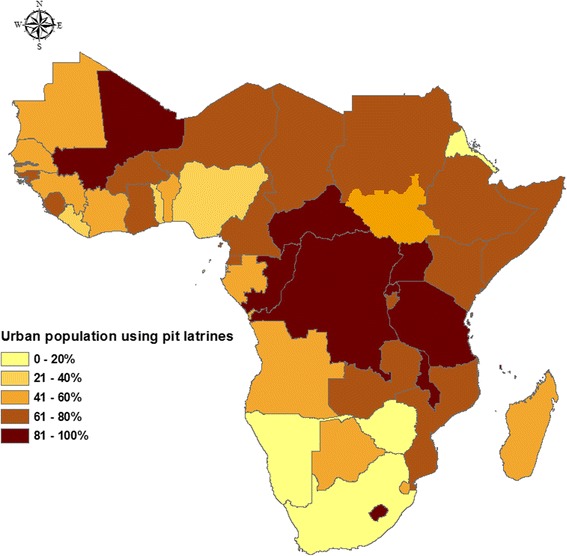
- The paper estimates that pit latrines provide sanitation for about 198 million (52.7%) of the urban population in SSA; in 2007 the figure was 65% or about 162 million people, so 36 million additional urban users adopted pit latrines since 2007.
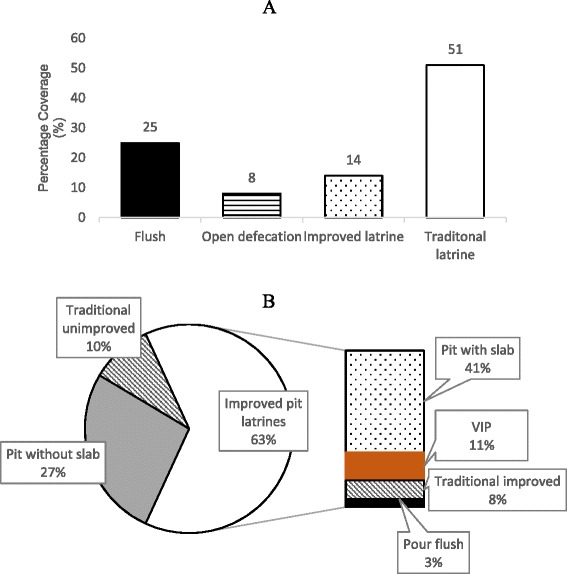
- Access to improved pit latrines in urban SSA is reported at about 63%, up from 14% in 2007; the commonest improved type is the simple pit latrine with a concrete slab, while VIP and pour-flush use remains low.
- The review says pit latrines are filling faster than expected; reported sludge accumulation/filling rates range from 40–90 ℓ/capita/year in proposed design values, with later studies reporting 25.5 ℓ/capita/year, 10–120.5 ℓ/capita/year, and even 1–264 ℓ/capita/year.
- Specific studies cited in the review found substantial filling problems: 35% abandoned because filled up in Kampala, 15% full and still in use there, 31% full in Ashanti (Ghana), and 40% full or nearly full in Dar es Salaam (Tanzania).
Methods
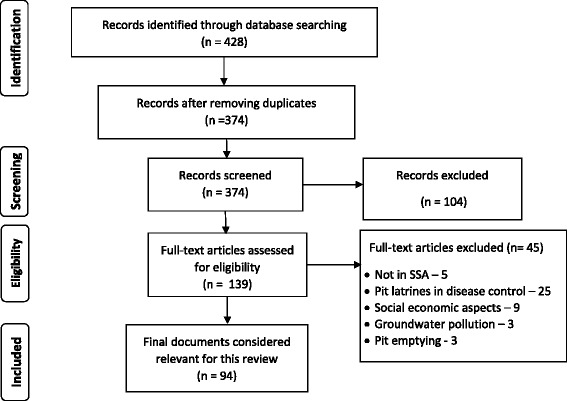
- This is a review paper combining a literature search with analysis of sanitation-coverage data; the authors state they followed PRISMA guidelines and searched Google, Google Scholar, and ScienceDirect with pit-latrine-related keywords.
- Urban SSA pit-latrine usage was calculated from JMP water and sanitation country files and WHO/UNICEF survey data; the paper also reviewed published and unpublished documents on usage, filling, smell, and insect nuisance.
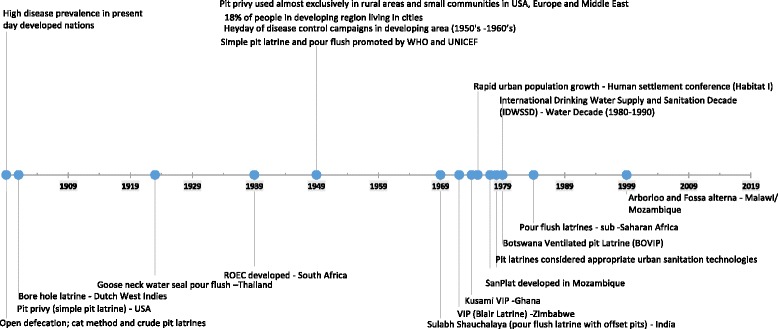
- The authors extracted findings from selected documents and discussed them qualitatively, including historical development, design types, and performance issues.
Limitations
- The paper states that research directly linking full pit latrines, smell, insect nuisance, disease, and health is limited.
- It also states that the actual composition of malodorous gases and the processes in pit latrines are not well understood, and that further research is still needed.
- Evident from the text: many conclusions are based on a narrative review of heterogeneous studies and secondary data rather than a single standardized empirical dataset, so comparisons across countries and studies are not fully uniform (said in the paper’s methods and shown by the varied sources).
Model-written summary. Check it against the paper before relying on it.
Integrity signals
Registry
Cites
Statistics
Figures
Verification
Claims the paper makes
15 Valid · 9 Not valid · 114 Not checked · 45 Own results and interpretations
At least one cited source doesn’t support this claim or points to a different paper, and none confirmed it — see the verdicts below.
In the paper
“A possible mass - volume reduction of 50–75 % [54] or up to 80 % [18, 67] after well-established degradation has been reported.”
§ Are pit latrines in urban areas of Sub-Saharan Africa performing? A review of usage, filling, insects and odour nuisances > Results and Discussion > Performance of pit latrines There is a clear link between proper excreta disposal and improved health [20]. The appropriateness of pit latrines at providing improved sanitation thus lies in its ability to safely dispose human excreta in such a way that there is minimal or no contact with humans. Furthermore, the excreta should not be accessible to insects or animals and the facility should be free from odours [18, 47]. Research directly linking full pit latrines, their smell and insect nuisances to disease and health is limited. However, it has been reported that full and/or over flowing improved pit latrines do not meet the criteria for hygienic, safe and sustainable sanitation systems [35]. It is not only difficult to use full or overflowing pit latrines as the waste splashes on to the users but also the excreta poses a health risk since it is in closer contact with humans. Additionally, smell and insects nuisances of pit latrine use are the main cause of disturbance of people who come in contact with them. In the past, smell and insects significantly affected the user satisfaction, although the problem did not impact on pit latrine use [19, 48]. More recently, bad smell has been frequently mentioned as a reason for dissatisfaction with shared toilets [40, 49], discouraging their use and subsequent use of polyethylene bags [37]. Foul smell has also been noted as a barrier for acquiring and using latrines [50]. Smell and insects have been associated with the hygienic nature of the pit latrine. For example, in a survey by IK Tumwebaze and H-J Mosler [51], respondents considered clean latrines as those free from smell and insects. The subsequent sections detail pit latrine performance in terms of filling, smell and insect nuisances.
What the sources say
- Not matchedcites [54] Bakare BF Scientific and management support for ventilated improved pit latrines (VIP) sludge content 2014 Durban University of KwaZulu Natal (UKZN)
We searched by its title and found no matching paper.
- Not checked — no full text of the sourcecites [18] Wagner EG Lanoix JN Excreta disposal for rural areas and small communities 1958 13581743 source
- Disputedcites [67] Zavala MAL, Funamizu N, Takakuwa T: Characterization of feces for describing the aerobic biodegradation of feces. J Environ Syst Eng, JSCE 2002;720/VII-25:99–105. sourceExperimental — accuracy not yet measured
The paper’s Additional information section reports that about 44% of total solids remained after biodegradation, implying about 56% solids-mass reduction—not 80%. Its Results and Discussion section identifies 80% as the slowly biodegradable fraction measured in COD terms, not a measured mass or volume reduction. No page numbers are available in our copy. (LLM, conf=0.84)
Checked by a reasoning model — may be wrong.
hedgedstates a possible cause- Asserted: passes — The authors put it forward as true.
- Checkable: passes — It can be checked against evidence.
- Load-bearing: unclear — It is unclear whether the paper’s conclusions depend on it.
- Based: passes — The paper gives a reason why it holds.
- Not matched
The cited sources support only part of this claim — read each source’s verdict below.
In the paper
“However, it has been reported that full and/or over flowing improved pit latrines do not meet the criteria for hygienic, safe and sustainable sanitation systems [35].”
§ Are pit latrines in urban areas of Sub-Saharan Africa performing? A review of usage, filling, insects and odour nuisances > Results and Discussion > Performance of pit latrines There is a clear link between proper excreta disposal and improved health [20]. The appropriateness of pit latrines at providing improved sanitation thus lies in its ability to safely dispose human excreta in such a way that there is minimal or no contact with humans. Furthermore, the excreta should not be accessible to insects or animals and the facility should be free from odours [18, 47]. Research directly linking full pit latrines, their smell and insect nuisances to disease and health is limited. However, it has been reported that full and/or over flowing improved pit latrines do not meet the criteria for hygienic, safe and sustainable sanitation systems [35]. It is not only difficult to use full or overflowing pit latrines as the waste splashes on to the users but also the excreta poses a health risk since it is in closer contact with humans. Additionally, smell and insects nuisances of pit latrine use are the main cause of disturbance of people who come in contact with them. In the past, smell and insects significantly affected the user satisfaction, although the problem did not impact on pit latrine use [19, 48]. More recently, bad smell has been frequently mentioned as a reason for dissatisfaction with shared toilets [40, 49], discouraging their use and subsequent use of polyethylene bags [37]. Foul smell has also been noted as a barrier for acquiring and using latrines [50]. Smell and insects have been associated with the hygienic nature of the pit latrine. For example, in a survey by IK Tumwebaze and H-J Mosler [51], respondents considered clean latrines as those free from smell and insects. The subsequent sections detail pit latrine performance in terms of filling, smell and insect nuisances.
What the sources say
- Partly supportedcites [35] Jenkins M Cumming O Scott B Cairncross S Beyond ‘improved’towards ‘safe and sustainable’urban sanitation: assessing the design, management and functionality of sanitation in poor communities of Dar es Salaam, Tanzania J Water Sanit Hyg Dev 2014 4 1 131 41 10.2166/washdev.2013.180 sourceExperimental — accuracy not yet measured
In “Access to safe and sustainable facilities” (page unavailable), the paper says flood-out drain pipes cause facilities to fail its hygienically safe and sustainable design criteria. Its functionality indicators also exclude completely full pits. But “Access to safe and sustainable sanitation systems” defines system access by facility design and access to safe emptying, with functionality assessed separately; the claim therefore overstates what a full pit alone means for system classification. (LLM, conf=0.83)
hedged- Asserted: passes — The authors put it forward as true.
- Checkable: passes — It can be checked against evidence.
- Load-bearing: passes — The paper’s conclusions depend on it.
- Based: passes — The paper gives a reason why it holds.
- Partly supported
The cited sources support only part of this claim — read each source’s verdict below.
In the paper
“M Jenkins, et al. [35] noted that 40 % of the latrines were full or nearly full in Dar es Salaam, Tanzania.”
§ Are pit latrines in urban areas of Sub-Saharan Africa performing? A review of usage, filling, insects and odour nuisances > Results and Discussion > Performance of pit latrines There is a clear link between proper excreta disposal and improved health [20]. The appropriateness of pit latrines at providing improved sanitation thus lies in its ability to safely dispose human excreta in such a way that there is minimal or no contact with humans. Furthermore, the excreta should not be accessible to insects or animals and the facility should be free from odours [18, 47]. Research directly linking full pit latrines, their smell and insect nuisances to disease and health is limited. However, it has been reported that full and/or over flowing improved pit latrines do not meet the criteria for hygienic, safe and sustainable sanitation systems [35]. It is not only difficult to use full or overflowing pit latrines as the waste splashes on to the users but also the excreta poses a health risk since it is in closer contact with humans. Additionally, smell and insects nuisances of pit latrine use are the main cause of disturbance of people who come in contact with them. In the past, smell and insects significantly affected the user satisfaction, although the problem did not impact on pit latrine use [19, 48]. More recently, bad smell has been frequently mentioned as a reason for dissatisfaction with shared toilets [40, 49], discouraging their use and subsequent use of polyethylene bags [37]. Foul smell has also been noted as a barrier for acquiring and using latrines [50]. Smell and insects have been associated with the hygienic nature of the pit latrine. For example, in a survey by IK Tumwebaze and H-J Mosler [51], respondents considered clean latrines as those free from smell and insects. The subsequent sections detail pit latrine performance in terms of filling, smell and insect nuisances.
What the sources say
- Partly supportedcites [35] Jenkins M Cumming O Scott B Cairncross S Beyond ‘improved’towards ‘safe and sustainable’urban sanitation: assessing the design, management and functionality of sanitation in poor communities of Dar es Salaam, Tanzania J Water Sanit Hyg Dev 2014 4 1 131 41 10.2166/washdev.2013.180 sourceExperimental — accuracy not yet measured
The Facility condition section reports that over 40% of facilities were full or nearly full. But the paper describes its study as covering some of Dar es Salaam’s poorest unplanned settlements, not latrines across the city as a whole. (LLM, conf=0.84)
plain- Asserted: passes — The authors put it forward as true.
- Checkable: passes — It can be checked against evidence.
- Load-bearing: unclear — It is unclear whether the paper’s conclusions depend on it.
- Based: passes — The paper gives a reason why it holds.
- Partly supported
The cited sources support only part of this claim — read each source’s verdict below.
In the paper
“Adult and larvae of Chrysomya putoria, Chrysomya marginalis, Musca spp, Lucilia cuprina, Sarcophaga spp have been reported [80–82].”
§ Are pit latrines in urban areas of Sub-Saharan Africa performing? A review of usage, filling, insects and odour nuisances > Results and Discussion > Performance of pit latrines There is a clear link between proper excreta disposal and improved health [20]. The appropriateness of pit latrines at providing improved sanitation thus lies in its ability to safely dispose human excreta in such a way that there is minimal or no contact with humans. Furthermore, the excreta should not be accessible to insects or animals and the facility should be free from odours [18, 47]. Research directly linking full pit latrines, their smell and insect nuisances to disease and health is limited. However, it has been reported that full and/or over flowing improved pit latrines do not meet the criteria for hygienic, safe and sustainable sanitation systems [35]. It is not only difficult to use full or overflowing pit latrines as the waste splashes on to the users but also the excreta poses a health risk since it is in closer contact with humans. Additionally, smell and insects nuisances of pit latrine use are the main cause of disturbance of people who come in contact with them. In the past, smell and insects significantly affected the user satisfaction, although the problem did not impact on pit latrine use [19, 48]. More recently, bad smell has been frequently mentioned as a reason for dissatisfaction with shared toilets [40, 49], discouraging their use and subsequent use of polyethylene bags [37]. Foul smell has also been noted as a barrier for acquiring and using latrines [50]. Smell and insects have been associated with the hygienic nature of the pit latrine. For example, in a survey by IK Tumwebaze and H-J Mosler [51], respondents considered clean latrines as those free from smell and insects. The subsequent sections detail pit latrine performance in terms of filling, smell and insect nuisances.
What the sources say
- Not checked — no full text of the sourcecites [80] Curtis C Hawkins PM Entomological studies of on-site sanitation systems in Botswana and Tanzania Trans R Soc Trop Med Hyg 1982 76 1 99 108 10.1016/0035-9203(82)90031-1 6123168 source
- Not checked — no full text of the sourcecites [81] Emerson PM Simms VM Makalo P Bailey RL Household pit latrines as a potential source of the fly Musca sorbens–a one year longitudinal study from The Gambia Trop Med Int Health 2005 10 7 706 9 10.1111/j.1365-3156.2005.01432.x 15960710 source
- Partly supportedcites [82] Lindsay TC Jawara M D’Alessandro U Pinder M Lindsay SW Development of odour-baited flytraps for sampling the African latrine fly, Chrysomya putoria, a putative vector of enteric diseases PLoS One 2012 7 11 e50505 10.1371/journal.pone.0050505 23226296 PMC3511572 sourceExperimental — accuracy not yet measured
The Results (page not available) report trap catches of all five named fly groups. But the Study Sites section describes field trapping, including at a communal open-defaecation area; the paper does not report larvae of these groups or establish that all five were found in pit latrines. (LLM, conf=0.89)
plain- Asserted: passes — The authors put it forward as true.
- Checkable: passes — It can be checked against evidence.
- Load-bearing: unclear — It is unclear whether the paper’s conclusions depend on it.
- Based: passes — The paper gives a reason why it holds.
Every source the paper cites for this claim was checked and supports it.
In the paper
“It was concluded that commercial pit latrine additives did not accelerate the rate of decomposition of pit latrine contents.”
§ Are pit latrines in urban areas of Sub-Saharan Africa performing? A review of usage, filling, insects and odour nuisances > Results and Discussion > Performance of pit latrines There is a clear link between proper excreta disposal and improved health [20]. The appropriateness of pit latrines at providing improved sanitation thus lies in its ability to safely dispose human excreta in such a way that there is minimal or no contact with humans. Furthermore, the excreta should not be accessible to insects or animals and the facility should be free from odours [18, 47]. Research directly linking full pit latrines, their smell and insect nuisances to disease and health is limited. However, it has been reported that full and/or over flowing improved pit latrines do not meet the criteria for hygienic, safe and sustainable sanitation systems [35]. It is not only difficult to use full or overflowing pit latrines as the waste splashes on to the users but also the excreta poses a health risk since it is in closer contact with humans. Additionally, smell and insects nuisances of pit latrine use are the main cause of disturbance of people who come in contact with them. In the past, smell and insects significantly affected the user satisfaction, although the problem did not impact on pit latrine use [19, 48]. More recently, bad smell has been frequently mentioned as a reason for dissatisfaction with shared toilets [40, 49], discouraging their use and subsequent use of polyethylene bags [37]. Foul smell has also been noted as a barrier for acquiring and using latrines [50]. Smell and insects have been associated with the hygienic nature of the pit latrine. For example, in a survey by IK Tumwebaze and H-J Mosler [51], respondents considered clean latrines as those free from smell and insects. The subsequent sections detail pit latrine performance in terms of filling, smell and insect nuisances.
What the sources say
- Supportedcites [71] Foxon K, Mkhize S, Reddy M, Buckley C. Laboratory protocols for testing the efficacy of commercial pit latrine additives. Water SA 2009, 35(2)228–35. source
The Conclusions state that treatment with commercial pit-latrine additives did not accelerate biodegradation or mass loss within pit-latrine contents. This directly supports the citing sentence as a summary of the paper’s conclusion. (LLM, conf=0.94)
boosted- Asserted: passes — The authors put it forward as true.
- Checkable: passes — It can be checked against evidence.
- Load-bearing: passes — The paper’s conclusions depend on it.
- Based: passes — The paper gives a reason why it holds.
- Supported
113 more claims · 6 with their cited sources checked
Create a free account to see all 183 claims and to verify the 49 references still open.
- Probably not a substantial claim. 45
- It may state two separate claims as one. 26
Citations
Cites
Preferred Reporting Items for Systematic Reviews and Meta-Analyses: the PRISMA statement
Moher, D., Liberati, A., Tetzlaff, J., Altman, D. G., & for the PRISMA Group (2009) · BMJ · doi:10.1136/bmj.b2535 · Cited by 83,823
Preferred reporting items for systematic reviews and meta-analyses: the PRISMA Statement.
(2009) · PubMed Central · Cited by 44,859
Preferred reporting items for systematic reviews and meta-analyses: The PRISMA statement
Moher, D., Liberati, A., Tetzlaff, J., Altman, D. G., & the PRISMA Group* (2009) · Annals of Internal Medicine · doi:10.7326/0003-4819-151-4-200908180-00135 · Cited by 37,554
Preferred Reporting Items for Systematic Reviews and Meta-Analyses: The PRISMA Statement
Moher, D., Liberati, A., Tetzlaff, J., & Altman, D. G. (2009) · Journal of Clinical Epidemiology · doi:10.1016/j.jclinepi.2009.06.005 · Cited by 19,575
Tsing, A. (2000) · Cultural Anthropology · doi:10.1525/can.2000.15.3.327 · Cited by 1,200
Sanitation and disease: Health aspects of excreta and wastewater management
Feachem, R., Bradley, D., Garelick, H., & Mara, D. (1983) · doi:10.1016/0043-1354(85)90337-9 · Cited by 1,014
Sanitation and disease: health aspects of excreta and wastewater management.
Feachem, R. G., Bradley, D. J., Garelick, H., & Mara, D. D. (1983) · Cited by 657
Chemical Ecology and Behavioral Aspects of Mosquito Oviposition
Bentley, M. D., & Day, J. F. (1989) · Annual Review of Entomology · doi:10.1146/annurev.en.34.010189.002153 · Cited by 588 · cited 1×
“Skatole (3-methylindole) Indole 4-metylindole have been cited as the most active pheromones attracting mosquitoes [102–105].”
Background(2008) · reroDoc Digital Library · Cited by 491
Pit Latrines and Their Impacts on Groundwater Quality: A Systematic Review
Graham, J. P., & Polizzotto, M. L. (2013) · Environmental Health Perspectives · doi:10.1289/ehp.1206028 · Cited by 431 · cited 1×
“77 billion use some form of pit latrine as their primary means of excreta disposal [12].”
BackgroundA comprehensive overview of elements in bioremediation
Juwarkar, A. A., Singh, S. K., & Mudhoo, A. (2010) · Reviews in Environmental Science and Bio/Technology · doi:10.1007/s11157-010-9215-6 · Cited by 364 · cited 1×
“However, the success in their application is strongly linked to the need for having the right organism biomass and optimization of the essential environmental factors as the environment should not deviate tremendously from the optimal growth range of the strain biomass in the inoculum [96, 97].”
BackgroundA review of microbiology in swine manure odor control
Zhu, J. (2000) · Agriculture, Ecosystems & Environment · doi:10.1016/s0167-8809(99)00116-4 · Cited by 250
Excreta disposal for rural areas and small communities
(1959) · Medical Journal of Australia · doi:10.5694/j.1326-5377.1959.tb88741.x · Cited by 245
Bartlett, S. (2008) · Environment and Urbanization · doi:10.1177/0956247808096125 · Cited by 203 · cited 1×
“Besides enforcement of sanitation policies is often lacking [106].”
Background(1992) · Medical Entomology and Zoology · Cited by 172
Sanitation and disease: Health aspects of excreta and wastewater management
Crowdy, J. P. (1984) · Transactions of the Royal Society of Tropical Medicine and Hygiene · doi:10.1016/0035-9203(84)90011-7 · Cited by 167
Environmental Biotechnology: Concepts and Applications
(2004) · Wiley eBooks · doi:10.1002/3527604286 · Cited by 159
The impact on health urban environments
Satterthwaite, D. (1993) · Environment and Urbanization · doi:10.1177/095624789300500208 · Cited by 136 · cited 1×
“Some types of mosquitoes especially Culex quinquefasciatus and species of Anopheles are known to breed in wet pits [84, 85].”
BackgroundEconomic Aspects of Sanitation in Developing Countries
Van Minh, H., & Hung, N. V. (2011) · Environmental Health Insights · doi:10.4137/ehi.s8199 · Cited by 128
Children first: the story of UNICEF, past and present
(1997) · Choice Reviews Online · doi:10.5860/choice.34-4791 · Cited by 123
Sanitation facilities in Kampala slums, Uganda: users' satisfaction and determinant factors
Tumwebaze, I. K., Orach, C. G., Niwagaba, C., Luthi, C., & Mosler, H.-J. (2013) · International Journal of Environmental Health Research · doi:10.1080/09603123.2012.713095 · Cited by 123
Self-citationCommunal sanitation alternatives for slums: A case study of Kibera, Kenya
Schouten, M. A. C., & Mathenge, R. W. (2010) · Physics and Chemistry of the Earth, Parts A/B/C · doi:10.1016/j.pce.2010.07.002 · Cited by 119 · cited 1×
“Biogas latrines have been installed as communal/public facilities in some areas of SSA [9, 10].”
BackgroundFaecal Sludge Management Systems
Strande, L., & Brdjanovic, D. (2014) · doi:10.26530/oapen_578132 · Cited by 113
Environmental biotechnology: concepts and applications
(2005) · Choice Reviews Online · doi:10.5860/choice.43-0342 · Cited by 101
Descending the sanitation ladder in urban Uganda: evidence from Kampala Slums
Kwiringira, J., Atekyereza, P., Niwagaba, C., & Günther, I. (2014) · BMC Public Health · doi:10.1186/1471-2458-14-624 · Cited by 96 · cited 3×
“More recently, bad smell has been frequently mentioned as a reason for dissatisfaction with shared toilets [40, 49], discouraging their use and subsequent use of polyethylene bags [37].”
BackgroundSelf-citationNavarro-Silva, M. A., Marques, F. A., & Duque L, J. E. (2009) · Revista Brasileira de Entomologia · doi:10.1590/s0085-56262009000100002 · Cited by 90 · cited 1×
“Skatole (3-methylindole) Indole 4-metylindole have been cited as the most active pheromones attracting mosquitoes [102–105].”
BackgroundKulabako, R. N., Nalubega, M., Wozei, E., & Thunvik, R. (2010) · International Journal of Environmental Health Research · doi:10.1080/09603120903545745 · Cited by 87 · cited 1×
“[108] Uganda <1 Low laying areas of peri-urban settlements in Kampala”
BackgroundSelf-citationAfrica's Water and Sanitation Infrastructure: Access, Affordability, and Alternatives
Banerjee, S. G., & Morella, E. (2011) · doi:10.1596/978-0-8213-8457-2 · Cited by 85 · cited 1×
“Sanitation provision in urban areas of SSA is predominantly on-site [5].”
BackgroundBlackwell, A., & Johnson, S. N. (2000) · Annals of Tropical Medicine & Parasitology · doi:10.1080/00034983.2000.11813554 · Cited by 83
Sustainable Environmental Protection Using Modified Pit-Latrines
Chaggu, E. J. (2004) · doi:10.18174/121533 · Cited by 81
Jenkins, M. W., Cumming, O., Scott, B., & Cairncross, S. (2014) · Journal of Water, Sanitation and Hygiene for Development · doi:10.2166/washdev.2013.180 · Cited by 81
Kwiringira, J., Atekyereza, P., Niwagaba, C., & Günther, I. (2014) · BMC Public Health · doi:10.1186/1471-2458-14-1180 · Cited by 76
Self-citationA Computer Model for Predicting Ammonia Release Rates from Swine Manure Pits
Zhang, R. H., Day, D. L., Christianson, L. L., & Jepson, W. P. (1994) · Journal of Agricultural Engineering Research · doi:10.1006/jaer.1994.1052 · Cited by 73 · cited 1×
“Household surveys have also reported addition of oil, kerosene, ash, soil, and disinfectants to control odour and insects [88–90].”
BackgroundA behavioural and electrophysiological study of ovi position cues for Culex quinquefasciatus
BLACKWELL1, A., (LUNTZ), A. J. M., HANSSON, B. S., WADHAMS, L. J., & PICKETT, J. A. (1993) · Physiological Entomology · doi:10.1111/j.1365-3032.1993.tb00607.x · Cited by 71
Winblad, U., & Kilama, W. L. (1980) · Medical Entomology and Zoology · Cited by 68
Learning what works : a 20 year retrospective view on international water and sanitation cooperation
Black, M. (1998) · Cited by 63
Ovipositional site selection by Anopheles gambiae : influences of substrate moisture and texture
Huang, J., Walker, E. D., Giroux, P. Y., Vulule, J., & Miller, J. R. (2005) · Medical and Veterinary Entomology · doi:10.1111/j.1365-2915.2005.00588.x · Cited by 61 · cited 1×
“The association arises because flies are attracted by the smell from the pits [18], while volatile compounds from pit latrines function as pheromones to attract gravid mosquitoes to suitable breeding sites [98–101].”
BackgroundShared toilet users’ collective cleaning and determinant factors in Kampala slums, Uganda
Tumwebaze, I. K., & Mosler, H.-J. (2014) · BMC Public Health · doi:10.1186/1471-2458-14-1260 · Cited by 58
Olagbemiro, T. O., Birkett, M. A., (Luntz), A. J. M., & Pickett, J. A. (2004) · Journal of Chemical Ecology · doi:10.1023/b:joec.0000028461.86243.19 · Cited by 53 · cited 1×
“The association arises because flies are attracted by the smell from the pits [18], while volatile compounds from pit latrines function as pheromones to attract gravid mosquitoes to suitable breeding sites [98–101].”
BackgroundPerformance of pit latrines in urban poor areas: A case of Kampala, Uganda
Nakagiri, A., Kulabako, R. N., Nyenje, P. M., Tumuhairwe, J. B., Niwagaba, C. B., & Kansiime, F. (2015) · Habitat International · doi:10.1016/j.habitatint.2015.07.005 · Cited by 52
Self-citation(1984) · Cited by 50
Pickford, J. (1995) · Practical Action Publishing eBooks · doi:10.3362/9781780445366 · Cited by 50 · cited 6×
“The use of inorganic and organic chemicals as larvicides and disinfectants like sodium fluosilicate, borax, paradichlorobenzene (PDB), orthodichlorobenzene (ODB), aldrin, BHC and DDT has been documented [17, 18, 86].”
BackgroundInfluentialEnvironmental History of Water - Global views on community water supply and sanitation
Juuti, P., Katko, T., & Vuorinen, H. (2015) · Water Intelligence Online · doi:10.2166/9781780402277 · Cited by 50 · cited 3×
“Wagner EG, Lanoix JN. Excreta disposal for rural areas and small communities.”
BackgroundInfluentialThe influence of thermal reaction and microbial transformation on the odour of human urine
Troccaz, M., Niclass, Y., Anziani, P., & Starkenmann, C. (2013) · Flavour and Fragrance Journal · doi:10.1002/ffj.3143 · Cited by 50 · cited 1×
“Fermenting urine resulting from enzymatic cleavage of urea by ureases has been noted to be representative of the smell found in public pit latrines [78, 79].”
BackgroundQualitative and Quantitative Analysis of Volatile Constituents from Latrines
Lin, J., Aoll, J., Niclass, Y., Velazco, M. I., Wünsche, L., Pika, J., & Starkenmann, C. (2013) · Environmental Science & Technology · doi:10.1021/es401677q · Cited by 48 · cited 3×
“[76] Durban VP dry pit Weak Sewage, phenol-like”
BackgroundMethodInfluentialModelling the filling rate of pit latrines
Brouckaert, C., Foxon, K., & Wood, K. (2013) · Water SA · doi:10.4314/wsa.v39i4.15 · Cited by 45 · cited 4×
“[63] using data from VIPs in South Africa, predicted that adding non-degradable material to the pit significantly influenced its filling.”
BackgroundMethodInfluentialChallenges with up-scaling dry sanitation technologies
Bhagwan, J. N., Still, D., Buckley, C., & Foxon, K. (2008) · Water Science and Technology · doi:10.2166/wst.2008.606 · Cited by 43 · cited 1×
“[110] 24.”
Sanitation survey of two urban slum Muslim communities in the Kumasi metropolis, Ghana
Adubofour, K., Obiri‐Danso, K., & Quansah, C. (2012) · Environment and Urbanization · doi:10.1177/0956247812468255 · Cited by 42 · cited 1×
“[109] Ghana (slums in Kusami metroplis) 4.”
Banks, I. (2014) · LSHTM Research Online (London School of Hygiene and Tropical Medicine) · doi:10.17037/pubs.01917781 · Cited by 41
(1982) · Medical Entomology and Zoology · Cited by 40
CHARACTERIZATION OF FECES FOR DESCRIBING THE AEROBIC BIODEGRADATION OF FECES
LOPEZ ZAVALA, M. A., FUNAMIZU, N., & TAKAKUWA, T. (2002) · Doboku Gakkai Ronbunshu · doi:10.2208/jscej.2002.720_99 · Cited by 40 · cited 1×
“A possible mass - volume reduction of 50–75 % [54] or up to 80 % [18, 67] after well-established degradation has been reported.”
BackgroundAccess, Affordability, and Alternatives : Modern Infrastructure Services in AfricaPreprint
Banerjee, S. G., Wodon, Q. T., Diallo, A., Pushak, T., Uddin, H., Tsimpo, C., & Foster, V. (2008) · RePEc: Research Papers in Economics · Cited by 39
Factors Associated With Pupil Toilet Use in Kenyan Primary Schools
Garn, J., Caruso, B., Drews-Botsch, C., Kramer, M., Brumback, B., Rheingans, R., & Freeman, M. (2014) · International Journal of Environmental Research and Public Health · doi:10.3390/ijerph110909694 · Cited by 39 · cited 1×
“[111] Kenyan schools Strong smell (25.”
Mboera, L. E. G., Mdira, K. Y., Salum, F. M., Takken, W., & Pickett, J. A. (1999) · Journal of Chemical Ecology · doi:10.1023/a:1020933800364 · Cited by 38 · cited 1×
“The association arises because flies are attracted by the smell from the pits [18], while volatile compounds from pit latrines function as pheromones to attract gravid mosquitoes to suitable breeding sites [98–101].”
BackgroundTumwebaze, I. K., Niwagaba, C. B., Günther, I., & Mosler, H.-J. (2014) · Habitat International · doi:10.1016/j.habitatint.2013.07.008 · Cited by 37
Self-citationNelson Ekane, N. E., Björn Nykvist, B. N., Marianne Kjellén, M. K., Stacey Noel, S. N., & Nina Weitz, N. W. (2014) · Waterlines · doi:10.3362/1756-3488.2014.024 · Cited by 37 · cited 2×
“One such case is Rwanda, where political will was successfully leveraged as all sanitation governance levels [45], and improved pit latrine coverage now stands at 82.”
BackgroundMboera, L. E. G., Takken, W., Mdira, K. Y., Chuwa, G. J., & Pickett, J. A. (2000) · Journal of Chemical Ecology · doi:10.1023/a:1005432010721 · Cited by 36 · cited 1×
“The association arises because flies are attracted by the smell from the pits [18], while volatile compounds from pit latrines function as pheromones to attract gravid mosquitoes to suitable breeding sites [98–101].”
BackgroundQuantitative Headspace Analysis of Selected Odorants from Latrines in Africa and India
Chappuis, C. J., Niclass, Y., Vuilleumier, C., & Starkenmann, C. (2015) · Environmental Science & Technology · doi:10.1021/acs.est.5b00692 · Cited by 35 · cited 1×
“[113] Nairobi Weak barnyard”
Entomological studies of on-site sanitation systems in Botswana and Tanzania
Curtis, C. F., & Hawkins, P. M. (1982) · Transactions of the Royal Society of Tropical Medicine and Hygiene · doi:10.1016/0035-9203(82)90031-1 · Cited by 33 · cited 13×
“This was because while both flies and mosquitoes were drawn to odour sources in pit latrines, [80] the latter have a positive phototropism and fly only towards light [18].”
BackgroundInfluentialEmerson, P. M., Simms, V. M., Makalo, P., & Bailey, R. L. (2005) · Tropical Medicine & International Health · doi:10.1111/j.1365-3156.2005.01432.x · Cited by 33
(1995) · OpenGrey (Institut de l'Information Scientifique et Technique) · Cited by 30
Diarrheal Disease Control by Improved Human Excreta Disposal
McCabe, L. J., & Haines, T. W. (1957) · Public Health Reports (1896-1970) · doi:10.2307/4589937 · Cited by 29 · cited 1×
“The use of inorganic and organic chemicals as larvicides and disinfectants like sodium fluosilicate, borax, paradichlorobenzene (PDB), orthodichlorobenzene (ODB), aldrin, BHC and DDT has been documented [17, 18, 86].”
BackgroundLindsay, T. C., Jawara, M., D’Alessandro, U., Pinder, M., & Lindsay, S. W. (2012) · PLoS ONE · doi:10.1371/journal.pone.0050505 · Cited by 28 · cited 1×
“Traps placed over the squatting plate hole have also been developed and experimented with success at controlling insects in pit latrines [82].”
BackgroundSmell: an overlooked factor in sanitation promotion
Thilde Rheinländer, T. R., Bernard Keraita, B. K., Flemming Konradsen, F. K., Helle Samuelsen, H. S., & Anders Dalsgaard, A. D. (2013) · Waterlines · doi:10.3362/1756-3488.2013.012 · Cited by 27 · cited 1×
“Foul smell has also been noted as a barrier for acquiring and using latrines [50].”
BackgroundAppropriate technology for water supply and sanitation : a summary of technical and economic options
Kalbermatten, J. M. (1980) · Cited by 25
Appiah-Effah, E., Nyarko, K. B., Gyasi, S. F., & Awuah, E. (2014) · Journal of Water, Sanitation and Hygiene for Development · doi:10.2166/washdev.2014.126 · Cited by 24 · cited 2×
“[57] Ghana (Ashanti region) 6–10 Low income area in Ashanti region Nakagiri et al.”
BackgroundScientific and management support for ventilated improved pit latrines (VIP) sludge content.
Bakare, B. F. (2014) · ResearchSpace (University of KwaZulu-Natal) · Cited by 22
Trends In Household Coverage Of Modern Infrastructure Services In Africa
Diallo, A., Banerjee, S., Foster, V., & Wodon, Q. (2009) · doi:10.1596/1813-9450-4880 · Cited by 21
Assessing sanitation service levels
Potter, A., Klutsé, A., Batchelor, C., et al. (2010) · Cited by 21
Modelling the fill rate of pit latrines in Ifakara, Tanzania
Todman, L. C., van Eekert, M. H. A., Templeton, M. R., Hardy (née Kelly), M., Gibson, W. T., Torondel, B., Abdelahi, F., & Ensink, J. H. J. (2015) · Journal of Water, Sanitation and Hygiene for Development · doi:10.2166/washdev.2014.082 · Cited by 19
Günther, I., Horst, A. C., Niwagaba, C. B., Lühti, C., Horst, A., Mosler, H., & Tumwebaze, I. K. (2012) · Munich Personal RePEc Archive (Ludwig Maximilian University of Munich) · doi:10.13140/rg.2.2.10422.09288 · Cited by 18
Self-citationCharacteristics of Latrines in Central Tanzania and Their Relation to Fly Catches
Irish, S., Aiemjoy, K., Torondel, B., Abdelahi, F., & Ensink, J. H. J. (2013) · PLoS ONE · doi:10.1371/journal.pone.0067951 · Cited by 18 · cited 2×
“[83] identified members of Psychodidae, Culicidae, Calliphoridae, Syrphidae, Stratiomyidae, Sarcophagidae families from pit latrines in central Tanzania.”
BackgroundLaboratory protocols for testing the efficacy of commercial pit latrine additives
Foxon, K., Mkhize, S., Reddy, M., & Buckley, C. (2012) · Water SA · doi:10.4314/wsa.v35i2.76759 · Cited by 16 · cited 2×
“[71] South Africa additives Laboratory experiments on pit latrine samples No statistically significant effect on rate of mass loss”
Background(2011) · Munich Personal RePEc Archive (Ludwig Maximilian University of Munich) · Cited by 15
Self-citation(2012) · Cited by 15
Sanitation technology options for developing countries (with special reference to Africa)
Iwugo, K. (1981) · Public Health · doi:10.1016/s0033-3506(81)80070-4 · Cited by 14
Lindsay, T. C., Jawara, M., D'Alessandro, U., Pinder, M., & Lindsay, S. W. (2013) · Tropical Medicine & International Health · doi:10.1111/tmi.12033 · Cited by 12 · cited 1×
“Pyriproxyfen, an insect juvenile hormone, and local soap have been found to reduce flies in pit latrines [92].”
BackgroundAppropriate technology for water supply and sanitation. A planner's guide.
Kalbermatten, J. M., & Julius, D. S. (1980) · Cited by 12
Low-Cost Technology Options for Sanitation: A State-Of-The-Art Review and Annotated Bibliography
Rybczynski, W., Polprasert, C., & McGarry, M. (1979) · Cited by 11
(2005) · PubMed · Cited by 11
(1998) · Loughborough University Institutional Repository (Loughborough University) · Cited by 11
Carlberg, G., Kihamia, C. M., & Minjas, J. (1985) · MIRCEN Journal of Applied Microbiology and Biotechnology · doi:10.1007/bf01748152 · Cited by 9 · cited 1×
“Muscabac, a Bacillus thuringiensis preparation containing exotoxin, was tested and showed reasonably good control of flies in latrines in a tropical environment [87].”
BackgroundAppropriate technology for water supply and sanitation : a sanitation field manual
Kalbermatten, J. M. (1980) · Cited by 9
Afful, K., Oduro–Kwarteng, S., & Awuah, E. (2015) · Journal of Water Sanitation and Hygiene for Development · doi:10.2166/washdev.2015.104 · Cited by 7 · cited 1×
“[112] Kusumi, Ghana Extremely annoying (69 no)”
Comparing National Sanitation Policy Content: An initial review of nine country profiles.
Wedc (2005) · Cited by 5
(1998) · Loughborough University Institutional Repository (Loughborough University) · Cited by 5
Performance evaluation of VIP latrines in the Upper West Region of Ghana
Dumpert, J. (2008) · Digital Commons - Michigan Tech (Michigan Technological University) · doi:10.37099/mtu.dc.etds/514 · Cited by 3 · cited 2×
“Dumpert JW. Performance Evaluation of VIP Latrines in the Upper West Region of Ghana.”
Rural ventilated improved pit latrines : a field manual for Botswana
van Nostrand, & Wilson, J. W. (1983) · Cited by 1
On-plot sanitation in urban areas
(1999) · Waterlines · doi:10.3362/0262-8104.1999.032 · Cited by 1
(1987) · PubMed
Research works printed but not linked: 22
- Jha P Recycling and reuse of human excreta from public toilets through biogas generation to improve sanitation, community health and environment 2005 India Sulabh International
- WSP. A review of EcoSan experience in eastern and southern Africa. Field Note. In. Nairobi, Kenya: Water and Sanitation Program (WSP), World Bank; 2005.
- Pickford J Low-Cost Sanitation. A survey of practical experience 2006 London ITDG Publishing
- Thrift C Sanitation policy in Ghana: Key factors and the potential for ecological sanitation solutions 2007 Stockholm Stockholm Environment Institute
- Solsona F The South African Sanplat. An alternative low-cost pit latrine system for rural and peri-urban areas. Technical guide 1995 South Africa CSIR Pretoria
- Morella E Foster V Banerjee SG Climbing the Ladder: The State of Sanitation in Sub-Saharan Africa 2008 Washington, DC The World Bank
- Kariuki M Collignon B Taisne R Valfrey B Plummer J Better Water and Sanitation for the Urban Poor: Good Practice from Sub-Saharan Africa 2003 Kenya Water utility partnership for capacity building (WUP) Africa
- WIN-SA, WRC. What Happens When the pit is full? Developments in on-site faecal sludge management (FSM). In: 1st faecal sludge management conference. Durban, South Africa: Water Information Network South Africa/Water Research Commission; 2011.
- Morgan P Ecological Toilets: Start Simple and Upgrade from Arborloo to VIP EcoSanRes Programme 2009 Stockholm Stockholm Environment Institute
- Macleod N WIN-SA, WRC Opening address and introduction What happens when the pit is full? Developments in on-site Faecal Sludge Management (FSM) 2011 South Africa WIN-SA. WRC
- Still DA After the pit latrine is fill … What then? Effective options for pit latrine management WISA Biennial Conference 19–23 May: 2002 2002 Durban Water Institute of Southern Africa (WISA)
- Buckley CA Foxon KM Brouckaert CJ Rodda N Nwaneri CF Balboni E Scientific support for the design and operation of ventilated improved pit latrines (VIPS) and the efficacy of pit latrine addtives. In 2008 South Africa Water Research Commission
- Torondel B. Sanitation Ventures Literature Review: on-site sanitation waste characteristics. In. London, UK: London School of Hygiene & Tropical Medicine; 2010.
- Taljaard L Venter A Gorton D Commission SAWR An Evaluation of Different Commercial Microbial Or Microbially-derived Products for the Treatment of Organic Waste in Pit Latrines: Water Research Commission 2003
- Kassam FF Assessment of the performance of a novel, on-site, worm based sanitation system for peri-urban environments Civil and Environmental Engineering Student Conference 25–26 June: 2012 2012 London Imperial College London
- Lin J, Aoll J, Niclass Y, Velazco MI, Wünsche L, Pika J, et al. Qualitative and Quantitative Analysis of Volatile Constituents from Latrines: Supporting Information. Environ Sci Technol. 2013;47(14):7876–82. available at http://pubs.acs.org/doi/suppl/7810.1021/es401677q/suppl_file/es401677q_si_401001.pdf accessed August 4 2013. 23829328 · doi:10.1021/es401677q/suppl_file/es401677q_si_401001.pdf
- Curtis C. Alternatives to conventional insecticides for urban vector and pest control. In: Proceedings of the First International Conference on Insect Pests in the Urban Environment 1993; Cambridge; 1993.
- Nwaneri CF. Physico-chemical charactristics and biodegradibility of contents of ventilated improved pit latrines (VIPs) in eThekwini Municipality. In. South Africa; Master's Thesis: University of KwaZulu-Natal; 2009.
- Nwaneri CF Foxon KM Bakare BF Buckley CA Biological degradation processes within a pit latrine WISA Biennial Conference & Exhibition 18–22 May 2008 2008 Sun City Water Institute of Southern Africa (WISA)
- Ryan BA, Mara DD, Mundial B. Pit latrine ventilation; field investigation methodology. TAG Technical Note. vol. 4. In. Washington, DC: World Bank; 1983.
- Morgan PR, Mara DD, Mundial B. Ventilated improved pit-latrines: recent development in Zimbabwe (Technical Note No. 2) vol. 3. In. Washington, D.C: World Bank; 1982.
- Still DA, Foxon K. Tackling the challenges of full pit latrines. Volume 1: Understanding sludge accumulation in VIPs and strategies for emptying full pits In., vol. 1. South Africa: WRC; 2012.
Cited by
The history, geography, and sociology of slums and the health problems of people who live in slums
Ezeh, A., Oyebode, O., Satterthwaite, D., Chen, Y.-F., Ndugwa, R., Sartori, J., Mberu, B., Melendez-Torres, G. J., Haregu, T., Watson, S. I., et al. (2017) · The Lancet · doi:10.1016/s0140-6736(16)31650-6 · Cited by 769
Improving the health and welfare of people who live in slums
Lilford, R. J., Oyebode, O., Satterthwaite, D., Melendez-Torres, G. J., Chen, Y.-F., Mberu, B., Watson, S. I., Sartori, J., Ndugwa, R., Caiaffa, W., et al. (2017) · The Lancet · doi:10.1016/s0140-6736(16)31848-7 · Cited by 305
“12 congested slum neighbourhoods.(59) Where adequately quality assured piped water cannot be 302”
Strande, L., Schoebitz, L., Bischoff, F., Ddiba, D., Okello, F., Englund, M., Ward, B. J., & Niwagaba, C. B. (2018) · Journal of Environmental Management · doi:10.1016/j.jenvman.2018.06.100 · Cited by 120
Self-citationStructural Injustice: Power, Advantage, and Human Rights
Powers, M., & Faden, R. (2019) · doi:10.1093/oso/9780190053987.001.0001 · Cited by 176
Wastewater surveillance for Covid-19: An African perspective
Street, R. A., Malema, S., Mahlangeni, N. T., & Mathee, A. (2020) · The Science of The Total Environment · doi:10.1016/j.scitotenv.2020.140719 · Cited by 112
Metadata
- Authors
- Nakagiri, A., Niwagaba, C. B., Nyenje, P. M., Kulabako, R. N., Tumuhairwe, J. B., & Kansiime, F.
- Affiliations
- Makerere University (UG)
- Corresponding author
- Nakagiri, Anne
- Venue
- BMC Public Health
- Published
- 2015-12
- Volume
- 16
- Issue
- 1
- Pages
- 120-120
- ISSN
- 1471-2458 (ISSN-L)
- PMC
- PMC4743102
- OpenAlex
- W2258981829
- Cited by
- 133
- References
- 95
- Citations by year
- 2026: 6 · 2025: 13 · 2024: 13 · 2023: 15 · 2022: 10 · 2021: 15 · 2020: 14 · 2019: 22 · 2018: 10 · 2017: 9 · 2016: 4
- FWCI
- 5.35
- Type
- journal article
- Language
- en
- Open access
- gold
- doi.org
- Licence
- cc-by
- creativecommons.org/licenses/by/4.0/ (tdm)
- creativecommons.org/licenses/by/4.0/ (vor, 65 d)
- Locations
- BMC Public Health (publishedVersion, cc-by)
- PubMed (publishedVersion)
- PubMed Central (submittedVersion, cc-by)
- Funders
- Bill and Melinda Gates Foundation (OPP1029019)
- Topics
- Health Sciences › Nursing › Nutrition and Dietetics › Child Nutrition and Water Access
- Health Sciences › Medicine › Public Health, Environmental and Occupational Health › Global Health and Epidemiology
- Life Sciences › Immunology and Microbiology › Microbiology › Vibrio bacteria research studies
- Keywords
- pit latrines, urban sanitation, sub-Saharan Africa, odour nuisance, low-income populations
- MeSH terms
- Animals, Humans, Hygiene, Insecta, Odorants, Socioeconomic Factors, Toilet Facilities, Urban Population, Africa South of the Sahara
About these checks
Registry, retraction, Cites and statistics results are computed, not judged, with one exception: a printed reference that no index lists is read once by a model before it counts as a citation error. Claims are extracted by a model and kept only when their quote appears verbatim in the text; each cited source is then checked, with a model’s help, for whether it says what the claim relies on. Those verdicts can be wrong — read the claim’s quote and the cited source before relying on one.
The claim verdicts this report counts are experimental: their accuracy is not yet measured.
A language model drew the claims from the paper on 2026-10-11, under version 3 of the claim definition (model deepseek-v4.1-flash, prompt extract-v3).
A second model labelled each claim on 2026-10-11 (model jev-1.13-20260917, definition revision gold-guideline-v0.2).
Cited sources are checked with a language model’s help (gpt-6-sol).
Statistics and arithmetic are recomputed, not judged.
Confidence bands are shown only for fields calibrated on our annotated test set. None is calibrated yet, so no band is shown.
What counts as a claim ›How we measure confidence ›How we check this ›
Are you an author, or do you see a problem with this page? Request a review
Data sources
Bibliographic data: Semantic Scholar, OpenAlex, Crossref.
Contains information from the Semantic Scholar Academic Graph Datasets, made available under the ODC Attribution License (ODC-BY 1.0).
Semantic Scholar’s data is described in: Kinney, R., et al. (2023). The Semantic Scholar Open Data Platform. arXiv:2301.10140.
