

Leading the charge in the education sector: development and validation of the School Implementation Leadership Scale (SILS)
Open accessPublished version of a preprint
The DOI matches its Crossref record; 91 of the 94 references it cites were found in a registry or an index, and 3 are not checked yet; 31 of the 60 sources its claims cite were checked for support.
Abstract
Strategic implementation leadership is a critical determinant of successful implementation, hypothesized to create a more supportive implementation climate conducive to the adoption and use of evidence-based practices. The current study adapted and validated the School Implementation Leadership Scale (SILS) (based on the Implementation Leadership Scale) in public school settings, demonstrating its utility in evaluating and supporting school leadership behavior for implementation.
Verified 2026-11-22 · 3 references not checked yet
Overview
CoChat Summary
## TL;DR
The study adapted and validated the 21-item School Implementation Leadership Scale (SILS) for elementary school settings using data from 441 teachers in 52 schools across 6 districts. The final 7-factor scale showed strong structural, convergent, and divergent validity for measuring strategic implementation leadership for school-based mental health prevention programs.
## Key findings
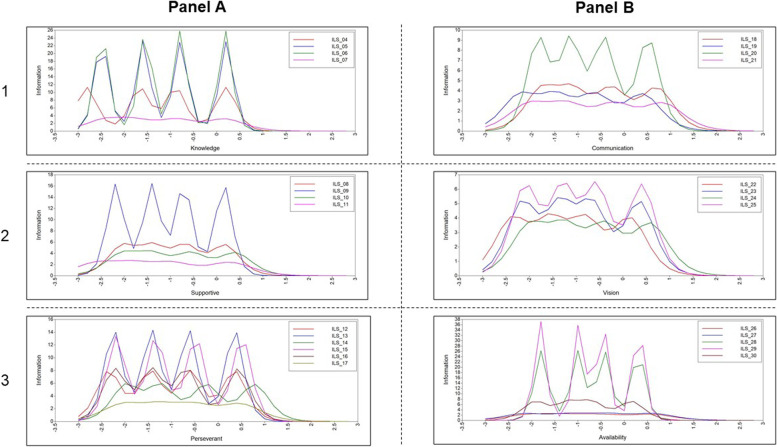
- Item reduction from the initial 30-item revision yielded a 21-item instrument with 7 subscales of 3 items each; 5 items were dropped from the original four subscales and 4 from the added subscales.
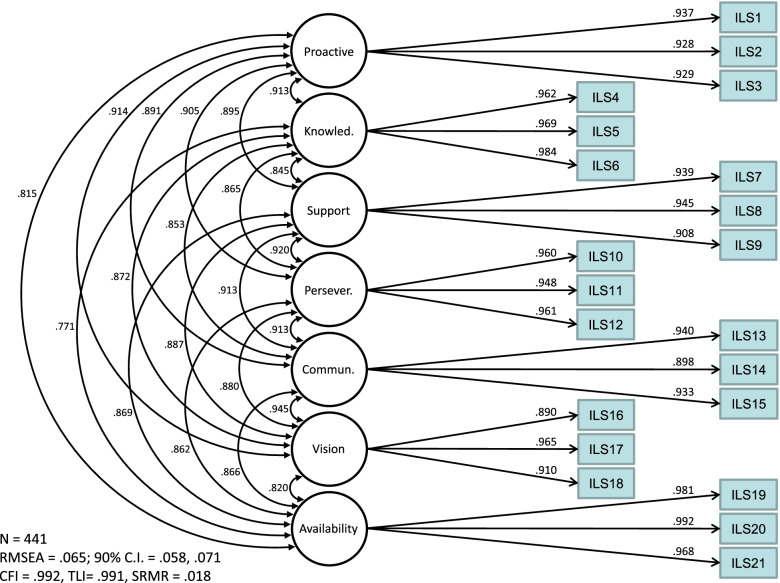
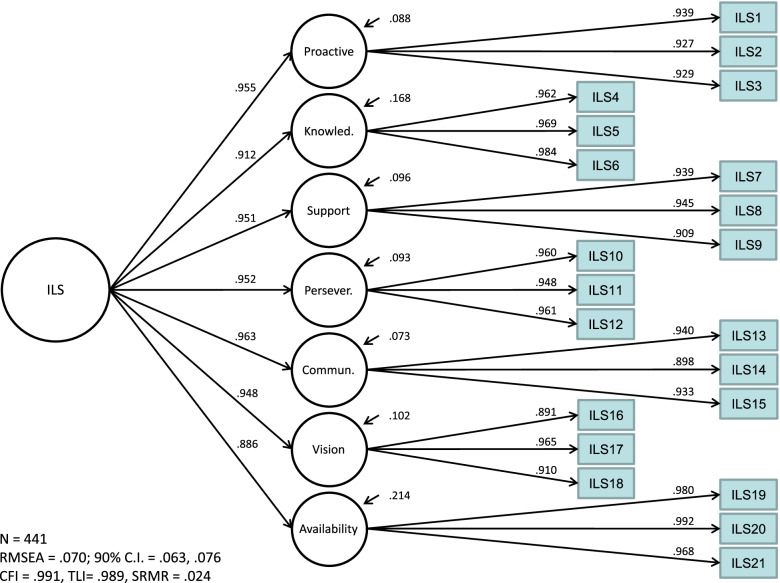
- The reduced model fit well: CFI = .99, TLI = .99, RMSEA = .07, SRMR = .02; second-order factor loadings were high (λ = .89 to .96), supporting a higher-order implementation leadership factor.
- Internal consistency was strong across subscales, with α = .91–.96.
- Validity evidence matched expectations: SILS subscales correlated moderately to highly with general leadership measures (r = .56–.80), moderately with teaching attitudes (r = .36–.44), and weakly with school demographics (r = −.31 to .22); management-by-exception showed low to near-zero correlations (r = .05–.12).
## Methods
- The authors adapted the original Implementation Leadership Scale for schools, adding new items for communication, vision/mission, and availability, then administered a survey to teachers in elementary schools implementing SWPBIS or PATHS.
- Sample: 441 public school teachers from 52 elementary schools in 6 districts in Washington, Ohio, and Illinois; about 88% of 500 contacted teachers completed the online survey.
- Main analyses: item characteristic curve analysis for item reduction, confirmatory factor analysis in Mplus v8 for structural validity, multigroup models for invariance across general vs intervention-specific item referents, and correlations for convergent/divergent validity.
## Limitations
- The paper states that a larger number of participants implemented SWPBIS than PATHS, so future studies should expand testing across more programs.
- It notes the need for future research on predictive validity with implementation climate and outcomes such as fidelity, and on including informal leaders; it also says the study was not sufficiently powered to rigorously examine the measurement model at the school level.
- Evident from the text: missing data were present and sometimes reduced the number of participants in analyses (<5% overall).
Model-written summary. Check it against the paper before relying on it.
Integrity signals
Registry
Cites
Statistics
Figures
Verification
Claims the paper makes
17 Valid · 2 Not valid · 11 Not checked · 60 Own results and interpretations
Every source the paper cites for this claim was checked and supports it.
In the paper
“In pursuit of this objective, Lyon and colleagues conducted an initial adaptation of the ILS for use with mental and behavioral health consultants in the education sector [66].”
§ Leading the charge in the education sector: development and validation of the School Implementation Leadership Scale (SILS) > Introduction > Implementation leadership in schools
What the sources say
- Supportedcites [66] Lyon AR Cook CR Brown EC Locke J Davis C Ehrhart M Assessing organizational implementation context in the education sector: confirmatory factor analysis of measures of implementation leadership, climate, and citizenship Implement Sci 2018 13 1 5 10.1186/s13012-017-0705-6 29310673 PMC5759223 source
The Study aims section says the authors evaluated adapted versions of the ILS through large-scale administration to school-based behavioral health consultants. The Measures section confirms that the ILS items were adapted for the school context. Page numbers are not provided in our copy. (LLM, conf=0.94)
plain- Asserted: passes — The authors put it forward as true.
- Checkable: passes — It can be checked against evidence.
- Load-bearing: passes — The paper’s conclusions depend on it.
- Based: passes — The paper gives a reason why it holds.
- Supported
The sources with a verdict support this claim; the rest weren’t checked yet, have no full text we could read, or their verdicts aren’t rated yet.
In the paper
“Subsequent studies have begun this work, including successful validation of the instrument in child welfare [30], substance use treatment [31], and acute care [32];”
§ Leading the charge in the education sector: development and validation of the School Implementation Leadership Scale (SILS) > Introduction > Organizational leadership for implementation
What the sources say
- Not checked — no full text of the sourcecites [30] Finn NK Torres EM Ehrhart MG Roesch SC Aarons GA Cross-validation of the implementation leadership scale (ILS) in child welfare service organizations Child Maltreat 2016 21 3 250 255 10.1177/1077559516638768 27002137 source
- Supportedcites [31] Aarons GA Ehrhart MG Torres EM Finn NK Roesch SC Validation of the implementation leadership scale (ILS) in substance use disorder treatment organizations J Subst Abus Treat 2016 68 31 35 10.1016/j.jsat.2016.05.004 PMC5349507 27431044 source
Citation [31] is attached to validation in substance use treatment, not the separate child-welfare or acute-care claims. The Abstract reports that the ILS factor structure, reliability, and validity were supported in alcohol and other drug use treatment agencies; the Discussion reiterates this finding. (LLM, conf=0.94)
- Supportedcites [32] Shuman CJ Ehrhart MG Torres EM Veliz P Kath LM VanAntwerp K EBP implementation leadership of frontline nurse managers: validation of the implementation leadership scale in acute care Worldviews Evid-Based Nurs 2020 17 1 82 91 10.1111/wvn.12402 31638315 source
The citation [32] is offered for the acute-care validation, and our copy is exactly that study: the Original Article (p. title/abstract) states the purpose was to evaluate the ILS's psychometric properties in acute care settings with direct-care RNs, using two independent samples (Methods, Design), and the Psychometric Findings and Abstract report strong first- and second-order factor structure (loadings >= .83, CFI .978/.986), reliability (alpha .91-.98) and unit-level agreement, concluding 'strong evidence supporting the validity and reliability of the ILS ... in acute care.' The child-welfare and substance-use validations are attributed to other works cited by this paper (Finn et al., 2016; Aarons et al., 2017), not to it, so they fall outside what this citation carries. (LLM, conf=0.92)
boosted- Asserted: passes — The authors put it forward as true.
- Checkable: passes — It can be checked against evidence.
- Load-bearing: unclear — It is unclear whether the paper’s conclusions depend on it.
- Based: passes — The paper gives a reason why it holds.
Every source the paper cites for this claim was checked and supports it.
In the paper
“Findings provided strong support for the original ILS factor structure with this new population.”
§ Leading the charge in the education sector: development and validation of the School Implementation Leadership Scale (SILS) > Introduction > Implementation leadership in schools
What the sources say
- Supportedcites [66] Lyon AR Cook CR Brown EC Locke J Davis C Ehrhart M Assessing organizational implementation context in the education sector: confirmatory factor analysis of measures of implementation leadership, climate, and citizenship Implement Sci 2018 13 1 5 10.1186/s13012-017-0705-6 29310673 PMC5759223 source
The Method (Abstract) identifies the new population as school-based mental/behavioral health consultants. The Results (Confirmatory factor analyses, ILS) report large, significant loadings for the four theorized ILS factors and strong fit statistics, supporting the original factor structure in that population. (LLM, conf=0.92)
boostedstates an association- Asserted: passes — The authors put it forward as true.
- Checkable: passes — It can be checked against evidence.
- Load-bearing: passes — The paper’s conclusions depend on it.
- Based: passes — The paper gives a reason why it holds.
- Supported
The cited sources support only part of this claim — read each source’s verdict below.
In the paper
“Rigorous assessment of implementation leadership is critical to inform implementation research and practice in this domain as recent studies have shown that implementation leadership is a malleable organizational characteristic [28].”
§ Leading the charge in the education sector: development and validation of the School Implementation Leadership Scale (SILS) > Introduction > Organizational leadership for implementation
What the sources say
- Partly supportedcites [28] Aarons GA Ehrhart MG Moullin JC Torres EM Green AE Testing the leadership and organizational change for implementation (LOCI) intervention in substance abuse treatment: A cluster randomized trial study protocol Implement Sci 2017 12 1 29 10.1186/s13012-017-0562-3 28253900 PMC5335741 sourceExperimental — accuracy not yet measured
The Background’s Preliminary studies section reports that a small LOCI pilot found change in leadership behavior, and the LOCI development section describes improving implementation leadership as an intervention goal (page numbers unavailable). This supports the idea that leadership can change, but the paper is a study protocol and does not report a demonstrated change specifically in implementation leadership. (LLM, conf=0.83)
boosted- Asserted: passes — The authors put it forward as true.
- Checkable: passes — It can be checked against evidence.
- Load-bearing: passes — The paper’s conclusions depend on it.
- Based: passes — The paper gives a reason why it holds.
- Partly supported
The cited sources support only part of this claim — read each source’s verdict below.
In the paper
“However, EBP are inconsistently adopted, delivered with fidelity, or sustained over time in schools [5, 6].”
§ Leading the charge in the education sector: development and validation of the School Implementation Leadership Scale (SILS) > Introduction
What the sources say
- Partly supportedcites [5] Lyon AR Bruns EJ From evidence to impact: Joining our best school mental health practices with our best implementation strategies Sch Ment Heal 2019 11 1 106 114 10.1007/s12310-018-09306-w PMC6839825 31709018 sourceExperimental — accuracy not yet measured
The section “Viewing School Mental Health Interventions through an Implementation Lens” describes inadequate implementation support in schools and a need to improve adherent uptake of research-based practices. The Conclusion also reports that many EBP implementation efforts fail. These passages support inconsistent adoption and fidelity, but they do not establish that school-based EBPs are inconsistently sustained over time; no page numbers are available in our copy. (LLM, conf=0.82)
- Supportedcites [6] Owens JS Lyon AR Brandt NE Masia Warner C Nadeem E Spiel C Implementation science in school mental health: Key constructs in a developing research agenda Sch Ment Heal 2014 6 2 99 111 10.1007/s12310-013-9115-3 PMC4580252 26413173 source
The Abstract (page not available in our copy) describes limited use of EBPs by school mental health providers and wide variability in the dose and integrity of implementation. The Intervention Integrity section reports variable adherence that declines without ongoing support, while the Sustainment section explains that improvements may be transitory even after successful implementation. (LLM, conf=0.90)
plain- Asserted: passes — The authors put it forward as true.
- Checkable: passes — It can be checked against evidence.
- Load-bearing: passes — The paper’s conclusions depend on it.
- Based: passes — The paper gives a reason why it holds.
- Partly supported
52 more claims · 3 with their cited sources checked
Create a free account to see all 90 claims and to verify the 3 references still open.
- Probably not a substantial claim. 12
- It may state two separate claims as one. 21
Citations
Cites
Hu, L., & Bentler, P. M. (1999) · Structural Equation Modeling A Multidisciplinary Journal · doi:10.1080/10705519909540118 · Cited by 108,788
Statistical Power Analysis for the Behavioral Sciences
Muller, K. (1989) · Technometrics · doi:10.1080/00401706.1989.10488618 · Cited by 99,167
Tabachnick, B. G., & Fidell, L. S. (1983) · Cited by 80,058
Testing Structural Equation Models.
Mueller, C. W., Bollen, K. A., & Long, J. S. (1994) · Contemporary Sociology · doi:10.2307/2074955 · Cited by 14,120
Proctor, E., Silmere, H., Raghavan, R., Hovmand, P., Aarons, G., Bunger, A., Griffey, R., & Hensley, M. (2011) · Administration and Policy in Mental Health and Mental Health Services Research · doi:10.1007/s10488-010-0319-7 · Cited by 8,721
Self-citationA Reliability Coefficient for Maximum Likelihood Factor Analysis
Tucker, L. R., & Lewis, C. (1973) · Psychometrika · doi:10.1007/bf02291170 · Cited by 7,330
Durlak, J. A., & DuPre, E. P. (2008) · American Journal of Community Psychology · doi:10.1007/s10464-008-9165-0 · Cited by 5,304
National Center for Education Statistics
(2008) · Encyclopedia of Educational Psychology · doi:10.4135/9781412963848.n192 · Cited by 4,546
Organizational culture and leadership
Tohidi, H., & Jabbari, M. M. (2012) · Procedia - Social and Behavioral Sciences · doi:10.1016/j.sbspro.2011.12.156 · Cited by 4,303
Advancing a Conceptual Model of Evidence-Based Practice Implementation in Public Service Sectors
Aarons, G. A., Hurlburt, M., & Horwitz, S. M. (2011) · Administration and Policy in Mental Health and Mental Health Services Research · doi:10.1007/s10488-010-0327-7 · Cited by 3,240
Self-citationA theory of organizational readiness for change
Weiner, B. J. (2009) · Implementation Science · doi:10.1186/1748-5908-4-67 · Cited by 2,268
Prevalence and Treatment of Mental Disorders, 1990 to 2003
Kessler, R. C., Demler, O., Frank, R. G., Olfson, M., Pincus, H. A., Walters, E. E., Wang, P., Wells, K. B., & Zaslavsky, A. M. (2005) · New England Journal of Medicine · doi:10.1056/nejmsa043266 · Cited by 1,910
The theory and practice of item response theory.
Ayala, D. (2009) · Guilford Press eBooks · Cited by 1,812
Transformational Leadership And Organizational Culture
Bass, B. M., & Avolio, B. J. (1994) · International Journal of Public Administration · doi:10.1080/01900699408524907 · Cited by 1,761
Predictors of bullying and victimization in childhood and adolescence: A meta-analytic investigation
Cook, C. R., Williams, K. R., Guerra, N. G., Kim, T. E., & Sadek, S. (2010) · School Psychology Quarterly · doi:10.1037/a0020149 · Cited by 1,758
Self-citationReassessing the Principal's Role in School Effectiveness: A Review of Empirical Research, 1980-1995
Hallinger, P., & Heck, R. H. (1996) · Educational Administration Quarterly · doi:10.1177/0013161x96032001002 · Cited by 1,751
Marks, H. M., & Printy, S. M. (2003) · Educational Administration Quarterly · doi:10.1177/0013161x03253412 · Cited by 1,747
Power and sensitivity of alternative fit indices in tests of measurement invariance.
Meade, A. W., Johnson, E. C., & Braddy, P. W. (2008) · Journal of Applied Psychology · doi:10.1037/0021-9010.93.3.568 · Cited by 1,668
Adapting Educational and Psychological Tests for Cross-Cultural Assessment
(2004) · Psychology Press eBooks · doi:10.4324/9781410611758 · Cited by 1,627
Merikangas, K. R., He, J.-P., Burstein, M., Swendsen, J., Avenevoli, S., Case, B., Georgiades, K., Heaton, L., Swanson, S., & Olfson, M. (2011) · Journal of the American Academy of Child & Adolescent Psychiatry · doi:10.1016/j.jaac.2010.10.006 · Cited by 1,579
Antonakis, J., Avolio, B. J., & Sivasubramaniam, N. (2003) · The Leadership Quarterly · doi:10.1016/s1048-9843(03)00030-4 · Cited by 1,533
THE COMPARISON OF PERCENTAGES IN MATCHED SAMPLES
COCHRAN, W. G. (1950) · Biometrika · doi:10.1093/biomet/37.3-4.256 · Cited by 1,465
Testing and Controlling for Common Method Variance: A Review of Available Methods
Tehseen, S., Ramayah, T., & Sajilan, S. (2017) · Journal of Management Sciences · doi:10.20547/jms.2014.1704202 · Cited by 1,316
Barling, J. I., Loughlin, C. A., & Kelloway, E. K. (2002) · Journal of Applied Psychology · doi:10.1037//0021-9010.87.3.488 · Cited by 1,047
Organizing Schools for Improvement: Lessons from Chicago
McPartland, J. M. (2011) · Contemporary Sociology: A Journal of Reviews · doi:10.1177/0094306110391764b · Cited by 1,027
Promoting emotional competence in school-aged children: The effects of the PATHS curriculum
Greenberg, M. T., Kusche, C. A., Cook, E. T., & Quamma, J. P. (1995) · Development and Psychopathology · doi:10.1017/s0954579400006374 · Cited by 808
Understanding Organization-Customer Links in Service Settings
Schneider, B., Ehrhart, M. G., Mayer, D. M., Saltz, J. L., & Niles-Jolly, K. (2005) · Academy of Management Journal · doi:10.5465/amj.2005.19573107 · Cited by 805
Self-citationIntegrated Approaches to Preventing Antisocial Behavior Patterns among School-Age Children and Youth
Walker, H. M., Horner, R. H., Sugai, G., Bullis, M., Sprague, J. R., Bricker, D., & Kaufman, M. J. (1996) · Journal of Emotional and Behavioral Disorders · doi:10.1177/106342669600400401 · Cited by 778
Schwarzer, R., Lippke, S., & Luszczynska, A. (2011) · Rehabilitation Psychology · doi:10.1037/a0024509 · Cited by 743
Mental health interventions in schools in high-income countries
Fazel, M., Hoagwood, K., Stephan, S., & Ford, T. (2014) · The Lancet Psychiatry · doi:10.1016/s2215-0366(14)70312-8 · Cited by 730
School-Based Mental Health Services: A Research Review
Rones, M., & Hoagwood, K. (2000) · Clinical Child and Family Psychology Review · doi:10.1023/a:1026425104386 · Cited by 713
CFI versus RMSEA: a comparison of two fit indexes for structural equation modeling
Rigdon, E. E. (1996) · Structural Equation Modeling: A Multidisciplinary Journal · doi:10.1080/10705519609540052 · Cited by 668
Pathways Into and Through Mental Health Services for Children and Adolescents
Farmer, E. M. Z., Burns, B. J., Phillips, S. D., Angold, A., & Costello, E. J. (2003) · Psychiatric Services · doi:10.1176/appi.ps.54.1.60 · Cited by 658
Blase, J., & Blase, J. (2000) · Journal of Educational Administration · doi:10.1108/09578230010320082 · Cited by 618
Aarons, G. A., Ehrhart, M. G., & Farahnak, L. R. (2014) · Implementation Science · doi:10.1186/1748-5908-9-45 · Cited by 559
Self-citationEhrhart, M. G., Aarons, G. A., & Farahnak, L. R. (2014) · Implementation Science · doi:10.1186/s13012-014-0157-1 · Cited by 502
Self-citationLangley, A. K., Nadeem, E., Kataoka, S. H., Stein, B. D., & Jaycox, L. H. (2010) · School Mental Health · doi:10.1007/s12310-010-9038-1 · Cited by 477
Effective Behavior Support: A Systems Approach to Proactive Schoolwide Management
Lewis, T. J., & Sugai, G. (2017) · Focus on Exceptional Children · doi:10.17161/foec.v31i6.6767 · Cited by 476
Quality of School-Based Prevention Programs: Results from a National Survey
Gottfredson, D. C., & Gottfredson, G. D. (2002) · Journal of Research in Crime and Delinquency · doi:10.1177/002242780203900101 · Cited by 474
Aarons, G. A., Ehrhart, M. G., Farahnak, L. R., & Sklar, M. (2014) · Annual Review of Public Health · doi:10.1146/annurev-publhealth-032013-182447 · Cited by 474
Self-citationGriffith, J. (2004) · Journal of Educational Administration · doi:10.1108/09578230410534667 · Cited by 454
Dynamic adaptation process to implement an evidence-based child maltreatment intervention
Aarons, G. A., Green, A. E., Palinkas, L. A., Self-Brown, S., Whitaker, D. J., Lutzker, J. R., Silovsky, J. F., Hecht, D. B., & Chaffin, M. J. (2012) · Implementation Science · doi:10.1186/1748-5908-7-32 · Cited by 449
Self-citationDuong, M. T., Bruns, E. J., Lee, K., Cox, S., Coifman, J., Mayworm, A., & Lyon, A. R. (2021) · Administration and Policy in Mental Health and Mental Health Services Research · doi:10.1007/s10488-020-01080-9 · Cited by 444
Self-citationLi, S.-A., Jeffs, L., Barwick, M., & Stevens, B. (2018) · Systematic Reviews · doi:10.1186/s13643-018-0734-5 · Cited by 433
Hong, Y., Liao, H., Hu, J., & Jiang, K. (2013) · Journal of Applied Psychology · doi:10.1037/a0031666 · Cited by 386
Examination of the Weighted Root Mean Square Residual: Evidence for Trustworthiness?
DiStefano, C., Liu, J., Jiang, N., & Shi, D. (2018) · Structural Equation Modeling: A Multidisciplinary Journal · doi:10.1080/10705511.2017.1390394 · Cited by 372
Commitment and Control: Alternative Strategies for the Organizational Design of Schools
Rowan, B. (1990) · Review of Research in Education · doi:10.2307/1167356 · Cited by 336
Scholl, I., LaRussa, A., Hahlweg, P., Kobrin, S., & Elwyn, G. (2018) · Implementation Science · doi:10.1186/s13012-018-0731-z · Cited by 331
Rimm-Kaufman, S. E., & Sawyer, B. E. (2004) · The Elementary School Journal · doi:10.1086/499756 · Cited by 325
Glasgow, R. E., & Riley, W. T. (2013) · American Journal of Preventive Medicine · doi:10.1016/j.amepre.2013.03.010 · Cited by 318
Organizing Schools for Improvement: Lessons from Chicago
Bryk, A. S., Sebring, P. B., Allensworth, E., Easton, J. Q., & Luppescu, S. (2009) · doi:10.7208/chicago/9780226078014.001.0001 · Cited by 299
Tian, M., Risku, M., & Collin, K. (2016) · Educational Management Administration & Leadership · doi:10.1177/1741143214558576 · Cited by 283
Implementation Science in School Mental Health: Key Constructs in a Developing Research Agenda
Owens, J. S., Lyon, A. R., Brandt, N. E., Masia Warner, C., Nadeem, E., Spiel, C., & Wagner, M. (2014) · School Mental Health · doi:10.1007/s12310-013-9115-3 · Cited by 247
Self-citationAssessing Teachers’ Beliefs About Social and Emotional Learning
Brackett, M. A., Reyes, M. R., Rivers, S. E., Elbertson, N. A., & Salovey, P. (2012) · Journal of Psychoeducational Assessment · doi:10.1177/0734282911424879 · Cited by 246
School context and individual characteristics: what influences principal practice?
Goldring, E., Huff, J., May, H., & Camburn, E. (2008) · Journal of Educational Administration · doi:10.1108/09578230810869275 · Cited by 231
Muenjohn, D. N., & Armstrong, P. A. (2008) · Contemporary Management Research · doi:10.7903/cmr.704 · Cited by 224
Urick, A., & Bowers, A. J. (2014) · Educational Administration Quarterly · doi:10.1177/0013161x13489019 · Cited by 217
Lyon, A. R., Cook, C. R., Brown, E. C., Locke, J., Davis, C., Ehrhart, M., & Aarons, G. A. (2018) · Implementation Science · doi:10.1186/s13012-017-0705-6 · Cited by 199
Self-citationLyon, A. R., & Bruns, E. J. (2019) · School Mental Health · doi:10.1007/s12310-018-09306-w · Cited by 191
Self-citationPredictors of Community Therapists’ Use of Therapy Techniques in a Large Public Mental Health System
Beidas, R. S., Marcus, S., Aarons, G. A., Hoagwood, K. E., Schoenwald, S., Evans, A. C., Hurford, M. O., Hadley, T., Barg, F. K., Walsh, L. M., et al. (2015) · JAMA Pediatrics · doi:10.1001/jamapediatrics.2014.3736 · Cited by 177
Self-citationAarons, G. A., Ehrhart, M. G., Moullin, J. C., Torres, E. M., & Green, A. E. (2017) · Implementation Science · doi:10.1186/s13012-017-0562-3 · Cited by 159
Self-citationHandbook of School Mental Health
Weist, M. D., Lever, N. A., Bradshaw, C. P., & Owens, J. S. (2013) · Issues in clinical child psychology · doi:10.1007/978-1-4614-7624-5 · Cited by 130
Pinkelman, S. E., Mcintosh, K., Rasplica, C. K., Berg, T., & Strickland-Cohen, M. K. (2015) · Behavioral Disorders · doi:10.17988/0198-7429-40.3.171 · Cited by 126
Locke, J., Lawson, G. M., Beidas, R. S., Aarons, G. A., Xie, M., Lyon, A. R., Stahmer, A., Seidman, M., Frederick, L., Oh, C., et al. (2019) · Implementation Science · doi:10.1186/s13012-019-0877-3 · Cited by 126
Self-citationBeidas, R. S., Edmunds, J., Ditty, M., Watkins, J., Walsh, L., Marcus, S., & Kendall, P. (2014) · Administration and Policy in Mental Health and Mental Health Services Research · doi:10.1007/s10488-013-0529-x · Cited by 95
Guidelines for Adapting Educational and Psychological Tests.
Hambleton, R. K. (1996) · Cited by 89
Lyon, A. R., Ludwig, K. A., Stoep, A. V., Gudmundsen, G., & McCauley, E. (2013) · School Mental Health · doi:10.1007/s12310-012-9097-6 · Cited by 88
Self-citationSchool mental health promotion and intervention: Experiences from four nations
Weist, M. D., Bruns, E. J., Whitaker, K. M., Wei, Y., Kutcher, S., Larsen, T. B., Holsen, I., Cooper, J. L., Geroski, A. M., & Short, K. H. (2017) · School Psychology International · doi:10.1177/0143034317695379 · Cited by 82
Policy to implementation: evidence-based practice in community mental health – study protocol
Beidas, R. S., Aarons, G., Barg, F., Evans, A., Hadley, T., Hoagwood, K., Marcus, S., Schoenwald, S., Walsh, L., & Mandell, D. S. (2013) · Implementation Science · doi:10.1186/1748-5908-8-38 · Cited by 81
Self-citationBruns, E. J., Duong, M. T., Lyon, A. R., Pullmann, M. D., Cook, C. R., Cheney, D., & McCauley, E. (2016) · American Journal of Orthopsychiatry · doi:10.1037/ort0000083 · Cited by 77
Self-citationRichter, A., von Thiele Schwarz, U., Lornudd, C., Lundmark, R., Mosson, R., & Hasson, H. (2015) · Implementation Science · doi:10.1186/s13012-016-0475-6 · Cited by 75
Dodek, P., Cahill, N. E., & Heyland, D. K. (2010) · Journal of Parenteral and Enteral Nutrition · doi:10.1177/0148607110361905 · Cited by 74 · cited 4×
“The resulting data were used to: (1) conduct item reduction analyses to ensure a pragmatic instrument [29], (2) complete a con rmatory factor analysis to establish structural validity, and (3) evaluate convergent and divergent validity with measures of molar leadership, staff attitudes, and school demographic variable…”
MethodInfluentialSystems Antecedents for Dissemination and Implementation: A Review and Analysis of Measures
Emmons, K. M., Weiner, B., Fernandez, M. E., & Tu, S.-P. (2012) · Health Education & Behavior · doi:10.1177/1090198111409748 · Cited by 72
Langer, D. A., Wood, J. J., Wood, P. A., Garland, A. F., Landsverk, J., & Hough, R. L. (2015) · School Mental Health · doi:10.1007/s12310-015-9146-z · Cited by 66
Brookman-Frazee, L., Chlebowski, C., Suhrheinrich, J., Finn, N., Dickson, K. S., Aarons, G. A., & Stahmer, A. (2020) · Administration and Policy in Mental Health and Mental Health Services Research · doi:10.1007/s10488-019-00931-4 · Cited by 64
Self-citationLocke, J., Beidas, R. S., Marcus, S., Stahmer, A., Aarons, G. A., Lyon, A. R., Cannuscio, C., Barg, F., Dorsey, S., & Mandell, D. S. (2016) · Implementation Science · doi:10.1186/s13012-016-0501-8 · Cited by 62
Self-citationSuhrheinrich, J., Melgarejo, M., Root, B. V., Aarons, G. A., & Brookman-Frazee, L. I. (2021) · Autism · doi:10.1177/13623613211016729 · Cited by 60
Self-citationAarons, G. A., Ehrhart, M. G., Torres, E. M., Finn, N. K., & Roesch, S. C. (2016) · Journal of Substance Abuse Treatment · doi:10.1016/j.jsat.2016.05.004 · Cited by 57
Self-citationMcIntosh, K., Kelm, J. L., & Canizal Delabra, A. (2016) · Journal of Positive Behavior Interventions · doi:10.1177/1098300715599960 · Cited by 55
The Role of Leadership in Organizational Implementation and Sustainment in Service Agencies
Moullin, J. C., Ehrhart, M. G., & Aarons, G. A. (2017) · Research on Social Work Practice · doi:10.1177/1049731517718361 · Cited by 48
Self-citationLocke, J. J., Shih, W., Kang‐Yi, C. D., Caramanico, J., Shingledecker, T., Gibson, J., Frederick, L., & Mandell, D. S. (2018) · Autism · doi:10.1177/1362361318787802 · Cited by 48
Self-citationShuman, C. J., Ehrhart, M. G., Torres, E. M., Veliz, P., Kath, L. M., VanAntwerp, K., Banaszak‐Holl, J., Titler, M. G., & Aarons, G. A. (2020) · Worldviews on Evidence-Based Nursing · doi:10.1111/wvn.12402 · Cited by 46
Self-citationCross-Validation of the Implementation Leadership Scale (ILS) in Child Welfare Service Organizations
Finn, N. K., Torres, E. M., Ehrhart, M. G., Roesch, S. C., & Aarons, G. A. (2016) · Child Maltreatment · doi:10.1177/1077559516638768 · Cited by 45
Self-citationPsychometric properties of leadership scales for health professionals: a systematic review
Carlson, M. A., Morris, S., Day, F. L., Dadich, A., Ryan, A., Fradgley, E. A., & Paul, C. L. (2021) · Implementation Science · doi:10.1186/s13012-021-01141-z · Cited by 44
Bonham, C. A., Sommerfeld, D., Willging, C., & Aarons, G. A. (2014) · Psychiatry Journal · doi:10.1155/2014/802983 · Cited by 42
Self-citationStadnick, N. A., Meza, R. D., Suhrheinrich, J., Aarons, G. A., Brookman-Frazee, L. I., Lyon, A. R., Mandell, D. S., & Locke, J. J. (2019) · Autism · doi:10.1177/1362361319834398 · Cited by 42
Self-citationMuthén, B., & Muthén, L. (2017) · Handbook of Item Response Theory · doi:10.1201/9781315117430-28 · Cited by 37
Leading for the long haul: a mixed-method evaluation of the Sustainment Leadership Scale (SLS)
Ehrhart, M. G., Torres, E. M., Green, A. E., Trott, E. M., Willging, C. E., Moullin, J. C., & Aarons, G. A. (2018) · Implementation Science · doi:10.1186/s13012-018-0710-4 · Cited by 29
Self-citationHu, J., Gifford, W., Ruan, H., Harrison, D. M., Li, Q., Ehrhart, M. G., & Aarons, G. A. (2019) · Journal of Nursing Management · doi:10.1111/jonm.12768 · Cited by 27
Self-citationRingwalt, C., Ennett, S. T., Vincus, A. A., Rohrbach, L. A., & Simons-Rudolph, A. (2004) · Journal of Drug Education · doi:10.2190/d2df-kydp-p49a-elc0 · Cited by 25
Validity and reliability of the Greek version of Implementation Leadership Scale (ILS)
Mandrou, E., Tsounis, A., & Sarafis, P. (2020) · BMC Psychology · doi:10.1186/s40359-020-00413-5 · Cited by 23
The Vanderbilt Assessment of Leadership in Education:Measuring Learning-Centered Leadership
Mo-Fei, Y.-S.-F., Ge-De-Lin, A. L., Ai-Lue, S. D.-F., Ke-Lei-Wen-Si, T. X., & Bo-Te, A. D.-L. (2011) · Huadong Shifan Daxue xuebao. Jiaoyu kexue ban · Cited by 14
International Efforts to Advance Mental Health in Schools
Weist, M. D., & Rowling, L. (2002) · International Journal of Mental Health Promotion · doi:10.1080/14623730.2002.9721882 · Cited by 11
Meza, R. D., Beidas, R. S., Ehrhart, M. G., Mandell, D. S., Dorsey, S., Frederick, L., Oh, C., & Locke, J. J. (2019) · Administration and Policy in Mental Health and Mental Health Services Research · doi:10.1007/s10488-019-00932-3 · Cited by 9
Self-citation
Research works printed but not linked: 4
- Durlak J Weissberg R A major meta-analysis of positive youth development programs 2005 Washington D.C Invited presentation at the Annual Meeting of the American Pschological Association; Washington, DC
- Hallinger P Principal instructional management rating scale 1990 Sarasota Leading Development Associates
- Muthén LK Muthén BO Mplus: Statistical Analysis with Latent Variables: User’s Guide (Version 8) 2017 Los Angeles Muthén & Muthén
- Kotter JP Leading change 1996 Harvard Business Press
Cited by
Daly, B. P., Resnikoff, A. W., & Litke, S. G. (2025) · Behavioral Sciences · doi:10.3390/bs15010036 · Cited by 43
Zhang, Y., Cook, C., Fallon, L. M., Corbin, C. M., Ehrhart, M. G., Brown, E. C., Locke, J. J., & Lyon, A. R. (2022) · Administration and Policy in Mental Health and Mental Health Services Research · doi:10.1007/s10488-022-01248-5 · Cited by 20
Self-citationAhlers, K. P., Hugh, M. L., Tagavi, D. M., Eayrs, C., Hernandez, A. M., Ho, T., & Locke, J. J. (2023) · Frontiers in Psychiatry · doi:10.3389/fpsyt.2023.1241892 · Cited by 25
“, support of adopting new practices; (22, 25)] as well as make structural decisions (e.”
BackgroundSelf-citationLyon, A. R., Cook, C. R., Larson, M. F., Hugh, M. L., Dopp, A. R., Hamlin, C., Reinke, P. H., Bose, M., Law, A., Goosey, R., et al. (2024) · Implementation Science · doi:10.1186/s13012-023-01330-y · Cited by 9
Self-citationCollins, V. K., Corbin, C. M., Locke, J. J., Cook, C. R., Ehrhart, M. G., Hatch, K., & Lyon, A. R. (2024) · School Mental Health · doi:10.1007/s12310-024-09635-z · Cited by 12
“School leaders can influence EBP implementation by allocating resources, communicating the importance of and expectations surrounding implementation of EBP, and recognizing and rewarding EBP use, among other things (Lyon et al., 2022).”
Self-citation
Metadata
- Authors
- Lyon, A. R., Corbin, C. M., Brown, E. C., Ehrhart, M. G., Locke, J., Davis, C., Picozzi, E., Aarons, G. A., & Cook, C. R.
- Affiliations
- University of Washington (US)
- University of Miami (US)
- University of Central Florida (US)
- University of California San Diego (US)
- University of Minnesota (US)
- Corresponding author
- Lyon, Aaron R.
- ORCID
- Venue
- Implementation Science
- Published
- 2022-07-19
- Volume
- 17
- Issue
- 1
- Pages
- 48-48
- ISSN
- 1748-5908 (ISSN-L)
- PMC
- PMC9295535
- OpenAlex
- W4285794646
- Cited by
- 41
- References
- 88
- Citations by year
- 2026: 9 · 2025: 13 · 2024: 13 · 2023: 4 · 2022: 2
- FWCI
- 7.15
- Type
- journal article
- Language
- en
- Open access
- gold
- doi.org
- Licence
- cc-by
- creativecommons.org/licenses/by/4.0 (tdm)
- creativecommons.org/licenses/by/4.0 (vor)
- Locations
- Implementation Science (publishedVersion, cc-by)
- Research Square (submittedVersion, cc-by)
- PubMed Central (publishedVersion, cc-by)
- PubMed (publishedVersion)
- DOAJ (DOAJ: Directory of Open Access Journals) (submittedVersion, cc-by-sa)
- Funders
- Institute of Education Sciences (R305A160114, R305A200023)
- National Institute on Drug Abuse (R01DA04989)
- National Institute of Mental Health (R03MH117493)
- Topics
- Health Sciences › Health Professions › General Health Professions › Health Policy Implementation Science
- Health Sciences › Medicine › Public Health, Environmental and Occupational Health › School Health and Nursing Education
- Health Sciences › Nursing › Research and Theory › Health Education and Validation
- Keywords
- implementation leadership, scale development, scale validation, school mental health, child and adolescent mental health, mental health prevention programs, primary school teachers, implementation climate, evidence-based practice adoption, leadership assessment, school districts, item characteristic curves, convergent and discriminant validity, factor structure, mission and vision
- MeSH terms
- Adolescent, Child, Factor Analysis, Statistical, Humans, Leadership, Psychometrics, Surveys and Questionnaires, Reproducibility of Results
About these checks
Registry, retraction, Cites and statistics results are computed, not judged, with one exception: a printed reference that no index lists is read once by a model before it counts as a citation error. Claims are extracted by a model and kept only when their quote appears verbatim in the text; each cited source is then checked, with a model’s help, for whether it says what the claim relies on. Those verdicts can be wrong — read the claim’s quote and the cited source before relying on one.
The claim verdicts this report counts are experimental: their accuracy is not yet measured.
A language model drew the claims from the paper on 2026-10-10, under version 3 of the claim definition (model deepseek-v4.1-flash, prompt extract-v3).
A second model labelled each claim on 2026-10-10 (model jev-1.13-20260917, definition revision gold-guideline-v0.2).
Cited sources are checked with a language model’s help (gpt-6-sol and qwen3.8-omni-flash).
Statistics and arithmetic are recomputed, not judged.
Confidence bands are shown only for fields calibrated on our annotated test set. None is calibrated yet, so no band is shown.
What counts as a claim ›How we measure confidence ›How we check this ›
Are you an author, or do you see a problem with this page? Request a review
Data sources
Bibliographic data: Semantic Scholar, OpenAlex, Crossref.
Contains information from the Semantic Scholar Academic Graph Datasets, made available under the ODC Attribution License (ODC-BY 1.0).
Semantic Scholar’s data is described in: Kinney, R., et al. (2023). The Semantic Scholar Open Data Platform. arXiv:2301.10140.
