

Group schema therapy versus group cognitive behavioral therapy for social anxiety disorder with comorbid avoidant personality disorder: study protocol for a randomized controlled trial.
Open accessThe DOI matches its Crossref record; 91 of the 97 references it cites were found in a registry or an index; 21 of the 100 sources its claims cite were checked for support.
Abstract
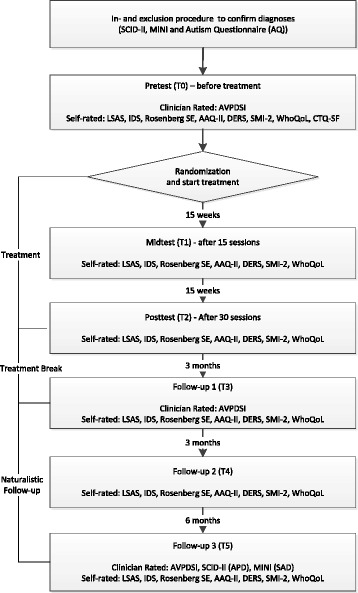
Background: Social anxiety disorder (SAD) with comorbid avoidant personality disorder (APD) has a high prevalence and is associated with serious psychosocial problems and high societal costs. When patients suffer from both SAD and APD, the Dutch multidisciplinary guidelines for personality disorders advise offering prolonged cognitive behavioral therapy (CBT). Recently there is increasing evidence for the effectiveness of schema therapy (ST) for personality disorders such as borderline personality disorder and cluster C personality disorders. Since ST addresses underlying personality characteristics and maladaptive coping strategies developed in childhood, this treatment might be particularly effective for patients with SAD and comorbid APD. To our knowledge, there are no studies comparing CBT with ST in this particular group of patients. This superiority trial aims at comparing the effectiveness of these treatments. As an additional goal, predictors and underlying mechanisms of change will be explored.Methods/design: The design of the study is a multicentre two-group randomized controlled trial (RCT) in which the treatment effect of group cognitive behavioral therapy (GCBT) will be compared to that of group schema therapy (GST) in a semi-open group format. A total of 128 patients aged 18-65 years old will be enrolled. Patients will receive 30 sessions of GCBT or GST during a period of approximately 9 months. Primary outcome measures are the Liebowitz Social Anxiety Scale Self-Report (LSAS-SR) for social anxiety disorder and the newly developed Avoidant Personality Disorder Severity Index (AVPDSI) for avoidant personality disorder. Secondary outcome measures are the MINI section SAD, the SCID-II section APD, the Schema Mode Inventory (SMI-2), the Inventory of Depressive Symptomatology Self-Report (IDS-SR), the World Health Organization Quality of Life-BREF (WHOQOL-BREF), the Difficulties in Emotion Regulation Scale (DERS), the Rosenberg Self-Esteem Scale (RSES) and the Acceptance and Action Questionnaire (AAQ-II). Data will be collected at the start, halfway and at the end of the treatment, followed by measurements at 3, 6 and 12 months post-treatment.Discussion: The trial will increase our knowledge on the effectiveness and applicability of both treatment modalities for patients suffering from both diagnoses.Trial Registration: Dutch Trial Register: NTR3921 . Registered on 25 March 2013.
Overview
CoChat Summary
TL;DR
This is a study protocol for a multicentre randomized controlled trial comparing group schema therapy (GST) with prolonged group cognitive behavioral therapy (GCBT) for patients with social anxiety disorder (SAD) and comorbid avoidant personality disorder (APD). The trial plans to enroll 128 patients and examine effects on SAD severity and APD severity, plus predictors and mediators of change.
Key findings
- Not stated in the paper.
- The planned trial is a multicentre two-group RCT with 128 patients aged 18–65, randomized to 30 weekly sessions of GST or GCBT over about 9 months.
- Primary outcomes are LSAS-SR for social anxiety and AVPDSI for APD severity; secondary outcomes include MINI SAD, SCID-II APD, SMI-2, IDS-SR, WHOQOL-BREF, DERS, RSES, and AAQ-II.
- Sample-size planning targeted detection of a medium effect size (Cohen’s d = 0.5) with 80% power at two-tailed alpha = 0.05.
Methods
- Multicentre, two-arm superiority RCT conducted at two PsyQ sites in the Netherlands, with semi-open groups and repeated measurements at baseline, mid-treatment, post-treatment, 3, 6, and 12 months follow-up.
- Participants: adults 18–65 with primary SAD and comorbid APD; exclusion criteria included suicidality, psychotic or bipolar symptoms, substance dependence needing detoxification, certain primary Axis II disorders, suspected ASD above AQ cutoff, IQ < 80, and Dutch language problems.
- Main analysis plan: multilevel analysis for repeated measures, multilevel logistic regression for remission of APD, survival analysis for retention, and regression/bootstrapping for predictors, moderators, and mediators.
Limitations
- The paper states that comparing GST with GCBT as treatment-as-usual rather than with a no-treatment or attention control condition may limit internal validity; if treatments do not differ, time or attention effects cannot be ruled out.
- The authors note that the semi-open group format may disrupt therapy when participants enter and leave at different times, and this may affect effectiveness differently across treatments.
- The study is multicentre but limited to two large cities in the Netherlands under tightly controlled conditions, which the text says may limit generalizability/external validity.
Model-written summary. Check it against the paper before relying on it.
Integrity signals
Registry
Cites
Statistics
Figures
Verification
Claims the paper makes
17 Valid · 1 Not valid · 38 Not checked · 37 Own results and interpretations
The cited sources that could be checked couldn’t confirm or dispute this claim.
In the paper
“None of these guidelines advises on the treatment of SAD and comorbid APD.”
§ Group schema therapy versus group cognitive behavioral therapy for social anxiety disorder with comorbid avoidant personality disorder: study protocol for a randomized controlled trial > Methods/design > Interventions
What the sources say
- Not matchedcites [28] Van Balkom A Van Vliet I Van Emmelkamp P Bockting CLH Spijker J Hermens M Multidisciplinaire Richtlijn Angststoornissen (3E Revisie, 2013) 2013 Utrecht Trimbos Instituut
We searched by its title and found no matching paper.
- Could not verifycites [29] Katzman MA Bleau P Blier P Chokka P Kjernisted K Van Ameringen M Canadian clinical practice guidelines for the management of anxiety, posttraumatic stress and obsessive-compulsive disorders BMC Psychiatry [Internet] 2014 14 Suppl 1 S1 10.1186/1471-244X-14-S1-S1 PMC4120194 25081580 sourceExperimental — accuracy not yet measured
The Psychiatric comorbidity section (p. 17) says avoidant personality disorder commonly occurs with social anxiety disorder, but gives no treatment advice for that combination. The comorbidity overview (p. 45) offers general advice, and searches for treatment recommendations specific to this combination found none. Because our copy is truncated and contains only this one guideline, it cannot establish that none of the cited guidelines provides such advice. (LLM, conf=0.70)
- Not matchedcites [30] Woolf SH Friedman CL Social anxiety disorder, The NICE guideline on recognition, assessment and treatment 2013 London The British Psychological Society & The Royal College of Psychiatrists
We searched by its title and found no matching paper.
plain- Asserted: passes — The authors put it forward as true.
- Checkable: passes — It can be checked against evidence.
- Load-bearing: passes — The paper’s conclusions depend on it.
- Based: passes — The paper gives a reason why it holds.
- Not matched
The cited sources support only part of this claim — read each source’s verdict below.
In the paper
“Furthermore, there is growing evidence that schema therapy (ST) is an effective treatment for patients with APD [18, 19].”
§ Group schema therapy versus group cognitive behavioral therapy for social anxiety disorder with comorbid avoidant personality disorder: study protocol for a randomized controlled trial > Background
What the sources say
- Partly supportedcites [18] Bamelis LLM Evers SMAA Arntz A Design of a multicentered randomized controlled trial on the clinical and cost effectiveness of schema therapy for personality disorders BMC Public Health [Internet] 2012 12 1 75 10.1186/1471-2458-12-75 PMC3305366 22272740 sourceExperimental — accuracy not yet measured
The Background describes schema therapy as promising for personality disorders and reports evidence of effectiveness for borderline personality disorder. The Discussion says the trial aims to study its effectiveness for avoidant personality disorder, while the Conclusion says effectiveness for most personality disorders was still unknown. The paper therefore does not establish the claimed growing evidence of effectiveness specifically for avoidant personality disorder. (LLM, conf=0.85)
- Not checked — no full text of the sourcecites [19] Bamelis LLM Evers SMAA Spinhoven P Arntz A Results of a multicenter randomized controlled trial of the clinical effectiviness of schema therapy for personality disorders Am J Psychiatry 2014 171 305 22 10.1176/appi.ajp.2013.12040518 24322378 source
plainstates a cause- Asserted: passes — The authors put it forward as true.
- Checkable: passes — It can be checked against evidence.
- Load-bearing: passes — The paper’s conclusions depend on it.
- Based: passes — The paper gives a reason why it holds.
- Partly supported
Every source the paper cites for this claim was checked and supports it.
In the paper
“High total AQ scores are specific to patients with an ASD and set them apart from both the general population and from patients with SAD [65].”
§ Group schema therapy versus group cognitive behavioral therapy for social anxiety disorder with comorbid avoidant personality disorder: study protocol for a randomized controlled trial > Methods/design > Screening instruments
What the sources say
- Supportedcites [65] Hoekstra RA Bartels M Cath DC Boomsma DI Factor structure, reliability and criterion validity of the Autism-Spectrum Quotient (AQ): a study in Dutch population and patient groups J Autism Dev Disord [Internet] 2008 38 8 1555 66 10.1007/s10803-008-0538-x PMC2516538 18302013 source
The Results section (‘The Spectrum of Autistic Traits’) states that total AQ scores above 145 occurred only in ASC subjects, not in the general-population or SAD samples. The Results section on patient-group differences also reports significantly higher total AQ scores for ASC subjects than for either comparison group. (LLM, conf=0.93)
plainstates an association- Asserted: passes — The authors put it forward as true.
- Checkable: passes — It can be checked against evidence.
- Load-bearing: passes — The paper’s conclusions depend on it.
- Based: passes — The paper gives a reason why it holds.
- Supported
Every source the paper cites for this claim was checked and supports it.
In the paper
“Evidence of the effectiveness of group ST on PDs other than borderline personality disorder (BPD) is sparse [69]”
§ Group schema therapy versus group cognitive behavioral therapy for social anxiety disorder with comorbid avoidant personality disorder: study protocol for a randomized controlled trial > Discussion
What the sources say
- Supportedcites [69] Skewes SA Samson RA Simpson SG van Vreeswijk M Short-term group schema therapy for mixed personality disorders: A pilot study Front Psychol 2015 6 1 9 25657631 PMC4302795 source
The Introduction explicitly says that preliminary evidence supports group schema therapy for BPD, but evidence for its use with other personality disorders is sparse. It also says that very few studies of schema therapy for non-BPD personality disorders were conducted in group settings. (LLM, conf=0.95)
plain- Asserted: passes — The authors put it forward as true.
- Checkable: passes — It can be checked against evidence.
- Load-bearing: passes — The paper’s conclusions depend on it.
- Based: passes — The paper gives a reason why it holds.
- Supported
Every source the paper cites for this claim was checked and supports it.
In the paper
“Since APD is often comorbid with SAD, with data on comorbidity varying between 32–50 % [3]”
§ Group schema therapy versus group cognitive behavioral therapy for social anxiety disorder with comorbid avoidant personality disorder: study protocol for a randomized controlled trial > Discussion
What the sources say
- Supportedcites [3] Bögels SM Alden L Beidel DC Clark LA Pine DS Stein MB Social anxiety disorder: questions and answers for the DSM-V Depress Anxiety [Internet] 2010 27 2 168 89 10.1002/da.20670 20143427 source
The 'Social anxiety disorder versus avoidant personality disorder' section reports 32% AVPD among patients with SAD and says that half of patients with AVPD in another sample also had generalized SAD. These figures support the stated 32–50% variation, though they use different starting populations. (LLM, conf=0.88)
plainstates an association- Asserted: passes — The authors put it forward as true.
- Checkable: passes — It can be checked against evidence.
- Load-bearing: passes — The paper’s conclusions depend on it.
- Based: passes — The paper gives a reason why it holds.
- Supported
21 more claims · 2 with their cited sources checked
Create a free account to see all 93 claims and to verify the 9 references still open.
- Probably not a substantial claim. 56
- It may state two separate claims as one. 33
Citations
Cites
Diagnostic and Statistical Manual of Mental Disorders
Williams, J. B. W., & First, M. (2013) · Encyclopedia of Social Work · doi:10.1093/acrefore/9780199975839.013.104 · Cited by 109,519
Preacher, K. J., & Hayes, A. F. (2008) · Behavior Research Methods · doi:10.3758/brm.40.3.879 · Cited by 34,117 · cited 1×
“Boot-strapping methods [67] will be used to investigate the mediating effects of, for example, emotion regulation on symptom reduction.”
Society and the Adolescent Self-Image
Rosenberg, M. (1965) · doi:10.1515/9781400876136 · Cited by 30,126
(1998) · The Journal of Clinical Psychiatry · Cited by 19,139
Diagnostic and Statistical Manual of Mental Disorders, 5th ed.
Carter, M. J. (2014) · Therapeutic Recreation Journal · Cited by 15,169
Borenstein, M., Hedges, L. V., Higgins, J. P. T., & Rothstein, H. R. (2009) · doi:10.1002/9780470743386 · Cited by 14,225
(1998) · PubMed · Cited by 10,216
Borenstein, M., Hedges, L. V., Higgins, J. P. T., & Rothstein, H. R. (2021) · doi:10.1002/9781119558378 · Cited by 9,799
Diagnostic and Statistical Manual of Mental Disorders (DSM-IV)
Hu, R. J. (2003) · Encyclopedia of the Neurological Sciences · doi:10.1016/b0-12-226870-9/01070-4 · Cited by 9,117
Gratz, K. L., & Roemer, L. (2004) · Journal of Psychopathology and Behavioral Assessment · doi:10.1023/b:joba.0000007455.08539.94 · Cited by 8,942
Jacobson, N. S., & Truax, P. (1991) · Journal of Consulting and Clinical Psychology · doi:10.1037/0022-006x.59.1.12 · Cited by 7,770
Baron-Cohen, S., Wheelwright, S., Skinner, R., Martin, J., & Clubley, E. (2001) · Journal of Autism and Developmental Disorders · doi:10.1023/a:1005653411471 · Cited by 6,450
Development and validation of a brief screening version of the Childhood Trauma Questionnaire
Bernstein, D. P., Stein, J. A., Newcomb, M. D., Walker, E., Pogge, D., Ahluvalia, T., Stokes, J., Handelsman, L., Medrano, M., Desmond, D., et al. (2003) · Child Abuse & Neglect · doi:10.1016/s0145-2134(02)00541-0 · Cited by 6,419 · cited 2×
“To assess childhood trauma, the CTQ short form [60] is chosen.”
Baron‐Cohen, S., Wheelwright, S., Hill, J., Raste, Y., & Plumb, I. (2001) · Journal of Child Psychology and Psychiatry · doi:10.1111/1469-7610.00715 · Cited by 4,555 · cited 1×
“The the score, the more autistic traits a person possesses [27, 63] with a cut-off of 32 for distinguishing individuals with clinically significant levels of autistic traits [27].”
Baron‐Cohen, S., Wheelwright, S. J., Hill, J., Raste, Y., & Plumb, I. (2001) · PubMed · Cited by 4,313
Bond, F. W., Hayes, S. C., Baer, R. A., Carpenter, K. M., Guenole, N., Orcutt, H. K., Waltz, T., & Zettle, R. D. (2011) · Behavior Therapy · doi:10.1016/j.beth.2011.03.007 · Cited by 3,950
Mediators and Moderators of Treatment Effects in Randomized Clinical Trials
Kraemer, H. C., Wilson, G. T., Fairburn, C. G., & Agras, W. S. (2002) · Archives of General Psychiatry · doi:10.1001/archpsyc.59.10.877 · Cited by 2,562 · cited 2×
“Investigating predictors, moderators and mediators of treatment can add valuable knowledge to our understanding of for whom, under what conditions and how treatments work, thus generating valuable hypotheses for future research [25].”
Maximizing exposure therapy: An inhibitory learning approach
Craske, M. G., Treanor, M., Conway, C. C., Zbozinek, T., & Vervliet, B. (2014) · Behaviour Research and Therapy · doi:10.1016/j.brat.2014.04.006 · Cited by 2,339 · cited 2×
“…in which the association of the conditioned stimulus (CS) (social situations) and the feared unconditioned stimulus (US) (humiliation) is inhibited by the forming of new associations around the CS, of which the association with ‘ no-US ’ (no rejection) is probably the most important [34].”
Liebowitz, M. R. (2015) · Modern Trends in Pharmacopsychiatry · doi:10.1159/000414022 · Cited by 2,266
The Inventory of Depressive Symptomatology (IDS): Psychometric properties
Rush, A. J., Gullion, C. M., Basco, M. R., Jarrett, R. B., & Trivedi, M. H. (1996) · Psychological Medicine · doi:10.1017/s0033291700035558 · Cited by 2,177 · cited 2×
“The questionnaire has highly acceptable psychometric properties with reasonable internal consistency, interrater reliability and concurrent and discriminant validity and is a sensitive measure of symptom severity in depression [51, 53].”
Research design in clinical psychology
(1952) · Journal of Clinical Psychology · doi:10.1002/1097-4679(195201)8:1<3::aid-jclp2270080102>3.0.co;2-0 · Cited by 2,147
Diagnostic and Statistical Manual of Mental Disorders (DSM-III-R)
Spitzer, R. L., & Williams, J. (1987) · Cited by 1,823
Giesen-Bloo, J., van Dyck, R., Spinhoven, P., van Tilburg, W., Dirksen, C., van Asselt, T., Kremers, I., Nadort, M., & Arntz, A. (2006) · Archives of General Psychiatry · doi:10.1001/archpsyc.63.6.649 · Cited by 1,248 · cited 1×
“Most published RCTs investigating ST treatments thus far comprise 50 or more sessions covering time spans of more than one year [19, 81, 87].”
Self-citationLobbestael, J., Leurgans, M., & Arntz, A. (2011) · Clinical Psychology & Psychotherapy · doi:10.1002/cpp.693 · Cited by 1,124
Self-citationKatzman, M. A., Bleau, P., Blier, P., Chokka, P., Kjernisted, K., Van Ameringen, M., & the Canadian Anxiety Guidelines Initiative Group on behalf of the Anxiety Disorders Association of Canada/Association Canadienne des troubles anxieux and McGill University (2014) · BMC Psychiatry · doi:10.1186/1471-244x-14-s1-s1 · Cited by 1,090 · cited 1×
“CBT is seen as the gold standard for SAD with respect to non-pharmacological treatment, and gains achieved with CBT seem to persist longer than those achieved with pharmacotherapy [29].”
TRIVEDI, M. H., RUSH, A. J., IBRAHIM, H. M., CARMODY, T. J., BIGGS, M. M., SUPPES, T., CRISMON, M. L., SHORES-WILSON, K., TOPRAC, M. G., DENNEHY, E. B., et al. (2004) · Psychological Medicine · doi:10.1017/s0033291703001107 · Cited by 968
Psychometric properties of the Liebowitz Social Anxiety Scale
HEIMBERG, R. G., HORNER, K. J., JUSTER, H. R., SAFREN, S. A., BROWN, E. J., SCHNEIER, F. R., & LIEBOWITZ, M. R. (1999) · Psychological Medicine · doi:10.1017/s0033291798007879 · Cited by 968
FRESCO, D. M., COLES, M. E., HEIMBERG, R. G., LIEBOWITZ, M. R., HAMI, S., STEIN, M. B., & GOETZ, D. (2001) · Psychological Medicine · doi:10.1017/s0033291701004056 · Cited by 874
Woodbury-Smith, M. R., Robinson, J., Wheelwright, S., & Baron-Cohen, S. (2005) · Journal of Autism and Developmental Disorders · doi:10.1007/s10803-005-3300-7 · Cited by 771 · cited 1×
“It has reasonable construct and face validity and good test-retest and interrater reliability [27] and is a useful screening instrument in clinical practice [64].”
A trial studying approach to predict college achievement
Meijer, R. R., & Niessen, A. S. M. (2015) · Frontiers in Psychology · doi:10.3389/fpsyg.2015.00887 · Cited by 711
Research Design in Clinical Psychology
Kazdin, A. E. (2023) · Cambridge University Press eBooks · doi:10.1017/9781108976589 · Cited by 656
Hoekstra, R. A., Bartels, M., Cath, D. C., & Boomsma, D. I. (2008) · Journal of Autism and Developmental Disorders · doi:10.1007/s10803-008-0538-x · Cited by 651 · cited 1×
“High total AQ scores are specific to patients with an ASD and set them apart from both the general population and from patients with SAD [65].”
Postpartum mood disorders: diagnosis and treatment guidelines.
Nonacs, R. M., & Cohen, L. S. (1998) · PubMed · Cited by 644
The Liebowitz social anxiety scale as a self-report instrument: a preliminary psychometric analysis
Baker, S. L., Heinrichs, N., Kim, H.-J., & Hofmann, S. G. (2002) · Behaviour Research and Therapy · doi:10.1016/s0005-7967(01)00060-2 · Cited by 640
Social anxiety disorder: questions and answers for the DSM-V
Bögels, S. M., Alden, L., Beidel, D. C., Clark, L. A., Pine, D. S., Stein, M. B., & Voncken, M. (2010) · Depression and Anxiety · doi:10.1002/da.20670 · Cited by 526 · cited 3×
“Shortcomings in establishing interpersonal relationships and severe feelings of inferiority are seen as cardinal features of APD [3, 6, 7].”
Maffei, C., Fossati, A., Agostoni, I., Barraco, A., Bagnato, M., Deborah, D., Namia, C., Novella, L., & Petrachi, M. (1997) · Journal of Personality Disorders · doi:10.1521/pedi.1997.11.3.279 · Cited by 516
Cognitive behavioral group treatment for social phobia: Comparison with a credible placebo control
Heimberg, R. G., Dodge, C. S., Hope, D. A., Kennedy, C. R., Zollo, L. J., & Becker, R. E. (1990) · Cognitive Therapy and Research · doi:10.1007/bf01173521 · Cited by 500
Bamelis, L. L. M., Evers, S. M. A. A., Spinhoven, P., & Arntz, A. (2014) · American Journal of Psychiatry · doi:10.1176/appi.ajp.2013.12040518 · Cited by 497
Self-citationFarrell, J. M., Shaw, I. A., & Webber, M. A. (2009) · Journal of Behavior Therapy and Experimental Psychiatry · doi:10.1016/j.jbtep.2009.01.002 · Cited by 428 · cited 2×
“Both treatments are well documented [17, 24, 75] and have been implemented in scientific research before in treatment studies for GCBT (e.g. [76 – 79]) and individual and group ST (e.g. [19, 43, 80, 81]).”
Rush, A. J., Carmody, T., & Reimitz, P. (2000) · International Journal of Methods in Psychiatric Research · doi:10.1002/mpr.79 · Cited by 427
Anxiety disorders: psychological approaches to theory and treatment
(1999) · Choice Reviews Online · doi:10.5860/choice.36-5351 · Cited by 419
Cognitive-Behavioral and Pharmacological Treatments of Social Phobia: A Controlled Study
Gelernter, C. S. (1991) · Archives of General Psychiatry · doi:10.1001/archpsyc.1991.01810340070009 · Cited by 404
(2002) · Cited by 399
(2007) · PubMed · Cited by 324
The impairments caused by social phobia in the general population: implications for intervention
Kessler, R. C. (2003) · Acta Psychiatrica Scandinavica · doi:10.1034/j.1600-0447.108.s417.2.x · Cited by 322
Cognitive?behavioral group treatment for social phobia: Effectiveness at five-year followup
Heimberg, R. G., Salzman, D. G., Holt, C. S., & Blendell, K. A. (1993) · Cognitive Therapy and Research · doi:10.1007/bf01177658 · Cited by 309 · cited 1×
“GCBT will follow a prolonged version of the well-investigated protocol of Heimberg and colleagues of group therapy for SAD [31 – 33] in combination with some new insights in the working mechanisms of exposure in vivo [34].”
Reliability and Validity of the Borderline Personality Disorder Severity Index
Arntz, A., van den Hoorn, M., Cornelis, J., Verheul, R., van den Bosch, W. M. C., & de Bie, A. J. H. T. (2003) · Journal of Personality Disorders · doi:10.1521/pedi.17.1.45.24053 · Cited by 305
Self-citationHedman, E., Andersson, G., Ljótsson, B., Andersson, E., Rück, C., Mörtberg, E., & Lindefors, N. (2011) · PLoS ONE · doi:10.1371/journal.pone.0018001 · Cited by 285 · cited 1×
“Both treatments are well documented [17, 24, 75] and have been implemented in scientific research before in treatment studies for GCBT (e.g. [76 – 79]) and individual and group ST (e.g. [19, 43, 80, 81]).”
Trompenaars, F. J., Masthoff, E. D., Van Heck, G. L., Hodiamont, P. P., & De Vries, J. (2005) · Quality of Life Research · doi:10.1007/s11136-004-0787-x · Cited by 273
Reliability and Validity of the Short Schema Mode Inventory (SMI)
Lobbestael, J., van Vreeswijk, M., Spinhoven, P., Schouten, E., & Arntz, A. (2010) · Behavioural and Cognitive Psychotherapy · doi:10.1017/s1352465810000226 · Cited by 268
Self-citationLobbestael, J., Arntz, A., & Bernstein, D. P. (2010) · Journal of Personality Disorders · doi:10.1521/pedi.2010.24.3.285 · Cited by 265
Self-citationNadort, M., Arntz, A., Smit, J. H., Giesen-Bloo, J., Eikelenboom, M., Spinhoven, P., van Asselt, T., Wensing, M., & van Dyck, R. (2009) · Behaviour Research and Therapy · doi:10.1016/j.brat.2009.07.013 · Cited by 259 · cited 2×
“Most published RCTs investigating ST treatments thus far comprise 50 or more sessions covering time spans of more than one year [19, 81, 87].”
Self-citationParenting Behaviors Associated With Risk for Offspring Personality Disorder During Adulthood
Johnson, J. G., Cohen, P., Chen, H., Kasen, S., & Brook, J. S. (2006) · Archives of General Psychiatry · doi:10.1001/archpsyc.63.5.579 · Cited by 253 · cited 1×
“Research has shown that APD is associated with emotional neglect and abuse in the past [20, 21].”
Personality Disorder Types Proposed for DSM-5
Skodol, A. E., Bender, D. S., Morey, L. C., Clark, L. A., Oldham, J. M., Alarcon, R. D., Krueger, R. F., Verheul, R., Bell, C. C., & Siever, L. J. (2011) · Journal of Personality Disorders · doi:10.1521/pedi.2011.25.2.136 · Cited by 241 · cited 1×
“APD is in general relatively under-studied [71], although it is one of the most prevalent personality disorders across community and clinical samples and is known by its significant functional impairment [71 – 73].”
A Computer-Administered Telephone Interview to Identify Mental Disorders
Kobak, K. A. (1997) · JAMA: The Journal of the American Medical Association · doi:10.1001/jama.1997.03550110043034 · Cited by 238
Avoidant personality disorder and the generalized subtype of social phobia.
Holt, C. S., Heimberg, R. G., & Hope, D. A. (1992) · Journal of Abnormal Psychology · doi:10.1037/0021-843x.101.2.318 · Cited by 236 · cited 1×
“While some researchers emphasize that APD is a serious form of generalized SAD [4, 5], a growing number of studies indicate that there is a qualitative difference between the two disorders.”
Spinhoven, P., Penninx, B. W., Hickendorff, M., van Hemert, A. M., Bernstein, D. P., & Elzinga, B. M. (2014) · Psychological Assessment · doi:10.1037/pas0000002 · Cited by 233
Self-citationBrown, E. J., Heimberg, R. G., & Juster, H. R. (1995) · Behavior Therapy · doi:10.1016/s0005-7894(05)80095-4 · Cited by 229 · cited 2×
“Although we subscribe the need for additional scientific evidence, we feel that prolonged GCBT can be considered as TAU based on Dutch guidelines [13] and earlier studies on SAD with comorbid APD [16] or APD with or without comorbid SAD [84 – 86].”
Psychometric Properties of the Dutch Rosenberg Self-Esteem Scale
Franck, E., De Raedt, R., Barbez, C., & Rosseel, Y. (2008) · Psychologica Belgica · doi:10.5334/pb-48-1-25 · Cited by 227 · cited 1×
“The Dutch version of the RSES is found to be a one-dimensional scale with high internal consistency and congruent validity and a Cronbach ’ s alpha of 0.89 [57].”
InfluentialBlanco, C., Heimberg, R. G., Schneier, F. R., Fresco, D. M., Chen, H., Turk, C. L., Vermes, D., Erwin, B. A., Schmidt, A. B., Juster, H. R., et al. (2010) · Archives of General Psychiatry · doi:10.1001/archgenpsychiatry.2010.11 · Cited by 206 · cited 1×
“Both treatments are well documented [17, 24, 75] and have been implemented in scientific research before in treatment studies for GCBT (e.g. [76 – 79]) and individual and group ST (e.g. [19, 43, 80, 81]).”
A Meta–Analytic Review of Psychological Treatments for Social Anxiety Disorder
Powers, M. B., Sigmarsson, S. R., & Emmelkamp, P. M. G. (2008) · International Journal of Cognitive Therapy · doi:10.1521/ijct.2008.1.2.94 · Cited by 191 · cited 2×
“We know that CBT has a large effect on SAD compared to waitlist and a small to moderate effect compared to placebo [15].”
Early family environments and traumatic experiences associated with borderline personality disorder.
Weaver, T. L., & Clum, G. A. (1993) · Journal of Consulting and Clinical Psychology · doi:10.1037/0022-006x.61.6.1068 · Cited by 184
Maximizing exposure therapy An inhibitory learning approach
Pittig, A., Stevens, S., Vervliet, B., Treanor, M., Conway, C., Zbozinek, T. D., & Craske, M. G. (2015) · Kölner Universitäts PublikationsServer (Universität zu Köln) · Cited by 182
Comparison of brief dynamic and cognitive-behavioural therapies in avoidant personality disorder
Emmelkamp, P. M. G., Benner, A., Kuipers, A., Feiertag, G. A., Koster, H. C., & van Apeldoorn, F. J. (2006) · British Journal of Psychiatry · doi:10.1192/bjp.bp.105.012153 · Cited by 156
The nature (and nurture) of personality disorders
TORGERSEN, S. (2009) · Scandinavian Journal of Psychology · doi:10.1111/j.1467-9450.2009.00788.x · Cited by 144
Short-term structured treatment for avoidant personality disorder.
Alden, L. (1989) · Journal of Consulting and Clinical Psychology · doi:10.1037/0022-006x.57.6.756 · Cited by 142
Giesen-Bloo, J. H., Wachters, L. M., Schouten, E., & Arntz, A. (2010) · Personality and Individual Differences · doi:10.1016/j.paid.2010.03.023 · Cited by 135
Self-citationKrieger, N., Waterman, P. D., Kosheleva, A., Chen, J. T., Carney, D. R., Smith, K. W., Bennett, G. G., Williams, D. R., Freeman, E., Russell, B., et al. (2011) · PLoS ONE · doi:10.1371/journal.pone.0027636 · Cited by 135
Weertman, A., ArntZ, A., Dreessen, L., Velzen, C. V., & Vertommen, S. (2003) · Journal of Personality Disorders · doi:10.1521/pedi.17.6.562.25359 · Cited by 126
Self-citationA confirmatory factor analysis of a self‐report version of the Liebowitz Social Anxiety Scale
Oakman, J., Van Ameringen, M., Mancini, C., & Farvolden, P. (2003) · Journal of Clinical Psychology · doi:10.1002/jclp.10124 · Cited by 121 · cited 1×
“Furthermore, the self-report version is easier to administer and is less time-consuming for both patient and clinician [38 – 40].”
Extended Schema Mode Conceptualizations for Specific Personality Disorders: An Empirical Study
Bamelis, L. L. M., Renner, F., Heidkamp, D., & Arntz, A. (2011) · Journal of Personality Disorders · doi:10.1521/pedi.2011.25.1.41 · Cited by 113
Self-citationAvoidant Personality Disorder: a Current Review
Weinbrecht, A., Schulze, L., Boettcher, J., & Renneberg, B. (2016) · Current Psychiatry Reports · doi:10.1007/s11920-016-0665-6 · Cited by 110 · cited 2×
“APD is in general relatively under-studied [71], although it is one of the most prevalent personality disorders across community and clinical samples and is known by its significant functional impairment [71 – 73].”
Is Avoidant Personality Disorder More Than Just Social Avoidance?
Taylor, C. T., Laposa, J. M., & Alden, L. E. (2004) · Journal of Personality Disorders · doi:10.1521/pedi.18.6.571.54792 · Cited by 105 · cited 1×
“Furthermore, on the basis of empirical findings, it has been suggested that avoidance is a dominant coping strategy not only in social but also in non-social situations in APD [9 – 11].”
Computer-assisted cognitive behavioral group therapy for social phobia
Gruber, K., Moran, P. J., Roth, W. T., & Taylor, C. B. (2001) · Behavior Therapy · doi:10.1016/s0005-7894(01)80050-2 · Cited by 101
Ten‐Year Rank‐Order Stability of Personality Traits and Disorders in a Clinical Sample
Hopwood, C. J., Morey, L. C., Donnellan, M. B., Samuel, D. B., Grilo, C. M., McGlashan, T. H., Shea, M. T., Zanarini, M. C., Gunderson, J. G., & Skodol, A. E. (2013) · Journal of Personality · doi:10.1111/j.1467-6494.2012.00801.x · Cited by 98
The Wiley-Blackwell Handbook of Schema Therapy: Theory, Research, and Practice
van Vreeswijk, M., Broersen, J., & Nadort, M. (2012) · Cited by 89
Intensive behavioral group treatment of avoidant personality disorder
Renneberg, B., Goldstein, A. J., Phillips, D., & Chambless, D. L. (1990) · Behavior Therapy · doi:10.1016/s0005-7894(05)80337-5 · Cited by 83 · cited 1×
“Although we subscribe the need for additional scientific evidence, we feel that prolonged GCBT can be considered as TAU based on Dutch guidelines [13] and earlier studies on SAD with comorbid APD [16] or APD with or without comorbid SAD [84 – 86].”
Arntz, A. (1999) · Behaviour Research and Therapy · doi:10.1016/s0005-7967(99)00052-2 · Cited by 82
Self-citationShort-term group schema therapy for mixed personality disorders: a pilot study
Skewes, S. A., Samson, R. A., Simpson, S. G., & van Vreeswijk, M. (2015) · Frontiers in Psychology · doi:10.3389/fpsyg.2014.01592 · Cited by 70 · cited 1×
“Evidence of the effectiveness of group ST on PDs other than borderline personality disorder (BPD) is sparse [69], and to the best of our knowledge, this is the first study on group ST for this specific patient group.”
Farrell, J. M., Reiss, N., & Shaw, I. A. (2014) · doi:10.1002/9781118510018 · Cited by 69
Schema Therapy for Cluster C Personality Disorders
Arntz, A. (2012) · The Wiley‐Blackwell Handbook of Schema Therapy · doi:10.1002/9781119962830.ch30 · Cited by 62
Self-citationAvoidant personality disorder and its relationship to social phobia
Reich, J. (2009) · Current Psychiatry Reports · doi:10.1007/s11920-009-0014-0 · Cited by 49 · cited 1×
“Shortcomings in establishing interpersonal relationships and severe feelings of inferiority are seen as cardinal features of APD [3, 6, 7].”
Lampe, L. (2016) · Current Opinion in Psychiatry · doi:10.1097/yco.0000000000000211 · Cited by 43 · cited 1×
“Most studies have investigated treatment of SAD and compared the outcome of patients with and without co-morbid APD [70].”
Shaw, I. A., & Farrell, J. M. (2012) · Cited by 37
(1994) · PubMed · Cited by 35
Bamelis, L. L., Evers, S. M., & Arntz, A. (2012) · BMC Public Health · doi:10.1186/1471-2458-12-75 · Cited by 33
Self-citationCarter, S. A., & Wu, K. D. (2010) · Behavior Therapy · doi:10.1016/j.beth.2008.10.002 · Cited by 29
Gjerde, L. C., Czajkowski, N., Røysamb, E., Ystrom, E., Tambs, K., Aggen, S. H., Ørstavik, R. E., Kendler, K. S., Reichborn-Kjennerud, T., & Knudsen, G. P. (2015) · Psychological Medicine · doi:10.1017/s0033291715001440 · Cited by 23
Borge, F., Hoffart, A., Sexton, H., Martinsen, E., Gude, T., Hedley, L. M., & Abrahamsen, G. (2010) · Clinical Psychology & Psychotherapy · doi:10.1002/cpp.640 · Cited by 20
Maas, C. J. M., Hox, J. J., & Lensvelt-Mulders, G. J. L. M. (2004) · Quality and Quantity · doi:10.1023/b:ququ.0000043125.43736.c4 · Cited by 18
Research works printed but not linked: 7
- Instituut T Multidisciplinaire richtlijn Persoonlijkheidsstoornissen: Diagnostiek en behandeling van persoonlijkheidsstoornissen [Internet] 2008 Utrecht Trimbos Instituut
- Hope DA Heimberg RG Turk CL Managing social anxiety, a cognitive behavioral approach 2010 2 Oxford Oxford University Press
- Van Balkom A Van Vliet I Van Emmelkamp P Bockting CLH Spijker J Hermens M Multidisciplinaire Richtlijn Angststoornissen (3E Revisie, 2013) 2013 Utrecht Trimbos Instituut
- Woolf SH Friedman CL Social anxiety disorder, The NICE guideline on recognition, assessment and treatment 2013 London The British Psychological Society & The Royal College of Psychiatrists
- Sheehan DV Janavs J Baker R Harnett-Sheehan K Knapp E Sheehan M MINI - Mini International Neuropsychiatric Interview - English Version 5.0.0 - DSM-IV J Clin Psychiatry 1998 59 34 57 9881538
- Jacobs N Kleen M De Groot F A-Tjak J Het meten van experiëntiële vermijding: De Nederlandstalige versie van de Acceptance and Action Questionnaire-II (AAQ-II) Gedragstherapie 2008 41 349 61
- Bernstein DP Fink L Childhood Trauma Questionnaire: a retrospective self-report 1998 San Antonio NCS Pearson
Cited by
Avoidant Personality Disorder: a Current Review
Weinbrecht, A., Schulze, L., Boettcher, J., & Renneberg, B. (2016) · Current Psychiatry Reports · doi:10.1007/s11920-016-0665-6 · Cited by 110
Avoidant personality disorder: current insights
Lampe, L. A., & Malhi, G. S. (2018) · Psychology Research and Behavior Management · doi:10.2147/prbm.s121073 · Cited by 120
Short-term group schema therapy for mixed personality disorders: a pilot study
Skewes, S. A., Samson, R. A., Simpson, S. G., & van Vreeswijk, M. (2015) · Frontiers in Psychology · doi:10.3389/fpsyg.2014.01592 · Cited by 70
“Moreover, a multicenter trial comparing group schema therapy to traditional group CBT for patients with generalized social phobia and comorbid avoidant personality has commenced (Greeven et al., 2013).”
BackgroundInfluentialKopf‐Beck, J., Zimmermann, P., Egli, S., Rein, M., Kappelmann, N., Fietz, J., Tamm, J., Rek, K., Lucae, S., Brem, A., et al. (2020) · BMC Psychiatry · doi:10.1186/s12888-020-02880-x · Cited by 55
Bachrach, N., & Arntz, A. R. (2021) · Journal of Clinical Psychology · doi:10.1002/jclp.23118 · Cited by 35
Self-citation
Metadata
- Authors
- Baljé, A., Greeven, A., van Giezen, A., Korrelboom, K., Arntz, A., & Spinhoven, P.
- Affiliations
- PsyQ (NL)
- Leiden University (NL)
- Tilburg University (NL)
- University of Amsterdam (NL)
- Corresponding author
- Baljé, Astrid
- Venue
- Trials
- Published
- 2016-10-08
- Volume
- 17
- Issue
- 1
- Pages
- 487-487
- ISSN
- 1745-6215 (ISSN-L)
- PMC
- PMC5055701
- OpenAlex
- W2527907845
- Cited by
- 39
- References
- 97
- Citations by year
- 2025: 3 · 2024: 7 · 2023: 9 · 2022: 4 · 2021: 6 · 2020: 3 · 2018: 3 · 2017: 2 · 2016: 1
- FWCI
- 2.84
- Type
- journal article
- Language
- en
- Open access
- gold
- doi.org
- Licence
- Locations
- Trials (publishedVersion, cc-by)
- Europe PMC (PubMed Central) (publishedVersion, cc-by)
- PubMed Central (publishedVersion, cc-by)
- Research portal (Tilburg University) (publishedVersion, other-oa)
- PubMed (publishedVersion)
- Leiden Repository (Leiden University) (submittedVersion)
- Data Archiving and Networked Services (DANS) (submittedVersion, other-oa)
- Tilburg University Research Portal (submittedVersion, other-oa)
- Data Archiving and Networked Services (DANS) (submittedVersion)
- Research Publications (Maastricht University) (submittedVersion, cc-by)
- UvA-DARE (University of Amsterdam) (submittedVersion, cc-by)
- Research Publications (Maastricht University) (submittedVersion, other-oa)
- Funders
- Fonds Psychische Gezondheid (2013 6778)
- Topics
- Social Sciences › Psychology › Experimental and Cognitive Psychology › Anxiety, Depression, Psychometrics, Treatment, Cognitive Processes
- Social Sciences › Psychology › Clinical Psychology › Personality Disorders and Psychopathology
- Social Sciences › Psychology › Clinical Psychology › Psychological Treatments and Assessments
- Keywords
- social anxiety disorder, avoidant personality disorder, schema therapy, group schema therapy, group cognitive behavioral therapy, comorbidities, treatment comparison, mechanisms of change, emotion regulation, self-esteem, quality of life, acceptance and commitment therapy
- MeSH terms
- Phobia, Social, Clinical Protocols, Humans, Personality Disorders, Psychotherapy, Group, Research Design, Cognitive Behavioral Therapy, Outcome Assessment, Health Care
About these checks
Registry, retraction, Cites and statistics results are computed, not judged, with one exception: a printed reference that no index lists is read once by a model before it counts as a citation error. Claims are extracted by a model and kept only when their quote appears verbatim in the text; each cited source is then checked, with a model’s help, for whether it says what the claim relies on. Those verdicts can be wrong — read the claim’s quote and the cited source before relying on one.
The claim verdicts this report counts are experimental: their accuracy is not yet measured.
A language model drew the claims from the paper on 2026-10-11, under version 3 of the claim definition (model deepseek-v4.1-flash, prompt extract-v3).
A second model labelled each claim on 2026-10-11 (model jev-1.13-20260917, definition revision gold-guideline-v0.2).
Cited sources are checked with a language model’s help (gpt-6-sol).
Statistics and arithmetic are recomputed, not judged.
Confidence bands are shown only for fields calibrated on our annotated test set. None is calibrated yet, so no band is shown.
What counts as a claim ›How we measure confidence ›How we check this ›
Are you an author, or do you see a problem with this page? Request a review
Data sources
Bibliographic data: Semantic Scholar, OpenAlex, Crossref.
Contains information from the Semantic Scholar Academic Graph Datasets, made available under the ODC Attribution License (ODC-BY 1.0).
Semantic Scholar’s data is described in: Kinney, R., et al. (2023). The Semantic Scholar Open Data Platform. arXiv:2301.10140.
