

Effectiveness and mediators of change of an online CBT intervention for students with adjustment disorder—study protocol for a randomized controlled trial
Open accessPublished version of a preprint
The DOI matches its Crossref record; 88 of the 89 references it cites were found in a registry or an index, and 1 are not checked yet; 24 of the 61 sources its claims cite were checked for support.
Abstract
Background: Adjustment problems and disorders are highly prevalent among university students worldwide. These problems can cause significant interference in academic and social functioning and increase vulnerability to other mental health disorders. Unfortunately, only half of students in need receive psychological help. Furthermore, few studies have evaluated psychological interventions for adjustment disorders in students. New, more scalable forms of treatment for students with an adjustment disorder need to be developed, evaluated, and implemented. The study aims to determine the effectiveness of an online transdiagnostic cognitive behavioural intervention for students experiencing adjustment disorder and to assess mediators of change. Method/design: In this three-arm randomized controlled trial, we plan to recruit 214 Polish students diagnosed with an adjustment disorder. Participants who meet initial eligibility criteria will be randomly assigned to one of three 6-week conditions: (1) online cognitive behavioural therapy intervention based on an existing, empirically supported transdiagnostic protocol, the unified protocol; (2) online progressive muscle relaxation training as an active control group; or (3) waiting-list control group. Both interventions are asynchronous, interactive, and include minimal amount of therapist support. Assessments will consist of self-report questionnaires, daily diary measures, and neurocognitive tasks for evaluating cognitive functioning. These will be conducted at baseline, post-treatment, and 1-month follow-up. Daily diary measures will be taken during the first and last week of treatment (or waitlist period). Primary outcome measures will include adjustment disorder severity; secondary outcome measures will consist of other negative (psychopathology: depression, anxiety, and stress) and positive (life satisfaction) indexes of mental health as well as process measures (e.g. mindfulness, experiential avoidance, cognitive fusion). Discussion: To our knowledge, the current study is the first to evaluate the effectiveness of a psychological intervention for students with adjustment disorder. Therefore, it may have important practical implications for students with this disorder. It can potentially guide the development of a scalable, validated treatment option. Trial registration: Clinical Trials, NCT05768308, registered 14 March 2023, https://www.clinicaltrials.gov/ct2/show/NCT05768308. © 2023, The Author(s).
Verified 2026-11-22 · 1 reference not checked yet
Overview
CoChat Summary
## TL;DR
This is a study protocol for a three-arm randomized controlled trial testing an online transdiagnostic CBT intervention based on the Unified Protocol for Polish university students diagnosed with adjustment disorder. The trial will compare the intervention with online progressive muscle relaxation and a waiting-list control, and examine both effectiveness and mediators of change.
## Key findings
- Not stated in the paper.
- The planned sample is 214 Polish students diagnosed with adjustment disorder; the sample size calculation states 190 participants would be sufficient for the assumed effect, but 247 would be recruited to account for an estimated 30% dropout rate.
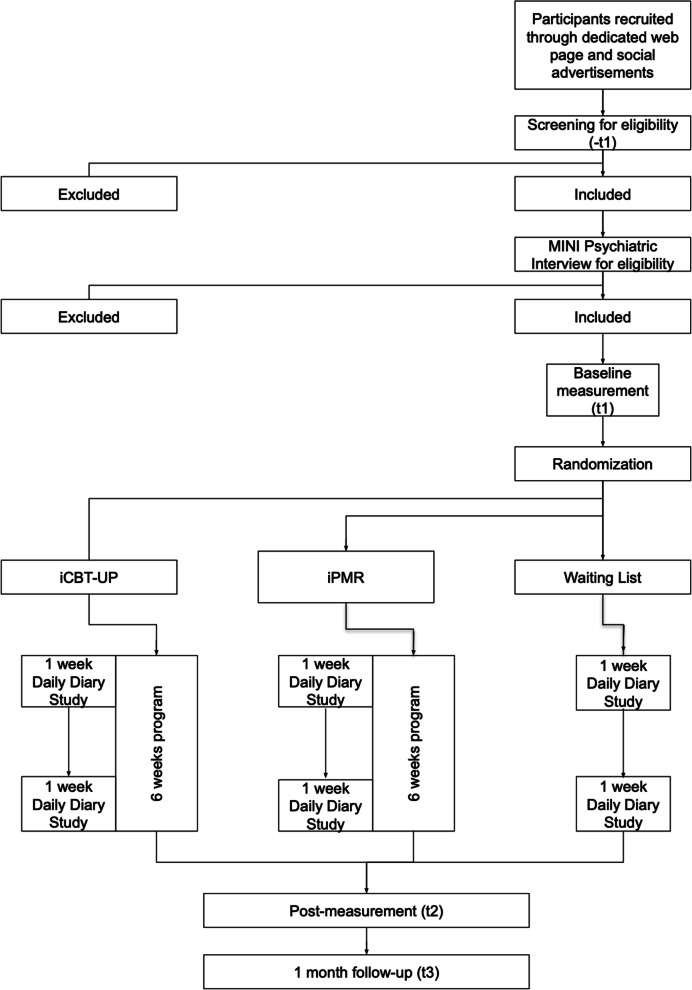
- Participants will be randomized in a 2:2:1 allocation ratio to iCBT-UP, iPMR, or waiting list, with assessments at baseline, post-treatment, and 1-month follow-up.
- The protocol specifies primary outcome adjustment disorder severity and secondary outcomes including stress, academic adjustment, life satisfaction, depression, anxiety, mindfulness, experiential avoidance, self-compassion, cognitive fusion, and daily diary/cognitive task measures.
## Methods
- Design: Parallel-group, three-arm randomized controlled trial following SPIRIT guidelines; two 6-week active conditions plus a 6-week waiting-list control.
- Sample/data: Polish university students aged 18+ with adjustment disorder confirmed by the IADQ and MINI; exclusion criteria include increased suicidality, bipolar/psychotic disorder, alcohol/substance use disorder, ongoing psychological treatment, or no time to participate.
- Analysis: Intention-to-treat analysis in SPSS v21.0; missing data handled with multiple imputation when appropriate; hierarchical linear modelling for primary/secondary outcomes, daily diary results, and cognitive functioning; Hayes’ Process Macro with bias-corrected bootstrap confidence intervals for mediation.
## Limitations
- The paper states that high dropout rates are a likely limitation for internet interventions and that the large assessment burden may reduce adherence; it says this may be especially problematic here because of the questionnaires plus daily diary measures.
- The text also notes a limitation evident from the design: the paper is a protocol, so it reports planned methods and outcomes rather than trial results.
- Another evident limitation is that the study is limited to Polish students, which may constrain generalizability beyond this population.
Model-written summary. Check it against the paper before relying on it.
Integrity signals
Registry
Cites
Statistics
Figures
Verification
Claims the paper makes
19 Valid · 1 Not valid · 19 Not checked · 11 Own results and interpretations
Some cited sources support this claim and some don’t — read each source’s verdict below.
In the paper
“Results of these studies indicate that academic adjustment problems are highly prevalent (around 50%) and negatively impact students’ functioning, including worse grades, high university dropout rates, and poor mental health [25–29].”
§ Effectiveness and mediators of change of an online CBT intervention for students with adjustment disorder—study protocol for a randomized controlled trial > Introduction
What the sources say
- Partly supportedcites [25] Aderi M Jdaitawi M Ishak NA Jdaitawi F The influence of demographic variables on university students’ adjustment in North Jordan Int Educ Stud 2013 6 2 172 178 10.5539/ies.v6n2p172 sourceExperimental — accuracy not yet measured
The Discussion and Conclusion reports that Jemal (2012) found adjustment problems in 50% of university students, but that figure concerns adjustment generally, not academic adjustment specifically. This paper’s Results instead report 35.63% with low academic adjustment and 49.27% with moderate academic adjustment; it does not establish the cited sentence’s claimed impacts on grades, dropout, and mental health. (LLM, conf=0.88)
- Not matchedcites [26] Mustaffa CS, Ilias M. Relationship between Students Adjustment Factors and Cross Cultural Adjustment: A Survey at the Northern University of Malaysia. Int Commun Stud. 2013;22(1):279–300.
Its entry has no title and year that we can search by.
- Not checked — no full text of the sourcecites [27] Lowe H Cook A Mind the gap: are students prepared for higher education? J Furth High Educ 2003 27 1 53 76 10.1080/03098770305629 source
- Disputedcites [28] Belay Ababu G, Belete Yigzaw A, Dinku Besene Y, Getinet Alemu W. Prevalence of adjustment problem and its predictors among first-year undergraduate students in Ethiopian University: a cross-sectional institution based study. Psychiatry J. 2018;25:5919743. PMC6176292 30356355 sourceExperimental — accuracy not yet measured
The Results (§3.1) report academic adjustment problems in 97 respondents (18.1%), not around 50%. The figure near 50% refers to overall adjustment problems (42.5%), a broader category. (LLM, conf=0.90)
Checked by a reasoning model — may be wrong.
- Not checked — no full text of the sourcecites [29] Rodgers LS Tennison LR A preliminary assessment of adjustment disorder among first-year college students Arch Psychiatr Nurs 2009 23 3 220 230 10.1016/j.apnu.2008.05.007 19446777 source
hedged- Asserted: passes — The authors put it forward as true.
- Checkable: passes — It can be checked against evidence.
- Load-bearing: passes — The paper’s conclusions depend on it.
- Based: passes — The paper gives a reason why it holds.
- Partly supported
The cited sources support only part of this claim — read each source’s verdict below.
In the paper
“Several studies have been published assessing the effectiveness of online therapeutic interventions aimed at people with AjD. All were based on CBT principles. Their promising results show small to medium effect-size improvements in experimental groups [39–42].”
§ Effectiveness and mediators of change of an online CBT intervention for students with adjustment disorder—study protocol for a randomized controlled trial > Introduction
What the sources say
- Partly supportedcites [39] Moser C Bachem R Berger T Maercker A ZIEL: Internet-based self-help for adjustment problems: results of a randomized controlled trial J Clin Med 2019 8 10 1655 10.3390/jcm8101655 31614528 PMC6832125 sourceExperimental — accuracy not yet measured
The Results (section 3.3) report small-to-medium improvements on AjD symptom subscales within the ZIEL intervention group. However, the primary AjD symptom measure showed a large within-group effect (d = 1.04), and its small between-group effect (d = 0.31) was not significant. Describing this study’s results simply as small-to-medium improvements omits those qualifications. (LLM, conf=0.88)
- Not checked — no full text of the sourcecites [40] Bachem R Maercker A Self-help interventions for adjustment disorder problems: a randomized waiting-list controlled study in a sample of burglary victims Cogn Behav Ther 2016 45 5 397 413 10.1080/16506073.2016.1191083 27299909 source
- Partly supportedcites [41] Rachyla I Pérez-Ara M Molés M Campos D Mira A Botella C Quero S An Internet-based intervention for adjustment disorder (TAO): study protocol for a randomized controlled trial BMC Psychiatry 2018 18 1 1 10 10.1186/s12888-018-1751-6 29855281 PMC5984386 sourceExperimental — accuracy not yet measured
The Background describes CBT-based computer interventions for AjD and reports preliminary positive findings for BADI. It does not report small-to-medium effect sizes from several online AjD studies; the Sample size section instead says there was no published research on ICBT effectiveness for AjD and draws its effect-size assumption from depression and anxiety trials. (LLM, conf=0.85)
- Not checked — no full text of the sourcecites [42] Eimontas J Rimsaite Z Gegieckaite G Zelviene P Kazlauskas E Internet-based self-help intervention for ICD-11 adjustment disorder: preliminary findings Psychiatr Q 2018 89 2 451 460 10.1007/s11126-017-9547-2 29124500 source
plainstates a cause- Asserted: passes — The authors put it forward as true.
- Checkable: passes — It can be checked against evidence.
- Load-bearing: passes — The paper’s conclusions depend on it.
- Based: passes — The paper gives a reason why it holds.
- Partly supported
The cited sources support only part of this claim — read each source’s verdict below.
In the paper
“Inflexibility processes associated with AjD include experiential avoidance and cognitive fusion [15, 16].”
§ Effectiveness and mediators of change of an online CBT intervention for students with adjustment disorder—study protocol for a randomized controlled trial > Introduction
What the sources say
- Partly supportedcites [15] Seçer İ Ulaş S Karaman-Özlü Z The effect of the fear of COVID-19 on healthcare professionals’ psychological adjustment skills: mediating role of experiential avoidance and psychological resilience Front Psychol 2020 11 561536 10.3389/fpsyg.2020.561536 33192830 PMC7609966 sourceExperimental — accuracy not yet measured
The Discussion (page not provided) links experiential avoidance with low psychological flexibility and impaired adjustment skills in healthcare professionals. The source does not address adjustment disorder (AjD) or identify cognitive fusion as an associated process. (LLM, conf=0.86)
- Not checked — no full text of the sourcecites [16] Krafft J Haeger JA Levin ME Comparing cognitive fusion and cognitive reappraisal as predictors of college student mental health Cogn Behav Ther 2019 48 3 241 252 10.1080/16506073.2018.1513556 30230428 source
plainstates an association- Asserted: passes — The authors put it forward as true.
- Checkable: passes — It can be checked against evidence.
- Load-bearing: passes — The paper’s conclusions depend on it.
- Based: passes — The paper gives a reason why it holds.
- Partly supported
The cited sources support only part of this claim — read each source’s verdict below.
In the paper
“Research has shown that the prevalence of mental health problems in this group is higher than in the general population [2, 3].”
§ Effectiveness and mediators of change of an online CBT intervention for students with adjustment disorder—study protocol for a randomized controlled trial > Introduction
What the sources say
- Partly supportedcites [2] Sheldon E Simmonds-Buckley M Bone C Mascarenhas T Chan N Wincott M Barkham M Prevalence and risk factors for mental health problems in university undergraduate students: a systematic review with meta-analysis J Affect Disord 2021 287 282 292 10.1016/j.jad.2021.03.054 33812241 sourceExperimental — accuracy not yet measured
The Introduction (p. 2) says university students report higher levels of depression than the general population. The Discussion (p. 18) likewise suggests higher depression prevalence, but says comparisons are inconclusive and difficult to make robustly. The claim extends that qualified finding about depression to mental health problems generally. (LLM, conf=0.88)
- Not checked — no full text of the sourcecites [3] Kang HK Rhodes C Rivers E Thornton CP Rodney T Prevalence of mental health disorders among undergraduate university students in the United States: a review J Psychosoc Nurs Ment Health Serv 2021 59 2 17 24 10.3928/02793695-20201104-03 33180947 source
plain- Asserted: passes — The authors put it forward as true.
- Checkable: passes — It can be checked against evidence.
- Load-bearing: unclear — It is unclear whether the paper’s conclusions depend on it.
- Based: passes — The paper gives a reason why it holds.
- Partly supported
Every source the paper cites for this claim was checked and supports it.
In the paper
“For example, in the abovementioned meta-analysis, only 9 out of 48 studies used a student functioning outcome [11].”
§ Effectiveness and mediators of change of an online CBT intervention for students with adjustment disorder—study protocol for a randomized controlled trial > Discussion
What the sources say
- Supportedcites [11] Harrer M Adam SH Baumeister H Cuijpers P Karyotaki E Auerbach RP Ebert DD Internet interventions for mental health in university students: a systematic review and meta-analysis Int J Methods Psychiatr Res 2019 28 2 e1759 10.1002/mpr.1759 30585363 PMC6877279 source
Section 3.1 (Study characteristics; page not available in our copy) states that student functioning outcomes were assessed in nine studies. Its three study-sample categories total 48 studies (25 + 18 + 5), matching the claim. (LLM, conf=0.94)
plain- Asserted: passes — The authors put it forward as true.
- Checkable: passes — It can be checked against evidence.
- Load-bearing: passes — The paper’s conclusions depend on it.
- Based: passes — The paper gives a reason why it holds.
- Supported
19 more claims · 4 with their cited sources checked
Create a free account to see all 50 claims and every source verdict.
- Probably not a substantial claim. 17
- It may state two separate claims as one. 15
Self-check
Percentages, sums and reported differences re-computed from the paper’s own numbers.
Each contradiction between two passages listed here was confirmed by an independent check.
Rated major: it would touch a result — a value a result rests on, reported and recomputed p-values on opposite sides of the significance level, two passages that conflict with no sign which is right, or a cited work retracted before this paper was published.
In the paper
§ Effectiveness and mediators of change of an online CBT intervention for students with adjustment disorder—study protocol for a randomized controlled trial > Abstract > Method/design
“In this three-arm randomized controlled trial, we plan to recruit 214 Polish students diagnosed with an adjustment disorder.”
§ Effectiveness and mediators of change of an online CBT intervention for students with adjustment disorder—study protocol for a randomized controlled trial > Methods/design > Sample size calculation
“However, because the literature reveals dropout rates from online CBT interventions, with minimal guidance, of approximately 30% [88], a total sample of 247 participants will be recruited.”
Citations
Cites
Diagnostic and Statistical Manual of Mental Disorders
American Psychiatric Association (2013) · doi:10.1176/appi.books.9780890425596 · Cited by 116,369
The PHQ-9: Validity of a brief depression severity measure
Kroenke, K., Spitzer, R. L., & Williams, J. B. W. (2001) · Journal of General Internal Medicine · doi:10.1046/j.1525-1497.2001.016009606.x · Cited by 44,910
(2013) · Cited by 44,563
A Global Measure of Perceived Stress
Cohen, S., Kamarck, T., & Mermelstein, R. (1983) · Journal of Health and Social Behavior · doi:10.2307/2136404 · Cited by 32,807 · cited 1×
“Secondary outcome measures The Scale of Experienced Stress (PSS-10) [60] is a scale made to measure stress levels and consists of 10 items.”
BackgroundThe satisfaction with life scale
Diener, E., Emmons, R. A., Larsen, R. J., & Griffin, S. (1985) · Journal of Personality Assessment · doi:10.1207/s15327752jpa4901_13 · Cited by 31,768
A Brief Measure for Assessing Generalized Anxiety Disorder: The GAD-7
Spitzer, R. L., Kroenke, K., Williams, J. B. W., & Löwe, B. (2006) · Archives of Internal Medicine · doi:10.1001/archinte.166.10.1092 · Cited by 31,765
Studies of interference in serial verbal reactions
Stroop, J. R. (1935) · Journal of Experimental Psychology · doi:10.1037/h0054651 · Cited by 18,622
Gross, J. J., & John, O. P. (2003) · Journal of Personality and Social Psychology · doi:10.1037/0022-3514.85.2.348 · Cited by 11,929 · cited 1×
“These variables will be measured using one item (each scale) from the Emotional Regulation Questionnaire (ERQ [78]).”
MethodSPIRIT 2013 explanation and elaboration: guidance for protocols of clinical trials
Chan, A.-W., Tetzlaff, J. M., Gotzsche, P. C., Altman, D. G., Mann, H., Berlin, J. A., Dickersin, K., Hrobjartsson, A., Schulz, K. F., Parulekar, W. R., et al. (2013) · BMJ · doi:10.1136/bmj.e7586 · Cited by 6,251 · cited 1×
“The study will follow SPIRIT guidelines (Standard Protocol Items: Recommendations for Interventional Trials) [47].”
MethodDevelopment and validation of the Penn State Worry Questionnaire
Meyer, T. J., Miller, M. L., Metzger, R. L., & Borkovec, T. D. (1990) · Behaviour Research and Therapy · doi:10.1016/0005-7967(90)90135-6 · Cited by 5,099 · cited 1×
“Daily worrying will be measured with three items taken from Meyer et al.’s scale [76].”
MethodThe Warwick-Edinburgh Mental Well-being Scale (WEMWBS): development and UK validation
Tennant, R., Hiller, L., Fishwick, R., Platt, S., Joseph, S., Weich, S., Parkinson, J., Secker, J., & Stewart-Brown, S. (2007) · Health and Quality of Life Outcomes · doi:10.1186/1477-7525-5-63 · Cited by 5,031
Mindfulness training as a clinical intervention: a conceptual and empirical review
Baer, R. A. (2003) · Clinical Psychology: Science and Practice · doi:10.1093/clipsy.bpg015 · Cited by 4,577 · cited 1×
“They have been proposed to attenuate the effects of experiential avoidance and cognitive fusion on well-being (e.g. [23, 24]).”
BackgroundBond, F. W., Hayes, S. C., Baer, R. A., Carpenter, K. M., Guenole, N., Orcutt, H. K., Waltz, T., & Zettle, R. D. (2011) · Behavior Therapy · doi:10.1016/j.beth.2011.03.007 · Cited by 3,950 · cited 1×
“The Acceptance and Action Questionnaire (AAQ-II) [66] is the most widely used measure of psychological inflexibility and experiential avoidance.”
MethodConstruction and factorial validation of a short form of the Self-Compassion Scale
Raes, F., Pommier, E., Neff, K. D., & Van Gucht, D. (2011) · Clinical Psychology & Psychotherapy · doi:10.1002/cpp.702 · Cited by 2,997 · cited 2×
“Self-compassion—measured by three items from the SCS [68].”
BackgroundMethodBaer, R. A., Smith, G. T., Lykins, E., Button, D., Krietemeyer, J., Sauer, S., Walsh, E., Duggan, D., & Williams, J. M. G. (2008) · Assessment · doi:10.1177/1073191107313003 · Cited by 2,930 · cited 1×
“The Five Facet Mindfulness Questionnaire (FFMQ-15) [65] is a 15-item self-report measure of mindfulness.”
BackgroundScreening Depressed Patients in Family Practice: A Rapid Technic
Beck, A. T., & Beck, R. W. (1972) · Postgraduate Medicine · doi:10.1080/00325481.1972.11713319 · Cited by 1,823
Trapnell, P. D., & Campbell, J. D. (1999) · Journal of Personality and Social Psychology · doi:10.1037/0022-3514.76.2.284 · Cited by 1,646 · cited 1×
“Daily rumination will be measured with three items based on Trapnell and Camp-bell’s scale [77].”
MethodMental Health and Academic Success in College
Eisenberg, D., Golberstein, E., & Hunt, J. B. (2009) · The B.E. Journal of Economic Analysis & Policy · doi:10.2202/1935-1682.2191 · Cited by 929
Ehring, T., Zetsche, U., Weidacker, K., Wahl, K., Schönfeld, S., & Ehlers, A. (2011) · Journal of Behavior Therapy and Experimental Psychiatry · doi:10.1016/j.jbtep.2010.12.003 · Cited by 888 · cited 1×
“The Perseverative Thinking Questionnaire (PTQ) [70] is used to measure repetitive negative thinking.”
MethodThe development and initial validation of the cognitive fusion questionnaire
Gillanders, D. T., Bolderston, H., Bond, F. W., Dempster, M., Flaxman, P. E., Campbell, L., Kerr, S., Tansey, L., Noel, P., Ferenbach, C., et al. (2014) · Behavior Therapy · doi:10.1016/j.beth.2013.09.001 · Cited by 837
Emotional openness as a predictor of college students' attitudes toward seeking psychological help.
Komiya, N., Good, G. E., & Sherrod, N. B. (2000) · Journal of Counseling Psychology · doi:10.1037/0022-0167.47.1.138 · Cited by 766 · cited 1×
“Self-help online therapy programs can address many of these problems [7, 8].”
BackgroundSheldon, E., Simmonds-Buckley, M., Bone, C., Mascarenhas, T., Chan, N., Wincott, M., Gleeson, H., Sow, K., Hind, D., & Barkham, M. (2021) · Journal of Affective Disorders · doi:10.1016/j.jad.2021.03.054 · Cited by 644 · cited 1×
“Research has shown that the prevalence of mental health problems in this group is higher than in the general population [2, 3].”
BackgroundBrown, T. A., & Barlow, D. H. (2009) · Psychological Assessment · doi:10.1037/a0016608 · Cited by 639 · cited 1×
“The UP aims to address temperamental characteristics, particularly neuroticism and resulting emotion dysregulation, which are argued to be a common factor underlying all emotional disorders [46].”
BackgroundTreweek, S., Lockhart, P., Pitkethly, M., Cook, J. A., Kjeldstrøm, M., Johansen, M., Taskila, T. K., Sullivan, F. M., Wilson, S., Jackson, C., et al. (2013) · BMJ Open · doi:10.1136/bmjopen-2012-002360 · Cited by 623
Credé, M., & Niehorster, S. (2012) · Educational Psychology Review · doi:10.1007/s10648-011-9184-5 · Cited by 607 · cited 1×
“They are also associated with suicidal ideation [30, 31].”
BackgroundDropout from Internet‐based treatment for psychological disorders
Melville, K. M., Casey, L. M., & Kavanagh, D. J. (2010) · British Journal of Clinical Psychology · doi:10.1348/014466509x472138 · Cited by 597 · cited 1×
“First, previous research findings have shown high dropout rates in studies of internet psychological interventions [94].”
BackgroundDepressed Medical Studentsʼ Use of Mental Health Services and Barriers to Use
Givens, J. L., & Tjia, J. (2002) · Academic Medicine · doi:10.1097/00001888-200209000-00024 · Cited by 583
Mind the Gap: Are students prepared for higher education?
Lowe, H., & Cook, A. (2003) · Journal of Further and Higher Education · doi:10.1080/03098770305629 · Cited by 583
Arousal, avoidant and decisional procrastinators: Do they exist?
Steel, P. (2010) · Personality and Individual Differences · doi:10.1016/j.paid.2010.02.025 · Cited by 514
Harrer, M., Adam, S. H., Baumeister, H., Cuijpers, P., Karyotaki, E., Auerbach, R. P., Kessler, R. C., Bruffaerts, R., Berking, M., & Ebert, D. D. (2019) · International Journal of Methods in Psychiatric Research · doi:10.1002/mpr.1759 · Cited by 445 · cited 3×
“A meta-analysis of online psychological interventions for students in 2019 revealed that only 23% of evaluated studies used an active control condition [11].”
BackgroundMethodInfluentialRegulating Positive and Negative Emotions in Daily Life
Nezlek, J. B., & Kuppens, P. (2008) · Journal of Personality · doi:10.1111/j.1467-6494.2008.00496.x · Cited by 441 · cited 1×
“All daily measures used in our study have been previously used in research [72, 73].”
Methodvan Ballegooijen, W., Cuijpers, P., van Straten, A., Karyotaki, E., Andersson, G., Smit, J. H., & Riper, H. (2014) · PLoS ONE · doi:10.1371/journal.pone.0100674 · Cited by 409
Linden, M. (2013) · Clinical Psychology & Psychotherapy · doi:10.1002/cpp.1765 · Cited by 397 · cited 1×
“Then, the answers will be coded using unwanted effects checklist [86].”
MethodConsensus statement on defining and measuring negative effects of internet interventions
Rozental, A., Andersson, G., Boettcher, J., Ebert, D. D., Cuijpers, P., Knaevelsrud, C., Ljótsson, B., Kaldo, V., Titov, N., & Carlbring, P. (2014) · Internet Interventions · doi:10.1016/j.invent.2014.02.001 · Cited by 371 · cited 2×
“If yes, please give us further details” [85].”
BackgroundMethodSakiris, N., & Berle, D. (2019) · Clinical Psychology Review · doi:10.1016/j.cpr.2019.101751 · Cited by 369 · cited 1×
“These reviews reveal that the UP significantly improves anxious and depressive symptoms with moderate to large effect sizes [51, 52].”
BackgroundToussaint, L., Nguyen, Q. A., Roettger, C., Dixon, K., Offenbächer, M., Kohls, N., Hirsch, J., & Sirois, F. (2021) · Evidence-Based Complementary and Alternative Medicine · doi:10.1155/2021/5924040 · Cited by 327 · cited 1×
“One of the most often used researched relaxation techniques is PMR [55].”
MethodTyndall, I., Waldeck, D., Pancani, L., Whelan, R., Roche, B., & Dawson, D. L. (2019) · Journal of Contextual Behavioral Science · doi:10.1016/j.jcbs.2018.09.005 · Cited by 303
Thompson, B. L., & Waltz, J. (2010) · Journal of Anxiety Disorders · doi:10.1016/j.janxdis.2010.02.005 · Cited by 264
Ryan, M. L., Shochet, I. M., & Stallman, H. M. (2010) · Advances in Mental Health · doi:10.5172/jamh.9.1.73 · Cited by 252
Ebert, D. D., Cuijpers, P., Muñoz, R. F., & Baumeister, H. (2017) · Frontiers in Psychiatry · doi:10.3389/fpsyt.2017.00116 · Cited by 244
What Makes Internet Therapy Work?
Andersson, G., Carlbring, P., Berger, T., Almlöv, J., & Cuijpers, P. (2009) · Cognitive Behaviour Therapy · doi:10.1080/16506070902916400 · Cited by 234
Carlucci, L., Saggino, A., & Balsamo, M. (2021) · Clinical Psychology Review · doi:10.1016/j.cpr.2021.101999 · Cited by 234 · cited 1×
“These reviews reveal that the UP significantly improves anxious and depressive symptoms with moderate to large effect sizes [51, 52].”
BackgroundRäsänen, P., Lappalainen, P., Muotka, J., Tolvanen, A., & Lappalainen, R. (2016) · Behaviour Research and Therapy · doi:10.1016/j.brat.2016.01.001 · Cited by 221 · cited 1×
“Global data show that such programs can effectively treat mental disorders and be used in prevention efforts among student populations [37, 38].”
BackgroundBardeen, J. R., & Fergus, T. A. (2016) · Journal of Contextual Behavioral Science · doi:10.1016/j.jcbs.2016.02.002 · Cited by 213 · cited 1×
“The combination of these two processes has been found to play a significant role in causing and maintaining psychological distress [17, 18].”
BackgroundRith-Najarian, L. R., Boustani, M. M., & Chorpita, B. F. (2019) · Journal of Affective Disorders · doi:10.1016/j.jad.2019.06.035 · Cited by 176
Optimizing Students’ Mental Health and Academic Performance: AI-Enhanced Life Crafting
Dekker, I., De Jong, E. M., Schippers, M. C., De Bruijn-Smolders, M., Alexiou, A., & Giesbers, B. (2020) · Frontiers in Psychology · doi:10.3389/fpsyg.2020.01063 · Cited by 176
Limone, P., & Toto, G. A. (2022) · Frontiers in Public Health · doi:10.3389/fpubh.2022.831349 · Cited by 165 · cited 1×
“Despite a clear need for mental health treatment, students rarely seek out and use in-person psychological services [4, 5].”
BackgroundVariations in the Circumplex Structure of Mood
Feldman, L. A. (1995) · Personality and Social Psychology Bulletin · doi:10.1177/0146167295218003 · Cited by 158 · cited 1×
“Daily affect—to be measured based on the circumplex model [79].”
BackgroundChanging the way we study change in psychotherapy.
Doss, B. D. (2004) · Clinical Psychology: Science and Practice · doi:10.1093/clipsy.bph094 · Cited by 158 · cited 1×
“It is essential for several practical reasons [91].”
BackgroundAdjustment disorder: A diagnosis whose time has come
Bachem, R., & Casey, P. (2018) · Journal of Affective Disorders · doi:10.1016/j.jad.2017.10.034 · Cited by 157 · cited 1×
“Adjustment disorder (AjD) is a disruption of adjustment following a stressful situation [12].”
BackgroundInfluentialNeural basis of the Stroop interference task: Response competition or selective attention?
MEAD, L. A., MAYER, A. R., BOBHOLZ, J. A., WOODLEY, S. J., CUNNINGHAM, J. M., HAMMEKE, T. A., & RAO, S. M. (2002) · Journal of the International Neuropsychological Society · doi:10.1017/s1355617702860015 · Cited by 155 · cited 1×
“To measure the cognitive functioning of students, we will use an online version of the Stroop task [80] (color– word), adapted from Mead et al. [81].”
MethodEffects of sleep deprivation on cognitive and physical performance in university students
Patrick, Y., Lee, A., Raha, O., Pillai, K., Gupta, S., Sethi, S., Mukeshimana, F., Gerard, L., Moghal, M. U., Saleh, S. N., et al. (2017) · Sleep and Biological Rhythms · doi:10.1007/s41105-017-0099-5 · Cited by 155
The Adjustment Disorder–New Module 20 as a Screening Instrument: Cluster Analysis and Cut-off Values
Lorenz, L., Bachem, R., & Maercker, A. (2016) · The International Journal of Occupational and Environmental Medicine · doi:10.15171/ijoem.2016.775 · Cited by 119
Unified Protocol for Transdiagnostic Treatment of Emotional Disorders: Workbook
Barlow, D. H., Ellard, K. K., Fairholme, C. P., Farchione, T. J., Boisseau, C. L., Allen, L. B., & Ehrenreich, J. T. (2010) · Cited by 113
Self-citationCookson, C., Luzon, O., Newland, J., & Kingston, J. (2020) · Psychology and Psychotherapy Theory Research and Practice · doi:10.1111/papt.12233 · Cited by 98
The academic adjustment scale: Measuring the adjustment of permanent resident or sojourner students
Anderson, J. R., Guan, Y., & Koc, Y. (2016) · International Journal of Intercultural Relations · doi:10.1016/j.ijintrel.2016.07.006 · Cited by 96
Kang, H. K., Rhodes, C., Rivers, E., Thornton, C. P., & Rodney, T. (2021) · Journal of Psychosocial Nursing and Mental Health Services · doi:10.3928/02793695-20201104-03 · Cited by 89 · cited 1×
“Research has shown that the prevalence of mental health problems in this group is higher than in the general population [2, 3].”
BackgroundFlett, J. A. M., Conner, T. S., Riordan, B. C., Patterson, T., & Hayne, H. (2020) · Psychology & Health · doi:10.1080/08870446.2019.1711089 · Cited by 84 · cited 1×
“Unfortunately, the study was limited by low app usage [34].”
BackgroundA Preliminary Assessment of Adjustment Disorder Among First-Year College Students
Rodgers, L. S., & Tennison, L. R. (2009) · Archives of Psychiatric Nursing · doi:10.1016/j.apnu.2008.05.007 · Cited by 82 · cited 2×
“%) and negatively impact students’ functioning, including worse grades, high university dropout rates, and poor mental health [25–29].”
BackgroundShevlin, M., Hyland, P., Ben‐Ezra, M., Karatzias, T., Cloitre, M., Vallières, F., Bachem, R., & Maercker, A. (2020) · Acta Psychiatrica Scandinavica · doi:10.1111/acps.13126 · Cited by 82
Physical Activity Is Associated With Better Executive Function in University Students
Salas-Gómez, D., Fernández‐Gorgojo, M., Pozueta, A., Ceballos, I. D., Lamarain, M., Pérez, C., Kazimierczak, M., & Sánchez‐Juan, P. (2020) · Frontiers in Human Neuroscience · doi:10.3389/fnhum.2020.00011 · Cited by 82 · cited 1×
“The Stroop test is a widely used measure in research on students’ mental health and cognitive functioning [82–84].”
MethodComparing cognitive fusion and cognitive reappraisal as predictors of college student mental health
Krafft, J., Haeger, J. A., & Levin, M. E. (2019) · Cognitive Behaviour Therapy · doi:10.1080/16506073.2018.1513556 · Cited by 76 · cited 1×
“Inflexibility processes associated with AjD include experiential avoidance and cognitive fusion [15, 16].”
BackgroundAnnales Universitatis Paedagogicae Cracoviensis
(n.d.) · Cited by 76
Seçer, İ., Ulaş, S., & Karaman-Özlü, Z. (2020) · Frontiers in Psychology · doi:10.3389/fpsyg.2020.561536 · Cited by 75 · cited 1×
“Inflexibility processes associated with AjD include experiential avoidance and cognitive fusion [15, 16].”
BackgroundNguyen-Feng, V. N., Greer, C. S., & Frazier, P. (2017) · Psychological Services · doi:10.1037/ser0000154 · Cited by 73
Ruiz, F. J., Flórez, C. L., García-Martín, M. B., Monroy-Cifuentes, A., Barreto-Montero, K., García-Beltrán, D. M., Riaño-Hernández, D., Sierra, M. A., Suárez-Falcón, J. C., Cardona-Betancourt, V., et al. (2018) · Journal of Contextual Behavioral Science · doi:10.1016/j.jcbs.2018.04.004 · Cited by 65
Adjustment and Emotional Maturity among First Year College Students
Sharma, B. (2012) · Cited by 61
Belay Ababu, G., Belete Yigzaw, A., Dinku Besene, Y., & Getinet Alemu, W. (2018) · Psychiatry Journal · doi:10.1155/2018/5919743 · Cited by 57
Bachem, R., & Maercker, A. (2016) · Cognitive Behaviour Therapy · doi:10.1080/16506073.2016.1191083 · Cited by 50
Internet-Based Self-Help Intervention for ICD-11 Adjustment Disorder: Preliminary Findings
Eimontas, J., Rimsaite, Z., Gegieckaite, G., Zelviene, P., & Kazlauskas, E. (2018) · Psychiatric Quarterly · doi:10.1007/s11126-017-9547-2 · Cited by 49 · cited 2×
“Their promising results show small to medium effect-size improvements in experimental groups [39–42].”
BackgroundInfluentialUnified Protocol for Transdiagnostic Treatment of Emotional Disorders: Workbook
Barlow, D. H., Farchione, T. J., Sauer-Zavala, S., Murray Latin, H., Ellard, K. K., Bullis, J. R., Bentley, K. H., Boettcher, H. T., & Cassiello-Robbins, C. (2017) · doi:10.1093/med-psych/9780190686017.001.0001 · Cited by 49
Self-citationElectronic bridge to mental health for college students: A randomized controlled intervention trial.
King, C. A., Eisenberg, D., Pistorello, J., Coryell, W. H., Albucher, R. C., Favorite, T., Horwitz, A. G., Bonar, E. E., Epstein, D. J., & Zheng, K. (2022) · Journal of Consulting and Clinical Psychology · doi:10.1037/ccp0000709 · Cited by 43 · cited 1×
“Despite a clear need for mental health treatment, students rarely seek out and use in-person psychological services [4, 5].”
BackgroundKingery, J. N., Bodenlos, J. S., & Lathrop, J. A. (2020) · Journal of American College Health · doi:10.1080/07448481.2019.1574801 · Cited by 34
The Influence of Demographic Variables on University Students’ Adjustment in North Jordan
Aderi, M., Jdaitawi, M., Ishak, N. A., & Jdaitawi, F. (2013) · International Education Studies · doi:10.5539/ies.v6n2p172 · Cited by 32 · cited 1×
“%) and negatively impact students’ functioning, including worse grades, high university dropout rates, and poor mental health [25–29].”
BackgroundEisenberg, D., Lipson, S. K., Ceglarek, P. J. D., Kern, A., & Phillips, M. (2018) · Routledge eBooks · doi:10.4324/9781315175799-5 · Cited by 32
ZIEL: Internet-Based Self-Help for Adjustment Problems: Results of a Randomized Controlled Trial
Moser, C., Bachem, R., Berger, T., & Maercker, A. (2019) · Journal of Clinical Medicine · doi:10.3390/jcm8101655 · Cited by 31 · cited 1×
“Their promising results show small to medium effect-size improvements in experimental groups [39–42].”
BackgroundEimontas, J., Gegieckaite, G., Dovydaitiene, M., Mazulyte, E., Rimsaite, Z., Skruibis, P., Zelviene, P., & Kazlauskas, E. (2018) · Anxiety, Stress, & Coping · doi:10.1080/10615806.2017.1385065 · Cited by 28
Sensitivity analysis in multiple imputation in effectiveness studies of psychotherapy
Crameri, A., von Wyl, A., Koemeda, M., Schulthess, P., & Tschuschke, V. (2015) · Frontiers in Psychology · doi:10.3389/fpsyg.2015.01042 · Cited by 24 · cited 1×
“We also plan to perform sensitivity analysis to test the robustness against departures from the assumption of missing data being at random following the technique explained in Crameri et al. [89].”
MethodRachyla, I., Pérez-Ara, M., Molés, M., Campos, D., Mira, A., Botella, C., & Quero, S. (2018) · BMC Psychiatry · doi:10.1186/s12888-018-1751-6 · Cited by 22
Bostani, S., Rambod, M., Irani, P. S., & Torabizadeh, C. (2020) · International Journal of Africa Nursing Sciences · doi:10.1016/j.ijans.2020.100218 · Cited by 19 · cited 1×
“PMR has been proven to reduce college students’ anxiety and stress and boost happiness [56, 57].”
BackgroundTimulak, L., Richards, D., Bhandal-Griffin, L., Healy, P., Azevedo, J., Connon, G., Martin, E., Kearney, A., O’Kelly, C., Enrique, A., et al. (2022) · Trials · doi:10.1186/s13063-022-06551-y · Cited by 19
Self-citationToqan, D., Ayed, A., & Khalaf, I. A. (2023) · Journal of Public Health Research · doi:10.1177/22799036231181668 · Cited by 19 · cited 1×
“PMR has been proven to reduce college students’ anxiety and stress and boost happiness [56, 57].”
BackgroundStudent Adaptation to College Survey: The Role of Self-Compassion in College Adjustment
Scott, H., & Donovan, E. (2021) · Psi Chi Journal of Psychological Research · doi:10.24839/2325-7342.jn26.2.101 · Cited by 15 · cited 1×
“On the other hand, psychological flexibility processes associated with AjD are mindfulness and self-compassion [21, 22].”
BackgroundPositive daily experiences can buffer the negative effects of daily stress: A conceptual replication
Nezlek, J. B., Rusanowska, M., Holas, P., & Krejtz, I. (2017) · Journal of Research in Personality · doi:10.1016/j.jrp.2017.09.002 · Cited by 13 · cited 1×
“All daily measures used in our study have been previously used in research [72, 73].”
MethodSelf-citationPsi Chi Journal of Psychological Research
(2017) · Psi Chi Journal of Psychological Research · doi:10.24839/2325-7342.jn · Cited by 13
Psychospołeczne uwarunkowania funkcjonowania i zdrowia psychicznego... w okresie wczesnej dorosłości
Franczok-Kuczmowska, A., & Kuzian, M. (2018) · Annales Universitatis Paedagogicae Cracoviensis Studia Psychologica · doi:10.24917/20845596.11.8 · Cited by 8 · cited 2×
“Students face many developmental challenges when transitioning to a university setting, such as leaving the family home, becoming independent, and adjusting study habits for the university setting [1].”
BackgroundMeditation in Higher Education: Does it Enhance Cognition?
Helber, C., Zook, N., & Immergut, M. (2012) · Innovative Higher Education · doi:10.1007/s10755-012-9217-0 · Cited by 7 · cited 1×
“The Stroop test is a widely used measure in research on students’ mental health and cognitive functioning [82–84].”
MethodHolas, P. (2021) · European Psychiatry · doi:10.1192/j.eurpsy.2021.291 · Cited by 3 · cited 1×
“The study evaluated the efficacy of online mindfulness-based cognitive therapy (eMBCT) [92].”
BackgroundSelf-citation(2013) · Cited by 2
Research works printed but not linked: 4
- Bond FW, Hayes SC, Barnes-Holmes D. Psychological flexibility, ACT, and organizational behavior. In: Acceptance and mindfulness at work: Applying acceptance and commitment therapy and relational frame theory to organizational behavior management. Routledge; 2013:25–54.
- Dereix-Calonge I Ruiz FJ Cardona-Betancourt V Flórez CL Repetitive negative thinking longitudinally predicts the psychological adjustment of clinical psychology trainees Psicología Conductual 2020 28 2 227 243
- Mustaffa CS, Ilias M. Relationship between Students Adjustment Factors and Cross Cultural Adjustment: A Survey at the Northern University of Malaysia. Int Commun Stud. 2013;22(1):279–300.
- Cieślak R, Kozłowska A, Michalak N, Koch A, Rogala A. Psychological internet interventions: concepts, applications, and challenges. Nauka. 2018;3:7–26.
Cited by
Vancappel, A., Eberle, D. J., Chkili, R., Kerbage, H., Shevlin, M. E., Maercker, A., El‐Hage, W., & Bachem, R. (2025) · Psychological Test Adaptation and Development · doi:10.1027/2698-1866/a000094 · Cited by 5
A 2023 nationwide study on adjustment disorder among first year MBBS students in India
Agarwal, M., Sharma, P., Goswami, A., & Mittal, R. (2024) · Bioinformation · doi:10.6026/973206300200190 · Cited by 7
Juszczyk-Kalina, A., Holas, P., Bachem, R., & Roczon, P. (2026) · Journal of American College Health · doi:10.1080/07448481.2025.2593313 · Cited by 2
“81 Future research should employ longitudinal and experimental designs to establish causal relationships between academic adjustment, psychological inflexibility, and AjD.”
Self-citation
Metadata
- Authors
- Juszczyk-Kalina, A., Holas, P., & Farchione, T. J.
- Affiliations
- University of Warsaw (PL)
- Boston University (US)
- Corresponding author
- Juszczyk-Kalina, A.
- Venue
- Trials
- Published
- 2023-12-01
- Volume
- 24
- Issue
- 1
- Pages
- 777-777
- ISSN
- 1745-6215 (ISSN-L)
- PMC
- PMC10691050
- OpenAlex
- W4389226361
- Cited by
- 4
- References
- 87
- Citations by year
- 2026: 1 · 2025: 2 · 2024: 1
- FWCI
- 1.03
- Type
- journal article
- Language
- en
- Open access
- gold
- doi.org
- Licence
- cc-by
- creativecommons.org/licenses/by/4.0 (tdm)
- creativecommons.org/licenses/by/4.0 (vor)
- Locations
- Trials (publishedVersion, cc-by)
- Research Square (acceptedVersion, cc-by)
- PubMed Central (publishedVersion, cc-by)
- PubMed (publishedVersion)
- DOAJ (DOAJ: Directory of Open Access Journals) (submittedVersion, cc-by-sa)
- Funders
- Uniwersytet Warszawski
- Topics
- Social Sciences › Psychology › Applied Psychology › Digital Mental Health Interventions
- Social Sciences › Psychology › Experimental and Cognitive Psychology › Anxiety, Depression, Psychometrics, Treatment, Cognitive Processes
- Social Sciences › Psychology › Clinical Psychology › Mindfulness and Compassion Interventions
- Keywords
- adjustment disorder, university students, internet-based cognitive behavioral therapy, transdiagnostic treatment, Unified Protocol, mediators of change, progressive muscle relaxation, mindfulness, experiential avoidance, cognitive fusion, depression, anxiety, stress, life satisfaction, cognitive function
- MeSH terms
- Adjustment Disorders, Anxiety Disorders, Humans, Surveys and Questionnaires, Students, Cognitive Behavioral Therapy, Randomized Controlled Trials as Topic, Treatment Outcome
About these checks
Registry, retraction, Cites and statistics results are computed, not judged, with one exception: a printed reference that no index lists is read once by a model before it counts as a citation error. Claims are extracted by a model and kept only when their quote appears verbatim in the text; each cited source is then checked, with a model’s help, for whether it says what the claim relies on. Those verdicts can be wrong — read the claim’s quote and the cited source before relying on one.
The claim verdicts this report counts are experimental: their accuracy is not yet measured.
A language model drew the claims from the paper on 2026-10-11, under version 3 of the claim definition (model deepseek-v4.1-flash, prompt extract-v3).
A second model labelled each claim on 2026-10-11 (model jev-1.13-20260917, definition revision gold-guideline-v0.2).
Cited sources are checked with a language model’s help (gpt-6-sol).
Statistics and arithmetic are recomputed, not judged.
Confidence bands are shown only for fields calibrated on our annotated test set. None is calibrated yet, so no band is shown.
What counts as a claim ›How we measure confidence ›How we check this ›
Are you an author, or do you see a problem with this page? Request a review
Data sources
Bibliographic data: Semantic Scholar, OpenAlex, Crossref.
Contains information from the Semantic Scholar Academic Graph Datasets, made available under the ODC Attribution License (ODC-BY 1.0).
Semantic Scholar’s data is described in: Kinney, R., et al. (2023). The Semantic Scholar Open Data Platform. arXiv:2301.10140.
