

The DOI matches its Crossref record; 111 of the 111 references it cites were found in a registry or an index; 4 of the 137 sources its claims cite were checked for support.
Planning and Evaluating Remote Consultation Services: A New Conceptual Framework Incorporating Complexity and Practical Ethics
Open accessAbstract
Establishing and running remote consultation services is challenging politically (interest groups may gain or lose), organizationally (remote consulting requires implementation work and new roles and workflows), economically (costs and benefits are unevenly distributed across the system), technically (excellent care needs dependable links and high-quality audio and images), relationally (interpersonal interactions are altered), and clinically (patients are unique, some examinations require contact, and clinicians have deeply-held habits, dispositions and norms). Many of these challenges have an under-examined ethical dimension. In this paper, we present a novel framework, Planning and Evaluating Remote Consultation Services (PERCS), built from a literature review and ongoing research. PERCS has 7 domains—the reason for consulting, the patient, the clinical relationship, the home and family, technologies, staff, the healthcare organization, and the wider system—and considers how these domains interact and evolve over time as a complex system. It focuses attention on the organization's digital maturity and digital inclusion efforts. We have found that both during and beyond the pandemic, policymakers envisaged an efficient, safe and accessible remote consultation service delivered through state-of-the art digital technologies and implemented via rational allocation criteria and quality standards. In contrast, our empirical data reveal that strategic decisions about establishing remote consultation services, allocation decisions for appointment type (phone, video, e-, face-to-face), and clinical decisions when consulting remotely are fraught with contradictions and tensions—for example, between demand management and patient choice—leading to both large- and small-scale ethical dilemmas for managers, support staff, and clinicians. These dilemmas cannot be resolved by standard operating procedures or algorithms. Rather, they must be managed by attending to here-and-now practicalities and emergent narratives, drawing on guiding principles applied with contextual judgement. We complement the PERCS framework with a set of principles for informing its application in practice, including education of professionals and patients.
Overview
AI snapshot
Written from the paper’s full text.
TL;DR
This paper presents PERCS, a complexity-informed framework for planning and evaluating remote consultation services, adapted from NASSS and refined using UK mixed-method studies and a Delphi exercise. It argues that remote consultation decisions are ethically and practically fraught, requiring contextual judgement and guiding principles rather than algorithms.
Key findings
- PERCS was built from a literature review and ongoing research and adapted from NASSS; it covers domains including the reason for consulting, the patient, the clinical relationship, the home and family, technologies, staff, the healthcare organization, and the wider system, follows their interaction over time, and adds side panels on organizational digital maturity and digital inclusion.
- Policymakers envisaged an efficient, safe, accessible remote service delivered through state-of-the-art digital technologies and implemented via rational allocation criteria and quality standards; empirical data showed strategic, allocation, and clinical decisions were fraught with contradictions and tensions (e.g., demand management vs patient choice), producing ethical dilemmas not resolvable by standard operating procedures or algorithms.
- A four-round Delphi produced 26 guiding principles; in round 2 all but one of 25 revised principles were supported by ≥80%, in round 3 all but one of 26 were supported by ≥80% (final item 71%), and after a fourth round there was high agreement on all 26. Final agreement ranged from 80% (patient training in digital skills) to 100% (safeguarding; balancing patient autonomy with support from carers/friends; remote physical examinations; information continuity and action points).
- The digital maturity scale has five levels from Level 1 Traditional (reactive) to Level 5 System-oriented (extending and spreading); digital inclusion was conceptualized as requiring diversity of provision, digital access support, and non-digital alternatives. Despite policy emphasis on video, telephone was the dominant technology used.
Methods
- Multiple UK mixed-methods studies, predominantly qualitative, using interviews, ethnography, documentary analysis, and descriptive quantitative data. Key datasets included a Scottish Government evaluation with 60 h of ethnographic observation, 223 interviews, and quantitative analysis of over 69,000 consultations (including over 18,000 patient assessments); Remote by Default with over 100 interviews, four locality case studies, four online focus groups with 19 participants, four cross-sector workshops with ~160 stakeholders, and a four-round Delphi; and the Health Foundation Video Consulting study with a survey of over 800 NHS staff, 40 follow-up interviews (20 repeated longitudinally), 10 patient interviews, two group discussions with 15 patient/public representatives, and 7 locality case studies.
- Framework development involved coding transcripts, field notes, and workshop write-ups (NVivo or Excel), descriptive statistics for quantitative data, narrative synthesis, and iterative team discussion; NASSS was initially used and then adapted into PERCS as it proved inadequate for some findings.
- The Delphi recruited 69 participants, of whom 19 did not attempt any items; 50 attempted at least one item in round 1, 40 in round 2, and 37 in rounds 3 and 4. It began with 60 draft principles organized into 30 partially contradictory pairs under four categories, then moved to a simple list of 25 principles in round 2 and 26 in round 3, with a fourth round on one remaining item; analysis used descriptive statistics and thematic analysis.
Limitations
- Stated: all empirical studies were UK-based, so PERCS and the guiding principles may not transfer to very different contexts without adaptation; pandemic restrictions made ethnography impossible for later months, and although ethics approval was obtained to video and audiotape clinical consultations, this proved impossible in practice, so insights are based more on what people said was happening than on direct observation; the Delphi sample was relatively small and should be replicated and tested prospectively; PERCS is explanatory, not deterministic or predictive.
- Evident from the text: the Delphi had substantial attrition (69 recruited, 19 attempted no items, 37 in final rounds) and later rounds included 11 patients or carers alongside mostly professional participants; the planned statistical analysis of Delphi quantitative data was abandoned after presenting principles in deliberately contradictory pairs caused confusion and irritation; SurveyMonkey was used because pandemic home-working precluded more specialized tools.
Model-written summary. Check it against the paper before relying on it.
Integrity signals
Registry
Cites
Statistics
Figures
Verification
Claims the paper makes
62 Not checked yet · 42 Own result · 25 Own interpretation · 14 No basis given · 7 Own method · 1 Partly supported · accuracy not yet measured
In the paper
“Our findings affirmed published claims that remote consulting is cognitively burdensome (54), excludes the physical touch on which the therapeutic relationship has traditionally depended (55), threatens continuity of care (7), brings greater clinical uncertainty, and makes the personal care afforded by the extended, face-to-face “long consultation” more difficult (8, 56, 57).”
§ Planning and Evaluating Remote Consultation Services: A New Conceptual Framework Incorporating Complexity and Practical Ethics > Findings > The PERCS Framework for Planning and Evaluating Remote Consultation Services
What the sources say
- Not checked yetcites [54] Ambrose, 2020, Remote consulting: recognising the cognitive load, Br J Gen Pract. source
plaindirect- Asserted: passes — The authors put it forward as true.
- Checkable: passes — It can be checked against evidence.
- Load-bearing: passes — The paper’s conclusions depend on it.
- Based: passes — The paper gives a reason why it holds.
A result the paper reports from its own data — it cites no other source for it, so there is none to check. The quote shows it is in the paper.
In the paper
“But whilst NASSS was our theoretical starting point, we quickly discovered that it did not fully explain all of our empirical data—especially findings around the clinical relationship and the ethics of allocating appointment type.”
§ Planning and Evaluating Remote Consultation Services: A New Conceptual Framework Incorporating Complexity and Practical Ethics > Context: the Shift to Remote Consultations in the UK
plain- Asserted: passes — The authors put it forward as true.
- Checkable: passes — It can be checked against evidence.
- Load-bearing: passes — The paper’s conclusions depend on it.
- Based: passes — The paper gives a reason why it holds.
A result the paper reports from its own data — it cites no other source for it, so there is none to check. The quote shows it is in the paper.
In the paper
“- Clinical risk management and safety-netting, especially in acutely unwell patients (e.g., deciding which patients with suspected COVID-19 to see in person or send to hospital);”
§ Planning and Evaluating Remote Consultation Services: A New Conceptual Framework Incorporating Complexity and Practical Ethics > Empirical Context: Mixed-Method Studies of Remote Care Before and During the Pandemic > Developing the PERCS Framework
plain- Asserted: passes — The authors put it forward as true.
- Checkable: passes — It can be checked against evidence.
- Load-bearing: passes — The paper’s conclusions depend on it.
- Based: passes — The paper gives a reason why it holds.
A result the paper reports from its own data — it cites no other source for it, so there is none to check. The quote shows it is in the paper.
In the paper
“- Technical issues, including technical infrastructure; interoperability (especially interfacing with the electronic patient record) and in patients' homes (e.g., linking with multiple devices), and the wasted time and stress caused by unreliable internet access and technologies;”
§ Planning and Evaluating Remote Consultation Services: A New Conceptual Framework Incorporating Complexity and Practical Ethics > Empirical Context: Mixed-Method Studies of Remote Care Before and During the Pandemic > Developing the PERCS Framework
plain- Asserted: passes — The authors put it forward as true.
- Checkable: passes — It can be checked against evidence.
- Load-bearing: unclear — It is unclear whether the paper’s conclusions depend on it.
- Based: passes — The paper gives a reason why it holds.
A result the paper reports from its own data — it cites no other source for it, so there is none to check. The quote shows it is in the paper.
In the paper
“- The patient's home and family context, notably concerns about privacy and safety (e.g., whether patients are safe from eavesdropping or coercion);”
§ Planning and Evaluating Remote Consultation Services: A New Conceptual Framework Incorporating Complexity and Practical Ethics > Empirical Context: Mixed-Method Studies of Remote Care Before and During the Pandemic > Developing the PERCS Framework
plain- Asserted: passes — The authors put it forward as true.
- Checkable: passes — It can be checked against evidence.
- Load-bearing: unclear — It is unclear whether the paper’s conclusions depend on it.
- Based: passes — The paper gives a reason why it holds.
A result the paper reports from its own data — it cites no other source for it, so there is none to check. The quote shows it is in the paper.
In the paper
“- Digital exclusion, including the impact of poor-quality technologies, low digital literacy and material aspects of the home environment (and, even more so, being homeless);”
§ Planning and Evaluating Remote Consultation Services: A New Conceptual Framework Incorporating Complexity and Practical Ethics > Empirical Context: Mixed-Method Studies of Remote Care Before and During the Pandemic > Developing the PERCS Framework
plain- Asserted: passes — The authors put it forward as true.
- Checkable: passes — It can be checked against evidence.
- Load-bearing: passes — The paper’s conclusions depend on it.
- Based: passes — The paper gives a reason why it holds.
A result the paper reports from its own data — it cites no other source for it, so there is none to check. The quote shows it is in the paper.
In the paper
“- Organizational efficiency such as the nature of, and reasons for, “double-handling” (e.g., when patients were transferred from e-consultation to phone or from phone to video or face-to-face);”
§ Planning and Evaluating Remote Consultation Services: A New Conceptual Framework Incorporating Complexity and Practical Ethics > Empirical Context: Mixed-Method Studies of Remote Care Before and During the Pandemic > Developing the PERCS Framework
plain- Asserted: passes — The authors put it forward as true.
- Checkable: passes — It can be checked against evidence.
- Load-bearing: unclear — It is unclear whether the paper’s conclusions depend on it.
- Based: passes — The paper gives a reason why it holds.
A result the paper reports from its own data — it cites no other source for it, so there is none to check. The quote shows it is in the paper.
In the paper
“- Remote clinical assessment of patients, especially those with a complex clinical picture such as evolving symptoms, co-morbidities, learning difficulties, cognitive impairment or vision or hearing difficulties;”
§ Planning and Evaluating Remote Consultation Services: A New Conceptual Framework Incorporating Complexity and Practical Ethics > Empirical Context: Mixed-Method Studies of Remote Care Before and During the Pandemic > Developing the PERCS Framework
plain- Asserted: passes — The authors put it forward as true.
- Checkable: passes — It can be checked against evidence.
- Load-bearing: passes — The paper’s conclusions depend on it.
- Based: passes — The paper gives a reason why it holds.
A result the paper reports from its own data — it cites no other source for it, so there is none to check. The quote shows it is in the paper.
In the paper
“- The national regulation and procurement context, which shaped not only what technology might be available and affordable in any organization, but also who could use it and for what.”
§ Planning and Evaluating Remote Consultation Services: A New Conceptual Framework Incorporating Complexity and Practical Ethics > Empirical Context: Mixed-Method Studies of Remote Care Before and During the Pandemic > Developing the PERCS Framework
hedgeddirect- Asserted: passes — The authors put it forward as true.
- Checkable: passes — It can be checked against evidence.
- Load-bearing: unclear — It is unclear whether the paper’s conclusions depend on it.
- Based: passes — The paper gives a reason why it holds.
A result the paper reports from its own data — it cites no other source for it, so there is none to check. The quote shows it is in the paper.
In the paper
“- New opportunities for inter-organizational collaboration e.g., for clinicians to engage in multiagency work to prepare and plan patient care; and”
§ Planning and Evaluating Remote Consultation Services: A New Conceptual Framework Incorporating Complexity and Practical Ethics > Empirical Context: Mixed-Method Studies of Remote Care Before and During the Pandemic > Developing the PERCS Framework
plain- Asserted: passes — The authors put it forward as true.
- Checkable: passes — It can be checked against evidence.
- Load-bearing: unclear — It is unclear whether the paper’s conclusions depend on it.
- Based: passes — The paper gives a reason why it holds.
A result the paper reports from its own data — it cites no other source for it, so there is none to check. The quote shows it is in the paper.
In the paper
“Our datasets include examples of patients who had no home or whose homes were small, crowded, lacking privacy (notably houses of multiple occupation, but also many family homes under conditions of lockdown) or not connected to the Internet.”
§ Planning and Evaluating Remote Consultation Services: A New Conceptual Framework Incorporating Complexity and Practical Ethics > Findings > The PERCS Framework for Planning and Evaluating Remote Consultation Services
plain- Asserted: passes — The authors put it forward as true.
- Checkable: passes — It can be checked against evidence.
- Load-bearing: passes — The paper’s conclusions depend on it.
- Based: passes — The paper gives a reason why it holds.
The paper states this without a source or data behind it here, so there is nothing to check it against. The quote shows it is in the paper.
In the paper
“- Sociotechnical issues such as use of workarounds—for example, patients strategically downplaying symptoms on e-consultations to avoid an algorithm-driven diversion to a call handling service;”
§ Planning and Evaluating Remote Consultation Services: A New Conceptual Framework Incorporating Complexity and Practical Ethics > Empirical Context: Mixed-Method Studies of Remote Care Before and During the Pandemic > Developing the PERCS Framework
plain- Asserted: passes — The authors put it forward as true.
- Checkable: passes — It can be checked against evidence.
- Load-bearing: unclear — It is unclear whether the paper’s conclusions depend on it.
- Based: passes — The paper gives a reason why it holds.
A result the paper reports from its own data — it cites no other source for it, so there is none to check. The quote shows it is in the paper.
In the paper
“Across our in-pandemic datasets, a number of themes were evident which had received little or no emphasis in pre-pandemic research on remote consultations (see Discussion for summary of that literature).”
§ Planning and Evaluating Remote Consultation Services: A New Conceptual Framework Incorporating Complexity and Practical Ethics > Empirical Context: Mixed-Method Studies of Remote Care Before and During the Pandemic > Developing the PERCS Framework
plain- Asserted: passes — The authors put it forward as true.
- Checkable: passes — It can be checked against evidence.
- Load-bearing: passes — The paper’s conclusions depend on it.
- Based: passes — The paper gives a reason why it holds.
A result the paper reports from its own data — it cites no other source for it, so there is none to check. The quote shows it is in the paper.
In the paper
“- Knock-on effects on vulnerable groups, for example the impact on people with drug dependency (e.g., reduced in-person pick-ups for controlled drugs has resulted in fewer opportunities for direct clinician-patient engagement);”
§ Planning and Evaluating Remote Consultation Services: A New Conceptual Framework Incorporating Complexity and Practical Ethics > Empirical Context: Mixed-Method Studies of Remote Care Before and During the Pandemic > Developing the PERCS Framework
plain- Asserted: passes — The authors put it forward as true.
- Checkable: passes — It can be checked against evidence.
- Load-bearing: unclear — It is unclear whether the paper’s conclusions depend on it.
- Based: passes — The paper gives a reason why it holds.
The paper states this without a source or data behind it here, so there is nothing to check it against. The quote shows it is in the paper.
In the paper
“At the time of our fieldwork, there were few established guiding principles for provision of remote services (exceptions include “see all young infants face-to-face promptly” and “don't provide end-of-life care remotely”).”
§ Planning and Evaluating Remote Consultation Services: A New Conceptual Framework Incorporating Complexity and Practical Ethics > Empirical Context: Mixed-Method Studies of Remote Care Before and During the Pandemic > Developing the Guiding Principles
plain- Asserted: passes — The authors put it forward as true.
- Checkable: passes — It can be checked against evidence.
- Load-bearing: passes — The paper’s conclusions depend on it.
- Based: unclear — It is unclear why the paper says it holds.
A result the paper reports from its own data — it cites no other source for it, so there is none to check. The quote shows it is in the paper.
In the paper
“- Staff wellbeing, especially stress and loss of motivation from lack of face-to-face contact and a perception that consultations have become more transactional;”
§ Planning and Evaluating Remote Consultation Services: A New Conceptual Framework Incorporating Complexity and Practical Ethics > Empirical Context: Mixed-Method Studies of Remote Care Before and During the Pandemic > Developing the PERCS Framework
plaindirect- Asserted: passes — The authors put it forward as true.
- Checkable: passes — It can be checked against evidence.
- Load-bearing: unclear — It is unclear whether the paper’s conclusions depend on it.
- Based: passes — The paper gives a reason why it holds.
A result the paper reports from its own data — it cites no other source for it, so there is none to check. The quote shows it is in the paper.
In the paper
“our empirical data reveal that strategic decisions about establishing remote consultation services, allocation decisions for appointment type (phone, video, e-, face-to-face), and clinical decisions when consulting remotely are fraught with contradictions and tensions”
- Also stated in: § Developing the Guiding Principles · plain
“decision-making at multiple levels—system-level strategic decisions about setting up remote consultation services, administrative decisions to allocate particular kinds of appointment (phone, video, e-, face-to-face), and clinical decisions when consulting remotely—was fraught with inherent contradictions and tensions.”
§ Planning and Evaluating Remote Consultation Services: A New Conceptual Framework Incorporating Complexity and Practical Ethics > Abstract
plain- Asserted: passes — The authors put it forward as true.
- Checkable: passes — It can be checked against evidence.
- Load-bearing: passes — The paper’s conclusions depend on it.
- Based: passes — The paper gives a reason why it holds.
- Also stated in: § Developing the Guiding Principles · plain
A result the paper reports from its own data — it cites no other source for it, so there is none to check. The quote shows it is in the paper.
In the paper
“- Continuity of care, especially how to create coherence over time when different consultation modalities and more than one clinician were involved;”
§ Planning and Evaluating Remote Consultation Services: A New Conceptual Framework Incorporating Complexity and Practical Ethics > Empirical Context: Mixed-Method Studies of Remote Care Before and During the Pandemic > Developing the PERCS Framework
plain- Asserted: passes — The authors put it forward as true.
- Checkable: passes — It can be checked against evidence.
- Load-bearing: passes — The paper’s conclusions depend on it.
- Based: passes — The paper gives a reason why it holds.
A result the paper reports from its own data — it cites no other source for it, so there is none to check. The quote shows it is in the paper.
In the paper
“One of the most frequent and consistent themes in our dataset was a sense from both clinicians and patients that the clinical relationship is necessarily built—at least initially—face-to-face.”
§ Planning and Evaluating Remote Consultation Services: A New Conceptual Framework Incorporating Complexity and Practical Ethics > Findings > The PERCS Framework for Planning and Evaluating Remote Consultation Services
plain- Asserted: passes — The authors put it forward as true.
- Checkable: passes — It can be checked against evidence.
- Load-bearing: passes — The paper’s conclusions depend on it.
- Based: passes — The paper gives a reason why it holds.
A result the paper reports from its own data — it cites no other source for it, so there is none to check. The quote shows it is in the paper.
In the paper
“leading to both large- and small-scale ethical dilemmas for managers, support staff, and clinicians.”
- Also stated in: § Developing the Guiding Principles · plain
“These tensions led to both large- and small-scale ethical dilemmas for managers, support staff, and clinicians.”
§ Planning and Evaluating Remote Consultation Services: A New Conceptual Framework Incorporating Complexity and Practical Ethics > Abstract
plaindirect- Asserted: passes — The authors put it forward as true.
- Checkable: passes — It can be checked against evidence.
- Load-bearing: passes — The paper’s conclusions depend on it.
- Based: passes — The paper gives a reason why it holds.
- Also stated in: § Developing the Guiding Principles · plain
A result the paper reports from its own data — it cites no other source for it, so there is none to check. The quote shows it is in the paper.
In the paper
“These themes were interdependent, illustrating the “complex system” aspect of the phenomenon we were researching.”
§ Planning and Evaluating Remote Consultation Services: A New Conceptual Framework Incorporating Complexity and Practical Ethics > Empirical Context: Mixed-Method Studies of Remote Care Before and During the Pandemic > Developing the PERCS Framework
plaincorrelational- Asserted: passes — The authors put it forward as true.
- Checkable: passes — It can be checked against evidence.
- Load-bearing: passes — The paper’s conclusions depend on it.
- Based: passes — The paper gives a reason why it holds.
A result the paper reports from its own data — it cites no other source for it, so there is none to check. The quote shows it is in the paper.
In the paper
“All these principles featured prominently—often as professional norms assumed to be self-evident—in our empirical data.”
§ Planning and Evaluating Remote Consultation Services: A New Conceptual Framework Incorporating Complexity and Practical Ethics > Findings > Findings on Practical Ethics of Remote Consultations
plain- Asserted: passes — The authors put it forward as true.
- Checkable: passes — It can be checked against evidence.
- Load-bearing: unclear — It is unclear whether the paper’s conclusions depend on it.
- Based: passes — The paper gives a reason why it holds.
A result the paper reports from its own data — it cites no other source for it, so there is none to check. The quote shows it is in the paper.
In the paper
“An example of cross-system influence at national level was how Scotland, which had been an early and successful adopter of video consulting across the country, supported the other UK jurisdictions (Wales, England, and Northern Ireland) with advice and re-usable resources (e.g., protocols, patient information).”
§ Planning and Evaluating Remote Consultation Services: A New Conceptual Framework Incorporating Complexity and Practical Ethics > Findings > The PERCS Framework for Planning and Evaluating Remote Consultation Services
plaindirect- Asserted: passes — The authors put it forward as true.
- Checkable: passes — It can be checked against evidence.
- Load-bearing: unclear — It is unclear whether the paper’s conclusions depend on it.
- Based: passes — The paper gives a reason why it holds.
None of the sources cited for this claim have been checked yet.
In the paper
“Finally, our empirical data raised organizational- and system-level ethical issues, many of which could be mapped either to the US Institute of Medicine's (94) six dimensions of quality—safety, efficiency, patient-centeredness, timeliness, effectiveness, and equity—or to more recent work on organizational and system resilience—for which redundancy may be needed to help weather stress—and”
§ Planning and Evaluating Remote Consultation Services: A New Conceptual Framework Incorporating Complexity and Practical Ethics > Findings > Findings on Practical Ethics of Remote Consultations
What the sources say
- Not checked yetcites [94] 2001
- Not checked yetcites [95] Doorn, 2019, A multidisciplinary definition and evaluation of resilience: The role of social justice in defining resilience, Sustain Resil Infrastruct. source
- Not checked yetcites [96] Braithwaite, 2015, Resilient health care: turning patient safety on its head, Int J Qual Health Care. source
hedgedcorrelational- Asserted: passes — The authors put it forward as true.
- Checkable: passes — It can be checked against evidence.
- Load-bearing: passes — The paper’s conclusions depend on it.
- Based: passes — The paper gives a reason why it holds.
A result the paper reports from its own data — it cites no other source for it, so there is none to check. The quote shows it is in the paper.
In the paper
“But as we found, not everywhere in UK has even basic broadband connection:”
§ Planning and Evaluating Remote Consultation Services: A New Conceptual Framework Incorporating Complexity and Practical Ethics > Findings > The PERCS Framework for Planning and Evaluating Remote Consultation Services
plainSingle case- Asserted: passes — The authors put it forward as true.
- Checkable: passes — It can be checked against evidence.
- Load-bearing: passes — The paper’s conclusions depend on it.
- Based: passes — The paper gives a reason why it holds.
In the paper
“Our findings affirmed published claims that remote consulting is cognitively burdensome (54), excludes the physical touch on which the therapeutic relationship has traditionally depended (55), threatens continuity of care (7), brings greater clinical uncertainty, and makes the personal care afforded by the extended, face-to-face “long consultation” more difficult (8, 56, 57).”
§ Planning and Evaluating Remote Consultation Services: A New Conceptual Framework Incorporating Complexity and Practical Ethics > Findings > The PERCS Framework for Planning and Evaluating Remote Consultation Services
What the sources say
- Not checked yetcites [55] de Zulueta, 2020, Touch matters: COVID-19, the physical examination and 21st century general practice, Br J Gen Pract. source
plaindirect- Asserted: passes — The authors put it forward as true.
- Checkable: passes — It can be checked against evidence.
- Load-bearing: passes — The paper’s conclusions depend on it.
- Based: passes — The paper gives a reason why it holds.
In the paper
“Our findings affirmed published claims that remote consulting is cognitively burdensome (54), excludes the physical touch on which the therapeutic relationship has traditionally depended (55), threatens continuity of care (7), brings greater clinical uncertainty, and makes the personal care afforded by the extended, face-to-face “long consultation” more difficult (8, 56, 57).”
§ Planning and Evaluating Remote Consultation Services: A New Conceptual Framework Incorporating Complexity and Practical Ethics > Findings > The PERCS Framework for Planning and Evaluating Remote Consultation Services
What the sources say
- Not checked yetcites [7] Gray, 2020, Covid 19: a fork in the road for general practice, BMJ. source
plaindirect- Asserted: passes — The authors put it forward as true.
- Checkable: passes — It can be checked against evidence.
- Load-bearing: passes — The paper’s conclusions depend on it.
- Based: passes — The paper gives a reason why it holds.
None of the sources cited for this claim have been checked yet.
In the paper
“Our findings affirmed published claims that remote consulting is cognitively burdensome (54), excludes the physical touch on which the therapeutic relationship has traditionally depended (55), threatens continuity of care (7), brings greater clinical uncertainty, and makes the personal care afforded by the extended, face-to-face “long consultation” more difficult (8, 56, 57).”
§ Planning and Evaluating Remote Consultation Services: A New Conceptual Framework Incorporating Complexity and Practical Ethics > Findings > The PERCS Framework for Planning and Evaluating Remote Consultation Services
What the sources say
- Not checked yetcites [8] Swinglehurst, 2020, ‘Bad old habits'… and what really matters, Br J Gen Pract. source
- Not checked yetcites [56] Brown, 2020, The power of personal care: the value of the patient–GP consultation, Brit J Gen Pract. source
- Not checked yetcites [57] Dawnay, 2020, Is this really doctoring?, Br J Gen Pract. source
plaindirect- Asserted: passes — The authors put it forward as true.
- Checkable: passes — It can be checked against evidence.
- Load-bearing: passes — The paper’s conclusions depend on it.
- Based: passes — The paper gives a reason why it holds.
None of the sources cited for this claim have been checked yet.
In the paper
“Our findings affirmed published claims that remote consulting is cognitively burdensome (54), excludes the physical touch on which the therapeutic relationship has traditionally depended (55), threatens continuity of care (7), brings greater clinical uncertainty, and makes the personal care afforded by the extended, face-to-face “long consultation” more difficult (8, 56, 57).”
§ Planning and Evaluating Remote Consultation Services: A New Conceptual Framework Incorporating Complexity and Practical Ethics > Findings > The PERCS Framework for Planning and Evaluating Remote Consultation Services
plaindirect- Asserted: passes — The authors put it forward as true.
- Checkable: passes — It can be checked against evidence.
- Load-bearing: passes — The paper’s conclusions depend on it.
- Based: passes — The paper gives a reason why it holds.
A result the paper reports from its own data — it cites no other source for it, so there is none to check. The quote shows it is in the paper.
In the paper
“Evident in our interviews with clinicians were the four widely-cited principles of practical medical ethics—beneficence (act in the patient's best interests), non-maleficence (do no harm), autonomy (respect the patient's right to choice and self-determination), justice (treat people fairly, especially when allocating scarce resources).”
§ Planning and Evaluating Remote Consultation Services: A New Conceptual Framework Incorporating Complexity and Practical Ethics > Findings > Findings on Practical Ethics of Remote Consultations
plain- Asserted: passes — The authors put it forward as true.
- Checkable: passes — It can be checked against evidence.
- Load-bearing: unclear — It is unclear whether the paper’s conclusions depend on it.
- Based: passes — The paper gives a reason why it holds.
The paper states this without a source or data behind it here, so there is nothing to check it against. The quote shows it is in the paper.
In the paper
“Small wonder that healthcare staff (both clinical and administrative) described themselves as “maxed out” and “knackered,” with little capacity for learning the new work routines needed for remote care.”
§ Planning and Evaluating Remote Consultation Services: A New Conceptual Framework Incorporating Complexity and Practical Ethics > Findings > The PERCS Framework for Planning and Evaluating Remote Consultation Services
plain- Asserted: passes — The authors put it forward as true.
- Checkable: passes — It can be checked against evidence.
- Load-bearing: unclear — It is unclear whether the paper’s conclusions depend on it.
- Based: passes — The paper gives a reason why it holds.
A result the paper reports from its own data — it cites no other source for it, so there is none to check. The quote shows it is in the paper.
In the paper
“Healthcare organizations participating in our studies were at different levels of digital maturity (for which a dictionary definition is “a measure of an organization's ability to create value [financial and non-financial] through digital”), as the following contrasting quote illustrates:”
§ Planning and Evaluating Remote Consultation Services: A New Conceptual Framework Incorporating Complexity and Practical Ethics > Findings > The PERCS Framework for Planning and Evaluating Remote Consultation Services
plain- Asserted: passes — The authors put it forward as true.
- Checkable: passes — It can be checked against evidence.
- Load-bearing: unclear — It is unclear whether the paper’s conclusions depend on it.
- Based: passes — The paper gives a reason why it holds.
The paper states this without a source or data behind it here, so there is nothing to check it against. The quote shows it is in the paper.
In the paper
“Slow adoption of remote services in some other organizations or departments could often be attributed to absence of such individuals: nobody opposed the innovation, but nobody enthused about it either.”
§ Planning and Evaluating Remote Consultation Services: A New Conceptual Framework Incorporating Complexity and Practical Ethics > Findings > The PERCS Framework for Planning and Evaluating Remote Consultation Services
hedgedconditional- Asserted: passes — The authors put it forward as true.
- Checkable: passes — It can be checked against evidence.
- Load-bearing: unclear — It is unclear whether the paper’s conclusions depend on it.
- Based: passes — The paper gives a reason why it holds.
A result the paper reports from its own data — it cites no other source for it, so there is none to check. The quote shows it is in the paper.
In the paper
“Of the 50 participants who completed round 1 of the Delphi survey, many put in free text comments that the paired principles were “contradictory” and “confusing.””
§ Planning and Evaluating Remote Consultation Services: A New Conceptual Framework Incorporating Complexity and Practical Ethics > Findings > Findings on Practical Ethics of Remote Consultations
plainn = 50- Asserted: passes — The authors put it forward as true.
- Checkable: passes — It can be checked against evidence.
- Load-bearing: passes — The paper’s conclusions depend on it.
- Based: passes — The paper gives a reason why it holds.
A result the paper reports from its own data — it cites no other source for it, so there is none to check. The quote shows it is in the paper.
In the paper
“After re-circulating this one item in a brief fourth round, there was high agreement on all 26 principles, which are listed in Table 3.”
§ Planning and Evaluating Remote Consultation Services: A New Conceptual Framework Incorporating Complexity and Practical Ethics > Findings > Findings on Practical Ethics of Remote Consultations
plain- Asserted: passes — The authors put it forward as true.
- Checkable: passes — It can be checked against evidence.
- Load-bearing: passes — The paper’s conclusions depend on it.
- Based: passes — The paper gives a reason why it holds.
A result the paper reports from its own data — it cites no other source for it, so there is none to check. The quote shows it is in the paper.
In the paper
“Our data affirm previous research (described below) which showed that the challenges of establishing and running remote consultation services operate at multiple levels: political (various interest groups may gain or lose from the introduction of new service models), economic (costs and benefits may be unevenly distributed across the system), organizational (remote consulting requires new roles”
§ Planning and Evaluating Remote Consultation Services: A New Conceptual Framework Incorporating Complexity and Practical Ethics > Discussion > Summary of Main Findings
hedged- Asserted: passes — The authors put it forward as true.
- Checkable: passes — It can be checked against evidence.
- Load-bearing: passes — The paper’s conclusions depend on it.
- Based: passes — The paper gives a reason why it holds.
In the paper
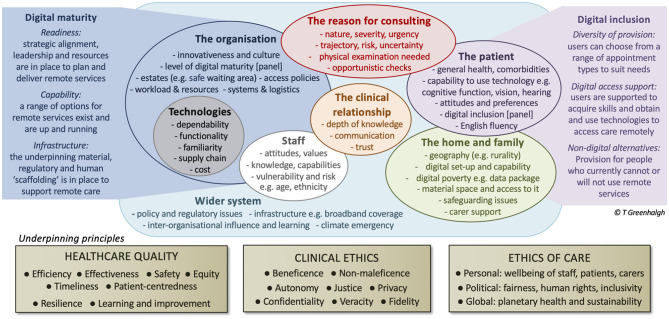
“The PERCS framework is shown in Figure 1. As noted above, it was adapted from the previously-published NASSS framework (17).”
§ Planning and Evaluating Remote Consultation Services: A New Conceptual Framework Incorporating Complexity and Practical Ethics > Findings > The PERCS Framework for Planning and Evaluating Remote Consultation Services
What the sources say
- Not checked yetcites [17] Greenhalgh, 2017, Beyond adoption: a new framework for theorizing and evaluating nonadoption, abandonment, and challenges to the scale-up, spread, and sustainability of health and care technologies, J Med Internet Res. source
plaindirect- Asserted: passes — The authors put it forward as true.
- Checkable: passes — It can be checked against evidence.
- Load-bearing: passes — The paper’s conclusions depend on it.
- Based: passes — The paper gives a reason why it holds.
In the paper
“Policy talk about remote health services was typically technology-focused, depicting these as state-of-the-art, high-quality, efficient, and safe (16).”
§ Planning and Evaluating Remote Consultation Services: A New Conceptual Framework Incorporating Complexity and Practical Ethics > Context: the Shift to Remote Consultations in the UK
What the sources say
- Not checked yetcites [16] Greenhalgh, 2012, The organising vision for telehealth and telecare: discourse analysis, BMJ Open. source
plain- Asserted: passes — The authors put it forward as true.
- Checkable: passes — It can be checked against evidence.
- Load-bearing: passes — The paper’s conclusions depend on it.
- Based: passes — The paper gives a reason why it holds.
None of the sources cited for this claim have been checked yet.
In the paper
“Given that previous attempts at introducing a comprehensive digital maturity scale for the UK NHS had been abandoned as unworkable (36, 38), we deliberately favored a short, pragmatic five-point scale over a detailed, exhaustive one.”
§ Planning and Evaluating Remote Consultation Services: A New Conceptual Framework Incorporating Complexity and Practical Ethics > Empirical Context: Mixed-Method Studies of Remote Care Before and During the Pandemic > Developing the PERCS Framework
What the sources say
- Not checked yetcites [36] Johnston, 2017, Digital maturity: are we ready to use technology in the NHS?, Future Healthc J. source
- Not checked yetcites [38] 2014
plain- Asserted: passes — The authors put it forward as true.
- Checkable: passes — It can be checked against evidence.
- Load-bearing: passes — The paper’s conclusions depend on it.
- Based: passes — The paper gives a reason why it holds.
A conclusion the paper draws from its own results — it cites no other source for it, so there is none to check. The quote shows it is in the paper.
In the paper
“These dilemmas cannot be resolved by standard operating procedures or algorithms.”
- Also stated in: § Developing the Guiding Principles · hedged
“Few of these dilemmas could be resolved by resort to standard operating procedures or algorithms.”
§ Planning and Evaluating Remote Consultation Services: A New Conceptual Framework Incorporating Complexity and Practical Ethics > Abstract
plain- Asserted: passes — The authors put it forward as true.
- Checkable: passes — It can be checked against evidence.
- Load-bearing: passes — The paper’s conclusions depend on it.
- Based: passes — The paper gives a reason why it holds.
- Also stated in: § Developing the Guiding Principles · hedged
A conclusion the paper draws from its own results — it cites no other source for it, so there is none to check. The quote shows it is in the paper.
In the paper
“The contradictions and tensions in our data reflected clinical practice more generally.”
§ Planning and Evaluating Remote Consultation Services: A New Conceptual Framework Incorporating Complexity and Practical Ethics > Empirical Context: Mixed-Method Studies of Remote Care Before and During the Pandemic > Developing the Guiding Principles
plaincorrelational- Asserted: passes — The authors put it forward as true.
- Checkable: passes — It can be checked against evidence.
- Load-bearing: passes — The paper’s conclusions depend on it.
- Based: passes — The paper gives a reason why it holds.
None of the sources cited for this claim have been checked yet.
In the paper
“most remote consultations before and during the pandemic occurred by telephone (3, 12–15).”
- Also stated in: § Developing the Guiding Principles · plain
“our front-line interviews, ethnographic observation, surveys, and service usage statistics revealed that, as in pre-pandemic times, the telephone was the dominant technology used”
§ Planning and Evaluating Remote Consultation Services: A New Conceptual Framework Incorporating Complexity and Practical Ethics > Context: the Shift to Remote Consultations in the UK
What the sources say
- Not checked yetcites [3] Horton, 2021
- Not checked yetcites [12] Brant, 2016, Using alternatives to face-to-face consultations: a survey of prevalence and attitudes in general practice, Br J Gen Pract. source
- Not checked yetcites [13] Atherton, 2018, Alternatives to the face-to-face consultation in general practice: focused ethnographic case study, Br J Gen Pract. source
- Not checked yetcites [14] Murphy, 2021, Implementation of remote consulting in UK primary care following the COVID-19 pandemic: a mixed-methods longitudinal study, Br J Gen Pract. source
- Not checked yetcites [15] Joy, 2020, Reorganisation of primary care for older adults during COVID-19: a cross-sectional database study in the UK, Br J Gen Pract. source
plain- Asserted: passes — The authors put it forward as true.
- Checkable: passes — It can be checked against evidence.
- Load-bearing: unclear — It is unclear whether the paper’s conclusions depend on it.
- Based: passes — The paper gives a reason why it holds.
- Also stated in: § Developing the Guiding Principles · plain
In the paper
“Help-seeking for urgent care is a social process comprising illness work (to make sense of symptoms), moral work (to justify choice of service and help-seeking behavior) and navigation work (to access services) (31).”
§ Planning and Evaluating Remote Consultation Services: A New Conceptual Framework Incorporating Complexity and Practical Ethics > Findings > The PERCS Framework for Planning and Evaluating Remote Consultation Services
What the sources say
- Not checked yetcites [31] Turnbull, 2019, A conceptual model of urgent care sense-making and help-seeking: a qualitative interview study of urgent care users in England, BMC Health Serv Res. source
plain- Asserted: passes — The authors put it forward as true.
- Checkable: passes — It can be checked against evidence.
- Load-bearing: unclear — It is unclear whether the paper’s conclusions depend on it.
- Based: passes — The paper gives a reason why it holds.
A conclusion the paper draws from its own results — it cites no other source for it, so there is none to check. The quote shows it is in the paper.
In the paper
“Aspects of the home and family domain—especially material spaces and privacy—may also be relevant to staff working from home during or beyond the pandemic.”
§ Planning and Evaluating Remote Consultation Services: A New Conceptual Framework Incorporating Complexity and Practical Ethics > Findings > The PERCS Framework for Planning and Evaluating Remote Consultation Services
hedgedconditional- Asserted: passes — The authors put it forward as true.
- Checkable: passes — It can be checked against evidence.
- Load-bearing: unclear — It is unclear whether the paper’s conclusions depend on it.
- Based: passes — The paper gives a reason why it holds.
The paper states this without a source or data behind it here, so there is nothing to check it against. The quote shows it is in the paper.
In the paper
“Through experience, reflection on practice and discussion with more experienced colleagues, clinicians learn which guiding principle to use—and hence, what is the right thing to do—in a particular situation.”
§ Planning and Evaluating Remote Consultation Services: A New Conceptual Framework Incorporating Complexity and Practical Ethics > Empirical Context: Mixed-Method Studies of Remote Care Before and During the Pandemic > Developing the Guiding Principles
plaindirect- Asserted: passes — The authors put it forward as true.
- Checkable: passes — It can be checked against evidence.
- Load-bearing: passes — The paper’s conclusions depend on it.
- Based: passes — The paper gives a reason why it holds.
In the paper
“Each of these phases can be time-consuming and exhausting, particularly when implementing technologies across multiple organizations (32).”
§ Planning and Evaluating Remote Consultation Services: A New Conceptual Framework Incorporating Complexity and Practical Ethics > Findings > The PERCS Framework for Planning and Evaluating Remote Consultation Services
What the sources say
- Not checked yetcites [32] Turnbull, 2014, The work, workforce, technology and organisational implications of the ‘111' single point of access telephone number for urgent (non-emergency) care: a mixed-methods case study, Health Serv Delivery Res. source
plaincorrelational- Asserted: passes — The authors put it forward as true.
- Checkable: passes — It can be checked against evidence.
- Load-bearing: unclear — It is unclear whether the paper’s conclusions depend on it.
- Based: passes — The paper gives a reason why it holds.
In the paper
“They are reflected in guidance such as the General Medical Council's Duties of a Doctor (88), to which some clinical interviewees referred.”
§ Planning and Evaluating Remote Consultation Services: A New Conceptual Framework Incorporating Complexity and Practical Ethics > Findings > Findings on Practical Ethics of Remote Consultations
What the sources say
- Not checked yetcites [88] LondonGMCDuties of a Doctor2020
plain- Asserted: passes — The authors put it forward as true.
- Checkable: passes — It can be checked against evidence.
- Load-bearing: unclear — It is unclear whether the paper’s conclusions depend on it.
- Based: passes — The paper gives a reason why it holds.
In the paper
“Patients who already suffer the multiple jeopardy of poverty, low health literacy, poor housing, weak social networks, psychological stress (e.g., from fear of crime) and—for some—language and cultural discordance now face an additional problem of digital inequalities, defined as differential access to healthcare depending on digital access, digital literacy or both (74).”
§ Planning and Evaluating Remote Consultation Services: A New Conceptual Framework Incorporating Complexity and Practical Ethics > Findings > The PERCS Framework for Planning and Evaluating Remote Consultation Services
What the sources say
- Not checked yetcites [74] Veinot, 2018, Good intentions are not enough: how informatics interventions can worsen inequality, J Am Med Inform Assoc. source
plaindirect- Asserted: passes — The authors put it forward as true.
- Checkable: passes — It can be checked against evidence.
- Load-bearing: passes — The paper’s conclusions depend on it.
- Based: passes — The paper gives a reason why it holds.
None of the sources cited for this claim have been checked yet.
In the paper
“The digital divide needs to be studied at a granular level, not merely in terms of the presence or absence of Internet access (76) but also in terms of how much bandwidth, data, IT literacy and skills, and power (e.g., over who in the household has use of the computer or smartphone) people have (77, 78).”
§ Planning and Evaluating Remote Consultation Services: A New Conceptual Framework Incorporating Complexity and Practical Ethics > Findings > The PERCS Framework for Planning and Evaluating Remote Consultation Services
What the sources say
- Not checked yetcites [76] 2019
- Not checked yetcites [77] Hilbert, 2016, The bad news is that the digital access divide is here to stay: domestically installed bandwidths among 172 countries for 1986–2014, Telecomm Policy. source
- Not checked yetcites [78] Ramsetty, 2020, Impact of the digital divide in the age of COVID-19, J Am Med Inform Assoc. source
plain- Asserted: passes — The authors put it forward as true.
- Checkable: passes — It can be checked against evidence.
- Load-bearing: passes — The paper’s conclusions depend on it.
- Based: passes — The paper gives a reason why it holds.
A conclusion the paper draws from its own results — it cites no other source for it, so there is none to check. The quote shows it is in the paper.
In the paper
“Another aspect of successful organizational-level innovation is the need for staff members to champion and support the innovation.”
§ Planning and Evaluating Remote Consultation Services: A New Conceptual Framework Incorporating Complexity and Practical Ethics > Findings > The PERCS Framework for Planning and Evaluating Remote Consultation Services
plaindirectSingle case- Asserted: passes — The authors put it forward as true.
- Checkable: passes — It can be checked against evidence.
- Load-bearing: passes — The paper’s conclusions depend on it.
- Based: passes — The paper gives a reason why it holds.
In the paper
“An important aspect of the policy context for remote consultations during the pandemic was the use of emergency powers to slacken red tape in relation to approved suppliers and purchasing rules, allowing organizations to effectively obtain and use any system deemed locally appropriate and workable (63).”
§ Planning and Evaluating Remote Consultation Services: A New Conceptual Framework Incorporating Complexity and Practical Ethics > Findings > The PERCS Framework for Planning and Evaluating Remote Consultation Services
What the sources say
- Not checked yetcites [63] NHS, 2020
plaindirect- Asserted: passes — The authors put it forward as true.
- Checkable: passes — It can be checked against evidence.
- Load-bearing: unclear — It is unclear whether the paper’s conclusions depend on it.
- Based: passes — The paper gives a reason why it holds.
None of the sources cited for this claim have been checked yet.
In the paper
“These complex effects of the remote modality on front-line staff added to the huge pandemic-related toll on their morale and well-being, which included the physical and emotional stress of clinical work, the personal risk of infection and its complications, and personal bereavements and other losses (59–61).”
§ Planning and Evaluating Remote Consultation Services: A New Conceptual Framework Incorporating Complexity and Practical Ethics > Findings > The PERCS Framework for Planning and Evaluating Remote Consultation Services
What the sources say
- Not checked yetcites [59] Trump, 2020, Risk and resilience in the time of the COVID-19 crisis, Environ Syst Decis source
- Not checked yetcites [60] Vera San Juan, 2021, Mental health and well-being of healthcare workers during the COVID-19 pandemic in the UK: contrasting guidelines with experiences in practice, BJPsychol Open source
- Not checked yetcites [61] Franklin, 2020, Loneliness: an incommunicable disease?, Br J Gen Pract. source
plaindirect- Asserted: passes — The authors put it forward as true.
- Checkable: passes — It can be checked against evidence.
- Load-bearing: unclear — It is unclear whether the paper’s conclusions depend on it.
- Based: passes — The paper gives a reason why it holds.
None of the sources cited for this claim have been checked yet.
In the paper
“there have been dozens of randomized controlled trials comparing video with face to face appointments in low-risk patients with stable long-term conditions (109–114)”
§ Planning and Evaluating Remote Consultation Services: A New Conceptual Framework Incorporating Complexity and Practical Ethics > Discussion > Comparison With Previous Research
What the sources say
- Not checked yetcites [109] Chongmelaxme, 2019, The effects of telemedicine on asthma control and patients' quality of life in adults: a systematic review and meta-analysis, J Allergy Clin Immunol Pract. source
- Not checked yetcites [110] Gentry, 2019, Geriatric telepsychiatry: systematic review and policy considerations, Am J Geriatr Psychiatry. source
- Not checked yetcites [111] Hong, 2019, Effectiveness of tele-monitoring by patient severity and intervention type in chronic obstructive pulmonary disease patients: a systematic review and meta-analysis, Int J Nurs Stud. source
- Not checked yetcites [112] Kelson, 2019, Internet-delivered acceptance and commitment therapy for anxiety treatment: systematic review, J Med Internet Res. source
- Not checked yetcites [113] McFarland, 2019, The effect of telehealth versus usual care for home-care patients with long-term conditions: a systematic review, meta-analysis and qualitative synthesis, J Telemed Telecare. source
- Not checked yetcites [114] Thiyagarajan, 2020, Exploring patients' and clinicians' experiences of video consultations in primary care: a systematic scoping review, BJGP Open. source
plain- Asserted: passes — The authors put it forward as true.
- Checkable: passes — It can be checked against evidence.
- Load-bearing: unclear — It is unclear whether the paper’s conclusions depend on it.
- Based: passes — The paper gives a reason why it holds.
A conclusion the paper draws from its own results — it cites no other source for it, so there is none to check. The quote shows it is in the paper.
In the paper
“It also allowed us to surface a key paradox of the pandemic, namely the mismatch between policy vision and practical reality.”
§ Planning and Evaluating Remote Consultation Services: A New Conceptual Framework Incorporating Complexity and Practical Ethics > Discussion > Summary of Main Findings
plaincorrelational- Asserted: passes — The authors put it forward as true.
- Checkable: passes — It can be checked against evidence.
- Load-bearing: passes — The paper’s conclusions depend on it.
- Based: passes — The paper gives a reason why it holds.
- Rests on an assumption: Policymakers envisaged an efficient, safe, and accessible remote consultation service delivered through state-of-the art digital technologies and implemented via rational allocation criteria and quality standards.
A conclusion the paper draws from its own results — it cites no other source for it, so there is none to check. The quote shows it is in the paper.
In the paper
“This earlier research, summarized briefly below, also failed to capture the complexity, messiness and associated ethical tensions of remote consultations across a range of settings once these modalities move from being evaluated in a tightly-controlled trial setting to contributing a major part of mainstream services”
§ Planning and Evaluating Remote Consultation Services: A New Conceptual Framework Incorporating Complexity and Practical Ethics > Discussion > Comparison With Previous Research
plain- Asserted: passes — The authors put it forward as true.
- Checkable: passes — It can be checked against evidence.
- Load-bearing: passes — The paper’s conclusions depend on it.
- Based: passes — The paper gives a reason why it holds.
What the paper did — it cites no source for this, so there is none to check. The quote shows it is in the paper.
In the paper
“Pandemic restrictions made ethnography impossible for the later months of the study”
§ Planning and Evaluating Remote Consultation Services: A New Conceptual Framework Incorporating Complexity and Practical Ethics > Discussion > Strengths and Limitations
plaindirect- Asserted: passes — The authors put it forward as true.
- Checkable: passes — It can be checked against evidence.
- Load-bearing: passes — The paper’s conclusions depend on it.
- Based: passes — The paper gives a reason why it holds.
A conclusion the paper draws from its own results — it cites no other source for it, so there is none to check. The quote shows it is in the paper.
In the paper
“These dilemmas—which included how far to use technological triage to manage demand in an under-funded, under-staffed system; when to welcome support from the patient's relatives and friends in a remote consultation; when to accept a compromised physical examination rather than bring the patient in for a full in-per son assessment; how far informational continuity might compensate for relational”
§ Planning and Evaluating Remote Consultation Services: A New Conceptual Framework Incorporating Complexity and Practical Ethics > Discussion > Summary of Main Findings
plain- Asserted: passes — The authors put it forward as true.
- Checkable: passes — It can be checked against evidence.
- Load-bearing: passes — The paper’s conclusions depend on it.
- Based: passes — The paper gives a reason why it holds.
None of the sources cited for this claim have been checked yet.
In the paper
“Levels of remote consulting outside the research setting were very low pre-pandemic (12, 13, 119)”
§ Planning and Evaluating Remote Consultation Services: A New Conceptual Framework Incorporating Complexity and Practical Ethics > Discussion > Comparison With Previous Research
What the sources say
- Not checked yetcites [12] Brant, 2016, Using alternatives to face-to-face consultations: a survey of prevalence and attitudes in general practice, Br J Gen Pract. source
- Not checked yetcites [13] Atherton, 2018, Alternatives to the face-to-face consultation in general practice: focused ethnographic case study, Br J Gen Pract. source
- Not checked yetcites [119] Hammersley, 2019, Comparing the content and quality of video, telephone, and face-to-face consultations: a non-randomised, quasi-experimental, exploratory study in UK primary care, Br J Gen Pract. source
plain- Asserted: passes — The authors put it forward as true.
- Checkable: passes — It can be checked against evidence.
- Load-bearing: unclear — It is unclear whether the paper’s conclusions depend on it.
- Based: passes — The paper gives a reason why it holds.
None of the sources cited for this claim have been checked yet.
In the paper
“we built on previous frameworks for organizational and technological innovation which had focused on the dynamic interaction between multiple influences in a complex system (17, 62)”
§ Planning and Evaluating Remote Consultation Services: A New Conceptual Framework Incorporating Complexity and Practical Ethics > Discussion > Strengths and Limitations
What the sources say
- Not checked yetcites [17] Greenhalgh, 2017, Beyond adoption: a new framework for theorizing and evaluating nonadoption, abandonment, and challenges to the scale-up, spread, and sustainability of health and care technologies, J Med Internet Res. source
- Not checked yetcites [62] Greenhalgh, 2004, Diffusion of innovations in service organizations: systematic review and recommendations, Milbank Q. source
plain- Asserted: passes — The authors put it forward as true.
- Checkable: passes — It can be checked against evidence.
- Load-bearing: passes — The paper’s conclusions depend on it.
- Based: passes — The paper gives a reason why it holds.
What the paper did — it cites no source for this, so there is none to check. The quote shows it is in the paper.
In the paper
“PERCS was extensively revised as we worked through analysis of the different datasets until all elements of the data could be explained with reference to the framework”
§ Planning and Evaluating Remote Consultation Services: A New Conceptual Framework Incorporating Complexity and Practical Ethics > Discussion > Strengths and Limitations
plaindirect- Asserted: passes — The authors put it forward as true.
- Checkable: passes — It can be checked against evidence.
- Load-bearing: passes — The paper’s conclusions depend on it.
- Based: passes — The paper gives a reason why it holds.
- Rests on an assumption: The empirical datasets used (surveys, ethnographic observations, interviews, focus groups, cross-sectoral workshops, and a Delphi panel) adequately capture the phenomena needed to develop and refine the PERCS framework.
In the paper
“Most such studies lacked descriptive detail; both the clinical condition and the technology were often described in bland and brief ways, omitting the nuances that might have explained variations in findings across studies (116)”
§ Planning and Evaluating Remote Consultation Services: A New Conceptual Framework Incorporating Complexity and Practical Ethics > Discussion > Comparison With Previous Research
What the sources say
- Not checked yetcites [116] James, 2021, Spread, scale-up, and sustainability of video consulting in health care: systematic review and synthesis guided by the NASSS framework, J Med Internet Res. source
plain- Asserted: passes — The authors put it forward as true.
- Checkable: passes — It can be checked against evidence.
- Load-bearing: passes — The paper’s conclusions depend on it.
- Based: passes — The paper gives a reason why it holds.
A conclusion the paper draws from its own results — it cites no other source for it, so there is none to check. The quote shows it is in the paper.
In the paper
“The PERCS framework enabled us to identify and explore how dynamic interactions between individual-, organizational-, and system-level factors influenced how remote consultation services were established and delivered (or not) in different local and regional settings.”
§ Planning and Evaluating Remote Consultation Services: A New Conceptual Framework Incorporating Complexity and Practical Ethics > Discussion > Summary of Main Findings
plaindirect- Asserted: passes — The authors put it forward as true.
- Checkable: passes — It can be checked against evidence.
- Load-bearing: passes — The paper’s conclusions depend on it.
- Based: passes — The paper gives a reason why it holds.
In the paper
“many studies had emphasized measures of efficiency including repeat appointments, staff workload (including knock-on workload for other sectors), length of consultation, and the proportion of remote appointments that get converted to face-to-face (thereby double-handling a problem), as well as addressing technical feasibility, user satisfaction, clinical quality and safety, and operational”
§ Planning and Evaluating Remote Consultation Services: A New Conceptual Framework Incorporating Complexity and Practical Ethics > Discussion > Comparison With Previous Research
What the sources say
- Not checked yetcites [97] O'Cathail, 2020, The use of patient-facing teleconsultations in the national health service: scoping review, JMIR Med Inform. source
plain- Asserted: passes — The authors put it forward as true.
- Checkable: passes — It can be checked against evidence.
- Load-bearing: passes — The paper’s conclusions depend on it.
- Based: passes — The paper gives a reason why it holds.
A conclusion the paper draws from its own results — it cites no other source for it, so there is none to check. The quote shows it is in the paper.
In the paper
“Hence our current insights are based more on what people said was happening than on direct observation”
§ Planning and Evaluating Remote Consultation Services: A New Conceptual Framework Incorporating Complexity and Practical Ethics > Discussion > Strengths and Limitations
plain- Asserted: passes — The authors put it forward as true.
- Checkable: passes — It can be checked against evidence.
- Load-bearing: passes — The paper’s conclusions depend on it.
- Based: passes — The paper gives a reason why it holds.
A conclusion the paper draws from its own results — it cites no other source for it, so there is none to check. The quote shows it is in the paper.
In the paper
“Rather, dilemmas had to be managed emergently by attending to here-and-now practicalities.”
§ Planning and Evaluating Remote Consultation Services: A New Conceptual Framework Incorporating Complexity and Practical Ethics > Discussion > Summary of Main Findings
plain- Asserted: passes — The authors put it forward as true.
- Checkable: passes — It can be checked against evidence.
- Load-bearing: passes — The paper’s conclusions depend on it.
- Based: passes — The paper gives a reason why it holds.
A conclusion the paper draws from its own results — it cites no other source for it, so there is none to check. The quote shows it is in the paper.
In the paper
“All our empirical studies were conducted in the UK, so the PERCS framework and linked guiding principles may not be transferable to contexts very different from the UK without further adaptation”
§ Planning and Evaluating Remote Consultation Services: A New Conceptual Framework Incorporating Complexity and Practical Ethics > Discussion > Strengths and Limitations
hedgedconditional- Asserted: passes — The authors put it forward as true.
- Checkable: passes — It can be checked against evidence.
- Load-bearing: unclear — It is unclear whether the paper’s conclusions depend on it.
- Based: passes — The paper gives a reason why it holds.
- Probably not a substantial claim. 55
- It may state two separate claims as one. 57
The cited sources support only part of this claim — read each source’s verdict below.
In the paper
“several studies have suggested that double-handling may reduce efficiency (32, 98–102)”
§ Planning and Evaluating Remote Consultation Services: A New Conceptual Framework Incorporating Complexity and Practical Ethics > Discussion > Comparison With Previous Research
What the sources say
- Partly supportedcites [32] Turnbull, 2014, The work, workforce, technology and organisational implications of the ‘111' single point of access telephone number for urgent (non-emergency) care: a mixed-methods case study, Health Serv Delivery Res. sourceExperimental — accuracy not yet measured
In “Sanctioning and moderating dispositions” (page not provided), the study reports that transferring calls to clinical advisers sometimes added to their workload. In “Supporting call advisers and providing further clinical assessment” (page not provided), it describes clinicians repeating parts of an assessment and a supervisor saying they should validate rather than re-triage. These passages support a concern about duplicated work, but the study does not establish that it reduced efficiency. (LLM, conf=0.78)
- Supportedcites [98] Thompson-Coon, 2013, Telephone consultations in place of face to face out-patient consultations for patients discharged from hospital following surgery: a systematic review, BMC Health Serv Res. source
The Background (page unavailable) says telephone follow-up may add to outpatient workloads rather than reduce them, citing several studies. That supports the hedged claim that double-handling may reduce efficiency, though the paper does not use the term “double-handling.” (LLM, conf=0.86)
- Supportedcites [99] Downes, 2017, Telephone consultations for general practice: a systematic review, Syst Rev. source
The Results > Outcomes section reports more follow-up consultations after telephone consultations. The Discussion also notes that GP-led triage increased contacts per person and suggests that avoiding a telephone consultation when a face-to-face visit is needed could reduce workload. Together, these support the hedged claim that double-handling may reduce efficiency; the paper does not claim a measured net loss of efficiency. (LLM, conf=0.83)
- Supportedcites [100] Campbell, 2014, Telephone triage for management of same-day consultation requests in general practice (the ESTEEM trial): a cluster-randomised controlled trial and cost–consequence analysis, Lancet J. source
The Discussion (page unavailable) reports that telephone triage increased primary-care contacts and that extra telephone contacts more than offset the reduction in GP face-to-face workload. This supports the hedged suggestion that handling a request through multiple contacts may reduce efficiency, although the paper does not use the term “double-handling.” (LLM, conf=0.86)
- Not checked yetcites [101] Newbould, 2019, A ‘telephone first' approach to demand management in English general practice: a multimethod evaluation, Health Serv Deliv Res. source
- Not checked yetcites [102] Salisbury, 2020, The impact of digital-first consultations on workload in general practice: modeling study, J Med Internet Res. source
hedgedconditional- Asserted: passes — The authors put it forward as true.
- Checkable: passes — It can be checked against evidence.
- Load-bearing: fails — The paper’s conclusions may not depend on it.
- Based: passes — The paper gives a reason why it holds.
Probably not a substantial claim. The paper’s conclusions may not depend on it.
- Partly supported
A result the paper reports from its own data — it cites no other source for it, so there is none to check. The quote shows it is in the paper.
In the paper
“Two prominent themes in our data were organizations' digital maturity in providing remote consultations and the need for proactive measures to improve digital inclusion.”
§ Planning and Evaluating Remote Consultation Services: A New Conceptual Framework Incorporating Complexity and Practical Ethics > Empirical Context: Mixed-Method Studies of Remote Care Before and During the Pandemic > Developing the PERCS Framework
plain- Asserted: passes — The authors put it forward as true.
- Checkable: passes — It can be checked against evidence.
- Load-bearing: passes — The paper’s conclusions depend on it.
- Based: passes — The paper gives a reason why it holds.
It may state two separate claims as one.
A result the paper reports from its own data — it cites no other source for it, so there is none to check. The quote shows it is in the paper.
In the paper
“There were tensions, for example, between quality and efficiency, between demand management and patient choice, and between the needs and preferences of some patients and those of other patients in the context of limited staffing and material constraints (e.g., availability of safe waiting areas which limited face-to-face appointments during the pandemic).”
§ Planning and Evaluating Remote Consultation Services: A New Conceptual Framework Incorporating Complexity and Practical Ethics > Empirical Context: Mixed-Method Studies of Remote Care Before and During the Pandemic > Developing the Guiding Principles
plaincorrelational- Asserted: passes — The authors put it forward as true.
- Checkable: passes — It can be checked against evidence.
- Load-bearing: passes — The paper’s conclusions depend on it.
- Based: passes — The paper gives a reason why it holds.
It may state two separate claims as one.
The paper states this without a source or data behind it here, so there is nothing to check it against. The quote shows it is in the paper.
In the paper
“The only available space for one (female) GP to consult from was the kitchen table, necessitating complex negotiations with other family members about access to the food supply.”
§ Planning and Evaluating Remote Consultation Services: A New Conceptual Framework Incorporating Complexity and Practical Ethics > Findings > The PERCS Framework for Planning and Evaluating Remote Consultation Services
plaindirectSingle case- Asserted: passes — The authors put it forward as true.
- Checkable: passes — It can be checked against evidence.
- Load-bearing: fails — The paper’s conclusions may not depend on it.
- Based: passes — The paper gives a reason why it holds.
Probably not a substantial claim. The paper’s conclusions may not depend on it.
A result the paper reports from its own data — it cites no other source for it, so there is none to check. The quote shows it is in the paper.
In the paper
“They talked about the need to be alert to the possibility of the “doorknob phenomenon” —that people sometimes seek a consultation for one reason but bring in the real reason late in the encounter, hence withholding key information at the triage stage.”
§ Planning and Evaluating Remote Consultation Services: A New Conceptual Framework Incorporating Complexity and Practical Ethics > Findings > The PERCS Framework for Planning and Evaluating Remote Consultation Services
hedged- Asserted: passes — The authors put it forward as true.
- Checkable: passes — It can be checked against evidence.
- Load-bearing: fails — The paper’s conclusions may not depend on it.
- Based: passes — The paper gives a reason why it holds.
Probably not a substantial claim. The paper’s conclusions may not depend on it.
A result the paper reports from its own data — it cites no other source for it, so there is none to check. The quote shows it is in the paper.
In the paper
“We have found that both during and beyond the pandemic, policymakers envisaged an efficient, safe and accessible remote consultation service delivered through state-of-the art digital technologies and implemented via rational allocation criteria and quality standards.”
- Also stated in: § Developing the Guiding Principles · hedged
“Evidence from policy announcements and our elite policymaker interviews revealed a relatively confident vision of an efficient, safe and accessible remote consultation service delivered mostly through state-of-the art digital technologies and implemented via rational allocation criteria and quality standards.”
§ Planning and Evaluating Remote Consultation Services: A New Conceptual Framework Incorporating Complexity and Practical Ethics > Abstract
plain- Asserted: passes — The authors put it forward as true.
- Checkable: passes — It can be checked against evidence.
- Load-bearing: passes — The paper’s conclusions depend on it.
- Based: passes — The paper gives a reason why it holds.
It may state two separate claims as one.
- Also stated in: § Developing the Guiding Principles · hedged
The paper states this without a source or data behind it here, so there is nothing to check it against. The quote shows it is in the paper.
In the paper
“- Access to care, especially patients' difficulty getting the kind of appointment they wished and conflict with support staff associated with this;”
§ Planning and Evaluating Remote Consultation Services: A New Conceptual Framework Incorporating Complexity and Practical Ethics > Empirical Context: Mixed-Method Studies of Remote Care Before and During the Pandemic > Developing the PERCS Framework
plaincorrelational- Asserted: passes — The authors put it forward as true.
- Checkable: passes — It can be checked against evidence.
- Load-bearing: unclear — It is unclear whether the paper’s conclusions depend on it.
- Based: passes — The paper gives a reason why it holds.
It may state two separate claims as one.
A result the paper reports from its own data — it cites no other source for it, so there is none to check. The quote shows it is in the paper.
In the paper
“An initial plan to analyse quantitative data statistically was abandoned when it became clear that presenting our draft principles in deliberately contradictory pairs had led to confusion and irritation (which we discuss briefly in the Findings section).”
§ Planning and Evaluating Remote Consultation Services: A New Conceptual Framework Incorporating Complexity and Practical Ethics > Empirical Context: Mixed-Method Studies of Remote Care Before and During the Pandemic > Developing the Guiding Principles
plaindirect- Asserted: passes — The authors put it forward as true.
- Checkable: passes — It can be checked against evidence.
- Load-bearing: fails — The paper’s conclusions may not depend on it.
- Based: passes — The paper gives a reason why it holds.
Probably not a substantial claim. The paper’s conclusions may not depend on it.
In the paper
“Clinicians described over-riding such systems (for example when triaging e-consultations) because they had a gut feeling that a seemingly minor aspect of the history could indicate serious illness (45) or because they had safety-netting concerns that a particular patient should be checked more frequently than the recommended interval.”
§ Planning and Evaluating Remote Consultation Services: A New Conceptual Framework Incorporating Complexity and Practical Ethics > Findings > The PERCS Framework for Planning and Evaluating Remote Consultation Services
What the sources say
- Not checked yetcites [45] Smith, 2020, Understanding the role of GPs' gut feelings in diagnosing cancer in primary care: a systematic review and meta-analysis of existing evidence, Br J Gen Pract. source
plaindirect- Asserted: passes — The authors put it forward as true.
- Checkable: passes — It can be checked against evidence.
- Load-bearing: passes — The paper’s conclusions depend on it.
- Based: passes — The paper gives a reason why it holds.
It may state two separate claims as one.
The paper states this without a source or data behind it here, so there is nothing to check it against. The quote shows it is in the paper.
In the paper
“Many staff—rightly or wrongly—still considered face-to-face consulting to be the “gold standard” professional norm:”
§ Planning and Evaluating Remote Consultation Services: A New Conceptual Framework Incorporating Complexity and Practical Ethics > Findings > The PERCS Framework for Planning and Evaluating Remote Consultation Services
plain- Asserted: passes — The authors put it forward as true.
- Checkable: passes — It can be checked against evidence.
- Load-bearing: fails — The paper’s conclusions may not depend on it.
- Based: fails — The paper may give no reason why it holds.
Probably not a substantial claim. The paper’s conclusions may not depend on it. The paper may give no reason why it holds.
The paper states this without a source or data behind it here, so there is nothing to check it against. The quote shows it is in the paper.
In the paper
“During the pandemic, some locality-based clinical commissioning groups became tied into commercial contracts with video software providers whose products were approved at speed at the height of the crisis and offered “free” or low-cost for the first year.”
§ Planning and Evaluating Remote Consultation Services: A New Conceptual Framework Incorporating Complexity and Practical Ethics > Findings > The PERCS Framework for Planning and Evaluating Remote Consultation Services
plaincorrelational- Asserted: passes — The authors put it forward as true.
- Checkable: passes — It can be checked against evidence.
- Load-bearing: fails — The paper’s conclusions may not depend on it.
- Based: fails — The paper may give no reason why it holds.
Probably not a substantial claim. The paper’s conclusions may not depend on it. The paper may give no reason why it holds.
A result the paper reports from its own data — it cites no other source for it, so there is none to check. The quote shows it is in the paper.
In the paper
“Several examples from our dataset illustrated the subtleties of the reason for consulting and why rigid algorithms or allocation criteria may prove too brittle to guide practice.”
§ Planning and Evaluating Remote Consultation Services: A New Conceptual Framework Incorporating Complexity and Practical Ethics > Findings > The PERCS Framework for Planning and Evaluating Remote Consultation Services
hedgedconditional- Asserted: passes — The authors put it forward as true.
- Checkable: passes — It can be checked against evidence.
- Load-bearing: passes — The paper’s conclusions depend on it.
- Based: passes — The paper gives a reason why it holds.
It may state two separate claims as one.
A result the paper reports from its own data — it cites no other source for it, so there is none to check. The quote shows it is in the paper.
In the paper
“One GP expressed concern that a patient was consulting from the lavatory because this was the only quiet and private space available. Another described connecting to a teenager's bedroom where a parent may have been present but off camera.”
§ Planning and Evaluating Remote Consultation Services: A New Conceptual Framework Incorporating Complexity and Practical Ethics > Findings > The PERCS Framework for Planning and Evaluating Remote Consultation Services
hedged- Asserted: passes — The authors put it forward as true.
- Checkable: passes — It can be checked against evidence.
- Load-bearing: fails — The paper’s conclusions may not depend on it.
- Based: passes — The paper gives a reason why it holds.
Probably not a substantial claim. The paper’s conclusions may not depend on it. It may state two separate claims as one.
A result the paper reports from its own data — it cites no other source for it, so there is none to check. The quote shows it is in the paper.
In the paper
“Learning from models of good practice elsewhere tended to be a positive experience, whereas public release of performance data—in which each organization or department is compared competitively with others (for example in the proportion of consultations undertaken remotely)—was viewed negatively by our participants.”
§ Planning and Evaluating Remote Consultation Services: A New Conceptual Framework Incorporating Complexity and Practical Ethics > Findings > The PERCS Framework for Planning and Evaluating Remote Consultation Services
hedged- Asserted: passes — The authors put it forward as true.
- Checkable: passes — It can be checked against evidence.
- Load-bearing: passes — The paper’s conclusions depend on it.
- Based: passes — The paper gives a reason why it holds.
It may state two separate claims as one.
A result the paper reports from its own data — it cites no other source for it, so there is none to check. The quote shows it is in the paper.
In the paper
“This had been our intention, but it was clear that whilst clinicians work comfortably with contradictory principles in their day to day work, they experienced strong cognitive dissonance when asked to confront them in a desktop exercise without a real, practical situation in mind.”
§ Planning and Evaluating Remote Consultation Services: A New Conceptual Framework Incorporating Complexity and Practical Ethics > Findings > Findings on Practical Ethics of Remote Consultations
boosteddirectn = 50- Asserted: passes — The authors put it forward as true.
- Checkable: passes — It can be checked against evidence.
- Load-bearing: unclear — It is unclear whether the paper’s conclusions depend on it.
- Based: passes — The paper gives a reason why it holds.
It may state two separate claims as one.
None of the sources cited for this claim have been checked yet.
In the paper
“Additional ethical tensions related to staff well-being and redistribution of the work of caring (often shifting to the patient or lay carer).”
§ Planning and Evaluating Remote Consultation Services: A New Conceptual Framework Incorporating Complexity and Practical Ethics > Findings > Findings on Practical Ethics of Remote Consultations
plain- Asserted: passes — The authors put it forward as true.
- Checkable: passes — It can be checked against evidence.
- Load-bearing: passes — The paper’s conclusions depend on it.
- Based: passes — The paper gives a reason why it holds.
It may state two separate claims as one.
A result the paper reports from its own data — it cites no other source for it, so there is none to check. The quote shows it is in the paper.
In the paper
“Our interviewees depicted these changes positively—indeed, they considered that the changes would have been impossible or much delayed without them—but they also expressed concern about what would happen when organizations returned to business as usual, since the longer-term trade-offs between convenience and regulatory control (e.g., data privacy) are unclear.”
§ Planning and Evaluating Remote Consultation Services: A New Conceptual Framework Incorporating Complexity and Practical Ethics > Findings > The PERCS Framework for Planning and Evaluating Remote Consultation Services
plaindirect- Asserted: passes — The authors put it forward as true.
- Checkable: passes — It can be checked against evidence.
- Load-bearing: passes — The paper’s conclusions depend on it.
- Based: passes — The paper gives a reason why it holds.
It may state two separate claims as one.
A result the paper reports from its own data — it cites no other source for it, so there is none to check. The quote shows it is in the paper.
In the paper
“However, our dataset included numerous examples of capacity constraints which limited organizations' abilities to undertake co-design work, provide a high degree of flexibility or provide sufficient face-to-face slots to accommodate all requests.”
§ Planning and Evaluating Remote Consultation Services: A New Conceptual Framework Incorporating Complexity and Practical Ethics > Findings > The PERCS Framework for Planning and Evaluating Remote Consultation Services
plaindirect- Asserted: passes — The authors put it forward as true.
- Checkable: passes — It can be checked against evidence.
- Load-bearing: unclear — It is unclear whether the paper’s conclusions depend on it.
- Based: passes — The paper gives a reason why it holds.
It may state two separate claims as one.
A result the paper reports from its own data — it cites no other source for it, so there is none to check. The quote shows it is in the paper.
In the paper
“The theme of digital inclusion recurred in our data.”
§ Planning and Evaluating Remote Consultation Services: A New Conceptual Framework Incorporating Complexity and Practical Ethics > Findings > The PERCS Framework for Planning and Evaluating Remote Consultation Services
plain- Asserted: passes — The authors put it forward as true.
- Checkable: passes — It can be checked against evidence.
- Load-bearing: passes — The paper’s conclusions depend on it.
- Based: passes — The paper gives a reason why it holds.
Probably not a substantial claim.
A result the paper reports from its own data — it cites no other source for it, so there is none to check. The quote shows it is in the paper.
In the paper
“Examples of digital inclusion efforts in our dataset included flexibility to accommodate patient preferences (some teenagers, for example, preferred to consult with the video switched off; some parents preferred to video their child doing a task and send the video to the therapist rather than the child perform live to camera), signposting to local digital literacy programmes, and making it clear”
§ Planning and Evaluating Remote Consultation Services: A New Conceptual Framework Incorporating Complexity and Practical Ethics > Findings > The PERCS Framework for Planning and Evaluating Remote Consultation Services
plain- Asserted: passes — The authors put it forward as true.
- Checkable: passes — It can be checked against evidence.
- Load-bearing: unclear — It is unclear whether the paper’s conclusions depend on it.
- Based: passes — The paper gives a reason why it holds.
It may state two separate claims as one.
A result the paper reports from its own data — it cites no other source for it, so there is none to check. The quote shows it is in the paper.
In the paper
“All but one of the 25 revised principles in round 2 were supported in principle by 80% or more respondents, but many had suggestions for changes in wording (e.g., be less paternalistic, reduce jargon, split a maxim into two).”
§ Planning and Evaluating Remote Consultation Services: A New Conceptual Framework Incorporating Complexity and Practical Ethics > Findings > Findings on Practical Ethics of Remote Consultations
plain- Asserted: passes — The authors put it forward as true.
- Checkable: passes — It can be checked against evidence.
- Load-bearing: passes — The paper’s conclusions depend on it.
- Based: passes — The paper gives a reason why it holds.
It may state two separate claims as one.
A result the paper reports from its own data — it cites no other source for it, so there is none to check. The quote shows it is in the paper.
In the paper
“All but one of the 26 revised principles in round 3 were supported by 80% or more participants with only minor suggestions for further revisions to wording; the final item was supported by 71%, with several respondents all suggesting omission of a particular phrase.”
§ Planning and Evaluating Remote Consultation Services: A New Conceptual Framework Incorporating Complexity and Practical Ethics > Findings > Findings on Practical Ethics of Remote Consultations
plain- Asserted: passes — The authors put it forward as true.
- Checkable: passes — It can be checked against evidence.
- Load-bearing: passes — The paper’s conclusions depend on it.
- Based: passes — The paper gives a reason why it holds.
It may state two separate claims as one.
A result the paper reports from its own data — it cites no other source for it, so there is none to check. The quote shows it is in the paper.
In the paper
“In contrast, our empirical data revealed that strategic decisions about setting up remote consultation services, allocation decisions for appointment type (phone, video, e-, face-to-face), and clinical decisions when consulting remotely were fraught with contradictions and tensions, leading to both large- and small-scale ethical dilemmas that were either unique to the remote modality or greatly”
§ Planning and Evaluating Remote Consultation Services: A New Conceptual Framework Incorporating Complexity and Practical Ethics > Discussion > Summary of Main Findings
plaindirect- Asserted: passes — The authors put it forward as true.
- Checkable: passes — It can be checked against evidence.
- Load-bearing: passes — The paper’s conclusions depend on it.
- Based: passes — The paper gives a reason why it holds.
It may state two separate claims as one.
A conclusion the paper draws from its own results — it cites no other source for it, so there is none to check. The quote shows it is in the paper.
In the paper
“Establishing and running remote consultation services is challenging politically (interest groups may gain or lose), organizationally (remote consulting requires implementation work and new roles and workflows), economically (costs and benefits are unevenly distributed across the system), technically (excellent care needs dependable links and high-quality audio and images)”
§ Planning and Evaluating Remote Consultation Services: A New Conceptual Framework Incorporating Complexity and Practical Ethics > Abstract
plain- Asserted: passes — The authors put it forward as true.
- Checkable: passes — It can be checked against evidence.
- Load-bearing: passes — The paper’s conclusions depend on it.
- Based: passes — The paper gives a reason why it holds.
It may state two separate claims as one.
A conclusion the paper draws from its own results — it cites no other source for it, so there is none to check. The quote shows it is in the paper.
In the paper
“Clinical allocation criteria, perhaps built into algorithms, may suggest (though not determine) a type of appointment.”
§ Planning and Evaluating Remote Consultation Services: A New Conceptual Framework Incorporating Complexity and Practical Ethics > Findings > The PERCS Framework for Planning and Evaluating Remote Consultation Services
hedgedconditional- Asserted: passes — The authors put it forward as true.
- Checkable: passes — It can be checked against evidence.
- Load-bearing: fails — The paper’s conclusions may not depend on it.
- Based: fails — The paper may give no reason why it holds.
Probably not a substantial claim. The paper’s conclusions may not depend on it. The paper may give no reason why it holds.
A conclusion the paper draws from its own results — it cites no other source for it, so there is none to check. The quote shows it is in the paper.
In the paper
“Costs of technologies are typically unevenly distributed across the healthcare system.”
§ Planning and Evaluating Remote Consultation Services: A New Conceptual Framework Incorporating Complexity and Practical Ethics > Findings > The PERCS Framework for Planning and Evaluating Remote Consultation Services
plaincorrelational- Asserted: passes — The authors put it forward as true.
- Checkable: passes — It can be checked against evidence.
- Load-bearing: fails — The paper’s conclusions may not depend on it.
- Based: fails — The paper may give no reason why it holds.
Probably not a substantial claim. The paper’s conclusions may not depend on it. The paper may give no reason why it holds.
In the paper
“On 30th July 2020, it was announced that all healthcare consultations in the UK should henceforth be “remote by default,” not just during the pandemic but indefinitely (1).”
§ Planning and Evaluating Remote Consultation Services: A New Conceptual Framework Incorporating Complexity and Practical Ethics > Context: the Shift to Remote Consultations in the UK
What the sources say
- Not checked yetcites [1] Hancock, 2020
plain- Asserted: passes — The authors put it forward as true.
- Checkable: passes — It can be checked against evidence.
- Load-bearing: fails — The paper’s conclusions may not depend on it.
- Based: passes — The paper gives a reason why it holds.
Probably not a substantial claim. The paper’s conclusions may not depend on it.
In the paper
“As Hunter (39) has argued, clinical decisions are governed not by hard and fast rules but by shared rules of thumb or guiding principles which she calls maxims, some of which are contradictory (e.g., “ignore the anecdotal” but “listen to the patient's story”).”
§ Planning and Evaluating Remote Consultation Services: A New Conceptual Framework Incorporating Complexity and Practical Ethics > Empirical Context: Mixed-Method Studies of Remote Care Before and During the Pandemic > Developing the Guiding Principles
What the sources say
- Not checked yetcites [39] Hunter, 1996, “Don't think zebras”: uncertainty, interpretation, and the place of paradox in clinical education, Theor Med. source
plain- Asserted: passes — The authors put it forward as true.
- Checkable: passes — It can be checked against evidence.
- Load-bearing: passes — The paper’s conclusions depend on it.
- Based: passes — The paper gives a reason why it holds.
Probably not a substantial claim. It may state two separate claims as one.
A conclusion the paper draws from its own results — it cites no other source for it, so there is none to check. The quote shows it is in the paper.
In the paper
“Whilst Hunter focused narrowly on clinical maxims, case-based ethical reasoning more broadly—whether, for example, to invoke child protection measures or ask a social prescriber to get involved in someone's life—operates along similar lines.”
§ Planning and Evaluating Remote Consultation Services: A New Conceptual Framework Incorporating Complexity and Practical Ethics > Empirical Context: Mixed-Method Studies of Remote Care Before and During the Pandemic > Developing the Guiding Principles
plaincorrelational- Asserted: passes — The authors put it forward as true.
- Checkable: passes — It can be checked against evidence.
- Load-bearing: fails — The paper’s conclusions may not depend on it.
- Based: fails — The paper may give no reason why it holds.
Probably not a substantial claim. The paper’s conclusions may not depend on it. The paper may give no reason why it holds. It may state two separate claims as one.
A conclusion the paper draws from its own results — it cites no other source for it, so there is none to check. The quote shows it is in the paper.
In the paper
“The situational application of such guiding principles has an important time dimension.”
§ Planning and Evaluating Remote Consultation Services: A New Conceptual Framework Incorporating Complexity and Practical Ethics > Empirical Context: Mixed-Method Studies of Remote Care Before and During the Pandemic > Developing the Guiding Principles
plaincorrelational- Asserted: passes — The authors put it forward as true.
- Checkable: fails — It may be too vague to check against evidence.
- Load-bearing: passes — The paper’s conclusions depend on it.
- Based: passes — The paper gives a reason why it holds.
Probably not a substantial claim. It may be too vague to check against evidence.
A conclusion the paper draws from its own results — it cites no other source for it, so there is none to check. The quote shows it is in the paper.
In the paper
“Importantly, both NASSS and the adaptation described here (PERCS) are explanatory frameworks to guide a holistic interpretation of a complex and evolving phenomenon. They do not offer predictive certainty and are not intended to be applied formulaically.”
§ Planning and Evaluating Remote Consultation Services: A New Conceptual Framework Incorporating Complexity and Practical Ethics > Context: the Shift to Remote Consultations in the UK
plain- Asserted: passes — The authors put it forward as true.
- Checkable: passes — It can be checked against evidence.
- Load-bearing: passes — The paper’s conclusions depend on it.
- Based: passes — The paper gives a reason why it holds.
Probably not a substantial claim. It may state two separate claims as one.
In the paper
“Maxims, which tend to be passed on orally from more to less experienced practitioners, encapsulate shared understanding and wisdom; they suggest a potential way forward but are high-level enough to be flexibly applied.”
§ Planning and Evaluating Remote Consultation Services: A New Conceptual Framework Incorporating Complexity and Practical Ethics > Empirical Context: Mixed-Method Studies of Remote Care Before and During the Pandemic > Developing the Guiding Principles
What the sources say
- Not checked yetcites [39] Hunter, 1996, “Don't think zebras”: uncertainty, interpretation, and the place of paradox in clinical education, Theor Med. source
plain- Asserted: passes — The authors put it forward as true.
- Checkable: passes — It can be checked against evidence.
- Load-bearing: passes — The paper’s conclusions depend on it.
- Based: passes — The paper gives a reason why it holds.
Probably not a substantial claim. It may state two separate claims as one.
In the paper
“To develop and refine some ethical principles to guide application of the PERCS framework, we used the Delphi method—a well-established semi-structured approach to working toward consensus among experts (41).”
§ Planning and Evaluating Remote Consultation Services: A New Conceptual Framework Incorporating Complexity and Practical Ethics > Empirical Context: Mixed-Method Studies of Remote Care Before and During the Pandemic > Developing the Guiding Principles
What the sources say
- Not checked yetcites [41] Boulkedid, 2011, Using and reporting the Delphi method for selecting healthcare quality indicators: a systematic review, PLoS ONE. source
boosted- Asserted: passes — The authors put it forward as true.
- Checkable: passes — It can be checked against evidence.
- Load-bearing: fails — The paper’s conclusions may not depend on it.
- Based: passes — The paper gives a reason why it holds.
Probably not a substantial claim. The paper’s conclusions may not depend on it.
The paper states this without a source or data behind it here, so there is nothing to check it against. The quote shows it is in the paper.
In the paper
“With time, one constellation of symptoms, signs, and contextual influences will evolve to a subtly different constellation, generating clues as to the nature of the illness and its likely regression or further progression.”
§ Planning and Evaluating Remote Consultation Services: A New Conceptual Framework Incorporating Complexity and Practical Ethics > Empirical Context: Mixed-Method Studies of Remote Care Before and During the Pandemic > Developing the Guiding Principles
plaindirect- Asserted: passes — The authors put it forward as true.
- Checkable: passes — It can be checked against evidence.
- Load-bearing: passes — The paper’s conclusions depend on it.
- Based: fails — The paper may give no reason why it holds.
Probably not a substantial claim. The paper may give no reason why it holds.
The paper states this without a source or data behind it here, so there is nothing to check it against. The quote shows it is in the paper.
In the paper
“Some software products (e.g., accuRx) potentially allow the clinician to instantly convert a phone consultation to video in real time, thus avoiding double-handling, but products which lack this functionality require a new appointment.”
§ Planning and Evaluating Remote Consultation Services: A New Conceptual Framework Incorporating Complexity and Practical Ethics > Findings > The PERCS Framework for Planning and Evaluating Remote Consultation Services
hedgedconditional- Asserted: passes — The authors put it forward as true.
- Checkable: passes — It can be checked against evidence.
- Load-bearing: fails — The paper’s conclusions may not depend on it.
- Based: passes — The paper gives a reason why it holds.
Probably not a substantial claim. The paper’s conclusions may not depend on it. It may state two separate claims as one.
None of the sources cited for this claim have been checked yet.
In the paper
“Telephone advice services, underpinned by advanced computer decision support systems, can be costly to set up and maintain and require new work skills to operate (32); their introduction may generate supply-induced demand (53).”
§ Planning and Evaluating Remote Consultation Services: A New Conceptual Framework Incorporating Complexity and Practical Ethics > Findings > The PERCS Framework for Planning and Evaluating Remote Consultation Services
What the sources say
- Not checked yetcites [32] Turnbull, 2014, The work, workforce, technology and organisational implications of the ‘111' single point of access telephone number for urgent (non-emergency) care: a mixed-methods case study, Health Serv Delivery Res. source
- Not checked yetcites [53] Pope, 2017, Has the NHS 111 urgent care telephone service been a success? Case study and secondary data analysis in England, BMJ Open. source
hedgedconditional- Asserted: passes — The authors put it forward as true.
- Checkable: passes — It can be checked against evidence.
- Load-bearing: unclear — It is unclear whether the paper’s conclusions depend on it.
- Based: passes — The paper gives a reason why it holds.
It may state two separate claims as one.
A conclusion the paper draws from its own results — it cites no other source for it, so there is none to check. The quote shows it is in the paper.
In the paper
“More prosaically, consulting behavior patterns previously learnt in the context of the clinic must now be transposed to the home space, which may produce dissonance, as the following quote illustrates:”
§ Planning and Evaluating Remote Consultation Services: A New Conceptual Framework Incorporating Complexity and Practical Ethics > Findings > The PERCS Framework for Planning and Evaluating Remote Consultation Services
hedgedconditional- Asserted: passes — The authors put it forward as true.
- Checkable: passes — It can be checked against evidence.
- Load-bearing: unclear — It is unclear whether the paper’s conclusions depend on it.
- Based: passes — The paper gives a reason why it holds.
It may state two separate claims as one.
A conclusion the paper draws from its own results — it cites no other source for it, so there is none to check. The quote shows it is in the paper.
In the paper
“All these factors may help explain why the patient seeks a particular mode of consultation—and also why a clinician or support staff member may decide that it is in the patient's best interests (or not) to be seen face-to-face, as the following quote illustrates:”
§ Planning and Evaluating Remote Consultation Services: A New Conceptual Framework Incorporating Complexity and Practical Ethics > Findings > The PERCS Framework for Planning and Evaluating Remote Consultation Services
hedgedconditionalSingle case- Asserted: passes — The authors put it forward as true.
- Checkable: passes — It can be checked against evidence.
- Load-bearing: passes — The paper’s conclusions depend on it.
- Based: passes — The paper gives a reason why it holds.
It may state two separate claims as one.
What the paper did — it cites no source for this, so there is none to check. The quote shows it is in the paper.
In the paper
“We recruited and obtained emailed consent from an initial sample of 69, though 19 of these did not attempt any items (mostly because they found the exercise too difficult).”
§ Planning and Evaluating Remote Consultation Services: A New Conceptual Framework Incorporating Complexity and Practical Ethics > Empirical Context: Mixed-Method Studies of Remote Care Before and During the Pandemic > Developing the Guiding Principles
plaindirect- Asserted: passes — The authors put it forward as true.
- Checkable: passes — It can be checked against evidence.
- Load-bearing: fails — The paper’s conclusions may not depend on it.
- Based: passes — The paper gives a reason why it holds.
Probably not a substantial claim. The paper’s conclusions may not depend on it. It may state two separate claims as one.
The paper states this without a source or data behind it here, so there is nothing to check it against. The quote shows it is in the paper.
In the paper
“Telephone, for example, has less functionality video but is more dependable and familiar.”
§ Planning and Evaluating Remote Consultation Services: A New Conceptual Framework Incorporating Complexity and Practical Ethics > Findings > The PERCS Framework for Planning and Evaluating Remote Consultation Services
plaincorrelational- Asserted: passes — The authors put it forward as true.
- Checkable: passes — It can be checked against evidence.
- Load-bearing: fails — The paper’s conclusions may not depend on it.
- Based: passes — The paper gives a reason why it holds.
Probably not a substantial claim. The paper’s conclusions may not depend on it. It may state two separate claims as one.
The paper states this without a source or data behind it here, so there is nothing to check it against. The quote shows it is in the paper.
In the paper
“Some reasons for consulting are clinician- or system-driven (e.g., invitations for screening or long-term condition monitoring).”
§ Planning and Evaluating Remote Consultation Services: A New Conceptual Framework Incorporating Complexity and Practical Ethics > Findings > The PERCS Framework for Planning and Evaluating Remote Consultation Services
plain- Asserted: passes — The authors put it forward as true.
- Checkable: passes — It can be checked against evidence.
- Load-bearing: fails — The paper’s conclusions may not depend on it.
- Based: passes — The paper gives a reason why it holds.
Probably not a substantial claim. The paper’s conclusions may not depend on it.
None of the sources cited for this claim have been checked yet.
In the paper
“Advantages of this method include practicality (it can be done online, asynchronously, without specialist tools), anonymity (participants know the average group score but not individuals' scores), and iteration (through feedback, outliers are prompted to either defend their response to the group or change it) (42, 43).”
§ Planning and Evaluating Remote Consultation Services: A New Conceptual Framework Incorporating Complexity and Practical Ethics > Empirical Context: Mixed-Method Studies of Remote Care Before and During the Pandemic > Developing the Guiding Principles
What the sources say
- Not checked yetcites [42] Khodyakov, 2020, Response changes in Delphi processes: why is it important to provide high-quality feedback to delphi participants?, J Clin Epidemiol source
- Not checked yetcites [43] Belton, 2019, Improving the practical application of the Delphi method in group-based judgment: a six-step prescription for a well-founded and defensible process, Technol Forecast Soc Change. source
plain- Asserted: passes — The authors put it forward as true.
- Checkable: passes — It can be checked against evidence.
- Load-bearing: fails — The paper’s conclusions may not depend on it.
- Based: passes — The paper gives a reason why it holds.
Probably not a substantial claim. The paper’s conclusions may not depend on it. It may state two separate claims as one.
None of the sources cited for this claim have been checked yet.
In the paper
“Maxims and other high-level guiding principles require an understanding of the circumstances in which the rule should be applied rather than formulaic replication.”
§ Planning and Evaluating Remote Consultation Services: A New Conceptual Framework Incorporating Complexity and Practical Ethics > Empirical Context: Mixed-Method Studies of Remote Care Before and During the Pandemic > Developing the Guiding Principles
plain- Asserted: passes — The authors put it forward as true.
- Checkable: passes — It can be checked against evidence.
- Load-bearing: passes — The paper’s conclusions depend on it.
- Based: passes — The paper gives a reason why it holds.
Probably not a substantial claim.
The paper states this without a source or data behind it here, so there is nothing to check it against. The quote shows it is in the paper.
In the paper
“Arguments against remote forms of care tended to be patient-focused, highlighting possible disbenefits such digital exclusion.”
§ Planning and Evaluating Remote Consultation Services: A New Conceptual Framework Incorporating Complexity and Practical Ethics > Context: the Shift to Remote Consultations in the UK
plain- Asserted: passes — The authors put it forward as true.
- Checkable: passes — It can be checked against evidence.
- Load-bearing: fails — The paper’s conclusions may not depend on it.
- Based: passes — The paper gives a reason why it holds.
Probably not a substantial claim. The paper’s conclusions may not depend on it.
A conclusion the paper draws from its own results — it cites no other source for it, so there is none to check. The quote shows it is in the paper.
In the paper
“Staff attitudes are grounded in professional norms and values including deeply-held concerns about quality and safety of care.”
§ Planning and Evaluating Remote Consultation Services: A New Conceptual Framework Incorporating Complexity and Practical Ethics > Findings > The PERCS Framework for Planning and Evaluating Remote Consultation Services
plaindirect- Asserted: passes — The authors put it forward as true.
- Checkable: passes — It can be checked against evidence.
- Load-bearing: fails — The paper’s conclusions may not depend on it.
- Based: fails — The paper may give no reason why it holds.
Probably not a substantial claim. The paper’s conclusions may not depend on it. The paper may give no reason why it holds.
None of the sources cited for this claim have been checked yet.
In the paper
“The NASSS framework has been widely used across a range of settings for evaluating and explaining the fortunes of various kinds of health technology projects [see for example (18–20)] and draws on complexity theory (21).”
§ Planning and Evaluating Remote Consultation Services: A New Conceptual Framework Incorporating Complexity and Practical Ethics > Context: the Shift to Remote Consultations in the UK
What the sources say
- Not checked yetcites [18] Greenhalgh, 2018, Analysing the role of complexity in explaining the fortunes of technology programmes: empirical application of the NASSS framework, BMC Med. source
- Not checked yetcites [19] Abimbola, 2019, The NASSS framework for ex post theorisation of technology-supported change in healthcare: worked example of the TORPEDO programme, BMC Med. source
- Not checked yetcites [20] Dyb, 2021, Adopt, adapt, or abandon technology-supported person-centred care initiatives: healthcare providers' beliefs matter, BMC Health Serv Res. source
- Not checked yetcites [21] Greenhalgh, 2018, Studying complexity in health services research: desperately seeking an overdue paradigm shift, BioMed source
plain- Asserted: passes — The authors put it forward as true.
- Checkable: passes — It can be checked against evidence.
- Load-bearing: fails — The paper’s conclusions may not depend on it.
- Based: passes — The paper gives a reason why it holds.
Probably not a substantial claim. The paper’s conclusions may not depend on it. It may state two separate claims as one.
None of the sources cited for this claim have been checked yet.
In the paper
“NASSS explores the dynamic interaction between multiple domains (the technology, the people and so on) in a complex system and how these domains and their interdependencies have evolved—and are likely to evolve further—over time.”
§ Planning and Evaluating Remote Consultation Services: A New Conceptual Framework Incorporating Complexity and Practical Ethics > Context: the Shift to Remote Consultations in the UK
What the sources say
- Not checked yetcites [17] Greenhalgh, 2017, Beyond adoption: a new framework for theorizing and evaluating nonadoption, abandonment, and challenges to the scale-up, spread, and sustainability of health and care technologies, J Med Internet Res. source
- Not checked yetcites [21] Greenhalgh, 2018, Studying complexity in health services research: desperately seeking an overdue paradigm shift, BioMed source
plaincorrelational- Asserted: passes — The authors put it forward as true.
- Checkable: passes — It can be checked against evidence.
- Load-bearing: passes — The paper’s conclusions depend on it.
- Based: passes — The paper gives a reason why it holds.
Probably not a substantial claim. It may state two separate claims as one.
A conclusion the paper draws from its own results — it cites no other source for it, so there is none to check. The quote shows it is in the paper.
In the paper
“Many of these challenges have an under-examined ethical dimension.”
§ Planning and Evaluating Remote Consultation Services: A New Conceptual Framework Incorporating Complexity and Practical Ethics > Abstract
plain- Asserted: passes — The authors put it forward as true.
- Checkable: fails — It may be too vague to check against evidence.
- Load-bearing: passes — The paper’s conclusions depend on it.
- Based: fails — The paper may give no reason why it holds.
Probably not a substantial claim. It may be too vague to check against evidence. The paper may give no reason why it holds.
None of the sources cited for this claim have been checked yet.
In the paper
“Digital inclusion is high on the policy agenda in the UK and elsewhere (79, 80).”
§ Planning and Evaluating Remote Consultation Services: A New Conceptual Framework Incorporating Complexity and Practical Ethics > Findings > The PERCS Framework for Planning and Evaluating Remote Consultation Services
What the sources say
- Not checked yetcites [79] 2020
- Not checked yetcites [80] NHS, 2020
plain- Asserted: passes — The authors put it forward as true.
- Checkable: passes — It can be checked against evidence.
- Load-bearing: fails — The paper’s conclusions may not depend on it.
- Based: passes — The paper gives a reason why it holds.
Probably not a substantial claim. The paper’s conclusions may not depend on it.
None of the sources cited for this claim have been checked yet.
In the paper
“These themes resonated with writing by feminist philosophers (89–92) on the ethics of care, including the hidden work and emotional labor of low-status workers such as receptionists and unpaid carers.”
§ Planning and Evaluating Remote Consultation Services: A New Conceptual Framework Incorporating Complexity and Practical Ethics > Findings > Findings on Practical Ethics of Remote Consultations
What the sources say
- Not checked yetcites [89] Tronto, 1993
- Not checked yetcites [90] Fisher, 1990, Toward a feminist theory of caring
- Not checked yetcites [91] Held, 2006
- Not checked yetcites [92] Pols, 2015, Towards an empirical ethics in care: Relations with technologies in health care, Med Health Care Philos. source
plaincorrelational- Asserted: passes — The authors put it forward as true.
- Checkable: passes — It can be checked against evidence.
- Load-bearing: fails — The paper’s conclusions may not depend on it.
- Based: passes — The paper gives a reason why it holds.
Probably not a substantial claim. The paper’s conclusions may not depend on it.
None of the sources cited for this claim have been checked yet.
In the paper
“Burden of treatment also includes the effort needed from the patient to access services (31, 93), which technologies (especially e-consultations) could potentially alleviate.”
§ Planning and Evaluating Remote Consultation Services: A New Conceptual Framework Incorporating Complexity and Practical Ethics > Findings > Findings on Practical Ethics of Remote Consultations
What the sources say
- Not checked yetcites [31] Turnbull, 2019, A conceptual model of urgent care sense-making and help-seeking: a qualitative interview study of urgent care users in England, BMC Health Serv Res. source
- Not checked yetcites [93] May, 2014, Rethinking the patient: using Burden of Treatment Theory to understand the changing dynamics of illness, BMC Health Serv Res. source
hedgedconditional- Asserted: passes — The authors put it forward as true.
- Checkable: passes — It can be checked against evidence.
- Load-bearing: unclear — It is unclear whether the paper’s conclusions depend on it.
- Based: passes — The paper gives a reason why it holds.
It may state two separate claims as one.
None of the sources cited for this claim have been checked yet.
In the paper
“Infrastructure also includes human elements (e.g., organizational roles, routines, and relationships), shared understandings and historical path-dependencies (such as legacy technologies and commercial contracts), and the regulatory and professional standards noted above (27, 37).”
§ Planning and Evaluating Remote Consultation Services: A New Conceptual Framework Incorporating Complexity and Practical Ethics > Findings > The PERCS Framework for Planning and Evaluating Remote Consultation Services
What the sources say
- Not checked yetcites [27] Greenhalgh, 2019, Infrastructure revisited: an ethnographic case study of how health information infrastructure shapes and constrains technological innovation, J Med Internet Res. source
- Not checked yetcites [37] Star, 1999, The ethnography of infrastructure, Am Behav Sci. source
plain- Asserted: passes — The authors put it forward as true.
- Checkable: passes — It can be checked against evidence.
- Load-bearing: passes — The paper’s conclusions depend on it.
- Based: passes — The paper gives a reason why it holds.
Probably not a substantial claim. It may state two separate claims as one.
In the paper
“A related concept is what May et al. (93) have called burden of treatment—the additional burden placed on the patient when they are asked to “self-manage” —with the sickest and most vulnerable carrying the greatest burden.”
§ Planning and Evaluating Remote Consultation Services: A New Conceptual Framework Incorporating Complexity and Practical Ethics > Findings > Findings on Practical Ethics of Remote Consultations
What the sources say
- Not checked yetcites [93] May, 2014, Rethinking the patient: using Burden of Treatment Theory to understand the changing dynamics of illness, BMC Health Serv Res. source
plaincorrelational- Asserted: passes — The authors put it forward as true.
- Checkable: passes — It can be checked against evidence.
- Load-bearing: fails — The paper’s conclusions may not depend on it.
- Based: passes — The paper gives a reason why it holds.
Probably not a substantial claim. The paper’s conclusions may not depend on it. It may state two separate claims as one.
In the paper
“The evidence base for achieving greener health services by means of remote care is limited and contested, but one study suggests that a substantial reduction in carbon footprint could be made (66).”
§ Planning and Evaluating Remote Consultation Services: A New Conceptual Framework Incorporating Complexity and Practical Ethics > Findings > The PERCS Framework for Planning and Evaluating Remote Consultation Services
What the sources say
- Not checked yetcites [66] Holmner, 2014, Carbon footprint of telemedicine solutions-unexplored opportunity for reducing carbon emissions in the health sector, PLoS ONE. source
hedgedconditional- Asserted: passes — The authors put it forward as true.
- Checkable: passes — It can be checked against evidence.
- Load-bearing: fails — The paper’s conclusions may not depend on it.
- Based: passes — The paper gives a reason why it holds.
Probably not a substantial claim. The paper’s conclusions may not depend on it. It may state two separate claims as one.
In the paper
“Pols (92) has developed what she calls an empirical ethics of [technology-supported] care which considers technologies not as inanimate tools which make the clinical interaction more or less efficient (and as “cold” artifacts that contrast with “warm” human care) but as relational actors which, if creatively selected and “tinkered with” to fit specific situations, can enhance and support the”
§ Planning and Evaluating Remote Consultation Services: A New Conceptual Framework Incorporating Complexity and Practical Ethics > Findings > Findings on Practical Ethics of Remote Consultations
What the sources say
- Not checked yetcites [92] Pols, 2015, Towards an empirical ethics in care: Relations with technologies in health care, Med Health Care Philos. source
plaindirect- Asserted: passes — The authors put it forward as true.
- Checkable: passes — It can be checked against evidence.
- Load-bearing: passes — The paper’s conclusions depend on it.
- Based: passes — The paper gives a reason why it holds.
Probably not a substantial claim.
In the paper
“Innovative organizations tend to be large, competently led and with clear strategic vision, functionally differentiated, non-hierarchical and with adequate slack (people and resources that can be channeled into new projects to get them up and running).”
§ Planning and Evaluating Remote Consultation Services: A New Conceptual Framework Incorporating Complexity and Practical Ethics > Findings > The PERCS Framework for Planning and Evaluating Remote Consultation Services
What the sources say
- Not checked yetcites [62] Greenhalgh, 2004, Diffusion of innovations in service organizations: systematic review and recommendations, Milbank Q. source
plaincorrelational- Asserted: passes — The authors put it forward as true.
- Checkable: passes — It can be checked against evidence.
- Load-bearing: fails — The paper’s conclusions may not depend on it.
- Based: passes — The paper gives a reason why it holds.
Probably not a substantial claim. The paper’s conclusions may not depend on it. It may state two separate claims as one.
In the paper
“As Gkeredakis et al. (4) have pointed out, during the pandemic a sense of urgency, relaxing of regulations and policy investment in technological solutions produced many new technological components but there was not time to strengthen either technical or human infrastructure, yet successful embedding and use of these novel solutions will be “contingent upon the openness, distributedness, recombin”
§ Planning and Evaluating Remote Consultation Services: A New Conceptual Framework Incorporating Complexity and Practical Ethics > Findings > The PERCS Framework for Planning and Evaluating Remote Consultation Services
What the sources say
- Not checked yetcites Gkeredakis et al. (4) Gkeredakis, 2021, Crisis as opportunity, disruption and exposure: exploring emergent responses to crisis through digital technology, Inform Organ. source
plainconditional- Asserted: passes — The authors put it forward as true.
- Checkable: passes — It can be checked against evidence.
- Load-bearing: passes — The paper’s conclusions depend on it.
- Based: passes — The paper gives a reason why it holds.
Probably not a substantial claim. It may state two separate claims as one.
None of the sources cited for this claim have been checked yet.
In the paper
“Tudor Hart's (71) inverse care law states that people most in need of health care are least likely to seek it or receive it; the law reflects two mutually-reinforcing phenomena—worse health in deprived localities and barriers to accessing healthcare in those same localities (47, 48, 72, 73).”
§ Planning and Evaluating Remote Consultation Services: A New Conceptual Framework Incorporating Complexity and Practical Ethics > Findings > The PERCS Framework for Planning and Evaluating Remote Consultation Services
What the sources say
- Not checked yetcites [71] Hart, 1971, The inverse care law, Lancet. source
- Not checked yetcites [47] Jansen, 2020, Socioeconomic inequalities in out-of-hours primary care use: an electronic health records linkage study, Eur J Public Health. source
- Not checked yetcites [48] Marmot, 2018, An inverse care law for our time, BMJ. source
- Not checked yetcites [72] Mercer, 2012, Multimorbidity and the inverse care law in primary care, BMJ. source
- Not checked yetcites [73] Rolewicz, 2020, Are the needs of people with multiple long-term conditions being met? Evidence from the 2018 General Practice Patient Survey, BMJ Open. source
plaincorrelational- Asserted: passes — The authors put it forward as true.
- Checkable: passes — It can be checked against evidence.
- Load-bearing: fails — The paper’s conclusions may not depend on it.
- Based: passes — The paper gives a reason why it holds.
Probably not a substantial claim. The paper’s conclusions may not depend on it. It may state two separate claims as one.
In the paper
“NHS England, for example, recently announced a vision for a “net zero [carbon] NHS,” including a major contribution of new modalities for delivering care (65).”
§ Planning and Evaluating Remote Consultation Services: A New Conceptual Framework Incorporating Complexity and Practical Ethics > Findings > The PERCS Framework for Planning and Evaluating Remote Consultation Services
What the sources say
- Not checked yetcites [65] NHS, 2021
plain- Asserted: passes — The authors put it forward as true.
- Checkable: passes — It can be checked against evidence.
- Load-bearing: fails — The paper’s conclusions may not depend on it.
- Based: passes — The paper gives a reason why it holds.
Probably not a substantial claim. The paper’s conclusions may not depend on it. It may state two separate claims as one.
In the paper
“Held's taxonomy (91) divides the ethics of care into personal (focusing on an individual's commitment and accountability to the person they are caring for), political (focusing on various kinds of inequality in caring—such as fairness, human rights, and inclusivity) and global (caring for the planet and its sustainability—and hence caring for future generations).”
§ Planning and Evaluating Remote Consultation Services: A New Conceptual Framework Incorporating Complexity and Practical Ethics > Findings > Findings on Practical Ethics of Remote Consultations
What the sources say
- Not checked yetcites [91] Held, 2006
plain- Asserted: passes — The authors put it forward as true.
- Checkable: passes — It can be checked against evidence.
- Load-bearing: fails — The paper’s conclusions may not depend on it.
- Based: passes — The paper gives a reason why it holds.
Probably not a substantial claim. The paper’s conclusions may not depend on it.
In the paper
“Beauchamp and Childress (87) later added four further principles based on behavioral norms—veracity (tell the truth), privacy (ensure no intruders or eavesdroppers), confidentiality, and fidelity (avoid conflicts of interest such as the potential for personal profit).”
§ Planning and Evaluating Remote Consultation Services: A New Conceptual Framework Incorporating Complexity and Practical Ethics > Findings > Findings on Practical Ethics of Remote Consultations
What the sources say
- Not checked yetcites [87] Beauchamp, 2019, Principles of biomedical ethics: marking its fortieth anniversary, Am J Bioethics source
plain- Asserted: passes — The authors put it forward as true.
- Checkable: passes — It can be checked against evidence.
- Load-bearing: fails — The paper’s conclusions may not depend on it.
- Based: passes — The paper gives a reason why it holds.
Probably not a substantial claim. The paper’s conclusions may not depend on it.
In the paper
“Normalization includes supporting staff to make sense of the new technology in the context of their work; engaging them to participate; coordinating their implementation efforts; and monitoring benefits and costs (23).”
§ Planning and Evaluating Remote Consultation Services: A New Conceptual Framework Incorporating Complexity and Practical Ethics > Findings > The PERCS Framework for Planning and Evaluating Remote Consultation Services
What the sources say
- Not checked yetcites [23] May, 2009, Development of a theory of implementation and integration: normalization process theory, Implement Sci. source
plain- Asserted: passes — The authors put it forward as true.
- Checkable: passes — It can be checked against evidence.
- Load-bearing: passes — The paper’s conclusions depend on it.
- Based: passes — The paper gives a reason why it holds.
Probably not a substantial claim. It may state two separate claims as one.
None of the sources cited for this claim have been checked yet.
In the paper
“These principles were originally proposed by Beauchamp (who leant toward a consequentialist or utilitarian position, focusing on outcomes of decisions for the patient and others) and Childress (a deontologist focusing more on the clinician's duties) (85), and extended to consider scope of application by Gillon (86).”
§ Planning and Evaluating Remote Consultation Services: A New Conceptual Framework Incorporating Complexity and Practical Ethics > Findings > Findings on Practical Ethics of Remote Consultations
What the sources say
- Not checked yetcites [85] Beauchamp, 1979
- Not checked yetcites [86] Gillon, 1994, Medical ethics: four principles plus attention to scope, BMJ. source
plain- Asserted: passes — The authors put it forward as true.
- Checkable: passes — It can be checked against evidence.
- Load-bearing: fails — The paper’s conclusions may not depend on it.
- Based: passes — The paper gives a reason why it holds.
Probably not a substantial claim. The paper’s conclusions may not depend on it. It may state two separate claims as one.
In the paper
“These barriers are part of a wider digital shift whereby many aspects of life—insurance, banking, local government, education, travel, and holidays, and many more—are increasingly presented to the citizen, client or customer as “digital first,” thereby excluding (partially or wholly) those unable to access them in this way (75).”
§ Planning and Evaluating Remote Consultation Services: A New Conceptual Framework Incorporating Complexity and Practical Ethics > Findings > The PERCS Framework for Planning and Evaluating Remote Consultation Services
What the sources say
- Not checked yetcites [75] Schou, 2019, Digital by default? A qualitative study of exclusion in digitalised welfare, Soc Policy Administr. source
plaindirect- Asserted: passes — The authors put it forward as true.
- Checkable: passes — It can be checked against evidence.
- Load-bearing: unclear — It is unclear whether the paper’s conclusions depend on it.
- Based: passes — The paper gives a reason why it holds.
It may state two separate claims as one.
What the paper did — it cites no source for this, so there is none to check. The quote shows it is in the paper.
In the paper
“whilst we obtained research ethics approval to video and audiotape clinical consultations, this aspect of the work has so far proved impossible in practice”
§ Planning and Evaluating Remote Consultation Services: A New Conceptual Framework Incorporating Complexity and Practical Ethics > Discussion > Strengths and Limitations
plain- Asserted: passes — The authors put it forward as true.
- Checkable: passes — It can be checked against evidence.
- Load-bearing: unclear — It is unclear whether the paper’s conclusions depend on it.
- Based: passes — The paper gives a reason why it holds.
It may state two separate claims as one.
None of the sources cited for this claim have been checked yet.
In the paper
“Overall, patients randomized to video did no worse clinically and were no less satisfied than those randomized to usual care, and that costs (where measured) were similar”
§ Planning and Evaluating Remote Consultation Services: A New Conceptual Framework Incorporating Complexity and Practical Ethics > Discussion > Comparison With Previous Research
What the sources say
- Not checked yetcites [109] Chongmelaxme, 2019, The effects of telemedicine on asthma control and patients' quality of life in adults: a systematic review and meta-analysis, J Allergy Clin Immunol Pract. source
- Not checked yetcites [110] Gentry, 2019, Geriatric telepsychiatry: systematic review and policy considerations, Am J Geriatr Psychiatry. source
- Not checked yetcites [111] Hong, 2019, Effectiveness of tele-monitoring by patient severity and intervention type in chronic obstructive pulmonary disease patients: a systematic review and meta-analysis, Int J Nurs Stud. source
- Not checked yetcites [112] Kelson, 2019, Internet-delivered acceptance and commitment therapy for anxiety treatment: systematic review, J Med Internet Res. source
- Not checked yetcites [113] McFarland, 2019, The effect of telehealth versus usual care for home-care patients with long-term conditions: a systematic review, meta-analysis and qualitative synthesis, J Telemed Telecare. source
- Not checked yetcites [114] Thiyagarajan, 2020, Exploring patients' and clinicians' experiences of video consultations in primary care: a systematic scoping review, BJGP Open. source
plain- Asserted: passes — The authors put it forward as true.
- Checkable: passes — It can be checked against evidence.
- Load-bearing: unclear — It is unclear whether the paper’s conclusions depend on it.
- Based: passes — The paper gives a reason why it holds.
It may state two separate claims as one.
None of the sources cited for this claim have been checked yet.
In the paper
“The few detailed real-world studies in the literature suggest that efforts to implement remote consultation services even without an ongoing pandemic are logistically complex, resource-intensive and often stymied by technical and regulatory challenges (18, 26, 27, 115, 117, 118)”
§ Planning and Evaluating Remote Consultation Services: A New Conceptual Framework Incorporating Complexity and Practical Ethics > Discussion > Comparison With Previous Research
What the sources say
- Not checked yetcites [18] Greenhalgh, 2018, Analysing the role of complexity in explaining the fortunes of technology programmes: empirical application of the NASSS framework, BMC Med. source
- Not checked yetcites [26] Greenhalgh, 2018, Real-world implementation of video outpatient consultations at macro, meso, and micro levels: mixed-method study, J Med Internet Res. source
- Not checked yetcites [27] Greenhalgh, 2019, Infrastructure revisited: an ethnographic case study of how health information infrastructure shapes and constrains technological innovation, J Med Internet Res. source
- Not checked yetcites [115] Donaghy, 2019, Acceptability, benefits, and challenges of video consulting: a qualitative study in primary care, Br J Gen Pract. source
- Not checked yetcites [117] Odendaal, 2020, Health workers' perceptions and experiences of using mHealth technologies to deliver primary healthcare services: a qualitative evidence synthesis, Cochrane Database Syst Rev source
- Not checked yetcites [118] Wherton, 2020, Guidance on the introduction and use of video consultations during COVID-19: important lessons from qualitative research, BMJ Leader. source
hedgeddirect- Asserted: passes — The authors put it forward as true.
- Checkable: passes — It can be checked against evidence.
- Load-bearing: passes — The paper’s conclusions depend on it.
- Based: passes — The paper gives a reason why it holds.
It may state two separate claims as one.
None of the sources cited for this claim have been checked yet.
In the paper
“almost all primary studies were underpowered and had highly-selected samples”
§ Planning and Evaluating Remote Consultation Services: A New Conceptual Framework Incorporating Complexity and Practical Ethics > Discussion > Comparison With Previous Research
What the sources say
- Not checked yetcites [109] Chongmelaxme, 2019, The effects of telemedicine on asthma control and patients' quality of life in adults: a systematic review and meta-analysis, J Allergy Clin Immunol Pract. source
- Not checked yetcites [110] Gentry, 2019, Geriatric telepsychiatry: systematic review and policy considerations, Am J Geriatr Psychiatry. source
- Not checked yetcites [111] Hong, 2019, Effectiveness of tele-monitoring by patient severity and intervention type in chronic obstructive pulmonary disease patients: a systematic review and meta-analysis, Int J Nurs Stud. source
- Not checked yetcites [112] Kelson, 2019, Internet-delivered acceptance and commitment therapy for anxiety treatment: systematic review, J Med Internet Res. source
- Not checked yetcites [113] McFarland, 2019, The effect of telehealth versus usual care for home-care patients with long-term conditions: a systematic review, meta-analysis and qualitative synthesis, J Telemed Telecare. source
- Not checked yetcites [114] Thiyagarajan, 2020, Exploring patients' and clinicians' experiences of video consultations in primary care: a systematic scoping review, BJGP Open. source
plain- Asserted: passes — The authors put it forward as true.
- Checkable: passes — It can be checked against evidence.
- Load-bearing: passes — The paper’s conclusions depend on it.
- Based: passes — The paper gives a reason why it holds.
It may state two separate claims as one.
None of the sources cited for this claim have been checked yet.
In the paper
“Qualitative studies had indicated high patient and staff satisfaction but frequent technical problems (113–115)”
§ Planning and Evaluating Remote Consultation Services: A New Conceptual Framework Incorporating Complexity and Practical Ethics > Discussion > Comparison With Previous Research
What the sources say
- Not checked yetcites [113] McFarland, 2019, The effect of telehealth versus usual care for home-care patients with long-term conditions: a systematic review, meta-analysis and qualitative synthesis, J Telemed Telecare. source
- Not checked yetcites [114] Thiyagarajan, 2020, Exploring patients' and clinicians' experiences of video consultations in primary care: a systematic scoping review, BJGP Open. source
- Not checked yetcites [115] Donaghy, 2019, Acceptability, benefits, and challenges of video consulting: a qualitative study in primary care, Br J Gen Pract. source
hedged- Asserted: passes — The authors put it forward as true.
- Checkable: passes — It can be checked against evidence.
- Load-bearing: fails — The paper’s conclusions may not depend on it.
- Based: passes — The paper gives a reason why it holds.
Probably not a substantial claim. The paper’s conclusions may not depend on it. It may state two separate claims as one.
None of the sources cited for this claim have been checked yet.
In the paper
“Observational studies documented a sharp increase in remote consultations (telephone, e- and video, in that order) during the first wave in the UK (14, 15)”
§ Planning and Evaluating Remote Consultation Services: A New Conceptual Framework Incorporating Complexity and Practical Ethics > Discussion > Comparison With Previous Research
What the sources say
- Not checked yetcites [14] Murphy, 2021, Implementation of remote consulting in UK primary care following the COVID-19 pandemic: a mixed-methods longitudinal study, Br J Gen Pract. source
- Not checked yetcites [15] Joy, 2020, Reorganisation of primary care for older adults during COVID-19: a cross-sectional database study in the UK, Br J Gen Pract. source
plaincorrelational- Asserted: passes — The authors put it forward as true.
- Checkable: passes — It can be checked against evidence.
- Load-bearing: fails — The paper’s conclusions may not depend on it.
- Based: passes — The paper gives a reason why it holds.
Probably not a substantial claim. The paper’s conclusions may not depend on it.
None of the sources cited for this claim have been checked yet.
In the paper
“There was very little research on e-consultations prior to the pandemic, and findings were limited (12, 103–107)”
§ Planning and Evaluating Remote Consultation Services: A New Conceptual Framework Incorporating Complexity and Practical Ethics > Discussion > Comparison With Previous Research
What the sources say
- Not checked yetcites [12] Brant, 2016, Using alternatives to face-to-face consultations: a survey of prevalence and attitudes in general practice, Br J Gen Pract. source
- Not checked yetcites [103] Huxley, 2015, Digital communication between clinician and patient and the impact on marginalised groups: a realist review in general practice, Br J Gen Pract. source
- Not checked yetcites [104] Banks, 2018, Use of an electronic consultation system in primary care: a qualitative interview study, Br J Gen Pract. source
- Not checked yetcites [105] Huygens, 2018, Understanding the use of email consultation in primary care using a retrospective observational study with data of Dutch electronic health records, BMJ Open. source
- Not checked yetcites [106] Edwards, 2017, Use of a primary care online consultation system, by whom, when and why: evaluation of a pilot observational study in 36 general practices in South West England, BMJ Open. source
- Not checked yetcites [107] Marshall, 2018, Online consulting in general practice: making the move from disruptive innovation to mainstream service, BMJ. source
plain- Asserted: passes — The authors put it forward as true.
- Checkable: passes — It can be checked against evidence.
- Load-bearing: unclear — It is unclear whether the paper’s conclusions depend on it.
- Based: passes — The paper gives a reason why it holds.
It may state two separate claims as one.
What the paper did — it cites no source for this, so there is none to check. The quote shows it is in the paper.
In the paper
“The Delphi exercise to develop guiding principles for applying the PERCS framework was undertaken on a relatively small sample”
§ Planning and Evaluating Remote Consultation Services: A New Conceptual Framework Incorporating Complexity and Practical Ethics > Discussion > Strengths and Limitations
plain- Asserted: passes — The authors put it forward as true.
- Checkable: passes — It can be checked against evidence.
- Load-bearing: fails — The paper’s conclusions may not depend on it.
- Based: passes — The paper gives a reason why it holds.
Probably not a substantial claim. The paper’s conclusions may not depend on it.
A conclusion the paper draws from its own results — it cites no other source for it, so there is none to check. The quote shows it is in the paper.
In the paper
“PERCS is an explanatory framework, not a deterministic or predictive tool”
§ Planning and Evaluating Remote Consultation Services: A New Conceptual Framework Incorporating Complexity and Practical Ethics > Discussion > Strengths and Limitations
plain- Asserted: passes — The authors put it forward as true.
- Checkable: passes — It can be checked against evidence.
- Load-bearing: passes — The paper’s conclusions depend on it.
- Based: passes — The paper gives a reason why it holds.
Probably not a substantial claim. It may state two separate claims as one.
What the paper did — it cites no source for this, so there is none to check. The quote shows it is in the paper.
In the paper
“the combined empirical dataset which we used to refine and extend those frameworks was large and diverse; it included several pre-pandemic studies as well as a government-funded evaluation and two in-pandemic research studies, incorporating extensive primary data from surveys, ethnographic observations, interviews, focus groups, cross-sectoral workshops, and a Delphi panel”
§ Planning and Evaluating Remote Consultation Services: A New Conceptual Framework Incorporating Complexity and Practical Ethics > Discussion > Strengths and Limitations
plain- Asserted: passes — The authors put it forward as true.
- Checkable: passes — It can be checked against evidence.
- Load-bearing: passes — The paper’s conclusions depend on it.
- Based: passes — The paper gives a reason why it holds.
It may state two separate claims as one.
- Rests on an assumption: The empirical datasets used (surveys, ethnographic observations, interviews, focus groups, cross-sectoral workshops, and a Delphi panel) adequately capture the phenomena needed to develop and refine the PERCS framework.
A conclusion the paper draws from its own results — it cites no other source for it, so there is none to check. The quote shows it is in the paper.
In the paper
“Findings from our in-pandemic research on remote consultation services contrast sharply with research on such services undertaken before the pandemic which—in retrospect—was incomplete, skewed and lacking granularity”
§ Planning and Evaluating Remote Consultation Services: A New Conceptual Framework Incorporating Complexity and Practical Ethics > Discussion > Comparison With Previous Research
boosted- Asserted: passes — The authors put it forward as true.
- Checkable: passes — It can be checked against evidence.
- Load-bearing: passes — The paper’s conclusions depend on it.
- Based: passes — The paper gives a reason why it holds.
It may state two separate claims as one.
None of the sources cited for this claim have been checked yet.
In the paper
“these have been widely-used and stood the test of time”
§ Planning and Evaluating Remote Consultation Services: A New Conceptual Framework Incorporating Complexity and Practical Ethics > Discussion > Strengths and Limitations
What the sources say
- Not checked yetcites [17] Greenhalgh, 2017, Beyond adoption: a new framework for theorizing and evaluating nonadoption, abandonment, and challenges to the scale-up, spread, and sustainability of health and care technologies, J Med Internet Res. source
- Not checked yetcites [62] Greenhalgh, 2004, Diffusion of innovations in service organizations: systematic review and recommendations, Milbank Q. source
plain- Asserted: passes — The authors put it forward as true.
- Checkable: passes — It can be checked against evidence.
- Load-bearing: fails — The paper’s conclusions may not depend on it.
- Based: passes — The paper gives a reason why it holds.
Probably not a substantial claim. The paper’s conclusions may not depend on it. It may state two separate claims as one.
In the paper
“One quantitative survey followed up 756 e-consultations in general practice and found that most generated either a telephone (32%) or face-to-face (38%) consultation (108)”
§ Planning and Evaluating Remote Consultation Services: A New Conceptual Framework Incorporating Complexity and Practical Ethics > Discussion > Comparison With Previous Research
What the sources say
- Not checked yetcites [108] Farr, 2018, Implementing online consultations in primary care: a mixed-method evaluation extending normalisation process theory through service co-production, BMJ Open. source
plain- Asserted: passes — The authors put it forward as true.
- Checkable: passes — It can be checked against evidence.
- Load-bearing: fails — The paper’s conclusions may not depend on it.
- Based: passes — The paper gives a reason why it holds.
Probably not a substantial claim. The paper’s conclusions may not depend on it.
None of the sources cited for this claim have been checked yet.
In the paper
“Previous research on telephone consultations is surprisingly sparse and supports no firm conclusions”
§ Planning and Evaluating Remote Consultation Services: A New Conceptual Framework Incorporating Complexity and Practical Ethics > Discussion > Comparison With Previous Research
What the sources say
- Not checked yetcites [32] Turnbull, 2014, The work, workforce, technology and organisational implications of the ‘111' single point of access telephone number for urgent (non-emergency) care: a mixed-methods case study, Health Serv Delivery Res. source
- Not checked yetcites [98] Thompson-Coon, 2013, Telephone consultations in place of face to face out-patient consultations for patients discharged from hospital following surgery: a systematic review, BMC Health Serv Res. source
- Not checked yetcites [99] Downes, 2017, Telephone consultations for general practice: a systematic review, Syst Rev. source
- Not checked yetcites [100] Campbell, 2014, Telephone triage for management of same-day consultation requests in general practice (the ESTEEM trial): a cluster-randomised controlled trial and cost–consequence analysis, Lancet J. source
- Not checked yetcites [101] Newbould, 2019, A ‘telephone first' approach to demand management in English general practice: a multimethod evaluation, Health Serv Deliv Res. source
- Not checked yetcites [102] Salisbury, 2020, The impact of digital-first consultations on workload in general practice: modeling study, J Med Internet Res. source
plain- Asserted: passes — The authors put it forward as true.
- Checkable: passes — It can be checked against evidence.
- Load-bearing: passes — The paper’s conclusions depend on it.
- Based: passes — The paper gives a reason why it holds.
It may state two separate claims as one.
What the paper did — it cites no source for this, so there is none to check. The quote shows it is in the paper.
In the paper
“The studies involving human participants were reviewed and approved by NHS East Midlands Leicester Central Research Ethics Committee (REC ref 20/EM0128; IRAS ID: 283196 and subsequent amendments)”
§ Planning and Evaluating Remote Consultation Services: A New Conceptual Framework Incorporating Complexity and Practical Ethics > Ethics Statement
plain- Asserted: passes — The authors put it forward as true.
- Checkable: passes — It can be checked against evidence.
- Load-bearing: passes — The paper’s conclusions depend on it.
- Based: passes — The paper gives a reason why it holds.
Probably not a substantial claim.
None of the sources cited for this claim have been checked yet.
In the paper
“they later reported feeling tired and under pressure as well as concerned about the loss of in-person care, threats to the therapeutic relationship, potential for missed diagnoses especially in deprived and vulnerable groups, and a rising backlog of unmet need”
§ Planning and Evaluating Remote Consultation Services: A New Conceptual Framework Incorporating Complexity and Practical Ethics > Discussion > Comparison With Previous Research
What the sources say
- Not checked yetcites [14] Murphy, 2021, Implementation of remote consulting in UK primary care following the COVID-19 pandemic: a mixed-methods longitudinal study, Br J Gen Pract. source
- Not checked yetcites [15] Joy, 2020, Reorganisation of primary care for older adults during COVID-19: a cross-sectional database study in the UK, Br J Gen Pract. source
plain- Asserted: passes — The authors put it forward as true.
- Checkable: passes — It can be checked against evidence.
- Load-bearing: fails — The paper’s conclusions may not depend on it.
- Based: passes — The paper gives a reason why it holds.
Probably not a substantial claim. The paper’s conclusions may not depend on it. It may state two separate claims as one.
A conclusion the paper draws from its own results — it cites no other source for it, so there is none to check. The quote shows it is in the paper.
In the paper
“Many interacting factors need to be taken into account, and the fortunes of remote consultation programs will unfold differently in different circumstances”
§ Planning and Evaluating Remote Consultation Services: A New Conceptual Framework Incorporating Complexity and Practical Ethics > Discussion > Implications for Policy, Practice, Education, and Further Research
plain- Asserted: passes — The authors put it forward as true.
- Checkable: fails — It may be too vague to check against evidence.
- Load-bearing: passes — The paper’s conclusions depend on it.
- Based: fails — The paper may give no reason why it holds.
Probably not a substantial claim. It may be too vague to check against evidence. The paper may give no reason why it holds. It may state two separate claims as one.
None of the sources cited for this claim have been checked yet.
In the paper
“Other studies have described problems of increased antimicrobial prescribing (120), reduced ordering of diagnostic investigations (121) and delayed diagnosis of cancer (122, 123) attributed to the pandemic-related shift to remote consultations”
§ Planning and Evaluating Remote Consultation Services: A New Conceptual Framework Incorporating Complexity and Practical Ethics > Discussion > Comparison With Previous Research
What the sources say
- Not checked yetcites [120] Han, 2020, Impact of remote consultations on antibiotic prescribing in primary health care: systematic review, J Med Internet Res. source
- Not checked yetcites [121] Crawford, 2021, Requests from primary care for chest X-ray and CA125 measurements during the COVID-19 emergency: an observational study, Clin Med. source
- Not checked yetcites [122] Hiom, 2020
- Not checked yetcites [123] Helsper, 2020, Cancer has not gone away: a primary care perspective to support a balanced approach for timely cancer diagnosis during COVID-19, Eur J Cancer Care source
plaindirect- Asserted: passes — The authors put it forward as true.
- Checkable: passes — It can be checked against evidence.
- Load-bearing: fails — The paper’s conclusions may not depend on it.
- Based: passes — The paper gives a reason why it holds.
Probably not a substantial claim. The paper’s conclusions may not depend on it. It may state two separate claims as one.
In the paper
“In surveys of staff and patients, most described their experience of technology-mediated care as “positive” but also questioned whether remote clinical care was as good as face-to-face (3)”
§ Planning and Evaluating Remote Consultation Services: A New Conceptual Framework Incorporating Complexity and Practical Ethics > Discussion > Comparison With Previous Research
What the sources say
- Not checked yetcites [3] Horton, 2021
plain- Asserted: passes — The authors put it forward as true.
- Checkable: passes — It can be checked against evidence.
- Load-bearing: fails — The paper’s conclusions may not depend on it.
- Based: passes — The paper gives a reason why it holds.
Probably not a substantial claim. The paper’s conclusions may not depend on it. It may state two separate claims as one.
A conclusion the paper draws from its own results — it cites no other source for it, so there is none to check. The quote shows it is in the paper.
In the paper
“The best kind of consultation for a particular patient at a particular time, taking account of the needs of other patients and staff, cannot be decided formulaically”
§ Planning and Evaluating Remote Consultation Services: A New Conceptual Framework Incorporating Complexity and Practical Ethics > Discussion > Implications for Policy, Practice, Education, and Further Research
plain- Asserted: passes — The authors put it forward as true.
- Checkable: fails — It may be too vague to check against evidence.
- Load-bearing: passes — The paper’s conclusions depend on it.
- Based: passes — The paper gives a reason why it holds.
Probably not a substantial claim. It may be too vague to check against evidence.
None of the sources cited for this claim have been checked yet.
In the paper
“that staff experienced the shift as organizationally and professionally challenging but considered it justified for safety reasons”
§ Planning and Evaluating Remote Consultation Services: A New Conceptual Framework Incorporating Complexity and Practical Ethics > Discussion > Comparison With Previous Research
What the sources say
- Not checked yetcites [14] Murphy, 2021, Implementation of remote consulting in UK primary care following the COVID-19 pandemic: a mixed-methods longitudinal study, Br J Gen Pract. source
- Not checked yetcites [15] Joy, 2020, Reorganisation of primary care for older adults during COVID-19: a cross-sectional database study in the UK, Br J Gen Pract. source
plain- Asserted: passes — The authors put it forward as true.
- Checkable: passes — It can be checked against evidence.
- Load-bearing: unclear — It is unclear whether the paper’s conclusions depend on it.
- Based: passes — The paper gives a reason why it holds.
It may state two separate claims as one.
The authors state this as an assumption.
Each of several philosophical ethical lenses (utilitarian, rights-based, fairness/justice, virtue ethics, common good) may prove useful in different scenarios.
“We were aware of the many different ways in which ethical dilemmas in healthcare may be theorized—including utilitarian, rights-based, fairness or justice, virtue ethics, and the common good (40), and took the view that each of these philosophical lenses might prove useful in different scenarios.”
The paper relies on this without support.
Readiness for a particular innovation generally involves both top and middle-management support, absence of opponents, and a formal assessment of innovation-system fit.
“Readiness generally involves both top and middle-management support, absence of opponents, and a formal assessment of innovation-system fit (e.g., a business case), though such requirements were often relaxed during the pandemic.”
The paper relies on this without support.
Profit-oriented providers offering only a limited range of remote services and targeted primarily at low-risk patients such as young professionals were part of the landscape before the pandemic, competing with local GP practices.
“Profit-oriented providers offering only a limited range of remote services and targeted primarily at low-risk patients such as young professionals were part of the landscape before the pandemic, competing with local GP practices.”
The paper relies on this without support.
Policymakers envisaged an efficient, safe, and accessible remote consultation service delivered through state-of-the art digital technologies and implemented via rational allocation criteria and quality standards.
“Both during and beyond the pandemic, policymakers envisaged an efficient, safe, and accessible remote consultation service delivered through state-of-the art digital technologies and implemented via rational allocation criteria and quality standards.”
The paper relies on this without support.
The empirical datasets used (surveys, ethnographic observations, interviews, focus groups, cross-sectoral workshops, and a Delphi panel) adequately capture the phenomena needed to develop and refine the PERCS framework.
“the combined empirical dataset which we used to refine and extend those frameworks was large and diverse”
Claims other papers make about this one
Each is checked against this paper’s own text: does it say what the citing paper says it does?
The cited source says what the claim attributes to it.
In the citing paper
“Two studies in this review mentioned the shortcomings of the NASSS framework [62,67], including ethical principles, which were addressed in the Planning and Evaluating Remote Consultation Services framework in 2021 [94].”
From The NASSS (Non-Adoption, Abandonment, Scale-Up, Spread and Sustainability) framework use over time: A scoping review (2025) · cites this paper as [94]
Self-check
Percentages, sums and reported differences re-computed from the paper’s own numbers.
Each contradiction between two passages listed here was confirmed by an independent check.
Rated minor: it would not touch a result — a value no result rests on, a p-value that stays on the same side of the significance level, or a conflict that is clerical, resolved elsewhere in the paper, or outside its own findings.
In the paper
§ Planning and Evaluating Remote Consultation Services: A New Conceptual Framework Incorporating Complexity and Practical Ethics > Empirical Context: Mixed-Method Studies of Remote Care Before and During the Pandemic > Overview and Data Sources
“funded by the Scottish Government (June–October 2020)”
§ Planning and Evaluating Remote Consultation Services: A New Conceptual Framework Incorporating Complexity and Practical Ethics > Empirical Context: Mixed-Method Studies of Remote Care Before and During the Pandemic > Overview and Data Sources
“to cover the early months of the pandemic to August 2021 (33).”
Rated minor: it would not touch a result — a value no result rests on, a p-value that stays on the same side of the significance level, or a conflict that is clerical, resolved elsewhere in the paper, or outside its own findings.
In the paper
§ Planning and Evaluating Remote Consultation Services: A New Conceptual Framework Incorporating Complexity and Practical Ethics > Abstract
“PERCS has 7 domains”
§ Planning and Evaluating Remote Consultation Services: A New Conceptual Framework Incorporating Complexity and Practical Ethics > Abstract
“the reason for consulting, the patient, the clinical relationship, the home and family, technologies, staff, the healthcare organization, and the wider system”
Citations
Cites
Outline of a Theory of Practice
Bourdieu, P. (1977) · doi:10.1017/cbo9780511812507 · Cited by 27,606
Damschroder, L. J., Aron, D. C., Keith, R. E., Kirsh, S. R., Alexander, J. A., & Lowery, J. C. (2009) · Implementation Science · doi:10.1186/1748-5908-4-50 · Cited by 14,496 · cited 1×
“There are theoretical parallels with other complexity-informed implementation and evaluation frameworks including i-PARIHS (22), normalization process theory (23), and the consolidated framework for implementation research (24).”
BackgroundDiffusion of Innovations in Service Organizations: Systematic Review and Recommendations
GREENHALGH, T., ROBERT, G., MACFARLANE, F., BATE, P., & KYRIAKIDOU, O. (2004) · The Milbank Quarterly · doi:10.1111/j.0887-378x.2004.00325.x · Cited by 7,448 · cited 3×
“First, we built on previous frameworks for organizational and technological innovation which had focused on the dynamic interaction between multiple influences in a complex system (17, 62); these have been widely-used and stood the test of time.”
BackgroundMethodSelf-citation(1993) · Cited by 5,568
The Ethnography of Infrastructure
STAR, S. L. (1999) · American Behavioral Scientist · doi:10.1177/00027649921955326 · Cited by 4,486
Tudor Hart, J. (1971) · The Lancet · doi:10.1016/s0140-6736(71)92410-x · Cited by 3,253 · cited 1×
“Tudor Hart’s (71) inverse care law states that people most in need of health care are least likely to seek it or receive it; the law reflects two mutually-reinforcing phenomena—worse health in deprived localities and barriers to accessing healthcare in those same localities (47, 48, 72, 73).”
BackgroundGreenhalgh, T., Wherton, J., Papoutsi, C., Lynch, J., Hughes, G., A'Court, C., Hinder, S., Fahy, N., Procter, R., & Shaw, S. (2017) · Journal of Medical Internet Research · doi:10.2196/jmir.8775 · Cited by 2,887 · cited 3×
“First, we built on previous frameworks for organizational and technological innovation which had focused on the dynamic interaction between multiple influences in a complex system (17, 62); these have been widely-used and stood the test of time.”
MethodSelf-citationWhy People Use Health Services
Rosenstock, I. M. (2005) · Milbank Quarterly · doi:10.1111/j.1468-0009.2005.00425.x · Cited by 2,329 · cited 2×
“It embraces the patient’s identity, values, personality traits, and socio-cultural background—features a sociologist might call habitus (46)—, their health beliefs (44), health literacy and digital literacy, socio-demographic characteristics (47, 48) and their personal experience of illness or disability.”
BackgroundBoulkedid, R., Abdoul, H., Loustau, M., Sibony, O., & Alberti, C. (2011) · PLoS ONE · doi:10.1371/journal.pone.0020476 · Cited by 2,045 · cited 1×
“To develop and refine some ethical principles to guide application of the PERCS framework, we used the Delphi method—a well-established semi-structured approach to working toward consensus among experts (41).”
MethodNo surgical innovation without evaluation: the IDEAL recommendations
McCulloch, P. G., Altman, D. G., Campbell, M., Flum, D. R., Glasziou, P., Marshall, J. C., & Nicholl, J. P. (2009) · The Lancet · doi:10.1016/s0140-6736(09)61116-8 · Cited by 1,831 · cited 1×
“We drew out different qualitative dimensions of digital maturity from our data, and also constructed a semi-quantitative digital maturity scale, incorporating work by others (34–37).”
Method
Research works printed but not linked: 17
- Hancock, 2020, The Future of Healthcare (Speech, 30th July)
- NHS, 2020, Advice on How to Establish a Remote ‘Total Triage' Model in General Practice Using Online Consultations
- Wherton, 2021, Evaluation of the Near Me video Consulting Service in Scotland During COVID-19, 2020
- 2014, The Forward View Into Action: Planning for 2015/16
- 2015, A Framework for Ethical Decision Making
- NHS, 2020, Advice on Using Video Consultation Systems
- NHS, 2021, Delivering a Net Zero NHS
- NHS, 2014, Five Year Forward View
- NHS, 2019, NHS Long Term Plan
- UK, 2019, The Digital Transformation Portfolio
- 2019, Exploring the UK's Digital Divide
- 2020, Implementing Phase 3 of the NHS Response to the COVID-19 Pandemic
- NHS, 2020, How We Can Support Digital Inclusion
- Stone, 2020, Digital Inclusion in Health and Care: Lessons Learned from the NHS Widening Digital Participation Programme
- Fisher, 1990, Toward a feminist theory of caring, 35
- 2001, Crossing the Quality Chasm: A New Health System for the 21st Century
- Hiom, 2020, How Coronavirus Is Impacting Cancer Services in the UK
Cited by
Sorted by citations
Why do GPs rarely do video consultations? qualitative study in UK general practice
Greenhalgh, T., Ladds, E., Hughes, G., Moore, L., Wherton, J. P., Shaw, S. E., Papoutsi, C., Wieringa, S., Rosen, R., Rushforth, A., et al. (2022) · British Journal of General Practice · doi:10.3399/bjgp.2021.0658 · Cited by 113
“4,5,11 These studies had different sponsors and focus, but all sought to explain successes and failures, and understand mechanisms at individual, technological, organisational, and policy level.”
Self-citationWhy do GPs rarely do video consultations? qualitative study in UK general practice
(13333548), T. G., (17129749), E. L., (7770530), G. H., (7736300), L. M., (17129716), J. W., (7811855), S. S., (17129752), C. P., (17129737), S. W., (13736338), R. R., (17129755), A. R., et al. (2023) · Figshare · Cited by 96
Wherton, J. P., Greenhalgh, T., & Shaw, S. E. (2021) · Journal of Medical Internet Research · doi:10.2196/31374 · Cited by 83
“Development and refinement of the PERCS framework (Figure 1) are described in detail elsewhere [51].”
Self-citationRosen, R., Wieringa, S., Greenhalgh, T., Leone, C., Rybczynska‐Bunt, S., Hughes, G., Moore, L., Shaw, S. E., Wherton, J. P., & Byng, R. (2022) · BJGP Open · doi:10.3399/bjgpo.2021.0204 · Cited by 84
Self-citationBeyond forced telehealth adoption: A framework to sustain telehealth among allied health services
Thomas, E. E., Taylor, M. L., Ward, E. C., Hwang, R., Cook, R., Ross, J.-A., Webb, C., Harris, M., Hartley, C., Carswell, P., et al. (2022) · Journal of Telemedicine and Telecare · doi:10.1177/1357633x221074499 · Cited by 70
Metadata
- Authors
- Greenhalgh, T., Rosen, R., Shaw, S. E., Byng, R., Faulkner, S., Finlay, T., Grundy, E., Husain, L., Hughes, G., Leone, C., Moore, L., Papoutsi, C., Pope, C., Rybczynska-Bunt, S., Rushforth, A., Wherton, J., Wieringa, S., & Wood, G. W.
- Affiliations
- University of Oxford (GB)
- Nuffield Trust (GB)
- University of Plymouth (GB)
- Corresponding author
- Greenhalgh, Trisha
- ORCID
- Venue
- Frontiers in Digital Health
- Publisher
- Frontiers Media SA
- Published
- 2021-08-13
- Volume
- 3
- Pages
- 726095-726095
- ISSN
- 2673-253X (ISSN-L)
- PMC
- PMC8521880
- OpenAlex
- W3193547041
- Cited by
- 173
- References
- 111
- Citations by year
- 2026: 25 · 2025: 34 · 2024: 33 · 2023: 34 · 2022: 42 · 2021: 5
- FWCI
- 24.70
- Type
- journal article
- Language
- en
- Open access
- gold
- doi.org
- Licence
- Locations
- Frontiers in Digital Health (publishedVersion, cc-by)
- Europe PMC (PubMed Central) (publishedVersion, other-oa)
- PubMed Central (publishedVersion, cc-by)
- PubMed (publishedVersion)
- PEARL (University of Plymouth) (submittedVersion, cc-by)
- DOAJ (DOAJ: Directory of Open Access Journals) (submittedVersion, cc-by-sa)
- PEARL (University of Plymouth) (submittedVersion)
- Funders
- Wellcome Trust (WT104830MA)
- UK Research and Innovation (ES/V010069/1)
- National Institute for Health and Care Research (BRC-1215–20008, NIHR202396)
- Economic and Social Research Council (ES/V010069/1)
- Topics
- Health Sciences › Medicine › Public Health, Environmental and Occupational Health › Telemedicine and Telehealth Implementation
- Health Sciences › Medicine › Public Health, Environmental and Occupational Health › Healthcare Systems and Technology
- Health Sciences › Medicine › Public Health, Environmental and Occupational Health › Healthcare Systems and Practices
- Keywords
- teleconsultation, telemedicine, clinical ethics, applied ethics, complex systems, digital maturity, digital inclusion, demand management, clinical decision-making, therapeutic relationship, healthcare organizations, COVID-19 pandemic, professional education, patient education
About these checks
Registry, retraction, Cites and statistics results are computed, not judged, with one exception: a printed reference that no index lists is read once by a model before it counts as a citation error. Claims are extracted by a model and kept only when their quote appears verbatim in the text; each cited source is then checked, with a model’s help, for whether it says what the claim relies on. Those verdicts can be wrong — read the claim’s quote and the cited source before relying on one.
A language model drew the claims from the paper on 2026-10-06, under version 3 of the claim definition (model deepseek-v4.1-flash, prompt extract-v3).
A second model labelled each claim on 2026-10-06 (model jev-1.13-20260917, definition revision gold-guideline-v0.2).
Cited sources are checked with a language model’s help (gpt-6-sol).
Statistics and arithmetic are recomputed, not judged.
Confidence bands are shown only for fields calibrated on our annotated test set. None is calibrated yet, so no band is shown.
What counts as a claim ›How we measure confidence ›How we check this ›
Are you an author, or do you see a problem with this page? Request a review
