

The DOI matches its Crossref record; 83 of the 83 references it cites were found in a registry or an index; none of the 127 sources its claims cite is checked for support yet.
Barriers and facilitators to primary health care for people with intellectual disabilities and/or autism: an integrative review
Open accessAbstract
Background: Globally, people with intellectual disabilities and/or autism experience health inequalities. Death occurs at a younger age and the prevalence of long-term morbidities is higher than in the general population. Despite this, their primary healthcare access rates are lower than the general population, their health needs are often unmet, and their views and experiences are frequently overlooked in research, policy, and practice. Aim: To investigate the barriers and facilitators reported by individuals with intellectual disabilities, autism, or both, and/or their carers, to accessing and utilising primary health care for their physical and mental health needs. Design & setting: An integrative review was undertaken, which used systematic review methodology. Method: Electronic databases MEDLINE, Embase, CINAHL (Cumulative Index to Nursing and Allied Health Literature), and Cochrane were searched for relevant studies (all languages) using a search strategy. Two researchers independently screened the results and assessed the quality of the studies. Results: Sixty-three international studies were identified. Six main themes relating to barriers and facilitators emerged from an analysis of these studies. The main themes were: training; knowledge and awareness; communication; fear and embarrassment; involvement in healthcare decision-making; and time. All the themes were underpinned by the need for greater care, dignity, respect, collaborative relationships, and reasonable adjustments. Opposing barriers and facilitators were identified within each of the main themes. Conclusion: Adolescents and adults with intellectual disabilities and/or autism experience several barriers to accessing and utilising primary health care. The findings highlight the reasonable adjustments and facilitators that can be implemented to ensure that these individuals are not excluded from primary health care.
Overview
AI snapshot
Written from the paper’s full text.
TL;DR
This integrative review synthesised 63 international studies on barriers and facilitators to primary health care for adolescents and adults with intellectual disabilities and/or autism, identifying six themes: training; knowledge and awareness; communication; fear and embarrassment; involvement in healthcare decision-making; and time. It reports that barriers and facilitators often oppose each other within themes, underpinned by needs for greater care, dignity, respect, collaborative relationships, and reasonable adjustments.
Key findings
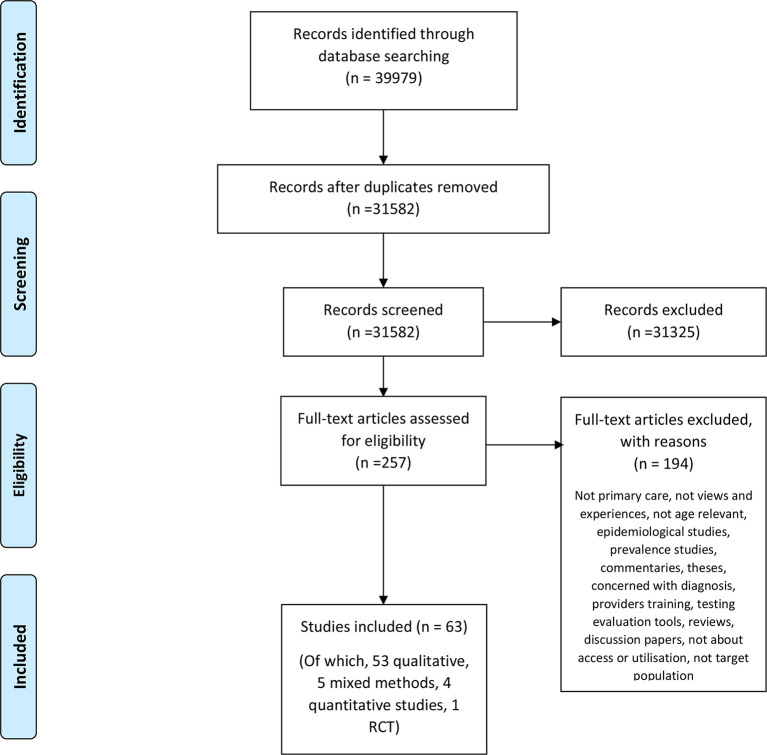
- Sixty-three studies met eligibility: 53 qualitative, 5 mixed-methods, 4 quantitative, and 1 randomised controlled trial; most were from the UK (n = 33), US (n = 13), and Australia (n = 8); 49 explored intellectual disabilities, 13 explored autism, and 1 explored both.
- Six main themes emerged: training; knowledge and awareness; communication; fear and embarrassment; involvement in healthcare decision-making; and time. All were underpinned by the need for greater care, dignity, respect, collaborative relationships, and reasonable adjustments.
- Opposing barriers and facilitators were identified within each theme; examples include lack of specialist training/knowledge and poor communication versus training, accessible information, continuity of professional, dignity/respect, and involvement in decisions.
- Quality appraisal rated 46 of 63 studies (73%) as high quality, 2 as good quality, 7 as satisfactory, poor, or very poor, and 8 were not rated; none were excluded from the review.
Methods
- Integrative review using systematic review methodology, reported per PRISMA 2009; searched Ovid MEDLINE, Embase, CINAHL Complete, and Cochrane up to 22 August 2018 for studies published 2001–2018 in all languages.
- Eligible studies were any design, included people aged ≥14 years formally or self-identified as having intellectual disability and/or autism, and/or their family members, carers, support workers, or healthcare professionals, and explored access to primary health care for physical and/or mental health needs.
- Two researchers independently screened titles/abstracts; three independently assessed full texts; two independently assessed quality using the Mixed Methods Analysis Tool (MMAT); data were extracted with a piloted tool and analysed using thematic analysis, with two researchers developing themes and narratively synthesising them.
Limitations
- The paper states that searches of other relevant databases such as PsycINFO, grey literature, and reference/citation checking were not undertaken owing to staffing resource constraints; most identified studies were from high-income countries and may not reflect low- and middle-income countries or all high-income countries; the review was limited to individuals aged ≥14 years; convenience samples and self-selection may bias results; and some studies were limited to urban rather than rural areas.
- The paper states that the publication dates 2001–2018 were not stated in the study protocol.
- The text makes evident that the review excluded systematic reviews, book reviews, editorials, commentaries, epidemiological studies, and prevalence studies, so such sources could not contribute to the synthesis.
Model-written summary. Check it against the paper before relying on it.
Integrity signals
Registry
Cites
Statistics
Figures
Verification
Claims the paper makes
51 Not checked yet · 11 Own method · 8 Own result · 7 Own interpretation · 2 No basis given
A result the paper reports from its own data — it cites no other source for it, so there is none to check. The quote shows it is in the paper.
In the paper
“Sixty-three studies met the eligibility criteria for inclusion in the review.”
§ Barriers and facilitators to primary health care for people with intellectual disabilities and/or autism: an integrative review > Results
plain- Asserted: passes — The authors put it forward as true.
- Checkable: passes — It can be checked against evidence.
- Load-bearing: unclear — It is unclear whether the paper’s conclusions depend on it.
- Based: passes — The paper gives a reason why it holds.
None of the sources cited for this claim have been checked yet.
In the paper
“Studies found a lack of awareness by healthcare providers about the range of communication issues faced by people with intellectual disabilities and/or autism when accessing and attending primary and acute healthcare settings.23,45–47”
§ Barriers and facilitators to primary health care for people with intellectual disabilities and/or autism: an integrative review > Results > Themes
What the sources say
plain- Asserted: passes — The authors put it forward as true.
- Checkable: passes — It can be checked against evidence.
- Load-bearing: passes — The paper’s conclusions depend on it.
- Based: passes — The paper gives a reason why it holds.
In the paper
“Despite this, healthcare providers recognise the importance of such specialist training for people with intellectual disabilities and for others with communication challenges.23”
§ Barriers and facilitators to primary health care for people with intellectual disabilities and/or autism: an integrative review > Results > Themes
What the sources say
- Not checked yetcites [23] source
plain- Asserted: passes — The authors put it forward as true.
- Checkable: passes — It can be checked against evidence.
- Load-bearing: unclear — It is unclear whether the paper’s conclusions depend on it.
- Based: passes — The paper gives a reason why it holds.
None of the sources cited for this claim have been checked yet.
In the paper
“Poor attitudes held by both healthcare professionals and non-health professionals, across both primary and acute healthcare provider settings, is a recurring theme in the review’s identified studies.22,31–33”
§ Barriers and facilitators to primary health care for people with intellectual disabilities and/or autism: an integrative review > Results > Themes
What the sources say
plain- Asserted: passes — The authors put it forward as true.
- Checkable: passes — It can be checked against evidence.
- Load-bearing: passes — The paper’s conclusions depend on it.
- Based: passes — The paper gives a reason why it holds.
A result the paper reports from its own data — it cites no other source for it, so there is none to check. The quote shows it is in the paper.
In the paper
“Participants perceived of barriers and facilitators within each of these themes as being integrated in an opposing fashion”
§ Barriers and facilitators to primary health care for people with intellectual disabilities and/or autism: an integrative review > Results > Themes
plain- Asserted: passes — The authors put it forward as true.
- Checkable: passes — It can be checked against evidence.
- Load-bearing: unclear — It is unclear whether the paper’s conclusions depend on it.
- Based: passes — The paper gives a reason why it holds.
The paper states this without a source or data behind it here, so there is nothing to check it against. The quote shows it is in the paper.
In the paper
“However, none of the studies were excluded from the review”
§ Barriers and facilitators to primary health care for people with intellectual disabilities and/or autism: an integrative review > Results > Quality of studies
plain- Asserted: passes — The authors put it forward as true.
- Checkable: passes — It can be checked against evidence.
- Load-bearing: unclear — It is unclear whether the paper’s conclusions depend on it.
- Based: passes — The paper gives a reason why it holds.
None of the sources cited for this claim have been checked yet.
In the paper
“Accessible healthcare information is perceived to be a high priority by people with intellectual disabilities and/or autism.48–50”
§ Barriers and facilitators to primary health care for people with intellectual disabilities and/or autism: an integrative review > Results > Themes
What the sources say
plain- Asserted: passes — The authors put it forward as true.
- Checkable: passes — It can be checked against evidence.
- Load-bearing: unclear — It is unclear whether the paper’s conclusions depend on it.
- Based: passes — The paper gives a reason why it holds.
A result the paper reports from its own data — it cites no other source for it, so there is none to check. The quote shows it is in the paper.
In the paper
“Most studies were conducted in the UK (n = 33), the US (n = 13), and Australia (n = 8).”
§ Barriers and facilitators to primary health care for people with intellectual disabilities and/or autism: an integrative review > Results
plainn = 33- Asserted: passes — The authors put it forward as true.
- Checkable: passes — It can be checked against evidence.
- Load-bearing: unclear — It is unclear whether the paper’s conclusions depend on it.
- Based: passes — The paper gives a reason why it holds.
None of the sources cited for this claim have been checked yet.
In the paper
“Healthcare providers (both primary and acute health care) may lack specialist training in this field.20–22”
§ Barriers and facilitators to primary health care for people with intellectual disabilities and/or autism: an integrative review > Results > Themes
What the sources say
hedged- Asserted: passes — The authors put it forward as true.
- Checkable: passes — It can be checked against evidence.
- Load-bearing: passes — The paper’s conclusions depend on it.
- Based: passes — The paper gives a reason why it holds.
None of the sources cited for this claim have been checked yet.
In the paper
“Communication is a significant barrier for people with autism and/or intellectual disabilities.29,38–42”
§ Barriers and facilitators to primary health care for people with intellectual disabilities and/or autism: an integrative review > Results > Themes
What the sources say
plaindirect- Asserted: passes — The authors put it forward as true.
- Checkable: passes — It can be checked against evidence.
- Load-bearing: passes — The paper’s conclusions depend on it.
- Based: passes — The paper gives a reason why it holds.
- It may state two separate claims as one. 24
- Probably not a substantial claim. 22
A result the paper reports from its own data — it cites no other source for it, so there is none to check. The quote shows it is in the paper.
In the paper
“The review identified 53 qualitative studies, five mixed-methods studies, four quantitative studies, and one randomised controlled trial.”
§ Barriers and facilitators to primary health care for people with intellectual disabilities and/or autism: an integrative review > Results
plain- Asserted: passes — The authors put it forward as true.
- Checkable: passes — It can be checked against evidence.
- Load-bearing: unclear — It is unclear whether the paper’s conclusions depend on it.
- Based: passes — The paper gives a reason why it holds.
It may state two separate claims as one.
None of the sources cited for this claim have been checked yet.
In the paper
“Some healthcare information may be incomprehensible and/or difficult to obtain.25,34,50,51”
§ Barriers and facilitators to primary health care for people with intellectual disabilities and/or autism: an integrative review > Results > Themes
What the sources say
hedged- Asserted: passes — The authors put it forward as true.
- Checkable: passes — It can be checked against evidence.
- Load-bearing: passes — The paper’s conclusions depend on it.
- Based: passes — The paper gives a reason why it holds.
It may state two separate claims as one.
None of the sources cited for this claim have been checked yet.
In the paper
“The use of easy-read information, sign language, non-face-to-face communication, such as via the telephone, not overloading the service user with verbal information, and use of virtual reality have been suggested as preferred methods of communication for this population.26,52”
§ Barriers and facilitators to primary health care for people with intellectual disabilities and/or autism: an integrative review > Results > Themes
hedged- Asserted: passes — The authors put it forward as true.
- Checkable: passes — It can be checked against evidence.
- Load-bearing: unclear — It is unclear whether the paper’s conclusions depend on it.
- Based: passes — The paper gives a reason why it holds.
It may state two separate claims as one.
A result the paper reports from its own data — it cites no other source for it, so there is none to check. The quote shows it is in the paper.
In the paper
“Six common themes were identified by the thematic analysis.”
§ Barriers and facilitators to primary health care for people with intellectual disabilities and/or autism: an integrative review > Results > Themes
plain- Asserted: passes — The authors put it forward as true.
- Checkable: passes — It can be checked against evidence.
- Load-bearing: fails — The paper’s conclusions may not depend on it.
- Based: passes — The paper gives a reason why it holds.
Probably not a substantial claim. The paper’s conclusions may not depend on it.
In the paper
“If these patients find health care stressful because of poor communication then they may lower their expectations, lower their attendance, and feel disaffected, and this may lead to ineffective health care.23”
§ Barriers and facilitators to primary health care for people with intellectual disabilities and/or autism: an integrative review > Results > Themes
What the sources say
- Not checked yetcites [23] source
hedgedconditional- Asserted: passes — The authors put it forward as true.
- Checkable: passes — It can be checked against evidence.
- Load-bearing: unclear — It is unclear whether the paper’s conclusions depend on it.
- Based: passes — The paper gives a reason why it holds.
It may state two separate claims as one.
A result the paper reports from its own data — it cites no other source for it, so there is none to check. The quote shows it is in the paper.
In the paper
“Of the 63 eligible studies, 46 (73%) were rated as high quality, two were rated as good quality, seven were rated as being either satisfactory, poor, or very poor, and eight were not rated owing to their lack of reported information.”
§ Barriers and facilitators to primary health care for people with intellectual disabilities and/or autism: an integrative review > Results > Quality of studies
plain- Asserted: passes — The authors put it forward as true.
- Checkable: passes — It can be checked against evidence.
- Load-bearing: unclear — It is unclear whether the paper’s conclusions depend on it.
- Based: passes — The paper gives a reason why it holds.
It may state two separate claims as one.
In the paper
“Barriers to their training include time constraints, knowledge gaps, and uncertainties over specialist help.23”
§ Barriers and facilitators to primary health care for people with intellectual disabilities and/or autism: an integrative review > Results > Themes
What the sources say
- Not checked yetcites [23] source
plaindirect- Asserted: passes — The authors put it forward as true.
- Checkable: passes — It can be checked against evidence.
- Load-bearing: unclear — It is unclear whether the paper’s conclusions depend on it.
- Based: passes — The paper gives a reason why it holds.
It may state two separate claims as one.
None of the sources cited for this claim have been checked yet.
In the paper
“A warm, friendly, and caring attitude from healthcare providers enables service users to access healthcare facilities and discuss sensitive health concerns.22,34–37”
§ Barriers and facilitators to primary health care for people with intellectual disabilities and/or autism: an integrative review > Results > Themes
What the sources say
plaindirect- Asserted: passes — The authors put it forward as true.
- Checkable: passes — It can be checked against evidence.
- Load-bearing: unclear — It is unclear whether the paper’s conclusions depend on it.
- Based: passes — The paper gives a reason why it holds.
It may state two separate claims as one.
A result the paper reports from its own data — it cites no other source for it, so there is none to check. The quote shows it is in the paper.
In the paper
“Forty-nine studies explored the views and experiences of participants with intellectual disabilities, 13 studies explored the views and experiences of participants with autism, and one study explored the views and experiences of participants with both intellectual disabilities and autism.”
§ Barriers and facilitators to primary health care for people with intellectual disabilities and/or autism: an integrative review > Results
plain- Asserted: passes — The authors put it forward as true.
- Checkable: passes — It can be checked against evidence.
- Load-bearing: unclear — It is unclear whether the paper’s conclusions depend on it.
- Based: passes — The paper gives a reason why it holds.
It may state two separate claims as one.
None of the sources cited for this claim have been checked yet.
In the paper
“Carers do not always allow the service user to speak for themselves or carers might try to protect them from perceived harmful communication,28 thereby preventing service users from exerting control over their own healthcare needs.32”
§ Barriers and facilitators to primary health care for people with intellectual disabilities and/or autism: an integrative review > Results > Themes
hedgeddirect- Asserted: passes — The authors put it forward as true.
- Checkable: passes — It can be checked against evidence.
- Load-bearing: unclear — It is unclear whether the paper’s conclusions depend on it.
- Based: passes — The paper gives a reason why it holds.
It may state two separate claims as one.
A result the paper reports from its own data — it cites no other source for it, so there is none to check. The quote shows it is in the paper.
In the paper
“Twenty-four studies were conducted between the years 2003 and 2010, and 39 studies were conducted between 2011 and 2018.”
§ Barriers and facilitators to primary health care for people with intellectual disabilities and/or autism: an integrative review > Results
plain- Asserted: passes — The authors put it forward as true.
- Checkable: passes — It can be checked against evidence.
- Load-bearing: fails — The paper’s conclusions may not depend on it.
- Based: passes — The paper gives a reason why it holds.
Probably not a substantial claim. The paper’s conclusions may not depend on it. It may state two separate claims as one.
None of the sources cited for this claim have been checked yet.
In the paper
“It causes problems in primary care as inadequate communication can result in the wrong diagnosis and inappropriate medication, and it can prevent a person’s access to receiving adequate health care.23,43,44”
§ Barriers and facilitators to primary health care for people with intellectual disabilities and/or autism: an integrative review > Results > Themes
What the sources say
plaindirect- Asserted: passes — The authors put it forward as true.
- Checkable: passes — It can be checked against evidence.
- Load-bearing: passes — The paper’s conclusions depend on it.
- Based: passes — The paper gives a reason why it holds.
It may state two separate claims as one.
In the paper
“People with intellectual disabilities and/or autism can make choices about their everyday lives, yet decisions about their health care may be made by their families, carers, and healthcare providers instead.25”
§ Barriers and facilitators to primary health care for people with intellectual disabilities and/or autism: an integrative review > Results > Themes
What the sources say
- Not checked yetcites [25] source
hedgedconditional- Asserted: passes — The authors put it forward as true.
- Checkable: passes — It can be checked against evidence.
- Load-bearing: passes — The paper’s conclusions depend on it.
- Based: passes — The paper gives a reason why it holds.
It may state two separate claims as one.
None of the sources cited for this claim have been checked yet.
In the paper
“These include fears of being judged over lifestyle choices, of blood tests and vaccinations,38 of medical instruments,31 and fears associated with a lack of understanding about screening procedures.59”
§ Barriers and facilitators to primary health care for people with intellectual disabilities and/or autism: an integrative review > Results > Themes
What the sources say
plain- Asserted: passes — The authors put it forward as true.
- Checkable: passes — It can be checked against evidence.
- Load-bearing: unclear — It is unclear whether the paper’s conclusions depend on it.
- Based: passes — The paper gives a reason why it holds.
It may state two separate claims as one.
None of the sources cited for this claim have been checked yet.
In the paper
“They feel empowered when they are involved in the decision-making process and gain a better understanding of their treatment and diagnosis.28,66”
§ Barriers and facilitators to primary health care for people with intellectual disabilities and/or autism: an integrative review > Results > Themes
plaindirect- Asserted: passes — The authors put it forward as true.
- Checkable: passes — It can be checked against evidence.
- Load-bearing: unclear — It is unclear whether the paper’s conclusions depend on it.
- Based: passes — The paper gives a reason why it holds.
It may state two separate claims as one.
None of the sources cited for this claim have been checked yet.
In the paper
“Prolonged times waiting to be seen and limited time spent with a healthcare professional during an appointment act as barriers.”
§ Barriers and facilitators to primary health care for people with intellectual disabilities and/or autism: an integrative review > Results > Themes
plaindirect- Asserted: passes — The authors put it forward as true.
- Checkable: passes — It can be checked against evidence.
- Load-bearing: passes — The paper’s conclusions depend on it.
- Based: passes — The paper gives a reason why it holds.
It may state two separate claims as one.
None of the sources cited for this claim have been checked yet.
In the paper
“Being treated with dignity and respect and being valued by healthcare providers are key facilitators,47,53 and are important in forming good relationships.54”
§ Barriers and facilitators to primary health care for people with intellectual disabilities and/or autism: an integrative review > Results > Themes
What the sources say
plaindirect- Asserted: passes — The authors put it forward as true.
- Checkable: passes — It can be checked against evidence.
- Load-bearing: passes — The paper’s conclusions depend on it.
- Based: passes — The paper gives a reason why it holds.
It may state two separate claims as one.
What the paper did — it cites no source for this, so there is none to check. The quote shows it is in the paper.
In the paper
“A third reviewer was involved where necessary.”
§ Barriers and facilitators to primary health care for people with intellectual disabilities and/or autism: an integrative review > Method
plain- Asserted: passes — The authors put it forward as true.
- Checkable: passes — It can be checked against evidence.
- Load-bearing: fails — The paper’s conclusions may not depend on it.
- Based: passes — The paper gives a reason why it holds.
Probably not a substantial claim. The paper’s conclusions may not depend on it.
In the paper
“Death occurs at a younger age and the prevalence of long-term morbidities is higher than in the general population.2”
§ Barriers and facilitators to primary health care for people with intellectual disabilities and/or autism: an integrative review > Introduction
What the sources say
- Not checked yetcites [2] source
plaincorrelational- Asserted: passes — The authors put it forward as true.
- Checkable: passes — It can be checked against evidence.
- Load-bearing: fails — The paper’s conclusions may not depend on it.
- Based: passes — The paper gives a reason why it holds.
Probably not a substantial claim. The paper’s conclusions may not depend on it.
What the paper did — it cites no source for this, so there is none to check. The quote shows it is in the paper.
In the paper
“Three researchers independently read and assessed the full texts of relevant citations, using the pre-specified eligibility criteria.”
§ Barriers and facilitators to primary health care for people with intellectual disabilities and/or autism: an integrative review > Method
plain- Asserted: passes — The authors put it forward as true.
- Checkable: passes — It can be checked against evidence.
- Load-bearing: fails — The paper’s conclusions may not depend on it.
- Based: passes — The paper gives a reason why it holds.
Probably not a substantial claim. The paper’s conclusions may not depend on it.
In the paper
“There may be overlap between these groups, but their needs may be unique and nuanced.11”
§ Barriers and facilitators to primary health care for people with intellectual disabilities and/or autism: an integrative review > Introduction
What the sources say
- Not checked yetcites [11] source
hedged- Asserted: passes — The authors put it forward as true.
- Checkable: passes — It can be checked against evidence.
- Load-bearing: passes — The paper’s conclusions depend on it.
- Based: passes — The paper gives a reason why it holds.
It may state two separate claims as one.
What the paper did — it cites no source for this, so there is none to check. The quote shows it is in the paper.
In the paper
“Data were extracted from the included studies using a data extraction tool, which was specifically designed and piloted by the research team.”
§ Barriers and facilitators to primary health care for people with intellectual disabilities and/or autism: an integrative review > Method
plain- Asserted: passes — The authors put it forward as true.
- Checkable: passes — It can be checked against evidence.
- Load-bearing: fails — The paper’s conclusions may not depend on it.
- Based: passes — The paper gives a reason why it holds.
Probably not a substantial claim. The paper’s conclusions may not depend on it.
None of the sources cited for this claim have been checked yet.
In the paper
“Study quality was assessed independently by two researchers using the Mixed Methods Analysis Tool (MMAT).16,17”
§ Barriers and facilitators to primary health care for people with intellectual disabilities and/or autism: an integrative review > Method
plain- Asserted: passes — The authors put it forward as true.
- Checkable: passes — It can be checked against evidence.
- Load-bearing: passes — The paper’s conclusions depend on it.
- Based: passes — The paper gives a reason why it holds.
Probably not a substantial claim.
In the paper
“UK guidance outlines the necessity of tailoring healthcare services to meet their needs.3”
§ Barriers and facilitators to primary health care for people with intellectual disabilities and/or autism: an integrative review > Introduction
What the sources say
- Not checked yetcites [3] Royal College of General Practitioners Care of people with intellectual disability. 24 Jun 2020. https://www.gponline.com/rcgp-curriculum/care-of-people-with-learning-disabilities.
plain- Asserted: passes — The authors put it forward as true.
- Checkable: passes — It can be checked against evidence.
- Load-bearing: fails — The paper’s conclusions may not depend on it.
- Based: passes — The paper gives a reason why it holds.
Probably not a substantial claim. The paper’s conclusions may not depend on it.
What the paper did — it cites no source for this, so there is none to check. The quote shows it is in the paper.
In the paper
“Titles and abstracts were first screened for relevance independently by two researchers.”
§ Barriers and facilitators to primary health care for people with intellectual disabilities and/or autism: an integrative review > Method
plain- Asserted: passes — The authors put it forward as true.
- Checkable: passes — It can be checked against evidence.
- Load-bearing: fails — The paper’s conclusions may not depend on it.
- Based: passes — The paper gives a reason why it holds.
Probably not a substantial claim. The paper’s conclusions may not depend on it.
What the paper did — it cites no source for this, so there is none to check. The quote shows it is in the paper.
In the paper
“The integrative review (utilising systematic review methodology) was conducted according to a pre-specified protocol”
§ Barriers and facilitators to primary health care for people with intellectual disabilities and/or autism: an integrative review > Method
plain- Asserted: passes — The authors put it forward as true.
- Checkable: passes — It can be checked against evidence.
- Load-bearing: fails — The paper’s conclusions may not depend on it.
- Based: passes — The paper gives a reason why it holds.
Probably not a substantial claim. The paper’s conclusions may not depend on it.
In the paper
“The two researchers independently assessed the number of criteria met by each study in each of the MMAT’s domains of assessment17 and provided each study with a score.”
§ Barriers and facilitators to primary health care for people with intellectual disabilities and/or autism: an integrative review > Method
What the sources say
- Not checked yetcites [17] source
plain- Asserted: passes — The authors put it forward as true.
- Checkable: passes — It can be checked against evidence.
- Load-bearing: fails — The paper’s conclusions may not depend on it.
- Based: passes — The paper gives a reason why it holds.
Probably not a substantial claim. The paper’s conclusions may not depend on it. It may state two separate claims as one.
What the paper did — it cites no source for this, so there is none to check. The quote shows it is in the paper.
In the paper
“Two researchers independently developed the themes.”
§ Barriers and facilitators to primary health care for people with intellectual disabilities and/or autism: an integrative review > Method
plain- Asserted: passes — The authors put it forward as true.
- Checkable: passes — It can be checked against evidence.
- Load-bearing: fails — The paper’s conclusions may not depend on it.
- Based: passes — The paper gives a reason why it holds.
Probably not a substantial claim. The paper’s conclusions may not depend on it.
In the paper
“written in accordance with the Preferred Reporting Items for Systematic Reviews and Meta-Analyses (PRISMA) 2009 checklist and reporting standards (Figure 1).12”
§ Barriers and facilitators to primary health care for people with intellectual disabilities and/or autism: an integrative review > Method
What the sources say
- Not checked yetcites [12] Higgins J Green S (2019) Cochrane Handbook for Systematic Reviews of Interventions. 17 Jun 2020. https://training.cochrane.org/handbook. source
plain- Asserted: passes — The authors put it forward as true.
- Checkable: passes — It can be checked against evidence.
- Load-bearing: fails — The paper’s conclusions may not depend on it.
- Based: passes — The paper gives a reason why it holds.
Probably not a substantial claim. The paper’s conclusions may not depend on it.
What the paper did — it cites no source for this, so there is none to check. The quote shows it is in the paper.
In the paper
“The researchers’ independent appraisal findings were compared and agreed.”
§ Barriers and facilitators to primary health care for people with intellectual disabilities and/or autism: an integrative review > Method
plain- Asserted: passes — The authors put it forward as true.
- Checkable: passes — It can be checked against evidence.
- Load-bearing: fails — The paper’s conclusions may not depend on it.
- Based: passes — The paper gives a reason why it holds.
Probably not a substantial claim. The paper’s conclusions may not depend on it.
What the paper did — it cites no source for this, so there is none to check. The quote shows it is in the paper.
In the paper
“These themes were compared, key themes agreed, and narratively synthesised by the two researchers.”
§ Barriers and facilitators to primary health care for people with intellectual disabilities and/or autism: an integrative review > Method
plain- Asserted: passes — The authors put it forward as true.
- Checkable: passes — It can be checked against evidence.
- Load-bearing: fails — The paper’s conclusions may not depend on it.
- Based: passes — The paper gives a reason why it holds.
Probably not a substantial claim. The paper’s conclusions may not depend on it. It may state two separate claims as one.
In the paper
“Death occurs at a younger age and the prevalence of long-term morbidities is higher than in the general population.2”
§ Barriers and facilitators to primary health care for people with intellectual disabilities and/or autism: an integrative review > Introduction
What the sources say
- Not checked yetcites [2] source
plaincorrelational- Asserted: passes — The authors put it forward as true.
- Checkable: passes — It can be checked against evidence.
- Load-bearing: fails — The paper’s conclusions may not depend on it.
- Based: passes — The paper gives a reason why it holds.
Probably not a substantial claim. The paper’s conclusions may not depend on it.
A conclusion the paper draws from its own results — it cites no other source for it, so there is none to check. The quote shows it is in the paper.
In the paper
“Improving these issues could help alleviate some of the fears reported by service users, which represent another reported barrier.”
§ Barriers and facilitators to primary health care for people with intellectual disabilities and/or autism: an integrative review > Discussion > Summary
hedgedconditional- Asserted: passes — The authors put it forward as true.
- Checkable: fails — It may be too vague to check against evidence.
- Load-bearing: fails — The paper’s conclusions may not depend on it.
- Based: passes — The paper gives a reason why it holds.
Probably not a substantial claim. It may be too vague to check against evidence. The paper’s conclusions may not depend on it.
A conclusion the paper draws from its own results — it cites no other source for it, so there is none to check. The quote shows it is in the paper.
In the paper
“This may be associated with poor communication between such healthcare providers and service users, and a lack of involvement in healthcare decision-making processes for these service users.”
§ Barriers and facilitators to primary health care for people with intellectual disabilities and/or autism: an integrative review > Discussion > Summary
hedgedcorrelational- Asserted: passes — The authors put it forward as true.
- Checkable: passes — It can be checked against evidence.
- Load-bearing: passes — The paper’s conclusions depend on it.
- Based: fails — The paper may give no reason why it holds.
Probably not a substantial claim. The paper may give no reason why it holds. It may state two separate claims as one.
A conclusion the paper draws from its own results — it cites no other source for it, so there is none to check. The quote shows it is in the paper.
In the paper
“A lack of specialist training in both primary and acute health care is an important barrier, which may mean that healthcare providers lack knowledge and awareness of the healthcare needs of people with intellectual disabilities and/or autism.”
§ Barriers and facilitators to primary health care for people with intellectual disabilities and/or autism: an integrative review > Discussion > Summary
hedgedconditional- Asserted: passes — The authors put it forward as true.
- Checkable: passes — It can be checked against evidence.
- Load-bearing: passes — The paper’s conclusions depend on it.
- Based: passes — The paper gives a reason why it holds.
It may state two separate claims as one.
What the paper did — it cites no source for this, so there is none to check. The quote shows it is in the paper.
In the paper
“Searches of grey literature and the checking of reference lists and citations for included studies were not undertaken, as originally stated in the study protocol, owing to staffing resource constraints.”
§ Barriers and facilitators to primary health care for people with intellectual disabilities and/or autism: an integrative review > Discussion > Strengths and limitations
plaindirect- Asserted: passes — The authors put it forward as true.
- Checkable: passes — It can be checked against evidence.
- Load-bearing: fails — The paper’s conclusions may not depend on it.
- Based: passes — The paper gives a reason why it holds.
Probably not a substantial claim. The paper’s conclusions may not depend on it.
What the paper did — it cites no source for this, so there is none to check. The quote shows it is in the paper.
In the paper
“However, a search of other relevant databases, such as PsycINFO, grey literature (including guidance and policy documents), and checking the references and citations of included studies, may have yielded additional results.”
§ Barriers and facilitators to primary health care for people with intellectual disabilities and/or autism: an integrative review > Discussion > Strengths and limitations
hedgedconditional- Asserted: passes — The authors put it forward as true.
- Checkable: passes — It can be checked against evidence.
- Load-bearing: fails — The paper’s conclusions may not depend on it.
- Based: passes — The paper gives a reason why it holds.
Probably not a substantial claim. The paper’s conclusions may not depend on it.
A conclusion the paper draws from its own results — it cites no other source for it, so there is none to check. The quote shows it is in the paper.
In the paper
“Most of the identified studies were conducted in high-income countries (HICs) and may not reflect the views and experiences of people with intellectual disabilities and/or autism from low- and middle-income countries.”
§ Barriers and facilitators to primary health care for people with intellectual disabilities and/or autism: an integrative review > Discussion > Strengths and limitations
hedgedconditional- Asserted: passes — The authors put it forward as true.
- Checkable: passes — It can be checked against evidence.
- Load-bearing: passes — The paper’s conclusions depend on it.
- Based: passes — The paper gives a reason why it holds.
It may state two separate claims as one.
None of the sources cited for this claim have been checked yet.
In the paper
“Some studies were limited to urban areas as opposed to rural areas, which may pose different healthcare barriers.81,82”
§ Barriers and facilitators to primary health care for people with intellectual disabilities and/or autism: an integrative review > Discussion > Strengths and limitations
hedgedconditional- Asserted: passes — The authors put it forward as true.
- Checkable: passes — It can be checked against evidence.
- Load-bearing: unclear — It is unclear whether the paper’s conclusions depend on it.
- Based: passes — The paper gives a reason why it holds.
It may state two separate claims as one.
None of the sources cited for this claim have been checked yet.
In the paper
“The use of convenience samples23,56 and self-selection20 may also bias the results.”
§ Barriers and facilitators to primary health care for people with intellectual disabilities and/or autism: an integrative review > Discussion > Strengths and limitations
What the sources say
hedgedconditional- Asserted: passes — The authors put it forward as true.
- Checkable: passes — It can be checked against evidence.
- Load-bearing: unclear — It is unclear whether the paper’s conclusions depend on it.
- Based: passes — The paper gives a reason why it holds.
It may state two separate claims as one.
What the paper did — it cites no source for this, so there is none to check. The quote shows it is in the paper.
In the paper
“The review was limited to studies involving individuals with intellectual disabilities and/or autism who were aged ≥14 years.”
§ Barriers and facilitators to primary health care for people with intellectual disabilities and/or autism: an integrative review > Discussion > Strengths and limitations
plain- Asserted: passes — The authors put it forward as true.
- Checkable: passes — It can be checked against evidence.
- Load-bearing: fails — The paper’s conclusions may not depend on it.
- Based: passes — The paper gives a reason why it holds.
Probably not a substantial claim. The paper’s conclusions may not depend on it.
A conclusion the paper draws from its own results — it cites no other source for it, so there is none to check. The quote shows it is in the paper.
In the paper
“There may be transferable evidence from studies involving children and younger people from this population and other cognitive disability populations (for example, patients with dementia, cerebral palsy, stroke, or acquired brain injury).”
§ Barriers and facilitators to primary health care for people with intellectual disabilities and/or autism: an integrative review > Discussion > Strengths and limitations
hedgedconditional- Asserted: passes — The authors put it forward as true.
- Checkable: fails — It may be too vague to check against evidence.
- Load-bearing: fails — The paper’s conclusions may not depend on it.
- Based: fails — The paper may give no reason why it holds.
Probably not a substantial claim. It may be too vague to check against evidence. The paper’s conclusions may not depend on it. The paper may give no reason why it holds.
The paper relies on this without support.
This is the first integrative review of barriers and facilitators to accessing and utilising primary health care experienced by adolescents and adults with intellectual disabilities and/or autism.
“To the authors’ knowledge, this is the first integrative review of barriers and facilitators to accessing and utilising primary health care experienced by adolescents and adults with intellectual disabilities and/or autism.”
Citations
Cites
Cochrane Handbook for Systematic Reviews of Interventions: Cochrane Book Series
(2008) · doi:10.1002/9780470712184 · Cited by 25,048
Cochrane Handbook for Systematic Reviews of Interventions
(2019) · doi:10.1002/9781119536604 · Cited by 14,828
Methods for the thematic synthesis of qualitative research in systematic reviews
Thomas, J., & Harden, A. (2008) · BMC Medical Research Methodology · doi:10.1186/1471-2288-8-45 · Cited by 9,312
The Mixed Methods Appraisal Tool (MMAT) version 2018 for information professionals and researchers
Hong, Q. N., Fàbregues, S., Bartlett, G., Boardman, F., Cargo, M., Dagenais, P., Gagnon, M.-P., Griffiths, F., Nicolau, B., O’Cathain, A., et al. (2018) · Education for Information · doi:10.3233/efi-180221 · Cited by 4,737 · cited 1×
“Study quality was assessed independently by two researchers using the Mixed Methods Analysis Tool (MMAT).(16,17) The MMAT is designed for use in the appraisal stage of systematic reviews of different types of studies.”
MethodLevesque, J.-F., Harris, M. F., & Russell, G. (2013) · International Journal for Equity in Health · doi:10.1186/1475-9276-12-18 · Cited by 3,484
What does 'access to health care' mean?
Gulliford, M. C., Figueroa-Munoz, J., Morgan, M., Hughes, D., Gibson, B., Beech, R., & Hudson, M. (2002) · Journal of Health Services Research & Policy · doi:10.1258/135581902760082517 · Cited by 1,135
Pluye, P., Gagnon, M.-P., Griffiths, F., & Johnson-Lafleur, J. (2009) · International Journal of Nursing Studies · doi:10.1016/j.ijnurstu.2009.01.009 · Cited by 1,119
A cascade of disparities: Health and health care access for people with intellectual disabilities
Krahn, G. L., Hammond, L., & Turner, A. (2006) · Mental Retardation and Developmental Disabilities Research Reviews · doi:10.1002/mrdd.20098 · Cited by 775
Heslop, P., Blair, P. S., Fleming, P., Hoghton, M., Marriott, A., & Russ, L. (2014) · The Lancet · doi:10.1016/s0140-6736(13)62026-7 · Cited by 607
College of General Practitioners
Abercrombie, G. F., Hughes, H. L. G., & Hunt, J. H. (1954) · BMJ · doi:10.1136/bmj.1.4857.336-c · Cited by 504
Cited by
Sorted by citations
Tackling healthcare access barriers for individuals with autism from diagnosis to adulthood
Malik-Soni, N., Shaker, A., Luck, H., Mullin, A. E., Wiley, R. E., Lewis, M. E. S., Fuentes, J., & Frazier, T. W. (2022) · Pediatric Research · doi:10.1038/s41390-021-01465-y · Cited by 309
Autistic Perspectives on the Future of Clinical Autism Research
Pukki, H., Bettin, J., Outlaw, A., Hennessy, J., Brook, K., Dekker, M., Doherty, M., Shaw, S. C. K., Bervoets, J., Rudolph, S., et al. (2022) · Autism in Adulthood · doi:10.1089/aut.2022.0017 · Cited by 158
Shady, K., Phillips, S. M., & Newman, S. D. (2022) · Review Journal of Autism and Developmental Disorders · doi:10.1007/s40489-022-00324-8 · Cited by 92
Association of Intellectual Disability With All-Cause and Cause-Specific Mortality in Sweden
Hirvikoski, T., Boman, M., Tideman, M., Lichtenstein, P., & Butwicka, A. (2021) · JAMA Network Open · doi:10.1001/jamanetworkopen.2021.13014 · Cited by 85
Building disability-inclusive health systems
Kuper, H., Azizatunnisa’, L., Gatta, D. R., Rotenberg, S., Banks, L. M., Smythe, T., & Heydt, P. (2024) · The Lancet Public Health · doi:10.1016/s2468-2667(24)00042-2 · Cited by 77
Chan, D. N. S., Law, B. M. H., Au, D. W. H., So, W. K. W., & Fan, N. (2021) · Cancer Epidemiology · doi:10.1016/j.canep.2021.102084 · Cited by 72
Heslop, P., Cook, A., Sullivan, B., Calkin, R., Pollard, J., & Byrne, V. (2022) · BMJ Open · doi:10.1136/bmjopen-2021-056974 · Cited by 52
Selick, A., Bobbette, N., Lunsky, Y., Hamdani, Y., Rayner, J., & Durbin, J. (2021) · Disability and health journal · doi:10.1016/j.dhjo.2021.101132 · Cited by 47
Lunsky, Y., Bobbette, N., Selick, A., & Jiwa, M. I. (2021) · Disability and health journal · doi:10.1016/j.dhjo.2021.101066 · Cited by 45
Terras, M. M., Jarrett, D., & McGregor, S. A. (2021) · Disabilities · doi:10.3390/disabilities1030011 · Cited by 43
Shea, B., Bailie, J., Dykgraaf, S. H., Fortune, N., Lennox, N. G., & Bailie, R. S. (2022) · BMC Family Practice · doi:10.1186/s12875-022-01917-2 · Cited by 42
Edwards, G., Jones, C. A., Pearson, E., Royston, R., Oliver, C., Tarver, J., Crawford, H., Shelley, L., & Waite, J. (2022) · Neuroscience & Biobehavioral Reviews · doi:10.1016/j.neubiorev.2022.104719 · Cited by 46
Donaghy, B., Moore, D., & Green, J. (2023) · Child Care in Practice · doi:10.1080/13575279.2022.2149471 · Cited by 41
Selick, A., Durbin, J., Hamdani, Y., Rayner, J., & Lunsky, Y. (2022) · JMIR Formative Research · doi:10.2196/38916 · Cited by 32
Health support of people with intellectual disability and the crucial role of support workers
Nijhof, K., Boot, F. H., Naaldenberg, J., Leusink, G. L., & Bevelander, K. E. (2024) · BMC Health Services Research · doi:10.1186/s12913-023-10206-2 · Cited by 29
Strnadová, I., Loblinzk, J., Scully, J. L., Danker, J., Tso, M., Jackaman, K.-M., Dunn, M., Willow, S. A., Sarfaraz, S., Fitzgerald, V., et al. (2023) · European Journal of Human Genetics · doi:10.1038/s41431-023-01282-3 · Cited by 29
Liu, S., Larsson, H., Kuja‐Halkola, R., Lichtenstein, P., Butwicka, A., & Taylor, M. J. (2023) · The Lancet Healthy Longevity · doi:10.1016/s2666-7568(23)00067-3 · Cited by 28
Wigham, S., Bourne, J., McKenzie, K., Rowlands, G., Petersen, K., & Hackett, S. (2022) · BMJ Open · doi:10.1136/bmjopen-2022-065945 · Cited by 27
Power, R., David, M., Strnadová, I., Touyz, L. M., Basckin, C., Loblinzk, J., Jolly, H., Kennedy, E., Ussher, J. M., Sweeney, S., et al. (2024) · Frontiers in Psychiatry · doi:10.3389/fpsyt.2024.1379497 · Cited by 26
Barriers to service and unmet need among autistic adolescents and young adults
Ishler, K. J., Berg, K. A., Olgac, T., Obeid, R., & Biegel, D. E. (2023) · Autism · doi:10.1177/13623613221150569 · Cited by 25
Co-design of an NHS primary care health check for autistic adults
Taylor, H. M., Ingham, B., Mason, D., Finch, T. L., Wilson, C., Scarlett, C., Moss, S., Buckley, C., Urbanowicz, A., Raymaker, D., et al. (2022) · Autism · doi:10.1177/13623613221132921 · Cited by 22
Co-development of a training programme on disability for healthcare workers in Uganda
Smythe, T., Ssemata, A. S., Slivesteri, S., Mbazzi, F. B., & Kuper, H. (2024) · BMC Health Services Research · doi:10.1186/s12913-024-10918-z · Cited by 20
Chinn, D. (2022) · Qualitative Health Research · doi:10.1177/10497323221089875 · Cited by 20
Mansour, H., Gillions, A., Brown, J. M., Pattenden, A., HARTLEY, S. H., Patel, S., James, S., Styles, M., Mandy, W., Stott, J. C. H., et al. (2024) · Autism · doi:10.1177/13623613241291081 · Cited by 20
Sønderlund, A. L., Baygi, F., Søndergaard, J., & Thilsing, T. (2024) · SSM - Health Systems · doi:10.1016/j.ssmhs.2024.100009 · Cited by 17
Gregson, N., Randle‐Phillips, C., & Hillman, S. (2022) · International Journal of Developmental Disabilities · doi:10.1080/20473869.2022.2056402 · Cited by 17
Views about primary care health checks for autistic adults: UK survey findings
Mason, D., Taylor, H. M., Ingham, B., Finch, T. L., Wilson, C., Scarlett, C., Urbanowicz, A., Nicolaidis, C., Lennox, N. G., Moss, S., et al. (2022) · BJGP Open · doi:10.3399/bjgpo.2022.0067 · Cited by 17
Marzi, A., Caniato, M., & Gasparella, A. (2024) · Building and Environment · doi:10.1016/j.buildenv.2024.112254 · Cited by 17
Selick, A., Durbin, J., Casson, I., Green, L., Abells, D., Bruni, A., Mazurek, M. T., Jiwa, M. I., & Lunsky, Y. (2022) · Disability and health journal · doi:10.1016/j.dhjo.2022.101282 · Cited by 17
Flood, B., & Henman, M. C. (2021) · Pharmacy · doi:10.3390/pharmacy9010024 · Cited by 16
Albaum, C. S., Chan, V., Sellitto, T., Vashi, N., Hastings, R. P., & Weiss, J. A. (2021) · International review of research in developmental disabilities · doi:10.1016/bs.irrdd.2021.08.003 · Cited by 20
Self-citationA Systematic Review of Therapeutic Process Factors in Mental Health Treatment for Autistic Youth
Albaum, C. S., Vashi, N., Bohr, Y. M., & Weiss, J. A. (2022) · Clinical Child and Family Psychology Review · doi:10.1007/s10567-022-00409-0 · Cited by 13
Clarke, L., & Tabor, H. K. (2023) · Journal of Intellectual & Developmental Disability · doi:10.3109/13668250.2023.2198345 · Cited by 14
Vaccination roll-out: a time to develop and maintain trust in science and health care
Muldoon, O. T., Bradshaw, D., Jay, S., Kinsella, E. L., Maher, P. J., Murphy, R. P., Taaffe, C., & O’Donnell, P. (2021) · British Journal of General Practice · doi:10.3399/bjgp21x717629 · Cited by 14
Gönen, Ö. F., Çavuşoğlu, T., & Kurnaz, E. (2023) · Natural Hazards · doi:10.1007/s11069-023-06273-7 · Cited by 14
Ahlström, G., Axmon, A., Sandberg, M., & Wallén, E. F. (2020) · BMC Health Services Research · doi:10.1186/s12913-020-05800-7 · Cited by 13
Havercamp, S. M., & Bonardi, A. (2022) · Intellectual and developmental disabilities · doi:10.1352/1934-9556-60.6.449 · Cited by 12
Selick, A., Durbin, J., Hamdani, Y., Rayner, J., & Lunsky, Y. (2023) · BMC Family Practice · doi:10.1186/s12875-023-02055-z · Cited by 12
Primary care experiences of adults reporting learning disability: a probability sample survey
Tromans, S. J., Teece, L., Shankar, R., Hassiotis, A., Brugha, T. S., & McManus, S. (2024) · British Journal of General Practice · doi:10.3399/bjgp.2024.0056 · Cited by 12
Meinert, E., Milne‐Ives, M., Sawyer, J., Boardman, L., Mitchell, S., McLean, B., Richardson, M. P., & Shankar, R. (2024) · BJPsych Open · doi:10.1192/bjo.2024.825 · Cited by 12
Taggart, L., Doherty, A. J., Chauhan, U., & Hassiotis, A. (2020) · Journal of Applied Research in Intellectual Disabilities · doi:10.1111/jar.12826 · Cited by 12
Self-citationDeprescripción en personas mayores: es el momento de pasar a la acción
Pliego, R. A. G., Baena-Díez, J. M., Herreros, Y. H., & Benito, M. Á. A. (2022) · Atención Primaria · doi:10.1016/j.aprim.2022.102367 · Cited by 12
Lucassen, L., Rinaldi, R., & Batselé, É. (2024) · Journal of Intellectual Disabilities · doi:10.1177/17446295241259913 · Cited by 11
Klara, S. M., Elmadani, M., Horvath, E., Lívia, T., Limungi, G. M., Hamad, O., Mesmar, A., Andrade, D. M. B., & Máté, O. (2024) · International Journal of Environmental Research and Public Health · doi:10.3390/ijerph21111402 · Cited by 11
Bacherini, A., Havercamp, S. M., & Balboni, G. (2023) · Journal of Intellectual Disability Research · doi:10.1111/jir.13013 · Cited by 10
Age- and Gender-Specific Prevalence of Intellectually Disabled Population in India
Kapoor, M., Ambade, M., Ravi, S., & Subramanian, S. V. (2023) · Journal of Autism and Developmental Disorders · doi:10.1007/s10803-022-05849-9 · Cited by 12
Stone, E. M., Wise, E. A., Stuart, E. A., & McGinty, E. E. (2023) · Disability and health journal · doi:10.1016/j.dhjo.2023.101547 · Cited by 9
Molnar, C., Strnadová, I., Dunn, M., Loblinzk, J., Sarfaraz, S., Cathcart‐King, Y., Tso, M., Danker, J., Hayes, S., Willow, S. A., et al. (2024) · Frontiers in Psychiatry · doi:10.3389/fpsyt.2024.1346423 · Cited by 9
Campbell, E. G., Rao, S. R., Ressalam, J., Bolcic‐Jankovic, D., Lawrence, R., Moore, J. M., & Iezzoni, L. I. (2022) · American Journal on Intellectual and Developmental Disabilities · doi:10.1352/1944-7558-128.1.36 · Cited by 9
Özdemir, A., Hall, R., Lovell, A., & Ellahi, B. (2023) · Nutrition Bulletin · doi:10.1111/nbu.12600 · Cited by 8
Acton, D., Arnold, R., Williams, G. P., Nicky, N. G., Mackay, K., & Jaydeokar, S. (2024) · Advances in Mental Health and Intellectual Disabilities · doi:10.1108/amhid-10-2023-0039 · Cited by 9
Menstruation and Autism: A Qualitative Systematic Review
Ellis, R., Williams, G., Caemawr, S., Craine, M., Holloway, W., Williams, K., Shaw, S. C. K., & Grant, A. (2025) · Autism in Adulthood · doi:10.1089/aut.2024.0307 · Cited by 9
Milne‐Ives, M., Shankar, R., Goodley, D., Lamb, K., Laugharne, R. A., Harding, T., & Meinert, E. (2022) · JMIR Research Protocols · doi:10.2196/31720 · Cited by 8
Equitable access to sustainable healthcare services for children with autism
Sultan, M. A. (2024) · BJPsych International · doi:10.1192/bji.2024.33 · Cited by 8
Hughes, J., Roberts, R. J., Tarver, J., Warters-Louth, C., Zhang, B., Southward, E., Shaw, R. L., Edwards, G., Waite, J., & Pearson, E. (2023) · Autism · doi:10.1177/13623613231196084 · Cited by 8
Lucassen, L., Rinaldi, R., & Batselé, É. (2025) · Research in Developmental Disabilities · doi:10.1016/j.ridd.2025.104969 · Cited by 9
Wellkamp, R., de Cruppé, W., Schwalen, S., & Geraedts, M. (2023) · Bundesgesundheitsblatt - Gesundheitsforschung - Gesundheitsschutz · doi:10.1007/s00103-023-03655-x · Cited by 7
How do primary care providers and autistic adults want to improve their primary care? A Delphi-study
Warreman, E. B., Ester, W. A., Geurts, H. M., Vermeiren, R. R. J. M., & Nooteboom, L. A. (2023) · Autism · doi:10.1177/13623613231172865 · Cited by 8
Sinclair, J., Aslan, B., Agabio, R., Anilkumar, A., Brosnan, M., Day, E., Dowling, N. A., Flood, C., Grant, J. E., Halliday, R., et al. (2023) · Comprehensive Psychiatry · doi:10.1016/j.comppsych.2023.152393 · Cited by 7
Kersten, M. L., Wilson, N. J., Pracilio, A., Howie, V. A., Trollor, J. N., Buckley, T. A., Morphet, J., Bryce, J., Griffin, K., & Cashin, A. J. (2023) · Journal of Intellectual Disabilities · doi:10.1177/17446295231174282 · Cited by 9
Self-citationLincoln, A. E., Dixon-Ibarra, A. M., Hanley, J. P., Smith, A. L., Martin, K., & Bazzano, A. (2023) · PLOS Global Public Health · doi:10.1371/journal.pgph.0001367 · Cited by 7
Disability training for healthcare workers in Uganda: qualitative findings from the pilot test
Smythe, T., Ssemata, A. S., Menya, A., Mbazzi, F. B., & Kuper, H. (2025) · BMC Medical Education · doi:10.1186/s12909-025-07330-4 · Cited by 6
Acton, D., Talbot, G., Mogan, C., & Jaydeokar, S. (2025) · Journal of Intellectual & Developmental Disability · doi:10.3109/13668250.2025.2517203 · Cited by 6
Mortality in Tuberous sclerosis Complex: Current understandings
Pentz, R., Sham, L., Zak, M., Muir, K. E., Trinari, E., Donner, E. J., Nouri, M. N., & Whitney, R. (2025) · European Journal of Paediatric Neurology · doi:10.1016/j.ejpn.2025.08.002 · Cited by 7
Davies, J., Remington, A., Buckley, C., Crane, L., & Smalley, K. (2023) · Autism · doi:10.1177/13623613231182011 · Cited by 6
Miner, D. C., Ailey, S. H., Thompson, R., Squires, A. P., Adarlo, A., & Brown, H. E. (2024) · Research in Nursing & Health · doi:10.1002/nur.22376 · Cited by 7
van den Bemd, M., Leensen, M. C. J., Cuypers, M., Leusink, G. L., Schalk, B. W. M., & Bischoff, E. W. M. A. (2024) · BMC Health Services Research · doi:10.1186/s12913-024-11155-0 · Cited by 6
Yeap, Z., Keeley, J., Skoss, R., Hunt, S., Kickett, A., Saldaris, J. M., Nevill, T., & Downs, J. A. (2024) · BMJ Open · doi:10.1136/bmjopen-2024-088509 · Cited by 6
Smart Cities for People with IDD - Foundations for Digitally Inclusive Healthcare Ecosystems
Badr, N. G. (2023) · ITM Web of Conferences · doi:10.1051/itmconf/20235104002 · Cited by 6
Mohd, F. N., Said, A. H., & Naji, A. S. M. (2023) · Journal of International Society of Preventive and Community Dentistry · doi:10.4103/jispcd.jispcd_157_22 · Cited by 6
Longhurst, P., & Full, W. (2023) · BMJ Open · doi:10.1136/bmjopen-2022-069204 · Cited by 6
Lassiter, J. W., Campbell, A. L., Taliaferro, A., & Zimmerman, S. P. (2023) · Journal of Health Communication · doi:10.1080/10810730.2023.2275125 · Cited by 6
Percepção do profissional da Estratégia Saúde da Família no cuidado à criança com deficiência
Seidel, B., Mazza, V. D. A., Schuertz, A. L., Ruthes, V. B. T. N. M., & Macedo, L. C. (2022) · Avances en Enfermería · doi:10.15446/av.enferm.v40n2.91505 · Cited by 7
Petitpierre, G., Otandault, A., Neumann-Michel, E., Olivier, E., Palpacuer, M., Lecluse, A., Heber-Suffrin, X., Trétarre, B., Serrand, C., & Satgé, D. (2024) · Patient Education and Counseling · doi:10.1016/j.pec.2024.108471 · Cited by 5
Kreps, F., Wijekulasuriya, S., Zurynski, Y. A., & Mitchell, R. J. (2025) · Journal of Intellectual Disability Research · doi:10.1111/jir.70033 · Cited by 6
Ageing, osteoporosis and intellectual disability; risks differ, and diagnosis can be missed
Burke, E. A., Carroll, R., O’Dwyer, M., Walsh, J. B., McCallion, P., & McCarron, M. (2024) · British Journal of Learning Disabilities · doi:10.1111/bld.12598 · Cited by 5
McMahon, M. J., Doyle, C., Burke, E. A., Fleming, S., Cleary, M. L., Byrne, K., McGlinchey, E., Keenan, P., McCarron, M., Horan, P., et al. (2024) · Tizard Learning Disability Review · doi:10.1108/tldr-06-2024-0026 · Cited by 5
Tucker, J., Korte, S., Kilduff, B., & Pabian, P. S. (2022) · American Journal of Lifestyle Medicine · doi:10.1177/15598276221105786 · Cited by 5
Poole, C., Hill, J. E., Harrison, J., & Doherty, A. J. (2022) · British Journal of Neuroscience Nursing · doi:10.12968/bjnn.2022.18.6.268 · Cited by 5
Self-citationSugiyama, Y., Mutai, R., & Matsushima, M. (2023) · BMJ Open · doi:10.1136/bmjopen-2022-068497 · Cited by 5
Lunsky, Y., Balogh, R. S., Chung, H., Durbin, A., Lai, M., Tint, A., Weiss, J. A., Isaacs, B. J., & Lin, E. H. B. (2024) · Autism · doi:10.1177/13623613241299285 · Cited by 5
Doody, O., Cithambaram, K., Ryan, J., Ryan, R., Conway, M., & Corby, D. (2025) · Healthcare · doi:10.3390/healthcare13131489 · Cited by 10
SOCIAL ENVIRONMENT FOR PEOPLE WITH AUTISM IN RUSSIA: EXPERT ASSESSMENT OF THE ACCESSIBILITY ISSUE
Mukharyamova, L., & Владимировна, С. Ж. (2021) · Экология человека · doi:10.33396/1728-0869-2021-1-45-50 · Cited by 5
Aarabi, M. A., Abdi, K., & Khanjani, M. S. (2022) · Middle East Journal of Rehabilitation and Health Studies · doi:10.5812/mejrh-126519 · Cited by 5
An integrative review of missed nursing care and the general practice nurse
Willis, E., Verrall, C., McInnes, S., & Pate, E. (2024) · Australian Journal of Primary Health · doi:10.1071/py23127 · Cited by 5
Pacitti, C., Cairns, D., Ward, L. M., & Nicholl, B. I. (2024) · BMC Medicine · doi:10.1186/s12916-024-03770-9 · Cited by 4
McMahon, M. J., Asï, E., Dimitrievska, V., Gözüm, S., Ilgaz, A., Martin, C. M., O’Connor, M., Sykes, K., & Knapp, P. (2025) · British Journal of Learning Disabilities · doi:10.1111/bld.12649 · Cited by 4
Harrison, R., Newman, B., Catlett, B., Mimmo, L., Wu, L., Tokutake, M., Phillips, K., van Hoek, M., van Hoek, D., Manias, E., et al. (2025) · Health Expectations · doi:10.1111/hex.70418 · Cited by 4
All-Cause Mortality and Specific Causes of Death in Autism: A Nationwide Analysis
Wu, C., Tsai, H., Chien, Y., & Gau, S. S. (2024) · Autism in Adulthood · doi:10.1089/aut.2023.0103 · Cited by 4
Zhang, X., Tang, Z., Zhang, Y., Tong, W. K., Xia, Q., Han, B., & Guo, N. (2024) · BMC Health Services Research · doi:10.1186/s12913-024-11136-3 · Cited by 4
Hypothyroidism in a Psychiatric Outpatient Population of People With Intellectual Disabilities
Chester, V., Cherukat, M., Smith, N., Patteril, E., Sawhney, I., Zia, A., & Alexander, R. (2024) · Journal of Applied Research in Intellectual Disabilities · doi:10.1111/jar.13321 · Cited by 4
Pracilio, A., Wilson, N. J., Tumanggor, R. D., & Cashin, A. J. (2024) · International Nursing Review · doi:10.1111/inr.12959 · Cited by 4
Self-citationGülgösteren, E., Öntürk, Y., ÇUHADAR, A., Zahiu, M., Stănescu, M., & Stănescu, R. (2025) · Healthcare · doi:10.3390/healthcare13172106 · Cited by 4
Selick, A., Campitelli, M. A., Huang, A., Balogh, R. S., Kurdyak, P. A., & Lunsky, Y. (2025) · The Canadian Journal of Psychiatry · doi:10.1177/07067437251380731 · Cited by 3
Okoye, E., Bronson, J., Shaw-Perry, M., Breland, R., & Omondi, A. (2026) · Future · doi:10.3390/future4020012 · Cited by 3
Chronic Health Among Those with an Intellectual Disability
Burke, E. A., O’Dwyer, M., Festen, D. A. M., & Oppewal, A. (2023) · Springer eBooks · doi:10.1007/978-3-031-27496-1_9 · Cited by 3
Transtorno do espectro autista: Uma abordagem da medicina da família e comunidade
Paro, L. B., Barreto, L. B., Alves, N. F. D. C., & Moreira, S. L. D. A. (2024) · Research Society and Development · doi:10.33448/rsd-v13i3.45188 · Cited by 3
Zubrinich, A., de Jong, G., Salehi, A., & Lakeman, R. (2024) · Journal of Applied Research in Intellectual Disabilities · doi:10.1111/jar.13240 · Cited by 3
Lemay, K. R., Kogan, C. S., Rebello, T. J., Keeley, J. W., Bhargava, R., Buono, S., Cooray, S., Ginige, P., Kishore, M. T., Kommu, J. V. S., et al. (2024) · Journal of Intellectual Disability Research · doi:10.1111/jir.13146 · Cited by 3
Hunter, E., Sunley, J., Richardson, S., Hemm, C., & Dagnan, D. (2024) · Advances in Mental Health and Intellectual Disabilities · doi:10.1108/amhid-06-2024-0020 · Cited by 3
Metadata
- Authors
- Doherty, A. J., Atherton, H., Boland, P., Hastings, R., Hives, L., Hood, K., James-Jenkinson, L., Leavey, R., Randell, E., Reed, J., Taggart, L., Wilson, N., & Chauhan, U.
- Affiliations
- University of Lancashire (GB)
- University of Warwick (GB)
- Cardiff University (GB)
- University of Ulster (GB)
- Corresponding author
- Doherty, Alison Jayne
- ORCID
- Venue
- BJGP Open
- Published
- 2020-06-30
- Volume
- 4
- Issue
- 3
- Pages
- bjgpopen20X101030
- ISSN
- 2398-3795 (ISSN-L)
- PMC
- PMC7465578
- OpenAlex
- W2989625113
- Semantic Scholar
- 27ff004a1ff06e326effe8c1f50dd64b05a31357
- Cited by
- 244
- References
- 83
- Citations by year
- 2026: 48 · 2025: 55 · 2024: 53 · 2023: 42 · 2022: 31 · 2021: 13 · 2020: 2
- FWCI
- 16.50
- Type
- journal article
- Language
- en
- Open access
- gold
- doi.org
- Licence
- cc-by
- Locations
- BJGP Open (publishedVersion, cc-by)
- PubMed Central (publishedVersion, cc-by)
- PubMed (publishedVersion)
- Ulster University Research Portal (Ulster University) (publishedVersion, cc-by)
- ORCA Online Research @Cardiff (Cardiff University) (acceptedVersion)
- Warwick Research Archive Portal (University of Warwick) (acceptedVersion)
- CLOK (University of Central Lancashire) (acceptedVersion)
- ePrints Soton (University of Southampton) (submittedVersion)
- DOAJ (DOAJ: Directory of Open Access Journals) (submittedVersion, cc-by-sa)
- University of Birmingham Research Portal (University of Birmingham) (submittedVersion, other-oa)
- Research Portal (Queen's University Belfast) (submittedVersion, cc-by)
- Funders
- University of Central Lancashire
- National Institute for Health and Care Research
- Department of Health and Social Care
- Topics
- Health Sciences › Medicine › Public Health, Environmental and Occupational Health › Down syndrome and intellectual disability research
- Social Sciences › Education › Inclusion and Disability in Education and Sport
- Social Sciences › Sociology and Political Science › Disability Rights and Representation
- Keywords
- intellectual disability, autism spectrum disorder, primary care access, barriers to care, facilitators of care, health disparities, caregivers, healthcare communication, reasonable accommodation, patient involvement in treatment decisions, health professions education, mental health needs, physical health needs
About these checks
Registry, retraction, Cites and statistics results are computed, not judged, with one exception: a printed reference that no index lists is read once by a model before it counts as a citation error. Claims are extracted by a model and kept only when their quote appears verbatim in the text; each cited source is then checked, with a model’s help, for whether it says what the claim relies on. Those verdicts can be wrong — read the claim’s quote and the cited source before relying on one.
A language model drew the claims from the paper on 2026-10-08, under version 3 of the claim definition (model deepseek-v4.1-flash, prompt extract-v3).
A second model labelled each claim on 2026-10-08 (model jev-1.13-20260917, definition revision gold-guideline-v0.2).
Statistics and arithmetic are recomputed, not judged.
Confidence bands are shown only for fields calibrated on our annotated test set. None is calibrated yet, so no band is shown.
What counts as a claim ›How we measure confidence ›How we check this ›
Are you an author, or do you see a problem with this page? Request a review
