

Air quality impacts of stratospheric aerosol injections are likely small and mainly driven by changes in climate, not aerosol settling
Open accessPublished version of a preprint
The DOI matches its Crossref record; 89 of the 89 references it cites were found in a registry or an index; 34 of the 79 sources its claims cite were checked for support.
Abstract
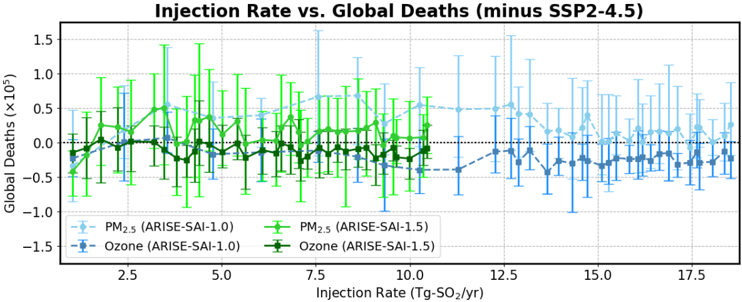
Stratospheric aerosol injection (SAI) is a proposed climate intervention method to offset future global warming through increased solar reflection in the stratosphere, but its broader environmental and public health implications are yet to be thoroughly explored. We use three large ensembles of fully coupled CESM2-WACCM6 simulations to assess changes in mortality attributable to fine particulate matter (PM2.5) and surface ozone exposure (O3). Maintaining temperatures at 1.5 °C above preindustrial levels through SAI is projected to yield a modest 0.4 % (ensemble range: −1.9 % to +1.5 %) reduction in pollution-related mortality relative to middle-of-the-road climate change scenario, reflecting a 1.3 % (−2.3 % to −0.6 %) reduction in ozone-related deaths and a 0.9 % (−0.4 % to +2.1 %) increase in PM2.5-related deaths. The spread among ensemble members underscores the influence of internal variability and highlights the importance of ensemble-based analyses when assessing the potential health impacts of climate intervention strategies. We find that global PM2.5 mortality changes exhibit little sensitivity to injected sulfate amounts, with the most variability driven by precipitation-mediated changes in non-sulfate PM2.5 species (e.g., dust and secondary organic aerosols), whereas ozone-related mortality is primarily driven by surface cooling and hemispheric asymmetries in stratospheric-tropospheric exchange and ozone transport. However, our results heavily reflect the specific forcing patterns of the SAI scenarios used; our estimates are also limited by model shortcomings, including omitting the effects of aerosols in the photolysis scheme – which might limit UV-driven changes and impact surface ozone rates – or not including nitrate aerosols. Within our framework, we find that SAI impacts on pollution-related mortality are modest but regionally heterogeneous, and that the magnitude of the SAI-driven changes is smaller than the improvements expected from near-term air quality policies planned or implemented within the same time frame.
Overview
CoChat Summary
TL;DR
Using three 10-member CESM2-WACCM6 ensembles, this study estimates that stratospheric aerosol injection (SAI) to hold warming at 1.5 °C produces only modest changes in air-pollution mortality relative to SSP2-4.5. The PM2.5 mortality response is driven mainly by climate-mediated changes in non-sulfate species, while ozone mortality reflects hemispheric asymmetries in stratospheric-tropospheric exchange and tropospheric chemistry.
Key findings
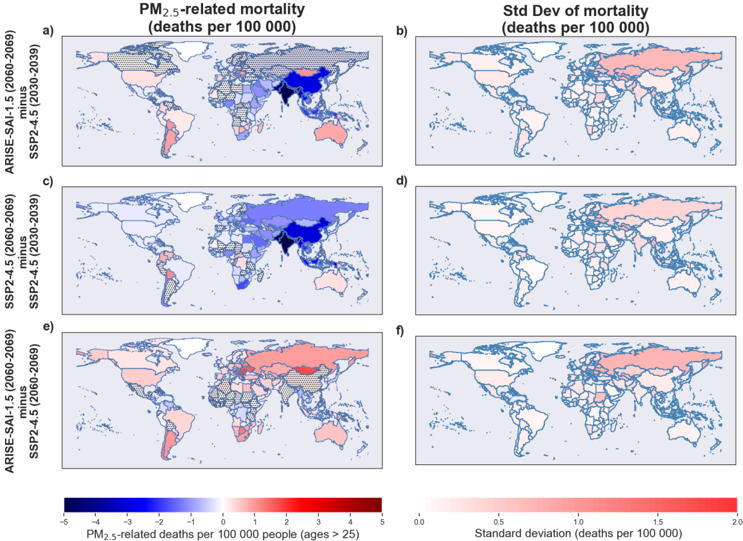
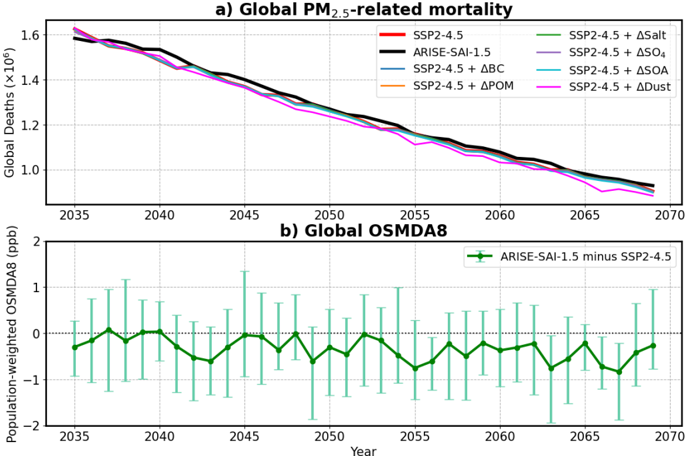
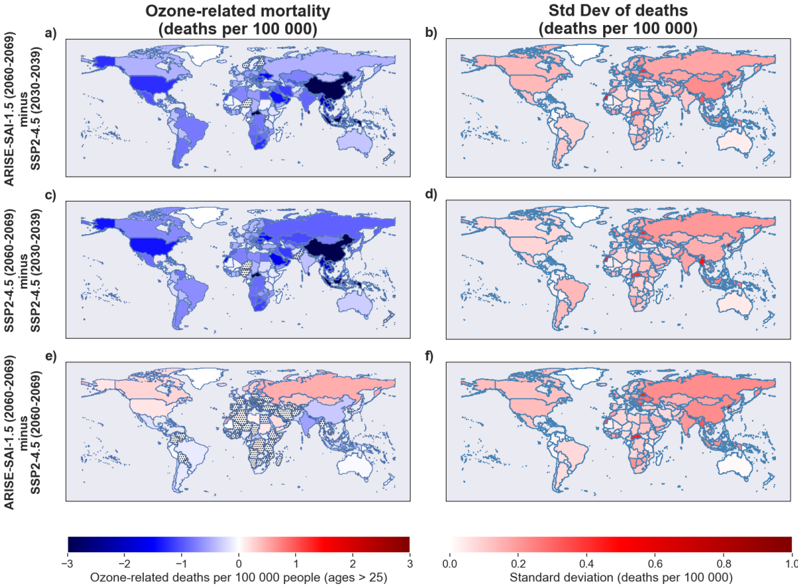
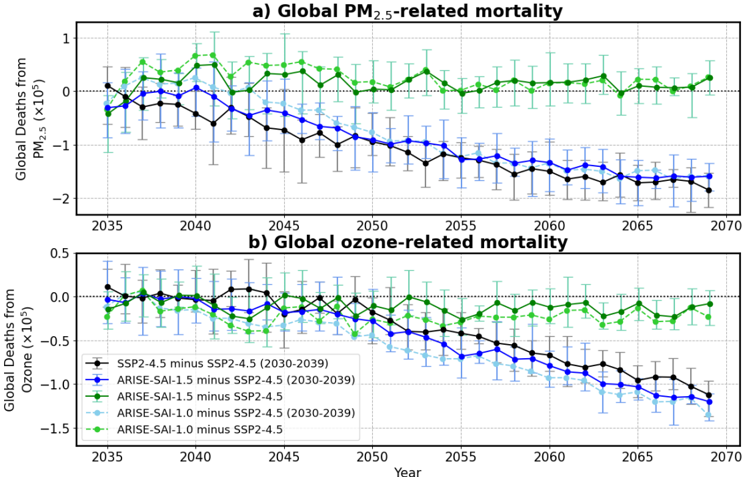
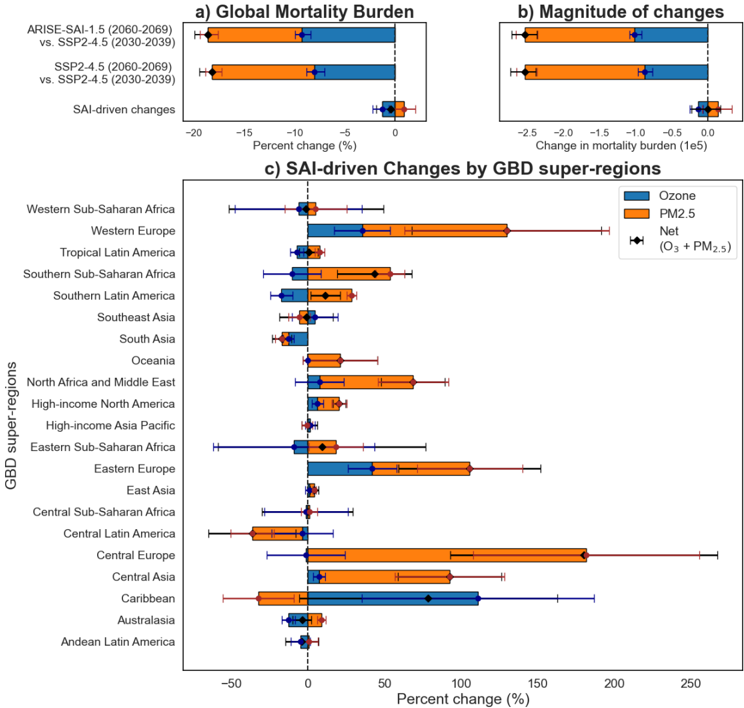
- SAI yields a 0.4 % reduction in total pollution-related mortality relative to SSP2-4.5, reflecting a 1.3 % reduction in ozone-related deaths and a 0.9 % increase in PM2.5-related deaths.
- Absolute estimates: SAI leads to a net increase of 14 000 PM2.5-related premature deaths and a net reduction of approximately 14 000 ozone-related premature deaths compared with SSP2-4.5 over 2060–2069.
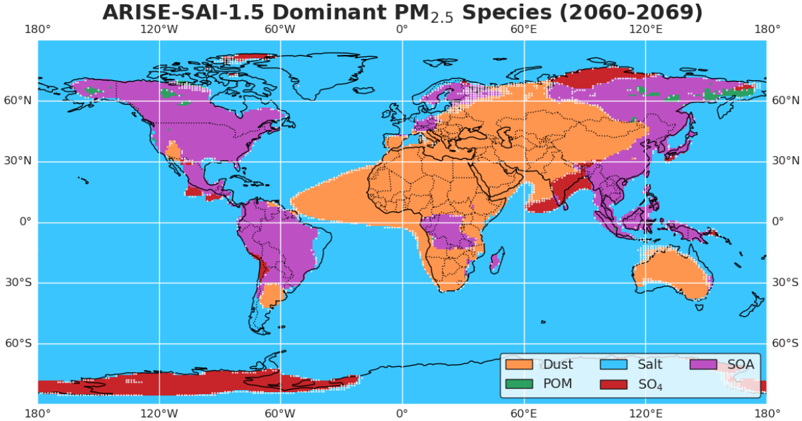
- PM2.5 mortality changes are not driven by sulfate; dust and secondary organic aerosols dominate, with precipitation and circulation affecting wet removal. Sulfate’s contribution is small relative to other components.
- Ozone mortality reductions occur mainly in the Southern Hemisphere from reduced stratosphere-troposphere exchange, while Northern Hemisphere surface ozone increases due to drier, colder tropospheric conditions suppressing photochemical ozone loss.
- SAI’s net effect is small compared with policy-driven improvements: SSP2-4.5 reduces air-pollution mortality by 18 % relative to present day, and ARISE-SAI-1.5 by 19 %, with the SAI impact largely within internal variability.
Methods
- Fully coupled CESM2-WACCM6 simulations with interactive aerosols and chemistry: three 10-member ensembles—SSP2-4.5 baseline, ARISE-SAI-1.5, and ARISE-SAI-1.0. SAI injects SO2 at 15° N, 15° S, 30° N, and 30° S at approximately 21.5 km from 2035 to 2070.
- Mortality estimated with a health impact function using a fixed 2020 population distribution; PM2.5 exposure-response from the Global Exposure Mortality Model, ozone from ozone season maximum daily 8 h average with GBD risk functions, and baseline mortality rates from the International Futures health model.
- Analyses compare 2060–2069 with 2030–2039 and isolate SAI by comparing ARISE-SAI-1.5 with SSP2-4.5 over the same future period; ensemble spread is used to characterize internal variability.
Limitations
- Stated by the authors: photolysis rates use lookup tables that exclude aerosol effects; the model omits ammonium and nitrate aerosols; dust concentrations may be overestimated; mortality uses a fixed 2020 population; results are based on a single model and two closely related SAI scenarios with SO2 injected primarily in the Southern Hemisphere.
- Also stated: other health-relevant outcomes such as surface UV and regional temperature changes were not evaluated, and processes such as planetary boundary layer height and lightning activity were not included.
- Evident from the text: large ensemble spread means regional mortality changes can differ in sign, and the results are scenario- and model-dependent.
Model-written summary. Check it against the paper before relying on it.
Integrity signals
Registry
Cites
Statistics
Figures
Verification
Claims the paper makes
22 Valid · 6 Not valid · 16 Not checked · 86 Own results and interpretations
The cited sources support only part of this claim — read each source’s verdict below.
In the paper
“Instead, regional changes in PM2 : 5 concentrations and the corresponding health impacts are mainly driven by shifts in precipitation patterns and/or circulation, which affect the wet removal of nonsulfate species such as dust and secondary organic aerosols, consistent with Eastham et al. (2018).”
What the sources say
- Partly supportedcites Eastham et al., 2018 matched to “Quantifying the impact of sulfate geoengineering on mortality from air quality and UV-B exposure” (2018) sourceExperimental — accuracy not yet measured
Split into 2 atoms — 0 confirmed, 2 partially supported, 0 disputed, 0 misattributed, 0 unverifiable. Expand the claim to see per-atom verdicts.
plainstates a cause- Asserted: passes — The authors put it forward as true.
- Checkable: passes — It can be checked against evidence.
- Load-bearing: passes — The paper’s conclusions depend on it.
- Based: passes — The paper gives a reason why it holds.
- Rests on an assumption not shown here.
- Partly supported
The cited sources support only part of this claim — read each source’s verdict below.
In the paper
“Previous evaluations have also shown that WACCM reproduces the large-scale distributions of tropospheric ozone and key pollutants, as well as climatological patterns of aerosols, with skill comparable to other climate models (Griffiths et al., 2021; Hancock et al., 2023).”
What the sources say
- Partly supportedcites Griffiths et al., 2021 matched to “Tropospheric ozone in CMIP6 simulations” (2021) sourceExperimental — accuracy not yet measured
Section 2.2 (p. 6) identifies CESM2-WACCM as one of the models evaluated, and the Summary (p. 22) says the models reproduce the spatial and seasonal variability of tropospheric ozone well. That finding is for the model ensemble, not a WACCM-specific comparison of skill; section 2.1.3 (p. 5) describes WACCM's aerosol chemistry but does not evaluate its reproduction of aerosol patterns or key pollutants. (LLM, conf=0.86)
- Not checked — no full text of the sourcecites Hancock et al., 2023 matched to “Changing PM2.5 and related meteorology over India from 1950–2014: a new perspective from a chemistry-climate model ensemble” (2023) source
plain- Asserted: passes — The authors put it forward as true.
- Checkable: passes — It can be checked against evidence.
- Load-bearing: passes — The paper’s conclusions depend on it.
- Based: passes — The paper gives a reason why it holds.
- Partly supported
The cited sources support only part of this claim — read each source’s verdict below.
In the paper
“we generally expect a reduction in surface pollutants in future scenarios independently of SAI implementation (Fricko et al., 2017; Hussain, 2025; Nazarenko et al., 2022)”
What the sources say
- Could not verifycites Fricko et al., 2017 matched to “The marker quantification of the Shared Socioeconomic Pathway 2: A middle-of-the-road scenario for the 21st century” (2017) sourceExperimental — accuracy not yet measured
Section 4.3.1 (page unavailable) discusses future baseline trajectories of air-pollutant emissions and says they differ across SSP scenarios. Our copy does not establish a general reduction in surface pollutant concentrations or assess whether such a reduction is independent of SAI (searched for pollutant declines, surface concentrations, and stratospheric aerosol injection). (LLM, conf=0.72)
- Not checked — no full text of the sourcecites Hussain, 2025 matched to “The future scenarios for air quality and climate change” (2025) source
- Partly supportedcites Nazarenko et al., 2022 matched to “Future Climate Change Under SSP Emission Scenarios With GISS‐E2.1” (2022) sourceExperimental — accuracy not yet measured
Section 3 (page unavailable) reports reduced aerosol emissions in two low-emission SSP scenarios and weaker negative aerosol forcing in most scenarios, consistent with a reduction in some pollution-related emissions without SAI. It does not establish a general reduction in surface pollutant concentrations, and it does not compare scenarios with and without SAI. (LLM, conf=0.85)
hedged- Asserted: passes — The authors put it forward as true.
- Checkable: passes — It can be checked against evidence.
- Load-bearing: passes — The paper’s conclusions depend on it.
- Based: passes — The paper gives a reason why it holds.
- Could not verify
The cited sources support only part of this claim — read each source’s verdict below.
In the paper
“Previous studies have looked into the health impacts of SAI due to air quality changes (Eastham et al., 2018; Visioni et al., 2020; Moch et al., 2023; Harding et al., 2024). These efforts have either relied on more idealized modeling frameworks and/or simplified mortality estimation methods.”
What the sources say
- Supportedcites Eastham et al., 2018 matched to “Quantifying the impact of sulfate geoengineering on mortality from air quality and UV-B exposure” (2018) source
Section 2.1, Atmospheric modeling (page unavailable), describes simulations using regridded historical meteorological fields for a 2040 scenario. Section 2.2 describes imposing pre-calculated temperature and precipitation changes, while Section 2.4 describes converting simulated exposure changes to mortality estimates using exposure-response function gradients. These modeling assumptions and mortality-estimation method support the characterization attributed to this study. (LLM, conf=0.86)
- Partly supportedcites Visioni et al., 2020 matched to “What goes up must come down: impacts of deposition in a sulfate geoengineering scenario” (2020) sourceExperimental — accuracy not yet measured
Our copy shows Visioni et al. (2020) touches air quality only as a diagnostic: in 'Derivation of PM2.5 concentrations' PM2.5 is not modelled explicitly but derived from the three aerosol modes (PM2.5 = Aitken + Accumulation + 0.1378·Coarse) with only sulfate-origin PM2.5 considered, and in 'Changes in deposition patterns for populations and soils' SPM2.5 is averaged over population-density bins with the remark that 'it is well known how these particles negatively impact the population [24,25]'. That supports the exposure/air-quality part, but the paper reports no health-outcome or mortality estimation at all — its stated focus (Abstract, Introduction) is sulfate deposition and soil acidification/Al mobilization — so 'health impacts ... simplified mortality estimation methods' is not supported by this source. Nor does the 'more idealized modeling frameworks' label fit: the Introduction states the authors use 'a more complex injection strategy with complex temperature targets and a state-of-the-art model with realistic stratospheric aerosols and better resolved stratospheric circulation' (CESM1(WACCM)/GLENS), contrasting their work with earlier reduced-complexity and fixed equatorial-injection studies. (LLM, conf=0.72)
- Partly supportedcites Moch et al., 2023 matched to “Overlooked Long‐Term Atmospheric Chemical Feedbacks Alter the Impact of Solar Geoengineering: Implications for Tropospheric Oxidative Capacity” (2023) sourceExperimental — accuracy not yet measured
Our copy confirms Moch et al. (2023) as a study of SAI health impacts via air-quality changes: Section 3.3 reports a net 60,000 deaths/yr avoided (95% CI 33,000-86,000) from ozone, PM2.5 and UV exposure changes. It also supports the 'idealized modeling framework' half of the characterization: Section 2.1 uses a chemical transport model with prescribed G4-SSA aerosol climatology, all ten simulated years driven by fixed 2016 GEOS-FP meteorology and unchanged emissions, and the Conclusions state that remaining uncertainties 'will require the use of a detailed coupled chemistry-climate model or full Earth System model'. The 'simplified mortality estimation methods' part is not the source's own description: Section 2.3 documents standard concentration-response functions (Vodonos et al. 2018 all-cause PM2.5, Jerrett et al. 2009 log-linear ozone, Slaper et al. 1996 UV power law) with Monte-Carlo uncertainty propagation, inherited from Eastham, Weisenstein, et al. (2018), and the Introduction explicitly frames its fully coupled tropospheric-stratospheric chemistry against earlier 'simple chemical schemes'. (LLM, conf=0.72)
plain- Asserted: passes — The authors put it forward as true.
- Checkable: passes — It can be checked against evidence.
- Load-bearing: passes — The paper’s conclusions depend on it.
- Based: passes — The paper gives a reason why it holds.
- Supported
Every source the paper cites for this claim was checked and supports it.
In the paper
“this is important as internal variability can drive regional air quality differences (Fiore et al., 2015).”
What the sources say
- Supportedcites Fiore et al., 2015 matched to “Air Quality and Climate Connections” (2015) source
In “Influence of climate variability,” the paper says naturally arising climate variability produces regional climate responses that change regional atmospheric composition. The same section links internally generated variability to year-to-year fluctuations in regional air pollution. This supports the claim that internal variability can drive regional air-quality differences. (LLM, conf=0.92)
plainstates a cause- Asserted: passes — The authors put it forward as true.
- Checkable: passes — It can be checked against evidence.
- Load-bearing: passes — The paper’s conclusions depend on it.
- Based: passes — The paper gives a reason why it holds.
- Supported
55 more claims · 2 with their cited sources checked
Create a free account to see all 130 claims and to verify the 19 references still open.
- Probably not a substantial claim. 33
- It may state two separate claims as one. 50
- The quote only partly states this claim. 1
Self-check
Percentages, sums and reported differences re-computed from the paper’s own numbers.
Each contradiction between two passages listed here was confirmed by an independent check.
Rated minor: it would not touch a result — a value no result rests on, a p-value that stays on the same side of the significance level, or a conflict that is clerical, resolved elsewhere in the paper, or outside its own findings.
In the paper
§ 3.2 Calculation of the air pollution related mortality from PM 2 : 5 and ozone changes · p. 12
“(2) ARISE-SAI-1.5 minus SSP24.5 (2030-2039)”
§ 3.2 Calculation of the air pollution related mortality from PM 2 : 5 and ozone changes · p. 12
“(5) ARISE-SAI-1.5 minus SSP2-4.5 (2030-2039)”
Rated minor: it would not touch a result — a value no result rests on, a p-value that stays on the same side of the significance level, or a conflict that is clerical, resolved elsewhere in the paper, or outside its own findings.
In the paper
§ 3.2 Calculation of the air pollution related mortality from PM 2 : 5 and ozone changes · p. 9
“The scenario with dust-only modifications results in fewer global deaths than the SSP2-4.5 baseline, which is likely due to the nonlinearity in the ozone-attributable risk function.”
§ 2.3 Calculation of exposure and mortality · p. 4
“For PM2 : 5, AF is calculated using the exposure-response function from the Global Exposure Mortality Model (GEMM; Burnett et al., 2018)”
Rated minor: it would not touch a result — a value no result rests on, a p-value that stays on the same side of the significance level, or a conflict that is clerical, resolved elsewhere in the paper, or outside its own findings.
In the paper
§ 3.1 Changes in health-related air pollutants · p. 6
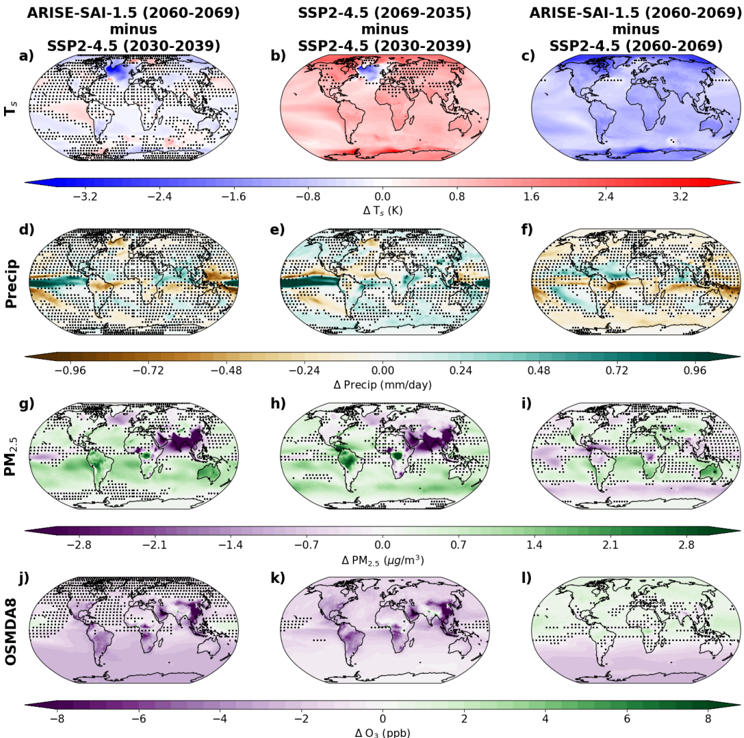
“Figure 1j-l shows % changes in surface ozone exposure.”
§ 3.1 Changes in health-related air pollutants · p. 6
“Each row represents changes in surface temperature ( T s , K) (a-c) , precipitation (mm d 1 ) (d-f) , PM2 : 5 concentration (µg m 3 ) (g-i) , and OSMDA8 (ppb) (j-1) .”
Rated minor: it would not touch a result — a value no result rests on, a p-value that stays on the same side of the significance level, or a conflict that is clerical, resolved elsewhere in the paper, or outside its own findings.
In the paper
§ 3.1 Changes in health-related air pollutants · p. 7
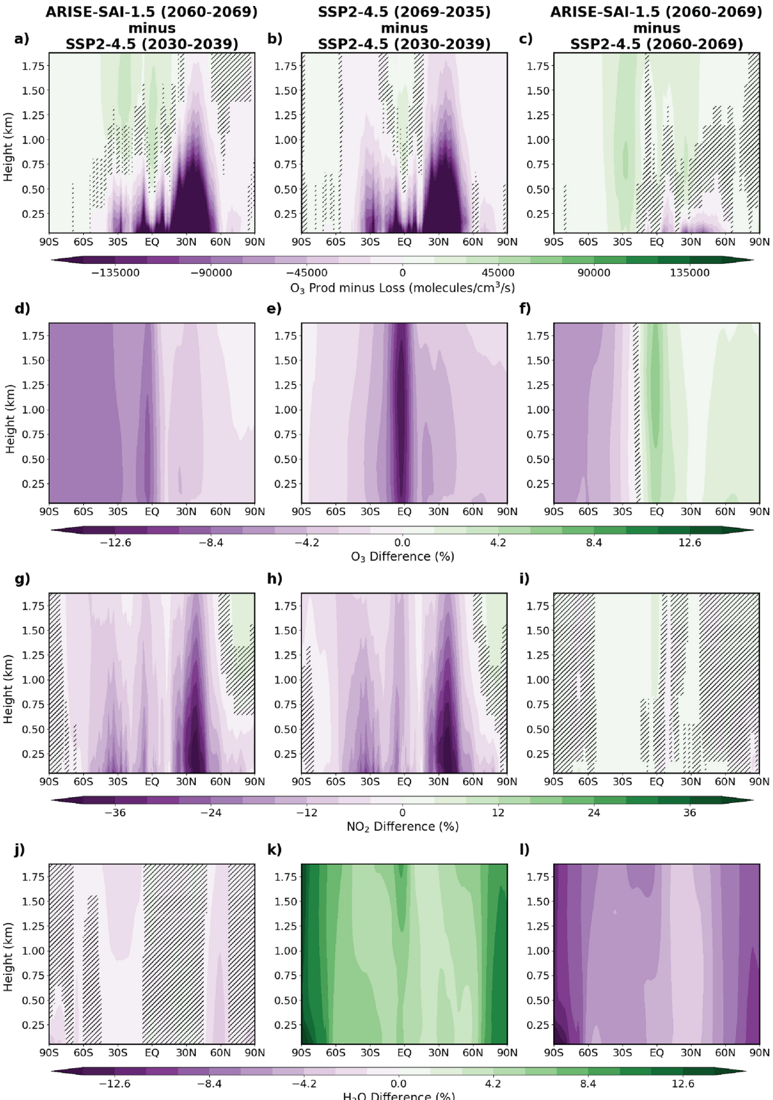
“even despite negative (particularly between 0 to 50° N) NH surface net production changes under SAI (Fig. 3i).”
§ 3.1 Changes in health-related air pollutants · p. 8
“Panels (g) -(i) show % differences in NO 2 concentrations, highlighting changes in a key ozone precursor”
Cited works that were retracted
Works this paper cites that were later retracted, from the retraction notices publishers deposit. Major when the notice came out before this paper was published.
Rated major: it would touch a result — a value a result rests on, reported and recomputed p-values on opposite sides of the significance level, two passages that conflict with no sign which is right, or a cited work retracted before this paper was published.
In the paper
“Wen, L., Xue, L., Dong, C., Wang, X., Chen, T., Jiang, Y., Gu, R., Zheng, P., Li, H., Shan, Y., Zhu, Y., Zhao, Y., Yin, X., Liu, H., Gao, J., Wu, Z., Wang, T., Herrmann, H., and Wang, W.: Reduced atmospheric sulfate enhances fine particulate nitrate formation in eastern China, Science of the Total Environment, 898, 165303, 10.1016/j.scitotenv.2023.165303, 2023.”
Cited work 10.1016/j.scitotenv.2023.165303 · retracted 2023-11-10 · notice 10.1016/j.scitotenv.2023.165303 · this paper published 2026-01-27
Citations
Cites
1 retracted
RETRACTED: Reduced atmospheric sulfate enhances fine particulate nitrate formation in eastern China
Wen, L., Xue, L., Dong, C., Wang, X., Chen, T., Jiang, Y., Gu, R., Zheng, P., Li, H., Shan, Y., et al. (2023) · Science of The Total Environment · doi:10.1016/j.scitotenv.2023.165303 · Cited by 24
RetractedRiahi, K., van Vuuren, D. P., Kriegler, E., Edmonds, J., O’Neill, B. C., Fujimori, S., Bauer, N., Calvin, K., Dellink, R., Fricko, O., et al. (2017) · Global Environmental Change · doi:10.1016/j.gloenvcha.2016.05.009 · Cited by 6,607
Volcanic eruptions and climate
Robock, A. (2000) · Reviews of Geophysics · doi:10.1029/1998rg000054 · Cited by 2,806
Global estimates of mortality associated with long-term exposure to outdoor fine particulate matter
Burnett, R., Chen, H., Szyszkowicz, M., Fann, N., Hubbell, B., Pope, C. A., Apte, J. S., Brauer, M., Cohen, A., Weichenthal, S., et al. (2018) · Proceedings of the National Academy of Sciences · doi:10.1073/pnas.1803222115 · Cited by 2,504 · cited 1×
“5 , AF is calculated using the exposure–response function from the Global Exposure Mortality Model (GEMM; Burnett et al., 2018), which provides improved estimates across a wide range of ambient PM 2 .”
Effect of climate change on air quality
Jacob, D. J., & Winner, D. A. (2009) · Atmospheric Environment · doi:10.1016/j.atmosenv.2008.09.051 · Cited by 1,979
Burnett, R. T., Pope, C. A., Ezzati, M., Olives, C., Lim, S. S., Mehta, S., Shin, H. H., Singh, G., Hubbell, B., Brauer, M., et al. (2014) · Environmental Health Perspectives · doi:10.1289/ehp.1307049 · Cited by 1,901
Long-term ozone exposure and mortality
Jerrett, M., Burnett, R. T., Pope, C. A., Ito, K., Thurston, G., Krewski, D., Shi, Y., Calle, E., & Thun, M. (2009) · New England Journal of Medicine · doi:10.1056/nejmoa0803894 · Cited by 1,602 · cited 1×
“For chronic respiratory disease mortality, we apply a β of ln(1.06) per 10 ppb ozone (95 % confidence interval (CI) 1.03–1.10) derived by GBD 2019 (Jerrett et al., 2009; Malashock et al., 2022; GBD 2021 Risk Factors Collabora-tors, 2020).”
InfluentialKC, S., & Lutz, W. (2017) · Global Environmental Change · doi:10.1016/j.gloenvcha.2014.06.004 · Cited by 1,337
Fricko, O., Havlik, P., Rogelj, J., Klimont, Z., Gusti, M., Johnson, N., Kolp, P., Strubegger, M., Valin, H., Amann, M., et al. (2017) · Global Environmental Change · doi:10.1016/j.gloenvcha.2016.06.004 · Cited by 1,075
Atmospheric effects of the Mt Pinatubo eruption
McCormick, M. P., Thomason, L. W., & Trepte, C. R. (1995) · Nature · doi:10.1038/373399a0 · Cited by 995
Aerosol and boundary-layer interactions and impact on air quality
Li, Z., Guo, J., Ding, A., Liao, H., Liu, J., Sun, Y., Wang, T., Xue, H., Zhang, H., & Zhu, B. (2017) · National Science Review · doi:10.1093/nsr/nwx117 · Cited by 903
The Whole Atmosphere Community Climate Model Version 6 (WACCM6)
Gettelman, A., Mills, M. J., Kinnison, D. E., Garcia, R. R., Smith, A. K., Marsh, D. R., Tilmes, S., Vitt, F., Bardeen, C. G., McInerny, J., et al. (2019) · Journal of Geophysical Research: Atmospheres · doi:10.1029/2019jd030943 · Cited by 786 · cited 1×
“Simulations were conducted using the CESM2(WACCM6) (Gettelman et al., 2019; Davis et al., 2023), a fully coupled ocean-atmosphere model with interactive tropospheric and stratospheric chemistry and aerosols The model simulates aerosol formation and growth through an interactive, two-moment modal…”
Liu, X., Ma, P.-L., Wang, H., Tilmes, S., Singh, B., Easter, R. C., Ghan, S. J., & Rasch, P. J. (2016) · Geoscientific Model Development · doi:10.5194/gmd-9-505-2016 · Cited by 671 · cited 1×
“…chemistry and aerosols The model simulates aerosol formation and growth through an interactive, two-moment modal aerosol microphysics scheme (MAM4; Liu et al., 2016), allowing sulfate aerosols to evolve over time based on the simulation of nucleation, coagulation, condensation and removal…”
The Chemistry Mechanism in the Community Earth System Model Version 2 (CESM2)
Emmons, L. K., Schwantes, R. H., Orlando, J. J., Tyndall, G., Kinnison, D., Lamarque, J., Marsh, D., Mills, M. J., Tilmes, S., Bardeen, C., et al. (2020) · Journal of Advances in Modeling Earth Systems · doi:10.1029/2019ms001882 · Cited by 613 · cited 3×
“…versions and observations – including NASA ATom aircraft profiles (Tilmes et al., 2019), Tropospheric Ozone Assessment Report (TOAR) surface ozone data (Emmons et al., 2020), and Measurements of Pollution in The Troposphere (MOPITT) carbon monoxide observations (Schwantes et al., 2020) – showing…”
The Role of Solar Radiation in Atmospheric Chemistry
Madronich, S., & Flocke, S. (1999) · The Handbook of Environmental Chemistry · doi:10.1007/978-3-540-69044-3_1 · Cited by 582
Air Quality and Climate Connections
Fiore, A. M., Naik, V., & Leibensperger, E. M. (2015) · Journal of the Air & Waste Management Association · doi:10.1080/10962247.2015.1040526 · Cited by 537 · cited 1×
“…of the parameters used in the AF calculations (Peng et al., 2021; Eastham et al., 2018) However, less attention has been given to the uncertainty arising from internal model variability: this is important as internal variability can drive regional air quality differences (Fiore et al., 2015).”
Kinnison, D. E., Brasseur, G. P., Walters, S., Garcia, R. R., Marsh, D. R., Sassi, F., Harvey, V. L., Randall, C. E., Emmons, L., Lamarque, J. F., et al. (2007) · Journal of Geophysical Research: Atmospheres · doi:10.1029/2006jd007879 · Cited by 489
Kravitz, B., Robock, A., Tilmes, S., Boucher, O., English, J. M., Irvine, P. J., Jones, A., Lawrence, M. G., MacCracken, M., Muri, H., et al. (2015) · Geoscientific Model Development · doi:10.5194/gmd-8-3379-2015 · Cited by 297
CESM1(WACCM) Stratospheric Aerosol Geoengineering Large Ensemble Project
Tilmes, S., Richter, J. H., Kravitz, B., MacMartin, D. G., Mills, M. J., Simpson, I. R., Glanville, A. S., Fasullo, J. T., Phillips, A. S., Lamarque, J.-F., et al. (2018) · Bulletin of the American Meteorological Society · doi:10.1175/bams-d-17-0267.1 · Cited by 296
Tropospheric ozone in CMIP6 simulations
Griffiths, P. T., Murray, L. T., Zeng, G., Shin, Y. M., Abraham, N. L., Archibald, A. T., Deushi, M., Emmons, L. K., Galbally, I. E., Hassler, B., et al. (2021) · Atmospheric Chemistry and Physics · doi:10.5194/acp-21-4187-2021 · Cited by 289
Vandyck, T., Keramidas, K., Kitous, A., Spadaro, J. V., Van Dingenen, R., Holland, M., & Saveyn, B. (2018) · Nature Communications · doi:10.1038/s41467-018-06885-9 · Cited by 278
Future global mortality from changes in air pollution attributable to climate change
Silva, R. A., West, J. J., Lamarque, J.-F., Shindell, D. T., Collins, W. J., Faluvegi, G., Folberth, G. A., Horowitz, L. W., Nagashima, T., Naik, V., et al. (2017) · Nature Climate Change · doi:10.1038/nclimate3354 · Cited by 277
Kravitz, B., MacMartin, D. G., Mills, M. J., Richter, J. H., Tilmes, S., Lamarque, J., Tribbia, J. J., & Vitt, F. (2017) · Journal of Geophysical Research: Atmospheres · doi:10.1002/2017jd026874 · Cited by 275 · cited 1×
“…Clausius-Clapeyron increase expected under climate change, as well as to changes in the strength and position of the Intertropical Convergence Zone and the Hadley circulation (Kravitz et al., 2017; Lee et al., 2020; Richter et al., 2022; Cheng et al., 2022) in the different scenarios.”
Liu, P., Ye, C., Xue, C., Zhang, C., Mu, Y., & Sun, X. (2020) · Atmospheric Chemistry and Physics · doi:10.5194/acp-20-4153-2020 · Cited by 268
Long-term exposure to ozone and cardiovascular mortality in China: a nationwide cohort study
Niu, Y., Zhou, Y., Chen, R., Yin, P., Meng, X., Wang, W., Liu, C., Ji, J. S., Qiu, Y., Kan, H., et al. (2022) · The Lancet Planetary Health · doi:10.1016/s2542-5196(22)00093-6 · Cited by 248 · cited 1×
“…diseases and ozone exposure solely to respiratory diseases, here we attribute cardio-vascular disease to ozone exposure, which aligns with more recent epidemiological findings (Sun et al., 2024; Niu et al., 2022) and improves the completeness of ozone-related health impact assessments For PM 2 .”
Climate Forcing and Trends of Organic Aerosols in the Community Earth System Model (CESM2)
Tilmes, S., Hodzic, A., Emmons, L. K., Mills, M. J., Gettelman, A., Kinnison, D. E., Park, M., Lamarque, J. ‐., Vitt, F., Shrivastava, M., et al. (2019) · Journal of Advances in Modeling Earth Systems · doi:10.1029/2019ms001827 · Cited by 246 · cited 2×
“These limitations notwithstanding, the interactive chemistry–climate framework of WACCM allows us to capture coupled meteorological, chemical, and radiative feedbacks that are central to evaluating the air quality response to stratospheric aerosol injection (Tilmes et al., 2019).”
Lightning NO x and Impacts on Air Quality
Murray, L. T. (2016) · Current Pollution Reports · doi:10.1007/s40726-016-0031-7 · Cited by 210
Impacts of climate change on surface ozone and intercontinental ozone pollution: A multi‐model study
Doherty, R. M., Wild, O., Shindell, D. T., Zeng, G., MacKenzie, I. A., Collins, W. J., Fiore, A. M., Stevenson, D. S., Dentener, F. J., Schultz, M. G., et al. (2013) · Journal of Geophysical Research: Atmospheres · doi:10.1002/jgrd.50266 · Cited by 209
Impact of geoengineered aerosols on the troposphere and stratosphere
Tilmes, S., Garcia, R. R., Kinnison, D. E., Gettelman, A., & Rasch, P. J. (2009) · Journal of Geophysical Research: Atmospheres · doi:10.1029/2008jd011420 · Cited by 187
Malashock, D. A., Delang, M. N., Becker, J. S., Serre, M. L., West, J. J., Chang, K.-L., Cooper, O. R., & Anenberg, S. C. (2022) · The Lancet Planetary Health · doi:10.1016/s2542-5196(22)00260-1 · Cited by 171
Zanis, P., Akritidis, D., Turnock, S. T., Naïk, V., Szopa, S., Georgoulias, A. K., Bauer, S. E., Deushi, M., Horowitz, L. W., Keeble, J., et al. (2022) · Environmental Research Letters · doi:10.1088/1748-9326/ac4a34 · Cited by 156
Climate Change Penalty to Ozone Air Quality: Review of Current Understandings and Knowledge Gaps
Fu, T.-M., & Tian, H. (2019) · Current Pollution Reports · doi:10.1007/s40726-019-00115-6 · Cited by 138
Richter, J. H., Visioni, D., MacMartin, D. G., Bailey, D. A., Rosenbloom, N., Dobbins, B., Lee, W. R., Tye, M., & Lamarque, J.-F. (2022) · Geoscientific Model Development · doi:10.5194/gmd-15-8221-2022 · Cited by 122 · cited 1×
“…Clausius-Clapeyron increase expected under climate change, as well as to changes in the strength and position of the Intertropical Convergence Zone and the Hadley circulation (Kravitz et al., 2017; Lee et al., 2020; Richter et al., 2022; Cheng et al., 2022) in the different scenarios.”
Self-citationBoule, P. (1999) · The handbook of environmental chemistry · doi:10.1007/978-3-540-69044-3 · Cited by 121
Li, X., Hu, X., Ma, Y., Wang, Y., Li, L., & Zhao, Z. (2019) · Atmospheric Environment · doi:10.1016/j.atmosenv.2019.116850 · Cited by 118
Schwantes, R. H., Emmons, L. K., Orlando, J. J., Barth, M. C., Tyndall, G. S., Hall, S. R., Ullmann, K., St. Clair, J. M., Blake, D. R., Wisthaler, A., et al. (2020) · Atmospheric Chemistry and Physics · doi:10.5194/acp-20-3739-2020 · Cited by 112 · cited 1×
“…Report (TOAR) surface ozone data (Emmons et al., 2020), and Measurements of Pollution in The Troposphere (MOPITT) carbon monoxide observations (Schwantes et al., 2020) – showing good agreement with ozonesonde data and seasonality of surface ozone, though with some regional spatial biases.”
Future Climate Change Under SSP Emission Scenarios With GISS‐E2.1
Nazarenko, L. S., Tausnev, N., Russell, G. L., Rind, D., Miller, R. L., Schmidt, G. A., Bauer, S. E., Kelley, M., Ruedy, R., Ackerman, A. S., et al. (2022) · Journal of Advances in Modeling Earth Systems · doi:10.1029/2021ms002871 · Cited by 104
Changing transport processes in the stratosphere by radiative heating of sulfate aerosols
Niemeier, U., & Schmidt, H. (2017) · Atmospheric Chemistry and Physics · doi:10.5194/acp-17-14871-2017 · Cited by 102
The Ozone–Climate Penalty: Past, Present, and Future
Rasmussen, D. J., Hu, J., Mahmud, A., & Kleeman, M. J. (2013) · Environmental Science & Technology · doi:10.1021/es403446m · Cited by 99
Is Turning Down the Sun a Good Proxy for Stratospheric Sulfate Geoengineering?
Visioni, D., MacMartin, D. G., & Kravitz, B. (2021) · Journal of Geophysical Research: Atmospheres · doi:10.1029/2020jd033952 · Cited by 99
Self-citationPeng, L., Liu, F., Zhou, M., Li, M., Zhang, Q., & Mauzerall, D. L. (2021) · One Earth · doi:10.1016/j.oneear.2021.07.007 · Cited by 98 · cited 1×
“…mortality have typically calculated mortality uncertainty based on the central intervals of the parameters used in the AF calculations (Peng et al., 2021; Eastham et al., 2018) However, less attention has been given to the uncertainty arising from internal model variability: this is…”
Burnett, R., & Cohen, A. (2020) · Atmosphere · doi:10.3390/atmos11060589 · Cited by 96
Quantifying the impact of sulfate geoengineering on mortality from air quality and UV-B exposure
Eastham, S. D., Weisenstein, D. K., Keith, D. W., & Barrett, S. R. H. (2018) · Atmospheric Environment · doi:10.1016/j.atmosenv.2018.05.047 · Cited by 85 · cited 3×
“…on air quality–related mortality using a fully coupled climate model ensemble under the ARISE-SAI protocol Unlike previous studies using CTMs (e.g., Eastham et al., 2018; Moch et al., 2023), which imposed stratospheric aerosols without capturing feedbacks on dynamics and transport, our use of…”
InfluentialEnhancement of atmospheric radiation by an aerosol layer
Michelangeli, D. V., Allen, M., Yung, Y. L., Shia, R., Crisp, D., & Eluszkiewicz, J. (1992) · Journal of Geophysical Research: Atmospheres · doi:10.1029/91jd01308 · Cited by 83
Tilmes, S., Visioni, D., Jones, A., Haywood, J., Séférian, R., Nabat, P., Boucher, O., Bednarz, E. M., & Niemeier, U. (2022) · Atmospheric Chemistry and Physics · doi:10.5194/acp-22-4557-2022 · Cited by 79
Self-citationVisioni, D., Robock, A. D., Haywood, J., Henry, M., Tilmes, S., MacMartin, D. G., Kravitz, B., Doherty, S. J., Moore, J. C., Lennard, C., et al. (2024) · Geoscientific model development · doi:10.5194/gmd-17-2583-2024 · Cited by 79
Self-citationImpacts of stratospheric sulfate geoengineering on tropospheric ozone
Xia, L., Nowack, P. J., Tilmes, S., & Robock, A. (2017) · Atmospheric Chemistry and Physics · doi:10.5194/acp-17-11913-2017 · Cited by 72 · cited 2×
“5 and surface ozone, by using a fully-coupled modeling approach with the Community Earth System Model (CESM2) Whole Atmosphere Climate-Chemistry Model (WACCM6), which includes interactive aerosols and detailed representations of stratospheric and tropospheric chemistry While using non-coupled model approaches allow on…”
Liu, Y., Wang, P., Li, Y., Wen, L., & Deng, X. (2022) · Scientific Reports · doi:10.1038/s41598-022-13579-2 · Cited by 65
Lightning : principles, instruments and applications : review of modern lightning research
Betz, H. D., Schumann, U., & Laroche, P. (2009) · Springer eBooks · doi:10.1007/978-1-4020-9079-0 · Cited by 63
The role of natural variability in projections of climate change impacts on U.S. ozone pollution
Garcia‐Menendez, F., Monier, E., & Selin, N. E. (2017) · Geophysical Research Letters · doi:10.1002/2016gl071565 · Cited by 62
Lee, W., MacMartin, D., Visioni, D., & Kravitz, B. (2020) · Earth System Dynamics · doi:10.5194/esd-11-1051-2020 · Cited by 62
Self-citationDavis, N. A., Visioni, D., Garcia, R. R., Kinnison, D. E., Marsh, D. R., Mills, M., Richter, J. H., Tilmes, S., Bardeen, C. G., Gettelman, A., et al. (2023) · Journal of Advances in Modeling Earth Systems · doi:10.1029/2022ms003579 · Cited by 59 · cited 1×
“Simulations were conducted using the CESM2(WACCM6) (Gettelman et al., 2019; Davis et al., 2023), a fully coupled ocean-atmosphere model with interactive tropospheric and stratospheric chemistry and aerosols The model simulates aerosol formation and growth through an interactive, two-moment modal…”
Self-citationNolte, C. G., Spero, T. L., Bowden, J. H., Mallard, M. S., & Dolwick, P. D. (2018) · Atmospheric Chemistry and Physics · doi:10.5194/acp-18-15471-2018 · Cited by 55
Extreme Ozone Loss Following Nuclear War Results in Enhanced Surface Ultraviolet Radiation
Bardeen, C. G., Kinnison, D. E., Toon, O. B., Mills, M. J., Vitt, F., Xia, L., Jägermeyr, J., Lovenduski, N. S., Scherrer, K. J. N., Clyne, M., et al. (2021) · Journal of Geophysical Research: Atmospheres · doi:10.1029/2021jd035079 · Cited by 55
Archibald, A. T., Turnock, S. T., Griffiths, P. T., Cox, T., Derwent, R. G., Knote, C., & Shin, M. (2020) · Philosophical Transactions of the Royal Society A: Mathematical, Physical and Engineering Sciences · doi:10.1098/rsta.2019.0329 · Cited by 54
What goes up must come down: impacts of deposition in a sulfate geoengineering scenario
Visioni, D., Slessarev, E., MacMartin, D. G., Mahowald, N. M., Goodale, C. L., & Xia, L. (2020) · Environmental Research Letters · doi:10.1088/1748-9326/ab94eb · Cited by 53
Self-citationBednarz, E. M., Butler, A. H., Visioni, D., Zhang, Y., Kravitz, B., & MacMartin, D. G. (2023) · Atmospheric Chemistry and Physics · doi:10.5194/acp-23-13665-2023 · Cited by 52
Self-citationJones, B., O'Neill, B. C., & Gao, J. (2020) · Earth Observing System Data and Information System · doi:10.7927/m30p-j498 · Cited by 43
Visioni, D., Pitari, G., Aquila, V., Tilmes, S., Cionni, I., Di Genova, G., & Mancini, E. (2017) · Atmospheric Chemistry and Physics · doi:10.5194/acp-17-11209-2017 · Cited by 41
Self-citationCheng, W., MacMartin, D. G., Kravitz, B., Visioni, D., Bednarz, E. M., Xu, Y., Luo, Y., Huang, L., Hu, Y., Staten, P. W., et al. (2022) · npj Climate and Atmospheric Science · doi:10.1038/s41612-022-00254-6 · Cited by 41 · cited 1×
“…Clausius-Clapeyron increase expected under climate change, as well as to changes in the strength and position of the Intertropical Convergence Zone and the Hadley circulation (Kravitz et al., 2017; Lee et al., 2020; Richter et al., 2022; Cheng et al., 2022) in the different scenarios.”
Self-citationSun, H. Z., van Daalen, K. R., Morawska, L., Guillas, S., Giorio, C., Di, Q., Kan, H., Loo, E. X.-L., Shek, L. P., Watts, N., et al. (2024) · One Earth · doi:10.1016/j.oneear.2024.08.018 · Cited by 41 · cited 2×
“For cardiovascular disease mortality, we apply a β of ln(1.028) per 10 ppb ozone (95 % CI 1.010–1.047) ( Sun et al., 2024).”
InfluentialStratospheric aerosol injection may impact global systems and human health outcomes
Tracy, S. M., Moch, J. M., Eastham, S. D., & Buonocore, J. J. (2022) · Elementa Science of the Anthropocene · doi:10.1525/elementa.2022.00047 · Cited by 36
Visioni, D., Bednarz, E. M., MacMartin, D. G., Kravitz, B., & Goddard, P. B. (2023) · Earth's Future · doi:10.1029/2023ef003851 · Cited by 35
Self-citationTilmes, S., Mills, M. J., Zhu, Y., Bardeen, C. G., Vitt, F., Yu, P., Fillmore, D., Liu, X., Toon, B., & Deshler, T. (2023) · Geoscientific Model Development · doi:10.5194/gmd-16-6087-2023 · Cited by 35
Natural Variability in Projections of Climate Change Impacts on Fine Particulate Matter Pollution
Pienkosz, B. D., Saari, R. K., Monier, E., & Garcia‐Menendez, F. (2019) · Earth's Future · doi:10.1029/2019ef001195 · Cited by 30
Shim, S., Sung, H., Kwon, S., Kim, J., Lee, J., Sun, M., Song, J., Ha, J., Byun, Y., Kim, Y., et al. (2021) · International Journal of Environmental Research and Public Health · doi:10.3390/ijerph18136817 · Cited by 24
Palancar, G. G., Lefer, B. L., Hall, S. R., Shaw, W. J., Corr, C. A., Herndon, S. C., Slusser, J. R., & Madronich, S. (2013) · Atmospheric Chemistry and Physics · doi:10.5194/acp-13-1011-2013 · Cited by 23
Impact of Lightning on Air Chemistry and Climate
Grewe, V. (2008) · Springer eBooks · doi:10.1007/978-1-4020-9079-0_25 · Cited by 22
Meteorological Change and Impacts on Air Pollution: Results From North China
Xu, Z., Chen, S. X., & Wu, X. (2020) · Journal of Geophysical Research Atmospheres · doi:10.1029/2020jd032423 · Cited by 21
Laboratory, C. A. I. S. (2023) · UCAR/NCAR · doi:10.5065/qx9a-pg09 · Cited by 21
Gridded Population of the World, Version 4 (GPWv4): National Identifier Grid, Revision 11
Center For International Earth Science Information Network-CIESIN-Columbia University (2018) · Earth Observing System Data and Information System · doi:10.7927/h4td9vdp · Cited by 19
Impact of solar geoengineering on temperature-attributable mortality
Harding, A. R., Vecchi, G. A., Yang, W., & Keith, D. W. (2024) · Proceedings of the National Academy of Sciences · doi:10.1073/pnas.2401801121 · Cited by 18
Richter, J. H., Visioni, D., MacMartin, D. G., et al. (2022) · doi:10.5194/egusphere-2022-125 · Cited by 17
Self-citationThe Overlooked Role of the Stratosphere Under a Solar Constant Reduction
Bednarz, E. M., Visioni, D., Banerjee, A., Braesicke, P., Kravitz, B., & MacMartin, D. G. (2022) · Geophysical Research Letters · doi:10.1029/2022gl098773 · Cited by 17 · cited 1×
“…2016), allowing sulfate aerosols to evolve over time based on the simulation of nucleation, coagulation, condensation and removal processes However, MAM4 uses assumptions of internal mixing for the size distribution of different species, whereas mass is tracked separately (Visioni et al., 2022 .”
Self-citationVisioni, D., Tilmes, S., Bardeen, C., Mills, M., MacMartin, D. G., Kravitz, B., & Richter, J. H. (2022) · Atmospheric Chemistry and Physics · doi:10.5194/acp-22-1739-2022 · Cited by 15 · cited 1×
“…2016), allowing sulfate aerosols to evolve over time based on the simulation of nucleation, coagulation, condensation and removal processes However, MAM4 uses assumptions of internal mixing for the size distribution of different species, whereas mass is tracked separately (Visioni et al., 2022 .”
Self-citationThe Effects of Planetary Boundary Layer Features on Air Pollution Based on ERA5 Data in East China
Deng, X., Chen, J., Dai, R., et al. (2023) · Atmosphere · doi:10.3390/atmos14081273 · Cited by 13
Wei, Z., & Tahrin, N. M. (2024) · Atmospheric Pollution Research · doi:10.1016/j.apr.2023.101997 · Cited by 12
Moch, J. M., Mickley, L. J., Eastham, S. D., Lundgren, E. W., Shah, V., Buonocore, J. J., Pang, J. Y. S., Sadiq, M., & Tai, A. P. K. (2023) · AGU Advances · doi:10.1029/2023av000911 · Cited by 10 · cited 1×
“…mortality using a fully coupled climate model ensemble under the ARISE-SAI protocol Unlike previous studies using CTMs (e.g., Eastham et al., 2018; Moch et al., 2023), which imposed stratospheric aerosols without capturing feedbacks on dynamics and transport, our use of CESM2(WACCM6) enables…”
Bednarz, E. M., Visioni, D., Butler, A. H., Kravitz, B., MacMartin, D. G., & Tilmes, S. (2023) · Geophysical Research Letters · doi:10.1029/2023gl104726 · Cited by 9
Self-citationNorman, O. G., Heald, C. L., Bililign, S., Campuzano-Jost, P., Coe, H., Fiddler, M. N., Green, J. R., Jimenez, J. L., Kaiser, K., Liao, J., et al. (2025) · Atmospheric Chemistry and Physics · doi:10.5194/acp-25-771-2025 · Cited by 8
Silva, R. A., West, J. J., Lamarque, J., Shindell, D. T., Collins, W. J., Faluvegi, G., Folberth, G., Horowitz, L. W., Nagashima, T., Naïk, V., et al. (2017) · Nature Climate Change · doi:10.1038/nclimate3427 · Cited by 5
The future scenarios for air quality and climate change
Hussain, N. K. H. (2025) · Air Pollution, Air Quality, and Climate Change · doi:10.1016/b978-0-443-23816-1.00009-4 · Cited by 3
Hancock, S., Fiore, A. M., Westervelt, D. M., Correa, G., Lamarque, J.-F., Venkataraman, C., & Sharma, A. (2023) · Environmental Research: Climate · doi:10.1088/2752-5295/acb22a · Cited by 2 · cited 2×
“Considering, however, that CESM2(WACCM6) is known to overestimate over-all dust concentrations (e.g., Hancock et al., 2023), it is possible that this may contribute to dust appearing as the dominant PM 2 .”
Wang, C., Visioni, D., Chua, G., et al. (2025) · doi:10.5194/egusphere-2025-3151 · Cited by 1
Self-citationAir Quality and Climate Connections
Fiore, A. M., Naïk, V., & Leibensperger, E. M. (2015) · Figshare · doi:10.6084/m9.figshare.1415963
SSP2-4.5 Simulations with CESM2(WACCM6)
Richter, J., & Visioni, D. (2022) · Zenodo · doi:10.5281/zenodo.6473954
Self-citationRichter, J., & Visioni, D. (2022) · Zenodo · doi:10.5281/zenodo.6473775
Self-citationErratum to: Lightning NO x and Impacts on Air Quality
Murray, L. T. (2016) · Current Pollution Reports · doi:10.1007/s40726-016-0038-0
Cited by
Solar radiation modification in Asia: Current progress, knowledge gaps and future priorities
Hai-Yuan, T. A. N. G., Tan, M. L., Feng, Z., Xian-Li, C. H. E., & ZHANG, F. (2026) · Advances in Climate Change Research · doi:10.1016/j.accre.2026.07.005 · Cited by 1
Visioni, D., Robock, A. D., Duffey, A., Henry, M., Hirasawa, H., Lee, W., Wang, C., Roberts, K., Watanabe, S., Reboita, M. S., et al. (2026) · Geoscientific model development · doi:10.5194/gmd-19-8469-2026 · Cited by 8
Self-citation
Metadata
- Authors
- Wang, C., Visioni, D., Chua, G., & Bednarz, E. M.
- Affiliations
- Cornell University (US)
- Goddard Institute for Space Studies (US)
- Cooperative Institute for Research in Environmental Sciences (US)
- Corresponding author
- Wang, Cindy
- Venue
- Atmospheric Chemistry and Physics
- Publisher
- Copernicus GmbH
- Published
- 2026-01-27
- Volume
- 26
- Issue
- 2
- Pages
- 1339-1357
- ISSN
- 1680-7316 (ISSN-L)
- 1680-7324
- OpenAlex
- W7125783580
- Cited by
- 3
- References
- 78
- Citations by year
- 2026: 3
- FWCI
- 9.04
- Type
- journal article
- Language
- en
- Open access
- gold
- doi.org
- Licence
- Locations
- Atmospheric chemistry and physics (publishedVersion, cc-by)
- NOAA Institutional Repository (submittedVersion, cc-by)
- Funders
- Quadrature Climate Foundation (N/A)
- Topics
- Physical Sciences › Environmental Science › Global and Planetary Change › Climate Change and Geoengineering
- Physical Sciences › Environmental Science › Global and Planetary Change › Atmospheric aerosols and clouds
- Physical Sciences › Earth and Planetary Sciences › Atmospheric Science › Atmospheric chemistry and aerosols
- Keywords
- stratospheric aerosol injection, solar geoengineering, climate intervention, air quality, mortality, PM2.5, surface ozone, ozone-related mortality, sulfate aerosols, stratosphere-troposphere exchange, hemispheric asymmetry (solar and geophysical), secondary organic aerosol, dust, public health impact, CESM2-WACCM6
About these checks
Registry, retraction, Cites and statistics results are computed, not judged, with one exception: a printed reference that no index lists is read once by a model before it counts as a citation error. Claims are extracted by a model and kept only when their quote appears verbatim in the text; each cited source is then checked, with a model’s help, for whether it says what the claim relies on. Those verdicts can be wrong — read the claim’s quote and the cited source before relying on one.
The claim verdicts this report counts are experimental: their accuracy is not yet measured.
A language model drew the claims from the paper on 2026-10-10, under version 3 of the claim definition (model deepseek-v4.1-flash, prompt extract-v3).
A second model labelled each claim on 2026-10-10 (model jev-1.13-20260917, definition revision gold-guideline-v0.2).
Cited sources are checked with a language model’s help (gpt-6-sol and qwen3.8-omni-flash).
Statistics and arithmetic are recomputed, not judged.
Confidence bands are shown only for fields calibrated on our annotated test set. None is calibrated yet, so no band is shown.
What counts as a claim ›How we measure confidence ›How we check this ›
Are you an author, or do you see a problem with this page? Request a review
Data sources
Bibliographic data: Semantic Scholar, OpenAlex, Crossref.
Contains information from the Semantic Scholar Academic Graph Datasets, made available under the ODC Attribution License (ODC-BY 1.0).
Semantic Scholar’s data is described in: Kinney, R., et al. (2023). The Semantic Scholar Open Data Platform. arXiv:2301.10140.
