

The DOI matches its Crossref record; 55 of the 55 references it cites were found in a registry or an index.
The Allen Ancient DNA Resource (AADR) a curated compendium of ancient human genomes
Published version of a preprint
Abstract
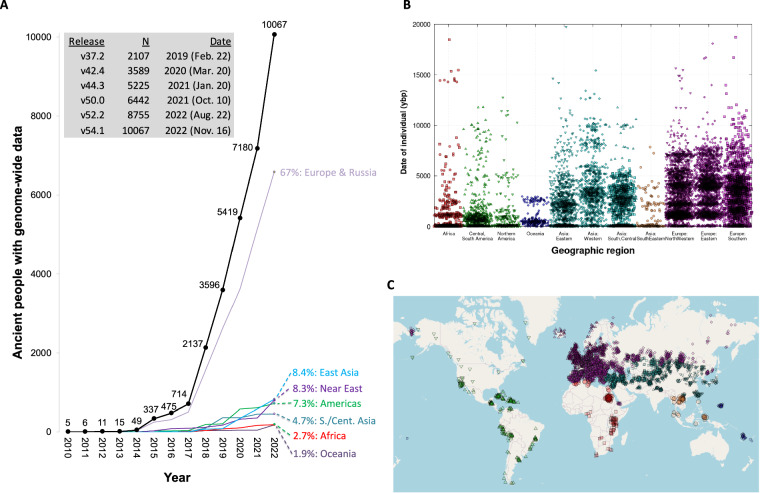
More than two hundred papers have reported genome-wide data from ancient humans. While the raw data for the vast majority are fully publicly available testifying to the commitment of the paleogenomics community to open data, formats for both raw data and meta-data differ. There is thus a need for uniform curation and a centralized, version-controlled compendium that researchers can download, analyze, and reference. Since 2019, we have been maintaining the Allen Ancient DNA Resource (AADR), which aims to provide an up-to-date, curated version of the world’s published ancient human DNA data, represented at more than a million single nucleotide polymorphisms (SNPs) at which almost all ancient individuals have been assayed. The AADR has gone through six public releases at the time of writing and review of this manuscript, and crossed the threshold of >10,000 individuals with published genome-wide ancient DNA data at the end of 2022. This note is intended as a citable descriptor of the AADR.
Overview
The claims and statistics of this paper haven’t been checked yet.
Run the check — free, no account needed. It reads the open-access text and checks the sources it cites.
Integrity signals
Registry
Cites
Statistics
Figures
Verification
Claims the paper makes
The claims and statistics of this paper haven’t been checked yet.
Run the check — free, no account needed. It reads the open-access text and checks the sources it cites.
Claims other papers make about this one
Each is checked against this paper’s own text: does it say what the citing paper says it does?
In the citing paper
“We found 2 Kipchaks samples in the AADR dataset (43); however, the two individuals were genetically distinct (Kipchak01 and Kipchak02 in the PCA plot, Fig. 4), therefore the two did not belong to a single population in a biological sense.”
From Genomes of the Golden Horde elites and their implications for the rulers of the Mongol Empire (2026) · cites this paper as [43]
Self-check
Percentages, sums and reported differences re-computed from the paper’s own numbers.
The self-check needs the paper’s full text.
Citations
Cites
A global reference for human genetic variation
The 1000 Genomes Project Consortium, authors, C., Auton, A., Abecasis, G. R., Steering committee, Altshuler, D. M., Durbin, R. M., Abecasis, G. R., Bentley, D. R., Chakravarti, A., et al. (2015) · Nature · doi:10.1038/nature15393 · Cited by 18,247
Population Structure and Eigenanalysis
Patterson, N., Price, A. L., & Reich, D. (2006) · PLoS Genetics · doi:10.1371/journal.pgen.0020190 · Cited by 5,280
Self-citationANGSD: Analysis of Next Generation Sequencing Data
Korneliussen, T. S., Albrechtsen, A., & Nielsen, R. (2014) · BMC Bioinformatics · doi:10.1186/s12859-014-0356-4 · Cited by 2,982
Ancient Admixture in Human History
Patterson, N., Moorjani, P., Luo, Y., Mallick, S., Rohland, N., Zhan, Y., Genschoreck, T., Webster, T., & Reich, D. (2012) · Genetics · doi:10.1534/genetics.112.145037 · Cited by 2,848
Self-citationThe complete genome sequence of a Neanderthal from the Altai Mountains
Prüfer, K., Racimo, F., Patterson, N., Jay, F., Sankararaman, S., Sawyer, S., Heinze, A., Renaud, G., Sudmant, P. H., de Filippo, C., et al. (2014) · Nature · doi:10.1038/nature12886 · Cited by 2,254
Self-citationGenetic history of an archaic hominin group from Denisova Cave in Siberia
Reich, D., Green, R. E., Kircher, M., Krause, J., Patterson, N., Durand, E. Y., Viola, B., Briggs, A. W., Stenzel, U., Johnson, P. L. F., et al. (2010) · Nature · doi:10.1038/nature09710 · Cited by 1,991
Self-citationA high-coverage genome sequence from an archaic denisovan individual
Meyer, M., Kircher, M., Gansauge, M.-T., Li, H., Racimo, F., Mallick, S., Schraiber, J. G., Jay, F., Prüfer, K., de Filippo, C., et al. (2012) · Science · doi:10.1126/science.1224344 · Cited by 1,967
Self-citationMassive migration from the steppe was a source for Indo-European languages in Europe
Haak, W., Lazaridis, I., Patterson, N., Rohland, N., Mallick, S., Llamas, B., Brandt, G., Nordenfelt, S., Harney, E., Stewardson, K., et al. (2015) · Nature · doi:10.1038/nature14317 · Cited by 1,940
Self-citationThe Simons Genome Diversity Project: 300 genomes from 142 diverse populations
Mallick, S., Li, H., Lipson, M., Mathieson, I., Gymrek, M., Racimo, F., Zhao, M., Chennagiri, N., Nordenfelt, S., Tandon, A., et al. (2016) · Nature · doi:10.1038/nature18964 · Cited by 1,584
Self-citationPopulation genomics of Bronze Age Eurasia
Allentoft, M. E., Sikora, M., Sjögren, K.-G., Rasmussen, S., Rasmussen, M., Stenderup, J., Damgaard, P. B., Schroeder, H., Ahlström, T., Vinner, L., et al. (2015) · Nature · doi:10.1038/nature14507 · Cited by 1,550
Research works printed but not linked: 203
- Green, R. E. et al. A draft sequence of the Neandertal genome. Science 328(5979), 710–722 (2010). · DOI · Paper page
- Slon, V. et al. Neandertal and Denisovan DNA from Pleistocene sediments. Science 356(6338), 605–608 (2017). · DOI · Paper page
- Anagnostou, P. et al. When data sharing gets close to 100%: what human paleogenetics can teach the open science movement. PLoS One 10(3), pe0121409 (2015). · DOI
- Leinonen, R. et al. The sequence read archive. Nucleic Acids Res 39(Database issue), D19–D21 (2011). · DOI
- Freeman, L., Brimacombe, C. S. & Elhaik, E. aYChr-DB: a database of ancient human Y haplogroups. NAR Genom Bioinform 2(4), lqaa081 (2020). · DOI
- Ehler, E. et al. AmtDB: a database of ancient human mitochondrial genomes. Nucleic Acids Res 47(D1), D29–D32 (2019). · DOI
- Li, H. & Durbin, R. Fast and accurate short read alignment with Burrows-Wheeler transform. Bioinformatics 25(14), 1754–1760 (2009). · DOI · Paper page
- Briggs, A. W. et al. Patterns of damage in genomic DNA sequences from a Neandertal. Proc Natl Acad Sci USA 104(37), 14616–14621 (2007). · DOI · Paper page
- Lander, E. S. et al. Initial sequencing and analysis of the human genome. Nature 409(6822), 860–921 (2001). · DOI · Paper page
- Fairley, S. et al. The International Genome Sample Resource (IGSR) collection of open human genomic variation resources. Nucleic Acids Res 48(D1), D941–D947 (2020). · DOI
- McKenna, A. et al. The Genome Analysis Toolkit: a MapReduce framework for analyzing next-generation DNA sequencing data. Genome Res 20(9), 1297–1303 (2010). · DOI · Paper page
- Alexander, D. H., Novembre, J. & Lange, K. Fast model-based estimation of ancestry in unrelated individuals. Genome Res. 19(9), 1655–1664 (2009). · DOI · Paper page
- Ringbauer, H., Novembre, J. & Steinrucken, M. Parental relatedness through time revealed by runs of homozygosity in ancient DNA. Nat Commun 12(1), 5425 (2021). · DOI
- Jakobsson, M. et al. Genotype, haplotype and copy-number variation in worldwide human populations. Nature 451(7181), 998–1003 (2008). · DOI · Paper page
- Raghavan, M. et al. The genetic prehistory of the New World Arctic. Science 345(6200), 1255832 (2014). · DOI · Paper page
- Skoglund, P. et al. Genomic diversity and admixture differs for Stone-Age Scandinavian foragers and farmers. Science 344(6185), 747–750 (2014). · DOI
- Gallego Llorente, M. et al. Ancient Ethiopian genome reveals extensive Eurasian admixture throughout the African continent. Science 350(6262), 820–822 (2015). · DOI · Paper page
- Olalde, I. et al. A Common Genetic Origin for Early Farmers from Mediterranean Cardial and Central European LBK Cultures. Mol Biol Evol 32(12), 3132–3142 (2015).
- Qin, P. et al. Denisovan Ancestry in East Eurasian and Native American Populations. Mol Biol Evol 32(10), 2665–2674 (2015). · DOI
- Skoglund, P. et al. Genetic evidence for two founding populations of the Americas. Nature 525(7567), 104–108 (2015). · DOI · Paper page
- Cassidy, L. M. et al. Neolithic and Bronze Age migration to Ireland and establishment of the insular Atlantic genome. Proc Natl Acad Sci USA 113(2), 368–373 (2016). · DOI
- Jeong, C. et al. Long-term genetic stability and a high-altitude East Asian origin for the peoples of the high valleys of the Himalayan arc. Proc Natl Acad Sci USA 113(27), 7485–7490 (2016). · DOI
- Kılınç, G. M. et al. The Demographic Development of the First Farmers in Anatolia. Curr Biol 26(19), 2659–2666 (2016). · DOI
- Martiniano, R. et al. Genomic signals of migration and continuity in Britain before the Anglo-Saxons. Nat Commun 7(1), 10326 (2016). · DOI
- Mondal, M. et al. Genomic analysis of Andamanese provides insights into ancient human migration into Asia and adaptation. Nat Genet 48(9), 1066–1070 (2016). · DOI · Paper page
- Omrak, A. et al. Genomic Evidence Establishes Anatolia as the Source of the European Neolithic Gene Pool. Curr Biol 26(2), 270–275 (2016). · DOI
- Schiffels, S. et al. Iron Age and Anglo-Saxon genomes from East England reveal British migration history. Nat Commun 7(1), 10408 (2016). · DOI
- González-Fortes, G. et al. Paleogenomic Evidence for Multi-generational Mixing between Neolithic Farmers and Mesolithic Hunter-Gatherers in the Lower Danube Basin. Curr Biol 27(12), 1801–1810 (2017). · DOI
- Japan et al. A partial nuclear genome of the Jomons who lived 3000 years ago in Fukushima, Japan. J Hum Genet 62(2), 213–221 (2017). · DOI · Paper page
- Jones, E. R. et al. The Neolithic Transition in the Baltic Was Not Driven by Admixture with Early European Farmers. Curr Biol 27(4), 576–582 (2017). · DOI
- Lazaridis, I. et al. Genetic origins of the Minoans and Mycenaeans. Nature 548(7666), 214–218 (2017). · DOI
- Lindo, J. et al. Ancient individuals from the North American Northwest Coast reveal 10,000 years of regional genetic continuity. Proc Natl Acad Sci USA 114(16), 4093–4098 (2017). · DOI
- Martiniano, R. et al. The population genomics of archaeological transition in west Iberia: Investigation of ancient substructure using imputation and haplotype-based methods. PLoS Genet 13(7), e1006852 (2017). · DOI
- Nakatsuka, N. et al. The promise of discovering population-specific disease-associated genes in South Asia. Nat Genet 49(9), 1403–1407 (2017). · DOI
- Prüfer, K. et al. A high-coverage Neandertal genome from Vindija Cave in Croatia. Science 358(6363), 655–658 (2017). · DOI · Paper page
- Rodríguez-Varela, R. et al. Genomic Analyses of Pre-European Conquest Human Remains from the Canary Islands Reveal Close Affinity to Modern North Africans. Curr Biol 27(21), 3396–3402 (2017). · DOI
- Saag, L. et al. Extensive Farming in Estonia Started through a Sex-Biased Migration from the Steppe. Curr Biol 27(14), 2185–2193 (2017). · DOI
- Sikora, M. et al. Ancient genomes show social and reproductive behavior of early Upper Paleolithic foragers. Science 358(6363), 659–662 (2017). · DOI · Paper page
- Siska, V. et al. Genome-wide data from two early Neolithic East Asian individuals dating to 7700 years ago. Sci Adv 3(2), e1601877 (2017). · DOI · Paper page
- Skoglund, P. et al. Reconstructing Prehistoric African Population Structure. Cell 171(1), 59–71 (2017). · DOI
- Unterländer, M. et al. Ancestry and demography and descendants of Iron Age nomads of the Eurasian Steppe. Nat Commun 8(1), 14615 (2017). · DOI · Paper page
- van, den, Brink, E. C. M. et al. A Late Bronze Age II clay coffin from Tel Shaddudin the Central Jezreel Valley, Israel: context andhistorical implications. Levant 49(2), 105–135 (2017). · DOI
- Yang, M. A. et al. 40,000-Year-Old Individual from Asia Provides Insight into Early Population Structure in Eurasia. Curr Biol 27(20), 3202–3208 (2017). · DOI
- Amorim, C. E. G. et al. Understanding 6th-century barbarian social organization and migration through paleogenomics. Nat Commun 9(1), 3547 (2018). · DOI
- Damgaard, P. B. et al. 137 ancient human genomes from across the Eurasian steppes. Nature 557(7705), 369–374 (2018). · DOI · Paper page
- de et al. The first horse herders and the impact of early Bronze Age steppe expansions into Asia. Science 360(6396), eaar7711 (2018). · DOI · Paper page
- De et al. Genomic insights into the origin and diversification of late maritime hunter-gatherers from the Chilean Patagonia. Proc Natl Acad Sci USA 115(17), E4006–E4012 (2018).
- Ebenesersdóttir, S. S. et al. Ancient genomes from Iceland reveal the making of a human population. Science 360(6392), 1028–1032 (2018). · DOI
- Fernandes, D. M. et al. A genomic Neolithic time transect of hunter-farmer admixture in central Poland. Sci Rep 8(1), 14879 (2018). · DOI
- Fregel, R. et al. Ancient genomes from North Africa evidence prehistoric migrations to the Maghreb from both the Levant and Europe. Proc Natl Acad Sci USA 115(26), 6774–6779 (2018). · DOI
- Günther, T. et al. Population genomics of Mesolithic Scandinavia: Investigating early postglacial migration routes and high-latitude adaptation. PLoS Biol 16(1), e2003703 (2018). · DOI
- Hajdinjak, M. et al. Reconstructing the genetic history of late Neanderthals. Nature 555(7698), 652–656 (2018). · DOI
- Jeong, C. et al. Bronze Age population dynamics and the rise of dairy pastoralism on the eastern Eurasian steppe. Proc Natl Acad Sci USA 115(48), E11248–55 (2018). · DOI · Paper page
- Krzewińska, M. et al. Genomic and Strontium Isotope Variation Reveal Immigration Patterns in a Viking Age Town. Curr Biol 28(17), 2730–2738 (2018). · DOI
- Krzewińska, M. et al. Ancient genomes suggest the eastern Pontic-Caspian steppe as the source of western Iron Age nomads. Sci Adv 4(10), eaat4457 (2018). · DOI
- Lamnidis, T. C. et al. Ancient Fennoscandian genomes reveal origin and spread of Siberian ancestry in Europe. Nat Commun 9(1), 5018 (2018). · DOI
- Lindo, J. et al. The genetic prehistory of the Andean highlands 7000 years BP though European contact. Sci Adv 4(11), eaau4921 (2018). · DOI
- Lipson, M. et al. Ancient genomes document multiple waves of migration in Southeast Asian prehistory. Science 361(6397), 92–95 (2018). · DOI
- Lipson, M. et al. Population Turnover in Remote Oceania Shortly after Initial Settlement. Curr Biol 28(7), 1157–1165 (2018). · DOI
- Mathieson, I. et al. The genomic history of southeastern Europe. Nature 555(7695), 197–203 (2018). · DOI
- Mittnik, A. et al. The genetic prehistory of the Baltic Sea region. Nat Commun 9(1), 442 (2018). · DOI
- Moreno-Mayar, J. V. et al. Terminal Pleistocene Alaskan genome reveals first founding population of Native Americans. Nature 553(7687), 203–207 (2018). · DOI · Paper page
- Moreno-Mayar, J. V. et al. Early human dispersals within the Americas. Science 362(6419), eaav2621 (2018). · DOI
- O’Sullivan, N. et al. Ancient genome-wide analyses infer kinship structure in an Early Medieval Alemannic graveyard. Sci Adv 4(9), eaao1262 (2018). · DOI
- Olalde, I. et al. The Beaker phenomenon and the genomic transformation of northwest Europe. Nature 555(7695), 190–196 (2018). · DOI · Paper page
- Posth, C. et al. Language continuity despite population replacement in Remote Oceania. Nat Ecol Evol 2(4), 731–740 (2018). · DOI · Paper page
- Posth, C. et al. Reconstructing the Deep Population History of Central and South America. Cell 175(5), 1185–1197 (2018). · DOI
- Scheib, C. L. et al. Ancient human parallel lineages within North America contributed to a coastal expansion. Science 360(6392), 1024–1027 (2018). · DOI · Paper page
- Slon, V. et al. The genome of the offspring of a Neanderthal mother and a Denisovan father. Nature 561(7721), 113–116 (2018). · DOI · Paper page
- Valdiosera, C. et al. Four millennia of Iberian biomolecular prehistory illustrate the impact of prehistoric migrations at the far end of Eurasia. Proc Natl Acad Sci USA 115(13), 3428–3433 (2018). · DOI
- van, de, Loosdrecht, M. et al. Pleistocene North African genomes link Near Eastern and sub-Saharan African human populations. Science 360(6388), 548–552 (2018). · DOI
- Veeramah, K. R. et al. Population genomic analysis of elongated skulls reveals extensive female-biased immigration in Early Medieval Bavaria. Proc Natl Acad Sci USA 115(13), 3494–3499 (2018). · DOI
- Zalloua, P. et al. Ancient DNA of Phoenician remains indicates discontinuity in the settlement history of Ibiza. Sci Rep 8(1), 17567 (2018). · DOI
- Amazonia et al. The Current Genomic Landscape of Western South America: Andes, Amazonia, and Pacific Coast. Mol Biol Evol 36(12), 2698–2713 (2019). · DOI
- Antonio, M. L. et al. Ancient Rome: A genetic crossroads of Europe and the Mediterranean. Science 366(6466), 708–714 (2019). · DOI · Paper page
- Biagini, S. A. et al. People from Ibiza: an unexpected isolate in the Western Mediterranean. Eur J Hum Genet 27(6), 941–951 (2019). · DOI
- Brace, S. et al. Ancient genomes indicate population replacement in Early Neolithic Britain. Nat Ecol Evol 3(5), 765–771 (2019). · DOI
- Fan, S. et al. African evolutionary history inferred from whole genome sequence data of 44 indigenous African populations. Genome Biol 20(1), 82 (2019). · DOI · Paper page
- Feldman, M. et al. Late Pleistocene human genome suggests a local origin for the first farmers of central Anatolia. Nat Commun 10(1), 1218 (2019). · DOI
- Flegontov, P. et al. Palaeo-Eskimo genetic ancestry and the peopling of Chukotka and North America. Nature 570(7760), 236–240 (2019). · DOI
- González-Fortes, G. et al. A western route of prehistoric human migration from Africa into the Iberian Peninsula. Proc Biol Sci 286(1895), 20182288 (2019).
- Haber, M. et al. A Transient Pulse of Genetic Admixture from the Crusaders in the Near East Identified from Ancient Genome Sequences. Am J Hum Genet 104(5), 977–984 (2019). · DOI
- Harney, É. et al. Ancient DNA from the skeletons of Roopkund Lake reveals Mediterranean migrants in India. Nat Commun 10(1), 3670 (2019). · DOI
- Järve, M. et al. Shifts in the Genetic Landscape of the Western Eurasian Steppe Associated with the Beginning and End of the Scythian Dominance. Curr Biol 29(14), 2430–2441 (2019). · DOI
- Jensen, T. Z. T. et al. A 5700 year-old human genome and oral microbiome from chewed birch pitch. Nat Commun 10(1), 5520 (2019). · DOI
- Jeong, C. et al. The genetic history of admixture across inner Eurasia. Nat Ecol Evol 3(6), 966–976 (2019). · DOI · Paper page
- Malmström, H. et al. The genomic ancestry of the Scandinavian Battle Axe Culture people and their relation to the broader Corded Ware horizon. Proc Biol Sci 286(1912), 20191528 (2019).
- Mittnik, A. et al. Kinship-based social inequality in Bronze Age Europe. Science 366(6466), 731–734 (2019). · DOI · Paper page
- Narasimhan, V. M. et al. The formation of human populations in South and Central Asia. Science 365(6457), eaat7487 (2019). · DOI · Paper page
- Nikitin, A. G. et al. Interactions between earliest Linearbandkeramik farmers and central European hunter gatherers at the dawn of European Neolithization. Sci Rep 9(1), 19544 (2019). · DOI
- Ning, C. et al. Ancient Genomes Reveal Yamnaya-Related Ancestry and a Potential Source of Indo-European Speakers in Iron Age Tianshan. Curr Biol 29(15), 2526–2532 (2019). · DOI
- Prendergast, M. E. et al. Ancient DNA reveals a multistep spread of the first herders into sub-Saharan Africa. Science 365(6448), eaaw6275 (2019). · DOI
- Saag, L. et al. The Arrival of Siberian Ancestry Connecting the Eastern Baltic to Uralic Speakers further East. Curr Biol 29(10), 1701–1711 (2019). · DOI
- Sánchez-Quinto, F. et al. Megalithic tombs in western and northern Neolithic Europe were linked to a kindred society. Proc Natl Acad Sci USA 116(19), 9469–9474 (2019). · DOI · Paper page
- Scheib, C. L. et al. East Anglian early Neolithic monument burial linked to contemporary Megaliths. Ann Hum Biol 46(2), 145–149 (2019). · DOI
- Schroeder, H. et al. Unraveling ancestry, kinship, and violence in a Late Neolithic mass grave. Proc Natl Acad Sci USA 116(22), 10705–10710 (2019). · DOI · Paper page
- Shinde, V. et al. An Ancient Harappan Genome Lacks Ancestry from Steppe Pastoralists or Iranian Farmers. Cell 179(3), 729–735 (2019). · DOI
- Sikora, M. et al. The population history of northeastern Siberia since the Pleistocene. Nature 570(7760), 182–188 (2019). · DOI · Paper page
- Villalba-Mouco, V. et al. Survival of Late Pleistocene Hunter-Gatherer Ancestry in the Iberian Peninsula. Curr Biol 29(7), 1169–1177 (2019). · DOI
- Wang, C. C. et al. Ancient human genome-wide data from a 3000-year interval in the Caucasus corresponds with eco-geographic regions. Nat Commun 10(1), 590 (2019). · DOI
- Bongers, J. L. et al. Integration of ancient DNA with transdisciplinary dataset finds strong support for Inca resettlement in the south Peruvian coast. Proc Natl Acad Sci USA 117(31), 18359–18368 (2020). · DOI
- Brunel, S. et al. Ancient genomes from present-day France unveil 7,000 years of its demographic history. Proc Natl Acad Sci USA 117(23), 12791–12798 (2020). · DOI
- Burger, J. et al. Low Prevalence of Lactase Persistence in Bronze Age Europe Indicates Ongoing Strong Selection over the Last 3,000 Years. Curr Biol 30(21), 4307–4315 (2020). · DOI · Paper page
- Cassidy, L. M. et al. A dynastic elite in monumental Neolithic society. Nature 582(7812), 384–388 (2020). · DOI · Paper page
- Coutinho, A. et al. The Neolithic Pitted Ware culture foragers were culturally but not genetically influenced by the Battle Axe culture herders. Am J Phys Anthropol 172(4), 638–649 (2020). · DOI
- Csáky, V. et al. Early medieval genetic data from Ural region evaluated in the light of archaeological evidence of ancient Hungarians. Sci Rep 10(1), 19137 (2020). · DOI
- Fernandes, D. M. et al. The spread of steppe and Iranian-related ancestry in the islands of the western Mediterranean. Nat Ecol Evol 4(3), 334–345 (2020). · DOI
- Furtwängler, A. et al. Comparison of target enrichment strategies for ancient pathogen DNA. Biotechniques 69(6), 455–459 (2020). · DOI
- Gokhman, D. et al. Differential DNA methylation of vocal and facial anatomy genes in modern humans. Nat Commun 11(1), 1189 (2020). · DOI · Paper page
- Haber, M. et al. A Genetic History of the Near East from an aDNA Time Course Sampling Eight Points in the Past 4,000 Years. Am J Hum Genet 107(1), 149–157 (2020). · DOI
- Linderholm, A. et al. Corded Ware cultural complexity uncovered using genomic and isotopic analysis from south-eastern Poland. Sci Rep 10(1), 6885 (2020). · DOI
- Lipson, M. et al. Ancient West African foragers in the context of African population history. Nature 577(7792), 665–670 (2020). · DOI
- Lipson, M. et al. Three Phases of Ancient Migration Shaped the Ancestry of Human Populations in Vanuatu. Curr Biol 30(24), 4846–4856 (2020). · DOI
- Liu, D. et al. Extensive Ethnolinguistic Diversity in Vietnam Reflects Multiple Sources of Genetic Diversity. Mol Biol Evol 37(9), 2503–2519 (2020). · DOI
- Marcus, J. H. et al. Genetic history from the Middle Neolithic to present on the Mediterranean island of Sardinia. Nat Commun 11(1), 939 (2020). · DOI
- Margaryan, A. et al. Population genomics of the Viking world. Nature 585(7825), 390–396 (2020). · DOI
- Massilani, D. et al. Denisovan ancestry and population history of early East Asians. Science 370(6516), 579–583 (2020). · DOI · Paper page
- Nägele, K. et al. Genomic insights into the early peopling of the Caribbean. Science 369(6502), 456–460 (2020). · DOI
- Nakatsuka, N. et al. A Paleogenomic Reconstruction of the Deep Population History of the Andes. Cell 181(5), 1131–1145 (2020). · DOI
- Nakatsuka, N. et al. Ancient genomes in South Patagonia reveal population movements associated with technological shifts and geography. Nat Commun 11(1), 3868 (2020). · DOI
- Nieves-Colón, M. A. et al. Ancient DNA Reconstructs the Genetic Legacies of Precontact Puerto Rico Communities. Mol Biol Evol 37(3), 611–626 (2020). · DOI
- Ning, C. et al. Ancient genomes from northern China suggest links between subsistence changes and human migration. Nat Commun 11(1), 2700 (2020). · DOI · Paper page
- Rivollat, M. et al. Ancient genome-wide DNA from France highlights the complexity of interactions between Mesolithic hunter-gatherers and Neolithic farmers. Sci Adv 6(22), eaaz5344 (2020). · DOI
- Skourtanioti, E. et al. Genomic History of Neolithic to Bronze Age Anatolia, Northern Levant, and Southern Caucasus. Cell 181(5), 1158–1175 (2020). · DOI · Paper page
- Teschler-Nicola, M. et al. Ancient DNA reveals monozygotic newborn twins from the Upper Palaeolithic. Commun Biol 3(1), 650 (2020). · DOI
- Wang, C. C. et al. The Genomic Formation of Human Populations in East Asia. bioRxiv, 2020. 2020.03.25.004606: https://doi.org/10.1101/2020.03.25.004606. · DOI
- Wang, K. et al. Ancient genomes reveal complex patterns of population movement, interaction, and replacement in sub-Saharan Africa. Sci Adv 6(24), eaaz0183 (2020). · DOI
- Yang, M. A. et al. Ancient DNA indicates human population shifts and admixture in northern and southern China. Science 369(6501), 282–288 (2020). · DOI
- Yu, H. et al. Paleolithic to Bronze Age Siberians Reveal Connections with First Americans and across Eurasia. Cell 181(6), 1232–1245 (2020). · DOI
- Bortolini, E. et al. Early Alpine occupation backdates westward human migration in Late Glacial Europe. Curr Biol 31(11), 2484–2493 (2021). · DOI
- Capodiferro, M. R. et al. Archaeogenomic distinctiveness of the Isthmo-Colombian area. Cell 184(7), 1706–1723 (2021). · DOI
- Carlhoff, S. et al. Genome of a middle Holocene hunter-gatherer from Wallacea. Nature 596(7873), 543–547 (2021). · DOI
- Clemente, F. et al. The genomic history of the Aegean palatial civilizations. Cell 184(10), 2565–2586 (2021). · DOI
- Cooke, N. P. et al. Ancient genomics reveals tripartite origins of Japanese populations. Sci Adv 7(38), eabh2419 (2021). · DOI
- Egfjord, A. F. et al. Genomic Steppe ancestry in skeletons from the Neolithic Single Grave Culture in Denmark. PLoS One 16(1), e0244872 (2021). · DOI
- Fernandes, D. M. et al. A genetic history of the pre-contact Caribbean. Nature 590(7844), 103–110 (2021). · DOI
- Freilich, S. et al. Reconstructing genetic histories and social organisation in Neolithic and Bronze Age Croatia. Sci Rep 11(1), 16729 (2021). · DOI
- Gnecchi-Ruscone, G. A. et al. Ancient genomic time transect from the Central Asian Steppe unravels the history of the Scythians. Sci Adv 7(13), eabe4414 (2021). · DOI · Paper page
- Hajdinjak, M. et al. Initial Upper Palaeolithic humans in Europe had recent Neanderthal ancestry. Nature 592(7853), 253–257 (2021). · DOI
- Harney, É. et al. A minimally destructive protocol for DNA extraction from ancient teeth. Genome Res 31(3), 472–483 (2021). · DOI
- Immel, A. et al. Genome-wide study of a Neolithic Wartberg grave community reveals distinct HLA variation and hunter-gatherer ancestry. Commun Biol 113(1), 113 (2021). · DOI
- Ingman, T. et al. Turkey during the 2nd millennium BC: Integration of isotopic and genomic evidence. PLoS One 16(6), e0241883 (2021). · DOI
- Kılınç, G. M. et al. Human population dynamics and Yersinia pestis in ancient northeast Asia. Sci Adv 7(2), eabc4587 (2021). · DOI · Paper page
- Larena, M. et al. Multiple migrations to the Philippines during the last 50,000 years. Proc Natl Acad Sci USA 118(13), e2026132118 (2021). · DOI
- López, S. et al. Evidence of the interplay of genetics and culture in Ethiopia. Nat Commun 12(1), 3581 (2021). · DOI
- Mao, X. et al. The deep population history of northern East Asia from the Late Pleistocene to the Holocene. Cell 184(12), 3256–3266 (2021). · DOI · Paper page
- Novak, M. et al. Genome-wide analysis of nearly all the victims of a 6200 year old massacre. PLoS One 16(3), e0247332 (2021). · DOI
- Papac, L. et al. Dynamic changes in genomic and social structures in third millennium BCE central Europe. Sci Adv 7(35), eabi6941 (2021). · DOI
- Popović, D. et al. Ancient genomes reveal long-range influence of the pre-Columbian culture and site of Tiwanaku. Sci Adv 7(39), eabg7261 (2021). · DOI
- Posth, C. et al. The origin and legacy of the Etruscans through a 2000-year archeogenomic time transect. Sci Adv 7(39), eabi7673 (2021). · DOI
- Prüfer, K. et al. A genome sequence from a modern human skull over 45,000 years old from Zlatý kůň in Czechia. Nat Ecol Evol 5(6), 820–825 (2021). · DOI
- Pugach, I. et al. Ancient DNA from Guam and the peopling of the Pacific. Proc Natl Acad Sci USA 118(1), e2022112118 (2021). · DOI
- Robbeets, M. et al. Triangulation supports agricultural spread of the Transeurasian languages. Nature 599(7886), 616–621 (2021). · DOI
- Saag, L. et al. Genetic ancestry changes in Stone to Bronze Age transition in the East European plain. Sci Adv 7(4), eabd6535 (2021). · DOI
- Saupe, T. et al. Ancient genomes reveal structural shifts after the arrival of Steppe-related ancestry in the Italian Peninsula. Curr Biol 31(12), 2576–2591 (2021). · DOI
- Seguin-Orlando, A. et al. Heterogeneous Hunter-Gatherer and Steppe-Related Ancestries in Late Neolithic and Bell Beaker Genomes from Present-Day France. Curr Biol 31(5), 1072–1083 (2021). · DOI · Paper page
- Silva, M. et al. Biomolecular insights into North African-related ancestry, mobility and diet in eleventh-century Al-Andalus. Sci Rep 11(1), 18121 (2021). · DOI
- Sirak, K. A. et al. Social stratification without genetic differentiation at the site of Kulubnarti in Christian Period Nubia. Nat Commun 12(1), 7283 (2021). · DOI
- Svensson, E. et al. Genome of Peştera Muierii skull shows high diversity and low mutational load in pre-glacial Europe. Curr Biol 31(14), 2973–2983 (2021). · DOI
- Villalba-Mouco, V. et al. Genomic transformation and social organization during the Copper Age-Bronze Age transition in southern Iberia. Sci Adv 7(47), eabi7038 (2021). · DOI
- Wang, C. C. et al. Genomic insights into the formation of human populations in East Asia. Nature 591(7850), 413–419 (2021). · DOI · Paper page
- Wang, T. et al. Human population history at the crossroads of East and Southeast Asia since 11,000 years ago. Cell 184(14), 3829–3841 (2021). · DOI
- Yaka, R. et al. Variable kinship patterns in Neolithic Anatolia revealed by ancient genomes. Curr Biol 31(11), 2455–2468 (2021). · DOI
- Žegarac, A. et al. Ancient genomes provide insights into family structure and the heredity of social status in the early Bronze Age of southeastern Europe. Sci Rep 11(1), 10072 (2021). · DOI
- Zhang, F. et al. The genomic origins of the Bronze Age Tarim Basin mummies. Nature 599(7884), 256–261 (2021). · DOI
- Alpaslan-Roodenberg, S. et al. The genetic history of the Southern Arc: A bridge between West Asia and Europe. Science 377(6609), eabm4247 (2022). · DOI
- Aneli, S. et al. The Genetic Origin of Daunians and the Pan-Mediterranean Southern Italian Iron Age Context. Mol Biol Evol 39(2), msac014 (2022). · DOI
- Changmai, P. et al. Ancient DNA from Protohistoric Period Cambodia indicates that South Asians admixed with local populations as early as 1st-3rd centuries CE. Sci Rep 12(1), 22507 (2022). · DOI
- Changmai, P. et al. Indian genetic heritage in Southeast Asian populations. PLoS Genet 18(2), e1010036 (2022). · DOI
- Childebayeva, A. et al. Population Genetics and Signatures of Selection in Early Neolithic European Farmers. Mol Biol Evol 39(6), msac108 (2022). · DOI
- De et al. First Glimpse into the Genomic Characterization of People from the Imperial Roman Community of Casal Bertone (Rome, First–Third Centuries AD). Genes 13(1), 136 (2022). · DOI
- Dulias, K. et al. Ancient DNA at the edge of the world: Continental immigration and the persistence of Neolithic male lineages in Bronze Age Orkney. Proc Natl Acad Sci USA 119(8), e2108001119 (2022). · DOI
- Fowler, C. et al. A high-resolution picture of kinship practices in an Early Neolithic tomb. Nature 601(7894), 584–587 (2022). · DOI · Paper page
- Gelabert, P. et al. Northeastern Asian and Jomon-related genetic structure in the Three Kingdoms period of Gimhae, Korea. Curr Biol 32(15), 3232–3244 (2022). · DOI
- Gelabert, P. et al. Genomes from Verteba cave suggest diversity within the Trypillians in Ukraine. Sci Rep 12(1), 7242 (2022). · DOI
- Gnecchi-Ruscone, G. A. et al. Ancient genomes reveal origin and rapid trans-Eurasian migration of 7th century Avar elites. Cell 185(8), 1402–1413 (2022). · DOI
- Gretzinger, J. et al. The Anglo-Saxon migration and the formation of the early English gene pool. Nature 610(7930), 112–119 (2022). · DOI
- Hannah, M. et al. A Genetic History of Continuity and Mobility in the Iron Age Central Mediterranean. bioRxiv, 2022. 2022.03.13.483276: https://doi.org/10.1101/2022.03.13.483276. · DOI
- Kennett, D. J. et al. South-to-north migration preceded the advent of intensive farming in the Maya region. Nat Commun 13(1), 1530 (2022). · DOI
- Kumar, V. et al. Bronze and Iron Age population movements underlie Xinjiang population history. Science 376(6588), 62–69 (2022). · DOI
- Lindo, J. et al. The genomic prehistory of the Indigenous peoples of Uruguay. PNAS Nexus 1(2), pgac047 (2022). · DOI
- Lipson, M. et al. Ancient DNA and deep population structure in sub-Saharan African foragers. Nature 603(7900), 290–296 (2022). · DOI
- Liu, C. C. et al. Ancient genomes from the Himalayas illuminate the genetic history of Tibetans and their Tibeto-Burman speaking neighbors. Nat Commun 13(1), 1203 (2022). · DOI
- Liu, Y. C. et al. Ancient DNA reveals five streams of migration into Micronesia and matrilocality in early Pacific seafarers. Science 377(6601), 72–79 (2022). · DOI
- Margaret, L. et al. Stable population structure in Europe since the Iron Age, despite high mobility. bioRxiv, 2022. 2022.05.15.491973: https://doi.org/10.1101/2022.05.15.491973. · DOI
- Maróti, Z. et al. The genetic origin of Huns, Avars, and conquering Hungarians. Curr Biol 32(13), 2858–2870 (2022). · DOI
- Maryland. et al. Technical Report on Ancient DNA analysis of 27 African Americans from Catoctin Furnace, Maryland. bioRxiv, 2022. 2022.06.12.495320.: https://doi.org/10.1101/2022.06.12.495320. · DOI
- Oliveira, S. et al. Ancient genomes from the last three millennia support multiple human dispersals into Wallacea. Nat Ecol Evol 6(7), 1024–1034 (2022). · DOI
- Patterson, N. et al. Large-scale migration into Britain during the Middle to Late Bronze Age. Nature 601(7894), 588–594 (2022). · DOI
- Reitsema, L. J. et al. The diverse genetic origins of a Classical period Greek army. Proc Natl Acad Sci USA 119(41), e2205272119 (2022). · DOI
- Rivollat, M. et al. Ancient DNA gives new insights into a Norman Neolithic monumental cemetery dedicated to male elites. Proc Natl Acad Sci USA 119(18), e2120786119 (2022). · DOI · Paper page
- Scorrano, G. et al. Bioarchaeological and palaeogenomic portrait of two Pompeians that died during the eruption of Vesuvius in 79 AD. Sci Rep 12(1), 6468 (2022). · DOI
- Spyrou, M. A. et al. The source of the Black Death in fourteenth-century central Eurasia. Nature 606(7915), 718–724 (2022). · DOI
- Srigyan, M. et al. Bioarchaeological evidence of one of the earliest Islamic burials in the Levant. Commun Biol 5(1), 554 (2022). · DOI
- Tiesler et al. Life and death in early colonial Campeche: New insights from ancient DNA. Antiquity 96(388), 937–954 (2022). · DOI
- Ullinger, J. et al. A Bioarchaeological Investigation of Fraternal Stillborn Twins from Tell el-Hesi. Near Eastern Archaelogy 85(3), 228–237 (2022). · DOI
- Waldman, S. et al. Genome-wide data from medieval German Jews show that the Ashkenazi founder event pre-dated the 14th century. Cell 185(25), 4703–4716 (2022). · DOI
- Winkelbach, L. et al. The genomic origins of the world’s first farmers world. Cell 185(11), 1842–1859 (2022). · DOI
- Wohns, A. W. et al. A unified genealogy of modern and ancient genomes. Science 375(6583), eabi8264 (2022). · DOI
- Yu, H. et al. Genomic and dietary discontinuities during the Mesolithic and Neolithic in Sicily. iScience 25(5), 104244 (2022). · DOI
200 of 203 shown
Cited by
Accurate detection of identity-by-descent segments in human ancient DNA
Ringbauer, H., Huang, Y., Akbari, A., Mallick, S., Olalde, I., Patterson, N., & Reich, D. (2024) · Nature Genetics · doi:10.1038/s41588-023-01582-w · Cited by 155
Self-citation50,000 years of evolutionary history of India: Impact on health and disease variation
Kerdoncuff, E., Skov, L., Patterson, N., Banerjee, J., Khobragade, P., Chakrabarti, S. S., Chakrawarty, A., Chatterjee, P., Dhar, M., Gupta, M., et al. (2025) · Cell · doi:10.1016/j.cell.2025.04.027 · Cited by 36
Self-citationGenomes of the Golden Horde elites and their implications for the rulers of the Mongol Empire
Askapuli, A., Kanzawa-Kiriyama, H., Kakuda, T., Kassenali, A., Yessen, S., Schamiloglu, U., Schrodi, S. J., Hawks, J., & Saitou, N. (2026) · Proceedings of the National Academy of Sciences · doi:10.1073/pnas.2531003123 · Cited by 5
Metadata
- Authors
- Mallick, S., Micco, A., Mah, M., Ringbauer, H., Lazaridis, I., Olalde, I., Patterson, N., & Reich, D.
- Venue
- Scientific Data
- Published
- 2024-02-10
- Volume
- 11
- Issue
- 1
- ISSN
- 2052-4463
- PMC
- PMC10858950
- Cited by
- 368
- References
- 55
- Language
- en
- Funders
- U.S. Department of Health & Human Services | NIH | Center for Information Technology (HG012287)
- John Templeton Foundation (61220)
About these checks
Registry, retraction, Cites and statistics results are computed, not judged, with one exception: a printed reference that no index lists is read once by a model before it counts as a citation error. Claims are extracted by a model and kept only when their quote appears verbatim in the text; each cited source is then checked, with a model’s help, for whether it says what the claim relies on. Those verdicts can be wrong — read the claim’s quote and the cited source before relying on one.
Statistics and arithmetic are recomputed, not judged.
Confidence bands are shown only for fields calibrated on our annotated test set. None is calibrated yet, so no band is shown.
What counts as a claim ›How we measure confidence ›How we check this ›
Are you an author, or do you see a problem with this page? Request a review
