

Social information creates self-fulfilling prophecies in judgments of pain, vicarious pain, and cognitive effort
Open accessThe DOI matches its Crossref record; 109 of the 111 references it cites were found in a registry or an index; 19 of the 33 sources its claims cite were checked for support.
Abstract
Expectations can shape perception and potentially lead to self-fulfilling prophecies such as placebo effects that persist or grow over time. Nonetheless, whether and how unreinforced and unconditioned social cues (i.e., suggestions about future experiences that have not been reinforced with reward or punishment) can create and sustain such effects is unknown. We conducted a set of experiments in which participants (N = 111) experienced stimuli eliciting somatic pain (heat), vicarious pain (videos of others in pain), and cognitive effort (a mental-rotation task), at three intensity levels each. Before each stimulus, participants viewed a social cue that ostensibly indicated ratings from 10 other participants but was in fact randomized to a high or low mean aversiveness level independent of actual stimulus intensity. Across all tasks, participants' expectations and experience ratings shifted in line with the cues, with high-aversive cues leading to higher perceived aversiveness. Computational modeling and behavioral analysis revealed lower learning rates for prediction errors inconsistent with the trial's cue value (e.g., better than expected for high-aversive cues) and higher learning rates for prediction errors consistent with the cue value (e.g., worse than expected for high-aversive cues). These findings reveal a confirmation bias in learning: people update more when outcomes align with expectations. Combined with expectation effects on perception, this bias helps sustain social cue effects. Together, these mechanisms show how social information can shape perception and learning, giving rise to self-fulfilling prophecies.
Overview
CoChat Summary
## TL;DR
This paper tests whether unreinforced social cues can bias judgments of pain, vicarious pain, and cognitive effort, and finds that they do. Across three tasks with 111 participants, the authors report self-reinforcing expectancy effects, confirmation bias in learning, and some cross-domain stability in cue effects.
## Key findings
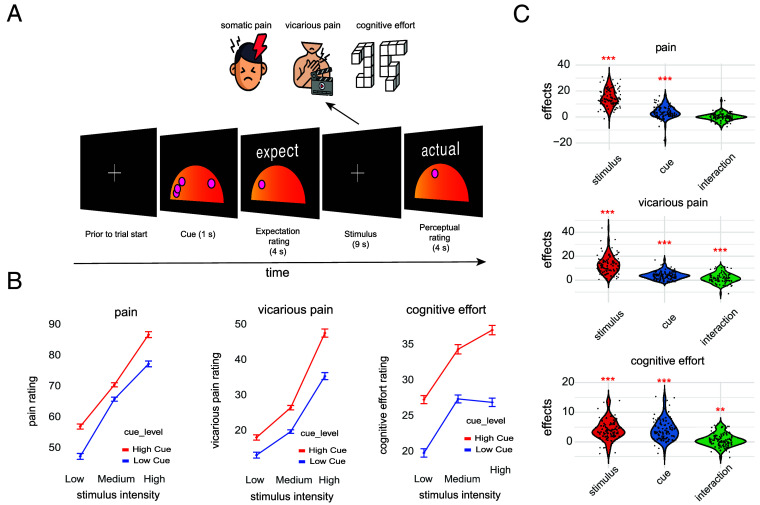
- Objective stimulus intensity strongly increased perceptual ratings in all three tasks: pain (P = 2.68×10^-17), vicarious pain (P = 5.69×10^-18), and cognitive effort (P = 4.02×10^-15), with large effect sizes from 0.78 to 0.86.
- High social cues substantially increased expectation ratings compared with low social cues in all tasks: pain (P = 1.42×10^-16), vicarious pain (P = 6.43×10^-18), and cognitive effort (P = 2.68×10^-17), with effect sizes from 0.82 to 0.86.
- High social cues also increased perceptual ratings, even controlling for objective stimulus intensity: pain (P = 2.62×10^-13), vicarious pain (P = 2.57×10^-16), and cognitive effort (P = 6.84×10^-16), with effect sizes from 0.73 to 0.81.
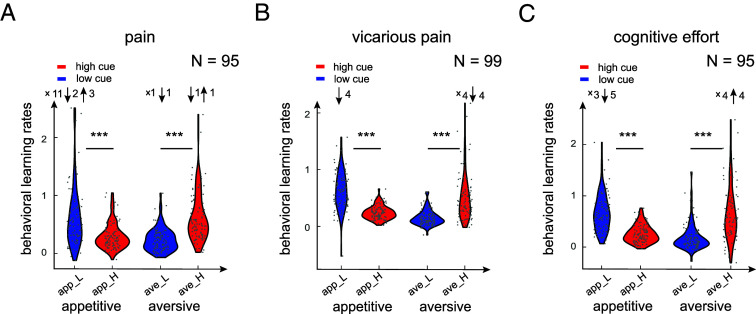
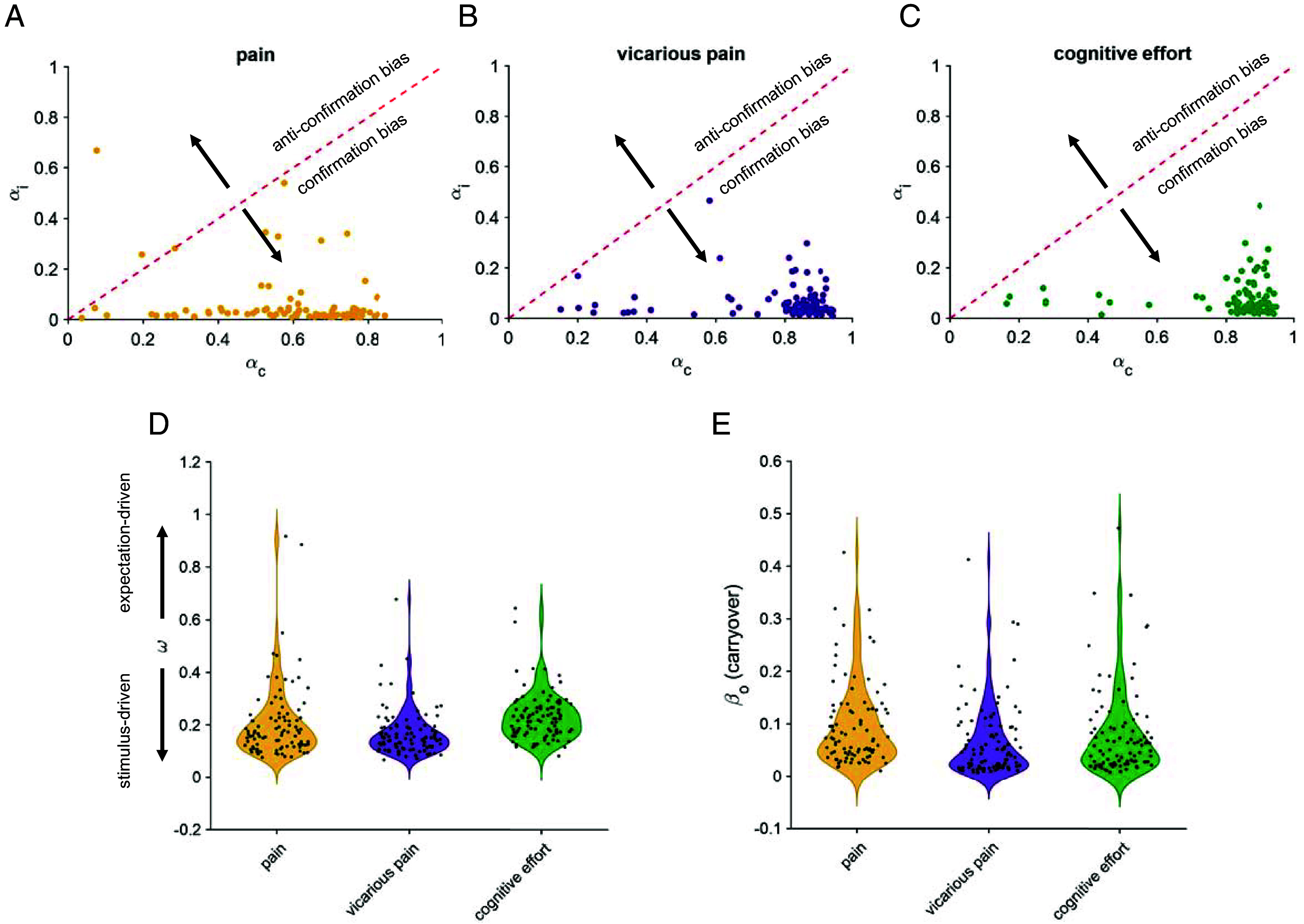
- Confirmation bias in learning was observed across all three tasks: learning rates for cue-congruent trials were significantly higher than for cue-incongruent trials in pain (P = 8.97×10^-13), vicarious pain (P = 5.5×10^-15), and cognitive effort (P = 2.9×10^-15).
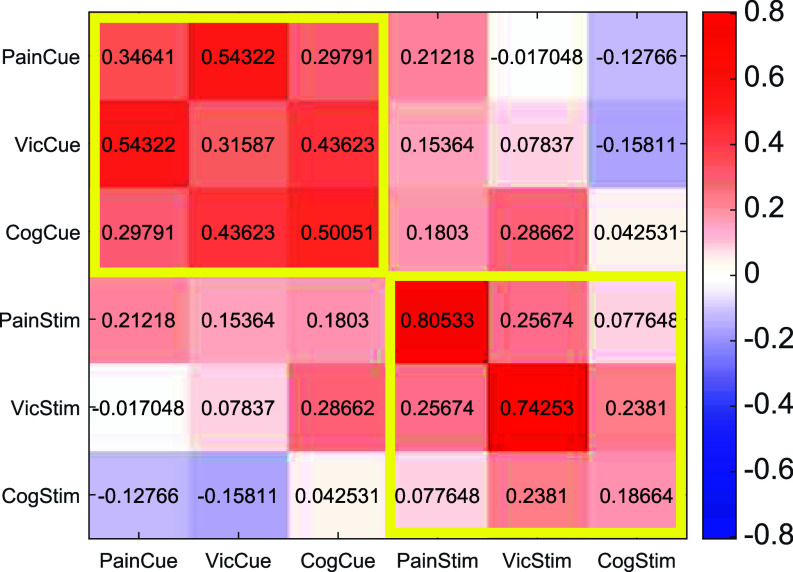
- In cross-task correlations, confirmation bias in learning was moderately stable between pain and cognitive effort (rs = 0.28) and between vicarious pain and cognitive effort (rs = 0.29), but not between pain and vicarious pain (rs = 0.15, P = 0.15).
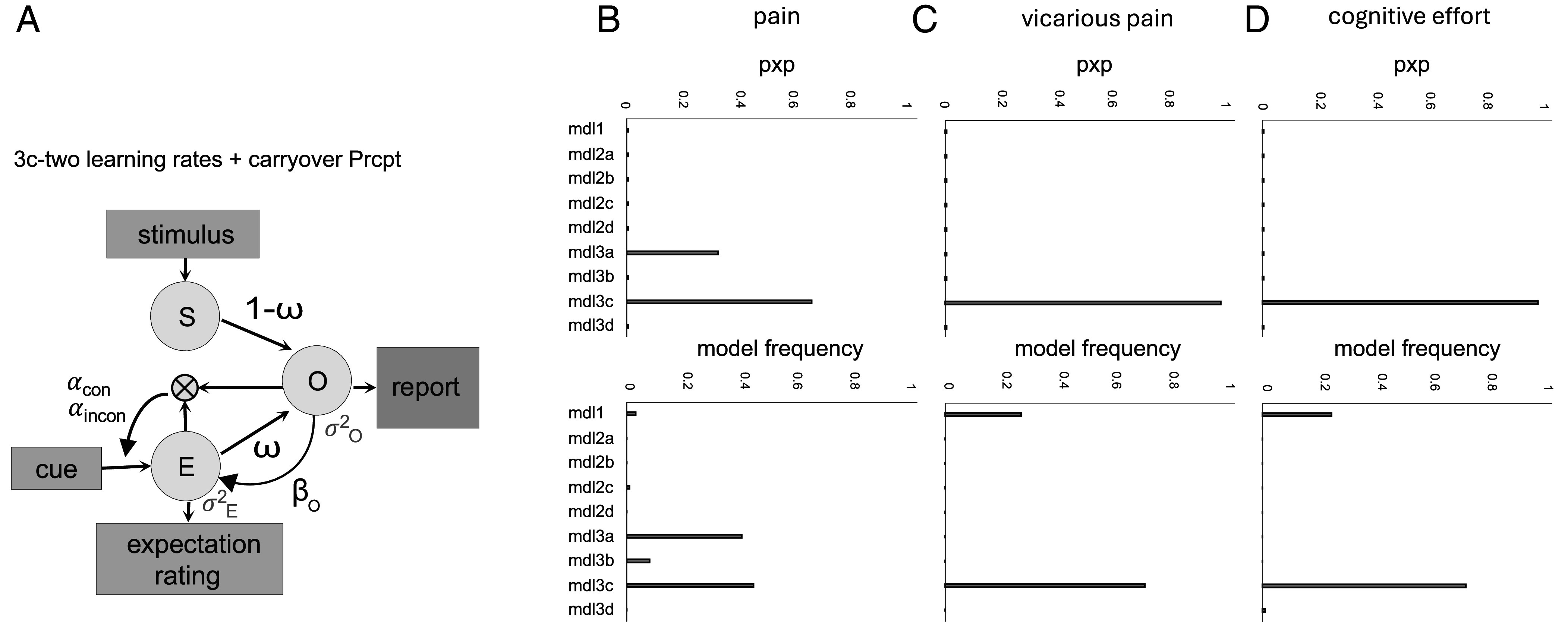
- The best-fitting computational model was Model 3c, which included separate learning rates for confirmatory and disconfirmatory prediction errors plus perceptual carryover; the paper reports that this model fit better than the alternatives by model frequency and protected exceedance probability.
## Methods
- Three-task experimental design: thermal pain, vicarious pain, and mental rotation cognitive effort, each with a 2 (high/low social cue) × 3 (low/medium/high stimulus intensity) factorial design and 12 trials per condition; the tasks were run across three sessions on different days.
- Sample: 111 recruited participants total (111 unique individuals), average age 24.7 ± 5.5 years; analyses were restricted to participants completing at least 24 trials, yielding 95 in the pain task, 99 in vicarious pain, and 95 in cognitive effort.
- Analysis combined participant-level general linear models, nonparametric tests, multilevel mediation analyses, cross-task rank correlations, and hierarchical Bayesian reinforcement-learning model comparison across nine models.
## Limitations
- The paper states that some participants did not learn the values of high and low cues despite trial-by-trial feedback, and that some showed no carryover effect, especially in the pain task.
- The paper notes that cue effects on perception had only low-to-moderate reliability (r = 0.32 to 0.50), and stimulus intensity effects were low for the cognitive effort task (r = 0.18), which the text says has implications for using these measures as individual-differences indices.
- Evident from the text: the cue ratings were “mere suggestions” with no real-world reinforcement and the tasks were laboratory-based with healthy participants from Dartmouth College, so generalization beyond this setting is not directly tested.
Model-written summary. Check it against the paper before relying on it.
Integrity signals
Registry
Cites
Statistics
Figures
Verification
Claims the paper makes
9 Valid · 0 Not valid · 5 Not checked · 82 Own results and interpretations
The cited sources support only part of this claim — read each source’s verdict below.
In the paper
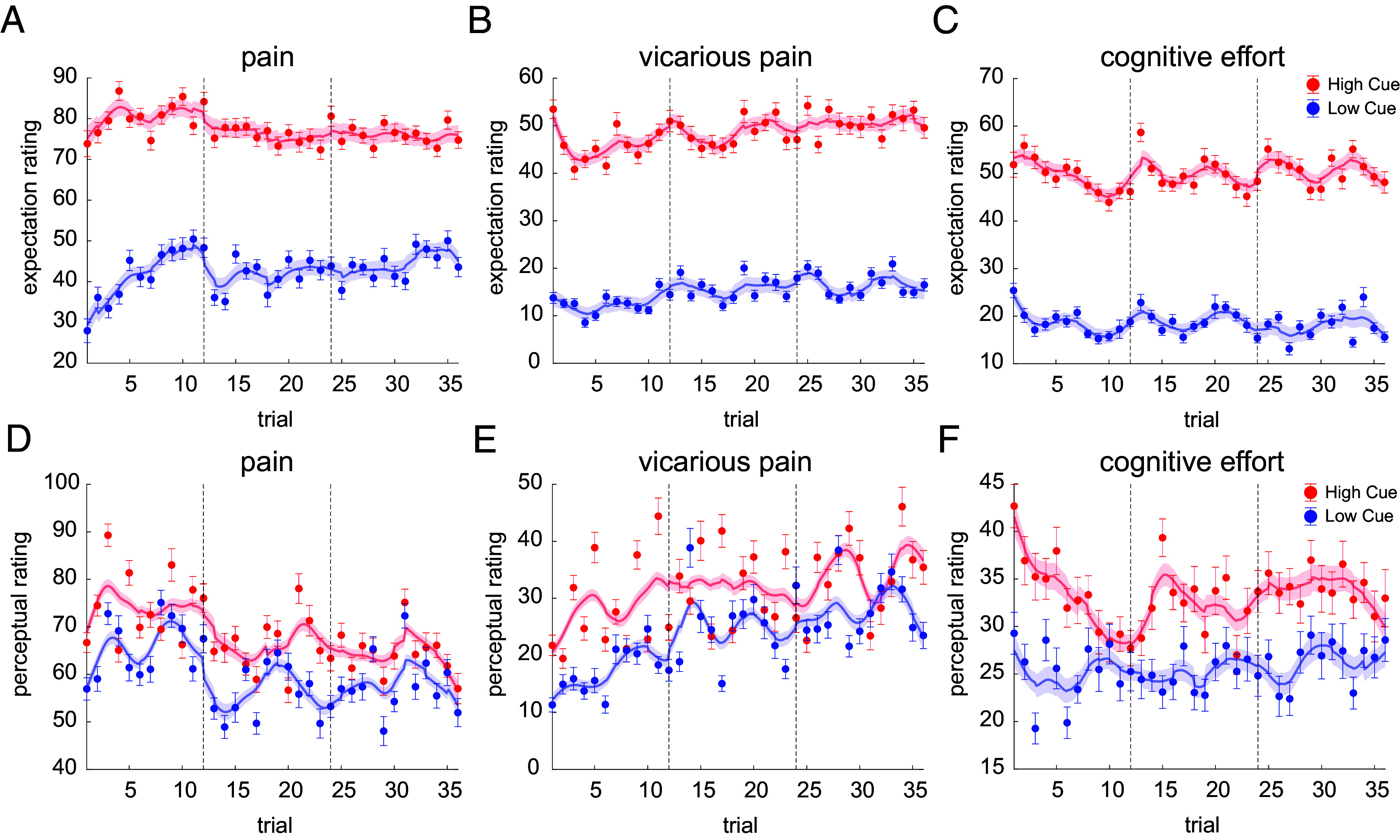
“Interestingly, higher perceptual rating in the current trial was associated with higher expectation rating in the next trial with a different cue type (SI Appendix, Figs. S8–S10) which suggests: 1) the existence of a carryover effect (61–63) from the previous to the current trial independent of the cue, or 2) a general learning of stimulus history.”
§ Social information creates self-fulfilling prophecies in judgments of pain, vicarious pain, and cognitive effort > Results > Bidirectional Effect of Expectations and Perceptual Ratings.
What the sources say
- Could not verifycites [61] A. G. E. Collins, The tortoise and the hare: Interactions between reinforcement learning and working memory. J. Cogn. Neurosci. 30, 1422– 1432 (2018). 29346018 sourceExperimental — accuracy not yet measured
The Results and Learning phase passages examine how previous correct choices for a given stimulus predict later action choices. Our copy does not report perceptual or expectation ratings, or an association between ratings on successive trials with different cue types (searched: perceptual rating, expectation rating, and cue-independent carryover). (LLM, conf=0.76)
- Could not verifycites [62] S. Farashahi, C. H. Donahue, B. Y. Hayden, D. Lee, A. Soltani, Flexible combination of reward information across primates. Nat. Hum. Behav. 3, 1215– 1224 (2019). 31501543 PMC6856432 sourceExperimental — accuracy not yet measured
The Methods section on human tasks says participants used outcomes from preceding trials to choose between reward targets, but it does not report perceptual or expectation ratings. Searches for the stated cross-trial association and for a cue-independent carryover effect found no passage addressing either point; page numbers were unavailable in our copy. (LLM, conf=0.76)
- Supportedcites [63] J. T. Colas, J. P. O’Doherty, S. T. Grafton, Active reinforcement learning versus action bias and hysteresis: Control with a mixture of experts and nonexperts. PLoS Comput. Biol. 20, e1011950 (2024). 38552190 PMC10980507 source
The citation is attached to the proposed cue-independent carryover effect, not to the rating association, which the citing sentence attributes to its own supplementary figures. The source’s Results (‘Alternatives to state-independent action hysteresis’; page unavailable) report that action-history effects across trials were accounted for by state-independent hysteresis, supporting that proposed form of carryover. (LLM, conf=0.87)
hedgedstates an association- Asserted: passes — The authors put it forward as true.
- Checkable: passes — It can be checked against evidence.
- Load-bearing: passes — The paper’s conclusions depend on it.
- Based: passes — The paper gives a reason why it holds.
- Could not verify
A result the paper reports from its own data — it cites no other source for it, so there is none to check. The quote shows it is in the paper.
In the paper
“Cue effects on expectations were even more stable (Spearman correlation; pain and vicarious pain: rs = 0.62, P < 2.22×10-308; pain and cognitive effort: rs = 0.65, P < 2.22×10-308; vicarious pain and cognitive effort: rs = 0.82, P < 2.22×10-308; SI Appendix, Fig. S1).”
§ Social information creates self-fulfilling prophecies in judgments of pain, vicarious pain, and cognitive effort > Results > Cross-Task Correlations of Individuals’ Cue and Stimulus Effects on Perceptual Ratings. Cue effects on perception and expectations are widely recognized, but their stability across domains remains unclear. For instance, does a strong cue effect on pain perception predict a strong effect on cognitive effort? To test this, we examined cross-task correlations of individual differences in cue effects. Cue effects on perceptions showed significant positive correlations across domains (Spearman’s correlation; pain and vicarious pain: rs = 0.54, P = 7.6×10⁻⁸; pain and cognitive effort: rs = 0.29, P = 0.0050; vicarious pain and cognitive effort: rs = 0.43, P = 2.6×10⁻⁵; Fig. 3). These correlations were comparable to the within-task reliability values—which provide a noise ceiling for cross-task correlations—suggesting consistent effects across tasks. Cue effects on expectations were even more stable (Spearman correlation; pain and vicarious pain: rs = 0.62, P < 2.22×10-308; pain and cognitive effort: rs = 0.65, P < 2.22×10-308; vicarious pain and cognitive effort: rs = 0.82, P < 2.22×10-308; SI Appendix, Fig. S1). In contrast, objective stimulus intensity effects were less stable across tasks (Spearman correlation; pain and vicarious pain: rs = 0.25, P = 0.016; pain and cognitive effort: rs = 0.23, P = 0.0257; vicarious pain and cognitive effort: rs = 0.07, P = 0.47; Fig. 3). This indicates that individuals with large stimulus intensity effects in one task do not necessarily show large stimulus intensity effects in others. Thus, overall, these results indicate stable individual susceptibility to cue effects across tasks but little stability in who responds most strongly to a given stimulus type.
plainstates an association- Asserted: passes — The authors put it forward as true.
- Checkable: passes — It can be checked against evidence.
- Load-bearing: passes — The paper’s conclusions depend on it.
- Based: passes — The paper gives a reason why it holds.
A result the paper reports from its own data — it cites no other source for it, so there is none to check. The quote shows it is in the paper.
In the paper
“This interaction was not significant in the pain task (P = 0.85, z = −0.18, d = −0.01).”
§ Social information creates self-fulfilling prophecies in judgments of pain, vicarious pain, and cognitive effort > Results > Stimulus Intensity and Cue Effects on Expectancy and Perceptual Ratings.
plain- Asserted: passes — The authors put it forward as true.
- Checkable: passes — It can be checked against evidence.
- Load-bearing: unclear — It is unclear whether the paper’s conclusions depend on it.
- Based: passes — The paper gives a reason why it holds.
A result the paper reports from its own data — it cites no other source for it, so there is none to check. The quote shows it is in the paper.
In the paper
“Mediation analysis 2 provided strong evidence that the perception of the stimuli (i.e., perceptual ratings) directly influences the expectation updates (SI Appendix, Figs. S12 and S13, path ab2 P < 0.001).”
§ Social information creates self-fulfilling prophecies in judgments of pain, vicarious pain, and cognitive effort > Results > Bidirectional Effect of Expectations and Perceptual Ratings.
boostedstates a cause- Asserted: passes — The authors put it forward as true.
- Checkable: passes — It can be checked against evidence.
- Load-bearing: passes — The paper’s conclusions depend on it.
- Based: passes — The paper gives a reason why it holds.
A result the paper reports from its own data — it cites no other source for it, so there is none to check. The quote shows it is in the paper.
In the paper
“Mediation analysis 1 showed that cue effects on subsequent perception are mediated by expectations in all three tasks (SI Appendix, Figs. S12 and S13, path ab1 P < 0.001).”
§ Social information creates self-fulfilling prophecies in judgments of pain, vicarious pain, and cognitive effort > Results > Bidirectional Effect of Expectations and Perceptual Ratings.
plainstates a cause- Asserted: passes — The authors put it forward as true.
- Checkable: passes — It can be checked against evidence.
- Load-bearing: passes — The paper’s conclusions depend on it.
- Based: passes — The paper gives a reason why it holds.
45 more claims
Create a free account to see all 96 claims and to verify the 2 references still open.
- Probably not a substantial claim. 9
- It may state two separate claims as one. 41
Citations
Cites
Tversky, A., & Kahneman, D. (1974) · Science · doi:10.1126/science.185.4157.1124 · Cited by 28,810 · cited 1×
“This is different from an anchoring bias (110–113) in which participants’ rating is anchored toward the visual cue that they observe without any updates of their expectations, or from frameworks that assume the experience is a combination of expectations and stimulus but without any learning (102).”
Kytle, J., & Bandura, A. (1978) · Contemporary Sociology · doi:10.2307/2065952 · Cited by 25,422
Judgment under Uncertainty: Heuristics and Biases
Tversky, A., & Kahneman, D. (1975) · Utility, Probability, and Human Decision Making · doi:10.1007/978-94-010-1834-0_8 · Cited by 22,650
Confirmation Bias: A Ubiquitous Phenomenon in Many Guises
Nickerson, R. S. (1998) · Review of General Psychology · doi:10.1037/1089-2680.2.2.175 · Cited by 7,267 · cited 1×
“Under some conditions, such deviations could lead to confirmation biases, the favoring of information aligned with preexisting beliefs and attenuation of evidence that contradicts them (19) [see Kube et al. (20) for a review].”
(2004) · Choice Reviews Online · doi:10.5860/choice.42-1645 · Cited by 2,925
Social Desirability Bias and the Validity of Indirect Questioning
Fisher, R. J. (1993) · Journal of Consumer Research · doi:10.1086/209351 · Cited by 2,789 · cited 1×
“Social desirability (98, 99)—the tendency of individuals to report socially acceptable responses—could also influence reports in several ways: i) by shifting overall rating levels, ii) amplifying cue effects, or iii) biasing learning dynamics.”
Conditioned Reflexes: An Investigation of the Physiological Activity of the Cerebral Cortex.
(1930) · Archives of Neurology And Psychiatry · doi:10.1001/archneurpsyc.1930.02220110256018 · Cited by 2,673
Confidence Intervals from Normalized Data: A correction to Cousineau (2005)
Morey, R. D. (2008) · Tutorials in Quantitative Methods for Psychology · doi:10.20982/tqmp.04.2.p061 · Cited by 1,997 · cited 1×
“Error bars represent the within - subject SEM using the Cousineau–Morey method (59, 60).”
Confidence intervals in within-subject designs: A simpler solution to Loftus and Masson's method
Cousineau, D. (2005) · Tutorials in Quantitative Methods for Psychology · doi:10.20982/tqmp.01.1.p042 · Cited by 1,874 · cited 1×
“Error bars represent the within - subject SEM using the Cousineau–Morey method (59, 60).”
An fMRI-Based Neurologic Signature of Physical Pain
Wager, T. D., Atlas, L. Y., Lindquist, M. A., Roy, M., Woo, C.-W., & Kross, E. (2013) · New England Journal of Medicine · doi:10.1056/nejmoa1204471 · Cited by 1,597 · cited 1×
“Conditioned cues reduced pain, autonomic responses to painful stimuli, and pain - related activity in the Neurologic Pain Signature (52), an established pain neuromarker.”
Self-citationInfluence of models' reinforcement contingencies on the acquisition of imitative responses.
Bandura, A. (1965) · Journal of Personality and Social Psychology · doi:10.1037/h0022070 · Cited by 1,301
Cognition does not affect perception: Evaluating the evidence for “top-down” effects
Firestone, C., & Scholl, B. J. (2016) · Behavioral and Brain Sciences · doi:10.1017/s0140525x15000965 · Cited by 1,200
CORRELATION CALCULATED FROM FAULTY DATA
SPEARMAN, C. (1910) · British Journal of Psychology, 1904-1920 · doi:10.1111/j.2044-8295.1910.tb00206.x · Cited by 1,144
How Do Expectations Shape Perception?
de Lange, F. P., Heilbron, M., & Kok, P. (2018) · Trends in Cognitive Sciences · doi:10.1016/j.tics.2018.06.002 · Cited by 975 · cited 1×
“The mechanisms of the confirmation bias revealed by our models align with the predictive processing framework, where expectations shape the perceptions and guide the integration of sensory evidence (26, 41, 102).”
Achieving quality in clinical decision making: cognitive strategies and detection of bias
Croskerry, P. (2002) · Academic Emergency Medicine · doi:10.1197/aemj.9.11.1184 · Cited by 938
Achieving Quality in Clinical Decision Making: Cognitive Strategies and Detection of Bias
Croskerry, P. (2002) · Academic Emergency Medicine · doi:10.1111/j.1553-2712.2002.tb01574.x · Cited by 938
The neuroscience of placebo effects: connecting context, learning and health
Wager, T. D., & Atlas, L. Y. (2015) · Nature Reviews Neuroscience · doi:10.1038/nrn3976 · Cited by 844 · cited 1×
“For example, studies of placebo and nocebo effects suggest that manipulations of contextual information can drive changes in the construction of pain and other symptoms (38–44), including responses to noxious stimuli in the spinal cord (45–47).”
Self-citationWhy Copy Others? Insights from the Social Learning Strategies Tournament
Rendell, L., Boyd, R., Cownden, D., Enquist, M., Eriksson, K., Feldman, M. W., Fogarty, L., Ghirlanda, S., Lillicrap, T., & Laland, K. N. (2010) · Science · doi:10.1126/science.1184719 · Cited by 811 · cited 1×
“Observational learning provides many advantages, including reducing the need for trial and error, helping learners avoid costly mistakes, and filtering information so that learners can quickly find optimal strategies (7, 10).”
Infant imitation after a 1-week delay: Long-term memory for novel acts and multiple stimuli.
Meltzoff, A. N. (1988) · Developmental Psychology · doi:10.1037//0012-1649.24.4.470 · Cited by 754
Hold your horses: a dynamic computational role for the subthalamic nucleus in decision making
Frank, M. J. (2006) · Neural Networks · doi:10.1016/j.neunet.2006.03.006 · Cited by 706 · cited 1×
“In more mechanistic models, differential learning rates emerge by allocating different subpopulations of neurons for positive and negative reinforcements (107) or through metaplasticity (108, 109).”
Olsson, A., & Phelps, E. A. (2007) · Nature Neuroscience · doi:10.1038/nn1968 · Cited by 622
Reinforcement Learning Signal Predicts Social Conformity
Klucharev, V., Hytönen, K., Rijpkema, M., Smidts, A., & Fernández, G. (2009) · Neuron · doi:10.1016/j.neuron.2008.11.027 · Cited by 594
SOME EXPERIMENTAL RESULTS IN THE CORRELATION OF MENTAL ABILITIES 1
BROWN, W. (1910) · British Journal of Psychology, 1904-1920 · doi:10.1111/j.2044-8295.1910.tb00207.x · Cited by 559
Getting the pain you expect: mechanisms of placebo, nocebo and reappraisal effects in humans
Tracey, I. (2010) · Nature Medicine · doi:10.1038/nm.2229 · Cited by 553
Cognitive culture: theoretical and empirical insights into social learning strategies
Rendell, L., Fogarty, L., Hoppitt, W. J. E., Morgan, T. J. H., Webster, M. M., & Laland, K. N. (2011) · Trends in Cognitive Sciences · doi:10.1016/j.tics.2010.12.002 · Cited by 549 · cited 1×
“Social observational learning is a powerful mechanism by which individuals acquire knowledge, skills, and behaviors by observing and interacting with others (1–8).”
Risk preference shares the psychometric structure of major psychological traits
Frey, R., Pedroni, A., Mata, R., Rieskamp, J., & Hertwig, R. (2017) · Science Advances · doi:10.1126/sciadv.1701381 · Cited by 526 · cited 1×
“This could indicate that the behavioral parameters are not reliable within individuals (86, 87), or could indicate that although the underlying mechanism of confirmation bias could be similar across tasks, the manifestation of confirmation bias can differ among individuals based on the specific…”
Direct evidence for spinal cord involvement in placebo analgesia
Eippert, F., Finsterbusch, J., Bingel, U., & Büchel, C. (2009) · Science · doi:10.1126/science.1180142 · Cited by 512 · cited 1×
“For example, studies of placebo and nocebo effects suggest that manipulations of contextual information can drive changes in the construction of pain and other symptoms (38–44), including responses to noxious stimuli in the spinal cord (45–47).”
Placebo Analgesia: A Predictive Coding Perspective
Büchel, C., Geuter, S., Sprenger, C., & Eippert, F. (2014) · Neuron · doi:10.1016/j.neuron.2014.02.042 · Cited by 505 · cited 1×
“However, despite the Bayesian formulation of the predictive coding, which assumes that the weights of prior and input are determined based on their precision and can change dynamically and rationally over time (26, 103–106), our framework does not incorporate changes in the weights across time.”
Large-scale analysis of test–retest reliabilities of self-regulation measures
Enkavi, A. Z., Eisenberg, I. W., Bissett, P. G., Mazza, G. L., MacKinnon, D. P., Marsch, L. A., & Poldrack, R. A. (2019) · Proceedings of the National Academy of Sciences · doi:10.1073/pnas.1818430116 · Cited by 489 · cited 1×
“This weaker or absent cross - task correlations for learning rates differences are consistent with reports that computational parameters and contrast - based task measures (e.g., incongruent - congruent differences) often have low test–retest reliability and poor generalizability (89).”
Classical conditioning and the placebo effect
Montgomery, G. H., & Kirsch, I. (1997) · Pain · doi:10.1016/s0304-3959(97)00016-x · Cited by 468 · cited 1×
“These two mechanisms explain how expectancy effects are mainly resistant to change and even can grow over time (37, 80, 81).”
How Placebos Change the Patient's Brain
Benedetti, F., Carlino, E., & Pollo, A. (2011) · Neuropsychopharmacology · doi:10.1038/npp.2010.81 · Cited by 446 · cited 1×
“For example, studies of placebo and nocebo effects suggest that manipulations of contextual information can drive changes in the construction of pain and other symptoms (38–44), including responses to noxious stimuli in the spinal cord (45–47).”
A comparison of placebo effects in clinical analgesic trials versus studies of placebo analgesia
Vase, L., Riley, J. L., & Price, D. D. (2002) · Pain · doi:10.1016/s0304-3959(02)00205-1 · Cited by 434
Placebo analgesia induced by social observational learning
Colloca, L., & Benedetti, F. (2009) · Pain · doi:10.1016/j.pain.2009.01.033 · Cited by 416 · cited 1×
“Despite well - known effects of socially induced expectations in different domains such as pain (68–71), fear (72), value, and reward (73–79), little is known about the mechanisms by which others’ opinions can create confirmation bias effects and whether these effects persist across time to produce…”
Brogden, W. J. (1939) · Journal of Experimental Psychology · doi:10.1037/h0058944 · Cited by 409
Vicarious Processes: A Case of No-Trial Learning
Bandura, A. (1965) · Advances in Experimental Social Psychology · doi:10.1016/s0065-2601(08)60102-1 · Cited by 397
Gene-culture coevolution in the age of genomics
Richerson, P. J., Boyd, R., & Henrich, J. (2010) · Proceedings of the National Academy of Sciences · doi:10.1073/pnas.0914631107 · Cited by 393 · cited 1×
“Not surprisingly, social learning may also be supported by specific genetic adaptations (18).”
Brain mediators of predictive cue effects on perceived pain
Atlas, L. Y., Bolger, N., Lindquist, M. A., & Wager, T. D. (2010) · The Journal of Neuroscience · doi:10.1523/jneurosci.0057-10.2010 · Cited by 389 · cited 2×
“Most prior work on social and sensory cues has used reinforcement paradigms, in which cues are informative because they are paired with subsequent reinforcers [i.e., reward, punishment, or symbolic outcomes such as money (31, 32)].”
Self-citationThe role of conditioning and verbal expectancy in the placebo response
Voudouris, N. J., Peck, C. L., & Coleman, G. (1990) · Pain · doi:10.1016/0304-3959(90)90057-k · Cited by 369
Neural mechanisms of observational learning
Burke, C. J., Tobler, P. N., Baddeley, M., & Schultz, W. (2010) · Proceedings of the National Academy of Sciences · doi:10.1073/pnas.1003111107 · Cited by 367
Social Influence Modulates the Neural Computation of Value
Zaki, J., Schirmer, J., & Mitchell, J. P. (2011) · Psychological Science · doi:10.1177/0956797611411057 · Cited by 359
How the Opinion of Others Affects Our Valuation of Objects
Campbell-Meiklejohn, D. K., Bach, D. R., Roepstorff, A., Dolan, R. J., & Frith, C. D. (2010) · Current Biology · doi:10.1016/j.cub.2010.04.055 · Cited by 339
Vase, L., Robinson, M. E., Verne, N. G., & Price, D. D. (2005) · Pain · doi:10.1016/j.pain.2005.03.014 · Cited by 331 · cited 2×
“These two mechanisms explain how expectancy effects are mainly resistant to change and even can grow over time (37, 80, 81).”
Mental rotation: Effects of stimulus complexity and familiarity.
Bethell-Fox, C. E., & Shepard, R. N. (1988) · Journal of Experimental Psychology: Human Perception and Performance · doi:10.1037//0096-1523.14.1.12 · Cited by 319 · cited 1×
“…effects between cognitive and affective domains can also be due to the fact that the reliability of the stimulus effect in the cognitive effort task was low, possibly, because the complexity of the task might have not been related to the rotation angle anymore after continuous training (92).”
The Social Regulation of Emotion: An Integrative, Cross-Disciplinary Model
Reeck, C., Ames, D. R., & Ochsner, K. N. (2016) · Trends in Cognitive Sciences · doi:10.1016/j.tics.2015.09.003 · Cited by 298
Measuring Change in Quality of Life: Bias in Prospective and Retrospective Evaluation
Blome, C., & Augustin, M. (2015) · Value in Health · doi:10.1016/j.jval.2014.10.007 · Cited by 288
Wager, T. D., van Ast, V. A., Hughes, B. L., Davidson, M. L., Lindquist, M. A., & Ochsner, K. N. (2009) · NeuroImage · doi:10.1016/j.neuroimage.2009.05.044 · Cited by 264 · cited 1×
“We conducted two multilevel mediation analyses (31, 64).”
Self-citationPlacebo analgesia: Psychological and neurobiological mechanisms
Colloca, L., Klinger, R., Flor, H., & Bingel, U. (2013) · Pain · doi:10.1016/j.pain.2013.02.002 · Cited by 263
Confirmation bias in human reinforcement learning: Evidence from counterfactual feedback processing
Palminteri, S., Lefebvre, G., Kilford, E. J., & Blakemore, S.-J. (2017) · PLOS Computational Biology · doi:10.1371/journal.pcbi.1005684 · Cited by 236 · cited 3×
“Confirmation bias in this context refers to the idea that learning from information that is incongruent with our beliefs is attenuated compared to learning from information that is congruent with our beliefs (26, 49, 51).”
Pedroni, A., Frey, R., Bruhin, A., Dutilh, G., Hertwig, R., & Rieskamp, J. (2017) · Nature Human Behaviour · doi:10.1038/s41562-017-0219-x · Cited by 233
Bested, A. C., & Marshall, L. M. (2015) · Reviews on Environmental Health · doi:10.1515/reveh-2015-0026 · Cited by 217 · cited 1×
“Here, although we are not measuring cognitive fatigue in a clinical setting, some of these findings might be a potential explanation for the comorbidity of symptoms such as pain and cognitive fatigue (91).”
Working Memory Contributions to Reinforcement Learning Impairments in Schizophrenia
Collins, A. G. E., Brown, J. K., Gold, J. M., Waltz, J. A., & Frank, M. J. (2014) · The Journal of Neuroscience · doi:10.1523/jneurosci.0989-14.2014 · Cited by 212 · cited 1×
“…where short - lived memory traces of recent reward associations with stimulus - action pairs can spill over and bias subsequent policy (61, 82), as well as choice hysteresis, where simply having chosen an option increases the probability of choosing it again on the next trial even when…”
Interactions between brain and spinal cord mediate value effects in nocebo hyperalgesia
Tinnermann, A., Geuter, S., Sprenger, C., Finsterbusch, J., & Büchel, C. (2017) · Science · doi:10.1126/science.aan1221 · Cited by 208 · cited 1×
“For example, studies of placebo and nocebo effects suggest that manipulations of contextual information can drive changes in the construction of pain and other symptoms (38–44), including responses to noxious stimuli in the spinal cord (45–47).”
Learning About Pain From Others: An Observational Learning Account
Goubert, L., Vlaeyen, J. W. S., Crombez, G., & Craig, K. D. (2011) · The Journal of Pain · doi:10.1016/j.jpain.2010.10.001 · Cited by 193
Confirmation bias in the utilization of others’ opinion strength
Kappes, A., Harvey, A. H., Lohrenz, T., Montague, P. R., & Sharot, T. (2020) · Nature Neuroscience · doi:10.1038/s41593-019-0549-2 · Cited by 186 · cited 1×
“For example, Kappes et al. (97) found that participants updated their beliefs in response to dis-confirmatory evidence less than the confirmatory one.”
Dopaminergic Genes Predict Individual Differences in Susceptibility to Confirmation Bias
Doll, B. B., Hutchison, K. E., & Frank, M. J. (2011) · The Journal of Neuroscience · doi:10.1523/jneurosci.6486-10.2011 · Cited by 184
Functional dissociation of stimulus intensity encoding and predictive coding of pain in the insula
Geuter, S., Boll, S., Eippert, F., & Büchel, C. (2017) · eLife · doi:10.7554/elife.24770 · Cited by 184 · cited 2×
“This is different from an anchoring bias (110–113) in which participants’ rating is anchored toward the visual cue that they observe without any updates of their expectations, or from frameworks that assume the experience is a combination of expectations and stimulus but without any learning (102).”
Watson, A., El-Deredy, W., Iannetti, G. D., Lloyd, D., Tracey, I., Vogt, B. A., Nadeau, V., & Jones, A. K. P. (2009) · Pain · doi:10.1016/j.pain.2009.04.003 · Cited by 184 · cited 1×
“Most prior work on social and sensory cues has used reinforcement paradigms, in which cues are informative because they are paired with subsequent reinforcers [i.e., reward, punishment, or symbolic outcomes such as money (31, 32)].”
Bayesian approaches to associative learning: From passive to active learning
KRUSCHKE, J. K. (2008) · Learning & Behavior · doi:10.3758/lb.36.3.210 · Cited by 179
Nocebo hyperalgesia induced by social observational learning
Vögtle, E., Barke, A., & Kröner-Herwig, B. (2013) · Pain · doi:10.1016/j.pain.2013.04.041 · Cited by 176
Smith, R., Badcock, P., & Friston, K. J. (2021) · Psychiatry and Clinical Neurosciences · doi:10.1111/pcn.13138 · Cited by 174
Great expectations: neural computations underlying the use of social norms in decision-making
Chang, L. J., & Sanfey, A. G. (2013) · Social Cognitive and Affective Neuroscience · doi:10.1093/scan/nsr094 · Cited by 169 · cited 1×
“Finally, reliance on judgments from multiple independent others can increase accuracy, as revealed by “wisdom of the crowd” studies (13, 14), which may explain the persistent power of social norms on perception (15), emotion (16), and decision - making in many spheres of human endeavor (17).”
Caught in the thickness of brain fog: exploring the cognitive symptoms of Chronic Fatigue Syndrome
Ocon, A. J. (2013) · Frontiers in Physiology · doi:10.3389/fphys.2013.00063 · Cited by 162 · cited 1×
“Building on the idea that cognitive effort can increase cognitive fatigue (93), our results propose a potential cognitive mechanism for persistent cognitive fatigue and chronic fatigue syndrome (94), potentially triggered by observing other’s opinions about a task.”
Evidence for Anchoring Bias During Physician Decision-Making
Ly, D. P., Shekelle, P., & Song, Z. (2023) · JAMA Internal Medicine · doi:10.1001/jamainternmed.2023.2366 · Cited by 162
Sensory preconditioning of human subjects.
Brogden, W. J. (1947) · Journal of Experimental Psychology · doi:10.1037/h0058465 · Cited by 161
A brain network supporting social influences in human decision-making
Zhang, L., & Gläscher, J. (2020) · Science Advances · doi:10.1126/sciadv.abb4159 · Cited by 160 · cited 1×
“Despite well - known effects of socially induced expectations in different domains such as pain (68–71), fear (72), value, and reward (73–79), little is known about the mechanisms by which others’ opinions can create confirmation bias effects and whether these effects persist across time to produce…”
Expectation and the Perception of Color
Bruner, J. S., Postman, L., & Rodrigues, J. (1951) · The American Journal of Psychology · doi:10.2307/1418668 · Cited by 157 · cited 1×
“…reveal how social information can shape perception and learning, with implications for how beliefs form and persist in our hyperconnected age. biases with uninformative cues (i.e., mere suggestions) across a range of tasks (27), even in judgments of elementary visual properties like color (28).”
The Neural Basis of Following Advice
Biele, G., Rieskamp, J., Krugel, L. K., & Heekeren, H. R. (2011) · PLoS Biology · doi:10.1371/journal.pbio.1001089 · Cited by 157 · cited 1×
“Moreover, others’ advice may boost reward signals in reinforcement learning (4) and enhance learning rates (12).”
Confirmation Bias and the Persistence of Misinformation on Climate Change
Zhou, Y., & Shen, L. (2022) · Communication Research · doi:10.1177/00936502211028049 · Cited by 155 · cited 1×
“Confirmation bias has been documented in multiple real - world decision - making contexts, including beliefs in the integrity of elections (21), medical diagnosis (22), judicial decisions (23), financial markets (24), climate change beliefs (25), and more.”
Behavioural and neural evidence for self-reinforcing expectancy effects on pain
Jepma, M., Koban, L., van Doorn, J., Jones, M., & Wager, T. D. (2018) · Nature Human Behaviour · doi:10.1038/s41562-018-0455-8 · Cited by 155 · cited 11×
“…in direct perceptual experiences like pain are more rare, but early evidence indicates biases in pain perception caused by predictive cues can short - circuit learning, creating positive feedback loops between predictions and experiences that result in resistance to disconfirming evidence (26).”
InfluentialSelf-citationFacilitation of Pain in the Human Spinal Cord by Nocebo Treatment
Geuter, S., & Büchel, C. (2013) · The Journal of Neuroscience · doi:10.1523/jneurosci.2191-13.2013 · Cited by 152
Nocebo and pain: an overview of the psychoneurobiological mechanisms
Blasini, M., Corsi, N., Klinger, R., & Colloca, L. (2017) · PAIN Reports · doi:10.1097/pr9.0000000000000585 · Cited by 139
Hierarchical Bayesian inference for concurrent model fitting and comparison for group studies
Piray, P., Dezfouli, A., Heskes, T., Frank, M. J., & Daw, N. D. (2019) · PLOS Computational Biology · doi:10.1371/journal.pcbi.1007043 · Cited by 138
When Beliefs Face Reality: An Integrative Review of Belief Updating in Mental Health and Illness
Kube, T., & Rozenkrantz, L. (2021) · Perspectives on Psychological Science · doi:10.1177/1745691620931496 · Cited by 136 · cited 1×
“Under some conditions, such deviations could lead to confirmation biases, the favoring of information aligned with preexisting beliefs and attenuation of evidence that contradicts them (19) [see Kube et al. (20) for a review].”
Conditioned Placebo Analgesia Persists When Subjects Know They Are Receiving a Placebo
Schafer, S. M., Colloca, L., & Wager, T. D. (2015) · The Journal of Pain · doi:10.1016/j.jpain.2014.12.008 · Cited by 117
Self-citationThe periaqueductal gray and Bayesian integration in placebo analgesia
Grahl, A., Onat, S., & Büchel, C. (2018) · eLife · doi:10.7554/elife.32930 · Cited by 112
The interpretation of computational model parameters depends on the context
Eckstein, M. K., Master, S. L., Xia, L., Dahl, R. E., Wilbrecht, L., & Collins, A. G. (2022) · eLife · doi:10.7554/elife.75474 · Cited by 112
Flexible combination of reward information across primates
Farashahi, S., Donahue, C. H., Hayden, B. Y., Lee, D., & Soltani, A. (2019) · Nature Human Behaviour · doi:10.1038/s41562-019-0714-3 · Cited by 112 · cited 1×
“…reward associations with stimulus - action pairs can spill over and bias subsequent policy (61, 82), as well as choice hysteresis, where simply having chosen an option increases the probability of choosing it again on the next trial even when reward contingencies do not warrant it (62, 63, 83, 84).”
Self-citationDynamic construction of the neural networks underpinning empathy for pain
Betti, V., & Aglioti, S. M. (2016) · Neuroscience & Biobehavioral Reviews · doi:10.1016/j.neubiorev.2016.02.009 · Cited by 110 · cited 1×
“Further, our results contribute to the empathy and mentalization literature, as vicarious pain has been shown to engage empathy and theory of mind (95, 96).”
The Anterior Cingulate Gyrus Signals the Net Value of Others' Rewards
Apps, M. A. J., & Ramnani, N. (2014) · The Journal of Neuroscience · doi:10.1523/jneurosci.2701-13.2014 · Cited by 109 · cited 1×
“Despite well - known effects of socially induced expectations in different domains such as pain (68–71), fear (72), value, and reward (73–79), little is known about the mechanisms by which others’ opinions can create confirmation bias effects and whether these effects persist across time to produce…”
How prior expectations shape multisensory perception
Gau, R., & Noppeney, U. (2016) · NeuroImage · doi:10.1016/j.neuroimage.2015.09.045 · Cited by 109
Learning about causes from people: observational causal learning in 24-month-old infants
Meltzoff, A. N., Waismeyer, A., & Gopnik, A. (2012) · Developmental Psychology · doi:10.1037/a0027440 · Cited by 107
Metaplasticity as a Neural Substrate for Adaptive Learning and Choice under Uncertainty
Farashahi, S., Donahue, C. H., Khorsand, P., Seo, H., Lee, D., & Soltani, A. (2017) · Neuron · doi:10.1016/j.neuron.2017.03.044 · Cited by 101 · cited 1×
“In more mechanistic models, differential learning rates emerge by allocating different subpopulations of neurons for positive and negative reinforcements (107) or through metaplasticity (108, 109).”
Self-citationThe Tortoise and the Hare: Interactions between Reinforcement Learning and Working Memory
Collins, A. G. E. (2018) · Journal of Cognitive Neuroscience · doi:10.1162/jocn_a_01238 · Cited by 97 · cited 2×
“S8–S10) which suggests: 1) the existence of a carryover effect (61–63) from the previous to the current trial independent of the cue, or 2) a general learning of stimulus history.”
Extinction versus credibility in the desensitization of speech anxiety.
Kirsch, I., & Henry, D. (1977) · Journal of Consulting and Clinical Psychology · doi:10.1037/0022-006x.45.6.1052 · Cited by 95 · cited 1×
“These two mechanisms explain how expectancy effects are mainly resistant to change and even can grow over time (37, 80, 81).”
Beyond conformity: Social influences on pain reports and physiology.
Koban, L., & Wager, T. D. (2016) · Emotion · doi:10.1037/emo0000087 · Cited by 92 · cited 2×
“In addition, some studies indicate that minimal, unreinforced, and unconditioned social cues can influence autonomic physiological responses (29, 30).”
Self-citationNajar, A., Bonnet, E., Bahrami, B., & Palminteri, S. (2020) · PLoS Biology · doi:10.1371/journal.pbio.3001028 · Cited by 90 · cited 1×
“Recent computational work also shows that others’ actions can act as pseudorewards that directly reshape value functions, a process known as “value shaping” (11).”
Different brain networks mediate the effects of social and conditioned expectations on pain
Koban, L., Jepma, M., López-Solà, M., & Wager, T. D. (2019) · Nature Communications · doi:10.1038/s41467-019-11934-y · Cited by 88 · cited 1×
“Studies using similar paradigms have shown that cue effects engage decision - making and social - cognitive circuits (100), predictive pain networks such as SIIPS (101), and autonomic responses linked to expectation (29).”
Self-citationOptimal Predictions in Everyday Cognition: The Wisdom of Individuals or Crowds?
Mozer, M. C., Pashler, H., & Homaei, H. (2008) · Cognitive Science · doi:10.1080/03640210802353016 · Cited by 84 · cited 1×
“Finally, reliance on judgments from multiple independent others can increase accuracy, as revealed by “wisdom of the crowd” studies (13, 14), which may explain the persistent power of social norms on perception (15), emotion (16), and decision - making in many spheres of human endeavor (17).”
Mind matters: placebo enhances reward learning in Parkinson's disease
Schmidt, L., Braun, E. K., Wager, T. D., & Shohamy, D. (2014) · Nature Neuroscience · doi:10.1038/nn.3842 · Cited by 84 · cited 2×
“Second, expectations could influence the impact of prediction errors by modulating learning rates, boosting learning for adjustments aligned with expected outcomes and reducing learning when the outcomes deviate from expectations (12, 48).”
Self-citationComputational mechanisms underlying the dynamics of physical and cognitive fatigue
Matthews, J., Pisauro, M. A., Jurgelis, M., Müller, T., Vassena, E., Chong, T. T. ‐., & Apps, M. A. J. (2023) · Cognition · doi:10.1016/j.cognition.2023.105603 · Cited by 75 · cited 1×
“Building on the idea that cognitive effort can increase cognitive fatigue (93), our results propose a potential cognitive mechanism for persistent cognitive fatigue and chronic fatigue syndrome (94), potentially triggered by observing other’s opinions about a task.”
Dissociation between asymmetric value updating and perseverance in human reinforcement learning
Sugawara, M., & Katahira, K. (2021) · Scientific Reports · doi:10.1038/s41598-020-80593-7 · Cited by 59
Choice-confirmation bias and gradual perseveration in human reinforcement learning.
Palminteri, S. (2023) · Behavioral Neuroscience · doi:10.1037/bne0000541 · Cited by 57
The neural processes of acquiring placebo effects through observation
Schenk, L. A., & Colloca, L. (2019) · NeuroImage · doi:10.1016/j.neuroimage.2019.116510 · Cited by 55 · cited 1×
“Despite well - known effects of socially induced expectations in different domains such as pain (68–71), fear (72), value, and reward (73–79), little is known about the mechanisms by which others’ opinions can create confirmation bias effects and whether these effects persist across time to produce…”
The power of priors: How confirmation bias impacts market prices
Cipriano, M., & Gruca, T. S. (2015) · The Journal of Prediction Markets · doi:10.5750/jpm.v8i3.974 · Cited by 51 · cited 1×
“Confirmation bias has been documented in multiple real - world decision - making contexts, including beliefs in the integrity of elections (21), medical diagnosis (22), judicial decisions (23), financial markets (24), climate change beliefs (25), and more.”
How initial confirmatory experience potentiates the detrimental influence of bad advice
Staudinger, M. R., & Büchel, C. (2013) · NeuroImage · doi:10.1016/j.neuroimage.2013.02.074 · Cited by 42
López‐Solà, M., Koban, L., Krishnan, A., & Wager, T. D. (2017) · Neuropsychologia · doi:10.1016/j.neuropsychologia.2017.07.012 · Cited by 41 · cited 1×
“Further, our results contribute to the empathy and mentalization literature, as vicarious pain has been shown to engage empathy and theory of mind (95, 96).”
Self-citationHumans flexibly integrate social information despite interindividual differences in reward
Witt, A., Toyokawa, W., Laland, K. N., Gaissmaier, W., & Wu, C. M. (2024) · Proceedings of the National Academy of Sciences · doi:10.1073/pnas.2404928121 · Cited by 40 · cited 1×
“Observational learning provides many advantages, including reducing the need for trial and error, helping learners avoid costly mistakes, and filtering information so that learners can quickly find optimal strategies (7, 10).”
The placebo effect on bradykinesia in Parkinson's disease with and without prior drug conditioning
Frisaldi, E., Carlino, E., Zibetti, M., Barbiani, D., Dematteis, F., Lanotte, M., Lopiano, L., & Benedetti, F. (2017) · Movement Disorders · doi:10.1002/mds.27142 · Cited by 35 · cited 1×
“However, the paradigm used by Jepma et al. (26), like most effective placebo paradigms, relied on conditioning (53, 54).”
Strube, A., Horing, B., Rose, M., & Büchel, C. (2023) · Neuron · doi:10.1016/j.neuron.2023.01.002 · Cited by 35 · cited 1×
“However, despite the Bayesian formulation of the predictive coding, which assumes that the weights of prior and input are determined based on their precision and can change dynamically and rationally over time (26, 103–106), our framework does not incorporate changes in the weights across time.”
The Influence of Anchoring on Pain Judgment
Riva, P., Rusconi, P., Montali, L., & Cherubini, P. (2011) · Journal of Pain and Symptom Management · doi:10.1016/j.jpainsymman.2010.10.264 · Cited by 34
Confirmation Bias in the United States Supreme Court Judicial Database
Harvey, A. L., & Woodruff, M. J. (2011) · The Journal of Law Economics and Organization · doi:10.1093/jleo/ewr003 · Cited by 33 · cited 1×
“Confirmation bias has been documented in multiple real - world decision - making contexts, including beliefs in the integrity of elections (21), medical diagnosis (22), judicial decisions (23), financial markets (24), climate change beliefs (25), and more.”
Optimal structure of metaplasticity for adaptive learning
Khorsand, P., & Soltani, A. (2017) · PLOS Computational Biology · doi:10.1371/journal.pcbi.1005630 · Cited by 26 · cited 1×
“In more mechanistic models, differential learning rates emerge by allocating different subpopulations of neurons for positive and negative reinforcements (107) or through metaplasticity (108, 109).”
Self-citationA belief systems analysis of fraud beliefs following the 2020 US election
Botvinik‐Nezer, R., Jones, M., & Wager, T. D. (2023) · Nature Human Behaviour · doi:10.1038/s41562-023-01570-4 · Cited by 25 · cited 1×
“Confirmation bias has been documented in multiple real - world decision - making contexts, including beliefs in the integrity of elections (21), medical diagnosis (22), judicial decisions (23), financial markets (24), climate change beliefs (25), and more.”
Self-citationVrizzi, S., Najar, A., Lemogne, C., Palminteri, S., & Lebreton, M. P. (2025) · Nature Mental Health · doi:10.1038/s44220-025-00427-1 · Cited by 25 · cited 1×
“Recent work in computational psychiatry has extended this concern, showing that reinforcement - learning parameters replicate robustly at the group level but display surprisingly low stability at the individual level, limiting their translational potential (90).”
Contributions of Attention to Learning in Multidimensional Reward Environments
Wang, M. C., & Soltani, A. (2024) · Journal of Neuroscience · doi:10.1523/jneurosci.2300-23.2024 · Cited by 16
Self-citationNeural correlates of sensory preconditioning: A preliminary fMRI investigation
Yu, T., Lang, S., Birbaumer, N., & Kotchoubey, B. (2013) · Human Brain Mapping · doi:10.1002/hbm.22253 · Cited by 12 · cited 1×
“This procedure is related to sensory preconditioning, which has established effects on behavior (55, 56), as it creates an association between arbitrary cues and pain at a conceptual level.”
Social cues influence perception of others' pain
Zhang, L., Wager, T. D., & Koban, L. (2024) · European Journal of Pain · doi:10.1002/ejp.2225 · Cited by 7 · cited 1×
“In addition, some studies indicate that minimal, unreinforced, and unconditioned social cues can influence autonomic physiological responses (29, 30).”
Self-citationColas, J. T., O’Doherty, J. P., & Grafton, S. T. (2024) · PLOS Computational Biology · doi:10.1371/journal.pcbi.1011950 · Cited by 6 · cited 2×
“…reward associations with stimulus - action pairs can spill over and bias subsequent policy (61, 82), as well as choice hysteresis, where simply having chosen an option increases the probability of choosing it again on the next trial even when reward contingencies do not warrant it (62, 63, 83, 84).”
Influencing Pain Inferences Using Random Numerical Anchoring: Randomized Controlled Trial
Lewinson, R., & Katz, J. D. (2020) · JMIR Human Factors · doi:10.2196/17533 · Cited by 6 · cited 1×
“This is different from an anchoring bias (110–113) in which participants’ rating is anchored toward the visual cue that they observe without any updates of their expectations, or from frameworks that assume the experience is a combination of expectations and stimulus but without any learning (102).”
Contribution of statistical learning to learning from reward feedbackPreprint
Yazdanpanah, A., Wang, M. C., Trepka, E. B., & Soltani, A. (2024) · bioRxiv (Cold Spring Harbor Laboratory) · doi:10.1101/2024.04.27.591445 · Cited by 5
Self-citationExpectation generation and its effect on subsequent pain and visual perception
Botvinik‐Nezer, R., Geuter, S., Lindquist, M. A., & Wager, T. D. (2025) · PLoS Computational Biology · doi:10.1371/journal.pcbi.1013053 · Cited by 4
Self-citation
Research works printed but not linked: 5
- N. A. Christakis, Blueprint: The Evolutionary Origins of a Good Society (Little, Brown Spark, 2019).
- M. Sherif, A study of some social factors in perception. Arch. Psychol. Columbia Univ. 187, 60– 60 (1935).
- R. S. Sutton, A. G. Barto, Reinforcement Learning: An Introduction (The MIT Press, ed. 2, 2018).
- G. H. Montgomery, I. Kirsch, Classical conditioning and the placebo effect. PAIN 72, 107 (1997). 9272794 · DOI · Paper page
- H. Helson, Adaptation-Level Theory: An Experimental and Systematic Approach to Behavior (Harper and Row, New York, NY, 1964).
Cited by
Beyond Bayesian integration: how meaning shapes placebo effects
Wiech, K., Eippert, F., Jensen, K. B., Vase, L., & Bingel, U. (2026) · Trends in Neurosciences · doi:10.1016/j.tins.2026.07.005 · Cited by 2
Metadata
- Authors
- Yazdanpanah, A., Jung, H., Soltani, A., & Wager, T. D.
- Affiliations
- Dartmouth College (US)
- Corresponding author
- Soltani, Alireza
- Wager, Tor D.
- Venue
- Proceedings of the National Academy of Sciences
- Publisher
- National Academy of Sciences
- Published
- 2026-02-09
- Volume
- 123
- Issue
- 7
- Pages
- e2513856123-e2513856123
- ISSN
- 0027-8424 (ISSN-L)
- 1091-6490
- PMC
- PMC12912994
- OpenAlex
- W7128442868
- Cited by
- 1
- References
- 104
- Citations by year
- 2026: 1
- FWCI
- 4.11
- Type
- journal article
- Language
- en
- Open access
- hybrid
- doi.org
- Licence
- Locations
- Proceedings of the National Academy of Sciences (publishedVersion, cc-by)
- PubMed (publishedVersion)
- PubMed Central (publishedVersion, cc-by)
- Topics
- Life Sciences › Neuroscience › Cognitive Neuroscience › Pain Management and Placebo Effect
- Life Sciences › Neuroscience › Cognitive Neuroscience › Neural and Behavioral Psychology Studies
- Health Sciences › Medicine › Physiology (medical) › Pain Mechanisms and Treatments
- Keywords
- self-fulfilling prophecy, social cues, vicarious pain, pain perception, cognitive effort, mental rotation, placebo effect, prediction error learning, social information
- MeSH terms
- Outcome Expectations, Adult, Cognition, Cues, Female, Humans, Judgment, Male, Pain, Placebo Effect, Young Adult, Pain Perception
About these checks
Registry, retraction, Cites and statistics results are computed, not judged, with one exception: a printed reference that no index lists is read once by a model before it counts as a citation error. Claims are extracted by a model and kept only when their quote appears verbatim in the text; each cited source is then checked, with a model’s help, for whether it says what the claim relies on. Those verdicts can be wrong — read the claim’s quote and the cited source before relying on one.
The claim verdicts this report counts are experimental: their accuracy is not yet measured.
A language model drew the claims from the paper on 2026-10-09, under version 3 of the claim definition (model deepseek-v4.1-flash, prompt extract-v3).
A second model labelled each claim on 2026-10-09 (model jev-1.13-20260917, definition revision gold-guideline-v0.2).
Cited sources are checked with a language model’s help (gpt-6-sol).
Statistics and arithmetic are recomputed, not judged.
Confidence bands are shown only for fields calibrated on our annotated test set. None is calibrated yet, so no band is shown.
What counts as a claim ›How we measure confidence ›How we check this ›
Are you an author, or do you see a problem with this page? Request a review
Data sources
Bibliographic data: Semantic Scholar, OpenAlex, Crossref.
Contains information from the Semantic Scholar Academic Graph Datasets, made available under the ODC Attribution License (ODC-BY 1.0).
Semantic Scholar’s data is described in: Kinney, R., et al. (2023). The Semantic Scholar Open Data Platform. arXiv:2301.10140.
