

The DOI matches its Crossref record; 221 of the 221 references it cites were found in a registry or an index; 51 of the 201 sources its claims cite were checked for support.
Understanding Autobiographical Memory in the Digital Age: The AMEDIA-Model
Open accessAbstract
Recent technological developments have led to an increased density of recorded life episodes. To understand how creating and sharing such immense amounts of data shapes the way individuals remember their past, we propose a model for autobiographical memory in the digital age (AMEDIA-Model) that systematizes the existing literature and sketches avenues for future research. The model views autobiographical remembering in the digital age as the result of the iterative process of combining information stored in the mind and information stored in the environment using high-tech applications. Moreover, the way autobiographical memories are (re-)constructed crucially depends on the way the information has been encoded and curated: Autobiographical remembering in the digital age is not a uniform process but is fundamentally shaped by the technology and the data that is being used. The AMEDIA-Model offers a framework for understanding technology-mediated human cognition in the twenty-first century.
Overview
AI snapshot
Written from the paper’s full text.
TL;DR
The paper proposes the AMEDIA-Model, which frames autobiographical remembering in the digital age as an iterative process combining information stored in the mind and in the environment via high-tech devices and applications. It argues that remembering is not uniform but is shaped by how information is encoded, curated, and retrieved, and by the specific technology and data involved.
Key findings
- The AMEDIA-Model distinguishes internal autobiographical memory—organized hierarchically from individual memories to general events, lifetime periods, themes, and a life story—from external resources, which include social, low-tech, and high-tech aids. High-tech resources are said to increase the density of recorded life episodes, create searchable multimedia databases, and allow access anywhere at any time.
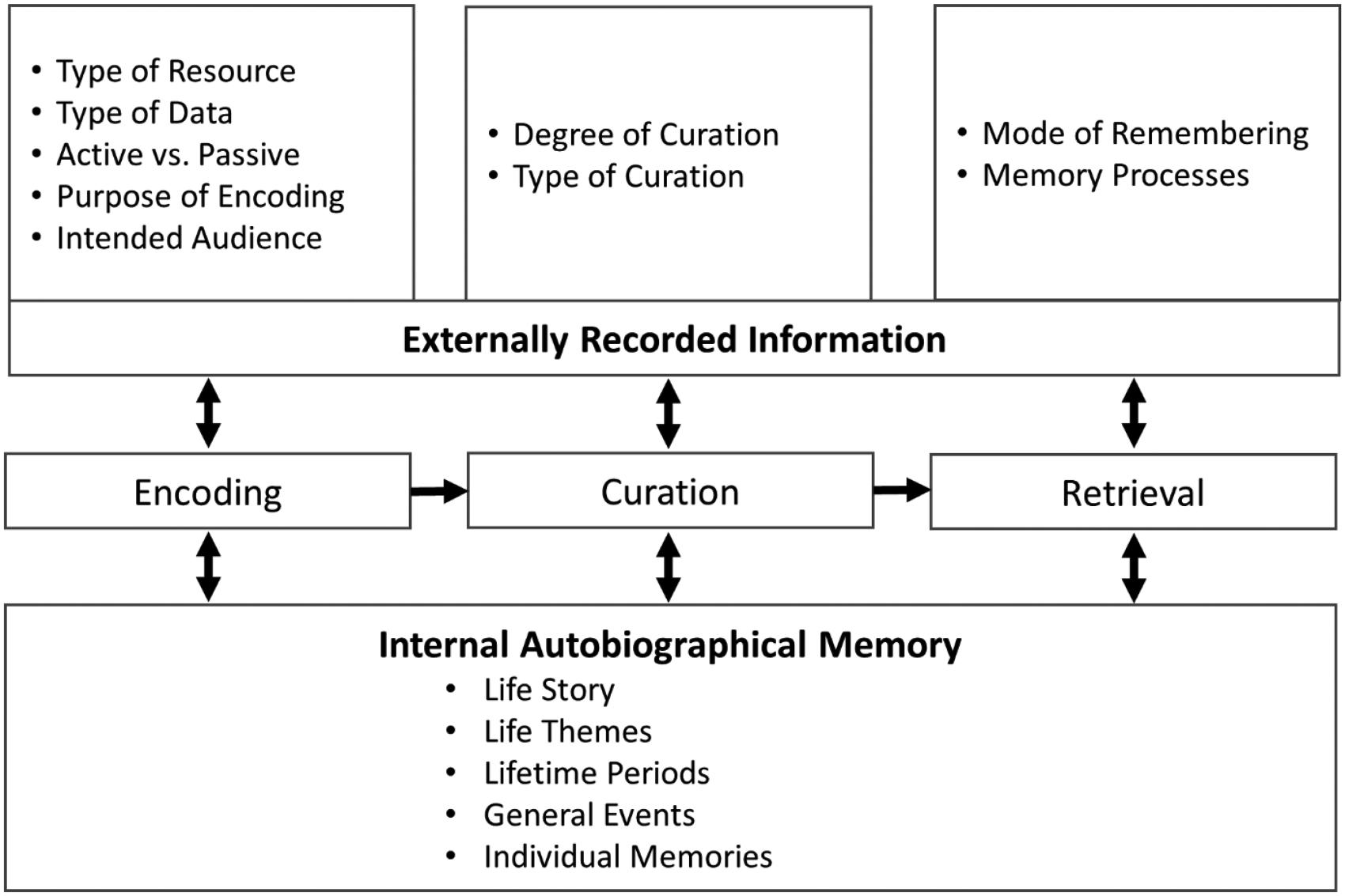
- The model separates three process components: encoding, curation, and retrieval. Encoding is shaped by dimensions such as digital substitutes versus innovative tools, qualitative versus quantitative data, active versus passive recording, intentional versus incidental encoding, and public versus private intended audience; curation can be human or algorithmic; retrieval can be intentional, incidental, or algorithmically triggered.
- The paper reports digital-age scale statistics: approximately five billion people worldwide are active on the Internet and approximately 4.65 billion are social media users; in each minute of 2023, users sent about 241 million emails, 41.6 million WhatsApp messages, and 360,000 tweets, shared about 694,000 Instagram reels via direct messages, and liked 4 million Facebook posts.
- It argues that external records can augment recollection, reminiscing, reflection, and narration, but also raises risks including dependency on digital records, undermined adaptive forgetting, privacy and surveillance concerns, data permanence and format obsolescence problems, rumination, and algorithmic shaping of life narratives.
Methods
- Theoretical/conceptual paper: it proposes the AMEDIA-Model by integrating existing empirical evidence and previously unrelated theory on nontechnological autobiographical memory and technology-mediated remembering; no new empirical data are collected.
- The review is organized around structural components (internal autobiographical memory and external resources) and process components (encoding, curation, retrieval), with dimensions and future research directions sketched throughout.
- No sample, experimental manipulation, or statistical analysis is reported; the paper states that research on autobiographical memory in the digital age is still relatively limited and that it sometimes provides informed speculations rather than empirically substantiated answers.
Limitations
- The paper states that research on autobiographical memory in the digital age is still relatively limited, that it sometimes offers informed speculations and sketches future research rather than empirically substantiated answers, that the dimensions presented are not exhaustive, and that testing the entire model in a single study would be too ambitious.
- Evident from the text: the AMEDIA-Model is not empirically tested here, no primary data are analyzed, and many proposed links and dimensions await empirical validation.
- The paper also notes a significant digital divide within and across societies, meaning not everyone has equal access to the technology or skills, and it states that long-term effects over years and decades remain unknown.
Model-written summary. Check it against the paper before relying on it.
Integrity signals
Registry
Cites
Statistics
Figures
Verification
Claims the paper makes
79 Own interpretation · 38 No full text of the sources · 26 Sources not found · 24 Partly supported · 13 Not checked yet · 9 Supported · 7 Supported so far · 5 No basis given · 1 Couldn’t confirm · accuracy not yet measured
Every source the paper cites for this claim was checked and supports it.
In the paper
“In addition, the recorded content can often be accessed anywhere at any time (Elsden, Kirk, et al., 2016;Heersmink, 2020)”
- Also stated in: § External Resources for Autobiographical Remembering · plain
“fourth, this database can often be accessed anywhere at any time (e.g., because it is stored one one's smartphone or in a cloud system).”
§ Understanding Autobiographical Memory in the Digital Age: The AMEDIA-Model > Abstract
What the sources say
- Supportedcites Elsden, Kirk, et al., 2016 source
The Introduction describes smart journals as networked and offering cloud storage. In “Particular affordances of smart journals” (page unavailable), the paper says journals are more “to-hand” on a ubiquitous smartphone and easier to reference. Together, these passages support the qualified claim that recorded content can often be accessed across times and places. (LLM, conf=0.87)
- Supportedcites Heersmink, 2020 source
Section 6, “Agent-Lifelogging Systems,” says lifelogs are typically stored in the cloud and accessible on a variety of devices, including smartphones. That supports the claim that recorded content can often be accessed from different places and at different times. (LLM, conf=0.90)
plain- Asserted: passes — The authors put it forward as true.
- Checkable: passes — It can be checked against evidence.
- Load-bearing: passes — The paper’s conclusions depend on it.
- Based: passes — The paper gives a reason why it holds.
- Also stated in: § External Resources for Autobiographical Remembering · plain
Every source the paper cites for this claim was checked and supports it.
In the paper
“Third, social media and the internet allow sharing information about one's life with a broader audience, which sets them apart from some of the other high-tech resources (cf.Stone & Zwolinski, 2022).”
§ Understanding Autobiographical Memory in the Digital Age: The AMEDIA-Model > Type of External Resource-Digital Substitutes Versus Innovative Tools
What the sources say
- Supportedcites Stone & Zwolinski, 2022 source
The Abstract says people share personal experiences on social media with friends, family, and the world at large, and describes sharing photographs worldwide via the internet. The Sharing section contrasts this reach and ease with earlier ways of sharing photographs, including mail and email. (LLM, conf=0.90)
plaindirect- Asserted: passes — The authors put it forward as true.
- Checkable: passes — It can be checked against evidence.
- Load-bearing: unclear — It is unclear whether the paper’s conclusions depend on it.
- Based: passes — The paper gives a reason why it holds.
- Supported
The cited sources support only part of this claim — read each source’s verdict below.
In the paper
“qualitative data give users even more room for interpretation and for reconstructing past events (Elsden, Kirk, et al., 2016), arguably because they provide richer and more diverse information about autobiographical events, including perceptual details”
§ Understanding Autobiographical Memory in the Digital Age: The AMEDIA-Model > Type of Data-Qualitative Versus Quantitative
What the sources say
- Partly supportedcites Elsden, Kirk, et al., 2016 sourceExperimental — accuracy not yet measured
Split into 2 atoms — 0 confirmed, 2 partially supported, 0 disputed, 0 misattributed, 0 unverifiable. Expand the claim to see per-atom verdicts.
hedgeddirect- Asserted: passes — The authors put it forward as true.
- Checkable: passes — It can be checked against evidence.
- Load-bearing: passes — The paper’s conclusions depend on it.
- Based: passes — The paper gives a reason why it holds.
- Partly supported
Every source the paper cites for this claim was checked and supports it.
In the paper
“Beside these autobiographical memories in a narrower sense, however, individuals may also refer to and make use of abstract knowledge about their lives (i.e., personal semantics; Renoult et al., 2012) including autobiographical facts (e.g.,”
§ Understanding Autobiographical Memory in the Digital Age: The AMEDIA-Model > Internal Autobiographical Memory
What the sources say
- Supportedcites Renoult et al., 2012 source
The paper identifies autobiographical facts as a common form of personal semantics and discusses self-knowledge as another form. Box 4 also explains that an event may be retrieved as an autobiographical fact rather than re-experienced episodically, supporting the distinction made in the citing sentence. Page numbers were not provided in our copy's passages. (LLM, conf=0.91)
hedgedconditional- Asserted: passes — The authors put it forward as true.
- Checkable: passes — It can be checked against evidence.
- Load-bearing: unclear — It is unclear whether the paper’s conclusions depend on it.
- Based: passes — The paper gives a reason why it holds.
- Supported
The cited sources support only part of this claim — read each source’s verdict below.
In the paper
“Most studies that have investigated the effects of high-tech external resources on recollection focused on the impact of reviewing photos (see, e.g., Finley et al., 2011;Mair et al., 2017;Martin et al., 2022; for reviews, see Foley, 2020;Silva et al., 2018).”
§ Understanding Autobiographical Memory in the Digital Age: The AMEDIA-Model > Memory Processes
What the sources say
- Supportedcites Finley et al., 2011 source
Finley et al. is cited as an example of a study on reviewing photos. The General Discussion explicitly says the paper focused on end-of-day review of SenseCam pictures to support autobiographical memory, and reports better memory performance for reviewed than non-reviewed days. (LLM, conf=0.92)
- Supportedcites Mair et al., 2017 source
Mair et al. is cited as an example of a study of photo review, not as evidence for the count implied by “most studies.” Section 4.1 reports that reviewing SenseCam images was associated with better episodic recall in both older and younger adults. (LLM, conf=0.93)
- Partly supportedcites Martin et al., 2022 sourceExperimental — accuracy not yet measured
The Discussion (page unavailable) describes a substantial body of research on reviewing photographs from wearable cameras, supporting the background point. But Martin et al.’s own intervention replayed video paired with verbal descriptions, not photos, so this paper is not itself an example of a photo-review study. (LLM, conf=0.85)
plain- Asserted: passes — The authors put it forward as true.
- Checkable: passes — It can be checked against evidence.
- Load-bearing: unclear — It is unclear whether the paper’s conclusions depend on it.
- Based: passes — The paper gives a reason why it holds.
- Supported
The cited sources support only part of this claim — read each source’s verdict below.
In the paper
“Generally speaking, these studies indicate that having access to photos documenting one's life can help to reconstruct past experiences that are not accessible in unaided recall.”
§ Understanding Autobiographical Memory in the Digital Age: The AMEDIA-Model > Memory Processes
What the sources say
- Supportedcites Finley et al., 2011 source
The General Discussion (page unavailable) describes SenseCam pictures as memory cues and says they can serve as a backup when human memory fails. This supports the broad claim that photos can help people reconstruct experiences they could not recall unaided. (LLM, conf=0.88)
- Supportedcites Mair et al., 2017 source
The Results (section 3.1; page unavailable) report significantly more recalled event details when participants viewed SenseCam photos than in the unaided baseline condition. The Discussion (section 4.1; page unavailable) explicitly says that viewing the images improved memory for everyday events in both older and younger adults. This supports the claim that life-documenting photos can help people recall experiences beyond what unaided recall yields. (LLM, conf=0.91)
- Partly supportedcites Martin et al., 2022 sourceExperimental — accuracy not yet measured
The Discussion reports that replaying recordings of daily-life events improved older adults’ recall of event-specific details. But the recordings included video and verbal descriptions, and the Results describe cued recall in both conditions; the study did not directly compare access to photos with unaided recall or establish that the recovered experiences were otherwise inaccessible. (LLM, conf=0.84)
hedgedconditional- Asserted: passes — The authors put it forward as true.
- Checkable: passes — It can be checked against evidence.
- Load-bearing: passes — The paper’s conclusions depend on it.
- Based: passes — The paper gives a reason why it holds.
- Supported
The sources with a verdict support this claim; the rest weren’t checked yet, have no full text we could read, or their verdicts aren’t rated yet.
In the paper
“As research has shown (Rasmussen & Berntsen, 2011; see also Bluck et al., 2005), intentionally remembering autobiographical events can be driven by a wide range of different goals and motivations, such as, regulating one's emotions (self function), wanting to solve a certain problem (directive function), or sharing information with others (social function).”
§ Understanding Autobiographical Memory in the Digital Age: The AMEDIA-Model > Mode of Remembering: Intentional, Incidental, and Triggered
What the sources say
- Supportedcites Rasmussen & Berntsen, 2011 source
The Introduction describes voluntary autobiographical remembering as an intended, goal-directed search. Table 1 lists emotional regulation, problem solving, and sharing with another person among the perceived functions of voluntary memories; the results also associate voluntary recall with problem solving and social sharing. (LLM, conf=0.91)
- Not checked — no full text of the sourcecites Bluck et al., 2005 source
plaindirect- Asserted: passes — The authors put it forward as true.
- Checkable: passes — It can be checked against evidence.
- Load-bearing: unclear — It is unclear whether the paper’s conclusions depend on it.
- Based: passes — The paper gives a reason why it holds.
- Supported
The cited sources support only part of this claim — read each source’s verdict below.
In the paper
“Recent studies suggest that individuals are willing to engage in this effortful process when they expect that the recorded information will serve one of the functions of autobiographical memory described above (Stone et al., 2022; see also Broekhuijsen et al., 2017;Choe et al., 2014;Elsden, Durrant, et al., 2016;Finley et al., 2018;Soares & Storm, 2022).”
§ Understanding Autobiographical Memory in the Digital Age: The AMEDIA-Model > Purpose of Encoding-Intentional Versus Incidental
What the sources say
- Not matchedcites Stone et al., 2022
Couldn’t be matched to a paper in Crossref, so it can’t be checked.
- Partly supportedcites Broekhuijsen et al., 2017 sourceExperimental — accuracy not yet measured
Section 5.1 (page unavailable) says a clear purpose can make burdensome photo-curation tasks more appealing, while Sections 4.5 and 6 link photo activities to future reminiscing and functions of autobiographical memory. The study concerns digital photos and photo enthusiasts; it does not establish the broader claim about individuals undertaking effortful recording of information whenever they expect any of the self, social, or directive functions to be served. (LLM, conf=0.83)
- Not checked — no full text of the sourcecites Choe et al., 2014 source
hedgedconditional- Asserted: passes — The authors put it forward as true.
- Checkable: passes — It can be checked against evidence.
- Load-bearing: passes — The paper’s conclusions depend on it.
- Based: passes — The paper gives a reason why it holds.
- Not matched
The cited sources support only part of this claim — read each source’s verdict below.
In the paper
“Interestingly, it has been shown that individuals can intentionally forget and suppress autobiographical memories (Barnier et al., 2007;Joslyn & Oakes, 2005;Noreen & MacLeod, 2013).”
§ Understanding Autobiographical Memory in the Digital Age: The AMEDIA-Model > Type of Curation-Human Versus Algorithmic Curation
What the sources say
- Not checked — no full text of the sourcecites Barnier et al., 2007 source
- Partly supportedcites Joslyn & Oakes, 2005 sourceExperimental — accuracy not yet measured
The Discussion (page not provided) reports that participants instructed to forget recalled fewer autobiographical events, supporting intentional forgetting. The General Discussion describes suppression or inhibition as a possibility, not an experimentally established effect, so the claim overstates that part. (LLM, conf=0.86)
- Not matchedcites Noreen & MacLeod, 2013
Couldn’t be matched to a paper in Crossref, so it can’t be checked.
plaindirect- Asserted: passes — The authors put it forward as true.
- Checkable: passes — It can be checked against evidence.
- Load-bearing: passes — The paper’s conclusions depend on it.
- Based: passes — The paper gives a reason why it holds.
The cited sources support only part of this claim — read each source’s verdict below.
In the paper
“Second, the fact that the information shared online tends to be curated more carefully, which also includes reflecting about an event's meaning as well as its key components, leads to a better internal memory for these events compared to information that is not shared (Johnson & Morley, 2021;Wang et al., 2017; see also Stone & Wang, 2019).”
§ Understanding Autobiographical Memory in the Digital Age: The AMEDIA-Model > Intended Audience-Public Versus Private
What the sources say
- Partly supportedcites Johnson & Morley, 2021 sourceExperimental — accuracy not yet measured
Split into 2 atoms — 0 confirmed, 2 partially supported, 0 disputed, 0 misattributed, 0 unverifiable. Expand the claim to see per-atom verdicts.
- Not matchedcites Wang et al., 2017
Couldn’t be matched to a paper in Crossref, so it can’t be checked.
- Not matchedcites Stone & Wang, 2019
Couldn’t be matched to a paper in Crossref, so it can’t be checked.
plaindirect- Asserted: passes — The authors put it forward as true.
- Checkable: passes — It can be checked against evidence.
- Load-bearing: passes — The paper’s conclusions depend on it.
- Based: passes — The paper gives a reason why it holds.
- Partly supported
- Probably not a substantial claim. 57
- It may state two separate claims as one. 66
- The quote only partly states this claim. 1
The cited sources support only part of this claim — read each source’s verdict below.
In the paper
“Usually, new technologies tend to have complex and multilayered effects on individuals and societies, which are not simply black or white; that is, the question whether digital technologies have desirable or problematic effects on autobiographical remembering is likely to be too superficial to account for the complexity of reality (cf.Appel et al., 2020;Orben & Przybylski, 2019).”
§ Understanding Autobiographical Memory in the Digital Age: The AMEDIA-Model > Abstract
What the sources say
- Not checked — no full text of the sourcecites Appel et al., 2020 source
- Partly supportedcites Orben & Przybylski, 2019 sourceExperimental — accuracy not yet measured
Split into 2 atoms — 0 confirmed, 2 partially supported, 0 disputed, 0 misattributed, 0 unverifiable. Expand the claim to see per-atom verdicts.
hedged- Asserted: passes — The authors put it forward as true.
- Checkable: fails — It may be too vague to check against evidence.
- Load-bearing: passes — The paper’s conclusions depend on it.
- Based: passes — The paper gives a reason why it holds.
Probably not a substantial claim. It may be too vague to check against evidence. It may state two separate claims as one.
The sources with a verdict support this claim; the rest weren’t checked yet, have no full text we could read, or their verdicts aren’t rated yet.
In the paper
“Importantly, these findings are in line with the results obtained when looking at the effects of note-taking (Schryer & Ross, 2013) as well as the subjective perceptions of users of smart journaling apps (Hutmacher et al., 2023).”
§ Understanding Autobiographical Memory in the Digital Age: The AMEDIA-Model > Memory Processes
What the sources say
- Not checked — no full text of the sourcecites Schryer & Ross, 2013 source
- Supportedcites Hutmacher et al., 2023 source
The paper’s “Perceived effects on memory activities” and “Additional perceived effects on memory” sections report users’ subjective assessments of how smart journaling affected remembering. The General Discussion explicitly characterizes the interviews as concerning users’ subjective perceptions, which is the part of the citing sentence attributed to Hutmacher et al. (LLM, conf=0.91)
plaincorrelational- Asserted: passes — The authors put it forward as true.
- Checkable: passes — It can be checked against evidence.
- Load-bearing: unclear — It is unclear whether the paper’s conclusions depend on it.
- Based: passes — The paper gives a reason why it holds.
It may state two separate claims as one.
The cited sources support only part of this claim — read each source’s verdict below.
In the paper
“Second, timing matters: If the reminders are not presented at the right moment (e.g., in a situation in which one is absolutely not willing to think about one's past; Jacobsen, 2022b; see also Bucher, 2020) or bring back memories that one would have preferred not to be reminded of (e.g., the death of a loved one; Lambert et al., 2018), triggered remembering can create confusion and lead to”
§ Understanding Autobiographical Memory in the Digital Age: The AMEDIA-Model > Mode of Remembering: Intentional, Incidental, and Triggered
What the sources say
- Not matchedcites Jacobsen, 2022b
Couldn’t be matched to a paper in Crossref, so it can’t be checked.
- Supportedcites Bucher, 2020 source
The “User modulation of right-time” section says an algorithmic reminder of an anniversary or past life event may arrive at a time that feels wrong to the user. Bucher thus supports the timing point to which “see also Bucher, 2020” is attached; the other example and emotional consequences are not specifically attributed to Bucher in the citing sentence. (LLM, conf=0.90)
- Not matchedcites Lambert et al., 2018
Couldn’t be matched to a paper in Crossref, so it can’t be checked.
plaindirect- Asserted: passes — The authors put it forward as true.
- Checkable: passes — It can be checked against evidence.
- Load-bearing: unclear — It is unclear whether the paper’s conclusions depend on it.
- Based: passes — The paper gives a reason why it holds.
It may state two separate claims as one.
- Not matched
The cited sources that could be checked couldn’t confirm or dispute this claim.
In the paper
“For example, location information and sudden changes in heart rate were connected to images that were taken using a wearable camera (Wang & Tanaka, 2019; see also Bermejo et al., 2020).”
§ Understanding Autobiographical Memory in the Digital Age: The AMEDIA-Model > Type of Data-Qualitative Versus Quantitative
What the sources say
- Not matchedcites Wang & Tanaka, 2019
Couldn’t be matched to a paper in Crossref, so it can’t be checked.
- Could not verifycites Bermejo et al., 2020 sourceExperimental — accuracy not yet measured
The indexed passages contain bibliographic details and keywords for VIMES, but no description of location information or heart-rate changes being connected to wearable-camera images. Searches for those terms returned no passage addressing the claim. (LLM, conf=0.72)
plaincorrelational- Asserted: passes — The authors put it forward as true.
- Checkable: passes — It can be checked against evidence.
- Load-bearing: fails — The paper’s conclusions may not depend on it.
- Based: passes — The paper gives a reason why it holds.
Probably not a substantial claim. The paper’s conclusions may not depend on it.
- Not matched
The cited sources support only part of this claim — read each source’s verdict below.
In the paper
“In previous research, it has been argued that active curation is preferable to no curation from the standpoint of autobiographical remembering because unorganized collections of an abundance of data make finding relevant information more complicated and because meaning-making requires prioritizing some aspects of one's life over others (Kalnikait_ e et al., 2010;Sas & Whittaker, 2013;Whittaker et”
§ Understanding Autobiographical Memory in the Digital Age: The AMEDIA-Model > Degree of Curation-From No Curation to Active Curation
What the sources say
- Not matchedcites Kalnikait_ e et al., 2010
Couldn’t be matched to a paper in Crossref, so it can’t be checked.
- Partly supportedcites Sas & Whittaker, 2013 sourceExperimental — accuracy not yet measured
Split into 2 atoms — 0 confirmed, 2 partially supported, 0 disputed, 0 misattributed, 0 unverifiable. Expand the claim to see per-atom verdicts.
- Not checked — no full text of the sourcecites Whittaker et al., 2012 source
plaindirect- Asserted: passes — The authors put it forward as true.
- Checkable: fails — It may be too vague to check against evidence.
- Load-bearing: passes — The paper’s conclusions depend on it.
- Based: passes — The paper gives a reason why it holds.
Probably not a substantial claim. It may be too vague to check against evidence. It may state two separate claims as one.
- Not matched
The cited sources support only part of this claim — read each source’s verdict below.
In the paper
“Second, sharing information with others can also be considered a curatorial practice as it involves selecting the information that an individual wants to present and as it invites others to join the curatorial process by liking the shared content or by commenting on it (cf.Stone & Zwolinski, 2022).”
§ Understanding Autobiographical Memory in the Digital Age: The AMEDIA-Model > Type of Curation-Human Versus Algorithmic Curation
What the sources say
- Partly supportedcites Stone & Zwolinski, 2022 sourceExperimental — accuracy not yet measured
The Organising section describes selectively curating photographs for social media, and the Collective nature of social media section says others can interact with shared photographs through likes and comments. The cited paper supports the curatorial account for photographs, but does not establish it for sharing information generally. The supplied passages do not provide page numbers. (LLM, conf=0.86)
plain- Asserted: passes — The authors put it forward as true.
- Checkable: passes — It can be checked against evidence.
- Load-bearing: fails — The paper’s conclusions may not depend on it.
- Based: passes — The paper gives a reason why it holds.
Probably not a substantial claim. The paper’s conclusions may not depend on it.
- Partly supported
The cited sources support only part of this claim — read each source’s verdict below.
In the paper
“Such occasions are more frequent than one might intuitively think and can occur up to several times a day (Berntsen, 2021; see also Rasmussen & Berntsen, 2011).”
§ Understanding Autobiographical Memory in the Digital Age: The AMEDIA-Model > Mode of Remembering: Intentional, Incidental, and Triggered
What the sources say
- Not matchedcites Berntsen, 2021
Couldn’t be matched to a paper in Crossref, so it can’t be checked.
- Supportedcites Rasmussen & Berntsen, 2011 source
The Discussion says involuntary autobiographical memories are more frequent in everyday life than previously assumed and gives an average of roughly 20 per day. That supports the claim that they can occur several times a day, though the reported figure is higher. (LLM, conf=0.93)
plain- Asserted: passes — The authors put it forward as true.
- Checkable: passes — It can be checked against evidence.
- Load-bearing: unclear — It is unclear whether the paper’s conclusions depend on it.
- Based: passes — The paper gives a reason why it holds.
It may state two separate claims as one.
- Not matched
Every source the paper cites for this claim was checked and supports it.
In the paper
“There may be various motivations for doing so, ranging from improving self-presentation and fostering social interactions to enjoyment and playful exploration (Javornik et al., 2022).”
§ Understanding Autobiographical Memory in the Digital Age: The AMEDIA-Model > Type of Curation-Human Versus Algorithmic Curation
What the sources say
- Supportedcites Javornik et al., 2022 source
Section 4.1 identifies self-presentation and social interaction as motivations for using AR face filters. The motivation items also include enjoyment, experimenting with appearance, and trying different looks, supporting the claim’s examples of playful exploration. The paper addresses these motivations specifically for AR-filtered social media content. (LLM, conf=0.90)
hedged- Asserted: passes — The authors put it forward as true.
- Checkable: passes — It can be checked against evidence.
- Load-bearing: fails — The paper’s conclusions may not depend on it.
- Based: passes — The paper gives a reason why it holds.
Probably not a substantial claim. The paper’s conclusions may not depend on it.
- Supported
The cited sources support only part of this claim — read each source’s verdict below.
In the paper
“using digital media gets individuals in touch with different possible ways of narrating their lives (Granic et al., 2020), which can include both culturally dominant master narratives as well as alternative narratives that might be particularly important for marginalized groups or groups of individuals with non-mainstream interests (cf.Bates et al., 2020).”
§ Understanding Autobiographical Memory in the Digital Age: The AMEDIA-Model > Developmental Psychology: Narrative Identity in Adolescence and Beyond
What the sources say
- Supportedcites Granic et al., 2020 source
The Granic et al. citation is attached to the claim that digital media exposes people to different ways of narrating their lives. In “Relevance of Digital Contexts for Cultural Processes” (p. 17), the paper says digital spaces communicate master and alternative narratives and give youth opportunities to discover or create alternatives. The later point about marginalized groups and non-mainstream interests is separately attributed to Bates et al. (LLM, conf=0.90)
- Partly supportedcites Bates et al., 2020 sourceExperimental — accuracy not yet measured
Split into 2 atoms — 1 confirmed, 1 partially supported, 0 disputed, 0 misattributed, 0 unverifiable. Expand the claim to see per-atom verdicts.
hedgeddirect- Asserted: passes — The authors put it forward as true.
- Checkable: passes — It can be checked against evidence.
- Load-bearing: passes — The paper’s conclusions depend on it.
- Based: passes — The paper gives a reason why it holds.
It may state two separate claims as one.
- Supported
The sources with a verdict support this claim; the rest weren’t checked yet, have no full text we could read, or their verdicts aren’t rated yet.
In the paper
“Ultimately, this can lead individuals to change their views about themselves (DeVito et al., 2017) and maybe even to modify their behavior (Isaacs et al., 2013;Kersten-van Dijk et al., 2017).”
§ Understanding Autobiographical Memory in the Digital Age: The AMEDIA-Model > Reflection and Narration.
What the sources say
- Not checked — no full text of the sourcecites DeVito et al., 2017 source
- Not checked — no full text of the sourcecites Isaacs et al., 2013 source
- Supportedcites Kersten-van Dijk et al., 2017 source
The Behavior Change section (p. 22) gives examples in which reflection on stored personal data led people to change their behavior. It also notes that insight does not always lead to change, consistent with the citing sentence’s tentative “maybe.” The citation to this paper is attached to behavior modification, not to the separate claim about changing views of oneself. (LLM, conf=0.92)
hedgedconditional- Asserted: passes — The authors put it forward as true.
- Checkable: passes — It can be checked against evidence.
- Load-bearing: passes — The paper’s conclusions depend on it.
- Based: passes — The paper gives a reason why it holds.
It may state two separate claims as one.
The cited sources support only part of this claim — read each source’s verdict below.
In the paper
“reviewing old social media posts, photos stored on the smartphone, entries in one's smart journal, or quantified lifelogging data may support individuals in understanding their personal past and in creating a unique perspective that integrates thoughts and feelings about positive as well as negative life events (Crete-Nishihata et al., 2012;Elsden, Durrant, et al., 2016;Elsden, Kirk, et al., 2016;”
§ Understanding Autobiographical Memory in the Digital Age: The AMEDIA-Model > Reflection and Narration.
What the sources say
- Partly supportedcites Crete-Nishihata et al., 2012 sourceExperimental — accuracy not yet measured
The Abstract reports that reviewing multimedia biographies and SenseCam images helped people with AD or MCI revisit their past, fostered a sense of self, and elicited mainly happiness with occasional sadness. It does not address social media posts, smartphone photos, smart journals, or quantified lifelogging data, nor does it establish the claimed integration of thoughts and feelings about positive and negative life events for individuals generally. (LLM, conf=0.85)
- Partly supportedcites Elsden, Durrant, et al., 2016 sourceExperimental — accuracy not yet measured
Split into 2 atoms — 1 confirmed, 1 partially supported, 0 disputed, 0 misattributed, 0 unverifiable. Expand the claim to see per-atom verdicts.
- Partly supportedcites Elsden, Kirk, et al., 2016 sourceExperimental — accuracy not yet measured
Split into 2 atoms — 1 confirmed, 1 partially supported, 0 disputed, 0 misattributed, 0 unverifiable. Expand the claim to see per-atom verdicts.
hedgedconditional- Asserted: passes — The authors put it forward as true.
- Checkable: passes — It can be checked against evidence.
- Load-bearing: passes — The paper’s conclusions depend on it.
- Based: passes — The paper gives a reason why it holds.
It may state two separate claims as one.
- Partly supported
Every source the paper cites for this claim was checked and supports it.
In the paper
“the recorded data do not present an authoritative version of one's past and that individuals are aware of this (Elsden, Kirk, et al., 2016)”
§ Understanding Autobiographical Memory in the Digital Age: The AMEDIA-Model > Reflection and Narration.
What the sources say
- Supportedcites Elsden, Kirk, et al., 2016 source
In “Data as context and authenticity,” participants recognized that imported social-media content was curated and rarely an accurate record of everyday life; none treated passive data as the primary means of remembering. “Recognize opportunities to account for one's life” adds that everyone wrote their own account, with technology as a witness rather than narrator. Page numbers are not provided in our copy. (LLM, conf=0.90)
plain- Asserted: passes — The authors put it forward as true.
- Checkable: passes — It can be checked against evidence.
- Load-bearing: passes — The paper’s conclusions depend on it.
- Based: passes — The paper gives a reason why it holds.
It may state two separate claims as one.
- Supported
The cited sources support only part of this claim — read each source’s verdict below.
In the paper
“the increased density of recorded life events could undermine the adaptive function of forgetting (Heersmink, 2017;Heersmink & Carter, 2020;Koops, 2011;Jacquemard et al., 2014;Mayer-Sch€ onberger, 2009;Storm & Soares, in press;van House & Churchill, 2008).”
§ Understanding Autobiographical Memory in the Digital Age: The AMEDIA-Model > Rumination and Forgetting.
What the sources say
- Not matchedcites Heersmink, 2017
Couldn’t be matched to a paper in Crossref, so it can’t be checked.
- Not matchedcites Heersmink & Carter, 2020
Couldn’t be matched to a paper in Crossref, so it can’t be checked.
- Supportedcites Koops, 2011 source
Section 3 describes the growing accumulation of digital records, including life-logging that captures life events. Section 4.3 warns against designing systems around virtually unlimited data generation and storage without recognizing the social function of forgetting. Together, these support the hedged claim. (LLM, conf=0.90)
hedgedconditional- Asserted: passes — The authors put it forward as true.
- Checkable: passes — It can be checked against evidence.
- Load-bearing: fails — The paper’s conclusions may not depend on it.
- Based: passes — The paper gives a reason why it holds.
Probably not a substantial claim. The paper’s conclusions may not depend on it.
- Not matched
The cited sources support only part of this claim — read each source’s verdict below.
In the paper
“there is also consistent evidence that the overall effects of digital media on well-being and mental health are rather small and depend on a wide range of contextual factors (for an overview, see Orben & Przybylski, 2019;Valkenburg, 2022).”
§ Understanding Autobiographical Memory in the Digital Age: The AMEDIA-Model > Clinical Psychology: Digital Memory as Curse and Blessing
What the sources say
- Partly supportedcites Orben & Przybylski, 2019 sourceExperimental — accuracy not yet measured
The paper reports a small negative association between digital technology use and adolescent well-being, explaining at most 0.4% of the variation (p. 2). It also shows that estimates vary with controls and whether adolescents or caregivers report well-being (pp. 8–9). But it cautions that its cross-sectional data cannot establish effects, and its findings do not cover mental health or digital-media users generally (p. 14). (LLM, conf=0.84)
- Partly supportedcites Valkenburg, 2022 sourceExperimental — accuracy not yet measured
The Conclusion describes weak aggregate effects of time-based social media use, and Recommendation 3 reports weak average associations that can mask differences between users. The paper also discusses contextual moderators, including motivations for use and experiences during use. It supports the claim for social media use, but does not establish it for digital media as a whole. (LLM, conf=0.85)
boosted- Asserted: passes — The authors put it forward as true.
- Checkable: passes — It can be checked against evidence.
- Load-bearing: passes — The paper’s conclusions depend on it.
- Based: passes — The paper gives a reason why it holds.
It may state two separate claims as one.
- Partly supported
The sources with a verdict support this claim; the rest weren’t checked yet, have no full text we could read, or their verdicts aren’t rated yet.
In the paper
“When people of public interest die, this usually leads to a sharp rise in media attention and social media activity that decays in a matter of days (West et al., 2021) and rises again at anniversaries and special dates related to the deceased individual (cf.Ferron & Massa, 2014;Keegan & Brubaker, 2015).”
§ Understanding Autobiographical Memory in the Digital Age: The AMEDIA-Model > Social Psychology: From Social Identity and Family Narratives to Collective Memory
What the sources say
- Supportedcites West et al., 2021 source
The Discussion reports a sharp rise in mentions after death for the majority of public figures, in both news and Twitter, and says the added attention usually decays in a matter of days. The anniversary portion of the citing sentence is attributed to other citations, not West et al. (LLM, conf=0.94)
- Not checked — no full text of the sourcecites Ferron & Massa, 2014 source
- Not checked — no full text of the sourcecites Keegan & Brubaker, 2015 source
plaindirect- Asserted: passes — The authors put it forward as true.
- Checkable: passes — It can be checked against evidence.
- Load-bearing: unclear — It is unclear whether the paper’s conclusions depend on it.
- Based: passes — The paper gives a reason why it holds.
It may state two separate claims as one.
- Supported
A conclusion the paper draws from its own results — it cites no other source for it, so there is none to check. The quote shows it is in the paper.
In the paper
“While internal autobiographical memories are inextricably bound to the cognitive architecture of our minds and brains, individuals have much more degrees of freedom regarding the way they encode information in external resources.”
§ Understanding Autobiographical Memory in the Digital Age: The AMEDIA-Model > Encoding
plaincorrelational- Asserted: passes — The authors put it forward as true.
- Checkable: fails — It may be too vague to check against evidence.
- Load-bearing: passes — The paper’s conclusions depend on it.
- Based: fails — The paper may give no reason why it holds.
Probably not a substantial claim. It may be too vague to check against evidence. The paper may give no reason why it holds. It may state two separate claims as one.
None of the sources cited for this claim have been checked yet.
In the paper
“For instance, people who write a blog on a personal web page (”
§ Understanding Autobiographical Memory in the Digital Age: The AMEDIA-Model > Type of External Resource-Digital Substitutes Versus Innovative Tools
What the sources say
- Not checked — no full text of the sourcecites Wang, 2013 source
- Not matchedcites Wang, 2021
Couldn’t be matched to a paper in Crossref, so it can’t be checked.
plaincorrelational- Asserted: passes — The authors put it forward as true.
- Checkable: passes — It can be checked against evidence.
- Load-bearing: passes — The paper’s conclusions depend on it.
- Based: passes — The paper gives a reason why it holds.
It may state two separate claims as one.
A conclusion the paper draws from its own results — it cites no other source for it, so there is none to check. The quote shows it is in the paper.
In the paper
“First,”
§ Understanding Autobiographical Memory in the Digital Age: The AMEDIA-Model > Abstract
plain- Asserted: passes — The authors put it forward as true.
- Checkable: fails — It may be too vague to check against evidence.
- Load-bearing: fails — The paper’s conclusions may not depend on it.
- Based: fails — The paper may give no reason why it holds.
Probably not a substantial claim. It may be too vague to check against evidence. The paper’s conclusions may not depend on it. The paper may give no reason why it holds.
A conclusion the paper draws from its own results — it cites no other source for it, so there is none to check. The quote shows it is in the paper.
In the paper
“Based on a strong foundation of established theoretical considerations and empirical findings, the AMEDIA-Model can help us to go beyond what is already known and to organize future research.”
§ Understanding Autobiographical Memory in the Digital Age: The AMEDIA-Model > Abstract
plaindirect- Asserted: passes — The authors put it forward as true.
- Checkable: fails — It may be too vague to check against evidence.
- Load-bearing: passes — The paper’s conclusions depend on it.
- Based: fails — The paper may give no reason why it holds.
Probably not a substantial claim. It may be too vague to check against evidence. The paper may give no reason why it holds.
A conclusion the paper draws from its own results — it cites no other source for it, so there is none to check. The quote shows it is in the paper.
In the paper
“Moreover, the way autobiographical memories are (re-)constructed crucially depends on the way the information has been encoded and curated:”
§ Understanding Autobiographical Memory in the Digital Age: The AMEDIA-Model > Abstract
plaindirect- Asserted: passes — The authors put it forward as true.
- Checkable: passes — It can be checked against evidence.
- Load-bearing: passes — The paper’s conclusions depend on it.
- Based: fails — The paper may give no reason why it holds.
Probably not a substantial claim. The paper may give no reason why it holds.
A conclusion the paper draws from its own results — it cites no other source for it, so there is none to check. The quote shows it is in the paper.
In the paper
“When speaking about the process of constructing and reconstructing autobiographical memories in the digital age, it is helpful to distinguish between three steps: encoding, curating, and retrieving.”
§ Understanding Autobiographical Memory in the Digital Age: The AMEDIA-Model > Process Components of the AMEDIA-Model: Encoding, Curating, Retrieving
plain- Asserted: passes — The authors put it forward as true.
- Checkable: fails — It may be too vague to check against evidence.
- Load-bearing: passes — The paper’s conclusions depend on it.
- Based: passes — The paper gives a reason why it holds.
Probably not a substantial claim. It may be too vague to check against evidence.
None of the sources cited for this claim have been checked yet.
In the paper
“Obviously, the fact that internal autobiographical memories are stored in the mind, which is bound to the human cognitive, biological, and neural structure, while high-tech external resources rely on the data formats and processing characteristics of digital tools, goes hand in hand with certain strengths and weaknesses in each case (see Donald, 1991;Finley et al., 2018).”
§ Understanding Autobiographical Memory in the Digital Age: The AMEDIA-Model > Model Overview
What the sources say
- Not matchedcites Donald, 1991
Couldn’t be matched to a paper in Crossref, so it can’t be checked.
- Not checked — no full text of the sourcecites Finley et al., 2018 source
plaincorrelational- Asserted: passes — The authors put it forward as true.
- Checkable: passes — It can be checked against evidence.
- Load-bearing: passes — The paper’s conclusions depend on it.
- Based: passes — The paper gives a reason why it holds.
It may state two separate claims as one.
- Not matched
In the paper
“In addition to the information about the what, where, and when of an event, autobiographical memories also contain the awareness of the self having experienced the event in the past (i.e., autonoetic consciousness), that is, the notion that the person who is remembering the event now is the same as the person who experienced the event in the past (cf.Nelson & Fivush, 2004).”
§ Understanding Autobiographical Memory in the Digital Age: The AMEDIA-Model > Internal Autobiographical Memory
What the sources say
- Not checked — no full text of the sourcecites Nelson & Fivush, 2004 source
plain- Asserted: passes — The authors put it forward as true.
- Checkable: passes — It can be checked against evidence.
- Load-bearing: passes — The paper’s conclusions depend on it.
- Based: passes — The paper gives a reason why it holds.
Probably not a substantial claim.
A conclusion the paper draws from its own results — it cites no other source for it, so there is none to check. The quote shows it is in the paper.
In the paper
“Note also that what counts as an innovative tool may change over time as new technologies emerge.”
§ Understanding Autobiographical Memory in the Digital Age: The AMEDIA-Model > Type of External Resource-Digital Substitutes Versus Innovative Tools
hedgedconditional- Asserted: passes — The authors put it forward as true.
- Checkable: fails — It may be too vague to check against evidence.
- Load-bearing: fails — The paper’s conclusions may not depend on it.
- Based: fails — The paper may give no reason why it holds.
Probably not a substantial claim. It may be too vague to check against evidence. The paper’s conclusions may not depend on it. The paper may give no reason why it holds.
In the paper
“In doing so, we follow the taxonomy proposed by Finley et al. (2018) who suggest to distinguish between social, low-tech and high-tech external resources (for a different taxonomy, see Sutton, 2015).”
§ Understanding Autobiographical Memory in the Digital Age: The AMEDIA-Model > External Resources for Autobiographical Remembering
What the sources say
- Not checked — no full text of the sourcecites Finley et al., 2018 source
hedged- Asserted: passes — The authors put it forward as true.
- Checkable: passes — It can be checked against evidence.
- Load-bearing: passes — The paper’s conclusions depend on it.
- Based: passes — The paper gives a reason why it holds.
Probably not a substantial claim.
A claim is checked only against the cited paper’s full text, never its abstract, and none is available for its sources.
In the paper
“In other words, creating a life story provides stability to our existence and therefore plays a central role in the development of the self (McLean et al., 2007) as well as in achieving subjective wellbeing (Adler et al., 2016).”
§ Understanding Autobiographical Memory in the Digital Age: The AMEDIA-Model > Internal Autobiographical Memory
What the sources say
plaindirect- Asserted: passes — The authors put it forward as true.
- Checkable: passes — It can be checked against evidence.
- Load-bearing: unclear — It is unclear whether the paper’s conclusions depend on it.
- Based: passes — The paper gives a reason why it holds.
It may state two separate claims as one.
In the paper
“Second, smartphone cameras-which could be considered to be located somewhere in the middle between digital substitutes and innovative tools-do not only surpass traditional cameras because they have overcome previous storage limits and are arguably more convenient to use, but also because digital photos can easily be modified (e.g., through applying filters), contain a wide range of metadata (e.g.,”
§ Understanding Autobiographical Memory in the Digital Age: The AMEDIA-Model > Type of External Resource-Digital Substitutes Versus Innovative Tools
What the sources say
- Not checked — no full text of the sourcecites Dinhopl & Gretzel, 2016 source
hedgeddirect- Asserted: passes — The authors put it forward as true.
- Checkable: passes — It can be checked against evidence.
- Load-bearing: unclear — It is unclear whether the paper’s conclusions depend on it.
- Based: passes — The paper gives a reason why it holds.
It may state two separate claims as one.
A conclusion the paper draws from its own results — it cites no other source for it, so there is none to check. The quote shows it is in the paper.
In the paper
“Through integrating the available empirical evidence on different sub-aspects of autobiographical remembering involving high-tech devices and applications as well as through connecting previously unrelated theory on nontechnological autobiographical memory and technologymediated remembering, our AMEDIA-Model provides the first systematic and comprehensive framework for understanding”
- Also stated in: § Discussion · plain
“we have proposed our AMEDIA-Model, which provides the first systematic and comprehensive framework for understanding autobiographical memory in the digital age.”
§ Understanding Autobiographical Memory in the Digital Age: The AMEDIA-Model > Abstract
plain- Asserted: passes — The authors put it forward as true.
- Checkable: passes — It can be checked against evidence.
- Load-bearing: passes — The paper’s conclusions depend on it.
- Based: passes — The paper gives a reason why it holds.
Probably not a substantial claim.
- Also stated in: § Discussion · plain
A claim is checked only against the cited paper’s full text, never its abstract, and none is available for its sources.
In the paper
“This life story, which typically begins to emerge in late adolescence (Habermas & Bluck, 2000;Habermas & Reese, 2015), helps us develop a narrative identity that connects our past to our present (McAdams & McLean, 2013;McAdams & Olson, 2010;Singer, 2004).”
§ Understanding Autobiographical Memory in the Digital Age: The AMEDIA-Model > Internal Autobiographical Memory
What the sources say
plaindirect- Asserted: passes — The authors put it forward as true.
- Checkable: passes — It can be checked against evidence.
- Load-bearing: unclear — It is unclear whether the paper’s conclusions depend on it.
- Based: passes — The paper gives a reason why it holds.
It may state two separate claims as one.
A conclusion the paper draws from its own results — it cites no other source for it, so there is none to check. The quote shows it is in the paper.
In the paper
“While quantitative data offer a rather formal and-at least seemingly-objective perspective on an individual's life, it should not be forgotten that even quantitative data never speak for themselves but need to be interpreted.”
§ Understanding Autobiographical Memory in the Digital Age: The AMEDIA-Model > Type of Data-Qualitative Versus Quantitative
plain- Asserted: passes — The authors put it forward as true.
- Checkable: fails — It may be too vague to check against evidence.
- Load-bearing: fails — The paper’s conclusions may not depend on it.
- Based: passes — The paper gives a reason why it holds.
Probably not a substantial claim. It may be too vague to check against evidence. The paper’s conclusions may not depend on it. It may state two separate claims as one.
A conclusion the paper draws from its own results — it cites no other source for it, so there is none to check. The quote shows it is in the paper.
In the paper
“However, even this digital substitute should not be considered a digital equivalent in the strictest sense of the word as the high-tech version of taking notes differs from the low-tech version with respect to the dimensions described above.”
§ Understanding Autobiographical Memory in the Digital Age: The AMEDIA-Model > Type of External Resource-Digital Substitutes Versus Innovative Tools
plain- Asserted: passes — The authors put it forward as true.
- Checkable: fails — It may be too vague to check against evidence.
- Load-bearing: fails — The paper’s conclusions may not depend on it.
- Based: passes — The paper gives a reason why it holds.
Probably not a substantial claim. It may be too vague to check against evidence. The paper’s conclusions may not depend on it.
In the paper
“That is, the currently active goals crucially shape which new information is encoded, which old information can be retrieved from long-term memory, and how this retrieved information is interpreted and narrated.”
§ Understanding Autobiographical Memory in the Digital Age: The AMEDIA-Model > Internal Autobiographical Memory
What the sources say
- Not checked — no full text of the sourcecites Conway, 2005 source
plaindirect- Asserted: passes — The authors put it forward as true.
- Checkable: passes — It can be checked against evidence.
- Load-bearing: passes — The paper’s conclusions depend on it.
- Based: passes — The paper gives a reason why it holds.
It may state two separate claims as one.
A claim is checked only against the cited paper’s full text, never its abstract, and none is available for its sources.
In the paper
“More specifically, autobiographical memories can often be condensed into general events, which are related to certain lifetime periods, which are in turn related to personally important themes (Conway & Pleydell-Pearce, 2000;Conway, 2005).”
§ Understanding Autobiographical Memory in the Digital Age: The AMEDIA-Model > Internal Autobiographical Memory
What the sources say
plaincorrelational- Asserted: passes — The authors put it forward as true.
- Checkable: passes — It can be checked against evidence.
- Load-bearing: passes — The paper’s conclusions depend on it.
- Based: passes — The paper gives a reason why it holds.
It may state two separate claims as one.
A conclusion the paper draws from its own results — it cites no other source for it, so there is none to check. The quote shows it is in the paper.
In the paper
“This does not, of course, mean that internally and externally stored information have the same characteristics or follow the same principles of organization.”
§ Understanding Autobiographical Memory in the Digital Age: The AMEDIA-Model > Model Overview
plain- Asserted: passes — The authors put it forward as true.
- Checkable: passes — It can be checked against evidence.
- Load-bearing: passes — The paper’s conclusions depend on it.
- Based: passes — The paper gives a reason why it holds.
It may state two separate claims as one.
In the paper
“This mirrors the general observation that personalization in digital environments often comes as a double-edged sword: It can help us dealing with the abundance of available data but can potentially also threaten the freedom and autonomy of the individual (Hutmacher & Appel, 2023).”
§ Understanding Autobiographical Memory in the Digital Age: The AMEDIA-Model > Type of Curation-Human Versus Algorithmic Curation
What the sources say
- Not matchedcites Hutmacher & Appel, 2023
Couldn’t be matched to a paper in Crossref, so it can’t be checked.
plainconditional- Asserted: passes — The authors put it forward as true.
- Checkable: passes — It can be checked against evidence.
- Load-bearing: fails — The paper’s conclusions may not depend on it.
- Based: passes — The paper gives a reason why it holds.
Probably not a substantial claim. The paper’s conclusions may not depend on it. It may state two separate claims as one.
- Not matched
A conclusion the paper draws from its own results — it cites no other source for it, so there is none to check. The quote shows it is in the paper.
In the paper
“In contrast, automatic location tracking is always passive.”
§ Understanding Autobiographical Memory in the Digital Age: The AMEDIA-Model > Purpose of Encoding-Intentional Versus Incidental
plain- Asserted: passes — The authors put it forward as true.
- Checkable: passes — It can be checked against evidence.
- Load-bearing: fails — The paper’s conclusions may not depend on it.
- Based: fails — The paper may give no reason why it holds.
Probably not a substantial claim. The paper’s conclusions may not depend on it. The paper may give no reason why it holds.
None of the sources cited for this claim have been checked yet.
In the paper
“Although algorithmically triggered autobiographical remembering can be a welcome opportunity for reminiscing about one's recent past and is-as mentioned above-already used by several social media platforms in combination with algorithmic curation (Jacobsen, 2020; see also Brewer et al., 2017), it is also faced with several challenges.”
§ Understanding Autobiographical Memory in the Digital Age: The AMEDIA-Model > Mode of Remembering: Intentional, Incidental, and Triggered
What the sources say
- Not matchedcites Jacobsen, 2020
Couldn’t be matched to a paper in Crossref, so it can’t be checked.
- Not checked — no full text of the sourcecites Brewer et al., 2017 source
plain- Asserted: passes — The authors put it forward as true.
- Checkable: passes — It can be checked against evidence.
- Load-bearing: unclear — It is unclear whether the paper’s conclusions depend on it.
- Based: passes — The paper gives a reason why it holds.
It may state two separate claims as one.
- Not matched
In the paper
“In this context, one study found that visual (i.e., qualitative) information is best suited for enabling detailed recollection, while locational (i.e., quantitative) information is more useful for reconstructing habits and behavioral patterns (Kalnikait_ e et al., 2010).”
§ Understanding Autobiographical Memory in the Digital Age: The AMEDIA-Model > Type of Data-Qualitative Versus Quantitative
What the sources say
- Not matchedcites Kalnikait_ e et al., 2010
Couldn’t be matched to a paper in Crossref, so it can’t be checked.
plaincorrelational- Asserted: passes — The authors put it forward as true.
- Checkable: passes — It can be checked against evidence.
- Load-bearing: passes — The paper’s conclusions depend on it.
- Based: passes — The paper gives a reason why it holds.
It may state two separate claims as one.
- Not matched
A conclusion the paper draws from its own results — it cites no other source for it, so there is none to check. The quote shows it is in the paper.
In the paper
“In other words, using high-tech devices and applications may not only change what individuals remember about their past but also how they remember their past.”
§ Understanding Autobiographical Memory in the Digital Age: The AMEDIA-Model > Retrieval
hedgedconditional- Asserted: passes — The authors put it forward as true.
- Checkable: passes — It can be checked against evidence.
- Load-bearing: passes — The paper’s conclusions depend on it.
- Based: unclear — It is unclear why the paper says it holds.
It may state two separate claims as one.
A claim is checked only against the cited paper’s full text, never its abstract, and none is available for its sources.
In the paper
“Regarding the latter, it has been demonstrated that taking photos can increase the enjoyment of an event but less likely so when the photo-taking creates interference or the event is already highly enjoyable (Diehl et al., 2016;Nardini et al, 2019).”
§ Understanding Autobiographical Memory in the Digital Age: The AMEDIA-Model > Summary and Future Directions
What the sources say
boosteddirect- Asserted: passes — The authors put it forward as true.
- Checkable: passes — It can be checked against evidence.
- Load-bearing: unclear — It is unclear whether the paper’s conclusions depend on it.
- Based: passes — The paper gives a reason why it holds.
It may state two separate claims as one.
A conclusion the paper draws from its own results — it cites no other source for it, so there is none to check. The quote shows it is in the paper.
In the paper
“Importantly, enhancing and changing recorded content is not restricted to photos but may also include rewriting diary entries (e.g., because one's evaluation of a past event changed in the light of new information) or making manual adjustments to one's running statistics (e.g., when assuming that the automatic tracking device made a mistake).”
§ Understanding Autobiographical Memory in the Digital Age: The AMEDIA-Model > Type of Curation-Human Versus Algorithmic Curation
hedged- Asserted: passes — The authors put it forward as true.
- Checkable: passes — It can be checked against evidence.
- Load-bearing: fails — The paper’s conclusions may not depend on it.
- Based: passes — The paper gives a reason why it holds.
Probably not a substantial claim. The paper’s conclusions may not depend on it.
In the paper
“Moreover, people seem to enjoy rediscovering records of their past experiences; interestingly, this not only applies to special and extraordinary experiences but also to mundane everyday ones that may otherwise have been forgotten (Zhang et al., 2014).”
§ Understanding Autobiographical Memory in the Digital Age: The AMEDIA-Model > Mode of Remembering: Intentional, Incidental, and Triggered
What the sources say
- Not checked — no full text of the sourcecites Zhang et al., 2014 source
hedged- Asserted: passes — The authors put it forward as true.
- Checkable: passes — It can be checked against evidence.
- Load-bearing: unclear — It is unclear whether the paper’s conclusions depend on it.
- Based: passes — The paper gives a reason why it holds.
It may state two separate claims as one.
A conclusion the paper draws from its own results — it cites no other source for it, so there is none to check. The quote shows it is in the paper.
In the paper
“As it seems, digital technologies indeed have the potential to shift the avenues available for encoding memories and to change the tone and texture of the encoded information.”
§ Understanding Autobiographical Memory in the Digital Age: The AMEDIA-Model > Summary and Future Directions
hedgedconditional- Asserted: passes — The authors put it forward as true.
- Checkable: passes — It can be checked against evidence.
- Load-bearing: passes — The paper’s conclusions depend on it.
- Based: passes — The paper gives a reason why it holds.
It may state two separate claims as one.
A conclusion the paper draws from its own results — it cites no other source for it, so there is none to check. The quote shows it is in the paper.
In the paper
“Once more, this illustrates that autobiographical remembering in the digital age can be viewed as the result of the iterative process of combining information stored in the mind and information stored in the environment using high-tech devices and applications as postulated in our AMEDIA-Model.”
§ Understanding Autobiographical Memory in the Digital Age: The AMEDIA-Model > Mode of Remembering: Intentional, Incidental, and Triggered
plaindirect- Asserted: passes — The authors put it forward as true.
- Checkable: passes — It can be checked against evidence.
- Load-bearing: passes — The paper’s conclusions depend on it.
- Based: passes — The paper gives a reason why it holds.
Probably not a substantial claim.
In the paper
“First, the algorithms not only help individuals to remember, but”
§ Understanding Autobiographical Memory in the Digital Age: The AMEDIA-Model > Mode of Remembering: Intentional, Incidental, and Triggered
What the sources say
- Not matchedcites Jacobsen, 2022a
Couldn’t be matched to a paper in Crossref, so it can’t be checked.
plainconditional- Asserted: passes — The authors put it forward as true.
- Checkable: passes — It can be checked against evidence.
- Load-bearing: passes — The paper’s conclusions depend on it.
- Based: passes — The paper gives a reason why it holds.
It may state two separate claims as one. The quote only partly states this claim.
- Not matched
In the paper
“Third, it should however be noted that the effects of triggering memories are not fixed (Jacobsen, 2020): Ultimately, it is the individual who decides how to deal with algorithmic reminders and what to make of them.”
§ Understanding Autobiographical Memory in the Digital Age: The AMEDIA-Model > Mode of Remembering: Intentional, Incidental, and Triggered
What the sources say
- Not matchedcites Jacobsen, 2020
Couldn’t be matched to a paper in Crossref, so it can’t be checked.
plaindirect- Asserted: passes — The authors put it forward as true.
- Checkable: passes — It can be checked against evidence.
- Load-bearing: unclear — It is unclear whether the paper’s conclusions depend on it.
- Based: passes — The paper gives a reason why it holds.
It may state two separate claims as one.
- Not matched
A conclusion the paper draws from its own results — it cites no other source for it, so there is none to check. The quote shows it is in the paper.
In the paper
“The dynamic interaction between the individual and the available external sources that lies at the heart of our AMEDIA-Model is arguably most pronounced at the retrieval stage.”
§ Understanding Autobiographical Memory in the Digital Age: The AMEDIA-Model > Retrieval
hedgedcorrelational- Asserted: passes — The authors put it forward as true.
- Checkable: passes — It can be checked against evidence.
- Load-bearing: passes — The paper’s conclusions depend on it.
- Based: fails — The paper may give no reason why it holds.
Probably not a substantial claim. The paper may give no reason why it holds. It may state two separate claims as one.
In the paper
“Third, individuals may decide to delete recorded content, for instance, because a certain offloading goal has been completed (e.g., one has ordered the product of which one had taken a photo) or because one does not find the content esthetically pleasing enough (Soares, 2023).”
§ Understanding Autobiographical Memory in the Digital Age: The AMEDIA-Model > Type of Curation-Human Versus Algorithmic Curation
What the sources say
- Not checked — no full text of the sourcecites Soares, 2023 source
hedgedconditional- Asserted: passes — The authors put it forward as true.
- Checkable: passes — It can be checked against evidence.
- Load-bearing: unclear — It is unclear whether the paper’s conclusions depend on it.
- Based: passes — The paper gives a reason why it holds.
It may state two separate claims as one.
None of the sources cited for this claim could be matched to a paper in Crossref, so there is nothing to check it against.
In the paper
“An early suggestion how to understand the intentional encoding of information in external resources comes from Esser (1996; see also Sch€ onpflug & Esser, 1995), who suggests that the decision to record or not to record information in an external store depends on three factors.”
§ Understanding Autobiographical Memory in the Digital Age: The AMEDIA-Model > Purpose of Encoding-Intentional Versus Incidental
What the sources say
- Not matchedcites Esser, 1996
Couldn’t be matched to a paper in Crossref, so it can’t be checked.
- Not matchedcites Sch€ onpflug & Esser, 1995
Couldn’t be matched to a paper in Crossref, so it can’t be checked.
hedgeddirect- Asserted: passes — The authors put it forward as true.
- Checkable: passes — It can be checked against evidence.
- Load-bearing: passes — The paper’s conclusions depend on it.
- Based: passes — The paper gives a reason why it holds.
Probably not a substantial claim.
- Not matched
A conclusion the paper draws from its own results — it cites no other source for it, so there is none to check. The quote shows it is in the paper.
In the paper
“However, merely asking whether and, if so, how the amount of retrievable autobiographical information changes when using high-tech devices and applications seems inadequate: The transformations of autobiographical remembering in the digital age may also pertain to processes such as reflection (i.e., How do individuals think about their lives?),narration (i.e., How do individuals tell their life”
§ Understanding Autobiographical Memory in the Digital Age: The AMEDIA-Model > Retrieval
hedgedconditional- Asserted: passes — The authors put it forward as true.
- Checkable: fails — It may be too vague to check against evidence.
- Load-bearing: passes — The paper’s conclusions depend on it.
- Based: passes — The paper gives a reason why it holds.
Probably not a substantial claim. It may be too vague to check against evidence.
A conclusion the paper draws from its own results — it cites no other source for it, so there is none to check. The quote shows it is in the paper.
In the paper
“Again, the available curatorial practices are likely to depend on the kind of tool and the kind of data individuals have stored.”
§ Understanding Autobiographical Memory in the Digital Age: The AMEDIA-Model > Type of Curation-Human Versus Algorithmic Curation
hedgedconditional- Asserted: passes — The authors put it forward as true.
- Checkable: passes — It can be checked against evidence.
- Load-bearing: fails — The paper’s conclusions may not depend on it.
- Based: fails — The paper may give no reason why it holds.
Probably not a substantial claim. The paper’s conclusions may not depend on it. The paper may give no reason why it holds.
A conclusion the paper draws from its own results — it cites no other source for it, so there is none to check. The quote shows it is in the paper.
In the paper
“However, the records of instant messaging conversations as well as one's posts on social media can also be used to reflect upon past events or to bring about memories.”
§ Understanding Autobiographical Memory in the Digital Age: The AMEDIA-Model > Purpose of Encoding-Intentional Versus Incidental
plainconditional- Asserted: passes — The authors put it forward as true.
- Checkable: passes — It can be checked against evidence.
- Load-bearing: passes — The paper’s conclusions depend on it.
- Based: passes — The paper gives a reason why it holds.
It may state two separate claims as one.
None of the sources cited for this claim have been checked yet.
In the paper
“In this context, it has been argued that manually taken photos already have a meaning when being taken (because individuals usually have reasons for taking them); in contrast, automatically recorded photos taken with lifelogging cameras such as SenseCam or Narrative Clip appear more random and only acquire meaning insofar as they offer access to aspects of one's life that one would otherwise not”
§ Understanding Autobiographical Memory in the Digital Age: The AMEDIA-Model > The Individual's Role-Active Versus Passive
What the sources say
- Not matchedcites Lee & Ryu, 2020
Couldn’t be matched to a paper in Crossref, so it can’t be checked.
- Not checked — no full text of the sourcecites Niforatos et al., 2017 source
hedgeddirect- Asserted: passes — The authors put it forward as true.
- Checkable: passes — It can be checked against evidence.
- Load-bearing: passes — The paper’s conclusions depend on it.
- Based: passes — The paper gives a reason why it holds.
Probably not a substantial claim. It may state two separate claims as one.
- Not matched
The paper states this without a source or data behind it here, so there is nothing to check it against. The quote shows it is in the paper.
In the paper
“To our knowledge, the differential impact of these different motivations for encoding autobiographical events on later retrieval has not been investigated so far.”
§ Understanding Autobiographical Memory in the Digital Age: The AMEDIA-Model > Purpose of Encoding-Intentional Versus Incidental
hedged- Asserted: passes — The authors put it forward as true.
- Checkable: passes — It can be checked against evidence.
- Load-bearing: passes — The paper’s conclusions depend on it.
- Based: fails — The paper may give no reason why it holds.
Probably not a substantial claim. The paper may give no reason why it holds.
A conclusion the paper draws from its own results — it cites no other source for it, so there is none to check. The quote shows it is in the paper.
In the paper
“Individuals thus intentionally encode personal information in high-tech external resources because they assume that it will help them to express themselves and to account for their lives (self function), because it provides a basis for sharing their memories with others and for creating a legacy (social function), and because it potentially supports them in their goal to learn for the future (d”
§ Understanding Autobiographical Memory in the Digital Age: The AMEDIA-Model > Purpose of Encoding-Intentional Versus Incidental
plaindirect- Asserted: passes — The authors put it forward as true.
- Checkable: passes — It can be checked against evidence.
- Load-bearing: passes — The paper’s conclusions depend on it.
- Based: passes — The paper gives a reason why it holds.
It may state two separate claims as one.
None of the sources cited for this claim could be matched to a paper in Crossref, so there is nothing to check it against.
In the paper
“Third, public and private encoding seem to accentuate different functions of autobiographical memory: In the case of publicly shared information, the social function is particularly prominent, while information that is kept private more strongly serves self-reflection and learning from past experiences (Stone et al., 2022; see also Hou et al., 2022).”
§ Understanding Autobiographical Memory in the Digital Age: The AMEDIA-Model > Intended Audience-Public Versus Private
What the sources say
- Not matchedcites Stone et al., 2022
Couldn’t be matched to a paper in Crossref, so it can’t be checked.
- Not matchedcites Hou et al., 2022
Couldn’t be matched to a paper in Crossref, so it can’t be checked.
hedgedcorrelational- Asserted: passes — The authors put it forward as true.
- Checkable: passes — It can be checked against evidence.
- Load-bearing: passes — The paper’s conclusions depend on it.
- Based: passes — The paper gives a reason why it holds.
It may state two separate claims as one.
- Not matched
None of the sources cited for this claim have been checked yet.
In the paper
“For instance, many smartphones can automatically sort one's photos in folders based on location and date information-and social media platforms such as Facebook, Instagram, and Snapchat offer their users personalized year-end stories containing the supposed highlights of last year (Malik, 2021b; see also Holloway & Green, 2017).In a similar vein, Spotify presents users music and podcast listening”
§ Understanding Autobiographical Memory in the Digital Age: The AMEDIA-Model > Type of Curation-Human Versus Algorithmic Curation
What the sources say
- Not matchedcites Malik, 2021b
Couldn’t be matched to a paper in Crossref, so it can’t be checked.
- Not checked — no full text of the sourcecites Holloway & Green, 2017 source
- Not matchedcites Perez, 2021
Couldn’t be matched to a paper in Crossref, so it can’t be checked.
plain- Asserted: passes — The authors put it forward as true.
- Checkable: passes — It can be checked against evidence.
- Load-bearing: fails — The paper’s conclusions may not depend on it.
- Based: passes — The paper gives a reason why it holds.
Probably not a substantial claim. The paper’s conclusions may not depend on it. It may state two separate claims as one.
- Not matched
A conclusion the paper draws from its own results — it cites no other source for it, so there is none to check. The quote shows it is in the paper.
In the paper
“More specifically, it has become clear that a uniform process of autobiographical remembering in the digital age does not exist: The kind of high-tech external resource that individuals use and the kind of data that they record will shape how the encoded events will be reconstructed later on.”
§ Understanding Autobiographical Memory in the Digital Age: The AMEDIA-Model > Summary and Future Directions
boosteddirect- Asserted: passes — The authors put it forward as true.
- Checkable: passes — It can be checked against evidence.
- Load-bearing: passes — The paper’s conclusions depend on it.
- Based: passes — The paper gives a reason why it holds.
It may state two separate claims as one.
A conclusion the paper draws from its own results — it cites no other source for it, so there is none to check. The quote shows it is in the paper.
In the paper
“Here, internally and externally recorded information is finally combined to bring about autobiographical remembering.”
§ Understanding Autobiographical Memory in the Digital Age: The AMEDIA-Model > Retrieval
plaindirect- Asserted: passes — The authors put it forward as true.
- Checkable: passes — It can be checked against evidence.
- Load-bearing: passes — The paper’s conclusions depend on it.
- Based: fails — The paper may give no reason why it holds.
Probably not a substantial claim. The paper may give no reason why it holds.
A conclusion the paper draws from its own results — it cites no other source for it, so there is none to check. The quote shows it is in the paper.
In the paper
“Even if one prefers to ignore a certain trigger because one finds it inappropriate, for example, one may still use the trigger as an inspiration to go through other recorded content.”
§ Understanding Autobiographical Memory in the Digital Age: The AMEDIA-Model > Mode of Remembering: Intentional, Incidental, and Triggered
hedgedconditional- Asserted: passes — The authors put it forward as true.
- Checkable: passes — It can be checked against evidence.
- Load-bearing: fails — The paper’s conclusions may not depend on it.
- Based: fails — The paper may give no reason why it holds.
Probably not a substantial claim. The paper’s conclusions may not depend on it. The paper may give no reason why it holds.
A conclusion the paper draws from its own results — it cites no other source for it, so there is none to check. The quote shows it is in the paper.
In the paper
“While there may be instances in which one would probably not expect marked differences between low-tech and high-tech devices (e.g., showing someone a photo stored on one's smartphone versus showing someone a printed photo), there are other contexts creating new affordances and interactional patterns.”
§ Understanding Autobiographical Memory in the Digital Age: The AMEDIA-Model > Reflection and Narration.
hedged- Asserted: passes — The authors put it forward as true.
- Checkable: fails — It may be too vague to check against evidence.
- Load-bearing: passes — The paper’s conclusions depend on it.
- Based: fails — The paper may give no reason why it holds.
Probably not a substantial claim. It may be too vague to check against evidence. The paper may give no reason why it holds. It may state two separate claims as one.
None of the sources cited for this claim have been checked yet.
In the paper
“the processes of narrating one's life and reasoning about autobiographical events are deeply social in nature and often take place in conversations (Grysman et al., 2024;Nelson & Fivush, 2004;Pasupathi & Wainryb, 2010).”
§ Understanding Autobiographical Memory in the Digital Age: The AMEDIA-Model > Reflection and Narration.
What the sources say
plaincorrelational- Asserted: passes — The authors put it forward as true.
- Checkable: passes — It can be checked against evidence.
- Load-bearing: passes — The paper’s conclusions depend on it.
- Based: passes — The paper gives a reason why it holds.
It may state two separate claims as one.
A conclusion the paper draws from its own results — it cites no other source for it, so there is none to check. The quote shows it is in the paper.
In the paper
“changes in identity may not only change the nature of the information that is newly being encoded but also lead to a host of curatorial practices.”
§ Understanding Autobiographical Memory in the Digital Age: The AMEDIA-Model > Developmental Psychology: Narrative Identity in Adolescence and Beyond
hedgedconditional- Asserted: passes — The authors put it forward as true.
- Checkable: passes — It can be checked against evidence.
- Load-bearing: passes — The paper’s conclusions depend on it.
- Based: passes — The paper gives a reason why it holds.
It may state two separate claims as one.
A conclusion the paper draws from its own results — it cites no other source for it, so there is none to check. The quote shows it is in the paper.
In the paper
“Engaging with externally recorded information does not necessarily have to be aimed at recollecting past experiences or life periods in the greatest possible detail.”
§ Understanding Autobiographical Memory in the Digital Age: The AMEDIA-Model > Reminiscing.
hedged- Asserted: passes — The authors put it forward as true.
- Checkable: passes — It can be checked against evidence.
- Load-bearing: fails — The paper’s conclusions may not depend on it.
- Based: passes — The paper gives a reason why it holds.
Probably not a substantial claim. The paper’s conclusions may not depend on it.
A conclusion the paper draws from its own results — it cites no other source for it, so there is none to check. The quote shows it is in the paper.
In the paper
“If autobiographical remembering in the digital age is shaped more by online posts and less by face-to-face conversations, then the individual's identity work is happening less in protected and trusted environments and more in the public sphere.”
§ Understanding Autobiographical Memory in the Digital Age: The AMEDIA-Model > Developmental Psychology: Narrative Identity in Adolescence and Beyond
plaindirect- Asserted: passes — The authors put it forward as true.
- Checkable: passes — It can be checked against evidence.
- Load-bearing: passes — The paper’s conclusions depend on it.
- Based: passes — The paper gives a reason why it holds.
Probably not a substantial claim. It may state two separate claims as one.
A conclusion the paper draws from its own results — it cites no other source for it, so there is none to check. The quote shows it is in the paper.
In the paper
“While this may be inadequate for gaining deeper insights in meaning-making processes that usually play a great role in the context of autobiographical remembering, it can provide a relatively objective basis for understanding the way individuals use modern-day technologies.”
§ Understanding Autobiographical Memory in the Digital Age: The AMEDIA-Model > Conducting Empirical Research
hedgedconditional- Asserted: passes — The authors put it forward as true.
- Checkable: passes — It can be checked against evidence.
- Load-bearing: passes — The paper’s conclusions depend on it.
- Based: fails — The paper may give no reason why it holds.
Probably not a substantial claim. The paper may give no reason why it holds. It may state two separate claims as one.
None of the sources cited for this claim could be matched to a paper in Crossref, so there is nothing to check it against.
In the paper
“collective memories seem to serve similar functions as individual autobiographical memories (Burnell et al., 2023;Heux et al., 2023): They shape the identity of collectives, can provide a basis for future decision-making, and may create bonds between different collectives”
§ Understanding Autobiographical Memory in the Digital Age: The AMEDIA-Model > Social Psychology: From Social Identity and Family Narratives to Collective Memory
What the sources say
- Not matchedcites Burnell et al., 2023
Couldn’t be matched to a paper in Crossref, so it can’t be checked.
- Not matchedcites Heux et al., 2023
Couldn’t be matched to a paper in Crossref, so it can’t be checked.
hedgedconditional- Asserted: passes — The authors put it forward as true.
- Checkable: passes — It can be checked against evidence.
- Load-bearing: passes — The paper’s conclusions depend on it.
- Based: passes — The paper gives a reason why it holds.
It may state two separate claims as one.
- Not matched
A conclusion the paper draws from its own results — it cites no other source for it, so there is none to check. The quote shows it is in the paper.
In the paper
“Our AMEDIA-Model offers a theory-based and empirically founded perspective that can be used as a tool for analyzing the ways in which the available technologies may change and transform autobiographical remembering.”
§ Understanding Autobiographical Memory in the Digital Age: The AMEDIA-Model > Areas of Application
plainconditional- Asserted: passes — The authors put it forward as true.
- Checkable: fails — It may be too vague to check against evidence.
- Load-bearing: passes — The paper’s conclusions depend on it.
- Based: fails — The paper may give no reason why it holds.
Probably not a substantial claim. It may be too vague to check against evidence. The paper may give no reason why it holds.
In the paper
“In sum, this suggests that using high-tech external resources can augment human memory and can make it easier to avoid everyday memory failures (cf.Harvey et al., 2016).”
§ Understanding Autobiographical Memory in the Digital Age: The AMEDIA-Model > Memory Processes
What the sources say
- Not matchedcites Harvey et al., 2016
Couldn’t be matched to a paper in Crossref, so it can’t be checked.
hedgeddirect- Asserted: passes — The authors put it forward as true.
- Checkable: passes — It can be checked against evidence.
- Load-bearing: passes — The paper’s conclusions depend on it.
- Based: passes — The paper gives a reason why it holds.
It may state two separate claims as one.
- Not matched
None of the sources cited for this claim have been checked yet.
In the paper
“When talking about autobiographical events, individual adopt factual details from their conversational partners, adapt interpretive details, and experiment with forming links between the different elements of their lives.”
§ Understanding Autobiographical Memory in the Digital Age: The AMEDIA-Model > Developmental Psychology: Narrative Identity in Adolescence and Beyond
plaindirect- Asserted: passes — The authors put it forward as true.
- Checkable: passes — It can be checked against evidence.
- Load-bearing: passes — The paper’s conclusions depend on it.
- Based: passes — The paper gives a reason why it holds.
It may state two separate claims as one.
A conclusion the paper draws from its own results — it cites no other source for it, so there is none to check. The quote shows it is in the paper.
In the paper
“the externally recorded information that individuals possess about their lives are not static and passive data reservoirs but actively shaped by individuals, which may ultimately also shape the way these individuals remember their personal past.”
§ Understanding Autobiographical Memory in the Digital Age: The AMEDIA-Model > Developmental Psychology: Narrative Identity in Adolescence and Beyond
hedgedconditional- Asserted: passes — The authors put it forward as true.
- Checkable: passes — It can be checked against evidence.
- Load-bearing: passes — The paper’s conclusions depend on it.
- Based: passes — The paper gives a reason why it holds.
It may state two separate claims as one.
A claim is checked only against the cited paper’s full text, never its abstract, and none is available for its sources.
In the paper
“there are several studies demonstrating impaired internal memory for information that is saved in an external resource (Sparrow et al., 2011) at least when the saving process is perceived as reliable (Schooler & Storm, 2021) as well as studies showing that taking photos of objects can impair memory for these objects (Henkel, 2014; for a potential explanation, see Barasch et al., 2017).”
§ Understanding Autobiographical Memory in the Digital Age: The AMEDIA-Model > Toward a Memory Ecology
What the sources say
boosteddirect- Asserted: passes — The authors put it forward as true.
- Checkable: passes — It can be checked against evidence.
- Load-bearing: passes — The paper’s conclusions depend on it.
- Based: passes — The paper gives a reason why it holds.
It may state two separate claims as one.
A conclusion the paper draws from its own results — it cites no other source for it, so there is none to check. The quote shows it is in the paper.
In the paper
“we hold that external records of one's life that are not accompanied by autonoetic consciousness should not be counted as autobiographical memories in the narrower sense because autonoetic consciousness is an essential part of what is commonly considered to constitute autobiographical memories.”
§ Understanding Autobiographical Memory in the Digital Age: The AMEDIA-Model > Varying Degrees of Autobiographical Dependency
plain- Asserted: passes — The authors put it forward as true.
- Checkable: fails — It may be too vague to check against evidence.
- Load-bearing: passes — The paper’s conclusions depend on it.
- Based: passes — The paper gives a reason why it holds.
Probably not a substantial claim. It may be too vague to check against evidence. It may state two separate claims as one.
A conclusion the paper draws from its own results — it cites no other source for it, so there is none to check. The quote shows it is in the paper.
In the paper
“internal memory representations should not be confused with the ability to remember, because remembering is-as outlined in our AMEDIA-Model-what happens when internal memories and externally recorded information are combined in an iterative process.”
§ Understanding Autobiographical Memory in the Digital Age: The AMEDIA-Model > Toward a Memory Ecology
plaindirect- Asserted: passes — The authors put it forward as true.
- Checkable: fails — It may be too vague to check against evidence.
- Load-bearing: passes — The paper’s conclusions depend on it.
- Based: passes — The paper gives a reason why it holds.
Probably not a substantial claim. It may be too vague to check against evidence.
- The authors state this as an assumption: Internal autobiographical memories and external records work in concert to bring about autobiographical remembering.
A conclusion the paper draws from its own results — it cites no other source for it, so there is none to check. The quote shows it is in the paper.
In the paper
“More generally speaking, the AMEDIA-Model can also be extended and applied to different areas of research.”
§ Understanding Autobiographical Memory in the Digital Age: The AMEDIA-Model > Areas of Application
plain- Asserted: passes — The authors put it forward as true.
- Checkable: fails — It may be too vague to check against evidence.
- Load-bearing: fails — The paper’s conclusions may not depend on it.
- Based: fails — The paper may give no reason why it holds.
Probably not a substantial claim. It may be too vague to check against evidence. The paper’s conclusions may not depend on it. The paper may give no reason why it holds.
In the paper
“Selfies indeed convey aspects of personality and lifestyle and give hints to people's values (cf.Dollinger, 2017)”
§ Understanding Autobiographical Memory in the Digital Age: The AMEDIA-Model > Social Psychology: From Social Identity and Family Narratives to Collective Memory
What the sources say
- Not checked — no full text of the sourcecites Dollinger, 2017 source
plaincorrelational- Asserted: passes — The authors put it forward as true.
- Checkable: passes — It can be checked against evidence.
- Load-bearing: unclear — It is unclear whether the paper’s conclusions depend on it.
- Based: passes — The paper gives a reason why it holds.
It may state two separate claims as one.
A conclusion the paper draws from its own results — it cites no other source for it, so there is none to check. The quote shows it is in the paper.
In the paper
“The AMEDIA-Model not only integrates a wide range of existing evidence but also provides a theoretical basis for investigating the interplay between individuals and the technology that they use in the context of encoding, curating, and retrieving autobiographical memories.”
§ Understanding Autobiographical Memory in the Digital Age: The AMEDIA-Model > Discussion
plain- Asserted: passes — The authors put it forward as true.
- Checkable: fails — It may be too vague to check against evidence.
- Load-bearing: passes — The paper’s conclusions depend on it.
- Based: passes — The paper gives a reason why it holds.
Probably not a substantial claim. It may be too vague to check against evidence. It may state two separate claims as one.
A conclusion the paper draws from its own results — it cites no other source for it, so there is none to check. The quote shows it is in the paper.
In the paper
“a lack of likes as well as receiving negative feedback might undermine efforts of narrative self-exploration.”
§ Understanding Autobiographical Memory in the Digital Age: The AMEDIA-Model > Rumination and Forgetting.
hedgedconditional- Asserted: passes — The authors put it forward as true.
- Checkable: passes — It can be checked against evidence.
- Load-bearing: unclear — It is unclear whether the paper’s conclusions depend on it.
- Based: unclear — It is unclear why the paper says it holds.
It may state two separate claims as one.
A conclusion the paper draws from its own results — it cites no other source for it, so there is none to check. The quote shows it is in the paper.
In the paper
“the proliferation of digital technologies has the potential to transform autobiographical remembering.”
§ Understanding Autobiographical Memory in the Digital Age: The AMEDIA-Model > Toward a Memory Ecology
hedgedconditional- Asserted: passes — The authors put it forward as true.
- Checkable: fails — It may be too vague to check against evidence.
- Load-bearing: passes — The paper’s conclusions depend on it.
- Based: fails — The paper may give no reason why it holds.
Probably not a substantial claim. It may be too vague to check against evidence. The paper may give no reason why it holds.
A conclusion the paper draws from its own results — it cites no other source for it, so there is none to check. The quote shows it is in the paper.
In the paper
“While it seems plausible that the increased density of recorded life episodes has the potential to lead to a richer and more detailed record of one's life”
§ Understanding Autobiographical Memory in the Digital Age: The AMEDIA-Model > Areas of Application
hedgedconditional- Asserted: passes — The authors put it forward as true.
- Checkable: fails — It may be too vague to check against evidence.
- Load-bearing: fails — The paper’s conclusions may not depend on it.
- Based: fails — The paper may give no reason why it holds.
Probably not a substantial claim. It may be too vague to check against evidence. The paper’s conclusions may not depend on it. The paper may give no reason why it holds.
The paper states this without a source or data behind it here, so there is nothing to check it against. The quote shows it is in the paper.
In the paper
“While experimental and laboratory studies have the clear advantage of allowing a well-controlled manipulation of the variables of interest, they also come with a reduced ecological validity as they tend to create settings in which the individual is removed from the usual environment, in which the above-mentioned processes of encoding, curating, and retrieving usually take place.”
§ Understanding Autobiographical Memory in the Digital Age: The AMEDIA-Model > Conducting Empirical Research
boosteddirect- Asserted: passes — The authors put it forward as true.
- Checkable: passes — It can be checked against evidence.
- Load-bearing: passes — The paper’s conclusions depend on it.
- Based: passes — The paper gives a reason why it holds.
It may state two separate claims as one.
A conclusion the paper draws from its own results — it cites no other source for it, so there is none to check. The quote shows it is in the paper.
In the paper
“autobiographical remembering is something that a person does and that, in principle, cannot be delegated completely to the environment.”
§ Understanding Autobiographical Memory in the Digital Age: The AMEDIA-Model > Varying Degrees of Autobiographical Dependency
plain- Asserted: passes — The authors put it forward as true.
- Checkable: fails — It may be too vague to check against evidence.
- Load-bearing: passes — The paper’s conclusions depend on it.
- Based: passes — The paper gives a reason why it holds.
Probably not a substantial claim. It may be too vague to check against evidence.
A conclusion the paper draws from its own results — it cites no other source for it, so there is none to check. The quote shows it is in the paper.
In the paper
“This also suggests that the AMEDIA-Model can also be applied to the way larger groups and collectives encode, curate, and retrieve memories in an attempt to craft an overarching narrative.”
§ Understanding Autobiographical Memory in the Digital Age: The AMEDIA-Model > Social Psychology: From Social Identity and Family Narratives to Collective Memory
hedged- Asserted: passes — The authors put it forward as true.
- Checkable: passes — It can be checked against evidence.
- Load-bearing: fails — The paper’s conclusions may not depend on it.
- Based: fails — The paper may give no reason why it holds.
Probably not a substantial claim. The paper’s conclusions may not depend on it. The paper may give no reason why it holds.
A conclusion the paper draws from its own results — it cites no other source for it, so there is none to check. The quote shows it is in the paper.
In the paper
“Individuals who have access to certain external resources for recording information certainly behave differently than individuals who do not.”
§ Understanding Autobiographical Memory in the Digital Age: The AMEDIA-Model > Toward a Memory Ecology
boosteddirect- Asserted: passes — The authors put it forward as true.
- Checkable: passes — It can be checked against evidence.
- Load-bearing: passes — The paper’s conclusions depend on it.
- Based: fails — The paper may give no reason why it holds.
Probably not a substantial claim. The paper may give no reason why it holds.
A conclusion the paper draws from its own results — it cites no other source for it, so there is none to check. The quote shows it is in the paper.
In the paper
“This could impact identity development in profound ways: As it can be hard for individuals to predict how the public will react to their postings, they may decide to limit the aspects of their lives they are willing to share, thereby unintentionally also limiting the aspects of their lives regarding which they engage in profound identity work.”
§ Understanding Autobiographical Memory in the Digital Age: The AMEDIA-Model > Developmental Psychology: Narrative Identity in Adolescence and Beyond
hedgedconditional- Asserted: passes — The authors put it forward as true.
- Checkable: passes — It can be checked against evidence.
- Load-bearing: passes — The paper’s conclusions depend on it.
- Based: passes — The paper gives a reason why it holds.
It may state two separate claims as one.
The paper states this without a source or data behind it here, so there is nothing to check it against. The quote shows it is in the paper.
In the paper
“the host of empirical studies on autobiographical memory published in recent years arguably still views externally available information as nothing but a cue that individuals respond to, misrepresenting the dynamic and iterative nature of human remembering.”
§ Understanding Autobiographical Memory in the Digital Age: The AMEDIA-Model > Toward a Memory Ecology
hedged- Asserted: passes — The authors put it forward as true.
- Checkable: fails — It may be too vague to check against evidence.
- Load-bearing: passes — The paper’s conclusions depend on it.
- Based: fails — The paper may give no reason why it holds.
Probably not a substantial claim. It may be too vague to check against evidence. The paper may give no reason why it holds. It may state two separate claims as one.
A conclusion the paper draws from its own results — it cites no other source for it, so there is none to check. The quote shows it is in the paper.
In the paper
“Comparing the performance of individuals who usually rely on a certain external resource in a situation in which they have access to this resource to a situation in which they do not seems to miss the actual point of how remembering works in real-world settings and may ultimately obfuscate scientific progress.”
§ Understanding Autobiographical Memory in the Digital Age: The AMEDIA-Model > Toward a Memory Ecology
hedgedconditional- Asserted: passes — The authors put it forward as true.
- Checkable: fails — It may be too vague to check against evidence.
- Load-bearing: passes — The paper’s conclusions depend on it.
- Based: passes — The paper gives a reason why it holds.
Probably not a substantial claim. It may be too vague to check against evidence. It may state two separate claims as one.
In the paper
“the way these photos have been taken can also shape and transform these identities and relationships (Stiglbauer & Weber, 2018).”
§ Understanding Autobiographical Memory in the Digital Age: The AMEDIA-Model > Social Psychology: From Social Identity and Family Narratives to Collective Memory
What the sources say
- Not checked — no full text of the sourcecites Stiglbauer & Weber, 2018 source
plaindirect- Asserted: passes — The authors put it forward as true.
- Checkable: passes — It can be checked against evidence.
- Load-bearing: passes — The paper’s conclusions depend on it.
- Based: passes — The paper gives a reason why it holds.
It may state two separate claims as one.
In the paper
“such photos are used to present moments and events that families spend together as well as to depict intergenerational relationships, possibly spanning grandparents, children, and grandchildren (Barnwell et al., 2023).”
§ Understanding Autobiographical Memory in the Digital Age: The AMEDIA-Model > Social Psychology: From Social Identity and Family Narratives to Collective Memory
What the sources say
- Not matchedcites Barnwell et al., 2023
Couldn’t be matched to a paper in Crossref, so it can’t be checked.
hedgedcorrelational- Asserted: passes — The authors put it forward as true.
- Checkable: passes — It can be checked against evidence.
- Load-bearing: unclear — It is unclear whether the paper’s conclusions depend on it.
- Based: passes — The paper gives a reason why it holds.
It may state two separate claims as one.
- Not matched
In the paper
“As identity exploration and identity formation as well as the creation of a coherent life story play a particularly prominent role in adolescence and emerging adulthood (cf.Habermas & Bluck, 2000)”
§ Understanding Autobiographical Memory in the Digital Age: The AMEDIA-Model > Developmental Psychology: Narrative Identity in Adolescence and Beyond
What the sources say
- Not checked — no full text of the sourcecites Habermas & Bluck, 2000 source
plain- Asserted: passes — The authors put it forward as true.
- Checkable: passes — It can be checked against evidence.
- Load-bearing: passes — The paper’s conclusions depend on it.
- Based: passes — The paper gives a reason why it holds.
It may state two separate claims as one.
The paper states this without a source or data behind it here, so there is nothing to check it against. The quote shows it is in the paper.
In the paper
“The existing literature provides compelling evidence that high-tech external resources can be used and are already used for autobiographical remembering.”
§ Understanding Autobiographical Memory in the Digital Age: The AMEDIA-Model > Summary and Future Directions.
boostedcorrelational- Asserted: passes — The authors put it forward as true.
- Checkable: passes — It can be checked against evidence.
- Load-bearing: passes — The paper’s conclusions depend on it.
- Based: unclear — It is unclear why the paper says it holds.
It may state two separate claims as one.
None of the sources cited for this claim could be matched to a paper in Crossref, so there is nothing to check it against.
In the paper
“Too much data permanence might be a problem insofar as it reduces the individuals' control about the way they narrate their lives and as it prevents forgetting that is necessary for distinguishing important from more ephemeral life events (cf.Mayer-Sch€ onberger, 2009;Tirosh, 2017).”
§ Understanding Autobiographical Memory in the Digital Age: The AMEDIA-Model > Ethical Considerations: From the Empirical to the Normative
What the sources say
- Not matchedcites Mayer-Sch€ onberger, 2009
Couldn’t be matched to a paper in Crossref, so it can’t be checked.
- Not matchedcites Tirosh, 2017
Couldn’t be matched to a paper in Crossref, so it can’t be checked.
hedgedconditional- Asserted: passes — The authors put it forward as true.
- Checkable: passes — It can be checked against evidence.
- Load-bearing: passes — The paper’s conclusions depend on it.
- Based: passes — The paper gives a reason why it holds.
It may state two separate claims as one.
- Not matched
None of the sources cited for this claim have been checked yet.
In the paper
“In close connection with this, individuals usually neither want their internal memories to be replaced by external recordings (Eliseev & Marsh, 2021;Harvey et al., 2016) nor do they strive for capturing as many moments of their lives as possible:”
§ Understanding Autobiographical Memory in the Digital Age: The AMEDIA-Model > Ethical Considerations: From the Empirical to the Normative
What the sources say
- Not checked — no full text of the sourcecites Eliseev & Marsh, 2021 source
- Not matchedcites Harvey et al., 2016
Couldn’t be matched to a paper in Crossref, so it can’t be checked.
plain- Asserted: passes — The authors put it forward as true.
- Checkable: passes — It can be checked against evidence.
- Load-bearing: unclear — It is unclear whether the paper’s conclusions depend on it.
- Based: passes — The paper gives a reason why it holds.
It may state two separate claims as one.
In the paper
“In fact, a first empirical demonstration has shown that AI-driven models can create helpful and accurate summaries of diary entries (Siriwardhana et al., 2023).”
§ Understanding Autobiographical Memory in the Digital Age: The AMEDIA-Model > Anticipated Future Developments
What the sources say
- Not checked — no full text of the sourcecites Siriwardhana et al., 2023 source
boosteddirect- Asserted: passes — The authors put it forward as true.
- Checkable: passes — It can be checked against evidence.
- Load-bearing: passes — The paper’s conclusions depend on it.
- Based: passes — The paper gives a reason why it holds.
Probably not a substantial claim.
None of the sources cited for this claim could be matched to a paper in Crossref, so there is nothing to check it against.
In the paper
“On the one hand, autobiographical memories become less specific and generally harder to recall in the case of people with dementia (Irish, 2023; see also Hutmacher, 2021).”
§ Understanding Autobiographical Memory in the Digital Age: The AMEDIA-Model > Clinical Psychology: Digital Memory as Curse and Blessing
What the sources say
- Not matchedcites Irish, 2023
Couldn’t be matched to a paper in Crossref, so it can’t be checked.
- Not matchedcites Hutmacher, 2021
Couldn’t be matched to a paper in Crossref, so it can’t be checked.
plaincorrelational- Asserted: passes — The authors put it forward as true.
- Checkable: passes — It can be checked against evidence.
- Load-bearing: passes — The paper’s conclusions depend on it.
- Based: passes — The paper gives a reason why it holds.
It may state two separate claims as one.
- Not matched
A conclusion the paper draws from its own results — it cites no other source for it, so there is none to check. The quote shows it is in the paper.
In the paper
“Internal autobiographical memory is organized in a hierarchical structure in which knowledge about general events and lifetime periods is built on individual memories that are integrated into life themes and a life story.”
§ Understanding Autobiographical Memory in the Digital Age: The AMEDIA-Model > Conclusion
plaindirect- Asserted: passes — The authors put it forward as true.
- Checkable: passes — It can be checked against evidence.
- Load-bearing: passes — The paper’s conclusions depend on it.
- Based: fails — The paper may give no reason why it holds.
Probably not a substantial claim. The paper may give no reason why it holds.
A conclusion the paper draws from its own results — it cites no other source for it, so there is none to check. The quote shows it is in the paper.
In the paper
“Arguably, publicly sharing information about one's life (e.g., on social media) might be particularly problematic in this respect, because this information is far more difficult to delete than information that individuals keep for themselves (e.g., in a smart journal).”
§ Understanding Autobiographical Memory in the Digital Age: The AMEDIA-Model > Ethical Considerations: From the Empirical to the Normative
hedgedconditional- Asserted: passes — The authors put it forward as true.
- Checkable: passes — It can be checked against evidence.
- Load-bearing: fails — The paper’s conclusions may not depend on it.
- Based: fails — The paper may give no reason why it holds.
Probably not a substantial claim. The paper’s conclusions may not depend on it. The paper may give no reason why it holds.
- Rests on an assumption: Publicly shared information about one's life is far more difficult to delete than information that individuals keep for themselves.
None of the sources cited for this claim have been checked yet.
In the paper
“Although this is true for the majority of people on our planet (cf.Domo, 2022Domo, , 2023)), there is still a significant digital divide within and across societies (van Dijk, 2020;Warschauer, 2003).”
- Also stated in: § Ethical Considerations: From the Empirical to the Normative · plain
“That is, it should not be forgotten that not everyone has equal access to the currently available technology or possesses the skills for using it.”
§ Understanding Autobiographical Memory in the Digital Age: The AMEDIA-Model > Ethical Considerations: From the Empirical to the Normative
What the sources say
- Not matchedcites van Dijk, 2020
Couldn’t be matched to a paper in Crossref, so it can’t be checked.
- Not checked — no full text of the sourcecites Warschauer, 2003 source
plain- Asserted: passes — The authors put it forward as true.
- Checkable: passes — It can be checked against evidence.
- Load-bearing: unclear — It is unclear whether the paper’s conclusions depend on it.
- Based: passes — The paper gives a reason why it holds.
It may state two separate claims as one.
- Also stated in: § Ethical Considerations: From the Empirical to the Normative · plain
In the paper
“Taking things even one step further, virtual reality environments could offer opportunities for-at least seemingly-interacting with deceased individuals (Stein, 2021):”
§ Understanding Autobiographical Memory in the Digital Age: The AMEDIA-Model > Anticipated Future Developments
What the sources say
- Not checked — no full text of the sourcecites Stein, 2021 source
hedgedconditional- Asserted: passes — The authors put it forward as true.
- Checkable: passes — It can be checked against evidence.
- Load-bearing: fails — The paper’s conclusions may not depend on it.
- Based: passes — The paper gives a reason why it holds.
Probably not a substantial claim. The paper’s conclusions may not depend on it.
A conclusion the paper draws from its own results — it cites no other source for it, so there is none to check. The quote shows it is in the paper.
In the paper
“That is, although the AMEDIA-Model was created based on the available empirical evidence and through extending and connecting existing theoretical strands, the basic structures and processes that we have identified can be transferred to new technological innovations.”
§ Understanding Autobiographical Memory in the Digital Age: The AMEDIA-Model > Anticipated Future Developments
plain- Asserted: passes — The authors put it forward as true.
- Checkable: fails — It may be too vague to check against evidence.
- Load-bearing: passes — The paper’s conclusions depend on it.
- Based: fails — The paper may give no reason why it holds.
Probably not a substantial claim. It may be too vague to check against evidence. The paper may give no reason why it holds.
A conclusion the paper draws from its own results — it cites no other source for it, so there is none to check. The quote shows it is in the paper.
In the paper
“The way autobiographical memories are constructed and reconstructed during retrieval crucially depends on the way the information has been encoded and curated.”
§ Understanding Autobiographical Memory in the Digital Age: The AMEDIA-Model > Conclusion
plaindirect- Asserted: passes — The authors put it forward as true.
- Checkable: passes — It can be checked against evidence.
- Load-bearing: passes — The paper’s conclusions depend on it.
- Based: fails — The paper may give no reason why it holds.
Probably not a substantial claim. The paper may give no reason why it holds.
A conclusion the paper draws from its own results — it cites no other source for it, so there is none to check. The quote shows it is in the paper.
In the paper
“Third, the availability of an incredible amount of data about the life of each individual in combination with the progress in the context of virtual reality environments could present new ways for creating immersive scenarios for reexperiencing past events or for experimenting with alternative outcomes and realities (”
§ Understanding Autobiographical Memory in the Digital Age: The AMEDIA-Model > Anticipated Future Developments
hedgedconditional- Asserted: passes — The authors put it forward as true.
- Checkable: fails — It may be too vague to check against evidence.
- Load-bearing: fails — The paper’s conclusions may not depend on it.
- Based: fails — The paper may give no reason why it holds.
Probably not a substantial claim. It may be too vague to check against evidence. The paper’s conclusions may not depend on it. The paper may give no reason why it holds.
A conclusion the paper draws from its own results — it cites no other source for it, so there is none to check. The quote shows it is in the paper.
In the paper
“In the AMEDIA-Model that we have proposed in the present paper, autobiographical remembering in the digital age is seen as the result of the iterative process of combining information stored in the mind and information stored in the environment using high-tech devices and applications.”
- Also stated in: § Conclusion · plain
“The AMEDIA-Model views autobiographical remembering in the digital age as the result of the iterative process of combining information stored in the mind (internal autobiographical memory) and information stored in the environment (externally recorded information) using high-tech devices and applications.”
§ Understanding Autobiographical Memory in the Digital Age: The AMEDIA-Model > Conclusion
plaindirect- Asserted: passes — The authors put it forward as true.
- Checkable: passes — It can be checked against evidence.
- Load-bearing: passes — The paper’s conclusions depend on it.
- Based: passes — The paper gives a reason why it holds.
Probably not a substantial claim.
- Also stated in: § Conclusion · plain
A conclusion the paper draws from its own results — it cites no other source for it, so there is none to check. The quote shows it is in the paper.
In the paper
“both the unintended availability and unintended unavailability of information about one's life could be experienced as deeply troublesome.”
§ Understanding Autobiographical Memory in the Digital Age: The AMEDIA-Model > Ethical Considerations: From the Empirical to the Normative
hedged- Asserted: passes — The authors put it forward as true.
- Checkable: fails — It may be too vague to check against evidence.
- Load-bearing: passes — The paper’s conclusions depend on it.
- Based: passes — The paper gives a reason why it holds.
Probably not a substantial claim. It may be too vague to check against evidence. It may state two separate claims as one.
A conclusion the paper draws from its own results — it cites no other source for it, so there is none to check. The quote shows it is in the paper.
In the paper
“As the externally recorded information that individuals store using high-tech devices and applications does not merely serve as a cue for autobiographical remembering but forms an important part of the individual's memory ecology, both the unintended availability and unintended unavailability of information about one's life could be experienced as deeply troublesome.”
§ Understanding Autobiographical Memory in the Digital Age: The AMEDIA-Model > Ethical Considerations: From the Empirical to the Normative
plaincorrelational- Asserted: passes — The authors put it forward as true.
- Checkable: passes — It can be checked against evidence.
- Load-bearing: passes — The paper’s conclusions depend on it.
- Based: fails — The paper may give no reason why it holds.
Probably not a substantial claim. The paper may give no reason why it holds.
A conclusion the paper draws from its own results — it cites no other source for it, so there is none to check. The quote shows it is in the paper.
In the paper
“In a similar vein, individuals who cannot afford the available technology will not be able to integrate it in their memory ecology and may ultimately feel excluded and disconnected from the recent developments.”
§ Understanding Autobiographical Memory in the Digital Age: The AMEDIA-Model > Ethical Considerations: From the Empirical to the Normative
hedgedconditional- Asserted: passes — The authors put it forward as true.
- Checkable: passes — It can be checked against evidence.
- Load-bearing: fails — The paper’s conclusions may not depend on it.
- Based: fails — The paper may give no reason why it holds.
Probably not a substantial claim. The paper’s conclusions may not depend on it. The paper may give no reason why it holds. It may state two separate claims as one.
The authors state this as an assumption.
Current life goals and themes influence encoding, curating, and retrieval of autobiographical memories.
“Moreover, it can be assumed that current life goals and themes not only influence to which aspects of our environment we direct our attention and which aspects we will try to preserve for later (encoding), but also which of the stored information we find important or worth exploring in detail (curating), as well as how and when we will try to remember what kind of aspect of our personal past (ret”
The authors state this as an assumption.
All high-tech external resources share certain characteristics: they tend to increase the density of recorded life episodes and contribute to creating a searchable database consisting of a combination of different media sources that can often be accessed anywhere at any time.
“As already mentioned, we assume that all high-tech external resources share certain characteristics insofar as they tend to increase the density of recorded life episodes and contribute to creating a searchable database consisting of a combination of different media sources that can often be accessed anywhere at any time.”
The paper relies on this without support.
The development and proliferation of mobile, digital technologies have simplified documenting one's lived life to an astonishing extent and could have far-reaching consequences for autobiographical remembering.
“Arguably, the fact that the development and proliferation of mobile, digital technologies have simplified documenting one's lived life to an astonishing extent could have far-reaching consequences for autobiographical remembering.”
The authors state this as an assumption.
The importance of recall is the most important criterion in deciding whether to record information in an external store.
“Although the importance of recall is assumed to be the most important criterion (see also Sch€ onpflug, 1986b)”
The paper relies on this without support.
The primary purpose of instant messaging services such as WhatsApp is to have conversations with other people.
“For instance, the primary purpose of instant messaging services such as WhatsApp is to have conversations with other people.”
The paper relies on this without support.
Many individuals avoid making the effort to actively curate their data.
“As actively curating the encoded information about one's life is an effortful process and as many individuals seem to avoid making this effort”
The authors state this as an assumption.
Internal autobiographical memories and external records work in concert to bring about autobiographical remembering.
“the AMEDIA-Model is based on the assumption that internal autobiographical memories and external records work in concert to bring about autobiographical remembering.”
The paper relies on this without support.
How conversations may change in the digital age when high-tech devices and applications are used is largely uncharted territory.
“How such conversations may change in the digital age when high-tech devices and applications are used is largely uncharted territory.”
The authors state this as an assumption.
Living in the digital age means creating and sharing immense amounts of data for individuals.
“Last but not least, the relevance of our AMEDIA-Model rests on the assumption that living in the digital age means creating and sharing immense amounts of data for individuals.”
The paper relies on this without support.
Most platforms and services that individuals use for storing and sharing information about their lives are provided by companies with commercial interests, which do not necessarily align with the users' needs and preferences.
“As most platforms and services that individuals use for storing and sharing information about their lives are provided by companies with commercial interests, which do not necessarily align with the users' needs and preferences, this seems to be a particularly important point.”
The paper relies on this without support.
The business model of many tech companies involves collecting as much information about individual users as possible.
“For instance, the business model of many tech companies involves collecting as much information about individual users as possible.”
The paper relies on this without support.
The popularity and availability of different platforms and applications changes relatively rapidly.
“In addition, the popularity and availability of different platforms and applications also changes relatively rapidly”
The paper relies on this without support.
Publicly shared information about one's life is far more difficult to delete than information that individuals keep for themselves.
“because this information is far more difficult to delete than information that individuals keep for themselves (e.g., in a smart journal).”
Citations
Cites
The Ecological Approach to Visual Perception
Bornstein, M. H., & Gibson, J. J. (1980) · The Journal of Aesthetics and Art Criticism · doi:10.2307/429816 · Cited by 22,935
The Ecological Approach to Visual Perception: Classic Edition
Gibson, J. J. (2014) · doi:10.4324/9781315740218 · Cited by 12,132
Handbook of Personality: Theory and Research
Krueger, R. F., & Johnson, W. (2008) · Cited by 7,884
Clark, A., & Chalmers, D. (1998) · Analysis · doi:10.1093/analys/58.1.7 · Cited by 6,333 · cited 1×
“…that is, although subscribing to the idea that human cognition is often embodied, embedded, extended, and enacted (so-called “4E cognition”; Clark & Chalmers, 1998; Gallagher, 2017; Malafouris, 2020; Varela et al., 1991; for an overview, see, Newen et al., 2018; for applications in the…”
The Embodied Mind: Cognitive Science and Human Experience
Varela, F. J., Rosch, E., & Thompson, E. (1991) · doi:10.7551/mitpress/6730.001.0001 · Cited by 5,765
Episodic memory: from mind to brain
Tulving, E. (2002) · Annual Review of Psychology · doi:10.1146/annurev.psych.53.100901.135114 · Cited by 4,950
The construction of autobiographical memories in the self-memory system
Conway, M. A., & Pleydell-Pearce, C. W. (2000) · Psychological Review · doi:10.1037/0033-295x.107.2.261 · Cited by 4,089
(2007) · Cognitive Psychology · doi:10.4135/9781446212967.n15 · Cited by 3,749
Origins of the modern mind: three stages in the evolution of culture and cognition
(1992) · Choice Reviews Online · doi:10.5860/choice.29-4184 · Cited by 2,410
Conway, M. A. (2005) · Journal of Memory and Language · doi:10.1016/j.jml.2005.08.005 · Cited by 2,155
Research works printed but not linked: 7
- Bush, V. (1945). As we may think. Atlantic Monthly, 176(1), 101–108.
- Domo. (2022 September 21). Domo releases 10th annual “data never sleeps” infographic. https://www.domo.com/news/press/domo-releases-10th-annual-data-never-sleeps-infographic
- Domo. (2023 December 14). Domo releases 11th annual “data never sleeps” report. https://www.domo.com/news/press/domo-releases-11th-annual-data-never-sleeps-report
- Jacobsen B. N. (2020). You have a new memory’: Mediated memories in the age of algorithms [Dissertation University of York]. White Rose eTheses Online. https://etheses.whiterose.ac.uk/28341/
- Schönpflug, W. (1986a). External information storage: An issue for the psychology of memory and cognitive capabilities. In F. Klix & H. Hagendorf (Eds.), Human memory and cognitive capabilities (Vol. 1, pp. 369–375). Elsevier.
- Schönpflug, W., & Esser, K. B. (1995). Memory and its Graeculi: Metamemory and control in extended memory systems. In C. A. Weaver, III, S. Mannes, & C. R. Fletcher (Eds.), Discourse comprehension: Essays in honor of Walter Kintsch (pp. 245–255). Erlbaum.
- van Dijk, J. (2020). The digital divide. Polity Press.
Cited by
Sorted by citations
Natseva, S. (2026) · Journal of Advances and Scholarly Researches in Allied Education · doi:10.29070/a3akdw17 · Cited by 13
Natseva, S. (2026) · Journal of Advances and Scholarly Researches in Allied Education · doi:10.29070/wpzwb802 · Cited by 9
Natseva, S. (2026) · Journal of Advances in Science and Technology · doi:10.29070/b8pf4r68 · Cited by 8
Sharing photographs on social media enhances recollection of photograph-related details
Vasquez, A. N., Dockery, S. J., Karanian, J. M., Wang, Q., & Stone, C. B. (2025) · Memory Mind & Media · doi:10.1017/mem.2025.3 · Cited by 4
Hutmacher, F., Conrad, B., Appel, M., & Schwan, S. (2025) · Cognitive Research Principles and Implications · doi:10.1186/s41235-025-00627-4 · Cited by 2
Self-citationThe brain edits the past: Neural systems of memory reconstruction and self-stability
Lepsius, M. (2025) · New Ideas in Psychology · doi:10.1016/j.newideapsych.2025.101221 · Cited by 2
Hutmacher, F., Einhellig, C., & Klink, S. (2025) · Memory · doi:10.1080/09658211.2025.2602077 · Cited by 1
Self-citationLa creación sintética de memorias: de la memoria individual a la memoria colectiva
Ramos, A. V. (2026) · Pasado y Memoria Revista de Historia Contemporánea · doi:10.14198/pasado.29942
Vibha, & Shekhawat, S. (2026) · Digital Library Perspectives · doi:10.1108/dlp-04-2026-0163
Memory and media in the twenty-first century
Efimova, S., & Hutmacher, F. (2026) · cultura & psyché · doi:10.1007/s43638-026-00116-5
Self-citationKaul, M. (2026) · SSRN Electronic Journal · doi:10.2139/ssrn.6898782
Memory and Technology: 4E Perspectives
Heersmink, R., & Michaelian, K. (2026) · Review of Philosophy and Psychology · doi:10.1007/s13164-026-00849-5
Metadata
- Authors
- Hutmacher, F., Appel, M., & Schwan, S.
- Affiliations
- University of Würzburg (DE)
- Leibniz-Institut für Wissensmedien (DE)
- Corresponding author
- Hutmacher, Fabian
- Venue
- Psychological Inquiry
- Publisher
- Informa UK Limited
- Published
- 2024-04-02
- Volume
- 35
- Issue
- 2
- Pages
- 83-105
- ISSN
- 1047-840X (ISSN-L)
- 1532-7965
- OpenAlex
- W4402573952
- Cited by
- 12
- References
- 216
- Citations by year
- 2026: 8 · 2025: 4
- FWCI
- 5.92
- Type
- journal article
- Language
- en
- Open access
- hybrid
- doi.org
- Licence
- Locations
- Psychological Inquiry (publishedVersion, cc-by)
- Online Publication Service of Würzburg University (Würzburg University) (submittedVersion, cc-by)
- Topics
- Social Sciences › Psychology › Developmental and Educational Psychology › Identity, Memory, and Therapy
- Life Sciences › Neuroscience › Cognitive Neuroscience › Memory Processes and Influences
- Social Sciences › Psychology › Experimental and Cognitive Psychology › Cognitive Functions and Memory
- Keywords
- autobiographical memory, digital era, memory construction, information encoding, information curation, digital media, memory sharing
About these checks
Registry, retraction, Cites and statistics results are computed, not judged, with one exception: a printed reference that no index lists is read once by a model before it counts as a citation error. Claims are extracted by a model and kept only when their quote appears verbatim in the text; each cited source is then checked, with a model’s help, for whether it says what the claim relies on. Those verdicts can be wrong — read the claim’s quote and the cited source before relying on one.
A language model drew the claims from the paper on 2026-11-05, under version 3 of the claim definition (model deepseek-v4.1-flash, prompt extract-v3).
A second model labelled each claim on 2026-11-05 (model jev-1.13-20260917, definition revision gold-guideline-v0.2).
Cited sources are checked with a language model’s help (gpt-6-sol).
Statistics and arithmetic are recomputed, not judged.
Confidence bands are shown only for fields calibrated on our annotated test set. None is calibrated yet, so no band is shown.
What counts as a claim ›How we measure confidence ›How we check this ›
Are you an author, or do you see a problem with this page? Request a review
