

The Cochrane Collaboration's tool for assessing risk of bias in randomised trials
Open accessThe DOI matches its Crossref record; 25 of the 26 references it cites were found in a registry or an index; none of the 1 sources its claims cite is checked for support yet.
Abstract
Flaws in the design, conduct, analysis, and reporting of randomised trials can cause the effect of an intervention to be underestimated or overestimated. The Cochrane Collaboration’s tool for assessing risk of bias aims to make the process clearer and more accurate
Overview
CoChat Summary
TL;DR
The paper presents the Cochrane Collaboration’s risk of bias tool for randomised trials, covering six bias domains with item-level support for judgment and low/unclear/high risk judgments. It describes the tool’s development, evaluation, and recommended use in systematic reviews and meta-analyses.
Key findings
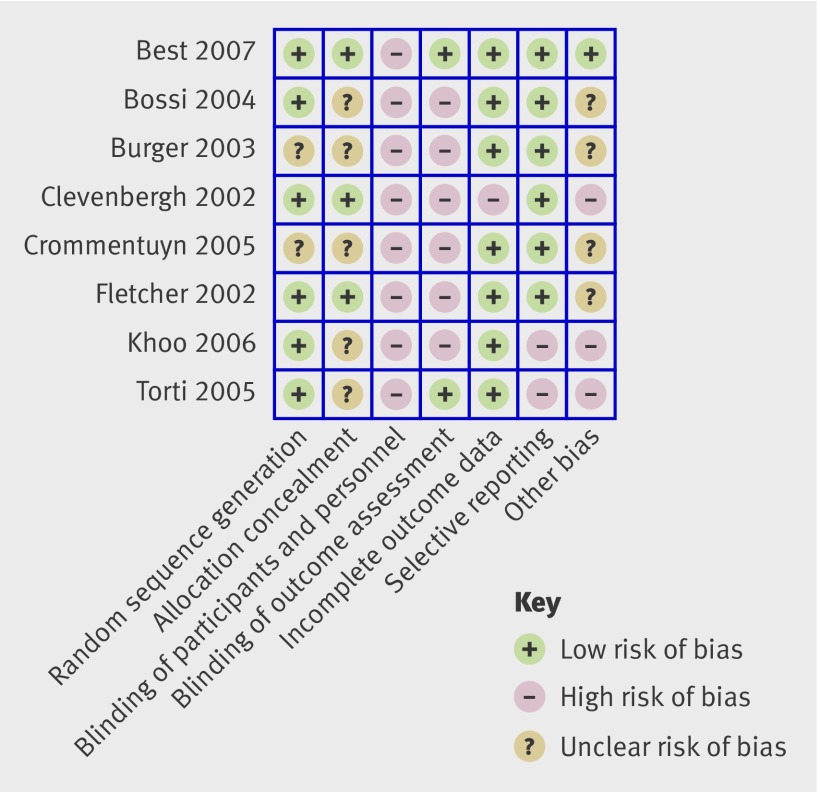
- The tool assesses six domains: selection bias, performance bias, detection bias, attrition bias, reporting bias, and other bias; each item has a support-for-judgment description and a judgment of low, unclear, or high risk of material bias.
- In evaluation, of 187 surveyed authors, 88% took longer than 10 minutes to complete the tool, 44% longer than 20 minutes, and 7% longer than an hour, but 83% considered the time taken acceptable.
- A cited study found a mean of 8.8 minutes per person for a single predetermined outcome using the tool compared with 1.5 minutes for a previous rating scale for quality of reporting; larger effect sizes were observed on average in studies rated at high risk of bias compared with low risk.
- Incomplete outcome data and selective reporting were the most difficult items to assess, with reported kappa measures of agreement of 0.32 (fair) and 0.13 (slight), respectively.
Methods
- The tool was developed at a May 2005 meeting by informal consensus, based on seven principles; detailed criteria and guidance were developed by pairs of authors and refined through feedback, email iterations, presentations, workshops, and pilot work, then published in February 2008.
- Evaluation began in early 2009 as a three-stage project: focus groups with review authors who had used the tool, three online surveys of review authors who had used the tool, review authors who had not used it, and editorial teams, plus a March 2010 meeting to consider revisions.
- The paper is a methods/guidance article describing the tool, its principles, presentation, summary assessment, and use in synthesis; survey findings are reported descriptively.
Limitations
- The paper states that the reliability of the tool has not been extensively studied and that, by explicitly incorporating judgments, agreements between assessors may not be as high as for some other tools.
- It states continuing uncertainty and great variation in practice over how to assess potential for bias in specific domains, how to summarise bias assessments across domains, and how to incorporate bias assessments into meta-analyses.
- Evident from the text: the evaluation reports selected survey percentages without a response rate or full survey methodology, and the reliability evidence cited is preliminary and limited.
Model-written summary. Check it against the paper before relying on it.
Integrity signals
Registry
Cites
Statistics
Figures
Verification
Claims the paper makes
0 Valid · 3 Not valid · 1 Not checked · 20 Own results and interpretations
In the paper
“This was published in February 2008 and adopted as the recommended method throughout the Cochrane Collaboration.”
What the sources say
- Not matchedcites [9] 9. Higgins JPT, Green S, eds. Cochrane handbook for systematic reviews of interventions . Wiley, 2008.
Couldn’t be matched to a paper, so it can’t be checked.
- Not matched
A result the paper reports from its own data — it cites no other source for it, so there is none to check. The quote shows it is in the paper.
In the paper
“The Cochrane Collaboration has developed a new tool for assessing risk of bias in randomised trials”
A result the paper reports from its own data — it cites no other source for it, so there is none to check. The quote shows it is in the paper.
In the paper
“The 2010 evaluation of the initial version found wide acceptance of the need for the risk of bias tool, with a consensus that it represents an improvement over methods previously recommended by the Collaboration or widely used in systematic reviews.”
A result the paper reports from its own data — it cites no other source for it, so there is none to check. The quote shows it is in the paper.
In the paper
“Participants in the focus groups noted that the tool took longer to complete than previous methods.”
A result the paper reports from its own data — it cites no other source for it, so there is none to check. The quote shows it is in the paper.
In the paper
“We believe our risk of bias tool is one of the most comprehensive approaches to assessing the potential for bias in randomised trials included in systematic reviews or meta-analyses.”
19 more claims
Create a free account to see all 24 claims and every source verdict.
Claims other papers make about this one
Each is checked against this paper’s own text: does it say what the citing paper says it does?
The source backs part of the claim, not all of it — or backs it for a different population, condition or comparison.
In the citing paper
“The methodological quality of the RCTs was assessed using the Cochrane collaboration’s Risk Interventions Risk of Bias Tool (Higgins et al., 2011) reporting each of its five domains (adequate randomization and allocation, blinding, loss to follow-up, selective reporting, and other sources of potential bias) into a low risk of bias, high risk of bias, or unclear risk of bias.”
From Augmentation strategies for treatment resistant major depression: A systematic review and network meta-analysis (2022) · cites this paper as Higgins et al., 2011
Experimental — accuracy not yet measuredThe source backs part of the claim, not all of it — or backs it for a different population, condition or comparison.
In the citing paper
“Checklists and protocols for gauging the quality of evidence in a systematic fashion 8,9 also do not single out these problematic reports.”
From Fraudulent studies are undermining the reliability of systematic reviews: on the prevalence of problematic images in preclinical depression studies (2025) · cites this paper as [9]
Experimental — accuracy not yet measuredThe source backs part of the claim, not all of it — or backs it for a different population, condition or comparison.
In the citing paper
“When assessing the risk of bias, seven general principles are relevant, based on theoretical considerations, empirical work, and the experience with assessing risk of bias in RCTs and other studies [55–57].”
From COSMOS-E: Guidance on conducting systematic reviews and meta-analyses of observational studies of etiology (2019) · cites this paper as [55]
Experimental — accuracy not yet measuredThe source backs part of the claim, not all of it — or backs it for a different population, condition or comparison.
In the citing paper
“Four reviewers (J.d.P.-C., B.d.P.-C., R.M.A.-R., and J.R.-M.) independently assessed the risk of bias of the included studies according to version 2 of the Cochrane riskof-bias tool for randomized trials (RoB 2) (26).”
From Optimal Dose and Type of Physical Activity to Improve Glycemic Control in People Diagnosed With Type 2 Diabetes: A Systematic Review and Meta-analysis (2024) · cites this paper as [26]
Experimental — accuracy not yet measuredThe source backs part of the claim, not all of it — or backs it for a different population, condition or comparison.
In the citing paper
“RCTs were appraised using the Cochrane RoB 2 tool and observational studies using methodological index for non-randomized studies (MINORS).13,14”
From Perioperative Analgesia and Postoperative Nausea and Vomiting Management in Otoplasty: A Systematic Review (2026) · cites this paper as [13]
Experimental — accuracy not yet measured
113 more claims about this paper
Create a free account to see every claim other papers make about this one.
Citations
Cites
Cochrane Handbook for Systematic Reviews of Interventions: Cochrane Book Series
(2008) · doi:10.1002/9780470712184 · Cited by 25,048
Self-citationGRADE: an emerging consensus on rating quality of evidence and strength of recommendations
Guyatt, G. H., Oxman, A. D., Vist, G. E., Kunz, R., Falck-Ytter, Y., Alonso-Coello, P., & Schünemann, H. J. (2008) · BMJ · doi:10.1136/bmj.39489.470347.ad · Cited by 23,305
Self-citationAssessing Risk of Bias in Included Studies
Higgins, J. P., & Altman, D. G. (2008) · Cochrane Handbook for Systematic Reviews of Interventions · doi:10.1002/9780470712184.ch8 · Cited by 3,396
Self-citationAssessing the quality of controlled clinical trials
Jüni, P., Altman, D. G., & Egger, M. (2001) · BMJ · doi:10.1136/bmj.323.7303.42 · Cited by 3,309
Self-citationWood, L., Egger, M., Gluud, L. L., Schulz, K. F., Jüni, P., Altman, D. G., Gluud, C., Martin, R. M., Wood, A. J. G., & Sterne, J. A. C. (2008) · BMJ · doi:10.1136/bmj.39465.451748.ad · Cited by 2,538
Self-citationSystematic Reviews in Health Care : Meta-Analysis in Context
Egger, M., Smith, G. D., & Altman, D. G. (2000) · Cited by 2,413
Self-citationThe Hazards of Scoring the Quality of Clinical Trials for Meta-analysis
Jüni, P. (1999) · JAMA · doi:10.1001/jama.282.11.1054 · Cited by 1,981
Self-citationMoher, D., Jadad, A. R., Nichol, G., Penman, M., Tugwell, P., & Walsh, S. (1995) · Controlled Clinical Trials · doi:10.1016/0197-2456(94)00031-w · Cited by 1,308
Self-citationControlling the risk of spurious findings from meta-regression
Higgins, J. P. T., & Thompson, S. G. (2004) · Statistics in Medicine · doi:10.1002/sim.1752 · Cited by 1,267
Self-citationDiscrepancies between Meta-Analyses and Subsequent Large Randomized, Controlled Trials
LeLorier, J., Grégoire, G., Benhaddad, A., Lapierre, J., & Derderian, F. (1997) · New England Journal of Medicine · doi:10.1056/nejm199708213370806 · Cited by 1,171
Research works printed but not linked: 3
- [9]9. Higgins JPT, Green S, eds. Cochrane handbook for systematic reviews of interventions . Wiley, 2008.
- [16]16. No commercial reuse: See rights and reprints http://www.bmj.com/permissions Subscribe: http://www.bmj.com/subscribe BMJ 2008;336:924-6.
- [17]17. Schünemann HJ, Oxman AD, Higgins JPT, Vist GE, Glasziou P, Guyatt GH, et al. Presenting results and "Summary of findings" tables. In: Higgins JPT, Green S, eds. Cochrane handbook for systematic reviews of interventions . Wiley, 2008:335-8.
Cited by
Items 1,301–1,400 of 2,382
Intravenous Vitamin C and Cancer: A Systematic Review
Fritz, H., Flower, G., Weeks, L., Cooley, K., Callachan, M., McGowan, J., Skidmore, B., Kirchner, L., & Seely, D. (2014) · Integrative Cancer Therapies · doi:10.1177/1534735414534463 · Cited by 124
Self-citationArmijo-Olivo, S., Ospina, M., da Costa, B. R., Egger, M., Saltaji, H., Fuentes, J., Ha, C., & Cummings, G. G. (2014) · PLoS ONE · doi:10.1371/journal.pone.0096920 · Cited by 124
Effect of probiotics on depressive symptoms: a meta-analysis of human studies
Goh, K. K., Liu, Y.-W., Kuo, P.-H., Chung, Y.-C. E., Lu, M.-L., & Chen, C.-H. (2019) · Psychiatry Research · doi:10.1016/j.psychres.2019.112568 · Cited by 123
Jones, B. D. M., Razza, L. B., Weissman, C. R., Karbi, J., Vine, T., Mulsant, L. S., Brunoni, A. R., Husain, M. I., Mulsant, B. H., Blumberger, D. M., et al. (2021) · JAMA Network Open · doi:10.1001/jamanetworkopen.2021.25531 · Cited by 121
Reis, D. J., Ilardi, S. S., & Punt, S. E. W. (2018) · PLOS ONE · doi:10.1371/journal.pone.0199041 · Cited by 123
Dauriz, M., Mantovani, A., Bonapace, S., Verlato, G., Zoppini, G., Bonora, E., & Targher, G. (2017) · Diabetes Care · doi:10.2337/dc17-0697 · Cited by 123
Heywood, R., McCarthy, A. L., & Skinner, T. L. (2017) · Supportive Care in Cancer · doi:10.1007/s00520-017-3827-0 · Cited by 123
Pouls, B. P. H., Vriezekolk, J. E., Bekker, C. L., Linn, A. J., van Onzenoort, H. A. W., Vervloet, M., van Dulmen, S., & van den Bemt, B. J. F. (2021) · Journal of Medical Internet Research · doi:10.2196/18901 · Cited by 123
Dal Farra, F., Risio, R. G., Vismara, L., & Bergna, A. (2021) · Complementary Therapies in Medicine · doi:10.1016/j.ctim.2020.102616 · Cited by 123
Nasal vs Oronasal CPAP for OSA Treatment
Andrade, R. G. S., Viana, F. M., Nascimento, J. A., Drager, L. F., Moffa, A., Brunoni, A. R., Genta, P. R., & Lorenzi-Filho, G. (2018) · Chest · doi:10.1016/j.chest.2017.10.044 · Cited by 122
Sherifali, D., Nerenberg, K. A., Wilson, S., Semeniuk, K., Ali, M. U., Redman, L. M., & Adamo, K. B. (2017) · Journal of Medical Internet Research · doi:10.2196/jmir.8006 · Cited by 122
How to prove that your therapy is effective, even when it is not: a guideline
Cuijpers, P., & Cristea, I. A. (2016) · Epidemiology and Psychiatric Sciences · doi:10.1017/s2045796015000864 · Cited by 122
Kriston, L., von Wolff, A., Westphal, A., Hölzel, L. P., & Härter, M. (2014) · Depression and Anxiety · doi:10.1002/da.22236 · Cited by 119
Zhou, S., Tao, Y., Huang, K., Zhu, B., & Tao, F. (2017) · Journal of Obstetrics and Gynaecology Research · doi:10.1111/jog.13239 · Cited by 122
Duan, J.-Y., Zheng, W.-H., Zhou, H., Xu, Y., & Huang, H.-B. (2021) · Critical Care · doi:10.1186/s13054-021-03508-6 · Cited by 122
Seidu, S., Kunutsor, S. K., Ajjan, R. A., & Choudhary, P. (2024) · Diabetes Care · doi:10.2337/dc23-1520 · Cited by 124
A proposed framework for developing quality assessment tools
Whiting, P., Wolff, R., Mallett, S., Simera, I., & Savović, J. (2017) · Systematic Reviews · doi:10.1186/s13643-017-0604-6 · Cited by 121
Self-citationA meta-analysis of the efficacy of gabapentin for treating alcohol use disorder
Kranzler, H. R., Feinn, R., Morris, P., & Hartwell, E. E. (2019) · Addiction · doi:10.1111/add.14655 · Cited by 121
Chamberlain, C., Gee, G., Harfield, S., Campbell, S., Brennan, S., Clark, Y., Mensah, F., Arabena, K., Herrman, H., Brown, S., et al. (2019) · PLOS ONE · doi:10.1371/journal.pone.0213460 · Cited by 121
Grace, S. A., Rossell, S. L., Heinrichs, M., Kordsachia, C., & Labuschagne, I. (2018) · Psychoneuroendocrinology · doi:10.1016/j.psyneuen.2018.05.031 · Cited by 120
“Second, the Cochrane Collaboration’s tool for assessing risk of bias (Higgins et al., 2011) was used to assess the within-study risk of bias in included studies systematically (Supplementary Table S4).”
Shah, E. D., Kim, H. M., & Schoenfeld, P. (2018) · American Journal of Gastroenterology · doi:10.1038/ajg.2017.495 · Cited by 119
Blazevich, A. J., Wilson, C. J., Alcaraz, P. E., & Rubio-Arias, J. A. (2020) · Sports Medicine · doi:10.1007/s40279-019-01239-x · Cited by 119
Im, S., Stavas, J., Lee, J., Mir, Z., Hazlett-Stevens, H., & Caplovitz, G. (2021) · Clinical Psychology Review · doi:10.1016/j.cpr.2021.101972 · Cited by 108
Cuijpers, P., Karyotaki, E., Ciharova, M., Miguel, C., Noma, H., Stikkelbroek, Y., Weisz, J. R., & Furukawa, T. A. (2023) · European Child & Adolescent Psychiatry · doi:10.1007/s00787-021-01884-6 · Cited by 118
Salehinejad, M. A., Nejati, V., Mosayebi-Samani, M., Mohammadi, A., Wischnewski, M., Kuo, M.-F., Avenanti, A., Vicario, C. M., & Nitsche, M. A. (2020) · Neuroscience Bulletin · doi:10.1007/s12264-020-00501-x · Cited by 118
Cognitive Behaviour Therapy for Health Anxiety: A Systematic Review and Meta-Analysis
Cooper, K., Gregory, J. D., Walker, I., Lambe, S., & Salkovskis, P. M. (2017) · Behavioural and Cognitive Psychotherapy · doi:10.1017/s1352465816000527 · Cited by 118
Alhazzani, W., Jacobi, J., Sindi, A., Hartog, C., Reinhart, K., Kokkoris, S., Gerlach, H., Andrews, P., Drabek, T., Manzanares, W., et al. (2013) · Critical Care Medicine · doi:10.1097/ccm.0b013e31828a24c6 · Cited by 118
Senftleber, N., Nielsen, S., Andersen, J., Bliddal, H., Tarp, S., Lauritzen, L., Furst, D., Suarez-Almazor, M., Lyddiatt, A., & Christensen, R. (2017) · Nutrients · doi:10.3390/nu9010042 · Cited by 114
Marijuana Use, Respiratory Symptoms, and Pulmonary Function: A Systematic Review and Meta-analysis
Ghasemiesfe, M., Ravi, D., Vali, M., Korenstein, D., Arjomandi, M., Frank, J., Austin, P. C., & Keyhani, S. (2018) · Annals of Internal Medicine · doi:10.7326/m18-0522 · Cited by 117
Tricco, A. C., Ashoor, H. M., Antony, J., Beyene, J., Veroniki, A. A., Isaranuwatchai, W., Harrington, A., Wilson, C., Tsouros, S., Soobiah, C., et al. (2014) · BMJ · doi:10.1136/bmj.g5459 · Cited by 117
Self-citationPeer support in critical care: A systematic review.
Haines, K. J., Beesley, S. J., Hopkins, R. O., McPeake, J., Quasim, T., Ritchie, K., & Iwashyna, T. J. (2018) · Critical Care Medicine · doi:10.1097/ccm.0000000000003293 · Cited by 117
Effects of anti-diabetic drugs on fracture risk: a systematic review and network meta-analysis
Zhang, Y.-S., Zheng, Y.-D., Yuan, Y., Chen, S.-C., & Xie, B.-C. (2021) · Frontiers in Endocrinology · doi:10.3389/fendo.2021.735824 · Cited by 117
Hewitt, S., Sephton, R., & Yeowell, G. (2020) · Journal of Medical Internet Research · doi:10.2196/15617 · Cited by 116
Speyer, H., Jakobsen, A. S., Westergaard, C., Nørgaard, H. C. B., Pisinger, C., Krogh, J., Hjorthøj, C., Nordentoft, M., Gluud, C., Correll, C. U., et al. (2019) · Psychotherapy and Psychosomatics · doi:10.1159/000502293 · Cited by 116
The Effects of Mind-Body Interventions on Sleep Quality: A Systematic Review
Neuendorf, R., Wahbeh, H., Chamine, I., Yu, J., Hutchison, K., & Oken, B. S. (2015) · Evidence-Based Complementary and Alternative Medicine · doi:10.1155/2015/902708 · Cited by 116
Caradeux, J., Martinez-Portilla, R. J., Basuki, T. R., Kiserud, T., & Figueras, F. (2018) · American Journal of Obstetrics and Gynecology · doi:10.1016/j.ajog.2017.11.566 · Cited by 115
Benkhadra, K., Alahdab, F., Tamhane, S. U., McCoy, R. G., Prokop, L. J., & Murad, M. H. (2017) · Endocrine · doi:10.1007/s12020-016-1039-x · Cited by 113
Silva Guerrero, A. V., Maujean, A., Campbell, L., & Sterling, M. (2018) · The Clinical Journal of Pain · doi:10.1097/ajp.0000000000000601 · Cited by 116
Korterink, J. J., Ockeloen, L., Benninga, M. A., Tabbers, M. M., Hilbink, M., & Deckers‐Kocken, J. M. (2014) · Acta Paediatrica · doi:10.1111/apa.12513 · Cited by 115
Wiers, R. W., Boffo, M., & Field, M. (2018) · Journal of Studies on Alcohol and Drugs · doi:10.15288/jsad.2018.79.333 · Cited by 115
Willcutts, K. F., Chung, M. C., Erenberg, C. L., Finn, K. L., Schirmer, B. D., & Byham-Gray, L. D. (2016) · Annals of Surgery · doi:10.1097/sla.0000000000001644 · Cited by 115
Neel, M. L. M., Stark, A. R., & Maitre, N. L. (2018) · Child: Care, Health and Development · doi:10.1111/cch.12561 · Cited by 114
Systematic reviews: guidance relevant for studies of older people
Shenkin, S. D., Harrison, J. K., Wilkinson, T., Dodds, R. M., & Ioannidis, J. P. A. (2017) · Age and Ageing · doi:10.1093/ageing/afx105 · Cited by 109
Singh, A. K., & Singh, R. (2020) · Diabetes & Metabolic Syndrome: Clinical Research & Reviews · doi:10.1016/j.dsx.2020.02.012 · Cited by 114
Kahleova, H., Salas-Salvadó, J., Rahelić, D., Kendall, C. W., Rembert, E., & Sievenpiper, J. L. (2019) · Nutrients · doi:10.3390/nu11092209 · Cited by 114
Clarke, K., Mayo-Wilson, E., Kenny, J., & Pilling, S. (2015) · Clinical Psychology Review · doi:10.1016/j.cpr.2015.04.002 · Cited by 113
Bonovas, S., Fiorino, G., Allocca, M., Lytras, T., Tsantes, A., Peyrin-Biroulet, L., & Danese, S. (2016) · Medicine · doi:10.1097/md.0000000000002308 · Cited by 113
Marker, I., & Norton, P. J. (2018) · Clinical Psychology Review · doi:10.1016/j.cpr.2018.04.004 · Cited by 112
Kitchiner, N. J., Lewis, C., Roberts, N. P., & Bisson, J. I. (2019) · European Journal of Psychotraumatology · doi:10.1080/20008198.2019.1684226 · Cited by 113
Kempler, L., Sharpe, L., Miller, C. B., & Bartlett, D. J. (2016) · Sleep Medicine Reviews · doi:10.1016/j.smrv.2015.08.002 · Cited by 113
Bunn, D. K., Abdelhamid, A., Copley, M., Cowap, V., Dickinson, A., Howe, A., Killett, A., Poland, F., Potter, J. F., Richardson, K., et al. (2016) · BMC Geriatrics · doi:10.1186/s12877-016-0256-8 · Cited by 113
Li, Z., Peng, X., Xiang, W., Han, J., & Li, K. (2018) · Aging Clinical and Experimental Research · doi:10.1007/s40520-018-0998-6 · Cited by 110
Bland, K. A., Zadravec, K., Landry, T., Weller, S., Meyers, L., & Campbell, K. L. (2019) · Critical Reviews in Oncology/Hematology · doi:10.1016/j.critrevonc.2019.02.005 · Cited by 109
Behavioral activation for children and adolescents: a systematic review of progress and promise
Martin, F., & Oliver, T. (2019) · European Child & Adolescent Psychiatry · doi:10.1007/s00787-018-1126-z · Cited by 111
Ketogenic diet for the treatment of pediatric epilepsy: review and meta-analysis
Sourbron, J., Klinkenberg, S., van Kuijk, S. M. J., Lagae, L., Lambrechts, D., Braakman, H. M. H., & Majoie, M. (2020) · Child's Nervous System · doi:10.1007/s00381-020-04578-7 · Cited by 111
Newton, N. C., Champion, K. E., Slade, T., Chapman, C., Stapinski, L., Koning, I., Tonks, Z., & Teesson, M. (2017) · Drug and Alcohol Review · doi:10.1111/dar.12497 · Cited by 111
Boumparis, N., Loheide-Niesmann, L., Blankers, M., Ebert, D. D., Korf, D., Schaub, M. P., Spijkerman, R., Tait, R. J., & Riper, H. (2019) · Drug and Alcohol Dependence · doi:10.1016/j.drugalcdep.2019.03.016 · Cited by 110
Gallardo-Gómez, D., Salazar-Martínez, E., Alfonso-Rosa, R. M., Ramos-Munell, J., del Pozo-Cruz, J., del Pozo Cruz, B., & Álvarez-Barbosa, F. (2024) · Diabetes Care · doi:10.2337/dc23-0800 · Cited by 137
Mindfulness-Based Interventions for Youth With Anxiety: A Systematic Review and Meta-Analysis
Borquist-Conlon, D. S., Maynard, B. R., Brendel, K. E., & Farina, A. S. J. (2019) · Research on Social Work Practice · doi:10.1177/1049731516684961 · Cited by 111
Three risk of bias tools lead to opposite conclusions in observational research synthesis
Losilla, J.-M., Oliveras, I., Marin-Garcia, J. A., & Vives, J. (2018) · Journal of Clinical Epidemiology · doi:10.1016/j.jclinepi.2018.05.021 · Cited by 111
Silverii, G. A., Monami, M., Gallo, M., Ragni, A., Prattichizzo, F., Renzelli, V., Ceriello, A., & Mannucci, E. (2024) · Diabetes Obesity and Metabolism · doi:10.1111/dom.15382 · Cited by 113
Supplemental Vitamins and Minerals for Cardiovascular Disease Prevention and Treatment
Jenkins, D. J. A., Spence, J. D., Giovannucci, E. L., Kim, Y.-I., Josse, R. G., Vieth, R., Sahye-Pudaruth, S., Paquette, M., Patel, D., Blanco Mejia, S., et al. (2021) · Journal of the American College of Cardiology · doi:10.1016/j.jacc.2020.09.619 · Cited by 110
Sweegers, M. G., Altenburg, T. M., Brug, J., May, A. M., van Vulpen, J. K., Aaronson, N. K., Arbane, G., Bohus, M., Courneya, K. S., Daley, A. J., et al. (2019) · British Journal of Sports Medicine · doi:10.1136/bjsports-2018-099191 · Cited by 109
Self-citationDietary Nitrate from Beetroot Juice for Hypertension: A Systematic Review
Bonilla Ocampo, D., Paipilla, A., Marín, E., Vargas-Molina, S., Petro, J., & Pérez-Idárraga, A. (2018) · Biomolecules · doi:10.3390/biom8040134 · Cited by 110
Tools used to assess the quality of peer review reports: A methodological systematic review
Superchi, C., González, J. A., Solà, I., Cobo, E., Hren, D., & Boutron, I. (2019) · BMC Medical Research Methodology · doi:10.1186/s12874-019-0688-x · Cited by 128
Montgomery, P., & Maunders, K. (2015) · Children and Youth Services Review · doi:10.1016/j.childyouth.2015.05.010 · Cited by 110
Ou, X., Hua, Y., Liu, J., Gong, C., & Zhao, W. (2017) · Canadian Medical Association Journal · doi:10.1503/cmaj.160570 · Cited by 109
Ultrasound Guidance Facilitates Radial Artery Catheterization
Gu, W.-J., Wu, X.-D., Wang, F., Ma, Z.-L., & Gu, X.-P. (2016) · Chest · doi:10.1378/chest.15-1784 · Cited by 109
Catalá-López, F., Macías Saint-Gerons, D., González-Bermejo, D., Rosano, G. M., Davis, B. R., Ridao, M., Zaragoza, A., Montero-Corominas, D., Tobías, A., de la Fuente-Honrubia, C., et al. (2016) · PLOS Medicine · doi:10.1371/journal.pmed.1001971 · Cited by 109
Creamer, J., Attridge, M., Ramsden, M., Cannings‐John, R., & Hawthorne, K. (2016) · Diabetic Medicine · doi:10.1111/dme.12865 · Cited by 109
Mindfulness induction and cognition: A systematic review and meta-analysis
Gill, L.-N., Renault, R., Campbell, E., Rainville, P., & Khoury, B. (2020) · Consciousness and Cognition · doi:10.1016/j.concog.2020.102991 · Cited by 98
Ye, Y., Liu, X., Wu, N., Han, Y., Wang, J., Yu, Y., & Chen, Q. (2021) · Frontiers in Pharmacology · doi:10.3389/fphar.2021.653887 · Cited by 109
Heynsbergh, N., Heckel, L., Botti, M., & Livingston, P. M. (2018) · BMC Cancer · doi:10.1186/s12885-018-4160-9 · Cited by 109
Thomas, E., Wickramasinghe, K., Mendis, S., Roberts, N., & Foster, C. (2015) · BMC Public Health · doi:10.1186/s12889-015-2024-7 · Cited by 109
Pérez-López, F. R., Martínez-Domínguez, S. J., Lajusticia, H., & Chedraui, P. (2017) · Maturitas · doi:10.1016/j.maturitas.2017.09.001 · Cited by 108
Baudard, M., Yavchitz, A., Ravaud, P., Perrodeau, E., & Boutron, I. (2017) · BMJ · doi:10.1136/bmj.j448 · Cited by 107
Gjuladin-Hellon, T., Davies, I. G., Penson, P., & Amiri Baghbadorani, R. (2019) · Nutrition Reviews · doi:10.1093/nutrit/nuy049 · Cited by 108
Wojnarowski, C., Firth, N., Finegan, M., & Delgadillo, J. (2019) · Behavioural and Cognitive Psychotherapy · doi:10.1017/s1352465819000080 · Cited by 108
Kolva, E., Hoffecker, L., & Cox-Martin, E. (2020) · Palliative and Supportive Care · doi:10.1017/s1478951519000610 · Cited by 108
Tao, D., Gao, Y., Cole, A., Baker, J. S., Gu, Y., Supriya, R., Tong, T. K., Hu, Q., & Awan-Scully, R. (2022) · Frontiers in Physiology · doi:10.3389/fphys.2022.925958 · Cited by 108
Huang, T.-S., Shyu, Y.-C., Chen, H.-Y., Lin, L.-M., Lo, C.-Y., Yuan, S.-S., & Chen, P.-J. (2013) · PLoS ONE · doi:10.1371/journal.pone.0054431 · Cited by 108
Basic study design influences the results of orthodontic clinical investigations
Papageorgiou, S. N., Xavier, G. M., & Cobourne, M. T. (2015) · Journal of Clinical Epidemiology · doi:10.1016/j.jclinepi.2015.03.008 · Cited by 108
Davies, C., Radua, J., Cipriani, A., Stahl, D., Provenzani, U., McGuire, P., & Fusar-Poli, P. (2018) · Frontiers in Psychiatry · doi:10.3389/fpsyt.2018.00187 · Cited by 107
Brief Mindfulness-Based Interventions for Acute and Chronic Pain: A Systematic Review
McClintock, A. S., McCarrick, S. M., Garland, E. L., Zeidan, F., & Zgierska, A. E. (2019) · The Journal of Alternative and Complementary Medicine · doi:10.1089/acm.2018.0351 · Cited by 107
Negative effects of psychotherapies for adult depression: A meta-analysis of deterioration rates
Cuijpers, P., Reijnders, M., Karyotaki, E., de Wit, L., & Ebert, D. D. (2018) · Journal of Affective Disorders · doi:10.1016/j.jad.2018.05.050 · Cited by 105
Jeminiwa, R., Hohmann, L., Qian, J., Garza, K., Hansen, R., & Fox, B. I. (2019) · Respiratory Medicine · doi:10.1016/j.rmed.2019.02.011 · Cited by 107
Axelsson, E., & Hedman-Lagerlöf, E. (2019) · Expert Review of Pharmacoeconomics & Outcomes Research · doi:10.1080/14737167.2019.1703182 · Cited by 96
for the FISSH Group (Fluids in Sepsis and Septic Shock), Rochwerg, B., Alhazzani, W., Gibson, A., Ribic, C. M., Sindi, A., Heels-Ansdell, D., Thabane, L., Fox-Robichaud, A., Mbuagbaw, L., et al. (2015) · Intensive Care Medicine · doi:10.1007/s00134-015-3794-1 · Cited by 106
Marsden, J., White, M., Annand, F., Burkinshaw, P., Carville, S., Eastwood, B., Kelleher, M., Knight, J., O'Connor, R., Tran, A., et al. (2019) · The Lancet Psychiatry · doi:10.1016/s2215-0366(19)30331-1 · Cited by 106
Singla, D. R., Waqas, A., Hamdani, S. U., Suleman, N., Zafar, S. W., Zill-e-Huma, Saeed, K., Servili, C., & Rahman, A. (2020) · Behaviour Research and Therapy · doi:10.1016/j.brat.2019.04.010 · Cited by 101
Guarino, A., Polini, C., Forte, G., Favieri, F., Boncompagni, I., & Casagrande, M. (2020) · Journal of Clinical Medicine · doi:10.3390/jcm9010209 · Cited by 106
Domhardt, M., Steubl, L., Boettcher, J., Buntrock, C., Karyotaki, E., Ebert, D. D., Cuijpers, P., & Baumeister, H. (2021) · Clinical Psychology Review · doi:10.1016/j.cpr.2020.101953 · Cited by 106
Step counter use in type 2 diabetes: a meta-analysis of randomized controlled trials
Qiu, S., Cai, X., Chen, X., Yang, B., & Sun, Z. (2014) · BMC Medicine · doi:10.1186/1741-7015-12-36 · Cited by 106
Naclerio, F., & Larumbe-Zabala, E. (2016) · Sports Medicine · doi:10.1007/s40279-015-0403-y · Cited by 106
Taylor, J. J., Rytwinski, T., Bennett, J. R., Smokorowski, K. E., Lapointe, N. W. R., Janusz, R., Clarke, K., Tonn, B., Walsh, J. C., & Cooke, S. J. (2019) · Environmental Evidence · doi:10.1186/s13750-019-0162-6 · Cited by 105
CPAP as treatment of sleep apnea after stroke: A meta-analysis of randomized trials
Brill, A.-K., Horvath, T., Seiler, A., Camilo, M., Haynes, A. G., Ott, S. R., Egger, M., & Bassetti, C. L. (2018) · Neurology · doi:10.1212/wnl.0000000000005262 · Cited by 105
Vallury, K. D., Jones, M., & Oosterbroek, C. (2015) · Journal of Medical Internet Research · doi:10.2196/jmir.4145 · Cited by 105
Sebri, V., Durosini, I., Triberti, S., & Pravettoni, G. (2021) · Frontiers in Psychology · doi:10.3389/fpsyg.2021.611954 · Cited by 104
“Risk of Bias The quality appraisal of the selected studies was assessed through the Cochrane risk of bias tool, version 2 (RoB 2; Higgins et al., 2011).”
InfluentialSystematic Review of the Literature: Best Practices
Gupta, S., Rajiah, P., Middlebrooks, E. H., Baruah, D., Carter, B. W., Burton, K. R., Chatterjee, A. R., & Miller, M. M. (2018) · Academic Radiology · doi:10.1016/j.acra.2018.04.025 · Cited by 105
Boumparis, N., Karyotaki, E., Kleiboer, A., Hofmann, S. G., & Cuijpers, P. (2016) · Journal of Affective Disorders · doi:10.1016/j.jad.2016.05.019 · Cited by 105
Metadata
- Authors
- Higgins, J. P. T., Altman, D. G., Gotzsche, P. C., Juni, P., Moher, D., Oxman, A. D., Savovic, J., Schulz, K. F., Weeks, L., Sterne, J. A. C., Cochrane Bias Methods Group, & Cochrane Statistical Methods Group
- Affiliations
- MRC Biostatistics Unit (GB)
- University of Oxford (GB)
- University of Ottawa (CA)
- Nasjonalt Kunnskapssenter for Helsetjenesten (NO)
- Family Health International 360 (US)
- Ottawa Hospital Research Institute (CA)
- University of Bristol (GB)
- Corresponding author
- Higgins, J. P. T.
- Venue
- BMJ
- Publisher
- BMJ
- Published
- 2011-10-18
- Volume
- 343
- Issue
- oct18 2
- Pages
- d5928-d5928
- ISSN
- 0007-1447 (ISSN-L)
- 0959-8138
- 1468-5833
- PMC
- PMC3196245
- OpenAlex
- W2098923148
- Cited by
- 33,817
- References
- 26
- Citations by year
- 2026: 1970 · 2025: 3214 · 2024: 3745 · 2023: 3530 · 2022: 4008 · 2021: 4125 · 2020: 3755 · 2019: 2714 · 2018: 2012 · 2017: 1569 · 2016: 1203 · 2015: 881 · 2014: 591 · 2013: 342 · 2012: 97
- FWCI
- 352.06
- Type
- journal article
- Language
- en
- Open access
- hybrid
- doi.org
- Licence
- cc-by-nc
- Locations
- BMJ (publishedVersion, cc-by-nc)
- Europe PMC (PubMed Central) (publishedVersion, cc-by-nc)
- PubMed Central (publishedVersion, cc-by-nc)
- PubMed (publishedVersion)
- Research at the University of Copenhagen (University of Copenhagen) (publishedVersion)
- Bristol Research (University of Bristol) (publishedVersion)
- Bern Open Repository and Information System (University of Bern) (submittedVersion, cc-by-nc)
- Open Access CRIS of the University of Bern
- Funders
- Cancer Research UK (C-5592)
- Canadian Institutes of Health Research
- Topics
- Social Sciences › Decision Sciences › Statistics, Probability and Uncertainty › Meta-analysis and systematic reviews
- Physical Sciences › Mathematics › Statistics and Probability › Statistical Methods in Clinical Trials
- Physical Sciences › Mathematics › Statistics and Probability › Statistical Methods in Epidemiology
- Keywords
- risk of bias, Cochrane risk of bias tool, randomised trials, trial design flaws, trial conduct, trial analysis, trial reporting, bias assessment
- MeSH terms
- Humans, Research Design, Bias, Randomized Controlled Trials as Topic, Risk Assessment
About these checks
Registry, retraction, Cites and statistics results are computed, not judged, with one exception: a printed reference that no index lists is read once by a model before it counts as a citation error. Claims are extracted by a model and kept only when their quote appears verbatim in the text; each cited source is then checked, with a model’s help, for whether it says what the claim relies on. Those verdicts can be wrong — read the claim’s quote and the cited source before relying on one.
A language model drew the claims from the paper on 2026-09-24 (prompt extract-v1).
Statistics and arithmetic are recomputed, not judged.
Confidence bands are shown only for fields calibrated on our annotated test set. None is calibrated yet, so no band is shown.
What counts as a claim ›How we measure confidence ›How we check this ›
Are you an author, or do you see a problem with this page? Request a review
Data sources
Bibliographic data: Semantic Scholar, OpenAlex, Crossref.
Contains information from the Semantic Scholar Academic Graph Datasets, made available under the ODC Attribution License (ODC-BY 1.0).
Semantic Scholar’s data is described in: Kinney, R., et al. (2023). The Semantic Scholar Open Data Platform. arXiv:2301.10140.
