

Medical cannabinoids: a pharmacology-based systematic review and meta-analysis for all relevant medical indications.
Open accessThe DOI matches its Crossref record; 265 of the 267 references it cites were found in a registry or an index; 8 of the 17 sources its claims cite were checked for support.
Abstract
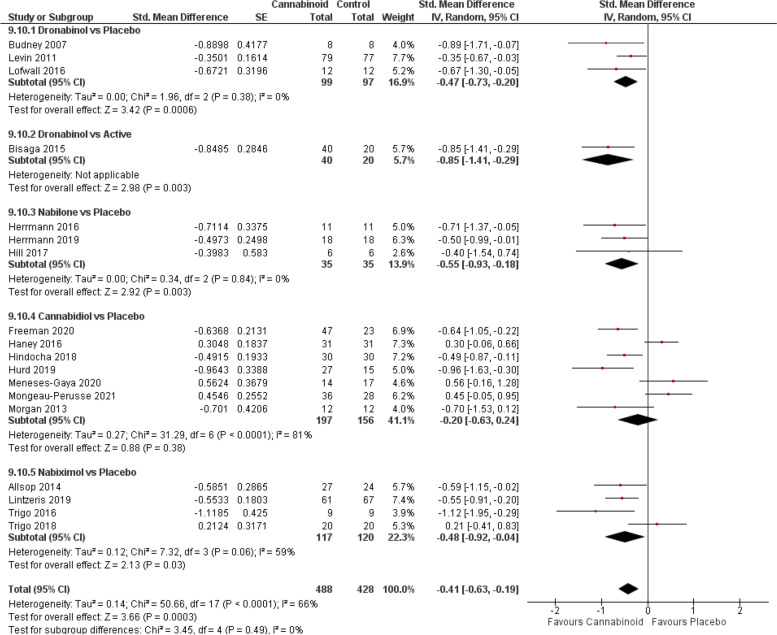
BACKGROUND: Medical cannabinoids differ in their pharmacology and may have different treatment effects. We aimed to conduct a pharmacology-based systematic review (SR) and meta-analyses of medical cannabinoids for efficacy, retention and adverse events. METHODS: We systematically reviewed (registered at PROSPERO: CRD42021229932) eight databases for randomized controlled trials (RCTs) of dronabinol, nabilone, cannabidiol and nabiximols for chronic pain, spasticity, nausea /vomiting, appetite, ALS, irritable bowel syndrome, MS, Chorea Huntington, epilepsy, dystonia, Parkinsonism, glaucoma, ADHD, anorexia nervosa, anxiety, dementia, depression, schizophrenia, PTSD, sleeping disorders, SUD and Tourette. Main outcomes and measures included patient-relevant/disease-specific outcomes, retention and adverse events. Data were calculated as standardized mean difference (SMD) and ORs with confidence intervals (CI) via random effects. Evidence quality was assessed by the Cochrane Risk of Bias and GRADE tools. RESULTS: In total, 152 RCTs (12,123 participants) were analysed according to the type of the cannabinoid, outcome and comparator used, resulting in 84 comparisons. Significant therapeutic effects of medical cannabinoids show a large variability in the grade of evidence that depends on the type of cannabinoid. CBD has a significant therapeutic effect for epilepsy (SMD - 0.5[CI - 0.62, - 0.38] high grade) and Parkinsonism (- 0.41[CI - 0.75, - 0.08] moderate grade). There is moderate evidence for dronabinol for chronic pain (- 0.31[CI - 0.46, - 0.15]), appetite (- 0.51[CI - 0.87, - 0.15]) and Tourette (- 1.01[CI - 1.58, - 0.44]) and moderate evidence for nabiximols on chronic pain (- 0.25[- 0.37, - 0.14]), spasticity (- 0.36[CI - 0.54, - 0.19]), sleep (- 0.24[CI - 0.35, - 0.14]) and SUDs (- 0.48[CI - 0.92, - 0.04]). All other significant therapeutic effects have either low, very low, or even no grade of evidence. Cannabinoids produce different adverse events, and there is low to moderate grade of evidence for this conclusion depending on the type of cannabinoid. CONCLUSIONS: Cannabinoids are effective therapeutics for several medical indications if their specific pharmacological properties are considered. We suggest that future systematic studies in the cannabinoid field should be based upon their specific pharmacology.
Overview
CoChat Summary
## TL;DR
This pharmacology-based systematic review and meta-analysis found that medical cannabinoids have condition-specific benefits, with the strongest evidence for CBD in epilepsy and Parkinsonism, dronabinol for chronic pain/appetite/Tourette, and nabiximols for chronic pain/spasticity/sleep/SUDs. Across 152 RCTs (12,123 participants), cannabinoids also produced more adverse events, while retention generally did not differ from controls.
## Key findings
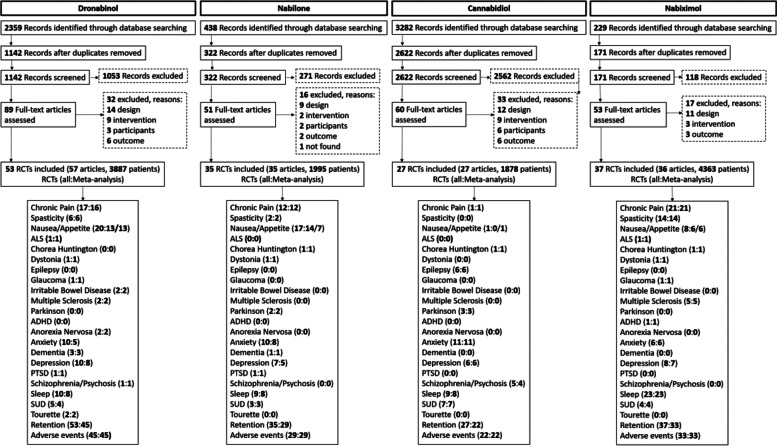
- The review included 152 RCTs with 12,123 participants, yielding 84 comparisons across 23 outcomes.
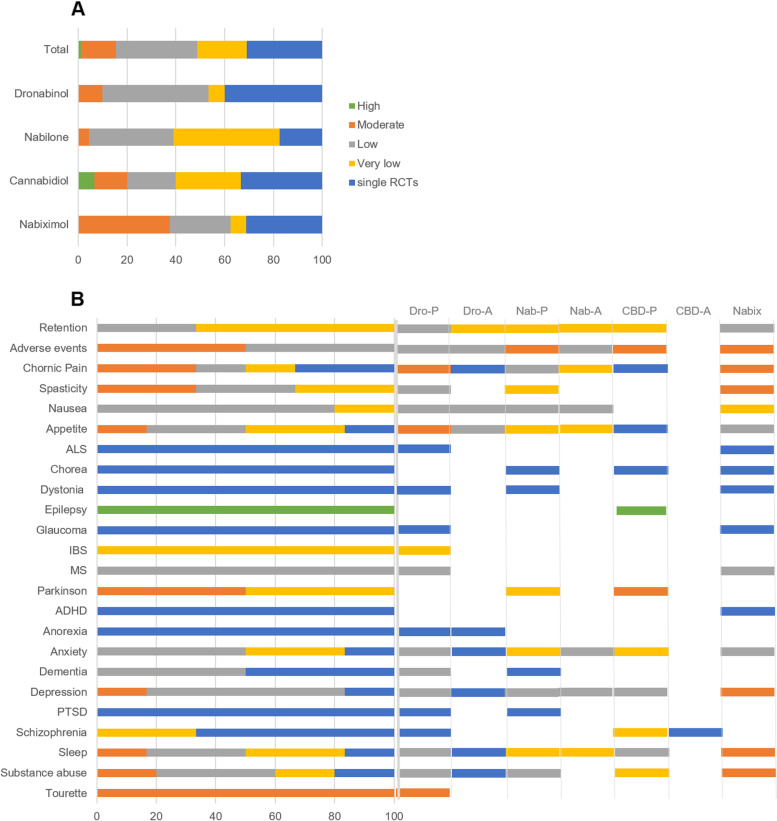
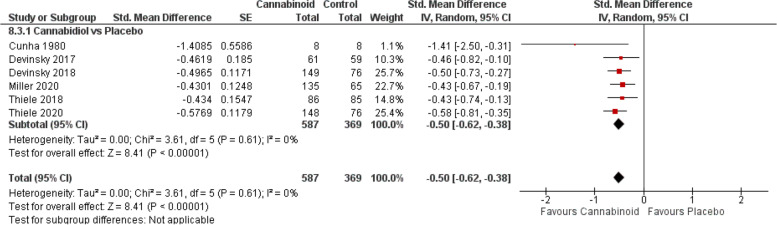
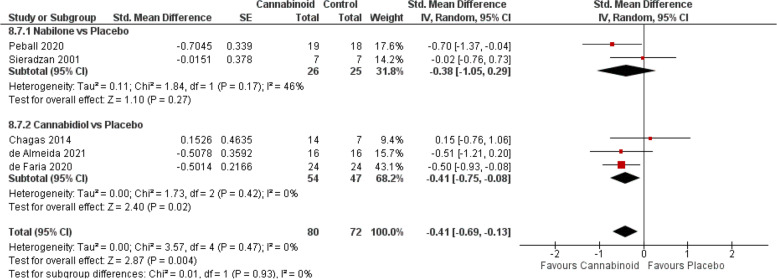
- CBD showed significant benefit for epilepsy (SMD −0.50, 95% CI −0.62 to −0.38; high-grade evidence) and Parkinsonism (SMD −0.41, 95% CI −0.75 to −0.08; moderate evidence).
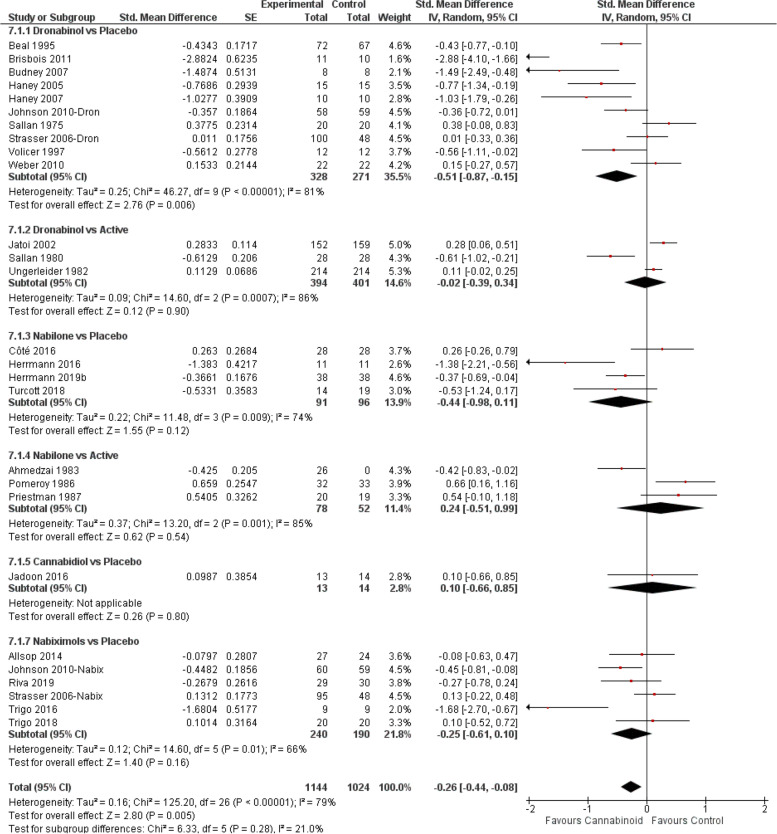
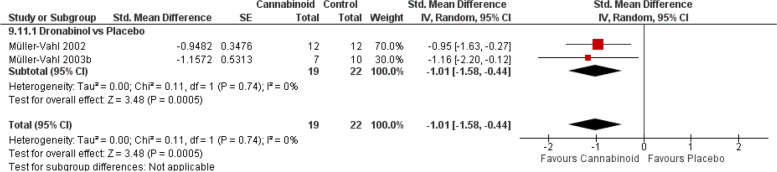
- Dronabinol had moderate evidence of benefit for chronic pain (SMD −0.31), appetite (SMD −0.51), and Tourette (SMD −1.01).
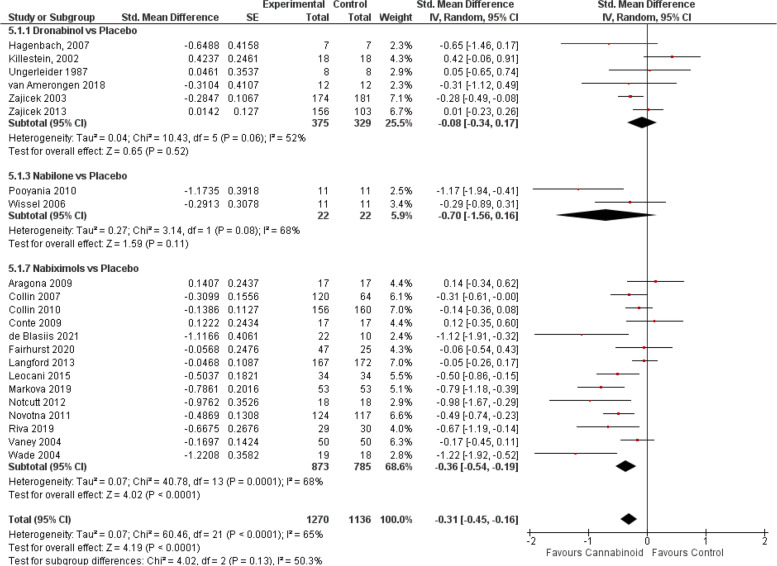
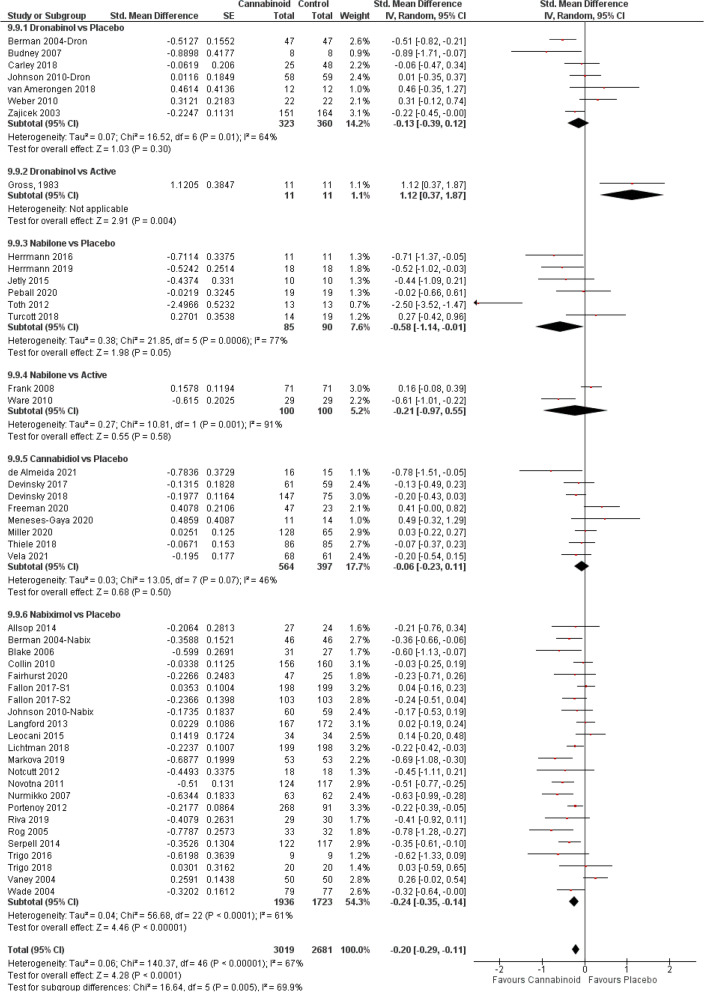
- Nabiximols had moderate evidence of benefit for chronic pain (SMD −0.25), spasticity (SMD −0.36), sleep (SMD −0.24), and SUDs (SMD −0.48).
- For safety, cannabinoids increased adverse events: e.g., dronabinol vs placebo OR 2.16, nabiximols OR 1.97, nabilone OR 3.12; however, overall retention was not significantly different (OR 1.12, P = 0.1).
## Methods
- Systematic review and meta-analysis of randomized controlled parallel and cross-over trials of dronabinol, nabilone, cannabidiol (CBD), and nabiximols, registered at PROSPERO (CRD42021229932) and conducted per PRISMA.
- Searched 8 databases through May 2021 with an update in October 2021; included humans of any age/sex with a medical condition and excluded non-RCT designs and smoked marijuana/other undefined cannabis products.
- Main analysis pooled continuous outcomes as SMDs and dichotomous outcomes as ORs using random-effects models, with subgroup analyses by cannabinoid type and comparator, plus meta-regression for subtype comparisons.
## Limitations
- The paper states that 15% of all studies (31% of all comparisons) could not be graded because they were single RCTs for ALS, Chorea Huntington, dystonia, glaucoma, ADHD, anorexia, and PTSD, so they were not included in the conclusions.
- The paper states that missing trials—especially for CBD—often prevented direct comparison across cannabinoid types, limiting conclusions.
- The paper states that many RCTs had small sample sizes, and that differences in sample characteristics, trial duration, dose, and route of administration contributed to heterogeneity; it also says a broader meta-regression with those covariates was not possible due to the small number of studies.
Model-written summary. Check it against the paper before relying on it.
Integrity signals
Registry
Cites
Statistics
Figures
Verification
Claims the paper makes
5 Valid · 1 Not valid · 10 Not checked · 83 Own results and interpretations
The cited sources support only part of this claim — read each source’s verdict below.
In the paper
“Small study sizes are of particular concern as it has been previously demonstrated that effects are larger in small studies using cannabinoids [2, 168].”
§ Medical cannabinoids: a pharmacology-based systematic review and meta-analysis for all relevant medical indications > Discussion Previous SRs and meta-analyses on cannabinoids [1–5] (and many others) did not consider, or only considered via sensitivity analysis, that medical cannabinoids and medical plant-derived cannabis products differ largely in their pharmacological mode of action [6–9] and pharmacokinetics [165]. For the first time, we provide pharmacology-based comparative systematic results for dronabinol, nabilone, CBD and nabiximols for all relevant medical indications. As shown in Fig. 2A, the confidence on the effect estimate strongly differs for these four medications. That is, high quality of evidence is seen only with CBD (6.7% of all CBD trials), and moderate quality of evidence is higher with CBD-containing (CBD 13.3%, nabiximols 37.5%) cannabinoids than with THC-containing (dronabinol 10%, nabilone 4.3%) medications. Notably, these differences are not directly related to a better efficacy, as the proportion of the 152 trials reporting positive results on their primary outcomes did not differ between cannabinoids (dronabinol 52%, nabilone 70%, CBD 52% and nabiximols 57%), resulting in an overall positive effect (data not shown, SMD − 0.33, 95% CI − 0.40 to 0.26; P = 0.0004). Although further meta-regression analyses did not show any specific impact of the cannabinoid type, we still found other differences for the four medications. First, CBD shows with a high grade of evidence effectiveness in the treatment of epilepsy (in particular for Dravet syndrome and Lennox-Gastaut syndrome). Second, there is an overall significant effect of cannabinoids on the improvement of chronic pain, but only dronabinol and nabiximols had moderate evidence. Third, although we found an overall significant effect of cannabinoids on appetite stimulation (especially in HIV/AIDS patients), this effect might be driven by dronabinol with a moderate grade of evidence. Fourth, although the overall effect in Parkinson favoured cannabinoids, only CBD seems to have an effect. Fifth, there was an overall significant effect of cannabinoids on improvement in sleep quality and disturbances and this effect was mainly driven by nabiximols. CBD does not improve sleep but the evidence for this is low. Therefore, it is unclear whether the THC or CBD component of nabiximols (because of low or very low evidence) induces this therapeutic effect. Finally, dronabinol and nabilone improves with a low grade of evidence nausea and vomiting due to chemotherapy. However, this effect is only significant in comparison to active comparators such as prochlorperazine that is not well tolerated by patients undergoing chemotherapy [166] and thus speaks against the use of THC-containing medications for the treatment of nausea and vomiting. A dichotomy of THC vs. CBD-containing medications is also seen with respect to alterations of physiological functions such as appetite in all medical indications. A recent meta-analysis shows that pharmaceutical THC (dronabinol, nabilone) has no negative effect on appetite, whereas CBD decreases appetite (OR = 2.46 [1.74:4.01] with moderate evidence) [167].
What the sources say
- Partly supportedcites [2] Black N Stockings E Campbell G Tran LT Zagic D Hall WD Cannabinoids for the treatment of mental disorders and symptoms of mental disorders: a systematic review and meta-analysis Lancet Psychiatry 2019 6 12 995 1010 10.1016/S2215-0366(19)30401-8 31672337 PMC6949116 sourceExperimental — accuracy not yet measured
The Discussion (Limitations and future directions; page not supplied) says larger effects had previously been identified in small studies of medicinal cannabinoids for chronic non-cancer pain (CNCP). The citing sentence omits that condition and presents the finding as applying to studies using cannabinoids generally. (LLM, conf=0.88)
- Not checked yetcites [168] Stockings E Campbell G Hall WD Nielsen S Zagic D Rahman R Cannabis and cannabinoids for the treatment of people with chronic noncancer pain conditions: a systematic review and meta-analysis of controlled and observational studies Pain 2018 159 10 1932 1954 10.1097/j.pain.0000000000001293 29847469 source
Checked before — its earlier verdict is held back until a new check runs.
boostedstates an association- Asserted: passes — The authors put it forward as true.
- Checkable: passes — It can be checked against evidence.
- Load-bearing: passes — The paper’s conclusions depend on it.
- Based: passes — The paper gives a reason why it holds.
- Partly supported
A result the paper reports from its own data — it cites no other source for it, so there is none to check. The quote shows it is in the paper.
In the paper
“Parkinsonism (− 0.41[CI − 0.75, − 0.08] moderate grade)”
§ Medical cannabinoids: a pharmacology-based systematic review and meta-analysis for all relevant medical indications > Abstract > Results
plainstates a cause- Asserted: passes — The authors put it forward as true.
- Checkable: passes — It can be checked against evidence.
- Load-bearing: passes — The paper’s conclusions depend on it.
- Based: passes — The paper gives a reason why it holds.
A result the paper reports from its own data — it cites no other source for it, so there is none to check. The quote shows it is in the paper.
In the paper
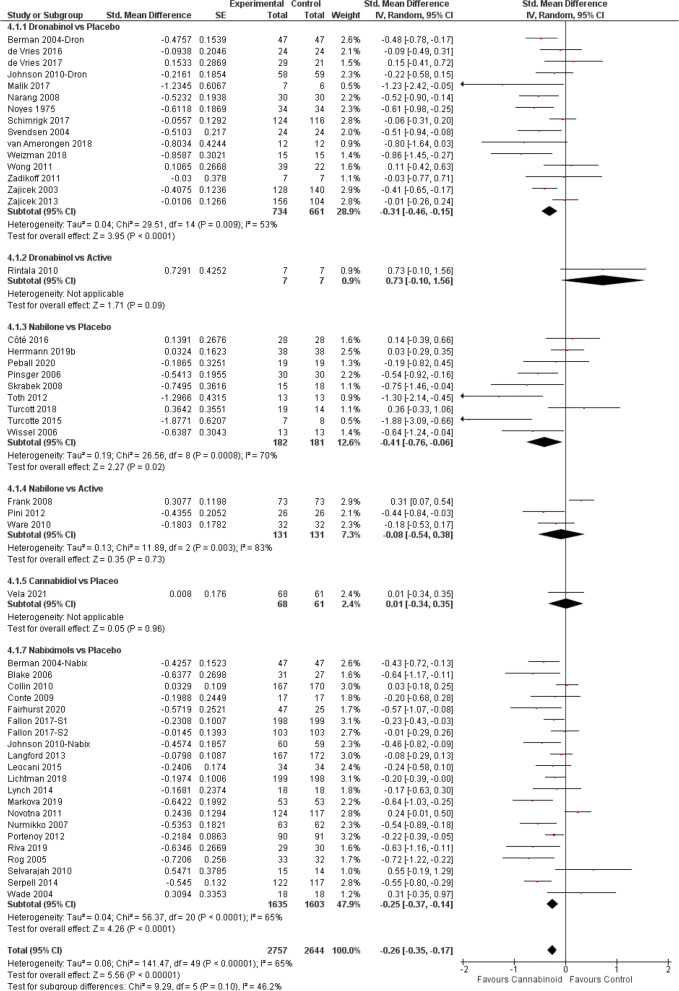
“The meta-analysis (Fig. 3) showed the beneficial effect of cannabinoids on chronic pain (SMD − 0.26, 95% CI − 0.35 to − 0.17; P < 0.00001).”
§ Medical cannabinoids: a pharmacology-based systematic review and meta-analysis for all relevant medical indications > Results > Primary outcomes
plainstates a cause- Asserted: passes — The authors put it forward as true.
- Checkable: passes — It can be checked against evidence.
- Load-bearing: passes — The paper’s conclusions depend on it.
- Based: passes — The paper gives a reason why it holds.
A result the paper reports from its own data — it cites no other source for it, so there is none to check. The quote shows it is in the paper.
In the paper
“appetite (− 0.51[CI − 0.87, − 0.15])”
§ Medical cannabinoids: a pharmacology-based systematic review and meta-analysis for all relevant medical indications > Abstract > Results
plainstates a cause- Asserted: passes — The authors put it forward as true.
- Checkable: passes — It can be checked against evidence.
- Load-bearing: passes — The paper’s conclusions depend on it.
- Based: passes — The paper gives a reason why it holds.
A result the paper reports from its own data — it cites no other source for it, so there is none to check. The quote shows it is in the paper.
In the paper
“sleep (− 0.24[CI − 0.35, − 0.14])”
§ Medical cannabinoids: a pharmacology-based systematic review and meta-analysis for all relevant medical indications > Abstract > Results
plainstates a cause- Asserted: passes — The authors put it forward as true.
- Checkable: passes — It can be checked against evidence.
- Load-bearing: passes — The paper’s conclusions depend on it.
- Based: passes — The paper gives a reason why it holds.
46 more claims
Create a free account to see all 99 claims and to verify the 3 references still open.
- It may state two separate claims as one. 43
- Probably not a substantial claim. 9
- Borderline: one of the tests for a substantial claim is unclear. 1
Self-check
Percentages, sums and reported differences re-computed from the paper’s own numbers.
Rated major: it would touch a result — a value a result rests on, reported and recomputed p-values on opposite sides of the significance level, two passages that conflict with no sign which is right, or a cited work retracted before this paper was published.
In the paper
“resulting in an overall positive effect (data not shown, SMD − 0.33, 95% CI − 0.40 to 0.26; P = 0.0004).”
§ Medical cannabinoids: a pharmacology-based systematic review and meta-analysis for all relevant medical indications > Discussion
Reported -0.33 · recomputed -0.66
Rated major: it would touch a result — a value a result rests on, reported and recomputed p-values on opposite sides of the significance level, two passages that conflict with no sign which is right, or a cited work retracted before this paper was published.
In the paper
“CBD was associated with a significant decrease in seizure frequencies (Fig. 6, SMD − 0.50, 95% CI − 0.62 to 0.38; P < 0.00001).”
§ Medical cannabinoids: a pharmacology-based systematic review and meta-analysis for all relevant medical indications > Results > Primary outcomes
Reported -0.5 · recomputed -1
Citations
Cites
Preferred Reporting Items for Systematic Reviews and Meta-Analyses: the PRISMA statement
Moher, D., Liberati, A., Tetzlaff, J., Altman, D. G., & for the PRISMA Group (2009) · BMJ · doi:10.1136/bmj.b2535 · Cited by 83,823
Preferred Reporting Items for Systematic Reviews and Meta-Analyses: The PRISMA Statement
Moher, D., Liberati, A., Tetzlaff, J., & Altman, D. G. (2009) · Journal of Clinical Epidemiology · doi:10.1016/j.jclinepi.2009.06.005 · Cited by 19,575
Meta-analyses involving cross-over trials: methodological issues
Elbourne, D. R., Altman, D. G., Higgins, J. P., Curtin, F., Worthington, H. V., & Vail, A. (2002) · International Journal of Epidemiology · doi:10.1093/ije/31.1.140 · Cited by 2,305
Cannabinoids for Medical Use: A Systematic Review and Meta-analysis
Whiting, P. F., Wolff, R. F., Deshpande, S., Di Nisio, M., Duffy, S., Hernandez, A. V., Keurentjes, J. C., Lang, S., Misso, K., Ryder, S., et al. (2015) · JAMA · doi:10.1001/jama.2015.6358 · Cited by 2,169 · cited 1×
“Finally, data analysis using SMD allowed the inclusion of a large variety of measurements in the evaluation of the outcomes and allowed us to include many more RCTs for all relevant medical indications than in a previous extensive meta-analysis [3].”
MethodTrial of Cannabidiol for Drug-Resistant Seizures in the Dravet Syndrome
Devinsky, O., Cross, J. H., Laux, L., Marsh, E., Miller, I., Nabbout, R., Scheffer, I. E., Thiele, E. A., & Wright, S. (2017) · New England Journal of Medicine · doi:10.1056/nejmoa1611618 · Cited by 1,711
Cannabidiol enhances anandamide signaling and alleviates psychotic symptoms of schizophrenia
Leweke, F. M., Piomelli, D., Pahlisch, F., Muhl, D., Gerth, C. W., Hoyer, C., Klosterkötter, J., Hellmich, M., & Koethe, D. (2012) · Translational Psychiatry · doi:10.1038/tp.2012.15 · Cited by 1,059 · cited 1×
“007), whereas CBD [25, 26, 28, 164] had no effect but the grade of evidence was very low (Fig.”
BackgroundCannabidiol is a negative allosteric modulator of the cannabinoid CB 1 receptor
Laprairie, R. B., Bagher, A. M., Kelly, M. E. M., & Denovan‐Wright, E. M. (2015) · British Journal of Pharmacology · doi:10.1111/bph.13250 · Cited by 1,039 · cited 1×
“Cannabidiol (CBD; Epidolex®) acts as a negative allosteric modulator at CB1 receptors [7] and also acts at several other receptors, such as CB2 receptors, serotonin 1A receptors, opioid receptors and several ligand-gated ion channels [8]; it represents the only CBD formulation approved by both USA and Europe for the t…”
BackgroundEffect of Cannabidiol on Drop Seizures in the Lennox–Gastaut Syndrome
Devinsky, O., Patel, A. D., Cross, J. H., Villanueva, V., Wirrell, E. C., Privitera, M., Greenwood, S. M., Roberts, C., Checketts, D., VanLandingham, K. E., et al. (2018) · New England Journal of Medicine · doi:10.1056/nejmoa1714631 · Cited by 1,015
Thiele, E. A., Marsh, E. D., French, J. A., Mazurkiewicz-Beldzinska, M., Benbadis, S. R., Joshi, C., Lyons, P. D., Taylor, A., Roberts, C., Sommerville, K., et al. (2018) · The Lancet · doi:10.1016/s0140-6736(18)30136-3 · Cited by 905
Phytocannabinoids: a unified critical inventory
Hanuš, L. O., Meyer, S. M., Muñoz, E., Taglialatela-Scafati, O., & Appendino, G. (2016) · Natural Product Reports · doi:10.1039/c6np00074f · Cited by 844 · cited 1×
“Moreover, plant-derived medical cannabis contains almost 150 phytocannabinoids, though most of them have neither been isolated nor pharmacologically characterized [9].”
BackgroundZajicek, J., Fox, P., Sanders, H., Wright, D., Vickery, J., Nunn, A., & Thompson, A. (2003) · The Lancet · doi:10.1016/s0140-6736(03)14738-1 · Cited by 827 · cited 3×
“From the studies with dronabinol, seven [10, 12, 34, 75, 92, 109, 150] were Table 3 (continued)”
BackgroundMethodResultBergamaschi, M. M., Queiroz, R. H. C., Chagas, M. H. N., de Oliveira, D. C. G., De Martinis, B. S., Kapczinski, F., Quevedo, J., Roesler, R., Schröder, N., Nardi, A. E., et al. (2011) · Neuropsychopharmacology · doi:10.1038/npp.2011.6 · Cited by 771
Randomized, controlled trial of cannabis-based medicine in central pain in multiple sclerosis
Rog, D. J., Nurmikko, T. J., Friede, T., & Young, C. A. (2005) · Neurology · doi:10.1212/01.wnl.0000176753.45410.8b · Cited by 679
Johnson, J. R., Burnell-Nugent, M., Lossignol, D., Ganae-Motan, E. D., Potts, R., & Fallon, M. T. (2010) · Journal of Pain and Symptom Management · doi:10.1016/j.jpainsymman.2009.06.008 · Cited by 622 · cited 3×
“From the studies with dronabinol, seven [10, 12, 34, 75, 92, 109, 150] were Table 3 (continued)”
BackgroundResultD’Souza, D. C., Abi-Saab, W. M., Madonick, S., Forselius-Bielen, K., Doersch, A., Braley, G., Gueorguieva, R., Cooper, T. B., & Krystal, J. H. (2005) · Biological Psychiatry · doi:10.1016/j.biopsych.2004.12.006 · Cited by 617
McGuire, P., Robson, P., Cubala, W. J., Vasile, D., Morrison, P. D., Barron, R., Taylor, A., & Wright, S. (2018) · American Journal of Psychiatry · doi:10.1176/appi.ajp.2017.17030325 · Cited by 617
Wade, D. T., Makela, P., Robson, P., House, H., & Bateman, C. (2004) · Multiple Sclerosis Journal · doi:10.1191/1352458504ms1082oa · Cited by 589
Chronic Administration of Cannabidiol to Healthy Volunteers and Epileptic Patients
Cunha, J. M., Carlini, E. A., Pereira, A. E., Ramos, O. L., Pimentel, C., Gagliardi, R., Sanvito, W. L., Lander, N., & Mechoulam, R. (2008) · Pharmacology · doi:10.1159/000137430 · Cited by 568
Black, N., Stockings, E., Campbell, G., Tran, L. T., Zagic, D., Hall, W. D., Farrell, M., & Degenhardt, L. (2019) · The Lancet Psychiatry · doi:10.1016/s2215-0366(19)30401-8 · Cited by 564
Cannabinoids in medicine: A review of their therapeutic potential
Ben Amar, M. (2006) · Journal of Ethnopharmacology · doi:10.1016/j.jep.2006.02.001 · Cited by 543
Jatoi, A., Windschitl, H. E., Loprinzi, C. L., Sloan, J. A., Dakhil, S. R., Mailliard, J. A., Pundaleeka, S., Kardinal, C. G., Fitch, T. R., Krook, J. E., et al. (2002) · Journal of Clinical Oncology · doi:10.1200/jco.20.2.567 · Cited by 543
Crippa, J. A. S., Derenusson, G. N., Ferrari, T. B., Wichert-Ana, L., Duran, F. L., Martin-Santos, R., Simões, M. V., Bhattacharyya, S., Fusar-Poli, P., Atakan, Z., et al. (2011) · Journal of Psychopharmacology · doi:10.1177/0269881110379283 · Cited by 535
Dronabinol as a treatment for anorexia associated with weight loss in patients with AIDS
Beal, J. E., Olson, R., Laubenstein, L., Morales, J. O., Bellman, P., Yangco, B., Lefkowitz, L., Plasse, T. F., & Shepard, K. V. (1995) · Journal of Pain and Symptom Management · doi:10.1016/0885-3924(94)00117-4 · Cited by 504
Svendsen, K. B., Jensen, T. S., & Bach, F. W. (2004) · BMJ · doi:10.1136/bmj.38149.566979.ae · Cited by 500
Novotna, A., Mares, J., Ratcliffe, S., Novakova, I., Vachova, M., Zapletalova, O., Gasperini, C., Pozzilli, C., Cefaro, L., Comi, G., et al. (2011) · European Journal of Neurology · doi:10.1111/j.1468-1331.2010.03328.x · Cited by 475
Stockings, E., Campbell, G., Hall, W. D., Nielsen, S., Zagic, D., Rahman, R., Murnion, B., Farrell, M., Weier, M., & Degenhardt, L. (2018) · Pain · doi:10.1097/j.pain.0000000000001293 · Cited by 460
Randomized, dose-ranging safety trial of cannabidiol in Dravet syndrome
Devinsky, O., Patel, A. D., Thiele, E. A., Wong, M. H., Appleton, R., Harden, C. L., Greenwood, S., Morrison, G., Sommerville, K., On behalf of the GWPCARE1 Part A Study Group, et al. (2018) · Neurology · doi:10.1212/wnl.0000000000005254 · Cited by 458
Wade, D. T., Robson, P., House, H., Makela, P., & Aram, J. (2003) · Clinical Rehabilitation · doi:10.1191/0269215503cr581oa · Cited by 441
Blake, D. R., Robson, P., Ho, M., Jubb, R. W., & McCabe, C. S. (2006) · Rheumatology · doi:10.1093/rheumatology/kei183 · Cited by 433
Nurmikko, T. J., Serpell, M. G., Hoggart, B., Toomey, P. J., Morlion, B. J., & Haines, D. (2007) · Pain · doi:10.1016/j.pain.2007.08.028 · Cited by 431
Proof of Concept Trial of Dronabinol in Obstructive Sleep Apnea
Prasad, B., Radulovacki, M. G., & Carley, D. W. (2013) · Frontiers in Psychiatry · doi:10.3389/fpsyt.2013.00001 · Cited by 423
Portenoy, R. K., Ganae-Motan, E. D., Allende, S., Yanagihara, R., Shaiova, L., Weinstein, S., McQuade, R., Wright, S., & Fallon, M. T. (2012) · The Journal of Pain · doi:10.1016/j.jpain.2012.01.003 · Cited by 420
Strasser, F., Luftner, D., Possinger, K., Ernst, G., Ruhstaller, T., Meissner, W., Ko, Y.-D., Schnelle, M., Reif, M., & Cerny, T. (2006) · Journal of Clinical Oncology · doi:10.1200/jco.2005.05.1847 · Cited by 413
Sloane, J. P., & Ormerod, M. G. (1981) · Cancer · doi:10.1002/1097-0142(19810401)47:7<1739::aid-cncr2820470702>3.0.co;2-2 · Cited by 405
Early phytocannabinoid chemistry to endocannabinoids and beyond
Mechoulam, R., Hanuš, L. O., Pertwee, R., & Howlett, A. C. (2014) · Nature Reviews Neuroscience · doi:10.1038/nrn3811 · Cited by 393 · cited 1×
“The synthetic cannabinoids dronabinol, which is ( −)-trans-Δ9-tetrahydrocannabinol (THC) (Marinol® and Syndros®), and nabilone—a synthetic cannabinoid with structural similarities to THC (Cesamet®), are partial agonists at the cannabinoid receptor 1 (CB1) and with somehow lower affinity at CB2 receptors [6].”
BackgroundNabilone for the treatment of pain in fibromyalgia.
Skrabek, R. Q., Galimova, L., Ethans, K., & Perry, D. (2008) · The Journal of Pain · doi:10.1016/j.jpain.2007.09.002 · Cited by 384
Randomized controlled trial of cannabis‐based medicine in spasticity caused by multiple sclerosis
Collin, C., Davies, P., Mutiboko, I. K., Ratcliffe, S., & for the Sativex Spasticity in MS Study Group (2007) · European Journal of Neurology · doi:10.1111/j.1468-1331.2006.01639.x · Cited by 379
The analgesic properties of delta‐9‐tetrahydrocannabinol and codeine
Noyes, R., Brunk, S. F., Avery, D. H., & Canter, A. (1975) · Clinical Pharmacology & Therapeutics · doi:10.1002/cpt197518184 · Cited by 378 · cited 1×
“Further subgroup analyses indicated that compared to placebo, dronabinol [10, 11, 95, 106, 139, 150, 161, 12, 23, 34, 45, 56, 72, 73, 84] and nabiximols [10, 33–44, 46–52] were associated with significant improvements and moderate evidence (Fig.”
ResultChagas, M. H. N., Zuardi, A. W., Tumas, V., Pena-Pereira, M. A., Sobreira, E. T., Bergamaschi, M. M., dos Santos, A. C., Teixeira, A. L., Hallak, J. E., & Crippa, J. A. S. (2014) · Journal of Psychopharmacology · doi:10.1177/0269881114550355 · Cited by 365
Antiemetic Effect of Delta-9-Tetrahydrocannabinol in Patients Receiving Cancer Chemotherapy
Sallan, S. E., Zinberg, N. E., & Frei, E. (1975) · New England Journal of Medicine · doi:10.1056/nejm197510162931603 · Cited by 364
Berman, J. S., Symonds, C., & Birch, R. (2004) · Pain · doi:10.1016/j.pain.2004.09.013 · Cited by 362 · cited 2×
“From the studies with dronabinol, seven [10, 12, 34, 75, 92, 109, 150] were Table 3 (continued)”
BackgroundResultCannabinoids reduce levodopa-induced dyskinesia in Parkinson’s disease: A pilot study
Sieradzan, K. A., Fox, S. H., Hill, M., Dick, J. P. R., Crossman, A. R., & Brotchie, J. M. (2001) · Neurology · doi:10.1212/wnl.57.11.2108 · Cited by 349
Hurd, Y. L., Spriggs, S., Alishayev, J., Winkel, G., Gurgov, K., Kudrich, C., Oprescu, A. M., & Salsitz, E. (2019) · American Journal of Psychiatry · doi:10.1176/appi.ajp.2019.18101191 · Cited by 343
Freeman, T. P., Craft, S., Wilson, J., Stylianou, S., ElSohly, M., Di Forti, M., & Lynskey, M. T. (2021) · Addiction · doi:10.1111/add.15253 · Cited by 337
The Effects of Nabilone on Sleep in Fibromyalgia: Results of a Randomized Controlled Trial
Ware, M. A., Fitzcharles, M.-A., Joseph, L., & Shir, Y. (2010) · Anesthesia & Analgesia · doi:10.1213/ane.0b013e3181c76f70 · Cited by 324
Jetly, R., Heber, A., Fraser, G., & Boisvert, D. (2015) · Psychoneuroendocrinology · doi:10.1016/j.psyneuen.2014.11.002 · Cited by 321
Controlled clinical trial of cannabidiol in Huntington's disease
Consroe, P., Laguna, J., Allender, J., Snider, S., Stern, L., Sandyk, R., Kennedy, K., & Schram, K. (1991) · Pharmacology Biochemistry and Behavior · doi:10.1016/0091-3057(91)90386-g · Cited by 320
Notcutt, W., Price, M., Miller, R., Newport, S., Phillips, C., Simmons, S., & Sansom, C. (2004) · Anaesthesia · doi:10.1111/j.1365-2044.2004.03674.x · Cited by 305
Langford, R. M., Mares, J., Novotna, A., Vachova, M., Novakova, I., Notcutt, W., & Ratcliffe, S. (2013) · Journal of Neurology · doi:10.1007/s00415-012-6739-4 · Cited by 298 · cited 8×
“GRADE Relative effect (95% CI) Anticipated absolute effects Outcome Risk with control Risk difference with Cannabinoids Chronic pain Dronabinol vs Placebo 1395 (15 RCTs) 53 ⨁⨁⨁◯ MODERATE c SMD 0.31 lower (0.46 lower to 0.15 lower) Dronabinol vs Active 14 (1 RCT) SMD 0.73 higher (0.1 lower to 1.56 higher) Nabilone vs P…”
BackgroundInfluentialWade, D. T., Makela, P. M., House, H., Bateman, C., & Robson, P. (2006) · Multiple Sclerosis Journal · doi:10.1177/1352458505070618 · Cited by 285
van de Donk, T., Niesters, M., Kowal, M. A., Olofsen, E., Dahan, A., & van Velzen, M. (2019) · Pain · doi:10.1097/j.pain.0000000000001464 · Cited by 284
Fraser, G. A. (2009) · CNS Neuroscience & Therapeutics · doi:10.1111/j.1755-5949.2008.00071.x · Cited by 283
Collin, C., Ehler, E., Waberzinek, G., Alsindi, Z., Davies, P., Powell, K., Notcutt, W., O'Leary, C., Ratcliffe, S., Nováková, I., et al. (2010) · Neurological Research · doi:10.1179/016164109x12590518685660 · Cited by 283 · cited 8×
“GRADE Relative effect (95% CI) Anticipated absolute effects Outcome Risk with control Risk difference with Cannabinoids Chronic pain Dronabinol vs Placebo 1395 (15 RCTs) 53 ⨁⨁⨁◯ MODERATE c SMD 0.31 lower (0.46 lower to 0.15 lower) Dronabinol vs Active 14 (1 RCT) SMD 0.73 higher (0.1 lower to 1.56 higher) Nabilone vs P…”
BackgroundInfluentialThiele, E. A., Bebin, E. M., Bhathal, H., Jansen, F. E., Kotulska, K., Lawson, J. A., O'Callaghan, F. J., Wong, M., Sahebkar, F., Checketts, D., et al. (2021) · JAMA Neurology · doi:10.1001/jamaneurol.2020.4607 · Cited by 281
MUltiple Sclerosis and Extract of Cannabis: results of the MUSEC trial
Zajicek, J. P., Hobart, J. C., Slade, A., Barnes, D., Mattison, P. G., & on behalf of the MUSEC Research Group (2012) · Journal of Neurology, Neurosurgery & Psychiatry · doi:10.1136/jnnp-2012-302468 · Cited by 278
Efficacy of Inhaled Cannabis on Painful Diabetic Neuropathy
Wallace, M. S., Marcotte, T. D., Umlauf, A., Gouaux, B., & Atkinson, J. H. (2015) · The Journal of Pain · doi:10.1016/j.jpain.2015.03.008 · Cited by 276
Muller-Vahl, K. R., Schneider, U., Prevedel, H., Theloe, K., Kolbe, H., Daldrup, T., & Emrich, H. M. (2003) · The Journal of Clinical Psychiatry · doi:10.4088/jcp.v64n0417 · Cited by 270
Miller, I., Scheffer, I. E., Gunning, B., Sanchez-Carpintero, R., Gil-Nagel, A., Perry, M. S., Saneto, R. P., Checketts, D., Dunayevich, E., Knappertz, V., et al. (2020) · JAMA Neurology · doi:10.1001/jamaneurol.2020.0073 · Cited by 267
Lynch, M. E., Cesar-Rittenberg, P., & Hohmann, A. G. (2014) · Journal of Pain and Symptom Management · doi:10.1016/j.jpainsymman.2013.02.018 · Cited by 266
Nabiximols as an Agonist Replacement Therapy During Cannabis Withdrawal: A Randomized Clinical Trial
Allsop, D. J., Copeland, J., Lintzeris, N., Dunlop, A. J., Montebello, M., Sadler, C., Rivas, G. R., Holland, R. M., Muhleisen, P., Norberg, M. M., et al. (2014) · JAMA Psychiatry · doi:10.1001/jamapsychiatry.2013.3947 · Cited by 266
Vaney, C., Heinzel-Gutenbrunner, M., Jobin, P., Tschopp, F., Gattlen, B., Hagen, U., Schnelle, M., & Reif, M. (2004) · Multiple Sclerosis Journal · doi:10.1191/1352458504ms1048oa · Cited by 262
Jadoon, K. A., Ratcliffe, S. H., Barrett, D. A., Thomas, E. L., Stott, C., Bell, J. D., O’Sullivan, S. E., & Tan, G. D. (2016) · Diabetes Care · doi:10.2337/dc16-0650 · Cited by 262
Sallan, S. E., Cronin, C., Zelen, M., & Zinberg, N. E. (1980) · New England Journal of Medicine · doi:10.1056/nejm198001173020302 · Cited by 261
CHANG, A. E., SHILING, D. J., STILLMAN, R. C., GOLDBERG, N. H., SEIPP, C. A., BAROFSKY, I., SIMON, R. M., & ROSENBERG, S. A. (1979) · Annals of Internal Medicine · doi:10.7326/0003-4819-91-6-819 · Cited by 259
Efficacy of Dronabinol as an Adjuvant Treatment for Chronic Pain Patients on Opioid Therapy
Narang, S., Gibson, D., Wasan, A. D., Ross, E. L., Michna, E., Nedeljkovic, S. S., & Jamison, R. N. (2008) · The Journal of Pain · doi:10.1016/j.jpain.2007.10.018 · Cited by 257
Treatment of Tourette's Syndrome with Δ9-Tetrahydrocannabinol (THC): A Randomized Crossover Trial
Müller-Vahl, K., Schneider, U., Koblenz, A., Jöbges, M., Kolbe, H., Daldrup, T., & Emrich, H. (2002) · Pharmacopsychiatry · doi:10.1055/s-2002-25028 · Cited by 256
Medicinal cannabis for psychiatric disorders: a clinically-focused systematic review
Sarris, J., Sinclair, J., Karamacoska, D., Davidson, M., & Firth, J. (2020) · BMC Psychiatry · doi:10.1186/s12888-019-2409-8 · Cited by 253
Brisbois, T. D., de Kock, I. H., Watanabe, S. M., Mirhosseini, M., Lamoureux, D. C., Chasen, M., MacDonald, N., Baracos, V. E., & Wismer, W. V. (2011) · Annals of Oncology · doi:10.1093/annonc/mdq727 · Cited by 246
Boggs, D. L., Surti, T., Gupta, A., Gupta, S., Niciu, M., Pittman, B., Schnakenberg Martin, A. M., Thurnauer, H., Davies, A., D’Souza, D. C., et al. (2018) · Psychopharmacology · doi:10.1007/s00213-018-4885-9 · Cited by 242
Abrams, D. I., Hilton, J. F., Leiser, R. J., Shade, S. B., Elbeik, T. A., Aweeka, F. T., Benowitz, N. L., Bredt, B. M., Kosel, B., Aberg, J. A., et al. (2003) · Annals of Internal Medicine · doi:10.7326/0003-4819-139-4-200308190-00008 · Cited by 238
Lichtman, A. H., Lux, E. A., McQuade, R., Rossetti, S., Sanchez, R., Sun, W., Wright, S., Kornyeyeva, E., & Fallon, M. T. (2018) · Journal of Pain and Symptom Management · doi:10.1016/j.jpainsymman.2017.09.001 · Cited by 234
Levin, F. R., Mariani, J. J., Brooks, D. J., Pavlicova, M., Cheng, W., & Nunes, E. V. (2011) · Drug and Alcohol Dependence · doi:10.1016/j.drugalcdep.2010.12.010 · Cited by 232
Karschner, E. L., Darwin, W. D., Goodwin, R. S., Wright, S., & Huestis, M. A. (2011) · Clinical Chemistry · doi:10.1373/clinchem.2010.152439 · Cited by 231
Naftali, T., Mechulam, R., Marii, A., Gabay, G., Stein, A., Bronshtain, M., Laish, I., Benjaminov, F., & Konikoff, F. M. (2017) · Digestive Diseases and Sciences · doi:10.1007/s10620-017-4540-z · Cited by 216
Meiri, E., Jhangiani, H., Vredenburgh, J. J., Barbato, L. M., Carter, F. J., Yang, H.-M., & Baranowski, V. (2007) · Current Medical Research and Opinion · doi:10.1185/030079907x167525 · Cited by 214
Freeman, R. M., Adekanmi, O., Waterfield, M. R., Waterfield, A. E., Wright, D., & Zajicek, J. (2006) · International Urogynecology Journal · doi:10.1007/s00192-006-0086-x · Cited by 209
Safety, tolerability, and efficacy of orally administered cannabinoids in MS
Killestein, J., Hoogervorst, E. L. J., Reif, M., Kalkers, N. F., van Loenen, A. C., Staats, P. G. M., Gorter, R. W., Uitdehaag, B. M. J., & Polman, C. H. (2002) · Neurology · doi:10.1212/wnl.58.9.1404 · Cited by 209
Frank, B., Serpell, M. G., Hughes, J., Matthews, J. N. S., & Kapur, D. (2008) · BMJ · doi:10.1136/bmj.39429.619653.80 · Cited by 207
Haney, M., Malcolm, R. J., Babalonis, S., Nuzzo, P. A., Cooper, Z. D., Bedi, G., Gray, K. M., McRae-Clark, A., Lofwall, M. R., Sparenborg, S., et al. (2016) · Neuropsychopharmacology · doi:10.1038/npp.2015.367 · Cited by 206
Xu, D. H., Cullen, B. D., Tang, M., & Fang, Y. (2020) · Current Pharmaceutical Biotechnology · doi:10.2174/1389201020666191202111534 · Cited by 206
Freeman, T. P., Hindocha, C., Baio, G., Shaban, N. D. C., Thomas, E. M., Astbury, D., Freeman, A. M., Lees, R., Craft, S., Morrison, P. D., et al. (2020) · The Lancet Psychiatry · doi:10.1016/s2215-0366(20)30290-x · Cited by 203
Effect of Sublingual Application of Cannabinoids on Intraocular Pressure: A Pilot Study
Tomida, I., Azuara-Blanco, A., House, H., Flint, M., Pertwee, R. G., & Robson, P. J. (2006) · Journal of Glaucoma · doi:10.1097/01.ijg.0000212260.04488.60 · Cited by 201
Serpell, M., Ratcliffe, S., Hovorka, J., Schofield, M., Taylor, L., Lauder, H., & Ehler, E. (2014) · European Journal of Pain · doi:10.1002/j.1532-2149.2013.00445.x · Cited by 197
Cannabidiol reduces cigarette consumption in tobacco smokers: Preliminary findings
Morgan, C. J. A., Das, R. K., Joye, A., Curran, H. V., & Kamboj, S. K. (2013) · Addictive Behaviors · doi:10.1016/j.addbeh.2013.03.011 · Cited by 193
Anxiolytic Effects of Repeated Cannabidiol Treatment in Teenagers With Social Anxiety Disorders
Masataka, N. (2019) · Frontiers in Psychology · doi:10.3389/fpsyg.2019.02466 · Cited by 192
Selvarajah, D., Gandhi, R., Emery, C. J., & Tesfaye, S. (2010) · Diabetes Care · doi:10.2337/dc09-1029 · Cited by 189
Lack of analgesic efficacy of oral δ-9-tetrahydrocannabinol in postoperative pain
Buggy, D. J., Toogood, L., Maric, S., Sharpe, P., Lambert, D. G., & Rowbotham, D. J. (2003) · Pain · doi:10.1016/s0304-3959(03)00331-2 · Cited by 184
Safety, tolerability, and efficacy of orally administered cannabinoids in MS
Russo, E. B. (2003) · Neurology · doi:10.1212/wnl.60.4.729-a · Cited by 184
Dronabinol and Marijuana in HIV-Positive Marijuana Smokers: Caloric Intake, Mood, and Sleep
Haney, M., Gunderson, E. W., Rabkin, J., Hart, C. L., Vosburg, S. K., Comer, S. D., & Foltin, R. W. (2007) · JAIDS Journal of Acquired Immune Deficiency Syndromes · doi:10.1097/qai.0b013e31811ed205 · Cited by 184
Hindocha, C., Freeman, T. P., Schafer, G., Gardener, C., Das, R. K., Morgan, C. J. A., & Curran, H. V. (2015) · European Neuropsychopharmacology · doi:10.1016/j.euroneuro.2014.11.014 · Cited by 183
Fallon, M. T., Albert Lux, E., McQuade, R., Rossetti, S., Sanchez, R., Sun, W., Wright, S., Lichtman, A. H., & Kornyeyeva, E. (2017) · British Journal of Pain · doi:10.1177/2049463717710042 · Cited by 181
Oral delta-9-tetrahydrocannabinol suppresses cannabis withdrawal symptoms
Budney, A. J., Vandrey, R. G., Hughes, J. R., Moore, B. A., & Bahrenburg, B. (2007) · Drug and Alcohol Dependence · doi:10.1016/j.drugalcdep.2006.04.014 · Cited by 180
Heinz, A., Kiefer, F., Smolka, M. N., Endrass, T., Beste, C., Beck, A., Liu, S., Genauck, A., Romund, L., Banaschewski, T., et al. (2020) · Addiction Biology · doi:10.1111/adb.12866 · Cited by 176
Self-citationCannabinoids in attention-deficit/hyperactivity disorder: A randomised-controlled trial
Cooper, R. E., Williams, E., Seegobin, S., Tye, C., Kuntsi, J., & Asherson, P. (2017) · European Neuropsychopharmacology · doi:10.1016/j.euroneuro.2017.05.005 · Cited by 175
Beyond THC and Endocannabinoids
Pacher, P., Kogan, N. M., & Mechoulam, R. (2020) · Annual Review of Pharmacology and Toxicology · doi:10.1146/annurev-pharmtox-010818-021441 · Cited by 175 · cited 1×
“Cannabidiol (CBD; Epidolex®) acts as a negative allosteric modulator at CB1 receptors [7] and also acts at several other receptors, such as CB2 receptors, serotonin 1A receptors, opioid receptors and several ligand-gated ion channels [8]; it represents the only CBD formulation approved by both USA and Europe for the t…”
BackgroundToth, C., Mawani, S., Brady, S., Chan, C., Liu, C., Mehina, E., Garven, A., Bestard, J., & Korngut, L. (2012) · Pain · doi:10.1016/j.pain.2012.06.024 · Cited by 174
Effects of THC and lofexidine in a human laboratory model of marijuana withdrawal and relapse
Haney, M., Hart, C. L., Vosburg, S. K., Comer, S. D., Reed, S. C., & Foltin, R. W. (2008) · Psychopharmacology · doi:10.1007/s00213-007-1020-8 · Cited by 174
Randomized controlled trial of Sativex to treat detrusor overactivity in multiple sclerosis
Kavia, R., De Ridder, D., Constantinescu, C., Stott, C., & Fowler, C. (2010) · Multiple Sclerosis Journal · doi:10.1177/1352458510378020 · Cited by 173
Wissel, J., Haydn, T., Müller, J., Brenneis, C., Berger, T., Poewe, W., & Schelosky, L. D. (2006) · Journal of Neurology · doi:10.1007/s00415-006-0218-8 · Cited by 171
Randomized Placebo-Controlled Trial of Nabilone for Agitation in Alzheimer's Disease
Herrmann, N., Ruthirakuhan, M., Gallagher, D., Verhoeff, N. P. L. G., Kiss, A., Black, S. E., & Lanctôt, K. L. (2019) · The American Journal of Geriatric Psychiatry · doi:10.1016/j.jagp.2019.05.002 · Cited by 169
Delta-9-THC in the Treatment of Spasticity Associated with Multiple Sclerosis
Ungerleider, J. T., Andyrsiak, T., Fairbanks, L., Ellison, G. W., & Myers, L. W. (1988) · Advances in Alcohol & Substance Abuse · doi:10.1300/j251v07n01_04 · Cited by 165
Notcutt, W., Langford, R., Davies, P., Ratcliffe, S., & Potts, R. (2012) · Multiple Sclerosis Journal · doi:10.1177/1352458511419700 · Cited by 165
Freeman, D., Dunn, G., Murray, R. M., Evans, N., Lister, R., Antley, A., Slater, M., Godlewska, B., Cornish, R., Williams, J., et al. (2015) · Schizophrenia Bulletin · doi:10.1093/schbul/sbu098 · Cited by 164
Tetrahydrocannabinol for neuropsychiatric symptoms in dementia: A randomized controlled trial
van den Elsen, G. A. H., Ahmed, A. I. A., Verkes, R.-J., Kramers, C., Feuth, T., Rosenberg, P. B., van der Marck, M. A., & Olde Rikkert, M. G. M. (2015) · Neurology · doi:10.1212/wnl.0000000000001675 · Cited by 164
Irving, P. M., Iqbal, T., Nwokolo, C., Subramanian, S., Bloom, S., Prasad, N., Hart, A., Murray, C., Lindsay, J. O., Taylor, A., et al. (2018) · Inflammatory Bowel Diseases · doi:10.1093/ibd/izy002 · Cited by 164
Grimison, P., Mersiades, A., Kirby, A., Lintzeris, N., Morton, R., Haber, P., Olver, I., Walsh, A., McGregor, I., Cheung, Y., et al. (2020) · Annals of Oncology · doi:10.1016/j.annonc.2020.07.020 · Cited by 162
López-Sendón Moreno, J. L., García Caldentey, J., Trigo Cubillo, P., Ruiz Romero, C., García Ribas, G., Alonso Arias, M. A. A., García de Yébenes, M. J., Tolón, R. M., Galve-Roperh, I., Sagredo, O., et al. (2016) · Journal of Neurology · doi:10.1007/s00415-016-8145-9 · Cited by 160
Dronabinol in severe, enduring anorexia nervosa: A randomized controlled trial
Andries, A., Frystyk, J., Flyvbjerg, A., & Støving, R. K. (2014) · International Journal of Eating Disorders · doi:10.1002/eat.22173 · Cited by 158
A pilot study using nabilone for symptomatic treatment in Huntington's disease
Curtis, A., Mitchell, I., Patel, S., Ives, N., & Rickards, H. (2009) · Movement Disorders · doi:10.1002/mds.22809 · Cited by 158
Duran, M., Pérez, E., Abanades, S., Vidal, X., Saura, C., Majem, M., Arriola, E., Rabanal, M., Pastor, A., Farré, M., et al. (2010) · British Journal of Clinical Pharmacology · doi:10.1111/j.1365-2125.2010.03743.x · Cited by 157
Flachenecker, P., Henze, T., & Zettl, U. K. (2014) · European Neurology · doi:10.1159/000357427 · Cited by 153
Markovà, J., Essner, U., Akmaz, B., Marinelli, M., Trompke, C., Lentschat, A., & Vila, C. (2019) · International Journal of Neuroscience · doi:10.1080/00207454.2018.1481066 · Cited by 151
Bhattacharyya, S., Wilson, R., Appiah-Kusi, E., O’Neill, A., Brammer, M., Perez, J., Murray, R., Allen, P., Bossong, M. G., & McGuire, P. (2018) · JAMA Psychiatry · doi:10.1001/jamapsychiatry.2018.2309 · Cited by 150
Winton-Brown, T. T., Allen, P., Bhattacharrya, S., Borgwardt, S. J., Fusar-Poli, P., Crippa, J. A., Seal, M. L., Martin-Santos, R., Ffytche, D., Zuardi, A. W., et al. (2011) · Neuropsychopharmacology · doi:10.1038/npp.2011.17 · Cited by 146
Almog, S., Aharon‐Peretz, J., Vulfsons, S., Ogintz, M., Abalia, H., Lupo, T., Hayon, Y., & Eisenberg, E. (2020) · European Journal of Pain · doi:10.1002/ejp.1605 · Cited by 143
Birnbaum, A. K., KARANAM, A. B., Marino, S. E., Barkley, C. M., Remmel, R. P., Roslawski, M. J., Gramling-Aden, M. L., & Leppik, I. E. (2019) · Epilepsia · doi:10.1111/epi.16093 · Cited by 142
Carley, D. W., Prasad, B., Reid, K. J., Malkani, R., Attarian, H., Abbott, S. M., Vern, B., Xie, H., Yuan, C., & Zee, P. C. (2018) · Sleep · doi:10.1093/sleep/zsx184 · Cited by 141
Turcott, J. G., Núñez, M. D. R. G., Flores‐Estrada, D., Oñate-Ocaña, L. F., Zatarain-Barrón, Z. L., Barrón, F., & Arrieta, O. G. (2018) · Supportive Care in Cancer · doi:10.1007/s00520-018-4154-9 · Cited by 140
de Faria, S. M., de Morais Fabrício, D., Tumas, V., Castro, P. C., Ponti, M. A., Hallak, J. E., Zuardi, A. W., Crippa, J. A. S., & Chagas, M. H. N. (2020) · Journal of Psychopharmacology · doi:10.1177/0269881119895536 · Cited by 140
The Efficacy and Safety of Nabilone (A Synthetic Cannabinoid) in the Treatment of Anxiety
FABRE, L. F., & McLENDON, D. (1981) · The Journal of Clinical Pharmacology · doi:10.1002/j.1552-4604.1981.tb02617.x · Cited by 138
Dronabinol Is a Safe Long-Term Treatment Option for Neuropathic Pain Patients
Schimrigk, S., Marziniak, M., Neubauer, C., Kugler, E. M., Werner, G., & Abramov-Sommariva, D. (2017) · European Neurology · doi:10.1159/000481089 · Cited by 136
Wheless, J. W., Dlugos, D., Miller, I., Oh, D. A., Parikh, N., Phillips, S. E., Renfroe, J. B., Roberts, C. M., Saeed, I., Sparagana, S. P., et al. (2019) · CNS Drugs · doi:10.1007/s40263-019-00624-4 · Cited by 136
A Double-Blind Trial of ??9-Tetrahydrocannabinol in Primary Anorexia Nervosa
GROSS, H., EBERT, M. H., FADEN, V. B., GOLDBERG, S. C., KAYE, W. H., CAINE, E. D., HAWKS, R., & ZINBERG, N. (1983) · Journal of Clinical Psychopharmacology · doi:10.1097/00004714-198306000-00004 · Cited by 133
Zajicek, J., Ball, S., Wright, D., Vickery, J., Nunn, A., Miller, D., Cano, M. G., McManus, D., Mallik, S., & Hobart, J. (2013) · The Lancet Neurology · doi:10.1016/s1474-4422(13)70159-5 · Cited by 132
How effective and safe is medical cannabis as a treatment of mental disorders? A systematic review
Hoch, E., Niemann, D., von Keller, R., Schneider, M., Friemel, C. M., Preuss, U. W., Hasan, A., & Pogarell, O. (2019) · European Archives of Psychiatry and Clinical Neuroscience · doi:10.1007/s00406-019-00984-4 · Cited by 131
Bonn-Miller, M. O., Sisley, S., Riggs, P., Yazar-Klosinski, B., Wang, J. B., Loflin, M. J. E., Shechet, B., Hennigan, C., Matthews, R., Emerson, A., et al. (2021) · PLOS ONE · doi:10.1371/journal.pone.0246990 · Cited by 128
Vela, J., Dreyer, L., Petersen, K. K., Arendt‐Nielsen, L., Duch, K. S., & Kristensen, S. (2021) · Pain · doi:10.1097/j.pain.0000000000002466 · Cited by 127
Dronabinol and marijuana in HIV+ marijuana smokers: acute effects on caloric intake and mood
Haney, M., Rabkin, J., Gunderson, E., & Foltin, R. W. (2005) · Psychopharmacology · doi:10.1007/s00213-005-2242-2 · Cited by 126
Lane, M., Vogel, C. L., Ferguson, J., Krasnow, S. H., Saiers, J. L., Hamm, J. T., Salva, K., Wiernik, P. H., Holroyde, C. P., Hammill, S., et al. (1991) · Journal of Pain and Symptom Management · doi:10.1016/0885-3924(91)90026-z · Cited by 125
Hallak, J. E. C., Machado-de-Sousa, J. P., Crippa, J. A. S., Sanches, R. F., Trzesniak, C., Chaves, C., Bernardo, S. A., Regalo, S. C., & Zuardi, A. W. (2010) · Revista Brasileira de Psiquiatria · doi:10.1590/s1516-44462010000100011 · Cited by 125
Nitecka-Buchta, A., Nowak-Wachol, A., Wachol, K., Walczyńska-Dragon, K., Olczyk, P., Batoryna, O., Kempa, W. M., & Baron, S. (2019) · Journal of Clinical Medicine · doi:10.3390/jcm8111886 · Cited by 125
Turcotte, D., Doupe, M., Torabi, M., Gomori, A., Ethans, K., Esfahani, F., Galloway, K., & Namaka, M. (2015) · Pain Medicine · doi:10.1111/pme.12569 · Cited by 124
Non‐Motor Symptoms in Parkinson's Disease are Reduced by Nabilone
Peball, M., Krismer, F., Knaus, H., Djamshidian, A., Werkmann, M., Carbone, F., Ellmerer, P., Heim, B., Marini, K., Valent, D., et al. (2020) · Annals of Neurology · doi:10.1002/ana.25864 · Cited by 123
Trigo, J. M., Soliman, A., Quilty, L. C., Fischer, B., Rehm, J., Selby, P., Barnes, A. J., Huestis, M. A., George, T. P., Streiner, D. L., et al. (2018) · PLOS ONE · doi:10.1371/journal.pone.0190768 · Cited by 122
Fox, S. H., Kellett, M., Moore, A. P., Crossman, A. R., & Brotchie, J. M. (2002) · Movement Disorders · doi:10.1002/mds.1280 · Cited by 120
Müller‐Vahl, K., Prevedel, H., Theloe, K., KOLBE, H., Emrich, H. M., & Schneider, U. (2003) · Neuropsychopharmacology · doi:10.1038/sj.npp.1300047 · Cited by 120
Cannabis analgesia in chronic neuropathic pain is associated with altered brain connectivity
Weizman, L., Dayan, L., Brill, S., Nahman-Averbuch, H., Hendler, T., Jacob, G., & Sharon, H. (2018) · Neurology · doi:10.1212/wnl.0000000000006293 · Cited by 120
Weber, M., Goldman, B., & Truniger, S. (2010) · Journal of Neurology, Neurosurgery & Psychiatry · doi:10.1136/jnnp.2009.200642 · Cited by 116
Nabiximols for the Treatment of Cannabis Dependence: A Randomized Clinical Trial
Lintzeris, N., Bhardwaj, A., Mills, L., Dunlop, A., Copeland, J., McGregor, I., Bruno, R., Gugusheff, J., Phung, N., Montebello, M., et al. (2019) · JAMA Internal Medicine · doi:10.1001/jamainternmed.2019.1993 · Cited by 110
Aragona, M., Onesti, E., Tomassini, V., Conte, A., Gupta, S., Gilio, F., Pantano, P., Pozzilli, C., & Inghilleri, M. (2009) · Clinical Neuropharmacology · doi:10.1097/wnf.0b013e3181633497 · Cited by 109
Effect of Dronabinol on Central Neuropathic Pain After Spinal Cord Injury: A Pilot Study
Rintala, D. H., Fiess, R. N., Tan, G., Holmes, S. A., & Bruel, B. M. (2010) · American Journal of Physical Medicine & Rehabilitation · doi:10.1097/phm.0b013e3181f1c4ec · Cited by 109
Levin, F. R., Mariani, J. J., Pavlicova, M., Brooks, D., Glass, A., Mahony, A., Nunes, E. V., Bisaga, A., Dakwar, E., Carpenter, K. M., et al. (2016) · Drug and Alcohol Dependence · doi:10.1016/j.drugalcdep.2015.11.025 · Cited by 109
Tetrahydrocannabinol in Behavioral Disturbances in Dementia: A Crossover Randomized Controlled Trial
van den Elsen, G. A. H., Ahmed, A. I. A., Verkes, R., Feuth, T. B., van der Marck, M. A., & Rikkert, M. G. M. O. (2015) · American Journal of Geriatric Psychiatry · doi:10.1016/j.jagp.2015.07.011 · Cited by 108
Pini, L. A., Guerzoni, S., Cainazzo, M. M., Ferrari, A., Sarchielli, P., Tiraferri, I., Ciccarese, M., & Zappaterra, M. (2012) · The Journal of Headache and Pain · doi:10.1007/s10194-012-0490-1 · Cited by 107
Hindocha, C., Freeman, T. P., Grabski, M., Stroud, J. B., Crudgington, H., Davies, A. C., Das, R. K., Lawn, W., Morgan, C. J. A., & Curran, H. V. (2018) · Addiction · doi:10.1111/add.14243 · Cited by 107
Riva, N., Mora, G., Sorarù, G., Lunetta, C., Ferraro, O. E., Falzone, Y., Leocani, L., Fazio, R., Comola, M., Comi, G., et al. (2019) · The Lancet Neurology · doi:10.1016/s1474-4422(18)30406-x · Cited by 104 · cited 1×
“Amyotrophic lateral sclerosis To date, only one cross-over RCT with dronabinol [75] and one parallel RCT with nabiximols [40] have been carried out in patients suffering from ALS (Additional file 4: Fig.”
Backgroundde Vries, M., van Rijckevorsel, D. C., Vissers, K. C. P., Wilder‐Smith, O. H. G., & van Goor, H. (2016) · Clinical Gastroenterology and Hepatology · doi:10.1016/j.cgh.2016.09.147 · Cited by 102
Bisaga, A., Sullivan, M. A., Glass, A., Mishlen, K., Pavlicova, M., Haney, M., Raby, W. N., Levin, F. R., Carpenter, K. M., Mariani, J. J., et al. (2015) · Drug and Alcohol Dependence · doi:10.1016/j.drugalcdep.2015.05.013 · Cited by 101
Wong, B. S., Camilleri, M., Busciglio, I., Carlson, P., Szarka, L. A., Burton, D., & Zinsmeister, A. R. (2011) · Gastroenterology · doi:10.1053/j.gastro.2011.07.036 · Cited by 100
Oral Administration of Cannabis and Δ-9-tetrahydrocannabinol (THC) Preparations: A Systematic Review
Poyatos, L., Pérez-Acevedo, A. P., Papaseit, E., Pérez‐Mañá, C., Martín, S., Hladun, O., Siles, A., Torrens, M., Busardò, F. P., & Farré, M. (2020) · Medicina · doi:10.3390/medicina56060309 · Cited by 100
Nabilone: an alternative antiemetic for cancer chemotherapy.
Dalzell, A. M., Bartlett, H., & Lilleyman, J. S. (1986) · Archives of Disease in Childhood · doi:10.1136/adc.61.5.502 · Cited by 98
Wall, M. B., Pope, R. A., Freeman, T. P., Kowalczyk, O. S., Demetriou, L., Mokrysz, C., Hindocha, C., Lawn, W., Bloomfield, M., Freeman, A. M., et al. (2019) · Journal of Psychopharmacology · doi:10.1177/0269881119841568 · Cited by 98
Effects of fixed or self-titrated dosages of Sativex on cannabis withdrawal and cravings.
Trigo, J. M., Lagzdins, D., Rehm, J., Selby, P., Gamaleddin, I., Fischer, B., Barnes, A. J., Huestis, M. A., & Le Foll, B. (2016) · Drug and Alcohol Dependence · doi:10.1016/j.drugalcdep.2016.02.020 · Cited by 97
Pinsger, M., Schimetta, W., Volc, D., Hiermann, E., Riederer, F., & Pölz, W. (2006) · Wiener klinische Wochenschrift · doi:10.1007/s00508-006-0611-4 · Cited by 96
Medical Cannabis for Pediatric Moderate to Severe Complex Motor Disorders
Libzon, S., Schleider, L. B., Saban, N., Levit, L., Tamari, Y., Linder, I., Lerman‐Sagie, T., & Blumkin, L. (2018) · Journal of Child Neurology · doi:10.1177/0883073818773028 · Cited by 96
Wong, B. S., Camilleri, M., Eckert, D., Carlson, P., Ryks, M., Burton, D., & Zinsmeister, A. R. (2012) · Neurogastroenterology & Motility · doi:10.1111/j.1365-2982.2011.01874.x · Cited by 95
Chan, H. S. L., Correia, J., & MacLeod, S. M. (1987) · PEDIATRICS · doi:10.1542/peds.79.6.946 · Cited by 94
Appiah-Kusi, E., Petros, N., Wilson, R., Colizzi, M., Bossong, M. G., Valmaggia, L., Mondelli, V., McGuire, P., & Bhattacharyya, S. (2020) · Psychopharmacology · doi:10.1007/s00213-019-05442-6 · Cited by 93
Nabilone: An Effective Antiemetic in Patients Receiving Cancer Chemotherapy
EINHORN, L. H., NAGY, C., FURNAS, B., & WILLIAMS, S. D. (1981) · The Journal of Clinical Pharmacology · doi:10.1002/j.1552-4604.1981.tb02576.x · Cited by 91
Shiling, D. J., Stillman, R. C., Chang, A. E., Goldberg, N. H., Seipp, C. A., Barofsky, I., & Rosenberg, S. A. (1981) · Cancer · doi:10.1002/1097-0142(19810401)47:7<1746::aid-cncr2820470704>3.0.co;2-4 · Cited by 89
Cannabis and cancer chemotherapy. A comparison of oral delta-9-thc and prochlorperazine
Thomas, J., Andrysiak, T., Fairbanks, L., Goodnight, J., Sarna, G., & Jamison, K. (1982) · Cancer · doi:10.1002/1097-0142(19820815)50:4<636::aid-cncr2820500404>3.0.co;2-4 · Cited by 88
Good, P. D., Haywood, A., Gogna, G., Martin, J. H., Yates, P. M., Greer, R. M., & Hardy, J. R. (2019) · BMC Palliative Care · doi:10.1186/s12904-019-0494-6 · Cited by 88
Anti-emetic efficacy and toxicity of nabilone, a synthetic cannabinoid, in lung cancer chemotherapy
Ahmedzai, S., Carlyle, D. L., Calder, I. T., & Moran, F. (1983) · British Journal of Cancer · doi:10.1038/bjc.1983.247 · Cited by 87
Szaflarski, J. P., Hernando, K., Bebin, E. M., Gaston, T. E., Grayson, L. E., Ampah, S. B., & Moreadith, R. (2019) · Epilepsy & Behavior · doi:10.1016/j.yebeh.2019.03.042 · Cited by 87
Naftali, T., Schleider, L. B., Almog, S., Meiri, D., & Konikoff, F. M. (2021) · Journal of Crohn s and Colitis · doi:10.1093/ecco-jcc/jjab069 · Cited by 87
Schoedel, K. A., Chen, N., Hilliard, A., White, L., Stott, C., Russo, E., Wright, S., Guy, G., Romach, M. K., & Sellers, E. M. (2011) · Human Psychopharmacology: Clinical and Experimental · doi:10.1002/hup.1196 · Cited by 86
van Amerongen, G., Kanhai, K., Baakman, A. C., Heuberger, J., Klaassen, E., Beumer, T. L., Strijers, R. L. M., Killestein, J., van Gerven, J., Cohen, A., et al. (2018) · Clinical Therapeutics · doi:10.1016/j.clinthera.2017.01.016 · Cited by 86
Bedi, G., Cooper, Z. D., & Haney, M. (2013) · Addiction Biology · doi:10.1111/j.1369-1600.2011.00427.x · Cited by 83
Short‐Term Effects of Cannabinoids on Immune Phenotype and Function in HIV‐1‐Infected Patients
Bredt, B. M., Higuera‐Alhino, D., Shade, S. B., Hebert, S. J., McCune, J. M., & Abrams, D. I. (2002) · The Journal of Clinical Pharmacology · doi:10.1002/j.1552-4604.2002.tb06007.x · Cited by 80
Ball, S., Vickery, J., Hobart, J., Wright, D., Green, C., Shearer, J., Nunn, A., Gomez Cano, M., MacManus, D., Miller, D., et al. (2015) · Health Technology Assessment · doi:10.3310/hta19120 · Cited by 78
STEELE, N. E., Gralla, R. J., Dw, B., & Cw, Y. (1980) · PubMed · Cited by 78
Bedi, G., Foltin, R. W., Gunderson, E. W., Rabkin, J., Hart, C. L., Comer, S. D., Vosburg, S. K., & Haney, M. (2010) · Psychopharmacology · doi:10.1007/s00213-010-1995-4 · Cited by 77
Topical Δ9‐Tetrahydrocannabinol and Aqueous Dynamics in Glaucoma
MERRITT, J. C., PERRY, D. D., RUSSELL, D. N., & JONES, B. F. (1981) · The Journal of Clinical Pharmacology · doi:10.1002/j.1552-4604.1981.tb02626.x · Cited by 77
O'Neill, A., Wilson, R., Blest-Hopley, G., Annibale, L., Colizzi, M., Brammer, M., Giampietro, V., & Bhattacharyya, S. (2021) · Psychological Medicine · doi:10.1017/s0033291719003519 · Cited by 75
Ben‐Menachem, E., Gunning, B. W., Cabrera, C. M. A., VanLandingham, K., Crockett, J. C., Critchley, D. J. P., Wray, L., Tayo, B., Morrison, G., & Toledo, M. (2020) · CNS Drugs · doi:10.1007/s40263-020-00726-4 · Cited by 75
Côté, M., Trudel, M., Wang, C., & Fortin, A. (2016) · Annals of Otology, Rhinology & Laryngology · doi:10.1177/0003489415612801 · Cited by 74
Are oral cannabinoids safe and effective in refractory neuropathic pain?
Attal, N., Brasseur, L., Guirimand, D., Clermond‐Gnamien, S., Atlami, S., & Bouhassira, D. (2004) · European Journal of Pain · doi:10.1016/s1090-3801(03)00084-3 · Cited by 74
Cannabinoids reduce symptoms of Tourette’s syndrome
Müller-Vahl, K. R. (2003) · Expert Opinion on Pharmacotherapy · doi:10.1517/14656566.4.10.1717 · Cited by 74
van den Elsen, G. A., Tobben, L., Ahmed, A. I., Verkes, R. J., Kramers, C., Marijnissen, R. M., Olde Rikkert, M. G., & van der Marck, M. A. (2017) · Journal of Psychopharmacology · doi:10.1177/0269881116665357 · Cited by 74
Drugs for the treatment of nausea and vomiting in adults in the emergency department setting
Furyk, J. S., Meek, R., & Egerton‐Warburton, D. (2015) · Cochrane Database of Systematic Reviews · doi:10.1002/14651858.cd010106.pub2 · Cited by 73
Efficacy of tetrahydrocannabinol in patients refractory to standard antiemetic therapy
McCabe, M., Smith, F. P., Macdonald, J. S., Woolley, P. V., Goldberg, D., & Schein, P. S. (1988) · Investigational New Drugs · doi:10.1007/bf00175407 · Cited by 72
The treatment of spasticity with Δ9-tetrahydrocannabinol in persons with spinal cord injury
Hagenbach, U., Luz, S., Ghafoor, N., Berger, J. M., Grotenhermen, F., Brenneisen, R., & Mäder, M. (2007) · Spinal Cord · doi:10.1038/sj.sc.3101982 · Cited by 70
Opioid withdrawal suppression efficacy of oral dronabinol in opioid dependent humans
Lofwall, M. R., Babalonis, S., Nuzzo, P. A., Elayi, S. C., & Walsh, S. L. (2016) · Drug and Alcohol Dependence · doi:10.1016/j.drugalcdep.2016.05.002 · Cited by 70
The effects of cannabidiol on persecutory ideation and anxiety in a high trait paranoid group
Hundal, H., Lister, R., Evans, N., Antley, A., Englund, A., Murray, R. M., Freeman, D., & Morrison, P. D. (2018) · Journal of Psychopharmacology · doi:10.1177/0269881117737400 · Cited by 70
Cannabidiol for Rapid Eye Movement Sleep Behavior Disorder
de Almeida, C. M. O., Brito, M. M. C., Bosaipo, N. B., Pimentel, A. V., Tumas, V., Zuardi, A. W., Crippa, J. A. S., Hallak, J. E. C., & Eckeli, A. L. (2021) · Movement Disorders · doi:10.1002/mds.28577 · Cited by 70 · cited 1×
“Depression Symptoms of depression caused by diverse medical conditions were evaluated with dronabinol in seven RCTs versus placebo [12, 23, 45, 75, 92, 102, 117] and in one study versus prochlorperazine [86]; with nabilone, three studies comparing placebo [118, 125, 151] and two comparing an active drug [121, 123] wer…”
MethodCunningham, D., Bradley, C. J., Forrest, G. J., Hutcheon, A. W., Adams, L., Sneddon, M., Harding, M., Kerr, D., Soukop, M., & Kaye, S. B. (1988) · European Journal of Cancer and Clinical Oncology · doi:10.1016/0277-5379(88)90300-8 · Cited by 68
Sativex® and clinical–neurophysiological measures of spasticity in progressive multiple sclerosis
Leocani, L., Nuara, A., Houdayer, E., Schiavetti, I., Del Carro, U., Amadio, S., Straffi, L., Rossi, P., Martinelli, V., Vila, C., et al. (2015) · Journal of Neurology · doi:10.1007/s00415-015-7878-1 · Cited by 66
Müller-Vahl, K. R., Koblenz, A., Jöbges, M., Kolbe, H., Emrich, H. M., & Schneider, U. (2001) · Pharmacopsychiatry · doi:10.1055/s-2001-15191 · Cited by 66
Nabilone pharmacotherapy for cannabis dependence: A randomized, controlled pilot study
Hill, K. P., Palastro, M. D., Gruber, S. A., Fitzmaurice, G. M., Greenfield, S. F., Lukas, S. E., & Weiss, R. D. (2017) · American Journal on Addictions · doi:10.1111/ajad.12622 · Cited by 66
Levin, D. N., Dulberg, Z., Chan, A., Hare, G. M. T., Mazer, C. D., & Hong, A. P. (2017) · Canadian Journal of Anesthesia/Journal canadien d anesthésie · doi:10.1007/s12630-017-0814-3 · Cited by 65
Cannabidiol for the treatment of crack-cocaine craving: an exploratory double-blind study
de Meneses-Gaya, C., Crippa, J. A. S., Hallak, J. E. C., Miguel, A. C., Laranjeira, R., Bressan, R. A., Zuardi, A. W., & Lacerda, A. L. T. (2021) · Brazilian Journal of Psychiatry · doi:10.1590/1516-4446-2020-1416 · Cited by 65
Pooyania, S., Ethans, K., Szturm, T., Casey, A., & Perry, D. (2010) · Archives of Physical Medicine and Rehabilitation · doi:10.1016/j.apmr.2009.12.025 · Cited by 64
Mongeau‐Pérusse, V., Brissette, S., Bruneau, J., Conrod, P., Dubreucq, S., Gazil, G., Stip, E., & Jutras‐Aswad, D. (2021) · Addiction · doi:10.1111/add.15417 · Cited by 64
Wilson, R., Bossong, M. G., Appiah-Kusi, E., Petros, N., Brammer, M., Perez, J., Allen, P., McGuire, P., & Bhattacharyya, S. (2019) · Translational Psychiatry · doi:10.1038/s41398-019-0534-2 · Cited by 63
Conte, A., Bettolo, C. M., Onesti, E., Frasca, V., Iacovelli, E., Gilio, F., Giacomelli, E., Gabriele, M., Aragona, M., Tomassini, V., et al. (2009) · European Journal of Pain · doi:10.1016/j.ejpain.2008.05.014 · Cited by 62
Pomeroy, M., FENNELLY, J. J., & Towers, M. J. (1986) · Cancer Chemotherapy and Pharmacology · doi:10.1007/bf00256701 · Cited by 62
Lack of effect of cannabis-based treatment on clinical and laboratory measures in multiple sclerosis
Centonze, D., Mori, F., Koch, G., Buttari, F., Codecà, C., Rossi, S., Cencioni, M. T., Bari, M., Fiore, S., Bernardi, G., et al. (2009) · Neurological Sciences · doi:10.1007/s10072-009-0136-5 · Cited by 60
Herrmann, E. S., Cooper, Z. D., Bedi, G., Ramesh, D., Reed, S. C., Comer, S. D., Foltin, R. W., & Haney, M. (2016) · Psychopharmacology · doi:10.1007/s00213-016-4298-6 · Cited by 60
Nakano, S., Gillespie, H. K., & Hollister, L. E. (1978) · Clinical Pharmacology & Therapeutics · doi:10.1002/cpt197823154 · Cited by 60
Jansma, J. M., van Hell, H. H., Vanderschuren, L. J. M. J., Bossong, M. G., Jager, G., Kahn, R. S., & Ramsey, N. F. (2013) · Translational Psychiatry · doi:10.1038/tp.2013.6 · Cited by 58
Research works printed but not linked: 3
- Schimrigk S Marziniak M Neubauer C Kugler EM Werner G Abramov-Sommariva D Dronabinol is a safe long-term treatment option for neuropathic pain patients Eur Neurol 2017 78 5–6 320 329 10.1159/000481089 29073592 PMC5804828 · DOI · Paper page
- Higgins JPT Page MJ, Elbers RG, Sterne JAC. SJ. Chapter 8: Assessing risk of bias in a randomized trial. In: Higgins JPT, Thomas J, Chandler J, Cumpston M, Li T, Page MJ, Welch VA (editors) Cochrane Handbook for Systematic Reviews of Interventions version 62 (updated February 2021) Cochrane, 2021
- GRADEpro GDT GRADEpro Guideline Development Tool [Software]. McMaster University, (developed by Evidence Prime, Inc.) 2012
Cited by
Pathology of pain and its implications for therapeutic interventions
Cao, B., Xu, Q., Shi, Y., Zhao, R., Li, H., Zheng, J., Liu, F., Wan, Y., & Wei, B. (2024) · Signal Transduction and Targeted Therapy · doi:10.1038/s41392-024-01845-w · Cited by 195
Chronic Visceral Pain: New Peripheral Mechanistic Insights and Resulting Treatments
Ford, A. C., Vanner, S. J., Kashyap, P., & Nasser, Y. (2024) · Gastroenterology · doi:10.1053/j.gastro.2024.01.045 · Cited by 95
Assessment of Medical Cannabis and Health-Related Quality of Life
Arkell, T. R., Downey, L. A., Hayley, A. C., & Roth, S. (2023) · JAMA Network Open · doi:10.1001/jamanetworkopen.2023.12522 · Cited by 69
Therapeutic Use of Cannabis and Cannabinoids: A Review
Hsu, M., Shah, A., Jordan, A., Gold, M. S., & Hill, K. P. (2025) · JAMA · doi:10.1001/jama.2025.19433 · Cited by 90
CBD in the Treatment of Epilepsy
Borowicz, K. K., Czernia, J., & Krawczyk, M. (2024) · Molecules · doi:10.3390/molecules29091981 · Cited by 86
Metadata
- Authors
- Bilbao, A., & Spanagel, R.
- Affiliations
- Heidelberg University (DE)
- Corresponding author
- Bilbao, Ainhoa
- Venue
- BMC Medicine
- Published
- 2022-08-19
- Volume
- 20
- Issue
- 1
- Pages
- 259-259
- ISSN
- 1741-7015 (ISSN-L)
- PMC
- PMC9389720
- OpenAlex
- W4292508586
- Cited by
- 181
- References
- 266
- Citations by year
- 2026: 33 · 2025: 49 · 2024: 63 · 2023: 30 · 2022: 6
- FWCI
- 5.31
- Type
- journal article
- Language
- en
- Open access
- gold
- doi.org
- Licence
- cc-by
- creativecommons.org/licenses/by/4.0 (tdm)
- creativecommons.org/licenses/by/4.0 (vor)
- Locations
- BMC Medicine (publishedVersion, cc-by)
- PubMed Central (publishedVersion, cc-by)
- PubMed (publishedVersion)
- DOAJ (DOAJ: Directory of Open Access Journals) (submittedVersion, cc-by-sa)
- Funders
- BMBF (FKZ: 01ZX1909A)
- German Research Foundation (ID 402170461, SFB1158 (B04))
- Zentralinstitut für Seelische Gesundheit (ZI)
- Topics
- Health Sciences › Medicine › Pharmacology (medical) › Cannabis and Cannabinoid Research
- Health Sciences › Medicine › Complementary and alternative medicine › Complementary and Alternative Medicine Studies
- Health Sciences › Medicine › Internal Medicine › General Medicine and Therapeutics
- Keywords
- dronabinol, nabilone, cannabidiol, nabiximols, chronic pain, spasticity, nausea and vomiting, appetite, epilepsy, Tourette syndrome, substance use disorders, glaucoma, multiple sclerosis, Huntington's disease, treatment retention, adverse events, treatment efficacy, patient-reported outcomes, quality of evidence, risk of bias
- MeSH terms
- Cannabinoids, Humans, Nausea, Dronabinol, Vomiting, Chronic Pain
About these checks
Registry, retraction, Cites and statistics results are computed, not judged, with one exception: a printed reference that no index lists is read once by a model before it counts as a citation error. Claims are extracted by a model and kept only when their quote appears verbatim in the text; each cited source is then checked, with a model’s help, for whether it says what the claim relies on. Those verdicts can be wrong — read the claim’s quote and the cited source before relying on one.
The claim verdicts this report counts are experimental: their accuracy is not yet measured.
A language model drew the claims from the paper on 2026-10-11, under version 3 of the claim definition (model deepseek-v4.1-flash, prompt extract-v3).
A second model labelled each claim on 2026-10-11 (model jev-1.13-20260917, definition revision gold-guideline-v0.2).
Cited sources are checked with a language model’s help (gpt-6-sol).
Statistics and arithmetic are recomputed, not judged.
Confidence bands are shown only for fields calibrated on our annotated test set. None is calibrated yet, so no band is shown.
What counts as a claim ›How we measure confidence ›How we check this ›
Are you an author, or do you see a problem with this page? Request a review
Data sources
Bibliographic data: Semantic Scholar, OpenAlex, Crossref.
Contains information from the Semantic Scholar Academic Graph Datasets, made available under the ODC Attribution License (ODC-BY 1.0).
Semantic Scholar’s data is described in: Kinney, R., et al. (2023). The Semantic Scholar Open Data Platform. arXiv:2301.10140.
