

Glycogen availability and skeletal muscle adaptations with endurance and resistance exercise
Open accessThe DOI matches its Crossref record; 113 of the 113 references it cites were found in a registry or an index.
Abstract
It is well established that glycogen depletion affects endurance exercise performance negatively. Moreover, numerous studies have demonstrated that post-exercise carbohydrate ingestion improves exercise recovery by increasing glycogen resynthesis. However, recent research into the effects of glycogen availability sheds new light on the role of the widely accepted energy source for adenosine triphosphate (ATP) resynthesis during endurance exercise. Indeed, several studies showed that endurance training with low glycogen availability leads to similar and sometimes even better adaptations and performance compared to performing endurance training sessions with replenished glycogen stores. In the case of resistance exercise, a few studies have been performed on the role of glycogen availability on the early post-exercise anabolic response. However, the effects of low glycogen availability on phenotypic adaptations and performance following prolonged resistance exercise remains unclear to date. This review summarizes the current knowledge about the effects of glycogen availability on skeletal muscle adaptations for both endurance and resistance exercise. Furthermore, it describes the role of glycogen availability when both exercise modes are performed concurrently.
Overview
The claims and statistics of this paper haven’t been checked yet.
Free: it reads the open-access text and checks the first 5 claims that cite a source we can check. Create a free account to check every claim.
Integrity signals
Registry
Cites
Statistics
Figures
Verification
Claims the paper makes
The claims and statistics of this paper haven’t been checked yet.
Free: it reads the open-access text and checks the first 5 claims that cite a source we can check. Create a free account to check every claim.
Claims other papers make about this one
Each is checked against this paper’s own text: does it say what the citing paper says it does?
In the citing paper
“For this reason, it would be convenient to start resistance exercises with replenished glycogen stores [16,17].”
From Carbohydrate Availability and Physical Performance: Physiological Overview and Practical Recommendations (2019) · cites this paper as [16]
Self-check
Percentages, sums and reported differences re-computed from the paper’s own numbers.
The self-check needs the paper’s full text.
Citations
Cites
(1992) · Applied Ergonomics · doi:10.1016/0003-6870(92)90338-v · Cited by 7,112
AMPK regulates energy expenditure by modulating NAD+ metabolism and SIRT1 activity
Cantó, C., Gerhart-Hines, Z., Feige, J. N., Lagouge, M., Noriega, L., Milne, J. C., Elliott, P. J., Puigserver, P., & Auwerx, J. (2009) · Nature · doi:10.1038/nature07813 · Cited by 3,300 · cited 3×
“Furthermore, it was shown that the acute actions of AMPK on lipid oxidation alter the balance between cellular NAD1 and NADH, which acts as a messenger to activate SIRT1 [57].”
BackgroundAMP-activated protein kinase (AMPK) action in skeletal muscle via direct phosphorylation of PGC-1α
Jäger, S., Handschin, C., St.-Pierre, J., & Spiegelman, B. M. (2007) · Proceedings of the National Academy of Sciences · doi:10.1073/pnas.0705070104 · Cited by 2,491 · cited 2×
“factors (NRF-1 and -2) and the mitochondrial transcription factor A (Tfam) [53].”
BackgroundPhysiological adaptations to low-volume, high-intensity interval training in health and disease
Gibala, M. J., Little, J. P., MacDonald, M. J., & Hawley, J. A. (2012) · The Journal of Physiology · doi:10.1113/jphysiol.2011.224725 · Cited by 1,744 · cited 1×
“Whereas high intensity interval training primarily consists of brief, intermittent bursts of vigorous movements, alternated by periods of rest or low-intensity movements with the purpose to improve both aerobic and anaerobic power production [1].”
BackgroundFolland, J. P., & Williams, A. G. (2007) · Sports Medicine · doi:10.2165/00007256-200737020-00004 · Cited by 1,347
Skeletal muscle hypertrophy and atrophy signaling pathways
Glass, D. J. (2005) · The International Journal of Biochemistry & Cell Biology · doi:10.1016/j.biocel.2005.04.018 · Cited by 1,106 · cited 1×
“The Akt-mTOR-S6K pathway that controls the process of MPS has been studied extensively [85, 86].”
BackgroundCarbohydrates for training and competition
Burke, L. M., Hawley, J. A., Wong, S. H. S., & Jeukendrup, A. E. (2011) · Journal of Sports Sciences · doi:10.1080/02640414.2011.585473 · Cited by 985 · cited 1×
“Although it is widely accepted that carbohydrate ingestion before endurance exercise enhances work capacity [45, 46], carbohydrate ingestion before resistance exercise has not been studied to the same extent.”
BackgroundStructure of mammalian AMPK and its regulation by ADP
Xiao, B., Sanders, M. J., Underwood, E., Heath, R., Mayer, F. V., Carmena, D., Jing, C., Walker, P. A., Eccleston, J. F., Haire, L. F., et al. (2011) · Nature · doi:10.1038/nature09932 · Cited by 926 · cited 1×
“The rise of ADP and AMP during prolonged endurance type exercise results in the phosphorylation of AMPK at Thr172, the active site on the AMPK α subunit [58–60].”
BackgroundThe effects of increasing exercise intensity on muscle fuel utilisation in humans
van Loon, L. J. C., Greenhaff, P. L., Constantin‐Teodosiu, D., Saris, W. H. M., & Wagenmakers, A. J. M. (2001) · The Journal of Physiology · doi:10.1111/j.1469-7793.2001.00295.x · Cited by 897
Bolster, D. R., Crozier, S. J., Kimball, S. R., & Jefferson, L. S. (2002) · Journal of Biological Chemistry · doi:10.1074/jbc.c200171200 · Cited by 851
Cermak, N. M., Res, P. T., de Groot, L. C., Saris, W. H., & van Loon, L. J. (2012) · The American Journal of Clinical Nutrition · doi:10.3945/ajcn.112.037556 · Cited by 827 · cited 1×
“In contrast, resistance exercise promotes skeletal muscle hypertrophy and strength through increases in myofibrillar volume predominantly in type II fibers [5, 6].”
BackgroundKraemer, W. J., Patton, J. F., Gordon, S. E., Harman, E. A., Deschenes, M. R., Reynolds, K., Newton, R. U., Triplett, N. T., & Dziados, J. E. (1995) · Journal of Applied Physiology · doi:10.1152/jappl.1995.78.3.976 · Cited by 782 · cited 1×
“Concurrent training does improve both endurance capacity and muscular strength/power, although numerous studies have revealed that strength development is compromised with concurrent training compared to resistance exercise alone [91–94], a phenomenon known as the “interference” effect.”
BackgroundInterference of strength development by simultaneously training for strength and endurance.
Hickson, R. C. (1980) · European Journal of Applied Physiology and Occupational Physiology · doi:10.1007/bf00421333 · Cited by 753 · cited 1×
“[99], numerous studies have investigated the effect of concurrent training on skeletal muscle adaptations.”
BackgroundWilson, J. M., Marin, P. J., Rhea, M. R., Wilson, S. M., Loenneke, J. P., & Anderson, J. C. (2012) · Journal of Strength and Conditioning Research · doi:10.1519/jsc.0b013e31823a3e2d · Cited by 587 · cited 1×
“training compared to endurance exercise alone [97, 98].”
Neuromuscular adaptations during concurrent strength and endurance training versus strength training
Häkkinen, K., Alen, M., Kraemer, W. J., Gorostiaga, E., Izquierdo, M., Rusko, H., Mikkola, J., Häkkinen, A., Valkeinen, H., Kaarakainen, E., et al. (2003) · European Journal of Applied Physiology · doi:10.1007/s00421-002-0751-9 · Cited by 527 · cited 1×
“Concurrent training does improve both endurance capacity and muscular strength/power, although numerous studies have revealed that strength development is compromised with concurrent training compared to resistance exercise alone [91–94], a phenomenon known as the “interference” effect.”
BackgroundA Study of the Glycogen Metabolism during Exercise in Man
Bergström, J., & Hultman, E. (1967) · Scandinavian Journal of Clinical and Laboratory Investigation · doi:10.3109/00365516709090629 · Cited by 426 · cited 1×
“Furthermore, it has been well documented that the capability of skeletal muscle to exercise is impaired when the glycogen store is reduced to a certain level, even when there is sufficient amount of other fuels available [28].”
BackgroundA Step Towards Personalized Sports Nutrition: Carbohydrate Intake During Exercise
Jeukendrup, A. (2014) · Sports Medicine · doi:10.1007/s40279-014-0148-z · Cited by 412
Bell, G. J., Syrotuik, D., Martin, T. P., Burnham, R., & Quinney, H. A. (2000) · European Journal of Applied Physiology · doi:10.1007/s004210050063 · Cited by 411 · cited 1×
“Concurrent training does improve both endurance capacity and muscular strength/power, although numerous studies have revealed that strength development is compromised with concurrent training compared to resistance exercise alone [91–94], a phenomenon known as the “interference” effect.”
BackgroundControl of the size of the human muscle mass
Rennie, M. J., Wackerhage, H., Spangenburg, E. E., & Booth, F. W. (2004) · Annual Review of Physiology · doi:10.1146/annurev.physiol.66.052102.134444 · Cited by 399 · cited 8×
“Thus, both exercise and food ingestion must be deployed in combination in order to create a positive NPB [78].”
BackgroundInfluentialBurd, N. A., Tang, J. E., Moore, D. R., & Phillips, S. M. (2009) · Journal of Applied Physiology · doi:10.1152/japplphysiol.91351.2008 · Cited by 390 · cited 8×
“Thus, both exercise and food ingestion must be deployed in combination in order to create a positive NPB [78].”
BackgroundInfluentialAMP-activated protein kinase: new regulation, new roles?
Carling, D., Thornton, C., Woods, A., & Sanders, M. J. (2012) · Biochemical Journal · doi:10.1042/bj20120546 · Cited by 379 · cited 1×
“The rise of ADP and AMP during prolonged endurance type exercise results in the phosphorylation of AMPK at Thr172, the active site on the AMPK α subunit [58–60].”
BackgroundMuscle glycogen stores and fatigue
Ørtenblad, N., Westerblad, H., & Nielsen, J. (2013) · The Journal of Physiology · doi:10.1113/jphysiol.2013.251629 · Cited by 353 · cited 4×
“[22] proposed that there is mechanistic role of glycogen on SR Ca release.”
BackgroundInfluentialWojtaszewski, J. F. P., MacDonald, C., Nielsen, J. N., Hellsten, Y., Hardie, D. G., Kemp, B. E., Kiens, B., & Richter, E. A. (2003) · American Journal of Physiology-Endocrinology and Metabolism · doi:10.1152/ajpendo.00436.2002 · Cited by 348 · cited 1×
“) [87].”
Fyfe, J. J., Bishop, D. J., & Stepto, N. K. (2014) · Sports Medicine · doi:10.1007/s40279-014-0162-1 · Cited by 347 · cited 1×
“(2015) [100–102].”
Early signaling responses to divergent exercise stimuli in skeletal muscle from well-trained humans
Coffey, V. G., Zhong, Z., Shield, A., Canny, B. J., Chibalin, A. V., Zierath, J. R., & Hawley, J. A. (2006) · The FASEB Journal · doi:10.1096/fj.05-4809fje · Cited by 336 · cited 1×
“Coffey and colleagues investigated the effects of successive bouts of resistance and endurance exercise performed in different order in close proximity on the early skeletal muscle molecular response [76].”
BackgroundAdaptations of Skeletal Muscle to Prolonged, Intense Endurance Training
Hawley, J. A. (2002) · Clinical and Experimental Pharmacology and Physiology · doi:10.1046/j.1440-1681.2002.03623.x · Cited by 328
Concurrent Strength and Endurance Training: A Review
Leveritt, M., Abernethy, P. J., Barry, B. K., & Logan, P. A. (1999) · Sports Medicine · doi:10.2165/00007256-199928060-00004 · Cited by 319
The use of carbohydrates during exercise as an ergogenic aid
Cermak, N. M., & van Loon, L. J. C. (2013) · Sports Medicine · doi:10.1007/s40279-013-0079-0 · Cited by 300 · cited 3×
“The relative use of energy sources during exercise is mainly determined by the intensity and the duration of the exercise bout, as well as the athlete’s training status [8].”
BackgroundEffect of initial muscle glycogen levels on protein catabolism during exercise
Lemon, P. W., & Mullin, J. P. (1980) · Journal of Applied Physiology · doi:10.1152/jappl.1980.48.4.624 · Cited by 291 · cited 2×
“To date, only a few studies examined the role of glycogen availability on protein metabolism following endurance exercise [30, 80, 81].”
BackgroundResistance exercise training alters mitochondrial function in human skeletal muscle
PORTER, C., REIDY, P. T., BHATTARAI, N., SIDOSSIS, L. S., & RASMUSSEN, B. B. (2015) · Medicine & Science in Sports & Exercise · doi:10.1249/mss.0000000000000605 · Cited by 288 · cited 1×
“Moreover, resistance training augmented oxidative phosphorylation in sedentary older adults [73] and respiratory capacity and intrinsic function of skeletal muscle mitochondria in young healthy men [74].”
BackgroundSkeletal muscle adaptation: training twice every second day vs. training once daily
Hansen, A. K., Fischer, C. P., Plomgaard, P., Andersen, J. L., Saltin, B., & Pedersen, B. K. (2005) · Journal of Applied Physiology · doi:10.1152/japplphysiol.00163.2004 · Cited by 286
Yeo, W. K., Paton, C. D., Garnham, A. P., Burke, L. M., Carey, A. L., & Hawley, J. A. (2008) · Journal of Applied Physiology · doi:10.1152/japplphysiol.90882.2008 · Cited by 283 · cited 4×
“[16], athletes generally use multiple intensities, as well as progressive overload [33, 34], rather than a fixed”
BackgroundMethodResultInfluentialRegulation of the transcriptional coactivator PGC-1 via MAPK-sensitive interaction with a repressor
Knutti, D., Kressler, D., & Kralli, A. (2001) · Proceedings of the National Academy of Sciences · doi:10.1073/pnas.171184698 · Cited by 271 · cited 1×
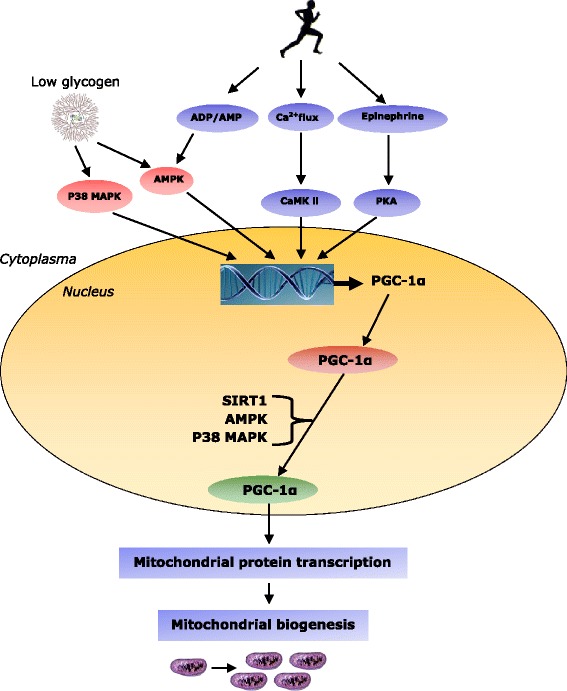
“Accordingly, p38 MAPK particularly phosphorylate the expression of PGC-1α [53, 62], whereas AMPK could both phosphorylate and enhance expression of PGC-1α [53, 62].”
BackgroundMolecular mechanisms for mitochondrial adaptation to exercise training in skeletal muscle
Drake, J. C., Wilson, R. J., & Yan, Z. (2016) · The FASEB Journal · doi:10.1096/fj.15-276337 · Cited by 263 · cited 1×
“Prolonged endurance type exercise requires a large amount of ATP resulting in accumulation of ADP and AMP in the recruited muscle fibers [55].”
BackgroundMuscle metabolism during intense, heavy-resistance exercise
Tesch, P. A., Colliander, E. B., & Kaiser, P. (1986) · European Journal of Applied Physiology and Occupational Physiology · doi:10.1007/bf00422734 · Cited by 259 · cited 1×
“In line with this, a typical resistance exercise session has been shown to reduces glycogen levels by approximately ~24-40 % [37, 39–41].”
BackgroundCarbohydrate availability and exercise training adaptation: Too much of a good thing?
Bartlett, J. D., Hawley, J. A., & Morton, J. P. (2015) · European Journal of Sport Science · doi:10.1080/17461391.2014.920926 · Cited by 230 · cited 2×
“Although carbohydrates are widely accepted as fuel for skeletal muscle both during [8] and following endurance exercise [8], recent investigations introduced a novel approach of exercising with reduced glycogen levels aimed to optimize skeletal muscle adaptations [9, 10].”
BackgroundDolezal, B. A., & Potteiger, J. A. (1998) · Journal of Applied Physiology · doi:10.1152/jappl.1998.85.2.695 · Cited by 228 · cited 1×
“Concurrent training does improve both endurance capacity and muscular strength/power, although numerous studies have revealed that strength development is compromised with concurrent training compared to resistance exercise alone [91–94], a phenomenon known as the “interference” effect.”
BackgroundRole of glycogen availability in sarcoplasmic reticulum Ca2+ kinetics in human skeletal muscle
Ørtenblad, N., Nielsen, J., Saltin, B., & Holmberg, H. (2011) · The Journal of Physiology · doi:10.1113/jphysiol.2010.195982 · Cited by 225 · cited 2×
“[21] it was shown that ingestion of carbohydrates during 4 h recovery following exercise markedly increases glycogen content and normalizes SR Ca compared to”
BackgroundHowarth, K. R., Moreau, N. A., Phillips, S. M., & Gibala, M. J. (2009) · Journal of Applied Physiology · doi:10.1152/japplphysiol.90333.2008 · Cited by 218
Achten, J., Halson, S. L., Moseley, L., Rayson, M. P., Casey, A., & Jeukendrup, A. E. (2004) · Journal of Applied Physiology · doi:10.1152/japplphysiol.00973.2003 · Cited by 214 · cited 1×
“which in turn may result in reduced training capacity [36].”
BackgroundLarge energetic adaptations of elderly muscle to resistance and endurance training
Jubrias, S. A., Esselman, P. C., Price, L. B., Cress, M. E., & Conley, K. E. (2001) · Journal of Applied Physiology · doi:10.1152/jappl.2001.90.5.1663 · Cited by 213 · cited 1×
“Moreover, resistance training augmented oxidative phosphorylation in sedentary older adults [73] and respiratory capacity and intrinsic function of skeletal muscle mitochondria in young healthy men [74].”
BackgroundLeg glucose uptake during maximal dynamic exercise in humans
Katz, A., Broberg, S., Sahlin, K., & Wahren, J. (1986) · American Journal of Physiology-Endocrinology and Metabolism · doi:10.1152/ajpendo.1986.251.1.e65 · Cited by 198 · cited 1×
“[37], the majority of ATP is derived from glycolysis [38].”
BackgroundTraining with Low Muscle Glycogen Enhances Fat Metabolism in Well-Trained Cyclists
HULSTON, C. J., VENABLES, M. C., MANN, C. H., MARTIN, C., PHILP, A., BAAR, K., & JEUKENDRUP, A. E. (2010) · Medicine & Science in Sports & Exercise · doi:10.1249/mss.0b013e3181dd5070 · Cited by 196 · cited 4×
“[18] used untrained subjects, whereas others tested well-trained subjects [12, 16].”
BackgroundMethodInfluentialBeneficial metabolic adaptations due to endurance exercise training in the fasted state
Van Proeyen, K., Szlufcik, K., Nielens, H., Ramaekers, M., & Hespel, P. (2011) · Journal of Applied Physiology · doi:10.1152/japplphysiol.00907.2010 · Cited by 196
The Interference Effects of Training for Strength and Endurance Simultaneously.
Hennessy, L. C., & Watson, A. W. S. (1994) · Journal of Strength and Conditioning Research · doi:10.1519/00124278-199402000-00003 · Cited by 193
Mitochondrial volume density in human skeletal muscle following heavy resistance training.
Jd, M., SALE, D. G., Мороз, Gc, E., Sutton, M. A., & HOWALD, H. (1979) · PubMed · Cited by 191
Aerobic Fitness Affects the Exercise Performance Responses to Nitrate Supplementation
PORCELLI, S., RAMAGLIA, M., BELLISTRI, G., PAVEI, G., PUGLIESE, L., MONTORSI, M., RASICA, L., & MARZORATI, M. (2015) · Medicine & Science in Sports & Exercise · doi:10.1249/mss.0000000000000577 · Cited by 187 · cited 1×
“Indeed, it has previously been shown that the effectiveness of nutritional interventions is influenced by the subject training status [32], possibly because trained subjects depend less on carbohydrate utilization because they have greater metabolic flexibility.”
BackgroundRole of p53 in mitochondrial biogenesis and apoptosis in skeletal muscle
Saleem, A., Adhihetty, P. J., & Hood, D. A. (2009) · Physiological Genomics · doi:10.1152/physiolgenomics.90346.2008 · Cited by 182 · cited 2×
“factor A (Tfam) and also by preventing p53 suppression of PGC-1α activation in the nucleus [67].”
BackgroundWang, L., Mascher, H., Psilander, N., Blomstrand, E., & Sahlin, K. (2011) · Journal of Applied Physiology · doi:10.1152/japplphysiol.00086.2011 · Cited by 181 · cited 1×
“Interestingly, it has been demonstrated that a resistance exercise session subsequently after low-intensity endurance, non-glycogen depleting session could enhance molecular signaling of mitochondrial biogenesis induced by endurance exercise [104].”
BackgroundMorton, J. P., Croft, L., Bartlett, J. D., MacLaren, D. P. M., Reilly, T., Evans, L., McArdle, A., & Drust, B. (2009) · Journal of Applied Physiology · doi:10.1152/japplphysiol.00003.2009 · Cited by 179 · cited 3×
“Indeed, several studies have reported that endurance exercise with low glycogen availability may be a strategy to augment the response in exercise-induced signaling associated with improved oxidative capacity [11–17], and potentially enhance exercise”
BackgroundBlomstrand, E., & Saltin, B. (1999) · The Journal of Physiology · doi:10.1111/j.1469-7793.1999.293af.x · Cited by 178
Pesta, D., Hoppel, F., Macek, C., Messner, H., Faulhaber, M., Kobel, C., Parson, W., Burtscher, M., Schocke, M., & Gnaiger, E. (2011) · American Journal of Physiology-Regulatory, Integrative and Comparative Physiology · doi:10.1152/ajpregu.00285.2011 · Cited by 177 · cited 1×
“However, it has been recently reported that resistance exercise increases the activity of oxidative enzymes in tissue homogenates [19, 71] and respiration in skinned muscle fibers [72].”
BackgroundPasiakos, S. M., Vislocky, L. M., Carbone, J. W., Altieri, N., Konopelski, K., Freake, H. C., Anderson, J. M., Ferrando, A. A., Wolfe, R. R., & Rodriguez, N. R. (2010) · The Journal of Nutrition · doi:10.3945/jn.109.118372 · Cited by 176 · cited 1×
“The result that MPS is not influenced by the level of glycogen was an interesting finding since it has been previously reported that energy deficit attenuates rates of mixed MPS by ~19 % [90].”
BackgroundCox, G. R., Clark, S. A., Cox, A. J., Halson, S. L., Hargreaves, M., Hawley, J. A., Jeacocke, N., Snow, R. J., Yeo, W. K., & Burke, L. M. (2010) · Journal of Applied Physiology · doi:10.1152/japplphysiol.00950.2009 · Cited by 165 · cited 3×
“Indeed, several studies have reported that endurance exercise with low glycogen availability may be a strategy to augment the response in exercise-induced signaling associated with improved oxidative capacity [11–17], and potentially enhance exercise”
BackgroundFat adaptation followed by carbohydrate loading compromises high-intensity sprint performance
Havemann, L., West, S. J., Goedecke, J. H., Macdonald, I. A., St Clair Gibson, A., Noakes, T. D., & Lambert, E. V. (2006) · Journal of Applied Physiology · doi:10.1152/japplphysiol.00813.2005 · Cited by 165 · cited 1×
“Furthermore, the majority of the studies with low glycogen availability were of short duration [18] and showed no changes [11–17], or showed, in some cases decreases in performance [109].”
BackgroundHuman Muscle Glycogen Metabolism During Exercise: Effect of Carbohydrate Supplementation
Tsintzas, K., & Williams, C. (1998) · Sports Medicine · doi:10.2165/00007256-199825010-00002 · Cited by 161
Rapid exercise-induced changes in PGC-1α mRNA and protein in human skeletal muscle
Mathai, A. S., Bonen, A., Benton, C. R., Robinson, D. L., & Graham, T. E. (2008) · Journal of Applied Physiology · doi:10.1152/japplphysiol.00847.2007 · Cited by 158
Manipulating Resistance Training Program Variables to Optimize Maximum Strength in Men: A Review
TAN, B. (1999) · Journal of Strength and Conditioning Research · doi:10.1519/00124278-199908000-00019 · Cited by 154
Creer, A., Gallagher, P., Slivka, D., Jemiolo, B., Fink, W., & Trappe, S. (2005) · Journal of Applied Physiology · doi:10.1152/japplphysiol.00110.2005 · Cited by 150 · cited 19×
“A more recent study by Howarth et al. [82] used the stable isotope tracer methodology and therefore enabled to determine the changes in MPS and MPB.”
BackgroundInfluentialBartlett, J. D., Louhelainen, J., Iqbal, Z., Cochran, A. J., Gibala, M. J., Gregson, W., Close, G. L., Drust, B., & Morton, J. P. (2013) · American Journal of Physiology-Regulatory, Integrative and Comparative Physiology · doi:10.1152/ajpregu.00498.2012 · Cited by 147 · cited 1×
“upregulates p53 to a larger extent than during exercise in a replenished glycogen state [68].”
BackgroundBiochemical Aspects of Overtraining in Endurance Sports: The Metabolism Alteration Process Syndrome
Petibois, C., Cazorla, G., POORTMANS, J. R., & D??l??ris, G. (2003) · Sports Medicine · doi:10.2165/00007256-200333020-00001 · Cited by 144 · cited 1×
“state may enhance the risk for overtraining syndrome [35]”
BackgroundCombined Training Enhances Skeletal Muscle Mitochondrial Oxidative Capacity Independent of Age
Irving, B. A., Lanza, I. R., Henderson, G. C., Rao, R. R., Spiegelman, B. M., & Nair, K. S. (2015) · The Journal of Clinical Endocrinology & Metabolism · doi:10.1210/jc.2014-3081 · Cited by 139 · cited 2×
“Interestingly, following all exercise modalities, concurrent training induced the most robust improvements in mitochondrial related outcomes and mRNA expression [75].”
BackgroundUsing Molecular Biology to Maximize Concurrent Training
Baar, K. (2014) · Sports Medicine · doi:10.1007/s40279-014-0252-0 · Cited by 135 · cited 1×
“Low glycogen availability and protein metabolism”
Philp, A., Hamilton, D. L., & Baar, K. (2011) · Journal of Applied Physiology · doi:10.1152/japplphysiol.00941.2010 · Cited by 131
Expanding roles for AMPK in skeletal muscle plasticity
Mounier, R., Théret, M., Lantier, L., Foretz, M., & Viollet, B. (2015) · Trends in Endocrinology & Metabolism · doi:10.1016/j.tem.2015.02.009 · Cited by 130 · cited 1×
“This activates AMPK with the purpose to restore cellular energy homeostasis [56, 57].”
BackgroundMuscle Substrate Utilization and Lactate Production During Weightlifting
Macdougall, J. D., Ray, S., Sale, D. G., Mccartney, N., Lee, P., & Garner, S. (1999) · Canadian Journal of Applied Physiology · doi:10.1139/h99-017 · Cited by 129
Slater, G., & Phillips, S. M. (2011) · Journal of Sports Sciences · doi:10.1080/02640414.2011.574722 · Cited by 129 · cited 2×
“However, this effect is not always evident [43] and is likely to be affected by the protocol used to induce glycogen depletion [44].”
BackgroundChan, M. H. S., McGee, S. L., Watt, M. J., Hargreaves, M., & Febbraio, M. A. (2004) · The FASEB Journal · doi:10.1096/fj.03-1039fje · Cited by 127 · cited 1×
“Chan et al (2004) suggested that low muscle glycogen availability associates with the phosphorylation of the nuclear P38 mitogen-activated protein kinases (p38 MAPK), rather than translocation of p38 MAPK to the nucleus per se [61].”
BackgroundNielsen, J., Holmberg, H., Schrøder, H. D., Saltin, B., & Ørtenblad, N. (2011) · The Journal of Physiology · doi:10.1113/jphysiol.2010.204487 · Cited by 122 · cited 1×
“Intramyofibrillar glycogen is preferably depleted during high-intensity exercise and seems to power cross-bridge cycling [23].”
BackgroundCoffey, V. G., Jemiolo, B., Edge, J., Garnham, A. P., Trappe, S. W., & Hawley, J. A. (2009) · American Journal of Physiology-Regulatory, Integrative and Comparative Physiology · doi:10.1152/ajpregu.00351.2009 · Cited by 120 · cited 1×
“Most existing information on nutrition and concurrent training adaptation is derived from studies where subjects performed exercise in the fasted state [104–108].”
BackgroundPasiakos, S. M., McClung, H. L., McClung, J. P., Margolis, L. M., Andersen, N. E., Cloutier, G. J., Pikosky, M. A., Rood, J. C., Fielding, R. A., & Young, A. J. (2011) · The American Journal of Clinical Nutrition · doi:10.3945/ajcn.111.017061 · Cited by 118
Yeo, W. K., McGee, S. L., Carey, A. L., Paton, C. D., Garnham, A. P., Hargreaves, M., & Hawley, J. A. (2010) · Experimental Physiology · doi:10.1113/expphysiol.2009.049353 · Cited by 117
Tang, J. E., Hartman, J. W., & Phillips, S. M. (2006) · Applied Physiology, Nutrition, and Metabolism · doi:10.1139/h06-026 · Cited by 116 · cited 1×
“However, it has been recently reported that resistance exercise increases the activity of oxidative enzymes in tissue homogenates [19, 71] and respiration in skinned muscle fibers [72].”
BackgroundConsecutive bouts of diverse contractile activity alter acute responses in human skeletal muscle
Coffey, V. G., Pilegaard, H., Garnham, A. P., O'Brien, B. J., & Hawley, J. A. (2009) · Journal of Applied Physiology · doi:10.1152/japplphysiol.91221.2008 · Cited by 116 · cited 1×
“Most existing information on nutrition and concurrent training adaptation is derived from studies where subjects performed exercise in the fasted state [104–108].”
BackgroundGlycogen resynthesis in skeletal muscle following resistive exercise
PASCOE, D. D., COSTILL, D. L., FINK, W. J., ROBERGS, R. A., & ZACHWIEJA, J. J. (1993) · Medicine & Science in Sports & Exercise · doi:10.1249/00005768-199303000-00009 · Cited by 112 · cited 1×
“The largest reductions in glycogen are seen with high repetitions with moderate load training [40], an effect that mainly occurs in type II fibers [39].”
BackgroundKoopman, R., Manders, R. J. F., Jonkers, R. A. M., Hul, G. B. J., Kuipers, H., & van Loon, L. J. C. (2006) · European Journal of Applied Physiology · doi:10.1007/s00421-005-0118-0 · Cited by 112 · cited 1×
“The largest reductions in glycogen are seen with high repetitions with moderate load training [40], an effect that mainly occurs in type II fibers [39].”
BackgroundCarbohydrate Availability and Training Adaptation: Effects on Cell Metabolism
Hawley, J. A., & Burke, L. M. (2010) · Exercise and Sport Sciences Reviews · doi:10.1097/jes.0b013e3181f44dd9 · Cited by 109 · cited 1×
“Although carbohydrates are widely accepted as fuel for skeletal muscle both during [8] and following endurance exercise [8], recent investigations introduced a novel approach of exercising with reduced glycogen levels aimed to optimize skeletal muscle adaptations [9, 10].”
BackgroundApró, W., Wang, L., Pontén, M., Blomstrand, E., & Sahlin, K. (2013) · American Journal of Physiology-Endocrinology and Metabolism · doi:10.1152/ajpendo.00091.2013 · Cited by 109 · cited 1×
“Most existing information on nutrition and concurrent training adaptation is derived from studies where subjects performed exercise in the fasted state [104–108].”
BackgroundHowarth, K. R., Phillips, S. M., MacDonald, M. J., Richards, D., Moreau, N. A., & Gibala, M. J. (2010) · Journal of Applied Physiology · doi:10.1152/japplphysiol.00108.2009 · Cited by 108 · cited 2×
“[82] used the stable isotope tracer methodology and therefore enabled to determine the changes in MPS and”
BackgroundMethodHaff, G. G., Koch, A. J., Potteiger, J. A., Kuphal, K. E., Magee, L. M., Green, S. B., & Jakicic, J. J. (2000) · International Journal of Sport Nutrition and Exercise Metabolism · doi:10.1123/ijsnem.10.3.326 · Cited by 103
Exercise with low glycogen increases PGC-1α gene expression in human skeletal muscle
Psilander, N., Frank, P., Flockhart, M., & Sahlin, K. (2013) · European Journal of Applied Physiology · doi:10.1007/s00421-012-2504-8 · Cited by 101
Resistance exercise training influences skeletal muscle immune activation: a microarray analysis
Gordon, P. M., Liu, D., Sartor, M. A., IglayReger, H. B., Pistilli, E. E., Gutmann, L., Nader, G. A., & Hoffman, E. P. (2012) · Journal of Applied Physiology · doi:10.1152/japplphysiol.00860.2011 · Cited by 100
Overtraining: A Review of the Signs, Symptoms and Possible Causes
Stone, M. H., Keith, R. E., Kearney, J. T., Fleck, S. J., Wilson, G., & Triplett, N. T. (1991) · The Journal of Strength and Conditioning Research · Cited by 94
Coffey, V. G., Moore, D. R., Burd, N. A., Rerecich, T., Stellingwerff, T., Garnham, A. P., Phillips, S. M., & Hawley, J. A. (2011) · European Journal of Applied Physiology · doi:10.1007/s00421-010-1768-0 · Cited by 92 · cited 1×
“It is now widely accepted that nutrition plays an important role in mediating skeletal muscle adaptations [7].”
BackgroundCochran, A. J. R., Little, J. P., Tarnopolsky, M. A., & Gibala, M. J. (2010) · Journal of Applied Physiology · doi:10.1152/japplphysiol.00659.2009 · Cited by 90 · cited 1×
“activate) p38 MAPK [63] and AMPK [15].”
Charifi, N., Kadi, F., Féasson, L., Costes, F., Geyssant, A., & Denis, C. (2004) · The Journal of Physiology · doi:10.1113/jphysiol.2003.046953 · Cited by 88 · cited 1×
“In short, endurance exercise training mainly results in mitochondrial biogenesis, increases capillary density and enzymes leading to enhanced skeletal muscle O2 utilization capacity [2–4].”
BackgroundMuscle strength and fatigue after selective glycogen depletion in human skeletal muscle fibers
Jacobs, I. A., Kaiser, P., & Tesch, P. A. (1981) · European Journal of Applied Physiology · doi:10.1007/bf00422176 · Cited by 88 · cited 2×
“Together, prolonged endurance exercise leads to muscle glycogen depletion, which is in turn linked to fatigue and makes it difficult to meet the energetic requirements of training and competition [22, 29].”
BackgroundChilibeck, P. D., Syrotuik, D. G., & Bell, G. J. (1999) · European Journal of Applied Physiology and Occupational Physiology · doi:10.1007/s004210050641 · Cited by 87 · cited 1×
“Early investigations have shown that skeletal mitochondrial volume [69] and oxidative capacity [70] are unaltered following prolonged resistance exercise.”
BackgroundChurchley, E. G., Coffey, V. G., Pedersen, D. J., Shield, A., Carey, K. A., Cameron-Smith, D., & Hawley, J. A. (2007) · Journal of Applied Physiology · doi:10.1152/japplphysiol.01260.2006 · Cited by 80 · cited 1×
“[88] demonstrated that low-glycogen availability (~193 mmol∙kgd.”
Margolis, L. M., & Pasiakos, S. M. (2013) · Advances in Nutrition · doi:10.3945/an.113.004572 · Cited by 73 · cited 1×
“oxidative capacity through increased fatty acid β-oxidation and mitigating glycogenolysis [52].”
BackgroundLow muscle glycogen concentration does not suppress the anabolic response to resistance exercise
Camera, D. M., West, D. W. D., Burd, N. A., Phillips, S. M., Garnham, A. P., Hawley, J. A., & Coffey, V. G. (2012) · Journal of Applied Physiology · doi:10.1152/japplphysiol.00395.2012 · Cited by 72 · cited 2×
“[20] young healthy men performed 8 sets of 5 unilateral leg press repetitions at 80 % 1RM.”
BackgroundVAN HALL, G., SALTIN, B., & WAGENMAKERS, A. J. M. (1999) · Clinical Science · doi:10.1042/cs0970557 · Cited by 71 · cited 2×
“To date, only a few studies examined the role of glycogen availability on protein metabolism following endurance exercise [30, 80, 81].”
BackgroundResultNutritional strategies to optimize training and racing in middle-distance athletes
Stellingwerff, T., Boit, M. K., & Res, P. T. (2007) · Journal of Sports Sciences · doi:10.1080/02640410701607213 · Cited by 69 · cited 1×
“[16], athletes generally use multiple intensities, as well as progressive overload [33, 34], rather than a fixed”
BackgroundBurelle, Y., & Hochachka, P. W. (2002) · Journal of Applied Physiology · doi:10.1152/japplphysiol.01024.2001 · Cited by 68 · cited 1×
“In short, endurance exercise training mainly results in mitochondrial biogenesis, increases capillary density and enzymes leading to enhanced skeletal muscle O2 utilization capacity [2–4].”
BackgroundDuhamel, T. A., Perco, J. G., & Green, H. J. (2006) · American Journal of Physiology-Regulatory, Integrative and Comparative Physiology · doi:10.1152/ajpregu.00858.2005 · Cited by 67 · cited 1×
“[25] found that commencing an endurance type bout of exercise till fatigue with low glycogen availability resulted in earlier deteriorations in SR Ca release.”
BackgroundEffects of training and immobilization on VO2 and DO2 in dog gastrocnemius muscle in situ
Bebout, D. E., Hogan, M. C., Hempleman, S. C., & Wagner, P. D. (1993) · Journal of Applied Physiology · doi:10.1152/jappl.1993.74.4.1697 · Cited by 67 · cited 1×
“In short, endurance exercise training mainly results in mitochondrial biogenesis, increases capillary density and enzymes leading to enhanced skeletal muscle O2 utilization capacity [2–4].”
BackgroundDirect influence of the p53 tumor suppressor on mitochondrial biogenesis and function
DONAHUE, R. J., RAZMARA, M., HOEK, J. B., & KNUDSEN, T. B. (2001) · The FASEB Journal · doi:10.1096/fj.00-0262com · Cited by 64 · cited 1×
“the stimulation of gene expression of mitochondrial function [66, 67].”
BackgroundThe Effect of Carbohydrate Supplementation on Multiple Sessions and Bouts of Resistance Exercise
HAFF, G. G., STONE, M. H., WARREN, B. J., KEITH, R., JOHNSON, R. L., NIEMAN, D. C., WILLIAMS, F., & KIRKSEY, K. B. (1999) · Journal of Strength and Conditioning Research · doi:10.1519/00124278-199905000-00003 · Cited by 64
Nielsen, J., Suetta, C., Hvid, L. G., Schrøder, H. D., Aagaard, P., & Ørtenblad, N. (2010) · American Journal of Physiology-Endocrinology and Metabolism · doi:10.1152/ajpendo.00324.2010 · Cited by 61
Nutritional strategies to support concurrent training
Perez‐Schindler, J., Hamilton, D. L., Moore, D. R., Baar, K., & Philp, A. (2015) · European Journal of Sport Science · doi:10.1080/17461391.2014.950345 · Cited by 57 · cited 21×
“A more recent study by Howarth et al. [82] used the stable isotope tracer methodology and therefore enabled to determine the changes in MPS and MPB.”
BackgroundInfluentialEffects of Carbohydrate Restriction on Strength Performance
LEVERITT, M., & ABERNETHY, P. J. (1999) · Journal of Strength and Conditioning Research · doi:10.1519/00124278-199902000-00010 · Cited by 56 · cited 1×
“It has been demonstrated that a reduction of muscle glycogen affects both isokinetic torque [29] and isoinertial resistance exercise capacity negatively [42].”
BackgroundRole of p53 Within the Regulatory Network Controlling Muscle Mitochondrial Biogenesis
Saleem, A., Carter, H. N., Iqbal, S., & Hood, D. A. (2011) · Exercise and Sport Sciences Reviews · doi:10.1097/jes.0b013e31822d71be · Cited by 54 · cited 1×
“changes in glycogen availability [65].”
The effects of supplemental carbohydrate ingestion on intermittent isokinetic leg exercise.
Haff, G. G., Schroeder, C. A., Koch, A. J., Kuphal, K. E., Comeau, M. J., & Potteiger, J. A. (2001) · PubMed · Cited by 52
Weltan, S. M., Bosch, A. N., Dennis, S. C., & Noakes, T. D. (1998) · American Journal of Physiology-Endocrinology and Metabolism · doi:10.1152/ajpendo.1998.274.1.e83 · Cited by 49 · cited 1×
“tabolism during and after exercise [30, 31].”
A Review: The Effects of Combined Strength and Endurance Training on Strength Development
Chromiak, J. A., & Mulvaney, D. R. (1990) · The Journal of Strength and Conditioning Research · doi:10.1519/1533-4287(1990)004<0047:rbrasp>2.3.co;2 · Cited by 47
Effects of Carbohydrate Feeding on Multiple-bout Resistance Exercise
Lambert, C. P., Flynn, M. G., Boone, J. B., Michaud, T. J., & Rodriguez-Zayas, J. (1991) · Journal of Strength and Conditioning Research · doi:10.1519/00124278-199111000-00004 · Cited by 47
Cochran, A. J. R., Myslik, F., MacInnis, M. J., Percival, M. E., Bishop, D., Tarnopolsky, M. A., & Gibala, M. J. (2015) · International Journal of Sport Nutrition and Exercise Metabolism · doi:10.1123/ijsnem.2014-0263 · Cited by 46
A Review: The Effects of Combined Strength and Endurance Training on Strength Development
Chromiak, J. A., & Mulvaney, D. R. (1990) · The Journal of Strength and Conditioning Research · doi:10.1519/1533-4287(1990)004<0055:arteoc>2.3.co;2 · Cited by 46 · cited 1×
“Vice versa, the effect of resistance exercise on endurance performance and VO2max appears to be marginal [95, 96].”
BackgroundCarrithers, J. A., Carroll, C. C., Coker, R. H., Sullivan, D. H., & Trappe, T. A. (2007) · PubMed · Cited by 45
CAMERA, D. M., Hawley, J. A., & Coffey, V. G. (2015) · European Journal of Applied Physiology · doi:10.1007/s00421-015-3116-x · Cited by 44
Kulik, J. R., Touchberry, C. D., Kawamori, N., Blumert, P. A., Crum, A. J., & Haff, G. G. (2008) · Journal of Strength and Conditioning Research · doi:10.1519/jsc.0b013e31816d679b · Cited by 41 · cited 1×
“In contrast, other reports show no benefit of carbohydrate ingestion on total work capacity [50, 51].”
(2014) · Routledge eBooks · doi:10.4324/9780203132142 · Cited by 36 · cited 1×
“A relative drop of ATP by less than 1 % translates into a doubling or more of the ADP and AMP concentrations [58].”
BackgroundThe Effect of Preexercise Carbohydrate Status on Resistance Exercise Performance
Mitchell, J. B., DiLauro, P. C., Pizza, F. X., & Cavender, D. L. (1997) · International Journal of Sport Nutrition · doi:10.1123/ijsn.7.3.185 · Cited by 32 · cited 1×
“However, this effect is not always evident [43] and is likely to be affected by the protocol used to induce glycogen depletion [44].”
Background
Cited by
The Crosstalk between the Gut Microbiota and Mitochondria during Exercise
Clark, A., & Mach, N. (2017) · Frontiers in Physiology · doi:10.3389/fphys.2017.00319 · Cited by 338
“…cell contains hundreds to thousands of mitochondria, and the organelle’s size, shape, and number depend on various physiological conditions and stimulus such as endurance exercise, high temperature, diet or hormones (Bartlett and Eaton, 2004; Knuiman et al., 2015; BusquetsCortés et al., 2016).”
BackgroundFundamentals of glycogen metabolism for coaches and athletes
Murray, B., & Rosenbloom, C. (2018) · Nutrition Reviews · doi:10.1093/nutrit/nuy001 · Cited by 224
“synthesis or the overall anabolic response to resistance training.(53,82,83)”
BackgroundMolecular mechanisms of exercise contributing to tissue regeneration
Chen, J., Zhou, R., Feng, Y., & Cheng, L. (2022) · Signal Transduction and Targeted Therapy · doi:10.1038/s41392-022-01233-2 · Cited by 167
Development of a Revised Conceptual Framework of Physical Training for Use in Research and Practice
Jeffries, A. C., Marcora, S. M., Coutts, A. J., Wallace, L., McCall, A., & Impellizzeri, F. M. (2022) · Sports Medicine · doi:10.1007/s40279-021-01551-5 · Cited by 159
Exercise-induced oxidative stress and melatonin supplementation: current evidence
Kruk, J., Aboul-Enein, B. H., & Duchnik, E. (2021) · The Journal of Physiological Sciences · doi:10.1186/s12576-021-00812-2 · Cited by 135
Metadata
- Authors
- Knuiman, P., Hopman, M. T. E., & Mensink, M.
- Affiliations
- Wageningen University & Research (NL)
- Radboud University Nijmegen (NL)
- Corresponding author
- Knuiman, Pim
- Venue
- Nutrition & Metabolism
- Published
- 2015-12
- Volume
- 12
- Issue
- 1
- Pages
- 59-59
- ISSN
- 1743-7075 (ISSN-L)
- PMC
- PMC4687103
- OpenAlex
- W2218861610
- Cited by
- 113
- References
- 110
- Citations by year
- 2026: 10 · 2025: 18 · 2024: 10 · 2023: 13 · 2022: 12 · 2021: 8 · 2020: 13 · 2019: 11 · 2018: 10 · 2017: 6 · 2016: 1
- FWCI
- 0.57
- Type
- journal article
- Language
- en
- Open access
- gold
- doi.org
- Licence
- cc-by
- creativecommons.org/licenses/by/4.0/ (tdm)
- Locations
- Nutrition & Metabolism (publishedVersion, cc-by)
- Europe PMC (PubMed Central) (publishedVersion, cc-by)
- PubMed Central (publishedVersion, cc-by)
- PubMed (publishedVersion)
- Socio-Environmental Systems Modeling (acceptedVersion, cc-by)
- Data Archiving and Networked Services (DANS) (submittedVersion, cc-by)
- Funders
- Eat2Move Gelderland (6163512152)
- Topics
- Health Sciences › Nursing › Nutrition and Dietetics › Muscle metabolism and nutrition
- Health Sciences › Medicine › Orthopedics and Sports Medicine › Sports Performance and Training
- Health Sciences › Medicine › Physiology (medical) › Cardiovascular and exercise physiology
- Keywords
- skeletal muscle adaptation, endurance exercise, resistance training, glycogen depletion, glycogen resynthesis, ATP resynthesis, endurance training, concurrent training, post-exercise recovery
About these checks
Registry, retraction, Cites and statistics results are computed, not judged, with one exception: a printed reference that no index lists is read once by a model before it counts as a citation error. Claims are extracted by a model and kept only when their quote appears verbatim in the text; each cited source is then checked, with a model’s help, for whether it says what the claim relies on. Those verdicts can be wrong — read the claim’s quote and the cited source before relying on one.
Statistics and arithmetic are recomputed, not judged.
Confidence bands are shown only for fields calibrated on our annotated test set. None is calibrated yet, so no band is shown.
What counts as a claim ›How we measure confidence ›How we check this ›
Are you an author, or do you see a problem with this page? Request a review
Data sources
Bibliographic data: Semantic Scholar, OpenAlex, Crossref.
Contains information from the Semantic Scholar Academic Graph Datasets, made available under the ODC Attribution License (ODC-BY 1.0).
Semantic Scholar’s data is described in: Kinney, R., et al. (2023). The Semantic Scholar Open Data Platform. arXiv:2301.10140.
