

Methods for Human-Centered eHealth Development: Narrative Scoping Review
Open accessPublished version of a preprint
The DOI matches its Crossref record; 187 of the 187 references it cites were found in a registry or an index; 45 of the 145 sources its claims cite were checked for support.
Abstract
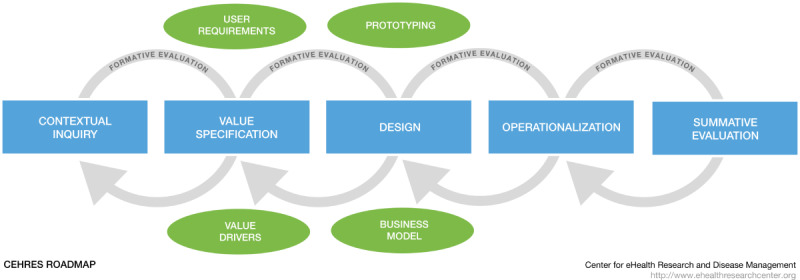
Background: Thorough holistic development of eHealth can contribute to a good fit among the technology, its users, and the context. However, despite the availability of frameworks, not much is known about specific research activities for different aims, phases, and settings. This results in researchers having to reinvent the wheel. Consequently, there is a need to synthesize existing knowledge on research activities for participatory eHealth development processes. Objective: The 3 main goals of this review are to create an overview of the development strategies used in studies based on the CeHRes (Center for eHealth Research) Roadmap, create an overview of the goals for which these methods can be used, and provide insight into the lessons learned about these methods. Methods: We included eHealth development studies that were based on the phases and/or principles of the CeHRes Roadmap. This framework was selected because of its focus on participatory, iterative eHealth design in context and to limit the scope of this review. Data were extracted about the type of strategy used, rationale for using the strategy, research questions, and reported information on lessons learned. The most frequently mentioned lessons learned were summarized using a narrative, inductive approach. Results: In the included 160 papers, a distinction was made between overarching development methods (n=10) and products (n=7). Methods are used to gather new data, whereas products can be used to synthesize previously collected data and support the collection of new data. The identified methods were focus groups, interviews, questionnaires, usability tests, literature studies, desk research, log data analyses, card sorting, Delphi studies, and experience sampling. The identified products were prototypes, requirements, stakeholder maps, values, behavior change strategies, personas, and business models. Examples of how these methods and products were applied in the development process and information about lessons learned were provided. Conclusions: This study shows that there is a plethora of methods and products that can be used at different points in the development process and in different settings. To do justice to the complexity of eHealth development, it seems that multiple strategies should be combined. In addition, we found no evidence for an optimal single step-by-step approach to develop eHealth. Rather, researchers need to select the most suitable research methods for their research objectives, the context in which data are collected, and the characteristics of the participants. This study serves as a first step toward creating a toolkit to support researchers in applying the CeHRes Roadmap to practice. In this way, they can shape the most suitable and efficient eHealth development process.
Overview
CoChat Summary
TL;DR
This narrative scoping review synthesized 160 eHealth development studies based on the CeHRes Roadmap, identifying 10 overarching methods and 7 products used across contextual inquiry, value specification, and design phases. It concludes there is no single optimal step-by-step approach; researchers should combine multiple strategies selected for the research objective, context, and participant characteristics.
Key findings
- In 160 included papers, the review identified 10 methods (focus groups, interviews, questionnaires, usability tests, literature studies, desk research, log data analyses, card sorting, Delphi studies, experience sampling) and 7 products (prototypes, requirements, stakeholder maps, values, behavior change strategies, personas, business models).
- Most development studies used a multi-method approach (90/160, 56.3%); web-based interventions were the most common technology (74/160, 46.3%), followed by mobile apps (34/160, 21.3%), VR (3/160, 1.9%), and no clear technology description (27/160, 16.9%).
- Most frequently reported methods were focus groups (71/160, 44.4%), interviews (70/160, 43.8%), questionnaires (51/160, 31.9%), usability tests (51/160, 31.9%), and literature studies (43/160, 26.9%); most frequently reported products were prototypes (32/160, 20%), requirements (11/160, 6.9%), stakeholder maps (10/160, 6.3%), and values (7/160, 4.4%).
- Lessons learned emphasized that methods and products should fit the context, participant characteristics and skills, and earlier findings; multiple methods should be combined; and there was no evidence for an optimal single step-by-step approach. Experience sampling (1/160, 0.6%), Delphi studies (3/160, 1.9%), personas (5/160, 3.1%), and behavior change strategies (5/160, 3.1%) were underrepresented.
Methods
- Narrative scoping review of eHealth development studies based on the CeHRes Roadmap phases and/or principles; inclusion required reference to the original 2011 CeHRes paper in the introduction or methods and use of ≥1 phase or principle, while implementation/summative-evaluation-only studies, abstract guideline papers, non-peer-reviewed records, and records not in English, Dutch, German, or Portuguese were excluded.
- Searched Scopus, Google Scholar, and Web of Science up to June 2021, plus snowball sampling for records coauthored by the CeHRes Roadmap founder; 1713 unique records were screened, 377 remained after title/abstract screening, and 160 were included after full-text screening.
- Data were extracted by 3 researchers on strategy type, rationale, research questions, and lessons learned; methods and products were categorized by consensus, and lessons learned were summarized using a narrative, inductive approach. Phases were deduced by the authors when not explicitly reported.
Limitations
- Stated: focusing only on the CeHRes Roadmap means other suitable methods or products may have been overlooked, so the overview is neither exhaustive nor unconditionally generalizable; lessons learned are not exhaustive; no quality assessment of included studies was performed; and the qualitative approach is prone to researcher bias, though screening and summarizing were systematic and conducted by 3 researchers with coauthor discussion.
- Stated: not all relevant development information may have been published, and reporting clarity and extensiveness varied across studies; suboptimal or incomplete reflection by authors resulted in some lessons learned remaining general.
- Evident from the text: CeHRes phases were explicitly mentioned in only 30% (48/160) of studies, so phase categorization was often deduced by the authors, which may introduce misclassification; products also appeared less clearly reported than methods.
Model-written summary. Check it against the paper before relying on it.
Integrity signals
Registry
Cites
Statistics
Figures

Verification
Claims the paper makes
22 Valid · 0 Not valid · 55 Not checked · 111 Own results and interpretations
The cited sources support only part of this claim — read each source’s verdict below.
In the paper
“First, multiple authors indicated that usability tests should be conducted with a broad range of stakeholders: not only end users such as patients, but also caregivers, managers, technology developers, and experts on content and design”
§ Methods for Human-Centered eHealth Development: Narrative Scoping Review > Results > Definition, Applicability, and Lessons Learned Per Method
What the sources say
- Not checked yetcites [21] Van Gemert-Pijnen, L, 2016, Handbook of Smart Homes, Health Care and Well-Being
- Partly supportedcites [43] sourceExperimental — accuracy not yet measured
Our copy supports only the descriptive half of the claim: the paper's own usability testing (Results, Part 4) involved people beyond patients — a testicular cancer survivor, a nurse, a cancer care assistant, a spouse of a cancer survivor with fatigue, and 2 health-psychology PhD students — and its development consulted content/design specialists (Results, Part 3: 'Specialists in the development and evaluation of Web-based behavior change interventions... expertise in the design and implementation of interventions built using LifeGuide'; 'the views of stakeholders, such as health care staff'). The Discussion (Principal Findings) endorses 'cocreation of the intervention with the experts and service users'. What the paper does NOT say is the normative, cross-study assertion attributed to it: it is a single intervention-development paper, not a review of 'included studies', and no passage states that usability tests SHOULD be conducted with a broad range of stakeholders including managers and technology developers (searched: stakeholders, caregivers, managers, technology developers, recommendations for usability testing). (LLM, conf=0.68)
- Not checked yetcites [54] source
- Partly supportedcites [64] sourceExperimental — accuracy not yet measured
The Discussion (p. n/a, 'This mixed method approach…') states the paper's lesson that they 'focused on diverse stakeholders to catch different perspectives' and 'involved end-users and stakeholders in the whole analysis through multiple and small tests', and the Methods/Results (Characteristics of participants, Table 1; Implementation) show those stakeholders were healthcare managers, clinicians/nurses, plus software developers, biomedical engineers and graphic designers acting as HCI/content-design experts — so the managers/technology-developers/design-experts part of the claim is supported. The patients-and-caregivers part is not: the paper's end users were healthcare professionals only, and the Results (Implementation) state the patient-facing use case UC1.3 'directly involves patients, and it is not included in this work'; caregivers are never mentioned. Searched: 'usability tests stakeholders patients/caregivers', 'patients and caregivers involvement', 'human-centered design stakeholders'. (LLM, conf=0.72)
- Not checked yetcites [77] Verhoeven, F, 2010, HCI in Work and Learning, Life and Leisure
- Partly supportedcites [112] sourceExperimental — accuracy not yet measured
Our copy supports the multi-stakeholder part of the claim at the level of intervention development, not usability testing: the Development team section (p. 6) states that 'different perspectives were considered important' and lists researchers, technicians with software development and design expertise, ten health professionals and five patients, and the Discussion (p. 11) reflects on collaboration of researchers, health professionals, patients and technicians. Phase 3 (p. 7) adds that usability findings were discussed with the development team and translated with two software engineers. However, the paper's actual usability tests were run with three outpatients only (p. 7, p. 9), it makes no recommendation that usability tests include caregivers or managers (neither group appears), and it reports its own co-creative practice rather than stating a normative point credited to 'multiple authors'. (LLM, conf=0.72)
- Partly supportedcites [127] sourceExperimental — accuracy not yet measured
Our copy of Derks et al. (2019) supports the core idea that usability testing should extend beyond end users: the Discussion Conclusions state that 'the involvement of multiple user groups proved to be of added value during design and realization, as evidenced by the complementary requirements and perspectives,' and the Abstract Methods/Results describe three cycles with patients, therapists (professional caregivers) and user-centered design experts, with the Limitations and Strengths section noting 'the use of the multiple user groups is of added value during design and realization.' However, the paper's groups are only patients, caregivers/therapists and UCD (content/design) experts; it nowhere recommends including managers or technology developers in usability tests, and it frames multi-group testing as its own demonstrated practice rather than a general normative statement by 'multiple authors.' The stakeholder list in the claim (managers, technology developers) is therefore not supported by this source. (LLM, conf=0.72)
- Partly supportedcites [131] sourceExperimental — accuracy not yet measured
Split into 2 atoms — 0 confirmed, 2 partially supported, 0 disputed, 0 misattributed, 0 unverifiable. Expand the claim to see per-atom verdicts.
- Not checked yetcites [152] source
- Not checked yetcites [155] source
hedged- Asserted: passes — The authors put it forward as true.
- Checkable: passes — It can be checked against evidence.
- Load-bearing: passes — The paper’s conclusions depend on it.
- Based: passes — The paper gives a reason why it holds.
Every source the paper cites for this claim was checked and supports it.
In the paper
“First, the included studies showed that there is not 1 single way to create a prototype.”
§ Methods for Human-Centered eHealth Development: Narrative Scoping Review > Results > Definition, Applicability, and Lessons Learned Per Product
What the sources say
- Supportedcites [40] source
The Methods (Overview; page unavailable) describe prototypes ranging from rough paper sketches to interactive tablet mock-ups. The Methods (Prototype and testing of PRO dashboard; page unavailable) also describe six iterations of a paper prototype shaped by feedback. This study supports the citing authors’ point that prototyping need not follow one fixed form. (LLM, conf=0.86)
- Supportedcites [55] source
The Results > Design section (page unavailable) describes four preliminary sketch concepts, two of which became distinct digital prototypes: a list-based version and a pie-chart version. This study therefore provides an example of more than one approach to creating a prototype, consistent with the citing sentence’s synthesis of the included studies. (LLM, conf=0.88)
- Supportedcites [121] source
The Background (page unavailable) lists several frameworks for developing web-based interventions and says this study used scrum. The Discussion, ‘Lessons learned & study limitations’ (page unavailable), considers IDEAS and traditional methods as alternatives. Together, these passages support the point that there is no single way to develop a prototype. (LLM, conf=0.88)
plain- Asserted: passes — The authors put it forward as true.
- Checkable: passes — It can be checked against evidence.
- Load-bearing: unclear — It is unclear whether the paper’s conclusions depend on it.
- Based: passes — The paper gives a reason why it holds.
- Supported
Every source the paper cites for this claim was checked and supports it.
In the paper
“Second, it can be challenging to recruit participants for a Delphi study because, for example, there are not many experts in a specific or new field, which can be especially relevant when studying novel applications of an eHealth technology”
§ Methods for Human-Centered eHealth Development: Narrative Scoping Review > Results > Definition, Applicability, and Lessons Learned Per Method
What the sources say
- Supportedcites [101] source
The Discussion (p. of passage [1]) states directly that 'It proved to be difficult to recruit participants for such an explorative study, since not many therapists have experience with online treatment, and therapists do not receive extra time to take part in research from their management,' which is exactly the recruitment-difficulty-because-few-experts point the claim attributes to this Delphi study. The surrounding Discussion (passage [2]) reinforces the novelty qualifier: 'online therapy is still scarce in clinical practice,' i.e. a novel eHealth application. The citing sentence adds a second reason (management time) only implicitly, but the core attribution is present in our copy. (LLM, conf=0.85)
plainstates a possible cause- Asserted: passes — The authors put it forward as true.
- Checkable: passes — It can be checked against evidence.
- Load-bearing: unclear — It is unclear whether the paper’s conclusions depend on it.
- Based: passes — The paper gives a reason why it holds.
- Supported
Every source the paper cites for this claim was checked and supports it.
In the paper
“First, in the included papers it was shown that stakeholder maps are not created from scratch but are based on data.”
§ Methods for Human-Centered eHealth Development: Narrative Scoping Review > Results > Definition, Applicability, and Lessons Learned Per Product
What the sources say
- Supportedcites [27] source
In Methods (Stakeholder Identification Method Number 3: Snowball Sampling With Stakeholders; page unavailable), the authors say they developed a stakeholder map from an initial list, then used questionnaire responses to revise and expand it. Their account supports the claim that the map was grounded in gathered information rather than created from scratch. (LLM, conf=0.90)
- Supportedcites [129] source
The Methods section (Key stakeholder identification; page not provided) says the initial stakeholder list was built from a literature scan rather than from scratch. It also says an online survey was used to identify key stakeholders from that list, supporting the claim that the stakeholder identification was based on data. (LLM, conf=0.87)
plain- Asserted: passes — The authors put it forward as true.
- Checkable: passes — It can be checked against evidence.
- Load-bearing: unclear — It is unclear whether the paper’s conclusions depend on it.
- Based: passes — The paper gives a reason why it holds.
- Supported
The cited sources support only part of this claim — read each source’s verdict below.
In the paper
“Second, it might not be possible to include all requirements in an eHealth technology because of practical, technical, or financial limitations.”
§ Methods for Human-Centered eHealth Development: Narrative Scoping Review > Results > Definition, Applicability, and Lessons Learned Per Product
What the sources say
- Supportedcites [38] source
The Methods section says that selecting requirements for bWell depended on technical feasibility, context of use, and available finance and time. The Discussion reports that financial limitations prevented the team from including all identified user needs and requirements. Our copy does not provide page numbers for these passages. (LLM, conf=0.91)
- Could not verifycites [39] sourceExperimental — accuracy not yet measured
The Results (Phase 2: Findings; page unavailable) say the team evaluated system requirements against usability feedback and addressed identified changes. Neither that passage nor the searched passages state that practical, technical, or financial limitations can prevent an eHealth technology from including all requirements (searched for those limitations, feasibility, resources, and unimplemented requirements). (LLM, conf=0.72)
hedgedstates a possible cause- Asserted: passes — The authors put it forward as true.
- Checkable: passes — It can be checked against evidence.
- Load-bearing: unclear — It is unclear whether the paper’s conclusions depend on it.
- Based: passes — The paper gives a reason why it holds.
- Supported
81 more claims · 3 with their cited sources checked
Create a free account to see all 188 claims and to verify the 100 references still open.
- It may state two separate claims as one. 40
- Probably not a substantial claim. 79
Self-check
Percentages, sums and reported differences re-computed from the paper’s own numbers.
Each contradiction between two passages listed here was confirmed by an independent check.
Rated minor: it would not touch a result — a value no result rests on, a p-value that stays on the same side of the significance level, or a conflict that is clerical, resolved elsewhere in the paper, or outside its own findings.
In the paper
§ Methods for Human-Centered eHealth Development: Narrative Scoping Review > Results > Overview of Methods and Products Per Phase of the CeHRes Roadmap
“| | Usability test (n=51) | 0 (0) | 0 (0) | 1 (2) | 1 (2) | 67 (131) | 67 (131) |”
§ Methods for Human-Centered eHealth Development: Narrative Scoping Review > Results > Definition, Applicability, and Lessons Learned Per Method
“Of the 160 included studies, 51 (31.9%) reported on usability tests.”
Citations
Cites
Preferred Reporting Items for Systematic Reviews and Meta-Analyses: the PRISMA statement
Moher, D., Liberati, A., Tetzlaff, J., Altman, D. G., & for the PRISMA Group (2009) · BMJ · doi:10.1136/bmj.b2535 · Cited by 83,823
Preferred Reporting Items for Systematic Reviews and Meta-Analyses: The PRISMA Statement
Moher, D., Liberati, A., Tetzlaff, J., Altman, D. G., & The PRISMA Group (2009) · PLoS Medicine · doi:10.1371/journal.pmed.1000097 · Cited by 64,042
Wang, G., Ma, R., Qiao, G., Wada, K., Aizawa, Y., & Satoh, T. (2015) · Integrative Medicine International · doi:10.1159/000368408 · Cited by 18,657
A typology of reviews: an analysis of 14 review types and associated methodologies
Grant, M. J., & Booth, A. (2009) · Health Information & Libraries Journal · doi:10.1111/j.1471-1842.2009.00848.x · Cited by 10,817
Michie, S., Richardson, M., Johnston, M., Abraham, C., Francis, J., Hardeman, W., Eccles, M. P., Cane, J., & Wood, C. E. (2013) · Annals of Behavioral Medicine · doi:10.1007/s12160-013-9486-6 · Cited by 7,629
Webb, T. L., Joseph, J., Yardley, L., & Michie, S. (2010) · Journal of Medical Internet Research · doi:10.2196/jmir.1376 · Cited by 2,517 · cited 1×
“This is quite surprising, especially considering the relationship between behavior change theory and effectiveness of (eHealth) interventions [184,185].”
Eysenbach, G. (2001) · Journal of Medical Internet Research · doi:10.2196/jmir.3.2.e20 · Cited by 2,449
CONSORT 2010 Statement: updated guidelines for reporting parallel group randomised trials
the CONSORT Group, Schulz, K. F., Altman, D. G., & Moher, D. (2010) · Trials · doi:10.1186/1745-6215-11-32 · Cited by 1,871
Planning Health Promotion Programs: An Intervention Mapping Approach
Hicking-Woodison, L. (2017) · Nursing Standard · doi:10.7748/ns.32.6.33.s38 · Cited by 1,841
Persuasive Systems Design: Key Issues, Process Model, and System Features
Oinas-Kukkonen, H., & Harjumaa, M. (2009) · Communications of the Association for Information Systems · doi:10.17705/1cais.02428 · Cited by 1,663
Yardley, L., Morrison, L., Bradbury, K., & Muller, I. (2015) · Journal of Medical Internet Research · doi:10.2196/jmir.4055 · Cited by 1,442
The Impact of eHealth on the Quality and Safety of Health Care: A Systematic Overview
Black, A. D., Car, J., Pagliari, C., Anandan, C., Cresswell, K., Bokun, T., McKinstry, B., Procter, R., Majeed, A., & Sheikh, A. (2011) · PLoS Medicine · doi:10.1371/journal.pmed.1000387 · Cited by 1,442
Persuasive System Design Does Matter: a Systematic Review of Adherence to Web-based Interventions
Kelders, S. M., Kok, R. N., Ossebaard, H. C., & Van Gemert-Pijnen, J. E. (2012) · Journal of Medical Internet Research · doi:10.2196/jmir.2104 · Cited by 1,308 · cited 1×
“Consequently, not all state-of-the-art knowledge on technologies is published at the point of conducting the review [99,158,163,167,172].”
Self-citationA Holistic Framework to Improve the Uptake and Impact of eHealth Technologies
van Gemert-Pijnen, J. E., Nijland, N., van Limburg, M., Ossebaard, H. C., Kelders, S. M., Eysenbach, G., & Seydel, E. R. (2011) · Journal of Medical Internet Research · doi:10.2196/jmir.1672 · Cited by 1,126
Self-citationMethods to support human-centred design
MAGUIRE, M. (2001) · International Journal of Human-Computer Studies · doi:10.1006/ijhc.2001.0503 · Cited by 1,057 · cited 1×
“Consequently, there might be an availability bias in eHealth development: researchers might mostly use research activities that they are experienced with or those that are often described in literature [17].”
Health behavior models in the age of mobile interventions: are our theories up to the task?
Riley, W. T., Rivera, D. E., Atienza, A. A., Nilsen, W., Allison, S. M., & Mermelstein, R. (2011) · Translational Behavioral Medicine · doi:10.1007/s13142-011-0021-7 · Cited by 978
Michie, S., Yardley, L., West, R., Patrick, K., & Greaves, F. (2017) · Journal of Medical Internet Research · doi:10.2196/jmir.7126 · Cited by 865 · cited 1×
“For that purpose, a user-centered, iterative, and multi-method development process in which all stakeholders are actively involved is recommended [7-10].”
Methods of usability testing in the development of eHealth applications: A scoping review
Maramba, I., Chatterjee, A., & Newman, C. (2019) · International Journal of Medical Informatics · doi:10.1016/j.ijmedinf.2019.03.018 · Cited by 602 · cited 1×
“Examples of such methods are observations, EMAs, or eye tracking [189-191].”
Mohr, D. C., Lyon, A. R., Lattie, E. G., Reddy, M., & Schueller, S. M. (2017) · Journal of Medical Internet Research · doi:10.2196/jmir.7725 · Cited by 432
User profiles and personas in the design and development of consumer health technologies
LeRouge, C., Ma, J., Sneha, S., & Tolle, K. (2013) · International Journal of Medical Informatics · doi:10.1016/j.ijmedinf.2011.03.006 · Cited by 411
Meiland, F., Innes, A., Mountain, G., Robinson, L., van der Roest, H., García-Casal, J. A., Gove, D., Thyrian, J. R., Evans, S., Dröes, R.-M., et al. (2017) · JMIR Rehabilitation and Assistive Technologies · doi:10.2196/rehab.6376 · Cited by 339
van der Vaart, R., Witting, M., Riper, H., Kooistra, L., Bohlmeijer, E. T., & van Gemert-Pijnen, L. J. (2014) · BMC Psychiatry · doi:10.1186/s12888-014-0355-z · Cited by 273 · cited 3×
“…or anxiety in their children to include in the eHealth technology [72], to reach consensus on the most optimal way to integrate an eHealth technology in standard treatment [101], and to gain insight into expert opinions on relevant self-management behaviors for reducing the impact of COPD [84].”
Designing eHealth that Matters via a Multidisciplinary Requirements Development Approach
Van Velsen, L., Wentzel, J., & Van Gemert-Pijnen, J. E. (2013) · JMIR Research Protocols · doi:10.2196/resprot.2547 · Cited by 262 · cited 1×
“In addition, values and requirements can be elicited by means of both an interview study and focus groups in which prototypes are evaluated [96,97,178,179].”
Verhoeven, F., van Gemert-Pijnen, L., Dijkstra, K., Nijland, N., Seydel, E., & Steehouder, M. (2007) · Journal of Medical Internet Research · doi:10.2196/jmir.9.5.e37 · Cited by 252
Asynchronous and synchronous teleconsultation for diabetes care: A systematic literature review
Verhoeven, F., Tanja-Dijkstra, K., Nijland, N., Eysenbach, G., & van Gemert-Pijnen, L. (2010) · Journal of Diabetes Science and Technology · doi:10.1177/193229681000400323 · Cited by 247
Agile science: creating useful products for behavior change in the real world
Hekler, E. B., Klasnja, P., Riley, W. T., Buman, M. P., Huberty, J., Rivera, D. E., & Martin, C. A. (2016) · Translational Behavioral Medicine · doi:10.1007/s13142-016-0395-7 · Cited by 208 · cited 4×
“This is in line with agile science , which states that eHealth development should be iterative and flexible, with short sprints to allow for constant changes to the process and products [14,183].”
InfluentialJansen, F., van Uden-Kraan, C. F., van Zwieten, V., Witte, B. I., & Verdonck-de Leeuw, I. M. (2015) · Supportive Care in Cancer · doi:10.1007/s00520-014-2514-7 · Cited by 195
The Pace of Technologic Change
Patrick, K., Hekler, E. B., Estrin, D., Mohr, D. C., Riper, H., Crane, D., Godino, J., & Riley, W. T. (2016) · American Journal of Preventive Medicine · doi:10.1016/j.amepre.2016.05.001 · Cited by 169 · cited 2×
“This is in line with agile science , which states that eHealth development should be iterative and flexible, with short sprints to allow for constant changes to the process and products [14,183].”
eHealth Research, Theory and Development: A Multidisciplinary Approach
(2018) · doi:10.4324/9781315385907 · Cited by 169
Self-citationLentferink, A. J., Oldenhuis, H. K., de Groot, M., Polstra, L., Velthuijsen, H., & van Gemert-Pijnen, J. E. (2017) · Journal of Medical Internet Research · doi:10.2196/jmir.7288 · Cited by 162
Van de Belt, T. H., Engelen, L. J., Berben, S. A., Teerenstra, S., Samsom, M., & Schoonhoven, L. (2013) · Journal of Medical Internet Research · doi:10.2196/jmir.2607 · Cited by 154
Moller, A. C., Merchant, G., Conroy, D. E., West, R., Hekler, E., Kugler, K. C., & Michie, S. (2017) · Journal of Behavioral Medicine · doi:10.1007/s10865-016-9818-7 · Cited by 151 · cited 1×
“Consequently, separate goals or activities might be added to the CeHRes Roadmap to support developers in incorporating behavior change theory [186,187].”
Asbjørnsen, R. A., Smedsrød, M. L., Solberg Nes, L., Wentzel, J., Varsi, C., Hjelmesæth, J., & van Gemert-Pijnen, J. E. (2019) · Journal of Medical Internet Research · doi:10.2196/14265 · Cited by 150 · cited 3×
“…such as technology in forensic psychiatry [158], to gain insight into development-related questions such as suitable persuasive features or behavior change techniques (BCTs) [159], or to develop recommendations for the design of specific interventions such as embodied conversational agents [172].”
Handbook of Smart Homes, Health Care and Well-Being
van Hoof, J., Demiris, G., & Wouters, E. J. M. (2016) · Springer eBooks · doi:10.1007/978-3-319-01583-5 · Cited by 133
Developing Embodied Conversational Agents for Coaching People in a Healthy Lifestyle: Scoping Review
Kramer, L. L., ter Stal, S., Mulder, B. C., de Vet, E., & van Velsen, L. (2020) · Journal of Medical Internet Research · doi:10.2196/14058 · Cited by 121 · cited 2×
“…such as technology in forensic psychiatry [158], to gain insight into development-related questions such as suitable persuasive features or behavior change techniques (BCTs) [159], or to develop recommendations for the design of specific interventions such as embodied conversational agents [172].”
Maguire, R., Ream, E., Richardson, A., Connaghan, J., Johnston, B., Kotronoulas, G., Pedersen, V., McPhelim, J., Pattison, N., Smith, A., et al. (2015) · Cancer Nursing · doi:10.1097/ncc.0000000000000150 · Cited by 120
Morrison, L. G. (2015) · DIGITAL HEALTH · doi:10.1177/2055207615595335 · Cited by 116
Lubberding, S., van Uden‐Kraan, C. F., Te Velde, E. A., Cuijpers, P., Leemans, C. R., & Verdonck‐de Leeuw, I. M. (2015) · Journal of Clinical Nursing · doi:10.1111/jocn.12753 · Cited by 109
Scholten, M. R., Kelders, S. M., & Van Gemert-Pijnen, J. E. (2017) · Journal of Medical Internet Research · doi:10.2196/jmir.7351 · Cited by 97 · cited 1×
“In any case, it is important to reflect on the choices that were made in the reviewing process when interpreting the results [158-160].”
Self-citationMoore, G., Wilding, H., Gray, K., & Castle, D. (2019) · Journal of Participatory Medicine · doi:10.2196/11474 · Cited by 95
Kooistra, L. C., Ruwaard, J., Wiersma, J. E., van Oppen, P., van der Vaart, R., van Gemert-Pijnen, J. E. W. C., & Riper, H. (2016) · Internet Interventions · doi:10.1016/j.invent.2016.01.003 · Cited by 92
Spanakis, E. G., Santana, S., Tsiknakis, M., Marias, K., Sakkalis, V., Teixeira, A., Janssen, J. H., de Jong, H., & Tziraki, C. (2016) · Journal of Medical Internet Research · doi:10.2196/jmir.4863 · Cited by 92
eHealth in Treatment of Offenders in Forensic Mental Health: A Review of the Current State
Kip, H., Bouman, Y. H. A., Kelders, S. M., & van Gemert-Pijnen, L. J. E. W. C. (2018) · Frontiers in Psychiatry · doi:10.3389/fpsyt.2018.00042 · Cited by 89 · cited 4×
“In any case, it is important to reflect on the choices that were made in the reviewing process when interpreting the results [158-160].”
InfluentialSelf-citationOpening the Black Box of Electronic Health: Collecting, Analyzing, and Interpreting Log Data
Sieverink, F., Kelders, S., Poel, M., & van Gemert-Pijnen, L. (2017) · JMIR Research Protocols · doi:10.2196/resprot.6452 · Cited by 88
Self-citationVan Gemert-Pijnen, J. E., Kelders, S. M., & Bohlmeijer, E. T. (2014) · Journal of Medical Internet Research · doi:10.2196/jmir.2991 · Cited by 84 · cited 4×
“This makes log data analysis a less complicated method than is often assumed [175].”
InfluentialSelf-citationHarder, H., Holroyd, P., Burkinshaw, L., Watten, P., Zammit, C., Harris, P. R., Good, A., & Jenkins, V. (2017) · Journal of Cancer Survivorship · doi:10.1007/s11764-017-0630-3 · Cited by 84 · cited 2×
“Consequently, researchers should carefully select methods that fit the characteristics and skills of these populations [38,39,70].”
Asbjørnsen, R. A., Wentzel, J., Smedsrød, M. L., Hjelmesæth, J., Clark, M. M., Solberg Nes, L., & Van Gemert-Pijnen, J. E. W. C. (2020) · Journal of Medical Internet Research · doi:10.2196/22598 · Cited by 84
Crane, D., Garnett, C., Brown, J., West, R., & Michie, S. (2017) · Frontiers in Public Health · doi:10.3389/fpubh.2017.00039 · Cited by 82 · cited 2×
“To overcome these issues, which are related to generalizability, multiple authors recommended that interviews be combined with other methods in a multi-method or mixed methods approach [24,40,52,54,69,78,96,97,100,102,108,109,116,118,120,124,126].”
Ledel Solem, I. K., Varsi, C., Eide, H., Kristjansdottir, O. B., Børøsund, E., Schreurs, K. M. G., Waxenberg, L. B., Weiss, K. E., Morrison, E. J., Haaland-Øverby, M., et al. (2020) · Journal of Medical Internet Research · doi:10.2196/15889 · Cited by 80
Development of a web-based intervention for the indicated prevention of depression
Kelders, S. M., Pots, W. T., Oskam, M. J., Bohlmeijer, E. T., & van Gemert-Pijnen, J. E. (2013) · BMC Medical Informatics and Decision Making · doi:10.1186/1472-6947-13-26 · Cited by 80 · cited 1×
“[15,21,24,26,28-31,33,34,40,44,45,47,49,50,52,54-56, 58,61,67,69,70,74,76,78,79,81,83,84,88,89,91,96-129,178] 21 (30) 32 (46) 41 (59) Interview (n=70) [15,24,26,29,32-34,46, 49”
Self-citationKorpershoek, Y. J. G., Hermsen, S., Schoonhoven, L., Schuurmans, M. J., & Trappenburg, J. C. A. (2020) · Journal of Medical Internet Research · doi:10.2196/15449 · Cited by 78
Mummah, S. A., King, A. C., Gardner, C. D., & Sutton, S. (2016) · International Journal of Behavioral Nutrition and Physical Activity · doi:10.1186/s12966-016-0400-z · Cited by 77
Pang, P. C., Chang, S., Verspoor, K. M., & Pearce, J. M. (2016) · Journal of Medical Internet Research · doi:10.2196/jmir.5661 · Cited by 77
Timmerman, J. G., Tönis, T. M., Dekker-van Weering, M. G. H., Stuiver, M. M., Wouters, M. W. J. M., van Harten, W. H., Hermens, H. J., & Vollenbroek-Hutten, M. M. R. (2016) · BMC Health Services Research · doi:10.1186/s12913-016-1385-7 · Cited by 75 · cited 2×
“Third, interviews were used quite often and were generally viewed as a useful method that can be used at any point in the eHealth development process [15,21,45,54,96-98,100”
Børøsund, E., Mirkovic, J., Clark, M. M., Ehlers, S. L., Andrykowski, M. A., Bergland, A., Westeng, M., & Solberg Nes, L. (2018) · JMIR Formative Research · doi:10.2196/formative.9954 · Cited by 73
Participatory eHealth development to support nurses in antimicrobial stewardship
Wentzel, J., van Velsen, L., van Limburg, M., de Jong, N., Karreman, J., Hendrix, R., & van Gemert-Pijnen, J. J. E. W. C. (2014) · BMC Medical Informatics and Decision Making · doi:10.1186/1472-6947-14-45 · Cited by 73
Sexual Health and the Internet: Cross-Sectional Study of Online Preferences Among Adolescents
von Rosen, A. J., von Rosen, F. T., Tinnemann, P., & Müller‐Riemenschneider, F. (2017) · Journal of Medical Internet Research · doi:10.2196/jmir.7068 · Cited by 73
Vermeulen, J., Neyens, J., Spreeuwenberg, van Rossum, E., Sipers, Habets, Hewson, D., & de Witte (2013) · Patient Preference and Adherence · doi:10.2147/ppa.s45897 · Cited by 64
Gilbert, M., Haag, D., Salway, T. J., Bondyra, M., Elliot, E., Chabot, C., Farrell, J., Bonnell, A., Kopp, S., Andruschak, J., et al. (2016) · JMIR Research Protocols · doi:10.2196/resprot.6293 · Cited by 64
Yap, M. B., Lawrence, K. A., Rapee, R. M., Cardamone-Breen, M. C., Green, J., & Jorm, A. F. (2017) · JMIR Mental Health · doi:10.2196/mental.8492 · Cited by 63 · cited 2×
“…to identify expert recommendations for parents to reduce the risk of depression or anxiety in their children to include in the eHealth technology [72], to reach consensus on the most optimal way to integrate an eHealth technology in standard treatment [101], and to gain insight into expert…”
Kip, H., Kelders, S. M., Weerink, K. M. A., Kuiper, A., Brüninghoff, I., Bouman, Y. H. A., Dijkslag, D., & van Gemert-Pijnen, L. J. E. W. C. (2019) · Frontiers in Psychology · doi:10.3389/fpsyg.2019.00406 · Cited by 61
Self-citationvan Limburg, M., Wentzel, J., Sanderman, R., & van Gemert-Pijnen, L. (2015) · JMIR Research Protocols · doi:10.2196/resprot.4519 · Cited by 59 · cited 5×
“Second, experience has shown that creating a business model is very time consuming, partly because there are no business models specifically for eHealth yet [27,99].”
InfluentialSpan, M., Hettinga, M., de Ven, L. G.-V., Jukema, J., Janssen, R., Vernooij-Dassen, M. J. F. J., Eefsting, J. A., & Smits, C. H. M. (2017) · Disability and Rehabilitation · doi:10.1080/09638288.2017.1298162 · Cited by 59
HCI in Work and Learning, Life and Leisure
Leitner, G., Holzinger, A., & Hitz, M. (2010) · Lecture notes in computer science · doi:10.1007/978-3-642-16607-5 · Cited by 59
van Woezik, A. F. G., Braakman-Jansen, L. M. A., Kulyk, O., Siemons, L., & van Gemert-Pijnen, J. E. W. C. (2016) · Antimicrobial Resistance & Infection Control · doi:10.1186/s13756-016-0119-2 · Cited by 57
eHealth research, theory and development: A multi-disciplinary approach
Sieverink, F., Köhle, N., Cheung, K., Roefs, A., Trompetter, H. R., & Keizer, J. (2018) · Research portal (Tilburg University) · Cited by 56
Self-citationCosta, D. D., Zelkowitz, P., Letourneau, N. L., Howlett, A., Dennis, C., Russell, B., Grover, S. A., Lowensteyn, I., Chan, P. T. K., & Khalifé, S. (2017) · Journal of Medical Internet Research · doi:10.2196/jmir.7415 · Cited by 55
Duman-Lubberding, S., van Uden‐Kraan, C. F., Peek, N. B., Cuijpers, P. J., Leemans, C. R., & Leeuw, I. M. V. (2015) · Journal of Medical Internet Research · doi:10.2196/jmir.4870 · Cited by 53
van Velsen, L., van Gemert-Pijnen, J. E. W. C., Beaujean, D. J. M. A., Wentzel, J., & van Steenbergen, J. E. (2012) · Journal of Medical Internet Research · doi:10.2196/jmir.2123 · Cited by 53 · cited 4×
“First, experience sampling was found to be a suitable method to explore an existing situation and thus to provide valuable input for further eHealth development [130].”
InfluentialBogza, L.-M., Patry-Lebeau, C., Farmanova, E., Witteman, H. O., Elliott, J., Stolee, P., Hudon, C., & Giguere, A. M. C. (2020) · Journal of Medical Internet Research · doi:10.2196/17406 · Cited by 52 · cited 2×
“Second, authors stated that ideally, multiple methods should be combined to paint a full picture of a prototype’s usability [24,25,64,77,80,118,152]; for example, qualitative methods such as think-aloud procedures and interviews can be combined.”
Floch, J., Zettl, A., Fricke, L., Weisser, T., Grut, L., Vilarinho, T., Stav, E., Ascolese, A., & Schauber, C. (2018) · JMIR mHealth and uHealth · doi:10.2196/mhealth.8236 · Cited by 51
Wahle, F., Bollhalder, L., Kowatsch, T., & Fleisch, E. (2017) · Journal of Medical Internet Research · doi:10.2196/jmir.7381 · Cited by 48
Derks, Y. P., Klaassen, R., Westerhof, G. J., Bohlmeijer, E. T., & Noordzij, M. L. (2019) · JMIR mHealth and uHealth · doi:10.2196/13479 · Cited by 45
Wentink, M. M., van Bodegom‐Vos, L., Brouns, B., Arwert, H. J., Houdijk, S., Kewalbansing, P., Boyce, L. W., Vlieland, T. P. M. V., de Kloet, A. J., & Meesters, J. J. L. (2019) · BMC Medical Informatics and Decision Making · doi:10.1186/s12911-019-0871-3 · Cited by 44
Active Patient Participation in the Development of an Online Intervention
van Bruinessen, I. R., van Weel-Baumgarten, E. M., Snippe, H. W., Gouw, H., Zijlstra, J. M., & van Dulmen, S. (2014) · JMIR Research Protocols · doi:10.2196/resprot.3695 · Cited by 43 · cited 5×
“To overcome these issues, which are related to generalizability, multiple authors recommended that interviews be combined with other methods in a multi-method or mixed methods approach [24,40,52,54,69,78,96,97,100,102,108,109,116,118,120,124,126].”
InfluentialOnline usability and patients with long-term conditions: A mixed-methods approach
Ossebaard, H. C., Seydel, E. R., & van Gemert-Pijnen, L. (2012) · International Journal of Medical Informatics · doi:10.1016/j.ijmedinf.2011.12.010 · Cited by 43 · cited 9×
“…potential to improve problems in a specific organization [77]; to analyze the way a high-fidelity prototype is used by prospective end users [24,84]; to assess whether the prototype fits the current work practice of end users such as nurses [25]; or to generate new, or further specify,…”
InfluentialWachtler, C., Coe, A., Davidson, S., Fletcher, S., Mendoza, A., Sterling, L., & Gunn, J. (2018) · JMIR mHealth and uHealth · doi:10.2196/mhealth.9502 · Cited by 43
Winterling, J., Wiklander, M., Obol, C. M., Lampic, C., Eriksson, L. E., Pelters, B., & Wettergren, L. (2016) · JMIR Research Protocols · doi:10.2196/resprot.5499 · Cited by 42
Stara, V., Santini, S., Kropf, J., & D'Amen, B. (2020) · Journal of Medical Internet Research · doi:10.2196/17809 · Cited by 42
Rothgangel, A., Braun, S., Smeets, R., & Beurskens, A. (2017) · JMIR Rehabilitation and Assistive Technologies · doi:10.2196/rehab.6761 · Cited by 42
(2020) · doi:10.2196/16906 · Cited by 41
Self-citationSpan, M., Smits, C., Jukema, J., Groen-van de Ven, L., Janssen, R., Vernooij-Dassen, M., Eefsting, J., & Hettinga, M. (2015) · Frontiers in Aging Neuroscience · doi:10.3389/fnagi.2015.00128 · Cited by 41
Kristan, J., & Suffoletto, B. P. (2014) · Translational Behavioral Medicine · doi:10.1007/s13142-014-0298-4 · Cited by 41
van Gemert-Pijnen, L. (. E. W. C. )., Kip, H., Kelders, S. M., & Sanderman, R. (2018) · eHealth Research, Theory and Development · doi:10.4324/9781315385907-1 · Cited by 41
Self-citationJonathan, G., Dopke, C. A., Michaels, T., Bank, A., Martin, C. R., Adhikari, K., Krakauer, R. L., Ryan, C., McBride, A., Babington, P., et al. (2021) · JMIR Mental Health · doi:10.2196/20424 · Cited by 41
Radomski, A. D., Wozney, L., McGrath, P., Huguet, A., Hartling, L., Dyson, M. P., Bennett, K., & Newton, A. S. (2019) · Journal of Medical Internet Research · doi:10.2196/11128 · Cited by 40 · cited 2×
“Consequently, not all state-of-the-art knowledge on technologies is published at the point of conducting the review [99,158,163,167,172].”
Ragouzeos, D., Gandrup, J., Berrean, B., Li, J., Murphy, M., Trupin, L., Yazdany, J., & Schmajuk, G. (2019) · Patient Education and Counseling · doi:10.1016/j.pec.2018.10.016 · Cited by 40
Kip, H., Kelders, S. M., Bouman, Y. H. A., & van Gemert-Pijnen, L. J. E. W. C. (2019) · Journal of Medical Internet Research · doi:10.2196/12972 · Cited by 40
Self-citationPearson, J., Walsh, N. E., Carter, D., Koskela, S., & Hurley, M. (2016) · JMIR Research Protocols · doi:10.2196/resprot.5446 · Cited by 39
Holistic development of eHealth technology
Kip, H., & van Gemert-Pijnen, L. (. E. W. C. ). (2018) · Routledge eBooks · doi:10.4324/9781315385907-7 · Cited by 39
Self-citationCnossen, I. C., van Uden‐Kraan, C. F., Eerenstein, S. E. J., Rinkel, R. N. P. M., Aalders, I. J., van den Berg, K., de Goede, C. J. T., van Stijgeren, A. J., Cruijff-Bijl, Y., de Bree, R., et al. (2015) · Folia Phoniatrica et Logopaedica · doi:10.1159/000441251 · Cited by 39
Sporrel, K., De Boer, R. D. D., Wang, S., Nibbeling, N., Simons, M., Deutekom, M., Ettema, D., Castro, P. C., Dourado, V. Z., & Kröse, B. (2021) · Frontiers in Public Health · doi:10.3389/fpubh.2020.528472 · Cited by 38 · cited 7×
“Ideally, multiple sources of data should be combined, such as scientific literature and qualitative data collected from multiple types of stakeholders [91,114,115].”
InfluentialNijland, N., Cranen, K., Boer, H., van Gemert-Pijnen, J. E. W. C., & Seydel, E. R. (2010) · Journal of Telemedicine and Telecare · doi:10.1258/jtt.2009.001004 · Cited by 37
Breeman, L. D., Keesman, M., Atsma, D. E., Chavannes, N. H., Janssen, V., van Gemert-Pijnen, L., Kemps, H., Kraaij, W., Rauwers, F., Reijnders, T., et al. (2021) · International Journal of Medical Informatics · doi:10.1016/j.ijmedinf.2020.104364 · Cited by 37
Infertility patients' need and preferences for online peer support
Grunberg, P. H., Dennis, C., Costa, D. D., & Zelkowitz, P. (2018) · Reproductive Biomedicine & Society Online · doi:10.1016/j.rbms.2018.10.016 · Cited by 37
Hochstenbach, L. M. J., Courtens, A. M., Zwakhalen, S. M. G., Vermeulen, J., van Kleef, M., & de Witte, L. P. (2017) · Applied Nursing Research · doi:10.1016/j.apnr.2017.03.004 · Cited by 36
Liu, L. H., Garrett, S. B., Li, J., Ragouzeos, D., Berrean, B., Dohan, D. P., Katz, P., Barton, J. L., Yazdany, J., & Schmajuk, G. (2020) · Health Expectations · doi:10.1111/hex.13057 · Cited by 35
How nurses seek and evaluate clinical guidelines on the Internet
Verhoeven, F., Steehouder, M. F., Hendrix, R., & van Gemert‐Pijnen, J. E. W. C. (2009) · Journal of Advanced Nursing · doi:10.1111/j.1365-2648.2009.05175.x · Cited by 33
on behalf of the INSTRUCT project group, Stuij, S. M., Drossaert, C. H. C., Labrie, N., Hulsman, R. L., Kersten, M. J., van Dulmen, S., & Smets, E. M. A. (2020) · BMC Medical Education · doi:10.1186/s12909-020-1985-0 · Cited by 32
Bernecker, S. L., Banschback, K., Santorelli, G., & Constantino, M. J. (2017) · JMIR Mental Health · doi:10.2196/mental.4751 · Cited by 31
Card sorting to evaluate the robustness of the information architecture of a protocol website
Wentzel, J., Müller, F., Jong, N. B.-D., & van Gemert-Pijnen, J. (2015) · International Journal of Medical Informatics · doi:10.1016/j.ijmedinf.2015.12.003 · Cited by 31
Self-citationKaur, H., Schneider, J. M., & Orrell, M. W. (2020) · JMIR Aging · doi:10.2196/17105 · Cited by 31
Fledderus, M., Schreurs, K. M., Bohlmeijer, E. T., & Vollenbroek-Hutten, M. M. (2015) · JMIR Human Factors · doi:10.2196/humanfactors.3302 · Cited by 30 · cited 1×
“[15,21,24,26,28-31,33,34,40,44,45,47,49,50,52,54-56, 58,61,67,69,70,74,76,78,79,81,83,84,88,89,91,96-129,178] 21 (30) 32 (46) 41 (59) Interview (n=70) [15,24,26,29,32-34,46, 49”
Bossen, D., Kloek, C., Snippe, H. W., Dekker, J., de Bakker, D., & Veenhof, C. (2016) · JMIR Research Protocols · doi:10.2196/resprot.5049 · Cited by 30 · cited 4×
“Thorough investigation of stakeholders and their context is very important not only for the entire development process, but also for implementation and evaluation of the to-be-developed eHealth technology [30,35].”
Influentialvan Velsen, L., Beaujean, D., van Gemert‐Pijnen, J. E. W. C., van Steenbergen, J., & Timen, A. (2014) · BMC Public Health · doi:10.1186/1471-2458-14-100 · Cited by 30
Hughes, C. M. L., Padilla, A. S., Hintze, A., Mariscal, T., Sera, M., Weidner, S., Ontiveros, J., Peng, T., Encarcion, A., Cruz, Z. A., et al. (2019) · Health Informatics Journal · doi:10.1177/1460458219868356 · Cited by 30
Boele, F. W., van Uden‐Kraan, C. F., Hilverda, K., Weimer, J. M., Donovan, H. S., Drappatz, J., Lieberman, F. S., Leeuw, I. M. V., & Sherwood, P. R. (2017) · Journal of Neuro-Oncology · doi:10.1007/s11060-017-2504-y · Cited by 29
Geraghty, A. W. A., Muñoz, R. F., Yardley, L., McSharry, J., Little, P. S., & Moore, M. V. (2016) · JMIR Mental Health · doi:10.2196/mental.5845 · Cited by 29
Honary, M., Fisher, N. R., McNaney, R., & Lobban, F. (2018) · JMIR Mental Health · doi:10.2196/11473 · Cited by 28 · cited 2×
“Consequently, researchers should carefully select methods that fit the characteristics and skills of these populations [38,39,70].”
Beerlage-de Jong, N., Van Gemert-Pijnen, L., Wentzel, J., Hendrix, R., & Siemons, L. (2017) · Infectious Disease Reports · doi:10.4081/idr.2017.6829 · Cited by 28
Self-citationKloek, C. J. J., van Tilburg, M. L., Staal, J. B., Veenhof, C., & Bossen, D. (2019) · Physiotherapy · doi:10.1016/j.physio.2018.12.006 · Cited by 28
Amann, J., Fiordelli, M., Scheel-Sailer, A., Brach, M., & Rubinelli, S. (2020) · JMIR mHealth and uHealth · doi:10.2196/22452 · Cited by 28
Tieman, J., Morgan, D. D., Swetenham, K., To, T. H. M., & Currow, D. C. (2014) · JMIR Research Protocols · doi:10.2196/resprot.3266 · Cited by 27
Wentink, M. M., van Bodegom‐Vos, L., Brouns, B., Arwert, H. J., Vlieland, T. P. M. V., de Kloet, A. J., & Meesters, J. J. L. (2018) · International Journal of Telerehabilitation · doi:10.5195/ijt.2018.6247 · Cited by 27
van Gemert-Pijnen, L., Beerlage-de Jong, N., Siemons, L., B, H. O.-K. A., & de Vries, P. W. (2017) · Lecture notes in computer science · doi:10.1007/978-3-319-55134-0 · Cited by 27
Self-citationEhrler, F., Lovis, C., & Blondon, K. (2019) · JMIR mhealth and uhealth · doi:10.2196/12551 · Cited by 26
on behalf of the INSTRUCT project group, Stuij, S. M., Labrie, N., van Dulmen, S., Kersten, M. J., Christoph, N., Hulsman, R. L., & Smets, E. M. A. (2018) · BMC Medical Education · doi:10.1186/s12909-018-1308-x · Cited by 26
Carey, T., & Harrigan, K. A. (2015) · AccessScience · doi:10.1036/1097-8542.757304 · Cited by 26
Al‐Itejawi, H. H., van Uden‐Kraan, C. F., Vis, A. N., Nieuwenhuijzen, J. A., Hofstee, M. J., van Moorselaar, R. J. A., & Verdonck‐de Leeuw, I. M. (2016) · Journal of Clinical Nursing · doi:10.1111/jocn.13120 · Cited by 25
Reblin, M., Wu, Y. P., Pok, J., Kane, L., Colman, H., Cohen, A. L., Mendivil, E., Warner, E. L., Meyer, M., & Agutter, J. (2017) · JMIR Human Factors · doi:10.2196/humanfactors.7845 · Cited by 25
Engagement Features in Physical Activity Smartphone Apps: Focus Group Study With Sedentary People
D’Αddario, M., Baretta, D., Zanatta, F., Greco, A., & Steca, P. (2020) · JMIR mhealth and uhealth · doi:10.2196/20460 · Cited by 25
Beerlage-de Jong, N., Wentzel, J., Hendrix, R., & van Gemert-Pijnen, L. (2017) · American Journal of Infection Control · doi:10.1016/j.ajic.2016.12.001 · Cited by 24
Nicklas, J. M., Leiferman, J. A., Lockhart, S., Daly, K. M., Bull, S. S., & Barbour, L. A. (2020) · JMIR Formative Research · doi:10.2196/16151 · Cited by 24
From expert-driven to user-oriented communication of infection control guidelines
Verhoeven, F., Steehouder, M. F., Hendrix, R. M. G., & Van Gemert-Pijnen, J. E. W. C. (2010) · International Journal of Human-Computer Studies · doi:10.1016/j.ijhcs.2009.07.003 · Cited by 24 · cited 4×
“A shared understanding among the eHealth development team members about what values are is essential to achieve this [15,64,97,152].”
InfluentialDuplaga, M. (2016) · PLoS ONE · doi:10.1371/journal.pone.0153173 · Cited by 24
Liao, G., Chien, Y.-T., Chen, Y.-J., Hsiung, H.-F., Chen, H.-J., Hsieh, M., & Wu, W.-J. (2017) · JMIR mhealth and uhealth · doi:10.2196/mhealth.6233 · Cited by 24
Whiteside, U., Lungu, A., Richards, J., Simon, G. E., Clingan, S., Siler, J., Snyder, L., & Ludman, E. (2014) · Journal of Medical Internet Research · doi:10.2196/jmir.3173 · Cited by 23
Doty, J. L., Brady, S. S., Monardez Popelka, J., Rietveld, L., Garcia-Huidobro, D., Doty, M. J., Linares, R., Svetaz, M. V., & Allen, M. L. (2020) · JMIR Formative Research · doi:10.2196/12618 · Cited by 23
van Velsen, L., Beaujean, D. J., Wentzel, J., Van Steenbergen, J. E., & van Gemert-Pijnen, J. E. (2015) · Health Informatics Journal · doi:10.1177/1460458213496419 · Cited by 23
Kuosmanen, T., Fleming, T. M., & Barry, M. M. (2018) · Health Communication · doi:10.1080/10410236.2017.1309620 · Cited by 23 · cited 1×
“[15,21,24,26,28-31,33,34,40,44,45,47,49,50,52,54-56, 58,61,67,69,70,74,76,78,79,81,83,84,88,89,91,96-129,178] 21 (30) 32 (46) 41 (59) Interview (n=70) [15,24,26,29,32-34,46, 49”
Kaur, H., Griffiths, R., Yates, L., Schneider, J. M., & Orrell, M. W. (2020) · Aging & Mental Health · doi:10.1080/13607863.2020.1783515 · Cited by 23
Fico, G., Hernanzez, L., Cancela, J., Dagliati, A., Sacchi, L., Martinez-Millana, A., Posada, J., Manero, L., Verdú, J., Facchinetti, A., et al. (2019) · BMC Medical Informatics and Decision Making · doi:10.1186/s12911-019-0887-8 · Cited by 22 · cited 4×
“A shared understanding among the eHealth development team members about what values are is essential to achieve this [15,64,97,152].”
InfluentialCarr, E., Babione, J., & Marshall, D. A. (2017) · International Journal of Medical Informatics · doi:10.1016/j.ijmedinf.2017.05.007 · Cited by 22
Towards Innovative Business Modeling for Sustainable eHealth Applications
van Limburg, A. H. M., & van Gemert-Pijnen, J. (2010) · 2010 Second International Conference on eHealth, Telemedicine, and Social Medicine · doi:10.1109/etelemed.2010.30 · Cited by 22 · cited 3×
“Consequently, not all state-of-the-art knowledge on technologies is published at the point of conducting the review [99,158,163,167,172].”
Disaster E-Health: A New Paradigm for Collaborative Healthcare in Disasters
Norris, A. C., Matinez, S., Labaka, L., Madanian, S., Gonzales, J. J. C., & Parry, D. T. (2015) · doi:10.13140/rg.2.1.3428.6248 · Cited by 22
Lentferink, A., Polstra, L., D’Souza, A., Oldenhuis, H., Velthuijsen, H., & van Gemert-Pijnen, L. (2020) · BMC Medical Informatics and Decision Making · doi:10.1186/s12911-020-1088-1 · Cited by 21 · cited 7×
“Requirements can be based on values, where values serve as a bridge between the previously conducted research and the specific requirements [129].”
InfluentialSewitch, M. J., Fallone, C. A., Ghali, P., & Lee, G. E. (2019) · JMIR mhealth and uhealth · doi:10.2196/12242 · Cited by 21
A Blended Physiotherapy Intervention for Persons With Hemophilic Arthropathy: Development Study
Timmer, M. A., Kloek, C. J. J., de Kleijn, P., Kuijlaars, I. A. R., Schutgens, R. E. G., Veenhof, C., & Pisters, M. F. (2020) · Journal of Medical Internet Research · doi:10.2196/16631 · Cited by 21
Beaujean, D., van Velsen, L., Pijnen, J. E. V. G. , Maat, A., van Steenbergen, J., & Crutzen, R. (2013) · JMIR Research Protocols · doi:10.2196/resprot.2760 · Cited by 21
Skjøth, M. M., Hansen, H. P., Draborg, E., Pedersen, C. D., Lamont, R., & Jørgensen, J. S. (2015) · JMIR Research Protocols · doi:10.2196/resprot.4291 · Cited by 19
Scholten, M. R., Kelders, S. M., & van Gemert‐Pijnen, J. E. W. C. (2019) · Frontiers in Psychology · doi:10.3389/fpsyg.2019.01063 · Cited by 19
Self-citationDerks, Y. P. M. J., Visser, T. D., Bohlmeijer, E. T., & Noordzij, M. L. (2017) · International Journal of Human Factors and Ergonomics · doi:10.1504/ijhfe.2017.088418 · Cited by 19
Suffoletto, B. P., Yanta, J. H., Kurtz, R., Cochran, G., Douaihy, A. B., & Chung, T. A. (2017) · Journal of Addiction Medicine · doi:10.1097/adm.0000000000000351 · Cited by 18
Corbett, T., Walsh, J. C., Groarke, A., Moss-Morris, R., Morrissey, E., & McGuire, B. E. (2017) · JMIR Cancer · doi:10.2196/cancer.6987 · Cited by 18 · cited 3×
“…overview of nonpublished projects on a technology in a specific sector [15], to observe existing face-to-face workshops to gain insight into their content [66], to gather correspondence for the analysis of existing communication processes [33], or to search for similar (eHealth) interventions [43].”
Health-related and cancer-related Internet use by patients treated with total laryngectomy
van Uden‐Kraan, C. F., Jansen, F., Lissenberg-Witte, B. I., Eerenstein, S. E. J., Leemans, C. R., & Leeuw, I. M. V. (2019) · Supportive Care in Cancer · doi:10.1007/s00520-019-04757-6 · Cited by 18
Noordman, J., Driesenaar, J. A., van Bruinessen, I. R., & van Dulmen, S. (2017) · Internet Interventions · doi:10.1016/j.invent.2017.05.002 · Cited by 15
Galpin, A. J., Meredith, J., Ure, C., & Robinson, L. (2017) · JMIR Cancer · doi:10.2196/cancer.8150 · Cited by 15
Gulmans, J., Vollenbroek-Hutten, M. M. R., Van Gemert-Pijnen, J. E. W. C., & Van Harten, W. H. (2009) · International Journal for Quality in Health Care · doi:10.1093/intqhc/mzn053 · Cited by 15 · cited 6×
“…overview of nonpublished projects on a technology in a specific sector [15], to observe existing face-to-face workshops to gain insight into their content [66], to gather correspondence for the analysis of existing communication processes [33], or to search for similar (eHealth) interventions [43].”
InfluentialA Review and Critique of Teledermatology in the South African Public Health Sector.
Walters, L. E. M., Mars, M., & Scott, R. E. (2016) · PubMed · Cited by 15
Lambert, J. D., Greaves, C. J., Farrand, P., Haase, A. M., & Taylor, A. H. (2017) · Mental Health and Physical Activity · doi:10.1016/j.mhpa.2017.10.003 · Cited by 14
Lentferink, A., Polstra, L., de Groot, M., Oldenhuis, H. K. E., Velthuijsen, H., & van Gemert‐Pijnen, J. E. W. C. (2018) · Lecture notes in computer science · doi:10.1007/978-3-319-78978-1_13 · Cited by 14
Keizer, J., Jong, N. B.-D., al Naiemi, N., & van Gemert‐Pijnen, J. E. W. C. (2020) · Antimicrobial Resistance and Infection Control · doi:10.1186/s13756-020-00794-7 · Cited by 14
Self-citationDowning, K. L., Best, K., Campbell, K. J., & Hesketh, K. D. (2016) · BioMed Research International · doi:10.1155/2016/2139782 · Cited by 13
Kip, H., Jong, N. B.-D., & Wentzel, J. (2018) · Routledge eBooks · doi:10.4324/9781315385907-8 · Cited by 13
Self-citationNoordman, J., Driesenaar, J. A., van Bruinessen, I. R., Portielje, J. E. A., & van Dulmen, S. (2018) · JMIR Cancer · doi:10.2196/11556 · Cited by 12
Lorenz, P., Schindler‐Gmelch, L., Steudte‐Schmiedgen, S., Weidner, K., Kirschbaum, C., & Schellong, J. (2019) · European Journal of Psychotraumatology · doi:10.1080/20008198.2019.1654064 · Cited by 12
Oberschmidt, K., Grünloh, C., Tunç, S., van Velsen, L., & Nijboer, F. (2020) · 32nd Australian Conference on Human-Computer Interaction · doi:10.1145/3441000.3441040 · Cited by 12 · cited 1×
“Organizing web-based usability testing, focus groups, or interviews is sometimes not only necessary, but they can also have practical and even substantive advantages [87].”
Kip, H., Kelders, S. M., & Van Gemert-Pijnen, L. J. E. W. C. (2019) · Proceedings of the 2019 CHI Conference on Human Factors in Computing Systems · doi:10.1145/3290605.3300365 · Cited by 11 · cited 10×
“Another option is the use of concrete examples of eHealth technologies to account for response or recollection biases [24,52,97,121,123].”
InfluentialSelf-citationTeles, S., Bertel, D., Kofler, A. C., Ruscher, S. H., & Paúl, C. (2017) · International Conference on Information and Communication Technologies for Ageing Well and e-Health (ICT4AWE) · doi:10.5220/0006380701040116 · Cited by 11
King, S., Boutilier, J. A., & MacLaren Chorney, J. (2018) · Canadian Journal of School Psychology · doi:10.1177/0829573516674308 · Cited by 11 · cited 1×
“First, multiple authors indicated that usability tests should be conducted with a broad range of stakeholders: not only end users such as patients, but also caregivers, managers, technology developers, and experts on content and design [21,43,54,64,77,112,127,131,152,155].”
Ammerlaan, J. W., Mulder, O. K., de Boer-Nijhof, N. C., Maat, B., Kruize, A. A., van Laar, J., van Os-Medendorp, H., & Geenen, R. (2016) · JMIR Research Protocols · doi:10.2196/resprot.5735 · Cited by 10
The OCareCloudS project: toward organizing care through trusted cloud services
Backere, F. D., Ongenae, F., Vannieuwenborg, F., Ooteghem, J. V., Duysburgh, P., Jansen, A., Hoebeke, J., Wuyts, K., Rossey, J., den Abeele, F. V., et al. (2014) · Informatics for Health and Social Care · doi:10.3109/17538157.2014.965306 · Cited by 10
OPTIMIZING USABILITY OF AN ECONOMIC DECISION SUPPORT TOOL: PROTOTYPE OF THE EQUIPT TOOL
Cheung, K. L., Hiligsmann, M., Präger, M., Jones, T. H., Józwiak‐Hagymásy, J., Muñoz, C., Lester‐George, A., Pokhrel, S., Nicolás, Á. L., Trapero‐Bertran, M., et al. (2018) · International Journal of Technology Assessment in Health Care · doi:10.1017/s0266462317004470 · Cited by 10
Scholten, M. R., Kelders, S. M., & van Gemert‐Pijnen, J. E. W. C. (2017) · Lecture notes in computer science · doi:10.1007/978-3-319-55134-0_4 · Cited by 9
Self-citationStakeholder Contradictions in Early Stages of eHealth Efforts
Askedal, K., & Flak, L. S. (2017) · Hawaii International Conference on System Sciences (HICSS) · doi:10.24251/hicss.2017.415 · Cited by 9
Fico, G., & Arredondo, M. T. (2015) · Annual International Conference of the IEEE Engineering in Medicine and Biology Society (EMBC) · doi:10.1109/embc.2015.7318812 · Cited by 8
Schmidt, T., Kok, R., Andersen, C. M., Skovbakke, S. J., Ahm, R., Wiil, U. K., Frostholm, L., & Pedersen, S. S. (2021) · Informatics for Health and Social Care · doi:10.1080/17538157.2021.1878185 · Cited by 8
Developing a concussion assessment mHealth app for certified Athletic Trainers.
McGrath, S., McGrath, M. L., & Bastola, D. R. (2017) · PubMed Central · Cited by 8
A Multi-disciplinary Approach in the Development of a Stroke Rehabilitation Tool
Sjölinder, M., Ehn, M., Boman, I.-L., Folke, M., Hansson, P., Sommerfeld, D. K., Nylander, S., & Borg, J. (2014) · Lecture notes in computer science · doi:10.1007/978-3-319-07227-2_34 · Cited by 7
User-Centered Value Specifications for Technologies Supporting Chronic Low-Back Pain Management
Merolli, M., Marshall, C. J., Pranata, A., Paay, J., & STERLING, L. S. (2019) · Studies in health technology and informatics · doi:10.3233/shti190434 · Cited by 7
Dick, S., Heavin, C., Vasiliou, V. S., Davoren, M. P., Dockray, S., Linehan, C., & Byrne, M. (2020) · Proceedings of the Annual Hawaii International Conference on System Sciences · doi:10.24251/hicss.2020.415 · Cited by 7 · cited 3×
“In the study by Dick et al [73], 3 personas of users of an eHealth intervention for illicit substance use were created: the heavy user, abstainer, and occasional user, whereas the study by Derks et al [70] developed personas for an intervention for people with cardiovascular disease and the study…”
CeHRes Roadmap to Improve Dementia Care
van Gemert-Pijnen, L., & Span, M. (2016) · Springer eBooks · doi:10.1007/978-3-319-01583-5_15 · Cited by 7
Oinas‐Kukkonen, H. (2018) · AccessScience · doi:10.1036/1097-8542.501030 · Cited by 6
Verhoeven, F., van Gemert-Pijnen, L., & Hendrix, R. (2010) · 2010 Second International Conference on eHealth, Telemedicine, and Social Medicine · doi:10.1109/etelemed.2010.31 · Cited by 5
Design Requirements for a Teledermatology Scale-up Framework
Walters, L. E., Scott, R. E., & Mars, M. (2018) · South African Computer Journal · doi:10.18489/sacj.v30i1.559 · Cited by 5 · cited 1×
“Ideally, multiple sources of data should be combined, such as scientific literature and qualitative data collected from multiple types of stakeholders [91,114,115].”
Leafman, J. S., & Mathieson, K. M. (2018) · Cogent Medicine · doi:10.1080/2331205x.2018.1525148 · Cited by 5
Nobakht, Z., Rassafiani, M., & Hosseini, S. A. (2018) · Europe PMC (PubMed Central) · Cited by 5
Mirk, S. M., & Wegrzyn, N. (2017) · JMIR Research Protocols · doi:10.2196/resprot.5886 · Cited by 5
Formative usability evaluation of a web-based insulin self-titration system: preliminary results.
Gude, W. T., Simon, A. C. R., Peute, L., Holleman, F., Hoekstra, J. B. L., Peek, N. B., & Jaspers, M. (2012) · PubMed · Cited by 4
Keizer, J., Braakman-Jansen, L. M. A., Kampmeier, S., Köck, R., Al Naiemi, N., Te Riet-Warning, R., Jong, N. B.-D., Becker, K., & Van Gemert-Pijnen, J. E. W. C. (2019) · Antimicrobial Resistance & Infection Control · doi:10.1186/s13756-019-0589-0 · Cited by 3 · cited 4×
“In addition, values and requirements can be elicited by means of both an interview study and focus groups in which prototypes are evaluated [96,97,178,179].”
InfluentialSelf-citationVerhoeven, F., van Gemert-Pijnen, L., & Hendrix, R. (2009) · doi:10.1109/etelemed.2009.10 · Cited by 3
Fico, G., Hernández, L., Cancela, J., & Arredondo, M. T. (2015) · World Congress on Medical Physics and Biomedical Engineering, September 7 - 12, 2009, Munich, Germany · doi:10.1007/978-3-319-19387-8_338 · Cited by 2
van der Horst, H. E. (2005) · Huisarts en Wetenschap · doi:10.1007/bf03084505 · Cited by 2
Radomski, A. D., Wozney, L., McGrath, P. J., Huguet, A., Hartling, L., Dyson, M. P., BENNETT, K. J., & Newton, A. S. (2018) · doi:10.2196/preprints.11128 · Cited by 2
Stara, V., Santini, S., Kropf, J., & D’Amen, B. (2020) · Journal of Medical Internet Research · doi:10.2196/25065 · Cited by 2
Literature Review on Monitoring Technology and Their Outcomes in Independently Living Elderly People
Peetoom, K. K. B., Lexis, M. A. S., Joore, M. A., Dirksen, C. D., & de Witte, L. (2013) · IOS Press eBooks · doi:10.3233/978-1-61499-304-9-1279 · Cited by 1
Reblin, M., Wu, Y. P., Pok, J., Kane, L., Colman, H., Cohen, A. L., Mendivil, E., Warner, E. L., Meyer, M., & Agutter, J. A. (2017) · doi:10.2196/preprints.7845 · Cited by 1
Research works printed but not linked: 21
- Van DykLWentzelMLimburg, vanMGemert-Pijnen, vanJEWCSchutteCSBusiness models for sustained ehealth implementation: Lessons from two continentsProceedings of International Conference on Computers and Industrial Engineering2012Proceedings of International Conference on Computers and Industrial EngineeringJul 16-18, 2012Cape Town, South Africa
- KulykOVan Gemert-PijnenLDaas DenCDavidSHow persuasive are serious games, social media and mHealth technologies for vulnerable young adults? Design factors for health behavior and lifestyle change support: sexual health caseProceedings of the 3rd International Workshop on Behavior Change Support Systems, BCSS 2015 - co-located with the 10th International Conference on Persuasive Technology, PERSUASIVE 201520153rd International Workshop on Behavior Change Support Systems, BCSS 2015 - co-located with the 10th International Conference on Persuasive Technology, PERSUASIVE 2015Jun 3, 2015Chicago, United States
- Kulyk, O, 2014, Advances Life Sci, 6, 300
- Beerlage-de Jong, N, 2014, Int J Advances Life Sci, 6, 262
- LimburgMOssebaardHWentzelMvan Gemert-PijnenJCo-creating with stakeholders: ideating eHealth applications to support antibiotic stewardship in hospitalsProceedings of the eTELEMED 2016: The Eighth International Conference on eHealth, Telemedicine, and Social Medicine 20162016eTELEMED 2016: The Eighth International Conference on eHealth, Telemedicine, and Social Medicine 2016Apr 24 - 28, 2016Venice, Italy
- McGrath, SP, 2017, AMIA Annu Symp Proc, 2017, 1282
- SpanMHettingaMSmitsCGroen-van de VenLJukemaJVernooij-DassenMEefstingJDeveloping a supportive tool to facilitate shared decision making in dementiaProceedings of the The Sixth International Conference on eHealth, Telemedicine, and Social Medicine2014The Sixth International Conference on eHealth, Telemedicine, and Social MedicineMar 23-27, 2014Barcelona, Spain
- Span, M, 2014, Int J Adv Life Sci, 6, 338
- Imhemed, S, 2017, J Eng Applied Sci, 12, 559
- Verhoeven, F, 2008, Hygiene Medizin, 33, 412
- Cruz-MartínezRSieverinkFWesselinkRvan Gemert-PijnenJTowards data-driven persuasive coaching in a heart failure telemonitoring technologyProceedings of the Sixth International Workshop on Behavior Change Support Systems (BCSS 2018). In conjunction with the 13th International Conference on Persuasive Technology2018Sixth International Workshop on Behavior Change Support Systems (BCSS 2018). In conjunction with the 13th International Conference on Persuasive TechnologyApr 16-19, 2018University of Waterloo, Canada
- Nobakht, Z, 2018, Iran J Child Neurol, 12, 65
- Span, M, 2014, Int J Adv Life Sci, 6, 107
- Ihmhemed, SM, 2017, J Advanced Sci Eng Res, 7, 27
- Gude, WT, 2012, Stud Health Technol Inform, 180, 1209
- Walters, LE, 2016, Stud Health Technol Inform, 231, 143
- OrganDDickSHurleyCHeavinCLinehanCDockraySDavorenMBryneMA systematic review of user-centred design practices in illicit substance use interventions for higher education studentsProceedings of the European Conference on Information Systems 2018: Beyond Digitization-Facets of Socio-Technical Change2018European Conference on Information Systems 2018: Beyond Digitization-Facets of Socio-Technical ChangeJun 23 - 28, 2018Portsmouth, UK
- WentzelMKarremanJvanGJvan VanGemert-PijneJEOssebaardHHamalainenPTowards an internet-based infectious disease management platform to increase patient safetyProceedings of the Third International Conference on eHealth, Telemedicine, and Social Medicine2011Third International Conference on eHealth, Telemedicine, and Social MedicineFeb 23-28, 2011Guadeloupe, France
- TschimmelKDesign thinking as an effective toolkit for innovationProceedings of the XXIII ISPIM Conference: Action for Innovation: Innovating from Experience2012XXIII ISPIM Conference: Action for Innovation: Innovating from ExperienceJun 17-20, 2012Barcelona, Spain
- Kip, H, 2018, eHealth Research, Theory and Development: A Multi-Disciplinary Approach
- 2014, Guidelines for Reporting Health Research: A User's Manual
Cited by
An umbrella review on how digital health intervention co-design is conducted and described
Kilfoy, A., Hsu, T. C., Stockton-Powdrell, C., Whelan, P., Chu, C. H., & Jibb, L. (2024) · npj Digital Medicine · doi:10.1038/s41746-024-01385-1 · Cited by 128
“Nine reviews 16,18,19,22,25,28,30,33,20 reported on challenges to co-design of digital health interventions.”
InfluentialBienefeld, N., Keller, E., & Grote, G. (2024) · Journal of Medical Internet Research · doi:10.2196/50852 · Cited by 88
Kip, H., Jong, N. B.-D., van Gemert‐Pijnen, J. E. W. C., & Kelders, S. M. (2024) · Journal of Medical Internet Research · doi:10.2196/59601 · Cited by 62
“Over the past years, the original CeHRes Roadmap has been applied to a broad range of contexts and has proven to be a useful tool for researchers and practitioners in the field of eHealth (refer to the study by Kip et al [13] for a partial overview).”
InfluentialSelf-citationRossetto, F., Borgnis, F., Isernia, S., Foglia, E., Garagiola, E., Realdon, O., & Baglio, F. (2023) · Frontiers in Public Health · doi:10.3389/fpubh.2023.1154481 · Cited by 39
Asbjørnsen, R. A., Hjelmesaeth, J. S., Smedsrød, M. L., Wentzel, J., Ollivier, M., Clark, M. M., van Gemert‐Pijnen, J. E. W. C., & Nes, L. S. (2022) · JMIR Human Factors · doi:10.2196/37372 · Cited by 33
Metadata
- Authors
- Kip, H., Keizer, J., da Silva, M. C., Beerlage-de Jong, N., Köhle, N., & Kelders, S. M.
- Affiliations
- University of Twente (NL)
- North-West University (ZA)
- Corresponding author
- Kip, Hanneke
- ORCID
- Venue
- Journal of Medical Internet Research
- Publisher
- JMIR Publications Inc.
- Published
- 2022-01-27
- Volume
- 24
- Issue
- 1
- Pages
- e31858
- ISSN
- 1438-8871 (ISSN-L)
- PMC
- PMC8832261
- OpenAlex
- W3213720648
- Cited by
- 67
- References
- 183
- Citations by year
- 2026: 4 · 2025: 15 · 2024: 20 · 2023: 19 · 2022: 7
- FWCI
- 2.48
- Type
- journal article
- Language
- en
- Open access
- gold
- doi.org
- Licence
- cc-by
- Locations
- Journal of Medical Internet Research (publishedVersion, cc-by)
- PubMed Central (publishedVersion, cc-by)
- PubMed (publishedVersion)
- University of Twente Research Information (publishedVersion, cc-by)
- DOAJ (DOAJ: Directory of Open Access Journals) (submittedVersion)
- University of Twente Research Information (submittedVersion, cc-by)
- Topics
- Health Sciences › Health Professions › General Health Professions › Mobile Health and mHealth Applications
- Physical Sciences › Computer Science › Human-Computer Interaction › Usability and User Interface Design
- Physical Sciences › Computer Science › Human-Computer Interaction › Innovative Human-Technology Interaction
- Keywords
- participatory design, human-centered design, iterative design, development methods, lessons learned, stakeholder engagement, personas, behavior change strategies, business models, prototype development, usability testing, stakeholder mapping
- MeSH terms
- Behavior Therapy, Humans, Surveys and Questionnaires, Research Design, Focus Groups, Telemedicine
About these checks
Registry, retraction, Cites and statistics results are computed, not judged, with one exception: a printed reference that no index lists is read once by a model before it counts as a citation error. Claims are extracted by a model and kept only when their quote appears verbatim in the text; each cited source is then checked, with a model’s help, for whether it says what the claim relies on. Those verdicts can be wrong — read the claim’s quote and the cited source before relying on one.
The claim verdicts this report counts are experimental: their accuracy is not yet measured.
A language model drew the claims from the paper on 2026-10-04, under version 3 of the claim definition (model deepseek-v4.1-flash, prompt extract-v3).
A second model labelled each claim on 2026-10-04 (model jev-1.13-20260917, definition revision gold-guideline-v0.2).
Cited sources are checked with a language model’s help (qwen3.8-omni-flash and gpt-6-sol).
Statistics and arithmetic are recomputed, not judged.
Confidence bands are shown only for fields calibrated on our annotated test set. None is calibrated yet, so no band is shown.
What counts as a claim ›How we measure confidence ›How we check this ›
Are you an author, or do you see a problem with this page? Request a review
Data sources
Bibliographic data: Semantic Scholar, OpenAlex, Crossref.
Contains information from the Semantic Scholar Academic Graph Datasets, made available under the ODC Attribution License (ODC-BY 1.0).
Semantic Scholar’s data is described in: Kinney, R., et al. (2023). The Semantic Scholar Open Data Platform. arXiv:2301.10140.
