

Transfer of metacognitive skills in self-regulated learning: an experimental training study
Open accessThe DOI matches its Crossref record; 114 of the 116 references it cites were found in a registry or an index, and 2 are not checked yet; 3 of the 41 sources its claims cite were checked for support.
Abstract
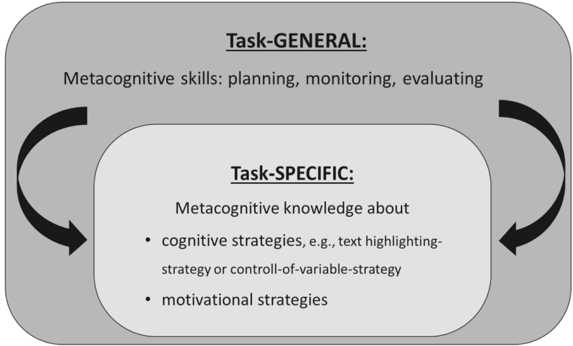
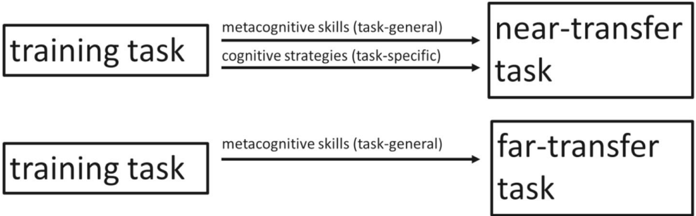
Training interventions for self-regulated learning foster the use of strategies and skills as well as their transfer to new learning tasks. Because cognitive strategies or motivation regulation strategies are task-specific, their transfer is limited. In contrast, metacognitive skills are task-general and transferable to a wide variety of learning tasks. Questions arise, therefore, as to whether students transfer metacognitive skills spontaneously and how to support metacognitive skill transfer. Previous research shows that hybrid training, which addresses both metacognitive skills and cognitive strategies, supports near transfer. However, it is not clear whether hybrid training also fosters far transfer of metacognitive skills. In investigating this research question, 233 fifth-grade students were randomly assigned to six different conditions: two hybrid-training conditions (metacognitive skills and one out of two cognitive strategies), two non-hybrid training conditions (“only” one out of two cognitive strategies), and two control training conditions (neither metacognitive skills nor cognitive strategies). After 15 weeks of training, transfer of metacognitive skills to learning tasks similar to training tasks (near transfer) was tested. In the following 15 weeks, all students received a second, non-hybrid training involving a new cognitive strategy. Far transfer of metacognitive skills to the new cognitive strategy was tested afterward. The results show that hybrid training, compared to non-hybrid and control training, improved both students’ near and far transfer of metacognitive skills. Moreover, cognitive strategy use increased in at least one of the hybrid-training conditions. However, since the level of metacognitive skills use remained low, further means to support transfer are discussed.
Verified 2026-11-25 · 2 references not checked yet
Overview
CoChat Summary
TL;DR
In a year-long experimental training study with 233 fifth-grade students, hybrid training combining metacognitive skills with a cognitive strategy improved near and far transfer of metacognitive skills compared with non-hybrid and control training. Cognitive strategy application in a far-transfer task improved in one hybrid condition (MT) but not the other (ME), and overall metacognitive skill use remained low.
Key findings
- Near transfer of metacognitive skills: hybrid training increased application at T2 versus non-hybrid and control training. For ME vs E: F(5,177)=11.72, p<.01, partial η²=.26; planned contrast vs E t(99)=4.63, p<.01, η²=.03; vs R t(99)=2.59, p<.05, η²=.01. For MT vs T: F(5,175)=48.74, p<.01, partial η²=.59; vs T t(92)=12.67, p<.01, η²=.41; vs R t(92)=7.24, p<.01, η²=.13.
- Far transfer of metacognitive skills: hybrid ME vs E at T3 showed F(5,205)=6.32, p<.01, partial η²=.09; contrast vs E t(108)=2.67, p<.01, η²=.01, but not vs R t(108)=1.52, p>.05, η²=.00. Hybrid MT vs T at T3 showed F(5,162)=17.13, p<.01, partial η²=.35; vs T t(71)=4.86, p<.01, η²=.06; vs R t(71)=2.94, p<.01, η²=.01.
- Far transfer of cognitive strategy application: MT hybrid increased cognitive strategy application at T3 versus non-hybrid and control: F(5,162)=58.84, p<.01, partial η²=.66; vs E t(71)=7.71, p<.01, η²=.21; vs R t(71)=6.15, p<.01, η²=.12. ME hybrid did not differ from non-hybrid E: F(5,155)=3.53, p<.01, partial η²=.11; vs E t(108)=0.50, p>.05, η²=.01; vs R t(108)=3.00, p<.01, η²=.00.
- Overall, hybrid training improved both near and far transfer of metacognitive skills, and cognitive strategy use increased in at least one hybrid-training condition; however, the level of metacognitive skill use remained low.
Methods
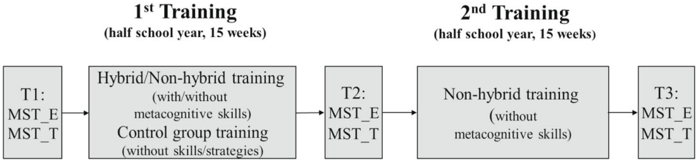
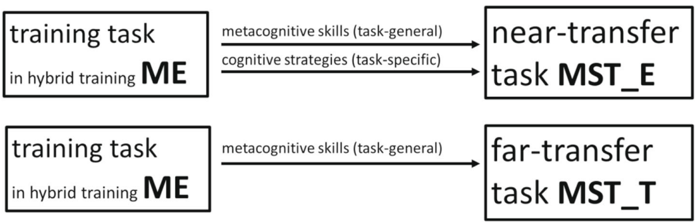
- Design: one full school year; 233 fifth-grade students from two German secondary schools (after excluding 10 for non-compliance from 243; 122 females; M=10.5 years, SD=0.49). Students were randomly assigned to six between-subject conditions: two hybrid (metacognitive skills plus conducting experiments [ME] or text highlighting [MT]), two non-hybrid (E or T only), and two control (reading motivation [R]). First half-year training was approximately 15 sessions of 90 min; second half-year all students received non-hybrid training with a new cognitive strategy (approximately 15 sessions of 90 min). Near transfer was tested after the first training (T2); far transfer after the second training (T3).
- Measures: multi-strategy test (MST) vignettes MST_E and MST_T; open-response descriptions were coded for metacognitive skills (planning, monitoring, evaluating) and cognitive strategy steps, with up to 9 points for metacognitive skills and 9 points for the cognitive strategy. Interrater reliability on a subsample (N=60, about 25%) averaged Cohen’s κ=.91.
- Analysis: ANCOVA controlling for prior cognitive strategy application (metacognitive skill application at T1 had zero variance and was not included), with planned contrasts comparing hybrid versus non-hybrid and control conditions; α=.05; partial η² reported as effect size.
Limitations
- Paper-stated: the MST measures intended strategy application in a fictitious learning situation, not actual strategy application; students made only limited mention of metacognitive skills; transfer distance is difficult to operationalize; MST_E and MST_T instructions differed (MST_E encouraged writing all possibilities, MST_T asked students to “simply” list what they would do), though coding addressed this; amount of text produced may influence scores and should be included as a covariate; no content knowledge was reported; results relate only to transfer of metacognitive skills; normality was violated, though ANCOVA was considered relatively robust.
- Paper-stated: the study was a first attempt to investigate far transfer within SRL using an experimental school design, and future studies are needed to replicate results with other performance measures such as acquired content knowledge.
- Evident from the text: missing data occurred due to student absence, illness, school organizational incidents, or a fire alarm during one measurement period, so analyses include different sample sizes; far-transfer cognitive strategy benefits depended on the strategy/task (MT vs ME), and the authors note students may have been more familiar with reading strategies than with the experiment strategy.
Model-written summary. Check it against the paper before relying on it.
Integrity signals
Registry
Cites
Statistics
Figures
Verification
Claims the paper makes
2 Valid · 3 Not valid · 31 Not checked · 69 Own results and interpretations
The cited sources that could be checked couldn’t confirm or dispute this claim.
In the paper
“Accordingly, motivation regulation strategies are task-specific (e.g., Donker et al. 2014) because they always focus on a particular motivational problem (Wolters and Rosenthal 2000).”
§ Transfer of metacognitive skills in self-regulated learning: an experimental training study > Abstract
What the sources say
- Could not verifycites Donker et al. 2014 matched to “Effectiveness of learning strategy instruction on academic performance: A meta-analysis” (2014) sourceExperimental — accuracy not yet measured
Donker et al. discuss how motivational aspects, including task-value beliefs, can influence students’ approach to a task (§1.3.1, page unavailable). Our copy does not say that motivation regulation strategies are task-specific; searches for that proposition and task-specific strategies found no supporting passage. The explanation about a particular motivational problem is cited to Wolters and Rosenthal, not Donker et al. (LLM, conf=0.72)
- Not checked — no full text of the sourcecites Wolters and Rosenthal 2000 matched to “The relation between students’ motivational beliefs and their use of motivational regulation strategies” (2000) source
plainstates a cause- Asserted: passes — The authors put it forward as true.
- Checkable: passes — It can be checked against evidence.
- Load-bearing: unclear — It is unclear whether the paper’s conclusions depend on it.
- Based: passes — The paper gives a reason why it holds.
- Could not verify
The sources with a verdict support this claim; the rest weren’t checked yet, have no full text we could read, or their verdicts aren’t rated yet.
In the paper
“Cognitive strategies, which are conducive to rehearsing, organizing, and elaborating information (Weinstein et al. 2000), are task-specific because they directly address particular kinds of information processing that must suit a given learning task (e.g., Donker et al. 2014).”
§ Transfer of metacognitive skills in self-regulated learning: an experimental training study > Abstract
What the sources say
- Not checked — no full text of the sourcecites Weinstein et al. 2000 matched to “Self-regulation interventions with a focus on learning strategies” (2000) source
- Supportedcites Donker et al. 2014 matched to “Effectiveness of learning strategy instruction on academic performance: A meta-analysis” (2014) source
Section 1.2.1, “Cognitive strategies,” says these strategies refer directly to the use of learned information and are therefore domain- or task-specific. Section 1.2 also describes learning strategies as processes matched to task requirements. (LLM, conf=0.94)
plainstates a cause- Asserted: passes — The authors put it forward as true.
- Checkable: passes — It can be checked against evidence.
- Load-bearing: passes — The paper’s conclusions depend on it.
- Based: passes — The paper gives a reason why it holds.
The sources with a verdict support this claim; the rest weren’t checked yet, have no full text we could read, or their verdicts aren’t rated yet.
In the paper
“When task-general metacognitive skills (e.g., Donker et al. 2014;Veenman et al. 2006) are trained together with task-specific cognitive strategies, students may transfer those metacognitive skills to other cognitive strategies.”
§ Transfer of metacognitive skills in self-regulated learning: an experimental training study > Discussion
What the sources say
- Supportedcites Donker et al. 2014 matched to “Effectiveness of learning strategy instruction on academic performance: A meta-analysis” (2014) source
The citation is attached to the example of task-general metacognitive skills. Section 2.2.1 (page unavailable) describes planning as a broadly defined, domain-independent strategy that applies to all domains and learning tasks, supporting that use of Donker et al. as an example. (LLM, conf=0.87)
- Not checked — no full text of the sourcecites Veenman et al. 2006 matched to “Metacognition and learning: conceptual and methodological considerations” (2006) source
hedgedstates a possible cause- Asserted: passes — The authors put it forward as true.
- Checkable: passes — It can be checked against evidence.
- Load-bearing: passes — The paper’s conclusions depend on it.
- Based: passes — The paper gives a reason why it holds.
- Rests on an assumption not shown here.
- Supported
A result the paper reports from its own data — it cites no other source for it, so there is none to check. The quote shows it is in the paper.
In the paper
“A significant effect of training condition on metacognitive strategy application appeared at T2 after controlling for the effect of the cognitive strategy application at T1, F(5,177) = 11.72,p < .01,partial η 2 = .26.”
§ Transfer of metacognitive skills in self-regulated learning: an experimental training study > Application of metacognitive skills in a near-transfer task
hedgedstates a cause- Asserted: passes — The authors put it forward as true.
- Checkable: passes — It can be checked against evidence.
- Load-bearing: passes — The paper’s conclusions depend on it.
- Based: passes — The paper gives a reason why it holds.
A result the paper reports from its own data — it cites no other source for it, so there is none to check. The quote shows it is in the paper.
In the paper
“Moreover, cognitive strategy use increased in at least one of the hybrid-training conditions.”
§ Transfer of metacognitive skills in self-regulated learning: an experimental training study > Abstract
plainstates a cause- Asserted: passes — The authors put it forward as true.
- Checkable: passes — It can be checked against evidence.
- Load-bearing: unclear — It is unclear whether the paper’s conclusions depend on it.
- Based: passes — The paper gives a reason why it holds.
48 more claims
Create a free account to see all 105 claims and every source verdict.
- It may state two separate claims as one. 14
- Probably not a substantial claim. 43
Statistics that don’t add up
Each reported p-value recomputed from its test statistic and degrees of freedom, each partial η² from its F, and each ratio, mean difference or B printed with a p checked against its own confidence interval.
Rated minor: it would not touch a result — a value no result rests on, a p-value that stays on the same side of the significance level, or a conflict that is clerical, resolved elsewhere in the paper, or outside its own findings.
In the paper
“F(5,177) = 11.72,p < .01,partial η 2 = .26”
§ Transfer of metacognitive skills in self-regulated learning: an experimental training study > Application of metacognitive skills in a near-transfer task
Reported ηp² = .26 · recomputed ηp² .2487–.2488
Rated minor: it would not touch a result — a value no result rests on, a p-value that stays on the same side of the significance level, or a conflict that is clerical, resolved elsewhere in the paper, or outside its own findings.
In the paper
“F(1, 155) = 0.68, p > .05,partial η 2 = .01”
§ Transfer of metacognitive skills in self-regulated learning: an experimental training study > Application of cognitive strategy in a far-transfer task
Reported ηp² = .01 · recomputed ηp² .00434–.00439
Rated minor: it would not touch a result — a value no result rests on, a p-value that stays on the same side of the significance level, or a conflict that is clerical, resolved elsewhere in the paper, or outside its own findings.
In the paper
“F(5,205) = 6.32, p < .01,partial η 2 = .09”
§ Transfer of metacognitive skills in self-regulated learning: an experimental training study > Application of metacognitive skills in a far-transfer task
Reported ηp² = .09 · recomputed ηp² .1335–.1336
Rated minor: it would not touch a result — a value no result rests on, a p-value that stays on the same side of the significance level, or a conflict that is clerical, resolved elsewhere in the paper, or outside its own findings.
In the paper
“F(5,155) = 3.53, p < .01,partial η 2 = .11”
§ Transfer of metacognitive skills in self-regulated learning: an experimental training study > Application of cognitive strategy in a far-transfer task
Reported ηp² = .11 · recomputed ηp² .1021–.1023
Rated minor: it would not touch a result — a value no result rests on, a p-value that stays on the same side of the significance level, or a conflict that is clerical, resolved elsewhere in the paper, or outside its own findings.
In the paper
“F(5,175) = 48.74,p < .01,partial η 2 = .59”
§ Transfer of metacognitive skills in self-regulated learning: an experimental training study > Application of metacognitive skills in a near-transfer task
Reported ηp² = .59 · recomputed ηp² .58202–.58206
1 more finding
Create a free account to see every finding of this check.
Statistics recomputed
Every reported test result, recomputed from its test statistic and degrees of freedom. A result shows as not adding up only once an independent check has confirmed it.
- ConsistentF(1, 177) = 0.03reported p > .05 · recomputed p = .863
“F(1, 177) = 0.03, p > .05”
- ConsistentF(5, 177) = 11.72reported p < .01 · recomputed p < .001
“F(5,177) = 11.72,p < .01”
- Consistentt(99) = 4.63reported p < .01 · recomputed p < .001
“t(99) = 4.63, p < .01”
- Consistentt(99) = 2.59reported p < .05 · recomputed p = .011
“t(99) = 2.59, p < .05”
- ConsistentF(1, 175) = 0.94reported p > .05 · recomputed p = .334
“F(1, 175) = 0.94, p > .05”
17 more recomputed tests
Create a free account to see every test the Stats check recomputed.
Self-check
Percentages, sums and reported differences re-computed from the paper’s own numbers.
Each contradiction between two passages listed here was confirmed by an independent check.
Rated major: it would touch a result — a value a result rests on, reported and recomputed p-values on opposite sides of the significance level, two passages that conflict with no sign which is right, or a cited work retracted before this paper was published.
In the paper
§ Transfer of metacognitive skills in self-regulated learning: an experimental training study > Application of metacognitive skills in a far-transfer task
“To investigate whether students receiving hybrid training (MT) more often applied metacognitive skills in a far-transfer task than students receiving non-hybrid training (T), we considered the results of the MST_T at T3.”
§ Transfer of metacognitive skills in self-regulated learning: an experimental training study > Procedure
“For Group 3 (MT/E), the MST_T served as a near-transfer task at T2 and T3, while the MST_E served as a far-transfer task.”
Rated major: it would touch a result — a value a result rests on, reported and recomputed p-values on opposite sides of the significance level, two passages that conflict with no sign which is right, or a cited work retracted before this paper was published.
In the paper
§ Transfer of metacognitive skills in self-regulated learning: an experimental training study > Theoretical considerations
“Our results revealed far transfer that connected to the far-transfer task MST_T (cognitive strategy of text highlighting), but not for the MST_E (cognitive strategy to conduct experiments).”
§ Transfer of metacognitive skills in self-regulated learning: an experimental training study > Application of cognitive strategy in a far-transfer task
“Planned contrasts revealed that receiving hybrid training (MT) significantly increased cognitive strategy application at T3 compared to receiving non-hybrid training (E), t(71) = 7.71, p < .01,η 2 = .21,as well as in comparison to receiving the control group training (R), t(71) = 6.15, p < .01,η 2 = .12.”
Rated major: it would touch a result — a value a result rests on, reported and recomputed p-values on opposite sides of the significance level, two passages that conflict with no sign which is right, or a cited work retracted before this paper was published.
In the paper
§ Transfer of metacognitive skills in self-regulated learning: an experimental training study > Application of metacognitive skills in a far-transfer task
“To investigate whether students receiving hybrid training (ME) more often applied metacognitive skills in a far-transfer task than students receiving non-hybrid training (E), we examined the results of the MST_E at T3.”
§ Transfer of metacognitive skills in self-regulated learning: an experimental training study > Procedure
“For Group 1 (ME/T), MST_E served as a near-transfer task at T2 and T3”
Rated minor: it would not touch a result — a value no result rests on, a p-value that stays on the same side of the significance level, or a conflict that is clerical, resolved elsewhere in the paper, or outside its own findings.
In the paper
§ Transfer of metacognitive skills in self-regulated learning: an experimental training study > Participants
“M = 10.5 years, SD = 0.49”
§ Transfer of metacognitive skills in self-regulated learning: an experimental training study > Participants
“Min = 11, Max = 16”
Rated minor: it would not touch a result — a value no result rests on, a p-value that stays on the same side of the significance level, or a conflict that is clerical, resolved elsewhere in the paper, or outside its own findings.
In the paper
§ Transfer of metacognitive skills in self-regulated learning: an experimental training study > Application of cognitive strategy in a far-transfer task
“To investigate whether students receiving hybrid training (MT) more often applied cognitive strategies in a far-transfer task than students who received non-hybrid training (T)”
§ Transfer of metacognitive skills in self-regulated learning: an experimental training study > Application of cognitive strategy in a far-transfer task
“receiving hybrid training (MT) significantly increased cognitive strategy application at T3 compared to receiving non-hybrid training (E)”
Citations
Cites
Statistical Power Analysis for the Behavioral Sciences
Muller, K. (1989) · Technometrics · doi:10.1080/00401706.1989.10488618 · Cited by 99,167
Faul, F., Erdfelder, E., Lang, A.-G., & Buchner, A. (2007) · Behavior Research Methods · doi:10.3758/bf03193146 · Cited by 65,971
Statistical power analysis for the behavioral sciences
(1990) · Computers, Environment and Urban Systems · doi:10.1016/0198-9715(90)90050-4 · Cited by 65,269
Handbook of research on teaching
Wittrock, M. C. (1986) · Bibliothèque et Archives nationales du Québec (Québec government) · Cited by 10,625
Reciprocal Teaching of Comprehension-Fostering and Comprehension-Monitoring Activities
Palinscar, A. S., & Brown, A. L. (1984) · Cognition and Instruction · doi:10.1207/s1532690xci0102_1 · Cited by 5,186
The Role of Goal Orientation in Self-Regulated Learning
Pintrich, P. R. (2000) · Handbook of Self-Regulation · doi:10.1016/b978-012109890-2/50043-3 · Cited by 5,173 · cited 2×
“…skills in self-regulated learning Within SRL, “learners set goals for their learning and then attempt to monitor, regulate and control their cognition, motivation and behavior, guided and constrained by their goals and the contextual features of the environment” (Pintrich 2000, p. 453).”
BackgroundCognitive Apprenticeship: Teaching the Crafts of Reading, Writing, and Mathematics
Collins, A., Brown, J. S., & Newman, S. E. (2018) · Knowing, Learning, and Instruction · doi:10.4324/9781315044408-14 · Cited by 3,674
Reliability and Predictive Validity of the Motivated Strategies for Learning Questionnaire (Mslq)
Pintrich, P. R., Smith, D. A. F., Garcia, T., & Mckeachie, W. J. (1993) · Educational and Psychological Measurement · doi:10.1177/0013164493053003024 · Cited by 3,646
Assessing Metacognitive Awareness
Schraw, G., & Dennison, R. S. (1994) · Contemporary Educational Psychology · doi:10.1006/ceps.1994.1033 · Cited by 3,199
Gunderman, R. B. (2011) · Achieving Excellence in Medical Education · doi:10.1007/978-0-85729-307-7_10 · Cited by 2,892
Statistical methods in psychology journals: Guidelines and explanations.
Wilkinson, L., & Task Force on Statistical Inference (1999) · American Psychologist · doi:10.1037/0003-066x.54.8.594 · Cited by 2,791
Advances in Instructional Psychology
(2019) · Routledge eBooks · doi:10.4324/9781315864341 · Cited by 2,532
The teaching of learning strategies
Weinste, N. (1986) · Medical Entomology and Zoology · Cited by 2,528
Metacognition in Educational Theory and Practice
(1998) · Routledge eBooks · doi:10.4324/9781410602350 · Cited by 2,119
Metacognition and learning: conceptual and methodological considerations
Veenman, M. V. J., Van Hout-Wolters, B. H. A. M., & Afflerbach, P. (2006) · Metacognition and Learning · doi:10.1007/s11409-006-6893-0 · Cited by 2,023
Glass, G. V., Peckham, P. D., & Sanders, J. R. (1972) · Review of Educational Research · doi:10.3102/00346543042003237 · Cited by 1,826
Studying as Self-Regulated Learning
(1998) · Metacognition in Educational Theory and Practice · doi:10.4324/9781410602350-19 · Cited by 1,589 · cited 1×
“…self-regulated learning are therefore doubtful (Sweller and Paas 2017), this aspect of metacognitive knowledge should be incorporated in established models of SRL (Boekaerts 1996; Efklides 2011; Hadwin et al. 2017; Pintrich 2000; Winne 2017; Winne and Hadwin 1998; Zimmerman and Moylan 2009).”
BackgroundSchraw, G., Crippen, K. J., & Hartley, K. (2006) · Research in Science Education · doi:10.1007/s11165-005-3917-8 · Cited by 1,529
Handbook of Metacognition in Education
Hacker, D. J., Dunlosky, J., & Graesser, A. C. (2009) · doi:10.4324/9780203876428 · Cited by 1,509
Knowing when, where, and how to remember ; A problem of metacognition
Brown, A. L. (1978) · Medical Entomology and Zoology · Cited by 1,462
Self-regulated learning: where we are today
Boekaerts, M. (1999) · International Journal of Educational Research · doi:10.1016/s0883-0355(99)00014-2 · Cited by 1,350
Classroom Applications of Research on Self-Regulated Learning
Paris, S. G., & Paris, A. H. (2001) · Educational Psychologist · doi:10.1207/s15326985ep3602_4 · Cited by 1,343 · cited 2×
“Therefore, a combined hybrid training approach is presumably the most effective way to promote metacognitive knowledge and skills at school (e.g., Paris and Paris 2001).”
BackgroundCognitive Apprenticeship: Teaching the Craft of Reading, Writing and Mathematics
Collins, A., Brown, J. S., Newman, S. E., & Montclair State University (1988) · Thinking: The Journal of Philosophy for Children · doi:10.5840/thinking19888129 · Cited by 1,299 · cited 1×
“In line with the cognitive apprenticeship approach, SRL training should be structured in such a way that direct strategy instruction becomes increasingly redundant (Collins et al. 1989; Palinscar and Brown 1984).”
BackgroundPromoting General Metacognitive Awareness
Schraw, G. (2001) · Neuropsychology and Cognition · doi:10.1007/978-94-017-2243-8_1 · Cited by 1,245 · cited 3×
“Furthermore, our results can be understood as evidence for the task generality of metacognitive skills (planning, monitoring, and evaluation; Schraw 2001), in contrast to the task-specific nature of metacognitive knowledge about cognitive and motivational strategies.”
BackgroundEfklides, A. (2011) · Educational Psychologist · doi:10.1080/00461520.2011.538645 · Cited by 1,211 · cited 1×
“…self-regulated learning are therefore doubtful (Sweller and Paas 2017), this aspect of metacognitive knowledge should be incorporated in established models of SRL (Boekaerts 1996; Efklides 2011; Hadwin et al. 2017; Pintrich 2000; Winne 2017; Winne and Hadwin 1998; Zimmerman and Moylan 2009).”
BackgroundThe Teaching of Learning Strategies.
Weinstein, C. E., & Mayer, R. E. (1983) · Cited by 1,163
Are Cognitive Skills Context-Bound?
PERKINS, D., & SALOMON, G. (1989) · Educational Researcher · doi:10.3102/0013189x018001016 · Cited by 1,133
Dignath, C., & Büttner, G. (2008) · Metacognition and Learning · doi:10.1007/s11409-008-9029-x · Cited by 1,085
Dual space search during scientific reasoning
Klahr, D., & Dunbar, K. (1988) · Cognitive Science · doi:10.1207/s15516709cog1201_1 · Cited by 1,058
Regulation of motivation: evaluating an underemphasized aspect of self-regulated learning.
Wolters, C. A. (2003) · Educational Psychologist · doi:10.1207/s15326985ep3804_1 · Cited by 975 · cited 1×
“other aspects of metacognitive knowledge: for example, motivational strategies (Wolters 2010)”
BackgroundHow can primary school students learn self-regulated learning strategies most effectively?
Dignath, C., Buettner, G., & Langfeldt, H.-P. (2008) · Educational Research Review · doi:10.1016/j.edurev.2008.02.003 · Cited by 903
Focusing the Conceptual Lens on Metacognition, Self-regulation, and Self-regulated Learning
Dinsmore, D. L., Alexander, P. A., & Loughlin, S. M. (2008) · Educational Psychology Review · doi:10.1007/s10648-008-9083-6 · Cited by 815
Self-regulated learning and college students' regulation of motivation.
Wolters, C. A. (1998) · Journal of Educational Psychology · doi:10.1037//0022-0663.90.2.224 · Cited by 801
A review of the time management literature
Claessens, B. J. C., van Eerde, W., Rutte, C. G., & Roe, R. A. (2007) · Personnel Review · doi:10.1108/00483480710726136 · Cited by 792
Developing self-regulated learners: Beyond achievement to self-efficacy.
Zimmerman, B. J., Bonner, S., & Kovach, R. (1996) · American Psychological Association eBooks · doi:10.1037/10213-000 · Cited by 770
Mental models contribute to foregrounding during text comprehension
Glenberg, A. M., Meyer, M., & Lindem, K. (1987) · Journal of Memory and Language · doi:10.1016/0749-596x(87)90063-5 · Cited by 736
Children's Metacognition About Reading: issues in Definition, Measurement, and Instruction
Jacobs, J. E., & Paris, S. G. (1987) · Educational Psychologist · doi:10.1207/s15326985ep2203 · Cited by 696
The Roles of Similarity in Transfer: Separating Retrievability From Inferential Soundness
Gentner, D., Rattermann, M. J., & Forbus, K. D. (1993) · Cognitive Psychology · doi:10.1006/cogp.1993.1013 · Cited by 640
Gearing, R. E., El-Bassel, N., Ghesquiere, A., Baldwin, S., Gillies, J., & Ngeow, E. (2011) · Clinical Psychology Review · doi:10.1016/j.cpr.2010.09.007 · Cited by 610
Self-Regulation, Co-Regulation, and Shared Regulation in Collaborative Learning Environments
Hadwin, A., Järvelä, S., & Miller, M. (2017) · Handbook of Self-Regulation of Learning and Performance · doi:10.4324/9781315697048-6 · Cited by 581
Koedinger, K., Aleven, V., Roll, I., & Baker, R. (2009) · Routledge eBooks · doi:10.4324/9780203876428-29 · Cited by 574
Perkins, D. N., & Salomon, G. (1988) · Educational leadership · Cited by 569
Self-regulated Learning at the Junction of Cognition and Motivation
Boekaerts, M. (1996) · European Psychologist · doi:10.1027/1016-9040.1.2.100 · Cited by 555
Self-regulation interventions with a focus on learning strategies
Weinstein, C. E., Husman, J., & Dierking, D. R. (2000) · Handbook of Self-Regulation · doi:10.1016/b978-012109890-2/50051-2 · Cited by 538
Flavell, J. H. (1982) · Child Development · doi:10.1111/j.1467-8624.1982.tb01289.x · Cited by 528
Cognitive, Metacognitive, and Motivational Aspects of Problem Solving
Mayer, R. E. (2001) · Neuropsychology and Cognition · doi:10.1007/978-94-017-2243-8_5 · Cited by 510
Influence of metacognitive knowledge and aptitude on problem solving.
Swanson, H. L. (1990) · Journal of Educational Psychology · doi:10.1037/0022-0663.82.2.306 · Cited by 508 · cited 1×
“Moreover, in comparison to think-aloud protocols (e.g., Swanson 1990), analyzing vignettes with a coding scheme is less time-consuming.”
ResultEffectiveness of learning strategy instruction on academic performance: A meta-analysis
Donker, A. S., de Boer, H., Kostons, D., Dignath van Ewijk, C. C., & van der Werf, M. P. C. (2014) · Educational Research Review · doi:10.1016/j.edurev.2013.11.002 · Cited by 489 · cited 6×
“Thus, metacognitive skills are task-general (e.g., Donker et al. 2014; Schraw et al. 1995; Schraw and Nietfeld 1998; Veenman et al. 1997; Veenman and Verheij 2003).”
BackgroundMethodInfluential(2013) · Educational Psychology Review · doi:10.1007/10648.1573-336x · Cited by 432
Mayer, R. E. (1996) · Educational Psychology Review · doi:10.1007/bf01463939 · Cited by 401
Children's Metacognition About Reading: issues in Definition, Measurement, and Instruction
Jacobs, J. E., & Paris, S. G. (1987) · Educational Psychologist · doi:10.1080/00461520.1987.9653052 · Cited by 389
Educational psychologist: (537492009-017)
(2005) · PsycEXTRA Dataset · doi:10.1037/e537492009-017 · Cited by 359
Cognitive, metacognitive, and motivational aspects of problem solving
Mayer, R. E. (1998) · Instructional Science · doi:10.1023/a:1003088013286 · Cited by 352
Error orientation questionnaire (EOQ): reliability, validity, and different language equivalence
Rybowiak, V., Garst, H., Frese, M., & Batinic, B. (1999) · Journal of Organizational Behavior · doi:10.1002/(sici)1099-1379(199907)20:4<527::aid-job886>3.0.co;2-g · Cited by 350
Metacognitive Monitoring Accuracy and Student Performance in the Postsecondary Classroom.
Nietfeld, J. L., Cao, L., & Osborne, J. W. (2005) · The Journal of Experimental Education · Cited by 345
Ohtani, K., & Hisasaka, T. (2018) · Metacognition and Learning · doi:10.1007/s11409-018-9183-8 · Cited by 345
Wolters, C. A., & Rosenthal, H. (2000) · International Journal of Educational Research · doi:10.1016/s0883-0355(00)00051-3 · Cited by 326
Sensible Reasoning: A Hypothesis about Hypotheses
Tschirgi, J. E. (1980) · Child Development · doi:10.1111/j.1467-8624.1980.tb02502.x · Cited by 318
Memory performance and competencies : issues in growth and development
Weinert, F. E., Schneider, W., & Directions, F. (1995) · Lawrence Erlbaum Associates eBooks · Cited by 301
Moving From the Lab to the Field: The Role of Fidelity and Achieved Relative Intervention Strength
Hulleman, C. S., & Cordray, D. S. (2009) · Journal of Research on Educational Effectiveness · doi:10.1080/19345740802539325 · Cited by 291
Training of self-regulatory and problem-solving competence
Perels, F., Gürtler, T., & Schmitz, B. (2005) · Learning and Instruction · doi:10.1016/j.learninstruc.2005.04.010 · Cited by 284
Cognition and Metacognition within Self-Regulated Learning
Winne, P. H. (2017) · Handbook of Self-Regulation of Learning and Performance · doi:10.4324/9781315697048-3 · Cited by 274
The effects of metacognitive instruction on solving mathematical authentic tasks
Kramarski, B., Mevarech, Z. R., & Arami, M. (2002) · Educational Studies in Mathematics · doi:10.1023/a:1016282811724 · Cited by 255
Cognition and Metacognition within Self-Regulated Learning
Winne, P. (2017) · doi:10.4324/9781315697048.ch3 · Cited by 252
Engle, R. A., Lam, D. P., Meyer, X. S., & Nix, S. E. (2012) · Educational Psychologist · doi:10.1080/00461520.2012.695678 · Cited by 249
Souvignier, E., & Mokhlesgerami, J. (2006) · Learning and Instruction · doi:10.1016/j.learninstruc.2005.12.006 · Cited by 246
The Process of Solving Complex Problems
Fischer, A., Greiff, S., & Funke, J. (2012) · The Journal of Problem Solving · doi:10.7771/1932-6246.1118 · Cited by 239
Schwinger, M., Steinmayr, R., & Spinath, B. (2009) · Learning and Individual Differences · doi:10.1016/j.lindif.2009.08.006 · Cited by 235
The Journal of Experimental Education: A Quarterly
(1971) · The Journal of Experimental Education · doi:10.1080/00220973.1971.11011294 · Cited by 209
Unskilled but aware: Reinterpreting overconfidence in low-performing students.
Miller, T. M., & Geraci, L. (2011) · Journal of Experimental Psychology: Learning, Memory, and Cognition · doi:10.1037/a0021802 · Cited by 192
Children's Metacognition About Reading: issues in Definition, Measurement, and Instruction
Jacobs, J., & Paris, S. (1987) · Educational Psychologist · doi:10.1207/s15326985ep2203&4_4 · Cited by 192
The relation between intellectual and metacognitive skills in early adolescence.
Veenman, M. V. J., Kok, R., & Blöte, A. W. (2005) · Instructional Science · doi:10.1007/s11251-004-2274-8 · Cited by 190
The generality vs domain-specificity of metacognitive skills in novice learning across domains
Veenman, M. V. J., Elshout, J. J., & Meijer, J. (1997) · Learning and Instruction · doi:10.1016/s0959-4752(96)00025-4 · Cited by 189
Can offline metacognition enhance mathematical problem solving?
Desoete, A., Roeyers, H., & Clercq, A. D. (2003) · Journal of Educational Psychology · doi:10.1037//0022-0663.95.1.188 · Cited by 172
Zepeda, C. D., Richey, J. E., Ronevich, P., & Nokes-Malach, T. J. (2015) · Journal of Educational Psychology · doi:10.1037/edu0000022 · Cited by 167
Does a general monitoring skill exist?
Schraw, G. J., Dunkle, M. E., Bendixen, L. D., & Roedel, T. D. (1995) · Journal of Educational Psychology · doi:10.1037//0022-0663.87.3.433 · Cited by 165
Interference and inhibition in cognition and behavior: unifying themes for educational psychology.
Dempster, F. N., & Corkill, A. J. (1999) · Educational Psychology Review · doi:10.1023/a:1021992632168 · Cited by 163
Stoeger, H., & Ziegler, A. (2008) · Metacognition and Learning · doi:10.1007/s11409-008-9027-z · Cited by 159
Self-Regulated Learning as a Competence: Implications of Theoretical Models for Assessment Methods
Wirth, J., & Leutner, D. (2008) · Zeitschrift für Psychologie / Journal of Psychology · doi:10.1027/0044-3409.216.2.102 · Cited by 158
Self-citationCompleteness of instruction and strategy transfer
O’Sullivan, J. T., & Pressley, M. G. (1984) · Journal of Experimental Child Psychology · doi:10.1016/0022-0965(84)90126-7 · Cited by 141
Aghaie, R., & Zhang, L. J. (2012) · Instructional Science · doi:10.1007/s11251-011-9202-5 · Cited by 135
Dignath, C. (2016) · Frontline Learning Research · doi:10.14786/flr.v4i5.247 · Cited by 133
Veenman, M. V. J., & Verheij, J. (2003) · Learning and Individual Differences · doi:10.1016/s1041-6080(02)00094-8 · Cited by 131
Improving lecture comprehension: Effects of a metacognitive strategy
King, A. (1991) · Applied Cognitive Psychology · doi:10.1002/acp.2350050404 · Cited by 130
Chrystèle, C. D., Bogni, A., Marco, M., & Guy, V. D. E. (2009) · Joint Research Centre (European Commission) · doi:10.2788/60083 · Cited by 106
Carretti, B., Caldarola, N., Tencati, C., & Cornoldi, C. (2014) · British Journal of Educational Psychology · doi:10.1111/bjep.12022 · Cited by 103
A further test of the general monitoring skill hypothesis.
Schraw, G., & Nietfeld, J. (1998) · Journal of Educational Psychology · doi:10.1037//0022-0663.90.2.236 · Cited by 94
Zepeda, C. D., Hlutkowsky, C. O., Partika, A. C., & Nokes-Malach, T. J. (2019) · Journal of Educational Psychology · doi:10.1037/edu0000300 · Cited by 91
Fifth graders metacognitive knowledge: general or domain-specific?
Neuenhaus, N., Artelt, C., Lingel, K., & Schneider, W. (2011) · European Journal of Psychology of Education · doi:10.1007/s10212-010-0040-7 · Cited by 85
Effectiveness of motivational regulation: Dependence on specific motivational problems
Engelschalk, T., Steuer, G., & Dresel, M. (2016) · Learning and Individual Differences · doi:10.1016/j.lindif.2016.10.011 · Cited by 79
Leopold, C., & Leutner, D. (2015) · Metacognition and Learning · doi:10.1007/s11409-014-9130-2 · Cited by 75
Self-citationEducating Youth for Nonexistent/Not Yet Existing Professions
Kirschner, P. A., & Stoyanov, S. (2020) · Educational Policy · doi:10.1177/0895904818802086 · Cited by 71
Stalbovs, K., Scheiter, K., & Gerjets, P. H. (2014) · Learning and Instruction · doi:10.1016/j.learninstruc.2014.09.002 · Cited by 69
Do cognitive and metacognitive processes set the stage for each other?
Roelle, J., Nowitzki, C., & Berthold, K. (2016) · Learning and Instruction · doi:10.1016/j.learninstruc.2016.11.009 · Cited by 68
Mihalca, L., Mengelkamp, C., & Schnotz, W. (2017) · Metacognition and Learning · doi:10.1007/s11409-017-9173-2 · Cited by 68
Logical structures in language
Chomsky, N. (1957) · American Documentation · doi:10.1002/asi.5090080406 · Cited by 63
Exploring Metacognition as Support for Learning Transfer
Scharff, L. F. V., Draeger, J. D., Verpoorten, D., Devlin, M., Dvorakova, L. S., Lodge, J. M., & Smith, S. V. (2017) · Teaching & Learning Inquiry The ISSOTL Journal · doi:10.20343/teachlearninqu.5.1.6 · Cited by 63
Händel, M., Harder, B., & Dresel, M. (2019) · Learning and Instruction · doi:10.1016/j.learninstruc.2019.101245 · Cited by 62
Kim, H. J., & Pedersen, S. (2011) · Computers & Education · doi:10.1016/j.compedu.2011.03.014 · Cited by 59
Measuring complex problem solving: the MicroDYN approach
Scheuermann, F. [. ]., & Björnsson, J. [. ]. (2013) · heiDOK (Heidelberg University) · doi:10.11588/heidok.00015502 · Cited by 59
Should self-regulated learning be integrated with cognitive load theory? A commentary
Sweller, J., & Paas, F. (2017) · Learning and Instruction · doi:10.1016/j.learninstruc.2017.05.005 · Cited by 54
An Evaluation of Experimental Designs for Constructing Vignette Sets in Factorial Surveys
Su, D., & Steiner, P. M. (2020) · Sociological Methods & Research · doi:10.1177/0049124117746427 · Cited by 47
Reliability and Validity Analyses of a Newly Developed Test to Assess Learning Strategy Knowledge
Maag Merki, K., Ramseier, E., & Karlen, Y. (2013) · Journal of Cognitive Education and Psychology · doi:10.1891/1945-8959.12.3.391 · Cited by 43
Förderung des Transfers metakognitiver Lernstrategien durch direktes und indirektes Training
Schuster, C., Stebner, F., Wirth, J., & Leutner, D. (2018) · Unterrichtswissenschaft · doi:10.1007/s42010-018-0028-6 · Cited by 27
Self-citationFostering self-regulation in training complex cognitive tasks
van Meeuwen, L. W., Brand‐Gruwel, S., Kirschner, P. A., de Bock, J. J. P. R., & van Merriënboer, J. J. G. (2017) · Educational Technology Research and Development · doi:10.1007/s11423-017-9539-9 · Cited by 24
A Meta-Analysis: Improvement of Students’ Algebraic Reasoning through Metacognitive Training
Lee, Y., Capraro, M. M., Capraro, R. M., & Biçer, A. (2018) · International Education Studies · doi:10.5539/ies.v11n10p42 · Cited by 21
Assessment of metacognitive knowledge in students with special educational needs
Händel, M., Lockl, K., Heydrich, J., Weinert, S., & Artelt, C. (2014) · Metacognition and Learning · doi:10.1007/s11409-014-9119-x · Cited by 20
Imitative problem solving: Why transfer of learning often fails to occur
Robertsonnm, I. (2000) · Instructional Science · doi:10.1023/a:1003884601109 · Cited by 15
Förderung selbstregulierten Lernens im schulischen Kontext
Spörer, N., & Glaser, C. (2010) · Zeitschrift für Pädagogische Psychologie · doi:10.1024/1010-0652/a000014 · Cited by 12
Stebner, F., Pfänder, H., Schuster, C., Schurig, M., van den Bogaert, V., & Strähle, P. (2019) · Springer eBooks · doi:10.1007/978-3-658-27172-5_3 · Cited by 10
Self-citationExploring Metacognition as Support for Learning Transfer
Scharff, L. F. V., Draeger, J. D., Verpoorten, D., Devlin, M., Dvorakova, L. S., Lodge, J. M., & Smith, S. V. (2017) · Teaching & Learning Inquiry The ISSOTL Journal · doi:10.20343/5.1.6 · Cited by 7
OECD-Wirtschaftsberichte: Deutschland 2006
OECD (2006) · OECD Wirtschaftsberichte. Deutschland/OECD Wirtschaftsberichte. Deutchland · doi:10.1787/eco_surveys-deu-2006-de · Cited by 3
Predicting educational success - what’s beyond intelligence
Lotz, C. (2018) · Publications of the UdS (Saarland University) · doi:10.22028/d291-27282 · Cited by 1
Zepeda, C. D., Hlutkowsky, C. O., Partika, A. C., & Nokes-Malach, T. J. (2018) · Journal of Educational Psychology · doi:10.1037/edu0000300.supp
Zimmerman, B. J., & Moylan, A. R. (2009) · Handbook of Metacognition in Education · doi:10.4324/9780203876428-23
Goal 6: Developing writing skills.
Zimmerman, B. J., Bonner, S., & Kovach, R. (n.d.) · Developing self-regulated learners: Beyond achievement to self-efficacy. · doi:10.1037/10213-006
Research works printed but not linked: 3
- 21. Flavell, J. H., Miller, P. H., & Miller, S. A. (2002). Cognitive development (4th ed.). Upper Saddle River: Prentice Hall.
- 31. Heller, K., & Perleth, C. (2000). Kognitiver Fähigkeitstest für 4. und 12. Klassen. [Cognitive ability test for 4th and 12th grades] (3rd ed.). Weinheim: Beltz-Test.
- 73. Stebner, F., Schmeck, A., Marschner, J., Leutner, D., & Wirth. J. (2015). Ein Training zur Förderung des selbstregulierten Lernens durch Experimentieren [Training to promote self-regulated learning through experimentation]. In H. Wendt & W. Bos (Eds.), Auf dem Weg zum Ganztagsgymnasium. Erste Ergebnisse der wissenschaftlichen Begleitforschung zum Projekt Ganz In (pp. 396-413). Münster Waxmann Verlag.
Cited by
Xu, X., Qiao, L., Cheng, N., Liu, H., & Zhao, W. (2025) · British Journal of Educational Technology · doi:10.1111/bjet.13599 · Cited by 359
Mindfulness for Global Public Health: Critical Analysis and Agenda
Oman, D. (2025) · Mindfulness · doi:10.1007/s12671-023-02089-5 · Cited by 87
Saqr, M., López‐Pernas, S., Jovanović, J., & Gašević, D. (2022) · The Internet and Higher Education · doi:10.1016/j.iheduc.2022.100902 · Cited by 83
Biwer, F., de Bruin, A. B. H., & Persky, A. M. (2022) · Advances in Health Sciences Education · doi:10.1007/s10459-022-10149-z · Cited by 113
Stebner, F., Schuster, C., Weber, X.-L., Greiff, S., Leutner, D., & Wirth, J. (2022) · Metacognition and Learning · doi:10.1007/s11409-022-09322-x · Cited by 57
Self-citation
Metadata
- Authors
- Schuster, C., Stebner, F., Leutner, D., & Wirth, J.
- Affiliations
- Ruhr University Bochum (DE)
- University of Duisburg-Essen (DE)
- Corresponding author
- Schuster, Corinna
- Venue
- Metacognition and Learning
- Published
- 2020-08-20
- Volume
- 15
- Issue
- 3
- Pages
- 455-477
- ISSN
- 1556-1623 (ISSN-L)
- 1556-1631
- OpenAlex
- W3080804017
- Cited by
- 105
- References
- 115
- Citations by year
- 2026: 10 · 2025: 25 · 2024: 23 · 2023: 22 · 2022: 15 · 2021: 8 · 2020: 1
- FWCI
- 17.33
- Type
- journal article
- Language
- en
- Open access
- hybrid
- doi.org
- Licence
- cc-by
- creativecommons.org/licenses/by/4.0 (tdm)
- creativecommons.org/licenses/by/4.0 (vor)
- Locations
- Metacognition and Learning (publishedVersion, cc-by)
- Funders
- Ruhr-Universität Bochum
- Topics
- Social Sciences › Psychology › Developmental and Educational Psychology › Innovative Teaching and Learning Methods
- Social Sciences › Psychology › Developmental and Educational Psychology › Educational Strategies and Epistemologies
- Social Sciences › Psychology › Experimental and Cognitive Psychology › Visual and Cognitive Learning Processes
- Keywords
- metacognitive skills, student self-regulation, skill transfer, hybrid training, cognitive strategies, near transfer, far transfer, fifth grade students, training program, metacognition
About these checks
Registry, retraction, Cites and statistics results are computed, not judged, with one exception: a printed reference that no index lists is read once by a model before it counts as a citation error. Claims are extracted by a model and kept only when their quote appears verbatim in the text; each cited source is then checked, with a model’s help, for whether it says what the claim relies on. Those verdicts can be wrong — read the claim’s quote and the cited source before relying on one.
The claim verdicts this report counts are experimental: their accuracy is not yet measured.
A language model drew the claims from the paper on 2026-10-12, under version 3 of the claim definition (model deepseek-v4.1-flash, prompt extract-v3).
A second model labelled each claim on 2026-10-12 (model jev-1.13-20260917, definition revision gold-guideline-v0.2).
Cited sources are checked with a language model’s help (gpt-6-sol).
Statistics and arithmetic are recomputed, not judged.
Confidence bands are shown only for fields calibrated on our annotated test set. None is calibrated yet, so no band is shown.
What counts as a claim ›How we measure confidence ›How we check this ›
Are you an author, or do you see a problem with this page? Request a review
Data sources
Bibliographic data: Semantic Scholar, OpenAlex, Crossref.
Contains information from the Semantic Scholar Academic Graph Datasets, made available under the ODC Attribution License (ODC-BY 1.0).
Semantic Scholar’s data is described in: Kinney, R., et al. (2023). The Semantic Scholar Open Data Platform. arXiv:2301.10140.
