

The DOI matches its Crossref record; 249 of the 254 references it cites were found in a registry or an index, and 3 are not checked yet; 4 of the 183 sources its claims cite were checked for support.
Nutritional priorities to support GLP-1 therapy for obesity: a joint Advisory from the American College of Lifestyle Medicine, the American Society for Nutrition, the Obesity Medicine Association, and The Obesity Society
Open accessAbstract
BACKGROUND: Glucagon-like peptide 1 receptor agonists and combination medications (hereafter collectively referred to as GLP-1s) are shifting the treatment landscape for obesity. However, real-world challenges and limited clinician and public knowledge on nutritional and lifestyle interventions can limit GLP-1 efficacy, equitable results, and cost-effectiveness. OBJECTIVES: We aimed to identify pragmatic priorities for nutrition and other lifestyle interventions relevant to GLP-1 treatment of obesity for the practicing clinician. METHODS: An expert group comprising multiple clinical and research disciplines appraised the scientific literature, informed by expert knowledge and clinical experience, to identify and summarize relevant topics, priorities, and emerging directions. RESULTS: GLP-1s reduce body weight by 5% to 18% in trials, with modestly lower effects in real-world analyses, and multiple demonstrated clinical benefits. Challenges include side effects, especially gastrointestinal; nutritional deficiencies due to calorie reduction; muscle and bone loss; low long-term adherence with subsequent weight regain; and high costs with resulting low cost-effectiveness. Numerous practice guidelines recommend multicomponent, evidence-based nutritional and behavioral therapy for adults with obesity, but use of such therapies with GLP-1s is not widespread. Priorities to address this include: (a) patient-centered initiation of GLP-1s, including goals for weight reduction and health; (b) baseline screening, including usual dietary habits, emotional triggers, disordered eating, and relevant medical conditions; (c) comprehensive exam including muscle strength, function, and body composition assessment; (d) social determinants of health screening; (e) and lifestyle assessment including aerobic activity, strength training, sleep, mental stress, substance use, and social connections. During GLP-1 use, nutritional and medical management of gastrointestinal side effects is critical, as is navigating altered dietary preferences and intakes, preventing nutrient deficiencies, preserving muscle and bone mass through resistance training and appropriate diet, and complementary lifestyle interventions. Supportive strategies include group-based visits, registered dietitian nutritionist counseling, telehealth and digital platforms, and Food is Medicine interventions. Drug access, food and nutrition insecurity, and nutrition and culinary knowledge influence equitable obesity management with GLP-1s. Emerging areas for more study include dietary modulation of endogenous GLP-1, strategies to improve compliance, nutritional priorities for weight maintenance post-cessation, combination or staged intensive lifestyle management, and diagnostic criteria for clinical obesity. CONCLUSIONS: Evidence-based nutritional and lifestyle strategies play a pivotal role to address key challenges around GLP-1 treatment of obesity, making clinicians more effective in advancing their patients' health.
Verified 2026-10-06 · 3 references not checked yet
Overview
AI snapshot
Written from the paper’s full text.
TL;DR
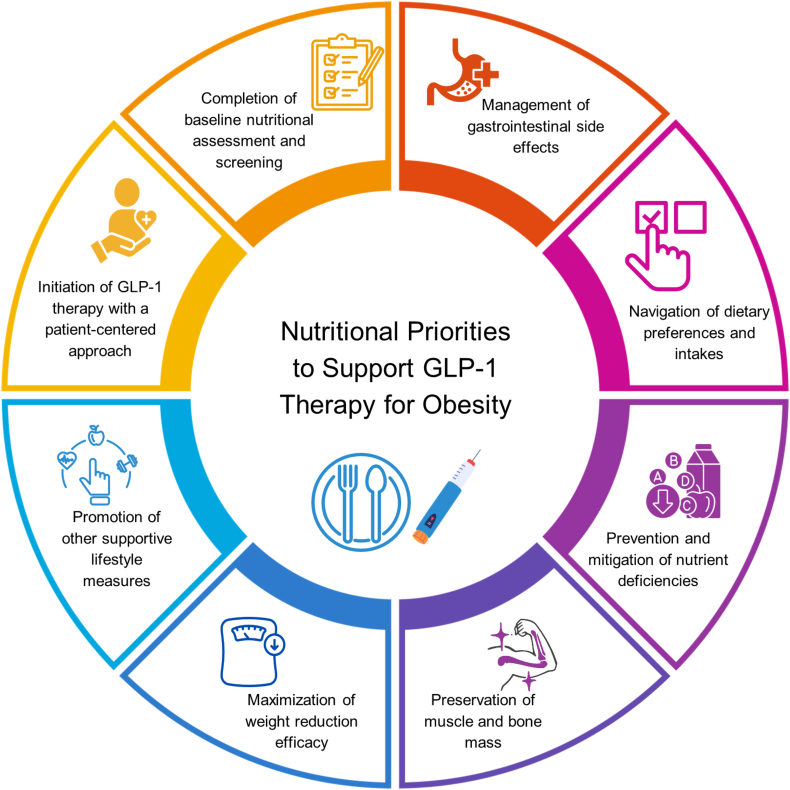
This joint Advisory from four clinical societies summarizes pragmatic nutritional and lifestyle priorities to support GLP-1 therapy for obesity, emphasizing screening, GI side-effect management, nutrient adequacy, muscle/bone preservation, and equitable implementation. It concludes that structured nutrition and behavioral care before, during, and after GLP-1 use can mitigate key challenges and improve long-term outcomes.
Key findings
- GLP-1s produce placebo-adjusted weight reduction of 5% to 18% in trials, with lower real-world effects (e.g., about 8% with diabetes and 11% without diabetes at 60 weeks with semaglutide 2.4 mg/d); discontinuation is high (e.g., 50%–67% at 1 year and 85% at 2 years in some real-world data).
- Common GI side effects include nausea (25%–44%), diarrhea (19%–30%), vomiting (8%–24%), constipation (17%–24%), and abdominal pain (9%–20%); caloric intake falls by 16%–39%, raising risk of inadequate intakes of iron, calcium, magnesium, zinc, and vitamins A, D, E, K, B1, B12, and C.
- Rapid weight loss can cause muscle and bone loss: in STEP 1, of a mean 13.6-kg weight reduction, 8.3 kg (62%) was fat mass and 5.3 kg (38%) was lean body mass, corresponding to about 20% of total weight reduction as muscle loss; structured resistance training at least 3 times weekly plus at least 150 min/week of moderate aerobic exercise is recommended to help preserve muscle and bone.
- Costs are high: US list prices are about $12,000–$16,000 per year, discounted to about $7,000–$8,000; nonindustry cost-effectiveness analyses report net costs per quality-adjusted life year of $237,000–$483,000, exceeding common thresholds.
Methods
- An expert group comprising multiple clinical and research disciplines appraised the scientific literature, informed by expert knowledge and clinical experience, to identify and summarize relevant topics, priorities, and emerging directions.
- The paper is a narrative joint Advisory, not a systematic review or meta-analysis; it synthesizes evidence and provides practice guidance, tables, and a figure for clinicians.
- No primary data collection or formal quantitative synthesis is reported.
Limitations
- The paper states that peer-reviewed evidence has not kept pace with clinical and public interest in GLP-1s, that some guidance is based on limited available evidence and expert opinion, and that specific nutritional behaviors for weight maintenance after GLP-1 cessation have not been rigorously studied in controlled trials.
- It also notes limited direct evidence on GLP-1 use with or without registered dietitian nutritionist–provided medical nutrition therapy, and lack of standardization in how “intensive” lifestyle intervention is defined or implemented across trials.
- Evident from the text: as a narrative expert Advisory, it does not describe a systematic search strategy, formal risk-of-bias assessment, or evidence-grading process, so recommendations may reflect expert consensus where data are sparse.
Model-written summary. Check it against the paper before relying on it.
Integrity signals
Registry
Cites
Statistics
Figures
Verification
Claims the paper makes
129 Not checked yet · 28 Own interpretation · 3 No basis given · 2 Partly supported · 1 Not supported · accuracy not yet measured
At least one cited source doesn’t support this claim or points to a different paper, and none confirmed it — see the verdicts below.
In the paper
“whereas in the SURMOUNT 3 trial, tirzepatide 10 or 15 mg/wk started after 12 weeks of intensive lifestyle intervention produced a 25% reduction from baseline (versus 4.8% with intensive lifestyle intervention alone) [178].”
§ Nutritional priorities to support GLP-1 therapy for obesity: a joint Advisory from the American College of Lifestyle Medicine, the American Society for Nutrition, the Obesity Medicine Association, and The Obesity Society > Completion of baseline nutritional assessment and screening > Maximization of weight reduction
What the sources say
- Disputedcites [178] Wadden, 2021, Effect of subcutaneous semaglutide vs placebo as an adjunct to intensive behavioral therapy on body weight in adults with overweight or obesity: the STEP 3 randomized clinical trial, JAMA sourceExperimental — accuracy not yet measured
The Co-Primary End Points section (page not provided) reports the STEP 3 trial, not SURMOUNT 3: participants received semaglutide or placebo alongside intensive behavioral therapy, with mean weight changes of −16.0% and −5.7%. This contradicts the attributed tirzepatide regimen and 25% versus 4.8% results. (LLM, conf=0.90)
Checked by a reasoning model — may be wrong.
plaindirect- Asserted: passes — The authors put it forward as true.
- Checkable: passes — It can be checked against evidence.
- Load-bearing: passes — The paper’s conclusions depend on it.
- Based: passes — The paper gives a reason why it holds.
- Disputed
The cited sources support only part of this claim — read each source’s verdict below.
In the paper
“Rapid weight reduction from (but not limited to) GLP-1 use frequently leads to loss of both fat and muscle mass [62,63].”
§ Nutritional priorities to support GLP-1 therapy for obesity: a joint Advisory from the American College of Lifestyle Medicine, the American Society for Nutrition, the Obesity Medicine Association, and The Obesity Society > Overview of Efficacy, Side Effects, and Key Challenges > Muscle and bone loss
What the sources say
- Partly supportedcites [62] Cava, 2017, Preserving healthy muscle during weight loss, Adv Nutr sourceExperimental — accuracy not yet measured
The section “Effect of diet-induced weight loss on muscle mass in persons with obesity” reports that calorie-restricted weight loss decreases fat and fat-free mass, and the Abstract states that diet-induced weight loss reduces muscle mass. The paper also discusses rapid weight loss after bariatric surgery, but says its effect on muscle mass remains unclear. It does not address GLP-1 use, so it cannot support that specific part of the claim. (LLM, conf=0.86)
- Partly supportedcites [63] Neeland, 2024, Changes in lean body mass with glucagon-like peptide-1-based therapies and mitigation strategies, Diabetes Obes Metab sourceExperimental — accuracy not yet measured
Section 3 reports weight and lean-mass losses in several GLP-1-based therapy trials, and the Conclusions report reductions in muscle volume during successful weight loss. The paper distinguishes lean mass from muscle mass and does not establish that the weight loss was rapid, so the sentence is more specific than the source supports. (LLM, conf=0.84)
plaindirect- Asserted: passes — The authors put it forward as true.
- Checkable: passes — It can be checked against evidence.
- Load-bearing: passes — The paper’s conclusions depend on it.
- Based: passes — The paper gives a reason why it holds.
- Partly supported
The cited sources support only part of this claim — read each source’s verdict below.
In the paper
“Some individuals can meet protein targets by supplementing with high-protein shakes, bars, and other fortified products [159].”
§ Nutritional priorities to support GLP-1 therapy for obesity: a joint Advisory from the American College of Lifestyle Medicine, the American Society for Nutrition, the Obesity Medicine Association, and The Obesity Society > Completion of baseline nutritional assessment and screening > Preservation of muscle and bone mass
What the sources say
- Partly supportedcites [159] Prado, 2022, Advances in muscle health and nutrition: a toolkit for healthcare professionals, Clin. Nutr. sourceExperimental — accuracy not yet measured
Section 6.7 (page unavailable) says oral nutritional supplements provide additional protein and improve protein intake beyond food alone, supporting the general idea of supplementation. It does not establish that individuals meet protein targets through them or specifically discuss bars and other fortified products. (LLM, conf=0.83)
plainconditional- Asserted: passes — The authors put it forward as true.
- Checkable: passes — It can be checked against evidence.
- Load-bearing: unclear — It is unclear whether the paper’s conclusions depend on it.
- Based: passes — The paper gives a reason why it holds.
- Partly supported
None of the sources cited for this claim have been checked yet.
In the paper
“Notably, this has been observed even with accompanying use of conventional nutritional counseling and/or behavioral therapy [18,19].”
§ Nutritional priorities to support GLP-1 therapy for obesity: a joint Advisory from the American College of Lifestyle Medicine, the American Society for Nutrition, the Obesity Medicine Association, and The Obesity Society > Overview of Efficacy, Side Effects, and Key Challenges > Efficacy
What the sources say
- Not checked yetcites [18] Aronne, 2024, Continued treatment with tirzepatide for maintenance of weight reduction in adults with obesity: the SURMOUNT-4 randomized clinical trial, JAMA source
- Not checked yetcites [19] Rubino, 2021, Effect of continued weekly subcutaneous semaglutide vs placebo on weight loss maintenance in adults with overweight or obesity: the STEP 4 randomized clinical trial, JAMA source
plain- Asserted: passes — The authors put it forward as true.
- Checkable: passes — It can be checked against evidence.
- Load-bearing: passes — The paper’s conclusions depend on it.
- Based: passes — The paper gives a reason why it holds.
In the paper
“Higher doses are more likely to provoke these adverse symptoms, indicating a dose-dependent relationship [40].”
§ Nutritional priorities to support GLP-1 therapy for obesity: a joint Advisory from the American College of Lifestyle Medicine, the American Society for Nutrition, the Obesity Medicine Association, and The Obesity Society > Overview of Efficacy, Side Effects, and Key Challenges > Side effects
What the sources say
- Not checked yetcites [40] Gorgojo-Martinez, 2022, Clinical recommendations to manage gastrointestinal adverse events in patients treated with GLP-1 receptor agonists: a multidisciplinary expert consensus, J Clin Med source
hedgeddirect- Asserted: passes — The authors put it forward as true.
- Checkable: passes — It can be checked against evidence.
- Load-bearing: unclear — It is unclear whether the paper’s conclusions depend on it.
- Based: passes — The paper gives a reason why it holds.
In the paper
“In the trials, GI symptoms rarely led to discontinuation, with <10% of participants stopping therapy due to GI issues [49].”
§ Nutritional priorities to support GLP-1 therapy for obesity: a joint Advisory from the American College of Lifestyle Medicine, the American Society for Nutrition, the Obesity Medicine Association, and The Obesity Society > Overview of Efficacy, Side Effects, and Key Challenges > Side effects
What the sources say
- Not checked yetcites [49] Tomlinson, 2016, Investigational glucagon-like peptide-1 agonists for the treatment of obesity, Expert Opin Investig Drugs source
plaindirect- Asserted: passes — The authors put it forward as true.
- Checkable: passes — It can be checked against evidence.
- Load-bearing: unclear — It is unclear whether the paper’s conclusions depend on it.
- Based: passes — The paper gives a reason why it holds.
In the paper
“GLP-1s activate several brain regions responsible for weight regulation, appetite, and nausea [51].”
§ Nutritional priorities to support GLP-1 therapy for obesity: a joint Advisory from the American College of Lifestyle Medicine, the American Society for Nutrition, the Obesity Medicine Association, and The Obesity Society > Overview of Efficacy, Side Effects, and Key Challenges > Side effects
What the sources say
- Not checked yetcites [51] Baggio, 2014, Glucagon-like peptide-1 receptors in the brain: controlling food intake and body weight, J Clin Invest source
plaindirect- Asserted: passes — The authors put it forward as true.
- Checkable: passes — It can be checked against evidence.
- Load-bearing: unclear — It is unclear whether the paper’s conclusions depend on it.
- Based: passes — The paper gives a reason why it holds.
In the paper
“Combining GLP-1s with metformin does not appear to worsen GI side effects, despite metformin’s association with similar symptoms [50].”
§ Nutritional priorities to support GLP-1 therapy for obesity: a joint Advisory from the American College of Lifestyle Medicine, the American Society for Nutrition, the Obesity Medicine Association, and The Obesity Society > Overview of Efficacy, Side Effects, and Key Challenges > Side effects
What the sources say
- Not checked yetcites [50] Klein, 2024, Occurrence of gastrointestinal adverse events upon GLP-1 receptor agonist initiation with concomitant metformin use: a post hoc analysis of LEADER, STEP 2, SUSTAIN-6, and PIONEER 6, Diabetes Care source
hedged- Asserted: passes — The authors put it forward as true.
- Checkable: passes — It can be checked against evidence.
- Load-bearing: unclear — It is unclear whether the paper’s conclusions depend on it.
- Based: passes — The paper gives a reason why it holds.
In the paper
“Occasionally, GLP-1s affect intestinal motility or secretions, contributing to diarrhea [46].”
§ Nutritional priorities to support GLP-1 therapy for obesity: a joint Advisory from the American College of Lifestyle Medicine, the American Society for Nutrition, the Obesity Medicine Association, and The Obesity Society > Overview of Efficacy, Side Effects, and Key Challenges > Side effects
What the sources say
- Not checked yetcites [46] Sun, 2015, Gastrointestinal adverse events of glucagon-like peptide-1 receptor agonists in patients with type 2 diabetes: a systematic review and network meta-analysis, Diabetes Technol Ther source
plainconditional- Asserted: passes — The authors put it forward as true.
- Checkable: passes — It can be checked against evidence.
- Load-bearing: unclear — It is unclear whether the paper’s conclusions depend on it.
- Based: passes — The paper gives a reason why it holds.
None of the sources cited for this claim have been checked yet.
In the paper
“When GLP-1 use is continued, weight reduction is sustained for at least 4 y in controlled and observational studies [16,17].”
§ Nutritional priorities to support GLP-1 therapy for obesity: a joint Advisory from the American College of Lifestyle Medicine, the American Society for Nutrition, the Obesity Medicine Association, and The Obesity Society > Overview of Efficacy, Side Effects, and Key Challenges > Efficacy
What the sources say
plaindirect- Asserted: passes — The authors put it forward as true.
- Checkable: passes — It can be checked against evidence.
- Load-bearing: passes — The paper’s conclusions depend on it.
- Based: passes — The paper gives a reason why it holds.
- It may state two separate claims as one. 72
- Probably not a substantial claim. 20
A conclusion the paper draws from its own results — it cites no other source for it, so there is none to check. The quote shows it is in the paper.
In the paper
“Although certain side effects have been reported more commonly with semaglutide than with tirzepatide, trial data suggest that such differences may be a reflection of variation in background (i.e., placebo group) rates in the enrolled trial populations, with the proportional increase in many side effects when compared to placebo being similar for the 2 agents (Table 2).”
§ Nutritional priorities to support GLP-1 therapy for obesity: a joint Advisory from the American College of Lifestyle Medicine, the American Society for Nutrition, the Obesity Medicine Association, and The Obesity Society > Overview of Efficacy, Side Effects, and Key Challenges > Side effects
hedgedconditional- Asserted: passes — The authors put it forward as true.
- Checkable: passes — It can be checked against evidence.
- Load-bearing: unclear — It is unclear whether the paper’s conclusions depend on it.
- Based: passes — The paper gives a reason why it holds.
It may state two separate claims as one.
In the paper
“In multivariate analyses, factors predicting larger responses with tirzepatide include female sex (2.4 higher odds of achieving a 20% weight reduction), lower baseline hemoglobin A1c (1.62 higher odds), no diagnosed hypertension (1.35 higher odds), and lower ALT (1.17 higher odds) [21];”
§ Nutritional priorities to support GLP-1 therapy for obesity: a joint Advisory from the American College of Lifestyle Medicine, the American Society for Nutrition, the Obesity Medicine Association, and The Obesity Society > Overview of Efficacy, Side Effects, and Key Challenges > Efficacy
What the sources say
- Not checked yetcites [21] Srinath, 2023, SAT660 Predictors of achieving body weight reduction ≥20% with tirzepatide in people with overweight or obesity in SURMOUNT-1, J Endocr Soc
plaincorrelational- Asserted: passes — The authors put it forward as true.
- Checkable: passes — It can be checked against evidence.
- Load-bearing: unclear — It is unclear whether the paper’s conclusions depend on it.
- Based: passes — The paper gives a reason why it holds.
It may state two separate claims as one.
In the paper
“Side effects are relatively common but usually not severe. These are more likely to occur within the first weeks of initiation of therapy and with dose escalation. Side effects tend to decrease in frequency and severity with continuation of a stable dose [40].”
§ Nutritional priorities to support GLP-1 therapy for obesity: a joint Advisory from the American College of Lifestyle Medicine, the American Society for Nutrition, the Obesity Medicine Association, and The Obesity Society > Overview of Efficacy, Side Effects, and Key Challenges > Side effects
What the sources say
- Not checked yetcites [40] Gorgojo-Martinez, 2022, Clinical recommendations to manage gastrointestinal adverse events in patients treated with GLP-1 receptor agonists: a multidisciplinary expert consensus, J Clin Med source
plaincorrelational- Asserted: passes — The authors put it forward as true.
- Checkable: passes — It can be checked against evidence.
- Load-bearing: unclear — It is unclear whether the paper’s conclusions depend on it.
- Based: passes — The paper gives a reason why it holds.
It may state two separate claims as one.
In the paper
“In real-world practice, the efficacy for weight reduction is often lower, for example, about 8% for individuals with diabetes and 11% for individuals without diabetes at 60 wk with semaglutide 2.4 mg/d [4].”
§ Nutritional priorities to support GLP-1 therapy for obesity: a joint Advisory from the American College of Lifestyle Medicine, the American Society for Nutrition, the Obesity Medicine Association, and The Obesity Society > Overview of Efficacy, Side Effects, and Key Challenges > Efficacy
What the sources say
- Not checked yetcites [4] Little, 2023
plaincorrelational- Asserted: passes — The authors put it forward as true.
- Checkable: passes — It can be checked against evidence.
- Load-bearing: unclear — It is unclear whether the paper’s conclusions depend on it.
- Based: passes — The paper gives a reason why it holds.
It may state two separate claims as one.
A conclusion the paper draws from its own results — it cites no other source for it, so there is none to check. The quote shows it is in the paper.
In the paper
“Although these findings describe the average response, individual responses can vary widely, highlighting the complexity of obesity as a disease. Some people experience minimal weight reduction with GLP-1s, whereas others have robust weight reductions of ≥30%.”
§ Nutritional priorities to support GLP-1 therapy for obesity: a joint Advisory from the American College of Lifestyle Medicine, the American Society for Nutrition, the Obesity Medicine Association, and The Obesity Society > Overview of Efficacy, Side Effects, and Key Challenges > Efficacy
plain- Asserted: passes — The authors put it forward as true.
- Checkable: passes — It can be checked against evidence.
- Load-bearing: unclear — It is unclear whether the paper’s conclusions depend on it.
- Based: passes — The paper gives a reason why it holds.
It may state two separate claims as one.
None of the sources cited for this claim have been checked yet.
In the paper
“For example, hemoglobin A1c reduction can occur without weight change, and reduced risk of cardiovascular events appears to emerge before substantial weight reduction [38,39].”
§ Nutritional priorities to support GLP-1 therapy for obesity: a joint Advisory from the American College of Lifestyle Medicine, the American Society for Nutrition, the Obesity Medicine Association, and The Obesity Society > Overview of Efficacy, Side Effects, and Key Challenges > Efficacy
What the sources say
hedgedcorrelational- Asserted: passes — The authors put it forward as true.
- Checkable: passes — It can be checked against evidence.
- Load-bearing: passes — The paper’s conclusions depend on it.
- Based: passes — The paper gives a reason why it holds.
It may state two separate claims as one.
In the paper
“and in univariate (crude) analyses with semaglutide, female sex (48% greater weight loss in kilograms), younger age (24% greater for age <55 vs. ≥75 y), and higher baseline BMI (23% greater for ≥40 vs. <30 kg/m2) [16].”
§ Nutritional priorities to support GLP-1 therapy for obesity: a joint Advisory from the American College of Lifestyle Medicine, the American Society for Nutrition, the Obesity Medicine Association, and The Obesity Society > Overview of Efficacy, Side Effects, and Key Challenges > Efficacy
What the sources say
- Not checked yetcites [16] Ryan, 2024, Long-term weight loss effects of semaglutide in obesity without diabetes in the SELECT trial, Nat Med source
plaincorrelational- Asserted: passes — The authors put it forward as true.
- Checkable: passes — It can be checked against evidence.
- Load-bearing: unclear — It is unclear whether the paper’s conclusions depend on it.
- Based: passes — The paper gives a reason why it holds.
It may state two separate claims as one.
In the paper
“GLP-1s delay gastric emptying, leading to bloating, fullness, and nausea [43].”
§ Nutritional priorities to support GLP-1 therapy for obesity: a joint Advisory from the American College of Lifestyle Medicine, the American Society for Nutrition, the Obesity Medicine Association, and The Obesity Society > Overview of Efficacy, Side Effects, and Key Challenges > Side effects
What the sources say
- Not checked yetcites [43] Filippatos, 2014, Adverse effects of GLP-1 receptor agonists, Rev Diabet Stud source
plaindirect- Asserted: passes — The authors put it forward as true.
- Checkable: passes — It can be checked against evidence.
- Load-bearing: passes — The paper’s conclusions depend on it.
- Based: passes — The paper gives a reason why it holds.
It may state two separate claims as one.
A conclusion the paper draws from its own results — it cites no other source for it, so there is none to check. The quote shows it is in the paper.
In the paper
“Although many of these benefits are weight-dependent, others appear at least partly weight-independent.”
§ Nutritional priorities to support GLP-1 therapy for obesity: a joint Advisory from the American College of Lifestyle Medicine, the American Society for Nutrition, the Obesity Medicine Association, and The Obesity Society > Overview of Efficacy, Side Effects, and Key Challenges > Efficacy
hedgedcorrelational- Asserted: passes — The authors put it forward as true.
- Checkable: passes — It can be checked against evidence.
- Load-bearing: unclear — It is unclear whether the paper’s conclusions depend on it.
- Based: passes — The paper gives a reason why it holds.
It may state two separate claims as one.
None of the sources cited for this claim have been checked yet.
In the paper
“GI side effects are most frequent and include nausea (25%–44%), diarrhea (19%–30%), vomiting (8%–24%), constipation (17%–24%), and abdominal pain (9%–20%) [[41], [42], [43], [44], [45], [46]].”
§ Nutritional priorities to support GLP-1 therapy for obesity: a joint Advisory from the American College of Lifestyle Medicine, the American Society for Nutrition, the Obesity Medicine Association, and The Obesity Society > Overview of Efficacy, Side Effects, and Key Challenges > Side effects
What the sources say
- Not checked yetcites [41] Nordisk, 2023
- Not checked yetcites [42] 2023
- Not checked yetcites [43] Filippatos, 2014, Adverse effects of GLP-1 receptor agonists, Rev Diabet Stud source
plain- Asserted: passes — The authors put it forward as true.
- Checkable: passes — It can be checked against evidence.
- Load-bearing: unclear — It is unclear whether the paper’s conclusions depend on it.
- Based: passes — The paper gives a reason why it holds.
It may state two separate claims as one.
None of the sources cited for this claim have been checked yet.
In the paper
“Real-world experience has largely mirrored these trial data, with GI issues (nausea, diarrhea, vomiting, constipation) being the most frequently reported side effects [47,48].”
§ Nutritional priorities to support GLP-1 therapy for obesity: a joint Advisory from the American College of Lifestyle Medicine, the American Society for Nutrition, the Obesity Medicine Association, and The Obesity Society > Overview of Efficacy, Side Effects, and Key Challenges > Side effects
What the sources say
- Not checked yetcites [47] Liu, 2022, Association between different GLP-1 receptor agonists and gastrointestinal adverse reactions: a real-world disproportionality study based on FDA adverse event reporting system database, Front Endocrinol (Lausanne) source
- Not checked yetcites [48] Shetty, 2022, Adverse drug reactions of GLP-1 agonists: a systematic review of case reports, Diabetes Metab Syndr source
plaincorrelational- Asserted: passes — The authors put it forward as true.
- Checkable: passes — It can be checked against evidence.
- Load-bearing: unclear — It is unclear whether the paper’s conclusions depend on it.
- Based: passes — The paper gives a reason why it holds.
It may state two separate claims as one.
None of the sources cited for this claim have been checked yet.
In the paper
“Weight reduction that is substantial (≥14%) and rapid (over 3–4 mo) is associated with significant bone loss [71], whereas more moderate and slower weight reduction may better preserve bone mass [72].”
§ Nutritional priorities to support GLP-1 therapy for obesity: a joint Advisory from the American College of Lifestyle Medicine, the American Society for Nutrition, the Obesity Medicine Association, and The Obesity Society > Overview of Efficacy, Side Effects, and Key Challenges > Muscle and bone loss
What the sources say
hedgedcorrelational- Asserted: passes — The authors put it forward as true.
- Checkable: passes — It can be checked against evidence.
- Load-bearing: passes — The paper’s conclusions depend on it.
- Based: passes — The paper gives a reason why it holds.
It may state two separate claims as one.
In the paper
“Ophthalmic complications have been rarely reported, which could relate to direct toxicity or rapid GLP-1-correction of hyperglycemia [52].”
§ Nutritional priorities to support GLP-1 therapy for obesity: a joint Advisory from the American College of Lifestyle Medicine, the American Society for Nutrition, the Obesity Medicine Association, and The Obesity Society > Overview of Efficacy, Side Effects, and Key Challenges > Side effects
What the sources say
- Not checked yetcites [52] Katz, 2025, Ophthalmic complications associated with the antidiabetic drugs semaglutide and tirzepatide, JAMA Ophthalmol source
hedgedconditional- Asserted: passes — The authors put it forward as true.
- Checkable: passes — It can be checked against evidence.
- Load-bearing: unclear — It is unclear whether the paper’s conclusions depend on it.
- Based: passes — The paper gives a reason why it holds.
It may state two separate claims as one.
In the paper
“Bone loss is influenced by initial body weight, age, sex, physical activity, extent of energy restriction and protein intake, and rate of weight reduction, with older individuals and females experiencing greater bone loss [71].”
§ Nutritional priorities to support GLP-1 therapy for obesity: a joint Advisory from the American College of Lifestyle Medicine, the American Society for Nutrition, the Obesity Medicine Association, and The Obesity Society > Overview of Efficacy, Side Effects, and Key Challenges > Muscle and bone loss
What the sources say
- Not checked yetcites [71] Shapses, 2006, Bone, body weight, and weight reduction: what are the concerns?, J Nutr source
plaincorrelational- Asserted: passes — The authors put it forward as true.
- Checkable: passes — It can be checked against evidence.
- Load-bearing: passes — The paper’s conclusions depend on it.
- Based: passes — The paper gives a reason why it holds.
It may state two separate claims as one.
A conclusion the paper draws from its own results — it cites no other source for it, so there is none to check. The quote shows it is in the paper.
In the paper
“In the absence of structured nutrition and exercise efforts, loss of muscle and bone may be exacerbated by intermittent use of GLP-1s and weight regain or “weight cycling,” increasing risk of sarcopenic obesity.”
§ Nutritional priorities to support GLP-1 therapy for obesity: a joint Advisory from the American College of Lifestyle Medicine, the American Society for Nutrition, the Obesity Medicine Association, and The Obesity Society > Overview of Efficacy, Side Effects, and Key Challenges > Muscle and bone loss
hedgedconditional- Asserted: passes — The authors put it forward as true.
- Checkable: passes — It can be checked against evidence.
- Load-bearing: passes — The paper’s conclusions depend on it.
- Based: passes — The paper gives a reason why it holds.
It may state two separate claims as one.
In the paper
“Signs of frank nutrient deficiency include fatigue beyond expected levels, excessive hair loss, skin flakiness or itching, muscle weakness, poor wound healing, and unusual bruising [59].”
§ Nutritional priorities to support GLP-1 therapy for obesity: a joint Advisory from the American College of Lifestyle Medicine, the American Society for Nutrition, the Obesity Medicine Association, and The Obesity Society > Overview of Efficacy, Side Effects, and Key Challenges > Nutritional deficiencies
What the sources say
- Not checked yetcites [59] Raymond, 2022
plain- Asserted: passes — The authors put it forward as true.
- Checkable: passes — It can be checked against evidence.
- Load-bearing: unclear — It is unclear whether the paper’s conclusions depend on it.
- Based: passes — The paper gives a reason why it holds.
It may state two separate claims as one.
None of the sources cited for this claim have been checked yet.
In the paper
“Several studies have estimated the cost-effectiveness of GLP-1s for obesity from a healthcare perspective, considering costs for screening and treatment against savings from improved weight and health outcomes and corresponding long-term reductions in healthcare utilization, including downstream accumulated health benefits. All have found that GLP-1 treatment costs exceed healthcare savings.”
§ Nutritional priorities to support GLP-1 therapy for obesity: a joint Advisory from the American College of Lifestyle Medicine, the American Society for Nutrition, the Obesity Medicine Association, and The Obesity Society > Overview of Efficacy, Side Effects, and Key Challenges > Adherence and costs
plaindirect- Asserted: passes — The authors put it forward as true.
- Checkable: passes — It can be checked against evidence.
- Load-bearing: passes — The paper’s conclusions depend on it.
- Based: passes — The paper gives a reason why it holds.
It may state two separate claims as one.
In the paper
“These reductions in fat mass, lean body mass, and muscle mass correlate with the degree of body weight reduction and are similar to those documented with other obesity therapies that achieve large weight reductions, such as bariatric surgery and very low-calorie restricted diets [65].”
§ Nutritional priorities to support GLP-1 therapy for obesity: a joint Advisory from the American College of Lifestyle Medicine, the American Society for Nutrition, the Obesity Medicine Association, and The Obesity Society > Overview of Efficacy, Side Effects, and Key Challenges > Muscle and bone loss
What the sources say
- Not checked yetcites [65] Nuijten, 2022, The magnitude and progress of lean body mass, fat-free mass, and skeletal muscle mass loss following bariatric surgery: a systematic review and meta-analysis, Obes Rev source
plaincorrelational- Asserted: passes — The authors put it forward as true.
- Checkable: passes — It can be checked against evidence.
- Load-bearing: passes — The paper’s conclusions depend on it.
- Based: passes — The paper gives a reason why it holds.
It may state two separate claims as one.
In the paper
“Medicare does not currently cover GLP-1s for obesity, but recently announced that they will be among the drug classes which the federal government will aim to negotiate in 2025; average price reductions in prior negotiations for other drug classes have ranged from 38% to 79% from the original list price [80].”
§ Nutritional priorities to support GLP-1 therapy for obesity: a joint Advisory from the American College of Lifestyle Medicine, the American Society for Nutrition, the Obesity Medicine Association, and The Obesity Society > Overview of Efficacy, Side Effects, and Key Challenges > Adherence and costs
What the sources say
- Not checked yetcites [80] 2025
plaindirect- Asserted: passes — The authors put it forward as true.
- Checkable: passes — It can be checked against evidence.
- Load-bearing: unclear — It is unclear whether the paper’s conclusions depend on it.
- Based: passes — The paper gives a reason why it holds.
It may state two separate claims as one.
In the paper
“Local and regional compounding pharmacies also directly manufacture GLP-1s, with gray literature prices from ∼$1800 to $3000 per year [81]. However, this is not regulated by the FDA for safety or efficacy; and recent FDA guidance has aimed to eliminate this production.”
§ Nutritional priorities to support GLP-1 therapy for obesity: a joint Advisory from the American College of Lifestyle Medicine, the American Society for Nutrition, the Obesity Medicine Association, and The Obesity Society > Overview of Efficacy, Side Effects, and Key Challenges > Adherence and costs
What the sources say
- Not checked yetcites [81] Landi
plain- Asserted: passes — The authors put it forward as true.
- Checkable: passes — It can be checked against evidence.
- Load-bearing: unclear — It is unclear whether the paper’s conclusions depend on it.
- Based: passes — The paper gives a reason why it holds.
It may state two separate claims as one.
In the paper
“Discontinuation is associated with older age (≥65 y), poor weight response, and moderate or severe GI side effects [74].”
§ Nutritional priorities to support GLP-1 therapy for obesity: a joint Advisory from the American College of Lifestyle Medicine, the American Society for Nutrition, the Obesity Medicine Association, and The Obesity Society > Overview of Efficacy, Side Effects, and Key Challenges > Adherence and costs
What the sources say
- Not checked yetcites [74] Rodriguez, 2025, Discontinuation and Reinitiation of Dual-Labeled GLP-1 Receptor Agonists Among US Adults With Overweight or Obesity, JAMA Netw Open source
plaincorrelational- Asserted: passes — The authors put it forward as true.
- Checkable: passes — It can be checked against evidence.
- Load-bearing: unclear — It is unclear whether the paper’s conclusions depend on it.
- Based: passes — The paper gives a reason why it holds.
It may state two separate claims as one.
A conclusion the paper draws from its own results — it cites no other source for it, so there is none to check. The quote shows it is in the paper.
In the paper
“GI side effects may further compromise nutrient absorption and exacerbate preceding or new risk of nutrient insufficiency.”
§ Nutritional priorities to support GLP-1 therapy for obesity: a joint Advisory from the American College of Lifestyle Medicine, the American Society for Nutrition, the Obesity Medicine Association, and The Obesity Society > Overview of Efficacy, Side Effects, and Key Challenges > Nutritional deficiencies
hedgedconditional- Asserted: passes — The authors put it forward as true.
- Checkable: passes — It can be checked against evidence.
- Load-bearing: passes — The paper’s conclusions depend on it.
- Based: unclear — It is unclear why the paper says it holds.
It may state two separate claims as one.
None of the sources cited for this claim have been checked yet.
In the paper
“Rare cases of suicidality have been reported, although preliminary evaluation using the FDA Adverse Reporting System, post hoc analysis of the STEP clinical trials, and 1 large cohort study have not confirmed any definitive link; the FDA and European Agencies are monitoring potential risk [[53], [54], [55]].”
§ Nutritional priorities to support GLP-1 therapy for obesity: a joint Advisory from the American College of Lifestyle Medicine, the American Society for Nutrition, the Obesity Medicine Association, and The Obesity Society > Overview of Efficacy, Side Effects, and Key Challenges > Side effects
What the sources say
- Not checked yetcites [53]
- Not checked yetcites [54] Wadden, 2024, Psychiatric safety of semaglutide for weight management in people without known major psychopathology: post hoc analysis of the STEP 1, 2, 3, and 5 trials, JAMA Intern Med source
- Not checked yetcites [55] Shapiro, 2025, Glucagon-like peptide-1 receptor agonists and risk of suicidality among patients with type 2 diabetes: active comparator, new user cohort study, BMJ source
plain- Asserted: passes — The authors put it forward as true.
- Checkable: passes — It can be checked against evidence.
- Load-bearing: unclear — It is unclear whether the paper’s conclusions depend on it.
- Based: passes — The paper gives a reason why it holds.
It may state two separate claims as one.
None of the sources cited for this claim have been checked yet.
In the paper
“Rare side effects include gallbladder disease, pancreatitis, acute kidney injury (typically related to hypovolemia), hypersensitivity reactions, and gastroparesis [12,41].”
§ Nutritional priorities to support GLP-1 therapy for obesity: a joint Advisory from the American College of Lifestyle Medicine, the American Society for Nutrition, the Obesity Medicine Association, and The Obesity Society > Overview of Efficacy, Side Effects, and Key Challenges > Side effects
What the sources say
- Not checked yetcites [12] 2024
- Not checked yetcites [41] Nordisk, 2023
plaindirect- Asserted: passes — The authors put it forward as true.
- Checkable: passes — It can be checked against evidence.
- Load-bearing: unclear — It is unclear whether the paper’s conclusions depend on it.
- Based: passes — The paper gives a reason why it holds.
It may state two separate claims as one.
None of the sources cited for this claim have been checked yet.
In the paper
“According to the USPSTF, the evidence supports referring all adults with obesity to intensive, multicomponent behavioral interventions for both weight reduction and weight maintenance.”
§ Nutritional priorities to support GLP-1 therapy for obesity: a joint Advisory from the American College of Lifestyle Medicine, the American Society for Nutrition, the Obesity Medicine Association, and The Obesity Society > Guidelines and Practice for Nutrition and Lifestyle Counseling for Obesity > Current guidelines
plaindirect- Asserted: passes — The authors put it forward as true.
- Checkable: passes — It can be checked against evidence.
- Load-bearing: fails — The paper’s conclusions may not depend on it.
- Based: passes — The paper gives a reason why it holds.
Probably not a substantial claim. The paper’s conclusions may not depend on it.
None of the sources cited for this claim have been checked yet.
In the paper
“In addition, although health coaching is theoretically reimbursable by some private insurers, employee wellness benefits, Medicare Advantage plans, and state Medicaid programs, the lack of approval of category I Current Procedural Terminology codes for health coaching by the American Medical Association remains a barrier to reimbursement [107,108].”
§ Nutritional priorities to support GLP-1 therapy for obesity: a joint Advisory from the American College of Lifestyle Medicine, the American Society for Nutrition, the Obesity Medicine Association, and The Obesity Society > Guidelines and Practice for Nutrition and Lifestyle Counseling for Obesity > Current practice
What the sources say
- Not checked yetcites [107]
- Not checked yetcites [108]
plaindirect- Asserted: passes — The authors put it forward as true.
- Checkable: passes — It can be checked against evidence.
- Load-bearing: unclear — It is unclear whether the paper’s conclusions depend on it.
- Based: passes — The paper gives a reason why it holds.
It may state two separate claims as one.
None of the sources cited for this claim have been checked yet.
In the paper
“Multiple studies demonstrate beneficial effects on food cravings and disordered eating. This includes reduced food preoccupation or “food noise”, reduced emotional eating, less external eating (i.e., eating that responds to external triggers, irrespective of satiety), and fewer binge eating episodes [56,149].”
§ Nutritional priorities to support GLP-1 therapy for obesity: a joint Advisory from the American College of Lifestyle Medicine, the American Society for Nutrition, the Obesity Medicine Association, and The Obesity Society > Completion of baseline nutritional assessment and screening > Navigation of dietary preferences and intakes
What the sources say
- Not checked yetcites [56] Christensen, 2024, Dietary intake by patients taking GLP-1 and dual GIP/GLP-1 receptor agonists: a narrative review and discussion of research needs, Obes Pillars
- Not checked yetcites [149] Tronieri, 2020, Effects of liraglutide on appetite, food preoccupation, and food liking: results of a randomized controlled trial, Int. J. Obes. (Lond.) source
boosteddirect- Asserted: passes — The authors put it forward as true.
- Checkable: passes — It can be checked against evidence.
- Load-bearing: passes — The paper’s conclusions depend on it.
- Based: passes — The paper gives a reason why it holds.
It may state two separate claims as one.
In the paper
“Serial studies from the US and Europe suggest that energy expenditure from physical activity increased between 1981 and 2017, during the onset of the obesity epidemic, while basal metabolic expenditure declined, implicating other factors such as dietary composition that impact metabolic rate [86].”
§ Nutritional priorities to support GLP-1 therapy for obesity: a joint Advisory from the American College of Lifestyle Medicine, the American Society for Nutrition, the Obesity Medicine Association, and The Obesity Society > Guidelines and Practice for Nutrition and Lifestyle Counseling for Obesity
What the sources say
- Not checked yetcites [86] Speakman, 2023, Total daily energy expenditure has declined over the past three decades due to declining basal expenditure, not reduced activity expenditure, Nature Metabolism source
hedgedcorrelational- Asserted: passes — The authors put it forward as true.
- Checkable: passes — It can be checked against evidence.
- Load-bearing: passes — The paper’s conclusions depend on it.
- Based: passes — The paper gives a reason why it holds.
It may state two separate claims as one.
The paper states this without a source or data behind it here, so there is nothing to check it against. The quote shows it is in the paper.
In the paper
“Although authoritative health and medical entities recommend comprehensive lifestyle modification as part of the treatment plan for obesity, the use of such therapies before or to support GLP-1 use is not widespread in practice.”
§ Nutritional priorities to support GLP-1 therapy for obesity: a joint Advisory from the American College of Lifestyle Medicine, the American Society for Nutrition, the Obesity Medicine Association, and The Obesity Society > Guidelines and Practice for Nutrition and Lifestyle Counseling for Obesity > Current practice
plain- Asserted: passes — The authors put it forward as true.
- Checkable: passes — It can be checked against evidence.
- Load-bearing: passes — The paper’s conclusions depend on it.
- Based: passes — The paper gives a reason why it holds.
It may state two separate claims as one.
In the paper
“These high costs, lower adherence in practice, and frequent weight regain after discontinuation, each highlight the importance of complementary nutritional and lifestyle counseling to help maximize overall efficacy and cost-effectiveness [84].”
§ Nutritional priorities to support GLP-1 therapy for obesity: a joint Advisory from the American College of Lifestyle Medicine, the American Society for Nutrition, the Obesity Medicine Association, and The Obesity Society > Overview of Efficacy, Side Effects, and Key Challenges > Adherence and costs
What the sources say
- Not checked yetcites [84] Kim, 2024, Balancing innovation and affordability in anti-obesity medications: the role of an alternative weight-maintenance program, Health Aff Sch
plaindirect- Asserted: passes — The authors put it forward as true.
- Checkable: passes — It can be checked against evidence.
- Load-bearing: passes — The paper’s conclusions depend on it.
- Based: passes — The paper gives a reason why it holds.
It may state two separate claims as one.
The paper states this without a source or data behind it here, so there is nothing to check it against. The quote shows it is in the paper.
In the paper
“In this writing group’s experience, we observe that many individuals prescribed GLP-1s have not received meaningful nutrition or other lifestyle guidance preceding, accompanying, or (if the drug is stopped) after the therapy.”
§ Nutritional priorities to support GLP-1 therapy for obesity: a joint Advisory from the American College of Lifestyle Medicine, the American Society for Nutrition, the Obesity Medicine Association, and The Obesity Society > Guidelines and Practice for Nutrition and Lifestyle Counseling for Obesity > Current practice
hedged- Asserted: passes — The authors put it forward as true.
- Checkable: fails — It may be too vague to check against evidence.
- Load-bearing: passes — The paper’s conclusions depend on it.
- Based: fails — The paper may give no reason why it holds.
Probably not a substantial claim. It may be too vague to check against evidence. The paper may give no reason why it holds.
In the paper
“GLP-1s meaningfully impact total energy intake and food preferences through multiple mechanisms—an active area of investigation—including peripherally in the gut, centrally in multiple brain regions, and through diet-microbiome–brain interactions [142].”
§ Nutritional priorities to support GLP-1 therapy for obesity: a joint Advisory from the American College of Lifestyle Medicine, the American Society for Nutrition, the Obesity Medicine Association, and The Obesity Society > Completion of baseline nutritional assessment and screening > Navigation of dietary preferences and intakes
What the sources say
- Not checked yetcites [142] Chen, 2021, GLP-1 suppresses feeding behaviors and modulates neuronal electrophysiological properties in multiple brain regions, Front. Mol. Neurosci. source
plaindirect- Asserted: passes — The authors put it forward as true.
- Checkable: passes — It can be checked against evidence.
- Load-bearing: unclear — It is unclear whether the paper’s conclusions depend on it.
- Based: passes — The paper gives a reason why it holds.
It may state two separate claims as one.
In the paper
“Dehydration from severe nausea, vomiting, or diarrhea can cause acute kidney injury, with or without existing kidney disease [140], as well as heart palpitations, so efforts should be made to prevent dehydration.”
§ Nutritional priorities to support GLP-1 therapy for obesity: a joint Advisory from the American College of Lifestyle Medicine, the American Society for Nutrition, the Obesity Medicine Association, and The Obesity Society > Completion of baseline nutritional assessment and screening > Management of GI side effects
What the sources say
- Not checked yetcites [140] Bradshaw, 2018, Acute kidney injury due to diarrheal illness requiring hospitalization: data from the National Inpatient Sample, J. Gen. Intern. Med. source
plaindirect- Asserted: passes — The authors put it forward as true.
- Checkable: passes — It can be checked against evidence.
- Load-bearing: passes — The paper’s conclusions depend on it.
- Based: passes — The paper gives a reason why it holds.
It may state two separate claims as one.
In the paper
“preclinical studies suggest that GLP-1 receptor activation may modulate inflammatory and immune responses that affect the brain [146].”
§ Nutritional priorities to support GLP-1 therapy for obesity: a joint Advisory from the American College of Lifestyle Medicine, the American Society for Nutrition, the Obesity Medicine Association, and The Obesity Society > Completion of baseline nutritional assessment and screening > Navigation of dietary preferences and intakes
What the sources say
- Not checked yetcites [146] Diz-Chaves, 2022, Anti-inflammatory effects of GLP-1 receptor activation in the brain in neurodegenerative diseases, Int. J. Mol. Sci. source
hedgedconditional- Asserted: passes — The authors put it forward as true.
- Checkable: passes — It can be checked against evidence.
- Load-bearing: fails — The paper’s conclusions may not depend on it.
- Based: passes — The paper gives a reason why it holds.
Probably not a substantial claim. The paper’s conclusions may not depend on it.
In the paper
“The high and rising prevalence of obesity globally is often attributed to poor dietary patterns and insufficient physical activity, which are often related to behaviors learned early in life and developed over time as well as structural barriers to good lifestyle [85].”
§ Nutritional priorities to support GLP-1 therapy for obesity: a joint Advisory from the American College of Lifestyle Medicine, the American Society for Nutrition, the Obesity Medicine Association, and The Obesity Society > Guidelines and Practice for Nutrition and Lifestyle Counseling for Obesity
What the sources say
- Not checked yetcites [85] 2012
hedgedcorrelational- Asserted: passes — The authors put it forward as true.
- Checkable: passes — It can be checked against evidence.
- Load-bearing: fails — The paper’s conclusions may not depend on it.
- Based: passes — The paper gives a reason why it holds.
Probably not a substantial claim. The paper’s conclusions may not depend on it. It may state two separate claims as one.
None of the sources cited for this claim have been checked yet.
In the paper
“GLP-1s reduce energy intake by 16%–39% compared with placebo, related to changes in cravings, hunger, and fullness [56,147,148].”
§ Nutritional priorities to support GLP-1 therapy for obesity: a joint Advisory from the American College of Lifestyle Medicine, the American Society for Nutrition, the Obesity Medicine Association, and The Obesity Society > Completion of baseline nutritional assessment and screening > Navigation of dietary preferences and intakes
What the sources say
- Not checked yetcites [56] Christensen, 2024, Dietary intake by patients taking GLP-1 and dual GIP/GLP-1 receptor agonists: a narrative review and discussion of research needs, Obes Pillars
- Not checked yetcites [147] Wharton, 2023, Two-year effect of semaglutide 2.4 mg on control of eating in adults with overweight/obesity: STEP 5, Obesity, Silver Spring, Md) source
- Not checked yetcites [148] Heise, 2023, Tirzepatide reduces appetite, energy intake, and fat mass in people with type 2 diabetes, Diabetes Care source
plaindirect- Asserted: passes — The authors put it forward as true.
- Checkable: passes — It can be checked against evidence.
- Load-bearing: passes — The paper’s conclusions depend on it.
- Based: passes — The paper gives a reason why it holds.
It may state two separate claims as one.
None of the sources cited for this claim have been checked yet.
In the paper
“For example, the Diabetes Prevention Program is known to reduce the risk of progression to diabetes and is covered by major payers, but has not been meaningfully scaled due to regulatory and implementation barriers [105,106].”
§ Nutritional priorities to support GLP-1 therapy for obesity: a joint Advisory from the American College of Lifestyle Medicine, the American Society for Nutrition, the Obesity Medicine Association, and The Obesity Society > Guidelines and Practice for Nutrition and Lifestyle Counseling for Obesity > Current practice
What the sources say
- Not checked yetcites [105] Halley, 2020, Barriers and facilitators to real-world implementation of the Diabetes Prevention Program in large healthcare systems: Lifestyle coach perspectives, J. Gen. Intern. Med. source
- Not checked yetcites [106] Rawal, 2024, Facilitators and barriers to implementing the Diabetes Prevention Program in rural church settings: a qualitative study using the Consolidated Framework for Implementation Research, J. Rural Health
boosteddirect- Asserted: passes — The authors put it forward as true.
- Checkable: passes — It can be checked against evidence.
- Load-bearing: unclear — It is unclear whether the paper’s conclusions depend on it.
- Based: passes — The paper gives a reason why it holds.
It may state two separate claims as one.
None of the sources cited for this claim have been checked yet.
In the paper
“As GLP-1s are becoming more commonly prescribed for obesity and other health conditions by providers across multiple disciplines, there is growing concern for the continued lack of formal medical training in nutrition and obesity and the paucity of basic knowledge and competencies to provide nutrition counseling [111,112].”
§ Nutritional priorities to support GLP-1 therapy for obesity: a joint Advisory from the American College of Lifestyle Medicine, the American Society for Nutrition, the Obesity Medicine Association, and The Obesity Society > Guidelines and Practice for Nutrition and Lifestyle Counseling for Obesity > Current practice
What the sources say
- Not checked yetcites [111] Devries, 2014, A deficiency of nutrition education in medical training, Am. J. Med. source
- Not checked yetcites [112] Harkin, 2019, Physicians' dietary knowledge, attitudes, and counseling practices: the experience of a single health care center at changing the landscape for dietary education, Am. J. Lifestyle Med. source
plain- Asserted: passes — The authors put it forward as true.
- Checkable: passes — It can be checked against evidence.
- Load-bearing: passes — The paper’s conclusions depend on it.
- Based: passes — The paper gives a reason why it holds.
It may state two separate claims as one.
In the paper
“Various dietary patterns have been used with success, with adherence to counseling visits and the selected diet often being the important factors in determining outcomes [101].”
§ Nutritional priorities to support GLP-1 therapy for obesity: a joint Advisory from the American College of Lifestyle Medicine, the American Society for Nutrition, the Obesity Medicine Association, and The Obesity Society > Guidelines and Practice for Nutrition and Lifestyle Counseling for Obesity > Current guidelines
What the sources say
- Not checked yetcites [101] Sacks, 2009, Comparison of weight-loss diets with different compositions of fat, protein, and carbohydrates, N. Engl. J. Med. source
plaincorrelational- Asserted: passes — The authors put it forward as true.
- Checkable: passes — It can be checked against evidence.
- Load-bearing: unclear — It is unclear whether the paper’s conclusions depend on it.
- Based: passes — The paper gives a reason why it holds.
It may state two separate claims as one.
A conclusion the paper draws from its own results — it cites no other source for it, so there is none to check. The quote shows it is in the paper.
In the paper
“with low cost-effectiveness related to plateauing of weight benefits but continued high costs of treatment, as well as weight regain following any cessation of use.”
§ Nutritional priorities to support GLP-1 therapy for obesity: a joint Advisory from the American College of Lifestyle Medicine, the American Society for Nutrition, the Obesity Medicine Association, and The Obesity Society > Overview of Efficacy, Side Effects, and Key Challenges > Adherence and costs
plaindirect- Asserted: passes — The authors put it forward as true.
- Checkable: passes — It can be checked against evidence.
- Load-bearing: passes — The paper’s conclusions depend on it.
- Based: passes — The paper gives a reason why it holds.
It may state two separate claims as one.
In the paper
“Foods high in protein or fat can further slow gastric emptying, which can promote weight reduction and metabolism but also worsen constipation, potentially requiring temporary limitation of these foods [141].”
§ Nutritional priorities to support GLP-1 therapy for obesity: a joint Advisory from the American College of Lifestyle Medicine, the American Society for Nutrition, the Obesity Medicine Association, and The Obesity Society > Completion of baseline nutritional assessment and screening > Management of GI side effects
What the sources say
- Not checked yetcites [141] Gentinetta, 2024, Dietary recommendations for the management of gastrointestinal symptoms in patients treated with GLP-1 receptor agonist, Diabetes Metab. Syndr. Obes. source
plaindirect- Asserted: passes — The authors put it forward as true.
- Checkable: passes — It can be checked against evidence.
- Load-bearing: unclear — It is unclear whether the paper’s conclusions depend on it.
- Based: passes — The paper gives a reason why it holds.
It may state two separate claims as one.
In the paper
“Smaller, more frequent meals and avoiding fatty or high fiber foods during the first few days of treatment can help alleviate symptoms [45].”
§ Nutritional priorities to support GLP-1 therapy for obesity: a joint Advisory from the American College of Lifestyle Medicine, the American Society for Nutrition, the Obesity Medicine Association, and The Obesity Society > Completion of baseline nutritional assessment and screening > Management of GI side effects
What the sources say
- Not checked yetcites [45] Wharton, 2022, Managing the gastrointestinal side effects of GLP-1 receptor agonists in obesity: recommendations for clinical practice, Postgrad Med source
plainconditional- Asserted: passes — The authors put it forward as true.
- Checkable: passes — It can be checked against evidence.
- Load-bearing: unclear — It is unclear whether the paper’s conclusions depend on it.
- Based: passes — The paper gives a reason why it holds.
It may state two separate claims as one.
In the paper
“Specific nutrient goals can vary by age, sex, and life stage (e.g., infancy, childhood, adolescence, pregnancy, lactation, older adulthood) [102] as well as comorbidities or clinical conditions.”
§ Nutritional priorities to support GLP-1 therapy for obesity: a joint Advisory from the American College of Lifestyle Medicine, the American Society for Nutrition, the Obesity Medicine Association, and The Obesity Society > Guidelines and Practice for Nutrition and Lifestyle Counseling for Obesity > Current guidelines
What the sources say
- Not checked yetcites [102] National Institutes of Health. Nutrient Recommendations: Dietary Reference Intakes (DRI). National Institutes of Health.
plaincorrelational- Asserted: passes — The authors put it forward as true.
- Checkable: passes — It can be checked against evidence.
- Load-bearing: fails — The paper’s conclusions may not depend on it.
- Based: passes — The paper gives a reason why it holds.
Probably not a substantial claim. The paper’s conclusions may not depend on it.
In the paper
“Excess dietary protein, above muscle needs for repair or growth, can be converted to fat by the liver and increase visceral adiposity [167].”
§ Nutritional priorities to support GLP-1 therapy for obesity: a joint Advisory from the American College of Lifestyle Medicine, the American Society for Nutrition, the Obesity Medicine Association, and The Obesity Society > Completion of baseline nutritional assessment and screening > Preservation of muscle and bone mass
What the sources say
- Not checked yetcites [167] Charidemou, 2019, A randomized 3-way crossover study indicates that high-protein feeding induces de novo lipogenesis in healthy humans, JCI Insight source
plaindirect- Asserted: passes — The authors put it forward as true.
- Checkable: passes — It can be checked against evidence.
- Load-bearing: passes — The paper’s conclusions depend on it.
- Based: passes — The paper gives a reason why it holds.
It may state two separate claims as one.
A conclusion the paper draws from its own results — it cites no other source for it, so there is none to check. The quote shows it is in the paper.
In the paper
“A structured, comprehensive nutrition and lifestyle program could help augment the weight reduction efficacy of GLP-1s, although findings have been mixed.”
§ Nutritional priorities to support GLP-1 therapy for obesity: a joint Advisory from the American College of Lifestyle Medicine, the American Society for Nutrition, the Obesity Medicine Association, and The Obesity Society > Completion of baseline nutritional assessment and screening > Maximization of weight reduction
hedgedconditional- Asserted: passes — The authors put it forward as true.
- Checkable: passes — It can be checked against evidence.
- Load-bearing: passes — The paper’s conclusions depend on it.
- Based: passes — The paper gives a reason why it holds.
It may state two separate claims as one.
In the paper
“Aerobic and resistance training exercises also improve insulin sensitivity, vascular function, and oxidative stress, critical for long-term cardiometabolic health [172].”
§ Nutritional priorities to support GLP-1 therapy for obesity: a joint Advisory from the American College of Lifestyle Medicine, the American Society for Nutrition, the Obesity Medicine Association, and The Obesity Society > Completion of baseline nutritional assessment and screening > Preservation of muscle and bone mass
What the sources say
- Not checked yetcites [172] Liu, 2023, Liraglutide and exercise synergistically attenuate vascular inflammation and enhance metabolic insulin action in early diet-induced obesity, Diabetes source
plaindirect- Asserted: passes — The authors put it forward as true.
- Checkable: passes — It can be checked against evidence.
- Load-bearing: unclear — It is unclear whether the paper’s conclusions depend on it.
- Based: passes — The paper gives a reason why it holds.
It may state two separate claims as one.
In the paper
“Mental stress should be addressed among individuals with obesity, as chronic stress may promote obesity development through the sympathetic nervous system and hypothalamic-pituitary-adrenal axis activation that elevates cortisol levels, interferes with insulin sensitivity, promotes energy storage, and creates food cravings for ultraprocessed “comfort foods” [189]”
§ Nutritional priorities to support GLP-1 therapy for obesity: a joint Advisory from the American College of Lifestyle Medicine, the American Society for Nutrition, the Obesity Medicine Association, and The Obesity Society > Completion of baseline nutritional assessment and screening > Other supportive lifestyle interventions
What the sources say
- Not checked yetcites [189] Scott, 2012, Effects of chronic social stress on obesity, Curr. Obes. Rep. source
hedgedconditional- Asserted: passes — The authors put it forward as true.
- Checkable: passes — It can be checked against evidence.
- Load-bearing: passes — The paper’s conclusions depend on it.
- Based: passes — The paper gives a reason why it holds.
It may state two separate claims as one.
In the paper
“In a recent randomized trial, one year of combined GLP-1 therapy with exercise training preserved bone mineral density, while GLP-1 therapy alone decreased bone mineral density [170].”
§ Nutritional priorities to support GLP-1 therapy for obesity: a joint Advisory from the American College of Lifestyle Medicine, the American Society for Nutrition, the Obesity Medicine Association, and The Obesity Society > Completion of baseline nutritional assessment and screening > Preservation of muscle and bone mass
What the sources say
- Not checked yetcites [170] Jensen, 2024, Bone health after exercise alone, GLP-1 receptor agonist treatment, or combination treatment: a secondary analysis of a randomized clinical trial, JAMA Netw. Open source
plaindirect- Asserted: passes — The authors put it forward as true.
- Checkable: passes — It can be checked against evidence.
- Load-bearing: passes — The paper’s conclusions depend on it.
- Based: passes — The paper gives a reason why it holds.
It may state two separate claims as one.
A conclusion the paper draws from its own results — it cites no other source for it, so there is none to check. The quote shows it is in the paper.
In the paper
“All these technologies monitor muscle mass but not muscle health, quality, or function.”
§ Nutritional priorities to support GLP-1 therapy for obesity: a joint Advisory from the American College of Lifestyle Medicine, the American Society for Nutrition, the Obesity Medicine Association, and The Obesity Society > Completion of baseline nutritional assessment and screening > Preservation of muscle and bone mass
plain- Asserted: passes — The authors put it forward as true.
- Checkable: passes — It can be checked against evidence.
- Load-bearing: passes — The paper’s conclusions depend on it.
- Based: fails — The paper may give no reason why it holds.
Probably not a substantial claim. The paper may give no reason why it holds. It may state two separate claims as one.
In the paper
“Poor sleep is associated with insulin resistance, increased hunger, and weight gain, which might reduce some benefits of GLP-1s [183].”
§ Nutritional priorities to support GLP-1 therapy for obesity: a joint Advisory from the American College of Lifestyle Medicine, the American Society for Nutrition, the Obesity Medicine Association, and The Obesity Society > Completion of baseline nutritional assessment and screening > Other supportive lifestyle interventions
What the sources say
- Not checked yetcites [183] Beccuti, 2011, Sleep and obesity, Curr. Opin. Clin. Nutr. Metab. Care
hedgedcorrelational- Asserted: passes — The authors put it forward as true.
- Checkable: passes — It can be checked against evidence.
- Load-bearing: unclear — It is unclear whether the paper’s conclusions depend on it.
- Based: passes — The paper gives a reason why it holds.
It may state two separate claims as one.
A conclusion the paper draws from its own results — it cites no other source for it, so there is none to check. The quote shows it is in the paper.
In the paper
“However, these influences are less rigorously documented, with varying study results.”
§ Nutritional priorities to support GLP-1 therapy for obesity: a joint Advisory from the American College of Lifestyle Medicine, the American Society for Nutrition, the Obesity Medicine Association, and The Obesity Society > Completion of baseline nutritional assessment and screening > Navigation of dietary preferences and intakes
plain- Asserted: passes — The authors put it forward as true.
- Checkable: passes — It can be checked against evidence.
- Load-bearing: unclear — It is unclear whether the paper’s conclusions depend on it.
- Based: passes — The paper gives a reason why it holds.
It may state two separate claims as one.
A conclusion the paper draws from its own results — it cites no other source for it, so there is none to check. The quote shows it is in the paper.
In the paper
“Estimated fat-free mass may be best for determining protein needs, although there is still no consensus on the optimal approach.”
§ Nutritional priorities to support GLP-1 therapy for obesity: a joint Advisory from the American College of Lifestyle Medicine, the American Society for Nutrition, the Obesity Medicine Association, and The Obesity Society > Completion of baseline nutritional assessment and screening > Preservation of muscle and bone mass
hedgedconditional- Asserted: passes — The authors put it forward as true.
- Checkable: passes — It can be checked against evidence.
- Load-bearing: passes — The paper’s conclusions depend on it.
- Based: passes — The paper gives a reason why it holds.
It may state two separate claims as one.
In the paper
“Among food sources, plant sources (e.g., beans, peas, lentils, whole grains), dairy, seafood, eggs, and lean poultry should generally be encouraged based on their links to general health, with red and processed meats considered in moderation or minimized given links to type 2 diabetes, cardiovascular disease, and colorectal cancer in general populations [60].”
§ Nutritional priorities to support GLP-1 therapy for obesity: a joint Advisory from the American College of Lifestyle Medicine, the American Society for Nutrition, the Obesity Medicine Association, and The Obesity Society > Completion of baseline nutritional assessment and screening > Preservation of muscle and bone mass
What the sources say
- Not checked yetcites [60] 2024
plaincorrelational- Asserted: passes — The authors put it forward as true.
- Checkable: passes — It can be checked against evidence.
- Load-bearing: passes — The paper’s conclusions depend on it.
- Based: passes — The paper gives a reason why it holds.
Probably not a substantial claim. It may state two separate claims as one.
In the paper
“A protein intake of 1.5 g per kilogram of lean body mass (FFM) per day is considered more accurate but requires body composition data for precise calculation [166].”
§ Nutritional priorities to support GLP-1 therapy for obesity: a joint Advisory from the American College of Lifestyle Medicine, the American Society for Nutrition, the Obesity Medicine Association, and The Obesity Society > Completion of baseline nutritional assessment and screening > Preservation of muscle and bone mass
What the sources say
- Not checked yetcites [166] Grosicki, 2024, Sculpting success: the importance of diet and physical activity to support skeletal muscle health during weight loss with new generation anti-obesity medications, Curr. Dev. Nutr. source
plain- Asserted: passes — The authors put it forward as true.
- Checkable: passes — It can be checked against evidence.
- Load-bearing: passes — The paper’s conclusions depend on it.
- Based: passes — The paper gives a reason why it holds.
It may state two separate claims as one.
In the paper
“GLP-1s may act both centrally and peripherally to reduce these downstream impacts of chronic stress and obesity and alter food reward pathways in positive ways [132].”
§ Nutritional priorities to support GLP-1 therapy for obesity: a joint Advisory from the American College of Lifestyle Medicine, the American Society for Nutrition, the Obesity Medicine Association, and The Obesity Society > Completion of baseline nutritional assessment and screening > Other supportive lifestyle interventions
What the sources say
- Not checked yetcites [132] Guerrero-Hreins, 2021, The therapeutic potential of GLP-1 analogues for stress-related eating and role of GLP-1 in stress, emotion and mood: a review, Prog. Neuropsychopharmacol. Biol. Psychiatry source
hedgedconditional- Asserted: passes — The authors put it forward as true.
- Checkable: passes — It can be checked against evidence.
- Load-bearing: unclear — It is unclear whether the paper’s conclusions depend on it.
- Based: passes — The paper gives a reason why it holds.
It may state two separate claims as one.
None of the sources cited for this claim have been checked yet.
In the paper
“Different studies suggest reduced cravings for savory foods and high-fat foods [150,151]; sweet, savory, or dairy foods [144]; salty, spicy, starchy, or dairy foods [147]; and sweets, carbohydrates, starches, and fast-food fats [154].”
§ Nutritional priorities to support GLP-1 therapy for obesity: a joint Advisory from the American College of Lifestyle Medicine, the American Society for Nutrition, the Obesity Medicine Association, and The Obesity Society > Completion of baseline nutritional assessment and screening > Navigation of dietary preferences and intakes
What the sources say
- Not checked yetcites [150] Blundell, 2017, Effects of once-weekly semaglutide on appetite, energy intake, control of eating, food preference and body weight in subjects with obesity, Diabetes Obes. Metab. source
- Not checked yetcites [151] Gibbons, 2021, Effects of oral semaglutide on energy intake, food preference, appetite, control of eating and body weight in subjects with type 2 diabetes, Diabetes Obes. Metab. source
- Not checked yetcites [144] Bettadapura, 2024, Changes in food preferences and ingestive behaviors after glucagon-like peptide-1 analog treatment: techniques and opportunities, Int. J. Obes. (Lond.)
- Not checked yetcites [147] Wharton, 2023, Two-year effect of semaglutide 2.4 mg on control of eating in adults with overweight/obesity: STEP 5, Obesity, Silver Spring, Md) source
hedgeddirect- Asserted: passes — The authors put it forward as true.
- Checkable: passes — It can be checked against evidence.
- Load-bearing: unclear — It is unclear whether the paper’s conclusions depend on it.
- Based: passes — The paper gives a reason why it holds.
It may state two separate claims as one.
A conclusion the paper draws from its own results — it cites no other source for it, so there is none to check. The quote shows it is in the paper.
In the paper
“A challenge in interpreting the impact of the lifestyle strategies in these trials is lack of standardization on how “intensive” lifestyle intervention is defined or implemented.”
§ Nutritional priorities to support GLP-1 therapy for obesity: a joint Advisory from the American College of Lifestyle Medicine, the American Society for Nutrition, the Obesity Medicine Association, and The Obesity Society > Completion of baseline nutritional assessment and screening > Maximization of weight reduction
plain- Asserted: passes — The authors put it forward as true.
- Checkable: passes — It can be checked against evidence.
- Load-bearing: passes — The paper’s conclusions depend on it.
- Based: passes — The paper gives a reason why it holds.
Probably not a substantial claim.
None of the sources cited for this claim have been checked yet.
In the paper
“Higher targets, such as 1.2–1.6 g/kg/d, have also been proposed during active weight reduction [162,163].”
§ Nutritional priorities to support GLP-1 therapy for obesity: a joint Advisory from the American College of Lifestyle Medicine, the American Society for Nutrition, the Obesity Medicine Association, and The Obesity Society > Completion of baseline nutritional assessment and screening > Preservation of muscle and bone mass
What the sources say
hedged- Asserted: passes — The authors put it forward as true.
- Checkable: passes — It can be checked against evidence.
- Load-bearing: passes — The paper’s conclusions depend on it.
- Based: passes — The paper gives a reason why it holds.
Probably not a substantial claim.
A conclusion the paper draws from its own results — it cites no other source for it, so there is none to check. The quote shows it is in the paper.
In the paper
“Protein-rich foods can be consumed first in a meal to increase the likelihood of sufficient consumption.”
§ Nutritional priorities to support GLP-1 therapy for obesity: a joint Advisory from the American College of Lifestyle Medicine, the American Society for Nutrition, the Obesity Medicine Association, and The Obesity Society > Completion of baseline nutritional assessment and screening > Preservation of muscle and bone mass
plainconditional- Asserted: passes — The authors put it forward as true.
- Checkable: passes — It can be checked against evidence.
- Load-bearing: passes — The paper’s conclusions depend on it.
- Based: passes — The paper gives a reason why it holds.
Probably not a substantial claim.
In the paper
“Enhanced mindfulness may also help individuals cope with GLP-1 side effects [192].”
§ Nutritional priorities to support GLP-1 therapy for obesity: a joint Advisory from the American College of Lifestyle Medicine, the American Society for Nutrition, the Obesity Medicine Association, and The Obesity Society > Completion of baseline nutritional assessment and screening > Other supportive lifestyle interventions
What the sources say
- Not checked yetcites [192] Greeson, 2019, Mindfulness and physical disease: a concise review, Curr. Opin. Psychol. source
hedgedconditional- Asserted: passes — The authors put it forward as true.
- Checkable: passes — It can be checked against evidence.
- Load-bearing: fails — The paper’s conclusions may not depend on it.
- Based: passes — The paper gives a reason why it holds.
Probably not a substantial claim. The paper’s conclusions may not depend on it.
A conclusion the paper draws from its own results — it cites no other source for it, so there is none to check. The quote shows it is in the paper.
In the paper
“Still, some are less sensitive to change (e.g., handgrip strength) or not feasible to conduct in a clinical setting (e.g., quadricep isometric strength).”
§ Nutritional priorities to support GLP-1 therapy for obesity: a joint Advisory from the American College of Lifestyle Medicine, the American Society for Nutrition, the Obesity Medicine Association, and The Obesity Society > Completion of baseline nutritional assessment and screening > Preservation of muscle and bone mass
plain- Asserted: passes — The authors put it forward as true.
- Checkable: passes — It can be checked against evidence.
- Load-bearing: fails — The paper’s conclusions may not depend on it.
- Based: passes — The paper gives a reason why it holds.
Probably not a substantial claim. The paper’s conclusions may not depend on it. It may state two separate claims as one.
In the paper
“Small, frequent meals may be effective when hunger and food interest are low [58].”
§ Nutritional priorities to support GLP-1 therapy for obesity: a joint Advisory from the American College of Lifestyle Medicine, the American Society for Nutrition, the Obesity Medicine Association, and The Obesity Society > Completion of baseline nutritional assessment and screening > Prevention and mitigation of nutrient deficiencies
What the sources say
- Not checked yetcites [58] Almandoz, 2024, Nutritional considerations with antiobesity medications, Obesity (Silver Spring) source
hedgedconditional- Asserted: passes — The authors put it forward as true.
- Checkable: passes — It can be checked against evidence.
- Load-bearing: fails — The paper’s conclusions may not depend on it.
- Based: passes — The paper gives a reason why it holds.
Probably not a substantial claim. The paper’s conclusions may not depend on it.
A conclusion the paper draws from its own results — it cites no other source for it, so there is none to check. The quote shows it is in the paper.
In the paper
“Sit-to-stand, stair climb, and timed-up-and-go measures can be helpful in older adults, but these measures may be less able to detect changes in younger individuals.”
§ Nutritional priorities to support GLP-1 therapy for obesity: a joint Advisory from the American College of Lifestyle Medicine, the American Society for Nutrition, the Obesity Medicine Association, and The Obesity Society > Completion of baseline nutritional assessment and screening > Preservation of muscle and bone mass
hedged- Asserted: passes — The authors put it forward as true.
- Checkable: passes — It can be checked against evidence.
- Load-bearing: fails — The paper’s conclusions may not depend on it.
- Based: fails — The paper may give no reason why it holds.
Probably not a substantial claim. The paper’s conclusions may not depend on it. The paper may give no reason why it holds. It may state two separate claims as one.
In the paper
“Protein intake in adults should not fall below 0.4–0.5 g/kg/d, as this can lead to muscle atrophy and functional impairments, whereas prolonged intake at or above 2 g/kg/d should be avoided due to potential adverse health effects [165].”
§ Nutritional priorities to support GLP-1 therapy for obesity: a joint Advisory from the American College of Lifestyle Medicine, the American Society for Nutrition, the Obesity Medicine Association, and The Obesity Society > Completion of baseline nutritional assessment and screening > Preservation of muscle and bone mass
What the sources say
- Not checked yetcites [165] Heymsfield, 2024, Guidance on energy and macronutrients across the life span, N. Engl. J. Med. source
plaindirect- Asserted: passes — The authors put it forward as true.
- Checkable: passes — It can be checked against evidence.
- Load-bearing: passes — The paper’s conclusions depend on it.
- Based: passes — The paper gives a reason why it holds.
Probably not a substantial claim. It may state two separate claims as one.
A conclusion the paper draws from its own results — it cites no other source for it, so there is none to check. The quote shows it is in the paper.
In the paper
“Alternatively, setting an absolute protein target of 80–120 g/d, or 16%–24% energy on a 2000 kcal/d diet, may enhance adherence while ensuring adequate intake.”
§ Nutritional priorities to support GLP-1 therapy for obesity: a joint Advisory from the American College of Lifestyle Medicine, the American Society for Nutrition, the Obesity Medicine Association, and The Obesity Society > Completion of baseline nutritional assessment and screening > Preservation of muscle and bone mass
hedgedconditional- Asserted: passes — The authors put it forward as true.
- Checkable: passes — It can be checked against evidence.
- Load-bearing: passes — The paper’s conclusions depend on it.
- Based: fails — The paper may give no reason why it holds.
Probably not a substantial claim. The paper may give no reason why it holds. It may state two separate claims as one.
In the paper
“In a study of ∼1.2 million commercially insured U.S. individuals with diabetes from 2015 to 2019, lower GLP-1 use was seen among Asian, Black, and Hispanic, compared with White, individuals and among those living in lower versus higher income households [237].”
§ Nutritional priorities to support GLP-1 therapy for obesity: a joint Advisory from the American College of Lifestyle Medicine, the American Society for Nutrition, the Obesity Medicine Association, and The Obesity Society > GLP-1s and Health Equity > GLP-1 access
What the sources say
- Not checked yetcites [237] Eberly, 2021, Racial, ethnic, and socioeconomic inequities in glucagon-like peptide-1 receptor agonist use among patients with diabetes in the US, JAMA Health Forum source
plaincorrelational- Asserted: passes — The authors put it forward as true.
- Checkable: passes — It can be checked against evidence.
- Load-bearing: passes — The paper’s conclusions depend on it.
- Based: passes — The paper gives a reason why it holds.
It may state two separate claims as one.
None of the sources cited for this claim have been checked yet.
In the paper
“Although limited direct evidence has evaluated use of GLP-1s with or without RDN-provided MNT, the SCALE [13], STEP 1 [14], SURMOUNT [15], and STEP 3 [178] trials each demonstrated substantial weight reduction by combining GLP-1s with regular counseling sessions by RDNs or other qualified healthcare professionals (such lifestyle support was also provided to the placebo group in each trial).”
§ Nutritional priorities to support GLP-1 therapy for obesity: a joint Advisory from the American College of Lifestyle Medicine, the American Society for Nutrition, the Obesity Medicine Association, and The Obesity Society > Behavior Change and Implementation Supports > Registered dietitian nutritionists
What the sources say
- Not checked yetcites [13] Pi-Sunyer, 2015, A randomized, controlled trial of 3.0 mg of liraglutide in weight management, N Engl J Med source
- Not checked yetcites [14] Wilding, 2021, Once-weekly semaglutide in adults with overweight or obesity, N Engl J Med source
- Not checked yetcites [15] Jastreboff, 2022, Tirzepatide once weekly for the treatment of obesity, N Engl J Med source
boosteddirect- Asserted: passes — The authors put it forward as true.
- Checkable: passes — It can be checked against evidence.
- Load-bearing: passes — The paper’s conclusions depend on it.
- Based: passes — The paper gives a reason why it holds.
It may state two separate claims as one.
None of the sources cited for this claim have been checked yet.
In the paper
“These tools can help address barriers posed by in-person visits, enhance patient engagement, and promote adherence to nutritional and lifestyle recommendations [[226], [227], [228], [229]].”
§ Nutritional priorities to support GLP-1 therapy for obesity: a joint Advisory from the American College of Lifestyle Medicine, the American Society for Nutrition, the Obesity Medicine Association, and The Obesity Society > Behavior Change and Implementation Supports > Telehealth and digital platforms
What the sources say
- Not checked yetcites [226] Ezeamii, 2024, Revolutionizing healthcare: how telemedicine is improving patient outcomes and expanding access to care, Cureus
- Not checked yetcites [227] Kelly, 2016, Telehealth methods to deliver dietary interventions in adults with chronic disease: a systematic review and meta-analysis, Am. J. Clin. Nutr. source
- Not checked yetcites [228] Bashshur, 2014, The empirical foundations of telemedicine interventions for chronic disease management, Telemed. e-Health source
plaindirect- Asserted: passes — The authors put it forward as true.
- Checkable: passes — It can be checked against evidence.
- Load-bearing: unclear — It is unclear whether the paper’s conclusions depend on it.
- Based: passes — The paper gives a reason why it holds.
It may state two separate claims as one.
In the paper
“One retrospective study identified higher likelihood of prescribing obesity management medication as well as higher relative weight reduction with GMVs versus individual medical visits [211].”
§ Nutritional priorities to support GLP-1 therapy for obesity: a joint Advisory from the American College of Lifestyle Medicine, the American Society for Nutrition, the Obesity Medicine Association, and The Obesity Society > Behavior Change and Implementation Supports > Group-based visits
What the sources say
- Not checked yetcites [211] Shibuya, 2020, Association between shared medical appointments and weight loss outcomes and anti-obesity medication use in patients with obesity, Obes. Sci. Pract. source
plaincorrelational- Asserted: passes — The authors put it forward as true.
- Checkable: passes — It can be checked against evidence.
- Load-bearing: passes — The paper’s conclusions depend on it.
- Based: passes — The paper gives a reason why it holds.
It may state two separate claims as one.
In the paper
“Team-based care, including registered dietitian nutritionists (RDNs), exercise physiologists, and health coaches, can be very helpful [204] but is not always available to clinicians or individuals depending on health system circumstances and payer policies.”
§ Nutritional priorities to support GLP-1 therapy for obesity: a joint Advisory from the American College of Lifestyle Medicine, the American Society for Nutrition, the Obesity Medicine Association, and The Obesity Society > Completion of baseline nutritional assessment and screening > Other supportive lifestyle interventions
What the sources say
- Not checked yetcites [204] Kane, 2024, Opportunities for general internal medicine to promote equity in obesity care, J. Gen. Intern. Med.
plainconditional- Asserted: passes — The authors put it forward as true.
- Checkable: passes — It can be checked against evidence.
- Load-bearing: fails — The paper’s conclusions may not depend on it.
- Based: passes — The paper gives a reason why it holds.
Probably not a substantial claim. The paper’s conclusions may not depend on it. It may state two separate claims as one.
In the paper
“Long periods of fasting without sufficient protein intake or dietary variety can lead to nutritional inadequacy, clinical nutrient deficiencies, loss of fat-free mass, and reduced resting energy expenditure [297].”
§ Nutritional priorities to support GLP-1 therapy for obesity: a joint Advisory from the American College of Lifestyle Medicine, the American Society for Nutrition, the Obesity Medicine Association, and The Obesity Society > Future Directions > Use of specific dietary patterns
What the sources say
- Not checked yetcites [297] Agagunduz, 2021, Effect of intermittent fasting (18/6) on energy expenditure, nutritional status, and body composition in healthy adults, Evid. Based Complement. Alternat. Med. source
plaindirect- Asserted: passes — The authors put it forward as true.
- Checkable: passes — It can be checked against evidence.
- Load-bearing: passes — The paper’s conclusions depend on it.
- Based: passes — The paper gives a reason why it holds.
It may state two separate claims as one.
A conclusion the paper draws from its own results — it cites no other source for it, so there is none to check. The quote shows it is in the paper.
In the paper
“Pairing GLP-1 use with RDN dietary counseling should support medication adherence, help prevent or manage GI side effects (particularly during medication initiation and dose increases), promote adequacy of nutrient intake, and support engagement in other behaviors (e.g., regular physical activity, adequate sleep, goal-setting) that enhance long-term weight management and overall health.”
§ Nutritional priorities to support GLP-1 therapy for obesity: a joint Advisory from the American College of Lifestyle Medicine, the American Society for Nutrition, the Obesity Medicine Association, and The Obesity Society > Behavior Change and Implementation Supports > Registered dietitian nutritionists
plainconditional- Asserted: passes — The authors put it forward as true.
- Checkable: passes — It can be checked against evidence.
- Load-bearing: passes — The paper’s conclusions depend on it.
- Based: passes — The paper gives a reason why it holds.
Probably not a substantial claim. It may state two separate claims as one.
In the paper
“Compared to conventional visits, GMVs have demonstrated improved dietary habits, improved sleep, greater patient satisfaction, better glycemic and blood pressure control among individuals with diabetes mellitus, modest but significant weight reduction improvement, particularly in females and older adults, and reduced healthcare costs [[207], [208], [209], [210]].”
§ Nutritional priorities to support GLP-1 therapy for obesity: a joint Advisory from the American College of Lifestyle Medicine, the American Society for Nutrition, the Obesity Medicine Association, and The Obesity Society > Behavior Change and Implementation Supports > Group-based visits
What the sources say
- Not checked yetcites [[207], [208], [209], [210]]
boosteddirect- Asserted: passes — The authors put it forward as true.
- Checkable: passes — It can be checked against evidence.
- Load-bearing: passes — The paper’s conclusions depend on it.
- Based: passes — The paper gives a reason why it holds.
It may state two separate claims as one.
In the paper
“Nutrient supplementation with fiber, resistant starch, and unsaturated fats are the most studied supplements in both animal studies and small-scale human trials—often showing increased circulating GLP-1 concentrations and associated metabolic improvements [269].”
§ Nutritional priorities to support GLP-1 therapy for obesity: a joint Advisory from the American College of Lifestyle Medicine, the American Society for Nutrition, the Obesity Medicine Association, and The Obesity Society > Future Directions > Dietary modulation of GLP-1 release and action
What the sources say
- Not checked yetcites [269] Rui, 2013, Brain regulation of energy balance and body weight, Rev. Endocr. Metab. Disord. source
plaincorrelational- Asserted: passes — The authors put it forward as true.
- Checkable: passes — It can be checked against evidence.
- Load-bearing: unclear — It is unclear whether the paper’s conclusions depend on it.
- Based: passes — The paper gives a reason why it holds.
It may state two separate claims as one.
None of the sources cited for this claim have been checked yet.
In the paper
“RDNs who provide MNT for obesity care can follow evidence-based practice guidelines [220] and earn a board-certified specialist credential in obesity and weight management [221].”
§ Nutritional priorities to support GLP-1 therapy for obesity: a joint Advisory from the American College of Lifestyle Medicine, the American Society for Nutrition, the Obesity Medicine Association, and The Obesity Society > Behavior Change and Implementation Supports > Registered dietitian nutritionists
What the sources say
- Not checked yetcites [220] Morgan-Bathke, 2023, Medical nutrition therapy interventions provided by dietitians for adult overweight and obesity management: an Academy of Nutrition and Dietetics evidence-based practice guideline, J. Acad. Nutr. Diet. source
- Not checked yetcites [221]
plain- Asserted: passes — The authors put it forward as true.
- Checkable: passes — It can be checked against evidence.
- Load-bearing: fails — The paper’s conclusions may not depend on it.
- Based: passes — The paper gives a reason why it holds.
Probably not a substantial claim. The paper’s conclusions may not depend on it. It may state two separate claims as one.
In the paper
“Medicare covers MNT only for individuals with diagnoses of diabetes, chronic kidney disease, and 36 months post-kidney transplant, and for only 3 h during the first year of referral and 2 h annually thereafter [223].”
§ Nutritional priorities to support GLP-1 therapy for obesity: a joint Advisory from the American College of Lifestyle Medicine, the American Society for Nutrition, the Obesity Medicine Association, and The Obesity Society > Behavior Change and Implementation Supports > Registered dietitian nutritionists
What the sources say
- Not checked yetcites [223] US Congress. United States Code: Social Security Act, U.S.C. § 1395x: Definitions. From Title 42 -The Public Health and Welfare. Chapter 7-Social Security. Subchapter XVII-Health Insurance for Aged And Disabled. Part E-Miscellaneous Provisions.
plain- Asserted: passes — The authors put it forward as true.
- Checkable: passes — It can be checked against evidence.
- Load-bearing: passes — The paper’s conclusions depend on it.
- Based: passes — The paper gives a reason why it holds.
It may state two separate claims as one.
In the paper
“In both traditional fee-for-service and value-based health delivery models, GMVs can increase access to healthcare professionals, promote in-depth, unrushed medical visits, promote social connection and support, and improve individual engagement and outcomes [206].”
§ Nutritional priorities to support GLP-1 therapy for obesity: a joint Advisory from the American College of Lifestyle Medicine, the American Society for Nutrition, the Obesity Medicine Association, and The Obesity Society > Behavior Change and Implementation Supports > Group-based visits
What the sources say
- Not checked yetcites [206] Lacagnina, 2021, Lifestyle medicine shared medical appointments, Am. J. Lifestyle Med. source
plaindirect- Asserted: passes — The authors put it forward as true.
- Checkable: passes — It can be checked against evidence.
- Load-bearing: unclear — It is unclear whether the paper’s conclusions depend on it.
- Based: passes — The paper gives a reason why it holds.
It may state two separate claims as one.
In the paper
“A recent expert group reviewed the utility of BMI-based measures for assessing individual health and concluded that these can misclassify (both underestimate and overestimate) adiposity—and thus undermine effective clinical care and policy development [271].”
§ Nutritional priorities to support GLP-1 therapy for obesity: a joint Advisory from the American College of Lifestyle Medicine, the American Society for Nutrition, the Obesity Medicine Association, and The Obesity Society > Future Directions > Definitions and diagnostic criteria for clinical obesity
What the sources say
- Not checked yetcites [271] Rubino, 2025, Definition and diagnostic criteria of clinical obesity, Lancet. Diabetes, Endocrinol
plaindirect- Asserted: passes — The authors put it forward as true.
- Checkable: passes — It can be checked against evidence.
- Load-bearing: passes — The paper’s conclusions depend on it.
- Based: passes — The paper gives a reason why it holds.
Probably not a substantial claim. It may state two separate claims as one.
In the paper
“In controlled trials, RDN-delivered MNT modestly but meaningfully improves dietary quality, body weight, waist circumference, glycemic control, blood pressure, and blood cholesterol levels [[216], [217], [218], [219]].”
§ Nutritional priorities to support GLP-1 therapy for obesity: a joint Advisory from the American College of Lifestyle Medicine, the American Society for Nutrition, the Obesity Medicine Association, and The Obesity Society > Behavior Change and Implementation Supports > Registered dietitian nutritionists
What the sources say
- Not checked yetcites [[216], [217], [218], [219]]
plaindirect- Asserted: passes — The authors put it forward as true.
- Checkable: passes — It can be checked against evidence.
- Load-bearing: passes — The paper’s conclusions depend on it.
- Based: passes — The paper gives a reason why it holds.
It may state two separate claims as one.
None of the sources cited for this claim have been checked yet.
In the paper
“Robust social networks improve health outcomes by reducing stress, increasing motivation, and encouraging accountability [198,199].”
§ Nutritional priorities to support GLP-1 therapy for obesity: a joint Advisory from the American College of Lifestyle Medicine, the American Society for Nutrition, the Obesity Medicine Association, and The Obesity Society > Completion of baseline nutritional assessment and screening > Other supportive lifestyle interventions
What the sources say
- Not checked yetcites [198] Lin, 2019, Social network structure is predictive of health and wellness, PLoS One source
- Not checked yetcites [199] Martino, 2017, The connection prescription: using the power of social interactions and the deep desire for connectedness to empower health and wellness, Am. J. Lifestyle Med. source
plaindirect- Asserted: passes — The authors put it forward as true.
- Checkable: passes — It can be checked against evidence.
- Load-bearing: passes — The paper’s conclusions depend on it.
- Based: passes — The paper gives a reason why it holds.
It may state two separate claims as one.
In the paper
“In a recent phase 2 randomized trial, 9 wk of low-dose semaglutide in 48 outpatient participants with alcohol use disorder led to reductions in some but not all measures of alcohol use and craving. They led to reductions in tobacco use in the subgroup of current smokers [33].”
§ Nutritional priorities to support GLP-1 therapy for obesity: a joint Advisory from the American College of Lifestyle Medicine, the American Society for Nutrition, the Obesity Medicine Association, and The Obesity Society > Completion of baseline nutritional assessment and screening > Other supportive lifestyle interventions
What the sources say
- Not checked yetcites [33] Hendershot, 2025, Once-weekly semaglutide in adults with alcohol use disorder: a randomized clinical trial, JAMA Psychiatry source
plaindirectn = 48- Asserted: passes — The authors put it forward as true.
- Checkable: passes — It can be checked against evidence.
- Load-bearing: passes — The paper’s conclusions depend on it.
- Based: passes — The paper gives a reason why it holds.
It may state two separate claims as one.
The paper relies on this without support.
Practical guidance for clinicians to implement a structured lifestyle approach with GLP-1s is limited.
“However, practical guidance for clinicians to implement such an approach is limited.”
The paper relies on this without support.
The potential for more robust, structured nutrition and lifestyle therapy to mitigate weight gain after GLP-1 cessation has not been studied in controlled trials.
“The potential for more robust, structured nutrition and lifestyle therapy to mitigate weight gain after GLP-1 cessation has not been studied in controlled trials.”
The paper relies on this without support.
Population risk and trends in obesity over time are predominantly driven by lifestyle trends related to cultural, community, and environmental factors.
“Although individual risk can be modified by genetic influences, population risk and trends in obesity over time are predominantly driven by lifestyle trends related to cultural, community, and environmental factors.”
The paper relies on this without support.
GI side effects are generally more likely to occur during GLP-1 initiation or dose escalation.
“GI side effects are generally more likely to occur during GLP-1 initiation or dose escalation.”
The paper relies on this without support.
Nausea is the most common GI side effect and often occurs in the morning or after longer periods without eating.
“Nausea is the most common GI side effect and often occurs in the morning or after longer periods without eating.”
The paper relies on this without support.
Constipation is common with weight loss.
“Constipation is common with weight loss and should be managed proactively.”
The paper relies on this without support.
Extended constipation can lead to reactive diarrhea.
“Extended constipation can also lead to reactive diarrhea.”
The paper relies on this without support.
Sarcopenia and osteopenia are seen in individuals who are older, sedentary, chronically ill, malnourished, or with type 2 diabetes.
“Individuals should be assessed for risk of sarcopenia and osteopenia, seen in individuals who are older, sedentary, chronically ill, malnourished, or with type 2 diabetes.”
The paper relies on this without support.
GMVs are covered by insurance payers, allowing broad access.
“GMVs are covered by insurance payers, allowing broad access.”
The paper relies on this without support.
Most individuals prescribed GLP-1s for obesity treatment stop taking the drug within one year.
“While persistent GLP-1 therapy is recommended for obesity control and weight maintenance, most individuals prescribed GLP-1s for obesity treatment stop taking the drug within one year.”
The paper relies on this without support.
Most state Medicaid programs have followed Medicare in limiting MNT coverage.
“Most state Medicaid programs have followed suit.”
The paper relies on this without support.
Commercial plan coverage varies widely and may provide MNT counseling for obesity but with annual or lifetime limits.
“Commercial plan coverage varies more widely and may provide MNT counseling for obesity but with annual or lifetime limits.”
The paper relies on this without support.
Clinicians often lack sufficient knowledge about food, nutrition, and healthy food preparation.
“Clinicians are not immune to these societal trends and often lack sufficient knowledge about food, nutrition, and healthy food preparation.”
Claims other papers make about this one
Each is checked against this paper’s own text: does it say what the citing paper says it does?
The source backs part of the claim, not all of it — or backs it for a different population, condition or comparison.
In the citing paper
“Patients accustomed to consuming large volumes of low-energy-density foods are likely to exacerbate GLP-1-induced gastric stasis and postprandial discomfort, supporting a shift toward nutrient-dense, lower-volume feeding patterns during the titration phase [27,33,37].”
From Adherence and Persistence with GLP-1-Based Therapies: International Real-World Evidence and the Role of Nutritional and Lifestyle Support—A Narrative Review (2026) · cites this paper as [27]
Experimental — accuracy not yet measuredThe source backs part of the claim, not all of it — or backs it for a different population, condition or comparison.
In the citing paper
“When a patient receiving a high-dose GLP-1 RA consumes a high-fat meal, the combined effect of pharmacological and endogenous lipid-mediated signaling can produce profound gastric stasis [27,33].”
From Adherence and Persistence with GLP-1-Based Therapies: International Real-World Evidence and the Role of Nutritional and Lifestyle Support—A Narrative Review (2026) · cites this paper as [27]
Experimental — accuracy not yet measuredThe source backs part of the claim, not all of it — or backs it for a different population, condition or comparison.
In the citing paper
“argues that narrowing this gap will require the systematic integration of Medical Nutrition Therapy (MNT) and structured behavioral support into routine GLP-1 RA care, rather than their continued treatment as optional adjuncts to pharmacotherapy [27].”
From Adherence and Persistence with GLP-1-Based Therapies: International Real-World Evidence and the Role of Nutritional and Lifestyle Support—A Narrative Review (2026) · cites this paper as [27]
Experimental — accuracy not yet measuredThe source backs part of the claim, not all of it — or backs it for a different population, condition or comparison.
In the citing paper
“GI side effects—including nausea, vomiting, bloating, and diarrhea—are profoundly dose-dependent and frequently exacerbated by specific macronutrient profiles [27,33].”
From Adherence and Persistence with GLP-1-Based Therapies: International Real-World Evidence and the Role of Nutritional and Lifestyle Support—A Narrative Review (2026) · cites this paper as [27]
Experimental — accuracy not yet measuredThe source backs part of the claim, not all of it — or backs it for a different population, condition or comparison.
In the citing paper
“The market is characterized by high out-of-pocket costs, complex insurance utilization management, and recurrent supply shortages [27,40,41].”
From Adherence and Persistence with GLP-1-Based Therapies: International Real-World Evidence and the Role of Nutritional and Lifestyle Support—A Narrative Review (2026) · cites this paper as [27]
Experimental — accuracy not yet measured
The source backs part of the claim, not all of it — or backs it for a different population, condition or comparison.
In the citing paper
“This dose-dependent increase in toxicity suggests that aggressive titration without concurrent MNT to optimize gastric volume management and meal composition substantially increases the risk of early patient discontinuation [27].”
From Adherence and Persistence with GLP-1-Based Therapies: International Real-World Evidence and the Role of Nutritional and Lifestyle Support—A Narrative Review (2026) · cites this paper as [27]
Experimental — accuracy not yet measuredThe cited source says what the claim attributes to it.
In the citing paper
“In routine practice, early discontinuation is frequent, with up to 67% of patients ceasing therapy within the first year (Mozaffarian et al., 2025; Alexander et al., 2025).”
From IS OBESITY PHARMACOTHERAPY A LIFETIME COMMITMENT? A STRUCTURED REVIEW OF WEIGHT REGAIN AND STRATEGIES FOLLOWING INCRETIN CESSATION (2026) · cites this paper as Mozaffarian et al., 2025
The cited source says what the claim attributes to it.
In the citing paper
“Resistance exercise has been shown to attenuate the proportion of weight loss composed of lean mass and, together with sufficient protein intake, may be a useful mitigation strategy where there is clinical concern of frailty.”
From The societal implications of using glucagon-like peptide-1 receptor agonists for the treatment of obesity (2025) · cites this paper as [27]
The cited source says what the claim attributes to it.
In the citing paper
“The synthesis of global epidemiological data and physiological barriers leads to a clear conclusion: pharmacotherapy alone is unlikely to be sufficient for long-term treatment retention in most patients [27,33].”
From Adherence and Persistence with GLP-1-Based Therapies: International Real-World Evidence and the Role of Nutritional and Lifestyle Support—A Narrative Review (2026) · cites this paper as [27]
The cited source says what the claim attributes to it.
In the citing paper
“Although these agents are now widely prescribed, there remains limited practical guidance or statements on dietary support during treatment [8, 9, 10, 11, 12].”
From Nutrition Strategies for Next‐Generation Incretin Therapies: A Systematic Scoping Review of the Current Evidence (2026) · cites this paper as [10]
The cited source says what the claim attributes to it.
In the citing paper
“though recent published guidelines have started to highlight this importance [10]”
From Nutrition Strategies for Next‐Generation Incretin Therapies: A Systematic Scoping Review of the Current Evidence (2026) · cites this paper as [10]
In the citing paper
“Despite their therapeutic efficacy, real-world discontinuation rates remain high, 46.5% in people with diabetes and 64.8% in those without, primarily due to high cost,3 and gastrointestinal adverse effects, including nausea, vomiting, diarrhea, gastroparesis, and pancreatitis.3,4”
From Metabolic rebound after GLP-1 receptor agonist discontinuation: a systematic review and meta-analysis (2025) · cites this paper as [4]
In the citing paper
“This pattern aligns with longitudinal findings from the STEP-1 extension and SURMOUNT-4 trials, where body weight increased steadily over 52 weeks of post-treatment follow-up.4,16”
From Metabolic rebound after GLP-1 receptor agonist discontinuation: a systematic review and meta-analysis (2025) · cites this paper as [4]
Self-check
Percentages, sums and reported differences re-computed from the paper’s own numbers.
Each contradiction between two passages listed here was confirmed by an independent check.
Rated minor: it would not touch a result — a value no result rests on, a p-value that stays on the same side of the significance level, or a conflict that is clerical, resolved elsewhere in the paper, or outside its own findings.
In the paper
§ Nutritional priorities to support GLP-1 therapy for obesity: a joint Advisory from the American College of Lifestyle Medicine, the American Society for Nutrition, the Obesity Medicine Association, and The Obesity Society > Overview of Efficacy, Side Effects, and Key Challenges > Efficacy
“about 8% for individuals with diabetes and 11% for individuals without diabetes at 60 wk with semaglutide 2.4 mg/d [4]”
§ Nutritional priorities to support GLP-1 therapy for obesity: a joint Advisory from the American College of Lifestyle Medicine, the American Society for Nutrition, the Obesity Medicine Association, and The Obesity Society > Overview of Efficacy, Side Effects, and Key Challenges > Efficacy
“| Semaglutide2.4 mg/wk 3 | 14.9% | 2.4% | 12.4% |”
Rated minor: it would not touch a result — a value no result rests on, a p-value that stays on the same side of the significance level, or a conflict that is clerical, resolved elsewhere in the paper, or outside its own findings.
In the paper
§ Nutritional priorities to support GLP-1 therapy for obesity: a joint Advisory from the American College of Lifestyle Medicine, the American Society for Nutrition, the Obesity Medicine Association, and The Obesity Society > Completion of baseline nutritional assessment and screening > Maximization of weight reduction
“whereas in the SURMOUNT 3 trial, tirzepatide 10 or 15 mg/wk started after 12 weeks of intensive lifestyle intervention produced a 25% reduction from baseline (versus 4.8% with intensive lifestyle intervention alone) [178].”
§ Nutritional priorities to support GLP-1 therapy for obesity: a joint Advisory from the American College of Lifestyle Medicine, the American Society for Nutrition, the Obesity Medicine Association, and The Obesity Society > References
“178. Wadden T.A. Bailey T.S. Billings L.K. Davies M. Frias J.P. Koroleva A. Effect of subcutaneous semaglutide vs placebo as an adjunct to intensive behavioral therapy on body weight in adults with overweight or obesity: the STEP 3 randomized clinical trial”
Rated minor: it would not touch a result — a value no result rests on, a p-value that stays on the same side of the significance level, or a conflict that is clerical, resolved elsewhere in the paper, or outside its own findings.
In the paper
§ Nutritional priorities to support GLP-1 therapy for obesity: a joint Advisory from the American College of Lifestyle Medicine, the American Society for Nutrition, the Obesity Medicine Association, and The Obesity Society > Overview of Efficacy, Side Effects, and Key Challenges > Efficacy
“TABLE 1 Efficacy and outcomes at 52 wk of GLP-1 therapy1 in the landmark industry-sponsored randomized controlled trials.”
§ Nutritional priorities to support GLP-1 therapy for obesity: a joint Advisory from the American College of Lifestyle Medicine, the American Society for Nutrition, the Obesity Medicine Association, and The Obesity Society > Overview of Efficacy, Side Effects, and Key Challenges > Efficacy
“In the original phase 3 randomized trials for obesity, average weight reduction compared to placebo has ranged from 5.3% to 17.8% after 56 to 72 wk (Table 1)”
Citations
Cites
Once-Weekly Semaglutide in Adults with Overweight or Obesity
Wilding, J. P. H., Batterham, R. L., Calanna, S., Davies, M., Van Gaal, L. F., Lingvay, I., McGowan, B. M., Rosenstock, J., Tran, M. T. D., Wadden, T. A., et al. (2021) · New England Journal of Medicine · doi:10.1056/nejmoa2032183 · Cited by 5,205 · cited 4×
“Healthfully prepared smoothies and protein drinks with fruits, vegetables, and various unsweetened milks or yogurt; cot-tage cheese and soups can provide needed nutrients and are often more appealing to individuals than heavier foods such as red meats, cold cuts, or hard cheeses.”
InfluentialThe Spread of Obesity in a Large Social Network over 32 Years
Christakis, N. A., & Fowler, J. H. (2007) · New England Journal of Medicine · doi:10.1056/nejmsa066082 · Cited by 5,007 · cited 1×
“Given the network effects of obesity and the added mortality impact of social isolation/loneliness among individuals with obesity, new interventions should be studied to promote social connectivity in conjunction with GLP-1 use [191,192].”
An Ultra-Brief Screening Scale for Anxiety and Depression: The PHQ–4
Kroenke, K., Spitzer, R. L., Williams, J. B. W., & Löwe, B. (2009) · Psychosomatics · doi:10.1016/s0033-3182(09)70864-3 · Cited by 4,261 · cited 1×
“Individuals who report high levels of stress on a Perceived Stress Scale (PSS) 10-item questionnaire [184] or a brief Patient Health Questionnaire for Depression and Anxiety [185] may particularly benefit from stress mitigation interventions.”
Tirzepatide Once Weekly for the Treatment of Obesity
Jastreboff, A. M., Aronne, L. J., Ahmad, N. N., Wharton, S., Connery, L., Alves, B., Kiyosue, A., Zhang, S., Liu, B., Bunck, M. C., et al. (2022) · New England Journal of Medicine · doi:10.1056/nejmoa2206038 · Cited by 3,838 · cited 8×
“…general nutritional instructions produced a 20.9 % reduction in body weight from baseline (versus 3.1 % with general nutrition instructions alone) [15], whereas in the SURMOUNT 3 trial, tirzepatide 10 or 15 mg/wk started after 12 weeks of intensive lifestyle intervention produced a 25 % reduction…”
InfluentialSemaglutide and Cardiovascular Outcomes in Obesity without Diabetes
Lincoff, A. M., Brown-Frandsen, K., Colhoun, H. M., Deanfield, J., Emerson, S. S., Esbjerg, S., Hardt-Lindberg, S., Hovingh, G. K., Kahn, S. E., Kushner, R. F., et al. (2023) · New England Journal of Medicine · doi:10.1056/nejmoa2307563 · Cited by 3,236 · cited 1×
“For example, hemoglobin A1c reduction can occur without weight change, and reduced risk of cardiovascular events appears to emerge before substantial weight reduction [36, 37].”
Jensen, M. D., Ryan, D. H., Apovian, C. M., Ard, J. D., Comuzzie, A. G., Donato, K. A., Hu, F. B., Hubbard, V. S., Jakicic, J. M., Kushner, R. F., et al. (2014) · Circulation · doi:10.1161/01.cir.0000437739.71477.ee · Cited by 2,735
Self-citationA Randomized, Controlled Trial of 3.0 mg of Liraglutide in Weight Management
Pi-Sunyer, X., Astrup, A., Fujioka, K., Greenway, F., Halpern, A., Krempf, M., Lau, D. C. W., le Roux, C. W., Violante Ortiz, R., Jensen, C. B., et al. (2015) · New England Journal of Medicine · doi:10.1056/nejmoa1411892 · Cited by 2,724 · cited 4×
“Generally, weight reduction is more rapid during the first 6 months and slows thereafter, with relative plateauing at 18 months [13,15,16].”
InfluentialEffects of Semaglutide on Chronic Kidney Disease in Patients with Type 2 Diabetes.
Perkovic, V., Tuttle, K. R., Rossing, P., Mahaffey, K. W., Mann, J. F. E., Bakris, G., Baeres, F. M. M., Idorn, T., Bosch-Traberg, H., Lausvig, N. L., et al. (2024) · New England Journal of Medicine · doi:10.1056/nejmoa2403347 · Cited by 2,099 · cited 1×
“…adverse cardiovascular events [23], decreased mortality in heart failure [24 – 28], and improvements in obstructive sleep apnea [12,29], prediabetes [30,31], chronic kidney disease [32], knee osteoarthritis [33], substance use disorders [34], and metabolic-associated steatotic liver disease [35].”
Comparison of Weight-Loss Diets with Different Compositions of Fat, Protein, and Carbohydrates
Sacks, F. M., Bray, G. A., Carey, V. J., Smith, S. R., Ryan, D. H., Anton, S. D., McManus, K., Champagne, C. M., Bishop, L. M., Laranjo, N., et al. (2009) · New England Journal of Medicine · doi:10.1056/nejmoa0804748 · Cited by 1,966 · cited 1×
“Various dietary patterns have been used with success, with adherence to counseling visits and the selected diet often being the important factors in determining outcomes [95].”
Garvey, W. T., Mechanick, J. I., Brett, E. M., Garber, A. J., Hurley, D. L., Jastreboff, A. M., Nadolsky, K., Pessah-Pollack, R., & Plodkowski, R. (2016) · Endocrine Practice · doi:10.4158/ep161365.gl · Cited by 1,914 · cited 1×
“The adverse effects of weight reduction on muscle and bone mass — particularly among individuals with insufficient physical activity or protein intake or at older ages [59,149] — have highlighted the interrelated priorities to preserve muscle mass, muscle quality, bone mass, and physical function.”
Mollayeva, T., Thurairajah, P., Burton, K., Mollayeva, S., Shapiro, C. M., & Colantonio, A. (2016) · Sleep Medicine Reviews · doi:10.1016/j.smrv.2015.01.009 · Cited by 1,847 · cited 1×
“Higher targets have been proposed during strength training of 1.2 – 1.7 g/kg body weight/day [153,154].”
InfluentialDefinition and diagnostic criteria of clinical obesity
Rubino, F., Cummings, D. E., Eckel, R. H., Cohen, R. V., Wilding, J. P. H., Brown, W. A., Stanford, F. C., Batterham, R. L., Farooqi, I. S., Farpour-Lambert, N. J., et al. (2025) · The Lancet Diabetes & Endocrinology · doi:10.1016/s2213-8587(24)00316-4 · Cited by 1,811
Self-citationSemaglutide in Patients with Heart Failure with Preserved Ejection Fraction and Obesity
Kosiborod, M. N., Abildstrøm, S. Z., Borlaug, B. A., Butler, J., Rasmussen, S., Davies, M., Hovingh, G. K., Kitzman, D. W., Lindegaard, M. L., Møller, D. V., et al. (2023) · New England Journal of Medicine · doi:10.1056/nejmoa2306963 · Cited by 1,669
Franz, M. J., VanWormer, J. J., Crain, A. L., Boucher, J. L., Histon, T., Caplan, W., Bowman, J. D., & Pronk, N. P. (2007) · Journal of the American Dietetic Association · doi:10.1016/j.jada.2007.07.017 · Cited by 1,559
Obesity in adults: a clinical practice guideline
Wharton, S., Lau, D. C. W., Vallis, M., Sharma, A. M., Biertho, L., Campbell-Scherer, D., Adamo, K., Alberga, A., Bell, R., Boulé, N., et al. (2020) · Canadian Medical Association Journal · doi:10.1503/cmaj.191707 · Cited by 1,506 · cited 1×
“[92]. f Data from Ref.”
Rubino, D., Abrahamsson, N., Davies, M., Hesse, D., Greenway, F. L., Jensen, C., Lingvay, I., Mosenzon, O., Rosenstock, J., Rubio, M. A., et al. (2021) · JAMA · doi:10.1001/jama.2021.3224 · Cited by 1,444 · cited 1×
“When GLP-1s are stopped, weight regain is common — typically nearly to baseline within one year [18 – 20].”
Davies, M., Færch, L., Jeppesen, O. K., Pakseresht, A., Pedersen, S. D., Perreault, L., Rosenstock, J., Shimomura, I., Viljoen, A., Wadden, T. A., et al. (2021) · The Lancet · doi:10.1016/s0140-6736(21)00213-0 · Cited by 1,419 · cited 1×
“In manufacturer-sponsored trials of GLP-1s for obesity, reported adherence (sustained use) has ranged from 83 to 88 % at 66 – 68 weeks [15,69].”
Telehealth and patient satisfaction: a systematic review and narrative analysis
Kruse, C. S., Krowski, N., Rodriguez, B., Tran, L., Vela, J., & Brooks, M. (2017) · BMJ Open · doi:10.1136/bmjopen-2017-016242 · Cited by 1,350 · cited 1×
“These tools can help address barriers posed by in-person visits, enhance patient engagement, and promote adherence to nutritional and lifestyle recommendations [217 – 220].”
Validation of a self-administered diet history questionnaire using multiple diet records
Block, G., Woods, M., Potosky, A., & Clifford, C. (1990) · Journal of Clinical Epidemiology · doi:10.1016/0895-4356(90)90099-b · Cited by 1,197
Wilding, J. P. H., Batterham, R. L., Davies, M., Van Gaal, L. F., Kandler, K., Konakli, K., Lingvay, I., McGowan, B. M., Oral, T. K., Rosenstock, J., et al. (2022) · Diabetes, Obesity and Metabolism · doi:10.1111/dom.14725 · Cited by 1,128
Wadden, T. A., Bailey, T. S., Billings, L. K., Davies, M., Frias, J. P., Koroleva, A., Lingvay, I., O’Neil, P. M., Rubino, D. M., Skovgaard, D., et al. (2021) · JAMA · doi:10.1001/jama.2021.1831 · Cited by 1,114 · cited 2×
“…limited direct evidence has evaluated use of GLP-1s with or without RDN-provided MNT, the SCALE [13], STEP 1 [14], SURMOUNT [15], and STEP 3 [169] trials each demonstrated substantial weight reduction by combining GLP-1s with regular counseling sessions by RDNs or other qualified healthcare…”
InfluentialEpidemiology of sarcopenia: Prevalence, risk factors, and consequences
Yuan, S., & Larsson, S. C. (2023) · Metabolism · doi:10.1016/j.metabol.2023.155533 · Cited by 1,114 · cited 2×
“A comprehensive medical history should include details of weight history and goals and conditions that may influence nutritional needs or intake [65,66,111].”
Tirzepatide for Heart Failure with Preserved Ejection Fraction and Obesity
Packer, M., Zile, M. R., Kramer, C. M., Baum, S. J., Litwin, S. E., Menon, V., Ge, J., Weerakkody, G. J., Ou, Y., Bunck, M. C., et al. (2025) · New England Journal of Medicine · doi:10.1056/nejmoa2410027 · Cited by 1,009 · cited 1×
“…of GLP-1s include improved cardiometabolic risks, fewer major adverse cardiovascular events [23], decreased mortality in heart failure [24 – 28], and improvements in obstructive sleep apnea [12,29], prediabetes [30,31], chronic kidney disease [32], knee osteoarthritis [33], substance use…”
Tirzepatide for metabolic dysfunction-associated steatohepatitis with liver fibrosis
Loomba, R., Hartman, M. L., Lawitz, E. J., Vuppalanchi, R., Boursier, J., Bugianesi, E., Yoneda, M., Behling, C., Cummings, O. W., Tang, Y., et al. (2024) · New England Journal of Medicine · doi:10.1056/nejmoa2401943 · Cited by 1,005 · cited 1×
“In real-world practice, the efficacy for weight reduction is often lower: for example, about 8 % for individuals with diabetes and 11 % for individuals without diabetes at”
The Look AHEAD Study: A Description of the Lifestyle Intervention and the Evidence Supporting It
The Look AHEAD Research Group (2006) · Obesity · doi:10.1038/oby.2006.84 · Cited by 873 · cited 1×
“…interferes with insulin sensitivity, promotes energy storage, and creates food cravings for ultra-processed “ comfort foods ” [180] GLP-1s may act both centrally and peripherally to reduce these downstream impacts of chronic stress and obesity and alter food reward pathways in positive ways [124].”
Tirzepatide for the Treatment of Obstructive Sleep Apnea and Obesity
Malhotra, A., Grunstein, R. R., Fietze, I., Weaver, T. E., Redline, S., Azarbarzin, A., Sands, S. A., Schwab, R. J., Dunn, J. P., Chakladar, S., et al. (2024) · New England Journal of Medicine · doi:10.1056/nejmoa2404881 · Cited by 871 · cited 1×
“…fewer major adverse cardiovascular events [23], decreased mortality in heart failure [24 – 28], and improvements in obstructive sleep apnea [12,29], prediabetes [30,31], chronic kidney disease [32], knee osteoarthritis [33], substance use disorders [34], and metabolic-associated steatotic…”
Two-year effects of semaglutide in adults with overweight or obesity: the STEP 5 trial
Garvey, W. T., Batterham, R. L., Bhatta, M., Buscemi, S., Christensen, L. N., Frias, J. P., Jódar, E., Kandler, K., Rigas, G., Wadden, T. A., et al. (2022) · Nature Medicine · doi:10.1038/s41591-022-02026-4 · Cited by 868 · cited 1×
“In real-world practice, the efficacy for weight reduction is often lower: for example, about 8 % for individuals with diabetes and 11 % for individuals without diabetes at”
Aronne, L. J., Sattar, N., Horn, D. B., Bays, H. E., Wharton, S., Lin, W.-Y., Ahmad, N. N., Zhang, S., Liao, R., Bunck, M. C., et al. (2024) · JAMA · doi:10.1001/jama.2023.24945 · Cited by 860 · cited 3×
“When GLP-1s are stopped, weight regain is common — typically nearly to baseline within one year [18 – 20].”
Self-citationEight-year weight losses with an intensive lifestyle intervention: The look AHEAD study
The Look AHEAD Research Group (2014) · Obesity · doi:10.1002/oby.20662 · Cited by 842 · cited 1×
“%) and rapid (over 3 – 4 months) is associated with significant bone loss [67], while more moderate and slower weight reduction may better preserve bone mass [68].”
Weight Loss and Improvement in Comorbidity: Differences at 5%, 10%, 15%, and Over
Ryan, D. H., & Yockey, S. R. (2017) · Current Obesity Reports · doi:10.1007/s13679-017-0262-y · Cited by 831 · cited 1×
“Conversely, weight reduction achieved with GLP-1s can improve D. Mozaffarian et al. symptoms of obstructive sleep apnea, a common obesity-related condition [176].”
Obesity Management in Adults: A Review
Elmaleh-Sachs, A., Schwartz, J. L., Bramante, C. T., Nicklas, J. M., Gudzune, K. A., & Jay, M. (2023) · JAMA · doi:10.1001/jama.2023.19897 · Cited by 813 · cited 1×
“Other lifestyle interventions are essential to support individuals using GLP-1s as part of the recommended multicomponent lifestyle programs that are the foundation of obesity treatment [88,171,172].”
Neurobiology of food intake in health and disease
Morton, G. J., Meek, T. H., & Schwartz, M. W. (2014) · Nature Reviews Neuroscience · doi:10.1038/nrn3745 · Cited by 748
Blundell, J., Finlayson, G., Axelsen, M., Flint, A., Gibbons, C., Kvist, T., & Hjerpsted, J. B. (2017) · Diabetes, Obesity and Metabolism · doi:10.1111/dom.12932 · Cited by 693 · cited 2×
“Similar effects have been observed on eating control, sweet cravings, and symptoms of food addiction [138, 141 – 144].”
Lifestyle modification approaches for the treatment of obesity in adults.
Wadden, T. A., Tronieri, J. S., & Butryn, M. L. (2020) · American Psychologist · doi:10.1037/amp0000517 · Cited by 661 · cited 2×
“Individuals who report high levels of stress on a Perceived Stress Scale (PSS) 10-item questionnaire [184] or a brief Patient Health Questionnaire for Depression and Anxiety [185] may particularly benefit from stress mitigation interventions.”
US Preventive Services Task Force, Curry, S. J., Krist, A. H., Owens, D. K., Barry, M. J., Caughey, A. B., Davidson, K. W., Doubeni, C. A., Epling, J. W., Grossman, D. C., et al. (2018) · JAMA · doi:10.1001/jama.2018.13022 · Cited by 563 · cited 1×
“Full costs may be incurred by those who self-pay, due to either off-label use or no payer coverage.”
Filippatos, T. D., Panagiotopoulou, T. V., & Elisaf, M. S. (2014) · The Review of Diabetic Studies · Cited by 560 · cited 1×
“GLP-1s delay gastric emptying, leading to bloating, fullness, and nausea [41].”
Beccuti, G., & Pannain, S. (2011) · Current Opinion in Clinical Nutrition and Metabolic Care · doi:10.1097/mco.0b013e3283479109 · Cited by 507 · cited 1×
“Poor sleep is associated with insulin resistance, increased hunger, and weight gain, which might reduce some benefits of GLP-1s [175].”
A new framework for the diagnosis, staging and management of obesity in adults
Busetto, L., Dicker, D., Frühbeck, G., Halford, J. C. G., Sbraccia, P., Yumuk, V., & Goossens, G. H. (2024) · Nature Medicine · doi:10.1038/s41591-024-03095-3 · Cited by 501 · cited 1×
“[93].”
Changes in fat-free mass during significant weight loss: a systematic review
Chaston, T. B., Dixon, J. B., & O'Brien, P. E. (2007) · International Journal of Obesity · doi:10.1038/sj.ijo.0803483 · Cited by 493 · cited 1×
“Hypoglycemia can occur in individuals with type 2 diabetes, especially when they are taking insulin or insulin secretagogues like sulfonylureas [39,40].”
US Preventive Services Task Force, Davidson, K. W., Barry, M. J., Mangione, C. M., Cabana, M., Caughey, A. B., Davis, E. M., Donahue, K. E., Doubeni, C. A., Krist, A. H., et al. (2021) · JAMA · doi:10.1001/jama.2021.12531 · Cited by 480 · cited 1×
“Some states have dropped coverage for GLP-1s due to high costs and unsuccessful pricing negotiations [75].”
The role of protein in weight loss and maintenance
Leidy, H. J., Clifton, P. M., Astrup, A., Wycherley, T. P., Westerterp-Plantenga, M. S., Luscombe-Marsh, N. D., Woods, S. C., & Mattes, R. D. (2015) · The American Journal of Clinical Nutrition · doi:10.3945/ajcn.114.084038 · Cited by 475 · cited 1×
“Further studies are warranted to elucidate the effects of GLP-1s on brain reward circuits and psychological dimensions of appetite and eating.”
Hypothalamic inflammation in obesity and metabolic disease
Jais, A., & Brüning, J. C. (2017) · Journal of Clinical Investigation · doi:10.1172/jci88878 · Cited by 474 · cited 1×
“In experimental studies, obesity-related hypothalamic inflammation can cause uncoupling of energy intake versus expenditure [136]; pre-clinical studies suggest that GLP-1 receptor activation may modulate inflammatory and immune responses that affect the brain [137].”
Preserving Healthy Muscle during Weight Loss
Cava, E., Yeat, N. C., & Mittendorfer, B. (2017) · Advances in Nutrition · doi:10.3945/an.116.014506 · Cited by 452 · cited 3×
“Structured strength (resistance) training or mixed training (resistance plus aerobic) [160] programs are well established to help preserve lean mass during weight reduction [58].”
The Empirical Foundations of Telemedicine Interventions for Chronic Disease Management
Bashshur, R. L., Shannon, G. W., Smith, B. R., Alverson, D. C., Antoniotti, N., Barsan, W. G., Bashshur, N., Brown, E. M., Coye, M. J., Doarn, C. R., et al. (2014) · Telemedicine and e-Health · doi:10.1089/tmj.2014.9981 · Cited by 452
Once-Weekly Semaglutide in Persons with Obesity and Knee Osteoarthritis
Bliddal, H., Bays, H., Czernichow, S., Uddén Hemmingsson, J., Hjelmesæth, J., Hoffmann Morville, T., Koroleva, A., Skov Neergaard, J., Vélez Sánchez, P., Wharton, S., et al. (2024) · New England Journal of Medicine · doi:10.1056/nejmoa2403664 · Cited by 440 · cited 1×
“…adverse cardiovascular events [23], decreased mortality in heart failure [24 – 28], and improvements in obstructive sleep apnea [12,29], prediabetes [30,31], chronic kidney disease [32], knee osteoarthritis [33], substance use disorders [34], and metabolic-associated steatotic liver disease [35].”
Changes in lean body mass with glucagon‐like peptide ‐1‐based therapies and mitigation strategies
Neeland, I. J., Linge, J., & Birkenfeld, A. L. (2024) · Diabetes, Obesity and Metabolism · doi:10.1111/dom.15728 · Cited by 391 · cited 2×
“The adverse effects of weight reduction on muscle and bone mass — particularly among individuals with insufficient physical activity or protein intake or at older ages [59,149] — have highlighted the interrelated priorities to preserve muscle mass, muscle quality, bone mass, and physical function.”
Rodriguez, P. J., Zhang, V., Gratzl, S., Do, D., Goodwin Cartwright, B., Baker, C., Gluckman, T. J., Stucky, N., & Emanuel, E. J. (2025) · JAMA Network Open · doi:10.1001/jamanetworkopen.2024.57349 · Cited by 374 · cited 1×
“Discontinuation is associated with older age (65 + years), poor weight response, and moderate or severe GI side effects [70].”
Trial of Lixisenatide in Early Parkinson’s Disease
Meissner, W. G., Remy, P., Giordana, C., Maltête, D., Derkinderen, P., Houéto, J.-L., Anheim, M., Benatru, I., Boraud, T., Brefel-Courbon, C., et al. (2024) · New England Journal of Medicine · doi:10.1056/nejmoa2312323 · Cited by 369 · cited 1×
“In real-world practice, the efficacy for weight reduction is often lower: for example, about 8 % for individuals with diabetes and 11 % for individuals without diabetes at”
US Preventive Services Task Force, Krist, A. H., Davidson, K. W., Mangione, C. M., Barry, M. J., Cabana, M., Caughey, A. B., Donahue, K., Doubeni, C. A., Epling, J. W., et al. (2020) · JAMA · doi:10.1001/jama.2020.21749 · Cited by 367 · cited 1×
“Coverage and costs for Medicaid programs vary by state, as each state determines coverage decisions and negotiates prices with the drug manufacturers.”
Gorgojo-Martínez, J. J., Mezquita-Raya, P., Carretero-Gómez, J., Castro, A., Cebrián-Cuenca, A., de Torres-Sánchez, A., García-de-Lucas, M. D., Núñez, J., Obaya, J. C., Soler, M. J., et al. (2022) · Journal of Clinical Medicine · doi:10.3390/jcm12010145 · Cited by 358 · cited 3×
“These are more likely to occur within the first weeks of initiation of therapy and with dose escalation; and tend to decrease in frequency and severity with continuation of a stable dose [38].”
InfluentialLong-term weight loss effects of semaglutide in obesity without diabetes in the SELECT trial
Ryan, D. H., Lingvay, I., Deanfield, J., Kahn, S. E., Barros, E., Burguera, B., Colhoun, H. M., Cercato, C., Dicker, D., Horn, D. B., et al. (2024) · Nature Medicine · doi:10.1038/s41591-024-02996-7 · Cited by 347 · cited 2×
“Individual-level factors predicting larger responses with tirzepatide include female sex, lower baseline ALT and hemoglobin A1C, and no diagnosed hypertension [21]; and with semaglutide, female sex, lower baseline hemoglobin A1c, and higher BMI [17,22].”
Self-citationNutrient deficiencies secondary to bariatric surgery
Alvarez-Leite, J. I. (2004) · Current Opinion in Clinical Nutrition & Metabolic Care · doi:10.1097/00075197-200409000-00010 · Cited by 343 · cited 1×
“A patient-centered discussion on starting GLP-1s should consider the individual ’ s circumstances, preferences, values, and medical conditions.”
Semaglutide vs Tirzepatide for Weight Loss in Adults With Overweight or Obesity
Rodriguez, P. J., Goodwin Cartwright, B. M., Gratzl, S., Brar, R., Baker, C., Gluckman, T. J., & Stucky, N. L. (2024) · JAMA Internal Medicine · doi:10.1001/jamainternmed.2024.2525 · Cited by 334 · cited 2×
“Adherence is much lower in practice: about 33 – 50 % at one year and 15 % at two years [5 – 8].”
Kosiborod, M., Deanfield, J. E., Pratley, R. E., Borlaug, B. A., Butler, J., Davies, M. J., Emerson, S. S., Kahn, S. E., Kitzman, D. W., Lingvay, I., et al. (2024) · The Lancet · doi:10.1016/s0140-6736(24)01643-x · Cited by 331
Deanfield, J. E., Verma, S., Scirica, B. M., Kahn, S. E., Emerson, S. S., Ryan, D. H., Lingvay, I., Colhoun, H. M., Plutzky, J., Kosiborod, M., et al. (2024) · The Lancet · doi:10.1016/s0140-6736(24)01498-3 · Cited by 302 · cited 1×
“In real-world practice, the efficacy for weight reduction is often lower: for example, about 8 % for individuals with diabetes and 11 % for individuals without diabetes at”
Eberly, L. A., Yang, L., Essien, U. R., Eneanya, N. D., Julien, H. M., Luo, J., Nathan, A. S., Khatana, S. A. M., Dayoub, E. J., Fanaroff, A. C., et al. (2021) · JAMA Health Forum · doi:10.1001/jamahealthforum.2021.4182 · Cited by 288 · cited 1×
“In a study of ~1.2 million commercially insured U.S. individuals with diabetes from 2015 to 2019, lower GLP-1 use was seen among Asian, Black, and Hispanic, compared with White, individuals and among those living in lower versus higher income households [229].”
InfluentialOnce-Weekly Semaglutide in Adults With Alcohol Use Disorder: A Randomized Clinical Trial
Hendershot, C. S., Bremmer, M. P., Paladino, M. B., Kostantinis, G., Gilmore, T. A., Sullivan, N. R., Tow, A. C., Dermody, S. S., Prince, M. A., Jordan, R., et al. (2025) · JAMA Psychiatry · doi:10.1001/jamapsychiatry.2024.4789 · Cited by 287 · cited 2×
“They led to reductions in tobacco use in the subgroup of current smokers [34].”
Implications of low muscle mass across the continuum of care: a narrative review
Prado, C. M., Purcell, S. A., Alish, C., Pereira, S. L., Deutz, N. E., Heyland, D. K., Goodpaster, B. H., Tappenden, K. A., & Heymsfield, S. B. (2018) · Annals of Medicine · doi:10.1080/07853890.2018.1511918 · Cited by 286 · cited 1×
“Decreased and/or low muscle and bone mass negatively impact health, including physical impairment or disability, falls and fractures, surgical complications, reduced quality of life, and decreased survival [150,151].”
Diet-Related Disparities: Understanding the Problem and Accelerating Solutions
Satia, J. A. (2009) · Journal of the American Dietetic Association · doi:10.1016/j.jada.2008.12.019 · Cited by 275 · cited 1×
“Tailoring GLP-1-coupled nutrition interventions to promote food sovereignty may help reduce disparities in diet-related diseases that persist among historically minoritized groups with strong cultural food traditions [242,243].”
Nutrition and Food Literacy: Framing the Challenges to Health Communication
Silva, P., Araújo, R., Lopes, F., & Ray, S. (2023) · Nutrients · doi:10.3390/nu15224708 · Cited by 267 · cited 1×
“These factors have particularly impacted individuals with lower health literacy, food/nutrition literacy, and socioeconomic status — perpetuating health inequities for diet-related diseases [248,251].”
Ahrén, B., Hirsch, I. B., Pieber, T. R., Mathieu, C., Gómez-Peralta, F., Hansen, T. K., Philotheou, A., Birch, S., Christiansen, E., Jensen, T. J., et al. (2016) · Diabetes Care · doi:10.2337/dc16-0690 · Cited by 262
Liu, L., Chen, J., Wang, L., Chen, C., & Chen, L. (2022) · Frontiers in Endocrinology · doi:10.3389/fendo.2022.1043789 · Cited by 258 · cited 1×
“Real-world experience has largely mirrored these trial data, with GI issues (nausea, diarrhea, vomiting, constipation) as the most frequently reported side effects [45,46].”
Effects of Chronic Social Stress on Obesity
Scott, K. A., Melhorn, S. J., & Sakai, R. R. (2012) · Current Obesity Reports · doi:10.1007/s13679-011-0006-3 · Cited by 251 · cited 1×
“…cortisol levels, interferes with insulin sensitivity, promotes energy storage, and creates food cravings for ultra-processed “ comfort foods ” [180] GLP-1s may act both centrally and peripherally to reduce these downstream impacts of chronic stress and obesity and alter food reward pathways…”
Bone, Body Weight, and Weight Reduction: What Are the Concerns?
Shapses, S. A., & Riedt, C. S. (2006) · The Journal of Nutrition · doi:10.1093/jn/136.6.1453 · Cited by 247 · cited 2×
“Whole bone loss is influenced by initial body weight, age, sex, physical activity, extent of energy restriction, and rate of weight reduction, with older individuals and women experiencing greater bone loss [67].”
Glucagon-like peptide-1 receptors in the brain: controlling food intake and body weight
Baggio, L. L., & Drucker, D. J. (2014) · Journal of Clinical Investigation · doi:10.1172/jci78371 · Cited by 245 · cited 1×
“…adverse cardiovascular events [23], decreased mortality in heart failure [24 – 28], and improvements in obstructive sleep apnea [12,29], prediabetes [30,31], chronic kidney disease [32], knee osteoarthritis [33], substance use disorders [34], and metabolic-associated steatotic liver disease [35].”
Protein Requirements and Recommendations for Older People: A Review
Nowson, C., & O'Connell, S. (2015) · Nutrients · doi:10.3390/nu7085311 · Cited by 243 · cited 1×
“A comprehensive medical history should include details of weight history and goals and conditions that may influence nutritional needs or intake [65,66,111].”
Ezeamii, V. C., Okobi, O. E., Wambai-Sani, H., Perera, G. S., Zaynieva, S., Okonkwo, C. C., Ohaiba, M. M., William-Enemali, P. C., Obodo, O. R., & Obiefuna, N. G. (2024) · Cureus · doi:10.7759/cureus.63881 · Cited by 242 · cited 1×
“These tools can help address barriers posed by in-person visits, enhance patient engagement, and promote adherence to nutritional and lifestyle recommendations [217 – 220].”
Yuan, X., Wang, J., Yang, S., Gao, M., Cao, L., Li, X., Hong, D., Tian, S., & Sun, C. (2020) · Nutrition & Diabetes · doi:10.1038/s41387-020-00142-z · Cited by 240
Mitchell, L. J., Ball, L. E., Ross, L. J., Barnes, K. A., & Williams, L. T. (2017) · Journal of the Academy of Nutrition and Dietetics · doi:10.1016/j.jand.2017.06.364 · Cited by 239 · cited 1×
“In controlled trials, RDN-delivered MNT modestly but meaning-fully improves dietary quality, body weight, waist circumference, glycemic control, blood pressure, and blood cholesterol levels [207 – 210].”
Kim, J. E., O’Connor, L. E., Sands, L. P., Slebodnik, M. B., & Campbell, W. W. (2016) · Nutrition Reviews · doi:10.1093/nutrit/nuv065 · Cited by 238
Advances in muscle health and nutrition: A toolkit for healthcare professionals
Prado, C. M., Landi, F., Chew, S. T. H., Atherton, P. J., Molinger, J., Ruck, T., & Gonzalez, M. C. (2022) · Clinical Nutrition · doi:10.1016/j.clnu.2022.07.041 · Cited by 237 · cited 2×
“Some individuals can meet protein targets by supple-menting with high-protein shakes, bars, and other fortified products [150].”
Nuijten, M. A. H., Eijsvogels, T. M. H., Monpellier, V. M., Janssen, I. M. C., Hazebroek, E. J., & Hopman, M. T. E. (2022) · Obesity Reviews · doi:10.1111/obr.13370 · Cited by 236 · cited 1×
“Less common side effects included dyspepsia, fatigue, eructation (belching), hair loss, gastroesophageal reflux, dizziness, and gastritis (Table 2).”
Wharton, S., Davies, M., Dicker, D., Lingvay, I., Mosenzon, O., Rubino, D. M., & Pedersen, S. D. (2022) · Postgraduate Medicine · doi:10.1080/00325481.2021.2002616 · Cited by 236 · cited 1×
“Smaller, more frequent meals and avoiding fatty or high fiber foods during the first few days of treatment can help alleviate symptoms [43].”
Sargeant, J. A., Henson, J., King, J. A., Yates, T., Khunti, K., & Davies, M. J. (2019) · Endocrinology and Metabolism · doi:10.3803/enm.2019.34.3.247 · Cited by 231 · cited 1×
“Some individuals may benefit from a change in the dose, agent, or class of obesity management medication.”
Pivetta, B., Chen, L., Nagappa, M., Saripella, A., Waseem, R., Englesakis, M. F., & Chung, F. F. (2021) · JAMA Network Open · doi:10.1001/jamanetworkopen.2021.1009 · Cited by 229 · cited 1×
“Clinicians should assess GLP-1 candidates for sleep quality, patterns, and duration using validated questionnaires like STOP-BANG [177], sleep initiation, sleep maintenance, or hypnotic drug use to assess insomnia [178] or questions about restless legs syndrome [179].”
Sikirica, M., Martin, A., Wood, R., Leith, A., Piercy, J., & Higgins, V. (2017) · Diabetes, Metabolic Syndrome and Obesity: Targets and Therapy · doi:10.2147/dmso.s141235 · Cited by 223 · cited 1×
“…loss of significant muscle mass and bone density [4]; high discontinuation rates (e.g., 50 – 67 %% at one year and 85 % at two years [5 – 8]) that may relate to side effects, costs, variable individual efficacy, or patient preferences [5,9]; and limited public and clinician knowledge on…”
Meng, Y., Bai, H., Wang, S., Li, Z., Wang, Q., & Chen, L. (2017) · Diabetes Research and Clinical Practice · doi:10.1016/j.diabres.2017.07.006 · Cited by 221 · cited 1×
“Ketogenic or very-low-carbohydrate diets can be a practical approach to weight loss and glycemic control for some people, while others find long-term adherence difficult [284 – 286].”
The Association of Nephrolithiasis With Hypertension and Obesity: A Review
Obligado, S. H., & Goldfarb, D. S. (2008) · American Journal of Hypertension · doi:10.1038/ajh.2007.62 · Cited by 219 · cited 1×
“Individuals with a history of nephrolithiasis should be counseled to avoid high oxalate foods, highly processed foods, and animal-source proteins [112 – 114].”
“Food Is Medicine” Strategies for Nutrition Security and Cardiometabolic Health Equity
Mozaffarian, D., Aspry, K. E., Garfield, K., Kris-Etherton, P., Seligman, H., Velarde, G. P., Williams, K., & Yang, E. (2024) · Journal of the American College of Cardiology · doi:10.1016/j.jacc.2023.12.023 · Cited by 219 · cited 1×
“In non-randomized interventions, FIM therapies are associated with BMI reductions of 0.4 – 0.6 kg/m 2 [224].”
InfluentialSelf-citationGLP-1 receptor agonist discontinuation among patients with obesity and/or type 2 diabetes
Do, D., Lee, T., Peasah, S. K., Good, C. B., Inneh, A., & Patel, U. (2024) · JAMA Network Open · doi:10.1001/jamanetworkopen.2024.13172 · Cited by 218 · cited 4×
“Adherence is much lower in practice: about 33 – 50 % at one year and 15 % at two years [5 – 8].”
InfluentialCorley, B. T., Carroll, R. W., Hall, R. M., Weatherall, M., Parry‐Strong, A., & Krebs, J. D. (2018) · Diabetic Medicine · doi:10.1111/dme.13595 · Cited by 217
Tirzepatide Reduces Appetite, Energy Intake, and Fat Mass in People With Type 2 Diabetes
Heise, T., DeVries, J. H., Urva, S., Li, J., Pratt, E. J., Thomas, M. K., Mather, K. J., Karanikas, C. A., Dunn, J., Haupt, A., et al. (2023) · Diabetes Care · doi:10.2337/dc22-1710 · Cited by 208 · cited 1×
“GLP-1s reduce energy intake by 16 – 39 % compared to placebo, related to changes in cravings, hunger, and fullness [52,138,139].”
Sandsdal, R. M., Juhl, C. R., Jensen, S. B. K., Lundgren, J. R., Janus, C., Blond, M. B., Rosenkilde, M., Bogh, A. F., Gliemann, L., Jensen, J.-E. B., et al. (2023) · Cardiovascular Diabetology · doi:10.1186/s12933-023-01765-z · Cited by 195 · cited 1×
“In these situations, it is beneficial to discuss with individuals whether this is related to disordered thoughts about “ food as love, ” affective changes induced by the medication, or a loss of interest in a food-related hobby such as cooking [148].”
Martino, J., Pegg, J., & Frates, E. P. (2017) · American Journal of Lifestyle Medicine · doi:10.1177/1559827615608788 · Cited by 192 · cited 1×
“Robust social networks improve health outcomes by reducing stress, increasing motivation, and encouraging accountability [189,190].”
Malnutrition in Obesity: Is It Possible?
Kobylińska, M., Antosik, K., Decyk, A., & Kurowska, K. (2022) · Obesity Facts · doi:10.1159/000519503 · Cited by 186 · cited 1×
“Obesity itself predisposes to nutrient deficiencies [55] — as do suboptimal dietary patterns high in ultra-processed foods or highly restrictive diets which are more common in individuals with adiposity [56].”
The Antidepressant Effects of GLP-1 Receptor Agonists: A Systematic Review and Meta-Analysis
Chen, X., Zhao, P., Wang, W., Guo, L., & Pan, Q. (2024) · The American Journal of Geriatric Psychiatry · doi:10.1016/j.jagp.2023.08.010 · Cited by 185 · cited 1×
“Table 4 summarizes the components of the 5As framework applied to obesity care using GLP-1 treatment.”
McGowan, B. M., Bruun, J. M., Capehorn, M., Pedersen, S. D., Pietiläinen, K. H., Muniraju, H. A. K., Quiroga, M., Varbo, A., & Lau, D. C. W. (2024) · The Lancet Diabetes & Endocrinology · doi:10.1016/s2213-8587(24)00182-7 · Cited by 176
Gleason, P. P., Urick, B. Y., Marshall, L. Z., Friedlander, N., Qiu, Y., & Leslie, R. S. (2024) · Journal of Managed Care & Specialty Pharmacy · doi:10.18553/jmcp.2024.23332 · Cited by 172
Aspry, K. E., Van Horn, L., Carson, J. A. S., Wylie-Rosett, J., Kushner, R. F., Lichtenstein, A. H., Devries, S., Freeman, A. M., Crawford, A., & Kris-Etherton, P. (2018) · Circulation · doi:10.1161/cir.0000000000000563 · Cited by 171
Brain regulation of energy balance and body weight
Rui, L. (2013) · Reviews in Endocrine and Metabolic Disorders · doi:10.1007/s11154-013-9261-9 · Cited by 168 · cited 1×
“How and when it may be integrated by clinical societies and practicing clinicians, as well as the impact on GLP-1 utilization and monitoring, is an area for future investigation.”
Kelly, J. T., Reidlinger, D. P., Hoffmann, T. C., & Campbell, K. L. (2016) · The American Journal of Clinical Nutrition · doi:10.3945/ajcn.116.136333 · Cited by 162
Hasan, B., Thompson, W. G., Almasri, J., Wang, Z., Lakis, S., Prokop, L. J., Hensrud, D. D., Frie, K. S., Wirtz, M. J., Murad, A. L., et al. (2019) · BMC Nutrition · doi:10.1186/s40795-019-0293-8 · Cited by 162 · cited 1×
“Teaching kitchen curricula for clinicians and individuals has emerging evidence for enhancing nutrition knowledge, culinary skills, and dietary pattern change [254 – 256].”
Touvier, M., da Costa Louzada, M. L., Mozaffarian, D., Baker, P., Juul, F., & Srour, B. (2023) · BMJ · doi:10.1136/bmj-2023-075294 · Cited by 159 · cited 2×
“Ultra-processed foods are defined by the use of industrial additives or processing technologies not normally used in home cooking [293].”
Self-citationSuccessful weight loss maintenance: A systematic review of weight control registries
Paixão, C., Dias, C. M., Jorge, R., Carraça, E. V., Yannakoulia, M., de Zwaan, M., Soini, S., Hill, J. O., Teixeira, P. J., & Santos, I. (2020) · Obesity Reviews · doi:10.1111/obr.13003 · Cited by 158 · cited 1×
“Consistent with this, in non-GLP-1 weight reduction studies, access to healthy food at home is associated with weight maintenance [272].”
Sun, F., Chai, S., Yu, K., Quan, X., Yang, Z., Wu, S., Zhang, Y., Ji, L., Wang, J., & Shi, L. (2015) · Diabetes Technology & Therapeutics · doi:10.1089/dia.2014.0188 · Cited by 158 · cited 2×
“Occasionally, GLP-1s affect intestinal motility or secretions, contributing to diarrhea [44].”
Jensen, S. B. K., Sørensen, V., Sandsdal, R. M., Lehmann, E. W., Lundgren, J. R., Juhl, C. R., Janus, C., Ternhamar, T., Stallknecht, B. M., Holst, J. J., et al. (2024) · JAMA Network Open · doi:10.1001/jamanetworkopen.2024.16775 · Cited by 155 · cited 1×
“In these situations, it is beneficial to discuss with individuals whether this is related to disordered thoughts about “ food as love, ” affective changes induced by the medication, or a loss of interest in a food-related hobby such as cooking [148].”
Housden, L., Wong, S. T., & Dawes, M. (2013) · Canadian Medical Association Journal · doi:10.1503/cmaj.130053 · Cited by 154
Locatelli, J. C., Costa, J. G., Haynes, A., Naylor, L. H., Fegan, P. G., Yeap, B. B., & Green, D. J. (2024) · Diabetes Care · doi:10.2337/dci23-0100 · Cited by 152 · cited 2×
“Some individuals may benefit from a change in the dose, agent, or class of obesity management medication.”
Gibbons, C., Blundell, J., Tetens Hoff, S., Dahl, K., Bauer, R., & Bækdal, T. (2021) · Diabetes, Obesity and Metabolism · doi:10.1111/dom.14255 · Cited by 149 · cited 1×
“Different studies suggest reduced cravings for savory foods and high-fat foods [141,142]; sweet, savory, or dairy foods [135]; salty, spicy, starchy, or dairy foods [138]; and sweets, carbohydrates, starches, and fast-food fats [145].”
Anti-Inflammatory Effects of GLP-1 Receptor Activation in the Brain in Neurodegenerative Diseases
Diz-Chaves, Y., Mastoor, Z., Spuch, C., González-Matías, L. C., & Mallo, F. (2022) · International Journal of Molecular Sciences · doi:10.3390/ijms23179583 · Cited by 148 · cited 1×
“Because the health benefits of obesity treatment generally outweigh these temporary challenges,”
Adverse drug reactions of GLP-1 agonists: A systematic review of case reports
Shetty, R., Basheer, F. T., Poojari, P. G., Thunga, G., Chandran, V. P., & Acharya, L. D. (2022) · Diabetes & Metabolic Syndrome: Clinical Research & Reviews · doi:10.1016/j.dsx.2022.102427 · Cited by 145 · cited 1×
“Real-world experience has largely mirrored these trial data, with GI issues (nausea, diarrhea, vomiting, constipation) as the most frequently reported side effects [45,46].”
Butsch, W. S., Kushner, R. F., Alford, S., & Smolarz, B. G. (2020) · BMC Medical Education · doi:10.1186/s12909-020-1925-z · Cited by 145 · cited 1×
“Academic experts, the U.S. House of Represen-tatives, and clinical societies have called for reform to support and facilitate more robust nutrition education and training in U.S. undergraduate and graduate medical education [106 – 110].”
Self-citationDisparities in Access and Quality of Obesity Care
Washington, T. B., Johnson, V. R., Kendrick, K., Ibrahim, A. A., Tu, L., Sun, K., & Stanford, F. C. (2023) · Gastroenterology Clinics of North America · doi:10.1016/j.gtc.2023.02.003 · Cited by 141 · cited 1×
“Poor nutrition and obesity disproportionately affect individuals with lower socioeconomic status in rural communities and in racial and ethnic minoritized populations [226], and disparities in poor nutrition and obesity prevalence are mirrored in disparities in access to quality health care [227].”
Self-citationNutritional modulation of endogenous glucagon-like peptide-1 secretion: a review
Bodnaruc, A. M., Prud’homme, D., Blanchet, R., & Giroux, I. (2016) · Nutrition & Metabolism · doi:10.1186/s12986-016-0153-3 · Cited by 139 · cited 10×
“Physiologic GLP-1 secretion is a complex, incompletely understood process, with early studies suggesting potentiated release through nutrient supplementation, whole foods, dietary patterns, and micro-biome alterations [260,264].”
InfluentialSardeli, A. V., Komatsu, T. R., Mori, M. A., Gáspari, A. F., & Chacon-Mikahil, M. P. T. (2018) · Nutrients · doi:10.3390/nu10040423 · Cited by 138 · cited 2×
“Based on these findings, GLP-1s should be prescribed together with a structured exercise program, aiming for regular strength training at least 3 times weekly plus at least 150 min of moderate-intensity aerobic exercise weekly to preserve muscle and bone mass [58,63,149,165 – 167].”
Mao, A., Tam, L., Xu, A., Osborn, K., Sheffrin, M., Gould, C., Schillinger, E., Martin, M., & Mesias, M. (2022) · JMIR Aging · doi:10.2196/34326 · Cited by 136 · cited 1×
“Tailored solutions can help address these challenges, which require healthcare provider knowledge and sensitivity and identification of individuals more likely to experience digital challenges (e.g., older adults) [221].”
Nutritional considerations with antiobesity medications
Almandoz, J. P., Wadden, T. A., Tewksbury, C., Apovian, C. M., Fitch, A., Ard, J. D., Li, Z., Richards, J., Butsch, W. S., Jouravskaya, I., et al. (2024) · Obesity · doi:10.1002/oby.24067 · Cited by 134 · cited 3×
“Alcohol use may also worsen nausea and gastroesophageal reflux with GLP-1 therapy and should be minimized [57].”
Self-citationAssessment of stress and self-efficacy for the NIH toolbox for neurological and behavioral function
Kupst, M. J., Butt, Z., Stoney, C. M., Griffith, J. W., Salsman, J. M., Folkman, S., & Cella, D. (2015) · Anxiety, Stress, & Coping · doi:10.1080/10615806.2014.994204 · Cited by 133 · cited 1×
“Alternatively, setting an absolute protein target of 80 – 120 g/day may enhance adherence while ensuring adequate intake.”
Whitley, H. P., Trujillo, J. M., & Neumiller, J. J. (2023) · Clinical Diabetes · doi:10.2337/cd23-0023 · Cited by 132
A Deficiency of Nutrition Education and Practice in Cardiology
Devries, S., Agatston, A., Aggarwal, M., Aspry, K. E., Esselstyn, C. B., Kris-Etherton, P., Miller, M., O'Keefe, J. H., Ros, E., Rzeszut, A. K., et al. (2017) · The American Journal of Medicine · doi:10.1016/j.amjmed.2017.04.043 · Cited by 126 · cited 1×
“While all causes and contributors of obesity are not within an individual ’ s control, structured lifestyle modification programs can be effective and feasible to help achieve a 5 – 10 % weight reduction and maintain a healthy body weight for many people [85 – 87].”
Self-citationTwo‐year effect of semaglutide 2.4 mg on control of eating in adults with overweight/obesity: STEP 5
Wharton, S., Batterham, R. L., Bhatta, M., Buscemi, S., Christensen, L. N., Frias, J. P., Jódar, E., Kandler, K., Rigas, G., Wadden, T. A., et al. (2023) · Obesity · doi:10.1002/oby.23673 · Cited by 124 · cited 1×
“Because the health benefits of obesity treatment generally outweigh these temporary challenges,”
Grunert, K. G., Wills, J., Celemín, L. F., Lähteenmäki, L., Scholderer, J., & Storcksdieck genannt Bonsmann, S. (2012) · Food Quality and Preference · doi:10.1016/j.foodqual.2012.04.007 · Cited by 123 · cited 2×
“…around eating; increased development, accessibility, and marketing of low-cost ultra-processed packaged foods; and higher perceived financial and opportunity costs of many health-promoting foods have each contributed to a dearth of nutrition and culinary knowledge and competencies [248 – 250].”
A systematic overview of systematic reviews evaluating medication adherence interventions
Anderson, L. J., Nuckols, T. K., Coles, C., Le, M. M., Schnipper, J. L., Shane, R., Jackevicius, C., Lee, J., Pevnick, J. M., Members of the PHARM-DC Group, et al. (2020) · American Journal of Health-System Pharmacy · doi:10.1093/ajhp/zxz284 · Cited by 122 · cited 2×
“Evidence-based strategies to improve general medication adherence include dose simplification, patient education, electronic reminders, reduced out-of-pocket costs, and patient incentives [5,268].”
A Deficiency of Nutrition Education in Medical Training
Devries, S., Dalen, J. E., Eisenberg, D. M., Maizes, V., Ornish, D., Prasad, A., Sierpina, V., Weil, A. T., & Willett, W. (2014) · The American Journal of Medicine · doi:10.1016/j.amjmed.2014.04.003 · Cited by 111 · cited 1×
“While all causes and contributors of obesity are not within an individual ’ s control, structured lifestyle modification programs can be effective and feasible to help achieve a 5 – 10 % weight reduction and maintain a healthy body weight for many people [85 – 87].”
Jeruszka-Bielak, M., Kollajtis-Dolowy, A., Santoro, A., Ostan, R., Berendsen, A. A. M., Jennings, A., Meunier, N., Marseglia, A., Caumon, E., Gillings, R., et al. (2018) · Frontiers in Physiology · doi:10.3389/fphys.2018.00994 · Cited by 110
Christensen, S., Robinson, K., Thomas, S., & Williams, D. R. (2024) · Obesity Pillars · doi:10.1016/j.obpill.2024.100121 · Cited by 108 · cited 4×
“GLP-1s reduce energy intake by 16 – 39 % compared to placebo, related to changes in cravings, hunger, and fullness [52,138,139].”
InfluentialSelf-citationEglseer, D., Traxler, M., Embacher, S., Reiter, L., Schoufour, J. D., Weijs, P. J. M., Voortman, T., Boirie, Y., Cruz-Jentoft, A., & Bauer, S. (2023) · Advances in Nutrition · doi:10.1016/j.advnut.2023.04.001 · Cited by 102 · cited 2×
“Aerobic activity alone has a smaller effect on preserving lean mass during rapid weight reduction [160].”
Mendoza, K., Smith-Warner, S. A., Rossato, S. L., Khandpur, N., Manson, J. E., Qi, L., Rimm, E. B., Mukamal, K. J., Willett, W. C., Wang, M., et al. (2024) · The Lancet Regional Health - Americas · doi:10.1016/j.lana.2024.100859 · Cited by 101 · cited 1×
“Avoiding these foods is generally advisable, although certain subcategories of ultra-processed foods may have neutral or net positive health effects (e.g., those rich in whole grains, fruit, yogurts, or seafood), depending on their ingredients, processing, and additives [294,295].”
Perspective: Obesity—an unexplained epidemic
Mozaffarian, D. (2022) · The American Journal of Clinical Nutrition · doi:10.1093/ajcn/nqac075 · Cited by 101 · cited 1×
“…a high refined carbohydrate diet, in resting energy expenditure (such as through brown or beige adipose tissue thermogenesis), in microbiome calorie utilization (with corresponding greater or lesser utilization by the host tissues), and in epigenetic or trans -generational risk of obesity [81,82].”
Self-citationGenetic Variants in SGLT1, Glucose Tolerance, and Cardiometabolic Risk
Seidelmann, S. B., Feofanova, E., Yu, B., Franceschini, N., Claggett, B., Kuokkanen, M., Puolijoki, H., Ebeling, T., Perola, M., Salomaa, V., et al. (2018) · Journal of the American College of Cardiology · doi:10.1016/j.jacc.2018.07.061 · Cited by 97 · cited 1×
“In the small intestine, monosaccharides directly drive GLP-1 secretion by binding to enteroendocrine L-cell glucose transporters [260,265].”
Social Determinants of American Indian Nutritional Health
Warne, D., & Wescott, S. (2019) · Current Developments in Nutrition · doi:10.1093/cdn/nzz054 · Cited by 97 · cited 1×
“Tailoring GLP-1-coupled nutrition interventions to promote food sovereignty may help reduce disparities in diet-related diseases that persist among historically minoritized groups with strong cultural food traditions [242,243].”
Wadden, T. A., Brown, G. K., Egebjerg, C., Frenkel, O., Goldman, B., Kushner, R. F., McGowan, B., Overvad, M., & Fink-Jensen, A. (2024) · JAMA Internal Medicine · doi:10.1001/jamainternmed.2024.4346 · Cited by 96 · cited 1×
“Concern has been raised about GLP1s and suicidal ideation; preliminary evaluation using the FDA Adverse Reporting System and post-hoc analysis of the STEP clinical trials has not confirmed any definitive link [50,51].”
Wang, Y. B., Shivappa, N., Hébert, J. R., Page, A. J., Gill, T. K., & Melaku, Y. A. (2021) · Nutrients · doi:10.3390/nu13051536 · Cited by 95 · cited 1×
“[93].”
Williams, L., Barnes, K., Ball, L., Ross, L., Sladdin, I., & Mitchell, L. (2019) · Healthcare · doi:10.3390/healthcare7010020 · Cited by 95
Silver, H. J., Olson, D., Mayfield, D., Wright, P., Nian, H., Mashayekhi, M., Koethe, J. R., Niswender, K. D., Luther, J. M., & Brown, N. J. (2023) · Diabetes, Obesity and Metabolism · doi:10.1111/dom.15113 · Cited by 94 · cited 1×
“Because the health benefits of obesity treatment generally outweigh these temporary challenges,”
Glucagon-like peptide 1 agonist and effects on reward behaviour: A systematic review
Badulescu, S., Tabassum, A., Le, G. H., Wong, S., Phan, L., Gill, H., Llach, C.-D., McIntyre, R. S., Rosenblat, J., & Mansur, R. (2024) · Physiology & Behavior · doi:10.1016/j.physbeh.2024.114622 · Cited by 90 · cited 1×
“GLP-1 receptors in the mesolimbic system are implicated in the modulation of reward behavior [134], while brain imaging studies document GLP-1-induced changes in brain regions related to appetite and reward, such as the insula, amygdala, putamen, and orbitofrontal cortex [135].”
The Emerging Role of Polyphenols in the Management of Type 2 Diabetes
Wang, Y., Alkhalidy, H., & Liu, D. (2021) · Molecules · doi:10.3390/molecules26030703 · Cited by 88 · cited 1×
“How and when it may be integrated by clinical societies and practicing clinicians, as well as the impact on GLP-1 utilization and monitoring, is an area for future investigation.”
Mindfulness and physical disease: a concise review
Greeson, J. M., & Chin, G. R. (2019) · Current Opinion in Psychology · doi:10.1016/j.copsyc.2018.12.014 · Cited by 85 · cited 1×
“Enhanced mindfulness may also help individuals cope with GLP-1 side effects [183].”
Morgan-Bathke, M., Raynor, H. A., Baxter, S. D., Halliday, T. M., Lynch, A., Malik, N., Garay, J. L., & Rozga, M. (2023) · Journal of the Academy of Nutrition and Dietetics · doi:10.1016/j.jand.2022.11.014 · Cited by 85
Institute of Medicine Measures of Social and Behavioral Determinants of Health: A Feasibility Study
Giuse, N. B., Koonce, T. Y., Kusnoor, S. V., Prather, A. A., Gottlieb, L. M., Huang, L., Phillips, S. E., Shyr, Y., Adler, N. E., & Stead, W. W. (2016) · American Journal of Preventive Medicine · doi:10.1016/j.amepre.2016.07.033 · Cited by 85 · cited 1×
“Clinicians should educate individuals about the potential interactions between these substances and GLP-1s and routinely screen for substance use using validated short tools such as those proposed by the Institute of Medicine for Social and Behavioral Determinants of Health [188].”
Harkin, N., Johnston, E., Mathews, T., Guo, Y., Schwartzbard, A., Berger, J., & Gianos, E. (2019) · American Journal of Lifestyle Medicine · doi:10.1177/1559827618809934 · Cited by 83 · cited 1×
“While all causes and contributors of obesity are not within an individual ’ s control, structured lifestyle modification programs can be effective and feasible to help achieve a 5 – 10 % weight reduction and maintain a healthy body weight for many people [85 – 87].”
Self-citationUse of glucagon‐like peptide‐1 receptor agonists in eating disorder populations
Bartel, S., McElroy, S. L., Levangie, D., & Keshen, A. (2024) · International Journal of Eating Disorders · doi:10.1002/eat.24109 · Cited by 81
Validity of the Exercise Vital Sign Tool to Assess Physical Activity
Kuntz, J. L., Young, D. R., Saelens, B. E., Frank, L. D., Meenan, R. T., Dickerson, J. F., Keast, E. M., & Fortmann, S. P. (2021) · American Journal of Preventive Medicine · doi:10.1016/j.amepre.2021.01.012 · Cited by 79 · cited 1×
“For more formal quantification, validated screeners include the Physical Activity as a Vital Sign questionnaire [127] and the International Physical Activity Questionnaire [128].”
Measuring Primary Care Exam Length Using Electronic Health Record Data
Neprash, H. T., Everhart, A., McAlpine, D., Smith, L. B., Sheridan, B., & Cross, D. A. (2021) · Medical Care · doi:10.1097/mlr.0000000000001450 · Cited by 79
Proposed Nutrition Competencies for Medical Students and Physician Trainees: A Consensus Statement
Eisenberg, D. M., Cole, A., Maile, E. J., Salt, M., Armstrong, E., Broad Leib, E., Findley, T., Massa, J., Albin, J., Alston, M., et al. (2024) · JAMA Network Open · doi:10.1001/jamanetworkopen.2024.35425 · Cited by 77
Weight loss and bone mineral density
Hunter, G. R., Plaisance, E. P., & Fisher, G. (2014) · Current Opinion in Endocrinology, Diabetes & Obesity · doi:10.1097/med.0000000000000087 · Cited by 76 · cited 1×
“%) and rapid (over 3 – 4 months) is associated with significant bone loss [67], while more moderate and slower weight reduction may better preserve bone mass [68].”
GLP-1 agonists for obesity—A new recipe for success
Mozaffarian, D. (2024) · JAMA · doi:10.1001/jama.2024.2252 · Cited by 76 · cited 3×
“Incorporating FIM interventions, such as medically tailored groceries or meals, may improve compliance with nutrition recommendations during GLP-1 use and, if stopped, thereafter [3].”
Self-citationSmartphone camera based assessment of adiposity: a validation study
Majmudar, M. D., Chandra, S., Yakkala, K., Kennedy, S., Agrawal, A., Sippel, M., Ramu, P., Chaudhri, A., Smith, B., Criminisi, A., et al. (2022) · npj Digital Medicine · doi:10.1038/s41746-022-00628-3 · Cited by 75 · cited 1×
“Newer technologies, such as visual-based capture using a smart phone, are being developed and validated and may be more widely used in the future [168].”
Self-citationAsher, R. C., Shrewsbury, V. A., Bucher, T., & Collins, C. E. (2022) · Journal of Human Nutrition and Dietetics · doi:10.1111/jhn.12944 · Cited by 75
Tronieri, J. S., Wadden, T. A., Walsh, O., Berkowitz, R. I., Alamuddin, N., Gruber, K., Leonard, S., Bakizada, Z. M., & Chao, A. M. (2020) · International Journal of Obesity · doi:10.1038/s41366-019-0348-6 · Cited by 74 · cited 1×
“Because the health benefits of obesity treatment generally outweigh these temporary challenges,”
The effect of food price changes on consumer purchases: a randomised experiment
Waterlander, W. E., Jiang, Y., Nghiem, N., Eyles, H., Wilson, N., Cleghorn, C., Genç, M., Swinburn, B., Mhurchu, C. N., & Blakely, T. (2019) · The Lancet Public Health · doi:10.1016/s2468-2667(19)30105-7 · Cited by 73 · cited 1×
“…around eating; increased development, accessibility, and marketing of low-cost ultra-processed packaged foods; and higher perceived financial and opportunity costs of many health-promoting foods have each contributed to a dearth of nutrition and culinary knowledge and competencies [248 – 250].”
GLP-1 signaling and alcohol-mediated behaviors; preclinical and clinical evidence
Jerlhag, E. (2018) · Neuropharmacology · doi:10.1016/j.neuropharm.2018.01.013 · Cited by 72 · cited 1×
“Through these interrelated pathways, GLP-1s use may also help reduce alcohol and other substance use disorders [187].”
Razaz, J. M., Rahmani, J., Varkaneh, H. K., Thompson, J., Clark, C., & Abdulazeem, H. M. (2019) · Primary Care Diabetes · doi:10.1016/j.pcd.2019.05.001 · Cited by 71
Nephrolithiasis After Bariatric Surgery for Obesity
Lieske, J. C., Kumar, R., & Collazo–Clavell, M. L. (2008) · Seminars in Nephrology · doi:10.1016/j.semnephrol.2008.01.009 · Cited by 69
Bays, H. E., Fitch, A., Christensen, S., Burridge, K., & Tondt, J. (2022) · Obesity Pillars · doi:10.1016/j.obpill.2022.100018 · Cited by 68 · cited 1×
“In one analysis, individuals with obesity treated with GLP-1s incurred significantly higher annual healthcare costs than individuals with obesity without GLP-1 use (~$7000 higher in the first year, and $4200 higher in the second year) [6,78].”
Self-citationOphthalmic Complications Associated With the Antidiabetic Drugs Semaglutide and Tirzepatide
Katz, B. J., Lee, M. S., Lincoff, N. S., Abel, A. S., Chowdhary, S., Ellis, B. D., Najafi, A., Nguyen, J., Seay, M. D., & Warner, J. E. A. (2025) · JAMA Ophthalmology · doi:10.1001/jamaophthalmol.2024.6058 · Cited by 68 · cited 1×
“For example, hemoglobin A1c reduction can occur without weight change, and reduced risk of cardiovascular events appears to emerge before substantial weight reduction [36, 37].”
Improvement of Social Isolation and Loneliness and Excess Mortality Risk in People With Obesity
Zhou, J., Tang, R., Wang, X., Li, X., Heianza, Y., & Qi, L. (2024) · JAMA Network Open · doi:10.1001/jamanetworkopen.2023.52824 · Cited by 68 · cited 1×
“Given the network effects of obesity and the added mortality impact of social isolation/loneliness among individuals with obesity, new interventions should be studied to promote social connectivity in conjunction with GLP-1 use [191,192].”
Speakman, J. R., de Jong, J. M. A., Sinha, S., Westerterp, K. R., Yamada, Y., Sagayama, H., Ainslie, P. N., Anderson, L. J., Arab, L., Bedu-Addo, K., et al. (2023) · Nature Metabolism · doi:10.1038/s42255-023-00782-2 · Cited by 67 · cited 1×
“Modeling data suggest that loss of muscle mass varies by sex, representing 10 – 15 % of total weight reduction in women and 20 – 25 % of total weight reduction in men, in the absence of structured strength training [60].”
GLP-1 agonists: A review for emergency clinicians
Long, B., Pelletier, J., Koyfman, A., & Bridwell, R. E. (2024) · The American Journal of Emergency Medicine · doi:10.1016/j.ajem.2024.01.010 · Cited by 67 · cited 1×
“Emerging therapies, such as dual and triple receptor agonists targeting GLP-1, GIP, and glucagon pathways, aim to improve efficacy while reducing GI side effects [42].”
Keyserling, T. C., Samuel-Hodge, C. D., Pitts, S. J., Garcia, B. A., Johnston, L. F., Gizlice, Z., Miller, C. L., Braxton, D. F., Evenson, K. R., Smith, J. C., et al. (2016) · BMC Public Health · doi:10.1186/s12889-016-3370-9 · Cited by 65 · cited 1×
“When culturally tailored, nutrition education further supports dietary change [257 – 259].”
Updates on Methods for Body Composition Analysis: Implications for Clinical Practice
Thomas, D. M., Crofford, I., Scudder, J., Oletti, B., Deb, A., & Heymsfield, S. (2025) · Current Obesity Reports · doi:10.1007/s13679-024-00593-w · Cited by 65 · cited 1×
“Some individuals may benefit from a change in the dose, agent, or class of obesity management medication.”
Huber, H., Schieren, A., Holst, J. J., & Simon, M.-C. (2024) · The American Journal of Clinical Nutrition · doi:10.1016/j.ajcnut.2024.01.007 · Cited by 62 · cited 4×
“Physiologic GLP-1 secretion is a complex, incompletely understood process, with early studies suggesting potentiated release through nutrient supplementation, whole foods, dietary patterns, and micro-biome alterations [260,264].”
InfluentialGuerrero-Hreins, E., Goldstone, A. P., Brown, R. M., & Sumithran, P. (2021) · Progress in Neuro-Psychopharmacology and Biological Psychiatry · doi:10.1016/j.pnpbp.2021.110303 · Cited by 62 · cited 3×
“Many people who reduce their weight on GLP-1s experience improved mood [122,124].”
Landry, M. J., Crimarco, A., Perelman, D., Durand, L. R., Petlura, C., Aronica, L., Robinson, J. L., Kim, S. H., & Gardner, C. D. (2021) · Nutrients · doi:10.3390/nu13030967 · Cited by 60 · cited 1×
“Ketogenic or very-low-carbohydrate diets can be a practical approach to weight loss and glycemic control for some people, while others find long-term adherence difficult [284 – 286].”
Lara-Breitinger, K. M., Medina‐Inojosa, J. R., Li, Z., Kunzová, Š., Lerman, A., Kopecky, S. L., & López-Jiménez, F. A. (2022) · Journal of the American Heart Association · doi:10.1161/jaha.121.025064 · Cited by 60 · cited 1×
“A validated short screener can be useful, such as the Diet History Questionnaire [116], Mini-EAT [117], Plant-based dietary score [118], or Diet Risk Score questionnaire [119].”
Discontinuation of glucagon-like peptide-1 receptor agonists.
Khan, S. S., Ndumele, C. E., & Kazi, D. S. (2025) · JAMA · doi:10.1001/jama.2024.22284 · Cited by 60 · cited 1×
“Given the existing adherence and cost challenges of GLP-1s coupled with significant weight regain after discontinuation, combination or staged therapy with intensive lifestyle management could promote greater efficacy, cost-effectiveness, and equitable obesity care [3,18, 222,271 – 273].”
Bettadapura, S., Dowling, K., Jablon, K. L., Al-Humadi, A. W., & le Roux, C. W. (2024) · International Journal of Obesity · doi:10.1038/s41366-024-01500-y · Cited by 60 · cited 1×
“Because the health benefits of obesity treatment generally outweigh these temporary challenges,”
McIntyre, R. S., Mansur, R. B., Rosenblat, J. D., Rhee, T. G., Cao, B., Teopiz, K. M., Wong, S., Le, G. H., Ho, R., & Kwan, A. T. H. (2024) · Journal of Affective Disorders · doi:10.1016/j.jad.2024.10.062 · Cited by 60
Wadden, T. A., Tsai, A. G., & Tronieri, J. S. (2019) · Obesity · doi:10.1002/oby.22594 · Cited by 57 · cited 2×
“Intensive behavioral therapy provides a potential option for reimbursement of services by dietitians and other health care professionals; this service can only be billed by a primary care practitioner but can be provided by a qualified health professional incident to the physician [101,102].”
Inequalities in the provision of GLP-1 receptor agonists for the treatment of obesity
Waldrop, S. W., Johnson, V. R., & Stanford, F. C. (2024) · Nature Medicine · doi:10.1038/s41591-023-02669-x · Cited by 54 · cited 1×
“Disparities in access to GLP-1s have been documented by race/ ethnicity and socioeconomic status [228].”
Self-citationNicolau, J., Pujol, A., Tofé, S., Bonet, A., & Gil, A. (2022) · Physiology & Behavior · doi:10.1016/j.physbeh.2022.113967 · Cited by 54
Lu, Y., Liu, Y., & Krumholz, H. M. (2022) · Journal of the American Heart Association · doi:10.1161/jaha.121.025545 · Cited by 54 · cited 2×
“…of weight maintenance [269,270], including eating at regular times daily; eating regular breakfast; eating more minimally processed foods higher in nutrients, fiber, and/or protein; avoiding sugary drinks, highly processed foods, and snack foods; and permitting flexibility with food choices…”
Semaglutide Eligibility Across All Current Indications for US Adults
Shi, I., Khan, S. S., Yeh, R. W., Ho, J. E., Dahabreh, I. J., & Kazi, D. S. (2025) · JAMA Cardiology · doi:10.1001/jamacardio.2024.4657 · Cited by 53 · cited 1×
“This efficacy has generated enormous attention and utilization [1].”
Gigliotti, L., Warshaw, H., Evert, A., Dawkins, C., Schwartz, J., Susie, C., Kushner, R., Subramanian, S., Handu, D., & Rozga, M. (2025) · Journal of the Academy of Nutrition and Dietetics · doi:10.1016/j.jand.2024.10.023 · Cited by 53
Mindfulness‐Based Stress Reduction in Women with Overweight or Obesity: A Randomized Clinical Trial
Raja‐Khan, N., Agito, K., Shah, J., Stetter, C. M., Gustafson, T. S., Socolow, H., Kunselman, A. R., Reibel, D. K., & Legro, R. S. (2017) · Obesity · doi:10.1002/oby.21910 · Cited by 53 · cited 1×
“Estimated fat-free mass may be best for determining protein needs, although there is still no consensus on the optimal approach.”
Proportion of caloric restriction‐induced weight loss as skeletal muscle
Heymsfield, S. B., Yang, S., McCarthy, C., Brown, J. B., Martin, C. K., Redman, L. M., Ravussin, E., Shen, W., Müller, M. J., & Bosy‐Westphal, A. (2024) · Obesity · doi:10.1002/oby.23910 · Cited by 53 · cited 1×
“Occasionally, GLP-1s affect intestinal motility or secretions, contributing to diarrhea [44].”
Chen, X.-Y., Chen, L., Yang, W., & Xie, A.-M. (2021) · Frontiers in Molecular Neuroscience · doi:10.3389/fnmol.2021.793004 · Cited by 52 · cited 1×
“GLP-1s meaningfully impact total energy intake and food preferences through multiple mechanisms — an active area of investigation — including peripherally in the gut, centrally in multiple brain regions, and through diet-microbiome-brain interactions [133].”
Charidemou, E., Ashmore, T., Li, X., McNally, B. D., West, J. A., Liggi, S., Harvey, M., Orford, E., & Griffin, J. L. (2019) · JCI Insight · doi:10.1172/jci.insight.124819 · Cited by 52 · cited 1×
“Excess dietary protein, above muscle needs for repair or growth, can be converted to fat by the liver and increase visceral adiposity [159].”
Guidance on Energy and Macronutrients across the Life Span
Heymsfield, S. B., & Shapses, S. A. (2024) · New England Journal of Medicine · doi:10.1056/nejmra2214275 · Cited by 52 · cited 1×
“This includes reduced food preoccupation or “ food noise ” , reduced emotional eating, less external eating (i.e., eating that responds to external triggers, irrespective of satiety), and fewer binge eating episodes [52,140].”
Poli, V. F. S., Sanches, R. B., Moraes, A. D. S., Fidalgo, J. P. N., Nascimento, M. A., Bresciani, P., Andrade-Silva, S. G., Cipullo, M. A. T., Clemente, J. C., & Caranti, D. A. (2017) · Nutrition · doi:10.1016/j.nut.2017.01.012 · Cited by 52 · cited 2×
“A patient-centered discussion on starting GLP-1s should consider the individual ’ s circumstances, preferences, values, and medical conditions.”
Eisenberg, D. M., Pacheco, L. S., McClure, A. C., McWhorter, J. W., Janisch, K., & Massa, J. (2023) · Nutrients · doi:10.3390/nu15132859 · Cited by 51 · cited 1×
“Teaching kitchen curricula for clinicians and individuals has emerging evidence for enhancing nutrition knowledge, culinary skills, and dietary pattern change [254 – 256].”
Raynor, H. A., Davidson, P. G., Burns, H., Nadelson, M. D. H., Mesznik, S., Uhley, V., & Moloney, L. (2017) · Journal of the Academy of Nutrition and Dietetics · doi:10.1016/j.jand.2017.06.361 · Cited by 50
Shapiro, S. B., Yin, H., Yu, O. H. Y., Rej, S., Suissa, S., & Azoulay, L. (2025) · BMJ · doi:10.1136/bmj-2024-080679 · Cited by 49 · cited 1×
“Rare cases of suicidality have been reported, although one large cohort study did not identify elevated risk after adjustment for other risk factors; the FDA and European Agencies are monitoring potential risk [125].”
The Treatment of Obesity and Its Co-Occurrence With Substance Use Disorders
VanBuskirk, K. A., & Potenza, M. N. (2010) · Journal of Addiction Medicine · doi:10.1097/adm.0b013e3181ce38e7 · Cited by 48 · cited 1×
“Substance use and cessation have complex associations with obesity, with over-lapping brain pathways with food reward and disordered eating [178, 186].”
Liraglutide 3.0 mg for weight management: weight-loss dependent and independent effects
Bays, H., Pi-Sunyer, X., Hemmingsson, J. U., Claudius, B., Jensen, C. B., & Van Gaal, L. (2017) · Current Medical Research and Opinion · doi:10.1080/03007995.2016.1251892 · Cited by 48 · cited 1×
“For example, hemoglobin A1c reduction can occur without weight change, and reduced risk of cardiovascular events appears to emerge before substantial weight reduction [36, 37].”
Volek, J. S., Kackley, M. L., & Buga, A. (2024) · Current Nutrition Reports · doi:10.1007/s13668-024-00548-6 · Cited by 48 · cited 1×
“For example, protein recommendations during major weight reduction are based on adjusted body weight range between 1.2 and 2.0 g/kg of adjusted body weight/day [156].”
InfluentialEffect of Obesogenic Medications on Weight‐Loss Outcomes in a Behavioral Weight‐Management Program
Desalermos, A., Russell, B., Leggett, C., Parnell, A., Ober, K., Hagerich, K., Gerlan, C., Ganji, G., Lee, E., Proudfoot, J. A., et al. (2019) · Obesity · doi:10.1002/oby.22444 · Cited by 47 · cited 1×
“Obesity can also be exacerbated by iatrogenic causes, resulting from poor diet quality or low physical activity due to medical conditions or obesogenic medications [83,84].”
Lifestyle Medicine Shared Medical Appointments
Lacagnina, S., Tips, J., Pauly, K., Cara, K., & Karlsen, M. (2021) · American Journal of Lifestyle Medicine · doi:10.1177/1559827620943819 · Cited by 46 · cited 1×
“Poor sleep is associated with insulin resistance, increased hunger, and weight gain, which might reduce some benefits of GLP-1s [175].”
Renal stone disease and obesity: what is important for urologists and nephrologists?
Ahmed, M. H., Ahmed, H. T., & Khalil, A. A. (2012) · Renal Failure · doi:10.3109/0886022x.2012.723777 · Cited by 46 · cited 1×
“Individuals with a history of nephrolithiasis should be counseled to avoid high oxalate foods, highly processed foods, and animal-source proteins [112 – 114].”
Lin, S., Zhang, H., Gao, T., Zhong, F., Sun, Y., Cai, J., & Ma, A. (2018) · Journal of Affective Disorders · doi:10.1016/j.jad.2018.04.042 · Cited by 45 · cited 1×
“Higher targets, such as 1.2 – 1.6 g/kg body weight/day [155], have also been proposed during active weight reduction.”
InfluentialSong, H.-J., Han, H.-R., Lee, J.-E., Kim, J., Kim, K. B., Nguyen, T., & Kim, M. T. (2010) · The Diabetes Educator · doi:10.1177/0145721710376328 · Cited by 44
Maudrie, T. L., Colón-Ramos, U., Harper, K. M., Jock, B. W., & Gittelsohn, J. (2021) · Current Developments in Nutrition · doi:10.1093/cdn/nzab093 · Cited by 43 · cited 1×
“For example, food sovereignty among indigenous North American communities can be promoted through community ownership, inclusion of traditional food knowledge, use of culturally relevant foods, and environmental sustainability [240,241].”
Social network structure is predictive of health and wellness
Lin, S., Faust, L., Robles-Granda, P., Kajdanowicz, T., & Chawla, N. V. (2019) · PLOS ONE · doi:10.1371/journal.pone.0217264 · Cited by 41 · cited 1×
“Robust social networks improve health outcomes by reducing stress, increasing motivation, and encouraging accountability [189,190].”
Practice Patterns and Perspectives of the Off-Label Use of GLP-1 Agonists for Cosmetic Weight Loss
Han, S. H., Ockerman, K., Furnas, H., Mars, P., Klenke, A., Ching, J., Momeni, A., & Sorice-Virk, S. (2024) · Aesthetic Surgery Journal · doi:10.1093/asj/sjad364 · Cited by 40
Dekker, I. M., van Rijssen, N. M., Verreijen, A., Weijs, P. J., de Boer, W. B. (., Terpstra, D., & Kruizenga, H. M. (2022) · Clinical Nutrition ESPEN · doi:10.1016/j.clnesp.2022.01.014 · Cited by 40 · cited 1×
“Higher targets, such as 1.2 – 1.6 g/kg body weight/day [155], have also been proposed during active weight reduction.”
InfluentialBhawra, J., Kirkpatrick, S. I., Hall, M. G., Vanderlee, L., White, C. M., & Hammond, D. (2023) · Nutrition Journal · doi:10.1186/s12937-023-00844-x · Cited by 39 · cited 1×
“Such use may be motivated by personal preferences, GI tolerability, costs, and drug shortages.”
Safety of bempedoic acid in patients at high cardiovascular risk and with statin intolerance
Bays, H. E., Bloedon, L. T., Lin, G., Powell, H. A., Louie, M. J., Nicholls, S. J., Lincoff, A. M., & Nissen, S. E. (2023) · Journal of clinical lipidology · doi:10.1016/j.jacl.2023.10.011 · Cited by 38 · cited 1×
“Demonstrated clinical benefits of GLP-1s include improved cardiometabolic risks, fewer major adverse cardiovascular events [23], decreased mortality in heart failure [24 – 28], and improvements in obstructive sleep apnea [12,29], prediabetes [30,31], chronic kidney disease [32], knee osteoarthritis…”
The emerging role of glucagon-like peptide 1 in binge eating
Balantekin, K. N., Kretz, M. J., & Mietlicki-Baase, E. G. (2024) · Journal of Endocrinology · doi:10.1530/joe-23-0405 · Cited by 38 · cited 2×
“Many people who reduce their weight on GLP-1s experience improved mood [122,124].”
Role of Glucagon-Like Peptide-1 (GLP-1) Receptor Agonists in Hypoglycemia
Jaarah, D., Zoubi, M. S. A., Abdelhady, G. T., Rabi, F., & Tambuwala, M. M. (2021) · Clinical Medicine Insights Endocrinology and Diabetes · doi:10.1177/11795514211051697 · Cited by 37 · cited 1×
“[93].”
Raynor, H. A., Morgan-Bathke, M. E., Baxter, S. D., Halliday, T. M., Lynch, A. I., Malik, N., Garay, J., & Rozga, M. (2023) · Journal of the Academy of Nutrition and Dietetics · doi:10.1016/j.jand.2023.11.013 · Cited by 37
Dong, S., & Sun, C. (2022) · Frontiers in Endocrinology · doi:10.3389/fendo.2022.1032199 · Cited by 37 · cited 1×
“Post-market reports — which may overestimate side effects — have noted renal impairment upon initiation and dose escalation of GLP-1s, possibly due to dehydration from nausea and vomiting [115].”
Bradshaw, C., Zheng, Y., Silver, S. A., Chertow, G. M., Long, J., & Anand, S. (2018) · Journal of General Internal Medicine · doi:10.1007/s11606-018-4531-6 · Cited by 36 · cited 1×
“Dehydration from severe nausea, vomiting, or diarrhea can cause acute kidney injury, with or without existing kidney disease [131], as well as heart palpitations, so efforts should be made to prevent dehydration.”
Watanabe, J. A., Nieto, J. A., Suarez-Diéguez, T., & Silva, M. (2024) · Nutrition · doi:10.1016/j.nut.2024.112354 · Cited by 35 · cited 1×
“Such use may be motivated by personal preferences, GI tolerability, costs, and drug shortages.”
Yancy, W. S., Crowley, M. J., Dar, M. S., Coffman, C. J., Jeffreys, A. S., Maciejewski, M. L., Voils, C. I., Bradley, A. B., & Edelman, D. E. (2019) · JAMA Internal Medicine · doi:10.1001/jamainternmed.2019.4802 · Cited by 33 · cited 1×
“In a recent randomized trial, one year of combined GLP-1 therapy with exercise training preserved bone mineral density, while GLP-1 therapy alone decreased bone mineral density [162].”
Atlas, S. J., Kim, K., Nhan, E., Touchette, D. R., Moradi, A., Agboola, F., Rind, D. M., Beaudoin, F. L., & Pearson, S. D. (2023) · Journal of Managed Care & Specialty Pharmacy · doi:10.18553/jmcp.2023.29.5.569 · Cited by 33 · cited 1×
“In non-industry sponsored analyses, net costs per quality-adjusted life year have ranged from $237,000-$483,000 [79], with low cost-effectiveness related to plateauing of weight benefits but continued costs of treatment, as well as weight regain following any cessation of use.”
Gentinetta, S., Sottotetti, F., Manuelli, M., & Cena, H. (2024) · Diabetes, Metabolic Syndrome and Obesity · doi:10.2147/dmso.s494919 · Cited by 32 · cited 2×
“Foods high in protein, fat, or fiber can further slow gastric emptying, which can be helpful for weight reduction and metabolism but can also worsen constipation, potentially requiring temporary limitation of these foods [132].”
Rodriguez, L. A., Finertie, H., Neugebauer, R. S., Gosiker, B., Thomas, T. W., Karter, A. J., Gilliam, L. K., Oshiro, C., An, J., Simonson, G., et al. (2024) · The Lancet Regional Health - Americas · doi:10.1016/j.lana.2024.100759 · Cited by 31 · cited 1×
“Using electronic health record data from six U.S. care delivery systems from 2014 to 2022, American Indian/Alaska Native, Asian, Black, Hawaiian or Pacific Islander, and Hispanic individuals were less likely to be prescribed a GLP-1 than White individuals [230].”
Grosicki, G. J., Dhurandhar, N. V., Unick, J. L., Arent, S. M., Thomas, J. G., Lofton, H., Shepherd, M. C., Kiel, J., Coleman, C., & Jonnalagadda, S. S. (2024) · Current Developments in Nutrition · doi:10.1016/j.cdnut.2024.104486 · Cited by 31 · cited 1×
“A protein intake of 1.5 g per kilogram of lean body mass (FFM) per day is considered more accurate but requires body composition data for precise calculation [158].”
InfluentialPhysical activity in the new era of antiobesity medications
Jakicic, J. M., Rogers, R. J., & Church, T. S. (2024) · Obesity · doi:10.1002/oby.23930 · Cited by 30 · cited 1×
“Some individuals may benefit from a change in the dose, agent, or class of obesity management medication.”
Halley, M. C., Petersen, J., Nasrallah, C., Szwerinski, N., Romanelli, R., & Azar, K. M. J. (2020) · Journal of General Internal Medicine · doi:10.1007/s11606-020-05744-y · Cited by 30 · cited 1×
“While individual risk can be modified by genetic influences, population risk and trends in obesity over time are predominantly driven by lifestyle trends related to cultural, community, and environmental factors.”
Research works printed but not linked: 9
- 2024, FDA clarifies policies for compounders as national GLP-1 supply begins to stabilize, Food and Drug Administration (FDA)
- Atlas, 2023, Medications for obesity management: effectiveness and value, J Manag Care Spec Pharm, 29, 569
- Tondt, 2024, 2024 Obesity Algorithm® E-book, Obes. Med. Assoc.
- Weber, 2024, Ozempic could crush the junk food industry. But it is fighting back, The New York Times Magazine
- Anita, 2024, Group medical appointments for intensive lifestyle treatment for obesity in Cleveland Clinic primary care practices, Patient Cent. Outcomes Res. Inst.
- US Congress. United States Code: Social Security Act, U.S.C. § 1395x: Definitions. From Title 42 -The Public Health and Welfare. Chapter 7-Social Security. Subchapter XVII-Health Insurance for Aged And Disabled. Part E-Miscellaneous Provisions.
- 2024, Proposed rule: Medicare and Medicaid Programs; Contract Year 2026 Policy and Technical Changes to the Medicare Advantage Program, Medicare Prescription Drug Benefit Program, Medicare Cost Plan Program, and Programs of All-Inclusive Care for the Elderly, Federal Register, United States Government
- 2024, FDA’s Concerns with unapproved GLP-1 drugs used for weight loss, Food and Drug Administration (FDA)
- Radcliffe, 2023, Mounjaro may work better than ozempic for weightloss, study finds
Cited by
Sorted by citations
Tzang, C.-C., Wu, P.-H., Luo, C.-A., Chen, Z.-T., Lee, Y.-T., Huang, E. S., Kang, Y.-F., Lin, W.-C., Tzang, B.-S., & Hsu, T.-C. (2025) · EClinicalMedicine · doi:10.1016/j.eclinm.2025.103680 · Cited by 73
Circadian nutrition and obesity: timing as a nutritional strategy
Alum, E. U. (2025) · Journal of Health Population and Nutrition · doi:10.1186/s41043-025-01102-y · Cited by 39
“Emerging evidence also suggests that certain micronutrients, such as vitamin D, zinc, and dietary fiber, may be disproportionately consumed during earlier meals, potentially contributing to improved satiety, glycemic control, and immune-metabolic regulation [62].”
Spreckley, M., Ruggiero, C. F., & Brown, A. (2026) · Obesity Reviews · doi:10.1111/obr.70079 · Cited by 16
Scragg, J., Koutoukidis, D. A., Dirksen, C., Heitmann, B. L., & Jebb, S. A. (2025) · Med · doi:10.1016/j.medj.2025.100805 · Cited by 16
Beyond Weight Loss: Optimizing GLP-1 Receptor Agonist Use in Children
Zaitoon, H., Wauters, A. D., Rodríguez, L. M., & Lynch, J. L. (2025) · Children · doi:10.3390/children12111427 · Cited by 15
“De-terminates of relative lean muscle and fat loss to inform the impact of GLP-1 RA therapy on physical function, metabolic health, and long-term cardiometabolic outcomes in youth are needed [47,68,69].”
Metadata
- Authors
- Mozaffarian, D., Agarwal, M., Aggarwal, M., Alexander, L., Apovian, C. M., Bindlish, S., Bonnet, J., Butsch, W. S., Christensen, S., Gianos, E., Gulati, M., Gupta, A., Horn, D., Kane, R. M., Saluja, J., Sannidhi, D., Stanford, F. C., & Callahan, E. A.
- Affiliations
- Tufts University (US)
- University of Alabama at Birmingham (US)
- University of Florida Health (US)
- Brigham and Women's Hospital (US)
- Stanford Medicine (US)
- Cleveland Clinic (US)
- Lenox Hill Hospital (US)
- UConn Health (US)
- George Washington University (US)
- The University of Texas at Austin (US)
- Duke University (US)
- University of California San Diego (US)
- Harvard University (US)
- Corresponding author
- Mozaffarian, Dariush
- ORCID
- Venue
- The American Journal of Clinical Nutrition
- Publisher
- Elsevier BV
- Published
- 2025-07
- Volume
- 122
- Issue
- 1
- Pages
- 344-367
- ISSN
- 0002-9165 (ISSN-L)
- PMC
- PMC12612741
- OpenAlex
- W4410885131
- Cited by
- 154
- References
- 254
- Citations by year
- 2026: 128 · 2025: 26
- FWCI
- 86.51
- Type
- journal article
- Language
- en
- Update notices
- Open access
- hybrid
- doi.org
- Licence
- Locations
- American Journal of Clinical Nutrition (publishedVersion, cc-by-nc-nd)
- Europe PMC (PubMed Central) (publishedVersion, cc-by-nc-nd)
- PubMed (publishedVersion)
- Funders
- Suomen Kardiologinen Seura
- National Institutes of Health (2R01 HL115189, P30 DK04056, UE5 DK137285, U24 DK132733)
- Topics
- Health Sciences › Medicine › Pharmacology (medical) › Pharmacology and Obesity Treatment
- Health Sciences › Medicine › Endocrinology, Diabetes and Metabolism › Diabetes Treatment and Management
- Health Sciences › Medicine › Surgery › Bariatric Surgery and Outcomes
- Keywords
- obesity treatment, dietary intervention, lifestyle intervention, weight management, gastrointestinal adverse effects, nutritional deficiency, weight regain, adherence, food as medicine, social determinants of health, nutritional insecurity, telemedicine, resistance training, cost-effectiveness
- MeSH terms
- Humans, Life Style, Obesity, United States, Glucagon-Like Peptide 1
About these checks
Registry, retraction, Cites and statistics results are computed, not judged, with one exception: a printed reference that no index lists is read once by a model before it counts as a citation error. Claims are extracted by a model and kept only when their quote appears verbatim in the text; each cited source is then checked, with a model’s help, for whether it says what the claim relies on. Those verdicts can be wrong — read the claim’s quote and the cited source before relying on one.
A language model drew the claims from the paper on 2026-10-06, under version 3 of the claim definition (model deepseek-v4.1-flash, prompt extract-v3).
A second model labelled each claim on 2026-10-06 (model jev-1.13-20260917, definition revision gold-guideline-v0.2).
Cited sources are checked with a language model’s help (gpt-6-sol).
Statistics and arithmetic are recomputed, not judged.
Confidence bands are shown only for fields calibrated on our annotated test set. None is calibrated yet, so no band is shown.
What counts as a claim ›How we measure confidence ›How we check this ›
Are you an author, or do you see a problem with this page? Request a review
