

The motivational dimension of language teaching
Open accessThe DOI matches its Crossref record; 281 of the 289 references it cites were found in a registry or an index, and 6 are not checked yet; 12 of the 130 sources its claims cite were checked for support.
Abstract
Motivation is recognized as a vital component in successful second language learning, and has been the subject of intensive research in recent decades. This review focuses on a growing branch of this research effort, that which examines the motivational effects of language teaching. This is pertinent because, despite enhanced mobility and expanding access to foreign languages online, most learners’ early encounters with the second language (L2) still take place in classrooms, and these encounters may shape attitudes and determine students’ willingness to invest further in the L2. Four main types of research are reviewed: first, that which deliberately seeks to identify and evaluate strategies to motivate L2 learners; second, that which has tested the validity of psychological theories of motivation by applying their precepts in L2 classrooms; third, that which assesses the motivational effects of a pedagogical innovation or intervention; fourth, research on what has been too often the unintended outcome of language education, namely learner demotivation. The review highlights the complexity of the relationship between teaching and learner motivation but an attempt is made to articulate some emerging verities and to point towards the most promising avenues for future research.
Verified 2026-11-22 · 6 references not checked yet
Overview
CoChat Summary
TL;DR
This state-of-the-art review synthesizes research on how language teaching affects learner motivation, covering motivational strategies, theory-based interventions, pedagogical innovations, and demotivation. It concludes that teachers can influence motivation—especially through personal relationships, context-sensitive methods, and support for learner control—but the evidence base is mostly short-term and non-controlled.
Key findings
- The review identifies well over 200 pieces of research published in the last 15 years; Boo, Dörnyei & Ryan (2015) found that approximately one third of 415 papers from 2005–2014 focused on “motivating” rather than “motivation.” Motivation is associated with 18–33% of the variation in achievement (Masgoret & Gardner 2003).
- Teachers can motivate learners, but the most consistently valued strategies concern the human side of teaching: teacher–student and peer relations, understanding learners’ needs/goals, group dynamics, and responsiveness. Methods matter, but their effectiveness is contingent on local context and individual learner differences.
- Motivational strategies (MotS) can work: Guilloteaux & Dörnyei (2008) found teacher MotS use correlated more with classroom engagement (r = 0.61) than with self-reported L2 motivation (r = 0.35); quasi-experiments in Saudi Arabia (Moskovsky et al. 2012; Alrabai 2016) showed trained teachers increased learner motivation and achievement. However, learner perceptions mediate effects (Bernaus & Gardner 2008), and autonomy/self-determination is central.
- Demotivation is a major concern; classroom factors include controlling or disinterested teaching, monotonous activities, over-corrective feedback, and neglecting learners’ identities/goals. CALL/digital technology is the dominant innovation area, with motivational benefits for autonomy, communication, identity, and IT skills, but it can also demotivate if poorly supported.
Methods
- Design: state-of-the-art narrative review of empirical research on the motivational dimension of language teaching, organized into four types: motivational strategies (MotS), theory-based research (SDT, L2MSS, social cognitive theory), empirical studies of teaching innovations, and demotivation.
- Data/sample: well over 200 pieces published in academically respectable outlets in the last 15 years, prioritizing major journals, monographs, or edited books; scope is limited to what is usually within teacher/institutional control (methods, materials, tasks, assessment, technology, classroom language, CLIL), excluding national assessment regimes, curriculum timing, teacher development initiatives, and other policy issues.
- Analysis: narrative synthesis with summary tables; highlights emerging verities and future research directions.
Limitations
- Paper-stated: the bulk of evidence is indirect, from non-controlled short-term studies of learner attitudes after innovations; there are very few controlled experiments, rare direct observation of learner behaviour, little long-term evidence, and randomized control trials are almost unheard of; samples are non-generalizable and results are vulnerable to novelty effects.
- Paper-stated: the review’s scope excludes policy-level factors and is dominated by English teaching in formal secondary/tertiary contexts, with much less on MFL, heritage languages, host-country languages for migrant adults, and other contexts.
- Evident from the text: as a narrative state-of-the-art review, it does not report a systematic search protocol or formal quality appraisal; it also notes that demotivation sources can be beyond teachers’ immediate control (societal discourses, curricula, high-stakes assessment, resourcing).
Model-written summary. Check it against the paper before relying on it.
Integrity signals
Registry
Cites
Statistics
Figures
Verification
Claims the paper makes
11 Valid · 4 Not valid · 92 Not checked · 63 Own results and interpretations
The cited sources support only part of this claim — read each source’s verdict below.
In the paper
“Attempts to apply SDT to L2 pedagogy were led by Noels and colleagues (Noels, Cl´ ement & Pelletier 1999; Noels 2001), who found that, in line with the theory, Spanish language teachers with a communicative style which supported their North American students' sense of autonomy and competence tended to have learners with more intrinsic and internalized forms of motivation.”
What the sources say
- Not matchedcites Noels, Cl´ ement & Pelletier 1999
An author–year citation the paper’s reference list doesn’t settle. We don’t search these by name.
- Supportedcites Noels 2001 matched to “Learning Spanish as a Second Language: Learners' Orientations and Perceptions of Their Teachers' Communication Style” (2001) source
Split into 2 atoms — 2 confirmed, 0 partially supported, 0 disputed, 0 misattributed, 0 unverifiable. Expand the claim to see per-atom verdicts.
plainstates an association- Asserted: passes — The authors put it forward as true.
- Checkable: passes — It can be checked against evidence.
- Load-bearing: unclear — It is unclear whether the paper’s conclusions depend on it.
- Based: passes — The paper gives a reason why it holds.
- Not matched
The cited sources support only part of this claim — read each source’s verdict below.
In the paper
“In other words, when students perceive their teachers as giving them choice in what and how to learn, and as providing helpful friendly feedback on progress, they will be encouraged to put more effort into study.”
What the sources say
- Not matchedcites Noels, Cl´ ement & Pelletier 1999
An author–year citation the paper’s reference list doesn’t settle. We don’t search these by name.
- Partly supportedcites Noels 2001 matched to “Learning Spanish as a Second Language: Learners' Orientations and Perceptions of Their Teachers' Communication Style” (2001) sourceExperimental — accuracy not yet measured
In “Students’ Perceptions of the Teacher and L2 Motivation” (page unavailable), the paper links choice and encouraging, informative feedback to motivation and says sustained effort is presumed to follow. Its results link perceived teacher behavior to autonomy and competence, but the “Limitations and Directions for Future Research” section says the correlational study cannot establish the proposed causal path to effort. The claim’s definite prediction that students will put in more effort therefore overstates the evidence. (LLM, conf=0.85)
plainstates a cause- Asserted: passes — The authors put it forward as true.
- Checkable: passes — It can be checked against evidence.
- Load-bearing: passes — The paper’s conclusions depend on it.
- Based: passes — The paper gives a reason why it holds.
- Not matched
The cited sources support only part of this claim — read each source’s verdict below.
In the paper
“for example Richards (2006) demonstrates how student class participation is enhanced when teachers engage with learners' 'transportable identities', that is their out-of-class personas”
What the sources say
- Partly supportedcites Richards (2006) matched to “‘Being the Teacher’: Identity and Classroom Conversation” (2006) sourceExperimental — accuracy not yet measured
In “Option 4: Orientation to aspects of transportable identity” (page unavailable), Richards describes how introducing transportable identities can open up more conversational participation. But “Issues of implementation” calls the analyses illustrative and says engaging these identities may transform classroom interaction; it does not establish that teachers’ engagement enhances student participation as a demonstrated outcome. (LLM, conf=0.85)
boostedstates a cause- Asserted: passes — The authors put it forward as true.
- Checkable: passes — It can be checked against evidence.
- Load-bearing: unclear — It is unclear whether the paper’s conclusions depend on it.
- Based: passes — The paper gives a reason why it holds.
- Partly supported
The cited sources support only part of this claim — read each source’s verdict below.
In the paper
“It is recognized that training novice teachers or persuading experienced teachers to use a pre-ordained set of instructional strategies is a recipe for failure if the strategies do not align with teachers' underlying beliefs and values (Borg 2003; Kubanyiova 2012).”
What the sources say
- Partly supportedcites Borg 2003 matched to “Teacher cognition in language teaching: A review of research on what language teachers think, know, believe, and do” (2003) sourceExperimental — accuracy not yet measured
The Introduction (page unavailable) says teacher-education programmes that ignore trainees’ prior beliefs may be less effective, and the teacher-education section reports that trainees’ prior cognitions shaped their acceptance of a taught method. This supports the concern about imposing strategies on novice teachers, but the categorical “recipe for failure” and its extension to persuading experienced teachers go beyond what these passages establish. (LLM, conf=0.86)
- Not checked — no full text of the sourcecites Kubanyiova 2012 matched to “Teacher Development in Action” (2012) source
boostedstates a cause- Asserted: passes — The authors put it forward as true.
- Checkable: passes — It can be checked against evidence.
- Load-bearing: unclear — It is unclear whether the paper’s conclusions depend on it.
- Based: passes — The paper gives a reason why it holds.
- Partly supported
A result the paper reports from its own data — it cites no other source for it, so there is none to check. The quote shows it is in the paper.
In the paper
“Furthermore, as Table 2 shows, there is disagreement about the relative importance of different macro-strategies.”
plain- Asserted: passes — The authors put it forward as true.
- Checkable: passes — It can be checked against evidence.
- Load-bearing: unclear — It is unclear whether the paper’s conclusions depend on it.
- Based: passes — The paper gives a reason why it holds.
- Rests on an assumption not shown here.
55 more claims
Create a free account to see all 170 claims and to verify the 3 references still open.
- Probably not a substantial claim. 72
- It may state two separate claims as one. 67
- The quote only partly states this claim. 3
Self-check
Percentages, sums and reported differences re-computed from the paper’s own numbers.
Each contradiction between two passages listed here was confirmed by an independent check.
Rated minor: it would not touch a result — a value no result rests on, a p-value that stays on the same side of the significance level, or a conflict that is clerical, resolved elsewhere in the paper, or outside its own findings.
In the paper
§ 6.3.3 Intervention studies
“Turner et al. (2014), who worked with a number of US high school teachers over a three-year period”
§ References
“Turner, J. C., A. Christensen, H. Z. Kackar-Cam, M. Trucano & S. M. Fulmer (2014). Enhancing students' engagement: Report of a 3-year intervention with middle school teachers.”
Citations
Cites
Ryan, R. M., & Deci, E. L. (2000) · American Psychologist · doi:10.1037//0003-066x.55.1.68 · Cited by 54,599
Self-efficacy: The exercise of control
Bandura, A., Freeman, W. H., & Lightsey, R. (1999) · Journal of Cognitive Psychotherapy · doi:10.1891/0889-8391.13.2.158 · Cited by 46,835
Intrinsic Motivation and Self-Determination in Human Behavior
Deci, E. L., & Ryan, R. M. (1985) · doi:10.1007/978-1-4899-2271-7 · Cited by 26,772
Self-efficacy: the exercise of control
(1997) · Choice Reviews Online · doi:10.5860/choice.35-1826 · Cited by 24,281
Intrinsic Motivation and Self-Determination in Human Behavior
Miller, K. A., Deci, E. L., & Ryan, R. M. (1988) · Contemporary Sociology · doi:10.2307/2070638 · Cited by 15,312
Flow: the psychology of optimal experience
(1990) · Choice Reviews Online · doi:10.5860/choice.28-0597 · Cited by 12,637
(1999) · Cited by 6,308
Motivation in Education: Theory, Research, and Applications
Pintrich, P. R., & Schunk, D. H. (1995) · Cited by 6,304
An Attributional Theory of Motivation and Emotion
Weiner, B. (1986) · Springer eBooks · doi:10.1007/978-1-4612-4948-1 · Cited by 4,942
(1985) · Cited by 4,527
Sociocultural Theory and Second Language Learning
Lantolf, J. P. (2005) · Cited by 3,855
Flow: The Psychology of Optimal Experience
Mirvis, P. H., & Csikszentmihalyi, M. (1991) · The Academy of Management Review · doi:10.2307/258925 · Cited by 3,611
2. The L2 Motivational Self System
Dörnyei, Z. (2009) · Motivation, Language Identity and the L2 Self · doi:10.21832/9781847691293-003 · Cited by 2,636 · cited 5×
“This provides the organizational structure of the article: the first section deals with research on MOTIVATIONAL STRATEGIES (MotS), techniques deployed by teachers to deliberately enhance learner motivation; the second section examines research on L2 classrooms which adopts a particular theoretical orientation – two t…”
BackgroundInfluentialBorg, S. (2003) · Language Teaching · doi:10.1017/s0261444803001903 · Cited by 2,543 · cited 1×
“It is recognized that training novice teachers or persuading experienced teachers to use a pre-ordained set of instructional strategies is a recipe for failure if the strategies do not align with teachers’ underlying beliefs and values (Borg 2003; Kubanyiova 2012).”
BackgroundTeaching and Researching: Motivation
Dörnyei, Z., & Ushioda, E. (2013) · Routledge eBooks · doi:10.4324/9781315833750 · Cited by 2,428
Motivational Strategies in the Language Classroom
Dörnyei, Z. (2001) · doi:10.1017/cbo9780511667343 · Cited by 2,328
Teaching and Researching Motivation
Busse, V. (2011) · System · doi:10.1016/j.system.2011.04.010 · Cited by 1,393
Motivation in second and foreign language learning
Dörnyei, Z. (1998) · Language Teaching · doi:10.1017/s026144480001315x · Cited by 1,384
Brophy, J. (2004) · Routledge eBooks · doi:10.4324/9781410610218 · Cited by 1,285
Identity, language learning, and social change
Norton, B., & Toohey, K. (2011) · Language Teaching · doi:10.1017/s0261444811000309 · Cited by 1,168 · cited 4×
“As Norton & Toohey (2011) acknowledge, this research has so far been successful in revealing structural constraints on L2 learner motivation/investment in western educational contexts but more needs to be done to uncover the ‘problems and triumphs of language teaching’ in postcolonial and…”
BackgroundInfluentialTechnologies for foreign language learning: a review of technology types and their effectiveness
Golonka, E. M., Bowles, A. R., Frank, V. M., Richardson, D. L., & Freynik, S. (2014) · Computer Assisted Language Learning · doi:10.1080/09588221.2012.700315 · Cited by 1,144
English as a Lingua Franca: Attitude and Identity
Jenkins, J. (2007) · ePrints Soton (University of Southampton) · Cited by 1,138
Genre pedagogy: Language, literacy and L2 writing instruction
Hyland, K. (2007) · Journal of Second Language Writing · doi:10.1016/j.jslw.2007.07.005 · Cited by 1,111
Language and Social Psychology
Mercer, N. (1979) · Sociology · doi:10.1177/003803857901300333 · Cited by 1,102
Psychology for Language Teachers
Rubdy, R., Williams, M., & Burden, R. L. (1999) · TESOL Quarterly · doi:10.2307/3588203 · Cited by 978
Motivation, Language Identity and the L2 Self
(2009) · Multilingual Matters eBooks · doi:10.21832/9781847691293 · Cited by 969
Language acquisition and language socialization : ecological perspectives
Kramsch, C. (2002) · Cited by 928
Reclaiming the Local in Language Policy and Practice
(2005) · Routledge eBooks · doi:10.4324/9781410611840 · Cited by 910
Naming the Mind: How Psychology Found its Language
Danziger, K. (1997) · SAGE Publications Ltd eBooks · doi:10.4135/9781446221815 · Cited by 856
Possible selves and academic outcomes: How and when possible selves impel action.
Oyserman, D., Bybee, D., & Terry, K. (2006) · Journal of Personality and Social Psychology · doi:10.1037/0022-3514.91.1.188 · Cited by 852
English as a Lingua Franca: Attitude and Identity
Kirkpatrick, A. (2007) · Asian Englishes · doi:10.1080/13488678.2007.10801218 · Cited by 796
Negotiating Participation and Identity in Second Language Academic Communities
Morita, N. (2004) · TESOL Quarterly · doi:10.2307/3588281 · Cited by 757 · cited 1×
“Examples from other educational settings are Cambodian women rejecting ESL classes because they felt their domestic and professional identities were not taken into account (Skilton-Sylvester 2002), and Japanese university students being side-lined in Canadian academic seminars (Morita 2004).”
BackgroundMotivation and Second Language Acquisition
Mahon, R., Dornyei, Z., & Schmidt, R. (2001) · TESOL Quarterly · doi:10.2307/3588443 · Cited by 723
Learner Contributions to Language Learning: New Directions in Research
Breen, M. (2001) · Cited by 722
Taguchi, T., Magid, M., & Papi, M. (2009) · Motivation, Language Identity and the L2 Self · doi:10.21832/9781847691293-005 · Cited by 687
GUILLOTEAUX, M. J., & DÖRNYEI, Z. (2008) · TESOL Quarterly · doi:10.1002/j.1545-7249.2008.tb00207.x · Cited by 678 · cited 1×
“especially when faced with cognitive challenges (Ryan & Mercer 2012). Experiment in Lou & Noels (2016) shows adult learners primed”
BackgroundTen commandments for motivating language learners: results of an empirical study
Dörnyei, Z., & Csizér, K. (1998) · Language Teaching Research · doi:10.1177/136216889800200303 · Cited by 676
11. A Person-in-Context Relational View of Emergent Motivation, Self and Identity
Ushioda, E. (2009) · Motivation, Language Identity and the L2 Self · doi:10.21832/9781847691293-012 · Cited by 668
McInerney, D. M., & Etten, S. V. (2018) · Medical Entomology and Zoology · Cited by 667
Motivational Dynamics in Language Learning
(2014) · Multilingual Matters eBooks · doi:10.21832/9781783092574 · Cited by 657
(2007) · Bloomsbury Academic eBooks · doi:10.5040/9781474212342 · Cited by 634
Expanding the Motivation Construct in Language Learning
TREMBLAY, P. F., & GARDNER, R. C. (1995) · The Modern Language Journal · doi:10.1111/j.1540-4781.1995.tb05451.x · Cited by 616
L2 motivation research 2005–2014: Understanding a publication surge and a changing landscape
Boo, Z., Dörnyei, Z., & Ryan, S. (2015) · System · doi:10.1016/j.system.2015.10.006 · Cited by 589
Motivation, Language Identity and the L2 Self
(2009) · Multilingual Matters eBooks · doi:10.2307/jj.30945943 · Cited by 581
Teaching and researching autonomy
Benson, P. (2011) · Cited by 576
Pervasive negative effects of rewards on intrinsic motivation: The myth continues
Cameron, J., Banko, K. M., & Pierce, W. D. (2001) · The Behavior Analyst · doi:10.1007/bf03392017 · Cited by 574
The role of individual and social variables in oral task performance
Dörnyei, Z., & Kormos, J. (2000) · Language Teaching Research · doi:10.1177/136216880000400305 · Cited by 562 · cited 1×
“The more micro-level analysis of learner engagement on language learning tasks was pioneered by Julkunen (2001), Dörnyei (2002) and Dörnyei & Kormos (2000), whose work brought to light the formidably complex range of situational factors, learner characteristics and dynamic processes which shape…”
BackgroundIndividual Differences and Instructed Language Learning
(2002) · Language Learning & Language Teaching · doi:10.1075/lllt.2 · Cited by 558
Perceptions of Teachers’ Communicative Style and Students’ Intrinsic and Extrinsic Motivation
Noels, K. A., Clément, R., & Pelletier, L. G. (1999) · The Modern Language Journal · doi:10.1111/0026-7902.00003 · Cited by 547
The effect of authentic materials on the motivation of EFL learners
Peacock, M. (1997) · ELT Journal · doi:10.1093/elt/51.2.144 · Cited by 543
International Handbook of English Language Teaching
(2007) · Springer eBooks · doi:10.1007/978-0-387-46301-8 · Cited by 528
Kramsch, C. (2006) · International Journal of Applied Linguistics · doi:10.1111/j.1473-4192.2006.00109.x · Cited by 521
Sadness Expressions in English and Chinese: Corpus Linguistic Contrastive Semantic Analysis
Zhang, R. (2014) · Bloomsbury Academic eBooks · doi:10.5040/9781472593757 · Cited by 507
Dörnyei, Z., & Chan, L. (2013) · Language Learning · doi:10.1111/lang.12005 · Cited by 484
Non-participation, imagined communities and the language classroom
(2014) · Learner Contributions to Language Learning · doi:10.4324/9781315838465-17 · Cited by 483
Group Dynamics in the Language Classroom
Dörnyei, Z., & Murphey, T. (2003) · Cambridge University Press eBooks · doi:10.1017/cbo9780511667138 · Cited by 482
The Oxford Handbook of Human Motivation
(2012) · Oxford University Press eBooks · doi:10.1093/oxfordhb/9780195399820.001.0001 · Cited by 482
Language and Social Psychology
Fishman, J., Giles, H., & Clair, R. S. (1981) · Language · doi:10.2307/414298 · Cited by 469
Duff, P. A. (2002) · Applied Linguistics · doi:10.1093/applin/23.3.289 · Cited by 437
The Effects of Cooperation and Competition on Intrinsic Motivation and Performance.
Tauer, J. M., & Harackiewicz, J. M. (2004) · Journal of Personality and Social Psychology · doi:10.1037/0022-3514.86.6.849 · Cited by 436
Masgoret, A. ‐., & Gardner, R. C. (2003) · Language Learning · doi:10.1111/1467-9922.00227 · Cited by 420
Stroet, K., Opdenakker, M.-C., & Minnaert, A. (2013) · Educational Research Review · doi:10.1016/j.edurev.2012.11.003 · Cited by 418
The Use of Motivational Strategies in Language Instruction: The Case of EFL Teaching in Taiwan
Cheng, H.-F., & Dörnyei, Z. (2007) · Innovation in Language Learning and Teaching · doi:10.2167/illt048.0 · Cited by 417
Reflective Language Teaching : From Research to Practice
(2007) · Bloomsbury Academic eBooks · doi:10.5040/9781474212328 · Cited by 408
Noels, K. A. (2001) · Language Learning · doi:10.1111/0023-8333.00149 · Cited by 395 · cited 2×
“Noels (2001) speculated that such effects might be even stronger for school pupils, who are at a more impressionable age and usually interact more intensively with their teachers than university students.”
BackgroundLamb, M. (2012) · Language Learning · doi:10.1111/j.1467-9922.2012.00719.x · Cited by 394
Self-citationStrategy Instruction in Listening for Lower‐Intermediate Learners of French
Graham, S., & Macaro, E. (2008) · Language Learning · doi:10.1111/j.1467-9922.2008.00478.x · Cited by 368 · cited 2×
“In the UK, Graham & Macaro (2008) hypothesized that learners’ low self-efficacy with French stemmed partly from difficulty with understanding French speech, and this could be ameliorated by training in a cluster of listening comprehension strategies (e.g. making predictions, identifying key words, recognizing word bou…”
BackgroundMotivating Learners, Motivating Teachers: Building Vision in the Language Classroom
Dörnyei, Z., & Kubanyiova, M. (2013) · Cited by 367
Teacher Motivation Strategies, Student Perceptions, Student Motivation, and English Achievement
BERNAUS, M., & GARDNER, R. C. (2008) · The Modern Language Journal · doi:10.1111/j.1540-4781.2008.00753.x · Cited by 366 · cited 1×
“Bernaus & Gardner (2008) divided motivational teaching strategies into ‘traditional’ (centred on the teacher’s behaviour e.g. ‘I make my students do dictations’) and ‘innovative’ (based on a learner-centred methodology e.g. ‘my students do self-evaluation and T H E M O T I V A T I O N A L D I M E N…”
BackgroundSelf‐efficacy of College Intermediate French Students: Relation to Achievement and Motivation
Mills, N., Pajares, F., & Herron, C. (2007) · Language Learning · doi:10.1111/j.1467-9922.2007.00421.x · Cited by 362
Language Learning Motivation in China: Results of a Large-Scale Stratified Survey
You, C. (., & Dörnyei, Z. (2016) · Applied Linguistics · doi:10.1093/applin/amu046 · Cited by 361
Language learning motivation, self and identity: current theoretical perspectives
Ushioda, E. (2011) · Computer Assisted Language Learning · doi:10.1080/09588221.2010.538701 · Cited by 348
Spada, N. M., & Fröhlich, M. (1995) · National Centre for English Language Teaching and Research, Macquarie University eBooks · Cited by 346
Williams, M., Burden, R., & Lanvers, U. (2002) · British Educational Research Journal · doi:10.1080/0141192022000005805 · Cited by 344
Masgoret, A. –., & Gardner, R. C. (2003) · Language Learning · doi:10.1111/1467-9922.00212 · Cited by 337
Systems of Goals, Attitudes, and Self-related Beliefs in Second-Language-Learning Motivation
Kormos, J., Kiddle, T., & Csizer, K. (2011) · Applied Linguistics · doi:10.1093/applin/amr019 · Cited by 336
7. The motivational basis of language learning tasks
Dörnyei, Z. (2002) · Language Learning & Language Teaching · doi:10.1075/lllt.2.10dor · Cited by 330
Washback in Language Testing: Research Contexts and Methods
(2004) · Routledge eBooks · doi:10.4324/9781410609731 · Cited by 327
KUBANYIOVA, M., & FERYOK, A. (2015) · The Modern Language Journal · doi:10.1111/modl.12239 · Cited by 325
Learning English at School: Identity, Socio-material Relations and Classroom Practice
Toohey, K. (2018) · Medical Entomology and Zoology · Cited by 317
An analysis of demotivators in the EFL classroom
Sakai, H., & Kikuchi, K. (2009) · System · doi:10.1016/j.system.2008.09.005 · Cited by 311
A Study of Flow Theory in the Foreign Language Classroom
Egbert, J. (2003) · The Modern Language Journal · doi:10.1111/1540-4781.00204 · Cited by 308
Teacher Motivation in Sub-Saharan Africa and South Asia
Bennell, P., & Akyeampong, K. (2007) · Cited by 307
Chen, C.-F. E., & Cheng, W.-Y. E. C. (2008) · Language Learning & Technology · doi:10.64152/10125/44145 · Cited by 304
Wentzel, K. R. (2014) · Routledge eBooks · doi:10.4324/9780203108017 · Cited by 296
English achievement and student motivation in CLIL and EFL settings
Lasagabaster, D. (2011) · Innovation in Language Learning and Teaching · doi:10.1080/17501229.2010.519030 · Cited by 294
(1999) · Cited by 288
6. Self and Identity in L2 Motivation in Japan: The Ideal L2 Self and Japanese Learners of English
Ryan, S. (2009) · Motivation, Language Identity and the L2 Self · doi:10.21832/9781847691293-007 · Cited by 288
Kramsch, C. (2012) · ELT Journal · doi:10.1093/elt/ccs024 · Cited by 287
Suggestology and Outlines of Suggestopedy
Scovel, T., & Lozanov, G. (1979) · TESOL Quarterly · doi:10.2307/3586214 · Cited by 284
‘Being the Teacher’: Identity and Classroom Conversation
Richards, K. (2006) · Applied Linguistics · doi:10.1093/applin/ami041 · Cited by 277 · cited 1×
“Support for this perspective comes from other studies of classrooms where teachers try to do just that – for example Richards (2006) demonstrates how student class participation is enhanced when teachers engage with learners’ ‘transportable identities’, that is their out-of-class personas (e.g. as…”
ResultWaninge, F., Dörnyei, Z., & De Bot, K. (2014) · The Modern Language Journal · doi:10.1111/j.1540-4781.2014.12118.x · Cited by 275
Nikolov, M. (1999) · Language Teaching Research · doi:10.1177/136216889900300103 · Cited by 274 · cited 1×
“Longitudinal studies of L2 learner motivation (e.g. Chambers 1999, Nikolov 1999) reinforced the view that teachers and teaching could play a central role in its development.”
BackgroundDemotivation: Affective states and learning outcomes
Falout, J., Elwood, J., & Hood, M. (2009) · System · doi:10.1016/j.system.2009.03.004 · Cited by 273
Pan, L., & Block, D. (2011) · System · doi:10.1016/j.system.2011.07.011 · Cited by 273
Dreams and Realities: Developing Countries and the English Language
Solly, M. (2013) · ELT Journal · doi:10.1093/elt/ccs073 · Cited by 272
The Developing Language Learner
Allwright, D., & Hanks, J. (2009) · Palgrave Macmillan UK eBooks · doi:10.1057/9780230233690 · Cited by 267
Learning English at School: Identity, Social Relations and Classroom Practice
Lamb, M. (2002) · System · doi:10.1016/s0346-251x(02)00023-4 · Cited by 267
Self-citationMotivational Currents in Language Learning: Frameworks for Focused Interventions
Dörnyei, Z., Henry, A., & Muir, C. (2015) · Routledge eBooks · doi:10.4324/9781315772714 · Cited by 261
HERNÁNDEZ, T. A. (2010) · The Modern Language Journal · doi:10.1111/j.1540-4781.2010.01053.x · Cited by 258
Busse, V., & Walter, C. (2013) · The Modern Language Journal · doi:10.1111/j.1540-4781.2013.12004.x · Cited by 245
Papi, M., & Abdollahzadeh, E. (2012) · Language Learning · doi:10.1111/j.1467-9922.2011.00632.x · Cited by 244 · cited 2×
“More sophisticated are those studies which actually evaluate the motivational effectiveness of MotS in terms of learners’ behaviour in class and their self-reported motivation (Guilloteaux & Dörnyei 2008; Papi & Abdollahzadeh 2012; Wong 2014).”
BackgroundTran, T. T. T., & Baldauf, R. B. (2007) · The Journal of AsiaTEFL · Cited by 241
Social Class in Applied Linguistics
Block, D. (2015) · Annual Review of Applied Linguistics · doi:10.1017/s0267190514000221 · Cited by 240
On Motivation, Research Agendas, and Theoretical Frameworks1
GARDNER, R. C., & TREMBLAY, P. F. (1994) · The Modern Language Journal · doi:10.1111/j.1540-4781.1994.tb02050.x · Cited by 239
Enhancing students’ engagement and motivation in writing: The case of primary students in Hong Kong
Lo, J., & Hyland, F. (2007) · Journal of Second Language Writing · doi:10.1016/j.jslw.2007.06.002 · Cited by 238
Social Class in Applied Linguistics
Block, D. (2013) · Routledge eBooks · doi:10.4324/9781315871141 · Cited by 235
Students’ perceptions and experiences of mobile learning
Kim, D., Rueckert, D., Kim, D.-J., & Seo, D. (2013) · Language Learning & Technology · doi:10.64152/10125/44339 · Cited by 235 · cited 1×
“The individual convenience and personalization made available through mobile learning (Kim et al. 2013) and ‘ubiquitous’ learning (Jung 2014) have also been shown to increase learner satisfaction, though KukulskaHulme, Norris & Donohue (2015) warn that teachers need to ensure all learners in a…”
BackgroundSTEM Motivation Interventions for Adolescents: A Promising Start, but Further to Go
Rosenzweig, E. Q., & Wigfield, A. (2016) · Educational Psychologist · doi:10.1080/00461520.2016.1154792 · Cited by 234
English language education in East Asia: some recent developments
Hu, G., & McKay, S. L. (2012) · Journal of Multilingual and Multicultural Development · doi:10.1080/01434632.2012.661434 · Cited by 232
Gardner, R. C., Lalonde, R. N., & Moorcroft, R. (1985) · Language Learning · doi:10.1111/j.1467-1770.1985.tb01025.x · Cited by 231
Using Online EFL Interaction to Increase Confidence, Motivation, and Ability
Wu, W. V., Yen, L. L., & Marek, M. W. (2011) · Educational Technology & Society · Cited by 219
Situation- and task-specific motivation in foreign-language learning and teaching
Julkunen, K. (1989) · Cited by 217
Lou, N. M., & Noels, K. A. (2016) · Contemporary Educational Psychology · doi:10.1016/j.cedpsych.2016.03.004 · Cited by 216
Creating a Motivating Classroom Environment
Dörnyei, Z. (2007) · International Handbook of English Language Teaching · doi:10.1007/978-0-387-46301-8_47 · Cited by 215
Reflective Language Teaching: From Research to Practice
Bolitho, R. (2008) · ELT Journal · doi:10.1093/elt/ccp012 · Cited by 213
Duijnhouwer, H., Prins, F. J., & Stokking, K. M. (2011) · Learning and Instruction · doi:10.1016/j.learninstruc.2011.10.003 · Cited by 211
2. Motivating Learners to Speak as Themselves
Ushioda, E. (2011) · Identity, Motivation and Autonomy in Language Learning · doi:10.21832/9781847693747-003 · Cited by 202
CLIL Learning: Achievement Levels and Affective Factors
Seikkula-Leino, J. (2007) · Language and Education · doi:10.2167/le635.0 · Cited by 201
“Non‐coercive Rearrangements”: Theorizing Desire in TESOL
Motha, S., & Lin, A. (2014) · TESOL Quarterly · doi:10.1002/tesq.126 · Cited by 196
The Developing Language Learner: An Introduction to Exploratory Practice
Allwright, D., & Hanks, J. (2008) · Cited by 196
The effects of Second Life on the motivation of undergraduate students learning a foreign language
Wehner, A. K., Gump, A., & Downey, S. (2011) · Computer Assisted Language Learning · doi:10.1080/09588221.2010.551757 · Cited by 195
Multiple Perspectives on Interaction
(2009) · Routledge eBooks · doi:10.4324/9780203880852 · Cited by 194
Attribution and Self‐Efficacy and Their Interrelationship in the Korean EFL Context
Hsieh, P. P., & Kang, H. (2010) · Language Learning · doi:10.1111/j.1467-9922.2010.00570.x · Cited by 193
Talmy, S. (2008) · Applied Linguistics · doi:10.1093/applin/amn011 · Cited by 191 · cited 1×
“…when teachers or their institutions do not recognize or respect the identities of classroom language learners, as in Toohey (2000), Duff (2002) and Talmy (2008), all case studies of English as a second language (ESL) learners in North American mainstream schools who reject the stigmatized ‘ESL’…”
BackgroundMotivational Currents in Language Learning: Frameworks for Focused Interventions
Dörnyei, Z., Henry, A., & Muir, C. (2015) · Cited by 185
Macaro, E., Handley, Z., & Walter, C. (2012) · Language Teaching · doi:10.1017/s0261444811000395 · Cited by 180
Communicative Language Teaching
Spada, N. (2007) · International Handbook of English Language Teaching · doi:10.1007/978-0-387-46301-8_20 · Cited by 180
Multilingual Education for Social Justice Globalising the Local
Mohanty, A. K. (2009) · Orient Blackswan eBooks · Cited by 176
Moskovsky, C., Alrabai, F., Paolini, S., & Ratcheva, S. (2013) · Language Learning · doi:10.1111/j.1467-9922.2012.00717.x · Cited by 175 · cited 4×
“Their argument has been strengthened by the subsequent quasi-experimental studies in which teachers specially trained in MotS produce positive changes in their learners’ motivation over the length of a course (Moskovsky et al. 2012) and even generate better L2 achievement, at least when compared to ‘traditional teachi…”
BackgroundInfluentialMacIntyre, P. D., & Serroul, A. (2014) · Channel View Publications eBooks · doi:10.21832/9781783092574-013 · Cited by 162
Yashima, T., & Zenuk-Nishide, L. (2008) · System · doi:10.1016/j.system.2008.03.006 · Cited by 160
Chou, M. (2012) · Education 3-13 · doi:10.1080/03004279.2012.680899 · Cited by 159
Skilton-Sylvester, E. (2002) · Adult Education Quarterly · doi:10.1177/074171302237201 · Cited by 157 · cited 1×
“Examples from other educational settings are Cambodian women rejecting ESL classes because they felt their domestic and professional identities were not taken into account (Skilton-Sylvester 2002), and Japanese university students being side-lined in Canadian academic seminars (Morita 2004).”
BackgroundCLIL and motivation: the effect of individual and contextual variables
Doiz, A., Lasagabaster, D., & Sierra, J. M. (2014) · The Language Learning Journal · doi:10.1080/09571736.2014.889508 · Cited by 156
Giving up on Modern Foreign Languages? Students' Perceptions of Learning French
Graham, S. J. (2004) · The Modern Language Journal · doi:10.1111/j.0026-7902.2004.00224.x · Cited by 152
Teachers’ motivation, classroom strategy use, students’ motivation and second language achievement
Bernaus, M. (2009) · Porta Linguarum Revista Interuniversitaria de Didáctica de las Lenguas Extranjeras · doi:10.30827/digibug.31869 · Cited by 142
The changing face of motivation: A study of second language learners’ motivation over time
Campbell, E., & Storch, N. (2011) · Australian Review of Applied Linguistics · doi:10.1075/aral.34.2.03cam · Cited by 141
Wentzel, K. R. (2013) · Routledge eBooks · doi:10.4324/9780203858318 · Cited by 140
Origins of adolescents' ideal self: An intergenerational perspective.
Zentner, M., & Renaud, O. (2007) · Journal of Personality and Social Psychology · doi:10.1037/0022-3514.92.3.557 · Cited by 138
Magid, M., & Chan, L. (2012) · Innovation in Language Learning and Teaching · doi:10.1080/17501229.2011.614693 · Cited by 135 · cited 3×
“Mearns (2012) reports motivational gains from an experiment with English secondary school learners of German in the UK.”
BackgroundKubanyiova, M. (2012) · doi:10.1057/9780230348424 · Cited by 133
McEown, M. S., Noels, K. A., & Saumure, K. D. (2014) · System · doi:10.1016/j.system.2014.06.001 · Cited by 132
Technology and Motivation in English-Language Teaching and Learning
Stockwell, G. (2013) · International Perspectives on Motivation · doi:10.1057/9781137000873_9 · Cited by 131 · cited 2×
“For reasons of space it is not possible to review all studies reporting motivational impact from the use of CALL in L2 courses – readers are referred to recent authoritative review articles (Macaro et al. 2012; Stockwell 2013; Golonka et al. 2014; Bodnar et al. 2016).”
BackgroundThe Tip of the Iceberg: Factors Affecting Learner Motivation
Littlejohn, A. (2008) · RELC Journal · doi:10.1177/0033688208092185 · Cited by 130
Enhancing Students’ Engagement: Report of a 3-Year Intervention With Middle School Teachers
Turner, J. C., Christensen, A., Kackar-Cam, H. Z., Trucano, M., & Fulmer, S. M. (2014) · American Educational Research Journal · doi:10.3102/0002831214532515 · Cited by 126
(2009) · Cited by 126
Primary and secondary students’ motivation in learning English: Grade and gender differences
Yeung, A. S., Lau, S., & Nie, Y. (2011) · Contemporary Educational Psychology · doi:10.1016/j.cedpsych.2011.03.001 · Cited by 125
The relationship between academic self-concept, attributions, and L2 achievement
Erten, İ. H., & Burden, R. (2014) · System · doi:10.1016/j.system.2014.01.006 · Cited by 124
Implicit Theories: Language Learning Mindsets
Ryan, S., & Mercer, S. (2012) · Palgrave Macmillan UK eBooks · doi:10.1057/9781137032829_6 · Cited by 124
Jauregi, K., de Graaff, R., van den Bergh, H., & Kriz, M. (2012) · Computer Assisted Language Learning · doi:10.1080/09588221.2011.582587 · Cited by 124
Humorous Language Play in a Thai EFL Classroom
Forman, R. (2011) · Applied Linguistics · doi:10.1093/applin/amr022 · Cited by 123
2. Self-Efficacy in Second Language Acquisition
Mills, N. (2014) · Multiple Perspectives on the Self in SLA · doi:10.21832/9781783091362-003 · Cited by 122
Motivational strategies in EFL classrooms: how do teachers impact students' motivation?
McEown, M. S., & Takeuchi, O. (2012) · Innovation in Language Learning and Teaching · doi:10.1080/17501229.2012.741133 · Cited by 121
The Effects of Teaching Spoken Arabic on Students'Attitudes and Motivation in Israel
Donitsa‐Schmidt, S., Inbar, O., & Shohamy, E. (2004) · The Modern Language Journal · doi:10.1111/j.0026-7902.2004.00226.x · Cited by 119
Ryan, S. (2006) · Critical Inquiry in Language Studies · doi:10.1207/s15427595cils0301_2 · Cited by 117 · cited 3×
“Originally formulated by Deci &Ryan (1985), SDT is one of the most enduring theories of motivation, actively applied in a wide range of human activities from education through healthcare to management, supported by a flourishing website (www.”
BackgroundInfluentialLasagabaster, D. (2015) · Porta Linguarum Revista Interuniversitaria de Didáctica de las Lenguas Extranjeras · doi:10.30827/digibug.53737 · Cited by 114
Group Processes and EFL Learners' Motivation: A Study of Group Dynamics in EFL Classrooms
CHANG, L. Y. (2010) · TESOL Quarterly · doi:10.5054/tq.2010.213780 · Cited by 113
Boys and foreign language learning
Carr, J., & Pauwels, A. (2006) · Palgrave Macmillan UK eBooks · doi:10.1057/9780230501652 · Cited by 110
Turner, J. C., Warzon, K. B., & Christensen, A. (2011) · American Educational Research Journal · doi:10.3102/0002831210385103 · Cited by 107
Csizér, K., & Kormos, J. (2008) · Journal of Multilingual and Multicultural Development · doi:10.2167/jmmd557.0 · Cited by 104
Mobile pedagogy for English language teaching: a guide for teachers
Kukulska‐Hulme, A., Norris, L., & Donohue, J. (2015) · Open Research Online (The Open University) · Cited by 104
Language Learning Motivation in Japan
Apple, M. T., Silva, D. D., & Fellner, T. (2013) · Channel View Publications eBooks · doi:10.2307/jj.27080065 · Cited by 104
Psychology for Language Learning: Insights from Research, Theory and Practice
Mercer, S., Ryan, S., & Williams, M. (2012) · Cited by 103
8. Motivation and Vision: The Relation Between the Ideal L2 Self, Imagination and Visual Style
Alshehri, A. (2009) · Multilingual Matters eBooks · doi:10.21832/9781847691293-009 · Cited by 102
Autonomy and task performance: Explaining the impact of grades on intrinsic motivation.
Pulfrey, C., Darnon, C., & Butera, F. (2013) · Journal of Educational Psychology · doi:10.1037/a0029376 · Cited by 99
Motivation, Gender, and Possible Selves
Henry, A., & Cliffordson, C. (2013) · Language Learning · doi:10.1111/lang.12009 · Cited by 99
On Motivation, Research Agendas, and Theoretical Frameworks
Gardner, R. C., & Tremblay, P. F. (1994) · Modern Language Journal · doi:10.2307/330113 · Cited by 99
The language-learning self, self-enhancement activities, and self perceptual change
Sampson, R. (2012) · Language Teaching Research · doi:10.1177/1362168812436898 · Cited by 98
Boys and foreign language learning: real boys don't do languages
(2006) · Choice Reviews Online · doi:10.5860/choice.44-0772 · Cited by 98
KAPLAN, A., & FLUM, H. (2009) · Educational Psychologist · doi:10.1080/00461520902832418 · Cited by 95 · cited 1×
“Mainstream educational psychology has attributed an increasing role to the concepts of ‘self’ and ‘identity’ in motivating learners to put effort into academic study (Oyserman, Bybee & Terry 2006; Kaplan & Flum 2009).”
BackgroundSanprasert, N. (2010) · System · doi:10.1016/j.system.2009.12.010 · Cited by 94 · cited 1×
“In a controlled experiment, Sanprasert (2010) shows how the introduction of an online course management system, with space for online communication and collaboration, improved her Thai students’ ability and willingness to learn independently.”
BackgroundMotivation and Foreign Language Learning: From theory to practice
Henry, A. (2014) · Language learning and language teaching · doi:10.1075/lllt.40 · Cited by 93
Guilloteaux, M.-J. (2013) · System · doi:10.1016/j.system.2012.12.002 · Cited by 90
A Study of Flow Theory in the Foreign Language Classroom
Egbert, J. (2004) · The Canadian Modern Language Review · doi:10.3138/cmlr.60.5.549 · Cited by 90
Learning language through music: A strategy for building inspiration and motivation
Kao, T.-A., & Oxford, R. L. (2014) · System · doi:10.1016/j.system.2014.01.003 · Cited by 88
L2 identity, discourse, and social networking in Russian
Klimanova, L., & Dembovskaya, S. (2013) · Language learning & technology · doi:10.64152/10125/24510 · Cited by 87
Promoting self-regulated learning through portfolio assessment: testimony and recommendations
Lam, R. (2013) · Assessment & Evaluation in Higher Education · doi:10.1080/02602938.2013.862211 · Cited by 86
Student and teacher perceptions of motivational strategies in the foreign language classroom
Ruesch, A., Bown, J., & Dewey, D. P. (2012) · Innovation in Language Learning and Teaching · doi:10.1080/17501229.2011.562510 · Cited by 86 · cited 1×
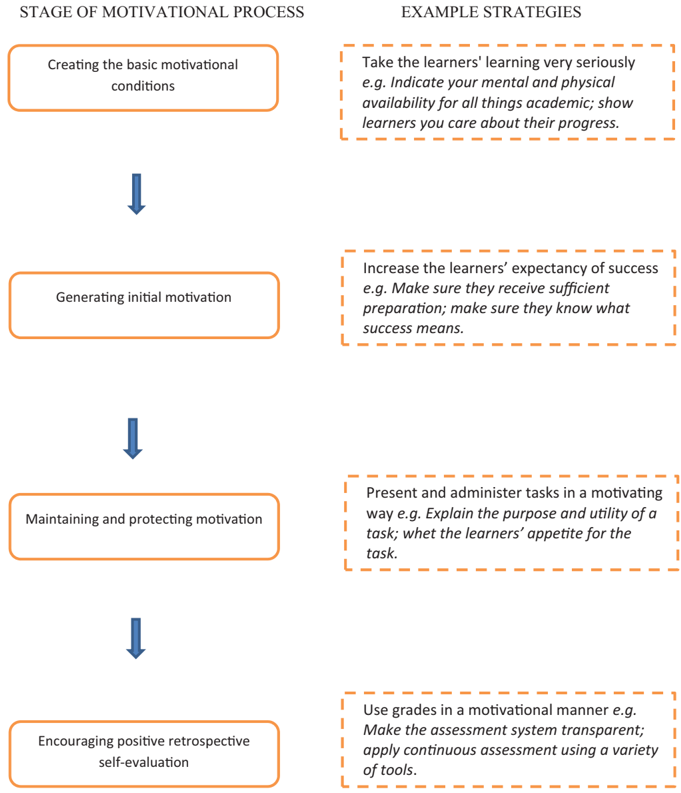
“There is also evidence that teachers and students’ views differ; for instance, Ruesch et al. (2012) found that university students see motivational value T H E M O T I V A T I O N A L D I M E N S I O N O F L A N G U A G E T E A C H I N G 305 STAGE OF MOTIVATIONAL PROCESS EXAMPLE STRATEGIES Figure 1…”
BackgroundThe UK language learning crisis in the public media: a critical analysis
Lanvers, U., & Coleman, J. A. (2013) · Language Learning Journal · doi:10.1080/09571736.2013.830639 · Cited by 86
Decoding Ability in French as a Foreign Language and Language Learning Motivation
Erler, L., & Macaro, E. (2011) · Modern Language Journal · doi:10.1111/j.1540-4781.2011.01238.x · Cited by 85
More or less choice? The influence of choice on task motivation and task engagement
Mozgalina, A. (2015) · System · doi:10.1016/j.system.2015.01.004 · Cited by 82
Freiermuth, M. R., & Huang, H.-C. (2012) · Language Teaching Research · doi:10.1177/1362168811423341 · Cited by 82
Sugita, M., & Takeuchi, O. (2010) · Innovation in Language Learning and Teaching · doi:10.1080/17501220802450470 · Cited by 82 · cited 1×
“The clarity and comprehensiveness of Dörnyei’s MotS framework attracted researchers to validate it empirically, first his own doctoral students (Cheng & Dörnyei 2007; Guilloteaux & Dörnyei 2008) and then those beyond his immediate orbit (e.g. Sugita & Takeuchi 2010).”
BackgroundDigital Games and ELT: Bridging the Authenticity Gap
Henry, A. (2013) · International Perspectives on Motivation · doi:10.1057/9781137000873_8 · Cited by 79
Shaaban, K. (2006) · Reading Psychology · doi:10.1080/02702710600846613 · Cited by 78 · cited 1×
“Shaaban (2006) describes how cooperative (‘jigsaw’) reading tasks improved the motivation to read of Year 5 students of English in Lebanon, while Lo & Hyland (2007) report an action research study in a ‘well-established’ Hong Kong primary 3 2 6 M A R T I N L A M B school which produced gains in…”
BackgroundMuñoz, A. P., & Ramírez, M. B. (2015) · Theory and Research in Education · doi:10.1177/1477878515593885 · Cited by 77
Lozanov, G. (2004) · Routledge eBooks · doi:10.4324/9780203392829 · Cited by 77
Cognitive Contributions to Plurilithic Views of English and Other Languages
Hall, C. J. (2012) · Applied Linguistics · doi:10.1093/applin/ams042 · Cited by 76
A Probe Into Three Chinese Boys' Self-Efficacy Beliefs Learning English as a Second Language
Wang, C., & Pape, S. J. (2007) · Journal of Research in Childhood Education · doi:10.1080/02568540709594601 · Cited by 76 · cited 1×
“Moreover, there is plenty of evidence that classroom experiences are an important source of self-efficacy beliefs (Wang & Pape 2007) and so what the teacher does (e.g. the type of questions they ask, how they group individuals with other students, the kind of feedback they give) may contribute to…”
BackgroundFactors Causing Demotivation in EFL Teaching Process: A Case Study
Aydın, S. (2015) · The Qualitative Report · doi:10.46743/2160-3715/2012.1696 · Cited by 74
How do students of German perceive feedback practices at university? A motivational exploration
Busse, V. (2013) · Journal of Second Language Writing · doi:10.1016/j.jslw.2013.09.005 · Cited by 73
Multiple Perspectives on the Self in SLA
(2014) · Multilingual Matters eBooks · doi:10.21832/9781783091362 · Cited by 72
Lee, K., & Brett, C. (2015) · Teaching and Teacher Education · doi:10.1016/j.tate.2014.11.001 · Cited by 71
Augmenting learner autonomy through blogging
Bhattacharya, A., & Chauhan, K. (2010) · ELT Journal · doi:10.1093/elt/ccq002 · Cited by 71
Language Learning Motivation in Japan
(2013) · Multilingual Matters eBooks · doi:10.21832/9781783090518 · Cited by 71
Taylor, F., & Marsden, E. J. (2014) · The Modern Language Journal · doi:10.1111/modl.12146 · Cited by 70 · cited 3×
“Block (2007), Kramsch (2009), Norton & Toohey (2011) and others have stressed the potential of digital technologies for ‘trying out new and alternative identities and modes of selfpresentation .”
BackgroundInfluentialPlanning for educational change: putting people and their contexts first
Oerlemans, K. (2010) · Journal of Education Policy · doi:10.1080/02680939.2010.518060 · Cited by 69
Research works printed but not linked: 27
- Ushioda, E. (2007). Motivation, autonomy and sociocultural theory. In P . Benson (ed.), Learner autonomy 8: Teacher and learner perspectives . Dublin: Authentik, 5-24.
- Burns, A., M. Morris-Adams, S. Garton & F. Copland (2013). Key factors and challenges in transition from primary to secondary schooling in ELT: An international perspective . London: British Council Research Papers.
- Wentzel, K. R. (2009). Students' relationships with teachers as motivational constructs. In K. R. Wentzel & A. Wigfield (eds.), Handbook of motivation at school . New York: Routledge, 301-322.
- Heinzmann, S. (2013). Young language learners' motivation and attitudes . London: Bloomsbury.
- Coleman, H. (2011). Allocating resources for English: The case of Indonesia's English medium international standard schools. In H. Coleman (ed.), 87-111.
- Warschauer, M. (1996). Motivational aspects of using computers for writing and communication. In M. Warschauer (ed.), Telecollaboration in foreign language learning . Honolulu, HI: University of Hawai'i Second Language Teaching and Curriculum Center, 29-46.
- McInerney, D. & S. Van Etten (eds.) (2004). Big theories revisited . Greenwich, CT: Information Age Publishing.
- D¨ ornyei, Z. (2009). The L2 motivational self system. In Z. D¨ ornyei & E. Ushioda (eds.), 9-42.
- Falout, J. & M. Maruyama (2004). A comparative study of proficiency and learner demotivation. The Language Teacher 28, 3-9.
- Yashima, T. (2013). Individuality, imagination and community in a globalizing world. In P . Benson & L. Cooker (eds.), The applied linguistic individual . London: Equinox Publishing, 46-58.
- Dörnyei, 2014, Motivating learners, motivating teachers: Building vision in the language classroom
- Gallagher-Brett, A. (2004). 700reasons for studying languages . Southampton: Subject Centre for Languages, Linguistics and Area Studies, University of Southampton.
- Hadfield, J. & Z. D¨ ornyei (2013). Motivating learning . Harlow: Longman.
- Anderman, E. M. & L. H. Anderman (2010). Classroom motivation . Upper Saddle River, NJ: Pearson Education.
- Rinvolucri, M. (2002). Humanizing your coursebook . London: DELTA Publishing.
- Enever, J. (2011). ELLiE: Early language learning in Europe . London: The British Council.
- Gleason, J. & R. Suvorov (2012). Learner perceptions of asynchronous oral computer-mediated communication: Proficiency and second language selves. The Canadian Journal of Applied Linguistics 15.1, 100-121.
- Fukuda, S. T ., H. Sakata & M. Takeuchi (2011). Facilitating autonomy to enhance motivation: Examining the effects of a guided-autonomy syllabus. Electronic Journal of Foreign Language Teaching 8.1, 71-86.
- Graddol, D. (2006). English next . Plymouth: The British Council.
- Reeve, J., E. L. Deci & R. M. Ryan (2004). Self-determination theory: A dialectical framework for understanding sociocultural influences on student motivation. In D. McInerney & S. Van Etten (eds.), 31-60.
- Pink, D. H. (2009). Drive: The surprising truth about what motivates us . Edinburgh: Canongate.
- Dörnyei, 2009, Multiple perspectives on interaction: Second language research in Honor of Susan M. Gass, 117
- Schunk, D. H. & F. Pajares (2004). Self-efficacy in education revisited: Empirical and applied evidence. In D. M. McInerney & S. Van Etten (eds.), 115-138.
- Patton, A. (2012). Work that matters: The teacher's guide to project-based learning . London: Paul Hamlyn Foundation.
- Oxford, R. L. (2001). 'The bleached bones of a story': Learners' constructions of language teachers. In M. Breen (ed.), 86-111.
- Shoaib, A. & Z. D¨ ornyei (2005). Affect in life-long learning: Exploring L2 motivation as a dynamic process. In P . Benson & D. Nunan (eds.), Learners' stories . Cambridge: University of Cambridge, 22-41.
- Alrabai, F . (2014). Motivational practices in English as a foreign language classes in Saudi Arabia: Teachers' beliefs and learners' perceptions. Arab World English Journal 5.1, 224-246.
Cited by
L2 motivation research 2005–2014: Understanding a publication surge and a changing landscape
Boo, Z., Dörnyei, Z., & Ryan, S. (2015) · System · doi:10.1016/j.system.2015.10.006 · Cited by 589
Lou, N. M., & Noels, K. A. (2019) · System · doi:10.1016/j.system.2019.102126 · Cited by 264
Huang, F., Wang, Y., & Zhang, H. (2024) · European Journal of Education · doi:10.1111/ejed.12770 · Cited by 243
Zheng, C., Liang, J.-C., Li, M., & Tsai, C.-C. (2018) · System · doi:10.1016/j.system.2018.05.003 · Cited by 173
Teacher–Student Relationships and L2 Motivation
Henry, A., & Thorsén, C. (2018) · Modern Language Journal · doi:10.1111/modl.12446 · Cited by 228
Metadata
- Authors
- Lamb, M.
- Affiliations
- University of Leeds (GB)
- Corresponding author
- Lamb, Martin
- ORCID
- Lamb, Martin
- Venue
- Language Teaching
- Publisher
- Cambridge University Press (CUP)
- Published
- 2017-05-31
- Volume
- 50
- Issue
- 3
- Pages
- 301-346
- ISSN
- 0261-4448 (ISSN-L)
- 1475-3049
- OpenAlex
- W2583077431
- Cited by
- 361
- References
- 289
- Citations by year
- 2026: 29 · 2025: 55 · 2024: 36 · 2023: 45 · 2022: 68 · 2021: 33 · 2020: 38 · 2019: 41 · 2018: 13 · 2017: 2
- FWCI
- 148.78
- Type
- journal article
- Language
- en
- Open access
- bronze
- doi.org
- Locations
- Language Teaching (publishedVersion)
- White Rose Research Online (University of Leeds, The University of Sheffield, University of York) (acceptedVersion)
- Topics
- Social Sciences › Arts and Humanities › Language and Linguistics › EFL/ESL Teaching and Learning
- Social Sciences › Psychology › Developmental and Educational Psychology › Education, Achievement, and Giftedness
- Social Sciences › Linguistics and Language › Second Language Learning and Teaching
- Keywords
- student motivation, second language acquisition, motivational strategies, educational innovation, learner demotivation, classroom attitude
About these checks
Registry, retraction, Cites and statistics results are computed, not judged, with one exception: a printed reference that no index lists is read once by a model before it counts as a citation error. Claims are extracted by a model and kept only when their quote appears verbatim in the text; each cited source is then checked, with a model’s help, for whether it says what the claim relies on. Those verdicts can be wrong — read the claim’s quote and the cited source before relying on one.
The claim verdicts this report counts are experimental: their accuracy is not yet measured.
A language model drew the claims from the paper on 2026-09-30, under version 3 of the claim definition (model deepseek-v4.1-flash, prompt extract-v3).
A second model labelled each claim on 2026-09-30 (model jev-1.13-20260917, definition revision gold-guideline-v0.2).
Cited sources are checked with a language model’s help (gpt-6-sol).
Statistics and arithmetic are recomputed, not judged.
Confidence bands are shown only for fields calibrated on our annotated test set. None is calibrated yet, so no band is shown.
What counts as a claim ›How we measure confidence ›How we check this ›
Are you an author, or do you see a problem with this page? Request a review
Data sources
Bibliographic data: Semantic Scholar, OpenAlex, Crossref.
Contains information from the Semantic Scholar Academic Graph Datasets, made available under the ODC Attribution License (ODC-BY 1.0).
Semantic Scholar’s data is described in: Kinney, R., et al. (2023). The Semantic Scholar Open Data Platform. arXiv:2301.10140.
