

Automated 'oscillometric' blood pressure measuring devices: how they work and what they measure
Open accessThe DOI matches its Crossref record; 69 of the 70 references it cites were found in a registry or an index; 14 of the 48 sources its claims cite were checked for support.
Abstract
Automated 'oscillometric' blood pressure (BP) measuring devices (BPMDs) were developed in the 1970s to replace manual auscultatory BP measurement by mercury sphygmomanometer. Automated BPMDs that have passed accuracy testing versus a reference auscultatory sphygmomanometer using a scientifically accepted validation protocol are recommended for clinical use globally. Currently, there are many thousands of unique automated BPMDs manufactured by hundreds of companies, with each device using proprietary algorithms to estimate BP and using a method of operation that is largely unchanged since inception. Validated automated BPMDs provide similar BP values to those recorded using manual auscultation albeit with potential sources of error mostly associated with using empirical algorithms to derive BP from waveform pulsations. Much of the work to derive contemporary BP thresholds and treatment targets used to manage cardiovascular disease risk was obtained using automated BPMDs. While there is room for future refinement to improve accuracy for better individual risk stratification, validated BPMDs remain the recommended standard for office and out-of-office BP measurement to be used in hypertension diagnosis and management worldwide.
Overview
CoChat Summary
## TL;DR
This paper is a review of how manual auscultatory sphygmomanometers and automated “oscillometric” blood pressure devices work, and what each method actually measures. It argues that validated automated devices remain the recommended standard for clinical and out-of-office blood pressure measurement, while also noting device-specific algorithmic errors and room for improvement.
## Key findings
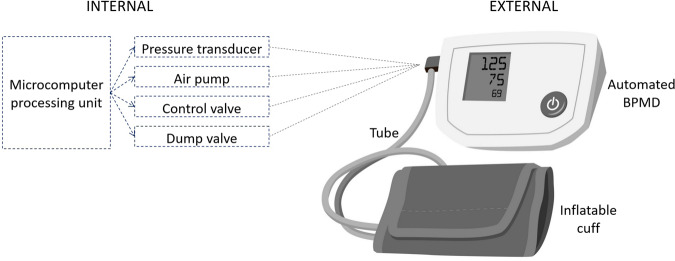
- Automated BPMDs estimate blood pressure from cuff pressure waveform signals using proprietary algorithms; the paper states the basic method has remained largely unchanged for decades and that there are more than 3,500 models from hundreds of companies.
- Validated automated BPMDs are said to provide blood pressure values similar to manual auscultation, and they are recommended globally for hypertension diagnosis and management.
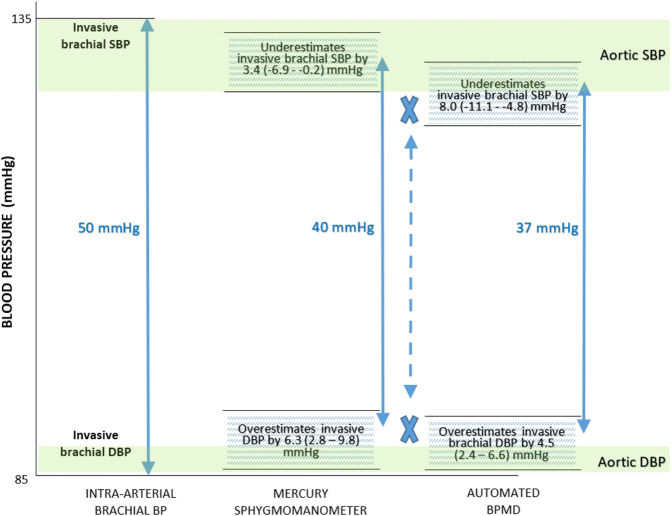
- The paper reports that compared with intra-arterial brachial BP, auscultatory sphygmomanometry underestimates systolic BP by 3–4 mmHg on average and overestimates diastolic BP by about 8 mmHg; automated BPMDs underestimate systolic BP by 8.0 mmHg on average and overestimate diastolic BP by 4.5 mmHg.
- The paper notes that brachial systolic BP averages 8.0 mmHg higher than proximal aortic systolic BP, while diastolic BP is only slightly lower at the brachial artery (−1.0 mmHg), highlighting that peripheral cuff BP is not the same as central aortic BP.
## Methods
- Narrative review / technical overview comparing manual auscultatory measurement with automated oscillometric BP devices.
- Uses prior literature, validation standards, and reported quantitative comparisons; no new sample or primary dataset is described in the text provided.
- Main analysis is descriptive: it explains device operation, waveform processing, algorithmic estimation of BP, and summarizes known sources of measurement error and published comparison values.
## Limitations
- The paper states that each unique automated BPMD has different processes, algorithms, and fitting functions, and that these are “none of which are publicly disclosed,” so accuracy must be determined device by device.
- It explicitly notes limitations of the oscillometric method, including errors that can be systematic, random, or related to specific patient populations, and that estimated BP can vary with device design and waveform-envelope construction.
- Evident from the text: this is a review article rather than an original validation study, so its conclusions depend on previously published studies and do not present new empirical data.
Model-written summary. Check it against the paper before relying on it.
Integrity signals
Registry
Cites
Statistics
Figures
Verification
Claims the paper makes
10 Valid · 2 Not valid · 14 Not checked · 5 Own results and interpretations
The cited sources support only part of this claim — read each source’s verdict below.
In the paper
“Since each unique automated BPMD can have different processes, algorithms and fitting functions to derive BPs (none of which are publicly disclosed), the accuracy of each BPMD needs to be individually determined by comparison to a BP reference standard using a scientifically accepted validation protocol [14, 57, 58].”
§ Automated ‘oscillometric’ blood pressure measuring devices: how they work and what they measure > Automated BPMDs: how do they work, what do they measure?
What the sources say
- Not checked — no full text of the sourcecites [14] Ringrose J, Padwal R. Automated blood pressure measuring devices: how are they validated for accuracy? J Hum Hypertens. 2022 (in press). 36220909 source
- Partly supportedcites [57] Stergiou GS Alpert B Mieke S Asmar R Atkins N Eckert S A universal standard for the validation of blood pressure measuring devices: Association for the Advancement of Medical Instrumentation/European Society of Hypertension/International Organization for Standardization (AAMI/ESH/ISO) Collaboration Statement Hypertension. 2018 71 368 74 10.1161/HYPERTENSIONAHA.117.10237 29386350 sourceExperimental — accuracy not yet measured
The Objective calls for all BP measuring devices to be assessed for accuracy under an agreed validation protocol, and Validation Criteria and Reporting specifies comparison of test-device readings with reference readings. The paper does not say that each automated device uses different, undisclosed algorithms or that this is why individual validation is needed; searches for algorithms and device-model differences did not establish that rationale. Page numbers were not available in our copy. (LLM, conf=0.86)
- Partly supportedcites [58] Stergiou GS Palatini P Asmar R Ioannidis JP Kollias A Lacy P Recommendations and Practical Guidance for performing and reporting validation studies according to the Universal Standard for the validation of blood pressure measuring devices by the Association for the Advancement of Medical Instrumentation/European Society of Hypertension/International Organization for Standardization (AAMI/ESH/ISO) J Hypertens 2019 37 459 66 10.1097/HJH.0000000000002039 30702492 sourceExperimental — accuracy not yet measured
The 'Validation data analysis—Pass/fail criteria' section (page not provided) describes assessing a test device's accuracy against reference BP readings under the AAMI/ESH/ISO standard. The copy does not say that each unique BPMD must be validated individually because its algorithms differ, or that those algorithms are undisclosed. (LLM, conf=0.86)
plainstates a cause- Asserted: passes — The authors put it forward as true.
- Checkable: passes — It can be checked against evidence.
- Load-bearing: passes — The paper’s conclusions depend on it.
- Based: passes — The paper gives a reason why it holds.
The cited sources that could be checked couldn’t confirm or dispute this claim.
In the paper
“In particular, increased arterial stiffness leads to overestimation of systolic, diastolic and mean arterial BPs [60, 62–64].”
§ Automated ‘oscillometric’ blood pressure measuring devices: how they work and what they measure > Automated BPMDs: how do they work, what do they measure?
What the sources say
- Not checked — no full text of the sourcecites [60] Ursino M Cristalli C A mathematical study of some biomechanical factors affecting the oscillometric blood pressure measurement IEEE Trans Biomed Eng 1996 43 761 78 10.1109/10.508540 9216149 source
- Not checked — no full text of the sourcecites [62] Finnegan TP Spence JD Wong DG Wells GA Blood pressure measurement in the elderly: correlation of arterial stiffness with difference between intra-arterial and cuff pressures J Hypertens 1985 3 231 5 10.1097/00004872-198506000-00006 4020129 source
- Could not verifycites [63] van Popele NM Grobbee DE Bots ML Asmar R Topouchian J Reneman RS Association between arterial stiffness and atherosclerosis: the Rotterdam Study Stroke. 2001 32 454 60 10.1161/01.STR.32.2.454 11157182 sourceExperimental — accuracy not yet measured
The Arterial Stiffness methods section describes measuring blood pressure and calculating mean arterial pressure with a one-third pulse-pressure coefficient, but does not assess whether that calculation overestimates pressure. The Discussion says stiffness increases systolic and decreases diastolic blood pressure; it does not address overestimation of measured systolic, diastolic, or mean arterial pressure. (LLM, conf=0.76)
- Not checked — no full text of the sourcecites [64] Stergiou GS Lourida P Tzamouranis D Baibas NM Unreliable oscillometric blood pressure measurement: prevalence, repeatability and characteristics of the phenomenon J Hum Hypertens 2009 23 794 800 10.1038/jhh.2009.20 19322203 source
plainstates a cause- Asserted: passes — The authors put it forward as true.
- Checkable: passes — It can be checked against evidence.
- Load-bearing: passes — The paper’s conclusions depend on it.
- Based: passes — The paper gives a reason why it holds.
The cited sources support only part of this claim — read each source’s verdict below.
In the paper
“However, the range of optimal coefficients for accurate systolic and diastolic BP measurements varies greatly between devices [12, 45, 50, 54].”
§ Automated ‘oscillometric’ blood pressure measuring devices: how they work and what they measure > Automated BPMDs: how do they work, what do they measure?
What the sources say
- Not checked — no full text of the sourcecites [12] Geddes LA Voelz M Combs C Reiner D Babbs CF Characterization of the oscillometric method for measuring indirect blood pressure Ann Biomed Eng 1982 10 271 80 10.1007/BF02367308 7171156 source
- Partly supportedcites [45] Celler BG Argha A Le PN Ambikairajah E Novel methods of testing and calibration of oscillometric blood pressure monitors PLoS One 2018 13 e0201123 10.1371/journal.pone.0201123 30080862 PMC6078288 sourceExperimental — accuracy not yet measured
The Results section, “Derivation of characteristic ratios based on device readings” (page unavailable), reports significant differences between device groups in the systolic and diastolic ratios they used. But the Discussion and conclusion (page unavailable) identifies a common optimal systolic range, 0.5–0.6, and does not establish device-specific optimal ranges or an optimal diastolic ratio. The claim conflates differing device ratios with differing optimal coefficients. (LLM, conf=0.88)
- Not checked — no full text of the sourcecites [50] Forouzanfar M Dajani HR Groza VZ Bolic M Rajan S Batkin I Oscillometric blood pressure estimation: past, present, and future IEEE Rev Biomed Eng 2015 8 44 63 10.1109/RBME.2015.2434215 25993705 source
- Not checked — no full text of the sourcecites [54] Amoore JN Vacher E Murray IC Mieke S King ST Smith FE Effect of the shapes of the oscillometric pulse amplitude envelopes and their characteristic ratios on the differences between auscultatory and oscillometric blood pressure measurements Blood Press Monit 2007 12 297 305 10.1097/MBP.0b013e32826fb773 17890968 source
plain- Asserted: passes — The authors put it forward as true.
- Checkable: passes — It can be checked against evidence.
- Load-bearing: unclear — It is unclear whether the paper’s conclusions depend on it.
- Based: passes — The paper gives a reason why it holds.
The cited sources support only part of this claim — read each source’s verdict below.
In the paper
“The systolic and diastolic BPs are estimated using proprietary algorithms, for example, based on empirical fixed-ratio coefficients [50, 53] that are designed to coincide with BPs measured by an auscultation sphygmomanometer.”
§ Automated ‘oscillometric’ blood pressure measuring devices: how they work and what they measure > Automated BPMDs: how do they work, what do they measure?
What the sources say
- Not checked — no full text of the sourcecites [50] Forouzanfar M Dajani HR Groza VZ Bolic M Rajan S Batkin I Oscillometric blood pressure estimation: past, present, and future IEEE Rev Biomed Eng 2015 8 44 63 10.1109/RBME.2015.2434215 25993705 source
- Partly supportedcites [53] Chandrasekhar A Yavarimanesh M Hahn JO Sung SH Chen CH Cheng HM Formulas to explain popular oscillometric blood pressure estimation algorithms Front Physiol 2019 10 1415 10.3389/fphys.2019.01415 31824333 PMC6881246 sourceExperimental — accuracy not yet measured
The Introduction (page unavailable) describes population-based fixed ratios for estimating systolic and diastolic BP and says these algorithms are believed to be related to proprietary commercial-device algorithms. It does not say the ratios are designed to coincide with auscultatory sphygmomanometer readings; the Materials and Methods instead describe deriving the paper's fixed ratios from invasive BP measurements. (LLM, conf=0.86)
plainstates a cause- Asserted: passes — The authors put it forward as true.
- Checkable: passes — It can be checked against evidence.
- Load-bearing: passes — The paper’s conclusions depend on it.
- Based: passes — The paper gives a reason why it holds.
The cited sources support only part of this claim — read each source’s verdict below.
In the paper
“hundreds of companies manufacturing more than 3500 different models of automated BPMDs, many of which are without evidence of having passed validation testing [25–29].”
§ Automated ‘oscillometric’ blood pressure measuring devices: how they work and what they measure > Introduction
What the sources say
- Supportedcites [25] Picone DS Campbell NRC Schutte AE Olsen MH Ordunez P Whelton PK Validation status of blood pressure measuring devices sold globally JAMA. 2022 327 680 1 10.1001/jama.2021.24464 35166811 PMC8848194 source
The Results section reports 4287 listed devices, of which 3411 automated upper-arm/wrist devices from 457 unique manufacturers remained after exclusions, with no evidence of validation for 2602 (76.3%) and only 300 (8.8%) validated; the Discussion concludes 'A minority of automated upper arm cuff and wristbased devices globally have evidence of validation for accuracy.' This supports both 'hundreds of companies' (457 manufacturers) and 'many ... without evidence of having passed validation testing' (76.3%). The 'more than 3500 models' figure corresponds to the automated devices listed before the site/obsolescence exclusions (3606 of 4287 after removing 681 manually operated) rather than the final analytic sample of 3411, a minor numeric nuance that does not alter the attributed point. (LLM, conf=0.80)
- Not matchedcites [26] Blood Pressure Monitoring Devices Market Size, Share & Trends Analysis Report By Product (Sphygmomanometers/Aneroid BP Monitors, Ambulatory BP Monitors), By End-use, By Region, And Segment Forecasts, 2021. 20282021. Report No.: 978-1-68038-586-1.
Its entry has no title and year that we can search by.
- Not checked — no full text of the sourcecites [27] Alpert BS Can ‘FDA-cleared’ blood pressure devices be trusted? A call to action Blood Press Monit 2017 22 179 81 10.1097/MBP.0000000000000279 28678035 source
- Partly supportedcites [28] Picone DS Deshpande RA Schultz MG Fonseca R Campbell NRC Delles C Nonvalidated home blood pressure devices dominate the online marketplace in Australia Hypertension. 2020 75 1593 9 10.1161/HYPERTENSIONAHA.120.14719 32275193 sourceExperimental — accuracy not yet measured
The Results (p. 7) found that only 6.6% of 972 unique devices surveyed were validated or claimed equivalence, supporting the point that many lacked validation evidence. The Discussion (p. 11) also reports Medaval data for more than 3,000 devices, but the paper does not establish the claimed figure of more than 3,500 models. (LLM, conf=0.88)
- Partly supportedcites [29] Sharman JE O’Brien E Alpert B Schutte AE Delles C Hecht Olsen M Lancet Commission on Hypertension group position statement on the global improvement of accuracy standards for devices that measure blood pressure J Hypertension 2020 38 21 29 10.1097/HJH.0000000000002246 PMC6919228 31790375 sourceExperimental — accuracy not yet measured
The Introduction reports that fewer than 15% of about 3000 cuff-based BP devices had published evidence on accuracy performance, supporting the point that many lack validation evidence. It does not substantiate the cited sentence’s figure of more than 3500 automated models or its claim about hundreds of manufacturers. No page number is available in our copy. (LLM, conf=0.88)
plain- Asserted: passes — The authors put it forward as true.
- Checkable: passes — It can be checked against evidence.
- Load-bearing: unclear — It is unclear whether the paper’s conclusions depend on it.
- Based: passes — The paper gives a reason why it holds.
- Supported
9 more claims
Create a free account to see all 31 claims and to verify the 5 references still open.
- Probably not a substantial claim. 4
- It may state two separate claims as one. 16
Citations
Cites
International Organization for Standardization
(2011) · SpringerReference · doi:10.1007/springerreference_16847 · Cited by 12,534
Whelton, P. K., Carey, R. M., Aronow, W. S., Casey, D. E., Collins, K. J., Dennison Himmelfarb, C., DePalma, S. M., Gidding, S., Jamerson, K. A., Jones, D. W., et al. (2018) · Hypertension · doi:10.1161/hyp.0000000000000065 · Cited by 7,391
Whelton, P. K., Carey, R. M., Aronow, W. S., Casey, D. E., Collins, K. J., Dennison Himmelfarb, C., DePalma, S. M., Gidding, S., Jamerson, K. A., Jones, D. W., et al. (2018) · Hypertension · doi:10.1161/hyp.0000000000000066 · Cited by 4,347
Ettehad, D., Emdin, C. A., Kiran, A., Anderson, S. G., Callender, T., Emberson, J., Chalmers, J., Rodgers, A., & Rahimi, K. (2016) · The Lancet · doi:10.1016/s0140-6736(15)01225-8 · Cited by 3,755
Williams, B., Mancia, G., Spiering, W., Agabiti Rosei, E., Azizi, M., Burnier, M., Clement, D. L., Coca, A., de Simone, G., Dominiczak, A., et al. (2018) · Journal of Hypertension · doi:10.1097/hjh.0000000000001940 · Cited by 2,885
O'Brien, E., Asmar, R., Beilin, L., Imai, Y., Mallion, J.-M., Mancia, G., Mengden, T., Myers, M., Padfield, P., Palatini, P., et al. (2003) · Journal of Hypertension · doi:10.1097/00004872-200305000-00001 · Cited by 1,655
Self-citationA general cardiovascular risk profile: The Framingham study
Kannel, W. B., McGee, D., & Gordon, T. (1976) · The American Journal of Cardiology · doi:10.1016/0002-9149(76)90061-8 · Cited by 1,189
Association Between Arterial Stiffness and Atherosclerosis: The Rotterdam Study
van Popele, N. M., Grobbee, D. E., Bots, M. L., Asmar, R., Topouchian, J., Reneman, R. S., Hoeks, A. P. G., van der Kuip, D. A. M., Hofman, A., & Witteman, J. C. M. (2001) · Stroke · doi:10.1161/01.str.32.2.454 · Cited by 1,142
Whelton, P. K., Carey, R. M., Aronow, W. S., Casey, D. E., Collins, K. J., Dennison Himmelfarb, C., DePalma, S. M., Gidding, S., Jamerson, K. A., Jones, D. W., et al. (2018) · Journal of the American College of Cardiology · doi:10.1016/j.jacc.2017.11.005 · Cited by 920
KARAMANOGLU, M., O'ROURKE, M. F., AVOLIO, A. P., & KELLY, R. P. (1993) · European Heart Journal · doi:10.1093/eurheartj/14.2.160 · Cited by 873
Self-citation(1970) · JAMA · doi:10.1001/jama.213.7.1143 · Cited by 554
Stergiou, G. S., Alpert, B., Mieke, S., Asmar, R., Atkins, N., Eckert, S., Frick, G., Friedman, B., Graßl, T., Ichikawa, T., et al. (2018) · Hypertension · doi:10.1161/hypertensionaha.117.10237 · Cited by 469
Self-citationLeung, A. A., Nerenberg, K., Daskalopoulou, S. S., McBrien, K., Zarnke, K. B., Dasgupta, K., Cloutier, L., Gelfer, M., Lamarre-Cliche, M., Milot, A., et al. (2016) · Canadian Journal of Cardiology · doi:10.1016/j.cjca.2016.02.066 · Cited by 461
Self-citationRole of blood pressure in cardiovascular morbidity and mortality
Kannel, W. B. (1974) · Progress in Cardiovascular Diseases · doi:10.1016/0033-0620(74)90034-6 · Cited by 418
Kallioinen, N., Hill, A., Horswill, M. S., Ward, H. E., & Watson, M. O. (2017) · Journal of Hypertension · doi:10.1097/hjh.0000000000001197 · Cited by 357
Characterization of the oscillometric method for measuring indirect blood pressure
Geddes, L. A., Voelz, M., Combs, C., Reiner, D., & Babbs, C. F. (1982) · Annals of Biomedical Engineering · doi:10.1007/bf02367308 · Cited by 340 · cited 3×
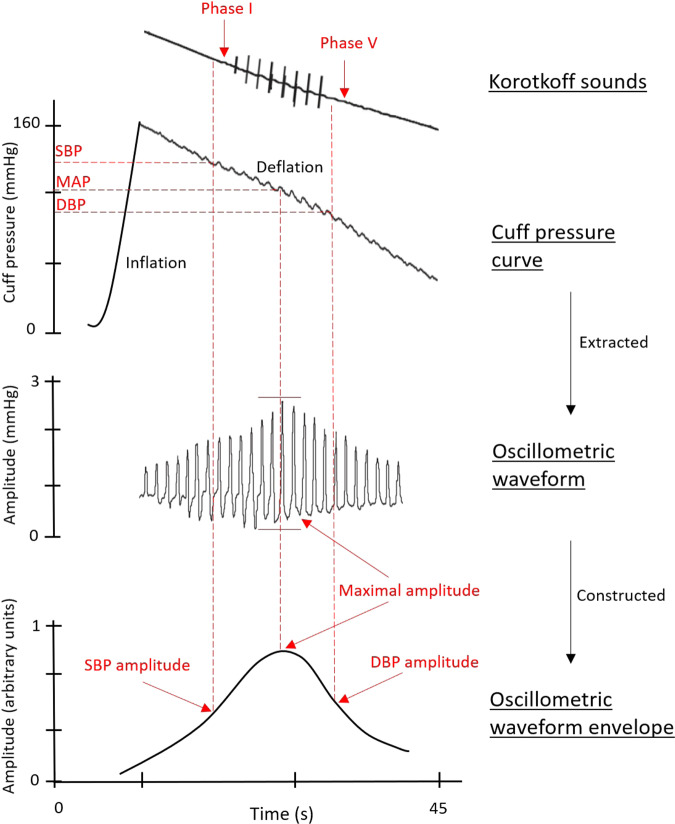
“The pulsations first become apparent before registration of systolic BP with Korotkoff phase I [12].”
BackgroundMethodKELLY, R. P., GIBS, H. H., O'ROURKE, M. F., DALEY, J. E., MANG, K., MORGEN, J. J., & AVOLID, A. P. (1990) · European Heart Journal · doi:10.1093/oxfordjournals.eurheartj.a059669 · Cited by 312
Noninvasive automatic determination of mean arterial pressure
Ramsey, M. (1979) · Medical and Biological Engineering and Computing · doi:10.1007/bf02440948 · Cited by 287 · cited 1×
“The maximum amplitude algorithm is a conventional method to estimate mean arterial pressure, which is the cuff pressure at the maximum amplitude of the oscillometric waveform envelope, corresponding with unloading the arterial wall and where the transmural pressure is zero [44, 51, 52].”
MethodAccuracy of Cuff-Measured Blood Pressure
Picone, D. S., Schultz, M. G., Otahal, P., Aakhus, S., Al-Jumaily, A. M., Black, J. A., Bos, W. J., Chambers, J. B., Chen, C.-H., Cheng, H.-M., et al. (2017) · Journal of the American College of Cardiology · doi:10.1016/j.jacc.2017.05.064 · Cited by 277
Self-citationRecommendations for Human Blood Pressure Determinations by Sphygmomanometers
BORDLEY, J., CONNOR, C. A. R., HAMILTON, W. F., KERR, W. J., & WIGGERS, C. J. (1951) · Circulation · doi:10.1161/01.cir.4.4.503 · Cited by 262 · cited 2×
“As early as in 1951, a committee of the Council for High BP Research of the American Heart Association reported that the sphygmomanometer auscultation method underestimates intraarterial brachial systolic BP by an average of 3–4mmHg, but overestimates diastolic BP by an average 8mmHg [40].”
BackgroundMethodSharman, J. E., Avolio, A. P., Baulmann, J., Benetos, A., Blacher, J., Blizzard, C. L., Boutouyrie, P., Chen, C.-H., Chowienczyk, P., Cockcroft, J. R., et al. (2017) · European Heart Journal · doi:10.1093/eurheartj/ehw632 · Cited by 231 · cited 1×
“The figure highlights that divergence from true intra-arterial BP values is greatest for automated BPMDs, and this issue forms a major component of the rationale to develop new BP technology to provide better estimates of BP, especially at the central aortic level [66].”
BackgroundSelf-citationStergiou, G. S., Palatini, P., Asmar, R., Ioannidis, J. P., Kollias, A., Lacy, P., McManus, R. J., Myers, M. G., Parati, G., Shennan, A., et al. (2019) · Journal of Hypertension · doi:10.1097/hjh.0000000000002039 · Cited by 218 · cited 1×
“Since each unique automated BPMD can have different processes, algorithms and fitting functions to derive BPs (none of which are publicly disclosed), the accuracy of each BPMD needs to be individually determined by comparison to a BP reference standard using a scientifically accepted validation protocol [14, 57, 58].”
MethodSelf-citationOscillometric blood pressure: a review for clinicians
Alpert, B. S., Quinn, D., & Gallick, D. (2014) · Journal of the American Society of Hypertension · doi:10.1016/j.jash.2014.08.014 · Cited by 211
Blood Pressure Assessment in Adults in Clinical Practice and Clinic-Based Research
Muntner, P., Einhorn, P. T., Cushman, W. C., Whelton, P. K., Bello, N. A., Drawz, P. E., Green, B. B., Jones, D. W., Juraschek, S. P., Margolis, K. L., et al. (2019) · Journal of the American College of Cardiology · doi:10.1016/j.jacc.2018.10.069 · Cited by 199
Self-citationOscillometric Blood Pressure Estimation: Past, Present, and Future
Forouzanfar, M., Dajani, H. R., Groza, V. Z., Bolic, M., Rajan, S., & Batkin, I. (2015) · IEEE Reviews in Biomedical Engineering · doi:10.1109/rbme.2015.2434215 · Cited by 196
Ursino, M., & Cristalli, C. (1996) · IEEE Transactions on Biomedical Engineering · doi:10.1109/10.508540 · Cited by 179 · cited 1×
“, up to 10–15%) [60] in BP estimations that are either systematic, random or associated with clinical characteristics of specific patient populations [61].”
BackgroundBabbs, C. F. (2012) · BioMedical Engineering OnLine · doi:10.1186/1475-925x-11-56 · Cited by 177
Blood pressure monitoring: Automated oscillometric devices
Ramsey, M. (1991) · Journal of Clinical Monitoring · doi:10.1007/bf01617900 · Cited by 155 · cited 3×
“This approach has remained mostly unchanged for decades [13, 44, 45].”
BackgroundMethodSharman, J. E., O’Brien, E., Alpert, B., Schutte, A. E., Delles, C., Hecht Olsen, M., Asmar, R., Atkins, N., Barbosa, E., Calhoun, D., et al. (2020) · Journal of Hypertension · doi:10.1097/hjh.0000000000002246 · Cited by 139
Self-citationPicone, D. S., Deshpande, R. A., Schultz, M. G., Fonseca, R., Campbell, N. R. C., Delles, C., Hecht Olsen, M., Schutte, A. E., Stergiou, G., Padwal, R., et al. (2020) · Hypertension · doi:10.1161/hypertensionaha.120.14719 · Cited by 118
Self-citationThe history of blood pressure measurement.
O'Brien, E. T., & Fitzgerald, D. (1994) · PubMed · Cited by 101
(1969) · PubMed · Cited by 96
Korotkoff Sounds: An Experimental Critique
MCCUTCHEON, E. P., RUSHMER, R. F., Jacobson, O., & Sandier, H. (1967) · Circulation Research · doi:10.1161/01.res.20.2.149 · Cited by 95
Historical Perspectives on the Management of Hypertension
Moser, M. (2006) · The Journal of Clinical Hypertension · doi:10.1111/j.1524-6175.2006.05836.x · Cited by 86
Formulas to Explain Popular Oscillometric Blood Pressure Estimation Algorithms
Chandrasekhar, A., Yavarimanesh, M., Hahn, J.-O., Sung, S.-H., Chen, C.-H., Cheng, H.-M., & Mukkamala, R. (2019) · Frontiers in Physiology · doi:10.3389/fphys.2019.01415 · Cited by 84 · cited 1×
“The systolic and diastolic BPs are estimated using proprietary algorithms, for example, based on empirical fixed-ratio coefficients [50, 53] that are designed to coincide with BPs measured by an auscultation sphygmomanometer.”
MethodStergiou, G. S., Lourida, P., Tzamouranis, D., & Baibas, N. M. (2009) · Journal of Human Hypertension · doi:10.1038/jhh.2009.20 · Cited by 74
Self-citationRequirements for professional office blood pressure monitors
Stergiou, G. S., Parati, G., Asmar, R., & O’Brien, E. (2012) · Journal of Hypertension · doi:10.1097/hjh.0b013e32834fcfa5 · Cited by 71
Self-citationSphygmomanometer calibration--why, how and how often?
Turner, M. J., Speechly, C., & Bignell, N. (2007) · PubMed · Cited by 67
Validation Status of Blood Pressure Measuring Devices Sold Globally
Picone, D. S., Campbell, N. R. C., Schutte, A. E., Olsen, M. H., Ordunez, P., Whelton, P. K., & Sharman, J. E. (2022) · JAMA · doi:10.1001/jama.2021.24464 · Cited by 66
Self-citationChungcharoen, D. (1964) · American Journal of Physiology-Legacy Content · doi:10.1152/ajplegacy.1964.207.1.190 · Cited by 61
Amoore, J. N., Lemesre, Y., Murray, I. C., Mieke, S., King, S. T., Smith, F. E., & Murray, A. (2008) · Journal of Hypertension · doi:10.1097/hjh.0b013e3282f06ec7 · Cited by 56
Self-citationFinnegan, T. P., Spence, J. D., Wong, D. G., & Wells, G. A. (1985) · Journal of Hypertension · doi:10.1097/00004872-198506000-00006 · Cited by 56
Oscillometric sphygmomanometers: a critical appraisal of current technology
Amoore, J. N. (2012) · Blood Pressure Monitoring · doi:10.1097/mbp.0b013e32835026b0 · Cited by 49
Palatini, P., Asmar, R., O’Brien, E., Padwal, R., Parati, G., Sarkis, J., & Stergiou, G. (2020) · Journal of Hypertension · doi:10.1097/hjh.0000000000002399 · Cited by 48
Self-citationPicone, D. S., Schultz, M. G., Peng, X., Black, J. A., Dwyer, N., Roberts-Thomson, P., Chen, C.-H., Cheng, H.-M., Pucci, G., Wang, J.-G., et al. (2018) · Hypertension · doi:10.1161/hypertensionaha.117.10696 · Cited by 47
Self-citationFreis, E. D. (1974) · Stroke · doi:10.1161/01.str.5.1.76 · Cited by 44
Amoore, J. N., Vacher, E., Murray, I. C., Mieke, S., King, S. T., Smith, F. E., & Murray, A. (2007) · Blood Pressure Monitoring · doi:10.1097/mbp.0b013e32826fb773 · Cited by 34 · cited 1×
“However, the range of optimal coefficients for accurate systolic and diastolic BP measurements varies greatly between devices [12, 45, 50, 54].”
BackgroundSelf-citationAmoore, J. N. (2006) · Blood Pressure Monitoring · doi:10.1097/01.mbp.0000217999.04592.7c · Cited by 32
Sharman, J. E., Ordunez, P., Brady, T., Parati, G., Stergiou, G., Whelton, P. K., Padwal, R., Olsen, M. H., Delles, C., Schutte, A. E., et al. (2022) · Journal of Human Hypertension · doi:10.1038/s41371-022-00747-0 · Cited by 31
Self-citationCan ‘FDA-cleared’ blood pressure devices be trusted? A call to action
Alpert, B. S. (2017) · Blood Pressure Monitoring · doi:10.1097/mbp.0000000000000279 · Cited by 31
How Important is the Recommended Slow Cuff Pressure Deflation Rate for Blood Pressure Measurement?
Zheng, D., Amoore, J. N., Mieke, S., & Murray, A. (2011) · Annals of Biomedical Engineering · doi:10.1007/s10439-011-0347-9 · Cited by 28
Self-citationNovel methods of testing and calibration of oscillometric blood pressure monitors
Celler, B. G., Argha, A., Le, P. N., & Ambikairajah, E. (2018) · PLOS ONE · doi:10.1371/journal.pone.0201123 · Cited by 28 · cited 4×
“Signal association with systolic and diastolic BP Korotkoff sounds denote systolic BP (phase I) and diastolic BP (phase V, or phase IV in absence of V): • Korotkoff phase I sound is the first appearance of two consecutive clear tapping sounds denoting the introduction of blood flow under the cuff • Korotkoff phase II–…”
BackgroundInfluentialG. Celler, B., Butlin, M., Argha, A., Tan, I., Yong, A., & Avolio, A. (2021) · IEEE Transactions on Biomedical Engineering · doi:10.1109/tbme.2021.3079578 · Cited by 24 · cited 1×
“The variability in error for systolic and diastolic BP plausibly has interaction with arterial stiffness, resulting in Korotkoff sounds I and V being separate events from the exact movement of the cuff pressure past the systolic and diastolic BP [43].”
BackgroundSelf-citationon behalf of the Japanese Society of Hypertension Working Group on Mercury Sphygmomanometer and Minamata Convention on Mercury, Asayama, K., Ohkubo, T., Hoshide, S., Kario, K., Ohya, Y., Rakugi, H., & Umemura, S. (2016) · Hypertension Research · doi:10.1038/hr.2015.158 · Cited by 21
Self-citationA Meta-analysis to Determine the Validity of Taking Blood Pressure Using the Indirect Cuff Method
Dankel, S. J., Kang, M., Abe, T., & Loenneke, J. P. (2019) · Current Hypertension Reports · doi:10.1007/s11906-019-0929-8 · Cited by 20
Stergiou, G. S., Lourida, P., & Tzamouranis, D. (2011) · Journal of Human Hypertension · doi:10.1038/jhh.2010.107 · Cited by 18 · cited 1×
“This prospect does not detract from the long-established clinical value of cuff measured BP, and although the general approach of estimating BP by automated BPMDs works well for many people, the method requires refining for improved accuracy among individuals [67].”
BackgroundSelf-citationJazbinšek, V., Lužnik, J., Mieke, S., & Trontelj, Z. (2009) · Annals of Biomedical Engineering · doi:10.1007/s10439-009-9853-4 · Cited by 17
Bazett, H. C., Laplace, L. B., & Scott, J. C. (1935) · American Journal of Physiology-Legacy Content · doi:10.1152/ajplegacy.1935.112.1.182 · Cited by 17
Clinical evaluation of the Welch Allyn SureBP algorithm for automated blood pressure measurement
Alpert, B. S. (2007) · Blood Pressure Monitoring · doi:10.1097/mbp.0b013e3280b0840d · Cited by 15 · cited 1×
“Most automated BPMDs analyse the pressure waveform signals during the period of cuff deflation, although some devices analyse signals during the inflation period [49].”
BackgroundOptimum waveform envelopes and amplitude ratios in oscillometric blood pressure estimation
Alvarado Alvarez, M., Padwal, R., Ringrose, J., Jalali, A., & Hiebert, W. (2021) · Blood Pressure Monitoring · doi:10.1097/mbp.0000000000000485 · Cited by 12 · cited 4×
“Constructing the oscillometric waveform envelope Several signal processing methods can be used to construct the oscillometric waveform envelope, and this creates variability in waveform envelope morphology as well as different BP estimations [55]”
BackgroundMethodInfluentialSelf-citationErrors in assessment of blood pressure: sphygmomanometers and blood pressure cuffs.
(1994) · PubMed · Cited by 11
Stork, M., & Jilek, J. (2011) · Biomedical Engineering, Trends in Electronics, Communications and Software · doi:10.5772/13475 · Cited by 10
Taleyarkhan, P. R., Geddes, L. A., Kemeny, A. E., & Vitter, J. S. (2009) · Cardiovascular Engineering An International Journal · doi:10.1007/s10558-009-9077-0 · Cited by 9
Automated blood pressure measuring devices: how are they clinically validated for accuracy?
Ringrose, J. S., & Padwal, R. (2022) · Journal of Human Hypertension · doi:10.1038/s41371-022-00761-2 · Cited by 9
Self-citationEvidence on Blood Pressure Measurement Methodology and Clinical Implementation
Stergiou, G. S., Kollias, A., & Protogerou, A. D. (2017) · Journal of the American College of Cardiology · doi:10.1016/j.jacc.2017.06.026 · Cited by 7 · cited 3×
“Cuff placement Select an appropriately sized inflatable compression cuff that encircles the upper arm: • Dimensions of the cuff bladder relative to the individual’s mid-arm circumference influence whether proper occlusion of the upper arm and brachial artery occurs • A cuff that is too small (undercuffing) will overes…”
BackgroundInfluentialSelf-citationBlood Pressure Measurement Methodologies: Present Status and Future Prospects
Butlin, M., Tan, I., Cox, J., Shirbani, F., Peebles, K. C., Zuo, J., & P. Avolio, A. (2020) · Hypertension Journal · doi:10.15713/ins.johtn.0196 · Cited by 4
Self-citationFaster oscillometric manometry does not sacrifice the accuracy of blood pressure determination
Sugimachi, M., Okamoto, H., Hoka, S., & Sunagawa, K. (2004) · Blood Pressure Monitoring · doi:10.1097/01.mbp.0000130430.78823.42 · Cited by 3
Measurements of arterial pressure and flow in vivo
Sharman, J. E., Segers, P., & Chirinos, J. A. (2022) · Textbook of Arterial Stiffness and Pulsatile Hemodynamics in Health and Disease · doi:10.1016/b978-0-323-91391-1.00002-9 · Cited by 3
Self-citation
Research works printed but not linked: 2
- Birkenhager WH, Reid JL, editors. Handbook of hypertension. The Netherlands: Elsevier Science Publishers B.V.; 1991.
- Jilek J Stork M Arterial pulsations in the blood pressure cuff: are they hemodynamic pulses or oscillations? Int J Biol Biomed Eng 2012 6 35 41
Cited by
Advances in mechanical biomarkers
Eroles, M., & Rico, F. (2023) · Journal of Molecular Recognition · doi:10.1002/jmr.3022 · Cited by 37
Cuff-based blood pressure measurement: challenges and solutions
Pilz, N., Picone, D. S., Patzak, A. R., Opatz, O. S., Lindner, T., Fesseler, L., Heinz, V., & Bothe, T. L. (2024) · Blood Pressure · doi:10.1080/08037051.2024.2402368 · Cited by 44
Reshaping the healthcare world by AI-integrated wearable sensors following COVID-19
Khan, B., Khalid, R. T., Wara, K. U., Masrur, M. A., Khan, S., Khan, W. U., Amara, U., & Abdullah, S. (2025) · Chemical Engineering Journal · doi:10.1016/j.cej.2025.159478 · Cited by 30
Akter, S., Azhar, B. S., Kamruzzaman, M., Banna, M. H. A., Hasan, H., & Roshid, M. M. (2025) · BMC Nutrition · doi:10.1186/s40795-025-01121-2 · Cited by 35
Resonance sonomanometry for noninvasive, continuous monitoring of blood pressure
Jimenez, R., Yurk, D., Dell, S. J., Rutledge, A. C., Fu, M., Dempsey, W. P., Abu‐Mostafa, Y. S., Rajagopal, A., & Rajagopal, A. B. (2024) · PNAS Nexus · doi:10.1093/pnasnexus/pgae252 · Cited by 16
Metadata
- Authors
- Sharman, J. E., Tan, I., Stergiou, G. S., Lombardi, C., Saladini, F., Butlin, M., Padwal, R., Asayama, K., Avolio, A., Brady, T. M., Murray, A., & Parati, G.
- Affiliations
- University of Tasmania (AU)
- The George Institute for Global Health (AU)
- National and Kapodistrian University of Athens (GR)
- IRCCS Istituto Auxologico Italiano (IT)
- Macquarie University (AU)
- University of Alberta (CA)
- Teikyo University (JP)
- Johns Hopkins University (US)
- Newcastle University (GB)
- Corresponding author
- Sharman, James E.
- ORCID
- Venue
- Journal of Human Hypertension
- Published
- 2022-05-30
- Volume
- 37
- Issue
- 2
- Pages
- 93-100
- ISSN
- 0950-9240 (ISSN-L)
- 1476-5527
- PMC
- PMC9957730
- OpenAlex
- W4281710849
- Cited by
- 84
- References
- 70
- Citations by year
- 2026: 32 · 2025: 23 · 2024: 16 · 2023: 12 · 2022: 1
- FWCI
- 2.64
- Type
- journal article
- Language
- en
- Open access
- hybrid
- doi.org
- Licence
- cc-by
- creativecommons.org/licenses/by/4.0 (tdm)
- creativecommons.org/licenses/by/4.0 (vor)
- Locations
- Journal of Human Hypertension (publishedVersion, cc-by)
- PubMed Central (publishedVersion, cc-by)
- PubMed (publishedVersion)
- BOA (University of Milano-Bicocca) (submittedVersion, cc-by)
- Lirias (submittedVersion, other-oa)
- Figshare (submittedVersion, cc-by)
- Newcastle University ePrints (Newcastle Univesity) (cc-by)
- Funders
- Engineering and Physical Sciences Research Council (EP/N025342/1)
- Topics
- Health Sciences › Medicine › Cardiology and Cardiovascular Medicine › Blood Pressure and Hypertension Studies
- Physical Sciences › Engineering › Biomedical Engineering › Non-Invasive Vital Sign Monitoring
- Health Sciences › Medicine › Cardiology and Cardiovascular Medicine › Cardiovascular Health and Disease Prevention
- Keywords
- automated blood pressure measurement, oscillometric blood pressure devices, device validation, measurement accuracy, hypertension diagnosis, antihypertensive therapy, cardiovascular risk stratification, blood pressure thresholds, out-of-office blood pressure monitoring
- MeSH terms
- Blood Pressure, Blood Pressure Determination, Humans, Hypertension, Oscillometry, Sphygmomanometers
About these checks
Registry, retraction, Cites and statistics results are computed, not judged, with one exception: a printed reference that no index lists is read once by a model before it counts as a citation error. Claims are extracted by a model and kept only when their quote appears verbatim in the text; each cited source is then checked, with a model’s help, for whether it says what the claim relies on. Those verdicts can be wrong — read the claim’s quote and the cited source before relying on one.
The claim verdicts this report counts are experimental: their accuracy is not yet measured.
A language model drew the claims from the paper on 2026-10-10, under version 3 of the claim definition (model deepseek-v4.1-flash, prompt extract-v3).
A second model labelled each claim on 2026-10-10 (model jev-1.13-20260917, definition revision gold-guideline-v0.2).
Cited sources are checked with a language model’s help (gpt-6-sol and qwen3.8-omni-flash).
Statistics and arithmetic are recomputed, not judged.
Confidence bands are shown only for fields calibrated on our annotated test set. None is calibrated yet, so no band is shown.
What counts as a claim ›How we measure confidence ›How we check this ›
Are you an author, or do you see a problem with this page? Request a review
Data sources
Bibliographic data: Semantic Scholar, OpenAlex, Crossref.
Contains information from the Semantic Scholar Academic Graph Datasets, made available under the ODC Attribution License (ODC-BY 1.0).
Semantic Scholar’s data is described in: Kinney, R., et al. (2023). The Semantic Scholar Open Data Platform. arXiv:2301.10140.
