

Array programming with NumPy
Open accessThe DOI matches its Crossref record; 43 of the 43 references it cites were found in a registry or an index.
Abstract
Abstract Array programming provides a powerful, compact and expressive syntax for accessing, manipulating and operating on data in vectors, matrices and higher-dimensional arrays. NumPy is the primary array programming library for the Python language. It has an essential role in research analysis pipelines in fields as diverse as physics, chemistry, astronomy, geoscience, biology, psychology, materials science, engineering, finance and economics. For example, in astronomy, NumPy was an important part of the software stack used in the discovery of gravitational waves 1 and in the first imaging of a black hole 2 . Here we review how a few fundamental array concepts lead to a simple and powerful programming paradigm for organizing, exploring and analysing scientific data. NumPy is the foundation upon which the scientific Python ecosystem is constructed. It is so pervasive that several projects, targeting audiences with specialized needs, have developed their own NumPy-like interfaces and array objects. Owing to its central position in the ecosystem, NumPy increasingly acts as an interoperability layer between such array computation libraries and, together with its application programming interface (API), provides a flexible framework to support the next decade of scientific and industrial analysis.
Overview
The claims and statistics of this paper haven’t been checked yet.
Free: it reads the open-access text and checks the first 5 claims that cite a source we can check. Create a free account to check every claim.
Integrity signals
Registry
Cites
Statistics
Figures
Verification
Claims the paper makes
The claims and statistics of this paper haven’t been checked yet.
Free: it reads the open-access text and checks the first 5 claims that cite a source we can check. Create a free account to check every claim.
Claims other papers make about this one
Each is checked against this paper’s own text: does it say what the citing paper says it does?
The cited source says what the claim attributes to it.
In the citing paper
“Each subset is saved in NumPy39 npz format, named as <data> mnist.npz for MedMNIST2D and <data> mnist3d.npz for MedMNIST3D, and is comprised of 6 keys (“train_images”, “train_labels”, “val_images”, “val_labels”, “test_images”, “test_labels”).”
From MedMNIST v2 - A large-scale lightweight benchmark for 2D and 3D biomedical image classification (2023) · cites this paper as [39]
The check wasn’t confident either way, so it gives no verdict — never disputed.
In the citing paper
“But there is no reason to suppose that the same system, absent human-generated inputs, would spontaneously develop a disposition to think analogically, as apparently happened at some point in human evolution.”
From Emergent analogical reasoning in large language models (2023) · cites this paper as [62]
Experimental — accuracy not yet measuredIn the citing paper
“RivGraph relies on functionality from the following Python packages: GDAL (GDAL/OGR contributors, 2020), NumPy (Harris et al., 2020), Matplotlib (Hunter, 2007), GeoPandas (Jordahl et al., 2020), Shapely (Gillies & others, 2007), Fiona (Gillies & others, 2011), pyproj (Snow et al., 2020), scikit-image (van der Walt et al., 2014), OpenCV (Bradski, 2000), networkx (Hagberg et al., 2008), and fastdtw”
From RivGraph: Automatic extraction and analysis of river and delta channel network topology (2021) · cites this paper as Harris et al., 2020
Self-check
Percentages, sums and reported differences re-computed from the paper’s own numbers.
The self-check needs the paper’s full text.
Citations
Cites
Scikit-learn: Machine Learning in Python
Pedregosa, F., Varoquaux, G., Gramfort, A., Michel, V., Thirion, B., Grisel, O., Blondel, M., Müller, A., Nothman, J., Louppe, G., et al. (2012) · arXiv · doi:10.48550/arxiv.1201.0490 · Cited by 71,016 · cited 3×
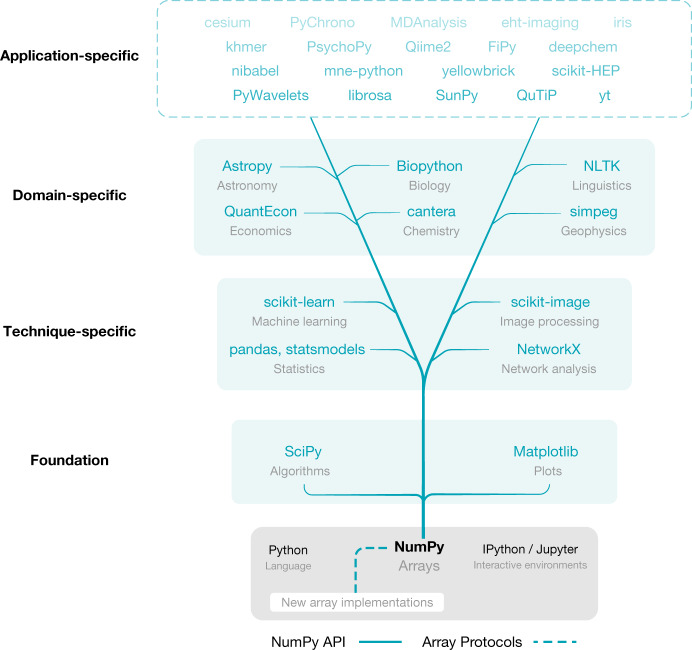
“2) builds on top of this foundation to provide several, widely used technique specific libraries [16, 17, 23], that in turn underlay numerous domain specific projects [24, 25, 26, 27, 28, 29].”
BackgroundSelf-citationMatplotlib: a 2D graphics environment
Hunter, J. D. (2007) · Computing in Science & Engineering · doi:10.1109/mcse.2007.55 · Cited by 39,249 · cited 2×
“[14] J.”
BackgroundSciPy 1.0: fundamental algorithms for scientific computing in Python
Virtanen, P., Gommers, R., Oliphant, T. E., Haberland, M., Reddy, T., Cournapeau, D., Burovski, E., Peterson, P., Weckesser, W., Bright, J., et al. (2020) · Nature Methods · doi:10.1038/s41592-019-0686-2 · Cited by 38,430 · cited 2×
“Now, fifteen years later, NumPy underpins almost every Python library that does scientific or numerical computation including SciPy [13], Matplotlib [14], pandas [15], scikit-learn [16], and scikit-image [17].”
BackgroundSelf-citationPyTorch: An Imperative Style, High-Performance Deep Learning Library
Paszke, A., Gross, S., Massa, F., Lerer, A., Bradbury, J., Chanan, G., Killeen, T., Lin, Z., Gimelshein, N., Antiga, L., et al. (2019) · arXiv · doi:10.48550/arxiv.1912.01703 · Cited by 31,473 · cited 2×
“For example, each deep learning framework created its own arrays; PyTorch [38], Tensorflow [39], Apache MXNet [40], and JAX arrays all have the capability to run on CPUs and GPUs, in a distributed fashion, utilizing lazy evaluation to allow for additional performance optimizations.”
MethodAstropy: A community Python package for astronomy
The Astropy Collaboration, Robitaille, T. P., Tollerud, E. J., Greenfield, P., Droettboom, M., Bray, E., Aldcroft, T., Davis, M., Ginsburg, A., Price-Whelan, A. M., et al. (2013) · Astronomy & Astrophysics · doi:10.1051/0004-6361/201322068 · Cited by 14,620 · cited 3×
“Astropy [24, 25] handles standard astronomical file formats and computes time/coordinate transformations.”
BackgroundObservation of Gravitational Waves from a Binary Black Hole Merger
Abbott, B. P., Abbott, R., Abbott, T. D., Abernathy, M. R., Acernese, F., Ackley, K., Adams, C., Adams, T., Addesso, P., Adhikari, R. X., et al. (2016) · Physical Review Letters · doi:10.1103/physrevlett.116.061102 · Cited by 14,151
TensorFlow: A system for large-scale machine learning
Abadi, M., Barham, P., Chen, J., Chen, Z., Davis, A., Dean, J., Devin, M., Ghemawat, S., Irving, G., Isard, M., et al. (2016) · arXiv (Cornell University) · doi:10.48550/arxiv.1605.08695 · Cited by 11,822
R: A Language for Data Analysis and Graphics
Ihaka, R., & Gentleman, R. (1996) · Journal of Computational and Graphical Statistics · doi:10.1080/10618600.1996.10474713 · Cited by 11,220 · cited 2×
“The design of this new tool was informed by other powerful interactive programming languages for scientific computing such as Basis [47], Yorick [48], R [49], and APL [50], as well as commercial languages and environments like IDL and MATLAB.”
MethodData Structures for Statistical Computing in Python
McKinney, W. (2010) · Proceedings of the Python in Science Conference · doi:10.25080/majora-92bf1922-00a · Cited by 11,032 · cited 2×
“Now, fifteen years later, NumPy underpins almost every Python library that does scientific or numerical computation including SciPy [13], Matplotlib [14], pandas [15], scikit-learn [16], and scikit-image [17].”
BackgroundSciPy 1.0: fundamental algorithms for scientific computing in Python
Virtanen, P., Gommers, R., Oliphant, T. E., Haberland, M., Reddy, T., Cournapeau, D., Burovski, E., Peterson, P., Weckesser, W., Bright, J., et al. (2019) · Apollo - University of Cambridge Repository · doi:10.17863/cam.64134 · Cited by 10,460
Self-citation
Research works printed but not linked: 11
- Yang, T.-Y., Furnish, G. & Dubois, P. F. Steering object-oriented scientific computations. In Proc. TOOLS USA 97. Intl Conf. Technology of Object Oriented Systems and Languages (eds Ege, R., Singh, M. & Meyer, B.) 112–119 (IEEE, 1997).
- Hamman, J., Rocklin, M. & Abernathy, R. Pangeo: a big-data ecosystem for scalable Earth system science. In EGU General Assembly Conf. Abstracts 12146 (2018).
- van der Walt, S. The SciPy Documentation Project (technical overview). In Proc. 7th Python in Science Conf. (SciPy 2008) (eds Varoquaux, G., Vaught, T. & Millman, K. J.) 27–28 (2008).
- Harrington, J. The SciPy Documentation Project. In Proc. 7th Python in Science Conference (SciPy 2008) (eds Varoquaux, G., Vaught, T. & Millman, K. J.) 33–35 (2008).
- Harrington, J. & Goldsmith, D. Progress report: NumPy and SciPy documentation in 2009. In Proc. 8th Python in Science Conf. (SciPy 2009) (eds Varoquaux, G., van der Walt, S. & Millman, K. J.) 84–87 (2009).
- Entschev, P. Distributed multi-GPU computing with Dask, CuPy and RAPIDS. In EuroPython 2019 https://ep2019.europython.eu/media/conference/slides/fX8dJsD-distributed-multi-gpu-computing-with-dask-cupy-and-rapids.pdf (2019).
- Barrett, K. A., Chiu, Y. H., Painter, J. F., Motteler, Z. C. & Dubois, P. F. Basis System, Part I: Running a Basis Program—A Tutorial for Beginners UCRL-MA-118543, Vol. 1 (Lawrence Livermore National Laboratory 1995).
- Dubois, P. F. & Motteler, Z. Basis System, Part II: Basis Language Reference Manual UCRL-MA-118543, Vol. 2 (Lawrence Livermore National Laboratory, 1995).
- Chiu, Y. H. & Dubois, P. F. Basis System, Part III: EZN User Manual UCRL-MA-118543, Vol. 3 (Lawrence Livermore National Laboratory, 1995).
- Chiu, Y. H. & Dubois, P. F. Basis System, Part IV: EZD User Manual UCRL-MA-118543, Vol. 4 (Lawrence Livermore National Laboratory, 1995).
- Lattner, C. & Adve, V. LLVM: a compilation framework for lifelong program analysis and transformation. In Proc. 2004 Intl Symp. Code Generation and Optimization (CGO’04) 75–88 (IEEE, 2004).
Cited by
Items 1,001–1,100 of 1,235
Lanfredi, R. B., Zhang, M., Auffermann, W. F., Chan, J., Duong, P.-A. T., Srikumar, V., Drew, T., Schroeder, J., & Taşdizen, T. (2022) · Scientific Data · doi:10.1038/s41597-022-01441-z · Cited by 92
BubbleDet: a Python package to compute functional determinants for bubble nucleation
Ekstedt, A., Gould, O., & Hirvonen, J. (2023) · Journal of High Energy Physics · doi:10.1007/jhep12(2023)056 · Cited by 66
Interaction and co-assembly of optical and topological solitons
Poy, G., Hess, A. J., Seracuse, A. J., Paul, M., Žumer, S., & Smalyukh, I. I. (2022) · Nature Photonics · doi:10.1038/s41566-022-01002-1 · Cited by 55
Fukushima, K., & Pollock, D. D. (2022) · doi:10.1101/2022.04.06.487346 · Cited by 55
Gaussian process foreground subtraction and power spectrum estimation for 21 cm cosmology
Kern, N. S., & Liu, A. (2020) · Monthly Notices of the Royal Astronomical Society · doi:10.1093/mnras/staa3736 · Cited by 64
Redox Hysteresis of Super-Earth Exoplanets from Magma Ocean Circulation
Lichtenberg, T. (2021) · The Astrophysical Journal Letters · doi:10.3847/2041-8213/ac0146 · Cited by 83
Multiphase Powerful Outflows Detected in High-z Quasars
Chartas, G., Cappi, M., Vignali, C., et al. (2021) · The Astrophysical Journal · doi:10.3847/1538-4357/ac0ef2 · Cited by 54
Galaxy zoo: stronger bars facilitate quenching in star-forming galaxies
Géron, T., Smethurst, R. J., Lintott, C. J., Kruk, S., Masters, K. L., Simmons, B. D., & Stark, D. V. (2021) · Monthly Notices of the Royal Astronomical Society · doi:10.1093/mnras/stab2064 · Cited by 75
Variational quantum eigensolver for the Heisenberg antiferromagnet on the kagome lattice
Kattemölle, J., & van Wezel, J. (2022) · Physical review. B./Physical review. B · doi:10.1103/physrevb.106.214429 · Cited by 84
MDM-TASK-web: MD-TASK and MODE-TASK web server for analyzing protein dynamics
Amamuddy, O. S., Glenister, M., Tshabalala, T., & Bishop, Ö. T. (2021) · Computational and Structural Biotechnology Journal · doi:10.1016/j.csbj.2021.08.043 · Cited by 60
Tekpinar, M., Néron, B., & Delarue, M. H. (2021) · Journal of Chemical Information and Modeling · doi:10.1021/acs.jcim.1c00742 · Cited by 65
The generative capacity of probabilistic protein sequence models
McGee, F., Hauri, S., Novinger, Q., Vucetic, S., Levy, R. M., Carnevale, V., & Haldane, A. (2021) · Nature Communications · doi:10.1038/s41467-021-26529-9 · Cited by 54
Self-citationFast and credible likelihood-free cosmology with truncated marginal neural ratio estimation
Cole, A., Miller, B., Witte, S. J., Cai, M. X., Grootes, M. W., Nattino, F., & Weniger, C. (2022) · Journal of Cosmology and Astroparticle Physics · doi:10.1088/1475-7516/2022/09/004 · Cited by 90
Fu, W., Li, Y., Hu, S., et al. (2022) · Computational Materials Science · doi:10.1016/j.commatsci.2022.111221 · Cited by 54
Evaluation of Feature Selection Methods for Classification of Epileptic Seizure EEG Signals
Sánchez-Hernández, S. E., Salido-Ruiz, R. A., Torres-Ramos, S., & Román-Godínez, I. (2022) · Sensors · doi:10.3390/s22083066 · Cited by 65
Evidence for the volatile-rich composition of a 1.5-Earth-radius planet
Piaulet, C., Benneke, B., Almenara, J. M., Dragomir, D., Knutson, H. A., Thorngren, D., Peterson, M. S., Crossfield, I. J. M., Kempton, E. M.-R., Kubyshkina, D. I., et al. (2022) · Nature Astronomy · doi:10.1038/s41550-022-01835-4 · Cited by 78
Predicting Intensive Care Delirium with Machine Learning: Model Development and External Validation
Gong, K. D., Lu, R., Bergamaschi, T. S., Sanyal, A., Guo, J., Kim, H., Nguyen, H., Greenstein, J. L., Winslow, R. L., & Stevens, R. D. (2022) · Anesthesiology · doi:10.1097/aln.0000000000004478 · Cited by 62
Jain, D., Borah, M. D., & Biswas, A. (2023) · Artificial Intelligence and Law · doi:10.1007/s10506-023-09345-y · Cited by 73
The Pan-STARRS1 z > 5.6 Quasar Survey. II. Discovery of 55 Quasars at 5.6 < z < 6.5
Bañados, E., Schindler, J., Venemans, B. P., et al. (2023) · The Astrophysical Journal Supplement Series · doi:10.3847/1538-4365/acb3c7 · Cited by 54
Spatially resolved protein map of intact human cytomegalovirus virions
(2023) · doi:10.1038/s41564-023-01433-8 · Cited by 54
Zhu, K., Lu, S., Cappellari, M., Li, R., Mao, S., & Gao, L. (2023) · Monthly Notices of the Royal Astronomical Society · doi:10.1093/mnras/stad1299 · Cited by 54
Ge, B., Chen, X., Chen, G., & Shen, Z. (2021) · IEEE Access · doi:10.1109/access.2021.3118377 · Cited by 54
Efficient edge-ai application deployment for fpgas
Kalapothas, S., Flamis, G., & Kitsos, P. (2022) · Information · doi:10.3390/info13060279 · Cited by 53
“NumPy [38] is also supported in PYNQ, as a powerful Python library that facilitates operations on array objects, statistics and a plethora of mathematical functions that are considered fundamental in deep learning.”
BackgroundAdriaenssens, E., Schaar, S., Cook, A. S. I., Stuke, J. F. M., Sawa-Makarska, J., Nguyen, T. N., Ren, X., Schuschnig, M., Romanov, J., Khuu, G., et al. (2025) · Nature Cell Biology · doi:10.1038/s41556-025-01712-y · Cited by 53
Adriaenssens, E., Schaar, S., Cook, A. S. I., Stuke, J. F. M., Sawa-Makarska, J., Nguyen, T. N., Ren, X., Schuschnig, M., Romanov, J., Khuu, G., et al. (2024) · doi:10.1101/2024.08.28.609967 · Cited by 53
Convolutional neural network and long short-term memory models for ice-jam predictions
Madaeni, F., Chokmani, K., Lhissou, R., Homayouni, S., Gauthier, Y., & Tolszczuk-Leclerc, S. (2022) · The Cryosphere · doi:10.5194/tc-16-1447-2022 · Cited by 51
Progress measures for grokking via mechanistic interpretability
Nanda, N., Chan, L., Lieberum, T., Smith, J., & Steinhardt, J. (2023) · arXiv · doi:10.48550/arxiv.2301.05217 · Cited by 51
Protein length distribution is remarkably uniform across the tree of life
Nevers, Y., Glover, N. M., Dessimoz, C., & Lecompte, O. (2023) · Genome Biology · doi:10.1186/s13059-023-02973-2 · Cited by 51
“Log-transformation Log transformation of protein length and gene length were done using the Numpy python library (v1.”
MethodOzden, B., Kryshtafovych, A., & Karaca, E. (2023) · Proteins: Structure, Function, and Bioinformatics · doi:10.1002/prot.26598 · Cited by 51
The Impact of AI-Based Modeling on the Accuracy of Protein Assembly Prediction: Insights from CASP15
(2023) · doi:10.1101/2023.07.10.548341 · Cited by 51
Sun, Y., Midori Maeda, T., Solís-Lemus, C., Pimentel-Alarcón, D., & Buřivalová, Z. (2022) · Ecological Indicators · doi:10.1016/j.ecolind.2022.109621 · Cited by 49
Haplotype-based inference of recent effective population size in modern and ancient DNA samples
Fournier, R., Tsangalidou, Z., Reich, D., & Palamara, P. F. (2023) · Nature Communications · doi:10.1038/s41467-023-43522-6 · Cited by 49
A Deep-learning Approach for Live Anomaly Detection of Extragalactic Transients
Villar, V. A., Cranmer, M., Berger, E., Contardo, G., Ho, S., Hosseinzadeh, G., & Lin, J. Y.-Y. (2021) · The Astrophysical Journal Supplement Series · doi:10.3847/1538-4365/ac0893 · Cited by 49
Jelli, E., Ohmura, T., Netter, N., Abt, M., Jiménez‐Siebert, E., Neuhaus, K., Rode, D. K. H., Nadell, C. D., & Drescher, K. (2023) · Molecular Microbiology · doi:10.1111/mmi.15064 · Cited by 48
Behavioral decomposition reveals rich encoding structure employed across neocortex in rats
Mimica, B., Tombaz, T., Battistin, C., Fuglstad, J. G., Dunn, B. A., & Whitlock, J. R. (2023) · Nature Communications · doi:10.1038/s41467-023-39520-3 · Cited by 45
Prediction of designer-recombinases for DNA editing with generative deep learning
Schmitt, L. T., Paszkowski-Rogacz, M., Jug, F., & Buchholz, F. (2022) · Nature Communications · doi:10.1038/s41467-022-35614-6 · Cited by 45
Scaling transformer neural networks for skillful and reliable medium-range weather forecasting
Nguyen, T., Shah, R., Bansal, H., Arcomano, T., Maulik, R., Kotamarthi, V., Foster, I., Madireddy, S., & Grover, A. (2023) · arXiv · doi:10.48550/arxiv.2312.03876 · Cited by 45
“We use PyTorch [34], Pytorch Lightning [13], timm [50], numpy [14] and xarray [20] for data processing and model training.”
Generative modeling of single-cell gene expression for dose-dependent chemical perturbations
Kana, O., Nault, R., Filipovic, D., Marri, D., Zacharewski, T., & Bhattacharya, S. (2023) · Patterns · doi:10.1016/j.patter.2023.100817 · Cited by 44
A Primer on Focused Solar Energetic Particle Transport: Basic Physics and Recent Modelling Results
van den Berg, J., Strauss, D. T., & Effenberger, F. (2020) · Space Science Reviews · doi:10.1007/s11214-020-00771-x · Cited by 43
Optimal, near-optimal, and robust epidemic control
Morris, D. H., Rossine, F. W., Plotkin, J. B., & Levin, S. (2020) · doi:10.31219/osf.io/9gr7q · Cited by 41
RivGraph: Automatic extraction and analysis of river and delta channel network topology
Schwenk, J., & Hariharan, J. (2021) · Journal of Open Source Software · doi:10.21105/joss.02952 · Cited by 43
Probabilistic mass-mapping with neural score estimation
Remy, B., Lanusse, F., Jeffrey, N., Liu, J., Starck, J.-L., Osato, K., & Schrabback, T. (2023) · Astronomy & Astrophysics · doi:10.1051/0004-6361/202243054 · Cited by 41
(2024) · doi:10.1101/2024.05.31.24308264 · Cited by 41
Georgiev, B., Pesce, D. W., Broderick, A. E., Wong, G. N., Dhruv, V., Wielgus, M., Gammie, C. F., Chan, C.-K., Chatterjee, K., Emami, R., et al. (2022) · The Astrophysical Journal Letters · doi:10.3847/2041-8213/ac65eb · Cited by 40
Meirelles, L. A., Vayena, E., Debache, A., Schmidt, E., Rossy, T., Distler, T., Hatzimanikatis, V., & Persat, A. (2024) · Nature Microbiology · doi:10.1038/s41564-024-01842-3 · Cited by 40
Spatiotemporal localization of proteins in mycobacteria
Zhu, J., Wolf, I. D., Dulberger, C. L., Won, H. I., Kester, J. C., Judd, J. A., Wirth, S. E., Clark, R. R., Li, Y., Luo, Y., et al. (2021) · Cell Reports · doi:10.1016/j.celrep.2021.110154 · Cited by 32
Petridis, S., Blanas, O., Rakopoulos, D., Stergiopoulos, F., Nikolopoulos, N., & Voutetakis, S. (2021) · Energies · doi:10.3390/en14040897 · Cited by 38
Cantor, M. C., Casella, E., Silvestri, S., Renaud, D. L., & Costa, J. H. C. (2022) · Frontiers in Animal Science · doi:10.3389/fanim.2022.852359 · Cited by 38
ParSNIP: Generative Models of Transient Light Curves with Physics-enabled Deep Learning
Boone, K. (2021) · The Astronomical Journal · doi:10.3847/1538-3881/ac2a2d · Cited by 38
“Software: Astropy (Astropy Collaboration et al. 2013, 2018), corner (Foreman-Mackey 2016), emcee (Foreman-Mackey et al. 2013), Extinction (Barbary 2016) Jupyter (Kluyver et al. 2016), 1 https://doi.org/10.5281/zenodo.5493509 LightGBM (Ke et al. 2017), Matplotlib (Hunter 2007), NumPy (Harris et al. 2020), PyTorch (Pasz…”
InfluentialOn the state and stability of fuel cell catalyst inks
Bapat, S., Giehl, C., Kohsakowski, S., Peinecke, V., Schäffler, M., & Segets, D. (2021) · Advanced Powder Technology · doi:10.1016/j.apt.2021.08.030 · Cited by 38
Engelmann, J., McTrusty, A. D., MacCormick, I. J. C., Pead, E., Storkey, A., & Bernabeu, M. O. (2022) · Nature Machine Intelligence · doi:10.1038/s42256-022-00566-5 · Cited by 37
Machine learning prediction of tau‐PET in Alzheimer's disease using plasma, MRI, and clinical data
Karlsson, L., Vogel, J., Arvidsson, I., Åström, K., Strandberg, O., Seidlitz, J., Bethlehem, R. A. I., Stomrud, E., Ossenkoppele, R., Ashton, N. J., et al. (2025) · Alzheimer's & Dementia · doi:10.1002/alz.14600 · Cited by 43
A tridimensional atlas of the developing human head
Blain, R., Couly, G., Shotar, E., Blévinal, J., Toupin, M., Favre, A., Abjaghou, A., Inoue, M., Hernández-Garzón, E., Clarençon, F., et al. (2023) · Cell · doi:10.1016/j.cell.2023.11.013 · Cited by 35
Littman, R., Cheng, M., Wang, N., Peng, C., & Yang, X. (2023) · iScience · doi:10.1016/j.isci.2023.107124 · Cited by 35
High-Fidelity Reproduction of Visual Signals by Electrical Stimulation in the Central Primate Retina
Gogliettino, A. R., Madugula, S. S., Grosberg, L. E., Vilkhu, R. S., Brown, J., Nguyen, H., Kling, A., Hottowy, P., Dąbrowski, W., Sher, A., et al. (2023) · The Journal of Neuroscience · doi:10.1523/jneurosci.1091-22.2023 · Cited by 30
Voetterl, H., van Wingen, G., Michelini, G., Griffiths, K. R., Gordon, E., DeBeus, R., Korgaonkar, M. S., Loo, S. K., Palmer, D., Breteler, R., et al. (2023) · Biological Psychiatry: Cognitive Neuroscience and Neuroimaging · doi:10.1016/j.bpsc.2022.02.007 · Cited by 35
Villalta, A., Schmitt, A., Estrozi, L. F., Quemin, E. R., Alempic, J.-M., Lartigue, A., Pražák, V., Belmudes, L., Vasishtan, D., Colmant, A. M., et al. (2022) · eLife · doi:10.7554/elife.77607 · Cited by 34
The giant Mimivirus 1.2 Mb genome is elegantly organized into a 30 nm helical protein shield
(2022) · doi:10.1101/2022.02.17.480895 · Cited by 34
RNA folding using quantum computers
Fox, D. M., MacDermaid, C. M., Schreij, A. M. A., Zwierzyna, M., & Walker, R. C. (2022) · PLOS Computational Biology · doi:10.1371/journal.pcbi.1010032 · Cited by 33
“The REMC method was implemented in pure Python and takes advantage of NumPy (44), and Python’s Random and Copy libraries.”
MethodInfluentialRolinger, L., Rüdt, M., & Hubbuch, J. (2021) · Biotechnology and Bioengineering · doi:10.1002/bit.27894 · Cited by 33
Powell, W., Song, X., Mohamed, Y., Walsh, D., Parks, E. J., McMahon, T. M., Khan, M., & Waitman, L. R. (2023) · Obesity · doi:10.1002/oby.23859 · Cited by 32
Després, P. C., Cisneros, A. F., Alexander, E. M. M., Sonigara, R., Gagné-Thivierge, C., Dubé, A. K., & Landry, C. R. (2022) · Nature Ecology & Evolution · doi:10.1038/s41559-022-01846-4 · Cited by 32
(2024) · doi:10.1038/s41467-024-52146-3 · Cited by 32
Machine learning approaches for biomarker discovery to predict large-artery atherosclerosis
Sun, T.-H., Wang, C.-C., Wu, Y.-L., Hsu, K.-C., & Lee, T.-H. (2023) · Scientific Reports · doi:10.1038/s41598-023-42338-0 · Cited by 32
Das, M., Fiannaca, A. J., Morris, M. R., Kane, S. K., & Bennett, C. L. (2024) · Proceedings of the CHI Conference on Human Factors in Computing Systems · doi:10.1145/3613904.3642325 · Cited by 32
Després, P. C., Cisneros, A. F., Alexander, E. M., Sonigara, R., Gagné-Thivierge, C., Dubé, A. K., & Landry, C. R. (2021) · doi:10.1101/2021.11.29.469899 · Cited by 32
Natural statistics support a rational account of confidence biases
Webb, T. W., Miyoshi, K., So, T. Y., Rajananda, S., & Lau, H. (2023) · Nature Communications · doi:10.1038/s41467-023-39737-2 · Cited by 31
“Simulations were carried out in Python using the following packages: PyTorch [41], NumPy [42], SciPy [43], scikit-learn [44], and Matplotlib [45].”
MethodSousa, F. M., Lima, L. M. P., Arnarez, C., Pereira, M. M., & Melo, M. N. (2021) · Journal of Chemical Information and Modeling · doi:10.1021/acs.jcim.0c01077 · Cited by 30
scELMo: Embeddings from Language Models are Good Learners for Single-cell Data Analysis
Liu, T., Chen, T., Zheng, W., Luo, X., Chen, Y., & Zhao, H. (2023) · doi:10.1101/2023.12.07.569910 · Cited by 30
High-fidelity reproduction of visual signals by electrical stimulation in the central primate retina
Gogliettino, A. R., Madugula, S. S., Grosberg, L. E., Vilkhu, R. S., Brown, J., Nguyen, H., Kling, A., Hottowy, P., Dąbrowski, W., Sher, A., et al. (2022) · bioRxiv (Cold Spring Harbor Laboratory) · doi:10.1101/2022.05.24.493162 · Cited by 30
Nonlinear 3D cosmic web simulation with heavy-tailed generative adversarial networks
Feder, R. M., Berger, P., & Stein, G. (2020) · Physical Review D · doi:10.1103/physrevd.102.103504 · Cited by 30
“The authors also acknowledge the use of the following software for visualization and analysis: H5PY, MATPLOTLIB, NBODYKIT [46], NUMPY [56], POWERBOX [57], PYLIANS, and PYTORCH.”
MethodA methodology for controlling bias and fairness in synthetic data generation
Barbierato, E., Vedova, M. L. D., Tessera, D., Toti, D., & Vanoli, N. (2022) · Applied Sciences · doi:10.3390/app12094619 · Cited by 30
Crean, R. M., Slusky, J. S. G., Kasson, P. M., & Kamerlin, S. C. L. (2023) · The Journal of Chemical Physics · doi:10.1063/5.0140882 · Cited by 30
Synergy between regulatory elements can render cohesin dispensable for distal enhancer function
Hansen, K. L., Adachi, A. S., Braccioli, L., Kadvani, S., Boileau, R. M., Martinovic, M., Pokorny, B., Shah, R., Anderson, E. C., Zhang, K., et al. (2026) · Science · doi:10.1126/science.adt4221 · Cited by 29
Trust Dynamics and Verbal Assurances in Human Robot Physical Collaboration
Alhaji, B., Prilla, M., & Rausch, A. (2021) · Frontiers in Artificial Intelligence · doi:10.3389/frai.2021.703504 · Cited by 29
“We performed all statistical tests and graphics representations using libraries in Python (SciPy: Virtanen et al., 2020; NumPy: Harris et al., 2020; Pandas: McKinney, 2010; Matplotlib: Hunter, 2007).”
MethodA TinyML approach to non-repudiable anomaly detection in extreme industrial environments
Antonini, M., Pincheira, M., Vecchio, M., & Antonelli, F. (2022) · 2022 IEEE International Workshop on Metrology for Industry 4.0 & IoT (MetroInd4.0&IoT) · doi:10.1109/metroind4.0iot54413.2022.9831517 · Cited by 28
Dissecting peripheral protein-membrane interfaces
Tubiana, T., Sillitoe, I., Orengo, C., & Reuter, N. (2022) · PLOS Computational Biology · doi:10.1371/journal.pcbi.1010346 · Cited by 28
Schmidt, M., Pearson, A. N., Incha, M. R., Thompson, M. G., Baidoo, E. E. K., Kakumanu, R., Mukhopadhyay, A., Shih, P. M., Deutschbauer, A. M., Blank, L. M., et al. (2022) · Applied and Environmental Microbiology · doi:10.1128/aem.02430-21 · Cited by 28
Investigating topological order using recurrent neural networks
Hibat-Allah, M., Melko, R. G., & Carrasquilla, J. (2023) · Physical Review B · doi:10.1103/physrevb.108.075152 · Cited by 27
The physical home environment and sleep: What matters most for sleep in early childhood
Hoyniak, C. P., Bates, J. E., Camacho, M. C., McQuillan, M. E., Whalen, D. J., Staples, A. D., Rudasill, K. M., & Deater-Deckard, K. (2022) · Journal of Family Psychology · doi:10.1037/fam0000977 · Cited by 27
Acoustic assessment of experimental reforestation in a Costa Rican rainforest
Vega-Hidalgo, Á., Flatt, E., Whitworth, A., & Symes, L. (2021) · Ecological Indicators · doi:10.1016/j.ecolind.2021.108413 · Cited by 26
Samadishadlou, M., Rahbarghazi, R., Piryaei, Z., Esmaeili, M., Avcı, Ç. B., Bani, F., & Kavousi, K. (2023) · Cardiovascular Diabetology · doi:10.1186/s12933-023-01957-7 · Cited by 26
Kataras, T. J., Jang, T. J., Koury, J., Singh, H., Fok, D., & Kaul, M. (2023) · Scientific Reports · doi:10.1038/s41598-023-34943-w · Cited by 26
Predicting individual neuron responses with anatomically constrained task optimization
Mano, O., Creamer, M. S., Badwan, B. A., & Clark, D. A. (2021) · Current Biology · doi:10.1016/j.cub.2021.06.090 · Cited by 24
Bogue-Jimenez, B., Huang, X., Powell, D., & Doblas, A. (2022) · Sensors · doi:10.3390/s22093534 · Cited by 24
“The core toolboxes used were the popular machine learning toolbox SciKit-Learn (also known as sklearn) [23] and some other auxiliary toolboxes such as Pandas [24,25], NumPy [26], and Matplotlib [27].”
MethodIntegrating Phylogenetics With Intron Positions Illuminates the Origin of the Complex Spliceosome
Vosseberg, J., Stolker, D., von der Dunk, S. H. A., & Snel, B. (2023) · Molecular Biology and Evolution · doi:10.1093/molbev/msad011 · Cited by 24
chronostar – II. Kinematic age and substructure of the Scorpius–Centaurus OB2 association
Žerjal, M., Ireland, M. J., Crundall, T. D., Krumholz, M. R., & Rains, A. D. (2023) · Monthly Notices of the Royal Astronomical Society · doi:10.1093/mnras/stac3693 · Cited by 24
Single-molecule evidence of Entropic Pulling by Hsp70 chaperones
Rukes, V., Rebeaud, M. E., Perrin, L. W., De Los Rios, P., & Cao, C. (2024) · Nature Communications · doi:10.1038/s41467-024-52674-y · Cited by 24
Han, Y., Zhang, G. J., & Wang, Y. (2023) · Journal of Advances in Modeling Earth Systems · doi:10.1029/2022ms003508 · Cited by 24
Integrating phylogenetics with intron positions illuminates the origin of the complex spliceosome
Vosseberg, J., Stolker, D., von der Dunk, S. H. A., & Snel, B. (2022) · doi:10.1101/2022.08.31.505394 · Cited by 24
Türkaydin, B., Schewe, M., Riel, E. B., Schulz, F., Biedermann, J., Baukrowitz, T., & Sun, H. (2024) · Nature Communications · doi:10.1038/s41467-024-48823-y · Cited by 23
(2023) · doi:10.1101/2023.10.06.561191 · Cited by 23
Designed allosteric protein logic
Plaper, T., Merljak, E., Fink, T., Satler, T., Ljubetič, A., Lainšček, D., Jazbec, V., Benčina, M., Stevanoska, S., Džeroski, S., et al. (2024) · Cell Discovery · doi:10.1038/s41421-023-00635-y · Cited by 22
Unified modeling of 3D molecular generation via atomic interactions with PocketXMol
Peng, X., Guo, R., Guo, F., Wang, Z., Sun, J., Guan, J., Jia, Y., Xu, Y., Huang, Y., Zhang, M., et al. (2026) · Cell · doi:10.1016/j.cell.2026.01.003 · Cited by 22
Booker, W. W., Ray, D. D., & Schrider, D. R. (2023) · GENETICS · doi:10.1093/genetics/iyad063 · Cited by 22
Tordai, H., Suhajda, E., Sillitoe, I., Nair, S., Varadi, M., & Hegedus, T. (2022) · International Journal of Molecular Sciences · doi:10.3390/ijms23168877 · Cited by 22
Tordai, H., Suhajda, E., Sillitoe, I., Nair, S., Váradi, M., & Hegedűs, T. (2022) · doi:10.1101/2022.07.08.499254 · Cited by 22
Booker, W. W., Ray, D. D., & Schrider, D. R. (2022) · doi:10.1101/2022.09.17.508145 · Cited by 22
Evaluation of genetic demultiplexing of single-cell sequencing data from model species
Cardiello, J. F., Joven Araus, A., Giatrellis, S., Helsens, C., Simon, A., & Leigh, N. D. (2023) · Life Science Alliance · doi:10.26508/lsa.202301979 · Cited by 21
“…of souporcell demultiplexing results was carried out in Google Colab notebooks shared below, using Python version 3.7, NumPy version 1.21.6 (Harris et al, 2020), Pandas version 1.3.5 (Reback et al, 2021), Matplotlib version 3.2.2 (Hunter, 2007), SciPy version 1.7.3 (Virtanen et al, 2020),…”
MethodInfluentialLevy, J. J., Davis, M. J., Chacko, R. S., Davis, M. J., Fu, L. J., Goel, T., Pamal, A., Nafi, I., Angirekula, A., Suvarna, A., et al. (2024) · npj Precision Oncology · doi:10.1038/s41698-023-00477-7 · Cited by 20
Metadata
- Authors
- Harris, C. R., Millman, K. J., van der Walt, S. J., Gommers, R., Virtanen, P., Cournapeau, D., Wieser, E., Taylor, J., Berg, S., Smith, N. J., Kern, R., Picus, M., Hoyer, S., van Kerkwijk, M. H., Brett, M., Haldane, A., del Río, J. F., Wiebe, M., Peterson, P., Gérard-Marchant, P., Sheppard, K., Reddy, T., Weckesser, W., Abbasi, H., Gohlke, C., & Oliphant, T. E.
- Affiliations
- University of California, Berkeley (US)
- Quansight (United States) (US)
- University of Jyväskylä (FI)
- University of Cambridge (GB)
- Enthought (United States) (US)
- Google (United States) (US)
- University of Birmingham (GB)
- Temple University (US)
- Amazon (United States) (US)
- Tallinn University of Technology (EE)
- University of Georgia (US)
- University of Oxford (GB)
- Los Alamos National Laboratory (US)
- University of California, Irvine (US)
- Corresponding author
- Millman, K. Jarrod
- Gommers, Ralf
- ORCID
- Venue
- Nature
- Published
- 2020-09-16
- Volume
- 585
- Issue
- 7825
- Pages
- 357-362
- ISSN
- 0028-0836 (ISSN-L)
- 1476-4687
- PMC
- PMC7759461
- OpenAlex
- W3035965352
- Semantic Scholar
- 024a2c03be8e468e7c4fdf9bda36cdc0eaae85fb
- Cited by
- 23,826
- References
- 40
- Citations by year
- 2026: 4948 · 2025: 5392 · 2024: 4557 · 2023: 3671 · 2022: 3110 · 2021: 1994 · 2020: 142
- FWCI
- 77.10
- Type
- journal article
- Language
- en
- Open access
- hybrid
- doi.org
- Licence
- cc-by
- creativecommons.org/licenses/by/4.0 (tdm)
- creativecommons.org/licenses/by/4.0 (vor)
- Locations
- Nature (publishedVersion, cc-by)
- Europe PMC (PubMed Central) (publishedVersion, other-oa)
- PubMed Central (publishedVersion, cc-by)
- PubMed (publishedVersion)
- arXiv (Cornell University) (submittedVersion)
- Jyväskylä University Digital Archive (University of Jyväskylä) (submittedVersion, cc-by)
- eScholarship (California Digital Library) (submittedVersion, cc-by)
- arXiv (Cornell University) (cc-by)
- Funders
- Alfred P. Sloan Foundation (g-2017-9960, 2013-10-27)
- Gordon and Betty Moore Foundation (GBMF5447, GBMF3834)
- Topics
- Physical Sciences › Computer Science › Software › Computational Physics and Python Applications
- Social Sciences › Decision Sciences › Information Systems and Management › Scientific Computing and Data Management
- Physical Sciences › Computer Science › Hardware and Architecture › Parallel Computing and Optimization Techniques
- Keywords
- array programming, NumPy, Python, scientific computing, multidimensional arrays, matrix-vector operations, scientific data analysis, scientific Python ecosystem, gravitational waves, black hole imaging
- MeSH terms
- Mathematics, Programming Languages, Software Design, Computational Biology
About these checks
Registry, retraction, Cites and statistics results are computed, not judged, with one exception: a printed reference that no index lists is read once by a model before it counts as a citation error. Claims are extracted by a model and kept only when their quote appears verbatim in the text; each cited source is then checked, with a model’s help, for whether it says what the claim relies on. Those verdicts can be wrong — read the claim’s quote and the cited source before relying on one.
Statistics and arithmetic are recomputed, not judged.
Confidence bands are shown only for fields calibrated on our annotated test set. None is calibrated yet, so no band is shown.
What counts as a claim ›How we measure confidence ›How we check this ›
Are you an author, or do you see a problem with this page? Request a review
Data sources
Bibliographic data: Semantic Scholar, OpenAlex, Crossref.
Contains information from the Semantic Scholar Academic Graph Datasets, made available under the ODC Attribution License (ODC-BY 1.0).
Semantic Scholar’s data is described in: Kinney, R., et al. (2023). The Semantic Scholar Open Data Platform. arXiv:2301.10140.
