

Array programming with NumPy
Open accessThe DOI matches its Crossref record; 43 of the 43 references it cites were found in a registry or an index.
Abstract
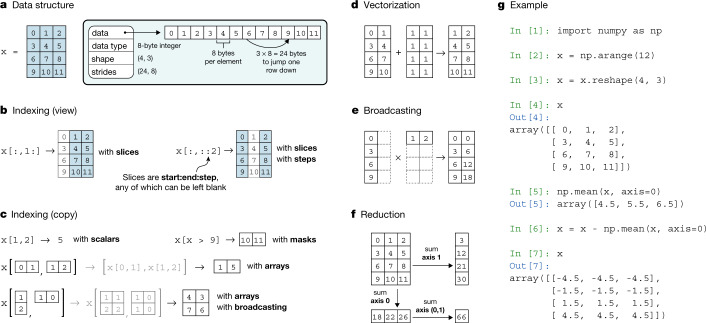
Abstract Array programming provides a powerful, compact and expressive syntax for accessing, manipulating and operating on data in vectors, matrices and higher-dimensional arrays. NumPy is the primary array programming library for the Python language. It has an essential role in research analysis pipelines in fields as diverse as physics, chemistry, astronomy, geoscience, biology, psychology, materials science, engineering, finance and economics. For example, in astronomy, NumPy was an important part of the software stack used in the discovery of gravitational waves 1 and in the first imaging of a black hole 2 . Here we review how a few fundamental array concepts lead to a simple and powerful programming paradigm for organizing, exploring and analysing scientific data. NumPy is the foundation upon which the scientific Python ecosystem is constructed. It is so pervasive that several projects, targeting audiences with specialized needs, have developed their own NumPy-like interfaces and array objects. Owing to its central position in the ecosystem, NumPy increasingly acts as an interoperability layer between such array computation libraries and, together with its application programming interface (API), provides a flexible framework to support the next decade of scientific and industrial analysis.
Overview
The claims and statistics of this paper haven’t been checked yet.
Free: it reads the open-access text and checks the first 5 claims that cite a source we can check. Create a free account to check every claim.
Integrity signals
Registry
Cites
Statistics
Figures
Verification
Claims the paper makes
The claims and statistics of this paper haven’t been checked yet.
Free: it reads the open-access text and checks the first 5 claims that cite a source we can check. Create a free account to check every claim.
Claims other papers make about this one
Each is checked against this paper’s own text: does it say what the citing paper says it does?
The cited source says what the claim attributes to it.
In the citing paper
“Each subset is saved in NumPy39 npz format, named as <data> mnist.npz for MedMNIST2D and <data> mnist3d.npz for MedMNIST3D, and is comprised of 6 keys (“train_images”, “train_labels”, “val_images”, “val_labels”, “test_images”, “test_labels”).”
From MedMNIST v2 - A large-scale lightweight benchmark for 2D and 3D biomedical image classification (2023) · cites this paper as [39]
The check wasn’t confident either way, so it gives no verdict — never disputed.
In the citing paper
“But there is no reason to suppose that the same system, absent human-generated inputs, would spontaneously develop a disposition to think analogically, as apparently happened at some point in human evolution.”
From Emergent analogical reasoning in large language models (2023) · cites this paper as [62]
Experimental — accuracy not yet measuredIn the citing paper
“RivGraph relies on functionality from the following Python packages: GDAL (GDAL/OGR contributors, 2020), NumPy (Harris et al., 2020), Matplotlib (Hunter, 2007), GeoPandas (Jordahl et al., 2020), Shapely (Gillies & others, 2007), Fiona (Gillies & others, 2011), pyproj (Snow et al., 2020), scikit-image (van der Walt et al., 2014), OpenCV (Bradski, 2000), networkx (Hagberg et al., 2008), and fastdtw”
From RivGraph: Automatic extraction and analysis of river and delta channel network topology (2021) · cites this paper as Harris et al., 2020
Self-check
Percentages, sums and reported differences re-computed from the paper’s own numbers.
The self-check needs the paper’s full text.
Citations
Cites
Scikit-learn: Machine Learning in Python
Pedregosa, F., Varoquaux, G., Gramfort, A., Michel, V., Thirion, B., Grisel, O., Blondel, M., Müller, A., Nothman, J., Louppe, G., et al. (2012) · arXiv · doi:10.48550/arxiv.1201.0490 · Cited by 71,016 · cited 3×
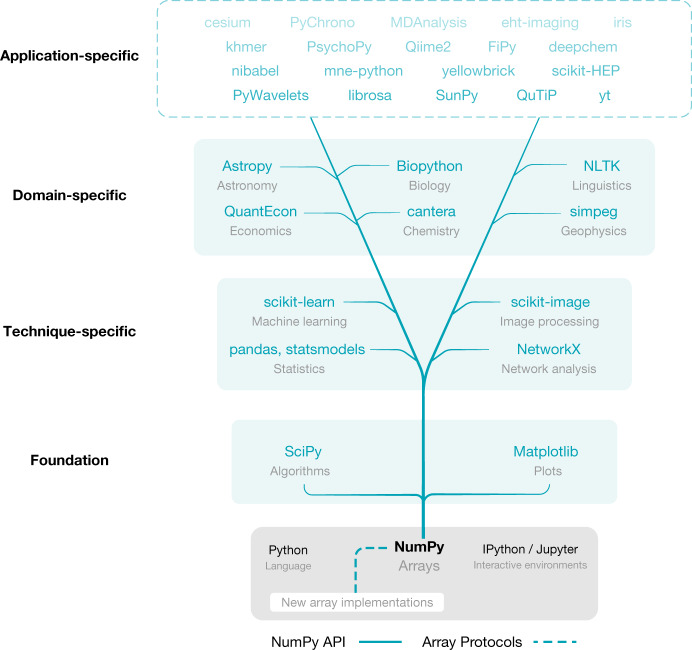
“2) builds on top of this foundation to provide several, widely used technique specific libraries [16, 17, 23], that in turn underlay numerous domain specific projects [24, 25, 26, 27, 28, 29].”
BackgroundSelf-citationMatplotlib: a 2D graphics environment
Hunter, J. D. (2007) · Computing in Science & Engineering · doi:10.1109/mcse.2007.55 · Cited by 39,249 · cited 2×
“[14] J.”
BackgroundSciPy 1.0: fundamental algorithms for scientific computing in Python
Virtanen, P., Gommers, R., Oliphant, T. E., Haberland, M., Reddy, T., Cournapeau, D., Burovski, E., Peterson, P., Weckesser, W., Bright, J., et al. (2020) · Nature Methods · doi:10.1038/s41592-019-0686-2 · Cited by 38,430 · cited 2×
“Now, fifteen years later, NumPy underpins almost every Python library that does scientific or numerical computation including SciPy [13], Matplotlib [14], pandas [15], scikit-learn [16], and scikit-image [17].”
BackgroundSelf-citationPyTorch: An Imperative Style, High-Performance Deep Learning Library
Paszke, A., Gross, S., Massa, F., Lerer, A., Bradbury, J., Chanan, G., Killeen, T., Lin, Z., Gimelshein, N., Antiga, L., et al. (2019) · arXiv · doi:10.48550/arxiv.1912.01703 · Cited by 31,473 · cited 2×
“For example, each deep learning framework created its own arrays; PyTorch [38], Tensorflow [39], Apache MXNet [40], and JAX arrays all have the capability to run on CPUs and GPUs, in a distributed fashion, utilizing lazy evaluation to allow for additional performance optimizations.”
MethodAstropy: A community Python package for astronomy
The Astropy Collaboration, Robitaille, T. P., Tollerud, E. J., Greenfield, P., Droettboom, M., Bray, E., Aldcroft, T., Davis, M., Ginsburg, A., Price-Whelan, A. M., et al. (2013) · Astronomy & Astrophysics · doi:10.1051/0004-6361/201322068 · Cited by 14,620 · cited 3×
“Astropy [24, 25] handles standard astronomical file formats and computes time/coordinate transformations.”
BackgroundObservation of Gravitational Waves from a Binary Black Hole Merger
Abbott, B. P., Abbott, R., Abbott, T. D., Abernathy, M. R., Acernese, F., Ackley, K., Adams, C., Adams, T., Addesso, P., Adhikari, R. X., et al. (2016) · Physical Review Letters · doi:10.1103/physrevlett.116.061102 · Cited by 14,151
TensorFlow: A system for large-scale machine learning
Abadi, M., Barham, P., Chen, J., Chen, Z., Davis, A., Dean, J., Devin, M., Ghemawat, S., Irving, G., Isard, M., et al. (2016) · arXiv (Cornell University) · doi:10.48550/arxiv.1605.08695 · Cited by 11,822
R: A Language for Data Analysis and Graphics
Ihaka, R., & Gentleman, R. (1996) · Journal of Computational and Graphical Statistics · doi:10.1080/10618600.1996.10474713 · Cited by 11,220 · cited 2×
“The design of this new tool was informed by other powerful interactive programming languages for scientific computing such as Basis [47], Yorick [48], R [49], and APL [50], as well as commercial languages and environments like IDL and MATLAB.”
MethodData Structures for Statistical Computing in Python
McKinney, W. (2010) · Proceedings of the Python in Science Conference · doi:10.25080/majora-92bf1922-00a · Cited by 11,032 · cited 2×
“Now, fifteen years later, NumPy underpins almost every Python library that does scientific or numerical computation including SciPy [13], Matplotlib [14], pandas [15], scikit-learn [16], and scikit-image [17].”
BackgroundSciPy 1.0: fundamental algorithms for scientific computing in Python
Virtanen, P., Gommers, R., Oliphant, T. E., Haberland, M., Reddy, T., Cournapeau, D., Burovski, E., Peterson, P., Weckesser, W., Bright, J., et al. (2019) · Apollo - University of Cambridge Repository · doi:10.17863/cam.64134 · Cited by 10,460
Self-citation
Research works printed but not linked: 11
- Yang, T.-Y., Furnish, G. & Dubois, P. F. Steering object-oriented scientific computations. In Proc. TOOLS USA 97. Intl Conf. Technology of Object Oriented Systems and Languages (eds Ege, R., Singh, M. & Meyer, B.) 112–119 (IEEE, 1997).
- Hamman, J., Rocklin, M. & Abernathy, R. Pangeo: a big-data ecosystem for scalable Earth system science. In EGU General Assembly Conf. Abstracts 12146 (2018).
- van der Walt, S. The SciPy Documentation Project (technical overview). In Proc. 7th Python in Science Conf. (SciPy 2008) (eds Varoquaux, G., Vaught, T. & Millman, K. J.) 27–28 (2008).
- Harrington, J. The SciPy Documentation Project. In Proc. 7th Python in Science Conference (SciPy 2008) (eds Varoquaux, G., Vaught, T. & Millman, K. J.) 33–35 (2008).
- Harrington, J. & Goldsmith, D. Progress report: NumPy and SciPy documentation in 2009. In Proc. 8th Python in Science Conf. (SciPy 2009) (eds Varoquaux, G., van der Walt, S. & Millman, K. J.) 84–87 (2009).
- Entschev, P. Distributed multi-GPU computing with Dask, CuPy and RAPIDS. In EuroPython 2019 https://ep2019.europython.eu/media/conference/slides/fX8dJsD-distributed-multi-gpu-computing-with-dask-cupy-and-rapids.pdf (2019).
- Barrett, K. A., Chiu, Y. H., Painter, J. F., Motteler, Z. C. & Dubois, P. F. Basis System, Part I: Running a Basis Program—A Tutorial for Beginners UCRL-MA-118543, Vol. 1 (Lawrence Livermore National Laboratory 1995).
- Dubois, P. F. & Motteler, Z. Basis System, Part II: Basis Language Reference Manual UCRL-MA-118543, Vol. 2 (Lawrence Livermore National Laboratory, 1995).
- Chiu, Y. H. & Dubois, P. F. Basis System, Part III: EZN User Manual UCRL-MA-118543, Vol. 3 (Lawrence Livermore National Laboratory, 1995).
- Chiu, Y. H. & Dubois, P. F. Basis System, Part IV: EZD User Manual UCRL-MA-118543, Vol. 4 (Lawrence Livermore National Laboratory, 1995).
- Lattner, C. & Adve, V. LLVM: a compilation framework for lifelong program analysis and transformation. In Proc. 2004 Intl Symp. Code Generation and Optimization (CGO’04) 75–88 (IEEE, 2004).
Cited by
Items 1,101–1,200 of 1,233
Feasibility test of per-flight contrail avoidance in commercial aviation
Sonabend-W, A., Elkin, C., Dean, T., Dudley, J., Ali, N., Blickstein, J., Brand, E., Broshears, B., Chen, S., Engberg, Z., et al. (2024) · Communications Engineering · doi:10.1038/s44172-024-00329-7 · Cited by 20
Dissecting whole-brain conduction delays through MRI microstructural measures
Mancini, M., Tian, Q., Fan, Q., Cercignani, M., & Huang, S. Y. (2021) · Brain Structure and Function · doi:10.1007/s00429-021-02358-w · Cited by 20
Cañameras, R., Schuldt, S., Shu, Y., Suyu, S. H., Taubenberger, S., Andika, I. T., Bag, S., Inoue, K. T., Jaelani, A. T., Leal-Taixé, L., et al. (2024) · Astronomy & Astrophysics · doi:10.1051/0004-6361/202347072 · Cited by 19
Improving Cardiovascular Disease Prediction With Machine Learning Using Mental Health Data
Dorraki, M., Liao, Z., Abbott, D., Psaltis, P. J., Baker, E., Bidargaddi, N., Wardill, H. R., van den Hengel, A., Narula, J., & Verjans, J. W. (2024) · JACC: Advances · doi:10.1016/j.jacadv.2024.101180 · Cited by 19
The OpenELM Library: Leveraging Progress in Language Models for Novel Evolutionary Algorithms
Bradley, H., Fan, H., Galanos, T., Zhou, R., Scott, D., & Lehman, J. (2024) · Genetic and Evolutionary Computation · doi:10.1007/978-981-99-8413-8_10 · Cited by 19
Pearce-Casey, R., Nagam, B. C., Wilde, J., Busillo, V., Ulivi, L., Andika, I. T., Manjón-García, A., Leuzzi, L., Matavulj, P., Serjeant, S., et al. (2025) · Astronomy & Astrophysics · doi:10.1051/0004-6361/202453152 · Cited by 18
Zero-shot visual reasoning through probabilistic analogical mapping
Webb, T. W., Fu, S., Bihl, T., Holyoak, K. J., & Lu, H. (2022) · arXiv · doi:10.48550/arxiv.2209.15087 · Cited by 18
The role of baryons in self-interacting dark matter mergers
Fischer, M. S., Durke, N.-H., Hollingshausen, K., Hammer, C., Brüggen, M., & Dolag, K. (2023) · Monthly Notices of the Royal Astronomical Society · doi:10.1093/mnras/stad1786 · Cited by 17
“Software: NumPy (Harris et al. 2020), Matplotlib (Hunter 2007) DATA AVAILABILITY The data underlying this paper will be shared on reasonable request to the corresponding author.”
BackgroundKIDINS220 and InsP8 safeguard the stepwise regulation of phosphate exporter XPR1
(2025) · doi:10.1016/j.molcel.2025.08.003 · Cited by 17
Mellot, A., Collas, A., Rodrigues, P. L. C., Engemann, D., & Gramfort, A. (2023) · Imaging Neuroscience · doi:10.1162/imag_a_00040 · Cited by 16
A control theoretic approach to evaluate and inform ecological momentary interventions
Fechtelpeter, J., Rauschenberg, C., Jamalabadi, H., Boecking, B., van Amelsvoort, T., Reininghaus, U., Durstewitz, D., & Koppe, G. (2023) · doi:10.31234/osf.io/97teh · Cited by 16
“All calculations were done using self - developed Python code, using the open source packages Numpy (Harris et al., 2020), Scipy (Virta-nen et al., 2020), Pandas (McKinney, 2010), NetworkX (Hagberg et al., 2008), and Matplotlib (Hunter, 2007).”
MethodRams, M., Wojtowicz, G., Sinha, A., & Hasik, J. (2025) · SciPost Physics Codebases · doi:10.21468/scipostphyscodeb.52 · Cited by 16
“Tensor , which implements block-sparse tensor structure corresponding to a given abelian symmetry on top of a dense linear algebra backend, such as NumPy [38] or PyTorch [39].”
Transient exposure of a buried phosphorylation site in an autoinhibited protein
(2021) · doi:10.1016/j.bpj.2021.11.2890 · Cited by 16
(2022) · doi:10.1016/j.freeradbiomed.2022.12.001 · Cited by 16
Willems, P., Huang, J., Messens, J., & Van Breusegem, F. (2022) · doi:10.1101/2022.10.17.512470 · Cited by 16
Transient exposure of a buried phosphorylation site in an autoinhibited protein
Orioli, S., Henning Hansen, C. G., & Lindorff-Larsen, K. (2021) · doi:10.1101/2021.05.10.443419 · Cited by 16
Ultrastructural analysis of wild-type and RIM1α knockout active zones in a large cortical synapse
Lichter, K., Paul, M. M., Pauli, M., Schoch, S., Kollmannsberger, P., Stigloher, C., Heckmann, M., & Sirén, A.-L. (2022) · Cell Reports · doi:10.1016/j.celrep.2022.111382 · Cited by 15
KIDINS220 and InsP8 safeguard the stepwise regulation of phosphate exporter XPR1
Wang, X., Bai, Z., Wallis, C., Wang, H., Han, Y., Jin, R., Lei, M., Yang, T., Gu, C., Jessen, H., et al. (2025) · doi:10.1101/2025.01.17.633679 · Cited by 15
Rezaei, A., Kocsis-Jutka, V., Gunes, Z. I., Zeng, Q., Kislinger, G., Bauernschmitt, F., Isilgan, H. B., Parisi, L. R., Kaya, T., Franzenburg, S., et al. (2025) · Nature Communications · doi:10.1038/s41467-025-58634-4 · Cited by 14
Luo, R., Wang, J., & Gates, I. (2023) · Environmental Research Communications · doi:10.1088/2515-7620/acf0a3 · Cited by 14
Triple tandem trimer immunogens for HIV-1 and influenza nucleic acid-based vaccines
del Moral-Sánchez, I., Wee, E. G., Xian, Y., Lee, W.-H., Allen, J. D., Torrents de la Peña, A., Fróes Rocha, R., Ferguson, J., León, A. N., Koekkoek, S., et al. (2024) · npj Vaccines · doi:10.1038/s41541-024-00862-8 · Cited by 14
Triple tandem trimer immunogens for HIV-1 and influenza nucleic acid-based vaccines
del Moral-Sánchez, I., Wee, E. G., Xian, Y., Lee, W.-H., Allen, J. D., Torrents de la Peña, A., Rocha, R. F., Ferguson, J., León, A. N., Koekkoek, S., et al. (2023) · doi:10.1101/2023.08.27.554987 · Cited by 14
Çubukçu, H. C. (2021) · Turkish Journal of Biochemistry · doi:10.1515/tjb-2021-0199 · Cited by 13
“The gaussian distributed 32,000 in-control internal QC results were generated using Python 3.7.6 [12]. with Numpy package 1.19.1 [13].”
MethodInfluentialAbdul-Khalek, N., Picciani, M., Shouman, O., Wimmer, R., Overgaard, M. T., Wilhelm, M., & Gregersen Echers, S. (2025) · Journal of Proteome Research · doi:10.1021/acs.jproteome.4c00973 · Cited by 13
Newman, K. E., Tindall, S. N., Mader, S. L., Khalid, S., Thomas, G. H., & Van Der Woude, M. W. (2023) · eLife · doi:10.7554/elife.81547 · Cited by 12
Physically Motivated Improvements of Variational Quantum Eigensolvers
Vaquero-Sabater, N., Carreras, A., Orús, R., Mayhall, N. J., & Casanova, D. (2024) · Journal of Chemical Theory and Computation · doi:10.1021/acs.jctc.4c00329 · Cited by 12
“energy-gradient criterion suggests the feasibility of alternative strategies for optimizing the selection of excitation operators.”
(2022) · doi:10.1101/2022.06.30.498268 · Cited by 12
Ozmen, B. B., Singh, N., Shah, K., Berber, I., Singh, D., Pinsky, E., Rampazzo, A., & Schwarz, G. S. (2025) · Journal of Hand and Microsurgery · doi:10.1016/j.jham.2025.100293 · Cited by 11
Zhang, Y., Zhao, X., Wang, Z. Z., Yang, C., Wei, J., & Wu, T. (2025) · Findings of the Association for Computational Linguistics: EMNLP 2025 · doi:10.18653/v1/2025.findings-emnlp.430 · Cited by 11
An interpretable deep learning framework identifies proteomic drivers of Alzheimer’s disease
Panizza, E., & Cerione, R. A. (2024) · Frontiers in Cell and Developmental Biology · doi:10.3389/fcell.2024.1379984 · Cited by 11
“…the value, the higher the dependency. shuf fl e (): function from the library NumPy (numpy.random.shuf fl e) (Harris et al., 2020), which shuf fl es the content of an array. median (): function from the library NumPy (numpy.median) (Harris et al., 2020), which computes the median of the provided data.”
Background(2025) · doi:10.1091/mbc.e24-10-0486 · Cited by 11
Chen, J., Mirvis, M., Ekman, A., Vanslembrouck, B., Le Gros, M., Larabell, C., & Marshall, W. F. (2024) · doi:10.1101/2024.10.31.621371 · Cited by 11
Busch, F., Kaibel, L., Nguyen, H., Lemke, T., Ziegelmayer, S., Graf, M., Marka, A. W., Endrös, L., Prucker, P., Spitzl, D., et al. (2025) · Journal of Imaging Informatics in Medicine · doi:10.1007/s10278-025-01483-w · Cited by 10
Marte, M. J., Carpenter, E., Scimeca, M., Russell-Meill, M., Peñaloza, C., Grasemann, U., Miikkulainen, R., & Kiran, S. (2025) · Stroke · doi:10.1161/strokeaha.124.047867 · Cited by 9
Crowl, S., Coleman, M. B., Chaphiv, A., Jordan, B. T., & Naegle, K. M. (2025) · Cell Systems · doi:10.1016/j.cels.2025.101318 · Cited by 10
Image-based, pooled phenotyping reveals multidimensional, disease-specific variant effects
Pendyala, S., Partington, K., Bradley, N., McEwen, A. E., Straub, G., Kim, H.-J., Fayer, S., Holmes, D. L., Sitko, K. A., Garge, R. K., et al. (2026) · Cell · doi:10.1016/j.cell.2026.04.031 · Cited by 10
Improving Instruction-Following in Language Models through Activation Steering
Stolfo, A., Balachandran, V., Yousefi, S., Horvitz, E., & Nushi, B. (2024) · arXiv · doi:10.48550/arxiv.2410.12877 · Cited by 10
“We performed our data analysis using NumPy (Harris et al., 2020) and Pandas (Wes McKinney, 2010).”
Johnson, S. R., Weigele, P. R., Fomenkov, A., Ge, A., Vincze, A., Eaglesham, J. B., Roberts, R. J., & Sun, Z. (2025) · Nucleic Acids Research · doi:10.1093/nar/gkae1175 · Cited by 10
Fitting high-resolution electron density maps from atomic models to solution scattering data
Chamberlain, S. R., Moore, S., & Grant, T. D. (2023) · Biophysical Journal · doi:10.1016/j.bpj.2023.10.034 · Cited by 10
Helical reconstruction of VP39 reveals principles for baculovirus nucleocapsid assembly
(2024) · doi:10.1038/s41467-023-44596-y · Cited by 10
Utgés, J. S., MacGowan, S. A., Ives, C. M., & Barton, G. J. (2024) · Communications Biology · doi:10.1038/s42003-024-05970-8 · Cited by 10
MS2: Multi-Document Summarization of Medical Studies
DeYoung, J., Beltagy, I., van Zuylen, M., Kuehl, B., & Wang, L. L. (2021) · arXiv · doi:10.48550/arxiv.2104.06486 · Cited by 10
Fitting high-resolution electron density maps from atomic models to solution scattering data
Chamberlain, S. R., Moore, S., & Grant, T. D. (2023) · doi:10.1101/2023.06.02.543451 · Cited by 10
Helical reconstruction of VP39 reveals principles for baculovirus nucleocapsid assembly
Benning, F. M. C., Jenni, S., Garcia, C. Y., Nguyen, T. H., Zhang, X., & Chao, L. H. (2023) · doi:10.1101/2023.06.15.545104 · Cited by 10
Baratam, K., & Srivastava, A. (2024) · Journal of Chemical Theory and Computation · doi:10.1021/acs.jctc.4c00579 · Cited by 9
Mapping Protein Conformational Landscapes from Crystallographic Drug Fragment Screens
Saeed, A. A., Klureza, M. A., & Hekstra, D. R. (2024) · Journal of Chemical Information and Modeling · doi:10.1021/acs.jcim.4c01380 · Cited by 9
Ferraz, M. V. F., Neto, J. C. S., Lins, R. D., & Teixeira, E. S. (2023) · Physical Chemistry Chemical Physics · doi:10.1039/d2cp05644e · Cited by 9
Thomasen, F. E., Cuneo, M. J., Mittag, T., & Lindorff-Larsen, K. (2023) · eLife · doi:10.7554/elife.84147 · Cited by 9
<tt>Sorcha</tt>: Optimized Solar System Ephemeris Generation
Holman, M. J., Bernardinelli, P. H., Schwamb, M. E., Jurić, M., Oldag, D., West, M., Napier, K. J., Merritt, S. R., Fedorets, G., Cornwall, S., et al. (2025) · The Astronomical Journal · doi:10.3847/1538-3881/ade435 · Cited by 9
“…al. 2023), Astropy (Astropy Collaboration et al. 2013, 2018, 2022), Healpy (G´orski & Hivon 2011; Zonca et al. 2019), Numba (Lam et al. 2015), Numpy (Harris et al. 2020), pandas (McKinney 2010; The pandas development team 2020), REBOUND (Rein & Liu 2012; Rein & Spiegel 2015), SciPy (Virtanen et…”
Granata, G., Caminha, G. B., Ertl, S., Grillo, C., Schuldt, S., Suyu, S. H., Acebron, A., Bergamini, P., Cañameras, R., Koekemoer, A. M., et al. (2025) · Astronomy & Astrophysics · doi:10.1051/0004-6361/202453486 · Cited by 9
Mapping protein conformational landscapes from crystallographic drug fragment screens
(2024) · doi:10.1101/2024.07.29.605395 · Cited by 9
Nagam, B. C., Acevedo Barroso, J. A., Wilde, J., Andika, I. T., Manjón-García, A., Pearce-Casey, R., Stern, D., Nightingale, J. W., Moustakas, L. A., McCarthy, K., et al. (2025) · Astronomy & Astrophysics · doi:10.1051/0004-6361/202554132 · Cited by 8
Tighe, D., Tekeli, K., Gouk, T., Smith, J., Ho, M., Moody, A., Walsh, S., Provost, S., & Freitas, A. (2023) · British Journal of Oral and Maxillofacial Surgery · doi:10.1016/j.bjoms.2022.11.280 · Cited by 8
AlphaFold2 SLiM screen for LC3-LIR interactions in autophagy
Stuke, J. F. M., & Hummer, G. (2025) · Autophagy · doi:10.1080/15548627.2025.2493999 · Cited by 8
“Furthermore, we employed Python3 [94] with Anaconda3 [95], iPython [96], Numpy [97], Matplotlib [98], Seaborn [99], MDAnalysis [100], MDTraj [101], BioPython [49], and PyMOL [82] to implement the analysis described in the previous sections.”
Fonseca Parra, E. P., Oumerri, J., Arteni, A. A., Six, J.-L., Armes, S. P., & Ferji, K. (2025) · Macromolecules · doi:10.1021/acs.macromol.4c01772 · Cited by 8
Decoupled degradation and translation enables noise modulation by poly(A) tails
Grandi, C., Emmaneel, M., Nelissen, F. H. T., Roosenboom, L. W. M., Petrova, Y., Elzokla, O., & Hansen, M. M. K. (2024) · Cell Systems · doi:10.1016/j.cels.2024.05.004 · Cited by 8
SeaMoon: From protein language models to continuous structural heterogeneity
Lombard, V., Timsit, D., Grudinin, S., & Laine, E. (2025) · Structure · doi:10.1016/j.str.2025.06.010 · Cited by 8
Analysis-ready VCF at Biobank scale using Zarr
(2025) · doi:10.1093/gigascience/giaf049 · Cited by 8
SeaMoon: from protein language models to continuous structural heterogeneity
Lombard, V., Timsit, D., Grudinin, S., & Laine, E. (2024) · doi:10.1101/2024.09.23.614585 · Cited by 8
Ginell, G. M., Flynn, A. J., & Holehouse, A. S. (2022) · doi:10.1101/2022.09.18.508433 · Cited by 8
Analysis-ready VCF at Biobank scale using Zarr
Czech, E., Millar, T. R., Tyler, W., White, T., Elsworth, B., Guez, J., Hancox, J., Jeffery, B., Karczewski, K. J., Miles, A., et al. (2024) · doi:10.1101/2024.06.11.598241 · Cited by 8
Spatially Resolved Recent Star Formation History in NGC 6946
Tran, D., Williams, B., Levesque, E., Lazzarini, M., Dalcanton, J., Dolphin, A., Koplitz, B., Smercina, A., & Telford, O. G. (2023) · The Astrophysical Journal · doi:10.3847/1538-4357/aced44 · Cited by 7
Measurement Integrity in Peer Prediction: A Peer Assessment Case Study
Burrell, N., & Schoenebeck, G. (2021) · arXiv · doi:10.48550/arxiv.2108.05521 · Cited by 7
Kim, T. J., Suh, J., Park, S.-H., Kim, Y., & Ko, S.-B. (2025) · Neurocritical Care · doi:10.1007/s12028-025-02222-3 · Cited by 7
“Data preprocessing was conducted via Python version 3.11.5 (Python Software Foundation, Beaver-ton, OR) in a Jupyter Notebook environment using libraries such as Pandas [33] for data manipulation and Numpy [34] for numerical operations.”
InfluentialPS4: A Next-Generation Dataset for Protein Single-Sequence Secondary Structure Prediction
Peracha, O. (2024) · BioTechniques · doi:10.2144/btn-2023-0024 · Cited by 7
BioStructNet: Structure-Based Network with Transfer Learning for Predicting Biocatalyst Functions
Wang, X., Zhou, J., Mueller, J., Quinn, D., Carvalho, A., Moody, T. S., & Huang, M. (2025) · Journal of Chemical Theory and Computation · doi:10.1021/acs.jctc.4c01391 · Cited by 7
SwinCell: a 3D transformer and flow-based framework for improved cell segmentation
Zhang, X., Lin, Z., Wang, L., Chu, Y. S., Yang, Y., Xiao, X., Lin, Y., & Liu, Q. (2025) · Communications Biology · doi:10.1038/s42003-025-08397-x · Cited by 7
BAGEL: Protein engineering via exploration of an energy landscape
(2025) · doi:10.1371/journal.pcbi.1013774 · Cited by 7
Akulov, V., Jiménez Panizo, A., Estébanez-Perpiñá, E., van Noort, J., & Mashaghi, A. (2025) · The Journal of Physical Chemistry B · doi:10.1021/acs.jpcb.5c03257 · Cited by 7
Akulov, V., Panizo, A. J., Perpiña, E. E., van Noort, J., & Mashaghi, A. (2024) · doi:10.1101/2024.09.21.614239 · Cited by 7
PS4: a Next-Generation Dataset for Protein Single Sequence Secondary Structure Prediction
Peracha, O. (2023) · doi:10.1101/2023.02.28.530456 · Cited by 7
BioStructNet: Structure-Based Network with Transfer Learning for Predicting Biocatalyst Functions
Wang, X., Zhou, J., Mueller, J., Quinn, D., Moody, T. S., & Huang, M. (2024) · doi:10.1101/2024.10.16.618725 · Cited by 7
BAGEL: Protein Engineering via Exploration of an Energy Landscape
Lála, J., Al-Saffar, A., & Angioletti-Uberti, S. (2025) · doi:10.1101/2025.07.05.663138 · Cited by 7
Vrba, J., Steinbach, J., Jirsa, T., Verde, L., De Fazio, R., Zeng, Y., Ichiji, K., Hájek, L., Sedláková, Z., Urbániová, Z., et al. (2025) · Journal of Voice · doi:10.1016/j.jvoice.2025.03.028 · Cited by 6
“…l u e s o f t h e s e l e c t e d M F CC M F CC u s e d 13 / u s e d 20 li b r o s a [ 33 ], nu m p y [ 35 ] m e a n fi r s t d e r i v a t i v e o f t h e s e l ec t e d M F CC ∆ M F CC li b r o s a [ 33 ], nu m p y [ 35 ] m e a n s ec o nd d e r i v a t i v e o f t h e s e - l ec t e d M F CC ∆ 2”
InfluentialJain, S., Cretu, A.-M., & de Montjoye, Y.-A. (2021) · arXiv · doi:10.48550/arxiv.2106.09820 · Cited by 21
Kende, Z., Piroska, P., Szemők, G. E., Khaeim, H., Sghaier, A. H., Gyuricza, C., & Tarnawa, Á. (2024) · Plants · doi:10.3390/plants13192776 · Cited by 6
“…on the germination percentage, radicle length, shoot length, and seedling growth were analyzed and a sigmoid curve model was applied in Python using various Python packages for data analysis and visualization, including Pandas [45], NumPy [46], Matplotlib [47], Seaborn [48], and Scikit-learn [49].”
MethodEngineering the Neural Automatic Passenger Counter
Jahn, N., & Siebert, M. (2022) · Engineering Applications of Artificial Intelligence · doi:10.1016/j.engappai.2022.105148 · Cited by 6
“The advantage of this bare-metal approach is that no notable data parsing delays occur once the Numpy file is created, which can be significant for other file formats.”
MethodInfluentialAli, M. A., & Caetano-Anollés, G. (2024) · Viruses · doi:10.3390/v16091358 · Cited by 6
“Matplotlib [50], numpy [51], and pandas [52] in python were used to process and visualize the data retrieved from the tools used in this study.”
MethodChen, Z., Williams, B., Lang, D., Dolphin, A., Durbin, M., Dalcanton, J. J., Smercina, A., Girardi, L., Murray, C. E., Bell, E. F., et al. (2025) · The Astrophysical Journal · doi:10.3847/1538-4357/ad7e2b · Cited by 6
ProteinDJ : A high‐performance and modular protein design pipeline
Silke, D., Iskander, J., Pan, J., Thompson, A. P., Papenfuss, A. T., Lucet, I. S., & Hardy, J. M. (2026) · Protein Science · doi:10.1002/pro.70464 · Cited by 6
Trading Accuracy for Enjoyment? Data Quality and Player Experience in Data Collection Games
Gundry, D., & Deterding, S. (2022) · CHI Conference on Human Factors in Computing Systems · doi:10.1145/3491102.3502025 · Cited by 6
“Analysis was conducted in Python 3.10.2 [69] using SciPy 1.8 [72], Pandas [54], Numpy 1.22.2 [31] and raincloud plots [1].”
MethodInfluentialAn accessible infrastructure for artificial intelligence using a Docker-based JupyterLab in Galaxy
Kumar, A., Cuccuru, G., Grüning, B., & Backofen, R. (2022) · GigaScience · doi:10.1093/gigascience/giad028 · Cited by 6
KiSSim: Predicting Off-Targets from Structural Similarities in the Kinome
Sydow, D., Aßmann, E., Kooistra, A. J., Rippmann, F., & Volkamer, A. (2022) · Journal of Chemical Information and Modeling · doi:10.1021/acs.jcim.2c00050 · Cited by 6
The Timescales of Embedded Star Formation as Observed in STARFORGE
Wainer, T. M., Dalcanton, J. J., Grudić, M. Y., Offner, S. S. R., Smercina, A., Williams, B. F., Johnson, L. C., Peltonen, J., Koch, E. W., & Neralwar, K. R. (2026) · The Astrophysical Journal · doi:10.3847/1538-4357/ae38b7 · Cited by 6
“2013, 2018, 2022), Jupyter (Kluyver et al. 2016), matplotlib (Hunter 2007), numpy (Harris et al. 2020), python (Van Rossum & Drake 2009), scipy (Virtanen et al. 2020; Gommers et al. 2024), h5py (Collette 2013; Col-lette et al. 2023), skirt (Baes et al. 2011; Camps & Baes 2015), openai (OpenAI 2023)”
rabpro: global watershed boundaries, river elevation profiles, and catchment statistics
Schwenk, J., Zussman, T., Stachelek, J., & Rowland, J. C. (2022) · Journal of Open Source Software · doi:10.21105/joss.04237 · Cited by 6
“rabpro relies on functionality from the following Python packages: GDAL (GDAL/OGR contributors, 2020), NumPy (Harris et al., 2020), GeoPandas (Jordahl et al.”
MethodThe molecular mechanism of lipid uptake by membrane-anchored bridge-like lipid transfer proteins
Álvarez, D., Blair, P. C., Rocha-Roa, C., Davey, M., Conibear, E., & Vanni, S. (2025) · doi:10.1101/2025.08.01.668188 · Cited by 6
An accessible infrastructure for artificial intelligence using a docker-based Jupyterlab in Galaxy
Kumar, A., Cuccuru, G., Grüning, B., & Backofen, R. (2022) · doi:10.1101/2022.07.08.499333 · Cited by 6
O’Donnell, J. H., Jeltema, T. E., Roberts, M. G., Nightingale, J., Flowers, A., & Aldas, D. (2026) · Physical Review D · doi:10.1103/hfgd-245k · Cited by 5
Gregersen Echers, S., Abdul-Khalek, N., Jensen, N. H., Jørgensen, A. K., Mattsson, T., Jørgensen, M. K., Lübeck, P. S., & Lübeck, M. (2026) · Sustainable Food Technology · doi:10.1039/d5fb00771b · Cited by 5
The molecular mechanism of lipid uptake by membrane-anchored bridge-like lipid transfer proteins
Álvarez, D., Blair, P. C., Rocha-Roa, C., Davey, M., Conibear, E., & Vanni, S. (2026) · Proceedings of the National Academy of Sciences · doi:10.1073/pnas.2520399123 · Cited by 5
Multi-Agent MDP Homomorphic Networks
van der Pol, E., van Hoof, H., Oliehoek, F. A., & Welling, M. (2021) · arXiv · doi:10.48550/arxiv.2110.04495 · Cited by 5
Gregersen Echers, S., Abdul-Khalek, N., Jensen, N. H., Jørgensen, A. K., Mattsson, T., Jørgensen, M. K., Lübeck, P. S., & Lübeck, M. (2025) · doi:10.1101/2025.10.24.684365 · Cited by 5
Kajiya, R., Miyawaki, H., Nakahara, H., & Mizuseki, K. (2025) · eneuro · doi:10.1523/eneuro.0575-24.2025 · Cited by 4
“Statistical analyses were performed using the NumPy and SciPy modules in Python (Harris et al., 2020; Virtanen et al., 2020; http://numpy.org/, http://www.scipy.org/) and EZR (Kanda, 2013; http://www.jichi.ac.jp/ saitama-sct/SaitamaHP. fi les/statmed.html).”
InfluentialPapagiannakis, A., Yu, Q., Govers, S. K., Lin, W.-H., Wingreen, N. S., & Jacobs-Wagner, C. (2025) · doi:10.7554/elife.104276.1 · Cited by 4
Raza, S., Yadav, N. S., Jussupow, A., Kerfeld, C. A., Feig, M., & Vermaas, J. V. (2025) · The Journal of Physical Chemistry B · doi:10.1021/acs.jpcb.5c05178 · Cited by 4
Wainer, T. M., Williams, B. F., Johnson, L. C., Weisz, D. R., Dalcanton, J. J., Seth, A. C., Dolphin, A., Durbin, M. J., Bell, E. F., Chen, Z., et al. (2024) · The Astronomical Journal · doi:10.3847/1538-3881/ad5a6e · Cited by 4
Limitations of Quantum Hardware for Molecular Energy Estimation Using VQE
Carreras, A., Orús, R., & Casanova, D. (2026) · Physical Chemistry Chemical Physics · doi:10.1039/d5cp03907j · Cited by 5
Hudon, A. (2025) · Frontiers in Artificial Intelligence · doi:10.3389/frai.2025.1606250 · Cited by 3
“Specifically, pandas and numpy were used for data handling and transformation, while scikit-learn supported preprocessing, scaling, and integration into the broader machine learning pipeline (Harris et al., 2020; The pandas development team, 2020).”
AlphaFold2 SLiM screen for LC3-LIR interactions in autophagy
(2024) · doi:10.1101/2024.09.06.611604 · Cited by 3
Metadata
- Authors
- Harris, C. R., Millman, K. J., van der Walt, S. J., Gommers, R., Virtanen, P., Cournapeau, D., Wieser, E., Taylor, J., Berg, S., Smith, N. J., Kern, R., Picus, M., Hoyer, S., van Kerkwijk, M. H., Brett, M., Haldane, A., del Río, J. F., Wiebe, M., Peterson, P., Gérard-Marchant, P., Sheppard, K., Reddy, T., Weckesser, W., Abbasi, H., Gohlke, C., & Oliphant, T. E.
- Affiliations
- University of California, Berkeley (US)
- Quansight (United States) (US)
- University of Jyväskylä (FI)
- University of Cambridge (GB)
- Enthought (United States) (US)
- Google (United States) (US)
- University of Birmingham (GB)
- Temple University (US)
- Amazon (United States) (US)
- Tallinn University of Technology (EE)
- University of Georgia (US)
- University of Oxford (GB)
- Los Alamos National Laboratory (US)
- University of California, Irvine (US)
- Corresponding author
- Millman, K. Jarrod
- Gommers, Ralf
- ORCID
- Venue
- Nature
- Published
- 2020-09-16
- Volume
- 585
- Issue
- 7825
- Pages
- 357-362
- ISSN
- 0028-0836 (ISSN-L)
- 1476-4687
- PMC
- PMC7759461
- OpenAlex
- W3035965352
- Semantic Scholar
- 024a2c03be8e468e7c4fdf9bda36cdc0eaae85fb
- Cited by
- 23,826
- References
- 40
- Citations by year
- 2026: 4948 · 2025: 5392 · 2024: 4557 · 2023: 3671 · 2022: 3110 · 2021: 1994 · 2020: 142
- FWCI
- 77.10
- Type
- journal article
- Language
- en
- Open access
- hybrid
- doi.org
- Licence
- cc-by
- creativecommons.org/licenses/by/4.0 (tdm)
- creativecommons.org/licenses/by/4.0 (vor)
- Locations
- Nature (publishedVersion, cc-by)
- Europe PMC (PubMed Central) (publishedVersion, other-oa)
- PubMed Central (publishedVersion, cc-by)
- PubMed (publishedVersion)
- arXiv (Cornell University) (submittedVersion)
- Jyväskylä University Digital Archive (University of Jyväskylä) (submittedVersion, cc-by)
- eScholarship (California Digital Library) (submittedVersion, cc-by)
- arXiv (Cornell University) (cc-by)
- Funders
- Alfred P. Sloan Foundation (g-2017-9960, 2013-10-27)
- Gordon and Betty Moore Foundation (GBMF5447, GBMF3834)
- Topics
- Physical Sciences › Computer Science › Software › Computational Physics and Python Applications
- Social Sciences › Decision Sciences › Information Systems and Management › Scientific Computing and Data Management
- Physical Sciences › Computer Science › Hardware and Architecture › Parallel Computing and Optimization Techniques
- Keywords
- array programming, NumPy, Python, scientific computing, multidimensional arrays, matrix-vector operations, scientific data analysis, scientific Python ecosystem, gravitational waves, black hole imaging
- MeSH terms
- Mathematics, Programming Languages, Software Design, Computational Biology
About these checks
Registry, retraction, Cites and statistics results are computed, not judged, with one exception: a printed reference that no index lists is read once by a model before it counts as a citation error. Claims are extracted by a model and kept only when their quote appears verbatim in the text; each cited source is then checked, with a model’s help, for whether it says what the claim relies on. Those verdicts can be wrong — read the claim’s quote and the cited source before relying on one.
Statistics and arithmetic are recomputed, not judged.
Confidence bands are shown only for fields calibrated on our annotated test set. None is calibrated yet, so no band is shown.
What counts as a claim ›How we measure confidence ›How we check this ›
Are you an author, or do you see a problem with this page? Request a review
Data sources
Bibliographic data: Semantic Scholar, OpenAlex, Crossref.
Contains information from the Semantic Scholar Academic Graph Datasets, made available under the ODC Attribution License (ODC-BY 1.0).
Semantic Scholar’s data is described in: Kinney, R., et al. (2023). The Semantic Scholar Open Data Platform. arXiv:2301.10140.
