

The DOI matches its Crossref record; 97 of the 97 references it cites were found in a registry or an index; 14 of the 59 sources its claims cite were checked for support.
Learning loss due to school closures during the COVID-19 pandemic
Open accessAbstract
Significance: School closures have been a common tool in the battle against COVID-19. Yet, their costs and benefits remain insufficiently known. We use a natural experiment that occurred as national examinations in The Netherlands took place before and after lockdown to evaluate the impact of school closures on students’ learning. The Netherlands is interesting as a “best-case” scenario, with a short lockdown, equitable school funding, and world-leading rates of broadband access. Despite favorable conditions, we find that students made little or no progress while learning from home. Learning loss was most pronounced among students from disadvantaged homes.
Overview
AI snapshot
Written from the paper’s full text.
TL;DR
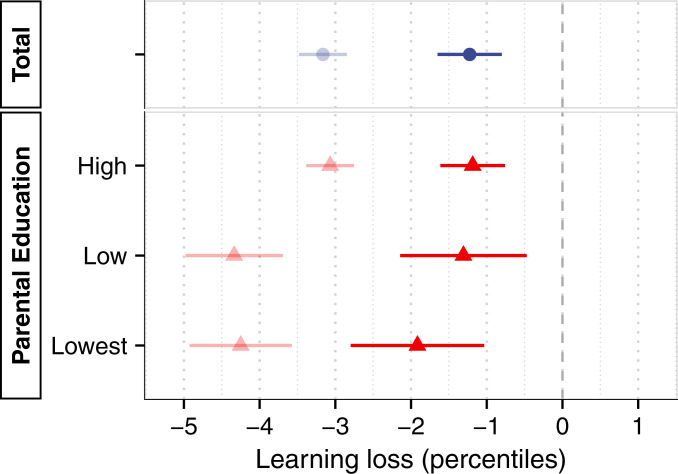
Using Dutch national assessments taken before and after an 8-week COVID-19 school closure, this study finds that primary students made little or no progress while learning from home. The Netherlands is a “best-case” setting, yet average learning loss was 3.16 percentile points (0.08 SD), with larger losses among students from disadvantaged homes.
Key findings
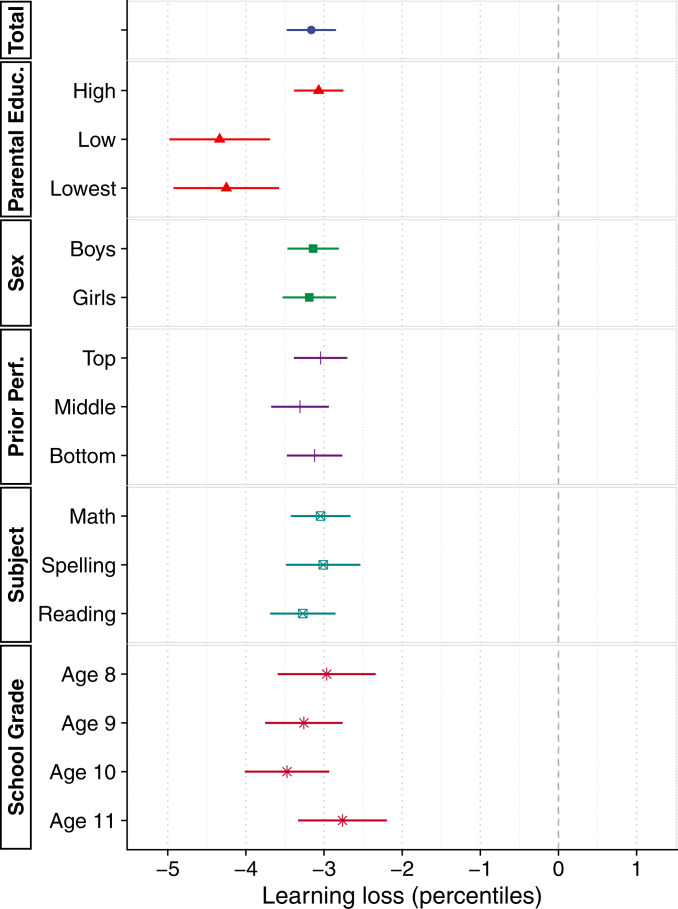
- In the baseline difference-in-differences estimate for a composite of math, spelling, and reading, students lost on average 3.16 percentile points, equivalent to 0.08 SD; raw differences ranged from −0.76 percentiles in spelling to −2.15 percentiles in math.
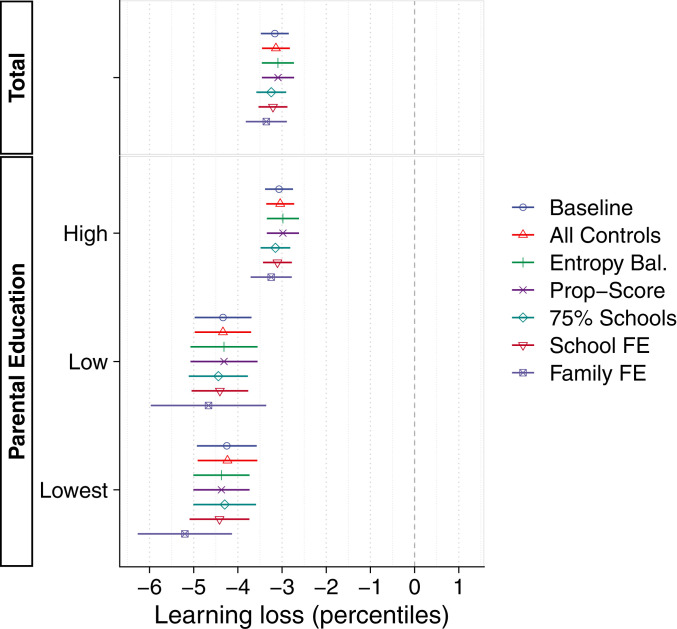
- Losses were concentrated among students from less-educated homes: the two lowest parental-education categories, together 8% of the population, suffered losses 40% larger than average (high, −3.07; low, −4.34; lowest, −4.25); within-family estimates showed a gap of 60% (high, −3.25; low, −4.67; lowest, −5.20).
- There was little evidence that effects differed by sex, school grade, subject, or prior performance, but school-level variation was considerable, with some schools seeing losses of 10 percentile points or more and others no losses or small gains.
- On a learning-readiness test not tied to curricular content, effects shrank by nearly two-thirds (main effect −1.19 vs. −3.16), suggesting most of the drop reflects knowledge learned; 3.16 percentiles translates to 7.9 to 10.5 weeks of lost learning depending on the benchmark.
Methods
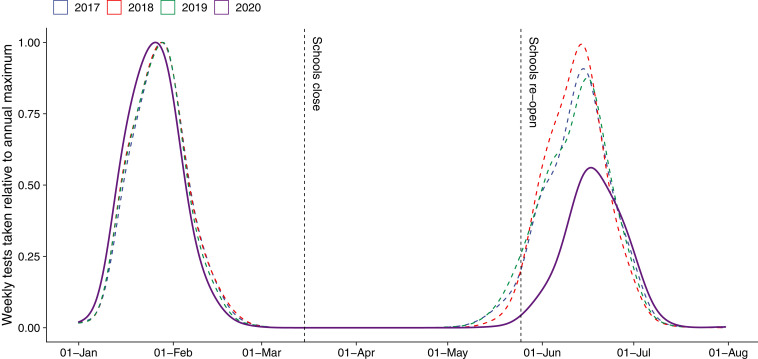
- Natural experiment/difference-in-differences design using biannual national standardized tests in The Netherlands from 2017 to 2020, covering 15% of Dutch primary schools (n ≈ 350,000) and students aged 8 to 11 years (grades 4 to 7); 2020 tests occurred just before and after 8 weeks of nationwide closures starting March 16.
- Main outcomes were math, spelling, reading, and a composite score, plus an oral reading fluency/learning-readiness test; scores were transformed to percentiles, with baseline models adjusting for a linear year trend and days between tests and clustering standard errors at the school level.
- Robustness included placebo analyses, year exclusions, loss-to-follow-up adjustments via regression, propensity-score and maximum-entropy weighting, school and family fixed effects, and a specification curve analysis of more than 2,000 alternative models.
Limitations
- The paper states that only time will tell whether students rebound, remain stable, or fall farther behind; test scores do not capture psychosocial development or societal and parental costs; and results may underestimate the full costs of school closures.
- The paper notes that The Netherlands is a best-case scenario due to short closures, high technological preparedness, and equitable school funding, making the estimates a likely lower bound; the short closure also gave little time to adapt, and remote learning might improve with time.
- The text makes evident that the sample covers 15% of primary schools, loss to follow-up is addressed but only a subset of students took tests after lockdown, and the within-family fixed-effects specification reduces the sample by approximately 60% and shifts it toward larger families.
Model-written summary. Check it against the paper before relying on it.
Integrity signals
Registry
Cites
Statistics
Figures
Verification
Claims the paper makes
23 Own result · 16 Own method · 12 Own interpretation · 10 No full text of the sources · 9 Sources not found · 4 Partly supported · 4 Not checked yet · 3 No basis given · 2 Supported so far · accuracy not yet measured
The cited sources support only part of this claim — read each source’s verdict below.
In the paper
“In their projections of learning loss due to the pandemic, the World Bank assumes a yearly progress of 0.40 SD (46).”
§ Learning loss due to school closures during the COVID-19 pandemic > Discussion
What the sources say
- Partly supportedcites [46] J. P. Azevedo, A. Hasan, D. Goldemberg, S. A. Iqbal, K. Geven (2020) Simulating the potential impacts of COVID-19 school closures on schooling and learning outcomes: A set of global estimates. World Bank Policy Research Working Paper (9284). https://openknowledge.worldbank.org/handle/10986/33945. Accessed 9 February 2021. sourceExperimental — accuracy not yet measured
The Empirical methodology (p. 15) says the projections assume learning gains of 0.2–0.5 SD from one grade to the next, depending on country income. Annex A.1 (p. 44) specifies 40 PISA points, equivalent to 0.40 SD, as the baseline for upper-middle-income countries—not as a universal yearly rate. (LLM, conf=0.90)
plain- Asserted: passes — The authors put it forward as true.
- Checkable: passes — It can be checked against evidence.
- Load-bearing: passes — The paper’s conclusions depend on it.
- Based: passes — The paper gives a reason why it holds.
- Partly supported
The cited sources support only part of this claim — read each source’s verdict below.
In the paper
“Our results show that learning loss was particularly pronounced for students from disadvantaged homes, confirming the fears held by many that school closures would cause socioeconomic gaps to widen (51 –55).”
§ Learning loss due to school closures during the COVID-19 pandemic > Discussion
What the sources say
- Supportedcites [51] E. A. Hanushek, L. Woessmann, The Economic Impacts of Learning Losses (Organisation for Economic Co-operation and Development OECD, 2020). source
The Summary of closure experiences says that school closures have widened gaps in skill development and warns that they may increase inequality. Section 4, “Distributional issues,” says the negative impact was greater for students from disadvantaged households. The citing authors’ claim about what their own results show is not attributed to this source. (LLM, conf=0.92)
- Supportedcites [52] F. Agostinelli, M. Doepke, G. Sorrenti, F. Zilibotti, When the Great Equalizer Shuts Down: Schools, Peers, and Parents in Pandemic Times (National Bureau of Economic Research, 2020). PMC8735857 35017763 source
The Conclusions state that the paper’s analysis finds higher educational inequality and that learning gaps grow during the pandemic. This supports the cited concern that school closures would widen socioeconomic gaps; the citing authors’ own learning-loss results are not attributed to this source. (LLM, conf=0.93)
- Partly supportedcites [53] A. Bacher-Hicks, J. Goodman, C. Mulhern, Inequality in household adaptation to schooling shocks: Covid-induced online learning engagement in real time. J. Publ. Econ. 193, 104345 (2020). PMC8486492 34629567 sourceExperimental — accuracy not yet measured
The Introduction reports that school closures widened socioeconomic gaps in searches for online learning resources. The Discussion says this pattern suggests academic gaps will be wider in future school years, but the paper does not establish that closures had already widened learning-loss gaps; its measured outcome is primarily search engagement. (LLM, conf=0.86)
- Supportedcites [54] Z. Parolin, E. K. Lee, Large socio-economic, geographic and demographic disparities exist in exposure to school closures. Nat. Hum. Beh., 10.1038/s41562-021-01087-8. (2021). PMC8060162 33737734 source
The Discussion says that disadvantaged students’ greater exposure to school closures and distance learning may exacerbate socio-economic gaps in learning outcomes. This supports the cited concern that closures could widen those gaps; the citing authors attribute the observed learning loss to their own results, not to this source. (LLM, conf=0.90)
- Supportedcites [55] D. H. Bailey, G. J. Duncan, R. J. Murnane, N. A. Yeung (2021) Achievement gaps in the wake of COVID-19 (EdWorkingPaper No. 21-346, Annenberg Institute at Brown University). https://www.edworkingpapers.com/ai21-346. Accessed 9 February 2021. source
The Discussion reports researchers’ prediction that COVID-19 would markedly increase achievement gaps between children from low- and higher-income families. The Abstract identifies these as forecasts, supporting the cited ‘fears’; the claim that results confirm them refers to the citing authors’ own results, not to this source. (LLM, conf=0.90)
boosteddirect- Asserted: passes — The authors put it forward as true.
- Checkable: passes — It can be checked against evidence.
- Load-bearing: passes — The paper’s conclusions depend on it.
- Based: passes — The paper gives a reason why it holds.
- Supported
The cited sources support only part of this claim — read each source’s verdict below.
In the paper
“Nevertheless, the magnitude of our findings appears to validate scenarios projected by bodies such as the European Commission (34) and the World Bank (46).”
§ Learning loss due to school closures during the COVID-19 pandemic > Discussion
What the sources say
- Not matchedcites [34] G. Di Pietro, F. Biagi, P. Costa, Z. Karpinski, J. Mazza, The Likely Impact of COVID-19 on Education: Reflections Based on the Existing Literature and Recent International Datasets (Publications Office of the European Union, 2020).
Couldn’t be matched to a paper in Crossref, so it can’t be checked.
- Supportedcites [46] J. P. Azevedo, A. Hasan, D. Goldemberg, S. A. Iqbal, K. Geven (2020) Simulating the potential impacts of COVID-19 school closures on schooling and learning outcomes: A set of global estimates. World Bank Policy Research Working Paper (9284). https://openknowledge.worldbank.org/handle/10986/33945. Accessed 9 February 2021. source
The citation to this paper is attached to the World Bank scenarios, not to the European Commission or the citing authors’ judgment that their findings validate them. The Conclusion (p. 35) presents optimistic, intermediate, and pessimistic global scenarios for the effects of COVID-19 school closures on schooling and learning. (LLM, conf=0.91)
hedgedcorrelational- Asserted: passes — The authors put it forward as true.
- Checkable: passes — It can be checked against evidence.
- Load-bearing: unclear — It is unclear whether the paper’s conclusions depend on it.
- Based: passes — The paper gives a reason why it holds.
- Not matched
The sources with a verdict support this claim; the rest weren’t checked yet, have no full text we could read, or their verdicts aren’t rated yet.
In the paper
“Moreover, we match treatment and control groups on a wider range of individual- and school-level characteristics using reweighting on the propensity of treatment (68) and maximum-entropy balancing (69).”
§ Learning loss due to school closures during the COVID-19 pandemic > Materials and Methods > Propensity Score and Entropy Weighting.
What the sources say
- Supportedcites [68] G. W. Imbens, J. M. Wooldridge, Recent developments in the econometrics of program evaluation. J. Econ. Lit. 47, 5– 86 (2009). source
Section 5.4 explains that adjusting for the propensity score accounts for differences in covariates between treated and control units. Section 5.6 describes weighting observations by their propensity of treatment or non-treatment. Citation (68) supports the propensity-reweighting method; the sentence cites a different source for maximum-entropy balancing. (LLM, conf=0.88)
- Not checked — no full text of the sourcecites [69] J. Hainmueller, Entropy balancing for causal effects: A multivariate reweighting method to produce balanced samples in observational studies. Polit. Anal., 20, 25– 46 (2012). source
plaincorrelational- Asserted: passes — The authors put it forward as true.
- Checkable: passes — It can be checked against evidence.
- Load-bearing: passes — The paper’s conclusions depend on it.
- Based: passes — The paper gives a reason why it holds.
- Supported
A result the paper reports from its own data — it cites no other source for it, so there is none to check. The quote shows it is in the paper.
In the paper
“The largest gap in effect sizes between educational backgrounds is found in our within-family analysis, estimated at 60% (parental education: high, −3.25; low, −4.67; lowest, −5.20).”
§ Learning loss due to school closures during the COVID-19 pandemic > Results > Adjusting for Loss to Follow-up.
hedgedcorrelational- Asserted: passes — The authors put it forward as true.
- Checkable: passes — It can be checked against evidence.
- Load-bearing: unclear — It is unclear whether the paper’s conclusions depend on it.
- Based: passes — The paper gives a reason why it holds.
A result the paper reports from its own data — it cites no other source for it, so there is none to check. The quote shows it is in the paper.
In the paper
“Those in the two lowest categories of parental education—together accounting for 8% of the population ( SI Appendix, section 5.1)—suffered losses 40% larger than the average student (estimates by parental education: high, −3.07; low, −4.34; lowest, −4.25).”
§ Learning loss due to school closures during the COVID-19 pandemic > Results > Baseline Specification.
plaincorrelational- Asserted: passes — The authors put it forward as true.
- Checkable: passes — It can be checked against evidence.
- Load-bearing: passes — The paper’s conclusions depend on it.
- Based: passes — The paper gives a reason why it holds.
A result the paper reports from its own data — it cites no other source for it, so there is none to check. The quote shows it is in the paper.
In the paper
“Disregarding the trend and instead assuming a counterfactual where achievement had stayed flat between 2019 and 2020, the estimated treatment effect shrinks by 21% to −2.51 percentiles ( SI Appendix, section 7.11).”
§ Learning loss due to school closures during the COVID-19 pandemic > Results > Specification Curve Analysis.
hedgeddirect- Asserted: passes — The authors put it forward as true.
- Checkable: passes — It can be checked against evidence.
- Load-bearing: passes — The paper’s conclusions depend on it.
- Based: passes — The paper gives a reason why it holds.
A result the paper reports from its own data — it cites no other source for it, so there is none to check. The quote shows it is in the paper.
In the paper
“In contrast, we find little evidence that the effect differs by sex, school grade, subject, or prior performance.”
§ Learning loss due to school closures during the COVID-19 pandemic > Results > Baseline Specification.
hedged- Asserted: passes — The authors put it forward as true.
- Checkable: passes — It can be checked against evidence.
- Load-bearing: unclear — It is unclear whether the paper’s conclusions depend on it.
- Based: passes — The paper gives a reason why it holds.
A result the paper reports from its own data — it cites no other source for it, so there is none to check. The quote shows it is in the paper.
In the paper
“The placebo estimate closest to zero is found in the version of our preferred specification that includes family fixed effects.”
§ Learning loss due to school closures during the COVID-19 pandemic > Results > Specification Curve Analysis.
plain- Asserted: passes — The authors put it forward as true.
- Checkable: passes — It can be checked against evidence.
- Load-bearing: unclear — It is unclear whether the paper’s conclusions depend on it.
- Based: passes — The paper gives a reason why it holds.
A result the paper reports from its own data — it cites no other source for it, so there is none to check. The quote shows it is in the paper.
In the paper
“Therefore, adjusting for these covariates makes little difference to our results ( SI Appendix, section 7.1).”
§ Learning loss due to school closures during the COVID-19 pandemic > Results > Adjusting for Loss to Follow-up.
plain- Asserted: passes — The authors put it forward as true.
- Checkable: passes — It can be checked against evidence.
- Load-bearing: unclear — It is unclear whether the paper’s conclusions depend on it.
- Based: passes — The paper gives a reason why it holds.
- Probably not a substantial claim. 19
- It may state two separate claims as one. 30
- The quote only partly states this claim. 1
The sources with a verdict support this claim; the rest weren’t checked yet, have no full text we could read, or their verdicts aren’t rated yet.
In the paper
“Dynamic models of learning stress how small losses can accumulate into large disadvantages with time (56 –58).”
§ Learning loss due to school closures during the COVID-19 pandemic > Discussion
What the sources say
- Not checked — no full text of the sourcecites [56] T. A. DiPrete, G. M. Eirich, Cumulative advantage as a mechanism for inequality: A review of theoretical and empirical developments. Annu. Rev. Sociol. 32, 271– 297 (2006). source
- Supportedcites [57] M. Kaffenberger, Modelling the long-run learning impact of the Covid-19 learning shock: Actions to (more than) mitigate loss. Int. J. Educ. Dev. 81, 102326 (2021). 33716394 PMC7923185 source
The Introduction reports that the model projects a one-third reduction in grade 3 learning to become a full-year deficit by grade 10, and a one-half reduction to become a 1.5-year deficit. These projections support the claim that an initial learning loss can lead to a larger disadvantage over time. (LLM, conf=0.92)
- Supportedcites [58] N. Fuchs-Schündeln, D. Krueger, A. Ludwig, I. Popova, The Long-Term Distributional and Welfare Effects of COVID-19 School Closures (National Bureau of Economic Research, 2020). source
The Introduction (page unavailable) explains that an initial shortfall in children’s human capital reduces the productivity of later investments, leading to less investment and worse educational and earnings outcomes. Section 4.1.1 (page unavailable) likewise says that reduced accumulation at younger ages translates into lower human capital and investment in the future. (LLM, conf=0.90)
plaindirect- Asserted: passes — The authors put it forward as true.
- Checkable: passes — It can be checked against evidence.
- Load-bearing: fails — The paper’s conclusions may not depend on it.
- Based: passes — The paper gives a reason why it holds.
Probably not a substantial claim. The paper’s conclusions may not depend on it.
The cited sources support only part of this claim — read each source’s verdict below.
In the paper
“Test scores do not consider children’s psychosocial development (63, 64), either societal costs due to productivity decline or heightened pressure among parents (65, 66).”
§ Learning loss due to school closures during the COVID-19 pandemic > Discussion
What the sources say
- Partly supportedcites [63] A. Gassman-Pines, C. M. Gibson-Davis, E. O. Ananat, How economic downturns affect children’s development: An interdisciplinary perspective on pathways of influence. Child Dev. Perspect. 9, 233– 238 (2015). 31327980 PMC6641565 sourceExperimental — accuracy not yet measured
The section on economic and psychological effects on continuously employed individuals reports increased financial and psychological stress within families and greater parental distress during downturns, supporting the point about pressure on parents. The paper also discusses children’s emotional well-being separately from test scores, but it does not say that test scores omit societal costs from declining productivity or explicitly assess what test scores capture. No page number was available in our copy. (LLM, conf=0.82)
- Could not verifycites [64] L. Shanahan, Emotional distress in young adults during the COVID-19 pandemic: Evidence of risk and resilience from a longitudinal cohort study. Psychol. Med., 10.1017/S003329172000241X (2020). PMC7338432 32571438 sourceExperimental — accuracy not yet measured
The Methods (Measures; page unavailable) assess economic and lifestyle disruptions among young adults, and the Discussion (page unavailable) links those disruptions to emotional distress. Neither passage addresses what test scores omit, societal costs from declining productivity, or heightened pressure on parents. Searches for those specific points found no supporting passage in our copy. (LLM, conf=0.73)
- Partly supportedcites [65] C. Collins, L. C. Landivar, L. Ruppanner, W. J. Scarborough, COVID-19 and the gender gap in work hours. Gender Work. Organ. 28, 101– 12. (2020). PMC7361447 32837019 sourceExperimental — accuracy not yet measured
The Introduction describes acute time and financial pressures on working parents, and the Results (section 4.1; page unavailable) report that mothers reduced paid work hours amid childcare and homeschooling demands. These passages support heightened parental pressure and reduced work time, but the paper does not assess test scores or establish societal costs from a decline in productivity. (LLM, conf=0.84)
- Partly supportedcites [66] P. Biroli (2020) “ Family life in lockdown” (IZA Discussion Paper 13398, Institute of Labor Economics, Bonn, Germany). sourceExperimental — accuracy not yet measured
The Results section (Family Cooperation and Tensions; page unavailable) reports increased household tension associated with changes in childcare and other household tasks during lockdown, supporting the point about pressure on parents. The paper does not establish societal costs from declining productivity or state that test scores omit these effects. (LLM, conf=0.82)
plain- Asserted: passes — The authors put it forward as true.
- Checkable: passes — It can be checked against evidence.
- Load-bearing: unclear — It is unclear whether the paper’s conclusions depend on it.
- Based: passes — The paper gives a reason why it holds.
It may state two separate claims as one.
- Partly supported
A result the paper reports from its own data — it cites no other source for it, so there is none to check. The quote shows it is in the paper.
In the paper
“Doing so identifies the control for pretreatment trends as the most influential, followed by the control for test timing and the inclusion of school and family fixed effects.”
§ Learning loss due to school closures during the COVID-19 pandemic > Results > Specification Curve Analysis.
plaindirect- Asserted: passes — The authors put it forward as true.
- Checkable: passes — It can be checked against evidence.
- Load-bearing: passes — The paper’s conclusions depend on it.
- Based: passes — The paper gives a reason why it holds.
It may state two separate claims as one.
A result the paper reports from its own data — it cites no other source for it, so there is none to check. The quote shows it is in the paper.
In the paper
“However, the fixed-effects specification shifts the sample toward larger families, and effects in this subsample are similar using our baseline specification ( SI Appendix, section 7.7).”
§ Learning loss due to school closures during the COVID-19 pandemic > Results > Adjusting for Loss to Follow-up.
plaincorrelational- Asserted: passes — The authors put it forward as true.
- Checkable: passes — It can be checked against evidence.
- Load-bearing: unclear — It is unclear whether the paper’s conclusions depend on it.
- Based: passes — The paper gives a reason why it holds.
It may state two separate claims as one.
A result the paper reports from its own data — it cites no other source for it, so there is none to check. The quote shows it is in the paper.
In the paper
“Excluding adjustment for testing date decreases the effect size by 12%, while including fixed effects increases it by 1.6% (school level) or 6.3% (family level).”
§ Learning loss due to school closures during the COVID-19 pandemic > Results > Specification Curve Analysis.
plaindirect- Asserted: passes — The authors put it forward as true.
- Checkable: passes — It can be checked against evidence.
- Load-bearing: unclear — It is unclear whether the paper’s conclusions depend on it.
- Based: passes — The paper gives a reason why it holds.
It may state two separate claims as one.
A result the paper reports from its own data — it cites no other source for it, so there is none to check. The quote shows it is in the paper.
In the paper
“We validate these benchmarks in our data by exploiting variation in testing dates during comparison years and show that test scores improve by 0.30 to 0.40 percentiles per week, equivalent to 0.31 to 0.41 SD annually ( SI Appendix, section 4.3).”
§ Learning loss due to school closures during the COVID-19 pandemic > Discussion
plaincorrelational- Asserted: passes — The authors put it forward as true.
- Checkable: passes — It can be checked against evidence.
- Load-bearing: passes — The paper’s conclusions depend on it.
- Based: passes — The paper gives a reason why it holds.
It may state two separate claims as one.
A result the paper reports from its own data — it cites no other source for it, so there is none to check. The quote shows it is in the paper.
In the paper
“Students lost on average 3.16 percentile points in the national distribution, equivalent to 0.08 standard deviations (SD) ( SI Appendix, section 4.3).”
§ Learning loss due to school closures during the COVID-19 pandemic > Results > Baseline Specification.
plaindirect- Asserted: passes — The authors put it forward as true.
- Checkable: passes — It can be checked against evidence.
- Load-bearing: passes — The paper’s conclusions depend on it.
- Based: passes — The paper gives a reason why it holds.
It may state two separate claims as one.
A result the paper reports from its own data — it cites no other source for it, so there is none to check. The quote shows it is in the paper.
In the paper
“In SI Appendix, Table S3, we show that the treatment sample is not skewed on sex, parental education, or prior performance.”
§ Learning loss due to school closures during the COVID-19 pandemic > Results > Adjusting for Loss to Follow-up.
plain- Asserted: passes — The authors put it forward as true.
- Checkable: passes — It can be checked against evidence.
- Load-bearing: passes — The paper’s conclusions depend on it.
- Based: passes — The paper gives a reason why it holds.
It may state two separate claims as one.
A result the paper reports from its own data — it cites no other source for it, so there is none to check. The quote shows it is in the paper.
In the paper
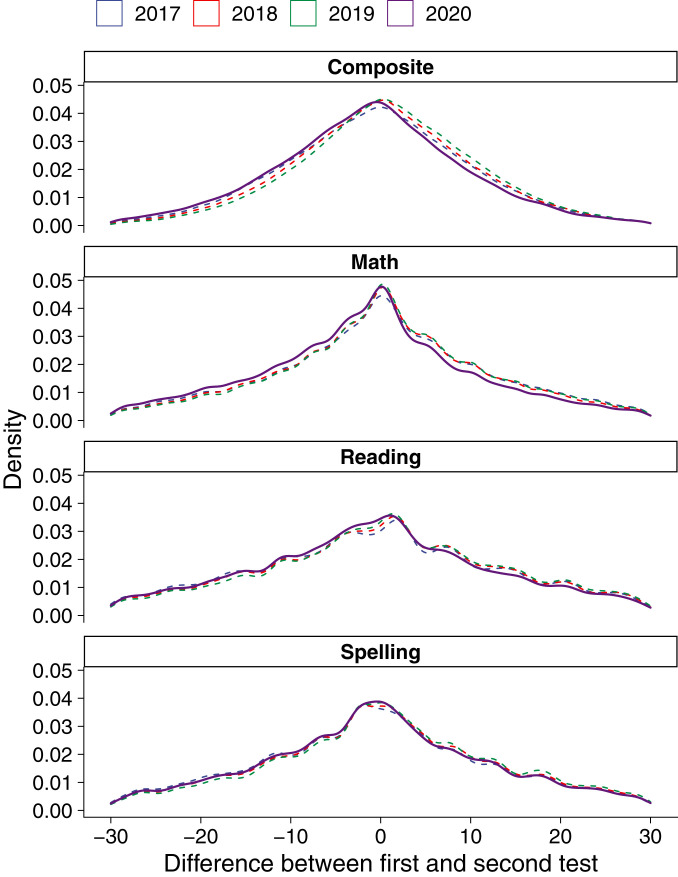
“This graph reveals a raw difference ranging from −0.76 percentiles in spelling to −2.15 percentiles in math.”
§ Learning loss due to school closures during the COVID-19 pandemic > Results
plain- Asserted: passes — The authors put it forward as true.
- Checkable: passes — It can be checked against evidence.
- Load-bearing: unclear — It is unclear whether the paper’s conclusions depend on it.
- Based: passes — The paper gives a reason why it holds.
The quote only partly states this claim.
A result the paper reports from its own data — it cites no other source for it, so there is none to check. The quote shows it is in the paper.
In the paper
“These losses are evident throughout the age range we study and across all of the three subject areas: math, spelling, and reading.”
§ Learning loss due to school closures during the COVID-19 pandemic > Discussion
plaincorrelational- Asserted: passes — The authors put it forward as true.
- Checkable: passes — It can be checked against evidence.
- Load-bearing: passes — The paper’s conclusions depend on it.
- Based: passes — The paper gives a reason why it holds.
It may state two separate claims as one.
A result the paper reports from its own data — it cites no other source for it, so there is none to check. The quote shows it is in the paper.
In the paper
“We also reestimate our main specification dropping comparison years one at a time ( SI Appendix, section 7.3). These results are estimated with less precision but otherwise in line with those of our main analysis.”
§ Learning loss due to school closures during the COVID-19 pandemic > Results > Placebo Analysis and Year Exclusions.
plain- Asserted: passes — The authors put it forward as true.
- Checkable: passes — It can be checked against evidence.
- Load-bearing: unclear — It is unclear whether the paper’s conclusions depend on it.
- Based: passes — The paper gives a reason why it holds.
It may state two separate claims as one.
The paper states this without a source or data behind it here, so there is nothing to check it against. The quote shows it is in the paper.
In the paper
“Our estimated treatment effect translates into 3.16/35 = 0.09 percentiles or 0.002 SD per school day and is thus on the lower end of that range.*”
§ Learning loss due to school closures during the COVID-19 pandemic > Discussion
plaindirect- Asserted: passes — The authors put it forward as true.
- Checkable: passes — It can be checked against evidence.
- Load-bearing: unclear — It is unclear whether the paper’s conclusions depend on it.
- Based: passes — The paper gives a reason why it holds.
It may state two separate claims as one.
In the paper
“These groups make up, respectively, 92, 4, and 4% of the student body and our sample ( SI Appendix, section 5.1).”
§ Learning loss due to school closures during the COVID-19 pandemic > Materials and Methods > Parental Education.
What the sources say
- Not matchedcites SI Appendix, section 5.1
Couldn’t be matched to a paper in Crossref, so it can’t be checked.
plain- Asserted: passes — The authors put it forward as true.
- Checkable: passes — It can be checked against evidence.
- Load-bearing: fails — The paper’s conclusions may not depend on it.
- Based: passes — The paper gives a reason why it holds.
Probably not a substantial claim. The paper’s conclusions may not depend on it. It may state two separate claims as one.
- Not matched
In the paper
“This literature reports reductions in achievement ranging from 0.001 to 0.010 SD per school day lost (10).”
§ Learning loss due to school closures during the COVID-19 pandemic > Discussion
What the sources say
- Not checked — no full text of the sourcecites [10] M. Kuhfeld, Projecting the potential impacts of COVID-19 school closures on academic achievement. Educ. Res. 49, 549– 565 (2020). source
plaindirect- Asserted: passes — The authors put it forward as true.
- Checkable: passes — It can be checked against evidence.
- Load-bearing: passes — The paper’s conclusions depend on it.
- Based: passes — The paper gives a reason why it holds.
Probably not a substantial claim.
A conclusion the paper draws from its own results — it cites no other source for it, so there is none to check. The quote shows it is in the paper.
In the paper
“Using the smaller benchmark, learning loss exceeds the period of school closures (3.16/0.30 = 10.5 wk), implying that students regressed during this time.”
§ Learning loss due to school closures during the COVID-19 pandemic > Discussion
plaindirect- Asserted: passes — The authors put it forward as true.
- Checkable: passes — It can be checked against evidence.
- Load-bearing: unclear — It is unclear whether the paper’s conclusions depend on it.
- Based: passes — The paper gives a reason why it holds.
It may state two separate claims as one.
A conclusion the paper draws from its own results — it cites no other source for it, so there is none to check. The quote shows it is in the paper.
In the paper
“Using the larger benchmark, a treatment effect of 3.16 percentiles would translate into 3.16/0.40 = 7.9 wk of lost learning—nearly exactly the same period that schools in The Netherlands remained closed.”
§ Learning loss due to school closures during the COVID-19 pandemic > Discussion
hedgeddirect- Asserted: passes — The authors put it forward as true.
- Checkable: passes — It can be checked against evidence.
- Load-bearing: unclear — It is unclear whether the paper’s conclusions depend on it.
- Based: passes — The paper gives a reason why it holds.
It may state two separate claims as one.
A conclusion the paper draws from its own results — it cites no other source for it, so there is none to check. The quote shows it is in the paper.
In the paper
“However, failure to adjust for pretreatment trends generates placebo estimates that are biased in a positive direction and is thus likely to underestimate treatment effects.”
§ Learning loss due to school closures during the COVID-19 pandemic > Results > Specification Curve Analysis.
hedgeddirect- Asserted: passes — The authors put it forward as true.
- Checkable: passes — It can be checked against evidence.
- Load-bearing: passes — The paper’s conclusions depend on it.
- Based: passes — The paper gives a reason why it holds.
It may state two separate claims as one.
What the paper did — it cites no source for this, so there is none to check. The quote shows it is in the paper.
In the paper
“Hypotheses and analysis protocols for this study were preregistered ( SI Appendix, section 4.1).”
§ Learning loss due to school closures during the COVID-19 pandemic > Study Setting
plain- Asserted: passes — The authors put it forward as true.
- Checkable: passes — It can be checked against evidence.
- Load-bearing: fails — The paper’s conclusions may not depend on it.
- Based: passes — The paper gives a reason why it holds.
Probably not a substantial claim. The paper’s conclusions may not depend on it.
None of the sources cited for this claim have been checked yet.
In the paper
“The Netherlands is interesting as a “best-case” scenario, with a short lockdown, equitable school funding, and world-leading rates of broadband access.”
- Also stated in: § Study Setting · hedged
“For these reasons, The Netherlands presents a “best-case” scenario, providing a likely lower bound on learning loss elsewhere in Europe and the world.”
§ Learning loss due to school closures during the COVID-19 pandemic > Abstract
What the sources say
- Not matchedcites [30] H. A. Patrinos, “ School choice in the Netherlands” (CESifo DICE Report 2/2011, ifo Institute for Economic Research, Munich, Germany, 2011).
Couldn’t be matched to a paper in Crossref, so it can’t be checked.
- Not checked — no full text of the sourcecites [31] H. F. Ladd, E. B. Fiske, Weighted student funding in The Netherlands: A model for the US? J. Pol. Anal. Manag. 30, 470– 498 (2011). source
- Not matchedcites [33] Statistics Netherlands (CBS), The Netherlands leads Europe in internet access. https://www.cbs.nl/en-gb/news/2018/05/the-Netherlands-leads-europe-in-internet-access. Accessed 9 February 2021.
Couldn’t be matched to a paper in Crossref, so it can’t be checked.
- Not matchedcites [34] G. Di Pietro, F. Biagi, P. Costa, Z. Karpinski, J. Mazza, The Likely Impact of COVID-19 on Education: Reflections Based on the Existing Literature and Recent International Datasets (Publications Office of the European Union, 2020).
Couldn’t be matched to a paper in Crossref, so it can’t be checked.
- Not matchedcites [36] Johns Hopkins Coronavirus Resource Center, COVID-19 case tracker. https://coronavirus.jhu.edu/data. Accessed 9 February 2021.
Couldn’t be matched to a paper in Crossref, so it can’t be checked.
- Not matchedcites [37] P. Tullis, Dutch cooperation made an ‘intelligent lockdown’ a success. Bloomberg Businessweek (4 June 2020).
Couldn’t be matched to a paper in Crossref, so it can’t be checked.
plaincorrelational- Asserted: passes — The authors put it forward as true.
- Checkable: passes — It can be checked against evidence.
- Load-bearing: passes — The paper’s conclusions depend on it.
- Based: passes — The paper gives a reason why it holds.
It may state two separate claims as one.
- Also stated in: § Study Setting · hedged
A conclusion the paper draws from its own results — it cites no other source for it, so there is none to check. The quote shows it is in the paper.
In the paper
“which would indicate that remote learning operated at 50% efficiency.”
§ Learning loss due to school closures during the COVID-19 pandemic > Discussion
hedgeddirect- Asserted: passes — The authors put it forward as true.
- Checkable: passes — It can be checked against evidence.
- Load-bearing: fails — The paper’s conclusions may not depend on it.
- Based: passes — The paper gives a reason why it holds.
Probably not a substantial claim. The paper’s conclusions may not depend on it.
What the paper did — it cites no source for this, so there is none to check. The quote shows it is in the paper.
In the paper
“In our baseline specification, we adjust for a linear trend in year and the time elapsed between testing dates and cluster standard errors at the school level.”
§ Learning loss due to school closures during the COVID-19 pandemic > Results
plain- Asserted: passes — The authors put it forward as true.
- Checkable: passes — It can be checked against evidence.
- Load-bearing: passes — The paper’s conclusions depend on it.
- Based: passes — The paper gives a reason why it holds.
Probably not a substantial claim. It may state two separate claims as one.
What the paper did — it cites no source for this, so there is none to check. The quote shows it is in the paper.
In the paper
“Moreover, we restrict analysis to schools where at least 75% of students took their tests after lockdown ( SI Appendix, section 7.5).”
§ Learning loss due to school closures during the COVID-19 pandemic > Results > Adjusting for Loss to Follow-up.
plain- Asserted: passes — The authors put it forward as true.
- Checkable: passes — It can be checked against evidence.
- Load-bearing: fails — The paper’s conclusions may not depend on it.
- Based: passes — The paper gives a reason why it holds.
Probably not a substantial claim. The paper’s conclusions may not depend on it.
A claim is checked only against the cited paper’s full text, never its abstract, and none is available for its sources.
In the paper
“Although early influential studies also found that summer is a time when socioeconomic learning gaps widen, this finding has failed to replicate in more recent studies (8, 9) or in European samples (48, 49).”
§ Learning loss due to school closures during the COVID-19 pandemic > Discussion
What the sources say
- Not checked — no full text of the sourcecites [8] P. T. von Hippel, C. Hamrock, Do test score gaps grow before, during, or between the school years?: Measurement artifacts and what we can know in spite of them. Soc. Sci. 6, 43 (2019). source
- Not checked — no full text of the sourcecites [9] M. Kuhfeld, Surprising new evidence on summer learning loss. Phi Delta Kappan 101, 25– 29 (2019). source
- Not checked — no full text of the sourcecites [48] P. Verachtert, J. Van Damme, P. Onghena, P. Ghesquière, A seasonal perspective on school effectiveness: Evidence from a Flemish longitudinal study in kindergarten and first grade. Sch. Effect. Sch. Improv. 20, 215– 233 (2009). source
- Not checked — no full text of the sourcecites [49] F. Meyer, K. Meissel, S. McNaughton, Patterns of literacy learning in German primary schools over the summer and the influence of home literacy practices. J. Res. Read. 40, 233– 253 (2017). source
plain- Asserted: passes — The authors put it forward as true.
- Checkable: passes — It can be checked against evidence.
- Load-bearing: unclear — It is unclear whether the paper’s conclusions depend on it.
- Based: passes — The paper gives a reason why it holds.
It may state two separate claims as one.
What the paper did — it cites no source for this, so there is none to check. The quote shows it is in the paper.
In the paper
“Our study represents one of the first attempts to quantify learning loss from COVID-19 using externally validated tests, a representative sample, and techniques that allow for causal inference.”
§ Learning loss due to school closures during the COVID-19 pandemic > Abstract
plain- Asserted: passes — The authors put it forward as true.
- Checkable: passes — It can be checked against evidence.
- Load-bearing: passes — The paper’s conclusions depend on it.
- Based: passes — The paper gives a reason why it holds.
It may state two separate claims as one.
In the paper
“The country is close to the Organization for Economic Cooperation and Development (OECD) average in school spending and reading performance, but among its top performers in math (32).”
§ Learning loss due to school closures during the COVID-19 pandemic > Study Setting
What the sources say
- Not matchedcites [32] A. Schleicher, PISA 2018: Insights and Interpretations (OECD Publishing, 2018).
Couldn’t be matched to a paper in Crossref, so it can’t be checked.
plain- Asserted: passes — The authors put it forward as true.
- Checkable: passes — It can be checked against evidence.
- Load-bearing: passes — The paper’s conclusions depend on it.
- Based: passes — The paper gives a reason why it holds.
It may state two separate claims as one.
- Not matched
A conclusion the paper draws from its own results — it cites no other source for it, so there is none to check. The quote shows it is in the paper.
In the paper
“The short duration of school closures gave students, educators, and parents little time to adapt.”
§ Learning loss due to school closures during the COVID-19 pandemic > Discussion
plaindirect- Asserted: passes — The authors put it forward as true.
- Checkable: passes — It can be checked against evidence.
- Load-bearing: fails — The paper’s conclusions may not depend on it.
- Based: passes — The paper gives a reason why it holds.
Probably not a substantial claim. The paper’s conclusions may not depend on it.
In the paper
“To identify the model components that exert the most influence on the magnitude of estimates we assessed more than 2,000 alternative models in a specification curve analysis (44) ( SI Appendix, section 7.13).”
§ Learning loss due to school closures during the COVID-19 pandemic > Results > Specification Curve Analysis.
What the sources say
- Not checked — no full text of the sourcecites [44] U. Simonsohn, J. P. Simmons, L. D. Nelson, Specification curve analysis. Nat. Hum. Behav. 4, 1208– 1214 (2020). 32719546 source
plain- Asserted: passes — The authors put it forward as true.
- Checkable: passes — It can be checked against evidence.
- Load-bearing: passes — The paper’s conclusions depend on it.
- Based: passes — The paper gives a reason why it holds.
Probably not a substantial claim.
A claim is checked only against the cited paper’s full text, never its abstract, and none is available for its sources.
In the paper
“Despite favorable conditions, survey evidence from lockdown indicates high levels of dissatisfaction with remote learning (38) and considerable disparities in help with schoolwork and learning resources (39).”
§ Learning loss due to school closures during the COVID-19 pandemic > Study Setting
What the sources say
- Not checked — no full text of the sourcecites [38] M. de Haas, R. Faber, M. Hamersma, How COVID-19 and the Dutch ‘intelligent lockdown’ changed activities, work and travel behaviour: Evidence from longitudinal data in the Netherlands. Transport. Res. Interdisciplinary Perspect. 6. 100150 (2020). PMC7284275 34171019 source
- Not checked — no full text of the sourcecites [39] T Bol, Inequality in homeschooling during the corona crisis in the Netherlands. First results from the LISS Panel. SocArXiv [Preprint] (2020). 10.31235/osf.io/hf32q (Accessed 9 February 2021). source
hedged- Asserted: passes — The authors put it forward as true.
- Checkable: passes — It can be checked against evidence.
- Load-bearing: passes — The paper’s conclusions depend on it.
- Based: passes — The paper gives a reason why it holds.
It may state two separate claims as one.
A conclusion the paper draws from its own results — it cites no other source for it, so there is none to check. The quote shows it is in the paper.
In the paper
“The high degree of school autonomy in The Netherlands is also likely to have created considerable variation in the pandemic response, possibly explaining the wide school-level variation in estimated learning loss ( SI Appendix, section 7.9).”
§ Learning loss due to school closures during the COVID-19 pandemic > Discussion
hedgedconditional- Asserted: passes — The authors put it forward as true.
- Checkable: passes — It can be checked against evidence.
- Load-bearing: unclear — It is unclear whether the paper’s conclusions depend on it.
- Based: passes — The paper gives a reason why it holds.
It may state two separate claims as one.
What the paper did — it cites no source for this, so there is none to check. The quote shows it is in the paper.
In the paper
“Our difference-in-differences design discards those students who did not take the tests, which might lead to bias if their performance trajectories differ from those we observe.”
§ Learning loss due to school closures during the COVID-19 pandemic > Results > Adjusting for Loss to Follow-up.
hedgedconditional- Asserted: passes — The authors put it forward as true.
- Checkable: passes — It can be checked against evidence.
- Load-bearing: passes — The paper’s conclusions depend on it.
- Based: passes — The paper gives a reason why it holds.
Probably not a substantial claim. It may state two separate claims as one.
In the paper
“Early estimates suggest that grades 3 to 8 students more than 6 mo into the pandemic underperformed by 7.5 percentile points in math but saw no loss in reading achievement (28).”
§ Learning loss due to school closures during the COVID-19 pandemic > Discussion
What the sources say
- Not matchedcites [28] M. Kuhfeld, B. Tarasawa, A. Johnson, E. Ruzek, K. Lewis, “ Learning during COVID-19: Initial findings on students’ reading and math achievement and growth” (NWEA Brief, Portland, OR, 2020).
Couldn’t be matched to a paper in Crossref, so it can’t be checked.
hedged- Asserted: passes — The authors put it forward as true.
- Checkable: passes — It can be checked against evidence.
- Load-bearing: unclear — It is unclear whether the paper’s conclusions depend on it.
- Based: passes — The paper gives a reason why it holds.
It may state two separate claims as one.
- Not matched
What the paper did — it cites no source for this, so there is none to check. The quote shows it is in the paper.
In the paper
“We do so using a difference-in-differences design ( SI Appendix, section 4.2) and address loss to follow-up using various techniques: regression adjustment, rebalancing on propensity scores and maximum-entropy weights, and fixed-effects designs that compare students within the same schools and families.”
§ Learning loss due to school closures during the COVID-19 pandemic > Study Setting
plain- Asserted: passes — The authors put it forward as true.
- Checkable: passes — It can be checked against evidence.
- Load-bearing: passes — The paper’s conclusions depend on it.
- Based: passes — The paper gives a reason why it holds.
Probably not a substantial claim. It may state two separate claims as one.
The paper states this without a source or data behind it here, so there is nothing to check it against. The quote shows it is in the paper.
In the paper
“Following school reopenings, tests were taken in person under normal conditions and with minimal social distancing.”
§ Learning loss due to school closures during the COVID-19 pandemic > Results > Knowledge Learned vs. Transitory Influences.
plain- Asserted: passes — The authors put it forward as true.
- Checkable: passes — It can be checked against evidence.
- Load-bearing: passes — The paper’s conclusions depend on it.
- Based: passes — The paper gives a reason why it holds.
Probably not a substantial claim.
A claim is checked only against the cited paper’s full text, never its abstract, and none is available for its sources.
In the paper
“Studies of school days lost due to other causes are mixed—some find durable effects and spillovers to adult earnings (59, 60), while others report a fadeout of effects over time (61, 62).”
§ Learning loss due to school closures during the COVID-19 pandemic > Discussion
What the sources say
- Not checked — no full text of the sourcecites [59] A. Ichino, R. Winter-Ebmer, The long-run educational cost of World War II. J. Labor Econ. 22, 57– 87 (2004). source
- Not checked — no full text of the sourcecites [60] D. Jaume, A. Willén, The long-run effects of teacher strikes: Evidence from Argentina. J. Labor Econ. 37, 1097– 1139 (2019). source
- Not checked — no full text of the sourcecites [61] S. Cattan, D. Kamhöfer, M. Karlsson, T. Nilsson “ The short- and long-term effects of student absence: Evidence from Sweden” (IZA Discussion Paper 10995, Institute of Labor Economics, Bonn, Germany, 2017). source
- Not checked — no full text of the sourcecites [62] B. Sacerdote, When the saints go marching out: Long-term outcomes for student evacuees from hurricanes Katrina and Rita. Am. Econ. J. Appl. Econ. 4, 109– 135 (2012). source
plaincorrelational- Asserted: passes — The authors put it forward as true.
- Checkable: passes — It can be checked against evidence.
- Load-bearing: unclear — It is unclear whether the paper’s conclusions depend on it.
- Based: passes — The paper gives a reason why it holds.
It may state two separate claims as one.
None of the sources cited for this claim could be matched to a paper in Crossref, so there is nothing to check it against.
In the paper
“School closures were short in comparative perspective ( SI Appendix, section 1), and the first wave of the pandemic had less of an impact than in other European countries (36, 37).”
§ Learning loss due to school closures during the COVID-19 pandemic > Study Setting
What the sources say
- Not matchedcites [36] Johns Hopkins Coronavirus Resource Center, COVID-19 case tracker. https://coronavirus.jhu.edu/data. Accessed 9 February 2021.
Couldn’t be matched to a paper in Crossref, so it can’t be checked.
- Not matchedcites [37] P. Tullis, Dutch cooperation made an ‘intelligent lockdown’ a success. Bloomberg Businessweek (4 June 2020).
Couldn’t be matched to a paper in Crossref, so it can’t be checked.
plain- Asserted: passes — The authors put it forward as true.
- Checkable: passes — It can be checked against evidence.
- Load-bearing: passes — The paper’s conclusions depend on it.
- Based: passes — The paper gives a reason why it holds.
It may state two separate claims as one.
- Not matched
A claim is checked only against the cited paper’s full text, never its abstract, and none is available for its sources.
In the paper
“Social distancing measures may have altered factors such as seating arrangements or indoor climate that in turn can influence student performance (41 –43).”
§ Learning loss due to school closures during the COVID-19 pandemic > Results > Knowledge Learned vs. Transitory Influences.
What the sources say
- Not checked — no full text of the sourcecites [41] M. J. Mendell, G. A. Heath, Do indoor pollutants and thermal conditions in schools influence student performance?: A critical review of the literature. Indoor Air 15, 27– 52 (2005). 15660567 source
- Not checked — no full text of the sourcecites [42] P. D. Marshall, M. Losonczy-Marshall, Classroom ecology: Relations between seating location, performance, and attendance. Psychol. Rep. 107, 567– 577 (2010). 21117484 source
- Not checked — no full text of the sourcecites [43] R. J. Park, J. Goodman, A. P. Behrer, Learning is inhibited by heat exposure, both internationally and within the United States. Nat. Hum. Behav. 5, 19– 27 (2020). 33020588 source
hedgedconditional- Asserted: passes — The authors put it forward as true.
- Checkable: passes — It can be checked against evidence.
- Load-bearing: fails — The paper’s conclusions may not depend on it.
- Based: passes — The paper gives a reason why it holds.
Probably not a substantial claim. The paper’s conclusions may not depend on it.
None of the sources cited for this claim could be matched to a paper in Crossref, so there is nothing to check it against.
In the paper
“No other country has higher rates of broadband penetration (33, 34), and efforts were made early in the pandemic to ensure access to home learning devices (35).”
§ Learning loss due to school closures during the COVID-19 pandemic > Study Setting
What the sources say
- Not matchedcites [33] Statistics Netherlands (CBS), The Netherlands leads Europe in internet access. https://www.cbs.nl/en-gb/news/2018/05/the-Netherlands-leads-europe-in-internet-access. Accessed 9 February 2021.
Couldn’t be matched to a paper in Crossref, so it can’t be checked.
- Not matchedcites [34] G. Di Pietro, F. Biagi, P. Costa, Z. Karpinski, J. Mazza, The Likely Impact of COVID-19 on Education: Reflections Based on the Existing Literature and Recent International Datasets (Publications Office of the European Union, 2020).
Couldn’t be matched to a paper in Crossref, so it can’t be checked.
- Not matchedcites [35] F. M. Reimers, A. Schleicher, A Framework to Guide an Education Response to the COVID-19 Pandemic of 2020 (OECD Publishing, 2020).
Couldn’t be matched to a paper in Crossref, so it can’t be checked.
plain- Asserted: passes — The authors put it forward as true.
- Checkable: passes — It can be checked against evidence.
- Load-bearing: passes — The paper’s conclusions depend on it.
- Based: passes — The paper gives a reason why it holds.
It may state two separate claims as one.
- Not matched
None of the sources cited for this claim have been checked yet.
In the paper
“The Dutch school system combines centralized and equitable school funding with a high degree of autonomy in school management (30, 31).”
§ Learning loss due to school closures during the COVID-19 pandemic > Study Setting
What the sources say
- Not matchedcites [30] H. A. Patrinos, “ School choice in the Netherlands” (CESifo DICE Report 2/2011, ifo Institute for Economic Research, Munich, Germany, 2011).
Couldn’t be matched to a paper in Crossref, so it can’t be checked.
- Not checked — no full text of the sourcecites [31] H. F. Ladd, E. B. Fiske, Weighted student funding in The Netherlands: A model for the US? J. Pol. Anal. Manag. 30, 470– 498 (2011). source
plain- Asserted: passes — The authors put it forward as true.
- Checkable: passes — It can be checked against evidence.
- Load-bearing: passes — The paper’s conclusions depend on it.
- Based: passes — The paper gives a reason why it holds.
It may state two separate claims as one.
- Not matched
What the paper did — it cites no source for this, so there is none to check. The quote shows it is in the paper.
In the paper
“Next, we balance treatment and control groups on a wider set of covariates, including at the school level, using maximum-entropy weights and the estimated propensity of treatment ( SI Appendix, section 7.4).”
§ Learning loss due to school closures during the COVID-19 pandemic > Results > Adjusting for Loss to Follow-up.
plain- Asserted: passes — The authors put it forward as true.
- Checkable: passes — It can be checked against evidence.
- Load-bearing: fails — The paper’s conclusions may not depend on it.
- Based: passes — The paper gives a reason why it holds.
Probably not a substantial claim. The paper’s conclusions may not depend on it.
What the paper did — it cites no source for this, so there is none to check. The quote shows it is in the paper.
In the paper
“This step reduces the size of our sample by approximately 60%, as not every student has a sibling attending a sampled school within the years that we are able to observe.”
§ Learning loss due to school closures during the COVID-19 pandemic > Materials and Methods > School and Family Fixed Effects.
plaindirect- Asserted: passes — The authors put it forward as true.
- Checkable: passes — It can be checked against evidence.
- Load-bearing: fails — The paper’s conclusions may not depend on it.
- Based: passes — The paper gives a reason why it holds.
Probably not a substantial claim. The paper’s conclusions may not depend on it.
A conclusion the paper draws from its own results — it cites no other source for it, so there is none to check. The quote shows it is in the paper.
In the paper
“We interpret it as a test of learning readiness.”
§ Learning loss due to school closures during the COVID-19 pandemic > Materials and Methods > Test Scores.
plain- Asserted: passes — The authors put it forward as true.
- Checkable: passes — It can be checked against evidence.
- Load-bearing: passes — The paper’s conclusions depend on it.
- Based: passes — The paper gives a reason why it holds.
Probably not a substantial claim.
In the paper
“The first one is the student monitoring system, which provides our test score data (40). This system comprises a series of mandatory tests that are taken twice a year throughout a child’s primary school education (ages 6 to 12 y).”
§ Learning loss due to school closures during the COVID-19 pandemic > Materials and Methods
What the sources say
- Not checked — no full text of the sourcecites [40] K. F. Vlug, Because every pupil counts: The success of the pupil monitoring system in The Netherlands. Educ. Inf. Technol. 2, 287– 306 (1997). source
plain- Asserted: passes — The authors put it forward as true.
- Checkable: passes — It can be checked against evidence.
- Load-bearing: passes — The paper’s conclusions depend on it.
- Based: passes — The paper gives a reason why it holds.
It may state two separate claims as one.
What the paper did — it cites no source for this, so there is none to check. The quote shows it is in the paper.
In the paper
“Throughout our analyses, we adjust confidence intervals for clustering on schools using robust standard errors.”
§ Learning loss due to school closures during the COVID-19 pandemic > Materials and Methods > Difference-in-Differences Analysis.
plain- Asserted: passes — The authors put it forward as true.
- Checkable: passes — It can be checked against evidence.
- Load-bearing: fails — The paper’s conclusions may not depend on it.
- Based: passes — The paper gives a reason why it holds.
Probably not a substantial claim. The paper’s conclusions may not depend on it.
In the paper
“Nationally standardized tests are taken across three main subjects: math, spelling, and reading ( SI Appendix, section 3.1).”
§ Learning loss due to school closures during the COVID-19 pandemic > Materials and Methods > Test Scores.
What the sources say
- Not matchedcites SI Appendix, section 3.1
Couldn’t be matched to a paper in Crossref, so it can’t be checked.
plainn = 3- Asserted: passes — The authors put it forward as true.
- Checkable: passes — It can be checked against evidence.
- Load-bearing: fails — The paper’s conclusions may not depend on it.
- Based: passes — The paper gives a reason why it holds.
Probably not a substantial claim. The paper’s conclusions may not depend on it.
- Not matched
In the paper
“The sample covers 15% of all primary schools and is broadly representative of the national student body ( SI Appendix, section 5.1).”
§ Learning loss due to school closures during the COVID-19 pandemic > Materials and Methods
What the sources say
- Not matchedcites SI Appendix, section 5.1
Couldn’t be matched to a paper in Crossref, so it can’t be checked.
plain- Asserted: passes — The authors put it forward as true.
- Checkable: passes — It can be checked against evidence.
- Load-bearing: passes — The paper’s conclusions depend on it.
- Based: passes — The paper gives a reason why it holds.
It may state two separate claims as one.
- Not matched
A conclusion the paper draws from its own results — it cites no other source for it, so there is none to check. The quote shows it is in the paper.
In the paper
“In the terminology of the test producer, its goal is to assess “technical reading ability”—likely a mix of reading ability, cognitive processing, and verbal fluency.”
§ Learning loss due to school closures during the COVID-19 pandemic > Materials and Methods > Test Scores.
hedged- Asserted: passes — The authors put it forward as true.
- Checkable: passes — It can be checked against evidence.
- Load-bearing: passes — The paper’s conclusions depend on it.
- Based: passes — The paper gives a reason why it holds.
Probably not a substantial claim.
The paper relies on this without support.
Students across The Netherlands take the same examination within a given year.
“Students across The Netherlands take the same examination within a given year.”
The paper relies on this without support.
The norm for transforming test results to percentile scores is the same across years, so absolute changes in performance over time are preserved.
“Test results are transformed to percentile scores, but the norm for transformation is the same across years so absolute changes in performance over time are preserved.”
The paper relies on this without support.
The oral reading fluency assessment does not test for the retention of curricular content.
“As this part of the assessment does not test for the retention of curricular content, we would expect it to be less affected by school closures, which is indeed what we find.”
The authors state this as an assumption.
Percentiles were drawn from an underlying normal distribution.
“Assuming that percentiles were drawn from an underlying normal distribution, we use the following formula to convert between one and the other: d=Φ−10.50+δ100, [3] where δ is the treatment effect on the percentile scale, and Φ−1 is the inverse cumulative standard normal distribution.”
The paper relies on this without support.
In the absence of the pandemic, the rate of progress in 2020 would have followed the same trend as in prior years.
“We analyze the rate of progress in 2020 to that in previous years using a difference-in-differences design.”
The paper relies on this without support.
Comprehension of the words is not needed and students and parents are discouraged to prepare for the oral reading fluency test.
“Crucially, comprehension of the words is not needed and students and parents are discouraged to prepare for it.”
The paper relies on this without support.
The test producer's translation keys are based on smaller samples than the study's sample.
“However, as these keys are actually based on smaller samples than that at our disposal, we further impose a uniform distribution in our sample within cells defined by subject, grade, and testing occasion: midyear vs. end of year.”
Claims other papers make about this one
Each is checked against this paper’s own text: does it say what the citing paper says it does?
The source backs part of the claim, not all of it — or backs it for a different population, condition or comparison.
In the citing paper
“School attendance is foundational to young people’s educational attainment, social development, and future life opportunities (Engzell et al., 2021; McDonald et al., 2022).”
From Beyond the Classroom: Strengthening Pupil Engagement, Attendance and Belonging through Alternative Education and Community Partnerships (2025) · cites this paper as Engzell et al., 2021
Experimental — accuracy not yet measuredThe source backs part of the claim, not all of it — or backs it for a different population, condition or comparison.
In the citing paper
“The impact is 40 percent larger among those in the least educated homes, suggesting that the pandemic not only increased educational inequality, but that disadvantaged children's skills actually deteriorated.”
From Educational Inequality* (2022) · cites this paper as Engzell, Frey, and Verhagen (2021)
Experimental — accuracy not yet measuredThe source backs part of the claim, not all of it — or backs it for a different population, condition or comparison.
In the citing paper
“Results from Engzell, Frey, and Verhagen (2021) for an eight-week school closure imply that this gap would further increase by around 0.05 of a standard deviation.”
From Educational Inequality* (2022) · cites this paper as Engzell, Frey, and Verhagen (2021)
Experimental — accuracy not yet measuredThe cited source says what the claim attributes to it.
In the citing paper
“Engzell, Frey, and Verhagen (2021) find that in the Netherlands, eight weeks of online rather than in-person learning led to 0.08 of a standard deviation lower test scores for students aged eight to eleven.”
From Educational Inequality* (2022) · cites this paper as Engzell, Frey, and Verhagen (2021)
The cited source says what the claim attributes to it.
In the citing paper
“However, the learning loss was up to 60% greater among students from disadvantaged backgrounds (i.e., students from less-educated households), indicating the disproportionate impact of the pandemic on student learning.”
From Impacts of the COVID-19 Pandemic on Student Learning and Opportunity Gaps Across the 2020–2021 School Year: A National Survey of Teachers (2022) · cites this paper as Engzell et al. (2021)
The cited source says what the claim attributes to it.
In the citing paper
“Several studies have demonstrated that student achievement has been lower during the pandemic compared to prior to the pandemic, with estimates ranging from three percentile points in the Netherlands (Engzell et al., 2021) to more than half of a school year in the U.S. state of Illinois (Streich et al., 2021).”
From Impacts of the COVID-19 Pandemic on Student Learning and Opportunity Gaps Across the 2020–2021 School Year: A National Survey of Teachers (2022) · cites this paper as Engzell et al., 2021
The cited source says what the claim attributes to it.
In the citing paper
“Results indicated a learning loss equivalent to 3 percentile points despite the relatively short lockdown.”
From Impacts of the COVID-19 Pandemic on Student Learning and Opportunity Gaps Across the 2020–2021 School Year: A National Survey of Teachers (2022) · cites this paper as Engzell et al. (2021)
In the citing paper
“The authors also noted that access to technology alone is not enough to guarantee quality distance learning [6] (p. 11).”
From Effects of Pandemic-Related School Closures on Pupils’ Performance and Learning in Selected Countries: A Rapid Review (2021) · cites this paper as [6]
In the citing paper
“Overall, a learning loss of 3 percentile points or 0.08 standard deviations was determined, whereby the losses in the case of pupils from less educated parents turned out to be 60% greater [6] (p. 1).”
From Effects of Pandemic-Related School Closures on Pupils’ Performance and Learning in Selected Countries: A Rapid Review (2021) · cites this paper as [6]
In the citing paper
“Engzell et al. [6] found that the time-measured learning loss in relation to the progress that would be achieved in a normal school year corresponds to a period of 7.9 to 10.5 weeks of non-learning [6] (p. 10).”
From Effects of Pandemic-Related School Closures on Pupils’ Performance and Learning in Selected Countries: A Rapid Review (2021) · cites this paper as [6]
In the citing paper
“With a sample size of n = 286,515, a significant difference in mean values was found when comparing the control group and the test group.The group of pupils that was tested after the school closures showed significantly worse test values than a comparison group that did not experience any school closures [6] (p. 85).”
From Effects of Pandemic-Related School Closures on Pupils’ Performance and Learning in Selected Countries: A Rapid Review (2021) · cites this paper as [6]
In the citing paper
“Engzell and colleagues quantified the learning loss, taking into account all the differences measured by them, with an overall negative effect of -0.08 standard deviations [6] (p. 1).”
From Effects of Pandemic-Related School Closures on Pupils’ Performance and Learning in Selected Countries: A Rapid Review (2021) · cites this paper as [6]
In the citing paper
“The test values of the group of pupils that were tested after the school closures (test group, M = -1.28,SD = 11.83), were on average significantly lower than those of the comparison group (control group, M = 0.28, SD = 10.99) that had not experienced any school closures [6] (p. 85).”
From Effects of Pandemic-Related School Closures on Pupils’ Performance and Learning in Selected Countries: A Rapid Review (2021) · cites this paper as [6]
In the citing paper
“Also, with regard to the area of spelling, a significantly lower test mean value was reported for the test group (M = 0.71, SD = 17.07, n = 58,627) compared to the control group (M = 0.05, SD = 17.27, n = 284,499) (p.85).”
From Effects of Pandemic-Related School Closures on Pupils’ Performance and Learning in Selected Countries: A Rapid Review (2021) · cites this paper as [6]
In the citing paper
“As pointed out by Engzell et al. (2021), non-causal methods fail to account for trends in student progress prior to the outbreak of Covid-19 and, hence, by assuming a counterfactual where achievement has stayed flat, they generate estimates of learning deficits that are biased downwards.”
From The impact of Covid-19 on student achievement: Evidence from a recent meta-analysis (2023) · cites this paper as Engzell et al. (2021)
In the citing paper
“there is a large consensus that it did not affect students equally.”
From The impact of Covid-19 on student achievement: Evidence from a recent meta-analysis (2023) · cites this paper as Engzell et al., 2021
In the citing paper
“several studies (see, for example, Engzell et al., 2021; Hevia et al., 2022) showed that Covid-19 had a detrimental effect especially on the achievement of students from less advantaged backgrounds.”
From The impact of Covid-19 on student achievement: Evidence from a recent meta-analysis (2023) · cites this paper as Engzell et al., 2021
In the citing paper
“The pandemic has also interrupted education and has adversely affected children’s social and emotional development and mental health.16-19”
From Evaluation of the BNT162b2 Covid-19 Vaccine in Children 5 to 11 Years of Age (2022) · cites this paper as [17]
In the citing paper
“Covid-19–associated school closures and quarantines also have social and economic costs for families and caregivers.16-19”
From Evaluation of the BNT162b2 Covid-19 Vaccine in Children 5 to 11 Years of Age (2022) · cites this paper as [17]
Citations
Cites
Statistical power analysis for the behavioral sciences
Cohen, J. (1990) · Computers Environment and Urban Systems · doi:10.1016/0198-9715(90)90050-4 · Cited by 65,417
The central role of the propensity score in observational studies for causal effects
ROSENBAUM, P. R., & RUBIN, D. B. (1983) · Biometrika · doi:10.1093/biomet/70.1.41 · Cited by 31,241
(2001) · RePEc: Research Papers in Economics · Cited by 27,577
Statistical Power Analysis for the Behavioral Sciences
Cohen, J. (2013) · doi:10.4324/9780203771587 · Cited by 25,373
The Psychological Impact of Quarantine and How to Reduce It: Rapid Review of the Evidence
Brooks, S. K., Webster, R. K., Smith, L. E., Woodland, L., Wessely, S., Greenberg, N., & Rubin, G. J. (2020) · doi:10.2139/ssrn.3532534 · Cited by 16,394
The psychological impact of quarantine and how to reduce it: Rapid review of the evidence
Brooks, S. K., Webster, R. K., Smith, L. E., Woodland, L., Wessely, S., Greenberg, N., & Rubin, G. J. (2020) · The Lancet · doi:10.1016/s0140-6736(20)30460-8 · Cited by 16,378
Multilevel analysis : an introduction to basic and advanced multilevel modeling
Snijders, T. A. B., & Bosker, R. (1999) · Cited by 6,830
Hainmueller, J. (2012) · Political Analysis · doi:10.1093/pan/mpr025 · Cited by 6,026
Recent Developments in the Econometrics of Program Evaluation
Imbens, G. W., & Wooldridge, J. M. (2009) · Journal of Economic Literature · doi:10.1257/jel.47.1.5 · Cited by 4,926
Viner, R. M., Russell, S. J., Croker, H., Packer, J., Ward, J., Stansfield, C., Mytton, O., Bonell, C., & Booy, R. (2020) · The Lancet Child & Adolescent Health · doi:10.1016/s2352-4642(20)30095-x · Cited by 2,213
Cited by
Sorted by citations
Items 401–500 of 1,570
From learning loss to learning opportunity
Jandrić, P., & McLaren, P. L. (2021) · Educational Philosophy and Theory · doi:10.1080/00131857.2021.2010544 · Cited by 14
Ammann, P., Ulytė, A., Haile, S. R., Puhan, M. A., Kriemler, S., & Radtke, T. (2022) · Swiss Medical Weekly · doi:10.4414/smw.2022.w30165 · Cited by 11
Asih, F. E., Poedjiastoeti, S., Lutfi, A., Novita, D., Ismono, I., & Purnamasari, A. P. (2022) · Journal of Technology and Science Education · doi:10.3926/jotse.1654 · Cited by 13
Richter, C. G., Siegelman, N., Mahaffy, K. E., van den Bunt, M. R., Kearns, D. M., Landi, N., Sabatini, J., Pugh, K. R., & Hoeft, F. (2022) · Frontiers in Psychology · doi:10.3389/fpsyg.2022.1001555 · Cited by 14
“School closure due to the COVID-19 pandemic only widened this achievement gap (Domingue et al., 2021; Engzell et al., 2021; i-Ready, 2021; Amplify, 2022; PALS Report, 2022).”
BackgroundResultNonpharmaceutical interventions for managing SARS-CoV-2
Murphy, C., Wong, J. Y., & Cowling, B. J. (2023) · Current Opinion in Pulmonary Medicine · doi:10.1097/mcp.0000000000000949 · Cited by 12
Learning inequality during Covid-19: Evidence from secondary schools in Colombia
Llanes, L. M., Pico, M. R., Maldonado, D., & García, S. (2023) · International Journal of Educational Development · doi:10.1016/j.ijedudev.2023.102788 · Cited by 9
Learning and happiness during Covid-19 school closure in urban Malaysia
Asadullah, M. N., & Tham, E. (2023) · International Journal of Educational Development · doi:10.1016/j.ijedudev.2023.102822 · Cited by 12
“A burgeoning literature has documented potential and actual losses in cognitive skills with the associated rise in learning poverty (Asian Development Bank, 2021; Donnelly and Patrinos, 2021; Engzell et al., 2021; Hevia et al., 2022; McBurnie et al., 2020).”
BackgroundMeasuring learning losses from delayed return to school: Evidence from Mexico
Székely, M., Flores-Ceceña, I., Hevia, F., & Calderón, D. (2024) · International Journal of Educational Development · doi:10.1016/j.ijedudev.2024.102998 · Cited by 13
Qu, A., Nicolas, M., Leung, E. M., Jones, S. M., Katyal, P., Punia, K., Maxfield, M., & Montclare, J. K. (2022) · Journal of Chemical Education · doi:10.1021/acs.jchemed.1c00892 · Cited by 9
COVID-19 and the Gender Gap in University Student PerformancePreprint
Bratti, M., & Lippo, E. (2022) · SSRN Electronic Journal · doi:10.2139/ssrn.4178932 · Cited by 8
“Although scholars have investigated the learning losses associated with, or caused by, the COVID-19 pandemic both at school (Kuhfeld et al., 2020; Engzell et al., 2021) and at the university level (e.”
BackgroundKurniadi, K., Wardani, L. M. I., & Rahmah, R. (2023) · Qeios · doi:10.32388/fo9zqo · Cited by 9
“Society 5.0 has the concept of big data technology collected by the Internet of Things (IoT) (Watkin, 2004) changed by Artificial Intelligence (AI) (Özdemir & Hekim, 2018) be something that can help the community so that life becomes better (Engzell et al., 2021).”
InfluentialMariyono, D., & Hidayatullah, A. N. A. (2025) · Applied Computational Intelligence and Soft Computing · doi:10.1155/acis/8584141 · Cited by 18
Stienstra, K., Knigge, A., Maas, I., de Zeeuw, E. L., & Boomsma, D. I. (2022) · European Sociological Review · doi:10.1093/esr/jcac054 · Cited by 10
Nembambula, T. A., Ooko, M. A., & Aluko, R. (2023) · International Journal of Social Sciences and Educational Studies · doi:10.23918/ijsses.v10i2p1 · Cited by 9
Agent-based modeling and simulation of pandemic propagation in a school environment
Fouad, A. A., & Antably, A. E. (2022) · International Journal of Architectural Computing · doi:10.1177/14780771221089886 · Cited by 8
Valenzuela, J. P., Kuzmanic, D., & Cortés, F. (2024) · International Journal of Educational Development · doi:10.1016/j.ijedudev.2023.102978 · Cited by 9
Rohmah, Z., Hamamah, H., & Junining, E. (2024) · Studies in English Language and Education · doi:10.24815/siele.v11i2.34804 · Cited by 8
“To restore learning that was disrupted by the pandemic (Aswat et al., 2021; Bhasin et al., 2021; Engzell et al., 2021; Kuhfeld et al., 2020), the Minister of Education of the Republic of Indonesia devised a new curriculum (Yudhawasthi & Christiani, 2022), officially introduced by the Minister of…”
BackgroundDigital learning technologies usage during Covid‐19 lockdowns
Sandu, A., & Taylor, C. (2024) · British Educational Research Journal · doi:10.1002/berj.4092 · Cited by 9
“…as a necessary first response to the fast-spreading virus, continued school closures led to concerns about potential learning losses and how these may exacerbate existing educational inequalities (Armitage & Nellums, 2020; Azevedo et al., 2020; Engzell et al., 2021; Maldonado & De Witte, 2021).”
Recovery from university grade inflation after the COVID-19 pandemic varies by faculty
Kuperman, V., Geva, E., Taler, V., & Thériault, K. (2025) · Studies in Higher Education · doi:10.1080/03075079.2025.2470297 · Cited by 8
“Reports of learning loss in primary and secondary education are even more abundant: see, for instance, the loss of 0.08 SD in academic performance based on national examinations of roughly 350,000 primary school students in the Netherlands (Engzell, Frey, and Verhagen 2021).”
InfluentialA meta-analysis of students’ academic learning losses over the course of the COVID-19 pandemic
Wisenöcker, A. S., Helm, C., Große, C. S., Hübner, N., & Zitzmann, S. (2025) · Learning and Instruction · doi:10.1016/j.learninstruc.2025.102111 · Cited by 19
Learning in the Counterspace of Not School
Casanova, S., Blanco, V. A., Takimoto, A. G., Vazquez, A., Covarrubias, R., London, R. A., Azmitia, M., & Lewis, C. (2021) · Educational Studies · doi:10.1080/00131946.2021.1969936 · Cited by 8
Coşkun, K., & Kara, C. (2022) · Humanities and Social Sciences Communications · doi:10.1057/s41599-022-01218-0 · Cited by 8
Schiavio, A., & Nijs, L. (2022) · Frontiers in Psychology · doi:10.3389/fpsyg.2022.899381 · Cited by 12
“A wealth of recent studies has reported that many learners might have been exposed to considerable psychological stress and associated learning shortfalls when transitioning from live to remote education in such a dramatic period (Cao et al., 2020; Engzell et al., 2021).”
BackgroundRevolutionized learning: Education policy and digital reform in the eurozone
Shehaj, A. (2022) · European Policy Analysis · doi:10.1002/epa2.1158 · Cited by 14
Walker, K. W. (2022) · The Journal of Academic Librarianship · doi:10.1016/j.acalib.2022.102595 · Cited by 8
“Citing previous research on student learning loss during summer months, many anticipate pandemic-related factors will lead to significant setbacks for students (Engzell et al., 2021; Harmey & Moss, 2021).”
BackgroundDinamika Pembelajaran Masa Pandemi Covid-19: Kekhawatiran Learning Loss Pada Siswa
Marera, A. (2022) · Diklabio Jurnal Pendidikan dan Pembelajaran Biologi · doi:10.33369/diklabio.6.2.160-172 · Cited by 8
Education data needs and challenges for building back from COVID-19
Recch, F., Petherick, A., Hinton, R., Nagesh, R., Furst, R., & Goldszmidt, R. B. (2023) · Epidemics · doi:10.1016/j.epidem.2023.100673 · Cited by 8
Miao, D., Zhu, M. S., Zhou, Z., & Zhang, N. (2023) · Building and Environment · doi:10.1016/j.buildenv.2023.110582 · Cited by 11
Scientific Literacy Improvement Using Socio-Scientific Issues Learning
Husniyyah, A. A., Erman, E., Purnomo, T., & Budiyanto, M. (2023) · IJORER International Journal of Recent Educational Research · doi:10.46245/ijorer.v4i4.303 · Cited by 8
“Students experience lost learning when studying from home due to the COVID-19 pandemic (Engzell et al., 2021).”
BackgroundThe Marginal Returns to Distance Education: Evidence from Mexico’s Telesecundarias
Borghesan, E., & Vasey, G. (2023) · American Economic Journal Applied Economics · doi:10.1257/app.20220065 · Cited by 8
Zagni, B., & Ryzin, M. J. V. (2024) · British Journal of Educational Psychology · doi:10.1111/bjep.12680 · Cited by 8
Gender differences in adolescents’ noncognitive skill development during the COVID-19 pandemic
Chen, Y., Feng, S., Zhang, J., & Zhuo, Y. (2024) · Journal of Economic Behavior & Organization · doi:10.1016/j.jebo.2024.05.024 · Cited by 8
van Leeuwen, F. D., Lugtig, P. J., & Feskens, R. C. W. (2024) · PLoS ONE · doi:10.1371/journal.pone.0301301 · Cited by 9
Choi, E. J., Séguin, D., Hmidan, A., & Duerden, E. G. (2024) · Heliyon · doi:10.1016/j.heliyon.2024.e36889 · Cited by 11
“The COVID-19 pandemic brought abrupt constraints on children ’ s lifestyles [1].”
BackgroundGoldman, J. L., Schuster, J. E., Maier, V. F., Anand, R., Hill, E. E., Butteris, S. M., DeMuri, G. P., Omidfar, S. A., Brookhart, M. A., Pak, J., et al. (2022) · PEDIATRICS · doi:10.1542/peds.2021-054268m · Cited by 8
Packer, R., Abbinett, E., & Morris, E. (2022) · British Journal of Special Education · doi:10.1111/1467-8578.12409 · Cited by 13
TPACK Tried and Tested: Experiences of Post-Secondary Educators During COVID-19 Pandemic
Manokore, V., & Kuntz, J. (2022) · International Journal for the Scholarship of Teaching and Learning · doi:10.20429/ijsotl.2022.160214 · Cited by 8
Keeping Fun Alive: an Experience Report on Running Online Coding Camps
Fronza, I., Corral, L., Wang, X., & Pahl, C. (2022) · IEEE/ACM International Conference on Software Engineering: Software Engineering Education and Training (ICSE-SEET) · doi:10.1109/icse-seet55299.2022.9794249 · Cited by 8
Flynn, N., Murray, C., Forkan, C., & Kealy, C. (2022) · Irish Educational Studies · doi:10.1080/03323315.2022.2088593 · Cited by 8
“…research evidence suggests that the academic progress and potentially, the psychological wellbeing, of students from marginalised backgrounds have been disproportionately impacted by the pandemic and its associated counter-measures (e.g. Dewa et al. 2021; Engzell, Frey, and Verhagen 2021).”
Students’ experiences with and perceptions of distance learning through learner-generated comics
Aladsani, H. K. (2022) · Journal of Research on Technology in Education · doi:10.1080/15391523.2022.2119451 · Cited by 8
“This interruption caused serious educational problems, such as increasing students’ stress, decreasing their academic performance (Almossa, 2021 ; Deepika, 2020 ), learning loss, and school dropout (Engzell et al., 2021 ).”
BackgroundScience teachers innovation in overcoming learning challenges during Pandemic Covid-19: A Reflection
Sulung, M. H., & Erman, E. (2022) · JURNAL PIJAR MIPA · doi:10.29303/jpm.v17i5.3678 · Cited by 8
“dominated by less-educated homes students accounting for 60% of the average general student [4].”
BackgroundCasimir, O. A., Blake, S., Klosky, J. V., & Gazmararian, J. A. (2023) · Journal of Child and Family Studies · doi:10.1007/s10826-022-02531-7 · Cited by 14
“Additionally, 2- 5% of students in U.S. public schools have unstable housing, which is another obstacle to distance learning (Engzell et al., 2021).”
BackgroundHome Schooling during the COVID-19 Pandemic: An Assessment of Malaysia‘s PdPR Programme
Asadullah, M. N. (2022) · Southeast Asian Economies · doi:10.1355/ae39-sd · Cited by 8
Learning loss: Impact of the COVID-19 pandemic on the students’ psychosocial condition
Maba, W., Widiastuti, I. A. M. S., Mantra, I. B. N., Suartama, I. K., & Sukanadi, N. L. (2023) · Journal of Education and e-Learning Research · doi:10.20448/jeelr.v10i2.4543 · Cited by 8
“The occurrence of this learning loss may have a real impact on the quality of education (Engzell, Frey, & Verhagen, 2021).”
BackgroundKertih, I. W., Widiana, I. W., & Antara, I. G. W. S. (2023) · Emerging Science Journal · doi:10.28991/esj-2023-sper-014 · Cited by 8
“The relatively short lockdown (which is 8 weeks) in the Netherlands is estimated to result in a loss of learning equivalent to 20% of the school year and even more for students from disadvantaged families [47].”
BackgroundAggregate and Intergenerational Implications of School Closures: A Quantitative Assessment
Jang, Y.-S., & Yum, M. (2020) · American Economic Journal Macroeconomics · doi:10.1257/mac.20200442 · Cited by 24
The population aspects of the COVID-19 pandemic in 20 papers: an introduction
Giulio, P. D., Goujon, A., & Marois, G. (2022) · Vienna Yearbook of Population Research · doi:10.1553/populationyearbook2022.int01 · Cited by 8
“As well as causing incalculable losses of learning skills and knowledge for children and altering the pace of life for families, school closures also deprived children of the formative experiences associated with school life that are hard to make up (Engzell et al., 2021; Larsen et al., 2022; Pfefferbaum, 2021).”
BackgroundThe Impacts of Remote Learning in Secondary Education during the Pandemic in Brazil
Lichand, G., Alberto Doria, C., Leal Neto, O., & Cossi Fernandes, J. P. (2021) · doi:10.2139/ssrn.3841775 · Cited by 8
The Longer Students Were Out of School, the Less They Learned
Patrinos, H. A. (2023) · World Bank, Washington, DC eBooks · doi:10.1596/1813-9450-10420 · Cited by 8
Widening the divide: the impact of school closures on primary science learning
Canovan, C., & Fallon, N. (2021) · SN Social Sciences · doi:10.1007/s43545-021-00122-9 · Cited by 8
“found that “[Learning] losses are up to 60% larger among students from less-educated homes, confirming worries about the uneven toll of the pandemic on children and families” (Engzell et al. 2021).”
BackgroundPutri, D. P., Jalmo, T., & Suyatna, A. (2023) · Jurnal Penelitian Pendidikan IPA · doi:10.29303/jppipa.v9i4.3004 · Cited by 8
Vogel, S. N. T., Stang‐Rabrig, J., & McElvany, N. (2023) · Social Psychology of Education · doi:10.1007/s11218-023-09801-2 · Cited by 13
“…revealed declines for all students on average in many areas, for example learning progress (e.g., Ludewig et al., 2022 ) and time spent on schoolwork (e.g., Grewenig et al., 2021 ) but especially disadvantaged students were negatively affected (e.g., Dietrich et al., 2021 ; Engzell et al., 2021 ).”
BackgroundRoss, S. L., Jiang, S., Young, M. F., Meyer, J. L., & Strambler, M. J. (2024) · Proceedings of the National Academy of Sciences · doi:10.1073/pnas.2407322121 · Cited by 7
Miyauchi, S., Hiyama, T., Nakano, Y., Yoshino, A., Miyake, Y., & Okamoto, Y. (2022) · American Journal of Infection Control · doi:10.1016/j.ajic.2022.11.015 · Cited by 9
“Distance education and school closures to prevent the in-school spread of COVID-19 resulted in significant learning losses.(23) A recent largescale study showed that face-to-face learning was not contributing to the spread of COVID-19 in a university community in the setting of a mask and vaccine mandate.”
BackgroundRotevatn, T. A., Nygård, K. M., Espenhain, L., Legarth, R. A., Møller, K. L., Sarvikivi, E., Helve, O., Aspelund, G., Ersson, A., Nordahl, M., et al. (2023) · BMC Public Health · doi:10.1186/s12889-022-14906-y · Cited by 7
“While most countries have now lifted COVID-19 specific mitigation measures in schools, it is becoming clear that closures and strict measures had negative short- and long-term consequences for children’s learning and quality of life [15, 18–25] Students have had vastly different opportunities to participate in digital…”
BackgroundModeling the Impact of Nonpharmaceutical Interventions on COVID-19 Transmission in K-12 Schools
Zhang, Y., Mayorga, M. E., Ivy, J. S., Lich, K. H., & Swann, J. (2022) · MDM Policy & Practice · doi:10.1177/23814683221140866 · Cited by 7
de Vries, J. H., Horstmann, K. T., & Mussel, P. (2022) · Current Psychology · doi:10.1007/s12144-022-03829-x · Cited by 13
“In the long run, this will mean that later higher education and consequently the future of young adults might be affected (Engzell et al., 2021).”
BackgroundTrotta, E., Serio, G., Monacis, L., Carlucci, L., Marinelli, C. V., Petito, A., Celia, G., Bonvino, A., Calvio, A., Stallone, R., et al. (2024) · PLoS ONE · doi:10.1371/journal.pone.0303991 · Cited by 10
Repo, J., Reimer, D., & Kilpi‐Jakonen, E. (2025) · Large-scale Assessments in Education · doi:10.1186/s40536-025-00251-0 · Cited by 10
“This interpretation aligns with prior research highlighting the critical role of direct support (e.g., home learning environments, teacher engagement) in sustaining academic performance during remote learning (Engzell et al., 2021).”
Contreras, M. I., Duryea, S., & Claudia Martínez, A. (2023) · International Journal of Educational Development · doi:10.1016/j.ijedudev.2023.102779 · Cited by 8
Walls, J., & Zuckerman, S. J. (2023) · Education Policy Analysis Archives · doi:10.14507/epaa.31.8059 · Cited by 7
Harbatkin, E., Strunk, K. O., & Mcilwain, A. (2023) · Economics of Education Review · doi:10.1016/j.econedurev.2023.102484 · Cited by 7
Alvarado-Socarrás, J. L., Quintero-Lesmes, D. C., Valle, J. C. C., Lopez, M. F., & Niederbacher-Velásquez, J. (2021) · Salud UIS · doi:10.18273/saluduis.53.e:21018 · Cited by 7
“Edad del padre 42,31 (7,65) 43,15 (7,43) 0,0044¥ Edad de la madre 38,74 (5,36) 39,74 (6,16) 0,0016¥ Edad niño (agrupada) Menos de 3 años 26 (9,45) 88 (7,48) <0,0001† Entre 3 y 6 años 112 (40,73) 317 (26,93) Entre 7 y 10años 85 (30,91) 326 (27,70) Mayor de 10 años 52 (18,91) 446 (37,89) Padre o madre presenta alguna co…”
Aplikasi konseling online pada masa pandemi Covid-19: systematic literature review
Purwaningrum, R., Asrowi, A., Susilo, A. T., & Suryawati, C. T. (2021) · TERAPUTIK Jurnal Bimbingan dan Konseling · doi:10.26539/teraputik.52705 · Cited by 7
Simm, I., Winklhofer, U., Naab, T., Langmeyer, A. N., & Linberg, A. (2021) · Frontiers in Psychology · doi:10.3389/fpsyg.2021.733428 · Cited by 7
Home as a mixture of spaces during the COVID-19 pandemic: The case of migrant families in Poland
Popyk, A. (2021) · Kultura i Społeczeństwo · doi:10.35757/kis.2021.65.3.2 · Cited by 8
“For migrant children and their parents, distance learning has become not only a context of growing learning gaps (Darmody et al. 2014; Engzell et al. 2021; Janta and Harte 2016; You et al. 2020), but also social disadvantages (Gornik et al. 2020).”
BackgroundAfable, T. M. M., Lamberto, J. C. D., Ng, T. A. N. P., Umandap, A. N. S., & Arcinas, M. M. (2022) · International Journal of Multidisciplinary Applied Business and Education Research · doi:10.11594/ijmaber.03.06.16 · Cited by 7
de Casteele, M. V., Waterschoot, J., Anthierens, S., DeSmet, A., Galand, B., Goossens, H., Morbée, S., & Vansteenkiste, M. (2022) · Social Science & Medicine · doi:10.1016/j.socscimed.2022.115295 · Cited by 7
Parenting and Adjustment Problems among Preschoolers during COVID-19
Ostrov, J. M., Murray-Close, D. K., Perry, K. J., Perhamus, G. R., Memba, G. V., Rice, D. R., & Nowalis, S. (2022) · Journal of Child and Family Studies · doi:10.1007/s10826-022-02439-2 · Cited by 6
“…that the transition to remote schooling due to COVID-19 was associated with decreases in student learning among primary school students (e.g., Engzell et al., 2021), as well as evidence of BSC processes in associations between parenting and literacy (Lipscomb et al., 2018), future research…”
BackgroundComputer-Based Development of Reading Skills to Reduce Dropout in Uncertain Times
Szili, K., Kiss, R., Csapó, B., & Molnár, G. (2022) · Journal of Intelligence · doi:10.3390/jintelligence10040089 · Cited by 7
Re‐Imagining Inclusion Through the Lens of Disabled Childhoods
Balter, A.-S., Feltham, L. E., Parekh, G., Douglas, P., Underwood, K., & Rhijn, T. M. V. (2022) · Social Inclusion · doi:10.17645/si.v11i1.5722 · Cited by 11
“Questions raised around learning loss, the implications on child development and socialization as well as men‐ tal health arose, with some analyses including particu‐ lar attention to disabled children (Engzell et al., 2021; Gallagher‐MacKay et al., 2021; Whitley et al., 2021).”
BackgroundEriksen, I. M., Stefansen, K., & Smette, I. (2022) · Journal of Youth Studies · doi:10.1080/13676261.2022.2144716 · Cited by 7
“In addition, classed health behaviour in the family was perpetuated or even exacerbated (Mollborn, Mercer, and Edwards-Capen 2021), and young people from disadvantaged families had the poorest learning outcomes from digital education (Engzell, Frey, and Verhagen 2021).”
BackgroundBritton, D., Thermer, S., Perez, J. A., & Montclare, J. K. (2022) · Technology & Innovation · doi:10.21300/22.3.2022.3 · Cited by 7
“The transition resulted in learning loss equivalent to the time that the online learning occurred (11).”
BackgroundCovid 19 Pandemisi Sürecinde Yükseköğretimde Öğretmenlik Uygulamasına İlişkin Öğrenci Deneyimleri
Can, E. (2022) · Journal of Higher Education and Science · doi:10.5961/higheredusci.1118080 · Cited by 7
Learning loss experience and control motive by Zillennial generation in Indonesia
Parahita, B. N., Astutik, D., Ghufronudin, G., & Yuhastina, Y. (2023) · International Journal of Evaluation and Research in Education (IJERE) · doi:10.11591/ijere.v12i1.23824 · Cited by 10
Godwin, K. E., Kaur, F., & Sonnenschein, S. (2023) · Education Sciences · doi:10.3390/educsci13040426 · Cited by 7
Dobrotić, I., & Blum, S. (2023) · European Journal of Politics and Gender · doi:10.1332/251510821x16812994360871 · Cited by 7
COVID-19 knowledge deconstruction and retrieval: an intelligent bibliometric solution
Wu, M., Zhang, Y., Markley, M., Cassidy, C., Newman, N. C., & Porter, A. L. (2023) · Scientometrics · doi:10.1007/s11192-023-04747-w · Cited by 7
“…broadly covers the social impacts of lockdown measures on healthcare services (Shepherd et al., 2021), economy (Bonaccorsi et al., 2020), education (Engzell et al., 2021), and environment (Venter et al., 2020), etc.; The latter topic discusses mental health issues among the general public…”
Saville, K., Gray, S. L., Perryman, J., & Hargreaves, E. (2023) · Education 3-13 · doi:10.1080/03004279.2023.2186977 · Cited by 7
“In England, the dominant focus has been on ‘ catching up ’ on ‘ lost learning ’ (Newton et al. 2021; Rose et al. 2021) and addressing the widening achievement gap between students from disadvantaged backgrounds and their peers (Engzell, Frey, and Verhagen 2021; Cattan et al. 2021).”
BackgroundAlMunifi, A. A., & Alfawzan, M. S. (2023) · Sustainability · doi:10.3390/su151813510 · Cited by 7
Dental Student Perceptions of Distance Education over Time: A Mixed-Methods Study
Yeh, S. Y., Ramesh, N. P., Kaczmarek-Stewart, K., Ahn, C., Li, A., & Ohyama, H. (2023) · Dentistry Journal · doi:10.3390/dj11100233 · Cited by 8
“While some studies have indicated adverse effects of distance learning on academic performance [10–12], others have demonstrated that it may have maintained the quality of student learning [13–16].”
BackgroundWahyudi, R., Handayani, L., Nuryana, Z., & Riduwan, R. (2023) · Journal of Education and Learning (EduLearn) · doi:10.11591/edulearn.v17i4.20947 · Cited by 7
“It is also interesting that several studies discuss education during the COVID-19 pandemic [39]–[42].”
BackgroundPittas, E., & Papanastasiou, E. C. (2023) · Research in Developmental Disabilities · doi:10.1016/j.ridd.2023.104635 · Cited by 7
Bibliometric analysis and scientific mapping of research trends on ‘digital divide’
Tyagi, S. (2023) · Global Knowledge, Memory and Communication · doi:10.1108/gkmc-10-2023-0376 · Cited by 7
Vogel, S., von Both, U., Nowak, E., Ludwig, J., Köhler, A., Lee, N., Dick, E., Rack-Hoch, A., Wicklein, B., Neusser, J., et al. (2022) · Diagnostics · doi:10.3390/diagnostics12010162 · Cited by 7
“Experts have observed an increase in depression symptoms [8], rising obesity rates [11,12], and a severe learning loss, with children from less educated families being disproportionally more affected [13].”
BackgroundRivas, J., Sparey, R. T., Davies, J., Gleason-Mercier, C., Hughes, S., Knights, S., & Cavett, E. (2021) · International Journal of Community Music · doi:10.1386/ijcm_00043_1 · Cited by 7
Porru, A., Dicataldo, R., Leo, I., Roch, M., & Lucangeli, D. (2022) · International Journal of Environmental Research and Public Health · doi:10.3390/ijerph191811652 · Cited by 10
“So far, many studies have focused on pandemic effects during lockdown, such as the impact on student achievement [1,2], on parenting [3,4] and on parental stress [5,6].”
BackgroundInequality and the Covid crisis in the United Kingdom
Blundell, R. W., Dias, M. C., Cribb, J., Joyce, R. C., Waters, T., Wernham, T., & Xu, X. (2022) · doi:10.1920/wp.ifs.2022.0122 · Cited by 7
“For example, national primary school tests are regularly carried out twice yearly in the Netherlands (Engzell, Frey, and Verhagen 2021).”
BackgroundSecondary Education and COVID-19
Siakalli, M., Mousoulidou, M., Christodoulou, A., Savvidou, A., & Kouppa, K. (2022) · Encyclopedia · doi:10.3390/encyclopedia2010025 · Cited by 9
“Nevertheless, there is also contradicting evidence reporting that no such differences can be observed [81], and that social disparities are greater for primary school students [82,83].”
BackgroundGlobal warming, pollution and cognitive developments
Horvath, D., & Borgonovi, F. (2022) · OECD social employment and migration working papers · doi:10.1787/319b9a1f-en · Cited by 12
Volante, L., Lara, C., Klinger, D. A., & Siegel, M. (2022) · Canadian Journal of Education / Revue canadienne de l éducation · doi:10.53967/cje-rce.5555 · Cited by 7
Battisti, A., Lazzaro, G., Varuzza, C., Vicari, S., & Menghini, D. (2022) · Frontiers in Psychiatry · doi:10.3389/fpsyt.2022.995484 · Cited by 6
“08 standard deviations in reading, maths and writing during the COVID-19 pandemic in about 60% of students (11, 13).”
BackgroundGarcia‐Bernardo, J., Westernhagen, C. H.-V., Emery, T., & van Hoek, A. J. (2024) · Scientific Reports · doi:10.1038/s41598-024-82646-7 · Cited by 6
“A majority of schools are Christian (either Protestant, Catholic, Evangelic or Reformist), while around one third are public schools (Engzell et al., 2021).”
Effect of class size on student achievement in the COVID‐19 “new normal”
Carro, J. M., & Gallardo, P. (2023) · Bulletin of Economic Research · doi:10.1111/boer.12426 · Cited by 6
Pistellato, I., Fonzo, M., Calzavara, A., Sorrentino, P., Selle, V., Sbrogiò, L. G., & Bertoncello, C. (2022) · European Journal of Pediatrics · doi:10.1007/s00431-022-04654-x · Cited by 6
“Enzgell estimates a worsening of school performance by 20% after only 2 months of school closure; this effect occurs especially in less educated families and in students belonging to fragile categories [29].”
BackgroundCOVID-19 and School Closures: A Narrative Review of Pediatric Mental Health Impacts
Marshall, D. T. (2023) · Routledge eBooks · doi:10.1080/15582159.2023.2201734 · Cited by 8
“Evidence suggests that students who learned remotely for longer periods of time suffered the greatest learning loss (Donnelly & Patrinos, 2022; Duckworth et al., 2021; Engzell, Frey, & Verhagen, 2021; Halloran, Jack, Okun, & Oster, 2021; Patrinos, 2023; Patrinos, Vegas, & Carter-Rau, 2022).”
BackgroundMatone, M., Wang, X., Marshall, D., Huang, J., Worsley, D., Filograna, C., & Rubin, D. (2023) · JAMA Network Open · doi:10.1001/jamanetworkopen.2023.8300 · Cited by 5
Explaining inequalities of homeschooling in Germany during the first COVID-19 lockdown
Sari, E., Bittmann, F., & Homuth, C. (2023) · Frontiers in Education · doi:10.3389/feduc.2023.1154389 · Cited by 17
“Certain results from Dutch researchers showed that students made very little progress while learning at home during the COVID-19 pandemic and were even somewhat affected by learning losses; this was especially the case for students whose parents had a low level of education (Engzell et al., 2021).”
ResultSystems Thinking for Public Health: A Case Study Using U.S. Public Education
National Academies of Sciences, E., Ashby, E., Minicucci, C., National Academies of Sciences, E., Liao, J., National Academies of Sciences, E., Buonsenso, D., González‐Dambrauskas, S., de Latinoamérica, L. R. C. P., Obregón, R., et al. (2023) · NAM Perspectives · doi:10.31478/202311a · Cited by 6
Directly observed social contact patterns among school children in rural Gambia
Osei, I., Mendy, E., van Zandvoort, K., Jobe, O., Sarwar, G., Wutor, B. M., Flasche, S., Mohammed, N. I., Bruce, J., Greenwood, B. M., et al. (2024) · Epidemics · doi:10.1016/j.epidem.2024.100790 · Cited by 5
Metadata
- Authors
- Engzell, P., Frey, A., & Verhagen, M. D.
- Affiliations
- Stockholm University (SE)
- University of Oxford (GB)
- Corresponding author
- Engzell, Per
- Frey, Arun
- Verhagen, Mark D.
- Venue
- Proceedings of the National Academy of Sciences
- Publisher
- National Academy of Sciences
- Published
- 2021-04-07
- Volume
- 118
- Issue
- 17
- ISSN
- 0027-8424 (ISSN-L)
- 1091-6490
- PMC
- PMC8092566
- OpenAlex
- W3143968054
- Cited by
- 1,848
- References
- 75
- Citations by year
- 2026: 154 · 2025: 211 · 2024: 312 · 2023: 476 · 2022: 456 · 2021: 231
- FWCI
- 562.67
- Type
- journal article
- Language
- en
- Open access
- hybrid
- doi.org
- Licence
- Locations
- Proceedings of the National Academy of Sciences (publishedVersion, cc-by)
- PubMed Central (publishedVersion, cc-by)
- PubMed (publishedVersion)
- UCL Discovery (University College London) (submittedVersion, cc-by)
- RePEc: Research Papers in Economics (submittedVersion)
- SocArXiv (OSF Preprints) (submittedVersion, cc-by-nc-nd)
- SocArXiv (OSF Preprints) (submittedVersion)
- Zenodo (CERN European Organization for Nuclear Research) (submittedVersion, cc-by)
- Funders
- Leverhulme Trust
- University of Oxford
- Vetenskapsrådet (2016-07099)
- Forskningsrådet om Hälsa, Arbetsliv och Välfärd (2016-07099)
- Organisation de Coopération et de Développement Économiques
- Economic and Social Research Council
- Topics
- Social Sciences › Education › Education during COVID-19 pandemic
- Social Sciences › Education › School Choice and Performance
- Social Sciences › Economics, Econometrics and Finance › Economics and Econometrics › COVID-19 Pandemic Impacts
- Keywords
- learning loss, school closures, COVID-19 pandemic, lockdown, national examinations, academic performance, home background, parental education, home-based learning, educational inequality
- MeSH terms
- COVID-19, SARS-CoV-2, Child, Female, Humans, Learning, Male, Netherlands, Quarantine, Schools, Pandemics
About these checks
Registry, retraction, Cites and statistics results are computed, not judged, with one exception: a printed reference that no index lists is read once by a model before it counts as a citation error. Claims are extracted by a model and kept only when their quote appears verbatim in the text; each cited source is then checked, with a model’s help, for whether it says what the claim relies on. Those verdicts can be wrong — read the claim’s quote and the cited source before relying on one.
A language model drew the claims from the paper on 2026-10-07, under version 3 of the claim definition (model deepseek-v4.1-flash, prompt extract-v3).
A second model labelled each claim on 2026-10-07 (model jev-1.13-20260917, definition revision gold-guideline-v0.2).
Cited sources are checked with a language model’s help (gpt-6-sol).
Statistics and arithmetic are recomputed, not judged.
Confidence bands are shown only for fields calibrated on our annotated test set. None is calibrated yet, so no band is shown.
What counts as a claim ›How we measure confidence ›How we check this ›
Are you an author, or do you see a problem with this page? Request a review
