

The DOI matches its Crossref record; 97 of the 97 references it cites were found in a registry or an index; 14 of the 59 sources its claims cite were checked for support.
Learning loss due to school closures during the COVID-19 pandemic
Open accessAbstract
Significance: School closures have been a common tool in the battle against COVID-19. Yet, their costs and benefits remain insufficiently known. We use a natural experiment that occurred as national examinations in The Netherlands took place before and after lockdown to evaluate the impact of school closures on students’ learning. The Netherlands is interesting as a “best-case” scenario, with a short lockdown, equitable school funding, and world-leading rates of broadband access. Despite favorable conditions, we find that students made little or no progress while learning from home. Learning loss was most pronounced among students from disadvantaged homes.
Overview
AI snapshot
Written from the paper’s full text.
TL;DR
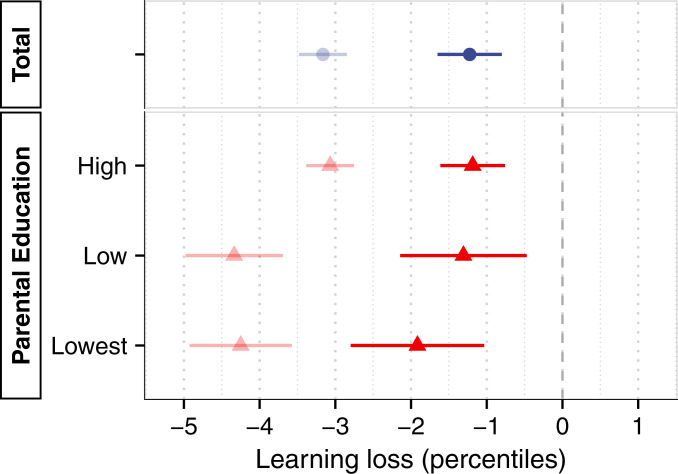
Using Dutch national assessments taken before and after an 8-week COVID-19 school closure, this study finds that primary students made little or no progress while learning from home. The Netherlands is a “best-case” setting, yet average learning loss was 3.16 percentile points (0.08 SD), with larger losses among students from disadvantaged homes.
Key findings
- In the baseline difference-in-differences estimate for a composite of math, spelling, and reading, students lost on average 3.16 percentile points, equivalent to 0.08 SD; raw differences ranged from −0.76 percentiles in spelling to −2.15 percentiles in math.
- Losses were concentrated among students from less-educated homes: the two lowest parental-education categories, together 8% of the population, suffered losses 40% larger than average (high, −3.07; low, −4.34; lowest, −4.25); within-family estimates showed a gap of 60% (high, −3.25; low, −4.67; lowest, −5.20).
- There was little evidence that effects differed by sex, school grade, subject, or prior performance, but school-level variation was considerable, with some schools seeing losses of 10 percentile points or more and others no losses or small gains.
- On a learning-readiness test not tied to curricular content, effects shrank by nearly two-thirds (main effect −1.19 vs. −3.16), suggesting most of the drop reflects knowledge learned; 3.16 percentiles translates to 7.9 to 10.5 weeks of lost learning depending on the benchmark.
Methods
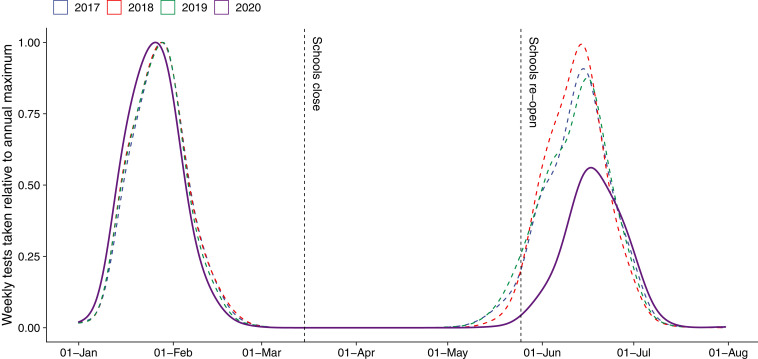
- Natural experiment/difference-in-differences design using biannual national standardized tests in The Netherlands from 2017 to 2020, covering 15% of Dutch primary schools (n ≈ 350,000) and students aged 8 to 11 years (grades 4 to 7); 2020 tests occurred just before and after 8 weeks of nationwide closures starting March 16.
- Main outcomes were math, spelling, reading, and a composite score, plus an oral reading fluency/learning-readiness test; scores were transformed to percentiles, with baseline models adjusting for a linear year trend and days between tests and clustering standard errors at the school level.
- Robustness included placebo analyses, year exclusions, loss-to-follow-up adjustments via regression, propensity-score and maximum-entropy weighting, school and family fixed effects, and a specification curve analysis of more than 2,000 alternative models.
Limitations
- The paper states that only time will tell whether students rebound, remain stable, or fall farther behind; test scores do not capture psychosocial development or societal and parental costs; and results may underestimate the full costs of school closures.
- The paper notes that The Netherlands is a best-case scenario due to short closures, high technological preparedness, and equitable school funding, making the estimates a likely lower bound; the short closure also gave little time to adapt, and remote learning might improve with time.
- The text makes evident that the sample covers 15% of primary schools, loss to follow-up is addressed but only a subset of students took tests after lockdown, and the within-family fixed-effects specification reduces the sample by approximately 60% and shifts it toward larger families.
Model-written summary. Check it against the paper before relying on it.
Integrity signals
Registry
Cites
Statistics
Figures
Verification
Claims the paper makes
23 Own result · 16 Own method · 12 Own interpretation · 10 No full text of the sources · 9 Sources not found · 4 Partly supported · 4 Not checked yet · 3 No basis given · 2 Supported so far · accuracy not yet measured
The cited sources support only part of this claim — read each source’s verdict below.
In the paper
“In their projections of learning loss due to the pandemic, the World Bank assumes a yearly progress of 0.40 SD (46).”
§ Learning loss due to school closures during the COVID-19 pandemic > Discussion
What the sources say
- Partly supportedcites [46] J. P. Azevedo, A. Hasan, D. Goldemberg, S. A. Iqbal, K. Geven (2020) Simulating the potential impacts of COVID-19 school closures on schooling and learning outcomes: A set of global estimates. World Bank Policy Research Working Paper (9284). https://openknowledge.worldbank.org/handle/10986/33945. Accessed 9 February 2021. sourceExperimental — accuracy not yet measured
The Empirical methodology (p. 15) says the projections assume learning gains of 0.2–0.5 SD from one grade to the next, depending on country income. Annex A.1 (p. 44) specifies 40 PISA points, equivalent to 0.40 SD, as the baseline for upper-middle-income countries—not as a universal yearly rate. (LLM, conf=0.90)
plain- Asserted: passes — The authors put it forward as true.
- Checkable: passes — It can be checked against evidence.
- Load-bearing: passes — The paper’s conclusions depend on it.
- Based: passes — The paper gives a reason why it holds.
- Partly supported
The cited sources support only part of this claim — read each source’s verdict below.
In the paper
“Our results show that learning loss was particularly pronounced for students from disadvantaged homes, confirming the fears held by many that school closures would cause socioeconomic gaps to widen (51 –55).”
§ Learning loss due to school closures during the COVID-19 pandemic > Discussion
What the sources say
- Supportedcites [51] E. A. Hanushek, L. Woessmann, The Economic Impacts of Learning Losses (Organisation for Economic Co-operation and Development OECD, 2020). source
The Summary of closure experiences says that school closures have widened gaps in skill development and warns that they may increase inequality. Section 4, “Distributional issues,” says the negative impact was greater for students from disadvantaged households. The citing authors’ claim about what their own results show is not attributed to this source. (LLM, conf=0.92)
- Supportedcites [52] F. Agostinelli, M. Doepke, G. Sorrenti, F. Zilibotti, When the Great Equalizer Shuts Down: Schools, Peers, and Parents in Pandemic Times (National Bureau of Economic Research, 2020). PMC8735857 35017763 source
The Conclusions state that the paper’s analysis finds higher educational inequality and that learning gaps grow during the pandemic. This supports the cited concern that school closures would widen socioeconomic gaps; the citing authors’ own learning-loss results are not attributed to this source. (LLM, conf=0.93)
- Partly supportedcites [53] A. Bacher-Hicks, J. Goodman, C. Mulhern, Inequality in household adaptation to schooling shocks: Covid-induced online learning engagement in real time. J. Publ. Econ. 193, 104345 (2020). PMC8486492 34629567 sourceExperimental — accuracy not yet measured
The Introduction reports that school closures widened socioeconomic gaps in searches for online learning resources. The Discussion says this pattern suggests academic gaps will be wider in future school years, but the paper does not establish that closures had already widened learning-loss gaps; its measured outcome is primarily search engagement. (LLM, conf=0.86)
- Supportedcites [54] Z. Parolin, E. K. Lee, Large socio-economic, geographic and demographic disparities exist in exposure to school closures. Nat. Hum. Beh., 10.1038/s41562-021-01087-8. (2021). PMC8060162 33737734 source
The Discussion says that disadvantaged students’ greater exposure to school closures and distance learning may exacerbate socio-economic gaps in learning outcomes. This supports the cited concern that closures could widen those gaps; the citing authors attribute the observed learning loss to their own results, not to this source. (LLM, conf=0.90)
- Supportedcites [55] D. H. Bailey, G. J. Duncan, R. J. Murnane, N. A. Yeung (2021) Achievement gaps in the wake of COVID-19 (EdWorkingPaper No. 21-346, Annenberg Institute at Brown University). https://www.edworkingpapers.com/ai21-346. Accessed 9 February 2021. source
The Discussion reports researchers’ prediction that COVID-19 would markedly increase achievement gaps between children from low- and higher-income families. The Abstract identifies these as forecasts, supporting the cited ‘fears’; the claim that results confirm them refers to the citing authors’ own results, not to this source. (LLM, conf=0.90)
boosteddirect- Asserted: passes — The authors put it forward as true.
- Checkable: passes — It can be checked against evidence.
- Load-bearing: passes — The paper’s conclusions depend on it.
- Based: passes — The paper gives a reason why it holds.
- Supported
The cited sources support only part of this claim — read each source’s verdict below.
In the paper
“Nevertheless, the magnitude of our findings appears to validate scenarios projected by bodies such as the European Commission (34) and the World Bank (46).”
§ Learning loss due to school closures during the COVID-19 pandemic > Discussion
What the sources say
- Not matchedcites [34] G. Di Pietro, F. Biagi, P. Costa, Z. Karpinski, J. Mazza, The Likely Impact of COVID-19 on Education: Reflections Based on the Existing Literature and Recent International Datasets (Publications Office of the European Union, 2020).
Couldn’t be matched to a paper in Crossref, so it can’t be checked.
- Supportedcites [46] J. P. Azevedo, A. Hasan, D. Goldemberg, S. A. Iqbal, K. Geven (2020) Simulating the potential impacts of COVID-19 school closures on schooling and learning outcomes: A set of global estimates. World Bank Policy Research Working Paper (9284). https://openknowledge.worldbank.org/handle/10986/33945. Accessed 9 February 2021. source
The citation to this paper is attached to the World Bank scenarios, not to the European Commission or the citing authors’ judgment that their findings validate them. The Conclusion (p. 35) presents optimistic, intermediate, and pessimistic global scenarios for the effects of COVID-19 school closures on schooling and learning. (LLM, conf=0.91)
hedgedcorrelational- Asserted: passes — The authors put it forward as true.
- Checkable: passes — It can be checked against evidence.
- Load-bearing: unclear — It is unclear whether the paper’s conclusions depend on it.
- Based: passes — The paper gives a reason why it holds.
- Not matched
The sources with a verdict support this claim; the rest weren’t checked yet, have no full text we could read, or their verdicts aren’t rated yet.
In the paper
“Moreover, we match treatment and control groups on a wider range of individual- and school-level characteristics using reweighting on the propensity of treatment (68) and maximum-entropy balancing (69).”
§ Learning loss due to school closures during the COVID-19 pandemic > Materials and Methods > Propensity Score and Entropy Weighting.
What the sources say
- Supportedcites [68] G. W. Imbens, J. M. Wooldridge, Recent developments in the econometrics of program evaluation. J. Econ. Lit. 47, 5– 86 (2009). source
Section 5.4 explains that adjusting for the propensity score accounts for differences in covariates between treated and control units. Section 5.6 describes weighting observations by their propensity of treatment or non-treatment. Citation (68) supports the propensity-reweighting method; the sentence cites a different source for maximum-entropy balancing. (LLM, conf=0.88)
- Not checked — no full text of the sourcecites [69] J. Hainmueller, Entropy balancing for causal effects: A multivariate reweighting method to produce balanced samples in observational studies. Polit. Anal., 20, 25– 46 (2012). source
plaincorrelational- Asserted: passes — The authors put it forward as true.
- Checkable: passes — It can be checked against evidence.
- Load-bearing: passes — The paper’s conclusions depend on it.
- Based: passes — The paper gives a reason why it holds.
- Supported
A result the paper reports from its own data — it cites no other source for it, so there is none to check. The quote shows it is in the paper.
In the paper
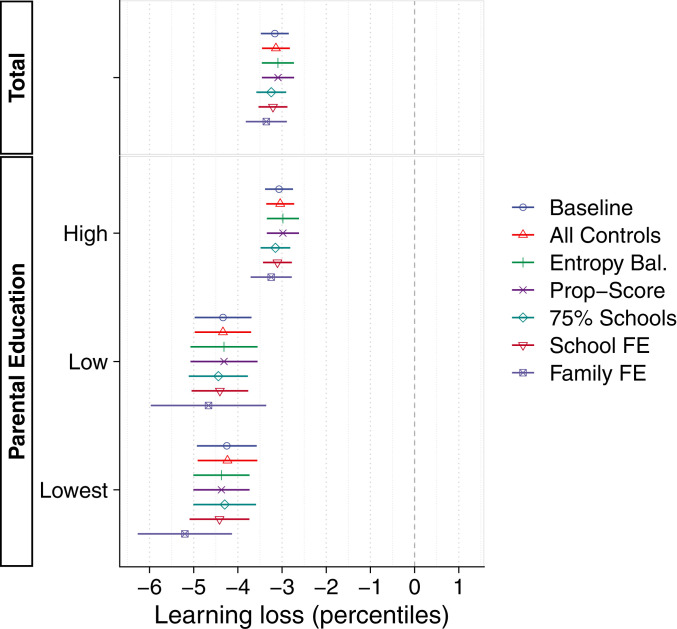
“The largest gap in effect sizes between educational backgrounds is found in our within-family analysis, estimated at 60% (parental education: high, −3.25; low, −4.67; lowest, −5.20).”
§ Learning loss due to school closures during the COVID-19 pandemic > Results > Adjusting for Loss to Follow-up.
hedgedcorrelational- Asserted: passes — The authors put it forward as true.
- Checkable: passes — It can be checked against evidence.
- Load-bearing: unclear — It is unclear whether the paper’s conclusions depend on it.
- Based: passes — The paper gives a reason why it holds.
A result the paper reports from its own data — it cites no other source for it, so there is none to check. The quote shows it is in the paper.
In the paper
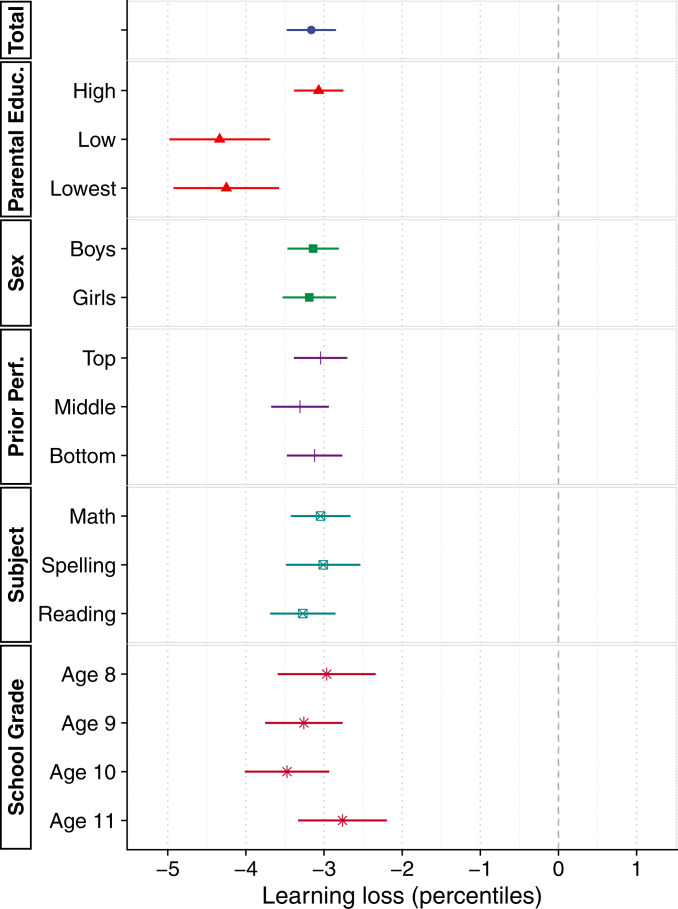
“Those in the two lowest categories of parental education—together accounting for 8% of the population ( SI Appendix, section 5.1)—suffered losses 40% larger than the average student (estimates by parental education: high, −3.07; low, −4.34; lowest, −4.25).”
§ Learning loss due to school closures during the COVID-19 pandemic > Results > Baseline Specification.
plaincorrelational- Asserted: passes — The authors put it forward as true.
- Checkable: passes — It can be checked against evidence.
- Load-bearing: passes — The paper’s conclusions depend on it.
- Based: passes — The paper gives a reason why it holds.
A result the paper reports from its own data — it cites no other source for it, so there is none to check. The quote shows it is in the paper.
In the paper
“Disregarding the trend and instead assuming a counterfactual where achievement had stayed flat between 2019 and 2020, the estimated treatment effect shrinks by 21% to −2.51 percentiles ( SI Appendix, section 7.11).”
§ Learning loss due to school closures during the COVID-19 pandemic > Results > Specification Curve Analysis.
hedgeddirect- Asserted: passes — The authors put it forward as true.
- Checkable: passes — It can be checked against evidence.
- Load-bearing: passes — The paper’s conclusions depend on it.
- Based: passes — The paper gives a reason why it holds.
A result the paper reports from its own data — it cites no other source for it, so there is none to check. The quote shows it is in the paper.
In the paper
“In contrast, we find little evidence that the effect differs by sex, school grade, subject, or prior performance.”
§ Learning loss due to school closures during the COVID-19 pandemic > Results > Baseline Specification.
hedged- Asserted: passes — The authors put it forward as true.
- Checkable: passes — It can be checked against evidence.
- Load-bearing: unclear — It is unclear whether the paper’s conclusions depend on it.
- Based: passes — The paper gives a reason why it holds.
A result the paper reports from its own data — it cites no other source for it, so there is none to check. The quote shows it is in the paper.
In the paper
“The placebo estimate closest to zero is found in the version of our preferred specification that includes family fixed effects.”
§ Learning loss due to school closures during the COVID-19 pandemic > Results > Specification Curve Analysis.
plain- Asserted: passes — The authors put it forward as true.
- Checkable: passes — It can be checked against evidence.
- Load-bearing: unclear — It is unclear whether the paper’s conclusions depend on it.
- Based: passes — The paper gives a reason why it holds.
A result the paper reports from its own data — it cites no other source for it, so there is none to check. The quote shows it is in the paper.
In the paper
“Therefore, adjusting for these covariates makes little difference to our results ( SI Appendix, section 7.1).”
§ Learning loss due to school closures during the COVID-19 pandemic > Results > Adjusting for Loss to Follow-up.
plain- Asserted: passes — The authors put it forward as true.
- Checkable: passes — It can be checked against evidence.
- Load-bearing: unclear — It is unclear whether the paper’s conclusions depend on it.
- Based: passes — The paper gives a reason why it holds.
- Probably not a substantial claim. 19
- It may state two separate claims as one. 30
- The quote only partly states this claim. 1
The sources with a verdict support this claim; the rest weren’t checked yet, have no full text we could read, or their verdicts aren’t rated yet.
In the paper
“Dynamic models of learning stress how small losses can accumulate into large disadvantages with time (56 –58).”
§ Learning loss due to school closures during the COVID-19 pandemic > Discussion
What the sources say
- Not checked — no full text of the sourcecites [56] T. A. DiPrete, G. M. Eirich, Cumulative advantage as a mechanism for inequality: A review of theoretical and empirical developments. Annu. Rev. Sociol. 32, 271– 297 (2006). source
- Supportedcites [57] M. Kaffenberger, Modelling the long-run learning impact of the Covid-19 learning shock: Actions to (more than) mitigate loss. Int. J. Educ. Dev. 81, 102326 (2021). 33716394 PMC7923185 source
The Introduction reports that the model projects a one-third reduction in grade 3 learning to become a full-year deficit by grade 10, and a one-half reduction to become a 1.5-year deficit. These projections support the claim that an initial learning loss can lead to a larger disadvantage over time. (LLM, conf=0.92)
- Supportedcites [58] N. Fuchs-Schündeln, D. Krueger, A. Ludwig, I. Popova, The Long-Term Distributional and Welfare Effects of COVID-19 School Closures (National Bureau of Economic Research, 2020). source
The Introduction (page unavailable) explains that an initial shortfall in children’s human capital reduces the productivity of later investments, leading to less investment and worse educational and earnings outcomes. Section 4.1.1 (page unavailable) likewise says that reduced accumulation at younger ages translates into lower human capital and investment in the future. (LLM, conf=0.90)
plaindirect- Asserted: passes — The authors put it forward as true.
- Checkable: passes — It can be checked against evidence.
- Load-bearing: fails — The paper’s conclusions may not depend on it.
- Based: passes — The paper gives a reason why it holds.
Probably not a substantial claim. The paper’s conclusions may not depend on it.
The cited sources support only part of this claim — read each source’s verdict below.
In the paper
“Test scores do not consider children’s psychosocial development (63, 64), either societal costs due to productivity decline or heightened pressure among parents (65, 66).”
§ Learning loss due to school closures during the COVID-19 pandemic > Discussion
What the sources say
- Partly supportedcites [63] A. Gassman-Pines, C. M. Gibson-Davis, E. O. Ananat, How economic downturns affect children’s development: An interdisciplinary perspective on pathways of influence. Child Dev. Perspect. 9, 233– 238 (2015). 31327980 PMC6641565 sourceExperimental — accuracy not yet measured
The section on economic and psychological effects on continuously employed individuals reports increased financial and psychological stress within families and greater parental distress during downturns, supporting the point about pressure on parents. The paper also discusses children’s emotional well-being separately from test scores, but it does not say that test scores omit societal costs from declining productivity or explicitly assess what test scores capture. No page number was available in our copy. (LLM, conf=0.82)
- Could not verifycites [64] L. Shanahan, Emotional distress in young adults during the COVID-19 pandemic: Evidence of risk and resilience from a longitudinal cohort study. Psychol. Med., 10.1017/S003329172000241X (2020). PMC7338432 32571438 sourceExperimental — accuracy not yet measured
The Methods (Measures; page unavailable) assess economic and lifestyle disruptions among young adults, and the Discussion (page unavailable) links those disruptions to emotional distress. Neither passage addresses what test scores omit, societal costs from declining productivity, or heightened pressure on parents. Searches for those specific points found no supporting passage in our copy. (LLM, conf=0.73)
- Partly supportedcites [65] C. Collins, L. C. Landivar, L. Ruppanner, W. J. Scarborough, COVID-19 and the gender gap in work hours. Gender Work. Organ. 28, 101– 12. (2020). PMC7361447 32837019 sourceExperimental — accuracy not yet measured
The Introduction describes acute time and financial pressures on working parents, and the Results (section 4.1; page unavailable) report that mothers reduced paid work hours amid childcare and homeschooling demands. These passages support heightened parental pressure and reduced work time, but the paper does not assess test scores or establish societal costs from a decline in productivity. (LLM, conf=0.84)
- Partly supportedcites [66] P. Biroli (2020) “ Family life in lockdown” (IZA Discussion Paper 13398, Institute of Labor Economics, Bonn, Germany). sourceExperimental — accuracy not yet measured
The Results section (Family Cooperation and Tensions; page unavailable) reports increased household tension associated with changes in childcare and other household tasks during lockdown, supporting the point about pressure on parents. The paper does not establish societal costs from declining productivity or state that test scores omit these effects. (LLM, conf=0.82)
plain- Asserted: passes — The authors put it forward as true.
- Checkable: passes — It can be checked against evidence.
- Load-bearing: unclear — It is unclear whether the paper’s conclusions depend on it.
- Based: passes — The paper gives a reason why it holds.
It may state two separate claims as one.
- Partly supported
A result the paper reports from its own data — it cites no other source for it, so there is none to check. The quote shows it is in the paper.
In the paper
“Doing so identifies the control for pretreatment trends as the most influential, followed by the control for test timing and the inclusion of school and family fixed effects.”
§ Learning loss due to school closures during the COVID-19 pandemic > Results > Specification Curve Analysis.
plaindirect- Asserted: passes — The authors put it forward as true.
- Checkable: passes — It can be checked against evidence.
- Load-bearing: passes — The paper’s conclusions depend on it.
- Based: passes — The paper gives a reason why it holds.
It may state two separate claims as one.
A result the paper reports from its own data — it cites no other source for it, so there is none to check. The quote shows it is in the paper.
In the paper
“However, the fixed-effects specification shifts the sample toward larger families, and effects in this subsample are similar using our baseline specification ( SI Appendix, section 7.7).”
§ Learning loss due to school closures during the COVID-19 pandemic > Results > Adjusting for Loss to Follow-up.
plaincorrelational- Asserted: passes — The authors put it forward as true.
- Checkable: passes — It can be checked against evidence.
- Load-bearing: unclear — It is unclear whether the paper’s conclusions depend on it.
- Based: passes — The paper gives a reason why it holds.
It may state two separate claims as one.
A result the paper reports from its own data — it cites no other source for it, so there is none to check. The quote shows it is in the paper.
In the paper
“Excluding adjustment for testing date decreases the effect size by 12%, while including fixed effects increases it by 1.6% (school level) or 6.3% (family level).”
§ Learning loss due to school closures during the COVID-19 pandemic > Results > Specification Curve Analysis.
plaindirect- Asserted: passes — The authors put it forward as true.
- Checkable: passes — It can be checked against evidence.
- Load-bearing: unclear — It is unclear whether the paper’s conclusions depend on it.
- Based: passes — The paper gives a reason why it holds.
It may state two separate claims as one.
A result the paper reports from its own data — it cites no other source for it, so there is none to check. The quote shows it is in the paper.
In the paper
“We validate these benchmarks in our data by exploiting variation in testing dates during comparison years and show that test scores improve by 0.30 to 0.40 percentiles per week, equivalent to 0.31 to 0.41 SD annually ( SI Appendix, section 4.3).”
§ Learning loss due to school closures during the COVID-19 pandemic > Discussion
plaincorrelational- Asserted: passes — The authors put it forward as true.
- Checkable: passes — It can be checked against evidence.
- Load-bearing: passes — The paper’s conclusions depend on it.
- Based: passes — The paper gives a reason why it holds.
It may state two separate claims as one.
A result the paper reports from its own data — it cites no other source for it, so there is none to check. The quote shows it is in the paper.
In the paper
“Students lost on average 3.16 percentile points in the national distribution, equivalent to 0.08 standard deviations (SD) ( SI Appendix, section 4.3).”
§ Learning loss due to school closures during the COVID-19 pandemic > Results > Baseline Specification.
plaindirect- Asserted: passes — The authors put it forward as true.
- Checkable: passes — It can be checked against evidence.
- Load-bearing: passes — The paper’s conclusions depend on it.
- Based: passes — The paper gives a reason why it holds.
It may state two separate claims as one.
A result the paper reports from its own data — it cites no other source for it, so there is none to check. The quote shows it is in the paper.
In the paper
“In SI Appendix, Table S3, we show that the treatment sample is not skewed on sex, parental education, or prior performance.”
§ Learning loss due to school closures during the COVID-19 pandemic > Results > Adjusting for Loss to Follow-up.
plain- Asserted: passes — The authors put it forward as true.
- Checkable: passes — It can be checked against evidence.
- Load-bearing: passes — The paper’s conclusions depend on it.
- Based: passes — The paper gives a reason why it holds.
It may state two separate claims as one.
A result the paper reports from its own data — it cites no other source for it, so there is none to check. The quote shows it is in the paper.
In the paper
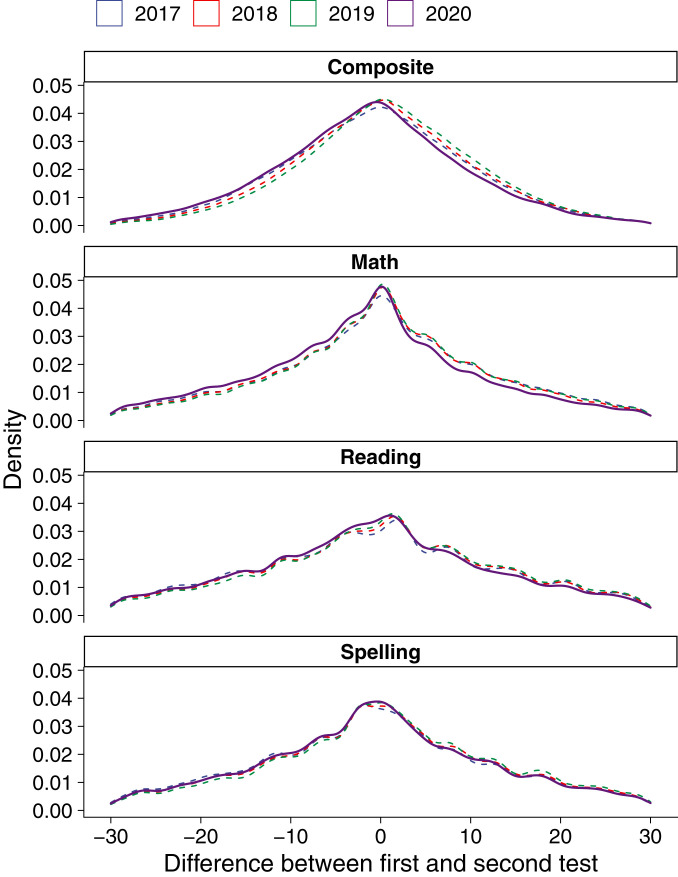
“This graph reveals a raw difference ranging from −0.76 percentiles in spelling to −2.15 percentiles in math.”
§ Learning loss due to school closures during the COVID-19 pandemic > Results
plain- Asserted: passes — The authors put it forward as true.
- Checkable: passes — It can be checked against evidence.
- Load-bearing: unclear — It is unclear whether the paper’s conclusions depend on it.
- Based: passes — The paper gives a reason why it holds.
The quote only partly states this claim.
A result the paper reports from its own data — it cites no other source for it, so there is none to check. The quote shows it is in the paper.
In the paper
“These losses are evident throughout the age range we study and across all of the three subject areas: math, spelling, and reading.”
§ Learning loss due to school closures during the COVID-19 pandemic > Discussion
plaincorrelational- Asserted: passes — The authors put it forward as true.
- Checkable: passes — It can be checked against evidence.
- Load-bearing: passes — The paper’s conclusions depend on it.
- Based: passes — The paper gives a reason why it holds.
It may state two separate claims as one.
A result the paper reports from its own data — it cites no other source for it, so there is none to check. The quote shows it is in the paper.
In the paper
“We also reestimate our main specification dropping comparison years one at a time ( SI Appendix, section 7.3). These results are estimated with less precision but otherwise in line with those of our main analysis.”
§ Learning loss due to school closures during the COVID-19 pandemic > Results > Placebo Analysis and Year Exclusions.
plain- Asserted: passes — The authors put it forward as true.
- Checkable: passes — It can be checked against evidence.
- Load-bearing: unclear — It is unclear whether the paper’s conclusions depend on it.
- Based: passes — The paper gives a reason why it holds.
It may state two separate claims as one.
The paper states this without a source or data behind it here, so there is nothing to check it against. The quote shows it is in the paper.
In the paper
“Our estimated treatment effect translates into 3.16/35 = 0.09 percentiles or 0.002 SD per school day and is thus on the lower end of that range.*”
§ Learning loss due to school closures during the COVID-19 pandemic > Discussion
plaindirect- Asserted: passes — The authors put it forward as true.
- Checkable: passes — It can be checked against evidence.
- Load-bearing: unclear — It is unclear whether the paper’s conclusions depend on it.
- Based: passes — The paper gives a reason why it holds.
It may state two separate claims as one.
In the paper
“These groups make up, respectively, 92, 4, and 4% of the student body and our sample ( SI Appendix, section 5.1).”
§ Learning loss due to school closures during the COVID-19 pandemic > Materials and Methods > Parental Education.
What the sources say
- Not matchedcites SI Appendix, section 5.1
Couldn’t be matched to a paper in Crossref, so it can’t be checked.
plain- Asserted: passes — The authors put it forward as true.
- Checkable: passes — It can be checked against evidence.
- Load-bearing: fails — The paper’s conclusions may not depend on it.
- Based: passes — The paper gives a reason why it holds.
Probably not a substantial claim. The paper’s conclusions may not depend on it. It may state two separate claims as one.
- Not matched
In the paper
“This literature reports reductions in achievement ranging from 0.001 to 0.010 SD per school day lost (10).”
§ Learning loss due to school closures during the COVID-19 pandemic > Discussion
What the sources say
- Not checked — no full text of the sourcecites [10] M. Kuhfeld, Projecting the potential impacts of COVID-19 school closures on academic achievement. Educ. Res. 49, 549– 565 (2020). source
plaindirect- Asserted: passes — The authors put it forward as true.
- Checkable: passes — It can be checked against evidence.
- Load-bearing: passes — The paper’s conclusions depend on it.
- Based: passes — The paper gives a reason why it holds.
Probably not a substantial claim.
A conclusion the paper draws from its own results — it cites no other source for it, so there is none to check. The quote shows it is in the paper.
In the paper
“Using the smaller benchmark, learning loss exceeds the period of school closures (3.16/0.30 = 10.5 wk), implying that students regressed during this time.”
§ Learning loss due to school closures during the COVID-19 pandemic > Discussion
plaindirect- Asserted: passes — The authors put it forward as true.
- Checkable: passes — It can be checked against evidence.
- Load-bearing: unclear — It is unclear whether the paper’s conclusions depend on it.
- Based: passes — The paper gives a reason why it holds.
It may state two separate claims as one.
A conclusion the paper draws from its own results — it cites no other source for it, so there is none to check. The quote shows it is in the paper.
In the paper
“Using the larger benchmark, a treatment effect of 3.16 percentiles would translate into 3.16/0.40 = 7.9 wk of lost learning—nearly exactly the same period that schools in The Netherlands remained closed.”
§ Learning loss due to school closures during the COVID-19 pandemic > Discussion
hedgeddirect- Asserted: passes — The authors put it forward as true.
- Checkable: passes — It can be checked against evidence.
- Load-bearing: unclear — It is unclear whether the paper’s conclusions depend on it.
- Based: passes — The paper gives a reason why it holds.
It may state two separate claims as one.
A conclusion the paper draws from its own results — it cites no other source for it, so there is none to check. The quote shows it is in the paper.
In the paper
“However, failure to adjust for pretreatment trends generates placebo estimates that are biased in a positive direction and is thus likely to underestimate treatment effects.”
§ Learning loss due to school closures during the COVID-19 pandemic > Results > Specification Curve Analysis.
hedgeddirect- Asserted: passes — The authors put it forward as true.
- Checkable: passes — It can be checked against evidence.
- Load-bearing: passes — The paper’s conclusions depend on it.
- Based: passes — The paper gives a reason why it holds.
It may state two separate claims as one.
What the paper did — it cites no source for this, so there is none to check. The quote shows it is in the paper.
In the paper
“Hypotheses and analysis protocols for this study were preregistered ( SI Appendix, section 4.1).”
§ Learning loss due to school closures during the COVID-19 pandemic > Study Setting
plain- Asserted: passes — The authors put it forward as true.
- Checkable: passes — It can be checked against evidence.
- Load-bearing: fails — The paper’s conclusions may not depend on it.
- Based: passes — The paper gives a reason why it holds.
Probably not a substantial claim. The paper’s conclusions may not depend on it.
None of the sources cited for this claim have been checked yet.
In the paper
“The Netherlands is interesting as a “best-case” scenario, with a short lockdown, equitable school funding, and world-leading rates of broadband access.”
- Also stated in: § Study Setting · hedged
“For these reasons, The Netherlands presents a “best-case” scenario, providing a likely lower bound on learning loss elsewhere in Europe and the world.”
§ Learning loss due to school closures during the COVID-19 pandemic > Abstract
What the sources say
- Not matchedcites [30] H. A. Patrinos, “ School choice in the Netherlands” (CESifo DICE Report 2/2011, ifo Institute for Economic Research, Munich, Germany, 2011).
Couldn’t be matched to a paper in Crossref, so it can’t be checked.
- Not checked — no full text of the sourcecites [31] H. F. Ladd, E. B. Fiske, Weighted student funding in The Netherlands: A model for the US? J. Pol. Anal. Manag. 30, 470– 498 (2011). source
- Not matchedcites [33] Statistics Netherlands (CBS), The Netherlands leads Europe in internet access. https://www.cbs.nl/en-gb/news/2018/05/the-Netherlands-leads-europe-in-internet-access. Accessed 9 February 2021.
Couldn’t be matched to a paper in Crossref, so it can’t be checked.
- Not matchedcites [34] G. Di Pietro, F. Biagi, P. Costa, Z. Karpinski, J. Mazza, The Likely Impact of COVID-19 on Education: Reflections Based on the Existing Literature and Recent International Datasets (Publications Office of the European Union, 2020).
Couldn’t be matched to a paper in Crossref, so it can’t be checked.
- Not matchedcites [36] Johns Hopkins Coronavirus Resource Center, COVID-19 case tracker. https://coronavirus.jhu.edu/data. Accessed 9 February 2021.
Couldn’t be matched to a paper in Crossref, so it can’t be checked.
- Not matchedcites [37] P. Tullis, Dutch cooperation made an ‘intelligent lockdown’ a success. Bloomberg Businessweek (4 June 2020).
Couldn’t be matched to a paper in Crossref, so it can’t be checked.
plaincorrelational- Asserted: passes — The authors put it forward as true.
- Checkable: passes — It can be checked against evidence.
- Load-bearing: passes — The paper’s conclusions depend on it.
- Based: passes — The paper gives a reason why it holds.
It may state two separate claims as one.
- Also stated in: § Study Setting · hedged
A conclusion the paper draws from its own results — it cites no other source for it, so there is none to check. The quote shows it is in the paper.
In the paper
“which would indicate that remote learning operated at 50% efficiency.”
§ Learning loss due to school closures during the COVID-19 pandemic > Discussion
hedgeddirect- Asserted: passes — The authors put it forward as true.
- Checkable: passes — It can be checked against evidence.
- Load-bearing: fails — The paper’s conclusions may not depend on it.
- Based: passes — The paper gives a reason why it holds.
Probably not a substantial claim. The paper’s conclusions may not depend on it.
What the paper did — it cites no source for this, so there is none to check. The quote shows it is in the paper.
In the paper
“In our baseline specification, we adjust for a linear trend in year and the time elapsed between testing dates and cluster standard errors at the school level.”
§ Learning loss due to school closures during the COVID-19 pandemic > Results
plain- Asserted: passes — The authors put it forward as true.
- Checkable: passes — It can be checked against evidence.
- Load-bearing: passes — The paper’s conclusions depend on it.
- Based: passes — The paper gives a reason why it holds.
Probably not a substantial claim. It may state two separate claims as one.
What the paper did — it cites no source for this, so there is none to check. The quote shows it is in the paper.
In the paper
“Moreover, we restrict analysis to schools where at least 75% of students took their tests after lockdown ( SI Appendix, section 7.5).”
§ Learning loss due to school closures during the COVID-19 pandemic > Results > Adjusting for Loss to Follow-up.
plain- Asserted: passes — The authors put it forward as true.
- Checkable: passes — It can be checked against evidence.
- Load-bearing: fails — The paper’s conclusions may not depend on it.
- Based: passes — The paper gives a reason why it holds.
Probably not a substantial claim. The paper’s conclusions may not depend on it.
A claim is checked only against the cited paper’s full text, never its abstract, and none is available for its sources.
In the paper
“Although early influential studies also found that summer is a time when socioeconomic learning gaps widen, this finding has failed to replicate in more recent studies (8, 9) or in European samples (48, 49).”
§ Learning loss due to school closures during the COVID-19 pandemic > Discussion
What the sources say
- Not checked — no full text of the sourcecites [8] P. T. von Hippel, C. Hamrock, Do test score gaps grow before, during, or between the school years?: Measurement artifacts and what we can know in spite of them. Soc. Sci. 6, 43 (2019). source
- Not checked — no full text of the sourcecites [9] M. Kuhfeld, Surprising new evidence on summer learning loss. Phi Delta Kappan 101, 25– 29 (2019). source
- Not checked — no full text of the sourcecites [48] P. Verachtert, J. Van Damme, P. Onghena, P. Ghesquière, A seasonal perspective on school effectiveness: Evidence from a Flemish longitudinal study in kindergarten and first grade. Sch. Effect. Sch. Improv. 20, 215– 233 (2009). source
- Not checked — no full text of the sourcecites [49] F. Meyer, K. Meissel, S. McNaughton, Patterns of literacy learning in German primary schools over the summer and the influence of home literacy practices. J. Res. Read. 40, 233– 253 (2017). source
plain- Asserted: passes — The authors put it forward as true.
- Checkable: passes — It can be checked against evidence.
- Load-bearing: unclear — It is unclear whether the paper’s conclusions depend on it.
- Based: passes — The paper gives a reason why it holds.
It may state two separate claims as one.
What the paper did — it cites no source for this, so there is none to check. The quote shows it is in the paper.
In the paper
“Our study represents one of the first attempts to quantify learning loss from COVID-19 using externally validated tests, a representative sample, and techniques that allow for causal inference.”
§ Learning loss due to school closures during the COVID-19 pandemic > Abstract
plain- Asserted: passes — The authors put it forward as true.
- Checkable: passes — It can be checked against evidence.
- Load-bearing: passes — The paper’s conclusions depend on it.
- Based: passes — The paper gives a reason why it holds.
It may state two separate claims as one.
In the paper
“The country is close to the Organization for Economic Cooperation and Development (OECD) average in school spending and reading performance, but among its top performers in math (32).”
§ Learning loss due to school closures during the COVID-19 pandemic > Study Setting
What the sources say
- Not matchedcites [32] A. Schleicher, PISA 2018: Insights and Interpretations (OECD Publishing, 2018).
Couldn’t be matched to a paper in Crossref, so it can’t be checked.
plain- Asserted: passes — The authors put it forward as true.
- Checkable: passes — It can be checked against evidence.
- Load-bearing: passes — The paper’s conclusions depend on it.
- Based: passes — The paper gives a reason why it holds.
It may state two separate claims as one.
- Not matched
A conclusion the paper draws from its own results — it cites no other source for it, so there is none to check. The quote shows it is in the paper.
In the paper
“The short duration of school closures gave students, educators, and parents little time to adapt.”
§ Learning loss due to school closures during the COVID-19 pandemic > Discussion
plaindirect- Asserted: passes — The authors put it forward as true.
- Checkable: passes — It can be checked against evidence.
- Load-bearing: fails — The paper’s conclusions may not depend on it.
- Based: passes — The paper gives a reason why it holds.
Probably not a substantial claim. The paper’s conclusions may not depend on it.
In the paper
“To identify the model components that exert the most influence on the magnitude of estimates we assessed more than 2,000 alternative models in a specification curve analysis (44) ( SI Appendix, section 7.13).”
§ Learning loss due to school closures during the COVID-19 pandemic > Results > Specification Curve Analysis.
What the sources say
- Not checked — no full text of the sourcecites [44] U. Simonsohn, J. P. Simmons, L. D. Nelson, Specification curve analysis. Nat. Hum. Behav. 4, 1208– 1214 (2020). 32719546 source
plain- Asserted: passes — The authors put it forward as true.
- Checkable: passes — It can be checked against evidence.
- Load-bearing: passes — The paper’s conclusions depend on it.
- Based: passes — The paper gives a reason why it holds.
Probably not a substantial claim.
A claim is checked only against the cited paper’s full text, never its abstract, and none is available for its sources.
In the paper
“Despite favorable conditions, survey evidence from lockdown indicates high levels of dissatisfaction with remote learning (38) and considerable disparities in help with schoolwork and learning resources (39).”
§ Learning loss due to school closures during the COVID-19 pandemic > Study Setting
What the sources say
- Not checked — no full text of the sourcecites [38] M. de Haas, R. Faber, M. Hamersma, How COVID-19 and the Dutch ‘intelligent lockdown’ changed activities, work and travel behaviour: Evidence from longitudinal data in the Netherlands. Transport. Res. Interdisciplinary Perspect. 6. 100150 (2020). PMC7284275 34171019 source
- Not checked — no full text of the sourcecites [39] T Bol, Inequality in homeschooling during the corona crisis in the Netherlands. First results from the LISS Panel. SocArXiv [Preprint] (2020). 10.31235/osf.io/hf32q (Accessed 9 February 2021). source
hedged- Asserted: passes — The authors put it forward as true.
- Checkable: passes — It can be checked against evidence.
- Load-bearing: passes — The paper’s conclusions depend on it.
- Based: passes — The paper gives a reason why it holds.
It may state two separate claims as one.
A conclusion the paper draws from its own results — it cites no other source for it, so there is none to check. The quote shows it is in the paper.
In the paper
“The high degree of school autonomy in The Netherlands is also likely to have created considerable variation in the pandemic response, possibly explaining the wide school-level variation in estimated learning loss ( SI Appendix, section 7.9).”
§ Learning loss due to school closures during the COVID-19 pandemic > Discussion
hedgedconditional- Asserted: passes — The authors put it forward as true.
- Checkable: passes — It can be checked against evidence.
- Load-bearing: unclear — It is unclear whether the paper’s conclusions depend on it.
- Based: passes — The paper gives a reason why it holds.
It may state two separate claims as one.
What the paper did — it cites no source for this, so there is none to check. The quote shows it is in the paper.
In the paper
“Our difference-in-differences design discards those students who did not take the tests, which might lead to bias if their performance trajectories differ from those we observe.”
§ Learning loss due to school closures during the COVID-19 pandemic > Results > Adjusting for Loss to Follow-up.
hedgedconditional- Asserted: passes — The authors put it forward as true.
- Checkable: passes — It can be checked against evidence.
- Load-bearing: passes — The paper’s conclusions depend on it.
- Based: passes — The paper gives a reason why it holds.
Probably not a substantial claim. It may state two separate claims as one.
In the paper
“Early estimates suggest that grades 3 to 8 students more than 6 mo into the pandemic underperformed by 7.5 percentile points in math but saw no loss in reading achievement (28).”
§ Learning loss due to school closures during the COVID-19 pandemic > Discussion
What the sources say
- Not matchedcites [28] M. Kuhfeld, B. Tarasawa, A. Johnson, E. Ruzek, K. Lewis, “ Learning during COVID-19: Initial findings on students’ reading and math achievement and growth” (NWEA Brief, Portland, OR, 2020).
Couldn’t be matched to a paper in Crossref, so it can’t be checked.
hedged- Asserted: passes — The authors put it forward as true.
- Checkable: passes — It can be checked against evidence.
- Load-bearing: unclear — It is unclear whether the paper’s conclusions depend on it.
- Based: passes — The paper gives a reason why it holds.
It may state two separate claims as one.
- Not matched
What the paper did — it cites no source for this, so there is none to check. The quote shows it is in the paper.
In the paper
“We do so using a difference-in-differences design ( SI Appendix, section 4.2) and address loss to follow-up using various techniques: regression adjustment, rebalancing on propensity scores and maximum-entropy weights, and fixed-effects designs that compare students within the same schools and families.”
§ Learning loss due to school closures during the COVID-19 pandemic > Study Setting
plain- Asserted: passes — The authors put it forward as true.
- Checkable: passes — It can be checked against evidence.
- Load-bearing: passes — The paper’s conclusions depend on it.
- Based: passes — The paper gives a reason why it holds.
Probably not a substantial claim. It may state two separate claims as one.
The paper states this without a source or data behind it here, so there is nothing to check it against. The quote shows it is in the paper.
In the paper
“Following school reopenings, tests were taken in person under normal conditions and with minimal social distancing.”
§ Learning loss due to school closures during the COVID-19 pandemic > Results > Knowledge Learned vs. Transitory Influences.
plain- Asserted: passes — The authors put it forward as true.
- Checkable: passes — It can be checked against evidence.
- Load-bearing: passes — The paper’s conclusions depend on it.
- Based: passes — The paper gives a reason why it holds.
Probably not a substantial claim.
A claim is checked only against the cited paper’s full text, never its abstract, and none is available for its sources.
In the paper
“Studies of school days lost due to other causes are mixed—some find durable effects and spillovers to adult earnings (59, 60), while others report a fadeout of effects over time (61, 62).”
§ Learning loss due to school closures during the COVID-19 pandemic > Discussion
What the sources say
- Not checked — no full text of the sourcecites [59] A. Ichino, R. Winter-Ebmer, The long-run educational cost of World War II. J. Labor Econ. 22, 57– 87 (2004). source
- Not checked — no full text of the sourcecites [60] D. Jaume, A. Willén, The long-run effects of teacher strikes: Evidence from Argentina. J. Labor Econ. 37, 1097– 1139 (2019). source
- Not checked — no full text of the sourcecites [61] S. Cattan, D. Kamhöfer, M. Karlsson, T. Nilsson “ The short- and long-term effects of student absence: Evidence from Sweden” (IZA Discussion Paper 10995, Institute of Labor Economics, Bonn, Germany, 2017). source
- Not checked — no full text of the sourcecites [62] B. Sacerdote, When the saints go marching out: Long-term outcomes for student evacuees from hurricanes Katrina and Rita. Am. Econ. J. Appl. Econ. 4, 109– 135 (2012). source
plaincorrelational- Asserted: passes — The authors put it forward as true.
- Checkable: passes — It can be checked against evidence.
- Load-bearing: unclear — It is unclear whether the paper’s conclusions depend on it.
- Based: passes — The paper gives a reason why it holds.
It may state two separate claims as one.
None of the sources cited for this claim could be matched to a paper in Crossref, so there is nothing to check it against.
In the paper
“School closures were short in comparative perspective ( SI Appendix, section 1), and the first wave of the pandemic had less of an impact than in other European countries (36, 37).”
§ Learning loss due to school closures during the COVID-19 pandemic > Study Setting
What the sources say
- Not matchedcites [36] Johns Hopkins Coronavirus Resource Center, COVID-19 case tracker. https://coronavirus.jhu.edu/data. Accessed 9 February 2021.
Couldn’t be matched to a paper in Crossref, so it can’t be checked.
- Not matchedcites [37] P. Tullis, Dutch cooperation made an ‘intelligent lockdown’ a success. Bloomberg Businessweek (4 June 2020).
Couldn’t be matched to a paper in Crossref, so it can’t be checked.
plain- Asserted: passes — The authors put it forward as true.
- Checkable: passes — It can be checked against evidence.
- Load-bearing: passes — The paper’s conclusions depend on it.
- Based: passes — The paper gives a reason why it holds.
It may state two separate claims as one.
- Not matched
A claim is checked only against the cited paper’s full text, never its abstract, and none is available for its sources.
In the paper
“Social distancing measures may have altered factors such as seating arrangements or indoor climate that in turn can influence student performance (41 –43).”
§ Learning loss due to school closures during the COVID-19 pandemic > Results > Knowledge Learned vs. Transitory Influences.
What the sources say
- Not checked — no full text of the sourcecites [41] M. J. Mendell, G. A. Heath, Do indoor pollutants and thermal conditions in schools influence student performance?: A critical review of the literature. Indoor Air 15, 27– 52 (2005). 15660567 source
- Not checked — no full text of the sourcecites [42] P. D. Marshall, M. Losonczy-Marshall, Classroom ecology: Relations between seating location, performance, and attendance. Psychol. Rep. 107, 567– 577 (2010). 21117484 source
- Not checked — no full text of the sourcecites [43] R. J. Park, J. Goodman, A. P. Behrer, Learning is inhibited by heat exposure, both internationally and within the United States. Nat. Hum. Behav. 5, 19– 27 (2020). 33020588 source
hedgedconditional- Asserted: passes — The authors put it forward as true.
- Checkable: passes — It can be checked against evidence.
- Load-bearing: fails — The paper’s conclusions may not depend on it.
- Based: passes — The paper gives a reason why it holds.
Probably not a substantial claim. The paper’s conclusions may not depend on it.
None of the sources cited for this claim could be matched to a paper in Crossref, so there is nothing to check it against.
In the paper
“No other country has higher rates of broadband penetration (33, 34), and efforts were made early in the pandemic to ensure access to home learning devices (35).”
§ Learning loss due to school closures during the COVID-19 pandemic > Study Setting
What the sources say
- Not matchedcites [33] Statistics Netherlands (CBS), The Netherlands leads Europe in internet access. https://www.cbs.nl/en-gb/news/2018/05/the-Netherlands-leads-europe-in-internet-access. Accessed 9 February 2021.
Couldn’t be matched to a paper in Crossref, so it can’t be checked.
- Not matchedcites [34] G. Di Pietro, F. Biagi, P. Costa, Z. Karpinski, J. Mazza, The Likely Impact of COVID-19 on Education: Reflections Based on the Existing Literature and Recent International Datasets (Publications Office of the European Union, 2020).
Couldn’t be matched to a paper in Crossref, so it can’t be checked.
- Not matchedcites [35] F. M. Reimers, A. Schleicher, A Framework to Guide an Education Response to the COVID-19 Pandemic of 2020 (OECD Publishing, 2020).
Couldn’t be matched to a paper in Crossref, so it can’t be checked.
plain- Asserted: passes — The authors put it forward as true.
- Checkable: passes — It can be checked against evidence.
- Load-bearing: passes — The paper’s conclusions depend on it.
- Based: passes — The paper gives a reason why it holds.
It may state two separate claims as one.
- Not matched
None of the sources cited for this claim have been checked yet.
In the paper
“The Dutch school system combines centralized and equitable school funding with a high degree of autonomy in school management (30, 31).”
§ Learning loss due to school closures during the COVID-19 pandemic > Study Setting
What the sources say
- Not matchedcites [30] H. A. Patrinos, “ School choice in the Netherlands” (CESifo DICE Report 2/2011, ifo Institute for Economic Research, Munich, Germany, 2011).
Couldn’t be matched to a paper in Crossref, so it can’t be checked.
- Not checked — no full text of the sourcecites [31] H. F. Ladd, E. B. Fiske, Weighted student funding in The Netherlands: A model for the US? J. Pol. Anal. Manag. 30, 470– 498 (2011). source
plain- Asserted: passes — The authors put it forward as true.
- Checkable: passes — It can be checked against evidence.
- Load-bearing: passes — The paper’s conclusions depend on it.
- Based: passes — The paper gives a reason why it holds.
It may state two separate claims as one.
- Not matched
What the paper did — it cites no source for this, so there is none to check. The quote shows it is in the paper.
In the paper
“Next, we balance treatment and control groups on a wider set of covariates, including at the school level, using maximum-entropy weights and the estimated propensity of treatment ( SI Appendix, section 7.4).”
§ Learning loss due to school closures during the COVID-19 pandemic > Results > Adjusting for Loss to Follow-up.
plain- Asserted: passes — The authors put it forward as true.
- Checkable: passes — It can be checked against evidence.
- Load-bearing: fails — The paper’s conclusions may not depend on it.
- Based: passes — The paper gives a reason why it holds.
Probably not a substantial claim. The paper’s conclusions may not depend on it.
What the paper did — it cites no source for this, so there is none to check. The quote shows it is in the paper.
In the paper
“This step reduces the size of our sample by approximately 60%, as not every student has a sibling attending a sampled school within the years that we are able to observe.”
§ Learning loss due to school closures during the COVID-19 pandemic > Materials and Methods > School and Family Fixed Effects.
plaindirect- Asserted: passes — The authors put it forward as true.
- Checkable: passes — It can be checked against evidence.
- Load-bearing: fails — The paper’s conclusions may not depend on it.
- Based: passes — The paper gives a reason why it holds.
Probably not a substantial claim. The paper’s conclusions may not depend on it.
A conclusion the paper draws from its own results — it cites no other source for it, so there is none to check. The quote shows it is in the paper.
In the paper
“We interpret it as a test of learning readiness.”
§ Learning loss due to school closures during the COVID-19 pandemic > Materials and Methods > Test Scores.
plain- Asserted: passes — The authors put it forward as true.
- Checkable: passes — It can be checked against evidence.
- Load-bearing: passes — The paper’s conclusions depend on it.
- Based: passes — The paper gives a reason why it holds.
Probably not a substantial claim.
In the paper
“The first one is the student monitoring system, which provides our test score data (40). This system comprises a series of mandatory tests that are taken twice a year throughout a child’s primary school education (ages 6 to 12 y).”
§ Learning loss due to school closures during the COVID-19 pandemic > Materials and Methods
What the sources say
- Not checked — no full text of the sourcecites [40] K. F. Vlug, Because every pupil counts: The success of the pupil monitoring system in The Netherlands. Educ. Inf. Technol. 2, 287– 306 (1997). source
plain- Asserted: passes — The authors put it forward as true.
- Checkable: passes — It can be checked against evidence.
- Load-bearing: passes — The paper’s conclusions depend on it.
- Based: passes — The paper gives a reason why it holds.
It may state two separate claims as one.
What the paper did — it cites no source for this, so there is none to check. The quote shows it is in the paper.
In the paper
“Throughout our analyses, we adjust confidence intervals for clustering on schools using robust standard errors.”
§ Learning loss due to school closures during the COVID-19 pandemic > Materials and Methods > Difference-in-Differences Analysis.
plain- Asserted: passes — The authors put it forward as true.
- Checkable: passes — It can be checked against evidence.
- Load-bearing: fails — The paper’s conclusions may not depend on it.
- Based: passes — The paper gives a reason why it holds.
Probably not a substantial claim. The paper’s conclusions may not depend on it.
In the paper
“Nationally standardized tests are taken across three main subjects: math, spelling, and reading ( SI Appendix, section 3.1).”
§ Learning loss due to school closures during the COVID-19 pandemic > Materials and Methods > Test Scores.
What the sources say
- Not matchedcites SI Appendix, section 3.1
Couldn’t be matched to a paper in Crossref, so it can’t be checked.
plainn = 3- Asserted: passes — The authors put it forward as true.
- Checkable: passes — It can be checked against evidence.
- Load-bearing: fails — The paper’s conclusions may not depend on it.
- Based: passes — The paper gives a reason why it holds.
Probably not a substantial claim. The paper’s conclusions may not depend on it.
- Not matched
In the paper
“The sample covers 15% of all primary schools and is broadly representative of the national student body ( SI Appendix, section 5.1).”
§ Learning loss due to school closures during the COVID-19 pandemic > Materials and Methods
What the sources say
- Not matchedcites SI Appendix, section 5.1
Couldn’t be matched to a paper in Crossref, so it can’t be checked.
plain- Asserted: passes — The authors put it forward as true.
- Checkable: passes — It can be checked against evidence.
- Load-bearing: passes — The paper’s conclusions depend on it.
- Based: passes — The paper gives a reason why it holds.
It may state two separate claims as one.
- Not matched
A conclusion the paper draws from its own results — it cites no other source for it, so there is none to check. The quote shows it is in the paper.
In the paper
“In the terminology of the test producer, its goal is to assess “technical reading ability”—likely a mix of reading ability, cognitive processing, and verbal fluency.”
§ Learning loss due to school closures during the COVID-19 pandemic > Materials and Methods > Test Scores.
hedged- Asserted: passes — The authors put it forward as true.
- Checkable: passes — It can be checked against evidence.
- Load-bearing: passes — The paper’s conclusions depend on it.
- Based: passes — The paper gives a reason why it holds.
Probably not a substantial claim.
The paper relies on this without support.
Students across The Netherlands take the same examination within a given year.
“Students across The Netherlands take the same examination within a given year.”
The paper relies on this without support.
The norm for transforming test results to percentile scores is the same across years, so absolute changes in performance over time are preserved.
“Test results are transformed to percentile scores, but the norm for transformation is the same across years so absolute changes in performance over time are preserved.”
The paper relies on this without support.
The oral reading fluency assessment does not test for the retention of curricular content.
“As this part of the assessment does not test for the retention of curricular content, we would expect it to be less affected by school closures, which is indeed what we find.”
The authors state this as an assumption.
Percentiles were drawn from an underlying normal distribution.
“Assuming that percentiles were drawn from an underlying normal distribution, we use the following formula to convert between one and the other: d=Φ−10.50+δ100, [3] where δ is the treatment effect on the percentile scale, and Φ−1 is the inverse cumulative standard normal distribution.”
The paper relies on this without support.
In the absence of the pandemic, the rate of progress in 2020 would have followed the same trend as in prior years.
“We analyze the rate of progress in 2020 to that in previous years using a difference-in-differences design.”
The paper relies on this without support.
Comprehension of the words is not needed and students and parents are discouraged to prepare for the oral reading fluency test.
“Crucially, comprehension of the words is not needed and students and parents are discouraged to prepare for it.”
The paper relies on this without support.
The test producer's translation keys are based on smaller samples than the study's sample.
“However, as these keys are actually based on smaller samples than that at our disposal, we further impose a uniform distribution in our sample within cells defined by subject, grade, and testing occasion: midyear vs. end of year.”
Claims other papers make about this one
Each is checked against this paper’s own text: does it say what the citing paper says it does?
The source backs part of the claim, not all of it — or backs it for a different population, condition or comparison.
In the citing paper
“School attendance is foundational to young people’s educational attainment, social development, and future life opportunities (Engzell et al., 2021; McDonald et al., 2022).”
From Beyond the Classroom: Strengthening Pupil Engagement, Attendance and Belonging through Alternative Education and Community Partnerships (2025) · cites this paper as Engzell et al., 2021
Experimental — accuracy not yet measuredThe source backs part of the claim, not all of it — or backs it for a different population, condition or comparison.
In the citing paper
“The impact is 40 percent larger among those in the least educated homes, suggesting that the pandemic not only increased educational inequality, but that disadvantaged children's skills actually deteriorated.”
From Educational Inequality* (2022) · cites this paper as Engzell, Frey, and Verhagen (2021)
Experimental — accuracy not yet measuredThe source backs part of the claim, not all of it — or backs it for a different population, condition or comparison.
In the citing paper
“Results from Engzell, Frey, and Verhagen (2021) for an eight-week school closure imply that this gap would further increase by around 0.05 of a standard deviation.”
From Educational Inequality* (2022) · cites this paper as Engzell, Frey, and Verhagen (2021)
Experimental — accuracy not yet measuredThe cited source says what the claim attributes to it.
In the citing paper
“Engzell, Frey, and Verhagen (2021) find that in the Netherlands, eight weeks of online rather than in-person learning led to 0.08 of a standard deviation lower test scores for students aged eight to eleven.”
From Educational Inequality* (2022) · cites this paper as Engzell, Frey, and Verhagen (2021)
The cited source says what the claim attributes to it.
In the citing paper
“However, the learning loss was up to 60% greater among students from disadvantaged backgrounds (i.e., students from less-educated households), indicating the disproportionate impact of the pandemic on student learning.”
From Impacts of the COVID-19 Pandemic on Student Learning and Opportunity Gaps Across the 2020–2021 School Year: A National Survey of Teachers (2022) · cites this paper as Engzell et al. (2021)
The cited source says what the claim attributes to it.
In the citing paper
“Several studies have demonstrated that student achievement has been lower during the pandemic compared to prior to the pandemic, with estimates ranging from three percentile points in the Netherlands (Engzell et al., 2021) to more than half of a school year in the U.S. state of Illinois (Streich et al., 2021).”
From Impacts of the COVID-19 Pandemic on Student Learning and Opportunity Gaps Across the 2020–2021 School Year: A National Survey of Teachers (2022) · cites this paper as Engzell et al., 2021
The cited source says what the claim attributes to it.
In the citing paper
“Results indicated a learning loss equivalent to 3 percentile points despite the relatively short lockdown.”
From Impacts of the COVID-19 Pandemic on Student Learning and Opportunity Gaps Across the 2020–2021 School Year: A National Survey of Teachers (2022) · cites this paper as Engzell et al. (2021)
In the citing paper
“The authors also noted that access to technology alone is not enough to guarantee quality distance learning [6] (p. 11).”
From Effects of Pandemic-Related School Closures on Pupils’ Performance and Learning in Selected Countries: A Rapid Review (2021) · cites this paper as [6]
In the citing paper
“Overall, a learning loss of 3 percentile points or 0.08 standard deviations was determined, whereby the losses in the case of pupils from less educated parents turned out to be 60% greater [6] (p. 1).”
From Effects of Pandemic-Related School Closures on Pupils’ Performance and Learning in Selected Countries: A Rapid Review (2021) · cites this paper as [6]
In the citing paper
“Engzell et al. [6] found that the time-measured learning loss in relation to the progress that would be achieved in a normal school year corresponds to a period of 7.9 to 10.5 weeks of non-learning [6] (p. 10).”
From Effects of Pandemic-Related School Closures on Pupils’ Performance and Learning in Selected Countries: A Rapid Review (2021) · cites this paper as [6]
In the citing paper
“With a sample size of n = 286,515, a significant difference in mean values was found when comparing the control group and the test group.The group of pupils that was tested after the school closures showed significantly worse test values than a comparison group that did not experience any school closures [6] (p. 85).”
From Effects of Pandemic-Related School Closures on Pupils’ Performance and Learning in Selected Countries: A Rapid Review (2021) · cites this paper as [6]
In the citing paper
“Engzell and colleagues quantified the learning loss, taking into account all the differences measured by them, with an overall negative effect of -0.08 standard deviations [6] (p. 1).”
From Effects of Pandemic-Related School Closures on Pupils’ Performance and Learning in Selected Countries: A Rapid Review (2021) · cites this paper as [6]
In the citing paper
“The test values of the group of pupils that were tested after the school closures (test group, M = -1.28,SD = 11.83), were on average significantly lower than those of the comparison group (control group, M = 0.28, SD = 10.99) that had not experienced any school closures [6] (p. 85).”
From Effects of Pandemic-Related School Closures on Pupils’ Performance and Learning in Selected Countries: A Rapid Review (2021) · cites this paper as [6]
In the citing paper
“Also, with regard to the area of spelling, a significantly lower test mean value was reported for the test group (M = 0.71, SD = 17.07, n = 58,627) compared to the control group (M = 0.05, SD = 17.27, n = 284,499) (p.85).”
From Effects of Pandemic-Related School Closures on Pupils’ Performance and Learning in Selected Countries: A Rapid Review (2021) · cites this paper as [6]
In the citing paper
“As pointed out by Engzell et al. (2021), non-causal methods fail to account for trends in student progress prior to the outbreak of Covid-19 and, hence, by assuming a counterfactual where achievement has stayed flat, they generate estimates of learning deficits that are biased downwards.”
From The impact of Covid-19 on student achievement: Evidence from a recent meta-analysis (2023) · cites this paper as Engzell et al. (2021)
In the citing paper
“there is a large consensus that it did not affect students equally.”
From The impact of Covid-19 on student achievement: Evidence from a recent meta-analysis (2023) · cites this paper as Engzell et al., 2021
In the citing paper
“several studies (see, for example, Engzell et al., 2021; Hevia et al., 2022) showed that Covid-19 had a detrimental effect especially on the achievement of students from less advantaged backgrounds.”
From The impact of Covid-19 on student achievement: Evidence from a recent meta-analysis (2023) · cites this paper as Engzell et al., 2021
In the citing paper
“The pandemic has also interrupted education and has adversely affected children’s social and emotional development and mental health.16-19”
From Evaluation of the BNT162b2 Covid-19 Vaccine in Children 5 to 11 Years of Age (2022) · cites this paper as [17]
In the citing paper
“Covid-19–associated school closures and quarantines also have social and economic costs for families and caregivers.16-19”
From Evaluation of the BNT162b2 Covid-19 Vaccine in Children 5 to 11 Years of Age (2022) · cites this paper as [17]
Citations
Cites
Statistical power analysis for the behavioral sciences
Cohen, J. (1990) · Computers Environment and Urban Systems · doi:10.1016/0198-9715(90)90050-4 · Cited by 65,417
The central role of the propensity score in observational studies for causal effects
ROSENBAUM, P. R., & RUBIN, D. B. (1983) · Biometrika · doi:10.1093/biomet/70.1.41 · Cited by 31,241
(2001) · RePEc: Research Papers in Economics · Cited by 27,577
Statistical Power Analysis for the Behavioral Sciences
Cohen, J. (2013) · doi:10.4324/9780203771587 · Cited by 25,373
The Psychological Impact of Quarantine and How to Reduce It: Rapid Review of the Evidence
Brooks, S. K., Webster, R. K., Smith, L. E., Woodland, L., Wessely, S., Greenberg, N., & Rubin, G. J. (2020) · doi:10.2139/ssrn.3532534 · Cited by 16,394
The psychological impact of quarantine and how to reduce it: Rapid review of the evidence
Brooks, S. K., Webster, R. K., Smith, L. E., Woodland, L., Wessely, S., Greenberg, N., & Rubin, G. J. (2020) · The Lancet · doi:10.1016/s0140-6736(20)30460-8 · Cited by 16,378
Multilevel analysis : an introduction to basic and advanced multilevel modeling
Snijders, T. A. B., & Bosker, R. (1999) · Cited by 6,830
Hainmueller, J. (2012) · Political Analysis · doi:10.1093/pan/mpr025 · Cited by 6,026
Recent Developments in the Econometrics of Program Evaluation
Imbens, G. W., & Wooldridge, J. M. (2009) · Journal of Economic Literature · doi:10.1257/jel.47.1.5 · Cited by 4,926
Viner, R. M., Russell, S. J., Croker, H., Packer, J., Ward, J., Stansfield, C., Mytton, O., Bonell, C., & Booy, R. (2020) · The Lancet Child & Adolescent Health · doi:10.1016/s2352-4642(20)30095-x · Cited by 2,213
Cited by
Sorted by citations
Items 101–200 of 1,570
Blanden, J., Doepke, M., & Stuhler, J. (2022) · National Bureau of Economic Research · doi:10.3386/w29979 · Cited by 72
Lerkkanen, M., Pakarinen, E., Salminen, J., & Torppa, M. (2022) · Reading and Writing · doi:10.1007/s11145-022-10358-3 · Cited by 77
Evensen, M., Hart, R. K., Godøy, A. A., Hauge, L. J., Lund, I. O., Knudsen, A. K., Grøtting, M. W., Surén, P., & Reneflot, A. (2022) · European Child & Adolescent Psychiatry · doi:10.1007/s00787-022-02046-y · Cited by 48
“Transitions to homeschooling during the pandemic negatively influenced many children's learning outcomes which may spill over to their wellbeing [13].”
BackgroundMcLoone, J. K., Wakefield, C. E., Marshall, G. M., Pierce, K., Jaffé, A., Bye, A., Kennedy, S., Drew, D., & Lingam, R. (2022) · PLoS ONE · doi:10.1371/journal.pone.0273622 · Cited by 45
Inequalities in healthcare use during the COVID-19 pandemic
Frey, A., Tilstra, A. M., & Verhagen, M. D. (2024) · Nature Communications · doi:10.1038/s41467-024-45720-2 · Cited by 52
“By demonstrating that the pandemic disproportionately impacted health use among marginalised population groups in an otherwise equitable healthcare system, we contribute to a growing body of literature on the unequal nature of the COVID-19 pandemic that goes beyond its direct toll on mortality and disease burden (Bamb…”
Self-citationDigital divide and access to online education: new evidence from Tamil Nadu, India
Jafar, K., Ananthpur, K., & Venkatachalam, L. (2023) · Journal of Social and Economic Development · doi:10.1007/s40847-023-00236-1 · Cited by 65
“In the absence of adequate support, students from countries with weaker infrastructure and longer school closures are likely to face larger learning losses and are likely to see a reversal of gains made over the past decades (Engzell et al. 2021).”
BackgroundSchippers, M. C., Ioannidis, J. P. A., & Joffe, A. R. (2022) · Frontiers in Public Health · doi:10.3389/fpubh.2022.950965 · Cited by 51
Kompetenzstände Hamburger Schüler*innen vor und während der Corona-Pandemie
Depping, D., Lücken, M., Musekamp, F., & Thonke, F. (2021) · Schule während der Corona-Pandemie. Neue Ergebnisse und Überblick über ein dynamisches Forschungsfeld · doi:10.31244/9783830993315.03 · Cited by 46
Educators’ implementation and use of social and emotional learning early in the COVID-19 pandemic.
Zieher, A. K., Cipriano, C., Meyer, J. L., & Strambler, M. J. (2021) · School Psychology · doi:10.1037/spq0000461 · Cited by 40
“These concerns are confirmed by emerging evidence of diminished student mental health, well-being, and academic performance (Courtney et al., 2020; Engzell et al., 2021; Kuhfeld et al., 2020; Marques de Miranda et al., 2020).”
BackgroundThe potential effects of the COVID-19 pandemic on learnings
Monroy-Gómez-Franco, L., Vélez-Grajales, R., & López-Calva, L. (2022) · International Journal of Educational Development · doi:10.1016/j.ijedudev.2022.102581 · Cited by 26
“In the Netherlands, the effect detected was relatively small (0.08 standard deviations), in part due to the short period of class suspension, which was eight weeks (Engzell et al., 2021).”
BackgroundInfluentialRelyea, J. E., Rich, P., Kim, J. S., & Gilbert, J. B. (2022) · Reading and Writing · doi:10.1007/s11145-022-10387-y · Cited by 54
The Pandemic’s Effect on Demand for Public Schools, Homeschooling, and Private Schools
Musaddiq, T., Stange, K., Bacher-Hicks, A., & Goodman, J. (2021) · National Bureau of Economic Research · doi:10.3386/w29262 · Cited by 40
“To date, most research on the educational impacts of the Covid-19 pandemic has centered on its damage to student achievement (Bailey et al., 2021; Chetty et al., 2020; Engzell et al., 2021; Kuhfeld et al., 2020) and the economic implications implied by disrupted learning (Azevedo et al.”
BackgroundCOVID-19, school closures, and student learning outcomes. New global evidence from PISA
Jakubowski, M., Gajderowicz, T., & Patrinos, H. A. (2025) · npj Science of Learning · doi:10.1038/s41539-025-00297-3 · Cited by 65
“Country studies show large losses (Alasino et al. 2024; Betthäuser et al. 2023; Carlana and La Ferrara 2023; Donnelly and Patrinos 2021; Engzell et al. 2021; Hammerstein et al. 2021; Jack and Oster 2023; Jack et al 2022; Maldonado and De Witte 2022; Zierer 2021).”
The impact of COVID-19 on children’s learning: a rapid review
Spiteri, J., Deguara, J., Muscat, T., Bonello, C., Farrugia, R., Milton, J., Gatt, S., & Said, L. (2022) · The Educational and Developmental Psychologist · doi:10.1080/20590776.2021.2024759 · Cited by 42
“Nevertheless, the three studies (Andrew et al., 2020; Bonal & Gonzalez, 2020; Engzell et al., 2021) highlighted the fact that learning inequalities in terms of learning resources available such as adequate digital equipment and reliable internet connection at home and those provided by schools were…”
BackgroundResultInfluentialOnline teaching, procrastination and student achievement
De Paola, M., Gioia, F., & Scoppa, V. (2023) · Economics of Education Review · doi:10.1016/j.econedurev.2023.102378 · Cited by 38
Vaillancourt, T., Brittain, H. L., Krygsman, A., Farrell, A. H., Pepler, D. J., Landon, S., Saint-Georges, Z., & Vitoroulis, I. (2021) · Journal of Psychoeducational Assessment · doi:10.1177/07342829211053668 · Cited by 54
“, 2021), learning loss (Engzell et al., 2021), and mental health (Vaillancourt, Szatmari, et al.”
BackgroundEarly Childhood Learning Losses during COVID-19: Systematic Review
Uğraş, M., ZENGİN, E., Papadakis, S., & Kalogiannakis, M. (2023) · Sustainability · doi:10.3390/su15076199 · Cited by 57
James, M., Marchant, E., Defeyter, M. A., Woodside, J. V., & Brophy, S. T. (2021) · BMJ Open · doi:10.1136/bmjopen-2021-051574 · Cited by 36
Steinmayr, R., Paschke, P., & Wirthwein, L. (2022) · Journal of Happiness Studies · doi:10.1007/s10902-022-00537-y · Cited by 48
Family Disruption and Parenting During the COVID-19 Pandemic
Schmeer, K. K., Singletary, B., Purtell, K. M., & Justice, L. M. (2021) · Journal of Family Issues · doi:10.1177/0192513x211042852 · Cited by 34
“COVID-19 family research also suggests that parent and child wellbeing worsened more among economically vulnerable families (Engzell et al., 2021; Gassman-Pines et al., 2020), and for female compared to male caregivers with children across settings (Wade et al., 2021).”
BackgroundLiu, S., & Fisher, P. A. (2022) · Developmental Cognitive Neuroscience · doi:10.1016/j.dcn.2022.101091 · Cited by 40
“Disruptions in children ’ s early learning environments and experiences have been speculated to lead to pervasive and lasting effects on children ’ s learning loss (Engzell et al., 2021; Kaffenberger, 2021; Mar-tinez and Broemmel, 2021).”
Disparate impacts on online information access during the Covid-19 pandemic
Suh, J., Horvitz, E., White, R. W., & Althoff, T. (2022) · Nature Communications · doi:10.1038/s41467-022-34592-z · Cited by 39
“In addition, school districts in low SES neighborhoods were more likely to be closed during the pandemic and less equipped to provide remote learning or at-home assignments, greatly reducing opportu-nitiesfor both in-person and online learning forstudents with negative educational outcomes 77,78 .”
Backgrounddel Olmo‐Muñoz, J., González‐Calero, J. A., Diago, P. D., Arnau, D., & Arevalillo‐Herráez, M. (2022) · ZDM · doi:10.1007/s11858-022-01396-w · Cited by 51
“The findings in the study by Engzell et al. (2021) during the school closures led to the conclusion that having access to technology is not enough to provide high-quality remote teaching, but our results suggest that things may be different in the case of ITSs.”
BackgroundLiao, H., Ma, S., & Xue, H. (2022) · China Economic Review · doi:10.1016/j.chieco.2022.101847 · Cited by 64
Yıldız, S., Kılıç, G. N., & Acar, İ. H. (2022) · Early Childhood Education Journal · doi:10.1007/s10643-022-01339-w · Cited by 47
“School closures have negatively affected children's academic outcomes, mental health, and well-being (Engzell et al., 2021; Lee, 2020).”
BackgroundAbdurrahmansyah, A., Sugilar, H., Ismail, I., & Warna, D. (2022) · Education Sciences · doi:10.3390/educsci12080508 · Cited by 35
“The unavailability of infrastructures to support the implementation of online learning became a primary factor in the failure of online-based education systems in various countries [38], including Indonesia.”
BackgroundThe Longer Students Were Out of School, the Less They Learned
Patrinos, H. A. (2023) · Journal of School Choice · doi:10.1080/15582159.2023.2210941 · Cited by 35
LGBTQ+ Students’ Peer Victimization and Mental Health before and during the COVID-19 Pandemic
Gill, E. K., & McQuillan, M. T. (2022) · International Journal of Environmental Research and Public Health · doi:10.3390/ijerph191811537 · Cited by 41
Schneider, R. M., Sachse, K. A., Schipolowski, S., & Enke, F. (2021) · Frontiers in Education · doi:10.3389/feduc.2021.702406 · Cited by 35
Blanden, J., Doepke, M., & Stuhler, J. L. (2023) · Handbook of the economics of education · doi:10.1016/bs.hesedu.2022.11.003 · Cited by 52
Analysis of Learning Losses of Students During the COVID-19 Pandemic
Zhdanov, S. P., Baranova, K. M., Udina, N. N., Terpugov, A. E., Lobanova, E. V., & Zakharova, O. V. (2022) · Contemporary Educational Technology · doi:10.30935/cedtech/11812 · Cited by 33
“Students lost an average of 3.16 percentile points, or 0.08 standard deviations, in the national distribution (SD) (Engzell et al., 2021).”
BackgroundInfluentialYusuf, A., Wright, N., Steiman, M., González, M., Karpur, A., Shih, A. J., Shikako‐Thomas, K., & Elsabbagh, M. (2022) · PLoS ONE · doi:10.1371/journal.pone.0271229 · Cited by 37
“A worsening in social interaction difficulties and education may be linked with school/daycare closures during the pandemic [54].”
BackgroundJohansson, S. T., & Singal, N. (2021) · International Journal of Inclusive Education · doi:10.1080/13603116.2021.1965799 · Cited by 55
“…equaliser, in the sense of its indiscriminate devas-tation across national boundaries and across rich and poor households, it has also ampli fi ed the many inequities existing in education before the pandemic (Hossain 2021; Engzell, Frey, and Verhagen 2021; Andrew et al. 2020; Favara et al. 2021).”
The Fiscal and Welfare Effects of Policy Responses to the Covid-19 School Closures
Fuchs-Schündeln, N., Krueger, D., Kurmann, A., Lalé, E., Ludwig, A., & Popova, I. (2023) · IMF Economic Review · doi:10.1057/s41308-022-00196-2 · Cited by 33
“(2022) for 11 US states based on average school test scores, and by Engzell et al. (2021) for the Netherlands.”
BackgroundAkpan, I. J., Offodile, O. F., Akpanobong, A. C., & Kobara, Y. M. (2024) · Informatics · doi:10.3390/informatics11030053 · Cited by 31
Bormann, I., Brøgger, K., Pol, M., & Lazarová, B. (2021) · European Educational Research Journal · doi:10.1177/14749041211031356 · Cited by 32
“In the meantime, some initial empirical studies have confirmed these concerns (Engzell et al., 2021; Maldonado and De Witte, 2020; Tomasik et al., 2020).”
BackgroundDigital Comics in Online Learning During COVID-19: Its Effect on Student Cognitive Learning Outcomes
Damopolii, I., Lumembang, T., & İlhan, G. O. (2021) · International Journal of Interactive Mobile Technologies (iJIM) · doi:10.3991/ijim.v15i19.23395 · Cited by 32
Construir el conocimiento en la era digital: retos y reflexiones
Marimón, M., Almenara, J. C., Castañeda, L., Salvador, C. C., de Oliveira, J. M., & Rodríguez‐Triana, M. J. (2022) · Revista de Educación a Distancia (RED) · doi:10.6018/red.505661 · Cited by 73
Digital Divide or Digital Provide? Technology, Time Use and Learning Loss During Covid-19
Asadullah, M. N., & Bhattacharjee, A. (2022) · The Journal of Development Studies · doi:10.1080/00220388.2022.2094253 · Cited by 41
“and physical infrastructure and/or prolonged school closures (Engzell et al., 2021).”
BackgroundBagnall, C. L., Skipper, Y., & Fox, C. L. (2022) · British Journal of Educational Psychology · doi:10.1111/bjep.12485 · Cited by 31
Lai, A. Y. K., Sit, S. M.-M., Lam, S. K. K., Choi, A. C.-M., Yiu, D. Y.-S., Lai, T. T.-K., Ip, M. S.-M., & Lam, T.-H. (2021) · Frontiers in Psychiatry · doi:10.3389/fpsyt.2021.738474 · Cited by 34
“Students made little or no progress while learning from home, and authors suggested losses were even larger in countries with weaker infrastructure or longer school closures (36).”
BackgroundA Flexible Future Education Model—Strategies Drawn from Teaching during the COVID-19 Pandemic
Srinivasan, S., Ramos, J. A. L., & Muhammad, N. (2021) · Education Sciences · doi:10.3390/educsci11090557 · Cited by 43
“[16] and Carroll and Conboy [2], while embracing technology, we must be mindful of the vulnerable sections that might not be able to access live lectures or might face technical issues during live lectures.”
BackgroundInfluentialNamkung, J. M., Goodrich, J. M., Hebert, M., & Koziol, N. (2022) · Frontiers in Education · doi:10.3389/feduc.2022.921497 · Cited by 31
Durrani, N., Qanay, G., Mir, G., Helmer, J., Polat, F., Karimova, N., & Temirbekova, A. (2023) · Sustainability · doi:10.3390/su152014725 · Cited by 45
Sun, X., Marks, R. A., Eggleston, R. L., Zhang, K., Lau, C., Yu, C., Nickerson, N., & Kovelman, I. (2022) · Reading and Writing · doi:10.1007/s11145-022-10388-x · Cited by 38
Teachers’ Emotional Exhaustion and Teaching Enthusiasm Before Versus During the COVID-19 Pandemic
Voss, T., Klusmann, U., Bönke, N., Richter, D., & Kunter, M. (2023) · Zeitschrift für Psychologie · doi:10.1027/2151-2604/a000520 · Cited by 36
The Impact of U.S. School Closures on Labor Market Outcomes during the COVID-19 Pandemic
Garcia, K. S., & Cowan, B. (2022) · National Bureau of Economic Research · doi:10.3386/w29641 · Cited by 29
Baten, E., Vlaeminck, F., Muès, M., Valcke, M., Desoete, A., & Warreyn, P. (2022) · Journal of Autism and Developmental Disorders · doi:10.1007/s10803-021-05383-0 · Cited by 33
“They help explaining why some children are exposed to richer opportunity contexts and/or can build on stronger/weaker propensities for learning than others (e.g., SES and gender).”
BackgroundInfluentialInequality in learning is a major concern after school closures
van de Werfhorst, H. G. (2021) · Proceedings of the National Academy of Sciences · doi:10.1073/pnas.2105243118 · Cited by 29
Is Flow Possible in the Emergency Remote Teaching Foreign Language Classroom?
Dewaele, J., Albakistani, A., & Ahmed, I. K. (2022) · Education Sciences · doi:10.3390/educsci12070444 · Cited by 35
“There was also a worry that ERT would be insufficient and that students would learn less [4].”
BackgroundDräger, J., Klein, M., & Sosu, E. (2024) · British Educational Research Journal · doi:10.1002/berj.3992 · Cited by 48
“As a result, children's learning loss and lower achievement during the Covid-19 pandemic may not only be caused by school closures (Engzell et al., 2021; Maldonado & De Witte, 2022), but continue to be driven by lower attendance rates after schools reopened.”
BackgroundTeaching and learning challenges due to the COVID-19 pandemic: A systematic review
Tan, C. Y., Jang, S. T., Lam, S. M., An, A. Q., & Lo, U. K. V. (2025) · Educational Research Review · doi:10.1016/j.edurev.2025.100667 · Cited by 35
Teachers’ emotional exhaustion and job satisfaction: How much does the school context matter?
Schulze-Hagenest, T., Carstensen, B., Weber, K. E., Jansen, T., Meyer, J., Köller, O., & Klusmann, U. (2023) · Teaching and Teacher Education · doi:10.1016/j.tate.2023.104360 · Cited by 50
Ogodo, J. A. (2024) · Education Sciences · doi:10.3390/educsci14020124 · Cited by 30
COVID-19 Salgını Sürecinde Öğrencilerin Olası Öğrenme Kayıpları Üzerine Bir Değerlendirme
Baz, B. (2021) · Temel Eğitim · doi:10.52105/temelegitim.3.1.3 · Cited by 28
The COVID generation: how is the pandemic affecting kids’ brains?
Moyer, M. W. (2022) · Nature · doi:10.1038/d41586-022-00027-4 · Cited by 37
Borchering, R. K., Mullany, L. C., Howerton, E., Chinazzi, M., Smith, C. P., Qin, M., Reich, N. G., Contamin, L., Levander, J. D., Kerr, J., et al. (2022) · The Lancet Regional Health - Americas · doi:10.1016/j.lana.2022.100398 · Cited by 32
“41 Overall, there was agreement be-tween models in projecting higher vaccine bene fi ts in periods of high incidence, as illustrated by the new variant scenarios.”
Changes in Cognitive Outcomes in Early Childhood: The Role of Family Income and Volatility
Sosu, E., & Schmidt, P. (2022) · Frontiers in Psychology · doi:10.3389/fpsyg.2022.758082 · Cited by 33
Connection between Teacher Support and Student’s Achievement: Could Growth Mindset Be the Moderator?
Brandišauskienė, A., Bukšnytė-Marmienė, L., Česnavičienė, J., Daugirdienė, A., Kemerytė-Ivanauskienė, E., & Nedzinskaitė, R. (2021) · Sustainability · doi:10.3390/su132413632 · Cited by 36
“schools [8]; the COVID-19 pandemic greatly aggravated adolescents’ symptoms of depression and anxiety and decreased their life satisfaction [9].”
BackgroundChristie, H., Hiscox, L. V., Halligan, S. L., & Creswell, C. (2022) · JCPP Advances · doi:10.1002/jcv2.12095 · Cited by 26
“In addition, families' financial situation or SES has been shown to cause educational losses for their children (Bayrakdar & Guveli, 2020; Engzell et al., 2021) and further longitudinal studies are needed to examine how this initial loss of learning may translate to long‐term attainments and future prospects.”
BackgroundBaudin, P. V., Sacksteder, R. E., Worthington, A. K., Voitiuk, K., Ly, V. T., Hoffman, R. N., Elliott, M. A. T., Parks, D. F., Ward, R., Torres-Montoya, S., et al. (2022) · Heliyon · doi:10.1016/j.heliyon.2022.e11596 · Cited by 26
“The negative impacts of this migration have disproportionately affected students from traditionally underrepresented groups [5, 6].”
BackgroundVoto, C. D., Superfine, B. M., & DeWit, M. (2023) · Educational Administration Quarterly · doi:10.1177/0013161x231163870 · Cited by 28
The academic left, human geography, and the rise of authoritarianism during the COVID-19 pandemic
Simandan, D., Rinner, C., & Capurri, V. (2023) · Geografiska Annaler Series B Human Geography · doi:10.1080/04353684.2023.2168560 · Cited by 25
“…and Gill 2020; Deoni et al. 2021); signi fi cant decline in the quality of education (Buonsenso et al. 2020; Christakis, Cleve, and Zimmerman 2020; Engzell, Frey, and Verhagen 2021; Lewis et al. 2021; Moore et al. 2021); decline in mental health and increase in alcoholism, drug use and suicide…”
BackgroundDesigualdades socioeconómicas y COVID-19 en España. Informe SESPAS 2022
Amaia Bacigalupe, H., Unai Martín, R., Franco, M., & Borrell, C. (2022) · Gaceta Sanitaria · doi:10.1016/j.gaceta.2022.01.011 · Cited by 25
Sabu, J. M., Zahid, I., Jacob, N., Alele, F. O., & Malau‐Aduli, B. S. (2022) · Vaccines · doi:10.3390/vaccines10111880 · Cited by 24
“This has many implications for children’s education and social and mental well-being, with children from vulnerable homes being at greater risk [7].”
BackgroundCovid-19: An urgent call for global “vaccines-plus” action
An open letter by a group of public health experts, & scientists (2022) · BMJ · doi:10.1136/bmj.o1 · Cited by 24
Spadafora, N., Reid‐Westoby, C., Pottruff, M. M., Wang, J., & Janus, M. (2022) · Early Childhood Education Journal · doi:10.1007/s10643-021-01304-z · Cited by 26
Linnes, C., Ronzoni, G., Agrusa, J. F., & Lema, J. D. (2022) · Education Sciences · doi:10.3390/educsci12100721 · Cited by 35
Projek Penguatan Profil Pelajar Pancasila Sebagai Program Kokurikuler Di Jenjang Sekolah Dasar
Damayanti, I., & Ghozali, M. I. A. (2023) · Jurnal Elementaria Edukasia · doi:10.31949/jee.v6i2.5563 · Cited by 38
“…yang telah dipelajari pada masa sebelumnya, tidak mampu menyelesaikan pembelajaran di jenjang kelas serta terindikasi mengalami dampak majemuk karena tidak menguasai kompetensi pembelajaran pada setiap jenjang (Donnelly & Patrinos, 2021 ; Yoo & Kweon, 2019 ; Engzell et al., 2021 ; BSKAP, 2022).”
BackgroundEffects of the COVID-19 pandemic on reading performance of second grade children in Germany
Förster, N., Forthmann, B., Back, M. D., & Souvignier, E. (2022) · Reading and Writing · doi:10.1007/s11145-022-10379-y · Cited by 37
Gorjón, L., & Osés, A. (2022) · Journal of Educational Computing Research · doi:10.1177/07356331221133408 · Cited by 31
“…a forced transition to more technology-based education during the closure of educational institutions and triggered learning losses in a wide range of contexts (see Engzell et al., 2021, for the Netherlands; Maldonado & De Witte, 2022, for Belgium; or Aucejo et al., 2020, for the United States).”
BackgroundJensen, S. S., & Reimer, D. (2021) · SSM - Population Health · doi:10.1016/j.ssmph.2021.100945 · Cited by 22
Welerubun, R. C., Wambrauw, H. L., Jeni, J., Wolo, D., & Damopolii, I. (2022) · Prima Magistra Jurnal Ilmiah Kependidikan · doi:10.37478/jpm.v3i1.1487 · Cited by 24
Cronert, A. (2022) · Journal of Public Policy · doi:10.1017/s0143814x22000101 · Cited by 21
“Although the jury will likely still be out for some time, global simulations as well as initial evidence suggest that the trade-offs might be real and the consequences substantial and inequality enhancing (e.g. Haug et al. 2020; Azevedo et al., 2021; Engzell et al. 2021).”
BackgroundAladsani, H. K., Al-Abdullatif, A. M., Almuhanna, M. A., & Gameil, A. A. (2022) · Sustainability · doi:10.3390/su14169931 · Cited by 23
Impacto de la pandemia en el aprendizaje: reflexiones desde la psicología educativa
Páez, V. C., Correa, R. A., Gutiérrez-Romero, M. F., Angrino, S. O., Ospina, T. R., & Osorio, H. T. (2022) · Praxis & Saber · doi:10.19053/22160159.v13.n34.2022.14532 · Cited by 23
“De forma similar, en un estudio realizado en Holanda con niños de ocho a diez años, se observó que el desempeño en matemáticas, lectura y escritura bajó después del confinamiento en tres puntos percentiles (Engzell et al., 2021).”
BackgroundA Systematic Review of COVID-19 Geographical Research: Machine Learning and Bibliometric Approach
Xi, J., Liu, X., Wang, J., Yao, L., & Zhou, C. (2022) · Annals of the American Association of Geographers · doi:10.1080/24694452.2022.2130143 · Cited by 26
Fontana, F. E., Bourbeau, K., Moriarty, T. A., & da Silva, M. P. (2022) · International Journal of Environmental Research and Public Health · doi:10.3390/ijerph192315465 · Cited by 25
Spitzer, M., & Moeller, K. (2023) · Trends in Neuroscience and Education · doi:10.1016/j.tine.2023.100203 · Cited by 28
Teich, P., Fühner, T., Bähr, F., Puta, C., Granacher, U., & Kliegl, R. M. (2023) · Sports Medicine - Open · doi:10.1186/s40798-023-00624-1 · Cited by 22
Sheldrick, M. P. R., Swindell, N. J., Richards, A. B., Fairclough, S. J., & Stratton, G. (2022) · International Journal of Behavioral Nutrition and Physical Activity · doi:10.1186/s12966-022-01346-5 · Cited by 24
“The increase in sitting time partly reflects children engaging in school-work at home due to school closures [57].”
BackgroundTantangan Implementasi Kurikulum Merdeka di Sekolah Dasar: Systematic Literature Review
Sucipto, S., Sukri, M., Patras, Y. E., & Novita, L. (2024) · Kalam Cendekia Jurnal Ilmiah Kependidikan · doi:10.20961/jkc.v12i1.84353 · Cited by 22
TRENDS IN DIGITAL ADAPTATION OF SCHOOLS DURING THE COVID-19 PANDEMIC
Мосьпан, Н. В., & Sysoіeva, S. (2022) · Information Technologies and Learning Tools · doi:10.33407/itlt.v91i5.5063 · Cited by 22
“primarily among students from less-educated homes (60%), which reveals inequity in education in low-developed countries or prolonged school closures [33].”
BackgroundLeng, T., Hill, E. M., Thompson, R. N., Tildesley, M. J., Keeling, M. J., & Dyson, L. (2022) · PLoS Computational Biology · doi:10.1371/journal.pcbi.1010158 · Cited by 22
“Studies prior to the COVID-19 pandemic have considered the impact of school days missed on attainment [79–81], while studies undertaken since the pandemic have attempted to quantify the impact of schools closures on loss of learning [82] and mental health [83].”
Chaku, N., Kelly, D. P., & Beltz, A. M. (2021) · Computers in Human Behavior · doi:10.1016/j.chb.2021.106772 · Cited by 21
Socioeconomic disparities in the reopening of schools during the pandemic in Chile
Kuzmanic, D., Valenzuela, J. P., Claro, S., Canales, A., Cerda, D. C., & Undurraga, E. A. (2023) · International Journal of Educational Development · doi:10.1016/j.ijedudev.2023.102805 · Cited by 25
The heterogeneity of Covid-19 learning loss across Italian primary and middle schools
Bertoletti, A., Cannistrà, M., Soncin, M., & Agasisti, T. (2023) · Economics of Education Review · doi:10.1016/j.econedurev.2023.102435 · Cited by 21
Risk, sanctions and norm change: the formation and decay of social distancing norms
Vriens, E., Andrighetto, G., & Tummolini, L. (2024) · Philosophical Transactions of the Royal Society B Biological Sciences · doi:10.1098/rstb.2023.0035 · Cited by 21
“The nationwide lockdowns and school closures that many countries imposed during the first wave of the pandemic, for instance, were effective [13], but also bore extreme economic [14] and social costs [15].”
BackgroundOKOYE, K. O., Daruich, S. D. N., Castaño, R., José Francisco Enríquez de la, O., Escamilla, J., & Hosseini, S. (2024) · Studies In Educational Evaluation · doi:10.1016/j.stueduc.2024.101359 · Cited by 22
Lidegran, I., Hultqvist, E., Bertilsson, E., & Börjesson, M. (2021) · European Journal of Education · doi:10.1111/ejed.12477 · Cited by 30
Galiani, S. (2021) · Journal of Economic Behavior & Organization · doi:10.1016/j.jebo.2021.10.016 · Cited by 22
Shayo, E. H., Nassor, N. K., Mboera, L. E. G., Ngadaya, E. S., Mangesho, P. E., Bakari, M., Urassa, M., Seif, M., Tarimo, C. S., Masemo, A., et al. (2023) · PLOS Global Public Health · doi:10.1371/journal.pgph.0001549 · Cited by 26
“Documented accounts of the indirect harms of other infectious disease epidemics include the loss of children’s learning from prolonged school closures [4], decreased access to basic administrative services [5], and traveling restrictions and border closures to contain transmission [6].”
BackgroundThe COVID-19 pandemic and social cognitive outcomes in early childhood
Scott, R. M., Nguyentran, G., & Sullivan, J. Z. (2024) · Scientific Reports · doi:10.1038/s41598-024-80532-w · Cited by 20
Bertoletti, A., Soncin, M., Cannistrà, M., & Agasisti, T. (2023) · PLoS ONE · doi:10.1371/journal.pone.0280494 · Cited by 20
“[32] evaluated school closures on primary school performance using data from the national Dutch test.”
MethodWill the last be the first? School closures and educational outcomes
Battisti, M., & Maggio, G. (2023) · European Economic Review · doi:10.1016/j.euroecorev.2023.104405 · Cited by 23
“In general, these studies find a sizable reduction in learning of about 4-5% for the case of Netherlands (Engzell et al., 2021) and Belgium (Maldonado and De Witte, 2022).”
Exacerbated Inequalities: The Learning Loss from COVID-19 in Italy
Carlana, M., Ferrara, E. L., & Lopez, C. (2023) · AEA Papers and Proceedings · doi:10.1257/pandp.20231010 · Cited by 24
The existence of environmental education in the COVID-19 pandemic: A systematic literature review
Husamah, H., Suwono, H., Nur, H., Dharmawan, A., & Chang, C. (2023) · Eurasia Journal of Mathematics Science and Technology Education · doi:10.29333/ejmste/13668 · Cited by 21
“2 / 24 COVID-19 pandemic has specifically changed the pattern of study and learning that is carried out (Engzell et al., 2021; Fahmalatif et al., 2021; Gonzalez et al., 2020; Kumar et al., 2021; Pokhrel & Chhetri, 2021; Wilczewski et al., 2021), including environmental education.”
BackgroundLearning loss one year after school closures: evidence from the Basque Country
Arenas, A., & Gortazar, L. (2024) · SERIEs: Journal of the Spanish Economic Association · doi:10.1007/s13209-024-00296-4 · Cited by 24
“As of October 2021, the only study that had access to that type of data was Engzell et al. (2021).”
Policies on children and schools during the SARS-CoV-2 pandemic in Western Europe
Soriano‐Arandes, A., Brett, A., Buonsenso, D., Emilsson, L., Garcia, I. D. L. F., Gkentzi, D., Helve, O., Kepp, K. P., Mossberg, M., Muka, T., et al. (2023) · Frontiers in Public Health · doi:10.3389/fpubh.2023.1175444 · Cited by 22
“Even in countries with excellent remote learning options such as the Netherlands, school closure led to learning loss (3), whereas in Sweden, which did not close schools during the pandemic, no learning loss was reported (219).”
BackgroundAggregate and Intergenerational Implications of School Closures: A Quantitative Assessment
Jang, Y., & Yum, M. (2020) · SSRN Electronic Journal · doi:10.2139/ssrn.3857687 · Cited by 22
“We show that although younger school-aged children are more negatively affected on impact than older ones, the equalizing effect of public education (Fernandez and Rogerson 1998) enables those young children (especially more disadvantaged children) to recover over time in the following periods without school closures.…”
Influential
Metadata
- Authors
- Engzell, P., Frey, A., & Verhagen, M. D.
- Affiliations
- Stockholm University (SE)
- University of Oxford (GB)
- Corresponding author
- Engzell, Per
- Frey, Arun
- Verhagen, Mark D.
- Venue
- Proceedings of the National Academy of Sciences
- Publisher
- National Academy of Sciences
- Published
- 2021-04-07
- Volume
- 118
- Issue
- 17
- ISSN
- 0027-8424 (ISSN-L)
- 1091-6490
- PMC
- PMC8092566
- OpenAlex
- W3143968054
- Cited by
- 1,848
- References
- 75
- Citations by year
- 2026: 154 · 2025: 211 · 2024: 312 · 2023: 476 · 2022: 456 · 2021: 231
- FWCI
- 562.67
- Type
- journal article
- Language
- en
- Open access
- hybrid
- doi.org
- Licence
- Locations
- Proceedings of the National Academy of Sciences (publishedVersion, cc-by)
- PubMed Central (publishedVersion, cc-by)
- PubMed (publishedVersion)
- UCL Discovery (University College London) (submittedVersion, cc-by)
- RePEc: Research Papers in Economics (submittedVersion)
- SocArXiv (OSF Preprints) (submittedVersion, cc-by-nc-nd)
- SocArXiv (OSF Preprints) (submittedVersion)
- Zenodo (CERN European Organization for Nuclear Research) (submittedVersion, cc-by)
- Funders
- Leverhulme Trust
- University of Oxford
- Vetenskapsrådet (2016-07099)
- Forskningsrådet om Hälsa, Arbetsliv och Välfärd (2016-07099)
- Organisation de Coopération et de Développement Économiques
- Economic and Social Research Council
- Topics
- Social Sciences › Education › Education during COVID-19 pandemic
- Social Sciences › Education › School Choice and Performance
- Social Sciences › Economics, Econometrics and Finance › Economics and Econometrics › COVID-19 Pandemic Impacts
- Keywords
- learning loss, school closures, COVID-19 pandemic, lockdown, national examinations, academic performance, home background, parental education, home-based learning, educational inequality
- MeSH terms
- COVID-19, SARS-CoV-2, Child, Female, Humans, Learning, Male, Netherlands, Quarantine, Schools, Pandemics
About these checks
Registry, retraction, Cites and statistics results are computed, not judged, with one exception: a printed reference that no index lists is read once by a model before it counts as a citation error. Claims are extracted by a model and kept only when their quote appears verbatim in the text; each cited source is then checked, with a model’s help, for whether it says what the claim relies on. Those verdicts can be wrong — read the claim’s quote and the cited source before relying on one.
A language model drew the claims from the paper on 2026-10-07, under version 3 of the claim definition (model deepseek-v4.1-flash, prompt extract-v3).
A second model labelled each claim on 2026-10-07 (model jev-1.13-20260917, definition revision gold-guideline-v0.2).
Cited sources are checked with a language model’s help (gpt-6-sol).
Statistics and arithmetic are recomputed, not judged.
Confidence bands are shown only for fields calibrated on our annotated test set. None is calibrated yet, so no band is shown.
What counts as a claim ›How we measure confidence ›How we check this ›
Are you an author, or do you see a problem with this page? Request a review
