

Genome-wide transcriptional changes induced by phagocytosis or growth on bacteria in Dictyostelium
Open accessThe DOI matches its Crossref record; 91 of the 91 references it cites were found in a registry or an index; 24 of the 92 sources its claims cite were checked for support.
Abstract
BACKGROUND: Phagocytosis plays a major role in the defense of higher organisms against microbial infection and provides also the basis for antigen processing in the immune response. Cells of the model organism Dictyostelium are professional phagocytes that exploit phagocytosis of bacteria as the preferred way to ingest food, besides killing pathogens. We have investigated Dictyostelium differential gene expression during phagocytosis of non-pathogenic bacteria, using DNA microarrays, in order to identify molecular functions and novel genes involved in phagocytosis. RESULTS: The gene expression profiles of cells incubated for a brief time with bacteria were compared with cells either incubated in axenic medium or growing on bacteria. Transcriptional changes during exponential growth in axenic medium or on bacteria were also compared. We recognized 443 and 59 genes that are differentially regulated by phagocytosis or by the different growth conditions (growth on bacteria vs. axenic medium), respectively, and 102 genes regulated by both processes. Roughly one third of the genes are up-regulated compared to macropinocytosis and axenic growth. Functional annotation of differentially regulated genes with different tools revealed that phagocytosis induces profound changes in carbohydrate, amino acid and lipid metabolism, and in cytoskeletal components. Genes regulating translation and mitochondrial biogenesis are mostly up-regulated. Genes involved in sterol biosynthesis are selectively up-regulated, suggesting a shift in membrane lipid composition linked to phagocytosis. Very few changes were detected in genes required for vesicle fission/fusion, indicating that the intracellular traffic machinery is mostly in common between phagocytosis and macropinocytosis. A few putative receptors, including GPCR family 3 proteins, scaffolding and adhesion proteins, components of signal transduction and transcription factors have been identified, which could be part of a signalling complex regulating phagocytosis and adaptational downstream responses. CONCLUSION: The results highlight differences between phagocytosis and macropinocytosis, and provide the basis for targeted functional analysis of new candidate genes and for comparison studies with transcriptomes during infection with pathogenic bacteria.
Overview
CoChat Summary
TL;DR
This microarray study in *Dictyostelium discoideum* found that phagocytosis of *E. coli* rapidly reshapes gene expression, with 443 genes specifically regulated by phagocytic stimuli and 59 by growth on bacteria, plus 102 shared genes. The main changes involved metabolism, translation, mitochondrial biogenesis, cytoskeleton, and candidate membrane receptors/signaling components.
Key findings
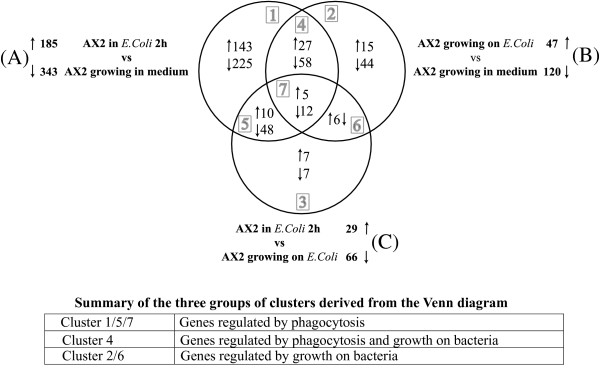
- Comparing cells incubated 2 hours with bacteria to axenic controls, the largest expression shift involved 528 genes; comparing 2-hour bacterial incubation to exponential growth on bacteria involved only 95 genes, suggesting most phagocytosis-related transcriptional changes occur within the first 2 hours.
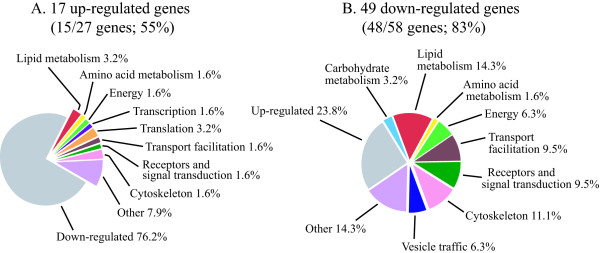
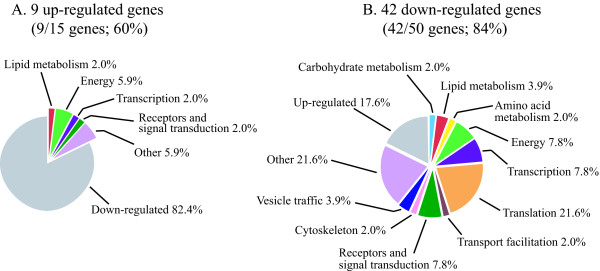
- The authors identified 443 genes regulated by phagocytosis, 59 genes regulated by growth on bacteria versus axenic medium, and 102 genes regulated by both processes.
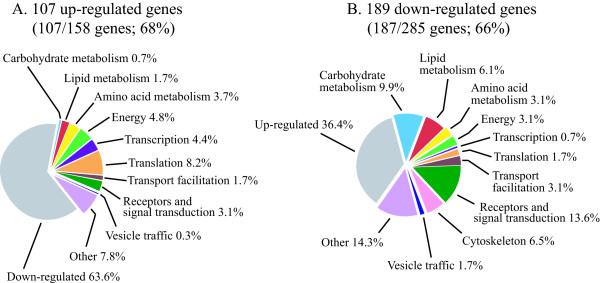
- About two-thirds of the identified genes were down-regulated relative to axenic medium, while genes involved in transcription, protein synthesis, and mitochondrial biogenesis were mostly up-regulated.
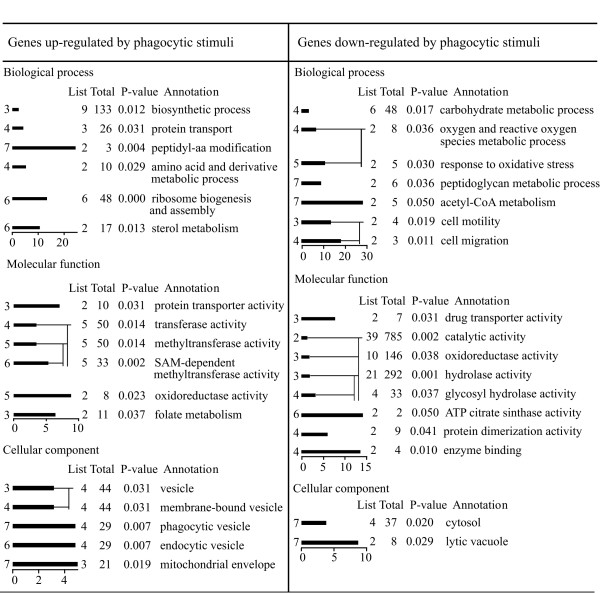
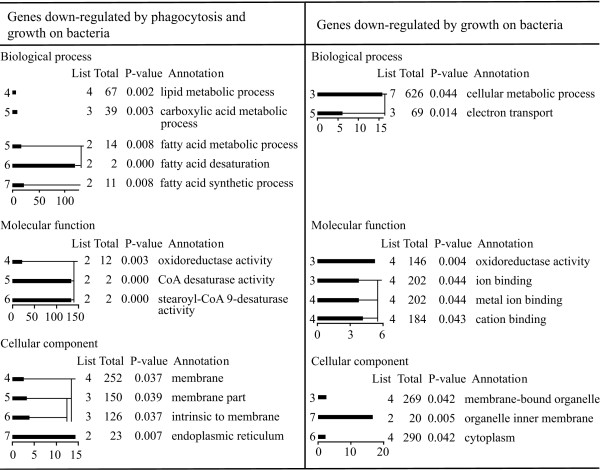
- Strong down-regulation was seen in carbohydrate and lipid metabolism and cytoskeletal genes; sterol biosynthesis genes were selectively up-regulated, with the paper reporting 78% of genes in fatty acid/phospholipid metabolism were down-regulated and some genes such as aclyA, aclyB, and pks16 changing by 16–20-fold.
Methods
- Design: four comparisons were used to separate effects of phagocytosis from growth-state effects, including 2-hour bacterial exposure versus axenic medium, exponential growth on bacteria versus axenic medium, 2-hour exposure versus growth on bacteria, and a strain comparison (V12M2 vs AX2 on bacteria).
- Sample/data: AX2 and V12M2 *Dictyostelium* cells; arrays covered 9,247 PCR products specific to 8,579 predicted genes, with two independent RNA samples per condition and a total of four hybridizations for the main comparisons, plus a supplemental strain comparison.
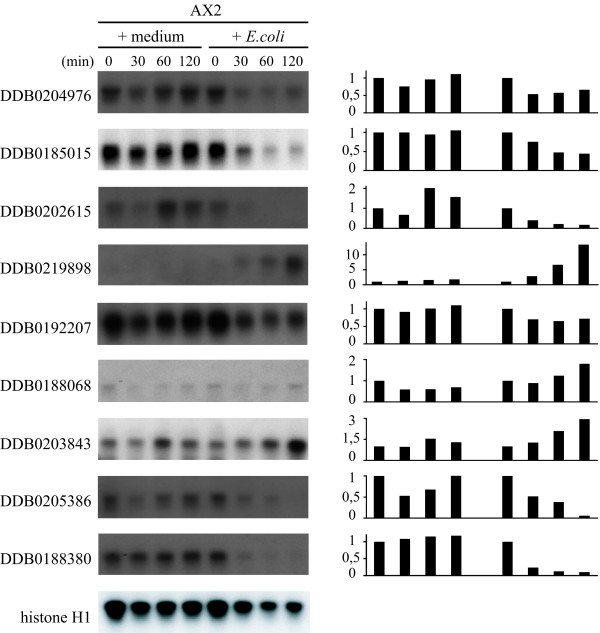
- Analysis: RNA was labeled and hybridized to DNA microarrays; differential expression was called using LIMMA with background subtraction, print-tip loess normalization, linear models, empirical Bayes testing, Benjamini-Hochberg correction, and a final threshold of log ratio >1 or <-1; GO term enrichment was assessed with GOAT, and some findings were validated by Northern blotting.
Limitations
- The paper states that GO annotations and GOAT results are preliminary and indicative only, because only a minority of *Dictyostelium* genes have been experimentally characterized and annotation quality is incomplete.
- The authors note that some expression changes may still reflect both phagocytosis and growth adaptation, so the process cannot be perfectly separated by their comparisons.
- Evident from the text: the study focuses on transcriptional changes, so it does not directly prove protein-level or functional roles for the candidate genes.
Model-written summary. Check it against the paper before relying on it.
Integrity signals
Registry
Cites
Statistics
Figures
Verification
Claims the paper makes
17 Valid · 0 Not valid · 27 Not checked · 118 Own results and interpretations
The cited sources support only part of this claim — read each source’s verdict below.
In the paper
“Molecular mechanisms of phagocytosis are conserved throughout evolution.”
§ Genome-wide transcriptional changes induced by phagocytosis or growth on bacteria in Dictyostelium > Background
What the sources say
- Not checked — no full text of the sourcecites [1] Cardelli J Phagocytosis and macropinocytosis in Dictyostelium: phosphoinositide-based processes, biochemically distinct Traffic 2001 2 311 320 11350627 10.1034/j.1600-0854.2001.002005311.x source
- Not checked — no full text of the sourcecites [4] Maniak M Rauchenberger R Albrecht R Murphy J Gerisch G Coronin involved in phagocytosis: dynamics of particle-induced relocalization visualized by a green fluorescent protein Tag Cell 1995 83 915 924 8521515 10.1016/0092-8674(95)90207-4 source
- Partly supportedcites [5] Peracino B Borleis J Jin T Westphal M Schwartz JM Wu L Bracco E Gerisch G Devreotes P Bozzaro S G protein beta subunit-null mutants are impaired in phagocytosis and chemotaxis due to inappropriate regulation of the actin cytoskeleton J Cell Biol 1998 141 1529 1537 9647646 10.1083/jcb.141.7.1529 PMC2133009 sourceExperimental — accuracy not yet measured
The paper’s opening passage (labeled Abstract in our copy; page unavailable) describes remarkably similar biochemical reactions and actin-based phagocytic structures in Dictyostelium and animal immune cells. That supports shared mechanisms across those groups, but the paper does not establish that molecular mechanisms of phagocytosis are conserved throughout evolution; it also frames its evolutionary inference as a suggestion. (LLM, conf=0.83)
- Not checked — no full text of the sourcecites [6] Janssen KP Schleicher M Dictyostelium discoideum: a genetic model system for the study of professional phagocytes. Profilin, phosphoinositides and the lmp gene family in Dictyostelium Biochim Biophys Acta 2001 1525 228 233 11257436 source
- Not checked — no full text of the sourcecites [7] Maniak M Conserved features of endocytosis in Dictyostelium Int Rev Cytol 2002 221 257 287 12455750 source
- Not checked — no full text of the sourcecites [8] Clarke M Maddera L Phagocyte meets prey: uptake, internalization, and killing of bacteria by Dictyostelium amoebae Eur J Cell Biol 2006 85 1001 1010 16782228 10.1016/j.ejcb.2006.05.004 source
- Not matchedcites [9] Bozzaro S Bucci C Steinert M Phagocytosis and host-pathogen interactions in Dictyostelium with a look at macrophages International Review of Cytology 19081545
Its entry has no title and year that we can search by.
plain- Asserted: passes — The authors put it forward as true.
- Checkable: passes — It can be checked against evidence.
- Load-bearing: passes — The paper’s conclusions depend on it.
- Based: passes — The paper gives a reason why it holds.
The cited sources support only part of this claim — read each source’s verdict below.
In the paper
“manual annotation of the microarray data detected 25 protein products in common with the 179 proteins identified in the phagosomal proteomic profile.”
§ Genome-wide transcriptional changes induced by phagocytosis or growth on bacteria in Dictyostelium > Results > Manual annotation of differentially regulated genes
What the sources say
- Partly supportedcites [35] Gotthardt D Blancheteau V Bosserhoff A Ruppert T Delorenzi M Soldati T Proteomics fingerprinting of phagosome maturation and evidence for the role of a Galpha during uptake Mol Cell Proteomics 2006 5 2228 2243 16926386 10.1074/mcp.M600113-MCP200 sourceExperimental — accuracy not yet measured
The Identification of Phagosome Proteins section reports 179 different proteins in the phagosomal proteomic profile. Our copy does not report manual annotation of microarray data or an overlap of 25 protein products; the Dynamics of the Phagosome section mentions microarray expression profiles only as an analogy for its clustering method. (LLM, conf=0.87)
plain- Asserted: passes — The authors put it forward as true.
- Checkable: passes — It can be checked against evidence.
- Load-bearing: passes — The paper’s conclusions depend on it.
- Based: passes — The paper gives a reason why it holds.
- Partly supported
The cited sources support only part of this claim — read each source’s verdict below.
In the paper
“the phagocytosis rate increases from 1 to 4 bacteria/min/cell during the first three hours of co-incubation [22,23]”
§ Genome-wide transcriptional changes induced by phagocytosis or growth on bacteria in Dictyostelium > Background
What the sources say
- Partly supportedcites [22] Vogel G Thilo L Schwarz H Steinhart R Mechanism of phagocytosis in Dictyostelium discoideum: phagocytosis is mediated by different recognition sites as disclosed by mutants with altered phagocytotic properties J Cell Biol 1980 86 456 465 6995464 10.1083/jcb.86.2.456 PMC2111509 sourceExperimental — accuracy not yet measured
The uptake-assay passage (around p. 457) reports that wild-type amoebae ingest about four to eight E. coli per minute, supporting the approximate rate of four. It says bacterial uptake was linear for about eight minutes; it does not report a rise from one to four bacteria per minute per cell over three hours of co-incubation. (LLM, conf=0.87)
- Not checked — no full text of the sourcecites [23] Bozzaro S Merkl R Gerisch G Cell adhesion: its quantification, assay of the molecules involved, and selection of defective mutants in Dictyostelium and Polysphondylium Methods Cell Biol 1987 28 359 385 3600412 source
plainstates a cause- Asserted: passes — The authors put it forward as true.
- Checkable: passes — It can be checked against evidence.
- Load-bearing: passes — The paper’s conclusions depend on it.
- Based: passes — The paper gives a reason why it holds.
- Partly supported
The cited sources support only part of this claim — read each source’s verdict below.
In the paper
“Several bacterial pathogens for humans, such as legionella, mycobacteria and salmonella, are pathogenic also for Dictyostelium, favouring the use of this model to study host-pathogen interactions [9-19].”
§ Genome-wide transcriptional changes induced by phagocytosis or growth on bacteria in Dictyostelium > Background
What the sources say
- Not matchedcites [9] Bozzaro S Bucci C Steinert M Phagocytosis and host-pathogen interactions in Dictyostelium with a look at macrophages International Review of Cytology 19081545
Its entry has no title and year that we can search by.
- Partly supportedcites [10] Solomon JM Rupper A Cardelli JA Isberg RR Intracellular growth of Legionella pneumophila in Dictyostelium discoideum, a system for genetic analysis of host-pathogen interactions Infect Immun 2000 68 2939 2947 10768992 10.1128/IAI.68.5.2939-2947.2000 PMC97507 sourceExperimental — accuracy not yet measured
Our copy supports only the Legionella part: the Abstract states that conditions were established in which L. pneumophila replicates within D. discoideum, and the Discussion (p. n/a) opens the L. pneumophila-D. discoideum system for genetic analysis of host-pathogen interactions. The mycobacteria and salmonella parts are not supported: Mycobacterium appears only in a Discussion paragraph crediting Ferrari et al. (reference 15) for a coronin/TACO model of M. tuberculosis phagosomes in macrophages, not in Dictyostelium, and no passage in our copy mentions Salmonella at all (searched: Salmonella; Mycobacterium tuberculosis survival in amoebae Dictyostelium). The closest the paper comes to the generalisation is a hedged, forward-looking statement that 'in theory, any intracellular pathogen that can grow at 25°C may be capable of growth in D. discoideum', which the citing sentence converts into an established fact about several named human pathogens. (LLM, conf=0.78)
- Not checked — no full text of the sourcecites [11] Hagele S Kohler R Merkert H Schleicher M Hacker J Steinert M Dictyostelium discoideum: a new host model system for intracellular pathogens of the genus Legionella Cell Microbiol 2000 2 165 171 11207573 10.1046/j.1462-5822.2000.00044.x source
- Not checked — no full text of the sourcecites [12] Skriwan C Fajardo M Hagele S Horn M Wagner M Michel R Krohne G Schleicher M Hacker J Steinert M Various bacterial pathogens and symbionts infect the amoeba Dictyostelium discoideum Int J Med Microbiol 2002 291 615 624 12008915 10.1078/1438-4221-00177 source
- Partly supportedcites [13] Pukatzki S Kessin RH Mekalanos JJ The human pathogen Pseudomonas aeruginosa utilizes conserved virulence pathways to infect the social amoeba Dictyostelium discoideum Proc Natl Acad Sci USA 2002 99 3159 3164 11867744 10.1073/pnas.052704399 PMC122489 sourceExperimental — accuracy not yet measured
Our copy supports only the Legionella element of the list: the Introduction states 'D. discoideum has already been shown to be useful in studying the virulence mechanisms of the intracellular pathogen Legionella pneumophilia (6)' — and even that is reported from another work (Solomon et al., ref. 6), not shown here. The paper's own new host-pathogen pairing is Pseudomonas aeruginosa with D. discoideum (Abstract; Discussion, p. 1). Searches of our copy for 'Mycobacterium' and 'Salmonella' returned no passage stating either is pathogenic for Dictyostelium (only unrelated semantic neighbours, e.g. Haemophilis influenzae/Staphylococcus aureus in the CF Introduction), so the mycobacteria and salmonella parts of the claim are not supported by this source. (LLM, conf=0.78)
- Partly supportedcites [14] Fajardo M Schleicher M Noegel A Bozzaro S Killinger S Heuner K Hacker J Steinert M Calnexin, calreticulin and cytoskeleton-associated proteins modulate uptake and growth of Legionella pneumophila in Dictyostelium discoideum Microbiology 2004 150 2825 2835 15347742 10.1099/mic.0.27111-0 sourceExperimental — accuracy not yet measured
Our copy of Fajardo et al. (2004) clearly supports the Legionella half of the claim: the Abstract calls D. discoideum 'a versatile host system for studying cellular aspects of Legionella pathogenicity' and the Introduction states it 'has proven to be a representative host-model system to analyse cellular aspects of L. pneumophila infection'. However, no passage in our copy (searched: Mycobacterium, Salmonella, other bacterial pathogens of Dictyostelium) says that mycobacteria or salmonella are also pathogenic for Dictyostelium; the paper's only nod to that breadth is its citation of Skriwan et al. (2002) 'Various bacterial pathogens and symbionts infect the amoeba Dictyostelium discoideum' (References, entry 43), which it does not elaborate. The mycobacteria/salmonella examples are therefore not supported by this source. (LLM, conf=0.72)
- Partly supportedcites [15] Steinert M Heuner K Dictyostelium as host model for pathogenesis Cell Microbiol 2005 7 307 314 15679834 10.1111/j.1462-5822.2005.00493.x sourceExperimental — accuracy not yet measured
Our copy supports the general point and two of the three named genera: the Abstract and Introduction state that D. discoideum 'has been established as a host model for several pathogens including Pseudomonas aeruginosa, Cryptococcus neoformans, Mycobacterium spp. and Legionella pneumophila', and the Mycobacterium and Legionella sections (plus Table 1, listing M. avium, M. marinum and L. pneumophila virulence traits in the D. discoideum host) document their pathogenicity for the amoeba. However, Salmonella is not mentioned anywhere in our copy (searched: 'Salmonella typhimurium', 'various bacterial pathogens infect the amoeba', Table 1 species list), so attributing the salmonella example to this source is unsupported; the review explicitly limits itself to four pathogens, none of which is Salmonella. (LLM, conf=0.85)
- Partly supportedcites [16] Peracino B Wagner C Balest A Balbo A Pergolizzi B Noegel AA Steinert M Bozzaro S Function and mechanism of action of Dictyostelium Nramp1 (Slc11a1) in bacterial infection Traffic 2006 7 22 38 16445684 10.1111/j.1600-0854.2005.00356.x sourceExperimental — accuracy not yet measured
The Abstract of Peracino et al. (2006) supports two of the three genera named: 'Microbes pathogenic for Dictyostelium have been described long ago (33). Recent studies have shown that Dictyostelium cells can be used as a model system for studying infections by Mycobacteria (34) and Legionella pneumophila (35)(36)(37)(38)', and it states that M. avium and L. pneumophila are human pathogens (bacteremia/pneumonia), plus the concluding section calls Dictyostelium 'an excellent host model, complementary to macrophages'. The Salmonella component is not supported: the only mention of Salmonella in our copy is in the mouse Bcg/Ity/Lsh Nramp1 context ('resistance to infections by Mycobacteria, Salmonella and Leishmania (15)(16)(17)'), i.e. mammalian resistance, not Dictyostelium pathogenicity; Salmonella-in-Dictyostelium is credited elsewhere (reference 34, Skriwan et al. 2002, 'Various bacterial pathogens and symbionts infect the amoeba Dictyostelium discoideum') without our copy stating it. (LLM, conf=0.78)
- Partly supportedcites [17] Weber SS Ragaz C Reus K Nyfeler Y Hilbi H Legionella pneumophila exploits PI(4)P to anchor secreted effector proteins to the replicative vacuole PLoS Pathog 2006 2 e46 16710455 10.1371/journal.ppat.0020046 PMC1463015 sourceExperimental — accuracy not yet measured
The Materials and Methods section (‘Intracellular growth of L. pneumophila within Dictyostelium’; page unavailable) describes infecting Dictyostelium with Legionella and measuring its intracellular replication, supporting that example and the model’s use in host–pathogen research. The passages from our copy do not establish that mycobacteria or salmonella are also pathogenic for Dictyostelium. (LLM, conf=0.87)
- Not checked yetcites [18] Benghezal M Fauvarque MO Tournebize R Froquet R Marchetti A Bergeret E Lardy B Klein G Sansonetti P Charette SJ Cosson P Specific host genes required for the killing of Klebsiella bacteria by phagocytes Cell Microbiol 2006 8 139 148 16367873 10.1111/j.1462-5822.2005.00607.x source
Checked before — its earlier verdict is held back until a new check runs.
plain- Asserted: passes — The authors put it forward as true.
- Checkable: passes — It can be checked against evidence.
- Load-bearing: passes — The paper’s conclusions depend on it.
- Based: passes — The paper gives a reason why it holds.
- Not matched
Every source the paper cites for this claim was checked and supports it.
In the paper
“The encoded putative proteins were recently found in a proteomic study to be enriched in phagosomes [35], which justifies their GO assignment to phagocytic vesicle.”
§ Genome-wide transcriptional changes induced by phagocytosis or growth on bacteria in Dictyostelium > Results > Functional characterization of differentially regulated genes
What the sources say
- Supportedcites [35] Gotthardt D Blancheteau V Bosserhoff A Ruppert T Delorenzi M Soldati T Proteomics fingerprinting of phagosome maturation and evidence for the role of a Galpha during uptake Mol Cell Proteomics 2006 5 2228 2243 16926386 10.1074/mcp.M600113-MCP200 source
The citation is offered to identify 'a proteomic study' in which putative gene products were found in phagosomes, and our copy is exactly that: the Abstract/Introduction (p. 2228) and the 'Identification of Phagosome Proteins' section state that time-resolved 2D gel electrophoresis plus mass spectrometry identified 179 Dictyostelium phagosomal proteins, 'known proteins or predicted open reading frames in the Dictyostelium genome', including 'over 35 conserved proteins ... [whose] functions ... are not known'. The same section also argues the presence reflects 'a specific and regulated recruitment' rather than purification carry-over, which supports the paraphrase 'enriched in phagosomes'. Caveat: the citing sentence does not name the four genes and our copy's Table I is only partly present, so the individual four cannot be checked here. (LLM, conf=0.80)
hedgedstates an association- Asserted: passes — The authors put it forward as true.
- Checkable: passes — It can be checked against evidence.
- Load-bearing: passes — The paper’s conclusions depend on it.
- Based: passes — The paper gives a reason why it holds.
- Supported
64 more claims · 4 with their cited sources checked
Create a free account to see all 162 claims and to verify the 25 references still open.
- Probably not a substantial claim. 34
- It may state two separate claims as one. 73
- The quote only partly states this claim. 3
Citations
Cites
Molecular Cloning: A Laboratory Manual
Sambrook, J., Fritsch, E., & Maniatis, T. (1989) · UCLA - Biblioteca de Ciencias de la Salud · Cited by 133,589
Controlling the False Discovery Rate: A Practical and Powerful Approach to Multiple Testing
Benjamini, Y., & Hochberg, Y. (1995) · Journal of the Royal Statistical Society Series B: Statistical Methodology · doi:10.1111/j.2517-6161.1995.tb02031.x · Cited by 109,482
Molecular cloning: A laboratory manual
Deininger, P. (1990) · Analytical Biochemistry · doi:10.1016/0003-2697(90)90595-z · Cited by 84,682
Bioconductor: open software development for computational biology and bioinformatics
Gentleman, R. C., Carey, V. J., Bates, D. M., Bolstad, B., Dettling, M., Dudoit, S., Ellis, B., Gautier, L., Ge, Y., Gentry, J., et al. (2004) · Genome Biology · doi:10.1186/gb-2004-5-10-r80 · Cited by 12,172
Smyth, G. K. (2004) · Statistical Applications in Genetics and Molecular Biology · doi:10.2202/1544-6115.1027 · Cited by 11,829
The Gene Ontology (GO) database and informatics resource
Gene Ontology Consortium (2004) · Nucleic Acids Research · doi:10.1093/nar/gkh036 · Cited by 4,579
The genome of the social amoeba Dictyostelium discoideum
Eichinger, L., Pachebat, J. A., Glöckner, G., Rajandream, M.-A., Sucgang, R., Berriman, M., Song, J., Olsen, R., Szafranski, K., Xu, Q., et al. (2005) · Nature · doi:10.1038/nature03481 · Cited by 1,351 · cited 1×
“The complete genome sequence has been made available recently [28], raising the possibility to use DNA microarrays to analyze transcriptional responses to phagocytic stimuli.”
Growth of myxamoebae of the cellular slime mould Dictyostelium discoideum in axenic culture
Watts, D. J., & Ashworth, J. M. (1970) · Biochemical Journal · doi:10.1042/bj1190171 · Cited by 1,135 · cited 2×
“AX2 cells were grown axenically as described [21].”
Phagocytosis of Microbes: Complexity in Action
Underhill, D. M., & Ozinsky, A. (2002) · Annual Review of Immunology · doi:10.1146/annurev.immunol.20.103001.114744 · Cited by 1,124 · cited 1×
“HSP's have been shown to modulate inflammatory response and phagocytosis in macrophages, though their mechanism of action remains unknown [52,53].”
Shen, Q.-H., Saijo, Y., Mauch, S., Biskup, C., Bieri, S., Keller, B., Seki, H., Ülker, B., Somssich, I. E., & Schulze-Lefert, P. (2007) · Science · doi:10.1126/science.1136372 · Cited by 751 · cited 3×
“WKRY transcription factors, in particular, have been shown to be positive and negative regulators of pathogen defense pathways in plants [ 54 ].”
InfluentialWormBase: a multi-species resource for nematode biology and genomics
Harris, T. W. (2004) · Nucleic Acids Research · doi:10.1093/nar/gkh066 · Cited by 715
Evolution, structure, and activation mechanism of family 3/C G-protein-coupled receptors
Pin, J.-P., Galvez, T., & Prézeau, L. (2003) · Pharmacology & Therapeutics · doi:10.1016/s0163-7258(03)00038-x · Cited by 662 · cited 4×
“Activation of the heterotrimeric G protein [5], putatively via autocrine signals or bacterial metabolites binding to GPCR's, will regulate actin reshaping in the phagocytic cup, favouring phagocytosis.”
InfluentialEssential Role for Cholesterol in Entry of Mycobacteria into Macrophages
Gatfield, J., & Pieters, J. (2000) · Science · doi:10.1126/science.288.5471.1647 · Cited by 615 · cited 1×
“Cholesterol rich membrane rafts have been shown to mediate phagocytosis of Mycobacterium, Pseudomonas or Leishmania species in macrophages [ 41- 44 ].”
Maniak, M., Rauchenberger, R., Albrecht, R., Murphy, J., & Gerisch, G. (1995) · Cell · doi:10.1016/0092-8674(95)90207-4 · Cited by 354 · cited 2×
“Important contributions to our understanding of phagocytosis have come indeed from utilization of genetically tractable organisms, such as Dictyostelium discoideum [1, 4-9 ].”
A Novel Role for the TIR Domain in Association with Pathogen-Derived Elicitors
Burch-Smith, T. M., Schiff, M., Caplan, J. L., Tsao, J., Czymmek, K., & Dinesh-Kumar, S. P. (2007) · PLoS Biology · doi:10.1371/journal.pbio.0050068 · Cited by 329 · cited 2×
“Interestingly, intracellular effectors with TIR-like domains have been recently shown to enter the nucleus and to regulate immune-like response in plants, acting on WRKY transcription factors, which negatively regulate such response [54, 66 ,68].”
Weber, S. S., Ragaz, C., Reus, K., Nyfeler, Y., & Hilbi, H. (2006) · PLoS Pathogens · doi:10.1371/journal.ppat.0020046 · Cited by 292 · cited 2×
“PI3K and PTEN, in contrast to PLC, are not essential for bacterial uptake [5,73] [Balest, unpublished results], but pi3k1-2 null mutants are defective in phago-lysosomal maturation [17,74] [Balest, unpublished results].”
Pukatzki, S., Kessin, R. H., & Mekalanos, J. J. (2002) · Proceedings of the National Academy of Sciences · doi:10.1073/pnas.052704399 · Cited by 289
Calreticulin and calnexin in the endoplasmic reticulum are important for phagocytosis
Müller‐Taubenberger, A., Lupas, A. N., Li, H., Ecke, M., Simmeth, E., & Gerisch, G. (2001) · The EMBO Journal · doi:10.1093/emboj/20.23.6772 · Cited by 242 · cited 1×
“The V-H+ ATPase, Rab7 and calreticulin are typical markers of phagosomal traffic [16,81-83], whereas gp24, discoidin II and gp130 are extracellular or membrane proteins that could be entrapped in the phagosome.”
Solomon, J. M., Rupper, A., Cardelli, J. A., & Isberg, R. R. (2000) · Infection and Immunity · doi:10.1128/iai.68.5.2939-2947.2000 · Cited by 215
Little, K. D., Hemler, M. E., & Stipp, C. S. (2004) · Molecular Biology of the Cell · doi:10.1091/mbc.e03-12-0886 · Cited by 211
Immune-like Phagocyte Activity in the Social Amoeba
Chen, G., Zhuchenko, O., & Kuspa, A. (2007) · Science · doi:10.1126/science.1143991 · Cited by 205 · cited 1×
“The latter has been recently shown to be involved in an immune-like phagocyte response in Dictyostelium cells at later stages of development [69].”
Peyron, P., Bordier, C., N′Diaye, E.-N., & Maridonneau-Parini, I. (2000) · The Journal of Immunology · doi:10.4049/jimmunol.165.9.5186 · Cited by 202
Hagele, S., Kohler, R., Merkert, H., Schleicher, M., Hacker, J., & Steinert, M. (2000) · Cellular Microbiology · doi:10.1046/j.1462-5822.2000.00044.x · Cited by 198
Vogel, G., Thilo, L., Schwarz, H., & Steinhart, R. (1980) · The Journal of Cell Biology · doi:10.1083/jcb.86.2.456 · Cited by 172 · cited 2×
“Carbohydrate-binding receptors have been long suggested to be involved in Dictyostelium phagocytosis, though their identification has been elusive so far [22,62,63].”
Morio, T. (1998) · DNA Research · doi:10.1093/dnares/5.6.335 · Cited by 163
Cardelli, J. (2001) · Traffic · doi:10.1034/j.1600-0854.2001.002005311.x · Cited by 150 · cited 3×
“It is already present in unicellular amoebae, where it also constitutes the major, if not unique, mechanism for uptake of nutrients [1].”
Dictyostelium as host model for pathogenesis
Steinert, M., & Heuner, K. (2005) · Cellular Microbiology · doi:10.1111/j.1462-5822.2005.00493.x · Cited by 144
Berger, P. (2002) · Human Molecular Genetics · doi:10.1093/hmg/11.13.1569 · Cited by 141
Clarke, M., Köhler, J., Arana, Q., Liu, T., Heuser, J., & Gerisch, G. (2002) · Journal of Cell Science · doi:10.1242/jcs.115.14.2893 · Cited by 138
Specific host genes required for the killing of Klebsiella bacteria by phagocytes
Benghezal, M., Fauvarque, M.-O., Tournebize, R., Froquet, R., Marchetti, A., Bergeret, E., Lardy, B., Klein, G., Sansonetti, P., Charette, S. J., et al. (2006) · Cellular Microbiology · doi:10.1111/j.1462-5822.2005.00607.x · Cited by 136
Cultivation of Dictyostelium discoideum in axenic medium
Sussman, R., & Sussman, M. (1967) · Biochemical and Biophysical Research Communications · doi:10.1016/0006-291x(67)90539-6 · Cited by 133 · cited 1×
“Laboratory strains have been selected which grow on liquid nutrient media by fluid-phase endocytosis, though having retained the ability to phagocytose [20,21].”
Hagedorn, M., & Soldati, T. (2007) · Cellular Microbiology · doi:10.1111/j.1462-5822.2007.00993.x · Cited by 132
In vivo analysis of 3-phosphoinositide dynamics during Dictyostelium phagocytosis and chemotaxis
Dormann, D., Weijer, G., Dowler, S., & Weijer, C. J. (2004) · Journal of Cell Science · doi:10.1242/jcs.01579 · Cited by 131
A transcriptional profile of multicellular development in Dictyostelium discoideum
Van Driessche, N., Shaw, C., Katoh, M., Morio, T., Sucgang, R., Ibarra, M., Kuwayama, H., Saito, T., Urushihara, H., Maeda, M., et al. (2002) · Development · doi:10.1242/dev.129.7.1543 · Cited by 130
Peracino, B., Borleis, J., Jin, T., Westphal, M., Schwartz, J.-M., Wu, L., Bracco, E., Gerisch, G., Devreotes, P., & Bozzaro, S. (1998) · The Journal of Cell Biology · doi:10.1083/jcb.141.7.1529 · Cited by 129
Self-citationImproved Background Correction for Spotted DNA Microarrays
Kooperberg, C., Fazzio, T. G., Delrow, J. J., & Tsukiyama, T. (2002) · Journal of Computational Biology · doi:10.1089/10665270252833190 · Cited by 128
The actin cytoskeleton of Dictyostelium: a story told by mutants
Noegel, A. A., & Schleicher, M. (2000) · Journal of Cell Science · doi:10.1242/jcs.113.5.759 · Cited by 127
Tse, S. M. L., Furuya, W., Gold, E., Schreiber, A. D., Sandvig, K., Inman, R. D., & Grinstein, S. (2003) · Journal of Biological Chemistry · doi:10.1074/jbc.m207966200 · Cited by 124 · cited 1×
“A dymA-minus mutant displays reduced fluid-phase uptake but increased phagocytosis [55], which would be consistent with the gene down-regulation observed here, suggesting a differential requirement for dynamin in endocytosis not phagocytosis, similarly to what has been described for macrophages [56].”
Chapter 6 Phagocytosis and Host–Pathogen Interactions in Dictyostelium with a Look at Macrophages
Bozzaro, S., Bucci, C., & Steinert, M. (2008) · International review of cytology · doi:10.1016/s1937-6448(08)01206-9 · Cited by 120
Self-citationde Chastellier, C., & Thilo, L. (2006) · Cellular Microbiology · doi:10.1111/j.1462-5822.2005.00617.x · Cited by 118 · cited 1×
“De Chastellier and Thilo [45] have recently shown that cholesterol depletion weakens the close apposition of phagosomal membrane and the membrane of mycobacteria, interfering with phagosome maturation.”
Dictyostelium transcriptional host cell response upon infection with Legionella
Farbrother, P., Wagner, C., Na, J., Tunggal, B., Morio, T., Urushihara, H., Tanaka, Y., Schleicher, M., Steinert, M., & Eichinger, L. (2006) · Cellular Microbiology · doi:10.1111/j.1462-5822.2005.00633.x · Cited by 112 · cited 1×
“Microarrays have been already used in Dictyostelium to study regulatory pathways during development [29-31] or host cell response during Legionella infection [32].”
Various bacterial pathogens and symbionts infect the amoeba Dictyostelium discoideum
Skriwan, C., Fajardo, M., Hägele, S., Horn, M., Wagner, M., Michel, R., Krohne, G., Schleicher, M., Hacker, J., & Steinert, M. (2002) · International Journal of Medical Microbiology · doi:10.1078/1438-4221-00177 · Cited by 109
Wienke, D. C., Knetsch, M. L. W., Neuhaus, E. M., Reedy, M. C., & Manstein, D. J. (1999) · Molecular Biology of the Cell · doi:10.1091/mbc.10.1.225 · Cited by 109
Phagocytosis: the convoluted way from nutrition to adaptive immunity
Desjardins, M., Houde, M., & Gagnon, E. (2005) · Immunological Reviews · doi:10.1111/j.0105-2896.2005.00319.x · Cited by 107 · cited 1×
“In multicellular organisms with a developed immune system, phagocytosis is integrated in this system and is performed by professional phagocytes, such as macrophages, monocytes and PMN leukocytes, which are capable of ingesting and killing a large variety of microorganisms [2,3].”
Regulation of phagocytosis and endo-phagosomal trafficking pathways in Dictyostelium discoideum
Rupper, A., & Cardelli, J. (2001) · Biochimica et Biophysica Acta (BBA) - General Subjects · doi:10.1016/s0304-4165(01)00106-4 · Cited by 103 · cited 1×
“PI3K and PTEN, in contrast to PLC, are not essential for bacterial uptake [5,73] [Balest, unpublished results], but pi3k1-2 null mutants are defective in phago-lysosomal maturation [17, 74 ] [Balest, unpublished results].”
Role of caveolae in Leishmania chagasi phagocytosis and intracellular survival in macrophages
Rodriguez, N. E., Gaur, U., & Wilson, M. E. (2006) · Cellular Microbiology · doi:10.1111/j.1462-5822.2006.00695.x · Cited by 98
Proteomics Fingerprinting of Phagosome Maturation and Evidence for the Role of a Gα during Uptake
Gotthardt, D., Blancheteau, V., Bosserhoff, A., Ruppert, T., Delorenzi, M., & Soldati, T. (2006) · Molecular & Cellular Proteomics · doi:10.1074/mcp.m600113-mcp200 · Cited by 98 · cited 3×
“-Comparison between transcriptomic profile and the phagosomal proteome A detailed characterization of the Dictyostelium phagosomal proteome was provided recently by Soldati and coworkers [35].”
Seastone, D. J., Zhang, L., Buczynski, G., Rebstein, P., Weeks, G., Spiegelman, G., & Cardelli, J. (1999) · Molecular Biology of the Cell · doi:10.1091/mbc.10.2.393 · Cited by 97
Iranfar, N., Fuller, D., & Loomis, W. F. (2003) · Eukaryotic Cell · doi:10.1128/ec.2.4.664-670.2003 · Cited by 97 · cited 1×
“Microarrays have been already used in Dictyostelium to study regulatory pathways during development [29-31] or host cell response during Legionella infection [32].”
Function and Mechanism of Action of Dictyostelium Nramp1 (Slc11a1) in Bacterial Infection
Peracino, B., Wagner, C., Balest, A., Balbo, A., Pergolizzi, B., Noegel, A. A., Steinert, M., & Bozzaro, S. (2006) · Traffic · doi:10.1111/j.1600-0854.2005.00356.x · Cited by 96 · cited 1×
“The V-H+ ATPase, Rab7 and calreticulin are typical markers of phagosomal traffic [16,81-83], whereas gp24, discoidin II and gp130 are extracellular or membrane proteins that could be entrapped in the phagosome.”
Self-citationChang, Y., & Finnemann, S. C. (2007) · Journal of Cell Science · doi:10.1242/jcs.006361 · Cited by 88
The Dictyostelium repertoire of seven transmembrane domain receptors
Prabhu, Y., & Eichinger, L. (2006) · European Journal of Cell Biology · doi:10.1016/j.ejcb.2006.04.003 · Cited by 87 · cited 4×
“Activation of the heterotrimeric G protein [5], putatively via autocrine signals or bacterial metabolites binding to GPCR's, will regulate actin reshaping in the phagocytic cup, favouring phagocytosis.”
InfluentialGABA induces terminal differentiation of Dictyostelium through a GABAB receptor
Anjard, C., & Loomis, W. F. (2006) · Development · doi:10.1242/dev.02399 · Cited by 86
Rab7 regulates phagosome maturation in Dictyostelium
Rupper, A., Grove, B., & Cardelli, J. (2001) · Journal of Cell Science · doi:10.1242/jcs.114.13.2449 · Cited by 85
Regulation of Phagocytosis in Dictyostelium by the Inositol 5‐Phosphatase OCRL Homolog Dd5P4
Loovers, H. M., Kortholt, A., de Groote, H., Whitty, L., Nussbaum, R. L., & Haastert, P. J. M. V. (2007) · Traffic · doi:10.1111/j.1600-0854.2007.00546.x · Cited by 81
Kannan, S., Audet, A., Huang, H., Chen, L.-J., & Wu, M. (2008) · The Journal of Immunology · doi:10.4049/jimmunol.180.4.2396 · Cited by 80
Ashworth, J. M., & Quance, J. (1972) · Biochemical Journal · doi:10.1042/bj1260601 · Cited by 80 · cited 1×
“They are all down-regulated, in agreement with previous results showing that cells growing on bacteria do not express glycosidases, which are instead expressed in cells growing axenically [48,49].”
Evolutionary Analyses of ABC Transporters of Dictyostelium discoideum
Anjard, C., the Dictyostelium Sequencing Consortium, & Loomis, W. F. (2002) · Eukaryotic Cell · doi:10.1128/ec.1.4.643-652.2002 · Cited by 78
Fajardo, M., Schleicher, M., Noegel, A., Bozzaro, S., Killinger, S., Heuner, K., Hacker, J., & Steinert, M. (2004) · Microbiology · doi:10.1099/mic.0.27111-0 · Cited by 73
Self-citationThe role of toll-like receptors in macrophages
McCoy, C. (2008) · Frontiers in Bioscience · doi:10.2741/2660 · Cited by 69 · cited 1×
“TIR-like proteins, among which are Toll receptors, are major regulators of phagocytosis and pathogen-response in animals [54,66-68].”
Contact sites in aggregating cells of Polysphondylium pallidum
Bozzaro, S., & Gerisch, G. (1978) · Journal of Molecular Biology · doi:10.1016/0022-2836(78)90067-0 · Cited by 67
Self-citationRecruitment of CD63 to Cryptococcus neoformans phagosomes requires acidification
Artavanis-Tsakonas, K., Love, J. C., Ploegh, H. L., & Vyas, J. M. (2006) · Proceedings of the National Academy of Sciences · doi:10.1073/pnas.0607528103 · Cited by 63 · cited 1×
“Nothing is known about their function in Dictyostelium, but recent evidence in mammalian cells suggests their involvement also in the early steps of phagocytosis [64,65].”
Phosphoinositide Involvement in Phagocytosis and Phagosome Maturation
Botelho, R. J., Scott, C. C., & Grinstein, S. (2004) · Current topics in microbiology and immunology · doi:10.1007/978-3-642-18805-3_1 · Cited by 58
Dictyostelium as model system for studies of the actin cytoskeleton by molecular genetics
Eichinger, L., Lee, S. S., & Schleicher, M. (1999) · Microscopy Research and Technique · doi:10.1002/(sici)1097-0029(19991015)47:2<124::aid-jemt5>3.0.co;2-8 · Cited by 57
Unconventional Myosins, Actin Dynamics and Endocytosis: A Ménage à Trois?
Soldati, T. (2003) · Traffic · doi:10.1034/j.1600-0854.2003.t01-1-00095.x · Cited by 53
Conserved features of endocytosis in Dictyostelium
Maniak, M. (2002) · International Review of Cytology · doi:10.1016/s0074-7696(02)21014-1 · Cited by 52
Analyses of cDNAs from growth and slug stages of Dictyostelium discoideum
Urushihara, H. (2004) · Nucleic Acids Research · doi:10.1093/nar/gkh262 · Cited by 51
Phagocyte meets prey: Uptake, internalization, and killing of bacteria by Dictyostelium amoebae
Clarke, M., & Maddera, L. (2006) · European Journal of Cell Biology · doi:10.1016/j.ejcb.2006.05.004 · Cited by 48
Increase in Phagocytosis after Geldanamycin Treatment or Heat Shock: Role of Heat Shock Proteins
Vega, V. L., & De Maio, A. (2005) · The Journal of Immunology · doi:10.4049/jimmunol.175.8.5280 · Cited by 41 · cited 1×
“HSP's have been shown to modulate inflammatory response and phagocytosis in macrophages, though their mechanism of action remains unknown [52,53].”
Developmental timing in Dictyostelium is regulated by the Set1 histone methyltransferase
Chubb, J. R., Bloomfield, G., Xu, Q., Kaller, M., Ivens, A., Skelton, J., Turner, B. M., Nellen, W., Shaulsky, G., Kay, R. R., et al. (2006) · Developmental Biology · doi:10.1016/j.ydbio.2005.12.054 · Cited by 41
Self-citationSchatzle, J. D., Bush, J., & Cardelli, J. A. (1992) · Journal of Biological Chemistry · doi:10.1016/s0021-9258(19)50624-x · Cited by 40
A Serum Response Factor homolog is required for spore differentiation in Dictyostelium
Escalante, R., & Sastre, L. (1998) · Development · doi:10.1242/dev.125.19.3801 · Cited by 39
Bozzaro, S., & Roseman, S. (1983) · Journal of Biological Chemistry · doi:10.1016/s0021-9258(17)44000-2 · Cited by 35 · cited 1×
“Carbohydrate-binding receptors have been long suggested to be involved in Dictyostelium phagocytosis, though their identification has been elusive so far [22,62,63].”
Self-citationMORGAN, C. P., INSALL, R., HAYNES, L., & COCKCROFT, S. (2004) · Biochemical Journal · doi:10.1042/bj20040110 · Cited by 35 · cited 1×
“The substrates of these phospholipases B have been shown to be the diacylglycerol-phosphocholine and -phosphoethanolamine as well as phosphatidylinositol [72].”
A Dictyostelium Mutant with Reduced Lysozyme Levels Compensates by Increased Phagocytic Activity
Müller, I., Šubert, N., Otto, H., Herbst, R., Rühling, H., Maniak, M., & Leippe, M. (2005) · Journal of Biological Chemistry · doi:10.1074/jbc.m411445200 · Cited by 35 · cited 2×
“coli, are unaffected by the enzyme [50].”
Where do animal α‐amylases come from? An interkingdom trip
Lage, J. D., Danchin, É., & Casañe, D. (2007) · FEBS Letters · doi:10.1016/j.febslet.2007.07.019 · Cited by 35
A PTEN-related 5-Phosphatidylinositol Phosphatase Localized in the Golgi
Merlot, S., Meili, R., Pagliarini, D. J., Maehama, T., Dixon, J. E., & Firtel, R. A. (2003) · Journal of Biological Chemistry · doi:10.1074/jbc.m306318200 · Cited by 32 · cited 1×
“The product of the plip gene is also a phosphatidylinositol phosphatase with PI5P as preferential substrate [71].”
Bozzaro, S., Merkl, R., & Gerisch, G. (1987) · Methods in Cell Biology · doi:10.1016/s0091-679x(08)61657-x · Cited by 31 · cited 1×
“Several lines of evidence indicate, however, that adaptive changes occur upon cell incubation with bacteria: (1) the phagocytosis rate increases from 1 to 4 bacteria/min/cell during the first three hours of co-incubation [22,23]; (2) within 90 min from exposure to bacteria, the pattern of glycoproteins reactive to mon…”
Self-citationDictyostelium discoideum: a genetic model system for the study of professional phagocytes
Janssen, K.-P., & Schleicher, M. (2001) · Biochimica et Biophysica Acta (BBA) - General Subjects · doi:10.1016/s0304-4165(01)00108-8 · Cited by 30
Freeze-fracture study of phagocytosis in Dictyostelium discoideum
Favard-Séréno, C., Ludosky, M.-A., & Ryter, A. (1981) · Journal of Cell Science · doi:10.1242/jcs.51.1.63 · Cited by 29
Monoclonal antibodies against Dictyostelium plasma membranes: their binding to simple sugars
Bozzaro, S., & Merkl, R. (1985) · Cell Differentiation · doi:10.1016/0045-6039(85)90474-9 · Cited by 25 · cited 1×
“Several lines of evidence indicate, however, that adaptive changes occur upon cell incubation with bacteria: (1) the phagocytosis rate increases from 1 to 4 bacteria/min/cell during the first three hours of co-incubation [22,23]; (2) within 90 min from exposure to bacteria, the pattern of glycoproteins reactive to mon…”
Self-citationGrlJ, a Dictyostelium GABAB-like receptor with roles in post-aggregation development
Prabhu, Y., Müller, R., Anjard, C., & Noegel, A. A. (2007) · BMC Developmental Biology · doi:10.1186/1471-213x-7-44 · Cited by 23 · cited 1×
“A grlJnull mutant was recently generated and found to undergo precocious development and abnormal spore differentiation [79].”
GOAT: An R Tool for Analysing Gene Ontology??? Term Enrichment
Xu, Q., & Shaulsky, G. (2005) · Applied Bioinformatics · doi:10.2165/00822942-200504040-00008 · Cited by 19
Cloning of Dictyostelium eIF6 (p27BBP) and mapping its nucle(ol)ar localization subdomains
Balbo, A., & Bozzaro, S. (2006) · European Journal of Cell Biology · doi:10.1016/j.ejcb.2006.05.010 · Cited by 17 · cited 1×
“Several lines of evidence indicate, however, that adaptive changes occur upon cell incubation with bacteria: (1) the phagocytosis rate increases from 1 to 4 bacteria/min/cell during the first three hours of co-incubation [22,23]; (2) within 90 min from exposure to bacteria, the pattern of glycoproteins reactive to mon…”
Self-citationDimond, R. L., Mayer, M., & Loomis, W. F. (1976) · Developmental Biology · doi:10.1016/0012-1606(76)90008-7 · Cited by 15 · cited 1×
“They are all down-regulated, in agreement with previous results showing that cells growing on bacteria do not express glycosidases, which are instead expressed in cells growing axenically [48,49].”
Nuclear Actions in Innate Immune Signaling
Sheen, J., & He, P. (2007) · Cell · doi:10.1016/j.cell.2007.02.019 · Cited by 12
Bracco, E., Peracino, B., Noegel, A. A., & Bozzaro, S. (1997) · FEBS Letters · doi:10.1016/s0014-5793(97)01425-7 · Cited by 12
Self-citationGlycoprotein gp130 of Dictyostelium discoideum Influences Macropinocytosis and Adhesion
Chia, C. P., Gomathinayagam, S., Schmaltz, R. J., & Smoyer, L. K. (2005) · Molecular Biology of the Cell · doi:10.1091/mbc.e04-06-0483 · Cited by 11 · cited 1×
“However, knockout mutants for both gp24 and gp130 are not defective in phagocytosis [84].”
Chang, Y., & Finnemann, S. C. (2007) · Cited by 9
Isoforms of gp138, a Cell-Fusion Related Protein in Dictyostelium discoideum
Aiba, K., Fang, H., Yamaguchi, N., Tanaka, Y., & Urushihara, H. (1997) · The Journal of Biochemistry · doi:10.1093/oxfordjournals.jbchem.a021579 · Cited by 7
Hitt, A. L., Iijima-Shimizu, M., DuBay, M. J., Antonette, L. L., Urushihara, H., & Wilkerson, C. G. (2003) · Biochimica et Biophysica Acta (BBA) - Gene Structure and Expression · doi:10.1016/s0167-4781(03)00115-5 · Cited by 3
Research works printed but not linked: 2
- Eichinger L Rivero F Methods in Molecular Biology – Dictyostelium discoideum Protocols 2006 Totowa, NJ: Humana Press
- Ceccarelli A Bozzaro S Selection of mutants defective in binding to immobilized carbohydrates in Dictyostelium discoideum Anim Biol 1992 1 59 68
Cited by
Desmond, E., & Gribaldo, S. (2009) · Genome Biology and Evolution · doi:10.1093/gbe/evp036 · Cited by 292
Probing the evolution, ecology and physiology of marine protists using transcriptomics
Caron, D. A., Alexander, H., Allen, A. E., Archibald, J. M., Armbrust, E. V., Bachy, C., Bell, C. J., Bharti, A., Dyhrman, S. T., Guida, S. M., et al. (2017) · Nature Reviews Microbiology · doi:10.1038/nrmicro.2016.160 · Cited by 226
The ancestry and cumulative evolution of immune reactions.
Dzik, J. (2010) · Acta Biochimica Polonica · doi:10.18388/abp.2010_2431 · Cited by 149
Phagocytosis in Teleosts. Implications of the New Cells Involved
Esteban, M. Á., Cuesta, A., Chaves-Pozo, E., & Meseguer, J. (2015) · Biology · doi:10.3390/biology4040907 · Cited by 125
Chapter 6 Phagocytosis and Host–Pathogen Interactions in Dictyostelium with a Look at Macrophages
Bozzaro, S., Bucci, C., & Steinert, M. (2008) · International review of cytology · doi:10.1016/s1937-6448(08)01206-9 · Cited by 120
Self-citation
Metadata
- Authors
- Sillo, A., Bloomfield, G., Balest, A., Balbo, A., Pergolizzi, B., Peracino, B., Skelton, J., Ivens, A., & Bozzaro, S.
- Affiliations
- Ospedale San Luigi Gonzaga (IT)
- MRC Laboratory of Molecular Biology (GB)
- Wellcome Sanger Institute (GB)
- Corresponding author
- Bozzaro, Salvatore
- Venue
- BMC Genomics
- Published
- 2008-06-17
- Volume
- 9
- Issue
- 1
- Pages
- 291-291
- ISSN
- 1471-2164 (ISSN-L)
- PMC
- PMC2443395
- OpenAlex
- W2163573357
- Cited by
- 69
- References
- 91
- Citations by year
- 2026: 3 · 2025: 2 · 2024: 1 · 2023: 2 · 2022: 3 · 2021: 4 · 2020: 5 · 2019: 5 · 2018: 2 · 2016: 4 · 2015: 3 · 2014: 1 · 2013: 8 · 2012: 6
- FWCI
- 2.78
- Type
- journal article
- Language
- en
- Open access
- gold
- doi.org
- Licence
- cc-by
- Locations
- BMC Genomics (publishedVersion, cc-by)
- PubMed Central (publishedVersion, cc-by)
- PubMed (publishedVersion)
- Institutional Research Information System University of Turin (University of Turin) (submittedVersion, other-oa)
- DOAJ (DOAJ: Directory of Open Access Journals) (submittedVersion)
- Edinburgh Research Explorer (University of Edinburgh) (submittedVersion, cc-by)
- Funders
- Wellcome Trust (06724)
- Università degli Studi di Torino
- Regione Piemonte
- Japan Society for the Promotion of Science (RFTF96L00105)
- Topics
- Life Sciences › Immunology and Microbiology › Immunology › Invertebrate Immune Response Mechanisms
- Life Sciences › Agricultural and Biological Sciences › Ecology, Evolution, Behavior and Systematics › Slime Mold and Myxomycetes Research
- Life Sciences › Immunology and Microbiology › Immunology › Phagocytosis and Immune Regulation
- Keywords
- phagocytosis, Dictyostelium, gene expression profiling, macropinocytosis, carbohydrate metabolism, lipid metabolism, sterol biosynthesis, mitochondrial biogenesis, cytoskeleton, membrane lipid composition, signal transduction, vesicle trafficking, phagocytic receptors
- MeSH terms
- Amino Acids, Animals, Culture Media, Cytoskeletal Proteins, Dictyostelium, Escherichia coli, Multigene Family, Mitochondria, Models, Genetic, Phagocytosis, Pinocytosis, Sterols, Transcription, Genetic, Protein Biosynthesis, Signal Transduction, Protozoan Proteins, Genome, Protozoan, Oligonucleotide Array Sequence Analysis, Proteome, Gene Expression Profiling, Carbohydrate Metabolism, Lipid Metabolism
About these checks
Registry, retraction, Cites and statistics results are computed, not judged, with one exception: a printed reference that no index lists is read once by a model before it counts as a citation error. Claims are extracted by a model and kept only when their quote appears verbatim in the text; each cited source is then checked, with a model’s help, for whether it says what the claim relies on. Those verdicts can be wrong — read the claim’s quote and the cited source before relying on one.
The claim verdicts this report counts are experimental: their accuracy is not yet measured.
A language model drew the claims from the paper on 2026-10-10, under version 3 of the claim definition (model deepseek-v4.1-flash, prompt extract-v3).
A second model labelled each claim on 2026-10-10 (model jev-1.13-20260917, definition revision gold-guideline-v0.2).
Cited sources are checked with a language model’s help (gpt-6-sol and qwen3.8-omni-flash).
Statistics and arithmetic are recomputed, not judged.
Confidence bands are shown only for fields calibrated on our annotated test set. None is calibrated yet, so no band is shown.
What counts as a claim ›How we measure confidence ›How we check this ›
Are you an author, or do you see a problem with this page? Request a review
Data sources
Bibliographic data: Semantic Scholar, OpenAlex, Crossref.
Contains information from the Semantic Scholar Academic Graph Datasets, made available under the ODC Attribution License (ODC-BY 1.0).
Semantic Scholar’s data is described in: Kinney, R., et al. (2023). The Semantic Scholar Open Data Platform. arXiv:2301.10140.
