

The function of gut microbiota in immune-related neurological disorders: a review
Open accessThe DOI matches its Crossref record; 210 of the 210 references it cites were found in a registry or an index.
Abstract
This review provides an overview of the importance of microbiota in the regulation of gut–brain communication in immune-related neurological disorders. The gastrointestinal (GI) tract hosts a diverse abundance of microbiota, referred to as gut microbiota. The gut microbiota plays a role in the maintenance of GI tract homeostasis and is likely to have multiple effects on brain development and function. The bidirectional communication between the gut microbiota and the brain is termed the microbiota–gut–brain axis. This communication between the intestine and the brain appears to affect human health and behavior, as certain animal studies have demonstrated the association between alterations in the gut microbiota and neurological disorders. Most insights about the microbiota–gut–brain axis come from germ-free animal models, which reveal the importance of gut microbiota in neural function. To date, many studies have observed the impact of the gut microbiota in patients with neurological disorders. Although many studies have investigated the microbiota–gut–brain axis, there are still limitations in translating this research to humans given the complexities of the relationship between the gut microbiota and the brain. In this review, we discuss emerging evidence of how the microbiota–gut–brain axis regulates brain development and function through biological networks, as well as the possible contribution of the microbiota–gut–brain axis in immune-related neurological disorders.
Overview
The claims and statistics of this paper haven’t been checked yet.
Free: it reads the open-access text and checks the first 5 claims that cite a source we can check. Create a free account to check every claim.
Integrity signals
Registry
Cites
Statistics
Figures
Verification
Claims the paper makes
The claims and statistics of this paper haven’t been checked yet.
Free: it reads the open-access text and checks the first 5 claims that cite a source we can check. Create a free account to check every claim.
Claims other papers make about this one
Each is checked against this paper’s own text: does it say what the citing paper says it does?
The cited source says what the claim attributes to it.
In the citing paper
“The gut microbiota is in constant communication with the immune system, influencing its maturation and performance as (3–6).”
From Unveiling the therapeutic symphony of probiotics, prebiotics, and postbiotics in gut-immune harmony (2024) · cites this paper as [5]
Self-check
Percentages, sums and reported differences re-computed from the paper’s own numbers.
The self-check needs the paper’s full text.
Citations
Cites
Changes of Intestinal Functions in Liver Cirrhosis
Fukui, H., & Wiest, R. (2016) · Inflammatory Intestinal Diseases · doi:10.1159/000444436 · Cited by 6,808
The Microbial Metabolites, Short-Chain Fatty Acids, Regulate Colonic T reg Cell Homeostasis
Smith, P. M., Howitt, M. R., Panikov, N., Michaud, M., Gallini, C. A., Bohlooly-Y, M., Glickman, J. N., & Garrett, W. S. (2013) · Science · doi:10.1126/science.1241165 · Cited by 5,413
Host-Bacterial Mutualism in the Human Intestine
Bäckhed, F., Ley, R. E., Sonnenburg, J. L., Peterson, D. A., & Gordon, J. I. (2005) · Science · doi:10.1126/science.1104816 · Cited by 5,277 · cited 1×
“The microorganisms living in the GI tract, including bacteria, archaea, fungi, and viruses, are termed the gut microbiota [9, 10].”
BackgroundMetabolites produced by commensal bacteria promote peripheral regulatory T-cell generation
Arpaia, N., Campbell, C., Fan, X., Dikiy, S., van der Veeken, J., deRoos, P., Liu, H., Cross, J. R., Pfeffer, K., Coffer, P. J., et al. (2013) · Nature · doi:10.1038/nature12726 · Cited by 4,838 · cited 1×
“Moreover, SCFAs also facilitate regulatory T cell (Treg) generation and homeostasis [33, 34].”
BackgroundMind-altering microorganisms: the impact of the gut microbiota on brain and behaviour
Cryan, J. F., & Dinan, T. G. (2012) · Nature Reviews Neuroscience · doi:10.1038/nrn3346 · Cited by 4,572
Bravo, J. A., Forsythe, P., Chew, M. V., Escaravage, E., Savignac, H. M., Dinan, T. G., Bienenstock, J., & Cryan, J. F. (2011) · Proceedings of the National Academy of Sciences · doi:10.1073/pnas.1102999108 · Cited by 3,888
Gut microbiota regulate motor deficits and neuroinflammation in a model of Parkinson's disease
Sampson, T. R., Debelius, J. W., Thron, T., Janssen, S., Shastri, G. G., Ilhan, Z. E., Challis, C., Schretter, C. E., Rocha, S., Gradinaru, V., et al. (2016) · Cell · doi:10.1016/j.cell.2016.11.018 · Cited by 3,622 · cited 5×
“In addition, the gut microbiota promoted α-syn-dependent microglial activation and motor dysfunction [173].”
BackgroundInfluentialIndigenous bacteria from the gut microbiota regulate host serotonin biosynthesis
Yano, J. M., Yu, K., Donaldson, G. P., Shastri, G. G., Ann, P., Ma, L., Nagler, C. R., Ismagilov, R. F., Mazmanian, S. K., & Hsiao, E. Y. (2015) · Cell · doi:10.1016/j.cell.2015.02.047 · Cited by 3,614 · cited 19×
“Various types of EECs can be identified by the hormones they produce.”
BackgroundInfluentialHost microbiota constantly control maturation and function of microglia in the CNS
Erny, D., Hrabě de Angelis, A. L., Jaitin, D., Wieghofer, P., Staszewski, O., David, E., Keren-Shaul, H., Mahlakoiv, T., Jakobshagen, K., Buch, T., et al. (2015) · Nature Neuroscience · doi:10.1038/nn.4030 · Cited by 3,569 · cited 5×
“Recent studies have highlighted the role of the gut microbiota in regulating microglial maturation and function [20].”
BackgroundInfluentialHsiao, E. Y., McBride, S. W., Hsien, S., Sharon, G., Hyde, E. R., McCue, T., Codelli, J. A., Chow, J., Reisman, S. E., Petrosino, J. F., et al. (2013) · Cell · doi:10.1016/j.cell.2013.11.024 · Cited by 3,283 · cited 3×
“Elevated serum levels of toxins and bacterial products, a result of increased intestinal permeability, can induce immune responses related to impaired brain function and social behavior [145, 146].”
BackgroundNormal gut microbiota modulates brain development and behavior
Heijtz, R. D., Wang, S., Anuar, F., Qian, Y., Björkholm, B., Samuelsson, A., Hibberd, M. L., Forssberg, H., & Pettersson, S. (2011) · Proceedings of the National Academy of Sciences · doi:10.1073/pnas.1010529108 · Cited by 3,228 · cited 6×
“GF mice exhibit impaired brain function in learning, recognition, and behavior [16, 17].”
BackgroundInfluentialShort chain fatty acids in human large intestine, portal, hepatic and venous blood
Cummings, J. H., Pomare, E. W., Branch, W. J., Naylor, C. P., & Macfarlane, G. T. (1987) · Gut · doi:10.1136/gut.28.10.1221 · Cited by 3,119 · cited 1×
“In the human GI tract, the colon contains the highest SCFA concentration in a ratio of 60:20:20 for acetate, propionate, and butyrate, respectively [23].”
BackgroundThe Role of Short-Chain Fatty Acids From Gut Microbiota in Gut-Brain Communication
Silva, Y. P., Bernardi, A., & Frozza, R. L. (2020) · Frontiers in Endocrinology · doi:10.3389/fendo.2020.00025 · Cited by 3,043 · cited 2×
“SCFAs that cross into the CNS can be recognized by microglia, astrocytes, and neurons that sequentially modulate neurological and behavioral processes [43].”
BackgroundFormation of propionate and butyrate by the human colonic microbiota
Louis, P., & Flint, H. J. (2017) · Environmental Microbiology · doi:10.1111/1462-2920.13589 · Cited by 3,028 · cited 1×
“In addition, other butyrate-producing gut microbiota belong to the genera Faecalibacterium, Clostridium, Roseburia, Eubacterium, and Anaerostipes [25, 26].”
BackgroundMetabolomics analysis reveals large effects of gut microflora on mammalian blood metabolites
Wikoff, W. R., Anfora, A. T., Liu, J., Schultz, P. G., Lesley, S. A., Peters, E. C., & Siuzdak, G. (2009) · Proceedings of the National Academy of Sciences · doi:10.1073/pnas.0812874106 · Cited by 2,677 · cited 1×
“GF mice showed a reduction in serotonin levels in the blood and colon [84] as well as an increased serotonin turnover rate in the brain [16].”
BackgroundThe gut microbiota influences blood-brain barrier permeability in mice
Braniste, V., Al-Asmakh, M., Kowal, C., Anuar, F., Abbaspour, A., Tóth, M., Korecka, A., Bakocevic, N., Ng, L. G., Kundu, P., et al. (2014) · Science Translational Medicine · doi:10.1126/scitranslmed.3009759 · Cited by 2,530 · cited 4×
“GF mice monocolonized with a single bacterial strain that mainly produces SCFAs or treated with sodium butyrate showed decreased BBB permeability and increased expression of brain endothelial TJs compared to untreated GF mice [22].”
BackgroundInfluentialLouis, P., & Flint, H. J. (2009) · FEMS Microbiology Letters · doi:10.1111/j.1574-6968.2009.01514.x · Cited by 2,179 · cited 1×
“In addition, other butyrate-producing gut microbiota belong to the genera Faecalibacterium, Clostridium, Roseburia, Eubacterium, and Anaerostipes [25, 26].”
BackgroundGut microbiome alterations in Alzheimer’s disease
Vogt, N. M., Kerby, R. L., Dill-McFarland, K. A., Harding, S. J., Merluzzi, A. P., Johnson, S. C., Carlsson, C. M., Asthana, S., Zetterberg, H., Blennow, K., et al. (2017) · Scientific Reports · doi:10.1038/s41598-017-13601-y · Cited by 2,137 · cited 1×
“In patients with AD, the levels of beneficial gut microbiota, such as Eubacterium rectale, Bifidobacterium, and Dialister, have been shown to be decreased, while the levels of pathogenic gut microbiota, including Escherichia/Shigella, Bacteroides, and Ruminococcus, are increased [189, 190].”
BackgroundPeng, L., Li, Z.-R., Green, R. S., Holzmanr, I. R., & Lin, J. (2009) · The Journal of Nutrition · doi:10.3945/jn.109.104638 · Cited by 2,130 · cited 1×
“SCFAs can enhance the intestinal barrier by upregulating TJ protein expression and facilitating TJ assembly [96, 97].”
BackgroundAkkermansia muciniphila gen. nov., sp. nov., a human intestinal mucin-degrading bacterium
Derrien, M., Vaughan, E. E., Plugge, C. M., & de Vos, W. M. (2004) · International Journal of Systematic and Evolutionary Microbiology · doi:10.1099/ijs.0.02873-0 · Cited by 2,094 · cited 2×
“Many gut microbiota are known to be mucin-degrading microorganisms, such as Akkermansia muciniphila [28] and Bacteroides thetaiotaomicron [101], and are implicated in increasing the numbers of goblet cells and stimulating mucin production [102].”
BackgroundClarke, G., Grenham, S., Scully, P., Fitzgerald, P., Moloney, R. D., Shanahan, F., Dinan, T. G., & Cryan, J. F. (2013) · Molecular Psychiatry · doi:10.1038/mp.2012.77 · Cited by 1,893 · cited 2×
“Colonization of gut microbiota in early life plays an important role in the development and maturation of the immune and endocrine systems, both of which influence the central nervous system (CNS) function [2, 5, 6].”
BackgroundMicroglia emerge as central players in brain disease
Salter, M. W., & Stevens, B. (2017) · Nature Medicine · doi:10.1038/nm.4397 · Cited by 1,767 · cited 1×
“Like other tissue-resident macrophages, microglia exert their functions in the CNS through cytokine release, complement activation, and phagocytosis [141].”
BackgroundBercik, P., Denou, E., Collins, J., Jackson, W., Lu, J., Jury, J., Deng, Y., Blennerhassett, P., Macri, J., McCoy, K. D., et al. (2011) · Gastroenterology · doi:10.1053/j.gastro.2011.04.052 · Cited by 1,748
Gut feelings: the emerging biology of gut-brain communication
Mayer, E. A. (2011) · Nature Reviews Neuroscience · doi:10.1038/nrn3071 · Cited by 1,726 · cited 1×
“The biological network of bidirectional communication between the gut microbiota and the brain is referred to as the “microbiota–gut–brain axis” [5, 7, 8].”
BackgroundRivière, A., Selak, M., Lantin, D., Leroy, F., & De Vuyst, L. (2016) · Frontiers in Microbiology · doi:10.3389/fmicb.2016.00979 · Cited by 1,726
Kelly, C. J., Zheng, L., Campbell, E. L., Saeedi, B., Scholz, C. C., Bayless, A. J., Wilson, K. E., Glover, L. E., Kominsky, D. J., Magnuson, A., et al. (2015) · Cell Host & Microbe · doi:10.1016/j.chom.2015.03.005 · Cited by 1,716 · cited 5×
“In addition, SCFAs enhance the integrity of the intestinal epithelial barrier by facilitating the assembly of TJs [32].”
BackgroundInfluentialMucus barrier, mucins and gut microbiota: the expected slimy partners?
Paone, P., & Cani, P. D. (2020) · Gut · doi:10.1136/gutjnl-2020-322260 · Cited by 1,578 · cited 2×
“It may be hypothesized that mucus degradation may lead to a compensatory increased systhesis of mucus [102].”
BackgroundRothhammer, V., Mascanfroni, I. D., Bunse, L., Takenaka, M. C., Kenison, J. E., Mayo, L., Chao, C.-C., Patel, B., Yan, R., Blain, M., et al. (2016) · Nature Medicine · doi:10.1038/nm.4106 · Cited by 1,559 · cited 10×
“In addition, indole derivatives, such as tryptamine, indole3-acetic acid (IAA), and indole-3-propionic acid, can cross the BBB and regulate neuronal proliferation, differentiation, and survival through AHR signaling.”
BackgroundInfluentialAntibiotics, birth mode, and diet shape microbiome maturation during early life
Bokulich, N. A., Chung, J., Battaglia, T., Henderson, N., Jay, M., Li, H., D. Lieber, A., Wu, F., Perez-Perez, G. I., Chen, Y., et al. (2016) · Science Translational Medicine · doi:10.1126/scitranslmed.aad7121 · Cited by 1,469 · cited 1×
“This association might be due to an alteration in the maternal gut microbiota and immune activation by antibiotics [166, 167].”
BackgroundCattaneo, A., Cattane, N., Galluzzi, S., Provasi, S., Lopizzo, N., Festari, C., Ferrari, C., Guerra, U. P., Paghera, B., Muscio, C., et al. (2017) · Neurobiology of Aging · doi:10.1016/j.neurobiolaging.2016.08.019 · Cited by 1,382 · cited 2×
“In patients with AD, the levels of beneficial gut microbiota, such as Eubacterium rectale, Bifidobacterium, and Dialister, have been shown to be decreased, while the levels of pathogenic gut microbiota, including Escherichia/Shigella, Bacteroides, and Ruminococcus, are increased [189, 190].”
BackgroundA Genomic View of the Human- Bacteroides thetaiotaomicron Symbiosis
Xu, J., Bjursell, M. K., Himrod, J., Deng, S., Carmichael, L. K., Chiang, H. C., Hooper, L. V., & Gordon, J. I. (2003) · Science · doi:10.1126/science.1080029 · Cited by 1,353
Reigstad, C. S., Salmonson, C. E., III, J. F. R., Szurszewski, J. H., Linden, D. R., Sonnenburg, J. L., Farrugia, G., & Kashyap, P. C. (2015) · The FASEB Journal · doi:10.1096/fj.14-259598 · Cited by 1,335 · cited 1×
“The gut microbiota and their bacterial metabolites can promote the differentiation of ISCs toward the secretory 5-HT-producing lineage and stimulate 5-HT secretion, resulting in increased circulating 5-HT levels [118, 119].”
BackgroundProinflammatory T-cell responses to gut microbiota promote experimental autoimmune encephalomyelitis
Lee, Y. K., Menezes, J. S., Umesaki, Y., & Mazmanian, S. K. (2011) · Proceedings of the National Academy of Sciences · doi:10.1073/pnas.1000082107 · Cited by 1,323 · cited 1×
“In addition, the colonization of segmented filamentous bacteria (SFB) induces Th1 and Th17 responses in the intestine and spinal cord and promotes EAE symptoms in GF mice [136].”
BackgroundSelf-citationColonic bacterial composition in Parkinson's disease
Keshavarzian, A., Green, S. J., Engen, P. A., Voigt, R. M., Naqib, A., Forsyth, C. B., Mutlu, E., & Shannon, K. M. (2015) · Movement Disorders · doi:10.1002/mds.26307 · Cited by 1,281 · cited 2×
“of butyrate-producing bacteria and a reduction in SCFA levels in patients with PD, which may eventually result in increased mucosal permeability and systemic endotoxin exposure from coliform bacteria [176].”
BackgroundRecent advances in the mechanisms of NLRP3 inflammasome activation and its inhibitors
Yang, Y., Wang, H., Kouadir, M., Song, H., & Shi, F. (2019) · Cell Death & Disease · doi:10.1038/s41419-019-1413-8 · Cited by 1,269 · cited 1×
“Specific MAMPs can activate inflammasome pathways and pro-inflammatory cytokine production, which have been implicated in a wide range of neurological disorders [139].”
BackgroundThe maternal interleukin-17a pathway in mice promotes autism-like phenotypes in offspring
Choi, G. B., Yim, Y. S., Wong, H., Kim, S., Kim, H., Kim, S. V., Hoeffer, C. A., Littman, D. R., & Huh, J. R. (2016) · Science · doi:10.1126/science.aad0314 · Cited by 1,214 · cited 2×
“Many studies demonstrated that an alteration of the gut microbiome during pregnancy leads to ASD in offspring and this effect is mediated by immune response modulation [138, 153].”
BackgroundHuman Gut Microbiota from Autism Spectrum Disorder Promote Behavioral Symptoms in Mice
Sharon, G., Cruz, N. J., Kang, D.-W., Gandal, M. J., Wang, B., Kim, Y.-M., Zink, E. M., Casey, C. P., Taylor, B. C., Lane, C. J., et al. (2019) · Cell · doi:10.1016/j.cell.2019.05.004 · Cited by 1,182 · cited 2×
“abnormalities, suggesting that the microbiome contributes to ASD symptoms via the production of neuroactive metabolites [4].”
BackgroundMicrobial reconstitution reverses maternal diet-induced social and synaptic deficits in offspring
Buffington, S. A., Di Prisco, G. V., Auchtung, T. A., Ajami, N. J., Petrosino, J. F., & Costa-Mattioli, M. (2016) · Cell · doi:10.1016/j.cell.2016.06.001 · Cited by 1,163 · cited 2×
“In a mouse model, feeding a mother on a high-fat diet induced dysbiosis of the gut microbiota and social behavior deficits in the offspring [159].”
BackgroundUnger, M. M., Spiegel, J., Dillmann, K.-U., Grundmann, D., Philippeit, H., Bürmann, J., Faßbender, K., Schwiertz, A., & Schäfer, K.-H. (2016) · Parkinsonism & Related Disorders · doi:10.1016/j.parkreldis.2016.08.019 · Cited by 1,159 · cited 2×
“Recent studies have also observed a reduction in the SCFA levels in participants with PD, which is consistent with alterations in the gut microbiota composition [177, 178].”
Resultγ-Aminobutyric acid production by culturable bacteria from the human intestine
Barrett, E., Ross, R. P., O'Toole, P. W., Fitzgerald, G. F., & Stanton, C. (2012) · Journal of Applied Microbiology · doi:10.1111/j.1365-2672.2012.05344.x · Cited by 1,156 · cited 2×
“LAB, such as the bacteria in the genera Lactobacillus, Bifidobacterium, and Streptococcus, produce the enzyme glutamic acid decarboxylase, which is used for GABA production [57, 59].”
BackgroundThe indigenous gastrointestinal microflora
Berg, R. (1996) · Trends in Microbiology · doi:10.1016/0966-842x(96)10057-3 · Cited by 1,153 · cited 1×
“The microorganisms living in the GI tract, including bacteria, archaea, fungi, and viruses, are termed the gut microbiota [9, 10].”
BackgroundControl of brain development, function, and behavior by the microbiome
Sampson, T. R., & Mazmanian, S. K. (2015) · Cell Host & Microbe · doi:10.1016/j.chom.2015.04.011 · Cited by 1,093 · cited 1×
“Activated immune cells produce pro-inflammatory cytokines, such as IL-1β, IL17A, TNF-α, and IL-6, which enter the brain circulation through the BBB, and may result in the development and progression of several neurological disorders [135].”
BackgroundCatecholamine Metabolism: A Contemporary View with Implications for Physiology and Medicine
Eisenhofer, G., Kopin, I. J., & Goldstein, D. S. (2004) · Pharmacological Reviews · doi:10.1124/pr.56.3.1 · Cited by 1,072 · cited 1×
“Catecholamines, such as dopamine and norepinephrine, regulate several central and peripheral nervous system functions, including cognitive abilities, mood, and gut motility [67].”
BackgroundIndole as an intercellular signal in microbial communities
Lee, J.-H., & Lee, J. (2010) · FEMS Microbiology Reviews · doi:10.1111/j.1574-6976.2009.00204.x · Cited by 1,059 · cited 9×
“In addition, indole derivatives, such as tryptamine, indole3-acetic acid (IAA), and indole-3-propionic acid, can cross the BBB and regulate neuronal proliferation, differentiation, and survival through AHR signaling.”
BackgroundInfluentialMicroglial control of astrocytes in response to microbial metabolites
Rothhammer, V., Borucki, D. M., Tjon, E. C., Takenaka, M. C., Chao, C.-C., Ardura-Fabregat, A., de Lima, K. A., Gutiérrez-Vázquez, C., Hewson, P., Staszewski, O., et al. (2018) · Nature · doi:10.1038/s41586-018-0119-x · Cited by 1,051 · cited 1×
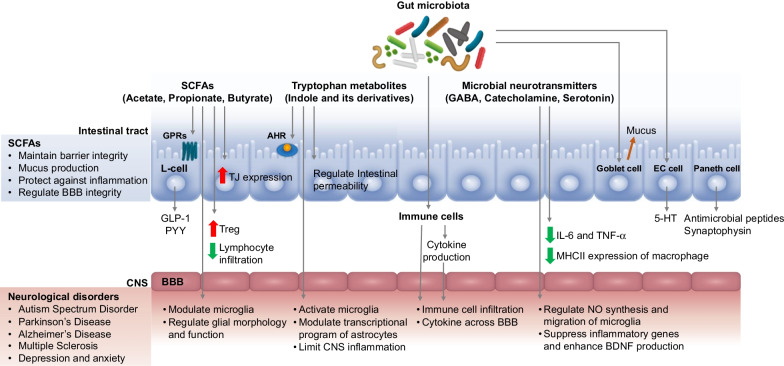
“Tryptophan metabolites produced by the gut microbiota regulate microglial activation as well as transforming growth factor alpha (TGFα) and vascular endothelial growth factor B (VEGF-B) production, and this may modulate the transcriptional program of astrocytes and limit CNS inflammation [54].”
BackgroundMicrobiota-liberated host sugars facilitate post-antibiotic expansion of enteric pathogens
Ng, K. M., Ferreyra, J. A., Higginbottom, S. K., Lynch, J. B., Kashyap, P. C., Gopinath, S., Naidu, N., Choudhury, B., Weimer, B. C., Monack, D. M., et al. (2013) · Nature · doi:10.1038/nature12503 · Cited by 1,035 · cited 1×
“The products of mucus degradation can be utilized by other gut microbiota, such as Lachnospiraceae [103], Clostridium cluster XIV [104], Clostridium difficile [105], and Enterobacteriaceae [106].”
BackgroundThe microbiome-gut-brain axis: from bowel to behavior
Cryan, J. F., & O’Mahony, S. M. (2011) · Neurogastroenterology & Motility · doi:10.1111/j.1365-2982.2010.01664.x · Cited by 990 · cited 2×
“Colonization of gut microbiota in early life plays an important role in the development and maturation of the immune and endocrine systems, both of which influence the central nervous system (CNS) function [2, 5, 6].”
BackgroundAkdis, C. A. (2021) · Nature Reviews Immunology · doi:10.1038/s41577-021-00538-7 · Cited by 981 · cited 1×
“Leaky gut is a condition characterized by the loss of intestinal barrier integrity and increased intestinal permeability, resulting in uncontrolled translocation of bacteria and harmful substances into the lamina propria and bloodstream and sequentially inducing inflammatory responses Therefore, leaky gut has been imp…”
BackgroundReduced incidence of Prevotella and other fermenters in intestinal microflora of autistic children
Kang, D.-W., Park, J. G., Ilhan, Z. E., Wallstrom, G., LaBaer, J., Adams, J. B., & Krajmalnik-Brown, R. (2013) · PLoS ONE · doi:10.1371/journal.pone.0068322 · Cited by 976 · cited 1×
“Low levels of the genera Prevotella, Coprococcus, and unclassified Veillonellaceae were observed in children with ASD and GI disorders [150].”
BackgroundForsyth, C. B., Shannon, K. M., Kordower, J. H., Voigt, R. M., Shaikh, M., Jaglin, J. A., Estes, J. D., Dodiya, H. B., & Keshavarzian, A. (2011) · PLoS ONE · doi:10.1371/journal.pone.0028032 · Cited by 974 · cited 1×
“Most patients with PD have increased intestinal permeability, which may reflect gut microbiota disorders [172], and this is reported to facilitate motor deficits, microglial activation, and α-syn pathology [173].”
BackgroundBrain-gut-microbe communication in health and disease
Grenham, S., Clarke, G., Cryan, J. F., & Dinan, T. G. (2011) · Frontiers in Physiology · doi:10.3389/fphys.2011.00094 · Cited by 952 · cited 1×
“Colonization of gut microbiota in early life plays an important role in the development and maturation of the immune and endocrine systems, both of which influence the central nervous system (CNS) function [2, 5, 6].”
BackgroundDietary fatty acids directly impact central nervous system autoimmunity via the small intestine
Haghikia, A., Jörg, S., Duscha, A., Berg, J., Manzel, A., Waschbisch, A., Hammer, A., Lee, D.-H., May, C., Wilck, N., et al. (2015) · Immunity · doi:10.1016/j.immuni.2015.09.007 · Cited by 927
Maternal Infection Requiring Hospitalization During Pregnancy and Autism Spectrum Disorders
Atladóttir, H. Ó., Thorsen, P., Østergaard, L., Schendel, D. E., Lemcke, S., Abdallah, M., & Parner, E. T. (2010) · Journal of Autism and Developmental Disorders · doi:10.1007/s10803-010-1006-y · Cited by 916 · cited 1×
“However, antibiotic use during the first year of life in offspring was not associated with the development of ASD [168].”
BackgroundThe gut microbiota in anxiety and depression—A systematic review
Simpson, C. A., Diaz-Arteche, C., Eliby, D., Schwartz, O. S., Simmons, J. G., & Cowan, C. S. M. (2021) · Clinical Psychology Review · doi:10.1016/j.cpr.2020.101943 · Cited by 912
Dopamine-mediated regulation of corticostriatal synaptic plasticity
Calabresi, P., Picconi, B., Tozzi, A., & Di Filippo, M. (2007) · Trends in Neurosciences · doi:10.1016/j.tins.2007.03.001 · Cited by 865 · cited 2×
“reported the role of dopamine in brain function; for example, the modulation of behavior, cognition, movement, emotions, memory, and learning [72].”
BackgroundRegulation of Intestinal Barrier Function by Microbial Metabolites
Ghosh, S., Whitley, C. S., Haribabu, B., & Jala, V. R. (2021) · Cellular and Molecular Gastroenterology and Hepatology · doi:10.1016/j.jcmgh.2021.02.007 · Cited by 835 · cited 2×
“The gut microbiota composition and bacterial metabolites are involved in the regulation of the intestinal barrier integrity and the CNS consequences [94, 95].”
BackgroundMack, D. R., Michail, S., Wei, S., McDougall, L., & Hollingsworth, M. A. (1999) · American Journal of Physiology-Gastrointestinal and Liver Physiology · doi:10.1152/ajpgi.1999.276.4.g941 · Cited by 829 · cited 1×
“In addition, certain gut microbiota, such as Lactobacillus plantarum and Lactobacillus rhamnosus GG, may induce the expression of mucins [110].”
BackgroundInflammatory Mediators and Modulation of Blood–Brain Barrier Permeability
Abbott, N. J. (2000) · Cellular and Molecular Neurobiology · doi:10.1023/a:1007074420772 · Cited by 803 · cited 1×
“However, serotonin has been reported to increase BBB permeability, which indirectly impacts brain function [86].”
BackgroundParracho, H. M., Bingham, M. O., Gibson, G. R., & McCartney, A. L. (2005) · Journal of Medical Microbiology · doi:10.1099/jmm.0.46101-0 · Cited by 784 · cited 1×
“In fecal samples of children with ASD, researchers found increased levels of the Clostridium histolyticum group (Clostridium clusters II and I), which are recognized as producers of toxins [149].”
BackgroundDopamine system dysregulation in major depressive disorders
Belujon, P., & Grace, A. A. (2017) · International Journal of Neuropsychopharmacology · doi:10.1093/ijnp/pyx056 · Cited by 754 · cited 1×
“Dopamine is a critical neurotransmitter that regulates peripheral immune responses and has been associated with several autoimmune diseases and neurological disorders [73, 74].”
BackgroundMaes, M. H. J., Kubera, M., & Leunis, J. (2008) · PubMed · Cited by 746
Monocarboxylate transporters in the central nervous system: distribution, regulation and function
Pierre, K., & Pellerin, L. (2005) · Journal of Neurochemistry · doi:10.1111/j.1471-4159.2005.03168.x · Cited by 744 · cited 2×
“The well-known transporters of SCFAs, MCTs, are abundantly expressed in endothelial cells and brain tissue [40, 41].”
BackgroundCharacterizing a model human gut microbiota composed of members of its two dominant bacterial phyla
Mahowald, M. A., Rey, F. E., Seedorf, H., Turnbaugh, P. J., Fulton, R. S., Wollam, A., Shah, N., Wang, C., Magrini, V., Wilson, R. K., et al. (2009) · Proceedings of the National Academy of Sciences · doi:10.1073/pnas.0901529106 · Cited by 740 · cited 1×
“Communication between the gut microbiota also supports the production of SCFAs, for example, Bacteroides thetaiotaomicron produces acetate, which is further utilized by Eubacterium hallii to generate butyrate [29].”
BackgroundThe Colonic Crypt Protects Stem Cells from Microbiota-Derived Metabolites
Kaiko, G. E., Ryu, S. H., Koues, O. I., Collins, P. L., Solnica-Krezel, L., Pearce, E. J., Pearce, E. L., Oltz, E. M., & Stappenbeck, T. S. (2016) · Cell · doi:10.1016/j.cell.2016.05.018 · Cited by 733
The composition of the gut microbiota shapes the colon mucus barrier
Jakobsson, H. E., Rodríguez‐Piñeiro, A. M., Schütte, A., Ermund, A., Boysen, P., Bemark, M., Sommer, F., Bäckhed, F., Hansson, G. C., & Johansson, M. E. (2015) · The EMBO Reports · doi:10.15252/embr.201439263 · Cited by 700 · cited 1×
“The composition of the microbiota can regulate mucus layer properties, influencing its permeability [100].”
BackgroundAsano, Y., Hiramoto, T., Nishino, R., Aiba, Y., Kimura, T., Yoshihara, K., Koga, Y., & Sudo, N. (2012) · American Journal of Physiology-Gastrointestinal and Liver Physiology · doi:10.1152/ajpgi.00341.2012 · Cited by 659 · cited 1×
“Levels of catecholamines have been found to be lower in GF mice than in specific pathogen-free mice; however, a mixture of Clostridia may elevate catecholamine levels in GF mice, suggesting that the gut microbiota plays a role in the generation of catecholamines in the gut lumen [68].”
BackgroundMinter, M. R., Zhang, C., Leone, V., Ringus, D. L., Zhang, X., Oyler-Castrillo, P., Musch, M. W., Liao, F., Ward, J. F., Holtzman, D. M., et al. (2016) · Scientific Reports · doi:10.1038/srep30028 · Cited by 655 · cited 1×
“Antibiotic-induced microbiota alteration plays a key role in modulating neuroinflammation, which in turn has been shown to influence amyloidosis in an AD mouse model [188].”
BackgroundPropionic Acid Shapes the Multiple Sclerosis Disease Course by an Immunomodulatory Mechanism
Duscha, A., Gisevius, B., Hirschberg, S., Yissachar, N., Stangl, G. I., Dawin, E., Bader, V., Haase, S., Kaisler, J., David, C., et al. (2020) · Cell · doi:10.1016/j.cell.2020.02.035 · Cited by 644
Van den Abbeele, P., Belzer, C., Goossens, M., Kleerebezem, M., De Vos, W. M., Thas, O., De Weirdt, R., Kerckhof, F.-M., & Van de Wiele, T. (2013) · The ISME Journal · doi:10.1038/ismej.2012.158 · Cited by 638
Microbial genes, brain & behaviour – epigenetic regulation of the gut–brain axis
Stilling, R. M., Dinan, T. G., & Cryan, J. F. (2014) · Genes, Brain and Behavior · doi:10.1111/gbb.12109 · Cited by 637
Short-Term Benefit From Oral Vancomycin Treatment of Regressive-Onset Autism
Sandler, R. H., Finegold, S. M., Bolte, E. R., Buchanan, C. P., Maxwell, A. P., Väisänen, M.-L., Nelson, M. N., & Wexler, H. M. (2000) · Journal of Child Neurology · doi:10.1177/088307380001500701 · Cited by 614 · cited 1×
“The reduction of the levels of these Clostridia by vancomycin treatment has been shown to improve ASD features [151], suggesting that bacteria in the C.”
BackgroundKim, M.-S., Kim, Y., Choi, H., Kim, W., Park, S., Lee, D., Kim, D. K., Kim, H. J., Choi, H., Hyun, D.-W., et al. (2020) · Gut · doi:10.1136/gutjnl-2018-317431 · Cited by 614 · cited 1×
“The transfer of a healthy gut microbiota could reduce aggregates of Aβ, tau pathology in the brain of AD mice [192].”
BackgroundMicrobiome–host systems interactions: protective effects of propionate upon the blood–brain barrier
Hoyles, L., Snelling, T., Umlai, U.-K., Nicholson, J. K., Carding, S. R., Glen, R. C., & McArthur, S. (2018) · Microbiome · doi:10.1186/s40168-018-0439-y · Cited by 591 · cited 1×
“Propionate can interact with free fatty acid receptor-3 (FFAR3) on endothelial cells, resulting in the inhibition of nonspecific microbial infections and protection of the BBB from oxidative stress [39].”
BackgroundInflammasome signaling affects anxiety- and depressive-like behavior and gut microbiome composition
Wong, M.-L., Inserra, A., Lewis, M. D., Mastronardi, C. A., Leong, L., Choo, J., Kentish, S., Xie, P., Morrison, M., Wesselingh, S. L., et al. (2016) · Molecular Psychiatry · doi:10.1038/mp.2016.46 · Cited by 568 · cited 3×
“Mice subjected to chronic restraint stress were found to have altered compositions of the gut microbiota compared to control mice [140, 207].”
BackgroundInfluentialLyte, M. (2011) · BioEssays · doi:10.1002/bies.201100024 · Cited by 549
Infant gut microbiome associated with cognitive development
Carlson, A. L., Xia, K., Azcarate-Peril, M. A., Goldman, B. D., Ahn, M., Styner, M. A., Thompson, A. L., Geng, X., Gilmore, J. H., & Knickmeyer, R. C. (2018) · Biological Psychiatry · doi:10.1016/j.biopsych.2017.06.021 · Cited by 541
Intestinal dysbiosis and lowered serum lipopolysaccharide-binding protein in Parkinson's disease
Hasegawa, S., Goto, S., Tsuji, H., Okuno, T., Asahara, T., Nomoto, K., Shibata, A., Fujisawa, Y., Minato, T., Okamoto, A., et al. (2015) · PLOS ONE · doi:10.1371/journal.pone.0142164 · Cited by 523 · cited 1×
“The level of Clostridium coccidias was found to be increased in early PD, whereas Lactobacillus gassier was increased in advanced PD [175].”
BackgroundInhibitory role for GABA in autoimmune inflammation
Bhat, R., Axtell, R., Mitra, A., Miranda, M., Lock, C., Tsien, R. W., & Steinman, L. (2010) · Proceedings of the National Academy of Sciences · doi:10.1073/pnas.0915139107 · Cited by 509 · cited 2×
“GABA treatment was effective in ameliorating multiple sclerosis (MS) in an animal model and experimental autoimmune encephalomyelitis (EAE) by inhibiting inflammation [66].”
BackgroundNeuropeptide, Y, peptide YY and pancreatic polypeptide in the gut-brain axis
Holzer, P., Reichmann, F., & Farzi, A. (2012) · Neuropeptides · doi:10.1016/j.npep.2012.08.005 · Cited by 501
Macrophages in inflammatory multiple sclerosis lesions have an intermediate activation status
Vogel, D. Y., Vereyken, E. J., Glim, J. E., Heijnen, P. D., Moeton, M., van der Valk, P., Amor, S., Teunissen, C. E., van Horssen, J., & Dijkstra, C. D. (2013) · Journal of Neuroinflammation · doi:10.1186/1742-2094-10-35 · Cited by 479
Role of TLR4 in the gut-brain axis in Parkinson's disease: A translational study from men to mice
Perez-Pardo, P., Dodiya, H. B., Engen, P. A., Forsyth, C. B., Huschens, A. M., Shaikh, M., Voigt, R. M., Naqib, A., Green, S. J., Kordower, J. H., et al. (2019) · Gut · doi:10.1136/gutjnl-2018-316844 · Cited by 467 · cited 1×
“The intestinal barrier is disrupted in patients with PD and PD mouse models, suggesting that intestinal barrier– brain interaction plays an important role in PD pathology [92].”
BackgroundParkinson disease and the immune system - Associations, mechanisms and therapeutics
Tan, E.-K., Chao, Y.-X., West, A., Chan, L.-L., Poewe, W., & Jankovic, J. (2020) · Nature Reviews Neurology · doi:10.1038/s41582-020-0344-4 · Cited by 457 · cited 3×
“The association between autoimmune diseases and PD has been demonstrated, for example, impaired cellular and humoral immune responses as well as immune dysregulation in PD [169].”
BackgroundThe contribution of neuroinflammation to amyloid toxicity in Alzheimer's disease
Minter, M. R., Taylor, J. M., & Crack, P. J. (2016) · Journal of Neurochemistry · doi:10.1111/jnc.13411 · Cited by 451 · cited 1×
“TLRs expressed by microglia recognize soluble Aβ peptides and induce inflammasome complexes, resulting in the initiation of neuroinflammatory responses [185].”
BackgroundTai, H.-C., Serrano-Pozo, A., Hashimoto, T., Frosch, M. P., Spires-Jones, T. L., & Hyman, B. T. (2012) · The American Journal of Pathology · doi:10.1016/j.ajpath.2012.06.033 · Cited by 443 · cited 1×
“In AD, misfolded and hyperphosphorylated tau proteins accumulate in neurons; this is associated with altered protein turnover at synapses [184, 187].”
BackgroundAho, V. T. E., Houser, M. C., Pereira, P. A. B., Chang, J., Rudi, K., Paulin, L., Hertzberg, V., Auvinen, P., Tansey, M. G., & Scheperjans, F. (2021) · Molecular Neurodegeneration · doi:10.1186/s13024-021-00427-6 · Cited by 435
MacFabe, D. F. (2012) · Microbial Ecology in Health & Disease · doi:10.3402/mehd.v23i0.19260 · Cited by 422 · cited 2×
“Moreover, increased oxidative stress and neuroinflammation have been observed in the brain tissue of propionic acid-treated rats [156].”
BackgroundZafra, F., Lindholm, D., Castren, E., Hartikka, J., & Thoenen, H. (1992) · The Journal of Neuroscience · doi:10.1523/jneurosci.12-12-04793.1992 · Cited by 414 · cited 1×
“In the brain, norepinephrine has neuroprotective effects by suppressing inflammatory gene transcription and enhancing BDNF production by microglia and astrocytes, which can further promote neuronal survival [82, 83].”
BackgroundWang, L., Christophersen, C. T., Sorich, M. J., Gerber, J. P., Angley, M. T., & Conlon, M. A. (2012) · Digestive Diseases and Sciences · doi:10.1007/s10620-012-2167-7 · Cited by 412 · cited 2×
“In addition to the gut microbiota alterations, changes in microbial metabolites have also been noted in ASD [154, 155].”
BackgroundMultiple facets of intestinal permeability and epithelial handling of dietary antigens
Ménard, S., Cerf-Bensussan, N., & Heyman, M. (2010) · Mucosal Immunology · doi:10.1038/mi.2010.5 · Cited by 410 · cited 10×
“The gut microbiota and their metabolites further impact IECs and the immune system, which mediate the pathology of neurological disorders Ta bl e 1 Fu nc tio ns o f t he m et ab ol ite s an d ne ur ot ra ns m itt er s pr od uc ed b y th e gu t m ic ro bi ot a M ic ro bi al m et ab ol ite s/ ne ur ot ra ns m itt er s G…”
BackgroundInfluentialRole of Monocarboxylate Transporters in Drug Delivery to the Brain
Vijay, N., & Morris, M. (2014) · Current Pharmaceutical Design · doi:10.2174/13816128113199990462 · Cited by 408 · cited 2×
“SCFAs are absorbed by colonocytes, mainly via monocarboxylate transporters (MCTs), and serve as energy sources for colonocytes [30, 31].”
BackgroundChristiansen, C. B., Gabe, M. B. N., Svendsen, B., Dragsted, L. O., Rosenkilde, M. M., & Holst, J. J. (2018) · American Journal of Physiology-Gastrointestinal and Liver Physiology · doi:10.1152/ajpgi.00346.2017 · Cited by 401 · cited 2×
“L-cells sense bacterial metabolites and secrete GLP-1 and PYY locally into the blood circulation [36, 123].”
BackgroundO’Donnell, J., Zeppenfeld, D., McConnell, E., Pena, S., & Nedergaard, M. (2012) · Neurochemical Research · doi:10.1007/s11064-012-0818-x · Cited by 399 · cited 2×
“In the brain, norepinephrine has neuroprotective effects by suppressing inflammatory gene transcription and enhancing BDNF production by microglia and astrocytes, which can further promote neuronal survival [82, 83].”
BackgroundRole of microbiota-derived short-chain fatty acids in nervous system disorders
Mirzaei, R., Bouzari, B., Hosseini-Fard, S. R., Mazaheri, M., Ahmadyousefi, Y., Abdi, M., Jalalifar, S., Karimitabar, Z., Teimoori, A., Keyvani, H., et al. (2021) · Biomedicine & Pharmacotherapy · doi:10.1016/j.biopha.2021.111661 · Cited by 386
Importance and regulation of the colonic mucus barrier in a mouse model of colitis
Petersson, J., Schreiber, O., Hansson, G. C., Gendler, S. J., Velcich, A., Lundberg, J. O., Roos, S., Holm, L., & Phillipson, M. (2011) · American Journal of Physiology-Gastrointestinal and Liver Physiology · doi:10.1152/ajpgi.00422.2010 · Cited by 385 · cited 6×
“It has been shown that the thickness of the mucus layer may be restored when GF mice are exposed to bacterial products (peptidoglycan or LPS) [109].”
BackgroundInfluentialDifferences in fecal microbial metabolites and microbiota of children with autism spectrum disorders
Kang, D.-W., Ilhan, Z. E., Isern, N. G., Hoyt, D. W., Howsmon, D. P., Shaffer, M., Lozupone, C. A., Hahn, J., Adams, J. B., & Krajmalnik-Brown, R. (2018) · Anaerobe · doi:10.1016/j.anaerobe.2017.12.007 · Cited by 381 · cited 2×
“In addition to the gut microbiota alterations, changes in microbial metabolites have also been noted in ASD [154, 155].”
BackgroundEnteroendocrine cells: a site of 'taste' in gastrointestinal chemosensing
Sternini, C., Anselmi, L., & Rozengurt, E. (2008) · Current Opinion in Endocrinology, Diabetes & Obesity · doi:10.1097/med.0b013e3282f43a73 · Cited by 377 · cited 1×
“After sensing stimuli in the luminal content, EECs produce and release signaling molecules or hormones that can act locally on neighboring cells in the GI tract or enter the blood circulation to act on distant target tissues [114, 115].”
BackgroundAutism After Infection, Febrile Episodes, and Antibiotic Use During Pregnancy: An Exploratory Study
Atladóttir, H. Ó., Henriksen, T. B., Schendel, D. E., & Parner, E. T. (2012) · Pediatrics · doi:10.1542/peds.2012-1107 · Cited by 369
Microbiota-derived short chain fatty acids modulate microglia and promote Aβ plaque deposition
Colombo, A. V., Sadler, R. K., Llovera, G., Singh, V., Roth, S., Heindl, S., Sebastian Monasor, L., Verhoeven, A., Peters, F., Parhizkar, S., et al. (2021) · eLife · doi:10.7554/elife.59826 · Cited by 354 · cited 2×
“However, SCFAs have been shown to promote amyloid β (Aβ) deposition in the brain of GF mouse model of Alzheimer’s disease (AD) by modulating microglia phenotypes [45].”
BackgroundThe role of small intestinal bacterial overgrowth in Parkinson's disease
Fasano, A., Bove, F., Gabrielli, M., Petracca, M., Zocco, M. A., Ragazzoni, E., Barbaro, F., Piano, C., Fortuna, S., Tortora, A., et al. (2013) · Movement Disorders · doi:10.1002/mds.25522 · Cited by 344 · cited 1×
“Excessive bacterial growth in the small intestine was found in patients with PD; it is related to abnormal absorption and motor impairment [174].”
BackgroundThe gut-brain axis: the missing link in depression
Evrensel, A., & Ceylan, M. E. (2015) · Clinical Psychopharmacology and Neuroscience · doi:10.9758/cpn.2015.13.3.239 · Cited by 338 · cited 1×
“In addition, certain bacterial genera, such as Candida, Streptococcus, Escherichia, Enterococcus, and Pseudomonas, can produce serotonin [85].”
BackgroundOu, Z., Deng, L., Lu, Z., Wu, F., Liu, W., Huang, D., & Peng, Y. (2020) · Nutrition & Diabetes · doi:10.1038/s41387-020-0115-8 · Cited by 328 · cited 1×
“muciniphila alleviated the reduction of colonic mucus cells and relieved cognitive impairment and anxiety-related behaviors in an AD mouse model [113].”
BackgroundThe immunoregulatory role of dopamine: An update
Sarkar, C., Basu, B., Chakroborty, D., Dasgupta, P. S., & Basu, S. (2010) · Brain, Behavior, and Immunity · doi:10.1016/j.bbi.2009.10.015 · Cited by 323 · cited 2×
“Dysfunction of the dopaminergic system and altered immune function are associated with Parkinson’s disease (PD) [77].”
BackgroundTryptophan Metabolism by Gut Microbiome and Gut-Brain-Axis: An in silico Analysis
Kaur, H., Bose, C., & Mande, S. S. (2019) · Frontiers in Neuroscience · doi:10.3389/fnins.2019.01365 · Cited by 318 · cited 3×
“In addition, an in silico analysis indicated enrichment of tryptophan metabolism in five bacterial genera, including Clostridium, Burkholderia, Streptomyces, Pseudomonas, and Bacillus, suggesting that these bacterial groups have the ability to metabolize tryptophan in the gut [49].”
BackgroundInfluentialGABA receptors in brain development, function, and injury
Wu, C., & Sun, D. (2015) · Metabolic Brain Disease · doi:10.1007/s11011-014-9560-1 · Cited by 317
Gunawardene, A. R., Corfe, B. M., & Staton, C. A. (2011) · International Journal of Experimental Pathology · doi:10.1111/j.1365-2613.2011.00767.x · Cited by 311 · cited 5×
“L-cells sense bacterial metabolites and secrete GLP-1 and PYY locally into the blood circulation [36, 123].”
BackgroundInfluentialXu, M., Xu, X., Li, J., & Li, F. (2019) · Frontiers in Psychiatry · doi:10.3389/fpsyt.2019.00473 · Cited by 309 · cited 1×
“A meta-analysis has also revealed that children diagnosed with ASD had lower levels of Enterococcus, Escherichia coli, Bifidobacterium, and Bacteroides populations and higher levels of Faecalibacterium, Lactobacillus, and Ruminococcus populations [148].”
BackgroundThe “Normal” Endocrine Cell of the Gut: Changing Concepts and New Evidences
RINDI, G., LEITER, A. B., KOPIN, A. S., BORDI, C., & SOLCIA, E. (2004) · Annals of the New York Academy of Sciences · doi:10.1196/annals.1294.001 · Cited by 297 · cited 1×
“For instance, secretin-secreting S cells, motilin-secreting M cells, and neurotensin-secreting N cells are only present in the small intestine [116].”
BackgroundRai, D., Zitko, P., Jones, K., Lynch, J., & Araya, R. (2013) · British Journal of Psychiatry · doi:10.1192/bjp.bp.112.112482 · Cited by 273
Spatial organization of intestinal microbiota in the mouse ascending colon
Nava, G. M., Friedrichsen, H. J., & Stappenbeck, T. S. (2011) · The ISME Journal · doi:10.1038/ismej.2010.161 · Cited by 270 · cited 2×
“Wong et al. demonstrated that the relative levels of bacteria in the genera Allobaculum, Bifidobacteria, Turicibacter, and Clostridium were reduced, and the relative level of the family Lachnospiraceae was increased in mice with chronic restraint stress [140].”
BackgroundJaglin, M., Rhimi, M., Philippe, C., Pons, N., Bruneau, A., Goustard, B., Daugé, V., Maguin, E., Naudon, L., & Rabot, S. (2018) · Frontiers in Neuroscience · doi:10.3389/fnins.2018.00216 · Cited by 269 · cited 3×
“This suggests that indole may play a critical role in promoting the development of anxiety and mood disorders [51].”
BackgroundThe Pharmacology and Function of Receptors for Short-Chain Fatty Acids
Bolognini, D., Tobin, A. B., Milligan, G., & Hodge, D. (2016) · Molecular Pharmacology · doi:10.1124/mol.115.102301 · Cited by 267 · cited 1×
“SCFAs bind to G proteincoupled receptors (GPCRs), such as GPR41, GPR43, and GPR109a, which are expressed in various cell types [35].”
BackgroundNishino, R., Mikami, K., Takahashi, H., Tomonaga, S., Furuse, M., Hiramoto, T., Aiba, Y., Koga, Y., & Sudo, N. (2013) · Neurogastroenterology & Motility · doi:10.1111/nmo.12110 · Cited by 266 · cited 2×
“GF mice exhibit impaired brain function in learning, recognition, and behavior [16, 17].”
BackgroundHuman Gut-Derived Commensal Bacteria Suppress CNS Inflammatory and Demyelinating Disease
Mangalam, A., Shahi, S. K., Luckey, D., Karau, M., Marietta, E., Luo, N., Choung, R. S., Ju, J., Sompallae, R., Gibson-Corley, K., et al. (2017) · Cell Reports · doi:10.1016/j.celrep.2017.07.031 · Cited by 266 · cited 1×
“Conversely, Bacteroides fragilis and Prevotella histicola colonization can suppress EAE by promoting Treg function, suggesting that the gut microbiota modulate neuroinflammation via immune responses [137].”
BackgroundSalcedo, I., Tweedie, D., Li, Y., & Greig, N. H. (2012) · British Journal of Pharmacology · doi:10.1111/j.1476-5381.2012.01971.x · Cited by 259
Intestinal microbial dysbiosis aggravates the progression of Alzheimer’s disease in Drosophila
Wu, S.-C., Cao, Z.-S., Chang, K.-M., & Juang, J.-L. (2017) · Nature Communications · doi:10.1038/s41467-017-00040-6 · Cited by 254 · cited 1×
“The gut microbiota dysbiosis exacerbates the progression of Alzheimer’s disease in flies by recruiting hemocytes to the brain and causing neuroinflammation [191].”
BackgroundCurran, E. A., O'Neill, S. M., Cryan, J. F., Kenny, L. C., Dinan, T. G., Khashan, A. S., & Kearney, P. M. (2015) · Journal of Child Psychology and Psychiatry · doi:10.1111/jcpp.12351 · Cited by 250 · cited 2×
“Studies on the etiological relationship between cesarean section (c-section) and ASD showed that infants delivered by c-section showed a high probability of developing ASD [161, 162].”
BackgroundImmune Dysfunction and Autoimmunity as Pathological Mechanisms in Autism Spectrum Disorders
Hughes, H. K., Mills Ko, E., Rose, D., & Ashwood, P. (2018) · Frontiers in Cellular Neuroscience · doi:10.3389/fncel.2018.00405 · Cited by 245 · cited 1×
“Besides GI disturbances and alteration of the gut microbiome, immune dysfunction and autoimmunity are highlighted as key players contributing to the pathogenesis of ASD [152].”
BackgroundDopamine and noradrenaline control distinct functions in rodent microglial cells
Färber, K., Pannasch, U., & Kettenmann, H. (2005) · Molecular and Cellular Neuroscience · doi:10.1016/j.mcn.2005.01.003 · Cited by 238 · cited 1×
“In the CNS, dopamine regulates nitric oxide synthesis and microglial cell migration [78, 79].”
BackgroundJohansson, M. E. V., Thomsson, K. A., & Hansson, G. C. (2009) · Journal of Proteome Research · doi:10.1021/pr9002504 · Cited by 237 · cited 1×
“The mucus layer is defined as two connected layers: an outer loose mucus layer and an inner adherent mucus layer [99].”
BackgroundWosen, J. E., Mukhopadhyay, D., Macaubas, C., & Mellins, E. D. (2018) · Frontiers in Immunology · doi:10.3389/fimmu.2018.02144 · Cited by 237 · cited 1×
“Besides their absorption function, enterocytes also act as non-professional antigen-presenting cells (APCs) and release cytokines in response to stimuli [90].”
BackgroundWu, M., Tian, T., Mao, Q., Zou, T., Zhou, C.-J., Xie, J., & Chen, J.-J. (2020) · Translational Psychiatry · doi:10.1038/s41398-020-01038-3 · Cited by 232
Gut microbiota: Implications in Parkinson's disease
Parashar, A., & Udayabanu, M. (2017) · Parkinsonism & Related Disorders · doi:10.1016/j.parkreldis.2017.02.002 · Cited by 230 · cited 1×
“Accumulating evidence suggests that intestinal inflammatory responses and intestinal derived inflammation related to dysbiosis play pathological roles in PD [169, 171].”
The microbiota-immune axis as a central mediator of gut-brain communication
Fung, T. C. (2020) · Neurobiology of Disease · doi:10.1016/j.nbd.2019.104714 · Cited by 230
Low-grade endotoxemia in patients with severe autism
Emanuele, E., Orsi, P., Boso, M., Broglia, D., Brondino, N., Barale, F., di Nemi, S. U., & Politi, P. (2010) · Neuroscience Letters · doi:10.1016/j.neulet.2010.01.033 · Cited by 225 · cited 1×
“Elevated serum levels of toxins and bacterial products, a result of increased intestinal permeability, can induce immune responses related to impaired brain function and social behavior [145, 146].”
BackgroundMicrobial Endocrinology and the Microbiota-Gut-Brain Axis
Lyte, M. (2014) · Advances in Experimental Medicine and Biology · doi:10.1007/978-1-4939-0897-4_1 · Cited by 224
Liu, J., Wang, F., Liu, S., Du, J., Hu, X., Xiong, J., Fang, R., Chen, W., & Sun, J. (2017) · Journal of the Neurological Sciences · doi:10.1016/j.jns.2017.08.3235 · Cited by 218 · cited 6×
“PD mice treated with sodium butyrate showed improvements in neurobehavioral impairment, prevented dopaminergic generation, attenuated the PD-associated disruption of BBB, and increased colonic GLP-1 and brain GLP-1R [179].”
BackgroundInfluentialHerath, M., Hosie, S., Bornstein, J. C., Franks, A. E., & Hill-Yardin, E. L. (2020) · Frontiers in Cellular and Infection Microbiology · doi:10.3389/fcimb.2020.00248 · Cited by 213 · cited 1×
“Abnormal mucin production and altered mucus layers are associated with neurological disorders, such as Alzheimer’s disease, PD, and MS [111].”
BackgroundTryptophan-metabolizing gut microbes regulate adult neurogenesis via the aryl hydrocarbon receptor
Wei, G. Z., Martin, K. A., Xing, P. Y., Agrawal, R., Whiley, L., Wood, T. K., Hejndorf, S., Ng, Y. Z., Low, J. Z. Y., Rossant, J., et al. (2021) · Proceedings of the National Academy of Sciences · doi:10.1073/pnas.2021091118 · Cited by 208 · cited 3×
“Researchers have recently investigated the potential role of tryptophan metabolites, which are produced by the gut microbiota, in the modulation of brain function [50, 51].”
BackgroundNoradrenergic Modulation of Cognition in Health and Disease
Borodovitsyna, O., Flamini, M., & Chandler, D. (2017) · Neural Plasticity · doi:10.1155/2017/6031478 · Cited by 205 · cited 1×
“Reduced norepinephrine levels have been associated with depression, anxiety, and post-traumatic stress disorder [80].”
BackgroundWang, Y., Telesford, K. M., Ochoa-Repáraz, J., Haque-Begum, S., Christy, M., Kasper, E. J., Wang, L., Wu, Y., Robson, S. C., Kasper, D. L., et al. (2014) · Nature Communications · doi:10.1038/ncomms5432 · Cited by 204 · cited 15×
“In addition, the colonization of segmented filamentous bacteria (SFB) induces Th1 and Th17 responses in the intestine and spinal cord and promotes EAE symptoms in GF mice [136].”
InfluentialYamawaki, Y., Yoshioka, N., Nozaki, K., Ito, H., Oda, K., Harada, K., Shirawachi, S., Asano, S., Aizawa, H., Yamawaki, S., et al. (2018) · Brain Research · doi:10.1016/j.brainres.2017.12.004 · Cited by 204
Impact of Cytokines and Chemokines on Alzheimer’s Disease Neuropathological Hallmarks
Domingues, C., da Cruz e Silva, O. A. B., & Henriques, A. G. (2017) · Current Alzheimer Research · doi:10.2174/1567205014666170317113606 · Cited by 203
St. Laurent, R., O’Brien, L. M., & Ahmad, S. T. (2013) · Neuroscience · doi:10.1016/j.neuroscience.2013.04.037 · Cited by 199
Characterization of Blood-Brain Barrier Permeability to PYY3-36 in the Mouse
Nonaka, N., Shioda, S., Niehoff, M. L., & Banks, W. A. (2003) · The Journal of Pharmacology and Experimental Therapeutics · doi:10.1124/jpet.103.051821 · Cited by 194
Molecular mechanisms of neuropathological changes in Alzheimer’s disease: a review
Šerý, O., Povová, J., Míšek, I., Pešák, L., & Janout, V. (2013) · Folia Neuropathologica · doi:10.5114/fn.2013.34190 · Cited by 190
Commensal microbiota induces colonic barrier structure and functions that contribute to homeostasis
Hayes, C. L., Dong, J., Galipeau, H. J., Jury, J., McCarville, J., Huang, X., Wang, X.-Y., Naidoo, A., Anbazhagan, A. N., Libertucci, J., et al. (2018) · Scientific Reports · doi:10.1038/s41598-018-32366-6 · Cited by 189 · cited 1×
“The gut microbiota composition and bacterial metabolites are involved in the regulation of the intestinal barrier integrity and the CNS consequences [94, 95].”
BackgroundTakewaki, D., Suda, W., Sato, W., Takayasu, L., Kumar, N., Kimura, K., Kaga, N., Mizuno, T., Miyake, S., Hattori, M., et al. (2020) · Proceedings of the National Academy of Sciences · doi:10.1073/pnas.2011703117 · Cited by 188
Kipnis, J., Cardon, M., Avidan, H., Lewitus, G. M., Mordechay, S., Rolls, A., Shani, Y., & Schwartz, M. (2004) · The Journal of Neuroscience · doi:10.1523/jneurosci.0600-04.2004 · Cited by 187
The Gut Immune Barrier and the Blood-Brain Barrier: Are They So Different?
Daneman, R., & Rescigno, M. (2009) · Immunity · doi:10.1016/j.immuni.2009.09.012 · Cited by 184
Jolanta Wasilewska, J., & Klukowski, M. (2015) · Pediatric Health, Medicine and Therapeutics · doi:10.2147/phmt.s85717 · Cited by 182 · cited 1×
“Patients with ASD also have GI disturbances, such as barrier disruption, constipation, abdominal pain, and diarrhea, which are linked to the severity of ASD symptoms [143].”
BackgroundEffect of short-chain fatty acids on paracellular permeability in Caco-2 intestinal epithelium model
Mariadason, J. M., Barkla, D. H., & Gibson, P. R. (1997) · American Journal of Physiology-Gastrointestinal and Liver Physiology · doi:10.1152/ajpgi.1997.272.4.g705 · Cited by 182 · cited 1×
“SCFAs can enhance the intestinal barrier by upregulating TJ protein expression and facilitating TJ assembly [96, 97].”
BackgroundGABA, a natural immunomodulator of T lymphocytes
Bjurstöm, H., Wang, J., Ericsson, I., Bengtsson, M., Liu, Y., Kumar-Mendu, S., Issazadeh-Navikas, S., & Birnir, B. (2008) · Journal of Neuroimmunology · doi:10.1016/j.jneuroim.2008.08.017 · Cited by 181
Takanaga, H., Ohtsuki, S., Hosoya, K.-I., & Terasaki, T. (2001) · Journal of Cerebral Blood Flow & Metabolism · doi:10.1097/00004647-200110000-00012 · Cited by 178
Krajmalnik-Brown, R., Lozupone, C., Kang, D.-W., & Adams, J. B. (2015) · Microbial Ecology in Health & Disease · doi:10.3402/mehd.v26.26914 · Cited by 167
Kubera, M., Maes, M. H. J., Kenis, G., Kim, Y., & Lasoń, W. (2005) · Psychiatry Research · doi:10.1016/j.psychres.2004.01.014 · Cited by 166
Tsavkelova, E. A., Botvinko, I. V., Кудрин, В. С., & Oleskin, A. V. (2000) · PubMed · Cited by 162
Schultz, S. T., Klonoff-Cohen, H. S., Wingard, D. L., Akshoomoff, N. A., Macera, C. A., Ji, M., & Bacher, C. (2006) · International Breastfeeding Journal · doi:10.1186/1746-4358-1-16 · Cited by 159 · cited 1×
“Moreover, over 6 months of breastfeeding has been associated with lower rates of ASD development and ASD-related GI symptoms [165].”
BackgroundEnteric short‐chain fatty acids promote proliferation of human neural progenitor cells
Yang, L. L., Millischer, V., Rodin, S., MacFabe, D. F., Villaescusa, J. C., & Lavebratt, C. (2020) · Journal of Neurochemistry · doi:10.1111/jnc.14928 · Cited by 157 · cited 1×
“SCFAs at physiologically relevant levels promote the proliferation and mitosis of human early neural progenitor cells [48].”
BackgroundThe Aryl Hydrocarbon Receptor and the Nervous System
Juricek, L., & Coumoul, X. (2018) · International Journal of Molecular Sciences · doi:10.3390/ijms19092504 · Cited by 155 · cited 1×
“Indole derivatives can interact with AHR, which is normally expressed in the GI tract and in CNS cells, including neurons, astrocytes, and microglia [55].”
BackgroundEmge, J. R., Huynh, K., Miller, E. N., Kaur, M., Reardon, C., Barrett, K. E., & Gareau, M. G. (2016) · American Journal of Physiology-Gastrointestinal and Liver Physiology · doi:10.1152/ajpgi.00086.2016 · Cited by 152
Clostridium ramosum regulates enterochromaffin cell development and serotonin release
Mandić, A. D., Woting, A., Jaenicke, T., Sander, A., Sabrowski, W., Rolle-Kampcyk, U., von Bergen, M., & Blaut, M. (2019) · Scientific Reports · doi:10.1038/s41598-018-38018-z · Cited by 150 · cited 1×
“The gut microbiota and their bacterial metabolites can promote the differentiation of ISCs toward the secretory 5-HT-producing lineage and stimulate 5-HT secretion, resulting in increased circulating 5-HT levels [118, 119].”
BackgroundType-1 interferon signaling mediates neuro-inflammatory events in models of Alzheimer’s disease
Taylor, J. M., Minter, M. R., Newman, A. G., Zhang, M., Adlard, P. A., & Crack, P. J. (2014) · Neurobiology of Aging · doi:10.1016/j.neurobiolaging.2013.10.089 · Cited by 145 · cited 1×
“In addition, peripheral immune cells, specifically type I interferon responses from T cells, also play a role in CNS neuroinflammatory responses [183].”
BackgroundAbdelli, L. S., Samsam, A., & Naser, S. A. (2019) · Scientific Reports · doi:10.1038/s41598-019-45348-z · Cited by 144 · cited 2×
“The effects of propionic acid on the pathogenesis of ASD have also been demonstrated [156, 157].”
Backgroundγ-Aminobutyric acid found in fermented foods and beverages: current trends
Sahab, N. R. M., Subroto, E., Balia, R. L., & Utama, G. L. (2020) · Heliyon · doi:10.1016/j.heliyon.2020.e05526 · Cited by 144
Roshchina, V. V. (2016) · Advances in Experimental Medicine and Biology · doi:10.1007/978-3-319-20215-0_2 · Cited by 143 · cited 1×
“In addition, dopamine has also been found in the biomass of Bacillus cereus, Bacillus mycoides, Bacillus subtilis, Proteus vulgaris, Serratia marcescens, Staphylococcus aureus, and Escherichia coli [76].”
BackgroundIntestinal microbiota and the immune system in metabolic diseases
Sittipo, P., Lobionda, S., Lee, Y. K., & Maynard, C. L. (2018) · Journal of Microbiology · doi:10.1007/s12275-018-7548-y · Cited by 141 · cited 2×
“Bacterial metabolites/neurotransmitters Microbial metabolites are important factors for communication among the gut microbiota and between the gut microbiota and host cells [11, 12].”
BackgroundSelf-citationHolmans, P., Moskvina, V., Jones, L., Sharma, M., The International Parkinson's Disease Genomics Consortium (IPDGC), Vedernikov, A., Buchel, F., Sadd, M., Bras, J. M., Bettella, F., et al. (2013) · Human Molecular Genetics · doi:10.1093/hmg/dds492 · Cited by 139 · cited 1×
“Pathway-based analysis showed that the genes involved in the regulation of leukocyte/lymphocyte activity and cytokine-mediated signaling are associated with the risk of PD [170].”
BackgroundKANDORI, H., HIRAYAMA, K., TAKEDA, M., & DOI, K. (1996) · Experimental Animals · doi:10.1538/expanim.45.155 · Cited by 138 · cited 1×
“GF animals showed fewer and smaller goblet cells as well as a relatively thinner mucus layer than conventional mice, suggesting that the gut microbiota plays a role in mucus composition and thickness [107, 108].”
BackgroundSex differences in autoimmune disorders of the central nervous system
Gold, S. M., Willing, A., Leypoldt, F., Paul, F., & Friese, M. A. (2018) · Seminars in Immunopathology · doi:10.1007/s00281-018-0723-8 · Cited by 138 · cited 1×
“Males are less likely to develop neuroinflammatory disorders than females, which reflects a possible neuroprotective pathway in males [47].”
BackgroundLee, C., Jeon, S. J., Cho, K. S., Moon, E., Sapkota, A., Jun, H., Ryu, J. H., & Choi, J. W. (2017) · Molecular Neurobiology · doi:10.1007/s12035-017-0550-2 · Cited by 136
Self-citationMicrobial Metabolites Determine Host Health and the Status of Some Diseases
Sittipo, P., Shim, J.-W., & Lee, Y. (2019) · International Journal of Molecular Sciences · doi:10.3390/ijms20215296 · Cited by 136 · cited 2×
“Bacterial metabolites/neurotransmitters Microbial metabolites are important factors for communication among the gut microbiota and between the gut microbiota and host cells [11, 12].”
BackgroundSelf-citationGao, W., Salzwedel, A. P., Carlson, A. L., Xia, K., Azcarate-Peril, M. A., Styner, M. A., Thompson, A. L., Geng, X., Goldman, B. D., Gilmore, J. H., et al. (2019) · Psychopharmacology · doi:10.1007/s00213-018-5161-8 · Cited by 135
SadA-Expressing Staphylococci in the Human Gut Show Increased Cell Adherence and Internalization
Luqman, A., Nega, M., Nguyen, M.-T., Ebner, P., & Götz, F. (2018) · Cell Reports · doi:10.1016/j.celrep.2017.12.058 · Cited by 127 · cited 1×
“A previous study showed that certain bacterial species in the genus Staphylococcus can produce dopamine via staphylococcal aromatic amino acid decarboxylase [75].”
BackgroundConnolly, N., Anixt, J., Manning, P., Ping‐I Lin, D., Marsolo, K. A., & Bowers, K. (2016) · Autism Research · doi:10.1002/aur.1586 · Cited by 125 · cited 2×
“A study of medical records showed that maternal obesity was positively associated with having a child with ASD [158].”
BackgroundThe Gut-Microglia Connection: Implications for Central Nervous System Diseases
Wang, Y., Wang, Z., Wang, Y., Li, F., Jia, J., Song, X., Qin, S., Wang, R., Jin, F., Kitazato, K., et al. (2018) · Frontiers in Immunology · doi:10.3389/fimmu.2018.02325 · Cited by 125 · cited 1×
“Microglia are major immune cells that maintain CNS processes and homeostasis [19].”
BackgroundTypes of endocrine cells in the human colon and rectum
Buffa, R., Capella, C., Fontana, P., Usellini, L., & Solcia, E. (1978) · Cell and Tissue Research · doi:10.1007/bf00220741 · Cited by 124 · cited 2×
“After sensing stimuli in the luminal content, EECs produce and release signaling molecules or hormones that can act locally on neighboring cells in the GI tract or enter the blood circulation to act on distant target tissues [114, 115].”
Backgroundon behalf of AddNeuroMed consortium, Whiley, L., Chappell, K. E., D’Hondt, E., Lewis, M. R., Jiménez, B., Snowden, S. G., Soininen, H., Kłoszewska, I., Mecocci, P., et al. (2021) · Alzheimer's Research & Therapy · doi:10.1186/s13195-020-00741-z · Cited by 124 · cited 1×
“For example, serum levels of serotonin have been found to be lower in patients with AD [121] and PD [122].”
BackgroundEffect of suboptimal breast-feeding on occurrence of autism: A case–control study
Al-Farsi, Y. M., Al‐Sharbati, M. M., Waly, M. I., Al-Farsi, O. A., Al‐Shafaee, M., Al‐Khaduri, M., Trivedi, M. S., & Deth, R. C. (2012) · Nutrition · doi:10.1016/j.nut.2012.01.007 · Cited by 121
GABA in the Mammalian Enteric Nervous System
Krantis, A. (2000) · Physiology · doi:10.1152/physiologyonline.2000.15.6.284 · Cited by 120
Short chain fatty acids in plasma and brain: Quantitative determination by gas chromatography
Bachmann, C., Colombo, J.-P., & Berüter, J. (1979) · Clinica Chimica Acta · doi:10.1016/0009-8981(79)90109-8 · Cited by 115 · cited 1×
“The presence of SCFAs in the human brain reflects their ability to cross the BBB [42].”
BackgroundZhao, L., Xiong, Q., Stary, C. M., Mahgoub, O. K., Ye, Y., Gu, L., Xiong, X., & Zhu, S. (2018) · Journal of Neuroinflammation · doi:10.1186/s12974-018-1382-3 · Cited by 113 · cited 1×
“The biological network of bidirectional communication between the gut microbiota and the brain is referred to as the “microbiota–gut–brain axis” [5, 7, 8].”
BackgroundGLP-1, the Gut-Brain, and Brain-Periphery Axes
Cabou, C., & Burcelin, R. (2011) · The Review of Diabetic Studies · doi:10.1900/rds.2011.8.418 · Cited by 110
Kim, Y.-K., Kim, O. Y., & Song, J. (2020) · Frontiers in Pharmacology · doi:10.3389/fphar.2020.01270 · Cited by 109 · cited 1×
“In addition, GLP-1 has recently been shown to regulate neuroinflammation, neurogenesis, and synaptic function in the alleviation of depression [130].”
BackgroundFessler, E., Chibane, F., Wang, Z., & Chuang, D.-M. (2013) · Current Pharmaceutical Design · doi:10.2174/1381612811319280009 · Cited by 105 · cited 1×
“It has been reported that the administration of sodium butyrate could prevent BBB breakdown and promote neurogenesis via inhibition of histone deacetylation [37, 38].”
BackgroundLammert, C. R., Frost, E. L., Bolte, A. C., Paysour, M. J., Shaw, M. E., Bellinger, C. E., Weigel, T. K., Zunder, E. R., & Lukens, J. R. (2018) · The Journal of Immunology · doi:10.4049/jimmunol.1701755 · Cited by 105 · cited 3×
“Many studies demonstrated that an alteration of the gut microbiome during pregnancy leads to ASD in offspring and this effect is mediated by immune response modulation [138, 153].”
BackgroundPossible Mechanisms of Tau Spread and Toxicity in Alzheimer’s Disease
Zhang, H., Cao, Y., Ma, L., Wei, Y., & Li, H. (2021) · Frontiers in Cell and Developmental Biology · doi:10.3389/fcell.2021.707268 · Cited by 103 · cited 1×
“In AD, misfolded and hyperphosphorylated tau proteins accumulate in neurons; this is associated with altered protein turnover at synapses [184, 187].”
BackgroundSternberg, E. M., Wedner, H. J., Leung, M. K., & Parker, C. W. (1987) · The Journal of Immunology · doi:10.4049/jimmunol.138.12.4360 · Cited by 100 · cited 1×
“For example, serotonin was shown to suppress MHC class II expression and the antigen-presenting capacity of macrophages [87].”
BackgroundGIP has neuroprotective effects in Alzheimer and Parkinson’s disease models
Zhang, Z. Q., & Hölscher, C. (2020) · Peptides · doi:10.1016/j.peptides.2019.170184 · Cited by 99
Qiao, C.-M., Sun, M., Jia, X.-B., Yang, L., Zhang, B.-P., Zhao, L., Shi, Y. W., Zhou, Z.-L., Zhu, Y., Cui, C., et al. (2020) · Neurochemical Research · doi:10.1007/s11064-020-03074-3 · Cited by 99
Cosentino, M., & Marino, F. (2012) · Journal of Neuroimmune Pharmacology · doi:10.1007/s11481-012-9410-z · Cited by 97
Sacramento, P. M., Monteiro, C., Dias, A. S. O., Kasahara, T. M., Ferreira, T. B., Hygino, J., Wing, A. C., Andrade, R. M., Rueda, F., Sales, M. C., et al. (2018) · European Journal of Immunology · doi:10.1002/eji.201847525 · Cited by 93
Targeting the gut microbiota to influence brain development and function in early life
Wang, S., Harvey, L., Martin, R., van der Beek, E. M., Knol, J., Cryan, J. F., & Renes, I. B. (2018) · Neuroscience & Biobehavioral Reviews · doi:10.1016/j.neubiorev.2018.09.002 · Cited by 91 · cited 1×
“The gut microbiota is diverse and rich during early life and its disruption at this critical period can affect brain development and function [15].”
BackgroundTong, Q., Zhang, L., Yuan, Y., Jiang, S., Zhang, R., Xu, Q., Ding, J., Li, D., Zhou, X., & Zhang, K. (2015) · Parkinsonism & Related Disorders · doi:10.1016/j.parkreldis.2015.05.016 · Cited by 81 · cited 1×
“For example, serum levels of serotonin have been found to be lower in patients with AD [121] and PD [122].”
BackgroundSong, X., Zhao, Z., Zhao, Y., Wang, Z., Wang, C., Yang, G., & Li, S. (2022) · Nutritional Neuroscience · doi:10.1080/1028415x.2021.1991556 · Cited by 81
Contribution of Gut Microbiota to Immunological Changes in Alzheimer’s Disease
van Olst, L., Roks, S. J. M., Kamermans, A., Verhaar, B. J. H., van der Geest, A. M., Muller, M., van der Flier, W. M., & de Vries, H. E. (2021) · Frontiers in Immunology · doi:10.3389/fimmu.2021.683068 · Cited by 74
Spichak, S., Donoso, F., Moloney, G. M., Gunnigle, E., Brown, J. M., Codagnone, M., Dinan, T. G., & Cryan, J. F. (2021) · Brain, Behavior, & Immunity - Health · doi:10.1016/j.bbih.2021.100318 · Cited by 72 · cited 1×
“For example, acetate upregulates the expression of the genes involved in anti-inflammatory pathways and propionate increases the expression of interleukin (IL)-22 in male, but not female cortical astrocytes [46].”
BackgroundAshida, H., Maki, R., Ozawa, H., Tani, Y., Kiyohara, M., Fujita, M., Imamura, A., Ishida, H., Kiso, M., & Yamamoto, K. (2008) · Glycobiology · doi:10.1093/glycob/cwn053 · Cited by 71
Benson, C. A., Wong, G., Tenorio, G., Baker, G. B., & Kerr, B. J. (2013) · Behavioural Brain Research · doi:10.1016/j.bbr.2013.06.019 · Cited by 70
Monocarboxylate 4 mediated butyrate transport in a rat intestinal epithelial cell line
Kekuda, R., Manoharan, P., Baseler, W., & Sundaram, U. (2013) · Digestive Diseases and Sciences · doi:10.1007/s10620-012-2407-x · Cited by 68 · cited 1×
“The well-known transporters of SCFAs, MCTs, are abundantly expressed in endothelial cells and brain tissue [40, 41].”
BackgroundCatecholamines inhibit microglial nitric oxide production
Chang, J. Y., & Liu, L.-Z. (2000) · Brain Research Bulletin · doi:10.1016/s0361-9230(00)00291-4 · Cited by 64 · cited 1×
“In the CNS, dopamine regulates nitric oxide synthesis and microglial cell migration [78, 79].”
BackgroundShyamaladevi, N., Jayakumar, A. R., Sujatha, R., Paul, V. I., & Subramanian, E. H. (2002) · Brain Research Bulletin · doi:10.1016/s0361-9230(01)00755-9 · Cited by 62 · cited 1×
“Moreover, the evidence showed that nitric oxide may increase the BBB permeability, resulting in increased GABA entry into the brain [62].”
BackgroundBajić, S. S., Đokić, J., Dinić, M., Tomić, S., Popović, N., Brdarić, E., Golić, N., & Tolinački, M. (2020) · Scientific Reports · doi:10.1038/s41598-020-58177-2 · Cited by 62
Yoo, D. Y., Kim, W., Nam, S. M., Kim, D. W., Chung, J. Y., Choi, S. Y., Yoon, Y. S., Won, M.-H., & Hwang, I. K. (2011) · Neurochemical Research · doi:10.1007/s11064-011-0503-5 · Cited by 60 · cited 1×
“It has been reported that the administration of sodium butyrate could prevent BBB breakdown and promote neurogenesis via inhibition of histone deacetylation [37, 38].”
BackgroundSun, Z., Gu, P., Xu, H., Zhao, W., Zhou, Y., Zhou, L., Zhang, Z., Wang, W., Han, R., Chai, X.-Q., et al. (2022) · Frontiers in Cell and Developmental Biology · doi:10.3389/fcell.2021.808905 · Cited by 60 · cited 1×
“A recent study demonstrated that the administration of umbilical cord mesenchymal stem cells through intranasal instillation corrected the microbial composition, maintained intestinal goblet cells, and improved locomotor function in PD, suggesting a positive correlation between goblet cells and PD [112].”
BackgroundGLP-1 and Underlying Beneficial Actions in Alzheimer’s Disease, Hypertension, and NASH
Li, Q.-X., Gao, H., Guo, Y.-X., Wang, B.-Y., Hua, R.-X., Gao, L., Shang, H.-W., Lu, X., & Xu, J.-D. (2021) · Frontiers in Endocrinology · doi:10.3389/fendo.2021.721198 · Cited by 56 · cited 1×
“Apart from having a role in the treatment of type 2 diabetes mellitus, GLP-1 plays a beneficial role in MS, AD, PD, and hypertension [127, 128].”
BackgroundThe role of dopamine in modulation of Th-17 immune response in multiple sclerosis
Melnikov, M., Belousova, O., Murugin, V. V., Pashenkov, M. V., & Boyко, A. (2016) · Journal of Neuroimmunology · doi:10.1016/j.jneuroim.2016.01.020 · Cited by 54 · cited 2×
“Dopamine levels are lower, whereas the percentage of IL-17 and IFN-γ producing cells is higher in MS patients than in healthy subjects, suggesting a suppressive effect of dopamine in MS [73].”
BackgroundUntangling the Tauopathy for Alzheimer’s disease and parkinsonism
Chang, H.-Y., Sang, T.-K., & Chiang, A.-S. (2018) · Journal of Biomedical Science · doi:10.1186/s12929-018-0457-x · Cited by 53 · cited 1×
“The microtubule-binding protein tau is predominantly localized in the axons in mature neurons to stabilize the microtubule structure and neuronal connectivity [186].”
BackgroundBuckley, M. M., O’Brien, R., Brosnan, E., Ross, R. P., Stanton, C., Buckley, J. M., & O’Malley, D. (2020) · Frontiers in Cellular Neuroscience · doi:10.3389/fncel.2020.00095 · Cited by 52 · cited 1×
“L-cells sense bacterial metabolites and secrete GLP-1 and PYY locally into the blood circulation [36, 123].”
BackgroundEthanol enhancement of blood-brain barrier permeability to catecholamines in chicks
Hanig, J. P., Morrison, J. M., & Krop, S. (1972) · European Journal of Pharmacology · doi:10.1016/0014-2999(72)90134-3 · Cited by 51
Soke, G. N., Maenner, M., Windham, G., Moody, E., Kaczaniuk, J., DiGuiseppi, C., & Schieve, L. A. (2019) · Autism Research · doi:10.1002/aur.2091 · Cited by 51 · cited 1×
“Previous studies have reported that in children with earlier initiation of breastfeeding, increased feeding periods, and continued breastfeeding, the risk of ASD was decreased [163, 164].”
Background
Cited by
Unveiling the therapeutic symphony of probiotics, prebiotics, and postbiotics in gut-immune harmony
Zhou, P., Chen, C., Patil, S., & Dong, S. (2024) · Frontiers in Nutrition · doi:10.3389/fnut.2024.1355542 · Cited by 193
“Understanding the implications of the gut-brain axis has opened avenues for potential interventions, including probiotics, prebiotics, and postbiotics, offering novel strategies for enhancing mental health (5).”
BackgroundShort chain fatty acids: the messengers from down below
Mansuy‐Aubert, V., & Ravussin, Y. (2023) · Frontiers in Neuroscience · doi:10.3389/fnins.2023.1197759 · Cited by 149
“In the past decade, a massive amount of studies - using extensively germ-free or fecal transplantation models - were useful in drawing primary correlative conclusions between the gut microbiota and several neurological conditions (Sittipo et al., 2022).”
BackgroundShort-chain fatty acids (SCFAs) in gut health: Implications for drug metabolism and therapeutics
Sankarganesh, P., Bhunia, A., Kumar, A. G., Babu, A. S., Gopukumar, S. T., & Elumalai, L. (2025) · Medicine in Microecology · doi:10.1016/j.medmic.2025.100139 · Cited by 144
The cancer-immune dialogue in the context of stress
Ma, Y., & Kroemer, G. (2023) · Nature reviews. Immunology · doi:10.1038/s41577-023-00949-8 · Cited by 133
“Gastrointestinal microflora-derived metabolites also exhibit immunoregulatory properties 218,219 .”
Role of Gut Microbiota in Neurological Disorders and Its Therapeutic Significance
Tiwari, P., Dwivedi, R., Bansal, M., Tripathi, M., & Dada, R. (2023) · Journal of Clinical Medicine · doi:10.3390/jcm12041650 · Cited by 117
“These MAMPs are recognized by toll-like receptors (TLRs) to activate the various immune cells to generate pro-inflammatory cytokines such asIL1β, IL6, TNF-α, and IL17 that enter the brain through the blood–brain barrier and cause neurological disorders [55].”
Background
Metadata
- Authors
- Sittipo, P., Choi, J., Lee, S., & Lee, Y. K.
- Affiliations
- Soonchunhyang University (KR)
- Chungnam National University (KR)
- Corresponding author
- Lee, Soojin
- Lee, Yun Kyung
- Venue
- Journal of Neuroinflammation
- Published
- 2022-06-15
- Volume
- 19
- Issue
- 1
- Pages
- 154-154
- ISSN
- 1742-2094 (ISSN-L)
- PMC
- PMC9199126
- OpenAlex
- W4282963464
- Cited by
- 221
- References
- 210
- Citations by year
- 2026: 57 · 2025: 85 · 2024: 47 · 2023: 29 · 2022: 3
- FWCI
- 4.27
- Type
- journal article
- Language
- en
- Open access
- gold
- doi.org
- Licence
- cc-by
- creativecommons.org/licenses/by/4.0 (tdm)
- creativecommons.org/licenses/by/4.0 (vor)
- Locations
- Journal of Neuroinflammation (publishedVersion, cc-by)
- PubMed Central (publishedVersion, cc-by)
- PubMed (publishedVersion)
- DOAJ (DOAJ: Directory of Open Access Journals) (submittedVersion)
- Funders
- National Research Foundation of Korea (2021R1I1A1A01045477, 2020R1A5A8017671, 2020R1I1A3073474, 2021M3A9I4027993, 2017M3A9F3043837)
- Topics
- Life Sciences › Biochemistry, Genetics and Molecular Biology › Molecular Biology › Gut microbiota and health
- Health Sciences › Medicine › Gastroenterology › Gastrointestinal motility and disorders
- Life Sciences › Neuroscience › Biological Psychiatry › Tryptophan and brain disorders
- Keywords
- gut microbiota, microbiota-gut-brain axis, neuroinflammation, brain development, gut-brain signaling, gastrointestinal homeostasis
- MeSH terms
- Gastrointestinal Microbiome, Animals, Brain, Humans, Immune System Diseases, Nervous System Diseases, Microbiota
About these checks
Registry, retraction, Cites and statistics results are computed, not judged, with one exception: a printed reference that no index lists is read once by a model before it counts as a citation error. Claims are extracted by a model and kept only when their quote appears verbatim in the text; each cited source is then checked, with a model’s help, for whether it says what the claim relies on. Those verdicts can be wrong — read the claim’s quote and the cited source before relying on one.
Statistics and arithmetic are recomputed, not judged.
Confidence bands are shown only for fields calibrated on our annotated test set. None is calibrated yet, so no band is shown.
What counts as a claim ›How we measure confidence ›How we check this ›
Are you an author, or do you see a problem with this page? Request a review
Data sources
Bibliographic data: Semantic Scholar, OpenAlex, Crossref.
Contains information from the Semantic Scholar Academic Graph Datasets, made available under the ODC Attribution License (ODC-BY 1.0).
Semantic Scholar’s data is described in: Kinney, R., et al. (2023). The Semantic Scholar Open Data Platform. arXiv:2301.10140.
