

Assessing ADHD symptoms in children and adults: evaluating the role of objective measures
Open accessThe DOI matches its Crossref record; 77 of the 79 references it cites were found in a registry or an index; 16 of the 66 sources its claims cite were checked for support.
Abstract
BACKGROUND: Diagnostic guidelines recommend using a variety of methods to assess and diagnose ADHD. Applying subjective measures always incorporates risks such as informant biases or large differences between ratings obtained from diverse sources. Furthermore, it has been demonstrated that ratings and tests seem to assess somewhat different constructs. The use of objective measures might thus yield valuable information for diagnosing ADHD. This study aims at evaluating the role of objective measures when trying to distinguish between individuals with ADHD and controls. Our sample consisted of children (n = 60) and adults (n = 76) diagnosed with ADHD and matched controls who completed self- and observer ratings as well as objective tasks. Diagnosis was primarily based on clinical interviews. A popular pattern recognition approach, support vector machines, was used to predict the diagnosis. RESULTS: We observed relatively high accuracy of 79% (adults) and 78% (children) applying solely objective measures. Predicting an ADHD diagnosis using both subjective and objective measures exceeded the accuracy of objective measures for both adults (89.5%) and children (86.7%), with the subjective variables proving to be the most relevant. CONCLUSIONS: We argue that objective measures are more robust against rater bias and errors inherent in subjective measures and may be more replicable. Considering the high accuracy of objective measures only, we found in our study, we think that they should be incorporated in diagnostic procedures for assessing ADHD.
Overview
CoChat Summary
## TL;DR
Using support vector machines on matched ADHD and control samples, the study found that combining subjective ratings with objective tests predicted ADHD diagnosis better than objective tests alone, but objective measures alone still performed well. Accuracy was 89.5% in adults and 86.7% in children with combined measures, versus 79% and 78% with objective measures only.
## Key findings
- In adults, combined subjective + objective measures predicted ADHD diagnosis with 89.5% accuracy (sensitivity = .90, specificity = .90, χ² = 44.26, p < .0001).
- In children, combined measures predicted diagnosis with 86.7% accuracy (sensitivity = .83, specificity = .90, χ² = 29.53, p < .0001).
- Using objective measures only, prediction still reached 79% accuracy in adults (sensitivity = .82, specificity = .76) and 78% accuracy in children (sensitivity = .80, specificity = .77), both with p < .0001.
- The most predictive variables were mainly subjective ratings in both age groups, but objective measures contributed unique information; in children, objective measures particularly captured hyperactivity well.
## Methods
- Design: Diagnostic classification study comparing ADHD vs control groups in two separate analyses for children and adults, using linear SVM with leave-one-out cross-validation and feature selection.
- Sample: 30 children with ADHD + 30 controls and 38 adults with ADHD + 38 controls; total N = 136. Controls had no established or suspected ADHD diagnosis or family history of ADHD.
- Main analysis: Variables were standardized, then ranked by group differences within each training set; the best threshold was selected in inner LOOCV, and the model was evaluated on held-out cases. Analyses were run both with all variables and with objective measures only.
## Limitations
- The paper states that teacher ratings were missing too often to include, even though DSM criteria require impairment across settings.
- The groups were relatively small: 38 per adult group and 30 per child group; the paper notes this itself.
- The paper says future research should include a clinical control sample to distinguish ADHD from other disorders with similar symptoms.
- Evident from the text: the study used matched controls rather than clinical controls, so the reported accuracies may not generalize to differential diagnosis in routine psychiatric settings.
Model-written summary. Check it against the paper before relying on it.
Integrity signals
Registry
Cites
Statistics
Figures
Verification
Claims the paper makes
10 Valid · 2 Not valid · 34 Not checked · 67 Own results and interpretations
At least one cited source doesn’t support this claim or points to a different paper, and none confirmed it — see the verdicts below.
In the paper
“However, sensitivity dropped substantially when trying to differentiate between individuals with ADHD and other clinical groups such as bipolar II disorder (36%) or borderline personality disorder (41%; [35]).”
§ Assessing ADHD symptoms in children and adults: evaluating the role of objective measures > Background > Objective measures
What the sources say
- Disputedcites [35] Edebol H Helldin L Norlander T Objective measures of behavior manifestations in adult ADHD and differentiation from participants with bipolar II disorder, borderline personality disorder, participants with disconfirmed ADHD as well as normative participants Clin Pract Epidemiol Mental Health 2012 8 134 143 10.2174/1745017901208010134 PMC3497060 23166565 sourceExperimental — accuracy not yet measured
The Discussion reports 87% sensitivity, not 36% or 41%. It identifies 36% as clinical specificity for a combined bipolar II/borderline group and 41% as clinical specificity for a disconfirmed-ADHD group; it does not assign separate percentages to bipolar II and borderline personality disorder. (LLM, conf=0.94)
Checked by a reasoning model — may be wrong.
plainstates a cause- Asserted: passes — The authors put it forward as true.
- Checkable: passes — It can be checked against evidence.
- Load-bearing: passes — The paper’s conclusions depend on it.
- Based: passes — The paper gives a reason why it holds.
- Disputed
The cited sources support only part of this claim — read each source’s verdict below.
In the paper
“The measure of impulsivity has been shown to be the least sensitive symptom with regard to discriminating between adults with and without ADHD as well as between patients with ADHD or other psychiatric disorders [35, 36, 39].”
§ Assessing ADHD symptoms in children and adults: evaluating the role of objective measures > Background > Objective measures
What the sources say
- Supportedcites [35] Edebol H Helldin L Norlander T Objective measures of behavior manifestations in adult ADHD and differentiation from participants with bipolar II disorder, borderline personality disorder, participants with disconfirmed ADHD as well as normative participants Clin Pract Epidemiol Mental Health 2012 8 134 143 10.2174/1745017901208010134 PMC3497060 23166565 source
The Methods (Instruments; page not provided) describe impulsivity as the least efficient objective measure of ADHD compared with healthy controls. The Discussion ranks it third among the measured features and says it did not distinguish the ADHD group from the other clinical groups studied. (LLM, conf=0.92)
- Partly supportedcites [36] Edebol H Helldin L Norlander T Measuring adult attention deficit hyperactivity disorder using the quantified behavior test plus Psych J 2013 2 48 62 10.1002/pchj.17 24294490 PMC3832237 sourceExperimental — accuracy not yet measured
The Discussion (‘The composite measure’; page unavailable) calls impulsivity ‘probably the measure with the least sensitivity’ for detecting ADHD in the study’s ADHD and non-ADHD groups. The paper discusses distinguishing ADHD from other psychiatric disorders, but does not establish that impulsivity is the least sensitive measure for that comparison; the cited clinical-group findings concern the composite measure and motor activity. (LLM, conf=0.86)
- Not checked — no full text of the sourcecites [39] Lis S Baer N Stein-en-Nosse C Gallhofer B Sammer G Kirsch P Objective measurement of motor activity during cognitive performance in adults with attention-deficit/hyperactivity disorder Acta Psychiatr Scand 2010 122 285 294 10.1111/j.1600-0447.2010.01549.x 20199487 source
boosted- Asserted: passes — The authors put it forward as true.
- Checkable: passes — It can be checked against evidence.
- Load-bearing: unclear — It is unclear whether the paper’s conclusions depend on it.
- Based: passes — The paper gives a reason why it holds.
- Supported
The cited sources support only part of this claim — read each source’s verdict below.
In the paper
“There are studies of the Qb+©, the version used for adolescents and adults, demonstrating high sensitivity (86%) and specificity (83%) when trying to differentiate between subjects with and without ADHD [35, 36].”
§ Assessing ADHD symptoms in children and adults: evaluating the role of objective measures > Background > Objective measures
What the sources say
- Partly supportedcites [35] Edebol H Helldin L Norlander T Objective measures of behavior manifestations in adult ADHD and differentiation from participants with bipolar II disorder, borderline personality disorder, participants with disconfirmed ADHD as well as normative participants Clin Pract Epidemiol Mental Health 2012 8 134 143 10.2174/1745017901208010134 PMC3497060 23166565 sourceExperimental — accuracy not yet measured
The Methods (Instruments; page unavailable) report 86% sensitivity and 83% specificity for a QbTest-Plus-based predictor distinguishing ADHD participants from healthy normative participants. The claim says more broadly “subjects with and without ADHD”; the Discussion reports substantially lower specificity for clinical groups without ADHD, so the figures do not apply to that broader comparison. (LLM, conf=0.88)
- Supportedcites [36] Edebol H Helldin L Norlander T Measuring adult attention deficit hyperactivity disorder using the quantified behavior test plus Psych J 2013 2 48 62 10.1002/pchj.17 24294490 PMC3832237 source
The Discussion (‘Sensitivity and specificity’; page unavailable) reports 86% sensitivity and 83% specificity when a measure derived from QbTest-Plus results classified adults with ADHD versus non-ADHD normative participants. The figures apply to that derived measure, PADHD, rather than to every scoring method for QbTest-Plus. (LLM, conf=0.91)
boostedstates an association- Asserted: passes — The authors put it forward as true.
- Checkable: passes — It can be checked against evidence.
- Load-bearing: unclear — It is unclear whether the paper’s conclusions depend on it.
- Based: passes — The paper gives a reason why it holds.
- Partly supported
The sources with a verdict support this claim; the rest weren’t checked yet, have no full text we could read, or their verdicts aren’t rated yet.
In the paper
“This is in line with previous research showing that children with ADHD commit both more omission errors and commission errors than healthy controls [80–82].”
§ Assessing ADHD symptoms in children and adults: evaluating the role of objective measures > Discussion > ADHD assessment in children
What the sources say
- Could not verifycites [80] Andreou P Neale BM Chen W Christiansen H Gabriels I Heise A Reaction time performance in ADHD: improvement under fast-incentive condition and familial effects Psychol Med 2007 37 1703 1715 10.1017/S0033291707000815 17537284 PMC3770126 sourceExperimental — accuracy not yet measured
The Results section reports slower and more variable reaction times in the ADHD group than in controls, but does not report omission or commission error rates. Searches for those terms and for missed targets, false alarms, and incorrect responses found no passage establishing the claimed comparison. (LLM, conf=0.76)
- Not checked — no full text of the sourcecites [81] Slaats-Willemse D Swaab-Barneveld H de Sonneville L van der Meulen E Buitelaar J Deficient response inhibition as a cognitive endophenotype of ADHD J Am Acad Child Adolesc Psychiatry 2003 42 1242 1248 10.1097/00004583-200310000-00016 14560175 source
- Supportedcites [82] Uebel H Albrecht B Asherson P Borger NA Butler L Chen W Performance variability, impulsivity errors and the impact of incentives as gender-independent endophenotypes for ADHD J Child Psychol Psychiatry 2010 51 210 218 10.1111/j.1469-7610.2009.02139.x 19929943 PMC2921046 source
The Discussion (‘Performance without modulators’; page not available in our copy) states that children with ADHD had higher percentages of both false alarms and omission errors than unrelated healthy controls. The Results (‘Impact of event-rate’) also reports both differences. False alarms correspond to the commission errors described in the claim. (LLM, conf=0.94)
plainstates an association- Asserted: passes — The authors put it forward as true.
- Checkable: passes — It can be checked against evidence.
- Load-bearing: unclear — It is unclear whether the paper’s conclusions depend on it.
- Based: passes — The paper gives a reason why it holds.
- Could not verify
Every source the paper cites for this claim was checked and supports it.
In the paper
“Considering the evidence that ratings and tests seem to assess at least partly different constructs [23], objective measures always add unique information.”
§ Assessing ADHD symptoms in children and adults: evaluating the role of objective measures > Conclusions
What the sources say
- Supportedcites [23] Toplak ME West RF Stanovich KE Practitioner review: do performance-based measures and ratings of executive function assess the same construct? J Child Psychol Psychiatry 2013 54 131 143 10.1111/jcpp.12001 23057693 source
The citation is attached to the proposition that ratings and tests assess at least partly different constructs, not to the citing authors’ subsequent assertion that objective measures always add unique information. The source’s Conclusion says the two types of measure assess different aspects of executive function and have only a very small to modest association. (LLM, conf=0.92)
boostedstates a cause- Asserted: passes — The authors put it forward as true.
- Checkable: passes — It can be checked against evidence.
- Load-bearing: passes — The paper’s conclusions depend on it.
- Based: passes — The paper gives a reason why it holds.
- Supported
52 more claims · 1 with their cited sources checked
Create a free account to see all 113 claims and to verify the 1 reference still open.
- Probably not a substantial claim. 27
- It may state two separate claims as one. 36
- The quote only partly states this claim. 1
Claims other papers make about this one
Each is checked against this paper’s own text: does it say what the citing paper says it does?
In the citing paper
“Various studies report different variables to quantify movement, often resorting to device–defined features (16, 17, 37, 38, 40–43), which reduces replicability when other devices are used.”
From A quantitative analysis of fidgeting in ADHD and its relation to performance and sustained attention on a cognitive task (2024) · cites this paper as [38]
In the citing paper
“However, there are currently no standard variables to define fidgeting.”
From A quantitative analysis of fidgeting in ADHD and its relation to performance and sustained attention on a cognitive task (2024) · cites this paper as [38]
In the citing paper
“Defining these fidget variables is important, as there is currently no standard with many studies (16, 17, 37, 38, 40–43) using only variables automatically provided by actigraphy devices.”
From A quantitative analysis of fidgeting in ADHD and its relation to performance and sustained attention on a cognitive task (2024) · cites this paper as [38]
Statistics recomputed
Every reported test result, recomputed from its test statistic and degrees of freedom. A result shows as not adding up only once an independent check has confirmed it.
- Consistentt(58) = -4.49reported p < .001 · recomputed p < .001
“t (58) = − 4.49, p < .001”
Self-check
Percentages, sums and reported differences re-computed from the paper’s own numbers.
Self-check results appear here once an independent check has confirmed them.
Citations
Cites
The Nature of Statistical Learning Theory
Vapnik, V. N. (1995) · doi:10.1007/978-1-4757-2440-0 · Cited by 39,138
Wu, Y. (1999) · Technometrics · doi:10.1080/00401706.1999.10485951 · Cited by 27,221
Book Review: Pattern Recognition and Machine Learning
Nasrabadi, N. M. (2007) · Journal of Electronic Imaging · doi:10.1117/1.2819119 · Cited by 22,066
KAUFMAN, J., BIRMAHER, B., BRENT, D., RAO, U., FLYNN, C., MORECI, P., WILLIAMSON, D., & RYAN, N. (1997) · Journal of the American Academy of Child & Adolescent Psychiatry · doi:10.1097/00004583-199707000-00021 · Cited by 10,148
Pattern Recognition and Machine Learning
(2006) · doi:10.1007/978-0-387-45528-0 · Cited by 9,824
Achenbach, T. M., McConaughy, S. H., & Howell, C. T. (1987) · Psychological Bulletin · doi:10.1037/0033-2909.101.2.213 · Cited by 5,436 · cited 1×
“However, using subjective measures always incorporates the risk of informant biases [18] and clinicians are often confronted with great inconsistencies between ratings obtained from different sources [19, 20].”
BackgroundThe worldwide prevalence of ADHD: a systematic review and metaregression analysis
Polanczyk, G., de Lima, M. S., Horta, B. L., Biederman, J., & Rohde, L. A. (2007) · American Journal of Psychiatry · doi:10.1176/ajp.2007.164.6.942 · Cited by 5,346
Kessler, R. C., Adler, L., Barkley, R., Biederman, J., Conners, C. K., Demler, O., Faraone, S. V., Greenhill, L. L., Howes, M. J., Secnik, K., et al. (2006) · American Journal of Psychiatry · doi:10.1176/ajp.2006.163.4.716 · Cited by 3,886
Mendelson, G. (1995) · Australian & New Zealand Journal of Psychiatry · doi:10.3109/00048679509064964 · Cited by 2,858
The Prevalence of DSM-IV Attention-Deficit/Hyperactivity Disorder: A Meta-Analytic Review
Willcutt, E. G. (2012) · Neurotherapeutics · doi:10.1007/s13311-012-0135-8 · Cited by 2,160 · cited 1×
“This reflects the findings on the development of ADHD symptoms from childhood to adulthood, demonstrating that hyperactivity is more observable in children than in adults [14, 83, 84].”
BackgroundPolanczyk, G. V., Willcutt, E. G., Salum, G. A., Kieling, C., & Rohde, L. A. (2014) · International Journal of Epidemiology · doi:10.1093/ije/dyt261 · Cited by 1,822
The validity of the multi-informant approach to assessing child and adolescent mental health.
De Los Reyes, A., Augenstein, T. M., Wang, M., Thomas, S. A., Drabick, D. A. G., Burgers, D. E., & Rabinowitz, J. (2015) · Psychological Bulletin · doi:10.1037/a0038498 · Cited by 1,666
Prevalence and correlates of adult attention-deficit hyperactivity disorder: meta-analysis
Simon, V., Czobor, P., Bálint, S., Mészáros, Á., & Bitter, I. (2009) · British Journal of Psychiatry · doi:10.1192/bjp.bp.107.048827 · Cited by 1,601
Wechsler Intelligence Scale for Children, Fourth Edition
Wechsler, D. (2012) · PsycTESTS Dataset · doi:10.1037/t15174-000 · Cited by 1,577
Biederman, J. (2000) · American Journal of Psychiatry · doi:10.1176/appi.ajp.157.5.816 · Cited by 1,498 · cited 1×
“This is in line with research suggesting that inattention is the ADHD symptom domain most likely to persist through lifetime, while hyperactivity and impulsivity seem to decline to a greater extent [74].”
ResultToplak, M. E., West, R. F., & Stanovich, K. E. (2013) · Journal of Child Psychology and Psychiatry · doi:10.1111/jcpp.12001 · Cited by 1,381 · cited 4×
“Considering the evidence that ratings and tests seem to assess at least partly different constructs [23], objective measures always add unique information.”
BackgroundInfluentialCommittee on Quality Improvement, S. O. A.-D. D. (2000) · Pediatrics · doi:10.1542/peds.105.5.1158 · Cited by 1,076
Orrù, G., Pettersson-Yeo, W., Marquand, A. F., Sartori, G., & Mechelli, A. (2012) · Neuroscience & Biobehavioral Reviews · doi:10.1016/j.neubiorev.2012.01.004 · Cited by 1,012
Diagnostic and Statistical Manual of Mental Disorders, Fifth Edition (DSM-5)
(2017) · The SAGE Encyclopedia of Abnormal and Clinical Psychology · doi:10.4135/9781483365817.n433 · Cited by 863
Neuropsychology of Adults With Attention-Deficit/Hyperactivity Disorder: A Meta-Analytic Review.
Hervey, A. S., Epstein, J. N., & Curry, J. F. (2004) · Neuropsychology · doi:10.1037/0894-4105.18.3.485 · Cited by 781
European clinical guidelines for hyperkinetic disorder ? first upgrade
Taylor, E., D�pfner, M., Sergeant, J., Asherson, P., Banaschewski, T., Buitelaar, J., Coghill, D., Danckaerts, M., Rothenberger, A., Sonuga-Barke, E., et al. (2004) · European Child & Adolescent Psychiatry · doi:10.1007/s00787-004-1002-x · Cited by 682
Wechsler Intelligence Scale for Children–Fourth Edition
Dumont, R., Willis, J. O., Veizel, K., & Zibulsky, J. (2014) · Encyclopedia of Special Education · doi:10.1002/9781118660584.ese2522 · Cited by 634
Toplak, M. E., Bucciarelli, S. M., Jain, U., & Tannock, R. (2008) · Child Neuropsychology · doi:10.1080/09297040802070929 · Cited by 444
Kessler, R. C., Adler, L., Ames, M., Barkley, R. A., Birnbaum, H., Greenberg, P., Johnston, J. A., Spencer, T., & ??st??n, T. B. (2005) · Journal of Occupational and Environmental Medicine · doi:10.1097/01.jom.0000166863.33541.39 · Cited by 335
Mariani, M. A., & Barkley, R. A. (1997) · Developmental Neuropsychology · doi:10.1080/87565649709540671 · Cited by 316 · cited 1×
“This is not surprising as the children with ADHD had lower IQ, which is known to be typical for this population [56, 57].”
BackgroundCo‐occurrence of ADHD and low IQ has genetic origins
Kuntsi, J., Eley, T. C., Taylor, A., Hughes, C., Asherson, P., Caspi, A., & Moffitt, T. E. (2004) · American Journal of Medical Genetics Part B: Neuropsychiatric Genetics · doi:10.1002/ajmg.b.20076 · Cited by 267 · cited 1×
“[58] found that the association between ADHD and lower IQ is based predominantly on genetic influences rather than environmental effects.”
BackgroundHinshaw, S. P., Owens, E. B., Sami, N., & Fargeon, S. (2006) · Journal of Consulting and Clinical Psychology · doi:10.1037/0022-006x.74.3.489 · Cited by 264
Psychiatric, Psychosocial, and Cognitive Functioning of Female Adolescents With ADHD
RUCKLIDGE, J. J., & TANNOCK, R. (2001) · Journal of the American Academy of Child & Adolescent Psychiatry · doi:10.1097/00004583-200105000-00012 · Cited by 223 · cited 1×
“This is not surprising as the children with ADHD had lower IQ, which is known to be typical for this population [56, 57].”
BackgroundThe estimated prevalence and correlates of adult ADHD in a German community sample
de Zwaan, M., Gruß, B., Müller, A., Graap, H., Martin, A., Glaesmer, H., Hilbert, A., & Philipsen, A. (2012) · European Archives of Psychiatry and Clinical Neuroscience · doi:10.1007/s00406-011-0211-9 · Cited by 212
Literature Review: ADHD in Adults: A Review of the Literature
Davidson, M. A. (2008) · Journal of Attention Disorders · doi:10.1177/1087054707310878 · Cited by 189
Deficient Response Inhibition as a Cognitive Endophenotype of ADHD
SLAATS-WILLEMSE, D., SWAAB-BARNEVELD, H., de SONNEVILLE, L., van der MEULEN, E., & BUITELAAR, J. (2003) · Journal of the American Academy of Child & Adolescent Psychiatry · doi:10.1097/00004583-200310000-00016 · Cited by 185
Reaction time performance in ADHD: improvement under fast-incentive condition and familial effects
ANDREOU, P., NEALE, B. M., CHEN, W., CHRISTIANSEN, H., GABRIELS, I., HEISE, A., MEIDAD, S., MULLER, U. C., UEBEL, H., BANASCHEWSKI, T., et al. (2007) · Psychological Medicine · doi:10.1017/s0033291707000815 · Cited by 182
Self-citationPrevalence of attention-deficit hyperactivity disorder in older adults in the Netherlands
Michielsen, M., Semeijn, E., Comijs, H. C., van de Ven, P., Beekman, A. T. F., Deeg, D. J. H., & Kooij, J. J. S. (2012) · British Journal of Psychiatry · doi:10.1192/bjp.bp.111.101196 · Cited by 181
Self-citationUebel, H., Albrecht, B., Asherson, P., Börger, N. A., Butler, L., Chen, W., Christiansen, H., Heise, A., Kuntsi, J., Schäfer, U., et al. (2010) · Journal of Child Psychology and Psychiatry · doi:10.1111/j.1469-7610.2009.02139.x · Cited by 161
Self-citationStructured Interviews for Assessing Children
Hodges, K. (1993) · Journal of Child Psychology and Psychiatry · doi:10.1111/j.1469-7610.1993.tb00967.x · Cited by 152
Lahey, B. B., & Willcutt, E. G. (2010) · Journal of Clinical Child & Adolescent Psychology · doi:10.1080/15374416.2010.517173 · Cited by 144 · cited 1×
“This reflects the findings on the development of ADHD symptoms from childhood to adulthood, demonstrating that hyperactivity is more observable in children than in adults [14, 83, 84].”
BackgroundThe nonmedical use of prescription ADHD medications: results from a national Internet panel
Novak, S. P., Kroutil, L. A., Williams, R. L., & Van Brunt, D. L. (2007) · Substance Abuse Treatment, Prevention, and Policy · doi:10.1186/1747-597x-2-32 · Cited by 142
The Wilson Effect: The increase in heritability of IQ with age
Bouchard, T. J. (2013) · Twin Research and Human Genetics · doi:10.1017/thg.2013.54 · Cited by 139 · cited 1×
“Considering IQ’s high rate of heritability (one that even rises with age [59]) and the additional role of the socio-economic status of those with a high IQ in particular [60], our sample’s IQ values are not that surprising.”
BackgroundInformant, gender and age differences in ratings of adolescent problem behaviour
van der Ende, J., & Verhulst, F. C. (2005) · European Child & Adolescent Psychiatry · doi:10.1007/s00787-005-0438-y · Cited by 133
Edwards, M. C., Gardner, E. S., Chelonis, J. J., Schulz, E. G., Flake, R. A., & Diaz, P. F. (2007) · Journal of Abnormal Child Psychology · doi:10.1007/s10802-007-9098-3 · Cited by 120
(2016) · Archives of Clinical Neuropsychology · doi:10.1093/arclin/acw101 · Cited by 118
Michielsen, M., Comijs, H. C., Aartsen, M. J., Semeijn, E. J., Beekman, A. T. F., Deeg, D. J. H., & Kooij, J. J. S. (2015) · Journal of Attention Disorders · doi:10.1177/1087054713515748 · Cited by 107 · cited 1×
“Furthermore, an objective assessment of a patient’s impairment might be especially relevant in cases where observer-ratings are unavailable [75], when self-ratings might be questionable due to the potential faking of results (e.”
BackgroundSelf-citationChristiansen, H., Kis, B., Hirsch, O., Matthies, S., Hebebrand, J., Uekermann, J., Abdel-Hamid, M., Kraemer, M., Wiltfang, J., Graf, E., et al. (2012) · European Psychiatry · doi:10.1016/j.eurpsy.2010.12.010 · Cited by 103 · cited 1×
“The CAARSL: S thus represents a reliable and cross-culturally valid measure of current ADHD symptoms in adults [64].”
BackgroundSelf-citationJohnston, B. A., Mwangi, B., Matthews, K., Coghill, D., Konrad, K., & Steele, J. D. (2014) · Human Brain Mapping · doi:10.1002/hbm.22542 · Cited by 101 · cited 1×
“This machine-learning approach is known to be very robust and capable of translating well in studies using imaging data [42].”
BackgroundSelf-citationA Critical Review of ADHD Diagnostic Criteria: What to Address in the DSM-V
Bell, A. S. (2011) · Journal of Attention Disorders · doi:10.1177/1087054710365982 · Cited by 100
Lis, S., Baer, N., Stein‐en‐Nosse, C., Gallhofer, B., Sammer, G., & Kirsch, P. (2010) · Acta Psychiatrica Scandinavica · doi:10.1111/j.1600-0447.2010.01549.x · Cited by 84
Entretiens diagnostiques structurés en psychiatrie de l’enfant et de l’adolescent
Renou, S., Hergueta, T., Flament, M., Mouren-Simeoni, M.-C., & Lecrubier, Y. (2004) · L'Encéphale · doi:10.1016/s0013-7006(04)95422-x · Cited by 81
Stimulant Prescription Cautions: Addressing Misuse, Diversion and Malingering
Rabiner, D. L. (2013) · Current Psychiatry Reports · doi:10.1007/s11920-013-0375-2 · Cited by 77
Christiansen, H., Kis, B., Hirsch, O., Philipsen, A., Henneck, M., Panczuk, A., Pietrowsky, R., Hebebrand, J., & Schimmelmann, B. G. (2011) · European Psychiatry · doi:10.1016/j.eurpsy.2009.12.024 · Cited by 76
Self-citationPrediction of remission in obsessive compulsive disorder using a novel machine learning strategy
Askland, K. D., Garnaat, S., Sibrava, N. J., Boisseau, C. L., Strong, D., Mancebo, M., Greenberg, B., Rasmussen, S., & Eisen, J. (2015) · International Journal of Methods in Psychiatric Research · doi:10.1002/mpr.1463 · Cited by 75 · cited 2×
“The risk of losing information is therefore reduced [41].”
BackgroundADHD and the QbTest: Diagnostic Validity of QbTest
Hult, N., Kadesjö, J., Kadesjö, B., Gillberg, C., & Billstedt, E. (2018) · Journal of Attention Disorders · doi:10.1177/1087054715595697 · Cited by 75 · cited 1×
“[33] examined the diagnostic validity of the QbTest 6–12 applying ROC curves in a clinical sample of children diagnosed with ADHD and a clinical control group of individuals with primarily autism spectrum disorder, observing moderate”
MethodChristiansen, H., Hirsch, O., Philipsen, A., Oades, R. D., Matthies, S., Hebebrand, J., Ueckermann, J., Abdel-Hamid, M., Kraemer, M., Wiltfang, J., et al. (2013) · Journal of Attention Disorders · doi:10.1177/1087054711435680 · Cited by 61
Self-citationThe Nature and Nurture of High IQ: An Extended Sensitive Period for Intellectual Development
Brant, A. M., Munakata, Y., Boomsma, D. I., DeFries, J. C., Haworth, C. M. A., Keller, M. C., Martin, N. G., McGue, M., Petrill, S. A., Plomin, R. J., et al. (2013) · Psychological Science · doi:10.1177/0956797612473119 · Cited by 53
Söderström, S., Pettersson, R., & Nilsson, K. W. (2014) · Nordic Journal of Psychiatry · doi:10.3109/08039488.2012.762940 · Cited by 52 · cited 1×
“These two variables are generally considered to be indicative of inattention, which has been supported in previous factor analyses [38].”
ResultBehavioral Assessment of Core ADHD Symptoms Using the QbTest
Reh, V., Schmidt, M., Lam, L., Schimmelmann, B. G., Hebebrand, J., Rief, W., & Christiansen, H. (2015) · Journal of Attention Disorders · doi:10.1177/1087054712472981 · Cited by 51 · cited 2×
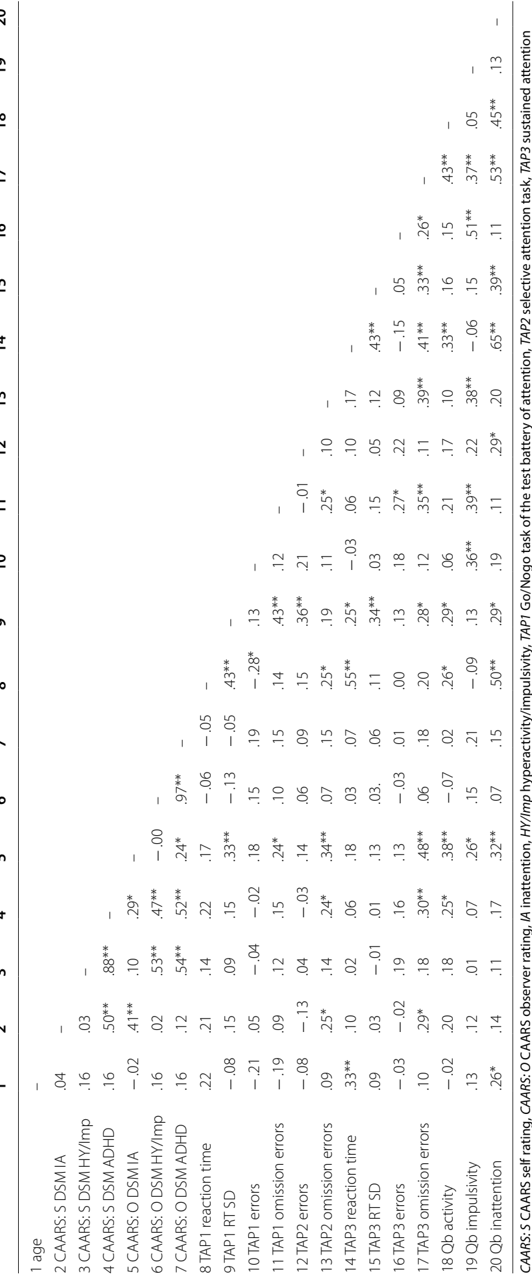
“In general, there were only few significant correlations between the subjective and the objective variables, a fact already shown in previous studies [31, 37].”
BackgroundResultSelf-citationMeasuring adult Attention Deficit Hyperactivity Disorder using the Quantified Behavior Test Plus
Edebol, H., Helldin, L., & Norlander, T. (2013) · PsyCh Journal · doi:10.1002/pchj.17 · Cited by 45 · cited 2×
“The measure of impulsivity has been shown to be the least sensitive symptom with regard to discriminating between adults with and without ADHD as well as between patients with ADHD or other psychiatric disorders [35, 36, 39].”
BackgroundPredicting methylphenidate response in attention deficit hyperactivity disorder: A preliminary study
Johnston, B. A., Coghill, D., Matthews, K., & Steele, J. D. (2015) · Journal of Psychopharmacology · doi:10.1177/0269881114548438 · Cited by 44
Self-citationHirsch, O., & Christiansen, H. (2018) · Journal of Attention Disorders · doi:10.1177/1087054715596577 · Cited by 40
Self-citationEdebol, H., Helldin, L., & Norlander, T. (2012) · Clinical Practice & Epidemiology in Mental Health · doi:10.2174/1745017901208010134 · Cited by 40 · cited 3×
“The measure of impulsivity has been shown to be the least sensitive symptom with regard to discriminating between adults with and without ADHD as well as between patients with ADHD or other psychiatric disorders [35, 36, 39].”
BackgroundClinical Course of Attention-Deficit/Hyperactivity Disorder From Childhood Toward Early Adolescence
STEINHAUSEN, H.-C., DRECHSLER, R., FÖLDÉNYI, M., IMHOF, K., & BRANDEIS, D. (2003) · Journal of the American Academy of Child & Adolescent Psychiatry · doi:10.1097/01.chi.0000070241.24125.a3 · Cited by 40
Neuropsychological deficits in adults age 60 and above with attention deficit hyperactivity disorder
Thorell, L. B., Holst, Y., Chistiansen, H., Kooij, J. J. S., Bijlenga, D., & Sjöwall, D. (2017) · European Psychiatry · doi:10.1016/j.eurpsy.2017.06.005 · Cited by 39
Self-citationDrechsler, R., Rizzo, P., & Steinhausen, H.-C. (2009) · Kindheit und Entwicklung · doi:10.1026/0942-5403.18.3.153 · Cited by 36 · cited 2×
“Nevertheless, findings are inconsistent, and often suggest using neuropsychological tests only as an additional resource within a comprehensive assessment strategy incorporating a variety of methods [27].”
BackgroundBijlenga, D., Jasperse, M., Gehlhaar, S. K., & Sandra Kooij, J. J. (2015) · European Psychiatry · doi:10.1016/j.eurpsy.2014.06.003 · Cited by 34 · cited 1×
“Another study demonstrated that the Qb+© is sensitive to medication effects, showing an improvement in 54% of patients who reported no changes in the subjective measure [79].”
BackgroundRoelofs, J., Muris, P., Braet, C., Arntz, A., & Beelen, I. (2015) · Child Psychiatry & Human Development · doi:10.1007/s10578-014-0477-z · Cited by 31
Johnston, B. A., Mwangi, B., Matthews, K., Coghill, D., & Steele, J. D. (2012) · European Child & Adolescent Psychiatry · doi:10.1007/s00787-012-0319-0 · Cited by 30
Self-citationAdult Attention-Deficit Hyperactivity Disorder
Wender, P. H. (1997) · Journal of Attention Disorders · doi:10.1177/108705479700100405 · Cited by 28
Földényi, M., Imhof, K., & Steinhausen, H.-C. (2000) · Zeitschrift für Neuropsychologie · doi:10.1024//1016-264x.11.3.154 · Cited by 27 · cited 1×
“One study using the TAP in a sample of children with ADHD and healthy controls demonstrated that two test measures (reaction time variability of the Go/NoGo task, number of errors of the reaction change task) were needed to classify 90% of the children correctly [26].”
MethodThe Persistence of ADHD into Adulthood: (Once Again) It Depends on Whom You Ask
Fischer, M., & Barkley, R. A. (2007) · The ADHD Report · doi:10.1521/adhd.2007.15.4.7 · Cited by 26
Factorial Structure and Validity of the Quantified Behavior Test Plus (Qb+©)
Hirsch, O., & Christiansen, H. (2017) · Assessment · doi:10.1177/1073191116638426 · Cited by 26 · cited 4×
“4%, sensitivity was 90%, and specificity was just 45% [37].”
BackgroundResultInfluentialSelf-citationGerman Validation of the Conners 3U+00AE Rating Scales for Parents, Teachers, and Children
Christiansen, H., Hirsch, O., Drechsler, R., Wanderer, S., Knospe, E.-L., Günther, T., & Lidzba, K. (2016) · Zeitschrift für Kinder- und Jugendpsychiatrie und Psychotherapie · doi:10.1024/1422-4917/a000408 · Cited by 22 · cited 1×
“Also, confirmatory factor analyses of the Conners 3 German version confirmed the factor structure for the content scales in the original American version [67].”
MethodSelf-citationPreliminary evidence for altered motion tracking-based hyperactivity in ADHD siblings
Reh, V., Schmidt, M., Rief, W., & Christiansen, H. (2014) · Behavioral and Brain Functions · doi:10.1186/1744-9081-10-7 · Cited by 18
Self-citationRenner, G., Lessing, T., Krampen, G., & Irblich, D. (2012) · Zeitschrift für Neuropsychologie · doi:10.1024/1016-264x/a000059 · Cited by 13
Corbisiero, S., Buchli-Kammermann, J., & Stieglitz, R.-D. (2010) · Zeitschrift für Psychiatrie, Psychologie und Psychotherapie · doi:10.1024/1661-4747/a000043 · Cited by 10
Corbisiero, S., Buchli-Kammermann, J., & Stieglitz, R. (2010) · Zurich Open Repository and Archive (University of Zurich) · doi:10.5167/uzh-42126 · Cited by 7
Aufmerksamkeits-Defizit/Hyperaktivitäts-Störung
Huß, M. (2010) · Pädiatrie up2date · doi:10.1055/s-0029-1244008 · Cited by 5
Adult Attention Deficit Hyperactivity Disorder
Weisler, R. H. (2004) · Child and Adolescent Psychopharmacology News · doi:10.1521/capn.9.8.1.64793 · Cited by 4
The german version of the conners adult ADHD rating scales (CAARS)
Christiansen, H., Kis, B., Hirsch, O., Philipsen, A., Hebebrand, J., & SCHIMMELMANN, B. G. (2011) · European Psychiatry · doi:10.1016/s0924-9338(11)72900-5 · Cited by 2
Self-citation
Research works printed but not linked: 10
- Zimmermann P Fimm B Testbatterie zur Aufmerksamkeitsprüfung 2012 Herzogenrath Psytest
- Zimmermann P Gondan M Fimm B Testbatterie zur Aufmerksamkeitsprüfung für Kinder KiTAP 2003 Herzogenrath Psytest
- Ulberstad F QbTest technical manual 2012 Stockholm Qbtech AB
- QbTech A QbTest plus technical manual 2010 Sweden Gothenburg
- APA Diagnostic and statistical manual of mental disorders-fourth edition (DSM IV) 2000 Arlington American Psychiatric Publishing, Inc.
- Sattler JM Assessment of children: cognitive foundations 2008 5 San Diego JM Sattler
- Döpfner M Frölich J Lehmkuhl G Leitfaden Kinder- und Jugendpsychotherapie. Aufmerksamkeitsdefizit-/Hyperaktivitätsstörung 2013 2 Göttingen Hogrefe
- Kaufman J Birmaher B Brent D Rao U Ryan N Kiddie-Sads-present and lifetime version (K-SADS-PL) 1996 Pittsburgh University of Pittsburgh, School of Medicine
- Conners CK Erhardt D Sparrow E Conner’s adult ADHD rating scales: CAARS, technical manual 1999 North Tonawande MHS
- Conners CK Conners 3rd edition: manual 2008 Toronto Multi-Health Systems
Cited by
Goharinejad, S., Goharinejad, S., Hajesmaeel‐Gohari, S., & Bahaadinbeigy, K. (2022) · BMC Psychiatry · doi:10.1186/s12888-021-03632-1 · Cited by 125
Marshall, P., Hoelzle, J., & Nikolas, M. (2021) · The Clinical Neuropsychologist · doi:10.1080/13854046.2019.1696409 · Cited by 85
“Emser et al., 2018 (IV) 38 adults clinically diagnosed with ADHD (mean age 35) and 38 adult controls (mean age 32) QbTest-Plus, CAARS selfand informant-report forms, TAP go/no go, divided attention, and sustained attention subtests The QbTest-Plus and TAP subtests were less helpful in predicting an…”
MethodA Machine-Based Prediction Model of ADHD Using CPT Data
Slobodin, O., Yahav, I., & Berger, I. (2020) · Frontiers in Human Neuroscience · doi:10.3389/fnhum.2020.560021 · Cited by 109
Musullulu, H. (2025) · Frontiers in Psychology · doi:10.3389/fpsyg.2025.1466088 · Cited by 107
The effect of high-order interactions on the functional brain networks of boys with ADHD
Xi, X., Li, J., Wang, Z., Tian, H., & Yang, R. (2024) · The European Physical Journal Special Topics · doi:10.1140/epjs/s11734-024-01161-y · Cited by 65
Metadata
- Authors
- Emser, T. S., Johnston, B. A., Steele, J. D., Kooij, S., Thorell, L., & Christiansen, H.
- Affiliations
- Philipps University of Marburg (DE)
- University of Dundee (GB)
- Karolinska Institutet (SE)
- Corresponding author
- Emser, Theresa S.
- Venue
- Behavioral and Brain Functions
- Published
- 2018-05-18
- Volume
- 14
- Issue
- 1
- Pages
- 11-11
- ISSN
- 1744-9081 (ISSN-L)
- PMC
- PMC5960089
- OpenAlex
- W2805062029
- Cited by
- 89
- References
- 79
- Citations by year
- 2026: 8 · 2025: 25 · 2024: 13 · 2023: 8 · 2022: 13 · 2021: 9 · 2020: 10 · 2019: 3
- FWCI
- 4.32
- Type
- journal article
- Language
- en
- Open access
- gold
- doi.org
- Licence
- cc-by
- creativecommons.org/licenses/by/4.0/ (tdm)
- Locations
- Behavioral and Brain Functions (publishedVersion, cc-by)
- Europe PMC (PubMed Central) (publishedVersion, other-oa)
- PubMed Central (publishedVersion, cc-by)
- PubMed (publishedVersion)
- Discovery Research Portal (University of Dundee) (publishedVersion, cc-by)
- Pure Amsterdam UMC (publishedVersion, other-oa)
- Amsterdam UMC (VU Amsterdam) - Institutional Repository (publishedVersion)
- DOAJ (DOAJ: Directory of Open Access Journals) (submittedVersion, cc-by-sa)
- Online Publication Service of Würzburg University (Würzburg University) (submittedVersion, cc-by)
- Data Archiving and Networked Services (DANS) (submittedVersion)
- Topics
- Health Sciences › Medicine › Psychiatry and Mental health › Attention Deficit Hyperactivity Disorder
- Life Sciences › Neuroscience › Cognitive Neuroscience › Autism Spectrum Disorder Research
- Social Sciences › Psychology › Neuropsychology and Physiological Psychology › Developmental and Educational Neuropsychology
- Keywords
- attention deficit hyperactivity disorder, objective measures, subjective indicators, informant bias, ADHD diagnosis, children, adults, support vector machine, diagnostic accuracy, self-ratings, observer ratings, pattern recognition
- MeSH terms
- Adult, Attention Deficit Disorder with Hyperactivity, Child, Humans, Middle Aged, Neuropsychological Tests, Support Vector Machine, Symptom Assessment
About these checks
Registry, retraction, Cites and statistics results are computed, not judged, with one exception: a printed reference that no index lists is read once by a model before it counts as a citation error. Claims are extracted by a model and kept only when their quote appears verbatim in the text; each cited source is then checked, with a model’s help, for whether it says what the claim relies on. Those verdicts can be wrong — read the claim’s quote and the cited source before relying on one.
The claim verdicts this report counts are experimental: their accuracy is not yet measured.
A language model drew the claims from the paper on 2026-10-10, under version 3 of the claim definition (model deepseek-v4.1-flash, prompt extract-v3).
A second model labelled each claim on 2026-10-10 (model jev-1.13-20260917, definition revision gold-guideline-v0.2).
Cited sources are checked with a language model’s help (gpt-6-sol).
Statistics and arithmetic are recomputed, not judged.
Confidence bands are shown only for fields calibrated on our annotated test set. None is calibrated yet, so no band is shown.
What counts as a claim ›How we measure confidence ›How we check this ›
Are you an author, or do you see a problem with this page? Request a review
Data sources
Bibliographic data: Semantic Scholar, OpenAlex, Crossref.
Contains information from the Semantic Scholar Academic Graph Datasets, made available under the ODC Attribution License (ODC-BY 1.0).
Semantic Scholar’s data is described in: Kinney, R., et al. (2023). The Semantic Scholar Open Data Platform. arXiv:2301.10140.
