

Socializing a group of male Asian elephants in a semi-captive facility in Lao PDR
Open accessThe DOI matches its Crossref record; 67 of the 67 references it cites were found in a registry or an index; 21 of the 69 sources its claims cite were checked for support.
Abstract
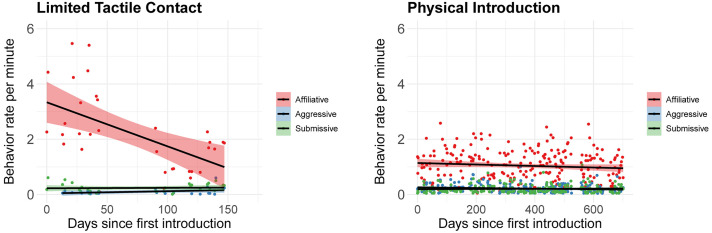
This study documents the introduction process of eight unrelated captive male Asian elephants in a free-contact management setting in Laos, utilizing a two-phase introduction process comprising limited tactile contact followed by full physical introduction. Behavioral data were collected using all-occurrence and focal-animal sampling, while fecal samples were analyzed for glucocorticoid (fGCM) and androgen (fAM) metabolite concentrations to assess physiological responses. Results indicated a prevalence of affiliative over aggressive or submissive behaviors throughout both introduction phases, supporting the idea that unrelated males can create social bonds without excessive aggression in captive settings. Affiliative behaviors declined over time during the limited tactile contact phase, then stabilized during physical introductions. Aggressive and submissive behaviors were consistently low throughout the study. Individual variations in behavior were observed, highlighting the importance of considering temperament in elephant introductions. No significant differences were found in fGCM concentrations before or after social introductions among the males, suggesting that the process did not cause substantial physiological stress. Only one male exhibited decreased fAM concentrations after social interactions, which could indicate testosterone suppression from more dominant males. During the limited contact period, aggressive interactions were positively associated with fGCM concentrations, whereas a longer duration since first introduction was associated with a decrease. In the physical introduction step, the number of days since the first introduction positively predicted an increase in fGCM concentrations, while the fAM concentration before social interactions negatively predicted fGCM. In addition, age was significantly positively predictive of fAM concentrations. These findings challenge traditional views on male elephant sociality under captive conditions and suggest that, with proper management, forming all-male groups can be a viable option for conservation and ex situ management programs. This study emphasizes the importance of gradual introduction processes, individual monitoring, and long-term behavioral observations in the successful introduction of unrelated captive male Asian elephants.
Overview
CoChat Summary
TL;DR
In a semi-captive Lao PDR facility, eight unrelated male Asian elephants were introduced using limited tactile contact followed by full physical contact; affiliative behavior predominated and aggression/submission stayed low. Fecal glucocorticoid and androgen responses showed no overall before-after stress increase, though some covariates predicted changes, supporting gradual all-male group formation with individual monitoring.
Key findings
- Affiliative behaviors were predominant across both phases. During limited tactile contact, affiliative rates declined over time (Spearman rho = −0.54, p = 0.0014); during physical introduction they were stable (rho = −0.09, p = 0.19). Aggressive behaviors were absent until day 13 of limited contact, low throughout, showed no trend in limited contact (rho = 0.01, p = 0.97), and declined during physical introduction (rho = −0.19, p = 0.004). Submissive rates remained low and unchanged (limited rho = 0.08, p = 0.68; physical rho = 0.02, p = 0.76).
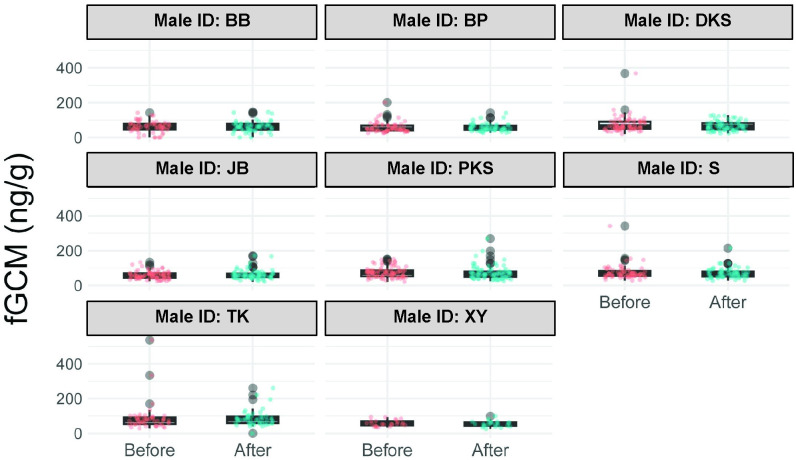
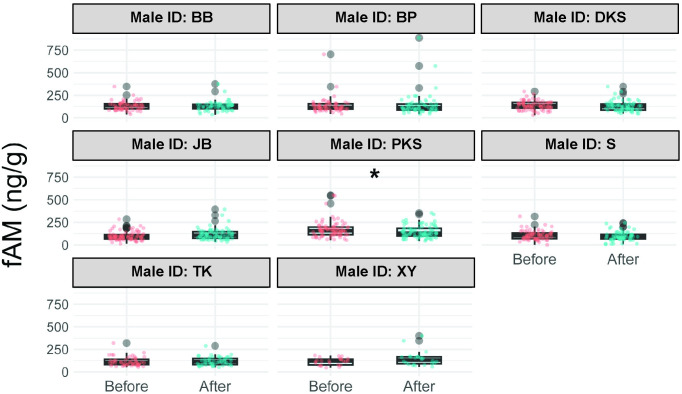
- No significant before-after differences in fGCM were found for any male. fAM did not change significantly except for PKS, whose fAM decreased significantly after social interactions.
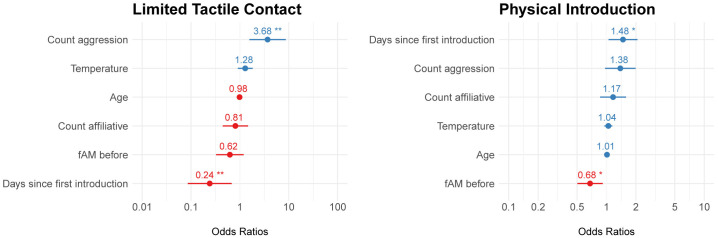
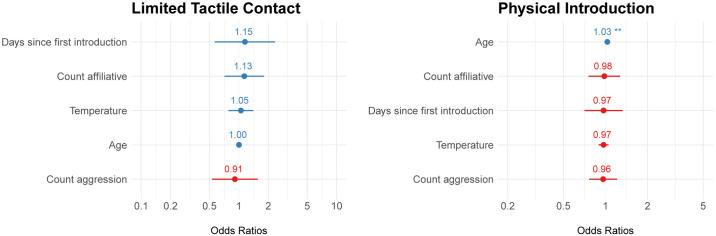
- Logistic models showed that, during limited contact, aggressive interactions positively predicted an increase in fGCM and days since first introduction negatively predicted an increase in fGCM. During full contact, days since introduction positively predicted an increase in fGCM, while pre-interaction fAM negatively predicted an increase in fGCM. In the fAM model, age positively predicted an increase in fAM during full contact; no covariates were significant during limited contact.
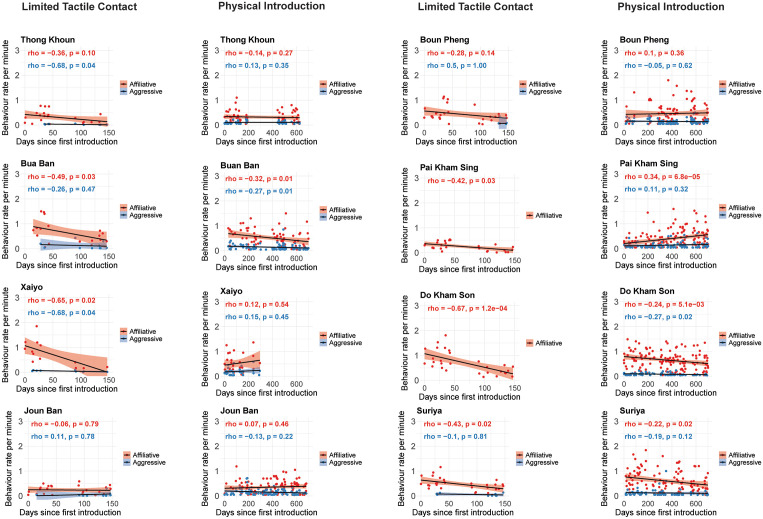
- Individual variation was marked: two males (DKS and PKS) never initiated aggression during the entire period; four males (BB, DKS, S, TK) decreased affiliation over time, while four (PKS, XY, BP, JB) increased affiliation during full physical introduction, with the trend significant only for PKS.
Methods
- Longitudinal observational study at the Elephant Conservation Center, Sayaboury, Laos, February 2020–June 2022, involving eight captive-born male Asian elephants (age 9–60 years at study start) in free-contact management. The two-phase introduction comprised limited tactile contact (13 Feb–9 Jul 2020; all-occurrence sampling; 83 observations, 34 h) followed by physical introduction (15 Jul 2020–16 Jun 2022; focal-animal sampling; 1107 observations, 351 h), totaling 385 h of behavioral observation.
- Behavior was recorded using an ethogram grouped into affiliative, aggressive (contact and non-contact), submissive, and other categories. Fecal samples were collected before and 48 h after 3 consecutive days of social interactions; 1090 samples (545 before, 545 after) were analyzed for fGCM and fAM by validated double-antibody enzyme immunoassays.
- Analysis used Spearman correlations for temporal behavioral trends, Wilcoxon signed-rank tests for before-after hormone comparisons, and logistic regression models with male ID as a random effect, run separately for each introduction phase. Covariates included days since first introduction, mean temperature, age, counts of affiliative and aggressive interactions, and pre-interaction fAM for fGCM models.
Limitations
- Stated: findings come from one free-contact facility with expansive spaces that allow elephants to avoid one another; ECC conditions may not capture the diversity of other facilities, and recommendations must be tailored to available space, individual temperament, staff proficiency, and monitoring time. Further research across different settings is needed.
- Stated/evident: the sample was small (n = 8) and there was no control or comparison group, so the observational design cannot establish causation. The paper also notes that group composition changed after XY left in May 2021 and TK died in April 2022, which may have contributed to increased fGCM during full contact.
- Evident: only non-musth males were included, so musth-period introductions are not addressed; behavioral sampling changed between phases (all-occurrence to focal-animal) and comparability was assumed; and hormone models were simplified to binary outcomes after initial Gaussian models did not meet diagnostic criteria.
Model-written summary. Check it against the paper before relying on it.
Integrity signals
Registry
Cites
Statistics
Figures
Verification
Claims the paper makes
19 Valid · 0 Not valid · 22 Not checked · 76 Own results and interpretations
The cited sources support only part of this claim — read each source’s verdict below.
In the paper
“The observed negative effect of fAM concentrations before social interactions on fGCM could be explained by a dual-hormone regulation through cortisol’s associations with stress and social dominance [64–66].”
§ Socializing a group of male Asian elephants in a semi-captive facility in Lao PDR > Discussion
What the sources say
- Not checked — no full text of the sourcecites [64] Dickerson SS, Kemeny ME. Acute stressors and cortisol responses: a theoretical integration and synthesis of laboratory research. Psychol Bull. 2004; 130(3): 355– 91. doi: 10.1037/0033-2909.130.3.355 15122924 source
- Not checked — no full text of the sourcecites [65] Popma A, Vermeiren R, Geluk CAML, Rinne T, van den Brink W, Knol DL, et al. Cortisol moderates the relationship between testosterone and aggression in delinquent male adolescents. Biol Psychiatry. 2007; 61(3): 405– 11. doi: 10.1016/j.biopsych.2006.06.006 16950214 source
- Partly supportedcites [66] Roelofs K, van Peer J, Berretty E, de Jong P, Spinhoven P, Elzinga BM. Hypothalamus-pituitary-adrenal axis hyperresponsiveness is associated with increased social avoidance behavior in social phobia. Biol Psychiatry. 2009; 65(4): 336– 43. doi: 10.1016/j.biopsych.2008.08.022 18947821 sourceExperimental — accuracy not yet measured
The Stress Measures and Discussion sections (page unavailable) link cortisol responses to social stress and avoidance in patients with social anxiety disorder. The paper does not support the proposed dual-hormone explanation, the negative fAM–fGCM effect, or an association with social dominance; it notes that only free cortisol was measured. (LLM, conf=0.85)
hedgedstates a possible cause- Asserted: passes — The authors put it forward as true.
- Checkable: passes — It can be checked against evidence.
- Load-bearing: passes — The paper’s conclusions depend on it.
- Based: passes — The paper gives a reason why it holds.
The sources with a verdict support this claim; the rest weren’t checked yet, have no full text we could read, or their verdicts aren’t rated yet.
In the paper
“Concentrations of fGCM were determined using a double-antibody EIA with a polyclonal rabbit anti-corticosterone antibody (CJM006) validated for Asian elephants [47] and described by Norkaew et al. [46].”
§ Socializing a group of male Asian elephants in a semi-captive facility in Lao PDR > Materials and methods > Hormone analyses
What the sources say
- Not checked — no full text of the sourcecites [47] Watson R, Munro C, Edwards KL, Norton V, Brown JL, Walker SL. Development of a versatile enzyme immunoassay for non-invasive assessment of glucocorticoid metabolites in a diversity of taxonomic species. Gen Comp Endocrinol. 2013; 186: 16– 24. doi: 10.1016/j.ygcen.2013.02.001 23462197 source
- Supportedcites [46] Norkaew T, Brown JL, Bansiddhi P, Somgird C, Thitaram C, Punyapornwithaya V, et al. Body condition and adrenal glucocorticoid activity affects metabolic marker and lipid profiles in captive female elephants in Thailand. PLoS One. 2018; 13(10):e0204965. doi: 10.1371/journal.pone.0204965 30278087 PMC6168167 source
The Fecal extraction and GC metabolite analysis section states that FGM concentrations were measured with a double-antibody EIA using the CJM006 antibody and that the assay had been validated for Asian elephants. The paper cites another work for the validation, but it describes the assay and reports its validated status, as attributed here. (LLM, conf=0.93)
plain- Asserted: passes — The authors put it forward as true.
- Checkable: passes — It can be checked against evidence.
- Load-bearing: unclear — It is unclear whether the paper’s conclusions depend on it.
- Based: passes — The paper gives a reason why it holds.
Every source the paper cites for this claim was checked and supports it.
In the paper
“indicating that the study animals exhibited behavior consistent with other populations [56].”
§ Socializing a group of male Asian elephants in a semi-captive facility in Lao PDR > Discussion
What the sources say
- Supportedcites [56] LaDue CA, Vandercone RPG, Kiso WK, Freeman EW. Social behavior and group formation in male Asian Elephants (Elephas maximus): the effects of age and musth in wild and zoo-housed animals. Animals (Basel). 2022; 12(9): 1215. doi: 10.3390/ani12091215 35565641 PMC9100748 source
The Discussion (page unavailable) says the study found similar patterns of social behavior in its wild and zoo-housed elephant populations. It also relates some observed group-formation patterns to findings from earlier elephant studies, supporting the broad comparison in the claim. (LLM, conf=0.84)
hedged- Asserted: passes — The authors put it forward as true.
- Checkable: passes — It can be checked against evidence.
- Load-bearing: unclear — It is unclear whether the paper’s conclusions depend on it.
- Based: passes — The paper gives a reason why it holds.
- Supported
The cited sources support only part of this claim — read each source’s verdict below.
In the paper
“This finding is consistent with the notion that during the initial exploration period, interactions may have elicited a stress response in males, as observed in other studies [26,35].”
§ Socializing a group of male Asian elephants in a semi-captive facility in Lao PDR > Discussion
What the sources say
- Not checked — no full text of the sourcecites [26] Schreier AL, Readyhough TS, Moresco A, Davis M, Joseph S. Social dynamics of a newly integrated bachelor group of Asian elephants (Elephas maximus): welfare implications. J Appl Anim Welf Sci. 2023; 26(2): 229– 46. doi: 10.1080/10888705.2021.1908141 33825611 source
- Partly supportedcites [35] Schmid J, Heistermann M, Gansloßer U, Hodges JK. Introduction of Foreign Female Asian Elephants (Elephas Maximus) into an existing group: behavioural reactions and changes in cortisol levels. Anim welf. 2001; 10(4): 357– 72. doi: 10.1017/s0962728600032632 sourceExperimental — accuracy not yet measured
The Investigation section reports a slight cortisol response in a female elephant that was likely attributable to aggression during an interaction. But the Abstract says only females were monitored and the bull was mainly kept separate. The paper therefore supports the possibility that interactions elicited a stress response, not the claim that this occurred in males during an initial exploration period. (LLM, conf=0.88)
hedgedstates a possible cause- Asserted: passes — The authors put it forward as true.
- Checkable: passes — It can be checked against evidence.
- Load-bearing: unclear — It is unclear whether the paper’s conclusions depend on it.
- Based: passes — The paper gives a reason why it holds.
A result the paper reports from its own data — it cites no other source for it, so there is none to check. The quote shows it is in the paper.
In the paper
“The logistic regression model for the difference in fAM before and after introductions was a good fit for the data for the limited and full contact periods (S6 Fig).”
§ Socializing a group of male Asian elephants in a semi-captive facility in Lao PDR > Results
plain- Asserted: passes — The authors put it forward as true.
- Checkable: passes — It can be checked against evidence.
- Load-bearing: unclear — It is unclear whether the paper’s conclusions depend on it.
- Based: passes — The paper gives a reason why it holds.
58 more claims
Create a free account to see all 117 claims and to verify the 2 references still open.
- Probably not a substantial claim. 39
- It may state two separate claims as one. 27
Self-check
Percentages, sums and reported differences re-computed from the paper’s own numbers.
Each contradiction between two passages listed here was confirmed by an independent check.
Rated minor: it would not touch a result — a value no result rests on, a p-value that stays on the same side of the significance level, or a conflict that is clerical, resolved elsewhere in the paper, or outside its own findings.
In the paper
§ Socializing a group of male Asian elephants in a semi-captive facility in Lao PDR > Discussion
“Since rates of aggressive behavior were performed at a higher rate than aggressive or submissive behavior over time during the full physical introduction step”
§ Socializing a group of male Asian elephants in a semi-captive facility in Lao PDR > Results
“Affiliative behaviors were the predominant form of interaction throughout both the limited tactile contact and physical introduction phases, consistently occurring at higher rates per minute than either aggressive or submissive behaviors over time (Fig 1).”
Citations
Cites
Fitting Linear Mixed-Effects Models Using lme4
Bates, D., Mächler, M., Bolker, B., & Walker, S. (2015) · Journal of Statistical Software · doi:10.18637/jss.v067.i01 · Cited by 86,835 · cited 1×
“We then ran logistic regression models with these binary variables as the response variables for fAM and fGCM models, respectively, using the lme4 package in R and the same model features described above [54].”
Observational study of behavior: sampling methods
Altmann, J. (1974) · Behaviour · doi:10.1163/156853974x00534 · Cited by 13,891 · cited 5×
“Because it was not feasible to conduct focal sampling during these times, all-occurrence sampling was used [39] to collect behavioral data from all males.”
InfluentialBrooks, M., Kristensen, K., Benthem, K., Magnusson, A., Berg, C., Nielsen, A., Skaug, H., Mächler, M., & Bolker, B. (2017) · The R Journal · doi:10.32614/rj-2017-066 · Cited by 12,915 · cited 1×
“Because these values were continuous and could be positive or negative, we then constructed Gaussian error distribution models with “after minus before” concentration differences as response variables in the glmmTMB package [49] using R Statistical Software v 4.1.2 [ 50].”
InfluentialDickerson, S. S., & Kemeny, M. E. (2004) · Psychological Bulletin · doi:10.1037/0033-2909.130.3.355 · Cited by 5,881 · cited 1×
“The observed negative effect of fAM concentrations before social interactions on fGCM could be explained by a dual-hormone regulation through cortisol’s associations with stress and social dominance [64–66].”
The influence of social hierarchy on primate health
Sapolsky, R. M. (2005) · Science · doi:10.1126/science.1106477 · Cited by 2,113 · cited 1×
“Maintaining a high-status position within such a fluid social structure requires heightened vigilance towards potential threats, particularly those that might challenge an individual’s social standing [70].”
The role of testosterone in social interaction
Eisenegger, C., Haushofer, J., & Fehr, E. (2011) · Trends in Cognitive Sciences · doi:10.1016/j.tics.2011.04.008 · Cited by 630 · cited 2×
“Testosterone has been proposed to facilitate socioemotional mechanisms that enhance an individual’s ability to achieve and maintain social dominance [36].”
Testosterone and cortisol jointly regulate dominance: evidence for a dual-hormone hypothesis
Mehta, P. H., & Josephs, R. A. (2010) · Hormones and Behavior · doi:10.1016/j.yhbeh.2010.08.020 · Cited by 574 · cited 2×
“Conversely, when cortisol is high, higher testosterone may actually decrease dominance and motivate lower status-seeking behavior [67].”
Social modulation of androgens in male vertebrates: meta-analyses of the challenge hypothesis
Hirschenhauser, K., & Oliveira, R. F. (2006) · Animal Behaviour · doi:10.1016/j.anbehav.2005.04.014 · Cited by 407
Hypercortisolism associated with social subordinance or social isolation among wild baboons
Sapolsky, R. M. (1997) · Archives of General Psychiatry · doi:10.1001/archpsyc.1997.01830240097014 · Cited by 318 · cited 1×
“In male baboons ( Papio anubis ), social integration was associated with lower basal cortisol levels, suggesting reduced stress in socially integrated individuals [6].”
A brief review of the status, distribution and biology of wild Asian elephants Elephas maximus
SUKUMAR, R. (2006) · International Zoo Yearbook · doi:10.1111/j.1748-1090.2006.00001.x · Cited by 315 · cited 1×
“Of the estimated 35,000–50,000 extant Asian elephants, approximately 15,000 live under human care, participating in tourism, logging, and religious activities, with fewer than 2,000 in zoos [2].”
Popma, A., Vermeiren, R., Geluk, C. A. M. L., Rinne, T., van den Brink, W., Knol, D. L., Jansen, L. M. C., van Engeland, H., & Doreleijers, T. A. H. (2007) · Biological Psychiatry · doi:10.1016/j.biopsych.2006.06.006 · Cited by 290
Mate guarding, reproductive success and female choice in African elephants
Poole, J. H. (1989) · Animal Behaviour · doi:10.1016/0003-3472(89)90068-7 · Cited by 242 · cited 3×
“In the context of male elephant society, age is often correlated with social status, with older males generally occupying more dominant positions in the hierarchy [21,68].”
Roelofs, K., van Peer, J., Berretty, E., Jong, P. D., Spinhoven, P., & Elzinga, B. M. (2009) · Biological Psychiatry · doi:10.1016/j.biopsych.2008.08.022 · Cited by 236 · cited 1×
“The observed negative effect of fAM concentrations before social interactions on fGCM could be explained by a dual-hormone regulation through cortisol’s associations with stress and social dominance [64–66].”
Behavioural reactions of elephants towards a dying and deceased matriarch
Douglas-Hamilton, I., Bhalla, S., Wittemyer, G., & Vollrath, F. (2006) · Applied Animal Behaviour Science · doi:10.1016/j.applanim.2006.04.014 · Cited by 219
Assessment of welfare in zoo animals: towards optimum quality of life
Wolfensohn, S., Shotton, J., Bowley, H., Davies, S., Thompson, S., & Justice, W. S. M. (2018) · Animals · doi:10.3390/ani8070110 · Cited by 197
Older bull elephants control young males
Slotow, R., van Dyk, G., Poole, J., Page, B., & Klocke, A. (2000) · Nature · doi:10.1038/35044191 · Cited by 187 · cited 1×
“Previous studies have reported that high-ranking musth males can suppress musth in lower-ranking males [21,57,58].”
GOBUSH, K. S., MUTAYOBA, B. M., & WASSER, S. K. (2008) · Conservation Biology · doi:10.1111/j.1523-1739.2008.01035.x · Cited by 180 · cited 1×
“Similarly, disruption in group composition from poaching in wild female African elephants has been associated with increased fGCM concentrations [76].”
Musth in the African elephant, Loxodonta africana
Poole, J. H., & Moss, C. J. (1981) · Nature · doi:10.1038/292830a0 · Cited by 164 · cited 2×
“The amount of time that wild males spend alone or with conspecifics depends on various factors, including age and reproductive state [18,19,21,22], forage abundance, kin relationships [14], and human activities [16].”
The dynamics of social networks among female Asian elephants
de Silva, S., Ranjeewa, A. D., & Kryazhimskiy, S. (2011) · BMC Ecology · doi:10.1186/1472-6785-11-17 · Cited by 159
Adolescence in male African elephants, Loxodonta africana, and the importance of sociality
Evans, K. E., & Harris, S. (2008) · Animal Behaviour · doi:10.1016/j.anbehav.2008.03.019 · Cited by 146 · cited 1×
“In the context of male elephant society, age is often correlated with social status, with older males generally occupying more dominant positions in the hierarchy [21,68].”
Fernando, P., & Lande, R. (2000) · Behavioral Ecology and Sociobiology · doi:10.1007/s002650000218 · Cited by 131 · cited 1×
“Although elephant males were historically considered primarily solitary [12,13], the richness and complexity of male-male social relationships are now widely acknowledged.”
Vidya, T. N. C., & Sukumar, R. (2005) · Journal of Ethology · doi:10.1007/s10164-005-0144-8 · Cited by 116
Ganswindt, A., Rasmussen, H. B., Heistermann, M., & Hodges, J. K. (2005) · Hormones and Behavior · doi:10.1016/j.yhbeh.2004.09.002 · Cited by 115 · cited 1×
“Previous studies have reported that high-ranking musth males can suppress musth in lower-ranking males [21,57,58].”
Watson, R., Munro, C., Edwards, K. L., Norton, V., Brown, J. L., & Walker, S. L. (2013) · General and Comparative Endocrinology · doi:10.1016/j.ygcen.2013.02.001 · Cited by 114 · cited 1×
“Concentrations of fGCM were determined using a double-antibody EIA with a polyclonal rabbit anti-corticosterone antibody (CJM006) validated for Asian elephants [47] and described by Norkaew et al. [46].”
Self-citationPositive upshots of cortisol in everyday life.
Hoyt, L. T., Zeiders, K. H., Ehrlich, K. B., & Adam, E. K. (2016) · Emotion · doi:10.1037/emo0000174 · Cited by 110 · cited 1×
“The increase may serve an adaptive function by enhancing alertness, engagement, and social bonding, possibly due to direct effects on metabolic processes, such as increased blood glucose levels [73].”
Meyer, J. S., & Hamel, A. F. (2014) · ILAR Journal · doi:10.1093/ilar/ilu023 · Cited by 96 · cited 1×
“Previous studies in non-human primates have shown that group formation triggers the HPA axis, with glucocorticoid concentrations typically normalizing once social hierarchies stabilize [72].”
Individual differences in temperament and behavioral management practices for nonhuman primates
Coleman, K. (2012) · Applied Animal Behaviour Science · doi:10.1016/j.applanim.2011.08.002 · Cited by 94 · cited 1×
“Research across various zoo species has demonstrated that animals exhibit diverse behavioral traits that influence their responses to management practices [62,63].”
Srinivasaiah, N., Kumar, V., Vaidyanathan, S., Sukumar, R., & Sinha, A. (2019) · Scientific Reports · doi:10.1038/s41598-019-45130-1 · Cited by 91
Brown, J. L., Somerville, M., Riddle, H. S., Keele, M., Duer, C. K., & Freeman, E. W. (2007) · General and Comparative Endocrinology · doi:10.1016/j.ygcen.2007.01.006 · Cited by 83 · cited 1×
“Musth, a phenomenon unique to African and Asian elephants, is typically observed in sexually mature males in good physical condition [22,59] and is associated with increased androgen production [60,61].”
Self-citationSCHEL, A. M., RAWLINGS, B., CLAIDIÈRE, N., WILKE, C., WATHAN, J., RICHARDSON, J., PEARSON, S., S. HERRELKO, E., WHITEN, A., & SLOCOMBE, K. (2013) · American Journal of Primatology · doi:10.1002/ajp.22101 · Cited by 65 · cited 1×
“Providing chimpanzees ( Pan troglodytes ) with the opportunity to engage in fission-fusion dynamics, akin to those found in wild populations, led to lower rates of aggression [7].”
Laws, N., Ganswindt, A., Heistermann, M., Harris, M., Harris, S., & Sherwin, C. (2007) · Journal of Applied Animal Welfare Science · doi:10.1080/10888700701555600 · Cited by 65 · cited 1×
“Transportation and relocation, which often result in the dissolution of social bonds or require the formation of new ones, can also trigger increased glucocorticoid excretion in elephants [77,78].”
Elephant tourism in Thailand: a review of animal welfare practices and needs
Bansiddhi, P., Brown, J. L., Thitaram, C., Punyapornwithaya, V., & Nganvongpanit, K. (2020) · Journal of Applied Animal Welfare Science · doi:10.1080/10888705.2019.1569522 · Cited by 65 · cited 1×
“However, in range countries, males are still primarily housed individually due to concerns about aggression, particularly during musth periods [27].”
Self-citationGoldenberg, S. Z., de Silva, S., Rasmussen, H. B., Douglas-Hamilton, I., & Wittemyer, G. (2014) · Animal Behaviour · doi:10.1016/j.anbehav.2014.07.002 · Cited by 61 · cited 2×
“These findings support the idea that adult males alternate time spent alone, in mixed-sex groups, and in male groups, albeit with weaker social bonds than those of females [18–20].”
Self-citationLincoln, G. A., & Ratnasooriya, W. D. (1996) · Reproduction · doi:10.1530/jrf.0.1080107 · Cited by 61 · cited 1×
“Musth, a phenomenon unique to African and Asian elephants, is typically observed in sexually mature males in good physical condition [22,59] and is associated with increased androgen production [60,61].”
Allen, C. R. B., Brent, L. J. N., Motsentwa, T., Weiss, M. N., & Croft, D. P. (2020) · Scientific Reports · doi:10.1038/s41598-020-70682-y · Cited by 60
Ganswindt, A., Heistermann, M., & Hodges, K. (2005) · Physiological and Biochemical Zoology · doi:10.1086/430237 · Cited by 58
RASMUSSEN, H., GANSWINDT, A., DOUGLASHAMILTON, I., & VOLLRATH, F. (2008) · Hormones and Behavior · doi:10.1016/j.yhbeh.2008.05.008 · Cited by 58 · cited 1×
“This heightened hormonal reactivity may be a physiological mechanism that supports their ability to gain or maintain high-status positions within the dynamic social hierarchy of male elephants [60,71].”
Schapiro, S. J. (2002) · Pharmacology Biochemistry and Behavior · doi:10.1016/s0091-3057(02)00779-7 · Cited by 57 · cited 1×
“Finally, Schapiro (2002) [8] found that species-typical behavior in rhesus macaques (Macaca mulatta) was increased, and abnormal behavior was decreased by social rather than single housing.”
Kumar, V., Palugulla Reddy, V., Kokkiligadda, A., Shivaji, S., & Umapathy, G. (2014) · General and Comparative Endocrinology · doi:10.1016/j.ygcen.2014.03.024 · Cited by 55 · cited 1×
“Concentrations of fAM were quantified by a double-antibody EIA validated for Asian elephants [48] utilizing an anti-testosterone antibody (R156/7).”
Norkaew, T., Brown, J. L., Bansiddhi, P., Somgird, C., Thitaram, C., Punyapornwithaya, V., Punturee, K., Vongchan, P., Somboon, N., & Khonmee, J. (2018) · PLoS ONE · doi:10.1371/journal.pone.0204965 · Cited by 54
Self-citationSchmid, J., Heistermann, M., Gansloßer, U., & Hodges, J. K. (2001) · Animal Welfare · doi:10.1017/s0962728600032632 · Cited by 48 · cited 2×
“Glucocorticoid measures have also been used to monitor social introductions in zoo female elephants [35,23].”
Cotton‐top tamarins (Saguinus (o.) oedipus) in a semi‐naturalistic captive colony
Price, E. C., & McGrew, W. C. (1990) · American Journal of Primatology · doi:10.1002/ajp.1350200102 · Cited by 45 · cited 1×
“In cotton-top tamarins (Saguinus oedipus ), resemblance to wild-type groups led to increased breeding success, higher infant survival, and lower incidences of abortion, stillbirths, and parental neglect [5].”
Katugaha, H. I. E., de Silva, M., & Santiapillai, C. (1999) · Biological Conservation · doi:10.1016/s0006-3207(98)00122-0 · Cited by 42
Sharma, N., Pokharel, S. S., Kohshima, S., & Sukumar, R. (2020) · Primates · doi:10.1007/s10329-019-00739-8 · Cited by 42 · cited 1×
“…males could have led to an increase in fGCM. Wild elephants have been observed showing awareness and interest in dying and deceased conspecifics [74,75], suggesting that the death of conspecifics, in addition to disrupting social groups, can be emotionally distressing for individual elephants, at…”
Evaluation of introduction procedures in captive chimpanzees
Brent, L., Kessel, A. L., & Barrera, H. (1997) · Zoo Biology · doi:10.1002/(sici)1098-2361(1997)16:4<335::aid-zoo5>3.0.co;2-b · Cited by 42
Fanson, K. V., Lynch, M., Vogelnest, L., Miller, G., & Keeley, T. (2013) · European Journal of Wildlife Research · doi:10.1007/s10344-013-0718-7 · Cited by 40 · cited 1×
“Transportation and relocation, which often result in the dissolution of social bonds or require the formation of new ones, can also trigger increased glucocorticoid excretion in elephants [77,78].”
Comparison of two introduction methods for African elephants (Loxodonta africana)
Burks, K. D., Mellen, J. D., Miller, G. W., Lehnhardt, J., Weiss, A., Figueredo, A. J., & Maple, T. L. (2004) · Zoo Biology · doi:10.1002/zoo.10132 · Cited by 37
Chiyo, P. I., Wilson, J. W., Archie, E. A., Lee, P. C., Moss, C. J., & Alberts, S. C. (2014) · Behavioral Ecology · doi:10.1093/beheco/aru152 · Cited by 37 · cited 2×
“The amount of time that wild males spend alone or with conspecifics depends on various factors, including age and reproductive state [18,19,21,22], forage abundance, kin relationships [14], and human activities [16].”
Social interactions in zoo-housed elephants: factors affecting social relationships
Williams, E., Carter, A., Hall, C., & Bremner-Harrison, S. (2019) · Animals · doi:10.3390/ani9100747 · Cited by 36 · cited 3×
“For instance, Williams et al. [3] found that social interactions among zoo-housed elephants were influenced by factors such as age, personality, and the presence of calves within the herd, not unlike those in the wild.”
Vanitha, V., Thiyagesan, K., & Baskaran, N. (2011) · Journal of Applied Animal Welfare Science · doi:10.1080/10888705.2011.527603 · Cited by 32 · cited 1×
“In Asian elephants, animals managed in social groups show lower rates of stereotypic behavior than those housed in isolation [9].”
Keerthipriya, P., Nandini, S., & Vidya, T. N. C. (2021) · Frontiers in Ecology and Evolution · doi:10.3389/fevo.2021.616666 · Cited by 27 · cited 1×
“The amount of time that wild males spend alone or with conspecifics depends on various factors, including age and reproductive state [18,19,21,22], forage abundance, kin relationships [14], and human activities [16].”
LaDue, C. A., Vandercone, R. P. G., Kiso, W. K., & Freeman, E. W. (2022) · Animals · doi:10.3390/ani12091215 · Cited by 26 · cited 1×
“%) and in all-male groups of Asian elephants housed in zoos (68.5%), indicating that the study animals exhibited behavior consistent with other populations [56].”
InfluentialSurvey of reproduction and calf rearing in Asian and African elephants in European zoos
Hartley, M., & Stanley, C. R. (2016) · The Journal of zoo and aquarium research · doi:10.19227/jzar.v4i3.161 · Cited by 26
The Elephant Ethogram: a library of African elephant behaviour
Poole, J., & Granli, P. (2021) · Pachyderm · doi:10.69649/pachyderm.v62i.462 · Cited by 25 · cited 1×
“The selected behaviors were then grouped into categories considered functionally similar [26,23,43–45] and were defined as aggressive, affiliative, submissive, and other.”
Fazio, J. M., Barthel, T., Freeman, E. W., Garlick-Ott, K., Scholle, A., & Brown, J. L. (2020) · Animals · doi:10.3390/ani10112026 · Cited by 24 · cited 1×
“An ethogram was developed using descriptions of social behaviors drawn from prior studies (Table 3) [3,23,40–42].”
Self-citationPhysiological plasticity in elephants: highly dynamic glucocorticoids in African and Asian elephants
Pokharel, S. S., & Brown, J. L. (2023) · Conservation Physiology · doi:10.1093/conphys/coad088 · Cited by 23 · cited 1×
“Introductions of new individuals can be stressful; therefore, glucocorticoid concentrations are commonly used as stress indicators for welfare management [34].”
Self-citationSchmidt, H., & Kappelhof, J. (2019) · International Zoo Yearbook · doi:10.1111/izy.12233 · Cited by 22
LaDue, C. A., Vandercone, R. P. G., Kiso, W. K., & Freeman, E. W. (2022) · Applied Animal Behaviour Science · doi:10.1016/j.applanim.2022.105639 · Cited by 22 · cited 1×
“For the fGCM models, we also included fAM concentration before the interaction period as a covariate because elevated fAM in males is known to influence social interactions [51,52].”
LaDue, C. A., Hunt, K. E., Samaraweera, M. G. S. M., Vandercone, R. P. G., Kiso, W. K., & Freeman, E. W. (2022) · Theriogenology Wild · doi:10.1016/j.therwi.2022.100011 · Cited by 18 · cited 1×
“For the fGCM models, we also included fAM concentration before the interaction period as a covariate because elevated fAM in males is known to influence social interactions [51,52].”
A review of injuries caused by elephants in captivity: an examination of predominant factors
GORE, M., HUTCHINS, M., & RAY, J. (2006) · International Zoo Yearbook · doi:10.1111/j.1748-1090.2006.00051.x · Cited by 17 · cited 1×
“In stark contrast to their reputation as being highly aggressive [55], this study revealed a consistent trend of higher rates of affiliative behavior per minute over aggressive or submissive behaviors over time during both the limited tactile contact and full physical introduction phases in all…”
Schreier, A. L., Readyhough, T. S., Moresco, A., Davis, M., & Joseph, S. (2023) · Journal of Applied Animal Welfare Science · doi:10.1080/10888705.2021.1908141 · Cited by 15 · cited 6×
“Recognizing this, western zoos have begun integrating males into female groups or creating bachelor groups [23–26].”
InfluentialBurks, K. D., Bloomsmith, M. A., Forthman, D. L., & Maple, T. L. (2001) · Zoo Biology · doi:10.1002/zoo.1033 · Cited by 14 · cited 1×
“Various approaches have been used to introduce unrelated animals, ranging from immediate co-housing [31] to a gradual introduction through sensory and limited tactile contact before sharing physical space [26,32,33].”
Hambrecht, S., & Reichler-Danielowski, S. (2013) · Der Zoologische Garten · doi:10.1016/j.zoolgart.2014.01.003 · Cited by 13
Impacts of socialization on bull Asian elephant (Elephas maximus) stereotypical behavior
Readyhough, T. S., Joseph, S., Davis, M., Moresco, A., & Schreier, A. L. (2022) · Journal of Zoological and Botanical Gardens · doi:10.3390/jzbg3010010 · Cited by 13
Socialization of an adult male Lowland gorilla Gorilla gorilla gorilla
WINSLOW, S., Ogden, J. J., & Maple, T. L. (1992) · International Zoo Yearbook · doi:10.1111/j.1748-1090.1991.tb02388.x · Cited by 11 · cited 1×
“Various approaches have been used to introduce unrelated animals, ranging from immediate co-housing [31] to a gradual introduction through sensory and limited tactile contact before sharing physical space [26,32,33].”
Readyhough, T. S., Davis, M., Joseph, S., Moresco, A., & Schreier, A. L. (2023) · Journal of Zoological and Botanical Gardens · doi:10.3390/jzbg4010018 · Cited by 4
Eggeling, T., Roos, T., Boult, V. L., Mitchell, B., & Steyn, T. (2024) · Pachyderm · doi:10.69649/pachyderm.v65i.1291 · Cited by 2 · cited 1×
“One key aspect is understanding elephant behavior and social dynamics in the wild, the lack of which could be detrimental to the proper management of captive counterparts [3,4].”
Research works printed but not linked: 10
- Choudhury A, Lahiri Choudhury DK, Desai A, Duckworth JW, Easa PS, et al. Elephas maximus. The IUCN Red List of Threatened Species; 2008. doi: e.T7140A12828813
- Sukumar R. The Asian elephant: ecology and management. Cambridge University Press; 1992.
- Namboodiri N, Panicker KC, Cheeran JV. Practical elephant management: a handbook for mahouts. Coimbatore: Elephant Welfare Association; 1997.
- Phuangkum P. Elephant care manual for mahouts and camp managers. Bangkok: FAO Regional Office for Asia and the Pacific, Regional Office for Asian and the Pacific: Forest Industry Organization, Ministry of Natural Resources and Environment; 2005.
- Ajitkumar G, Anil KS, Alex PC, Rajeev TS. Healthcare management of captive Asian elephants. Kerala Agricultural University; 2009.
- Doyle C, Hoffman D. 30 husbandry and care of elephants. In: Irwin M, Stoner J, Cobaugh A, eds. Zookeeping: an introduction to the science and technology. Chicago: University of Chicago Press; 2013: 298– 304. doi: 10.7208/9780226925325-031 · doi:10.7208/9780226925325-031
- Olson D. Elephant husbandry resource guide. Azle, TX: Elephant Welfare Association; 2002.
- R Core Team R. R: A language and environment for statistical computing. Vienna, Austria: R Foundation for Statistical Computing; 2021.
- Hartig F. DHARMa: Residual diagnostics for hierarchical (multi-level/mixed) regression models. CRAN: Contributed Packages; 2022.
- Moss CJ, Croze H, Lee PC. The Amboseli elephants: a long-term perspective on a long-lived mammal. University of Chicago Press; 2019.
Cited by
Pérez, A. B. L., Goldenberg, S. Z., Brown, J. L., & Khonmee, J. (2026) · Applied Animal Behaviour Science · doi:10.1016/j.applanim.2026.107067
Self-citation
Metadata
- Authors
- López Pérez, A. B., Brown, J. L., Goldenberg, S. Z., Rey, A., & Khonmee, J.
- Affiliations
- Smithsonian Institution (US)
- Chiang Mai University (TH)
- Corresponding author
- Khonmee, Jaruwan
- Venue
- PLOS One
- Publisher
- Public Library of Science (PLoS)
- Published
- 2025-11-26
- Volume
- 20
- Issue
- 11
- Pages
- e0332944
- ISSN
- 1932-6203 (ISSN-L)
- PMC
- PMC12654932
- OpenAlex
- W4416715226
- Semantic Scholar
- 7e4e510660af8ee7b6e68089d4c4286f89e8e019
- Cited by
- 2
- References
- 66
- Citations by year
- 2026: 2
- FWCI
- 2.38
- Type
- journal article
- Language
- en
- Open access
- gold
- doi.org
- Licence
- public-domain
- creativecommons.org/publicdomain/zero/1.0/ (vor)
- Locations
- PLoS ONE (publishedVersion, public-domain)
- PubMed (publishedVersion)
- DOAJ (DOAJ: Directory of Open Access Journals) (submittedVersion, cc-by-sa)
- Funders
- Faculty of Veterinary Medicine, Chiang Mai University (2562)
- Susan Fulton (2020)
- Shared Earth Foundation (2020)
- Topics
- Life Sciences › Agricultural and Biological Sciences › Animal Science and Zoology › Animal Behavior and Welfare Studies
- Life Sciences › Agricultural and Biological Sciences › Ecology, Evolution, Behavior and Systematics › Primate Behavior and Ecology
- Physical Sciences › Environmental Science › Ecology › Wildlife Ecology and Conservation
- Keywords
- Asian elephant, group socialization, affiliative behavior, aggression, glucocorticoid metabolites, androgen metabolites, testosterone suppression, stress physiology, ex situ conservation, Laos
- MeSH terms
- Aggression, Androgens, Animals, Behavior, Animal, Elephants, Feces, Glucocorticoids, Laos, Male, Social Behavior
About these checks
Registry, retraction, Cites and statistics results are computed, not judged, with one exception: a printed reference that no index lists is read once by a model before it counts as a citation error. Claims are extracted by a model and kept only when their quote appears verbatim in the text; each cited source is then checked, with a model’s help, for whether it says what the claim relies on. Those verdicts can be wrong — read the claim’s quote and the cited source before relying on one.
The claim verdicts this report counts are experimental: their accuracy is not yet measured.
A language model drew the claims from the paper on 2026-10-10, under version 3 of the claim definition (model deepseek-v4.1-flash, prompt extract-v3).
A second model labelled each claim on 2026-10-10 (model jev-1.13-20260917, definition revision gold-guideline-v0.2).
Cited sources are checked with a language model’s help (gpt-6-sol).
Statistics and arithmetic are recomputed, not judged.
Confidence bands are shown only for fields calibrated on our annotated test set. None is calibrated yet, so no band is shown.
What counts as a claim ›How we measure confidence ›How we check this ›
Are you an author, or do you see a problem with this page? Request a review
Data sources
Bibliographic data: Semantic Scholar, OpenAlex, Crossref.
Contains information from the Semantic Scholar Academic Graph Datasets, made available under the ODC Attribution License (ODC-BY 1.0).
Semantic Scholar’s data is described in: Kinney, R., et al. (2023). The Semantic Scholar Open Data Platform. arXiv:2301.10140.
