

The DOI matches its Crossref record; 222 of the 225 references it cites were found in a registry or an index; 48 of the 237 sources its claims cite were checked for support.
Emerging Alternative Proteinases in APP Metabolism and Alzheimer’s Disease Pathogenesis: A Focus on MT1-MMP and MT5-MMP
Open accessAbstract
Processing of amyloid beta precursor protein (APP) into amyloid-beta peptide (Aβ) by β-secretase and γ-secretase complex is at the heart of the pathogenesis of Alzheimer's disease (AD). Targeting this proteolytic pathway effectively reduces/prevents pathology and cognitive decline in preclinical experimental models of the disease, but therapeutic strategies based on secretase activity modifying drugs have so far failed in clinical trials. Although this may raise some doubts on the relevance of β- and γ-secretases as targets, new APP-cleaving enzymes, including meprin-β, legumain (δ-secretase), rhomboid-like protein-4 (RHBDL4), caspases and membrane-type matrix metalloproteinases (MT-MMPs/η-secretases) have confirmed that APP processing remains a solid mechanism in AD pathophysiology. This review will discuss recent findings on the roles of all these proteinases in the nervous system, and in particular on the roles of MT-MMPs, which are at the crossroads of pathological events involving not only amyloidogenesis, but also inflammation and synaptic dysfunctions. Assessing the potential of these emerging proteinases in the Alzheimer's field opens up new research prospects to improve our knowledge of fundamental mechanisms of the disease and help us establish new therapeutic strategies.
Overview
AI snapshot
Written from the paper’s full text.
TL;DR
This review argues that APP proteolysis remains central to Alzheimer’s disease pathogenesis and highlights emerging APP-cleaving proteinases, especially MT1-MMP and MT5-MMP, as modulators of amyloidogenesis, inflammation, and synaptic dysfunction. It synthesizes evidence that MT5-MMP/η-secretase and MT1-MMP can promote amyloidogenic APP processing while also showing Aβ-degrading or BACE-1-surrogate activities.
Key findings
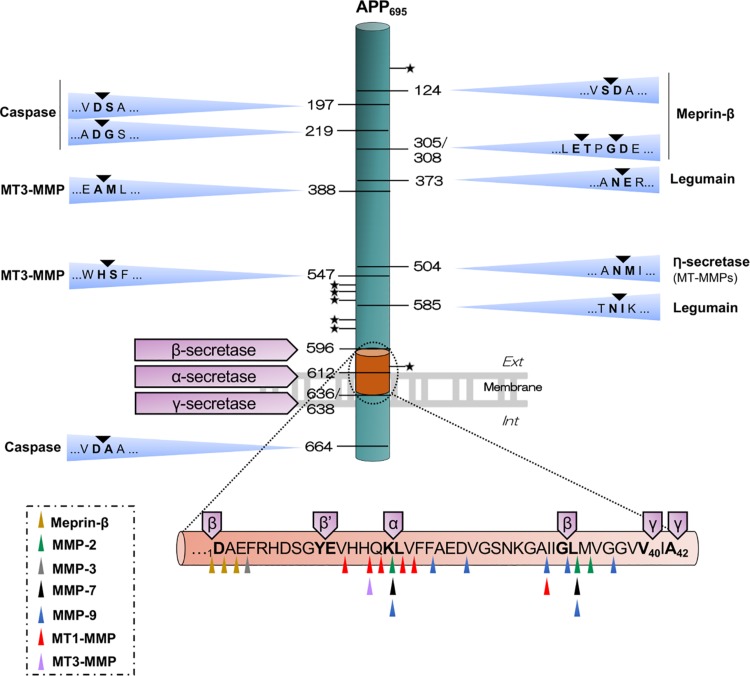
- Canonical β- and γ-secretase targeting has failed clinically, but new APP-cleaving enzymes—meprin-β, legumain/δ-secretase, RHBDL4, caspases, and MT-MMPs/η-secretases—support APP processing as a continuing AD mechanism. Meprin-β can cleave at the β-site and generate Aβ2–X; legumain cleaves APP at positions 373 and 585 (APP695 numbering), producing APP1–373 and APP586–695; RHBDL4 decreases Aβ38, Aβ40, and Aβ42; caspases cleave APP mainly between V664–D665 in the intracytoplasmic domain.
- MT5-MMP was identified as an η-secretase cleaving APP at VLAN504–M505ISEPR (APP695 numbering), generating sAPPη/sAPP95 and η-CTF/CTF-30. In 5xFAD/MT5–/– mice, soluble Aβ40 and Aβ42, oligomers, plaques, and C99 were strikingly lower, with fewer reactive microglia/astrocytes, reduced IL-1β and TNF-α, and prevention of LTP and spatial/working memory deficits; some benefits persisted at 16 months.
- MT1-MMP can cleave APP and degrade Aβ, but in HEKswe cells it also increases Aβ, sAPP95, CTF-30, and C99; about 50% of sAPP95 release is estimated to involve MMP-2. MT1-MMP can restore basal Aβ levels when BACE-1 is inhibited, suggesting a possible surrogate β-secretase role, and MT1-MMP is upregulated in cortex and hippocampus of 6-month-old 5xFAD mice.
- TIMPs regulate MT-MMPs: TIMP-2, -3, and -4 inhibit MT1-MMP, while MT5-MMP is targeted only by TIMP-2; TIMP-1 is a very poor inhibitor of MT-MMPs. Clinical TIMP-2 data in AD are inconsistent, with no change, no difference, or increased levels reported across studies.
Methods
- Design: narrative review, not a primary experimental study.
- Data or sample: published literature on APP metabolism, secretases, emerging proteinases, MT-MMPs, TIMPs, and AD models; no new human or animal sample was collected.
- Main analysis: qualitative synthesis of cited in vitro, mouse-model, human biomarker/postmortem, and inhibitor studies, organized around APP cleavage sites, emerging APP-processing enzymes, MT1-/MT5-MMP biology, and therapeutic implications.
Limitations
- Stated by the paper: many findings remain correlative or speculative; in vivo validation is needed for MT1-MMP and RHBDL4; the exact nature of sAPP95 remains to be established; functional evidence for MT5-MMP/γ-secretase interaction is lacking; studies on TIMP regulation of ADAMs in AD are lacking; substrate lists for emerging proteinases may grow.
- Evident from the text: as a review, it provides no systematic search, meta-analysis, or new data, and conclusions depend on cited cell-line, mouse-model, and human observational studies, some with inconsistent clinical inhibitor findings.
Model-written summary. Check it against the paper before relying on it.
Integrity signals
Registry
Cites
Statistics
Figures
Verification
Claims the paper makes
97 Not checked yet · 42 No full text of the sources · 21 Own interpretation · 18 Partly supported · 16 Sources not found · 14 Supported · 6 Supported so far · 3 No basis given · 1 Not supported · 1 Own result · accuracy not yet measured
At least one cited source doesn’t support this claim or points to a different paper, and none confirmed it — see the verdicts below.
In the paper
“antibodies specifically raised against the Tau1–368 neoepitope were found in AD brains”
§ Emerging Alternative Proteinases in APP Metabolism and Alzheimer’s Disease Pathogenesis: A Focus on MT1-MMP and MT5-MMP > Some Emerging APP Processing Proteinases > Legumain
What the sources say
- Disputedcites Zhang et al., 2014 sourceExperimental — accuracy not yet measured
The Online Methods section says the anti-tau N368 antibodies were generated by immunizing mice. In the Results, those antibodies were used to detect tau N368 fragments in human AD brains; the paper does not report finding the antibodies themselves in AD brains. (LLM, conf=0.88)
Checked by a reasoning model — may be wrong.
plain- Asserted: passes — The authors put it forward as true.
- Checkable: passes — It can be checked against evidence.
- Load-bearing: passes — The paper’s conclusions depend on it.
- Based: passes — The paper gives a reason why it holds.
- Disputed
The cited sources support only part of this claim — read each source’s verdict below.
In the paper
“Aβ results from the proteolysis of APP, a type I transmembrane protein targeted first at the plasma membrane, then rapidly endocytosed to endosomes to be metabolized to Aβ or subsequently sent to the lysosomal compartment for degradation (Wang X. et al., 2017; Van Acker et al., 2019).”
§ Emerging Alternative Proteinases in APP Metabolism and Alzheimer’s Disease Pathogenesis: A Focus on MT1-MMP and MT5-MMP > Alzheimer’s Disease, A Proteolytic Problem
What the sources say
- Not matchedcites Wang X. et al., 2017
Couldn’t be matched to a paper in Crossref, so it can’t be checked.
- Supportedcites Van Acker et al., 2019 source
The Background states that APP is cleaved sequentially by BACE-1 and γ-secretase, producing Aβ peptides. This supports the attributed claim that Aβ results from proteolysis of APP. (LLM, conf=0.94)
plaindirect- Asserted: passes — The authors put it forward as true.
- Checkable: passes — It can be checked against evidence.
- Load-bearing: passes — The paper’s conclusions depend on it.
- Based: passes — The paper gives a reason why it holds.
- Not matched
The sources with a verdict support this claim; the rest weren’t checked yet, have no full text we could read, or their verdicts aren’t rated yet.
In the paper
“which in turn promotes astrocyte proliferation (Ogier et al., 2005; Hernandez-Guillamon et al., 2009)”
§ Emerging Alternative Proteinases in APP Metabolism and Alzheimer’s Disease Pathogenesis: A Focus on MT1-MMP and MT5-MMP > Alzheimer’s Disease, A Proteolytic Problem
What the sources say
- Supportedcites Ogier et al., 2005 source
The Discussion explicitly states that TIMP-1 induces astrocyte proliferation. The Results likewise report that recombinant TIMP-1 produced the largest increase in proliferation in cultured wild-type astrocytes. (LLM, conf=0.94)
- Not checked — no full text of the sourcecites Hernandez-Guillamon et al., 2009 source
plaindirect- Asserted: passes — The authors put it forward as true.
- Checkable: passes — It can be checked against evidence.
- Load-bearing: unclear — It is unclear whether the paper’s conclusions depend on it.
- Based: passes — The paper gives a reason why it holds.
- Supported
The cited sources support only part of this claim — read each source’s verdict below.
In the paper
“which results in modulation of hippocampal synaptic plasticity and neurotransmission in vivo by decreasing the release of synaptic vesicles (Rice et al., 2019)”
§ Emerging Alternative Proteinases in APP Metabolism and Alzheimer’s Disease Pathogenesis: A Focus on MT1-MMP and MT5-MMP > Alzheimer’s Disease, A Proteolytic Problem
What the sources say
- Partly supportedcites Rice et al., 2019 sourceExperimental — accuracy not yet measured
The section on Schaffer collateral synapses reports that sAPPα alters short-term plasticity and suppresses transmission by reducing release probability through GABABR1a, but those experiments used acute hippocampal slices, not an in vivo preparation. The in vivo section reports reduced CA1 neuronal activity after application of an APP-derived peptide; it does not demonstrate in vivo synaptic plasticity or decreased vesicle release by sAPPα. (LLM, conf=0.88)
plaindirect- Asserted: passes — The authors put it forward as true.
- Checkable: passes — It can be checked against evidence.
- Load-bearing: unclear — It is unclear whether the paper’s conclusions depend on it.
- Based: passes — The paper gives a reason why it holds.
- Partly supported
Every source the paper cites for this claim was checked and supports it.
In the paper
“thereby providing mechanistic ground for promotion of LTP and synaptic plasticity (Mockett et al., 2019)”
§ Emerging Alternative Proteinases in APP Metabolism and Alzheimer’s Disease Pathogenesis: A Focus on MT1-MMP and MT5-MMP > Alzheimer’s Disease, A Proteolytic Problem
What the sources say
- Supportedcites Mockett et al., 2019 source
The Significance Statement reports that sAPPα facilitates LTP through protein synthesis and trafficking of GluA2-lacking AMPARs and NMDARs, and that it enhances GluA1 synthesis. The Discussion distinguishes the initial trafficking effect from the longer-term contribution of newly synthesized GluA1, consistent with the claim's broad mechanistic framing. (LLM, conf=0.93)
plaindirect- Asserted: passes — The authors put it forward as true.
- Checkable: passes — It can be checked against evidence.
- Load-bearing: unclear — It is unclear whether the paper’s conclusions depend on it.
- Based: passes — The paper gives a reason why it holds.
- Supported
The cited sources support only part of this claim — read each source’s verdict below.
In the paper
“many studies using genetic or pharmacological approaches to increase C99 levels in animal models consistently demonstrate the pathogenic properties of C99 linked with AD phenotypes”
§ Emerging Alternative Proteinases in APP Metabolism and Alzheimer’s Disease Pathogenesis: A Focus on MT1-MMP and MT5-MMP > Alzheimer’s Disease, A Proteolytic Problem
What the sources say
- Not checked — no full text of the sourcecites Neve et al., 1996 source
- Partly supportedcites Oster-Granite et al., 1996 sourceExperimental — accuracy not yet measured
The Discussion reports AD-like neuronal and synaptic degeneration in mice genetically engineered to express APP-C100, supporting the claim’s core point about a pathogenic C-terminal APP fragment in an animal model. This paper studies APP-C100 rather than specifically establishing increased C99 levels, and it does not demonstrate the claim’s pharmacological approach. The reference to “many studies” also goes beyond what this paper itself demonstrates. (LLM, conf=0.85)
- Partly supportedcites Song et al., 1998 sourceExperimental — accuracy not yet measured
The Abstract reports that injected CT105 caused behavioral impairment, gliosis, and neurodegeneration in mice; it also describes neurotoxicity in transgenic animals expressing related APP fragments. This supports the general link between APP carboxyl-terminal fragments and AD-like pathology, but the study injected a 105-amino-acid fragment rather than increasing C99 levels, and it does not establish that genetic or pharmacological C99-increasing studies consistently show this effect. (LLM, conf=0.86)
boostedcorrelational- Asserted: passes — The authors put it forward as true.
- Checkable: passes — It can be checked against evidence.
- Load-bearing: unclear — It is unclear whether the paper’s conclusions depend on it.
- Based: passes — The paper gives a reason why it holds.
The sources with a verdict support this claim; the rest weren’t checked yet, have no full text we could read, or their verdicts aren’t rated yet.
In the paper
“C99 accumulates in the brains of AD patients (Pera et al., 2013; Kim et al., 2016)”
§ Emerging Alternative Proteinases in APP Metabolism and Alzheimer’s Disease Pathogenesis: A Focus on MT1-MMP and MT5-MMP > Alzheimer’s Disease, A Proteolytic Problem
What the sources say
- Not checked yetcites Pera et al., 2013 source
Checked before — its earlier verdict is held back until a new check runs.
- Supportedcites Kim et al., 2016 source
The Results section, “βCTF and endosomal APPL1 levels are elevated in AD brains” (page unavailable), reports significantly elevated βCTF—the APP fragment referred to here as C99—in AD cerebral cortex. The Discussion also describes elevated βCTF levels in sporadic AD brain. (LLM, conf=0.91)
plain- Asserted: passes — The authors put it forward as true.
- Checkable: passes — It can be checked against evidence.
- Load-bearing: unclear — It is unclear whether the paper’s conclusions depend on it.
- Based: passes — The paper gives a reason why it holds.
- Not checked yet
The cited sources support only part of this claim — read each source’s verdict below.
In the paper
“recent data suggest that only a limited fraction of highly diffusible small oligomers have adverse effects, for instance on the disruption of synaptic activity (Hong et al., 2018)”
§ Emerging Alternative Proteinases in APP Metabolism and Alzheimer’s Disease Pathogenesis: A Focus on MT1-MMP and MT5-MMP > Alzheimer’s Disease, A Proteolytic Problem
What the sources say
- Partly supportedcites Hong et al., 2018 sourceExperimental — accuracy not yet measured
The Introduction reports that a small, diffusible fraction of Aβ carried the toxic activity, and the Results report that diffusible Aβ impaired hippocampal long-term potentiation, a measure of synaptic plasticity. But the Discussion says the precise attributes of the toxic species remain unidentified; the paper does not establish that the active oligomers are small in size or that only a minority of the diffusible oligomers are harmful. No page numbers are available in our copy. (LLM, conf=0.84)
hedged- Asserted: passes — The authors put it forward as true.
- Checkable: passes — It can be checked against evidence.
- Load-bearing: unclear — It is unclear whether the paper’s conclusions depend on it.
- Based: passes — The paper gives a reason why it holds.
- Partly supported
The cited sources support only part of this claim — read each source’s verdict below.
In the paper
“a possible cause of clinical failure could be the difficulty of inhibiting these proteinases without causing side effects resulting from non-targeted proteolytic inhibition on their many physiological substrates”
§ Emerging Alternative Proteinases in APP Metabolism and Alzheimer’s Disease Pathogenesis: A Focus on MT1-MMP and MT5-MMP > Alzheimer’s Disease, A Proteolytic Problem
What the sources say
- Not checked — no full text of the sourcecites Karran et al., 2011 source
- Partly supportedcites Vassar et al., 2014 sourceExperimental — accuracy not yet measured
The BACE inhibition as a treatment strategy for AD section attributes failed Phase 3 γ-secretase inhibitor studies to dose-limiting side effects likely related to inhibition of Notch processing or other non-APP substrates. The Outlook section identifies side effects from inhibiting BACE1 functions as a concern, but says severe mechanism-based side effects had not yet been observed in BACE inhibitor clinical trials. Thus the source supports the explanation for γ-secretase inhibitor failure and a possible risk for β-secretase inhibitors, not clinical failure of both therapies. (LLM, conf=0.88)
- Partly supportedcites De Strooper and Chavez Gutierrez, 2015 sourceExperimental — accuracy not yet measured
In “Failed Drug Trials and Implications for Aβ-Directed Therapies” (page not provided), the review says adverse effects limited trials of a γ-secretase inhibitor. It also warns that β-secretase has more than 20 substrates and that chronic inhibition could cause harm, but describes β-secretase inhibitors as still in development rather than reporting clinical failure of those inhibitors. (LLM, conf=0.86)
hedgedconditional- Asserted: passes — The authors put it forward as true.
- Checkable: passes — It can be checked against evidence.
- Load-bearing: passes — The paper’s conclusions depend on it.
- Based: passes — The paper gives a reason why it holds.
- Rests on an assumption: Aβ is the main driving force behind AD pathology.
Every source the paper cites for this claim was checked and supports it.
In the paper
“human astrocytes derived from induced pluripotent stem cells (iPS) deficient for APP exhibited reduced levels of intracellular cholesterol”
§ Emerging Alternative Proteinases in APP Metabolism and Alzheimer’s Disease Pathogenesis: A Focus on MT1-MMP and MT5-MMP > Insufficiently Explored Territories
What the sources say
- Supportedcites Fong et al., 2018 source
The Results section (‘APP-KO astrocytes have altered cholesterol metabolism’) reports that hiPSC-derived APP-knockout astrocytes had decreased cholesterol compared with wild-type astrocytes. The paper also describes this as decreased intracellular cholesterol in its discussion of full-length APP and cholesterol metabolism. (LLM, conf=0.94)
plaindirect- Asserted: passes — The authors put it forward as true.
- Checkable: passes — It can be checked against evidence.
- Load-bearing: unclear — It is unclear whether the paper’s conclusions depend on it.
- Based: passes — The paper gives a reason why it holds.
- Supported
- Probably not a substantial claim. 31
- It may state two separate claims as one. 58
- The quote only partly states this claim. 1
The cited sources support only part of this claim — read each source’s verdict below.
In the paper
“Matrix metalloproteinases (MMPs), including MMP-2, MMP-3, MMP-7 and MMP-9 also cleave within the Aβ sequence (Rivera et al., 2019) and these cleavages have been compared to those of membrane-type MMPs (MT-MMPs) in Figure 1.”
§ Emerging Alternative Proteinases in APP Metabolism and Alzheimer’s Disease Pathogenesis: A Focus on MT1-MMP and MT5-MMP > Alzheimer’s Disease, A Proteolytic Problem
What the sources say
- Partly supportedcites Rivera et al., 2019 sourceExperimental — accuracy not yet measured
The Introduction reports that MMP-9 cleaves Aβ at identified sites, that MMP-2 has a similar Aβ-degrading profile, and that MMP-7 cleaves Aβ40 and Aβ42. For MMP-3, it reports Aβ degradation through a mechanism involving MMP-3 activation, but does not establish that MMP-3 itself cleaves within the Aβ sequence. No page numbers are available in our copy. (LLM, conf=0.86)
plaindirect- Asserted: passes — The authors put it forward as true.
- Checkable: passes — It can be checked against evidence.
- Load-bearing: fails — The paper’s conclusions may not depend on it.
- Based: passes — The paper gives a reason why it holds.
Probably not a substantial claim. The paper’s conclusions may not depend on it.
- Partly supported
The sources with a verdict support this claim; the rest weren’t checked yet, have no full text we could read, or their verdicts aren’t rated yet.
In the paper
“The γ-secretase complex is formed by a PS1 or PS2 catalytic subunit and 3 partner proteins, Aph-1, pen-2 and nicastrin (Haass et al., 2012; Rajendran and Annaert, 2012; Masters et al., 2015; Selkoe and Hardy, 2016).”
§ Emerging Alternative Proteinases in APP Metabolism and Alzheimer’s Disease Pathogenesis: A Focus on MT1-MMP and MT5-MMP > Alzheimer’s Disease, A Proteolytic Problem
What the sources say
- Supportedcites Haass et al., 2012 source
The γ-Secretase section states that the complex has four subunits: PS1 or PS2, which contains catalytic residues, plus nicastrin, APH-1, and PEN-2. This matches the cited claim. (LLM, conf=0.95)
- Not checked — no full text of the sourcecites Rajendran and Annaert, 2012 source
- Not checked — no full text of the sourcecites Masters et al., 2015 source
plain- Asserted: passes — The authors put it forward as true.
- Checkable: passes — It can be checked against evidence.
- Load-bearing: fails — The paper’s conclusions may not depend on it.
- Based: passes — The paper gives a reason why it holds.
Probably not a substantial claim. The paper’s conclusions may not depend on it.
- Supported
The cited sources support only part of this claim — read each source’s verdict below.
In the paper
“BACE-1 cleaves numerous substrates, which confers this enzyme a wide spectrum of physiological and pathological activities (Kuhn et al., 2012; Zhou et al., 2012; Vassar et al., 2014), but it is indisputably its ability to process APP that has attracted much attention, especially in relation to AD.”
§ Emerging Alternative Proteinases in APP Metabolism and Alzheimer’s Disease Pathogenesis: A Focus on MT1-MMP and MT5-MMP > Alzheimer’s Disease, A Proteolytic Problem
What the sources say
- Partly supportedcites Kuhn et al., 2012 sourceExperimental — accuracy not yet measured
The Identification of neuronal BACE1 sheddome section reports 34 neuronal membrane proteins whose shedding depends on BACE1. The Introduction links APP cleavage to pathogenic amyloid production and neuregulin-1 cleavage to myelination. But the Discussion says the functional consequences of cleavage remain unknown for most substrates, so the claim that cleavage confers a wide spectrum of physiological and pathological activities is stronger than the paper establishes. (LLM, conf=0.82)
- Not checked — no full text of the sourcecites Zhou et al., 2012 source
- Supportedcites Vassar et al., 2014 source
The ‘Additional BACE1 substrates in the CNS’ section says BACE1 has a broad range of substrates within and outside the nervous system. The ‘BACE protease substrates – overview’ section links its substrates to physiological functions, while ‘β-amyloid and Alzheimer’s disease’ describes the pathological consequence of APP processing. No page numbers are available in our copy. (LLM, conf=0.92)
plaindirect- Asserted: passes — The authors put it forward as true.
- Checkable: passes — It can be checked against evidence.
- Load-bearing: fails — The paper’s conclusions may not depend on it.
- Based: passes — The paper gives a reason why it holds.
Probably not a substantial claim. The paper’s conclusions may not depend on it.
- Partly supported
The sources with a verdict support this claim; the rest weren’t checked yet, have no full text we could read, or their verdicts aren’t rated yet.
In the paper
“a few studies indicate that Aβ has antimicrobial activities”
§ Emerging Alternative Proteinases in APP Metabolism and Alzheimer’s Disease Pathogenesis: A Focus on MT1-MMP and MT5-MMP > Insufficiently Explored Territories
What the sources say
- Supportedcites Soscia et al., 2010 source
The Results report that synthetic Aβ peptides inhibited the growth of bacteria and yeast in vitro, with activity against seven tested pathogens equivalent to or greater than LL-37. This directly supports the attributed claim that Aβ has antimicrobial activities. (LLM, conf=0.94)
- Not checked — no full text of the sourcecites Moir et al., 2018 source
- Supportedcites Dominy et al., 2019 source
The Introduction describes Aβ as an antimicrobial peptide. In the section “Aβ1–42 has antibacterial effects against P. gingivalis,” the authors also report that Aβ1–42 significantly increased the proportion of dead or dying bacteria compared with controls. These passages support the attributed statement. (LLM, conf=0.94)
hedgeddirect- Asserted: passes — The authors put it forward as true.
- Checkable: passes — It can be checked against evidence.
- Load-bearing: fails — The paper’s conclusions may not depend on it.
- Based: passes — The paper gives a reason why it holds.
Probably not a substantial claim. The paper’s conclusions may not depend on it.
- Supported
The cited sources support only part of this claim — read each source’s verdict below.
In the paper
“this inhibitor not only reduces α-cleavage of APP but also the cell surface levels of ADAM10 and APP, which leads to increased endocytosis and β-secretase cleavage”
§ Emerging Alternative Proteinases in APP Metabolism and Alzheimer’s Disease Pathogenesis: A Focus on MT1-MMP and MT5-MMP > Alzheimer’s Disease, A Proteolytic Problem
What the sources say
- Partly supportedcites Hoe et al., 2007 sourceExperimental — accuracy not yet measured
The Discussion reports reduced APP α-cleavage, reduced surface ADAM-10 and APP, increased APP endocytosis, and increased β-cleavage. But the cleavage and surface-level experiments described in the Results used COS7 cells, not neuroblastoma cells; the paper mentions neuroblastoma cells in connection with a gene screen. It also describes enhanced β-cleavage in endosomes as a proposed mechanism, rather than establishing every step of the causal chain. (LLM, conf=0.88)
plaindirect- Asserted: passes — The authors put it forward as true.
- Checkable: passes — It can be checked against evidence.
- Load-bearing: unclear — It is unclear whether the paper’s conclusions depend on it.
- Based: passes — The paper gives a reason why it holds.
It may state two separate claims as one.
- Partly supported
The cited sources support only part of this claim — read each source’s verdict below.
In the paper
“probably reflecting a combination of events triggered by its accumulation, including stimulation of Tau hyperphosphorylation and subsequent formation of neurofibrillary tangles (NFTs), promotion of inflammation and also synaptic dysfunctions”
§ Emerging Alternative Proteinases in APP Metabolism and Alzheimer’s Disease Pathogenesis: A Focus on MT1-MMP and MT5-MMP > Alzheimer’s Disease, A Proteolytic Problem
What the sources say
- Not checked — no full text of the sourcecites Benilova et al., 2012 source
- Partly supportedcites Mucke and Selkoe, 2012 sourceExperimental — accuracy not yet measured
The paper’s discussion of elevated Aβ and synaptic transmission reports synaptic impairment and loss. Its introductory section also says nonneuronal changes, including microgliosis and astrocytosis, may contribute to neuronal dysfunction. The paper does not establish the claimed sequence from Aβ-induced tau hyperphosphorylation to neurofibrillary tangle formation; tau hyperphosphorylation appears in the title of a work listed in its References, but that does not support the full sequence. (LLM, conf=0.86)
- Supportedcites Selkoe and Hardy, 2016 source
The sections on Aβ-driven tau alteration and synaptic loss report tau hyperphosphorylation, subsequent tau deposition and impaired synaptic function. The Introduction’s Figure 1 description says Aβ oligomers may activate microglia and astrocytes, supporting the claim’s hedged reference to inflammation. Page numbers are unavailable in our copy. (LLM, conf=0.91)
hedgedconditional- Asserted: passes — The authors put it forward as true.
- Checkable: passes — It can be checked against evidence.
- Load-bearing: unclear — It is unclear whether the paper’s conclusions depend on it.
- Based: passes — The paper gives a reason why it holds.
It may state two separate claims as one.
Every source the paper cites for this claim was checked and supports it.
In the paper
“sAPPα interacts with BACE-1 and inhibits Aβ production”
§ Emerging Alternative Proteinases in APP Metabolism and Alzheimer’s Disease Pathogenesis: A Focus on MT1-MMP and MT5-MMP > Alzheimer’s Disease, A Proteolytic Problem
What the sources say
- Supportedcites Obregon et al., 2012 source
The Results section, “sAPP-α interacts and inhibits BACE1,” reports coprecipitation of sAPP-α with BACE1. The Discussion reports that exogenous sAPP-α inhibited Aβ40 and Aβ42 production in the studied cells. Together, these passages support both parts of the claim. (LLM, conf=0.94)
plaindirect- Asserted: passes — The authors put it forward as true.
- Checkable: passes — It can be checked against evidence.
- Load-bearing: unclear — It is unclear whether the paper’s conclusions depend on it.
- Based: passes — The paper gives a reason why it holds.
It may state two separate claims as one.
- Supported
Every source the paper cites for this claim was checked and supports it.
In the paper
“and as a Tau- or APP-cleaving enzyme (Zhang et al., 2014, 2015).”
§ Emerging Alternative Proteinases in APP Metabolism and Alzheimer’s Disease Pathogenesis: A Focus on MT1-MMP and MT5-MMP > Some Emerging APP Processing Proteinases > Legumain
What the sources say
- Supportedcites Zhang et al., 2014 source
The Introduction identifies asparagine endopeptidase (AEP) as legumain and states that AEP cleaves tau. The Results section, “AEP directly cleaves tau,” reports direct cleavage by purified AEP. This supports the tau-cleaving part of the cited description; the sentence also cites a separate 2015 paper for the alternative APP-cleaving description. (LLM, conf=0.94)
- Supportedcites Zhang et al., 2015 source
The Abstract identifies AEP as legumain and states that AEP cleaves tau. The Results section, “APP is a physiological substrate of AEP,” reports direct cleavage of APP by AEP. No page numbers are provided in our copy. (LLM, conf=0.94)
plaindirect- Asserted: passes — The authors put it forward as true.
- Checkable: passes — It can be checked against evidence.
- Load-bearing: unclear — It is unclear whether the paper’s conclusions depend on it.
- Based: passes — The paper gives a reason why it holds.
It may state two separate claims as one.
- Supported
The sources with a verdict support this claim; the rest weren’t checked yet, have no full text we could read, or their verdicts aren’t rated yet.
In the paper
“picomolar concentrations of Aβ are sufficient to stimulate nicotinic receptors and subsequently LTP and learning and memory in healthy rodents (Puzzo et al., 2008, 2012; Morley et al., 2010)”
§ Emerging Alternative Proteinases in APP Metabolism and Alzheimer’s Disease Pathogenesis: A Focus on MT1-MMP and MT5-MMP > Insufficiently Explored Territories
What the sources say
- Supportedcites Puzzo et al., 2008 source
The Results report that 200 pM Aβ42 enhanced hippocampal LTP and that the enhancement was absent in mice lacking α7 nicotinic receptors. The paper also reports enhanced reference and contextual fear memory and describes a model in which α7 receptor activation mediates these effects. The Discussion leaves open whether Aβ42 interacts directly with the receptors, but the claim does not require direct binding. (LLM, conf=0.86)
- Not checked — no full text of the sourcecites Puzzo et al., 2012 source
- Not checked — no full text of the sourcecites Morley et al., 2010 source
plaindirect- Asserted: passes — The authors put it forward as true.
- Checkable: passes — It can be checked against evidence.
- Load-bearing: unclear — It is unclear whether the paper’s conclusions depend on it.
- Based: passes — The paper gives a reason why it holds.
It may state two separate claims as one.
- Supported
Every source the paper cites for this claim was checked and supports it.
In the paper
“also Tau could cause APP-dependent impairment of LTP and spatial learning in mice (Puzzo et al., 2017).”
§ Emerging Alternative Proteinases in APP Metabolism and Alzheimer’s Disease Pathogenesis: A Focus on MT1-MMP and MT5-MMP > Insufficiently Explored Territories
What the sources say
- Supportedcites Puzzo et al., 2017 source
In the Results sections on oTau and memory and on oTau and LTP, extracellular Tau oligomers impaired radial-arm water-maze performance and reduced LTP in wild-type mice, but not in APP-knockout mice. This supports the claim that Tau can cause APP-dependent impairment of spatial learning and LTP under the tested conditions. (LLM, conf=0.93)
hedgeddirect- Asserted: passes — The authors put it forward as true.
- Checkable: passes — It can be checked against evidence.
- Load-bearing: fails — The paper’s conclusions may not depend on it.
- Based: passes — The paper gives a reason why it holds.
Probably not a substantial claim. The paper’s conclusions may not depend on it.
- Supported
Every source the paper cites for this claim was checked and supports it.
In the paper
“Aβ oligomers and also Tau could cause APP-dependent impairment of LTP and spatial learning in mice (Puzzo et al., 2017)”
§ Emerging Alternative Proteinases in APP Metabolism and Alzheimer’s Disease Pathogenesis: A Focus on MT1-MMP and MT5-MMP > Insufficiently Explored Territories
What the sources say
- Supportedcites Puzzo et al., 2017 source
The Results sections on oAβ and oTau memory report impaired spatial-learning performance in wild-type mice but not APP-KO mice (Figures 3D and 4D; page numbers unavailable). The Results section on LTP likewise reports impairment from each oligomer in wild-type hippocampal slices but not APP-KO slices (Figure 5B–C). (LLM, conf=0.94)
hedgeddirect- Asserted: passes — The authors put it forward as true.
- Checkable: passes — It can be checked against evidence.
- Load-bearing: unclear — It is unclear whether the paper’s conclusions depend on it.
- Based: passes — The paper gives a reason why it holds.
It may state two separate claims as one.
- Supported
Every source the paper cites for this claim was checked and supports it.
In the paper
“legumain can cleave APP at positions 373 and 585 (APP695 numbering), generating 2 fragments with distinctive cytotoxicity (Zhang et al., 2015).”
§ Emerging Alternative Proteinases in APP Metabolism and Alzheimer’s Disease Pathogenesis: A Focus on MT1-MMP and MT5-MMP > Some Emerging APP Processing Proteinases > Legumain
What the sources say
- Supportedcites Zhang et al., 2015 source
The Results section ('AEP cleaves APP at N373 and N585 residues') identifies both cleavage sites using APP695 numbering. In 'APP N-terminal ectodomain shed by AEP cleavage is neurotoxic,' the paper reports that APP1–373 was neurotoxic to primary neurons, whereas APP1–585 showed no demonstrable neurotoxic effect. (LLM, conf=0.92)
plaindirect- Asserted: passes — The authors put it forward as true.
- Checkable: passes — It can be checked against evidence.
- Load-bearing: passes — The paper’s conclusions depend on it.
- Based: passes — The paper gives a reason why it holds.
It may state two separate claims as one.
- Supported
The cited sources support only part of this claim — read each source’s verdict below.
In the paper
“In addition, it was shown that cultured hippocampal neurons with truncated APP gene accumulate APP on the plasma membrane and present reduced colocalization of BACE-1 and APP in endosomes, confirming a key role of the YENPTY sequence in APP internalization and Aβ production by endosomes (Sun et al., 2019).”
§ Emerging Alternative Proteinases in APP Metabolism and Alzheimer’s Disease Pathogenesis: A Focus on MT1-MMP and MT5-MMP > Some Emerging APP Processing Proteinases > Caspases
What the sources say
- Partly supportedcites Sun et al., 2019 sourceExperimental — accuracy not yet measured
Split into 2 atoms — 0 confirmed, 2 partially supported, 0 disputed, 0 misattributed, 0 unverifiable. Expand the claim to see per-atom verdicts.
boosteddirect- Asserted: passes — The authors put it forward as true.
- Checkable: passes — It can be checked against evidence.
- Load-bearing: unclear — It is unclear whether the paper’s conclusions depend on it.
- Based: passes — The paper gives a reason why it holds.
It may state two separate claims as one.
- Partly supported
The cited sources support only part of this claim — read each source’s verdict below.
In the paper
“bigenic 5xFAD/legumain–/– and 5xFAD/MT5–/– mice both show significant reductions in Aβ burden and glial reactivity, as well as prevention of LTP and learning and memory deficits (Zhang et al., 2015; Baranger et al., 2016b, 2017a)”
§ Emerging Alternative Proteinases in APP Metabolism and Alzheimer’s Disease Pathogenesis: A Focus on MT1-MMP and MT5-MMP > Some Emerging APP Processing Proteinases > MT-MMPs
What the sources say
- Partly supportedcites Zhang et al., 2015 sourceExperimental — accuracy not yet measured
The Results sections on AEP knockout report reduced Aβ burden, rescued LTP deficits, and protection from spatial-memory impairment in 5XFAD/AEP−/− mice (Figs. 7c–j). Our copy does not report reduced glial reactivity in those mice. The Methods list 5XFAD/AEP−/− mice but not 5XFAD/MT5−/− mice; the latter part of the sentence may be covered by the other citations, but it is not supported by Zhang et al. (LLM, conf=0.88)
- Not matchedcites Baranger et al., 2016b, 2017a
Couldn’t be matched to a paper in Crossref, so it can’t be checked.
plaindirect- Asserted: passes — The authors put it forward as true.
- Checkable: passes — It can be checked against evidence.
- Load-bearing: passes — The paper’s conclusions depend on it.
- Based: passes — The paper gives a reason why it holds.
It may state two separate claims as one.
- Partly supported
In the paper
“Endosomes are thought to be the main locus of Aβ production, which is ensured by canonical β- and γ-secretases (Vassar et al., 1999).”
§ Emerging Alternative Proteinases in APP Metabolism and Alzheimer’s Disease Pathogenesis: A Focus on MT1-MMP and MT5-MMP > Alzheimer’s Disease, A Proteolytic Problem
What the sources say
- Not checked yetcites Vassar et al., 1999 source
hedgeddirect- Asserted: passes — The authors put it forward as true.
- Checkable: passes — It can be checked against evidence.
- Load-bearing: fails — The paper’s conclusions may not depend on it.
- Based: passes — The paper gives a reason why it holds.
Probably not a substantial claim. The paper’s conclusions may not depend on it. It may state two separate claims as one.
In the paper
“This type I transmembrane protein of the aspartyl proteinase family needs an acidic environment (optimum pH 4.5) to be enzymatically active (Saric et al., 2013).”
§ Emerging Alternative Proteinases in APP Metabolism and Alzheimer’s Disease Pathogenesis: A Focus on MT1-MMP and MT5-MMP > Alzheimer’s Disease, A Proteolytic Problem
What the sources say
- Not checked — no full text of the sourcecites Saric et al., 2013 source
plaindirect- Asserted: passes — The authors put it forward as true.
- Checkable: passes — It can be checked against evidence.
- Load-bearing: fails — The paper’s conclusions may not depend on it.
- Based: passes — The paper gives a reason why it holds.
Probably not a substantial claim. The paper’s conclusions may not depend on it.
None of the sources cited for this claim have been checked yet.
In the paper
“which appears to be a new biomarker of Aβ clearance in AD as it is noticeably increased in mild cognitive impaired patients along with strong BACE-1 activity (Liebsch et al., 2019).”
§ Emerging Alternative Proteinases in APP Metabolism and Alzheimer’s Disease Pathogenesis: A Focus on MT1-MMP and MT5-MMP > Alzheimer’s Disease, A Proteolytic Problem
What the sources say
- Not checked yetcites Liebsch et al., 2019 source
Checked before — its earlier verdict is held back until a new check runs.
hedgedcorrelational- Asserted: passes — The authors put it forward as true.
- Checkable: passes — It can be checked against evidence.
- Load-bearing: unclear — It is unclear whether the paper’s conclusions depend on it.
- Based: passes — The paper gives a reason why it holds.
It may state two separate claims as one.
- Not checked yet
None of the sources cited for this claim have been checked yet.
In the paper
“Physiologically relevant Aβ degradation has been mainly attributed to 4 metalloproteinases: neprilysin, insulin degrading enzyme, endothelin converting enzyme and angiotensin converting enzyme, the regulation and functions of which have been extensively reviewed elsewhere (De Strooper, 2010; Nalivaeva et al., 2012).”
§ Emerging Alternative Proteinases in APP Metabolism and Alzheimer’s Disease Pathogenesis: A Focus on MT1-MMP and MT5-MMP > Alzheimer’s Disease, A Proteolytic Problem
What the sources say
plaindirect- Asserted: passes — The authors put it forward as true.
- Checkable: passes — It can be checked against evidence.
- Load-bearing: fails — The paper’s conclusions may not depend on it.
- Based: passes — The paper gives a reason why it holds.
Probably not a substantial claim. The paper’s conclusions may not depend on it.
None of the sources cited for this claim have been checked yet.
In the paper
“Interestingly, β’-cleavage is favored in the neuroprotective Icelandic APP mutation while the canonic β-cleavage at Asp1 is reduced (Kimura et al., 2016).”
§ Emerging Alternative Proteinases in APP Metabolism and Alzheimer’s Disease Pathogenesis: A Focus on MT1-MMP and MT5-MMP > Alzheimer’s Disease, A Proteolytic Problem
What the sources say
- Not checked yetcites Kimura et al., 2016 source
Checked before — its earlier verdict is held back until a new check runs.
plaindirect- Asserted: passes — The authors put it forward as true.
- Checkable: passes — It can be checked against evidence.
- Load-bearing: unclear — It is unclear whether the paper’s conclusions depend on it.
- Based: passes — The paper gives a reason why it holds.
It may state two separate claims as one.
- Not checked yet
None of the sources cited for this claim have been checked yet.
In the paper
“Together, these data confirm early studies (Fluhrer et al., 2003; Shi et al., 2003), placing BACE-1 as a prominent Aβ-generating, but also as an occasional Aβ-“degrading” enzyme under some circumstances.”
§ Emerging Alternative Proteinases in APP Metabolism and Alzheimer’s Disease Pathogenesis: A Focus on MT1-MMP and MT5-MMP > Alzheimer’s Disease, A Proteolytic Problem
What the sources say
boostedconditional- Asserted: passes — The authors put it forward as true.
- Checkable: passes — It can be checked against evidence.
- Load-bearing: unclear — It is unclear whether the paper’s conclusions depend on it.
- Based: passes — The paper gives a reason why it holds.
It may state two separate claims as one.
None of the sources cited for this claim have been checked yet.
In the paper
“The subcellular location and substrate specificity of γ-secretase may vary depending on the presence of PS1 or PS2 in the complex.”
§ Emerging Alternative Proteinases in APP Metabolism and Alzheimer’s Disease Pathogenesis: A Focus on MT1-MMP and MT5-MMP > Alzheimer’s Disease, A Proteolytic Problem
What the sources say
- Not checked yetcites Sannerud et al., 2016 source
Checked before — its earlier verdict is held back until a new check runs.
hedgedconditional- Asserted: passes — The authors put it forward as true.
- Checkable: passes — It can be checked against evidence.
- Load-bearing: fails — The paper’s conclusions may not depend on it.
- Based: passes — The paper gives a reason why it holds.
Probably not a substantial claim. The paper’s conclusions may not depend on it.
- Not checked yet
None of the sources cited for this claim have been checked yet.
In the paper
“Like BACE-1, γ-secretase targets many substrates in addition to APP, with the consequent impact on a vast array of physiological and pathological processes (Haapasalo and Kovacs, 2011).”
§ Emerging Alternative Proteinases in APP Metabolism and Alzheimer’s Disease Pathogenesis: A Focus on MT1-MMP and MT5-MMP > Alzheimer’s Disease, A Proteolytic Problem
What the sources say
- Not checked yetcites Haapasalo and Kovacs, 2011 source
Checked before — its earlier verdict is held back until a new check runs.
plaindirect- Asserted: passes — The authors put it forward as true.
- Checkable: passes — It can be checked against evidence.
- Load-bearing: fails — The paper’s conclusions may not depend on it.
- Based: passes — The paper gives a reason why it holds.
Probably not a substantial claim. The paper’s conclusions may not depend on it. It may state two separate claims as one.
- Not checked yet
In the paper
“sAPPα has been shown to act as a ligand of GABABR1a”
§ Emerging Alternative Proteinases in APP Metabolism and Alzheimer’s Disease Pathogenesis: A Focus on MT1-MMP and MT5-MMP > Alzheimer’s Disease, A Proteolytic Problem
What the sources say
- Not checked yetcites Rice et al., 2019 source
plaindirect- Asserted: passes — The authors put it forward as true.
- Checkable: passes — It can be checked against evidence.
- Load-bearing: fails — The paper’s conclusions may not depend on it.
- Based: passes — The paper gives a reason why it holds.
Probably not a substantial claim. The paper’s conclusions may not depend on it.
A conclusion the paper draws from its own results — it cites no other source for it, so there is none to check. The quote shows it is in the paper.
In the paper
“suggesting altogether that TIMP-1 could contribute to AD neuroinflammation and/or downregulate ADAM10 activity”
§ Emerging Alternative Proteinases in APP Metabolism and Alzheimer’s Disease Pathogenesis: A Focus on MT1-MMP and MT5-MMP > Alzheimer’s Disease, A Proteolytic Problem
hedgedconditional- Asserted: passes — The authors put it forward as true.
- Checkable: passes — It can be checked against evidence.
- Load-bearing: unclear — It is unclear whether the paper’s conclusions depend on it.
- Based: passes — The paper gives a reason why it holds.
It may state two separate claims as one.
A claim is checked only against the cited paper’s full text, never its abstract, and none is available for its sources.
In the paper
“AICD has gained consensus as signaling molecule that can translocate to the nucleus and regulate the expression of manifold genes, some of them involved in AD pathogenic mechanisms (Kim et al., 2003; Chang et al., 2006), but also in cytoskeleton dynamics, cell cycle control or synaptic plasticity.”
§ Emerging Alternative Proteinases in APP Metabolism and Alzheimer’s Disease Pathogenesis: A Focus on MT1-MMP and MT5-MMP > Alzheimer’s Disease, A Proteolytic Problem
What the sources say
plaindirect- Asserted: passes — The authors put it forward as true.
- Checkable: passes — It can be checked against evidence.
- Load-bearing: unclear — It is unclear whether the paper’s conclusions depend on it.
- Based: passes — The paper gives a reason why it holds.
It may state two separate claims as one.
In the paper
“These data linking sAPPα to neuroprotection were later confirmed by studies showing that moderate neuronal overexpression of ADAM10 in transgenic AD mice favored an increase in sAPPα levels and a decrease in Aβ, concomitant with a reduction of deficits in long-term potentiation (LTP) and learning (Postina et al., 2004).”
§ Emerging Alternative Proteinases in APP Metabolism and Alzheimer’s Disease Pathogenesis: A Focus on MT1-MMP and MT5-MMP > Alzheimer’s Disease, A Proteolytic Problem
What the sources say
- Not checked yetcites Postina et al., 2004 source
boosteddirect- Asserted: passes — The authors put it forward as true.
- Checkable: passes — It can be checked against evidence.
- Load-bearing: unclear — It is unclear whether the paper’s conclusions depend on it.
- Based: passes — The paper gives a reason why it holds.
It may state two separate claims as one.
A conclusion the paper draws from its own results — it cites no other source for it, so there is none to check. The quote shows it is in the paper.
In the paper
“Clearly, studies are lacking to confirm or refute the idea that a regulatory action of TIMPs on ADAMs could impact on the progression of the disease.”
§ Emerging Alternative Proteinases in APP Metabolism and Alzheimer’s Disease Pathogenesis: A Focus on MT1-MMP and MT5-MMP > Alzheimer’s Disease, A Proteolytic Problem
boosted- Asserted: passes — The authors put it forward as true.
- Checkable: passes — It can be checked against evidence.
- Load-bearing: fails — The paper’s conclusions may not depend on it.
- Based: passes — The paper gives a reason why it holds.
Probably not a substantial claim. The paper’s conclusions may not depend on it.
None of the sources cited for this claim have been checked yet.
In the paper
“This is performed by a disintegrin and metalloproteinases (ADAMs) of the metzincin superfamily of metalloproteinases (Rivera et al., 2010; Paschkowsky et al., 2019), in a constitutive (ADAM10) or regulated manner (ADAM17; also known as TACE for TNF-α converting enzyme) (Lammich et al., 1999; Jorissen et al., 2010; Kuhn et al., 2010).”
§ Emerging Alternative Proteinases in APP Metabolism and Alzheimer’s Disease Pathogenesis: A Focus on MT1-MMP and MT5-MMP > Alzheimer’s Disease, A Proteolytic Problem
What the sources say
- Not checked yetcites Rivera et al., 2010 source
Checked before — its earlier verdict is held back until a new check runs.
- Not checked yetcites Paschkowsky et al., 2019 source
Checked before — its earlier verdict is held back until a new check runs.
- Not checked — no full text of the sourcecites Lammich et al., 1999 source
plaindirect- Asserted: passes — The authors put it forward as true.
- Checkable: passes — It can be checked against evidence.
- Load-bearing: fails — The paper’s conclusions may not depend on it.
- Based: passes — The paper gives a reason why it holds.
Probably not a substantial claim. The paper’s conclusions may not depend on it. It may state two separate claims as one.
- Not checked yet
In the paper
“Aβ oligomers may be responsible for sAPPα release by cultured neurons and also in vivo”
§ Emerging Alternative Proteinases in APP Metabolism and Alzheimer’s Disease Pathogenesis: A Focus on MT1-MMP and MT5-MMP > Alzheimer’s Disease, A Proteolytic Problem
What the sources say
- Not checked — no full text of the sourcecites Rose et al., 2018 source
hedgedconditional- Asserted: passes — The authors put it forward as true.
- Checkable: passes — It can be checked against evidence.
- Load-bearing: unclear — It is unclear whether the paper’s conclusions depend on it.
- Based: passes — The paper gives a reason why it holds.
It may state two separate claims as one.
None of the sources cited for this claim have been checked yet.
In the paper
“Presenilins are acidic proteinases [optimum pH 6.3, (Campbell et al., 2003)] that belong to the family of seven transmembrane domain proteins.”
§ Emerging Alternative Proteinases in APP Metabolism and Alzheimer’s Disease Pathogenesis: A Focus on MT1-MMP and MT5-MMP > Alzheimer’s Disease, A Proteolytic Problem
What the sources say
- Not checked yetcites Campbell et al., 2003 source
Checked before — its earlier verdict is held back until a new check runs.
plain- Asserted: passes — The authors put it forward as true.
- Checkable: passes — It can be checked against evidence.
- Load-bearing: fails — The paper’s conclusions may not depend on it.
- Based: passes — The paper gives a reason why it holds.
Probably not a substantial claim. The paper’s conclusions may not depend on it. It may state two separate claims as one.
- Not checked yet
In the paper
“another study in 5xFAD mice, showed mild variations of TIMP-3 mRNA levels at different ages, compared to wild type (Py et al., 2014)”
§ Emerging Alternative Proteinases in APP Metabolism and Alzheimer’s Disease Pathogenesis: A Focus on MT1-MMP and MT5-MMP > Alzheimer’s Disease, A Proteolytic Problem
What the sources say
- Not matchedcites Py et al., 2014
Couldn’t be matched to a paper in Crossref, so it can’t be checked.
plain- Asserted: passes — The authors put it forward as true.
- Checkable: passes — It can be checked against evidence.
- Load-bearing: fails — The paper’s conclusions may not depend on it.
- Based: passes — The paper gives a reason why it holds.
Probably not a substantial claim. The paper’s conclusions may not depend on it.
- Not matched
In the paper
“Aβ inhibits ADAM10 in mouse primary neuronal cultures, thus favoring endogenous APP processing by β-secretase (Spilman et al., 2016)”
§ Emerging Alternative Proteinases in APP Metabolism and Alzheimer’s Disease Pathogenesis: A Focus on MT1-MMP and MT5-MMP > Alzheimer’s Disease, A Proteolytic Problem
What the sources say
- Not checked — no full text of the sourcecites Spilman et al., 2016 source
plaindirect- Asserted: passes — The authors put it forward as true.
- Checkable: passes — It can be checked against evidence.
- Load-bearing: unclear — It is unclear whether the paper’s conclusions depend on it.
- Based: passes — The paper gives a reason why it holds.
It may state two separate claims as one.
None of the sources cited for this claim have been checked yet.
In the paper
“instead sAPPβ was reported to induce axonal pruning but not neuronal death, and to interact with DR6 through the more C-terminal E2 domain placed above the β-cleavage site (Olsen et al., 2014)”
§ Emerging Alternative Proteinases in APP Metabolism and Alzheimer’s Disease Pathogenesis: A Focus on MT1-MMP and MT5-MMP > Alzheimer’s Disease, A Proteolytic Problem
What the sources say
- Not checked yetcites Olsen et al., 2014 source
Checked before — its earlier verdict is held back until a new check runs.
plaindirect- Asserted: passes — The authors put it forward as true.
- Checkable: passes — It can be checked against evidence.
- Load-bearing: unclear — It is unclear whether the paper’s conclusions depend on it.
- Based: passes — The paper gives a reason why it holds.
It may state two separate claims as one.
- Not checked yet
None of the sources cited for this claim have been checked yet.
In the paper
“While the complex containing PS1 is widely distributed in the cell, a single acidic-dileucine sorting motif present in PS2 directs the γ-secretase complex to late endosomes/lysosomes (Sannerud et al., 2016).”
§ Emerging Alternative Proteinases in APP Metabolism and Alzheimer’s Disease Pathogenesis: A Focus on MT1-MMP and MT5-MMP > Alzheimer’s Disease, A Proteolytic Problem
What the sources say
- Not checked yetcites Sannerud et al., 2016 source
Checked before — its earlier verdict is held back until a new check runs.
plaindirect- Asserted: passes — The authors put it forward as true.
- Checkable: passes — It can be checked against evidence.
- Load-bearing: fails — The paper’s conclusions may not depend on it.
- Based: passes — The paper gives a reason why it holds.
Probably not a substantial claim. The paper’s conclusions may not depend on it. It may state two separate claims as one.
- Not checked yet
In the paper
“The latter can be translocated in the nucleus and engages in transcriptional activities, which are to some extent still controversial in the AD field (reviewed in Pardossi-Piquard and Checler, 2012) (Table 1).”
§ Emerging Alternative Proteinases in APP Metabolism and Alzheimer’s Disease Pathogenesis: A Focus on MT1-MMP and MT5-MMP > Alzheimer’s Disease, A Proteolytic Problem
What the sources say
- Not checked — no full text of the sourcecites Pardossi-Piquard and Checler, 2012 source
plain- Asserted: passes — The authors put it forward as true.
- Checkable: passes — It can be checked against evidence.
- Load-bearing: fails — The paper’s conclusions may not depend on it.
- Based: passes — The paper gives a reason why it holds.
Probably not a substantial claim. The paper’s conclusions may not depend on it. It may state two separate claims as one.
In the paper
“elevated neuronal immunostaining found in 3xTg transgenic mouse and by increased levels in AD brain homogenates (Hoe et al., 2007)”
§ Emerging Alternative Proteinases in APP Metabolism and Alzheimer’s Disease Pathogenesis: A Focus on MT1-MMP and MT5-MMP > Alzheimer’s Disease, A Proteolytic Problem
What the sources say
- Not checked yetcites Hoe et al., 2007 source
plaincorrelational- Asserted: passes — The authors put it forward as true.
- Checkable: passes — It can be checked against evidence.
- Load-bearing: passes — The paper’s conclusions depend on it.
- Based: passes — The paper gives a reason why it holds.
It may state two separate claims as one.
In the paper
“A recent review has identified nearly 40 genes targeted by the AICD in relation with these and other processes (Bukhari et al., 2017)”
§ Emerging Alternative Proteinases in APP Metabolism and Alzheimer’s Disease Pathogenesis: A Focus on MT1-MMP and MT5-MMP > Alzheimer’s Disease, A Proteolytic Problem
What the sources say
- Not checked — no full text of the sourcecites Bukhari et al., 2017 source
plaincorrelational- Asserted: passes — The authors put it forward as true.
- Checkable: passes — It can be checked against evidence.
- Load-bearing: fails — The paper’s conclusions may not depend on it.
- Based: passes — The paper gives a reason why it holds.
Probably not a substantial claim. The paper’s conclusions may not depend on it.
In the paper
“TIMP-1 expression is highly upregulated in the brain of transgenic 5xFAD mice at early stages of the pathology and remains durably high”
§ Emerging Alternative Proteinases in APP Metabolism and Alzheimer’s Disease Pathogenesis: A Focus on MT1-MMP and MT5-MMP > Alzheimer’s Disease, A Proteolytic Problem
What the sources say
- Not matchedcites Py et al., 2014
Couldn’t be matched to a paper in Crossref, so it can’t be checked.
plaincorrelational- Asserted: passes — The authors put it forward as true.
- Checkable: passes — It can be checked against evidence.
- Load-bearing: unclear — It is unclear whether the paper’s conclusions depend on it.
- Based: passes — The paper gives a reason why it holds.
It may state two separate claims as one.
- Not matched
In the paper
“The potential relevance of TIMP-3 in promoting AD pathogenesis is reinforced in this study by the elevated neuronal immunostaining”
§ Emerging Alternative Proteinases in APP Metabolism and Alzheimer’s Disease Pathogenesis: A Focus on MT1-MMP and MT5-MMP > Alzheimer’s Disease, A Proteolytic Problem
What the sources say
- Not checked yetcites Hoe et al., 2007 source
plaincorrelational- Asserted: passes — The authors put it forward as true.
- Checkable: passes — It can be checked against evidence.
- Load-bearing: unclear — It is unclear whether the paper’s conclusions depend on it.
- Based: passes — The paper gives a reason why it holds.
It may state two separate claims as one. The quote only partly states this claim.
In the paper
“legumain has been involved in numerous pathological settings, including atherosclerosis, osteoporosis, cancer, ischemic stroke, and neurodegenerative diseases (Lunde et al., 2019).”
§ Emerging Alternative Proteinases in APP Metabolism and Alzheimer’s Disease Pathogenesis: A Focus on MT1-MMP and MT5-MMP > Some Emerging APP Processing Proteinases > Legumain
What the sources say
- Not checked — no full text of the sourcecites Lunde et al., 2019 source
plaincorrelational- Asserted: passes — The authors put it forward as true.
- Checkable: passes — It can be checked against evidence.
- Load-bearing: fails — The paper’s conclusions may not depend on it.
- Based: passes — The paper gives a reason why it holds.
Probably not a substantial claim. The paper’s conclusions may not depend on it.
None of the sources cited for this claim have been checked yet.
In the paper
“and preferentially generates Aβ1–40 and a N-terminally truncated Aβ (Aβ2–X)”
§ Emerging Alternative Proteinases in APP Metabolism and Alzheimer’s Disease Pathogenesis: A Focus on MT1-MMP and MT5-MMP > Some Emerging APP Processing Proteinases > Meprin-β
What the sources say
- Not checked yetcites Bien et al., 2012 source
Checked before — its earlier verdict is held back until a new check runs.
plaindirect- Asserted: passes — The authors put it forward as true.
- Checkable: passes — It can be checked against evidence.
- Load-bearing: unclear — It is unclear whether the paper’s conclusions depend on it.
- Based: passes — The paper gives a reason why it holds.
It may state two separate claims as one.
- Not checked yet
None of the sources cited for this claim have been checked yet.
In the paper
“Legumain, also known as asparagine endopeptidase, is a soluble cysteine proteinase mainly found in endo-lysosomal compartments that provide the optimal functional pH of 6.”
§ Emerging Alternative Proteinases in APP Metabolism and Alzheimer’s Disease Pathogenesis: A Focus on MT1-MMP and MT5-MMP > Some Emerging APP Processing Proteinases > Legumain
What the sources say
plain- Asserted: passes — The authors put it forward as true.
- Checkable: passes — It can be checked against evidence.
- Load-bearing: fails — The paper’s conclusions may not depend on it.
- Based: passes — The paper gives a reason why it holds.
Probably not a substantial claim. The paper’s conclusions may not depend on it. It may state two separate claims as one.
A conclusion the paper draws from its own results — it cites no other source for it, so there is none to check. The quote shows it is in the paper.
In the paper
“it could also alter the subcellular location of APP and thus the degree of pathogenicity of proteolytic fragments depending on whether they are mainly generated in endosomes (e.g., C99, Aβ) or in the cell membrane (e.g., sAPPα).”
§ Emerging Alternative Proteinases in APP Metabolism and Alzheimer’s Disease Pathogenesis: A Focus on MT1-MMP and MT5-MMP > Insufficiently Explored Territories
hedgedconditional- Asserted: passes — The authors put it forward as true.
- Checkable: passes — It can be checked against evidence.
- Load-bearing: fails — The paper’s conclusions may not depend on it.
- Based: fails — The paper may give no reason why it holds.
Probably not a substantial claim. The paper’s conclusions may not depend on it. The paper may give no reason why it holds.
None of the sources cited for this claim have been checked yet.
In the paper
“Using a synthetic peptide mimicking APP/Aβ sequence, it was shown in vitro that meprin-β was able to cleave APP at the β-cleavage site and after the first and second amino acids of the Aβ sequence”
§ Emerging Alternative Proteinases in APP Metabolism and Alzheimer’s Disease Pathogenesis: A Focus on MT1-MMP and MT5-MMP > Some Emerging APP Processing Proteinases > Meprin-β
What the sources say
- Not checked yetcites Bien et al., 2012 source
Checked before — its earlier verdict is held back until a new check runs.
plaindirect- Asserted: passes — The authors put it forward as true.
- Checkable: passes — It can be checked against evidence.
- Load-bearing: passes — The paper’s conclusions depend on it.
- Based: passes — The paper gives a reason why it holds.
It may state two separate claims as one.
- Not checked yet
In the paper
“Meprin-β is a type I transmembrane protein of the astacin group of the metzincin superfamily of metalloproteinases (Villa et al., 2003).”
§ Emerging Alternative Proteinases in APP Metabolism and Alzheimer’s Disease Pathogenesis: A Focus on MT1-MMP and MT5-MMP > Some Emerging APP Processing Proteinases > Meprin-β
What the sources say
- Not checked — no full text of the sourcecites Villa et al., 2003 source
plain- Asserted: passes — The authors put it forward as true.
- Checkable: passes — It can be checked against evidence.
- Load-bearing: fails — The paper’s conclusions may not depend on it.
- Based: passes — The paper gives a reason why it holds.
Probably not a substantial claim. The paper’s conclusions may not depend on it.
None of the sources cited for this claim could be matched to a paper in Crossref, so there is nothing to check it against.
In the paper
“Moreover, decreased APP processing and amyloidogenesis upon MT5-MMP deficiency were concomitant with fewer reactive microglial cells and astrocytes around amyloid plaques, as well as reduced levels of IL-1β and TNF-α (Baranger et al., 2016b, 2017a).”
§ Emerging Alternative Proteinases in APP Metabolism and Alzheimer’s Disease Pathogenesis: A Focus on MT1-MMP and MT5-MMP > Some Emerging APP Processing Proteinases > MT-MMPs
What the sources say
- Not matchedcites Baranger et al., 2016b
Couldn’t be matched to a paper in Crossref, so it can’t be checked.
- Not matchedcites Baranger et al., 2017a
Couldn’t be matched to a paper in Crossref, so it can’t be checked.
plaincorrelational- Asserted: passes — The authors put it forward as true.
- Checkable: passes — It can be checked against evidence.
- Load-bearing: passes — The paper’s conclusions depend on it.
- Based: passes — The paper gives a reason why it holds.
It may state two separate claims as one.
- Not matched
None of the sources cited for this claim have been checked yet.
In the paper
“Aη-γ peptides, potentially generated by a combined action of MT5-MMP and γ-secretase, were not detected, probably revealing a lack of functional interaction between η- and γ-secretase as it is the case with BACE-1, ADAM10 and γ-secretase (Chen et al., 2015; Liu et al., 2019).”
§ Emerging Alternative Proteinases in APP Metabolism and Alzheimer’s Disease Pathogenesis: A Focus on MT1-MMP and MT5-MMP > Some Emerging APP Processing Proteinases > MT-MMPs
What the sources say
hedgedconditional- Asserted: passes — The authors put it forward as true.
- Checkable: passes — It can be checked against evidence.
- Load-bearing: unclear — It is unclear whether the paper’s conclusions depend on it.
- Based: passes — The paper gives a reason why it holds.
It may state two separate claims as one.
In the paper
“The function of sAPP95/sAPPη is not yet known, but a recent study showed that it binds GABABR1a, which also acts as a receptor for sAPPα and sAPPβ, resulting in a reduced probability of presynaptic release (Rice et al., 2019).”
§ Emerging Alternative Proteinases in APP Metabolism and Alzheimer’s Disease Pathogenesis: A Focus on MT1-MMP and MT5-MMP > Some Emerging APP Processing Proteinases > MT-MMPs
What the sources say
- Not checked yetcites Rice et al., 2019 source
plaindirect- Asserted: passes — The authors put it forward as true.
- Checkable: passes — It can be checked against evidence.
- Load-bearing: passes — The paper’s conclusions depend on it.
- Based: passes — The paper gives a reason why it holds.
It may state two separate claims as one.
A claim is checked only against the cited paper’s full text, never its abstract, and none is available for its sources.
In the paper
“When γ-secretase processes C99 into Aβ, the remaining AICD is further cleaved by caspase to generate C31 and JCasp fragments, both of which promote neuronal apoptosis (Bertrand et al., 2001; Madeira et al., 2005).”
§ Emerging Alternative Proteinases in APP Metabolism and Alzheimer’s Disease Pathogenesis: A Focus on MT1-MMP and MT5-MMP > Some Emerging APP Processing Proteinases > Caspases
What the sources say
plaindirect- Asserted: passes — The authors put it forward as true.
- Checkable: passes — It can be checked against evidence.
- Load-bearing: unclear — It is unclear whether the paper’s conclusions depend on it.
- Based: passes — The paper gives a reason why it holds.
It may state two separate claims as one.
The paper states this without a source or data behind it here, so there is nothing to check it against. The quote shows it is in the paper.
In the paper
“Despite this, Aβ levels remained stable in HEK293 cells expressing MT3-MMP, probably indicating that MT3-MMP processes APP in cell compartments that do not influence amyloidogenesis.”
§ Emerging Alternative Proteinases in APP Metabolism and Alzheimer’s Disease Pathogenesis: A Focus on MT1-MMP and MT5-MMP > Some Emerging APP Processing Proteinases > MT-MMPs
hedged- Asserted: passes — The authors put it forward as true.
- Checkable: passes — It can be checked against evidence.
- Load-bearing: unclear — It is unclear whether the paper’s conclusions depend on it.
- Based: passes — The paper gives a reason why it holds.
It may state two separate claims as one.
None of the sources cited for this claim have been checked yet.
In the paper
“Cleavage of APP by caspases generates a membrane bound N-terminal fragment, named APP-Ncas, and an intracellular C-terminal peptide of 31 amino acids, named APP-Ccas or C31.”
§ Emerging Alternative Proteinases in APP Metabolism and Alzheimer’s Disease Pathogenesis: A Focus on MT1-MMP and MT5-MMP > Some Emerging APP Processing Proteinases > Caspases
plaindirect- Asserted: passes — The authors put it forward as true.
- Checkable: passes — It can be checked against evidence.
- Load-bearing: unclear — It is unclear whether the paper’s conclusions depend on it.
- Based: passes — The paper gives a reason why it holds.
It may state two separate claims as one.
None of the sources cited for this claim have been checked yet.
In the paper
“Although functional interactions between MT1-MMP and APP/Aβ are not fully understood, it has been shown that the release of sAPP95 by MT1-MMP does not involve BACE-1, but it may involve MMP-2.”
§ Emerging Alternative Proteinases in APP Metabolism and Alzheimer’s Disease Pathogenesis: A Focus on MT1-MMP and MT5-MMP > Some Emerging APP Processing Proteinases > MT-MMPs
hedgedconditional- Asserted: passes — The authors put it forward as true.
- Checkable: passes — It can be checked against evidence.
- Load-bearing: unclear — It is unclear whether the paper’s conclusions depend on it.
- Based: passes — The paper gives a reason why it holds.
It may state two separate claims as one.
In the paper
“Compared to 5xFAD, 5xFAD/MT5–/– mice showed significantly lower levels of sAPP95, validating our in vitro observations and APP being an in vivo physiological substrate of MT5-MMP (Baranger et al., 2016b).”
§ Emerging Alternative Proteinases in APP Metabolism and Alzheimer’s Disease Pathogenesis: A Focus on MT1-MMP and MT5-MMP > Some Emerging APP Processing Proteinases > MT-MMPs
What the sources say
- Not matchedcites Baranger et al., 2016b
Couldn’t be matched to a paper in Crossref, so it can’t be checked.
plaindirect- Asserted: passes — The authors put it forward as true.
- Checkable: passes — It can be checked against evidence.
- Load-bearing: passes — The paper’s conclusions depend on it.
- Based: passes — The paper gives a reason why it holds.
It may state two separate claims as one.
- Not matched
In the paper
“Aη-α and Aη-β peptides were both detected in human cerebrospinal fluid (CSF) of healthy and AD patients, but no differences in their levels were observed between groups (Willem et al., 2015).”
§ Emerging Alternative Proteinases in APP Metabolism and Alzheimer’s Disease Pathogenesis: A Focus on MT1-MMP and MT5-MMP > Some Emerging APP Processing Proteinases > MT-MMPs
What the sources say
- Not checked yetcites Willem et al., 2015 source
plain- Asserted: passes — The authors put it forward as true.
- Checkable: passes — It can be checked against evidence.
- Load-bearing: unclear — It is unclear whether the paper’s conclusions depend on it.
- Based: passes — The paper gives a reason why it holds.
It may state two separate claims as one.
None of the sources cited for this claim have been checked yet.
In the paper
“MT1-MMP upregulation in 5xFAD mice timely and spatially correlates with the increase in C99 levels (Py et al., 2014), thus providing indirect in vivo support for the pro-amyloidogenic features of this MMP described in HEKswe cells (Paumier et al., 2019).”
§ Emerging Alternative Proteinases in APP Metabolism and Alzheimer’s Disease Pathogenesis: A Focus on MT1-MMP and MT5-MMP > Some Emerging APP Processing Proteinases > MT-MMPs
What the sources say
- Not matchedcites Py et al., 2014
Couldn’t be matched to a paper in Crossref, so it can’t be checked.
- Not checked — no full text of the sourcecites Paumier et al., 2019 source
hedgedcorrelational- Asserted: passes — The authors put it forward as true.
- Checkable: passes — It can be checked against evidence.
- Load-bearing: passes — The paper’s conclusions depend on it.
- Based: passes — The paper gives a reason why it holds.
It may state two separate claims as one.
- Not matched
None of the sources cited for this claim have been checked yet.
In the paper
“Transiently expressed MT1-MMP in HEKswe interacts with APP and induces the release of a soluble APP fragment of ∼95 kDa (sAPP95), distinct of sAPPα or sAPPβ generated by α- and β-secretase, respectively.”
§ Emerging Alternative Proteinases in APP Metabolism and Alzheimer’s Disease Pathogenesis: A Focus on MT1-MMP and MT5-MMP > Some Emerging APP Processing Proteinases > MT-MMPs
plaindirect- Asserted: passes — The authors put it forward as true.
- Checkable: passes — It can be checked against evidence.
- Load-bearing: passes — The paper’s conclusions depend on it.
- Based: passes — The paper gives a reason why it holds.
It may state two separate claims as one.
None of the sources cited for this claim have been checked yet.
In the paper
“The expression of this C-terminal truncated APP in human iPS-derived neurons prevented the production sAPPβ and Aβ, while stimulating α-secretase cleavage.”
§ Emerging Alternative Proteinases in APP Metabolism and Alzheimer’s Disease Pathogenesis: A Focus on MT1-MMP and MT5-MMP > Some Emerging APP Processing Proteinases > Caspases
plaindirect- Asserted: passes — The authors put it forward as true.
- Checkable: passes — It can be checked against evidence.
- Load-bearing: unclear — It is unclear whether the paper’s conclusions depend on it.
- Based: passes — The paper gives a reason why it holds.
It may state two separate claims as one.
None of the sources cited for this claim have been checked yet.
In the paper
“Thus, it is possible that lowering cholesterol could increase RHBDL4 activity on full-length APP, with the consequent generation of CTFs and the decrease in Aβ generation (Paschkowsky et al., 2018).”
§ Emerging Alternative Proteinases in APP Metabolism and Alzheimer’s Disease Pathogenesis: A Focus on MT1-MMP and MT5-MMP > Some Emerging APP Processing Proteinases > Rhomboid-Like Protein-4
What the sources say
- Not checked yetcites Paschkowsky et al., 2018 source
Checked before — its earlier verdict is held back until a new check runs.
hedgedconditional- Asserted: passes — The authors put it forward as true.
- Checkable: passes — It can be checked against evidence.
- Load-bearing: fails — The paper’s conclusions may not depend on it.
- Based: passes — The paper gives a reason why it holds.
Probably not a substantial claim. The paper’s conclusions may not depend on it. It may state two separate claims as one.
- Not checked yet
In the paper
“Mass spectrometry analysis for MT3-MMP cleavage-sites revealed the same VLAN579-M580ISEPR site previously identified for MT1-MMP and 3 other cleavage sites at Ala463-Met464, His622-Ser623 and His685-Gln686 (Higashi and Miyazaki, 2003b), the latter being located in the Aβ sequence, just upstream of the α-cleavage site (Figure 1).”
§ Emerging Alternative Proteinases in APP Metabolism and Alzheimer’s Disease Pathogenesis: A Focus on MT1-MMP and MT5-MMP > Some Emerging APP Processing Proteinases > MT-MMPs
What the sources say
- Not matchedcites Higashi and Miyazaki, 2003b
Couldn’t be matched to a paper in Crossref, so it can’t be checked.
plain- Asserted: passes — The authors put it forward as true.
- Checkable: passes — It can be checked against evidence.
- Load-bearing: unclear — It is unclear whether the paper’s conclusions depend on it.
- Based: passes — The paper gives a reason why it holds.
It may state two separate claims as one.
- Not matched
None of the sources cited for this claim have been checked yet.
In the paper
“Replacing the transmembrane domain (TMD) of BACE-1 by that of MT5-MMP did not prevent BACE-1 complex with γ-secretase and Aβ production, suggesting that motifs other than TMD are involved in the formation of the BACE-1/γ-secretase interactions (Liu et al., 2019).”
§ Emerging Alternative Proteinases in APP Metabolism and Alzheimer’s Disease Pathogenesis: A Focus on MT1-MMP and MT5-MMP > Some Emerging APP Processing Proteinases > MT-MMPs
What the sources say
- Not checked yetcites Liu et al., 2019 source
Checked before — its earlier verdict is held back until a new check runs.
hedged- Asserted: passes — The authors put it forward as true.
- Checkable: passes — It can be checked against evidence.
- Load-bearing: unclear — It is unclear whether the paper’s conclusions depend on it.
- Based: passes — The paper gives a reason why it holds.
It may state two separate claims as one.
- Not checked yet
None of the sources cited for this claim have been checked yet.
In the paper
“Another study identified a ∼25 kDa η-CTF in CSF, but in this case the peptide content was higher in AD patients with a PSEN1 familial mutation, in patients with sporadic AD and in Down Syndrome individuals with Alzheimer’s type dementia, compared to age-matched non-demented controls, raising the possibility that η-CTF could be a new disease biomarker (Garcia-Ayllon et al., 2017).”
§ Emerging Alternative Proteinases in APP Metabolism and Alzheimer’s Disease Pathogenesis: A Focus on MT1-MMP and MT5-MMP > Some Emerging APP Processing Proteinases > MT-MMPs
What the sources say
- Not checked yetcites Garcia-Ayllon et al., 2017 source
Checked before — its earlier verdict is held back until a new check runs.
hedgedcorrelational- Asserted: passes — The authors put it forward as true.
- Checkable: passes — It can be checked against evidence.
- Load-bearing: unclear — It is unclear whether the paper’s conclusions depend on it.
- Based: passes — The paper gives a reason why it holds.
It may state two separate claims as one.
- Not checked yet
A conclusion the paper draws from its own results — it cites no other source for it, so there is none to check. The quote shows it is in the paper.
In the paper
“The mechanism by which MT1-MMP could promote amyloidogenesis is still elusive. Nevertheless, reminiscent of legumain, MT1-MMP cleavage upstream of the β-cleavage site could facilitate β-secretase cleavage of APP and thus the subsequent production of C99 and Aβ.”
§ Emerging Alternative Proteinases in APP Metabolism and Alzheimer’s Disease Pathogenesis: A Focus on MT1-MMP and MT5-MMP > Some Emerging APP Processing Proteinases > MT-MMPs
hedgedconditional- Asserted: passes — The authors put it forward as true.
- Checkable: passes — It can be checked against evidence.
- Load-bearing: passes — The paper’s conclusions depend on it.
- Based: fails — The paper may give no reason why it holds.
Probably not a substantial claim. The paper may give no reason why it holds.
In the paper
“Intriguingly, the Willem’s study did not identify MT1-MMP as cleaving at this VLAN504-M505ISEPR/η-site and it was concluded that only MT5-MMP could act as a η-secretase in vivo (Willem et al., 2015).”
§ Emerging Alternative Proteinases in APP Metabolism and Alzheimer’s Disease Pathogenesis: A Focus on MT1-MMP and MT5-MMP > Some Emerging APP Processing Proteinases > MT-MMPs
What the sources say
- Not checked yetcites Willem et al., 2015 source
plain- Asserted: passes — The authors put it forward as true.
- Checkable: passes — It can be checked against evidence.
- Load-bearing: passes — The paper’s conclusions depend on it.
- Based: passes — The paper gives a reason why it holds.
It may state two separate claims as one.
In the paper
“By the same time, our group demonstrated that MT5-MMP induced the production of a soluble APP fragment of sAPP95 in HEKswe, concomitant with elevated levels of C99 and Aβ40 (Baranger et al., 2016b).”
§ Emerging Alternative Proteinases in APP Metabolism and Alzheimer’s Disease Pathogenesis: A Focus on MT1-MMP and MT5-MMP > Some Emerging APP Processing Proteinases > MT-MMPs
What the sources say
- Not matchedcites Baranger et al., 2016b
Couldn’t be matched to a paper in Crossref, so it can’t be checked.
boosteddirect- Asserted: passes — The authors put it forward as true.
- Checkable: passes — It can be checked against evidence.
- Load-bearing: passes — The paper’s conclusions depend on it.
- Based: passes — The paper gives a reason why it holds.
It may state two separate claims as one.
- Not matched
In the paper
“It is estimated that about 50% of the sAPP95 released after MT1-MMP expression in HEKswe cells results from concerted action with MMP-2, MT1-MMP being in any case the limiting factor in this enzymatic tandem (Paumier et al., 2019).”
§ Emerging Alternative Proteinases in APP Metabolism and Alzheimer’s Disease Pathogenesis: A Focus on MT1-MMP and MT5-MMP > Some Emerging APP Processing Proteinases > MT-MMPs
What the sources say
- Not checked — no full text of the sourcecites Paumier et al., 2019 source
hedgeddirect- Asserted: passes — The authors put it forward as true.
- Checkable: passes — It can be checked against evidence.
- Load-bearing: unclear — It is unclear whether the paper’s conclusions depend on it.
- Based: passes — The paper gives a reason why it holds.
It may state two separate claims as one.
None of the sources cited for this claim have been checked yet.
In the paper
“This is consistent with the observation that C-terminal truncated forms of Tau show increased polymerization capacity in vitro and are associated with NFTs formation in the brain of AD patients (Gamblin et al., 2003; Rissman et al., 2004).”
§ Emerging Alternative Proteinases in APP Metabolism and Alzheimer’s Disease Pathogenesis: A Focus on MT1-MMP and MT5-MMP > Some Emerging APP Processing Proteinases > Caspases
What the sources say
plaincorrelational- Asserted: passes — The authors put it forward as true.
- Checkable: passes — It can be checked against evidence.
- Load-bearing: unclear — It is unclear whether the paper’s conclusions depend on it.
- Based: passes — The paper gives a reason why it holds.
It may state two separate claims as one.
In the paper
“Most interestingly, it has been proposed that MT1-MMP could also function as a surrogate β-secretase when BACE-1 is inhibited; this is supported by experiments in HEKswe cells where MT1-MMP is able to restore the basal levels of Aβ, almost abolished in the presence of BACE-1 inhibitor IV (or C3) (Paumier et al., 2019).”
§ Emerging Alternative Proteinases in APP Metabolism and Alzheimer’s Disease Pathogenesis: A Focus on MT1-MMP and MT5-MMP > Some Emerging APP Processing Proteinases > MT-MMPs
What the sources say
- Not checked — no full text of the sourcecites Paumier et al., 2019 source
hedgedconditional- Asserted: passes — The authors put it forward as true.
- Checkable: passes — It can be checked against evidence.
- Load-bearing: passes — The paper’s conclusions depend on it.
- Based: passes — The paper gives a reason why it holds.
It may state two separate claims as one.
- The authors state this as an assumption: Reducing Aβ levels below a physiological threshold could have adverse consequences.
None of the sources cited for this claim have been checked yet.
In the paper
“Recently, Paschkowsky et al. (2016) showed in HEK cells expressing APP695 that RHBDL4 but not RHDBL1, 2 and 3, cleaves at multiple sites within the ectodomain of APP (Figure 1) and APLP1 and APLP2, generating a N-terminal fragment of ∼70 kDa and different C-terminal fragments whose functions are still unknown.”
§ Emerging Alternative Proteinases in APP Metabolism and Alzheimer’s Disease Pathogenesis: A Focus on MT1-MMP and MT5-MMP > Some Emerging APP Processing Proteinases > Rhomboid-Like Protein-4
What the sources say
- Not checked yetcites Paschkowsky et al., 2016 source
Checked before — its earlier verdict is held back until a new check runs.
plaindirect- Asserted: passes — The authors put it forward as true.
- Checkable: passes — It can be checked against evidence.
- Load-bearing: passes — The paper’s conclusions depend on it.
- Based: passes — The paper gives a reason why it holds.
It may state two separate claims as one.
- Not checked yet
None of the sources cited for this claim have been checked yet.
In the paper
“It is also noteworthy that AD brains show elevated levels of caspases and that APP fragments resulting from caspase cleavage colocalize with amyloid plaques (Gervais et al., 1999; Lu et al., 2000).”
§ Emerging Alternative Proteinases in APP Metabolism and Alzheimer’s Disease Pathogenesis: A Focus on MT1-MMP and MT5-MMP > Some Emerging APP Processing Proteinases > Caspases
What the sources say
- Not checked — no full text of the sourcecites Gervais et al., 1999 source
- Not matchedcites Lu et al., 2000
Couldn’t be matched to a paper in Crossref, so it can’t be checked.
plaincorrelational- Asserted: passes — The authors put it forward as true.
- Checkable: passes — It can be checked against evidence.
- Load-bearing: unclear — It is unclear whether the paper’s conclusions depend on it.
- Based: passes — The paper gives a reason why it holds.
It may state two separate claims as one.
None of the sources cited for this claim have been checked yet.
In the paper
“η-secretase cleavage of APP generates sAPPη and a residual transmembrane C-terminal APP fragment-η (η-CTF), which accumulates in dystrophic neurites around amyloid plaques in APP/PS1 mice.”
§ Emerging Alternative Proteinases in APP Metabolism and Alzheimer’s Disease Pathogenesis: A Focus on MT1-MMP and MT5-MMP > Some Emerging APP Processing Proteinases > MT-MMPs
plaindirect- Asserted: passes — The authors put it forward as true.
- Checkable: passes — It can be checked against evidence.
- Load-bearing: passes — The paper’s conclusions depend on it.
- Based: passes — The paper gives a reason why it holds.
It may state two separate claims as one.
In the paper
“The complementary transmembrane fragment of ∼30 kDa (CTF-30) and C99 are also dramatically increased and their levels highly correlated, suggesting that CTF-30 may be the precursor of C99 (Paumier et al., 2019).”
§ Emerging Alternative Proteinases in APP Metabolism and Alzheimer’s Disease Pathogenesis: A Focus on MT1-MMP and MT5-MMP > Some Emerging APP Processing Proteinases > MT-MMPs
What the sources say
- Not checked — no full text of the sourcecites Paumier et al., 2019 source
hedgedconditional- Asserted: passes — The authors put it forward as true.
- Checkable: passes — It can be checked against evidence.
- Load-bearing: passes — The paper’s conclusions depend on it.
- Based: passes — The paper gives a reason why it holds.
It may state two separate claims as one.
None of the sources cited for this claim have been checked yet.
In the paper
“high cholesterol levels inhibit RHBDL4 activity, which has been correlated with an increase in the formation of Aβ (Paschkowsky et al., 2018).”
§ Emerging Alternative Proteinases in APP Metabolism and Alzheimer’s Disease Pathogenesis: A Focus on MT1-MMP and MT5-MMP > Secretase Inhibitors/Modulators Can Be Linked to AD
What the sources say
- Not checked yetcites Paschkowsky et al., 2018 source
Checked before — its earlier verdict is held back until a new check runs.
plaindirect- Asserted: passes — The authors put it forward as true.
- Checkable: passes — It can be checked against evidence.
- Load-bearing: unclear — It is unclear whether the paper’s conclusions depend on it.
- Based: passes — The paper gives a reason why it holds.
It may state two separate claims as one.
- Not checked yet
In the paper
“Pre-clinical work has reported TIMP-2 as a possible anti-aging factor as it promotes neuronal plasticity and hippocampal-dependent cognition in aging mice (Castellano et al., 2017).”
§ Emerging Alternative Proteinases in APP Metabolism and Alzheimer’s Disease Pathogenesis: A Focus on MT1-MMP and MT5-MMP > Secretase Inhibitors/Modulators Can Be Linked to AD
What the sources say
- Not checked yetcites Castellano et al., 2017 source
hedgeddirect- Asserted: passes — The authors put it forward as true.
- Checkable: passes — It can be checked against evidence.
- Load-bearing: fails — The paper’s conclusions may not depend on it.
- Based: passes — The paper gives a reason why it holds.
Probably not a substantial claim. The paper’s conclusions may not depend on it.
In the paper
“proteinase inhibitors (e.g., TIMPs), which are known to control cell cycle, cell migration or cell fate also independent of anti-proteinase activities (Baranger et al., 2014).”
§ Emerging Alternative Proteinases in APP Metabolism and Alzheimer’s Disease Pathogenesis: A Focus on MT1-MMP and MT5-MMP > Concluding Remarks and Future Directions
What the sources say
- Not checked — no full text of the sourcecites Baranger et al., 2014 source
boosteddirect- Asserted: passes — The authors put it forward as true.
- Checkable: passes — It can be checked against evidence.
- Load-bearing: fails — The paper’s conclusions may not depend on it.
- Based: passes — The paper gives a reason why it holds.
Probably not a substantial claim. The paper’s conclusions may not depend on it.
In the paper
“in the CSF, two independent studies showed no difference (Mroczko et al., 2014) or increased (Lorenzl et al., 2003a) TIMP-2 levels in AD patients.”
§ Emerging Alternative Proteinases in APP Metabolism and Alzheimer’s Disease Pathogenesis: A Focus on MT1-MMP and MT5-MMP > Secretase Inhibitors/Modulators Can Be Linked to AD
What the sources say
- Not matchedcites Lorenzl et al., 2003a
Couldn’t be matched to a paper in Crossref, so it can’t be checked.
plaincorrelational- Asserted: passes — The authors put it forward as true.
- Checkable: passes — It can be checked against evidence.
- Load-bearing: fails — The paper’s conclusions may not depend on it.
- Based: passes — The paper gives a reason why it holds.
Probably not a substantial claim. The paper’s conclusions may not depend on it.
- Not matched
In the paper
“in the CSF, two independent studies showed no difference (Mroczko et al., 2014) or increased (Lorenzl et al., 2003a) TIMP-2 levels in AD patients.”
§ Emerging Alternative Proteinases in APP Metabolism and Alzheimer’s Disease Pathogenesis: A Focus on MT1-MMP and MT5-MMP > Secretase Inhibitors/Modulators Can Be Linked to AD
What the sources say
- Not checked — no full text of the sourcecites Mroczko et al., 2014 source
plain- Asserted: passes — The authors put it forward as true.
- Checkable: passes — It can be checked against evidence.
- Load-bearing: fails — The paper’s conclusions may not depend on it.
- Based: passes — The paper gives a reason why it holds.
Probably not a substantial claim. The paper’s conclusions may not depend on it.
None of the sources cited for this claim have been checked yet.
In the paper
“patients taking statins, a cholesterol-lowering drug, are still less likely to develop the disease (Eckert et al., 2005; Fonseca et al., 2010; Wood et al., 2014).”
§ Emerging Alternative Proteinases in APP Metabolism and Alzheimer’s Disease Pathogenesis: A Focus on MT1-MMP and MT5-MMP > Secretase Inhibitors/Modulators Can Be Linked to AD
What the sources say
plaincorrelational- Asserted: passes — The authors put it forward as true.
- Checkable: passes — It can be checked against evidence.
- Load-bearing: fails — The paper’s conclusions may not depend on it.
- Based: passes — The paper gives a reason why it holds.
Probably not a substantial claim. The paper’s conclusions may not depend on it.
A conclusion the paper draws from its own results — it cites no other source for it, so there is none to check. The quote shows it is in the paper.
In the paper
“A clear link between high cholesterol levels and the pathogenesis of AD has not yet been confirmed”
§ Emerging Alternative Proteinases in APP Metabolism and Alzheimer’s Disease Pathogenesis: A Focus on MT1-MMP and MT5-MMP > Secretase Inhibitors/Modulators Can Be Linked to AD
plain- Asserted: passes — The authors put it forward as true.
- Checkable: passes — It can be checked against evidence.
- Load-bearing: fails — The paper’s conclusions may not depend on it.
- Based: passes — The paper gives a reason why it holds.
Probably not a substantial claim. The paper’s conclusions may not depend on it.
None of the sources cited for this claim have been checked yet.
In the paper
“MT5-MMP can be internalized in endosomes (Wang et al., 2004; Baranger et al., 2017a) and thus promote endosomal APP sorting (Baranger et al., 2017a).”
§ Emerging Alternative Proteinases in APP Metabolism and Alzheimer’s Disease Pathogenesis: A Focus on MT1-MMP and MT5-MMP > Some Emerging APP Processing Proteinases > MT-MMPs
What the sources say
- Not checked — no full text of the sourcecites Wang et al., 2004 source
- Not matchedcites Baranger et al., 2017a
Couldn’t be matched to a paper in Crossref, so it can’t be checked.
plaindirect- Asserted: passes — The authors put it forward as true.
- Checkable: passes — It can be checked against evidence.
- Load-bearing: passes — The paper’s conclusions depend on it.
- Based: passes — The paper gives a reason why it holds.
It may state two separate claims as one.
A conclusion the paper draws from its own results — it cites no other source for it, so there is none to check. The quote shows it is in the paper.
In the paper
“In general, the available literature on proteinase inhibitors and AD remains essentially correlative and the link between both is to date inconclusive or, at best, speculative.”
§ Emerging Alternative Proteinases in APP Metabolism and Alzheimer’s Disease Pathogenesis: A Focus on MT1-MMP and MT5-MMP > Secretase Inhibitors/Modulators Can Be Linked to AD
hedgedcorrelational- Asserted: passes — The authors put it forward as true.
- Checkable: fails — It may be too vague to check against evidence.
- Load-bearing: fails — The paper’s conclusions may not depend on it.
- Based: passes — The paper gives a reason why it holds.
Probably not a substantial claim. It may be too vague to check against evidence. The paper’s conclusions may not depend on it. It may state two separate claims as one.
- The authors state this as an assumption: Control of proteolytic activities is an important component of the final proteolytic balance.
The paper relies on this without support.
Targeting the APP proteolytic pathway effectively reduces or prevents pathology and cognitive decline in preclinical experimental models of Alzheimer's disease.
“Targeting this proteolytic pathway effectively reduces/prevents pathology and cognitive decline in preclinical experimental models of the disease”
The paper relies on this without support.
Therapeutic strategies based on secretase activity modifying drugs have so far failed in clinical trials.
“but therapeutic strategies based on secretase activity modifying drugs have so far failed in clinical trials.”
The paper relies on this without support.
Aβ is the main driving force behind AD pathology.
“Aβ, which remains the main driving force behind AD pathology”
The paper relies on this without support.
Findings from mouse models and cultured cells about meprin-β and legumain APP processing can be extrapolated to human AD pathogenesis.
“In support of these in vitro data, legumain deficiency in the 5xFAD transgenic mouse model of AD (Oakley et al., 2006) causes a drop of Aβ40, Aβ42 and amyloid plaque burden”
The paper relies on this without support.
Aβ oligomers are highly toxic.
“truncated Aβ species may promote the formation of highly toxic Aβ oligomers.”
The paper relies on this without support.
Tau hyperphosphorylation is a major hallmark of AD pathogenesis.
“which is a major hallmark of AD pathogenesis.”
The authors state this as an assumption.
Reducing Aβ levels below a physiological threshold could have adverse consequences.
“if it is assumed that reducing Aβ levels below a physiological threshold could have adverse consequences.”
The authors state this as an assumption.
Control of proteolytic activities is an important component of the final proteolytic balance.
“assuming that the control of proteolytic activities is an important component of the final proteolytic balance”
The paper relies on this without support.
Aging is by far the main risk factor for AD and other degenerative disorders of nervous and non-nervous tissues.
“aging is by far the main risk factor for AD and other degenerative disorders of nervous and non-nervous tissues.”
The paper relies on this without support.
The way APP and its metabolites circulate in the cell or between cells affects their functions and their availability for proteolytic processing.
“Mounting evidence indicates that the way these molecules circulate in the cell (or between cells) affects their functions and their availability for proteolytic processing.”
Self-check
Percentages, sums and reported differences re-computed from the paper’s own numbers.
Each contradiction between two passages listed here was confirmed by an independent check.
Rated minor: it would not touch a result — a value no result rests on, a p-value that stays on the same side of the significance level, or a conflict that is clerical, resolved elsewhere in the paper, or outside its own findings.
In the paper
§ Emerging Alternative Proteinases in APP Metabolism and Alzheimer’s Disease Pathogenesis: A Focus on MT1-MMP and MT5-MMP > Some Emerging APP Processing Proteinases > MT-MMPs
“a glycosylphosphatidyl inositol (GPI) bond (MT2-MMP and MT6-MMP)”
§ Emerging Alternative Proteinases in APP Metabolism and Alzheimer’s Disease Pathogenesis: A Focus on MT1-MMP and MT5-MMP > Some Emerging APP Processing Proteinases > MT-MMPs
“a transmembrane domain (MT1-, MT2-, MT3- and MT5-MMP)”
Cited works that were retracted
Works this paper cites that were later retracted, from the retraction notices publishers deposit. Major when the notice came out before this paper was published.
A note, not an issue: for example, a cited work that was retracted only after this paper was published, which its authors could not have known.
In the paper
“Nikolaev, 2009, APP binds DR6 to trigger axon pruning and neuron death via distinct caspases., Nature, 457, 981, 10.1038/nature07767”
Cited work 10.1038/nature07767 · retracted 2023-12-18 · notice 10.1038/s41586-023-06943-3 · this paper published 2019-09-24
Citations
Cites
1 retracted
Items 201–223 of 223
Matrix metalloproteinase-14 triggers an anti-inflammatory proteolytic cascade in endotoxemia
Aguirre, A., Blázquez-Prieto, J., Amado‐Rodríguez, L., López-Alonso, I., Batalla-Solís, E., González-López, A., Sánchez-Pérez, M., Mayoral-García, C., Gutiérrez‐Fernández, A., & Albaiceta, G. M. (2017) · Journal of Molecular Medicine · doi:10.1007/s00109-017-1510-z · Cited by 37
Campbell, W. A., Reed, M. L. O., Strahle, J., Wolfe, M. S., & Xia, W. (2003) · Journal of Neurochemistry · doi:10.1046/j.1471-4159.2003.01799.x · Cited by 35
Meprin proteolytic complexes at the cell surface and in extracellular spaces.
Villa, J. P., Bertenshaw, G. P., Bylander, J. E., & Bond, J. S. (2003) · Biochemical Society Symposia · doi:10.1042/bss0700053 · Cited by 35
Matrix metalloproteinase signals following neurotrauma are right on cue
Trivedi, A. A., Noble‐Haeusslein, L. J., Levine, J. M., Santucci, A. D., Reeves, T. M., & Phillips, L. L. (2019) · Cellular and Molecular Life Sciences · doi:10.1007/s00018-019-03176-4 · Cited by 35
Matsumoto, Y., Watanabe, S., Suh, Y., & Yamamoto, T. (2002) · Journal of Neurochemistry · doi:10.1046/j.1471-4159.2002.00944.x · Cited by 34
MT5-MMP, just a new APP processing proteinase in Alzheimer’s disease?
Baranger, K., Khrestchatisky, M., & Rivera, S. (2016) · Journal of Neuroinflammation · doi:10.1186/s12974-016-0633-4 · Cited by 34
Self-citationHigashi, S., & Miyazaki, K. (2008) · Journal of Biological Chemistry · doi:10.1074/jbc.m709509200 · Cited by 32
Astrocyte reactivity to Fas activation is attenuated in TIMP-1 deficient mice, an in vitrostudy
Ogier, C., Creidy, R., Boucraut, J., Soloway, P. D., Khrestchatisky, M., & Rivera, S. (2005) · BMC Neuroscience · doi:10.1186/1471-2202-6-68 · Cited by 31
Self-citationMembrane cholesterol as regulator of human rhomboid protease RHBDL4.
Paschkowsky, S., Recinto, S. J., Young, J. C., Bondar, A.-N., & Munter, L. M. (2018) · Journal of Biological Chemistry · doi:10.1074/jbc.ra118.002640 · Cited by 29
Regulation of the alternative β-secretase meprin β by ADAM-mediated shedding
Scharfenberg, F., Armbrust, F., Marengo, L., Pietrzik, C., & Becker-Pauly, C. (2019) · Cellular and Molecular Life Sciences · doi:10.1007/s00018-019-03179-1 · Cited by 29
Mammalian legumain - A lysosomal cysteine protease with extracellular functions?
Lunde, N. N., Bosnjak, T., Solberg, R., & Johansen, H. T. (2019) · Biochimie · doi:10.1016/j.biochi.2019.06.002 · Cited by 29
Wójcik, L., Sawicka, A., Rivera, S., & Zalewska, T. (2009) · Acta Neurobiologiae Experimentalis · doi:10.55782/ane-2009-1729 · Cited by 27
Self-citationSchlenzig, D., Cynis, H., Hartlage-Rübsamen, M., Zeitschel, U., Menge, K., Fothe, A., Ramsbeck, D., Spahn, C., Wermann, M., Roßner, S., et al. (2018) · Journal of Alzheimer’s Disease · doi:10.3233/jad-171183 · Cited by 27
Kojima, A., Konishi, M., & Akizawa, T. (2014) · Biomolecules · doi:10.3390/biom4020510 · Cited by 23
MMP-7 cleaves amyloid β fragment peptides and copper ion inhibits the degradation
Taniguchi, M., Matsuura, K., Nakamura, R., Kojima, A., Konishi, M., & Akizawa, T. (2017) · BioMetals · doi:10.1007/s10534-017-0048-4 · Cited by 21
Geroldi, D., Minoretti, P., Bianchi, M., Di Vito, C., Reino, M., Bertona, M., & Emanuele, E. (2005) · Neuroscience Letters · doi:10.1016/j.neulet.2005.06.014 · Cited by 18
Putative autoantibodies in the cerebrospinal fluid of Alzheimer’s disease patients
Lim, B., Tsolaki, M., Batruch, I., Anastasiou, A., Frontistis, A., Prassas, I., & Diamandis, E. P. (2019) · F1000Research · doi:10.12688/f1000research.21140.1 · Cited by 17
The discovery of proteases and intramembrane proteolysis
Paschkowsky, S., Hsiao, J. M., Young, J. C., & Munter, L. M. (2019) · Biochemistry and Cell Biology · doi:10.1139/bcb-2018-0186 · Cited by 14
Rose, C., Dorard, E., Audrain, M., Gorisse-Hussonnois, L., Cartier, N., Braudeau, J., & Allinquant, B. (2018) · Neurobiology of Aging · doi:10.1016/j.neurobiolaging.2017.09.008 · Cited by 12
C99 selectively accumulates in vulnerable neurons in Alzheimer’s disease
Pulina, M. V., Hopkins, M., Haroutunian, V., Greengard, P., & Bustos, V. (2019) · doi:10.1101/527572 · Cited by 9
Development and characterization of a novel membrane assay for full-length BACE-1 at pH 6.0.
Saric, A., Brügge, L. Z., Müller-Pompalla, D., Rysiok, T., Ousson, S., Permanne, B., Quattropani, A., Busch, M., Beher, D., & Hussain, I. (2013) · SLAS Discovery · doi:10.1177/1087057112462237 · Cited by 4
(1998) · Europe PMC (PubMed Central)
Morley (2010) · doi:10.3233/jad-2009-1230
Cited by
Sorted by citations
Multifunctional Role of S100 Protein Family in the Immune System: An Update
Singh, P., & Ali, S. A. (2022) · Cells · doi:10.3390/cells11152274 · Cited by 204
Behl, T., Kaur, G., Sehgal, A., Bhardwaj, S., Singh, S., Buhaș, C. L., Pusta, C. T. J., Uivaroșan, D., Munteanu, M. A., & BUNGAU, S. G. (2021) · International Journal of Molecular Sciences · doi:10.3390/ijms22031413 · Cited by 198
Targeting Amyloidogenic Processing of APP in Alzheimer’s Disease
Zhao, J., Liu, X., Xia, W., Zhang, Y., & Wang, C. (2020) · Frontiers in Molecular Neuroscience · doi:10.3389/fnmol.2020.00137 · Cited by 178
Exploring Sphingolipid Implications in Neurodegeneration
Alessenko, A. V., & Albi, E. (2020) · Frontiers in Neurology · doi:10.3389/fneur.2020.00437 · Cited by 141
Nanomedicine for Neurodegenerative Disorders: Focus on Alzheimer’s and Parkinson’s Diseases
Jagaran, K., & Singh, M. (2021) · International Journal of Molecular Sciences · doi:10.3390/ijms22169082 · Cited by 117
Metadata
- Authors
- García-González, L., Pilat, D., Baranger, K., & Rivera, S.
- Affiliations
- Centre National de la Recherche Scientifique (FR)
- Corresponding author
- Baranger, Kévin
- Rivera, Santiago
- Venue
- Frontiers in Aging Neuroscience
- Publisher
- Frontiers Media SA
- Published
- 2019-09-24
- Volume
- 11
- Pages
- 244-244
- ISSN
- 1663-4365 (ISSN-L)
- PMC
- PMC6769103
- OpenAlex
- W2969928181
- Semantic Scholar
- 7fd6419a47cbacdb52d3361d9416343d0a53148e
- Cited by
- 88
- References
- 225
- Citations by year
- 2026: 8 · 2025: 10 · 2024: 11 · 2023: 12 · 2022: 15 · 2021: 20 · 2020: 8 · 2019: 3
- FWCI
- 1.20
- Type
- journal article
- Language
- en
- Open access
- gold
- doi.org
- Licence
- Locations
- Frontiers in Aging Neuroscience (publishedVersion, cc-by)
- PubMed Central (publishedVersion, cc-by)
- PubMed (publishedVersion)
- HAL (submittedVersion, cc-by)
- DOAJ (DOAJ: Directory of Open Access Journals) (submittedVersion, cc-by-sa)
- Funders
- Aix-Marseille Université
- Agence Nationale de la Recherche (ANR-15-CE16-0006, ANR-16-COEN-0005)
- Centre National de la Recherche Scientifique
- Topics
- Life Sciences › Neuroscience › Cellular and Molecular Neuroscience › Alzheimer's disease research and treatments
- Life Sciences › Biochemistry, Genetics and Molecular Biology › Cancer Research › Protease and Inhibitor Mechanisms
- Health Sciences › Medicine › Psychiatry and Mental health › Dementia and Cognitive Impairment Research
- Keywords
- Alzheimer's disease, amyloid precursor protein, APP processing, MT1-MMP, membrane-type matrix metalloproteinases, beta-secretase, gamma-secretase, meprin beta, legumain, caspases, amyloidogenesis, neuroinflammation, synaptic dysfunction, therapeutic target
About these checks
Registry, retraction, Cites and statistics results are computed, not judged, with one exception: a printed reference that no index lists is read once by a model before it counts as a citation error. Claims are extracted by a model and kept only when their quote appears verbatim in the text; each cited source is then checked, with a model’s help, for whether it says what the claim relies on. Those verdicts can be wrong — read the claim’s quote and the cited source before relying on one.
A language model drew the claims from the paper on 2026-11-10, under version 3 of the claim definition (model deepseek-v4.1-flash, prompt extract-v3).
A second model labelled each claim on 2026-11-10 (model jev-1.13-20260917, definition revision gold-guideline-v0.2).
Cited sources are checked with a language model’s help (gpt-6-sol).
Statistics and arithmetic are recomputed, not judged.
Confidence bands are shown only for fields calibrated on our annotated test set. None is calibrated yet, so no band is shown.
What counts as a claim ›How we measure confidence ›How we check this ›
Are you an author, or do you see a problem with this page? Request a review
