

A new criterion for assessing discriminant validity in variance-based structural equation modeling
Open accessThe DOI matches its Crossref record; 108 of the 112 references it cites were found in a registry or an index.
Abstract
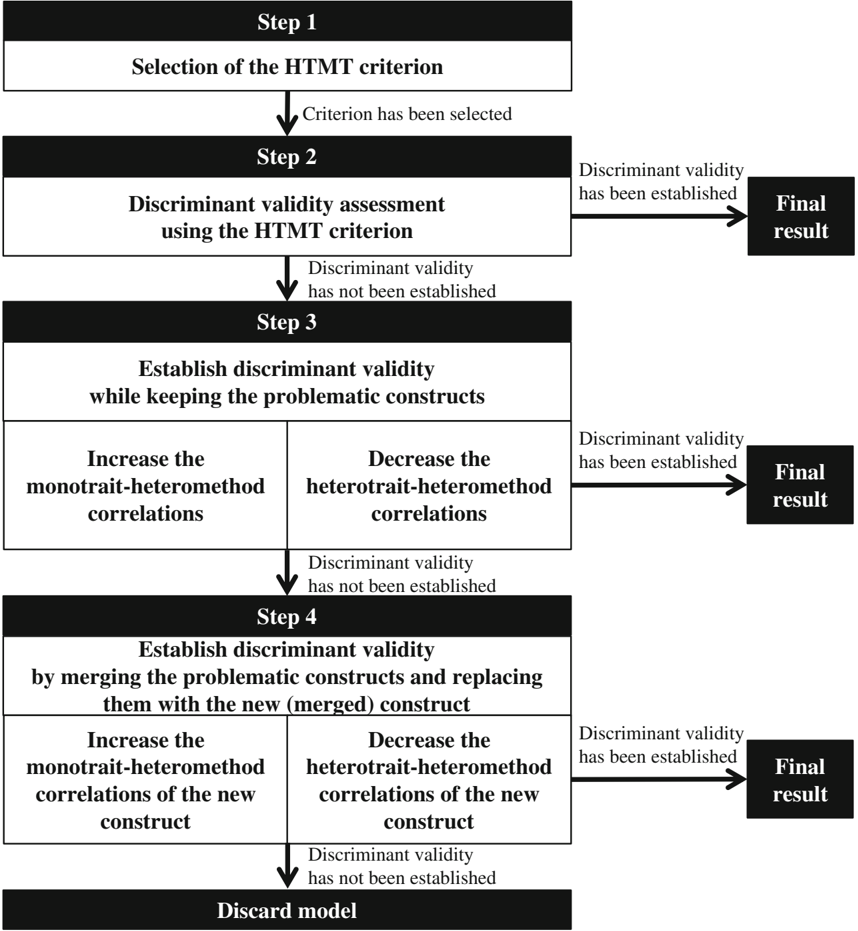
Discriminant validity assessment has become a generally accepted prerequisite for analyzing relationships between latent variables. For variance-based structural equation modeling, such as partial least squares, the Fornell-Larcker criterion and the examination of cross-loadings are the dominant approaches for evaluating discriminant validity. By means of a simulation study, we show that these approaches do not reliably detect the lack of discriminant validity in common research situations. We therefore propose an alternative approach, based on the multitrait-multimethod matrix, to assess discriminant validity: the heterotrait-monotrait ratio of correlations. We demonstrate its superior performance by means of a Monte Carlo simulation study, in which we compare the new approach to the Fornell-Larcker criterion and the assessment of (partial) cross-loadings. Finally, we provide guidelines on how to handle discriminant validity issues in variance-based structural equation modeling.
Overview
The claims and statistics of this paper haven’t been checked yet.
Free: it reads the open-access text and checks the first 5 claims that cite a source we can check. Create a free account to check every claim.
Integrity signals
Registry
Cites
Statistics
Figures


Verification
Claims the paper makes
The claims and statistics of this paper haven’t been checked yet.
Free: it reads the open-access text and checks the first 5 claims that cite a source we can check. Create a free account to check every claim.
Claims other papers make about this one
Each is checked against this paper’s own text: does it say what the citing paper says it does?
The cited source doesn’t support the claim as written.
In the citing paper
“Ultimately, they did not recommend HTMT inference , given it failed to detect discriminant validity violations even when inter-construct correlations were as high as 0.95.”
From Reporting reliability, convergent and discriminant validity with structural equation modeling: A review and best-practice recommendations (2024) · cites this paper as Henseler et al. (2015)
Checked by a reasoning model — may be wrong.
Experimental — accuracy not yet measuredThe cited source doesn’t support the claim as written.
In the citing paper
“First, intending to estimate the disattenuated construct score correlation, Henseler et al.'s (2015, Eq. 6) HTMT equation is incorrect.”
From Reporting reliability, convergent and discriminant validity with structural equation modeling: A review and best-practice recommendations (2024) · cites this paper as Henseler et al. (2015)
Checked by a reasoning model — may be wrong.
Experimental — accuracy not yet measuredThe source backs part of the claim, not all of it — or backs it for a different population, condition or comparison.
In the citing paper
“While Henseler et al.'s (2015) HTMT equation uses inter-item correlations instead of inter-item covariances, that becomes the disattenuated correlation between two composite scores formed by averaging the standardized item scores.”
From Reporting reliability, convergent and discriminant validity with structural equation modeling: A review and best-practice recommendations (2024) · cites this paper as Henseler et al. (2015)
Experimental — accuracy not yet measuredThe source backs part of the claim, not all of it — or backs it for a different population, condition or comparison.
In the citing paper
“Third, the recommended HTMT threshold of 0.85 was based on the power of detecting a population correlation at 1.0 in a simulation study (Henseler et al., 2015).”
From Reporting reliability, convergent and discriminant validity with structural equation modeling: A review and best-practice recommendations (2024) · cites this paper as Henseler et al., 2015
Experimental — accuracy not yet measuredThe source backs part of the claim, not all of it — or backs it for a different population, condition or comparison.
In the citing paper
“Hence, unless the construct scores are calculated by averaging the standardized item scores, Henseler et al.'s HTMT equation provides a biased estimate of the disattenuated correlation between two composites.”
From Reporting reliability, convergent and discriminant validity with structural equation modeling: A review and best-practice recommendations (2024) · cites this paper as Henseler et al. (2015)
Experimental — accuracy not yet measured
38 more claims about this paper
Create a free account to see every claim other papers make about this one.
Self-check
Percentages, sums and reported differences re-computed from the paper’s own numbers.
The self-check needs the paper’s full text.
Citations
Cites
R: A Language and Environment for Statistical Computing
R Core Team (2025) · doi:10.32614/r.manuals · Cited by 352,181
Evaluating Structural Equation Models with Unobservable Variables and Measurement Error
Fornell, C., & Larcker, D. F. (1981) · Journal of Marketing Research · doi:10.2307/3151312 · Cited by 109,314
Evaluating structural equation models with unobservable variables and measurement error
Fornell, C., & Larcker, D. F. (1981) · Journal of Marketing Research · doi:10.1177/002224378101800104 · Cited by 109,190
Perceived usefulness, perceived ease of use, and user acceptance of information technology
Davis, F. D. (1989) · MIS Quarterly · doi:10.2307/249008 · Cited by 68,483 · cited 1×
“Take, for example, the technology acceptance model and its variations (Davis 1989; Venkatesh et al. 2003), which include the constructs intention to use and the actual use.”
BackgroundUser Acceptance of Information Technology: Toward A Unified View1
Venkatesh, V., Morris, M. G., Davis, G. B., & Davis, F. D. (2003) · MIS Quarterly · doi:10.2307/30036540 · Cited by 45,035 · cited 1×
“Take, for example, the technology acceptance model and its variations (Davis 1989; Venkatesh et al. 2003), which include the constructs intention to use and the actual use.”
BackgroundStructural equation modeling in practice: A review and recommended two-step approach
Anderson, J. C., & Gerbing, D. W. (1988) · Psychological Bulletin · doi:10.1037/0033-2909.103.3.411 · Cited by 41,941 · cited 1×
“That is, discriminant validity assessment using HTMTinference needs to adjust the upper and lower bounds of the confidence interval in each test to maintain the familywise error rate at a predefined α level (Anderson and Gerbing 1988).”
Method(1998) · Cited by 36,049
Herne, H., Cooley, W. W., & Lohnes, P. R. (1973) · Journal of the Royal Statistical Society. Series A (General) · doi:10.2307/2344428 · Cited by 35,697
Pls-Sem: indeed a silver bullet
Hair, J. F., Ringle, C. M., & Sarstedt, M. (2011) · Journal of Marketing Theory and Practice · doi:10.2753/mtp1069-6679190202 · Cited by 21,631
Self-citationA Simple Sequentially Rejective Multiple Test Procedure
(1979) · Scandinavian Journal of Statistics · doi:10.2307/4615733 · Cited by 21,526 · cited 1×
“Furthermore, Bonferroni is a rather conservative approach to maintain the familywise error rate at a predefined level (Hochberg 1988; Holm 1979).”
Method
Research works printed but not linked: 3
- 29. Gefen, D., Straub, D. W., & Boudreau, M.-C. (2000). Structural equation modeling techniques and regression: guidelines for research prac- tice. Communications of the AIS, 4, 1-78.
- 65. Nunnally, J. (1978). Psychometric theory (2nd ed.). New York: McGraw-Hill.
- 76. Ringle, C. M., Sarstedt, M., & Straub, D. W. (2012). A critical look at the use of PLS-SEM in MIS Quarterly. MIS Quarterly, 36(1), iii-xiv.
Cited by
Items 1,001–1,100 of 1,266
Miranda, S., Trigo, I., Rodrigues, R., & Duarte, M. (2023) · Technological Forecasting and Social Change · doi:10.1016/j.techfore.2022.122280 · Cited by 128
What Determines AI Adoption in Companies? Mixed-Method Evidence
Polisetty, A., Chakraborty, D., G, S., Kar, A. K., & Pahari, S. (2024) · Journal of Computer Information Systems · doi:10.1080/08874417.2023.2219668 · Cited by 128
Guo, Y., Bao, Y., Stuart, B. J., & Le‐Nguyen, K. (2018) · Information Systems Journal · doi:10.1111/isj.12144 · Cited by 127
“Insert Table 2 here To assess discriminant validity, we used the techniques of Fornell and Larcker (1981), Chin (1998) and Henseler (2015).”
MethodLeading for Resilience: Fostering Employee and Organizational Resilience in Tourism Firms
Prayag, G., Muskat, B., & Dassanayake, C. (2024) · Journal of Travel Research · doi:10.1177/00472875231164984 · Cited by 124
Liao, Y.-K., Wu, W.-Y., Le, T. Q., & Phung, T. T. T. (2022) · Sustainability · doi:10.3390/su14020815 · Cited by 123
“9, in line with the suggestion of [81].”
BackgroundMethodHaneem, F., Kama, N., Taskin, N., Pauleen, D., & Abu Bakar, N. A. (2019) · International Journal of Information Management · doi:10.1016/j.ijinfomgt.2018.10.007 · Cited by 121
Akbar, A., Ali, S., Ahmad, M. A., Akbar, M., & Danish, M. (2019) · International Journal of Environmental Research and Public Health · doi:10.3390/ijerph16204043 · Cited by 122
“SEM is an influential multivariate second generation data analysis technique having several benefits over conventional multivariate data analysis techniques in terms of efficiency, convenience, and accuracy [102,103].”
BackgroundAli, A. M., Hori, H., Kim, Y., & Kunugi, H. (2022) · Frontiers in Psychology · doi:10.3389/fpsyg.2022.799769 · Cited by 122
Tourism experiences, memorability and behavioural intentions: A study of tourists in Sardinia, Italy
Sthapit, E., Del Chiappa, G., Coudounaris, D. N., & Björk, P. (2019) · Tourism Review · doi:10.1108/tr-03-2019-0102 · Cited by 120
Terblanche, N., & Kidd, M. (2022) · Sage Open · doi:10.1177/21582440221096136 · Cited by 120
“Discriminant validity was assessed using the method of heterotrait-monotrait ratio (Henseler et al., 2015).”
MethodAl-Abdullatif, A. M., & Alsubaie, M. A. (2024) · Behavioral Sciences · doi:10.3390/bs14090845 · Cited by 126
“While there is abundant discourse on the potential of AI in education or even the While there is abundant discourse on the potential of AI in education or even the”
Tanantong, T., & Wongras, P. (2024) · Systems · doi:10.3390/systems12010028 · Cited by 114
Alkhadra, W. A., Khawaldeh, S., & Aldehayyat, J. (2023) · International Journal of Ethics and Systems · doi:10.1108/ijoes-05-2022-0092 · Cited by 114
Modeling adoption of intelligent agents in medical imaging
Calisto, F. M., Nunes, N., & Nascimento, J. C. (2022) · International Journal of Human-Computer Studies · doi:10.1016/j.ijhcs.2022.102922 · Cited by 111
Karjaluoto, H., Glavee-Geo, R., Ramdhony, D., Shaikh, A. A., & Hurpaul, A. (2021) · International Journal of Bank Marketing · doi:10.1108/ijbm-03-2020-0129 · Cited by 109
Religiosity and food waste reduction intentions: A conceptual model
Elhoushy, S., & Jang, S. (. (2021) · International Journal of Consumer Studies · doi:10.1111/ijcs.12624 · Cited by 109
Akter, S., Wamba, S. F., Mariani, M., & Hani, U. (2021) · Industrial Marketing Management · doi:10.1016/j.indmarman.2021.07.014 · Cited by 108
Zollo, L., Carranza, R., Faraoni, M., Díaz, E., & Martín-Consuegra, D. (2021) · Journal of Retailing and Consumer Services · doi:10.1016/j.jretconser.2020.102432 · Cited by 107
Jeilani, A., & Hussein, A. (2025) · BMC Health Services Research · doi:10.1186/s12913-025-12414-4 · Cited by 105
“According to [68], discriminant validity is established when the HTMT values are less than or equal to 0.90.”
InfluentialShahzad, M. F., Xu, S., & Asif, M. (2025) · British Educational Research Journal · doi:10.1002/berj.4084 · Cited by 103
The role of domain expertise in trusting and following explainable AI decision support systems
Bayer, S., Gimpel, H., & Markgraf, M. (2022) · Journal of Decision Systems · doi:10.1080/12460125.2021.1958505 · Cited by 103
Al-Abdullatif, A. M. (2023) · Education Sciences · doi:10.3390/educsci13111151 · Cited by 102
Seçilmiş, C., Özdemir, C., & Kılıç, İ. (2022) · Current Issues in Tourism · doi:10.1080/13683500.2021.1994528 · Cited by 101
Development and validation of ChatGPT literacy scale
Lee, S., & Park, G. (2024) · Current Psychology · doi:10.1007/s12144-024-05723-0 · Cited by 100
“Discriminant validity was evaluated using two distinct methods: the approach proposed by Fornell and Larcker (1981) and the heterotrait-monotrait ratio of correlations (HTMT) as suggested by Henseler et al. (2015).”
Ahadzadeh, A. S., Rafik-Galea, S., Alavi, M., & Amini, M. (2018) · Health Psychology Open · doi:10.1177/2055102918774251 · Cited by 99
Why do people switch mobile payment service platforms? An empirical study in Taiwan
Kuo, R.-Z. (2020) · Technology in Society · doi:10.1016/j.techsoc.2020.101312 · Cited by 99
Lu, B., Wang, Z., & Zhang, S. (2021) · Information & Management · doi:10.1016/j.im.2021.103504 · Cited by 96
Khan, A. N., Jabeen, F., Mehmood, K., Ali Soomro, M., & Bresciani, S. (2023) · Journal of Business Research · doi:10.1016/j.jbusres.2023.114019 · Cited by 98
Ramkumar, M., Schoenherr, T., Wagner, S. M., & Jenamani, M. (2019) · International Journal of Production Economics · doi:10.1016/j.ijpe.2019.06.003 · Cited by 96
Privacy Concerns and Self-Disclosure in Private and Public Uses of Social Media
Gruzd, A., & Hernández-García, Á. (2018) · Cyberpsychology, Behavior, and Social Networking · doi:10.1089/cyber.2017.0709 · Cited by 97
Creepy vs. cool: Switching from human staff to service robots in the hospitality industry
Kang, S.-E., Koo, C., & Chung, N. (2023) · International Journal of Hospitality Management · doi:10.1016/j.ijhm.2023.103479 · Cited by 96
Song, Y., Yang, Y., & Cheng, P. (2022) · Sensors · doi:10.3390/s22041614 · Cited by 95
Ng, S. I., Ho, J. A., Lim, X. J., Chong, K. L., & Latiff, K. (2021) · Young Consumers · doi:10.1108/yc-06-2019-1006 · Cited by 92
Asiaei, K., Bontis, N., Barani, O., & Jusoh, R. (2021) · Journal of Management Control · doi:10.1007/s00187-021-00317-4 · Cited by 91
Shao, C., Nah, S., Makady, H., & McNealy, J. (2024) · International Journal of Human–Computer Interaction · doi:10.1080/10447318.2024.2331858 · Cited by 94
“Discriminant validity was further supported by a Heterotrait-Monotrait Ratio (HTMT) test, with the result showing that the HTMT values were below 0.85, indicating acceptable discriminant validity (Henseler et al., 2015).”
InfluentialCegarra-Navarro, J.-G., & Martelo-Landroguez, S. (2020) · Journal of Intellectual Capital · doi:10.1108/jic-03-2019-0048 · Cited by 91
“Finally, all the variables attain discriminant validity (Table 1), since all HTMT are below the value of 0.90 (Henseler et al., 2015).”
BackgroundMethodInfluentialFaculty of Business Administration, H. C. M. C. O. U., DOAN, T. T. T., NGUYEN, L. C. T., & NGUYEN, T. D. N. (2020) · The Journal of Asian Finance, Economics and Business · doi:10.13106/jafeb.2020.vol7.no3.223 · Cited by 88
“HTMT ratio is ranged from 0.190 to 0.85 which showed the qualified index to satisfy the discriminant validity (Nitzl, 2016; Henseler et al., 2015).”
BackgroundMethodInfluentialAlzghoul, A., Khaddam, A. A., Abousweilem, F., Irtaimeh, H. J., & Alshaar, Q. (2024) · Information Development · doi:10.1177/02666669221108438 · Cited by 87
“So, the HTMT correlation ratios reported in Table 3 were below the ( ≤ 0.90) threshold (Henseler et al., 2015).”
BackgroundInfluentialde Blanes Sebastián, M. G., Antonovica, A., & Sarmiento Guede, J. R. (2023) · Technological Forecasting and Social Change · doi:10.1016/j.techfore.2022.122235 · Cited by 86
Building customer loyalty in retail banking: a serial-mediation approach
Kamath, P. R., Pai, Y. P., & Prabhu, N. K. P. (2019) · International Journal of Bank Marketing · doi:10.1108/ijbm-01-2019-0034 · Cited by 85
An, M. H., You, S. C., Park, R. W., & Lee, S. (2021) · JMIR Medical Informatics · doi:10.2196/25435 · Cited by 84
“According to Henseler et al [46], when testing the null hypothesis (H0: HTMT≥1) against the opposite hypothesis (H1: HTMT 1), if a CI contains the value 1, it indicates a lack of discriminant validity.”
BackgroundMethodInfluentialWörfel, P., Frentz, F., & Tautu, C. (2022) · European Journal of Marketing · doi:10.1108/ejm-07-2020-0510 · Cited by 84
Impact of Self-Control, Financial Literacy and Financial Behavior on Financial Well-Being
(2019) · The Journal of Social Sciences Research · doi:10.32861/jssr.51.211.218 · Cited by 83
“Discriminant Validity HTMT ratios show the correlations between two variables (Henseler et al., 2015).”
BackgroundConfirmation of a crisis leadership model and its effectiveness: Lessons from the COVID-19 pandemic
Balasubramanian, S., & Fernandes, C. (2022) · Cogent Business & Management · doi:10.1080/23311975.2021.2022824 · Cited by 77
Balaskas, S., Tsiantos, V., Chatzifotiou, S., & Rigou, M. (2025) · Information · doi:10.3390/info16020082 · Cited by 81
“Discriminant validity was evaluated by comparing the inter-construct correlations to the square root of the AVE using the approach of Claes Fornell et al. [77], and also by using the heterotrait–monotrait ratio (HTMT) proposed by Jörg Henseler et al. [94].”
Role of brand experience in predicting consumer loyalty
Safeer, A. A., Yuanqiong, H., Abrar, M., Shabbir, R., & Rasheed, H. M. W. (2021) · Marketing Intelligence & Planning · doi:10.1108/mip-11-2020-0471 · Cited by 81
Quoquab, F., Jaini, A., & Mohammad, J. (2020) · International Journal of Environmental Research and Public Health · doi:10.3390/ijerph17145258 · Cited by 80
“The second method (the heterotrait-monotrait (HTMT)) required comparing the ratio between construct correlations to within construct correlation [77].”
MethodSuhartanto, D., Dean, D., Nansuri, R., & Triyuni, N. N. (2018) · Journal of Business Research · doi:10.1016/j.jbusres.2017.10.039 · Cited by 79
Beyond the hype: exploring faculty perceptions and acceptability of AI in teaching practices
Ofosu-Ampong, K. (2024) · Discover Education · doi:10.1007/s44217-024-00128-4 · Cited by 79
“The closer the NFI values to 1, the better the fit model [32].”
InfluentialA further approach in omnichannel LSQ, satisfaction and customer loyalty
Cotarelo, M., Calderón, H., & Fayos, T. (2021) · International Journal of Retail & Distribution Management · doi:10.1108/ijrdm-01-2020-0013 · Cited by 78
“Discriminant validity was measure following the criteria described by Fornell and Larker (1981) and the heterotrait–monotrait ratio of correlations (HTMT) criterion (Henseler et al., 2015).”
MethodAnasori, E., De Vita, G., & Gürkan Küçükergin, K. (2023) · The Service Industries Journal · doi:10.1080/02642069.2022.2147514 · Cited by 77
Foroughi, B., Iranmanesh, M., Nikbin, D., & Hyun, S. S. (2019) · Telematics and Informatics · doi:10.1016/j.tele.2019.101247 · Cited by 77
Pattali, S., Sankar, J. P., Al Qahtani, H., Menon, N., & Faizal, S. (2024) · BMC Health Services Research · doi:10.1186/s12913-024-10674-0 · Cited by 76
How Do Fresh Live Broadcast Impact Consumers’ Purchase Intention? Based on the SOR Theory
Song, Z., Liu, C., & Shi, R. (2022) · Sustainability · doi:10.3390/su142114382 · Cited by 76
“[61] recommends using the HTMT standard to evaluate discriminant validity in variance-based SEM.”
MethodAntecedents of strategic thinking and its impact on competitive advantage
Dixit, S., Singh, S., Dhir, S., & Dhir, S. (2021) · Journal of Indian Business Research · doi:10.1108/jibr-08-2020-0262 · Cited by 75
Do Parent Units Benefit from Reverse Knowledge Transfer?
Nair, S. R., Demirbag, M., Mellahi, K., & Pillai, K. G. (2018) · British Journal of Management · doi:10.1111/1467-8551.12234 · Cited by 74
Wu, W., Huang, Y., & Qian, L. (2024) · Decision Support Systems · doi:10.1016/j.dss.2023.114115 · Cited by 73
Online social games: The effect of social comparison elements on continuance behaviour
Esteves, J., Valogianni, K., & Greenhill, A. (2021) · Information & Management · doi:10.1016/j.im.2021.103452 · Cited by 73
PLS–SEM in business promotion strategies. A multigroup analysis of mobile coupon users using MICOM
Carranza, R., Díaz, E., Martín-Consuegra, D., & Fernández-Ferrín, P. (2020) · Industrial Management & Data Systems · doi:10.1108/imds-12-2019-0726 · Cited by 72
Vu, T., Vo‐Thanh, T., Chi, H., Nguyen, N. P., Nguyen, D. V., & Zaman, M. (2022) · Human Resource Management · doi:10.1002/hrm.22101 · Cited by 71
Kılıç, İ., & Gürlek, M. (2024) · Journal of Sustainable Tourism · doi:10.1080/09669582.2023.2273755 · Cited by 71
Raza, S. A., Qazi, W., & Yousufi, S. Q. (2021) · Journal of Applied Research in Higher Education · doi:10.1108/jarhe-03-2020-0065 · Cited by 70
Wang, S., Cheah, J.-H., Lim, X.-J., Leong, Y. C., & Choo, W. C. (2022) · Journal of Retailing and Consumer Services · doi:10.1016/j.jretconser.2021.102843 · Cited by 70
Damberg, S., Schwaiger, M., & Ringle, C. M. (2022) · Journal of Marketing Analytics · doi:10.1057/s41270-021-00147-2 · Cited by 69
Self-citationUrsavaş, Ö. F., Yalçın, Y., İslamoğlu, H., Bakır-Yalçın, E., & Cukurova, M. (2025) · International Journal of Educational Technology in Higher Education · doi:10.1186/s41239-025-00535-z · Cited by 69
“Numerous studies have demonstrated the suitability of the Heterotrait-Monotrait (HTMT) ratio of correlations (Henseler et al., 2015) and the Fornell–Larcker criterion (Fornell & Larcker, 1981) for verifying discriminant validity.”
InfluentialLight exposure behaviors predict mood, memory and sleep quality
Siraji, M. A., Spitschan, M., Kalavally, V., & Haque, S. (2023) · Scientific Reports · doi:10.1038/s41598-023-39636-y · Cited by 69
Singh, P. K., & Chan, S. W. (2022) · Journal of Open Innovation: Technology, Market, and Complexity · doi:10.3390/joitmc8020061 · Cited by 65
“A study by [131] discovered that E-informing has a positive significant influence on supply chain performance and therefore enhanced sustainability in her study of the impact of E-procurement on organizational performance in state corporations in Nairobi County.”
BackgroundNikbin, D., Iranmanesh, M., & Foroughi, B. (2021) · Behaviour & Information Technology · doi:10.1080/0144929x.2020.1722749 · Cited by 67
“The heterotrait-monotrait ratio of correlations (HTMT) was used to evaluate discriminant validity as suggested by Henseler, Ringle, and Sarstedt (2015).”
MethodChatterjee, S., Chaudhuri, R., Thrassou, A., & Sakka, G. (2022) · Journal of Intellectual Capital · doi:10.1108/jic-12-2020-0378 · Cited by 67
Tailoring Persuasive and Behaviour Change Systems Based on Stages of Change and Motivation
Oyebode, O., Ndulue, C., Mulchandani, D., A. Zamil Adib, A., Alhasani, M., & Orji, R. (2021) · Proceedings of the 2021 CHI Conference on Human Factors in Computing Systems · doi:10.1145/3411764.3445619 · Cited by 66
Kumar, A., Shankar, A., Behl, A., Chakraborty, D., & Gundala, R. R. (2025) · Journal of Consumer Marketing · doi:10.1108/jcm-06-2024-6922 · Cited by 66
Power imbalance and the dark side of the captive agri-food supplier–buyer relationship
Glavee-Geo, R., Engelseth, P., & Buvik, A. (2022) · Journal of Business Ethics · doi:10.1007/s10551-021-04791-7 · Cited by 64
Zou, B., Wang, C., Yan, Y., Du, X., & Ji, Y. (2025) · International Journal of Applied Linguistics · doi:10.1111/ijal.12658 · Cited by 66
Adu-Gyamfi, G., Song, H., Asamoah, A. N., Li, L., Nketiah, E., Obuobi, B., Adjei, M., & Cudjoe, D. (2022) · Technological Forecasting and Social Change · doi:10.1016/j.techfore.2022.121995 · Cited by 61
Al Mamun, A., Nawi, N. C., Hayat, N., & Zainol, N. R. B. (2020) · Sustainability · doi:10.3390/su122410663 · Cited by 61
“The first step reflects the estimation of model measurement, where reliability and validity of the study constructs are determined [36]; whereas discriminant validity is achieved by using the old and newly proposed approaches of Fornell–Larcker criterion and the heterotrait-monotrait ratio (HTMT) [38,39].”
Methodvan Bussel, M. J. P., Odekerken–Schröder, G. J., Ou, C., Swart, R. R., & Jacobs, M. J. G. (2022) · BMC Health Services Research · doi:10.1186/s12913-022-08189-7 · Cited by 60
“This measure was found unsuitable for homogenous loading patterns [91].”
BackgroundMethodInfluentialTajeddini, K., Gamage, T. C., Hameed, W. U., Qumsieh-Mussalam, G., Chaijani, M. H., Rasoolimanesh, S. M., & Kallmuenzer, A. (2022) · International Journal of Hospitality Management · doi:10.1016/j.ijhm.2021.103093 · Cited by 60
The impact of eudaimonic well-being on experience and loyalty: a tourism context
Al-okaily, N. S., Alzboun, N., Alrawadieh, Z., & Slehat, M. (2023) · Journal of Services Marketing · doi:10.1108/jsm-08-2021-0282 · Cited by 59
Habibi, A., & Rasoolimanesh, S. M. (2021) · Journal of Quality Assurance in Hospitality & Tourism · doi:10.1080/1528008x.2020.1837050 · Cited by 58
Alqurni, J. (2026) · Frontiers in Artificial Intelligence · doi:10.3389/frai.2026.1738774 · Cited by 58
Gao, Y., & Liang, J. (2025) · Sustainability · doi:10.3390/su17072789 · Cited by 57
“Moreover, the HTMT values are below 0.9 [137], further supporting the conclusion that the measurement model possesses satisfactory discriminant validity.”
InfluentialGrappe, C. G., Lombart, C., Louis, D., & Durif, F. (2021) · International Journal of Retail & Distribution Management · doi:10.1108/ijrdm-12-2020-0489 · Cited by 57
“The discriminant validity of the measurement scales used was established through the HTMT method, as recommended by Henseler et al. (2015) for variance-based SEM.”
The Self-as-Context Scale: Development and preliminary psychometric properties
Zettle, R. D., Gird, S. R., Webster, B. K., Carrasquillo-Richardson, N., Swails, J. A., & Burdsal, C. A. (2018) · Journal of Contextual Behavioral Science · doi:10.1016/j.jcbs.2018.08.010 · Cited by 56
Untangling the adverse effects of late-night usage of smartphone-based SNS among University students
Luqman, A., Masood, A., Shahzad, F., Shahbaz, M., & Feng, Y. (2021) · Behaviour & Information Technology · doi:10.1080/0144929x.2020.1773538 · Cited by 56
Sadiq, M. W., Akhtar, M. W., Huo, C., & Zulfiqar, S. (2024) · The Service Industries Journal · doi:10.1080/02642069.2023.2278463 · Cited by 56
“Discriminant validity was evaluated using the HTMT ratio approach (Henseler et al., 2015).”
MethodInternet Celebrities’ Impact on Luxury Fashion Impulse Buying
Chen, M., Xie, Z., Zhang, J., & Li, Y. (2021) · Journal of Theoretical and Applied Electronic Commerce Research · doi:10.3390/jtaer16060136 · Cited by 56
“[100] was conducted to confirm discriminant validity.”
Seow, A. N., Foroughi, B., & Choong, Y. O. (2024) · SAGE Open · doi:10.1177/21582440241274049 · Cited by 55
How social and media cues induce live streaming impulse buying? SOR model perspective
Xia, Y. X., Chae, S. W., & Xiang, Y. C. (2024) · Frontiers in Psychology · doi:10.3389/fpsyg.2024.1379992 · Cited by 55
“Thirdly, in terms of discriminant validity, the Heterotrait-Monotrait (HTMT) ratio superior the Fornell-Larcker test (Henseler et al., 2015).”
BackgroundInfluentialBile Hassan, I., Murad, M. A. A., El-Shekeil, I., & Liu, J. (2022) · Informatics · doi:10.3390/informatics9020031 · Cited by 55
Examining the factors influencing fintech adoption behaviour of gen Y in India
Aggarwal, M., Nayak, K. M., & Bhatt, V. (2023) · Cogent Economics & Finance · doi:10.1080/23322039.2023.2197699 · Cited by 54
Jin, X.-L., Chen, X., & Zhou, Z. (2022) · International Journal of Information Management · doi:10.1016/j.ijinfomgt.2021.102428 · Cited by 54
How event information is trusted and shared on social media: a uses and gratification perspective
Kim, S.-E., Kim, H. L., & Lee, S. (2021) · Journal of Travel & Tourism Marketing · doi:10.1080/10548408.2021.1943600 · Cited by 53
Zahrai, K., Veer, E., Ballantine, P. W., de Vries, H. P., & Prayag, G. (2022) · Journal of Consumer Affairs · doi:10.1111/joca.12449 · Cited by 53
Teck Soon, H., & Syed A. Kadir, S. L. (2017) · Internet Research · doi:10.1108/intr-08-2016-0256 · Cited by 53
Xu, Y., Du, J., Shahzad, F., & Li, X. (2021) · Frontiers in Psychology · doi:10.3389/fpsyg.2021.724452 · Cited by 52
Badar, K., Aboramadan, M., & Plimmer, G. (2023) · International Journal of Conflict Management · doi:10.1108/ijcma-12-2022-0210 · Cited by 52
Qiu, H., Wang, G., Ren, L., Zhang, J., & Wang, J. (2022) · Tourism Management Perspectives · doi:10.1016/j.tmp.2022.101028 · Cited by 52
Augmented reality (AR) marketing and consumer responses: a study of cue-utilization and habituation
Söderström, C., Mikalef, P., Dypvik Landmark, A., & Gupta, S. (2024) · Journal of Business Research · doi:10.1016/j.jbusres.2024.114813 · Cited by 51
Zhang, Q., Wang, Y., & Ariffin, S. K. (2024) · PLoS ONE · doi:10.1371/journal.pone.0296339 · Cited by 50
Adoption of AI writing tools among academic researchers: A Theory of Reasoned Action approach
Al-Bukhrani, M. A., Alrefaee, Y. M. H., & Tawfik, M. (2025) · PLOS ONE · doi:10.1371/journal.pone.0313837 · Cited by 50
Metadata
- Authors
- Henseler, J., Ringle, C. M., & Sarstedt, M.
- Affiliations
- Universidade Nova de Lisboa (PT)
- University of Newcastle Australia (AU)
- Corresponding author
- Sarstedt, Marko
- Venue
- Journal of the Academy of Marketing Science
- Published
- 2014-08-22
- Volume
- 43
- Issue
- 1
- Pages
- 115-135
- ISSN
- 0092-0703 (ISSN-L)
- 1552-7824
- OpenAlex
- W2105846236
- Cited by
- 38,459
- References
- 112
- Citations by year
- 2026: 9160 · 2025: 7076 · 2024: 5683 · 2023: 5082 · 2022: 4007 · 2021: 2951 · 2020: 1857 · 2019: 1210 · 2018: 761 · 2017: 384 · 2016: 208 · 2015: 58 · 2014: 7
- FWCI
- 276.66
- Type
- journal article
- Language
- en
- Open access
- hybrid
- doi.org
- Locations
- Journal of the Academy of Marketing Science (publishedVersion, cc-by)
- New University of Lisbon's Repository (New University of Lisbon) (publishedVersion, other-oa)
- University of Twente Research Information (acceptedVersion, cc-by)
- Figshare (submittedVersion, cc-by)
- Portuguese National Funding Agency for Science, Research and Technology (RCAAP Project by FCT) (submittedVersion, other-oa)
- tub.dok (Hamburg University of Technology) (submittedVersion)
- NOVA (University of Newcastle Australia) (submittedVersion, cc-by)
- University of Twente Research Information (submittedVersion, cc-by)
- Funders
- Rijksuniversiteit Groningen
- Radboud Universiteit
- Topics
- Social Sciences › Decision Sciences › Management Science and Operations Research › Psychometric Methodologies and Testing
- Physical Sciences › Mathematics › Statistics and Probability › Statistical Methods and Applications
- Social Sciences › Business, Management and Accounting › Strategy and Management › Business Strategies and Management Research
- Keywords
- discriminant validity, partial least squares, cross-loadings, multitrait-multimethod matrix, latent variables, measurement validity
About these checks
Registry, retraction, Cites and statistics results are computed, not judged, with one exception: a printed reference that no index lists is read once by a model before it counts as a citation error. Claims are extracted by a model and kept only when their quote appears verbatim in the text; each cited source is then checked, with a model’s help, for whether it says what the claim relies on. Those verdicts can be wrong — read the claim’s quote and the cited source before relying on one.
Statistics and arithmetic are recomputed, not judged.
Confidence bands are shown only for fields calibrated on our annotated test set. None is calibrated yet, so no band is shown.
What counts as a claim ›How we measure confidence ›How we check this ›
Are you an author, or do you see a problem with this page? Request a review
Data sources
Bibliographic data: Semantic Scholar, OpenAlex, Crossref.
Contains information from the Semantic Scholar Academic Graph Datasets, made available under the ODC Attribution License (ODC-BY 1.0).
Semantic Scholar’s data is described in: Kinney, R., et al. (2023). The Semantic Scholar Open Data Platform. arXiv:2301.10140.
