

Bile Salt Hydrolase Activity in the Food-Derived Strain Levilactobacillus brevis M3R3: Genomic and Functional Characterization
Open accessPublished version of a preprint
The DOI matches its Crossref record; 126 of the 126 references it cites were found in a registry or an index; 42 of the 65 sources its claims cite were checked for support.
Abstract
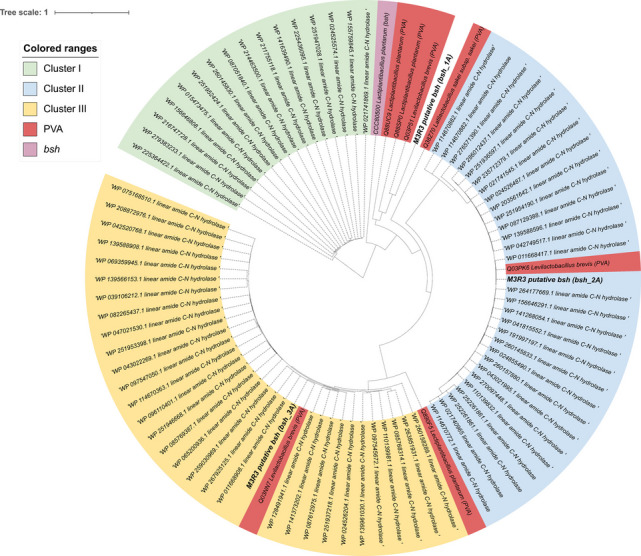
In the present study, Levilactobacillus brevis M3R3, isolated from traditional Sicilian sourdough, was evaluated for bile salt hydrolase (BSH) activity through kinetic growth assays and bile salts (BSs) deconjugation analysis by UHPLC/HR-MS. Genome sequencing and in silico analyses were performed to assess its safety and probiotic potential. Results showed that strain M3R3 tolerated different concentrations of individual conjugated BSs, with dose-dependent growth inhibition. Exposure to 1.0% glycocholic and glycodeoxycholic acids reduced M3R3 growth, indicating an adaptive stress response. When exposed to a mixed BS solution mimicking intestinal conditions, the strain maintained growth despite an extended lag phase and a reduced final biomass, likely due to toxic BSs accumulation. UHPLC/HR-MS confirmed complete deconjugation of glyco-conjugated BSs and partial deconjugation of tauro-conjugated BSs. Whole-genome sequencing (2.30 Mbp, 2375 CDSs) revealed absence of antimicrobial resistance or virulence genes and identified two bsh genes (bsh_2A and bsh_3A), both expressed under control and BS-exposed conditions. Phylogenetic analysis of L. brevis BSH proteins identified three clusters (I, II, and III), with bsh_2A and bsh_3A from M3R3 grouped in clusters II and III, respectively. Overall, genomic and functional characterizations support that L. brevis M3R3 is a safe, BSH-active strain, with potential applications as a functional ingredient in health promoting formulations.
Overview
CoChat Summary
## TL;DR
Levilactobacillus brevis M3R3, isolated from traditional Sicilian sourdough, showed bile salt tolerance and bile salt deconjugation activity, with stronger activity against glyco-conjugated bile salts than tauro-conjugated ones. Genome and expression analyses identified two candidate bsh genes, and the strain was reported as genomically safe with no detected virulence genes and no ARGs by most screening tools.
## Key findings
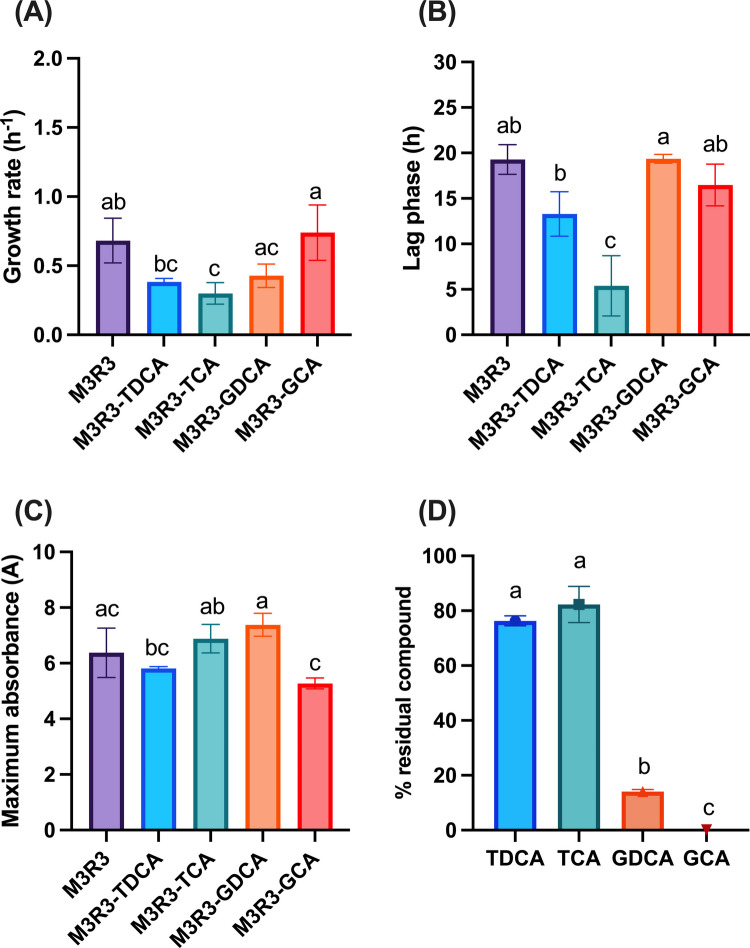
- In plate-count assays, M3R3 tolerated individual conjugated bile salts, with counts ranging from 8.73 ± 0.06 to 9.37 ± 0.08 Log10 CFU/mL; increasing bile salt concentrations generally increased growth inhibition, except for TCA.
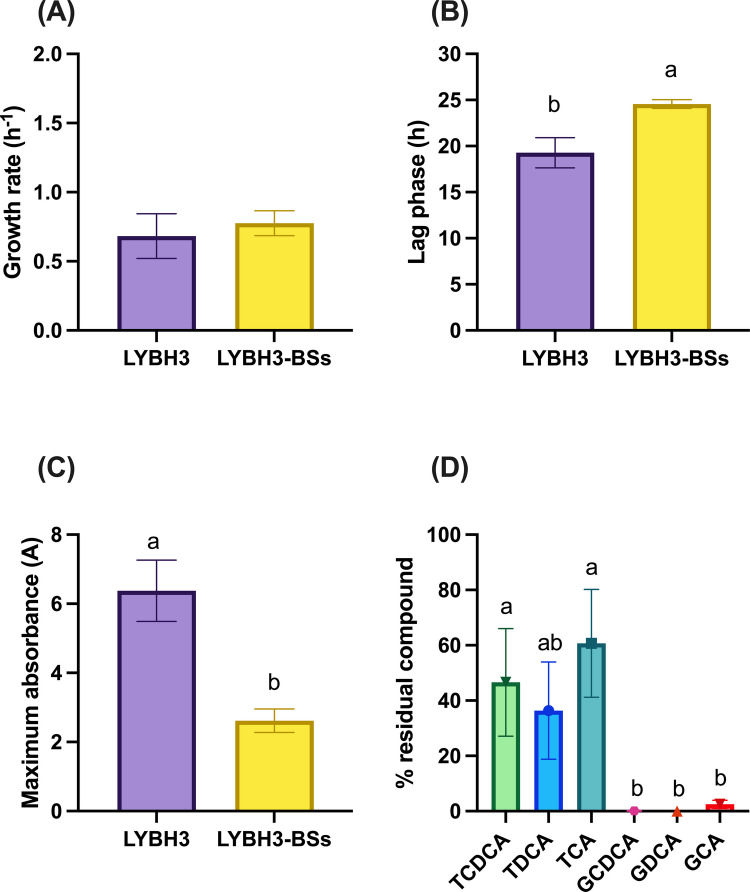
- Under 1.0% glycocholic acid (GCA) and glycodeoxycholic acid (GDCA), growth was reduced; with the bile-salt mixture, growth rate was not significantly affected, but lag phase increased (p < 0.01) and final biomass decreased (p < 0.01).
- UHPLC/HR-MS showed complete deconjugation of GCDCA and GDCA, near-complete deconjugation of GCA (2.5% residual), but much weaker activity against tauro-conjugated bile salts: TDCA 83.4% residual and TCA 76.3% residual in individual-bile-salt assays; in the mixture, TCDCA 46.6% and TCA 60.7% residual.
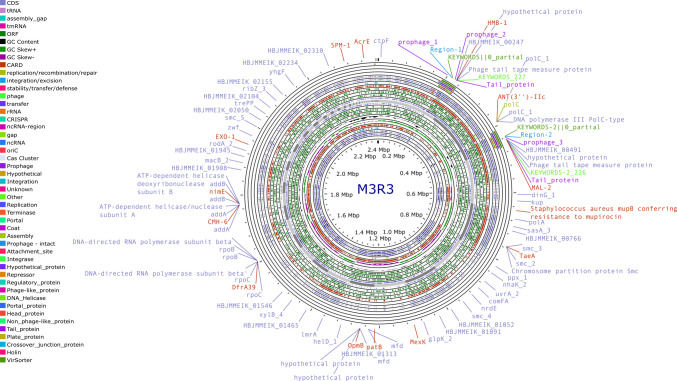
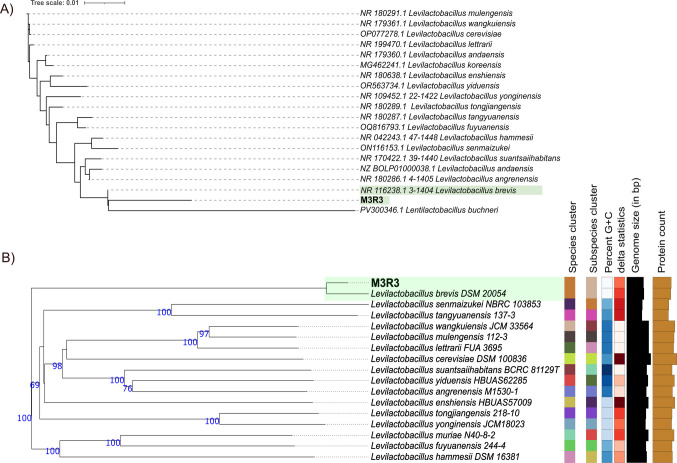
- Whole-genome sequencing produced an assembly of 72 contigs with a total length of 2,406,595 bp and 45.93% GC; annotation predicted 2442 genes including 2373 CDS, 66 tRNA, 6 rRNA, and 1 tmRNA.
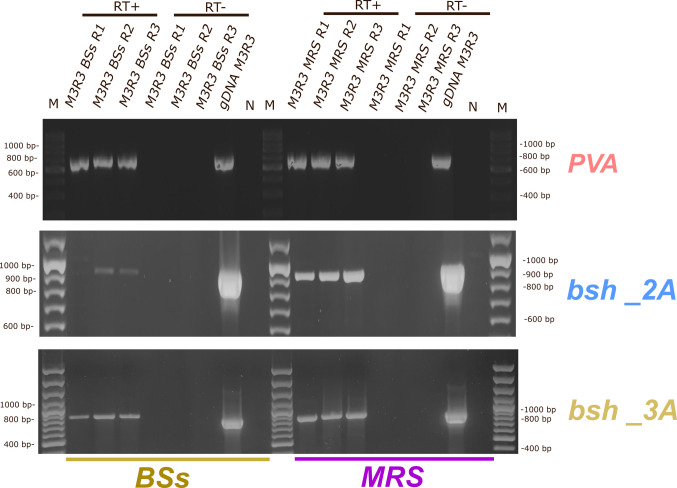
- Comparative genomics and RT-PCR led the authors to conclude that M3R3 carries two bsh genes (bsh_2A and bsh_3A) plus one pva gene (formerly bsh_1A), and that all three were transcribed under both control and bile-stress conditions.
- Safety screening reported no ARGs with CARD and ARMFinder, no pathogenic genes except walR, and a PPRS of 1.00 (low risk); Penicillin V MIC was < 0.25 µg/mL, interpreted as susceptibility.
## Methods
- Phenotypic assays tested bile salt tolerance and growth kinetics of *L. brevis* M3R3 in MRS medium with four individual conjugated bile salts and a bile-salt mixture, using plate counts and OD600-based growth curves.
- UHPLC/HR-MS was used to quantify residual bile salts after growth and assess deconjugation activity.
- The strain’s genome was sequenced on Illumina MiSeq, assembled de novo, annotated, and analyzed for taxonomy, safety traits, biosynthetic gene clusters, mobile elements, prophages, CRISPRs, and candidate bsh genes; RT-PCR tested expression of pva, bsh_2A, and bsh_3A.
## Limitations
- The authors state that for TCA and GCA growth-curve assays, there were limited sampling points during lag and exponential phases, reducing the reliability of those kinetic estimates.
- They note that the bile-salt mixture assay used a closed system without efflux mechanisms, which may cause accumulation of deconjugated bile salts and overestimate sensitivity to the mixture.
- The paper states that more sampling in earlier growth phases and protein-level analyses would be needed to definitively link the candidate genes to BSH activity; this is an explicit limitation in the text.
Model-written summary. Check it against the paper before relying on it.
Integrity signals
Registry
Cites
Statistics
Figures
Verification
Claims the paper makes
31 Valid · 2 Not valid · 6 Not checked · 95 Own results and interpretations
The cited sources support only part of this claim — read each source’s verdict below.
In the paper
“To exert these beneficial effects, they must withstand the harsh conditions of the gastrointestinal tract, including gastric acidity and bile salts [1].”
§ Bile Salt Hydrolase Activity in the Food-Derived Strain Levilactobacillus brevis M3R3: Genomic and Functional Characterization > Introduction
What the sources say
- Partly supportedcites [1] Dempsey E, Corr SC (2022) Lactobacillus spp. for gastrointestinal health: current and future perspectives. Front Immunol 13:840245. 10.3389/fimmu.2022.840245 35464397 PMC9019120 sourceExperimental — accuracy not yet measured
The Introduction (page unavailable) says an efficacious probiotic must survive the gastrointestinal tract and resist the stomach’s low pH; it identifies Lactobacillus species as widely used probiotics. Our copy does not state that resistance to bile salts is required, so that specific part of the claim is unsupported. (LLM, conf=0.88)
plainstates a cause- Asserted: passes — The authors put it forward as true.
- Checkable: passes — It can be checked against evidence.
- Load-bearing: passes — The paper’s conclusions depend on it.
- Based: passes — The paper gives a reason why it holds.
- Partly supported
The cited sources support only part of this claim — read each source’s verdict below.
In the paper
“The deconjugation ability enhances bacterial survival and colonization of the gastrointestinal tract, modulates lipid metabolism, and shapes the bile acid pool, ultimately influencing host-microbiome signaling [6, 10, 11].”
§ Bile Salt Hydrolase Activity in the Food-Derived Strain Levilactobacillus brevis M3R3: Genomic and Functional Characterization > Introduction
What the sources say
- Not checked — no full text of the sourcecites [6] Agolino G, Pino A, Vaccalluzzo A et al (2024) Bile salt hydrolase: the complexity behind its mechanism in relation to lowering-cholesterol lactobacilli probiotics. J Funct Foods 120:106357. 10.1016/j.jff.2024.106357 source
- Partly supportedcites [10] Bustos AY, Font de Valdez G, Fadda S, Taranto MP (2018) New insights into bacterial bile resistance mechanisms: the role of bile salt hydrolase and its impact on human health. Food Res Int 112:250–262. 10.1016/j.foodres.2018.06.035 30131136 sourceExperimental — accuracy not yet measured
Section 5.5 (page unavailable) reports that BSH activity increased bile tolerance and gut colonization in particular bacteria, and suggests a role in intestinal survival and early colonization. It also says that some studies found no correlation between BSH activity and bile tolerance. The claim presents the benefit as a general, established effect of deconjugation rather than a strain-dependent possibility. (LLM, conf=0.85)
- Partly supportedcites [11] Kriaa A, Bourgin M, Potiron A et al (2019) Microbial impact on cholesterol and bile acid metabolism: current status and future prospects. J Lipid Res 60:323–332. 10.1194/jlr.R088989 30487175 PMC6358303 sourceExperimental — accuracy not yet measured
The Deconjugation section proposes that deconjugation may enhance gastrointestinal persistence and that BSH-positive bacteria, together with bacteria that incorporate cholesterol into their membranes, may survive better in the gastrointestinal tract. The claim states this as a definite effect and extends persistence to colonization, which the passage does not establish. No page number is supplied for the passage. (LLM, conf=0.86)
plainstates a cause- Asserted: passes — The authors put it forward as true.
- Checkable: passes — It can be checked against evidence.
- Load-bearing: passes — The paper’s conclusions depend on it.
- Based: passes — The paper gives a reason why it holds.
Every source the paper cites for this claim was checked and supports it.
In the paper
“Genomic analyses indicate that L. brevis carries multiple bsh gene copies of different subtypes [9], consistent with observed bile tolerance and cholesterol‐lowering activity in vitro [28–30].”
§ Bile Salt Hydrolase Activity in the Food-Derived Strain Levilactobacillus brevis M3R3: Genomic and Functional Characterization > Introduction
What the sources say
- Supportedcites [9] Liang L, Yi Y, Lv Y et al (2018) A comprehensive genome survey provides novel insights into bile salt hydrolase (BSH) in Lactobacillaceae. Molecules 23:1157. 10.3390/molecules23051157 29751655 PMC6100381 source
The Phylogenetic Analysis (section 2.2) states that four BSH copies of Lactobacillus brevis fall into four different subtypes: BSH A, C, D, and E. The Genome Survey (section 2.4) also describes L. brevis as a BSH-rich species. The separate claim about in vitro activity is attached to other citations, not this one. (LLM, conf=0.94)
hedged- Asserted: passes — The authors put it forward as true.
- Checkable: passes — It can be checked against evidence.
- Load-bearing: unclear — It is unclear whether the paper’s conclusions depend on it.
- Based: passes — The paper gives a reason why it holds.
- Supported
The cited sources support only part of this claim — read each source’s verdict below.
In the paper
“a condition which more closely mimics the complex in vivo bile environment compared to individual BSs exposure [31, 72].”
§ Bile Salt Hydrolase Activity in the Food-Derived Strain Levilactobacillus brevis M3R3: Genomic and Functional Characterization > Results and Discussion > Growth Kinetics and Deconjugation Activity Under Bile Salt Mixture Exposure The survival and deconjugation activity of M3R3 strain were further assessed in the presence of BSs mixture, a condition which more closely mimics the complex in vivo bile environment compared to individual BSs exposure [31, 72]. The resulting growth curves (Fig. S2) were modeled to determine the kinetic parameters μ, A, and λ (Table S3). As shown in Fig. 2a, exposure to the BSs mixture did not significantly affect the specific growth rate, consistent with the results obtained using individual BSs (Fig. 1a). In contrast, the BSs mixture significantly increased the lag phase duration (p < 0.01) (Fig. 2b), supporting a delayed adaptation to the complex bile environment. This effect contrasts with the response observed under exposure to TDCA and TCA alone (Fig. 1b), where the lag phase was shortened. Furthermore, a significant decrease in A value was observed under BSs mixture stress compared to the control (p < 0.01), indicating that the biomass production is markedly inhibited under this condition (Fig. 2c). A study conducted by Hu and co-workers [72] characterized commercial BSs mixture powders and demonstrated the presence of several other BSs beyond TDCA, TCA, GDCA, and GCA, which can impair the growth of strain M3R3 more severely than the individual BSs. Furthermore, it can be speculated that, unlike the in vivo gut environment, the experimental system used here is closed and lacks efflux mechanisms, leading to the accumulation of deconjugated BSs. Such accumulation may reduce cell viability and contribute to the delayed adaptation observed in strain M3R3, thereby potentially overestimating its sensitivity to BSs mixture. Consistently, a recent study revealed that, contrary to the earlier assumptions, certain deconjugated BSs can exert more toxic effects on bacterial cells than their conjugated counterparts [73]. The semi-quantitative analysis of residual conjugated BSs revealed a marked variability in BSH activity of M3R3 strain related to the substrate. Notably, GCDCA and GDCA were completely deconjugated, while GCA exhibited a residual compound of 2.5%. Among tauro-conjugated BSs, TDCA displayed the lowest residual percentage (Fig. 2d). By contrast, M3R3 strain displayed the lowest efficiency in deconjugating TCDCA and TCA, which persisted in their conjugated forms, showing a residual percentage of 46.6% and 60.7% respectively (Fig. 2d).
What the sources say
- Partly supportedcites [31] Agolino G, Cristofolini M, Vaccalluzzo A et al (2025) Genome mining and characterization of two novel Lacticaseibacillus rhamnosus probiotic candidates with bile salt hydrolase activity. Biomolecules 15(1):86. 10.3390/biom15010086 39858480 PMC11763831 sourceExperimental — accuracy not yet measured
The Introduction describes multiple bile-acid forms in the gut, and Results §3.8 reports testing the strains with a bile-acid mixture. The Discussion also compares the test concentration with estimated bile concentrations in the human gastrointestinal tract. Our copy does not explicitly say that the mixture mimics in vivo bile more closely than exposure to individual bile salts. (LLM, conf=0.78)
- Partly supportedcites [72] Hu PL, Yuan YH, Yue TL, Guo CF (2018) Bile acid patterns in commercially available oxgall powders used for the evaluation of the bile tolerance ability of potential probiotics. PLoS ONE 13(3):e0192964. 10.1371/journal.pone.0192964 29494656 PMC5832225 sourceExperimental — accuracy not yet measured
The Discussion (page unavailable) describes human bile as a mixture of several bile acids, and the Conclusions (page unavailable) identify the oxgall powder whose bile-acid ratios most resemble human bile as the best substitute for evaluating probiotic bile tolerance. The paper does not directly compare exposure to a bile-salt mixture with exposure to individual bile salts, and it finds that mixtures differ in how closely they resemble human bile. (LLM, conf=0.82)
plainstates an association- Asserted: passes — The authors put it forward as true.
- Checkable: passes — It can be checked against evidence.
- Load-bearing: passes — The paper’s conclusions depend on it.
- Based: passes — The paper gives a reason why it holds.
- Partly supported
The sources with a verdict support this claim; the rest weren’t checked yet, have no full text we could read, or their verdicts aren’t rated yet.
In the paper
“This result is also consistent with previous works indicating that exposure to bile does not necessarily induce bsh gene expression in BSH-active lactobacilli strains [73, 86].”
§ Bile Salt Hydrolase Activity in the Food-Derived Strain Levilactobacillus brevis M3R3: Genomic and Functional Characterization > Results and Discussion > Identification of bsh Gene Candidates and RT-PCR Assay
What the sources say
- Supportedcites [73] Foley MH, O’Flaherty S, Allen G, Rivera AJ, Stewart AK, Barrangou R, Theriot CM (2021) Lactobacillus bile salt hydrolase substrate specificity governs bacterial fitness and host colonization. Proc Natl Acad Sci U S A 118:e2017709118 33526676 PMC8017965 source
The Results section, “BSH Expression Alters Lactobacillus Transcriptome during BA Exposure,” reports minimal changes in L. acidophilus bshB expression after bile-acid exposure and decreased L. gasseri bshB expression under two exposure conditions. These findings support the qualified claim that exposure does not necessarily induce bsh expression. (LLM, conf=0.93)
- Not checked — no full text of the sourcecites [86] Pfeiler EA, Azcarate-Peril MA, Klaenhammer TR (2007) Characterization of a novel bile-inducible operon encoding a two-component regulatory system in Lactobacillus acidophilus. J Bacteriol 189:4624–4634 17449631 PMC1913432 source
hedged- Asserted: passes — The authors put it forward as true.
- Checkable: passes — It can be checked against evidence.
- Load-bearing: unclear — It is unclear whether the paper’s conclusions depend on it.
- Based: passes — The paper gives a reason why it holds.
- Supported
60 more claims
Create a free account to see all 134 claims and to verify the 1 reference still open.
- Probably not a substantial claim. 33
- It may state two separate claims as one. 45
Self-check
Percentages, sums and reported differences re-computed from the paper’s own numbers.
Each contradiction between two passages listed here was confirmed by an independent check.
Rated minor: it would not touch a result — a value no result rests on, a p-value that stays on the same side of the significance level, or a conflict that is clerical, resolved elsewhere in the paper, or outside its own findings.
In the paper
§ Bile Salt Hydrolase Activity in the Food-Derived Strain Levilactobacillus brevis M3R3: Genomic and Functional Characterization > Abstract
“UHPLC/HR-MS confirmed complete deconjugation of glyco-conjugated BSs and partial deconjugation of tauro-conjugated BSs.”
§ Bile Salt Hydrolase Activity in the Food-Derived Strain Levilactobacillus brevis M3R3: Genomic and Functional Characterization > Results and Discussion > Growth Kinetics and Deconjugation Activity Under Bile Salt Mixture Exposure
“Notably, GCDCA and GDCA were completely deconjugated, while GCA exhibited a residual compound of 2.5%.”
Citations
Cites
Prokka: rapid prokaryotic genome annotation
Seemann, T. (2014) · Bioinformatics · doi:10.1093/bioinformatics/btu153 · Cited by 18,818 · cited 1×
“14.6 [39].”
InfluentialKEGG as a reference resource for gene and protein annotation
Kanehisa, M., Sato, Y., Kawashima, M., Furumichi, M., & Tanabe, M. (2016) · Nucleic Acids Research · doi:10.1093/nar/gkv1070 · Cited by 7,387 · cited 1×
“A complementary functional analysis was performed using the Kyoto Encyclopedia of Genes and Genomes (KEGG) mapper/BLASTKOALA tool [42].”
Manni, M., Berkeley, M. R., Seppey, M., Simão, F. A., & Zdobnov, E. M. (2021) · Molecular Biology and Evolution · doi:10.1093/molbev/msab199 · Cited by 6,187 · cited 1×
“4.3 [38] were used to evaluate genome completeness and assembly quality.”
InfluentialInteractive Tree Of Life (iTOL) v4: recent updates and new developments
Letunic, I., & Bork, P. (2019) · Nucleic Acids Research · doi:10.1093/nar/gkz239 · Cited by 5,925 · cited 3×
“All trees generated in this study were visualized using the Interactive Tree Of Life (iTOL v7) [50].”
Influential(2021) · doi:10.1093/molbev/msab293 · Cited by 5,335 · cited 1×
“1.7) tool [41] from the online Egg-NOG database (v5.”
InfluentialDNA–DNA hybridization values and their relationship to whole-genome sequence similarities
Goris, J., Konstantinidis, K. T., Klappenbach, J. A., Coenye, T., Vandamme, P., & Tiedje, J. M. (2007) · International Journal of Systematic and Evolutionary Microbiology · doi:10.1099/ijs.0.64483-0 · Cited by 4,750 · cited 1×
“The species thresholds of 95% and 70% were considered for ANI and dDDH analyses, respectively [46].”
Kanehisa, M., Sato, Y., & Morishima, K. (2016) · Journal of Molecular Biology · doi:10.1016/j.jmb.2015.11.006 · Cited by 4,055
Using SPAdes De Novo Assembler
Prjibelski, A., Antipov, D., Meleshko, D., Lapidus, A., & Korobeynikov, A. (2020) · Current Protocols in Bioinformatics · doi:10.1002/cpbi.102 · Cited by 3,555 · cited 1×
“15.5 [36] was used to perform de novo genome assembly on the cleaned reads.”
InfluentialResFinder 4.0 for predictions of phenotypes from genotypes
Bortolaia, V., Kaas, R. S., Ruppe, E., Roberts, M. C., Schwarz, S., Cattoir, V., Philippon, A., Allesoe, R. L., Rebelo, A. R., Florensa, A. F., et al. (2020) · Journal of Antimicrobial Chemotherapy · doi:10.1093/jac/dkaa345 · Cited by 3,373
TYGS is an automated high-throughput platform for state-of-the-art genome-based taxonomy
Meier-Kolthoff, J. P., & Göker, M. (2019) · Nature Communications · doi:10.1038/s41467-019-10210-3 · Cited by 3,276
CARD 2020: Antibiotic Resistome Surveillance with the Comprehensive Antibiotic Resistance Database
Alcock, B. P., Raphenya, A. R., Lau, T. T. Y., Tsang, K. K., Bouchard, M., Edalatmand, A., Huynh, W., Nguyen, A.-L. V., Cheng, A. A., Liu, S., et al. (2019) · Nucleic Acids Research · doi:10.1093/nar/gkz935 · Cited by 3,202 · cited 1×
“0.0 [52], ARMFinder [49], and ResFinder v4.”
InfluentialJSpeciesWS: a web server for prokaryotic species circumscription based on pairwise genome comparison
Richter, M., Rosselló-Móra, R., Oliver Glöckner, F., & Peplies, J. (2016) · Bioinformatics · doi:10.1093/bioinformatics/btv681 · Cited by 2,932 · cited 1×
“…identification of strain M3R3 was determined via calculation of the Average Nucleotide Identity (ANI) index using the JSpecies web server tool with default parameters [44] and calculation of the digital DNA–DNA hybridization (dDDH) values using an online Genome-to-Genome Distance Calculator (GGDC3.”
Croucher, N. J., Page, A. J., Connor, T. R., Delaney, A. J., Keane, J. A., Bentley, S. D., Parkhill, J., & Harris, S. R. (2015) · Nucleic Acids Research · doi:10.1093/nar/gku1196 · Cited by 2,741
antiSMASH 6.0: improving cluster detection and comparison capabilities
Blin, K., Shaw, S., Kloosterman, A. M., Charlop-Powers, Z., van Wezel, G. P., Medema, M. H., & Weber, T. (2021) · Nucleic Acids Research · doi:10.1093/nar/gkab335 · Cited by 2,562 · cited 1×
“Biosynthetic gene clusters were identified using antiSMASH 6.0 with default parameters [62].”
InfluentialAlcock, B. P., Huynh, W., Chalil, R., Smith, K. W., Raphenya, A. R., Wlodarski, M. A., Edalatmand, A., Petkau, A., Syed, S. A., Tsang, K. K., et al. (2023) · Nucleic Acids Research · doi:10.1093/nar/gkac920 · Cited by 2,441
Meier-Kolthoff, J. P., Carbasse, J. S., Peinado-Olarte, R. L., & Göker, M. (2022) · Nucleic Acids Research · doi:10.1093/nar/gkab902 · Cited by 2,210 · cited 2×
“0; https:// ggdc. dsmz. de/ ggdc. php) with formula 2 [45].”
Ultrafast one‐pass FASTQ data preprocessing, quality control, and deduplication using fastp
Chen, S. (2023) · iMeta · doi:10.1002/imt2.107 · Cited by 2,166 · cited 1×
“23.2 [34] to remove adapters and filter low quality bases (Q 30) and short reads (length 150).”
InfluentialProksee: in-depth characterization and visualization of bacterial genomes
Grant, J. R., Enns, E., Marinier, E., Mandal, A., Herman, E. K., Chen, C.-Y., Graham, M., Van Domselaar, G., & Stothard, P. (2023) · Nucleic Acids Research · doi:10.1093/nar/gkad326 · Cited by 1,882 · cited 1×
“1.2) based on GenBank-formatted annotation files [40].”
InfluentialVFDB 2022: a general classification scheme for bacterial virulence factors
Liu, B., Zheng, D., Zhou, S., Chen, L., & Yang, J. (2022) · Nucleic Acids Research · doi:10.1093/nar/gkab1107 · Cited by 1,774 · cited 2×
“14 database to identify the probable pathogenic genes (PGs) in the M3R3 genome [54].”
InfluentialAuch, A. F., von Jan, M., Klenk, H.-P., & Göker, M. (2010) · Standards in Genomic Sciences · doi:10.4056/sigs.531120 · Cited by 1,757
Health benefits of fermented foods: Microbiota and beyond
Marco, M. L., Heeney, D., Binda, S., Cifelli, C. J., Cotter, P. D., Foligné, B., Gänzle, M., Kort, R., Pasin, G., Pihlanto, A., et al. (2017) · Current Opinion in Biotechnology · doi:10.1016/j.copbio.2016.11.010 · Cited by 1,674 · cited 1×
“Although BSH activity is predominantly associated with gastrointestinal isolates, non-intestinal lactobacilli from fermented foods also show decon-jugation ability and thus potential probiotic value [15–17].”
Feldgarden, M., Brover, V., Gonzalez-Escalona, N., Frye, J. G., Haendiges, J., Haft, D. H., Hoffmann, M., Pettengill, J. B., Prasad, A. B., Tillman, G. E., et al. (2021) · Scientific Reports · doi:10.1038/s41598-021-91456-0 · Cited by 1,653 · cited 2×
“Since EDGAR uses a bidirectional best BLASTp hits approach for calculating singletons, gene duplication and paralogs are treated as singletons, if uniden-tical [49].”
InfluentialCouvin, D., Bernheim, A., Toffano-Nioche, C., Touchon, M., Michalik, J., Néron, B., Rocha, E. P. C., Vergnaud, G., Gautheret, D., & Pourcel, C. (2018) · Nucleic Acids Research · doi:10.1093/nar/gky425 · Cited by 1,570 · cited 1×
“2 [60].”
Versatile genome assembly evaluation with QUAST-LG
Mikheenko, A., Prjibelski, A., Saveliev, V., Antipov, D., & Gurevich, A. (2018) · Bioinformatics · doi:10.1093/bioinformatics/bty266 · Cited by 1,527 · cited 1×
“2.0 [37] and BUSCO v5.”
InfluentialBlanco-Míguez, A., Beghini, F., Cumbo, F., McIver, L. J., Thompson, K. N., Zolfo, M., Manghi, P., Dubois, L., Huang, K. D., Thomas, A. M., et al. (2023) · Nature Biotechnology · doi:10.1038/s41587-023-01688-w · Cited by 1,442 · cited 1×
“0.1 [35].”
InfluentialBUSCO: Assessing Genomic Data Quality and Beyond
Manni, M., Berkeley, M. R., Seppey, M., & Zdobnov, E. M. (2021) · Current Protocols · doi:10.1002/cpz1.323 · Cited by 1,286
Bile Salt Hydrolase Activity in Probiotics
Begley, M., Hill, C., & Gahan, C. G. M. (2006) · Applied and Environmental Microbiology · doi:10.1128/aem.72.3.1729-1738.2006 · Cited by 1,187 · cited 2×
“Notably, BSH-positive lactobacilli strains have been reported to have a preferential deconjugation activity towards glyco-conjugated BSs, which are more cytotoxic than tauro-conju-gated counterparts [6, 71].”
COBALT: constraint-based alignment tool for multiple protein sequences
Papadopoulos, J. S., & Agarwala, R. (2007) · Bioinformatics · doi:10.1093/bioinformatics/btm076 · Cited by 1,127 · cited 1×
“All proteins sequences were aligned using the COBALT multiple sequence alignment tool [63].”
Guidance on the characterisation of microorganisms used as feed additives or as production organisms
(FEEDAP), E. P. O. A. A. P. O. S. U. I. A. F., Rychen, G., Aquilina, G., Azimonti, G., Bampidis, V., Bastos, M. D. L., Bories, G., Chesson, A., Cocconcelli, P. S., Flachowsky, G., et al. (2018) · EFSA Journal · doi:10.2903/j.efsa.2018.5206 · Cited by 1,009 · cited 2×
“The Minimum Inhibitory Concentration (MIC) was determined according to the break-point values established for obligate heterofer-mentative lactobacilli (including L. brevis ) [66], in order to classify the strain as resistant or susceptible to PenV, as recommended by EFSA [51].”
Carattoli, A., & Hasman, H. (2020) · Methods in Molecular Biology · doi:10.1007/978-1-4939-9877-7_20 · Cited by 637 · cited 1×
“1 (https:// cge. food. dtu. dk/ servi ces/ Plasm idFin der/, last accessed 1 December 2024), applying thresholds of ≥ 95% identity and ≥ 60% coverage [59].”
Regulation of host weight gain and lipid metabolism by bacterial bile acid modification in the gut
Joyce, S. A., MacSharry, J., Casey, P. G., Kinsella, M., Murphy, E. F., Shanahan, F., Hill, C., & Gahan, C. G. M. (2014) · Proceedings of the National Academy of Sciences · doi:10.1073/pnas.1323599111 · Cited by 604 · cited 1×
“Recently, several studies have underscored the pivotal role of BSH in lipid metabolism and in mediating host–microbe interactions [67–69].”
Lactobacillus spp. for Gastrointestinal Health: Current and Future Perspectives
Dempsey, E., & Corr, S. C. (2022) · Frontiers in Immunology · doi:10.3389/fimmu.2022.840245 · Cited by 579
Brown, C. L., Mullet, J., Hindi, F., Stoll, J. E., Gupta, S., Choi, M., Keenum, I., Vikesland, P., Pruden, A., & Zhang, L. (2022) · Applied and Environmental Microbiology · doi:10.1128/aem.00991-22 · Cited by 515
grofit: Fitting Biological Growth Curves with R
Kahm, M., Hasenbrink, G., Lichtenberg-Fraté, H., Ludwig, J., & Kschischo, M. (2010) · Journal of Statistical Software · doi:10.18637/jss.v033.i07 · Cited by 514 · cited 1×
“Kinetic parameters were determined by fitting the experimental data to either parametric or non-parametric smooth spline models provided by the Grofit package (version 1.1.1–1) in R [32].”
InfluentialSong, Z., Cai, Y., Lao, X., Wang, X., Lin, X., Cui, Y., Kalavagunta, P. K., Liao, J., Jin, L., Shang, J., et al. (2019) · Microbiome · doi:10.1186/s40168-019-0628-3 · Cited by 505
Bile acid metabolism and signaling, the microbiota, and metabolic disease
Cai, J., Rimal, B., Jiang, C., Chiang, J. Y. L., & Patterson, A. D. (2022) · Pharmacology & Therapeutics · doi:10.1016/j.pharmthera.2022.108238 · Cited by 497
Interactions between Bacteria and Bile Salts in the Gastrointestinal and Hepatobiliary Tracts
Urdaneta, V., & Casadesús, J. (2017) · Frontiers in Medicine · doi:10.3389/fmed.2017.00163 · Cited by 449
Malberg Tetzschner, A. M., Johnson, J. R., Johnston, B. D., Lund, O., & Scheutz, F. (2020) · Journal of Clinical Microbiology · doi:10.1128/jcm.01269-20 · Cited by 428
Lee, G., You, H. J., Bajaj, J. S., Joo, S. K., Yu, J., Park, S., Kang, H., Park, J. H., Kim, J. H., Lee, D. H., et al. (2020) · Nature Communications · doi:10.1038/s41467-020-18754-5 · Cited by 395 · cited 1×
“A recent study reported that non-obese liver fibrotic individuals displayed a significantly lower copy number of BSH encoding genes in their gut microbiome [89].”
EDGAR 2.0: an enhanced software platform for comparative gene content analyses
Blom, J., Kreis, J., Spänig, S., Juhre, T., Bertelli, C., Ernst, C., & Goesmann, A. (2016) · Nucleic Acids Research · doi:10.1093/nar/gkw255 · Cited by 369
Hofmann, A. F., & Hagey, L. R. (2014) · Journal of Lipid Research · doi:10.1194/jlr.r049437 · Cited by 358 · cited 2×
“Their conjugation with glycine and taurine occurs through the formation of an amide bond between the bile acid’s carboxyl group and the amino group of the respective amino acid, a modification essential for efficient lipid emulsification and other physiological functions [3].”
Sources, isolation, characterisation and evaluation of probiotics
Fontana, L., Bermudez-Brito, M., Plaza-Diaz, J., Muñoz-Quezada, S., & Gil, A. (2013) · British Journal of Nutrition · doi:10.1017/s0007114512004011 · Cited by 348
Frees, D., Savijoki, K., Varmanen, P., & Ingmer, H. (2007) · Molecular Microbiology · doi:10.1111/j.1365-2958.2007.05598.x · Cited by 288 · cited 2×
“Clp is inducible under acidic shock [77] and contributes to the fast response of lactobacilli to harsh gastro-intestinal conditions, especially to acid and bile stresses [76].”
Microbial impact on cholesterol and bile acid metabolism: current status and future prospects
Kriaa, A., Bourgin, M., Potiron, A., Mkaouar, H., Jablaoui, A., Gérard, P., Maguin, E., & Rhimi, M. (2019) · Journal of Lipid Research · doi:10.1194/jlr.r088989 · Cited by 264 · cited 2×
“The deconjugation ability enhances bacterial survival and colonization of the gastrointestinal tract, modulates lipid metabolism, and shapes the bile acid pool, ultimately influencing host-microbiome signaling [6, 10, 11].”
Phigaro: high-throughput prophage sequence annotation
Starikova, E. V., Tikhonova, P. O., Prianichnikov, N. A., Rands, C. M., Zdobnov, E. M., Ilina, E. N., & Govorun, V. M. (2020) · Bioinformatics · doi:10.1093/bioinformatics/btaa250 · Cited by 254
Bustos, A. Y., Font de Valdez, G., Fadda, S., & Taranto, M. P. (2018) · Food Research International · doi:10.1016/j.foodres.2018.06.035 · Cited by 232 · cited 3×
“The deconjugation ability enhances bacterial survival and colonization of the gastrointestinal tract, modulates lipid metabolism, and shapes the bile acid pool, ultimately influencing host-microbiome signaling [6, 10, 11].”
Lambert, J. M., Bongers, R. S., de Vos, W. M., & Kleerebezem, M. (2008) · Applied and Environmental Microbiology · doi:10.1128/aem.00137-08 · Cited by 210
Foley, M. H., O’Flaherty, S., Allen, G., Rivera, A. J., Stewart, A. K., Barrangou, R., & Theriot, C. M. (2021) · Proceedings of the National Academy of Sciences · doi:10.1073/pnas.2017709118 · Cited by 205 · cited 3×
“Consistently, a recent study revealed that, contrary to the earlier assumptions, certain deconjugated BSs can exert more toxic effects on bacterial cells than their conjugated counterparts [73].”
Kostinek, M., Specht, I., Edward, V. A., Schillinger, U., Hertel, C., Holzapfel, W. H., & Franz, C. M. A. P. (2005) · Systematic and Applied Microbiology · doi:10.1016/j.syapm.2005.03.001 · Cited by 198
Jones, M. L., Tomaro-Duchesneau, C., Martoni, C. J., & Prakash, S. (2013) · Expert Opinion on Biological Therapy · doi:10.1517/14712598.2013.758706 · Cited by 190 · cited 1×
“Among its metabolic benefits, BSH activity has been implicated in the regulation of host cholesterol levels, contributing to its potential cholesterol-lowering effect [11–13].”
Bile Salt Hydrolase Activity of Three Strains of Lactobacillus acidophilus
Corzo, G., & Gilliland, S. E. (1999) · Journal of Dairy Science · doi:10.3168/jds.s0022-0302(99)75256-2 · Cited by 190
Lifestyles of sourdough lactobacilli – Do they matter for microbial ecology and bread quality?
Gänzle, M. G., & Zheng, J. (2019) · International Journal of Food Microbiology · doi:10.1016/j.ijfoodmicro.2018.08.019 · Cited by 183
EDGAR3.0: comparative genomics and phylogenomics on a scalable infrastructure
Dieckmann, M. A., Beyvers, S., Fankep, R. C. N., Hanel, P., Jelonek, L., Blom, J., & Goesmann, A. (2021) · Nucleic Acids Research · doi:10.1093/nar/gkab341 · Cited by 165 · cited 1×
“2) web tool, which checked for reciprocal best BLAST hits against all other genomes with L. brevis strain M3R3 serving as the reference genome [48].”
Beneficial Bile Acid Metabolism from Lactobacillus plantarum of Food Origin
Prete, R., Long, S. L., Gallardo, A. L., Gahan, C. G., Corsetti, A., & Joyce, S. A. (2020) · Scientific Reports · doi:10.1038/s41598-020-58069-5 · Cited by 165
Pfeiler, E. A., Azcarate-Peril, M. A., & Klaenhammer, T. R. (2007) · Journal of Bacteriology · doi:10.1128/jb.00337-07 · Cited by 154 · cited 1×
“This result is also consistent with previous works indicating that exposure to bile does not necessarily induce bsh gene expression in BSH-active lactobacilli strains [73, 86].”
Topisirovic, L., Kojic, M., Fira, D., Golic, N., Strahinic, I., & Lozo, J. (2006) · International Journal of Food Microbiology · doi:10.1016/j.ijfoodmicro.2006.04.009 · Cited by 142
Wall, T., Båth, K., Britton, R. A., Jonsson, H., Versalovic, J., & Roos, S. (2007) · Applied and Environmental Microbiology · doi:10.1128/aem.01502-06 · Cited by 131 · cited 1×
“Clp is inducible under acidic shock [77] and contributes to the fast response of lactobacilli to harsh gastro-intestinal conditions, especially to acid and bile stresses [76].”
Kumar, R., Grover, S., & Batish, V. K. (2012) · Probiotics and Antimicrobial Proteins · doi:10.1007/s12602-012-9101-3 · Cited by 123
In vitro bile salt hydrolase (BSH) activity screening of different probiotic microorganisms
Hernández-Gómez, J. G., López-Bonilla, A., Trejo-Tapia, G., Ávila-Reyes, S. V., Jiménez-Aparicio, A. R., & Hernández-Sánchez, H. (2021) · Foods · doi:10.3390/foods10030674 · Cited by 122
Probiotics and the BSH-related cholesterol lowering mechanism: a Jekyll and Hyde scenario
Choi, S.-B., Lew, L.-C., Yeo, S.-K., Nair Parvathy, S., & Liong, M.-T. (2015) · Critical Reviews in Biotechnology · doi:10.3109/07388551.2014.889077 · Cited by 119
The Lactobacillus Bile Salt Hydrolase Repertoire Reveals Niche-Specific Adaptation
O’Flaherty, S., Briner Crawley, A., Theriot, C. M., & Barrangou, R. (2018) · mSphere · doi:10.1128/msphere.00140-18 · Cited by 118 · cited 3×
“BSH and PVA are evolutionary related enzymes with high similarity in terms of the amino acid residues involved in their active site [5, 84].”
da Silva, T. F., Glória, R. D. A., Americo, M. F., Freitas, A. D. S., de Jesus, L. C. L., Barroso, F. A. L., Laguna, J. G., Coelho-Rocha, N. D., Tavares, L. M., le Loir, Y., et al. (2024) · Probiotics and Antimicrobial Proteins · doi:10.1007/s12602-024-10247-x · Cited by 117
Probiotic fermented foods for health benefits
Beena Divya, J., Kulangara Varsha, K., Madhavan Nampoothiri, K., Ismail, B., & Pandey, A. (2012) · Engineering in Life Sciences · doi:10.1002/elsc.201100179 · Cited by 108
Molecular features of bile salt hydrolases and relevance in human health
Chand, D., Avinash, V. S., Yadav, Y., Pundle, A. V., Suresh, C. G., & Ramasamy, S. (2016) · Biochimica et Biophysica Acta (BBA) - General Subjects · doi:10.1016/j.bbagen.2016.09.024 · Cited by 107
Kim, G.-B., Miyamoto, C. M., Meighen, E. A., & Lee, B. H. (2004) · Applied and Environmental Microbiology · doi:10.1128/aem.70.9.5603-5612.2004 · Cited by 103
Agolino, G., Pino, A., Vaccalluzzo, A., Cristofolini, M., Solieri, L., Caggia, C., & Randazzo, C. L. (2024) · Journal of Functional Foods · doi:10.1016/j.jff.2024.106357 · Cited by 99
Self-citationBile salt hydrolases: Structure and function, substrate preference, and inhibitor development
Dong, Z., & Lee, B. H. (2018) · Protein Science · doi:10.1002/pro.3484 · Cited by 92 · cited 1×
“Furthermore, N-terminal autocatalysis and oligomeric assembly in homotetramers are critical post-translational modifications to ensure active BSH enzymes [87].”
Effects of bile acids on the growth, composition and metabolism of gut bacteria
Peng, Y.-L., Wang, S., Zhang, Y., Chen, M., He, K., Li, Q., Huang, W., & Zhang, W. (2024) · npj Biofilms and Microbiomes · doi:10.1038/s41522-024-00566-w · Cited by 89
Role of bile acids in the regulation of the metabolic pathways
Taoka, H., Yokoyama, Y., Morimoto, K., Kitamura, N., Tanigaki, T., Takashina, Y., Tsubota, K., & Watanabe, M. (2016) · World Journal of Diabetes · doi:10.4239/wjd.v7.i13.260 · Cited by 80 · cited 1×
“Moreover, BSH is associated with other beneficial functions including the regulation of energy balance and glucose metabolism [14].”
Genomic Comparison of Lactobacillus helveticus Strains Highlights Probiotic Potential
Fontana, A., Falasconi, I., Molinari, P., Treu, L., Basile, A., Vezzi, A., Campanaro, S., & Morelli, L. (2019) · Frontiers in Microbiology · doi:10.3389/fmicb.2019.01380 · Cited by 77
Zhang, D., Zhang, J., Kalimuthu, S., Liu, J., Song, Z.-M., He, B.-B., Cai, P., Zhong, Z., Feng, C., Neelakantan, P., et al. (2023) · Microbiome · doi:10.1186/s40168-023-01540-y · Cited by 72
Ren, J., Sun, K., Wu, Z., Yao, J., & Guo, B. (2011) · Journal of Food Science · doi:10.1111/j.1750-3841.2011.02431.x · Cited by 70 · cited 1×
“BSH activity is widely distributed among gastrointestinal microbes, including various Lactobacillaceae species [5–8], where the presence of multiple bsh orthologs reflects strain-specific adaptations into the intestinal environment [5, 8–10].”
Behbahani, B. A., Jooyandeh, H., Hojjati, M., & Sheikhjan, M. G. (2023) · LWT · doi:10.1016/j.lwt.2023.115601 · Cited by 69 · cited 1×
“Among these, Levilactobacillus brevis has attracted attention due to its functional and probiotic properties [18–23].”
Molina, G. E. S., Ras, G., da Silva, D. F., Duedahl‐Olesen, L., Hansen, E. B., & Bang‐Berthelsen, C. H. (2025) · Comprehensive Reviews in Food Science and Food Safety · doi:10.1111/1541-4337.70134 · Cited by 69 · cited 1×
“Technologi-cally, L. brevis contributes to bioactive compound production, enhancement of aroma and flavor, and improved fermentation outcomes [25–27].”
Dual RNA regulatory control of a Staphylococcus aureus virulence factor
Chabelskaya, S., Bordeau, V., & Felden, B. (2014) · Nucleic Acids Research · doi:10.1093/nar/gku119 · Cited by 68
Somashekaraiah, R., Mottawea, W., Gunduraj, A., Joshi, U., Hammami, R., & Sreenivasa, M. Y. (2021) · Frontiers in Microbiology · doi:10.3389/fmicb.2021.696267 · Cited by 66
New insights into microbial bile salt hydrolases: from physiological roles to potential applications
Dong, Z., Yang, S., Tang, C., Li, D., Kan, Y., & Yao, L. (2025) · Frontiers in Microbiology · doi:10.3389/fmicb.2025.1513541 · Cited by 64 · cited 2×
“Recently, several studies have underscored the pivotal role of BSH in lipid metabolism and in mediating host–microbe interactions [67–69].”
Wang, G., Yu, H., Feng, X., Tang, H., Xiong, Z., Xia, Y., Ai, L., & Song, X. (2021) · LWT · doi:10.1016/j.lwt.2021.111208 · Cited by 60
Du, R., Yu, L., Yu, N., Ping, W., Song, G., & Ge, J. (2022) · International Journal of Biological Macromolecules · doi:10.1016/j.ijbiomac.2022.07.057 · Cited by 58
Comparative genome analysis of the Lactobacillus brevis species
Feyereisen, M., Mahony, J., Kelleher, P., Roberts, R. J., O’Sullivan, T., Geertman, J.-M. A., & van Sinderen, D. (2019) · BMC Genomics · doi:10.1186/s12864-019-5783-1 · Cited by 57 · cited 3×
“These findings are consistent with the high plasticity of the L. brevis genome, which tends to adapt its features depending on the environment [74, 75].”
Yang, Y., & Wu, C. (2022) · Food & Function · doi:10.1039/d2fo01252a · Cited by 56
Sunder, A. V., Utari, P. D., Ramasamy, S., van Merkerk, R., Quax, W. J., & Pundle, A. V. (2016) · Applied Microbiology and Biotechnology · doi:10.1007/s00253-016-8031-5 · Cited by 50
Hu, P.-L., Yuan, Y.-H., Yue, T.-L., & Guo, C.-F. (2018) · PLOS ONE · doi:10.1371/journal.pone.0192964 · Cited by 48 · cited 2×
“A study conducted by Hu and co-workers [72] characterized commercial BSs mixture powders and demonstrated the presence of several Fig.”
Kusada, H., Morinaga, K., & Tamaki, H. (2021) · Microorganisms · doi:10.3390/microorganisms9051011 · Cited by 48
Chen, C., Yu, L., Tian, F., Zhao, J., & Zhai, Q. (2022) · Microorganisms · doi:10.3390/microorganisms10122371 · Cited by 47
Role of Gut Microbial Metabolites in Cardiovascular Diseases—Current Insights and the Road Ahead
Datta, S., Pasham, S., Sandeep, I. S., Boini, K. M., & Koka, S. (2024) · International Journal of Molecular Sciences · doi:10.3390/ijms251810208 · Cited by 46
Ru, X., Zhang, C.-C., Yuan, Y.-H., Yue, T.-L., & Guo, C.-F. (2019) · Applied Microbiology and Biotechnology · doi:10.1007/s00253-018-9492-5 · Cited by 45 · cited 1×
“Although BSH activity is predominantly associated with gastrointestinal isolates, non-intestinal lactobacilli from fermented foods also show decon-jugation ability and thus potential probiotic value [15–17].”
Duru, I. C., Ylinen, A., Belanov, S., Pulido, A. A., Paulin, L., & Auvinen, P. (2021) · BMC Genomics · doi:10.1186/s12864-020-07338-8 · Cited by 40 · cited 1×
“The walR regulates cell wall metabolism, ensuring structural integrity and adaptability in harsh environments such as the gastrointestinal tract [78].”
Functional and Phylogenetic Diversity of BSH and PVA Enzymes
Daly, J. W., Keely, S. J., & Gahan, C. G. M. (2021) · Microorganisms · doi:10.3390/microorganisms9040732 · Cited by 40 · cited 1×
“BSH and PVA are evolutionary related enzymes with high similarity in terms of the amino acid residues involved in their active site [5, 84].”
Munir, A., Javed, G. A., Javed, S., & Arshad, N. (2022) · Journal of Applied Microbiology · doi:10.1111/jam.15678 · Cited by 40 · cited 1×
“Genomic analyses indicate that L. brevis carries multiple bsh gene copies of different subtypes [9], consistent with observed bile tolerance and cholesterol ‐ lowering activity in vitro [28–30].”
Liang, L., Yi, Y., Lv, Y., Qian, J., Lei, X., & Zhang, G. (2018) · Molecules · doi:10.3390/molecules23051157 · Cited by 38 · cited 2×
“These results were consistent with previous studies that demonstrated that putative L. brevis bsh genes clustered into three distinct phylotypes [9].”
Sreepathi, N., B, C. K. V., Huligere, S. S., Al-Odayni, A.-B. M., Lasehinde, V., Jayanthi, M. K., & Ramu, R. (2023) · Frontiers in Microbiology · doi:10.3389/fmicb.2023.1168102 · Cited by 36
Han, S., & Won, H. (2024) · Biomolecules · doi:10.3390/biom14040479 · Cited by 35
Liu, Y.-Y., Hsu, C.-Y., Yang, Y.-C., Huang, C.-H., & Chen, C.-C. (2023) · Bioinformatics Advances · doi:10.1093/bioadv/vbad153 · Cited by 32 · cited 1×
“All these analyses were implemented in ProbioMinServer [57].”
Pan, X., Xu, L., Li, Y., Wu, S., Wu, Y., & Wei, W. (2022) · Frontiers in Bioengineering and Biotechnology · doi:10.3389/fbioe.2022.936487 · Cited by 31
Kusada, H., Arita, M., Tohno, M., & Tamaki, H. (2022) · Frontiers in Microbiology · doi:10.3389/fmicb.2022.858263 · Cited by 29 · cited 2×
“Although, PVA may also hydrolyze PenV, conferring resistance to this antibiotic [85].”
Bai, Z., Zhang, N., Jin, Y., Chen, L., Mao, Y., Sun, L., Fang, F., Liu, Y., Han, M., & Li, G. (2023) · Frontiers in Cellular and Infection Microbiology · doi:10.3389/fcimb.2022.919701 · Cited by 29 · cited 1×
“The probiotic potential risk score (PPRS) was computed as defined by Bai et al. [56] to evaluate the risks associated with M3R3 probiotic candidate.”
Jiang, J., Zhang, H., Hussain, M., Abdullah, Feng, F., Guan, R., & Zhong, H. (2025) · Biology · doi:10.3390/biology14070802 · Cited by 28
Solieri, L., Solà, L., Vaccalluzzo, A., Randazzo, C. L., Martini, S., & Tagliazucchi, D. (2022) · Biology · doi:10.3390/biology11010139 · Cited by 26
Self-citationDo Bacteria Provide an Alternative to Cancer Treatment and What Role Does Lactic Acid Bacteria Play?
Dicks, L. M. T., & Vermeulen, W. (2022) · Microorganisms · doi:10.3390/microorganisms10091733 · Cited by 25 · cited 1×
“Type III polyketide synthases (T3PKS) are involved in the bio-synthesis of polyketides, which are secondary metabolites with diverse biological activities, including antimicrobial, antifungal, and anticancer properties [82].”
Zeng, J., Sheng, F., Hu, X., Huang, Z., Tian, X., & Wu, Z. (2022) · Food Bioscience · doi:10.1016/j.fbio.2022.101941 · Cited by 25
Scheutz, F., Nielsen, C. H., & von Mentzer, A. (2024) · Journal of Clinical Microbiology · doi:10.1128/jcm.00570-23 · Cited by 22 · cited 1×
“0.3 [55].”
InfluentialSolà, L., Quadu, E., Bortolazzo, E., Bertoldi, L., Randazzo, C. L., Pizzamiglio, V., & Solieri, L. (2022) · Scientific Reports · doi:10.1038/s41598-022-22207-y · Cited by 22
Self-citationKang, M. H., Elnar, A. G., & Kim, G.-B. (2025) · Food Science of Animal Resources · doi:10.5851/kosfa.2025.e1 · Cited by 21 · cited 1×
“1.24) is the microbial enzyme which plays a crucial role Gianluigi Agolino and Marianna Cristofolini contributed equally to this work. in BSs metabolism by cleaving the amide bond of conjugated BSs, thereby releasing unconjugated bile acids with free taurine or glycine [4].”
InfluentialFraunhofer, M. E., Geißler, A. J., Behr, J., & Vogel, R. F. (2018) · Current Microbiology · doi:10.1007/s00284-018-1581-2 · Cited by 20 · cited 2×
“These findings are consistent with the high plasticity of the L. brevis genome, which tends to adapt its features depending on the environment [74, 75].”
Translation-Targeting RiPPs and Where to Find Them
Travin, D. Y., Bikmetov, D., & Severinov, K. (2020) · Frontiers in Genetics · doi:10.3389/fgene.2020.00226 · Cited by 19 · cited 1×
“In detail, class IV lanthip-eptides are characterized by multiple lanthionine rings and exert strong antimicrobial activity against several Gram-positive bacteria, including Streptococcus spp, Clostridium difficile , and Bacillus spp. [80, 81].”
Agolino, G., Cristofolini, M., Vaccalluzzo, A., Tagliazucchi, D., Cattivelli, A., Pino, A., Caggia, C., Solieri, L., & Randazzo, C. L. (2025) · Biomolecules · doi:10.3390/biom15010086 · Cited by 19 · cited 4×
“…of 16,500, with an AGC target of 5 × 10 5 , a maximum IT of 120 ms, and an isolation window of 1 m/z. Identification of the different BSs was carried out by comparing the retention time, the m/z value and the fragmentation pattern with authentic standard compounds, as previously reported [31].”
InfluentialSelf-citationWatanabe, S., Katsube, T., Hattori, H., Sato, H., Ishijima, T., Nakai, Y., Abe, K., & Sonomoto, K. (2013) · Journal of Bioscience and Bioengineering · doi:10.1016/j.jbiosc.2013.01.009 · Cited by 18
Kusada, H., Arita, M., Tohno, M., & Tamaki, H. (2022) · Frontiers in Microbiology · doi:10.3389/fmicb.2022.810872 · Cited by 17
Karlov, D. S., Long, S. L., Zeng, X., Xu, F., Lal, K., Cao, L., Hayoun, K., Lin, J., Joyce, S. A., & Tikhonova, I. G. (2023) · Structure · doi:10.1016/j.str.2023.02.014 · Cited by 16
Kaya, Y., Kök, M. Ş., & Öztürk, M. (2017) · Food Biotechnology · doi:10.1080/08905436.2017.1303778 · Cited by 16
Xu, G., Zhao, Q., Huang, B., Zhou, J., & Cao, F. (2018) · Enzyme and Microbial Technology · doi:10.1016/j.enzmictec.2018.08.006 · Cited by 15
Shangpliang, H. N. J., & Tamang, J. P. (2023) · Probiotics and Antimicrobial Proteins · doi:10.1007/s12602-023-10125-y · Cited by 13
Survival of Lactobacillus helveticus strain CP53 in the human gastrointestinal tract
Shinoda, T., KUSUDA, D., ISHIDA, Y., Ikeda, N., KANEKO, K., Masuda, O., & Yamamoto, N. (2001) · Letters in Applied Microbiology · doi:10.1046/j.1472-765x.2001.00870.x · Cited by 13
Martini, S., Solà, L., Cattivelli, A., Cristofolini, M., Pizzamiglio, V., Tagliazucchi, D., & Solieri, L. (2024) · Frontiers in Microbiology · doi:10.3389/fmicb.2024.1342180 · Cited by 11
Self-citationChen, C., Li, M., Yu, L., Tian, F., Zhao, J., Chen, W., & Zhai, Q. (2024) · Food Bioscience · doi:10.1016/j.fbio.2024.104803 · Cited by 11
Sethi, M., Arjun, O. K., Dash, J., Parida, D., Kar, S., Mishra, S., Minz, A. P., Padhi, A., Das, K. R., Pradhan, B., et al. (2024) · Probiotics and Antimicrobial Proteins · doi:10.1007/s12602-024-10217-3 · Cited by 10 · cited 2×
“A similar plasmid was found in the probiotic candidate L. brevis strain H3 isolated from a traditional fermented beverage in India [18].”
Urshev, Z. L., Doynova, D., Prasev, I., Denkova-Kostova, R. S., Koleva, A., Denkova, Z. R., Goranov, B. G., & Kostov, G. A. (2024) · Applied Sciences · doi:10.3390/app14052093 · Cited by 9 · cited 1×
“The Minimum Inhibitory Concentration (MIC) was determined according to the break-point values established for obligate heterofer-mentative lactobacilli (including L. brevis ) [66], in order to classify the strain as resistant or susceptible to PenV, as recommended by EFSA [51].”
Wang, Q., Zhang, W., Liu, J., Qin, W., & Cai, J. (2025) · Current Microbiology · doi:10.1007/s00284-025-04190-5 · Cited by 9
Molecular Insight into the Response of Lactic Acid Bacteria to Bile Acids
Moreno, C. N., Gomez, J. N., Taranto, M. P., Ledesma, A. E., & Bustos, A. Y. (2024) · BioTech · doi:10.3390/biotech13030029 · Cited by 9
Nair, V. G., Unnikrishnan, V. K., Muralidharan, N., Venkatathri, B. N. S., Lowrence, R. C., YBRD, R., Narbhavi, D., A, A., N, P., & Nagarajan, S. (2025) · Scientific Reports · doi:10.1038/s41598-025-17404-4 · Cited by 8 · cited 1×
“Lactobacilli-derived terpenes have been recently demonstrated to inhibit efflux pumps in drug-resistant pathogens [83].”
Wang, Q., Peng, J., Tian, Y., Li, J., Cai, J., & Qin, W. (2025) · Current Microbiology · doi:10.1007/s00284-024-03974-5 · Cited by 5 · cited 1×
“Genomic analyses indicate that L. brevis carries multiple bsh gene copies of different subtypes [9], consistent with observed bile tolerance and cholesterol ‐ lowering activity in vitro [28–30].”
Matta, T., Agrawal, K., Datta, P., Kumari, L., Bishnoi, M., Chopra, K., & Kondepudi, K. K. (2026) · Probiotics and Antimicrobial Proteins · doi:10.1007/s12602-025-10628-w · Cited by 4 · cited 1×
“The same two-components system was found in a L. brevis GABA-producing probiotic candidate [79].”
de Medeiros, A. R. S., Rodrigues, N. P. A., Couto, M. V. D. S., Barbosa, G. V. P., Rodrigues, T. Z., Guerra, I. C. D., Campana, E. H., Braga, A. L. M., Lima, M. D. S., Alcântara, M. A., et al. (2025) · International Journal of Gastronomy and Food Science · doi:10.1016/j.ijgfs.2025.101221 · Cited by 4
Umeh, M. N., & Achi, O. K. (2024) · Path of Science · doi:10.22178/pos.107-12 · Cited by 3
(FEEDAP), E. P. O. A. A. P. O. S. U. I. A. F., Villa, R. E., Azimonti, G., Bonos, E., Christensen, H., Durjava, M., Dusemund, B., Gehring, R., Glandorf, B., Kouba, M., et al. (2024) · EFSA Journal · doi:10.2903/j.efsa.2024.8934 · Cited by 1
Research works printed but not linked: 1
- Hundt M, Basit H, John S (2025) Physiology, Bile Secretion. In: StatPearls [Internet]. StatPearls Publishing, Treasure Island (FL). Available from: https://www.ncbi.nlm.nih.gov/books/NBK470209/. Accessed 12 Aug 2025 29262229
Cited by
Advances in research on the effects of bile acids and their receptors on intestinal function
Cheng, Y., Zhang, L., Zhang, M., & Yu, J. (2026) · Frontiers in Nutrition · doi:10.3389/fnut.2026.1821418 · Cited by 8
“These interventions aim to reshape the microbial ecosystem and its metabolic functions (61, 62).”
Metadata
- Authors
- Agolino, G., Cristofolini, M., Ronsivalle, M. A., Cattivelli, A., Tagliazucchi, D., Caggia, C., Solieri, L., & Randazzo, C. L.
- Affiliations
- University of Catania (IT)
- University of Modena and Reggio Emilia (IT)
- Corresponding author
- Solieri, Lisa
- ORCID
- Venue
- Probiotics and Antimicrobial Proteins
- Published
- 2025-11-19
- Volume
- 18
- Issue
- 4
- Pages
- 5688-5705
- ISSN
- 1867-1306 (ISSN-L)
- 1867-1314
- PMC
- PMC13342217
- OpenAlex
- W4416335803
- Cited by
- 1
- References
- 87
- Citations by year
- 2026: 1
- FWCI
- 0.47
- Type
- journal article
- Language
- en
- Open access
- hybrid
- doi.org
- Licence
- cc-by
- creativecommons.org/licenses/by/4.0 (tdm)
- creativecommons.org/licenses/by/4.0 (vor)
- Locations
- Probiotics and Antimicrobial Proteins (publishedVersion, cc-by)
- Research Square (acceptedVersion, cc-by)
- PubMed (publishedVersion)
- PubMed Central (publishedVersion, cc-by)
- IRIS UNIMORE (University of Modena and Reggio Emilia) (submittedVersion, cc-by)
- Funders
- Department of Life Sciences, University of Modena and Reggio Emilia (FAR2024_PD)
- NextGenerationEU (E93C22001090001)
- Università degli Studi di Modena e Reggio Emilia
- Topics
- Life Sciences › Agricultural and Biological Sciences › Food Science › Probiotics and Fermented Foods
- Life Sciences › Biochemistry, Genetics and Molecular Biology › Biotechnology › Enzyme Production and Characterization
- Life Sciences › Biochemistry, Genetics and Molecular Biology › Molecular Biology › Gut microbiota and health
- Keywords
- bile salt hydrolase, Lactobacillus brevis, bile acid deconjugation, probiotic safety, bile salt tolerance, glycocholic acid, glycodeoxycholic acid, adaptive stress response, whole genome sequencing, phylogenetic analysis, functional food ingredients
- MeSH terms
- Amidohydrolases, Bacterial Proteins, Bile Acids and Salts, Genome, Bacterial, Levilactobacillus brevis
About these checks
Registry, retraction, Cites and statistics results are computed, not judged, with one exception: a printed reference that no index lists is read once by a model before it counts as a citation error. Claims are extracted by a model and kept only when their quote appears verbatim in the text; each cited source is then checked, with a model’s help, for whether it says what the claim relies on. Those verdicts can be wrong — read the claim’s quote and the cited source before relying on one.
The claim verdicts this report counts are experimental: their accuracy is not yet measured.
A language model drew the claims from the paper on 2026-10-11, under version 3 of the claim definition (model deepseek-v4.1-flash, prompt extract-v3).
A second model labelled each claim on 2026-10-11 (model jev-1.13-20260917, definition revision gold-guideline-v0.2).
Cited sources are checked with a language model’s help (gpt-6-sol).
Statistics and arithmetic are recomputed, not judged.
Confidence bands are shown only for fields calibrated on our annotated test set. None is calibrated yet, so no band is shown.
What counts as a claim ›How we measure confidence ›How we check this ›
Are you an author, or do you see a problem with this page? Request a review
Data sources
Bibliographic data: Semantic Scholar, OpenAlex, Crossref.
Contains information from the Semantic Scholar Academic Graph Datasets, made available under the ODC Attribution License (ODC-BY 1.0).
Semantic Scholar’s data is described in: Kinney, R., et al. (2023). The Semantic Scholar Open Data Platform. arXiv:2301.10140.
