

The DOI matches its Crossref record; 168 of the 169 references it cites were found in a registry or an index; 105 of the 151 sources its claims cite were checked for support.
The role of PLCγ2 in immunological disorders, cancer, and neurodegeneration
Open accessAbstract
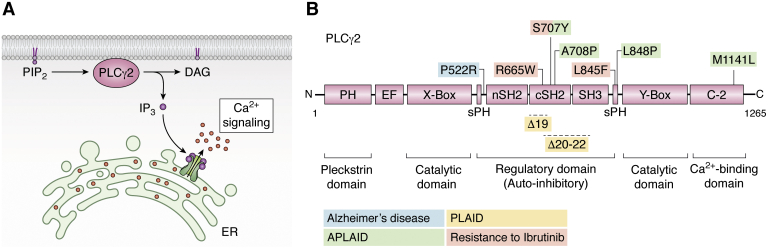
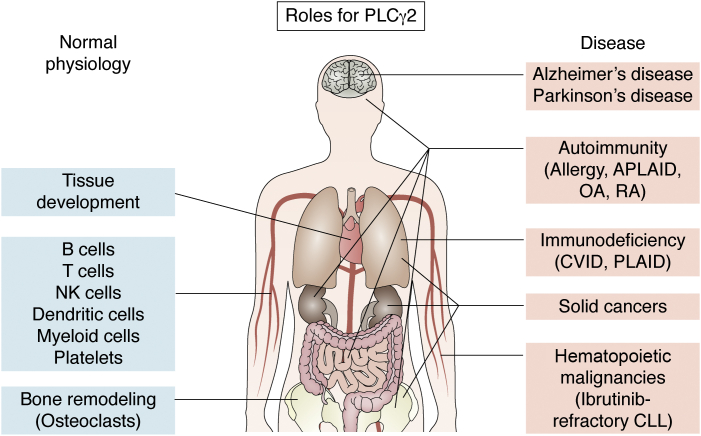
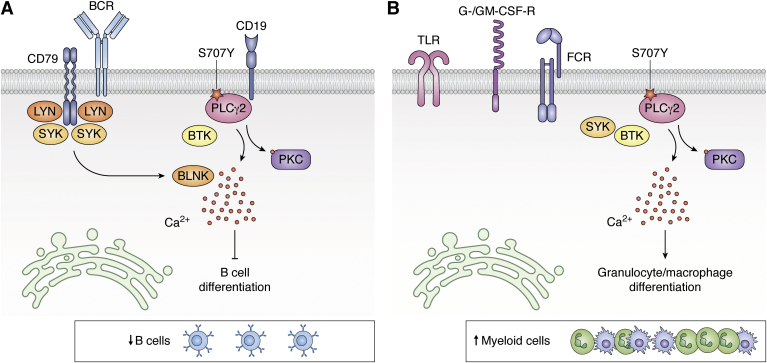
Phosphatidylinositol-specific phospholipase Cγ2 (PLCγ2) is a critical signaling molecule activated downstream from a variety of cell surface receptors that contain an intracellular immunoreceptor tyrosine-based activation motif. These receptors recruit kinases such as Syk, BTK, and BLNK to phosphorylate and activate PLCγ2, which then generates 1D-myo-inositol 1,4,5-trisphosphate and diacylglycerol. These well-known second messengers are required for diverse membrane functionality including cellular proliferation, endocytosis, and calcium flux. As a result, PLCγ2 dysfunction is associated with a variety of diseases including cancer, neurodegeneration, and immune disorders. The diverse pathologies associated with PLCγ2 are exemplified by distinct genetic variants. Inherited mutations at this locus cause PLCγ2-associated antibody deficiency and immune dysregulation, in some cases with autoinflammation. Acquired mutations at this locus, which often arise as a result of BTK inhibition to treat chronic lymphocytic leukemia, result in constitutive downstream signaling and lymphocyte proliferation. Finally, a third group of PLCγ2 variants actually has a protective effect in a variety of neurodegenerative disorders, presumably by increased uptake and degradation of deleterious neurological aggregates. Therefore, manipulating PLCγ2 activity either up or down could have therapeutic benefit; however, we require a better understanding of the signaling pathways propagated by these variants before such clinical utility can be realized. Here, we review the signaling roles of PLCγ2 in hematopoietic cells to help understand the effect of mutations driving immune disorders and cancer and extrapolate from this to roles which may relate to protection against neurodegeneration.
Overview
AI snapshot
Written from the paper’s full text.
TL;DR
This narrative review synthesizes the signaling biology of phospholipase Cγ2 (PLCγ2) downstream of immunoreceptor tyrosine-based activation motif–bearing receptors and maps distinct germline and acquired *PLCG2* variants onto immune deficiency, autoinflammation, hematological malignancy, and neurodegeneration. It argues that PLCγ2 activity may need to be tuned up or down depending on disease context, but that the pathways linking its biochemistry to these diverse pathologies remain poorly understood.
Key findings
- PLCγ2 hydrolyzes PIP2 into IP3 and DAG and is activated downstream of Syk, BTK, BLNK, Lyn, Vav, and Rac2; autoinhibition is relieved by phosphorylation at Y759, and four tyrosines (Y753, Y759, Y1197, Y1217) are phosphorylated, with Y1217 showing up to 3-fold greater phosphorylation than Y753/Y759 in maximally stimulated murine splenic B cells.
- Inherited *PLCG2* mutations cause PLAID (cold urticaria, low serum IgG/IgM/IgA, granulomatous disease, defective neutrophil chemotaxis) and APLAID (seven reported human cases of autoinflammation; early-onset blistering skin lesions, pulmonary disease, arthralgia, inflammatory eye and bowel disease, mild immunodeficiency; refractory to TNF-α inhibitors, partial response to Anakinra). Approximately 2% of published CVID cases are estimated to carry *PLCG2* mutations.
- Acquired *PLCG2* mutations drive ibrutinib resistance in CLL: *PLCG2* and/or *BTK* mutations are reported in 11–90% of ibrutinib-refractory CLL cases, with no *PLCG2*/*BTK* mutations detected pre-treatment in two studies, and rare subclones bearing *PLCG2* mutations selected on therapy. PLCγ2 was implicated in 63% of DLBCL cases (54 of 86 patients), where the PLC inhibitor U73122 suppressed proliferation and induced apoptosis and cell cycle arrest in vitro.
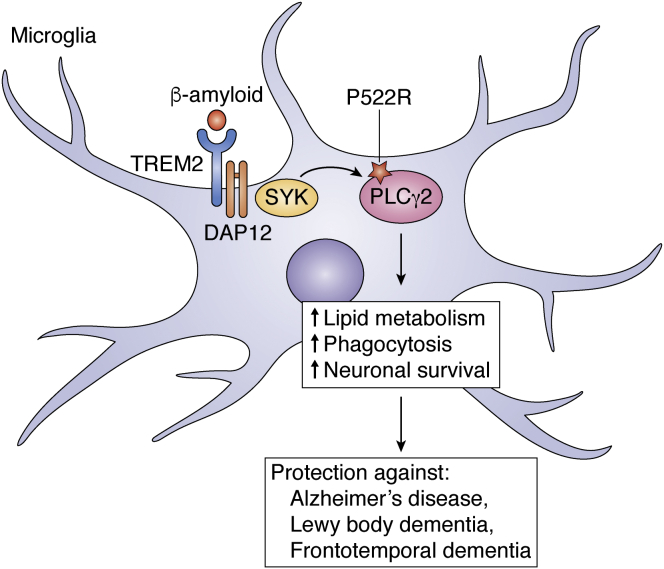
- The *PLCG2* P522R variant is protective against Alzheimer's disease, dementia with Lewy bodies, and frontotemporal dementia, and is associated with increased likelihood of reaching 90+ years as a cognitively healthy centenarian; it acts as a functional hypermorph with increased enzymatic activity versus WT, and shows no protective effect on progressive supranuclear palsy, amyotrophic lateral sclerosis, Parkinson's disease, or multiple sclerosis. In brain, PLCγ2 is primarily expressed in microglia, where it acts downstream of TREM2 to support survival, myelin phagocytosis, neuronal debris processing, and lipid metabolism.
Methods
- Narrative review; the authors state no systematic search strategy, inclusion criteria, or quantitative synthesis, and describe the work as a review of PLCγ2 signaling in hematopoietic cells intended to connect mutation-driven immune disease and cancer to neurodegeneration.
- Evidence base is the published literature, spanning mouse models (PLCγ2 enzymatic-deletion and inducible floxed knockouts, BLNK−/−PLCγ2−/−, Eμ-Myc lymphoma, Ali5 and Ali14 gain-of-function mutants, K/BxN serum-transfer arthritis, AppNL-G-F/NL-G-F and tau/Aβ AD models), human patient cohorts and case series (PLAID, APLAID, CVID, CLL, DLBCL, EBL, solid tumors), cell lines (DT40, Raji, THP-1, human iPSC-derived microglia-like cells), and GWAS/genetic association studies.
- No new primary data, meta-analysis, or statistical modeling are presented; findings are reported as cited results from the underlying studies.
Limitations
- The paper states no formal limitations section. Limitations evident from the text: the authors state that "the links between PLCγ2's critical biochemical functions and its diverse biological impacts are poorly understood," and that the pathogenesis of APLAID "is not yet well understood," with conflicting mechanistic data (increased IL-1β secretion from patient mononuclear cells attributed to NLRP3 inflammasome activation versus reduced IL-10 and IL-1β after LPS stimulation in whole-blood assays).
- As a narrative review, it does not describe a systematic literature search or evidence-grading approach, so coverage and citation selection may be selective.
- Several cited disease associations rest on small or preliminary evidence, which the text itself flags: the seven reported APLAID cases; the EBV-transformed lymphoblast upregulation of PLCγ2 described as requiring confirmation "as to whether this is indeed the process that occurs during EBV transformation and why"; and the observation that PLCγ2's influence on tumorigenesis "may be dependent on the cellular context" (opposing cisplatin-sensitivity results across studies).
Model-written summary. Check it against the paper before relying on it.
Integrity signals
Registry
Cites
Statistics
Figures
Verification
Claims the paper makes
37 Supported · 35 Partly supported · 29 No full text of the sources · 19 Own interpretation · 9 No basis given · 3 Supported so far · 2 Mixed support · 2 Not checked yet · 1 Not supported · accuracy not yet measured
Some cited sources support this claim and some don’t — read each source’s verdict below.
In the paper
“Several biochemical pathways and processes were shown to negatively regulate PLCγ2 activity and the resulting calcium flux after BCR engagement. These include RasGRP3 (39, 40), Bam32 (41), hematopoietic adaptor protein Dok-3 (downstream of kinase-3) with Grb2 (42), Themis2, an adaptor protein with no known enzymatic activity, via constitutive binding to Lyn, Grb2, and PLCγ2 to mediate its function”
§ The role of PLCγ2 in immunological disorders, cancer, and neurodegeneration > PLCγ2 in the adaptive immune system
What the sources say
- Disputedcites [39] Oh-hora, 2003, Requirement for Ras guanine nucleotide releasing protein 3 in coupling phospholipase C-gamma2 to Ras in B cell receptor signaling, J. Exp. Med. sourceExperimental — accuracy not yet measured
The citation to this paper is attached to RasGRP3, not the other listed proteins. In the Results (Figure 5 and accompanying text), BCR-induced IP3 generation and calcium mobilization were unaffected by RasGRP3 deficiency; the Discussion instead places RasGRP3 downstream of PLC-γ2 in Ras activation. (LLM, conf=0.90)
Checked by a reasoning model — may be wrong.
- Could not verifycites [40] Aiba, 2004, Activation of RasGRP3 by phosphorylation of Thr-133 is required for B cell receptor-mediated Ras activation, Proc. Natl. Acad. Sci. U. S. A. sourceExperimental — accuracy not yet measured
The Abstract and Results describe PLC-γ2 as upstream of RasGRP3 activation after BCR engagement; they do not report that RasGRP3 negatively regulates PLC-γ2 or calcium flux. Searches for RasGRP3-mediated inhibition of PLC-γ2 and calcium flux found no passage addressing that claim. The cited paper does not address the other listed regulators. (LLM, conf=0.76)
- Not checked — no full text of the sourcecites [41] Marshall, 2000, Regulation of B-cell activation and differentiation by the phosphatidylinositol 3-kinase and phospholipase Cgamma pathway, Immunol. Rev. source
- Supportedcites [42] Stork, 2007, Subcellular localization of Grb2 by the adaptor protein Dok-3 restricts the intensity of Ca2+ signaling in B cells, EMBO J. source
The citation to this paper is attached to Dok-3 with Grb2, not to the other regulators in the list. The Introduction states that recruitment of Grb2 to phosphorylated Dok-3 attenuates PLC-γ2 phosphorylation, and the Discussion describes their inhibition of calcium signaling after BCR activation. Page numbers are not supplied in our copy. (LLM, conf=0.94)
plaindirect- Asserted: passes — The authors put it forward as true.
- Checkable: passes — It can be checked against evidence.
- Load-bearing: unclear — It is unclear whether the paper’s conclusions depend on it.
- Based: passes — The paper gives a reason why it holds.
- Disputed
At least one cited source doesn’t support this claim or points to a different paper, and none confirmed it — see the verdicts below.
In the paper
“In addition, an RNA-seq study of patient tumors of EBL, a common childhood cancer from equatorial Africa where malaria is endemic, showed that the vast majority of cases which harbor EBV contain PLCγ2 mutations, along with mutations in other genes including MYC (142).”
§ The role of PLCγ2 in immunological disorders, cancer, and neurodegeneration > PLCγ2 and cancer
What the sources say
- Disputedcites [142] Kaymaz, 2017, Comprehensive transcriptome and mutational profiling of endemic Burkitt lymphoma reveals EBV type–specific differences, Mol. Cancer Res. sourceExperimental — accuracy not yet measured
The Results (Table 2; page unavailable) report PLCG2 mutations in 0% of EBV type 1 tumors and 25% of EBV type 2 tumors, contrary to the claim that the vast majority of EBV-positive cases had them. The study did use RNA-seq on patient tumors and report MYC mutations, but those points do not support the claimed PLCG2 prevalence. (LLM, conf=0.94)
Checked by a reasoning model — may be wrong.
plaincorrelational- Asserted: passes — The authors put it forward as true.
- Checkable: passes — It can be checked against evidence.
- Load-bearing: passes — The paper’s conclusions depend on it.
- Based: passes — The paper gives a reason why it holds.
- Disputed
The cited sources support only part of this claim — read each source’s verdict below.
In the paper
“Inherited mutations at this locus cause PLCγ2-associated antibody deficiency and immune dysregulation, in some cases with autoinflammation.”
§ The role of PLCγ2 in immunological disorders, cancer, and neurodegeneration > Abstract
What the sources say
- Partly supportedcites [63] Ombrello, 2012, Cold urticaria, immunodeficiency, and autoimmunity related to PLCG2 deletions, N. Engl. J. Med. sourceExperimental — accuracy not yet measured
The Discussion (page unavailable) attributes a dominantly inherited syndrome of cold urticaria and immune dysregulation to PLCG2 deletions and links the B-cell abnormalities to antibody deficiency. The Results (page unavailable) also report variable immunodeficiency. The paper describes inflammatory manifestations but does not establish that some affected subjects had autoinflammation specifically. (LLM, conf=0.82)
- Not checked — no full text of the sourcecites [64] Zhou, 2012, A hypermorphic missense mutation in PLCG2, encoding phospholipase Cγ2, causes a dominantly inherited autoinflammatory disease with immunodeficiency, Am. J. Hum. Genet. source
plaindirect- Asserted: passes — The authors put it forward as true.
- Checkable: passes — It can be checked against evidence.
- Load-bearing: passes — The paper’s conclusions depend on it.
- Based: passes — The paper gives a reason why it holds.
- Partly supported
The cited sources support only part of this claim — read each source’s verdict below.
In the paper
“PLCγ2 would then be phosphorylated at four tyrosines (Y753, Y759, Y1197, and Y1217 (8, 9, 10, 11)).”
§ The role of PLCγ2 in immunological disorders, cancer, and neurodegeneration > PLCγ2 in the adaptive immune system
What the sources say
- Not checked — no full text of the sourcecites [8] Ozdener, 2002, Activation of phospholipase Cgamma2 by tyrosine phosphorylation, Mol. Pharmacol. source
- Partly supportedcites [9] Rodriguez, 2003, Requirements for distinct steps of phospholipase Cgamma2 regulation, membrane-raft-dependent targeting and subsequent enzyme activation in B-cell signalling, Biochem. J. sourceExperimental — accuracy not yet measured
The section on raft-targeted PLCγ2 examines Tyr753 and Tyr759 and reports reduced phosphorylation after both are mutated. It does not identify Y1197 or Y1217 as phosphorylation sites or establish a total of four phosphorylated tyrosines. (LLM, conf=0.87)
- Partly supportedcites [10] Kim, 2004, Mechanism of B-cell receptor-induced phosphorylation and activation of phospholipase C-gamma2, Mol. Cell. Biol. sourceExperimental — accuracy not yet measured
The Discussion identifies Y753, Y759, and Y1217 as phosphorylated after B-cell receptor stimulation. It also states that Y1197 phosphorylation was not detectable in the B cells tested, so the paper does not support the claim that all four sites are phosphorylated in that setting. (LLM, conf=0.90)
- Supportedcites [11] Watanabe, 2001, Four tyrosine residues in phospholipase C-gamma 2, identified as Btk-dependent phosphorylation sites, are required for B cell antigen receptor-coupled calcium signaling, J. Biol. Chem. source
The section on Btk-dependent phosphorylation identifies Tyr-753, Tyr-759, Tyr-1197, and Tyr-1217 as confirmed phosphorylation sites in PLCγ2. The paper also reports that mutating all four caused almost complete loss of BCR-induced PLCγ2 phosphorylation. No page number is provided in the supplied passages. (LLM, conf=0.94)
hedged- Asserted: passes — The authors put it forward as true.
- Checkable: passes — It can be checked against evidence.
- Load-bearing: unclear — It is unclear whether the paper’s conclusions depend on it.
- Based: passes — The paper gives a reason why it holds.
The sources with a verdict support this claim; the rest weren’t checked yet, have no full text we could read, or their verdicts aren’t rated yet.
In the paper
“Given its prominent role in the adaptive immune system, PLCγ2 has been implicated in manifestations of immunodeficiency, including both the immunodeficiency syndrome, PLCγ2-associated antibody deficiency and immune dysregulation (PLAID) and common variable immunodeficiency (CVID).”
§ The role of PLCγ2 in immunological disorders, cancer, and neurodegeneration > PLCγ2 and immune deficiency
What the sources say
- Supportedcites [63] Ombrello, 2012, Cold urticaria, immunodeficiency, and autoimmunity related to PLCG2 deletions, N. Engl. J. Med. source
The Results (Linkage and Mutational Analysis; page not provided) identify PLCG2 deletions in affected families and name the resulting syndrome PLAID. The Discussion (page not provided) reports that three subjects had CVID and describes substantial phenotypic overlap between CVID and PLAID. This supports the claim that PLCγ2 is implicated in immunodeficiency manifestations including both conditions, without implying that it causes CVID generally. (LLM, conf=0.90)
- Not checked — no full text of the sourcecites [64] Zhou, 2012, A hypermorphic missense mutation in PLCG2, encoding phospholipase Cγ2, causes a dominantly inherited autoinflammatory disease with immunodeficiency, Am. J. Hum. Genet. source
- Supportedcites [65] Bogaert, 2016, Genes associated with common variable immunodeficiency: One diagnosis to rule them all?, J. Med. Genet. source
The section “PLCγ2-associated antibody deficiency and immune dysregulation” identifies PLAID as an immunodeficiency syndrome caused by PLCG2 mutations. It also reports that PLAID shares features with CVID and that some patients with PLAID met CVID diagnostic criteria. (LLM, conf=0.90)
plaincorrelational- Asserted: passes — The authors put it forward as true.
- Checkable: passes — It can be checked against evidence.
- Load-bearing: passes — The paper’s conclusions depend on it.
- Based: passes — The paper gives a reason why it holds.
- Supported
The cited sources support only part of this claim — read each source’s verdict below.
In the paper
“PLAID is specifically driven by a gain-of-function amino acid mutation in the PLCγ2 gene (63, 64), whereas CVID is much more genetically diverse with 2% of published cases of CVID estimated to be due to mutations in the PLCG2 gene (65).”
§ The role of PLCγ2 in immunological disorders, cancer, and neurodegeneration > PLCγ2 and immune deficiency
What the sources say
- Partly supportedcites [63] Ombrello, 2012, Cold urticaria, immunodeficiency, and autoimmunity related to PLCG2 deletions, N. Engl. J. Med. sourceExperimental — accuracy not yet measured
The Discussion reports that PLAID-associated PLCG2 deletions cause constitutive phospholipase activity, supporting the gain-of-function aspect. But the Results (Linkage and Mutational Analysis) identify genomic deletions spanning exons in all three families, not a gain-of-function amino acid mutation. (LLM, conf=0.90)
- Not checked — no full text of the sourcecites [64] Zhou, 2012, A hypermorphic missense mutation in PLCG2, encoding phospholipase Cγ2, causes a dominantly inherited autoinflammatory disease with immunodeficiency, Am. J. Hum. Genet. source
plaindirect- Asserted: passes — The authors put it forward as true.
- Checkable: passes — It can be checked against evidence.
- Load-bearing: unclear — It is unclear whether the paper’s conclusions depend on it.
- Based: passes — The paper gives a reason why it holds.
- Partly supported
The cited sources support only part of this claim — read each source’s verdict below.
In the paper
“Indeed, PLCγ2-deficient and inducible PLCγ2−/− mice have been widely shown to lack the ability to respond to antigens (24, 26, 27, 28).”
§ The role of PLCγ2 in immunological disorders, cancer, and neurodegeneration > PLCγ2 in the adaptive immune system
What the sources say
- Not checked — no full text of the sourcecites [24] Wang, 2000, Phospholipase Cgamma2 is essential in the functions of B cell and several Fc receptors, Immunity source
- Partly supportedcites [26] Hashimoto, 2000, Cutting edge: Essential role of phospholipase C-gamma 2 in B cell development and function, J. Immunol. sourceExperimental — accuracy not yet measured
The Results report reduced IgM responses to both T-independent and T-dependent antigens in inducible PLCγ2-mutant mice. They do not support a complete inability to respond: T-dependent IgG responses were comparable to controls. This paper tests inducible mutants, not a separate group of constitutively PLCγ2-deficient mice. (LLM, conf=0.90)
- Partly supportedcites [27] Dai, 2006, Distinct roles of phosphoinositide-3 kinase and phospholipase Cgamma2 in B-cell receptor-mediated signal transduction, Mol. Cell. Biol. sourceExperimental — accuracy not yet measured
The Abstract (page not provided) states that PLCγ2-deficient B cells are unable to respond to antigens. The paper does not establish the same claim for inducible PLCγ2−/− mice, so that part of the citing sentence is unsupported by our copy. (LLM, conf=0.85)
- Partly supportedcites [28] Bai, 2007, Phospholipase Cgamma2 contributes to light-chain gene activation and receptor editing, Mol. Cell. Biol. sourceExperimental — accuracy not yet measured
The Discussion (page unavailable) reports impaired antigen-induced receptor editing in PLCγ2-deficient mice, and the Results (page unavailable) report severely impaired antigen-induced IRF-4 and IRF-8 expression. These are specific impaired responses, not evidence that the mice cannot respond to antigens at all. Our copy also does not establish the claim for inducible PLCγ2−/− mice. (LLM, conf=0.86)
boosteddirect- Asserted: passes — The authors put it forward as true.
- Checkable: passes — It can be checked against evidence.
- Load-bearing: passes — The paper’s conclusions depend on it.
- Based: passes — The paper gives a reason why it holds.
The cited sources support only part of this claim — read each source’s verdict below.
In the paper
“In a K/BxN serum-transfer murine model of RA, Vav/PLCγ2-deficient mice were protected from inflammation and bone erosion (73, 112).”
§ The role of PLCγ2 in immunological disorders, cancer, and neurodegeneration > PLCγ2 and autoimmune disease
What the sources say
- Partly supportedcites [73] Jakus, 2009, Critical role of phospholipase Cgamma2 in integrin and Fc receptor-mediated neutrophil functions and the effector phase of autoimmune arthritis, J. Exp. Med. sourceExperimental — accuracy not yet measured
The Results (Fig. 7; page unavailable) show that PLCγ2-deficient mice were protected from clinical arthritis and periarticular leukocyte infiltration after K/B×N serum transfer. The cited paper does not establish protection from bone erosion or report a Vav/PLCγ2-deficient genotype. (LLM, conf=0.86)
- Supportedcites [112] Cremasco, 2008, Vav/Phospholipase Cgamma2-mediated control of a neutrophil-dependent murine model of rheumatoid arthritis, Arthritis Rheum. source
The Results sections on PLCγ2−/− mice and Vav proteins report that each deficient group lacked signs of inflammation and bone erosion after K/BxN serum transfer. The Results passage provided in the prompt also states the claim directly. (LLM, conf=0.95)
plaindirect- Asserted: passes — The authors put it forward as true.
- Checkable: passes — It can be checked against evidence.
- Load-bearing: passes — The paper’s conclusions depend on it.
- Based: passes — The paper gives a reason why it holds.
- Partly supported
Every source the paper cites for this claim was checked and supports it.
In the paper
“In contrast, whole-blood assays revealed a reduced production of IL-10 and IL-1β after LPS stimulation (110).”
§ The role of PLCγ2 in immunological disorders, cancer, and neurodegeneration > PLCγ2 and autoinflammatory disease
What the sources say
- Supportedcites [110] Neves, 2018, Novel PLCG2 mutation in a patient with APLAID and Cutis Laxa, Front. Immunol. source
The Case Report states that whole-blood stimulation assays in the patient with APLAID showed reduced IL-10 and IL-1β production after LPS stimulation. The finding concerns this patient, not APLAID patients generally. (LLM, conf=0.94)
plaindirect- Asserted: passes — The authors put it forward as true.
- Checkable: passes — It can be checked against evidence.
- Load-bearing: unclear — It is unclear whether the paper’s conclusions depend on it.
- Based: passes — The paper gives a reason why it holds.
- Supported
Every source the paper cites for this claim was checked and supports it.
In the paper
“The authors of this study concluded that the impaired cellular movement of the antigen-engaged BCR may be responsible, at least in part, for the PLAID syndrome through reduction of specific antigen engagement by T and B cells that are required to activate and differentiate B cells allowing antibody secretion and formation of B cell memory (69).”
§ The role of PLCγ2 in immunological disorders, cancer, and neurodegeneration > PLCγ2 and immune deficiency
What the sources say
- Supportedcites [69] Wang, 2014, The autoinhibitory C-terminal SH2 domain of phospholipase C-gamma2 stabilizes B cell receptor signalosome assembly, Sci. Signal. source
Split into 2 atoms — 2 confirmed, 0 partially supported, 0 disputed, 0 misattributed, 0 unverifiable. Expand the claim to see per-atom verdicts.
hedgedconditional- Asserted: passes — The authors put it forward as true.
- Checkable: passes — It can be checked against evidence.
- Load-bearing: passes — The paper’s conclusions depend on it.
- Based: passes — The paper gives a reason why it holds.
- Supported
The cited sources support only part of this claim — read each source’s verdict below.
In the paper
“The use of BM-derived macrophages and DCs from PLCγ2 KO mice showed that PLCγ2 was required after peptidoglycan/TLR2 and LPS/TLR4 stimulation to induce normal levels of TNF-α and IL-6 (84).”
§ The role of PLCγ2 in immunological disorders, cancer, and neurodegeneration > PLCγ2 in the innate immune system
What the sources say
- Partly supportedcites [84] Aki, 2008, Peptidoglycan and lipopolysaccharide activate PLCgamma2, leading to enhanced cytokine production in macrophages and dendritic cells, Genes Cells sourceExperimental — accuracy not yet measured
The cytokine-production results section reports reduced TNF-α and IL-6 after PGN stimulation of PLCγ2-deficient bone marrow-derived macrophages, with a similar reduction after LPS stimulation. It suggests the requirement extends to dendritic cells, but the Introduction describes the knockout dendritic-cell finding as impaired calcium mobilization, not a direct cytokine-production measurement. The claim overstates what the knockout dendritic-cell experiments showed. (LLM, conf=0.85)
plaindirect- Asserted: passes — The authors put it forward as true.
- Checkable: passes — It can be checked against evidence.
- Load-bearing: passes — The paper’s conclusions depend on it.
- Based: passes — The paper gives a reason why it holds.
- Partly supported
The cited sources support only part of this claim — read each source’s verdict below.
In the paper
“Indeed, PLCγ2 is essential for murine NK cell cytotoxic function as it is required for cytotoxic granule secretion and calcium flux (94, 95).”
§ The role of PLCγ2 in immunological disorders, cancer, and neurodegeneration > PLCγ2 in the innate immune system
What the sources say
- Partly supportedcites [94] Tassi, 2005, Phospholipase C-gamma 2 is a critical signaling mediator for murine NK cell activating receptors, J. Immunol. sourceExperimental — accuracy not yet measured
The cytotoxicity results and Discussion report dramatically impaired murine NK-cell killing without PLCγ2, and the Discussion says PLCγ2 is required for intracellular calcium signaling (page numbers unavailable). The paper links calcium to lytic-granule exocytosis, but does not directly show that PLCγ2 is required for granule secretion; it also allows for PLCγ2-independent exocytosis pathways. (LLM, conf=0.83)
- Supportedcites [95] Caraux, 2006, Phospholipase C-gamma2 is essential for NK cell cytotoxicity and innate immunity to malignant and virally infected cells, Blood source
The ‘Lack of NK cell cytotoxicity in the absence of PLC-γ2’ section reports that cytotoxicity was completely abrogated in PLC-γ2-deficient mouse NK cells. ‘Mechanisms of defective NK cytotoxicity’ reports virtually no calcium increase after NK1.1 stimulation, and the Discussion reports that cytotoxic-granule secretion was totally blocked. (LLM, conf=0.94)
plaindirect- Asserted: passes — The authors put it forward as true.
- Checkable: passes — It can be checked against evidence.
- Load-bearing: unclear — It is unclear whether the paper’s conclusions depend on it.
- Based: passes — The paper gives a reason why it holds.
- Partly supported
Every source the paper cites for this claim was checked and supports it.
In the paper
“PLCγ2 also appears to play a role in the chronic inflammatory disorder, rheumatoid arthritis (RA), as evident by an upregulation of the PLCγ2 gene signature of patient peripheral blood mononuclear cells (111).”
§ The role of PLCγ2 in immunological disorders, cancer, and neurodegeneration > PLCγ2 and autoimmune disease
What the sources say
- Supportedcites [111] Afroz, 2017, A comprehensive gene expression meta-analysis identifies novel immune signatures in rheumatoid arthritis patients, Front. Immunol. source
The Results, under “Validation of Meta-analysis Data,” report that PLCG2 was among the genes significantly upregulated in RA patients’ peripheral blood mononuclear cells compared with healthy controls. The Discussion also identifies PLCG2 as an inflammatory gene potentially involved in RA, consistent with the citing sentence’s hedged wording. (LLM, conf=0.94)
hedgedcorrelational- Asserted: passes — The authors put it forward as true.
- Checkable: passes — It can be checked against evidence.
- Load-bearing: passes — The paper’s conclusions depend on it.
- Based: passes — The paper gives a reason why it holds.
- Supported
The cited sources support only part of this claim — read each source’s verdict below.
In the paper
“Moreover, PLCγ2-deficient mouse studies showed that blocking PLCγ2 impedes the early development and function of osteoclasts, thereby preventing bone loss in arthritis (99, 100).”
§ The role of PLCγ2 in immunological disorders, cancer, and neurodegeneration > PLCγ2 in the innate immune system
What the sources say
- Partly supportedcites [99] Mao, 2006, PLCgamma2 regulates osteoclastogenesis via its interaction with ITAM proteins and GAB2, J. Clin. Invest. sourceExperimental — accuracy not yet measured
The section on inhibition of PLCγ enzymatic activity reports that an inhibitor blocked osteoclast development and bone resorption in culture. The bone-mass results show increased bone volume in PLCγ2-deficient mice, but the Discussion describes preventing arthritis-related bone loss as a potential therapeutic application, not an outcome demonstrated in arthritic mice. (LLM, conf=0.88)
- Partly supportedcites [100] Chen, 2008, Phospholipase Cgamma2 mediates RANKL-stimulated lymph node organogenesis and osteoclastogenesis, J. Biol. Chem. sourceExperimental — accuracy not yet measured
The osteoclast-formation results (page unavailable) show that PLCγ2-deficient bone marrow precursors failed to form multinucleated osteoclasts after RANKL stimulation. The in-vivo bone results report fewer osteoclasts and greater bone density in deficient mice. The paper does not show that PLCγ2 blockade prevents bone loss in arthritis, and it does not directly test mature osteoclast function. (LLM, conf=0.88)
plaindirect- Asserted: passes — The authors put it forward as true.
- Checkable: passes — It can be checked against evidence.
- Load-bearing: passes — The paper’s conclusions depend on it.
- Based: passes — The paper gives a reason why it holds.
- Partly supported
Every source the paper cites for this claim was checked and supports it.
In the paper
“RANKL-induced osteoclastogenesis requires PLCγ2, which controls downstream functions including NFATc1, AP1, and NF-κB (99).”
§ The role of PLCγ2 in immunological disorders, cancer, and neurodegeneration > PLCγ2 in the innate immune system
What the sources say
- Supportedcites [99] Mao, 2006, PLCgamma2 regulates osteoclastogenesis via its interaction with ITAM proteins and GAB2, J. Clin. Invest. source
The Introduction reports that Plcg2-null cells fail to form multinucleated osteoclasts and have decreased RANKL-mediated NFATc1 expression and defective AP1 and NF-κB activation. The section on RANKL-induced AP1 and NF-κB activation concludes that PLCγ2 controls all three pathways during osteoclastogenesis. (LLM, conf=0.94)
plaindirect- Asserted: passes — The authors put it forward as true.
- Checkable: passes — It can be checked against evidence.
- Load-bearing: passes — The paper’s conclusions depend on it.
- Based: passes — The paper gives a reason why it holds.
- Supported
Every source the paper cites for this claim was checked and supports it.
In the paper
“PLCγ2 is also essential in neutrophils for β-2 integrin and FcγR-mediated effects including production of ROS, degranulation, and cell spreading (73).”
§ The role of PLCγ2 in immunological disorders, cancer, and neurodegeneration > PLCγ2 in the innate immune system
What the sources say
- Supportedcites [73] Jakus, 2009, Critical role of phospholipase Cgamma2 in integrin and Fc receptor-mediated neutrophil functions and the effector phase of autoimmune arthritis, J. Exp. Med. source
The Results section reports that PLCγ2-deficient neutrophils failed to produce superoxide, release the granule marker gelatinase, or spread during β2 integrin-dependent activation on fibrinogen. The same section reports loss of all three responses when neutrophils were activated through Fcγ receptors by immobilized IgG immune complexes. Page numbers were not provided in our copy. (LLM, conf=0.94)
plaindirect- Asserted: passes — The authors put it forward as true.
- Checkable: passes — It can be checked against evidence.
- Load-bearing: unclear — It is unclear whether the paper’s conclusions depend on it.
- Based: passes — The paper gives a reason why it holds.
- Supported
The cited sources support only part of this claim — read each source’s verdict below.
In the paper
“In addition to FcR signaling requiring PLCγ2 for efficient ROS production in murine neutrophils, PLCγ2 is also essential for postintegrin signaling induction of ROS, as well as being critical for the neutrophil-dependent host defense against bacterial infections in vivo (80).”
§ The role of PLCγ2 in immunological disorders, cancer, and neurodegeneration > PLCγ2 in the innate immune system
What the sources say
- Partly supportedcites [80] Graham, 2007, Neutrophil-mediated oxidative burst and host defense are controlled by a Vav-PLCgamma2 signaling axis in mice, J. Clin. Invest. sourceExperimental — accuracy not yet measured
The Figure 3/Figure 6 passages show that PLC-γ2-deficient neutrophils fail to produce reactive oxygen intermediates after adhesion-dependent stimulation. The in vivo bacterial-infection experiments described with Figure 2 tested Vav-deficient mice, not PLC-γ2-deficient mice, so the paper does not directly establish that PLC-γ2 is critical for host defense in vivo. (LLM, conf=0.88)
plaindirect- Asserted: passes — The authors put it forward as true.
- Checkable: passes — It can be checked against evidence.
- Load-bearing: passes — The paper’s conclusions depend on it.
- Based: passes — The paper gives a reason why it holds.
- Partly supported
Every source the paper cites for this claim was checked and supports it.
In the paper
“This involvement of PLCγ2 was downstream of integrin stimulation and neutrophil activation, including their spreading and degranulation (112).”
§ The role of PLCγ2 in immunological disorders, cancer, and neurodegeneration > PLCγ2 and autoimmune disease
What the sources say
- Supportedcites [112] Cremasco, 2008, Vav/Phospholipase Cgamma2-mediated control of a neutrophil-dependent murine model of rheumatoid arthritis, Arthritis Rheum. source
The Results section on cell spreading states that PLCγ2 controls downstream integrin signaling events and that PLCγ2-deficient neutrophils have impaired spreading on an integrin substrate. The Results section on adhesion-mediated degranulation reports that these neutrophils failed to degranulate in response to an integrin ligand and links that defect to protection in the K/BxN arthritis model. Page numbers were not provided in our copy. (LLM, conf=0.93)
plaindirect- Asserted: passes — The authors put it forward as true.
- Checkable: passes — It can be checked against evidence.
- Load-bearing: unclear — It is unclear whether the paper’s conclusions depend on it.
- Based: passes — The paper gives a reason why it holds.
- Supported
Every source the paper cites for this claim was checked and supports it.
In the paper
“The inflammation found in APLAID has partially been attributed to the activation of the NLRP3 inflammasome as patient’s blood mononuclear cells secreted increased levels of IL-1β (109).”
§ The role of PLCγ2 in immunological disorders, cancer, and neurodegeneration > PLCγ2 and autoinflammatory disease
What the sources say
- Supportedcites [109] Chae, 2015, Connecting two pathways through Ca 2+ signaling: NLRP3 inflammasome activation induced by a hypermorphic PLCG2 mutation, Arthritis Rheumatol. source
The Results report that patients’ PBMCs secreted IL-1β under conditions in which control PBMCs did not, and conclude that the findings demonstrate NLRP3 inflammasome activation in APLAID. This supports the citing sentence’s qualified attribution of inflammation partly to that activation. (LLM, conf=0.93)
hedgedconditional- Asserted: passes — The authors put it forward as true.
- Checkable: passes — It can be checked against evidence.
- Load-bearing: unclear — It is unclear whether the paper’s conclusions depend on it.
- Based: passes — The paper gives a reason why it holds.
- Supported
The cited sources support only part of this claim — read each source’s verdict below.
In the paper
“PLCγ2 can also be exploited by some intracellular bacteria, such as Ehrlichia chaffeensis in the monocytic THP-1 cell line, where the recruitment and activation of PLCγ2 is required to maintain stable calcium levels to facilitate intracellular infections (82).”
§ The role of PLCγ2 in immunological disorders, cancer, and neurodegeneration > PLCγ2 in the innate immune system
What the sources say
- Partly supportedcites [82] Lin, 2002, Rapid activation of protein tyrosine kinase and phospholipase C-gamma2 and increase in cytosolic free calcium are required by Ehrlichia chaffeensis for internalization and growth in THP-1 cells, Infect. Immun. sourceExperimental — accuracy not yet measured
The Results report that E. chaffeensis recruits and activates PLC-γ2 in THP-1 cells and that PLC-γ2 is required for infection. They do not support the claim that this maintains stable calcium levels: the Results say calcium rose rapidly in individual cells, then returned to baseline within four minutes (page numbers unavailable). (LLM, conf=0.88)
plaindirect- Asserted: passes — The authors put it forward as true.
- Checkable: passes — It can be checked against evidence.
- Load-bearing: unclear — It is unclear whether the paper’s conclusions depend on it.
- Based: passes — The paper gives a reason why it holds.
- Partly supported
Every source the paper cites for this claim was checked and supports it.
In the paper
“The inflammation found in APLAID has partially been attributed to the activation of the NLRP3 inflammasome as patient’s blood mononuclear cells secreted increased levels of IL-1β (109).”
§ The role of PLCγ2 in immunological disorders, cancer, and neurodegeneration > PLCγ2 and autoinflammatory disease
What the sources say
- Supportedcites [109] Chae, 2015, Connecting two pathways through Ca 2+ signaling: NLRP3 inflammasome activation induced by a hypermorphic PLCG2 mutation, Arthritis Rheumatol. source
The Results report that LPS-primed peripheral blood mononuclear cells (PBMCs) from APLAID patients secreted IL-1β without added inflammasome activators, whereas control PBMCs did not under that condition. The Conclusion states that NLRP3 inflammasome activation may partially drive inflammation in APLAID. (LLM, conf=0.92)
plaindirect- Asserted: passes — The authors put it forward as true.
- Checkable: passes — It can be checked against evidence.
- Load-bearing: passes — The paper’s conclusions depend on it.
- Based: passes — The paper gives a reason why it holds.
- Supported
The cited sources support only part of this claim — read each source’s verdict below.
In the paper
“In humans, seven cases of autoinflammation caused by PLCγ2 gain-of-function point mutations, summarized under the acronym APLAID, have been reported (69).”
§ The role of PLCγ2 in immunological disorders, cancer, and neurodegeneration > PLCγ2 and autoinflammatory disease
What the sources say
- Partly supportedcites [69] Wang, 2014, The autoinhibitory C-terminal SH2 domain of phospholipase C-gamma2 stabilizes B cell receptor signalosome assembly, Sci. Signal. sourceExperimental — accuracy not yet measured
The Discussion (page not provided) describes APLAID patients with a gain-of-function PLC-γ2 point mutation, S707Y. It does not report seven cases; searches for that number and for APLAID case counts found no supporting passage in our copy. (LLM, conf=0.88)
plaindirectn = 7- Asserted: passes — The authors put it forward as true.
- Checkable: passes — It can be checked against evidence.
- Load-bearing: unclear — It is unclear whether the paper’s conclusions depend on it.
- Based: passes — The paper gives a reason why it holds.
- Partly supported
The cited sources support only part of this claim — read each source’s verdict below.
In the paper
“Population studies and microarray analyses also revealed PLCγ2 associated with the EGFR pathway was a risk factor in esophageal squamous cell carcinoma and gastric cancer (149), in non–small-cell lung cancer associated with HMGB1 expression (150), and as upregulated and potentially involved in triple-negative breast cancer–associated BRAC1 in a Chinese patient cohort (151).”
§ The role of PLCγ2 in immunological disorders, cancer, and neurodegeneration > PLCγ2 and cancer
What the sources say
- Partly supportedcites [150] Feng, 2016, The effect of HMGB1 on the clinicopathological and prognostic features of non-small cell lung cancer, Oncotarget sourceExperimental — accuracy not yet measured
The Results section (‘The molecular mechanisms of HMGB1 in NSCLC’; page unavailable) identifies PLCG2 as a central gene in a network analyzed alongside HMGB1 in lung adenocarcinoma. It does not identify PLCG2 as an NSCLC risk factor or establish its association with the EGFR pathway; the reported prognostic association concerns HMGB1 expression, not PLCG2. (LLM, conf=0.85)
plaincorrelational- Asserted: passes — The authors put it forward as true.
- Checkable: passes — It can be checked against evidence.
- Load-bearing: unclear — It is unclear whether the paper’s conclusions depend on it.
- Based: passes — The paper gives a reason why it holds.
- Partly supported
Every source the paper cites for this claim was checked and supports it.
In the paper
“Furthermore, PLCγ2 mutations R665W and L845F in Ibrutinib-resistant CLL were shown to be hypersensitive to the Rho GTPase, Rac2 protein in vitro, which may suggest Rac2 as a potential target of refractory disease (135).”
§ The role of PLCγ2 in immunological disorders, cancer, and neurodegeneration > PLCγ2 and cancer
What the sources say
- Supportedcites [135] Walliser, 2016, The phospholipase Cγ2 mutants R665W and L845F identified in ibrutinib-resistant chronic lymphocytic leukemia patients are hypersensitive to the Rho GTPase Rac2 protein, J. Biol. Chem. source
The Abstract identifies R665W and L845F as mutations associated with ibrutinib-resistant CLL and reports that both PLCγ2 mutants are hypersensitive to Rac2 activation. It also describes testing their interaction with Rac in intact cells and in a cell-free system in vitro. The discussion proposes intervention at the level of Rac as a potential treatment strategy. (LLM, conf=0.93)
plaindirect- Asserted: passes — The authors put it forward as true.
- Checkable: passes — It can be checked against evidence.
- Load-bearing: passes — The paper’s conclusions depend on it.
- Based: passes — The paper gives a reason why it holds.
- Supported
The cited sources support only part of this claim — read each source’s verdict below.
In the paper
“Population studies and microarray analyses also revealed PLCγ2 associated with the EGFR pathway was a risk factor in esophageal squamous cell carcinoma and gastric cancer (149), in non–small-cell lung cancer associated with HMGB1 expression (150), and as upregulated and potentially involved in triple-negative breast cancer–associated BRAC1 in a Chinese patient cohort (151).”
§ The role of PLCγ2 in immunological disorders, cancer, and neurodegeneration > PLCγ2 and cancer
What the sources say
- Partly supportedcites [149] Li, 2013, Genetic variants in epidermal growth factor receptor pathway genes and risk of esophageal squamous cell carcinoma and gastric cancer in a Chinese population, PLoS One sourceExperimental — accuracy not yet measured
The Abstract (page not available) lists PLCG2 among EGFR-pathway genes associated with gastric cancer risk, but lists different genes for esophageal squamous cell carcinoma. The Methods describe an analysis of genetic variants using GWAS data, not a microarray expression analysis. The paper treats these as associations requiring validation, rather than establishing PLCγ2 as a risk factor for both cancers. (LLM, conf=0.90)
plaincorrelational- Asserted: passes — The authors put it forward as true.
- Checkable: passes — It can be checked against evidence.
- Load-bearing: unclear — It is unclear whether the paper’s conclusions depend on it.
- Based: passes — The paper gives a reason why it holds.
- Partly supported
The cited sources support only part of this claim — read each source’s verdict below.
In the paper
“Interestingly, while MYC translocation and hyperexpression is a hallmark of EBL, it in itself is not sufficient to induce lymphogenesis (143), which may at least in part explain why mutations in PLCγ2 are relevant to the disease initiation (142).”
§ The role of PLCγ2 in immunological disorders, cancer, and neurodegeneration > PLCγ2 and cancer
What the sources say
- Partly supportedcites [142] Kaymaz, 2017, Comprehensive transcriptome and mutational profiling of endemic Burkitt lymphoma reveals EBV type–specific differences, Mol. Cancer Res. sourceExperimental — accuracy not yet measured
The Results report PLCG2 mutations in endemic Burkitt lymphoma and identify PLCγ2 as an enzyme in B-cell receptor signaling. The Discussion links signaling pathways to lymphoma development, but does not establish that PLCG2 mutations contribute specifically to disease initiation. Page numbers are not available in our copy. (LLM, conf=0.84)
- Not checked — no full text of the sourcecites [143] Janz, 2003, Lymphoma- and leukemia-associated chromosomal translocations in healthy individuals, Genes Chromosomes Cancer source
hedgedconditional- Asserted: passes — The authors put it forward as true.
- Checkable: passes — It can be checked against evidence.
- Load-bearing: passes — The paper’s conclusions depend on it.
- Based: passes — The paper gives a reason why it holds.
- Partly supported
Every source the paper cites for this claim was checked and supports it.
In the paper
“Mutations in the PLCγ2 (Q548R) gene, along with PIK3CD (D133E) and AKT3 (D280G), were implicated in myelodysplastic syndrome progression after the chemotherapeutic combination treatment of Azacitidine/Lenalidomide in the cohort of patients who were either first to become refractory to therapy or failed entirely to respond to therapy (139).”
§ The role of PLCγ2 in immunological disorders, cancer, and neurodegeneration > PLCγ2 and cancer
What the sources say
- Supportedcites [139] Follo, 2019, Response of high-risk MDS to azacitidine and lenalidomide is impacted by baseline and acquired mutations in a cluster of three inositide-specific genes, Leukemia source
The Results section, ‘Identification of a 3-gene cluster associated with loss of response,’ reports that patients who lost response and those who never responded acquired the same three mutations: PLCG2 Q548R, PIK3CD D133E, and AKT3 D280G. The Discussion associates the cluster with shorter leukemia-free survival and suggests that the PLCG2 mutation could contribute to AML progression. Page numbers are not provided in our copy. (LLM, conf=0.91)
plaincorrelational- Asserted: passes — The authors put it forward as true.
- Checkable: passes — It can be checked against evidence.
- Load-bearing: unclear — It is unclear whether the paper’s conclusions depend on it.
- Based: passes — The paper gives a reason why it holds.
- Supported
The cited sources support only part of this claim — read each source’s verdict below.
In the paper
“It was noted that PLCγ2 and its BCR-associated signaling are blocked via the virally encoded integral latent membrane protein 2A in combination with BLNK (140).”
§ The role of PLCγ2 in immunological disorders, cancer, and neurodegeneration > PLCγ2 and cancer
What the sources say
- Partly supportedcites [140] Engels, 2001, Epstein-Barr virus latent membrane protein 2A (LMP2A) employs the SLP-65 signaling module, J. Exp. Med. sourceExperimental — accuracy not yet measured
The Introduction identifies BLNK as SLP-65, and the Results report that EBV infection uncouples SLP-65 phosphorylation from PLC-γ2 activation, explaining a block in BCR-induced signaling in LMP2A-expressing cells. But the Results say the mechanism remains unknown; the paper does not establish that LMP2A and BLNK act in combination to cause the block. (LLM, conf=0.84)
plaindirect- Asserted: passes — The authors put it forward as true.
- Checkable: passes — It can be checked against evidence.
- Load-bearing: unclear — It is unclear whether the paper’s conclusions depend on it.
- Based: passes — The paper gives a reason why it holds.
- Partly supported
Every source the paper cites for this claim was checked and supports it.
In the paper
“The use of the Ali5 heterozygous point mutation, gain-of-function PLCγ2 mice (106) in a model of Helicobacter felis infection showed PLCγ2 protects mice from developing gastric MALT lymphoma (138).”
§ The role of PLCγ2 in immunological disorders, cancer, and neurodegeneration > PLCγ2 and cancer
What the sources say
- Supportedcites [138] Gossmann, 2016, A gain-of-function mutation in the Plcg2 gene protects mice from Helicobacter felis-induced gastric MALT lymphoma, PLoS One source
The Introduction identifies Plcg2Ali5/+ as a gain-of-function point mutation, and the Results report significantly fewer gastric MALT lymphomas in infected heterozygous mice than in wild-type littermates after 16 months (50% versus 93%). The finding supports protection in this long-term H. felis model, not complete prevention of lymphoma. (LLM, conf=0.92)
plaindirect- Asserted: passes — The authors put it forward as true.
- Checkable: passes — It can be checked against evidence.
- Load-bearing: unclear — It is unclear whether the paper’s conclusions depend on it.
- Based: passes — The paper gives a reason why it holds.
- Supported
The cited sources support only part of this claim — read each source’s verdict below.
In the paper
“Lyn tyrosine kinase autoactivation (gain-of-function) mice, after BCR stimulation, showed constitutive phosphorylation of Syk/PLCγ2, with a resultant increased calcium flux, observed in their resting B cells (118).”
§ The role of PLCγ2 in immunological disorders, cancer, and neurodegeneration > PLCγ2 and autoimmune disease
What the sources say
- Partly supportedcites [118] Hibbs, 2002, Sustained activation of Lyn tyrosine kinase in vivo leads to autoimmunity, J. Exp. Med. sourceExperimental — accuracy not yet measured
In Results, “Altered Lyn Protein Levels and Signaling in Lynup/up B Cells,” Syk and PLCγ2 are phosphorylated in unstimulated mutant B cells, with phosphorylation increasing after BCR stimulation. In “Calcium Signaling in Lynup/up B Cells,” the higher calcium-flux peak occurs after BCR cross-linking, not consistently in resting cells; basal calcium was variably elevated. The paper also says the higher peak *possibly* reflects PLCγ2 hyperactivation, rather than establishing that causal link. (LLM, conf=0.86)
plaindirect- Asserted: passes — The authors put it forward as true.
- Checkable: passes — It can be checked against evidence.
- Load-bearing: passes — The paper’s conclusions depend on it.
- Based: passes — The paper gives a reason why it holds.
- Partly supported
Every source the paper cites for this claim was checked and supports it.
In the paper
“In addition, PLCG2 was implicated as a potential tumor suppressor gene in Wilms' tumor with a focal deletion of chromosome 16q22.1q24.3, which resulted in a copy number alteration and downregulation of PLCG2 (145).”
§ The role of PLCγ2 in immunological disorders, cancer, and neurodegeneration > PLCγ2 and cancer
What the sources say
- Supportedcites [145] Krepischi, 2016, Genomic imbalances pinpoint potential oncogenes and tumor suppressors in Wilms tumors, Mol. Cytogenet. source
The Abstract (Results) identifies PLCG2 on 16q as a potential tumor suppressor highlighted by downregulation in a focally deleted region. The Results (Gene expression analysis, Table 3) specify a 16q22.1q24.3 deletion and report reduced PLCG2 expression with a concordant copy-number alteration. (LLM, conf=0.91)
hedgeddirect- Asserted: passes — The authors put it forward as true.
- Checkable: passes — It can be checked against evidence.
- Load-bearing: unclear — It is unclear whether the paper’s conclusions depend on it.
- Based: passes — The paper gives a reason why it holds.
- Supported
Every source the paper cites for this claim was checked and supports it.
In the paper
“The resulting mutagenic stress may also be a factor in the development of esophageal adenocarcinoma (146).”
§ The role of PLCγ2 in immunological disorders, cancer, and neurodegeneration > PLCγ2 and cancer
What the sources say
- Supportedcites [146] Hong, 2010, Bile acid reflux contributes to development of esophageal adenocarcinoma via activation of phosphatidylinositol-specific phospholipase Cgamma2 and NADPH oxidase NOX5-S, Cancer Res. source
The Introduction (page not provided in our copy) says reactive oxygen species may contribute to esophageal adenocarcinoma and can damage DNA, potentially causing mutations. It also links bile acids to oxidative stress and DNA damage, supporting the claim’s hedged description of mutagenic stress as a possible factor. (LLM, conf=0.91)
hedgedconditional- Asserted: passes — The authors put it forward as true.
- Checkable: passes — It can be checked against evidence.
- Load-bearing: unclear — It is unclear whether the paper’s conclusions depend on it.
- Based: passes — The paper gives a reason why it holds.
- Supported
The cited sources support only part of this claim — read each source’s verdict below.
In the paper
“It was also demonstrated in vitro SYK and LYN were essential in the mutated hypermorphic PLCγ2 (R665W) signaling, a common relapse patient PLCγ2 mutation, suggesting SYK and LYN as alternative targets in Ibrutinib resistance (132).”
§ The role of PLCγ2 in immunological disorders, cancer, and neurodegeneration > PLCγ2 and cancer
What the sources say
- Partly supportedcites [132] Liu, 2015, Hypermorphic mutation of phospholipase C, γ2 acquired in ibrutinib-resistant CLL confers BTK independency upon B-cell receptor activation, Blood sourceExperimental — accuracy not yet measured
The Introduction reports functional dependence of PLCγ2 R665W signaling on SYK and LYN, and the Results show that inhibitors of either kinase reduced signaling in vitro. The Results identify R665W in three patients who relapsed on ibrutinib, but do not establish that it is a common mutation among relapse patients. (LLM, conf=0.82)
boosteddirect- Asserted: passes — The authors put it forward as true.
- Checkable: passes — It can be checked against evidence.
- Load-bearing: passes — The paper’s conclusions depend on it.
- Based: passes — The paper gives a reason why it holds.
- Partly supported
Every source the paper cites for this claim was checked and supports it.
In the paper
“Using this Eμ-Myc lymphomagenesis mouse model in the absence of PLCγ2 demonstrated that PLCγ2 was indeed vital to early B cell development, resulting in an accumulation of large pre-B cells (121).”
§ The role of PLCγ2 in immunological disorders, cancer, and neurodegeneration > PLCγ2 and cancer
What the sources say
- Supportedcites [121] Wen, 2006, Essential role of phospholipase C gamma 2 in early B-cell development and Myc-mediated lymphomagenesis, Mol. Cell. Biol. source
The Results report that PLCγ2-deficient mice have marked increases in large pre-B cells, and the Discussion identifies this as an impaired early developmental transition. The paper also studies PLCγ2 deficiency in Eμ-Myc mice and reports that most examined lymphomas in those mice were of large pre-B-cell origin. (LLM, conf=0.90)
boosteddirect- Asserted: passes — The authors put it forward as true.
- Checkable: passes — It can be checked against evidence.
- Load-bearing: passes — The paper’s conclusions depend on it.
- Based: passes — The paper gives a reason why it holds.
- Supported
The cited sources support only part of this claim — read each source’s verdict below.
In the paper
“Mutations in PLCγ2 and/or Btk have been reported in 11 to 90% cases of Ibrutinib-refractory CLL, further underscoring the importance of better understanding the process by which the partnership of Btk and PLCγ2 drives CLL disease progression (122, 123, 124, 125, 126).”
§ The role of PLCγ2 in immunological disorders, cancer, and neurodegeneration > PLCγ2 and cancer
What the sources say
- Partly supportedcites [122] Ahn, 2017, Clonal evolution leading to ibrutinib resistance in chronic lymphocytic leukemia, Blood sourceExperimental — accuracy not yet measured
The Discussion reports BTK and/or PLCG2 mutations in 80.0% of patients progressing with CLL, supporting their prevalence in ibrutinib-resistant disease. The cited paper does not establish the stated 11%–90% range; it supplies one figure within that range. (LLM, conf=0.83)
- Partly supportedcites [123] Gango, 2020, Dissection of subclonal evolution by temporal mutation profiling in chronic lymphocytic leukemia patients treated with ibrutinib, Int. J. Cancer sourceExperimental — accuracy not yet measured
The Introduction (page unavailable) says BTK and PLCG2 mutations are predominant mechanisms of secondary ibrutinib resistance, supporting the association. The Discussion reports that 7 of 20 patients in this cohort relapsed with a BTK or PLCG2 mutation, but our copy does not give the claimed 11–90% range for ibrutinib-refractory CLL cases. (LLM, conf=0.84)
- Partly supportedcites [124] Kadri, 2017, Clonal evolution underlying leukemia progression and Richter transformation in patients with ibrutinib-relapsed CLL, Blood Adv. sourceExperimental — accuracy not yet measured
The Discussion reports that, among 28 patients with CLL progression after ibrutinib relapse, 71% had BTK mutations and 11% had PLCG2 mutations. It does not report 90% for either gene or for the two combined; the reported counts total 23 of 28 patients (82%). (LLM, conf=0.87)
plaincorrelational- Asserted: passes — The authors put it forward as true.
- Checkable: passes — It can be checked against evidence.
- Load-bearing: passes — The paper’s conclusions depend on it.
- Based: passes — The paper gives a reason why it holds.
- Partly supported
Every source the paper cites for this claim was checked and supports it.
In the paper
“PLCγ2 was also found to potentially contribute to other tumorogenic situations such as the formation of esophageal adenocarcinoma (146).”
§ The role of PLCγ2 in immunological disorders, cancer, and neurodegeneration > PLCγ2 and cancer
What the sources say
- Supportedcites [146] Hong, 2010, Bile acid reflux contributes to development of esophageal adenocarcinoma via activation of phosphatidylinositol-specific phospholipase Cgamma2 and NADPH oxidase NOX5-S, Cancer Res. source
The Results (page unavailable) report that knocking down PI-PLCγ2 reduced bile-acid-induced proliferation in esophageal adenocarcinoma cells. The Abstract (page unavailable) links this pathway to the possible progression from Barrett’s esophagus to adenocarcinoma, supporting the citing sentence’s hedged claim that PLCγ2 may contribute to its formation. (LLM, conf=0.88)
hedgedconditional- Asserted: passes — The authors put it forward as true.
- Checkable: passes — It can be checked against evidence.
- Load-bearing: unclear — It is unclear whether the paper’s conclusions depend on it.
- Based: passes — The paper gives a reason why it holds.
- Supported
Every source the paper cites for this claim was checked and supports it.
In the paper
“While PLCγ2 signaling is apparently blocked during EBV infection, it was also conversely shown to be upregulated in EBV-transformed lymphoblasts (141).”
§ The role of PLCγ2 in immunological disorders, cancer, and neurodegeneration > PLCγ2 and cancer
What the sources say
- Supportedcites [141] Dai, 2012, Screening and functional analysis of differentially expressed genes in EBV-transformed lymphoblasts, Virol. J. source
The Abstract’s Results list PLCG2, the gene encoding PLCγ2, among genes upregulated in EBV-transformed lymphocytes. The source supports increased gene expression; it does not establish increased PLCγ2 signaling, which is not the point attributed to this citation. (LLM, conf=0.92)
plaincorrelational- Asserted: passes — The authors put it forward as true.
- Checkable: passes — It can be checked against evidence.
- Load-bearing: unclear — It is unclear whether the paper’s conclusions depend on it.
- Based: passes — The paper gives a reason why it holds.
- Supported
Every source the paper cites for this claim was checked and supports it.
In the paper
“Downregulation of PLCγ2 gene pathways, and other BCR-related genes, along with EBV infection, is also associated with Hodgkin’s lymphoma (137).”
§ The role of PLCγ2 in immunological disorders, cancer, and neurodegeneration > PLCγ2 and cancer
What the sources say
- Supportedcites [137] Kuang, 2017, Identification of key genes and pathways associated with classical Hodgkin lymphoma by bioinformatics analysis, Mol. Med. Rep. source
The Results identify PLCG2 and other B-cell-receptor-related genes as downregulated in classical Hodgkin lymphoma. The Discussion links their downregulation to the B-cell receptor signaling pathway and Epstein–Barr virus infection, supporting the claimed association. (LLM, conf=0.92)
plaincorrelational- Asserted: passes — The authors put it forward as true.
- Checkable: passes — It can be checked against evidence.
- Load-bearing: unclear — It is unclear whether the paper’s conclusions depend on it.
- Based: passes — The paper gives a reason why it holds.
- Supported
Every source the paper cites for this claim was checked and supports it.
In the paper
“Interestingly, two separate studies observed that there were no PLCγ2 or BTK mutations detected in patients with CLL before Ibrutinib treatment (127, 128).”
§ The role of PLCγ2 in immunological disorders, cancer, and neurodegeneration > PLCγ2 and cancer
What the sources say
- Supportedcites [127] Kanagal-Shamanna, 2019, Targeted multigene deep sequencing of Bruton tyrosine kinase inhibitor-resistant chronic lymphocytic leukemia with disease progression and Richter transformation, Cancer source
The discussion (page not supplied) states that no patients in this study had detectable BTK or PLCG2 mutations at baseline before BTK-inhibitor therapy. The cohort included patients treated with ibrutinib, so this paper supports the finding attributed to it as one of the two cited studies. (LLM, conf=0.92)
- Supportedcites [128] Maddocks, 2015, Etiology of ibrutinib therapy discontinuation and outcomes in patients with chronic lymphocytic leukemia, JAMA Oncol. source
The Results section, under “Association of BTK and PLCγ2 mutations with relapse on ibrutinib,” states that relapse mutations were not detected before treatment by deep sequencing. This supports the finding attributed to this study; the Discussion notes that baseline sampling was limited to peripheral blood, so mutations elsewhere or at very low levels could not be ruled out. (LLM, conf=0.91)
plain- Asserted: passes — The authors put it forward as true.
- Checkable: passes — It can be checked against evidence.
- Load-bearing: passes — The paper’s conclusions depend on it.
- Based: passes — The paper gives a reason why it holds.
- Supported
The cited sources support only part of this claim — read each source’s verdict below.
In the paper
“Indeed, PLCγ2 SNPs were identified as breast cancer risk factors in patients on menopausal hormone replacement therapy (152, 153).”
§ The role of PLCγ2 in immunological disorders, cancer, and neurodegeneration > PLCγ2 and cancer
What the sources say
- Partly supportedcites [152] Rudolph, 2015, A comprehensive evaluation of interaction between genetic variants and use of menopausal hormone therapy on mammographic density, Breast Cancer Res. sourceExperimental — accuracy not yet measured
The Abstract Results and Discussion say that three PLCG2 SNPs had previously shown potential interaction with menopausal hormone therapy (MHT) use in relation to breast cancer risk. This supports an MHT-related risk association, but describing the SNPs as established breast cancer risk factors overstates the finding; this paper primarily tests their interaction with MHT use on mammographic density. No page numbers are available in our copy. (LLM, conf=0.86)
- Partly supportedcites [153] Rudolph, 2013, Genetic modifiers of menopausal hormone replacement therapy and breast cancer risk: A genome-wide interaction study, Endocr. Relat. Cancer sourceExperimental — accuracy not yet measured
The Results (page not provided) identify three PLCG2 SNPs that modified the association between current menopausal hormone therapy use and overall breast cancer risk. The Discussion (page not provided) says that no SNP reached genome-wide significance. Calling the PLCG2 SNPs established breast cancer risk factors overstates a finding about possible modification of therapy-associated risk. (LLM, conf=0.84)
plaincorrelational- Asserted: passes — The authors put it forward as true.
- Checkable: passes — It can be checked against evidence.
- Load-bearing: unclear — It is unclear whether the paper’s conclusions depend on it.
- Based: passes — The paper gives a reason why it holds.
- Partly supported
Every source the paper cites for this claim was checked and supports it.
In the paper
“Common genetic variants in PLCG2 also link the enzyme to type 1 diabetes (119) and venous thromboembolism (120), which could have a shared autoimmune etiology.”
§ The role of PLCγ2 in immunological disorders, cancer, and neurodegeneration > PLCγ2 and autoimmune disease
What the sources say
- Supportedcites [119] Bergholdt, 2012, Identification of novel type 1 diabetes candidate genes by integrating genome-wide association data, protein-protein interactions, and human pancreatic islet gene expression, Diabetes source
The Results section, “Genetic association of networks” (page unavailable), reports that PLCG2 harbored a SNP nominally associated with type 1 diabetes (P < 0.05), supporting the genetic link attributed to this source. Venous thromboembolism has a separate citation in the citing sentence and is not assessed here. (LLM, conf=0.88)
- Supportedcites [120] Lindström, 2019, Genomic and transcriptomic association studies identify 16 novel susceptibility loci for venous thromboembolism, Blood source
Citation (120) is attached to the venous thromboembolism part of the sentence, not the type 1 diabetes claim or the proposed shared etiology. In the Chr16.q23.3 passage (page not provided), the paper reports that a relatively common intronic PLCG2 variant was associated with VTE risk and that the association replicated. (LLM, conf=0.93)
plaincorrelational- Asserted: passes — The authors put it forward as true.
- Checkable: passes — It can be checked against evidence.
- Load-bearing: unclear — It is unclear whether the paper’s conclusions depend on it.
- Based: passes — The paper gives a reason why it holds.
- Supported
The cited sources support only part of this claim — read each source’s verdict below.
In the paper
“Pathogenic B cells which form in the thymocyte-expressed, positive selection–associated 1 KO mice in a collagen-induced arthritis model were impaired in PLCγ2 function, and associated calcium flux, thereby reducing the severity of their disease in comparison with control mice (117).”
§ The role of PLCγ2 in immunological disorders, cancer, and neurodegeneration > PLCγ2 and autoimmune disease
What the sources say
- Partly supportedcites [117] Yao, 2018, Tespa1 deficiency dampens thymus-dependent B-cell activation and attenuates collagen-induced arthritis in mice, Front. Immunol. sourceExperimental — accuracy not yet measured
Split into 2 atoms — 1 confirmed, 1 partially supported, 0 disputed, 0 misattributed, 0 unverifiable. Expand the claim to see per-atom verdicts.
plaindirect- Asserted: passes — The authors put it forward as true.
- Checkable: passes — It can be checked against evidence.
- Load-bearing: passes — The paper’s conclusions depend on it.
- Based: passes — The paper gives a reason why it holds.
- Partly supported
Every source the paper cites for this claim was checked and supports it.
In the paper
“However, after Ibrutinib treatment, it was observed that CLL progression favored the selection of rare subclones bearing PLCγ2 mutations (129, 130).”
§ The role of PLCγ2 in immunological disorders, cancer, and neurodegeneration > PLCγ2 and cancer
What the sources say
- Supportedcites [129] Landau, 2017, The evolutionary landscape of chronic lymphocytic leukemia treated with ibrutinib targeted therapy, Nat. Commun. source
The Introduction states that minute PLCG2-mutated clones were present at study entry and that ibrutinib provided strong selection pressure for resistant clones. The Results section on relapsed disease describes expansion of PLCG2-bearing subclones during treatment and at relapse. Page numbers are not provided in our copy. (LLM, conf=0.92)
- Supportedcites [130] Burger, 2016, Clonal evolution in patients with chronic lymphocytic leukaemia developing resistance to BTK inhibition, Nat. Commun. source
The Results section reports that four distinct PLCG2-mutated subclones expanded during ibrutinib treatment in Patient 1 and estimates that they were already present at treatment initiation at low numbers. The Discussion says their fitness advantage became accentuated by ibrutinib therapy. The paper also describes other routes to progression, so this finding is an example rather than a universal pattern. (LLM, conf=0.91)
plaindirect- Asserted: passes — The authors put it forward as true.
- Checkable: passes — It can be checked against evidence.
- Load-bearing: passes — The paper’s conclusions depend on it.
- Based: passes — The paper gives a reason why it holds.
- Supported
Every source the paper cites for this claim was checked and supports it.
In the paper
“PLCγ2 was also implicated in cervical adenocarcinoma, where in vitro siRNA knockdown of PLCγ2, and calmodulin 1, in human cervical adenocarcinoma cells led to an increased sensitivity to doxorubicin and paclitaxel, but not Cisplatin (147).”
§ The role of PLCγ2 in immunological disorders, cancer, and neurodegeneration > PLCγ2 and cancer
What the sources say
- Supportedcites [147] Stanislaus, 2012, Knockdown of PLC-gamma-2 and calmodulin 1 genes sensitizes human cervical adenocarcinoma cells to doxorubicin and paclitaxel, Cancer Cell Int. source
The Abstract Results and Background report that siRNA targeting PLCG2 and CALM1 sensitized HeLa cells to doxorubicin- and paclitaxel-induced cell death, depending on drug dose. Both passages state that no comparable enhancement was observed with cisplatin. (LLM, conf=0.94)
plaindirect- Asserted: passes — The authors put it forward as true.
- Checkable: passes — It can be checked against evidence.
- Load-bearing: unclear — It is unclear whether the paper’s conclusions depend on it.
- Based: passes — The paper gives a reason why it holds.
- Supported
The cited sources support only part of this claim — read each source’s verdict below.
In the paper
“Using patient material and mouse/human xenograft models, PLCγ2 was revealed to be an overexpressed upstream mediator, among other factors resulting in ERK signaling, that induced increased FGF-mediated bevacizumab resistance in head and neck squamous cell carcinoma (154).”
§ The role of PLCγ2 in immunological disorders, cancer, and neurodegeneration > PLCγ2 and cancer
What the sources say
- Partly supportedcites [154] Gyanchandani, 2013, A proangiogenic signature is revealed in FGF-mediated bevacizumab-resistant head and neck squamous cell carcinoma, Mol. Cancer Res. sourceExperimental — accuracy not yet measured
Split into 2 atoms — 0 confirmed, 2 partially supported, 0 disputed, 0 misattributed, 0 unverifiable. Expand the claim to see per-atom verdicts.
plaindirect- Asserted: passes — The authors put it forward as true.
- Checkable: passes — It can be checked against evidence.
- Load-bearing: passes — The paper’s conclusions depend on it.
- Based: passes — The paper gives a reason why it holds.
- Partly supported
The sources with a verdict support this claim; the rest weren’t checked yet, have no full text we could read, or their verdicts aren’t rated yet.
In the paper
“siRNA targeting Ezrin, a cytoplasmic peripheral protein involved in metastatic spreading of osteosarcoma and dependent on PIP2, also resulted in PLCγ2 upregulation in human osteosarcoma cell lines (155, 156), while another study of osteosarcoma cell lines found PLCγ2 to be a differentially regulated gene (157).”
§ The role of PLCγ2 in immunological disorders, cancer, and neurodegeneration > PLCγ2 and cancer
What the sources say
- Supportedcites [155] Lo Vasco, 2014, Ezrin silencing remodulates the expression of Phosphoinositide-specific phospholipase C enzymes in human osteosarcoma cell lines, J. Cell. Commun. Signal. source
The Introduction says the authors transfected human osteosarcoma 143B and Hs888 cells with Ezrin-targeting siRNA. The Abstract reports increased PLCG2 transcription in 143B cells and up-regulated PLCG2 expression in Hs888 cells after Ezrin silencing. (LLM, conf=0.94)
- Not checked — no full text of the sourcecites [156] Lo Vasco, 2014, Silencing of phosphoinositide-specific phospholipase C ε remodulates the expression of the phosphoinositide signal transduction pathway in human osteosarcoma cell lines, Anticancer Res.
plaindirect- Asserted: passes — The authors put it forward as true.
- Checkable: passes — It can be checked against evidence.
- Load-bearing: unclear — It is unclear whether the paper’s conclusions depend on it.
- Based: passes — The paper gives a reason why it holds.
- Supported
Every source the paper cites for this claim was checked and supports it.
In the paper
“This variant was also associated with an increased chance of reaching at least 90 years of age and then becoming a cognitively healthy centenarian, that is, people in whom the absence of dementia and extreme longevity is combined (163).”
§ The role of PLCγ2 in immunological disorders, cancer, and neurodegeneration > PLCγ2 and neurological diseases
What the sources say
- Supportedcites [163] van der Lee, 2019, A nonsynonymous mutation in PLCG2 reduces the risk of Alzheimer's disease, dementia with Lewy bodies and frontotemporal dementia, and increases the likelihood of longevity, Acta Neuropathol. source
The Results (Association with longevity) report that rs72824905-G was associated with an increased likelihood of reaching age 90 and was most enriched in a cohort of cognitively healthy centenarians. The Discussion likewise describes the strongest effect as occurring in cognitively healthy centenarians. (LLM, conf=0.90)
plaincorrelational- Asserted: passes — The authors put it forward as true.
- Checkable: passes — It can be checked against evidence.
- Load-bearing: unclear — It is unclear whether the paper’s conclusions depend on it.
- Based: passes — The paper gives a reason why it holds.
- Supported
Every source the paper cites for this claim was checked and supports it.
In the paper
“Recently, the reduced risk of the P522R mutation for AD has been extended to other dementia subtypes including Lewy bodies and frontotemporal dementia (163) (Fig. 4).”
§ The role of PLCγ2 in immunological disorders, cancer, and neurodegeneration > PLCγ2 and neurological diseases
What the sources say
- Supportedcites [163] van der Lee, 2019, A nonsynonymous mutation in PLCG2 reduces the risk of Alzheimer's disease, dementia with Lewy bodies and frontotemporal dementia, and increases the likelihood of longevity, Acta Neuropathol. source
The Materials and methods section identifies rs72824905-G as p.Pro522Arg (P522R). The Discussion reports that the authors replicated its protective association with Alzheimer’s disease and found that it also protected against frontotemporal dementia and dementia with Lewy bodies. Page numbers were not available in our copy. (LLM, conf=0.94)
plaindirect- Asserted: passes — The authors put it forward as true.
- Checkable: passes — It can be checked against evidence.
- Load-bearing: unclear — It is unclear whether the paper’s conclusions depend on it.
- Based: passes — The paper gives a reason why it holds.
- Supported
Every source the paper cites for this claim was checked and supports it.
In the paper
“On a functional level, the P522R mutation shows an increased enzymatic activity in cell lines compared with WT enzyme, acting as a functional hypermorph (164).”
§ The role of PLCγ2 in immunological disorders, cancer, and neurodegeneration > PLCγ2 and neurological diseases
What the sources say
- Supportedcites [164] Magno, 2019, Alzheimer's disease phospholipase C-gamma-2 (PLCG2) protective variant is a functional hypermorph, Alzheimers Res. Ther. source
The Results section reports that P522R increased PLC activity 1.24 ± 0.06-fold over wild type in transfected COS7 cells after EGF stimulation. It also reports higher activity in HEK293T cells, while the Discussion describes the effect as a small hypermorphic effect. (LLM, conf=0.94)
plaindirect- Asserted: passes — The authors put it forward as true.
- Checkable: passes — It can be checked against evidence.
- Load-bearing: unclear — It is unclear whether the paper’s conclusions depend on it.
- Based: passes — The paper gives a reason why it holds.
- Supported
Every source the paper cites for this claim was checked and supports it.
In the paper
“A rare variant in the PLCG2 gene (Pro522Arg) has been associated with decreased risk of AD by genome-wide association study (159).”
§ The role of PLCγ2 in immunological disorders, cancer, and neurodegeneration > PLCγ2 and neurological diseases
What the sources say
- Supportedcites [159] Sims, 2017, Rare coding variants in PLCG2, ABI3, and TREM2 implicate microglial-mediated innate immunity in Alzheimer's disease, Nat. Genet. source
The paper’s results (passage [1], supplied under Abstract; page not specified) identify PLCG2 p.P522R (Pro522Arg) as a rare variant with a genome-wide significant association and explicitly state that it is associated with decreased risk of late-onset Alzheimer’s disease. The study design in passage [4] describes the association testing used to find it. (LLM, conf=0.93)
plaincorrelational- Asserted: passes — The authors put it forward as true.
- Checkable: passes — It can be checked against evidence.
- Load-bearing: passes — The paper’s conclusions depend on it.
- Based: passes — The paper gives a reason why it holds.
- Supported
Every source the paper cites for this claim was checked and supports it.
In the paper
“Comparative gene expression profiling of known genetic risk factors in AD revealed an increase of PLCG2 gene expression in the cortex of AppNL-G-F/NL-G-F mice (165).”
§ The role of PLCγ2 in immunological disorders, cancer, and neurodegeneration > PLCγ2 and neurological diseases
What the sources say
- Supportedcites [165] Castillo, 2017, Comparative profiling of cortical gene expression in Alzheimer's disease patients and mouse models demonstrates a link between amyloidosis and neuroinflammation, Sci. Rep. source
The Results section on AD risk-factor genes states that Plcg2 expression was significantly increased in the cortex of AppNL-G-F/NL-G-F mice. Table 3 reports a 1.26-fold change relative to control mice. (LLM, conf=0.95)
plaincorrelational- Asserted: passes — The authors put it forward as true.
- Checkable: passes — It can be checked against evidence.
- Load-bearing: unclear — It is unclear whether the paper’s conclusions depend on it.
- Based: passes — The paper gives a reason why it holds.
- Supported
Every source the paper cites for this claim was checked and supports it.
In the paper
“Although PLCγ2 is active in various cell types and tissues as highlighted in this article, within the brain, PLCγ2 is, interestingly, primarily expressed in microglia, in both humans and mice (164) (Fig. 4).”
§ The role of PLCγ2 in immunological disorders, cancer, and neurodegeneration > PLCγ2 and neurological diseases
What the sources say
- Supportedcites [164] Magno, 2019, Alzheimer's disease phospholipase C-gamma-2 (PLCG2) protective variant is a functional hypermorph, Alzheimers Res. Ther. source
The Discussion says human and mouse cortical transcriptomic data suggest PLCG2 enrichment in microglia. The Results identify microglia as the primary expressing cells across the mouse brain, while the human tissue findings are from cortex. The paper notes an exception in mouse dentate gyrus granule cells, which is consistent with the claim’s use of “primarily.” (LLM, conf=0.90)
plain- Asserted: passes — The authors put it forward as true.
- Checkable: passes — It can be checked against evidence.
- Load-bearing: passes — The paper’s conclusions depend on it.
- Based: passes — The paper gives a reason why it holds.
- Supported
Every source the paper cites for this claim was checked and supports it.
In the paper
“siRNA targeting Ezrin, a cytoplasmic peripheral protein involved in metastatic spreading of osteosarcoma and dependent on PIP2, also resulted in PLCγ2 upregulation in human osteosarcoma cell lines (155, 156), while another study of osteosarcoma cell lines found PLCγ2 to be a differentially regulated gene (157).”
§ The role of PLCγ2 in immunological disorders, cancer, and neurodegeneration > PLCγ2 and cancer
What the sources say
- Supportedcites [157] Sun, 2015, Gene expression profiling analysis of osteosarcoma cell lines, Mol. Med. Rep. source
The Discussion reports that PLCγ2 was downregulated in the study’s analysis of osteosarcoma cell lines. This supports the claim that the study found it to be a differentially regulated gene; no page number is available in the supplied copy. (LLM, conf=0.93)
plaincorrelational- Asserted: passes — The authors put it forward as true.
- Checkable: passes — It can be checked against evidence.
- Load-bearing: unclear — It is unclear whether the paper’s conclusions depend on it.
- Based: passes — The paper gives a reason why it holds.
- Supported
The cited sources support only part of this claim — read each source’s verdict below.
In the paper
“The initial genetic results were replicated by various independent cohorts (160, 161, 162).”
§ The role of PLCγ2 in immunological disorders, cancer, and neurodegeneration > PLCγ2 and neurological diseases
What the sources say
- Partly supportedcites [160] Conway, 2018, ABI3 and PLCG2 missense variants as risk factors for neurodegenerative diseases in Caucasians and African Americans, Mol. Neurodegener. sourceExperimental — accuracy not yet measured
The Results section reports that PLCG2 rs72824905-G (P522R) was associated with decreased AD risk in the full Caucasian cohort. Its non-overlapping replication cohort showed the same direction of effect, but that result was not statistically significant (Fisher’s OR = 0.66, p = 0.192). This paper therefore supports a directionally consistent result in one independent cohort, not a statistically significant replication across various cohorts. (LLM, conf=0.85)
- Partly supportedcites [161] Tesi, 2019, Centenarian controls increase variant effect sizes by an average twofold in an extreme case-extreme control analysis of Alzheimer's disease, Eur. J. Hum. Genet. sourceExperimental — accuracy not yet measured
The Discussion says this study provides independent replication of previously reported AD-associated variants in a Dutch population. Table 2 reports an association between the PLCG2 variant and AD, consistent with decreased risk, but the paper describes one independent Dutch study—not replication by various independent cohorts. (LLM, conf=0.86)
- Partly supportedcites [162] Dalmasso, 2019, Transethnic meta-analysis of rare coding variants in PLCG2, ABI3, and TREM2 supports their general contribution to Alzheimer's disease, Transl. Psychiatry sourceExperimental — accuracy not yet measured
The Results report that PLCG2 p.P522R had the same protective direction as the initial IGAP finding in the Argentinian sample and in the European meta-analysis. But the Argentinian result was not statistically significant, nor was the European result alone (Table 3); only the combined analysis reached the reported threshold. The paper therefore supports consistency across populations, not a clear replication by various independent cohorts. (LLM, conf=0.86)
plaincorrelational- Asserted: passes — The authors put it forward as true.
- Checkable: passes — It can be checked against evidence.
- Load-bearing: unclear — It is unclear whether the paper’s conclusions depend on it.
- Based: passes — The paper gives a reason why it holds.
- Partly supported
A claim is checked only against the cited paper’s full text, never its abstract, and none is available for its sources.
In the paper
“Phosphatidylinositol-specific phospholipase Cγ2 (PLCγ2) is a critical signaling molecule activated downstream from a variety of cell surface receptors that contain an intracellular immunoreceptor tyrosine-based activation motif.”
§ The role of PLCγ2 in immunological disorders, cancer, and neurodegeneration > Abstract
What the sources say
plaindirect- Asserted: passes — The authors put it forward as true.
- Checkable: passes — It can be checked against evidence.
- Load-bearing: passes — The paper’s conclusions depend on it.
- Based: passes — The paper gives a reason why it holds.
A conclusion the paper draws from its own results — it cites no other source for it, so there is none to check. The quote shows it is in the paper.
In the paper
“Collectively, these studies reveal that PLCγ2 is an important component in several immunological pathways resulting in the induction of key transcription factors necessary for subsequent immunological functions.”
§ The role of PLCγ2 in immunological disorders, cancer, and neurodegeneration > PLCγ2 in the adaptive immune system
plaindirect- Asserted: passes — The authors put it forward as true.
- Checkable: passes — It can be checked against evidence.
- Load-bearing: passes — The paper’s conclusions depend on it.
- Based: passes — The paper gives a reason why it holds.
The paper states this without a source or data behind it here, so there is nothing to check it against. The quote shows it is in the paper.
In the paper
“PLCγ2 plays a fundamental role in development of mature B cells as a component of the signal transduction cascade that occurs when a B cell receptor (BCR) is stimulated by its cognate antigen.”
§ The role of PLCγ2 in immunological disorders, cancer, and neurodegeneration > PLCγ2 in the adaptive immune system
plaindirect- Asserted: passes — The authors put it forward as true.
- Checkable: passes — It can be checked against evidence.
- Load-bearing: passes — The paper’s conclusions depend on it.
- Based: passes — The paper gives a reason why it holds.
The paper states this without a source or data behind it here, so there is nothing to check it against. The quote shows it is in the paper.
In the paper
“As a result, PLCγ2 dysfunction is associated with a variety of diseases including cancer, neurodegeneration, and immune disorders.”
§ The role of PLCγ2 in immunological disorders, cancer, and neurodegeneration > Abstract
plaincorrelational- Asserted: passes — The authors put it forward as true.
- Checkable: passes — It can be checked against evidence.
- Load-bearing: passes — The paper’s conclusions depend on it.
- Based: passes — The paper gives a reason why it holds.
The paper states this without a source or data behind it here, so there is nothing to check it against. The quote shows it is in the paper.
In the paper
“Biochemically, PLCγ2 is downstream of many signaling molecules including the kinases Syk Btk, and Lyn, the guanine nucleotide exchange factors Vav, and the GTPase Rac2 that will be discussed in this review.”
§ The role of PLCγ2 in immunological disorders, cancer, and neurodegeneration > Abstract
plaindirect- Asserted: passes — The authors put it forward as true.
- Checkable: passes — It can be checked against evidence.
- Load-bearing: unclear — It is unclear whether the paper’s conclusions depend on it.
- Based: passes — The paper gives a reason why it holds.
The paper states this without a source or data behind it here, so there is nothing to check it against. The quote shows it is in the paper.
In the paper
“Acquired mutations at this locus, which often arise as a result of BTK inhibition to treat chronic lymphocytic leukemia, result in constitutive downstream signaling and lymphocyte proliferation.”
§ The role of PLCγ2 in immunological disorders, cancer, and neurodegeneration > Abstract
plaindirect- Asserted: passes — The authors put it forward as true.
- Checkable: passes — It can be checked against evidence.
- Load-bearing: passes — The paper’s conclusions depend on it.
- Based: passes — The paper gives a reason why it holds.
The paper states this without a source or data behind it here, so there is nothing to check it against. The quote shows it is in the paper.
In the paper
“These receptors recruit kinases such as Syk, BTK, and BLNK to phosphorylate and activate PLCγ2, which then generates 1D-myo-inositol 1,4,5-trisphosphate and diacylglycerol.”
§ The role of PLCγ2 in immunological disorders, cancer, and neurodegeneration > Abstract
plaindirect- Asserted: passes — The authors put it forward as true.
- Checkable: passes — It can be checked against evidence.
- Load-bearing: passes — The paper’s conclusions depend on it.
- Based: passes — The paper gives a reason why it holds.
In the paper
“Phosphatidylinositol-specific phospholipase Cγ2 (PLCγ2) belongs to a group of intracellular enzymes that cleave the membrane phospholipid phosphatidylinositol-4,5-bisphosphate (PIP2) into diacylglycerol (DAG) and inositol 1,4,5-trisphosphate (IP3) (1) (Fig. 1A).”
§ The role of PLCγ2 in immunological disorders, cancer, and neurodegeneration > Abstract
What the sources say
- Not checked — no full text of the sourcecites [1] Berridge, 1993, Inositol trisphosphate and calcium signalling, Nature source
plaindirect- Asserted: passes — The authors put it forward as true.
- Checkable: passes — It can be checked against evidence.
- Load-bearing: passes — The paper’s conclusions depend on it.
- Based: passes — The paper gives a reason why it holds.
In the paper
“These mice exhibited a dominantly inherited disease characterized by spontaneous hind paw swelling/inflammation (107).”
§ The role of PLCγ2 in immunological disorders, cancer, and neurodegeneration > PLCγ2 and autoinflammatory disease
What the sources say
- Not checked — no full text of the sourcecites [107] Abe, 2011, A novel N-ethyl-N-nitrosourea-induced mutation in phospholipase Cγ2 causes inflammatory arthritis, metabolic defects, and male infertility in vitro in a murine model, Arthritis Rheum. source
plain- Asserted: passes — The authors put it forward as true.
- Checkable: passes — It can be checked against evidence.
- Load-bearing: unclear — It is unclear whether the paper’s conclusions depend on it.
- Based: passes — The paper gives a reason why it holds.
A conclusion the paper draws from its own results — it cites no other source for it, so there is none to check. The quote shows it is in the paper.
In the paper
“Most mutations found in APLAID lie within the autoinhibitory domain (Fig. 1), causing failure of autoinhibition and resulting in constitutive phospholipase activity resulting ultimately in an increased production of both intracellular IP3 and calcium.”
§ The role of PLCγ2 in immunological disorders, cancer, and neurodegeneration > PLCγ2 and autoinflammatory disease
plaindirect- Asserted: passes — The authors put it forward as true.
- Checkable: passes — It can be checked against evidence.
- Load-bearing: passes — The paper’s conclusions depend on it.
- Based: passes — The paper gives a reason why it holds.
The paper states this without a source or data behind it here, so there is nothing to check it against. The quote shows it is in the paper.
In the paper
“PLCγ2 is also very important in the context of myeloid cells including monocytes, macrophages, NK cells, dendritic cells (DCs), and mast cells often because of its utility in facilitating downstream signaling after FcR engagement.”
§ The role of PLCγ2 in immunological disorders, cancer, and neurodegeneration > PLCγ2 in the innate immune system
plaindirect- Asserted: passes — The authors put it forward as true.
- Checkable: passes — It can be checked against evidence.
- Load-bearing: unclear — It is unclear whether the paper’s conclusions depend on it.
- Based: passes — The paper gives a reason why it holds.
In the paper
“The potential mode of action in human B cells by Epratuzumab was observed to be elicited by a downregulation of Syk/PLCγ2 signaling, including calcium flux, after BCR stimulation (116).”
§ The role of PLCγ2 in immunological disorders, cancer, and neurodegeneration > PLCγ2 and autoimmune disease
What the sources say
- Not checked — no full text of the sourcecites [116] Sieger, 2013, CD22 ligation inhibits downstream B cell receptor signaling and Ca(2+) flux upon activation, Arthritis Rheum. source
plaindirect- Asserted: passes — The authors put it forward as true.
- Checkable: passes — It can be checked against evidence.
- Load-bearing: unclear — It is unclear whether the paper’s conclusions depend on it.
- Based: passes — The paper gives a reason why it holds.
In the paper
“Understanding the mechanisms behind the role of PLCγ2 in autoinflammatory diseases was enabled by the identification of the Ali5 mice that bear a gain-of-function point mutation resulting in a single amino acid change (D993G) in PLCγ2 resulting in spontaneous inflammation (106).”
§ The role of PLCγ2 in immunological disorders, cancer, and neurodegeneration > PLCγ2 and autoinflammatory disease
What the sources say
- Not checked — no full text of the sourcecites [106] Yu, 2005, Autoimmunity and inflammation due to a gain-of-function mutation in phospholipase C gamma 2 that specifically increases external Ca2+ entry, Immunity source
plaindirectSingle case- Asserted: passes — The authors put it forward as true.
- Checkable: passes — It can be checked against evidence.
- Load-bearing: passes — The paper’s conclusions depend on it.
- Based: passes — The paper gives a reason why it holds.
In the paper
“Further work utilizing N-ethyl-N-nitrosourea alkylating mutagenesis resulted in the creation of the Ali14 mutant mice, in which gene mapping revealed a Y to C missense mutation in PLCγ2 at amino acid position 495 within the SH2 domain (107).”
§ The role of PLCγ2 in immunological disorders, cancer, and neurodegeneration > PLCγ2 and autoinflammatory disease
What the sources say
- Not checked — no full text of the sourcecites [107] Abe, 2011, A novel N-ethyl-N-nitrosourea-induced mutation in phospholipase Cγ2 causes inflammatory arthritis, metabolic defects, and male infertility in vitro in a murine model, Arthritis Rheum. source
plainSingle case- Asserted: passes — The authors put it forward as true.
- Checkable: passes — It can be checked against evidence.
- Load-bearing: unclear — It is unclear whether the paper’s conclusions depend on it.
- Based: passes — The paper gives a reason why it holds.
In the paper
“Indeed, patients with SLE saw clinical benefit through treatment with an anti-CD22 mAb therapy, Epratuzumab (115).”
§ The role of PLCγ2 in immunological disorders, cancer, and neurodegeneration > PLCγ2 and autoimmune disease
What the sources say
- Not checked — no full text of the sourcecites [115] Jacobi, 2008, Differential effects of epratuzumab on peripheral blood B cells of patients with systemic lupus erythematosus versus normal controls, Ann. Rheum. Dis. source
plaindirect- Asserted: passes — The authors put it forward as true.
- Checkable: passes — It can be checked against evidence.
- Load-bearing: unclear — It is unclear whether the paper’s conclusions depend on it.
- Based: passes — The paper gives a reason why it holds.
The paper states this without a source or data behind it here, so there is nothing to check it against. The quote shows it is in the paper.
In the paper
“Most mutations found in APLAID lie within the autoinhibitory domain (Fig. 1), causing failure of autoinhibition and resulting in constitutive phospholipase activity resulting ultimately in an increased production of both intracellular IP3 and calcium.”
§ The role of PLCγ2 in immunological disorders, cancer, and neurodegeneration > PLCγ2 and autoinflammatory disease
plaindirect- Asserted: passes — The authors put it forward as true.
- Checkable: passes — It can be checked against evidence.
- Load-bearing: passes — The paper’s conclusions depend on it.
- Based: passes — The paper gives a reason why it holds.
In the paper
“PLCγ2 is implicated in allergic responses, specifically with regard to the function of mast cells and their crosslinking of FcεRI (IgE-binding receptor) and FcγR and subsequent degranulation (71).”
§ The role of PLCγ2 in immunological disorders, cancer, and neurodegeneration > PLCγ2 and allergy
What the sources say
- Not checked — no full text of the sourcecites [71] Wen, 2002, Phospholipase C gamma 2 is essential for specific functions of Fc epsilon R and Fc gamma R, J. Immunol. source
plaincorrelational- Asserted: passes — The authors put it forward as true.
- Checkable: passes — It can be checked against evidence.
- Load-bearing: passes — The paper’s conclusions depend on it.
- Based: passes — The paper gives a reason why it holds.
In the paper
“As a consequence, binding of the SH2 domain to BLNK is also stabilized by the C2 domain in a calcium-regulated manner (44).”
§ The role of PLCγ2 in immunological disorders, cancer, and neurodegeneration > PLCγ2 and autoinflammatory disease
What the sources say
- Not checked — no full text of the sourcecites [44] Engelke, 2013, Cutting edge: Feed-forward activation of phospholipase Cγ2 via C2 domain-mediated binding to SLP65, J. Immunol. source
plaindirect- Asserted: passes — The authors put it forward as true.
- Checkable: passes — It can be checked against evidence.
- Load-bearing: unclear — It is unclear whether the paper’s conclusions depend on it.
- Based: passes — The paper gives a reason why it holds.
In the paper
“The PLCγ2-deficient mice were also resistant to IgE-mediated cutaneous inflammatory skin reactions (71).”
§ The role of PLCγ2 in immunological disorders, cancer, and neurodegeneration > PLCγ2 and allergy
What the sources say
- Not checked — no full text of the sourcecites [71] Wen, 2002, Phospholipase C gamma 2 is essential for specific functions of Fc epsilon R and Fc gamma R, J. Immunol. source
plaindirect- Asserted: passes — The authors put it forward as true.
- Checkable: passes — It can be checked against evidence.
- Load-bearing: passes — The paper’s conclusions depend on it.
- Based: passes — The paper gives a reason why it holds.
A conclusion the paper draws from its own results — it cites no other source for it, so there is none to check. The quote shows it is in the paper.
In the paper
“Overall, these studies of CVID and PLAID lay bare the crucial role of PLCγ2 in the etiology of these diseases because of PLCγ2’s underlying role in the vital immunological signaling of lymphoid cells.”
§ The role of PLCγ2 in immunological disorders, cancer, and neurodegeneration > PLCγ2 and immune deficiency
boosteddirect- Asserted: passes — The authors put it forward as true.
- Checkable: passes — It can be checked against evidence.
- Load-bearing: passes — The paper’s conclusions depend on it.
- Based: passes — The paper gives a reason why it holds.
In the paper
“The C2 domain of PLCγ2, in which the APLAID mutation M1141L resides, has previously been shown to be critical for calcium-dependent translocation of PLCγ2 to the plasma membrane for the sustained influx of extracellular calcium.”
§ The role of PLCγ2 in immunological disorders, cancer, and neurodegeneration > PLCγ2 and autoinflammatory disease
What the sources say
- Not checked — no full text of the sourcecites [44] Engelke, 2013, Cutting edge: Feed-forward activation of phospholipase Cγ2 via C2 domain-mediated binding to SLP65, J. Immunol. source
plaindirect- Asserted: passes — The authors put it forward as true.
- Checkable: passes — It can be checked against evidence.
- Load-bearing: passes — The paper’s conclusions depend on it.
- Based: passes — The paper gives a reason why it holds.
A conclusion the paper draws from its own results — it cites no other source for it, so there is none to check. The quote shows it is in the paper.
In the paper
“These studies collectively show that targeting PLCγ2 may have benefits for the treatment of diseases associated with an overreactive immune response.”
§ The role of PLCγ2 in immunological disorders, cancer, and neurodegeneration > PLCγ2 and allergy
hedgedconditional- Asserted: passes — The authors put it forward as true.
- Checkable: passes — It can be checked against evidence.
- Load-bearing: passes — The paper’s conclusions depend on it.
- Based: passes — The paper gives a reason why it holds.
In the paper
“In monocytes, macrophages, and mast cells, PLCγ2 is activated through crosslinking of the FcεR and FcγR (71).”
§ The role of PLCγ2 in immunological disorders, cancer, and neurodegeneration > PLCγ2 in the innate immune system
What the sources say
- Not checked — no full text of the sourcecites [71] Wen, 2002, Phospholipase C gamma 2 is essential for specific functions of Fc epsilon R and Fc gamma R, J. Immunol. source
plaindirect- Asserted: passes — The authors put it forward as true.
- Checkable: passes — It can be checked against evidence.
- Load-bearing: unclear — It is unclear whether the paper’s conclusions depend on it.
- Based: passes — The paper gives a reason why it holds.
A claim is checked only against the cited paper’s full text, never its abstract, and none is available for its sources.
In the paper
“SYK/PLCγ2 activity is also suggested as a potential biomarker for responsiveness in the treatment of CLL and DLBCL, as their signaling activity correlated with cell death induced by treatment with the Src tyrosine kinase inhibitor, Dasatinib (133, 134).”
§ The role of PLCγ2 in immunological disorders, cancer, and neurodegeneration > PLCγ2 and cancer
What the sources say
- Not checked — no full text of the sourcecites [133] Yang, 2008, Tyrosine kinase inhibition in diffuse large B-cell lymphoma: Molecular basis for antitumor activity and drug resistance of dasatinib, Leukemia source
- Not checked — no full text of the sourcecites [134] Song, 2010, Activities of SYK and PLCgamma2 predict apoptotic response of CLL cells to SRC tyrosine kinase inhibitor dasatinib, Clin. Cancer Res. source
hedgedcorrelational- Asserted: passes — The authors put it forward as true.
- Checkable: passes — It can be checked against evidence.
- Load-bearing: passes — The paper’s conclusions depend on it.
- Based: passes — The paper gives a reason why it holds.
None of the sources cited for this claim have been checked yet.
In the paper
“PLCγ2 is also potentially involved in a small number of solid cancers such as Wilms' tumor (kidney), osteosarcoma, esophageal squamous cell carcinoma, esophageal adenocarcinoma, cervical adenocarcinoma, Birt-Hogg-Dube tumors, non–small-cell lung cancer, and breast cancer.”
§ The role of PLCγ2 in immunological disorders, cancer, and neurodegeneration > PLCγ2 and cancer
hedgedcorrelational- Asserted: passes — The authors put it forward as true.
- Checkable: passes — It can be checked against evidence.
- Load-bearing: unclear — It is unclear whether the paper’s conclusions depend on it.
- Based: passes — The paper gives a reason why it holds.
In the paper
“Hypermorphic gain-of-function genetic changes in the putative calcium-regulated domain (C2) of PLCG2 were noted to be correlated with CLL resistance to Ibrutinib (131).”
§ The role of PLCγ2 in immunological disorders, cancer, and neurodegeneration > PLCγ2 and cancer
What the sources say
- Not checked — no full text of the sourcecites [131] Jones, 2017, PLCG2 C2 domain mutations co-occur with BTK and PLCG2 resistance mutations in chronic lymphocytic leukemia undergoing ibrutinib treatment, Leukemia source
hedgedcorrelational- Asserted: passes — The authors put it forward as true.
- Checkable: passes — It can be checked against evidence.
- Load-bearing: passes — The paper’s conclusions depend on it.
- Based: passes — The paper gives a reason why it holds.
In the paper
“PLCγ2 was implicated in the Wnt signaling pathway necessary for kidney development and development of Wilms' tumor (144).”
§ The role of PLCγ2 in immunological disorders, cancer, and neurodegeneration > PLCγ2 and cancer
What the sources say
- Not checked — no full text of the sourcecites [144] Maschietto, 2008, Molecular profiling of isolated histological components of wilms tumor implicates a common role for the Wnt signaling pathway in kidney and tumor development, Oncology source
plaincorrelational- Asserted: passes — The authors put it forward as true.
- Checkable: passes — It can be checked against evidence.
- Load-bearing: unclear — It is unclear whether the paper’s conclusions depend on it.
- Based: passes — The paper gives a reason why it holds.
In the paper
“However, unusually, high PLCγ2 expression was actually associated with better overall survival, which the authors speculated that potentially the stronger PLCγ2 signaling enhancing cellular proliferation and thus making the cells more susceptible to cytotoxic drugs (136).”
§ The role of PLCγ2 in immunological disorders, cancer, and neurodegeneration > PLCγ2 and cancer
What the sources say
- Not checked — no full text of the sourcecites [136] Huynh, 2015, Expression and pro-survival function of phospholipase Cγ2 in diffuse large B-cell lymphoma, Leuk. Lymphoma source
plaincorrelational- Asserted: passes — The authors put it forward as true.
- Checkable: passes — It can be checked against evidence.
- Load-bearing: unclear — It is unclear whether the paper’s conclusions depend on it.
- Based: passes — The paper gives a reason why it holds.
In the paper
“PLCγ2 has also been implicated in 63% of DLBCL cases (54 of 86 patients in the study) (136).”
§ The role of PLCγ2 in immunological disorders, cancer, and neurodegeneration > PLCγ2 and cancer
What the sources say
- Not checked — no full text of the sourcecites [136] Huynh, 2015, Expression and pro-survival function of phospholipase Cγ2 in diffuse large B-cell lymphoma, Leuk. Lymphoma source
plaincorrelationaln = 86- Asserted: passes — The authors put it forward as true.
- Checkable: passes — It can be checked against evidence.
- Load-bearing: unclear — It is unclear whether the paper’s conclusions depend on it.
- Based: passes — The paper gives a reason why it holds.
A conclusion the paper draws from its own results — it cites no other source for it, so there is none to check. The quote shows it is in the paper.
In the paper
“These PLCγ2 signaling-induced autoimmune diseases produce a range of inflammatory phenotypes in both patients and disease models, typically driven by autoantibodies (with the exception of APLAID) and broad autoimmune cell expansion.”
§ The role of PLCγ2 in immunological disorders, cancer, and neurodegeneration > PLCγ2 and autoimmune disease
plaindirect- Asserted: passes — The authors put it forward as true.
- Checkable: passes — It can be checked against evidence.
- Load-bearing: passes — The paper’s conclusions depend on it.
- Based: passes — The paper gives a reason why it holds.
A conclusion the paper draws from its own results — it cites no other source for it, so there is none to check. The quote shows it is in the paper.
In the paper
“Nevertheless, PLCγ2 clearly plays a crucial role in CLL that has become refractory to Ibrutinib treatment.”
§ The role of PLCγ2 in immunological disorders, cancer, and neurodegeneration > PLCγ2 and cancer
boosteddirect- Asserted: passes — The authors put it forward as true.
- Checkable: passes — It can be checked against evidence.
- Load-bearing: passes — The paper’s conclusions depend on it.
- Based: passes — The paper gives a reason why it holds.
In the paper
“PLCγ2 as was also noted as a potential biomarker of radiation exposure through its upregulation after ionizing radiation (158).”
§ The role of PLCγ2 in immunological disorders, cancer, and neurodegeneration > PLCγ2 and cancer
What the sources say
- Not checked — no full text of the sourcecites [158] Park, 2002, Identification of radiation-specific responses from gene expression profile, Oncogene source
hedgeddirect- Asserted: passes — The authors put it forward as true.
- Checkable: passes — It can be checked against evidence.
- Load-bearing: unclear — It is unclear whether the paper’s conclusions depend on it.
- Based: passes — The paper gives a reason why it holds.
In the paper
“Interestingly, in the absence of TREM2, TLR-dependent PLCγ2 signaling was intensified as a result of aberrant lipid metabolism, resulting in a hyperinflammatory state (167).”
§ The role of PLCγ2 in immunological disorders, cancer, and neurodegeneration > PLCγ2 and neurological diseases
What the sources say
- Not checked — no full text of the sourcecites [167] Andreone, 2020, Alzheimer's-associated PLCγ2 is a signaling node required for both TREM2 function and the inflammatory response in human microglia, Nat. Neurosci. source
plaindirect- Asserted: passes — The authors put it forward as true.
- Checkable: passes — It can be checked against evidence.
- Load-bearing: passes — The paper’s conclusions depend on it.
- Based: passes — The paper gives a reason why it holds.
A conclusion the paper draws from its own results — it cites no other source for it, so there is none to check. The quote shows it is in the paper.
In the paper
“Taken together, these results provide further evidence that PLCγ2 may play an important role in AD pathophysiology.”
§ The role of PLCγ2 in immunological disorders, cancer, and neurodegeneration > PLCγ2 and neurological diseases
hedgedconditional- Asserted: passes — The authors put it forward as true.
- Checkable: passes — It can be checked against evidence.
- Load-bearing: passes — The paper’s conclusions depend on it.
- Based: passes — The paper gives a reason why it holds.
A conclusion the paper draws from its own results — it cites no other source for it, so there is none to check. The quote shows it is in the paper.
In the paper
“It is also fascinating that the same mutation can drive both resistance to Ibrutinib and the inherited immune disease APLAID (Fig. 1).”
§ The role of PLCγ2 in immunological disorders, cancer, and neurodegeneration > PLCγ2 and cancer
plaindirect- Asserted: passes — The authors put it forward as true.
- Checkable: passes — It can be checked against evidence.
- Load-bearing: passes — The paper’s conclusions depend on it.
- Based: passes — The paper gives a reason why it holds.
A conclusion the paper draws from its own results — it cites no other source for it, so there is none to check. The quote shows it is in the paper.
In the paper
“However, in mice, the absence of PLCγ2 can help drive lymphomagenesis.”
§ The role of PLCγ2 in immunological disorders, cancer, and neurodegeneration > PLCγ2 and cancer
plainconditional- Asserted: passes — The authors put it forward as true.
- Checkable: passes — It can be checked against evidence.
- Load-bearing: passes — The paper’s conclusions depend on it.
- Based: passes — The paper gives a reason why it holds.
A conclusion the paper draws from its own results — it cites no other source for it, so there is none to check. The quote shows it is in the paper.
In the paper
“In this context, PLCγ2 serves as a vital biomarker for CLL progression during Ibrutinib treatment in the clinical setting.”
§ The role of PLCγ2 in immunological disorders, cancer, and neurodegeneration > PLCγ2 and cancer
plaincorrelational- Asserted: passes — The authors put it forward as true.
- Checkable: passes — It can be checked against evidence.
- Load-bearing: passes — The paper’s conclusions depend on it.
- Based: passes — The paper gives a reason why it holds.
A conclusion the paper draws from its own results — it cites no other source for it, so there is none to check. The quote shows it is in the paper.
In the paper
“Some of these same mutations can also drive hematopoietic cell proliferation, for example, in Ibrutinib-refractory CLL, and so inhibition of PLCγ2 could be considered as a therapeutic modality in some malignancies and immune disorders.”
§ The role of PLCγ2 in immunological disorders, cancer, and neurodegeneration > Conclusion
plaindirect- Asserted: passes — The authors put it forward as true.
- Checkable: passes — It can be checked against evidence.
- Load-bearing: passes — The paper’s conclusions depend on it.
- Based: passes — The paper gives a reason why it holds.
A conclusion the paper draws from its own results — it cites no other source for it, so there is none to check. The quote shows it is in the paper.
In the paper
“Overall, these studies demonstrate that PLCγ2 is a driver or risk factor in a number of human cancers, both solid and hematological.”
§ The role of PLCγ2 in immunological disorders, cancer, and neurodegeneration > PLCγ2 and cancer
boosteddirect- Asserted: passes — The authors put it forward as true.
- Checkable: passes — It can be checked against evidence.
- Load-bearing: passes — The paper’s conclusions depend on it.
- Based: passes — The paper gives a reason why it holds.
- It may state two separate claims as one. 42
- Probably not a substantial claim. 2
Some cited sources support this claim and some don’t — read each source’s verdict below.
In the paper
“Aside from BCR engagement, there are alternative signaling pathways initiated through extracellular immunological receptors that also utilize PLCγ2 to function, which include CD38 (16), CD40 (52), IL-4R (53, 54, 55) and the LPS/TLR4/MyD88 pathway, the latter of which induces ERK and NK-κB phosphorylation in MEKs in a PI3K-independent fashion (56). CD86 engagement was also observed to signal via PL”
§ The role of PLCγ2 in immunological disorders, cancer, and neurodegeneration > PLCγ2 in the adaptive immune system
What the sources say
- Not checked — no full text of the sourcecites [16] Moreno-García, 2005, CD38 signaling regulates B lymphocyte activation via a phospholipase C (PLC)-gamma 2-independent, protein kinase C, phosphatidylcholine-PLC, and phospholipase D-dependent signaling cascade, J. Immunol. source
- Supportedcites [52] Ying, 2011, Syk mediates BCR- and CD40-signaling integration during B cell activation, Immunobiology source
The citation to this paper is attached to CD40, not to the other receptors in the list. The Introduction states that CD40 stimulation activates PLC-γ2, and the Results report PLC-γ2 phosphorylation after CD40 stimulation of B cells. (LLM, conf=0.93)
- Could not verifycites [53] Mizuno, 2002, Src homology region 2 domain-containing phosphatase 1 positively regulates B cell receptor-induced apoptosis by modulating association of B cell linker protein with Nck and activation of c-Jun NH2-terminal kinase, J. Immunol. sourceExperimental — accuracy not yet measured
The introductory passage (section C; page unavailable) mentions phospholipase Cγ as a protein recruited by BLNK after BCR ligation, not through the alternative receptors in the claim. Searches for CD38, CD40, IL-4R, LPS/TLR4/MyD88, CD86, and TGF-βR found no passage establishing their claimed effects on PLCγ2. (LLM, conf=0.76)
- Not checked — no full text of the sourcecites [54] Mizuno, 2005, SLP-76 is recruited to CD22 and dephosphorylated by SHP-1, thereby regulating B cell receptor-induced c-Jun N-terminal kinase activation, Eur. J. Immunol. source
- Disputedcites [55] Guo, 2005, B cell receptor (BCR) cross-talk: IL-4 creates an alternate pathway for BCR-induced ERK activation that is phosphatidylinositol 3-kinase independent, J. Immunol. sourceExperimental — accuracy not yet measured
The claim attributes PLCγ2 use to the IL-4R-associated alternative pathway. The Discussion (page unavailable) says instead that IL-4 treatment creates an alternative pathway for BCR-induced ERK activation that operates independently of PLCγ2; the Results section on PLC independence likewise says IL-4 eliminates the requirement for PLCγ2. This paper does not establish the other receptor pathways listed in the claim. (LLM, conf=0.88)
Checked by a reasoning model — may be wrong.
plaindirect- Asserted: passes — The authors put it forward as true.
- Checkable: passes — It can be checked against evidence.
- Load-bearing: unclear — It is unclear whether the paper’s conclusions depend on it.
- Based: passes — The paper gives a reason why it holds.
It may state two separate claims as one.
The cited sources support only part of this claim — read each source’s verdict below.
In the paper
“In addition to this crucial role in BCR signaling, PLCγ2 is also required for the signaling of CD72, a regulatory molecule important in B cell development, although it is thought this process relies on Btk instead of Syk (23).”
§ The role of PLCγ2 in immunological disorders, cancer, and neurodegeneration > PLCγ2 in the adaptive immune system
What the sources say
- Partly supportedcites [23] Venkataraman, 1998, Activation of lyn, blk, and btk but not syk in CD72-stimulated B lymphocytes, J. Immunol. sourceExperimental — accuracy not yet measured
The section on PLCγ2 phosphorylation reports that CD72 stimulation phosphorylates PLCγ2 while Btk, but not Syk, is activated. The Discussion proposes that Btk may substitute for Syk in this pathway. The paper does not establish that PLCγ2 is required for CD72 signaling; it shows phosphorylation, not a test of necessity. (LLM, conf=0.86)
hedgeddirect- Asserted: passes — The authors put it forward as true.
- Checkable: passes — It can be checked against evidence.
- Load-bearing: unclear — It is unclear whether the paper’s conclusions depend on it.
- Based: passes — The paper gives a reason why it holds.
It may state two separate claims as one.
- Partly supported
The cited sources support only part of this claim — read each source’s verdict below.
In the paper
“Patients with PLAID typically exhibit symptoms of cold urticaria, a form of cold temperature-induced hives, beginning in infancy, but otherwise shares many of the common clinical manifestations of CVID such as granulomatous disease, allergy, autoimmune disease, and an abnormally low concentration of serum IgG with recurrent infections (63, 66).”
§ The role of PLCγ2 in immunological disorders, cancer, and neurodegeneration > PLCγ2 and immune deficiency
What the sources say
- Partly supportedcites [63] Ombrello, 2012, Cold urticaria, immunodeficiency, and autoimmunity related to PLCG2 deletions, N. Engl. J. Med. sourceExperimental — accuracy not yet measured
Split into 2 atoms — 0 confirmed, 2 partially supported, 0 disputed, 0 misattributed, 0 unverifiable. Expand the claim to see per-atom verdicts.
- Partly supportedcites [66] Giannelou, 2014, When less is more: Primary immunodeficiency with an autoinflammatory kick, Curr. Opin. Allergy Clin. Immunol. sourceExperimental — accuracy not yet measured
Split into 2 atoms — 0 confirmed, 2 partially supported, 0 disputed, 0 misattributed, 0 unverifiable. Expand the claim to see per-atom verdicts.
plaincorrelational- Asserted: passes — The authors put it forward as true.
- Checkable: passes — It can be checked against evidence.
- Load-bearing: unclear — It is unclear whether the paper’s conclusions depend on it.
- Based: passes — The paper gives a reason why it holds.
It may state two separate claims as one.
- Partly supported
The cited sources support only part of this claim — read each source’s verdict below.
In the paper
“In addition to the production of IP3, DAG, and calcium flux, PLCγ2 activation results in activation of phospholipase D and cell spreading (12, 13, 14, 15, 16, 17), bringing on other vital cell signaling processes such as Erk (18).”
§ The role of PLCγ2 in immunological disorders, cancer, and neurodegeneration > PLCγ2 in the adaptive immune system
What the sources say
- Partly supportedcites [12] Hitomi, 1999, Cross-linking of the B cell receptor induces activation of phospholipase D through Syk, Btk and phospholipase C-gamma2, FEBS Lett. sourceExperimental — accuracy not yet measured
The Results and discussion section shows that PLCγ2 is required for B-cell-receptor-induced phospholipase D activation in DT40 cells. Our copy does not address cell spreading. Erk signaling is attached to a separate citation (18) in the citing sentence, so it is not assessed as an attribution to this paper. (LLM, conf=0.88)
- Not checked — no full text of the sourcecites [13] Aman, 2000, A requirement for lipid rafts in B cell receptor induced Ca(2+) flux, Curr. Biol. source
- Partly supportedcites [14] Lang, 2002, IgA Fc receptor (FcalphaR) cross-linking recruits tyrosine kinases, phosphoinositide kinases and serine/threonine kinases to glycolipid rafts, Biochem. J. sourceExperimental — accuracy not yet measured
The section on phosphoinositide-kinase recruitment (page unavailable) describes PLC-mediated production of IP3, DAG, and calcium signaling, and reports PLCγ2 recruitment after FcαR cross-linking. The Discussion (page unavailable) links PLCγ2 to DAG-dependent kinase recruitment. Neither passage, nor the additional passages searched for phospholipase D, cell spreading, and Erk, supports the claimed downstream effects. (LLM, conf=0.84)
- Partly supportedcites [15] Yokozeki, 2003, B cell receptor-mediated Syk-independent activation of phosphatidylinositol 3-kinase, Ras, and mitogen-activated protein kinase pathways, J. Immunol. sourceExperimental — accuracy not yet measured
Citation 18 is attached to the Erk-signaling clause, not the phospholipase D or cell-spreading claims cited to references 12–17. The Discussion suggests that the Syk-dependent PLCγ2 pathway cooperates with Ras and PI3K in regulating ERK, but the section on MAPK activation reports strong early ERK2 activation even in Syk-deficient cells unable to activate PLCγ2. The source therefore supports a possible PLCγ2 contribution, not an unqualified claim that PLCγ2 activation brings on Erk signaling. (LLM, conf=0.86)
- Not checked — no full text of the sourcecites [16] Moreno-García, 2005, CD38 signaling regulates B lymphocyte activation via a phospholipase C (PLC)-gamma 2-independent, protein kinase C, phosphatidylcholine-PLC, and phospholipase D-dependent signaling cascade, J. Immunol. source
- Partly supportedcites [17] Weber, 2008, Phospholipase C-gamma2 and Vav cooperate within signaling microclusters to propagate B cell spreading in response to membrane-bound antigen, J. Exp. Med. sourceExperimental — accuracy not yet measured
The Results section (‘PLCγ2 recruitment to antigen microclusters is required for cell spreading’; page unavailable) reports that PLCγ2-deficient B cells have markedly impaired spreading in response to membrane-bound antigen. The paper does not report activation of phospholipase D by PLCγ2. Erk is attached to a separate citation (18) in the citing sentence, though this paper’s Discussion mentions PLCγ2-dependent Erk signaling. (LLM, conf=0.86)
- Supportedcites [18] Hashimoto, 1998, Involvement of guanosine triphosphatases and phospholipase C-gamma2 in extracellular signal-regulated kinase, c-Jun NH2-terminal kinase, and p38 mitogen-activated protein kinase activation by the B cell antigen receptor, J. Exp. Med. source
Citation (18) is attached to the Erk-signaling part of the sentence, not the phospholipase D or cell-spreading claims. The Results section, “Both PKC and Ras Pathways Are Required for ERK Activation,” reports that loss of PLC-γ2 markedly inhibited BCR-induced ERK2 activation in DT40 B cells, supporting that attributed link. (LLM, conf=0.92)
plaindirect- Asserted: passes — The authors put it forward as true.
- Checkable: passes — It can be checked against evidence.
- Load-bearing: unclear — It is unclear whether the paper’s conclusions depend on it.
- Based: passes — The paper gives a reason why it holds.
It may state two separate claims as one.
- Partly supported
The cited sources support only part of this claim — read each source’s verdict below.
In the paper
“PLAID is specifically driven by a gain-of-function amino acid mutation in the PLCγ2 gene (63, 64), whereas CVID is much more genetically diverse with 2% of published cases of CVID estimated to be due to mutations in the PLCG2 gene (65).”
§ The role of PLCγ2 in immunological disorders, cancer, and neurodegeneration > PLCγ2 and immune deficiency
What the sources say
- Partly supportedcites [65] Bogaert, 2016, Genes associated with common variable immunodeficiency: One diagnosis to rule them all?, J. Med. Genet. sourceExperimental — accuracy not yet measured
The Introduction and ‘Complex forms of CVID’ sections describe CVID as genetically diverse and say that monogenic causes have been identified in 2–10% of patients. The PLCγ2 section reports that some patients with PLCG2-related PLAID met CVID diagnostic criteria, but it does not estimate that PLCG2 mutations account for 2% of published CVID cases. Page numbers are unavailable in our copy. (LLM, conf=0.90)
hedgeddirect- Asserted: passes — The authors put it forward as true.
- Checkable: passes — It can be checked against evidence.
- Load-bearing: unclear — It is unclear whether the paper’s conclusions depend on it.
- Based: passes — The paper gives a reason why it holds.
It may state two separate claims as one.
- Partly supported
The sources with a verdict support this claim; the rest weren’t checked yet, have no full text we could read, or their verdicts aren’t rated yet.
In the paper
“Inducible KO mice showed T cell development and T cell receptor (TCR)-mediated proliferation were normal in the absence of PLCγ2 (24, 26), with development instead depending on the closely related family member PLCγ1 (60).”
§ The role of PLCγ2 in immunological disorders, cancer, and neurodegeneration > PLCγ2 in the adaptive immune system
What the sources say
- Not checked — no full text of the sourcecites [24] Wang, 2000, Phospholipase Cgamma2 is essential in the functions of B cell and several Fc receptors, Immunity source
- Supportedcites [26] Hashimoto, 2000, Cutting edge: Essential role of phospholipase C-gamma 2 in B cell development and function, J. Immunol. source
This source is cited for the first clause, not the separate claim about PLCγ1, which has citation (60). The Results report normal T cell development and unchanged anti-CD3-induced T cell proliferation in mice lacking PLCγ2. (LLM, conf=0.93)
- Supportedcites [60] Fu, 2010, Phospholipase C{gamma}1 is essential for T cell development, activation, and tolerance, J. Exp. Med. source
Citation (60) is attached to the statement that T cell development depends on PLCγ1; the PLCγ2 findings are attributed to citations (24, 26), not this paper. In Results and Discussion, under “PLCγ1 deficiency impairs thymocyte maturation,” the paper reports impaired development of CD4 and CD8 thymocytes after PLCγ1 deficiency. (LLM, conf=0.93)
plaindirect- Asserted: passes — The authors put it forward as true.
- Checkable: passes — It can be checked against evidence.
- Load-bearing: passes — The paper’s conclusions depend on it.
- Based: passes — The paper gives a reason why it holds.
It may state two separate claims as one.
Every source the paper cites for this claim was checked and supports it.
In the paper
“The importance of PLCγ2 was additionally shown in terms of light-chain loci activation, required for recombination and receptor editing of autoreactive B cells (28).”
§ The role of PLCγ2 in immunological disorders, cancer, and neurodegeneration > PLCγ2 in the adaptive immune system
What the sources say
- Supportedcites [28] Bai, 2007, Phospholipase Cgamma2 contributes to light-chain gene activation and receptor editing, Mol. Cell. Biol. source
The passage labeled Abstract explicitly says PLCγ2 plays an important role in activating light-chain loci for recombination and receptor editing of self-reactive B cells. The Discussion likewise reports impaired light-chain rearrangement and receptor editing with PLCγ2 deficiency. (LLM, conf=0.95)
plaindirect- Asserted: passes — The authors put it forward as true.
- Checkable: passes — It can be checked against evidence.
- Load-bearing: unclear — It is unclear whether the paper’s conclusions depend on it.
- Based: passes — The paper gives a reason why it holds.
It may state two separate claims as one.
- Supported
The cited sources support only part of this claim — read each source’s verdict below.
In the paper
“The first PLCγ2−/− mouse studies showed a block in B cell maturation from transitional 2 to follicular B cells, with these cells also exhibiting increased levels of BCR-induced apoptosis (28, 32).”
§ The role of PLCγ2 in immunological disorders, cancer, and neurodegeneration > PLCγ2 in the adaptive immune system
What the sources say
- Partly supportedcites [28] Bai, 2007, Phospholipase Cgamma2 contributes to light-chain gene activation and receptor editing, Mol. Cell. Biol. sourceExperimental — accuracy not yet measured
The Discussion (page not provided) says PLCγ2 is essential for maturation from T2 to follicular B cells, citing previous studies. It does not report increased BCR-induced apoptosis in those cells; the Results (page not provided) instead examine apoptosis in freshly isolated cells, which does not test that claim. (LLM, conf=0.86)
- Not checked — no full text of the sourcecites [32] Wen, 2003, Phospholipase Cgamma2 provides survival signals via Bcl2 and A1 in different subpopulations of B cells, J. Biol. Chem. source
plaindirect- Asserted: passes — The authors put it forward as true.
- Checkable: passes — It can be checked against evidence.
- Load-bearing: passes — The paper’s conclusions depend on it.
- Based: passes — The paper gives a reason why it holds.
It may state two separate claims as one.
- Partly supported
The cited sources support only part of this claim — read each source’s verdict below.
In the paper
“However, PLCγ2 is required in primary T cells, in association with a linker for activated T cells and SH2 domain–containing leukocyte protein of 76 kDa (SLP-76), when signaling upon TCR stimulation, with PLCγ1/2 double-mutant cells showing impaired TCR signal transduction with regard to calcium flux and subsequent Erk activation compared with the PLCγ1 KO alone (61).”
§ The role of PLCγ2 in immunological disorders, cancer, and neurodegeneration > PLCγ2 in the adaptive immune system
What the sources say
- Partly supportedcites [61] Fu, 2012, Phospholipase Cγ2 plays a role in TCR signal transduction and T cell selection, J. Immunol. sourceExperimental — accuracy not yet measured
The Results sections report that PLCγ2 associates with LAT and SLP-76 after TCR stimulation and that double-deficient thymocytes have less calcium flux and Erk activation than PLCγ1-deficient thymocytes. But the Discussion says PLCγ2 deficiency alone appears not to affect TCR signaling, so calling it generally “required” in primary T cells overstates its role. Page numbers were not provided. (LLM, conf=0.86)
plaindirect- Asserted: passes — The authors put it forward as true.
- Checkable: passes — It can be checked against evidence.
- Load-bearing: passes — The paper’s conclusions depend on it.
- Based: passes — The paper gives a reason why it holds.
It may state two separate claims as one.
- Partly supported
The cited sources support only part of this claim — read each source’s verdict below.
In the paper
“Patients were refractory to treatment with TNF-α inhibitors and responded partially to the IL-1 receptor antagonist Anakinra (108).”
§ The role of PLCγ2 in immunological disorders, cancer, and neurodegeneration > PLCγ2 and autoinflammatory disease
What the sources say
- Partly supportedcites [108] Martín-Nalda, 2020, Severe autoinflammatory manifestations and antibody deficiency due to novel hypermorphic PLCG2 mutations, J. Clin. Immunol. sourceExperimental — accuracy not yet measured
The Results > Clinical Description passage reports partial control of skin inflammation with anakinra, supporting a partial response. But it also reports partial control with etanercept, a TNF-α inhibitor, and a decrease in CRP; it does not support describing the patient as refractory to that treatment. The passage concerns one patient, not APLAID patients generally. (LLM, conf=0.90)
plaindirectn = 7- Asserted: passes — The authors put it forward as true.
- Checkable: passes — It can be checked against evidence.
- Load-bearing: unclear — It is unclear whether the paper’s conclusions depend on it.
- Based: passes — The paper gives a reason why it holds.
It may state two separate claims as one.
- Partly supported
Every source the paper cites for this claim was checked and supports it.
In the paper
“Thymocyte-expressed, positive selection–associated 1 is critical in thymic T cell development and activation of mast cells via FcεRI, as well as being of importance to B cell functions including proliferation, activation, germinal center formation, and serum antibody production (117).”
§ The role of PLCγ2 in immunological disorders, cancer, and neurodegeneration > PLCγ2 and autoimmune disease
What the sources say
- Supportedcites [117] Yao, 2018, Tespa1 deficiency dampens thymus-dependent B-cell activation and attenuates collagen-induced arthritis in mice, Front. Immunol. source
Split into 2 atoms — 2 confirmed, 0 partially supported, 0 disputed, 0 misattributed, 0 unverifiable. Expand the claim to see per-atom verdicts.
plaindirect- Asserted: passes — The authors put it forward as true.
- Checkable: passes — It can be checked against evidence.
- Load-bearing: unclear — It is unclear whether the paper’s conclusions depend on it.
- Based: passes — The paper gives a reason why it holds.
It may state two separate claims as one.
- Supported
The cited sources support only part of this claim — read each source’s verdict below.
In the paper
“PLCγ2 also has a role in neutrophil recruitment via Btk in regulating E-selectin–mediated integrin activation, which facilitates leukocyte rolling and infiltration into inflamed tissues, and subsequent PI3Kγ pathways (87).”
§ The role of PLCγ2 in immunological disorders, cancer, and neurodegeneration > PLCγ2 in the innate immune system
What the sources say
- Partly supportedcites [87] Mueller, 2010, Tyrosine kinase Btk regulates E-selectin-mediated integrin activation and neutrophil recruitment by controlling phospholipase C (PLC) gamma2 and PI3Kgamma pathways, Blood sourceExperimental — accuracy not yet measured
The Discussion reports that Btk controls E-selectin–mediated slow rolling through PLCγ2- and PI3Kγ-dependent pathways, and that blocking PLCγ2 abolishes leukocyte extravasation and neutrophil recruitment into inflamed tissue. It describes those pathways as branches downstream of Btk, however, not PI3Kγ as a subsequent pathway downstream of PLCγ2. No page numbers are provided in the supplied passages. (LLM, conf=0.88)
plaindirect- Asserted: passes — The authors put it forward as true.
- Checkable: passes — It can be checked against evidence.
- Load-bearing: unclear — It is unclear whether the paper’s conclusions depend on it.
- Based: passes — The paper gives a reason why it holds.
It may state two separate claims as one.
- Partly supported
Every source the paper cites for this claim was checked and supports it.
In the paper
“Patients with PLAID also typically have suboptimal numbers of NK cells, low serum IgM and IgA, weak vaccination responses, and low frequency of circulating switched memory B cells (68).”
§ The role of PLCγ2 in immunological disorders, cancer, and neurodegeneration > PLCγ2 and immune deficiency
What the sources say
- Supportedcites [68] Milner, 2015, PLAID: A syndrome of complex patterns of disease and unique phenotypes, J. Clin. Immunol. source
Passage [2] reports that almost all PLAID patients had low serum IgM and low circulating switched memory B cells. It also says many had low IgA, poor pneumococcal vaccine responses, and low or low-normal NK-cell counts, supporting the claim’s general description. (LLM, conf=0.92)
plaincorrelational- Asserted: passes — The authors put it forward as true.
- Checkable: passes — It can be checked against evidence.
- Load-bearing: unclear — It is unclear whether the paper’s conclusions depend on it.
- Based: passes — The paper gives a reason why it holds.
It may state two separate claims as one.
- Supported
The cited sources support only part of this claim — read each source’s verdict below.
In the paper
“B cell adaptor protein with ankyrin repeats is a known risk factor in autoimmunity including SLE and systemic sclerosis (113, 114).”
§ The role of PLCγ2 in immunological disorders, cancer, and neurodegeneration > PLCγ2 and autoimmune disease
What the sources say
- Not checked — no full text of the sourcecites [113] Kozyrev, 2008, Corrigendum: Functional variants in the B-cell gene BANK1 are associated with systemic lupus erythematosus, Nat. Genet. source
- Partly supportedcites [114] Rueda, 2010, BANK1 functional variants are associated with susceptibility to diffuse systemic sclerosis in Caucasians, Ann. Rheum. Dis. sourceExperimental — accuracy not yet measured
The Introduction reports that BANK1 variants are associated with susceptibility to SLE, and the Discussion reports an association with diffuse systemic sclerosis in the studied Caucasian cohorts. The claim does not preserve the paper’s limitation to the diffuse form; the Discussion says the results suggest susceptibility to diffuse, but not limited, systemic sclerosis and calls for further replication. (LLM, conf=0.86)
boostedcorrelational- Asserted: passes — The authors put it forward as true.
- Checkable: passes — It can be checked against evidence.
- Load-bearing: fails — The paper’s conclusions may not depend on it.
- Based: passes — The paper gives a reason why it holds.
Probably not a substantial claim. The paper’s conclusions may not depend on it.
Every source the paper cites for this claim was checked and supports it.
In the paper
“Indeed, PLCγ2 was revealed to be involved in RA-related gene pathways such as inflammasome activation and both platelet aggregation and activation, which makes it a promising drug target to stem inflammation in RA (111).”
§ The role of PLCγ2 in immunological disorders, cancer, and neurodegeneration > PLCγ2 and autoimmune disease
What the sources say
- Supportedcites [111] Afroz, 2017, A comprehensive gene expression meta-analysis identifies novel immune signatures in rheumatoid arthritis patients, Front. Immunol. source
The Abstract identifies PLCG2 (PLCγ2) as involved in RA-relevant pathways including inflammasome activation, platelet aggregation, and activation, and suggests it as a potential therapeutic target for controlling inflammation. The Results’ Pathway Enrichment Analysis also reports enrichment of inflammasome and platelet-activation pathways. (LLM, conf=0.94)
plaincorrelational- Asserted: passes — The authors put it forward as true.
- Checkable: passes — It can be checked against evidence.
- Load-bearing: passes — The paper’s conclusions depend on it.
- Based: passes — The paper gives a reason why it holds.
It may state two separate claims as one.
- Supported
Every source the paper cites for this claim was checked and supports it.
In the paper
“PLCγ2 deficiency affects the functionality of pre-BCR, resulting in increased IL-7 signaling and upregulation of the RAG recombinase in selected large pre-B cells, thus leaving them vulnerable to transformation and accelerating c-myc-mediated lymphomagenesis (121).”
§ The role of PLCγ2 in immunological disorders, cancer, and neurodegeneration > PLCγ2 and cancer
What the sources say
- Supportedcites [121] Wen, 2006, Essential role of phospholipase C gamma 2 in early B-cell development and Myc-mediated lymphomagenesis, Mol. Cell. Biol. source
Split into 2 atoms — 2 confirmed, 0 partially supported, 0 disputed, 0 misattributed, 0 unverifiable. Expand the claim to see per-atom verdicts.
plaindirect- Asserted: passes — The authors put it forward as true.
- Checkable: passes — It can be checked against evidence.
- Load-bearing: passes — The paper’s conclusions depend on it.
- Based: passes — The paper gives a reason why it holds.
It may state two separate claims as one.
- Supported
The cited sources support only part of this claim — read each source’s verdict below.
In the paper
“However, a subset of patients become refractory to this treatment over time and relapse, with PLCγ2 as a primary driver of the recurrent disease (122, 123).”
§ The role of PLCγ2 in immunological disorders, cancer, and neurodegeneration > PLCγ2 and cancer
What the sources say
- Partly supportedcites [122] Ahn, 2017, Clonal evolution leading to ibrutinib resistance in chronic lymphocytic leukemia, Blood sourceExperimental — accuracy not yet measured
The Abstract reports that 15 of 84 patients progressed during ibrutinib treatment, including 10 with progressive CLL. The Discussion identifies BTK and/or PLCG2 mutations in 80% of patients progressing with CLL, but does not establish PLCγ2 alone as the primary driver of recurrence. (LLM, conf=0.88)
- Supportedcites [123] Gango, 2020, Dissection of subclonal evolution by temporal mutation profiling in chronic lymphocytic leukemia patients treated with ibrutinib, Int. J. Cancer source
The Introduction states that approximately 20% of patients develop resistance to ibrutinib and identifies BTK and PLCG2 mutations as the predominant mechanisms. The Discussion reports relapse with a BTK or PLCG2 mutation in 7 of 20 patients in this cohort. The paper supports PLCG2 as one of the principal resistance mechanisms, not as the sole driver of relapse. (LLM, conf=0.88)
plaindirect- Asserted: passes — The authors put it forward as true.
- Checkable: passes — It can be checked against evidence.
- Load-bearing: passes — The paper’s conclusions depend on it.
- Based: passes — The paper gives a reason why it holds.
It may state two separate claims as one.
- Partly supported
Every source the paper cites for this claim was checked and supports it.
In the paper
“These mice also had decreased levels of inflammatory cytokines and antibody responses to H. felis, suggesting a weakened immune response after infection that the authors ventured was due to the increased presence of regulatory T cells (138).”
§ The role of PLCγ2 in immunological disorders, cancer, and neurodegeneration > PLCγ2 and cancer
What the sources say
- Supportedcites [138] Gossmann, 2016, A gain-of-function mutation in the Plcg2 gene protects mice from Helicobacter felis-induced gastric MALT lymphoma, PLoS One source
The Results report significantly lower H. felis-specific IgG1 and IgG2a titers in infected Plcg2Ali5/+ mice than in infected WT mice. The Discussion reports less induction or production of inflammatory cytokines after infection and explicitly speculates that elevated regulatory T-cell numbers could explain the decreased inflammatory response and antibody titers. (LLM, conf=0.93)
plaincorrelational- Asserted: passes — The authors put it forward as true.
- Checkable: passes — It can be checked against evidence.
- Load-bearing: passes — The paper’s conclusions depend on it.
- Based: passes — The paper gives a reason why it holds.
It may state two separate claims as one.
- Supported
Every source the paper cites for this claim was checked and supports it.
In the paper
“These mutations also were noted to correlate with shorter overall survival and duration of response to treatment (139).”
§ The role of PLCγ2 in immunological disorders, cancer, and neurodegeneration > PLCγ2 and cancer
What the sources say
- Supportedcites [139] Follo, 2019, Response of high-risk MDS to azacitidine and lenalidomide is impacted by baseline and acquired mutations in a cluster of three inositide-specific genes, Leukemia source
The Results (Survival analyses; page not provided) report that the PIK3CD, AKT3, and PLCG2 mutation cluster was significantly associated with both shorter overall survival and shorter duration of response in MDS patients treated with azacitidine and lenalidomide. (LLM, conf=0.94)
plaincorrelational- Asserted: passes — The authors put it forward as true.
- Checkable: passes — It can be checked against evidence.
- Load-bearing: unclear — It is unclear whether the paper’s conclusions depend on it.
- Based: passes — The paper gives a reason why it holds.
It may state two separate claims as one.
- Supported
The cited sources support only part of this claim — read each source’s verdict below.
In the paper
“These circumstances of PLCγ2 hyperactivation led to an increased level of autoantibodies in these mice and ultimately a lethal autoimmune glomerulonephritis (118).”
§ The role of PLCγ2 in immunological disorders, cancer, and neurodegeneration > PLCγ2 and autoimmune disease
What the sources say
- Partly supportedcites [118] Hibbs, 2002, Sustained activation of Lyn tyrosine kinase in vivo leads to autoimmunity, J. Exp. Med. sourceExperimental — accuracy not yet measured
The Abstract reports constitutive PLCγ2 phosphorylation in Lynup/up B cells and circulating autoreactive antibodies and lethal autoimmune glomerulonephritis in the mice. The Results section on circulating autoreactive antibodies finds antinuclear antibodies in most Lynup/up mice but weak or no staining in wild-type mice. The paper suggests that enhanced positive signaling contributes to the disease; it does not establish that PLCγ2 hyperactivation specifically caused it. (LLM, conf=0.85)
plaindirect- Asserted: passes — The authors put it forward as true.
- Checkable: passes — It can be checked against evidence.
- Load-bearing: passes — The paper’s conclusions depend on it.
- Based: passes — The paper gives a reason why it holds.
It may state two separate claims as one.
- Partly supported
The cited sources support only part of this claim — read each source’s verdict below.
In the paper
“Population studies and microarray analyses also revealed PLCγ2 associated with the EGFR pathway was a risk factor in esophageal squamous cell carcinoma and gastric cancer (149), in non–small-cell lung cancer associated with HMGB1 expression (150), and as upregulated and potentially involved in triple-negative breast cancer–associated BRAC1 in a Chinese patient cohort (151).”
§ The role of PLCγ2 in immunological disorders, cancer, and neurodegeneration > PLCγ2 and cancer
What the sources say
- Partly supportedcites [151] Qi, 2019, Molecular mechanism of triple-negative breast cancer-associated BRCA1 and the identification of signaling pathways, Oncol. Lett. sourceExperimental — accuracy not yet measured
The Abstract lists PLCG2 among upregulated genes, and 'Verifying the expression of DEGs and transcription factors' reports increased PLCG2 expression in TNBC patient samples. The Patient samples section places the small validation sample at a Shanghai hospital and diagnostic center, but does not establish the patients’ nationality. The BRCA1-associated PPI network section says no proteins encoded by upregulated genes interacted with BRCA1, so the paper does not establish a PLCG2–BRCA1 interaction. (LLM, conf=0.85)
hedgedcorrelational- Asserted: passes — The authors put it forward as true.
- Checkable: passes — It can be checked against evidence.
- Load-bearing: unclear — It is unclear whether the paper’s conclusions depend on it.
- Based: passes — The paper gives a reason why it holds.
It may state two separate claims as one.
- Partly supported
Every source the paper cites for this claim was checked and supports it.
In the paper
“This is thought to be through PLCγ2’s necessary role in contributing to excessive ROS production and cell proliferation, induced by taurodeoxycholic acid, causing the activation of PI-PLCγ2, ERK-2, and MAPK and production of NADPH oxidase NOX5-S.”
§ The role of PLCγ2 in immunological disorders, cancer, and neurodegeneration > PLCγ2 and cancer
What the sources say
- Supportedcites [146] Hong, 2010, Bile acid reflux contributes to development of esophageal adenocarcinoma via activation of phosphatidylinositol-specific phospholipase Cgamma2 and NADPH oxidase NOX5-S, Cancer Res. source
The Results section reports that taurodeoxycholic acid increased NOX5-S expression, H2O2 production and cell proliferation in FLO cells, and that PI-PLCγ2 knockdown reduced those effects. It also reports that PI-PLCγ2 knockdown reduced TDCA-induced ERK-2 phosphorylation, supporting the proposed sequence of PI-PLCγ2 and ERK-2 MAP kinase activation. (LLM, conf=0.88)
hedgeddirect- Asserted: passes — The authors put it forward as true.
- Checkable: passes — It can be checked against evidence.
- Load-bearing: passes — The paper’s conclusions depend on it.
- Based: passes — The paper gives a reason why it holds.
It may state two separate claims as one.
- Supported
Every source the paper cites for this claim was checked and supports it.
In the paper
“Single microglia sequencing of two different mouse models of AD, one displaying either Aβ or tau pathology, further confirmed the expression of AD risk genes, including PLCG2 gene, and also confirmed that more microglia adopt an activated phenotype when facing Aβ than tau pathology (166).”
§ The role of PLCγ2 in immunological disorders, cancer, and neurodegeneration > PLCγ2 and neurological diseases
What the sources say
- Supportedcites [166] Sierksma, 2020, Novel Alzheimer risk genes determine the microglia response to amyloid-β but not to TAU pathology, EMBO Mol. Med. source
Split into 2 atoms — 2 confirmed, 0 partially supported, 0 disputed, 0 misattributed, 0 unverifiable. Expand the claim to see per-atom verdicts.
plaincorrelational- Asserted: passes — The authors put it forward as true.
- Checkable: passes — It can be checked against evidence.
- Load-bearing: passes — The paper’s conclusions depend on it.
- Based: passes — The paper gives a reason why it holds.
It may state two separate claims as one.
- Supported
The cited sources support only part of this claim — read each source’s verdict below.
In the paper
“In contrast, the PLCγ2 variant had no protective effect on the risk of progressive supranuclear palsy, amyotrophic lateral sclerosis, Parkinson's disease, or multiple sclerosis (163).”
§ The role of PLCγ2 in immunological disorders, cancer, and neurodegeneration > PLCγ2 and neurological diseases
What the sources say
- Partly supportedcites [163] van der Lee, 2019, A nonsynonymous mutation in PLCG2 reduces the risk of Alzheimer's disease, dementia with Lewy bodies and frontotemporal dementia, and increases the likelihood of longevity, Acta Neuropathol. sourceExperimental — accuracy not yet measured
The Discussion reports no protective association for ALS, Parkinson’s disease or multiple sclerosis. It says the progressive supranuclear palsy analysis was inconclusive because of insufficient power, so the source does not establish that the variant had no protective effect on that disease. (LLM, conf=0.92)
plain- Asserted: passes — The authors put it forward as true.
- Checkable: passes — It can be checked against evidence.
- Load-bearing: passes — The paper’s conclusions depend on it.
- Based: passes — The paper gives a reason why it holds.
It may state two separate claims as one.
- Partly supported
The paper states this without a source or data behind it here, so there is nothing to check it against. The quote shows it is in the paper.
In the paper
“Finally, a third group of PLCγ2 variants actually has a protective effect in a variety of neurodegenerative disorders, presumably by increased uptake and degradation of deleterious neurological aggregates.”
§ The role of PLCγ2 in immunological disorders, cancer, and neurodegeneration > Abstract
hedgedconditional- Asserted: passes — The authors put it forward as true.
- Checkable: passes — It can be checked against evidence.
- Load-bearing: passes — The paper’s conclusions depend on it.
- Based: fails — The paper may give no reason why it holds.
Probably not a substantial claim. The paper may give no reason why it holds.
The paper states this without a source or data behind it here, so there is nothing to check it against. The quote shows it is in the paper.
In the paper
“PLCγ2 is also a known risk factor and an important driver in a multitude of diverse disease circumstances including those with an immunological basis such as inflammation, autoimmunity, immunodeficiency, and allergy, as well as in hematological malignancies (Fig. 2).”
§ The role of PLCγ2 in immunological disorders, cancer, and neurodegeneration > Abstract
boosteddirect- Asserted: passes — The authors put it forward as true.
- Checkable: passes — It can be checked against evidence.
- Load-bearing: passes — The paper’s conclusions depend on it.
- Based: unclear — It is unclear why the paper says it holds.
It may state two separate claims as one.
A conclusion the paper draws from its own results — it cites no other source for it, so there is none to check. The quote shows it is in the paper.
In the paper
“The plethora of negative regulators suggested to help control BCR/PLCγ2/calcium flux signaling within B cells underscores the importance of tight regulation of this cellular process in mediating immune responses, without which would very likely further contribute to development of inflammatory disease.”
§ The role of PLCγ2 in immunological disorders, cancer, and neurodegeneration > PLCγ2 in the adaptive immune system
hedgedconditional- Asserted: passes — The authors put it forward as true.
- Checkable: passes — It can be checked against evidence.
- Load-bearing: passes — The paper’s conclusions depend on it.
- Based: passes — The paper gives a reason why it holds.
It may state two separate claims as one.
In the paper
“Unlike the germline deletion of PLCγ2 that results in embryonic lethality, mice lacking PLCγ2 enzymatic activity were viable, but with profound defects in B cell development and function. These mice exhibited reduced mature B cells, disrupted differentiation of pro-B cells, and a lack of B1 B cells (24).”
§ The role of PLCγ2 in immunological disorders, cancer, and neurodegeneration > PLCγ2 in the adaptive immune system
What the sources say
- Not checked — no full text of the sourcecites [24] Wang, 2000, Phospholipase Cgamma2 is essential in the functions of B cell and several Fc receptors, Immunity source
plaindirect- Asserted: passes — The authors put it forward as true.
- Checkable: passes — It can be checked against evidence.
- Load-bearing: passes — The paper’s conclusions depend on it.
- Based: passes — The paper gives a reason why it holds.
It may state two separate claims as one.
In the paper
“This study also showed that PLCγ2 dosage was important as PLCγ2 biochemical function and B cell development were reduced in the PLCγ2 heterozygous mice on a BLNK-deficient background, compared with BLNK−/−PLCγ2+/+ mice (29).”
§ The role of PLCγ2 in immunological disorders, cancer, and neurodegeneration > PLCγ2 in the adaptive immune system
What the sources say
- Not checked — no full text of the sourcecites [29] Xu, 2006, Phospholipase Cgamma2 dosage is critical for B cell development in the absence of adaptor protein BLNK, J. Immunol. source
plaindirect- Asserted: passes — The authors put it forward as true.
- Checkable: passes — It can be checked against evidence.
- Load-bearing: passes — The paper’s conclusions depend on it.
- Based: passes — The paper gives a reason why it holds.
It may state two separate claims as one.
A conclusion the paper draws from its own results — it cites no other source for it, so there is none to check. The quote shows it is in the paper.
In the paper
“In summary, PLCγ2 plays a fundamental role in B cell development affecting the survival of mature B cells and antibody production, as well as being an absolutely necessary and immediately proximal component of the BCR signaling cascade.”
§ The role of PLCγ2 in immunological disorders, cancer, and neurodegeneration > PLCγ2 in the adaptive immune system
plaindirect- Asserted: passes — The authors put it forward as true.
- Checkable: passes — It can be checked against evidence.
- Load-bearing: passes — The paper’s conclusions depend on it.
- Based: passes — The paper gives a reason why it holds.
It may state two separate claims as one.
None of the sources cited for this claim have been checked yet.
In the paper
“A number of studies also noted that PLCγ2 is required for osteoclastogenesis and within the BM niche.”
§ The role of PLCγ2 in immunological disorders, cancer, and neurodegeneration > PLCγ2 in the innate immune system
plaindirect- Asserted: passes — The authors put it forward as true.
- Checkable: passes — It can be checked against evidence.
- Load-bearing: unclear — It is unclear whether the paper’s conclusions depend on it.
- Based: passes — The paper gives a reason why it holds.
It may state two separate claims as one.
In the paper
“These patients exhibit both phenotypic differences and similarities with PLAID, including involvement of the humoral immune (Fig. 3A) and innate system (Fig. 3B) as well as various forms of inflammation (64).”
§ The role of PLCγ2 in immunological disorders, cancer, and neurodegeneration > PLCγ2 and autoinflammatory disease
What the sources say
- Not checked — no full text of the sourcecites [64] Zhou, 2012, A hypermorphic missense mutation in PLCG2, encoding phospholipase Cγ2, causes a dominantly inherited autoinflammatory disease with immunodeficiency, Am. J. Hum. Genet. source
plaincorrelationaln = 7- Asserted: passes — The authors put it forward as true.
- Checkable: passes — It can be checked against evidence.
- Load-bearing: unclear — It is unclear whether the paper’s conclusions depend on it.
- Based: passes — The paper gives a reason why it holds.
It may state two separate claims as one.
In the paper
“While PLCγ2 KO mice have normal numbers of myeloid cells, and mast cells exhibit normal MAPK activation and cytokine mRNA levels, they show impaired FcεR-stimulated calcium flux, IP3 production, degranulation, and inflammatory cytokine release (71).”
§ The role of PLCγ2 in immunological disorders, cancer, and neurodegeneration > PLCγ2 in the innate immune system
What the sources say
- Not checked — no full text of the sourcecites [71] Wen, 2002, Phospholipase C gamma 2 is essential for specific functions of Fc epsilon R and Fc gamma R, J. Immunol. source
plaindirect- Asserted: passes — The authors put it forward as true.
- Checkable: passes — It can be checked against evidence.
- Load-bearing: passes — The paper’s conclusions depend on it.
- Based: passes — The paper gives a reason why it holds.
It may state two separate claims as one.
In the paper
“Hyperactive calcium flux was observed in their B cells, with an abnormally high T:B cell ratio, especially in the peripheral blood, as well as increased serum Ig, cholesterol, and triglycerides (107).”
§ The role of PLCγ2 in immunological disorders, cancer, and neurodegeneration > PLCγ2 and autoinflammatory disease
What the sources say
- Not checked — no full text of the sourcecites [107] Abe, 2011, A novel N-ethyl-N-nitrosourea-induced mutation in phospholipase Cγ2 causes inflammatory arthritis, metabolic defects, and male infertility in vitro in a murine model, Arthritis Rheum. source
plaincorrelational- Asserted: passes — The authors put it forward as true.
- Checkable: passes — It can be checked against evidence.
- Load-bearing: unclear — It is unclear whether the paper’s conclusions depend on it.
- Based: passes — The paper gives a reason why it holds.
It may state two separate claims as one.
A conclusion the paper draws from its own results — it cites no other source for it, so there is none to check. The quote shows it is in the paper.
In the paper
“Most mutations found in APLAID lie within the autoinhibitory domain (Fig. 1), causing failure of autoinhibition and resulting in constitutive phospholipase activity resulting ultimately in an increased production of both intracellular IP3 and calcium.”
§ The role of PLCγ2 in immunological disorders, cancer, and neurodegeneration > PLCγ2 and autoinflammatory disease
plaindirect- Asserted: passes — The authors put it forward as true.
- Checkable: passes — It can be checked against evidence.
- Load-bearing: passes — The paper’s conclusions depend on it.
- Based: passes — The paper gives a reason why it holds.
It may state two separate claims as one.
In the paper
“Laboratory analysis of patients with APLAID showed decreased IgM, IgG, and IgA levels, typically lacking class-switched memory B cells, with normal NK and T cell counts.”
§ The role of PLCγ2 in immunological disorders, cancer, and neurodegeneration > PLCγ2 and autoinflammatory disease
What the sources say
- Not checked — no full text of the sourcecites [64] Zhou, 2012, A hypermorphic missense mutation in PLCG2, encoding phospholipase Cγ2, causes a dominantly inherited autoinflammatory disease with immunodeficiency, Am. J. Hum. Genet. source
plaincorrelationaln = 7- Asserted: passes — The authors put it forward as true.
- Checkable: passes — It can be checked against evidence.
- Load-bearing: unclear — It is unclear whether the paper’s conclusions depend on it.
- Based: passes — The paper gives a reason why it holds.
It may state two separate claims as one.
A conclusion the paper draws from its own results — it cites no other source for it, so there is none to check. The quote shows it is in the paper.
In the paper
“These numerous reports give great scope to the incredibly important innate immune functions that require PLCγ2 in their execution and exemplify why the corruption of these processes is of great relevance for inflammatory disease, as now discussed below.”
§ The role of PLCγ2 in immunological disorders, cancer, and neurodegeneration > PLCγ2 in the innate immune system
boosteddirect- Asserted: passes — The authors put it forward as true.
- Checkable: passes — It can be checked against evidence.
- Load-bearing: passes — The paper’s conclusions depend on it.
- Based: passes — The paper gives a reason why it holds.
It may state two separate claims as one.
In the paper
“Common clinical features in APLAID include early-onset, recurrent blistering skin lesions, pulmonary disease, arthralgia, inflammatory eye and bowel disease, and mild immunodeficiency (64).”
§ The role of PLCγ2 in immunological disorders, cancer, and neurodegeneration > PLCγ2 and autoinflammatory disease
What the sources say
- Not checked — no full text of the sourcecites [64] Zhou, 2012, A hypermorphic missense mutation in PLCG2, encoding phospholipase Cγ2, causes a dominantly inherited autoinflammatory disease with immunodeficiency, Am. J. Hum. Genet. source
plainn = 7- Asserted: passes — The authors put it forward as true.
- Checkable: passes — It can be checked against evidence.
- Load-bearing: unclear — It is unclear whether the paper’s conclusions depend on it.
- Based: passes — The paper gives a reason why it holds.
It may state two separate claims as one.
In the paper
“Treatment of these patient cells with an inhibitor of PLC (U73122) in vitro suppressed their proliferation and induced apoptosis and cell cycle arrest (136).”
§ The role of PLCγ2 in immunological disorders, cancer, and neurodegeneration > PLCγ2 and cancer
What the sources say
- Not checked — no full text of the sourcecites [136] Huynh, 2015, Expression and pro-survival function of phospholipase Cγ2 in diffuse large B-cell lymphoma, Leuk. Lymphoma source
plaindirect- Asserted: passes — The authors put it forward as true.
- Checkable: passes — It can be checked against evidence.
- Load-bearing: passes — The paper’s conclusions depend on it.
- Based: passes — The paper gives a reason why it holds.
It may state two separate claims as one.
In the paper
“Interestingly, while MYC translocation and hyperexpression is a hallmark of EBL, it in itself is not sufficient to induce lymphogenesis (143), which may at least in part explain why mutations in PLCγ2 are relevant to the disease initiation (142).”
§ The role of PLCγ2 in immunological disorders, cancer, and neurodegeneration > PLCγ2 and cancer
What the sources say
- Not checked — no full text of the sourcecites [143] Janz, 2003, Lymphoma- and leukemia-associated chromosomal translocations in healthy individuals, Genes Chromosomes Cancer source
plain- Asserted: passes — The authors put it forward as true.
- Checkable: passes — It can be checked against evidence.
- Load-bearing: passes — The paper’s conclusions depend on it.
- Based: passes — The paper gives a reason why it holds.
It may state two separate claims as one.
A conclusion the paper draws from its own results — it cites no other source for it, so there is none to check. The quote shows it is in the paper.
In the paper
“While the absence of PLCγ2 can further enable lymphogenesis in certain murine lymphomas, in humans, PLCγ2 signaling can drive leukemogenesis in some cases.”
§ The role of PLCγ2 in immunological disorders, cancer, and neurodegeneration > PLCγ2 and cancer
plaindirect- Asserted: passes — The authors put it forward as true.
- Checkable: passes — It can be checked against evidence.
- Load-bearing: passes — The paper’s conclusions depend on it.
- Based: passes — The paper gives a reason why it holds.
It may state two separate claims as one.
A conclusion the paper draws from its own results — it cites no other source for it, so there is none to check. The quote shows it is in the paper.
In the paper
“Overall, PLCγ2 clearly exhibits an important role in the manifestation of autoinflammatory disease with hypermorphic PLCγ2 signaling resulting in spontaneous autoinflammatory disease.”
§ The role of PLCγ2 in immunological disorders, cancer, and neurodegeneration > PLCγ2 and autoimmune disease
boosteddirect- Asserted: passes — The authors put it forward as true.
- Checkable: passes — It can be checked against evidence.
- Load-bearing: passes — The paper’s conclusions depend on it.
- Based: passes — The paper gives a reason why it holds.
It may state two separate claims as one.
A conclusion the paper draws from its own results — it cites no other source for it, so there is none to check. The quote shows it is in the paper.
In the paper
“Conclusive genetic evidence demonstrates how important normal PLCγ2 function is to immune health, the overaction of which can lead to immunodeficiency, autoimmunity, or autoinflammation.”
§ The role of PLCγ2 in immunological disorders, cancer, and neurodegeneration > Conclusion
boosteddirect- Asserted: passes — The authors put it forward as true.
- Checkable: passes — It can be checked against evidence.
- Load-bearing: passes — The paper’s conclusions depend on it.
- Based: passes — The paper gives a reason why it holds.
It may state two separate claims as one.
In the paper
“A recent study using genetically engineered human induced pluripotent stem cell–derived microglia-like cells found that PLCγ2 activity in microglia regulates multiple processes downstream of TREM2 including survival, myelin phagocytosis, processing of neuronal debris, and metabolism of lipids (Fig. 4), as well as inflammation downstream of TLRs (167).”
§ The role of PLCγ2 in immunological disorders, cancer, and neurodegeneration > PLCγ2 and neurological diseases
What the sources say
- Not checked — no full text of the sourcecites [167] Andreone, 2020, Alzheimer's-associated PLCγ2 is a signaling node required for both TREM2 function and the inflammatory response in human microglia, Nat. Neurosci. source
plaindirect- Asserted: passes — The authors put it forward as true.
- Checkable: passes — It can be checked against evidence.
- Load-bearing: passes — The paper’s conclusions depend on it.
- Based: passes — The paper gives a reason why it holds.
It may state two separate claims as one.
The paper relies on this without support.
The links between PLCγ2's critical biochemical functions and its diverse biological impacts are poorly understood.
“However, the links between PLCγ2’s critical biochemical functions and its diverse biological impacts are poorly understood.”
The paper relies on this without support.
PLCγ2 may have a role in Alzheimer's disease and some solid cancers.
“Moreover, research has also suggested PLCγ2 may have a role in Alzheimer’s disease (AD) and some solid cancers.”
Claims other papers make about this one
Each is checked against this paper’s own text: does it say what the citing paper says it does?
The source backs part of the claim, not all of it — or backs it for a different population, condition or comparison.
In the citing paper
“Other more strongly hypermorphic PLCG2 variants are associated with autoimmune PLCγ2-associated antibody deficiency and immune dysregulation (APLAID) (15), while other loss-of-function PLCG2 variants are associated with common variable immunodeficiency (CVID) and PLAID (18).”
From Multi-omics analyses reveal novel effects of PLCγ2 deficiency in the mouse brain (2023) · cites this paper as [18]
Experimental — accuracy not yet measuredThe source backs part of the claim, not all of it — or backs it for a different population, condition or comparison.
In the citing paper
“PLCG2 is highly expressed in immune cells including brain-resident microglia, peripheral monocytes, and tissue-resident macrophages [9].”
From Alzheimer’s disease-associated protective variant Plcg2-P522R modulates peripheral macrophage function in a sex-dimorphic manner (2024) · cites this paper as [9]
Experimental — accuracy not yet measuredThe source backs part of the claim, not all of it — or backs it for a different population, condition or comparison.
In the citing paper
“PLCG2 is expressed principally by immune cells, including myeloid lineage cells, B cells, and other lymphocytes, and in the brain is inducibly expressed by plaque‐associated microglia.”
From PLCG2 modulates TREM2 expression and signaling in response to Alzheimer's disease pathology (2025) · cites this paper as [10]
Experimental — accuracy not yet measuredThe source backs part of the claim, not all of it — or backs it for a different population, condition or comparison.
In the citing paper
“Genetic variants of PLCG2 are associated with altered risk for AD, and mutations which alter its function result in pleiotropic effects impacting immune, vascular, and nervous functions, as well as contributing to cancer pathogenesis and treatment resistance.”
From PLCG2 modulates TREM2 expression and signaling in response to Alzheimer's disease pathology (2025) · cites this paper as [10]
Experimental — accuracy not yet measuredThe source backs part of the claim, not all of it — or backs it for a different population, condition or comparison.
In the citing paper
“PLCG2 is a critical signaling intermediate subserving the actions of several immune receptors that selectively alter the microglial transcriptome 32 .”
From Genetic variants of phospholipase C-γ2 alter the phenotype and function of microglia and confer differential risk for Alzheimer’s disease (2023) · cites this paper as [32]
Experimental — accuracy not yet measured
The cited source says what the claim attributes to it.
In the citing paper
“mutations in PLCG2 that constitutively activate the enzyme contribute to autoinflammatory disorders and resistance mechanisms in cancer treatment. 21 , 22 , 23”
From Alzheimer's disease–associated PLCG2 variants alter microglial state and function in human induced pluripotent stem cell–derived microglia‐like cells (2025) · cites this paper as [23]
The cited source says what the claim attributes to it.
In the citing paper
“PLCγ2 is necessary for separation of blood and lymphatic vessels in mice (29) and osteoclastogenesis (42), and PLCγ2 outside of the brain has roles in immune deficiencies, autoimmunity, and cancer (18).”
From Multi-omics analyses reveal novel effects of PLCγ2 deficiency in the mouse brain (2023) · cites this paper as [18]
The cited source says what the claim attributes to it.
In the citing paper
“PLCγ2 is an important downstream mediator of B cell an T cell receptors (18).”
From Multi-omics analyses reveal novel effects of PLCγ2 deficiency in the mouse brain (2023) · cites this paper as [18]
The cited source says what the claim attributes to it.
In the citing paper
“Genetic variants of PLCG2 are associated with altered risk for AD, and mutations which alter its function result in pleiotropic effects impacting immune, vascular, and nervous functions, as well as contributing to cancer pathogenesis and treatment resistance.”
From PLCG2 modulates TREM2 expression and signaling in response to Alzheimer's disease pathology (2025) · cites this paper as [10]
The cited source says what the claim attributes to it.
In the citing paper
“Phospholipase C gamma 2 (PLCG2) is an intracellular effector of microglial cell surface receptors, including triggering receptor expressed on myeloid cells 2 (TREM2).”
From PLCG2 modulates TREM2 expression and signaling in response to Alzheimer's disease pathology (2025) · cites this paper as [10]
Self-check
Percentages, sums and reported differences re-computed from the paper’s own numbers.
Each contradiction between two passages listed here was confirmed by an independent check.
Rated minor: it would not touch a result — a value no result rests on, a p-value that stays on the same side of the significance level, or a conflict that is clerical, resolved elsewhere in the paper, or outside its own findings.
In the paper
§ The role of PLCγ2 in immunological disorders, cancer, and neurodegeneration > PLCγ2 in the adaptive immune system
“alternative signaling pathways initiated through extracellular immunological receptors that also utilize PLCγ2 to function, which include CD38 (16)”
§ The role of PLCγ2 in immunological disorders, cancer, and neurodegeneration > References
“CD38 signaling regulates B lymphocyte activation via a phospholipase C (PLC)-gamma 2-independent, protein kinase C, phosphatidylcholine-PLC, and phospholipase D-dependent signaling cascade”
Citations
Cites
Inositol trisphosphate and calcium signalling
Berridge, M. J. (1993) · Nature · doi:10.1038/361315a0 · Cited by 6,545 · cited 11×
“1), causing failure of autoinhibition and resulting in constitutive phospholipase activity resulting ultimately in an increased production of both intracellular IP3 and calcium.”
BackgroundInfluentialProtein kinase C and lipid signaling for sustained cellular responses
Nishizuka, Y. (1995) · The FASEB Journal · doi:10.1096/fasebj.9.7.7737456 · Cited by 2,499 · cited 5×
“(2021) 297(2) 100905 reactive oxygen species; SLE, systemic lupus erythematosus; SLP-76, SH2 domain–containing leukocyte protein of 76 kDa; TB, tuberculosis; TCR, T cell receptor.”
BackgroundInfluentialARUK Consortium, Sims, R., GERAD/PERADES, C., van der Lee, S. J., Naj, A. C., Bellenguez, C., Badarinarayan, N., Jakobsdottir, J., Kunkle, B. W., Boland, A., et al. (2017) · Nature Genetics · doi:10.1038/ng.3916 · Cited by 1,012 · cited 1×
“A rare variant in the PLCG2 gene (Pro522Arg) has been associated with decreased risk of AD by genome-wide association study (159).”
BackgroundThe ikaros gene is required for the development of all lymphoid lineages
Georgopoulos, K., Bigby, M., Wang, J.-H., Molnar, A., Wu, P., Winandy, S., & Sharpe, A. (1994) · Cell · doi:10.1016/0092-8674(94)90407-3 · Cited by 985
Wang, J., Nichogiannopoulou, A., Wu, L. J., Sun, L., Sharpe, A. H., Bigby, M. E., & Georgopoulos, K. (1996) · Immunity · doi:10.1016/s1074-7613(00)80269-1 · Cited by 614
Maddocks, K. J., Ruppert, A. S., Lozanski, G., Heerema, N. A., Zhao, W., Abruzzo, L., Lozanski, A., Davis, M., Gordon, A., Smith, L. L., et al. (2015) · JAMA Oncology · doi:10.1001/jamaoncol.2014.218 · Cited by 584 · cited 1×
“Interestingly, two separate studies observed that there were no PLCγ2 or BTK mutations detected in patients with CLL before Ibrutinib treatment (127, 128).”
BackgroundPhospholipase Cγ2 Is Essential in the Functions of B Cell and Several Fc Receptors
Wang, D., Feng, J., Wen, R., Marine, J.-C., Sangster, M. Y., Parganas, E., Hoffmeyer, A., Jackson, C. W., Cleveland, J. L., Murray, P. J., et al. (2000) · Immunity · doi:10.1016/s1074-7613(00)00005-4 · Cited by 475 · cited 5×
“As expected, BCR stimulation failed to induce calcium flux or mitogenic stimulation of proliferation in B cells and serum immunoglobulin (Ig) M, G2a, and G3 and T cell–independent antibody production was reduced in the absence of PLCγ2 function (24).”
BackgroundInfluentialCold Urticaria, Immunodeficiency, and Autoimmunity Related to PLCG2 Deletions
Ombrello, M. J., Remmers, E. F., Sun, G., Freeman, A. F., Datta, S., Torabi-Parizi, P., Subramanian, N., Bunney, T. D., Baxendale, R. W., Martins, M. S., et al. (2012) · New England Journal of Medicine · doi:10.1056/nejmoa1102140 · Cited by 425 · cited 2×
“Patients with PLAID typically exhibit symptoms of cold urticaria, a form of cold temperature-induced hives, beginning in infancy, but otherwise shares many of the common clinical manifestations of CVID such as granulomatous disease, allergy, autoimmune disease, and an abnormally low concentration of serum IgG with rec…”
BackgroundZhou, Q., Lee, G.-S., Brady, J., Datta, S., Katan, M., Sheikh, A., Martins, M. S., Bunney, T. D., Santich, B. H., Moir, S., et al. (2012) · The American Journal of Human Genetics · doi:10.1016/j.ajhg.2012.08.006 · Cited by 374
Burger, J. A., Landau, D. A., Taylor-Weiner, A., Bozic, I., Zhang, H., Sarosiek, K., Wang, L., Stewart, C., Fan, J., Hoellenriegel, J., et al. (2016) · Nature Communications · doi:10.1038/ncomms11589 · Cited by 345 · cited 1×
“However, after Ibrutinib treatment, it was observed that CLL progression favored the selection of rare subclones bearing PLCγ2 mutations (129, 130).”
Cited by
Sorted by citations
CGI1746 targets σ1R to modulate ferroptosis through mitochondria-associated membranes
Zhang, Z., Zhou, H., Gu, W., Wei, Y., Mou, S., Wang, Y., Zhang, J., & Zhong, Q. (2024) · Nature Chemical Biology · doi:10.1038/s41589-023-01512-1 · Cited by 126
“Meanwhile, the phosphorylation of both BTK and its downstream substrate phospholipase C gamma 2 (PLCγ2) 28 was substantially inhibited, confirming the inhibitory effect of both ibrutinib and CGI1746 on BTK (Extended Data Fig.”
Overarching roles of diacylglycerol signaling in cancer development and antitumor immunity
Cooke, M., & Kazanietz, M. G. (2022) · Science Signaling · doi:10.1126/scisignal.abo0264 · Cited by 98
Tsai, A. P., Dong, C., Lin, P. B.-C., Oblak, A. L., Viana Di Prisco, G., Wang, N., Hajicek, N., Carr, A. J., Lendy, E. K., Hahn, O., et al. (2023) · Immunity · doi:10.1016/j.immuni.2023.08.008 · Cited by 71
Baysac, K., Sun, G., Nakano, H., Schmitz, E. G., Cruz, A. C., Fisher, C., Bailey, A. C., Abbott, J. K., Aldave Becerra, J. C., Allenspach, E. J., et al. (2024) · Journal of Allergy and Clinical Immunology · doi:10.1016/j.jaci.2023.08.036 · Cited by 63
He, S., Xu, Z., & Han, X. (2025) · Molecular Neurodegeneration · doi:10.1186/s13024-025-00803-6 · Cited by 62
Metadata
- Authors
- Jackson, J. T., Mulazzani, E., Nutt, S. L., & Masters, S. L.
- Affiliations
- Walter and Eliza Hall Institute of Medical Research (AU)
- The University of Melbourne (AU)
- Corresponding author
- Masters, Seth L.
- Venue
- Journal of Biological Chemistry
- Publisher
- Elsevier BV
- Published
- 2021-08
- Volume
- 297
- Issue
- 2
- Pages
- 100905
- ISSN
- 0021-9258 (ISSN-L)
- PMC
- PMC8318911
- OpenAlex
- W3174481374
- Cited by
- 113
- References
- 169
- Citations by year
- 2026: 15 · 2025: 32 · 2024: 25 · 2023: 26 · 2022: 14 · 2021: 1
- FWCI
- 5.42
- Type
- journal article
- Language
- en
- Open access
- gold
- doi.org
- Licence
- Locations
- Journal of Biological Chemistry (publishedVersion, cc-by)
- PubMed (publishedVersion)
- PubMed Central (submittedVersion, cc-by)
- Minerva Access (University of Melbourne) (submittedVersion, cc-by)
- Funders
- NHMRC
- DFG
- Topics
- Life Sciences › Immunology and Microbiology › Immunology › Immunodeficiency and Autoimmune Disorders
- Life Sciences › Biochemistry, Genetics and Molecular Biology › Molecular Biology › Protein Kinase Regulation and GTPase Signaling
- Life Sciences › Immunology and Microbiology › Immunology › T-cell and B-cell Immunology
- Keywords
- PLCγ2, ITAM, Syk, Bruton's tyrosine kinase, BLNK, IP3, diacylglycerol, calcium signaling, antibody deficiency, autoinflammation, chronic lymphocytic leukemia, BTK inhibitors, lymphocyte proliferation, neurodegeneration, hematopoietic cells
- MeSH terms
- Syk Kinase, Agammaglobulinaemia Tyrosine Kinase, Animals, Humans, Immune System Diseases, Neoplasms, Neurodegenerative Diseases, Calcium Signaling, Phospholipase C gamma
About these checks
Registry, retraction, Cites and statistics results are computed, not judged, with one exception: a printed reference that no index lists is read once by a model before it counts as a citation error. Claims are extracted by a model and kept only when their quote appears verbatim in the text; each cited source is then checked, with a model’s help, for whether it says what the claim relies on. Those verdicts can be wrong — read the claim’s quote and the cited source before relying on one.
A language model drew the claims from the paper on 2026-10-19, under version 3 of the claim definition (model deepseek-v4.1-flash, prompt extract-v3).
A second model labelled each claim on 2026-10-19 (model jev-1.13-20260917, definition revision gold-guideline-v0.2).
Cited sources are checked with a language model’s help (gpt-6-sol).
Statistics and arithmetic are recomputed, not judged.
Confidence bands are shown only for fields calibrated on our annotated test set. None is calibrated yet, so no band is shown.
What counts as a claim ›How we measure confidence ›How we check this ›
Are you an author, or do you see a problem with this page? Request a review
