

Investigating sources of inaccuracy in wearable optical heart rate sensors
Open accessThe DOI matches its Crossref record; 37 of the 37 references it cites were found in a registry or an index; 19 of the 50 sources its claims cite were checked for support.
Abstract
As wearable technologies are being increasingly used for clinical research and healthcare, it is critical to understand their accuracy and determine how measurement errors may affect research conclusions and impact healthcare decision-making. Accuracy of wearable technologies has been a hotly debated topic in both the research and popular science literature. Currently, wearable technology companies are responsible for assessing and reporting the accuracy of their products, but little information about the evaluation method is made publicly available. Heart rate measurements from wearables are derived from photoplethysmography (PPG), an optical method for measuring changes in blood volume under the skin. Potential inaccuracies in PPG stem from three major areas, includes (1) diverse skin types, (2) motion artifacts, and (3) signal crossover. To date, no study has systematically explored the accuracy of wearables across the full range of skin tones. Here, we explored heart rate and PPG data from consumer- and research-grade wearables under multiple circumstances to test whether and to what extent these inaccuracies exist. We saw no statistically significant difference in accuracy across skin tones, but we saw significant differences between devices, and between activity types, notably, that absolute error during activity was, on average, 30% higher than during rest. Our conclusions indicate that different wearables are all reasonably accurate at resting and prolonged elevated heart rate, but that differences exist between devices in responding to changes in activity. This has implications for researchers, clinicians, and consumers in drawing study conclusions, combining study results, and making health-related decisions using these devices.
Overview
CoChat Summary
## TL;DR
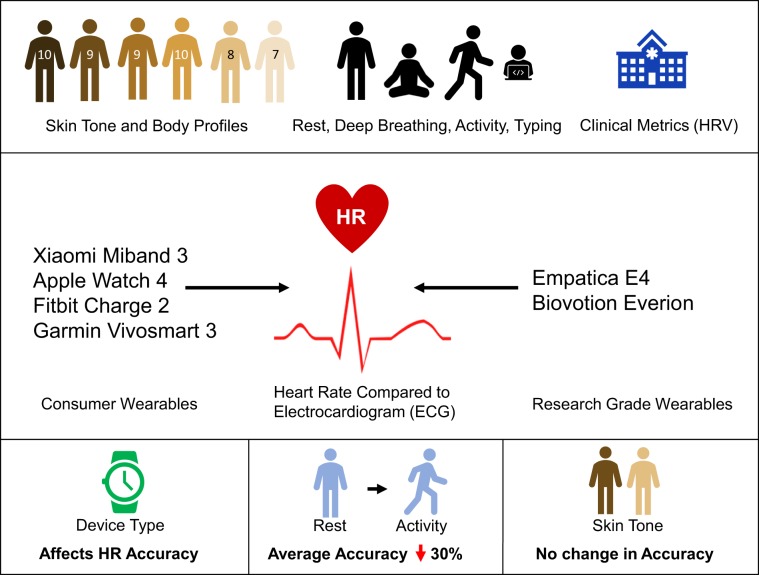
This study tested six wearable optical heart-rate devices in 53 participants across the full Fitzpatrick skin-tone scale, using ECG as the reference standard. The main drivers of error were device type and activity condition, not skin tone.
## Key findings
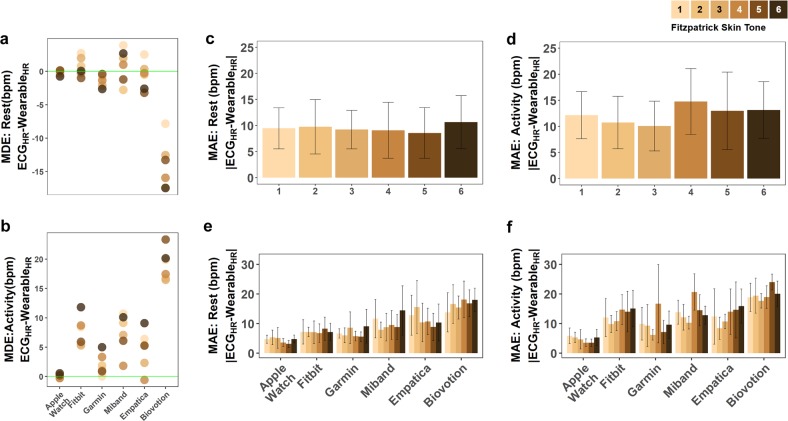
- Across all devices, there was no statistically significant difference in heart-rate accuracy across skin tones; the authors also report no differences in HRV accuracy between skin-tone groups.
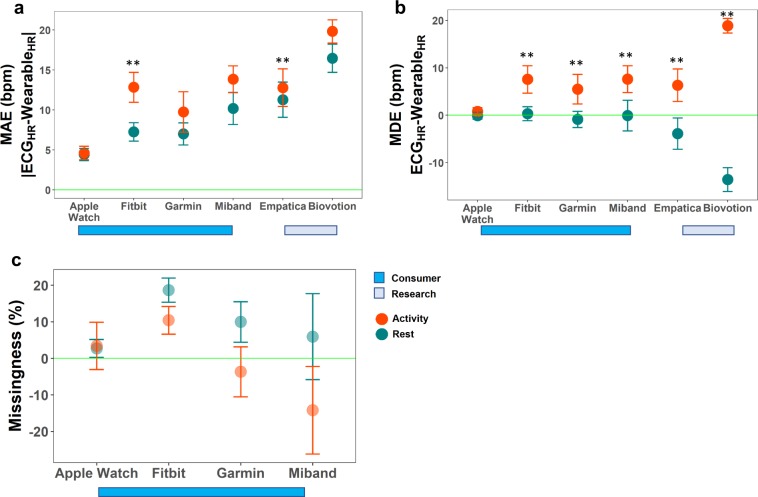
- At rest, consumer-grade wearables were more accurate than research-grade wearables: MAE was 7.2 ± 5.4 bpm vs 13.9 ± 7.8 bpm (p < 0.0125).
- During physical activity, error increased for both categories: MAE was 10.2 ± 7.5 bpm for consumer devices vs 15.9 ± 8.1 bpm for research devices (p < 0.0125); the abstract also states absolute error during activity was 30% higher than during rest.
- Device performance varied substantially: at rest, the Apple Watch 4 had the lowest MAE among consumer devices (4.4 bpm) and the Empatica E4 the lowest among research devices (11.3 bpm); during activity, the Apple Watch 4 remained lowest (4.6 bpm) while the Biovotion Everion was highest among research devices (19.8 bpm).
## Methods
- Design/sample: Observational validation study of 56 recruited participants, with 53 completing the protocol; participants were 18–54 years old, with an approximately equal distribution across six Fitzpatrick skin-tone categories.
- Devices/protocol: Six wearables were tested—4 consumer-grade (Apple Watch 4, Fitbit Charge 2, Garmin Vivosmart 3, Xiaomi Miband 3) and 2 research-grade (Empatica E4, Biovotion Everion)—during rest, deep breathing, walking, washout, and typing, with ECG (Bittium Faros 180) as the reference standard.
- Analysis: The paper compared wearable HR to ECG using MAE, MDE, missingness, and HRV analyses, with mixed-effects models for skin tone, condition, device, and interactions, plus t tests and Bonferroni corrections.
## Limitations
- The authors state that the study had a limited scope of devices, so they could not tease apart the separate effects of cost, market size, and release year.
- For HRV, analysis was limited to only the Empatica E4, because most wearables did not provide the raw data needed for HRV calculations.
- Evident from the text: the protocol was short and structured (about 1 hour of seated rest, deep breathing, walking, and typing), so the findings may not generalize to other activities or longer-term real-world use.
Model-written summary. Check it against the paper before relying on it.
Integrity signals
Registry
Cites
Statistics
Figures
Verification
Claims the paper makes
5 Valid · 4 Not valid · 8 Not checked · 77 Own results and interpretations
Some cited sources support this claim and some don’t — read each source’s verdict below.
In the paper
“Our analyses reinforces the growing body of research demonstrating that wearable devices have higher error during activity than at rest.8,11,35,38,39”
§ Investigating sources of inaccuracy in wearable optical heart rate sensors > Discussion
What the sources say
- Not checked — no full text of the sourcecites [8] Jo, E., Lewis, K., Directo, D., Kim, M. J. & Dolezal, B. A. Validation of biofeedback wearables for photoplethysmographic heart rate tracking. J. Sports Sci. Med.15, 540–547 (2016). PMC4974868 27803634
- Disputedcites [11] Shcherbina A Accuracy in wrist-worn, sensor-based measurements of heart rate and energy expenditure in a diverse cohort J. Pers. Med. 2017 7 3 10.3390/jpm7020003 PMC5491979 28538708 sourceExperimental — accuracy not yet measured
The Results (§3.2; page unavailable) report the opposite for energy expenditure: error was highest while sitting and lower during walking and running. The paper also finds that heart-rate error varies by activity rather than establishing that it is generally higher during activity than at rest (§3.1 and §3.4). (LLM, conf=0.87)
Checked by a reasoning model — may be wrong.
- Partly supportedcites [35] Zhang Y Motion artifact reduction for wrist-worn photoplethysmograph sensors based on different wavelengths Sensors 2019 19 673 10.3390/s19030673 PMC6387309 30736395 sourceExperimental — accuracy not yet measured
The Introduction says motion can distort wrist-worn PPG signals, and Section 4.1 reports a higher peak-to-noise ratio in stationary conditions than in several motion conditions. These passages support the direction of the claim for wrist-worn PPG, but the paper does not establish that wearable devices generally have higher measurement error during activity than at rest. (LLM, conf=0.78)
- Not checked — no full text of the sourcecites [38] Zong, C. & Jafari, R. Robust heart rate estimation using wrist-based PPG signals in the presence of intense physical activities. in 2015 37th Annual International Conference of the IEEE Engineering in Medicine and Biology Society (EMBC) 8078–8082. 10.1109/EMBC.2015.7320268 (IEEE, 2015). 26738168 source
- Could not verifycites [39] Reis VM Are wearable heart rate measurements accurate to estimate aerobic energy cost during low-intensity resistance exercise? PLoS ONE 2019 14 e0221284 10.1371/journal.pone.0221284 31437191 PMC6705857 sourceExperimental — accuracy not yet measured
The Results and Conclusions report estimation errors during low-intensity resistance exercise, but do not compare them with errors at rest. A search for resting measurements and an activity-versus-rest accuracy comparison found no passage addressing that comparison in our copy. (LLM, conf=0.76)
boostedstates an association- Asserted: passes — The authors put it forward as true.
- Checkable: passes — It can be checked against evidence.
- Load-bearing: passes — The paper’s conclusions depend on it.
- Based: passes — The paper gives a reason why it holds.
The cited sources support only part of this claim — read each source’s verdict below.
In the paper
“Several research groups and manufacturers have identified that cyclical motion can affect accuracy of HR in wearable sensors.”
§ Investigating sources of inaccuracy in wearable optical heart rate sensors > Introduction
What the sources say
- Supportedcites [9] Reddy RK Accuracy of wrist-worn activity monitors during common daily physical activities and types of structured exercise: evaluation study JMIR mHealth uHealth 2018 6 e10338 10.2196/10338 30530451 PMC6305876 source
The Results (Heart Rate Accuracy; page not supplied) report significantly different heart-rate errors between activities with and without repetitive upper-torso motion. The Discussion (Principal Findings; page not supplied) likewise says accuracy differed with repetitive wrist motion. These findings support the claim that cyclical motion can affect wearable heart-rate accuracy, without implying that it necessarily worsens it. (LLM, conf=0.91)
- Supportedcites [10] Sartor F Wrist-worn optical and chest strap heart rate comparison in a heterogeneous sample of healthy individuals and in coronary artery disease patients BMC Sports Sci. Med. Rehabil. 2018 10 10 10.1186/s13102-018-0098-0 29881626 PMC5984393 source
The Background explains that motion artifacts distort the PPG signal used by wearable heart-rate monitors and that filtering them is especially challenging during periodic motion. This supports the claim that cyclical motion can affect heart-rate accuracy. (LLM, conf=0.91)
- Not matchedcites [15] Apple Support. Get the most accurate measurements using your Apple Watch—Apple Support. https://support.apple.com/en-us/HT207941#heartrate (2019).
Its entry has no title and year that we can search by.
plainstates a possible cause- Asserted: passes — The authors put it forward as true.
- Checkable: passes — It can be checked against evidence.
- Load-bearing: passes — The paper’s conclusions depend on it.
- Based: passes — The paper gives a reason why it holds.
- Supported
The cited sources support only part of this claim — read each source’s verdict below.
In the paper
“Several studies have demonstrated that HR measurements from wearable devices are often less accurate during physical activity or cyclic wrist motions.”
§ Investigating sources of inaccuracy in wearable optical heart rate sensors > Introduction
What the sources say
- Not checked — no full text of the sourcecites [8] Jo, E., Lewis, K., Directo, D., Kim, M. J. & Dolezal, B. A. Validation of biofeedback wearables for photoplethysmographic heart rate tracking. J. Sports Sci. Med.15, 540–547 (2016). PMC4974868 27803634
- Partly supportedcites [11] Shcherbina A Accuracy in wrist-worn, sensor-based measurements of heart rate and energy expenditure in a diverse cohort J. Pers. Med. 2017 7 3 10.3390/jpm7020003 PMC5491979 28538708 sourceExperimental — accuracy not yet measured
The Discussion reports higher heart-rate error at higher intensity within each activity, and Results §3.1 reports more error during walking than cycling. But the paper does not assess cyclic wrist motions, and its Conclusions say heart-rate measurements were within an acceptable error range in most activity settings; it does not support a general claim that physical activity makes them less accurate. (LLM, conf=0.84)
- Supportedcites [35] Zhang Y Motion artifact reduction for wrist-worn photoplethysmograph sensors based on different wavelengths Sensors 2019 19 673 10.3390/s19030673 PMC6387309 30736395 source
The Introduction states that motions during ambulatory monitoring can distort wrist-worn PPG signals and that motion artifacts can overlap the heart-rate signal. The Results and Discussion assess heart-rate estimation error during motion, supporting the claim that wearable heart-rate measurements can be less accurate during activity or wrist motion. (LLM, conf=0.90)
- Not checked — no full text of the sourcecites [38] Zong, C. & Jafari, R. Robust heart rate estimation using wrist-based PPG signals in the presence of intense physical activities. in 2015 37th Annual International Conference of the IEEE Engineering in Medicine and Biology Society (EMBC) 8078–8082. 10.1109/EMBC.2015.7320268 (IEEE, 2015). 26738168 source
- Partly supportedcites [39] Reis VM Are wearable heart rate measurements accurate to estimate aerobic energy cost during low-intensity resistance exercise? PLoS ONE 2019 14 e0221284 10.1371/journal.pone.0221284 31437191 PMC6705857 sourceExperimental — accuracy not yet measured
The Discussion reports that some wearable HR devices had errors above 10% when used to predict energy cost during higher-intensity resistance exercise, while this study found errors below 10% at low intensity. That supports a narrower, activity-dependent concern about energy-cost estimates, not the claim that HR measurements themselves are often less accurate during physical activity; the paper does not address cyclic wrist motions. Our copy provides no page numbers for these passages. (LLM, conf=0.82)
boostedstates an association- Asserted: passes — The authors put it forward as true.
- Checkable: passes — It can be checked against evidence.
- Load-bearing: passes — The paper’s conclusions depend on it.
- Based: passes — The paper gives a reason why it holds.
The cited sources support only part of this claim — read each source’s verdict below.
In the paper
“previous research demonstrated that inaccurate PPG HR measurements occur up to 15% more frequently in dark skin as compared to light skin”
§ Investigating sources of inaccuracy in wearable optical heart rate sensors > Introduction
What the sources say
- Not checked — no full text of the sourcecites [23] Zonios G Bykowski J Kollias N Skin melanin, hemoglobin, and light scattering properties can be quantitatively assessed in vivo using diffuse reflectance spectroscopy J. Invest. Dermatol. 2001 117 1452 1457 10.1046/j.0022-202x.2001.01577.x 11886508 source
- Could not verifycites [24] Tseng S-H Grant A Durkin AJ In vivo determination of skin near-infrared optical properties using diffuse optical spectroscopy J. Biomed. Opt. 2008 13 014016 10.1117/1.2829772 18315374 PMC2626348 sourceExperimental — accuracy not yet measured
Our copy of Tseng et al. (2008) is entirely about building a superficial diffusing DOS probe and recovering absorption/reduced-scattering coefficients of volar forearm and palm skin in 15 subjects (Introduction, Results Sec. 4, Conclusion); no passage mentions photoplethysmography, pulse/heart rate measurement, or any accuracy/error rate, and no 15% figure of that kind appears (searched: PPG/pulse rate/heart rate accuracy, pulse oximetry, introduction/motivation). The closest content is mechanistic background — Results Sec. 4 (Fig. 4a) that melanin absorption in dark skin reduces the probe's interrogation depth so hemoglobin features 'are not apparent,' and Sec. 4 (Fig. 5a) that dark-skinned subjects' absorption is ~5x Caucasian at 650 nm — which explains why light-based signals are weaker in dark skin but does not state the attributed quantitative claim about inaccurate PPG HR measurements. The paper also names no other work as the source of such a PPG error statistic, so misattribution cannot be established either. (LLM, conf=0.72)
- Not checked — no full text of the sourcecites [25] Fallow BA Tarumi T Tanaka H Influence of skin type and wavelength on light wave reflectance J. Clin. Monit. Comput. 2013 27 313 317 10.1007/s10877-013-9436-7 23397431 source
- Could not verifycites [26] Treesirichod A Chansakulporn S Wattanapan P Correlation between skin color evaluation by skin color scale chart and narrowband reflectance spectrophotometer Indian J. Dermatol. 2014 59 339 342 10.4103/0019-5154.135476 25071249 PMC4103266 sourceExperimental — accuracy not yet measured
The Introduction states that the study compares a skin-color chart with a narrowband reflectance spectrophotometer, and the Methods describe skin-color measurements with a Mexameter MX18. Searches for PPG heart-rate accuracy, dark-versus-light-skin error rates, and 15% found no passage addressing the cited claim. No page numbers were available in our copy. (LLM, conf=0.76)
- Not checked — no full text of the sourcecites [27] Ries AL Prewitt LM Johnson JJ Skin color and ear oximetry Chest 1989 96 287 290 10.1378/chest.96.2.287 2752811 source
- Could not verifycites [28] Lister T Wright PA Chappell PH Optical properties of human skin J. Biomed. Opt. 2012 17 0909011 10.1117/1.JBO.17.9.090901 23085902 sourceExperimental — accuracy not yet measured
Our copy of Lister et al. (2012) is a review of the absorption and scattering coefficients of human skin; it nowhere addresses photoplethysmography, heart-rate measurement, or any 15% error figure (searched: 'photoplethysmography PPG heart rate measurement accuracy dark skin', 'pulse oximetry blood volume pulse measurement error skin type', 'heart rate pulse oximetry photoplethysmogram ... Fitzpatrick'). The closest content is qualitative and mechanistic — Sec. 2.2 (Scattering) notes melanosome volume fraction rising from ~1% in pale to ~5% in darker skin and melanin's variable contribution to epidermal scatter, and Sec. 4.3 (Further Causes of Discrepancy) notes 'darker skin types demonstrating greater absorption across the visible spectrum' (Svaasand et al., only one or two subjects per skin type) — but neither reports PPG measurement accuracy nor the attributed magnitude. Nothing in our copy contradicts the claim; it simply does not cover it, so the 15% figure must come from another source. (LLM, conf=0.72)
- Not checked — no full text of the sourcecites [29] Weiler DT Villajuan SO Edkins L Cleary S Saleem JJ Wearable heart rate monitor technology accuracy in research: a comparative study between PPG and ECG technology Proc. Hum. Factors Ergon. Soc. Annu. Meet. 2017 61 1292 1296 10.1177/1541931213601804 source
- Could not verifycites [30] Nitzan M Romem A Koppel R Pulse oximetry: fundamentals and technology update Med. Devices Evid. Res. 2014 7 231 10.2147/MDER.S47319 PMC4099100 25031547 sourceExperimental — accuracy not yet measured
The 'Pulse oximetry – the technique' section says melanin can absorb light used in PPG, but it does not compare measurement accuracy by skin tone. The accuracy section concerns oxygen-saturation measurements, not PPG heart-rate errors. Searches for skin pigmentation, heart rate, and 15% found no passage supporting the claimed difference. (LLM, conf=0.76)
- Partly supportedcites [31] Yan, L., Hu, S., Alzahrani, A., Alharbi, S. & Blanos, P. A Multi-wavelength opto-electronic patch sensor to effectively detect physiological changes against human skin types. Biosensors7, 22 (2017). PMC5487964 28635643 sourceExperimental — accuracy not yet measured
The Introduction says skin pigmentation can affect PPG signal quality and mentions anecdotal errors of 3–5% in black skin. It does not report that inaccurate PPG heart-rate measurements occur 15% more frequently in dark skin than in light skin. The Discussion reports no significant effect of skin type on heart-rate measurements with the sensor tested (p = 0.09). (LLM, conf=0.87)
boostedstates an association- Asserted: passes — The authors put it forward as true.
- Checkable: passes — It can be checked against evidence.
- Load-bearing: passes — The paper’s conclusions depend on it.
- Based: passes — The paper gives a reason why it holds.
The cited sources that could be checked couldn’t confirm or dispute this claim.
In the paper
“since optical HR measurements primarily measure green light absorption.24,25”
§ Investigating sources of inaccuracy in wearable optical heart rate sensors > Methods > Sample size
What the sources say
- Could not verifycites [24] Tseng S-H Grant A Durkin AJ In vivo determination of skin near-infrared optical properties using diffuse optical spectroscopy J. Biomed. Opt. 2008 13 014016 10.1117/1.2829772 18315374 PMC2626348 sourceExperimental — accuracy not yet measured
Our copy of Tseng et al. (2008) deals exclusively with recovering skin absorption and reduced-scattering coefficients over the 650-1000 nm near-infrared window (Instrumentation, six laser diodes at 661-850 nm; Results, Sec. 4), and never mentions heart rate, pulse, photoplethysmography, or green-light absorption. Searches for 'green light absorption / heart rate / photoplethysmography' and for 'wavelengths shorter than 650 nm / hemoglobin spectral features' returned only the Conclusion's statement that the instrument is being improved so that shorter-than-650 nm wavelengths, with more prominent hemoglobin features, can be acquired - a forward-looking remark about their own DOS system, not a claim about how optical HR measurements work. Nothing in our copy either supports or contradicts the attributed point. (LLM, conf=0.72)
- Not checked — no full text of the sourcecites [25] Fallow BA Tarumi T Tanaka H Influence of skin type and wavelength on light wave reflectance J. Clin. Monit. Comput. 2013 27 313 317 10.1007/s10877-013-9436-7 23397431 source
plain- Asserted: passes — The authors put it forward as true.
- Checkable: passes — It can be checked against evidence.
- Load-bearing: passes — The paper’s conclusions depend on it.
- Based: passes — The paper gives a reason why it holds.
- Could not verify
41 more claims
Create a free account to see all 94 claims and to verify the 3 references still open.
- It may state two separate claims as one. 34
- Probably not a substantial claim. 17
Claims other papers make about this one
Each is checked against this paper’s own text: does it say what the citing paper says it does?
The cited source doesn’t support the claim as written.
In the citing paper
“too few people with the darkest skin tones were included (n = 9 in FST Type 6)”
From Response To: Investigating sources of inaccuracy in wearable optical heart rate sensors (2021) · cites this paper as [1]
Checked by a reasoning model — may be wrong.
Experimental — accuracy not yet measuredThe cited source doesn’t support the claim as written.
In the citing paper
“A power analysis conducted prior to data collection indicated that a minimum of 52 participants would be needed to detect a medium effect size (f2(v) = 0.20) in a MANOVA with two groups and two dependent variables (absolute and directional error), assuming α = 0.05 and power (1 − β) = 0.80 [23].”
From PPG-Based Heart Rate Accuracy in Hispanic Adults with Fitzpatrick III–V Skin Tones: An Evaluation of Body Composition and Skin-Tone Effects (2026) · cites this paper as [23]
Checked by a reasoning model — may be wrong.
Experimental — accuracy not yet measuredThe source backs part of the claim, not all of it — or backs it for a different population, condition or comparison.
In the citing paper
“there are only a small handful of studies that examine skin tone and accuracy rates directly1–3,11”
From Response To: Investigating sources of inaccuracy in wearable optical heart rate sensors (2021) · cites this paper as [1]
Experimental — accuracy not yet measuredThe source backs part of the claim, not all of it — or backs it for a different population, condition or comparison.
In the citing paper
“Bent et al. (2020) reported that PPG devices showed error rates exceeding 20% during cycling and resistance exercise in individuals with higher pigmentation, while maintaining <10% error at rest, underscoring the importance of activity context [5].”
From Photoplethysmography in Diverse Skin Tones: Evaluating Bias in Smartwatch Health Monitoring (2025) · cites this paper as [5]
Experimental — accuracy not yet measuredThe source backs part of the claim, not all of it — or backs it for a different population, condition or comparison.
In the citing paper
“failing to correct for these errors exacerbates existing healthcare disparities [10,23,24,25,26]”
From PPG-Based Heart Rate Accuracy in Hispanic Adults with Fitzpatrick III–V Skin Tones: An Evaluation of Body Composition and Skin-Tone Effects (2026) · cites this paper as [23]
Experimental — accuracy not yet measured
43 more claims about this paper
Create a free account to see every claim other papers make about this one.
Citations
Cites
An overview of heart rate variability metrics and norms
Shaffer, F., & Ginsberg, J. P. (2017) · Frontiers in Public Health · doi:10.3389/fpubh.2017.00258 · Cited by 7,185 · cited 1×
“In addition to HR, we examined HR variability (HRV), a clinically relevant diagnostic metric that can be derived from PPG signals and is a widely used metric of autonomic nervous system function.(43) The standard HRV metrics we examined, included the time-domain metrics, included mean HRV, minimum HRV, maximum HRV, RM…”
MethodThe validity and practicality of sun-reactive skin types I through VI
Fitzpatrick, T. B. (1988) · Archives of Dermatology · doi:10.1001/archderm.1988.01670060015008 · Cited by 4,339
Ghamari, M. (2018) · International Journal of Biosensors & Bioelectronics · doi:10.15406/ijbsbe.2018.04.00125 · Cited by 945 · cited 1×
“Another suspected measurement error in wrist-worn devices is motion artifact, which is typically caused by displacement of the PPG sensor over the skin, changes in skin deformation, blood flow dynamics, and ambient temperature.(33,34) Motion artifacts may manifest as missing or false beats which result in incorrect HR…”
BackgroundWearable photoplethysmographic sensors—past and present
Tamura, T., Maeda, Y., Sekine, M., & Yoshida, M. (2014) · Electronics · doi:10.3390/electronics3020282 · Cited by 912
Shcherbina, A., Mattsson, C., Waggott, D., Salisbury, H., Christle, J., Hastie, T., Wheeler, M., & Ashley, E. (2017) · Journal of Personalized Medicine · doi:10.3390/jpm7020003 · Cited by 625 · cited 2×
“Our analyses reinforces the growing body of research demonstrating that wearable devices have higher error during activity than at rest.(8,11,35,38,39) We further demonstrate that the directionality of the HR error is dependent on the activity type.”
BackgroundResultGoldsack, J. C., Coravos, A., Bakker, J. P., Bent, B., Dowling, A. V., Fitzer-Attas, C., Godfrey, A., Godino, J. G., Gujar, N., Izmailova, E., et al. (2020) · npj Digital Medicine · doi:10.1038/s41746-020-0260-4 · Cited by 557
Self-citationZonios, G., Bykowski, J., & Kollias, N. (2001) · Journal of Investigative Dermatology · doi:10.1046/j.0022-202x.2001.01577.x · Cited by 477
Optical properties of human skin
Lister, T., Wright, P. A., & Chappell, P. H. (2012) · Journal of Biomedical Optics · doi:10.1117/1.jbo.17.9.090901 · Cited by 467
Pulse oximetry: fundamentals and technology update
Nitzan, M., Romem, A., & Koppel, R. (2014) · Medical Devices: Evidence and Research · doi:10.2147/mder.s47319 · Cited by 438
Effects of skin pigmentation on pulse oximeter accuracy at low saturation
Bickler, P. E., Feiner, J. R., & Severinghaus, J. W. (2005) · Anesthesiology · doi:10.1097/00000542-200504000-00004 · Cited by 427
Research works printed but not linked: 1
- Hugh et al. Consumer-Grade Wrist-worn Ppg Sensors Can Be Used to Detect Differences in Heart Rate Variability among A Heterogenous Prediabetic Population (IEEE International Conference on Biomedical and Health Informatics, 2018).
Cited by
Items 401–500 of 661
Fingertip Strain Plethysmography: Representation of Pulse Information based on Vascular Vibration
Shokouhmand, A., Ayazi, F., & Ebadi, N. (2023) · Annual International Conference of the IEEE Engineering in Medicine and Biology Society (EMBC) · doi:10.1109/embc40787.2023.10340340 · Cited by 4
“It has been demonstrated that dark skin color and motion artifacts could impose significant noise in PPG recordings [6].”
BackgroundExploring the Hidden Complexity: Entropy Analysis in Pulse Oximetry of Female Athletes
Cabanas, A. M., Fuentes‐Guajardo, M., Saez, N. V., Catalán, D. D., Caiconte, P. C., & Martín-Escudero, P. (2024) · Biosensors · doi:10.3390/bios14010052 · Cited by 5
“Factors such as motion artifacts—brought on by the increased movement of the subject—or physiological changes like fluctuations in peripheral blood flow can significantly distort the readings [52].”
BackgroundSupervised Image Decomposition for Human Heart Rate Measurement Under Low-Light Environments
Wang, H., & Zhang, S. (2024) · IEEE Sensors Journal · doi:10.1109/jsen.2024.3355167 · Cited by 4
“Traditional heart rate measurement methods require the subject to wear specific measuring equipment (electronic sphygmomanometer, stethoscope, heart rate meter, etc.) [2], [3].”
BackgroundWiebe, M., MacKay, M., Krishnan, R., Tian, J., Larsson, J., Modanloo, S., McIntosh, C. J., Sztym, M., Elton-Smith, G., Rose, A., et al. (2024) · PLOS Digital Health · doi:10.1371/journal.pdig.0000571 · Cited by 7
“The drawback of consumer-grade biosensors is that sensor accuracy is often unknown and cannot be assumed clinical grade [25].”
BackgroundQuantifying Missingness in Wearable Heart Rate Recordings
Collins, T., Woolley, S. I., Oniani, S., et al. (2021) · Studies in health technology and informatics · doi:10.3233/shti210352 · Cited by 4
Föll, S., Lison, A., Maritsch, M., Klingberg, K., Lehmann, V. F., Züger, T., Srivastava, D., Jegerlehner, S. N., Feuerriegel, S., Fleisch, E., et al. (2022) · JMIR Formative Research · doi:10.2196/35717 · Cited by 6
Heart Snapshot: a broadly validated smartphone measure of VO 2 max for collection of real world dataPreprint
Webster, D. E., Tummalacherla, M., Higgins, M., Wing, D., Ashley, E. A., Kelly, V. E., McConnell, M. V., Muse, E. D., Olgin, J., Mangravite, L. M., et al. (2020) · bioRxiv (Cold Spring Harbor Laboratory) · doi:10.1101/2020.07.02.185314 · Cited by 4
Hamid, T., Flores, P., Byun, J., Courtney, E. C., Quinn, K. C., & Watson, A. (2025) · Proceedings of the ACM on Interactive Mobile Wearable and Ubiquitous Technologies · doi:10.1145/3729474 · Cited by 4
The Effect of Tattoos on Heart Rate Validity in the Polar Verity Sense Commercial Wearable Device
Navalta, J. W., Perez, O. R., Mejia, R., & Bunn, J. A. (2025) · Sensors · doi:10.3390/s25226896 · Cited by 3
“Wearable device manufacturers including Apple, Garmin, and Biovotion, have acknowledged various factors that may affect the heart rate readings, and one factor is the presence of arm tattoos [40].”
Multi-sensor wearables re-shaping care of chronic heart-failure: A narrative review
Elechi, U. S., Udoh, K., Orobator, E. T., Demola, M. B., Tarawallie, M. A., & Lawal, O. P. (2025) · The Indian Journal of Medical Research · doi:10.25259/ijmr_1617_2025 · Cited by 4
“Optical heart-rate sensing via photoplethysmography also shows device-and context-dependent accuracy with skin-tone considerations, reinforcing the value of multi-wavelength hardware and transparent validation by Fitzpatrick type 30 .”
Baumgart, J. K., Coyle-Asbil, H. J., Kebede, M., Otterbein, M., Mancini, M., Beauchamp, M., Pfeiffer, K. A., Milton, K. E., Ginis, K. M., Helbostad, J. L., et al. (2026) · Journal for the Measurement of Physical Behaviour · doi:10.1123/jmpb.2026-0021 · Cited by 3
Salas-Monedero, M., Lozano-Berrio, V., Cazorla-Martínez, M.-J., Ceruelo-Abajo, S., Gil-Agudo, A. M., Hernández-Sánchez, S., Díaz, J. F. J., & Reyes-Guzmán, A. D. L. (2022) · Bioengineering · doi:10.3390/bioengineering9120763 · Cited by 3
The development of stretchable and self-repairing materials applied to electronic skin
Li, M., Miao, C., Zou, M., Guo, J., Wang, H., Gao, M., Zhang, H., & Deng, Z. (2023) · Frontiers in Chemistry · doi:10.3389/fchem.2023.1198067 · Cited by 3
“Frontiers in Chemistry frontiersin.org01 TYPE Mini Review PUBLISHED 28 April 2023 DOI 10.3389/fchem.2023.1198067 the development of stretchable and skin like electronic products (Shcherbina et al., 2017; Etiwy et al., 2019; Bent et al., 2020).”
BackgroundInfluentialHeart rate estimation using on-nail wearable photoplethysmography
Mohtadzar, N. A. A., Balaban, E., Beach, C., Taylor, P. S., Horne, R. J., Batchelor, J. C., & Casson, A. J. (2024) · Annual International Conference of the IEEE Engineering in Medicine and Biology Society (EMBC) · doi:10.1109/embc53108.2024.10782437 · Cited by 4
“This is consistent with several studies which also found no statistically significant differences in wearable HR measurement accuracy across skin tones [17], [18], although other studies contradict this, [13], [14].”
Huang, J., Guo, X., Gu, C., Miao, Y., He, S., Shu, Y., & Chen, J. (2025) · Proceedings of the ACM on Interactive Mobile Wearable and Ubiquitous Technologies · doi:10.1145/3712272 · Cited by 4
“Similarly, Photoplethysmography (PPG) sensors are influenced by factors such as body fluids and skin tones due to the elevated melanin levels in darker skin, causing absorption of the laser light and consequently reducing the signal-to-noise ratio of the measurements [24, 25].”
Towards Interval Type-2 Fuzzy-Based PPG Quality Assessment for Physiological Monitoring
Miranda, J., Páez-Montoro, A., López-Ongil, C., & Andreu-Pérez, J. (2022) · IEEE International Conference on Fuzzy Systems (FUZZ-IEEE) · doi:10.1109/fuzz-ieee55066.2022.9882649 · Cited by 3
“For instance, different commercial and researchgrade wearable devices have been compared with respect to their heart rate estimation through PPG sensors in [7].”
BackgroundGoodison, S. E., Barnum, J. D., Vermeer, M., Woods, D., Sitar, S. I., Shelton, S. R., & Jackson, B. A. (2020) · RAND Corporation eBooks · doi:10.7249/rra108-7 · Cited by 3
“Also, different wearable devices have been found to be accurate in some conditions, such as while the user’s heart rate is resting or has been elevated for a prolonged period, but readings deteriorate with changing activity levels (Bent et al., 2020).”
BackgroundWearable photoplethysmography devices
Charlton, P. H., & Marozas, V. (2021) · Elsevier eBooks · doi:10.1016/b978-0-12-823374-0.00011-6 · Cited by 26
“Reassuringly, research to date has found the performance of certain PPG-based wearables not to be affected by skin type [42], [43].”
BackgroundResultCompounding barriers to fairness in the digital technology ecosystem
Woolley, S. I., Collins, T., András, P., Gardner, A., Ortolani, M., & Pitt, J. V. (2021) · IEEE International Symposium on Technology and Society (ISTAS) · doi:10.1109/istas52410.2021.9629166 · Cited by 4
“But despite inaccuracies [23], [24], inclusivity failings [25] and a lack of evaluation reporting in the academic literature [26], the devices do achieve positive and worthwhile health outcomes and insights for many users.”
Modeling Energy Aware Photoplethysmography for Personalized Healthcare Applications
Ownby, N. B., Flynn, K. A., & Calhoun, B. H. (2022) · IEEE Transactions on Biomedical Circuits and Systems · doi:10.1109/tbcas.2022.3197128 · Cited by 3
Deep Canonical Correlation Alignment for Sensor SignalsPreprint
Schütz, N., Botros, A., Single, M., Naef, A. C., Buluschek, P., & Nef, T. (2021) · arXiv (Cornell University) · doi:10.48550/arxiv.2106.03637 · Cited by 4
“With the increase in sensor data, one particular issue that is becoming more apparent, is accurate temporal alignment [12, 13, 14, 15].”
BackgroundHurwitz, E. G., Butzin-Dozier, Z., Master, H., O’Neil, S. T., Walden, A., Holko, M., Patel, R. C., & Haendel, M. A. (2023) · medRxiv · doi:10.1101/2023.10.13.23296965 · Cited by 3
Pal, R., Rudas, Á., Kim, S. S., et al. (2024) · medRxiv · doi:10.1101/2024.03.14.24304307 · Cited by 3
Leng, Y., Cavaillès, C., Peltz, C. B., O’Bryant, S. E., Redline, S. S., & Yaffe, K. S. (2024) · medRxiv · doi:10.1101/2024.10.23.24315996 · Cited by 3
Pluščiauskaitė, V., Sološenko, A., Jančiulevičiūtė, K., Marozas, V., Sörnmo, L., & Petrėnas, A. (2024) · Physiological Measurement · doi:10.1088/1361-6579/ad79b3 · Cited by 4
“Commonly, the mean absolute percentage error of the estimated HR from a PPG is 5%–20% (Bent et al 2020, Düking et al 2020, Germini et al 2022).”
Feng, K. Y., Short, S. A., Saeb, S., Carroll, M. K., Olivier, C. B., Simard, E. P., Swope, S., Williams, D., Eckstrand, J., Pagidipati, N. J., et al. (2024) · Journal of Medical Internet Research · doi:10.2196/60493 · Cited by 4
“Despite their high accuracy in measuring HR at rest and the ubiquity of these devices in modern life, an in-clinic ECG is still the gold standard method to determine RHR [18].”
Villegas‐Downs, M., Peters, T. A., Matthews, J., Fink, A. M., Matthews, A. K., Schlaeger, J. M., Han, A., O’Brien, W. D., Briller, J. E., Yeo, W., et al. (2025) · Journal of Midwifery & Women s Health · doi:10.1111/jmwh.13743 · Cited by 2
“42 In our study, the PPG signal was evaluated for adequacy, and the results were comparable to the self-reported SpO 2 measures.”
InfluentialPredicting post-VR game experiences with wearable physiological sensors
Huang, W., Gao, J., & Chen, X. (2025) · Entertainment Computing · doi:10.1016/j.entcom.2025.100977 · Cited by 2
Hegarty‐Craver, M., Womack, D. S., Thornburg, J. W., Boe, T., Archer, M. J., & Calfee, M. W. (2025) · JMIR Formative Research · doi:10.2196/72324 · Cited by 2
“The original algorithm was developed using HR data from a Polar chest strap which, if worn correctly, is more accurate than HR data from a smartwatch [16].”
InfluentialArtificial intelligence in wearable biosensing: Enhancing data analysis and decision-making
Ding, Z., Fang, W., Zhang, J., Fang, C., & Sun, Y. (2025) · Progress in molecular biology and translational science · doi:10.1016/bs.pmbts.2025.06.012 · Cited by 6
Branan, K. L., Kurian, R., McMurray, J. P., Erraguntla, M., Gutiérrez‐Osuna, R., & Coté, G. L. (2025) · Biosensors · doi:10.3390/bios15080493 · Cited by 4
“However, according to several studies, skin tone variation or an increase in the amount of epidermal melanin does not play a significant effect on the HR accuracy for PPG-green [31,32].”
A Laplace diffusion-based transformer model for heart rate forecasting within daily activity context
Mateescu, A., Hadarau, I., Anghel, I. M., Cioara, T., Anchidin, O., & Nemes, A. (2025) · Machine Learning with Applications · doi:10.1016/j.mlwa.2025.100746 · Cited by 5
Kitagaki, K., Hongo, Y., Futai, R., Hasegawa, T., Morikawa, H., & Shimoyama, H. (2025) · JMIR Cardio · doi:10.2196/77911 · Cited by 5
“…correlation coefficients 0.5) [25], increased forearm muscle contraction to stabilize the handlebars (which can reduce blood flow and introduce signal artifacts) [26,27], reduced contact between the PPG sensor and the skin [28], measurement latency [29], and motion artifacts themselves [30].”
InfluentialHäusler, E., Kremser, W., Huber, F., & Hornung–Prähauser, V. (2025) · European Journal of Innovation Management · doi:10.1108/ejim-02-2025-0181 · Cited by 3
Singh, J., Wilkins, G. C., Manginas, A., Chishti, S., Fiori, F., Sharma, G. D., Shetty, J., & Santosh, P. (2025) · Sensors · doi:10.3390/s25216697 · Cited by 3
Yu, H., Saffaran, S., Tonelli, R., Laffey, J. G., Zhang, Q., Esquinas, A. M., de Lima, L. M., Kawano-Dourado, L. B., Maia, I. S., Cavalcanti, A. B., et al. (2025) · Critical Care · doi:10.1186/s13054-025-05765-1 · Cited by 6
“Novel wearable optical heart rate sensors have also been reported to produce significant errors [17].”
Li, W., Feng, J., Feng, G., & Feng, S. (2026) · Microchimica Acta · doi:10.1007/s00604-025-07792-9 · Cited by 4
“Conversely, SpO 2 monitoring remains a notable limitation, as consumer-grade wearables often display poor agreement with medical-grade devices, particularly under hypoxic conditions [ 131, 132].”
Is artificial intelligence a friend or foe to epidemiology?
Rashidi, E., Brooks, M. M., Hassoon, A., Mehta, S., Althoff, K., & Alexander, G. C. (2026) · Annals of Epidemiology · doi:10.1016/j.annepidem.2026.01.003 · Cited by 4
Wearanize+ : a multimodal dataset for evaluating wearable technologies in sleep research
Sikder, N., Verkaar, L., Paltarzhytskaya, A., Acan, S., Bovy, L., Almazova, T., Krugliakova, E., Rosenblum, Y., Krauledat, M., Dresler, M., et al. (2025) · SLEEP Advances · doi:10.1093/sleepadvances/zpaf094 · Cited by 7
The research progress of wearable digital health technologies in epilepsy management
Zhao, X., & Wang, T. (2026) · Acta Epileptologica · doi:10.1186/s42494-026-00247-5 · Cited by 2
“One of the key challenges is the quality of recorded data [58, 59].”
Kostrna, J., Oparina, E., Palacios, C., Rodriguez, A. J., Pei, J., Ajmal, A., & Ramella-Roman, J. C. (2026) · Sensors · doi:10.3390/s26102922 · Cited by 5
“As wearable devices become central to health monitoring, failing to correct for these errors exacerbates existing healthcare disparities [10,23–26].”
InfluentialAI for science: Progress, challenges, and perspectives
Xu, Y., Shao, Z., Liu, X., Li, Y., An, Z., Fu, C., Huang, C., Zhang, L., Gao, F., Li, J., et al. (2026) · The Innovation · doi:10.1016/j.xinn.2026.101530 · Cited by 16
Contact Force Estimation from Raw Photoplethysmogram Signal
Fortin, P. E., Blum, J. R., Weill–Duflos, A., & Cooperstock, J. R. (2020) · Proceedings of IEEE Sensors/Proceedings of IEEE Sensors ... · doi:10.1109/sensors47125.2020.9278658 · Cited by 2
“, skin color, body fat, and skin hairiness [7] has an effect on raw PPG traces.”
BackgroundÇİĞDEM, M., & Şahin, S. (2022) · Journal of International Health Sciences and Management · doi:10.48121/jihsam.903224 · Cited by 3
Model-based detection and classification of premature contractions from photoplethysmography signals
Regis, M., Eerikäinen, L. M., Haakma, R., van den Heuvel, E. R., & Serra, P. (2023) · Journal of the Royal Statistical Society Series C (Applied Statistics) · doi:10.1093/jrsssc/qlad066 · Cited by 4
Díaz–González, C. D. L. M., Pérez-Bello, C., la Rosa-Hormiga, M. D., González, J. J., & Reyes-Noha, M. D. L. M. (2024) · Healthcare · doi:10.3390/healthcare12090940 · Cited by 5
Procházková, H., Šplíchal, M., & Chlebek, J. (2024) · New Trends in Civil Aviation (NTCA) · doi:10.23919/ntca60572.2024.10517829 · Cited by 2
Lee, J., Kim, S.-U., & Kim, J. (2024) · Sensors · doi:10.3390/s24113395 · Cited by 2
WristSense framework: Exploring the forensic potential of wrist-wear devices through case studies
Almubairik, N. A., Khan, F. A., Mohammad, R. M. A., & Alshahrani, M. (2025) · Forensic Science International Digital Investigation · doi:10.1016/j.fsidi.2025.301862 · Cited by 3
Real-Time Forecasting from Wearable-Monitored Heart Rate Data Through Autoregressive Models
Sabbata, G. D., & Simonini, G. (2025) · Journal of Healthcare Informatics Research · doi:10.1007/s41666-025-00191-y · Cited by 3
“Real-time processing is a critical requirement for modern applications, particularly in fields such as wearable sensor data analysis [20].”
Investigation and Validation of New Heart Rate Measurement Sites for Wearable Technologies
Ma’touq, J., AlSaaideh, I., Hatahet, O., & Pott, P. P. (2025) · Sensors · doi:10.3390/s25072069 · Cited by 2
“This finding has been reported previously for different wearable applications [33].”
Metcalf, O., Lamb, K. E., Forbes, D., O'Donnell, M. L., Qian, T., Varker, T., Cowlishaw, S., & Zaloumis, S. G. (2025) · European Journal of Psychotraumatology · doi:10.1080/20008066.2025.2472485 · Cited by 2
“The measures of HRV are available across all consumer-grade wearables, and although there are some variations (Bent et al., 2020), they require no pre-processing, meaning more feasible translation of the models to widespread use and adoption.”
MAHADEVASWAMY, G., SIVANATHAN, G., RAJAGOPAL, S., ANGAMUTHU, G., & Venkatesh, D. N. (2025) · International Journal of Applied Pharmaceutics · doi:10.22159/ijap.2025v17i3.53457 · Cited by 3
“Bent et al. applied deep learning models to data from wearable sensors to prove the capabilities of tracking early signs of viral infection, including COVID-19 [31].”
Ternarized TCN for $\mu \mathrm{J}/\text{Inference}$ Gesture Recognition from DVS Event Frames
Rutishauser, G., Scherer, M., Fischer, T., & Benini, L. (2022) · Design, Automation, and Test in Europe · doi:10.23919/date54114.2022.9774592 · Cited by 6
Wearable Technologies for Cardiac Monitoring
Drummond, C. K., Hsu, J. J., Phelan, D. M. J., Dhruv Seshadri, R., & Emery, M. S. (2022) · Elsevier eBooks · doi:10.1016/b978-0-12-816861-5.00008-3 · Cited by 3
Digital Health Data, a Way to Take Under Control the Quality During the Elaboration Processes
Bellandi, V., D’Andrea, G., Maghool, S., & Siccardi, S. (2022) · International Conference on Signal-Image Technology & Internet-Based Systems (SITIS) · doi:10.1109/sitis57111.2022.00015 · Cited by 2
“Heart rate data was prepared considering as examples the data [6] described in [7], found in the PhysioNet data bank ( [10]), which is suitable for our research aim.”
BackgroundMethodDevelopment and Calibration of a PATCH Device for Monitoring Children’s Heart Rate and Acceleration
Armstrong, B., Weaver, R. G., McAninch, J., Smith, M. T., Parker, H., Lane, A. D., Wang, Y., PATE, R. R., Rahman, M., Matolak, D. W., et al. (2024) · Medicine & Science in Sports & Exercise · doi:10.1249/mss.0000000000003404 · Cited by 2
Measurement of Human Stress: A Multidimensional ApproachPreprint
Dorsey, A. F., Scherer, E. M., Eckhoff, R., et al. (2020) · doi:10.31234/osf.io/es2p9 · Cited by 2
Brunoni, A. R., Ekhtiari, H., Antal, A., Auvichayapat, P., Baeken, C., Benseñor, I. M., Bikson, M., Boggio, P. S., Borroni, B., Brighina, F., et al. (2022) · SSRN Electronic Journal · doi:10.1101/2022.03.03.22271837 · Cited by 2
Heiden, E., Jones, T., Maczka, A. B., et al. (2022) · doi:10.2196/preprints.36340 · Cited by 2
Feasibility of Using an Armband Optical Heart Rate Sensor in Naturalistic EnvironmentPreprint
Yu, H., Kotlyar, M., Dufresne, S. R., et al. (2022) · bioRxiv (Cold Spring Harbor Laboratory) · doi:10.1101/2022.10.03.510715 · Cited by 2
Han, W., Cai, H., Lu, J., et al. (2023) · Research Square · doi:10.21203/rs.3.rs-3176190/v1 · Cited by 2
Khodr, R., Kamal, L., Minerbi, A., & Gupta, G. (2024) · medRxiv · doi:10.1101/2024.01.04.24300784 · Cited by 3
“PPG-based technologies have historically been prone to errors, in part through motion artifacts and variability in skin complexion (Allen, 2007; Bent et al., 2020; Butler et al., 2016; Sañudo et al., 2019).”
BackgroundMonitoring Long-term Cardiac Activity with Contactless Radio Frequency SignalsPreprint
Chen, Y., Zhang, B.-B., Zhang, D., Li, Y., Lu, Z. P., Chen, J., Wang, H., Zhou, F., Pu, Y., Hu, Y., et al. (2024) · Research Square · doi:10.21203/rs.3.rs-4456442/v1 · Cited by 2
Sinichi, M., Gevonden, M. J., & Krabbendam, L. (2024) · The Journal of Open Source Software · doi:10.21105/joss.06240 · Cited by 2
Vaccarino, V., She, H., Elon, L., Lewis, T. T., Ko, Y., Clifford, G. D., Li, Q., Murrah, N. V., Shallenberger, L. H., Roberts, T., et al. (2026) · Journal of the American Heart Association · doi:10.21203/rs.3.rs-7418040/v1 · Cited by 3
“54 Study staff applied the device on the chest with two electrode patches at the end of the clinic visit and instructed participants to wear it continuously for 7 consecutive days.”
He, H., Christensen, J. H., Sørensen, A. J. M., & Konvalinka, I. (2025) · bioRxiv (Cold Spring Harbor Laboratory) · doi:10.64898/2025.12.01.691366 · Cited by 2
Vinatzer, H., Rzepka, A., Hayn, D., Ziegl, A., & Schreier, G. (2022) · Annual International Conference of the IEEE Engineering in Medicine and Biology Society (EMBC) · doi:10.1109/embc48229.2022.9871629 · Cited by 1
Assessment of inter-operator Reproducibility of CardioInsight ECG-Imaging
Orini, M., Waddingham, P. H., Dennis, A., Mangual, J. O., Lam, P. D., & Chow", A. W. (2022) · Computing in cardiology · doi:10.22489/cinc.2022.232 · Cited by 2
Physiological sensor data cleaning with autoencoders
Kriara, L., Zanon, M., Lipsmeier, F., & Lindemann, M. (2023) · Physiological Measurement · doi:10.1088/1361-6579/ad10c7 · Cited by 3
The coupling effect between skin strain and blood condition on its reflectance spectrum in-vivo
Huo, Z., Wang, S., Tan, K., Li, L., Li, C., & Wang, Z. (2024) · Optics & Laser Technology · doi:10.1016/j.optlastec.2024.110990 · Cited by 2
Liu, X., Wang, R., & Qin, Z. (2025) · Thermal Science and Engineering Progress · doi:10.1016/j.tsep.2024.103208 · Cited by 1
RetractedDevelopment of deep learning models for motion artifact mitigation in wearable PPG devices
Lee, M., Gao, Y., Wu, J., McIntosh, C., & Franklin, D. (2025) · Biophotonics in Exercise Science, Sports Medicine, Health Monitoring Technologies, and Wearables · doi:10.1117/12.3039622 · Cited by 4
“Certain studies have shown a 30% decrease in heart rate estimation accuracy from wearable devices when subjects were asked to perform simple movements such as walking and typing [3].”
Enhancing dynamic metabolic rate estimation using calibration models for portable devices
Zhang, Y., Feng, X., Zhang, S., Gao, N., Fang, Z., & Lin, Z. (2025) · Building and Environment · doi:10.1016/j.buildenv.2025.113128 · Cited by 2
Fan, Y., Zhang, S., Sun, X., Sun, Z., Peng, W. H., Shi, L. S., Gou, B., & Wang, Y. (2025) · Nutrients · doi:10.3390/nu17111886 · Cited by 1
“This geospatial responsiveness distinguishes GPS-enabled platforms from traditional “smart” devices, which rely predominantly on inertial sensors or self-reported data and lack dynamic adaptation to the user’s physical surroundings [51].”
Lyle, N. N., Chanh, H. Q., Van, H. N., Anibal, J., Karolcik, S., Ming, D. K. Y., Thi, G. N., Thanh, H. V. N., Quang, H. N., Hai, H. B., et al. (2025) · PLOS Digital Health · doi:10.1371/journal.pdig.0000924 · Cited by 4
“Since PPG quality can be impacted by skin tone [24] the results of this study may not be generalizable to populations where there are a different mix of skin colors.”
VitalEar: An Earable Heartbeat and Respiratory Rate Monitoring System Under Aerobic Exercises
Zhu, Y., Liang, Z., Zheng, J., Zou, Y., Leung, V. C. M., & Wu, K. (2025) · IEEE Transactions on Mobile Computing · doi:10.1109/tmc.2025.3595178 · Cited by 5
“For example, wristband devices based on PPG exhibit an average error of up to 30% during intense exercise [37].”
Wearable Devices Methodology: Opportunities and Challenges in Human Resource Management
Massaro, S., Yang, T. Y. K., & Christopoulos, G. I. (2025) · Human Resource Management Journal · doi:10.1111/1748-8583.70014 · Cited by 7
Sutanto, D., & So, B. C. L. (2025) · BMC Sports Science Medicine and Rehabilitation · doi:10.1186/s13102-025-01389-8 · Cited by 1
“Recently marketed fitness trackers offer features such as step counts, heart rate monitoring, and calorie expenditure estimates, utilizing proprietary algorithms and optical sensors [13].”
Abdrasulova, N., Aleksanyan, M., Kim, M. J., & Ahn, J. M. (2025) · Sensors · doi:10.3390/s25227091 · Cited by 4
“However, PPG signals exhibit high susceptibility to motion-induced artifacts, baseline drift, and waveform variability, which complicate peak detection and frequency-domain analysis [6,7].”
Fortis, H. O., Cronin, C., Johnson, K. O., Shepherd, S. O., Hackney, A. C., & Strauss, J. A. (2025) · Nutrients · doi:10.3390/nu17233773 · Cited by 3
“Wrist-based optical HR sensors were not permitted due to their lower accuracy during movement [43,44].”
Evaluation of ECG Waveform Accuracy in the CardioBAN Wearable Device: An Initial Analysis
Escrivães, I., Lopes, D., Vilaça, J. L., Varela‐Lema, L., & Morais, P. (2025) · Applied Sciences · doi:10.3390/app152413143 · Cited by 2
Oropesa, P. T., Sánchez-Pay, A., Conesa‐Ros, E., Bianco, A., Ruiz-Navarro, J. J., & Martínez-Cava, A. (2025) · Applied Sciences · doi:10.3390/app16010126 · Cited by 1
Wearable Biosensors and AI Analytics for Continuous Health Monitoring and Early Disease Detection
Mohmmed, H. A. (2024) · Academic International Journal of Engineering Science · doi:10.59675/e225 · Cited by 1
“The main validation sample consisted of 247 respondents comprising of healthy participants, those with cardiovascular disease, diabetes mellitus patients, and chronic respiratory illnesses patients [44].”
Jiao, Y. (2026) · Sensor Review · doi:10.1108/sr-08-2025-0630 · Cited by 2
Guerrero-Blázquez, A., Álvarez-Melcón, Á. C., López-Marcos, J. J., Martín‐Casas, P., Escudero, A. A., & Ortiz-Gutiérrez, R. M. (2026) · Sensors · doi:10.3390/s26030828 · Cited by 1
“Common conditions in children with CP, such as vasoconstriction, increased muscle tone, and fatigue, may negatively affect the optical signal of PPG sensors, thereby reducing measurement quality [27].”
Procházková, H., & Juračka, J. (2026) · Transportation research procedia · doi:10.1016/j.trpro.2026.01.012 · Cited by 2
Wang, Z., Hu, Y., Hu, Q., & Bai, D. (2026) · IEEE Transactions on Consumer Electronics · doi:10.1109/tce.2026.3673947 · Cited by 1
“For example, Bent et al. developed a multi-modal wearable platform that combined PPG, Accelerometry and Temperature Sensors to improve the accuracy of predicting stress and Metabolic Expenditure (ME) [5].”
Industry perspective: Wearable electronic devices for remote patient monitoring
Nightingale, A., & Bird, G. (2026) · APL Electronic Devices · doi:10.1063/5.0317022 · Cited by 3
Penguin: General Vital Sign Reconstruction from PPG with Flow Matching State Space Model
Suzuki, S., Koyama, S., Hirano, S., & Nagashima, S. (2026) · IEEE International Conference on Acoustics Speech and Signal Processing · doi:10.1109/icassp55912.2026.11463201 · Cited by 3
Advanced ambulatory and continuous sensing technologies for cardiovascular connected healthcare
Ke, Y., Li, J., Li, T., Xu, W., Ni, D., Ye, X., Li, Z., Yang, F., & Wang, Z. L. (2026) · Nano Energy · doi:10.1016/j.nanoen.2026.112011 · Cited by 2
Huang, T., Yuan, Z., Ran, W., & Shen, G. (2026) · Science China Materials · doi:10.1007/s40843-026-4069-0 · Cited by 4
“To effectively address these issues, researchers have systematically examined three aforementioned factors affect PPG accuracy and found that, in contrast to motion artifacts, skin-tone and individual differences have minimal influence on clinical metrics like heart rate [107].”
Alshehri, B., Aljhani, N., Albalawi, A., Abdulghani, W., Alfawzan, T., & Alkhodair, A. J. (2026) · Future Internet · doi:10.3390/fi18060293 · Cited by 4
Lepley, A. S., Davis, F., Melvin, A. C., & Zhao, Z.-Y. (2026) · Sensors · doi:10.3390/s26144486 · Cited by 2
“The accuracy of PPG-derived cardiovascular metrics also declines when signal quality is degraded by motion artifact, poor device fit, or skin-device interference from tattoos, hair, or individual differences in skin tone [21].”
Body fat, skin tone, and the accuracy of smartwatch caloric expenditure estimates
Kostrna, J. R., Oparina, E., Palacios, C. S., Rodriguez, A. J., Pei, J., Ajmal, A., & Ramella‐Roman, J. C. (2026) · PLoS ONE · doi:10.1371/journal.pone.0353261 · Cited by 3
“Errors in these estimates can mislead individuals attempting to lose weight, distort clinical recommendations, undermine exercise prescriptions, provide inaccurate information for healthcare decisions, and compromise the validity of population-level research [3,4].”
InfluentialAssessing the agreement and reliability of Magene ® for heart rate monitoring
Rodrigues, M. A. D. M., da Silva, T. D., Santos, J. T., de Oliveira, V. N., Marques, N. E., de Freitas, J. V. R., Andrade, M. R., Vancini, R. L., Knechtle, B., Weiss, K., et al. (2026) · Proceedings of the Institution of Mechanical Engineers Part H Journal of Engineering in Medicine · doi:10.1177/09544119261477973 · Cited by 1
Magal, M., Franklin, B. A., Dwyer, G. B., & Riebe, D. A. (2023) · ACSMʼs Health & Fitness Journal · doi:10.1249/fit.0000000000000847 · Cited by 1
Heart Rate Extraction from Abdominal Audio Signals
Stuchbury-Wass, J., Bondareva, E., Butkow, K.-J., Šćepanović, S., Radivojević, Z., & Mascolo, C. (2023) · IEEE International Conference on Acoustics Speech and Signal Processing · doi:10.1109/icassp49357.2023.10096600 · Cited by 2
“[18].”
BackgroundTecnologias aplicadas ao monitoramento de parâmetros fisiológicos na produção de ruminantes
Conceição, A. R., Coeli, A. C., Braga, P. H. S., Oliveira, P. D. C. S., & Schultz, É. B. (2023) · Revista Agraria Academica · doi:10.32406/v6n2/2023/27-37/agrariacad · Cited by 2
The emerging role of wearables in cardiac care
Sigfstead, S., & Cheung, C. C. (2023) · University of Toronto Medical Journal · doi:10.33137/utmj.v100i2.41461 · Cited by 2
Metadata
- Authors
- Bent, B., Goldstein, B. A., Kibbe, W. A., & Dunn, J. P.
- Affiliations
- Duke University (US)
- Corresponding author
- Dunn, Jessilyn P.
- Venue
- npj Digital Medicine
- Published
- 2020-02-10
- Volume
- 3
- Issue
- 1
- Pages
- 18-18
- ISSN
- 2398-6352 (ISSN-L)
- PMC
- PMC7010823
- OpenAlex
- W3005348902
- Cited by
- 673
- References
- 37
- Citations by year
- 2026: 127 · 2025: 114 · 2024: 111 · 2023: 98 · 2022: 114 · 2021: 85 · 2020: 24
- FWCI
- 25.20
- Type
- journal article
- Language
- en
- Open access
- gold
- doi.org
- Licence
- cc-by
- creativecommons.org/licenses/by/4.0 (tdm)
- creativecommons.org/licenses/by/4.0 (vor)
- Locations
- npj Digital Medicine (publishedVersion, cc-by)
- PubMed Central (publishedVersion, cc-by)
- PubMed (publishedVersion)
- DOAJ (DOAJ: Directory of Open Access Journals) (submittedVersion, cc-by-sa)
- Funders
- Duke FORGE Fellowship
- Topics
- Physical Sciences › Engineering › Biomedical Engineering › Non-Invasive Vital Sign Monitoring
- Health Sciences › Medicine › Cardiology and Cardiovascular Medicine › Heart Rate Variability and Autonomic Control
- Health Sciences › Medicine › Physiology (medical) › Cardiovascular and exercise physiology
- Keywords
- wearable devices, heart rate monitoring, photoplethysmography, measurement accuracy, skin tone, motion artifacts, device comparison, physical activity
About these checks
Registry, retraction, Cites and statistics results are computed, not judged, with one exception: a printed reference that no index lists is read once by a model before it counts as a citation error. Claims are extracted by a model and kept only when their quote appears verbatim in the text; each cited source is then checked, with a model’s help, for whether it says what the claim relies on. Those verdicts can be wrong — read the claim’s quote and the cited source before relying on one.
The claim verdicts this report counts are experimental: their accuracy is not yet measured.
A language model drew the claims from the paper on 2026-10-10, under version 3 of the claim definition (model deepseek-v4.1-flash, prompt extract-v3).
A second model labelled each claim on 2026-10-10 (model jev-1.13-20260917, definition revision gold-guideline-v0.2).
Cited sources are checked with a language model’s help (gpt-6-sol and qwen3.8-omni-flash).
Statistics and arithmetic are recomputed, not judged.
Confidence bands are shown only for fields calibrated on our annotated test set. None is calibrated yet, so no band is shown.
What counts as a claim ›How we measure confidence ›How we check this ›
Are you an author, or do you see a problem with this page? Request a review
Data sources
Bibliographic data: Semantic Scholar, OpenAlex, Crossref.
Contains information from the Semantic Scholar Academic Graph Datasets, made available under the ODC Attribution License (ODC-BY 1.0).
Semantic Scholar’s data is described in: Kinney, R., et al. (2023). The Semantic Scholar Open Data Platform. arXiv:2301.10140.
