

Investigating sources of inaccuracy in wearable optical heart rate sensors
Open accessThe DOI matches its Crossref record; 37 of the 37 references it cites were found in a registry or an index; 19 of the 50 sources its claims cite were checked for support.
Abstract
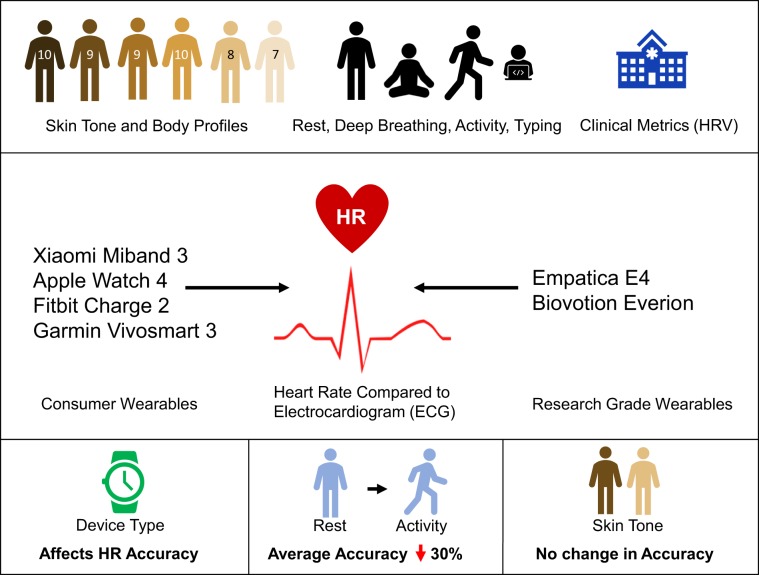
As wearable technologies are being increasingly used for clinical research and healthcare, it is critical to understand their accuracy and determine how measurement errors may affect research conclusions and impact healthcare decision-making. Accuracy of wearable technologies has been a hotly debated topic in both the research and popular science literature. Currently, wearable technology companies are responsible for assessing and reporting the accuracy of their products, but little information about the evaluation method is made publicly available. Heart rate measurements from wearables are derived from photoplethysmography (PPG), an optical method for measuring changes in blood volume under the skin. Potential inaccuracies in PPG stem from three major areas, includes (1) diverse skin types, (2) motion artifacts, and (3) signal crossover. To date, no study has systematically explored the accuracy of wearables across the full range of skin tones. Here, we explored heart rate and PPG data from consumer- and research-grade wearables under multiple circumstances to test whether and to what extent these inaccuracies exist. We saw no statistically significant difference in accuracy across skin tones, but we saw significant differences between devices, and between activity types, notably, that absolute error during activity was, on average, 30% higher than during rest. Our conclusions indicate that different wearables are all reasonably accurate at resting and prolonged elevated heart rate, but that differences exist between devices in responding to changes in activity. This has implications for researchers, clinicians, and consumers in drawing study conclusions, combining study results, and making health-related decisions using these devices.
Overview
CoChat Summary
## TL;DR
This study tested six wearable optical heart-rate devices in 53 participants across the full Fitzpatrick skin-tone scale, using ECG as the reference standard. The main drivers of error were device type and activity condition, not skin tone.
## Key findings
- Across all devices, there was no statistically significant difference in heart-rate accuracy across skin tones; the authors also report no differences in HRV accuracy between skin-tone groups.
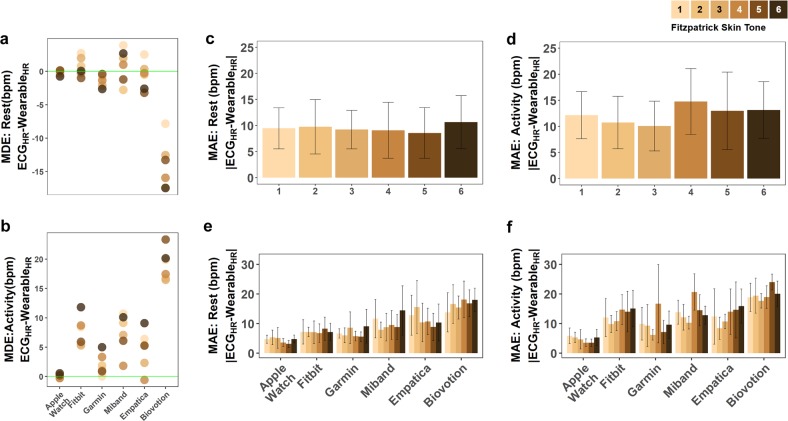
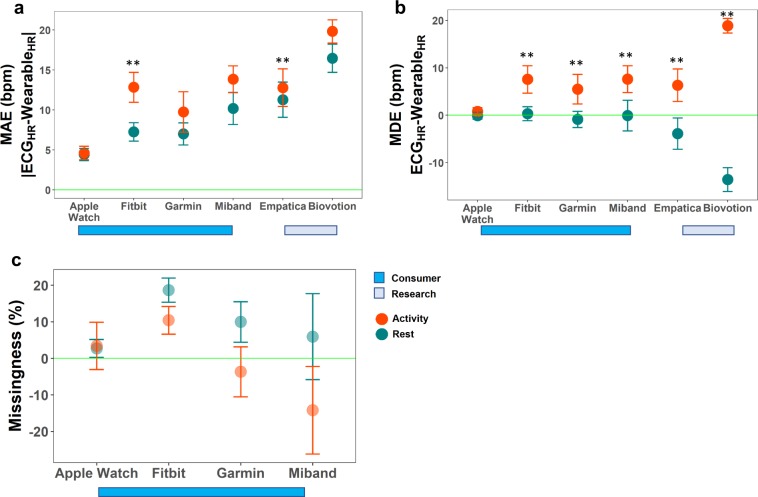
- At rest, consumer-grade wearables were more accurate than research-grade wearables: MAE was 7.2 ± 5.4 bpm vs 13.9 ± 7.8 bpm (p < 0.0125).
- During physical activity, error increased for both categories: MAE was 10.2 ± 7.5 bpm for consumer devices vs 15.9 ± 8.1 bpm for research devices (p < 0.0125); the abstract also states absolute error during activity was 30% higher than during rest.
- Device performance varied substantially: at rest, the Apple Watch 4 had the lowest MAE among consumer devices (4.4 bpm) and the Empatica E4 the lowest among research devices (11.3 bpm); during activity, the Apple Watch 4 remained lowest (4.6 bpm) while the Biovotion Everion was highest among research devices (19.8 bpm).
## Methods
- Design/sample: Observational validation study of 56 recruited participants, with 53 completing the protocol; participants were 18–54 years old, with an approximately equal distribution across six Fitzpatrick skin-tone categories.
- Devices/protocol: Six wearables were tested—4 consumer-grade (Apple Watch 4, Fitbit Charge 2, Garmin Vivosmart 3, Xiaomi Miband 3) and 2 research-grade (Empatica E4, Biovotion Everion)—during rest, deep breathing, walking, washout, and typing, with ECG (Bittium Faros 180) as the reference standard.
- Analysis: The paper compared wearable HR to ECG using MAE, MDE, missingness, and HRV analyses, with mixed-effects models for skin tone, condition, device, and interactions, plus t tests and Bonferroni corrections.
## Limitations
- The authors state that the study had a limited scope of devices, so they could not tease apart the separate effects of cost, market size, and release year.
- For HRV, analysis was limited to only the Empatica E4, because most wearables did not provide the raw data needed for HRV calculations.
- Evident from the text: the protocol was short and structured (about 1 hour of seated rest, deep breathing, walking, and typing), so the findings may not generalize to other activities or longer-term real-world use.
Model-written summary. Check it against the paper before relying on it.
Integrity signals
Registry
Cites
Statistics
Figures
Verification
Claims the paper makes
5 Valid · 4 Not valid · 8 Not checked · 77 Own results and interpretations
Some cited sources support this claim and some don’t — read each source’s verdict below.
In the paper
“Our analyses reinforces the growing body of research demonstrating that wearable devices have higher error during activity than at rest.8,11,35,38,39”
§ Investigating sources of inaccuracy in wearable optical heart rate sensors > Discussion
What the sources say
- Not checked — no full text of the sourcecites [8] Jo, E., Lewis, K., Directo, D., Kim, M. J. & Dolezal, B. A. Validation of biofeedback wearables for photoplethysmographic heart rate tracking. J. Sports Sci. Med.15, 540–547 (2016). PMC4974868 27803634
- Disputedcites [11] Shcherbina A Accuracy in wrist-worn, sensor-based measurements of heart rate and energy expenditure in a diverse cohort J. Pers. Med. 2017 7 3 10.3390/jpm7020003 PMC5491979 28538708 sourceExperimental — accuracy not yet measured
The Results (§3.2; page unavailable) report the opposite for energy expenditure: error was highest while sitting and lower during walking and running. The paper also finds that heart-rate error varies by activity rather than establishing that it is generally higher during activity than at rest (§3.1 and §3.4). (LLM, conf=0.87)
Checked by a reasoning model — may be wrong.
- Partly supportedcites [35] Zhang Y Motion artifact reduction for wrist-worn photoplethysmograph sensors based on different wavelengths Sensors 2019 19 673 10.3390/s19030673 PMC6387309 30736395 sourceExperimental — accuracy not yet measured
The Introduction says motion can distort wrist-worn PPG signals, and Section 4.1 reports a higher peak-to-noise ratio in stationary conditions than in several motion conditions. These passages support the direction of the claim for wrist-worn PPG, but the paper does not establish that wearable devices generally have higher measurement error during activity than at rest. (LLM, conf=0.78)
- Not checked — no full text of the sourcecites [38] Zong, C. & Jafari, R. Robust heart rate estimation using wrist-based PPG signals in the presence of intense physical activities. in 2015 37th Annual International Conference of the IEEE Engineering in Medicine and Biology Society (EMBC) 8078–8082. 10.1109/EMBC.2015.7320268 (IEEE, 2015). 26738168 source
- Could not verifycites [39] Reis VM Are wearable heart rate measurements accurate to estimate aerobic energy cost during low-intensity resistance exercise? PLoS ONE 2019 14 e0221284 10.1371/journal.pone.0221284 31437191 PMC6705857 sourceExperimental — accuracy not yet measured
The Results and Conclusions report estimation errors during low-intensity resistance exercise, but do not compare them with errors at rest. A search for resting measurements and an activity-versus-rest accuracy comparison found no passage addressing that comparison in our copy. (LLM, conf=0.76)
boostedstates an association- Asserted: passes — The authors put it forward as true.
- Checkable: passes — It can be checked against evidence.
- Load-bearing: passes — The paper’s conclusions depend on it.
- Based: passes — The paper gives a reason why it holds.
The cited sources support only part of this claim — read each source’s verdict below.
In the paper
“Several research groups and manufacturers have identified that cyclical motion can affect accuracy of HR in wearable sensors.”
§ Investigating sources of inaccuracy in wearable optical heart rate sensors > Introduction
What the sources say
- Supportedcites [9] Reddy RK Accuracy of wrist-worn activity monitors during common daily physical activities and types of structured exercise: evaluation study JMIR mHealth uHealth 2018 6 e10338 10.2196/10338 30530451 PMC6305876 source
The Results (Heart Rate Accuracy; page not supplied) report significantly different heart-rate errors between activities with and without repetitive upper-torso motion. The Discussion (Principal Findings; page not supplied) likewise says accuracy differed with repetitive wrist motion. These findings support the claim that cyclical motion can affect wearable heart-rate accuracy, without implying that it necessarily worsens it. (LLM, conf=0.91)
- Supportedcites [10] Sartor F Wrist-worn optical and chest strap heart rate comparison in a heterogeneous sample of healthy individuals and in coronary artery disease patients BMC Sports Sci. Med. Rehabil. 2018 10 10 10.1186/s13102-018-0098-0 29881626 PMC5984393 source
The Background explains that motion artifacts distort the PPG signal used by wearable heart-rate monitors and that filtering them is especially challenging during periodic motion. This supports the claim that cyclical motion can affect heart-rate accuracy. (LLM, conf=0.91)
- Not matchedcites [15] Apple Support. Get the most accurate measurements using your Apple Watch—Apple Support. https://support.apple.com/en-us/HT207941#heartrate (2019).
Its entry has no title and year that we can search by.
plainstates a possible cause- Asserted: passes — The authors put it forward as true.
- Checkable: passes — It can be checked against evidence.
- Load-bearing: passes — The paper’s conclusions depend on it.
- Based: passes — The paper gives a reason why it holds.
- Supported
The cited sources support only part of this claim — read each source’s verdict below.
In the paper
“Several studies have demonstrated that HR measurements from wearable devices are often less accurate during physical activity or cyclic wrist motions.”
§ Investigating sources of inaccuracy in wearable optical heart rate sensors > Introduction
What the sources say
- Not checked — no full text of the sourcecites [8] Jo, E., Lewis, K., Directo, D., Kim, M. J. & Dolezal, B. A. Validation of biofeedback wearables for photoplethysmographic heart rate tracking. J. Sports Sci. Med.15, 540–547 (2016). PMC4974868 27803634
- Partly supportedcites [11] Shcherbina A Accuracy in wrist-worn, sensor-based measurements of heart rate and energy expenditure in a diverse cohort J. Pers. Med. 2017 7 3 10.3390/jpm7020003 PMC5491979 28538708 sourceExperimental — accuracy not yet measured
The Discussion reports higher heart-rate error at higher intensity within each activity, and Results §3.1 reports more error during walking than cycling. But the paper does not assess cyclic wrist motions, and its Conclusions say heart-rate measurements were within an acceptable error range in most activity settings; it does not support a general claim that physical activity makes them less accurate. (LLM, conf=0.84)
- Supportedcites [35] Zhang Y Motion artifact reduction for wrist-worn photoplethysmograph sensors based on different wavelengths Sensors 2019 19 673 10.3390/s19030673 PMC6387309 30736395 source
The Introduction states that motions during ambulatory monitoring can distort wrist-worn PPG signals and that motion artifacts can overlap the heart-rate signal. The Results and Discussion assess heart-rate estimation error during motion, supporting the claim that wearable heart-rate measurements can be less accurate during activity or wrist motion. (LLM, conf=0.90)
- Not checked — no full text of the sourcecites [38] Zong, C. & Jafari, R. Robust heart rate estimation using wrist-based PPG signals in the presence of intense physical activities. in 2015 37th Annual International Conference of the IEEE Engineering in Medicine and Biology Society (EMBC) 8078–8082. 10.1109/EMBC.2015.7320268 (IEEE, 2015). 26738168 source
- Partly supportedcites [39] Reis VM Are wearable heart rate measurements accurate to estimate aerobic energy cost during low-intensity resistance exercise? PLoS ONE 2019 14 e0221284 10.1371/journal.pone.0221284 31437191 PMC6705857 sourceExperimental — accuracy not yet measured
The Discussion reports that some wearable HR devices had errors above 10% when used to predict energy cost during higher-intensity resistance exercise, while this study found errors below 10% at low intensity. That supports a narrower, activity-dependent concern about energy-cost estimates, not the claim that HR measurements themselves are often less accurate during physical activity; the paper does not address cyclic wrist motions. Our copy provides no page numbers for these passages. (LLM, conf=0.82)
boostedstates an association- Asserted: passes — The authors put it forward as true.
- Checkable: passes — It can be checked against evidence.
- Load-bearing: passes — The paper’s conclusions depend on it.
- Based: passes — The paper gives a reason why it holds.
The cited sources support only part of this claim — read each source’s verdict below.
In the paper
“previous research demonstrated that inaccurate PPG HR measurements occur up to 15% more frequently in dark skin as compared to light skin”
§ Investigating sources of inaccuracy in wearable optical heart rate sensors > Introduction
What the sources say
- Not checked — no full text of the sourcecites [23] Zonios G Bykowski J Kollias N Skin melanin, hemoglobin, and light scattering properties can be quantitatively assessed in vivo using diffuse reflectance spectroscopy J. Invest. Dermatol. 2001 117 1452 1457 10.1046/j.0022-202x.2001.01577.x 11886508 source
- Could not verifycites [24] Tseng S-H Grant A Durkin AJ In vivo determination of skin near-infrared optical properties using diffuse optical spectroscopy J. Biomed. Opt. 2008 13 014016 10.1117/1.2829772 18315374 PMC2626348 sourceExperimental — accuracy not yet measured
Our copy of Tseng et al. (2008) is entirely about building a superficial diffusing DOS probe and recovering absorption/reduced-scattering coefficients of volar forearm and palm skin in 15 subjects (Introduction, Results Sec. 4, Conclusion); no passage mentions photoplethysmography, pulse/heart rate measurement, or any accuracy/error rate, and no 15% figure of that kind appears (searched: PPG/pulse rate/heart rate accuracy, pulse oximetry, introduction/motivation). The closest content is mechanistic background — Results Sec. 4 (Fig. 4a) that melanin absorption in dark skin reduces the probe's interrogation depth so hemoglobin features 'are not apparent,' and Sec. 4 (Fig. 5a) that dark-skinned subjects' absorption is ~5x Caucasian at 650 nm — which explains why light-based signals are weaker in dark skin but does not state the attributed quantitative claim about inaccurate PPG HR measurements. The paper also names no other work as the source of such a PPG error statistic, so misattribution cannot be established either. (LLM, conf=0.72)
- Not checked — no full text of the sourcecites [25] Fallow BA Tarumi T Tanaka H Influence of skin type and wavelength on light wave reflectance J. Clin. Monit. Comput. 2013 27 313 317 10.1007/s10877-013-9436-7 23397431 source
- Could not verifycites [26] Treesirichod A Chansakulporn S Wattanapan P Correlation between skin color evaluation by skin color scale chart and narrowband reflectance spectrophotometer Indian J. Dermatol. 2014 59 339 342 10.4103/0019-5154.135476 25071249 PMC4103266 sourceExperimental — accuracy not yet measured
The Introduction states that the study compares a skin-color chart with a narrowband reflectance spectrophotometer, and the Methods describe skin-color measurements with a Mexameter MX18. Searches for PPG heart-rate accuracy, dark-versus-light-skin error rates, and 15% found no passage addressing the cited claim. No page numbers were available in our copy. (LLM, conf=0.76)
- Not checked — no full text of the sourcecites [27] Ries AL Prewitt LM Johnson JJ Skin color and ear oximetry Chest 1989 96 287 290 10.1378/chest.96.2.287 2752811 source
- Could not verifycites [28] Lister T Wright PA Chappell PH Optical properties of human skin J. Biomed. Opt. 2012 17 0909011 10.1117/1.JBO.17.9.090901 23085902 sourceExperimental — accuracy not yet measured
Our copy of Lister et al. (2012) is a review of the absorption and scattering coefficients of human skin; it nowhere addresses photoplethysmography, heart-rate measurement, or any 15% error figure (searched: 'photoplethysmography PPG heart rate measurement accuracy dark skin', 'pulse oximetry blood volume pulse measurement error skin type', 'heart rate pulse oximetry photoplethysmogram ... Fitzpatrick'). The closest content is qualitative and mechanistic — Sec. 2.2 (Scattering) notes melanosome volume fraction rising from ~1% in pale to ~5% in darker skin and melanin's variable contribution to epidermal scatter, and Sec. 4.3 (Further Causes of Discrepancy) notes 'darker skin types demonstrating greater absorption across the visible spectrum' (Svaasand et al., only one or two subjects per skin type) — but neither reports PPG measurement accuracy nor the attributed magnitude. Nothing in our copy contradicts the claim; it simply does not cover it, so the 15% figure must come from another source. (LLM, conf=0.72)
- Not checked — no full text of the sourcecites [29] Weiler DT Villajuan SO Edkins L Cleary S Saleem JJ Wearable heart rate monitor technology accuracy in research: a comparative study between PPG and ECG technology Proc. Hum. Factors Ergon. Soc. Annu. Meet. 2017 61 1292 1296 10.1177/1541931213601804 source
- Could not verifycites [30] Nitzan M Romem A Koppel R Pulse oximetry: fundamentals and technology update Med. Devices Evid. Res. 2014 7 231 10.2147/MDER.S47319 PMC4099100 25031547 sourceExperimental — accuracy not yet measured
The 'Pulse oximetry – the technique' section says melanin can absorb light used in PPG, but it does not compare measurement accuracy by skin tone. The accuracy section concerns oxygen-saturation measurements, not PPG heart-rate errors. Searches for skin pigmentation, heart rate, and 15% found no passage supporting the claimed difference. (LLM, conf=0.76)
- Partly supportedcites [31] Yan, L., Hu, S., Alzahrani, A., Alharbi, S. & Blanos, P. A Multi-wavelength opto-electronic patch sensor to effectively detect physiological changes against human skin types. Biosensors7, 22 (2017). PMC5487964 28635643 sourceExperimental — accuracy not yet measured
The Introduction says skin pigmentation can affect PPG signal quality and mentions anecdotal errors of 3–5% in black skin. It does not report that inaccurate PPG heart-rate measurements occur 15% more frequently in dark skin than in light skin. The Discussion reports no significant effect of skin type on heart-rate measurements with the sensor tested (p = 0.09). (LLM, conf=0.87)
boostedstates an association- Asserted: passes — The authors put it forward as true.
- Checkable: passes — It can be checked against evidence.
- Load-bearing: passes — The paper’s conclusions depend on it.
- Based: passes — The paper gives a reason why it holds.
The cited sources that could be checked couldn’t confirm or dispute this claim.
In the paper
“since optical HR measurements primarily measure green light absorption.24,25”
§ Investigating sources of inaccuracy in wearable optical heart rate sensors > Methods > Sample size
What the sources say
- Could not verifycites [24] Tseng S-H Grant A Durkin AJ In vivo determination of skin near-infrared optical properties using diffuse optical spectroscopy J. Biomed. Opt. 2008 13 014016 10.1117/1.2829772 18315374 PMC2626348 sourceExperimental — accuracy not yet measured
Our copy of Tseng et al. (2008) deals exclusively with recovering skin absorption and reduced-scattering coefficients over the 650-1000 nm near-infrared window (Instrumentation, six laser diodes at 661-850 nm; Results, Sec. 4), and never mentions heart rate, pulse, photoplethysmography, or green-light absorption. Searches for 'green light absorption / heart rate / photoplethysmography' and for 'wavelengths shorter than 650 nm / hemoglobin spectral features' returned only the Conclusion's statement that the instrument is being improved so that shorter-than-650 nm wavelengths, with more prominent hemoglobin features, can be acquired - a forward-looking remark about their own DOS system, not a claim about how optical HR measurements work. Nothing in our copy either supports or contradicts the attributed point. (LLM, conf=0.72)
- Not checked — no full text of the sourcecites [25] Fallow BA Tarumi T Tanaka H Influence of skin type and wavelength on light wave reflectance J. Clin. Monit. Comput. 2013 27 313 317 10.1007/s10877-013-9436-7 23397431 source
plain- Asserted: passes — The authors put it forward as true.
- Checkable: passes — It can be checked against evidence.
- Load-bearing: passes — The paper’s conclusions depend on it.
- Based: passes — The paper gives a reason why it holds.
- Could not verify
41 more claims
Create a free account to see all 94 claims and to verify the 3 references still open.
- It may state two separate claims as one. 34
- Probably not a substantial claim. 17
Claims other papers make about this one
Each is checked against this paper’s own text: does it say what the citing paper says it does?
The cited source doesn’t support the claim as written.
In the citing paper
“too few people with the darkest skin tones were included (n = 9 in FST Type 6)”
From Response To: Investigating sources of inaccuracy in wearable optical heart rate sensors (2021) · cites this paper as [1]
Checked by a reasoning model — may be wrong.
Experimental — accuracy not yet measuredThe cited source doesn’t support the claim as written.
In the citing paper
“A power analysis conducted prior to data collection indicated that a minimum of 52 participants would be needed to detect a medium effect size (f2(v) = 0.20) in a MANOVA with two groups and two dependent variables (absolute and directional error), assuming α = 0.05 and power (1 − β) = 0.80 [23].”
From PPG-Based Heart Rate Accuracy in Hispanic Adults with Fitzpatrick III–V Skin Tones: An Evaluation of Body Composition and Skin-Tone Effects (2026) · cites this paper as [23]
Checked by a reasoning model — may be wrong.
Experimental — accuracy not yet measuredThe source backs part of the claim, not all of it — or backs it for a different population, condition or comparison.
In the citing paper
“there are only a small handful of studies that examine skin tone and accuracy rates directly1–3,11”
From Response To: Investigating sources of inaccuracy in wearable optical heart rate sensors (2021) · cites this paper as [1]
Experimental — accuracy not yet measuredThe source backs part of the claim, not all of it — or backs it for a different population, condition or comparison.
In the citing paper
“Bent et al. (2020) reported that PPG devices showed error rates exceeding 20% during cycling and resistance exercise in individuals with higher pigmentation, while maintaining <10% error at rest, underscoring the importance of activity context [5].”
From Photoplethysmography in Diverse Skin Tones: Evaluating Bias in Smartwatch Health Monitoring (2025) · cites this paper as [5]
Experimental — accuracy not yet measuredThe source backs part of the claim, not all of it — or backs it for a different population, condition or comparison.
In the citing paper
“failing to correct for these errors exacerbates existing healthcare disparities [10,23,24,25,26]”
From PPG-Based Heart Rate Accuracy in Hispanic Adults with Fitzpatrick III–V Skin Tones: An Evaluation of Body Composition and Skin-Tone Effects (2026) · cites this paper as [23]
Experimental — accuracy not yet measured
43 more claims about this paper
Create a free account to see every claim other papers make about this one.
Citations
Cites
An overview of heart rate variability metrics and norms
Shaffer, F., & Ginsberg, J. P. (2017) · Frontiers in Public Health · doi:10.3389/fpubh.2017.00258 · Cited by 7,185 · cited 1×
“In addition to HR, we examined HR variability (HRV), a clinically relevant diagnostic metric that can be derived from PPG signals and is a widely used metric of autonomic nervous system function.(43) The standard HRV metrics we examined, included the time-domain metrics, included mean HRV, minimum HRV, maximum HRV, RM…”
MethodThe validity and practicality of sun-reactive skin types I through VI
Fitzpatrick, T. B. (1988) · Archives of Dermatology · doi:10.1001/archderm.1988.01670060015008 · Cited by 4,339
Ghamari, M. (2018) · International Journal of Biosensors & Bioelectronics · doi:10.15406/ijbsbe.2018.04.00125 · Cited by 945 · cited 1×
“Another suspected measurement error in wrist-worn devices is motion artifact, which is typically caused by displacement of the PPG sensor over the skin, changes in skin deformation, blood flow dynamics, and ambient temperature.(33,34) Motion artifacts may manifest as missing or false beats which result in incorrect HR…”
BackgroundWearable photoplethysmographic sensors—past and present
Tamura, T., Maeda, Y., Sekine, M., & Yoshida, M. (2014) · Electronics · doi:10.3390/electronics3020282 · Cited by 912
Shcherbina, A., Mattsson, C., Waggott, D., Salisbury, H., Christle, J., Hastie, T., Wheeler, M., & Ashley, E. (2017) · Journal of Personalized Medicine · doi:10.3390/jpm7020003 · Cited by 625 · cited 2×
“Our analyses reinforces the growing body of research demonstrating that wearable devices have higher error during activity than at rest.(8,11,35,38,39) We further demonstrate that the directionality of the HR error is dependent on the activity type.”
BackgroundResultGoldsack, J. C., Coravos, A., Bakker, J. P., Bent, B., Dowling, A. V., Fitzer-Attas, C., Godfrey, A., Godino, J. G., Gujar, N., Izmailova, E., et al. (2020) · npj Digital Medicine · doi:10.1038/s41746-020-0260-4 · Cited by 557
Self-citationZonios, G., Bykowski, J., & Kollias, N. (2001) · Journal of Investigative Dermatology · doi:10.1046/j.0022-202x.2001.01577.x · Cited by 477
Optical properties of human skin
Lister, T., Wright, P. A., & Chappell, P. H. (2012) · Journal of Biomedical Optics · doi:10.1117/1.jbo.17.9.090901 · Cited by 467
Pulse oximetry: fundamentals and technology update
Nitzan, M., Romem, A., & Koppel, R. (2014) · Medical Devices: Evidence and Research · doi:10.2147/mder.s47319 · Cited by 438
Effects of skin pigmentation on pulse oximeter accuracy at low saturation
Bickler, P. E., Feiner, J. R., & Severinghaus, J. W. (2005) · Anesthesiology · doi:10.1097/00000542-200504000-00004 · Cited by 427
Research works printed but not linked: 1
- Hugh et al. Consumer-Grade Wrist-worn Ppg Sensors Can Be Used to Detect Differences in Heart Rate Variability among A Heterogenous Prediabetic Population (IEEE International Conference on Biomedical and Health Informatics, 2018).
Cited by
Items 301–400 of 661
Steinberg, N., Moshe-Cohen, R., Sheena, L., & Kivity, Y. (2024) · Current Psychology · doi:10.1007/s12144-023-04963-w · Cited by 8
“It is not yet clear to what extent the psychophysiological recording is influenced by activity level, activity type and skin tone (Bent et al., 2020).”
Snoozing: an examination of a common method of waking
Mattingly, S. M., Martinez, G. J., Young, J., Cain, M. K., & Striegel, A. (2022) · SLEEP · doi:10.1093/sleep/zsac184 · Cited by 10
“This pattern is true for the Garmin vivoSmart 3, which is comparable to other commercial and research grade HR sensors, and has been shown to not meaningfully differ from ECG at rest (though a significant difference of ~10% during physical activity was noted) [46].”
MethodRatitch, B., Kunkoski, E., Fontanari, A., Onorati, F., Dabral, A., Rodriguez-Chavez, I. R., Vandendriessche, B., Vega, J., Morton, S., & Damestani, Y. (2022) · Digital Biomarkers · doi:10.1159/000525897 · Cited by 10
Cloud Computing to Enable Wearable-Driven Longitudinal Hemodynamic Maps
Tanade, C., Rakestraw, E., Ladd, W., Draeger, E. W., & Randles, A. P. (2023) · International Conference for High Performance Computing, Networking, Storage and Analysis (SC) · doi:10.1145/3581784.3607101 · Cited by 12
“Common approaches, such as the parareal algorithm [26], use a predictor-corrector scheme where a serial coarse solver initializes the values over the full time sequence, and a � ne iterator is used to re � ne the initial guesses.”
MethodA Framework for Selecting and Assessing Wearable Sensors Deployed in Safety Critical Scenarios
Houghton, R., Martinetti, A., & Majumdar, A. (2024) · Sensors · doi:10.3390/s24144589 · Cited by 9
A Skin-Tone Insensitive, Fully Integrated Smartwatch for Continuous Blood Pressure Measurement
Huang, C.-Y., Sung, Y., Ni, S.-H., & Wang, T.-W. (2024) · IEEE Transactions on Instrumentation and Measurement · doi:10.1109/tim.2024.3502829 · Cited by 10
“However, variations in skin pigmentation among diverse ethnic groups due to melanin levels can introduce disparities in light penetration depth, potentially resulting in inaccuracies in physiological measurements [16], [31], [32].”
Sriranga, A. K., Lu, Q., & Birrell, S. A. (2025) · IEEE Transactions on Intelligent Transportation Systems · doi:10.1109/tits.2025.3566896 · Cited by 7
Hardon, H. J., Kerkhof, Y. N. V., Bartelds, B., Kammeraad, J. A. E., & van Deutekom, A. W. (2025) · JMIR Formative Research · doi:10.2196/70835 · Cited by 11
“Skin type differentiation (Fitzpatrick I and II, Fitzpatrick III, and Fitzpatrick IV, V, and VI, for CardioWatch only) was included as darker skin is known to influence the optical PPG measurement [24,25].”
Schuller, S., Bergefurt, L., de Kort, Y. A. W., & Appel‐Meulenbroek, R. (2025) · Journal of Environmental Psychology · doi:10.1016/j.jenvp.2025.102642 · Cited by 11
Advancements in Sensor Technology for Monitoring and Management of Chronic Coronary Syndrome
Cricco, R., Segreti, A., Ferro, A., Beato, S., Castaldo, G., Ciancio, M., Sacco, F. M., Pennazza, G., Ussia, G. P., & Grigioni, F. (2025) · Sensors · doi:10.3390/s25154585 · Cited by 11
“Moreover, systematic bias in PPG interpretation has been observed in individuals with darker skin tones, where increased melanin content interferes with optical signal transmission, potentially compromising accuracy [118,119].”
Grosicki, G. J., Carter, J. R., Laursen, P. B., Plews, D. J., Altini, M., Galpin, A. J., Fielding, F., von Hippel, W., Chapman, C., Jasinski, S. R., et al. (2025) · American Journal of Physiology-Heart and Circulatory Physiology · doi:10.1152/ajpheart.00738.2025 · Cited by 12
Khundaqji, H., Hing, W. A., Furness, J. W., & Climstein, M. (2021) · PeerJ · doi:10.7717/peerj.12598 · Cited by 8
Itzhak, S. B., Ricon, S. S., Biton, S. B., Behar, J. A., & Sobel, J. (2022) · Physiological Measurement · doi:10.1088/1361-6579/ac6561 · Cited by 10
A Wearable Bracelet for Simultaneous Monitoring of Transcutaneous Carbon Dioxide and Pulse Rates
Cui, Y., Cao, Q., Zheng, X., et al. (2024) · Advanced Electronic Materials · doi:10.1002/aelm.202300760 · Cited by 7
Dynamic Peripheral Hemoperfusion Distribution Monitoring Based on Janus Flexible Sensor System
Huang, C., He, O., Lao, Z., Liu, H., Leng, Y., Xu, X., Tian, S. T., Wang, Y., Wu, G., Li, R., et al. (2024) · IEEE Transactions on Biomedical Engineering · doi:10.1109/tbme.2024.3381637 · Cited by 7
“Such artifacts are mainly caused by the sensor and skin surface detachment, resulting from skin surface deformation and unconformable contact [34], [35].”
BackgroundDüking, P., Ruf, L., Altmann, S., Thron, M., Kunz, P., & Sperlich, B. (2024) · Journal of Sports Science and Medicine · doi:10.52082/jssm.2024.351 · Cited by 18
“However, players with wrist tattoos were excluded due to potential interference with the smartwatch's optical sensor (Bent et al., 2020).”
BackgroundComparison of physiological and clinical reactions to COVID-19 and influenza vaccination
Yechezkel, M., Qian, G. L., Levi, Y., Davidovitch, N., Shmueli, E., Yamin, D., & Brandeau, M. L. (2024) · Communications Medicine · doi:10.1038/s43856-024-00588-7 · Cited by 9
“Third, the Garmin smartwatches are not medical-grade wearabledevices,althoughpreviousstudieshavedemonstratedtheaccuracyof smartwatchesinmeasuringheartrates 39,40 and our analysis considers relative heart rate values pre-and post-vaccination rather than absolute heart rate values.”
FloHR: Ubiquitous Heart Rate Measurement using Indirect Floor Vibration Sensing
Codling, J., Shulkin, J. D., Chang, Y. C., Zhang, J., Latapie, H. M., Noh, H. Y., Zhang, P., & Dong, Y. (2024) · ACM International Conference on Systems for Energy-Efficient Buildings, Cities, and Transportation (BuildSys) · doi:10.1145/3671127.3698170 · Cited by 14
Consumer Wearables for Patient Monitoring in Otolaryngology: A State of the Art Review
Somani, S. N., Yu, K. M., Chiu, A. G., Sykes, K. J., & Villwock, J. A. (2021) · Otolaryngology · doi:10.1177/01945998211061681 · Cited by 7
“For example, measurement of physiologic parameters reflective of sympathetic stimulation (eg, heart rate, HRV, respiratory rate) should occur only at rest, as these values are highly variable with physical activity.(67,125) Even if consumer wearables are validated for monitoring select populations, health care provide…”
BackgroundBassiouni, M. M., Hegazy, I., Rizk, N. J., El-Dahshan, E.-S. A., & Salem, A.-B. M. (2021) · International Conference on Intelligent Computing and Information Systems (ICICIS) · doi:10.1109/icicis52592.2021.9694241 · Cited by 12
Combination of ECG and PPG Signals for Healthcare Applications: A Survey
Bassiouni, M. M., Hegazy, I., Rizk, N. J., El-Dahshan, S. A., & Salem, A.-B. M. (2021) · Advances in Modelling and Analysis B · doi:10.18280/ama_b.641-409 · Cited by 10
“All these merits of the PPG suffer from the inaccurate estimation of the HR and many other limitations such as the skin tone, different skin types, motion noises, and signal crossovers among others [7].”
BackgroundWhen Work Hits Home: The Cancer-Treatment Journey of a Clinical Scientist Driving Digital Medicine
Izmailova, E. S., & Ellis, R. (2022) · JCO Clinical Cancer Informatics · doi:10.1200/cci.22.00033 · Cited by 7
Lingawi, S., Hutton, J., Khalili, M., Shadgan, B., Christenson, J. M., Grunau, B. E., & Kuo, C. (2024) · Annals of Biomedical Engineering · doi:10.1007/s10439-024-03442-y · Cited by 10
“Most notably, user-specific characteristics such as skin pigmentation or body weight can cause measurement variations that affect the accuracy of PPG signals [157].”
Racial discrepancies in oximetry: where do we stand?
Knight, M., Subbe, C. P., & Inada-Kim, M. (2021) · Anaesthesia · doi:10.1111/anae.15635 · Cited by 8
“Bias The so-called ‘racial bias’ in the realms of physiological monitoring appears not to be limited just to oximetry, with reports that photoplethysmography heart rate measurements are more frequently inaccurate in subjects with darker skin that those with lighter skin [20], with heart rate frequently overestimated i…”
BackgroundElzinga, W. O., Prins, S., Borghans, L. G. J. M., Gal, P., Vargas, G. A., Groeneveld, G. J., & Doll, R. J. (2021) · JMIR Formative Research · doi:10.2196/31890 · Cited by 8
“HR estimates obtained from a wearable device during physical activity may show higher variability and are less accurate than estimates obtained while at rest [10].”
InfluentialSharma, Y., Djambazova, K. V., Marquez, C., Lyden, K. A., Goldsack, J. C., & Bakker, J. P. (2023) · medRxiv · doi:10.1101/2023.05.22.23290371 · Cited by 7
“Despite the widespread adoption of the V3 Framework and the EVIDENCE checklist since publication [6, 7], the quality of reporting for AV is still unclear.”
MethodPhysioKit: Open-source, Low-cost Physiological Computing Toolkit for Single and Multi-user StudiesPreprint
Joshi, J., Wang, K., & Cho, Y. (2023) · Preprints.org · doi:10.20944/preprints202308.0545.v1 · Cited by 7
Accuracy of Video-Based Hand Tracking for People With Upper-Body Disabilities
Portnova-Fahreeva, A. A., Yamagami, M., Robert-Gonzalez, A., Mankoff, J. C., Feldner, H. A., & Steele, K. M. (2024) · IEEE Transactions on Neural Systems and Rehabilitation Engineering · doi:10.1109/tnsre.2024.3398610 · Cited by 7
“In the past, it has been reported that the accuracy of worn sensors is lower for individuals with darker skin tones [27], [28], [29].”
BackgroundLeng, Y., Cavaillès, C., Peltz, C. B., O’Bryant, S. E., Redline, S. S., & Yaffe, K. S. (2025) · Annals of the American Thoracic Society · doi:10.1513/annalsats.202411-1146oc · Cited by 10
Moayedi, Y., Foroutan, F., Gao, Y., Kim, B. Y., Luca, E. D., Brum, M., Brahmbhatt, D. H., Duhamel, J., Simard, A., McIntosh, C., et al. (2025) · Circulation Heart Failure · doi:10.1161/circheartfailure.124.012204 · Cited by 8
Oost, N. C. V., Masci, F., Malisse, A., Schyvens, A.-M., Peters, B., Dirix, H., Ross, V., Wets, G., Neven, A., Verbraecken, J. A., et al. (2025) · Sensors · doi:10.3390/s25206319 · Cited by 16
“In this regard, research-grade devices are an asset as they offer access to raw physiological signals and allow insights into their processing algorithms [32,46].”
Advances and Challenges in Wearable Sensors for Health Monitoring
Brazaca, L. C., Lozano, A. M., Mayol, B., Scheidt, D. T., Fazio, D. D., Kim, E., Maroli, G., Rosati, G., Ates, H. C., Wang, H., et al. (2026) · ACS Applied Materials & Interfaces · doi:10.1021/acsami.6c04520 · Cited by 13
White, M. S., Pizzetta, C., Davidson, E., Hines, A. L., Azevedo, M., Ikem, F. M., Jones, L., Malone, S., & Berhie, G. (2023) · AIMS Public Health · doi:10.3934/publichealth.2023052 · Cited by 7
“With the increasing application of wearable technologies used for clinical research and healthcare, accuracy is important because measurement errors can impact conclusions and impact healthcare decision-making, a finding that is supported by research conducted by Bent et al. [30].”
BackgroundUsing Voice and Biofeedback to Predict User Engagement during Product Feedback Interviews
Ferrari, A., Huichapa, T., Spoletini, P., Novielli, N., Fucci, D., & Girardi, D. (2024) · ACM Transactions on Software Engineering and Methodology · doi:10.1145/3635712 · Cited by 8
Mascret, Q., Gurve, D., Abdou, A., Bhadra, S., Lasry, N., Mai, K., Krishnan, S., & Gosselin, B. J. (2024) · IEEE Sensors Journal · doi:10.1109/jsen.2024.3388950 · Cited by 10
“These variations in P7 could be attributed to differences in skin colorimetry [48].”
BackgroundPauly, T., Lüscher, J., Wilhelm, L. O., Amrein, M. A., Boateng, G., Kowatsch, T., Fleisch, E., Bodenmann, G., & Scholz, U. (2024) · JMIR mhealth and uhealth · doi:10.2196/49576 · Cited by 7
“Specifically, wearables might be less accurate than ECG-based devices when participants are physically active versus resting (about 30% higher absolute error [56]).”
BackgroundLombardi, S., Bocchi, L., & Francia, P. (2024) · IEEE Access · doi:10.1109/access.2024.3508467 · Cited by 7
Girardi, D., Ferrari, A., Novielli, N., Spoletini, P., Fucci, D., & Huichapa, T. (2020) · IEEE International Requirements Engineering Conference (RE) · doi:10.1109/re48521.2020.00016 · Cited by 9
“To account for differences in biometrics due to physiological aspects [62], we try to have a pool of participants as varied as possible by including multiple ethnic groups and both female and male subjects.”
BackgroundKeshavarz, M., Sénéchal, M., & B̀ouchard, D. R. (2023) · Medicine & Science in Sports & Exercise · doi:10.1249/mss.0000000000003270 · Cited by 9
Data-Fusion-Based Quality Enhancement for HR Measurements Collected by Wearable Sensors
Xia, S., Wung, S., Chen, C., Coompson, J. L. K., Roveda, J. M., & Liu, J. (2024) · Sensors · doi:10.3390/s24102970 · Cited by 9
“In addition, HR data collected by wearable PPG sensors have large variance, because of their high susceptibility to motion artifacts [12] and external light sources [13].”
BackgroundUsing Voice and Biofeedback to Predict User Engagement during Requirements InterviewsPreprint
Ferrari, A., Huichapa, T., Spoletini, P., Novielli, N., Fucci, D., & Girardi, D. (2021) · Research Square · doi:10.21203/rs.3.rs-416018/v1 · Cited by 7
Risk and early signs of PTSD in people indirectly exposed to October 7 eventsPreprint
Yamin, D., Lev‐Ari, S., Mofaz, M., Elias, R., Spiegel, D., Yechezkel, M., Brandeau, M. L., & Shmueli, E. (2023) · medRxiv · doi:10.1101/2023.12.15.23300048 · Cited by 9
Simonson, J., Anderson, M., Polacek, C., Klump, E., & Haque, S. N. (2023) · JMIR Cardio · doi:10.2196/47292 · Cited by 8
“Such an evaluation XSL • FO RenderX of specificity and sensitivity may be especially important with regard to race and ethnicity as there have been equivocal reports on whether skin tone may contribute to the inaccuracy of optical heart rate sensors (ie, PPG) [58].”
BackgroundMulticenter Evaluation of Machine-Learning Continuous Pulse Rate Algorithm on Wrist-Worn Device
Chen, W. '., Cordero, R., Taylor, J. L., Pangallo, D. R., Picard, R. W., Cruz, M. L., & Regalia, G. (2024) · Digital Biomarkers · doi:10.1159/000542615 · Cited by 8
“In one study [18] investigating the performance of multiple consumer and research-grade (but not FDA-cleared) wrist sensors, the lowest MAE was 4.4 bpm at rest and 4.6 bpm during physical activities.”
InfluentialInvestigating the accuracy of Apple Watch VO2 max measurements: A validation study
Lambe, R., O’Grady, B., Baldwin, M., & Doherty, C. (2025) · PLoS ONE · doi:10.1371/journal.pone.0323741 · Cited by 8
“…can influence measurements: physiological factors such as heart rate response to exercise and perfusion; environmental factors like skin contact and motion [29]; or external influences, including caffeine intake and carrying additional weight beyond body weight, such as bags or equipment [28].”
Gao, S., Yang, L., Zhao, S., Liu, S., Zhang, H., & Zhai, Y. (2025) · Building and Environment · doi:10.1016/j.buildenv.2025.113235 · Cited by 8
Khan, M., & Nnaji, C. A. (2025) · International Journal of Industrial Ergonomics · doi:10.1016/j.ergon.2025.103776 · Cited by 6
Krummenacher, M., Tarvainen, M. P., Montet, E., Turner, M. C., & Canu, I. G. (2025) · Journal of Occupational and Environmental Medicine · doi:10.1097/jom.0000000000003479 · Cited by 8
“22 Access to the Bittium Faros ™ is typically provided through medical device distributors, healthcare providers, hospitals, and clinics that are authorized to use and prescribe medical-grade equipment.”
Peng, C., Bazilinskyy, P., Yu, Y., & Merat, N. (2025) · International Conference on Automotive User Interfaces and Interactive Vehicular Applications (AutomotiveUI) · doi:10.1145/3744335.3749142 · Cited by 4
“Moreover, these signals are susceptible to artefacts caused by body movement, vehicle motion, and interactions with in-vehicle systems [2, 9], leading to potential inaccuracies.”
Sîngeap, M. S., Corneanu, L. E., Prodaniuc, A., Șova, I. A., Coșovanu, E. O., & Petriș, O. R. (2025) · Diagnostics · doi:10.3390/diagnostics15243162 · Cited by 15
“Adaptive learning algorithms that tailor instruction and detection parameters based on individual user characteristics (e.g., age, motion, skin tone, tremor frequency) could significantly enhance usability and data quality [34].”
Artificial Intelligence-Driven Wearable Sensors for Cardiovascular Health Monitoring
Deng, H. T., Ma, B., Chen, G., Chi, J., Tong, J., Yu, F., Lü, B., Chen, Y., Zhao, C., Zhang, C., et al. (2026) · ACS Sensors · doi:10.1021/acssensors.5c04840 · Cited by 8
Aldosari, H. (2026) · Healthcare · doi:10.3390/healthcare14111497 · Cited by 10
“At the same time, wearable-based monitoring must account for measurement error, device variability, false alerts, and unequal access to digital technologies [51].”
Hu, H., Li, J., & Chen, X. (2022) · International Congress on Image and Signal Processing (CISP) · doi:10.1109/cisp-bmei56279.2022.9979897 · Cited by 8
“It has been found that many factors may affect the signal characteristics during the acquisition of reflectance PPG, including blood perfusion [3], skin darkness and thickness [4], contact pressure [5], motion artifacts [6], and other factors.”
BackgroundDeveloping a Wearable Sensor-Based Digital Biomarker of Opioid Dependence
Carreiro, S., Ramanand, P., Akram, W., Stapp, J., Chapman, B. P., Smelson, D. A., & Indic, P. (2024) · Anesthesia & Analgesia · doi:10.1213/ane.0000000000007244 · Cited by 6
Lin, R., Huang, Z., Liu, Y., & Zhou, Y. (2025) · Biosensors · doi:10.3390/bios15030191 · Cited by 6
“Additionally, integrated into wearable devices, optical sensors can also provide real-time monitoring of heart rate and blood oxygen levels, indirectly assessing the cardiovascular protective effects of drugs [86].”
Deep Neural Network Architecture Search for Wearable Heart Rate Estimations
Ray, D., Collins, T., & Ponnapalli, P. V. S. (2021) · Studies in health technology and informatics · doi:10.3233/shti210366 · Cited by 5
Fedorin, I. V., Pohribnyi, V., Sverdlov, D., & Krasnoshchok, I. (2022) · Annual International Conference of the IEEE Engineering in Medicine and Biology Society (EMBC) · doi:10.1109/embc48229.2022.9871612 · Cited by 5
“However, in some cases, such measurements may be inaccurate as a result of motion artifacts [9-11].”
BackgroundLi, H., Yuan, J., Fennell, G., Abdulla, V., Nistala, R., Dandachi, D., Ho, K. C., & Zhang, Y. (2023) · Biophysics Reviews · doi:10.1063/5.0140900 · Cited by 6
Badolato, E., Little, A., & Le, V. N. D. (2024) · Optics Express · doi:10.1364/oe.510977 · Cited by 5
Aschbacher, K., Mather, M., Lehrer, P. M., Gevirtz, R., Epel, E. S., & Peiper, N. C. (2024) · Psychophysiology · doi:10.1111/psyp.14533 · Cited by 7
Sher, J., Lewis, C. W., & Lin, C. Y. (2024) · Current Sports Medicine Reports · doi:10.1249/jsr.0000000000001187 · Cited by 6
Tan, Y., Xie, L., Yang, S., Zhang, S., Xia, Z., & Ma, P. (2024) · IEEE Sensors Journal · doi:10.1109/jsen.2024.3444038 · Cited by 6
“PPG signals exhibit a strong correlation with the cardiac cycle and pulse variations, and the signal quality is susceptible to interference from motion artifact (MA) [12], which leads to significant errors between estimated and actual HR [13].”
BackgroundCossu, L., Cappon, G., & Facchinetti, A. (2024) · Journal of The Royal Society Interface · doi:10.1098/rsif.2024.0222 · Cited by 5
“Notably, the MAE result of the BF technique on the synthetic signal is lower than the MAE of consumer wearable HR monitoring smartwatches (e.g. 4.6 bpm for the Apple Watch 4 [29]).”
MethodInfluentialLi, A., Li, J., Hu, Y., Geng, Y., Qiang, Y., & Zhao, J. (2024) · JMIR Medical Informatics · doi:10.2196/60250 · Cited by 6
“Although Empatica 4 offers convenience and noninvasiveness for recording HRV, it still faces issues such as artifacts or measurement gaps [39,40].”
RetractedEmbedded POFBG for Respiratory and Heart Rate Measurement
Qu, H., Liang, W., Chen, X., Tam, H., Min, R., Li, P.-C., & Hu, X. (2024) · IEEE Sensors Journal · doi:10.1109/jsen.2024.3515210 · Cited by 5
“However, PPG results are susceptible to interference from environmental factors such as temperature, ambient light intensity, and even skin color [18], [19].”
Ruiz‐Alias, S. A., García‐Pinillos, F., Soto-Hermoso, V. M., & Ruiz‐Malagón, E. J. (2021) · Proceedings of the Institution of Mechanical Engineers Part P Journal of Sports Engineering and Technology · doi:10.1177/17543371211037035 · Cited by 9
“Despite the ecological progress in HR monitoring, these devices have been characterized as being less accurate in tasks associated with high levels of movement.(15) This lack of precision lies in the loss of data when the device is not well adjusted to the skin(16) or when the movements developed generate blood volume…”
BackgroundMethodInfluentialA Channel Selection Method for Epilepsy Seizure Prediction
Coşgun, E., Celebi, A. T., & Güllü, M. K. (2021) · International Conference on Innovations in Intelligent Systems and Applications (INISTA) · doi:10.1109/inista52262.2021.9548583 · Cited by 5
Regulation of Digital Health Technologies in the European Union: Intended versus Actual Use*
Yu, H. (2022) · Cambridge University Press eBooks · doi:10.1017/9781108975452.009 · Cited by 6
On the Non-invasive Sensing of Arterial Waveform and Hematocrit using Microwaves
Gaddam, S., Samaddar, P., Khan, M. R., Damani, D. N., Shivaram, S., Roy, S. K., Dey, S., Mitra, D., & Arunachalam, S. P. (2022) · Digest - IEEE Antennas and Propagation Society. International Symposium · doi:10.1109/ap-s/usnc-ursi47032.2022.9886974 · Cited by 6
“parameters of the HCT were based on the average linear variation in properties of sheep and cow blood over a range of 20% to 70% HCT levels [4].”
BackgroundMethodSchmitter‐Edgecombe, M., Luna, C. M., & Cook, D. J. (2022) · Springer eBooks · doi:10.1007/978-3-031-11389-5_4 · Cited by 10
Linking Electronic Health Records With Wearable Technology From the All of Us Research Program
Epstein, C. M., & McCoy, T. P. (2023) · Journal of Obstetric, Gynecologic & Neonatal Nursing · doi:10.1016/j.jogn.2022.12.003 · Cited by 7
King, S. E., Waddell, J. T., & Corbin, W. R. (2023) · Experimental and Clinical Psychopharmacology · doi:10.1037/pha0000640 · Cited by 5
Wearable Devices for Gait Measurement - A Case for Textile-Based Devices
Raji, R. K., Wang, W., Han, J., & Li, N. (2023) · Textile & Leather Review · doi:10.31881/tlr.2023.070 · Cited by 5
HRV and EEG correlates of well-being using ultra-short, portable, and low-cost measurements
Cannard, C., Delorme, A., & Wahbeh, H. (2024) · Progress in brain research · doi:10.1016/bs.pbr.2024.04.004 · Cited by 7
Newton, T., Shah, N., Lewis, K., Zocchi, M. S., Bixler, F. R., Etingen, B., Lipschitz, J. M., Robinson, S. A., Hogan, T. P., & Shimada, S. L. (2025) · Journal of Medical Internet Research · doi:10.2196/70755 · Cited by 4
“For example, step counts can vary significantly based on the make, model, and type of device (eg, smartphone vs Bluetooth digital pedometer vs smart-watch), and heart rate measurements can be affected by movement or improper device placement [13,14].”
Biostrap Kairos Wristband Versus Electrocardiography for Resting Heart Rate Variability Assessment
Flatt, A. A., Blalock, A. C. E., Wade, A. N., & Riemann, B. L. (2025) · Sensors · doi:10.3390/s25103165 · Cited by 4
“However, SD2 and LF were not included in the analysis [48].”
Asadi, M. R., Rezaee, M., Rezazadeh, G., Azizi, S., & Madinei, H. (2025) · Ain Shams Engineering Journal · doi:10.1016/j.asej.2025.103575 · Cited by 5
Chen, R., Miao, F., Wang, Y., Lu, T., Qin, C., Yan, F., Wang, Y., Wang, H., & Cao, F. (2025) · Scientific Reports · doi:10.1038/s41598-025-08569-z · Cited by 5
“Nonetheless, PPG technology is influenced by a multitude of factors 34 .”
Norman, G. J., Morgan, E., Raja, S., & Berntson, G. G. (2025) · Autonomic Neuroscience · doi:10.1016/j.autneu.2025.103364 · Cited by 11
Towett, G., Snead, R. S., Marczika, J., Ambalavanan, R., Mbogori-Kairichi, M., & Malioukis, A. (2025) · Digital Health · doi:10.1177/20552076251406654 · Cited by 13
Cuffless blood pressure in 2025: from promise to practice: a narrative review
Wehbe, F., & Hiremath, S. S. (2025) · Current Opinion in Nephrology & Hypertension · doi:10.1097/mnh.0000000000001150 · Cited by 6
Wearable technologies in neurorehabilitation and cardiac rehabilitation: A narrative review
Micali, G., Corallo, F., Cappadona, I., Giambò, F. M., Duca, A., D'Aleo, P., Anselmo, A., Bramanti, A., Garofano, M., Bramanti, P., et al. (2026) · Journal of Bodywork and Movement Therapies · doi:10.1016/j.jbmt.2026.03.023 · Cited by 5
Big Data and Trustworthy AI for Heart Failure: A Review
Llussà, J. P., Skorupko, G., Rao, S., Pujadas, E. R., Jouide, S., Stepin, I., Mamouei, M., Boonstra, M., Triantafyllidis, A., Asselbergs, F. W., et al. (2026) · Circulation Heart Failure · doi:10.1161/circheartfailure.125.013823 · Cited by 10
Markovic, A., Kovačević, V., Brakenhoff, T. B., Veen, D., Klaver, P., Mitratza, M., Downward, G. S., Grobbee, D. E., Cronin, M., & Goodale, B. M. (2024) · Journal of Medical Internet Research · doi:10.2196/51120 · Cited by 3
“Moreover, while we acknowledge variability in wearable device accuracy [58,59], the large sample size and the temporal specificity of the observed effects mitigate this concern.”
Signal Quality in Continuous Transcutaneous Bilirubinometry
Crivellaro, F., Costa, A., & Vieira, P. M. (2024) · Sensors · doi:10.3390/s24186154 · Cited by 5
Wearable intelligence: can we transform fertility tracking through digital innovation?
Ali, Z. E., Ammar, O. F., Liperis, G., Sharma, K., Hall, J., Grace, B., & Fraire-Zamora, J. J. (2025) · Human Reproduction · doi:10.1093/humrep/deaf148 · Cited by 4
Bene, B. A., Ibeneme, S., Fadahunsi, K. P., Harri, B. I., Ukor, N., Mastellos, N., Majeed, A., & Car, J. (2022) · BMJ Open · doi:10.1136/bmjopen-2021-058067 · Cited by 6
Lanius, M., Zheng, J., & Abebe, A. (2023) · Investigations in Mathematics Learning · doi:10.1080/19477503.2023.2259558 · Cited by 4
“However, more recent studies have shown that the accuracy of these sensors have improved and that there is no statistically significant differences in heart rate or HRV accuracy across skin tones (Bent et al., 2020).”
BackgroundLu, S., Yiin, J., Lin, Y., & Lee, K. (2024) · Cancer Nursing · doi:10.1097/ncc.0000000000001387 · Cited by 9
Gaitán-Padilla, M., Múnera, M., Pontes, M. J., Segatto, M. E. V., Cifuentes, C. A., & Díaz, C. A. R. (2024) · IEEE Sensors Journal · doi:10.1109/jsen.2024.3435399 · Cited by 6
“The wearable optical sensor was designed for monitoring applications; other optical sensors have been developed for fitness [39], monitoring [40], and users’ individual use [29].”
BackgroundLandry, C., Dubrofsky, L., Pasricha, S. V., Ringrose, J., Ruzicka, M., Tran, K. C., Tsuyuki, R. T., Hiremath, S. S., & Goupil, R. (2024) · American Journal of Hypertension · doi:10.1093/ajh/hpae154 · Cited by 6
Zhang, N., Peng, Y., & Guo, Q. (2024) · Digital Health · doi:10.1177/20552076241305233 · Cited by 7
“For instance, Bent and their research team 43 conducted a comparative study analyzing heart rate and photoplethysmography data from consumer-grade and research-grade WDsinvarious scenarios.”
Mendt, S., Zout, G., Rabuffetti, M., Gunga, H., Bunker, A., Barteit, S., & Maggioni, M. A. (2025) · Frontiers in Physiology · doi:10.3389/fphys.2025.1491401 · Cited by 5
“Furthermore, agreement in HR with the criterion measure during physical activity seems to be lower than during rest, which is in line with previous fi ndings (Thomson et al., 2019; Bent et al., 2020).”
InfluentialArtificial intelligence, health empowerment, and the general practitioner scheme
Krumsvik, R. J., Johansen, M. O., & Slettvoll, V. (2025) · Digital Health · doi:10.1177/20552076251365006 · Cited by 5
“46 Such issues might disproportionately affect certain populations, raising concerns about equitable access and the risk of exacerbating health disparities.”
An Adaptive Heart Rate Monitoring Algorithm for Wearable Healthcare Devices
Kuo, T.-H., Teng, C.-M., Wu, M., & Wen, C.-Y. (2021) · Electronics · doi:10.3390/electronics10172092 · Cited by 4
“This section introduces the background information, including on the AMPD and Bayesian learning (BL) approaches.”
Background"Movement, sweating, and contact pressure as sources of heart rate inaccuracy in wearable devices"
Orini, M., Guvensen, G., Jamieson, A., Chaturvedi, N., & Hughes, A. D. (2022) · Computing in cardiology · doi:10.22489/cinc.2022.237 · Cited by 10
Antognoli, L., Panni, L., Cosoli, G., & Scalise, L. (2023) · IEEE International Workshop on Metrology for Living Environment (MetroLivEnv) · doi:10.1109/metrolivenv56897.2023.10164071 · Cited by 3
“It is fundamental to determine also how measurement errors may impact healthcare decisionmaking [18] and also the development of personal comfort models (PCMs), in a view of well-being and QoL improvement [19], [20], [21].”
BackgroundDevices based on photoplethysmogram and pulse oximetry
Bolić, M. (2023) · Elsevier eBooks · doi:10.1016/b978-0-12-820947-9.00002-7 · Cited by 5
Exercise-Induced Arrhythmia or Munchausen Syndrome in a Marathon Runner?
Gajda, R., Drygas, W., Gajda, J., Kiper, P., Knechtle, B., Kwaśniewska, M., Sterlinski, M. M., & Biernacka, E. K. (2023) · Diagnostics · doi:10.3390/diagnostics13182917 · Cited by 5
Dynamic model for the strain-modulated spectral reflectance of the human skin in vivo
Huo, Z., Wang, S., Wei, H., Cheng, X., Li, L., Li, C., & Wang, Z. (2024) · Biomedical Optics Express · doi:10.1364/boe.507361 · Cited by 4
Metadata
- Authors
- Bent, B., Goldstein, B. A., Kibbe, W. A., & Dunn, J. P.
- Affiliations
- Duke University (US)
- Corresponding author
- Dunn, Jessilyn P.
- Venue
- npj Digital Medicine
- Published
- 2020-02-10
- Volume
- 3
- Issue
- 1
- Pages
- 18-18
- ISSN
- 2398-6352 (ISSN-L)
- PMC
- PMC7010823
- OpenAlex
- W3005348902
- Cited by
- 673
- References
- 37
- Citations by year
- 2026: 127 · 2025: 114 · 2024: 111 · 2023: 98 · 2022: 114 · 2021: 85 · 2020: 24
- FWCI
- 25.20
- Type
- journal article
- Language
- en
- Open access
- gold
- doi.org
- Licence
- cc-by
- creativecommons.org/licenses/by/4.0 (tdm)
- creativecommons.org/licenses/by/4.0 (vor)
- Locations
- npj Digital Medicine (publishedVersion, cc-by)
- PubMed Central (publishedVersion, cc-by)
- PubMed (publishedVersion)
- DOAJ (DOAJ: Directory of Open Access Journals) (submittedVersion, cc-by-sa)
- Funders
- Duke FORGE Fellowship
- Topics
- Physical Sciences › Engineering › Biomedical Engineering › Non-Invasive Vital Sign Monitoring
- Health Sciences › Medicine › Cardiology and Cardiovascular Medicine › Heart Rate Variability and Autonomic Control
- Health Sciences › Medicine › Physiology (medical) › Cardiovascular and exercise physiology
- Keywords
- wearable devices, heart rate monitoring, photoplethysmography, measurement accuracy, skin tone, motion artifacts, device comparison, physical activity
About these checks
Registry, retraction, Cites and statistics results are computed, not judged, with one exception: a printed reference that no index lists is read once by a model before it counts as a citation error. Claims are extracted by a model and kept only when their quote appears verbatim in the text; each cited source is then checked, with a model’s help, for whether it says what the claim relies on. Those verdicts can be wrong — read the claim’s quote and the cited source before relying on one.
The claim verdicts this report counts are experimental: their accuracy is not yet measured.
A language model drew the claims from the paper on 2026-10-10, under version 3 of the claim definition (model deepseek-v4.1-flash, prompt extract-v3).
A second model labelled each claim on 2026-10-10 (model jev-1.13-20260917, definition revision gold-guideline-v0.2).
Cited sources are checked with a language model’s help (gpt-6-sol and qwen3.8-omni-flash).
Statistics and arithmetic are recomputed, not judged.
Confidence bands are shown only for fields calibrated on our annotated test set. None is calibrated yet, so no band is shown.
What counts as a claim ›How we measure confidence ›How we check this ›
Are you an author, or do you see a problem with this page? Request a review
Data sources
Bibliographic data: Semantic Scholar, OpenAlex, Crossref.
Contains information from the Semantic Scholar Academic Graph Datasets, made available under the ODC Attribution License (ODC-BY 1.0).
Semantic Scholar’s data is described in: Kinney, R., et al. (2023). The Semantic Scholar Open Data Platform. arXiv:2301.10140.
