

Investigating sources of inaccuracy in wearable optical heart rate sensors
Open accessThe DOI matches its Crossref record; 37 of the 37 references it cites were found in a registry or an index; 19 of the 50 sources its claims cite were checked for support.
Abstract
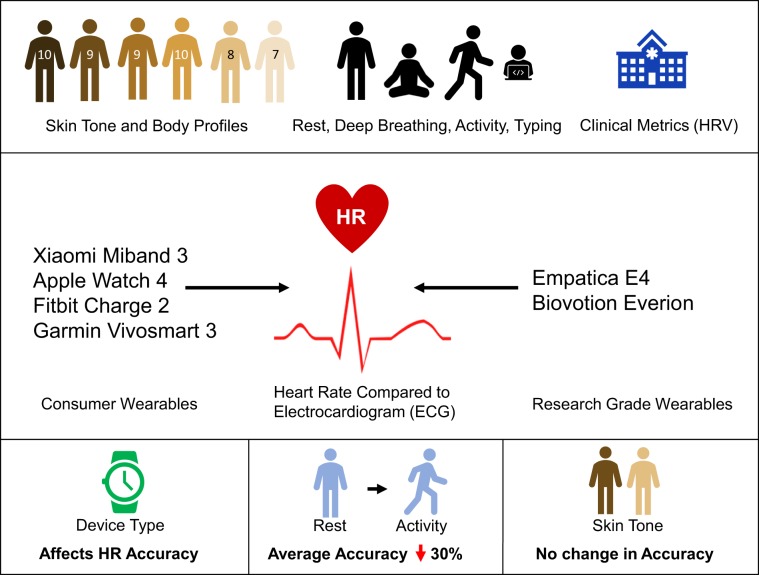
As wearable technologies are being increasingly used for clinical research and healthcare, it is critical to understand their accuracy and determine how measurement errors may affect research conclusions and impact healthcare decision-making. Accuracy of wearable technologies has been a hotly debated topic in both the research and popular science literature. Currently, wearable technology companies are responsible for assessing and reporting the accuracy of their products, but little information about the evaluation method is made publicly available. Heart rate measurements from wearables are derived from photoplethysmography (PPG), an optical method for measuring changes in blood volume under the skin. Potential inaccuracies in PPG stem from three major areas, includes (1) diverse skin types, (2) motion artifacts, and (3) signal crossover. To date, no study has systematically explored the accuracy of wearables across the full range of skin tones. Here, we explored heart rate and PPG data from consumer- and research-grade wearables under multiple circumstances to test whether and to what extent these inaccuracies exist. We saw no statistically significant difference in accuracy across skin tones, but we saw significant differences between devices, and between activity types, notably, that absolute error during activity was, on average, 30% higher than during rest. Our conclusions indicate that different wearables are all reasonably accurate at resting and prolonged elevated heart rate, but that differences exist between devices in responding to changes in activity. This has implications for researchers, clinicians, and consumers in drawing study conclusions, combining study results, and making health-related decisions using these devices.
Overview
CoChat Summary
## TL;DR
This study tested six wearable optical heart-rate devices in 53 participants across the full Fitzpatrick skin-tone scale, using ECG as the reference standard. The main drivers of error were device type and activity condition, not skin tone.
## Key findings
- Across all devices, there was no statistically significant difference in heart-rate accuracy across skin tones; the authors also report no differences in HRV accuracy between skin-tone groups.
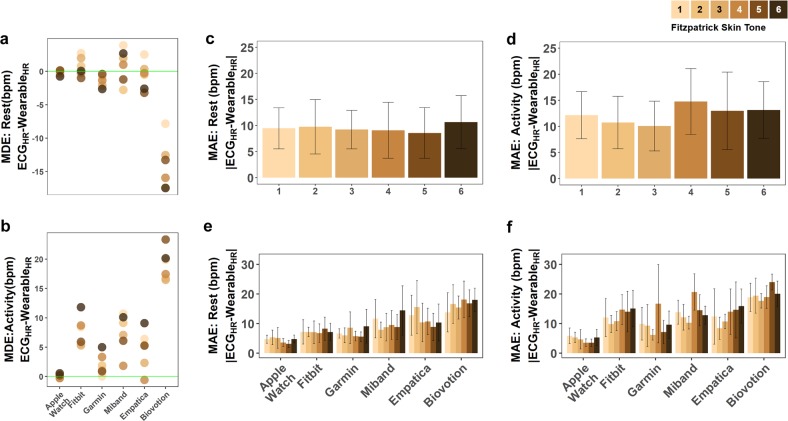
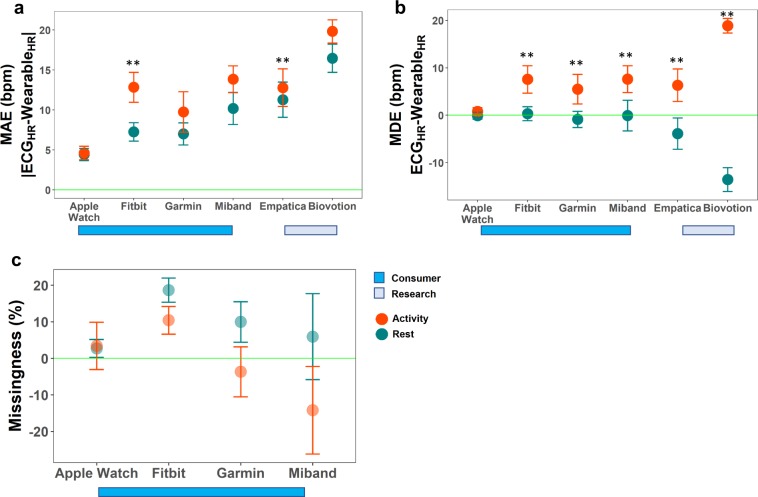
- At rest, consumer-grade wearables were more accurate than research-grade wearables: MAE was 7.2 ± 5.4 bpm vs 13.9 ± 7.8 bpm (p < 0.0125).
- During physical activity, error increased for both categories: MAE was 10.2 ± 7.5 bpm for consumer devices vs 15.9 ± 8.1 bpm for research devices (p < 0.0125); the abstract also states absolute error during activity was 30% higher than during rest.
- Device performance varied substantially: at rest, the Apple Watch 4 had the lowest MAE among consumer devices (4.4 bpm) and the Empatica E4 the lowest among research devices (11.3 bpm); during activity, the Apple Watch 4 remained lowest (4.6 bpm) while the Biovotion Everion was highest among research devices (19.8 bpm).
## Methods
- Design/sample: Observational validation study of 56 recruited participants, with 53 completing the protocol; participants were 18–54 years old, with an approximately equal distribution across six Fitzpatrick skin-tone categories.
- Devices/protocol: Six wearables were tested—4 consumer-grade (Apple Watch 4, Fitbit Charge 2, Garmin Vivosmart 3, Xiaomi Miband 3) and 2 research-grade (Empatica E4, Biovotion Everion)—during rest, deep breathing, walking, washout, and typing, with ECG (Bittium Faros 180) as the reference standard.
- Analysis: The paper compared wearable HR to ECG using MAE, MDE, missingness, and HRV analyses, with mixed-effects models for skin tone, condition, device, and interactions, plus t tests and Bonferroni corrections.
## Limitations
- The authors state that the study had a limited scope of devices, so they could not tease apart the separate effects of cost, market size, and release year.
- For HRV, analysis was limited to only the Empatica E4, because most wearables did not provide the raw data needed for HRV calculations.
- Evident from the text: the protocol was short and structured (about 1 hour of seated rest, deep breathing, walking, and typing), so the findings may not generalize to other activities or longer-term real-world use.
Model-written summary. Check it against the paper before relying on it.
Integrity signals
Registry
Cites
Statistics
Figures
Verification
Claims the paper makes
5 Valid · 4 Not valid · 8 Not checked · 77 Own results and interpretations
Some cited sources support this claim and some don’t — read each source’s verdict below.
In the paper
“Our analyses reinforces the growing body of research demonstrating that wearable devices have higher error during activity than at rest.8,11,35,38,39”
§ Investigating sources of inaccuracy in wearable optical heart rate sensors > Discussion
What the sources say
- Not checked — no full text of the sourcecites [8] Jo, E., Lewis, K., Directo, D., Kim, M. J. & Dolezal, B. A. Validation of biofeedback wearables for photoplethysmographic heart rate tracking. J. Sports Sci. Med.15, 540–547 (2016). PMC4974868 27803634
- Disputedcites [11] Shcherbina A Accuracy in wrist-worn, sensor-based measurements of heart rate and energy expenditure in a diverse cohort J. Pers. Med. 2017 7 3 10.3390/jpm7020003 PMC5491979 28538708 sourceExperimental — accuracy not yet measured
The Results (§3.2; page unavailable) report the opposite for energy expenditure: error was highest while sitting and lower during walking and running. The paper also finds that heart-rate error varies by activity rather than establishing that it is generally higher during activity than at rest (§3.1 and §3.4). (LLM, conf=0.87)
Checked by a reasoning model — may be wrong.
- Partly supportedcites [35] Zhang Y Motion artifact reduction for wrist-worn photoplethysmograph sensors based on different wavelengths Sensors 2019 19 673 10.3390/s19030673 PMC6387309 30736395 sourceExperimental — accuracy not yet measured
The Introduction says motion can distort wrist-worn PPG signals, and Section 4.1 reports a higher peak-to-noise ratio in stationary conditions than in several motion conditions. These passages support the direction of the claim for wrist-worn PPG, but the paper does not establish that wearable devices generally have higher measurement error during activity than at rest. (LLM, conf=0.78)
- Not checked — no full text of the sourcecites [38] Zong, C. & Jafari, R. Robust heart rate estimation using wrist-based PPG signals in the presence of intense physical activities. in 2015 37th Annual International Conference of the IEEE Engineering in Medicine and Biology Society (EMBC) 8078–8082. 10.1109/EMBC.2015.7320268 (IEEE, 2015). 26738168 source
- Could not verifycites [39] Reis VM Are wearable heart rate measurements accurate to estimate aerobic energy cost during low-intensity resistance exercise? PLoS ONE 2019 14 e0221284 10.1371/journal.pone.0221284 31437191 PMC6705857 sourceExperimental — accuracy not yet measured
The Results and Conclusions report estimation errors during low-intensity resistance exercise, but do not compare them with errors at rest. A search for resting measurements and an activity-versus-rest accuracy comparison found no passage addressing that comparison in our copy. (LLM, conf=0.76)
boostedstates an association- Asserted: passes — The authors put it forward as true.
- Checkable: passes — It can be checked against evidence.
- Load-bearing: passes — The paper’s conclusions depend on it.
- Based: passes — The paper gives a reason why it holds.
The cited sources support only part of this claim — read each source’s verdict below.
In the paper
“Several research groups and manufacturers have identified that cyclical motion can affect accuracy of HR in wearable sensors.”
§ Investigating sources of inaccuracy in wearable optical heart rate sensors > Introduction
What the sources say
- Supportedcites [9] Reddy RK Accuracy of wrist-worn activity monitors during common daily physical activities and types of structured exercise: evaluation study JMIR mHealth uHealth 2018 6 e10338 10.2196/10338 30530451 PMC6305876 source
The Results (Heart Rate Accuracy; page not supplied) report significantly different heart-rate errors between activities with and without repetitive upper-torso motion. The Discussion (Principal Findings; page not supplied) likewise says accuracy differed with repetitive wrist motion. These findings support the claim that cyclical motion can affect wearable heart-rate accuracy, without implying that it necessarily worsens it. (LLM, conf=0.91)
- Supportedcites [10] Sartor F Wrist-worn optical and chest strap heart rate comparison in a heterogeneous sample of healthy individuals and in coronary artery disease patients BMC Sports Sci. Med. Rehabil. 2018 10 10 10.1186/s13102-018-0098-0 29881626 PMC5984393 source
The Background explains that motion artifacts distort the PPG signal used by wearable heart-rate monitors and that filtering them is especially challenging during periodic motion. This supports the claim that cyclical motion can affect heart-rate accuracy. (LLM, conf=0.91)
- Not matchedcites [15] Apple Support. Get the most accurate measurements using your Apple Watch—Apple Support. https://support.apple.com/en-us/HT207941#heartrate (2019).
Its entry has no title and year that we can search by.
plainstates a possible cause- Asserted: passes — The authors put it forward as true.
- Checkable: passes — It can be checked against evidence.
- Load-bearing: passes — The paper’s conclusions depend on it.
- Based: passes — The paper gives a reason why it holds.
- Supported
The cited sources support only part of this claim — read each source’s verdict below.
In the paper
“Several studies have demonstrated that HR measurements from wearable devices are often less accurate during physical activity or cyclic wrist motions.”
§ Investigating sources of inaccuracy in wearable optical heart rate sensors > Introduction
What the sources say
- Not checked — no full text of the sourcecites [8] Jo, E., Lewis, K., Directo, D., Kim, M. J. & Dolezal, B. A. Validation of biofeedback wearables for photoplethysmographic heart rate tracking. J. Sports Sci. Med.15, 540–547 (2016). PMC4974868 27803634
- Partly supportedcites [11] Shcherbina A Accuracy in wrist-worn, sensor-based measurements of heart rate and energy expenditure in a diverse cohort J. Pers. Med. 2017 7 3 10.3390/jpm7020003 PMC5491979 28538708 sourceExperimental — accuracy not yet measured
The Discussion reports higher heart-rate error at higher intensity within each activity, and Results §3.1 reports more error during walking than cycling. But the paper does not assess cyclic wrist motions, and its Conclusions say heart-rate measurements were within an acceptable error range in most activity settings; it does not support a general claim that physical activity makes them less accurate. (LLM, conf=0.84)
- Supportedcites [35] Zhang Y Motion artifact reduction for wrist-worn photoplethysmograph sensors based on different wavelengths Sensors 2019 19 673 10.3390/s19030673 PMC6387309 30736395 source
The Introduction states that motions during ambulatory monitoring can distort wrist-worn PPG signals and that motion artifacts can overlap the heart-rate signal. The Results and Discussion assess heart-rate estimation error during motion, supporting the claim that wearable heart-rate measurements can be less accurate during activity or wrist motion. (LLM, conf=0.90)
- Not checked — no full text of the sourcecites [38] Zong, C. & Jafari, R. Robust heart rate estimation using wrist-based PPG signals in the presence of intense physical activities. in 2015 37th Annual International Conference of the IEEE Engineering in Medicine and Biology Society (EMBC) 8078–8082. 10.1109/EMBC.2015.7320268 (IEEE, 2015). 26738168 source
- Partly supportedcites [39] Reis VM Are wearable heart rate measurements accurate to estimate aerobic energy cost during low-intensity resistance exercise? PLoS ONE 2019 14 e0221284 10.1371/journal.pone.0221284 31437191 PMC6705857 sourceExperimental — accuracy not yet measured
The Discussion reports that some wearable HR devices had errors above 10% when used to predict energy cost during higher-intensity resistance exercise, while this study found errors below 10% at low intensity. That supports a narrower, activity-dependent concern about energy-cost estimates, not the claim that HR measurements themselves are often less accurate during physical activity; the paper does not address cyclic wrist motions. Our copy provides no page numbers for these passages. (LLM, conf=0.82)
boostedstates an association- Asserted: passes — The authors put it forward as true.
- Checkable: passes — It can be checked against evidence.
- Load-bearing: passes — The paper’s conclusions depend on it.
- Based: passes — The paper gives a reason why it holds.
The cited sources support only part of this claim — read each source’s verdict below.
In the paper
“previous research demonstrated that inaccurate PPG HR measurements occur up to 15% more frequently in dark skin as compared to light skin”
§ Investigating sources of inaccuracy in wearable optical heart rate sensors > Introduction
What the sources say
- Not checked — no full text of the sourcecites [23] Zonios G Bykowski J Kollias N Skin melanin, hemoglobin, and light scattering properties can be quantitatively assessed in vivo using diffuse reflectance spectroscopy J. Invest. Dermatol. 2001 117 1452 1457 10.1046/j.0022-202x.2001.01577.x 11886508 source
- Could not verifycites [24] Tseng S-H Grant A Durkin AJ In vivo determination of skin near-infrared optical properties using diffuse optical spectroscopy J. Biomed. Opt. 2008 13 014016 10.1117/1.2829772 18315374 PMC2626348 sourceExperimental — accuracy not yet measured
Our copy of Tseng et al. (2008) is entirely about building a superficial diffusing DOS probe and recovering absorption/reduced-scattering coefficients of volar forearm and palm skin in 15 subjects (Introduction, Results Sec. 4, Conclusion); no passage mentions photoplethysmography, pulse/heart rate measurement, or any accuracy/error rate, and no 15% figure of that kind appears (searched: PPG/pulse rate/heart rate accuracy, pulse oximetry, introduction/motivation). The closest content is mechanistic background — Results Sec. 4 (Fig. 4a) that melanin absorption in dark skin reduces the probe's interrogation depth so hemoglobin features 'are not apparent,' and Sec. 4 (Fig. 5a) that dark-skinned subjects' absorption is ~5x Caucasian at 650 nm — which explains why light-based signals are weaker in dark skin but does not state the attributed quantitative claim about inaccurate PPG HR measurements. The paper also names no other work as the source of such a PPG error statistic, so misattribution cannot be established either. (LLM, conf=0.72)
- Not checked — no full text of the sourcecites [25] Fallow BA Tarumi T Tanaka H Influence of skin type and wavelength on light wave reflectance J. Clin. Monit. Comput. 2013 27 313 317 10.1007/s10877-013-9436-7 23397431 source
- Could not verifycites [26] Treesirichod A Chansakulporn S Wattanapan P Correlation between skin color evaluation by skin color scale chart and narrowband reflectance spectrophotometer Indian J. Dermatol. 2014 59 339 342 10.4103/0019-5154.135476 25071249 PMC4103266 sourceExperimental — accuracy not yet measured
The Introduction states that the study compares a skin-color chart with a narrowband reflectance spectrophotometer, and the Methods describe skin-color measurements with a Mexameter MX18. Searches for PPG heart-rate accuracy, dark-versus-light-skin error rates, and 15% found no passage addressing the cited claim. No page numbers were available in our copy. (LLM, conf=0.76)
- Not checked — no full text of the sourcecites [27] Ries AL Prewitt LM Johnson JJ Skin color and ear oximetry Chest 1989 96 287 290 10.1378/chest.96.2.287 2752811 source
- Could not verifycites [28] Lister T Wright PA Chappell PH Optical properties of human skin J. Biomed. Opt. 2012 17 0909011 10.1117/1.JBO.17.9.090901 23085902 sourceExperimental — accuracy not yet measured
Our copy of Lister et al. (2012) is a review of the absorption and scattering coefficients of human skin; it nowhere addresses photoplethysmography, heart-rate measurement, or any 15% error figure (searched: 'photoplethysmography PPG heart rate measurement accuracy dark skin', 'pulse oximetry blood volume pulse measurement error skin type', 'heart rate pulse oximetry photoplethysmogram ... Fitzpatrick'). The closest content is qualitative and mechanistic — Sec. 2.2 (Scattering) notes melanosome volume fraction rising from ~1% in pale to ~5% in darker skin and melanin's variable contribution to epidermal scatter, and Sec. 4.3 (Further Causes of Discrepancy) notes 'darker skin types demonstrating greater absorption across the visible spectrum' (Svaasand et al., only one or two subjects per skin type) — but neither reports PPG measurement accuracy nor the attributed magnitude. Nothing in our copy contradicts the claim; it simply does not cover it, so the 15% figure must come from another source. (LLM, conf=0.72)
- Not checked — no full text of the sourcecites [29] Weiler DT Villajuan SO Edkins L Cleary S Saleem JJ Wearable heart rate monitor technology accuracy in research: a comparative study between PPG and ECG technology Proc. Hum. Factors Ergon. Soc. Annu. Meet. 2017 61 1292 1296 10.1177/1541931213601804 source
- Could not verifycites [30] Nitzan M Romem A Koppel R Pulse oximetry: fundamentals and technology update Med. Devices Evid. Res. 2014 7 231 10.2147/MDER.S47319 PMC4099100 25031547 sourceExperimental — accuracy not yet measured
The 'Pulse oximetry – the technique' section says melanin can absorb light used in PPG, but it does not compare measurement accuracy by skin tone. The accuracy section concerns oxygen-saturation measurements, not PPG heart-rate errors. Searches for skin pigmentation, heart rate, and 15% found no passage supporting the claimed difference. (LLM, conf=0.76)
- Partly supportedcites [31] Yan, L., Hu, S., Alzahrani, A., Alharbi, S. & Blanos, P. A Multi-wavelength opto-electronic patch sensor to effectively detect physiological changes against human skin types. Biosensors7, 22 (2017). PMC5487964 28635643 sourceExperimental — accuracy not yet measured
The Introduction says skin pigmentation can affect PPG signal quality and mentions anecdotal errors of 3–5% in black skin. It does not report that inaccurate PPG heart-rate measurements occur 15% more frequently in dark skin than in light skin. The Discussion reports no significant effect of skin type on heart-rate measurements with the sensor tested (p = 0.09). (LLM, conf=0.87)
boostedstates an association- Asserted: passes — The authors put it forward as true.
- Checkable: passes — It can be checked against evidence.
- Load-bearing: passes — The paper’s conclusions depend on it.
- Based: passes — The paper gives a reason why it holds.
The cited sources that could be checked couldn’t confirm or dispute this claim.
In the paper
“since optical HR measurements primarily measure green light absorption.24,25”
§ Investigating sources of inaccuracy in wearable optical heart rate sensors > Methods > Sample size
What the sources say
- Could not verifycites [24] Tseng S-H Grant A Durkin AJ In vivo determination of skin near-infrared optical properties using diffuse optical spectroscopy J. Biomed. Opt. 2008 13 014016 10.1117/1.2829772 18315374 PMC2626348 sourceExperimental — accuracy not yet measured
Our copy of Tseng et al. (2008) deals exclusively with recovering skin absorption and reduced-scattering coefficients over the 650-1000 nm near-infrared window (Instrumentation, six laser diodes at 661-850 nm; Results, Sec. 4), and never mentions heart rate, pulse, photoplethysmography, or green-light absorption. Searches for 'green light absorption / heart rate / photoplethysmography' and for 'wavelengths shorter than 650 nm / hemoglobin spectral features' returned only the Conclusion's statement that the instrument is being improved so that shorter-than-650 nm wavelengths, with more prominent hemoglobin features, can be acquired - a forward-looking remark about their own DOS system, not a claim about how optical HR measurements work. Nothing in our copy either supports or contradicts the attributed point. (LLM, conf=0.72)
- Not checked — no full text of the sourcecites [25] Fallow BA Tarumi T Tanaka H Influence of skin type and wavelength on light wave reflectance J. Clin. Monit. Comput. 2013 27 313 317 10.1007/s10877-013-9436-7 23397431 source
plain- Asserted: passes — The authors put it forward as true.
- Checkable: passes — It can be checked against evidence.
- Load-bearing: passes — The paper’s conclusions depend on it.
- Based: passes — The paper gives a reason why it holds.
- Could not verify
41 more claims
Create a free account to see all 94 claims and to verify the 3 references still open.
- It may state two separate claims as one. 34
- Probably not a substantial claim. 17
Claims other papers make about this one
Each is checked against this paper’s own text: does it say what the citing paper says it does?
The cited source doesn’t support the claim as written.
In the citing paper
“too few people with the darkest skin tones were included (n = 9 in FST Type 6)”
From Response To: Investigating sources of inaccuracy in wearable optical heart rate sensors (2021) · cites this paper as [1]
Checked by a reasoning model — may be wrong.
Experimental — accuracy not yet measuredThe cited source doesn’t support the claim as written.
In the citing paper
“A power analysis conducted prior to data collection indicated that a minimum of 52 participants would be needed to detect a medium effect size (f2(v) = 0.20) in a MANOVA with two groups and two dependent variables (absolute and directional error), assuming α = 0.05 and power (1 − β) = 0.80 [23].”
From PPG-Based Heart Rate Accuracy in Hispanic Adults with Fitzpatrick III–V Skin Tones: An Evaluation of Body Composition and Skin-Tone Effects (2026) · cites this paper as [23]
Checked by a reasoning model — may be wrong.
Experimental — accuracy not yet measuredThe source backs part of the claim, not all of it — or backs it for a different population, condition or comparison.
In the citing paper
“there are only a small handful of studies that examine skin tone and accuracy rates directly1–3,11”
From Response To: Investigating sources of inaccuracy in wearable optical heart rate sensors (2021) · cites this paper as [1]
Experimental — accuracy not yet measuredThe source backs part of the claim, not all of it — or backs it for a different population, condition or comparison.
In the citing paper
“Bent et al. (2020) reported that PPG devices showed error rates exceeding 20% during cycling and resistance exercise in individuals with higher pigmentation, while maintaining <10% error at rest, underscoring the importance of activity context [5].”
From Photoplethysmography in Diverse Skin Tones: Evaluating Bias in Smartwatch Health Monitoring (2025) · cites this paper as [5]
Experimental — accuracy not yet measuredThe source backs part of the claim, not all of it — or backs it for a different population, condition or comparison.
In the citing paper
“failing to correct for these errors exacerbates existing healthcare disparities [10,23,24,25,26]”
From PPG-Based Heart Rate Accuracy in Hispanic Adults with Fitzpatrick III–V Skin Tones: An Evaluation of Body Composition and Skin-Tone Effects (2026) · cites this paper as [23]
Experimental — accuracy not yet measured
43 more claims about this paper
Create a free account to see every claim other papers make about this one.
Citations
Cites
An overview of heart rate variability metrics and norms
Shaffer, F., & Ginsberg, J. P. (2017) · Frontiers in Public Health · doi:10.3389/fpubh.2017.00258 · Cited by 7,185 · cited 1×
“In addition to HR, we examined HR variability (HRV), a clinically relevant diagnostic metric that can be derived from PPG signals and is a widely used metric of autonomic nervous system function.(43) The standard HRV metrics we examined, included the time-domain metrics, included mean HRV, minimum HRV, maximum HRV, RM…”
MethodThe validity and practicality of sun-reactive skin types I through VI
Fitzpatrick, T. B. (1988) · Archives of Dermatology · doi:10.1001/archderm.1988.01670060015008 · Cited by 4,339
Ghamari, M. (2018) · International Journal of Biosensors & Bioelectronics · doi:10.15406/ijbsbe.2018.04.00125 · Cited by 945 · cited 1×
“Another suspected measurement error in wrist-worn devices is motion artifact, which is typically caused by displacement of the PPG sensor over the skin, changes in skin deformation, blood flow dynamics, and ambient temperature.(33,34) Motion artifacts may manifest as missing or false beats which result in incorrect HR…”
BackgroundWearable photoplethysmographic sensors—past and present
Tamura, T., Maeda, Y., Sekine, M., & Yoshida, M. (2014) · Electronics · doi:10.3390/electronics3020282 · Cited by 912
Shcherbina, A., Mattsson, C., Waggott, D., Salisbury, H., Christle, J., Hastie, T., Wheeler, M., & Ashley, E. (2017) · Journal of Personalized Medicine · doi:10.3390/jpm7020003 · Cited by 625 · cited 2×
“Our analyses reinforces the growing body of research demonstrating that wearable devices have higher error during activity than at rest.(8,11,35,38,39) We further demonstrate that the directionality of the HR error is dependent on the activity type.”
BackgroundResultGoldsack, J. C., Coravos, A., Bakker, J. P., Bent, B., Dowling, A. V., Fitzer-Attas, C., Godfrey, A., Godino, J. G., Gujar, N., Izmailova, E., et al. (2020) · npj Digital Medicine · doi:10.1038/s41746-020-0260-4 · Cited by 557
Self-citationZonios, G., Bykowski, J., & Kollias, N. (2001) · Journal of Investigative Dermatology · doi:10.1046/j.0022-202x.2001.01577.x · Cited by 477
Optical properties of human skin
Lister, T., Wright, P. A., & Chappell, P. H. (2012) · Journal of Biomedical Optics · doi:10.1117/1.jbo.17.9.090901 · Cited by 467
Pulse oximetry: fundamentals and technology update
Nitzan, M., Romem, A., & Koppel, R. (2014) · Medical Devices: Evidence and Research · doi:10.2147/mder.s47319 · Cited by 438
Effects of skin pigmentation on pulse oximeter accuracy at low saturation
Bickler, P. E., Feiner, J. R., & Severinghaus, J. W. (2005) · Anesthesiology · doi:10.1097/00000542-200504000-00004 · Cited by 427
Research works printed but not linked: 1
- Hugh et al. Consumer-Grade Wrist-worn Ppg Sensors Can Be Used to Detect Differences in Heart Rate Variability among A Heterogenous Prediabetic Population (IEEE International Conference on Biomedical and Health Informatics, 2018).
Cited by
Items 201–300 of 661
Yu, Q., Wu, J., Xiao, W., Zhao, C., Zhang, W., Chen, Y., Liu, Y., Liu, H., Zhou, J., Ding, L., et al. (2025) · Cell Reports Physical Science · doi:10.1016/j.xcrp.2024.102389 · Cited by 24
Clay, I., Angelopoulos, C., Bailey, A. L., Blocker, A., Carini, S., Carvajal, R., Drummond, D., McManus, K. F., Oakley-Girvan, I. A., Patel, K., et al. (2021) · Journal of Medical Internet Research · doi:10.2196/34493 · Cited by 20
“Examples include converting an outcome used in a clinical trial to deployment to support reimbursement [16] or treatment [17], or comparing error from research or clinical-grade and consumer-grade sensors to better validate large-scale observations [18].”
MethodConsumer Wearable Sleep Trackers
Chiang, A. A.-P., & Khosla, S. (2023) · Sleep Medicine Clinics · doi:10.1016/j.jsmc.2023.05.005 · Cited by 22
SOSW: Stress Sensing With Off-the-Shelf Smartwatches in the Wild
Toshnazarov, K. E., Lee, U., Kim, B. H., Mishra, V., Najarro, L. A. C., & Noh, Y. (2024) · IEEE Internet of Things Journal · doi:10.1109/jiot.2024.3375299 · Cited by 26
“Actions, such as gripping, flexing, and extending fingers and wrist motions have been found to be particularly damaging in this regard [20], [46].”
BackgroundHybrid sensor integration in wearable devices for improved cardiovascular health monitoring
Khan, B., Khan, W., Masrur, M. A., Khalid, R. T., Awais, M., Khan, B., Khoo, B. L., & Abdullah, S. (2025) · Journal of Science Advanced Materials and Devices · doi:10.1016/j.jsamd.2025.100889 · Cited by 36
Closing the Digital Divide in Interventions for Substance Use Disorder
Hampton, J., Mugambi, P., Caggiano, E. G., Eugene, R., Valente, A., Taylor, M. M., & Carreiro, S. (2024) · Journal of Psychiatry and Brain Science · doi:10.20900/jpbs.20240002 · Cited by 27
“For instance, it has been shown that pulse oximeters have a significant decrease in accuracy for darker-skinned people compared to those with lighter skin tones [57] and that accuracy of heart rate variability can vary with skin tone in some sensors [58].”
BackgroundXiang, T., Jin, Y., Liu, Z., Clifton, L., Clifton, D. A., Zhang, Y., Zhang, Q., Ji, N., & Zhang, Y. (2025) · IEEE Journal of Biomedical and Health Informatics · doi:10.1109/jbhi.2025.3548771 · Cited by 20
“4) Robustness Against Noise and Outliers: Single-channel signals, like PPG, are highly sensitive to external influences like temperature fluctuations, noise and motion artifacts, etc. [51].”
Fiske, A., Schneider, A., McLennan, S., Karapetyan, S., & Buyx, A. (2021) · BMJ Open · doi:10.1136/bmjopen-2021-051167 · Cited by 21
Koedel, U., Schuetze, C., Fischer, P. F., Bussmann, I., Sauer, P. K., Nixdorf, E., Kalbacher, T., Wichert, V., Rechid, D., Bouwer, L. M., et al. (2022) · Frontiers in Environmental Science · doi:10.3389/fenvs.2021.772666 · Cited by 24
“In contrast, data of reduced quality could be a source of ambiguity and therefore also inaccurate analysis and weakly derived or wrong conclusions (e.g. Cai and Zhu, 2015; Brown et al., 2018; Bent et al., 2020).”
ResultChen, J., Huang, H.-K., Fang, Y.-T., Lin, Y.-T., Li, S.-Z., Chen, B., Lo, Y., Chen, P.-C., Wang, C.-F., & Chen, Y. (2022) · Sensors · doi:10.3390/s22051873 · Cited by 19
“By evaluating the 24-h signal quality, the 15-s measurement time was considered the optimal sampling time for physiological applications of PPG [59].”
MethodComposite Hydrogel Modified with Gelatin-Imidazole: A Conductive and Adhesive Hydrogel
Zhang, Y.-S., Liu, X., Chu, Y.-Z., Chen, P., Yeh, Y., Ni, Y.-F., & Yeh, M. (2023) · ACS Applied Electronic Materials · doi:10.1021/acsaelm.3c01075 · Cited by 19
Ibrahim, N. S., Rampal, S., Lee, W. L., Pek, E. W., & Suhaimi, A. (2023) · Cardiovascular Engineering and Technology · doi:10.1007/s13239-023-00693-z · Cited by 17
“Other causes of HR recording discrepancies include delayed Bluetooth transmission [23, 56], and the pathophysiology of cardiovascular disease includes peripheral edema and poor tissue perfusion [57].”
Human vital sign determination using tactile sensing and fuzzy triage system
Kerr, E., McGinnity, T. M., Coleman, S., & Shepherd, A. (2021) · Expert Systems with Applications · doi:10.1016/j.eswa.2021.114781 · Cited by 20
Reply: Matters Arising ‘Investigating sources of inaccuracy in wearable optical heart rate sensors’
Bent, B., Enache, O. M., Goldstein, B., Kibbe, W., & Dunn, J. P. (2021) · npj Digital Medicine · doi:10.1038/s41746-021-00409-4 · Cited by 17
Self-citationPopulation Digital Health: Continuous Health Monitoring and Profiling at Scale
Motlagh, N. H., Zuniga, A., Nguyen, N. T., Flores, H., Wang, J., Tarkoma, S., Prosperi, M., Helal, S., & Nurmi, P. (2024) · Online Journal of Public Health Informatics · doi:10.2196/60261 · Cited by 18
“Personal HR trackers are popular examples of devices producing digital health information and they are well known to be subject to inaccuracies [16].”
Heiden, E., Jones, T. L., Maczka, A. B., Kapoor, M., Chauhan, M., Wiffen, L., Barham, H., Holland, J., Saxena, M., Wegerif, S., et al. (2022) · JMIR Formative Research · doi:10.2196/36340 · Cited by 17
“Bent and colleagues [38] also reported that Fitzpatrick skin type had no significant effect on the accuracy of PR measurements by wearable optical heart rate sensors; however, this was a small study (n=53).”
BackgroundGarikapati, K., Turnbull, S., Bennett, R. G., Campbell, T. G., Kanawati, J., Wong, M. S., Thomas, S. P., Chow, C. K., & Kumar, S. (2022) · Heart Lung and Circulation · doi:10.1016/j.hlc.2022.08.001 · Cited by 24
Page, D., Lindeman, R. W., & Lukosch, S. G. (2023) · Multimodal Technologies and Interaction · doi:10.3390/mti7050047 · Cited by 25
Lu, J. K., Sijm, M., Janssens, G. E., Goh, J., & Maier, A. B. (2023) · GeroScience · doi:10.1007/s11357-023-00815-4 · Cited by 19
“, rest versus exercise), leading to errors in data collection and subsequent analyses [6].”
BackgroundAn ML-Based Approach to Reconstruct Heart Rate from PPG in Presence of Motion Artifacts
Vicente-Samper, J. M., Tamantini, C., Ávila-Navarro, E., de la Casa, M. A., Zollo, L., Sabater-Navarro, J. M., & Cordella, F. (2023) · Biosensors · doi:10.3390/bios13070718 · Cited by 19
Tan, Y., Dede, M., Mohanty, V., Dou, J., Hill, H., Bernstam, E., & Chen, K. (2024) · Journal of Biomedical Informatics · doi:10.1016/j.jbi.2024.104648 · Cited by 19
Neudorfer, M., Kumar, D., Smeddinck, J. D., Kulnik, S. T., Niebauer, J., Treff, G., & Sareban, M. (2024) · Scandinavian Journal of Medicine and Science in Sports · doi:10.1111/sms.14756 · Cited by 17
“Previous findings indicate that wrist-worn sensors exhibit higher validity during steady-state intensities such as ergometer cycling compared to activities with changing intensities like graded incremental tests or alternating intensities during ADLs [35, 36].”
Coste, A., Millour, G., & Hausswirth, C. (2025) · Sensors · doi:10.3390/s25185745 · Cited by 33
“Moreover, shorter recordings are more vulnerable to noise and motion artifacts, especially when using PPG-based sensors, as peripheral blood flow is highly sensitive to external disturbances [15,16].”
Joshi, J., Wang, K., & Cho, Y. (2023) · Sensors · doi:10.3390/s23198244 · Cited by 27
“The Apple Watch showed highest accuracy in several studies (Apple Watch 4 MAE: 4.4 ± 2.7 bpm [67]; Apple Watch 6 ICC: 0.96 [14,53]) compared to other commercial devices.”
BackgroundMethodResultInfluentialPini, N., Fifer, W. P., Oh, J., Nebeker, C., Croff, J. M., & Smith, B. A. (2024) · Developmental Cognitive Neuroscience · doi:10.1016/j.dcn.2024.101446 · Cited by 22
“…historical perspective, data collection via wearable devices has been preferentially conducted in individuals who are disproportionately non-Hispanic White, located in high-income urban setting, and of higher-socio-economic status (Zinzuwadia and Singh, 2022; Cho et al., 2022; Bent et al., 2020).”
Gilgen-Ammann, R., Roos, L., Wyss, T., Veenstra, B., Delves, S. K., Beeler, N., Buller, M. J., & Friedl, K. E. (2021) · Physiological Measurement · doi:10.1088/1361-6579/ac19f9 · Cited by 18
Belavý, D. L., Diwan, A. D., Ford, J. J., Miller, C. T., Hahne, A. J., Mundell, N. L., Tagliaferri, S. D., Bowe, S. J., Pedder, H., Saueressig, T., et al. (2021) · BMJ Open · doi:10.1136/bmjopen-2021-057112 · Cited by 16
Charpignon, M., Carrel, A., Jiang, Y., Kwaga, T., Cantada, B., Hyslop, T., Cox, C. E., Haines, K., Koomson, V., Dumas, G., et al. (2023) · PLOS Digital Health · doi:10.1371/journal.pdig.0000244 · Cited by 21
“According to a study by Bent and colleagues [85], the accuracy of PPG heart rate measurements in selected wearable devices does not differ significantly across skin tones.”
BackgroundSelf-citationHashimoto, Y., Noto, K., Tada, S., & Nishida, Y. (2025) · IEEE Access · doi:10.1109/access.2025.3561288 · Cited by 20
“For the heart rate, methods include electrocardiogram (ECG)-based measurements using patch [34], [35] or belt sensors [36], [37], [38], as well as pulse-based measurements using wrist-band sensors [39], [40].”
Anomaly Detection in Elderly Health Monitoring via IoT for Timely Interventions
Roșca, C.-M., & Stancu, A. (2025) · Applied Sciences · doi:10.3390/app15137272 · Cited by 17
Machado, A., Ferreira, D. F., Ferreira, S., Almeida‐Antunes, N., Carvalho, P. J., Melo, P. I. D. A., Rocha, N., & Rodrigues, M. A. (2025) · Sensors · doi:10.3390/s25196049 · Cited by 22
“This distinction rein-forces the importance of considering not only technical performance but also situational adaptability when selecting reference technologies [67].”
The accuracy of Apple Watch measurements: a living systematic review and meta-analysis
Lambe, R., Baldwin, M., O’Grady, B., Schumann, M., Caulfield, B., & Doherty, C. (2026) · npj Digital Medicine · doi:10.1038/s41746-025-02238-1 · Cited by 24
“Thirdly, physiological factors, including blood perfusion and individual variation in heart rate response to exercise affect measurements 18 .”
Wireless monitoring devices in hospitalized children: a scoping review
Sénéchal, E., Jeanne, E., Tao, L., Kearney, R. E., Shalish, W., & SantʼAnna, G. (2023) · European Journal of Pediatrics · doi:10.1007/s00431-023-04881-w · Cited by 18
“However, most available devices for infants and children are primarily used for home monitoring of healthy infants and children [17–19], and with variable accuracy [16, 20].”
BackgroundSymmetrical Photoplethysmogram Signal-Based Cuff-Less Blood Pressure Estimation
Liu, Z., Xiao, L., Liu, Y., Gao, L., Zhang, J., & Si, W. (2024) · IEEE Sensors Journal · doi:10.1109/jsen.2024.3356757 · Cited by 16
“In the process of feature extraction, we extract the morphological and computational features of symmetric PPG signals for BP estimation [33], [34].”
MethodSinichi, M., Gevonden, M. J., & Krabbendam, L. (2025) · Psychophysiology · doi:10.1111/psyp.70004 · Cited by 27
FPGA based real-time epileptic seizure prediction system
Coşgun, E., & Celebi, A. T. (2021) · Journal of Applied Biomedicine · doi:10.1016/j.bbe.2021.01.006 · Cited by 14
Webster, D. E., Tummalacherla, M., Higgins, M., Wing, D., Ashley, E. A., Kelly, V. E., McConnell, M. V., Muse, E. D., Olgin, J. E., Mangravite, L. M., et al. (2021) · JMIR mhealth and uhealth · doi:10.2196/26006 · Cited by 19
Hoevenaars, D., Yocarini, I. E., Paraschiakos, S., Holla, J., de Groot, S., Kraaij, W., & Janssen, T. W. J. (2022) · JMIR Rehabilitation and Assistive Technologies · doi:10.2196/27637 · Cited by 15
Assessing Heart Rate Using Consumer Technology Association Standards
Reece, J. D., Bunn, J. A., Choi, M., & Navalta, J. W. (2021) · Technologies · doi:10.3390/technologies9030046 · Cited by 21
Allado, E., Poussel, M., Moussu, A., Hily, O., Temperelli, M., Cherifi, A., Saunier, V., Bernard, Y., Albuisson, É., & Chenuel, B. J. (2022) · Journal of Clinical Medicine · doi:10.3390/jcm11206101 · Cited by 16
Guo, C.-Y., Huang, W., Chang, H., & Hsieh, T.-L. (2023) · IEEE Sensors Journal · doi:10.1109/jsen.2023.3288151 · Cited by 17
“Some studies suggest that the issue of melanin absorbing red light in the rest state can be compensated by increasing the light intensity [13], [14].”
Lins, L. F. T. D. S., do Nascimento, E. G. C., Júnior, J. A. D. ́., Fernandes, T. A. A. D. M., de Andrade, M. F., & Andrade, C. D. M. (2023) · Medical & Biological Engineering & Computing · doi:10.1007/s11517-023-02869-0 · Cited by 11
Exploring Biomagnetism for Inclusive Vital Sign Monitoring: Modeling and Implementation
Guo, X., Tan, L., Chen, T., Gu, C., Shu, Y., He, S., He, Y., Chen, J., & Shangguan, L. (2024) · ACM Annual International Conference on Mobile Computing and Networking (MobiCom) · doi:10.1145/3636534.3649349 · Cited by 19
“• Firstly, PPG sensors are shown to be less accurate in people with dark skin [18].”
BackgroundRizvi, S. L., Ruork, A. K., Yin, Q., Yeager, A. L., Taylor, M. E., & Kleiman, E. M. (2024) · JMIR Mental Health · doi:10.2196/60035 · Cited by 17
Helgerud, J., Haglo, H. P., & Hoff, J. (2022) · JMIR Cardio · doi:10.2196/38570 · Cited by 17
“Bent et al [11] documented that wearable optical HR sensors had, on average, an absolute error during activity 30% higher than during rest.”
BackgroundFrugal Heart Rate Correction Method for Scalable Health and Safety Monitoring in Construction Sites
Sowiński, P., Rachwał, K., Danilenka, A., Bogacka, K., Kobus, M., Dabrowska, A. K., Paszkiewicz, A., Bolanowski, M., Ganzha, M., & Paprzycki, M. (2023) · Sensors · doi:10.3390/s23146464 · Cited by 21
“In a different study [24], the authors found the measurement error to be significantly higher when the user is performing movements.”
BackgroundSkin-Attachable Sensors for Biomedical Applications
Hua, J., Li, J., Jiang, Y., Xie, S., Shi, Y., & Pan, L. (2022) · Biomedical Materials & Devices · doi:10.1007/s44174-022-00018-z · Cited by 13
“Although PPG heart rate sensors consisting of a photodetector (PD) and several pairs of light-emitting diodes (LEDs) are now commercially available [38], the performance of PD imposes restrictions on the improvement of wearable PPG heart rate sensors in broader application scenarios.”
BackgroundPerfusion index for early identification of regional anesthesia effectiveness: a narrative review
Chu, T., Xin, Y., Zhou, S., & Xu, A. (2023) · Minerva Anestesiologica · doi:10.23736/s0375-9393.23.17065-9 · Cited by 13
Quantification of the Phenomena Affecting Reflective Arterial Photoplethysmography
Rovas, G., Bikia, V., & Stergiopulos, N. (2023) · Bioengineering · doi:10.3390/bioengineering10040460 · Cited by 18
Vogel, C., Grimm, B. P., Marmor, M. T., Sivananthan, S., Richter, P. H., Yarboro, S. R., Hanflik, A. M., Histing, T., & Braun, B. J. (2024) · Journal of Clinical Medicine · doi:10.3390/jcm13113134 · Cited by 16
“They can estimate blood pressure and thus blood pressure variability, as a prognostic marker for cerebrovascular and cardio-vascular disease using a pulse wave analysis algorithm alone or in combination with an ECG [35,36].”
BackgroundGaur, P., Temple, D. S., Hegarty‐Craver, M., Boyce, M., Holt, J. R., Wenger, M., Preble, E. A., Eckhoff, R., McCombs, M., Davis-Wilson, H. C., et al. (2024) · JMIR Formative Research · doi:10.2196/53977 · Cited by 23
“Recent research indicates that the accuracy of HR measured by most leading wearable optical sensors is not significantly affected by skin tone, although devices themselves vary in their measurement accuracy, particularly during activity [35].”
BackgroundRaggi, M., Moore, L. J., & Mesin, L. (2025) · IEEE Access · doi:10.1109/access.2025.3528518 · Cited by 17
Recent Academic Research on Clinically Relevant Digital Measures: Systematic Review
Shandhi, M. M. H., Goldsack, J. C., Ryan, K., Bennion, A., Kotla, A. V., Feng, A., Jiang, Y., Wang, W. K., HURST, T. L., Patena, J. V., et al. (2021) · Journal of Medical Internet Research · doi:10.2196/29875 · Cited by 14
Self-citationChen, C.-C., Chen, Y., Tang, L., & Chieng, W.-H. (2022) · International Journal of Environmental Research and Public Health · doi:10.3390/ijerph19084810 · Cited by 19
Nelson, B. W., Harvie, H. M. K., Jain, B., Knight, E. L., Roos, L. E., & Giuliano, R. J. (2023) · Psychosomatic Medicine · doi:10.1097/psy.0000000000001178 · Cited by 19
Wei, J. C. J., van den Broek, T. J., van Baardewijk, J. U., van Stokkum, R., Kamstra, R. J. M., Rikken, L. F. A., Gijsbertse, K., Uzunbajakava, N. E., & van den Brink, W. J. (2024) · Scientific Reports · doi:10.1038/s41598-024-73557-8 · Cited by 16
“For example, a study by Bent et al. to consumer-grade wearable devices using an optical sensor for PPG, from which the heart rate was extracted mentioned MAE between 7 and 14 bpm (rest and activities) 20 .”
MethodDigital Medicine Community Perspectives and Challenges: Survey Study
Bent, B., Sim, I., & Dunn, J. (2021) · JMIR mhealth and uhealth · doi:10.2196/24570 · Cited by 13
“While the field of digital medicine has seen rapid growth, many challenges remain: standards, best practices, and oversight methodology are still under development [7], sensors and devices used in digital medicine are constantly evolving and are often not validated [8], and a lack of interoperability results in a frag…”
Self-citationChen, K., Casey, J., Connelly, D. E., Merrilees, J. J., Yang, C., Miller, B. L., & LEVENSON, R. W. (2022) · Psychophysiology · doi:10.1111/psyp.14040 · Cited by 14
Ehrmann, D., Chatwin, H., SCHMITT, A. J., Søholm, U., Kulzer, B., Axelsen, J. L., Broadley, M. M., Haak, T., Pouwer, F., & Hermanns, N. (2023) · Diabetic Medicine · doi:10.1111/dme.15040 · Cited by 12
Støve, M. P., Graversen, A. H., & Sørensen, J. (2023) · Respiratory Care · doi:10.4187/respcare.10760 · Cited by 10
“37 In this study, however, all the participants were white and had no tattoos in the areas used for measurement; hence, generalizations cannot be made for individuals with darker skin tones or tattoos in the measurement area.”
Wang, C., Cui, Z., Zhu, Y., Liu, X., Wang, L., & Wang, L. J. (2024) · Diamond and Related Materials · doi:10.1016/j.diamond.2024.110970 · Cited by 12
Biosignal Compression Toolbox for Digital Biomarker Discovery
Bent, B., Lu, B., Kim, J., & Dunn, J. (2021) · Sensors · doi:10.3390/s21020516 · Cited by 12
“Data The data used to evaluate the compression methods included ECG data from the Bittium Italy) [30].”
MethodInfluentialSelf-citationAssessment of EMF Human Exposure Levels Due to Wearable Antennas at 5G Frequency Band
Gallucci, S., Bonato, M., Benini, M., Chiaramello, E., Fiocchi, S., Tognola, G., & Parazzini, M. (2022) · Sensors · doi:10.3390/s23010104 · Cited by 17
Wearable Upper Arm SpO 2 Sensor for Wellness Monitoring
Kinnunen, M. T., Behfar, M. H., Santaniemi, N., Happonen, T., Nguyen, D. H. P., Kilpijärvi, J., Jaako, T., Happonen, J., Russell, M. K., Clermont, C. A., et al. (2024) · IEEE Transactions on Biomedical Engineering · doi:10.1109/tbme.2024.3521189 · Cited by 14
“Recent wearable devices might show inaccuracy in PPG measurements due to several factors such as diverse skin pigmentation, motion artifacts, and signal crossover [2], [3].”
Giggins, O. M., Doyle, J., Smith, S., Crabtree, D. R., & Fraser, M. (2022) · JMIR Formative Research · doi:10.2196/34280 · Cited by 14
“Motion artifact is commonly cited as a source of measurement error in wrist-worn PPG-enabled measurement of HR [25].”
BackgroundFudolig, M. I., Bloomfield, L. S. P., Price, M., Bird, Y. M., Hidalgo, J. E., Kim, J. N., Llorin, J., Lovato, J. L., McGinnis, E. W., McGinnis, R. S., et al. (2024) · Digital Biomarkers · doi:10.1159/000539487 · Cited by 17
“As movement during sleep results in poorer heart rate estimates [29], the Oura ring does not provide HR measurements when there is signi fi cant movement.”
Largent, E. A., Karlawish, J. H., & Wexler, A. (2024) · BMC Digital Health · doi:10.1186/s44247-024-00098-5 · Cited by 13
“One solution is for developers to be transparent about when their devices may be less accurate, and some companies recommend only using their devices for individuals with light skin tones [10].”
BackgroundMagWear: Vital Sign Monitoring Based on Biomagnetism Sensing
Guo, X., Tan, L., Gu, C., Shu, Y., He, S., & Chen, J. (2024) · IEEE Transactions on Mobile Computing · doi:10.1109/tmc.2024.3452499 · Cited by 12
“(cid:2) First, PPG sensors are shown to be less accurate in people with dark skin [4].”
BackgroundTaking the time for our bodies: How wearables can be used to assess circadian physiology
Shandhi, M. M. H., Wang, W. K., & Dunn, J. (2021) · Cell Reports Methods · doi:10.1016/j.crmeth.2021.100067 · Cited by 14
“As an example, we and others have demonstrated that the accuracy of some sensors and algorithms are affected by variables including race/ethnicity (Bent et al., 2020; Sjoding et al., 2020), physiological condition (Dunn et al.”
BackgroundSelf-citationFeroz, A. S., Valliani, K., Khwaja, H., & Karim, S. (2021) · BMJ Open · doi:10.1136/bmjopen-2021-053871 · Cited by 15
Giggins, O. M., Doyle, J., Sojan, N., Moran, O., Crabtree, D. R., Fraser, M., & Muggeridge, D. J. (2021) · Annual International Conference of the IEEE Engineering in Medicine and Biology Society (EMBC) · doi:10.1109/embc46164.2021.9629522 · Cited by 13
“The E4 device has also been evaluated, albeit not as extensively as the Apple Watch, with the findings indicating that the E4 becomes more inaccurate with increasing activity [7], [8].”
MethodResultCruz, S., Lu, C., Ulloa, M., Redding, A., Hester, J. D., & Jacobs, M. L. (2024) · JMIR mhealth and uhealth · doi:10.2196/50826 · Cited by 19
Wearables in the SARS-CoV-2 Pandemic: What Are They Good for?
Bent, B., & Dunn, J. P. (2020) · JMIR mHealth and uHealth · doi:10.2196/25137 · Cited by 10
“Perhaps the most integral component of the V3 framework is reporting results in a standardized and transparent manner [6,13,15-17].”
BackgroundSelf-citationKang, J., & Cairns, J. (2022) · BMJ Open · doi:10.1136/bmjopen-2021-055985 · Cited by 10
Albert, K., & Delano, M. K. (2021) · ACM Conference on Fairness, Accountability, and Transparency (FAccT) · doi:10.1145/3442188.3445898 · Cited by 22
“rt rate on wearables were less accurate for users with darker skin tones [31, 69], though recent evidence suggests these disparities may have been addressed by improvements to the device’s algorithms [6]. The development of algorithms without a diverse set of users creates algorithmicexclusion. Populations are exclude…”
MethodMulholland, A. M., MacDonald, H. V., Aguiar, E. J., & Wingo, J. E. (2025) · European Journal of Applied Physiology · doi:10.1007/s00421-025-05977-x · Cited by 12
“…categorical rating of skin color: Fitzpatrick Skin Type (Fallow et al. 2013; Shcherbina et al. 2017; Sañudo et al. 2019; Hermand et al. 2019; Bent et al. 2020; Hochstadt et al. 2020; Puranen et al. 2020; Ray et al. 2021; Hung et al. 2025), “white, black, other” (Etiwy et al. 2019), or…”
Photoplethysmography in Diverse Skin Tones: Evaluating Bias in Smartwatch Health Monitoring
Asif, S., AlSaafeen, A., Nadar, S., Nambiar, S., Dannawi, J., Korrapati, H., & Wilkhoo, H. S. (2025) · Cureus · doi:10.7759/cureus.94074 · Cited by 13
“For example, Bent et al. (2020) quantified error >20% during cycling in darker-skinned individuals compared with <10% at rest, showing how context alters reliability [5].”
Feasibility of Using an Armband Optical Heart Rate Sensor in Naturalistic Environment
Yu, H., Kotlyar, M., Dufresne, S. R., THURAS, P. D., & Pakhomov, S. (2022) · Pacific Symposium on Biocomputing (PSB) · doi:10.1142/9789811270611_0005 · Cited by 15
Andersson, K. E., Neher, T., & Christensen, J. H. (2023) · Frontiers in Audiology and Otology · doi:10.3389/fauot.2023.1275210 · Cited by 9
Ring-Type Biomedical Eddy Current Sensor for Continuous Blood Pressure Monitoring
Ni, S.-H., Sung, Y., Hsu, D.-Y., Huang, C.-Y., Lai, D.-N., & Wang, T.-W. (2024) · IEEE Transactions on Instrumentation and Measurement · doi:10.1109/tim.2024.3450913 · Cited by 11
“However, PPG still faces variations in skin tones among different racial groups, resulting in differences in light penetration depth [19].”
BackgroundRaw Photoplethysmography as an Enhancement for Research-Grade Wearable Activity Monitors
Hibbing, P. R., & Khan, M. M. (2024) · JMIR mhealth and uhealth · doi:10.2196/57158 · Cited by 10
“This is one reason that PPG-based devices have frequently been shown to have lower accuracy during physical activity than during other behaviors [37,49,50].”
BackgroundFrancisco, A., Pascoal, C., Lamborne, P., Morais, H., & Gonçalves, M. A. D. A. (2025) · Cureus · doi:10.7759/cureus.77404 · Cited by 29
Karakoltzidis, A., Agalliadou, A., Kermenidou, M., Nikiforou, F., Chatzimpaloglou, A., Feleki, E., Karakitsios, S., Gotti, A., & Sarigiannis, D. A. (2025) · The Science of The Total Environment · doi:10.1016/j.scitotenv.2025.178804 · Cited by 15
Icenhower, A. L., Murphy, C. M., Brooks, A. K., Irby, M. B., N'dah, K. W., Robison, J., & Fanning, J. T. (2025) · Frontiers in Digital Health · doi:10.3389/fdgth.2025.1553565 · Cited by 19
Ravanelli, N., Lefebvre, K., Brough, A., Paquette, S., & Lin, W. (2025) · Sensors · doi:10.3390/s25092926 · Cited by 12
“As previous work has demonstrated that movement can impact an optical sensor’s accuracy in measuring heart rate [17,18], a secondary analysis was conducted to determine the agreement between the Bangle.js2 optical sensor or the Fitbit Charge 5 and the Polar H10 heart-rate strap for minute-average…”
Li, M. Q., Jeong, M., Park, B., et al. (2025) · Advanced Functional Materials · doi:10.1002/adfm.202513336 · Cited by 9
Marutani, Y., Konda, S., Ogasawara, I., Yamasaki, K., Yokoyama, T., Maeshima, E., & Nakata, K. (2022) · Sensors · doi:10.3390/s22072577 · Cited by 11
Romero, E., Andújar, C. S. D. B., & López-Ongil, C. (2023) · Sensors · doi:10.3390/s23125483 · Cited by 16
Clinical application of a body area network-based smart bracelet for pre-hospital trauma care
Han, W., Yuan, J.-Y., Li, R., Yang, L., Fang, J., Fan, H., & Hou, S. (2023) · Frontiers in Medicine · doi:10.3389/fmed.2023.1190125 · Cited by 9
“Moreover, the literature on the accuracy and clinical benefits of wearable devices is still limited (14).”
BackgroundUshering in safe, effective, secure, and ethical medicine in the digital era
Gordon, W. J., Coravos, A., & Stern, A. D. (2021) · npj Digital Medicine · doi:10.1038/s41746-021-00424-5 · Cited by 10
Examining weekly heart rate variability changes: a comparison between monitoring methods
Ruiz‐Alias, S. A., Marcos‐Blanco, A., Clavero‐Jimeno, A., & García‐Pinillos, F. (2022) · Sports Engineering · doi:10.1007/s12283-022-00371-8 · Cited by 14
“The main source of error of PPG devices are the motion artefacts that are mainly pre-sent in physical activities, meanwhile at rest, they present a reasonable accuracy [22].”
Assessment of Remote Vital Sign Monitoring and Alarms in a Real-World Healthcare at Home Dataset
Zahradka, N., Geoghan, S., Watson, H., Goldberg, E., Wolfberg, A., & Wilkes, M. (2022) · Bioengineering · doi:10.3390/bioengineering10010037 · Cited by 11
McLean, M. K., Weaver, R. G., Lane‐Cordova, A. D., Smith, M. T., Parker, H., Stone, B., McAninch, J., Matolak, D. W., Burkart, S. A., Chandrashekhar, M. V. S., et al. (2023) · Sensors · doi:10.3390/s23073429 · Cited by 11
Digital biomarker applications across the spectrum of opioid use disorder
Rigatti, M., Chapman, B. P., Chai, P. R., Smelson, D. A., Babu, K. M., & Carreiro, S. (2023) · Cogent Mental Health · doi:10.1080/28324765.2023.2240375 · Cited by 9
“From a physical standpoint, accuracy of sensor features, specifically light-based measurements such as photoplethysmography (PPG), can vary based on factors such as skin tone (Bent et al., 2020) high-lighting the importance of diversity of participants in training datasets.”
Donawa, A., Powell, C., Wang, R., Chih, M.-Y., Patel, R., Zinner, R., Aronoff-Spencer, E., & Baker, C. E. (2024) · JMIR Formative Research · doi:10.2196/57801 · Cited by 8
Combating cardiovascular disease disparities: The potential role of artificial intelligence
Orakwue, C. J., Tajrishi, F. Z., Gistand, C. M., Feng, H., & Ferdinand, K. C. (2025) · American Journal of Preventive Cardiology · doi:10.1016/j.ajpc.2025.100954 · Cited by 11
“However, PPG validity and accuracy may be less reliable with darker skin tones, as increased melanin absorbs more light, reducing signal quality [30,31].”
Hsiao, C., Hong, S., Branan, K. L., McMurray, J. P., & Coté, G. L. (2025) · Computers in Biology and Medicine · doi:10.1016/j.compbiomed.2025.110357 · Cited by 13
Scardulla, F., Cosoli, G., Gnoffo, C., Antognoli, L., Bongiorno, F., Diana, G., Scalise, L., D’Acquisto, L., & Arnesano, M. (2025) · Sensors · doi:10.3390/s25144477 · Cited by 13
“Thus, it appears even more evident that there is a need for sound testing and validation methodologies, delivering homogeneous and comparable results that robustly qualify a device from a metrological point of view [30].”
Gielen, J., Oost, N. C. V., Debard, G., Sels, R., Witte, N. A. J. D., Colman, T., Bonroy, B., & Aerts, J. (2026) · JMIR Formative Research · doi:10.2196/85186 · Cited by 8
“Cold-induced vasoconstriction and heat-induced vasodilation are known to affect peripheral blood flow and optical signal amplitude [3,8,30].”
Restrepo, M., Huffenberger, A. M., Hanson, C. W., Draugelis, M. E., & Laudański, K. (2021) · Healthcare · doi:10.3390/healthcare9030343 · Cited by 8
Metadata
- Authors
- Bent, B., Goldstein, B. A., Kibbe, W. A., & Dunn, J. P.
- Affiliations
- Duke University (US)
- Corresponding author
- Dunn, Jessilyn P.
- Venue
- npj Digital Medicine
- Published
- 2020-02-10
- Volume
- 3
- Issue
- 1
- Pages
- 18-18
- ISSN
- 2398-6352 (ISSN-L)
- PMC
- PMC7010823
- OpenAlex
- W3005348902
- Cited by
- 673
- References
- 37
- Citations by year
- 2026: 127 · 2025: 114 · 2024: 111 · 2023: 98 · 2022: 114 · 2021: 85 · 2020: 24
- FWCI
- 25.20
- Type
- journal article
- Language
- en
- Open access
- gold
- doi.org
- Licence
- cc-by
- creativecommons.org/licenses/by/4.0 (tdm)
- creativecommons.org/licenses/by/4.0 (vor)
- Locations
- npj Digital Medicine (publishedVersion, cc-by)
- PubMed Central (publishedVersion, cc-by)
- PubMed (publishedVersion)
- DOAJ (DOAJ: Directory of Open Access Journals) (submittedVersion, cc-by-sa)
- Funders
- Duke FORGE Fellowship
- Topics
- Physical Sciences › Engineering › Biomedical Engineering › Non-Invasive Vital Sign Monitoring
- Health Sciences › Medicine › Cardiology and Cardiovascular Medicine › Heart Rate Variability and Autonomic Control
- Health Sciences › Medicine › Physiology (medical) › Cardiovascular and exercise physiology
- Keywords
- wearable devices, heart rate monitoring, photoplethysmography, measurement accuracy, skin tone, motion artifacts, device comparison, physical activity
About these checks
Registry, retraction, Cites and statistics results are computed, not judged, with one exception: a printed reference that no index lists is read once by a model before it counts as a citation error. Claims are extracted by a model and kept only when their quote appears verbatim in the text; each cited source is then checked, with a model’s help, for whether it says what the claim relies on. Those verdicts can be wrong — read the claim’s quote and the cited source before relying on one.
The claim verdicts this report counts are experimental: their accuracy is not yet measured.
A language model drew the claims from the paper on 2026-10-10, under version 3 of the claim definition (model deepseek-v4.1-flash, prompt extract-v3).
A second model labelled each claim on 2026-10-10 (model jev-1.13-20260917, definition revision gold-guideline-v0.2).
Cited sources are checked with a language model’s help (gpt-6-sol and qwen3.8-omni-flash).
Statistics and arithmetic are recomputed, not judged.
Confidence bands are shown only for fields calibrated on our annotated test set. None is calibrated yet, so no band is shown.
What counts as a claim ›How we measure confidence ›How we check this ›
Are you an author, or do you see a problem with this page? Request a review
Data sources
Bibliographic data: Semantic Scholar, OpenAlex, Crossref.
Contains information from the Semantic Scholar Academic Graph Datasets, made available under the ODC Attribution License (ODC-BY 1.0).
Semantic Scholar’s data is described in: Kinney, R., et al. (2023). The Semantic Scholar Open Data Platform. arXiv:2301.10140.
