

The DOI matches its Crossref record; 110 of the 111 references it cites were found in a registry or an index; 21 of the 99 sources its claims cite were checked for support.
Ultra-processed food exposure and adverse health outcomes: umbrella review of epidemiological meta-analyses
Open accessAbstract
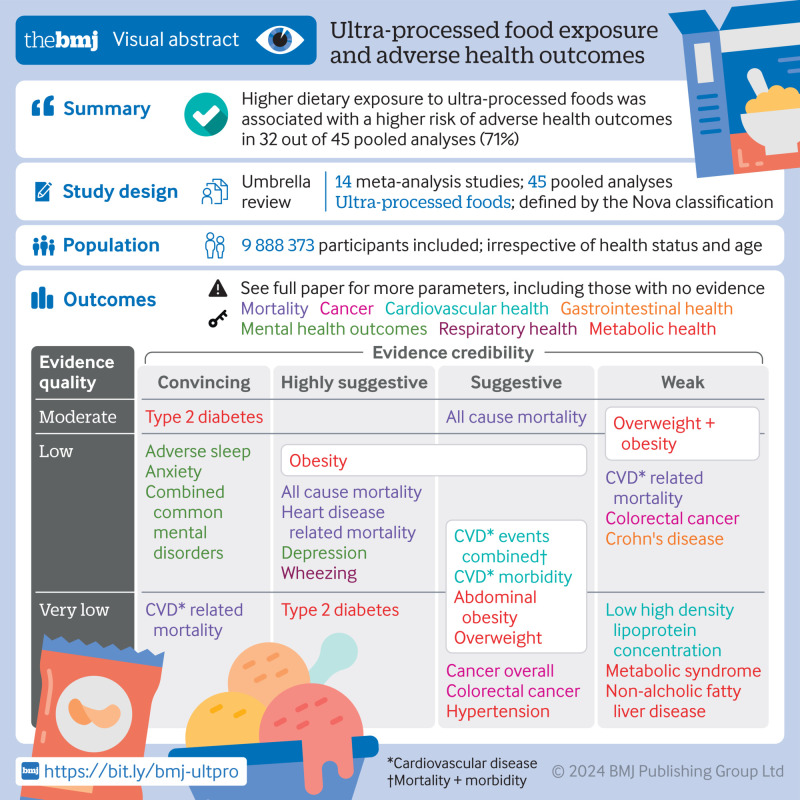
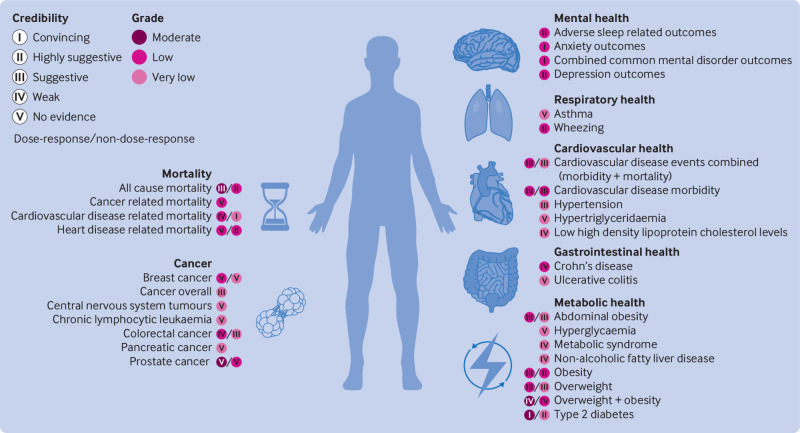
Objective: To evaluate the existing meta-analytic evidence of associations between exposure to ultra-processed foods, as defined by the Nova food classification system, and adverse health outcomes. Design: Systematic umbrella review of existing meta-analyses. Data sources: MEDLINE, PsycINFO, Embase, and the Cochrane Database of Systematic Reviews, as well as manual searches of reference lists from 2009 to June 2023. Eligibility criteria for selecting studies: Systematic reviews and meta-analyses of cohort, case-control, and/or cross sectional study designs. To evaluate the credibility of evidence, pre-specified evidence classification criteria were applied, graded as convincing (“class I”), highly suggestive (“class II”), suggestive (“class III”), weak (“class IV”), or no evidence (“class V”). The quality of evidence was assessed using the GRADE (Grading of Recommendations, Assessment, Development, and Evaluations) framework, categorised as “high,” “moderate,” “low,” or “very low” quality. Results: The search identified 45 unique pooled analyses, including 13 dose-response associations and 32 non-dose-response associations (n=9 888 373). Overall, direct associations were found between exposure to ultra-processed foods and 32 (71%) health parameters spanning mortality, cancer, and mental, respiratory, cardiovascular, gastrointestinal, and metabolic health outcomes. Based on the pre-specified evidence classification criteria, convincing evidence (class I) supported direct associations between greater ultra-processed food exposure and higher risks of incident cardiovascular disease related mortality (risk ratio 1.50, 95% confidence interval 1.37 to 1.63; GRADE=very low) and type 2 diabetes (dose-response risk ratio 1.12, 1.11 to 1.13; moderate), as well as higher risks of prevalent anxiety outcomes (odds ratio 1.48, 1.37 to 1.59; low) and combined common mental disorder outcomes (odds ratio 1.53, 1.43 to 1.63; low). Highly suggestive (class II) evidence indicated that greater exposure to ultra-processed foods was directly associated with higher risks of incident all cause mortality (risk ratio 1.21, 1.15 to 1.27; low), heart disease related mortality (hazard ratio 1.66, 1.51 to 1.84; low), type 2 diabetes (odds ratio 1.40, 1.23 to 1.59; very low), and depressive outcomes (hazard ratio 1.22, 1.16 to 1.28; low), together with higher risks of prevalent adverse sleep related outcomes (odds ratio 1.41, 1.24 to 1.61; low), wheezing (risk ratio 1.40, 1.27 to 1.55; low), and obesity (odds ratio 1.55, 1.36 to 1.77; low). Of the remaining 34 pooled analyses, 21 were graded as suggestive or weak strength (class III-IV) and 13 were graded as no evidence (class V). Overall, using the GRADE framework, 22 pooled analyses were rated as low quality, with 19 rated as very low quality and four rated as moderate quality. Conclusions: Greater exposure to ultra-processed food was associated with a higher risk of adverse health outcomes, especially cardiometabolic, common mental disorder, and mortality outcomes. These findings provide a rationale to develop and evaluate the effectiveness of using population based and public health measures to target and reduce dietary exposure to ultra-processed foods for improved human health. They also inform and provide support for urgent mechanistic research. Systematic review registration: PROSPERO CRD42023412732.
Overview
AI snapshot
Written from the paper’s full text.
TL;DR
This umbrella review of 45 pooled analyses (n=9,888,373) found that greater ultra-processed food exposure was directly associated with 32 (71%) adverse health outcomes, with convincing evidence for cardiovascular disease mortality, type 2 diabetes, anxiety, and combined common mental disorders. The authors conclude that the findings support urgent mechanistic research and population-level public health measures to reduce ultra-processed food exposure.
Key findings
- Across 45 unique pooled analyses, 32 (71%) showed direct associations between greater ultra-processed food exposure and higher risk of adverse health outcomes at P≤0.05; 11 (34%) remained significant at P<1×10⁻⁶.
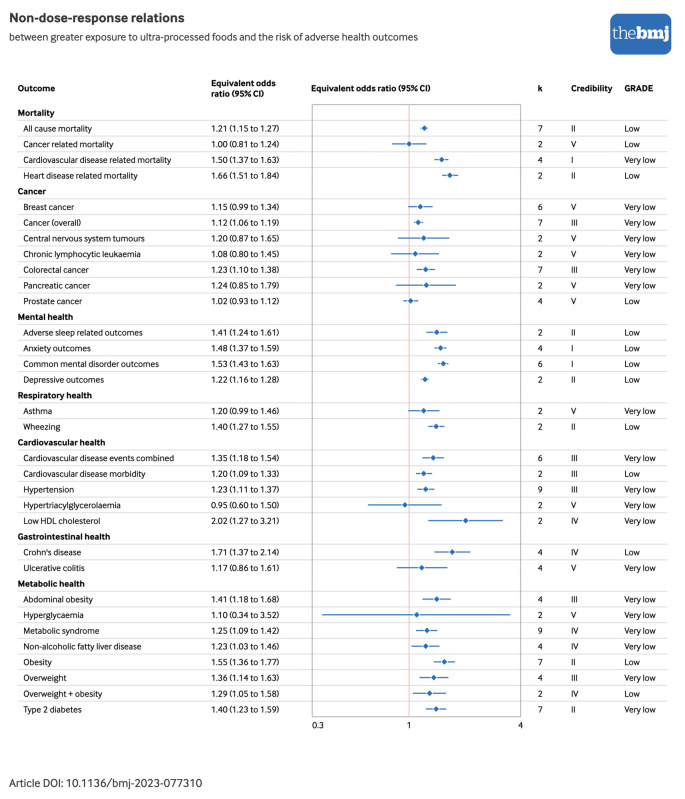
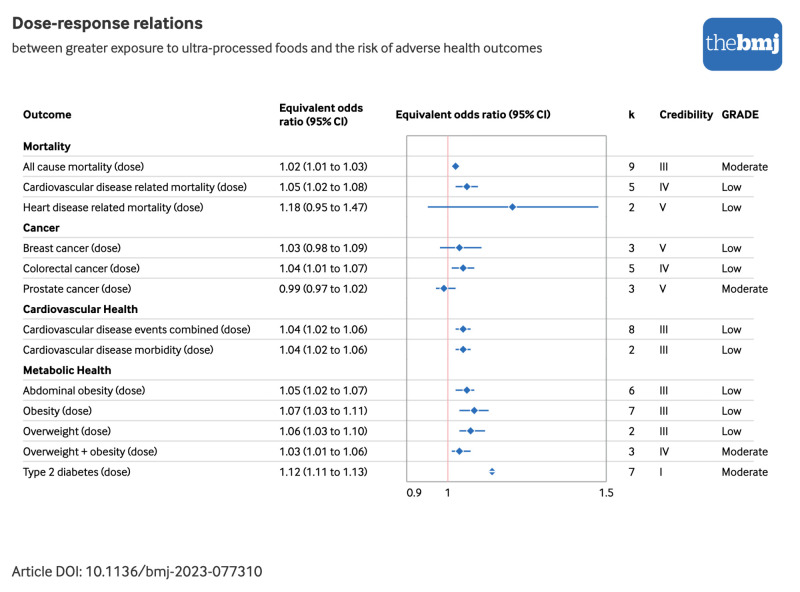
- Convincing evidence (class I) supported direct associations with incident cardiovascular disease related mortality (risk ratio 1.50, 95% CI 1.37 to 1.63; GRADE=very low), type 2 diabetes dose-response (risk ratio 1.12, 1.11 to 1.13; moderate), prevalent anxiety outcomes (odds ratio 1.48, 1.37 to 1.59; low), and combined common mental disorder outcomes (odds ratio 1.53, 1.43 to 1.63; low).
- Highly suggestive evidence (class II) supported direct associations with incident all cause mortality (risk ratio 1.21, 1.15 to 1.27; low), heart disease related mortality (hazard ratio 1.66, 1.51 to 1.84; low), type 2 diabetes (odds ratio 1.40, 1.23 to 1.59; very low), depressive outcomes (hazard ratio 1.22, 1.16 to 1.28; low), adverse sleep related outcomes (odds ratio 1.41, 1.24 to 1.61; low), wheezing (risk ratio 1.40, 1.27 to 1.55; low), and obesity (odds ratio 1.55, 1.36 to 1.77; low).
- Using GRADE, 22 pooled analyses were rated low quality, 19 very low quality, and four moderate quality.
Methods
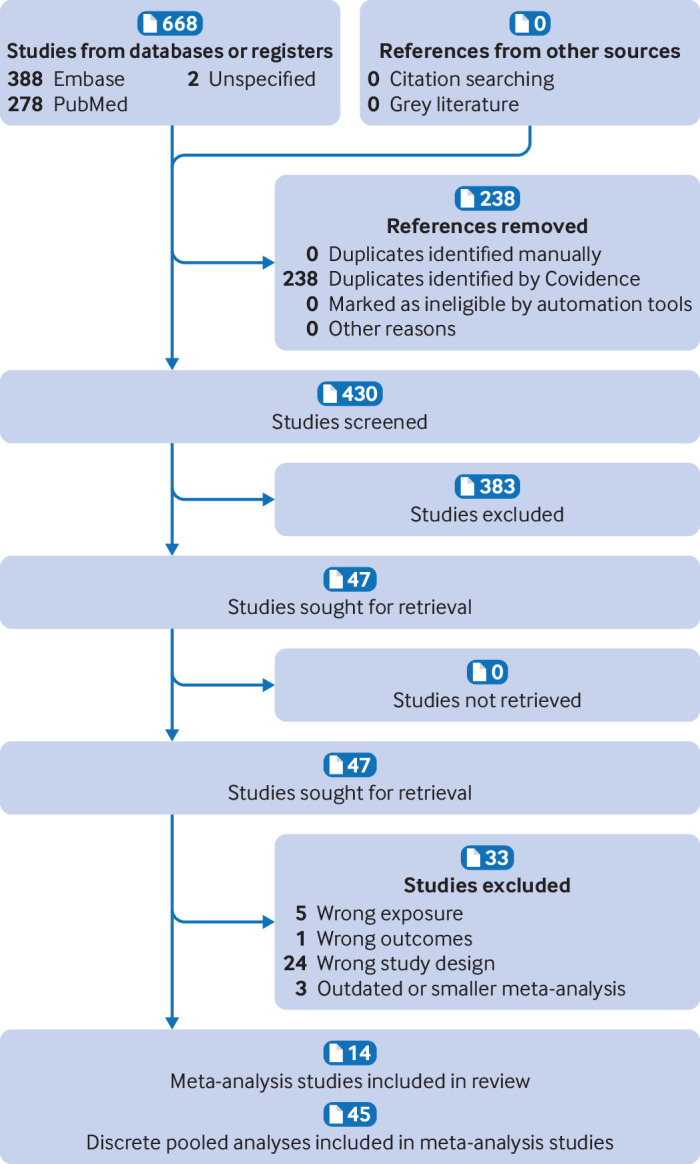
- Systematic umbrella review of meta-analyses, reported per PRISMA, searching MEDLINE, PsycINFO, Embase, and Cochrane from 2009 to June 2023; 14 meta-analysis studies with 45 distinct pooled analyses were included.
- Eligible meta-analysis studies pooled observational epidemiological designs (prospective cohort, case-control, and/or cross sectional) examining dietary ultra-processed food exposure per the Nova classification against any adverse health endpoint.
- Random-effects reanalysis recalculated pooled effect estimates, P values, I2 heterogeneity, 95% prediction intervals, excess significance bias, small study effects, and largest study significance; credibility was graded class I–V and quality assessed with GRADE and AMSTAR 2.
Limitations
- The paper states that umbrella reviews provide a high-level overview and did not consider specific confounder or mediator adjustments or sensitivity analyses; it also notes inevitable measurement bias from different dietary assessment methods, possible residual confounding, and possible heterogeneity across ultra-processed food subgroups/subcategories.
- The paper states that further randomised controlled trials are needed for causality, though only short-term trials on intermediate outcomes would be feasible and long-term trials on hard disease endpoints would not be ethical.
- Evident from the text: most pooled analyses were rated low or very low quality by GRADE (22 low, 19 very low, four moderate); moderate to high heterogeneity was found in 13 (29%) and eight (18%) of 45 pooled analyses, respectively; and many pooled analyses were based on few original research articles (average four, range two to nine).
Model-written summary. Check it against the paper before relying on it.
Integrity signals
Registry
Cites
Statistics
Figures
Verification
Claims the paper makes
42 Own result · 38 Not checked yet · 26 No full text of the sources · 11 Own interpretation · 9 Supported · 6 Partly supported · 6 Own method · 4 No basis given · 1 Supported so far · 1 Not supported · 1 Couldn’t confirm · 1 Sources not found · accuracy not yet measured
At least one cited source doesn’t support this claim or points to a different paper, and none confirmed it — see the verdicts below.
In the paper
“Pooled analyses that included two cross sectional studies provided limited evidence of an association between greater exposure to ultra-processed foods and risks of prevalent asthma (risk ratio 1.20, 0.99 to 1.46; class V; very low)”
§ Ultra-processed food exposure and adverse health outcomes: umbrella review of epidemiological meta-analyses > Results > Credibility and GRADE quality assessments
What the sources say
- Disputedcites [18] sourceExperimental — accuracy not yet measured
Split into 2 atoms — 0 confirmed, 1 partially supported, 1 disputed, 0 misattributed, 0 unverifiable. Expand the claim to see per-atom verdicts.
Checked by a reasoning model — may be wrong.
hedgedcorrelational- Asserted: passes — The authors put it forward as true.
- Checkable: passes — It can be checked against evidence.
- Load-bearing: unclear — It is unclear whether the paper’s conclusions depend on it.
- Based: passes — The paper gives a reason why it holds.
- Disputed
The cited sources support only part of this claim — read each source’s verdict below.
In the paper
“non-dose-response odds ratio 1.15, 0.99 to 1.34; class V; very low”
§ Ultra-processed food exposure and adverse health outcomes: umbrella review of epidemiological meta-analyses > Results > Credibility and GRADE quality assessments
What the sources say
- Partly supportedcites [40] sourceExperimental — accuracy not yet measured
Split into 2 atoms — 1 confirmed, 1 partially supported, 0 disputed, 0 misattributed, 0 unverifiable. Expand the claim to see per-atom verdicts.
plaincorrelational- Asserted: passes — The authors put it forward as true.
- Checkable: passes — It can be checked against evidence.
- Load-bearing: unclear — It is unclear whether the paper’s conclusions depend on it.
- Based: passes — The paper gives a reason why it holds.
- Partly supported
The cited sources support only part of this claim — read each source’s verdict below.
In the paper
“non-dose-response odds ratio 1.23, 1.10 to 1.38; class III; very low”
§ Ultra-processed food exposure and adverse health outcomes: umbrella review of epidemiological meta-analyses > Results > Credibility and GRADE quality assessments
What the sources say
- Partly supportedcites [40] sourceExperimental — accuracy not yet measured
Results §3.2.1 reports that the highest versus lowest ultra-processed food consumption was associated with colorectal cancer risk (pooled OR 1.23, 95% CI 1.10–1.38) across three cohort and three case–control studies. The paper reports a separate dose-based estimate, so the quoted OR is the non-dose-response comparison. Our copy does not assign this finding credibility class III or a GRADE rating of very low; Methods §2.3 instead describes quality assessment using the Newcastle–Ottawa Scale. Page numbers are unavailable in our copy. (LLM, conf=0.88)
plaincorrelational- Asserted: passes — The authors put it forward as true.
- Checkable: passes — It can be checked against evidence.
- Load-bearing: passes — The paper’s conclusions depend on it.
- Based: passes — The paper gives a reason why it holds.
- Partly supported
The sources with a verdict support this claim; the rest weren’t checked yet, have no full text we could read, or their verdicts aren’t rated yet.
In the paper
“we considered the overall confidence in the results of seven meta-analysis studies to be low owing to lack of clarity as to whether the review methods were established before the conduct of the review (AMSTAR critical item 2)”
§ Ultra-processed food exposure and adverse health outcomes: umbrella review of epidemiological meta-analyses > Results > Quality assessment of individual meta-analysis studies using AMSTAR 2 tool
What the sources say
- Supportedcites [17] source
The Methods (Statistical analysis; page unavailable) confirm that this paper conducted a meta-analysis, so it can be cited as an example of a meta-analysis study. The low-confidence AMSTAR rating is explicitly the citing authors’ own assessment, not a finding attributed to this paper. (LLM, conf=0.86)
- Could not verifycites [40] sourceExperimental — accuracy not yet measured
The Methods (§2.3; page unavailable) describe assessing included studies with the Newcastle–Ottawa Scale, and the Results (§3.1; page unavailable) describe 13 cohort and case–control studies. Searches for AMSTAR item 2, seven meta-analyses, and whether review methods were established beforehand found no passage assessing those seven studies or giving the stated reason for low confidence. (LLM, conf=0.76)
- Not checked — no full text of the sourcecites [41] source
plain- Asserted: passes — The authors put it forward as true.
- Checkable: passes — It can be checked against evidence.
- Load-bearing: unclear — It is unclear whether the paper’s conclusions depend on it.
- Based: passes — The paper gives a reason why it holds.
- Supported
The cited sources support only part of this claim — read each source’s verdict below.
In the paper
“The heterogeneity and imprecision noted across several of the pooled analyses, as shown by both the evidence classification criteria and GRADE assessments, may be partly explained by the treatment of different effect estimates derived from original research articles (hazard ratios, odds ratios, and risk ratios) as approximately equivalent in various meta-analysis studies.”
§ Ultra-processed food exposure and adverse health outcomes: umbrella review of epidemiological meta-analyses > Discussion > Principal findings
What the sources say
- Partly supportedcites [40] sourceExperimental — accuracy not yet measured
The Methods (§2.3–2.4; page unavailable) say the review extracted ORs or RRs from original studies and pooled estimates as ORs; the Results (§3.2) report heterogeneity in some pooled analyses. The paper does not say that treating effect estimates as approximately equivalent explains heterogeneity or imprecision, and these passages do not mention hazard ratios or GRADE assessments. (LLM, conf=0.82)
- Not checked — no full text of the sourcecites [42] source
- Not checked — no full text of the sourcecites [43] source
hedgedconditional- Asserted: passes — The authors put it forward as true.
- Checkable: passes — It can be checked against evidence.
- Load-bearing: unclear — It is unclear whether the paper’s conclusions depend on it.
- Based: passes — The paper gives a reason why it holds.
- Partly supported
Every source the paper cites for this claim was checked and supports it.
In the paper
“The mechanisms contributing to the excess consumption effect of diets rich in ultra-processed foods seem to involve the nature of the energy source”
§ Ultra-processed food exposure and adverse health outcomes: umbrella review of epidemiological meta-analyses > Discussion > Potential mechanisms of action
What the sources say
- Supportedcites [71] source
In Results and Discussion > Food Intake (page not provided), the paper reports that excess energy intake on the ultra-processed diet came from carbohydrate and fat, not protein. It also proposes the diet’s lower protein fraction as a possible partial explanation, consistent with the claim’s tentative wording. The authors caution in Limitations of Study that the trial was not designed to establish the cause. (LLM, conf=0.88)
hedgedconditional- Asserted: passes — The authors put it forward as true.
- Checkable: passes — It can be checked against evidence.
- Load-bearing: unclear — It is unclear whether the paper’s conclusions depend on it.
- Based: passes — The paper gives a reason why it holds.
- Supported
Every source the paper cites for this claim was checked and supports it.
In the paper
“Experimental evidence indicates a robust causal relation between ultra-processed diets and increased energy intake and weight gain (approximately 500 kcal (2000 kJ) per day and 0.9 kg during the ultra-processed diet).”
§ Ultra-processed food exposure and adverse health outcomes: umbrella review of epidemiological meta-analyses > Discussion > Potential mechanisms of action
What the sources say
- Supportedcites [71] source
The Results and Discussion (Food Intake; page unavailable) report 508±106 kcal/day greater energy intake during the ultra-processed diet than during the unprocessed diet. The Body weight and composition section (page unavailable) reports a 0.9±0.3 kg gain during the ultra-processed diet. These findings come from the randomized inpatient comparison described in the paper. (LLM, conf=0.94)
boosteddirect- Asserted: passes — The authors put it forward as true.
- Checkable: passes — It can be checked against evidence.
- Load-bearing: unclear — It is unclear whether the paper’s conclusions depend on it.
- Based: passes — The paper gives a reason why it holds.
- Supported
Every source the paper cites for this claim was checked and supports it.
In the paper
“The consumption of ultra-processed foods is linked to a lower intake of unprocessed or minimally processed fruits, vegetables, legumes, and seafood.”
§ Ultra-processed food exposure and adverse health outcomes: umbrella review of epidemiological meta-analyses > Discussion > Strengths and limitations of study and comparisons with other studies
What the sources say
- Supportedcites [6] source
The Results section (3.3; page not available in our copy) reports a negative linear correlation between ultra-processed food consumption and intake of unprocessed fruits, vegetables, seafood, beans, and legumes. This directly supports the claimed association. (LLM, conf=0.95)
plaincorrelational- Asserted: passes — The authors put it forward as true.
- Checkable: passes — It can be checked against evidence.
- Load-bearing: unclear — It is unclear whether the paper’s conclusions depend on it.
- Based: passes — The paper gives a reason why it holds.
- Supported
The cited sources that could be checked couldn’t confirm or dispute this claim.
In the paper
“they suggest that higher consumption of ultra-processed foods within broader dietary patterns may have synergistic or compounded consequences compared with lower intakes”
§ Ultra-processed food exposure and adverse health outcomes: umbrella review of epidemiological meta-analyses > Discussion > Strengths and limitations of study and comparisons with other studies
What the sources say
- Could not verifycites [12] sourceExperimental — accuracy not yet measured
The retrieved passages are from the References section and do not address whether higher ultra-processed-food intake has synergistic or compounded consequences within broader dietary patterns. Searches for “synergistic,” “dietary patterns,” and combined effects found no decisive passage in the available full-text copy. (LLM, conf=0.70)
- Not checked — no full text of the sourcecites [13] source
- Not checked — no full text of the sourcecites [14] source
hedgedconditional- Asserted: passes — The authors put it forward as true.
- Checkable: passes — It can be checked against evidence.
- Load-bearing: unclear — It is unclear whether the paper’s conclusions depend on it.
- Based: passes — The paper gives a reason why it holds.
- Could not verify
Every source the paper cites for this claim was checked and supports it.
In the paper
“with the definitions and examples provided by the Nova system deemed adequate in classifying more than 70% of the food items reported in food frequency questionnaires from various cohorts from the US,99”
§ Ultra-processed food exposure and adverse health outcomes: umbrella review of epidemiological meta-analyses > Discussion > Policy implications
What the sources say
- Supportedcites [99] source
The Discussion states that over 70% of FFQ food items across the NHS, HPFS and GUTS cohorts were assigned to a NOVA group on the first attempt using published definitions and examples. The remaining items required additional review. The supplied passage gives a section label but no page number. (LLM, conf=0.94)
plain- Asserted: passes — The authors put it forward as true.
- Checkable: passes — It can be checked against evidence.
- Load-bearing: unclear — It is unclear whether the paper’s conclusions depend on it.
- Based: passes — The paper gives a reason why it holds.
- Supported
The cited sources support only part of this claim — read each source’s verdict below.
In the paper
“the greater energy density, faster eating rate, and hyper-palatability attributed to ultra-processed foods are regarded as important factors influencing this effect.”
§ Ultra-processed food exposure and adverse health outcomes: umbrella review of epidemiological meta-analyses > Discussion > Potential mechanisms of action
What the sources say
- Partly supportedcites [73] sourceExperimental — accuracy not yet measured
The Abstract reports that energy density and hyper-palatable foods positively mediated the higher meal energy intake associated with the ultra-processed diet. It also finds that faster eating predicts greater intake across diets, but says eating rate was lower on the ultra-processed diet and negatively mediated the diet effect; it does not support attributing faster eating to that diet. (LLM, conf=0.88)
hedgedcorrelational- Asserted: passes — The authors put it forward as true.
- Checkable: passes — It can be checked against evidence.
- Load-bearing: unclear — It is unclear whether the paper’s conclusions depend on it.
- Based: passes — The paper gives a reason why it holds.
- Partly supported
Every source the paper cites for this claim was checked and supports it.
In the paper
“This limitation may partially account for differences in the strength of evidence observed in our review compared with another recent umbrella review focusing on dietary sugar consumption”
§ Ultra-processed food exposure and adverse health outcomes: umbrella review of epidemiological meta-analyses > Discussion > Strengths and limitations of study and comparisons with other studies
What the sources say
- Supportedcites [25] source
The Introduction identifies this work as an umbrella review of dietary sugar intake and health outcomes, and the Methods describe its analysis of systematic reviews and meta-analyses. The citation identifies the other review; the proposed explanation for differences in evidence strength is the citing authors’ own interpretation. (LLM, conf=0.93)
hedgedconditional- Asserted: passes — The authors put it forward as true.
- Checkable: passes — It can be checked against evidence.
- Load-bearing: unclear — It is unclear whether the paper’s conclusions depend on it.
- Based: passes — The paper gives a reason why it holds.
- Supported
A result the paper reports from its own data — it cites no other source for it, so there is none to check. The quote shows it is in the paper.
In the paper
“On the basis of the random effects model, 32 (71%) distinct pooled analyses showed direct associations between greater ultra-processed food exposure and a higher risk of adverse health outcomes at the significance level of P≤0.05 (supplementary table G).”
- Also stated in: § Results · plain
“Overall, direct associations were found between exposure to ultra-processed foods and 32 (71%) health parameters spanning mortality, cancer, and mental, respiratory, cardiovascular, gastrointestinal, and metabolic health outcomes.”
§ Ultra-processed food exposure and adverse health outcomes: umbrella review of epidemiological meta-analyses > Results > Results of syntheses
plaincorrelational- Asserted: passes — The authors put it forward as true.
- Checkable: passes — It can be checked against evidence.
- Load-bearing: passes — The paper’s conclusions depend on it.
- Based: passes — The paper gives a reason why it holds.
- Also stated in: § Results · plain
A result the paper reports from its own data — it cites no other source for it, so there is none to check. The quote shows it is in the paper.
In the paper
“Highly suggestive (class II) evidence indicated that greater exposure to ultra-processed foods was directly associated with higher risks of incident all cause mortality (risk ratio 1.21, 1.15 to 1.27; low)”
§ Ultra-processed food exposure and adverse health outcomes: umbrella review of epidemiological meta-analyses > Abstract > Results
hedgedcorrelational- Asserted: passes — The authors put it forward as true.
- Checkable: passes — It can be checked against evidence.
- Load-bearing: passes — The paper’s conclusions depend on it.
- Based: passes — The paper gives a reason why it holds.
A result the paper reports from its own data — it cites no other source for it, so there is none to check. The quote shows it is in the paper.
In the paper
“heart disease related mortality (hazard ratio 1.66, 1.51 to 1.84; low)”
§ Ultra-processed food exposure and adverse health outcomes: umbrella review of epidemiological meta-analyses > Abstract > Results
plaincorrelational- Asserted: passes — The authors put it forward as true.
- Checkable: passes — It can be checked against evidence.
- Load-bearing: passes — The paper’s conclusions depend on it.
- Based: passes — The paper gives a reason why it holds.
A result the paper reports from its own data — it cites no other source for it, so there is none to check. The quote shows it is in the paper.
In the paper
“and depressive outcomes (hazard ratio 1.22, 1.16 to 1.28; low)”
§ Ultra-processed food exposure and adverse health outcomes: umbrella review of epidemiological meta-analyses > Abstract > Results
plaincorrelational- Asserted: passes — The authors put it forward as true.
- Checkable: passes — It can be checked against evidence.
- Load-bearing: passes — The paper’s conclusions depend on it.
- Based: passes — The paper gives a reason why it holds.
A result the paper reports from its own data — it cites no other source for it, so there is none to check. The quote shows it is in the paper.
In the paper
“convincing evidence (class I) supported direct associations between greater ultra-processed food exposure and higher risks of incident cardiovascular disease related mortality (risk ratio 1.50, 95% confidence interval 1.37 to 1.63; GRADE=very low)”
§ Ultra-processed food exposure and adverse health outcomes: umbrella review of epidemiological meta-analyses > Abstract > Results
boostedcorrelational- Asserted: passes — The authors put it forward as true.
- Checkable: passes — It can be checked against evidence.
- Load-bearing: passes — The paper’s conclusions depend on it.
- Based: passes — The paper gives a reason why it holds.
A result the paper reports from its own data — it cites no other source for it, so there is none to check. The quote shows it is in the paper.
In the paper
“higher risks of prevalent adverse sleep related outcomes (odds ratio 1.41, 1.24 to 1.61; low)”
§ Ultra-processed food exposure and adverse health outcomes: umbrella review of epidemiological meta-analyses > Abstract > Results
plaincorrelational- Asserted: passes — The authors put it forward as true.
- Checkable: passes — It can be checked against evidence.
- Load-bearing: passes — The paper’s conclusions depend on it.
- Based: passes — The paper gives a reason why it holds.
A result the paper reports from its own data — it cites no other source for it, so there is none to check. The quote shows it is in the paper.
In the paper
“The search identified 45 unique pooled analyses, including 13 dose-response associations and 32 non-dose-response associations (n=9 888 373).”
- Also stated in: § Results · plain
“After applying the eligibility criteria, we included 14 meta-analysis studies with 45 distinct pooled analyses.”
§ Ultra-processed food exposure and adverse health outcomes: umbrella review of epidemiological meta-analyses > Abstract > Results
plain- Asserted: passes — The authors put it forward as true.
- Checkable: passes — It can be checked against evidence.
- Load-bearing: unclear — It is unclear whether the paper’s conclusions depend on it.
- Based: passes — The paper gives a reason why it holds.
- Also stated in: § Results · plain
A result the paper reports from its own data — it cites no other source for it, so there is none to check. The quote shows it is in the paper.
In the paper
“type 2 diabetes (odds ratio 1.40, 1.23 to 1.59; very low)”
§ Ultra-processed food exposure and adverse health outcomes: umbrella review of epidemiological meta-analyses > Abstract > Results
plaincorrelational- Asserted: passes — The authors put it forward as true.
- Checkable: passes — It can be checked against evidence.
- Load-bearing: passes — The paper’s conclusions depend on it.
- Based: passes — The paper gives a reason why it holds.
A result the paper reports from its own data — it cites no other source for it, so there is none to check. The quote shows it is in the paper.
In the paper
“as well as higher risks of prevalent anxiety outcomes (odds ratio 1.48, 1.37 to 1.59; low)”
§ Ultra-processed food exposure and adverse health outcomes: umbrella review of epidemiological meta-analyses > Abstract > Results
plaincorrelational- Asserted: passes — The authors put it forward as true.
- Checkable: passes — It can be checked against evidence.
- Load-bearing: passes — The paper’s conclusions depend on it.
- Based: passes — The paper gives a reason why it holds.
A result the paper reports from its own data — it cites no other source for it, so there is none to check. The quote shows it is in the paper.
In the paper
“and combined common mental disorder outcomes (odds ratio 1.53, 1.43 to 1.63; low)”
§ Ultra-processed food exposure and adverse health outcomes: umbrella review of epidemiological meta-analyses > Abstract > Results
plaincorrelational- Asserted: passes — The authors put it forward as true.
- Checkable: passes — It can be checked against evidence.
- Load-bearing: passes — The paper’s conclusions depend on it.
- Based: passes — The paper gives a reason why it holds.
A result the paper reports from its own data — it cites no other source for it, so there is none to check. The quote shows it is in the paper.
In the paper
“and type 2 diabetes (dose-response risk ratio 1.12, 1.11 to 1.13; moderate)”
§ Ultra-processed food exposure and adverse health outcomes: umbrella review of epidemiological meta-analyses > Abstract > Results
plaincorrelational- Asserted: passes — The authors put it forward as true.
- Checkable: passes — It can be checked against evidence.
- Load-bearing: passes — The paper’s conclusions depend on it.
- Based: passes — The paper gives a reason why it holds.
None of the sources cited for this claim have been checked yet.
In the paper
“dose-response hazard ratio 1.18, 0.95 to 1.47; class V; low”
§ Ultra-processed food exposure and adverse health outcomes: umbrella review of epidemiological meta-analyses > Results > Credibility and GRADE quality assessments
What the sources say
- Not checked yetcites [51] source
Checked before — its earlier verdict is held back until a new check runs.
plaincorrelational- Asserted: passes — The authors put it forward as true.
- Checkable: passes — It can be checked against evidence.
- Load-bearing: unclear — It is unclear whether the paper’s conclusions depend on it.
- Based: passes — The paper gives a reason why it holds.
- Not checked yet
None of the sources cited for this claim have been checked yet.
In the paper
“and wheezing (risk ratio 1.40, 1.27 to 1.55; class II; low)”
§ Ultra-processed food exposure and adverse health outcomes: umbrella review of epidemiological meta-analyses > Results > Credibility and GRADE quality assessments
What the sources say
- Not checked yetcites [18] source
Checked before — its earlier verdict is held back until a new check runs.
plaincorrelational- Asserted: passes — The authors put it forward as true.
- Checkable: passes — It can be checked against evidence.
- Load-bearing: unclear — It is unclear whether the paper’s conclusions depend on it.
- Based: passes — The paper gives a reason why it holds.
- Not checked yet
In the paper
“The risk of abdominal obesity was examined by synthesising effect estimates from mixed cohort and cross sectional study designs, which showed direct associations with greater ultra-processed food exposure (dose-response odds ratio 1.05, 1.02 to 1.07; class III; low”
§ Ultra-processed food exposure and adverse health outcomes: umbrella review of epidemiological meta-analyses > Results > Credibility and GRADE quality assessments
What the sources say
- Not checked — no full text of the sourcecites [42] source
plaincorrelational- Asserted: passes — The authors put it forward as true.
- Checkable: passes — It can be checked against evidence.
- Load-bearing: passes — The paper’s conclusions depend on it.
- Based: passes — The paper gives a reason why it holds.
None of the sources cited for this claim have been checked yet.
In the paper
“We found weak or no evidence in pooled analyses incorporating data from four cohorts for associations between greater exposure to ultra-processed foods and higher risks of incident Crohn’s disease (hazard ratio 1.71, 1.37 to 2.14; class IV; low)”
§ Ultra-processed food exposure and adverse health outcomes: umbrella review of epidemiological meta-analyses > Results > Credibility and GRADE quality assessments
What the sources say
- Not checked yetcites [48] source
Checked before — its earlier verdict is held back until a new check runs.
plain- Asserted: passes — The authors put it forward as true.
- Checkable: passes — It can be checked against evidence.
- Load-bearing: passes — The paper’s conclusions depend on it.
- Based: passes — The paper gives a reason why it holds.
- Not checked yet
A result the paper reports from its own data — it cites no other source for it, so there is none to check. The quote shows it is in the paper.
In the paper
“considering the overall body of evidence, 93% of pooled analyses indicated point estimates in the same direction (greater than one)”
§ Ultra-processed food exposure and adverse health outcomes: umbrella review of epidemiological meta-analyses > Discussion > Principal findings
plaincorrelational- Asserted: passes — The authors put it forward as true.
- Checkable: passes — It can be checked against evidence.
- Load-bearing: passes — The paper’s conclusions depend on it.
- Based: passes — The paper gives a reason why it holds.
A result the paper reports from its own data — it cites no other source for it, so there is none to check. The quote shows it is in the paper.
In the paper
“Across the pooled analyses, greater exposure to ultra-processed foods, whether measured as higher versus lower consumption, additional servings per day, or a 10% increment, was consistently associated with a higher risk of adverse health outcomes (71% of outcomes).”
§ Ultra-processed food exposure and adverse health outcomes: umbrella review of epidemiological meta-analyses > Discussion > Principal findings
plaincorrelational- Asserted: passes — The authors put it forward as true.
- Checkable: passes — It can be checked against evidence.
- Load-bearing: passes — The paper’s conclusions depend on it.
- Based: passes — The paper gives a reason why it holds.
In the paper
“overweight and obesity (assessed together: dose-response odds ratio 1.03, 1.01 to 1.06; class IV; moderate”
§ Ultra-processed food exposure and adverse health outcomes: umbrella review of epidemiological meta-analyses > Results > Credibility and GRADE quality assessments
What the sources say
- Not checked — no full text of the sourcecites [42] source
plain- Asserted: passes — The authors put it forward as true.
- Checkable: passes — It can be checked against evidence.
- Load-bearing: passes — The paper’s conclusions depend on it.
- Based: passes — The paper gives a reason why it holds.
In the paper
“non-dose-response risk ratio 1.50, 1.37 to 1.63; class I; very low”
§ Ultra-processed food exposure and adverse health outcomes: umbrella review of epidemiological meta-analyses > Results > Credibility and GRADE quality assessments
What the sources say
- Not checked — no full text of the sourcecites [43] source
plaincorrelational- Asserted: passes — The authors put it forward as true.
- Checkable: passes — It can be checked against evidence.
- Load-bearing: passes — The paper’s conclusions depend on it.
- Based: passes — The paper gives a reason why it holds.
A result the paper reports from its own data — it cites no other source for it, so there is none to check. The quote shows it is in the paper.
In the paper
“wheezing (risk ratio 1.40, 1.27 to 1.55; low)”
§ Ultra-processed food exposure and adverse health outcomes: umbrella review of epidemiological meta-analyses > Abstract > Results
plaincorrelational- Asserted: passes — The authors put it forward as true.
- Checkable: passes — It can be checked against evidence.
- Load-bearing: passes — The paper’s conclusions depend on it.
- Based: passes — The paper gives a reason why it holds.
None of the sources cited for this claim have been checked yet.
In the paper
“non-alcoholic fatty liver disease (risk ratio 1.23, 1.03 to 1.46; class IV; very low)”
§ Ultra-processed food exposure and adverse health outcomes: umbrella review of epidemiological meta-analyses > Results > Credibility and GRADE quality assessments
What the sources say
- Not checked yetcites [46] source
Checked before — its earlier verdict is held back until a new check runs.
plain- Asserted: passes — The authors put it forward as true.
- Checkable: passes — It can be checked against evidence.
- Load-bearing: unclear — It is unclear whether the paper’s conclusions depend on it.
- Based: passes — The paper gives a reason why it holds.
- Not checked yet
None of the sources cited for this claim have been checked yet.
In the paper
“Effect estimates from two cohorts were pooled and showed limited evidence supporting direct associations between greater ultra-processed food exposure and a higher risk of incident cancer related mortality (hazard ratio 1.00, 0.81 to 1.24; class V; low)”
§ Ultra-processed food exposure and adverse health outcomes: umbrella review of epidemiological meta-analyses > Results > Credibility and GRADE quality assessments
What the sources say
- Not checked yetcites [51] source
Checked before — its earlier verdict is held back until a new check runs.
hedgedcorrelational- Asserted: passes — The authors put it forward as true.
- Checkable: passes — It can be checked against evidence.
- Load-bearing: unclear — It is unclear whether the paper’s conclusions depend on it.
- Based: passes — The paper gives a reason why it holds.
- Not checked yet
In the paper
“non-dose-response risk ratio 1.21, 1.15 to 1.27; class II; low”
§ Ultra-processed food exposure and adverse health outcomes: umbrella review of epidemiological meta-analyses > Results > Credibility and GRADE quality assessments
What the sources say
- Not checked — no full text of the sourcecites [43] source
plaincorrelational- Asserted: passes — The authors put it forward as true.
- Checkable: passes — It can be checked against evidence.
- Load-bearing: passes — The paper’s conclusions depend on it.
- Based: passes — The paper gives a reason why it holds.
None of the sources cited for this claim have been checked yet.
In the paper
“We found weak to no evidence for associations between exposure to ultra-processed foods and hypertriglyceridaemia (odds ratio 0.95, 0.60 to 1.50; class V; very low)”
§ Ultra-processed food exposure and adverse health outcomes: umbrella review of epidemiological meta-analyses > Results > Credibility and GRADE quality assessments
What the sources say
- Not checked yetcites [17] source
Checked before — its earlier verdict is held back until a new check runs.
plain- Asserted: passes — The authors put it forward as true.
- Checkable: passes — It can be checked against evidence.
- Load-bearing: unclear — It is unclear whether the paper’s conclusions depend on it.
- Based: passes — The paper gives a reason why it holds.
- Not checked yet
None of the sources cited for this claim have been checked yet.
In the paper
“non-dose-response hazard ratio 1.66, 1.51 to 1.84; class II; low”
§ Ultra-processed food exposure and adverse health outcomes: umbrella review of epidemiological meta-analyses > Results > Credibility and GRADE quality assessments
What the sources say
- Not checked yetcites [51] source
Checked before — its earlier verdict is held back until a new check runs.
plaincorrelational- Asserted: passes — The authors put it forward as true.
- Checkable: passes — It can be checked against evidence.
- Load-bearing: passes — The paper’s conclusions depend on it.
- Based: passes — The paper gives a reason why it holds.
- Not checked yet
None of the sources cited for this claim have been checked yet.
In the paper
“central nervous system tumours (odds ratio 1.20, 0.87 to 1.65; class V; very low)”
§ Ultra-processed food exposure and adverse health outcomes: umbrella review of epidemiological meta-analyses > Results > Credibility and GRADE quality assessments
What the sources say
- Not checked yetcites [40] source
Checked before — its earlier verdict is held back until a new check runs.
plaincorrelational- Asserted: passes — The authors put it forward as true.
- Checkable: passes — It can be checked against evidence.
- Load-bearing: unclear — It is unclear whether the paper’s conclusions depend on it.
- Based: passes — The paper gives a reason why it holds.
- Not checked yet
In the paper
“Examining data from two to four cross sectional designs, we found evidence supporting direct associations between greater exposure to ultra-processed foods and a higher risk of the prevalence of adverse sleep related outcomes (odds ratio 1.41, 1.24 to 1.61; class II; low)”
§ Ultra-processed food exposure and adverse health outcomes: umbrella review of epidemiological meta-analyses > Results > Credibility and GRADE quality assessments
What the sources say
- Not checked — no full text of the sourcecites [49] source
plaincorrelational- Asserted: passes — The authors put it forward as true.
- Checkable: passes — It can be checked against evidence.
- Load-bearing: passes — The paper’s conclusions depend on it.
- Based: passes — The paper gives a reason why it holds.
None of the sources cited for this claim have been checked yet.
In the paper
“We observed similar associations in separate assessments of prevalent combined common mental disorder outcomes across six cross sectional designs (odds ratio 1.53, 1.43 to 1.63; class I; low)”
§ Ultra-processed food exposure and adverse health outcomes: umbrella review of epidemiological meta-analyses > Results > Credibility and GRADE quality assessments
What the sources say
- Not checked yetcites [50] source
Checked before — its earlier verdict is held back until a new check runs.
plaincorrelational- Asserted: passes — The authors put it forward as true.
- Checkable: passes — It can be checked against evidence.
- Load-bearing: passes — The paper’s conclusions depend on it.
- Based: passes — The paper gives a reason why it holds.
- Not checked yet
In the paper
“non-dose-response odds ratio 1.40, 1.23 to 1.59; class II; very low”
§ Ultra-processed food exposure and adverse health outcomes: umbrella review of epidemiological meta-analyses > Results > Credibility and GRADE quality assessments
What the sources say
- Not checked — no full text of the sourcecites [47] source
plaincorrelational- Asserted: passes — The authors put it forward as true.
- Checkable: passes — It can be checked against evidence.
- Load-bearing: passes — The paper’s conclusions depend on it.
- Based: passes — The paper gives a reason why it holds.
None of the sources cited for this claim have been checked yet.
In the paper
“as well as anxiety outcomes (odds ratio 1.48, 1.37 to 1.59; class I; low)”
§ Ultra-processed food exposure and adverse health outcomes: umbrella review of epidemiological meta-analyses > Results > Credibility and GRADE quality assessments
What the sources say
- Not checked yetcites [50] source
Checked before — its earlier verdict is held back until a new check runs.
plaincorrelational- Asserted: passes — The authors put it forward as true.
- Checkable: passes — It can be checked against evidence.
- Load-bearing: passes — The paper’s conclusions depend on it.
- Based: passes — The paper gives a reason why it holds.
- Not checked yet
In the paper
“Pooled effect estimates from nine dose-response and seven non-dose-response cohorts showed direct associations between greater exposure to ultra-processed foods and higher risks of incident all cause mortality (dose-response risk ratio 1.02, 95% confidence interval 1.01 to 1.03; credibility assessment class III; GRADE assessment moderate”
§ Ultra-processed food exposure and adverse health outcomes: umbrella review of epidemiological meta-analyses > Results > Credibility and GRADE quality assessments
What the sources say
- Not checked — no full text of the sourcecites [43] source
plaincorrelational- Asserted: passes — The authors put it forward as true.
- Checkable: passes — It can be checked against evidence.
- Load-bearing: passes — The paper’s conclusions depend on it.
- Based: passes — The paper gives a reason why it holds.
In the paper
“Pooled analyses from six cohorts showed direct associations between greater ultra-processed food exposure and higher risks of incident cardiovascular disease events such as morbidity and mortality (dose-response risk ratio 1.04, 1.02 to 1.06; class III; low”
§ Ultra-processed food exposure and adverse health outcomes: umbrella review of epidemiological meta-analyses > Results > Credibility and GRADE quality assessments
What the sources say
- Not checked — no full text of the sourcecites [43] source
plaincorrelational- Asserted: passes — The authors put it forward as true.
- Checkable: passes — It can be checked against evidence.
- Load-bearing: passes — The paper’s conclusions depend on it.
- Based: passes — The paper gives a reason why it holds.
A result the paper reports from its own data — it cites no other source for it, so there is none to check. The quote shows it is in the paper.
In the paper
“The 95% prediction intervals were statistically significant for seven (25%) of the 28 pooled analyses with three or more original research articles (supplementary table G), including direct associations of greater ultra-processed food exposure with higher risks of all cause mortality,43 cardiovascular disease related mortality,43 common mental disorder outcomes,50 Crohn’s disease,48 obesity,42 and”
§ Ultra-processed food exposure and adverse health outcomes: umbrella review of epidemiological meta-analyses > Results > Results of syntheses
plain- Asserted: passes — The authors put it forward as true.
- Checkable: passes — It can be checked against evidence.
- Load-bearing: unclear — It is unclear whether the paper’s conclusions depend on it.
- Based: passes — The paper gives a reason why it holds.
None of the sources cited for this claim have been checked yet.
In the paper
“chronic lymphocytic leukaemia (odds ratio 1.08, 0.80 to 1.45; class V; very low)”
§ Ultra-processed food exposure and adverse health outcomes: umbrella review of epidemiological meta-analyses > Results > Credibility and GRADE quality assessments
What the sources say
- Not checked yetcites [40] source
Checked before — its earlier verdict is held back until a new check runs.
plaincorrelational- Asserted: passes — The authors put it forward as true.
- Checkable: passes — It can be checked against evidence.
- Load-bearing: unclear — It is unclear whether the paper’s conclusions depend on it.
- Based: passes — The paper gives a reason why it holds.
- Not checked yet
None of the sources cited for this claim have been checked yet.
In the paper
“and low high density lipoprotein concentrations (odds ratio 2.02, 1.27 to 3.21; class IV; very low)”
§ Ultra-processed food exposure and adverse health outcomes: umbrella review of epidemiological meta-analyses > Results > Credibility and GRADE quality assessments
What the sources say
- Not checked yetcites [17] source
Checked before — its earlier verdict is held back until a new check runs.
plain- Asserted: passes — The authors put it forward as true.
- Checkable: passes — It can be checked against evidence.
- Load-bearing: unclear — It is unclear whether the paper’s conclusions depend on it.
- Based: passes — The paper gives a reason why it holds.
- Not checked yet
None of the sources cited for this claim have been checked yet.
In the paper
“We found weak to no evidence for associations between exposure to ultra-processed foods and hyperglycaemia (odds ratio 1.10, 0.34 to 3.52; class V; very low)”
§ Ultra-processed food exposure and adverse health outcomes: umbrella review of epidemiological meta-analyses > Results > Credibility and GRADE quality assessments
What the sources say
- Not checked yetcites [17] source
Checked before — its earlier verdict is held back until a new check runs.
hedged- Asserted: passes — The authors put it forward as true.
- Checkable: passes — It can be checked against evidence.
- Load-bearing: unclear — It is unclear whether the paper’s conclusions depend on it.
- Based: passes — The paper gives a reason why it holds.
- Not checked yet
In the paper
“Four dose-response and five non-dose-response cohorts informed the synthesis of associations between greater exposure to ultra-processed foods and higher risks of incident cardiovascular disease related mortality (dose-response risk ratio 1.05, 1.02 to 1.08; class IV; low”
§ Ultra-processed food exposure and adverse health outcomes: umbrella review of epidemiological meta-analyses > Results > Credibility and GRADE quality assessments
What the sources say
- Not checked — no full text of the sourcecites [43] source
plaincorrelational- Asserted: passes — The authors put it forward as true.
- Checkable: passes — It can be checked against evidence.
- Load-bearing: passes — The paper’s conclusions depend on it.
- Based: passes — The paper gives a reason why it holds.
None of the sources cited for this claim have been checked yet.
In the paper
“prostate cancer (dose-response odds ratio 0.99, 0.97 to 1.02; class V; moderate”
§ Ultra-processed food exposure and adverse health outcomes: umbrella review of epidemiological meta-analyses > Results > Credibility and GRADE quality assessments
What the sources say
- Not checked yetcites [40] source
Checked before — its earlier verdict is held back until a new check runs.
plaincorrelational- Asserted: passes — The authors put it forward as true.
- Checkable: passes — It can be checked against evidence.
- Load-bearing: unclear — It is unclear whether the paper’s conclusions depend on it.
- Based: passes — The paper gives a reason why it holds.
- Not checked yet
In the paper
“Effect estimates from four cross sectional studies informed pooled analyses of direct associations between greater ultra-processed food exposure and higher risk of the prevalence of overweight (dose-response odds ratio 1.06, 1.03 to 1.10; class III; low”
§ Ultra-processed food exposure and adverse health outcomes: umbrella review of epidemiological meta-analyses > Results > Credibility and GRADE quality assessments
What the sources say
- Not checked — no full text of the sourcecites [42] source
plaincorrelational- Asserted: passes — The authors put it forward as true.
- Checkable: passes — It can be checked against evidence.
- Load-bearing: passes — The paper’s conclusions depend on it.
- Based: passes — The paper gives a reason why it holds.
None of the sources cited for this claim have been checked yet.
In the paper
“Synthesised analyses including mixed cohort and case-control study designs additionally showed direct associations with a risk of colorectal cancer (dose-response odds ratio 1.04, 1.01 to 1.07; class IV; low”
§ Ultra-processed food exposure and adverse health outcomes: umbrella review of epidemiological meta-analyses > Results > Credibility and GRADE quality assessments
What the sources say
- Not checked yetcites [40] source
Checked before — its earlier verdict is held back until a new check runs.
plaincorrelational- Asserted: passes — The authors put it forward as true.
- Checkable: passes — It can be checked against evidence.
- Load-bearing: passes — The paper’s conclusions depend on it.
- Based: passes — The paper gives a reason why it holds.
- Not checked yet
A result the paper reports from its own data — it cites no other source for it, so there is none to check. The quote shows it is in the paper.
In the paper
“We graded 16% of pooled analyses (all non-dose-response) as providing highly suggestive evidence (class II), encompassing risks of all cause mortality, heart disease related mortality, adverse sleep related outcomes, wheezing, obesity, and type 2 diabetes.”
§ Ultra-processed food exposure and adverse health outcomes: umbrella review of epidemiological meta-analyses > Discussion > Principal findings
plaincorrelational- Asserted: passes — The authors put it forward as true.
- Checkable: passes — It can be checked against evidence.
- Load-bearing: passes — The paper’s conclusions depend on it.
- Based: passes — The paper gives a reason why it holds.
None of the sources cited for this claim have been checked yet.
In the paper
“The higher risk of hypertension associated with greater ultra-processed food exposure was assessed using data from nine mixed cohorts and cross sectional study designs (odds ratio 1.23, 1.11 to 1.37; class III; very low)”
§ Ultra-processed food exposure and adverse health outcomes: umbrella review of epidemiological meta-analyses > Results > Credibility and GRADE quality assessments
What the sources say
- Not checked yetcites [44] source
Checked before — its earlier verdict is held back until a new check runs.
plaincorrelational- Asserted: passes — The authors put it forward as true.
- Checkable: passes — It can be checked against evidence.
- Load-bearing: passes — The paper’s conclusions depend on it.
- Based: passes — The paper gives a reason why it holds.
- Not checked yet
In the paper
“non-dose-response odds ratio 1.29, 1.05 to 1.58; class IV; low”
§ Ultra-processed food exposure and adverse health outcomes: umbrella review of epidemiological meta-analyses > Results > Credibility and GRADE quality assessments
What the sources say
- Not checked — no full text of the sourcecites [42] source
plain- Asserted: passes — The authors put it forward as true.
- Checkable: passes — It can be checked against evidence.
- Load-bearing: passes — The paper’s conclusions depend on it.
- Based: passes — The paper gives a reason why it holds.
A result the paper reports from its own data — it cites no other source for it, so there is none to check. The quote shows it is in the paper.
In the paper
“We found no existing pooled analyses of randomised controlled trials during the pilot phase of this review.”
§ Ultra-processed food exposure and adverse health outcomes: umbrella review of epidemiological meta-analyses > Methods > Inclusion criteria and searches
plain- Asserted: passes — The authors put it forward as true.
- Checkable: passes — It can be checked against evidence.
- Load-bearing: passes — The paper’s conclusions depend on it.
- Based: passes — The paper gives a reason why it holds.
A result the paper reports from its own data — it cites no other source for it, so there is none to check. The quote shows it is in the paper.
In the paper
“We graded approximately 29% of the pooled analyses as providing suggestive evidence (class III), covering a range of conditions from risks of abdominal obesity to overweight”
§ Ultra-processed food exposure and adverse health outcomes: umbrella review of epidemiological meta-analyses > Discussion > Principal findings
plain- Asserted: passes — The authors put it forward as true.
- Checkable: passes — It can be checked against evidence.
- Load-bearing: unclear — It is unclear whether the paper’s conclusions depend on it.
- Based: passes — The paper gives a reason why it holds.
In the paper
“non-dose-response odds ratio 1.41, 1.18 to 1.68; class III; very low”
§ Ultra-processed food exposure and adverse health outcomes: umbrella review of epidemiological meta-analyses > Results > Credibility and GRADE quality assessments
What the sources say
- Not checked — no full text of the sourcecites [42] source
plaincorrelational- Asserted: passes — The authors put it forward as true.
- Checkable: passes — It can be checked against evidence.
- Load-bearing: passes — The paper’s conclusions depend on it.
- Based: passes — The paper gives a reason why it holds.
A result the paper reports from its own data — it cites no other source for it, so there is none to check. The quote shows it is in the paper.
In the paper
“Small study effects were evident in five (18%) of the 28 pooled analyses with three or more original research articles, as indicated in supplementary table G.”
§ Ultra-processed food exposure and adverse health outcomes: umbrella review of epidemiological meta-analyses > Results > Results of syntheses
plain- Asserted: passes — The authors put it forward as true.
- Checkable: passes — It can be checked against evidence.
- Load-bearing: unclear — It is unclear whether the paper’s conclusions depend on it.
- Based: passes — The paper gives a reason why it holds.
A result the paper reports from its own data — it cites no other source for it, so there is none to check. The quote shows it is in the paper.
In the paper
“moderate to high levels of heterogeneity were observed across 45% of pooled analyses.”
§ Ultra-processed food exposure and adverse health outcomes: umbrella review of epidemiological meta-analyses > Discussion > Principal findings
plain- Asserted: passes — The authors put it forward as true.
- Checkable: passes — It can be checked against evidence.
- Load-bearing: unclear — It is unclear whether the paper’s conclusions depend on it.
- Based: passes — The paper gives a reason why it holds.
In the paper
“non-dose-response risk ratio 1.20, 1.09 to 1.33; class III; low”
§ Ultra-processed food exposure and adverse health outcomes: umbrella review of epidemiological meta-analyses > Results > Credibility and GRADE quality assessments
What the sources say
- Not checked — no full text of the sourcecites [43] source
plaincorrelational- Asserted: passes — The authors put it forward as true.
- Checkable: passes — It can be checked against evidence.
- Load-bearing: passes — The paper’s conclusions depend on it.
- Based: passes — The paper gives a reason why it holds.
A result the paper reports from its own data — it cites no other source for it, so there is none to check. The quote shows it is in the paper.
In the paper
“Additionally, we found evidence of excess significance bias in nine (32%) of the 28 pooled analyses with three or more original research articles listed in supplementary table G.”
§ Ultra-processed food exposure and adverse health outcomes: umbrella review of epidemiological meta-analyses > Results > Results of syntheses
plain- Asserted: passes — The authors put it forward as true.
- Checkable: passes — It can be checked against evidence.
- Load-bearing: unclear — It is unclear whether the paper’s conclusions depend on it.
- Based: passes — The paper gives a reason why it holds.
In the paper
“as well as incident cardiovascular disease morbidity (dose-response risk ratio 1.04, 1.02 to 1.06; class III; low”
§ Ultra-processed food exposure and adverse health outcomes: umbrella review of epidemiological meta-analyses > Results > Credibility and GRADE quality assessments
What the sources say
- Not checked — no full text of the sourcecites [43] source
plaincorrelational- Asserted: passes — The authors put it forward as true.
- Checkable: passes — It can be checked against evidence.
- Load-bearing: passes — The paper’s conclusions depend on it.
- Based: passes — The paper gives a reason why it holds.
In the paper
“Pooled analyses from seven cohort studies showed direct associations between greater exposure to ultra-processed foods and higher risks of incident cancer overall (hazard ratio 1.12, 1.06 to 1.19; class III; very low)”
§ Ultra-processed food exposure and adverse health outcomes: umbrella review of epidemiological meta-analyses > Results > Credibility and GRADE quality assessments
What the sources say
- Not checked — no full text of the sourcecites [41] source
plaincorrelational- Asserted: passes — The authors put it forward as true.
- Checkable: passes — It can be checked against evidence.
- Load-bearing: passes — The paper’s conclusions depend on it.
- Based: passes — The paper gives a reason why it holds.
None of the sources cited for this claim have been checked yet.
In the paper
“and ulcerative colitis (hazard ratio 1.17, 0.86 to 1.61; class V; very low)”
§ Ultra-processed food exposure and adverse health outcomes: umbrella review of epidemiological meta-analyses > Results > Credibility and GRADE quality assessments
What the sources say
- Not checked yetcites [48] source
Checked before — its earlier verdict is held back until a new check runs.
plain- Asserted: passes — The authors put it forward as true.
- Checkable: passes — It can be checked against evidence.
- Load-bearing: unclear — It is unclear whether the paper’s conclusions depend on it.
- Based: passes — The paper gives a reason why it holds.
- Not checked yet
A result the paper reports from its own data — it cites no other source for it, so there is none to check. The quote shows it is in the paper.
In the paper
“Additionally, of these combined analyses, 11 (34%) showed continued statistical significance when a more stringent threshold was applied (P<1×10⁻⁶) (data not shown).”
§ Ultra-processed food exposure and adverse health outcomes: umbrella review of epidemiological meta-analyses > Results > Results of syntheses
plain- Asserted: passes — The authors put it forward as true.
- Checkable: passes — It can be checked against evidence.
- Load-bearing: unclear — It is unclear whether the paper’s conclusions depend on it.
- Based: passes — The paper gives a reason why it holds.
In the paper
“non-dose-response odds ratio 1.36, 1.14 to 1.63; class III; very low”
§ Ultra-processed food exposure and adverse health outcomes: umbrella review of epidemiological meta-analyses > Results > Credibility and GRADE quality assessments
What the sources say
- Not checked — no full text of the sourcecites [42] source
plaincorrelational- Asserted: passes — The authors put it forward as true.
- Checkable: passes — It can be checked against evidence.
- Load-bearing: passes — The paper’s conclusions depend on it.
- Based: passes — The paper gives a reason why it holds.
None of the sources cited for this claim have been checked yet.
In the paper
“metabolic syndrome (risk ratio 1.25, 1.09 to 1.42; class IV; very low)”
§ Ultra-processed food exposure and adverse health outcomes: umbrella review of epidemiological meta-analyses > Results > Credibility and GRADE quality assessments
What the sources say
- Not checked yetcites [45] source
Checked before — its earlier verdict is held back until a new check runs.
plain- Asserted: passes — The authors put it forward as true.
- Checkable: passes — It can be checked against evidence.
- Load-bearing: passes — The paper’s conclusions depend on it.
- Based: passes — The paper gives a reason why it holds.
- Not checked yet
None of the sources cited for this claim have been checked yet.
In the paper
“pancreatic cancer (odds ratio 1.24, 0.85 to 1.79; class V; very low)”
§ Ultra-processed food exposure and adverse health outcomes: umbrella review of epidemiological meta-analyses > Results > Credibility and GRADE quality assessments
What the sources say
- Not checked yetcites [40] source
Checked before — its earlier verdict is held back until a new check runs.
plaincorrelational- Asserted: passes — The authors put it forward as true.
- Checkable: passes — It can be checked against evidence.
- Load-bearing: unclear — It is unclear whether the paper’s conclusions depend on it.
- Based: passes — The paper gives a reason why it holds.
- Not checked yet
None of the sources cited for this claim have been checked yet.
In the paper
“incident depressive outcomes across two cohorts (odds ratio 1.22, 1.16 to 1.28; class II; low)”
§ Ultra-processed food exposure and adverse health outcomes: umbrella review of epidemiological meta-analyses > Results > Credibility and GRADE quality assessments
What the sources say
- Not checked yetcites [50] source
Checked before — its earlier verdict is held back until a new check runs.
plaincorrelational- Asserted: passes — The authors put it forward as true.
- Checkable: passes — It can be checked against evidence.
- Load-bearing: passes — The paper’s conclusions depend on it.
- Based: passes — The paper gives a reason why it holds.
- Not checked yet
None of the sources cited for this claim have been checked yet.
In the paper
“non-dose-response odds ratio 1.02, 0.93 to 1.12; class V; low”
§ Ultra-processed food exposure and adverse health outcomes: umbrella review of epidemiological meta-analyses > Results > Credibility and GRADE quality assessments
What the sources say
- Not checked yetcites [40] source
Checked before — its earlier verdict is held back until a new check runs.
plaincorrelational- Asserted: passes — The authors put it forward as true.
- Checkable: passes — It can be checked against evidence.
- Load-bearing: unclear — It is unclear whether the paper’s conclusions depend on it.
- Based: passes — The paper gives a reason why it holds.
- Not checked yet
A result the paper reports from its own data — it cites no other source for it, so there is none to check. The quote shows it is in the paper.
In the paper
“We graded the remaining 29% of pooled analyses as lacking evidence (class V), spanning conditions from asthma to ulcerative colitis.”
§ Ultra-processed food exposure and adverse health outcomes: umbrella review of epidemiological meta-analyses > Discussion > Principal findings
plain- Asserted: passes — The authors put it forward as true.
- Checkable: passes — It can be checked against evidence.
- Load-bearing: unclear — It is unclear whether the paper’s conclusions depend on it.
- Based: passes — The paper gives a reason why it holds.
In the paper
“non-dose-response odds ratio 1.55, 1.36 to 1.77; class II; low”
§ Ultra-processed food exposure and adverse health outcomes: umbrella review of epidemiological meta-analyses > Results > Credibility and GRADE quality assessments
What the sources say
- Not checked — no full text of the sourcecites [42] source
plaincorrelational- Asserted: passes — The authors put it forward as true.
- Checkable: passes — It can be checked against evidence.
- Load-bearing: passes — The paper’s conclusions depend on it.
- Based: passes — The paper gives a reason why it holds.
A result the paper reports from its own data — it cites no other source for it, so there is none to check. The quote shows it is in the paper.
In the paper
“Effect estimates from the largest original research article were nominally statistically significant for 28 (62%) pooled analyses”
§ Ultra-processed food exposure and adverse health outcomes: umbrella review of epidemiological meta-analyses > Results > Results of syntheses
plaincorrelational- Asserted: passes — The authors put it forward as true.
- Checkable: passes — It can be checked against evidence.
- Load-bearing: unclear — It is unclear whether the paper’s conclusions depend on it.
- Based: passes — The paper gives a reason why it holds.
In the paper
“Pooled analyses including seven cross sectional study designs further showed direct associations between greater ultra-processed food exposure and a higher prevalence of obesity (dose-response odds ratio 1.07, 1.03 to 1.11; class III; low”
§ Ultra-processed food exposure and adverse health outcomes: umbrella review of epidemiological meta-analyses > Results > Credibility and GRADE quality assessments
What the sources say
- Not checked — no full text of the sourcecites [42] source
plaincorrelational- Asserted: passes — The authors put it forward as true.
- Checkable: passes — It can be checked against evidence.
- Load-bearing: passes — The paper’s conclusions depend on it.
- Based: passes — The paper gives a reason why it holds.
In the paper
“non-dose-response risk ratio 1.35, 1.18 to 1.54; class III; very low”
§ Ultra-processed food exposure and adverse health outcomes: umbrella review of epidemiological meta-analyses > Results > Credibility and GRADE quality assessments
What the sources say
- Not checked — no full text of the sourcecites [43] source
plaincorrelational- Asserted: passes — The authors put it forward as true.
- Checkable: passes — It can be checked against evidence.
- Load-bearing: passes — The paper’s conclusions depend on it.
- Based: passes — The paper gives a reason why it holds.
A result the paper reports from its own data — it cites no other source for it, so there is none to check. The quote shows it is in the paper.
In the paper
“with 18% graded as weak evidence (class IV), encompassing outcomes such as risks of colorectal cancer and overweight and obesity (evaluated together as single outcome).”
§ Ultra-processed food exposure and adverse health outcomes: umbrella review of epidemiological meta-analyses > Discussion > Principal findings
plain- Asserted: passes — The authors put it forward as true.
- Checkable: passes — It can be checked against evidence.
- Load-bearing: unclear — It is unclear whether the paper’s conclusions depend on it.
- Based: passes — The paper gives a reason why it holds.
None of the sources cited for this claim have been checked yet.
In the paper
“limited evidence for pooled analyses, including mixed cohort and case-control study designs, of the association between greater ultra-processed food exposure and higher risks of breast cancer (dose-response odds ratio 1.03, 0.98 to 1.09; class V; low”
§ Ultra-processed food exposure and adverse health outcomes: umbrella review of epidemiological meta-analyses > Results > Credibility and GRADE quality assessments
What the sources say
- Not checked yetcites [40] source
Checked before — its earlier verdict is held back until a new check runs.
hedgedcorrelational- Asserted: passes — The authors put it forward as true.
- Checkable: passes — It can be checked against evidence.
- Load-bearing: unclear — It is unclear whether the paper’s conclusions depend on it.
- Based: passes — The paper gives a reason why it holds.
- Not checked yet
In the paper
“The combined analysis of seven cohorts showed direct associations between greater exposure to ultra-processed foods and higher risk of incident type 2 diabetes (dose-response risk ratio 1.12, 1.11 to 1.13; class I; moderate”
§ Ultra-processed food exposure and adverse health outcomes: umbrella review of epidemiological meta-analyses > Results > Credibility and GRADE quality assessments
What the sources say
- Not checked — no full text of the sourcecites [47] source
plaincorrelational- Asserted: passes — The authors put it forward as true.
- Checkable: passes — It can be checked against evidence.
- Load-bearing: passes — The paper’s conclusions depend on it.
- Based: passes — The paper gives a reason why it holds.
The paper states this without a source or data behind it here, so there is nothing to check it against. The quote shows it is in the paper.
In the paper
“Evidence for the associations of ultra-processed food exposure with asthma, gastrointestinal health, some cancers, and intermediate cardiometabolic risk factors remains limited and warrants further investigation.”
§ Ultra-processed food exposure and adverse health outcomes: umbrella review of epidemiological meta-analyses > Discussion > Conclusions
plaincorrelational- Asserted: passes — The authors put it forward as true.
- Checkable: passes — It can be checked against evidence.
- Load-bearing: passes — The paper’s conclusions depend on it.
- Based: passes — The paper gives a reason why it holds.
A result the paper reports from its own data — it cites no other source for it, so there is none to check. The quote shows it is in the paper.
In the paper
“Convincing and highly suggestive evidence (classes I and II) related to early death and adverse cardiometabolic and mental health”
§ Ultra-processed food exposure and adverse health outcomes: umbrella review of epidemiological meta-analyses > What this study adds
boostedcorrelational- Asserted: passes — The authors put it forward as true.
- Checkable: passes — It can be checked against evidence.
- Load-bearing: passes — The paper’s conclusions depend on it.
- Based: passes — The paper gives a reason why it holds.
A result the paper reports from its own data — it cites no other source for it, so there is none to check. The quote shows it is in the paper.
In the paper
“This umbrella review reports a higher risk of adverse health outcomes associated with ultra-processed food exposure.”
- Also stated in: § What this study adds · boosted
“This umbrella review found consistent evidence of a higher risk of adverse health outcomes associated with greater ultra-processed food exposure”
§ Ultra-processed food exposure and adverse health outcomes: umbrella review of epidemiological meta-analyses > Discussion > Conclusions
boostedcorrelational- Asserted: passes — The authors put it forward as true.
- Checkable: passes — It can be checked against evidence.
- Load-bearing: passes — The paper’s conclusions depend on it.
- Based: passes — The paper gives a reason why it holds.
- Also stated in: § What this study adds · boosted
What the paper did — it cites no source for this, so there is none to check. The quote shows it is in the paper.
In the paper
“and accounted for the potential risk of bias in original research articles when interpreting and discussing their results (AMSTAR critical item 9)”
§ Ultra-processed food exposure and adverse health outcomes: umbrella review of epidemiological meta-analyses > Results > Quality assessment of individual meta-analysis studies using AMSTAR 2 tool
plain- Asserted: passes — The authors put it forward as true.
- Checkable: passes — It can be checked against evidence.
- Load-bearing: unclear — It is unclear whether the paper’s conclusions depend on it.
- Based: passes — The paper gives a reason why it holds.
What the paper did — it cites no source for this, so there is none to check. The quote shows it is in the paper.
In the paper
“Based on non-critical items, the confidence in the results of all meta-analysis studies was assessed as moderate.”
§ Ultra-processed food exposure and adverse health outcomes: umbrella review of epidemiological meta-analyses > Results > Quality assessment of individual meta-analysis studies using AMSTAR 2 tool
plain- Asserted: passes — The authors put it forward as true.
- Checkable: passes — It can be checked against evidence.
- Load-bearing: unclear — It is unclear whether the paper’s conclusions depend on it.
- Based: passes — The paper gives a reason why it holds.
What the paper did — it cites no source for this, so there is none to check. The quote shows it is in the paper.
In the paper
“Although all of the authors of the meta-analysis studies used satisfactory literature search techniques (AMSTAR critical item 4)”
§ Ultra-processed food exposure and adverse health outcomes: umbrella review of epidemiological meta-analyses > Results > Quality assessment of individual meta-analysis studies using AMSTAR 2 tool
plain- Asserted: passes — The authors put it forward as true.
- Checkable: passes — It can be checked against evidence.
- Load-bearing: unclear — It is unclear whether the paper’s conclusions depend on it.
- Based: passes — The paper gives a reason why it holds.
In the paper
“Moreover, the synthesis of results based on three or fewer original research articles may contribute to heterogeneity and imprecision,53 affecting outcomes assessed in our review such as certain cancers, asthma, and intermediate cardiometabolic risk factors.”
§ Ultra-processed food exposure and adverse health outcomes: umbrella review of epidemiological meta-analyses > Discussion > Principal findings
What the sources say
- Not checked — no full text of the sourcecites [53] source
hedgedconditional- Asserted: passes — The authors put it forward as true.
- Checkable: passes — It can be checked against evidence.
- Load-bearing: passes — The paper’s conclusions depend on it.
- Based: passes — The paper gives a reason why it holds.
A conclusion the paper draws from its own results — it cites no other source for it, so there is none to check. The quote shows it is in the paper.
In the paper
“However, the consistent findings across most pooled analyses in our review support the notion that residual confounding does not fully explain the observed associations.”
§ Ultra-processed food exposure and adverse health outcomes: umbrella review of epidemiological meta-analyses > Discussion > Strengths and limitations of study and comparisons with other studies
hedgedcorrelational- Asserted: passes — The authors put it forward as true.
- Checkable: passes — It can be checked against evidence.
- Load-bearing: passes — The paper’s conclusions depend on it.
- Based: passes — The paper gives a reason why it holds.
None of the sources cited for this claim have been checked yet.
In the paper
“emerging evidence in humans shows links between exposure to additives, including non-sugar sweeteners, emulsifiers, colorants, and nitrates/nitrites, and detrimental health outcomes.”
§ Ultra-processed food exposure and adverse health outcomes: umbrella review of epidemiological meta-analyses > Discussion > Potential mechanisms of action
What the sources say
hedgedcorrelational- Asserted: passes — The authors put it forward as true.
- Checkable: passes — It can be checked against evidence.
- Load-bearing: passes — The paper’s conclusions depend on it.
- Based: passes — The paper gives a reason why it holds.
A conclusion the paper draws from its own results — it cites no other source for it, so there is none to check. The quote shows it is in the paper.
In the paper
“Setting up trials testing the effect of long term exposure to interventions with suspected deleterious properties (that is, diets rich in ultra-processed foods) on hard disease endpoints such as cardiovascular disease or cancer will not be possible, for obvious ethical reasons.”
§ Ultra-processed food exposure and adverse health outcomes: umbrella review of epidemiological meta-analyses > Discussion > Strengths and limitations of study and comparisons with other studies
plain- Asserted: passes — The authors put it forward as true.
- Checkable: unclear — It is unclear whether it could be checked against evidence.
- Load-bearing: passes — The paper’s conclusions depend on it.
- Based: passes — The paper gives a reason why it holds.
None of the sources cited for this claim have been checked yet.
In the paper
“alterations in the food matrix during intensive processing, also known as dietary reconstitution, may affect digestion, nutrient absorption, and feelings of satiety.”
§ Ultra-processed food exposure and adverse health outcomes: umbrella review of epidemiological meta-analyses > Discussion > Potential mechanisms of action
What the sources say
- Not checked yetcites [59] source
Checked before — its earlier verdict is held back until a new check runs.
hedgedconditional- Asserted: passes — The authors put it forward as true.
- Checkable: passes — It can be checked against evidence.
- Load-bearing: unclear — It is unclear whether the paper’s conclusions depend on it.
- Based: passes — The paper gives a reason why it holds.
- Not checked yet
None of the sources cited for this claim have been checked yet.
In the paper
“Other experimental evidence has also shown that using the Nova food classification system for nutritional counselling and adjunctive to physical activity effectively prevents excessive weight gain in pregnant women with high body mass index.”
§ Ultra-processed food exposure and adverse health outcomes: umbrella review of epidemiological meta-analyses > Discussion > Potential mechanisms of action
What the sources say
- Not checked yetcites [72] source
Checked before — its earlier verdict is held back until a new check runs.
plaindirect- Asserted: passes — The authors put it forward as true.
- Checkable: passes — It can be checked against evidence.
- Load-bearing: unclear — It is unclear whether the paper’s conclusions depend on it.
- Based: passes — The paper gives a reason why it holds.
- Not checked yet
A conclusion the paper draws from its own results — it cites no other source for it, so there is none to check. The quote shows it is in the paper.
In the paper
“our umbrella review shows compelling evidence (class I) that supports direct associations between greater dietary exposure to ultra-processed foods and higher risks of adverse health outcomes spanning cardiometabolic diseases, common mental disorders, and mortality.”
§ Ultra-processed food exposure and adverse health outcomes: umbrella review of epidemiological meta-analyses > Discussion > Strengths and limitations of study and comparisons with other studies
boostedcorrelational- Asserted: passes — The authors put it forward as true.
- Checkable: passes — It can be checked against evidence.
- Load-bearing: passes — The paper’s conclusions depend on it.
- Based: passes — The paper gives a reason why it holds.
A claim is checked only against the cited paper’s full text, never its abstract, and none is available for its sources.
In the paper
“Such nutrient-poor dietary profiles have been implicated in the prevalence and incidence of chronic diseases through various pathways, including inflammatory mechanisms.”
§ Ultra-processed food exposure and adverse health outcomes: umbrella review of epidemiological meta-analyses > Discussion > Potential mechanisms of action
What the sources say
plaincorrelational- Asserted: passes — The authors put it forward as true.
- Checkable: passes — It can be checked against evidence.
- Load-bearing: unclear — It is unclear whether the paper’s conclusions depend on it.
- Based: passes — The paper gives a reason why it holds.
None of the sources cited for this claim have been checked yet.
In the paper
“as well as more than 90% of the food items reported in 24 hour dietary recalls from participants in a national Brazilian dietary survey.100”
§ Ultra-processed food exposure and adverse health outcomes: umbrella review of epidemiological meta-analyses > Discussion > Policy implications
What the sources say
- Not checked yetcites [100] source
Checked before — its earlier verdict is held back until a new check runs.
plain- Asserted: passes — The authors put it forward as true.
- Checkable: passes — It can be checked against evidence.
- Load-bearing: unclear — It is unclear whether the paper’s conclusions depend on it.
- Based: passes — The paper gives a reason why it holds.
- Not checked yet
None of the sources cited for this claim have been checked yet.
In the paper
“the inclusion of original research articles with different methods of assessing ultra-processed food intake, such as dietary history, food frequency questionnaires, food records, and 24 hour dietary recalls, introduces an inevitable measurement bias regardless of whether validated methods were applied.”
§ Ultra-processed food exposure and adverse health outcomes: umbrella review of epidemiological meta-analyses > Discussion > Strengths and limitations of study and comparisons with other studies
What the sources say
- Not checked yetcites [76] source
Checked before — its earlier verdict is held back until a new check runs.
plaindirect- Asserted: passes — The authors put it forward as true.
- Checkable: passes — It can be checked against evidence.
- Load-bearing: unclear — It is unclear whether the paper’s conclusions depend on it.
- Based: passes — The paper gives a reason why it holds.
- Not checked yet
A conclusion the paper draws from its own results — it cites no other source for it, so there is none to check. The quote shows it is in the paper.
In the paper
“The adverse health outcomes associated with ultra-processed foods may not be fully explained by their nutrient composition and energy density alone but also by physical and chemical properties associated with industrial processing methods, ingredients, and by-products.”
§ Ultra-processed food exposure and adverse health outcomes: umbrella review of epidemiological meta-analyses > Discussion > Potential mechanisms of action
hedgedconditional- Asserted: passes — The authors put it forward as true.
- Checkable: passes — It can be checked against evidence.
- Load-bearing: unclear — It is unclear whether the paper’s conclusions depend on it.
- Based: passes — The paper gives a reason why it holds.
- It may state two separate claims as one. 32
- Probably not a substantial claim. 21
- The quote only partly states this claim. 1
Every source the paper cites for this claim was checked and supports it.
In the paper
“Notably, the most considerable limitations, for which all meta-analysis studies scored zero, were related to the review authors’ failure to provide an explanation for their selection of study designs for inclusion in the review (AMSTAR item 3) and their omission of information on funding sources for the studies included in the review (AMSTAR item 10).”
§ Ultra-processed food exposure and adverse health outcomes: umbrella review of epidemiological meta-analyses > Results > Quality assessment of individual meta-analysis studies using AMSTAR 2 tool
What the sources say
- Supportedcites [39] source
In the ‘Rationale for selection of items’ section, AMSTAR 2 item 3 asks whether review authors explained their selection of study designs, and item 10 asks whether they reported funding sources for included studies. The statement that all meta-analyses scored zero is the citing authors’ assessment, not a result attributed to Shea et al. (LLM, conf=0.92)
plain- Asserted: passes — The authors put it forward as true.
- Checkable: passes — It can be checked against evidence.
- Load-bearing: unclear — It is unclear whether the paper’s conclusions depend on it.
- Based: passes — The paper gives a reason why it holds.
It may state two separate claims as one.
- Supported
The cited sources support only part of this claim — read each source’s verdict below.
In the paper
“We conducted and reported this systematic umbrella review of meta-analyses (herein referred to as “meta-analysis studies”) in line with the Preferred Reporting Items for Systematic Reviews and Meta-Analyses (PRISMA) guidelines.21”
§ Ultra-processed food exposure and adverse health outcomes: umbrella review of epidemiological meta-analyses > Methods
What the sources say
- Partly supportedcites [21] sourceExperimental — accuracy not yet measured
The Abstract identifies PRISMA 2020 as a guideline for reporting systematic reviews, supporting the citation for how the umbrella review was reported. The Scope of the guideline says PRISMA 2020 is not intended to guide systematic review conduct, so it does not support the claim that the review was conducted in line with PRISMA guidelines. (LLM, conf=0.88)
plain- Asserted: passes — The authors put it forward as true.
- Checkable: passes — It can be checked against evidence.
- Load-bearing: fails — The paper’s conclusions may not depend on it.
- Based: passes — The paper gives a reason why it holds.
Probably not a substantial claim. The paper’s conclusions may not depend on it.
- Partly supported
Every source the paper cites for this claim was checked and supports it.
In the paper
“We used the AMSTAR 2 (A Measurement Tool to Assess Systematic Reviews – second edition) quality assessment tool to evaluate the quality of the included meta-analysis studies (supplementary table E).39”
§ Ultra-processed food exposure and adverse health outcomes: umbrella review of epidemiological meta-analyses > Methods > Credibility and quality assessment of evidence and methods
What the sources say
- Supportedcites [39] source
The Discussion identifies AMSTAR 2 as a critical appraisal instrument for systematic reviews and says it provides a broad assessment of quality. This supports citing the paper to identify the tool used to assess the included meta-analyses; the citing authors’ statement that they used it is their own report. (LLM, conf=0.93)
plain- Asserted: passes — The authors put it forward as true.
- Checkable: passes — It can be checked against evidence.
- Load-bearing: passes — The paper’s conclusions depend on it.
- Based: passes — The paper gives a reason why it holds.
Probably not a substantial claim.
- Supported
Every source the paper cites for this claim was checked and supports it.
In the paper
“That review found no convincing (class I) evidence for adverse health outcomes linked to dietary sugar or sugar sweetened beverage consumption.”
§ Ultra-processed food exposure and adverse health outcomes: umbrella review of epidemiological meta-analyses > Discussion > Strengths and limitations of study and comparisons with other studies
What the sources say
- Supportedcites [25] source
The Results (Characteristics of meta-analyses) explicitly state that no class I evidence was found in the umbrella review. The review did find harmful associations, but none met its class I threshold; the claim is about the strength of evidence, not the absence of adverse associations. (LLM, conf=0.95)
plain- Asserted: passes — The authors put it forward as true.
- Checkable: passes — It can be checked against evidence.
- Load-bearing: passes — The paper’s conclusions depend on it.
- Based: passes — The paper gives a reason why it holds.
Probably not a substantial claim.
- Supported
Every source the paper cites for this claim was checked and supports it.
In the paper
“Considering that observational epidemiological studies have inherent limitations is also important, with residual confounding being perhaps most pertinent.”
§ Ultra-processed food exposure and adverse health outcomes: umbrella review of epidemiological meta-analyses > Discussion > Strengths and limitations of study and comparisons with other studies
What the sources say
- Supportedcites [77] source
The Conclusions section identifies residual confounding as a source of uncertainty in any observational finding. The Confounding Bias section explains why unmeasured confounding cannot be reliably adjusted away, supporting the claim that it is a particularly important limitation. Page numbers were not provided in the passages. (LLM, conf=0.92)
hedged- Asserted: passes — The authors put it forward as true.
- Checkable: passes — It can be checked against evidence.
- Load-bearing: unclear — It is unclear whether the paper’s conclusions depend on it.
- Based: passes — The paper gives a reason why it holds.
It may state two separate claims as one.
- Supported
None of the sources cited for this claim have been checked yet.
In the paper
“recent assessments show acceptable construct validity and strong agreement among coders,97 98”
§ Ultra-processed food exposure and adverse health outcomes: umbrella review of epidemiological meta-analyses > Discussion > Policy implications
What the sources say
- Not checked yetcites [97] source
Checked before — its earlier verdict is held back until a new check runs.
- Could not verifycites [98] sourceExperimental — accuracy not yet measured
The 'Theoretical issues in measurement of rater reliability' section explains how to interpret coder agreement, including what counts as strong agreement, but does not report an assessment of the Nova classification system. Searches for Nova, construct validity, and coder agreement found no passage establishing the claimed validity or agreement for Nova; page numbers were unavailable in our copy. (LLM, conf=0.76)
plain- Asserted: passes — The authors put it forward as true.
- Checkable: passes — It can be checked against evidence.
- Load-bearing: unclear — It is unclear whether the paper’s conclusions depend on it.
- Based: passes — The paper gives a reason why it holds.
It may state two separate claims as one.
- Not checked yet
The cited sources support only part of this claim — read each source’s verdict below.
In the paper
“In contrast, more recent assessments show acceptable construct validity and strong agreement among coders”
§ Ultra-processed food exposure and adverse health outcomes: umbrella review of epidemiological meta-analyses > Discussion > Policy implications
What the sources say
- Supportedcites [97] source
The Discussion reports high interrater reliability (88.3% agreement; κ = 0.75) and says that macronutrient comparisons and diet-quality correlations supported validity. These findings concern trained coders assigning Nova categories to foods in 24-hour dietary recall data, rather than every use of the classification system. (LLM, conf=0.91)
- Could not verifycites [98] sourceExperimental — accuracy not yet measured
The paper’s ‘Theoretical issues in measurement of rater reliability’ section explains kappa and levels of agreement, using fictitious data rather than an assessment of Nova. Searches for the Nova classification system, construct validity, and agreement among food-classification coders found no passage addressing the attributed finding. (LLM, conf=0.77)
plain- Asserted: passes — The authors put it forward as true.
- Checkable: passes — It can be checked against evidence.
- Load-bearing: unclear — It is unclear whether the paper’s conclusions depend on it.
- Based: passes — The paper gives a reason why it holds.
It may state two separate claims as one.
- Supported
A result the paper reports from its own data — it cites no other source for it, so there is none to check. The quote shows it is in the paper.
In the paper
“The search identified 45 unique pooled analyses, including 13 dose-response associations and 32 non-dose-response associations (n=9 888 373).”
§ Ultra-processed food exposure and adverse health outcomes: umbrella review of epidemiological meta-analyses > Abstract > Results
plainn = 9- Asserted: passes — The authors put it forward as true.
- Checkable: passes — It can be checked against evidence.
- Load-bearing: unclear — It is unclear whether the paper’s conclusions depend on it.
- Based: passes — The paper gives a reason why it holds.
It may state two separate claims as one.
A result the paper reports from its own data — it cites no other source for it, so there is none to check. The quote shows it is in the paper.
In the paper
“The sum total number of participants included across the pooled analyses was 9 888 373 (ranging from 111317 to 962 59348).”
§ Ultra-processed food exposure and adverse health outcomes: umbrella review of epidemiological meta-analyses > Results > Study characteristics
plain- Asserted: passes — The authors put it forward as true.
- Checkable: passes — It can be checked against evidence.
- Load-bearing: fails — The paper’s conclusions may not depend on it.
- Based: passes — The paper gives a reason why it holds.
Probably not a substantial claim. The paper’s conclusions may not depend on it.
A result the paper reports from its own data — it cites no other source for it, so there is none to check. The quote shows it is in the paper.
In the paper
“We found evidence of moderate (I2=50-74.9%) to high (I2≥75%) heterogeneity in 13 (29%) and eight (18%) of the 45 discrete pooled analyses, respectively (supplementary table G).”
§ Ultra-processed food exposure and adverse health outcomes: umbrella review of epidemiological meta-analyses > Results > Results of syntheses
plain- Asserted: passes — The authors put it forward as true.
- Checkable: passes — It can be checked against evidence.
- Load-bearing: unclear — It is unclear whether the paper’s conclusions depend on it.
- Based: passes — The paper gives a reason why it holds.
It may state two separate claims as one.
A result the paper reports from its own data — it cites no other source for it, so there is none to check. The quote shows it is in the paper.
In the paper
“After applying the eligibility criteria, we included 14 meta-analysis studies with 45 distinct pooled analyses.17 18 40 41 42 43 44 45 46 47 48 49 50 51”
§ Ultra-processed food exposure and adverse health outcomes: umbrella review of epidemiological meta-analyses > Results
plain- Asserted: passes — The authors put it forward as true.
- Checkable: passes — It can be checked against evidence.
- Load-bearing: passes — The paper’s conclusions depend on it.
- Based: passes — The paper gives a reason why it holds.
It may state two separate claims as one.
The paper states this without a source or data behind it here, so there is nothing to check it against. The quote shows it is in the paper.
In the paper
“All meta-analysis studies were published in the past three years, and none was funded by a company involved in the production of ultra-processed foods.”
§ Ultra-processed food exposure and adverse health outcomes: umbrella review of epidemiological meta-analyses > Results > Study characteristics
plain- Asserted: passes — The authors put it forward as true.
- Checkable: passes — It can be checked against evidence.
- Load-bearing: fails — The paper’s conclusions may not depend on it.
- Based: passes — The paper gives a reason why it holds.
Probably not a substantial claim. The paper’s conclusions may not depend on it. It may state two separate claims as one.
A result the paper reports from its own data — it cites no other source for it, so there is none to check. The quote shows it is in the paper.
In the paper
“approximately 29% of the pooled analyses remained unchanged, indicating that no additional concerns were identified based on GRADE criteria, with a further 9% upgraded to a “moderate” rating owing to a dose-response gradient”
§ Ultra-processed food exposure and adverse health outcomes: umbrella review of epidemiological meta-analyses > Discussion > Principal findings
plain- Asserted: passes — The authors put it forward as true.
- Checkable: passes — It can be checked against evidence.
- Load-bearing: unclear — It is unclear whether the paper’s conclusions depend on it.
- Based: passes — The paper gives a reason why it holds.
It may state two separate claims as one.
A result the paper reports from its own data — it cites no other source for it, so there is none to check. The quote shows it is in the paper.
In the paper
“These included the incidence of all cause mortality,43 cardiovascular disease related mortality,43 heart disease related mortality,51 type 2 diabetes (dose-response and non-dose-response),47 and depressive outcomes,50 as well as the prevalence of anxiety and combined common mental disorder outcomes,50 adverse sleep related outcomes,49 and wheezing.18”
§ Ultra-processed food exposure and adverse health outcomes: umbrella review of epidemiological meta-analyses > Results > Results of syntheses
plaincorrelational- Asserted: passes — The authors put it forward as true.
- Checkable: passes — It can be checked against evidence.
- Load-bearing: passes — The paper’s conclusions depend on it.
- Based: passes — The paper gives a reason why it holds.
It may state two separate claims as one.
A result the paper reports from its own data — it cites no other source for it, so there is none to check. The quote shows it is in the paper.
In the paper
“Of the remaining 34 pooled analyses, 21 were graded as suggestive or weak strength (class III-IV) and 13 were graded as no evidence (class V).”
§ Ultra-processed food exposure and adverse health outcomes: umbrella review of epidemiological meta-analyses > Abstract > Results
plain- Asserted: passes — The authors put it forward as true.
- Checkable: passes — It can be checked against evidence.
- Load-bearing: unclear — It is unclear whether the paper’s conclusions depend on it.
- Based: passes — The paper gives a reason why it holds.
It may state two separate claims as one.
A result the paper reports from its own data — it cites no other source for it, so there is none to check. The quote shows it is in the paper.
In the paper
“We observed these effects in associations between higher ultra-processed food exposure and all cause mortality (dose-response and non-dose-response),43 breast cancer,40 metabolic syndrome,45 and obesity (dose-response).42”
§ Ultra-processed food exposure and adverse health outcomes: umbrella review of epidemiological meta-analyses > Results > Results of syntheses
plaincorrelational- Asserted: passes — The authors put it forward as true.
- Checkable: passes — It can be checked against evidence.
- Load-bearing: unclear — It is unclear whether the paper’s conclusions depend on it.
- Based: passes — The paper gives a reason why it holds.
It may state two separate claims as one.
A result the paper reports from its own data — it cites no other source for it, so there is none to check. The quote shows it is in the paper.
In the paper
“This bias was evident in associations between higher ultra-processed food exposure and all cause mortality (dose-response and non-dose-response),43 hypertension,44 abdominal obesity,42 metabolic syndrome,45 non-alcoholic fatty liver disease,46 obesity (dose-response and non-dose-response),42 and type 2 diabetes.47”
§ Ultra-processed food exposure and adverse health outcomes: umbrella review of epidemiological meta-analyses > Results > Results of syntheses
plaincorrelational- Asserted: passes — The authors put it forward as true.
- Checkable: passes — It can be checked against evidence.
- Load-bearing: passes — The paper’s conclusions depend on it.
- Based: passes — The paper gives a reason why it holds.
It may state two separate claims as one.
A result the paper reports from its own data — it cites no other source for it, so there is none to check. The quote shows it is in the paper.
In the paper
“Our review included 45 distinct pooled analyses, encompassing a total population of 9 888 373 participants and spanning seven health parameters”
§ Ultra-processed food exposure and adverse health outcomes: umbrella review of epidemiological meta-analyses > Discussion > Principal findings
plain- Asserted: passes — The authors put it forward as true.
- Checkable: passes — It can be checked against evidence.
- Load-bearing: unclear — It is unclear whether the paper’s conclusions depend on it.
- Based: passes — The paper gives a reason why it holds.
It may state two separate claims as one.
A result the paper reports from its own data — it cites no other source for it, so there is none to check. The quote shows it is in the paper.
In the paper
“The systematic search identified 430 de-duplicated articles (fig 1).”
§ Ultra-processed food exposure and adverse health outcomes: umbrella review of epidemiological meta-analyses > Results
plain- Asserted: passes — The authors put it forward as true.
- Checkable: passes — It can be checked against evidence.
- Load-bearing: fails — The paper’s conclusions may not depend on it.
- Based: passes — The paper gives a reason why it holds.
Probably not a substantial claim. The paper’s conclusions may not depend on it.
A result the paper reports from its own data — it cites no other source for it, so there is none to check. The quote shows it is in the paper.
In the paper
“including direct associations of greater ultra-processed food exposure with higher risks of all cause mortality,43 cardiovascular disease related mortality,43 common mental disorder outcomes,50 Crohn’s disease,48 obesity,42 and type 2 diabetes (dose-response).47”
§ Ultra-processed food exposure and adverse health outcomes: umbrella review of epidemiological meta-analyses > Results > Results of syntheses
plaincorrelational- Asserted: passes — The authors put it forward as true.
- Checkable: passes — It can be checked against evidence.
- Load-bearing: passes — The paper’s conclusions depend on it.
- Based: passes — The paper gives a reason why it holds.
It may state two separate claims as one.
The paper states this without a source or data behind it here, so there is nothing to check it against. The quote shows it is in the paper.
In the paper
“Dose-response pooled analyses upgraded to “moderate” quality evidence related to all cause mortality, prostate cancer, overweight and obesity (assessed together), and type 2 diabetes.”
§ Ultra-processed food exposure and adverse health outcomes: umbrella review of epidemiological meta-analyses > Discussion > Principal findings
plaincorrelational- Asserted: passes — The authors put it forward as true.
- Checkable: passes — It can be checked against evidence.
- Load-bearing: passes — The paper’s conclusions depend on it.
- Based: passes — The paper gives a reason why it holds.
It may state two separate claims as one.
A result the paper reports from its own data — it cites no other source for it, so there is none to check. The quote shows it is in the paper.
In the paper
“Overall, using the GRADE framework, 22 pooled analyses were rated as low quality, with 19 rated as very low quality and four rated as moderate quality.”
§ Ultra-processed food exposure and adverse health outcomes: umbrella review of epidemiological meta-analyses > Abstract > Results
plain- Asserted: passes — The authors put it forward as true.
- Checkable: passes — It can be checked against evidence.
- Load-bearing: unclear — It is unclear whether the paper’s conclusions depend on it.
- Based: passes — The paper gives a reason why it holds.
It may state two separate claims as one.
A result the paper reports from its own data — it cites no other source for it, so there is none to check. The quote shows it is in the paper.
In the paper
“and obesity (odds ratio 1.55, 1.36 to 1.77; low)”
§ Ultra-processed food exposure and adverse health outcomes: umbrella review of epidemiological meta-analyses > Abstract > Results
plaincorrelational- Asserted: passes — The authors put it forward as true.
- Checkable: passes — It can be checked against evidence.
- Load-bearing: passes — The paper’s conclusions depend on it.
- Based: passes — The paper gives a reason why it holds.
The quote only partly states this claim.
A result the paper reports from its own data — it cites no other source for it, so there is none to check. The quote shows it is in the paper.
In the paper
“we graded 9% of the pooled analyses as providing convincing evidence (class I), including those measuring risks of cardiovascular disease related mortality, common mental disorder outcomes, and type 2 diabetes (dose-response)”
§ Ultra-processed food exposure and adverse health outcomes: umbrella review of epidemiological meta-analyses > Discussion > Principal findings
plaincorrelational- Asserted: passes — The authors put it forward as true.
- Checkable: passes — It can be checked against evidence.
- Load-bearing: passes — The paper’s conclusions depend on it.
- Based: passes — The paper gives a reason why it holds.
It may state two separate claims as one.
The paper states this without a source or data behind it here, so there is nothing to check it against. The quote shows it is in the paper.
In the paper
“The strongest available evidence pertained to direct associations between greater exposure to ultra-processed foods and higher risks of all cause mortality, cardiovascular disease related mortality, common mental disorder outcomes, overweight and obesity, and type 2 diabetes.”
§ Ultra-processed food exposure and adverse health outcomes: umbrella review of epidemiological meta-analyses > Discussion > Conclusions
plaincorrelational- Asserted: passes — The authors put it forward as true.
- Checkable: passes — It can be checked against evidence.
- Load-bearing: passes — The paper’s conclusions depend on it.
- Based: passes — The paper gives a reason why it holds.
It may state two separate claims as one.
In the paper
“We used the GRADE (Grading of Recommendations, Assessment, Development, and Evaluation) system to evaluate the quality of evidence for each unique pooled analysis, and categorised them as either “high,” “moderate,” “low,” or “very low” (supplementary table D).38”
§ Ultra-processed food exposure and adverse health outcomes: umbrella review of epidemiological meta-analyses > Methods > Credibility and quality assessment of evidence and methods
What the sources say
- Not checked — no full text of the sourcecites [38] source
plain- Asserted: passes — The authors put it forward as true.
- Checkable: passes — It can be checked against evidence.
- Load-bearing: passes — The paper’s conclusions depend on it.
- Based: passes — The paper gives a reason why it holds.
Probably not a substantial claim.
In the paper
“given that prospective studies guarantee temporality in epidemiological associations and strongly limit reverse causality bias.27”
§ Ultra-processed food exposure and adverse health outcomes: umbrella review of epidemiological meta-analyses > Methods > Data extraction
What the sources say
- Not checked yetcites [27] source
boosteddirect- Asserted: passes — The authors put it forward as true.
- Checkable: passes — It can be checked against evidence.
- Load-bearing: passes — The paper’s conclusions depend on it.
- Based: passes — The paper gives a reason why it holds.
It may state two separate claims as one.
None of the sources cited for this claim have been checked yet.
In the paper
“The available evidence indicates that ultra-processed foods differ from unprocessed and minimally processed foods in several aspects, potentially explaining their plausible links with adverse health outcomes.”
§ Ultra-processed food exposure and adverse health outcomes: umbrella review of epidemiological meta-analyses > Discussion > Potential mechanisms of action
What the sources say
hedgedcorrelational- Asserted: passes — The authors put it forward as true.
- Checkable: passes — It can be checked against evidence.
- Load-bearing: passes — The paper’s conclusions depend on it.
- Based: passes — The paper gives a reason why it holds.
It may state two separate claims as one.
A conclusion the paper draws from its own results — it cites no other source for it, so there is none to check. The quote shows it is in the paper.
In the paper
“Although the pooled analyses relating to these outcomes were rated as having no or low quality evidence based on the evidence classification criteria and GRADE assessments, this does not necessarily negate the potential for an association, particularly as more data may become available in the future.”
§ Ultra-processed food exposure and adverse health outcomes: umbrella review of epidemiological meta-analyses > Discussion > Principal findings
hedgedcorrelational- Asserted: passes — The authors put it forward as true.
- Checkable: passes — It can be checked against evidence.
- Load-bearing: fails — The paper’s conclusions may not depend on it.
- Based: passes — The paper gives a reason why it holds.
Probably not a substantial claim. The paper’s conclusions may not depend on it. It may state two separate claims as one.
A conclusion the paper draws from its own results — it cites no other source for it, so there is none to check. The quote shows it is in the paper.
In the paper
“Associations were downgraded largely owing to inconsistencies or heterogeneity in the effect estimates found across the original research articles or owing to imprecision”
§ Ultra-processed food exposure and adverse health outcomes: umbrella review of epidemiological meta-analyses > Discussion > Principal findings
plain- Asserted: passes — The authors put it forward as true.
- Checkable: passes — It can be checked against evidence.
- Load-bearing: passes — The paper’s conclusions depend on it.
- Based: passes — The paper gives a reason why it holds.
It may state two separate claims as one.
A conclusion the paper draws from its own results — it cites no other source for it, so there is none to check. The quote shows it is in the paper.
In the paper
“Greater exposure to ultra-processed food was associated with a higher risk of adverse health outcomes, especially cardiometabolic, common mental disorder, and mortality outcomes.”
§ Ultra-processed food exposure and adverse health outcomes: umbrella review of epidemiological meta-analyses > Abstract > Conclusions
plaincorrelational- Asserted: passes — The authors put it forward as true.
- Checkable: passes — It can be checked against evidence.
- Load-bearing: passes — The paper’s conclusions depend on it.
- Based: passes — The paper gives a reason why it holds.
It may state two separate claims as one.
In the paper
“we categorised each re-meta-analysed result of our umbrella review as convincing (“class I”), highly suggestive (“class II”), suggestive (“class III”), weak (“class IV”), or no evidence (“class V”) by following evidence classification criteria and previous umbrella reviews.24 25 26 36”
§ Ultra-processed food exposure and adverse health outcomes: umbrella review of epidemiological meta-analyses > Methods > Credibility and quality assessment of evidence and methods
What the sources say
- Not matchedcites 24 25 26 36
Couldn’t be matched to a paper in Crossref, so it can’t be checked.
plain- Asserted: passes — The authors put it forward as true.
- Checkable: passes — It can be checked against evidence.
- Load-bearing: passes — The paper’s conclusions depend on it.
- Based: passes — The paper gives a reason why it holds.
Probably not a substantial claim.
- Not matched
In the paper
“while certain subcategories of ultra-processed foods further showed higher risk, others were inversely associated, such as ultra-processed cereals, dark/wholegrain bread, packaged sweet and savoury snacks, fruit based products and yoghurt, and dairy based desserts.”
§ Ultra-processed food exposure and adverse health outcomes: umbrella review of epidemiological meta-analyses > Discussion > Strengths and limitations of study and comparisons with other studies
What the sources say
- Not checked — no full text of the sourcecites [47] source
plaincorrelational- Asserted: passes — The authors put it forward as true.
- Checkable: passes — It can be checked against evidence.
- Load-bearing: unclear — It is unclear whether the paper’s conclusions depend on it.
- Based: passes — The paper gives a reason why it holds.
It may state two separate claims as one.
In the paper
“These findings support recommendations to consider overall diet quality in nutritional epidemiology”
§ Ultra-processed food exposure and adverse health outcomes: umbrella review of epidemiological meta-analyses > Discussion > Strengths and limitations of study and comparisons with other studies
What the sources say
- Not checked — no full text of the sourcecites [79] source
plain- Asserted: passes — The authors put it forward as true.
- Checkable: fails — It may be too vague to check against evidence.
- Load-bearing: passes — The paper’s conclusions depend on it.
- Based: passes — The paper gives a reason why it holds.
Probably not a substantial claim. It may be too vague to check against evidence.
In the paper
“A recent statement from the UK’s Scientific Advisory Committee on Nutrition (SACN) evaluated the Nova classification system among others and concluded that Nova is the only suitable classification for potential use in the country.”
§ Ultra-processed food exposure and adverse health outcomes: umbrella review of epidemiological meta-analyses > Discussion > Policy implications
What the sources say
- Not checked yetcites [92] Scientific Advisory Committee on Nutrition (SACN). SACN statement on processed foods and health. 2023. https://assets.publishing.service.gov.uk/media/64ac1fe7b504f7000ccdb89a/SACN-position-statement-Processed-Foods-and-Health.pdf.
plain- Asserted: passes — The authors put it forward as true.
- Checkable: passes — It can be checked against evidence.
- Load-bearing: fails — The paper’s conclusions may not depend on it.
- Based: passes — The paper gives a reason why it holds.
Probably not a substantial claim. The paper’s conclusions may not depend on it.
In the paper
“it highlighted that the available studies applying the Nova system are primarily epidemiological in nature and may lack adequate consideration of confounding factors or covariates”
§ Ultra-processed food exposure and adverse health outcomes: umbrella review of epidemiological meta-analyses > Discussion > Policy implications
What the sources say
- Not checked yetcites [92] Scientific Advisory Committee on Nutrition (SACN). SACN statement on processed foods and health. 2023. https://assets.publishing.service.gov.uk/media/64ac1fe7b504f7000ccdb89a/SACN-position-statement-Processed-Foods-and-Health.pdf.
hedged- Asserted: passes — The authors put it forward as true.
- Checkable: passes — It can be checked against evidence.
- Load-bearing: fails — The paper’s conclusions may not depend on it.
- Based: passes — The paper gives a reason why it holds.
Probably not a substantial claim. The paper’s conclusions may not depend on it. It may state two separate claims as one.
None of the sources cited for this claim have been checked yet.
In the paper
“Nova has received recognition from authoritative reports by the Food and Agricultural Organisation of the United Nations and the Pan American Health Organization of the WHO.”
§ Ultra-processed food exposure and adverse health outcomes: umbrella review of epidemiological meta-analyses > Discussion > Policy implications
What the sources say
- Not checked yetcites [87] Food Agriculture Organization (FAO) of the United Nations . Guidelines on the collection of information on food processing through food consumption surveys. 2015. https://www.fao.org/documents/card/es/c/a7e19774-1170-4891-b4ae-b7477514ab4e/.
- Not checked yetcites [88] Food and Agriculture Organization of the United Nations (FAO) . Minimum dietary diversity for women. 2021. https://www.fao.org/documents/card/en/c/cb3434en.
- Not checked yetcites [89] United Nations Children's Fund (UNICEF). Policy Brief: Sugar-Sweetened Beverage Taxation 2021. https://www.unicef.org/documents/advocacy-packages-food-environment-policies.
plain- Asserted: passes — The authors put it forward as true.
- Checkable: passes — It can be checked against evidence.
- Load-bearing: fails — The paper’s conclusions may not depend on it.
- Based: passes — The paper gives a reason why it holds.
Probably not a substantial claim. The paper’s conclusions may not depend on it.
In the paper
“Ultra-processed foods displace more nutritious foods in diets, such as fruits, vegetables, legumes, nuts, and seeds,6 resulting in reduced intakes of beneficial bioactive compounds”
§ Ultra-processed food exposure and adverse health outcomes: umbrella review of epidemiological meta-analyses > Discussion > Potential mechanisms of action
What the sources say
- Not checked yetcites [6] source
plaindirect- Asserted: passes — The authors put it forward as true.
- Checkable: passes — It can be checked against evidence.
- Load-bearing: unclear — It is unclear whether the paper’s conclusions depend on it.
- Based: passes — The paper gives a reason why it holds.
It may state two separate claims as one.
In the paper
“The extensive marketing strategies used by ultra-processed food manufacturers, which involve visually captivating packaging with eye catching designs and health related assertions, have also been suggested as a potential contributing factor to excessive consumption.”
§ Ultra-processed food exposure and adverse health outcomes: umbrella review of epidemiological meta-analyses > Discussion > Potential mechanisms of action
What the sources say
- Not checked yetcites [74] source
hedgedconditional- Asserted: passes — The authors put it forward as true.
- Checkable: passes — It can be checked against evidence.
- Load-bearing: fails — The paper’s conclusions may not depend on it.
- Based: passes — The paper gives a reason why it holds.
Probably not a substantial claim. The paper’s conclusions may not depend on it.
A conclusion the paper draws from its own results — it cites no other source for it, so there is none to check. The quote shows it is in the paper.
In the paper
“It stands as the first comprehensive synthesis of current evidence derived from meta-analyses of epidemiological studies, exploring the associations between dietary exposure to ultra-processed foods and various adverse health outcomes.”
§ Ultra-processed food exposure and adverse health outcomes: umbrella review of epidemiological meta-analyses > Discussion > Strengths and limitations of study and comparisons with other studies
plain- Asserted: passes — The authors put it forward as true.
- Checkable: passes — It can be checked against evidence.
- Load-bearing: passes — The paper’s conclusions depend on it.
- Based: fails — The paper may give no reason why it holds.
Probably not a substantial claim. The paper may give no reason why it holds.
What the paper did — it cites no source for this, so there is none to check. The quote shows it is in the paper.
In the paper
“composite interactions between various consumables within broader dietary patterns are unaccounted for.”
§ Ultra-processed food exposure and adverse health outcomes: umbrella review of epidemiological meta-analyses > Discussion > Strengths and limitations of study and comparisons with other studies
plain- Asserted: passes — The authors put it forward as true.
- Checkable: passes — It can be checked against evidence.
- Load-bearing: fails — The paper’s conclusions may not depend on it.
- Based: passes — The paper gives a reason why it holds.
Probably not a substantial claim. The paper’s conclusions may not depend on it.
What the paper did — it cites no source for this, so there is none to check. The quote shows it is in the paper.
In the paper
“we did not consider specific confounder or mediator adjustments and sensitivity analyses as part of our review”
§ Ultra-processed food exposure and adverse health outcomes: umbrella review of epidemiological meta-analyses > Discussion > Strengths and limitations of study and comparisons with other studies
plain- Asserted: passes — The authors put it forward as true.
- Checkable: passes — It can be checked against evidence.
- Load-bearing: fails — The paper’s conclusions may not depend on it.
- Based: passes — The paper gives a reason why it holds.
Probably not a substantial claim. The paper’s conclusions may not depend on it.
In the paper
“A meta-analysis by Chen and colleagues (2023), included in our review, established a clear link between overall consumption of ultra-processed foods and a higher risk of type 2 diabetes, consistently observed across multiple cohorts.”
§ Ultra-processed food exposure and adverse health outcomes: umbrella review of epidemiological meta-analyses > Discussion > Strengths and limitations of study and comparisons with other studies
What the sources say
- Not checked — no full text of the sourcecites [47] source
boostedcorrelational- Asserted: passes — The authors put it forward as true.
- Checkable: passes — It can be checked against evidence.
- Load-bearing: unclear — It is unclear whether the paper’s conclusions depend on it.
- Based: passes — The paper gives a reason why it holds.
It may state two separate claims as one.
A conclusion the paper draws from its own results — it cites no other source for it, so there is none to check. The quote shows it is in the paper.
In the paper
“our umbrella review of extant observational epidemiological research provides complementary insights and has implications for public health”
§ Ultra-processed food exposure and adverse health outcomes: umbrella review of epidemiological meta-analyses > Discussion > Strengths and limitations of study and comparisons with other studies
plain- Asserted: passes — The authors put it forward as true.
- Checkable: fails — It may be too vague to check against evidence.
- Load-bearing: passes — The paper’s conclusions depend on it.
- Based: passes — The paper gives a reason why it holds.
Probably not a substantial claim. It may be too vague to check against evidence. It may state two separate claims as one.
What the paper did — it cites no source for this, so there is none to check. The quote shows it is in the paper.
In the paper
“An additional strength of our review is that we reviewed the competing interests and funding disclosures of the included meta-analysis studies, with none being funded by companies involved in the production of ultra-processed foods.”
§ Ultra-processed food exposure and adverse health outcomes: umbrella review of epidemiological meta-analyses > Discussion > Strengths and limitations of study and comparisons with other studies
plain- Asserted: passes — The authors put it forward as true.
- Checkable: passes — It can be checked against evidence.
- Load-bearing: unclear — It is unclear whether the paper’s conclusions depend on it.
- Based: passes — The paper gives a reason why it holds.
It may state two separate claims as one.
A conclusion the paper draws from its own results — it cites no other source for it, so there is none to check. The quote shows it is in the paper.
In the paper
“However, only short term trials testing the effect of ultra-processed food exposure on intermediate outcomes (such as alterations to body weight, insulin resistance, depressive and anxiety symptoms, gut microbiome, and inflammation) would be feasible.”
§ Ultra-processed food exposure and adverse health outcomes: umbrella review of epidemiological meta-analyses > Discussion > Strengths and limitations of study and comparisons with other studies
hedged- Asserted: passes — The authors put it forward as true.
- Checkable: fails — It may be too vague to check against evidence.
- Load-bearing: passes — The paper’s conclusions depend on it.
- Based: passes — The paper gives a reason why it holds.
Probably not a substantial claim. It may be too vague to check against evidence.
In the paper
“the most commonly used classification system worldwide is the Nova food classification system.”
§ Ultra-processed food exposure and adverse health outcomes: umbrella review of epidemiological meta-analyses > Discussion > Policy implications
What the sources say
- Not checked yetcites [86] source
plain- Asserted: passes — The authors put it forward as true.
- Checkable: passes — It can be checked against evidence.
- Load-bearing: fails — The paper’s conclusions may not depend on it.
- Based: passes — The paper gives a reason why it holds.
Probably not a substantial claim. The paper’s conclusions may not depend on it.
A conclusion the paper draws from its own results — it cites no other source for it, so there is none to check. The quote shows it is in the paper.
In the paper
“Nevertheless, although some subcategories of ultra-processed items may have better nutrient and ingredient profiles, the overall consumption of ultra-processed foods remains consistently associated with a higher risk of chronic diseases, as evidenced by our review.”
§ Ultra-processed food exposure and adverse health outcomes: umbrella review of epidemiological meta-analyses > Discussion > Strengths and limitations of study and comparisons with other studies
boostedcorrelational- Asserted: passes — The authors put it forward as true.
- Checkable: passes — It can be checked against evidence.
- Load-bearing: passes — The paper’s conclusions depend on it.
- Based: passes — The paper gives a reason why it holds.
It may state two separate claims as one.
None of the sources cited for this claim have been checked yet.
In the paper
“diets rich in ultra-processed foods are associated with markers of poor diet quality, with higher levels of added sugars, saturated fat, and sodium; higher energy density; and lower fibre, protein, and micronutrients.”
§ Ultra-processed food exposure and adverse health outcomes: umbrella review of epidemiological meta-analyses > Discussion > Potential mechanisms of action
What the sources say
plaincorrelational- Asserted: passes — The authors put it forward as true.
- Checkable: passes — It can be checked against evidence.
- Load-bearing: passes — The paper’s conclusions depend on it.
- Based: passes — The paper gives a reason why it holds.
It may state two separate claims as one.
In the paper
“a recent meta-analysis found that adjusting for diet quality or patterns does not change the consistent evidence for direct associations between greater ultra-processed food exposure and a higher risk of adverse health outcomes”
§ Ultra-processed food exposure and adverse health outcomes: umbrella review of epidemiological meta-analyses > Discussion > Strengths and limitations of study and comparisons with other studies
What the sources say
- Not checked yetcites [75] source
plaincorrelational- Asserted: passes — The authors put it forward as true.
- Checkable: passes — It can be checked against evidence.
- Load-bearing: fails — The paper’s conclusions may not depend on it.
- Based: passes — The paper gives a reason why it holds.
Probably not a substantial claim. The paper’s conclusions may not depend on it.
The paper relies on this without support.
No comprehensive umbrella review has offered a broad overview and assessment of the existing meta-analytic evidence.
“Although several meta-analyses have made efforts to consolidate the many individual original research articles that have investigated the associations between exposure to ultra-processed foods and the risk of adverse health outcomes in the past decade,17 18 no comprehensive umbrella review has offered a broad overview and assessment of the existing meta-analytic evidence.”
The paper relies on this without support.
No comprehensive umbrella review has been conducted to provide a broad perspective and evaluate the meta-analytic evidence in this area.
“However, no comprehensive umbrella review has been conducted to provide a broad perspective and evaluate the meta-analytic evidence in this area”
The paper relies on this without support.
Multiple meta-analyses have aimed to consolidate original epidemiological research investigating associations between ultra-processed food and adverse health outcomes.
“Multiple meta-analyses have aimed to consolidate original epidemiological research investigating associations between ultra-processed food and adverse health outcomes”
The paper relies on this without support.
Reducing dietary exposure to ultra-processed foods will improve human health.
“aimed at targeting and reducing dietary exposure to ultra-processed foods for improved human health.”
Claims other papers make about this one
Each is checked against this paper’s own text: does it say what the citing paper says it does?
The cited source says what the claim attributes to it.
In the citing paper
“After the initial submission of this Series paper, similar associations between UPF consumption and adverse health outcomes were reported in three umbrella reviews of meta-analyses.[223][224][225]”
From Ultra-processed foods and human health: the main thesis and the evidence (2025) · cites this paper as [223]
In the citing paper
“UPF intake is associated with obesity, type 2 diabetes, hypertension, and other chronic diseases.”
From Food Service Directors’ Knowledge and Beliefs About Ultraprocessed Foods in California’s San Joaquin Valley Schools (2026) · cites this paper as [3]
Self-check
Percentages, sums and reported differences re-computed from the paper’s own numbers.
Each contradiction between two passages listed here was confirmed by an independent check.
Rated minor: it would not touch a result — a value no result rests on, a p-value that stays on the same side of the significance level, or a conflict that is clerical, resolved elsewhere in the paper, or outside its own findings.
In the paper
§ Ultra-processed food exposure and adverse health outcomes: umbrella review of epidemiological meta-analyses > Abstract > Results
“depressive outcomes (hazard ratio 1.22, 1.16 to 1.28; low)”
§ Ultra-processed food exposure and adverse health outcomes: umbrella review of epidemiological meta-analyses > Results > Credibility and GRADE quality assessments
“incident depressive outcomes across two cohorts (odds ratio 1.22, 1.16 to 1.28; class II; low)”
Citations
Cites
The PRISMA 2020 statement: An updated guideline for reporting systematic reviews
Page, M. J., McKenzie, J. E., Bossuyt, P. M., Boutron, I., Hoffmann, T. C., Mulrow, C. D., Shamseer, L., Tetzlaff, J. M., Akl, E. A., Brennan, S. E., et al. (2021) · BMJ · doi:10.1136/bmj.n71 · Cited by 108,283
Measuring inconsistency in meta-analyses
Higgins, J. P. T., Thompson, S. G., Deeks, J. J., & Altman, D. G. (2003) · BMJ · doi:10.1136/bmj.327.7414.557 · Cited by 63,139
Bias in meta-analysis detected by a simple, graphical test
Egger, M., Smith, G. D., Schneider, M., & Minder, C. (1997) · BMJ · doi:10.1136/bmj.315.7109.629 · Cited by 56,722
Dermyshi, E., Wang, Y., Yan, C., Hong, W., Qiu, G., Gong, X., & Zhang, T. (2017) · Neonatology · doi:10.1159/000454668 · Cited by 24,586
Barreto, M. L., Teixeira, M. G., Bastos, F. I., Ximenes, R. A. A., Barata, R. B., & Rodrigues, L. C. (2011) · The Lancet · doi:10.1016/s0140-6736(11)60202-x · Cited by 23,063
Interrater reliability: The kappa statistic
McHugh, M. L. (2012) · Biochemia Medica · doi:10.11613/bm.2012.031 · Cited by 19,877
Borenstein, M., Hedges, L. V., Higgins, J. P. T., & Rothstein, H. R. (2009) · doi:10.1002/9780470743386 · Cited by 14,225
GRADE guidelines: 1. Introduction—GRADE evidence profiles and summary of findings tables
Guyatt, G., Oxman, A. D., Akl, E. A., Kunz, R., Vist, G., Brozek, J., Norris, S., Falck-Ytter, Y., Glasziou, P., & deBeer, H. (2011) · Journal of Clinical Epidemiology · doi:10.1016/j.jclinepi.2010.04.026 · Cited by 10,681 · cited 4×
“38”
InfluentialShea, B. J., Reeves, B. C., Wells, G., Thuku, M., Hamel, C., Moran, J., Moher, D., Tugwell, P., Welch, V., Kristjansson, E., et al. (2017) · BMJ · doi:10.1136/bmj.j4008 · Cited by 10,636
A basic introduction to fixed-effect and random-effects models for meta-analysis
Borenstein, M., Hedges, L. V., Higgins, J. P. T., & Rothstein, H. R. (2010) · Research Synthesis Methods · doi:10.1002/jrsm.12 · Cited by 6,793
Research works printed but not linked: 1
- Deeks JJ Higgins JPT Altman DG the Cochrane Statistical Methods Group . Chapter 10: Analysing data and undertaking meta-analyses. In: Higgins JPT Thomas J Chandler J , , eds. Cochrane Handbook for Systematic Reviews of Interventions version 6.4 (updated August 2023). Cochrane, 2023
Cited by
Sorted by citations
The EAT–Lancet Commission on healthy, sustainable, and just food systems
Rockström, J., Thilsted, S. H., Willett, W. C., Gordon, L. J., Herrero, M., Hicks, C. C., Mason-D’Croz, D., Rao, N., Springmann, M., Wright, E. C., et al. (2025) · The Lancet · doi:10.1016/s0140-6736(25)01201-2 · Cited by 621
Ultra-processed foods and human health: the main thesis and the evidence
Monteiro, C. A., Louzada, M. L., Steele-Martinez, E., Cannon, G., Andrade, G. C., Baker, P., Bes-Rastrollo, M., Bonaccio, M., Gearhardt, A. N., Khandpur, N., et al. (2025) · The Lancet · doi:10.1016/s0140-6736(25)01565-x · Cited by 339
Self-citationDicken, S. J., Jassil, F. C., Brown, A., Kalis, M., Stanley, C., Ranson, C., Ruwona, T., Qamar, S., Buck, C., Mallik, R., et al. (2025) · Nature Medicine · doi:10.1038/s41591-025-03842-0 · Cited by 129
Global health 2050: the path to halving premature death by mid-century
Jamison, D. T., Summers, L. H., Chang, A. Y., Karlsson, O., Mao, W., Norheim, O. F., Ogbuoji, O., Schäferhoff, M., Watkins, D., Adeyi, O., et al. (2024) · The Lancet · doi:10.1016/s0140-6736(24)01439-9 · Cited by 125
Romeo, S., Vidal‐Puig, A., Husain, M., Ahima, R. S., Arca, M., Bhatt, D. L., Diehl, A. M., Fontana, L., Foo, R., Frühbeck, G., et al. (2025) · European Heart Journal · doi:10.1093/eurheartj/ehaf314 · Cited by 93
Metadata
- Authors
- Lane, M. M., Gamage, E., Du, S., Ashtree, D. N., McGuinness, A. J., Gauci, S., Baker, P., Lawrence, M., Rebholz, C. M., Srour, B., Touvier, M., Jacka, F. N., O’Neil, A., Segasby, T., & Marx, W.
- Affiliations
- Barwon Health (AU)
- Johns Hopkins University (US)
- The University of Sydney (AU)
- Deakin University (AU)
- Conservatoire National des Arts et Métiers (FR)
- Dublin City University (IE)
- Corresponding author
- Lane, Melissa M
- ORCID
- Venue
- BMJ
- Publisher
- BMJ
- Published
- 2024-02-28
- Volume
- 384
- Pages
- e077310
- ISSN
- 1756-1833 (ISSN-L)
- PMC
- PMC10899807
- OpenAlex
- W4392600894
- Semantic Scholar
- 8cd8a9fd5ed24abb471d81e66290f87105293e47
- Cited by
- 1,153
- References
- 111
- Citations by year
- 2026: 496 · 2025: 459 · 2024: 197
- FWCI
- 78.19
- Type
- journal article
- Language
- en
- Open access
- hybrid
- doi.org
- Licence
- Locations
- BMJ (publishedVersion, cc-by-nc)
- Preprints.org (acceptedVersion, cc-by)
- PubMed (publishedVersion)
- PubMed Central (publishedVersion, cc-by-nc)
- ResearchOnline - JCU (James Cook University) (submittedVersion)
- HAL (submittedVersion, cc-by-nc)
- Figshare (submittedVersion, cc-by-nc)
- HighWire Press Open Archive (submittedVersion)
- Funders
- Bloomberg Philanthropies
- Multiple Sclerosis Australia
- Deakin University
- Monash University
- Dasman Diabetes Institute
- Barwon Health Foundation
- MTPConnect
- Medical Research Council
- Australian Research Council (DP190101323, FT220100690)
- National Health and Medical Research Council (1194982, 2008971, 1182301, 2009295)
- Medical Research Future Fund
- Topics
- Health Sciences › Medicine › Public Health, Environmental and Occupational Health › Consumer Attitudes and Food Labeling
- Health Sciences › Medicine › Public Health, Environmental and Occupational Health › Nutritional Studies and Diet
- Health Sciences › Medicine › Public Health, Environmental and Occupational Health › Global Public Health Policies and Epidemiology
- Keywords
- ultra-processed foods, NOVA classification, diet and health outcomes, cardiovascular mortality, type 2 diabetes, all-cause mortality, cancer risk, anxiety, common mental disorders, respiratory diseases, gastrointestinal diseases, metabolic disorders, dose-response relationship, classification of evidence, quality of evidence, dietary exposure assessment
- MeSH terms
- Food, Processed, Cardiovascular Diseases, Humans, Meta-Analysis as Topic
About these checks
Registry, retraction, Cites and statistics results are computed, not judged, with one exception: a printed reference that no index lists is read once by a model before it counts as a citation error. Claims are extracted by a model and kept only when their quote appears verbatim in the text; each cited source is then checked, with a model’s help, for whether it says what the claim relies on. Those verdicts can be wrong — read the claim’s quote and the cited source before relying on one.
A language model drew the claims from the paper on 2026-11-10, under version 3 of the claim definition (model deepseek-v4.1-flash, prompt extract-v3).
A second model labelled each claim on 2026-11-10 (model jev-1.13-20260917, definition revision gold-guideline-v0.2).
Cited sources are checked with a language model’s help (gpt-6-sol).
Statistics and arithmetic are recomputed, not judged.
Confidence bands are shown only for fields calibrated on our annotated test set. None is calibrated yet, so no band is shown.
What counts as a claim ›How we measure confidence ›How we check this ›
Are you an author, or do you see a problem with this page? Request a review
