

Enablers and barriers of clinical trial participation in adult patients from minority ethnic groups: a systematic review
Open accessThe DOI matches its Crossref record; 66 of the 68 references it cites were found in a registry or an index; 63 of the 116 sources its claims cite were checked for support.
Abstract
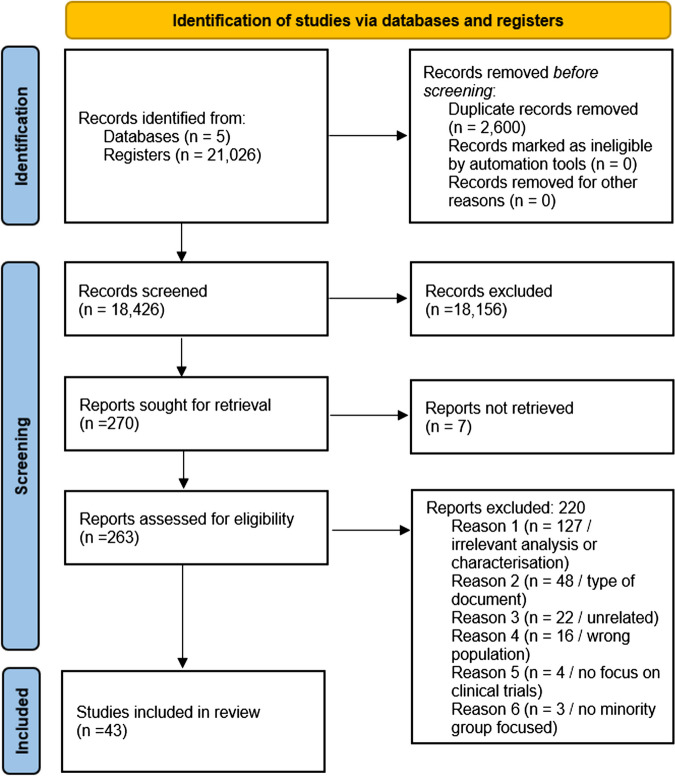
BACKGROUND: Clinical trials are essential to the development of healthcare innovations that advance life expectancy and improve quality of life. However, there exists a pronounced disparity in ethnic representation among trial participants. This imbalance, particularly in relation to minority ethnic groups, can lead to a limited understanding of how therapies affect diverse populations. The present systematic literature review (SLR) aims to identify the factors that both hinder and facilitate the participation of minority ethnic groups in clinical trials. METHODS: This review involved a systematic search of keywords across four databases: Web of Science, PubMed, CINAHL Plus and The Cochrane Library. The review was not restricted by language or study site; however, the date of publication was limited between 1st January 2017 and 1st October 2022. Studies discussing or outlining the involvement of minority ethnic groups in clinical trials, and those outlining inclusive recruitment and participation procedures were targeted. RESULTS: A total of 43 articles were included in the review. Of these, 36 articles were from the United States (US), 20 articles reported on oncology trials and 39 articles reported information from the patient's perspective. Reported barriers included a lack of researchers from minority ethnic groups implementing and conducting clinical research, inadequate funding for clinical trial efforts in geographical areas serving minority populations and a lack of awareness and education among research staff regarding which underrepresented groups to target for recruitment and the strategies to employ in reaching out to them. Several recommendations were suggested by the articles included in the review to address these barriers. Prominently, the use of patient navigators or community liaison roles was highly recommended as a way of supporting patients through the research recruitment process. The articles also highlighted the benefits of translating study materials and interventions into multiple languages and actively involving diverse communities in the development of health education materials. Lastly, leveraging technologies to address socioeconomic barriers, such as the use of virtual approaches to avoid lengthy travel, may also help to improve diversity in trials. CONCLUSIONS: Ensuring representation of minority ethnic groups in clinical trials is critical to developing therapies with generalisable efficacies. While progress has been made in enhancing outreach of wider racial groups and fortifying educational resources, there remains a pressing need to delve deeper into the obstacles impeding the recruitment of a diverse participant base, particularly in regions outside the US, where relevant studies are scarce. REGISTRATION: The review protocol was registered on PROSPERO (CRD42022368106) (1).
Overview
CoChat Summary
TL;DR
This systematic review synthesized 43 articles on barriers and enablers of clinical trial participation among adult patients from minority ethnic groups, finding that evidence is concentrated in the US and especially in oncology. It identifies mistrust, communication/language problems, socioeconomic constraints, and lack of culturally competent outreach as recurring barriers, while patient navigators, community liaisons, translated materials, and community-engaged recruitment are recurring enablers.
Key findings
- The review included 43 articles; 36 were from the US, 20 focused on oncology trials, and 39 reported from the patient perspective.
- Evidence quality was moderate overall: the MMAT average score was 4, and 12 articles scored below 3.
- Reported barriers included lack of researchers from minority ethnic groups, inadequate funding in areas serving minority populations, limited staff awareness of which groups to target and how, plus implicit bias, language barriers, and socioeconomic challenges such as unstable employment, childcare, low income, and transport problems.
- Recurrent enablers/recommendations were patient navigators or community liaisons, translation of study materials and interventions into multiple languages, involving diverse communities in health education materials, and virtual approaches to reduce travel burden.
Methods
- Systematic review using PRISMA, with a protocol registered on PROSPERO (CRD42022368106).
- Searches were conducted in Web of Science, PubMed, CINAHL Plus, and The Cochrane Library/CENTRAL, for studies published between 1 January 2017 and 1 October 2022, with no language or study-site restriction.
- Included peer-reviewed empirical studies about adult minority ethnic groups’ involvement in clinical trials or inclusive recruitment/participation processes; evidence was synthesized using narrative synthesis, and study quality was appraised with the MMAT.
Limitations
- The paper states that it was limited to empirical articles, excluding grey literature and non-empirical articles, which could have added further reflections on disparities.
- It also states that paediatric studies were excluded, so the findings do not apply to children.
- Evident from the text: the evidence base is heavily US-centered (36/43 articles) and sparse outside the US, so generalisability to other countries is limited (stated in the paper).
Model-written summary. Check it against the paper before relying on it.
Integrity signals
Registry
Cites
Statistics
Figures
Verification
Claims the paper makes
30 Valid · 4 Not valid · 22 Not checked · 46 Own results and interpretations
At least one cited source doesn’t support this claim or points to a different paper, and none confirmed it — see the verdicts below.
In the paper
“and American Indian and Alaska Natives accounted for a mere 1.3% of trial participants [19].”
§ Enablers and barriers of clinical trial participation in adult patients from minority ethnic groups: a systematic review > Introduction
What the sources say
- Disputedcites [19] Reihl SJ, Patil N, Morshed RA, Mehari M, Aabedi A, Chukwueke UN, et al. A population study of clinical trial accrual for women and minorities in neuro-oncology following the NIH Revitalization Act. Neuro Oncol. 2022;24(8):1341–9. 10.1093/neuonc/noac011. 34999844 PMC9340618 sourceExperimental — accuracy not yet measured
The Results section reports that American Indian/Alaska Native participants accounted for 0.2% of participants in studies reporting race. It assigns the 1.3% figure to Asian/Pacific Islander participants, not American Indian/Alaska Native participants. Page numbers were not provided in our copy. (LLM, conf=0.95)
Checked by a reasoning model — may be wrong.
plain- Asserted: passes — The authors put it forward as true.
- Checkable: passes — It can be checked against evidence.
- Load-bearing: unclear — It is unclear whether the paper’s conclusions depend on it.
- Based: passes — The paper gives a reason why it holds.
- Disputed
The cited sources support only part of this claim — read each source’s verdict below.
In the paper
“A frequently cited reason for the underrepresentation of certain minority ethnic groups in clinical trials is a pervasive mistrust in the healthcare system. This is often attributed to historical instances of mistreatment and exploitation.”
§ Enablers and barriers of clinical trial participation in adult patients from minority ethnic groups: a systematic review > Introduction
What the sources say
- Partly supportedcites [3] Nouvini R, Parker PA, Malling CD, Godwin K, Costas-Muñiz R. Interventions to increase racial and ethnic minority accrual into cancer clinical trials: A systematic review. Cancer. 2022;128(21):3860–9. 10.1002/cncr.34454. 36107740 PMC10456972 sourceExperimental — accuracy not yet measured
The Introduction (page unavailable) identifies mistrust as an extensively studied barrier to minority enrollment in cancer clinical trials. It does not explicitly describe that mistrust as pervasive throughout the healthcare system or attribute it to historical mistreatment and exploitation; its references to the Tuskegee study do not establish that full claim. (LLM, conf=0.84)
- Supportedcites [8] Sneed RS, Mason M, Williams JN, Sinnette C, Taber K, Mancera-Cuevas K, et al. Using Critical Race Theory to Understand Trial Participation Among Black Individuals With Systemic Lupus Erythematosus: A Qualitative Study of Patients and Caregivers. Arthritis Care Res. 2021;73(10):1387–95. 10.1002/acr.24635. PMC8557360 33973413 source
The Discussion says historical exploitation of Black individuals in research has embedded mistrust of researchers and the research process in Black communities. The Results identify mistrust linked to historical racism as a barrier to clinical-trial participation among Black patients with SLE. These passages support the cited statement as a broad explanation for underrepresentation, rather than a claim about every minority ethnic group. (LLM, conf=0.88)
- Not checked — no full text of the sourcecites [9] Cocroft S, Welsh-Bohmer KA, Plassman BL, Chanti-Ketterl M, Edmonds H, Gwyther L, et al. Racially diverse participant registries to facilitate the recruitment of African Americans into presymptomatic Alzheimer’s disease studies. Alzheimer’s & dementia: the journal of the Alzheimer’s Association. 2020;16(8):1107–14. 10.1002/alz.12048. 32543781 source
- Not checked yetcites [10] Dance KV, Imbody CB, Chen L, McNeill L, Payne JB, Flowers CR. Perceptions of clinical care and research among African-American patients with lymphoma. Leuk Lymphoma. 2021;62(8):1860–8. 10.1080/10428194.2021.1892092. 33645400 PMC8760890 source
Checked before — its earlier verdict is held back until a new check runs.
- Supportedcites [11] Rogers CR, Matthews P, Brooks E, Le Duc N, Washington C, McKoy A, et al. Barriers to and Facilitators of Recruitment of Adult African American Men for Colorectal Cancer Research: An Instrumental Exploratory Case Study. JCO oncology practice. 2021;17(5):e686–94. 10.1200/OP.21.00008. 33974818 PMC8258132 source
The Background identifies medical mistrust as a main barrier to African Americans’ participation in research and clinical trials and links that distrust to historical events such as the Tuskegee study. The Discussion likewise describes mistrust stemming from historical mistreatment in medical research. The paper’s specific focus is African American men, who fit the claim’s reference to certain minority ethnic groups. (LLM, conf=0.88)
- Partly supportedcites [12] Thetford K, Gillespie TW, Kim YI, Hansen B, Scarinci IC. Willingness of Latinx and African Americans to Participate in Nontherapeutic Trials: It Depends on Who Runs the Research. Ethnicity & Disease. 2021;31(2): 263–272. 10.18865/ed.31.2.263. PMC8054877 33883867 sourceExperimental — accuracy not yet measured
The Introduction identifies distrust and historical medical maltreatment as possible explanations for low participation, and the Discussion describes this as a continuing belief among providers and researchers. But the paper does not establish pervasive mistrust as the reason for underrepresentation: its Conclusion reports trust among the populations studied and identifies not being invited as the primary reason they had not participated. (LLM, conf=0.85)
- Not checked — no full text of the sourcecites [13] Henrietta Lacks: science must right a historical wrong. Henrietta Lacks: science must right a historical wrong. Nature. 2020;585(7823): 7–7. 10.1038/d41586-020-02494-z. 32873976 source
plainstates a cause- Asserted: passes — The authors put it forward as true.
- Checkable: passes — It can be checked against evidence.
- Load-bearing: passes — The paper’s conclusions depend on it.
- Based: passes — The paper gives a reason why it holds.
- Partly supported
The sources with a verdict support this claim; the rest weren’t checked yet, have no full text we could read, or their verdicts aren’t rated yet.
In the paper
“Historically, there has been a lack of ethnic representation in clinical trial participants; minority ethnic groups have often been underrepresented or omitted from research [3, 4].”
§ Enablers and barriers of clinical trial participation in adult patients from minority ethnic groups: a systematic review > Introduction
What the sources say
- Supportedcites [3] Nouvini R, Parker PA, Malling CD, Godwin K, Costas-Muñiz R. Interventions to increase racial and ethnic minority accrual into cancer clinical trials: A systematic review. Cancer. 2022;128(21):3860–9. 10.1002/cncr.34454. 36107740 PMC10456972 source
The Introduction states that most studies leading to cancer-treatment advances lacked adequate racial and ethnic minority representation and that minority patients have been underrepresented in many clinical trials. It also reports disproportionately low enrollment rates for Black and Latino patients. (LLM, conf=0.92)
- Not checked — no full text of the sourcecites [4] Shapiro M. Disparity of Equitable Representation in Cancer Clinical Trials: Nursing Perspectives. Clin J Oncol Nurs. 2022;26(4):449–54. 10.1188/22.CJON.449-454. 35939726 source
plain- Asserted: passes — The authors put it forward as true.
- Checkable: passes — It can be checked against evidence.
- Load-bearing: passes — The paper’s conclusions depend on it.
- Based: passes — The paper gives a reason why it holds.
- Supported
Every source the paper cites for this claim was checked and supports it.
In the paper
“A 2019 review revealed that of the cancer therapies approved by the US Food and Drug Administration (FDA) between 2008 and 2018, only 63% of the relevant trials reported race-related data [18].”
§ Enablers and barriers of clinical trial participation in adult patients from minority ethnic groups: a systematic review > Introduction
What the sources say
- Supportedcites [18] Loree JM, Anand S, Dasari A, Unger JM, Gothwal A, Ellis LM, et al. Disparity of Race Reporting and Representation in Clinical Trials Leading to Cancer Drug Approvals From 2008 to 2018. JAMA Oncol. 2019;5(10): e191870. 10.1001/jamaoncol.2019.1870. 31415071 PMC6696743 source
The Abstract reports that 145 of 230 trials (63.0%) supporting FDA oncology drug approvals reported on at least one race. It defines the approval period as July 2008 through June 2018, matching the citing sentence’s rounded date range. (LLM, conf=0.95)
plain- Asserted: passes — The authors put it forward as true.
- Checkable: passes — It can be checked against evidence.
- Load-bearing: unclear — It is unclear whether the paper’s conclusions depend on it.
- Based: passes — The paper gives a reason why it holds.
- Supported
The cited sources support only part of this claim — read each source’s verdict below.
In the paper
“In 2022, a study by Reihl et al. revealed that, almost 30 years after the Revitalization Act was put in place in the US, White males were still overrepresented in neuro-oncology clinical trials, accounting for more than 90% of trial participants.”
§ Enablers and barriers of clinical trial participation in adult patients from minority ethnic groups: a systematic review > Introduction
What the sources say
- Partly supportedcites [19] Reihl SJ, Patil N, Morshed RA, Mehari M, Aabedi A, Chukwueke UN, et al. A population study of clinical trial accrual for women and minorities in neuro-oncology following the NIH Revitalization Act. Neuro Oncol. 2022;24(8):1341–9. 10.1093/neuonc/noac011. 34999844 PMC9340618 sourceExperimental — accuracy not yet measured
The Abstract reports that White participants accounted for 91.7% of trial participants, while men accounted for 62.5%; it does not say White men accounted for more than 90%. The Discussion says White men remained disproportionately represented in trials for adult neuro-epithelial CNS tumors, supporting the overrepresentation point but not the claimed percentage for that group. (LLM, conf=0.90)
plain- Asserted: passes — The authors put it forward as true.
- Checkable: passes — It can be checked against evidence.
- Load-bearing: unclear — It is unclear whether the paper’s conclusions depend on it.
- Based: passes — The paper gives a reason why it holds.
- Partly supported
35 more claims · 8 with their cited sources checked
Create a free account to see all 102 claims and to verify the 8 references still open.
- Probably not a substantial claim. 39
- It may state two separate claims as one. 43
Citations
Cites
Rayyan-a web and mobile app for systematic reviews.
Ouzzani, M., Hammady, H., Fedorowicz, Z., & Elmagarmid, A. (2016) · Systematic Reviews · doi:10.1186/s13643-016-0384-4 · Cited by 26,092 · cited 1×
“Rayyan facilitated the screening by presenting citation details, titles and abstracts of each publication [28].”
Pace, R., Pluye, P., Bartlett, G., Macaulay, A. C., Salsberg, J., Jagosh, J., & Seller, R. (2012) · International Journal of Nursing Studies · doi:10.1016/j.ijnurstu.2011.07.002 · Cited by 1,331
Loree, J. M., Anand, S., Dasari, A., Unger, J. M., Gothwal, A., Ellis, L. M., Varadhachary, G., Kopetz, S., Overman, M. J., & Raghav, K. (2019) · JAMA Oncology · doi:10.1001/jamaoncol.2019.1870 · Cited by 570 · cited 1×
“A 2019 review revealed that of the cancer therapies approved by the US Food and Drug Administration (FDA) between 2008 and 2018, only 63% of the relevant trials reported race-related data [18].”
Souto, R. Q., Khanassov, V., Hong, Q. N., Bush, P. L., Vedel, I., & Pluye, P. (2015) · International Journal of Nursing Studies · doi:10.1016/j.ijnurstu.2014.08.010 · Cited by 375 · cited 1×
“The methodological quality of the empirical studies was critically appraised using the Mixed Methods Appraisal Tool (MMAT) [30, 31].”
Bower, P., Brueton, V., Gamble, C., Treweek, S., Smith, C. T., Young, B., & Williamson, P. (2014) · Trials · doi:10.1186/1745-6215-15-399 · Cited by 369
Witham, M. D., Anderson, E., Carroll, C., Dark, P. M., Down, K., Hall, A. S., Knee, J., Maier, R. H., Mountain, G. A., Nestor, G., et al. (2020) · Trials · doi:10.1186/s13063-020-04613-7 · Cited by 259 · cited 1×
“A recent initiative funded by the NIHR, named “Inno-vations in Clinical Trial Design and Delivery for the Under-served” (INCLUDE), proposed a framework to increase the number of underserved trial participants from minority ethnic groups [24–26].”
Ortega, V. E., & Meyers, D. A. (2014) · Journal of Allergy and Clinical Immunology · doi:10.1016/j.jaci.2013.10.040 · Cited by 237 · cited 1×
“The consequences of such underrepresentation are profound, leading to disparities in access to treatment and significant knowledge gaps regarding how certain drugs and therapies affect different ethnic populations [7, 8].”
Otado, J., Kwagyan, J., Edwards, D., Ukaegbu, A., Rockcliffe, F., & Osafo, N. (2015) · Clinical and Translational Science · doi:10.1111/cts.12285 · Cited by 231 · cited 1×
“For instance, the introduction of diversity quotas for trials may result in recruitment taking longer and increase the cost of delivering the study, ultimately reducing the benefit of the research to all patients [76].”
Differences in cancer incidence by broad ethnic group in England, 2013–2017
Delon, C., Brown, K. F., Payne, N. W. S., Kotrotsios, Y., Vernon, S., & Shelton, J. (2022) · British Journal of Cancer · doi:10.1038/s41416-022-01718-5 · Cited by 137
COVID-19 and ethnicity: who will research results apply to?
Treweek, S., Forouhi, N. G., Narayan, K. M. V., & Khunti, K. (2020) · The Lancet · doi:10.1016/s0140-6736(20)31380-5 · Cited by 119 · cited 2×
“…patients, the reviewed studies produced a significant amount of data on how historical and institutional forms of racism acted as barriers to trial participation [9–11, 37, 53, 55], exemplified by events like the US Tuskegee Syph-ilis study and its unethical treatment of Black patients [74].”
Alsan, M., Wanamaker, M., & Hardeman, R. R. (2020) · Journal of General Internal Medicine · doi:10.1007/s11606-019-05309-8 · Cited by 116 · cited 2×
“The focus on oncology further narrowed the range [71–73].”
Smith, A. ‘., Agar, M., Delaney, G., Descallar, J., Dobell‐Brown, K., Grand, M., Aung, J., Patel, P., Kaadan, N., & Girgis, A. (2018) · Asia-Pacific Journal of Clinical Oncology · doi:10.1111/ajco.12818 · Cited by 87
Wilkins, C. H., Schindler, S. E., & Morris, J. C. (2020) · JAMA Neurology · doi:10.1001/jamaneurol.2020.1614 · Cited by 83 · cited 2×
“This exclusion persists despite some ethnic populations bearing a disproportionately high burden of certain diseases [5, 6].”
Underrepresentation of Hispanics and Other Minorities in Clinical Trials: Recruiters’ Perspectives
Occa, A., Morgan, S. E., & Potter, J. E. (2018) · Journal of Racial and Ethnic Health Disparities · doi:10.1007/s40615-017-0373-x · Cited by 78 · cited 1×
“…e t a r y ) a r e p o t e n t i a l r e c r u i t i n g f a c i l i t a t o r s t h a t s h o u l d b e u s e d t o e m p h a s i s e t h a t p a r t i c i p a n t s ’ t i m e a n d o p i n i o n s a r e s i g n i fi c a n t [ 11 , 33 , 37 , 47 , 54 , 65 ] S t u d y c h a r a c t e r i s t i c s –”
Henrietta Lacks: science must right a historical wrong
(2020) · Nature · doi:10.1038/d41586-020-02494-z · Cited by 78
Haley, S. J., Southwick, L. E., Parikh, N. S., Rivera, J., Farrar-Edwards, D., & Boden-Albala, B. (2017) · Journal of Racial and Ethnic Health Disparities · doi:10.1007/s40615-016-0332-y · Cited by 73 · cited 4×
“Fourteen studies reported on why certain patients may have been overlooked for clinical trial participation [12, 17, 38, 42, 44, 45, 52–55, 59, 63, 66, 69].”
InfluentialKearney, A., Rosala‐Hallas, A., Bacon, N., Daykin, A. R., Shaw, A. R. G., Lane, J. A., Blazeby, J. M., Clarke, M. J., Williamson, P. R., & Gamble, C. L. (2018) · PLoS ONE · doi:10.1371/journal.pone.0204886 · Cited by 69 · cited 4×
“…Kearney et al. indicated that protecting against attrition should begin at the recruitment phase, with provision of transparent information on the withdrawal process and employing flexible data collection methods, such as using routine appointments or medical notes to reduce patient burden [79].”
InfluentialCosta, L. J., Hari, P. N., & Kumar, S. K. (2016) · Leukemia & Lymphoma · doi:10.3109/10428194.2016.1170828 · Cited by 57 · cited 6×
“The reasons driving people from minority ethnic groups who agreed to and continued to participate in clinical trials were discussed in 12 articles [10, 12, 33, 34, 43, 45, 48, 50, 56, 57, 63, 69].”
InfluentialNouvini, R., Parker, P. A., Malling, C. D., Godwin, K., & Costas‐Muñiz, R. (2022) · Cancer · doi:10.1002/cncr.34454 · Cited by 56 · cited 3×
“The subsequent research with the HeLa cell line now underpins much of the modern medical profession and practice, yet was initiated without her knowledge or consent [3, 8–13].”
Stewart, J., Krows, M. L., Schaafsma, T. T., Heller, K. B., Brown, E. R., Boonyaratanakornkit, J., Brown, C. E., Leingang, H., Liou, C., Bershteyn, A., et al. (2022) · JAMA Network Open · doi:10.1001/jamanetworkopen.2021.48325 · Cited by 54 · cited 9×
“The reasons driving people from minority ethnic groups who agreed to and continued to participate in clinical trials were discussed in 12 articles [10, 12, 33, 34, 43, 45, 48, 50, 56, 57, 63, 69].”
InfluentialHorowitz, C. R., Sabin, T., Ramos, M., Richardson, L. D., Hauser, D., Robinson, M., & Fei, K. (2019) · Genetics in Medicine · doi:10.1038/s41436-019-0498-x · Cited by 50 · cited 8×
“In Horowitz et al., participants indicated inadequate social support made it difficult for them to continue with trials [46].”
InfluentialReihl, S. J., Patil, N., Morshed, R. A., Mehari, M., Aabedi, A., Chukwueke, U. N., Porter, A. B., Fontil, V., Cioffi, G., Waite, K., et al. (2022) · Neuro-Oncology · doi:10.1093/neuonc/noac011 · Cited by 46 · cited 1×
“In contrast, minority ethnic groups such as Black and African Americans, Hispanic and Latino, and Asian and Pacific Islanders each accounted for less than 2.0% of trial participants, and American Indian and Alaska Natives accounted for a mere 1.3% of trial participants [19].”
InfluentialAre ethnic and racial minority women less likely to participate in clinical trials?
Patel, S. N., Staples, J. N., Garcia, C., Chatfield, L., Ferriss, J. S., & Duska, L. (2020) · Gynecologic Oncology · doi:10.1016/j.ygyno.2020.01.040 · Cited by 44 · cited 2×
“Fourteen studies reported on why certain patients may have been overlooked for clinical trial participation [12, 17, 38, 42, 44, 45, 52–55, 59, 63, 66, 69].”
Lincoln, K. D., Chow, T., Gaines, B. F., & Fitzgerald, T. (2021) · Ethnicity & Health · doi:10.1080/13557858.2018.1539222 · Cited by 38
Rayment, J., Lanlehin, R. M., McCourt, C., & Husain, S. M. (2017) · Research Involvement and Engagement · doi:10.1186/s40900-017-0061-3 · Cited by 36 · cited 2×
“The report urged for collective efforts from research organisations, funding institutions and providers to investigate further on the matter, considering interactions such as social location, language, class and gender [75].”
Access Denied: Inequities in Clinical Trial Enrollment for Pancreatic Cancer
Eskander, M. F., Gil, L., Beal, E. W., Li, Y., Hamad, A., Oppong, B., Obeng-Gyasi, S., & Tsung, A. (2022) · Annals of Surgical Oncology · doi:10.1245/s10434-021-10868-4 · Cited by 35 · cited 3×
“These supportive roles not only carried out recruitment, and explained the research process [40, 41], but also provided emotional support [45] and were considered as peers and relatable Figs.”
Shaw, A. R., Perales-Puchalt, J., Moore, T., Weatherspoon, P., Robinson, M., Hill, C. V., & Vidoni, E. D. (2022) · The Journal of Prevention of Alzheimer's Disease · doi:10.14283/jpad.2022.82 · Cited by 34 · cited 5×
“Education was found to be a relevant determinant of participation, as discussed in 20 studies [12, 34, 39–43, 45, 46, 48, 50, 51, 53–57, 59, 61, 63].”
InfluentialEvaluating a tool to improve engagement and recruitment of under-served groups in trials
Morris, L., Dumville, J., Treweek, S., Miah, N., Curtis, F., & Bower, P. (2022) · Trials · doi:10.1186/s13063-022-06747-2 · Cited by 32 · cited 6×
“For example, while trial location may inadvertently exclude some populations from participation, in some instances, these populations may not engage these healthcare services altogether or experience poor care and disengage and thus are inaccessible to researchers irrespective of location [52].”
InfluentialHwang, D. A., Lee, A., Song, J. M., & Han, H.-R. (2021) · Journal of Medical Internet Research · doi:10.2196/23959 · Cited by 30 · cited 2×
“…e t a r y ) a r e p o t e n t i a l r e c r u i t i n g f a c i l i t a t o r s t h a t s h o u l d b e u s e d t o e m p h a s i s e t h a t p a r t i c i p a n t s ’ t i m e a n d o p i n i o n s a r e s i g n i fi c a n t [ 11 , 33 , 37 , 47 , 54 , 65 ] S t u d y c h a r a c t e r i s t i c s –”
Cunningham, J., & Garvey, G. (2021) · Australian and New Zealand Journal of Public Health · doi:10.1111/1753-6405.13059 · Cited by 30 · cited 7×
“Lastly, many research sites were located in areas difficult for Aboriginal and Torres Strait Islander communities to access or required travel to main cities to access treat-ment and subsequent follow-up visits [38].”
InfluentialPerceptions and Preferences Regarding Multiple Sclerosis Research Among Racial and Ethnic Groups
Pimentel Maldonado, D. A., Moreno, A., Williams, M. J., Amezcua, L., Feliciano, S., Williams, A., Machemer, D., Livingston, T., LaRocque, M., Glim, M., et al. (2021) · International Journal of MS Care · doi:10.7224/1537-2073.2019-131 · Cited by 29 · cited 10×
“…m e m b e r s a r e d i s c o u r a g e d f r o m p a r t i c i p a t i n g i n s t u d i e s d u e t o m i s t r u s t , c o n c e r n s a b o u t r e c e i v i n g p oo r ‑ q u a l i t y m e d i c a l c a r e a n d r i s k s t o i n s u r a n c e c o v e r a g e o r l e g a l s t a t u s [ 57 ] –”
InfluentialRogers, C. R., Matthews, P., Brooks, E., Le Duc, N., Washington, C., McKoy, A., Edmonson, A., Lange, L., & Fetters, M. D. (2021) · JCO Oncology Practice · doi:10.1200/op.21.00008 · Cited by 28 · cited 10×
“…i ‑ c a l t r i a l s , s t r i n g e n t i n c l u s i o n o r e x c l u s i o n c r i t e r i a , u n c e r t a i n t y a b o u t r e s i d e n c y s t a t u s , f e a r o f h a r m a n d l a c k o f i n s u r a n c e c o v e r a g e f o r t r e a t m e n t [ 11 , 43 , 46 , 58 , 60 , 61 , 63 ] –”
InfluentialHernandez, N. D., Durant, R., Lisovicz, N., Nweke, C., Belizaire, C., Cooper, D., Soiro, F., Rivers, D., Sodeke, S., & Rivers, B. M. (2022) · Journal of Cancer Education · doi:10.1007/s13187-021-01994-4 · Cited by 26 · cited 9×
“The reasons driving people from minority ethnic groups who agreed to and continued to participate in clinical trials were discussed in 12 articles [10, 12, 33, 34, 43, 45, 48, 50, 56, 57, 63, 69].”
InfluentialSkinner, J. S., Fair, A. M., Holman, A. S., Boyer, A. P., & Wilkins, C. H. (2019) · Frontiers in Public Health · doi:10.3389/fpubh.2019.00104 · Cited by 26 · cited 4×
“This included two RCTs [61, 66], three non-randomised studies [15, 46, 64], six quantitative descriptive studies [9, 37, 38, 40, 57, 58] and one mixed methods study [60].”
InfluentialThetford, K., Gillespie, T. W., Kim, Y.-I., Hansen, B., & Scarinci, I. C. (2021) · Ethnicity & Disease · doi:10.18865/ed.31.2.263 · Cited by 25 · cited 6×
“The reasons driving people from minority ethnic groups who agreed to and continued to participate in clinical trials were discussed in 12 articles [10, 12, 33, 34, 43, 45, 48, 50, 56, 57, 63, 69].”
InfluentialTorres, S., de la Riva, E. E., Tom, L. S., Clayman, M. L., Taylor, C., Dong, X., & Simon, M. A. (2015) · Journal of Cancer Education · doi:10.1007/s13187-015-0818-z · Cited by 22 · cited 1×
“While some regulatory bodies, such as the FDA [70], have rolled out guidelines to stimulate more diverse recruitment to trials, implementing these changes is challenging.”
Niranjan, S. J., Martin, M. Y., Fouad, M. N., Vickers, S. M., Wenzel, J., Cook, E. D., Konety, B. R., & Durant, R. W. (2019) · Journal of Clinical Oncology · doi:10.1200/jco.2019.37.27_suppl.152 · Cited by 22
Byrne, L. M., Cook, S. K., Kennedy, N., Russell, M., Jerome, R. N., Tan, J., Barajas, C., Wilkins, C. H., & Harris, P. A. (2021) · Journal of Clinical and Translational Science · doi:10.1017/cts.2020.539 · Cited by 21 · cited 2×
“T h e a b s e n c e o f a w o r k a b l e m e t h o d t o t r a n s l a t e r e s e a r c h m a t e r i a l s l i k e q u a l i t y ‑ o f ‑ l i f e m e a s u r e m e n t t oo l s a n d i n f o r m e d c o n s e n t d o c u m e n t s [ 36 ] –”
Sanossian, N., Rosenberg, L., Liebeskind, D. S., Starkman, S., Eckstein, M., Stratton, S., Pratt, F. D., Hamilton, S., Kim-Tenser, M., Sharma, L. K., et al. (2017) · Stroke · doi:10.1161/strokeaha.117.014745 · Cited by 21 · cited 3×
“This included two RCTs [61, 66], three non-randomised studies [15, 46, 64], six quantitative descriptive studies [9, 37, 38, 40, 57, 58] and one mixed methods study [60].”
Sneed, R. S., Mason, M., Williams, J. N., Sinnette, C., Taber, K., Mancera‐Cuevas, K., Curry, G., Canessa, P., Ramsey‐Goldman, R., & Feldman, C. H. (2021) · Arthritis Care & Research · doi:10.1002/acr.24635 · Cited by 21 · cited 4×
“The subsequent research with the HeLa cell line now underpins much of the modern medical profession and practice, yet was initiated without her knowledge or consent [3, 8–13].”
InfluentialArriens, C., Aberle, T., Carthen, F., Kamp, S., Thanou, A., Chakravarty, E., James, J. A., Merrill, J. T., & Ogunsanya, M. E. (2020) · Lupus Science & Medicine · doi:10.1136/lupus-2019-000360 · Cited by 19 · cited 8×
“The reasons driving people from minority ethnic groups who agreed to and continued to participate in clinical trials were discussed in 12 articles [10, 12, 33, 34, 43, 45, 48, 50, 56, 57, 63, 69].”
InfluentialBrierley, C. K., Zabor, E. C., Komrokji, R. S., Dezern, A. E., Roboz, G. J., Brunner, A. M., Stone, R. M., Sekeres, M. A., & Steensma, D. P. (2020) · Cancer · doi:10.1002/cncr.33105 · Cited by 19
Addison, S., Yang, Y., Metlock, F., King, M., McKoy, A., Williams, A., Gregory, J., Gray, D. M., Joseph, J. J., & Nolan, T. S. (2022) · International Journal of Environmental Research and Public Health · doi:10.3390/ijerph191912041 · Cited by 17 · cited 10×
“The reasons driving people from minority ethnic groups who agreed to and continued to participate in clinical trials were discussed in 12 articles [10, 12, 33, 34, 43, 45, 48, 50, 56, 57, 63, 69].”
InfluentialCocroft, S., Welsh‐Bohmer, K. A., Plassman, B. L., Chanti‐Ketterl, M., Edmonds, H., Gwyther, L., McCart, M., MacDonald, H., Potter, G., & Burke, J. R. (2020) · Alzheimer's & Dementia · doi:10.1002/alz.12048 · Cited by 16 · cited 5×
“…n t ee r s r e c e i v e d i n f o r m a t i o n a n d i n v i t a t i o n a b o u t s t u d i e s , t h e y m i g h t q u a l i f y f o r a r e a c r u c i a l t a c t i c f o r b oo s t i n g m i n o r i t y g r o u p s ’ e n r o l m e n t [ 9 ] being the main participant population investigated.”
InfluentialIs It Time for Quotas to Achieve Racial and Ethnic Representation in Multiple Sclerosis Trials?
Mateen, F. J. (2021) · Frontiers in Neurology · doi:10.3389/fneur.2021.680912 · Cited by 15 · cited 1×
“The focus on oncology further narrowed the range [71–73].”
Langford, A., Studts, J. L., & Byrne, M. M. (2021) · Patient Education and Counseling · doi:10.1016/j.pec.2020.07.005 · Cited by 15 · cited 3×
“The reasons driving people from minority ethnic groups who agreed to and continued to participate in clinical trials were discussed in 12 articles [10, 12, 33, 34, 43, 45, 48, 50, 56, 57, 63, 69].”
The Effect of Discrimination on Likelihood of Participation in a Clinical Trial
Devlin, A., Gonzalez, E., Ramsey, F., Esnaola, N., & Fisher, S. (2020) · Journal of Racial and Ethnic Health Disparities · doi:10.1007/s40615-020-00735-5 · Cited by 15 · cited 2×
“Twenty-four papers reported information on why patients might decline invitations to participate in clinical trials [9–11, 16, 17, 32–34, 39, 42–47, 51, 52, 57– 59, 61, 63, 65, 69].”
Cook, E. D., Yeager, K. A., Cecchini, R. S., Boparai, J., Brown, C. L., Duncan, M., Cronin, W. M., & Paskett, E. D. (2018) · Contemporary Clinical Trials Communications · doi:10.1016/j.conctc.2018.03.003 · Cited by 14 · cited 3×
“This included two RCTs [61, 66], three non-randomised studies [15, 46, 64], six quantitative descriptive studies [9, 37, 38, 40, 57, 58] and one mixed methods study [60].”
Recruitment of African Americans into Cancer Clinical Research: Strategies and Outcomes
Sheppard, V. B., Sutton, A. L., Holmes, E. J., Edmonds, M. C., Preston, M. A., Namoos, A. M., Wells, M., & Thomson, M. D. (2021) · Journal of Urban Health · doi:10.1007/s11524-021-00565-8 · Cited by 13 · cited 3×
“This included two RCTs [61, 66], three non-randomised studies [15, 46, 64], six quantitative descriptive studies [9, 37, 38, 40, 57, 58] and one mixed methods study [60].”
Overcoming racial disparities in cancer clinical trial enrollment of Asians and Native Hawaiians
Acoba, J. D., Sumida, K., & Berenberg, J. (2022) · Contemporary Clinical Trials Communications · doi:10.1016/j.conctc.2022.100933 · Cited by 13 · cited 5×
“Barriers were reported across all stages of clinical trial design and delivery, and included socio-economic challenges such as unstable employment, strict schedules, difficulties securing childcare, low income and transport deficiencies [32].”
InfluentialGiannuzzi, V., Felisi, M., Bonifazi, D., Devlieger, H., Papanikolaou, G., Ragab, L., Fattoum, S., Tempesta, B., Reggiardo, G., & Ceci, A. (2021) · BMC Medical Ethics · doi:10.1186/s12910-021-00618-2 · Cited by 11 · cited 4×
“These cultural ambassadors acted as the bridge between the medical school and communities, supporting the development of protocols, recruitment plans, translation services and planning community engagement activities [80].”
InfluentialStockdill, M. L., Dionne-Odom, J. N., Wells, R., Ejem, D., Azuero, A., Keebler, K., Sockwell, E., Tims, S., Burgio, K. L., Engler, S., et al. (2023) · Journal of Palliative Care · doi:10.1177/0825859720975978 · Cited by 11 · cited 1×
“This included two RCTs [61, 66], three non-randomised studies [15, 46, 64], six quantitative descriptive studies [9, 37, 38, 40, 57, 58] and one mixed methods study [60].”
Barriers to Enrollment in Rheumatology Research: Who, What, Where, When, and Why?
Sandhu, V. K., Duro, T., Kamboj, A., Salto, L., & Chiruvolu, N. V. (2022) · Cureus · doi:10.7759/cureus.27235 · Cited by 10 · cited 3×
“This included two RCTs [61, 66], three non-randomised studies [15, 46, 64], six quantitative descriptive studies [9, 37, 38, 40, 57, 58] and one mixed methods study [60].”
Kim, Y. J., DeLisa, J. A., Chung, Y.-C., Shapiro, N. L., Rajanna, S. K. K., Barbour, E., Loeb, J. A., Turner, J., Daley, S., Skowlund, J., et al. (2021) · Journal of the American Medical Informatics Association · doi:10.1093/jamia/ocab240 · Cited by 9
Doran, K., Collado, A., Taylor, H., Felton, J. W., Tormohlen, K. N., & Yi, R. (2021) · Research and Theory for Nursing Practice · doi:10.1891/rtnp-d-19-00039 · Cited by 9 · cited 7×
“Other reported reasons related to social support included time constraints, clashes with employment schedules, and conflicts with staff members [40].”
InfluentialKenerson, D., Fadeyi, S., Liu, J., WERIWOH, M., Beard, K., & Hargreaves, M. K. (2017) · Journal of Health Communication · doi:10.1080/10810730.2017.1382613 · Cited by 8 · cited 4×
“…c a t i o n m a t e r i a l s c o n t r i b u t e d t o i n c r e a s i n g s c i e n t i fi c a cc u r a c y , r e d u c i n g c o m p l e x i t y , a c h i e v i n g a pp r o p r i a t e r e a d a b i l i t y l e v e l s a n d e n s u r i n g c u l t u r a l a pp r o p r i a t e ‑ n e ss [ 48 ] –”
InfluentialPerceptions of Clinical Trial Participation in African American Cancer Survivors and Caregivers
(2022) · Oncology Nursing Forum · doi:10.1188/22.onf.113-124 · Cited by 8 · cited 9×
“Granda-Cameron et al. [43] reported that patients felt that physicians did not allow sufficient time to address their concerns and were condescending, resulting in mis-trust and further leading to their unwillingness to participate [43].”
InfluentialPerceptions of clinical care and research among African-American patients with lymphoma
Dance, K. V., Imbody, C. B., Chen, L., McNeill, L., Payne, J. B., & Flowers, C. R. (2021) · Leukemia & Lymphoma · doi:10.1080/10428194.2021.1892092 · Cited by 7 · cited 8×
“The reasons driving people from minority ethnic groups who agreed to and continued to participate in clinical trials were discussed in 12 articles [10, 12, 33, 34, 43, 45, 48, 50, 56, 57, 63, 69].”
InfluentialA Provider‐Based Approach to Address Racial Disparities in Lupus Clinical Trial Participation
Wanty, N., Cooper, D. L., Simkus, A., Twombly, E. C., McCalla, S., Holtz, S. K. D., Langford, A. T., Cozart, T., Gorlitsky, B. R., Moore, C. A., et al. (2023) · Arthritis Care & Research · doi:10.1002/acr.25054 · Cited by 7
Marrast, L., Conigliaro, J., Chan, C., Kim, E. J., Duer-Hefele, J., Diefenbach, M. A., & Davidson, K. W. (2021) · Personalized Medicine · doi:10.2217/pme-2020-0166 · Cited by 6
Pillay, D., & Wassenaar, D. R. (2018) · South African Journal of Psychology · doi:10.1177/0081246317708094 · Cited by 6 · cited 3×
“The reasons driving people from minority ethnic groups who agreed to and continued to participate in clinical trials were discussed in 12 articles [10, 12, 33, 34, 43, 45, 48, 50, 56, 57, 63, 69].”
Merz, E. L., Riley, N. E., Malcarne, V. L., & Sadler, G. R. (2022) · Journal of Cancer Education · doi:10.1007/s13187-022-02162-y · Cited by 6 · cited 5×
“Education was found to be a relevant determinant of participation, as discussed in 20 studies [12, 34, 39–43, 45, 46, 48, 50, 51, 53–57, 59, 61, 63].”
InfluentialFink, A. K. C., DeRenzis, A. C., Awasthi, S., Jahan, N., Johnstone, P. A. S., Pow‐Sang, J., Torres‐Roca, J., Grass, D., Fernandez, D., Naghavi, A., et al. (2023) · Cancer Medicine · doi:10.1002/cam4.5000 · Cited by 5
Mergenthal, K., Siebenhofer, A., Ulrich, L.-R., Guethlin, C., Gerlach, F. M., & Petersen, J. J. (2020) · PLOS ONE · doi:10.1371/journal.pone.0230297 · Cited by 3 · cited 5×
“The proportion of migrant patients declined at each subsequent recruitment stage, indicating that patients with a migrant status were more likely to with-draw from trials [16].”
InfluentialDesai, S. R., Hernandez, C., & McMichael, A. J. (2017) · JAMA Dermatology · doi:10.1001/jamadermatol.2016.4130 · Cited by 3
Disparity of Equitable Representation in Cancer Clinical Trials: Nursing Perspectives
(2022) · Clinical Journal of Oncology Nursing · doi:10.1188/22.cjon.449-454 · Cited by 2 · cited 1×
“Historically, there has been a lack of ethnic representation in clinical trial participants; minority ethnic groups have often been underrepresented or omitted from research [3, 4].”
Research works printed but not linked: 1
- Alarcon Garavito GA, Gilchrist K, Vindrola Padros C. Enablers and barriers of clinical trial participation in patients from minority ethnic groups: a systematic review. Systematic review protocol. https://www.crd.york.ac.uk/prospero/display_record.php?RecordID=368106 [Accessed 7th March 2023]. PMC11846389 39984940
Cited by
Enhancing randomized clinical trials with digital twins
Akbarialiabad, H., Pasdar, A., Murrell, D. F., Mostafavi, M., Shakil, F., Safaee, E., Leachman, S. A., Haghighi, A., Tarbox, M. B., Bunick, C. G., et al. (2025) · npj Systems Biology and Applications · doi:10.1038/s41540-025-00592-0 · Cited by 72
Gogoi, M., Baggaley, R. F., Silva, L., Lal, Z. Z., Reilly, H., Modhwadia, V., Pan, D., Bird, P. W., Nellums, L. B., & Pareek, M. (2025) · Health Expectations · doi:10.1111/hex.70337 · Cited by 5
Thomas, T., Jones, L. L., Dawson, S., Houghton, C., Hunter, A., O'Connell, N., & Biesty, L. (2026) · Journal of Clinical Epidemiology · doi:10.1016/j.jclinepi.2026.112202 · Cited by 3
Sidhu, R., Selvamogan, A., & Boddy, A. (2026) · Annals of The Royal College of Surgeons of England · doi:10.1308/rcsann.2026.0021 · Cited by 3
Solving the 'Goldilocks problem' in dementia clinical trials with multimodal AI
Welchman, A. E., & Kourtzi, Z. (2025) · The Journal of Prevention of Alzheimer s Disease · doi:10.1016/j.tjpad.2025.100397 · Cited by 3
“Clinical trials and research cohorts generally overrepresent majority populations [55,56] creating the potential for models to perform poorly when presented with data from underrepresented groups.”
Metadata
- Authors
- Alarcón Garavito, G. A., Gilchrist, K., Ciurtin, C., Khanna, S., Chambers, P., McNally, N., Merivale, E., Carr, E., Yu, R., & Vindrola-Padros, C.
- Affiliations
- University College London (GB)
- University College London Hospitals NHS Foundation Trust (GB)
- Roche (United Kingdom) (GB)
- Venue
- Trials
- Published
- 2025-02-22
- Volume
- 26
- Issue
- 1
- Pages
- 65-65
- ISSN
- 1745-6215 (ISSN-L)
- PMC
- PMC11846389
- OpenAlex
- W4407820176
- Cited by
- 42
- References
- 68
- Citations by year
- 2026: 32 · 2025: 10
- FWCI
- 7.98
- Type
- journal article
- Language
- en
- Open access
- gold
- doi.org
- Licence
- cc-by
- creativecommons.org/licenses/by/4.0 (tdm)
- creativecommons.org/licenses/by/4.0 (vor)
- Locations
- Trials (publishedVersion, cc-by)
- PubMed Central (publishedVersion, cc-by)
- PubMed (publishedVersion)
- DOAJ (DOAJ: Directory of Open Access Journals) (submittedVersion, cc-by-sa)
- UCL Discovery (University College London) (submittedVersion)
- Funders
- University College London Hospitals NHS Foundation Trust
- Topics
- Health Sciences › Medicine › Public Health, Environmental and Occupational Health › Ethics in Clinical Research
- Social Sciences › Anthropology › Race, Genetics, and Society
- Health Sciences › Medicine › Public Health, Environmental and Occupational Health › Cultural Competency in Health Care
- Keywords
- clinical trial participation, ethnic minorities, underrepresented groups, recruitment barriers, patient navigators, community liaison, language translation, virtual clinical trials, cancer clinical trials, patient perspectives, health equity
- MeSH terms
- Adult, Clinical Trials as Topic, Ethnicity, Humans, Health Knowledge, Attitudes, Practice, Minority Groups, Patient Participation, Patient Selection, Healthcare Disparities
About these checks
Registry, retraction, Cites and statistics results are computed, not judged, with one exception: a printed reference that no index lists is read once by a model before it counts as a citation error. Claims are extracted by a model and kept only when their quote appears verbatim in the text; each cited source is then checked, with a model’s help, for whether it says what the claim relies on. Those verdicts can be wrong — read the claim’s quote and the cited source before relying on one.
The claim verdicts this report counts are experimental: their accuracy is not yet measured.
A language model drew the claims from the paper on 2026-10-09, under version 3 of the claim definition (model deepseek-v4.1-flash, prompt extract-v3).
A second model labelled each claim on 2026-10-09 (model jev-1.13-20260917, definition revision gold-guideline-v0.2).
Cited sources are checked with a language model’s help (gpt-6-sol).
Statistics and arithmetic are recomputed, not judged.
Confidence bands are shown only for fields calibrated on our annotated test set. None is calibrated yet, so no band is shown.
What counts as a claim ›How we measure confidence ›How we check this ›
Are you an author, or do you see a problem with this page? Request a review
Data sources
Bibliographic data: Semantic Scholar, OpenAlex, Crossref.
Contains information from the Semantic Scholar Academic Graph Datasets, made available under the ODC Attribution License (ODC-BY 1.0).
Semantic Scholar’s data is described in: Kinney, R., et al. (2023). The Semantic Scholar Open Data Platform. arXiv:2301.10140.
