

The DOI matches its Crossref record; 272 of the 273 references it cites were found in a registry or an index; 102 of the 193 sources its claims cite were checked for support.
Reporting animal research: Explanation and elaboration for the ARRIVE guidelines 2.0
Open accessPublished version of a preprint
Abstract
Improving the reproducibility of biomedical research is a major challenge. Transparent and accurate reporting is vital to this process; it allows readers to assess the reliability of the findings and repeat or build upon the work of other researchers. The ARRIVE guidelines (Animal Research: Reporting In Vivo Experiments) were developed in 2010 to help authors and journals identify the minimum information necessary to report in publications describing in vivo experiments. Despite widespread endorsement by the scientific community, the impact of ARRIVE on the transparency of reporting in animal research publications has been limited. We have revised the ARRIVE guidelines to update them and facilitate their use in practice. The revised guidelines are published alongside this paper. This explanation and elaboration document was developed as part of the revision. It provides further information about each of the 21 items in ARRIVE 2.0, including the rationale and supporting evidence for their inclusion in the guidelines, elaboration of details to report, and examples of good reporting from the published literature. This document also covers advice and best practice in the design and conduct of animal studies to support researchers in improving standards from the start of the experimental design process through to publication.
Overview
AI snapshot
Written from the paper’s full text.
TL;DR
This explanation and elaboration document accompanies ARRIVE 2.0, providing rationale, reporting guidance, and examples for 21 items split into the Essential 10 and the Recommended Set. It aims to improve transparent reporting and reproducibility of in vivo animal research.
Key findings
- ARRIVE 2.0 comprises 21 items: the Essential 10 are the minimum reporting requirement, and the Recommended Set adds context; there is no ranking within either set.
- The document gives item-by-item rationale, elaboration, supporting evidence, and examples of good reporting from the published literature, plus a glossary of statistical terms.
- Despite ARRIVE 2010 being recommended by more than a thousand journals, studies measuring its impact on reporting quality have produced mixed results, and reporting of animal research remains incomplete.
- It cites evidence that lack of bias-reducing measures such as randomisation and blinding can contribute to as much as 30%–45% inflation of effect sizes.
Methods
- The guidelines were revised by a new international working group, with full methodology for the revision and item allocation described in the accompanying publication.
- This explanation and elaboration document was developed as part of the revision and road tested alongside the revised guidelines with researchers preparing manuscripts describing in vivo research.
- Each of the 21 items is written as a self-contained section with rationale, details to report, and examples; the document also covers experimental design concepts and best practices.
Limitations
- Stated: the exact type of detail to report might vary between species and experimental setup, and this is acknowledged in the guidance for each item.
- Stated: there is limited empirical evidence in animal research for the impact of blinding, although systematic reviews show nonblinded outcome assessment can overestimate treatment effects.
- Evident: the paper has no formal limitations section and is a guidance/consensus explanation and elaboration document rather than an empirical study reporting original outcome data.
Model-written summary. Check it against the paper before relying on it.
Integrity signals
Registry
Cites
Statistics
Figures
Verification
Claims the paper makes
49 No basis given · 39 Own interpretation · 38 Partly supported · 38 No full text of the sources · 24 Supported · 9 Supported so far · 8 Not checked yet · 2 Couldn’t confirm · accuracy not yet measured
The cited sources support only part of this claim — read each source’s verdict below.
In the paper
“Studies measuring the impact of ARRIVE on the quality of reporting have produced mixed results [6–11]”
§ Reporting animal research: Explanation and elaboration for the ARRIVE guidelines 2.0 > Introduction
What the sources say
- Supportedcites [6] D Baker, 2014, Two years later: journals are not yet enforcing the ARRIVE guidelines on reporting standards for pre-clinical animal studies, PLoS Biol source
In “Are the Guidelines Being Ignored?” (page unavailable), the authors compare reporting before and after ARRIVE endorsement. They find increased reporting of animal characteristics, but little change in blinding, rare reporting of randomisation and power calculations, and less appropriate statistical analysis on one measure. This study therefore supports the cited sentence as an example of mixed results, without establishing what every study in the citation range found. (LLM, conf=0.87)
- Supportedcites [7] JE Gulin, 2015, Quality of reporting and adherence to ARRIVE guidelines in animal studies for Chagas disease preclinical drug research: a systematic review, PLoS Negl Trop Dis source
The Methods (Statistics) compare reporting before and after ARRIVE, so this is a study measuring its impact. The paper reports that ARRIVE’s publication did not seem to improve reporting quality. As one of several studies cited for mixed results, it supports the no-improvement side of that collective statement. (LLM, conf=0.88)
- Partly supportedcites [8] MT Avey, 2016, The devil is in the details: incomplete reporting in preclinical animal research, PLoS ONE sourceExperimental — accuracy not yet measured
The Results (page unavailable) report a statistically significant but small increase in reporting after ARRIVE was published; fewer than half of the assessed items were still reported. The authors also say extraneous factors may explain the increase. This study contributes a qualified finding, but it does not establish that studies of ARRIVE’s impact collectively produced mixed results. (LLM, conf=0.82)
- Partly supportedcites [9] TS Reichlin, 2016, The researchers’ view of scientific rigor—survey on the conduct and reporting of in vivo research, PLoS ONE sourceExperimental — accuracy not yet measured
In the Discussion (page unavailable), researchers who knew the ARRIVE guidelines scored higher on a self-reported reporting measure. The Introduction and Discussion also say reporting remained low after journal endorsement. These contrasting observations fit the idea of mixed results, but this survey did not directly measure ARRIVE’s impact on the quality of published reporting. (LLM, conf=0.82)
- Supportedcites [10] V Leung, 2018, ARRIVE has not ARRIVEd: Support for the ARRIVE (Animal Research: Reporting of in vivo Experiments) guidelines does not improve the reporting quality of papers in animal welfare, analgesia or anesthesia, PLoS ONE source
The Abstract and Discussion report that this study found no meaningful improvement in reporting quality from journal support for ARRIVE. As one of several studies cited for a collective statement about mixed results, it supports the no-improvement side of that statement; it need not establish the positive side on its own. (LLM, conf=0.88)
- Supportedcites [11] K Hair, 2019, A randomised controlled trial of an intervention to improve compliance with the ARRIVE guidelines (IICARus), Research Integrity and Peer Review source
The Results report no improvement in full ARRIVE compliance, while the Discussion reports improvement in one individual ARRIVE reporting item. The Discussion also contrasts this trial’s findings with reports of improved reporting after a different, mandated checklist intervention. Together, these passages support the broad statement that reporting-quality findings have been mixed. (LLM, conf=0.86)
plain- Asserted: passes — The authors put it forward as true.
- Checkable: passes — It can be checked against evidence.
- Load-bearing: unclear — It is unclear whether the paper’s conclusions depend on it.
- Based: passes — The paper gives a reason why it holds.
- Supported
The cited sources that could be checked couldn’t confirm or dispute this claim.
In the paper
“Low power has three effects: first, within the experiment, real effects are more likely to be missed; second, when an effect is detected, this will often be an overestimation of the true effect size [24]; and finally, when low power is combined with publication bias, there is an increase in the false positive rate in the published literature [36].”
§ Reporting animal research: Explanation and elaboration for the ARRIVE guidelines 2.0 > ARRIVE Essential 10 > Item 2. Sample size
What the sources say
- Could not verifycites [24] SE Lazic, 2018, What exactly is ‘N’ in cell culture and animal experiments?, PLoS Biol sourceExperimental — accuracy not yet measured
The section ‘What is the extent of the problem?’ discusses how correcting pseudoreplication can leave an experiment with low statistical power. The Introduction discusses inflated apparent evidence from pseudoreplication. Neither passage addresses whether effects detected in low-power studies tend to overestimate the true effect size; searches for effect-size overestimation and significant results in small samples found no such passage in our copy. (LLM, conf=0.76)
hedgeddirect- Asserted: passes — The authors put it forward as true.
- Checkable: passes — It can be checked against evidence.
- Load-bearing: passes — The paper’s conclusions depend on it.
- Based: passes — The paper gives a reason why it holds.
- Could not verify
Every source the paper cites for this claim was checked and supports it.
In the paper
“Low power has three effects: first, within the experiment, real effects are more likely to be missed; second, when an effect is detected, this will often be an overestimation of the true effect size [24]; and finally, when low power is combined with publication bias, there is an increase in the false positive rate in the published literature [36].”
§ Reporting animal research: Explanation and elaboration for the ARRIVE guidelines 2.0 > ARRIVE Essential 10 > Item 2. Sample size
What the sources say
- Supportedcites [36] KS Button, 2013, Power failure: why small sample size undermines the reliability of neuroscience, Nat Rev Neurosci source
The Abstract (page not supplied) says lower power reduces the probability that a significant finding reflects a true effect and that publishing biases may leave the literature heavily contaminated by false positives. “Low power in the presence of other biases” (page not supplied) adds that publication bias is more likely to affect underpowered studies. Together, these passages support the cited clause. (LLM, conf=0.88)
plaindirect- Asserted: passes — The authors put it forward as true.
- Checkable: passes — It can be checked against evidence.
- Load-bearing: passes — The paper’s conclusions depend on it.
- Based: passes — The paper gives a reason why it holds.
- Supported
Every source the paper cites for this claim was checked and supports it.
In the paper
“Conflating experimental units with subsamples or repeated measurements can lead to artificial inflation of the sample size.”
§ Reporting animal research: Explanation and elaboration for the ARRIVE guidelines 2.0 > ARRIVE Essential 10 > Item 1. Study design
What the sources say
- Supportedcites [26] SE Lazic, 2010, The problem of pseudoreplication in neuroscientific studies: is it affecting your analysis?, BMC Neurosci source
The Background defines sample size as the number of experimental units and says that multiple observations from one rat cannot be summed to give a larger sample size. Its pseudoreplication example illustrates the error by treating 20 measurements from two rats as 20 independent data points. (LLM, conf=0.94)
plaindirectn = 50- Asserted: passes — The authors put it forward as true.
- Checkable: passes — It can be checked against evidence.
- Load-bearing: passes — The paper’s conclusions depend on it.
- Based: passes — The paper gives a reason why it holds.
- Supported
The cited sources support only part of this claim — read each source’s verdict below.
In the paper
“Animals, experimental units, or data points that are unaccounted for can lead to instances in which conclusions cannot be supported by the raw data [52].”
§ Reporting animal research: Explanation and elaboration for the ARRIVE guidelines 2.0 > ARRIVE Essential 10 > Item 3. Inclusion and exclusion criteria
What the sources say
- Partly supportedcites [52] N Kafkafi, 2018, Reproducibility and replicability of rodent phenotyping in preclinical studies, Neurosci Biobehav Rev sourceExperimental — accuracy not yet measured
The section “Reproducibility and replicability in general science: a crisis?” (page unavailable) says that some studies are difficult to reproduce because their figures, tables, and conclusions cannot be regenerated from the study data. It does not identify unaccounted-for animals, experimental units, or data points as the cause, so that specific part of the claim is unsupported. (LLM, conf=0.82)
plaindirect- Asserted: passes — The authors put it forward as true.
- Checkable: passes — It can be checked against evidence.
- Load-bearing: passes — The paper’s conclusions depend on it.
- Based: passes — The paper gives a reason why it holds.
- Partly supported
The cited sources support only part of this claim — read each source’s verdict below.
In the paper
“Systematic reviews have shown that animal experiments that do not report randomisation or other bias-reducing measures such as blinding are more likely to report exaggerated effects that meet conventional measures of statistical significance [67–69].”
§ Reporting animal research: Explanation and elaboration for the ARRIVE guidelines 2.0 > ARRIVE Essential 10 > Item 4. Randomisation
What the sources say
- Partly supportedcites [67] JA Hirst, 2014, The need for randomization in animal trials: an overview of systematic reviews, PLoS ONE sourceExperimental — accuracy not yet measured
The Results (Randomization; page not available) report larger effect sizes in studies without randomization, and the Discussion says failure to randomize likely overestimates treatment benefits. But the Results (Blinding; page not available) find no overall difference for blinding in the primary analysis. The paper reports statistical significance for some pooled comparisons; it does not show that studies omitting these measures are more likely to report individually statistically significant effects. (LLM, conf=0.88)
- Not checked — no full text of the sourcecites [68] HM Vesterinen, 2010, Improving the translational hit of experimental treatments in multiple sclerosis, Multiple Sclerosis Journal source
- Partly supportedcites [69] V Bebarta, 2003, Emergency medicine animal research: does use of randomization and blinding affect the results?, Acad Emerg Med sourceExperimental — accuracy not yet measured
The Results report that animal-study abstracts reporting neither randomization nor blinding were more likely to report a positive outcome than those reporting both methods. The paper measured whether a difference met each author's definition of significance, not whether effect sizes were exaggerated or met a uniform conventional threshold. Its Limitations also restrict the analysis to abstracts from one emergency medicine meeting, so it does not establish the broader claim about animal experiments generally. (LLM, conf=0.87)
boostedcorrelational- Asserted: passes — The authors put it forward as true.
- Checkable: passes — It can be checked against evidence.
- Load-bearing: passes — The paper’s conclusions depend on it.
- Based: passes — The paper gives a reason why it holds.
- Partly supported
The cited sources support only part of this claim — read each source’s verdict below.
In the paper
“Failure to disclose all the outcomes that were measured introduces bias in the literature, as positive outcomes (e.g., those statistically significant) are reported more often [88–91].”
§ Reporting animal research: Explanation and elaboration for the ARRIVE guidelines 2.0 > ARRIVE Essential 10 > Item 6. Outcome measures
What the sources say
- Not checked — no full text of the sourcecites [88] LK John, 2012, Measuring the prevalence of questionable research practices with incentives for truth telling, Psychol Sci source
- Supportedcites [89] K Dwan, 2008, Systematic review of the empirical evidence of study publication bias and outcome reporting bias, PLoS ONE source
The Introduction describes selective non-reporting of outcomes within published studies as outcome reporting bias and says statistically significant results have higher odds of being fully reported. The Discussion likewise reports that statistically significant outcomes have higher odds of being fully reported. (LLM, conf=0.93)
- Supportedcites [90] KK Tsilidis, 2013, Evaluation of excess significance bias in animal studies of neurological diseases, PLoS Biol source
The Introduction says selective outcome reporting can involve measuring many outcomes but reporting only those with the best results, leaving an inflated proportion of statistically significant findings in the published evidence. The Discussion also describes studies potentially reporting only a few findings guided by their statistical significance. (LLM, conf=0.93)
- Partly supportedcites [91] ES Sena, 2010, Publication bias in reports of animal stroke studies leads to major overstatement of efficacy, PLoS Biol sourceExperimental — accuracy not yet measured
The Discussion reports that positive animal-stroke studies are more likely to be published than neutral ones, biasing the literature. But the paper examines missing experiments, not whether researchers selectively disclose positive outcomes among all outcomes measured in a study. (LLM, conf=0.88)
plaindirect- Asserted: passes — The authors put it forward as true.
- Checkable: passes — It can be checked against evidence.
- Load-bearing: passes — The paper’s conclusions depend on it.
- Based: passes — The paper gives a reason why it holds.
The cited sources support only part of this claim — read each source’s verdict below.
In the paper
“There are, however, compelling data from systematic reviews showing that nonblinded outcome assessment leads to the treatment effects being overestimated, and the lack of bias-reducing measures such as randomisation and blinding can contribute to as much as 30%–45% inflation of effect sizes [67,68,85].”
§ Reporting animal research: Explanation and elaboration for the ARRIVE guidelines 2.0 > ARRIVE Essential 10 > Item 5. Blinding
What the sources say
- Partly supportedcites [67] JA Hirst, 2014, The need for randomization in animal trials: an overview of systematic reviews, PLoS ONE sourceExperimental — accuracy not yet measured
The Introduction (Bias in Animal Studies) reports a human-trial study finding exaggerated odds ratios when outcome assessment was not blinded, and the Results (3. Blinding) find an effect for neurobehavioral outcomes. But this paper’s primary analysis found no significant overall difference between blinded and nonblinded animal studies, so it does not support the claim as an unqualified finding. (LLM, conf=0.86)
- Not checked — no full text of the sourcecites [68] HM Vesterinen, 2010, Improving the translational hit of experimental treatments in multiple sclerosis, Multiple Sclerosis Journal source
- Partly supportedcites [85] MR Macleod, 2008, Evidence for the efficacy of NXY-059 in experimental focal cerebral ischaemia is confounded by study quality, Stroke sourceExperimental — accuracy not yet measured
The Discussion says efficacy may have been overstated by methodological flaws and identifies blinded outcome assessment as a measure that might reduce bias. But Potential Weaknesses says the impact of blinded outcome assessment is not yet clear, so the source does not establish the claim’s categorical causal conclusion. The Results report lower efficacy estimates with randomization and allocation concealment, but do not substantiate the cited sentence’s 30%–45% inflation figure. (LLM, conf=0.86)
boosteddirect- Asserted: passes — The authors put it forward as true.
- Checkable: passes — It can be checked against evidence.
- Load-bearing: passes — The paper’s conclusions depend on it.
- Based: passes — The paper gives a reason why it holds.
- Partly supported
Every source the paper cites for this claim was checked and supports it.
In the paper
“Studies that claim to test a hypothesis but do not specify a predefined primary outcome measure or those that change the primary outcome measure after data were collected (also known as primary outcome switching) are liable to selectively report only statistically significant results, favouring more positive findings [94].”
§ Reporting animal research: Explanation and elaboration for the ARRIVE guidelines 2.0 > ARRIVE Essential 10 > Item 6. Outcome measures
What the sources say
- Supportedcites [94] ML Head, 2015, The extent and consequences of p-hacking in science, PLoS Biol source
The Introduction identifies choosing which response variables to report after analysis as a p-hacking practice and explains that selective reporting favors statistically significant findings. The paper also recommends prespecifying methods before data collection so readers can assess that risk. It does not use the term “primary outcome switching,” but the cited sentence is a reasonable paraphrase of the risk it describes. (LLM, conf=0.87)
plainconditional- Asserted: passes — The authors put it forward as true.
- Checkable: passes — It can be checked against evidence.
- Load-bearing: passes — The paper’s conclusions depend on it.
- Based: passes — The paper gives a reason why it holds.
- Supported
The cited sources support only part of this claim — read each source’s verdict below.
In the paper
“Inferential statistics based on nonrandomised group allocation are not valid [65,66].”
§ Reporting animal research: Explanation and elaboration for the ARRIVE guidelines 2.0 > ARRIVE Essential 10 > Item 4. Randomisation
What the sources say
- Not checked — no full text of the sourcecites [65] BG Greenberg, 1951, Why randomize?, Biometrics source
- Partly supportedcites [66] DG Altman, 1999, Statistics notes. Treatment allocation in controlled trials: why randomise?, BMJ sourceExperimental — accuracy not yet measured
Altman and Bland explain that random allocation lets treatment-group differences be assessed using statistical theory about random samples (p. 1209). They also describe bias risks in nonrandomised comparisons, but do not say that all inferential statistics based on nonrandomised allocation are invalid; they acknowledge situations where randomisation is not possible. (LLM, conf=0.85)
plain- Asserted: passes — The authors put it forward as true.
- Checkable: passes — It can be checked against evidence.
- Load-bearing: passes — The paper’s conclusions depend on it.
- Based: passes — The paper gives a reason why it holds.
- It may state two separate claims as one. 61
- The quote only partly states this claim. 1
- Probably not a substantial claim. 105
The cited sources support only part of this claim — read each source’s verdict below.
In the paper
“However, evidence shows that the majority of publications fail to include key information and there is significant scope to improve the reporting of studies involving animal research [1–4].”
§ Reporting animal research: Explanation and elaboration for the ARRIVE guidelines 2.0 > Introduction
What the sources say
- Supportedcites [1] C Kilkenny, 2009, Survey of the quality of experimental design, statistical analysis and reporting of research using animals, PLoS ONE source
The Results (Quality of Reporting; page not available) show that only 43% of the 271 surveyed publications reported animal age and 46% reported weight—details the Discussion (Animal Characteristics) calls scientifically important. The Abstract says the survey identified issues requiring improvement in reporting. The findings concern surveyed rodent and primate studies from UK and US laboratories, rather than all animal research publications. (LLM, conf=0.88)
- Partly supportedcites [2] O Florez-Vargas, 2016, Bias in the reporting of sex and age in biomedical research on mouse models, Elife sourceExperimental — accuracy not yet measured
The Results (‘Reporting of sex and age’; page not available) say that only about 50% of mouse-model papers published since 2012 reported both variables. The Discussion identifies this as a reporting problem, but the study does not establish that a majority of animal-research publications generally omit key information. (LLM, conf=0.86)
- Supportedcites [3] TL Weissgerber, 2018, Why we need to report more than ‘Data were Analyzed by t-tests or ANOVA’, Elife source
The Abstract reports that papers in the review routinely omitted essential statistical information, including 95% of papers using ANOVA lacking enough detail to identify the test. The section “Papers rarely contain information needed to verify the test result” also reports that more than two thirds of papers using animal models of stroke or cancer lacked sufficient information to determine whether animals were excluded. These findings support the broad claim that reporting in animal research has substantial room for improvement. (LLM, conf=0.88)
- Supportedcites [4] MR Macleod, 2015, Risk of bias in reports of in vivo research: a focus for improvement, PLoS Biol source
The paper reports that over two-thirds of more than 1,000 publications from leading UK institutions did not report even one of four measures considered critical to reducing bias. It also concludes that there is substantial room to improve reporting of in vivo research (passages [1] and [4]; section labelled Abstract, no page supplied). (LLM, conf=0.94)
plain- Asserted: passes — The authors put it forward as true.
- Checkable: passes — It can be checked against evidence.
- Load-bearing: passes — The paper’s conclusions depend on it.
- Based: passes — The paper gives a reason why it holds.
It may state two separate claims as one.
- Supported
Every source the paper cites for this claim was checked and supports it.
In the paper
“Reporting n = 50 in this case is an example of pseudoreplication [26].”
§ Reporting animal research: Explanation and elaboration for the ARRIVE guidelines 2.0 > ARRIVE Essential 10 > Item 1. Study design
What the sources say
- Supportedcites [26] SE Lazic, 2010, The problem of pseudoreplication in neuroscientific studies: is it affecting your analysis?, BMC Neurosci source
The Background defines n as the number of experimental units and says that multiple observations from one animal cannot be added together to obtain the sample size. Its Figure 1 example calls treating 20 measurements from two rats as independent an example of pseudoreplication. Thus reporting n = 50 is pseudoreplication if the 50 are observations from fewer than 50 mice, rather than 50 independent mice. (LLM, conf=0.88)
plainSingle case- Asserted: passes — The authors put it forward as true.
- Checkable: passes — It can be checked against evidence.
- Load-bearing: unclear — It is unclear whether the paper’s conclusions depend on it.
- Based: passes — The paper gives a reason why it holds.
The quote only partly states this claim.
- Supported
Every source the paper cites for this claim was checked and supports it.
In the paper
“The use of a one-sided test requires justification of why a treatment effect is only of interest when it is in a defined direction and why they would treat a large effect in the unexpected direction no differently from a nonsignificant difference [43].”
§ Reporting animal research: Explanation and elaboration for the ARRIVE guidelines 2.0 > ARRIVE Essential 10 > Item 2. Sample size
What the sources say
- Supportedcites [43] GD Ruxton, 2010, When should we use one-tailed hypothesis testing?, Methods Ecol Evol source
Split into 2 atoms — 2 confirmed, 0 partially supported, 0 disputed, 0 misattributed, 0 unverifiable. Expand the claim to see per-atom verdicts.
plain- Asserted: passes — The authors put it forward as true.
- Checkable: passes — It can be checked against evidence.
- Load-bearing: fails — The paper’s conclusions may not depend on it.
- Based: passes — The paper gives a reason why it holds.
Probably not a substantial claim. The paper’s conclusions may not depend on it. It may state two separate claims as one.
- Supported
The cited sources support only part of this claim — read each source’s verdict below.
In the paper
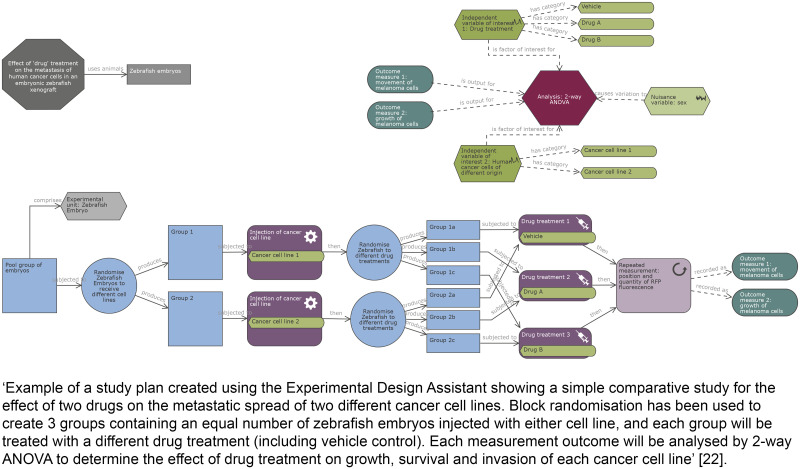
“The Experimental Design Assistant (EDA) is a platform to support researchers in the design of in vivo experiments; it can be used to generate diagrams to represent any type of experimental design [19].”
§ Reporting animal research: Explanation and elaboration for the ARRIVE guidelines 2.0 > ARRIVE Essential 10 > Item 1. Study design
What the sources say
- Partly supportedcites [19] N Percie du Sert, 2017, The Experimental Design Assistant, PLoS Biol sourceExperimental — accuracy not yet measured
The Introduction describes the EDA as a web-based tool that guides researchers in designing animal experiments and produces diagrams of their plans. The section on standard notation describes diagrams for different designs, but our copy does not establish the broader claim that it can represent any type of experimental design. (LLM, conf=0.82)
plain- Asserted: passes — The authors put it forward as true.
- Checkable: passes — It can be checked against evidence.
- Load-bearing: fails — The paper’s conclusions may not depend on it.
- Based: passes — The paper gives a reason why it holds.
Probably not a substantial claim. The paper’s conclusions may not depend on it. It may state two separate claims as one.
- Partly supported
The sources with a verdict support this claim; the rest weren’t checked yet, have no full text we could read, or their verdicts aren’t rated yet.
In the paper
“For hypothesis-testing experiments, in which inferential statistics are used to estimate the size of the effect and to determine the weight of evidence against the null hypothesis, the sample size needs to be justified to ensure experiments are of an optimal size to test the research question [33,34] (see Item 13. Objectives).”
§ Reporting animal research: Explanation and elaboration for the ARRIVE guidelines 2.0 > ARRIVE Essential 10 > Item 2. Sample size
What the sources say
- Not checked — no full text of the sourcecites [33] F Vahidy, 2016, Reporting standards for preclinical studies of stroke therapy, Stroke source
- Supportedcites [34] BS Muhlhausler, 2013, Whole animal experiments should be more like human randomized controlled trials, PLoS Biol source
The “Sample Size Issues” section says that calculating sample size before an RCT ensures sufficient statistical power and recommends that animal researchers report how they determined sample size a priori. The recommendations table likewise calls for justification of sample size selection based on a prespecified primary outcome. (LLM, conf=0.90)
plaindirect- Asserted: passes — The authors put it forward as true.
- Checkable: fails — It may be too vague to check against evidence.
- Load-bearing: passes — The paper’s conclusions depend on it.
- Based: passes — The paper gives a reason why it holds.
Probably not a substantial claim. It may be too vague to check against evidence.
Every source the paper cites for this claim was checked and supports it.
In the paper
“and there is evidence that in vivo scientists are not sufficiently aware of the importance of reporting the information covered in the guidelines and fail to appreciate the relevance to their work or their research field [12].”
§ Reporting animal research: Explanation and elaboration for the ARRIVE guidelines 2.0 > Introduction
What the sources say
- Supportedcites [12] JC McGrath, 2015, Implementing guidelines on reporting research using animals (ARRIVE etc.): new requirements for publication in BJP, Br J Pharmacol source
In “Implementation of ARRIVE,” the authors report that many authors paid no attention to the guidelines and that some did not see the point of particular requirements for their work. In “Have our efforts made a difference?” and the subsequent discussion, they describe colleagues who considered the effort a waste of time and authors who claimed compliance without fully following the guidelines. These passages support the cited statement about insufficient appreciation of the reporting requirements and their relevance. (LLM, conf=0.88)
plain- Asserted: passes — The authors put it forward as true.
- Checkable: passes — It can be checked against evidence.
- Load-bearing: passes — The paper’s conclusions depend on it.
- Based: passes — The paper gives a reason why it holds.
It may state two separate claims as one.
- Supported
Every source the paper cites for this claim was checked and supports it.
In the paper
“Consequently, low-powered studies contribute to the poor internal validity of research and risk wasting animals used in inconclusive research [37].”
§ Reporting animal research: Explanation and elaboration for the ARRIVE guidelines 2.0 > ARRIVE Essential 10 > Item 2. Sample size
What the sources say
- Supportedcites [37] H Würbel, 2017, More than 3Rs: The importance of scientific validity for harm-benefit analysis of animal research, Lab animal source
In the Hanno Würbel section (page unavailable), the paper identifies samples that are too small as a threat to scientific validity and includes sample-size calculation in its assessment of internal validity. In “Bumping up the benefits” (page unavailable), it says animals may be wasted when a study produces inconclusive results. (LLM, conf=0.90)
plaindirect- Asserted: passes — The authors put it forward as true.
- Checkable: passes — It can be checked against evidence.
- Load-bearing: passes — The paper’s conclusions depend on it.
- Based: passes — The paper gives a reason why it holds.
It may state two separate claims as one.
- Supported
The cited sources support only part of this claim — read each source’s verdict below.
In the paper
“To ensure scientific rigour, the criteria should be defined before the experiment starts and data are collected [8,33,48,49].”
§ Reporting animal research: Explanation and elaboration for the ARRIVE guidelines 2.0 > ARRIVE Essential 10 > Item 3. Inclusion and exclusion criteria
What the sources say
- Partly supportedcites [8] MT Avey, 2016, The devil is in the details: incomplete reporting in preclinical animal research, PLoS ONE sourceExperimental — accuracy not yet measured
The Results section identifies inclusion and exclusion criteria as core reporting items, and the Discussion links rigorous implementation and reporting of such measures to reduced risk of bias. Our copy does not say that these criteria must be defined before the experiment starts or before data collection; that timing is not supported by this source. (LLM, conf=0.82)
- Not checked — no full text of the sourcecites [33] F Vahidy, 2016, Reporting standards for preclinical studies of stroke therapy, Stroke source
- Not checked — no full text of the sourcecites [48] ASC Rice, 2013, Transparency in the reporting of in vivo pre-clinical pain research: The relevance and implications of the ARRIVE (Animal Research: Reporting In Vivo Experiments) guidelines, Scandinavian Journal of Pain source
- Not checked — no full text of the sourcecites [49] Salkind NJ. Encyclopedia of research design: Sage; 2010. source
plaindirect- Asserted: passes — The authors put it forward as true.
- Checkable: fails — It may be too vague to check against evidence.
- Load-bearing: passes — The paper’s conclusions depend on it.
- Based: passes — The paper gives a reason why it holds.
Probably not a substantial claim. It may be too vague to check against evidence.
- Partly supported
Every source the paper cites for this claim was checked and supports it.
In the paper
“To ensure that the recommendations are as clear and useful as possible to the target audience, this document was road tested alongside the revised guidelines with researchers preparing manuscripts describing in vivo research [13].”
§ Reporting animal research: Explanation and elaboration for the ARRIVE guidelines 2.0 > Introduction
What the sources say
- Supportedcites [13] N Percie du Sert, 2020, The ARRIVE guidelines 2.0: Updated guidelines for reporting animal research, PLoS Biol source
The ‘Introducing ARRIVE 2.0’ section states that the revised guidelines and accompanying Explanation and Elaboration document were road tested with researchers preparing manuscripts describing in vivo studies. It also gives the stated purpose: checking that the documents were understood and useful to their intended users. (LLM, conf=0.95)
plain- Asserted: passes — The authors put it forward as true.
- Checkable: passes — It can be checked against evidence.
- Load-bearing: fails — The paper’s conclusions may not depend on it.
- Based: passes — The paper gives a reason why it holds.
Probably not a substantial claim. The paper’s conclusions may not depend on it.
- Supported
The sources with a verdict support this claim; the rest weren’t checked yet, have no full text we could read, or their verdicts aren’t rated yet.
In the paper
“Statistical programmes to help perform a priori sample size calculations exist for a variety of experimental designs and statistical analyses, both freeware (web-based applets and functions in R) and commercial software [38–40].”
§ Reporting animal research: Explanation and elaboration for the ARRIVE guidelines 2.0 > ARRIVE Essential 10 > Item 2. Sample size
What the sources say
- Not matchedcites [38] R Core Team, 2017
Couldn’t be matched to a paper in Crossref, so it can’t be checked.
- Not checked — no full text of the sourcecites [39] C-YJ Peng, 2012, Power analysis software for educational researchers, The Journal of Experimental Education source
- Supportedcites [40] J Charan, 2013, How to calculate sample size in animal studies?, J Pharmacol Pharmacother source
The passage on software for sample-size calculation (section labeled Abstract) recommends freely downloadable G*Power, points to other free calculators, and names nQuery Advisor and MINITAB for more complex calculations. It also discusses calculations for different statistical tests, including t-tests, chi-square tests, ANOVA and non-parametric tests. This supports the attributed claim that free and commercial programs are available for a variety of analyses. (LLM, conf=0.90)
plain- Asserted: passes — The authors put it forward as true.
- Checkable: passes — It can be checked against evidence.
- Load-bearing: fails — The paper’s conclusions may not depend on it.
- Based: passes — The paper gives a reason why it holds.
Probably not a substantial claim. The paper’s conclusions may not depend on it.
- Not matched
The sources with a verdict support this claim; the rest weren’t checked yet, have no full text we could read, or their verdicts aren’t rated yet.
In the paper
“It underestimates the true variability in a study, which can lead to false positives and invalidate the analysis and resulting conclusions [26,27].”
§ Reporting animal research: Explanation and elaboration for the ARRIVE guidelines 2.0 > ARRIVE Essential 10 > Item 1. Study design
What the sources say
- Supportedcites [26] SE Lazic, 2010, The problem of pseudoreplication in neuroscientific studies: is it affecting your analysis?, BMC Neurosci source
In the Background section on false precision, the paper explains that pseudoreplication produces an incorrectly narrow error bar and confidence interval, understating uncertainty about the population. The same section reports increased false-positive rates and says analyses that ignore this data structure can be meaningless and lead to false conclusions. (LLM, conf=0.93)
- Not checked — no full text of the sourcecites [27] SH Hurlbert, 1984, Pseudoreplication and the design of ecological field experiments, Ecol Monogr source
plaindirect- Asserted: passes — The authors put it forward as true.
- Checkable: passes — It can be checked against evidence.
- Load-bearing: passes — The paper’s conclusions depend on it.
- Based: passes — The paper gives a reason why it holds.
It may state two separate claims as one.
- Supported
The cited sources support only part of this claim — read each source’s verdict below.
In the paper
“Missing data, common in all areas of research, can impact the sensitivity of the study and also lead to biased estimates, distorted power, and loss of information if the missing values are not random [54].”
§ Reporting animal research: Explanation and elaboration for the ARRIVE guidelines 2.0 > ARRIVE Essential 10 > Item 3. Inclusion and exclusion criteria
What the sources say
- Partly supportedcites [54] H Kang, 2013, The prevention and handling of the missing data, Korean J Anesthesiol sourceExperimental — accuracy not yet measured
The Abstract (page not provided) says missing data reduce statistical power and can bias parameter estimates; the Missing completely at random section adds that power can be lost even when estimates remain unbiased. The paper also describes lost data, but it does not say missing data affect the study’s sensitivity. Its Sensitivity analysis section discusses a method for testing the robustness of results, not a loss of study sensitivity. (LLM, conf=0.84)
plaindirect- Asserted: passes — The authors put it forward as true.
- Checkable: passes — It can be checked against evidence.
- Load-bearing: unclear — It is unclear whether the paper’s conclusions depend on it.
- Based: passes — The paper gives a reason why it holds.
It may state two separate claims as one.
- Partly supported
The cited sources support only part of this claim — read each source’s verdict below.
In the paper
“In a hypothesis-testing study powered to detect an effect on the primary outcome measure, data on secondary outcomes are used to evaluate additional effects of the intervention, but subsequent statistical analysis of secondary outcome measures may be underpowered, making results and interpretation less reliable [88,93].”
§ Reporting animal research: Explanation and elaboration for the ARRIVE guidelines 2.0 > ARRIVE Essential 10 > Item 6. Outcome measures
What the sources say
- Not checked — no full text of the sourcecites [88] LK John, 2012, Measuring the prevalence of questionable research practices with incentives for truth telling, Psychol Sci source
- Partly supportedcites [93] SC Landis, 2012, A call for transparent reporting to optimize the predictive value of preclinical research, Nature sourceExperimental — accuracy not yet measured
Split into 2 atoms — 0 confirmed, 2 partially supported, 0 disputed, 0 misattributed, 0 unverifiable. Expand the claim to see per-atom verdicts.
hedgedconditional- Asserted: passes — The authors put it forward as true.
- Checkable: passes — It can be checked against evidence.
- Load-bearing: passes — The paper’s conclusions depend on it.
- Based: passes — The paper gives a reason why it holds.
It may state two separate claims as one.
Every source the paper cites for this claim was checked and supports it.
In the paper
“Registering a protocol in advance protects the researcher against concerns about selective outcome reporting (also known as data dredging or p-hacking) and provides evidence that the primary outcome reported in the manuscript accurately reflects what was planned [95] (see Item 19. Protocol registration).”
§ Reporting animal research: Explanation and elaboration for the ARRIVE guidelines 2.0 > ARRIVE Essential 10 > Item 6. Outcome measures
What the sources say
- Supportedcites [95] MR Munafò, 2017, A manifesto for reproducible science, Nature Human Behaviour source
In “Reporting and dissemination,” the paper says that pre-registering a study with its primary outcome specified in advance addresses outcome switching and P-hacking. The advance specification provides a record against which the manuscript’s reported primary outcome can be compared; the paper does not suggest that registration guarantees adherence. (LLM, conf=0.89)
plaindirect- Asserted: passes — The authors put it forward as true.
- Checkable: passes — It can be checked against evidence.
- Load-bearing: passes — The paper’s conclusions depend on it.
- Based: passes — The paper gives a reason why it holds.
It may state two separate claims as one.
- Supported
Every source the paper cites for this claim was checked and supports it.
In the paper
“Analysing the data using different methods and selectively reporting those with statistically significant results constitutes p-hacking and introduces bias in the literature [90,94].”
§ Reporting animal research: Explanation and elaboration for the ARRIVE guidelines 2.0 > ARRIVE Essential 10 > Item 7. Statistical methods
What the sources say
- Supportedcites [90] KK Tsilidis, 2013, Evaluation of excess significance bias in animal studies of neurological diseases, PLoS Biol source
The Introduction describes using different statistical approaches but reporting only the analysis with the best results, calling this selective analysis and outcome reporting bias. It says these biases inflate the proportion of published statistically significant findings. Although the paper does not use the term “p-hacking” in the quoted passage, it describes the practice the claim names. (LLM, conf=0.92)
- Supportedcites [94] ML Head, 2015, The extent and consequences of p-hacking in science, PLoS Biol source
The paper lists post-analysis choices, including changing which covariates to include and stopping data exploration when an analysis yields a significant p-value, as p-hacking practices (introductory discussion; page not provided). Box 3 calls for reporting the entire analysis process rather than only the final tests, and the Summary and Conclusions says p-hacking has probably inflated estimated mean effect sizes. Together, these support the claim that selectively reporting significant results from different analyses is p-hacking and biases the literature. (LLM, conf=0.90)
plaindirect- Asserted: passes — The authors put it forward as true.
- Checkable: passes — It can be checked against evidence.
- Load-bearing: passes — The paper’s conclusions depend on it.
- Based: passes — The paper gives a reason why it holds.
It may state two separate claims as one.
- Supported
The sources with a verdict support this claim; the rest weren’t checked yet, have no full text we could read, or their verdicts aren’t rated yet.
In the paper
“The immune or microbiological status of the animals can also influence welfare, experimental variability, and scientific outcomes [112–114].”
§ Reporting animal research: Explanation and elaboration for the ARRIVE guidelines 2.0 > ARRIVE Essential 10 > Item 8. Experimental animals
What the sources say
- Supportedcites [112] M Mahler Convenor, 2014, FELASA recommendations for the health monitoring of mouse, rat, hamster, guinea pig and rabbit colonies in breeding and experimental units, Lab Anim source
The opening passage (Abstract) states that animals’ microbiological quality directly influences welfare, experimental variability, and scientific research projects. The discussion of infections (Abstract) also says they can confound scientific results and increase experimental variability. (LLM, conf=0.93)
- Not checked — no full text of the sourcecites [113] DG Baker, 1998, Natural pathogens of laboratory mice, rats, and rabbits and their effects on research, Clin Microbiol Rev source
- Supportedcites [114] EM Velazquez, 2019, Endogenous Enterobacteriaceae underlie variation in susceptibility to Salmonella infection, Nat Microbiol source
The Abstract identifies gut microbiota as a source of variation in animal experiments and links understanding that variation to reproducibility. The Results report that microbiota transplants reproduced differences in Salmonella susceptibility and that one donor microbiota led to greater lethal morbidity—a welfare-relevant outcome. Together, these passages support the claim that animals’ microbiological status can affect welfare, experimental variability, and scientific outcomes. (LLM, conf=0.88)
plainconditional- Asserted: passes — The authors put it forward as true.
- Checkable: passes — It can be checked against evidence.
- Load-bearing: passes — The paper’s conclusions depend on it.
- Based: passes — The paper gives a reason why it holds.
It may state two separate claims as one.
- Supported
The cited sources support only part of this claim — read each source’s verdict below.
In the paper
“The animals’ provenance, their health or immune status, and their history of previous testing or procedures can influence their physiology and behaviour, as well as their response to treatments, and thus impact on study outcomes.”
§ Reporting animal research: Explanation and elaboration for the ARRIVE guidelines 2.0 > ARRIVE Essential 10 > Item 8. Experimental animals
What the sources say
- Not checked — no full text of the sourcecites [16] MF Festing, 2002, Guidelines for the design and statistical analysis of experiments using laboratory animals, ILAR J source
- Partly supportedcites [112] M Mahler Convenor, 2014, FELASA recommendations for the health monitoring of mouse, rat, hamster, guinea pig and rabbit colonies in breeding and experimental units, Lab Anim sourceExperimental — accuracy not yet measured
The paper’s introductory passage (indexed as Abstract; page not given) says infections can affect animals’ physiology, including behaviour and immune response, and can confound experimental results. Its health-monitoring discussion also considers immune status and the health history of the facility of origin. It does not establish that previous testing or procedures alter animals’ physiology, behaviour, or responses to treatments. (LLM, conf=0.85)
- Not checked — no full text of the sourcecites [113] DG Baker, 1998, Natural pathogens of laboratory mice, rats, and rabbits and their effects on research, Clin Microbiol Rev source
- Partly supportedcites [114] EM Velazquez, 2019, Endogenous Enterobacteriaceae underlie variation in susceptibility to Salmonella infection, Nat Microbiol sourceExperimental — accuracy not yet measured
The Results show that mice from different vendors had different susceptibility to Salmonella infection, and the Abstract links that variation to their gut microbiota and to reproducibility of animal experiments. The cited paper does not establish the claim about prior testing or procedures, behaviour, or responses to treatments generally. The copy provides section labels but no page numbers. (LLM, conf=0.88)
plainconditional- Asserted: passes — The authors put it forward as true.
- Checkable: passes — It can be checked against evidence.
- Load-bearing: passes — The paper’s conclusions depend on it.
- Based: passes — The paper gives a reason why it holds.
It may state two separate claims as one.
The sources with a verdict support this claim; the rest weren’t checked yet, have no full text we could read, or their verdicts aren’t rated yet.
In the paper
“Animal handling can be a source of stress, and the specific method used (e.g., mice picked up by tail or in cupped hands) can affect research outcomes [61,121,122].”
§ Reporting animal research: Explanation and elaboration for the ARRIVE guidelines 2.0 > ARRIVE Essential 10 > Item 9. Experimental procedures
What the sources say
- Supportedcites [61] K Gouveia, 2017, Optimising reliability of mouse performance in behavioural testing: the major role of non-aversive handling, Sci Rep source
The Abstract identifies handling as a source of stress and says that handling method affects mouse anxiety and test performance. The General Discussion reports that tail-handled mice avoided the handler, while mice handled non-aversively explored more and performed better in behavioural tests. (LLM, conf=0.93)
- Supportedcites [121] JM Clarkson, 2018, Handling method alters the hedonic value of reward in laboratory mice, Sci Rep source
The Introduction describes tail handling as more anxiety-provoking than tunnel or cupped-hand handling and says handling technique can influence behavioural-study data. The Results report greater anxiety-like behaviour in tail-handled mice, and the Discussion warns that handling may affect responses to rewards and the interpretation of findings. The paper itself tested tail versus tunnel handling; cupped hands appear as an illustrative alternative, not a tested group. (LLM, conf=0.93)
- Not checked — no full text of the sourcecites [122] JL Hurst, 2010, Taming anxiety in laboratory mice, Nat Methods source
plaindirect- Asserted: passes — The authors put it forward as true.
- Checkable: passes — It can be checked against evidence.
- Load-bearing: passes — The paper’s conclusions depend on it.
- Based: passes — The paper gives a reason why it holds.
It may state two separate claims as one.
- Supported
Every source the paper cites for this claim was checked and supports it.
In the paper
“RRIDs are unique and stable, allowing unambiguous identification of reagents or tools used in a study, aiding other researchers to replicate the methods.”
§ Reporting animal research: Explanation and elaboration for the ARRIVE guidelines 2.0 > ARRIVE Essential 10 > Item 9. Experimental procedures
What the sources say
- Supportedcites [126] AE Bandrowski, 2016, RRIDs: a simple step toward improving reproducibility through rigor and transparency of experimental methods, Neuron source
The “Why Not Just Use a Catalog Number or the Company Website?” section explicitly says RRID syntax is unique and stable. “One Practical Solution: Research Resource Identifiers” explains that identifiers point to individual resources, while “Simple Common-Sense Steps Help Authors Avoid Reproducibility Pitfalls” says RRIDs make it easier to identify the exact resource used in a study. No page numbers are provided in our copy. (LLM, conf=0.94)
- Supportedcites [127] A Bandrowski, 2016, The Resource Identification Initiative: a cultural shift in publishing, J Comp Neurol source
The Abstract says RRIDs identify research resources, including reagents and tools, to improve identifiability and scientific reproducibility. The Discussion (“Why unique identifiers?”) says identifiers must be unique and persistent, and the Results say an RRID combined with its resource accession number uniquely retrieves articles using that resource. (LLM, conf=0.92)
plaindirect- Asserted: passes — The authors put it forward as true.
- Checkable: passes — It can be checked against evidence.
- Load-bearing: passes — The paper’s conclusions depend on it.
- Based: passes — The paper gives a reason why it holds.
Probably not a substantial claim. It may state two separate claims as one.
- Supported
The cited sources support only part of this claim — read each source’s verdict below.
In the paper
“Reporting the correct nomenclature is crucial to understanding the data and ensuring that the research is discoverable and replicable [116–118].”
§ Reporting animal research: Explanation and elaboration for the ARRIVE guidelines 2.0 > ARRIVE Essential 10 > Item 8. Experimental animals
What the sources say
- Supportedcites [116] S Mallapaty, 2018, In the name of reproducibility, Lab Animal source
The opening of “In the name of reproducibility” says that adhering to mouse nomenclature guidelines makes research discoverable and replicable. “Who provides it now?” explains that inconsistent gene names make it difficult to tell which gene or mutation a paper describes, supporting the point about understanding the data. (LLM, conf=0.91)
- Partly supportedcites [117] JP Sundberg, 2010, Commentary: mouse genetic nomenclature: standardization of strain, gene, and protein symbols, Vet Pathol sourceExperimental — accuracy not yet measured
The Abstract says standard nomenclature is vital for interpreting and recovering mouse experimental data, and the Conclusions link it to searching and retrieving archived data. The Mutant Gene Symbols section says correct annotation allows studies to be compared accurately. These passages support understanding and discoverability, but do not establish that correct nomenclature ensures research is replicable. (LLM, conf=0.83)
- Not checked — no full text of the sourcecites [118] L Montoliu, 2011, Using standard nomenclature to adequately name transgenes, knockout gene alleles and any mutation associated to a genetically modified mouse strain, Transgenic Res source
plaindirect- Asserted: passes — The authors put it forward as true.
- Checkable: fails — It may be too vague to check against evidence.
- Load-bearing: passes — The paper’s conclusions depend on it.
- Based: passes — The paper gives a reason why it holds.
Probably not a substantial claim. It may be too vague to check against evidence. It may state two separate claims as one.
- Supported
Every source the paper cites for this claim was checked and supports it.
In the paper
“Maternal diet affects offspring body weight [183].”
§ Reporting animal research: Explanation and elaboration for the ARRIVE guidelines 2.0 > Recommended Set > Item 15. Housing and husbandry
What the sources say
- Supportedcites [183] SA Bayol, 2007, A maternal ‘junk food’ diet in pregnancy and lactation promotes an exacerbated taste for ‘junk food’ and a greater propensity for obesity in rat offspring, Br J Nutr source
The Results and discussion (p. 5) report significantly lower birth weights and weaning body masses in offspring of mothers fed a junk-food diet than in the chow-fed comparison group. This directly supports the broad claim that maternal diet affects offspring body weight, as demonstrated in rats. (LLM, conf=0.94)
plaindirect- Asserted: passes — The authors put it forward as true.
- Checkable: passes — It can be checked against evidence.
- Load-bearing: fails — The paper’s conclusions may not depend on it.
- Based: passes — The paper gives a reason why it holds.
Probably not a substantial claim. The paper’s conclusions may not depend on it.
- Supported
The sources with a verdict support this claim; the rest weren’t checked yet, have no full text we could read, or their verdicts aren’t rated yet.
In the paper
“Testing a specific hypothesis has implications for both the study design and the data analysis [16,167].”
§ Reporting animal research: Explanation and elaboration for the ARRIVE guidelines 2.0 > Recommended Set > Item 13. Objectives
What the sources say
- Not checked — no full text of the sourcecites [16] MF Festing, 2002, Guidelines for the design and statistical analysis of experiments using laboratory animals, ILAR J source
- Supportedcites [167] J Kimmelman, 2014, Distinguishing between exploratory and confirmatory preclinical research will improve translation, PLoS Biol source
In “Improving Design and Interpretation of Preclinical Research” (page not provided), the authors say that confirmatory studies should match experimental design to the intended application and use pre-specified statistical analyses. This supports the claim that the purpose of hypothesis testing has implications for both study design and data analysis. (LLM, conf=0.90)
plaindirect- Asserted: passes — The authors put it forward as true.
- Checkable: fails — It may be too vague to check against evidence.
- Load-bearing: passes — The paper’s conclusions depend on it.
- Based: passes — The paper gives a reason why it holds.
Probably not a substantial claim. It may be too vague to check against evidence.
The cited sources support only part of this claim — read each source’s verdict below.
In the paper
“Temperature and humidity | Modifies tumour progression [186].”
§ Reporting animal research: Explanation and elaboration for the ARRIVE guidelines 2.0 > Recommended Set > Item 15. Housing and husbandry
What the sources say
- Partly supportedcites [186] KM Kokolus, 2013, Baseline tumor growth and immune control in laboratory mice are significantly influenced by subthermoneutral housing temperature, Proc Natl Acad Sci U S A sourceExperimental — accuracy not yet measured
The Results report slower tumor growth and fewer lung metastases in mice housed at thermoneutral rather than standard temperatures. Materials and Methods says humidity was controlled, but the paper does not report testing whether humidity modifies tumour progression. (LLM, conf=0.89)
plaindirect- Asserted: passes — The authors put it forward as true.
- Checkable: passes — It can be checked against evidence.
- Load-bearing: fails — The paper’s conclusions may not depend on it.
- Based: passes — The paper gives a reason why it holds.
Probably not a substantial claim. The paper’s conclusions may not depend on it.
- Partly supported
Every source the paper cites for this claim was checked and supports it.
In the paper
“The ethical statement provides editors, reviewers, and readers with assurance that studies have received this ethical oversight [12].”
§ Reporting animal research: Explanation and elaboration for the ARRIVE guidelines 2.0 > Recommended Set > Item 14. Ethical statement
What the sources say
- Supportedcites [12] JC McGrath, 2015, Implementing guidelines on reporting research using animals (ARRIVE etc.): new requirements for publication in BJP, Br J Pharmacol source
The Ethical statement section requires authors to disclose ethical review permissions. The Practicalities section says this information should be available to reviewers and readers for assessment, while Table 1 says it enables editors and reviewers to judge the work’s ethical quality. Together, these support the claimed purpose of the statement. (LLM, conf=0.88)
plaindirect- Asserted: passes — The authors put it forward as true.
- Checkable: fails — It may be too vague to check against evidence.
- Load-bearing: passes — The paper’s conclusions depend on it.
- Based: passes — The paper gives a reason why it holds.
Probably not a substantial claim. It may be too vague to check against evidence.
- Supported
The cited sources support only part of this claim — read each source’s verdict below.
In the paper
“They can also inform the choice of animal model by providing a comprehensive overview of the models used along with their benefits and limitations [160–162].”
§ Reporting animal research: Explanation and elaboration for the ARRIVE guidelines 2.0 > Recommended Set > Item 12. Background
What the sources say
- Not checked — no full text of the sourcecites [160] MT Avey, 2015, The use of systematic reviews and reporting guidelines to advance the implementation of the 3Rs, Journal of the American Association for Laboratory Animal Science: JAALAS
- Supportedcites [161] CR Hooijmans, 2013, Progress in using systematic reviews of animal studies to improve translational research, PLoS Med source
The Scientific Rationale section says systematic reviews make differences in animal-study designs transparent and help select the most suitable animal models. That supports the claim that reviewing models and their relative strengths and limitations can inform model choice; the paper does not use the phrase “comprehensive overview.” (LLM, conf=0.88)
- Partly supportedcites [162] ES Sena, 2014, Systematic reviews and meta-analysis of preclinical studies: why perform them and how to appraise them critically, J Cereb Blood Flow Metab sourceExperimental — accuracy not yet measured
The Introduction says systematic reviews provide a less biased summary of preclinical evidence, and the ‘External and Construct Validity’ section gives an example of a review identifying which animals predominate in stroke studies. That section also discusses limitations in how animal models represent human disease. Our copy does not say that reviews provide a comprehensive account of the benefits and limitations of each model or explicitly recommend them for choosing a model. (LLM, conf=0.81)
plaindirect- Asserted: passes — The authors put it forward as true.
- Checkable: passes — It can be checked against evidence.
- Load-bearing: fails — The paper’s conclusions may not depend on it.
- Based: passes — The paper gives a reason why it holds.
Probably not a substantial claim. The paper’s conclusions may not depend on it.
The cited sources that could be checked couldn’t confirm or dispute this claim.
In the paper
“However, abstracts often either do not contain enough information for this purpose [11] or contain information that is inconsistent with the results in the rest of the manuscript [154,155].”
§ Reporting animal research: Explanation and elaboration for the ARRIVE guidelines 2.0 > Recommended Set > Item 11. Abstract
What the sources say
- Could not verifycites [11] K Hair, 2019, A randomised controlled trial of an intervention to improve compliance with the ARRIVE guidelines (IICARus), Research Integrity and Peer Review sourceExperimental — accuracy not yet measured
This source is cited for the claim that abstracts contain information inconsistent with the rest of the manuscript; the insufficient-information claim has a separate citation. The Discussion and Results address compliance with ARRIVE reporting guidelines, but no passage found by searching for abstracts, inconsistencies, and manuscript results assesses whether abstracts contradict manuscript results. (LLM, conf=0.73)
- Not checked — no full text of the sourcecites [154] RM Pitkin, 1999, Accuracy of data in abstracts of published research articles, JAMA source
- Not checked — no full text of the sourcecites [155] I Boutron, 2014, Impact of spin in the abstracts of articles reporting results of randomized controlled trials in the field of cancer: the SPIIN randomized controlled trial, J Clin Oncol source
plain- Asserted: passes — The authors put it forward as true.
- Checkable: passes — It can be checked against evidence.
- Load-bearing: passes — The paper’s conclusions depend on it.
- Based: passes — The paper gives a reason why it holds.
It may state two separate claims as one.
- Could not verify
The cited sources support only part of this claim — read each source’s verdict below.
In the paper
“In studies in which statistical power is low and/or hypothesis-testing is inappropriate, providing the effect size and confidence interval indicates how small or large an effect might really be, so a reader can judge the biological significance of the data [151,152].”
§ Reporting animal research: Explanation and elaboration for the ARRIVE guidelines 2.0 > ARRIVE Essential 10 > Item 10. Results
What the sources say
- Partly supportedcites [151] D Moher, 2010, CONSORT 2010 Explanation and Elaboration: updated guidelines for reporting parallel group randomised trials, BMJ sourceExperimental — accuracy not yet measured
Split into 2 atoms — 0 confirmed, 2 partially supported, 0 disputed, 0 misattributed, 0 unverifiable. Expand the claim to see per-atom verdicts.
- Not checked — no full text of the sourcecites [152] S Nakagawa, 2007, Effect size, confidence interval and statistical significance: a practical guide for biologists, Biol Rev Camb Philos Soc source
hedgeddirect- Asserted: passes — The authors put it forward as true.
- Checkable: fails — It may be too vague to check against evidence.
- Load-bearing: passes — The paper’s conclusions depend on it.
- Based: passes — The paper gives a reason why it holds.
Probably not a substantial claim. It may be too vague to check against evidence.
- Partly supported
Every source the paper cites for this claim was checked and supports it.
In the paper
“Different studies may be sensitive to different environmental factors, and particular aspects of the environment necessary to report may depend on the type of study [176].”
§ Reporting animal research: Explanation and elaboration for the ARRIVE guidelines 2.0 > Recommended Set > Item 15. Housing and husbandry
What the sources say
- Supportedcites [176] 2014, Guidance for the description of animal research in scientific publications, ILAR J source
Section 4, “The Research Animal Environment (Study Conditions)” (page not provided), says environmental factors can affect study outcomes and recommends describing factors known to affect the particular study type or endpoints. Its examples show that the environmental details warranting fuller reporting differ by study type. (LLM, conf=0.94)
hedgedconditional- Asserted: passes — The authors put it forward as true.
- Checkable: fails — It may be too vague to check against evidence.
- Load-bearing: passes — The paper’s conclusions depend on it.
- Based: passes — The paper gives a reason why it holds.
Probably not a substantial claim. It may be too vague to check against evidence. It may state two separate claims as one.
- Supported
Every source the paper cites for this claim was checked and supports it.
In the paper
“For example, in a systematic review of the effect of the MVA85A vaccine on tuberculosis challenge in animals, the largest preclinical trial did not include the vaccine name in the abstract or keywords of the publication; the paper was only included in the systematic review following discussions with experts in the field [157].”
§ Reporting animal research: Explanation and elaboration for the ARRIVE guidelines 2.0 > Recommended Set > Item 11. Abstract
What the sources say
- Supportedcites [157] R Kashangura, 2015, Effects of MVA85A vaccine on tuberculosis challenge in animals: systematic review, Int J Epidemiol source
Split into 2 atoms — 2 confirmed, 0 partially supported, 0 disputed, 0 misattributed, 0 unverifiable. Expand the claim to see per-atom verdicts.
plaindirect- Asserted: passes — The authors put it forward as true.
- Checkable: passes — It can be checked against evidence.
- Load-bearing: unclear — It is unclear whether the paper’s conclusions depend on it.
- Based: passes — The paper gives a reason why it holds.
It may state two separate claims as one.
- Supported
The cited sources support only part of this claim — read each source’s verdict below.
In the paper
“Environmental enrichment | Reduces anxiety [196,197], stress [196,197], and abnormal repetitive behaviour [198–200]. Reduces susceptibility to epilepsy [201] and osteoarthritis [202] and modifies the pathology of neurological disorders [203]. Increases foraging behaviour in fish [204].”
§ Reporting animal research: Explanation and elaboration for the ARRIVE guidelines 2.0 > Recommended Set > Item 15. Housing and husbandry
What the sources say
- Partly supportedcites [202] A Salvarrey-Strati, 2008, The influence of enrichment devices on development of osteoarthritis in a surgically induced murine model, ILAR J sourceExperimental — accuracy not yet measured
The Severity of OA section reports lower histological OA scores with one enrichment device, the Shepherd Shack, than with the other devices, but the difference was not statistically significant (p = 0.07). All mice developed OA after surgery. The paper therefore suggests a device-specific effect on disease severity in a surgically induced mouse model, not a general reduction in susceptibility to developing OA. (LLM, conf=0.89)
plaindirect- Asserted: passes — The authors put it forward as true.
- Checkable: passes — It can be checked against evidence.
- Load-bearing: fails — The paper’s conclusions may not depend on it.
- Based: passes — The paper gives a reason why it holds.
Probably not a substantial claim. The paper’s conclusions may not depend on it.
- Partly supported
The cited sources support only part of this claim — read each source’s verdict below.
In the paper
“Similarly, human clinical trials initiated based on insufficient or misleading animal research evidence increase research waste and negatively influence the risk-benefit balance for research participants [229,232].”
§ Reporting animal research: Explanation and elaboration for the ARRIVE guidelines 2.0 > Recommended Set > Item 18. Generalisability/translation
What the sources say
- Partly supportedcites [229] S Wieschowski, 2018, Preclinical efficacy studies in investigator brochures: do they enable risk–benefit assessment?, PLoS Biol sourceExperimental — accuracy not yet measured
The Introduction (page not specified) says risk–benefit assessment in early human trials depends heavily on animal evidence, and the paper states that poor preclinical study design and reporting thwart that assessment. It does not establish that trials launched on insufficient or misleading evidence increase research waste or demonstrate a worsened risk–benefit balance for participants. (LLM, conf=0.84)
- Not checked — no full text of the sourcecites [232] I Chalmers, 2014, How to increase value and reduce waste when research priorities are set, The Lancet source
plaindirect- Asserted: passes — The authors put it forward as true.
- Checkable: passes — It can be checked against evidence.
- Load-bearing: passes — The paper’s conclusions depend on it.
- Based: passes — The paper gives a reason why it holds.
It may state two separate claims as one.
- Partly supported
The cited sources support only part of this claim — read each source’s verdict below.
In the paper
“Limitations are unavoidable in scientific research, and describing them is essential to share experience, guide best practice, and aid the design of future experiments [228].”
§ Reporting animal research: Explanation and elaboration for the ARRIVE guidelines 2.0 > Recommended Set > Item 17. Interpretation/scientific implications
What the sources say
- Partly supportedcites [228] MA Puhan, 2012, Discussing study limitations in reports of biomedical studies- the need for more transparency, Health Qual Life Outcomes sourceExperimental — accuracy not yet measured
The Introduction (page not provided) calls candid discussion of limitations crucial to scientific discourse and says it informs higher-quality future studies. The Discussion section (page not provided) recommends using limitations to guide future research and study design. The copy does not establish that limitations are unavoidable in all scientific research or specifically say that describing them guides best practice. (LLM, conf=0.83)
plaindirect- Asserted: passes — The authors put it forward as true.
- Checkable: fails — It may be too vague to check against evidence.
- Load-bearing: passes — The paper’s conclusions depend on it.
- Based: passes — The paper gives a reason why it holds.
Probably not a substantial claim. It may be too vague to check against evidence. It may state two separate claims as one.
- Partly supported
Every source the paper cites for this claim was checked and supports it.
In the paper
“If the experiment is testing the efficacy of a treatment, the occurrence of adverse events may alter the balance between treatment benefit and risk [34].”
§ Reporting animal research: Explanation and elaboration for the ARRIVE guidelines 2.0 > Recommended Set > Item 16. Animal care and monitoring
What the sources say
- Supportedcites [34] BS Muhlhausler, 2013, Whole animal experiments should be more like human randomized controlled trials, PLoS Biol source
The Adverse Events section states that adverse events may tip the balance of benefit and risk for the intervention being tested. This directly supports the citing sentence’s qualified claim. (LLM, conf=0.94)
hedgedconditional- Asserted: passes — The authors put it forward as true.
- Checkable: passes — It can be checked against evidence.
- Load-bearing: fails — The paper’s conclusions may not depend on it.
- Based: passes — The paper gives a reason why it holds.
Probably not a substantial claim. The paper’s conclusions may not depend on it.
- Supported
Every source the paper cites for this claim was checked and supports it.
In the paper
“Environmental enrichment | Reduces anxiety [196,197], stress [196,197], and abnormal repetitive behaviour [198–200]. Reduces susceptibility to epilepsy [201] and osteoarthritis [202] and modifies the pathology of neurological disorders [203]. Increases foraging behaviour in fish [204].”
§ Reporting animal research: Explanation and elaboration for the ARRIVE guidelines 2.0 > Recommended Set > Item 15. Housing and husbandry
What the sources say
- Supportedcites [204] VA Braithwaite, 2005, Environmental variability in the early rearing environment generates behaviourally flexible cod: implications for rehabilitating wild populations, Proceedings of the Royal Society B-Biological Sciences source
The Discussion reports that cod reared with variable food cues were faster to approach and consume live prey than cod given food at an unchanging location. It concludes that varying food supply may improve the foraging capacity of hatchery-reared fish. (LLM, conf=0.89)
plaindirect- Asserted: passes — The authors put it forward as true.
- Checkable: passes — It can be checked against evidence.
- Load-bearing: fails — The paper’s conclusions may not depend on it.
- Based: passes — The paper gives a reason why it holds.
Probably not a substantial claim. The paper’s conclusions may not depend on it.
- Supported
Every source the paper cites for this claim was checked and supports it.
In the paper
“Untreated pain can affect the animals’ biology and add variability to the experiment; however, specific pain management procedures can also introduce variability, affecting experimental data [212,213].”
§ Reporting animal research: Explanation and elaboration for the ARRIVE guidelines 2.0 > Recommended Set > Item 16. Animal care and monitoring
What the sources say
- Supportedcites [212] P Jirkof, 2017, Side effects of pain and analgesia in animal experimentation, Lab Anim (NY) source
The review states that untreated pain can affect organs, physiology and behavior and may increase data variability (Conclusion). It also says that both the pain-management protocol and untreated pain can affect results and increase variability (Focus on Reproducibility Review). (LLM, conf=0.94)
- Supportedcites [213] L Carbone, 2016, Pain and laboratory animals: publication practices for better data reproducibility and better animal welfare, PLoS ONE source
The Introduction (page not supplied) states that untreated pain affects animals’ biology and that pain can skew experimental data by introducing unwanted variability. It also says pain-relieving drugs can have these effects, supporting the sentence’s second clause. (LLM, conf=0.95)
plaindirect- Asserted: passes — The authors put it forward as true.
- Checkable: passes — It can be checked against evidence.
- Load-bearing: passes — The paper’s conclusions depend on it.
- Based: passes — The paper gives a reason why it holds.
It may state two separate claims as one.
- Supported
The cited sources support only part of this claim — read each source’s verdict below.
In the paper
“The EDA can also be used to generate a time-stamped PDF, which sets out key elements of the experimental design [19].”
§ Reporting animal research: Explanation and elaboration for the ARRIVE guidelines 2.0 > Recommended Set > Item 19. Protocol registration
What the sources say
- Partly supportedcites [19] N Percie du Sert, 2017, The Experimental Design Assistant, PLoS Biol sourceExperimental — accuracy not yet measured
The Introduction section on improving the reliability of experimental results and analysis (Fig. 1 workflow; page not available in our copy) says users can export a PDF report containing the EDA diagram and information about the experiment’s internal validity. It does not say the PDF is time-stamped. (LLM, conf=0.87)
plaindirect- Asserted: passes — The authors put it forward as true.
- Checkable: passes — It can be checked against evidence.
- Load-bearing: fails — The paper’s conclusions may not depend on it.
- Based: passes — The paper gives a reason why it holds.
Probably not a substantial claim. The paper’s conclusions may not depend on it.
- Partly supported
The cited sources support only part of this claim — read each source’s verdict below.
In the paper
“Registering a protocol before the start of the experiment enables researchers to demonstrate that the hypothesis, approach, and analysis were planned in advance and not shaped by data as they emerged; it enhances scientific rigour and protects the researcher against concerns about selective reporting of results [239,240].”
§ Reporting animal research: Explanation and elaboration for the ARRIVE guidelines 2.0 > Recommended Set > Item 19. Protocol registration
What the sources say
- Partly supportedcites [239] RM Kaplan, 2015, Likelihood of null effects of large NHLBI clinical trials has increased over time, PLoS ONE sourceExperimental — accuracy not yet measured
The Results section says prospective declaration of primary outcomes prevents investigators from selecting a favorable outcome to report, and the Discussion says preregistration constrained post hoc changes to hypotheses. The paper thus supports the selective-reporting and transparency rationale for preregistration, but it does not say that registration protects researchers personally from concerns about selective reporting, and its evidence concerns clinical trials rather than experiments generally. (LLM, conf=0.83)
- Not matchedcites [240] C Allen, 2018, Open Science challenges, benefits and tips in early career and beyond, PsyArXiv
Couldn’t be matched to a paper in Crossref, so it can’t be checked.
plaindirect- Asserted: passes — The authors put it forward as true.
- Checkable: passes — It can be checked against evidence.
- Load-bearing: passes — The paper’s conclusions depend on it.
- Based: passes — The paper gives a reason why it holds.
It may state two separate claims as one.
- Partly supported
Every source the paper cites for this claim was checked and supports it.
In the paper
“For example, in the Registered Report format offered by an increasing number of journals, protocols undergo peer review, and if accepted, the journal commits to publishing the completed research regardless of the results obtained [237].”
§ Reporting animal research: Explanation and elaboration for the ARRIVE guidelines 2.0 > Recommended Set > Item 19. Protocol registration
What the sources say
- Supportedcites [237] CD Chambers, 2014, Instead of "playing the game" it is time to change the rules: Registered Reports at AIMS Neuroscience and beyond, AIMS Neuroscience source
The Registered Reports section describes peer review of a Stage 1 protocol and says that a sound rationale and methods lead to an agreement to publish regardless of the outcome. The submission-pipeline passage adds that in-principle acceptance virtually guarantees publication if the authors follow the approved protocol. (LLM, conf=0.94)
plaindirect- Asserted: passes — The authors put it forward as true.
- Checkable: passes — It can be checked against evidence.
- Load-bearing: fails — The paper’s conclusions may not depend on it.
- Based: passes — The paper gives a reason why it holds.
Probably not a substantial claim. The paper’s conclusions may not depend on it. It may state two separate claims as one.
- Supported
The cited sources support only part of this claim — read each source’s verdict below.
In the paper
“An increasing number of publishers and funding bodies require authors or grant holders to make their data publicly available [247].”
§ Reporting animal research: Explanation and elaboration for the ARRIVE guidelines 2.0 > Recommended Set > Item 20. Data access
What the sources say
- Partly supportedcites [247] V Stodden, 2013, Toward reproducible computational research: an empirical analysis of data and code policy adoption by journals, PLoS ONE sourceExperimental — accuracy not yet measured
The Discussion reports an increase from 2011 to 2012 in journals requiring data sharing, and the Introduction says NSF and NIH require dataset disclosure. But the Introduction describes sharing with other researchers, while some journal policies provide data only upon request; it does not establish that authors or grant holders must make data publicly available. Page numbers are not supplied in our copy. (LLM, conf=0.82)
plain- Asserted: passes — The authors put it forward as true.
- Checkable: passes — It can be checked against evidence.
- Load-bearing: fails — The paper’s conclusions may not depend on it.
- Based: passes — The paper gives a reason why it holds.
Probably not a substantial claim. The paper’s conclusions may not depend on it.
- Partly supported
In the paper
“In such cases, power calculations are not appropriate and sample sizes can be estimated based on operational capacity and constraints [44].”
§ Reporting animal research: Explanation and elaboration for the ARRIVE guidelines 2.0 > ARRIVE Essential 10 > Item 2. Sample size
What the sources say
- Not checked — no full text of the sourcecites [44] PS Reynolds, 2019, When power calculations won’t do: Fermi approximation of animal numbers, Lab Animal source
plain- Asserted: passes — The authors put it forward as true.
- Checkable: passes — It can be checked against evidence.
- Load-bearing: fails — The paper’s conclusions may not depend on it.
- Based: passes — The paper gives a reason why it holds.
Probably not a substantial claim. The paper’s conclusions may not depend on it. It may state two separate claims as one.
The paper states this without a source or data behind it here, so there is nothing to check it against. The quote shows it is in the paper.
In the paper
“Two-sided tests with a nondirectional alternative hypothesis are much more common and allow researchers to detect the effect of a treatment regardless of its direction.”
§ Reporting animal research: Explanation and elaboration for the ARRIVE guidelines 2.0 > ARRIVE Essential 10 > Item 2. Sample size
plaindirect- Asserted: passes — The authors put it forward as true.
- Checkable: passes — It can be checked against evidence.
- Load-bearing: fails — The paper’s conclusions may not depend on it.
- Based: fails — The paper may give no reason why it holds.
Probably not a substantial claim. The paper’s conclusions may not depend on it. The paper may give no reason why it holds. It may state two separate claims as one.
The paper states this without a source or data behind it here, so there is nothing to check it against. The quote shows it is in the paper.
In the paper
“Study design can influence the statistical power of an experiment, and the power calculation used needs to be appropriate for the design implemented.”
§ Reporting animal research: Explanation and elaboration for the ARRIVE guidelines 2.0 > ARRIVE Essential 10 > Item 2. Sample size
plaindirect- Asserted: passes — The authors put it forward as true.
- Checkable: passes — It can be checked against evidence.
- Load-bearing: passes — The paper’s conclusions depend on it.
- Based: passes — The paper gives a reason why it holds.
Probably not a substantial claim. It may state two separate claims as one.
The paper states this without a source or data behind it here, so there is nothing to check it against. The quote shows it is in the paper.
In the paper
“The choice of control or comparator group is dependent on the experimental objective.”
§ Reporting animal research: Explanation and elaboration for the ARRIVE guidelines 2.0 > ARRIVE Essential 10 > Item 1. Study design
plaindirect- Asserted: passes — The authors put it forward as true.
- Checkable: passes — It can be checked against evidence.
- Load-bearing: fails — The paper’s conclusions may not depend on it.
- Based: passes — The paper gives a reason why it holds.
Probably not a substantial claim. The paper’s conclusions may not depend on it.
The paper states this without a source or data behind it here, so there is nothing to check it against. The quote shows it is in the paper.
In the paper
“Reporting the total number of animals used in the study is also useful to identify whether any were reused between experiments.”
§ Reporting animal research: Explanation and elaboration for the ARRIVE guidelines 2.0 > ARRIVE Essential 10 > Item 2. Sample size
plaincorrelational- Asserted: passes — The authors put it forward as true.
- Checkable: passes — It can be checked against evidence.
- Load-bearing: fails — The paper’s conclusions may not depend on it.
- Based: passes — The paper gives a reason why it holds.
Probably not a substantial claim. The paper’s conclusions may not depend on it.
The paper states this without a source or data behind it here, so there is nothing to check it against. The quote shows it is in the paper.
In the paper
“For complex study designs, a visual representation is more easily interpreted than a text description, so a timeline diagram or flowchart is recommended.”
§ Reporting animal research: Explanation and elaboration for the ARRIVE guidelines 2.0 > ARRIVE Essential 10 > Item 1. Study design
plaindirect- Asserted: passes — The authors put it forward as true.
- Checkable: fails — It may be too vague to check against evidence.
- Load-bearing: passes — The paper’s conclusions depend on it.
- Based: passes — The paper gives a reason why it holds.
Probably not a substantial claim. It may be too vague to check against evidence.
The paper states this without a source or data behind it here, so there is nothing to check it against. The quote shows it is in the paper.
In the paper
“For example, the number of animals needed for antibody or tissue production is determined by the amount required and the production ability of an individual animal.”
§ Reporting animal research: Explanation and elaboration for the ARRIVE guidelines 2.0 > ARRIVE Essential 10 > Item 2. Sample size
plaindirect- Asserted: passes — The authors put it forward as true.
- Checkable: passes — It can be checked against evidence.
- Load-bearing: fails — The paper’s conclusions may not depend on it.
- Based: passes — The paper gives a reason why it holds.
Probably not a substantial claim. The paper’s conclusions may not depend on it.
In the paper
“Controversy exists within the statistics community on when it is appropriate to use a one-sided test [42].”
§ Reporting animal research: Explanation and elaboration for the ARRIVE guidelines 2.0 > ARRIVE Essential 10 > Item 2. Sample size
What the sources say
- Not checked — no full text of the sourcecites [42] LS Freedman, 2008, An analysis of the controversy over classical one-sided tests, Clin Trials source
plain- Asserted: passes — The authors put it forward as true.
- Checkable: passes — It can be checked against evidence.
- Load-bearing: fails — The paper’s conclusions may not depend on it.
- Based: passes — The paper gives a reason why it holds.
Probably not a substantial claim. The paper’s conclusions may not depend on it.
The paper states this without a source or data behind it here, so there is nothing to check it against. The quote shows it is in the paper.
In the paper
“Note that analyses such as ANOVA and chi-squared are based on asymmetrical distributions (F-distribution and chi-squared distribution) with only one tail. Therefore, these tests do not have a directionality option.”
§ Reporting animal research: Explanation and elaboration for the ARRIVE guidelines 2.0 > ARRIVE Essential 10 > Item 2. Sample size
plaindirect- Asserted: passes — The authors put it forward as true.
- Checkable: passes — It can be checked against evidence.
- Load-bearing: fails — The paper’s conclusions may not depend on it.
- Based: passes — The paper gives a reason why it holds.
Probably not a substantial claim. The paper’s conclusions may not depend on it. It may state two separate claims as one.
The paper states this without a source or data behind it here, so there is nothing to check it against. The quote shows it is in the paper.
In the paper
“In early feasibility or pilot studies, the number of animals required depends on the purpose of the study.”
§ Reporting animal research: Explanation and elaboration for the ARRIVE guidelines 2.0 > ARRIVE Essential 10 > Item 2. Sample size
plaincorrelational- Asserted: passes — The authors put it forward as true.
- Checkable: passes — It can be checked against evidence.
- Load-bearing: fails — The paper’s conclusions may not depend on it.
- Based: passes — The paper gives a reason why it holds.
Probably not a substantial claim. The paper’s conclusions may not depend on it.
The paper states this without a source or data behind it here, so there is nothing to check it against. The quote shows it is in the paper.
In the paper
“Diagrams facilitate the identification of which treatments and procedures were applied to specific animals or groups of animals and at what point in the study these were performed.”
§ Reporting animal research: Explanation and elaboration for the ARRIVE guidelines 2.0 > ARRIVE Essential 10 > Item 1. Study design
plaindirect- Asserted: passes — The authors put it forward as true.
- Checkable: fails — It may be too vague to check against evidence.
- Load-bearing: passes — The paper’s conclusions depend on it.
- Based: passes — The paper gives a reason why it holds.
Probably not a substantial claim. It may be too vague to check against evidence.
In the paper
“Selectively excluding some experimental groups (for example, because the data are inconsistent or conflict with the narrative of the paper) is misleading and should be avoided [20].”
§ Reporting animal research: Explanation and elaboration for the ARRIVE guidelines 2.0 > ARRIVE Essential 10 > Item 1. Study design
What the sources say
- Not checked yetcites [20] The BMJ. Scientific misconduct [cited 2020 Jan 10]. https://www.bmj.com/about-bmj/resources-authors/forms-policies-and-checklists/scientific-misconduct
plaindirect- Asserted: passes — The authors put it forward as true.
- Checkable: fails — It may be too vague to check against evidence.
- Load-bearing: passes — The paper’s conclusions depend on it.
- Based: passes — The paper gives a reason why it holds.
Probably not a substantial claim. It may be too vague to check against evidence. It may state two separate claims as one.
The paper states this without a source or data behind it here, so there is nothing to check it against. The quote shows it is in the paper.
In the paper
“The sample size in each group at the start of the study may be different from the n numbers in the analysis (see Item 3. Inclusion and exclusion criteria); this information helps readers identify attrition or if there have been exclusions and in which group they occurred.”
§ Reporting animal research: Explanation and elaboration for the ARRIVE guidelines 2.0 > ARRIVE Essential 10 > Item 2. Sample size
hedgedconditional- Asserted: passes — The authors put it forward as true.
- Checkable: passes — It can be checked against evidence.
- Load-bearing: fails — The paper’s conclusions may not depend on it.
- Based: passes — The paper gives a reason why it holds.
Probably not a substantial claim. The paper’s conclusions may not depend on it. It may state two separate claims as one.
In the paper
“Sample sizes that are too small (i.e., underpowered studies) produce inconclusive results, whereas sample sizes that are too large (i.e., overpowered studies) raise ethical issues over unnecessary use of animals and may produce trivial findings that are statistically significant but not biologically relevant [35].”
§ Reporting animal research: Explanation and elaboration for the ARRIVE guidelines 2.0 > ARRIVE Essential 10 > Item 2. Sample size
What the sources say
- Not checked — no full text of the sourcecites [35] MD Jennions, 2003, A survey of the statistical power of research in behavioral ecology and animal behavior, Behav Ecol source
hedgedconditional- Asserted: passes — The authors put it forward as true.
- Checkable: passes — It can be checked against evidence.
- Load-bearing: passes — The paper’s conclusions depend on it.
- Based: passes — The paper gives a reason why it holds.
It may state two separate claims as one.
The paper states this without a source or data behind it here, so there is nothing to check it against. The quote shows it is in the paper.
In the paper
“Positive controls can be used to support the interpretation of negative results or determine if an expected effect is detectable.”
§ Reporting animal research: Explanation and elaboration for the ARRIVE guidelines 2.0 > ARRIVE Essential 10 > Item 1. Study design
plaindirect- Asserted: passes — The authors put it forward as true.
- Checkable: passes — It can be checked against evidence.
- Load-bearing: fails — The paper’s conclusions may not depend on it.
- Based: fails — The paper may give no reason why it holds.
Probably not a substantial claim. The paper’s conclusions may not depend on it. The paper may give no reason why it holds. It may state two separate claims as one.
The paper states this without a source or data behind it here, so there is nothing to check it against. The quote shows it is in the paper.
In the paper
“When the objective of the preliminary study is primarily logistic or operational (e.g., to improve procedures and equipment), the number of animals needed is generally small.”
§ Reporting animal research: Explanation and elaboration for the ARRIVE guidelines 2.0 > ARRIVE Essential 10 > Item 2. Sample size
plaincorrelational- Asserted: passes — The authors put it forward as true.
- Checkable: passes — It can be checked against evidence.
- Load-bearing: fails — The paper’s conclusions may not depend on it.
- Based: passes — The paper gives a reason why it holds.
Probably not a substantial claim. The paper’s conclusions may not depend on it.
The paper states this without a source or data behind it here, so there is nothing to check it against. The quote shows it is in the paper.
In the paper
“If, however, each cell taken from the mouse is then randomly allocated to different treatments and assessed individually, the cell might be regarded as the experimental unit.”
§ Reporting animal research: Explanation and elaboration for the ARRIVE guidelines 2.0 > ARRIVE Essential 10 > Item 1. Study design
hedgedconditional- Asserted: passes — The authors put it forward as true.
- Checkable: passes — It can be checked against evidence.
- Load-bearing: fails — The paper’s conclusions may not depend on it.
- Based: passes — The paper gives a reason why it holds.
Probably not a substantial claim. The paper’s conclusions may not depend on it.
The paper states this without a source or data behind it here, so there is nothing to check it against. The quote shows it is in the paper.
In the paper
“Choosing the appropriate calculator or algorithm to use depends on the type of outcome measures and independent variables, and the number of groups.”
§ Reporting animal research: Explanation and elaboration for the ARRIVE guidelines 2.0 > ARRIVE Essential 10 > Item 2. Sample size
plaincorrelational- Asserted: passes — The authors put it forward as true.
- Checkable: passes — It can be checked against evidence.
- Load-bearing: fails — The paper’s conclusions may not depend on it.
- Based: passes — The paper gives a reason why it holds.
Probably not a substantial claim. The paper’s conclusions may not depend on it.
The paper states this without a source or data behind it here, so there is nothing to check it against. The quote shows it is in the paper.
In the paper
“For studies in which the outcome is the successful generation of a sample or a condition (e.g., the production of transgenic animals), the number of animals is determined by the probability of success of the experimental procedure.”
§ Reporting animal research: Explanation and elaboration for the ARRIVE guidelines 2.0 > ARRIVE Essential 10 > Item 2. Sample size
plaindirect- Asserted: passes — The authors put it forward as true.
- Checkable: passes — It can be checked against evidence.
- Load-bearing: fails — The paper’s conclusions may not depend on it.
- Based: passes — The paper gives a reason why it holds.
Probably not a substantial claim. The paper’s conclusions may not depend on it.
None of the sources cited for this claim have been checked yet.
In the paper
“They also help to communicate complex design features such as whether factors are crossed or nested (hierarchical/multilevel designs), blocking (to reduce unwanted variation, see Item 4. Randomisation), or repeated measurements over time on the same experimental unit (repeated measures designs); see [16–18] for more information on different design types.”
§ Reporting animal research: Explanation and elaboration for the ARRIVE guidelines 2.0 > ARRIVE Essential 10 > Item 1. Study design
What the sources say
plaindirect- Asserted: passes — The authors put it forward as true.
- Checkable: fails — It may be too vague to check against evidence.
- Load-bearing: fails — The paper’s conclusions may not depend on it.
- Based: passes — The paper gives a reason why it holds.
Probably not a substantial claim. It may be too vague to check against evidence. The paper’s conclusions may not depend on it.
The paper states this without a source or data behind it here, so there is nothing to check it against. The quote shows it is in the paper.
In the paper
“Exclusion criteria may result from technical or welfare issues such as complications anticipated during surgery or circumstances in which test procedures might be compromised (e.g., development of motor impairments that could affect behavioural measurements).”
§ Reporting animal research: Explanation and elaboration for the ARRIVE guidelines 2.0 > ARRIVE Essential 10 > Item 3. Inclusion and exclusion criteria
hedgedconditional- Asserted: passes — The authors put it forward as true.
- Checkable: passes — It can be checked against evidence.
- Load-bearing: fails — The paper’s conclusions may not depend on it.
- Based: passes — The paper gives a reason why it holds.
Probably not a substantial claim. The paper’s conclusions may not depend on it.
The paper states this without a source or data behind it here, so there is nothing to check it against. The quote shows it is in the paper.
In the paper
“It may also provide important safety information for human trials (e.g., exclusions related to adverse effects).”
§ Reporting animal research: Explanation and elaboration for the ARRIVE guidelines 2.0 > ARRIVE Essential 10 > Item 3. Inclusion and exclusion criteria
hedgedconditional- Asserted: passes — The authors put it forward as true.
- Checkable: passes — It can be checked against evidence.
- Load-bearing: fails — The paper’s conclusions may not depend on it.
- Based: passes — The paper gives a reason why it holds.
Probably not a substantial claim. The paper’s conclusions may not depend on it.
A conclusion the paper draws from its own results — it cites no other source for it, so there is none to check. The quote shows it is in the paper.
In the paper
“Reporting losses will help the reader to understand the experimental design process, replicate methods, and provide adequate tracking of animal numbers in a study, especially when sample size numbers in the analyses do not match the original group numbers.”
§ Reporting animal research: Explanation and elaboration for the ARRIVE guidelines 2.0 > ARRIVE Essential 10 > Item 3. Inclusion and exclusion criteria
plaindirect- Asserted: passes — The authors put it forward as true.
- Checkable: fails — It may be too vague to check against evidence.
- Load-bearing: passes — The paper’s conclusions depend on it.
- Based: passes — The paper gives a reason why it holds.
Probably not a substantial claim. It may be too vague to check against evidence. It may state two separate claims as one.
The paper states this without a source or data behind it here, so there is nothing to check it against. The quote shows it is in the paper.
In the paper
“There are many legitimate reasons for experimental attrition, some of which are anticipated and controlled for in advance (see subitem 3a on defining exclusion and inclusion criteria), but some data loss might not be anticipated.”
§ Reporting animal research: Explanation and elaboration for the ARRIVE guidelines 2.0 > ARRIVE Essential 10 > Item 3. Inclusion and exclusion criteria
hedged- Asserted: passes — The authors put it forward as true.
- Checkable: passes — It can be checked against evidence.
- Load-bearing: fails — The paper’s conclusions may not depend on it.
- Based: passes — The paper gives a reason why it holds.
Probably not a substantial claim. The paper’s conclusions may not depend on it. It may state two separate claims as one.
The paper states this without a source or data behind it here, so there is nothing to check it against. The quote shows it is in the paper.
In the paper
“For example, data points may be excluded from analyses because of an animal receiving the wrong treatment, unexpected drug toxicity, infections or diseases unrelated to the experiment, sampling errors (e.g., a malfunctioning assay that produced a spurious result, inadequate calibration of equipment), or other human error (e.g., forgetting to switch on equipment for a recording).”
§ Reporting animal research: Explanation and elaboration for the ARRIVE guidelines 2.0 > ARRIVE Essential 10 > Item 3. Inclusion and exclusion criteria
hedgedconditional- Asserted: passes — The authors put it forward as true.
- Checkable: passes — It can be checked against evidence.
- Load-bearing: fails — The paper’s conclusions may not depend on it.
- Based: passes — The paper gives a reason why it holds.
Probably not a substantial claim. The paper’s conclusions may not depend on it. It may state two separate claims as one.
The paper states this without a source or data behind it here, so there is nothing to check it against. The quote shows it is in the paper.
In the paper
“Blinding is a strategy used to minimise these subjective biases.”
§ Reporting animal research: Explanation and elaboration for the ARRIVE guidelines 2.0 > ARRIVE Essential 10 > Item 5. Blinding
plaindirect- Asserted: passes — The authors put it forward as true.
- Checkable: passes — It can be checked against evidence.
- Load-bearing: passes — The paper’s conclusions depend on it.
- Based: passes — The paper gives a reason why it holds.
Probably not a substantial claim.
In the paper
“Blinding is especially important during outcome assessment, particularly if there is a subjective element (e.g., when assessing behavioural changes or reading histological slides) [83].”
§ Reporting animal research: Explanation and elaboration for the ARRIVE guidelines 2.0 > ARRIVE Essential 10 > Item 5. Blinding
What the sources say
- Not checked — no full text of the sourcecites [83] R Rosenthal, 1963, The effect of experimenter bias on the performance of the albino rat, Behav Sci source
plain- Asserted: passes — The authors put it forward as true.
- Checkable: fails — It may be too vague to check against evidence.
- Load-bearing: fails — The paper’s conclusions may not depend on it.
- Based: passes — The paper gives a reason why it holds.
Probably not a substantial claim. It may be too vague to check against evidence. The paper’s conclusions may not depend on it.
A claim is checked only against the cited paper’s full text, never its abstract, and none is available for its sources.
In the paper
“Using a validated method of randomisation helps minimise selection bias and reduce systematic differences in the characteristics of animals allocated to different groups [62–64].”
§ Reporting animal research: Explanation and elaboration for the ARRIVE guidelines 2.0 > ARRIVE Essential 10 > Item 4. Randomisation
What the sources say
- Not checked — no full text of the sourcecites [62] KF Schulz, 1995, Empirical evidence of bias. Dimensions of methodological quality associated with estimates of treatment effects in controlled trials, JAMA source
- Not checked — no full text of the sourcecites [63] KF Schulz, 2002, Allocation concealment in randomised trials: defending against deciphering, Lancet source
- Not checked — no full text of the sourcecites [64] TC Chalmers, 1983, Bias in treatment assignment in controlled clinical trials, N Engl J Med source
plaindirect- Asserted: passes — The authors put it forward as true.
- Checkable: passes — It can be checked against evidence.
- Load-bearing: passes — The paper’s conclusions depend on it.
- Based: passes — The paper gives a reason why it holds.
It may state two separate claims as one.
The paper states this without a source or data behind it here, so there is nothing to check it against. The quote shows it is in the paper.
In the paper
“Using appropriate randomisation methods during the allocation to groups ensures that each experimental unit has an equal probability of receiving a particular treatment and provides balanced numbers in each treatment group.”
§ Reporting animal research: Explanation and elaboration for the ARRIVE guidelines 2.0 > ARRIVE Essential 10 > Item 4. Randomisation
plaindirect- Asserted: passes — The authors put it forward as true.
- Checkable: passes — It can be checked against evidence.
- Load-bearing: passes — The paper’s conclusions depend on it.
- Based: passes — The paper gives a reason why it holds.
It may state two separate claims as one.
The paper states this without a source or data behind it here, so there is nothing to check it against. The quote shows it is in the paper.
In the paper
“Exclusion criteria may also reflect the ethical principles of a study in line with its humane endpoints (see Item 16. Animal care and monitoring).”
§ Reporting animal research: Explanation and elaboration for the ARRIVE guidelines 2.0 > ARRIVE Essential 10 > Item 3. Inclusion and exclusion criteria
hedgedconditional- Asserted: passes — The authors put it forward as true.
- Checkable: passes — It can be checked against evidence.
- Load-bearing: fails — The paper’s conclusions may not depend on it.
- Based: passes — The paper gives a reason why it holds.
Probably not a substantial claim. The paper’s conclusions may not depend on it.
The paper states this without a source or data behind it here, so there is nothing to check it against. The quote shows it is in the paper.
In the paper
“Reporting exclusions and attritions provides valuable information to other investigators evaluating the results or who intend to repeat the experiment or test the intervention in other species.”
§ Reporting animal research: Explanation and elaboration for the ARRIVE guidelines 2.0 > ARRIVE Essential 10 > Item 3. Inclusion and exclusion criteria
plaincorrelational- Asserted: passes — The authors put it forward as true.
- Checkable: fails — It may be too vague to check against evidence.
- Load-bearing: passes — The paper’s conclusions depend on it.
- Based: passes — The paper gives a reason why it holds.
Probably not a substantial claim. It may be too vague to check against evidence.
The paper states this without a source or data behind it here, so there is nothing to check it against. The quote shows it is in the paper.
In the paper
“Whereas exclusion criteria and humane endpoints are typically included in the ethical review application, reporting the criteria used to exclude animals or data points in the manuscript helps readers with the interpretation of the data and provides crucial information to other researchers wanting to adopt the model.”
§ Reporting animal research: Explanation and elaboration for the ARRIVE guidelines 2.0 > ARRIVE Essential 10 > Item 3. Inclusion and exclusion criteria
plaindirect- Asserted: passes — The authors put it forward as true.
- Checkable: fails — It may be too vague to check against evidence.
- Load-bearing: passes — The paper’s conclusions depend on it.
- Based: passes — The paper gives a reason why it holds.
Probably not a substantial claim. It may be too vague to check against evidence. It may state two separate claims as one.
The paper states this without a source or data behind it here, so there is nothing to check it against. The quote shows it is in the paper.
In the paper
“Criteria for excluding samples or data include failure to meet quality control standards, such as insufficient sample volumes, unacceptable levels of contaminants, poor histological quality, etc.”
§ Reporting animal research: Explanation and elaboration for the ARRIVE guidelines 2.0 > ARRIVE Essential 10 > Item 3. Inclusion and exclusion criteria
plain- Asserted: passes — The authors put it forward as true.
- Checkable: passes — It can be checked against evidence.
- Load-bearing: fails — The paper’s conclusions may not depend on it.
- Based: passes — The paper gives a reason why it holds.
Probably not a substantial claim. The paper’s conclusions may not depend on it.
A conclusion the paper draws from its own results — it cites no other source for it, so there is none to check. The quote shows it is in the paper.
In the paper
“The exact number of experimental units analysed in each group (i.e., the n number) is essential information for the reader to interpret the analysis; it should be reported unambiguously.”
§ Reporting animal research: Explanation and elaboration for the ARRIVE guidelines 2.0 > ARRIVE Essential 10 > Item 3. Inclusion and exclusion criteria
plain- Asserted: passes — The authors put it forward as true.
- Checkable: fails — It may be too vague to check against evidence.
- Load-bearing: passes — The paper’s conclusions depend on it.
- Based: passes — The paper gives a reason why it holds.
Probably not a substantial claim. It may be too vague to check against evidence.
A conclusion the paper draws from its own results — it cites no other source for it, so there is none to check. The quote shows it is in the paper.
In the paper
“If the person assessing the outcome cannot be blinded to the group allocation (e.g., obvious phenotypic or behavioural differences between groups), some, but not all, of the sources of bias could be mitigated by sending data for analysis to a third party who has no vested interest in the experiment and does not know whether a treatment is expected to improve or worsen the outcome.”
§ Reporting animal research: Explanation and elaboration for the ARRIVE guidelines 2.0 > ARRIVE Essential 10 > Item 5. Blinding
hedgedconditional- Asserted: passes — The authors put it forward as true.
- Checkable: passes — It can be checked against evidence.
- Load-bearing: fails — The paper’s conclusions may not depend on it.
- Based: passes — The paper gives a reason why it holds.
Probably not a substantial claim. The paper’s conclusions may not depend on it.
The paper states this without a source or data behind it here, so there is nothing to check it against. The quote shows it is in the paper.
In the paper
“Randomising the order of examination can also reduce bias.”
§ Reporting animal research: Explanation and elaboration for the ARRIVE guidelines 2.0 > ARRIVE Essential 10 > Item 5. Blinding
plaindirect- Asserted: passes — The authors put it forward as true.
- Checkable: passes — It can be checked against evidence.
- Load-bearing: fails — The paper’s conclusions may not depend on it.
- Based: fails — The paper may give no reason why it holds.
Probably not a substantial claim. The paper’s conclusions may not depend on it. The paper may give no reason why it holds.
The paper states this without a source or data behind it here, so there is nothing to check it against. The quote shows it is in the paper.
In the paper
“Together with randomisation, allocation concealment helps minimise selection bias, which can introduce systematic differences between treatment groups.”
§ Reporting animal research: Explanation and elaboration for the ARRIVE guidelines 2.0 > ARRIVE Essential 10 > Item 5. Blinding
plaindirect- Asserted: passes — The authors put it forward as true.
- Checkable: passes — It can be checked against evidence.
- Load-bearing: fails — The paper’s conclusions may not depend on it.
- Based: passes — The paper gives a reason why it holds.
Probably not a substantial claim. The paper’s conclusions may not depend on it.
A conclusion the paper draws from its own results — it cites no other source for it, so there is none to check. The quote shows it is in the paper.
In the paper
“This type of blinding is often neglected but is important, as the analyst makes many semisubjective decisions such as applying data transformation to outcome measures, choosing methods for handling missing data, and handling outliers.”
§ Reporting animal research: Explanation and elaboration for the ARRIVE guidelines 2.0 > ARRIVE Essential 10 > Item 5. Blinding
plaindirect- Asserted: passes — The authors put it forward as true.
- Checkable: fails — It may be too vague to check against evidence.
- Load-bearing: passes — The paper’s conclusions depend on it.
- Based: passes — The paper gives a reason why it holds.
Probably not a substantial claim. It may be too vague to check against evidence.
A conclusion the paper draws from its own results — it cites no other source for it, so there is none to check. The quote shows it is in the paper.
In the paper
“Summary/descriptive statistics provide a quick and simple description of the data; they communicate quantitative results easily and facilitate visual presentation.”
§ Reporting animal research: Explanation and elaboration for the ARRIVE guidelines 2.0 > ARRIVE Essential 10 > Item 10. Results
plaindirect- Asserted: passes — The authors put it forward as true.
- Checkable: fails — It may be too vague to check against evidence.
- Load-bearing: fails — The paper’s conclusions may not depend on it.
- Based: passes — The paper gives a reason why it holds.
Probably not a substantial claim. It may be too vague to check against evidence. The paper’s conclusions may not depend on it. It may state two separate claims as one.
The paper states this without a source or data behind it here, so there is nothing to check it against. The quote shows it is in the paper.
In the paper
“The outcome measure is potentially affected by the treatments or interventions being tested but also by other factors, such as the properties of the biological samples (sex, litter, age, weight, etc.) and technical considerations (cage, time of day, batch, experimenter, etc.).”
§ Reporting animal research: Explanation and elaboration for the ARRIVE guidelines 2.0 > ARRIVE Essential 10 > Item 7. Statistical methods
hedgedconditional- Asserted: passes — The authors put it forward as true.
- Checkable: passes — It can be checked against evidence.
- Load-bearing: fails — The paper’s conclusions may not depend on it.
- Based: passes — The paper gives a reason why it holds.
Probably not a substantial claim. The paper’s conclusions may not depend on it. It may state two separate claims as one.
In the paper
“For example, categorical data are summarised by counts and percentages or proportions and are analysed by tests of proportions; these analysis methods assume that data are binary, ordinal or nominal, and independent [18].”
§ Reporting animal research: Explanation and elaboration for the ARRIVE guidelines 2.0 > ARRIVE Essential 10 > Item 7. Statistical methods
What the sources say
- Not checked yetcites [18] G Ruxton, 2017
plain- Asserted: passes — The authors put it forward as true.
- Checkable: passes — It can be checked against evidence.
- Load-bearing: fails — The paper’s conclusions may not depend on it.
- Based: passes — The paper gives a reason why it holds.
Probably not a substantial claim. The paper’s conclusions may not depend on it. It may state two separate claims as one.
A conclusion the paper draws from its own results — it cites no other source for it, so there is none to check. The quote shows it is in the paper.
In the paper
“Standard acclimatisation periods may vary between research laboratories, and this information cannot be inferred by readers.”
§ Reporting animal research: Explanation and elaboration for the ARRIVE guidelines 2.0 > ARRIVE Essential 10 > Item 9. Experimental procedures
hedged- Asserted: passes — The authors put it forward as true.
- Checkable: fails — It may be too vague to check against evidence.
- Load-bearing: fails — The paper’s conclusions may not depend on it.
- Based: passes — The paper gives a reason why it holds.
Probably not a substantial claim. It may be too vague to check against evidence. The paper’s conclusions may not depend on it. It may state two separate claims as one.
A conclusion the paper draws from its own results — it cites no other source for it, so there is none to check. The quote shows it is in the paper.
In the paper
“This relationship has to be managed in the statistical analysis by including cage/litter/animal effects in the model or by aggregating the outcome measure to the cage/litter/animal level.”
§ Reporting animal research: Explanation and elaboration for the ARRIVE guidelines 2.0 > ARRIVE Essential 10 > Item 7. Statistical methods
plain- Asserted: passes — The authors put it forward as true.
- Checkable: fails — It may be too vague to check against evidence.
- Load-bearing: passes — The paper’s conclusions depend on it.
- Based: passes — The paper gives a reason why it holds.
Probably not a substantial claim. It may be too vague to check against evidence. It may state two separate claims as one.
A conclusion the paper draws from its own results — it cites no other source for it, so there is none to check. The quote shows it is in the paper.
In the paper
“If the assumptions are incorrect, the conclusions may not be valid.”
§ Reporting animal research: Explanation and elaboration for the ARRIVE guidelines 2.0 > ARRIVE Essential 10 > Item 7. Statistical methods
hedgedconditional- Asserted: passes — The authors put it forward as true.
- Checkable: passes — It can be checked against evidence.
- Load-bearing: fails — The paper’s conclusions may not depend on it.
- Based: passes — The paper gives a reason why it holds.
Probably not a substantial claim. The paper’s conclusions may not depend on it.
The paper states this without a source or data behind it here, so there is nothing to check it against. The quote shows it is in the paper.
In the paper
“However, these tests have to be used cautiously. If the sample size is small, they will struggle to detect non-normality; if the sample size is large, the tests will detect unimportant deviations.”
§ Reporting animal research: Explanation and elaboration for the ARRIVE guidelines 2.0 > ARRIVE Essential 10 > Item 7. Statistical methods
plaindirect- Asserted: passes — The authors put it forward as true.
- Checkable: passes — It can be checked against evidence.
- Load-bearing: fails — The paper’s conclusions may not depend on it.
- Based: fails — The paper may give no reason why it holds.
Probably not a substantial claim. The paper’s conclusions may not depend on it. The paper may give no reason why it holds. It may state two separate claims as one.
A conclusion the paper draws from its own results — it cites no other source for it, so there is none to check. The quote shows it is in the paper.
In the paper
“It enables other researchers to repeat the experiment and generalise the findings.”
§ Reporting animal research: Explanation and elaboration for the ARRIVE guidelines 2.0 > ARRIVE Essential 10 > Item 8. Experimental animals
plaindirect- Asserted: passes — The authors put it forward as true.
- Checkable: passes — It can be checked against evidence.
- Load-bearing: passes — The paper’s conclusions depend on it.
- Based: passes — The paper gives a reason why it holds.
It may state two separate claims as one.
The paper states this without a source or data behind it here, so there is nothing to check it against. The quote shows it is in the paper.
In the paper
“For example, the assumptions for data used in parametric tests (such as a t test, z test, ANOVA, etc.) are that the data are continuous, the residuals from the analysis are normally distributed, the responses are independent, and different groups have similar variances.”
§ Reporting animal research: Explanation and elaboration for the ARRIVE guidelines 2.0 > ARRIVE Essential 10 > Item 7. Statistical methods
plain- Asserted: passes — The authors put it forward as true.
- Checkable: passes — It can be checked against evidence.
- Load-bearing: fails — The paper’s conclusions may not depend on it.
- Based: fails — The paper may give no reason why it holds.
Probably not a substantial claim. The paper’s conclusions may not depend on it. The paper may give no reason why it holds. It may state two separate claims as one.
The paper states this without a source or data behind it here, so there is nothing to check it against. The quote shows it is in the paper.
In the paper
“Effect sizes are often not reported in animal research, but they are relevant to both exploratory and hypothesis-testing studies.”
§ Reporting animal research: Explanation and elaboration for the ARRIVE guidelines 2.0 > ARRIVE Essential 10 > Item 10. Results
plain- Asserted: passes — The authors put it forward as true.
- Checkable: passes — It can be checked against evidence.
- Load-bearing: passes — The paper’s conclusions depend on it.
- Based: passes — The paper gives a reason why it holds.
It may state two separate claims as one.
A conclusion the paper draws from its own results — it cites no other source for it, so there is none to check. The quote shows it is in the paper.
In the paper
“If the residuals of the analysis are not normally distributed, the assumption may be satisfied using a data transformation in which the same mathematical function is applied to all data points to produce normally distributed data (e.g., loge, log10, square root).”
§ Reporting animal research: Explanation and elaboration for the ARRIVE guidelines 2.0 > ARRIVE Essential 10 > Item 7. Statistical methods
hedgedconditional- Asserted: passes — The authors put it forward as true.
- Checkable: passes — It can be checked against evidence.
- Load-bearing: fails — The paper’s conclusions may not depend on it.
- Based: passes — The paper gives a reason why it holds.
Probably not a substantial claim. The paper’s conclusions may not depend on it.
The paper states this without a source or data behind it here, so there is nothing to check it against. The quote shows it is in the paper.
In the paper
“Categorical data can be expressed as counts, frequencies, or proportions.”
§ Reporting animal research: Explanation and elaboration for the ARRIVE guidelines 2.0 > ARRIVE Essential 10 > Item 10. Results
plain- Asserted: passes — The authors put it forward as true.
- Checkable: fails — It may be too vague to check against evidence.
- Load-bearing: fails — The paper’s conclusions may not depend on it.
- Based: fails — The paper may give no reason why it holds.
Probably not a substantial claim. It may be too vague to check against evidence. The paper’s conclusions may not depend on it. The paper may give no reason why it holds.
In the paper
“Other types of outcome measures (binary, categorical, or ordinal) will require different methods of analysis, and each will have different sets of assumptions.”
§ Reporting animal research: Explanation and elaboration for the ARRIVE guidelines 2.0 > ARRIVE Essential 10 > Item 7. Statistical methods
What the sources say
- Not checked yetcites [18] G Ruxton, 2017
hedgeddirect- Asserted: passes — The authors put it forward as true.
- Checkable: passes — It can be checked against evidence.
- Load-bearing: unclear — It is unclear whether the paper’s conclusions depend on it.
- Based: passes — The paper gives a reason why it holds.
It may state two separate claims as one.
The paper states this without a source or data behind it here, so there is nothing to check it against. The quote shows it is in the paper.
In the paper
“The hierarchy can induce a clustering effect; for example, cage, litter, or animal effects can occur when the outcomes measured for animals from the same cage/litter, or for cells from the same animal, are more similar to each other.”
§ Reporting animal research: Explanation and elaboration for the ARRIVE guidelines 2.0 > ARRIVE Essential 10 > Item 7. Statistical methods
plaindirect- Asserted: passes — The authors put it forward as true.
- Checkable: passes — It can be checked against evidence.
- Load-bearing: passes — The paper’s conclusions depend on it.
- Based: passes — The paper gives a reason why it holds.
Probably not a substantial claim.
The paper states this without a source or data behind it here, so there is nothing to check it against. The quote shows it is in the paper.
In the paper
“For continuous data, these descriptors include a measure of central tendency (e.g., mean, median) and a measure of variability (e.g., quartiles, range, standard deviation) to help readers assess the precision of the data collected.”
§ Reporting animal research: Explanation and elaboration for the ARRIVE guidelines 2.0 > ARRIVE Essential 10 > Item 10. Results
plain- Asserted: passes — The authors put it forward as true.
- Checkable: passes — It can be checked against evidence.
- Load-bearing: fails — The paper’s conclusions may not depend on it.
- Based: passes — The paper gives a reason why it holds.
Probably not a substantial claim. The paper’s conclusions may not depend on it.
In the paper
“For example, animals of the same strain but from different sources, or animals obtained from the same source but at different times, may be genetically different [16].”
§ Reporting animal research: Explanation and elaboration for the ARRIVE guidelines 2.0 > ARRIVE Essential 10 > Item 8. Experimental animals
What the sources say
- Not checked — no full text of the sourcecites [16] MF Festing, 2002, Guidelines for the design and statistical analysis of experiments using laboratory animals, ILAR J source
hedgedconditional- Asserted: passes — The authors put it forward as true.
- Checkable: passes — It can be checked against evidence.
- Load-bearing: unclear — It is unclear whether the paper’s conclusions depend on it.
- Based: passes — The paper gives a reason why it holds.
It may state two separate claims as one.
A conclusion the paper draws from its own results — it cites no other source for it, so there is none to check. The quote shows it is in the paper.
In the paper
“It also enables readers to assess whether the animal characteristics chosen for the experiment are relevant to the research objectives.”
§ Reporting animal research: Explanation and elaboration for the ARRIVE guidelines 2.0 > ARRIVE Essential 10 > Item 8. Experimental animals
plaindirect- Asserted: passes — The authors put it forward as true.
- Checkable: passes — It can be checked against evidence.
- Load-bearing: passes — The paper’s conclusions depend on it.
- Based: passes — The paper gives a reason why it holds.
Probably not a substantial claim.
In the paper
“In some cases, however, reporting the developmental stage is more informative than chronological age—for example, in juvenile Xenopus, in which rate of development can be manipulated by incubation temperature [109].”
§ Reporting animal research: Explanation and elaboration for the ARRIVE guidelines 2.0 > ARRIVE Essential 10 > Item 8. Experimental animals
What the sources say
- Not checked — no full text of the sourcecites [109] MK Khokha, 2002, Techniques and probes for the study of Xenopus tropicalis development, Dev Dyn source
plaindirect- Asserted: passes — The authors put it forward as true.
- Checkable: passes — It can be checked against evidence.
- Load-bearing: fails — The paper’s conclusions may not depend on it.
- Based: passes — The paper gives a reason why it holds.
Probably not a substantial claim. The paper’s conclusions may not depend on it.
The paper states this without a source or data behind it here, so there is nothing to check it against. The quote shows it is in the paper.
In the paper
“Statistical significance is usually quantified and evaluated against a preassigned threshold, with p < 0.05 often used as a convention.”
§ Reporting animal research: Explanation and elaboration for the ARRIVE guidelines 2.0 > ARRIVE Essential 10 > Item 10. Results
plain- Asserted: passes — The authors put it forward as true.
- Checkable: passes — It can be checked against evidence.
- Load-bearing: fails — The paper’s conclusions may not depend on it.
- Based: fails — The paper may give no reason why it holds.
Probably not a substantial claim. The paper’s conclusions may not depend on it. The paper may give no reason why it holds. It may state two separate claims as one.
The paper states this without a source or data behind it here, so there is nothing to check it against. The quote shows it is in the paper.
In the paper
“Hypothesis tests are based on assumptions about the underlying data.”
§ Reporting animal research: Explanation and elaboration for the ARRIVE guidelines 2.0 > ARRIVE Essential 10 > Item 7. Statistical methods
plain- Asserted: passes — The authors put it forward as true.
- Checkable: passes — It can be checked against evidence.
- Load-bearing: passes — The paper’s conclusions depend on it.
- Based: fails — The paper may give no reason why it holds.
Probably not a substantial claim. The paper may give no reason why it holds.
A conclusion the paper draws from its own results — it cites no other source for it, so there is none to check. The quote shows it is in the paper.
In the paper
“To reduce the risk of bias, some of these factors can be taken into account in the design of the experiment, for example, by using blocking factors in the randomisation (see Item 4. Randomisation).”
§ Reporting animal research: Explanation and elaboration for the ARRIVE guidelines 2.0 > ARRIVE Essential 10 > Item 7. Statistical methods
plaindirect- Asserted: passes — The authors put it forward as true.
- Checkable: passes — It can be checked against evidence.
- Load-bearing: fails — The paper’s conclusions may not depend on it.
- Based: passes — The paper gives a reason why it holds.
Probably not a substantial claim. The paper’s conclusions may not depend on it.
A conclusion the paper draws from its own results — it cites no other source for it, so there is none to check. The quote shows it is in the paper.
In the paper
“For example, an experiment designed to detect a hypothesised effect will likely need to be analysed with inferential statistics, and a statistical estimation of the sample size will need to be performed a priori (see Item 2. Sample size).”
§ Reporting animal research: Explanation and elaboration for the ARRIVE guidelines 2.0 > Recommended Set > Item 13. Objectives
hedgedconditional- Asserted: passes — The authors put it forward as true.
- Checkable: fails — It may be too vague to check against evidence.
- Load-bearing: fails — The paper’s conclusions may not depend on it.
- Based: passes — The paper gives a reason why it holds.
Probably not a substantial claim. It may be too vague to check against evidence. The paper’s conclusions may not depend on it. It may state two separate claims as one.
A conclusion the paper draws from its own results — it cites no other source for it, so there is none to check. The quote shows it is in the paper.
In the paper
“Explaining the purpose of the study by describing the question(s) that the research addresses allows readers to determine whether the study is relevant to them.”
§ Reporting animal research: Explanation and elaboration for the ARRIVE guidelines 2.0 > Recommended Set > Item 13. Objectives
plaindirect- Asserted: passes — The authors put it forward as true.
- Checkable: fails — It may be too vague to check against evidence.
- Load-bearing: passes — The paper’s conclusions depend on it.
- Based: passes — The paper gives a reason why it holds.
Probably not a substantial claim. It may be too vague to check against evidence.
A conclusion the paper draws from its own results — it cites no other source for it, so there is none to check. The quote shows it is in the paper.
In the paper
“This also promotes transparency and understanding about the use of animals in research and fosters public trust.”
§ Reporting animal research: Explanation and elaboration for the ARRIVE guidelines 2.0 > Recommended Set > Item 14. Ethical statement
plaindirect- Asserted: passes — The authors put it forward as true.
- Checkable: fails — It may be too vague to check against evidence.
- Load-bearing: fails — The paper’s conclusions may not depend on it.
- Based: passes — The paper gives a reason why it holds.
Probably not a substantial claim. It may be too vague to check against evidence. The paper’s conclusions may not depend on it. It may state two separate claims as one.
A conclusion the paper draws from its own results — it cites no other source for it, so there is none to check. The quote shows it is in the paper.
In the paper
“Readers can also assess the relevance of the model organism, procedures, outcomes measured, and analysis used.”
§ Reporting animal research: Explanation and elaboration for the ARRIVE guidelines 2.0 > Recommended Set > Item 13. Objectives
plaindirect- Asserted: passes — The authors put it forward as true.
- Checkable: fails — It may be too vague to check against evidence.
- Load-bearing: passes — The paper’s conclusions depend on it.
- Based: passes — The paper gives a reason why it holds.
Probably not a substantial claim. It may be too vague to check against evidence.
A conclusion the paper draws from its own results — it cites no other source for it, so there is none to check. The quote shows it is in the paper.
In the paper
“In contrast, exploratory research investigates many possible effects and is likely to yield more false positive results because some will be positive by chance.”
§ Reporting animal research: Explanation and elaboration for the ARRIVE guidelines 2.0 > Recommended Set > Item 13. Objectives
hedgeddirect- Asserted: passes — The authors put it forward as true.
- Checkable: passes — It can be checked against evidence.
- Load-bearing: passes — The paper’s conclusions depend on it.
- Based: passes — The paper gives a reason why it holds.
It may state two separate claims as one.
A conclusion the paper draws from its own results — it cites no other source for it, so there is none to check. The quote shows it is in the paper.
In the paper
“Knowing whether a study is exploratory or hypothesis-testing is critical to its interpretation.”
§ Reporting animal research: Explanation and elaboration for the ARRIVE guidelines 2.0 > Recommended Set > Item 13. Objectives
plaincorrelational- Asserted: passes — The authors put it forward as true.
- Checkable: fails — It may be too vague to check against evidence.
- Load-bearing: passes — The paper’s conclusions depend on it.
- Based: fails — The paper may give no reason why it holds.
Probably not a substantial claim. It may be too vague to check against evidence. The paper may give no reason why it holds.
The paper states this without a source or data behind it here, so there is nothing to check it against. The quote shows it is in the paper.
In the paper
“The abstract is often used as a screening tool by readers to decide whether to read the full article or whether to select an article for inclusion in a systematic review.”
§ Reporting animal research: Explanation and elaboration for the ARRIVE guidelines 2.0 > Recommended Set > Item 11. Abstract
plain- Asserted: passes — The authors put it forward as true.
- Checkable: passes — It can be checked against evidence.
- Load-bearing: passes — The paper’s conclusions depend on it.
- Based: passes — The paper gives a reason why it holds.
It may state two separate claims as one.
The paper states this without a source or data behind it here, so there is nothing to check it against. The quote shows it is in the paper.
In the paper
“Hypothesis-testing studies also have a predefined primary outcome measure, which is used to assess the evidence in support of the specific research question (see Item 6. Outcome measures).”
§ Reporting animal research: Explanation and elaboration for the ARRIVE guidelines 2.0 > Recommended Set > Item 13. Objectives
plain- Asserted: passes — The authors put it forward as true.
- Checkable: passes — It can be checked against evidence.
- Load-bearing: fails — The paper’s conclusions may not depend on it.
- Based: passes — The paper gives a reason why it holds.
Probably not a substantial claim. The paper’s conclusions may not depend on it.
A claim is checked only against the cited paper’s full text, never its abstract, and none is available for its sources.
In the paper
“Tank colour affects stress in aquatic species [179,180].”
§ Reporting animal research: Explanation and elaboration for the ARRIVE guidelines 2.0 > Recommended Set > Item 15. Housing and husbandry
What the sources say
- Not checked — no full text of the sourcecites [179] AM Holmes, 2016, Impact of tank background on the welfare of the African clawed frog, Xenopus laevis (Daudin), Appl Anim Behav Sci source
- Not checked — no full text of the sourcecites [180] M Pavlidis, 2013, Husbandry of zebrafish, Danio rerio, and the cortisol stress response, Zebrafish source
plaindirect- Asserted: passes — The authors put it forward as true.
- Checkable: passes — It can be checked against evidence.
- Load-bearing: fails — The paper’s conclusions may not depend on it.
- Based: passes — The paper gives a reason why it holds.
Probably not a substantial claim. The paper’s conclusions may not depend on it.
In the paper
“The environment determines the health and wellbeing of the animals, and every aspect of it can potentially affect their behavioural and physiological responses, thereby affecting research outcomes [175].”
§ Reporting animal research: Explanation and elaboration for the ARRIVE guidelines 2.0 > Recommended Set > Item 15. Housing and husbandry
What the sources say
- Not checked — no full text of the sourcecites [175] T Nevalainen, 2014, Animal husbandry and experimental design, ILAR J source
plaindirect- Asserted: passes — The authors put it forward as true.
- Checkable: passes — It can be checked against evidence.
- Load-bearing: passes — The paper’s conclusions depend on it.
- Based: passes — The paper gives a reason why it holds.
It may state two separate claims as one.
In the paper
“A transparent and accurate abstract increases the utility and impact of the manuscript and allows readers to assess the reliability of the study [153].”
§ Reporting animal research: Explanation and elaboration for the ARRIVE guidelines 2.0 > Recommended Set > Item 11. Abstract
What the sources say
- Not checked — no full text of the sourcecites [153] RB Haynes, 1990, More informative abstracts revisited, Ann Intern Med source
plaindirect- Asserted: passes — The authors put it forward as true.
- Checkable: fails — It may be too vague to check against evidence.
- Load-bearing: passes — The paper’s conclusions depend on it.
- Based: passes — The paper gives a reason why it holds.
Probably not a substantial claim. It may be too vague to check against evidence. It may state two separate claims as one.
A conclusion the paper draws from its own results — it cites no other source for it, so there is none to check. The quote shows it is in the paper.
In the paper
“Exploratory research helps researchers to design hypothesis-testing experiments by choosing what variables or outcome measures to focus on in subsequent studies.”
§ Reporting animal research: Explanation and elaboration for the ARRIVE guidelines 2.0 > Recommended Set > Item 13. Objectives
plaindirect- Asserted: passes — The authors put it forward as true.
- Checkable: passes — It can be checked against evidence.
- Load-bearing: fails — The paper’s conclusions may not depend on it.
- Based: passes — The paper gives a reason why it holds.
Probably not a substantial claim. The paper’s conclusions may not depend on it.
In the paper
“Regulates sexual differentiation in zebrafish [187].”
§ Reporting animal research: Explanation and elaboration for the ARRIVE guidelines 2.0 > Recommended Set > Item 15. Housing and husbandry
What the sources say
- Not checked — no full text of the sourcecites [187] C Lawrence, 2007, The husbandry of zebrafish (Danio rerio): A review, Aquaculture source
plaindirect- Asserted: passes — The authors put it forward as true.
- Checkable: passes — It can be checked against evidence.
- Load-bearing: fails — The paper’s conclusions may not depend on it.
- Based: passes — The paper gives a reason why it holds.
Probably not a substantial claim. The paper’s conclusions may not depend on it.
The paper states this without a source or data behind it here, so there is nothing to check it against. The quote shows it is in the paper.
In the paper
“Hypothesis-testing studies may collect additional information for exploratory purposes; it is important to distinguish which hypotheses were prespecified and which originated after data inspection, especially when reporting unanticipated effects or outcomes that were not part of the original study design.”
§ Reporting animal research: Explanation and elaboration for the ARRIVE guidelines 2.0 > Recommended Set > Item 13. Objectives
hedgedconditional- Asserted: passes — The authors put it forward as true.
- Checkable: fails — It may be too vague to check against evidence.
- Load-bearing: fails — The paper’s conclusions may not depend on it.
- Based: passes — The paper gives a reason why it holds.
Probably not a substantial claim. It may be too vague to check against evidence. The paper’s conclusions may not depend on it.
The paper states this without a source or data behind it here, so there is nothing to check it against. The quote shows it is in the paper.
In the paper
“A typical exploratory study may measure multiple outcomes and look for patterns in the data or relationships that can be used to generate hypotheses.”
§ Reporting animal research: Explanation and elaboration for the ARRIVE guidelines 2.0 > Recommended Set > Item 13. Objectives
hedged- Asserted: passes — The authors put it forward as true.
- Checkable: fails — It may be too vague to check against evidence.
- Load-bearing: fails — The paper’s conclusions may not depend on it.
- Based: fails — The paper may give no reason why it holds.
Probably not a substantial claim. It may be too vague to check against evidence. The paper’s conclusions may not depend on it. The paper may give no reason why it holds. It may state two separate claims as one.
A conclusion the paper draws from its own results — it cites no other source for it, so there is none to check. The quote shows it is in the paper.
In the paper
“Independent replication and meta-analysis can further increase the confidence in conclusions.”
§ Reporting animal research: Explanation and elaboration for the ARRIVE guidelines 2.0 > Recommended Set > Item 13. Objectives
plainconditional- Asserted: passes — The authors put it forward as true.
- Checkable: fails — It may be too vague to check against evidence.
- Load-bearing: fails — The paper’s conclusions may not depend on it.
- Based: fails — The paper may give no reason why it holds.
Probably not a substantial claim. It may be too vague to check against evidence. The paper’s conclusions may not depend on it. The paper may give no reason why it holds.
In the paper
“The confidence interval for the effect indicates how precisely the effect has been estimated and tells the reader about the strength of the effect [150].”
§ Reporting animal research: Explanation and elaboration for the ARRIVE guidelines 2.0 > ARRIVE Essential 10 > Item 10. Results
What the sources say
- Not checked — no full text of the sourcecites [150] DG Altman, 2005, Why we need confidence intervals, World J Surg source
plain- Asserted: passes — The authors put it forward as true.
- Checkable: passes — It can be checked against evidence.
- Load-bearing: passes — The paper’s conclusions depend on it.
- Based: passes — The paper gives a reason why it holds.
Probably not a substantial claim. It may state two separate claims as one.
A conclusion the paper draws from its own results — it cites no other source for it, so there is none to check. The quote shows it is in the paper.
In the paper
“Systematic reviews of the animal literature provide the most convincing evidence that a research question has not been conclusively addressed, by showing the extent of current evidence within a field of research.”
§ Reporting animal research: Explanation and elaboration for the ARRIVE guidelines 2.0 > Recommended Set > Item 12. Background
boosteddirect- Asserted: passes — The authors put it forward as true.
- Checkable: fails — It may be too vague to check against evidence.
- Load-bearing: fails — The paper’s conclusions may not depend on it.
- Based: passes — The paper gives a reason why it holds.
Probably not a substantial claim. It may be too vague to check against evidence. The paper’s conclusions may not depend on it.
In the paper
“Environmental enrichment | Reduces anxiety [196,197], stress [196,197], and abnormal repetitive behaviour [198–200]. Reduces susceptibility to epilepsy [201] and osteoarthritis [202] and modifies the pathology of neurological disorders [203]. Increases foraging behaviour in fish [204].”
§ Reporting animal research: Explanation and elaboration for the ARRIVE guidelines 2.0 > Recommended Set > Item 15. Housing and husbandry
What the sources say
- Not checked — no full text of the sourcecites [201] R Auvergne, 2002, Delayed kindling epileptogenesis and increased neurogenesis in adult rats housed in an enriched environment, Brain Research source
plaindirect- Asserted: passes — The authors put it forward as true.
- Checkable: passes — It can be checked against evidence.
- Load-bearing: fails — The paper’s conclusions may not depend on it.
- Based: passes — The paper gives a reason why it holds.
Probably not a substantial claim. The paper’s conclusions may not depend on it.
In the paper
“The use of humane endpoints can help minimise harm while allowing the scientific objectives to be achieved [219].”
§ Reporting animal research: Explanation and elaboration for the ARRIVE guidelines 2.0 > Recommended Set > Item 16. Animal care and monitoring
What the sources say
- Not checked yetcites [219] C Hendriksen, 2011
plainconditional- Asserted: passes — The authors put it forward as true.
- Checkable: fails — It may be too vague to check against evidence.
- Load-bearing: fails — The paper’s conclusions may not depend on it.
- Based: passes — The paper gives a reason why it holds.
Probably not a substantial claim. It may be too vague to check against evidence. The paper’s conclusions may not depend on it.
A conclusion the paper draws from its own results — it cites no other source for it, so there is none to check. The quote shows it is in the paper.
In the paper
“Reporting adverse events allows other researchers to plan appropriate welfare assessments and minimise the risk of these events occurring in their own studies.”
§ Reporting animal research: Explanation and elaboration for the ARRIVE guidelines 2.0 > Recommended Set > Item 16. Animal care and monitoring
plaindirect- Asserted: passes — The authors put it forward as true.
- Checkable: fails — It may be too vague to check against evidence.
- Load-bearing: passes — The paper’s conclusions depend on it.
- Based: passes — The paper gives a reason why it holds.
Probably not a substantial claim. It may be too vague to check against evidence.
A conclusion the paper draws from its own results — it cites no other source for it, so there is none to check. The quote shows it is in the paper.
In the paper
“A thorough description of the procedures used to alleviate pain, suffering, and distress provides practical information for researchers to replicate the method.”
§ Reporting animal research: Explanation and elaboration for the ARRIVE guidelines 2.0 > Recommended Set > Item 16. Animal care and monitoring
plaindirect- Asserted: passes — The authors put it forward as true.
- Checkable: fails — It may be too vague to check against evidence.
- Load-bearing: passes — The paper’s conclusions depend on it.
- Based: passes — The paper gives a reason why it holds.
Probably not a substantial claim. It may be too vague to check against evidence.
In the paper
“Discussing the limitations of the work is important to place the findings in context, interpret the validity of the results, and ascribe a credibility level to its conclusions [227].”
§ Reporting animal research: Explanation and elaboration for the ARRIVE guidelines 2.0 > Recommended Set > Item 17. Interpretation/scientific implications
What the sources say
- Not checked — no full text of the sourcecites [227] JP Ioannidis, 2007, Limitations are not properly acknowledged in the scientific literature, J Clin Epidemiol source
plaindirect- Asserted: passes — The authors put it forward as true.
- Checkable: fails — It may be too vague to check against evidence.
- Load-bearing: passes — The paper’s conclusions depend on it.
- Based: passes — The paper gives a reason why it holds.
Probably not a substantial claim. It may be too vague to check against evidence. It may state two separate claims as one.
A conclusion the paper draws from its own results — it cites no other source for it, so there is none to check. The quote shows it is in the paper.
In the paper
“Exploratory results derived from additional outcomes should not be described as conclusive, as they may be underpowered and less reliable.”
§ Reporting animal research: Explanation and elaboration for the ARRIVE guidelines 2.0 > Recommended Set > Item 17. Interpretation/scientific implications
hedgedconditional- Asserted: passes — The authors put it forward as true.
- Checkable: passes — It can be checked against evidence.
- Load-bearing: fails — The paper’s conclusions may not depend on it.
- Based: passes — The paper gives a reason why it holds.
Probably not a substantial claim. The paper’s conclusions may not depend on it.
In the paper
“Publishing score sheets of the clinical signs that were monitored [221] can help guide other researchers to develop clinically relevant welfare assessments, particularly for studies reporting novel procedures.”
§ Reporting animal research: Explanation and elaboration for the ARRIVE guidelines 2.0 > Recommended Set > Item 16. Animal care and monitoring
What the sources say
- Not checked — no full text of the sourcecites [221] DB Morton, 2000, A systematic approach for establishing humane endpoints, ILAR J source
plainconditional- Asserted: passes — The authors put it forward as true.
- Checkable: fails — It may be too vague to check against evidence.
- Load-bearing: fails — The paper’s conclusions may not depend on it.
- Based: passes — The paper gives a reason why it holds.
Probably not a substantial claim. It may be too vague to check against evidence. The paper’s conclusions may not depend on it.
A conclusion the paper draws from its own results — it cites no other source for it, so there is none to check. The quote shows it is in the paper.
In the paper
“Datasets can also be independently cited in their own right, which provides additional credit for authors.”
§ Reporting animal research: Explanation and elaboration for the ARRIVE guidelines 2.0 > Recommended Set > Item 20. Data access
plaindirect- Asserted: passes — The authors put it forward as true.
- Checkable: passes — It can be checked against evidence.
- Load-bearing: fails — The paper’s conclusions may not depend on it.
- Based: passes — The paper gives a reason why it holds.
Probably not a substantial claim. The paper’s conclusions may not depend on it. It may state two separate claims as one.
A conclusion the paper draws from its own results — it cites no other source for it, so there is none to check. The quote shows it is in the paper.
In the paper
“Sharing adequately annotated data allows others to replicate data analyses so that results can be independently tested and verified.”
§ Reporting animal research: Explanation and elaboration for the ARRIVE guidelines 2.0 > Recommended Set > Item 20. Data access
plaindirect- Asserted: passes — The authors put it forward as true.
- Checkable: passes — It can be checked against evidence.
- Load-bearing: passes — The paper’s conclusions depend on it.
- Based: passes — The paper gives a reason why it holds.
Probably not a substantial claim.
A conclusion the paper draws from its own results — it cites no other source for it, so there is none to check. The quote shows it is in the paper.
In the paper
“The identification of funding sources allows the reader to assess any competing interests and any potential sources of bias.”
§ Reporting animal research: Explanation and elaboration for the ARRIVE guidelines 2.0 > Recommended Set > Item 21. Declaration of interests
plaindirect- Asserted: passes — The authors put it forward as true.
- Checkable: passes — It can be checked against evidence.
- Load-bearing: passes — The paper’s conclusions depend on it.
- Based: passes — The paper gives a reason why it holds.
Probably not a substantial claim.
A conclusion the paper draws from its own results — it cites no other source for it, so there is none to check. The quote shows it is in the paper.
In the paper
“This allows others to explore new topics and increases the impact of the study, potentially preventing unnecessary use of animals and providing more value for money.”
§ Reporting animal research: Explanation and elaboration for the ARRIVE guidelines 2.0 > Recommended Set > Item 20. Data access
hedgeddirect- Asserted: passes — The authors put it forward as true.
- Checkable: passes — It can be checked against evidence.
- Load-bearing: passes — The paper’s conclusions depend on it.
- Based: passes — The paper gives a reason why it holds.
Probably not a substantial claim. It may state two separate claims as one.
A conclusion the paper draws from its own results — it cites no other source for it, so there is none to check. The quote shows it is in the paper.
In the paper
“Alternatively, enough evidence may have accumulated in the literature to justify further research in another species or in humans.”
§ Reporting animal research: Explanation and elaboration for the ARRIVE guidelines 2.0 > Recommended Set > Item 18. Generalisability/translation
hedgedconditional- Asserted: fails — The authors may not put it forward as true.
- Checkable: fails — It may be too vague to check against evidence.
- Load-bearing: fails — The paper’s conclusions may not depend on it.
- Based: fails — The paper may give no reason why it holds.
Probably not a substantial claim. The authors may not put it forward as true. It may be too vague to check against evidence. The paper’s conclusions may not depend on it. The paper may give no reason why it holds.
A conclusion the paper draws from its own results — it cites no other source for it, so there is none to check. The quote shows it is in the paper.
In the paper
“Findings from a novel, exploratory study may be used to inform future research in a broadly similar context.”
§ Reporting animal research: Explanation and elaboration for the ARRIVE guidelines 2.0 > Recommended Set > Item 18. Generalisability/translation
hedgedconditional- Asserted: passes — The authors put it forward as true.
- Checkable: fails — It may be too vague to check against evidence.
- Load-bearing: fails — The paper’s conclusions may not depend on it.
- Based: fails — The paper may give no reason why it holds.
Probably not a substantial claim. It may be too vague to check against evidence. The paper’s conclusions may not depend on it. The paper may give no reason why it holds.
In the paper
“This practice is gaining increasing recognition and acceptance [250].”
§ Reporting animal research: Explanation and elaboration for the ARRIVE guidelines 2.0 > Recommended Set > Item 20. Data access
What the sources say
- Not checked yetcites [250] Data Citation Synthesis Group, 2014
plain- Asserted: passes — The authors put it forward as true.
- Checkable: passes — It can be checked against evidence.
- Load-bearing: fails — The paper’s conclusions may not depend on it.
- Based: passes — The paper gives a reason why it holds.
Probably not a substantial claim. The paper’s conclusions may not depend on it.
A conclusion the paper draws from its own results — it cites no other source for it, so there is none to check. The quote shows it is in the paper.
In the paper
“Data sharing allows the data to be repurposed and new datasets to be created by combining data from multiple studies (e.g., to be used in secondary analyses).”
§ Reporting animal research: Explanation and elaboration for the ARRIVE guidelines 2.0 > Recommended Set > Item 20. Data access
plaindirect- Asserted: passes — The authors put it forward as true.
- Checkable: passes — It can be checked against evidence.
- Load-bearing: passes — The paper’s conclusions depend on it.
- Based: passes — The paper gives a reason why it holds.
Probably not a substantial claim. It may state two separate claims as one.
A conclusion the paper draws from its own results — it cites no other source for it, so there is none to check. The quote shows it is in the paper.
In the paper
“This can be used to demonstrate that the study conduct, analysis, and reporting were not unduly driven by emerging data.”
§ Reporting animal research: Explanation and elaboration for the ARRIVE guidelines 2.0 > Recommended Set > Item 19. Protocol registration
plaindirect- Asserted: passes — The authors put it forward as true.
- Checkable: passes — It can be checked against evidence.
- Load-bearing: fails — The paper’s conclusions may not depend on it.
- Based: passes — The paper gives a reason why it holds.
Probably not a substantial claim. The paper’s conclusions may not depend on it.
The paper relies on this without support.
The ARRIVE guidelines have received widespread endorsement and are currently recommended by more than a thousand journals, with further endorsement from research funders, universities, and learned societies worldwide.
“The guidelines have received widespread endorsement from the scientific community and are currently recommended by more than a thousand journals, with further endorsement from research funders, universities, and learned societies worldwide.”
The paper relies on this without support.
Most statistical analysis methods are extremely sensitive to outliers and missing data.
“Most statistical analysis methods are extremely sensitive to outliers and missing data.”
The paper relies on this without support.
Missing data are common in all areas of research.
“Missing data, common in all areas of research”
The paper relies on this without support.
Authors are responsible for complying with regulations and guidelines relating to the use of animals for scientific purposes.
“Authors are responsible for complying with regulations and guidelines relating to the use of animals for scientific purposes.”
The paper relies on this without support.
A safe and effective analgesic plan is critical to relieve pain, suffering, and distress.
“A safe and effective analgesic plan is critical to relieve pain, suffering, and distress.”
The paper relies on this without support.
Additional unnecessary animal studies are wasteful and unethical.
“Thoughtful consideration is warranted, as additional unnecessary animal studies are wasteful and unethical.”
The paper relies on this without support.
An important purpose of publishing research findings is to inform future research.
“An important purpose of publishing research findings is to inform future research.”
The paper relies on this without support.
Conflicts of interest can interfere with the full and objective presentation, analysis, and interpretation of research.
“A competing or conflict of interest is anything that interferes with (or could be perceived as interfering with) the full and objective presentation, analysis, and interpretation of the research.”
The paper relies on this without support.
Potential competing interests are considered in peer review, editorial, and publication decisions.
“Potential competing interests are considered in peer review, editorial, and publication decisions”
The paper relies on this without support.
In most cases, a declaration of a conflict of interest does not obstruct the publication or review process.
“in most cases, a declaration of a conflict of interest does not obstruct the publication or review process”
Citations
Cites
R: A Language and Environment for Statistical Computing
R Core Team (2000) · doi:10.32614/r.manuals · Cited by 355,893
The FAIR Guiding Principles for scientific data management and stewardship
Wilkinson, M. D., Dumontier, M., Aalbersberg, I. J., Appleton, G., Axton, M., Baak, A., Blomberg, N., Boiten, J.-W., da Silva Santos, L. B., Bourne, P. E., et al. (2016) · Scientific Data · doi:10.1038/sdata.2016.18 · Cited by 18,423
Guide for the Care and Use of Laboratory Animals: Eighth Edition
(2011) · doi:10.17226/12910 · Cited by 16,199
Moher, D., Hopewell, S., Schulz, K. F., Montori, V., Gotzsche, P. C., Devereaux, P. J., Elbourne, D., Egger, M., & Altman, D. G. (2010) · BMJ · doi:10.1136/bmj.c869 · Cited by 8,883
Pseudoreplication and the Design of Ecological Field Experiments
Hurlbert, S. H. (1984) · Ecological Monographs · doi:10.2307/1942661 · Cited by 8,377 · cited 1×
“It underestimates the true variability in a study, which can lead to false positives and invalidate the analysis and resulting conclusions [26,27].”
BackgroundPower failure: why small sample size undermines the reliability of neuroscience
Button, K. S., Ioannidis, J. P. A., Mokrysz, C., Nosek, B. A., Flint, J., Robinson, E. S. J., & Munafò, M. R. (2013) · Nature Reviews Neuroscience · doi:10.1038/nrn3475 · Cited by 7,641
Improving Bioscience Research Reporting: The ARRIVE Guidelines for Reporting Animal Research
Kilkenny, C., Browne, W. J., Cuthill, I. C., Emerson, M., & Altman, D. G. (2010) · PLoS Biology · doi:10.1371/journal.pbio.1000412 · Cited by 7,300
Self-citationImproving bioscience research reporting: The ARRIVE guidelines for reporting animal research
Kilkenny, C., Browne, W. J., Cuthill, I. C., Emerson, M., & Altman, D. G. (2010) · Journal of Pharmacology and Pharmacotherapeutics · doi:10.4103/0976-500x.72351 · Cited by 6,277
Self-citationThe ARRIVE guidelines 2.0: Updated guidelines for reporting animal research
Percie du Sert, N., Hurst, V., Ahluwalia, A., Alam, S., Avey, M. T., Baker, M., Browne, W. J., Clark, A., Cuthill, I. C., Dirnagl, U., et al. (2020) · PLOS Biology · doi:10.1371/journal.pbio.3000410 · Cited by 5,939
Self-citationSchulz (1995) · doi:10.1001/jama.1995.03520290060030 · Cited by 5,634
Research works printed but not linked: 2
- The BMJ. Scientific misconduct [cited 2020 Jan 10]. https://www.bmj.com/about-bmj/resources-authors/forms-policies-and-checklists/scientific-misconduct
- JD Kim, 2019, A conserved retromer-independent function for RAB-6.2 in C. elegans epidermis integrity, J Cell Sci, 132
Cited by
Sorted by citations
The ARRIVE guidelines 2.0: Updated guidelines for reporting animal research
Percie du Sert, N., Hurst, V., Ahluwalia, A., Alam, S., Avey, M. T., Baker, M., Browne, W. J., Clark, A., Cuthill, I. C., Dirnagl, U., et al. (2020) · PLOS Biology · doi:10.1371/journal.pbio.3000410 · Cited by 5,939
Self-citationThe ARRIVE guidelines 2.0: Updated guidelines for reporting animal research
du Sert, N. P., Hurst, V., Ahluwalia, A., Alam, S., Avey, M. T., Baker, M., Browne, W. J., Clark, A., Cuthill, I. C., Dirnagl, U., et al. (2020) · Experimental Physiology · doi:10.1113/ep088870 · Cited by 3,547
Self-citationSerdar, C. C., Cihan, M., Yücel, D., & Serdar, M. A. (2020) · Biochemia Medica · doi:10.11613/bm.2021.010502 · Cited by 1,868
The ARRIVE guidelines 2.0: Updated guidelines for reporting animal research*
Percie du Sert, N., Hurst, V., Ahluwalia, A., Alam, S., Avey, M. T., Baker, M., Browne, W. J., Clark, A., Cuthill, I. C., Dirnagl, U., et al. (2020) · Journal of Cerebral Blood Flow & Metabolism · doi:10.1177/0271678x20943823 · Cited by 1,443
Self-citationARRIVE 2.0 and the British Journal of Pharmacology: Updated guidance for 2020
Lilley, E., Stanford, S. C., Kendall, D. E., Alexander, S. P. H., Cirino, G., Docherty, J. R., George, C. H., Insel, P. A., Izzo, A. A., Ji, Y., et al. (2020) · British Journal of Pharmacology · doi:10.1111/bph.15178 · Cited by 1,214
Self-citationThe ARRIVE guidelines 2.0: Updated guidelines for reporting animal research
du Sert, N. P., Hurst, V., Ahluwalia, A., Alam, S., Avey, M. T., Baker, M., Browne, W. J., Clark, A., Cuthill, I. C., Dirnagl, U., et al. (2020) · British Journal of Pharmacology · doi:10.1111/bph.15193 · Cited by 1,152
Self-citationThe ARRIVE guidelines 2.0: updated guidelines for reporting animal research
du Sert, N. P., Hurst, V., Ahluwalia, A., Alam, S., Avey, M. T., Baker, M., Browne, W. J., Clark, A., Cuthill, I. C., Dirnagl, U., et al. (2020) · The Journal of Physiology · doi:10.1113/jp280389 · Cited by 633
Self-citationPlanning experiments: Updated guidance on experimental design and analysis and their reporting III
Curtis, M. J., Alexander, S. P. H., Cirino, G., George, C. H., Kendall, D. A., Insel, P. A., Izzo, A. A., Ji, Y., Panettieri, R. A., Patel, H. H., et al. (2022) · British Journal of Pharmacology · doi:10.1111/bph.15868 · Cited by 520
Self-citationThe ARRIVE guidelines 2.0: Updated guidelines for reporting animal research
du Sert, N. P., Hurst, V., Ahluwalia, A., Alam, S., Avey, M. T., Baker, M., Browne, W. J., Clark, A., Cuthill, I. C., Dirnagl, U., et al. (2020) · BMC Veterinary Research · doi:10.1186/s12917-020-02451-y · Cited by 531
“Explanations and examples for items 1 to 10 are available in the Explanation and Elaboration document [42] and on the website at https://www.”
InfluentialSelf-citationSynaptic degeneration in Alzheimer disease
Tzioras, M., McGeachan, R. I., Durrant, C. S., & Spires-Jones, T. L. (2023) · Nature Reviews Neurology · doi:10.1038/s41582-022-00749-z · Cited by 504
du Sert, N. P., Hurst, V., Ahluwalia, A., Alam, S., Avey, M. T., Baker, M., Browne, W. J., Clark, A., Cuthill, I. C., Dirnagl, U., et al. (2020) · BMJ Open Science · doi:10.1136/bmjos-2020-100115 · Cited by 309
Self-citationEpigenetic inheritance of diet-induced and sperm-borne mitochondrial RNAs
Tomar, A., Gomez-Velazquez, M., Gerlini, R., Comas-Armangué, G., Makharadze, L., Kolbe, T., Boersma, A., Dahlhoff, M., Burgstaller, J. P., Lassi, M., et al. (2024) · Nature · doi:10.1038/s41586-024-07472-3 · Cited by 216
The Skin Microbiome: Current Landscape and Future Opportunities
Smythe, P., & Wilkinson, H. N. (2023) · International Journal of Molecular Sciences · doi:10.3390/ijms24043950 · Cited by 218
Silverman, J. L., Thurm, A. E., Ethridge, S. B., Soller, M. M., Petkova, S. P., Abel, T. G., Bauman, M. D., Brodkin, E. S., Harony‐Nicolas, H., Wöhr, M., et al. (2022) · Genes Brain & Behavior · doi:10.1111/gbb.12803 · Cited by 133
“51,52,58,147 Studying social behavior in a mouse is relevant, and studying related neural circuitry in a mouse is necessary but not sufficient.”
Substrains matter in phenotyping of C57BL/6 mice
Mekada, K., & Yoshiki, A. (2021) · EXPERIMENTAL ANIMALS · doi:10.1538/expanim.20-0158 · Cited by 131
The natural axis of transmitter receptor distribution in the human cerebral cortex
Goulas, A., Changeux, J., Wagstyl, K., Amunts, K., Palomero‐Gallagher, N., & Hilgetag, C. C. (2021) · Proceedings of the National Academy of Sciences · doi:10.1073/pnas.2020574118 · Cited by 125
Transplantation of a genetically modified porcine heart into a live human
Griffith, B. P., Grazioli, A., Singh, A. K., et al. (2025) · Nature Medicine · doi:10.1038/s41591-024-03429-1 · Cited by 110
Lowerison, M. R., Sekaran, N. V. C., Zhang, W., Dong, Z., Chen, X., Llano, D. A., & Song, P. (2022) · Scientific Reports · doi:10.1038/s41598-021-04712-8 · Cited by 106
Jung, H., Lee, D., You, H., Lee, M.-H., Kim, H., Cheong, E., & Um, J. W. (2023) · Scientific Reports · doi:10.1038/s41598-023-32798-9 · Cited by 108
Knudsen, J. K., Michaelsen, T. Y., Bundgaard‐Nielsen, C., Nielsen, R. E., Hjerrild, S., Leutscher, P. D. C., Wegener, G., & Sørensen, S. (2021) · Scientific Reports · doi:10.1038/s41598-021-01248-9 · Cited by 99
Reducing soft-tissue shrinkage artefacts caused by staining with Lugol’s solution
Dawood, Y., Hagoort, J., Siadari, B. A., Ruijter, J. M., Gunst, Q. D., Lobé, N. H. J., Strijkers, G. J., de Bakker, B. S., & van den Hoff, M. J. B. (2021) · Scientific Reports · doi:10.1038/s41598-021-99202-2 · Cited by 92
Is the future of peer review automated?
Schulz, R., Barnett, A., Bernard, R., Brown, N. J. L., Byrne, J. A., Eckmann, P., Gazda, M. A., Kilicoglu, H., Prager, E. M., Salholz-Hillel, M., et al. (2022) · BMC Research Notes · doi:10.1186/s13104-022-06080-6 · Cited by 80
“This may also include some routine aspects of the research and reporting quality assessment (e.g., compliance with elements of reporting guidelines, such as CONSORT [25], PRISMA [26], or ARRIVE [27]).”
BackgroundGroot, O. Q., Ogink, P. T., Lans, A., Twining, P. K., Kapoor, N. D., DiGiovanni, W., Bindels, B. J. J., Bongers, M. E. R., Oosterhoff, J. H. F., Karhade, A. V., et al. (2021) · Journal of Orthopaedic Research® · doi:10.1002/jor.25036 · Cited by 81
OA foundations – experimental models of osteoarthritis
Zaki, S., Blaker, C. L., & Little, C. B. (2021) · Osteoarthritis and Cartilage · doi:10.1016/j.joca.2021.03.024 · Cited by 83
Cruz, P. L., Moraes-Silva, I. C., Ribeiro, A., et al. (2021) · BMC Endocrine Disorders · doi:10.1186/s12902-021-00795-6 · Cited by 73
Huang, J., Guan, B., Lin, L., & Wang, Y. (2021) · Bioengineered · doi:10.1080/21655979.2021.2009322 · Cited by 73
Carbone, C., Piro, G., Agostini, A., Delfino, P., Sanctis, F. D., Nasca, V., Spallotta, F., Sette, C., Martini, M., Ugel, S., et al. (2021) · Journal for ImmunoTherapy of Cancer · doi:10.1136/jitc-2021-002876 · Cited by 70
Impact of noise on development, physiological stress and behavioural patterns in larval zebrafish
Lara, R. A., & Vasconcelos, R. O. (2021) · Scientific Reports · doi:10.1038/s41598-021-85296-1 · Cited by 72
AI Adoption and Educational Sustainability in Higher Education in the UAE
Shwedeh, F., Salloum, S. A., Aburayya, A., Fatin, B., Elbadawi, M. A., Ghurabli, Z. A., & Aldabbagh, T. (2024) · Studies in big data · doi:10.1007/978-3-031-52280-2_14 · Cited by 87
Miyazaki, Y., Oda, T., Inagaki, Y., Kushige, H., Saitō, Y., Mori, N., Takayama, Y., Kumagai, Y., Mitsuyama, T., & Kida, Y. S. (2021) · Scientific Reports · doi:10.1038/s41598-021-84058-3 · Cited by 70
Mao, L., Xiao, Y., Yang, Q.-C., Yang, S.-C., Yang, L.-L., & Sun, Z.-J. (2021) · Oral Oncology · doi:10.1016/j.oraloncology.2021.105472 · Cited by 68
Effects of fluoxetine on fish: What do we know and where should we focus our efforts in the future?
Correia, D., Domingues, I., Faria, M., & Oliveira, M. (2022) · The Science of The Total Environment · doi:10.1016/j.scitotenv.2022.159486 · Cited by 73
Hamster models of COVID-19 pneumonia reviewed: How human can they be?
Gruber, A. D., Firsching, T. C., Trimpert, J., & Dietert, K. (2021) · Veterinary Pathology · doi:10.1177/03009858211057197 · Cited by 63
Mayor, D., Ji, Z., Sun, X., et al. (2021) · Science Translational Medicine · doi:10.1126/scitranslmed.abb1498 · Cited by 64
Toward a common interpretation of the 3Rs principles in animal research
Lauwereyns, J., Bajramovic, J. J., Bert, B., et al. (2024) · Lab Animal · doi:10.1038/s41684-024-01476-2 · Cited by 63
Self-citationJani, S., Eira, D. D., Hadday, I., Bikopoulos, G. J., Mohasses, A., Pinho, R. A., & Ceddia, R. B. (2021) · Scientific Reports · doi:10.1038/s41598-021-98819-7 · Cited by 63
Bergmann, C. B., McReynolds, C. B., Wan, D., Singh, N., Goetzman, H. S., Caldwell, C. C., Supp, D. M., & Hammock, B. D. (2022) · Proceedings of the National Academy of Sciences · doi:10.1073/pnas.2120691119 · Cited by 61
Pastorino, P., Prearo, M., Blasio, A. D., Barceló, ., Anselmi, S., Colussi, S., Alberti, S., Tedde, G., Dondo, A., Ottino, M., et al. (2022) · Diversity · doi:10.3390/d14020066 · Cited by 60
Salam, M. A., Islam, M. A., Paul, S. I., Rahman, M. M., Rahman, M. L., Islam, F., Rahman, A., Shaha, D. C., Alam, M. S., & Islam, T. (2021) · Scientific Reports · doi:10.1038/s41598-021-90158-x · Cited by 57
Živković, L., Asare, Y., Bernhagen, J., Dichgans, M., & Georgakis, M. K. (2022) · Arteriosclerosis Thrombosis and Vascular Biology · doi:10.1161/atvbaha.122.317492 · Cited by 62
Collagen-chitosan-hydroxyapatite composite scaffolds for bone repair in ovariectomized rats
Chacon, E. L., Bertolo, M. R. V., Plepis, A. M. D. G., Martins, V. D. C. A., dos Santos, G. R., Pinto, C. A. L., Pelegrine, A. A., Teixeira, M. L., Buchaim, D. V., Nazari, F. M., et al. (2023) · Scientific Reports · doi:10.1038/s41598-022-24424-x · Cited by 57
Karas, R. A., Alexeree, S. M. I., Elsayed, H., & Attia, Y. A. (2024) · Scientific Reports · doi:10.1038/s41598-024-54064-2 · Cited by 60
“This study is reported in accordance with ARRIVE guidelines 57 .”
ResultGoldfarb, C. N., Karri, K., Pyatkov, M., & Waxman, D. J. (2022) · Endocrinology · doi:10.1210/endocr/bqac059 · Cited by 46
A comprehensive tool box for large animal studies of intervertebral disc degeneration
Lee, N. N., Salzer, E., Bach, F. C., Bonilla, A. F., Cook, J. L., Gazit, Z., Grad, S., Ito, K., Smith, L. J., Vernengo, J., et al. (2021) · JOR Spine · doi:10.1002/jsp2.1162 · Cited by 60
Vo, T. T., Im, G. H., Han, K., Suh, M., Drew, P. J., & Kim, S. (2023) · Proceedings of the National Academy of Sciences · doi:10.1073/pnas.2220777120 · Cited by 58
“All procedures were approved by the Institutional Animal Care and Use Committee of Sungkyunkwan University and were conducted in compliance with the Animal Welfare Act, NIH Guide for the Care and Use of Laboratory Animals, and ARRIVE guidelines 2.0 (Animal Research: Reporting in Vivo Experiments) (80).”
InfluentialMcDowell, C. M., Kizhatil, K., Elliott, M. H., et al. (2022) · Investigative Ophthalmology & Visual Science · doi:10.1167/iovs.63.2.12 · Cited by 54
Self-citationMaigaard, M., Weisbjerg, M. R., Johansen, M., Walker, N. D., Ohlsson, C., & Lund, P. (2023) · Journal of Dairy Science · doi:10.3168/jds.2023-23420 · Cited by 55
The design of animal experiments
Bate, S. T., & Stanford, S. C. (2024) · Wiley eBooks · doi:10.1002/9781119555278.ch3 · Cited by 54
Molagoda, I. M. N., Jayasingha, J. A. C. C., Choi, Y. H., Jayasooriya, R. G. P. T., Kang, C.-H., & Kim, G. (2021) · Scientific Reports · doi:10.1038/s41598-021-87257-0 · Cited by 57
The protective effect of crocin on cisplatin-induced testicular impairment in rats
Mesbahzadeh, B., Taheri, M. M. H., Aliparast, M.-S., et al. (2021) · BMC Urology · doi:10.1186/s12894-021-00889-2 · Cited by 53
Gut-derived butyrate suppresses ocular surface inflammation
Schaefer, L., Hernandez, H., Coats, R. A., Yu, Z., Pflugfelder, S. C., Britton, R. A., & de Paiva, C. S. (2022) · Scientific Reports · doi:10.1038/s41598-022-08442-3 · Cited by 55
Recommendations for robust and reproducible preclinical research in personalised medicine
Fosse, V., Oldoni, E., Biétrix, F., Budillon, A., Daskalopoulos, E. P., Fratelli, M., Gerlach, B., Groenen, P. M. A., Hölter, S. M., Menon, J. M. L., et al. (2023) · BMC Medicine · doi:10.1186/s12916-022-02719-0 · Cited by 58
Multiparametric ultrasound imaging for the assessment of normal versus steatotic livers
Basavarajappa, L., Baek, J., Reddy, S., Song, J. J., Tai, H., Rijal, G., Parker, K. J., & Hoyt, K. (2021) · Scientific Reports · doi:10.1038/s41598-021-82153-z · Cited by 52
Preclinical Characterization of DPI-4452: A68Ga/177Lu Theranostic Ligand for Carbonic Anhydrase IX
Massière, F., Wiedemann, N., Borrego, I., et al. (2024) · Journal of Nuclear Medicine · doi:10.2967/jnumed.123.266309 · Cited by 52
“All animal experiments were performed by Minerva Imaging under a license approved by the National Animal Inspectorate under the Ministry of Environment and Food of Denmark and in accordance with ARRIVE guidelines ( 15 ).”
MethodXi, Y., Xu, Q., Huang, Q., Ma, S., Wang, Y., Han, C., Zhang, R., Wang, J., Liu, H., & Li, L. (2021) · BMC Genomics · doi:10.1186/s12864-021-07719-7 · Cited by 52
Tutorial: design, production and testing of oncolytic viruses for cancer immunotherapy
Gujar, S. A., Pol, J. G., Kumar, V., Lizarralde-Guerrero, M., Konda, P., Kroemer, G., & Bell, J. C. (2024) · Nature Protocols · doi:10.1038/s41596-024-00985-1 · Cited by 57
“Preclinical testing of OVs in the cancer model of choice should involve appropriate statistical methodology, especially for the calculation of the number of mice to be included in a study 238 .”
InfluentialTelocytes are major constituents of the angiogenic apparatus
Soliman, S. A. (2021) · Scientific Reports · doi:10.1038/s41598-021-85166-w · Cited by 50
Li, F., Jiang, M., Ma, M., Chen, X., Zhang, Y., Zhang, Y., Yu, Y., Cui, Y., Chen, J., Zhao, H., et al. (2021) · Acta Pharmaceutica Sinica B · doi:10.1016/j.apsb.2021.09.009 · Cited by 50
Improving the anti-ageing activity of coenzyme Q10 through protransfersome-loaded emulgel
A’yunin, Q., Miatmoko, A., Soeratri, W., Erawati, T., Susanto, J., & Legowo, D. (2022) · Scientific Reports · doi:10.1038/s41598-021-04708-4 · Cited by 53
Melatonin and/or erythropoietin combined with hypothermia in a piglet model of perinatal asphyxia
Pang, R., Avdic-Belltheus, A., Meehan, C., Martinello, K. A., Mutshiya, T., Qin, Y., Sokolska, M., Torrealdea, F. J., Hristova, M., Bainbridge, A. P., et al. (2020) · Brain Communications · doi:10.1093/braincomms/fcaa211 · Cited by 49
Molagoda, I. M. N., Kang, C.-H., Lee, M., Choi, Y. H., Lee, C.-M., Lee, S., & Kim, G. (2021) · Biochemical Pharmacology · doi:10.1016/j.bcp.2021.114676 · Cited by 50
Hedin, K. A., Rees, V. E., Zhang, H., Kruse, V., Vazquez-Uribe, R., & Sommer, M. O. A. (2022) · Scientific Reports · doi:10.1038/s41598-022-12806-0 · Cited by 48
A Systematic Review of Animal Models of Disuse-Induced Bone Loss
Brent, M. B., Brüel, A., & Thomsen, J. S. (2021) · Calcified Tissue International · doi:10.1007/s00223-020-00799-9 · Cited by 45
Stehle, D., Xu, M., Schomber, T., Hahn, M. G., Schweda, F., Feil, S. C., Kraehling, J. R., Eitner, F., Patzak, A. R., Sandner, P., et al. (2021) · British Journal of Pharmacology · doi:10.1111/bph.15586 · Cited by 45
Interleukin-11 drives human and mouse alcohol-related liver disease
Effenberger, M., Widjaja, A. A., Grabherr, F., Schaefer, B., Grander, C., Mayr, L., Schwärzler, J., Enrich, B., Moser, P. L., Fink, J., et al. (2022) · Gut · doi:10.1136/gutjnl-2021-326076 · Cited by 44
Dectin-1 Acts as a Non-Classical Receptor of Ang II to Induce Cardiac Remodeling
Ye, S., Huang, H., Han, X., Luo, W., Wu, L., Ye, Y., Gong, Y., Zhao, X., Huang, W., Wang, Y., et al. (2023) · Circulation Research · doi:10.1161/circresaha.122.322259 · Cited by 46
Hedin, K. A., Zhang, H., Kruse, V., Rees, V. E., Bäckhed, F., Greiner, T. U., Vazquez-Uribe, R., & Sommer, M. O. A. (2023) · ACS Synthetic Biology · doi:10.1021/acssynbio.3c00455 · Cited by 44
Yang, W., Li, T., Wan, Q., Zhang, X., Xiao, Y., Sun, L., Zhang, Y., & Liu, X.-N. (2022) · Neural Regeneration Research · doi:10.4103/1673-5374.335162 · Cited by 46
Nestlet Shredding and Nest Building Tests to Assess Features of Psychiatric Disorders in Mice
Dorninger, F., Zeitler, G., & Berger, J. (2020) · BIO-PROTOCOL · doi:10.21769/bioprotoc.3863 · Cited by 44
Younis, N. S., Ghanim, A. M. H., Elmorsy, M. A., & Metwaly, H. A. (2021) · Scientific Reports · doi:10.1038/s41598-021-91666-6 · Cited by 47
RetractedWarkad, M. S., Kim, C.-H., Kang, B.-G., Park, S.-H., Jung, J., Feng, J., Inci, G., Kim, S.-C., Suh, H., Lim, S. S., et al. (2021) · Scientific Reports · doi:10.1038/s41598-021-93270-0 · Cited by 45
Berrio, J. P., Hestehave, S., & Kalliokoski, O. (2024) · Translational Psychiatry · doi:10.1038/s41398-024-02742-0 · Cited by 49
Genetic Parameters and Genomic Regions Underlying Growth and Linear Type Traits in Akkaraman Sheep
Kızılaslan, M., Arzık, Y., White, S. N., Piel, L. M. W., & Çınar, M. U. (2022) · Genes · doi:10.3390/genes13081414 · Cited by 43
Niksirat, K. S., Goswami, L., Rao, P. S. B., Tyler, J., Silacci, A., Aliyu, S., Aebli, A., Wacharamanotham, C., & Cherubini, M. (2023) · CHI Conference on Human Factors in Computing Systems · doi:10.1145/3544548.3580848 · Cited by 64
Scarano, A., Khater, A. G. A., Gehrke, S. A., et al. (2024) · Journal of Functional Biomaterials · doi:10.3390/jfb15040083 · Cited by 43
“As such, the ARRIVE 2.0 guidelines were published to emphasize that each study should define its specific hypotheses, methodologies, and statistical analysis plan before the investigation begins to minimize any risk of bias [20].”
BackgroundInfluentialJohra, F. T., Hossain, S., Jain, P., et al. (2023) · Scientific Reports · doi:10.1038/s41598-023-35228-y · Cited by 42
“Omics” and Postmortem Interval Estimation: A Systematic Review
Secco, L., Palumbi, S., Padalino, P., et al. (2025) · International Journal of Molecular Sciences · doi:10.3390/ijms26031034 · Cited by 42
“%) of the retrieved records elaborated a predictive model for PMI estimation [19–22, The ARRIVE guidelines (Animal Research: Reporting of In Vivo Experiments) [51] were applied to the studies in which animals were involved to perform a methodological assessment of the studies’ procedures and design.”
Penetration Enhancers for Topical Drug Delivery to the Ocular Posterior Segment—A Systematic Review
Thareja, A., Hughes, H. P., Alvarez‐Lorenzo, C., Hakkarainen, J. J., & Ahmed, Z. (2021) · Pharmaceutics · doi:10.3390/pharmaceutics13020276 · Cited by 43
Modulating mitochondrial dynamics attenuates cardiac ischemia-reperfusion injury in prediabetic rats
Maneechote, C., Palee, S., Kerdphoo, S., Jaiwongkam, T., Chattipakorn, S. C., & Chattipakorn, N. (2021) · Acta Pharmacologica Sinica · doi:10.1038/s41401-021-00626-3 · Cited by 44
Choy, C. S., Lee, W. F., Lin, P. Y., et al. (2021) · Scientific Reports · doi:10.1038/s41598-021-88402-5 · Cited by 42
Sun, W., Wu, X., Yu, P., Zhang, Q., Shen, L., Chen, J., Tong, H., Fan, M., Shi, H., & Chen, X. (2022) · Frontiers in Cell and Developmental Biology · doi:10.3389/fcell.2022.672391 · Cited by 43
Ali, A. S. M., Wu, D., Bannach‐Brown, A., Dhamrait, D., Berg, J., Tolksdorf, B., Lichtenstein, D., Dressler, C., Braeuning, A., Kurreck, J., et al. (2024) · Materials Today Bio · doi:10.1016/j.mtbio.2024.100991 · Cited by 45
“While the reporting standards for animal experiments are well established [114], the methodological documentation for in vitro model systems strongly varies in quality.”
Vilela, R., Huebner, M., Vilela, C. R., Vilela, G., Pettersen, B., Oliveira, C. L., & Mendoza, L. (2021) · Scientific Reports · doi:10.1038/s41598-021-97429-7 · Cited by 41
Stein, M., Elefteriou, F., Busse, B., Fiedler, I. A., Kwon, R. Y., Farrell, E., Ahmad, M., Ignatius, A., Grover, L., Geris, L., et al. (2023) · Journal of Bone and Mineral Research · doi:10.1002/jbmr.4868 · Cited by 42
In Vivo Syngeneic Tumor Models with Acquired Resistance to Anti–PD-1/PD-L1 Therapies
Denis, M., Grasselly, C., Choffour, P., Wierinckx, A., Mathé, D., Chettab, K., Tourette, A., Talhi, N., Bourguignon, A., Birzele, F., et al. (2022) · Cancer Immunology Research · doi:10.1158/2326-6066.cir-21-0802 · Cited by 46
“We used the ARRIVE guidelines when writing our animal experimental protocol (19).”
MethodClaeys, W., Verhaege, D., Imschoot, G. V., Wonterghem, E. V., Acker, L. V., Amelinck, L., Ponti, F. F. D., Scott, C. L., Geerts, A. M., Steenkiste, C. V., et al. (2023) · Frontiers in Immunology · doi:10.3389/fimmu.2023.1283711 · Cited by 42
Ipema, A. F., Bokkers, E. A. M., Gerrits, W. J. J., Kemp, B., & Bolhuis, J. E. (2021) · Scientific Reports · doi:10.1038/s41598-021-86765-3 · Cited by 40
Influence of ethylenediaminetetraacetic acid on regenerative endodontics: A systematic review
dos Reis‐Prado, A. H., Abreu, L. G., Fagundes, R. R., Oliveira, S. D. C., Bottino, M. C., Sobrinho, A. P. R., & Benetti, F. (2022) · International Endodontic Journal · doi:10.1111/iej.13728 · Cited by 39
Kjeldsen, M. H., Weisbjerg, M. R., Larsen, M., Højberg, O., Ohlsson, C., Walker, N. D., Hellwing, A. L. F., & Lund, P. (2023) · Journal of Dairy Science · doi:10.3168/jds.2023-23743 · Cited by 41
Farag, O. M., Abd‐Elsalam, R. M., Badawy, S. A. E., et al. (2021) · BMC Complementary Medicine and Therapies · doi:10.1186/s12906-021-03286-2 · Cited by 39
Fisetin Inhibits NLRP3 Inflammasome by Suppressing TLR4/MD2-Mediated Mitochondrial ROS Production
Molagoda, I. M. N., Athapaththu, A. M. G. K., Choi, Y. H., Park, C., Jin, C.-Y., Kang, C., Lee, M., & Kim, G. (2021) · Antioxidants · doi:10.3390/antiox10081215 · Cited by 39
Hussein, Z. A., Abu-Raghif, A. R., Tahseen, N. J., Rashed, K. A., Shaker, N. S., & Fawzi, H. A. (2024) · Scientific Reports · doi:10.1038/s41598-024-61269-y · Cited by 38
Jia, X., Bai, X., Yang, X., Wang, L., Lu, Y., Zhu, L., Zhao, Y., Cheng, W., Shu, M., Mei, Q., et al. (2022) · Metabolism · doi:10.1016/j.metabol.2022.155274 · Cited by 39
Development of KEAP1-targeting PROTAC and its antioxidant properties: In vitro and in vivo
Park, S. Y., Gurung, R., Hwang, J. H., Kang, J., Jung, H. J., Zeb, A., Hwang, J., Park, S. J., Maeng, H., Shin, D., et al. (2023) · Redox Biology · doi:10.1016/j.redox.2023.102783 · Cited by 41
Hou, B., Yin, J., Liu, S., Guo, J., Zhang, B., Zhang, Z., Yang, L.-P., Tan, X., Long, Y., Feng, S., et al. (2023) · Molecular Neurobiology · doi:10.1007/s12035-023-03618-y · Cited by 38
Ripley, A., Jeffers, M. S., McDonald, M. W., Montroy, J. R., Dykes, A., Fergusson, D. A., Silasi, G., Lalu, M. M., & Corbett, D. (2021) · Translational Stroke Research · doi:10.1007/s12975-020-00882-1 · Cited by 37
What is the optimum design for my animal experiment?
Karp, N. A., & Fry, D. (2021) · BMJ Open Science · doi:10.1136/bmjos-2020-100126 · Cited by 41
Self-citationJayawardena, U. A., Wickramasinghe, D., & Udagama, P. V. (2021) · Chemosphere · doi:10.1016/j.chemosphere.2021.130278 · Cited by 37
Observation of rescue behaviour in wild boar (Sus scrofa)
Masilkova, M., Ježek, M., Silovský, V., Faltusová, M., Rohla, J., Kušta, T., & Burda, H. (2021) · Scientific Reports · doi:10.1038/s41598-021-95682-4 · Cited by 37
Effects of Holding Density on the Welfare of Zebrafish: A Systematic Review
Andersson, M., & Kettunen, P. (2021) · Zebrafish · doi:10.1089/zeb.2021.0018 · Cited by 37
“55 This would improve the quality of science within the welfare field.”
Metadata
- Authors
- Percie du Sert, N., Ahluwalia, A., Alam, S., Avey, M. T., Baker, M., Browne, W. J., Clark, A., Cuthill, I. C., Dirnagl, U., Emerson, M., Garner, P., Holgate, S. T., Howells, D. W., Hurst, V., Karp, N. A., Lazic, S. E., Lidster, K., MacCallum, C. J., Macleod, M., Pearl, E. J., Petersen, O. H., Rawle, F., Reynolds, P., Rooney, K., Sena, E. S., Silberberg, S. D., Steckler, T., & Würbel, H.
- Affiliations
- Queen Mary University of London (GB)
- Taylor and Francis (United Kingdom)
- University of Bristol (GB)
- Berlin Institute of Health at Charité - Universitätsmedizin Berlin (DE)
- Imperial College London (GB)
- Liverpool School of Tropical Medicine (GB)
- University of Southampton (GB)
- University of Tasmania (AU)
- National Centre for the Replacement Refinement and Reduction of Animals in Research (GB)
- AstraZeneca (United Kingdom) (GB)
- Prioris.ai (Canada) (CA)
- Hindawi (United Kingdom) (GB)
- University of Edinburgh (GB)
- Cardiff University (GB)
- Medical Research Council (GB)
- University of Florida (US)
- The University of Sydney (AU)
- National Institute of Neurological Disorders and Stroke (US)
- Janssen (Belgium) (BE)
- University of Bern (CH)
- ORCID
- Percie du Sert, Nathalie
- Ahluwalia, Amrita
- Alam, Sabina
- Avey, Marc T.
- Browne, William J.
- Clark, Alejandra
- Cuthill, Innes C.
- Dirnagl, Ulrich
- Emerson, Michael
- Garner, Paul
- Holgate, Stephen T.
- Howells, David W.
- Hurst, Viki
- Karp, Natasha A.
- Lazic, Stanley E.
- MacCallum, Catriona J.
- Macleod, Malcolm
- Pearl, Esther J.
- Petersen, Ole H.
- Rawle, Frances
- Reynolds, Penny
- Rooney, Kieron
- Sena, Emily S.
- Silberberg, Shai D.
- Steckler, Thomas
- Würbel, Hanno
- Venue
- PLOS Biology
- Publisher
- Public Library of Science (PLoS)
- Published
- 2020-07-14
- Volume
- 18
- Issue
- 7
- Pages
- e3000411
- ISSN
- 1544-9173 (ISSN-L)
- 1545-7885
- PMC
- PMC7360025
- OpenAlex
- W3043135743
- Semantic Scholar
- 6c1eafe5c5cbd15ca5812b57f8f81ccd02386b96
- Cited by
- 2,677
- References
- 273
- Citations by year
- 2026: 320 · 2025: 497 · 2024: 550 · 2023: 510 · 2022: 413 · 2021: 354 · 2020: 32
- FWCI
- 288.64
- Type
- journal article
- Language
- en
- Open access
- gold
- doi.org
- Licence
- public-domain
- creativecommons.org/publicdomain/zero/1.0/ (vor)
- Locations
- PLoS Biology (publishedVersion, public-domain)
- PubMed (publishedVersion)
- UTAS Research Repository (acceptedVersion)
- PubMed Central (submittedVersion, public-domain)
- RePEc: Research Papers in Economics (submittedVersion)
- DOAJ (DOAJ: Directory of Open Access Journals) (submittedVersion, cc-by-sa)
- Edinburgh Research Explorer (University of Edinburgh) (submittedVersion, cc-by)
- Bristol Research (University of Bristol) (submittedVersion)
- Explore Bristol Research (submittedVersion)
- Spiral (Imperial College London) (submittedVersion, public-domain)
- Funders
- National Centre for the Replacement, Refinement and Reduction of Animals in Research
- Topics
- Health Sciences › Veterinary › Small Animals › Animal testing and alternatives
- Social Sciences › Decision Sciences › Statistics, Probability and Uncertainty › Meta-analysis and systematic reviews
- Social Sciences › Library and Information Sciences › Academic Publishing and Open Access
- Keywords
- ARRIVE guidelines, animal research reporting, reproducibility, research transparency, in vivo experiments, reporting guidelines, animal welfare
- MeSH terms
- Animals, Animal Husbandry, Housing, Animal, Publications, Random Allocation, Reproducibility of Results, Confidence Intervals, Outcome Assessment, Health Care, Guidelines as Topic, Sample Size, Animal Experimentation, Research Report
About these checks
Registry, retraction, Cites and statistics results are computed, not judged, with one exception: a printed reference that no index lists is read once by a model before it counts as a citation error. Claims are extracted by a model and kept only when their quote appears verbatim in the text; each cited source is then checked, with a model’s help, for whether it says what the claim relies on. Those verdicts can be wrong — read the claim’s quote and the cited source before relying on one.
A language model drew the claims from the paper on 2026-10-24, under version 3 of the claim definition (model deepseek-v4.1-flash, prompt extract-v3).
A second model labelled each claim on 2026-10-24 (model jev-1.13-20260917, definition revision gold-guideline-v0.2).
Cited sources are checked with a language model’s help (gpt-6-sol).
Statistics and arithmetic are recomputed, not judged.
Confidence bands are shown only for fields calibrated on our annotated test set. None is calibrated yet, so no band is shown.
What counts as a claim ›How we measure confidence ›How we check this ›
Are you an author, or do you see a problem with this page? Request a review
