

The DOI matches its Crossref record; 166 of the 168 references it cites were found in a registry or an index, and 1 are not checked yet; none of the 116 sources its claims cite is checked for support yet.
Creativity, Critical Thinking, Communication, and Collaboration: Assessment, Certification, and Promotion of 21st Century Skills for the Future of Work and Education
Open accessAbstract
This article addresses educational challenges posed by the future of work, examining “21st century skills”, their conception, assessment, and valorization. It focuses in particular on key soft skill competencies known as the “4Cs”: creativity, critical thinking, collaboration, and communication. In a section on each C, we provide an overview of assessment at the level of individual performance, before focusing on the less common assessment of systemic support for the development of the 4Cs that can be measured at the institutional level (i.e., in schools, universities, professional training programs, etc.). We then present the process of official assessment and certification known as “labelization”, suggesting it as a solution both for establishing a publicly trusted assessment of the 4Cs and for promoting their cultural valorization. Next, two variations of the “International Institute for Competency Development’s 21st Century Skills Framework” are presented. The first of these comprehensive systems allows for the assessment and labelization of the extent to which development of the 4Cs is supported by a formal educational program or institution. The second assesses informal educational or training experiences, such as playing a game. We discuss the overlap between the 4Cs and the challenges of teaching and institutionalizing them, both of which may be assisted by adopting a dynamic interactionist model of the 4Cs—playfully entitled “Crea-Critical-Collab-ication”—for pedagogical and policy-promotion purposes. We conclude by briefly discussing opportunities presented by future research and new technologies such as artificial intelligence and virtual reality.
Checked 2026-10-10 · 1 reference not checked yet
Overview
AI snapshot
Written from the paper’s full text.
TL;DR
This conceptual article argues that the “4Cs”—creativity, critical thinking, communication, and collaboration—should be taught, assessed, and promoted together as core 21st century skills. It proposes “labelization” and two International Institute for Competency Development frameworks for assessing institutional support for the 4Cs and for evaluating informal learning activities such as games.
Key findings
- The article positions the 4Cs as higher-order transversal “meta-competencies” and proposes a “Dynamic Interactionist Model of the 4Cs,” playfully called “Crea-Critical-Collab-ication,” to capture their overlap and support pedagogy, assessment, and policy promotion.
- It presents the International Institute for Competency Development’s 4Cs Assessment Framework for institutions and programs, which divides each C into three components and assesses them across seven dimensions.
- For informal contexts, it presents a games evaluation framework in which each C has five components; subcomponents are rated yes/no for whether they are “possible” and “required for success,” and if 60% (three of five) or more subcomponents are positively rated as required, the general component is considered required; if 60% or more components are positively rated as required, the game is labelized as potentially effective for training and improving that C.
- It cites the World Economic Forum’s 2020 “Future of Jobs Report,” studying 15 industries in 26 advanced and emerging countries, as indicating that up to 50% of employees will need some degree of reskilling by 2025.
Methods
- Design: conceptual and review article, not an empirical study; it synthesizes literature on each of the 4Cs and proposes assessment, certification, and promotion frameworks.
- Data or sample: no primary sample or empirical dataset is reported; the IICD frameworks are described as based on expert opinion and a review of available literature, developed with international experts, teachers, and researchers from the University of Paris Cité, Oxford University, and AFNOR UK.
- Main analysis: narrative synthesis and framework development; no statistical analysis is reported, though the games framework specifies a 60% threshold rule for rating components and labelizing a game’s potential effectiveness.
Limitations
- The paper states that the complexity of the 4Cs’ definitions makes them difficult to assess in terms of both reliability and validity.
- The paper states that a definitive taxonomy and measurement model are still lacking and might only be established through large-scale administration of a comprehensive battery of skill-measuring psychometric tests on appropriate cross sections of society.
- Evident from the text: the proposed IICD frameworks and labelization process are presented as expert- and literature-based tools, but the article reports no empirical validation, reliability data, or outcome data for them.
Model-written summary. Check it against the paper before relying on it.
Integrity signals
Registry
Cites
Statistics
Figures
Verification
Claims the paper makes
81 Not checked yet · 14 Own interpretation · 13 No basis given
None of the sources cited for this claim have been checked yet.
In the paper
“Despite the fact that both these studies necessarily involved assumptions and interpretive grouping of variables, the presence and importance of the 4Cs as higher-order skills is evident in both sets of empirical results.”
§ Creativity, Critical Thinking, Communication, and Collaboration: Assessment, Certification, and Promotion of 21st Century Skills for the Future of Work and Education > 1. Introduction > “21st Century Skills”, “Soft Skills”, and the “4Cs”
What the sources say
- Not checked yetcites Joie-La Marle et al. 2022
- Not checked yetcites Lamri et al. 2022
plaincorrelational- Asserted: passes — The authors put it forward as true.
- Checkable: passes — It can be checked against evidence.
- Load-bearing: unclear — It is unclear whether the paper’s conclusions depend on it.
- Based: passes — The paper gives a reason why it holds.
The paper states this without a source or data behind it here, so there is nothing to check it against. The quote shows it is in the paper.
In the paper
“Even having defined soft skills as a potentially more narrow and manageable focus, we are still aware of no large-scale study that has employed a comprehensive enough range of actual psychometric measures of soft skills in a manner that might help produce a definitive empirical taxonomy.”
§ Creativity, Critical Thinking, Communication, and Collaboration: Assessment, Certification, and Promotion of 21st Century Skills for the Future of Work and Education > 1. Introduction > “21st Century Skills”, “Soft Skills”, and the “4Cs”
hedged- Asserted: passes — The authors put it forward as true.
- Checkable: passes — It can be checked against evidence.
- Load-bearing: passes — The paper’s conclusions depend on it.
- Based: unclear — It is unclear why the paper says it holds.
In the paper
“Taking them as our focus, we note, however, that the teaching and development of the 4Cs will require a complex intervention and mobilization of educational and socio-economic resources—both a major shift in pedagogical techniques and even more fundamental changes in institutional structures (Ananiadoui and Claro 2009).”
§ Creativity, Critical Thinking, Communication, and Collaboration: Assessment, Certification, and Promotion of 21st Century Skills for the Future of Work and Education > 1. Introduction > “21st Century Skills”, “Soft Skills”, and the “4Cs”
What the sources say
- Not checked yetcites Ananiadoui and Claro 2009
plaindirect- Asserted: passes — The authors put it forward as true.
- Checkable: passes — It can be checked against evidence.
- Load-bearing: passes — The paper’s conclusions depend on it.
- Based: passes — The paper gives a reason why it holds.
None of the sources cited for this claim have been checked yet.
In the paper
“However, these heuristics (i.e., automatisms) can be a source of errors, in particular, in tricky reasoning situations, as demonstrated in the field of reasoning, arithmetic problems (Kahneman 2003) or even divergent thinking tasks (Cassotti et al. 2016; for a review of biases, see Friedman 2017).”
§ Creativity, Critical Thinking, Communication, and Collaboration: Assessment, Certification, and Promotion of 21st Century Skills for the Future of Work and Education > 2. The 4Cs, Assessment, and Support for Development > 2.2. Critical Thinking
What the sources say
boosteddirect- Asserted: passes — The authors put it forward as true.
- Checkable: passes — It can be checked against evidence.
- Load-bearing: unclear — It is unclear whether the paper’s conclusions depend on it.
- Based: passes — The paper gives a reason why it holds.
In the paper
“CT is central to better outcomes in daily life and general problem solving (Hitchcock 2020), to intelligence and adaptability (Halpern and Dunn 2021), and to academic achievement (Ren et al. 2020).”
§ Creativity, Critical Thinking, Communication, and Collaboration: Assessment, Certification, and Promotion of 21st Century Skills for the Future of Work and Education > 2. The 4Cs, Assessment, and Support for Development > 2.2. Critical Thinking
What the sources say
- Not checked yetcites Halpern and Dunn 2021
plaincorrelational- Asserted: passes — The authors put it forward as true.
- Checkable: passes — It can be checked against evidence.
- Load-bearing: unclear — It is unclear whether the paper’s conclusions depend on it.
- Based: passes — The paper gives a reason why it holds.
None of the sources cited for this claim have been checked yet.
In the paper
“To overcome these cognitive and social biases, different variants of brainstorming techniques have shown positive effects (for reviews of methods, see Al-Samarraie and Hurmuzan 2018; Paulus and Brown 2007).”
§ Creativity, Critical Thinking, Communication, and Collaboration: Assessment, Certification, and Promotion of 21st Century Skills for the Future of Work and Education > 2. The 4Cs, Assessment, and Support for Development > 2.1. Creativity
What the sources say
- Not checked yetcites Al-Samarraie and Hurmuzan 2018
- Not checked yetcites Paulus and Brown 2007 source
plaindirect- Asserted: passes — The authors put it forward as true.
- Checkable: passes — It can be checked against evidence.
- Load-bearing: unclear — It is unclear whether the paper’s conclusions depend on it.
- Based: passes — The paper gives a reason why it holds.
In the paper
“Alongside intelligence, with which it shares some common mechanisms, creativity is now recognized as an indispensable element for the flexibility and adaptation of individuals in challenging situations (Sternberg 1986).”
§ Creativity, Critical Thinking, Communication, and Collaboration: Assessment, Certification, and Promotion of 21st Century Skills for the Future of Work and Education > 2. The 4Cs, Assessment, and Support for Development > 2.1. Creativity
What the sources say
- Not checked yetcites Sternberg 1986 source
plaincorrelational- Asserted: passes — The authors put it forward as true.
- Checkable: passes — It can be checked against evidence.
- Load-bearing: unclear — It is unclear whether the paper’s conclusions depend on it.
- Based: passes — The paper gives a reason why it holds.
In the paper
“Indeed, though world-wide data suggest that neither money nor mere time spent in class correlate well with educational outcomes, both policies and pedagogy that direct the ways in which time is spent make a significant difference (Schleicher 2022).”
§ Creativity, Critical Thinking, Communication, and Collaboration: Assessment, Certification, and Promotion of 21st Century Skills for the Future of Work and Education > 2. The 4Cs, Assessment, and Support for Development > 2.1. Creativity
What the sources say
- Not checked yetcites Schleicher 2022
plaindirect- Asserted: passes — The authors put it forward as true.
- Checkable: passes — It can be checked against evidence.
- Load-bearing: passes — The paper’s conclusions depend on it.
- Based: passes — The paper gives a reason why it holds.
In the paper
“According to Pasquinelli et al. (2021), young children already possess cognitive functions underlying critical thinking, such as the ability to determine that information is false.”
§ Creativity, Critical Thinking, Communication, and Collaboration: Assessment, Certification, and Promotion of 21st Century Skills for the Future of Work and Education > 2. The 4Cs, Assessment, and Support for Development > 2.2. Critical Thinking
What the sources say
- Not checked yetcites Pasquinelli et al. 2021 source
plain- Asserted: passes — The authors put it forward as true.
- Checkable: passes — It can be checked against evidence.
- Load-bearing: unclear — It is unclear whether the paper’s conclusions depend on it.
- Based: passes — The paper gives a reason why it holds.
In the paper
“Research and experts suggest the utility of many additional creativity enhancement techniques (see, e.g., Thornhill-Miller and Dupont 2016), and the largest and most rapid effects are often attributed to these more method- or technique-oriented approaches (Scott et al. 2004).”
§ Creativity, Critical Thinking, Communication, and Collaboration: Assessment, Certification, and Promotion of 21st Century Skills for the Future of Work and Education > 2. The 4Cs, Assessment, and Support for Development > 2.1. Creativity
What the sources say
- Not checked yetcites Scott et al. 2004 source
hedgedconditional- Asserted: passes — The authors put it forward as true.
- Checkable: passes — It can be checked against evidence.
- Load-bearing: unclear — It is unclear whether the paper’s conclusions depend on it.
- Based: passes — The paper gives a reason why it holds.
None of the sources cited for this claim have been checked yet.
In the paper
“Studies have shown that the physical environment in which individuals work can enhance their positive emotions and mood and thus their creativity.”
§ Creativity, Critical Thinking, Communication, and Collaboration: Assessment, Certification, and Promotion of 21st Century Skills for the Future of Work and Education > 2. The 4Cs, Assessment, and Support for Development > 2.1. Creativity
What the sources say
- Not checked yetcites Dul and Ceylan 2011
- Not checked yetcites Samani et al. 2014 source
plaindirect- Asserted: passes — The authors put it forward as true.
- Checkable: passes — It can be checked against evidence.
- Load-bearing: unclear — It is unclear whether the paper’s conclusions depend on it.
- Based: passes — The paper gives a reason why it holds.
In the paper
“Corazza et al. (2021)’s theoretical framework concerning the “Space-Time Continuum”, related to support for creativity, suggests that traditional education systems are an example of an environment that is “tight” both in the conceptual “space” it affords for creativity and in the available time allowed for creativity to happen—essentially leaving little room for original ideas to emerge.”
§ Creativity, Critical Thinking, Communication, and Collaboration: Assessment, Certification, and Promotion of 21st Century Skills for the Future of Work and Education > 2. The 4Cs, Assessment, and Support for Development > 2.1. Creativity
What the sources say
- Not checked yetcites Corazza et al. 2021
hedgeddirect- Asserted: passes — The authors put it forward as true.
- Checkable: passes — It can be checked against evidence.
- Load-bearing: passes — The paper’s conclusions depend on it.
- Based: passes — The paper gives a reason why it holds.
None of the sources cited for this claim have been checked yet.
In the paper
“It should also be noted that being able to apply critical thinking is necessary to detect and overcome the cognitive biases that can constrain one’s reasoning.”
§ Creativity, Critical Thinking, Communication, and Collaboration: Assessment, Certification, and Promotion of 21st Century Skills for the Future of Work and Education > 2. The 4Cs, Assessment, and Support for Development > 2.2. Critical Thinking
plaindirect- Asserted: passes — The authors put it forward as true.
- Checkable: passes — It can be checked against evidence.
- Load-bearing: unclear — It is unclear whether the paper’s conclusions depend on it.
- Based: passes — The paper gives a reason why it holds.
In the paper
“In fact, the social and physical environment often hinders creativity.”
§ Creativity, Critical Thinking, Communication, and Collaboration: Assessment, Certification, and Promotion of 21st Century Skills for the Future of Work and Education > 2. The 4Cs, Assessment, and Support for Development > 2.1. Creativity
What the sources say
- Not checked yetcites Corazza et al. 2021
plaindirect- Asserted: passes — The authors put it forward as true.
- Checkable: passes — It can be checked against evidence.
- Load-bearing: passes — The paper’s conclusions depend on it.
- Based: passes — The paper gives a reason why it holds.
In the paper
“CT is central to better outcomes in daily life and general problem solving (Hitchcock 2020), to intelligence and adaptability (Halpern and Dunn 2021), and to academic achievement (Ren et al. 2020).”
§ Creativity, Critical Thinking, Communication, and Collaboration: Assessment, Certification, and Promotion of 21st Century Skills for the Future of Work and Education > 2. The 4Cs, Assessment, and Support for Development > 2.2. Critical Thinking
What the sources say
- Not checked yetcites Ren et al. 2020 source
plaincorrelational- Asserted: passes — The authors put it forward as true.
- Checkable: passes — It can be checked against evidence.
- Load-bearing: unclear — It is unclear whether the paper’s conclusions depend on it.
- Based: passes — The paper gives a reason why it holds.
None of the sources cited for this claim have been checked yet.
In the paper
“However, until late adolescence, studies have demonstrated an underdevelopment of executive functions involved in resistance to biased reasoning (Casey et al. 2008) as well as some other higher-order skills that underlie the overall critical thinking process (Bloom 1956).”
§ Creativity, Critical Thinking, Communication, and Collaboration: Assessment, Certification, and Promotion of 21st Century Skills for the Future of Work and Education > 2. The 4Cs, Assessment, and Support for Development > 2.2. Critical Thinking
What the sources say
- Not checked yetcites Casey et al. 2008 source
- Not checked yetcites Bloom 1956
boosted- Asserted: passes — The authors put it forward as true.
- Checkable: passes — It can be checked against evidence.
- Load-bearing: unclear — It is unclear whether the paper’s conclusions depend on it.
- Based: passes — The paper gives a reason why it holds.
None of the sources cited for this claim have been checked yet.
In the paper
“Indeed, when solving a problem, it is widely recognized that people tend to automate the application of strategies that are usually relevant in similar and analogous situations that have already been encountered.”
§ Creativity, Critical Thinking, Communication, and Collaboration: Assessment, Certification, and Promotion of 21st Century Skills for the Future of Work and Education > 2. The 4Cs, Assessment, and Support for Development > 2.2. Critical Thinking
What the sources say
boosted- Asserted: passes — The authors put it forward as true.
- Checkable: passes — It can be checked against evidence.
- Load-bearing: unclear — It is unclear whether the paper’s conclusions depend on it.
- Based: passes — The paper gives a reason why it holds.
In the paper
“Though some cognitive biases can even be seen as normal ways of thinking and feeling, sometimes shaping human beliefs and ideologies in ways that make it completely normal—and even definitely human—not to be objective (see Thornhill-Miller and Millican 2015), the mobilization of cognitive resources such as those involved in critical reasoning on logical bases usually makes it possible to overcome”
§ Creativity, Critical Thinking, Communication, and Collaboration: Assessment, Certification, and Promotion of 21st Century Skills for the Future of Work and Education > 2. The 4Cs, Assessment, and Support for Development > 2.2. Critical Thinking
What the sources say
- Not checked yetcites West et al. 2008 source
plainconditional- Asserted: passes — The authors put it forward as true.
- Checkable: passes — It can be checked against evidence.
- Load-bearing: passes — The paper’s conclusions depend on it.
- Based: passes — The paper gives a reason why it holds.
In the paper
“CT is central to better outcomes in daily life and general problem solving (Hitchcock 2020), to intelligence and adaptability (Halpern and Dunn 2021), and to academic achievement (Ren et al. 2020).”
§ Creativity, Critical Thinking, Communication, and Collaboration: Assessment, Certification, and Promotion of 21st Century Skills for the Future of Work and Education > 2. The 4Cs, Assessment, and Support for Development > 2.2. Critical Thinking
What the sources say
- Not checked yetcites Hitchcock 2020
plaindirect- Asserted: passes — The authors put it forward as true.
- Checkable: passes — It can be checked against evidence.
- Load-bearing: unclear — It is unclear whether the paper’s conclusions depend on it.
- Based: passes — The paper gives a reason why it holds.
None of the sources cited for this claim have been checked yet.
In the paper
“Underscoring the importance of teaching the creative process and creativity techniques is the demonstration, in a number of contexts, that groups of individuals who generate ideas without a specific method are often negatively influenced by their social environment.”
§ Creativity, Critical Thinking, Communication, and Collaboration: Assessment, Certification, and Promotion of 21st Century Skills for the Future of Work and Education > 2. The 4Cs, Assessment, and Support for Development > 2.1. Creativity
boosteddirect- Asserted: passes — The authors put it forward as true.
- Checkable: passes — It can be checked against evidence.
- Load-bearing: passes — The paper’s conclusions depend on it.
- Based: passes — The paper gives a reason why it holds.
None of the sources cited for this claim have been checked yet.
In the paper
“Contrary to many traditional beliefs, however, creativity can be trained and taught in a variety of different ways, both through direct, active teaching of creativity concepts and techniques and through more passive and indirect means such as the development of creativity-supporting contexts (Chiu 2015; Thornhill-Miller and Dupont 2016).”
§ Creativity, Critical Thinking, Communication, and Collaboration: Assessment, Certification, and Promotion of 21st Century Skills for the Future of Work and Education > 2. The 4Cs, Assessment, and Support for Development > 2.1. Creativity
What the sources say
- Not checked yetcites Chiu 2015 source
- Not checked yetcites Thornhill-Miller and Dupont 2016
plaindirect- Asserted: passes — The authors put it forward as true.
- Checkable: passes — It can be checked against evidence.
- Load-bearing: passes — The paper’s conclusions depend on it.
- Based: passes — The paper gives a reason why it holds.
None of the sources cited for this claim have been checked yet.
In the paper
“Like the other 4Cs, according to most authorities, communication skills are ranked by both students and teachers as skills of the highest priority for acquisition in order to be ready for the workforce in 2030 (OECD 2019b; Hanover Research 2012).”
§ Creativity, Critical Thinking, Communication, and Collaboration: Assessment, Certification, and Promotion of 21st Century Skills for the Future of Work and Education > 2. The 4Cs, Assessment, and Support for Development > 2.3. Communication
What the sources say
- Not checked yetcites OECD 2019b
- Not checked yetcites Hanover Research 2012
hedged- Asserted: passes — The authors put it forward as true.
- Checkable: passes — It can be checked against evidence.
- Load-bearing: unclear — It is unclear whether the paper’s conclusions depend on it.
- Based: passes — The paper gives a reason why it holds.
In the paper
“Although the Watson–Glaser is one of the oldest and most frequently used assessments internationally for hiring and promotion in professional contexts, its construct validity, like many other measures of this challenging topic, has some limitations (Possin 2014).”
§ Creativity, Critical Thinking, Communication, and Collaboration: Assessment, Certification, and Promotion of 21st Century Skills for the Future of Work and Education > 2. The 4Cs, Assessment, and Support for Development > 2.2. Critical Thinking
What the sources say
- Not checked yetcites Possin 2014 source
plain- Asserted: passes — The authors put it forward as true.
- Checkable: passes — It can be checked against evidence.
- Load-bearing: unclear — It is unclear whether the paper’s conclusions depend on it.
- Based: passes — The paper gives a reason why it holds.
None of the sources cited for this claim have been checked yet.
In the paper
“Collaborative problem solving—and more generally, collaboration—has gained increasing attention in national and international assessments (e.g., PISA) as an educational priority encompassing social, emotional, and cognitive skills critical to efficiency, effectiveness, and innovation in the modern global economy (Graesser et al. 2018; OECD 2017).”
§ Creativity, Critical Thinking, Communication, and Collaboration: Assessment, Certification, and Promotion of 21st Century Skills for the Future of Work and Education > 2. The 4Cs, Assessment, and Support for Development > 2.4. Collaboration
What the sources say
- Not checked yetcites Graesser et al. 2018 source
- Not checked yetcites OECD 2017
plaincorrelational- Asserted: passes — The authors put it forward as true.
- Checkable: passes — It can be checked against evidence.
- Load-bearing: unclear — It is unclear whether the paper’s conclusions depend on it.
- Based: passes — The paper gives a reason why it holds.
In the paper
“It is specifically in regard to skills and knowledge that institutions are well suited to develop critical thinking through pedagogical elements such as rhetoric training, relevance of information evaluation (e.g., media literacy, where and how to check information on the internet, dealing with “fake news”, etc.), deductive thinking skills, and inductive reasoning (Moore and Parker 2016).”
§ Creativity, Critical Thinking, Communication, and Collaboration: Assessment, Certification, and Promotion of 21st Century Skills for the Future of Work and Education > 2. The 4Cs, Assessment, and Support for Development > 2.2. Critical Thinking
What the sources say
- Not checked yetcites Moore and Parker 2016
boosteddirect- Asserted: passes — The authors put it forward as true.
- Checkable: passes — It can be checked against evidence.
- Load-bearing: unclear — It is unclear whether the paper’s conclusions depend on it.
- Based: passes — The paper gives a reason why it holds.
In the paper
“For example, teacher-based skills that are critical for enhancing collaboration are, among others, the abilities to plan, monitor, support, consolidate, and reflect upon student interaction in group work (Kaendler et al. 2016).”
§ Creativity, Critical Thinking, Communication, and Collaboration: Assessment, Certification, and Promotion of 21st Century Skills for the Future of Work and Education > 2. The 4Cs, Assessment, and Support for Development > 2.4. Collaboration
What the sources say
- Not checked yetcites Kaendler et al. 2016 source
plaindirect- Asserted: passes — The authors put it forward as true.
- Checkable: passes — It can be checked against evidence.
- Load-bearing: unclear — It is unclear whether the paper’s conclusions depend on it.
- Based: passes — The paper gives a reason why it holds.
None of the sources cited for this claim have been checked yet.
In the paper
“However, the literature provides several tools with which to measure different facets of cognitive functions and skills involved in the overarching critical thinking process (Lai 2011; Liu et al. 2014).”
§ Creativity, Critical Thinking, Communication, and Collaboration: Assessment, Certification, and Promotion of 21st Century Skills for the Future of Work and Education > 2. The 4Cs, Assessment, and Support for Development > 2.2. Critical Thinking
What the sources say
- Not checked yetcites Lai 2011
- Not checked yetcites Liu et al. 2014
plain- Asserted: passes — The authors put it forward as true.
- Checkable: passes — It can be checked against evidence.
- Load-bearing: unclear — It is unclear whether the paper’s conclusions depend on it.
- Based: passes — The paper gives a reason why it holds.
In the paper
“Although communication appears to be a key employability skill, the proficiency acquired during studies rarely meets the expectations of employers (Jackson 2014).”
§ Creativity, Critical Thinking, Communication, and Collaboration: Assessment, Certification, and Promotion of 21st Century Skills for the Future of Work and Education > 2. The 4Cs, Assessment, and Support for Development > 2.3. Communication
What the sources say
- Not checked yetcites Jackson 2014 source
plain- Asserted: passes — The authors put it forward as true.
- Checkable: passes — It can be checked against evidence.
- Load-bearing: passes — The paper’s conclusions depend on it.
- Based: passes — The paper gives a reason why it holds.
None of the sources cited for this claim have been checked yet.
In the paper
“The literature suggests that interactive approaches in small groups, in which competencies are practiced explicitly in an open and feedback-safe environment, are more effective (Bourke et al. 2021; D’Alimonte et al. 2019; AbuSeileek 2012; Fryer-Edwards et al. 2006).”
§ Creativity, Critical Thinking, Communication, and Collaboration: Assessment, Certification, and Promotion of 21st Century Skills for the Future of Work and Education > 2. The 4Cs, Assessment, and Support for Development > 2.3. Communication
What the sources say
hedgeddirect- Asserted: passes — The authors put it forward as true.
- Checkable: passes — It can be checked against evidence.
- Load-bearing: passes — The paper’s conclusions depend on it.
- Based: passes — The paper gives a reason why it holds.
None of the sources cited for this claim have been checked yet.
In the paper
“Training programs involving, for example, communication theory classes (Kruijver et al. 2000) and self-assessment tools that can be used in specific situations (Curtis et al. 2013; Rider and Keefer 2006) have had convincingly positive results.”
§ Creativity, Critical Thinking, Communication, and Collaboration: Assessment, Certification, and Promotion of 21st Century Skills for the Future of Work and Education > 2. The 4Cs, Assessment, and Support for Development > 2.3. Communication
What the sources say
boosteddirect- Asserted: passes — The authors put it forward as true.
- Checkable: passes — It can be checked against evidence.
- Load-bearing: unclear — It is unclear whether the paper’s conclusions depend on it.
- Based: passes — The paper gives a reason why it holds.
In the paper
“Teaching students how to communicate efficiently and effectively in all the new modalities of information exchange is an important challenge faced by all pedagogical organizations today (Morreale et al. 2017).”
§ Creativity, Critical Thinking, Communication, and Collaboration: Assessment, Certification, and Promotion of 21st Century Skills for the Future of Work and Education > 2. The 4Cs, Assessment, and Support for Development > 2.3. Communication
What the sources say
- Not checked yetcites Morreale et al. 2017 source
plain- Asserted: passes — The authors put it forward as true.
- Checkable: passes — It can be checked against evidence.
- Load-bearing: unclear — It is unclear whether the paper’s conclusions depend on it.
- Based: passes — The paper gives a reason why it holds.
The paper states this without a source or data behind it here, so there is nothing to check it against. The quote shows it is in the paper.
In the paper
“Assessing collaboration requires capturing the dynamic and multi-level nature of the collaboration process, which is not as easily quantifiable as group/team inputs and outputs (task performance, satisfaction, and changes at group/team and individual level).”
§ Creativity, Critical Thinking, Communication, and Collaboration: Assessment, Certification, and Promotion of 21st Century Skills for the Future of Work and Education > 2. The 4Cs, Assessment, and Support for Development > 2.4. Collaboration
plain- Asserted: passes — The authors put it forward as true.
- Checkable: passes — It can be checked against evidence.
- Load-bearing: passes — The paper’s conclusions depend on it.
- Based: passes — The paper gives a reason why it holds.
In the paper
“Because VR technologies offer the possibility of enhanced and materially enriched communication, collaboration, and information availability, they not only allow for the enhancement of creativity techniques but also for similar expansions and improvements on almost all forms of human activity (see Thornhill-Miller and Dupont 2016)—including the other three Cs.”
§ Creativity, Critical Thinking, Communication, and Collaboration: Assessment, Certification, and Promotion of 21st Century Skills for the Future of Work and Education > 6. Discussion and Conclusions > 6.2. Limitations and Future Work
What the sources say
- Not checked yetcites Thornhill-Miller and Dupont 2016
hedgeddirect- Asserted: passes — The authors put it forward as true.
- Checkable: passes — It can be checked against evidence.
- Load-bearing: unclear — It is unclear whether the paper’s conclusions depend on it.
- Based: passes — The paper gives a reason why it holds.
In the paper
“Games provide a unique environment for learning, as they can foster a space to freely explore possibilities and one’s own potential (de Freitas 2006).”
§ Creativity, Critical Thinking, Communication, and Collaboration: Assessment, Certification, and Promotion of 21st Century Skills for the Future of Work and Education > 5. Assessing the 4Cs in Informal Educational Contexts: The Example of Games > 5.1. The 4Cs in Informal Educational Contexts
What the sources say
- Not checked yetcites de Freitas 2006
plainconditional- Asserted: passes — The authors put it forward as true.
- Checkable: passes — It can be checked against evidence.
- Load-bearing: passes — The paper’s conclusions depend on it.
- Based: passes — The paper gives a reason why it holds.
None of the sources cited for this claim have been checked yet.
In the paper
“Studies diverge in this area, but based on the seminal work of Parkinson (1975); Chameroy and Veran (2014), in their research on the effect of labels on willingness to pay, found that in 75% of cases, products with labels are chosen and preferred to those without labels, demonstrating the impact of the label on customer confidence—provided that it is issued by a recognized third party.”
§ Creativity, Critical Thinking, Communication, and Collaboration: Assessment, Certification, and Promotion of 21st Century Skills for the Future of Work and Education > 3. Labelization: Valorization of the 4Cs and Assessing Support for Their Development > 3.2. Influence on Choice and Adoption of Goods and Services
What the sources say
- Not checked yetcites Parkinson 1975 source
- Not checked yetcites Chameroy and Veran 2014
boosteddirect- Asserted: passes — The authors put it forward as true.
- Checkable: passes — It can be checked against evidence.
- Load-bearing: unclear — It is unclear whether the paper’s conclusions depend on it.
- Based: passes — The paper gives a reason why it holds.
In the paper
“Similarly, research on virtual reality and creativity suggest that VR environments assist and expand individual and collaborative creativity (Bourgeois-Bougrine et al. 2022).”
§ Creativity, Critical Thinking, Communication, and Collaboration: Assessment, Certification, and Promotion of 21st Century Skills for the Future of Work and Education > 6. Discussion and Conclusions > 6.2. Limitations and Future Work
What the sources say
- Not checked yetcites Bourgeois-Bougrine et al. 2022
hedgeddirect- Asserted: passes — The authors put it forward as true.
- Checkable: passes — It can be checked against evidence.
- Load-bearing: unclear — It is unclear whether the paper’s conclusions depend on it.
- Based: passes — The paper gives a reason why it holds.
In the paper
“Traditional educational approaches cannot meet the educational needs of our emergent societies if they do not teach, promote, and assess in line with the new learner characteristics and contexts of the 21st century (Sahin 2009).”
§ Creativity, Critical Thinking, Communication, and Collaboration: Assessment, Certification, and Promotion of 21st Century Skills for the Future of Work and Education > 6. Discussion and Conclusions > 6.3. Conclusion: Labelization of the 4Cs and the Future of Education and Work
What the sources say
- Not checked yetcites Sahin 2009 source
plainconditional- Asserted: passes — The authors put it forward as true.
- Checkable: passes — It can be checked against evidence.
- Load-bearing: passes — The paper’s conclusions depend on it.
- Based: passes — The paper gives a reason why it holds.
A conclusion the paper draws from its own results — it cites no other source for it, so there is none to check. The quote shows it is in the paper.
In the paper
“One important means of simultaneously offering a reliable, independent assessment of 21st century skills and valorizing them by making them a core target within an educational system (schools, universities, and teaching and training programs of all kinds) is labelization.”
§ Creativity, Critical Thinking, Communication, and Collaboration: Assessment, Certification, and Promotion of 21st Century Skills for the Future of Work and Education > 3. Labelization: Valorization of the 4Cs and Assessing Support for Their Development > 3.4. Labelization of 21st Century Skills
plaindirect- Asserted: passes — The authors put it forward as true.
- Checkable: passes — It can be checked against evidence.
- Load-bearing: passes — The paper’s conclusions depend on it.
- Based: passes — The paper gives a reason why it holds.
None of the sources cited for this claim have been checked yet.
In the paper
“More specifically, third-party assurances and labelization have been shown to strongly influence customer buying intentions and purchasing behavior (e.g., Kimery and McCord 2002; Lee et al. 2004).”
§ Creativity, Critical Thinking, Communication, and Collaboration: Assessment, Certification, and Promotion of 21st Century Skills for the Future of Work and Education > 3. Labelization: Valorization of the 4Cs and Assessing Support for Their Development > 3.1. Labeling as a Means of Trust and Differentiation
What the sources say
- Not checked yetcites Kimery and McCord 2002
- Not checked yetcites Lee et al. 2004 source
boosteddirect- Asserted: passes — The authors put it forward as true.
- Checkable: passes — It can be checked against evidence.
- Load-bearing: unclear — It is unclear whether the paper’s conclusions depend on it.
- Based: passes — The paper gives a reason why it holds.
In the paper
“This informal setting can also provide favorable conditions to help improve the 4Cs (van Rosmalen et al. 2014)”
§ Creativity, Critical Thinking, Communication, and Collaboration: Assessment, Certification, and Promotion of 21st Century Skills for the Future of Work and Education > 5. Assessing the 4Cs in Informal Educational Contexts: The Example of Games > 5.1. The 4Cs in Informal Educational Contexts
What the sources say
- Not checked yetcites van Rosmalen et al. 2014
plainconditional- Asserted: passes — The authors put it forward as true.
- Checkable: passes — It can be checked against evidence.
- Load-bearing: passes — The paper’s conclusions depend on it.
- Based: passes — The paper gives a reason why it holds.
In the paper
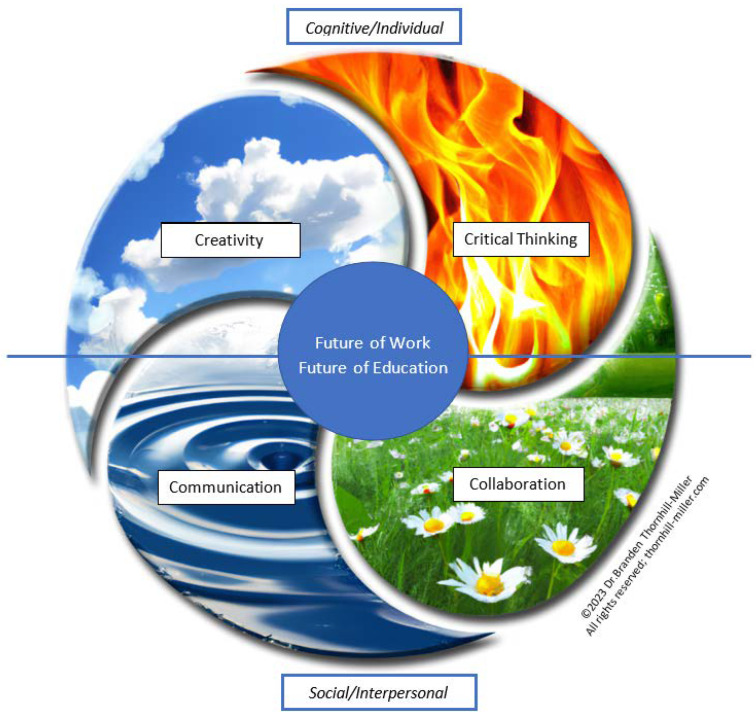
“the 4Cs are not entirely separate entities but instead, as Figure 2 shows, should be seen as four interlinked basic “elements” for future-oriented education that can help individuals in their learning process and, together, synergistically “bootstrap” the development of their cognitive potentials.”
§ Creativity, Critical Thinking, Communication, and Collaboration: Assessment, Certification, and Promotion of 21st Century Skills for the Future of Work and Education > 6. Discussion and Conclusions > 6.1. Interrelationships between the 4Cs and a New Model for Use in Pedagogy and Policy Promotion
What the sources say
- Not checked yetcites Lamri and Lubart (2021)
plaindirect- Asserted: passes — The authors put it forward as true.
- Checkable: passes — It can be checked against evidence.
- Load-bearing: passes — The paper’s conclusions depend on it.
- Based: passes — The paper gives a reason why it holds.
In the paper
“Thus, brands that have good reputations tend to be preferred over cheaper new brands, because they are more accepted and valued by the individual social network (Zielke and Dobbelstein 2007).”
§ Creativity, Critical Thinking, Communication, and Collaboration: Assessment, Certification, and Promotion of 21st Century Skills for the Future of Work and Education > 3. Labelization: Valorization of the 4Cs and Assessing Support for Their Development > 3.2. Influence on Choice and Adoption of Goods and Services
What the sources say
- Not checked yetcites Zielke and Dobbelstein 2007
plaindirect- Asserted: passes — The authors put it forward as true.
- Checkable: passes — It can be checked against evidence.
- Load-bearing: unclear — It is unclear whether the paper’s conclusions depend on it.
- Based: passes — The paper gives a reason why it holds.
In the paper
“Participation, social regulation, and perspective taking have been identified as central social skills in collaborative problem solving (Hesse et al. 2015).”
§ Creativity, Critical Thinking, Communication, and Collaboration: Assessment, Certification, and Promotion of 21st Century Skills for the Future of Work and Education > 4. The International Institute for Competency Development’s 21st Century Competencies 4Cs Assessment Framework for Institutions and Programs > 4.3. Evaluation Grid for Collaboration
What the sources say
- Not checked yetcites Hesse et al. 2015
plaincorrelational- Asserted: passes — The authors put it forward as true.
- Checkable: passes — It can be checked against evidence.
- Load-bearing: unclear — It is unclear whether the paper’s conclusions depend on it.
- Based: passes — The paper gives a reason why it holds.
In the paper
“Yet the same evolving digital technologies that have largely caused the need for these massive, rapid changes can also assist in the implementation of solutions (van Laar et al. 2017).”
§ Creativity, Critical Thinking, Communication, and Collaboration: Assessment, Certification, and Promotion of 21st Century Skills for the Future of Work and Education > 6. Discussion and Conclusions > 6.3. Conclusion: Labelization of the 4Cs and the Future of Education and Work
What the sources say
- Not checked yetcites van Laar et al. 2017
plaindirect- Asserted: passes — The authors put it forward as true.
- Checkable: passes — It can be checked against evidence.
- Load-bearing: unclear — It is unclear whether the paper’s conclusions depend on it.
- Based: passes — The paper gives a reason why it holds.
- Probably not a substantial claim. 42
- It may state two separate claims as one. 30
The paper states this without a source or data behind it here, so there is nothing to check it against. The quote shows it is in the paper.
In the paper
“One very important issue for understanding the 4Cs and their educational implementation related to this, which can simultaneously facilitate their teaching but be a challenge for their assessment, is the multidimensionality, interrelatedness, and transdisciplinary relevance of the 4Cs.”
§ Creativity, Critical Thinking, Communication, and Collaboration: Assessment, Certification, and Promotion of 21st Century Skills for the Future of Work and Education > 1. Introduction > “21st Century Skills”, “Soft Skills”, and the “4Cs”
plaincorrelational- Asserted: passes — The authors put it forward as true.
- Checkable: passes — It can be checked against evidence.
- Load-bearing: passes — The paper’s conclusions depend on it.
- Based: passes — The paper gives a reason why it holds.
Probably not a substantial claim. It may state two separate claims as one.
In the paper
“Gathering support from researchers and industry alike, we suggest that the 4Cs can be seen as highest-level transversal skills—or “meta-competencies”—that allow individuals to remain competent and to develop their potential in a rapidly changing professional world.”
§ Creativity, Critical Thinking, Communication, and Collaboration: Assessment, Certification, and Promotion of 21st Century Skills for the Future of Work and Education > 1. Introduction > “21st Century Skills”, “Soft Skills”, and the “4Cs”
What the sources say
- Not checked yetcites National Education Association 2011
hedgeddirect- Asserted: passes — The authors put it forward as true.
- Checkable: fails — It may be too vague to check against evidence.
- Load-bearing: passes — The paper’s conclusions depend on it.
- Based: passes — The paper gives a reason why it holds.
Probably not a substantial claim. It may be too vague to check against evidence.
In the paper
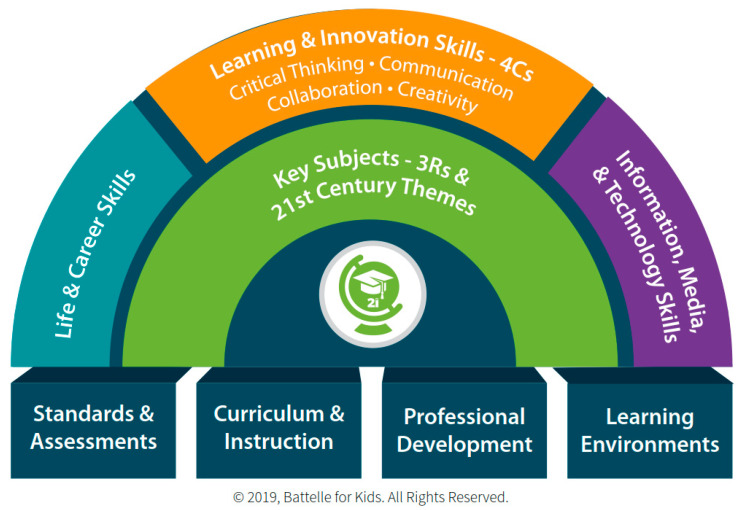
“Other important organizations such as the World Economic Forum (2015) have produced similar overarching models of “21st century skills’’ with the 4Cs at their center, but the term “21st century skills’’ has been rightly criticized for a several reasons: the skills referred to are not actually all unique to, or uniquely important to, the 21st century, and it is a term that is often used more as an”
§ Creativity, Critical Thinking, Communication, and Collaboration: Assessment, Certification, and Promotion of 21st Century Skills for the Future of Work and Education > 1. Introduction > “21st Century Skills”, “Soft Skills”, and the “4Cs”
What the sources say
- Not checked yetcites Lucas 2019
boosted- Asserted: passes — The authors put it forward as true.
- Checkable: passes — It can be checked against evidence.
- Load-bearing: fails — The paper’s conclusions may not depend on it.
- Based: passes — The paper gives a reason why it holds.
Probably not a substantial claim. The paper’s conclusions may not depend on it. It may state two separate claims as one.
None of the sources cited for this claim have been checked yet.
In the paper
“Researchers, teachers, employers, and public policymakers around the world have long ranked the development of critical thinking (CT) abilities as one of the highest educational priorities and public needs in modern democratic societies (Ahern et al. 2019; Dumitru et al. 2018; Pasquinelli et al. 2021).”
§ Creativity, Critical Thinking, Communication, and Collaboration: Assessment, Certification, and Promotion of 21st Century Skills for the Future of Work and Education > 2. The 4Cs, Assessment, and Support for Development > 2.2. Critical Thinking
What the sources say
plain- Asserted: passes — The authors put it forward as true.
- Checkable: passes — It can be checked against evidence.
- Load-bearing: fails — The paper’s conclusions may not depend on it.
- Based: passes — The paper gives a reason why it holds.
Probably not a substantial claim. The paper’s conclusions may not depend on it.
A conclusion the paper draws from its own results — it cites no other source for it, so there is none to check. The quote shows it is in the paper.
In the paper
“Indeed, it can be argued that creativity and critical thinking are inextricably linked and are often two sides of the same coin.”
§ Creativity, Critical Thinking, Communication, and Collaboration: Assessment, Certification, and Promotion of 21st Century Skills for the Future of Work and Education > 2. The 4Cs, Assessment, and Support for Development > 2.2. Critical Thinking
hedgedcorrelational- Asserted: passes — The authors put it forward as true.
- Checkable: unclear — It is unclear whether it could be checked against evidence.
- Load-bearing: unclear — It is unclear whether the paper’s conclusions depend on it.
- Based: passes — The paper gives a reason why it holds.
It may state two separate claims as one.
In the paper
“Indeed, many helpful design thinking-related programs now exist around the world and have been shown to have a substantial impact on creative outcomes (Bourgeois-Bougrine 2022).”
§ Creativity, Critical Thinking, Communication, and Collaboration: Assessment, Certification, and Promotion of 21st Century Skills for the Future of Work and Education > 2. The 4Cs, Assessment, and Support for Development > 2.1. Creativity
What the sources say
- Not checked yetcites Bourgeois-Bougrine 2022
boosteddirect- Asserted: passes — The authors put it forward as true.
- Checkable: passes — It can be checked against evidence.
- Load-bearing: unclear — It is unclear whether the paper’s conclusions depend on it.
- Based: passes — The paper gives a reason why it holds.
It may state two separate claims as one.
In the paper
“Indeed, though world-wide data suggest that neither money nor mere time spent in class correlate well with educational outcomes, both policies and pedagogy that direct the ways in which time is spent make a significant difference (Schleicher 2022).”
§ Creativity, Critical Thinking, Communication, and Collaboration: Assessment, Certification, and Promotion of 21st Century Skills for the Future of Work and Education > 2. The 4Cs, Assessment, and Support for Development > 2.1. Creativity
What the sources say
- Not checked yetcites Schleicher 2022
hedged- Asserted: passes — The authors put it forward as true.
- Checkable: passes — It can be checked against evidence.
- Load-bearing: unclear — It is unclear whether the paper’s conclusions depend on it.
- Based: passes — The paper gives a reason why it holds.
It may state two separate claims as one.
None of the sources cited for this claim have been checked yet.
In the paper
“Although much research has addressed both potentially related constructs, such as intelligence and wisdom, and lists of potential component aspects of human thought, such as inductive or deductive reasoning (for reviews of all of these, see Sternberg and Funke 2019), reaching a consensus on a definition has been difficult, because CT relies on the coordination of many different skills (Bellaera et”
§ Creativity, Critical Thinking, Communication, and Collaboration: Assessment, Certification, and Promotion of 21st Century Skills for the Future of Work and Education > 2. The 4Cs, Assessment, and Support for Development > 2.2. Critical Thinking
What the sources say
- Not checked yetcites Bellaera et al. 2021 source
- Not checked yetcites Dumitru et al. 2018
- Not checked yetcites Lewis and Smith 1993
plaindirect- Asserted: passes — The authors put it forward as true.
- Checkable: passes — It can be checked against evidence.
- Load-bearing: fails — The paper’s conclusions may not depend on it.
- Based: passes — The paper gives a reason why it holds.
Probably not a substantial claim. The paper’s conclusions may not depend on it.
In the paper
“Conversely, creative production in any domain needs to be balanced by critical appraisal and thought at each step of the creative process (Bailin 1988).”
§ Creativity, Critical Thinking, Communication, and Collaboration: Assessment, Certification, and Promotion of 21st Century Skills for the Future of Work and Education > 2. The 4Cs, Assessment, and Support for Development > 2.2. Critical Thinking
What the sources say
- Not checked yetcites Bailin 1988
plaincorrelational- Asserted: passes — The authors put it forward as true.
- Checkable: fails — It may be too vague to check against evidence.
- Load-bearing: fails — The paper’s conclusions may not depend on it.
- Based: passes — The paper gives a reason why it holds.
Probably not a substantial claim. It may be too vague to check against evidence. The paper’s conclusions may not depend on it.
None of the sources cited for this claim have been checked yet.
In the paper
“These characteristics, one might note, are also characteristic of the “creative individual” (Facione 1990b; Lai 2011), as is the ability to imagine alternatives, which is often cited as a component of critical thinking ability (Facione 1990b; Halpern 1998).”
§ Creativity, Critical Thinking, Communication, and Collaboration: Assessment, Certification, and Promotion of 21st Century Skills for the Future of Work and Education > 2. The 4Cs, Assessment, and Support for Development > 2.2. Critical Thinking
What the sources say
- Not checked yetcites Facione 1990b
- Not checked yetcites Lai 2011
- Not checked yetcites Halpern 1998 source
hedgedcorrelational- Asserted: passes — The authors put it forward as true.
- Checkable: passes — It can be checked against evidence.
- Load-bearing: passes — The paper’s conclusions depend on it.
- Based: passes — The paper gives a reason why it holds.
It may state two separate claims as one.
A conclusion the paper draws from its own results — it cites no other source for it, so there is none to check. The quote shows it is in the paper.
In the paper
“The 4Cs, on the other hand, seem to provide a relatively simple, persuasive, targetable core that has been found to constitute a pedagogically and policy-friendly model by major organizations, and that also now seems to be gaining some additional empirical validity.”
§ Creativity, Critical Thinking, Communication, and Collaboration: Assessment, Certification, and Promotion of 21st Century Skills for the Future of Work and Education > 1. Introduction > “21st Century Skills”, “Soft Skills”, and the “4Cs”
hedgedcorrelational- Asserted: passes — The authors put it forward as true.
- Checkable: passes — It can be checked against evidence.
- Load-bearing: passes — The paper’s conclusions depend on it.
- Based: unclear — It is unclear why the paper says it holds.
It may state two separate claims as one.
In the paper
“Furthermore, as a transversal competency, having the skills to perform aspects of critical thinking in a given domain does not necessarily entail also having the metacognitive ability to know when to engage in which of its aspects, or having the disposition, attitude, or “mindset” that motivates one to actually engage in them—all of which are actually required to be a good critical thinker (Fac”
§ Creativity, Critical Thinking, Communication, and Collaboration: Assessment, Certification, and Promotion of 21st Century Skills for the Future of Work and Education > 2. The 4Cs, Assessment, and Support for Development > 2.2. Critical Thinking
What the sources say
- Not checked yetcites Facione 2011
plain- Asserted: passes — The authors put it forward as true.
- Checkable: passes — It can be checked against evidence.
- Load-bearing: passes — The paper’s conclusions depend on it.
- Based: passes — The paper gives a reason why it holds.
It may state two separate claims as one.
The paper states this without a source or data behind it here, so there is nothing to check it against. The quote shows it is in the paper.
In the paper
“Various comprehensive “21st century skills” systems proposed in the past without much empirical verification also seem to have been found too complex and cumbersome for implementation.”
§ Creativity, Critical Thinking, Communication, and Collaboration: Assessment, Certification, and Promotion of 21st Century Skills for the Future of Work and Education > 1. Introduction > “21st Century Skills”, “Soft Skills”, and the “4Cs”
hedgeddirect- Asserted: passes — The authors put it forward as true.
- Checkable: passes — It can be checked against evidence.
- Load-bearing: passes — The paper’s conclusions depend on it.
- Based: fails — The paper may give no reason why it holds.
Probably not a substantial claim. The paper may give no reason why it holds.
None of the sources cited for this claim have been checked yet.
In the paper
“For example, unless guarded against, the presence of others tends to reduce the number of ideas generated and to induce a fixation on a limited number of ideas conforming to those produced by others (Camarda et al. 2021; Goldenberg and Wiley 2011; Kohn and Smith 2011; Paulus and Dzindolet 1993; Putman and Paulus 2009; Rietzschel et al. 2006).”
§ Creativity, Critical Thinking, Communication, and Collaboration: Assessment, Certification, and Promotion of 21st Century Skills for the Future of Work and Education > 2. The 4Cs, Assessment, and Support for Development > 2.1. Creativity
What the sources say
- Not checked yetcites Camarda et al. 2021 source
- Not checked yetcites Goldenberg and Wiley 2011
- Not checked yetcites Kohn and Smith 2011
hedgeddirect- Asserted: passes — The authors put it forward as true.
- Checkable: passes — It can be checked against evidence.
- Load-bearing: passes — The paper’s conclusions depend on it.
- Based: passes — The paper gives a reason why it holds.
It may state two separate claims as one.
None of the sources cited for this claim have been checked yet.
In the paper
“Consequently, various researchers have suggested ways to improve analytic methods, and they emphasize the need to create more advanced evaluation methods (Brookfield 1997; Liu et al. 2014).”
§ Creativity, Critical Thinking, Communication, and Collaboration: Assessment, Certification, and Promotion of 21st Century Skills for the Future of Work and Education > 2. The 4Cs, Assessment, and Support for Development > 2.2. Critical Thinking
What the sources say
- Not checked yetcites Brookfield 1997 source
- Not checked yetcites Liu et al. 2014
hedged- Asserted: passes — The authors put it forward as true.
- Checkable: passes — It can be checked against evidence.
- Load-bearing: fails — The paper’s conclusions may not depend on it.
- Based: passes — The paper gives a reason why it holds.
Probably not a substantial claim. The paper’s conclusions may not depend on it.
None of the sources cited for this claim have been checked yet.
In the paper
“Understanding what makes effective collaboration is of crucial importance for professional practice and training (Détienne et al. 2012; Graesser et al. 2018), as evidenced by the long line of research on group or team collaboration over the past 40 years (for a review, see e.g., Salas et al. 2004; Mathieu et al. 2017).”
§ Creativity, Critical Thinking, Communication, and Collaboration: Assessment, Certification, and Promotion of 21st Century Skills for the Future of Work and Education > 2. The 4Cs, Assessment, and Support for Development > 2.4. Collaboration
What the sources say
- Not checked yetcites Détienne et al. 2012
- Not checked yetcites Graesser et al. 2018 source
boosted- Asserted: passes — The authors put it forward as true.
- Checkable: fails — It may be too vague to check against evidence.
- Load-bearing: passes — The paper’s conclusions depend on it.
- Based: passes — The paper gives a reason why it holds.
Probably not a substantial claim. It may be too vague to check against evidence.
In the paper
“Finally, computer-assisted learning methods can be relevant for establishing a secure framework (especially, for example, when learning another language): anonymity indeed helps to overcome anxiety or social blockages linked to fear of public speaking or showing one’s difficulties (AbuSeileek 2012).”
§ Creativity, Critical Thinking, Communication, and Collaboration: Assessment, Certification, and Promotion of 21st Century Skills for the Future of Work and Education > 2. The 4Cs, Assessment, and Support for Development > 2.3. Communication
What the sources say
- Not checked yetcites AbuSeileek 2012 source
plaindirect- Asserted: passes — The authors put it forward as true.
- Checkable: passes — It can be checked against evidence.
- Load-bearing: unclear — It is unclear whether the paper’s conclusions depend on it.
- Based: passes — The paper gives a reason why it holds.
It may state two separate claims as one.
The paper states this without a source or data behind it here, so there is nothing to check it against. The quote shows it is in the paper.
In the paper
“Alternatively, qualitative approaches based on multidimensional views of collaboration provide a more elaborated or nuanced view of collaboration and are useful for identifying potential relationships between distinctive dimensions of collaboration and aspects of team performance, in order to identify processes that could be improved.”
§ Creativity, Critical Thinking, Communication, and Collaboration: Assessment, Certification, and Promotion of 21st Century Skills for the Future of Work and Education > 2. The 4Cs, Assessment, and Support for Development > 2.4. Collaboration
plaincorrelational- Asserted: passes — The authors put it forward as true.
- Checkable: passes — It can be checked against evidence.
- Load-bearing: unclear — It is unclear whether the paper’s conclusions depend on it.
- Based: passes — The paper gives a reason why it holds.
It may state two separate claims as one.
In the paper
“Moreover, as Brookfield (1997) argues, because critical thinking is a social process that takes place in specific contexts of knowledge and culture, it should be assessed as a social process, therefore, involving a multiplicity of experiences, perceptions, and contributions.”
§ Creativity, Critical Thinking, Communication, and Collaboration: Assessment, Certification, and Promotion of 21st Century Skills for the Future of Work and Education > 2. The 4Cs, Assessment, and Support for Development > 2.2. Critical Thinking
What the sources say
- Not checked yetcites Brookfield 1997 source
plain- Asserted: passes — The authors put it forward as true.
- Checkable: passes — It can be checked against evidence.
- Load-bearing: passes — The paper’s conclusions depend on it.
- Based: passes — The paper gives a reason why it holds.
Probably not a substantial claim.
None of the sources cited for this claim have been checked yet.
In the paper
“Moreover, as Spitzberg (2003) pointed out, communication skills are supported by different abilities, classically conceptualized as motivational functions (e.g., confidence and goal-orientation), knowledge (e.g., content and procedural knowledge), or cognitive and socio-cognitive functions (e.g., theory of mind, verbal cognition, emotional intelligence, and empathy; McDonald et al. 2014; Rotherm”
§ Creativity, Critical Thinking, Communication, and Collaboration: Assessment, Certification, and Promotion of 21st Century Skills for the Future of Work and Education > 2. The 4Cs, Assessment, and Support for Development > 2.3. Communication
What the sources say
- Not checked yetcites Spitzberg 2003
- Not checked yetcites McDonald et al. 2014 source
- Not checked yetcites Rothermich 2020
plaincorrelational- Asserted: passes — The authors put it forward as true.
- Checkable: passes — It can be checked against evidence.
- Load-bearing: unclear — It is unclear whether the paper’s conclusions depend on it.
- Based: passes — The paper gives a reason why it holds.
It may state two separate claims as one.
In the paper
“Although there is no consensus on a definition of collaboration, scholars often see it as mutual engagement in a coordinated effort to achieve a common goal that involves the sharing of goals, resources, and representations relating to the joint activity of participants; and other important aspects relate to mutual respect, trust, responsibilities, and accountability within situational rules and”
§ Creativity, Critical Thinking, Communication, and Collaboration: Assessment, Certification, and Promotion of 21st Century Skills for the Future of Work and Education > 2. The 4Cs, Assessment, and Support for Development > 2.4. Collaboration
What the sources say
- Not checked yetcites Détienne et al. 2012
plain- Asserted: passes — The authors put it forward as true.
- Checkable: passes — It can be checked against evidence.
- Load-bearing: fails — The paper’s conclusions may not depend on it.
- Based: passes — The paper gives a reason why it holds.
Probably not a substantial claim. The paper’s conclusions may not depend on it. It may state two separate claims as one.
None of the sources cited for this claim have been checked yet.
In the paper
“The executive functions underlying general critical thinking, the ability to overcome bias (Houdé 2000; Houdé and Borst 2014), and meta-cognitive processes (i.e., meta information about our cognitive strategies) can all be trained and enhanced by educational programs (Abrami et al. 2015; Ahern et al. 2019; Alsaleh 2020; Bellaera et al. 2021; Uribe-Enciso et al. 2017; Popil 2011; Pasquinelli and Br”
§ Creativity, Critical Thinking, Communication, and Collaboration: Assessment, Certification, and Promotion of 21st Century Skills for the Future of Work and Education > 2. The 4Cs, Assessment, and Support for Development > 2.2. Critical Thinking
What the sources say
plaindirect- Asserted: passes — The authors put it forward as true.
- Checkable: passes — It can be checked against evidence.
- Load-bearing: passes — The paper’s conclusions depend on it.
- Based: passes — The paper gives a reason why it holds.
It may state two separate claims as one.
None of the sources cited for this claim have been checked yet.
In the paper
“These new spaces for collaboration are, however, often difficult to use and less satisfactory than face-to-face interactions, suggesting the need for more research on collaborative activities and on how to support them (Faidley 2018; Karl et al. 2022; Kemp and Grieve 2014; Singh et al. 2022; Waizenegger et al. 2020).”
§ Creativity, Critical Thinking, Communication, and Collaboration: Assessment, Certification, and Promotion of 21st Century Skills for the Future of Work and Education > 2. The 4Cs, Assessment, and Support for Development > 2.4. Collaboration
What the sources say
- Not checked yetcites Faidley 2018
- Not checked yetcites Karl et al. 2022 source
- Not checked yetcites Kemp and Grieve 2014
hedgedcorrelational- Asserted: passes — The authors put it forward as true.
- Checkable: passes — It can be checked against evidence.
- Load-bearing: unclear — It is unclear whether the paper’s conclusions depend on it.
- Based: passes — The paper gives a reason why it holds.
It may state two separate claims as one.
None of the sources cited for this claim have been checked yet.
In the paper
“The individual assessment of critical thinking skills presents a number of challenges, because it is a multi-task ability and involves specific knowledge in the different areas in which it is applied (Liu et al. 2014; Willingham 2008).”
§ Creativity, Critical Thinking, Communication, and Collaboration: Assessment, Certification, and Promotion of 21st Century Skills for the Future of Work and Education > 2. The 4Cs, Assessment, and Support for Development > 2.2. Critical Thinking
What the sources say
- Not checked yetcites Liu et al. 2014
- Not checked yetcites Willingham 2008 source
plaindirect- Asserted: passes — The authors put it forward as true.
- Checkable: passes — It can be checked against evidence.
- Load-bearing: passes — The paper’s conclusions depend on it.
- Based: passes — The paper gives a reason why it holds.
It may state two separate claims as one.
The paper states this without a source or data behind it here, so there is nothing to check it against. The quote shows it is in the paper.
In the paper
“Note here that effective collaboration involves skills that have also been identified elsewhere as essential competencies, including communication, creativity, and critical thinking.”
§ Creativity, Critical Thinking, Communication, and Collaboration: Assessment, Certification, and Promotion of 21st Century Skills for the Future of Work and Education > 2. The 4Cs, Assessment, and Support for Development > 2.4. Collaboration
plaincorrelational- Asserted: passes — The authors put it forward as true.
- Checkable: passes — It can be checked against evidence.
- Load-bearing: fails — The paper’s conclusions may not depend on it.
- Based: fails — The paper may give no reason why it holds.
Probably not a substantial claim. The paper’s conclusions may not depend on it. The paper may give no reason why it holds.
In the paper
“Work on social/emotional intelligence (and on its role in students’ personal and professional success) shows that these skills are both disparate and difficult to assess (Humphrey et al. 2007).”
§ Creativity, Critical Thinking, Communication, and Collaboration: Assessment, Certification, and Promotion of 21st Century Skills for the Future of Work and Education > 2. The 4Cs, Assessment, and Support for Development > 2.3. Communication
What the sources say
- Not checked yetcites Humphrey et al. 2007 source
plain- Asserted: passes — The authors put it forward as true.
- Checkable: passes — It can be checked against evidence.
- Load-bearing: unclear — It is unclear whether the paper’s conclusions depend on it.
- Based: passes — The paper gives a reason why it holds.
It may state two separate claims as one.
The paper states this without a source or data behind it here, so there is nothing to check it against. The quote shows it is in the paper.
In the paper
“Communication has an obvious link with the three other Cs.”
§ Creativity, Critical Thinking, Communication, and Collaboration: Assessment, Certification, and Promotion of 21st Century Skills for the Future of Work and Education > 2. The 4Cs, Assessment, and Support for Development > 2.3. Communication
boostedcorrelational- Asserted: passes — The authors put it forward as true.
- Checkable: fails — It may be too vague to check against evidence.
- Load-bearing: fails — The paper’s conclusions may not depend on it.
- Based: passes — The paper gives a reason why it holds.
Probably not a substantial claim. It may be too vague to check against evidence. The paper’s conclusions may not depend on it.
In the paper
“The integrative concept of “quality of collaboration” (Burkhardt et al. 2009) encapsulates much of what is currently known about collaborative processes and what constitutes effective collaboration.”
§ Creativity, Critical Thinking, Communication, and Collaboration: Assessment, Certification, and Promotion of 21st Century Skills for the Future of Work and Education > 2. The 4Cs, Assessment, and Support for Development > 2.4. Collaboration
What the sources say
- Not checked yetcites Burkhardt et al. 2009
plain- Asserted: passes — The authors put it forward as true.
- Checkable: fails — It may be too vague to check against evidence.
- Load-bearing: fails — The paper’s conclusions may not depend on it.
- Based: passes — The paper gives a reason why it holds.
Probably not a substantial claim. It may be too vague to check against evidence. The paper’s conclusions may not depend on it.
In the paper
“A large body of methodology developed to assess collaboration processes and collaborative tools has been focused on quantifying a restricted subset of fine-grained interactions (e.g., number of speakers’ turns; number of words spoken; number of interruptions; amount of grounding questions). This approach has at least two limitations. First, because these categories of analysis are often ad hoc”
§ Creativity, Critical Thinking, Communication, and Collaboration: Assessment, Certification, and Promotion of 21st Century Skills for the Future of Work and Education > 2. The 4Cs, Assessment, and Support for Development > 2.4. Collaboration
What the sources say
- Not checked yetcites Détienne et al. 2012
plain- Asserted: passes — The authors put it forward as true.
- Checkable: passes — It can be checked against evidence.
- Load-bearing: passes — The paper’s conclusions depend on it.
- Based: passes — The paper gives a reason why it holds.
It may state two separate claims as one.
A conclusion the paper draws from its own results — it cites no other source for it, so there is none to check. The quote shows it is in the paper.
In the paper
“And we contend that efforts such as labelizing 4C processes will serve to push educators and institutions towards more relevant offerings, oriented towards the future of work and helping build a more successful future for all.”
§ Creativity, Critical Thinking, Communication, and Collaboration: Assessment, Certification, and Promotion of 21st Century Skills for the Future of Work and Education > 6. Discussion and Conclusions > 6.3. Conclusion: Labelization of the 4Cs and the Future of Education and Work
plaindirect- Asserted: passes — The authors put it forward as true.
- Checkable: fails — It may be too vague to check against evidence.
- Load-bearing: passes — The paper’s conclusions depend on it.
- Based: fails — The paper may give no reason why it holds.
Probably not a substantial claim. It may be too vague to check against evidence. The paper may give no reason why it holds. It may state two separate claims as one.
- Rests on an assumption: Future-oriented change in institutional practices, programming, and structure will likely meet with significant resistance from entrenched segments of traditional educational and training establishments.
- Rests on an assumption: Additional external evaluation and monitoring is rarely welcome by workers in any context.
- Rests on an assumption: Top-down processes from innovative and competition-conscious administrative levels will be met by bottom-up demands from students and education consumers to support institutional changes.
In the paper
“Indeed, French companies with corporate social responsibility labels have been shown to have higher than average growth rates, and the adoption of quality standards is linked with a 7% increase in the share of export turnover (Restout 2020).”
§ Creativity, Critical Thinking, Communication, and Collaboration: Assessment, Certification, and Promotion of 21st Century Skills for the Future of Work and Education > 3. Labelization: Valorization of the 4Cs and Assessing Support for Their Development > 3.1. Labeling as a Means of Trust and Differentiation
What the sources say
- Not checked yetcites Restout 2020
boostedcorrelational- Asserted: passes — The authors put it forward as true.
- Checkable: passes — It can be checked against evidence.
- Load-bearing: unclear — It is unclear whether the paper’s conclusions depend on it.
- Based: passes — The paper gives a reason why it holds.
It may state two separate claims as one.
The paper states this without a source or data behind it here, so there is nothing to check it against. The quote shows it is in the paper.
In the paper
“Similarly, as we have seen in the literature review, the best approach to understanding and assessing a particular C is from a combination of different levels and perspectives in context.”
§ Creativity, Critical Thinking, Communication, and Collaboration: Assessment, Certification, and Promotion of 21st Century Skills for the Future of Work and Education > 3. Labelization: Valorization of the 4Cs and Assessing Support for Their Development > 3.4. Labelization of 21st Century Skills
plain- Asserted: passes — The authors put it forward as true.
- Checkable: fails — It may be too vague to check against evidence.
- Load-bearing: fails — The paper’s conclusions may not depend on it.
- Based: passes — The paper gives a reason why it holds.
Probably not a substantial claim. It may be too vague to check against evidence. The paper’s conclusions may not depend on it.
In the paper
“Thompson (2020) proposes a four-component operationalized definition of communication for its assessment in students.”
§ Creativity, Critical Thinking, Communication, and Collaboration: Assessment, Certification, and Promotion of 21st Century Skills for the Future of Work and Education > 4. The International Institute for Competency Development’s 21st Century Competencies 4Cs Assessment Framework for Institutions and Programs > 4.4. Evaluation Grid for Communication
What the sources say
- Not checked yetcites Thompson (2020)
plain- Asserted: passes — The authors put it forward as true.
- Checkable: passes — It can be checked against evidence.
- Load-bearing: fails — The paper’s conclusions may not depend on it.
- Based: passes — The paper gives a reason why it holds.
Probably not a substantial claim. The paper’s conclusions may not depend on it.
In the paper
“Lucas (2019) and colleagues have suggested conflating creative thinking and critical thinking in order to propose “3Cs” (creative thinking, communication, and collaboration) as new “foundational literacies” to symmetrically add to the 3Rs (Reading, wRiting, and aRithmetic) of previous educational eras.”
§ Creativity, Critical Thinking, Communication, and Collaboration: Assessment, Certification, and Promotion of 21st Century Skills for the Future of Work and Education > 6. Discussion and Conclusions > 6.1. Interrelationships between the 4Cs and a New Model for Use in Pedagogy and Policy Promotion
What the sources say
- Not checked yetcites Lucas (2019)
hedged- Asserted: passes — The authors put it forward as true.
- Checkable: passes — It can be checked against evidence.
- Load-bearing: fails — The paper’s conclusions may not depend on it.
- Based: passes — The paper gives a reason why it holds.
Probably not a substantial claim. The paper’s conclusions may not depend on it.
In the paper
“One comprehensive attempt to operationalize programmatic-level and institutional-level support for the development of the 4Cs is the International Institute for Competency Development’s 4Cs Assessment Framework (International Institute for Competency Development 2021).”
§ Creativity, Critical Thinking, Communication, and Collaboration: Assessment, Certification, and Promotion of 21st Century Skills for the Future of Work and Education > 4. The International Institute for Competency Development’s 21st Century Competencies 4Cs Assessment Framework for Institutions and Programs
What the sources say
- Not checked yetcites International Institute for Competency Development 2021
plain- Asserted: passes — The authors put it forward as true.
- Checkable: passes — It can be checked against evidence.
- Load-bearing: fails — The paper’s conclusions may not depend on it.
- Based: passes — The paper gives a reason why it holds.
Probably not a substantial claim. The paper’s conclusions may not depend on it.
A conclusion the paper draws from its own results — it cites no other source for it, so there is none to check. The quote shows it is in the paper.
In the paper
“We argue that games are a significant potential pathway for the improvement of the 4Cs, and as such, they merit the same attention as more formal ways of learning and developing competencies.”
§ Creativity, Critical Thinking, Communication, and Collaboration: Assessment, Certification, and Promotion of 21st Century Skills for the Future of Work and Education > 5. Assessing the 4Cs in Informal Educational Contexts: The Example of Games > 5.1. The 4Cs in Informal Educational Contexts
hedgedconditional- Asserted: passes — The authors put it forward as true.
- Checkable: unclear — It is unclear whether it could be checked against evidence.
- Load-bearing: passes — The paper’s conclusions depend on it.
- Based: passes — The paper gives a reason why it holds.
It may state two separate claims as one.
- The authors state this as an assumption: If a game presents affordances conducive to exercising a given skill, engaged playing of that game should help improve that skill.
The paper states this without a source or data behind it here, so there is nothing to check it against. The quote shows it is in the paper.
In the paper
“The validity of the assessment process is reinforced by this double evaluation: a first level of audit carried out by a team of experts according to a clearly defined set of criteria and a second level of decision making assuring that the methodology and the result of the audit are in conformity with the defined reference framework.”
§ Creativity, Critical Thinking, Communication, and Collaboration: Assessment, Certification, and Promotion of 21st Century Skills for the Future of Work and Education > 3. Labelization: Valorization of the 4Cs and Assessing Support for Their Development > 3.3. Process of Labelizing Products and Services
plaindirect- Asserted: passes — The authors put it forward as true.
- Checkable: passes — It can be checked against evidence.
- Load-bearing: fails — The paper’s conclusions may not depend on it.
- Based: passes — The paper gives a reason why it holds.
Probably not a substantial claim. The paper’s conclusions may not depend on it.
A conclusion the paper draws from its own results — it cites no other source for it, so there is none to check. The quote shows it is in the paper.
In the paper
“As a result, it ranges from impossible to suboptimal to teach (or teach towards) one of the 4Cs without involving one or more of the others, and this commingling also underscores the genuine need and appropriateness of assessing them together.”
§ Creativity, Critical Thinking, Communication, and Collaboration: Assessment, Certification, and Promotion of 21st Century Skills for the Future of Work and Education > 6. Discussion and Conclusions > 6.1. Interrelationships between the 4Cs and a New Model for Use in Pedagogy and Policy Promotion
plaindirect- Asserted: passes — The authors put it forward as true.
- Checkable: unclear — It is unclear whether it could be checked against evidence.
- Load-bearing: passes — The paper’s conclusions depend on it.
- Based: passes — The paper gives a reason why it holds.
It may state two separate claims as one.
A conclusion the paper draws from its own results — it cites no other source for it, so there is none to check. The quote shows it is in the paper.
In the paper
“games, complex and deep as they can sometimes be, cannot directly be compared to the complexity of a school curriculum and all the programs it contains.”
§ Creativity, Critical Thinking, Communication, and Collaboration: Assessment, Certification, and Promotion of 21st Century Skills for the Future of Work and Education > 5. Assessing the 4Cs in Informal Educational Contexts: The Example of Games > 5.2. 4Cs Evaluation Framework for Games
plain- Asserted: passes — The authors put it forward as true.
- Checkable: fails — It may be too vague to check against evidence.
- Load-bearing: fails — The paper’s conclusions may not depend on it.
- Based: fails — The paper may give no reason why it holds.
Probably not a substantial claim. It may be too vague to check against evidence. The paper’s conclusions may not depend on it. The paper may give no reason why it holds.
None of the sources cited for this claim have been checked yet.
In the paper
“Games are activities that are present and participated in throughout human society—by those of all ages, genders, and socio-economic statuses (Bateson and Martin 2013; Huizinga 1949; Malaby 2007).”
§ Creativity, Critical Thinking, Communication, and Collaboration: Assessment, Certification, and Promotion of 21st Century Skills for the Future of Work and Education > 5. Assessing the 4Cs in Informal Educational Contexts: The Example of Games > 5.1. The 4Cs in Informal Educational Contexts
What the sources say
- Not checked yetcites Bateson and Martin 2013
- Not checked yetcites Huizinga 1949
- Not checked yetcites Malaby 2007 source
plain- Asserted: passes — The authors put it forward as true.
- Checkable: passes — It can be checked against evidence.
- Load-bearing: fails — The paper’s conclusions may not depend on it.
- Based: passes — The paper gives a reason why it holds.
Probably not a substantial claim. The paper’s conclusions may not depend on it.
In the paper
“Lamri and Lubart (2021), for example, found a certain base level of creativity was a necessary but not sufficient condition for success in managerial tasks, but that high-level performance required a combination of all four Cs.”
§ Creativity, Critical Thinking, Communication, and Collaboration: Assessment, Certification, and Promotion of 21st Century Skills for the Future of Work and Education > 6. Discussion and Conclusions > 6.1. Interrelationships between the 4Cs and a New Model for Use in Pedagogy and Policy Promotion
What the sources say
- Not checked yetcites Lamri and Lubart (2021)
plainconditional- Asserted: passes — The authors put it forward as true.
- Checkable: passes — It can be checked against evidence.
- Load-bearing: passes — The paper’s conclusions depend on it.
- Based: passes — The paper gives a reason why it holds.
It may state two separate claims as one.
The paper states this without a source or data behind it here, so there is nothing to check it against. The quote shows it is in the paper.
In the paper
“Based upon expert opinion and a review of the available literature, this evaluation grid is a practical tool that divides each of the 4Cs into three “user-friendly” but topic-covering components (see Table 1 and definitions and further discussion in the sections that follow). Each of these components is then assessed across seven dimensions (see Table 2, below), designed to cover concisely the ped”
§ Creativity, Critical Thinking, Communication, and Collaboration: Assessment, Certification, and Promotion of 21st Century Skills for the Future of Work and Education > 4. The International Institute for Competency Development’s 21st Century Competencies 4Cs Assessment Framework for Institutions and Programs
plain- Asserted: passes — The authors put it forward as true.
- Checkable: passes — It can be checked against evidence.
- Load-bearing: fails — The paper’s conclusions may not depend on it.
- Based: passes — The paper gives a reason why it holds.
Probably not a substantial claim. The paper’s conclusions may not depend on it. It may state two separate claims as one.
In the paper
“First, they describe a comprehension strand covering the understanding and selection of adequate information from a range of sources.”
§ Creativity, Critical Thinking, Communication, and Collaboration: Assessment, Certification, and Promotion of 21st Century Skills for the Future of Work and Education > 4. The International Institute for Competency Development’s 21st Century Competencies 4Cs Assessment Framework for Institutions and Programs > 4.4. Evaluation Grid for Communication
What the sources say
- Not checked yetcites Thompson (2020)
plain- Asserted: passes — The authors put it forward as true.
- Checkable: passes — It can be checked against evidence.
- Load-bearing: fails — The paper’s conclusions may not depend on it.
- Based: passes — The paper gives a reason why it holds.
Probably not a substantial claim. The paper’s conclusions may not depend on it.
None of the sources cited for this claim have been checked yet.
In the paper
“The aim of these labelization frameworks is to assist in the development of “quality culture” in education by offering individual programs, institutions, and systems additional independent, reliable means of benchmarking, charting progress, and distinguishing themselves based on their capacity to support and promote the development of crucial skills.”
§ Creativity, Critical Thinking, Communication, and Collaboration: Assessment, Certification, and Promotion of 21st Century Skills for the Future of Work and Education > 3. Labelization: Valorization of the 4Cs and Assessing Support for Their Development > 3.4. Labelization of 21st Century Skills
plaindirect- Asserted: passes — The authors put it forward as true.
- Checkable: passes — It can be checked against evidence.
- Load-bearing: passes — The paper’s conclusions depend on it.
- Based: passes — The paper gives a reason why it holds.
Probably not a substantial claim.
In the paper
“Evans (2020) identified four main collaboration skills consistently mentioned in the scientific literature that are assessed in the IICD grid”
§ Creativity, Critical Thinking, Communication, and Collaboration: Assessment, Certification, and Promotion of 21st Century Skills for the Future of Work and Education > 4. The International Institute for Competency Development’s 21st Century Competencies 4Cs Assessment Framework for Institutions and Programs > 4.3. Evaluation Grid for Collaboration
What the sources say
- Not checked yetcites Evans (2020)
plain- Asserted: passes — The authors put it forward as true.
- Checkable: passes — It can be checked against evidence.
- Load-bearing: unclear — It is unclear whether the paper’s conclusions depend on it.
- Based: passes — The paper gives a reason why it holds.
It may state two separate claims as one.
In the paper
“Finally, Thompson (2020) describes the recognition of cultural and other differences as an important aspect of communication.”
§ Creativity, Critical Thinking, Communication, and Collaboration: Assessment, Certification, and Promotion of 21st Century Skills for the Future of Work and Education > 4. The International Institute for Competency Development’s 21st Century Competencies 4Cs Assessment Framework for Institutions and Programs > 4.4. Evaluation Grid for Communication
What the sources say
- Not checked yetcites Thompson (2020)
plain- Asserted: passes — The authors put it forward as true.
- Checkable: passes — It can be checked against evidence.
- Load-bearing: fails — The paper’s conclusions may not depend on it.
- Based: passes — The paper gives a reason why it holds.
Probably not a substantial claim. The paper’s conclusions may not depend on it.
The paper states this without a source or data behind it here, so there is nothing to check it against. The quote shows it is in the paper.
In the paper
“The world of education is particularly concerned by the need to develop and assess 21st century skills, because it represents the first link in the chain of skills acquisition, preparing the human resources of tomorrow.”
§ Creativity, Critical Thinking, Communication, and Collaboration: Assessment, Certification, and Promotion of 21st Century Skills for the Future of Work and Education > 3. Labelization: Valorization of the 4Cs and Assessing Support for Their Development > 3.4. Labelization of 21st Century Skills
plaindirect- Asserted: passes — The authors put it forward as true.
- Checkable: passes — It can be checked against evidence.
- Load-bearing: fails — The paper’s conclusions may not depend on it.
- Based: passes — The paper gives a reason why it holds.
Probably not a substantial claim. The paper’s conclusions may not depend on it.
A conclusion the paper draws from its own results — it cites no other source for it, so there is none to check. The quote shows it is in the paper.
In the paper
“At the same time, the complexity of their definitions makes them difficult to assess, both in terms of reliability (assessment must not vary from one measurement to another) and of validity (tests must measure that which they are intended to measure).”
§ Creativity, Critical Thinking, Communication, and Collaboration: Assessment, Certification, and Promotion of 21st Century Skills for the Future of Work and Education > 6. Discussion and Conclusions > 6.2. Limitations and Future Work
plaindirect- Asserted: passes — The authors put it forward as true.
- Checkable: passes — It can be checked against evidence.
- Load-bearing: passes — The paper’s conclusions depend on it.
- Based: passes — The paper gives a reason why it holds.
Probably not a substantial claim.
In the paper
“Second, the presentation of information and ideas is mentioned in several different modes, adjusted to the intended audience, verbally as well as non-verbally.”
§ Creativity, Critical Thinking, Communication, and Collaboration: Assessment, Certification, and Promotion of 21st Century Skills for the Future of Work and Education > 4. The International Institute for Competency Development’s 21st Century Competencies 4Cs Assessment Framework for Institutions and Programs > 4.4. Evaluation Grid for Communication
What the sources say
- Not checked yetcites Thompson (2020)
plain- Asserted: passes — The authors put it forward as true.
- Checkable: passes — It can be checked against evidence.
- Load-bearing: fails — The paper’s conclusions may not depend on it.
- Based: passes — The paper gives a reason why it holds.
Probably not a substantial claim. The paper’s conclusions may not depend on it.
In the paper
“two main underpinning skills were described for the assessment: the social skill of audience awareness (“how to adapt one’s own behavior to suit the needs of the task and the partner’s requirements”, Care et al. 2016, p. 258) and the cognitive skill of planning and executing”
§ Creativity, Critical Thinking, Communication, and Collaboration: Assessment, Certification, and Promotion of 21st Century Skills for the Future of Work and Education > 4. The International Institute for Competency Development’s 21st Century Competencies 4Cs Assessment Framework for Institutions and Programs > 4.3. Evaluation Grid for Collaboration
What the sources say
- Not checked yetcites Care et al. 2016 source
plain- Asserted: passes — The authors put it forward as true.
- Checkable: passes — It can be checked against evidence.
- Load-bearing: fails — The paper’s conclusions may not depend on it.
- Based: passes — The paper gives a reason why it holds.
Probably not a substantial claim. The paper’s conclusions may not depend on it.
A conclusion the paper draws from its own results — it cites no other source for it, so there is none to check. The quote shows it is in the paper.
In the paper
“But the most definitive sort of taxonomy and measurement model that we are currently lacking might only be established based on the large-scale administration of a comprehensive battery of skill-measuring psychometric tests on appropriate cross sections of society.”
§ Creativity, Critical Thinking, Communication, and Collaboration: Assessment, Certification, and Promotion of 21st Century Skills for the Future of Work and Education > 6. Discussion and Conclusions > 6.2. Limitations and Future Work
hedgedconditional- Asserted: passes — The authors put it forward as true.
- Checkable: fails — It may be too vague to check against evidence.
- Load-bearing: fails — The paper’s conclusions may not depend on it.
- Based: fails — The paper may give no reason why it holds.
Probably not a substantial claim. It may be too vague to check against evidence. The paper’s conclusions may not depend on it. The paper may give no reason why it holds.
In the paper
“Third, the authors note the importance of communication technology and its advanced use.”
§ Creativity, Critical Thinking, Communication, and Collaboration: Assessment, Certification, and Promotion of 21st Century Skills for the Future of Work and Education > 4. The International Institute for Competency Development’s 21st Century Competencies 4Cs Assessment Framework for Institutions and Programs > 4.4. Evaluation Grid for Communication
What the sources say
- Not checked yetcites Thompson (2020)
plain- Asserted: passes — The authors put it forward as true.
- Checkable: passes — It can be checked against evidence.
- Load-bearing: fails — The paper’s conclusions may not depend on it.
- Based: passes — The paper gives a reason why it holds.
Probably not a substantial claim. The paper’s conclusions may not depend on it.
The paper states this without a source or data behind it here, so there is nothing to check it against. The quote shows it is in the paper.
In the paper
“Its effectiveness is therefore closely linked to the choice of requirements set out in its specifications, as well as to the independence and rigor of the body that verifies compliance with the criteria.”
§ Creativity, Critical Thinking, Communication, and Collaboration: Assessment, Certification, and Promotion of 21st Century Skills for the Future of Work and Education > 3. Labelization: Valorization of the 4Cs and Assessing Support for Their Development
plaincorrelational- Asserted: passes — The authors put it forward as true.
- Checkable: passes — It can be checked against evidence.
- Load-bearing: fails — The paper’s conclusions may not depend on it.
- Based: passes — The paper gives a reason why it holds.
Probably not a substantial claim. The paper’s conclusions may not depend on it.
A conclusion the paper draws from its own results — it cites no other source for it, so there is none to check. The quote shows it is in the paper.
In the paper
“we believe that the individual importance of, and distinct differences between, creative thinking and critical thinking support preserving them both as separate constructs in order to encourage the greatest development of each of them.”
§ Creativity, Critical Thinking, Communication, and Collaboration: Assessment, Certification, and Promotion of 21st Century Skills for the Future of Work and Education > 6. Discussion and Conclusions > 6.1. Interrelationships between the 4Cs and a New Model for Use in Pedagogy and Policy Promotion
hedgeddirect- Asserted: passes — The authors put it forward as true.
- Checkable: fails — It may be too vague to check against evidence.
- Load-bearing: passes — The paper’s conclusions depend on it.
- Based: fails — The paper may give no reason why it holds.
Probably not a substantial claim. It may be too vague to check against evidence. The paper may give no reason why it holds.
The paper states this without a source or data behind it here, so there is nothing to check it against. The quote shows it is in the paper.
In the paper
“The grid itself can be used in several important and different ways by different educational stakeholders: (1) by the institution itself in its self-evaluation and possible preparation for a certification or labelization process, (2) as an explicit list of criteria for external evaluation of the institution and its 4Cs-related programs, and (3) as a potential long-term development targeting tool”
§ Creativity, Critical Thinking, Communication, and Collaboration: Assessment, Certification, and Promotion of 21st Century Skills for the Future of Work and Education > 4. The International Institute for Competency Development’s 21st Century Competencies 4Cs Assessment Framework for Institutions and Programs
plain- Asserted: passes — The authors put it forward as true.
- Checkable: passes — It can be checked against evidence.
- Load-bearing: fails — The paper’s conclusions may not depend on it.
- Based: passes — The paper gives a reason why it holds.
Probably not a substantial claim. The paper’s conclusions may not depend on it. It may state two separate claims as one.
None of the sources cited for this claim have been checked yet.
In the paper
“Taking France as an example, research shows that quality certification is seen as “important” or “significant” by 76% of companies (Chameroy and Veran 2014), and decision makers feel more confident and are more willing to invest with the support of third-party approval than if their decision is merely based on the brand’s reputation or its demonstrated level of social responsibility (Etilé and Te”
§ Creativity, Critical Thinking, Communication, and Collaboration: Assessment, Certification, and Promotion of 21st Century Skills for the Future of Work and Education > 3. Labelization: Valorization of the 4Cs and Assessing Support for Their Development > 3.1. Labeling as a Means of Trust and Differentiation
What the sources say
- Not checked yetcites Chameroy and Veran 2014
- Not checked yetcites Etilé and Teyssier 2016
plaindirect- Asserted: passes — The authors put it forward as true.
- Checkable: passes — It can be checked against evidence.
- Load-bearing: unclear — It is unclear whether the paper’s conclusions depend on it.
- Based: passes — The paper gives a reason why it holds.
It may state two separate claims as one.
None of the sources cited for this claim have been checked yet.
In the paper
“Recent efforts to clarify the conceptual overlap and hierarchical relations of soft skills for the future of education and work, for example, have been helpful and promising (e.g., Joie-La Marle et al. 2022; Lamri et al. 2022).”
§ Creativity, Critical Thinking, Communication, and Collaboration: Assessment, Certification, and Promotion of 21st Century Skills for the Future of Work and Education > 6. Discussion and Conclusions > 6.2. Limitations and Future Work
What the sources say
- Not checked yetcites Joie-La Marle et al. 2022
- Not checked yetcites Lamri et al. 2022
plain- Asserted: passes — The authors put it forward as true.
- Checkable: fails — It may be too vague to check against evidence.
- Load-bearing: fails — The paper’s conclusions may not depend on it.
- Based: passes — The paper gives a reason why it holds.
Probably not a substantial claim. It may be too vague to check against evidence. The paper’s conclusions may not depend on it.
In the paper
“This model goes further to suggest some dimensional differences in emphases that, roughly speaking, also often exist among the 4Cs: that is to say, the frequently greater emphasis on cognitive or individual elements at play in creativity and critical thinking in comparison to the social and interpersonal aspects more central to communication and collaboration (Thornhill-Miller 2021).”
§ Creativity, Critical Thinking, Communication, and Collaboration: Assessment, Certification, and Promotion of 21st Century Skills for the Future of Work and Education > 6. Discussion and Conclusions > 6.1. Interrelationships between the 4Cs and a New Model for Use in Pedagogy and Policy Promotion
What the sources say
- Not checked yetcites Thornhill-Miller 2021
hedgedcorrelational- Asserted: passes — The authors put it forward as true.
- Checkable: passes — It can be checked against evidence.
- Load-bearing: fails — The paper’s conclusions may not depend on it.
- Based: passes — The paper gives a reason why it holds.
Probably not a substantial claim. The paper’s conclusions may not depend on it.
A conclusion the paper draws from its own results — it cites no other source for it, so there is none to check. The quote shows it is in the paper.
In the paper
“Similarly, among many other interrelationships, there is no collaboration without communication—and even ostensibly individual creativity is a “collaboration” of sorts with the general culture and precursors in a given field.”
§ Creativity, Critical Thinking, Communication, and Collaboration: Assessment, Certification, and Promotion of 21st Century Skills for the Future of Work and Education > 6. Discussion and Conclusions > 6.1. Interrelationships between the 4Cs and a New Model for Use in Pedagogy and Policy Promotion
plaindirect- Asserted: passes — The authors put it forward as true.
- Checkable: fails — It may be too vague to check against evidence.
- Load-bearing: passes — The paper’s conclusions depend on it.
- Based: fails — The paper may give no reason why it holds.
Probably not a substantial claim. It may be too vague to check against evidence. The paper may give no reason why it holds. It may state two separate claims as one.
A conclusion the paper draws from its own results — it cites no other source for it, so there is none to check. The quote shows it is in the paper.
In the paper
“the specific criteria to detect support for each C can vary depending upon the educational context (e.g., formal and institutional level or informal and at the activity level).”
§ Creativity, Critical Thinking, Communication, and Collaboration: Assessment, Certification, and Promotion of 21st Century Skills for the Future of Work and Education > 6. Discussion and Conclusions
plaincorrelational- Asserted: passes — The authors put it forward as true.
- Checkable: passes — It can be checked against evidence.
- Load-bearing: fails — The paper’s conclusions may not depend on it.
- Based: passes — The paper gives a reason why it holds.
Probably not a substantial claim. The paper’s conclusions may not depend on it.
In the paper
“Thornhill-Miller (2021) proposed a “dynamic interactionist model of the 4Cs” and their interrelated contributions to the future of education and work.”
§ Creativity, Critical Thinking, Communication, and Collaboration: Assessment, Certification, and Promotion of 21st Century Skills for the Future of Work and Education > 6. Discussion and Conclusions > 6.1. Interrelationships between the 4Cs and a New Model for Use in Pedagogy and Policy Promotion
What the sources say
- Not checked yetcites Thornhill-Miller (2021)
plaincorrelational- Asserted: passes — The authors put it forward as true.
- Checkable: passes — It can be checked against evidence.
- Load-bearing: passes — The paper’s conclusions depend on it.
- Based: passes — The paper gives a reason why it holds.
Probably not a substantial claim.
In the paper
“For example, the recent developments make it clear that the 4Cs will be enhanced and changed by interaction with artificially intelligence, even as 4Cs-related skills will probably, for the same reason, increasingly constitute the core of available human work in the future (see, e.g., Ross 2018).”
§ Creativity, Critical Thinking, Communication, and Collaboration: Assessment, Certification, and Promotion of 21st Century Skills for the Future of Work and Education > 6. Discussion and Conclusions > 6.2. Limitations and Future Work
What the sources say
- Not checked yetcites Ross 2018
hedgedconditional- Asserted: passes — The authors put it forward as true.
- Checkable: passes — It can be checked against evidence.
- Load-bearing: unclear — It is unclear whether the paper’s conclusions depend on it.
- Based: passes — The paper gives a reason why it holds.
It may state two separate claims as one.
A conclusion the paper draws from its own results — it cites no other source for it, so there is none to check. The quote shows it is in the paper.
In the paper
“The promotion, teaching, and assessment of the 4Cs will require a complex social intervention and mobilization of educational resources—a major shift in pedagogy and institutional structures.”
§ Creativity, Critical Thinking, Communication, and Collaboration: Assessment, Certification, and Promotion of 21st Century Skills for the Future of Work and Education > 6. Discussion and Conclusions > 6.3. Conclusion: Labelization of the 4Cs and the Future of Education and Work
plaindirect- Asserted: passes — The authors put it forward as true.
- Checkable: fails — It may be too vague to check against evidence.
- Load-bearing: passes — The paper’s conclusions depend on it.
- Based: fails — The paper may give no reason why it holds.
Probably not a substantial claim. It may be too vague to check against evidence. The paper may give no reason why it holds.
A conclusion the paper draws from its own results — it cites no other source for it, so there is none to check. The quote shows it is in the paper.
In the paper
“In the end, the 4Cs framework seems to be a manageable, focused model for modernizing education, and one worthy of its growing prevalence in the educational and research marketplace for a number of reasons.”
§ Creativity, Critical Thinking, Communication, and Collaboration: Assessment, Certification, and Promotion of 21st Century Skills for the Future of Work and Education > 6. Discussion and Conclusions > 6.3. Conclusion: Labelization of the 4Cs and the Future of Education and Work
hedged- Asserted: passes — The authors put it forward as true.
- Checkable: fails — It may be too vague to check against evidence.
- Load-bearing: passes — The paper’s conclusions depend on it.
- Based: passes — The paper gives a reason why it holds.
Probably not a substantial claim. It may be too vague to check against evidence. It may state two separate claims as one.
- Rests on an assumption: The 4Cs have benefitted from subsequent promotion by organizations such as the OECD and the World Economic Forum, as well as some more direct support from recent empirical research.
The authors state this as an assumption.
If a game presents affordances conducive to exercising a given skill, engaged playing of that game should help improve that skill.
“The evaluation of a game’s effectiveness for training/improving a given C rests on the following principle: if a game presents affordances conducive to exercising a given skill, engaged playing of that game should help improve that skill.”
The paper relies on this without support.
Future-oriented change in institutional practices, programming, and structure will likely meet with significant resistance from entrenched segments of traditional educational and training establishments.
“The sort of future-oriented change and development required by this shift in institutional practices, programming, and structure will likely meet with significant resistance from comfortably entrenched (and often outdated) segments of traditional educational and training establishments.”
The paper relies on this without support.
Additional external evaluation and monitoring is rarely welcome by workers in any context.
“Additional external evaluation and monitoring is rarely welcome by workers in any context.”
The paper relies on this without support.
Top-down processes from innovative and competition-conscious administrative levels will be met by bottom-up demands from students and education consumers to support institutional changes.
“We believe, however, that top-down processes from the innovative and competition-conscious administrative levels will be met by bottom-up demands from students and education consumers to support these institutional changes.”
The paper relies on this without support.
The 4Cs have benefitted from subsequent promotion by organizations such as the OECD and the World Economic Forum, as well as some more direct support from recent empirical research.
“In addition, the 4Cs have benefitted from their subsequent promotion by organizations such as the OECD and the World Economic Forum, as well as some more direct support from recent empirical research.”
Claims other papers make about this one
Each is checked against this paper’s own text: does it say what the citing paper says it does?
The source backs part of the claim, not all of it — or backs it for a different population, condition or comparison.
In the citing paper
“Constructivist active learning pedagogies are widely theorized as tools for nurturing transferable 21st-century skills including creativity, critical thinking, communication, collaboration, leadership, and technology proficiency9.”
From Project based learning framework integrating industry collaboration to enhance student future readiness in higher education (2025) · cites this paper as [9]
Experimental — accuracy not yet measuredThe source backs part of the claim, not all of it — or backs it for a different population, condition or comparison.
In the citing paper
“Thornhill-Miller et al.9write in terms of assessment of 21st-century skills and specifically make a call to action for practical examples of such evaluations.”
From Project based learning framework integrating industry collaboration to enhance student future readiness in higher education (2025) · cites this paper as [9]
Experimental — accuracy not yet measured
Citations
Cites
A perspective on judgment and choice: mapping bounded rationality.
Kahneman, D. (2003) · American Psychologist · doi:10.1037/0003-066x.58.9.697 · Cited by 5,540 · cited 1×
“However, these heuristics (i.e., automatisms) can be a source of errors, in particular, in tricky reasoning situations, as demonstrated in the field of reasoning, arithmetic problems (Kahneman 2003) or even divergent thinking tasks (Cassotti et al. 2016; for a review of biases, see Friedman 2017).”
BackgroundThe Collapse of Sensemaking in Organizations: The Mann Gulch Disaster
Weick, K. E. (1993) · Administrative Science Quarterly · doi:10.2307/2393339 · Cited by 5,000 · cited 1×
“To move away from the limitations of the standard definition of creativity, we can consider Bruner’s description of creativity as “figuring out how to use what you already know in order to go beyond what you currently think” (p. 183 in Weick 1993).”
MethodCasey, B. J., Jones, R. M., & Hare, T. A. (2008) · Annals of the New York Academy of Sciences · doi:10.1196/annals.1440.010 · Cited by 3,345
Social psychology of creativity: A consensual assessment technique.
Amabile, T. M. (1982) · Journal of Personality and Social Psychology · doi:10.1037/0022-3514.43.5.997 · Cited by 2,278 · cited 2×
“…won or times cited) in an effort to understand eminent, field-changing creativity (Simonton 1999); (b) the Consensual Assessment Technique (CAT) (Amabile 1982), which offers a method for combining and validating judges’ subjective evaluations of a set of (potentially) creative productions or…”
MethodCritical Thinking: What It Is and Why It Counts
Facione, P. A. (2011) · Cited by 2,252
The Persuasiveness of Source Credibility: A Critical Review of Five Decades' Evidence
Pornpitakpan, C. (2004) · Journal of Applied Social Psychology · doi:10.1111/j.1559-1816.2004.tb02547.x · Cited by 2,205 · cited 1×
“…link with the three other Cs. Starting with critical thinking, sound communication implies fostering the conditions for a communicative exchange directed towards a common goal, which is, at least in educational and professional contexts, based on a fair evaluation of reality (Pornpitakpan 2004).”
Background(1990) · Cited by 2,028
The relation between 21st-century skills and digital skills: A systematic literature review
van Laar, E., van Deursen, A. J. A. M., van Dijk, J. A. G. M., & de Haan, J. (2017) · Computers in Human Behavior · doi:10.1016/j.chb.2017.03.010 · Cited by 2,006
Casey, B. J., Getz, S., & Galvan, A. (2008) · Developmental Review · doi:10.1016/j.dr.2007.08.003 · Cited by 1,810
Voogt, J., & Roblin, N. P. (2012) · Journal of Curriculum Studies · doi:10.1080/00220272.2012.668938 · Cited by 1,561
Research works printed but not linked: 23
- Barnett, Ronald (2015). The Palgrave Handbook of Critical Thinking in Higher Education, Palgrave Macmillan US.
- Bourgeois-Bougrine, Samira (2022). The Palgrave Encyclopedia of the Possible, Springer International Publishing.
- Burkhardt, Jean-Marie, Détienne, Françoise, Hébert, Anne-Marie, and Perron, Laurence (2009). Human-Computer Interaction—INTERACT 2009, Springer.
- Doyle, Denise (2021). Creativity in the Twenty First Century. Edited by Anna Hui and Christian Wagner, Springer International Publishing.
- Dumitru, Daniela, Bigu, Dragos, Elen, Jan, Ahern, Aoife, McNally, Ciaran, and O’Sullivan, John (2018). A European Review on Critical Thinking Educational Practices in Higher Education Institutions, UTAD. Available online: http://repositorio.utad.pt/handle/10348/8320.
- Evans, Carla (2020). Measuring Student Success Skills: A Review of the Literature on Collaboration, National Center for the Improvement of Educational Assessment.
- Edward, Nouri Zalta (2020). The Stanford Encyclopedia of Philosophy (Fall 2020 Edition), Stanford University.
- Huizinga, Johan (1949). Homo Ludens: A Study of the Play-Elements in Culture, Routledge.
- Keefer, Kateryna V., Parker, James D. A., and Saklofske, Donald H. (2018). The Springer Series on Human Exceptionality, Springer International Publishing.
- Matthews, Danielle (2014). Pragmatic Development in First Language Acquisition. Amsterdam: John Benjamins Publishing Company. · DOI
- Moore, Brooke Noel, and Parker, Richard (2016). Critical Thinking, McGraw-Hill Education. [20th ed.].
- Proctor, Robert W., and Dutta, Addie (1995). Skill Acquisition and Human Performance, Sage Publications, Inc.
- Reiman, Joey (1992). Success: The Original Handbook, Longstreet Press.
- Rhodes, 1961, An Analysis of Creativity, The Phi Delta Kappan, 42, 305
- Salas, Eduardo, Stagl, Kevin C., and Burke, C. Shawn (2004). International Review of Industrial and Organizational Psychology, John Wiley & Sons, Ltd.
- Scialabba, 1984, Mindplay, Harvard Magazine, 16, 19
- Matson, Johnny L. (2008). Clinical Assessment and Intervention for Autism Spectrum Disorders, Elsevier.
- Sternberg, Robert J. (1999). Handbook of Creativity, Cambridge University Press.
- Spada, Hans, Meier, Anne, Rummel, Nikol, and Hauser, Sabine (2005). Proceedings of the 2005 Conference on Computer Support for Collaborative Learning Learning 2005: The next 10 Years!—CSCL’05, Taipei, Taiwan, May 30–June 4, Association for Computational Linguistics.
- Thompson, Jeri (2020). Measuring Student Success Skills: A Review of the Literature on Complex Communication, National Center for the Improvement of Educational Assessment.
- van Rosmalen, Peter, Boyle, Elizabeth A., Nadolski, Rob, van der Baaren, John, Fernández-Manjón, Baltasar, MacArthur, Ewan, Pennanen, Tiina, Manea, Madalina, and Star, Kam (2014). Lecture Notes in Computer Science, Springer International Publishing.
- Watson, Goodwin, and Glaser, Edwin M. (2010). Technical Manual and User’s Guide, Pearson.
- Whitmore, Paul G. (, January December). What are soft skills. Paper presented at the CONARC Soft Skills Conference, Fort Bliss, TX, USA.
Cited by
Sorted by citations
Ruiz-Rojas, L. I., Salvador-Ullauri, L., & Acosta-Vargas, P. (2024) · Sustainability · doi:10.3390/su16135367 · Cited by 263
“Critical thinking involves analyzing, evaluating, and synthesizing information reflec-tively and deliberately, questioning assumptions, examining evidence, identifying biases, and forming informed conclusions [37].”
Wei, X., Wang, L., Lee, L., & Liu, R. (2025) · International Journal of Educational Technology in Higher Education · doi:10.1186/s41239-025-00526-0 · Cited by 179
“However, traditional educational approaches have often struggled to adequately develop these skills (Kim et al., 2019; Thornhill-Miller et al., 2023).”
Digital skills at work – Conceptual development and empirical validation of a measurement scale
Audrin, B., Audrin, C., & Salamin, X. (2024) · Technological Forecasting and Social Change · doi:10.1016/j.techfore.2024.123279 · Cited by 108
Naseer, F., Tariq, R., Alshahrani, H. M., Alruwais, N., & Al-Wesabi, F. N. (2025) · Scientific Reports · doi:10.1038/s41598-025-10385-4 · Cited by 169
“Thornhill-Miller et al. (2023) 9 Assessment of 21st-century skills for future work and education.”
InfluentialNew Examination Approach for Real-World Creativity and Problem-Solving Skills in Mathematics
Nilimaa, J. (2023) · Trends in Higher Education · doi:10.3390/higheredu2030028 · Cited by 134
“Consequently, there has been a growing movement towards more student-centered learning [7], inquiry-based approaches [8,9], and alternative assessment methods that emphasize creativity, critical thinking, and problem-solving in higher education [10].”
Background
Metadata
- Authors
- Thornhill-Miller, B., Camarda, A., Mercier, M., Burkhardt, J.-M., Morisseau, T., Bourgeois-Bougrine, S., Vinchon, F., El Hayek, S., Augereau-Landais, M., Mourey, F., Feybesse, C., Sundquist, D., & Lubart, T.
- Affiliations
- University of Oxford (GB)
- Université Paris Cité (FR)
- LaPEA, Université Paris Cité and Univ Gustave Eiffel, 92100 Boulogne-Billancourt, France
- AFNOR International, 93210 Saint-Denis, France
- Association Française de Normalisation (FR)
- Centre Hospitalier Guillaume Régnier (FR)
- Corresponding author
- Thornhill-Miller, Branden
- ORCID
- Venue
- Journal of Intelligence
- Publisher
- MDPI AG
- Published
- 2023-03-15
- Volume
- 11
- Issue
- 3
- Pages
- 54
- ISSN
- 2079-3200 (ISSN-L)
- PMC
- PMC10054602
- OpenAlex
- W4327597860
- Cited by
- 768
- References
- 148
- Citations by year
- 2026: 242 · 2025: 308 · 2024: 187 · 2023: 31
- FWCI
- 46.92
- Type
- journal article
- Language
- en
- Open access
- gold
- doi.org
- Licence
- Locations
- Journal of Intelligence (publishedVersion, cc-by)
- PubMed Central (publishedVersion, cc-by)
- PubMed (publishedVersion)
- HAL (submittedVersion, cc-by)
- DOAJ (DOAJ: Directory of Open Access Journals) (submittedVersion, cc-by-sa)
- Topics
- Social Sciences › Education › Educational Methods and Analysis
- Social Sciences › Education › Education and Critical Thinking Development
- Social Sciences › Education › Innovations in Education and Learning Technologies
- Keywords
- 21st century skills, 4Cs, creativity, critical thinking, collaboration, communication, soft skills, skill assessment, certification, competency framework, institutional evaluation, informal learning, play-based learning, future of work, education policy, interactionist model
About these checks
Registry, retraction, Cites and statistics results are computed, not judged, with one exception: a printed reference that no index lists is read once by a model before it counts as a citation error. Claims are extracted by a model and kept only when their quote appears verbatim in the text; each cited source is then checked, with a model’s help, for whether it says what the claim relies on. Those verdicts can be wrong — read the claim’s quote and the cited source before relying on one.
A language model drew the claims from the paper on 2026-10-10, under version 3 of the claim definition (model deepseek-v4.1-flash, prompt extract-v3).
A second model labelled each claim on 2026-10-10 (model jev-1.13-20260917, definition revision gold-guideline-v0.2).
Statistics and arithmetic are recomputed, not judged.
Confidence bands are shown only for fields calibrated on our annotated test set. None is calibrated yet, so no band is shown.
What counts as a claim ›How we measure confidence ›How we check this ›
Are you an author, or do you see a problem with this page? Request a review
