

The DOI matches its Crossref record; 67 of the 71 references it cites were found in a registry or an index; none of the 114 sources its claims cite is checked for support yet.
Higher antioxidant and lower cadmium concentrations and lower incidence of pesticide residues in organically grown crops: a systematic literature review and meta-analyses
Open accessAbstract
Demand for organic foods is partially driven by consumers' perceptions that they are more nutritious. However, scientific opinion is divided on whether there are significant nutritional differences between organic and non-organic foods, and two recent reviews have concluded that there are no differences. In the present study, we carried out meta-analyses based on 343 peer-reviewed publications that indicate statistically significant and meaningful differences in composition between organic and non-organic crops/crop-based foods. Most importantly, the concentrations of a range of antioxidants such as polyphenolics were found to be substantially higher in organic crops/crop-based foods, with those of phenolic acids, flavanones, stilbenes, flavones, flavonols and anthocyanins being an estimated 19 (95 % CI 5, 33) %, 69 (95 % CI 13, 125) %, 28 (95 % CI 12, 44) %, 26 (95 % CI 3, 48) %, 50 (95 % CI 28, 72) % and 51 (95 % CI 17, 86) % higher, respectively. Many of these compounds have previously been linked to a reduced risk of chronic diseases, including CVD and neurodegenerative diseases and certain cancers, in dietary intervention and epidemiological studies. Additionally, the frequency of occurrence of pesticide residues was found to be four times higher in conventional crops, which also contained significantly higher concentrations of the toxic metal Cd. Significant differences were also detected for some other (e.g. minerals and vitamins) compounds. There is evidence that higher antioxidant concentrations and lower Cd concentrations are linked to specific agronomic practices (e.g. non-use of mineral N and P fertilisers, respectively) prescribed in organic farming systems. In conclusion, organic crops, on average, have higher concentrations of antioxidants, lower concentrations of Cd and a lower incidence of pesticide residues than the non-organic comparators across regions and production seasons.
Overview
AI snapshot
Written from the paper’s full text.
TL;DR
This systematic review and meta-analysis of 343 peer-reviewed publications reports that organic crops/crop-based foods have higher antioxidant activity and higher concentrations of several antioxidants/(poly)phenolics, lower Cd concentrations, and a lower frequency of detectable pesticide residues than conventional comparators. The authors conclude these differences are statistically significant and potentially nutritionally meaningful, while noting high heterogeneity and uncertainty about human health impacts.
Key findings
- Organic crops had substantially higher concentrations of several antioxidants/(poly)phenolics: phenolic acids 19 % (95 % CI 5, 33) %, flavanones 69 % (95 % CI 13, 125) %, stilbenes 28 % (95 % CI 12, 44) %, flavones 26 % (95 % CI 3, 48) %, flavonols 50 % (95 % CI 28, 72) %, and anthocyanins 51 % (95 % CI 17, 86) % higher; antioxidant activity was 17 % (95 % CI 3, 32) % higher in organic crops.
- The frequency of detectable pesticide residues was four times higher in conventional crops: 46 % (95 % CI 38, 55) % of conventional samples vs 11 % (95 % CI 7, 14) % of organic samples.
- Organic crops had lower Cd concentrations, with a mean percentage difference of −48 % (95 % CI −112, 16) %, and lower total N (−10 %, 95 % CI −15, −4), proteins (−15 %, 95 % CI −27, −3), amino acids (−11 %, 95 % CI −14, −8), and fibre (−8 %, 95 % CI −14, −2); they had higher total carbohydrates (25 %, 95 % CI 5, 45) and reducing sugars (7 %, 95 % CI 4, 11).
- No significant differences were detected for As and Pb; for minerals, organic crops had lower Cr (−59 %, 95 % CI −147, 30) and Sr (−26 %, 95 % CI −45, −6) but higher Mo (65 %, 95 % CI 26, 105) and Rb (82 %, 95 % CI 6, 157). GRADE assessment indicated moderate or high reliability for most antioxidant/(poly)phenolic parameters with significant differences and moderate reliability for Cd.
Methods
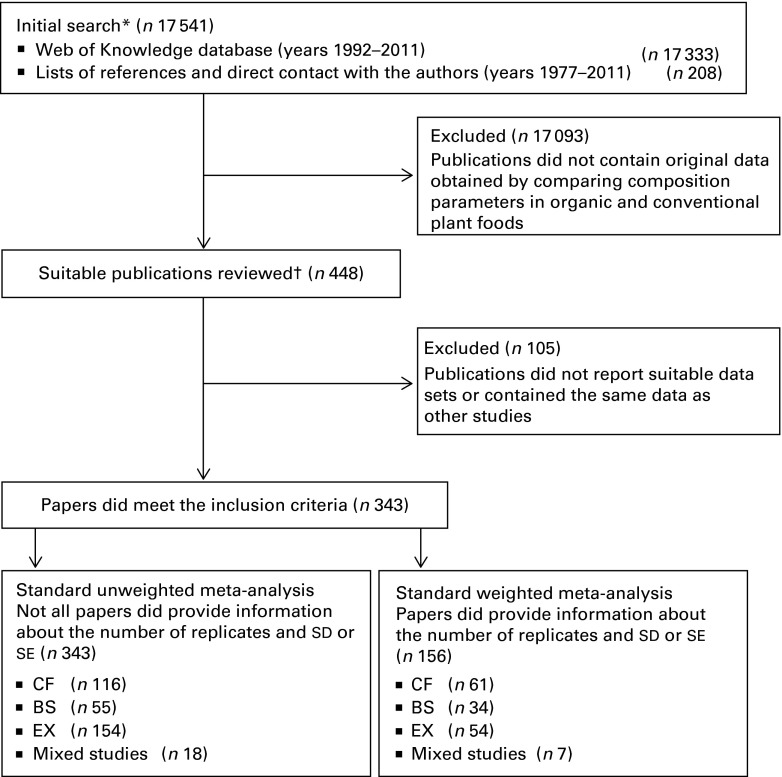
- Systematic literature review and meta-analyses based on 343 peer-reviewed publications; 156 publications met criteria for the standard weighted meta-analysis and 343 for the standard unweighted meta-analysis. Searches used Web of Knowledge for January 1992–December 2011, plus 208 additional publications, yielding 17 333 references; 448 suitable publications were identified and 105 rejected.
- Data came from matched farm comparisons (116 papers), basket/retail surveys (55 papers), controlled field experiments (154 papers), or more than one study type (18 papers). Weighted random-effects meta-analyses used standardised mean differences; unweighted meta-analyses used ln-transformed organic:conventional mean ratios; pesticide residue frequency was analysed with ln OR; sensitivity analyses and an adapted GRADE assessment were performed.
- Analyses covered 182 composition parameters from 907 reported parameters, including antioxidants/(poly)phenolics, vitamins, macronutrients, minerals, toxic metals, nitrate/nitrite, and pesticide residues.
Limitations
- The paper states that heterogeneity was extremely high (I² > 75 %) for most composition parameters, publication bias was strongly suspected for approximately half of parameters, and many studies lacked standardised measurements, measures of variance/replication, or certified reference materials.
- The paper states that pesticide residue comparisons were limited: only eleven studies compared frequencies, eight focused on one crop species, no comparative studies for cereals, oilseeds and pulses were identified, and available data did not allow robust comparisons of pesticide concentrations.
- The paper states that human health impacts remain uncertain: there is a lack of knowledge about uptake, bioavailability and mechanisms of (poly)phenolics, only two human dietary intervention studies used conventional vs organic diets and were inconclusive, and potential health benefits of lower Cd or pesticide exposure are difficult to estimate. Evident from the text: the meta-analysis synthesises observational and field studies and cannot establish causality, and high variation by crop type, country, and agronomic/pedo-climatic background limits generalisability.
Model-written summary. Check it against the paper before relying on it.
Integrity signals
Registry
Cites
Statistics
Figures

Verification
Claims the paper makes
51 Own result · 47 Not checked yet · 20 Own interpretation · 10 No basis given · 7 Own method · 2 Sources not found
A result the paper reports from its own data — it cites no other source for it, so there is none to check. The quote shows it is in the paper.
In the paper
“Most importantly, the concentrations of a range of antioxidants such as polyphenolics were found to be substantially higher in organic crops/crop-based foods, with those of phenolic acids, flavanones, stilbenes, flavones, flavonols and anthocyanins being an estimated 19 (95 % CI 5, 33) %, 69 (95 % CI 13, 125) %, 28 (95 % CI 12, 44) %, 26 (95 % CI 3, 48) %, 50 (95 % CI 28, 72) % and 51 (95 % CI 17,”
§ Higher antioxidant and lower cadmium concentrations and lower incidence of pesticide residues in organically grown crops: a systematic literature review and meta-analyses > Abstract
hedgedcorrelational- Asserted: passes — The authors put it forward as true.
- Checkable: passes — It can be checked against evidence.
- Load-bearing: passes — The paper’s conclusions depend on it.
- Based: passes — The paper gives a reason why it holds.
- Rests on an assumption: The organic status of crops in the included studies (as reported by authors or labels) accurately reflects organic production standards.
A result the paper reports from its own data — it cites no other source for it, so there is none to check. The quote shows it is in the paper.
In the paper
“which also contained significantly higher concentrations of the toxic metal Cd”
§ Higher antioxidant and lower cadmium concentrations and lower incidence of pesticide residues in organically grown crops: a systematic literature review and meta-analyses > Abstract
plaincorrelational- Asserted: passes — The authors put it forward as true.
- Checkable: passes — It can be checked against evidence.
- Load-bearing: passes — The paper’s conclusions depend on it.
- Based: passes — The paper gives a reason why it holds.
- Rests on an assumption: The organic status of crops in the included studies (as reported by authors or labels) accurately reflects organic production standards.
A result the paper reports from its own data — it cites no other source for it, so there is none to check. The quote shows it is in the paper.
In the paper
“Most importantly, the concentrations of a range of antioxidants such as polyphenolics were found to be substantially higher in organic crops/crop-based foods, with those of phenolic acids, flavanones, stilbenes, flavones, flavonols and anthocyanins being an estimated 19 (95 % CI 5, 33) %, 69 (95 % CI 13, 125) %, 28 (95 % CI 12, 44) %, 26 (95 % CI 3, 48) %, 50 (95 % CI 28, 72) % and 51 (95 % CI 17,”
§ Higher antioxidant and lower cadmium concentrations and lower incidence of pesticide residues in organically grown crops: a systematic literature review and meta-analyses > Abstract
hedgedcorrelational- Asserted: passes — The authors put it forward as true.
- Checkable: passes — It can be checked against evidence.
- Load-bearing: passes — The paper’s conclusions depend on it.
- Based: passes — The paper gives a reason why it holds.
- Rests on an assumption: The organic status of crops in the included studies (as reported by authors or labels) accurately reflects organic production standards.
A result the paper reports from its own data — it cites no other source for it, so there is none to check. The quote shows it is in the paper.
In the paper
“In the present study, we carried out meta-analyses based on 343 peer-reviewed publications that indicate statistically significant and meaningful differences in composition between organic and non-organic crops/crop-based foods.”
§ Higher antioxidant and lower cadmium concentrations and lower incidence of pesticide residues in organically grown crops: a systematic literature review and meta-analyses > Abstract
hedgedcorrelational- Asserted: passes — The authors put it forward as true.
- Checkable: passes — It can be checked against evidence.
- Load-bearing: passes — The paper’s conclusions depend on it.
- Based: passes — The paper gives a reason why it holds.
- Rests on an assumption: The organic status of crops in the included studies (as reported by authors or labels) accurately reflects organic production standards.
- Rests on an assumption: Peer review is a valid quality selection criterion for included studies.
A result the paper reports from its own data — it cites no other source for it, so there is none to check. The quote shows it is in the paper.
In the paper
“Additionally, the frequency of occurrence of pesticide residues was found to be four times higher in conventional crops”
§ Higher antioxidant and lower cadmium concentrations and lower incidence of pesticide residues in organically grown crops: a systematic literature review and meta-analyses > Abstract
plaincorrelational- Asserted: passes — The authors put it forward as true.
- Checkable: passes — It can be checked against evidence.
- Load-bearing: passes — The paper’s conclusions depend on it.
- Based: passes — The paper gives a reason why it holds.
- Rests on an assumption: The organic status of crops in the included studies (as reported by authors or labels) accurately reflects organic production standards.
A result the paper reports from its own data — it cites no other source for it, so there is none to check. The quote shows it is in the paper.
In the paper
“Most importantly, the concentrations of a range of antioxidants such as polyphenolics were found to be substantially higher in organic crops/crop-based foods”
§ Higher antioxidant and lower cadmium concentrations and lower incidence of pesticide residues in organically grown crops: a systematic literature review and meta-analyses > Abstract
plaincorrelational- Asserted: passes — The authors put it forward as true.
- Checkable: passes — It can be checked against evidence.
- Load-bearing: passes — The paper’s conclusions depend on it.
- Based: passes — The paper gives a reason why it holds.
- Rests on an assumption: The organic status of crops in the included studies (as reported by authors or labels) accurately reflects organic production standards.
A result the paper reports from its own data — it cites no other source for it, so there is none to check. The quote shows it is in the paper.
In the paper
“Most importantly, the concentrations of a range of antioxidants such as polyphenolics were found to be substantially higher in organic crops/crop-based foods, with those of phenolic acids, flavanones, stilbenes, flavones, flavonols and anthocyanins being an estimated 19 (95 % CI 5, 33) %, 69 (95 % CI 13, 125) %, 28 (95 % CI 12, 44) %, 26 (95 % CI 3, 48) %, 50 (95 % CI 28, 72) % and 51 (95 % CI 17,”
§ Higher antioxidant and lower cadmium concentrations and lower incidence of pesticide residues in organically grown crops: a systematic literature review and meta-analyses > Abstract
hedgedcorrelational- Asserted: passes — The authors put it forward as true.
- Checkable: passes — It can be checked against evidence.
- Load-bearing: passes — The paper’s conclusions depend on it.
- Based: passes — The paper gives a reason why it holds.
- Rests on an assumption: The organic status of crops in the included studies (as reported by authors or labels) accurately reflects organic production standards.
A result the paper reports from its own data — it cites no other source for it, so there is none to check. The quote shows it is in the paper.
In the paper
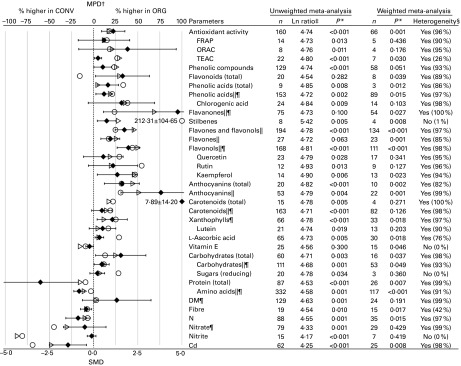
“Heterogeneity was extremely high (I 2>75 %) for most of the composition parameters, with I 2 ranging from 76 % for ascorbic acid to 100 % for carotenoids and DM (Fig. 3).”
§ Higher antioxidant and lower cadmium concentrations and lower incidence of pesticide residues in organically grown crops: a systematic literature review and meta-analyses > Results > Effects of crop type/species/variety, study type and other sources of variation
plain- Asserted: passes — The authors put it forward as true.
- Checkable: passes — It can be checked against evidence.
- Load-bearing: unclear — It is unclear whether the paper’s conclusions depend on it.
- Based: passes — The paper gives a reason why it holds.
A result the paper reports from its own data — it cites no other source for it, so there is none to check. The quote shows it is in the paper.
In the paper
“For most of the minerals (including many plant marco- and micronutrients), the meta-analyses could not detect significant composition differences between organic and conventional crops (see online supplementary Table S12).”
§ Higher antioxidant and lower cadmium concentrations and lower incidence of pesticide residues in organically grown crops: a systematic literature review and meta-analyses > Results > Other minerals
hedged- Asserted: passes — The authors put it forward as true.
- Checkable: passes — It can be checked against evidence.
- Load-bearing: unclear — It is unclear whether the paper’s conclusions depend on it.
- Based: passes — The paper gives a reason why it holds.
A result the paper reports from its own data — it cites no other source for it, so there is none to check. The quote shows it is in the paper.
In the paper
“Significantly higher frequencies of occurrence of pesticide residues in conventional crops were also detected when data reported for fruits, vegetables and processed crop-based foods were analysed separately (Fig. 5).”
§ Higher antioxidant and lower cadmium concentrations and lower incidence of pesticide residues in organically grown crops: a systematic literature review and meta-analyses > Results > Toxic metals, nitrogen, nitrate, nitrite and pesticides
plaincorrelational- Asserted: passes — The authors put it forward as true.
- Checkable: passes — It can be checked against evidence.
- Load-bearing: passes — The paper’s conclusions depend on it.
- Based: passes — The paper gives a reason why it holds.
A result the paper reports from its own data — it cites no other source for it, so there is none to check. The quote shows it is in the paper.
In the paper
“while only a trend towards a significant difference (P= 0·06) was observed for vegetables”
§ Higher antioxidant and lower cadmium concentrations and lower incidence of pesticide residues in organically grown crops: a systematic literature review and meta-analyses > Results > Antioxidant activity
plain- Asserted: passes — The authors put it forward as true.
- Checkable: passes — It can be checked against evidence.
- Load-bearing: unclear — It is unclear whether the paper’s conclusions depend on it.
- Based: passes — The paper gives a reason why it holds.
- Rests on an assumption: The organic status of crops in the included studies (as reported by authors or labels) accurately reflects organic production standards.
A result the paper reports from its own data — it cites no other source for it, so there is none to check. The quote shows it is in the paper.
In the paper
“The MPD for most of the compounds were between 18 and 69 % for most of the above-mentioned antioxidant compounds (Fig. 3).”
§ Higher antioxidant and lower cadmium concentrations and lower incidence of pesticide residues in organically grown crops: a systematic literature review and meta-analyses > Results > Antioxidants/(poly)phenolics
plain- Asserted: passes — The authors put it forward as true.
- Checkable: passes — It can be checked against evidence.
- Load-bearing: unclear — It is unclear whether the paper’s conclusions depend on it.
- Based: passes — The paper gives a reason why it holds.
A result the paper reports from its own data — it cites no other source for it, so there is none to check. The quote shows it is in the paper.
In the paper
“The meta-analyses did not detect significant differences for a range of other secondary metabolites with antioxidant activity. These included some individual carotenoids (α-carotene, lycopene, β-cryptoxanthin and zeaxanthin), vitamins (α-tocopherol, γ-tocopherol, vitamin B and vitamin B1), some specific phenolic acids (total hydroxycinnamic acids, caffeic acid, p-coumaric acid, ferulic acid, sinap”
§ Higher antioxidant and lower cadmium concentrations and lower incidence of pesticide residues in organically grown crops: a systematic literature review and meta-analyses > Results > Antioxidants/(poly)phenolics
plain- Asserted: passes — The authors put it forward as true.
- Checkable: passes — It can be checked against evidence.
- Load-bearing: passes — The paper’s conclusions depend on it.
- Based: passes — The paper gives a reason why it holds.
A result the paper reports from its own data — it cites no other source for it, so there is none to check. The quote shows it is in the paper.
In the paper
“For the toxic metals As and Pb, no significant differences could be detected in their concentrations between organic and conventional crops in the meta-analyses (see online supplementary Table S12).”
§ Higher antioxidant and lower cadmium concentrations and lower incidence of pesticide residues in organically grown crops: a systematic literature review and meta-analyses > Results > Toxic metals, nitrogen, nitrate, nitrite and pesticides
hedged- Asserted: passes — The authors put it forward as true.
- Checkable: passes — It can be checked against evidence.
- Load-bearing: unclear — It is unclear whether the paper’s conclusions depend on it.
- Based: passes — The paper gives a reason why it holds.
A result the paper reports from its own data — it cites no other source for it, so there is none to check. The quote shows it is in the paper.
In the paper
“When data reported for fruits and vegetables were analysed separately, a significant difference was detected for fruits”
§ Higher antioxidant and lower cadmium concentrations and lower incidence of pesticide residues in organically grown crops: a systematic literature review and meta-analyses > Results > Antioxidant activity
plaincorrelational- Asserted: passes — The authors put it forward as true.
- Checkable: passes — It can be checked against evidence.
- Load-bearing: unclear — It is unclear whether the paper’s conclusions depend on it.
- Based: passes — The paper gives a reason why it holds.
- Rests on an assumption: The organic status of crops in the included studies (as reported by authors or labels) accurately reflects organic production standards.
A result the paper reports from its own data — it cites no other source for it, so there is none to check. The quote shows it is in the paper.
In the paper
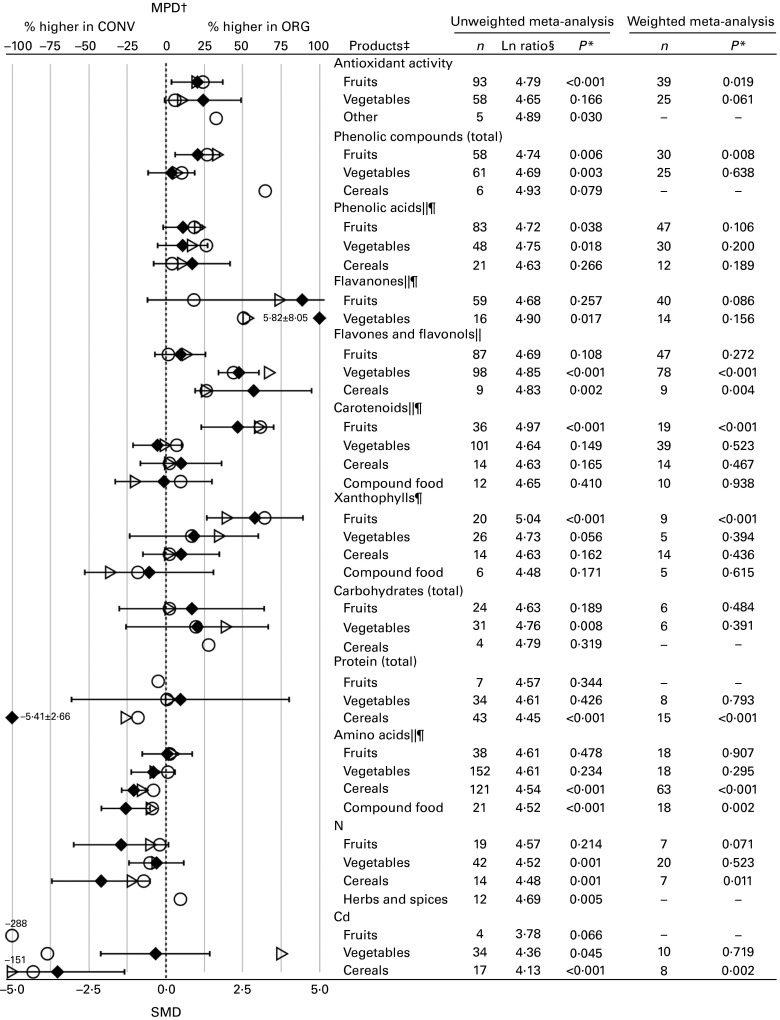
“The unweighted meta-analysis also detected significantly higher concentrations of reducing sugars and DM in organic crops (Fig. 4).”
§ Higher antioxidant and lower cadmium concentrations and lower incidence of pesticide residues in organically grown crops: a systematic literature review and meta-analyses > Results > Macronutrients, fibre and DM content
plaincorrelational- Asserted: passes — The authors put it forward as true.
- Checkable: passes — It can be checked against evidence.
- Load-bearing: unclear — It is unclear whether the paper’s conclusions depend on it.
- Based: passes — The paper gives a reason why it holds.
A result the paper reports from its own data — it cites no other source for it, so there is none to check. The quote shows it is in the paper.
In the paper
“The unweighted meta-analysis also detected significantly higher concentrations of chlorogenic acid (5-O-caffeoylquinic acid) in organic crops (Fig. 3).”
§ Higher antioxidant and lower cadmium concentrations and lower incidence of pesticide residues in organically grown crops: a systematic literature review and meta-analyses > Results > Antioxidants/(poly)phenolics
plaincorrelational- Asserted: passes — The authors put it forward as true.
- Checkable: passes — It can be checked against evidence.
- Load-bearing: passes — The paper’s conclusions depend on it.
- Based: passes — The paper gives a reason why it holds.
A result the paper reports from its own data — it cites no other source for it, so there is none to check. The quote shows it is in the paper.
In the paper
“Also, when data reported for carbohydrates in vegetables, fruits and cereals were analysed separately, no significant effects could be detected in their concentrations (Fig. 4).”
§ Higher antioxidant and lower cadmium concentrations and lower incidence of pesticide residues in organically grown crops: a systematic literature review and meta-analyses > Results > Macronutrients, fibre and DM content
plain- Asserted: passes — The authors put it forward as true.
- Checkable: passes — It can be checked against evidence.
- Load-bearing: unclear — It is unclear whether the paper’s conclusions depend on it.
- Based: passes — The paper gives a reason why it holds.
A result the paper reports from its own data — it cites no other source for it, so there is none to check. The quote shows it is in the paper.
In the paper
“although there was no evidence of an interaction”
§ Higher antioxidant and lower cadmium concentrations and lower incidence of pesticide residues in organically grown crops: a systematic literature review and meta-analyses > Results > Antioxidant activity
plain- Asserted: passes — The authors put it forward as true.
- Checkable: passes — It can be checked against evidence.
- Load-bearing: unclear — It is unclear whether the paper’s conclusions depend on it.
- Based: passes — The paper gives a reason why it holds.
- Rests on an assumption: The organic status of crops in the included studies (as reported by authors or labels) accurately reflects organic production standards.
A result the paper reports from its own data — it cites no other source for it, so there is none to check. The quote shows it is in the paper.
In the paper
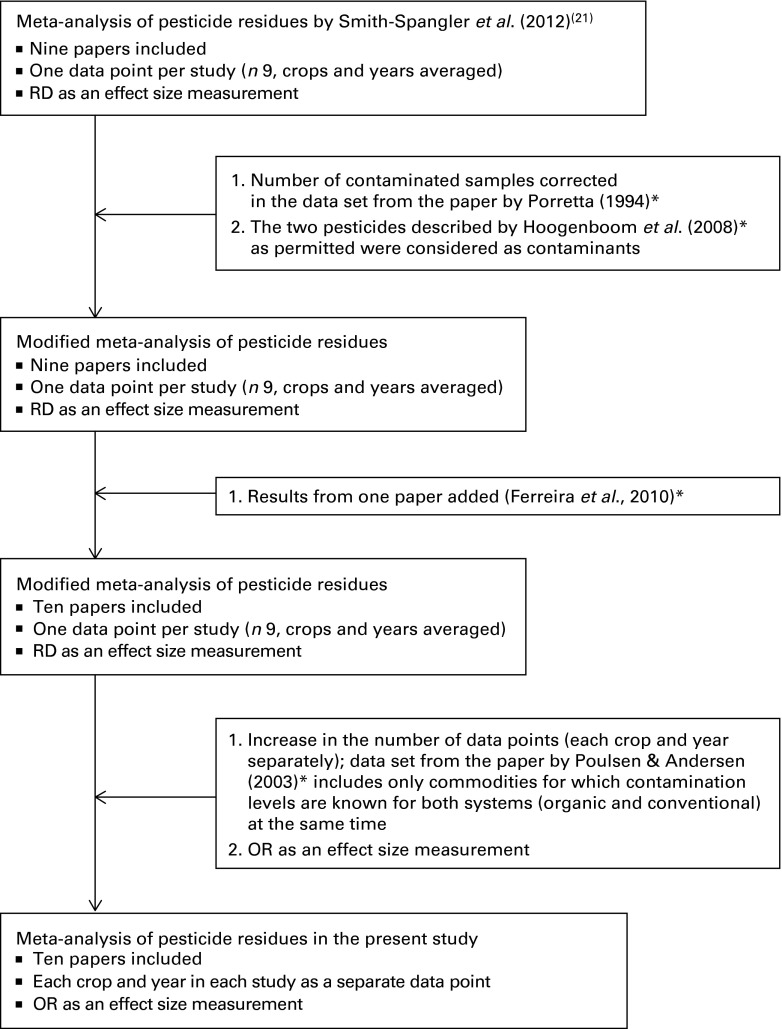
“The standard meta-analyses showed that the frequency of occurrence of detectable pesticide residues was four times higher in conventional crops (46 (95 % CI 38, 55) %) than in organic crops (11 (95 % CI 7, 14) %) (Fig. 5).”
§ Higher antioxidant and lower cadmium concentrations and lower incidence of pesticide residues in organically grown crops: a systematic literature review and meta-analyses > Results > Toxic metals, nitrogen, nitrate, nitrite and pesticides
plaincorrelational- Asserted: passes — The authors put it forward as true.
- Checkable: passes — It can be checked against evidence.
- Load-bearing: passes — The paper’s conclusions depend on it.
- Based: passes — The paper gives a reason why it holds.
A result the paper reports from its own data — it cites no other source for it, so there is none to check. The quote shows it is in the paper.
In the paper
“It should be pointed out that (1) there are only eleven studies in which the frequencies of occurrence of pesticide residues were compared, (2) eight of these studies focused on only one crop species, (3) no comparative studies for cereals, oilseeds and pulses were identified in the literature review, and (4) the data available did not allow scientifically robust comparisons of the concentrations”
§ Higher antioxidant and lower cadmium concentrations and lower incidence of pesticide residues in organically grown crops: a systematic literature review and meta-analyses > Discussion > Cadmium and pesticide residues
plain- Asserted: passes — The authors put it forward as true.
- Checkable: passes — It can be checked against evidence.
- Load-bearing: passes — The paper’s conclusions depend on it.
- Based: passes — The paper gives a reason why it holds.
None of the sources cited for this claim have been checked yet.
In the paper
“The concentrations of proteins, amino acids and N (which are known to be positively correlated in plants) were found to be lower in organic crops, and this is consistent with the results of previous studies that have linked lower protein concentrations to lower N inputs and N availability in organic crop production systems( 61 , 62 ).”
§ Higher antioxidant and lower cadmium concentrations and lower incidence of pesticide residues in organically grown crops: a systematic literature review and meta-analyses > Discussion > Proteins, amino acids, nitrogen and nitrate/nitrite
plain- Asserted: passes — The authors put it forward as true.
- Checkable: passes — It can be checked against evidence.
- Load-bearing: unclear — It is unclear whether the paper’s conclusions depend on it.
- Based: passes — The paper gives a reason why it holds.
A result the paper reports from its own data — it cites no other source for it, so there is none to check. The quote shows it is in the paper.
In the paper
“It should be pointed out that (1) there are only eleven studies in which the frequencies of occurrence of pesticide residues were compared, (2) eight of these studies focused on only one crop species, (3) no comparative studies for cereals, oilseeds and pulses were identified in the literature review, and (4) the data available did not allow scientifically robust comparisons of the concentrations”
§ Higher antioxidant and lower cadmium concentrations and lower incidence of pesticide residues in organically grown crops: a systematic literature review and meta-analyses > Discussion > Cadmium and pesticide residues
plain- Asserted: passes — The authors put it forward as true.
- Checkable: passes — It can be checked against evidence.
- Load-bearing: passes — The paper’s conclusions depend on it.
- Based: passes — The paper gives a reason why it holds.
The paper states this without a source or data behind it here, so there is nothing to check it against. The quote shows it is in the paper.
In the paper
“For many composition parameters, the method of synthesis did not have large effects on results, in terms of both statistical significance and the magnitude of relative difference between organic and conventional crops.”
§ Higher antioxidant and lower cadmium concentrations and lower incidence of pesticide residues in organically grown crops: a systematic literature review and meta-analyses > Discussion > Effects of crop type/species/variety, study type and other sources of variation
plain- Asserted: passes — The authors put it forward as true.
- Checkable: passes — It can be checked against evidence.
- Load-bearing: passes — The paper’s conclusions depend on it.
- Based: passes — The paper gives a reason why it holds.
The paper states this without a source or data behind it here, so there is nothing to check it against. The quote shows it is in the paper.
In the paper
“However, due to the lack of detailed information on agronomic and pedo-climatic background conditions in most of the available literature, it is currently not possible to quantify the relative contribution of genetic and environmental/agronomic sources of variation.”
§ Higher antioxidant and lower cadmium concentrations and lower incidence of pesticide residues in organically grown crops: a systematic literature review and meta-analyses > Discussion > Effects of crop type/species/variety, study type and other sources of variation
plain- Asserted: passes — The authors put it forward as true.
- Checkable: passes — It can be checked against evidence.
- Load-bearing: unclear — It is unclear whether the paper’s conclusions depend on it.
- Based: passes — The paper gives a reason why it holds.
A result the paper reports from its own data — it cites no other source for it, so there is none to check. The quote shows it is in the paper.
In the paper
“The present study also identified variation between studies (1) carried out in countries with different pedo-climatic conditions and agronomic protocols (e.g. rotation designs, irrigated or non-irrigated crop production, and level and type of animal manures used) and/or (2) focused on different crop species.”
§ Higher antioxidant and lower cadmium concentrations and lower incidence of pesticide residues in organically grown crops: a systematic literature review and meta-analyses > Discussion > Effects of crop type/species/variety, study type and other sources of variation
plaincorrelational- Asserted: passes — The authors put it forward as true.
- Checkable: passes — It can be checked against evidence.
- Load-bearing: unclear — It is unclear whether the paper’s conclusions depend on it.
- Based: passes — The paper gives a reason why it holds.
A result the paper reports from its own data — it cites no other source for it, so there is none to check. The quote shows it is in the paper.
In the paper
“The on average 48 % lower Cd concentrations found in organic crops/crop-based foods in the meta-analyses carried out in the present study are therefore desirable, although the exact health benefits associated with reducing Cd intake levels via a switch to organic food consumption are difficult to estimate.”
§ Higher antioxidant and lower cadmium concentrations and lower incidence of pesticide residues in organically grown crops: a systematic literature review and meta-analyses > Discussion > Cadmium and pesticide residues
plaincorrelational- Asserted: passes — The authors put it forward as true.
- Checkable: passes — It can be checked against evidence.
- Load-bearing: passes — The paper’s conclusions depend on it.
- Based: passes — The paper gives a reason why it holds.
A result the paper reports from its own data — it cites no other source for it, so there is none to check. The quote shows it is in the paper.
In the paper
“The present study demonstrated that the prohibition of synthetic chemical pesticide use under organic farming standards results in a more than 4-fold reduction in the number of crop samples with detectable pesticide residues.”
§ Higher antioxidant and lower cadmium concentrations and lower incidence of pesticide residues in organically grown crops: a systematic literature review and meta-analyses > Discussion > Cadmium and pesticide residues
boosteddirect- Asserted: passes — The authors put it forward as true.
- Checkable: passes — It can be checked against evidence.
- Load-bearing: passes — The paper’s conclusions depend on it.
- Based: passes — The paper gives a reason why it holds.
A result the paper reports from its own data — it cites no other source for it, so there is none to check. The quote shows it is in the paper.
In the paper
“It should be pointed out that (1) there are only eleven studies in which the frequencies of occurrence of pesticide residues were compared, (2) eight of these studies focused on only one crop species, (3) no comparative studies for cereals, oilseeds and pulses were identified in the literature review, and (4) the data available did not allow scientifically robust comparisons of the concentrations”
§ Higher antioxidant and lower cadmium concentrations and lower incidence of pesticide residues in organically grown crops: a systematic literature review and meta-analyses > Discussion > Cadmium and pesticide residues
plain- Asserted: passes — The authors put it forward as true.
- Checkable: passes — It can be checked against evidence.
- Load-bearing: passes — The paper’s conclusions depend on it.
- Based: passes — The paper gives a reason why it holds.
None of the sources cited for this claim have been checked yet.
In the paper
“As has been mentioned in previous reviews( 19 – 21 ), pooling diverse information was necessary, because for most of the composition parameters, the number of published studies available was not sufficient to carry out separate meta-analyses for specific countries/regions and crop types and species.”
§ Higher antioxidant and lower cadmium concentrations and lower incidence of pesticide residues in organically grown crops: a systematic literature review and meta-analyses > Discussion > Effects of crop type/species/variety, study type and other sources of variation
What the sources say
- Not checked yetcites [19] Dangour AD, Dodhia SK, Hayter A, et al. (2009) Nutritional quality of organic foods: a systematic review. Am J Clin Nutr 90, 680– 685 19640946 source
- Not checked yetcites [20] Brandt K, Leifert C, Sanderson R, et al. (2011) Agroecosystem management and nutritional quality of plant foods: the case of organic fruits and vegetables. Crit Rev Plant Sci 30, 177– 197 source
- Not checked yetcites [21] Smith-Spangler C, Brandeau ML, Hunter GE, et al. (2012) Are organic foods safer or healthier than conventional alternatives? A systematic review. Ann Intern Med 157, 348– 366 22944875 source
plain- Asserted: passes — The authors put it forward as true.
- Checkable: passes — It can be checked against evidence.
- Load-bearing: passes — The paper’s conclusions depend on it.
- Based: passes — The paper gives a reason why it holds.
The paper states this without a source or data behind it here, so there is nothing to check it against. The quote shows it is in the paper.
In the paper
“Consequently, heterogeneity was extremely high (I 2>75 %) for most of the composition parameters for which significant differences were detected.”
§ Higher antioxidant and lower cadmium concentrations and lower incidence of pesticide residues in organically grown crops: a systematic literature review and meta-analyses > Discussion > Effects of crop type/species/variety, study type and other sources of variation
plain- Asserted: passes — The authors put it forward as true.
- Checkable: passes — It can be checked against evidence.
- Load-bearing: passes — The paper’s conclusions depend on it.
- Based: passes — The paper gives a reason why it holds.
A result the paper reports from its own data — it cites no other source for it, so there is none to check. The quote shows it is in the paper.
In the paper
“The considerably higher frequency of occurrence of detectable residues in conventional fruits (75 %) than in vegetables (32 %) may indicate higher levels of crop protection inputs being used in fruit crops, but could also have been due to the use of more persistent chemicals, different sprayer technologies used and/or pesticide applications being made closer to harvest.”
§ Higher antioxidant and lower cadmium concentrations and lower incidence of pesticide residues in organically grown crops: a systematic literature review and meta-analyses > Discussion > Cadmium and pesticide residues
hedgedcorrelational- Asserted: passes — The authors put it forward as true.
- Checkable: passes — It can be checked against evidence.
- Load-bearing: unclear — It is unclear whether the paper’s conclusions depend on it.
- Based: passes — The paper gives a reason why it holds.
The paper states this without a source or data behind it here, so there is nothing to check it against. The quote shows it is in the paper.
In the paper
“For other composition parameters (e.g. ferric reducing antioxidant power, oxygen radical absorbance capacity, Trolox equivalent antioxidant capacity, and levels of flavonoids, stilbenes, total carotenoids, l-ascorbic acid, proteins, and Cd), differences in methods had a large impact in terms of both significant effects being detected and/or estimates of the magnitude of difference based on MPD and”
§ Higher antioxidant and lower cadmium concentrations and lower incidence of pesticide residues in organically grown crops: a systematic literature review and meta-analyses > Discussion > Effects of crop type/species/variety, study type and other sources of variation
plaincorrelational- Asserted: passes — The authors put it forward as true.
- Checkable: passes — It can be checked against evidence.
- Load-bearing: unclear — It is unclear whether the paper’s conclusions depend on it.
- Based: passes — The paper gives a reason why it holds.
The paper states this without a source or data behind it here, so there is nothing to check it against. The quote shows it is in the paper.
In the paper
“Not all studies included in the meta-analyses used certified reference materials as a quality assurance measure for the accuracy of estimates of concentrations of compounds in crops.”
§ Higher antioxidant and lower cadmium concentrations and lower incidence of pesticide residues in organically grown crops: a systematic literature review and meta-analyses > Discussion > The need for use of standardised protocols for comparative food composition studies
plain- Asserted: passes — The authors put it forward as true.
- Checkable: passes — It can be checked against evidence.
- Load-bearing: unclear — It is unclear whether the paper’s conclusions depend on it.
- Based: passes — The paper gives a reason why it holds.
The paper states this without a source or data behind it here, so there is nothing to check it against. The quote shows it is in the paper.
In the paper
“Also, in many studies, there was a lack of detailed information on (1) the geographical origin of samples in retail surveys and (2) agronomic (e.g. rotation, fertilisation, tillage and irrigation regimens), pedo-climatic and crop genetic backgrounds (in farm surveys and field experiments), which would allow potential sources of variation to be investigated.”
§ Higher antioxidant and lower cadmium concentrations and lower incidence of pesticide residues in organically grown crops: a systematic literature review and meta-analyses > Discussion > The need for use of standardised protocols for comparative food composition studies
plain- Asserted: passes — The authors put it forward as true.
- Checkable: passes — It can be checked against evidence.
- Load-bearing: unclear — It is unclear whether the paper’s conclusions depend on it.
- Based: passes — The paper gives a reason why it holds.
None of the sources cited for this claim have been checked yet.
In the paper
“However, there is increasing evidence and more widespread acceptance that the consumption of organic foods is likely to reduce exposure to pesticide residues( 21 , 23 , 24 ).”
§ Higher antioxidant and lower cadmium concentrations and lower incidence of pesticide residues in organically grown crops: a systematic literature review and meta-analyses > Abstract
What the sources say
- Not checked yetcites [21] Smith-Spangler C, Brandeau ML, Hunter GE, et al. (2012) Are organic foods safer or healthier than conventional alternatives? A systematic review. Ann Intern Med 157, 348– 366 22944875 source
- Not checked yetcites [23] Curl C, Fenske RA & Elgethun K (2003) Organophosphorus pesticide exposure of urban and suburban preschool children with organic and conventional diets. Environ Health Perspect 111, 377– 382 12611667 PMC1241395 source
- Not checked yetcites [24] Leifert C, Ball K, Volakakis N, et al. (2008) Control of enteric pathogens in ready-to-eat vegetable crops in organic and ‘low input’ production systems: a HACCP-based approach. J Appl Microbiol 105, 931– 950 18397255 source
hedgedconditional- Asserted: passes — The authors put it forward as true.
- Checkable: passes — It can be checked against evidence.
- Load-bearing: passes — The paper’s conclusions depend on it.
- Based: passes — The paper gives a reason why it holds.
None of the sources cited for this claim have been checked yet.
In the paper
“Many of these compounds have previously been linked to a reduced risk of chronic diseases, including CVD and neurodegenerative diseases and certain cancers, in dietary intervention and epidemiological studies.”
- Also stated in: § Abstract · boosted
“There is particular interest in antioxidant activity/concentrations, as there is strong scientific evidence for health benefits associated with increased consumption of crops rich in (poly)phenolics and other plant secondary metabolites with antioxidant activity (e.g. carotenoids and vitamins C and E)( 16 – 18 ).”
§ Higher antioxidant and lower cadmium concentrations and lower incidence of pesticide residues in organically grown crops: a systematic literature review and meta-analyses > Abstract
What the sources say
- Not checked yetcites [16] Del Rio D, Rodriguez-Mateos A, Spencer JPE, et al. (2013) Dietary (poly)phenolics in human health: structures, bioavailability, and evidence of protective effects against chronic diseases. Antioxid Redox Signal 18, 1818– 1892 22794138 PMC3619154 source
- Not checked yetcites [17] Wahlqvist ML (2013) Antioxidant relevance to human health. Asia Pac J Clin Nutr 22, 171– 176 23635359 source
- Not checked yetcites [18] Fardet A (2010) New hypotheses for the health-protective mechanisms of whole-grain cereals: what is beyond fibre? Nutr Res Rev 23, 65– 134 20565994 source
boostedcorrelational- Asserted: passes — The authors put it forward as true.
- Checkable: passes — It can be checked against evidence.
- Load-bearing: passes — The paper’s conclusions depend on it.
- Based: passes — The paper gives a reason why it holds.
- Also stated in: § Abstract · boosted
None of the sources cited for this claim have been checked yet.
In the paper
“there were some statistically significant interactions between fertilisation and crop protection protocols with respect to gene and protein expression pattern”
§ Higher antioxidant and lower cadmium concentrations and lower incidence of pesticide residues in organically grown crops: a systematic literature review and meta-analyses > Abstract
What the sources say
- Not checked yetcites [10] Rempelos L, Cooper J, Wilcockson S, et al. (2013) Quantitative proteomics to study the response of potato to contrasting fertilisation regimes. Mol Breed 31, 363– 378 source
- Not checked yetcites [11] Lehesranta SJ, Koistinen KM, Massat N, et al. (2007) Effects of agricultural production systems and their components on protein profiles of potato tubers. Proteomics 7, 597– 604 17309105 source
- Not checked yetcites [12] Tetard-Jones C, Shotton PN, Rempelos L, et al. (2013) Quantitative proteomics to study the response of wheat to contrasting fertilisation regimes. Mol Breed 31, 379– 393 source
- Not checked yetcites [13] van Dijk JP, Cankar K, Scheffer SJ, et al. (2009) Transcriptome analysis of potato tubers – effects of different agricultural practices. J Agric Food Chem 57, 1612– 1623 19173602 source
- Not checked yetcites [14] van Dijk JP, Leifert C, Barros E, et al. (2010) Gene expression profiling for food safety assessment: examples in potato and maize. Regul Toxicol Pharmacol 58, Suppl. 3, S21– S25 20600454 source
- Not checked yetcites [15] van Dijk JP, Cankar K, Hendriksen PJM, et al. (2012) The identification and interpretation of differences in the transcriptomes of organically and conventionally grown potato tubers. J Agric Food Chem 60, 2090– 2101 22300527 source
hedgedcorrelational- Asserted: passes — The authors put it forward as true.
- Checkable: passes — It can be checked against evidence.
- Load-bearing: unclear — It is unclear whether the paper’s conclusions depend on it.
- Based: passes — The paper gives a reason why it holds.
What the paper did — it cites no source for this, so there is none to check. The quote shows it is in the paper.
In the paper
“Such large differences can be considered biologically implausible, and these ‘outlier’ data pairs were therefore omitted from the final standard meta-analyses”
§ Higher antioxidant and lower cadmium concentrations and lower incidence of pesticide residues in organically grown crops: a systematic literature review and meta-analyses > Materials and methods > Meta-analyses
plain- Asserted: passes — The authors put it forward as true.
- Checkable: passes — It can be checked against evidence.
- Load-bearing: passes — The paper’s conclusions depend on it.
- Based: passes — The paper gives a reason why it holds.
None of the sources cited for this claim have been checked yet.
In the paper
“Also, a switch from pesticide-based conventional to organic crop protection protocols has been shown to have a significant, but more limited effect than fertilisation regimens”
§ Higher antioxidant and lower cadmium concentrations and lower incidence of pesticide residues in organically grown crops: a systematic literature review and meta-analyses > Abstract
What the sources say
- Not checked yetcites [10] Rempelos L, Cooper J, Wilcockson S, et al. (2013) Quantitative proteomics to study the response of potato to contrasting fertilisation regimes. Mol Breed 31, 363– 378 source
- Not checked yetcites [11] Lehesranta SJ, Koistinen KM, Massat N, et al. (2007) Effects of agricultural production systems and their components on protein profiles of potato tubers. Proteomics 7, 597– 604 17309105 source
- Not checked yetcites [12] Tetard-Jones C, Shotton PN, Rempelos L, et al. (2013) Quantitative proteomics to study the response of wheat to contrasting fertilisation regimes. Mol Breed 31, 379– 393 source
- Not checked yetcites [13] van Dijk JP, Cankar K, Scheffer SJ, et al. (2009) Transcriptome analysis of potato tubers – effects of different agricultural practices. J Agric Food Chem 57, 1612– 1623 19173602 source
- Not checked yetcites [14] van Dijk JP, Leifert C, Barros E, et al. (2010) Gene expression profiling for food safety assessment: examples in potato and maize. Regul Toxicol Pharmacol 58, Suppl. 3, S21– S25 20600454 source
- Not checked yetcites [15] van Dijk JP, Cankar K, Hendriksen PJM, et al. (2012) The identification and interpretation of differences in the transcriptomes of organically and conventionally grown potato tubers. J Agric Food Chem 60, 2090– 2101 22300527 source
plaindirect- Asserted: passes — The authors put it forward as true.
- Checkable: passes — It can be checked against evidence.
- Load-bearing: unclear — It is unclear whether the paper’s conclusions depend on it.
- Based: passes — The paper gives a reason why it holds.
In the paper
“The finding of a four times higher frequency of occurrence of pesticide residues in conventional crops confirms the results of the study of Smith-Spangler et al. ( 21 ), in which a very similar set of studies (nine of the ten publications used in the present study) were used for analysis.”
§ Higher antioxidant and lower cadmium concentrations and lower incidence of pesticide residues in organically grown crops: a systematic literature review and meta-analyses > Discussion
What the sources say
- Not checked yetcites [21] Smith-Spangler C, Brandeau ML, Hunter GE, et al. (2012) Are organic foods safer or healthier than conventional alternatives? A systematic review. Ann Intern Med 157, 348– 366 22944875 source
plaincorrelational- Asserted: passes — The authors put it forward as true.
- Checkable: passes — It can be checked against evidence.
- Load-bearing: unclear — It is unclear whether the paper’s conclusions depend on it.
- Based: passes — The paper gives a reason why it holds.
A conclusion the paper draws from its own results — it cites no other source for it, so there is none to check. The quote shows it is in the paper.
In the paper
“The main reason for the inability of previous studies to detect composition differences was probably the highly limited number of studies/data sets available or included in analyses by these authors, which would have decreased the statistical power of the meta-analyses.”
§ Higher antioxidant and lower cadmium concentrations and lower incidence of pesticide residues in organically grown crops: a systematic literature review and meta-analyses > Discussion
hedgedconditional- Asserted: passes — The authors put it forward as true.
- Checkable: passes — It can be checked against evidence.
- Load-bearing: passes — The paper’s conclusions depend on it.
- Based: passes — The paper gives a reason why it holds.
A conclusion the paper draws from its own results — it cites no other source for it, so there is none to check. The quote shows it is in the paper.
In the paper
“This suggests that a switch from conventional to organic crop consumption may have impacts similar to those of an increase in the intake of foods with high antioxidant/(poly)phenolic contents.”
§ Higher antioxidant and lower cadmium concentrations and lower incidence of pesticide residues in organically grown crops: a systematic literature review and meta-analyses > Discussion > Antioxidants/(poly)phenolics
hedgedconditional- Asserted: passes — The authors put it forward as true.
- Checkable: passes — It can be checked against evidence.
- Load-bearing: passes — The paper’s conclusions depend on it.
- Based: passes — The paper gives a reason why it holds.
None of the sources cited for this claim have been checked yet.
In the paper
“In contrast, there is increasing evidence that differences in fertilisation regimens between organic and conventional production systems (and, in particular, the non-use of high mineral N fertiliser inputs) are significant drivers for higher (poly)phenolic concentrations in organic crops( 20 , 49 – 52 ).”
§ Higher antioxidant and lower cadmium concentrations and lower incidence of pesticide residues in organically grown crops: a systematic literature review and meta-analyses > Discussion > Antioxidants/(poly)phenolics
What the sources say
- Not checked yetcites [20] Brandt K, Leifert C, Sanderson R, et al. (2011) Agroecosystem management and nutritional quality of plant foods: the case of organic fruits and vegetables. Crit Rev Plant Sci 30, 177– 197 source
- Not checked yetcites [49] Almuayrifi M (2013) Effect of fertilisation, crop protection, pre-crop and variety choice on yield of phenols content diseases severity and yield of winter wheat. PhD Thesis, Newcastle University.
- Not checked yetcites [50] Sander JF & Heitefuss R (1998) Susceptibility to Erysiphe graminis f. sp. tritici and phenolic acid content of wheat as influenced by different levels of nitrogen fertilization. J Phytopathol 146, 495– 507 source
- Not checked yetcites [51] Rühmann S, Leser C, Bannert M, et al. (2002) Relationship between growth, secondary metabolism, and resistance of apple. Plant Biol 4, 137– 143 source
- Not checked yetcites [52] Stewart AJ, Chapman W, Jenkins GI, et al. (2001) The effect of nitrogen and phosphorus deficiency on flavonol accumulation in plant tissues. Plant Cell Environ 24, 1189– 1197 source
hedgeddirect- Asserted: passes — The authors put it forward as true.
- Checkable: passes — It can be checked against evidence.
- Load-bearing: unclear — It is unclear whether the paper’s conclusions depend on it.
- Based: passes — The paper gives a reason why it holds.
None of the sources cited for this claim have been checked yet.
In the paper
“Many of the antioxidants, including (poly)phenolics, found in higher concentrations in organic crops are known to be produced by plants in response to abiotic (e.g. wounding and heat, water and nutrient stress) and biotic (pest attacks and disease) stress and form part of the plants' constitutive and inducible resistance mechanisms to pests and diseases( 47 – 49 ).”
§ Higher antioxidant and lower cadmium concentrations and lower incidence of pesticide residues in organically grown crops: a systematic literature review and meta-analyses > Discussion > Antioxidants/(poly)phenolics
What the sources say
- Not checked yetcites [47] Nicholson RL & Hammerschmidt R (1992) Phenolic compounds and their role in disease resistance. Annu Rev Phytopathol 30, 369– 389 source
- Not checked yetcites [48] Bennett RN & Wallsgrove RM (1994) Secondary metabolites in plant defense mechanisms. New Phytol 127, 617– 633 33874382 source
- Not checked yetcites [49] Almuayrifi M (2013) Effect of fertilisation, crop protection, pre-crop and variety choice on yield of phenols content diseases severity and yield of winter wheat. PhD Thesis, Newcastle University.
boosteddirect- Asserted: passes — The authors put it forward as true.
- Checkable: passes — It can be checked against evidence.
- Load-bearing: unclear — It is unclear whether the paper’s conclusions depend on it.
- Based: passes — The paper gives a reason why it holds.
In the paper
“For plant secondary metabolites, this confirms the results of the meta-analyses carried out by Brandt et al. ( 20 ), which indicated that there are significant composition differences between organic and conventional crops for a range of nutritionally relevant compounds.”
§ Higher antioxidant and lower cadmium concentrations and lower incidence of pesticide residues in organically grown crops: a systematic literature review and meta-analyses > Discussion
What the sources say
- Not checked yetcites [20] Brandt K, Leifert C, Sanderson R, et al. (2011) Agroecosystem management and nutritional quality of plant foods: the case of organic fruits and vegetables. Crit Rev Plant Sci 30, 177– 197 source
hedgedcorrelational- Asserted: passes — The authors put it forward as true.
- Checkable: passes — It can be checked against evidence.
- Load-bearing: unclear — It is unclear whether the paper’s conclusions depend on it.
- Based: passes — The paper gives a reason why it holds.
None of the sources cited for this claim have been checked yet.
In the paper
“This estimated magnitude of difference would be equivalent to the amount of antioxidants/(poly)phenolics present in one to two of the five portions of fruits and vegetables recommended to be consumed daily and would therefore be significant/meaningful in terms of human nutrition, if information linking these plant secondary metabolites to the health benefits associated with increased fruit,”
§ Higher antioxidant and lower cadmium concentrations and lower incidence of pesticide residues in organically grown crops: a systematic literature review and meta-analyses > Discussion > Antioxidants/(poly)phenolics
What the sources say
- Not checked yetcites [16] Del Rio D, Rodriguez-Mateos A, Spencer JPE, et al. (2013) Dietary (poly)phenolics in human health: structures, bioavailability, and evidence of protective effects against chronic diseases. Antioxid Redox Signal 18, 1818– 1892 22794138 PMC3619154 source
- Not checked yetcites [17] Wahlqvist ML (2013) Antioxidant relevance to human health. Asia Pac J Clin Nutr 22, 171– 176 23635359 source
- Not checked yetcites [18] Fardet A (2010) New hypotheses for the health-protective mechanisms of whole-grain cereals: what is beyond fibre? Nutr Res Rev 23, 65– 134 20565994 source
hedged- Asserted: passes — The authors put it forward as true.
- Checkable: passes — It can be checked against evidence.
- Load-bearing: passes — The paper’s conclusions depend on it.
- Based: passes — The paper gives a reason why it holds.
What the paper did — it cites no source for this, so there is none to check. The quote shows it is in the paper.
In the paper
“Strong or moderate funnel plot asymmetry consistent with a publication bias was detected for approximately half of the parameters.”
§ Higher antioxidant and lower cadmium concentrations and lower incidence of pesticide residues in organically grown crops: a systematic literature review and meta-analyses > Results > Effects of crop type/species/variety, study type and other sources of variation
plain- Asserted: passes — The authors put it forward as true.
- Checkable: passes — It can be checked against evidence.
- Load-bearing: unclear — It is unclear whether the paper’s conclusions depend on it.
- Based: passes — The paper gives a reason why it holds.
None of the sources cited for this claim have been checked yet.
In the paper
“However, there are several animal dietary intervention studies that have identified significant associations between organic feed consumption and animal growth and physiological (including immune and endocrine) parameters and/or biomarkers of health when compared with conventional feed consumption( 44 , 45 ).”
§ Higher antioxidant and lower cadmium concentrations and lower incidence of pesticide residues in organically grown crops: a systematic literature review and meta-analyses > Discussion > Antioxidants/(poly)phenolics
What the sources say
- Not checked yetcites [44] Huber M, van de Vijver LPL, Parmentier H, et al. (2010) Effects of organically and conventionally produced feed on biomarkers of health in a chicken model. Br J Nutr 103, 663– 676 19860984 source
- Not checked yetcites [45] Lauridsen C, Yong C, Halekoh U, et al. (2008) Rats show differences in some biomarkers of health when eating diets based on ingredients produced with three different cultivation strategies. J Sci Food Agric 88, 720– 732 source
plaincorrelational- Asserted: passes — The authors put it forward as true.
- Checkable: passes — It can be checked against evidence.
- Load-bearing: unclear — It is unclear whether the paper’s conclusions depend on it.
- Based: passes — The paper gives a reason why it holds.
In the paper
“Redundancy analysis identified total polyphenol concentrations in feeds as the strongest driver for the physiological/endocrinological parameters assessed in rats.”
§ Higher antioxidant and lower cadmium concentrations and lower incidence of pesticide residues in organically grown crops: a systematic literature review and meta-analyses > Discussion > Antioxidants/(poly)phenolics
What the sources say
- Not checked yetcites [46] Srednicka-Tober D, Baranski M, Gromadzka-Ostrowska J, et al. (2013) Effect of crop protection and fertilization regimes used in organic and conventional production systems on feed composition and physiological parameters in rats. J Agric Food Chem 61, 1017– 1029 23323826 source
plaindirect- Asserted: passes — The authors put it forward as true.
- Checkable: passes — It can be checked against evidence.
- Load-bearing: passes — The paper’s conclusions depend on it.
- Based: passes — The paper gives a reason why it holds.
None of the sources cited for this claim have been checked yet.
In the paper
“However, it contradicts the results of the systematic reviews/meta-analyses by Dangour et al. ( 19 ) and Smith-Spangler et al. ( 21 ), which indicated that there are no significant composition differences between organic and conventional crops.”
§ Higher antioxidant and lower cadmium concentrations and lower incidence of pesticide residues in organically grown crops: a systematic literature review and meta-analyses > Discussion
What the sources say
- Not checked yetcites [19] Dangour AD, Dodhia SK, Hayter A, et al. (2009) Nutritional quality of organic foods: a systematic review. Am J Clin Nutr 90, 680– 685 19640946 source
- Not checked yetcites [21] Smith-Spangler C, Brandeau ML, Hunter GE, et al. (2012) Are organic foods safer or healthier than conventional alternatives? A systematic review. Ann Intern Med 157, 348– 366 22944875 source
plain- Asserted: passes — The authors put it forward as true.
- Checkable: passes — It can be checked against evidence.
- Load-bearing: unclear — It is unclear whether the paper’s conclusions depend on it.
- Based: passes — The paper gives a reason why it holds.
A conclusion the paper draws from its own results — it cites no other source for it, so there is none to check. The quote shows it is in the paper.
In the paper
“The finding in the present study that organic crops have significantly lower N, and concentrations would support the theory that differences in antioxidant/(poly)phenolic concentrations between organic and conventional crops are driven by contrasting N supply patterns.”
§ Higher antioxidant and lower cadmium concentrations and lower incidence of pesticide residues in organically grown crops: a systematic literature review and meta-analyses > Discussion > Antioxidants/(poly)phenolics
hedgedconditional- Asserted: passes — The authors put it forward as true.
- Checkable: passes — It can be checked against evidence.
- Load-bearing: passes — The paper’s conclusions depend on it.
- Based: passes — The paper gives a reason why it holds.
In the paper
“However, a significant number of crop samples included in the regulatory European Food Safety Authority pesticide residue monitoring in Europe are still found to contain pesticide residues above the MRL( 57 ).”
§ Higher antioxidant and lower cadmium concentrations and lower incidence of pesticide residues in organically grown crops: a systematic literature review and meta-analyses > Discussion > Cadmium and pesticide residues
What the sources say
- Not checked yetcites [57] European Food Safety Authority (2011) The 2009 European Union report on pesticide residues in food. EFSA 9, 2430 source
plain- Asserted: passes — The authors put it forward as true.
- Checkable: passes — It can be checked against evidence.
- Load-bearing: unclear — It is unclear whether the paper’s conclusions depend on it.
- Based: passes — The paper gives a reason why it holds.
A conclusion the paper draws from its own results — it cites no other source for it, so there is none to check. The quote shows it is in the paper.
In the paper
“A range of other soil (e.g. pH) and agronomic (e.g. liming) factors are known to affect Cd concentrations in crops( 54 ), and these may explain the variability in results between individual comparative studies, crop species and crop types (see Fig. 4 and online supplementary Figs. S4 and S22).”
§ Higher antioxidant and lower cadmium concentrations and lower incidence of pesticide residues in organically grown crops: a systematic literature review and meta-analyses > Discussion > Cadmium and pesticide residues
hedgedconditional- Asserted: passes — The authors put it forward as true.
- Checkable: passes — It can be checked against evidence.
- Load-bearing: unclear — It is unclear whether the paper’s conclusions depend on it.
- Based: passes — The paper gives a reason why it holds.
In the paper
“in antioxidant/(poly)phenolic concentrations between organic and conventional crops are driven by contrasting N supply patterns. This view is supported by previous studies that have suggested that under high N availability, plants allocate carbohydrates from photosynthesis to primary metabolism and rapid growth while producing less amounts of secondary metabolites involved in defence( 51 ).”
§ Higher antioxidant and lower cadmium concentrations and lower incidence of pesticide residues in organically grown crops: a systematic literature review and meta-analyses > Discussion > Antioxidants/(poly)phenolics
What the sources say
- Not checked yetcites [51] Rühmann S, Leser C, Bannert M, et al. (2002) Relationship between growth, secondary metabolism, and resistance of apple. Plant Biol 4, 137– 143 source
hedgeddirect- Asserted: passes — The authors put it forward as true.
- Checkable: passes — It can be checked against evidence.
- Load-bearing: unclear — It is unclear whether the paper’s conclusions depend on it.
- Based: passes — The paper gives a reason why it holds.
A conclusion the paper draws from its own results — it cites no other source for it, so there is none to check. The quote shows it is in the paper.
In the paper
“One of the main challenges to interpreting comparisons of organic and inorganic food production systems is the high heterogeneity arising from combinations of (1) crops, crop types and/or crop-based foods, (2) countries, and/or (3) pedo-climatic and agronomic background conditions.”
§ Higher antioxidant and lower cadmium concentrations and lower incidence of pesticide residues in organically grown crops: a systematic literature review and meta-analyses > Discussion > Effects of crop type/species/variety, study type and other sources of variation
plaindirect- Asserted: passes — The authors put it forward as true.
- Checkable: passes — It can be checked against evidence.
- Load-bearing: passes — The paper’s conclusions depend on it.
- Based: passes — The paper gives a reason why it holds.
A conclusion the paper draws from its own results — it cites no other source for it, so there is none to check. The quote shows it is in the paper.
In the paper
“This indicates that there is now a sufficiently large body of published information to identify differences that are relatively consistent across study types, crops, and pedo-climatic and agronomic environments.”
§ Higher antioxidant and lower cadmium concentrations and lower incidence of pesticide residues in organically grown crops: a systematic literature review and meta-analyses > Discussion > Effects of crop type/species/variety, study type and other sources of variation
hedged- Asserted: passes — The authors put it forward as true.
- Checkable: passes — It can be checked against evidence.
- Load-bearing: passes — The paper’s conclusions depend on it.
- Based: passes — The paper gives a reason why it holds.
What the paper did — it cites no source for this, so there is none to check. The quote shows it is in the paper.
In the paper
“However, data from studies that did not use reference materials are less reliable when used to estimate the concentrations of nutritionally relevant compounds in crops and total dietary intake levels of such compounds in crop-based foods.”
§ Higher antioxidant and lower cadmium concentrations and lower incidence of pesticide residues in organically grown crops: a systematic literature review and meta-analyses > Discussion > The need for use of standardised protocols for comparative food composition studies
plaincorrelational- Asserted: passes — The authors put it forward as true.
- Checkable: passes — It can be checked against evidence.
- Load-bearing: unclear — It is unclear whether the paper’s conclusions depend on it.
- Based: passes — The paper gives a reason why it holds.
What the paper did — it cites no source for this, so there is none to check. The quote shows it is in the paper.
In the paper
“This is unlikely to have affected the estimates of relative differences between organic and conventional crops, as the same extraction and analytical methods were used for organic and conventional samples in all the studies included in the meta-analyses in the present study.”
§ Higher antioxidant and lower cadmium concentrations and lower incidence of pesticide residues in organically grown crops: a systematic literature review and meta-analyses > Discussion > The need for use of standardised protocols for comparative food composition studies
hedged- Asserted: passes — The authors put it forward as true.
- Checkable: passes — It can be checked against evidence.
- Load-bearing: passes — The paper’s conclusions depend on it.
- Based: passes — The paper gives a reason why it holds.
A conclusion the paper draws from its own results — it cites no other source for it, so there is none to check. The quote shows it is in the paper.
In the paper
“There is little uncertainty surrounding this overall result, but further research is required to quantify more accurately the relative impacts of (1) crop types, species, and varieties/cultivars/hybrids and (2) agronomic and pedo-climatic background conditions on the relative difference between organic and conventional crop composition.”
§ Higher antioxidant and lower cadmium concentrations and lower incidence of pesticide residues in organically grown crops: a systematic literature review and meta-analyses > Discussion > Effects of crop type/species/variety, study type and other sources of variation
boosted- Asserted: passes — The authors put it forward as true.
- Checkable: unclear — It is unclear whether it could be checked against evidence.
- Load-bearing: passes — The paper’s conclusions depend on it.
- Based: passes — The paper gives a reason why it holds.
- It may state two separate claims as one. 48
- Probably not a substantial claim. 32
A result the paper reports from its own data — it cites no other source for it, so there is none to check. The quote shows it is in the paper.
In the paper
“Both weighted and unweighted meta-analyses detected a significantly higher antioxidant activity in organic crops (Fig. 3) and the MPD was 17 (95 % CI 3, 32) % (Fig. 3).”
§ Higher antioxidant and lower cadmium concentrations and lower incidence of pesticide residues in organically grown crops: a systematic literature review and meta-analyses > Results > Antioxidant activity
plaincorrelational- Asserted: passes — The authors put it forward as true.
- Checkable: passes — It can be checked against evidence.
- Load-bearing: passes — The paper’s conclusions depend on it.
- Based: passes — The paper gives a reason why it holds.
It may state two separate claims as one.
- Rests on an assumption: The organic status of crops in the included studies (as reported by authors or labels) accurately reflects organic production standards.
A result the paper reports from its own data — it cites no other source for it, so there is none to check. The quote shows it is in the paper.
In the paper
“Also, lower concentrations of Mn ( − 8 (95 % CI − 13, − 3) %) and higher concentrations of Ga and Mg in organic crops (57 (95 % CI − 122, 8) % and 4 (95 % CI − 5, 13) %, respectively) were detected only by the weighted meta-analysis, while slightly higher concentrations of Zn (5 (95 % CI − 6, 15) %) in organic crops were only detected by the unweighted meta-analysis (see online supplementary Table”
§ Higher antioxidant and lower cadmium concentrations and lower incidence of pesticide residues in organically grown crops: a systematic literature review and meta-analyses > Results > Other minerals
plaincorrelational- Asserted: passes — The authors put it forward as true.
- Checkable: passes — It can be checked against evidence.
- Load-bearing: unclear — It is unclear whether the paper’s conclusions depend on it.
- Based: passes — The paper gives a reason why it holds.
It may state two separate claims as one.
A result the paper reports from its own data — it cites no other source for it, so there is none to check. The quote shows it is in the paper.
In the paper
“The MPD were 17 (95 % CI 0, 34) % for total carotenoids, 15 (95 % CI − 3, 32) % for carotenoids (where data reported for all individual carotenoid compounds were included in the same analysis), 12 (95 % CI − 4, 28) % for xanthophylls, 5 (95 % CI − 3, 13) % for lutein, 6 (95 % CI − 3, 15) % for vitamin C and − 15 (95 % CI − 49, 19) % for vitamin E.”
§ Higher antioxidant and lower cadmium concentrations and lower incidence of pesticide residues in organically grown crops: a systematic literature review and meta-analyses > Results > Antioxidants/(poly)phenolics
plain- Asserted: passes — The authors put it forward as true.
- Checkable: passes — It can be checked against evidence.
- Load-bearing: passes — The paper’s conclusions depend on it.
- Based: passes — The paper gives a reason why it holds.
It may state two separate claims as one.
A result the paper reports from its own data — it cites no other source for it, so there is none to check. The quote shows it is in the paper.
In the paper
“When data reported for total carotenoids and xanthophylls in fruits, vegetables, cereals and processed crop-based compound foods were analysed separately, significantly higher concentrations in organic samples were detected only for fruits (Fig. 4), with evidence of interactions being detected for carotenoids, but not for xanthophylls.”
§ Higher antioxidant and lower cadmium concentrations and lower incidence of pesticide residues in organically grown crops: a systematic literature review and meta-analyses > Results > Antioxidants/(poly)phenolics
plaincorrelational- Asserted: passes — The authors put it forward as true.
- Checkable: passes — It can be checked against evidence.
- Load-bearing: unclear — It is unclear whether the paper’s conclusions depend on it.
- Based: passes — The paper gives a reason why it holds.
It may state two separate claims as one.
A result the paper reports from its own data — it cites no other source for it, so there is none to check. The quote shows it is in the paper.
In the paper
“for the ferric reducing antioxidant power and oxygen radical absorbance capacity assays with only the standard unweighted meta-analysis”
§ Higher antioxidant and lower cadmium concentrations and lower incidence of pesticide residues in organically grown crops: a systematic literature review and meta-analyses > Results > Antioxidant activity
plain- Asserted: passes — The authors put it forward as true.
- Checkable: passes — It can be checked against evidence.
- Load-bearing: fails — The paper’s conclusions may not depend on it.
- Based: passes — The paper gives a reason why it holds.
Probably not a substantial claim. The paper’s conclusions may not depend on it.
- Rests on an assumption: The organic status of crops in the included studies (as reported by authors or labels) accurately reflects organic production standards.
A result the paper reports from its own data — it cites no other source for it, so there is none to check. The quote shows it is in the paper.
In the paper
“Higher concentrations of total carotenoids, carotenoids (where data reported for all individual phenolic acid compounds were included in the same analysis) and lutein were also detected by the unweighted meta-analysis (Fig. 3).”
§ Higher antioxidant and lower cadmium concentrations and lower incidence of pesticide residues in organically grown crops: a systematic literature review and meta-analyses > Results > Antioxidants/(poly)phenolics
plaincorrelational- Asserted: passes — The authors put it forward as true.
- Checkable: passes — It can be checked against evidence.
- Load-bearing: passes — The paper’s conclusions depend on it.
- Based: passes — The paper gives a reason why it holds.
It may state two separate claims as one.
A result the paper reports from its own data — it cites no other source for it, so there is none to check. The quote shows it is in the paper.
In the paper
“However, for a small number of minerals, differences in composition were identified by both weighted and unweighted meta-analyses, which detected significantly lower concentrations of Cr and Sr ( − 59 (95 % CI − 147, 30) % and − 26 (95 % CI − 45, − 6) %, respectively), but significantly higher concentrations of Mo and Rb (65 (95 % CI 26, 105) % and 82 (95 % CI 6, 157) %, respectively) in organic”
§ Higher antioxidant and lower cadmium concentrations and lower incidence of pesticide residues in organically grown crops: a systematic literature review and meta-analyses > Results > Other minerals
plaincorrelational- Asserted: passes — The authors put it forward as true.
- Checkable: passes — It can be checked against evidence.
- Load-bearing: unclear — It is unclear whether the paper’s conclusions depend on it.
- Based: passes — The paper gives a reason why it holds.
It may state two separate claims as one.
A result the paper reports from its own data — it cites no other source for it, so there is none to check. The quote shows it is in the paper.
In the paper
“The MPD were − 48 (95 % CI − 112, 16) % for Cd, − 10 (95 % CI − 15, − 4) % for N, − 30 (95 % CI − 144, 84) % for and − 87 (95 % CI − 225, 52) % for (Fig. 3).”
§ Higher antioxidant and lower cadmium concentrations and lower incidence of pesticide residues in organically grown crops: a systematic literature review and meta-analyses > Results > Toxic metals, nitrogen, nitrate, nitrite and pesticides
plain- Asserted: passes — The authors put it forward as true.
- Checkable: passes — It can be checked against evidence.
- Load-bearing: passes — The paper’s conclusions depend on it.
- Based: passes — The paper gives a reason why it holds.
It may state two separate claims as one.
A result the paper reports from its own data — it cites no other source for it, so there is none to check. The quote shows it is in the paper.
In the paper
“When data reported for phenolic compounds, phenolic acids and flavanones in fruits, vegetables, cereals and/or processed crop-based foods were analysed separately, significant differences were detected only for the concentrations of phenolic compounds and phenolic acids in fruits and a trend towards a significant difference (P= 0·09) was detected for the concentrations of flavanones in fruits (Fig”
§ Higher antioxidant and lower cadmium concentrations and lower incidence of pesticide residues in organically grown crops: a systematic literature review and meta-analyses > Results > Antioxidants/(poly)phenolics
plain- Asserted: passes — The authors put it forward as true.
- Checkable: passes — It can be checked against evidence.
- Load-bearing: unclear — It is unclear whether the paper’s conclusions depend on it.
- Based: passes — The paper gives a reason why it holds.
It may state two separate claims as one.
A result the paper reports from its own data — it cites no other source for it, so there is none to check. The quote shows it is in the paper.
In the paper
“In contrast, when differences in the concentrations of flavones and flavonols were analysed separately for fruits, vegetables and cereals, significant differences were detected for vegetables and cereals, but not for fruits, with evidence of interactions (Fig. 4).”
§ Higher antioxidant and lower cadmium concentrations and lower incidence of pesticide residues in organically grown crops: a systematic literature review and meta-analyses > Results > Antioxidants/(poly)phenolics
plain- Asserted: passes — The authors put it forward as true.
- Checkable: passes — It can be checked against evidence.
- Load-bearing: unclear — It is unclear whether the paper’s conclusions depend on it.
- Based: passes — The paper gives a reason why it holds.
It may state two separate claims as one.
A result the paper reports from its own data — it cites no other source for it, so there is none to check. The quote shows it is in the paper.
In the paper
“Inclusion of data for which no measures of variance were reported in the calculation of MPD yielded similar values for phenolic compounds, phenolic acids, chlorogenic acid, flavones, quercetin, kaempferol and anthocyanins; higher values for phenolic acids (total), stilbenes and quercetin-3-rutinoside; and lower values for flavonoids, flavanones and flavonols (see Fig. 4 and online supplementary”
§ Higher antioxidant and lower cadmium concentrations and lower incidence of pesticide residues in organically grown crops: a systematic literature review and meta-analyses > Results > Antioxidants/(poly)phenolics
plain- Asserted: passes — The authors put it forward as true.
- Checkable: passes — It can be checked against evidence.
- Load-bearing: unclear — It is unclear whether the paper’s conclusions depend on it.
- Based: passes — The paper gives a reason why it holds.
It may state two separate claims as one.
A result the paper reports from its own data — it cites no other source for it, so there is none to check. The quote shows it is in the paper.
In the paper
“The MPD were 25 (95 % CI 5, 45) % for total carbohydrates, 11 (95 % CI 2, 20) % for carbohydrates (where data reported for all individual phenolic acid compounds were included in the same analysis), 7 (95 % CI 4, 11) % for reducing sugars, − 15 (95 % CI − 27, − 3) % for proteins, − 11 (95 % CI − 14, − 8) % for amino acids, 2 (95 % CI − 1, 6) % for DM and − 8 (95 % CI − 14, − 2) % for fibre.”
§ Higher antioxidant and lower cadmium concentrations and lower incidence of pesticide residues in organically grown crops: a systematic literature review and meta-analyses > Results > Macronutrients, fibre and DM content
plain- Asserted: passes — The authors put it forward as true.
- Checkable: passes — It can be checked against evidence.
- Load-bearing: unclear — It is unclear whether the paper’s conclusions depend on it.
- Based: passes — The paper gives a reason why it holds.
It may state two separate claims as one.
A result the paper reports from its own data — it cites no other source for it, so there is none to check. The quote shows it is in the paper.
In the paper
“Both unweighted and weighted meta-analyses detected significantly higher concentrations of xanthophylls and l-ascorbic acid and significantly lower concentrations of vitamin E in organic crops.”
§ Higher antioxidant and lower cadmium concentrations and lower incidence of pesticide residues in organically grown crops: a systematic literature review and meta-analyses > Results > Antioxidants/(poly)phenolics
plaincorrelational- Asserted: passes — The authors put it forward as true.
- Checkable: passes — It can be checked against evidence.
- Load-bearing: passes — The paper’s conclusions depend on it.
- Based: passes — The paper gives a reason why it holds.
It may state two separate claims as one.
A result the paper reports from its own data — it cites no other source for it, so there is none to check. The quote shows it is in the paper.
In the paper
“Both weighted and unweighted meta-analyses detected significantly lower concentrations of the toxic metal Cd and total N in organic crops, while lower concentrations of and in organic crops were detected only by the unweighted meta-analysis (Fig. 3).”
§ Higher antioxidant and lower cadmium concentrations and lower incidence of pesticide residues in organically grown crops: a systematic literature review and meta-analyses > Results > Toxic metals, nitrogen, nitrate, nitrite and pesticides
plain- Asserted: passes — The authors put it forward as true.
- Checkable: passes — It can be checked against evidence.
- Load-bearing: passes — The paper’s conclusions depend on it.
- Based: passes — The paper gives a reason why it holds.
It may state two separate claims as one.
A result the paper reports from its own data — it cites no other source for it, so there is none to check. The quote shows it is in the paper.
In the paper
“When data reported for proteins and amino acids in vegetables, cereals and/or processed crop-based foods were analysed separately, significant differences were detected for cereals and processed crop-based foods, but not for vegetables (Fig. 4), although there was no evidence of an interaction.”
§ Higher antioxidant and lower cadmium concentrations and lower incidence of pesticide residues in organically grown crops: a systematic literature review and meta-analyses > Results > Macronutrients, fibre and DM content
plain- Asserted: passes — The authors put it forward as true.
- Checkable: passes — It can be checked against evidence.
- Load-bearing: unclear — It is unclear whether the paper’s conclusions depend on it.
- Based: passes — The paper gives a reason why it holds.
It may state two separate claims as one.
A result the paper reports from its own data — it cites no other source for it, so there is none to check. The quote shows it is in the paper.
In the paper
“Conventional fruits had a higher frequency (75 (95 % CI 65, 85) %) of occurrence of pesticide residues than vegetables (32 (95 % CI 22, 43) %) and crop-based compound foods (45 (95 % CI 25, 65) %), while contamination rates were very similar in the different organic crop types. This resulted in significant differences in the OR for different crop types (Fig. 5).”
§ Higher antioxidant and lower cadmium concentrations and lower incidence of pesticide residues in organically grown crops: a systematic literature review and meta-analyses > Results > Toxic metals, nitrogen, nitrate, nitrite and pesticides
plaincorrelational- Asserted: passes — The authors put it forward as true.
- Checkable: passes — It can be checked against evidence.
- Load-bearing: unclear — It is unclear whether the paper’s conclusions depend on it.
- Based: passes — The paper gives a reason why it holds.
It may state two separate claims as one.
A result the paper reports from its own data — it cites no other source for it, so there is none to check. The quote shows it is in the paper.
In the paper
“When data reported for N and Cd concentrations in fruits, vegetables and cereals were analysed separately, significant differences were detected for cereals, but not for vegetables and/or fruits (Fig. 4), although there was no evidence of an interaction.”
§ Higher antioxidant and lower cadmium concentrations and lower incidence of pesticide residues in organically grown crops: a systematic literature review and meta-analyses > Results > Toxic metals, nitrogen, nitrate, nitrite and pesticides
plain- Asserted: passes — The authors put it forward as true.
- Checkable: passes — It can be checked against evidence.
- Load-bearing: unclear — It is unclear whether the paper’s conclusions depend on it.
- Based: passes — The paper gives a reason why it holds.
It may state two separate claims as one.
A result the paper reports from its own data — it cites no other source for it, so there is none to check. The quote shows it is in the paper.
In the paper
“Both unweighted and weighted meta-analyses detected significantly higher concentrations of total carbohydrates and significantly lower concentrations of proteins, amino acids and fibre in organic crops/crop-based compound foods (Fig. 3).”
§ Higher antioxidant and lower cadmium concentrations and lower incidence of pesticide residues in organically grown crops: a systematic literature review and meta-analyses > Results > Macronutrients, fibre and DM content
plaincorrelational- Asserted: passes — The authors put it forward as true.
- Checkable: passes — It can be checked against evidence.
- Load-bearing: unclear — It is unclear whether the paper’s conclusions depend on it.
- Based: passes — The paper gives a reason why it holds.
It may state two separate claims as one.
A result the paper reports from its own data — it cites no other source for it, so there is none to check. The quote shows it is in the paper.
In the paper
“The unweighted meta-analysis yielded similar results, except for (1) total flavonoids, for which no significant difference was detected, and (2) flavanones and flavones, for which only trends towards higher concentrations in organic crops were detected (Fig. 3).”
§ Higher antioxidant and lower cadmium concentrations and lower incidence of pesticide residues in organically grown crops: a systematic literature review and meta-analyses > Results > Antioxidants/(poly)phenolics
plain- Asserted: passes — The authors put it forward as true.
- Checkable: passes — It can be checked against evidence.
- Load-bearing: unclear — It is unclear whether the paper’s conclusions depend on it.
- Based: passes — The paper gives a reason why it holds.
It may state two separate claims as one.
A result the paper reports from its own data — it cites no other source for it, so there is none to check. The quote shows it is in the paper.
In the paper
“similar results were obtained for the Trolox equivalent antioxidant capacity assay with both the standard weighted and unweighted meta-analyses”
§ Higher antioxidant and lower cadmium concentrations and lower incidence of pesticide residues in organically grown crops: a systematic literature review and meta-analyses > Results > Antioxidant activity
plain- Asserted: passes — The authors put it forward as true.
- Checkable: passes — It can be checked against evidence.
- Load-bearing: fails — The paper’s conclusions may not depend on it.
- Based: passes — The paper gives a reason why it holds.
Probably not a substantial claim. The paper’s conclusions may not depend on it.
- Rests on an assumption: The organic status of crops in the included studies (as reported by authors or labels) accurately reflects organic production standards.
None of the sources cited for this claim have been checked yet.
In the paper
“In contrast to previous literature reviews( 19 – 21 ), the larger number of studies now available allowed separate meta-analyses to be carried out for different crop types (e.g. fruits, vegetables and cereals), but only for a limited number of composition parameters.”
§ Higher antioxidant and lower cadmium concentrations and lower incidence of pesticide residues in organically grown crops: a systematic literature review and meta-analyses > Discussion > Effects of crop type/species/variety, study type and other sources of variation
What the sources say
- Not checked yetcites [19] Dangour AD, Dodhia SK, Hayter A, et al. (2009) Nutritional quality of organic foods: a systematic review. Am J Clin Nutr 90, 680– 685 19640946 source
- Not checked yetcites [20] Brandt K, Leifert C, Sanderson R, et al. (2011) Agroecosystem management and nutritional quality of plant foods: the case of organic fruits and vegetables. Crit Rev Plant Sci 30, 177– 197 source
- Not checked yetcites [21] Smith-Spangler C, Brandeau ML, Hunter GE, et al. (2012) Are organic foods safer or healthier than conventional alternatives? A systematic review. Ann Intern Med 157, 348– 366 22944875 source
plain- Asserted: passes — The authors put it forward as true.
- Checkable: passes — It can be checked against evidence.
- Load-bearing: passes — The paper’s conclusions depend on it.
- Based: passes — The paper gives a reason why it holds.
Probably not a substantial claim. It may state two separate claims as one.
The paper states this without a source or data behind it here, so there is nothing to check it against. The quote shows it is in the paper.
In the paper
“Overall assessment of the strength of evidence for antioxidant/(poly)phenolic parameters indicated high or moderate reliability for thirteen of the nineteen parameters and moderate reliability for Cd.”
§ Higher antioxidant and lower cadmium concentrations and lower incidence of pesticide residues in organically grown crops: a systematic literature review and meta-analyses > Discussion > Effects of crop type/species/variety, study type and other sources of variation
hedged- Asserted: passes — The authors put it forward as true.
- Checkable: passes — It can be checked against evidence.
- Load-bearing: passes — The paper’s conclusions depend on it.
- Based: passes — The paper gives a reason why it holds.
It may state two separate claims as one.
The paper states this without a source or data behind it here, so there is nothing to check it against. The quote shows it is in the paper.
In the paper
“Particularly, there is a lack of studies comparing pesticide residue levels in organic and conventional crops, and there has been very little effort taken to re-analyse and then publish available comparative data from food surveillance surveys (e.g. the regular pesticide residue and food composition surveys carried out by the European Food Safety Authority and national agencies in Europe and”
§ Higher antioxidant and lower cadmium concentrations and lower incidence of pesticide residues in organically grown crops: a systematic literature review and meta-analyses > Discussion > The need for use of standardised protocols for comparative food composition studies
plain- Asserted: passes — The authors put it forward as true.
- Checkable: passes — It can be checked against evidence.
- Load-bearing: fails — The paper’s conclusions may not depend on it.
- Based: passes — The paper gives a reason why it holds.
Probably not a substantial claim. The paper’s conclusions may not depend on it. It may state two separate claims as one.
A result the paper reports from its own data — it cites no other source for it, so there is none to check. The quote shows it is in the paper.
In the paper
“The present study identified deficiencies in a large proportion of the published studies. These included a lack of standardised measurements and a lack of reporting (and, in particular, the non-reporting of measures of variability and/or replication) for many composition parameters, and there was evidence of duplicate or selective reporting of data collected in experiments, which may lead to”
§ Higher antioxidant and lower cadmium concentrations and lower incidence of pesticide residues in organically grown crops: a systematic literature review and meta-analyses > Discussion > The need for use of standardised protocols for comparative food composition studies
hedgedconditional- Asserted: passes — The authors put it forward as true.
- Checkable: passes — It can be checked against evidence.
- Load-bearing: passes — The paper’s conclusions depend on it.
- Based: passes — The paper gives a reason why it holds.
It may state two separate claims as one.
None of the sources cited for this claim have been checked yet.
In the paper
“Several systematic literature reviews have recently analysed the available published information, using both qualitative and quantitative methods, with the aim of identifying the potential effects of organic and conventional production protocols on the nutritional quality of crops( 19 – 21 ).”
§ Higher antioxidant and lower cadmium concentrations and lower incidence of pesticide residues in organically grown crops: a systematic literature review and meta-analyses > Abstract
What the sources say
- Not checked yetcites [19] Dangour AD, Dodhia SK, Hayter A, et al. (2009) Nutritional quality of organic foods: a systematic review. Am J Clin Nutr 90, 680– 685 19640946 source
- Not checked yetcites [20] Brandt K, Leifert C, Sanderson R, et al. (2011) Agroecosystem management and nutritional quality of plant foods: the case of organic fruits and vegetables. Crit Rev Plant Sci 30, 177– 197 source
- Not checked yetcites [21] Smith-Spangler C, Brandeau ML, Hunter GE, et al. (2012) Are organic foods safer or healthier than conventional alternatives? A systematic review. Ann Intern Med 157, 348– 366 22944875 source
plain- Asserted: passes — The authors put it forward as true.
- Checkable: passes — It can be checked against evidence.
- Load-bearing: passes — The paper’s conclusions depend on it.
- Based: passes — The paper gives a reason why it holds.
Probably not a substantial claim.
None of the sources cited for this claim have been checked yet.
In the paper
“As a result, organic and conventional crop production may differ significantly in crop rotation designs and fertilisation and crop protection protocols as well as in the type of crop varieties used( 6 – 10 ).”
§ Higher antioxidant and lower cadmium concentrations and lower incidence of pesticide residues in organically grown crops: a systematic literature review and meta-analyses > Abstract
What the sources say
- Not matchedcites [6] Hansen AL (2010) The Organic Farming Manual: A Comprehensive Guide to Starting and Running a Certified Organic Farm. North Adams, MA: Storey Books
Couldn’t be matched to a paper in Crossref, so it can’t be checked.
- Not checked yetcites [7] Cooper J, Sanderson R, Cakmak I, et al. (2011) Effect of organic and conventional crop rotation, fertilization, and crop protection practices on metal contents in wheat (Triticum aestivum). J Agric Food Chem 59, 4715– 4724 21495704 source
- Not matchedcites [8] van Bueren ETL, Jones SS, Tamm L, et al. (2011) The need to breed crop varieties suitable for organic farming, using wheat, tomato and broccoli as examples: a review. NJAS Wageningen J Life Sci 58, 193– 205
Couldn’t be matched to a paper in Crossref, so it can’t be checked.
- Not checked yetcites [9] Tetard-Jones C, Edwards M, Rempelos L, et al. (2013) Effects of previous crop management, fertilization regime and water supply on potato tuber proteome and yield. Agronomy 3, 59– 85 source
- Not checked yetcites [10] Rempelos L, Cooper J, Wilcockson S, et al. (2013) Quantitative proteomics to study the response of potato to contrasting fertilisation regimes. Mol Breed 31, 363– 378 source
hedgedconditional- Asserted: passes — The authors put it forward as true.
- Checkable: passes — It can be checked against evidence.
- Load-bearing: unclear — It is unclear whether the paper’s conclusions depend on it.
- Based: passes — The paper gives a reason why it holds.
It may state two separate claims as one.
- Not matched
A conclusion the paper draws from its own results — it cites no other source for it, so there is none to check. The quote shows it is in the paper.
In the paper
“In conclusion, organic crops, on average, have higher concentrations of antioxidants, lower concentrations of Cd and a lower incidence of pesticide residues than the non-organic comparators across regions and production seasons.”
§ Higher antioxidant and lower cadmium concentrations and lower incidence of pesticide residues in organically grown crops: a systematic literature review and meta-analyses > Abstract
plaincorrelational- Asserted: passes — The authors put it forward as true.
- Checkable: passes — It can be checked against evidence.
- Load-bearing: passes — The paper’s conclusions depend on it.
- Based: passes — The paper gives a reason why it holds.
It may state two separate claims as one.
- Rests on an assumption: The organic status of crops in the included studies (as reported by authors or labels) accurately reflects organic production standards.
- Rests on an assumption: The included studies are representative of organic and conventional crop production across regions and production seasons.
In the paper
“An overall assessment of the strength of evidence was made using an adaptation of the GRADE (Grading of Recommendations, Assessment, Development and Evaluation) system( 41 ).”
§ Higher antioxidant and lower cadmium concentrations and lower incidence of pesticide residues in organically grown crops: a systematic literature review and meta-analyses > Materials and methods > Meta-analyses
What the sources say
- Not checked yetcites [41] Guyatt GH, Oxman AD, Vist GE, et al. (2008) GRADE: an emerging consensus on rating quality of evidence and strength of recommendations. BMJ 336, 924– 926 18436948 PMC2335261
plain- Asserted: passes — The authors put it forward as true.
- Checkable: passes — It can be checked against evidence.
- Load-bearing: fails — The paper’s conclusions may not depend on it.
- Based: passes — The paper gives a reason why it holds.
Probably not a substantial claim. The paper’s conclusions may not depend on it.
None of the sources cited for this claim have been checked yet.
In the paper
“Weighted meta-analyses are widely regarded as the most appropriate statistical approach for comparing data sets from studies with variable experimental designs( 25 , 26 ).”
§ Higher antioxidant and lower cadmium concentrations and lower incidence of pesticide residues in organically grown crops: a systematic literature review and meta-analyses > Abstract
What the sources say
- Not checked yetcites [25] Stewart G (2010) Meta-analysis in applied ecology. Biol Lett 6, 78– 81 19776064 PMC2817246 source
- Not checked yetcites [26] Koricheva J & Gurevitch J (2013) Place of meta-analysis among other methods of research synthesis. In Handbook of Meta-Analysis in Ecology and Evolution, [ Koricheva J, Gurevitch J and Mengersen K, editors]. Princeton, NJ: Princeton University Press source
boosted- Asserted: passes — The authors put it forward as true.
- Checkable: fails — It may be too vague to check against evidence.
- Load-bearing: passes — The paper’s conclusions depend on it.
- Based: passes — The paper gives a reason why it holds.
Probably not a substantial claim. It may be too vague to check against evidence.
None of the sources cited for this claim have been checked yet.
In the paper
“Recent studies have shown that the switch from mineral to organic fertilisers results in significant differences in gene and protein expression patterns and, as a result, in secondary metabolite profiles; for example, approximately 10 % of proteins have been found to be either up- or down-regulated in response to contrasting fertiliser inputs in potato and wheat( 10 – 15 ).”
§ Higher antioxidant and lower cadmium concentrations and lower incidence of pesticide residues in organically grown crops: a systematic literature review and meta-analyses > Abstract
What the sources say
- Not checked yetcites [10] Rempelos L, Cooper J, Wilcockson S, et al. (2013) Quantitative proteomics to study the response of potato to contrasting fertilisation regimes. Mol Breed 31, 363– 378 source
- Not checked yetcites [11] Lehesranta SJ, Koistinen KM, Massat N, et al. (2007) Effects of agricultural production systems and their components on protein profiles of potato tubers. Proteomics 7, 597– 604 17309105 source
- Not checked yetcites [12] Tetard-Jones C, Shotton PN, Rempelos L, et al. (2013) Quantitative proteomics to study the response of wheat to contrasting fertilisation regimes. Mol Breed 31, 379– 393 source
- Not checked yetcites [13] van Dijk JP, Cankar K, Scheffer SJ, et al. (2009) Transcriptome analysis of potato tubers – effects of different agricultural practices. J Agric Food Chem 57, 1612– 1623 19173602 source
- Not checked yetcites [14] van Dijk JP, Leifert C, Barros E, et al. (2010) Gene expression profiling for food safety assessment: examples in potato and maize. Regul Toxicol Pharmacol 58, Suppl. 3, S21– S25 20600454 source
- Not checked yetcites [15] van Dijk JP, Cankar K, Hendriksen PJM, et al. (2012) The identification and interpretation of differences in the transcriptomes of organically and conventionally grown potato tubers. J Agric Food Chem 60, 2090– 2101 22300527 source
plaindirect- Asserted: passes — The authors put it forward as true.
- Checkable: passes — It can be checked against evidence.
- Load-bearing: unclear — It is unclear whether the paper’s conclusions depend on it.
- Based: passes — The paper gives a reason why it holds.
It may state two separate claims as one.
None of the sources cited for this claim have been checked yet.
In the paper
“However, these systematic reviews (1) used different methodologies (e.g. weighted and unweighted meta-analyses) and inclusion criteria, (2) did not cover most of the large amount of information published in the last 4–5 years, (3) provided no structured assessment of the strength of the evidence presented, and (4) came to contrasting conclusions.”
§ Higher antioxidant and lower cadmium concentrations and lower incidence of pesticide residues in organically grown crops: a systematic literature review and meta-analyses > Abstract
What the sources say
- Not checked yetcites [19] Dangour AD, Dodhia SK, Hayter A, et al. (2009) Nutritional quality of organic foods: a systematic review. Am J Clin Nutr 90, 680– 685 19640946 source
- Not checked yetcites [20] Brandt K, Leifert C, Sanderson R, et al. (2011) Agroecosystem management and nutritional quality of plant foods: the case of organic fruits and vegetables. Crit Rev Plant Sci 30, 177– 197 source
- Not checked yetcites [21] Smith-Spangler C, Brandeau ML, Hunter GE, et al. (2012) Are organic foods safer or healthier than conventional alternatives? A systematic review. Ann Intern Med 157, 348– 366 22944875 source
plain- Asserted: passes — The authors put it forward as true.
- Checkable: passes — It can be checked against evidence.
- Load-bearing: passes — The paper’s conclusions depend on it.
- Based: passes — The paper gives a reason why it holds.
It may state two separate claims as one.
What the paper did — it cites no source for this, so there is none to check. The quote shows it is in the paper.
In the paper
“Data extracted by the two reviewers were then compared. Discrepancies were detected for approximately 2 % of the data extracted, and in these cases, data extraction was repeated to correct mistakes.”
§ Higher antioxidant and lower cadmium concentrations and lower incidence of pesticide residues in organically grown crops: a systematic literature review and meta-analyses > Materials and methods > Data and information extraction and validation
plain- Asserted: passes — The authors put it forward as true.
- Checkable: passes — It can be checked against evidence.
- Load-bearing: fails — The paper’s conclusions may not depend on it.
- Based: passes — The paper gives a reason why it holds.
Probably not a substantial claim. The paper’s conclusions may not depend on it. It may state two separate claims as one.
What the paper did — it cites no source for this, so there is none to check. The quote shows it is in the paper.
In the paper
“Publications were assessed for eligibility and data were independently extracted from them by two reviewers.”
§ Higher antioxidant and lower cadmium concentrations and lower incidence of pesticide residues in organically grown crops: a systematic literature review and meta-analyses > Materials and methods > Data and information extraction and validation
plain- Asserted: passes — The authors put it forward as true.
- Checkable: passes — It can be checked against evidence.
- Load-bearing: passes — The paper’s conclusions depend on it.
- Based: passes — The paper gives a reason why it holds.
Probably not a substantial claim. It may state two separate claims as one.
None of the sources cited for this claim have been checked yet.
In the paper
“As a result, there is still considerable controversy as to whether the use of organic production standards results in significant and consistent changes in the concentrations of potentially health-promoting (e.g. antioxidants, (poly)phenolics, vitamins and certain minerals) and potentially harmful (e.g. Cd and Pb) compounds in crops and crop-based foods( 7 , 19 – 22 ).”
§ Higher antioxidant and lower cadmium concentrations and lower incidence of pesticide residues in organically grown crops: a systematic literature review and meta-analyses > Abstract
What the sources say
- Not checked yetcites [7] Cooper J, Sanderson R, Cakmak I, et al. (2011) Effect of organic and conventional crop rotation, fertilization, and crop protection practices on metal contents in wheat (Triticum aestivum). J Agric Food Chem 59, 4715– 4724 21495704 source
- Not checked yetcites [19] Dangour AD, Dodhia SK, Hayter A, et al. (2009) Nutritional quality of organic foods: a systematic review. Am J Clin Nutr 90, 680– 685 19640946 source
- Not checked yetcites [20] Brandt K, Leifert C, Sanderson R, et al. (2011) Agroecosystem management and nutritional quality of plant foods: the case of organic fruits and vegetables. Crit Rev Plant Sci 30, 177– 197 source
- Not checked yetcites [21] Smith-Spangler C, Brandeau ML, Hunter GE, et al. (2012) Are organic foods safer or healthier than conventional alternatives? A systematic review. Ann Intern Med 157, 348– 366 22944875 source
- Not matchedcites [22] Benbrook C, Zhao X, Davies N, et al. (2008) New evidence confirms the nutritional superiority of plant-based organic foods. http://organic-center.org/reportfiles/NutrientContentReport.pdf (accessed June 2014)
Couldn’t be matched to a paper in Crossref, so it can’t be checked.
plain- Asserted: passes — The authors put it forward as true.
- Checkable: passes — It can be checked against evidence.
- Load-bearing: passes — The paper’s conclusions depend on it.
- Based: passes — The paper gives a reason why it holds.
Probably not a substantial claim.
In the paper
“However, some studies have used unweighted analytical methods( 19 ) to avoid the loss of information associated with conducting weighted meta-analyses on a subset of the available information.”
§ Higher antioxidant and lower cadmium concentrations and lower incidence of pesticide residues in organically grown crops: a systematic literature review and meta-analyses > Abstract
What the sources say
- Not checked yetcites [19] Dangour AD, Dodhia SK, Hayter A, et al. (2009) Nutritional quality of organic foods: a systematic review. Am J Clin Nutr 90, 680– 685 19640946 source
plaincorrelational- Asserted: passes — The authors put it forward as true.
- Checkable: passes — It can be checked against evidence.
- Load-bearing: fails — The paper’s conclusions may not depend on it.
- Based: passes — The paper gives a reason why it holds.
Probably not a substantial claim. The paper’s conclusions may not depend on it.
In the paper
“Funnel plots, Egger tests of funnel plot asymmetry and fail-safe number tests were used to assess publication bias( 37 )”
§ Higher antioxidant and lower cadmium concentrations and lower incidence of pesticide residues in organically grown crops: a systematic literature review and meta-analyses > Materials and methods > Meta-analyses
What the sources say
- Not checked yetcites [37] Rothstein HR, Sutton AJ & Borenstein M (2006) Publication Bias in Meta-Analysis. Chichester, UK: John Wiley & Sons Ltd source
plain- Asserted: passes — The authors put it forward as true.
- Checkable: passes — It can be checked against evidence.
- Load-bearing: fails — The paper’s conclusions may not depend on it.
- Based: passes — The paper gives a reason why it holds.
Probably not a substantial claim. The paper’s conclusions may not depend on it.
What the paper did — it cites no source for this, so there is none to check. The quote shows it is in the paper.
In the paper
“We carried out tests of homogeneity (Q statistics and I 2 statistics) on all the summary effect sizes.”
§ Higher antioxidant and lower cadmium concentrations and lower incidence of pesticide residues in organically grown crops: a systematic literature review and meta-analyses > Materials and methods > Meta-analyses
plain- Asserted: passes — The authors put it forward as true.
- Checkable: passes — It can be checked against evidence.
- Load-bearing: fails — The paper’s conclusions may not depend on it.
- Based: passes — The paper gives a reason why it holds.
Probably not a substantial claim. The paper’s conclusions may not depend on it.
A conclusion the paper draws from its own results — it cites no other source for it, so there is none to check. The quote shows it is in the paper.
In the paper
“There is evidence that higher antioxidant concentrations and lower Cd concentrations are linked to specific agronomic practices (e.g. non-use of mineral N and P fertilisers, respectively) prescribed in organic farming systems.”
§ Higher antioxidant and lower cadmium concentrations and lower incidence of pesticide residues in organically grown crops: a systematic literature review and meta-analyses > Abstract
hedgedcorrelational- Asserted: passes — The authors put it forward as true.
- Checkable: passes — It can be checked against evidence.
- Load-bearing: passes — The paper’s conclusions depend on it.
- Based: unclear — It is unclear why the paper says it holds.
It may state two separate claims as one.
- Rests on an assumption: The organic status of crops in the included studies (as reported by authors or labels) accurately reflects organic production standards.
None of the sources cited for this claim have been checked yet.
In the paper
“Based on the differences reported, results indicate that a switch from conventional to organic crop consumption would result in a 20–40 % (and for some compounds more than 60 %) increase in crop-based antioxidant/(poly)phenolic intake levels without a simultaneous increase in energy, which would be in line with the dietary recommendations( 16 , 17 ).”
§ Higher antioxidant and lower cadmium concentrations and lower incidence of pesticide residues in organically grown crops: a systematic literature review and meta-analyses > Discussion > Antioxidants/(poly)phenolics
What the sources say
- Not checked yetcites [16] Del Rio D, Rodriguez-Mateos A, Spencer JPE, et al. (2013) Dietary (poly)phenolics in human health: structures, bioavailability, and evidence of protective effects against chronic diseases. Antioxid Redox Signal 18, 1818– 1892 22794138 PMC3619154 source
- Not checked yetcites [17] Wahlqvist ML (2013) Antioxidant relevance to human health. Asia Pac J Clin Nutr 22, 171– 176 23635359 source
hedgeddirect- Asserted: passes — The authors put it forward as true.
- Checkable: passes — It can be checked against evidence.
- Load-bearing: passes — The paper’s conclusions depend on it.
- Based: passes — The paper gives a reason why it holds.
It may state two separate claims as one.
The paper states this without a source or data behind it here, so there is nothing to check it against. The quote shows it is in the paper.
In the paper
“In addition, most of the previous studies did not use weighted meta-analyses based on SMD.”
§ Higher antioxidant and lower cadmium concentrations and lower incidence of pesticide residues in organically grown crops: a systematic literature review and meta-analyses > Discussion
plain- Asserted: passes — The authors put it forward as true.
- Checkable: passes — It can be checked against evidence.
- Load-bearing: fails — The paper’s conclusions may not depend on it.
- Based: passes — The paper gives a reason why it holds.
Probably not a substantial claim. The paper’s conclusions may not depend on it.
In the paper
“The study also demonstrated that composition differences were mainly linked to contrasting fertilisation regimens (green and animal manures v. mineral fertiliser inputs).”
§ Higher antioxidant and lower cadmium concentrations and lower incidence of pesticide residues in organically grown crops: a systematic literature review and meta-analyses > Discussion > Antioxidants/(poly)phenolics
What the sources say
- Not checked yetcites [46] Srednicka-Tober D, Baranski M, Gromadzka-Ostrowska J, et al. (2013) Effect of crop protection and fertilization regimes used in organic and conventional production systems on feed composition and physiological parameters in rats. J Agric Food Chem 61, 1017– 1029 23323826 source
boostedcorrelational- Asserted: passes — The authors put it forward as true.
- Checkable: passes — It can be checked against evidence.
- Load-bearing: fails — The paper’s conclusions may not depend on it.
- Based: passes — The paper gives a reason why it holds.
Probably not a substantial claim. The paper’s conclusions may not depend on it.
In the paper
“With respect to composition differences, the study yielded results similar to those of the meta-analyses carried out in the present study. For example, rat feeds produced from organic crops had lower concentrations of proteins and Cd, but higher concentrations of polyphenols and the carotenoid lutein.”
§ Higher antioxidant and lower cadmium concentrations and lower incidence of pesticide residues in organically grown crops: a systematic literature review and meta-analyses > Discussion > Antioxidants/(poly)phenolics
What the sources say
- Not checked yetcites [46] Srednicka-Tober D, Baranski M, Gromadzka-Ostrowska J, et al. (2013) Effect of crop protection and fertilization regimes used in organic and conventional production systems on feed composition and physiological parameters in rats. J Agric Food Chem 61, 1017– 1029 23323826 source
plaincorrelational- Asserted: passes — The authors put it forward as true.
- Checkable: passes — It can be checked against evidence.
- Load-bearing: unclear — It is unclear whether the paper’s conclusions depend on it.
- Based: passes — The paper gives a reason why it holds.
It may state two separate claims as one.
In the paper
“The overall assessment of the strength of evidence using an adapted GRADE( 41 ) approach highlighted uncertainties in the evidence base, but the overall strength of evidence was moderate or high for the majority of parameters for which significant differences were detected (see Table 1 and online supplementary Table S13).”
§ Higher antioxidant and lower cadmium concentrations and lower incidence of pesticide residues in organically grown crops: a systematic literature review and meta-analyses > Results > Effects of crop type/species/variety, study type and other sources of variation
What the sources say
- Not checked yetcites [41] Guyatt GH, Oxman AD, Vist GE, et al. (2008) GRADE: an emerging consensus on rating quality of evidence and strength of recommendations. BMJ 336, 924– 926 18436948 PMC2335261
plain- Asserted: passes — The authors put it forward as true.
- Checkable: passes — It can be checked against evidence.
- Load-bearing: passes — The paper’s conclusions depend on it.
- Based: passes — The paper gives a reason why it holds.
It may state two separate claims as one.
A conclusion the paper draws from its own results — it cites no other source for it, so there is none to check. The quote shows it is in the paper.
In the paper
“However, it is not possible to definitively attribute discrepancies between large precise studies and small imprecise studies to publication bias, which remains strongly suspected rather than detected where asymmetry is severe (see Table 1 and online supplementary Table S13).”
§ Higher antioxidant and lower cadmium concentrations and lower incidence of pesticide residues in organically grown crops: a systematic literature review and meta-analyses > Results > Effects of crop type/species/variety, study type and other sources of variation
plain- Asserted: passes — The authors put it forward as true.
- Checkable: passes — It can be checked against evidence.
- Load-bearing: unclear — It is unclear whether the paper’s conclusions depend on it.
- Based: passes — The paper gives a reason why it holds.
It may state two separate claims as one.
A conclusion the paper draws from its own results — it cites no other source for it, so there is none to check. The quote shows it is in the paper.
In the paper
“The results of meta-analyses of the extensive data set of 343 peer-reviewed publications indicated that organic crops and processed crop-based foods have a higher antioxidant activity and contain higher concentrations of a wide range of nutritionally desirable antioxidants/(poly)phenolics, but lower concentrations of the potentially harmful, toxic metal Cd.”
§ Higher antioxidant and lower cadmium concentrations and lower incidence of pesticide residues in organically grown crops: a systematic literature review and meta-analyses > Discussion
hedgedcorrelational- Asserted: passes — The authors put it forward as true.
- Checkable: passes — It can be checked against evidence.
- Load-bearing: passes — The paper’s conclusions depend on it.
- Based: passes — The paper gives a reason why it holds.
It may state two separate claims as one.
- The authors state this as an assumption: Crop management practices rather than the certification process affect crop performance and composition.
- Rests on an assumption: Biodynamic standards comply with the legal European Union organic farming standards.
None of the sources cited for this claim have been checked yet.
In the paper
“There are, to our knowledge, only two human dietary intervention studies in which contrasting antioxidant/(poly)phenolic intake levels were generated by providing diets based on conventional and organic crops; both studies focused on assessing antioxidant status in humans and were inconclusive with respect to the identification of potential health impacts of organic food consumption( 21 , 42 , 43”
§ Higher antioxidant and lower cadmium concentrations and lower incidence of pesticide residues in organically grown crops: a systematic literature review and meta-analyses > Discussion > Antioxidants/(poly)phenolics
What the sources say
- Not checked yetcites [21] Smith-Spangler C, Brandeau ML, Hunter GE, et al. (2012) Are organic foods safer or healthier than conventional alternatives? A systematic review. Ann Intern Med 157, 348– 366 22944875 source
- Not checked yetcites [42] Grinder-Pedersen L, Rasmussen SE, Bügel S, et al. (2003) Effect of diets based on foods from conventional versus organic production on intake and excretion of flavonoids and markers of antioxidative defense in humans. J Agric Food Chem 51, 5671– 5676 12952417 source
- Not checked yetcites [43] Søltoft M, Bysted A, Madsen KH, et al. (2011) Effects of organic and conventional growth systems on the content of carotenoids in carrot roots, and on intake and plasma status of carotenoids in humans. J Sci Food Agric 91, 767– 775 21213256 source
hedged- Asserted: passes — The authors put it forward as true.
- Checkable: passes — It can be checked against evidence.
- Load-bearing: unclear — It is unclear whether the paper’s conclusions depend on it.
- Based: passes — The paper gives a reason why it holds.
It may state two separate claims as one.
A conclusion the paper draws from its own results — it cites no other source for it, so there is none to check. The quote shows it is in the paper.
In the paper
“Therefore, higher concentrations of (poly)phenolics in organic crops may be due to higher incidence/severity of pest and disease damage, causing enhanced (poly)phenolic production as part of the inducible plant resistance response.”
§ Higher antioxidant and lower cadmium concentrations and lower incidence of pesticide residues in organically grown crops: a systematic literature review and meta-analyses > Discussion > Antioxidants/(poly)phenolics
hedgedconditional- Asserted: passes — The authors put it forward as true.
- Checkable: passes — It can be checked against evidence.
- Load-bearing: fails — The paper’s conclusions may not depend on it.
- Based: passes — The paper gives a reason why it holds.
Probably not a substantial claim. The paper’s conclusions may not depend on it.
In the paper
“In the study carried out by Dangour et al. ( 19 ), published data from (1) surveys in which the organic samples were produced to ‘biodynamic-organic’ standards and (2) field experiments investigating associations between organic and conventional production protocols and crop composition were not included in the meta-analyses. This would have further reduced the number of data sets and sensitivity”
§ Higher antioxidant and lower cadmium concentrations and lower incidence of pesticide residues in organically grown crops: a systematic literature review and meta-analyses > Discussion
What the sources say
- Not checked yetcites [19] Dangour AD, Dodhia SK, Hayter A, et al. (2009) Nutritional quality of organic foods: a systematic review. Am J Clin Nutr 90, 680– 685 19640946 source
hedgeddirect- Asserted: passes — The authors put it forward as true.
- Checkable: passes — It can be checked against evidence.
- Load-bearing: unclear — It is unclear whether the paper’s conclusions depend on it.
- Based: passes — The paper gives a reason why it holds.
It may state two separate claims as one.
A conclusion the paper draws from its own results — it cites no other source for it, so there is none to check. The quote shows it is in the paper.
In the paper
“However, it is important to point out that there is still a lack of knowledge about the potential human health impacts of increasing antioxidant/(poly)phenolic intake levels and switching to organic food consumption.”
§ Higher antioxidant and lower cadmium concentrations and lower incidence of pesticide residues in organically grown crops: a systematic literature review and meta-analyses > Discussion > Antioxidants/(poly)phenolics
plain- Asserted: passes — The authors put it forward as true.
- Checkable: passes — It can be checked against evidence.
- Load-bearing: fails — The paper’s conclusions may not depend on it.
- Based: passes — The paper gives a reason why it holds.
Probably not a substantial claim. The paper’s conclusions may not depend on it.
In the paper
“Similar to the results of the present study, a recent literature review by Smith-Spangler et al. ( 21 ) has also reported that of the seventy-seven comparative data sets (extracted from fifteen publications), twenty-one indicated significantly lower and only one significantly higher Cd concentrations in organic foods.”
§ Higher antioxidant and lower cadmium concentrations and lower incidence of pesticide residues in organically grown crops: a systematic literature review and meta-analyses > Discussion > Cadmium and pesticide residues
What the sources say
- Not checked yetcites [21] Smith-Spangler C, Brandeau ML, Hunter GE, et al. (2012) Are organic foods safer or healthier than conventional alternatives? A systematic review. Ann Intern Med 157, 348– 366 22944875 source
plaincorrelational- Asserted: passes — The authors put it forward as true.
- Checkable: passes — It can be checked against evidence.
- Load-bearing: unclear — It is unclear whether the paper’s conclusions depend on it.
- Based: passes — The paper gives a reason why it holds.
It may state two separate claims as one.
In the paper
“Differences in Cd contamination levels between organic and conventional winter wheat have recently been shown to be mainly linked to differences in fertilisation regimens (especially the high mineral P inputs used in conventional farming systems), although contrasting rotation designs also contributed to differences in Cd concentrations between organic and conventional wheat( 7 ).”
§ Higher antioxidant and lower cadmium concentrations and lower incidence of pesticide residues in organically grown crops: a systematic literature review and meta-analyses > Discussion > Cadmium and pesticide residues
What the sources say
- Not checked yetcites [7] Cooper J, Sanderson R, Cakmak I, et al. (2011) Effect of organic and conventional crop rotation, fertilization, and crop protection practices on metal contents in wheat (Triticum aestivum). J Agric Food Chem 59, 4715– 4724 21495704 source
plaincorrelational- Asserted: passes — The authors put it forward as true.
- Checkable: passes — It can be checked against evidence.
- Load-bearing: unclear — It is unclear whether the paper’s conclusions depend on it.
- Based: passes — The paper gives a reason why it holds.
It may state two separate claims as one.
In the paper
“The higher and concentrations in conventional crops are also thought to be linked to high mineral N inputs, as both and are known to accumulate in plants under high-mineral N input regimens( 65 ).”
§ Higher antioxidant and lower cadmium concentrations and lower incidence of pesticide residues in organically grown crops: a systematic literature review and meta-analyses > Discussion > Proteins, amino acids, nitrogen and nitrate/nitrite
What the sources say
- Not checked yetcites [65] McKnight GM, Duncan CW, Leifert C, et al. (1999) Dietary nitrate in man: friend or foe? Br J Nutr 81, 349– 358 10615207 source
hedgedcorrelational- Asserted: passes — The authors put it forward as true.
- Checkable: passes — It can be checked against evidence.
- Load-bearing: unclear — It is unclear whether the paper’s conclusions depend on it.
- Based: passes — The paper gives a reason why it holds.
It may state two separate claims as one.
In the paper
“Cd accumulates in the human body (especially in the liver and kidneys) and therefore dietary Cd intake levels should be kept as low as possible( 53 ).”
§ Higher antioxidant and lower cadmium concentrations and lower incidence of pesticide residues in organically grown crops: a systematic literature review and meta-analyses > Discussion > Cadmium and pesticide residues
What the sources say
- Not matchedcites [53] European Commission (2008) Commission Regulation (EC) No. 629/2008 of 2 July 2008 amending Regulation (EC) No. 1881/2006 setting maximum levels for certain contaminants in foodstuffs. Off J Eur Union L 173, 6– 9
Couldn’t be matched to a paper in Crossref, so it can’t be checked.
plain- Asserted: passes — The authors put it forward as true.
- Checkable: passes — It can be checked against evidence.
- Load-bearing: passes — The paper’s conclusions depend on it.
- Based: passes — The paper gives a reason why it holds.
Probably not a substantial claim.
- Not matched
A conclusion the paper draws from its own results — it cites no other source for it, so there is none to check. The quote shows it is in the paper.
In the paper
“This demonstrates that there is variation between crop types with respect to (1) whether the production system has a significant effect and/or (2) the magnitude of difference between organic and conventional crops, although sample sizes remain insufficient to detect interactions between crop types in many cases.”
§ Higher antioxidant and lower cadmium concentrations and lower incidence of pesticide residues in organically grown crops: a systematic literature review and meta-analyses > Discussion > Effects of crop type/species/variety, study type and other sources of variation
boostedcorrelational- Asserted: passes — The authors put it forward as true.
- Checkable: passes — It can be checked against evidence.
- Load-bearing: passes — The paper’s conclusions depend on it.
- Based: passes — The paper gives a reason why it holds.
It may state two separate claims as one.
In the paper
“The higher concentrations in conventional crops/crop-based foods are nutritionally undesirable, as they have been described to be risk factors for stomach cancer and methaemoglobinaemia in humans( 65 ).”
§ Higher antioxidant and lower cadmium concentrations and lower incidence of pesticide residues in organically grown crops: a systematic literature review and meta-analyses > Discussion > Proteins, amino acids, nitrogen and nitrate/nitrite
What the sources say
- Not checked yetcites [65] McKnight GM, Duncan CW, Leifert C, et al. (1999) Dietary nitrate in man: friend or foe? Br J Nutr 81, 349– 358 10615207 source
plaincorrelational- Asserted: passes — The authors put it forward as true.
- Checkable: passes — It can be checked against evidence.
- Load-bearing: unclear — It is unclear whether the paper’s conclusions depend on it.
- Based: passes — The paper gives a reason why it holds.
It may state two separate claims as one.
In the paper
“However, care should be taken when interpreting MPD values, as they do not take variability in the precision of individual studies into account( 25 ) and provide less precise estimates of effect than weighted estimates.”
§ Higher antioxidant and lower cadmium concentrations and lower incidence of pesticide residues in organically grown crops: a systematic literature review and meta-analyses > Discussion > Effects of crop type/species/variety, study type and other sources of variation
What the sources say
- Not checked yetcites [25] Stewart G (2010) Meta-analysis in applied ecology. Biol Lett 6, 78– 81 19776064 PMC2817246 source
plain- Asserted: passes — The authors put it forward as true.
- Checkable: passes — It can be checked against evidence.
- Load-bearing: fails — The paper’s conclusions may not depend on it.
- Based: passes — The paper gives a reason why it holds.
Probably not a substantial claim. The paper’s conclusions may not depend on it. It may state two separate claims as one.
None of the sources cited for this claim have been checked yet.
In the paper
“However, while increasing dietary intake levels is widely considered to be potentially harmful for human health, there is still controversy about the potential health impacts of crop-based dietary intake( 65 – 67 ).”
§ Higher antioxidant and lower cadmium concentrations and lower incidence of pesticide residues in organically grown crops: a systematic literature review and meta-analyses > Discussion > Proteins, amino acids, nitrogen and nitrate/nitrite
What the sources say
- Not checked yetcites [65] McKnight GM, Duncan CW, Leifert C, et al. (1999) Dietary nitrate in man: friend or foe? Br J Nutr 81, 349– 358 10615207 source
- Not checked yetcites [66] Lundberg JO, Weitzberg E & Gladwin MT (2008) The nitrate–nitrite–nitric oxide pathway in physiology and therapeutics. Nat Rev Drug Discov 7, 156– 167 18167491 source
- Not checked yetcites [67] Machha A & Schechter AN (2012) Inorganic nitrate: a major player in the cardiovascular health benefits of vegetables? Nutr Rev 70, 367– 372 22646129 PMC3367800 source
plain- Asserted: passes — The authors put it forward as true.
- Checkable: passes — It can be checked against evidence.
- Load-bearing: fails — The paper’s conclusions may not depend on it.
- Based: passes — The paper gives a reason why it holds.
Probably not a substantial claim. The paper’s conclusions may not depend on it.
None of the sources cited for this claim have been checked yet.
In the paper
“This is not surprising as both genetic and environmental/agronomic factors are known to affect the concentrations of N, , , proteins, sugars, antioxidants/(poly)phenolics, Cd and pesticides in crops( 7 , 9 – 12 , 20 , 47 – 52 , 62 ).”
§ Higher antioxidant and lower cadmium concentrations and lower incidence of pesticide residues in organically grown crops: a systematic literature review and meta-analyses > Discussion > Effects of crop type/species/variety, study type and other sources of variation
What the sources say
- Not checked yetcites [7] Cooper J, Sanderson R, Cakmak I, et al. (2011) Effect of organic and conventional crop rotation, fertilization, and crop protection practices on metal contents in wheat (Triticum aestivum). J Agric Food Chem 59, 4715– 4724 21495704 source
- Not checked yetcites [9] Tetard-Jones C, Edwards M, Rempelos L, et al. (2013) Effects of previous crop management, fertilization regime and water supply on potato tuber proteome and yield. Agronomy 3, 59– 85 source
- Not checked yetcites [10] Rempelos L, Cooper J, Wilcockson S, et al. (2013) Quantitative proteomics to study the response of potato to contrasting fertilisation regimes. Mol Breed 31, 363– 378 source
- Not checked yetcites [11] Lehesranta SJ, Koistinen KM, Massat N, et al. (2007) Effects of agricultural production systems and their components on protein profiles of potato tubers. Proteomics 7, 597– 604 17309105 source
- Not checked yetcites [12] Tetard-Jones C, Shotton PN, Rempelos L, et al. (2013) Quantitative proteomics to study the response of wheat to contrasting fertilisation regimes. Mol Breed 31, 379– 393 source
- Not checked yetcites [20] Brandt K, Leifert C, Sanderson R, et al. (2011) Agroecosystem management and nutritional quality of plant foods: the case of organic fruits and vegetables. Crit Rev Plant Sci 30, 177– 197 source
- Not checked yetcites [47] Nicholson RL & Hammerschmidt R (1992) Phenolic compounds and their role in disease resistance. Annu Rev Phytopathol 30, 369– 389 source
- Not checked yetcites [48] Bennett RN & Wallsgrove RM (1994) Secondary metabolites in plant defense mechanisms. New Phytol 127, 617– 633 33874382 source
- Not checked yetcites [49] Almuayrifi M (2013) Effect of fertilisation, crop protection, pre-crop and variety choice on yield of phenols content diseases severity and yield of winter wheat. PhD Thesis, Newcastle University.
- Not checked yetcites [50] Sander JF & Heitefuss R (1998) Susceptibility to Erysiphe graminis f. sp. tritici and phenolic acid content of wheat as influenced by different levels of nitrogen fertilization. J Phytopathol 146, 495– 507 source
boosteddirect- Asserted: passes — The authors put it forward as true.
- Checkable: passes — It can be checked against evidence.
- Load-bearing: fails — The paper’s conclusions may not depend on it.
- Based: passes — The paper gives a reason why it holds.
Probably not a substantial claim. The paper’s conclusions may not depend on it.
None of the sources cited for this claim have been checked yet.
In the paper
“There is still scientific controversy about the safety of some currently permitted pesticides (e.g. organophosphorus compounds) even at levels below the MRL and complex mixtures of pesticides, as additive/synergistic effects of pesticide mixtures have been documented and safety testing of pesticide mixtures is currently not required as part of the regulatory pesticide approval process( 58 – 60 ).”
§ Higher antioxidant and lower cadmium concentrations and lower incidence of pesticide residues in organically grown crops: a systematic literature review and meta-analyses > Discussion > Cadmium and pesticide residues
What the sources say
- Not checked yetcites [58] Marinovich M, Ghilardi F & Galli CL (1996) Effect of pesticide mixtures on in vitro nervous cells: comparison with single pesticides. Toxicology 108, 201– 206 8658539 source
- Not checked yetcites [59] Pape-Lindstrom PA & Lydy MJ (1997) Synergistic toxicity of atrazine and organophosphate insecticides contravenes the response addition mixture model. Environ Toxicol Chem 16, 2415– 2420 source
- Not checked yetcites [60] Axelrad JC, Howard CV & McLean WG (2002) Interactions between pesticides and components of pesticide formulations in an in vitro neurotoxicity test. Toxicology 173, 259– 268 11960678 source
plain- Asserted: passes — The authors put it forward as true.
- Checkable: passes — It can be checked against evidence.
- Load-bearing: unclear — It is unclear whether the paper’s conclusions depend on it.
- Based: passes — The paper gives a reason why it holds.
It may state two separate claims as one.
None of the sources cited for this claim have been checked yet.
In the paper
“Pesticide residues that are below the MRL set by the European Commission( 55 , 56 ) are considered by regulators not to pose risk to consumers or the environment, as they are significantly lower than concentrations for which negative health or environmental impacts can be detected in the regulatory pesticide safety testing carried out as part of the pesticide approval process( 55 ).”
§ Higher antioxidant and lower cadmium concentrations and lower incidence of pesticide residues in organically grown crops: a systematic literature review and meta-analyses > Discussion > Cadmium and pesticide residues
What the sources say
- Not checked yetcites [55] European Commission (2005) Commission Regulation (EC) No. 396/2005 of 23 February 2005 on maximum residue levels of pesticides in or on food and feed of plant and animal origin and amending Council Directive 91/414/EEC. Off J Eur Union L 70, 1– 16
- Not checked yetcites [56] European Food Safety Authority (2013) Maximum Residue Levels http://www.efsa.europa.eu/en/pesticides/mrls.htm (accessed accessed September 2013).
plain- Asserted: passes — The authors put it forward as true.
- Checkable: passes — It can be checked against evidence.
- Load-bearing: fails — The paper’s conclusions may not depend on it.
- Based: passes — The paper gives a reason why it holds.
Probably not a substantial claim. The paper’s conclusions may not depend on it.
A conclusion the paper draws from its own results — it cites no other source for it, so there is none to check. The quote shows it is in the paper.
In the paper
“The nutritional significance/relevance of slightly lower protein and amino acid concentrations in organic crops to human health is likely to be low, as European and North American diets typically provide sufficient or even excessive amounts of proteins and essential amino acids.”
- Also stated in: § Proteins, amino acids, nitrogen and nitrate/nitrite · hedged
“Therefore, the lower protein and amino acid concentrations found in organic foods are unlikely to have a significant nutritional or health impact.”
§ Higher antioxidant and lower cadmium concentrations and lower incidence of pesticide residues in organically grown crops: a systematic literature review and meta-analyses > Discussion > Proteins, amino acids, nitrogen and nitrate/nitrite
hedged- Asserted: passes — The authors put it forward as true.
- Checkable: passes — It can be checked against evidence.
- Load-bearing: unclear — It is unclear whether the paper’s conclusions depend on it.
- Based: passes — The paper gives a reason why it holds.
It may state two separate claims as one.
- Rests on an assumption: European and North American diets typically provide sufficient or even excessive amounts of proteins and essential amino acids.
- Also stated in: § Proteins, amino acids, nitrogen and nitrate/nitrite · hedged
None of the sources cited for this claim have been checked yet.
In the paper
“The concentrations of proteins, amino acids and N (which are known to be positively correlated in plants) were found to be lower in organic crops, and this is consistent with the results of previous studies that have linked lower protein concentrations to lower N inputs and N availability in organic crop production systems( 61 , 62 ).”
§ Higher antioxidant and lower cadmium concentrations and lower incidence of pesticide residues in organically grown crops: a systematic literature review and meta-analyses > Discussion > Proteins, amino acids, nitrogen and nitrate/nitrite
What the sources say
- Not checked yetcites [61] Lueck L, Schmidt C, Cooper J, et al. (2006) Effect of organic, low-input and conventional production systems on yield and quality of winter wheat. Aspects Appl Biol 80, 135– 140 source
- Not checked yetcites [62] Bilsborrow P, Cooper J, Tetard-Jones C, et al. (2013) The effect of organic and conventional crop production systems on the yield and quality of wheat (Triticum aestivum) grown in a long-term field trial. Eur J Agron 51, 71– 80 source
plaincorrelational- Asserted: passes — The authors put it forward as true.
- Checkable: passes — It can be checked against evidence.
- Load-bearing: fails — The paper’s conclusions may not depend on it.
- Based: passes — The paper gives a reason why it holds.
Probably not a substantial claim. The paper’s conclusions may not depend on it.
A conclusion the paper draws from its own results — it cites no other source for it, so there is none to check. The quote shows it is in the paper.
In the paper
“The considerably higher frequency of occurrence of detectable residues in conventional fruits (75 %) than in vegetables (32 %) may indicate higher levels of crop protection inputs being used in fruit crops, but could also have been due to the use of more persistent chemicals, different sprayer technologies used and/or pesticide applications being made closer to harvest.”
§ Higher antioxidant and lower cadmium concentrations and lower incidence of pesticide residues in organically grown crops: a systematic literature review and meta-analyses > Discussion > Cadmium and pesticide residues
hedgedconditional- Asserted: passes — The authors put it forward as true.
- Checkable: passes — It can be checked against evidence.
- Load-bearing: fails — The paper’s conclusions may not depend on it.
- Based: passes — The paper gives a reason why it holds.
Probably not a substantial claim. The paper’s conclusions may not depend on it. It may state two separate claims as one.
None of the sources cited for this claim have been checked yet.
In the paper
“This supports previous studies that have concluded that organic food consumption can reduce exposure to pesticide residues( 21 – 23 ).”
§ Higher antioxidant and lower cadmium concentrations and lower incidence of pesticide residues in organically grown crops: a systematic literature review and meta-analyses > Discussion > Cadmium and pesticide residues
What the sources say
- Not checked yetcites [21] Smith-Spangler C, Brandeau ML, Hunter GE, et al. (2012) Are organic foods safer or healthier than conventional alternatives? A systematic review. Ann Intern Med 157, 348– 366 22944875 source
- Not matchedcites [22] Benbrook C, Zhao X, Davies N, et al. (2008) New evidence confirms the nutritional superiority of plant-based organic foods. http://organic-center.org/reportfiles/NutrientContentReport.pdf (accessed June 2014)
Couldn’t be matched to a paper in Crossref, so it can’t be checked.
- Not checked yetcites [23] Curl C, Fenske RA & Elgethun K (2003) Organophosphorus pesticide exposure of urban and suburban preschool children with organic and conventional diets. Environ Health Perspect 111, 377– 382 12611667 PMC1241395 source
plaindirect- Asserted: passes — The authors put it forward as true.
- Checkable: passes — It can be checked against evidence.
- Load-bearing: fails — The paper’s conclusions may not depend on it.
- Based: passes — The paper gives a reason why it holds.
Probably not a substantial claim. The paper’s conclusions may not depend on it.
In the paper
“For example, in recent European Food Safety Authority surveys, pesticide residues above the MRL have been found in 6·2 % of spinach, 3·8 % of oat, 3·4 % of peach, 3·0 % of orange, 2·9 % of strawberry and lettuce, 2·8 % of table grape and 2·7 % of apple samples analysed( 57 ).”
§ Higher antioxidant and lower cadmium concentrations and lower incidence of pesticide residues in organically grown crops: a systematic literature review and meta-analyses > Discussion > Cadmium and pesticide residues
What the sources say
- Not checked yetcites [57] European Food Safety Authority (2011) The 2009 European Union report on pesticide residues in food. EFSA 9, 2430 source
plain- Asserted: passes — The authors put it forward as true.
- Checkable: passes — It can be checked against evidence.
- Load-bearing: unclear — It is unclear whether the paper’s conclusions depend on it.
- Based: passes — The paper gives a reason why it holds.
It may state two separate claims as one.
In the paper
“A range of other soil (e.g. pH) and agronomic (e.g. liming) factors are known to affect Cd concentrations in crops( 54 ), and these may explain the variability in results between individual comparative studies, crop species and crop types (see Fig. 4 and online supplementary Figs. S4 and S22).”
§ Higher antioxidant and lower cadmium concentrations and lower incidence of pesticide residues in organically grown crops: a systematic literature review and meta-analyses > Discussion > Cadmium and pesticide residues
What the sources say
- Not checked yetcites [54] Bešter PK, Lobnik F, Eržen I, et al. (2013) Prediction of cadmium concentration in selected home-produced vegetables. Ecotoxicol Environ Saf 96, 182– 190 23886800 source
boosteddirect- Asserted: passes — The authors put it forward as true.
- Checkable: passes — It can be checked against evidence.
- Load-bearing: fails — The paper’s conclusions may not depend on it.
- Based: passes — The paper gives a reason why it holds.
Probably not a substantial claim. The paper’s conclusions may not depend on it.
A conclusion the paper draws from its own results — it cites no other source for it, so there is none to check. The quote shows it is in the paper.
In the paper
“This supports the conclusion that future research would likely be confirmatory.”
§ Higher antioxidant and lower cadmium concentrations and lower incidence of pesticide residues in organically grown crops: a systematic literature review and meta-analyses > Discussion > Effects of crop type/species/variety, study type and other sources of variation
hedged- Asserted: passes — The authors put it forward as true.
- Checkable: fails — It may be too vague to check against evidence.
- Load-bearing: passes — The paper’s conclusions depend on it.
- Based: passes — The paper gives a reason why it holds.
Probably not a substantial claim. It may be too vague to check against evidence.
In the paper
“Cd is a highly toxic metal and one of the only three toxic metal contaminants (the other two being Pb and Hg) for which the European Commission has set maximum residue levels (MRL) in foods( 53 ).”
§ Higher antioxidant and lower cadmium concentrations and lower incidence of pesticide residues in organically grown crops: a systematic literature review and meta-analyses > Discussion > Cadmium and pesticide residues
What the sources say
- Not matchedcites [53] European Commission (2008) Commission Regulation (EC) No. 629/2008 of 2 July 2008 amending Regulation (EC) No. 1881/2006 setting maximum levels for certain contaminants in foodstuffs. Off J Eur Union L 173, 6– 9
Couldn’t be matched to a paper in Crossref, so it can’t be checked.
plain- Asserted: passes — The authors put it forward as true.
- Checkable: passes — It can be checked against evidence.
- Load-bearing: fails — The paper’s conclusions may not depend on it.
- Based: passes — The paper gives a reason why it holds.
Probably not a substantial claim. The paper’s conclusions may not depend on it. It may state two separate claims as one.
- Not matched
In the paper
“However, they concluded that the currently available data do not allow clear trends with respect to health markers and outcomes to be identified.”
§ Higher antioxidant and lower cadmium concentrations and lower incidence of pesticide residues in organically grown crops: a systematic literature review and meta-analyses > Discussion > The need for dietary intervention/cohort studies to identify health impacts
What the sources say
- Not checked yetcites [21] Smith-Spangler C, Brandeau ML, Hunter GE, et al. (2012) Are organic foods safer or healthier than conventional alternatives? A systematic review. Ann Intern Med 157, 348– 366 22944875 source
plain- Asserted: passes — The authors put it forward as true.
- Checkable: passes — It can be checked against evidence.
- Load-bearing: passes — The paper’s conclusions depend on it.
- Based: passes — The paper gives a reason why it holds.
Probably not a substantial claim.
A conclusion the paper draws from its own results — it cites no other source for it, so there is none to check. The quote shows it is in the paper.
In the paper
“Diet composition may have an effect on the relative impact of switching from conventional to organic food consumption, and this should be considered in the design of such studies.”
§ Higher antioxidant and lower cadmium concentrations and lower incidence of pesticide residues in organically grown crops: a systematic literature review and meta-analyses > Discussion > The need for dietary intervention/cohort studies to identify health impacts
hedgedconditional- Asserted: passes — The authors put it forward as true.
- Checkable: passes — It can be checked against evidence.
- Load-bearing: fails — The paper’s conclusions may not depend on it.
- Based: passes — The paper gives a reason why it holds.
Probably not a substantial claim. The paper’s conclusions may not depend on it.
In the paper
“A recent review by Smith-Spangler et al. ( 21 ) has analysed the results of fourteen studies in which the effects of organic and conventional food (both crop and livestock product) consumption on clinical outcomes (e.g. allergic symptoms and Campylobacter infections) and health markers (e.g. serum lipid and vitamin concentrations) were studied.”
§ Higher antioxidant and lower cadmium concentrations and lower incidence of pesticide residues in organically grown crops: a systematic literature review and meta-analyses > Discussion > The need for dietary intervention/cohort studies to identify health impacts
What the sources say
- Not checked yetcites [21] Smith-Spangler C, Brandeau ML, Hunter GE, et al. (2012) Are organic foods safer or healthier than conventional alternatives? A systematic review. Ann Intern Med 157, 348– 366 22944875 source
plain- Asserted: passes — The authors put it forward as true.
- Checkable: passes — It can be checked against evidence.
- Load-bearing: fails — The paper’s conclusions may not depend on it.
- Based: passes — The paper gives a reason why it holds.
Probably not a substantial claim. The paper’s conclusions may not depend on it.
A conclusion the paper draws from its own results — it cites no other source for it, so there is none to check. The quote shows it is in the paper.
In the paper
“For example, the relative impact of switching from conventional to organic food consumption could be expected to be smaller for diets with high amounts of (poly)phenolic-rich foods.”
§ Higher antioxidant and lower cadmium concentrations and lower incidence of pesticide residues in organically grown crops: a systematic literature review and meta-analyses > Discussion > The need for dietary intervention/cohort studies to identify health impacts
hedgedconditional- Asserted: passes — The authors put it forward as true.
- Checkable: passes — It can be checked against evidence.
- Load-bearing: fails — The paper’s conclusions may not depend on it.
- Based: fails — The paper may give no reason why it holds.
Probably not a substantial claim. The paper’s conclusions may not depend on it. The paper may give no reason why it holds.
A conclusion the paper draws from its own results — it cites no other source for it, so there is none to check. The quote shows it is in the paper.
In the paper
“However, there is now evidence from a large number of quality studies that consistently show that organic production systems result in crops/crop-based compound foods with higher concentrations of antioxidants/(poly)phenolics and lower concentrations of Cd and pesticide residues compared with conventional production systems.”
§ Higher antioxidant and lower cadmium concentrations and lower incidence of pesticide residues in organically grown crops: a systematic literature review and meta-analyses > Discussion > Effects of crop type/species/variety, study type and other sources of variation
boosteddirect- Asserted: passes — The authors put it forward as true.
- Checkable: passes — It can be checked against evidence.
- Load-bearing: passes — The paper’s conclusions depend on it.
- Based: passes — The paper gives a reason why it holds.
It may state two separate claims as one.
The paper relies on this without support.
The organic status of crops in the included studies (as reported by authors or labels) accurately reflects organic production standards.
“Data from all the three types of studies were deemed relevant for the meta-analyses if the authors stated that (1) organic farms included in farm surveys were using organic farming methods, (2) organic products collected in retail surveys were labelled as organic, and (3) organic plots used in EX were managed according to organic farming standards.”
The paper relies on this without support.
The included studies are representative of organic and conventional crop production across regions and production seasons.
“Approximately 70 % of all the studies included in the meta-analyses were carried out in Europe, mainly in Italy, Spain, Poland, Sweden, the Czech Republic, Switzerland, Turkey, Denmark, Finland and Germany, with most of the remaining studies being carried out in the USA, Brazil, Canada and Japan”
The paper relies on this without support.
Peer review is a valid quality selection criterion for included studies.
“Only four non-peer-reviewed papers with suitable data sets were identified but subsequently rejected, as the small number minimised any potential bias( 28 ) from using peer review as a ‘quality’ selection criterion.”
The authors state this as an assumption.
Crop management practices rather than the certification process affect crop performance and composition.
“the crop management practices rather than the certification process were assumed to affect crop performance and composition.”
The paper relies on this without support.
Biodynamic standards comply with the legal European Union organic farming standards.
“as biodynamic standards comply with the legal European Union organic farming standards.”
The paper relies on this without support.
European and North American diets typically provide sufficient or even excessive amounts of proteins and essential amino acids.
“as European and North American diets typically provide sufficient or even excessive amounts of proteins and essential amino acids.”
Claims other papers make about this one
Each is checked against this paper’s own text: does it say what the citing paper says it does?
In the citing paper
“Compared with conventionally grown foods, organically grown foods can contain higher concentrations of phenolic compounds and fewer pesticide residues; yet, they also have similar nutrient profiles in many other respects.124-126”
From Dietary and Policy Priorities for Cardiovascular Disease, Diabetes, and Obesity: A Comprehensive Review (2016) · cites this paper as [126]
Self-check
Percentages, sums and reported differences re-computed from the paper’s own numbers.
Each contradiction between two passages listed here was confirmed by an independent check.
Rated minor: it would not touch a result — a value no result rests on, a p-value that stays on the same side of the significance level, or a conflict that is clerical, resolved elsewhere in the paper, or outside its own findings.
In the paper
§ Higher antioxidant and lower cadmium concentrations and lower incidence of pesticide residues in organically grown crops: a systematic literature review and meta-analyses > Results > Antioxidants/(poly)phenolics
“The unweighted meta-analysis also detected significantly higher concentrations of chlorogenic acid (5-O-caffeoylquinic acid) in organic crops (Fig. 3).”
§ Higher antioxidant and lower cadmium concentrations and lower incidence of pesticide residues in organically grown crops: a systematic literature review and meta-analyses > Results > Antioxidants/(poly)phenolics
“The meta-analyses did not detect significant differences for a range of other secondary metabolites with antioxidant activity. These included some individual carotenoids (α-carotene, lycopene, β-cryptoxanthin and zeaxanthin), vitamins (α-tocopherol, γ-tocopherol, vitamin B and vitamin B1), some specific phenolic acids (total hydroxycinnamic acids, caffeic acid, p-coumaric acid, ferulic acid, sinapic acid, 5-O-caffeoylquinic acid, ellagic acid, gallic acid and salicylic acid)”
Citations
Cites
GRADE: an emerging consensus on rating quality of evidence and strength of recommendations
Guyatt, G. H., Oxman, A. D., Vist, G. E., Kunz, R., Falck-Ytter, Y., Alonso-Coello, P., & Schünemann, H. J. (2008) · BMJ · doi:10.1136/bmj.39489.470347.ad · Cited by 23,305
Conducting Meta-Analyses in R with the metafor Package
Viechtbauer, W. (2010) · Journal of Statistical Software · doi:10.18637/jss.v036.i03 · Cited by 20,464 · cited 1×
“SMDtot) and CI were estimated based on standard methods((35)) using ‘metafor’((31)).”
Wasserman, S. S., Hedges, L. V., & Olkin, I. (1988) · Journal of Educational Statistics · doi:10.2307/1164953 · Cited by 10,377
(2000) · Cited by 9,198
Statistical Methods for Meta-Analysis.
Freeman, P. R., Hedges, L. V., & Olkin, I. (1986) · Biometrics · doi:10.2307/2531069 · Cited by 4,840
The meta-analysis of response ratios in experimental ecology
Hedges, L. V., Gurevitch, J., & Curtis, P. S. (1999) · Ecology · doi:10.1890/0012-9658(1999)080[1150:tmaorr]2.0.co;2 · Cited by 4,704
Randomization, Bootstrap and Monte Carlo Methods in Biology
Manly, B. F. J. (2018) · Chapman & Hall/CRC eBooks · doi:10.1201/9781315273075 · Cited by 4,209
The nitrate-nitrite-nitric oxide pathway in physiology and therapeutics
Lundberg, J. O., Weitzberg, E., & Gladwin, M. T. (2008) · Nature Reviews Drug Discovery · doi:10.1038/nrd2466 · Cited by 2,739
Del Rio, D., Rodriguez-Mateos, A., Spencer, J. P. E., Tognolini, M., Borges, G., & Crozier, A. (2013) · Antioxidants & Redox Signaling · doi:10.1089/ars.2012.4581 · Cited by 2,601
Origins and evolution of the Western diet: health implications for the 21st century1,2
Cordain, L., Eaton, S. B., Sebastian, A., Mann, N., Lindeberg, S., Watkins, B. A., O’Keefe, J. H., & Brand-Miller, J. (2005) · The American Journal of Clinical Nutrition · doi:10.1093/ajcn.81.2.341 · Cited by 2,397 · cited 1×
“Also, while some studies concluded that protein content in most European and North American diets is too high and that this contributes to the increasing incidence of diabetes and obesity((63)), other studies reported that increasing protein intake levels may be a strategy to prevent obesity((64)).”
Research works printed but not linked: 3
- Lampkin, 2002, Organic Farming
- 2005, Commission Regulation (EC) No. 396/2005 of 23 February 2005 on maximum residue levels of pesticides in or on food and feed of plant and animal origin and amending Council Directive 91/414/EEC, Off J Eur Union, 70, 1
- 2008, Commission Regulation (EC) No. 629/2008 of 2 July 2008 amending Regulation (EC) No. 1881/2006 setting maximum levels for certain contaminants in foodstuffs, Off J Eur Union, 173, 6
Cited by
Sorted by citations
Mozaffarian, D. (2016) · Circulation · doi:10.1161/circulationaha.115.018585 · Cited by 2,216
Organic agriculture in the twenty-first century
Reganold, J. P., & Wachter, J. M. (2016) · Nature Plants · doi:10.1038/nplants.2015.221 · Cited by 2,130
An extensive review on the consequences of chemical pesticides on human health and environment
Rani, L., Thapa, K., Kanojia, N., Sharma, N., Singh, S., Grewal, A. S., Srivastav, A. L., & Kaushal, J. (2021) · Journal of Cleaner Production · doi:10.1016/j.jclepro.2020.124657 · Cited by 1,427
Many shades of gray—The context-dependent performance of organic agriculture
Seufert, V., & Ramankutty, N. (2017) · Science Advances · doi:10.1126/sciadv.1602638 · Cited by 523
Financial competitiveness of organic agriculture on a global scale
Crowder, D. W., & Reganold, J. P. (2015) · Proceedings of the National Academy of Sciences · doi:10.1073/pnas.1423674112 · Cited by 518
Metadata
- Authors
- Barański, M., Średnicka-Tober, D., Volakakis, N., Seal, C., Sanderson, R., Stewart, G. B., Benbrook, C., Biavati, B., Markellou, E., Giotis, C., Gromadzka-Ostrowska, J., Rembiałkowska, E., Skwarło-Sońta, K., Tahvonen, R., Janovská, D., Niggli, U., Nicot, P., & Leifert, C.
- Affiliations
- Newcastle University (GB)
- University of Newcastle Australia (AU)
- Washington State University (US)
- University of Bologna (IT)
- Benaki Phytopathological Institute (GR)
- Technological Educational Institute of the Ionian Islands (GR)
- Warsaw University of Life Sciences (PL)
- Agrifood Research Finland (FI)
- Czech Agrifood Research Center (CZ)
- Forschungsinstitut für biologischen Landbau (DE)
- Pathologie végétale (FR)
- Corresponding author
- Leifert, Carlo
- ORCID
- Venue
- British Journal of Nutrition
- Publisher
- Cambridge University Press (CUP)
- Published
- 2014-07-15
- Volume
- 112
- Issue
- 5
- Pages
- 794-811
- ISSN
- 0007-1145 (ISSN-L)
- 1475-2662
- PMC
- PMC4141693
- OpenAlex
- W2119995313
- Semantic Scholar
- 67b2ca87a2b52e77e58f8e8f990d783a24f26afd
- Cited by
- 684
- References
- 71
- Citations by year
- 2026: 33 · 2025: 56 · 2024: 75 · 2023: 55 · 2022: 72 · 2021: 57 · 2020: 61 · 2019: 38 · 2018: 53 · 2017: 63 · 2016: 64 · 2015: 45 · 2014: 9
- FWCI
- 6.91
- Type
- journal article
- Language
- en
- Open access
- hybrid
- doi.org
- Locations
- British Journal Of Nutrition (publishedVersion, cc-by)
- PubMed Central (publishedVersion, cc-by)
- PubMed (publishedVersion)
- HAL (acceptedVersion, other-oa)
- Organic Eprints (International Centre for Research in Organic Food Systems, and Research Institute of Organic Agriculture) (acceptedVersion)
- Jukuri (Natural Resources Institute Finland (Luke)) (submittedVersion)
- Archivio istituzionale della ricerca (Alma Mater Studiorum Università di Bologna) (submittedVersion)
- Newcastle University ePrints (Newcastle Univesity) (cc-by)
- Funders
- Helsingin Yliopisto
- Newcastle University
- Topics
- Life Sciences › Agricultural and Biological Sciences › Plant Science › Organic Food and Agriculture
- Health Sciences › Medicine › Biochemistry (medical) › Phytochemicals and Antioxidant Activities
- Life Sciences › Agricultural and Biological Sciences › Food Science › Food Nutrient Composition and Product Development
- Keywords
- organic farming, antioxidants, polyphenols, cadmium, pesticide residues, flavonoids, anthocyanins, stilbenes, flavonols, flavanones, phenolic acids, nutritional composition, vitamin and mineral content, fertilizer use
- MeSH terms
- Antioxidants, Cadmium, Flavonoids, Humans, Nutritive Value, Pesticide Residues, Crops, Agricultural, Food, Organic, Organic Agriculture, Polyphenols, Hydroxybenzoates
About these checks
Registry, retraction, Cites and statistics results are computed, not judged, with one exception: a printed reference that no index lists is read once by a model before it counts as a citation error. Claims are extracted by a model and kept only when their quote appears verbatim in the text; each cited source is then checked, with a model’s help, for whether it says what the claim relies on. Those verdicts can be wrong — read the claim’s quote and the cited source before relying on one.
A language model drew the claims from the paper on 2026-10-10, under version 3 of the claim definition (model deepseek-v4.1-flash, prompt extract-v3).
A second model labelled each claim on 2026-10-10 (model jev-1.13-20260917, definition revision gold-guideline-v0.2).
Statistics and arithmetic are recomputed, not judged.
Confidence bands are shown only for fields calibrated on our annotated test set. None is calibrated yet, so no band is shown.
What counts as a claim ›How we measure confidence ›How we check this ›
Are you an author, or do you see a problem with this page? Request a review
