

The DOI matches its Crossref record; 108 of the 108 references it cites were found in a registry or an index; none of the 163 sources its claims cite is checked for support yet.
Data Mining for Wearable Sensors in Health Monitoring Systems: A Review of Recent Trends and Challenges
Open accessAbstract
The past few years have witnessed an increase in the development of wearable sensors for health monitoring systems. This increase has been due to several factors such as development in sensor technology as well as directed efforts on political and stakeholder levels to promote projects which address the need for providing new methods for care given increasing challenges with an aging population. An important aspect of study in such system is how the data is treated and processed. This paper provides a recent review of the latest methods and algorithms used to analyze data from wearable sensors used for physiological monitoring of vital signs in healthcare services. In particular, the paper outlines the more common data mining tasks that have been applied such as anomaly detection, prediction and decision making when considering in particular continuous time series measurements. Moreover, the paper further details the suitability of particular data mining and machine learning methods used to process the physiological data and provides an overview of the properties of the data sets used in experimental validation. Finally, based on this literature review, a number of key challenges have been outlined for data mining methods in health monitoring systems.
Overview
AI snapshot
Written from the paper’s full text.
TL;DR
This review surveys data mining and machine learning methods applied to wearable sensor data for health monitoring, focusing on vital-sign time series. It identifies anomaly detection, prediction, and diagnosis/decision making as the predominant tasks and outlines key challenges for real-world deployment.
Key findings
- Based on a review of more than eighty papers from the last four years, three data mining tasks predominate: anomaly detection, prediction, and diagnosis/decision making.
- ECG is predominantly used across all tasks; ECG, HR, SpO2, and RR are described as the most complex health parameters where several data mining techniques have been applied.
- SVM, neural networks, decision trees, and frequency/wavelet methods are commonly used for wearable sensor data processing, though they have been seen more often only on ECG.
- The paper reports that decision trees have been used for heat stress risk prediction with 95% accuracy, and that GMM provided the highest accuracy in one coronary artery disease detection study.
Methods
- Design: literature review of data mining and pattern recognition methods for wearable sensors in health monitoring systems.
- Data/sample: papers filtered to the last four years, limited to more than eighty selected papers; scope covered vital signs ECG, SpO2, HR, PPG, BG, RR, and BP, while accelerometer-based activity monitoring, gait research, and rehabilitation were excluded.
- Analysis: literature organized by data mining tasks, algorithms, and data set properties such as time horizon, scale, labeling, continuous/discrete, and single/multi-sensor data.
Limitations
- Stated field challenges include need for large-scale monitoring in non-clinical contexts, dealing with annotated data sets, exploiting multiple measurements, using contextual information, reliability/trust in automated systems, discovering unseen features, and post-processing/representation.
- Evident from the review’s scope: the survey is limited to selected vital-sign parameters and excludes activity monitoring via accelerometers; it covers only the last four years and more than eighty papers, so it is not a systematic review of all available literature.
- The paper states that there is no tailored work considering preprocessing issues such as data formatting, normalization, and synchronization in detail for real-life scenarios.
Model-written summary. Check it against the paper before relying on it.
Integrity signals
Registry
Cites
Statistics
Figures
Verification
Claims the paper makes
87 Not checked yet · 54 Own interpretation · 49 No basis given · 3 Own result
The paper states this without a source or data behind it here, so there is nothing to check it against. The quote shows it is in the paper.
In the paper
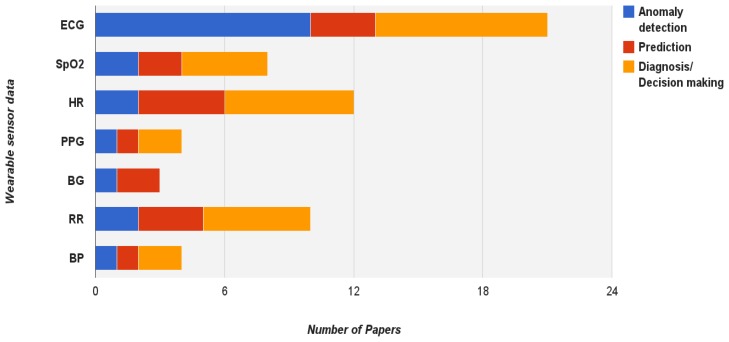
“ECG, which provides mostly the rich data, is predominantly used for all tasks in comparison to the other types of sensors.”
§ Data Mining for Wearable Sensors in Health Monitoring Systems: A Review of Recent Trends and Challenges > Data Mining Tasks for Wearable Sensors
plaincorrelational- Asserted: passes — The authors put it forward as true.
- Checkable: passes — It can be checked against evidence.
- Load-bearing: unclear — It is unclear whether the paper’s conclusions depend on it.
- Based: passes — The paper gives a reason why it holds.
The paper states this without a source or data behind it here, so there is nothing to check it against. The quote shows it is in the paper.
In the paper
“However, for health parameters such as heart rate and blood glucose, the percentage of the tasks dedicated to predication is higher.”
§ Data Mining for Wearable Sensors in Health Monitoring Systems: A Review of Recent Trends and Challenges > Data Mining Tasks for Wearable Sensors
plaincorrelational- Asserted: passes — The authors put it forward as true.
- Checkable: passes — It can be checked against evidence.
- Load-bearing: unclear — It is unclear whether the paper’s conclusions depend on it.
- Based: passes — The paper gives a reason why it holds.
In the paper
“For health monitoring which typically include healthy individuals who want to ensure the maintenance of good health, prediction and anomaly detection are used in the literature [22].”
§ Data Mining for Wearable Sensors in Health Monitoring Systems: A Review of Recent Trends and Challenges > Data Mining Tasks for Wearable Sensors
What the sources say
- Not checked yetcites [22] Mukherjee, A., Pal, A., and Misra, P. (2012, January 12–14). Data Analytics in Ubiquitous Sensor-Based Health Information Systems. Paris, France. source
plaincorrelational- Asserted: passes — The authors put it forward as true.
- Checkable: passes — It can be checked against evidence.
- Load-bearing: unclear — It is unclear whether the paper’s conclusions depend on it.
- Based: passes — The paper gives a reason why it holds.
A result the paper reports from its own data — it cites no other source for it, so there is none to check. The quote shows it is in the paper.
In the paper
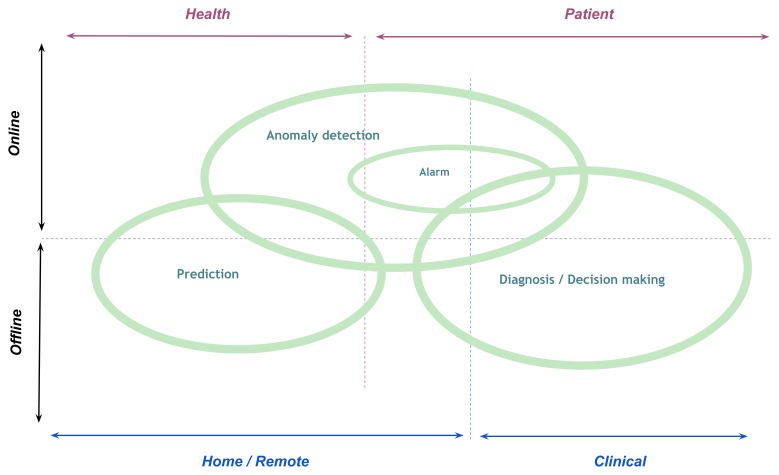
“Based on the selected literature, three types of data mining tasks are predominant. These three tasks are: prediction, anomaly detection which may include the subtask of raising alarms, and diagnosis where a decision making process is made to often categorize the data into different groups depending on the diseases.”
§ Data Mining for Wearable Sensors in Health Monitoring Systems: A Review of Recent Trends and Challenges > Data Mining Tasks for Wearable Sensors
plain- Asserted: passes — The authors put it forward as true.
- Checkable: passes — It can be checked against evidence.
- Load-bearing: passes — The paper’s conclusions depend on it.
- Based: passes — The paper gives a reason why it holds.
- Rests on an assumption: The selected set of more than eighty papers is representative of recent research in data mining for wearable health monitoring.
None of the sources cited for this claim have been checked yet.
In the paper
“According to our review, most of the papers using the anomaly detection approach usually deal with short term [30] and multivariate data sets [31] in order to characterize the entire the data to find discords.”
§ Data Mining for Wearable Sensors in Health Monitoring Systems: A Review of Recent Trends and Challenges > Data Mining Tasks for Wearable Sensors > Anomaly Detection
What the sources say
- Not checked yetcites [30] Huang, G., Zhang, Y., Cao, J., Steyn, M., and Taraporewalla, K. (2013). Online mining abnormal period patterns from multiple medical sensor data streams. World Wide Web. source
- Not checked yetcites [31] Clifton, 2013, Gaussian processes for personalized e-health monitoring with wearable sensors, IEEE Trans. Biomed. Eng. source
plaincorrelational- Asserted: passes — The authors put it forward as true.
- Checkable: passes — It can be checked against evidence.
- Load-bearing: unclear — It is unclear whether the paper’s conclusions depend on it.
- Based: passes — The paper gives a reason why it holds.
None of the sources cited for this claim have been checked yet.
In the paper
“For example, support vector machines [27], Markov models [28] and Wavelet analysis [29] are used in health monitoring systems for anomaly detection.”
§ Data Mining for Wearable Sensors in Health Monitoring Systems: A Review of Recent Trends and Challenges > Data Mining Tasks for Wearable Sensors > Anomaly Detection
What the sources say
- Not checked yetcites [27] Lee, 2012, Low-energy formulations of support vector machine kernel functions for biomedical sensor applications, J. Signal Process. Syst. source
- Not checked yetcites [28] Zhu, 2011, Automatic detection of anomalies in blood glucose using a machine learning approach, J. Commun. Netw. source
- Not checked yetcites [29] Nikita, 2012, Identifying Chronic Disease Complications Utilizing State of the Art Data Fusion Methodologies and Signal Processing Algorithms, Wireless Mobile Communication and Healthcare source
plain- Asserted: passes — The authors put it forward as true.
- Checkable: passes — It can be checked against evidence.
- Load-bearing: unclear — It is unclear whether the paper’s conclusions depend on it.
- Based: passes — The paper gives a reason why it holds.
None of the sources cited for this claim have been checked yet.
In the paper
“Few of the papers have used domain knowledge and predefined information to detect anomalies for decision making such as anomaly detection in sleep episodes [34,35], and finding hazardous stress levels [36].”
§ Data Mining for Wearable Sensors in Health Monitoring Systems: A Review of Recent Trends and Challenges > Data Mining Tasks for Wearable Sensors > Anomaly Detection
What the sources say
- Not checked yetcites [34] Adnane, 2009, Detecting specific health-related events using an integrated sensor system for vital sign monitoring, Sensors source
- Not checked yetcites [35] Adnane, M., Jiang, Z., Mori, N., and Matsumoto, Y. (2011, January 9–11). An Automated Program for Mental Stress and Apnea/Hypopnea Events Detection. Tipaza, Algeria. source
- Not checked yetcites [36] Singh, R.R., Conjeti, S., and Banerjee, R. (2011, January 5–). An Approach for Real-Time Stress-Trend Detection Using Physiological Signals in Wearable Computing Systems for Automotive Drivers. Washington, DC, USA. source
plain- Asserted: passes — The authors put it forward as true.
- Checkable: passes — It can be checked against evidence.
- Load-bearing: unclear — It is unclear whether the paper’s conclusions depend on it.
- Based: passes — The paper gives a reason why it holds.
None of the sources cited for this claim have been checked yet.
In the paper
“Some of the papers considered finding irregular patterns in vital signs time series such as abnormal episodes in ECG pulses [31,32], SpO2 signal [33] and blood glucose level [28], which mostly discover unusual temporal patterns in continuous data.”
§ Data Mining for Wearable Sensors in Health Monitoring Systems: A Review of Recent Trends and Challenges > Data Mining Tasks for Wearable Sensors > Anomaly Detection
What the sources say
- Not checked yetcites [31] Clifton, 2013, Gaussian processes for personalized e-health monitoring with wearable sensors, IEEE Trans. Biomed. Eng. source
- Not checked yetcites [32] Thakker, 2011, Support vector machine for abnormal pulse classification, Int. J. Comput. Appl.
- Not checked yetcites [33] Charbonnier, 2009, On-line adaptive trend extraction of multiple physiological signals for alarm filtering in intensive care units, Int. J. Adapt. Control. Signal. Process. source
- Not checked yetcites [28] Zhu, 2011, Automatic detection of anomalies in blood glucose using a machine learning approach, J. Commun. Netw. source
plain- Asserted: passes — The authors put it forward as true.
- Checkable: passes — It can be checked against evidence.
- Load-bearing: unclear — It is unclear whether the paper’s conclusions depend on it.
- Based: passes — The paper gives a reason why it holds.
In the paper
“Anomaly detection techniques are often developed based on a classification methods to distinguish the data set into normal class and outliers [26].”
§ Data Mining for Wearable Sensors in Health Monitoring Systems: A Review of Recent Trends and Challenges > Data Mining Tasks for Wearable Sensors > Anomaly Detection
What the sources say
- Not checked yetcites [26] Gaura, E., Kemp, J., and Brusey, J. (2013). Leveraging knowledge from physiological data: On-body heat stress risk prediction with sensor networks. IEEE Trans. Biomed. Circuits Syst., in press. source
plain- Asserted: passes — The authors put it forward as true.
- Checkable: passes — It can be checked against evidence.
- Load-bearing: unclear — It is unclear whether the paper’s conclusions depend on it.
- Based: passes — The paper gives a reason why it holds.
None of the sources cited for this claim have been checked yet.
In the paper
“As the common examples of the predictive models, authors in [38,39] presented a method which predicts the further stress levels of a subject.”
§ Data Mining for Wearable Sensors in Health Monitoring Systems: A Review of Recent Trends and Challenges > Data Mining Tasks for Wearable Sensors > Prediction
What the sources say
- Not checked yetcites [38] 2013, Experimental Study of the Stress Level at the Workplace Using an Smart Testbed of Wireless Sensor Networks and Ambient Intelligence Techniques, Natural and Artificial Computation in Engineering and Medical Applications source
- Not checked yetcites [39] Gris, 2012, Activity-Aware Mental Stress Detection Using Physiological Sensors, Mobile Computing, Applications, and Services source
plain- Asserted: passes — The authors put it forward as true.
- Checkable: passes — It can be checked against evidence.
- Load-bearing: unclear — It is unclear whether the paper’s conclusions depend on it.
- Based: passes — The paper gives a reason why it holds.
- It may state two separate claims as one. 50
- Probably not a substantial claim. 110
The paper states this without a source or data behind it here, so there is nothing to check it against. The quote shows it is in the paper.
In the paper
“Equal emphasis is placed on anomaly detection and diagnosis and less attention put on prediction.”
§ Data Mining for Wearable Sensors in Health Monitoring Systems: A Review of Recent Trends and Challenges > Data Mining Tasks for Wearable Sensors
plain- Asserted: passes — The authors put it forward as true.
- Checkable: passes — It can be checked against evidence.
- Load-bearing: unclear — It is unclear whether the paper’s conclusions depend on it.
- Based: passes — The paper gives a reason why it holds.
It may state two separate claims as one.
In the paper
“For all three tasks data has been addressed both in an online and offline manner, with more alarm related tasks being naturally used in the context of online and continuous monitoring [1].”
§ Data Mining for Wearable Sensors in Health Monitoring Systems: A Review of Recent Trends and Challenges > Data Mining Tasks for Wearable Sensors
What the sources say
- Not checked yetcites [1] Aggarwal, C.C. (2013). Managing and Mining Sensor Data, Springer. source
plaincorrelational- Asserted: passes — The authors put it forward as true.
- Checkable: passes — It can be checked against evidence.
- Load-bearing: unclear — It is unclear whether the paper’s conclusions depend on it.
- Based: passes — The paper gives a reason why it holds.
It may state two separate claims as one.
The paper states this without a source or data behind it here, so there is nothing to check it against. The quote shows it is in the paper.
In the paper
“For patients with known medical records, both diagnosis and specifically the possibility to raise alarms are key tasks.”
§ Data Mining for Wearable Sensors in Health Monitoring Systems: A Review of Recent Trends and Challenges > Data Mining Tasks for Wearable Sensors
plain- Asserted: passes — The authors put it forward as true.
- Checkable: passes — It can be checked against evidence.
- Load-bearing: unclear — It is unclear whether the paper’s conclusions depend on it.
- Based: passes — The paper gives a reason why it holds.
It may state two separate claims as one.
None of the sources cited for this claim have been checked yet.
In the paper
“Based on the literature, most monitoring applications which consider home settings or remote monitoring deal predominantly with prediction and anomaly detection whereas the applications in clinical settings are typically focused on diagnosis [10,21].”
§ Data Mining for Wearable Sensors in Health Monitoring Systems: A Review of Recent Trends and Challenges > Data Mining Tasks for Wearable Sensors
What the sources say
plaincorrelational- Asserted: passes — The authors put it forward as true.
- Checkable: passes — It can be checked against evidence.
- Load-bearing: unclear — It is unclear whether the paper’s conclusions depend on it.
- Based: passes — The paper gives a reason why it holds.
It may state two separate claims as one.
In the paper
“However, anomaly detection task could use offline techniques in order to detect abnormal reading for each individual based on the historical measurements for the person [28], since the definition of the abnormal patterns can be different for each subject.”
§ Data Mining for Wearable Sensors in Health Monitoring Systems: A Review of Recent Trends and Challenges > Data Mining Tasks for Wearable Sensors > Anomaly Detection
What the sources say
- Not checked yetcites [28] Zhu, 2011, Automatic detection of anomalies in blood glucose using a machine learning approach, J. Commun. Netw. source
hedged- Asserted: passes — The authors put it forward as true.
- Checkable: passes — It can be checked against evidence.
- Load-bearing: unclear — It is unclear whether the paper’s conclusions depend on it.
- Based: passes — The paper gives a reason why it holds.
It may state two separate claims as one.
In the paper
“In online health monitoring systems, raising alarm as soon as detecting any anomaly in vital signs will be triggered to have instant reaction and such alarm system are usually designed for monitoring patients in clinical units [33].”
§ Data Mining for Wearable Sensors in Health Monitoring Systems: A Review of Recent Trends and Challenges > Data Mining Tasks for Wearable Sensors > Anomaly Detection
What the sources say
- Not checked yetcites [33] Charbonnier, 2009, On-line adaptive trend extraction of multiple physiological signals for alarm filtering in intensive care units, Int. J. Adapt. Control. Signal. Process. source
plaindirect- Asserted: passes — The authors put it forward as true.
- Checkable: passes — It can be checked against evidence.
- Load-bearing: fails — The paper’s conclusions may not depend on it.
- Based: passes — The paper gives a reason why it holds.
Probably not a substantial claim. The paper’s conclusions may not depend on it. It may state two separate claims as one.
None of the sources cited for this claim have been checked yet.
In the paper
“This approach is getting more and more interest for the healthcare providers in the medical domain since it helps to prevent further chronic problems [18] and could lead to a decision about prognosis [37].”
§ Data Mining for Wearable Sensors in Health Monitoring Systems: A Review of Recent Trends and Challenges > Data Mining Tasks for Wearable Sensors > Prediction
What the sources say
- Not checked yetcites [18] Bellazzi, 2011, Predictive data mining in clinical medicine: A focus on selected methods and applications, Wiley. Interdiscip. Rev.: Data. Min. Knowl. Discov.
- Not checked yetcites [37] Bellazzi, 2008, Predictive data mining in clinical medicine: Current issues and guidelines, Int. J. Med. Inform. source
hedgeddirect- Asserted: passes — The authors put it forward as true.
- Checkable: passes — It can be checked against evidence.
- Load-bearing: unclear — It is unclear whether the paper’s conclusions depend on it.
- Based: passes — The paper gives a reason why it holds.
It may state two separate claims as one.
None of the sources cited for this claim have been checked yet.
In the paper
“A similar example of using predictive models in healthcare are: blood glucose level prediction [23], mortality prediction by clustering electronic health data [40], and a predictive decision making system for dialysis patients [41].”
§ Data Mining for Wearable Sensors in Health Monitoring Systems: A Review of Recent Trends and Challenges > Data Mining Tasks for Wearable Sensors > Prediction
What the sources say
- Not checked yetcites [23] Chatterjee, S., Dutta, K., Xie, H.Q., Byun, J., Pottathil, A., and Moore, M. (2013, January 7–10). Persuasive and Pervasive Sensing: A New Frontier to Monitor, Track and Assist Older Adults Suffering from Type-2 Diabetes. Grand Wailea, Maui, HI, USA. source
- Not checked yetcites [40] Marlin, B.M., Kale, D.C., Khemani, R.G., and Wetzel, R.C. (, January January). Unsupervised Pattern Discovery in Electronic Health Care Data Using Probabilistic Clustering Models. Miami, FL, USA.
- Not checked yetcites [41] Yeh, 2011, Using data mining techniques to predict hospitalization of hemodialysis patients, Decis. Support Syst. source
plain- Asserted: passes — The authors put it forward as true.
- Checkable: passes — It can be checked against evidence.
- Load-bearing: fails — The paper’s conclusions may not depend on it.
- Based: passes — The paper gives a reason why it holds.
Probably not a substantial claim. The paper’s conclusions may not depend on it. It may state two separate claims as one.
None of the sources cited for this claim have been checked yet.
In the paper
“Some examples of recent works in this area involve estimating the severity of health episodes of patients suffering chronic disease [44–46], sleep issues such as polysomnography and apnea [47,48], estimation and classification of health conditions [49,50], and emotion recognition [51].”
§ Data Mining for Wearable Sensors in Health Monitoring Systems: A Review of Recent Trends and Challenges > Data Mining Tasks for Wearable Sensors > Diagnosis/Decision Making
What the sources say
- Not checked yetcites [44] Nikita, 2012, A Support Vector Machine Approach for Categorization of Patients Suffering from Chronic Diseases, Wireless Mobile Communication and Healthcare source
- Not checked yetcites [45] Giri, 2013, Automated diagnosis of Coronary Artery Disease affected patients using LDA, PCA, ICA and Discrete Wavelet Transform, Know. Based Syst. source
- Not checked yetcites [46] Bellos, C., Papadopoulos, A., Rosso, R., and Fotiadis, D.I. (2012, January 5–7). Categorization of Patients' Health Status in Copd Disease Using a Wearable Platform and Random Forests Methodology. Shenzhen, China. source
- Not checked yetcites [47] Bianchi, 2010, Processing of signals recorded through smart devices: Sleep-quality assessment, IEEE Trans. Inf. Technol. Biomed. source
- Not checked yetcites [48] Xie, 2012, Real-time sleep apnea detection by classifier combination, IEEE Trans. Inf. Technol. Biomed. source
- Not checked yetcites [49] Vu, 2010, Online discovery of Heart Rate Variability patterns in mobile healthcare services, J. Syst. Softw. source
- Not checked yetcites [50] Pantelopoulos, 2010, Prognosis—a wearable health-monitoring system for people at risk: Methodology and modeling, IEEE Trans. Inf. Technol. Biomed. source
plain- Asserted: passes — The authors put it forward as true.
- Checkable: passes — It can be checked against evidence.
- Load-bearing: unclear — It is unclear whether the paper’s conclusions depend on it.
- Based: passes — The paper gives a reason why it holds.
It may state two separate claims as one.
In the paper
“Decision making in diagnosis is one of the main tasks of clinical monitoring systems which is often based on retrieved knowledge using vital signs, and also other information such as electronic health records and metadata [43].”
§ Data Mining for Wearable Sensors in Health Monitoring Systems: A Review of Recent Trends and Challenges > Data Mining Tasks for Wearable Sensors > Diagnosis/Decision Making
What the sources say
- Not checked yetcites [43] Sneha, 2009, Enabling ubiquitous patient monitoring: Model, decision protocols, opportunities and challenges, Decis. Support Syst. source
plaincorrelational- Asserted: passes — The authors put it forward as true.
- Checkable: passes — It can be checked against evidence.
- Load-bearing: unclear — It is unclear whether the paper’s conclusions depend on it.
- Based: passes — The paper gives a reason why it holds.
It may state two separate claims as one.
None of the sources cited for this claim have been checked yet.
In the paper
“In order to conduct these problems, several data mining techniques are applied such as wavelet analysis for artifact reduction [53] and data compression [54], rule-based methods for data summarizing and transmitting [55,56], and Gaussian process for secure authentication [57].”
§ Data Mining for Wearable Sensors in Health Monitoring Systems: A Review of Recent Trends and Challenges > Data Mining Tasks for Wearable Sensors > Other Data Mining Tasks for Wearable Sensors
What the sources say
- Not checked yetcites [53] Naraharisetti, K.V.P., Bawa, M., and Tahernezhadi, M. (2011, January 15–17). Comparison of Different Signal Processing Methods for Reducing Artifacts from Photoplethysmograph Signal. Mankato, MN, USA. source
- Not checked yetcites [54] Ding, H., Sun, H., and mean Hou, K. (2011, January 9–11). Abnormal ECG Signal Detection Based on Compressed Sampling in Wearable ECG Sensor. Nanjing, China. source
- Not checked yetcites [55] Yoon, J. (2013, January 23–28). Three-Tiered Data Mining for Big Data Patterns of Wireless Sensor Networks in Medical and Healthcare Domains. Rome, Italy.
- Not checked yetcites [56] Ahmad, N.F., Hoang, D.B., and Phung, M.H. (2009, January 16–18). Robust Preprocessing for Health Care Monitoring Framework. Sydney, Australia. source
plaindirect- Asserted: passes — The authors put it forward as true.
- Checkable: passes — It can be checked against evidence.
- Load-bearing: unclear — It is unclear whether the paper’s conclusions depend on it.
- Based: passes — The paper gives a reason why it holds.
It may state two separate claims as one.
None of the sources cited for this claim have been checked yet.
In the paper
“According to [1,19], most healthcare systems are dealing with the following issues: (1) data acquisition using the adequate sensor set; (2) transmission of data from subject to clinician; (3) integration of data with other descriptive data; and (4) data storage.”
§ Data Mining for Wearable Sensors in Health Monitoring Systems: A Review of Recent Trends and Challenges > Data Mining Tasks for Wearable Sensors > Other Data Mining Tasks for Wearable Sensors
What the sources say
plain- Asserted: passes — The authors put it forward as true.
- Checkable: passes — It can be checked against evidence.
- Load-bearing: unclear — It is unclear whether the paper’s conclusions depend on it.
- Based: passes — The paper gives a reason why it holds.
It may state two separate claims as one.
The paper states this without a source or data behind it here, so there is nothing to check it against. The quote shows it is in the paper.
In the paper
“The main role of data mining in healthcare monitoring systems is retrieving information (i.e., anomaly detection, prediction and diagnosis decision making), and there are several tasks considering wearable sensors that data mining methods are able to carry out.”
§ Data Mining for Wearable Sensors in Health Monitoring Systems: A Review of Recent Trends and Challenges > Data Mining Tasks for Wearable Sensors > Other Data Mining Tasks for Wearable Sensors
plain- Asserted: passes — The authors put it forward as true.
- Checkable: passes — It can be checked against evidence.
- Load-bearing: unclear — It is unclear whether the paper’s conclusions depend on it.
- Based: passes — The paper gives a reason why it holds.
It may state two separate claims as one.
The paper states this without a source or data behind it here, so there is nothing to check it against. The quote shows it is in the paper.
In the paper
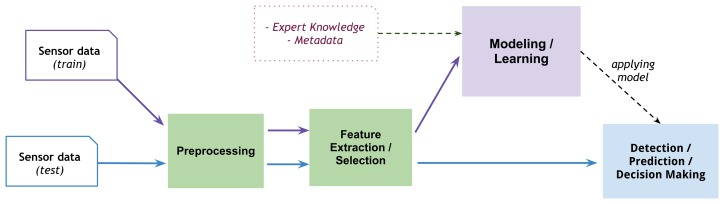
“The main steps of the data mining approach consist (1) data preprocessing; (2) feature extraction and selection; and (3) modelling data learning the input features (considering expert knowledge and metadata) to perform the tasks such as detection, prediction, and decision making.”
§ Data Mining for Wearable Sensors in Health Monitoring Systems: A Review of Recent Trends and Challenges > Data Mining Approach
plain- Asserted: passes — The authors put it forward as true.
- Checkable: passes — It can be checked against evidence.
- Load-bearing: fails — The paper’s conclusions may not depend on it.
- Based: passes — The paper gives a reason why it holds.
Probably not a substantial claim. The paper’s conclusions may not depend on it.
The paper states this without a source or data behind it here, so there is nothing to check it against. The quote shows it is in the paper.
In the paper
“Most of these researches have used online databases with annotated episodes in order to have sufficient and trustable real-world disease labels to evaluate the decision making process.”
§ Data Mining for Wearable Sensors in Health Monitoring Systems: A Review of Recent Trends and Challenges > Data Mining Tasks for Wearable Sensors > Diagnosis/Decision Making
plain- Asserted: passes — The authors put it forward as true.
- Checkable: passes — It can be checked against evidence.
- Load-bearing: fails — The paper’s conclusions may not depend on it.
- Based: passes — The paper gives a reason why it holds.
Probably not a substantial claim. The paper’s conclusions may not depend on it.
The paper states this without a source or data behind it here, so there is nothing to check it against. The quote shows it is in the paper.
In the paper
“Data mining techniques that have been applied to wearable sensor data in health monitoring systems have varied and it is also not uncommon that several techniques are used within the same architecture.”
§ Data Mining for Wearable Sensors in Health Monitoring Systems: A Review of Recent Trends and Challenges > Data Mining Approach
plain- Asserted: passes — The authors put it forward as true.
- Checkable: passes — It can be checked against evidence.
- Load-bearing: fails — The paper’s conclusions may not depend on it.
- Based: fails — The paper may give no reason why it holds.
Probably not a substantial claim. The paper’s conclusions may not depend on it. The paper may give no reason why it holds. It may state two separate claims as one.
None of the sources cited for this claim have been checked yet.
In the paper
“This metadata provides contextual analysis and improves the process of knowledge extraction [29,57].”
§ Data Mining for Wearable Sensors in Health Monitoring Systems: A Review of Recent Trends and Challenges > Data Mining Approach
What the sources say
- Not checked yetcites [29] Nikita, 2012, Identifying Chronic Disease Complications Utilizing State of the Art Data Fusion Methodologies and Signal Processing Algorithms, Wireless Mobile Communication and Healthcare source
- Not checked yetcites [57] Wang, 2011, Secure stochastic ECG signals based on gaussian mixture model for e-healthcare systems, IEEE Syst. J. source
plaindirect- Asserted: passes — The authors put it forward as true.
- Checkable: passes — It can be checked against evidence.
- Load-bearing: unclear — It is unclear whether the paper’s conclusions depend on it.
- Based: passes — The paper gives a reason why it holds.
It may state two separate claims as one.
The paper states this without a source or data behind it here, so there is nothing to check it against. The quote shows it is in the paper.
In the paper
“For this reason recent health monitoring systems have given more attention to the data processing phase in order to catch more valuable information based on the expert user requirements.”
§ Data Mining for Wearable Sensors in Health Monitoring Systems: A Review of Recent Trends and Challenges > Data Mining Approach
plaindirect- Asserted: passes — The authors put it forward as true.
- Checkable: passes — It can be checked against evidence.
- Load-bearing: fails — The paper’s conclusions may not depend on it.
- Based: fails — The paper may give no reason why it holds.
Probably not a substantial claim. The paper’s conclusions may not depend on it. The paper may give no reason why it holds.
None of the sources cited for this claim have been checked yet.
In the paper
“According to the literature, for filtering artifacts, designed modules have usually applied threshold-based methods to filter sensor data [36,60] or used statistical tools to interpolate the missing data points [61].”
§ Data Mining for Wearable Sensors in Health Monitoring Systems: A Review of Recent Trends and Challenges > Data Mining Approach > Preprocessing
What the sources say
- Not checked yetcites [36] Singh, R.R., Conjeti, S., and Banerjee, R. (2011, January 5–). An Approach for Real-Time Stress-Trend Detection Using Physiological Signals in Wearable Computing Systems for Automotive Drivers. Washington, DC, USA. source
- Not checked yetcites [60] Mao, Y., Chen, W., Chen, Y., Lu, C., Kollef, M., and Bailey, T. (2012, January 16–18). An Integrated Data Mining Approach to Real-Time Clinical Monitoring and Deterioration Warning. Beijing, China. source
- Not checked yetcites [61] Apiletti, 2009, Real-time analysis of physiological data to support medical applications, Trans. Info. Tech. Biomed. source
plain- Asserted: passes — The authors put it forward as true.
- Checkable: passes — It can be checked against evidence.
- Load-bearing: unclear — It is unclear whether the paper’s conclusions depend on it.
- Based: passes — The paper gives a reason why it holds.
It may state two separate claims as one.
None of the sources cited for this claim have been checked yet.
In the paper
“For example in ECG data, several works have been done to improve the quality of signals for accurate analysis [29,32].”
§ Data Mining for Wearable Sensors in Health Monitoring Systems: A Review of Recent Trends and Challenges > Data Mining Approach > Preprocessing
What the sources say
- Not checked yetcites [29] Nikita, 2012, Identifying Chronic Disease Complications Utilizing State of the Art Data Fusion Methodologies and Signal Processing Algorithms, Wireless Mobile Communication and Healthcare source
- Not checked yetcites [32] Thakker, 2011, Support vector machine for abnormal pulse classification, Int. J. Comput. Appl.
plain- Asserted: passes — The authors put it forward as true.
- Checkable: passes — It can be checked against evidence.
- Load-bearing: fails — The paper’s conclusions may not depend on it.
- Based: passes — The paper gives a reason why it holds.
Probably not a substantial claim. The paper’s conclusions may not depend on it.
None of the sources cited for this claim have been checked yet.
In the paper
“Preprocessing in the healthcare domain involves (1) filter unusual data to remove artifacts and (2) remove high frequency noise [1,13].”
§ Data Mining for Wearable Sensors in Health Monitoring Systems: A Review of Recent Trends and Challenges > Data Mining Approach > Preprocessing
What the sources say
plain- Asserted: passes — The authors put it forward as true.
- Checkable: passes — It can be checked against evidence.
- Load-bearing: fails — The paper’s conclusions may not depend on it.
- Based: passes — The paper gives a reason why it holds.
Probably not a substantial claim. The paper’s conclusions may not depend on it. It may state two separate claims as one.
None of the sources cited for this claim have been checked yet.
In the paper
“To remove frequency noise, the other methods in frequency domain such as such as power spectral density (PSD) fast Fourier transforms (FFT), and low-pass/high-pass filtering tools are common to remove the fluctuations in sensor signals [51,62].”
§ Data Mining for Wearable Sensors in Health Monitoring Systems: A Review of Recent Trends and Challenges > Data Mining Approach > Preprocessing
What the sources say
- Not checked yetcites [51] Frantzidis, 2010, On the classification of emotional biosignals evoked while viewing affective pictures: An integrated data-mining-based approach for healthcare applications, Trans. Inf. Tech. Biomed. source
- Not checked yetcites [62] Hu, 2008, medical ad hoc sensor networks (MASN) with wavelet-based ECG data mining, Ad Hoc Robust Netw. source
plaindirect- Asserted: passes — The authors put it forward as true.
- Checkable: passes — It can be checked against evidence.
- Load-bearing: fails — The paper’s conclusions may not depend on it.
- Based: passes — The paper gives a reason why it holds.
Probably not a substantial claim. The paper’s conclusions may not depend on it.
The paper states this without a source or data behind it here, so there is nothing to check it against. The quote shows it is in the paper.
In the paper
“However, there is no tailored work considering these issues in detail for real life scenarios.”
§ Data Mining for Wearable Sensors in Health Monitoring Systems: A Review of Recent Trends and Challenges > Data Mining Approach > Preprocessing
plain- Asserted: passes — The authors put it forward as true.
- Checkable: passes — It can be checked against evidence.
- Load-bearing: fails — The paper’s conclusions may not depend on it.
- Based: fails — The paper may give no reason why it holds.
Probably not a substantial claim. The paper’s conclusions may not depend on it. The paper may give no reason why it holds.
None of the sources cited for this claim have been checked yet.
In the paper
“Moreover, reducing the amount of sensor network data is another task in feature extraction and feature selection phases which leads to have an arranged vector of features as an input of data mining techniques like classifier methods [45,60].”
§ Data Mining for Wearable Sensors in Health Monitoring Systems: A Review of Recent Trends and Challenges > Data Mining Approach > Feature Extraction/Selection
What the sources say
- Not checked yetcites [45] Giri, 2013, Automated diagnosis of Coronary Artery Disease affected patients using LDA, PCA, ICA and Discrete Wavelet Transform, Know. Based Syst. source
- Not checked yetcites [60] Mao, Y., Chen, W., Chen, Y., Lu, C., Kollef, M., and Bailey, T. (2012, January 16–18). An Integrated Data Mining Approach to Real-Time Clinical Monitoring and Deterioration Warning. Beijing, China. source
plaindirect- Asserted: passes — The authors put it forward as true.
- Checkable: passes — It can be checked against evidence.
- Load-bearing: fails — The paper’s conclusions may not depend on it.
- Based: passes — The paper gives a reason why it holds.
Probably not a substantial claim. The paper’s conclusions may not depend on it.
In the paper
“Especially in wearable sensor data, according to the magnitude and complexity of the raw data, feature extraction provides a meaningful representation of the sensor data which can formulate the relation of raw data with the expected knowledge for decision making [64].”
§ Data Mining for Wearable Sensors in Health Monitoring Systems: A Review of Recent Trends and Challenges > Data Mining Approach > Feature Extraction/Selection
What the sources say
- Not checked yetcites [64] Bellos, C.C., Papadopoulos, A., Rosso, R., and Fotiadis, D.I. (2010, January 3–5). Extraction and Analysis of Features Acquired By Wearable Sensors Network. Corfu, Greece. source
plaindirect- Asserted: passes — The authors put it forward as true.
- Checkable: passes — It can be checked against evidence.
- Load-bearing: fails — The paper’s conclusions may not depend on it.
- Based: passes — The paper gives a reason why it holds.
Probably not a substantial claim. The paper’s conclusions may not depend on it.
In the paper
“The main challenges of the preprocessing phase in healthcare systems are addressed in [1] which includes data formatting, data normalization, and data synchronization.”
§ Data Mining for Wearable Sensors in Health Monitoring Systems: A Review of Recent Trends and Challenges > Data Mining Approach > Preprocessing
What the sources say
- Not checked yetcites [1] Aggarwal, C.C. (2013). Managing and Mining Sensor Data, Springer. source
plain- Asserted: passes — The authors put it forward as true.
- Checkable: passes — It can be checked against evidence.
- Load-bearing: unclear — It is unclear whether the paper’s conclusions depend on it.
- Based: passes — The paper gives a reason why it holds.
It may state two separate claims as one.
In the paper
“Two main aspects of analyzing signals are time domain and spectral domain [14].”
§ Data Mining for Wearable Sensors in Health Monitoring Systems: A Review of Recent Trends and Challenges > Data Mining Approach > Feature Extraction/Selection
What the sources say
- Not checked yetcites [14] Avci, A., Bosch, S., Marin-Perianu, M., Marin-Perianu, R., and Havinga, P. (2010, January 22–23). Activity Recognition Using Inertial Sensing for Healthcare, Wellbeing and Sports Applications: A Survey. Hannover, Germany.
plain- Asserted: passes — The authors put it forward as true.
- Checkable: passes — It can be checked against evidence.
- Load-bearing: fails — The paper’s conclusions may not depend on it.
- Based: passes — The paper gives a reason why it holds.
Probably not a substantial claim. The paper’s conclusions may not depend on it.
None of the sources cited for this claim have been checked yet.
In the paper
“Three most popular approaches for dimension reduction in medical domain are PCA, ICA, and LDA [66] which are statistically selecting the subset of the most significant features [45,67].”
§ Data Mining for Wearable Sensors in Health Monitoring Systems: A Review of Recent Trends and Challenges > Data Mining Approach > Feature Extraction/Selection
What the sources say
- Not checked yetcites [66] Widodo, 2007, Application of nonlinear feature extraction and support vector machines for fault diagnosis of induction motors, Expert Syst. Appl. source
- Not checked yetcites [45] Giri, 2013, Automated diagnosis of Coronary Artery Disease affected patients using LDA, PCA, ICA and Discrete Wavelet Transform, Know. Based Syst. source
- Not checked yetcites [67] Li, X., and Porikli, F. (2010, January 23–26). Human State Classification and Predication for Critical Care Monitoring by Real-Time Bio-signal Analysis. Istanbul, Turkey. source
plain- Asserted: passes — The authors put it forward as true.
- Checkable: passes — It can be checked against evidence.
- Load-bearing: unclear — It is unclear whether the paper’s conclusions depend on it.
- Based: passes — The paper gives a reason why it holds.
It may state two separate claims as one.
The paper states this without a source or data behind it here, so there is nothing to check it against. The quote shows it is in the paper.
In the paper
“For physiological data, using feature selection techniques leads to reduce the dimensions of input data.”
§ Data Mining for Wearable Sensors in Health Monitoring Systems: A Review of Recent Trends and Challenges > Data Mining Approach > Feature Extraction/Selection
plaindirect- Asserted: passes — The authors put it forward as true.
- Checkable: passes — It can be checked against evidence.
- Load-bearing: fails — The paper’s conclusions may not depend on it.
- Based: passes — The paper gives a reason why it holds.
Probably not a substantial claim. The paper’s conclusions may not depend on it.
None of the sources cited for this claim have been checked yet.
In the paper
“As an example, for the works studying ECG signals, although Bsoul et al. [65] have proposed dozens of features, the main focus of research is to consider R points (the pick point of each beat), and its properties in ECG pulses such as R-R intervals, pick counts, etc. [39,64].”
§ Data Mining for Wearable Sensors in Health Monitoring Systems: A Review of Recent Trends and Challenges > Data Mining Approach > Feature Extraction/Selection
What the sources say
- Not checked yetcites [65] Bsoul, 2011, Apnea medassist: Real-time sleep apnea monitor using single-lead ECG, IEEE Trans. Inf. Technol. Biomed. source
- Not checked yetcites [39] Gris, 2012, Activity-Aware Mental Stress Detection Using Physiological Sensors, Mobile Computing, Applications, and Services source
- Not checked yetcites [64] Bellos, C.C., Papadopoulos, A., Rosso, R., and Fotiadis, D.I. (2010, January 3–5). Extraction and Analysis of Features Acquired By Wearable Sensors Network. Corfu, Greece. source
plain- Asserted: passes — The authors put it forward as true.
- Checkable: passes — It can be checked against evidence.
- Load-bearing: unclear — It is unclear whether the paper’s conclusions depend on it.
- Based: passes — The paper gives a reason why it holds.
It may state two separate claims as one.
In the paper
“Besides the features from these domains, there are other considered features which such as heuristic and specific field features [61].”
§ Data Mining for Wearable Sensors in Health Monitoring Systems: A Review of Recent Trends and Challenges > Data Mining Approach > Feature Extraction/Selection
What the sources say
- Not checked yetcites [61] Apiletti, 2009, Real-time analysis of physiological data to support medical applications, Trans. Info. Tech. Biomed. source
plain- Asserted: passes — The authors put it forward as true.
- Checkable: passes — It can be checked against evidence.
- Load-bearing: fails — The paper’s conclusions may not depend on it.
- Based: passes — The paper gives a reason why it holds.
Probably not a substantial claim. The paper’s conclusions may not depend on it.
None of the sources cited for this claim have been checked yet.
In the paper
“Other tools for feature selection used in the literature includes threshold-based rules [61], analysis of variance (ANOVA) [51], and Fourier transforms [52].”
§ Data Mining for Wearable Sensors in Health Monitoring Systems: A Review of Recent Trends and Challenges > Data Mining Approach > Feature Extraction/Selection
What the sources say
- Not checked yetcites [61] Apiletti, 2009, Real-time analysis of physiological data to support medical applications, Trans. Info. Tech. Biomed. source
- Not checked yetcites [51] Frantzidis, 2010, On the classification of emotional biosignals evoked while viewing affective pictures: An integrated data-mining-based approach for healthcare applications, Trans. Inf. Tech. Biomed. source
- Not checked yetcites [52] Karlen, 2009, Sleep and wake classification with ECG and respiratory effort signals, IEEE Trans. Biomed. Circuits Syst. source
plain- Asserted: passes — The authors put it forward as true.
- Checkable: passes — It can be checked against evidence.
- Load-bearing: fails — The paper’s conclusions may not depend on it.
- Based: passes — The paper gives a reason why it holds.
Probably not a substantial claim. The paper’s conclusions may not depend on it. It may state two separate claims as one.
In the paper
“Similarly, [27] developed an SVM method for detecting the arrhythmia and seizure episodes while ECG signals.”
§ Data Mining for Wearable Sensors in Health Monitoring Systems: A Review of Recent Trends and Challenges > Data Mining Approach > Modeling and Learning Methods
What the sources say
- Not checked yetcites [27] Lee, 2012, Low-energy formulations of support vector machine kernel functions for biomedical sensor applications, J. Signal Process. Syst. source
plain- Asserted: passes — The authors put it forward as true.
- Checkable: passes — It can be checked against evidence.
- Load-bearing: fails — The paper’s conclusions may not depend on it.
- Based: passes — The paper gives a reason why it holds.
Probably not a substantial claim. The paper’s conclusions may not depend on it.
The paper states this without a source or data behind it here, so there is nothing to check it against. The quote shows it is in the paper.
In the paper
“Further, when multiple sensors are used, this data is multivariate with possible dependencies.”
§ Data Mining for Wearable Sensors in Health Monitoring Systems: A Review of Recent Trends and Challenges > Data Mining Approach > Modeling and Learning Methods
hedgedcorrelational- Asserted: passes — The authors put it forward as true.
- Checkable: passes — It can be checked against evidence.
- Load-bearing: fails — The paper’s conclusions may not depend on it.
- Based: passes — The paper gives a reason why it holds.
Probably not a substantial claim. The paper’s conclusions may not depend on it. It may state two separate claims as one.
The paper states this without a source or data behind it here, so there is nothing to check it against. The quote shows it is in the paper.
In the paper
“Although most of the proposed frameworks in the healthcare domain contain feature extraction/selection phases, the main challenge still is to balance between the optimum feature extraction/selection methods and their costs for the system.”
§ Data Mining for Wearable Sensors in Health Monitoring Systems: A Review of Recent Trends and Challenges > Data Mining Approach > Feature Extraction/Selection
plain- Asserted: passes — The authors put it forward as true.
- Checkable: passes — It can be checked against evidence.
- Load-bearing: passes — The paper’s conclusions depend on it.
- Based: passes — The paper gives a reason why it holds.
It may state two separate claims as one.
The paper states this without a source or data behind it here, so there is nothing to check it against. The quote shows it is in the paper.
In the paper
“However, its solution is still to be addressed in recent research.”
§ Data Mining for Wearable Sensors in Health Monitoring Systems: A Review of Recent Trends and Challenges > Data Mining Approach > Feature Extraction/Selection
plain- Asserted: passes — The authors put it forward as true.
- Checkable: passes — It can be checked against evidence.
- Load-bearing: passes — The paper’s conclusions depend on it.
- Based: passes — The paper gives a reason why it holds.
Probably not a substantial claim.
In the paper
“Hu et al. [62] used SVM to find out arrhythmia in ECG signals.”
§ Data Mining for Wearable Sensors in Health Monitoring Systems: A Review of Recent Trends and Challenges > Data Mining Approach > Modeling and Learning Methods
What the sources say
- Not checked yetcites [62] Hu, 2008, medical ad hoc sensor networks (MASN) with wavelet-based ECG data mining, Ad Hoc Robust Netw. source
plaindirect- Asserted: passes — The authors put it forward as true.
- Checkable: passes — It can be checked against evidence.
- Load-bearing: fails — The paper’s conclusions may not depend on it.
- Based: passes — The paper gives a reason why it holds.
Probably not a substantial claim. The paper’s conclusions may not depend on it.
The paper states this without a source or data behind it here, so there is nothing to check it against. The quote shows it is in the paper.
In the paper
“When such sensors are deployed in applications such as home monitoring, a large amount of data can be generated.”
§ Data Mining for Wearable Sensors in Health Monitoring Systems: A Review of Recent Trends and Challenges > Data Mining Approach > Modeling and Learning Methods
plainconditional- Asserted: passes — The authors put it forward as true.
- Checkable: passes — It can be checked against evidence.
- Load-bearing: fails — The paper’s conclusions may not depend on it.
- Based: fails — The paper may give no reason why it holds.
Probably not a substantial claim. The paper’s conclusions may not depend on it. The paper may give no reason why it holds.
In the paper
“It applied a binary classifier version of SVM to categorize ECG signals into normal and arrhythmia classes.”
§ Data Mining for Wearable Sensors in Health Monitoring Systems: A Review of Recent Trends and Challenges > Data Mining Approach > Modeling and Learning Methods
What the sources say
- Not checked yetcites [62] Hu, 2008, medical ad hoc sensor networks (MASN) with wavelet-based ECG data mining, Ad Hoc Robust Netw. source
plain- Asserted: passes — The authors put it forward as true.
- Checkable: passes — It can be checked against evidence.
- Load-bearing: fails — The paper’s conclusions may not depend on it.
- Based: passes — The paper gives a reason why it holds.
Probably not a substantial claim. The paper’s conclusions may not depend on it.
The paper states this without a source or data behind it here, so there is nothing to check it against. The quote shows it is in the paper.
In the paper
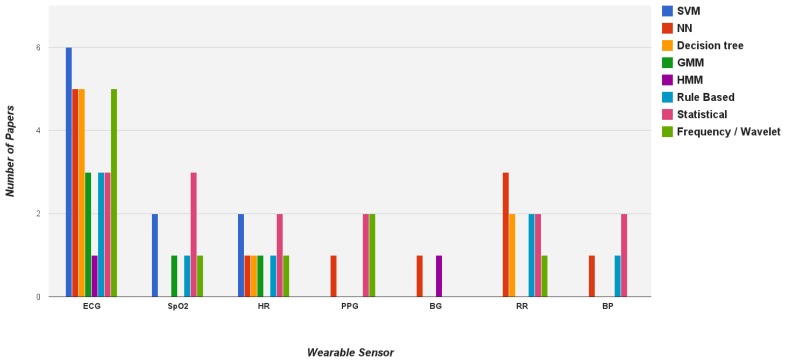
“Common health parameters considered by SVM methods are ECG, HR, and SpO2 which are mostly used in the short term and annotated form.”
§ Data Mining for Wearable Sensors in Health Monitoring Systems: A Review of Recent Trends and Challenges > Data Mining Approach > Modeling and Learning Methods
plain- Asserted: passes — The authors put it forward as true.
- Checkable: passes — It can be checked against evidence.
- Load-bearing: unclear — It is unclear whether the paper’s conclusions depend on it.
- Based: passes — The paper gives a reason why it holds.
It may state two separate claims as one.
The paper states this without a source or data behind it here, so there is nothing to check it against. The quote shows it is in the paper.
In the paper
“As the SVM has the ability to handle high dimensional data using minimal training set of features, it is recently very popular for mining physiological data in medical applications.”
§ Data Mining for Wearable Sensors in Health Monitoring Systems: A Review of Recent Trends and Challenges > Data Mining Approach > Modeling and Learning Methods
plaindirect- Asserted: passes — The authors put it forward as true.
- Checkable: passes — It can be checked against evidence.
- Load-bearing: fails — The paper’s conclusions may not depend on it.
- Based: passes — The paper gives a reason why it holds.
Probably not a substantial claim. The paper’s conclusions may not depend on it. It may state two separate claims as one.
In the paper
“Based on the expert's labels on data episodes (4 levels of the severity), several binary SVMs with different kernels such as RBF, polynomial, and sigmoid are combined to model the input data from multi sensor features.”
§ Data Mining for Wearable Sensors in Health Monitoring Systems: A Review of Recent Trends and Challenges > Data Mining Approach > Modeling and Learning Methods
What the sources say
- Not checked yetcites [44] Nikita, 2012, A Support Vector Machine Approach for Categorization of Patients Suffering from Chronic Diseases, Wireless Mobile Communication and Healthcare source
plain- Asserted: passes — The authors put it forward as true.
- Checkable: passes — It can be checked against evidence.
- Load-bearing: fails — The paper’s conclusions may not depend on it.
- Based: passes — The paper gives a reason why it holds.
Probably not a substantial claim. The paper’s conclusions may not depend on it.
In the paper
“The input of the method the reduced power spectral density features of pulse.”
§ Data Mining for Wearable Sensors in Health Monitoring Systems: A Review of Recent Trends and Challenges > Data Mining Approach > Modeling and Learning Methods
What the sources say
- Not checked yetcites [32] Thakker, 2011, Support vector machine for abnormal pulse classification, Int. J. Comput. Appl.
plain- Asserted: passes — The authors put it forward as true.
- Checkable: passes — It can be checked against evidence.
- Load-bearing: fails — The paper’s conclusions may not depend on it.
- Based: passes — The paper gives a reason why it holds.
Probably not a substantial claim. The paper’s conclusions may not depend on it.
In the paper
“This research showed that the SVM method with polynomial kernel leads to better result rather than other kernels.”
§ Data Mining for Wearable Sensors in Health Monitoring Systems: A Review of Recent Trends and Challenges > Data Mining Approach > Modeling and Learning Methods
What the sources say
- Not checked yetcites [27] Lee, 2012, Low-energy formulations of support vector machine kernel functions for biomedical sensor applications, J. Signal Process. Syst. source
plaindirect- Asserted: passes — The authors put it forward as true.
- Checkable: passes — It can be checked against evidence.
- Load-bearing: fails — The paper’s conclusions may not depend on it.
- Based: passes — The paper gives a reason why it holds.
Probably not a substantial claim. The paper’s conclusions may not depend on it.
In the paper
“Detection of the patient's condition is the topic of [44] which used a one-against-all SVMs method in order to handle multi-label classification.”
§ Data Mining for Wearable Sensors in Health Monitoring Systems: A Review of Recent Trends and Challenges > Data Mining Approach > Modeling and Learning Methods
What the sources say
- Not checked yetcites [44] Nikita, 2012, A Support Vector Machine Approach for Categorization of Patients Suffering from Chronic Diseases, Wireless Mobile Communication and Healthcare source
plain- Asserted: passes — The authors put it forward as true.
- Checkable: passes — It can be checked against evidence.
- Load-bearing: fails — The paper’s conclusions may not depend on it.
- Based: passes — The paper gives a reason why it holds.
Probably not a substantial claim. The paper’s conclusions may not depend on it.
The paper states this without a source or data behind it here, so there is nothing to check it against. The quote shows it is in the paper.
In the paper
“In general, SVM techniques are often proposed for anomaly detection and decision making tasks in healthcare services.”
§ Data Mining for Wearable Sensors in Health Monitoring Systems: A Review of Recent Trends and Challenges > Data Mining Approach > Modeling and Learning Methods
plain- Asserted: passes — The authors put it forward as true.
- Checkable: passes — It can be checked against evidence.
- Load-bearing: fails — The paper’s conclusions may not depend on it.
- Based: fails — The paper may give no reason why it holds.
Probably not a substantial claim. The paper’s conclusions may not depend on it. The paper may give no reason why it holds.
In the paper
“Due to the admissible predictive performance of NN, it is presently the most popular data modeling method used in the medical domain [37].”
§ Data Mining for Wearable Sensors in Health Monitoring Systems: A Review of Recent Trends and Challenges > Data Mining Approach > Modeling and Learning Methods
What the sources say
- Not checked yetcites [37] Bellazzi, 2008, Predictive data mining in clinical medicine: Current issues and guidelines, Int. J. Med. Inform. source
plaindirect- Asserted: passes — The authors put it forward as true.
- Checkable: passes — It can be checked against evidence.
- Load-bearing: fails — The paper’s conclusions may not depend on it.
- Based: passes — The paper gives a reason why it holds.
Probably not a substantial claim. The paper’s conclusions may not depend on it.
The paper states this without a source or data behind it here, so there is nothing to check it against. The quote shows it is in the paper.
In the paper
“Studies using GMM usually deal with annotated medical data in order to assess the performance of the model.”
§ Data Mining for Wearable Sensors in Health Monitoring Systems: A Review of Recent Trends and Challenges > Data Mining Approach > Modeling and Learning Methods
plaincorrelational- Asserted: passes — The authors put it forward as true.
- Checkable: passes — It can be checked against evidence.
- Load-bearing: fails — The paper’s conclusions may not depend on it.
- Based: passes — The paper gives a reason why it holds.
Probably not a substantial claim. The paper’s conclusions may not depend on it.
The paper states this without a source or data behind it here, so there is nothing to check it against. The quote shows it is in the paper.
In the paper
“More attention has been given to decision trees in medical domain when short term data with few numbers of subjects has been used.”
§ Data Mining for Wearable Sensors in Health Monitoring Systems: A Review of Recent Trends and Challenges > Data Mining Approach > Modeling and Learning Methods
plaincorrelational- Asserted: passes — The authors put it forward as true.
- Checkable: passes — It can be checked against evidence.
- Load-bearing: fails — The paper’s conclusions may not depend on it.
- Based: fails — The paper may give no reason why it holds.
Probably not a substantial claim. The paper’s conclusions may not depend on it. The paper may give no reason why it holds.
The paper states this without a source or data behind it here, so there is nothing to check it against. The quote shows it is in the paper.
In the paper
“However, all the mentioned tasks in Section 3 have been addressed in the literature with a decision tree solution, because it is simple and easy to implement.”
§ Data Mining for Wearable Sensors in Health Monitoring Systems: A Review of Recent Trends and Challenges > Data Mining Approach > Modeling and Learning Methods
plaindirect- Asserted: passes — The authors put it forward as true.
- Checkable: passes — It can be checked against evidence.
- Load-bearing: fails — The paper’s conclusions may not depend on it.
- Based: fails — The paper may give no reason why it holds.
Probably not a substantial claim. The paper’s conclusions may not depend on it. The paper may give no reason why it holds. It may state two separate claims as one.
The paper states this without a source or data behind it here, so there is nothing to check it against. The quote shows it is in the paper.
In the paper
“In general, HMM is used for anomaly detection rather than any other tasks.”
§ Data Mining for Wearable Sensors in Health Monitoring Systems: A Review of Recent Trends and Challenges > Data Mining Approach > Modeling and Learning Methods
plain- Asserted: passes — The authors put it forward as true.
- Checkable: passes — It can be checked against evidence.
- Load-bearing: fails — The paper’s conclusions may not depend on it.
- Based: fails — The paper may give no reason why it holds.
Probably not a substantial claim. The paper’s conclusions may not depend on it. The paper may give no reason why it holds.
The paper states this without a source or data behind it here, so there is nothing to check it against. The quote shows it is in the paper.
In the paper
“Additionally, to the best of our knowledge, this method has not been applied to multi health parameters analysis and big data sets.”
§ Data Mining for Wearable Sensors in Health Monitoring Systems: A Review of Recent Trends and Challenges > Data Mining Approach > Modeling and Learning Methods
hedged- Asserted: passes — The authors put it forward as true.
- Checkable: passes — It can be checked against evidence.
- Load-bearing: fails — The paper’s conclusions may not depend on it.
- Based: fails — The paper may give no reason why it holds.
Probably not a substantial claim. The paper’s conclusions may not depend on it. The paper may give no reason why it holds.
None of the sources cited for this claim have been checked yet.
In the paper
“Some other examples are mentioned here: Bayesian network for classifying stress level [26,39] or for predicting patient's state [72], Fuzzy state machine for estimating the health status to provide alerts [68], logistic regression models [42] and association rules [41] to predict stress level and hospitalization of hemodialysis patients, respectively.”
§ Data Mining for Wearable Sensors in Health Monitoring Systems: A Review of Recent Trends and Challenges > Data Mining Approach > Modeling and Learning Methods
What the sources say
- Not checked yetcites [26] Gaura, E., Kemp, J., and Brusey, J. (2013). Leveraging knowledge from physiological data: On-body heat stress risk prediction with sensor networks. IEEE Trans. Biomed. Circuits Syst., in press. source
- Not checked yetcites [39] Gris, 2012, Activity-Aware Mental Stress Detection Using Physiological Sensors, Mobile Computing, Applications, and Services source
- Not checked yetcites [72] Li, 2012, Dynamic time warping and machine learning for signal quality assessment of pulsatile signals, Physiol. Meas. source
- Not checked yetcites [68] Pradhan, G.N., Chattopadhyay, R., and Panchanathan, S. (2010, January 29–31). Processing Body Sensor Data Streams for Continuous Physiological Monitoring. Philadelphia, PA, USA. source
plain- Asserted: passes — The authors put it forward as true.
- Checkable: passes — It can be checked against evidence.
- Load-bearing: unclear — It is unclear whether the paper’s conclusions depend on it.
- Based: passes — The paper gives a reason why it holds.
It may state two separate claims as one.
None of the sources cited for this claim have been checked yet.
In the paper
“Aside from the above mentioned techniques, other general statistical parameters and probability functions have been used for data mining techniques in the literature [39,53].”
§ Data Mining for Wearable Sensors in Health Monitoring Systems: A Review of Recent Trends and Challenges > Data Mining Approach > Modeling and Learning Methods
What the sources say
- Not checked yetcites [39] Gris, 2012, Activity-Aware Mental Stress Detection Using Physiological Sensors, Mobile Computing, Applications, and Services source
- Not checked yetcites [53] Naraharisetti, K.V.P., Bawa, M., and Tahernezhadi, M. (2011, January 15–17). Comparison of Different Signal Processing Methods for Reducing Artifacts from Photoplethysmograph Signal. Mankato, MN, USA. source
plain- Asserted: passes — The authors put it forward as true.
- Checkable: passes — It can be checked against evidence.
- Load-bearing: fails — The paper’s conclusions may not depend on it.
- Based: passes — The paper gives a reason why it holds.
Probably not a substantial claim. The paper’s conclusions may not depend on it.
The paper states this without a source or data behind it here, so there is nothing to check it against. The quote shows it is in the paper.
In the paper
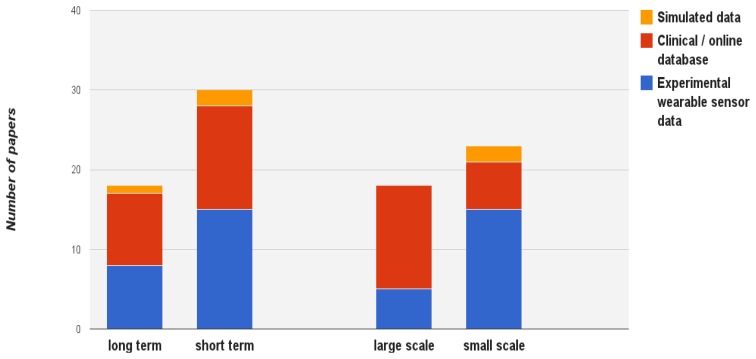
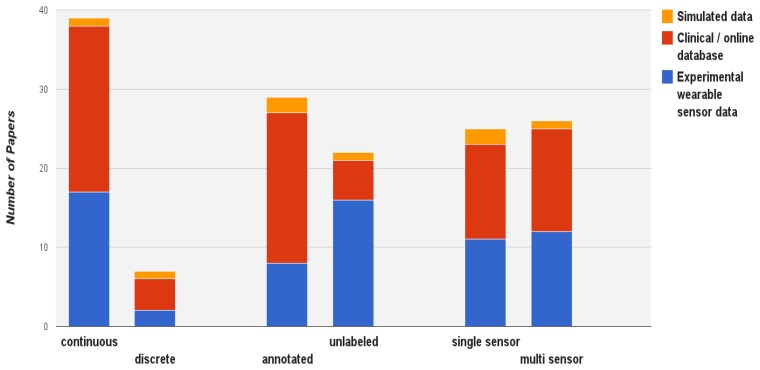
“Here, three major data gathering approaches have been identified such as experimental wearable sensor data, clinical or online databases of sensor data, and simulated sensor data.”
§ Data Mining for Wearable Sensors in Health Monitoring Systems: A Review of Recent Trends and Challenges > Data Sets and their Properties > Data Acquisition
plain- Asserted: passes — The authors put it forward as true.
- Checkable: passes — It can be checked against evidence.
- Load-bearing: fails — The paper’s conclusions may not depend on it.
- Based: passes — The paper gives a reason why it holds.
Probably not a substantial claim. The paper’s conclusions may not depend on it.
A result the paper reports from its own data — it cites no other source for it, so there is none to check. The quote shows it is in the paper.
In the paper
“Considering the data mining methods, SVM, NN, decision tree and frequency/wavelet are commonly used methods for wearable sensor data processing though they have seen more often only on the ECG health parameter.”
§ Data Mining for Wearable Sensors in Health Monitoring Systems: A Review of Recent Trends and Challenges > Data Mining Approach > Modeling and Learning Methods
plaincorrelational- Asserted: passes — The authors put it forward as true.
- Checkable: passes — It can be checked against evidence.
- Load-bearing: unclear — It is unclear whether the paper’s conclusions depend on it.
- Based: passes — The paper gives a reason why it holds.
It may state two separate claims as one.
The paper states this without a source or data behind it here, so there is nothing to check it against. The quote shows it is in the paper.
In the paper
“It can be seen that ECG, HR, SpO2 and RR are the most complex health parameters where researchers have applied several data mining techniques to analyze these vital signs.”
§ Data Mining for Wearable Sensors in Health Monitoring Systems: A Review of Recent Trends and Challenges > Data Mining Approach > Modeling and Learning Methods
plaincorrelational- Asserted: passes — The authors put it forward as true.
- Checkable: passes — It can be checked against evidence.
- Load-bearing: fails — The paper’s conclusions may not depend on it.
- Based: passes — The paper gives a reason why it holds.
Probably not a substantial claim. The paper’s conclusions may not depend on it.
The paper states this without a source or data behind it here, so there is nothing to check it against. The quote shows it is in the paper.
In the paper
“On the other hand, dealing with long term data is the significant portion of some data mining methods for handling and processing lengthy period of sensor data.”
§ Data Mining for Wearable Sensors in Health Monitoring Systems: A Review of Recent Trends and Challenges > Data Sets and their Properties > Data Properties
plain- Asserted: passes — The authors put it forward as true.
- Checkable: passes — It can be checked against evidence.
- Load-bearing: fails — The paper’s conclusions may not depend on it.
- Based: passes — The paper gives a reason why it holds.
Probably not a substantial claim. The paper’s conclusions may not depend on it.
The paper states this without a source or data behind it here, so there is nothing to check it against. The quote shows it is in the paper.
In the paper
“Due to have significant data analysis step, attention of the most research is given to annotated data.”
§ Data Mining for Wearable Sensors in Health Monitoring Systems: A Review of Recent Trends and Challenges > Data Sets and their Properties > Data Properties
plain- Asserted: passes — The authors put it forward as true.
- Checkable: passes — It can be checked against evidence.
- Load-bearing: fails — The paper’s conclusions may not depend on it.
- Based: passes — The paper gives a reason why it holds.
Probably not a substantial claim. The paper’s conclusions may not depend on it.
None of the sources cited for this claim have been checked yet.
In the paper
“Blood pressure data is an example which has been appeared in the literature in both continuous and discrete format [30,75].”
§ Data Mining for Wearable Sensors in Health Monitoring Systems: A Review of Recent Trends and Challenges > Data Sets and their Properties > Data Properties
What the sources say
- Not checked yetcites [30] Huang, G., Zhang, Y., Cao, J., Steyn, M., and Taraporewalla, K. (2013). Online mining abnormal period patterns from multiple medical sensor data streams. World Wide Web. source
- Not checked yetcites [75] Ordonez, P., Armstrong, T., Oates, T., and Fackler, J. (2011, January 18–21). Classification of Patients Using Novel Multivariate Time Series Representations of Physiological Data. Honolulu, HI, USA. source
plain- Asserted: passes — The authors put it forward as true.
- Checkable: passes — It can be checked against evidence.
- Load-bearing: fails — The paper’s conclusions may not depend on it.
- Based: passes — The paper gives a reason why it holds.
Probably not a substantial claim. The paper’s conclusions may not depend on it.
In the paper
“Although using several wearable sensors in health monitoring frameworks are common, but few researches have really performed the multivariate data analysis in order to extract effective information through multi sensor data [30].”
§ Data Mining for Wearable Sensors in Health Monitoring Systems: A Review of Recent Trends and Challenges > Data Sets and their Properties > Data Properties
What the sources say
- Not checked yetcites [30] Huang, G., Zhang, Y., Cao, J., Steyn, M., and Taraporewalla, K. (2013). Online mining abnormal period patterns from multiple medical sensor data streams. World Wide Web. source
plain- Asserted: passes — The authors put it forward as true.
- Checkable: passes — It can be checked against evidence.
- Load-bearing: passes — The paper’s conclusions depend on it.
- Based: passes — The paper gives a reason why it holds.
It may state two separate claims as one.
The paper states this without a source or data behind it here, so there is nothing to check it against. The quote shows it is in the paper.
In the paper
“Beside, large scale data is typically more available in clinical settings and online databases where more resources are available.”
§ Data Mining for Wearable Sensors in Health Monitoring Systems: A Review of Recent Trends and Challenges > Data Sets and their Properties > Data Properties
plaincorrelational- Asserted: passes — The authors put it forward as true.
- Checkable: passes — It can be checked against evidence.
- Load-bearing: fails — The paper’s conclusions may not depend on it.
- Based: fails — The paper may give no reason why it holds.
Probably not a substantial claim. The paper’s conclusions may not depend on it. The paper may give no reason why it holds.
The paper states this without a source or data behind it here, so there is nothing to check it against. The quote shows it is in the paper.
In the paper
“On considering time horizon, Since the short term data sets are easily acquired and processed, they have been more used than long term for the most of the health parameters excluding BG, BP which need naturally long term data to analyze.”
§ Data Mining for Wearable Sensors in Health Monitoring Systems: A Review of Recent Trends and Challenges > Data Sets and their Properties > Data Properties
plaincorrelational- Asserted: passes — The authors put it forward as true.
- Checkable: passes — It can be checked against evidence.
- Load-bearing: unclear — It is unclear whether the paper’s conclusions depend on it.
- Based: passes — The paper gives a reason why it holds.
It may state two separate claims as one.
The paper states this without a source or data behind it here, so there is nothing to check it against. The quote shows it is in the paper.
In the paper
“Wearable sensor data collected in other contexts are rather unlabeled.”
§ Data Mining for Wearable Sensors in Health Monitoring Systems: A Review of Recent Trends and Challenges > Data Sets and their Properties > Data Properties
plain- Asserted: passes — The authors put it forward as true.
- Checkable: passes — It can be checked against evidence.
- Load-bearing: fails — The paper’s conclusions may not depend on it.
- Based: fails — The paper may give no reason why it holds.
Probably not a substantial claim. The paper’s conclusions may not depend on it. The paper may give no reason why it holds.
The paper states this without a source or data behind it here, so there is nothing to check it against. The quote shows it is in the paper.
In the paper
“In this field relatively little data is discrete and is usually collected in conjunction with other sensor modalities.”
§ Data Mining for Wearable Sensors in Health Monitoring Systems: A Review of Recent Trends and Challenges > Data Sets and their Properties > Data Properties
plaincorrelational- Asserted: passes — The authors put it forward as true.
- Checkable: passes — It can be checked against evidence.
- Load-bearing: unclear — It is unclear whether the paper’s conclusions depend on it.
- Based: passes — The paper gives a reason why it holds.
It may state two separate claims as one.
The paper states this without a source or data behind it here, so there is nothing to check it against. The quote shows it is in the paper.
In the paper
“Most of the health parameters are used the annotated data sets rather than the unlabeled measurements excluding BG and RR, Since there is no adequate predefined annotations to be marked on specific temporal data.”
§ Data Mining for Wearable Sensors in Health Monitoring Systems: A Review of Recent Trends and Challenges > Data Sets and their Properties > Data Properties
plaindirect- Asserted: passes — The authors put it forward as true.
- Checkable: passes — It can be checked against evidence.
- Load-bearing: unclear — It is unclear whether the paper’s conclusions depend on it.
- Based: passes — The paper gives a reason why it holds.
It may state two separate claims as one.
The paper states this without a source or data behind it here, so there is nothing to check it against. The quote shows it is in the paper.
In the paper
“Data mining methods (e.g rule-based, decision tree) have been used in clinical situation with controlled conditions and clear data sets, but the efficiency of them are not tested in real experiments of healthcare services.”
§ Data Mining for Wearable Sensors in Health Monitoring Systems: A Review of Recent Trends and Challenges > Discussion and Future Challenges
plain- Asserted: passes — The authors put it forward as true.
- Checkable: passes — It can be checked against evidence.
- Load-bearing: fails — The paper’s conclusions may not depend on it.
- Based: fails — The paper may give no reason why it holds.
Probably not a substantial claim. The paper’s conclusions may not depend on it. The paper may give no reason why it holds. It may state two separate claims as one.
The paper states this without a source or data behind it here, so there is nothing to check it against. The quote shows it is in the paper.
In the paper
“Most studies have been conducted on ECG sensor signal, where all types of data has been used i.e., long/short term, large/small scale, and annotated/unlabeled data properties.”
§ Data Mining for Wearable Sensors in Health Monitoring Systems: A Review of Recent Trends and Challenges > Data Sets and their Properties > Data Properties
plain- Asserted: passes — The authors put it forward as true.
- Checkable: passes — It can be checked against evidence.
- Load-bearing: unclear — It is unclear whether the paper’s conclusions depend on it.
- Based: passes — The paper gives a reason why it holds.
It may state two separate claims as one.
In the paper
“Some attention to this issue has been given in the literature such as [30].”
§ Data Mining for Wearable Sensors in Health Monitoring Systems: A Review of Recent Trends and Challenges > Discussion and Future Challenges
What the sources say
- Not checked yetcites [30] Huang, G., Zhang, Y., Cao, J., Steyn, M., and Taraporewalla, K. (2013). Online mining abnormal period patterns from multiple medical sensor data streams. World Wide Web. source
plain- Asserted: passes — The authors put it forward as true.
- Checkable: passes — It can be checked against evidence.
- Load-bearing: fails — The paper’s conclusions may not depend on it.
- Based: passes — The paper gives a reason why it holds.
Probably not a substantial claim. The paper’s conclusions may not depend on it.
- Rests on an assumption: The literature study performed here is sufficient to identify general challenges in the field of health monitoring.
The paper states this without a source or data behind it here, so there is nothing to check it against. The quote shows it is in the paper.
In the paper
“In contrast, some studies in the literature have used NN, HMM, and frequency techniques in order to handle complex physiological data and discover the unexpected patterns in real world situations.”
§ Data Mining for Wearable Sensors in Health Monitoring Systems: A Review of Recent Trends and Challenges > Discussion and Future Challenges
plain- Asserted: passes — The authors put it forward as true.
- Checkable: passes — It can be checked against evidence.
- Load-bearing: fails — The paper’s conclusions may not depend on it.
- Based: fails — The paper may give no reason why it holds.
Probably not a substantial claim. The paper’s conclusions may not depend on it. The paper may give no reason why it holds.
The paper states this without a source or data behind it here, so there is nothing to check it against. The quote shows it is in the paper.
In the paper
“One challenge is that still many applications using larger data sets and still consider monitoring in clinical contexts.”
§ Data Mining for Wearable Sensors in Health Monitoring Systems: A Review of Recent Trends and Challenges > Discussion and Future Challenges
plain- Asserted: passes — The authors put it forward as true.
- Checkable: passes — It can be checked against evidence.
- Load-bearing: passes — The paper’s conclusions depend on it.
- Based: fails — The paper may give no reason why it holds.
Probably not a substantial claim. The paper may give no reason why it holds.
- Rests on an assumption: The literature study performed here is sufficient to identify general challenges in the field of health monitoring.
The paper states this without a source or data behind it here, so there is nothing to check it against. The quote shows it is in the paper.
In the paper
“Data mining approaches gain increasing attention in this field, open data sets as well as benchmark data sets become important in order to validate different approaches.”
§ Data Mining for Wearable Sensors in Health Monitoring Systems: A Review of Recent Trends and Challenges > Discussion and Future Challenges
plain- Asserted: passes — The authors put it forward as true.
- Checkable: passes — It can be checked against evidence.
- Load-bearing: fails — The paper’s conclusions may not depend on it.
- Based: passes — The paper gives a reason why it holds.
Probably not a substantial claim. The paper’s conclusions may not depend on it.
- Rests on an assumption: The literature study performed here is sufficient to identify general challenges in the field of health monitoring.
The paper states this without a source or data behind it here, so there is nothing to check it against. The quote shows it is in the paper.
In the paper
“However, it is still a big challenge that experts using healthcare services are not sufficiently interact with the reactive and proactive decisions made by the developed system.”
§ Data Mining for Wearable Sensors in Health Monitoring Systems: A Review of Recent Trends and Challenges > Discussion and Future Challenges
plain- Asserted: passes — The authors put it forward as true.
- Checkable: passes — It can be checked against evidence.
- Load-bearing: passes — The paper’s conclusions depend on it.
- Based: fails — The paper may give no reason why it holds.
Probably not a substantial claim. The paper may give no reason why it holds.
- Rests on an assumption: The literature study performed here is sufficient to identify general challenges in the field of health monitoring.
In the paper
“This is most likely due to the fact that these parameters are associated with monitoring of specific diseases e.g., diabetes whereby prediction is an important component [23].”
§ Data Mining for Wearable Sensors in Health Monitoring Systems: A Review of Recent Trends and Challenges > Data Mining Tasks for Wearable Sensors
What the sources say
- Not checked yetcites [23] Chatterjee, S., Dutta, K., Xie, H.Q., Byun, J., Pottathil, A., and Moore, M. (2013, January 7–10). Persuasive and Pervasive Sensing: A New Frontier to Monitor, Track and Assist Older Adults Suffering from Type-2 Diabetes. Grand Wailea, Maui, HI, USA. source
hedgedconditional- Asserted: passes — The authors put it forward as true.
- Checkable: passes — It can be checked against evidence.
- Load-bearing: fails — The paper’s conclusions may not depend on it.
- Based: passes — The paper gives a reason why it holds.
Probably not a substantial claim. The paper’s conclusions may not depend on it.
A conclusion the paper draws from its own results — it cites no other source for it, so there is none to check. The quote shows it is in the paper.
In the paper
“The role of the predictive data mining considering wearable sensors is nontrivial due to requirement of modeling sequential patterns acquired from vital signs.”
§ Data Mining for Wearable Sensors in Health Monitoring Systems: A Review of Recent Trends and Challenges > Data Mining Tasks for Wearable Sensors > Prediction
plaindirect- Asserted: passes — The authors put it forward as true.
- Checkable: passes — It can be checked against evidence.
- Load-bearing: fails — The paper’s conclusions may not depend on it.
- Based: passes — The paper gives a reason why it holds.
Probably not a substantial claim. The paper’s conclusions may not depend on it.
In the paper
“Moreover, the complication of the conditions, especially about patient's situations, needs more robust and global information rather than sensor's abnormal patterns alone [43].”
§ Data Mining for Wearable Sensors in Health Monitoring Systems: A Review of Recent Trends and Challenges > Data Mining Tasks for Wearable Sensors > Diagnosis/Decision Making
What the sources say
- Not checked yetcites [43] Sneha, 2009, Enabling ubiquitous patient monitoring: Model, decision protocols, opportunities and challenges, Decis. Support Syst. source
plain- Asserted: passes — The authors put it forward as true.
- Checkable: fails — It may be too vague to check against evidence.
- Load-bearing: fails — The paper’s conclusions may not depend on it.
- Based: passes — The paper gives a reason why it holds.
Probably not a substantial claim. It may be too vague to check against evidence. The paper’s conclusions may not depend on it.
A conclusion the paper draws from its own results — it cites no other source for it, so there is none to check. The quote shows it is in the paper.
In the paper
“For the sake of the unexpected situations and conditions in environmental health monitoring (e.g., home), the difficulty of using predictive models is higher than controlled positions such as clinical units.”
§ Data Mining for Wearable Sensors in Health Monitoring Systems: A Review of Recent Trends and Challenges > Data Mining Tasks for Wearable Sensors > Prediction
plaindirect- Asserted: passes — The authors put it forward as true.
- Checkable: passes — It can be checked against evidence.
- Load-bearing: fails — The paper’s conclusions may not depend on it.
- Based: passes — The paper gives a reason why it holds.
Probably not a substantial claim. The paper’s conclusions may not depend on it.
None of the sources cited for this claim have been checked yet.
In the paper
“An instance is every healthcare system using HR sensor data needs to investigate the effect of metadata such as age, sex, weight, and medicine in order to have meaningful reasoning to find i.e., basic abnormal heart rates or to personalize the critical pulses based on the mentioned metadata [58,59].”
§ Data Mining for Wearable Sensors in Health Monitoring Systems: A Review of Recent Trends and Challenges > Data Mining Approach
What the sources say
plaindirect- Asserted: passes — The authors put it forward as true.
- Checkable: fails — It may be too vague to check against evidence.
- Load-bearing: fails — The paper’s conclusions may not depend on it.
- Based: passes — The paper gives a reason why it holds.
Probably not a substantial claim. It may be too vague to check against evidence. The paper’s conclusions may not depend on it.
A conclusion the paper draws from its own results — it cites no other source for it, so there is none to check. The quote shows it is in the paper.
In the paper
“When the data is gathered from numerous wearable sensors, normalization and synchronization of sensor data is required.”
§ Data Mining for Wearable Sensors in Health Monitoring Systems: A Review of Recent Trends and Challenges > Data Mining Approach > Preprocessing
plaindirect- Asserted: passes — The authors put it forward as true.
- Checkable: passes — It can be checked against evidence.
- Load-bearing: fails — The paper’s conclusions may not depend on it.
- Based: passes — The paper gives a reason why it holds.
Probably not a substantial claim. The paper’s conclusions may not depend on it.
A conclusion the paper draws from its own results — it cites no other source for it, so there is none to check. The quote shows it is in the paper.
In the paper
“For instance, it would be costly to use feature selection in real time systems since the modeling techniques can handle the raw extracted features.”
§ Data Mining for Wearable Sensors in Health Monitoring Systems: A Review of Recent Trends and Challenges > Data Mining Approach > Feature Extraction/Selection
hedgeddirect- Asserted: passes — The authors put it forward as true.
- Checkable: passes — It can be checked against evidence.
- Load-bearing: fails — The paper’s conclusions may not depend on it.
- Based: fails — The paper may give no reason why it holds.
Probably not a substantial claim. The paper’s conclusions may not depend on it. The paper may give no reason why it holds.
A conclusion the paper draws from its own results — it cites no other source for it, so there is none to check. The quote shows it is in the paper.
In the paper
“In these cases, the framework has to deal with unnecessary redundancies which reduce the accuracy of results.”
§ Data Mining for Wearable Sensors in Health Monitoring Systems: A Review of Recent Trends and Challenges > Data Mining Approach > Feature Extraction/Selection
plaindirect- Asserted: passes — The authors put it forward as true.
- Checkable: passes — It can be checked against evidence.
- Load-bearing: fails — The paper’s conclusions may not depend on it.
- Based: fails — The paper may give no reason why it holds.
Probably not a substantial claim. The paper’s conclusions may not depend on it. The paper may give no reason why it holds.
A conclusion the paper draws from its own results — it cites no other source for it, so there is none to check. The quote shows it is in the paper.
In the paper
“The mentioned challenge is directly related to considering (1) selected health parameters in the system and (2) data mining tasks or the target of the health monitoring system.”
§ Data Mining for Wearable Sensors in Health Monitoring Systems: A Review of Recent Trends and Challenges > Data Mining Approach > Feature Extraction/Selection
plaincorrelational- Asserted: passes — The authors put it forward as true.
- Checkable: passes — It can be checked against evidence.
- Load-bearing: fails — The paper’s conclusions may not depend on it.
- Based: passes — The paper gives a reason why it holds.
Probably not a substantial claim. The paper’s conclusions may not depend on it.
In the paper
“This means that in order to make sense of the data, appropriate data processing techniques are essential [1].”
§ Data Mining for Wearable Sensors in Health Monitoring Systems: A Review of Recent Trends and Challenges > Data Mining Approach > Modeling and Learning Methods
What the sources say
- Not checked yetcites [1] Aggarwal, C.C. (2013). Managing and Mining Sensor Data, Springer. source
plaindirect- Asserted: passes — The authors put it forward as true.
- Checkable: fails — It may be too vague to check against evidence.
- Load-bearing: fails — The paper’s conclusions may not depend on it.
- Based: passes — The paper gives a reason why it holds.
Probably not a substantial claim. It may be too vague to check against evidence. The paper’s conclusions may not depend on it.
In the paper
“A Neural Network (NN) is an artificial intelligent approach which is widely used for classification and prediction [70].”
§ Data Mining for Wearable Sensors in Health Monitoring Systems: A Review of Recent Trends and Challenges > Data Mining Approach > Modeling and Learning Methods
What the sources say
- Not checked yetcites [70] Paliwal, 2009, Neural networks and statistical techniques: A review of applications, Expert. Syst. Appl. source
plain- Asserted: passes — The authors put it forward as true.
- Checkable: passes — It can be checked against evidence.
- Load-bearing: fails — The paper’s conclusions may not depend on it.
- Based: passes — The paper gives a reason why it holds.
Probably not a substantial claim. The paper’s conclusions may not depend on it.
A conclusion the paper draws from its own results — it cites no other source for it, so there is none to check. The quote shows it is in the paper.
In the paper
“Moreover, like other classifiers, SVM could not be applied to find the unexpected information from unlabelled data.”
§ Data Mining for Wearable Sensors in Health Monitoring Systems: A Review of Recent Trends and Challenges > Data Mining Approach > Modeling and Learning Methods
hedged- Asserted: passes — The authors put it forward as true.
- Checkable: passes — It can be checked against evidence.
- Load-bearing: fails — The paper’s conclusions may not depend on it.
- Based: fails — The paper may give no reason why it holds.
Probably not a substantial claim. The paper’s conclusions may not depend on it. The paper may give no reason why it holds.
A conclusion the paper draws from its own results — it cites no other source for it, so there is none to check. The quote shows it is in the paper.
In the paper
“However, SVM is not an appropriate method to integrate domain knowledge in order to use metadata or symbolic knowledge seamlessly with the measurements from the sensors.”
§ Data Mining for Wearable Sensors in Health Monitoring Systems: A Review of Recent Trends and Challenges > Data Mining Approach > Modeling and Learning Methods
plain- Asserted: passes — The authors put it forward as true.
- Checkable: passes — It can be checked against evidence.
- Load-bearing: fails — The paper’s conclusions may not depend on it.
- Based: fails — The paper may give no reason why it holds.
Probably not a substantial claim. The paper’s conclusions may not depend on it. The paper may give no reason why it holds.
In the paper
“To make an accurate discrimination for selected features, the decision tree method is one of the significant learning a technique which provides an efficient representation of rule classification [51].”
§ Data Mining for Wearable Sensors in Health Monitoring Systems: A Review of Recent Trends and Challenges > Data Mining Approach > Modeling and Learning Methods
What the sources say
- Not checked yetcites [51] Frantzidis, 2010, On the classification of emotional biosignals evoked while viewing affective pictures: An integrated data-mining-based approach for healthcare applications, Trans. Inf. Tech. Biomed. source
plaindirect- Asserted: passes — The authors put it forward as true.
- Checkable: passes — It can be checked against evidence.
- Load-bearing: fails — The paper’s conclusions may not depend on it.
- Based: passes — The paper gives a reason why it holds.
Probably not a substantial claim. The paper’s conclusions may not depend on it.
A conclusion the paper draws from its own results — it cites no other source for it, so there is none to check. The quote shows it is in the paper.
In the paper
“Furthermore, since the number of features can impact on the efficiency of the method, decision tree models are not usually applied to big and complex physiological data.”
§ Data Mining for Wearable Sensors in Health Monitoring Systems: A Review of Recent Trends and Challenges > Data Mining Approach > Modeling and Learning Methods
plaindirect- Asserted: passes — The authors put it forward as true.
- Checkable: passes — It can be checked against evidence.
- Load-bearing: unclear — It is unclear whether the paper’s conclusions depend on it.
- Based: passes — The paper gives a reason why it holds.
It may state two separate claims as one.
A conclusion the paper draws from its own results — it cites no other source for it, so there is none to check. The quote shows it is in the paper.
In the paper
“This method is also suitable for handling multivariate sensors due to construction of independent levels in the decision tree.”
§ Data Mining for Wearable Sensors in Health Monitoring Systems: A Review of Recent Trends and Challenges > Data Mining Approach > Modeling and Learning Methods
plaindirect- Asserted: passes — The authors put it forward as true.
- Checkable: passes — It can be checked against evidence.
- Load-bearing: fails — The paper’s conclusions may not depend on it.
- Based: passes — The paper gives a reason why it holds.
Probably not a substantial claim. The paper’s conclusions may not depend on it.
None of the sources cited for this claim have been checked yet.
In the paper
“Nowadays, upon dealing with complex and noisy data, the C4.5 algorithm is used which is estimating the error rate of initial nodes and pruning the tree to make a more efficient sub-tree [41,51].”
§ Data Mining for Wearable Sensors in Health Monitoring Systems: A Review of Recent Trends and Challenges > Data Mining Approach > Modeling and Learning Methods
What the sources say
- Not checked yetcites [41] Yeh, 2011, Using data mining techniques to predict hospitalization of hemodialysis patients, Decis. Support Syst. source
- Not checked yetcites [51] Frantzidis, 2010, On the classification of emotional biosignals evoked while viewing affective pictures: An integrated data-mining-based approach for healthcare applications, Trans. Inf. Tech. Biomed. source
plaindirect- Asserted: passes — The authors put it forward as true.
- Checkable: passes — It can be checked against evidence.
- Load-bearing: fails — The paper’s conclusions may not depend on it.
- Based: passes — The paper gives a reason why it holds.
Probably not a substantial claim. The paper’s conclusions may not depend on it. It may state two separate claims as one.
A conclusion the paper draws from its own results — it cites no other source for it, so there is none to check. The quote shows it is in the paper.
In the paper
“So, finding hidden information out of constricted features would not be recognizable.”
§ Data Mining for Wearable Sensors in Health Monitoring Systems: A Review of Recent Trends and Challenges > Data Mining Approach > Modeling and Learning Methods
hedged- Asserted: passes — The authors put it forward as true.
- Checkable: passes — It can be checked against evidence.
- Load-bearing: fails — The paper’s conclusions may not depend on it.
- Based: passes — The paper gives a reason why it holds.
Probably not a substantial claim. The paper’s conclusions may not depend on it.
A conclusion the paper draws from its own results — it cites no other source for it, so there is none to check. The quote shows it is in the paper.
In the paper
“In sum, since the progress of learning in NN would be complex, the method is commonly used for decision making in clinical conditions with large and complicated data sets.”
§ Data Mining for Wearable Sensors in Health Monitoring Systems: A Review of Recent Trends and Challenges > Data Mining Approach > Modeling and Learning Methods
hedgeddirect- Asserted: passes — The authors put it forward as true.
- Checkable: passes — It can be checked against evidence.
- Load-bearing: fails — The paper’s conclusions may not depend on it.
- Based: fails — The paper may give no reason why it holds.
Probably not a substantial claim. The paper’s conclusions may not depend on it. The paper may give no reason why it holds.
A conclusion the paper draws from its own results — it cites no other source for it, so there is none to check. The quote shows it is in the paper.
In the paper
“Generally, decision tree methods are limited to the space of the constructed features as the inputs of the model.”
§ Data Mining for Wearable Sensors in Health Monitoring Systems: A Review of Recent Trends and Challenges > Data Mining Approach > Modeling and Learning Methods
plain- Asserted: passes — The authors put it forward as true.
- Checkable: passes — It can be checked against evidence.
- Load-bearing: fails — The paper’s conclusions may not depend on it.
- Based: fails — The paper may give no reason why it holds.
Probably not a substantial claim. The paper’s conclusions may not depend on it. The paper may give no reason why it holds.
A conclusion the paper draws from its own results — it cites no other source for it, so there is none to check. The quote shows it is in the paper.
In the paper
“Additionally, as the modeling process in NN is a black box progress, NN method needs to justify for each input data.”
§ Data Mining for Wearable Sensors in Health Monitoring Systems: A Review of Recent Trends and Challenges > Data Mining Approach > Modeling and Learning Methods
plaindirect- Asserted: passes — The authors put it forward as true.
- Checkable: passes — It can be checked against evidence.
- Load-bearing: fails — The paper’s conclusions may not depend on it.
- Based: fails — The paper may give no reason why it holds.
Probably not a substantial claim. The paper’s conclusions may not depend on it. The paper may give no reason why it holds. It may state two separate claims as one.
A conclusion the paper draws from its own results — it cites no other source for it, so there is none to check. The quote shows it is in the paper.
In the paper
“But same as SVM it could not handle domain knowledge to enrich the results.”
§ Data Mining for Wearable Sensors in Health Monitoring Systems: A Review of Recent Trends and Challenges > Data Mining Approach > Modeling and Learning Methods
hedged- Asserted: passes — The authors put it forward as true.
- Checkable: passes — It can be checked against evidence.
- Load-bearing: fails — The paper’s conclusions may not depend on it.
- Based: fails — The paper may give no reason why it holds.
Probably not a substantial claim. The paper’s conclusions may not depend on it. The paper may give no reason why it holds.
In the paper
“Gaussian mixture model (GMM) is another statistical model which used for classification and pattern recognition [57].”
§ Data Mining for Wearable Sensors in Health Monitoring Systems: A Review of Recent Trends and Challenges > Data Mining Approach > Modeling and Learning Methods
What the sources say
- Not checked yetcites [57] Wang, 2011, Secure stochastic ECG signals based on gaussian mixture model for e-healthcare systems, IEEE Syst. J. source
plain- Asserted: passes — The authors put it forward as true.
- Checkable: passes — It can be checked against evidence.
- Load-bearing: fails — The paper’s conclusions may not depend on it.
- Based: passes — The paper gives a reason why it holds.
Probably not a substantial claim. The paper’s conclusions may not depend on it.
None of the sources cited for this claim have been checked yet.
In the paper
“Decision tree is a reliable technique to use in different areas of medical domain in order to make a right decision [76,77].”
§ Data Mining for Wearable Sensors in Health Monitoring Systems: A Review of Recent Trends and Challenges > Data Mining Approach > Modeling and Learning Methods
What the sources say
plain- Asserted: passes — The authors put it forward as true.
- Checkable: passes — It can be checked against evidence.
- Load-bearing: fails — The paper’s conclusions may not depend on it.
- Based: passes — The paper gives a reason why it holds.
Probably not a substantial claim. The paper’s conclusions may not depend on it.
In the paper
“Using this model the hidden states can be inferred from the other observations in sequence of data [80].”
§ Data Mining for Wearable Sensors in Health Monitoring Systems: A Review of Recent Trends and Challenges > Data Mining Approach > Modeling and Learning Methods
What the sources say
- Not checked yetcites [80] Bae, 2011, Gait phase analysis based on a Hidden Markov Model, Mechatronics source
plaindirect- Asserted: passes — The authors put it forward as true.
- Checkable: passes — It can be checked against evidence.
- Load-bearing: fails — The paper’s conclusions may not depend on it.
- Based: passes — The paper gives a reason why it holds.
Probably not a substantial claim. The paper’s conclusions may not depend on it.
None of the sources cited for this claim have been checked yet.
In the paper
“A domain-specific expert system is a common rule-based method that defines and applies the expert conditions during data analysis [83–85].”
§ Data Mining for Wearable Sensors in Health Monitoring Systems: A Review of Recent Trends and Challenges > Data Mining Approach > Modeling and Learning Methods
What the sources say
- Not checked yetcites [83] He, J., Liu, X., Krupinski, E., and Xu, G. (2012). Health Information Science, Springer. source
- Not checked yetcites [84] Fayyad, U.M., Piatetsky-Shapiro, G., Smyth, P., and Uthurusamy, R. (1996). Advances in Knowledge Discovery and Data Mining, American Association for Artificial Intelligence.
- Not checked yetcites [85] Kalagnanam, J., and Henrion, M. (2013). A comparison of decision analysis and expert rules for sequential diagnosis. arXiv:1304.2362.
plain- Asserted: passes — The authors put it forward as true.
- Checkable: passes — It can be checked against evidence.
- Load-bearing: fails — The paper’s conclusions may not depend on it.
- Based: passes — The paper gives a reason why it holds.
Probably not a substantial claim. The paper’s conclusions may not depend on it.
A conclusion the paper draws from its own results — it cites no other source for it, so there is none to check. The quote shows it is in the paper.
In the paper
“However, based on the abilities of HMM to model the unexpected behaviors of the data, it is applicable to use the modified versions of HMM in more problems in healthcare domains.”
§ Data Mining for Wearable Sensors in Health Monitoring Systems: A Review of Recent Trends and Challenges > Data Mining Approach > Modeling and Learning Methods
plainconditional- Asserted: passes — The authors put it forward as true.
- Checkable: fails — It may be too vague to check against evidence.
- Load-bearing: fails — The paper’s conclusions may not depend on it.
- Based: fails — The paper may give no reason why it holds.
Probably not a substantial claim. It may be too vague to check against evidence. The paper’s conclusions may not depend on it. The paper may give no reason why it holds.
In the paper
“Hidden Markov model (HMM) is a probabilistic model which is convenient for modeling sequential data [78].”
§ Data Mining for Wearable Sensors in Health Monitoring Systems: A Review of Recent Trends and Challenges > Data Mining Approach > Modeling and Learning Methods
What the sources say
- Not checked yetcites [78] Rabiner, 1986, An introduction to hidden Markov models, IEEE ASSP Mag. source
plain- Asserted: passes — The authors put it forward as true.
- Checkable: passes — It can be checked against evidence.
- Load-bearing: fails — The paper’s conclusions may not depend on it.
- Based: passes — The paper gives a reason why it holds.
Probably not a substantial claim. The paper’s conclusions may not depend on it.
A conclusion the paper draws from its own results — it cites no other source for it, so there is none to check. The quote shows it is in the paper.
In the paper
“Despite GMM is able to detect unseen information in physiological data”
§ Data Mining for Wearable Sensors in Health Monitoring Systems: A Review of Recent Trends and Challenges > Data Mining Approach > Modeling and Learning Methods
plaindirect- Asserted: passes — The authors put it forward as true.
- Checkable: passes — It can be checked against evidence.
- Load-bearing: fails — The paper’s conclusions may not depend on it.
- Based: fails — The paper may give no reason why it holds.
Probably not a substantial claim. The paper’s conclusions may not depend on it. The paper may give no reason why it holds.
A conclusion the paper draws from its own results — it cites no other source for it, so there is none to check. The quote shows it is in the paper.
In the paper
“The rule-based methods are not adequate for decision making and prediction tasks as well as the personalized system with context aware targets.”
§ Data Mining for Wearable Sensors in Health Monitoring Systems: A Review of Recent Trends and Challenges > Data Mining Approach > Modeling and Learning Methods
plain- Asserted: passes — The authors put it forward as true.
- Checkable: passes — It can be checked against evidence.
- Load-bearing: unclear — It is unclear whether the paper’s conclusions depend on it.
- Based: passes — The paper gives a reason why it holds.
It may state two separate claims as one.
A conclusion the paper draws from its own results — it cites no other source for it, so there is none to check. The quote shows it is in the paper.
In the paper
“However, these methods are biased to the predefined rules in order to learn the features and behavior of the data itself.”
§ Data Mining for Wearable Sensors in Health Monitoring Systems: A Review of Recent Trends and Challenges > Data Mining Approach > Modeling and Learning Methods
plaindirect- Asserted: passes — The authors put it forward as true.
- Checkable: passes — It can be checked against evidence.
- Load-bearing: fails — The paper’s conclusions may not depend on it.
- Based: passes — The paper gives a reason why it holds.
Probably not a substantial claim. The paper’s conclusions may not depend on it.
In the paper
“Due to the basic task of the healthcare monitoring which is to find the obvious problem in physiological data, the RBR phase is necessary to apply on any wearable sensor framework [82].”
§ Data Mining for Wearable Sensors in Health Monitoring Systems: A Review of Recent Trends and Challenges > Data Mining Approach > Modeling and Learning Methods
What the sources say
- Not checked yetcites [82] Al-Hajji, A.A. (2012, January 12–14). Rule-Based Expert System for Diagnosis and Symptom of Neurological Disorders Neurologist Expert System (NES). Al-Madinah Al-Munawwarah, Saudi Arabia.
plaindirect- Asserted: passes — The authors put it forward as true.
- Checkable: passes — It can be checked against evidence.
- Load-bearing: fails — The paper’s conclusions may not depend on it.
- Based: passes — The paper gives a reason why it holds.
Probably not a substantial claim. The paper’s conclusions may not depend on it.
- Rests on an assumption: The basic task of healthcare monitoring is to find the obvious problem in physiological data.
A conclusion the paper draws from its own results — it cites no other source for it, so there is none to check. The quote shows it is in the paper.
In the paper
“Since rule-based methods are using a set of provided rules by experts or the domain knowledge, they are able to perform anomaly detection task and to deal with unlabeled data sets to find unusual patterns.”
§ Data Mining for Wearable Sensors in Health Monitoring Systems: A Review of Recent Trends and Challenges > Data Mining Approach > Modeling and Learning Methods
plaindirect- Asserted: passes — The authors put it forward as true.
- Checkable: passes — It can be checked against evidence.
- Load-bearing: fails — The paper’s conclusions may not depend on it.
- Based: passes — The paper gives a reason why it holds.
Probably not a substantial claim. The paper’s conclusions may not depend on it. It may state two separate claims as one.
A conclusion the paper draws from its own results — it cites no other source for it, so there is none to check. The quote shows it is in the paper.
In the paper
“Moreover, the initialization step in GMM does not necessarily enrich the modeling (as GMM approached assume data as a combination of Gaussian distinction) due to the character of health parameters in real world situations.”
§ Data Mining for Wearable Sensors in Health Monitoring Systems: A Review of Recent Trends and Challenges > Data Mining Approach > Modeling and Learning Methods
plain- Asserted: passes — The authors put it forward as true.
- Checkable: passes — It can be checked against evidence.
- Load-bearing: fails — The paper’s conclusions may not depend on it.
- Based: fails — The paper may give no reason why it holds.
Probably not a substantial claim. The paper’s conclusions may not depend on it. The paper may give no reason why it holds.
- The authors state this as an assumption: GMM assumes that the input data are a linear combination of Gaussian distributions.
A conclusion the paper draws from its own results — it cites no other source for it, so there is none to check. The quote shows it is in the paper.
In the paper
“Despite that these tools are not reliable for decision making tasks”
§ Data Mining for Wearable Sensors in Health Monitoring Systems: A Review of Recent Trends and Challenges > Data Mining Approach > Modeling and Learning Methods
plain- Asserted: passes — The authors put it forward as true.
- Checkable: passes — It can be checked against evidence.
- Load-bearing: fails — The paper’s conclusions may not depend on it.
- Based: fails — The paper may give no reason why it holds.
Probably not a substantial claim. The paper’s conclusions may not depend on it. The paper may give no reason why it holds.
A conclusion the paper draws from its own results — it cites no other source for it, so there is none to check. The quote shows it is in the paper.
In the paper
“Frequency domain analysis is able to model and find complex patterns and detect the non obvious anomalies in the data.”
§ Data Mining for Wearable Sensors in Health Monitoring Systems: A Review of Recent Trends and Challenges > Data Mining Approach > Modeling and Learning Methods
plaindirect- Asserted: passes — The authors put it forward as true.
- Checkable: passes — It can be checked against evidence.
- Load-bearing: fails — The paper’s conclusions may not depend on it.
- Based: fails — The paper may give no reason why it holds.
Probably not a substantial claim. The paper’s conclusions may not depend on it. The paper may give no reason why it holds. It may state two separate claims as one.
A conclusion the paper draws from its own results — it cites no other source for it, so there is none to check. The quote shows it is in the paper.
In the paper
“Furthermore, these models have not commonly applied for predication task due to the lack of domain knowledge in their models.”
§ Data Mining for Wearable Sensors in Health Monitoring Systems: A Review of Recent Trends and Challenges > Data Mining Approach > Modeling and Learning Methods
plaindirect- Asserted: passes — The authors put it forward as true.
- Checkable: passes — It can be checked against evidence.
- Load-bearing: fails — The paper’s conclusions may not depend on it.
- Based: passes — The paper gives a reason why it holds.
Probably not a substantial claim. The paper’s conclusions may not depend on it.
A conclusion the paper draws from its own results — it cites no other source for it, so there is none to check. The quote shows it is in the paper.
In the paper
“Nevertheless, domain knowledge and context metadata cannot be integrated with the statistical models.”
§ Data Mining for Wearable Sensors in Health Monitoring Systems: A Review of Recent Trends and Challenges > Data Mining Approach > Modeling and Learning Methods
plain- Asserted: passes — The authors put it forward as true.
- Checkable: passes — It can be checked against evidence.
- Load-bearing: fails — The paper’s conclusions may not depend on it.
- Based: fails — The paper may give no reason why it holds.
Probably not a substantial claim. The paper’s conclusions may not depend on it. The paper may give no reason why it holds.
A conclusion the paper draws from its own results — it cites no other source for it, so there is none to check. The quote shows it is in the paper.
In the paper
“Thus, these models are able to detect the types of anomalies which are not easily seen by the expert.”
§ Data Mining for Wearable Sensors in Health Monitoring Systems: A Review of Recent Trends and Challenges > Data Mining Approach > Modeling and Learning Methods
plaindirect- Asserted: passes — The authors put it forward as true.
- Checkable: passes — It can be checked against evidence.
- Load-bearing: fails — The paper’s conclusions may not depend on it.
- Based: passes — The paper gives a reason why it holds.
Probably not a substantial claim. The paper’s conclusions may not depend on it.
None of the sources cited for this claim have been checked yet.
In the paper
“Very common example of online databases is PhysioNet [90,91] database which consists a wide range of physiological data sets with categorized and robust annotations for complex clinical signals.”
§ Data Mining for Wearable Sensors in Health Monitoring Systems: A Review of Recent Trends and Challenges > Data Sets and their Properties > Data Acquisition
What the sources say
- Not checked yetcites [90] PhysioBank Archive Index. Available online: http://www.physionet.org/physiobank/database/.
- Not checked yetcites [91] Goldberger, 2000, PhysioBank, physiotoolkit, and physionet: Components of a new research resource for complex physiologic signals, Circulation source
plain- Asserted: passes — The authors put it forward as true.
- Checkable: passes — It can be checked against evidence.
- Load-bearing: fails — The paper’s conclusions may not depend on it.
- Based: passes — The paper gives a reason why it holds.
Probably not a substantial claim. The paper’s conclusions may not depend on it.
None of the sources cited for this claim have been checked yet.
In the paper
“Data simulation would be useful when the more focus of data processing method is on the efficiency and robustness of information extraction [28,57] rather than handling real-world data including the artifact, errors, conditions of data gathering environment, etc.”
§ Data Mining for Wearable Sensors in Health Monitoring Systems: A Review of Recent Trends and Challenges > Data Sets and their Properties > Data Acquisition
What the sources say
hedgedconditional- Asserted: passes — The authors put it forward as true.
- Checkable: passes — It can be checked against evidence.
- Load-bearing: fails — The paper’s conclusions may not depend on it.
- Based: passes — The paper gives a reason why it holds.
Probably not a substantial claim. The paper’s conclusions may not depend on it.
A conclusion the paper draws from its own results — it cites no other source for it, so there is none to check. The quote shows it is in the paper.
In the paper
“Depending on the design of sensor network, data gathering, and the goal of decision making, the scale of subjects in the frameworks would differ.”
§ Data Mining for Wearable Sensors in Health Monitoring Systems: A Review of Recent Trends and Challenges > Data Sets and their Properties > Data Properties
hedgedcorrelational- Asserted: passes — The authors put it forward as true.
- Checkable: passes — It can be checked against evidence.
- Load-bearing: fails — The paper’s conclusions may not depend on it.
- Based: fails — The paper may give no reason why it holds.
Probably not a substantial claim. The paper’s conclusions may not depend on it. The paper may give no reason why it holds.
None of the sources cited for this claim have been checked yet.
In the paper
“Blood glucose monitoring is an example of long term data analysis for the sake of right decision making [23,28].”
§ Data Mining for Wearable Sensors in Health Monitoring Systems: A Review of Recent Trends and Challenges > Data Sets and their Properties > Data Properties
What the sources say
- Not checked yetcites [23] Chatterjee, S., Dutta, K., Xie, H.Q., Byun, J., Pottathil, A., and Moore, M. (2013, January 7–10). Persuasive and Pervasive Sensing: A New Frontier to Monitor, Track and Assist Older Adults Suffering from Type-2 Diabetes. Grand Wailea, Maui, HI, USA. source
- Not checked yetcites [28] Zhu, 2011, Automatic detection of anomalies in blood glucose using a machine learning approach, J. Commun. Netw. source
plain- Asserted: passes — The authors put it forward as true.
- Checkable: passes — It can be checked against evidence.
- Load-bearing: fails — The paper’s conclusions may not depend on it.
- Based: passes — The paper gives a reason why it holds.
Probably not a substantial claim. The paper’s conclusions may not depend on it.
A conclusion the paper draws from its own results — it cites no other source for it, so there is none to check. The quote shows it is in the paper.
In the paper
“The length of time for considering data set measurements is a particular challenge for wearable sensor data in order to orientate the data mining techniques and the manner of data interpretation.”
§ Data Mining for Wearable Sensors in Health Monitoring Systems: A Review of Recent Trends and Challenges > Data Sets and their Properties > Data Properties
plain- Asserted: passes — The authors put it forward as true.
- Checkable: passes — It can be checked against evidence.
- Load-bearing: fails — The paper’s conclusions may not depend on it.
- Based: passes — The paper gives a reason why it holds.
Probably not a substantial claim. The paper’s conclusions may not depend on it.
A conclusion the paper draws from its own results — it cites no other source for it, so there is none to check. The quote shows it is in the paper.
In the paper
“On the other hand, working with unlabeled data leads to have unsupervised learning methods in order to extract unseen knowledge among raw sensor data.”
§ Data Mining for Wearable Sensors in Health Monitoring Systems: A Review of Recent Trends and Challenges > Data Sets and their Properties > Data Properties
plaindirect- Asserted: passes — The authors put it forward as true.
- Checkable: passes — It can be checked against evidence.
- Load-bearing: fails — The paper’s conclusions may not depend on it.
- Based: passes — The paper gives a reason why it holds.
Probably not a substantial claim. The paper’s conclusions may not depend on it.
None of the sources cited for this claim have been checked yet.
In the paper
“Due to the nature of vital signs, some of them are essentially counted as continuous such as ECG, heart rate and respiration rate [31,42] or discrete like blood glucose level [28].”
§ Data Mining for Wearable Sensors in Health Monitoring Systems: A Review of Recent Trends and Challenges > Data Sets and their Properties > Data Properties
What the sources say
- Not checked yetcites [31] Clifton, 2013, Gaussian processes for personalized e-health monitoring with wearable sensors, IEEE Trans. Biomed. Eng. source
- Not checked yetcites [42] Choi, 2012, Development and evaluation of an ambulatory stress monitor based on wearable sensors, IEEE Trans. Inf. Technol. Biomed. source
- Not checked yetcites [28] Zhu, 2011, Automatic detection of anomalies in blood glucose using a machine learning approach, J. Commun. Netw. source
plain- Asserted: passes — The authors put it forward as true.
- Checkable: passes — It can be checked against evidence.
- Load-bearing: fails — The paper’s conclusions may not depend on it.
- Based: passes — The paper gives a reason why it holds.
Probably not a substantial claim. The paper’s conclusions may not depend on it. It may state two separate claims as one.
In the paper
“From the data mining point of view, the continuity of physiological data is important, since dealing with streams of sensor data has its own problems and challenges as well as analyzing sporadic measurements [30].”
§ Data Mining for Wearable Sensors in Health Monitoring Systems: A Review of Recent Trends and Challenges > Data Sets and their Properties > Data Properties
What the sources say
- Not checked yetcites [30] Huang, G., Zhang, Y., Cao, J., Steyn, M., and Taraporewalla, K. (2013). Online mining abnormal period patterns from multiple medical sensor data streams. World Wide Web. source
plain- Asserted: passes — The authors put it forward as true.
- Checkable: passes — It can be checked against evidence.
- Load-bearing: fails — The paper’s conclusions may not depend on it.
- Based: passes — The paper gives a reason why it holds.
Probably not a substantial claim. The paper’s conclusions may not depend on it. It may state two separate claims as one.
A conclusion the paper draws from its own results — it cites no other source for it, so there is none to check. The quote shows it is in the paper.
In the paper
“Data mining techniques have progressed significantly in the past few years and with the availability of large and open data sets, new possibilities for achieving suitable algorithms for wearable sensors exist.”
§ Data Mining for Wearable Sensors in Health Monitoring Systems: A Review of Recent Trends and Challenges > Discussion and Future Challenges
plainconditional- Asserted: passes — The authors put it forward as true.
- Checkable: passes — It can be checked against evidence.
- Load-bearing: fails — The paper’s conclusions may not depend on it.
- Based: fails — The paper may give no reason why it holds.
Probably not a substantial claim. The paper’s conclusions may not depend on it. The paper may give no reason why it holds. It may state two separate claims as one.
A conclusion the paper draws from its own results — it cites no other source for it, so there is none to check. The quote shows it is in the paper.
In the paper
“So, the role of statistical methods in this task is less, but SVM, NN, and decision tree techniques have usually applied for the healthcare problems with decision making tasks with good success.”
§ Data Mining for Wearable Sensors in Health Monitoring Systems: A Review of Recent Trends and Challenges > Discussion and Future Challenges
plain- Asserted: passes — The authors put it forward as true.
- Checkable: passes — It can be checked against evidence.
- Load-bearing: fails — The paper’s conclusions may not depend on it.
- Based: fails — The paper may give no reason why it holds.
Probably not a substantial claim. The paper’s conclusions may not depend on it. The paper may give no reason why it holds. It may state two separate claims as one.
A conclusion the paper draws from its own results — it cites no other source for it, so there is none to check. The quote shows it is in the paper.
In the paper
“But simple methods such as rule-based, decision tree and statistical techniques can quickly handle the online data processing requirements.”
§ Data Mining for Wearable Sensors in Health Monitoring Systems: A Review of Recent Trends and Challenges > Discussion and Future Challenges
plaindirect- Asserted: passes — The authors put it forward as true.
- Checkable: passes — It can be checked against evidence.
- Load-bearing: fails — The paper’s conclusions may not depend on it.
- Based: passes — The paper gives a reason why it holds.
Probably not a substantial claim. The paper’s conclusions may not depend on it.
A conclusion the paper draws from its own results — it cites no other source for it, so there is none to check. The quote shows it is in the paper.
In the paper
“Finally, any decision making task needs a strong modeling and inferring system with a proper usage of the contextual information.”
§ Data Mining for Wearable Sensors in Health Monitoring Systems: A Review of Recent Trends and Challenges > Discussion and Future Challenges
plain- Asserted: passes — The authors put it forward as true.
- Checkable: fails — It may be too vague to check against evidence.
- Load-bearing: fails — The paper’s conclusions may not depend on it.
- Based: fails — The paper may give no reason why it holds.
Probably not a substantial claim. It may be too vague to check against evidence. The paper’s conclusions may not depend on it. The paper may give no reason why it holds.
A conclusion the paper draws from its own results — it cites no other source for it, so there is none to check. The quote shows it is in the paper.
In the paper
“Still, despite these developments, their application to health monitoring is hindered by the challenges that are present in data from wearable sensors which create new challenges for the data mining field.”
§ Data Mining for Wearable Sensors in Health Monitoring Systems: A Review of Recent Trends and Challenges > Discussion and Future Challenges
plaindirect- Asserted: passes — The authors put it forward as true.
- Checkable: passes — It can be checked against evidence.
- Load-bearing: passes — The paper’s conclusions depend on it.
- Based: passes — The paper gives a reason why it holds.
It may state two separate claims as one.
A conclusion the paper draws from its own results — it cites no other source for it, so there is none to check. The quote shows it is in the paper.
In the paper
“The properties of the data set and experimental condition also influence the choice of method.”
§ Data Mining for Wearable Sensors in Health Monitoring Systems: A Review of Recent Trends and Challenges > Discussion and Future Challenges
plaindirect- Asserted: passes — The authors put it forward as true.
- Checkable: passes — It can be checked against evidence.
- Load-bearing: fails — The paper’s conclusions may not depend on it.
- Based: passes — The paper gives a reason why it holds.
Probably not a substantial claim. The paper’s conclusions may not depend on it.
None of the sources cited for this claim have been checked yet.
In the paper
“It is also possible to automate the retrieval of high level information via available ontologies [98,99] and link this information to the data.”
§ Data Mining for Wearable Sensors in Health Monitoring Systems: A Review of Recent Trends and Challenges > Discussion and Future Challenges
What the sources say
- Not checked yetcites [98] Kim, J., Kim, J., Lee, D., and Chung, K.Y. (2012). Ontology driven interactive healthcare with wearable sensors. Multimed. Tools Appl. source
- Not checked yetcites [99] Alirezaie, M., and Loutfi, A. (2013, January 19–22). Automatic Annotation of Sensor Data Streams Using Abductive Reasoning. Vilamoura, Portugal.
hedgedcorrelational- Asserted: passes — The authors put it forward as true.
- Checkable: passes — It can be checked against evidence.
- Load-bearing: fails — The paper’s conclusions may not depend on it.
- Based: passes — The paper gives a reason why it holds.
Probably not a substantial claim. The paper’s conclusions may not depend on it. It may state two separate claims as one.
- Rests on an assumption: The literature study performed here is sufficient to identify general challenges in the field of health monitoring.
A conclusion the paper draws from its own results — it cites no other source for it, so there is none to check. The quote shows it is in the paper.
In the paper
“A caveat with automated data mining and black box learning methods is the amount of trust between the data analysis system and the experts who use the system for decision making tasks.”
§ Data Mining for Wearable Sensors in Health Monitoring Systems: A Review of Recent Trends and Challenges > Discussion and Future Challenges
plain- Asserted: passes — The authors put it forward as true.
- Checkable: passes — It can be checked against evidence.
- Load-bearing: fails — The paper’s conclusions may not depend on it.
- Based: fails — The paper may give no reason why it holds.
Probably not a substantial claim. The paper’s conclusions may not depend on it. The paper may give no reason why it holds.
- Rests on an assumption: The literature study performed here is sufficient to identify general challenges in the field of health monitoring.
A conclusion the paper draws from its own results — it cites no other source for it, so there is none to check. The quote shows it is in the paper.
In the paper
“Another challenge in this field is to exploit the multiple measurements of vital signs simultaneously.”
§ Data Mining for Wearable Sensors in Health Monitoring Systems: A Review of Recent Trends and Challenges > Discussion and Future Challenges
plain- Asserted: passes — The authors put it forward as true.
- Checkable: passes — It can be checked against evidence.
- Load-bearing: fails — The paper’s conclusions may not depend on it.
- Based: passes — The paper gives a reason why it holds.
Probably not a substantial claim. The paper’s conclusions may not depend on it.
- Rests on an assumption: The literature study performed here is sufficient to identify general challenges in the field of health monitoring.
A conclusion the paper draws from its own results — it cites no other source for it, so there is none to check. The quote shows it is in the paper.
In the paper
“In particular, sensor fusion techniques which are able to consider dependencies and correlations between different vital sign parameters could assist in performing the main data mining tasks of prediction, decision making and anomaly detection.”
§ Data Mining for Wearable Sensors in Health Monitoring Systems: A Review of Recent Trends and Challenges > Discussion and Future Challenges
hedgedconditional- Asserted: passes — The authors put it forward as true.
- Checkable: passes — It can be checked against evidence.
- Load-bearing: fails — The paper’s conclusions may not depend on it.
- Based: passes — The paper gives a reason why it holds.
Probably not a substantial claim. The paper’s conclusions may not depend on it.
- Rests on an assumption: The literature study performed here is sufficient to identify general challenges in the field of health monitoring.
A conclusion the paper draws from its own results — it cites no other source for it, so there is none to check. The quote shows it is in the paper.
In the paper
“It also worth noting that in real world system such as home monitoring, it would be difficult to model the unexpected features with straightforward techniques.”
§ Data Mining for Wearable Sensors in Health Monitoring Systems: A Review of Recent Trends and Challenges > Discussion and Future Challenges
hedged- Asserted: passes — The authors put it forward as true.
- Checkable: fails — It may be too vague to check against evidence.
- Load-bearing: fails — The paper’s conclusions may not depend on it.
- Based: fails — The paper may give no reason why it holds.
Probably not a substantial claim. It may be too vague to check against evidence. The paper’s conclusions may not depend on it. The paper may give no reason why it holds.
- Rests on an assumption: The literature study performed here is sufficient to identify general challenges in the field of health monitoring.
A conclusion the paper draws from its own results — it cites no other source for it, so there is none to check. The quote shows it is in the paper.
In the paper
“In addition, usage of contextual information to assist in data mining is of ever increasing importance.”
§ Data Mining for Wearable Sensors in Health Monitoring Systems: A Review of Recent Trends and Challenges > Discussion and Future Challenges
plaincorrelational- Asserted: passes — The authors put it forward as true.
- Checkable: fails — It may be too vague to check against evidence.
- Load-bearing: fails — The paper’s conclusions may not depend on it.
- Based: fails — The paper may give no reason why it holds.
Probably not a substantial claim. It may be too vague to check against evidence. The paper’s conclusions may not depend on it. The paper may give no reason why it holds.
- Rests on an assumption: The literature study performed here is sufficient to identify general challenges in the field of health monitoring.
A conclusion the paper draws from its own results — it cites no other source for it, so there is none to check. The quote shows it is in the paper.
In the paper
“For multivariate analysis of wearable sensor data, the methods working with domain knowledge such as rule-based, decision tree, and statistical tools are more usable, while GMM and HMM could not play this role in healthcare systems.”
§ Data Mining for Wearable Sensors in Health Monitoring Systems: A Review of Recent Trends and Challenges > Discussion and Future Challenges
hedged- Asserted: passes — The authors put it forward as true.
- Checkable: passes — It can be checked against evidence.
- Load-bearing: passes — The paper’s conclusions depend on it.
- Based: fails — The paper may give no reason why it holds.
Probably not a substantial claim. The paper may give no reason why it holds. It may state two separate claims as one.
In the paper
“For this reason, different approaches such as case based reasoning [100] may increase the level of trust by being explicit and referring to previous cases.”
§ Data Mining for Wearable Sensors in Health Monitoring Systems: A Review of Recent Trends and Challenges > Discussion and Future Challenges
What the sources say
- Not checked yetcites [100] Ahmed, 2013, Health monitoring for elderly: An application using case-based reasoning and cluster analysis, ISRN Artif. Intell. source
hedgedconditional- Asserted: passes — The authors put it forward as true.
- Checkable: passes — It can be checked against evidence.
- Load-bearing: fails — The paper’s conclusions may not depend on it.
- Based: passes — The paper gives a reason why it holds.
Probably not a substantial claim. The paper’s conclusions may not depend on it.
- Rests on an assumption: The literature study performed here is sufficient to identify general challenges in the field of health monitoring.
A conclusion the paper draws from its own results — it cites no other source for it, so there is none to check. The quote shows it is in the paper.
In the paper
“As hardware architectures allow for more parameters to be collected, more information could readily be collected.”
§ Data Mining for Wearable Sensors in Health Monitoring Systems: A Review of Recent Trends and Challenges > Discussion and Future Challenges
hedgedconditional- Asserted: passes — The authors put it forward as true.
- Checkable: passes — It can be checked against evidence.
- Load-bearing: fails — The paper’s conclusions may not depend on it.
- Based: fails — The paper may give no reason why it holds.
Probably not a substantial claim. The paper’s conclusions may not depend on it. The paper may give no reason why it holds. It may state two separate claims as one.
- Rests on an assumption: The literature study performed here is sufficient to identify general challenges in the field of health monitoring.
A conclusion the paper draws from its own results — it cites no other source for it, so there is none to check. The quote shows it is in the paper.
In the paper
“Still, important features of the data which may be unintuitive e.g., frequency domain features may be needed for providing proper analysis and uncovering important characteristics from the data which cannot be obtained by hand-engineered features.”
§ Data Mining for Wearable Sensors in Health Monitoring Systems: A Review of Recent Trends and Challenges > Discussion and Future Challenges
hedgedconditional- Asserted: passes — The authors put it forward as true.
- Checkable: fails — It may be too vague to check against evidence.
- Load-bearing: fails — The paper’s conclusions may not depend on it.
- Based: fails — The paper may give no reason why it holds.
Probably not a substantial claim. It may be too vague to check against evidence. The paper’s conclusions may not depend on it. The paper may give no reason why it holds. It may state two separate claims as one.
- Rests on an assumption: The literature study performed here is sufficient to identify general challenges in the field of health monitoring.
A conclusion the paper draws from its own results — it cites no other source for it, so there is none to check. The quote shows it is in the paper.
In the paper
“The process of annotating data is expensive, time consuming and non-trivial considering long-term continuous data.”
§ Data Mining for Wearable Sensors in Health Monitoring Systems: A Review of Recent Trends and Challenges > Discussion and Future Challenges
plain- Asserted: passes — The authors put it forward as true.
- Checkable: passes — It can be checked against evidence.
- Load-bearing: passes — The paper’s conclusions depend on it.
- Based: passes — The paper gives a reason why it holds.
Probably not a substantial claim. It may state two separate claims as one.
- Rests on an assumption: The literature study performed here is sufficient to identify general challenges in the field of health monitoring.
A conclusion the paper draws from its own results — it cites no other source for it, so there is none to check. The quote shows it is in the paper.
In the paper
“The result is a move from applying out of the box data mining algorithms to a more concentrated effort towards novel data mining methods for the wearable sensors in health monitoring.”
§ Data Mining for Wearable Sensors in Health Monitoring Systems: A Review of Recent Trends and Challenges > Discussion and Future Challenges
plaindirect- Asserted: passes — The authors put it forward as true.
- Checkable: passes — It can be checked against evidence.
- Load-bearing: passes — The paper’s conclusions depend on it.
- Based: passes — The paper gives a reason why it holds.
Probably not a substantial claim.
The paper relies on this without support.
The selected set of more than eighty papers is representative of recent research in data mining for wearable health monitoring.
“So, the selected papers as the representatives of the performed research are limited to the more than eighty papers.”
The authors state this as an assumption.
GMM assumes that the input data are a linear combination of Gaussian distributions.
“This method is based on this assumption that the input data are a linear combination of Gaussian distributions.”
The paper relies on this without support.
The basic task of healthcare monitoring is to find the obvious problem in physiological data.
“Due to the basic task of the healthcare monitoring which is to find the obvious problem in physiological data, the RBR phase is necessary to apply on any wearable sensor framework [82].”
The paper relies on this without support.
Having a robust data processing stage requires adequate information about the data itself.
“In any health monitoring system, having a robust data processing stage requires adequate information about the data itself.”
The paper relies on this without support.
Dealing with the type of input data and its properties is the prerequisite of any data processing system.
“In other words, dealing with the type of input data and its properties is the prerequisite of any data processing system in order to handle the significant issues such as: selecting the proper data mining approach, designing and adjusting new method and features, and tuning the parameters of data analysis.”
The paper relies on this without support.
Health monitoring systems need to evaluate their results in order to show the correctness of the decision making process.
“Health monitoring systems need to evaluate their results in order to show the correctness of the decision making process.”
The paper relies on this without support.
The literature study performed here is sufficient to identify general challenges in the field of health monitoring.
“These challenges are general challenges in the field of health monitoring and have emerged from the literature study performed here.”
Claims other papers make about this one
Each is checked against this paper’s own text: does it say what the citing paper says it does?
In the citing paper
“To solve such problems, data mining techniques such as wavelet analysis for artifact reduction and data compression, rule-based methods for data summary and transmission, and Gaussian processing for secure authentication have been implemented.129”
From Wearable sensors for monitoring the physiological and biochemical profile of the athlete (2019) · cites this paper as [129]
Self-check
Percentages, sums and reported differences re-computed from the paper’s own numbers.
Each contradiction between two passages listed here was confirmed by an independent check.
Rated minor: it would not touch a result — a value no result rests on, a p-value that stays on the same side of the significance level, or a conflict that is clerical, resolved elsewhere in the paper, or outside its own findings.
In the paper
§ Data Mining for Wearable Sensors in Health Monitoring Systems: A Review of Recent Trends and Challenges > Data Mining Tasks for Wearable Sensors > Other Data Mining Tasks for Wearable Sensors
“Gaussian process for secure authentication [57].”
§ Data Mining for Wearable Sensors in Health Monitoring Systems: A Review of Recent Trends and Challenges > Data Mining Approach > Modeling and Learning Methods
“Wang et al. [57] proposed a GMM method using inter-pulse interval (IPI) signals of ECG in order to make the secure body sensor communications.”
Rated minor: it would not touch a result — a value no result rests on, a p-value that stays on the same side of the significance level, or a conflict that is clerical, resolved elsewhere in the paper, or outside its own findings.
In the paper
§ Data Mining for Wearable Sensors in Health Monitoring Systems: A Review of Recent Trends and Challenges > Data Mining Approach > Modeling and Learning Methods
“Replicator Neural Network (RNN) [73] is another type of NN which is generally used for anomaly and outlier detection.”
§ Data Mining for Wearable Sensors in Health Monitoring Systems: A Review of Recent Trends and Challenges > References
“73. Blonde L. Karter A.J. Current evidence regarding the value of self-monitored blood glucose testing Am. J. Med. 2005 118 20 26 16224939”
Rated minor: it would not touch a result — a value no result rests on, a p-value that stays on the same side of the significance level, or a conflict that is clerical, resolved elsewhere in the paper, or outside its own findings.
In the paper
§ Data Mining for Wearable Sensors in Health Monitoring Systems: A Review of Recent Trends and Challenges > Data Mining Approach > Modeling and Learning Methods
“A rule-based method is designed by [16] to detect different types of arrhythmias using ECG sensor data.”
§ Data Mining for Wearable Sensors in Health Monitoring Systems: A Review of Recent Trends and Challenges > References
“16. Patel S. Park H. Bonato P. Chan L. Rodgers M. A review of wearable sensors and systems with application in rehabilitation J. Neuroeng. Rehabil. 2012 9 1 17 22520559 PMC3354997”
Rated minor: it would not touch a result — a value no result rests on, a p-value that stays on the same side of the significance level, or a conflict that is clerical, resolved elsewhere in the paper, or outside its own findings.
In the paper
§ Data Mining for Wearable Sensors in Health Monitoring Systems: A Review of Recent Trends and Challenges > Data Sets and their Properties > Data Properties
“Some researches have been done on unlabeled data in order to consider uncontrolled situations for especially experimental data sets [39,44,88].”
§ Data Mining for Wearable Sensors in Health Monitoring Systems: A Review of Recent Trends and Challenges > Data Mining Approach > Modeling and Learning Methods
“Based on the expert's labels on data episodes (4 levels of the severity), several binary SVMs with different kernels such as RBF, polynomial, and sigmoid are combined to model the input data from multi sensor features.”
Citations
Cites
Cortes, C., & Vapnik, V. (1995) · Machine Learning · doi:10.1007/bf00994018 · Cited by 59,421
Cortes, C., & Vapnik, V. N. (1995) · Machine Learning · doi:10.1023/a:1022627411411 · Cited by 34,565
Goldberger, A. L., Amaral, L. A. N., Glass, L., Hausdorff, J. M., Ivanov, P. C., Mark, R. G., Mietus, J. E., Moody, G. B., Peng, C.-K., & Stanley, H. E. (2000) · Circulation · doi:10.1161/01.cir.101.23.e215 · Cited by 14,809
Chandola, V., Banerjee, A., & Kumar, V. (2009) · ACM Computing Surveys · doi:10.1145/1541880.1541882 · Cited by 11,687
An introduction to hidden Markov models
Rabiner, L., & Juang, B. (1986) · IEEE ASSP Magazine · doi:10.1109/massp.1986.1165342 · Cited by 4,775
A Survey on Human Activity Recognition using Wearable Sensors
Lara, O. D., & Labrador, M. A. (2013) · IEEE Communications Surveys & Tutorials · doi:10.1109/surv.2012.110112.00192 · Cited by 2,662
A review of wearable sensors and systems with application in rehabilitation
Patel, S., Park, H., Bonato, P., Chan, L., & Rodgers, M. (2012) · Journal of NeuroEngineering and Rehabilitation · doi:10.1186/1743-0003-9-21 · Cited by 2,396
From data mining to knowledge discovery: an overview
Fayyad, U. M., Piatetsky-Shapiro, G., & Smyth, P. (1996) · Knowledge Discovery and Data Mining · Cited by 2,395
A Survey on Wearable Sensor-Based Systems for Health Monitoring and Prognosis
Pantelopoulos, A., & Bourbakis, N. G. (2010) · IEEE Transactions on Systems Man and Cybernetics Part C (Applications and Reviews) · doi:10.1109/tsmcc.2009.2032660 · Cited by 2,296
Feature Extraction: Foundations and Applications (Studies in Fuzziness and Soft Computing)
Guyon, I., Gunn, S., Nikravesh, M., & Zadeh, L. A. (2006) · Springer eBooks · Cited by 1,845
Cited by
Sorted by citations
Wearable health devices-vital sign monitoring, systems and technologies
Dias, D., & Paulo Silva Cunha, J. (2018) · Sensors · doi:10.3390/s18082414 · Cited by 919
Multi-sensor fusion in body sensor networks: State-of-the-art and research challenges
Gravina, R., Alinia, P., Ghasemzadeh, H., & Fortino, G. (2017) · Information Fusion · doi:10.1016/j.inffus.2016.09.005 · Cited by 899
Wearable sensors for monitoring the physiological and biochemical profile of the athlete
Seshadri, D. R., Li, R. T., Voos, J. E., Rowbottom, J. R., Alfes, C. M., Zorman, C. A., & Drummond, C. K. (2019) · npj Digital Medicine · doi:10.1038/s41746-019-0150-9 · Cited by 537
The emergence of AI-based wearable sensors for digital health technology: a review
Shajari, S., Kuruvinashetti, K., Komeili, A., & Sundararaj, U. (2023) · Sensors · doi:10.3390/s23239498 · Cited by 535
Fog Assisted-IoT Enabled Patient Health Monitoring in Smart Homes
Verma, P., & Sood, S. K. (2018) · IEEE Internet of Things Journal · doi:10.1109/jiot.2018.2803201 · Cited by 473
A Survey of Healthcare Internet of Things (HIoT): A Clinical Perspective
Habibzadeh, H., Dinesh, K., Shishvan, O. R., Boggio-Dandry, A., Gaurav Sharma, A., & Soyata, T. (2019) · IEEE Internet of Things Journal · doi:10.1109/jiot.2019.2946359 · Cited by 433
ECG Monitoring Systems: Review, Architecture, Processes, and Key Challenges
Serhani, M. A., Kassabi, H. T. E., Ismail, H., & Navaz, A. N. (2020) · Sensors · doi:10.3390/s20061796 · Cited by 373
IoT Wearable Sensors and Devices in Elderly Care: A Literature Review
Stavropoulos, T. G., Papastergiou, A., Mpaltadoros, L., Nikolopoulos, S., & Kompatsiaris, I. Y. (2020) · Sensors · doi:10.3390/s20102826 · Cited by 385
Woldaregay, A. Z., Årsand, E., Walderhaug, S., Albers, D., Mamykina, L., Botsis, T., & Hartvigsen, G. (2019) · Artificial Intelligence in Medicine · doi:10.1016/j.artmed.2019.07.007 · Cited by 358
Baig, M. M., GholamHosseini, H., Moqeem, A. A., Mirza, F., & Lindén, M. (2017) · Journal of Medical Systems · doi:10.1007/s10916-017-0760-1 · Cited by 351
Graphene-Based Sensors for Human Health Monitoring
Huang, H., Su, S., Wu, N., Wan, H., Wan, S., Bi, H., & Sun, L. (2019) · Frontiers in Chemistry · doi:10.3389/fchem.2019.00399 · Cited by 343
A multi-sensor data fusion enabled ensemble approach for medical data from body sensor networks
Muzammal, M., Talat, R., Sodhro, A. H., & Pirbhulal, S. (2020) · Information Fusion · doi:10.1016/j.inffus.2019.06.021 · Cited by 311
–Omic and Electronic Health Record Big Data Analytics for Precision Medicine
Wu, P.-Y., Cheng, C., Kaddi, C. D., Venugopalan, J., Hoffman, R., & Wang, M. D. (2016) · IEEE Transactions on Biomedical Engineering · doi:10.1109/tbme.2016.2573285 · Cited by 317
Internet of Health Things: Toward intelligent vital signs monitoring in hospital wards
da Costa, C. A., Pasluosta, C. F., Eskofier, B. M., da Silva, D. B., & Righi, R. D. R. (2018) · Artificial Intelligence in Medicine · doi:10.1016/j.artmed.2018.05.005 · Cited by 288
Noah, B., Keller, M. S., Mosadeghi, S., Stein, L., Johl, S., Delshad, S., Tashjian, V. C., Lew, D., Kwan, J. T., Jusufagic, A., et al. (2018) · npj Digital Medicine · doi:10.1038/s41746-017-0002-4 · Cited by 273
Cloud-centric IoT based disease diagnosis healthcare framework
Verma, P., & Sood, S. K. (2018) · Journal of Parallel and Distributed Computing · doi:10.1016/j.jpdc.2017.11.018 · Cited by 246
Baig, M. M., Afifi, S. M., GholamHosseini, H., & Mirza, F. (2019) · Journal of Medical Systems · doi:10.1007/s10916-019-1365-7 · Cited by 216
Computational Health Informatics in the Big Data Age: A Survey
Fang, R., Pouyanfar, S., Yang, Y., Chen, S.-C., & Iyengar, S. S. (2017) · ACM Computing Surveys · doi:10.1145/2932707 · Cited by 210
Shameer, K., Badgeley, M. A., Miotto, R., Glicksberg, B. S., Morgan, J. W., & Dudley, J. T. (2017) · Briefings in Bioinformatics · doi:10.1093/bib/bbv118 · Cited by 198
Sarker, M. T. H., Ishtiaque, A., & Rahaman, M. A. (2023) · American Journal of Scholarly Research and Innovation · doi:10.63125/ceqapd08 · Cited by 198
Monitoring Methods of Human Body Joints: State-of-the-Art and Research Challenges
Faisal, A. I., Majumder, S., Mondal, T., Cowan, D., Naseh, S., & Deen, M. J. (2019) · Sensors · doi:10.3390/s19112629 · Cited by 187
An architecture and protocol for smart continuous eHealth monitoring using 5G
Lloret, J., Parra, L., Taha, M., & Tomás, J. (2017) · Computer Networks · doi:10.1016/j.comnet.2017.05.018 · Cited by 164
Woldaregay, A. Z., Årsand, E., Botsis, T., Albers, D. J., Mamykina, L., & Hartvigsen, G. (2019) · Journal of Medical Internet Research · doi:10.2196/11030 · Cited by 164
Podgórski, D., Majchrzycka, K., Dabrowska, A. K., Gralewicz, G., & Okrasa, M. (2016) · International Journal of Occupational Safety and Ergonomics · doi:10.1080/10803548.2016.1214431 · Cited by 153
Akhbarifar, S., Javadi, H. H. S., Rahmani, A. M., & Hosseinzadeh, M. (2020) · Personal and Ubiquitous Computing · doi:10.1007/s00779-020-01475-3 · Cited by 149
RetractedHandling big data: research challenges and future directions
Anagnostopoulos, I. E., Zeadally, S., & Expósito, E. (2016) · The Journal of Supercomputing · doi:10.1007/s11227-016-1677-z · Cited by 148
Cloud-centric IoT based student healthcare monitoring framework
Verma, P., Sood, S. K., & Kalra, S. (2017) · Journal of Ambient Intelligence and Humanized Computing · doi:10.1007/s12652-017-0520-6 · Cited by 141
Alfian, G., Rhee, J., Ahn, H., Lee, J., Farooq, U., Ijaz, M. F., & Syaekhoni, M. A. (2017) · Journal of Food Engineering · doi:10.1016/j.jfoodeng.2017.05.008 · Cited by 140
Real-time data analysis in health monitoring systems: A comprehensive systematic literature review
Paganelli, A. I., Mondéjar, A. G., da Silva, A. C., Silva-Calpa, G. F. M., Teixeira, M. F., Carvalho, F. G. D., Raposo, A. B., & Endler, M. (2022) · Journal of Biomedical Informatics · doi:10.1016/j.jbi.2022.104009 · Cited by 141
Know Thyself: A Theory of the Self for Personal Informatics
Rapp, A., & Tirassa, M. (2017) · Human-Computer Interaction · doi:10.1080/07370024.2017.1285704 · Cited by 154
Ethical perspectives on recommending digital technology for patients with mental illness
Bauer, M., Glenn, T., Monteith, S., Bauer, R., Whybrow, P. C., & Geddes, J. R. (2017) · International Journal of Bipolar Disorders · doi:10.1186/s40345-017-0073-9 · Cited by 137
Tough, anti-freezing and conductive ionic hydrogels
Wu, S., Wang, T., Du, Y., Yao, B., Duan, S., Yan, Y., Hua, M., Alsaid, Y., Zhu, X., & He, X. (2022) · NPG Asia Materials · doi:10.1038/s41427-022-00410-7 · Cited by 126
Rodgers, M. M., Alon, G., Pai, V. M., & Conroy, R. S. (2019) · Journal of Rehabilitation and Assistive Technologies Engineering · doi:10.1177/2055668319839607 · Cited by 119
Paganelli, A. I., Velmovitsky, P. E., de Miranda, P. C., Branco, A. F., Alencar, P., Cowan, D. D., Endler, M., & Morita, P. P. (2021) · Internet of Things · doi:10.1016/j.iot.2021.100399 · Cited by 122
A review of analytics and clinical informatics in health care
Simpao, A. F., Ahumada, L. M., Gálvez, J. A., & Rehman, M. A. (2014) · Journal of Medical Systems · doi:10.1007/s10916-014-0045-x · Cited by 154
Silva, K. D., Lee, W. K., Forbes, A. B., Demmer, R. T., Barton, C., & Enticott, J. (2020) · International Journal of Medical Informatics · doi:10.1016/j.ijmedinf.2020.104268 · Cited by 110
An accurate and dynamic predictive model for a smart M-Health system using machine learning
Qureshi, K. N., Din, S., Jeon, G., & Piccialli, F. (2020) · Information Sciences · doi:10.1016/j.ins.2020.06.025 · Cited by 107
Smart city architecture for community level services through the internet of things
Jalali, R., El‐Khatib, K., & McGregor, C. (2015) · International Conference on Intelligence in Next Generation Networks · doi:10.1109/icin.2015.7073815 · Cited by 104
Glenn, T., & Monteith, S. (2014) · Current Psychiatry Reports · doi:10.1007/s11920-014-0523-3 · Cited by 104
Big data and visual analytics in anaesthesia and health care
Allan F. Simpao, M., Ahumada, L. M., & Rehman, M. A. (2015) · British Journal of Anaesthesia · doi:10.1093/bja/aeu552 · Cited by 103
Milosevic, B., Leardini, A., & Farella, E. (2020) · BioMedical Engineering OnLine · doi:10.1186/s12938-020-00762-7 · Cited by 103
Machine learning for sperm selection
You, J. B., McCallum, C., Wang, Y., Riordon, J., Nosrati, R., & Sinton, D. A. (2021) · Nature Reviews Urology · doi:10.1038/s41585-021-00465-1 · Cited by 104
A Semantic Big Data Platform for Integrating Heterogeneous Wearable Data in Healthcare
Mezghani, E., Expósito, E., Drira, K., Silveira, M. D., & Pruski, C. (2015) · Journal of Medical Systems · doi:10.1007/s10916-015-0344-x · Cited by 100
Healthcare and anomaly detection: using machine learning to predict anomalies in heart rate data
Šabić, E., Keeley, D., Henderson, B., & Nannemann, S. (2020) · AI & Society · doi:10.1007/s00146-020-00985-1 · Cited by 106
Runkle, J., Sugg, M., Boase, D., Galvin, S. L., & C. Coulson, C. (2019) · DIGITAL HEALTH · doi:10.1177/2055207619828220 · Cited by 98
Ed-daoudy, A., & Maalmi, K. (2019) · Journal Of Big Data · doi:10.1186/s40537-019-0271-7 · Cited by 96
Bharathi, R., Abirami, T., Dhanasekaran, S., Gupta, D. K., Khanna, A. K., Elhoseny, M., & Shankar, K. (2020) · Sustainable Computing Informatics and Systems · doi:10.1016/j.suscom.2020.100453 · Cited by 98
Using Psychophysiological Sensors to Assess Mental Workload During Web Browsing
Jimenez-Molina, A., Retamal, C., & Lira, H. (2018) · Sensors · doi:10.3390/s18020458 · Cited by 101
Modeling Heart Rate and Activity Data for Personalized Fitness Recommendation
Ni, J., Muhlstein, L., & McAuley, J. (2019) · The World Wide Web Conference · doi:10.1145/3308558.3313643 · Cited by 94
Nhiem, L. T., & Park, S. (2018) · Scientific Reports · doi:10.1038/s41598-018-36468-z · Cited by 89
Promises and Challenges in the Use of Consumer-Grade Devices for Sleep Monitoring
Roomkham, S., Lovell, D. R., Cheung, J., & Perrin, D. (2018) · IEEE Reviews in Biomedical Engineering · doi:10.1109/rbme.2018.2811735 · Cited by 90
Aich, S., Pradhan, P. M., Park, J., Sethi, N. K., Vathsa, V. S. S., & Kim, H. (2018) · Sensors · doi:10.3390/s18103287 · Cited by 84
Big Healthcare Data Analytics: Challenges and Applications
Lee, C., Luo, Z., Ngiam, K. Y., Zhang, M., Zheng, K., Chen, G., Ooi, B. C., & Yip, W. L. J. (2017) · Scalable computing and communications · doi:10.1007/978-3-319-58280-1_2 · Cited by 89
Singh, M. S., Pondenkandath, V., Zhou, B., Lukowicz, P., & Liwicki, M. (2017) · International Joint Conference on Neural Networks (IJCNN) · doi:10.1109/ijcnn.2017.7966182 · Cited by 82
Recent trends and challenges in predictive maintenance of aircraft’s engine and hydraulic system
Khan, K., Sohaib, M., Rashid, A., Ali, S., Akbar, H., Basit, A., & Ahmad, T. (2021) · Journal of the Brazilian Society of Mechanical Sciences and Engineering · doi:10.1007/s40430-021-03121-2 · Cited by 79
Habib, C., Makhoul, A., Darazi, R., & Couturier, R. (2018) · Information Fusion · doi:10.1016/j.inffus.2018.06.008 · Cited by 77
Sunny, J. S., Patro, C. P. K., Karnani, K., Pingle, S. C., Lin, F., Anekoji, M., Jones, L., Kesari, S., & Ashili, S. (2022) · Sensors · doi:10.3390/s22030756 · Cited by 77
Using data to advance service: managerial issues and theoretical implications from action research
Lim, C., Kim, M.-J., Kim, K.-H., Kim, K.-J., & Maglio, P. P. (2017) · Journal of Service Theory and Practice · doi:10.1108/jstp-08-2016-0141 · Cited by 72
Multi-level assessment model for wellness service based on human mental stress level
Jung, Y., & Yoon, Y. I. (2016) · Multimedia Tools and Applications · doi:10.1007/s11042-016-3444-9 · Cited by 68
Su, C., Li, L., & Wen, Z. (2020) · Quality and Reliability Engineering International · doi:10.1002/qre.2651 · Cited by 67
Recent Advances in Artificial Intelligence and Wearable Sensors in Healthcare Delivery
Junaid, S. B., Imam, A. A., Abdulkarim, M., Surakat, Y. A., Balogun, A. O., Kumar, G., Shuaibu, A. N., Garba, A., Sahalu, Y., Mohammed, A., et al. (2022) · Applied Sciences · doi:10.3390/app122010271 · Cited by 65
Dobbins, C., Rawassizadeh, R., & Momeni, E. (2016) · Neurocomputing · doi:10.1016/j.neucom.2016.02.088 · Cited by 65
Aich, S., Chakraborty, S., Sim, J. S., Jang, D.-J., & Kim, H. (2019) · Applied Sciences · doi:10.3390/app9224938 · Cited by 66
Bakker, J. P., Goldsack, J. C., Clarke, M. J., Coravos, A., Geoghegan, C., Godfrey, A., Heasley, M. G., Karlin, D. R., Manta, C. J., Peterson, B., et al. (2019) · npj Digital Medicine · doi:10.1038/s41746-019-0125-x · Cited by 63
Palladium/palladium oxide coated electrospun fibers for wearable sweat pH-sensors
Diculescu, V. C., Beregoi, M., Evanghelidis, A., Negrea, R., Apostol, N. G., & Enculescu, I. (2019) · Scientific Reports · doi:10.1038/s41598-019-45399-2 · Cited by 63
From Personalized Medicine to Population Health: A Survey of mHealth Sensing Techniques
Wang, Z., Xiong, H., Zhang, J., Yang, S., Boukhechba, M., Zhang, D., Barnes, L. E., & Dou, D. (2022) · IEEE Internet of Things Journal · doi:10.1109/jiot.2022.3161046 · Cited by 63
Singh, A., Ahmed, A., Sharma, A., & Arya, S. K. (2022) · Biosensors · doi:10.3390/bios12100910 · Cited by 65
Machine and Deep Learning Models for Stress Detection Using Multimodal Physiological Data
Abdelfattah, E., Joshi, S., & Tiwari, S. (2025) · IEEE Access · doi:10.1109/access.2024.3525459 · Cited by 69
Qi, K. (2025) · Journal Of Big Data · doi:10.1186/s40537-024-01038-w · Cited by 61
An Internet of Things (IoT) Application for Predicting the Quantity of Future Heart Attack Patients
Ahmed, F. (2017) · International Journal of Computer Applications · doi:10.5120/ijca2017913773 · Cited by 61
A medical monitoring scheme and health‐medical service composition model in cloud‐based IoT platform
Asghari, P., Rahmani, A. M., & Javadi, H. H. S. (2019) · Transactions on Emerging Telecommunications Technologies · doi:10.1002/ett.3637 · Cited by 61
Cantin-Garside, K. D., Kong, Z., White, S. W., Antezana, L., Kim, S., & Nussbaum, M. A. (2020) · Journal of Autism and Developmental Disorders · doi:10.1007/s10803-020-04463-x · Cited by 61
Energy-Efficient Integration of Continuous Context Sensing and Prediction into Smartwatches
Rawassizadeh, R., Tomitsch, M., Nourizadeh, M., Momeni, E., Peery, A., Ulanova, L., & Pazzani, M. J. (2015) · Sensors · doi:10.3390/s150922616 · Cited by 60
M4CVD: Mobile Machine Learning Model for Monitoring Cardiovascular Disease
Boursalie, O., Samavi, R., & Doyle, T. E. (2015) · Procedia Computer Science · doi:10.1016/j.procs.2015.08.357 · Cited by 62
Personalized Health Monitoring System of Elderly Wellness at the Community Level in Hong Kong
Yu, L., Chan, W. M., Zhao, Y., & Tsui, K. (2018) · IEEE Access · doi:10.1109/access.2018.2848936 · Cited by 60
Fujita, H., & Cimr, D. (2019) · Applied Intelligence · doi:10.1007/s10489-019-01461-0 · Cited by 59
Tortorella, G. L., Fogliatto, F. S., Vijaya Sunder, M., Vergara, A., & Vassolo, R. S. (2021) · International Journal of Production Research · doi:10.1080/00207543.2021.1912429 · Cited by 59
Rapp, A., & Boldi, A. (2023) · ACM Transactions on Computer-Human Interaction · doi:10.1145/3603497 · Cited by 57
Khan, A. Q., Touseeq, M., Rehman, S., Tahir, M., Ashfaq, M., Jaffar, E., & Abbasi, S. F. (2025) · Frontiers in Oncology · doi:10.3389/fonc.2025.1587517 · Cited by 60
Patchable micro/nanodevices interacting with skin
Bai, W., Kuang, T., Chitrakar, C., Yang, R., Li, S., Zhu, D., & Chang, L. (2018) · Biosensors and Bioelectronics · doi:10.1016/j.bios.2018.09.035 · Cited by 56
Raza, A., Tran, K. P., Koehl, L., & Li, S. (2023) · Engineering Applications of Artificial Intelligence · doi:10.1016/j.engappai.2023.106051 · Cited by 58
A Comprehensive Survey on Wearable Computing for Mental and Physical Health Monitoring
Elfouly, T., & Alouani, A. T. (2025) · Electronics · doi:10.3390/electronics14173443 · Cited by 59
Salazar-Reyna, R., Aleu, F. G., Gutiérrez, E. M. A. G., Díaz-Ramírez, J., Garza‐Reyes, J. A., & Kumar, A., V (2020) · Management Decision · doi:10.1108/md-01-2020-0035 · Cited by 56
Golovenkin, S. E., Bac, J., Chervov, A., Mirkes, E. M., Orlova, Y. V., Barillot, E., Gorban, A. N., & Zinovyev, A. Y. (2020) · GigaScience · doi:10.1093/gigascience/giaa128 · Cited by 57
Iqbal, N., Imran, I., Ahmad, S., Ahmad, R., & Kim, D. (2021) · Sensors · doi:10.3390/s21165430 · Cited by 52
Big Data and Predictive Analytics
Suresh, S. (2016) · Pediatric Clinics of North America · doi:10.1016/j.pcl.2015.12.007 · Cited by 51
Monteith, S., Glenn, T., Geddes, J. R., Whybrow, P. C., & Bauer, M. (2016) · International Journal of Bipolar Disorders · doi:10.1186/s40345-016-0051-7 · Cited by 51
Higaki, S., Miura, R., Suda, T., Andersson, L. M., Okada, H., Zhang, Y., Itoh, T., Miwakeichi, F., & Yoshioka, K. (2018) · Theriogenology · doi:10.1016/j.theriogenology.2018.09.038 · Cited by 50
Proto, A., Bibbo, D., Černý, M., Vala, D., Kašík, V., Peter, L., Conforto, S., Schmid, M., & Penhaker, M. (2018) · Sensors · doi:10.3390/s18061927 · Cited by 51
Ambient Assisted Living [Guest editors' introduction]
Monekosso, D., Flórez‐Revuelta, F., & Remagnino, P. (2015) · IEEE Intelligent Systems · doi:10.1109/mis.2015.63 · Cited by 47
Robust and Accurate Modeling Approaches for Migraine Per-Patient Prediction from Ambulatory Data
Pagán, J., Orbe, M.-I. D., Gago‐Veiga, A. B., Sobrado, M., Risco‐Martín, J. L., Mora, J., Moya, J. M., & Ayala, J. L. (2015) · Sensors · doi:10.3390/s150715419 · Cited by 47
Khodasevych, I. E., Parmar, S., & Troynikov, O. (2017) · Sensors · doi:10.3390/s17102399 · Cited by 47
Modeling perceived stress via HRV and accelerometer sensor streams
Wu, M., Cao, H., Nguyen, H.-L., Surmacz, K., & Hargrove, C. (2015) · Annual International Conference of the IEEE Engineering in Medicine and Biology Society (EMBC) · doi:10.1109/embc.2015.7318686 · Cited by 47
Big Data for Context Aware Computing – Perspectives and Challenges
Subbu, K. P., & Vasilakos, A. V. (2017) · Big Data Research · doi:10.1016/j.bdr.2017.10.002 · Cited by 45
Nazir, S., & Iqbal, R. A. (2023) · Biosensors and Bioelectronics X · doi:10.1016/j.biosx.2023.100388 · Cited by 44
Samples, C., Ni, Z., & Shaw, R. J. (2014) · International Journal of Nursing Sciences · doi:10.1016/j.ijnss.2014.08.002 · Cited by 44
Parent, M., Albuquerque, I., Tiwari, A., Cassani, R., Gagnon, J.-F., Lafond, D., Tremblay, S., & Falk, T. H. (2020) · Frontiers in Neuroscience · doi:10.3389/fnins.2020.542934 · Cited by 44
Salem, M., Elkaseer, A., El-Maddah, I. A. M., Youssef, K. Y., Scholz, S. G., & Mohamed, H. K. (2022) · Sensors · doi:10.3390/s22176625 · Cited by 46
The path from big data to precision medicine
Huang, B. E., Mulyasasmita, W., & Rajagopal, G. (2016) · Expert Review of Precision Medicine and Drug Development · doi:10.1080/23808993.2016.1157686 · Cited by 44
Metadata
- Authors
- Banaee, H., Ahmed, M., & Loutfi, A.
- Affiliations
- Örebro University (SE)
- Corresponding author
- Banaee, Hadi
- Venue
- Sensors
- Publisher
- MDPI AG
- Published
- 2013-12-17
- Volume
- 13
- Issue
- 12
- Pages
- 17472-17500
- ISSN
- 1424-8220 (ISSN-L)
- PMC
- PMC3892855
- OpenAlex
- W2146884567
- Semantic Scholar
- 1b8ac910c710b035c4601dc628587dafec25dad7
- Cited by
- 452
- References
- 107
- Citations by year
- 2026: 13 · 2025: 26 · 2024: 28 · 2023: 33 · 2022: 36 · 2021: 45 · 2020: 42 · 2019: 49 · 2018: 49 · 2017: 48 · 2016: 48 · 2015: 26 · 2014: 8
- FWCI
- 2.56
- Type
- journal article
- Language
- en
- Open access
- gold
- doi.org
- Licence
- Locations
- Sensors (publishedVersion, cc-by)
- Europe PMC (PubMed Central) (publishedVersion, cc-by)
- PubMed Central (publishedVersion, cc-by)
- PubMed (publishedVersion)
- Örebro University Library (Örebro University) (submittedVersion, other-oa)
- DOAJ (DOAJ: Directory of Open Access Journals) (submittedVersion, cc-by-sa)
- Topics
- Physical Sciences › Engineering › Biomedical Engineering › Non-Invasive Vital Sign Monitoring
- Physical Sciences › Computer Science › Signal Processing › Time Series Analysis and Forecasting
- Physical Sciences › Computer Science › Computer Vision and Pattern Recognition › Context-Aware Activity Recognition Systems
- Keywords
- wearable sensors, health monitoring system, physiological monitoring, vital signs, data mining, anomaly detection, time series forecasting, decision-making, continuous time series, machine learning, population aging
- MeSH terms
- Algorithms, Artificial Intelligence, Humans, Monitoring, Physiologic, Biosensing Techniques, Monitoring, Ambulatory, Data Mining
About these checks
Registry, retraction, Cites and statistics results are computed, not judged, with one exception: a printed reference that no index lists is read once by a model before it counts as a citation error. Claims are extracted by a model and kept only when their quote appears verbatim in the text; each cited source is then checked, with a model’s help, for whether it says what the claim relies on. Those verdicts can be wrong — read the claim’s quote and the cited source before relying on one.
A language model drew the claims from the paper on 2026-10-09, under version 3 of the claim definition (model deepseek-v4.1-flash, prompt extract-v3).
A second model labelled each claim on 2026-10-09 (model jev-1.13-20260917, definition revision gold-guideline-v0.2).
Statistics and arithmetic are recomputed, not judged.
Confidence bands are shown only for fields calibrated on our annotated test set. None is calibrated yet, so no band is shown.
What counts as a claim ›How we measure confidence ›How we check this ›
Are you an author, or do you see a problem with this page? Request a review
