

The DOI matches its Crossref record; 267 of the 269 references it cites were found in a registry or an index; 5 of the 158 sources its claims cite were checked for support.
“Pumping iron”—how macrophages handle iron at the systemic, microenvironmental, and cellular levels
Open accessAbstract
Macrophages reside in virtually every organ. First arising during embryogenesis, macrophages replenish themselves in the adult through a combination of self-renewal and influx of bone marrow-derived monocytes. As large phagocytic cells, macrophages participate in innate immunity while contributing to tissue-specific homeostatic functions. Among the key metabolic tasks are senescent red blood cell recycling, free heme detoxification, and provision of iron for de novo hemoglobin synthesis. While this systemic mechanism involves the shuttling of iron between spleen, liver, and bone marrow through the concerted function of defined macrophage populations, similar circuits appear to exist within the microenvironment of other organs. The high turnover of iron is the prerequisite for continuous erythropoiesis and tissue integrity but challenges macrophages' ability to maintain cellular iron homeostasis and immune function.This review provides a brief overview of systemic, microenvironmental, and cellular aspects of macrophage iron handling with a focus on exciting and unresolved questions in the field.
Overview
AI snapshot
Written from the paper’s full text.
TL;DR
This review synthesizes how macrophages handle iron at systemic, microenvironmental, and cellular levels, emphasizing red blood cell recycling, the hepcidin–ferroportin axis, and local iron circuits in organs such as liver, spleen, muscle, heart, vessels, brain, retina, bone, and bone marrow. It argues that macrophage iron homeostasis is central to erythropoiesis, tissue integrity, and immunity, while many mechanistic questions remain unresolved.
Key findings
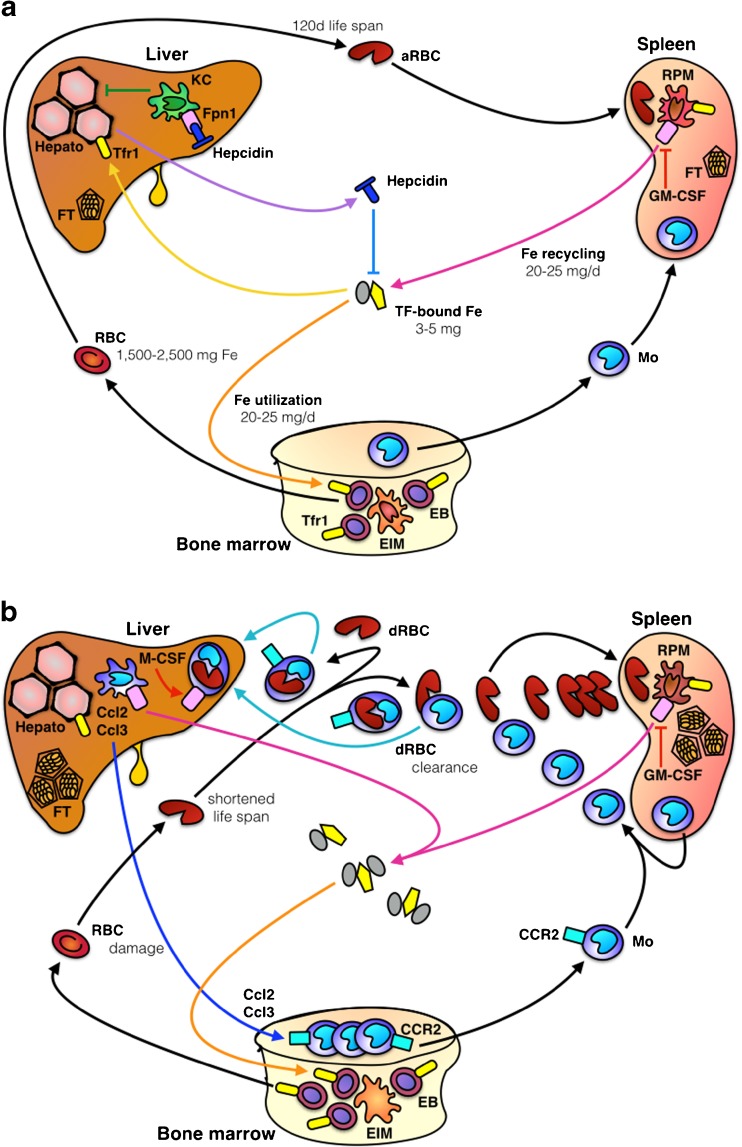
- Systemic iron homeostasis depends on macrophage recycling of senescent red blood cells: 20–25 mg/day of iron is needed for new RBC production, dietary absorption supplies only 1–2 mg/day, the adult Hb iron pool is 1500–2500 mg, RBC lifespan averages 120 days, and splenic red pulp macrophages clear more than 2 × 10⁶ RBC per second in a healthy adult.
- The hepcidin–ferroportin-1 (Fpn1) axis is central: hepatocyte-derived hepcidin targets Fpn1 for degradation, reducing iron transfer from macrophages and the diet into plasma; macrophage iron handling is further controlled by Bach1/Nrf2, SpiC, HIFs, IRPs, Hmox1, Flvcr, and Nramp1.
- Local iron-recycling circuits exist beyond the spleen and liver: liver Kupffer cells dominate clearance during excessive RBC damage and recruit CCR2⁺ monocytes via CCL2/CCL3; muscle injury involves myoglobin (17 kDa, below the kidney’s 30–50 kDa filtration cutoff); and analogous macrophage iron handling is discussed in heart, atherosclerotic plaques, brain microglia, retina, osteoclasts, and bone marrow erythroid islands.
- Macrophage iron overload impairs antimicrobial immunity: iron inhibits NF-IL6 and HIF-1α binding, blocks Nos2/NO formation, and promotes ROS/NF-κB, while IRP1/IRP2 deletion impairs control of Salmonella Typhimurium.
Methods
- Narrative review; no primary experiments, systematic search strategy, or meta-analysis are described.
- Synthesizes published literature and includes a table of selected macrophage iron-handling proteins and figures on systemic and cellular iron pathways.
- Main analysis is conceptual and mechanistic synthesis across systemic, organ-level, and cellular contexts.
Limitations
- Stated: many unresolved questions remain, including mechanistic insight into atherosclerosis, brain iron handling, and iron shuttling from erythroid island macrophages to erythroblasts; findings from small animal models need translation to humans.
- Stated: some areas are controversial, such as the role of Kupffer cells in hepcidin regulation and the directionality of Nramp1 iron transport.
- Evident: as a narrative review, it lacks systematic inclusion criteria and primary data, so conclusions depend on selected cited literature and may reflect selection bias.
Model-written summary. Check it against the paper before relying on it.
Integrity signals
Registry
Cites
Statistics
Figures
Verification
Claims the paper makes
92 Not checked yet · 19 Own interpretation · 2 Partly supported · 1 No basis given · accuracy not yet measured
The cited sources support only part of this claim — read each source’s verdict below.
In the paper
“It is well established that RPM and KC express the complete machinery for RBC clearance and heme iron recycling [72, 88, 231].”
§ “Pumping iron”—how macrophages handle iron at the systemic, microenvironmental, and cellular levels > The complexity of macrophage iron handling at the cellular level > A broad spectrum of iron uptake pathways
What the sources say
- Partly supportedcites [72] Franken L, Klein M, Spasova M, Elsukova A, Wiedwald U, Welz M, Knolle P, Farle M, Limmer A, Kurts C (2015) Splenic red pulp macrophages are intrinsically superparamagnetic and contaminate magnetic cell isolates. Sci Rep 5:12940 sourceExperimental — accuracy not yet measured
The Results (‘RPM are superparamagnetic’) identify degradation of aged or damaged erythrocytes as a main RPM function, and ‘Functional consequences of RPM contaminations’ identifies iron-metabolism genes active in RPM. The Results (‘Kupffer cells also show superparamagnetic behavior’) say Kupffer cells can take over erythrocyte degradation when RPM are absent. The paper does not establish that both cell types express the complete machinery for RBC clearance and heme-iron recycling. (LLM, conf=0.87)
- Partly supportedcites [88] Haldar M, Kohyama M, So AY, Kc W, Wu X, Briseno CG, Satpathy AT, Kretzer NM, Arase H, Rajasekaran NS, Wang L, Egawa T, Igarashi K, Baltimore D, Murphy TL, Murphy KM (2014) Heme-mediated SPI-C induction promotes monocyte differentiation into iron-recycling macrophages. Cell 156:1223–1234 sourceExperimental — accuracy not yet measured
The Introduction says red pulp macrophages (RPM), and to some extent liver macrophages, clear erythrocytes, degrade heme, and release its iron. It does not establish that both RPM and Kupffer cells (KC) express the complete machinery for those processes; its qualification of the liver macrophages is narrower than the claim. (LLM, conf=0.86)
- Partly supportedcites [231] Theurl I, Hilgendorf I, Nairz M, Tymoszuk P, Haschka D, Asshoff M, He S, Gerhardt LM, Holderried TA, Seifert M, Sopper S, Fenn AM, Anzai A, Rattik S, McAlpine C, Theurl M, Wieghofer P, Iwamoto Y, Weber GF, Harder NK, Chousterman BG, Arvedson TL, McKee M, Wang F, Lutz OM, Rezoagli E, Babitt JL, Berra L, Prinz M, Nahrendorf M, Weiss G, Weissleder R, Lin HY, Swirski FK (2016a) On-demand erythrocyte disposal and iron recycling requires transient macrophages in the liver. Nat Med 22:945–951 sourceExperimental — accuracy not yet measured
The paper reports that Kupffer cells (KC) and red pulp macrophages (RPM) express surface ferroportin for iron transport, and that the liver and spleen express ferritin and ferroportin at steady state (body text indexed under Abstract; page unavailable). This supports their involvement in iron recycling, but does not establish that both cell types express the complete machinery for RBC clearance and heme iron recycling. The paper also reports that clearing stressed RBCs under increased demand requires transient liver macrophages. (LLM, conf=0.84)
boosted- Asserted: passes — The authors put it forward as true.
- Checkable: passes — It can be checked against evidence.
- Load-bearing: unclear — It is unclear whether the paper’s conclusions depend on it.
- Based: passes — The paper gives a reason why it holds.
- Partly supported
The cited sources support only part of this claim — read each source’s verdict below.
In the paper
“Two elegant studies have shown that the application of nanoparticles to tumor-bearing mice is sufficient to induce clinical remission.”
§ “Pumping iron”—how macrophages handle iron at the systemic, microenvironmental, and cellular levels > The complexity of macrophage iron handling at the cellular level > Interplay of macrophage iron metabolism and immune functions
What the sources say
- Partly supportedcites [112] Kim SE, Zhang L, Ma K, Riegman M, Chen F, Ingold I, Conrad M, Turker MZ, Gao M, Jiang X, Monette S, Pauliah M, Gonen M, Zanzonico P, Quinn T, Wiesner U, Bradbury MS, Overholtzer M (2016) Ultrasmall nanoparticles induce ferroptosis in nutrient-deprived cancer cells and suppress tumour growth. Nat Nanotechnol 11:977–985 sourceExperimental — accuracy not yet measured
The “αMSH-PEG-C′ dots inhibit tumor growth” section reports that nanoparticles inhibited growth in tumor-bearing mice and caused partial HT-1080 tumor regression. It reports neither complete tumor disappearance nor clinical remission, so the claimed outcome overstates the finding. (LLM, conf=0.90)
- Partly supportedcites [257] Zanganeh S, Hutter G, Spitler R, Lenkov O, Mahmoudi M, Shaw A, Pajarinen JS, Nejadnik H, Goodman S, Moseley M, Coussens LM, Daldrup-Link HE (2016) Iron oxide nanoparticles inhibit tumour growth by inducing pro-inflammatory macrophage polarization in tumour tissues. Nat Nanotechnol 11:986–994 sourceExperimental — accuracy not yet measured
The Results section, “Inhibition of metastases in the liver and lungs” (page unavailable), reports that ferumoxytol given to mice with confirmed tumours significantly reduced tumour signals and tumour load. It does not report clinical remission. The mammary-tumour Results likewise report inhibited growth, not remission. (LLM, conf=0.89)
boosteddirect- Asserted: passes — The authors put it forward as true.
- Checkable: passes — It can be checked against evidence.
- Load-bearing: passes — The paper’s conclusions depend on it.
- Based: passes — The paper gives a reason why it holds.
- Partly supported
In the paper
“However, when the capacity of red pulp macrophages (the iron-recycling macrophage population in the spleen, henceforward abbreviated as RPM) and KC is overwhelmed, the cells die, presumably by a specific form of cell death called ferroptosis that is induced by iron-mediated oxidative stress and lipid peroxidation [54].”
§ “Pumping iron”—how macrophages handle iron at the systemic, microenvironmental, and cellular levels > Systemic aspects of iron recycling
What the sources say
- Not checked yetcites [54] Dixon SJ, Lemberg KM, Lamprecht MR, Skouta R, Zaitsev EM, Gleason CE, Patel DN, Bauer AJ, Cantley AM, Yang WS, Morrison B 3rd, Stockwell BR (2012) Ferroptosis: an iron-dependent form of nonapoptotic cell death. Cell 149:1060–1072 source
hedgedconditional- Asserted: passes — The authors put it forward as true.
- Checkable: passes — It can be checked against evidence.
- Load-bearing: unclear — It is unclear whether the paper’s conclusions depend on it.
- Based: passes — The paper gives a reason why it holds.
None of the sources cited for this claim have been checked yet.
In the paper
“Second, the degradation of Bach1 induces expression of the transcription factor (an E26 transformation-specific transcription factor of the Spi subfamily) SpiC independently of Nrf2 [116, 211].”
§ “Pumping iron”—how macrophages handle iron at the systemic, microenvironmental, and cellular levels > Systemic aspects of iron recycling > Erythrophagocytosis
What the sources say
- Not checked yetcites [116] Kohyama M, Ise W, Edelson BT, Wilker PR, Hildner K, Mejia C, Frazier WA, Murphy TL, Murphy KM (2009) Role for Spi-C in the development of red pulp macrophages and splenic iron homeostasis. Nature 457:318–321 source
- Not checked yetcites [211] Soares MP, Hamza I (2016) Macrophages and iron metabolism. Immunity 44:492–504 source
plaindirect- Asserted: passes — The authors put it forward as true.
- Checkable: passes — It can be checked against evidence.
- Load-bearing: unclear — It is unclear whether the paper’s conclusions depend on it.
- Based: passes — The paper gives a reason why it holds.
A conclusion the paper draws from its own results — it cites no other source for it, so there is none to check. The quote shows it is in the paper.
In the paper
“The maintenance of iron homeostasis at the systemic level requires iron recycling (Fig. 1), much of which is contained in senescent red blood cells (RBC).”
§ “Pumping iron”—how macrophages handle iron at the systemic, microenvironmental, and cellular levels > Systemic aspects of iron recycling
plaindirect- Asserted: passes — The authors put it forward as true.
- Checkable: passes — It can be checked against evidence.
- Load-bearing: passes — The paper’s conclusions depend on it.
- Based: passes — The paper gives a reason why it holds.
In the paper
“Indeed, monocyte recruitment from the BM to the liver is mediated by a liver-specific, KC-derived CC-chemokine gradient of CCL2 and CCL3 that attracts CCR2+ CCR5+ monocytes to the organ.”
§ “Pumping iron”—how macrophages handle iron at the systemic, microenvironmental, and cellular levels > Systemic aspects of iron recycling
What the sources say
- Not checked yetcites [231] Theurl I, Hilgendorf I, Nairz M, Tymoszuk P, Haschka D, Asshoff M, He S, Gerhardt LM, Holderried TA, Seifert M, Sopper S, Fenn AM, Anzai A, Rattik S, McAlpine C, Theurl M, Wieghofer P, Iwamoto Y, Weber GF, Harder NK, Chousterman BG, Arvedson TL, McKee M, Wang F, Lutz OM, Rezoagli E, Babitt JL, Berra L, Prinz M, Nahrendorf M, Weiss G, Weissleder R, Lin HY, Swirski FK (2016a) On-demand erythrocyte disposal and iron recycling requires transient macrophages in the liver. Nat Med 22:945–951 source
plaindirect- Asserted: passes — The authors put it forward as true.
- Checkable: passes — It can be checked against evidence.
- Load-bearing: unclear — It is unclear whether the paper’s conclusions depend on it.
- Based: passes — The paper gives a reason why it holds.
None of the sources cited for this claim have been checked yet.
In the paper
“HIF-HRE interaction in response to hypoxia thus stimulates iron release from macrophages by inducing Hmox1 and Fpn1 as well as one of its associated ferroxidases, ceruloplasmin [37, 63, 200].”
§ “Pumping iron”—how macrophages handle iron at the systemic, microenvironmental, and cellular levels > Systemic aspects of iron recycling > Erythrophagocytosis
What the sources say
- Not checked yetcites [37] Chiabrando D, Fiorito V, Marro S, Silengo L, Altruda F, Tolosano E (2012) Cell-specific regulation of Ferroportin transcription following experimentally-induced acute anemia in mice. Blood Cells Mol Dis 50:25–30 source
- Not checked yetcites [63] Fang HY, Hughes R, Murdoch C, Coffelt SB, Biswas SK, Harris AL, Johnson RS, Imityaz HZ, Simon MC, Fredlund E, Greten FR, Rius J, Lewis CE (2009) Hypoxia-inducible factors 1 and 2 are important transcriptional effectors in primary macrophages experiencing hypoxia. Blood 114:844–859 source
- Not checked yetcites [200] Sarkar J, Seshadri V, Tripoulas NA, Ketterer ME, Fox PL (2003) Role of ceruloplasmin in macrophage iron efflux during hypoxia. J Biol Chem 278:44018–44024 source
plaindirect- Asserted: passes — The authors put it forward as true.
- Checkable: passes — It can be checked against evidence.
- Load-bearing: unclear — It is unclear whether the paper’s conclusions depend on it.
- Based: passes — The paper gives a reason why it holds.
In the paper
“This chemokine-mediated monocyte recruitment is essential because if disrupted pharmacologically, damaged RBC accumulate in glomerular capillaries resulting in renal failure [231].”
§ “Pumping iron”—how macrophages handle iron at the systemic, microenvironmental, and cellular levels > Systemic aspects of iron recycling
What the sources say
- Not checked yetcites [231] Theurl I, Hilgendorf I, Nairz M, Tymoszuk P, Haschka D, Asshoff M, He S, Gerhardt LM, Holderried TA, Seifert M, Sopper S, Fenn AM, Anzai A, Rattik S, McAlpine C, Theurl M, Wieghofer P, Iwamoto Y, Weber GF, Harder NK, Chousterman BG, Arvedson TL, McKee M, Wang F, Lutz OM, Rezoagli E, Babitt JL, Berra L, Prinz M, Nahrendorf M, Weiss G, Weissleder R, Lin HY, Swirski FK (2016a) On-demand erythrocyte disposal and iron recycling requires transient macrophages in the liver. Nat Med 22:945–951 source
plaindirect- Asserted: passes — The authors put it forward as true.
- Checkable: passes — It can be checked against evidence.
- Load-bearing: unclear — It is unclear whether the paper’s conclusions depend on it.
- Based: passes — The paper gives a reason why it holds.
A conclusion the paper draws from its own results — it cites no other source for it, so there is none to check. The quote shows it is in the paper.
In the paper
“The liver acts as central orchestrator of iron metabolism through various mechanisms.”
§ “Pumping iron”—how macrophages handle iron at the systemic, microenvironmental, and cellular levels > Local circuits > Liver—the iron regulatory organ
plaindirect- Asserted: passes — The authors put it forward as true.
- Checkable: passes — It can be checked against evidence.
- Load-bearing: unclear — It is unclear whether the paper’s conclusions depend on it.
- Based: passes — The paper gives a reason why it holds.
In the paper
“In conditions of excessive RBC damage, liver macrophages (Kupffer cells, henceforward abbreviated as KC) dominate RBC clearance (as detailed in “Liver—the iron regulatory organ” section) [231].”
§ “Pumping iron”—how macrophages handle iron at the systemic, microenvironmental, and cellular levels > Systemic aspects of iron recycling
What the sources say
- Not checked yetcites [231] Theurl I, Hilgendorf I, Nairz M, Tymoszuk P, Haschka D, Asshoff M, He S, Gerhardt LM, Holderried TA, Seifert M, Sopper S, Fenn AM, Anzai A, Rattik S, McAlpine C, Theurl M, Wieghofer P, Iwamoto Y, Weber GF, Harder NK, Chousterman BG, Arvedson TL, McKee M, Wang F, Lutz OM, Rezoagli E, Babitt JL, Berra L, Prinz M, Nahrendorf M, Weiss G, Weissleder R, Lin HY, Swirski FK (2016a) On-demand erythrocyte disposal and iron recycling requires transient macrophages in the liver. Nat Med 22:945–951 source
plaindirect- Asserted: passes — The authors put it forward as true.
- Checkable: passes — It can be checked against evidence.
- Load-bearing: unclear — It is unclear whether the paper’s conclusions depend on it.
- Based: passes — The paper gives a reason why it holds.
In the paper
“Although many genes involved in heme iron recycling are thus HIF-inducible, HIF-1α and HIF-2α in macrophages are dispensable for heme iron recycling under hemolytic stress [147].”
§ “Pumping iron”—how macrophages handle iron at the systemic, microenvironmental, and cellular levels > Systemic aspects of iron recycling > Erythrophagocytosis
What the sources say
- Not checked yetcites [147] Mathieu JR, Heinis M, Zumerle S, Delga S, Le Bon A, Peyssonnaux C (2014) Investigating the real role of HIF-1 and HIF-2 in iron recycling by macrophages. Haematologica 99:e112–e114 source
plain- Asserted: passes — The authors put it forward as true.
- Checkable: passes — It can be checked against evidence.
- Load-bearing: unclear — It is unclear whether the paper’s conclusions depend on it.
- Based: passes — The paper gives a reason why it holds.
A conclusion the paper draws from its own results — it cites no other source for it, so there is none to check. The quote shows it is in the paper.
In the paper
“A central role of this multifunctional system beyond immunity and tissue repair is to control the body’s metabolic needs for iron.”
§ “Pumping iron”—how macrophages handle iron at the systemic, microenvironmental, and cellular levels > Systemic aspects of iron recycling
plaindirect- Asserted: passes — The authors put it forward as true.
- Checkable: passes — It can be checked against evidence.
- Load-bearing: passes — The paper’s conclusions depend on it.
- Based: passes — The paper gives a reason why it holds.
None of the sources cited for this claim have been checked yet.
In the paper
“In steady-state conditions, RBC recycling mainly takes place in the spleen [48, 213].”
§ “Pumping iron”—how macrophages handle iron at the systemic, microenvironmental, and cellular levels > Systemic aspects of iron recycling
What the sources say
- Not checked yetcites [48] Delaby C, Pilard N, Hetet G, Driss F, Grandchamp B, Beaumont C, Canonne-Hergaux F (2005) A physiological model to study iron recycling in macrophages. Exp Cell Res 310:43–53 source
- Not checked yetcites [213] Soe-Lin S, Apte SS, Andriopoulos B Jr, Andrews MC, Schranzhofer M, Kahawita T, Garcia-Santos D, Ponka P (2009) Nramp1 promotes efficient macrophage recycling of iron following erythrophagocytosis in vivo. Proc Natl Acad Sci U S A 106:5960–5965 source
plain- Asserted: passes — The authors put it forward as true.
- Checkable: passes — It can be checked against evidence.
- Load-bearing: unclear — It is unclear whether the paper’s conclusions depend on it.
- Based: passes — The paper gives a reason why it holds.
In the paper
“To compensate, blood-derived monocytes fill the partial niche after KC loss and differentiate into a transient macrophage population that has a unique phenotype including the high expression of the CC-chemokine receptor 2 (CCR2) [231].”
§ “Pumping iron”—how macrophages handle iron at the systemic, microenvironmental, and cellular levels > Systemic aspects of iron recycling
What the sources say
- Not checked yetcites [231] Theurl I, Hilgendorf I, Nairz M, Tymoszuk P, Haschka D, Asshoff M, He S, Gerhardt LM, Holderried TA, Seifert M, Sopper S, Fenn AM, Anzai A, Rattik S, McAlpine C, Theurl M, Wieghofer P, Iwamoto Y, Weber GF, Harder NK, Chousterman BG, Arvedson TL, McKee M, Wang F, Lutz OM, Rezoagli E, Babitt JL, Berra L, Prinz M, Nahrendorf M, Weiss G, Weissleder R, Lin HY, Swirski FK (2016a) On-demand erythrocyte disposal and iron recycling requires transient macrophages in the liver. Nat Med 22:945–951 source
plaindirect- Asserted: passes — The authors put it forward as true.
- Checkable: passes — It can be checked against evidence.
- Load-bearing: unclear — It is unclear whether the paper’s conclusions depend on it.
- Based: passes — The paper gives a reason why it holds.
None of the sources cited for this claim have been checked yet.
In the paper
“Rising heme levels induce Bach1 proteosomal degradation, releasing the brake on two types of down-stream pathways. First, the competitive inhibition of nuclear factor (erythroid-derived 2)-like 2 (Nrf2) binding to antioxidant-response elements (ARE) ceases for genes containing AREs [51, 145, 221], such as ferritin h chain (FTH), FPN1, heme-regulated gene-1 (HRG1), and heme oxygenase (Hmox1) [102,”
§ “Pumping iron”—how macrophages handle iron at the systemic, microenvironmental, and cellular levels > Systemic aspects of iron recycling > Erythrophagocytosis
What the sources say
- Not checked yetcites [51] Dhakshinamoorthy S, Jain AK, Bloom DA, Jaiswal AK (2005) Bach1 competes with Nrf2 leading to negative regulation of the antioxidant response element (ARE)-mediated NAD(P)H:quinone oxidoreductase 1 gene expression and induction in response to antioxidants. J Biol Chem 280:16891–16900 source
- Not checked yetcites [145] Marro S, Chiabrando D, Messana E, Stolte J, Turco E, Tolosano E, Muckenthaler MU (2010) Heme controls ferroportin1 (FPN1) transcription involving Bach1, Nrf2 and a MARE/ARE sequence motif at position -7007 of the FPN1 promoter. Haematologica 95:1261–1268 source
- Not checked yetcites [221] Sun J, Hoshino H, Takaku K, Nakajima O, Muto A, Suzuki H, Tashiro S, Takahashi S, Shibahara S, Alam J, Taketo MM, Yamamoto M, Igarashi K (2002) Hemoprotein Bach1 regulates enhancer availability of heme oxygenase-1 gene. EMBO J 21:5216–5224 source
- Not checked yetcites [102] Iwasaki K, Mackenzie EL, Hailemariam K, Sakamoto K, Tsuji Y (2006) Hemin-mediated regulation of an antioxidant-responsive element of the human ferritin H gene and role of Ref-1 during erythroid differentiation of K562 cells. Mol Cell Biol 26:2845–2856 source
- Not checked yetcites [190] Pietsch EC, Chan JY, Torti FM, Torti SV (2003) Nrf2 mediates the induction of ferritin H in response to xenobiotics and cancer chemopreventive dithiolethiones. J Biol Chem 278:2361–2369 source
plaindirect- Asserted: passes — The authors put it forward as true.
- Checkable: passes — It can be checked against evidence.
- Load-bearing: passes — The paper’s conclusions depend on it.
- Based: passes — The paper gives a reason why it holds.
In the paper
“Macrophages infiltrating the injured skeletal muscle induce the expression of Hmox1, CD163, and FT to contain and detoxify heme [41].”
§ “Pumping iron”—how macrophages handle iron at the systemic, microenvironmental, and cellular levels > Local circuits > Muscle—venue for a closed circuit for iron recycling following myolysis?
What the sources say
- Not checked yetcites [41] Corna G, Caserta I, Monno A, Apostoli P, Manfredi AA, Camaschella C, Rovere-Querini P (2016) The repair of skeletal muscle requires iron recycling through macrophage ferroportin. J Immunol 197:1914–1925 source
plaindirect- Asserted: passes — The authors put it forward as true.
- Checkable: passes — It can be checked against evidence.
- Load-bearing: passes — The paper’s conclusions depend on it.
- Based: passes — The paper gives a reason why it holds.
In the paper
“For instance, surplus iron in thalassemic patients may promote osteoclast differentiation and function and thus contribute to bone resorption [101].”
§ “Pumping iron”—how macrophages handle iron at the systemic, microenvironmental, and cellular levels > Local circuits > Bone—osteoclasts are iron-dependent
What the sources say
- Not checked yetcites [101] Ishii KA, Fumoto T, Iwai K, Takeshita S, Ito M, Shimohata N, Aburatani H, Taketani S, Lelliott CJ, Vidal-Puig A, Ikeda K (2009) Coordination of PGC-1beta and iron uptake in mitochondrial biogenesis and osteoclast activation. Nat Med 15:259–266 source
hedgedconditional- Asserted: passes — The authors put it forward as true.
- Checkable: passes — It can be checked against evidence.
- Load-bearing: unclear — It is unclear whether the paper’s conclusions depend on it.
- Based: passes — The paper gives a reason why it holds.
A conclusion the paper draws from its own results — it cites no other source for it, so there is none to check. The quote shows it is in the paper.
In the paper
“In summary, hepatocytes, KC, and endothelial cells cooperate to maintain the body’s iron homeostasis and we are beginning to decipher the signals that coordinate the function of these and other liver-resident cell types.”
§ “Pumping iron”—how macrophages handle iron at the systemic, microenvironmental, and cellular levels > Local circuits > Liver—the iron regulatory organ
plaindirect- Asserted: passes — The authors put it forward as true.
- Checkable: passes — It can be checked against evidence.
- Load-bearing: passes — The paper’s conclusions depend on it.
- Based: passes — The paper gives a reason why it holds.
In the paper
“In addition, the transcription factor peroxisome proliferator-activated receptor-gamma coactivator 1 beta (PGC-1ß) is essential for osteoclast differentiation [101].”
§ “Pumping iron”—how macrophages handle iron at the systemic, microenvironmental, and cellular levels > Local circuits > Bone—osteoclasts are iron-dependent
What the sources say
- Not checked yetcites [101] Ishii KA, Fumoto T, Iwai K, Takeshita S, Ito M, Shimohata N, Aburatani H, Taketani S, Lelliott CJ, Vidal-Puig A, Ikeda K (2009) Coordination of PGC-1beta and iron uptake in mitochondrial biogenesis and osteoclast activation. Nat Med 15:259–266 source
plaindirect- Asserted: passes — The authors put it forward as true.
- Checkable: passes — It can be checked against evidence.
- Load-bearing: passes — The paper’s conclusions depend on it.
- Based: passes — The paper gives a reason why it holds.
In the paper
“These effects along with oxidative stress to photoreceptors can be prevented by the oral iron chelator DFP [217].”
§ “Pumping iron”—how macrophages handle iron at the systemic, microenvironmental, and cellular levels > Local circuits > Retina—the location in which iron aggravates light damage
What the sources say
- Not checked yetcites [217] Song D, Song Y, Hadziahmetovic M, Zhong Y, Dunaief JL (2012a) Systemic administration of the iron chelator deferiprone protects against light-induced photoreceptor degeneration in the mouse retina. Free Radic Biol Med 53:64–71 source
plaindirect- Asserted: passes — The authors put it forward as true.
- Checkable: passes — It can be checked against evidence.
- Load-bearing: unclear — It is unclear whether the paper’s conclusions depend on it.
- Based: passes — The paper gives a reason why it holds.
In the paper
“Indeed, long-term induction of Hmox1 promotes the resolution of ICH [260].”
§ “Pumping iron”—how macrophages handle iron at the systemic, microenvironmental, and cellular levels > Local circuits > Brain—cerebral iron overload is implicated in neurodegeneration
What the sources say
- Not checked yetcites [260] Zhang Z, Song Y, Li D, Zhu H, Liang R, Gu Y, Pang Y, Qi J, Wu H, Wang J (2017) Distinct role of heme oxygenase-1 in early- and late-stage intracerebral hemorrhage in 12-month-old mice. J Cereb Blood Flow Metab 37:25–38 source
plaindirect- Asserted: passes — The authors put it forward as true.
- Checkable: passes — It can be checked against evidence.
- Load-bearing: unclear — It is unclear whether the paper’s conclusions depend on it.
- Based: passes — The paper gives a reason why it holds.
In the paper
“Elevated vascular cell adhesion molecule 1 (VCAM1) levels are an accurate biomarker to diagnose this condition, but whether the adhesion molecule is also involved in its pathogenesis remains unclear [170].”
§ “Pumping iron”—how macrophages handle iron at the systemic, microenvironmental, and cellular levels > Local circuits > Bone—osteoclasts are iron-dependent
What the sources say
- Not checked yetcites [170] Nell-Duxneuner V, Axmann R, Husar-Memmer E, Dallos T, Datz C, Stadlmayr A, Aigner E, Englbrecht M, Schett G, Zwerina J (2013) VCAM-1 serum levels are associated with arthropathy in hereditary haemochromatosis. Ann Rheum Dis 72:2006–2010 source
plaincorrelational- Asserted: passes — The authors put it forward as true.
- Checkable: passes — It can be checked against evidence.
- Load-bearing: unclear — It is unclear whether the paper’s conclusions depend on it.
- Based: passes — The paper gives a reason why it holds.
In the paper
“Apart from neurons, activated microglia can accumulate iron in Alzheimer’s disease, e.g., in the hippocampus as detected my ultra-high-resolution MR [258].”
§ “Pumping iron”—how macrophages handle iron at the systemic, microenvironmental, and cellular levels > Local circuits > Brain—cerebral iron overload is implicated in neurodegeneration
What the sources say
- Not checked yetcites [258] Zeineh MM, Chen Y, Kitzler HH, Hammond R, Vogel H, Rutt BK (2015) Activated iron-containing microglia in the human hippocampus identified by magnetic resonance imaging in Alzheimer disease. Neurobiol Aging 36:2483–2500 source
plaincorrelational- Asserted: passes — The authors put it forward as true.
- Checkable: passes — It can be checked against evidence.
- Load-bearing: unclear — It is unclear whether the paper’s conclusions depend on it.
- Based: passes — The paper gives a reason why it holds.
In the paper
“These findings thus contrast to what has been shown for co-cultured primary Kupffer cells and hepatocytes inasmuch as culture supernatants from primary Kupffer cells blunted hepcidin production [228].”
§ “Pumping iron”—how macrophages handle iron at the systemic, microenvironmental, and cellular levels > Local circuits > Brain—cerebral iron overload is implicated in neurodegeneration
What the sources say
- Not checked yetcites [228] Theurl M, Theurl I, Hochegger K, Obrist P, Subramaniam N, van Rooijen N, Schuemann K, Weiss G (2008b) Kupffer cells modulate iron homeostasis in mice via regulation of hepcidin expression. J Mol Med (Berl) 86:825–835 source
plaindirect- Asserted: passes — The authors put it forward as true.
- Checkable: passes — It can be checked against evidence.
- Load-bearing: unclear — It is unclear whether the paper’s conclusions depend on it.
- Based: passes — The paper gives a reason why it holds.
In the paper
“Therefore, early DFO treatment in experimental ICH translates into improved neurologic outcome [222].”
§ “Pumping iron”—how macrophages handle iron at the systemic, microenvironmental, and cellular levels > Local circuits > Brain—cerebral iron overload is implicated in neurodegeneration
What the sources say
- Not checked yetcites [222] Sun YM, Wang YT, Jiang L, Xue MZ (2016) The effects of deferoxamine on inhibition for microglia activation and protection of secondary nerve injury after intracerebral hemorrhage in rats. Pak J Pharm Sci 29:1087–1093
plaindirect- Asserted: passes — The authors put it forward as true.
- Checkable: passes — It can be checked against evidence.
- Load-bearing: unclear — It is unclear whether the paper’s conclusions depend on it.
- Based: passes — The paper gives a reason why it holds.
In the paper
“For instance, in neuronal cells exposed to amyloid beta peptide fragments, iron chelation with DFO or deferiprone (DFP) reduces ROS generation via the NADPH oxidase [181].”
§ “Pumping iron”—how macrophages handle iron at the systemic, microenvironmental, and cellular levels > Local circuits > Brain—cerebral iron overload is implicated in neurodegeneration
What the sources say
- Not checked yetcites [181] Part K, Kunnis-Beres K, Poska H, Land T, Shimmo R, Zetterstrom Fernaeus S (2015) Amyloid beta25-35 induced ROS-burst through NADPH oxidase is sensitive to iron chelation in microglial Bv2 cells. Brain Res 1629:282–290 source
plaindirect- Asserted: passes — The authors put it forward as true.
- Checkable: passes — It can be checked against evidence.
- Load-bearing: unclear — It is unclear whether the paper’s conclusions depend on it.
- Based: passes — The paper gives a reason why it holds.
A conclusion the paper draws from its own results — it cites no other source for it, so there is none to check. The quote shows it is in the paper.
In the paper
“A mechanism comparable to hemolysis-induced RBC recycling in the liver has recently been described in the skeletal muscle in the context of rhabdomyolysis.”
§ “Pumping iron”—how macrophages handle iron at the systemic, microenvironmental, and cellular levels > Local circuits > Muscle—venue for a closed circuit for iron recycling following myolysis?
plaincorrelational- Asserted: passes — The authors put it forward as true.
- Checkable: passes — It can be checked against evidence.
- Load-bearing: passes — The paper’s conclusions depend on it.
- Based: passes — The paper gives a reason why it holds.
In the paper
“Mice with the homologous mutation in Hfe have increased FTL chain expression in microglia, suggesting iron overload [169].”
§ “Pumping iron”—how macrophages handle iron at the systemic, microenvironmental, and cellular levels > Local circuits > Brain—cerebral iron overload is implicated in neurodegeneration
What the sources say
- Not checked yetcites [169] Nandar W, Neely EB, Unger E, Connor JR (2013) A mutation in the HFE gene is associated with altered brain iron profiles and increased oxidative stress in mice. Biochim Biophys Acta 1832:729–741 source
hedgeddirect- Asserted: passes — The authors put it forward as true.
- Checkable: passes — It can be checked against evidence.
- Load-bearing: unclear — It is unclear whether the paper’s conclusions depend on it.
- Based: passes — The paper gives a reason why it holds.
A conclusion the paper draws from its own results — it cites no other source for it, so there is none to check. The quote shows it is in the paper.
In the paper
“Apparently, both Tfr1-mediated iron uptake and PGC-1ß activation ensure mitochondrial respiration in osteoclasts as prerequisite for energy generation and proton secretion.”
§ “Pumping iron”—how macrophages handle iron at the systemic, microenvironmental, and cellular levels > Local circuits > Bone—osteoclasts are iron-dependent
hedgeddirect- Asserted: passes — The authors put it forward as true.
- Checkable: passes — It can be checked against evidence.
- Load-bearing: passes — The paper’s conclusions depend on it.
- Based: passes — The paper gives a reason why it holds.
None of the sources cited for this claim have been checked yet.
In the paper
“In addition, mutated FTL proteins may have a dominant negative effect on FT’s stability and resistance to oxidative damage [12, 140, 160].”
§ “Pumping iron”—how macrophages handle iron at the systemic, microenvironmental, and cellular levels > Local circuits > Brain—cerebral iron overload is implicated in neurodegeneration
What the sources say
- Not checked yetcites [12] Baraibar MA, Barbeito AG, Muhoberac BB, Vidal R (2012) A mutant light-chain ferritin that causes neurodegeneration has enhanced propensity toward oxidative damage. Free Radic Biol Med 52:1692–1697 source
- Not checked yetcites [140] Luscieti S, Santambrogio P, Langlois d'Estaintot B, Granier T, Cozzi A, Poli M, Gallois B, Finazzi D, Cattaneo A, Levi S, Arosio P (2010) Mutant ferritin L-chains that cause neurodegeneration act in a dominant-negative manner to reduce ferritin iron incorporation. J Biol Chem 285:11948–11957 source
- Not checked yetcites [160] Muhoberac BB, Baraibar MA, Vidal R (2013) Iron loading-induced aggregation and reduction of iron incorporation in heteropolymeric ferritin containing a mutant light chain that causes neurodegeneration. Biochim Biophys Acta 1812:544–548 source
hedgedconditional- Asserted: passes — The authors put it forward as true.
- Checkable: passes — It can be checked against evidence.
- Load-bearing: unclear — It is unclear whether the paper’s conclusions depend on it.
- Based: passes — The paper gives a reason why it holds.
In the paper
“This suggests that endothelial Fpn1 is the gatekeeper for iron transport into the retina [232].”
§ “Pumping iron”—how macrophages handle iron at the systemic, microenvironmental, and cellular levels > Local circuits > Retina—the location in which iron aggravates light damage
What the sources say
- Not checked yetcites [232] Theurl M, Song D, Clark E, Sterling J, Grieco S, Altamura S, Galy B, Hentze M, Muckenthaler MU, Dunaief JL (2016b) Mice with hepcidin-resistant ferroportin accumulate iron in the retina. FASEB J 30:813–823 source
hedgeddirect- Asserted: passes — The authors put it forward as true.
- Checkable: passes — It can be checked against evidence.
- Load-bearing: passes — The paper’s conclusions depend on it.
- Based: passes — The paper gives a reason why it holds.
None of the sources cited for this claim have been checked yet.
In the paper
“However, it is well documented that arterial macrophages, typically identified by CD68 histochemistry on histologic sections within atherosclerotic lesions, contain larger amounts of FT than those outside plaques [129, 256].”
§ “Pumping iron”—how macrophages handle iron at the systemic, microenvironmental, and cellular levels > Local circuits > Blood vessels—arterial macrophage iron overload as hallmark of atherosclerosis
What the sources say
- Not checked yetcites [129] Li W, Xu LH, Forssell C, Sullivan JL, Yuan XM (2008) Overexpression of transferrin receptor and ferritin related to clinical symptoms and destabilization of human carotid plaques. Exp Biol Med (Maywood) 233:818–826 source
- Not checked yetcites [256] Yuan XM (1999) Apoptotic macrophage-derived foam cells of human atheromas are rich in iron and ferritin, suggesting iron-catalysed reactions to be involved in apoptosis. Free Radic Res 30:221–231 source
boostedcorrelational- Asserted: passes — The authors put it forward as true.
- Checkable: passes — It can be checked against evidence.
- Load-bearing: passes — The paper’s conclusions depend on it.
- Based: passes — The paper gives a reason why it holds.
In the paper
“Local iron accumulation in the brain (particularly in neurons and astrocytes) is linked to several neurodegenerative disorders, collectively referred to as neurodegeneration with brain iron accumulation (NBIA) [127].”
§ “Pumping iron”—how macrophages handle iron at the systemic, microenvironmental, and cellular levels > Local circuits > Brain—cerebral iron overload is implicated in neurodegeneration
What the sources say
- Not checked yetcites [127] Levi S, Finazzi D (2014) Neurodegeneration with brain iron accumulation: update on pathogenic mechanisms. Front Pharmacol 5:99 source
plaincorrelational- Asserted: passes — The authors put it forward as true.
- Checkable: passes — It can be checked against evidence.
- Load-bearing: unclear — It is unclear whether the paper’s conclusions depend on it.
- Based: passes — The paper gives a reason why it holds.
In the paper
“Although hepcidin production has been observed in the brain, co-culture models suggest that microglia enhance hepcidin expression by neurons via IL-6 in a paracrine fashion [191].”
§ “Pumping iron”—how macrophages handle iron at the systemic, microenvironmental, and cellular levels > Local circuits > Brain—cerebral iron overload is implicated in neurodegeneration
What the sources say
- Not checked yetcites [191] Qian ZM, He X, Liang T, Wu KC, Yan YC, Lu LN, Yang G, Luo QQ, Yung WH, Ke Y (2014) Lipopolysaccharides upregulate hepcidin in neuron via microglia and the IL-6/STAT3 signaling pathway. Mol Neurobiol 50:811–820 source
hedgeddirect- Asserted: passes — The authors put it forward as true.
- Checkable: passes — It can be checked against evidence.
- Load-bearing: unclear — It is unclear whether the paper’s conclusions depend on it.
- Based: passes — The paper gives a reason why it holds.
A conclusion the paper draws from its own results — it cites no other source for it, so there is none to check. The quote shows it is in the paper.
In the paper
“Importantly, LDN treatment also reduced atherosclerotic lesion size, suggesting that modulating systemic iron metabolism affects atherosclerosis progression.”
§ “Pumping iron”—how macrophages handle iron at the systemic, microenvironmental, and cellular levels > Local circuits > Blood vessels—arterial macrophage iron overload as hallmark of atherosclerosis
hedgeddirect- Asserted: passes — The authors put it forward as true.
- Checkable: passes — It can be checked against evidence.
- Load-bearing: passes — The paper’s conclusions depend on it.
- Based: passes — The paper gives a reason why it holds.
A conclusion the paper draws from its own results — it cites no other source for it, so there is none to check. The quote shows it is in the paper.
In the paper
“In conclusion, evidence is accumulating for a cross-talk between the regulators of iron and cholesterol metabolism both systemically and locally in the microenvironment of the atherosclerotic plaque.”
§ “Pumping iron”—how macrophages handle iron at the systemic, microenvironmental, and cellular levels > Local circuits > Blood vessels—arterial macrophage iron overload as hallmark of atherosclerosis
hedgedcorrelational- Asserted: passes — The authors put it forward as true.
- Checkable: passes — It can be checked against evidence.
- Load-bearing: passes — The paper’s conclusions depend on it.
- Based: passes — The paper gives a reason why it holds.
None of the sources cited for this claim have been checked yet.
In the paper
“One such mechanism to maintain cytosolic iron levels are the iron regulatory proteins (IRPs) 1 and 2 [5, 179, 195].”
§ “Pumping iron”—how macrophages handle iron at the systemic, microenvironmental, and cellular levels > The complexity of macrophage iron handling at the cellular level > The control of cytosolic iron levels
What the sources say
- Not checked yetcites [5] Anderson CP, Shen M, Eisenstein RS, Leibold EA (2012) Mammalian iron metabolism and its control by iron regulatory proteins. Biochim Biophys Acta 1823:1468–1483 source
- Not checked yetcites [179] Pantopoulos K, Weiss G, Hentze MW (1996) Nitric oxide and oxidative stress (H2O2) control mammalian iron metabolism by different pathways. Mol Cell Biol 16:3781–3788 source
- Not checked yetcites [195] Rouault TA (2006) The role of iron regulatory proteins in mammalian iron homeostasis and disease. Nat Chem Biol 2:406–414 source
plaindirect- Asserted: passes — The authors put it forward as true.
- Checkable: passes — It can be checked against evidence.
- Load-bearing: unclear — It is unclear whether the paper’s conclusions depend on it.
- Based: passes — The paper gives a reason why it holds.
In the paper
“Data in support of this concept has been generated using the CD169-DTR model: The depletion of EIM (and other CD169+ macrophages) had only little impact on the restoration of erythropoiesis after BM transplantation.”
§ “Pumping iron”—how macrophages handle iron at the systemic, microenvironmental, and cellular levels > Local circuits > Bone marrow—are erythroblasts “nursed” with iron?
What the sources say
- Not checked yetcites [38] Chow A, Huggins M, Ahmed J, Hashimoto D, Lucas D, Kunisaki Y, Pinho S, Leboeuf M, Noizat C, van Rooijen N, Tanaka M, Zhao ZJ, Bergman A, Merad M, Frenette PS (2013) CD169(+) macrophages provide a niche promoting erythropoiesis under homeostasis and stress. Nat Med 19:429–436 source
plain- Asserted: passes — The authors put it forward as true.
- Checkable: passes — It can be checked against evidence.
- Load-bearing: passes — The paper’s conclusions depend on it.
- Based: passes — The paper gives a reason why it holds.
A conclusion the paper draws from its own results — it cites no other source for it, so there is none to check. The quote shows it is in the paper.
In the paper
“Therefore, macrophage IRPs are required to regulate their effector functions upon infection with an iron-dependent pathogen.”
§ “Pumping iron”—how macrophages handle iron at the systemic, microenvironmental, and cellular levels > The complexity of macrophage iron handling at the cellular level > The control of cytosolic iron levels
plaindirect- Asserted: passes — The authors put it forward as true.
- Checkable: passes — It can be checked against evidence.
- Load-bearing: passes — The paper’s conclusions depend on it.
- Based: passes — The paper gives a reason why it holds.
None of the sources cited for this claim have been checked yet.
In the paper
“Lcn2 binds distinct types of so-called siderophores, low molecular mass compounds with remarkably high affinity and specificity for ferric iron.”
§ “Pumping iron”—how macrophages handle iron at the systemic, microenvironmental, and cellular levels > The complexity of macrophage iron handling at the cellular level
What the sources say
- Not checked yetcites [11] Bao G, Clifton M, Hoette TM, Mori K, Deng SX, Qiu A, Viltard M, Williams D, Paragas N, Leete T, Kulkarni R, Li X, Lee B, Kalandadze A, Ratner AJ, Pizarro JC, Schmidt-Ott KM, Landry DW, Raymond KN, Strong RK, Barasch J (2010) Iron traffics in circulation bound to a siderocalin (Ngal)-catechol complex. Nat Chem Biol 6:602–609 source
- Not checked yetcites [70] Flo TH, Smith KD, Sato S, Rodriguez DJ, Holmes MA, Strong RK, Akira S, Aderem A (2004) Lipocalin 2 mediates an innate immune response to bacterial infection by sequestrating iron. Nature 432:917–921 source
plaincorrelational- Asserted: passes — The authors put it forward as true.
- Checkable: passes — It can be checked against evidence.
- Load-bearing: unclear — It is unclear whether the paper’s conclusions depend on it.
- Based: passes — The paper gives a reason why it holds.
None of the sources cited for this claim have been checked yet.
In the paper
“IRPs sense free labile iron and control cellular iron homeostasis at the post-transcriptional level: Due to their ability to interact with iron-responsive elements (IREs) that are present in the non-coding mRNA sequences of Tfr1, Dmt1, Fpn1, FTH, and FTL chains, fluctuations in intracellular iron are promptly counterbalanced [179, 195].”
§ “Pumping iron”—how macrophages handle iron at the systemic, microenvironmental, and cellular levels > The complexity of macrophage iron handling at the cellular level > The control of cytosolic iron levels
What the sources say
- Not checked yetcites [179] Pantopoulos K, Weiss G, Hentze MW (1996) Nitric oxide and oxidative stress (H2O2) control mammalian iron metabolism by different pathways. Mol Cell Biol 16:3781–3788 source
- Not checked yetcites [195] Rouault TA (2006) The role of iron regulatory proteins in mammalian iron homeostasis and disease. Nat Chem Biol 2:406–414 source
plaindirect- Asserted: passes — The authors put it forward as true.
- Checkable: passes — It can be checked against evidence.
- Load-bearing: passes — The paper’s conclusions depend on it.
- Based: passes — The paper gives a reason why it holds.
In the paper
“Concretely, a moderate decrease of iron supply to erythroblasts as deduced from the reduced Hb content in reticulocytes was observed [38].”
§ “Pumping iron”—how macrophages handle iron at the systemic, microenvironmental, and cellular levels > Local circuits > Bone marrow—are erythroblasts “nursed” with iron?
What the sources say
- Not checked yetcites [38] Chow A, Huggins M, Ahmed J, Hashimoto D, Lucas D, Kunisaki Y, Pinho S, Leboeuf M, Noizat C, van Rooijen N, Tanaka M, Zhao ZJ, Bergman A, Merad M, Frenette PS (2013) CD169(+) macrophages provide a niche promoting erythropoiesis under homeostasis and stress. Nat Med 19:429–436 source
plaindirect- Asserted: passes — The authors put it forward as true.
- Checkable: passes — It can be checked against evidence.
- Load-bearing: passes — The paper’s conclusions depend on it.
- Based: passes — The paper gives a reason why it holds.
None of the sources cited for this claim have been checked yet.
In the paper
“Erythroid island macrophages (EIM) are a population of BM-resident macrophages that support erythropoiesis as “nurse cells” [17, 192].”
§ “Pumping iron”—how macrophages handle iron at the systemic, microenvironmental, and cellular levels > Local circuits > Bone marrow—are erythroblasts “nursed” with iron?
What the sources say
- Not checked yetcites [17] Bessis M, Breton-Gorius J (1959) New observations on the erythroblast islet and rhopheocytosis of ferritin. Rev Hematol 14:165–197
- Not checked yetcites [192] Ramos P, Casu C, Gardenghi S, Breda L, Crielaard BJ, Guy E, Marongiu MF, Gupta R, Levine RL, Abdel-Wahab O, Ebert BL, Van Rooijen N, Ghaffari S, Grady RW, Giardina PJ, Rivella S (2013) Macrophages support pathological erythropoiesis in polycythemia vera and beta-thalassemia. Nat Med 19:437–445 source
plaindirect- Asserted: passes — The authors put it forward as true.
- Checkable: passes — It can be checked against evidence.
- Load-bearing: passes — The paper’s conclusions depend on it.
- Based: passes — The paper gives a reason why it holds.
None of the sources cited for this claim have been checked yet.
In the paper
“Macrophage iron metabolism and immune functions are interconnected [57, 79, 165, 247].”
§ “Pumping iron”—how macrophages handle iron at the systemic, microenvironmental, and cellular levels > The complexity of macrophage iron handling at the cellular level > Interplay of macrophage iron metabolism and immune functions
What the sources say
- Not checked yetcites [57] Drakesmith H, Prentice AM (2012) Hepcidin and the iron-infection axis. Science 338:768–772 source
- Not checked yetcites [79] Ganz T, Nemeth E (2015) Iron homeostasis in host defence and inflammation. Nat Rev Immunol 15:500–510 source
- Not checked yetcites [165] Nairz M, Haschka D, Demetz E, Weiss G (2014) Iron at the interface of immunity and infection. Front Pharmacol 5:152 source
- Not checked yetcites [247] Weiss G, Schaible UE (2015) Macrophage defense mechanisms against intracellular bacteria. Immunol Rev 264:182–203 source
plaincorrelational- Asserted: passes — The authors put it forward as true.
- Checkable: passes — It can be checked against evidence.
- Load-bearing: passes — The paper’s conclusions depend on it.
- Based: passes — The paper gives a reason why it holds.
A conclusion the paper draws from its own results — it cites no other source for it, so there is none to check. The quote shows it is in the paper.
In the paper
“Therefore, due to its sensitivity to both oxygen and iron, the transcription factor HIF-1α appears to hold a central position in the interplay of macrophage iron homeostasis and immunity.”
§ “Pumping iron”—how macrophages handle iron at the systemic, microenvironmental, and cellular levels > The complexity of macrophage iron handling at the cellular level > Interplay of macrophage iron metabolism and immune functions
hedgedcorrelational- Asserted: passes — The authors put it forward as true.
- Checkable: passes — It can be checked against evidence.
- Load-bearing: passes — The paper’s conclusions depend on it.
- Based: passes — The paper gives a reason why it holds.
In the paper
“Moreover, hypoxia impairs NO production by Nos2 and thus blunts the antimicrobial activity of macrophages towards Leishmania major [142].”
§ “Pumping iron”—how macrophages handle iron at the systemic, microenvironmental, and cellular levels > The complexity of macrophage iron handling at the cellular level > Interplay of macrophage iron metabolism and immune functions
What the sources say
- Not checked yetcites [142] Mahnke A, Meier RJ, Schatz V, Hofmann J, Castiglione K, Schleicher U, Wolfbeis OS, Bogdan C, Jantsch J (2014) Hypoxia in Leishmania major skin lesions impairs the NO-dependent leishmanicidal activity of macrophages. J Invest Dermatol 134:2339–2346 source
plaindirect- Asserted: passes — The authors put it forward as true.
- Checkable: passes — It can be checked against evidence.
- Load-bearing: unclear — It is unclear whether the paper’s conclusions depend on it.
- Based: passes — The paper gives a reason why it holds.
In the paper
“One of these papers implicated a direct tumoricidal effect of iron delivered by ultrasmall polyethylene glycol particles and attributed tumor regression to the induction of ferroptosis in malignant cells [112].”
§ “Pumping iron”—how macrophages handle iron at the systemic, microenvironmental, and cellular levels > The complexity of macrophage iron handling at the cellular level > Interplay of macrophage iron metabolism and immune functions
What the sources say
- Not checked yetcites [112] Kim SE, Zhang L, Ma K, Riegman M, Chen F, Ingold I, Conrad M, Turker MZ, Gao M, Jiang X, Monette S, Pauliah M, Gonen M, Zanzonico P, Quinn T, Wiesner U, Bradbury MS, Overholtzer M (2016) Ultrasmall nanoparticles induce ferroptosis in nutrient-deprived cancer cells and suppress tumour growth. Nat Nanotechnol 11:977–985 source
plaindirect- Asserted: passes — The authors put it forward as true.
- Checkable: passes — It can be checked against evidence.
- Load-bearing: passes — The paper’s conclusions depend on it.
- Based: passes — The paper gives a reason why it holds.
In the paper
“In addition, IFN-γ in conjunction with TLR4 ligation results in NF-κB-dependent activation of HIF-1α and increased transcription of TfR1 thus aggravating macrophage iron overload [224].”
§ “Pumping iron”—how macrophages handle iron at the systemic, microenvironmental, and cellular levels > The complexity of macrophage iron handling at the cellular level > Interplay of macrophage iron metabolism and immune functions
What the sources say
- Not checked yetcites [224] Tacchini L, Gammella E, De Ponti C, Recalcati S, Cairo G (2008) Role of HIF-1 and NF-kappaB transcription factors in the modulation of transferrin receptor by inflammatory and anti-inflammatory signals. J Biol Chem 283:20674–20686 source
plaindirect- Asserted: passes — The authors put it forward as true.
- Checkable: passes — It can be checked against evidence.
- Load-bearing: unclear — It is unclear whether the paper’s conclusions depend on it.
- Based: passes — The paper gives a reason why it holds.
In the paper
“Accordingly, free heme, which is predicted to accumulate when Hmox1 is inhibited, activates NF-κB to induce TNF and Nos2 transcription resulting in improved control of Salmonella infection [154].”
§ “Pumping iron”—how macrophages handle iron at the systemic, microenvironmental, and cellular levels > The complexity of macrophage iron handling at the cellular level > Interplay of macrophage iron metabolism and immune functions
What the sources say
- Not checked yetcites [154] Mitterstiller AM, Haschka D, Dichtl S, Nairz M, Demetz E, Talasz H, Soares MP, Einwallner E, Esterbauer H, Fang FC, Geley S, Weiss G (2016) Heme oxygenase 1 controls early innate immune response of macrophages to Salmonella typhimurium infection. Cell Microbiol 18:1374–1389 source
plaindirect- Asserted: passes — The authors put it forward as true.
- Checkable: passes — It can be checked against evidence.
- Load-bearing: unclear — It is unclear whether the paper’s conclusions depend on it.
- Based: passes — The paper gives a reason why it holds.
In the paper
“Intriguingly, the accumulation of heme during the course of sepsis-induced hemolysis also impairs phagocyte functions due to interference with actin cytoskeleton rearrangements resulting in poor outcome [146].”
§ “Pumping iron”—how macrophages handle iron at the systemic, microenvironmental, and cellular levels > The complexity of macrophage iron handling at the cellular level > Interplay of macrophage iron metabolism and immune functions
What the sources say
- Not checked yetcites [146] Martins R, Maier J, Gorki AD, Huber KV, Sharif O, Starkl P, Saluzzo S, Quattrone F, Gawish R, Lakovits K, Aichinger MC, Radic-Sarikas B, Lardeau CH, Hladik A, Korosec A, Brown M, Vaahtomeri K, Duggan M, Kerjaschki D, Esterbauer H, Colinge J, Eisenbarth SC, Decker T, Bennett KL, Kubicek S, Sixt M, Superti-Furga G, Knapp S (2016) Heme drives hemolysis-induced susceptibility to infection via disruption of phagocyte functions. Nat Immunol source
plaindirect- Asserted: passes — The authors put it forward as true.
- Checkable: passes — It can be checked against evidence.
- Load-bearing: unclear — It is unclear whether the paper’s conclusions depend on it.
- Based: passes — The paper gives a reason why it holds.
None of the sources cited for this claim have been checked yet.
In the paper
“First, a range of intracellular microbes can resist killing by macrophages by gaining access to macrophage iron pools [30, 245].”
§ “Pumping iron”—how macrophages handle iron at the systemic, microenvironmental, and cellular levels > The complexity of macrophage iron handling at the cellular level > Interplay of macrophage iron metabolism and immune functions
What the sources say
plaindirect- Asserted: passes — The authors put it forward as true.
- Checkable: passes — It can be checked against evidence.
- Load-bearing: passes — The paper’s conclusions depend on it.
- Based: passes — The paper gives a reason why it holds.
None of the sources cited for this claim have been checked yet.
In the paper
“However, some data suggest that Nramp1 in fact pumps iron into the phagolysosome where it may boost ROS generation [121, 122].”
§ “Pumping iron”—how macrophages handle iron at the systemic, microenvironmental, and cellular levels > The complexity of macrophage iron handling at the cellular level > Interplay of macrophage iron metabolism and immune functions
What the sources say
- Not checked yetcites [121] Kuhn DE, Baker BD, Lafuse WP, Zwilling BS (1999) Differential iron transport into phagosomes isolated from the RAW264.7 macrophage cell lines transfected with Nramp1Gly169 or Nramp1Asp169. J Leukoc Biol 66:113–119 source
- Not checked yetcites [122] Kuhn DE, Lafuse WP, Zwilling BS (2001) Iron transport into mycobacterium avium-containing phagosomes from an Nramp1(Gly169)-transfected RAW264.7 macrophage cell line. J Leukoc Biol 69:43–49 source
hedgedconditional- Asserted: passes — The authors put it forward as true.
- Checkable: passes — It can be checked against evidence.
- Load-bearing: unclear — It is unclear whether the paper’s conclusions depend on it.
- Based: passes — The paper gives a reason why it holds.
None of the sources cited for this claim have been checked yet.
In the paper
“A phagolysosomal transporter with homology to Dmt1 (Nramp2) is Nramp1 [8, 20, 71, 75].”
§ “Pumping iron”—how macrophages handle iron at the systemic, microenvironmental, and cellular levels > The complexity of macrophage iron handling at the cellular level > Interplay of macrophage iron metabolism and immune functions
What the sources say
- Not checked yetcites [8] Atkinson PG, Blackwell JM, Barton CH (1997) Nramp1 locus encodes a 65 kDa interferon-gamma-inducible protein in murine macrophages. Biochem J 325(Pt 3):779–786 source
- Not checked yetcites [20] Blackwell JM (1996) Structure and function of the natural-resistance-associated macrophage protein (Nramp1), a candidate protein for infectious and autoimmune disease susceptibility. Mol Med Today 2:205–211 source
- Not checked yetcites [71] Forbes JR, Gros P (2001) Divalent-metal transport by NRAMP proteins at the interface of host-pathogen interactions. Trends Microbiol 9:397–403 source
- Not checked yetcites [75] Fritsche G, Nairz M, Theurl I, Mair S, Bellmann-Weiler R, Barton HC, Weiss G (2007) Modulation of macrophage iron transport by Nramp1 (Slc11a1). Immunobiology 212:751–757 source
plain- Asserted: passes — The authors put it forward as true.
- Checkable: passes — It can be checked against evidence.
- Load-bearing: unclear — It is unclear whether the paper’s conclusions depend on it.
- Based: passes — The paper gives a reason why it holds.
None of the sources cited for this claim have been checked yet.
In the paper
“These novel and exciting data support the general idea that the modulation of macrophage iron homeostasis is a promising way to control their immune functions and alter myeloid-driven disease processes in infection, auto-immunity, atherosclerosis, and possibly also cancer [143, 167]”
§ “Pumping iron”—how macrophages handle iron at the systemic, microenvironmental, and cellular levels > The complexity of macrophage iron handling at the cellular level > Interplay of macrophage iron metabolism and immune functions
What the sources say
- Not checked yetcites [143] Mair SM, Nairz M, Bellmann-Weiler R, Muehlbacher T, Schroll A, Theurl I, Moser PL, Talasz H, Fang FC, Weiss G (2011) Nifedipine affects the course of Salmonella enterica serovar Typhimurium infection by modulating macrophage iron homeostasis. J Infect Dis 204:685–694 source
- Not checked yetcites [167] Nairz M, Schroll A, Demetz E, Tancevski I, Theurl I, Weiss G (2015b) 'Ride on the ferrous wheel'—the cycle of iron in macrophages in health and disease. Immunobiology 220:280–294 source
hedgedconditional- Asserted: passes — The authors put it forward as true.
- Checkable: passes — It can be checked against evidence.
- Load-bearing: passes — The paper’s conclusions depend on it.
- Based: passes — The paper gives a reason why it holds.
None of the sources cited for this claim have been checked yet.
In the paper
“Most studies have shown that Nramp1 shifts iron and other divalent cations from the phagolysosome to the cytosol.”
§ “Pumping iron”—how macrophages handle iron at the systemic, microenvironmental, and cellular levels > The complexity of macrophage iron handling at the cellular level > Interplay of macrophage iron metabolism and immune functions
What the sources say
- Not checked yetcites [32] Cellier MF, Courville P, Campion C (2007) Nramp1 phagocyte intracellular metal withdrawal defense. Microbes Infect 9:1662–1670 source
- Not checked yetcites [71] Forbes JR, Gros P (2001) Divalent-metal transport by NRAMP proteins at the interface of host-pathogen interactions. Trends Microbiol 9:397–403 source
- Not checked yetcites [225] Techau ME, Valdez-Taubas J, Popoff JF, Francis R, Seaman M, Blackwell JM (2007) Evolution of differences in transport function in Slc11a family members. J Biol Chem 282:35646–35656 source
- Not checked yetcites [249] Wessling-Resnick M (2015) Nramp1 and other transporters involved in metal withholding during infection. J Biol Chem 290:18984–18990 source
hedgeddirect- Asserted: passes — The authors put it forward as true.
- Checkable: passes — It can be checked against evidence.
- Load-bearing: unclear — It is unclear whether the paper’s conclusions depend on it.
- Based: passes — The paper gives a reason why it holds.
None of the sources cited for this claim have been checked yet.
In the paper
“Its cation transport function is directly linked to the antimicrobial activity of macrophages and DCs [74, 163, 219].”
§ “Pumping iron”—how macrophages handle iron at the systemic, microenvironmental, and cellular levels > The complexity of macrophage iron handling at the cellular level > Interplay of macrophage iron metabolism and immune functions
What the sources say
- Not checked yetcites [74] Fritsche G, Dlaska M, Barton H, Theurl I, Garimorth K, Weiss G (2003) Nramp1 functionality increases inducible nitric oxide synthase transcription via stimulation of IFN regulatory factor 1 expression. J Immunol 171:1994–1998 source
- Not checked yetcites [163] Nairz M, Fritsche G, Crouch ML, Barton HC, Fang FC, Weiss G (2009) Slc11a1 limits intracellular growth of Salmonella enterica sv. Typhimurium by promoting macrophage immune effector functions and impairing bacterial iron acquisition. Cell Microbiol 11:1365–1381 source
- Not checked yetcites [219] Stober CB, Brode S, White JK, Popoff JF, Blackwell JM (2007) Slc11a1, formerly Nramp1, is expressed in dendritic cells and influences major histocompatibility complex class II expression and antigen-presenting cell function. Infect Immun 75:5059–5067 source
plaincorrelational- Asserted: passes — The authors put it forward as true.
- Checkable: passes — It can be checked against evidence.
- Load-bearing: passes — The paper’s conclusions depend on it.
- Based: passes — The paper gives a reason why it holds.
In the paper
“In this context, iron present in heme can stimulate the production of ROS and of pro-inflammatory cytokines such as TNF, IL-1ß, and IL-6 [241].”
§ “Pumping iron”—how macrophages handle iron at the systemic, microenvironmental, and cellular levels > The complexity of macrophage iron handling at the cellular level > Interplay of macrophage iron metabolism and immune functions
What the sources say
- Not checked yetcites [241] Vinchi F, Costa da Silva M, Ingoglia G, Petrillo S, Brinkman N, Zuercher A, Cerwenka A, Tolosano E, Muckenthaler MU (2016) Hemopexin therapy reverts heme-induced proinflammatory phenotypic switching of macrophages in a mouse model of sickle cell disease. Blood 127:473–486 source
plaindirect- Asserted: passes — The authors put it forward as true.
- Checkable: passes — It can be checked against evidence.
- Load-bearing: unclear — It is unclear whether the paper’s conclusions depend on it.
- Based: passes — The paper gives a reason why it holds.
None of the sources cited for this claim have been checked yet.
In the paper
“In contrast, arginase-1, which depletes the Nos2 substrate arginine by converting it to ornithine [62, 205], is reduced by heme.”
§ “Pumping iron”—how macrophages handle iron at the systemic, microenvironmental, and cellular levels > The complexity of macrophage iron handling at the cellular level > Interplay of macrophage iron metabolism and immune functions
What the sources say
- Not checked yetcites [62] El Kasmi KC, Qualls JE, Pesce JT, Smith AM, Thompson RW, Henao-Tamayo M, Basaraba RJ, Konig T, Schleicher U, Koo MS, Kaplan G, Fitzgerald KA, Tuomanen EI, Orme IM, Kanneganti TD, Bogdan C, Wynn TA, Murray PJ (2008) Toll-like receptor-induced arginase 1 in macrophages thwarts effective immunity against intracellular pathogens. Nat Immunol 9:1399–1406 source
- Not checked yetcites [205] Schleicher U, Paduch K, Debus A, Obermeyer S, Konig T, Kling JC, Ribechini E, Dudziak D, Mougiakakos D, Murray PJ, Ostuni R, Korner H, Bogdan C (2016) TNF-mediated restriction of arginase 1 expression in myeloid cells triggers type 2 NO synthase activity at the site of infection. Cell Rep 15:1062–1075 source
plaindirect- Asserted: passes — The authors put it forward as true.
- Checkable: passes — It can be checked against evidence.
- Load-bearing: unclear — It is unclear whether the paper’s conclusions depend on it.
- Based: passes — The paper gives a reason why it holds.
None of the sources cited for this claim have been checked yet.
In the paper
“Specifically, macrophage functions driven by IFN-γ are impaired when macrophages are exposed to surplus iron [138, 162, 176] largely because iron directly inhibits the binding activities of the transcription factors nuclear factor interleukin-6 (NF-IL6) and hypoxia-inducible factor (HIF)-1α [55, 153] [176].”
§ “Pumping iron”—how macrophages handle iron at the systemic, microenvironmental, and cellular levels > The complexity of macrophage iron handling at the cellular level > Interplay of macrophage iron metabolism and immune functions
What the sources say
- Not checked yetcites [138] Ludwiczek S, Aigner E, Theurl I, Weiss G (2003) Cytokine-mediated regulation of iron transport in human monocytic cells. Blood 101:4148–4154 source
- Not checked yetcites [162] Nairz M, Fritsche G, Brunner P, Talasz H, Hantke K, Weiss G (2008) Interferon-gamma limits the availability of iron for intramacrophage Salmonella typhimurium. Eur J Immunol 38:1923–1936 source
- Not checked yetcites [176] Oexle H, Kaser A, Most J, Bellmann-Weiler R, Werner ER, Werner-Felmayer G, Weiss G (2003) Pathways for the regulation of interferon-gamma-inducible genes by iron in human monocytic cells. J Leukoc Biol 74:287–294 source
- Not checked yetcites [55] Dlaska M, Weiss G (1999) Central role of transcription factor NF-IL6 for cytokine and iron-mediated regulation of murine inducible nitric oxide synthase expression. J Immunol 162:6171–6177 source
- Not checked yetcites [153] Melillo G, Taylor LS, Brooks A, Musso T, Cox GW, Varesio L (1997) Functional requirement of the hypoxia-responsive element in the activation of the inducible nitric oxide synthase promoter by the iron chelator desferrioxamine. J Biol Chem 272:12236–12243 source
plaindirect- Asserted: passes — The authors put it forward as true.
- Checkable: passes — It can be checked against evidence.
- Load-bearing: passes — The paper’s conclusions depend on it.
- Based: passes — The paper gives a reason why it holds.
None of the sources cited for this claim have been checked yet.
In the paper
“Although intended to be otherwise inert, it has recently been uncovered in tumor models that nanoparticles may alter the biology of both tumor cells and tumor-associated macrophages, albeit with favorable results.”
§ “Pumping iron”—how macrophages handle iron at the systemic, microenvironmental, and cellular levels > The complexity of macrophage iron handling at the cellular level > Interplay of macrophage iron metabolism and immune functions
hedgedconditional- Asserted: passes — The authors put it forward as true.
- Checkable: passes — It can be checked against evidence.
- Load-bearing: passes — The paper’s conclusions depend on it.
- Based: passes — The paper gives a reason why it holds.
None of the sources cited for this claim have been checked yet.
In the paper
“Because of its inhibitory effects on NF-IL6 and HIF-1α, iron excess blocks Nos2 transcription and the high output formation of NO which worsens bacterial killing of iron-laden macrophages [91, 164].”
§ “Pumping iron”—how macrophages handle iron at the systemic, microenvironmental, and cellular levels > The complexity of macrophage iron handling at the cellular level > Interplay of macrophage iron metabolism and immune functions
What the sources say
- Not checked yetcites [91] Haschka D, Nairz M, Demetz E, Wienerroither S, Decker T, Weiss G (2015) Contrasting regulation of macrophage iron homeostasis in response to infection with Listeria monocytogenes depending on localization of bacteria. Metallomics 7:1036–1045 source
- Not checked yetcites [164] Nairz M, Schleicher U, Schroll A, Sonnweber T, Theurl I, Ludwiczek S, Talasz H, Brandacher G, Moser PL, Muckenthaler MU, Fang FC, Bogdan C, Weiss G (2013) Nitric oxide-mediated regulation of ferroportin-1 controls macrophage iron homeostasis and immune function in Salmonella infection. J Exp Med 210:855–873 source
plaindirect- Asserted: passes — The authors put it forward as true.
- Checkable: passes — It can be checked against evidence.
- Load-bearing: passes — The paper’s conclusions depend on it.
- Based: passes — The paper gives a reason why it holds.
None of the sources cited for this claim have been checked yet.
In the paper
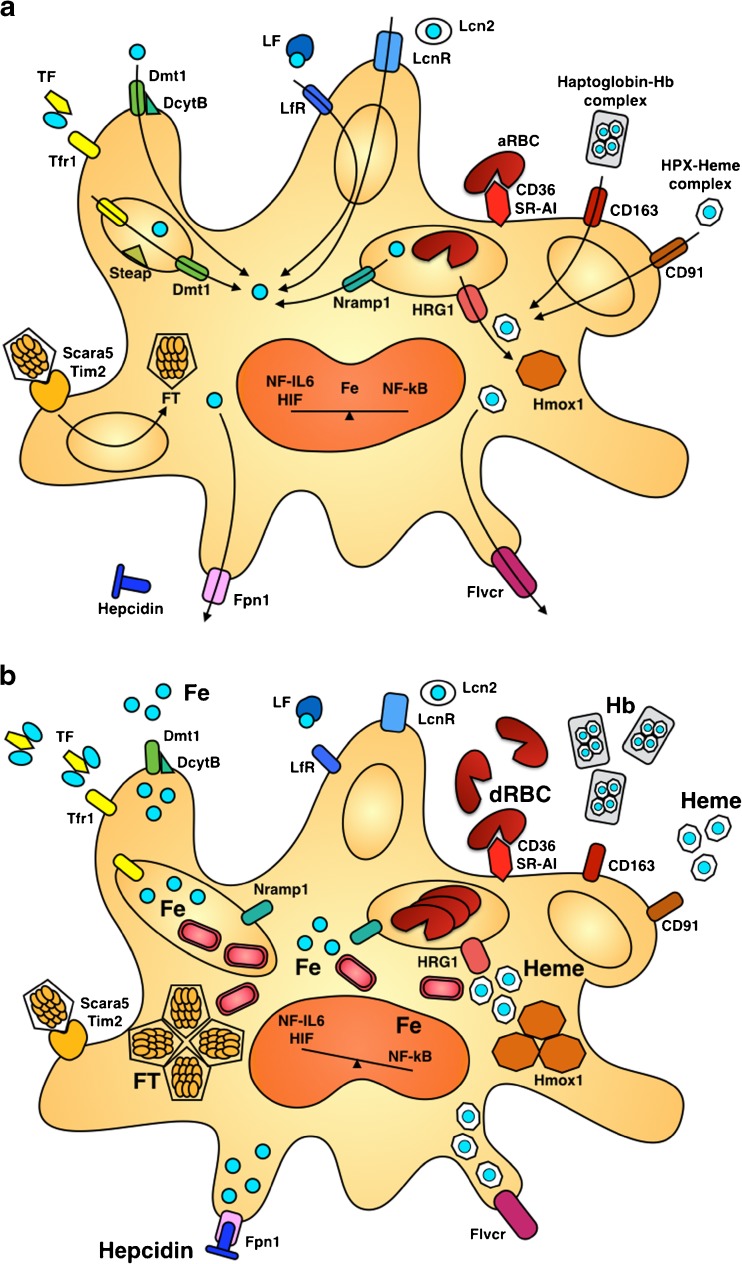
“Clinical data as well as many studies in infection models show that macrophage iron overload, often resulting from hemolysis or iron supplementation, interferes with their antimicrobial activity (Fig. 2b).”
§ “Pumping iron”—how macrophages handle iron at the systemic, microenvironmental, and cellular levels > The complexity of macrophage iron handling at the cellular level > Interplay of macrophage iron metabolism and immune functions
plaindirect- Asserted: passes — The authors put it forward as true.
- Checkable: passes — It can be checked against evidence.
- Load-bearing: passes — The paper’s conclusions depend on it.
- Based: passes — The paper gives a reason why it holds.
A conclusion the paper draws from its own results — it cites no other source for it, so there is none to check. The quote shows it is in the paper.
In the paper
“One of macrophages’ central metabolic functions is to eliminate senescent and damaged RBCs and to recycle their heme-bound iron to maintain systemic and cellular iron homeostasis.”
§ “Pumping iron”—how macrophages handle iron at the systemic, microenvironmental, and cellular levels > Conclusion
plaindirect- Asserted: passes — The authors put it forward as true.
- Checkable: passes — It can be checked against evidence.
- Load-bearing: passes — The paper’s conclusions depend on it.
- Based: unclear — It is unclear why the paper says it holds.
A conclusion the paper draws from its own results — it cites no other source for it, so there is none to check. The quote shows it is in the paper.
In the paper
“The role of macrophages in iron handling preserves iron homeostasis and tissue integrity.”
§ “Pumping iron”—how macrophages handle iron at the systemic, microenvironmental, and cellular levels > Conclusion
plaindirect- Asserted: passes — The authors put it forward as true.
- Checkable: passes — It can be checked against evidence.
- Load-bearing: passes — The paper’s conclusions depend on it.
- Based: passes — The paper gives a reason why it holds.
- It may state two separate claims as one. 45
- Probably not a substantial claim. 8
- The quote only partly states this claim. 1
None of the sources cited for this claim have been checked yet.
In the paper
“The presence of Fpn1 in the absorptive epithelium is under negative control of hepcidin, which is mainly secreted by hepatocytes in response to high circulating and tissue amounts of iron or upon stimulation by inflammatory mediators [171, 229].”
§ “Pumping iron”—how macrophages handle iron at the systemic, microenvironmental, and cellular levels > Systemic aspects of iron recycling
What the sources say
- Not checked yetcites [171] Nemeth E, Ganz T (2006) Regulation of iron metabolism by hepcidin. Annu Rev Nutr 26:323–342 source
- Not checked yetcites [229] Theurl I, Aigner E, Theurl M, Nairz M, Seifert M, Schroll A, Sonnweber T, Eberwein L, Witcher DR, Murphy AT, Wroblewski VJ, Wurz E, Datz C, Weiss G (2009) Regulation of iron homeostasis in anemia of chronic disease and iron deficiency anemia: diagnostic and therapeutic implications. Blood 113:5277–5286 source
plaindirect- Asserted: passes — The authors put it forward as true.
- Checkable: passes — It can be checked against evidence.
- Load-bearing: unclear — It is unclear whether the paper’s conclusions depend on it.
- Based: passes — The paper gives a reason why it holds.
It may state two separate claims as one.
A conclusion the paper draws from its own results — it cites no other source for it, so there is none to check. The quote shows it is in the paper.
In the paper
“The molecular machinery of RBC recycling is relatively well described, and its function is essential to tissue integrity given the pro-oxidative capacity of free labile heme.”
§ “Pumping iron”—how macrophages handle iron at the systemic, microenvironmental, and cellular levels > Systemic aspects of iron recycling > Erythrophagocytosis
boosteddirect- Asserted: passes — The authors put it forward as true.
- Checkable: passes — It can be checked against evidence.
- Load-bearing: unclear — It is unclear whether the paper’s conclusions depend on it.
- Based: passes — The paper gives a reason why it holds.
It may state two separate claims as one.
In the paper
“It is at this location that ferroportin-1 (Fpn1; AKA solute carrier family 40 member 1) fulfills its function as the sole cellular efflux protein for ionic iron, shuttling apically absorbed iron to the circulation, where it is oxidized and loaded onto transferrin (TF) [173].”
§ “Pumping iron”—how macrophages handle iron at the systemic, microenvironmental, and cellular levels > Systemic aspects of iron recycling
What the sources say
- Not checked yetcites [173] Nemeth E, Tuttle MS, Powelson J, Vaughn MB, Donovan A, Ward DM, Ganz T, Kaplan J (2004b) Hepcidin regulates cellular iron efflux by binding to ferroportin and inducing its internalization. Science 306:2090–2093 source
plaindirect- Asserted: passes — The authors put it forward as true.
- Checkable: passes — It can be checked against evidence.
- Load-bearing: unclear — It is unclear whether the paper’s conclusions depend on it.
- Based: passes — The paper gives a reason why it holds.
It may state two separate claims as one.
In the paper
“It is essential to the development of these cell types as Spic −/− mice have drastically reduced numbers of RPM and EIM which lead to reduced proerythroblast numbers in the steady state, supporting the idea that iron recycling is essential to sustain iron-sufficient erythropoiesis [58].”
§ “Pumping iron”—how macrophages handle iron at the systemic, microenvironmental, and cellular levels > Systemic aspects of iron recycling > Erythrophagocytosis
What the sources say
- Not checked yetcites [58] Drakesmith H, Schimanski LM, Ormerod E, Merryweather-Clarke AT, Viprakasit V, Edwards JP, Sweetland E, Bastin JM, Cowley D, Chinthammitr Y, Robson KJ, Townsend AR (2005) Resistance to hepcidin is conferred by hemochromatosis-associated mutations of ferroportin. Blood 106:1092–1097 source
plaindirect- Asserted: passes — The authors put it forward as true.
- Checkable: passes — It can be checked against evidence.
- Load-bearing: passes — The paper’s conclusions depend on it.
- Based: passes — The paper gives a reason why it holds.
It may state two separate claims as one.
None of the sources cited for this claim have been checked yet.
In the paper
“Furthermore, the inflammasome activation via cryopyrin (AKA NLRP3) is sensitive to surplus intracellular heme while extracellular free heme can activate Toll-like receptor 4 (TLR4), supporting the idea that free heme is an endogenous danger signal [60, 65, 66, 131].”
§ “Pumping iron”—how macrophages handle iron at the systemic, microenvironmental, and cellular levels > Systemic aspects of iron recycling > Erythrophagocytosis
What the sources say
- Not checked yetcites [60] Dutra FF, Alves LS, Rodrigues D, Fernandez PL, de Oliveira RB, Golenbock DT, Zamboni DS, Bozza MT (2014) Hemolysis-induced lethality involves inflammasome activation by heme. Proc Natl Acad Sci U S A 111:E4110–E4118 source
- Not checked yetcites [65] Fernandez PL, Dutra FF, Alves L, Figueiredo RT, Mourao-Sa D, Fortes GB, Bergstrand S, Lonn D, Cevallos RR, Pereira RM, Lopes UG, Travassos LH, Paiva CN, Bozza MT (2010) Heme amplifies the innate immune response to microbial molecules through spleen tyrosine kinase (Syk)-dependent reactive oxygen species generation. J Biol Chem 285:32844–32851 source
- Not checked yetcites [66] Figueiredo RT, Fernandez PL, Mourao-Sa DS, Porto BN, Dutra FF, Alves LS, Oliveira MF, Oliveira PL, Graca-Souza AV, Bozza MT (2007) Characterization of heme as activator of Toll-like receptor 4. J Biol Chem 282:20221–20229 source
- Not checked yetcites [131] Li Q, Fu W, Yao J, Ji Z, Wang Y, Zhou Z, Yan J, Li W (2014a) Heme induces IL-1beta secretion through activating NLRP3 in kidney inflammation. Cell Biochem Biophys 69:495–502 source
plaindirect- Asserted: passes — The authors put it forward as true.
- Checkable: passes — It can be checked against evidence.
- Load-bearing: unclear — It is unclear whether the paper’s conclusions depend on it.
- Based: passes — The paper gives a reason why it holds.
It may state two separate claims as one.
None of the sources cited for this claim have been checked yet.
In the paper
“In addition, their roles in the metabolic activity of the adjacent myocardium and in chronic cardiac diseases such as congestive heart failure are increasingly appreciated [199], and macrophages may either tailor the delivery of iron to the myocardium or accumulate and detoxify heme which may mainly arise from tissue injury [161, 214].”
§ “Pumping iron”—how macrophages handle iron at the systemic, microenvironmental, and cellular levels > Local circuits > Heart—an organ exquisitely sensitive to iron toxicity
What the sources say
- Not checked yetcites [161] Nahrendorf M, Swirski FK (2016) Innate immune cells in ischaemic heart disease: does myocardial infarction beget myocardial infarction? Eur Heart J 37:868–872 source
- Not checked yetcites [214] Sohn YS, Ghoti H, Breuer W, Rachmilewitz E, Attar S, Weiss G, Cabantchik ZI (2012) The role of endocytic pathways in cellular uptake of plasma non-transferrin iron. Haematologica 97:670–678 source
hedgedconditional- Asserted: passes — The authors put it forward as true.
- Checkable: passes — It can be checked against evidence.
- Load-bearing: unclear — It is unclear whether the paper’s conclusions depend on it.
- Based: passes — The paper gives a reason why it holds.
It may state two separate claims as one.
None of the sources cited for this claim have been checked yet.
In the paper
“Although iron-mediated generation of ROS and injury to mitochondria are likely mechanisms [196, 204]”
§ “Pumping iron”—how macrophages handle iron at the systemic, microenvironmental, and cellular levels > Local circuits > Brain—cerebral iron overload is implicated in neurodegeneration
What the sources say
- Not checked yetcites [196] Rouault TA (2013) Iron metabolism in the CNS: implications for neurodegenerative diseases. Nat Rev Neurosci 14:551–564 source
- Not checked yetcites [204] Schipper HM (1999) Glial HO-1 expression, iron deposition and oxidative stress in neurodegenerative diseases. Neurotox Res 1:57–70 source
hedgedconditional- Asserted: passes — The authors put it forward as true.
- Checkable: passes — It can be checked against evidence.
- Load-bearing: unclear — It is unclear whether the paper’s conclusions depend on it.
- Based: passes — The paper gives a reason why it holds.
It may state two separate claims as one.
None of the sources cited for this claim have been checked yet.
In the paper
“A paradigmatic yet rare NBIA condition is the neuroferritinopathy that is caused by a mutation in the coding region of the FTL gene [44, 45].”
§ “Pumping iron”—how macrophages handle iron at the systemic, microenvironmental, and cellular levels > Local circuits > Brain—cerebral iron overload is implicated in neurodegeneration
What the sources say
- Not checked yetcites [44] Cozzi A, Santambrogio P, Privitera D, Broccoli V, Rotundo LI, Garavaglia B, Benz R, Altamura S, Goede JS, Muckenthaler MU, Levi S (2013) Human L-ferritin deficiency is characterized by idiopathic generalized seizures and atypical restless leg syndrome. J Exp Med 210:1779–1791 source
- Not checked yetcites [45] Curtis AR, Fey C, Morris CM, Bindoff LA, Ince PG, Chinnery PF, Coulthard A, Jackson MJ, Jackson AP, McHale DP, Hay D, Barker WA, Markham AF, Bates D, Curtis A, Burn J (2001) Mutation in the gene encoding ferritin light polypeptide causes dominant adult-onset basal ganglia disease. Nat Genet 28:350–354 source
plaindirect- Asserted: passes — The authors put it forward as true.
- Checkable: passes — It can be checked against evidence.
- Load-bearing: fails — The paper’s conclusions may not depend on it.
- Based: passes — The paper gives a reason why it holds.
Probably not a substantial claim. The paper’s conclusions may not depend on it.
A conclusion the paper draws from its own results — it cites no other source for it, so there is none to check. The quote shows it is in the paper.
In the paper
“It would appear that neuronal iron efflux is insufficient to remove surplus and potentially harmful iron from the cytoplasm.”
§ “Pumping iron”—how macrophages handle iron at the systemic, microenvironmental, and cellular levels > Local circuits > Brain—cerebral iron overload is implicated in neurodegeneration
hedged- Asserted: passes — The authors put it forward as true.
- Checkable: passes — It can be checked against evidence.
- Load-bearing: fails — The paper’s conclusions may not depend on it.
- Based: fails — The paper may give no reason why it holds.
Probably not a substantial claim. The paper’s conclusions may not depend on it. The paper may give no reason why it holds.
In the paper
“Müller glial cells and endothelial cells of the retina both express Fpn1, but only the latter cell type is sensitive to hepcidin regulation.”
§ “Pumping iron”—how macrophages handle iron at the systemic, microenvironmental, and cellular levels > Local circuits > Retina—the location in which iron aggravates light damage
What the sources say
- Not checked yetcites [232] Theurl M, Song D, Clark E, Sterling J, Grieco S, Altamura S, Galy B, Hentze M, Muckenthaler MU, Dunaief JL (2016b) Mice with hepcidin-resistant ferroportin accumulate iron in the retina. FASEB J 30:813–823 source
plain- Asserted: passes — The authors put it forward as true.
- Checkable: passes — It can be checked against evidence.
- Load-bearing: passes — The paper’s conclusions depend on it.
- Based: passes — The paper gives a reason why it holds.
It may state two separate claims as one.
In the paper
“Arthropathy of the second and third metacarpophalangeal joints is a typical manifestation of type I hemochromatosis [94].”
§ “Pumping iron”—how macrophages handle iron at the systemic, microenvironmental, and cellular levels > Local circuits > Bone—osteoclasts are iron-dependent
What the sources say
- Not checked yetcites [94] Heiland GR, Aigner E, Dallos T, Sahinbegovic E, Krenn V, Thaler C, Weiss G, Distler JH, Datz C, Schett G, Zwerina J (2010) Synovial immunopathology in haemochromatosis arthropathy. Ann Rheum Dis 69:1214–1219 source
plaincorrelational- Asserted: passes — The authors put it forward as true.
- Checkable: passes — It can be checked against evidence.
- Load-bearing: fails — The paper’s conclusions may not depend on it.
- Based: passes — The paper gives a reason why it holds.
Probably not a substantial claim. The paper’s conclusions may not depend on it.
In the paper
“Importantly, LDN treatment also reduced atherosclerotic lesion size, suggesting that modulating systemic iron metabolism affects atherosclerosis progression.”
§ “Pumping iron”—how macrophages handle iron at the systemic, microenvironmental, and cellular levels > Local circuits > Blood vessels—arterial macrophage iron overload as hallmark of atherosclerosis
What the sources say
- Not checked yetcites [198] Saeed O, Otsuka F, Polavarapu R, Karmali V, Weiss D, Davis T, Rostad B, Pachura K, Adams L, Elliott J, Taylor WR, Narula J, Kolodgie F, Virmani R, Hong CC, Finn AV (2012) Pharmacological suppression of hepcidin increases macrophage cholesterol efflux and reduces foam cell formation and atherosclerosis. Arterioscler Thromb Vasc Biol 32:299–307 source
hedgeddirect- Asserted: passes — The authors put it forward as true.
- Checkable: passes — It can be checked against evidence.
- Load-bearing: passes — The paper’s conclusions depend on it.
- Based: passes — The paper gives a reason why it holds.
It may state two separate claims as one. The quote only partly states this claim.
In the paper
“In addition, experimental light damage to the retina results in microglial activation, its migration to the outer retina, and in induction of FT H and L chains.”
§ “Pumping iron”—how macrophages handle iron at the systemic, microenvironmental, and cellular levels > Local circuits > Retina—the location in which iron aggravates light damage
What the sources say
- Not checked yetcites [217] Song D, Song Y, Hadziahmetovic M, Zhong Y, Dunaief JL (2012a) Systemic administration of the iron chelator deferiprone protects against light-induced photoreceptor degeneration in the mouse retina. Free Radic Biol Med 53:64–71 source
plaindirect- Asserted: passes — The authors put it forward as true.
- Checkable: passes — It can be checked against evidence.
- Load-bearing: passes — The paper’s conclusions depend on it.
- Based: passes — The paper gives a reason why it holds.
It may state two separate claims as one.
In the paper
“Notably, Lcn2 also affects a variety of brain functions from cognition to emotional stress [104].”
§ “Pumping iron”—how macrophages handle iron at the systemic, microenvironmental, and cellular levels > Local circuits > Brain—cerebral iron overload is implicated in neurodegeneration
What the sources say
- Not checked yetcites [104] Jha MK, Lee S, Park DH, Kook H, Park KG, Lee IK, Suk K (2014) Diverse functional roles of lipocalin-2 in the central nervous system. Neurosci Biobehav Rev 49:135–156
plaindirect- Asserted: passes — The authors put it forward as true.
- Checkable: passes — It can be checked against evidence.
- Load-bearing: fails — The paper’s conclusions may not depend on it.
- Based: passes — The paper gives a reason why it holds.
Probably not a substantial claim. The paper’s conclusions may not depend on it.
The paper states this without a source or data behind it here, so there is nothing to check it against. The quote shows it is in the paper.
In the paper
“For instance, after experimental intracranial hemorrhage (ICH), microglia clear RBC but may also sustain inflammation and cause secondary damage.”
§ “Pumping iron”—how macrophages handle iron at the systemic, microenvironmental, and cellular levels > Local circuits > Brain—cerebral iron overload is implicated in neurodegeneration
hedgedconditional- Asserted: passes — The authors put it forward as true.
- Checkable: passes — It can be checked against evidence.
- Load-bearing: unclear — It is unclear whether the paper’s conclusions depend on it.
- Based: passes — The paper gives a reason why it holds.
It may state two separate claims as one.
In the paper
“However, microglia are also exquisitely sensitive to the potential toxicity of IONs because they are rapidly degraded within lysosomes and their iron catalyzes ROS generation [184].”
§ “Pumping iron”—how macrophages handle iron at the systemic, microenvironmental, and cellular levels > Local circuits > Brain—cerebral iron overload is implicated in neurodegeneration
What the sources say
- Not checked yetcites [184] Petters C, Thiel K, Dringen R (2015) Lysosomal iron liberation is responsible for the vulnerability of brain microglial cells to iron oxide nanoparticles: comparison with neurons and astrocytes. Nanotoxicology 10:332–342 source
plaindirect- Asserted: passes — The authors put it forward as true.
- Checkable: passes — It can be checked against evidence.
- Load-bearing: unclear — It is unclear whether the paper’s conclusions depend on it.
- Based: passes — The paper gives a reason why it holds.
It may state two separate claims as one.
In the paper
“Since photoreceptors are sensitive to iron toxicity, local iron regulatory circuits including the hepcidin-Fpn1 axis operate in the retina [261].”
§ “Pumping iron”—how macrophages handle iron at the systemic, microenvironmental, and cellular levels > Local circuits > Retina—the location in which iron aggravates light damage
What the sources say
- Not checked yetcites [261] Zhao L, Li Y, Song D, Song Y, Theurl M, Wang C, Cwanger A, Su G, Dunaief JL (2014) A high serum iron level causes mouse retinal iron accumulation despite an intact blood-retinal barrier. Am J Pathol 184:2862–2867 source
plaindirect- Asserted: passes — The authors put it forward as true.
- Checkable: passes — It can be checked against evidence.
- Load-bearing: unclear — It is unclear whether the paper’s conclusions depend on it.
- Based: passes — The paper gives a reason why it holds.
It may state two separate claims as one.
A conclusion the paper draws from its own results — it cites no other source for it, so there is none to check. The quote shows it is in the paper.
In the paper
“Therefore, the retina is another organ that is sensitive to iron toxicity but has evidence of endogenous mechanisms to maintain local iron homeostasis in the microenvironment.”
§ “Pumping iron”—how macrophages handle iron at the systemic, microenvironmental, and cellular levels > Local circuits > Retina—the location in which iron aggravates light damage
plaincorrelational- Asserted: passes — The authors put it forward as true.
- Checkable: passes — It can be checked against evidence.
- Load-bearing: unclear — It is unclear whether the paper’s conclusions depend on it.
- Based: passes — The paper gives a reason why it holds.
It may state two separate claims as one.
In the paper
“The composition of FT is cell type-specific, and central neuronal FT are L chain-rich [236].”
§ “Pumping iron”—how macrophages handle iron at the systemic, microenvironmental, and cellular levels > Local circuits > Brain—cerebral iron overload is implicated in neurodegeneration
What the sources say
- Not checked yetcites [236] Torti FM, Torti SV (2002) Regulation of ferritin genes and protein. Blood 99:3505–3516 source
plaincorrelational- Asserted: passes — The authors put it forward as true.
- Checkable: passes — It can be checked against evidence.
- Load-bearing: unclear — It is unclear whether the paper’s conclusions depend on it.
- Based: passes — The paper gives a reason why it holds.
It may state two separate claims as one.
None of the sources cited for this claim have been checked yet.
In the paper
“Interestingly, the hyperferritinemia-cataract syndrome that is caused by a mutation in a specific non-coding region of the FTL gene, the iron-responsive element (IRE), is not associated with iron accumulation in the brain but with the formation of ferritin crystals in the ocular lenses, resulting in cataracts in early adulthood [23, 83, 195].”
§ “Pumping iron”—how macrophages handle iron at the systemic, microenvironmental, and cellular levels > Local circuits > Brain—cerebral iron overload is implicated in neurodegeneration
What the sources say
- Not checked yetcites [23] Brooks DG, Manova-Todorova K, Farmer J, Lobmayr L, Wilson RB, Eagle RC Jr, St Pierre TG, Stambolian D (2002) Ferritin crystal cataracts in hereditary hyperferritinemia cataract syndrome. Invest Ophthalmol Vis Sci 43:1121–1126
- Not checked yetcites [83] Girelli D, Corrocher R, Bisceglia L, Olivieri O, De Franceschi L, Zelante L, Gasparini P (1995) Molecular basis for the recently described hereditary hyperferritinemia-cataract syndrome: a mutation in the iron-responsive element of ferritin L-subunit gene (the “Verona mutation”). Blood 86:4050–4053 source
- Not checked yetcites [195] Rouault TA (2006) The role of iron regulatory proteins in mammalian iron homeostasis and disease. Nat Chem Biol 2:406–414 source
plaindirect- Asserted: passes — The authors put it forward as true.
- Checkable: passes — It can be checked against evidence.
- Load-bearing: fails — The paper’s conclusions may not depend on it.
- Based: passes — The paper gives a reason why it holds.
Probably not a substantial claim. The paper’s conclusions may not depend on it. It may state two separate claims as one.
In the paper
“Osteoclast precursors take up iron via Tfr1 and utilize six-transmembrane epithelial antigen of prostate (Steap4) as ferrireductase [262].”
§ “Pumping iron”—how macrophages handle iron at the systemic, microenvironmental, and cellular levels > Local circuits > Bone—osteoclasts are iron-dependent
What the sources say
- Not checked yetcites [262] Zhou J, Ye S, Fujiwara T, Manolagas SC, Zhao H (2013) Steap4 plays a critical role in osteoclastogenesis in vitro by regulating cellular iron/reactive oxygen species (ROS) levels and cAMP response element-binding protein (CREB) activation. J Biol Chem 288:30064–30074 source
plaindirect- Asserted: passes — The authors put it forward as true.
- Checkable: passes — It can be checked against evidence.
- Load-bearing: unclear — It is unclear whether the paper’s conclusions depend on it.
- Based: passes — The paper gives a reason why it holds.
It may state two separate claims as one.
In the paper
“An increase in plasma iron stimulates hepcidin secretion which dampens macrophage iron egress and to a lesser extent duodenal iron absorption following its interaction with Fpn1.”
§ “Pumping iron”—how macrophages handle iron at the systemic, microenvironmental, and cellular levels > Local circuits > Liver—the iron regulatory organ
What the sources say
- Not checked yetcites [158] Moretti D, Goede JS, Zeder C, Jiskra M, Chatzinakou V, Tjalsma H, Melse-Boonstra A, Brittenham G, Swinkels DW, Zimmermann MB (2015) Oral iron supplements increase hepcidin and decrease iron absorption from daily or twice-daily doses in iron-depleted young women. Blood 126:1981–1989 source
plaindirect- Asserted: passes — The authors put it forward as true.
- Checkable: passes — It can be checked against evidence.
- Load-bearing: passes — The paper’s conclusions depend on it.
- Based: passes — The paper gives a reason why it holds.
It may state two separate claims as one.
None of the sources cited for this claim have been checked yet.
In the paper
“It is well characterized that erythroblasts expel their nuclei during differentiation and that these are taken up by EIM after phosphatidylserine exposure via Tim4 and MER proto-oncogene, tyrosine kinase (MerTK) [234, 254].”
§ “Pumping iron”—how macrophages handle iron at the systemic, microenvironmental, and cellular levels > Local circuits > Bone marrow—are erythroblasts “nursed” with iron?
What the sources say
- Not checked yetcites [234] Toda S, Segawa K, Nagata S (2014) MerTK-mediated engulfment of pyrenocytes by central macrophages in erythroblastic islands. Blood 123:3963–3971 source
- Not checked yetcites [254] Yoshida H, Kawane K, Koike M, Mori Y, Uchiyama Y, Nagata S (2005) Phosphatidylserine-dependent engulfment by macrophages of nuclei from erythroid precursor cells. Nature 437:754–758 source
boosteddirect- Asserted: passes — The authors put it forward as true.
- Checkable: passes — It can be checked against evidence.
- Load-bearing: unclear — It is unclear whether the paper’s conclusions depend on it.
- Based: passes — The paper gives a reason why it holds.
It may state two separate claims as one.
None of the sources cited for this claim have been checked yet.
In the paper
“At either location, Dmt1 only accepts ferrous iron along with other divalent cations, such as copper or manganese, and co-localizes with an iron reductase [152, 177].”
§ “Pumping iron”—how macrophages handle iron at the systemic, microenvironmental, and cellular levels > The complexity of macrophage iron handling at the cellular level > A broad spectrum of iron uptake pathways
What the sources say
- Not checked yetcites [152] McKie AT, Barrow D, Latunde-Dada GO, Rolfs A, Sager G, Mudaly E, Mudaly M, Richardson C, Barlow D, Bomford A, Peters TJ, Raja KB, Shirali S, Hediger MA, Farzaneh F, Simpson RJ (2001) An iron-regulated ferric reductase associated with the absorption of dietary iron. Science 291:1755–1759 source
- Not checked yetcites [177] Ohgami RS, Campagna DR, Greer EL, Antiochos B, McDonald A, Chen J, Sharp JJ, Fujiwara Y, Barker JE, Fleming MD (2005) Identification of a ferrireductase required for efficient transferrin-dependent iron uptake in erythroid cells. Nat Genet 37:1264–1269 source
plaincorrelational- Asserted: passes — The authors put it forward as true.
- Checkable: passes — It can be checked against evidence.
- Load-bearing: unclear — It is unclear whether the paper’s conclusions depend on it.
- Based: passes — The paper gives a reason why it holds.
It may state two separate claims as one.
None of the sources cited for this claim have been checked yet.
In the paper
“These are best characterized in bacteria, but eukaryotes including fungi and mammals produce siderophores, too [16, 42, 67, 86, 106].”
§ “Pumping iron”—how macrophages handle iron at the systemic, microenvironmental, and cellular levels > The complexity of macrophage iron handling at the cellular level
What the sources say
- Not checked yetcites [16] Behnsen J, Raffatellu M (2016) Siderophores: more than stealing iron. MBio 7:e01397–16 source
- Not checked yetcites [42] Correnti C, Strong RK (2012) Mammalian siderophores, siderophore-binding lipocalins, and the labile iron pool. J Biol Chem 287:13524–13531 source
- Not checked yetcites [67] Fischbach MA, Lin H, Liu DR, Walsh CT (2006) How pathogenic bacteria evade mammalian sabotage in the battle for iron. Nat Chem Biol 2:132–138 source
- Not checked yetcites [86] Haas H (2014) Fungal siderophore metabolism with a focus on Aspergillus fumigatus. Nat Prod Rep 31:1266–1276 source
- Not checked yetcites [106] Jones RL, Peterson CM, Grady RW, Cerami A (1980) Low molecular weight iron-binding factor from mammalian tissue that potentiates bacterial growth. J Exp Med 151:418–428 source
plain- Asserted: passes — The authors put it forward as true.
- Checkable: passes — It can be checked against evidence.
- Load-bearing: unclear — It is unclear whether the paper’s conclusions depend on it.
- Based: passes — The paper gives a reason why it holds.
It may state two separate claims as one.
In the paper
“In addition, membrane VCAM1 is expressed on CD169+ macrophages in the spleen and provides a molecular anchor to retain hematopoietic stem cells in the murine spleen, although it is unclear whether this is also relevant to arthropathy [61].”
§ “Pumping iron”—how macrophages handle iron at the systemic, microenvironmental, and cellular levels > Local circuits > Bone—osteoclasts are iron-dependent
What the sources say
- Not checked yetcites [61] Dutta P, Hoyer FF, Grigoryeva LS, Sager HB, Leuschner F, Courties G, Borodovsky A, Novobrantseva T, Ruda VM, Fitzgerald K, Iwamoto Y, Wojtkiewicz G, Sun Y, Da Silva N, Libby P, Anderson DG, Swirski FK, Weissleder R, Nahrendorf M (2015) Macrophages retain hematopoietic stem cells in the spleen via VCAM-1. J Exp Med 212:497–512 source
plaindirect- Asserted: passes — The authors put it forward as true.
- Checkable: passes — It can be checked against evidence.
- Load-bearing: fails — The paper’s conclusions may not depend on it.
- Based: passes — The paper gives a reason why it holds.
Probably not a substantial claim. The paper’s conclusions may not depend on it. It may state two separate claims as one.
In the paper
“At the cell surface membrane, macrophages possess the heme exporter Flvcr and its genetic deletion results in RPM iron overload [108].”
§ “Pumping iron”—how macrophages handle iron at the systemic, microenvironmental, and cellular levels > The complexity of macrophage iron handling at the cellular level > A broad spectrum of iron uptake pathways
What the sources say
- Not checked yetcites [108] Keel SB, Doty RT, Yang Z, Quigley JG, Chen J, Knoblaugh S, Kingsley PD, De Domenico I, Vaughn MB, Kaplan J, Palis J, Abkowitz JL (2008) A heme export protein is required for red blood cell differentiation and iron homeostasis. Science 319:825–828 source
plaindirect- Asserted: passes — The authors put it forward as true.
- Checkable: passes — It can be checked against evidence.
- Load-bearing: unclear — It is unclear whether the paper’s conclusions depend on it.
- Based: passes — The paper gives a reason why it holds.
It may state two separate claims as one.
In the paper
“Interestingly, the functions of IRPs1 and 2 are redundant in macrophages and only targeted deletion of both isoforms via the LysM-Cre system results in increased FT levels and intracellular iron retention [193].”
§ “Pumping iron”—how macrophages handle iron at the systemic, microenvironmental, and cellular levels > The complexity of macrophage iron handling at the cellular level > The control of cytosolic iron levels
What the sources say
- Not checked yetcites [193] Recalcati S, Alberghini A, Campanella A, Gianelli U, De Camilli E, Conte D, Cairo G (2006) Iron regulatory proteins 1 and 2 in human monocytes, macrophages and duodenum: expression and regulation in hereditary hemochromatosis and iron deficiency. Haematologica 91:303–310
plaindirect- Asserted: passes — The authors put it forward as true.
- Checkable: passes — It can be checked against evidence.
- Load-bearing: unclear — It is unclear whether the paper’s conclusions depend on it.
- Based: passes — The paper gives a reason why it holds.
It may state two separate claims as one.
In the paper
“Of interest, circulating VCAM1 is shed by the metalloproteinase ADAM metallopeptidase domain 17 (ADAM17, AKA TNF alpha-converting enzyme (TACE)) which is activated by inflammatory stimuli [81].”
§ “Pumping iron”—how macrophages handle iron at the systemic, microenvironmental, and cellular levels > Local circuits > Bone—osteoclasts are iron-dependent
What the sources say
- Not checked yetcites [81] Garton KJ, Gough PJ, Philalay J, Wille PT, Blobel CP, Whitehead RH, Dempsey PJ, Raines EW (2003) Stimulated shedding of vascular cell adhesion molecule 1 (VCAM-1) is mediated by tumor necrosis factor-alpha-converting enzyme (ADAM 17). J Biol Chem 278:37459–37464 source
plaindirect- Asserted: passes — The authors put it forward as true.
- Checkable: passes — It can be checked against evidence.
- Load-bearing: fails — The paper’s conclusions may not depend on it.
- Based: passes — The paper gives a reason why it holds.
Probably not a substantial claim. The paper’s conclusions may not depend on it. It may state two separate claims as one.
In the paper
“Its two major functional components are HRG1 which shifts heme from the endosome/lysosome to the cytoplasm and Hmox1 which then metabolizes heme [117].”
§ “Pumping iron”—how macrophages handle iron at the systemic, microenvironmental, and cellular levels > The complexity of macrophage iron handling at the cellular level
What the sources say
- Not checked yetcites [117] Korolnek T, Hamza I (2014) Like iron in the blood of the people: the requirement for heme trafficking in iron metabolism. Front Pharmacol 5:126 source
plaindirect- Asserted: passes — The authors put it forward as true.
- Checkable: passes — It can be checked against evidence.
- Load-bearing: unclear — It is unclear whether the paper’s conclusions depend on it.
- Based: passes — The paper gives a reason why it holds.
It may state two separate claims as one.
In the paper
“However, the deletion of Fpn1 by Cre recombinase expressed under the lysozyme M promoter results in iron accumulation in macrophages, including BM macrophages, and mild anemia.”
§ “Pumping iron”—how macrophages handle iron at the systemic, microenvironmental, and cellular levels > Local circuits > Bone marrow—are erythroblasts “nursed” with iron?
What the sources say
- Not checked yetcites [259] Zhang Z, Zhang F, An P, Guo X, Shen Y, Tao Y, Wu Q, Zhang Y, Yu Y, Ning B, Nie G, Knutson MD, Anderson GJ, Wang F (2011) Ferroportin1 deficiency in mouse macrophages impairs iron homeostasis and inflammatory responses. Blood 118:1912–1922 source
plaindirect- Asserted: passes — The authors put it forward as true.
- Checkable: passes — It can be checked against evidence.
- Load-bearing: passes — The paper’s conclusions depend on it.
- Based: passes — The paper gives a reason why it holds.
It may state two separate claims as one.
None of the sources cited for this claim have been checked yet.
In the paper
“However, LysM-Cre FTH mice have no apparent phenotype suggesting that iron storage and trafficking are well controlled in myeloid cells by other mechanisms [46, 239].”
§ “Pumping iron”—how macrophages handle iron at the systemic, microenvironmental, and cellular levels > The complexity of macrophage iron handling at the cellular level > The control of cytosolic iron levels
What the sources say
- Not checked yetcites [46] Darshan D, Vanoaica L, Richman L, Beermann F, Kuhn LC (2009) Conditional deletion of ferritin H in mice induces loss of iron storage and liver damage. Hepatology 50:852–860 source
- Not checked yetcites [239] Vanoaica L, Darshan D, Richman L, Schumann K, Kuhn LC (2010) Intestinal ferritin H is required for an accurate control of iron absorption. Cell Metab 12:273–282 source
hedged- Asserted: passes — The authors put it forward as true.
- Checkable: passes — It can be checked against evidence.
- Load-bearing: unclear — It is unclear whether the paper’s conclusions depend on it.
- Based: passes — The paper gives a reason why it holds.
It may state two separate claims as one.
In the paper
“This suggests that EIM utilize Fpn1 to export iron and thus function as iron-rich nurse cells [259].”
§ “Pumping iron”—how macrophages handle iron at the systemic, microenvironmental, and cellular levels > Local circuits > Bone marrow—are erythroblasts “nursed” with iron?
What the sources say
- Not checked yetcites [259] Zhang Z, Zhang F, An P, Guo X, Shen Y, Tao Y, Wu Q, Zhang Y, Yu Y, Ning B, Nie G, Knutson MD, Anderson GJ, Wang F (2011) Ferroportin1 deficiency in mouse macrophages impairs iron homeostasis and inflammatory responses. Blood 118:1912–1922 source
hedgeddirect- Asserted: passes — The authors put it forward as true.
- Checkable: passes — It can be checked against evidence.
- Load-bearing: passes — The paper’s conclusions depend on it.
- Based: passes — The paper gives a reason why it holds.
It may state two separate claims as one.
In the paper
“For instance, EIM express the αV integrin which binds ICAM4 on erythroid cells, and ICAM4 KO mice have reduced numbers of erythropoietic islands [126].”
§ “Pumping iron”—how macrophages handle iron at the systemic, microenvironmental, and cellular levels > Local circuits > Bone marrow—are erythroblasts “nursed” with iron?
What the sources say
- Not checked yetcites [126] Lee G, Lo A, Short SA, Mankelow TJ, Spring F, Parsons SF, Yazdanbakhsh K, Mohandas N, Anstee DJ, Chasis JA (2006) Targeted gene deletion demonstrates that the cell adhesion molecule ICAM-4 is critical for erythroblastic island formation. Blood 108:2064–2071 source
plaindirect- Asserted: passes — The authors put it forward as true.
- Checkable: passes — It can be checked against evidence.
- Load-bearing: unclear — It is unclear whether the paper’s conclusions depend on it.
- Based: passes — The paper gives a reason why it holds.
It may state two separate claims as one.
None of the sources cited for this claim have been checked yet.
In the paper
“Tfr1, which is also known as CD71, is widely expressed by isolated macrophages, and it may form a major route of iron uptake in the absence of RBC (an indirect iron source), though it also appears to be important in adaptive immunity [103, 138].”
§ “Pumping iron”—how macrophages handle iron at the systemic, microenvironmental, and cellular levels > The complexity of macrophage iron handling at the cellular level > A broad spectrum of iron uptake pathways
What the sources say
- Not checked yetcites [103] Jabara HH, Boyden SE, Chou J, Ramesh N, Massaad MJ, Benson H, Bainter W, Fraulino D, Rahimov F, Sieff C, Liu ZJ, Alshemmari SH, Al-Ramadi BK, Al-Dhekri H, Arnaout R, Abu-Shukair M, Vatsayan A, Silver E, Ahuja S, Davies EG, Sola-Visner M, Ohsumi TK, Andrews NC, Notarangelo LD, Fleming MD, Al-Herz W, Kunkel LM, Geha RS (2016) A missense mutation in TFRC, encoding transferrin receptor 1, causes combined immunodeficiency. Nat Genet 48:74–78 source
- Not checked yetcites [138] Ludwiczek S, Aigner E, Theurl I, Weiss G (2003) Cytokine-mediated regulation of iron transport in human monocytic cells. Blood 101:4148–4154 source
hedgedconditional- Asserted: passes — The authors put it forward as true.
- Checkable: passes — It can be checked against evidence.
- Load-bearing: unclear — It is unclear whether the paper’s conclusions depend on it.
- Based: passes — The paper gives a reason why it holds.
It may state two separate claims as one.
None of the sources cited for this claim have been checked yet.
In the paper
“While some of these compounds such as citrate are ubiquitous substrates, other mammalian siderophores such as catechols are probably synthesized from commensal metabolites or dietary precursors [11, 50, 252].”
§ “Pumping iron”—how macrophages handle iron at the systemic, microenvironmental, and cellular levels > The complexity of macrophage iron handling at the cellular level
What the sources say
- Not checked yetcites [11] Bao G, Clifton M, Hoette TM, Mori K, Deng SX, Qiu A, Viltard M, Williams D, Paragas N, Leete T, Kulkarni R, Li X, Lee B, Kalandadze A, Ratner AJ, Pizarro JC, Schmidt-Ott KM, Landry DW, Raymond KN, Strong RK, Barasch J (2010) Iron traffics in circulation bound to a siderocalin (Ngal)-catechol complex. Nat Chem Biol 6:602–609 source
- Not checked yetcites [50] Devireddy LR, Hart DO, Goetz DH, Green MR (2010) A mammalian siderophore synthesized by an enzyme with a bacterial homolog involved in enterobactin production. Cell 141:1006–1017 source
- Not checked yetcites [252] Xiao X, Yeoh BS, Saha P, Tian Y, Singh V, Patterson AD, Vijay-Kumar M (2016) Modulation of urinary siderophores by the diet, gut microbiota and inflammation in mice. J Nutr Biochem 41:25–33 source
hedgedconditional- Asserted: passes — The authors put it forward as true.
- Checkable: passes — It can be checked against evidence.
- Load-bearing: fails — The paper’s conclusions may not depend on it.
- Based: passes — The paper gives a reason why it holds.
Probably not a substantial claim. The paper’s conclusions may not depend on it.
None of the sources cited for this claim have been checked yet.
In the paper
“The transcription factor SpiC and its down-stream effector Hmox1 are both essential for EIM differentiation, since ablation of either gene reduces EIM number [73, 88].”
§ “Pumping iron”—how macrophages handle iron at the systemic, microenvironmental, and cellular levels > Local circuits > Bone marrow—are erythroblasts “nursed” with iron?
What the sources say
- Not checked yetcites [73] Fraser ST, Midwinter RG, Coupland LA, Kong S, Berger BS, Yeo JH, Andrade OC, Cromer D, Suarna C, Lam M, Maghzal GJ, Chong BH, Parish CR, Stocker R (2015) Heme oxygenase-1 deficiency alters erythroblastic island formation, steady-state erythropoiesis and red blood cell lifespan in mice. Haematologica 100:601–610 source
- Not checked yetcites [88] Haldar M, Kohyama M, So AY, Kc W, Wu X, Briseno CG, Satpathy AT, Kretzer NM, Arase H, Rajasekaran NS, Wang L, Egawa T, Igarashi K, Baltimore D, Murphy TL, Murphy KM (2014) Heme-mediated SPI-C induction promotes monocyte differentiation into iron-recycling macrophages. Cell 156:1223–1234 source
plaindirect- Asserted: passes — The authors put it forward as true.
- Checkable: passes — It can be checked against evidence.
- Load-bearing: unclear — It is unclear whether the paper’s conclusions depend on it.
- Based: passes — The paper gives a reason why it holds.
It may state two separate claims as one.
None of the sources cited for this claim have been checked yet.
In the paper
“Dmt1 shifts iron from the extracellular space to the cytoplasm and, in its alternately spliced form, from the Tfr1 endosome to the cytoplasm [69, 99, 139].”
§ “Pumping iron”—how macrophages handle iron at the systemic, microenvironmental, and cellular levels > The complexity of macrophage iron handling at the cellular level > A broad spectrum of iron uptake pathways
What the sources say
- Not checked yetcites [69] Fleming MD, Romano MA, Su MA, Garrick LM, Garrick MD, Andrews NC (1998) Nramp2 is mutated in the anemic Belgrade (b) rat: evidence of a role for Nramp2 in endosomal iron transport. Proc Natl Acad Sci U S A 95:1148–1153 source
- Not checked yetcites [99] Hubert N, Hentze MW (2002) Previously uncharacterized isoforms of divalent metal transporter (DMT)-1: implications for regulation and cellular function. Proc Natl Acad Sci U S A 99:12345–12350 source
- Not checked yetcites [139] Ludwiczek S, Theurl I, Muckenthaler MU, Jakab M, Mair SM, Theurl M, Kiss J, Paulmichl M, Hentze MW, Ritter M, Weiss G (2007) Ca2+ channel blockers reverse iron overload by a new mechanism via divalent metal transporter-1. Nat Med 13:448–454 source
plaindirect- Asserted: passes — The authors put it forward as true.
- Checkable: passes — It can be checked against evidence.
- Load-bearing: unclear — It is unclear whether the paper’s conclusions depend on it.
- Based: passes — The paper gives a reason why it holds.
It may state two separate claims as one.
In the paper
“This pathogen preferentially infects murine macrophages and has a proliferative advantage in the absence of both IRPs resulting in increased bacterial burden and reduced survival in a systemic infection model.”
§ “Pumping iron”—how macrophages handle iron at the systemic, microenvironmental, and cellular levels > The complexity of macrophage iron handling at the cellular level > The control of cytosolic iron levels
What the sources say
- Not checked yetcites [166] Nairz M, Ferring-Appel D, Casarrubea D, Sonnweber T, Viatte L, Schroll A, Haschka D, Fang FC, Hentze MW, Weiss G, Galy B (2015a) Iron regulatory proteins mediate host resistance to salmonella infection. Cell Host Microbe 18:254–261 source
plaindirect- Asserted: passes — The authors put it forward as true.
- Checkable: passes — It can be checked against evidence.
- Load-bearing: passes — The paper’s conclusions depend on it.
- Based: passes — The paper gives a reason why it holds.
It may state two separate claims as one.
In the paper
“The deletion of both IRPs in macrophages does not affect RBC recycling but impairs their nutritional immune functions against intracellular bacteria, such as Salmonella Typhimurium [166].”
§ “Pumping iron”—how macrophages handle iron at the systemic, microenvironmental, and cellular levels > The complexity of macrophage iron handling at the cellular level > The control of cytosolic iron levels
What the sources say
- Not checked yetcites [166] Nairz M, Ferring-Appel D, Casarrubea D, Sonnweber T, Viatte L, Schroll A, Haschka D, Fang FC, Hentze MW, Weiss G, Galy B (2015a) Iron regulatory proteins mediate host resistance to salmonella infection. Cell Host Microbe 18:254–261 source
plaindirect- Asserted: passes — The authors put it forward as true.
- Checkable: passes — It can be checked against evidence.
- Load-bearing: passes — The paper’s conclusions depend on it.
- Based: passes — The paper gives a reason why it holds.
It may state two separate claims as one.
None of the sources cited for this claim have been checked yet.
In the paper
“Macrophages express a range of factors mediating iron uptake (summarized in the Table 1) which essentially face only two pathways for iron efflux, Fpn1 for ionic iron and feline leukemia virus subtype C receptor (Flvcr) for heme iron (Fig. 2), although alternatives routes may exist [49, 136].”
§ “Pumping iron”—how macrophages handle iron at the systemic, microenvironmental, and cellular levels > The complexity of macrophage iron handling at the cellular level
What the sources say
- Not checked yetcites [49] Devireddy LR, Gazin C, Zhu X, Green MR (2005) A cell-surface receptor for lipocalin 24p3 selectively mediates apoptosis and iron uptake. Cell 123:1293–1305 source
- Not checked yetcites [136] Lok HC, Sahni S, Jansson PJ, Kovacevic Z, Hawkins CL, Richardson DR (2016) A nitric oxide storage and transport system that protects activated macrophages from endogenous nitric oxide cytotoxicity. J Biol Chem 291:27042–27061 source
hedged- Asserted: passes — The authors put it forward as true.
- Checkable: passes — It can be checked against evidence.
- Load-bearing: unclear — It is unclear whether the paper’s conclusions depend on it.
- Based: passes — The paper gives a reason why it holds.
It may state two separate claims as one.
None of the sources cited for this claim have been checked yet.
In the paper
“Second, iron alters gene transcription, translation, and mitochondrial respiration in macrophages [165, 175].”
§ “Pumping iron”—how macrophages handle iron at the systemic, microenvironmental, and cellular levels > The complexity of macrophage iron handling at the cellular level > Interplay of macrophage iron metabolism and immune functions
What the sources say
- Not checked yetcites [165] Nairz M, Haschka D, Demetz E, Weiss G (2014) Iron at the interface of immunity and infection. Front Pharmacol 5:152 source
- Not checked yetcites [175] Oexle H, Gnaiger E, Weiss G (1999) Iron-dependent changes in cellular energy metabolism: influence on citric acid cycle and oxidative phosphorylation. Biochim Biophys Acta 1413:99–107 source
plaindirect- Asserted: passes — The authors put it forward as true.
- Checkable: passes — It can be checked against evidence.
- Load-bearing: passes — The paper’s conclusions depend on it.
- Based: passes — The paper gives a reason why it holds.
It may state two separate claims as one.
A conclusion the paper draws from its own results — it cites no other source for it, so there is none to check. The quote shows it is in the paper.
In the paper
“In contrast to its inhibitory effect on NO, iron stimulates the non-enzymatic generation of ROS which may promote their antimicrobial activity but contribute to tissue damage and the pathogenesis of many inflammatory disorders.”
§ “Pumping iron”—how macrophages handle iron at the systemic, microenvironmental, and cellular levels > The complexity of macrophage iron handling at the cellular level > Interplay of macrophage iron metabolism and immune functions
hedgedconditional- Asserted: passes — The authors put it forward as true.
- Checkable: passes — It can be checked against evidence.
- Load-bearing: passes — The paper’s conclusions depend on it.
- Based: passes — The paper gives a reason why it holds.
It may state two separate claims as one.
None of the sources cited for this claim have been checked yet.
In the paper
“This pathway is important for iron recycling after erythrophagocytosis [213] and serves as a mechanism of nutrient withdrawal that is particularly efficient in host defense against Mycobacterium, Salmonella, and Leishmania species [31].”
§ “Pumping iron”—how macrophages handle iron at the systemic, microenvironmental, and cellular levels > The complexity of macrophage iron handling at the cellular level > Interplay of macrophage iron metabolism and immune functions
What the sources say
- Not checked yetcites [213] Soe-Lin S, Apte SS, Andriopoulos B Jr, Andrews MC, Schranzhofer M, Kahawita T, Garcia-Santos D, Ponka P (2009) Nramp1 promotes efficient macrophage recycling of iron following erythrophagocytosis in vivo. Proc Natl Acad Sci U S A 106:5960–5965 source
- Not checked yetcites [31] Cellier MF (2012) Nramp: from sequence to structure and mechanism of divalent metal import. Curr Top Membr 69:249–293 source
plaindirect- Asserted: passes — The authors put it forward as true.
- Checkable: passes — It can be checked against evidence.
- Load-bearing: passes — The paper’s conclusions depend on it.
- Based: passes — The paper gives a reason why it holds.
It may state two separate claims as one.
A conclusion the paper draws from its own results — it cites no other source for it, so there is none to check. The quote shows it is in the paper.
In the paper
“These effects may contribute to the inflammatory characteristics of sickle cell disease and can be ameliorated by the heme scavenger HPX.”
§ “Pumping iron”—how macrophages handle iron at the systemic, microenvironmental, and cellular levels > The complexity of macrophage iron handling at the cellular level > Interplay of macrophage iron metabolism and immune functions
hedgedconditional- Asserted: passes — The authors put it forward as true.
- Checkable: passes — It can be checked against evidence.
- Load-bearing: passes — The paper’s conclusions depend on it.
- Based: passes — The paper gives a reason why it holds.
It may state two separate claims as one.
None of the sources cited for this claim have been checked yet.
In the paper
“In addition, the functional form of Nramp1 in myeloid cells shifts the balance in T helper cell activity towards Th1, which may increase resistance to infections while increasing the susceptibility to autoimmune diseases [167, 226].”
§ “Pumping iron”—how macrophages handle iron at the systemic, microenvironmental, and cellular levels > The complexity of macrophage iron handling at the cellular level > Interplay of macrophage iron metabolism and immune functions
What the sources say
- Not checked yetcites [167] Nairz M, Schroll A, Demetz E, Tancevski I, Theurl I, Weiss G (2015b) 'Ride on the ferrous wheel'—the cycle of iron in macrophages in health and disease. Immunobiology 220:280–294 source
- Not checked yetcites [226] Theurl I, Fritsche G, Ludwiczek S, Garimorth K, Bellmann-Weiler R, Weiss G (2005) The macrophage: a cellular factory at the interphase between iron and immunity for the control of infections. Biometals 18:359–367 source
hedgedconditional- Asserted: passes — The authors put it forward as true.
- Checkable: passes — It can be checked against evidence.
- Load-bearing: unclear — It is unclear whether the paper’s conclusions depend on it.
- Based: passes — The paper gives a reason why it holds.
It may state two separate claims as one.
None of the sources cited for this claim have been checked yet.
In the paper
“Another layer of complexity is added by the fact that TLR4 signaling stabilizes HIF-1α activation via induction of FTH and hypoxia stimulates arginase-1 expression in myeloid cells thus undermining Leishmania killing [142, 209].”
§ “Pumping iron”—how macrophages handle iron at the systemic, microenvironmental, and cellular levels > The complexity of macrophage iron handling at the cellular level > Interplay of macrophage iron metabolism and immune functions
What the sources say
- Not checked yetcites [142] Mahnke A, Meier RJ, Schatz V, Hofmann J, Castiglione K, Schleicher U, Wolfbeis OS, Bogdan C, Jantsch J (2014) Hypoxia in Leishmania major skin lesions impairs the NO-dependent leishmanicidal activity of macrophages. J Invest Dermatol 134:2339–2346 source
- Not checked yetcites [209] Siegert I, Schodel J, Nairz M, Schatz V, Dettmer K, Dick C, Kalucka J, Franke K, Ehrenschwender M, Schley G, Beneke A, Sutter J, Moll M, Hellerbrand C, Wielockx B, Katschinski DM, Lang R, Galy B, Hentze MW, Koivunen P, Oefner PJ, Bogdan C, Weiss G, Willam C, Jantsch J (2015) Ferritin-mediated iron sequestration stabilizes hypoxia-inducible factor-1alpha upon LPS activation in the presence of ample oxygen. Cell Rep 13:2048–2055 source
plaindirect- Asserted: passes — The authors put it forward as true.
- Checkable: passes — It can be checked against evidence.
- Load-bearing: passes — The paper’s conclusions depend on it.
- Based: passes — The paper gives a reason why it holds.
It may state two separate claims as one.
In the paper
“The other study suggested that IONs stimulate TNF expression while inhibiting arginase-1 which results in improved killing of tumor cells [257].”
§ “Pumping iron”—how macrophages handle iron at the systemic, microenvironmental, and cellular levels > The complexity of macrophage iron handling at the cellular level > Interplay of macrophage iron metabolism and immune functions
What the sources say
- Not checked yetcites [257] Zanganeh S, Hutter G, Spitler R, Lenkov O, Mahmoudi M, Shaw A, Pajarinen JS, Nejadnik H, Goodman S, Moseley M, Coussens LM, Daldrup-Link HE (2016) Iron oxide nanoparticles inhibit tumour growth by inducing pro-inflammatory macrophage polarization in tumour tissues. Nat Nanotechnol 11:986–994 source
hedgeddirect- Asserted: passes — The authors put it forward as true.
- Checkable: passes — It can be checked against evidence.
- Load-bearing: passes — The paper’s conclusions depend on it.
- Based: passes — The paper gives a reason why it holds.
It may state two separate claims as one.
A conclusion the paper draws from its own results — it cites no other source for it, so there is none to check. The quote shows it is in the paper.
In the paper
“Mechanistically, these two modes of HIF activation are distinct. While TLR4 signaling results in depletion of iron as co-substrate which prolyl hydroxylases (PHDs) require to tag HIF for degradation, hypoxia, per definition, impairs PHD activity due to a lack of their substrate oxygen.”
§ “Pumping iron”—how macrophages handle iron at the systemic, microenvironmental, and cellular levels > The complexity of macrophage iron handling at the cellular level > Interplay of macrophage iron metabolism and immune functions
plaindirect- Asserted: passes — The authors put it forward as true.
- Checkable: passes — It can be checked against evidence.
- Load-bearing: passes — The paper’s conclusions depend on it.
- Based: passes — The paper gives a reason why it holds.
It may state two separate claims as one.
A conclusion the paper draws from its own results — it cites no other source for it, so there is none to check. The quote shows it is in the paper.
In the paper
“Under physiologic conditions, macrophages recycle the iron for erythropoiesis, while under hemolytic stress, macrophages detoxify heme to prevent iron toxicity towards parenchymal cells and tissues.”
§ “Pumping iron”—how macrophages handle iron at the systemic, microenvironmental, and cellular levels > Conclusion
plaindirect- Asserted: passes — The authors put it forward as true.
- Checkable: passes — It can be checked against evidence.
- Load-bearing: passes — The paper’s conclusions depend on it.
- Based: unclear — It is unclear why the paper says it holds.
It may state two separate claims as one.
The paper relies on this without support.
No regulated pathway of iron excretion exists in the mammalian organism.
“It is generally thought that no regulated pathway of iron excretion exists in the mammalian organism.”
Claims other papers make about this one
Each is checked against this paper’s own text: does it say what the citing paper says it does?
In the citing paper
“Furthermore, free heme and hemoglobin released during red blood cell (RBC) lysis are bound in the circulation by hemopexin and haptoglobin, respectively, and these iron-containing complexes are then taken up by cells expressing the CD91 and CD163 receptors (Nairz et al., 2017).”
From The Role of Iron Regulation in Immunometabolism and Immune-Related Disease (2019) · cites this paper as Nairz et al., 2017
Self-check
Percentages, sums and reported differences re-computed from the paper’s own numbers.
Each contradiction between two passages listed here was confirmed by an independent check.
Rated minor: it would not touch a result — a value no result rests on, a p-value that stays on the same side of the significance level, or a conflict that is clerical, resolved elsewhere in the paper, or outside its own findings.
In the paper
§ “Pumping iron”—how macrophages handle iron at the systemic, microenvironmental, and cellular levels > Systemic aspects of iron recycling
“circulating hemoglobin (Hb) and heme are bound by hemopexin (HPX) and haptoglobin, respectively”
§ “Pumping iron”—how macrophages handle iron at the systemic, microenvironmental, and cellular levels > Local circuits > Liver—the iron regulatory organ
“Haptoglobin and HPX scavenge free Hb and heme, respectively”
Citations
Cites
Ferroptosis: An Iron-Dependent Form of Nonapoptotic Cell Death
Dixon, S. J., Lemberg, K. M., Lamprecht, M. R., Skouta, R., Zaitsev, E. M., Gleason, C. E., Patel, D. N., Bauer, A. J., Cantley, A. M., Yang, W. S., et al. (2012) · Cell · doi:10.1016/j.cell.2012.03.042 · Cited by 18,691
Revised Estimates for the Number of Human and Bacteria Cells in the Body
Sender, R., Fuchs, S., & Milo, R. (2016) · PLOS Biology · doi:10.1371/journal.pbio.1002533 · Cited by 5,425
Monocyte and macrophage heterogeneity
Gordon, S., & Taylor, P. R. (2005) · Nature Reviews Immunology · doi:10.1038/nri1733 · Cited by 5,190
Hepcidin Regulates Cellular Iron Efflux by Binding to Ferroportin and Inducing Its Internalization
Nemeth, E., Tuttle, M. S., Powelson, J., Vaughn, M. B., Donovan, A., Ward, D. M., Ganz, T., & Kaplan, J. (2004) · Science · doi:10.1126/science.1104742 · Cited by 4,803
Nemeth, E., Rivera, S., Gabayan, V., Keller, C., Taudorf, S., Pedersen, B. K., & Ganz, T. (2004) · Journal of Clinical Investigation · doi:10.1172/jci200420945 · Cited by 2,650 · cited 7×
“Since Bmp6 stimulates both hepcidin production by hepatocytes [6] and transcriptionally regulates macrophage effector functions [123], it may broadly orchestrate the interplay between various liver-resident cell types.”
BackgroundInfluentialTwo to tango: Regulation of Mammalian iron metabolism
Hentze, M. W., Muckenthaler, M. U., Galy, B., & Camaschella, C. (2010) · Cell · doi:10.1016/j.cell.2010.06.028 · Cited by 2,120
Tissue-Resident Macrophage Ontogeny and Homeostasis
Ginhoux, F., & Guilliams, M. (2016) · Immunity · doi:10.1016/j.immuni.2016.02.024 · Cited by 1,884
Lipocalin 2 mediates an innate immune response to bacterial infection by sequestrating iron
Flo, T. H., Smith, K. D., Sato, S., Rodriguez, D. J., Holmes, M. A., Strong, R. K., Akira, S., & Aderem, A. (2004) · Nature · doi:10.1038/nature03104 · Cited by 1,877
Blood Monocytes: Development, Heterogeneity, and Relationship with Dendritic Cells
Auffray, C., Sieweke, M. H., & Geissmann, F. (2009) · Annual Review of Immunology · doi:10.1146/annurev.immunol.021908.132557 · Cited by 1,745
Identification of the haemoglobin scavenger receptor
Kristiansen, M., Graversen, J. H., Jacobsen, C., Sonne, O., Hoffman, H.-J., Law, S. K. A., & Moestrup, S. K. (2001) · Nature · doi:10.1038/35051594 · Cited by 1,712
Cited by
Sorted by citations
Weiss, G., Ganz, T., & Goodnough, L. T. (2019) · Blood · doi:10.1182/blood-2018-06-856500 · Cited by 1,219
Self-citationNutrition, immunity and COVID-19
Calder, P. C. (2020) · BMJ Nutrition Prevention & Health · doi:10.1136/bmjnph-2020-000085 · Cited by 612
Metabolism of tissue macrophages in homeostasis and pathology
Wculek, S. K., Dunphy, G., Heras-Murillo, I., Mastrangelo, A., & Sancho, D. (2022) · Cellular & Molecular Immunology · doi:10.1038/s41423-021-00791-9 · Cited by 501
On Iron Metabolism and Its Regulation
Vogt, A. S., Arsiwala, T., Mohsen, M. O., Vogel, M., Manolova, V., & Bachmann, M. F. (2021) · International Journal of Molecular Sciences · doi:10.3390/ijms22094591 · Cited by 505
The Role of Iron Regulation in Immunometabolism and Immune-Related Disease
Cronin, S. J. F., Woolf, C. J., Weiss, G., & Penninger, J. M. (2019) · Frontiers in Molecular Biosciences · doi:10.3389/fmolb.2019.00116 · Cited by 299
Self-citation
Metadata
- Authors
- Nairz, M., Theurl, I., Swirski, F. K., & Weiss, G.
- Affiliations
- Harvard University (US)
- Innsbruck Medical University (AT)
- Corresponding author
- Nairz, Manfred
- Venue
- Pflügers Archiv - European Journal of Physiology
- Published
- 2017-03-01
- Volume
- 469
- Issue
- 3-4
- Pages
- 397-418
- ISSN
- 0031-6768 (ISSN-L)
- 1432-2013
- PMC
- PMC5362662
- OpenAlex
- W2592213450
- Semantic Scholar
- 223e4460dd3f67b8a384962555fdeab9e69defd4
- Cited by
- 178
- References
- 269
- Citations by year
- 2026: 8 · 2025: 15 · 2024: 15 · 2023: 22 · 2022: 23 · 2021: 28 · 2020: 31 · 2019: 14 · 2018: 17 · 2017: 4
- FWCI
- 2.87
- Type
- journal article
- Language
- en
- Open access
- hybrid
- doi.org
- Locations
- Pflügers Archiv - European Journal of Physiology (publishedVersion, cc-by)
- PubMed Central (publishedVersion, cc-by)
- PubMed (publishedVersion)
- Digital Access to Scholarship at Harvard (DASH) (Harvard University) (submittedVersion, cc-by)
- Funders
- University of Innsbruck and Medical University of Innsbruck
- Topics
- Health Sciences › Medicine › Hematology › Iron Metabolism and Disorders
- Physical Sciences › Materials Science › Metals and Alloys › Iron and Steelmaking Processes
- Life Sciences › Biochemistry, Genetics and Molecular Biology › Cancer Research › Ferroptosis and cancer prognosis
- Keywords
- macrophages, iron homeostasis, iron metabolism, heme detoxification, hemoglobin synthesis, spleen, liver, bone marrow, tissue microenvironment, innate immunity, erythropoiesis
- MeSH terms
- Animals, Erythropoiesis, Homeostasis, Humans, Iron, Macrophages, Cellular Microenvironment
About these checks
Registry, retraction, Cites and statistics results are computed, not judged, with one exception: a printed reference that no index lists is read once by a model before it counts as a citation error. Claims are extracted by a model and kept only when their quote appears verbatim in the text; each cited source is then checked, with a model’s help, for whether it says what the claim relies on. Those verdicts can be wrong — read the claim’s quote and the cited source before relying on one.
A language model drew the claims from the paper on 2026-10-07, under version 3 of the claim definition (model deepseek-v4.1-flash, prompt extract-v3).
A second model labelled each claim on 2026-10-07 (model jev-1.13-20260917, definition revision gold-guideline-v0.2).
Cited sources are checked with a language model’s help (gpt-6-sol).
Statistics and arithmetic are recomputed, not judged.
Confidence bands are shown only for fields calibrated on our annotated test set. None is calibrated yet, so no band is shown.
What counts as a claim ›How we measure confidence ›How we check this ›
Are you an author, or do you see a problem with this page? Request a review
