

Engineering and logistical concerns add practical limitations to stratospheric aerosol injection strategies
Open accessThe DOI matches its Crossref record; 224 of the 227 references it cites were found in a registry or an index; 30 of the 41 sources its claims cite were checked for support.
Abstract
The use of reflective aerosols in the upper atmosphere (stratospheric aerosol injections, SAI) to limit incoming sunlight has been proposed as a potential means of countering anthropogenic climate change. Such a strategy ideates from observed cooling effects due to sulfate aerosol formation following volcanic eruptions. Solid mineral candidates have been proposed as a sulfate alternative, potentially lowering environmental risks like ozone depletion and absorption of radiation. The bulk of SAI modeling literature focuses on optimal deployment scenarios, in which practical constraints-microphysical, geopolitical, and economic-are not considered. Here, we explore several key micro- and macroscopic aspects of deployment that may directly increase risk, and the degree to which technical and governance approaches could be levied to offset it. We find that the risk and design space for SAI may be considerably constrained by factors like supply chains and governance. Logistical and technical considerations, most significantly difficulties in dispersing solid aerosols at scale in the desired size range, and the radiative properties of potentially formed aggregates, notably introduce uncertainties in the outcomes of solid-based SAI strategies more so than sulfate. We conclude that the design space for a "low-risk" SAI strategy, particularly with solid aerosol, may be more limited than current literature reflects.
Overview
CoChat Summary
TL;DR
This paper argues that practical engineering, supply-chain, and governance constraints narrow the realistic “low-risk” design space for stratospheric aerosol injection (SAI), especially for solid mineral aerosols. It finds that solid aerosols may be hard to disperse as optimal monomers at scale, and that aggregate formation can erode their radiative advantage over sulfate.
Key findings
- Governance and deployment coordination strongly affect SAI risk: centralized control can tune latitude, altitude, longitude, season, and magnitude, while decentralized deployment lacks such control and may produce shorter aerosol lifetimes, poorer radiative properties, and higher requisite burdens.
- Supply-chain constraints vary by candidate: in the paper’s 15-year scenario, diamond would require 100% of 2023 global production, zircon ores 40%, ilmenite/slag 4%, alumina 0.5%, lime 0.4%, and mined sulfur 0.6%; estimated price elasticities of demand were −0.44 for zircon, −0.29 for ilmenite, and near-inelastic for most others.
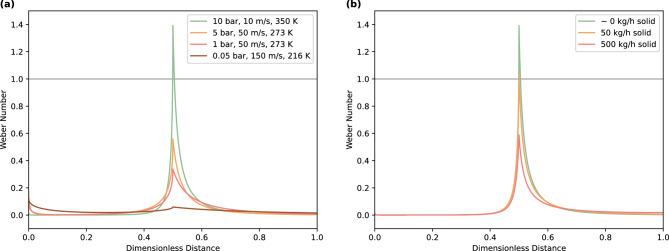
- Solid aerosol dispersal is constrained by Geldart Group C behavior: literature methods report low solid mass flows, while the paper notes a potential need to disperse >5,000 kg/hour cost-effectively; its nozzle simulation suggests a gas-to-solid mass ratio of roughly 35:1 to approach Weber number ~1.
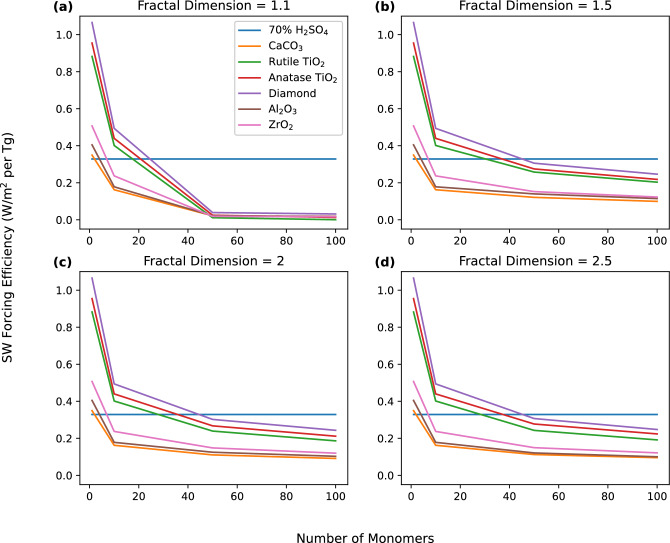
- Aggregate formation can sharply reduce shortwave forcing: sub-micron monomers may scatter up to 3× as effectively as sulfate, but aggregates with fractal dimension = 1.1 quickly reach near-0 forcing efficiency, while aggregates with fractal dimension >1.5 show less severe reductions.
Methods
- The paper synthesizes existing SAI modeling literature, grouping deployment strategies by latitude and degree of governance (centralized vs. decentralized) to assess how altitude, longitude, season, and magnitude affect aerosol lifetime and stratospheric aerosol optical density.
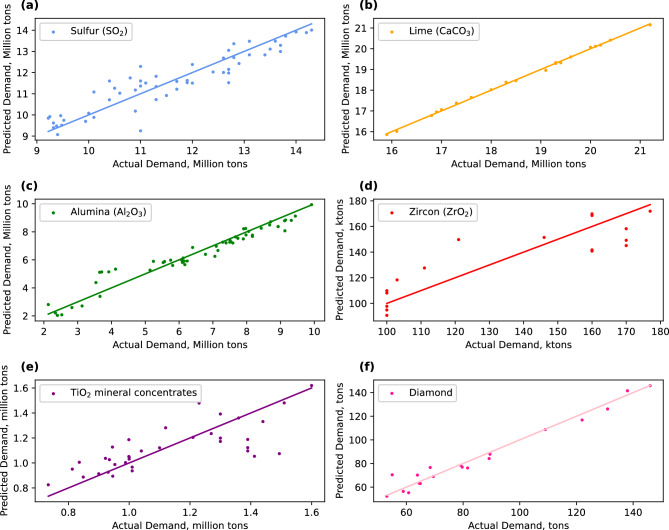
- Supply-chain analysis uses USGS yearly mineral surveys, a recession indicator index, and a log-linear regression to estimate price elasticity of demand for raw materials, with burdens calculated for a 15-year scenario starting in 2035 under RCP 6.0.
- Solid dispersal is examined via a two-phase fluid simulation of a choked convergent-barrel nozzle using MATLAB’s ode15s, Henderson’s drag model, and a modified Weber number; aggregate forcing is simulated with PythonicDISORT, Mie theory, and a mean-field T-matrix method for fractal aggregates.
Limitations
- The paper states that post-injection aggregation of solid aerosols remains relatively unconstrained, that decentralized SAI scenarios have not been modeled explicitly in the literature, and that GCM runs simulating aggregate injection are needed to better contextualize worst-case climate impacts.
- The paper also states that the cost-risk trade-off of solid monomer dispersal—especially increased cost for reduced payloads—remains a key uncertainty.
- Evident from the text: the supply-chain and deployment conclusions rely on existing literature and modeled scenarios rather than new large-scale field or GCM experiments, and the nozzle and radiative-transfer analyses are idealized simulations with stated assumptions such as inviscid flow apart from drag and monodisperse aerosols.
Model-written summary. Check it against the paper before relying on it.
Integrity signals
Registry
Cites
Statistics
Figures
Verification
Claims the paper makes
21 Valid · 7 Not valid · 7 Not checked · 88 Own results and interpretations
At least one cited source doesn’t support this claim or points to a different paper, and none confirmed it — see the verdicts below.
In the paper
“Kleinschmitt (2018) supports this, finding that the rate of change of burden achieved per unit injection decreases with injection height (for equatorial injections of 10 Tg S ), with an optimal range between 17 and 19 km22.”
§ Engineering and logistical concerns add practical limitations to stratospheric aerosol injection strategies > Results > Deployment strategies and governance
What the sources say
- Disputedcites [22] Kleinschmitt, C., Boucher, O. & Platt, U. Sensitivity of the radiative forcing by stratospheric sulfur geoengineering to the amount and strategy of the SO2injection studied with the LMDZ-S3A model. Atmos. Chem. Phys. 18, 2769–2786. 10.5194/acp-18-2769-2018 (2018). sourceExperimental — accuracy not yet measured
Section 3.3 reports that aerosol lifetime increases with injection height and that injections below 17 km produce a small stratospheric burden—the opposite of the claimed decrease in burden per unit injection. The section does support avoiding heights below 17 km and above 19 km, but that does not support the claimed direction of the burden change. (LLM, conf=0.87)
Checked by a reasoning model — may be wrong.
plainstates a cause- Asserted: passes — The authors put it forward as true.
- Checkable: passes — It can be checked against evidence.
- Load-bearing: unclear — It is unclear whether the paper’s conclusions depend on it.
- Based: passes — The paper gives a reason why it holds.
- Disputed
Every source the paper cites for this claim was checked and supports it.
In the paper
“Injections at longitudes with equator-ward winds yield particles with a longer lifetime than those with poleward ones16.”
§ Engineering and logistical concerns add practical limitations to stratospheric aerosol injection strategies > Results > Deployment strategies and governance
What the sources say
- Supportedcites [16] Sun, H., Bourguet, S., Eastham, S. & Keith, D. Optimizing injection locations relaxes altitude-lifetime trade-off for stratospheric aerosol injection. Geophys. Res. Lett. 10.1029/2023GL105371 (2023). source
Section 3.1 explains that equatorward winds at one injection longitude carry particles into the tropical pipe, where they can have a longer stratospheric lifetime. It contrasts this with poleward winds at another longitude, which carry particles out of the tropical pipe toward the tropopause. The claim accurately paraphrases that comparison. (LLM, conf=0.94)
plainstates a cause- Asserted: passes — The authors put it forward as true.
- Checkable: passes — It can be checked against evidence.
- Load-bearing: unclear — It is unclear whether the paper’s conclusions depend on it.
- Based: passes — The paper gives a reason why it holds.
- Supported
The cited sources support only part of this claim — read each source’s verdict below.
In the paper
“Springtime injections could lead to peak sAODs during the summer, matching maximum cooling capacity to peak sunlight18,29,30.”
§ Engineering and logistical concerns add practical limitations to stratospheric aerosol injection strategies > Results > Deployment strategies and governance
What the sources say
- Could not verifycites [18] Lee, W. R. et al. Quantifying the efficiency of stratospheric aerosol geoengineering at different altitudes. Geophys. Res. Lett. 10.1029/2023GL104417 (2023). sourceExperimental — accuracy not yet measured
The Introduction says that injection seasonality can affect SAI, but does not describe spring injections or a summer peak in stratospheric aerosol optical depth. The simulations in section 2 and the results in section 3.1 discuss injection altitudes and annual rates, not the proposed timing relative to peak sunlight. Searches for spring, summer, and seasonal AOD found no passage establishing the claim. (LLM, conf=0.76)
- Supportedcites [29] Visioni, D. et al. Seasonal injection strategies for stratospheric aerosol geoengineering. Geophys. Res. Lett. 46, 7790–7799. 10.1029/2019GL083680 (2019). source
Section 3.2 (p. 7) reports that spring injections at 15°N produce an AOD peak in summer and higher radiative forcing than injections in other seasons. The paper also explains that shortwave radiative forcing is maximized when peak stratospheric AOD coincides with the summer's strongest sunlight (p. 8). (LLM, conf=0.93)
- Supportedcites [30] Lee, W. R., MacMartin, D. G., Visioni, D. & Kravitz, B. High-latitude stratospheric aerosol geoengineering can be more effective if injection is limited to spring. Geophys. Res. Lett. 10.1029/2021GL092696 (2021). source
The Results report that AOD for all spring-injection cases peaks in summer. The discussion adds that the peak for March–May injection coincides with peak insolation in June, supporting the claimed alignment of reflective capacity with sunlight. (LLM, conf=0.93)
hedgedstates a cause- Asserted: passes — The authors put it forward as true.
- Checkable: passes — It can be checked against evidence.
- Load-bearing: unclear — It is unclear whether the paper’s conclusions depend on it.
- Based: passes — The paper gives a reason why it holds.
- Could not verify
The cited sources support only part of this claim — read each source’s verdict below.
In the paper
“However, the use of these minerals has primarily been modeled with the assumption that they could be dispersed on a grid box scale with a single, optimal sub-micron particle size11,12.”
§ Engineering and logistical concerns add practical limitations to stratospheric aerosol injection strategies > Introduction
What the sources say
- Partly supportedcites [11] Vattioni, S. et al. A fully coupled solid-particle microphysics scheme for stratospheric aerosol injections within the aerosol-chemistry-climate model socol-aerv2. Geosci. Model Dev. 17, 7767–7793. 10.5194/gmd-17-7767-2024 (2024). sourceExperimental — accuracy not yet measured
Section 4.2 (page unavailable) says injections are distributed across a climate-model grid box, and Section 2.2 describes runs with specified sub-micron monomer radii. The paper does not support the claim that modeling primarily assumes one optimal size: it tests radii from 80 to 320 nm, and Section 4.1 reports different radii producing the largest radiative forcing in this model and an earlier study. (LLM, conf=0.84)
- Supportedcites [12] Weisenstein, D. K., Keith, D. W. & Dykema, J. A. Solar geoengineering using solid aerosol in the stratosphere. Atmos. Chem. Phys. 15, 11835–11859. 10.5194/acp-15-11835-2015 (2015). source
Section 3.3 says the model implicitly mixes injected material into bands set by its grid resolution. Section 4.1.3 says it assumes all injected monomers have a uniform radius, and Section 4.2 identifies an optimal alumina monomer radius of roughly 240 nm. Together, these support the description of the modeling assumption, although the paper also compares runs using different radii. (LLM, conf=0.88)
plain- Asserted: passes — The authors put it forward as true.
- Checkable: passes — It can be checked against evidence.
- Load-bearing: passes — The paper’s conclusions depend on it.
- Based: passes — The paper gives a reason why it holds.
- Partly supported
Every source the paper cites for this claim was checked and supports it.
In the paper
“However, longitude may play a significant role in particle lifetime, particularly for lower-altitude injections26.”
§ Engineering and logistical concerns add practical limitations to stratospheric aerosol injection strategies > Results > Deployment strategies and governance
What the sources say
- Supportedcites [26] Sun, H., Bourguet, S., Luan, L. & Keith, D. Stratospheric transport and tropospheric sink of solar geoengineering aerosol: a Lagrangian analysis. npj Clim. Atmos. Sci. 10.1038/s41612-024-00664-8 (2024). source
The Introduction (page unavailable) states that particles injected at different longitudes in the tropical lower stratosphere can follow different transport pathways, resulting in different stratospheric lifetimes. This supports the hedged claim about longitude and lower-altitude injections. (LLM, conf=0.91)
hedgedstates a possible cause- Asserted: passes — The authors put it forward as true.
- Checkable: passes — It can be checked against evidence.
- Load-bearing: unclear — It is unclear whether the paper’s conclusions depend on it.
- Based: passes — The paper gives a reason why it holds.
- Supported
62 more claims · 5 with their cited sources checked
Create a free account to see all 123 claims and to verify the 2 references still open.
- It may state two separate claims as one. 35
- Probably not a substantial claim. 28
Citations
Cites
The London—van der Waals attraction between spherical particles
Hamaker, H. C. (1937) · Physica · doi:10.1016/s0031-8914(37)80203-7 · Cited by 3,967 · cited 1×
“A modified Weber number for a solid-gas system compares the magnitude of drag forces exerted on the agglomerate to cohesive intermolecular forces (in this case, van der Waals, with Hamaker’s constants estimated using Lifshitz theory) 229,230 .”
Geldart, D. (1973) · Powder Technology · doi:10.1016/0032-5910(73)80037-3 · Cited by 3,481
G EOENGINEERING THE C LIMATE: History and Prospect
Keith, D. W. (2000) · Annual Review of Energy and the Environment · doi:10.1146/annurev.energy.25.1.245 · Cited by 567
Drag Coefficients of Spheres in Continuum and Rarefied Flows
Henderson, C. B. (1976) · AIAA Journal · doi:10.2514/3.61409 · Cited by 526 · cited 1×
“We model the acceleration of a gas such a nozzle, which imparts a drag force (drag coefficient modeled with Henderson’s semi-empirical model, which accounts for all regimes of Knudsen, Reynolds and Mach numbers encountered here) on a spherical agglomerate 228 .”
Regional climate responses to geoengineering with tropical and Arctic SO2 injections
Robock, A., Oman, L., & Stenchikov, G. L. (2008) · Journal of Geophysical Research: Atmospheres · doi:10.1029/2008jd010050 · Cited by 456 · cited 1×
“Such asymmetric scenarios do exist in literature and are studied here ( 18,24,30,51,53,] 55,85,109,115,123,124,] 132–134,137,159,164,165,223 ).”
Historical statistics for mineral and material commodities in the United States
Kelly, T., Matos, G. R., Buckingham, D. A., DiFrancesco, C. A., Porter, K. E., Berry, C., Crane, M., Goonan, T., & Sznopek, J. (2005) · Data Series · doi:10.3133/ds140 · Cited by 388
An overview of geoengineering of climate using stratospheric sulphate aerosols
Rasch, P. J., Tilmes, S., Turco, R. P., Robock, A., Oman, L., Chen, C.-C. (., Stenchikov, G. L., & Garcia, R. R. (2008) · Philosophical Transactions of the Royal Society A: Mathematical, Physical and Engineering Sciences · doi:10.1098/rsta.2008.0131 · Cited by 326
A “tropical pipe” model of stratospheric transport
Plumb, R. A. (1996) · Journal of Geophysical Research: Atmospheres · doi:10.1029/95jd03002 · Cited by 309 · cited 1×
“Longitudinal variations in meridional circulations impacts transport of aerosols into and out of the tropical pipe, a stratospheric region near the equator isolated from mid-latitude isentropic mixing, enabling rapid vertical transport 27 .”
Kravitz, B., Robock, A., Tilmes, S., Boucher, O., English, J. M., Irvine, P. J., Jones, A., Lawrence, M. G., MacCracken, M., Muri, H., et al. (2015) · Geoscientific Model Development · doi:10.5194/gmd-8-3379-2015 · Cited by 297
CESM1(WACCM) Stratospheric Aerosol Geoengineering Large Ensemble Project
Tilmes, S., Richter, J. H., Kravitz, B., MacMartin, D. G., Mills, M. J., Simpson, I. R., Glanville, A. S., Fasullo, J. T., Phillips, A. S., Lamarque, J.-F., et al. (2018) · Bulletin of the American Meteorological Society · doi:10.1175/bams-d-17-0267.1 · Cited by 296
Kravitz, B., MacMartin, D. G., Mills, M. J., Richter, J. H., Tilmes, S., Lamarque, J., Tribbia, J. J., & Vitt, F. (2017) · Journal of Geophysical Research: Atmospheres · doi:10.1002/2017jd026874 · Cited by 275
The impact of geoengineering aerosols on stratospheric temperature and ozone
Heckendorn, P., Weisenstein, D., Fueglistaler, S., Luo, B. P., Rozanov, E., Schraner, M., Thomason, L. W., & Peter, T. (2009) · Environmental Research Letters · doi:10.1088/1748-9326/4/4/045108 · Cited by 254 · cited 1×
“The tendency of new condensation nuclei to coagulate with existing large particles leads to undesirably large particles under conditions of low local gas-to-particle flux, as shown by Heckendorn (2009), which modeled zonally averaged injections 31 .”
Halving warming with idealized solar geoengineering moderates key climate hazards
Irvine, P., Emanuel, K., He, J., Horowitz, L. W., Vecchi, G., & Keith, D. (2019) · Nature Climate Change · doi:10.1038/s41558-019-0398-8 · Cited by 252 · cited 1×
“Burdens are calculated from SW forcing of monomers required for each candidate in a scenario chosen to 1/2 the rate of increase in radiative forcing for 15 years, starting in 2035, RCP 6.0 227 .”
InfluentialSimpson, I. R., Tilmes, S., Richter, J. H., Kravitz, B., MacMartin, D. G., Mills, M. J., Fasullo, J. T., & Pendergrass, A. G. (2019) · Journal of Geophysical Research: Atmospheres · doi:10.1029/2019jd031093 · Cited by 202
Pitari, G., Aquila, V., Kravitz, B., Robock, A., Watanabe, S., Cionni, I., Luca, N. D., Genova, G. D., Mancini, E., & Tilmes, S. (2014) · Journal of Geophysical Research: Atmospheres · doi:10.1002/2013jd020566 · Cited by 196
Stratospheric aerosol injection tactics and costs in the first 15 years of deployment
Smith, W., & Wagner, G. (2018) · Environmental Research Letters · doi:10.1088/1748-9326/aae98d · Cited by 181
Self-citationStratospheric solar geoengineering without ozone loss
Keith, D. W., Weisenstein, D. K., Dykema, J. A., & Keutsch, F. N. (2016) · Proceedings of the National Academy of Sciences · doi:10.1073/pnas.1615572113 · Cited by 176
MacMartin, D. G., Kravitz, B., Tilmes, S., Richter, J. H., Mills, M. J., Lamarque, J., Tribbia, J. J., & Vitt, F. (2017) · Journal of Geophysical Research Atmospheres · doi:10.1002/2017jd026868 · Cited by 173
Trisos, C. H., Amatulli, G., Gurevitch, J., Robock, A., Xia, L., & Zambri, B. (2018) · Nature Ecology & Evolution · doi:10.1038/s41559-017-0431-0 · Cited by 157
What is the limit of climate engineering by stratospheric injection of SO 2 ?
Niemeier, U., & Timmreck, C. (2015) · Atmospheric Chemistry and Physics · doi:10.5194/acp-15-9129-2015 · Cited by 156 · cited 5×
“This leads to larger burdens and stronger radiative forcing per injection rate 17,18 .”
InfluentialPierce, J. R., Weisenstein, D. K., Heckendorn, P., Peter, T., & Keith, D. W. (2010) · Geophysical Research Letters · doi:10.1029/2010gl043975 · Cited by 146
Visioni, D., MacMartin, D. G., Kravitz, B., Boucher, O., Jones, A., Lurton, T., Martine, M., Mills, M. J., Nabat, P., Niemeier, U., et al. (2021) · Atmospheric Chemistry and Physics · doi:10.5194/acp-21-10039-2021 · Cited by 145
Stratospheric Dynamical Response and Ozone Feedbacks in the Presence of SO 2 Injections
Richter, J. H., Tilmes, S., Mills, M. J., Tribbia, J. J., Kravitz, B., MacMartin, D. G., Vitt, F., & Lamarque, J. (2017) · Journal of Geophysical Research: Atmospheres · doi:10.1002/2017jd026912 · Cited by 133
Solar geoengineering using solid aerosol in the stratosphere
Weisenstein, D. K., Keith, D. W., & Dykema, J. A. (2015) · Atmospheric Chemistry and Physics · doi:10.5194/acp-15-11835-2015 · Cited by 132 · cited 3×
“Solids coagulate differently since nucleation and ultra-fine particles aren’t relevant; Vattioni (2024) and Weisenstein (2015) find that for continuous monomer injections over a large spread ( 30 ◦ S - 30 ◦ N), coagulation increases with increases injection rate and decreasing monomer size,…”
Kravitz, B., MacMartin, D. G., Tilmes, S., Richter, J. H., Mills, M. J., Cheng, W., Dagon, K., Glanville, A. S., Lamarque, J., Simpson, I. R., et al. (2019) · Journal of Geophysical Research: Atmospheres · doi:10.1029/2019jd030329 · Cited by 132 · cited 1×
“…injection, separated into tropical/equatorial 3–6,17–19,21,22,24,] 26,30–33,50–163 , polar 21,24,28,55–57,] 128,134–137,147,150,152,] 164,165 , and multi-latitude 6,11,16,17,21,] 22,25,28–30,32,]61,] 86–89,104,107,] 109,113,119,120,122,127,] 128,135–137,145,] 147–150,152,157,163,165–222 strategies.”
Tilmes, S., MacMartin, D. G., Lenaerts, J. T. M., van Kampenhout, L., Muntjewerf, L., Xia, L., Harrison, C. S., Krumhardt, K. M., Mills, M. J., Kravitz, B., et al. (2020) · Earth System Dynamics · doi:10.5194/esd-11-579-2020 · Cited by 131
Effects of Different Stratospheric SO2 Injection Altitudes on Stratospheric Chemistry and Dynamics
Tilmes, S., Richter, J. H., Mills, M. J., Kravitz, B., MacMartin, D. G., Garcia, R. R., Kinnison, D. E., Lamarque, J., Tribbia, J., & Vitt, F. (2018) · Journal of Geophysical Research: Atmospheres · doi:10.1002/2017jd028146 · Cited by 127
Geoengineering as an optimization problem
Ban-Weiss, G. A., & Caldeira, K. (2010) · Environmental Research Letters · doi:10.1088/1748-9326/5/3/034009 · Cited by 123
Improved aerosol radiative properties as a foundation for solar geoengineering risk assessment
Dykema, J. A., Keith, D. W., & Keutsch, F. N. (2016) · Geophysical Research Letters · doi:10.1002/2016gl069258 · Cited by 123 · cited 1×
“Shortwave refractive index information is taken from Dykema (2016) 10 .”
Aquila, V., Garfinkel, C. I., Newman, P. A., Oman, L. D., & Waugh, D. W. (2014) · Geophysical Research Letters · doi:10.1002/2013gl058818 · Cited by 122
Richter, J. H., Visioni, D., MacMartin, D. G., Bailey, D. A., Rosenbloom, N., Dobbins, B., Lee, W. R., Tye, M., & Lamarque, J.-F. (2022) · Geoscientific Model Development · doi:10.5194/gmd-15-8221-2022 · Cited by 122
The dependency of geoengineered sulfate aerosol on the emission strategy
Niemeier, U., Schmidt, H., & Timmreck, C. (2011) · Atmospheric Science Letters · doi:10.1002/asl.304 · Cited by 118 · cited 1×
“Niemeier (2011) found that longitudinally dispersed injections led to overgrowth when compared to pulsed injections in a single grid box 5 .”
Solar geoengineering to reduce climate change: a review of governance proposals
Reynolds, J. L. (2019) · Proceedings of the Royal Society A: Mathematical, Physical and Engineering Sciences · doi:10.1098/rspa.2019.0255 · Cited by 108 · cited 1×
“On a broader scale, lack of coordinated SAI governance leads to further risks surrounding deployment strategies 13,14 .”
Changing transport processes in the stratosphere by radiative heating of sulfate aerosols
Niemeier, U., & Schmidt, H. (2017) · Atmospheric Chemistry and Physics · doi:10.5194/acp-17-14871-2017 · Cited by 102 · cited 1×
“…injection, separated into tropical/equatorial 3–6,17–19,21,22,24,] 26,30–33,50–163 , polar 21,24,28,55–57,] 128,134–137,147,150,152,] 164,165 , and multi-latitude 6,11,16,17,21,] 22,25,28–30,32,]61,] 86–89,104,107,] 109,113,119,120,122,127,] 128,135–137,145,] 147–150,152,157,163,165–222 strategies.”
Effects of stratospheric sulfate aerosol geo‐engineering on cirrus clouds
Kuebbeler, M., Lohmann, U., & Feichter, J. (2012) · Geophysical Research Letters · doi:10.1029/2012gl053797 · Cited by 101
Microphysical simulations of sulfur burdens from stratospheric sulfur geoengineering
English, J. M., Toon, O. B., & Mills, M. J. (2012) · Atmospheric Chemistry and Physics · doi:10.5194/acp-12-4775-2012 · Cited by 101 · cited 1×
“…injection, separated into tropical/equatorial 3–6,17–19,21,22,24,] 26,30–33,50–163 , polar 21,24,28,55–57,] 128,134–137,147,150,152,] 164,165 , and multi-latitude 6,11,16,17,21,] 22,25,28–30,32,]61,] 86–89,104,107,] 109,113,119,120,122,127,] 128,135–137,145,] 147–150,152,157,163,165–222 strategies.”
Mean-field approximation of Mie scattering by fractal aggregates of identical spheres
Botet, R., Rannou, P., & Cabane, M. (1997) · Applied Optics · doi:10.1364/ao.36.008791 · Cited by 100
Is Turning Down the Sun a Good Proxy for Stratospheric Sulfate Geoengineering?
Visioni, D., MacMartin, D. G., & Kravitz, B. (2021) · Journal of Geophysical Research: Atmospheres · doi:10.1029/2020jd033952 · Cited by 99 · cited 1×
“…injection, separated into tropical/equatorial 3–6,17–19,21,22,24,] 26,30–33,50–163 , polar 21,24,28,55–57,] 128,134–137,147,150,152,] 164,165 , and multi-latitude 6,11,16,17,21,] 22,25,28–30,32,]61,] 86–89,104,107,] 109,113,119,120,122,127,] 128,135–137,145,] 147–150,152,157,163,165–222 strategies.”
Weakened tropical circulation and reduced precipitation in response to geoengineering
Ferraro, A. J., Highwood, E. J., & Charlton-Perez, A. J. (2014) · Environmental Research Letters · doi:10.1088/1748-9326/9/1/014001 · Cited by 97
Jones, A., Haywood, J., Boucher, O., Kravitz, B., & Robock, A. (2010) · Atmospheric Chemistry and Physics · doi:10.5194/acp-10-5999-2010 · Cited by 93
Sulfuric acid deposition from stratospheric geoengineering with sulfate aerosols
Kravitz, B., Robock, A., Oman, L., Stenchikov, G., & Marquardt, A. B. (2009) · Journal of Geophysical Research Atmospheres · doi:10.1029/2009jd011918 · Cited by 93
Ari, U. (2025) · Greenwich Academic Literature Archive (University of Greenwich) · doi:10.5281/zenodo.1234567 · Cited by 92
Stratospheric sulfate aerosol geoengineering could alter the high-latitude seasonal cycle
Jiang, J., Cao, L., MacMartin, D. G., Simpson, I. R., Kravitz, B., Cheng, W., Visioni, D., Tilmes, S., Richter, J. H., & Mills, M. J. (2019) · Geophysical Research Letters · doi:10.1029/2019gl085758 · Cited by 91
Impacts of hemispheric solar geoengineering on tropical cyclone frequency
Jones, A. C., Haywood, J. M., Dunstone, N., Emanuel, K., Hawcroft, M. K., Hodges, K. I., & Jones, A. (2017) · Nature Communications · doi:10.1038/s41467-017-01606-0 · Cited by 90
Stratospheric sulfate geoengineering could enhance the terrestrial photosynthesis rate
Xia, L., Robock, A., Tilmes, S., & Neely III, R. R. (2016) · Atmospheric Chemistry and Physics · doi:10.5194/acp-16-1479-2016 · Cited by 89
Tjiputra, J. F., Grini, A., & Lee, H. (2016) · Journal of Geophysical Research: Biogeosciences · doi:10.1002/2015jg003045 · Cited by 87
Lee, W. R., MacMartin, D. G., Visioni, D., & Kravitz, B. (2021) · Geophysical Research Letters · doi:10.1029/2021gl092696 · Cited by 87
High‐Latitude Stratospheric Aerosol Injection to Preserve the Arctic
Lee, W. R., MacMartin, D. G., Visioni, D., Kravitz, B., Chen, Y., Moore, J. C., Leguy, G., Lawrence, D. M., & Bailey, D. A. (2023) · Earth's Future · doi:10.1029/2022ef003052 · Cited by 86 · cited 3×
“Such asymmetric scenarios do exist in literature and are studied here ( 18,24,30,51,53,] 55,85,109,115,123,124,] 132–134,137,159,164,165,223 ).”
Reduced Poleward Transport Due to Stratospheric Heating Under Stratospheric Aerosols Geoengineering
Visioni, D., MacMartin, D. G., Kravitz, B., Lee, W., Simpson, I. R., & Richter, J. H. (2020) · Geophysical Research Letters · doi:10.1029/2020gl089470 · Cited by 85 · cited 1×
“…injection, separated into tropical/equatorial 3–6,17–19,21,22,24,] 26,30–33,50–163 , polar 21,24,28,55–57,] 128,134–137,147,150,152,] 164,165 , and multi-latitude 6,11,16,17,21,] 22,25,28–30,32,]61,] 86–89,104,107,] 109,113,119,120,122,127,] 128,135–137,145,] 147–150,152,157,163,165–222 strategies.”
Climate impacts of geoengineering in a delayed mitigation scenario
Tilmes, S., Sanderson, B. M., & O'Neill, B. C. (2016) · Geophysical Research Letters · doi:10.1002/2016gl070122 · Cited by 84
Kleinschmitt, C., Boucher, O., & Platt, U. (2018) · Atmospheric Chemistry and Physics · doi:10.5194/acp-18-2769-2018 · Cited by 84 · cited 3×
“Kleinschmitt (2018) supports this, finding that the rate of change of burden achieved per unit injection decreases with injection height (for equatorial injections of 10 Tg S year − 1 ), with an optimal range between 17 and 19 km 22 .”
Africa's Climate Response to Solar Radiation Management With Stratospheric Aerosol
Pinto, I., Jack, C., Lennard, C., Tilmes, S., & Odoulami, R. C. (2020) · Geophysical Research Letters · doi:10.1029/2019gl086047 · Cited by 83
Cheng, W., MacMartin, D. G., Dagon, K., Kravitz, B., Tilmes, S., Richter, J. H., Mills, M. J., & Simpson, I. R. (2019) · Journal of Geophysical Research: Atmospheres · doi:10.1029/2018jd030237 · Cited by 82 · cited 1×
“…injection, separated into tropical/equatorial 3–6,17–19,21,22,24,] 26,30–33,50–163 , polar 21,24,28,55–57,] 128,134–137,147,150,152,] 164,165 , and multi-latitude 6,11,16,17,21,] 22,25,28–30,32,]61,] 86–89,104,107,] 109,113,119,120,122,127,] 128,135–137,145,] 147–150,152,157,163,165–222 strategies.”
Tilmes, S., Visioni, D., Jones, A., Haywood, J., Séférian, R., Nabat, P., Boucher, O., Bednarz, E. M., & Niemeier, U. (2022) · Atmospheric Chemistry and Physics · doi:10.5194/acp-22-4557-2022 · Cited by 79
Changes in West African Summer Monsoon Precipitation Under Stratospheric Aerosol Geoengineering
Da‐Allada, C. Y., Baloïtcha, E., Alamou, E. A., Awo, F. M., Bonou, F., Pomalegni, Y., Biao, E. I., Obada, E., Zandagba, J. E., Tilmes, S., et al. (2020) · Earth's Future · doi:10.1029/2020ef001595 · Cited by 77
Timescale for Detecting the Climate Response to Stratospheric Aerosol Geoengineering
MacMartin, D. G., Wang, W., Kravitz, B., Tilmes, S., Richter, J. H., & Mills, M. J. (2019) · Journal of Geophysical Research: Atmospheres · doi:10.1029/2018jd028906 · Cited by 74
Calculation of the fractal dimension of aggregates
Gmachowski, L. (2002) · Colloids and Surfaces A Physicochemical and Engineering Aspects · doi:10.1016/s0927-7757(02)00278-9 · Cited by 73
Banerjee, A., Butler, A. H., Polvani, L. M., Robock, A., Simpson, I. R., & Sun, L. (2021) · Atmospheric Chemistry and Physics · doi:10.5194/acp-21-6985-2021 · Cited by 73
Abiodun, B. J., Odoulami, R. C., Sawadogo, W., Oloniyo, O. A., Abatan, A. A., New, M. G., Lennard, C., Pinto, I., Egbebiyi, T. S., & MacMartin, D. G. (2021) · Climatic Change · doi:10.1007/s10584-021-03268-w · Cited by 73
Haywood, J., Jones, A., Jones, A. C., Halloran, P. R., & Rasch, P. J. (2023) · Atmospheric chemistry and physics · doi:10.5194/acp-23-15305-2023 · Cited by 73
Impacts of stratospheric sulfate geoengineering on tropospheric ozone
Xia, L., Nowack, P. J., Tilmes, S., & Robock, A. (2017) · Atmospheric Chemistry and Physics · doi:10.5194/acp-17-11913-2017 · Cited by 72 · cited 1×
“Tilmes (2017) finds that the lifetime of high-altitude injections decreases at larger injection rates 21 .”
Ji, D., Fang, S., Curry, C. L., Kashimura, H., Watanabe, S., Cole, J. N. S., Lenton, A., Muri, H., Kravitz, B., & Moore, J. C. (2018) · Atmospheric Chemistry and Physics · doi:10.5194/acp-18-10133-2018 · Cited by 71
Seasonal Injection Strategies for Stratospheric Aerosol Geoengineering
Visioni, D., MacMartin, D. G., Kravitz, B., Tilmes, S., Mills, M. J., Richter, J. H., & Boudreau, M. P. (2019) · Geophysical Research Letters · doi:10.1029/2019gl083680 · Cited by 69 · cited 1×
“Springtime injections could lead to peak sAODs during the summer, matching maximum cooling capacity to peak sunlight 18,29,30 .”
Visioni, D., Bednarz, E. M., Lee, W. R., Kravitz, B., Jones, A., Haywood, J. M., & MacMartin, D. G. (2023) · Atmospheric Chemistry and Physics · doi:10.5194/acp-23-663-2023 · Cited by 69 · cited 1×
“Such asymmetric scenarios do exist in literature and are studied here ( 18,24,30,51,53,] 55,85,109,115,123,124,] 132–134,137,159,164,165,223 ).”
Yu, X., Moore, J. C., Cui, X., Rinke, A., Ji, D., Kravitz, B., & Yoon, J. (2015) · Global and Planetary Change · doi:10.1016/j.gloplacha.2015.02.010 · Cited by 68
Climatic impacts of stratospheric geoengineering with sulfate, black carbon and titania injection
Jones, A. C., Haywood, J. M., & Jones, A. (2016) · Atmospheric Chemistry and Physics · doi:10.5194/acp-16-2843-2016 · Cited by 67
Greenland Ice Sheet Response to Stratospheric Aerosol Injection Geoengineering
Moore, J. C., Yue, C., Zhao, L., Guo, X., Watanabe, S., & Ji, D. (2019) · Earth s Future · doi:10.1029/2019ef001393 · Cited by 67
Tilmes, S., Mills, M. J., Niemeier, U., Schmidt, H., Robock, A., Kravitz, B., Lamarque, J.-F., Pitari, G., & English, J. M. (2015) · Geoscientific Model Development · doi:10.5194/gmd-8-43-2015 · Cited by 66
Ferraro, A. J., Charlton‐Perez, A. J., & Highwood, E. J. (2015) · Journal of Geophysical Research: Atmospheres · doi:10.1002/2014jd022734 · Cited by 65
Visioni, D., Pitari, G., Tuccella, P., & Curci, G. (2018) · Atmospheric Chemistry and Physics · doi:10.5194/acp-18-2787-2018 · Cited by 64
Jones, A., Haywood, J. M., Jones, A. C., Tilmes, S., Kravitz, B., & Robock, A. (2021) · Atmospheric Chemistry and Physics · doi:10.5194/acp-21-1287-2021 · Cited by 63
Lee, W., MacMartin, D., Visioni, D., & Kravitz, B. (2020) · Earth System Dynamics · doi:10.5194/esd-11-1051-2020 · Cited by 62
Aswathy, V. N., Boucher, O., Quaas, M., Niemeier, U., Muri, H., Mülmenstädt, J., & Quaas, J. (2015) · Atmospheric Chemistry and Physics · doi:10.5194/acp-15-9593-2015 · Cited by 61
Tilmes, S., Kinnison, D. E., Garcia, R. R., Salawitch, R., Canty, T., Lee-Taylor, J., Madronich, S., & Chance, K. (2012) · Atmospheric Chemistry and Physics · doi:10.5194/acp-12-10945-2012 · Cited by 61
Seasonally Modulated Stratospheric Aerosol Geoengineering Alters the Climate Outcomes
Visioni, D., MacMartin, D. G., Kravitz, B., Richter, J. H., Tilmes, S., & Mills, M. J. (2020) · Geophysical Research Letters · doi:10.1029/2020gl088337 · Cited by 61
Kliegel, J. R. (1963) · Symposium (International) on Combustion · doi:10.1016/s0082-0784(63)80088-0 · Cited by 58 · cited 2×
“Governing equations for this approach are are outlined in Kliegel (1963).”
Halving warming with stratospheric aerosol geoengineering moderates policy-relevant climate hazards
Irvine, P. J., & Keith, D. W. (2020) · Environmental Research Letters · doi:10.1088/1748-9326/ab76de · Cited by 58
Niemeier, U., Richter, J. H., & Tilmes, S. (2020) · Atmospheric Chemistry and Physics · doi:10.5194/acp-20-8975-2020 · Cited by 58
Atlantic hurricane surge response to geoengineering
Moore, J. C., Grinsted, A., Guo, X., Yu, X., Jevrejeva, S., Rinke, A., Cui, X., Kravitz, B., Lenton, A., Watanabe, S., et al. (2015) · Proceedings of the National Academy of Sciences · doi:10.1073/pnas.1510530112 · Cited by 57
Crook, J. A., Jackson, L. S., Osprey, S. M., & Forster, P. M. (2015) · Journal of Geophysical Research: Atmospheres · doi:10.1002/2015jd023269 · Cited by 57
Upper tropospheric ice sensitivity to sulfate geoengineering
Visioni, D., Pitari, G., di Genova, G., Tilmes, S., & Cionni, I. (2018) · Atmospheric Chemistry and Physics · doi:10.5194/acp-18-14867-2018 · Cited by 57
Laakso, A., Niemeier, U., Visioni, D., Tilmes, S., & Kokkola, H. (2022) · Atmospheric Chemistry and Physics · doi:10.5194/acp-22-93-2022 · Cited by 55
Effects of Arctic geoengineering on precipitation in the tropical monsoon regions
Nalam, A., Bala, G., & Modak, A. (2018) · Climate Dynamics · doi:10.1007/s00382-017-3810-y · Cited by 54 · cited 2×
“Such asymmetric scenarios do exist in literature and are studied here ( 18,24,30,51,53,] 55,85,109,115,123,124,] 132–134,137,159,164,165,223 ).”
Weisenstein, D. K., Visioni, D., Franke, H., Niemeier, U., Vattioni, S., Chiodo, G., Peter, T., & Keith, D. W. (2022) · Atmospheric Chemistry and Physics · doi:10.5194/acp-22-2955-2022 · Cited by 53
Bednarz, E. M., Butler, A. H., Visioni, D., Zhang, Y., Kravitz, B., & MacMartin, D. G. (2023) · Atmospheric Chemistry and Physics · doi:10.5194/acp-23-13665-2023 · Cited by 52
Assessing the controllability of Arctic sea ice extent by sulfate aerosol geoengineering
Jackson, L. S., Crook, J. A., Jarvis, A., Leedal, D., Ridgwell, A., Vaughan, N., & Forster, P. M. (2015) · Geophysical Research Letters · doi:10.1002/2014gl062240 · Cited by 51 · cited 1×
“Such asymmetric scenarios do exist in literature and are studied here ( 18,24,30,51,53,] 55,85,109,115,123,124,] 132–134,137,159,164,165,223 ).”
Arctic cryosphere response in the Geoengineering Model Intercomparison Project G3 and G4 scenarios
Berdahl, M., Robock, A., Ji, D., Moore, J. C., Jones, A., Kravitz, B., & Watanabe, S. (2014) · Journal of Geophysical Research: Atmospheres · doi:10.1002/2013jd020627 · Cited by 51
Laakso, A., Kokkola, H., Partanen, A.-I., Niemeier, U., Timmreck, C., Lehtinen, K. E. J., Hakkarainen, H., & Korhonen, H. (2016) · Atmospheric chemistry and physics · doi:10.5194/acp-16-305-2016 · Cited by 51 · cited 1×
“…injection, separated into tropical/equatorial 3–6,17–19,21,22,24,] 26,30–33,50–163 , polar 21,24,28,55–57,] 128,134–137,147,150,152,] 164,165 , and multi-latitude 6,11,16,17,21,] 22,25,28–30,32,]61,] 86–89,104,107,] 109,113,119,120,122,127,] 128,135–137,145,] 147–150,152,157,163,165–222 strategies.”
Persistent polar ocean warming in a strategically geoengineered climate
Fasullo, J., Tilmes, S., Richter, J. H., Kravitz, B., MacMartin, D. G., Mills, M. J., & Simpson, I. R. (2018) · Nature Geoscience · doi:10.1038/s41561-018-0249-7 · Cited by 51
Henry, M., Haywood, J., Jones, A., Dalvi, M., Wells, A., Visioni, D., Bednarz, E. M., MacMartin, D. G., Lee, W., & Tye, M. R. (2023) · Atmospheric Chemistry and Physics · doi:10.5194/acp-23-13369-2023 · Cited by 51
Mitigation of Arctic permafrost carbon loss through stratospheric aerosol geoengineering
Chen, Y., Liu, A., & Moore, J. C. (2020) · Nature Communications · doi:10.1038/s41467-020-16357-8 · Cited by 50
Sensitivity of Total Column Ozone to Stratospheric Sulfur Injection Strategies
Tilmes, S., Richter, J. H., Kravitz, B., MacMartin, D. G., Glanville, A. S., Visioni, D., Kinnison, D. E., & Müller, R. (2021) · Geophysical Research Letters · doi:10.1029/2021gl094058 · Cited by 50 · cited 1×
“…injection, separated into tropical/equatorial 3–6,17–19,21,22,24,] 26,30–33,50–163 , polar 21,24,28,55–57,] 128,134–137,147,150,152,] 164,165 , and multi-latitude 6,11,16,17,21,] 22,25,28–30,32,]61,] 86–89,104,107,] 109,113,119,120,122,127,] 128,135–137,145,] 147–150,152,157,163,165–222 strategies.”
Impacts of three types of solar geoengineering on the Atlantic Meridional Overturning Circulation
Xie, M., Moore, J. C., Zhao, L., Wolovick, M., & Muri, H. (2022) · Atmospheric chemistry and physics · doi:10.5194/acp-22-4581-2022 · Cited by 50
Kravitz, B., Robock, A., Shindell, D. T., & Miller, M. A. (2012) · Journal of Geophysical Research: Atmospheres · doi:10.1029/2011jd017341 · Cited by 48
Vattioni, S., Weisenstein, D., Keith, D., Feinberg, A., Peter, T., & Stenke, A. (2019) · Atmospheric Chemistry and Physics · doi:10.5194/acp-19-4877-2019 · Cited by 48 · cited 2×
“Existing literature that models large-scale, global injection scenarios is grouped by latitude of injection, separated into tropical/equatorial 3–6,17–19,21,22,24,] 26,30–33,50–163 , polar 21,24,28,55–57,] 128,134–137,147,150,152,] 164,165 , and multi-latitude 6,11,16,17,21,] 22,25,28–30,32,]61,]…”
Hemispherically symmetric strategies for stratospheric aerosol injection
Zhang, Y., MacMartin, D. G., Visioni, D., Bednarz, E. M., & Kravitz, B. (2024) · Earth System Dynamics · doi:10.5194/esd-15-191-2024 · Cited by 48 · cited 2×
“…is grouped by latitude of injection, separated into tropical/equatorial 3–6,17–19,21,22,24,] 26,30–33,50–163 , polar 21,24,28,55–57,] 128,134–137,147,150,152,] 164,165 , and multi-latitude 6,11,16,17,21,] 22,25,28–30,32,]61,] 86–89,104,107,] 109,113,119,120,122,127,] 128,135–137,145,]…”
Inability of stratospheric sulfate aerosol injections to preserve the West Antarctic Ice Sheet
McCusker, K. E., Battisti, D. S., & Bitz, C. M. (2015) · Geophysical Research Letters · doi:10.1002/2015gl064314 · Cited by 47
Bednarz, E. M., Visioni, D., Kravitz, B., Jones, A., Haywood, J. M., Richter, J., MacMartin, D. G., & Braesicke, P. (2023) · Atmospheric Chemistry and Physics · doi:10.5194/acp-23-687-2023 · Cited by 47
Dispersion mechanism of aggregate particles in air.
Kousaka, Y., Okuyama, K., SHIMIZU, A., et al. (1979) · JOURNAL OF CHEMICAL ENGINEERING OF JAPAN · doi:10.1252/jcej.12.152 · Cited by 46
Sensitivity of tropical monsoon precipitation to the latitude of stratospheric aerosol injections
Krishnamohan, K. S., & Bala, G. (2022) · Climate Dynamics · doi:10.1007/s00382-021-06121-z · Cited by 46 · cited 1×
“Such asymmetric scenarios do exist in literature and are studied here ( 18,24,30,51,53,] 55,85,109,115,123,124,] 132–134,137,159,164,165,223 ).”
Tang, M. J., Telford, P. J., Pope, F. D., Rkiouak, L., Abraham, N. L., Archibald, A. T., Braesicke, P., Pyle, J. A., McGregor, J., Watson, I. M., et al. (2014) · Atmospheric Chemistry and Physics · doi:10.5194/acp-14-6035-2014 · Cited by 43
Highly decentralized solar geoengineering
Reynolds, J. L., & Wagner, G. (2020) · Environmental Politics · doi:10.1080/09644016.2019.1648169 · Cited by 42 · cited 1×
“…the latitudinal distribution of aerosol and resulting stratospheric aerosol optical density (sAOD), which dictates many climate impacts—and degree of governance, varying from “centralized” (international coordination) to “decentralized” (grassroots efforts by local, non-state actors) 15 .”
Self-citationGlobal monsoon response to tropical and Arctic stratospheric aerosol injection
Sun, W., Wang, B., Chen, D., Gao, C., Lu, G., & Liu, J. (2020) · Climate Dynamics · doi:10.1007/s00382-020-05371-7 · Cited by 42 · cited 1×
“Such asymmetric scenarios do exist in literature and are studied here ( 18,24,30,51,53,] 55,85,109,115,123,124,] 132–134,137,159,164,165,223 ).”
McCusker, K. E., Battisti, D. S., & Bitz, C. M. (2012) · Journal of Climate · doi:10.1175/jcli-d-11-00183.1 · Cited by 41
Rapid and extensive warming following cessation of solar radiation management
McCusker, K. E., Armour, K. C., Bitz, C. M., & Battisti, D. S. (2014) · Environmental Research Letters · doi:10.1088/1748-9326/9/2/024005 · Cited by 41
Visioni, D., Pitari, G., Aquila, V., Tilmes, S., Cionni, I., Di Genova, G., & Mancini, E. (2017) · Atmospheric Chemistry and Physics · doi:10.5194/acp-17-11209-2017 · Cited by 41
Climate Response to Aerosol Geoengineering: A Multimethod Comparison
Muri, H., Tjiputra, J., Otterå, O. H., Adakudlu, M., Lauvset, S. K., Grini, A., Schulz, M., Niemeier, U., & Kristjánsson, J. E. (2018) · Journal of Climate · doi:10.1175/jcli-d-17-0620.1 · Cited by 41
Cheng, W., MacMartin, D. G., Kravitz, B., Visioni, D., Bednarz, E. M., Xu, Y., Luo, Y., Huang, L., Hu, Y., Staten, P. W., et al. (2022) · npj Climate and Atmospheric Science · doi:10.1038/s41612-022-00254-6 · Cited by 41 · cited 1×
“…injection, separated into tropical/equatorial 3–6,17–19,21,22,24,] 26,30–33,50–163 , polar 21,24,28,55–57,] 128,134–137,147,150,152,] 164,165 , and multi-latitude 6,11,16,17,21,] 22,25,28–30,32,]61,] 86–89,104,107,] 109,113,119,120,122,127,] 128,135–137,145,] 147–150,152,157,163,165–222 strategies.”
Rezaei, A., Karami, K., Tilmes, S., & Moore, J. C. (2023) · Atmospheric chemistry and physics · doi:10.5194/acp-23-5835-2023 · Cited by 41
Laakso, A., Korhonen, H., Romakkaniemi, S., & Kokkola, H. (2017) · Atmospheric Chemistry and Physics · doi:10.5194/acp-17-6957-2017 · Cited by 40 · cited 3×
“…injection scenarios is grouped by latitude of injection, separated into tropical/equatorial 3–6,17–19,21,22,24,] 26,30–33,50–163 , polar 21,24,28,55–57,] 128,134–137,147,150,152,] 164,165 , and multi-latitude 6,11,16,17,21,] 22,25,28–30,32,]61,] 86–89,104,107,] 109,113,119,120,122,127,]…”
Kashimura, H., Abe, M., Watanabe, S., Sekiya, T., Ji, D., Moore, J. C., Cole, J. N. S., & Kravitz, B. (2017) · Atmospheric chemistry and physics · doi:10.5194/acp-17-3339-2017 · Cited by 40
Identifying Climate Impacts From Different Stratospheric Aerosol Injection Strategies in UKESM1
Wells, A., Henry, M., Bednarz, E., MacMartin, D. G., Jones, A., Dalvi, M., & Haywood, J. (2024) · Earth s Future · doi:10.1029/2023ef004358 · Cited by 40
Land Surface Cooling Induced by Sulfate Geoengineering Constrained by Major Volcanic Eruptions
Plazzotta, M., Séférian, R., Douville, H., Kravitz, B., & Tjiputra, J. (2018) · Geophysical Research Letters · doi:10.1029/2018gl077583 · Cited by 39
Ferraro, A. J., & Griffiths, H. G. (2016) · Environmental Research Letters · doi:10.1088/1748-9326/11/3/034012 · Cited by 38
Franke, H., Niemeier, U., & Visioni, D. (2021) · Atmospheric Chemistry and Physics · doi:10.5194/acp-21-8615-2021 · Cited by 38 · cited 2×
“This is explored by Franke (2021), who found that particle number size distributions (PNSDs) were shifted to larger radii for 25 Tg S year − 1 injections versus 5 Tg S year − 1 for SO 2 more significantly than H 2 SO 4 32 .”
Dependence of strategic solar climate intervention on background scenario and model physics
Fasullo, J. T., & Richter, J. H. (2023) · Atmospheric Chemistry and Physics · doi:10.5194/acp-23-163-2023 · Cited by 38
Storm Track Changes in the Middle East and North Africa Under Stratospheric Aerosol Geoengineering
Karami, K., Tilmes, S., Muri, H., & Mousavi, S. V. (2020) · Geophysical Research Letters · doi:10.1029/2020gl086954 · Cited by 37
Microphysical and radiative changes in cirrus clouds by geoengineering the stratosphere
Cirisan, A., Spichtinger, P., Luo, B. P., Weisenstein, D. K., Wernli, H., Lohmann, U., & Peter, T. (2013) · Journal of Geophysical Research: Atmospheres · doi:10.1002/jgrd.50388 · Cited by 36
Richter, J., Tilmes, S., Glanville, A., Kravitz, B., MacMartin, D. G., Mills, M. J., Simpson, I. R., Vitt, F., Tribbia, J. J., & Lamarque, J. (2018) · Journal of Geophysical Research: Atmospheres · doi:10.1029/2018jd028285 · Cited by 36
Odoulami, R. C., New, M. G., Wolski, P., Guillemet, G., Pinto, I., Lennard, C., Muri, H., & Tilmes, S. (2020) · Environmental Research Letters · doi:10.1088/1748-9326/abbf13 · Cited by 36
Patel, T. D., Odoulami, R. C., Pinto, I., Egbebiyi, T. S., Lennard, C., Abiodun, B. J., & New, M. G. (2023) · Environmental Research Climate · doi:10.1088/2752-5295/acdaec · Cited by 36 · cited 1×
“…injection, separated into tropical/equatorial 3–6,17–19,21,22,24,] 26,30–33,50–163 , polar 21,24,28,55–57,] 128,134–137,147,150,152,] 164,165 , and multi-latitude 6,11,16,17,21,] 22,25,28–30,32,]61,] 86–89,104,107,] 109,113,119,120,122,127,] 128,135–137,145,] 147–150,152,157,163,165–222 strategies.”
Visioni, D., Bednarz, E. M., MacMartin, D. G., Kravitz, B., & Goddard, P. B. (2023) · Earth's Future · doi:10.1029/2023ef003851 · Cited by 35
Haywood, J., Jones, A., Johnson, B. T. T., & Smith, W. M. (2022) · Atmospheric chemistry and physics · doi:10.5194/acp-22-6135-2022 · Cited by 34
How does the latitude of stratospheric aerosol injection affect the climate in UKESM1?
Henry, M., Bednarz, E., & Haywood, J. (2024) · Atmospheric chemistry and physics · doi:10.5194/acp-24-13253-2024 · Cited by 34 · cited 2×
“…by latitude of injection, separated into tropical/equatorial 3–6,17–19,21,22,24,] 26,30–33,50–163 , polar 21,24,28,55–57,] 128,134–137,147,150,152,] 164,165 , and multi-latitude 6,11,16,17,21,] 22,25,28–30,32,]61,] 86–89,104,107,] 109,113,119,120,122,127,] 128,135–137,145,]…”
Benduhn, F., Schallock, J., & Lawrence, M. G. (2016) · Geophysical Research Letters · doi:10.1002/2016gl070701 · Cited by 33
Impact of the Latitude of Stratospheric Aerosol Injection on the Southern Annular Mode
Bednarz, E., Visioni, D., Richter, J. H., Butler, A. H., & MacMartin, D. G. (2022) · Geophysical Research Letters · doi:10.1029/2022gl100353 · Cited by 33 · cited 1×
“Such asymmetric scenarios do exist in literature and are studied here ( 18,24,30,51,53,] 55,85,109,115,123,124,] 132–134,137,159,164,165,223 ).”
Quantifying the Efficiency of Stratospheric Aerosol Geoengineering at Different Altitudes
Lee, W. R., Visioni, D., Bednarz, E. M., MacMartin, D. G., Kravitz, B., & Tilmes, S. (2023) · Geophysical Research Letters · doi:10.1029/2023gl104417 · Cited by 33 · cited 4×
“…global injection scenarios is grouped by latitude of injection, separated into tropical/equatorial 3–6,17–19,21,22,24,] 26,30–33,50–163 , polar 21,24,28,55–57,] 128,134–137,147,150,152,] 164,165 , and multi-latitude 6,11,16,17,21,] 22,25,28–30,32,]61,] 86–89,104,107,]…”
InfluentialA Cost-Effective Method of Aerosolizing Dry Powdered Nanoparticles
Tiwari, A. J., Fields, C. G., & Marr, L. C. (2013) · Aerosol Science and Technology · doi:10.1080/02786826.2013.834292 · Cited by 32
Methods of Extracting TiO2 and Other Related Compounds from Ilmenite
Sampath, A. H. J., Wickramasinghe, N. D., de Silva, K. M. N., et al. (2023) · Minerals · doi:10.3390/min13050662 · Cited by 32 · cited 1×
“Similarly, ZrO 2 can be generated by thermal decomposition of zircon ores at high-temperatures, SO 2 by combustion of sulfur and TiO 2 from the reaction of ores with acid, followed by hydrolysis and calcining 225,226 .”
Global streamflow and flood response to stratospheric aerosol geoengineering
Wei, L., Ji, D., Miao, C., Muri, H., & Moore, J. C. (2018) · Atmospheric Chemistry and Physics · doi:10.5194/acp-18-16033-2018 · Cited by 31
Lee, H., Ekici, A., Tjiputra, J., Muri, H., Chadburn, S. E., Lawrence, D. M., & Schwinger, J. (2019) · Earth's Future · doi:10.1029/2018ef001146 · Cited by 31
Detecting Changes in Global Extremes Under the GLENS‐SAI Climate Intervention Strategy
Barnes, E. A., Hurrell, J. W., & Sun, L. (2022) · Geophysical Research Letters · doi:10.1029/2022gl100198 · Cited by 31
Simple and cost-effective powder disperser for aerosol particle size measurement
Tang, P., Fletcher, D. F., Chan, H., et al. (2008) · Powder Technology · doi:10.1016/j.powtec.2008.01.003 · Cited by 30
Stratospheric geoengineering impacts on El Niño/Southern Oscillation
Gabriel, C. J., & Robock, A. (2015) · Atmospheric Chemistry and Physics · doi:10.5194/acp-15-11949-2015 · Cited by 30
Impact of Stratospheric Aerosol Injection Geoengineering on the Summer Climate Over East Asia
Liu, Z., Lang, X., & Jiang, D. (2021) · Journal of Geophysical Research Atmospheres · doi:10.1029/2021jd035049 · Cited by 30
Glacier evolution in high-mountain Asia under stratospheric sulfate aerosol injection geoengineering
Zhao, L., Yang, Y., Cheng, W., Ji, D., & Moore, J. C. (2017) · Atmospheric chemistry and physics · doi:10.5194/acp-17-6547-2017 · Cited by 29
How large is the design space for stratospheric aerosol geoengineering?
Zhang, Y., MacMartin, D. G., Visioni, D., & Kravitz, B. (2022) · Earth System Dynamics · doi:10.5194/esd-13-201-2022 · Cited by 29
Side Effects of Sulfur‐Based Geoengineering Due To Absorptivity of Sulfate Aerosols
Wunderlin, E., Chiodo, G., Sukhodolov, T., Vattioni, S., Visioni, D., & Tilmes, S. (2024) · Geophysical Research Letters · doi:10.1029/2023gl107285 · Cited by 29
Boucher, O., Kleinschmitt, C., & Myhre, G. (2017) · Geophysical Research Letters · doi:10.1002/2017gl074647 · Cited by 28
Camilloni, I. A., Montroull, N. B., Gulizia, C. N., & Saurral, R. I. (2022) · Frontiers in Climate · doi:10.3389/fclim.2022.763983 · Cited by 28
Goddard, P. B., Kravitz, B., MacMartin, D. G., Visioni, D., Bednarz, E., & Lee, W. (2023) · Journal of Geophysical Research Atmospheres · doi:10.1029/2023jd039434 · Cited by 28 · cited 3×
“Such asymmetric scenarios do exist in literature and are studied here ( 18,24,30,51,53,] 55,85,109,115,123,124,] 132–134,137,159,164,165,223 ).”
Obahoundjé, S., Bi, V. H. N., Diédhiou, A., Kravitz, B., & Moore, J. C. (2022) · The Science of The Total Environment · doi:10.1016/j.scitotenv.2022.160806 · Cited by 27
Future changes in atmospheric rivers over East Asia under stratospheric aerosol intervention
Liang, J., & Haywood, J. (2023) · Atmospheric chemistry and physics · doi:10.5194/acp-23-1687-2023 · Cited by 27
Mousavi, S. V., Karami, K., Tilmes, S., Muri, H., Xia, L., & Rezaei, A. (2023) · Atmospheric chemistry and physics · doi:10.5194/acp-23-10677-2023 · Cited by 27
Mamalakis, A., Barnes, E. A., & Hurrell, J. W. (2023) · Geophysical Research Letters · doi:10.1029/2023gl106137 · Cited by 26
Vattioni, S., Luo, B., Feinberg, A., Stenke, A., Vockenhuber, C., Weber, R., Dykema, J. A., Krieger, U. K., Ammann, M., Keutsch, F., et al. (2023) · Geophysical Research Letters · doi:10.1029/2023gl105889 · Cited by 26
Flawed Emergency Intervention: Slow Ocean Response to Abrupt Stratospheric Aerosol Injection
Pflüger, D., Wieners, C., van Kampenhout, L., Wijngaard, R. R., & Dijkstra, H. A. (2024) · Geophysical Research Letters · doi:10.1029/2023gl106132 · Cited by 26
Tsai, C., Lin, G.-Y., Liu, C.-N., He, C. Q., & Chen, C.-W. (2012) · Journal of Nanoparticle Research · doi:10.1007/s11051-012-0777-9 · Cited by 25
Liu, Z., Lang, X., & Jiang, D. (2024) · Journal of Geophysical Research Atmospheres · doi:10.1029/2023jd039988 · Cited by 25
Response of Surface Ultraviolet and Visible Radiation to Stratospheric SO2 Injections
Madronich, S., Tilmes, S., Kravitz, B., MacMartin, D. G., & Richter, J. H. (2018) · Atmosphere · doi:10.3390/atmos9110432 · Cited by 24
Assessing Outcomes in Stratospheric Aerosol Injection Scenarios Shortly After Deployment
Hueholt, D. M., Barnes, E. A., Hurrell, J. W., Richter, J. H., & Sun, L. (2023) · Earth s Future · doi:10.1029/2023ef003488 · Cited by 24
An approach to sulfate geoengineering with surface emissions of carbonyl sulfide
Quaglia, I., Visioni, D., Pitari, G., & Kravitz, B. (2022) · Atmospheric Chemistry and Physics · doi:10.5194/acp-22-5757-2022 · Cited by 23
Roose, S., Bala, G., Krishnamohan, K. S., Cao, L., & Caldeira, K. (2023) · Climate Dynamics · doi:10.1007/s00382-023-06799-3 · Cited by 23 · cited 2×
“Such asymmetric scenarios do exist in literature and are studied here ( 18,24,30,51,53,] 55,85,109,115,123,124,] 132–134,137,159,164,165,223 ).”
Hueholt, D. M., Barnes, E. A., Hurrell, J. W., & Morrison, A. L. (2024) · Nature Communications · doi:10.1038/s41467-024-47656-z · Cited by 23
An investigation of the role of sedimentation for stratospheric solar radiation management
Benduhn, F., & Lawrence, M. G. (2013) · Journal of Geophysical Research: Atmospheres · doi:10.1002/jgrd.50622 · Cited by 22
Wang, Q., Moore, J. C., & Ji, D. (2018) · Atmospheric chemistry and physics · doi:10.5194/acp-18-9173-2018 · Cited by 22
Detectability of Artificial Ocean Alkalinization and Stratospheric Aerosol Injection in MPI‐ESM
Fröb, F., Sonntag, S., Pongratz, J., Schmidt, H., & Ilyina, T. (2020) · Earth s Future · doi:10.1029/2020ef001634 · Cited by 22
Impact of Stratospheric Aerosol Geoengineering on Meteorological Droughts in West Africa
Alamou, A. E., Obada, E., Biao, E. I., Zandagba, E. B. J., Da‐Allada, C. Y., Bonou, F., Baloïtcha, E., Tilmes, S., & Irvine, P. J. (2022) · Atmosphere · doi:10.3390/atmos13020234 · Cited by 22
Impact of Stratospheric Aerosol Injection on the East Asian Winter Monsoon
Liu, Z., Lang, X., Miao, J., & Jiang, D. (2023) · Geophysical Research Letters · doi:10.1029/2022gl102109 · Cited by 22
The Impact of Stratospheric Aerosol Injection on Extreme Fire Weather Risk
Touma, D., Hurrell, J. W., Tye, M. R., & Dagon, K. (2023) · Earth s Future · doi:10.1029/2023ef003626 · Cited by 22
Brody, E., Visioni, D., Bednarz, E., Kravitz, B., MacMartin, D. G., Richter, J. H., & Tye, M. R. (2024) · Environmental Research Climate · doi:10.1088/2752-5295/ad53f3 · Cited by 22
Geoengineering the Climate: History and Prospect
Keith, D. W. (2009) · Cambridge University Press eBooks · doi:10.1017/cbo9780511536038.010 · Cited by 22
The climatic effects of hygroscopic growth of sulfate aerosols in the stratosphere
Krishnamohan, K. S., Bala, G., Cao, L., Duan, L., & Caldeira, K. (2020) · Earth s Future · doi:10.1029/2019ef001326 · Cited by 21 · cited 1×
“Altitude also impacts relative humidity conditions and the degree of hygroscopic growth, which could affect aqueous aerosol sizes, compositions and resulting optical properties 23 , though this is highly dependent on the size of aerosol injected 24 .”
Climate Response to Latitudinal and Altitudinal Distribution of Stratospheric Sulfate Aerosols
Zhao, M., Cao, L., Bala, G., & Duan, L. (2021) · Journal of Geophysical Research: Atmospheres · doi:10.1029/2021jd035379 · Cited by 21
Laakso, A., Visioni, D., Niemeier, U., Tilmes, S., & Kokkola, H. (2024) · Earth System Dynamics · doi:10.5194/esd-15-405-2024 · Cited by 21
Jiang, J. K., Xia, Y. P., Cao, L., Kravitz, B., MacMartin, D. G., Fu, J., & Jiang, G. (2024) · Earth s Future · doi:10.1029/2023ef004364 · Cited by 21
Vattioni, S., Käslin, S. K., Dykema, J. A., Luo, B., Sukhodolov, T., Sedláčék, J., Keutsch, F. N., Peter, T., & Chiodo, G. (2024) · Geophysical Research Letters · doi:10.1029/2024gl110575 · Cited by 21
South Asian Summer Monsoon under stratospheric aerosol intervention
Asutosh, A., Tilmes, S., Bednarz, E., & Fadnavis, S. (2025) · npj Climate and Atmospheric Science · doi:10.1038/s41612-024-00875-z · Cited by 21
Climate Response to Pulse Versus Sustained Stratospheric Aerosol Forcing
Duan, L., Cao, L., Bala, G., & Caldeira, K. (2019) · Geophysical Research Letters · doi:10.1029/2019gl083701 · Cited by 20 · cited 2×
“…models large-scale, global injection scenarios is grouped by latitude of injection, separated into tropical/equatorial 3–6,17–19,21,22,24,] 26,30–33,50–163 , polar 21,24,28,55–57,] 128,134–137,147,150,152,] 164,165 , and multi-latitude 6,11,16,17,21,] 22,25,28–30,32,]61,] 86–89,104,107,]…”
Liu, A., Moore, J. C., & Chen, Y. (2023) · Earth System Dynamics · doi:10.5194/esd-14-39-2023 · Cited by 20
Cziczo, D. J., Wolf, M. J., Gasparini, B., Münch, S., & Lohmann, U. (2019) · Scientific Reports · doi:10.1038/s41598-019-53595-3 · Cited by 19
Chen, Y., Ji, D., Zhang, Q., Moore, J. C., Boucher, O., Jones, A., Lurton, T., Mills, M. J., Niemeier, U., Séférian, R., et al. (2023) · Earth System Dynamics · doi:10.5194/esd-14-55-2023 · Cited by 19
Impacts of Sulfate Geoengineering on Rice Yield in China: Results From a Multimodel Ensemble
Zhan, P., Zhu, W., Zhang, T., Cui, X., & Li, N. (2019) · Earth s Future · doi:10.1029/2018ef001094 · Cited by 18
Heterogeneous Chemistry of CaCO3 Aerosols with HNO3 and HCl
Huynh, H. N., & McNeill, V. F. (2020) · The Journal of Physical Chemistry A · doi:10.1021/acs.jpca.9b11691 · Cited by 18
Self-citationBednarz, E., Goddard, P. B., MacMartin, D. G., Visioni, D., Bailey, D. A., & Danabasoglu, G. (2025) · Earth s Future · doi:10.1029/2025ef005919 · Cited by 18
Vattioni, S., Weber, R., Feinberg, A., Stenke, A., Dykema, J. A., Luo, B., Kelesidis, G. A., Bruun, C. A., Sukhodolov, T., Keutsch, F. N., et al. (2024) · Geoscientific Model Development · doi:10.5194/gmd-17-7767-2024 · Cited by 17 · cited 5×
“The impact of fractal aggregate formation on solid forcing efficiency has only been modeled as a result of coagulation during the lifetime of optimally dispersed monomers 11 .”
InfluentialLiu, Z., Lang, X., & Jiang, D. (2022) · Atmospheric chemistry and physics · doi:10.5194/acp-22-7667-2022 · Cited by 16
Changes in coastal upwelling in the northern Gulf of Guinea under Stratospheric Aerosol Injection
Ayissi, F. F. B. K., Da-Allada, C. Y., Baloïtcha, E., Worou, L. O., & Tilmes, S. (2024) · Regional Studies in Marine Science · doi:10.1016/j.rsma.2024.103607 · Cited by 16
Emulating inconsistencies in stratospheric aerosol injection
Farley, J., MacMartin, D. G., Visioni, D., & Kravitz, B. (2024) · Environmental Research Climate · doi:10.1088/2752-5295/ad519c · Cited by 16
Simulation of climate change induced by injection of sulfur compounds into the stratosphere
Volodin, E. M., Kostrykin, S. V., & Ryaboshapko, A. G. (2011) · Izvestiya Atmospheric and Oceanic Physics · doi:10.1134/s0001433811040116 · Cited by 15
Visioni, D., Tilmes, S., Bardeen, C., Mills, M., MacMartin, D. G., Kravitz, B., & Richter, J. H. (2022) · Atmospheric Chemistry and Physics · doi:10.5194/acp-22-1739-2022 · Cited by 15
Izrael, Y. A., Volodin, E. M., Kostrykin, S. V., Revokatova, A. P., & Ryaboshapko, A. G. (2013) · Russian Meteorology and Hydrology · doi:10.3103/s1068373913060010 · Cited by 14
Climate response to aerosol injection at different stratospheric locations
Volodin, E. M., Kostrykin, S. V., & Ryaboshapko, A. G. (2011) · Atmospheric Science Letters · doi:10.1002/asl.351 · Cited by 14
Solar radiation management and ecosystem functional responses
Ito, A. (2017) · Climatic Change · doi:10.1007/s10584-017-1930-3 · Cited by 14
Heterogeneous Reactivity of HCl on CaCO3 Aerosols at Stratospheric Temperature
Huynh, H. N., & McNeill, V. F. (2021) · ACS Earth and Space Chemistry · doi:10.1021/acsearthspacechem.1c00151 · Cited by 14
Self-citationWang, J., Moore, J. C., Zhao, L., Yue, C., & Di, Z. (2022) · Earth System Dynamics · doi:10.5194/esd-13-1625-2022 · Cited by 14
Sun, H., Bourguet, S., Eastham, S., & Keith, D. (2023) · Geophysical Research Letters · doi:10.1029/2023gl105371 · Cited by 14 · cited 3×
“Altitude Aerosols injected at higher altitudes have higher stratospheric lifetimes, with injections at altitudes greater than 20 km more likely to be advected by a deep branch of the BDC, slowing the time it takes for them to reach the tropopause 16 .”
Reboita, M. S., Ribeiro, J. G. M., Crespo, N. M., da Rocha, R. P., Odoulami, R. C., Sawadogo, W., & Moore, J. C. (2024) · Environmental Research Climate · doi:10.1088/2752-5295/ad519e · Cited by 14 · cited 1×
“…injection, separated into tropical/equatorial 3–6,17–19,21,22,24,] 26,30–33,50–163 , polar 21,24,28,55–57,] 128,134–137,147,150,152,] 164,165 , and multi-latitude 6,11,16,17,21,] 22,25,28–30,32,]61,] 86–89,104,107,] 109,113,119,120,122,127,] 128,135–137,145,] 147–150,152,157,163,165–222 strategies.”
Change in Wind Renewable Energy Potential Under Stratospheric Aerosol Injections
Baur, S., Sanderson, B. M., Séférian, R., & Terray, L. (2024) · Earth s Future · doi:10.1029/2024ef004575 · Cited by 14
Impacts on Indian Agriculture Due To Stratospheric Aerosol Intervention Using Agroclimatic Indices
Grant, N., Robock, A. D., Xia, L., Singh, J., & Clark, B. (2025) · Earth s Future · doi:10.1029/2024ef005262 · Cited by 14 · cited 1×
“…injection, separated into tropical/equatorial 3–6,17–19,21,22,24,] 26,30–33,50–163 , polar 21,24,28,55–57,] 128,134–137,147,150,152,] 164,165 , and multi-latitude 6,11,16,17,21,] 22,25,28–30,32,]61,] 86–89,104,107,] 109,113,119,120,122,127,] 128,135–137,145,] 147–150,152,157,163,165–222 strategies.”
Izrael, Y. A., Volodin, E. M., Kostrykin, S. V., Revokatova, A. P., & Ryaboshapko, A. G. (2013) · Atmospheric Science Letters · doi:10.1002/asl2.481 · Cited by 13
Wang, J., Moore, J. C., & Zhao, L. (2023) · Earth System Dynamics · doi:10.5194/esd-14-989-2023 · Cited by 13
Development of a highly controlled gas-phase nanoparticle generator for inhalation exposure studies
Miettinen, M., Riikonen, J., Tapper, U., Backman, U., Joutsensaari, J., Auvinen, A., Lehto, V.-P., & Jokiniemi, J. K. (2009) · Human & Experimental Toxicology · doi:10.1177/0960327109105155 · Cited by 12
The Holton–Tan mechanism under stratospheric aerosol intervention
Karami, K., García, R. R., Jacobi, C., Richter, J. H., & Tilmes, S. (2023) · Atmospheric chemistry and physics · doi:10.5194/acp-23-3799-2023 · Cited by 12
Reduced Ice Loss From Greenland Under Stratospheric Aerosol Injection
Moore, J. C., Greve, R., Yue, C., Zwinger, T., Gillet‐Chaulet, F., & Zhao, L. (2023) · Journal of Geophysical Research Earth Surface · doi:10.1029/2023jf007112 · Cited by 11
Zhao, M., Cao, L., Visioni, D., & MacMartin, D. G. (2024) · Earth s Future · doi:10.1029/2024ef004474 · Cited by 11 · cited 2×
“…grouped by latitude of injection, separated into tropical/equatorial 3–6,17–19,21,22,24,] 26,30–33,50–163 , polar 21,24,28,55–57,] 128,134–137,147,150,152,] 164,165 , and multi-latitude 6,11,16,17,21,] 22,25,28–30,32,]61,] 86–89,104,107,] 109,113,119,120,122,127,] 128,135–137,145,]…”
Stefanetti, F., Vattioni, S., Dykema, J. A., Chiodo, G., Sedláčék, J., Keutsch, F. N., & Sukhodolov, T. (2024) · Environmental Research Climate · doi:10.1088/2752-5295/ad9f93 · Cited by 11
Stratospheric Aerosol Intervention experiment for the Chemistry–Climate Model Initiative
Tilmes, S., Bednarz, E., Jörimann, A., Visioni, D., Kinnison, D. E., Chiodo, G., & Plummer, D. A. (2025) · Atmospheric chemistry and physics · doi:10.5194/acp-25-6001-2025 · Cited by 11
SCALING LAWS FOR PARTICLE BREAKUP IN NOZZLE GENERATED SHOCKS
Forney, L. J., & McGregor, W. K. (1983) · Particulate Science And Technology · doi:10.1080/02726358308906386 · Cited by 10 · cited 1×
“A modified Weber number for a solid-gas system compares the magnitude of drag forces exerted on the agglomerate to cohesive intermolecular forces (in this case, van der Waals, with Hamaker’s constants estimated using Lifshitz theory) 229,230 .”
Inequal Responses of Drylands to Radiative Forcing Geoengineering Methods
Park, C., Jeong, S., Fan, Y., Tjiputra, J. F., Muri, H., & Zheng, C. (2019) · Geophysical Research Letters · doi:10.1029/2019gl084210 · Cited by 10
Research works printed but not linked: 6
- Wagner, G. Geoengineering: The Gamble (Polity, 2021).
- Lee, F. R. et al. Quantifying the efficiency of stratospheric aerosol geoengineering at different altitudes. Geophys. Res. Lett. 10.1029/2023GL104417 (2023). · DOI · Paper page
- Lee, R. R. et al. Quantifying the efficiency of stratospheric aerosol geoengineering at different altitudes. Geophys. Res. Lett. 10.1029/2023GL104417 (2023). · DOI · Paper page
- To, D. Deagglomeration and mixing via the rapid expansion of high pressure and supercritical suspensions. Ph.D. thesis, New Jersey Institute of Technology (2011).
- Zhang, Y., Macmartin, D. G., Visioni, D., Bednarz, E. M. & Kravitz, B. Hemispherically symmetric strategies for stratospheric aerosol injection. Earth Syst. Dyn. 15, 191–213. 10.5194/esd-15-191-2024 (2024). · DOI · Paper page
- Ullmann’s Encyclopedia of Industrial Chemistry (Wiley, 2000).
Cited by
Strong light absorption by sp hybridized carbon impurities in diamond dust
Kumar, J., Jung, G.-Y., Kapoor, T. S., Mishra, R., & Chakrabarty, R. K. (2026) · Journal of Aerosol Science · doi:10.1016/j.jaerosci.2026.106767 · Cited by 4
Shahabadi, V., Luo, Y., Palmisano, A. M., Allende, P. D., Bain, A., Davies, J. F., & Preston, T. C. (2026) · Environmental Science Advances · doi:10.1039/d6va00218h · Cited by 1
Strong Light Absorption by sp2 Hybridized Carbon Impurities in Diamond DustPreprint
Kumar, J., Jung, G.-Y., Kapoor, T. S., Mishra, R., & Chakrabarty, R. K. (2025) · SSRN Electronic Journal · doi:10.2139/ssrn.5788557
Feinberg, A. A. (2026) · SSRN Electronic Journal · doi:10.2139/ssrn.6259580
The effect of particle shape on shortwave radiative forcing in stratospheric aerosol injection
Vennes, B., & Preston, T. C. (2026) · Journal of Quantitative Spectroscopy and Radiative Transfer · doi:10.1016/j.jqsrt.2026.109888
Metadata
- Authors
- Hack, M., McNeill, V. F., Steingart, D., & Wagner, G.
- Affiliations
- Columbia University (US)
- Corresponding author
- McNeill, V. Faye
- Venue
- Scientific Reports
- Published
- 2025-10-21
- Volume
- 15
- Issue
- 1
- Pages
- 34635-34635
- ISSN
- 2045-2322 (ISSN-L)
- PMC
- PMC12540826
- OpenAlex
- W4415468903
- Cited by
- 7
- References
- 223
- Citations by year
- 2026: 7
- FWCI
- 1.96
- Type
- journal article
- Language
- en
- Open access
- gold
- doi.org
- Licence
- cc-by-nc-nd
- creativecommons.org/licenses/by-nc-nd/4.0 (tdm)
- creativecommons.org/licenses/by-nc-nd/4.0 (vor)
- Locations
- Scientific Reports (publishedVersion, cc-by-nc-nd)
- Europe PMC (PubMed Central) (publishedVersion, cc-by-nc-nd)
- PubMed (publishedVersion)
- DOAJ (DOAJ: Directory of Open Access Journals) (submittedVersion, cc-by-sa)
- Funders
- Bernard and Anne Spitzer Charitable Trust
- Simons Foundation (MPS-SRM-00006583)
- Topics
- Physical Sciences › Environmental Science › Global and Planetary Change › Climate Change and Geoengineering
- Physical Sciences › Environmental Science › Global and Planetary Change › Atmospheric aerosols and clouds
- Physical Sciences › Earth and Planetary Sciences › Atmospheric Science › Atmospheric chemistry and aerosols
- Keywords
- stratospheric aerosol injection, solar geoengineering, sulfate aerosols, aerosol microphysics, radiative properties, geoengineering governance, climate change mitigation, volcanic eruptions, ozone depletion
About these checks
Registry, retraction, Cites and statistics results are computed, not judged, with one exception: a printed reference that no index lists is read once by a model before it counts as a citation error. Claims are extracted by a model and kept only when their quote appears verbatim in the text; each cited source is then checked, with a model’s help, for whether it says what the claim relies on. Those verdicts can be wrong — read the claim’s quote and the cited source before relying on one.
The claim verdicts this report counts are experimental: their accuracy is not yet measured.
A language model drew the claims from the paper on 2026-10-10, under version 3 of the claim definition (model deepseek-v4.1-flash, prompt extract-v3).
A second model labelled each claim on 2026-10-10 (model jev-1.13-20260917, definition revision gold-guideline-v0.2).
Cited sources are checked with a language model’s help (gpt-6-sol).
Statistics and arithmetic are recomputed, not judged.
Confidence bands are shown only for fields calibrated on our annotated test set. None is calibrated yet, so no band is shown.
What counts as a claim ›How we measure confidence ›How we check this ›
Are you an author, or do you see a problem with this page? Request a review
Data sources
Bibliographic data: Semantic Scholar, OpenAlex, Crossref.
Contains information from the Semantic Scholar Academic Graph Datasets, made available under the ODC Attribution License (ODC-BY 1.0).
Semantic Scholar’s data is described in: Kinney, R., et al. (2023). The Semantic Scholar Open Data Platform. arXiv:2301.10140.
