

The DOI matches its Crossref record; 135 of the 135 references it cites were found in a registry or an index; 10 of the 191 sources its claims cite were checked for support.
Overcoming tumor microenvironment barriers: transformable and bioinspired nanomedicine strategies for deep tumor penetration
Open accessAbstract
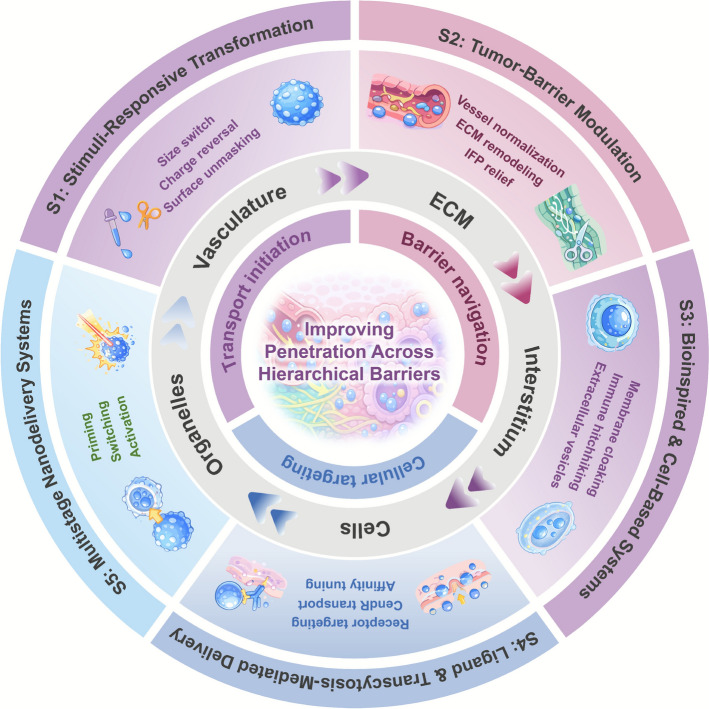
Solid tumors pose a spatial “delivery-at-depth” bottleneck: therapeutics that reach tumors often remain sequestered near vessels and fail to distribute uniformly into tumor cores. This limitation arises from heterogeneous perfusion, elevated interstitial fluid pressure, and dense extracellular matrix, which together restrict convection–diffusion balance and amplify binding-site barriers. We organize transformable and bioinspired nanomedicines using a barrier-centric lens and summarize five strategy families to deepen and homogenize intratumoral transport: (i) stimuli-responsive size/charge switching, (ii) microenvironment remodeling to restore perfusion and decompress stroma, (iii) ligand-guided transcytosis and CendR pathway engagement, (iv) cell-based and biomimetic vectors leveraging homing and immune evasion, and (v) multistage designs that sequence priming, switching, and payload activation. We compare representative systems by trigger specificity, activation timing, affinity tuning, and corona susceptibility, and highlight recurring failure modes including stimulus heterogeneity, premature/off-target activation, and escalating chemistry–manufacturing–controls burdens with added components. We conclude with translational priorities: couple barrier priming with a single well-characterized switching event, favor moderated or activatable affinity to avoid perivascular trapping, and validate spatial gains using standardized intratumoral distribution metrics linked to therapeutic endpoints. Graphical Abstract
Overview
AI snapshot
Written from the paper’s full text.
TL;DR
This review maps transformable and bioinspired nanomedicines onto five barrier-centric strategy families for deep tumor penetration and compares their triggers, timing, affinity, and corona susceptibility. It argues that deep homogeneous delivery requires coordinated vascular access, stromal resistance reduction, and on-site activation, with translational priority on barrier priming plus a single well-characterized switch and standardized spatial metrics.
Key findings
- Five strategy families are synthesized: stimuli-responsive size/charge switching, microenvironment remodeling, ligand-guided transcytosis/CendR engagement, cell-based and biomimetic vectors, and multistage designs that sequence priming, switching, and payload activation.
- Representative transformable systems report large switches: HAase-responsive Te/QAm polycarbonate masks a cationic core (ζ ~ −27 mV, 160 nm), shrinks to ~130 nm and reverses positive, enabling uniform penetration through 3.6 mm DMMA xenografts with ~87% tumor inhibition; Met@BF shifts −16.6 to +18.5 mV at pH 6.0, penetrates melanoma spheroids ~60 µm, and gives ~87% tumor inhibition.
- Barrier-remodeling and bioinspired examples include collagenase@CMSNs with detectable penetration depth 1200 μm and 86% tumor inhibition, ENP5 fusiform CaP with a 12.2× penetration enhancement factor, and neutrophil “Trojanbots” with ~50% BBB crossing, ~416 μm spheroid propulsion, and median survival 45 days vs PBS 18 days.
- Recurring failure modes are stimulus heterogeneity, premature/off-target activation, and escalating chemistry–manufacturing–controls burden; clinical translation remains sparse and many trials do not report standardized intratumoral transport metrics.
Methods
- Review article, not a primary study; it organizes transformable and bioinspired nanomedicines into five penetration-enabling strategy families (S1–S5) using a barrier-centric framework.
- Compares representative systems by trigger specificity, activation timing, affinity tuning, and corona susceptibility, and consolidates penetration/efficacy readouts in Tables 1–6 with explicit comparator arms where reported.
- Discusses preclinical models (spheroids, xenografts, patient-derived organoids, tumor-on-a-chip) and provides a clinical translation snapshot compiled from prior review sources.
Limitations
- Stated: most penetration claims are established in subcutaneous or orthotopic xenografts and simple 3D spheroids, which only partially recapitulate patient-level heterogeneity; spheroid penetration of 50–200 μm and rodent millimeter-scale readouts are relative performance metrics, not direct predictors of human penetration.
- Stated: stimulus heterogeneity, premature/incomplete/misplaced activation, insufficient long-term biosafety study of residual metallic or polymeric fragments, and CMC/manufacturability burdens for multi-component bioinspired constructs.
- Evident: as a review, it generates no new experimental data; cross-study comparisons are constrained by heterogeneous models, imaging pipelines, and comparator arms, and many clinical trials do not report standardized intratumoral transport metrics.
Model-written summary. Check it against the paper before relying on it.
Integrity signals
Registry
Cites
Statistics
Figures
Verification
Claims the paper makes
86 No full text of the sources · 81 Not checked yet · 54 Own interpretation · 7 Partly supported · 5 No basis given · 2 Couldn’t confirm · 1 Own result · accuracy not yet measured
The cited sources support only part of this claim — read each source’s verdict below.
In the paper
“In solid tumors, IFP is markedly elevated (typically 10–40 mmHg), due to leaky vasculature and dysfunctional lymphatic drainage.”
§ Overcoming tumor microenvironment barriers: transformable and bioinspired nanomedicine strategies for deep tumor penetration > Barrier overcoming systems > ECM and IFP remodeling
What the sources say
- Partly supportedcites [56] Wang Y, Lu H, Huang L, Li D, Qiu W, Li L, et al. Noninvasive estimation of tumor interstitial fluid pressure from subharmonic scattering of ultrasound contrast microbubbles. Biosensors. 2023;13:528. sourceExperimental — accuracy not yet measured
The Introduction reports elevated IFP in solid tumors and identifies leaky blood vessels and limited lymphatic drainage as contributors. It does not establish 10–40 mmHg as a typical tumor IFP: the Discussion uses that range for ambient pressures tested in vitro, while the mouse tumors studied had IFPs of 3–16 mmHg. Page numbers are unavailable in our copy. (LLM, conf=0.90)
plaindirect- Asserted: passes — The authors put it forward as true.
- Checkable: passes — It can be checked against evidence.
- Load-bearing: passes — The paper’s conclusions depend on it.
- Based: passes — The paper gives a reason why it holds.
- Partly supported
The cited sources support only part of this claim — read each source’s verdict below.
In the paper
“ENP5 fusiform CaP | High-curvature geometry (apical mean curvature 1,004.8 µm⁻1) to reduce viscous drag | Huh-7 hepatocellular carcinoma | Pressure-limited extravasation and matrix tortuosity | Matrix transport assay; penetration enhancement factor increased by 12.2 times | — | [51]”
§ Overcoming tumor microenvironment barriers: transformable and bioinspired nanomedicine strategies for deep tumor penetration > Barrier overcoming systems
What the sources say
- Partly supportedcites [51] Jiang X, Xu S, Miao Y, Huang K, Wang B, Ding B, et al. Curvature-mediated rapid extravasation and penetration of nanoparticles against interstitial fluid pressure for improved drug delivery. Proc Natl Acad Sci U S A. 2024;121:e2319880121. https://doi.org/10.1073/pnas.2319880121. sourceExperimental — accuracy not yet measured
The Results section, “High Curvature Leads to Rapid NP Penetration in Tumors” (page unavailable), reports 12.2-fold higher fluorescence intensity for ENP5 than SNP at a depth of 1.5 mm in isolated Huh-7 xenograft tumors under high interstitial fluid pressure. That supports enhanced penetration, but the 12.2-fold figure is not reported as a penetration enhancement factor from the matrix transport assay; the assay discussed in “ENP5 Penetrates Rapidly with Enhanced Hopping Frequency” reports diffusivity instead. (LLM, conf=0.88)
plaindirect- Asserted: passes — The authors put it forward as true.
- Checkable: passes — It can be checked against evidence.
- Load-bearing: passes — The paper’s conclusions depend on it.
- Based: passes — The paper gives a reason why it holds.
- Partly supported
The cited sources support only part of this claim — read each source’s verdict below.
In the paper
“In vivo, the combined administration inhibited tumor growth most significantly compared with anti-PD1 antibody alone (and vs. PBS control), clarifying the control context for the reported synergy.”
§ Overcoming tumor microenvironment barriers: transformable and bioinspired nanomedicine strategies for deep tumor penetration > Cell-based and bioinspired delivery systems > Microenvironment priming systems
What the sources say
- Partly supportedcites [70] Yalamandala BN, Chen YJ, Lin YH, Huynh TMH, Chiang WH, Chou TC, et al. A self-cascade penetrating brain tumor immunotherapy mediated by near-infrared II cell membrane-disrupting nanoflakes via detained dendritic cells. ACS Nano. 2024;18:18712–28. https://doi.org/10.1021/acsnano.4c06183. sourceExperimental — accuracy not yet measured
The Results and Discussion section, “In Vivo Study of the T Cell Infiltration and Survival Rate” (page unavailable), reports reduced tumor signals after CuS NB+NIR treatment and significantly prolonged survival with CuS NB+NIR+aPD-1 relative to the PBS control. It does not report a tumor-growth comparison between the combined treatment and anti-PD-1 antibody alone; the listed treatment groups do not include an antibody-only arm. (LLM, conf=0.85)
boosteddirect- Asserted: passes — The authors put it forward as true.
- Checkable: passes — It can be checked against evidence.
- Load-bearing: passes — The paper’s conclusions depend on it.
- Based: passes — The paper gives a reason why it holds.
- Partly supported
The cited sources that could be checked couldn’t confirm or dispute this claim.
In the paper
“ligands with strong receptor affinity and/or high multivalency are preferentially captured by the first accessible receptors near vessels, leading to perivascular sequestration and reduced interstitial propagation.”
§ Overcoming tumor microenvironment barriers: transformable and bioinspired nanomedicine strategies for deep tumor penetration > Ligand and transcytosis mediated penetration > CendR-mediated tissue penetration systems
What the sources say
- Could not verifycites [92] Xu Y, Yang S, Rao Q, Gao Y, Zhou G, Zhao D, et al. A mechanistic quantitative systems pharmacology model platform for translational efficacy evaluation and checkpoint combination design of bispecific immuno-modulatory antibodies. Front Pharmacol. 2025;16:1571844. https://doi.org/10.3389/fphar.2025.1571844. sourceExperimental — accuracy not yet measured
The Materials and methods section describes antibody binding and estimates tumor antibody concentrations from plasma concentrations using partition coefficients, but does not address where antibodies bind within the tumor. Searches for perivascular sequestration, affinity- or multivalency-driven capture, and reduced interstitial propagation found no passage establishing the claimed mechanism. No page number is available in our copy. (LLM, conf=0.76)
plaindirect- Asserted: passes — The authors put it forward as true.
- Checkable: passes — It can be checked against evidence.
- Load-bearing: passes — The paper’s conclusions depend on it.
- Based: passes — The paper gives a reason why it holds.
- Could not verify
The cited sources that could be checked couldn’t confirm or dispute this claim.
In the paper
“Cell based and bioinspired carriers remain compelling for specific niches, for example blood–brain barrier delivery, immune cell trafficking and homologous adhesion, but their translational pathway depends as much on standardized sourcing, potency assays and regulatory alignment as on delivery performance [131].”
§ Overcoming tumor microenvironment barriers: transformable and bioinspired nanomedicine strategies for deep tumor penetration > Conclusions and future perspectives
What the sources say
- Could not verifycites [131] Loewa A, Feng JJ, Hedtrich S. Human disease models in drug development. Nat Rev Bioeng. 2023;1:1–15. https://doi.org/10.1038/s44222-023-00063-3. sourceExperimental — accuracy not yet measured
The Cell diversity and tissue biomimicry section discusses incorporating barriers such as the blood–brain barrier into disease models, not using cell-based carriers to cross them. The Outlook calls for standardized manufacturing and regulatory approval of human disease models, but does not address carrier sourcing, potency assays, delivery performance, or the claimed delivery niches (pages not provided). Searches for carrier delivery and those translational requirements found no passage addressing the claim. (LLM, conf=0.75)
plaincorrelational- Asserted: passes — The authors put it forward as true.
- Checkable: passes — It can be checked against evidence.
- Load-bearing: passes — The paper’s conclusions depend on it.
- Based: passes — The paper gives a reason why it holds.
- Could not verify
None of the sources cited for this claim have been checked yet.
In the paper
“Interestingly, what appear to be barriers can also be exploited as triggers: local acidity and enzymatic activity can induce size shrinkage and charge reversal; hypoxia and redox gradients can open transcytotic pathways and expose latent ligands.”
§ Overcoming tumor microenvironment barriers: transformable and bioinspired nanomedicine strategies for deep tumor penetration > Background
What the sources say
- Not checked yetcites [9] Nussbaum S, Shoukry M, Ashary MA, Kasbi AA, Baksh M, Gabriel E. Advanced tumor imaging approaches in human tumors. Cancers (Basel). 2022;14:1549. https://doi.org/10.3390/cancers14061549. source
Checked before — its earlier verdict is held back until a new check runs.
plaindirect- Asserted: passes — The authors put it forward as true.
- Checkable: passes — It can be checked against evidence.
- Load-bearing: passes — The paper’s conclusions depend on it.
- Based: passes — The paper gives a reason why it holds.
- Not checked yet
In the paper
“First, modest contraction, approximately twofold, already reduces steric hindrance and improves interstitial diffusion.”
§ Overcoming tumor microenvironment barriers: transformable and bioinspired nanomedicine strategies for deep tumor penetration > Size and charge transformation > Size shrinkable systems
What the sources say
- Not checked — no full text of the sourcecites [22] He Y, Fan X, Wu X, Hu T, Zhou F, Tan S, et al. pH-responsive size-shrinkable mesoporous silica-based nanocarriers for improving tumor penetration and therapeutic efficacy. Nanoscale. 2022;14:1271–84. https://doi.org/10.1039/d1nr07513f. source
plaindirect- Asserted: passes — The authors put it forward as true.
- Checkable: passes — It can be checked against evidence.
- Load-bearing: passes — The paper’s conclusions depend on it.
- Based: passes — The paper gives a reason why it holds.
None of the sources cited for this claim have been checked yet.
In the paper
“Through such mechanisms, these cues can be harnessed to invert biological filters and propel nanomedicines beyond perivascular regions into tumor cores [9].”
§ Overcoming tumor microenvironment barriers: transformable and bioinspired nanomedicine strategies for deep tumor penetration > Background
What the sources say
- Not checked yetcites [9] Nussbaum S, Shoukry M, Ashary MA, Kasbi AA, Baksh M, Gabriel E. Advanced tumor imaging approaches in human tumors. Cancers (Basel). 2022;14:1549. https://doi.org/10.3390/cancers14061549. source
Checked before — its earlier verdict is held back until a new check runs.
plaindirect- Asserted: passes — The authors put it forward as true.
- Checkable: passes — It can be checked against evidence.
- Load-bearing: passes — The paper’s conclusions depend on it.
- Based: passes — The paper gives a reason why it holds.
- Not checked yet
None of the sources cited for this claim have been checked yet.
In the paper
“To address this issue, researchers have developed transformable nanocarriers whose size or surface charge can dynamically respond to specific TME stimuli, such as pH, enzymes, or GSH [20].”
§ Overcoming tumor microenvironment barriers: transformable and bioinspired nanomedicine strategies for deep tumor penetration > Size and charge transformation
What the sources say
- Not checked yetcites [20] Badparvar F, Marjani AP, Salehi R, Ramezani F. Dual pH/redox-responsive hyperbranched polymeric nanocarriers with TME-trigger size shrinkage and charge reversible ability for amplified chemotherapy of breast cancer. Sci Rep. 2024;14:8567. https://doi.org/10.1038/s41598-024-57296-4. source
Checked before — its earlier verdict is held back until a new check runs.
plaindirect- Asserted: passes — The authors put it forward as true.
- Checkable: passes — It can be checked against evidence.
- Load-bearing: passes — The paper’s conclusions depend on it.
- Based: passes — The paper gives a reason why it holds.
- Not checked yet
A conclusion the paper draws from its own results — it cites no other source for it, so there is none to check. The quote shows it is in the paper.
In the paper
“This approach effectively balances systemic stability with deep intratumoral penetration (Fig. 2).”
§ Overcoming tumor microenvironment barriers: transformable and bioinspired nanomedicine strategies for deep tumor penetration > Size and charge transformation
plaindirect- Asserted: passes — The authors put it forward as true.
- Checkable: passes — It can be checked against evidence.
- Load-bearing: passes — The paper’s conclusions depend on it.
- Based: passes — The paper gives a reason why it holds.
- It may state two separate claims as one. 130
- The quote only partly states this claim. 1
- Probably not a substantial claim. 13
The cited sources support only part of this claim — read each source’s verdict below.
In the paper
“Conversely, smaller particles (< 30 nm) diffuse more readily into deep tumor regions but are quickly cleared from circulation and may cause off-target effects [19].”
§ Overcoming tumor microenvironment barriers: transformable and bioinspired nanomedicine strategies for deep tumor penetration > Size and charge transformation
What the sources say
- Partly supportedcites [19] Mellor RD, Uchegbu IF. Ultrasmall-in-nano: why size matters. Nanomaterials. 2022;12:2476. https://doi.org/10.3390/nano12142476. sourceExperimental — accuracy not yet measured
Section 2.6 says smaller particles diffuse more freely into tumors and distribute more widely in healthy as well as diseased tissues, supporting the diffusion and potential off-target concerns. It does not establish a <30 nm cutoff or specifically describe penetration into deep tumor regions. The claim that particles throughout that size range are quickly cleared overgeneralizes Section 2.4’s finding for <5 nm particles; Section 2.6 instead says smaller particles can have extended circulation times. (LLM, conf=0.88)
hedgedconditional- Asserted: passes — The authors put it forward as true.
- Checkable: passes — It can be checked against evidence.
- Load-bearing: passes — The paper’s conclusions depend on it.
- Based: passes — The paper gives a reason why it holds.
It may state two separate claims as one.
- Partly supported
The cited sources support only part of this claim — read each source’s verdict below.
In the paper
“Systemically administered drugs are subject to rapid clearance, limited tumor accumulation, and most critically, poor tissue penetration.”
§ Overcoming tumor microenvironment barriers: transformable and bioinspired nanomedicine strategies for deep tumor penetration > Background
What the sources say
- Partly supportedcites [2] Yun WS, Kim J, Lim DK, Kim DH, Jeon SI, Kim K. Recent studies and progress in the intratumoral administration of nano-sized drug delivery systems. Nanomaterials. 2023;13:2225. https://doi.org/10.3390/nano13152225. sourceExperimental — accuracy not yet measured
The Introduction describes systemically administered nano-sized drug delivery systems being cleared before reaching tumors and achieving limited tumor delivery. Section 2.1 describes impaired deep penetration into tumor tissue. The paper does not establish that poor penetration is the most critical of these problems, and its discussion chiefly concerns nano-sized delivery systems rather than systemically administered drugs generally. (LLM, conf=0.86)
- Partly supportedcites [3] Momoh J, Kapsokalyvas D, Vogt M, Hak S, Kiessling F, van Zandvoort M, et al. Intravital microscopy for real-time monitoring of drug delivery and nanobiological processes. Adv Drug Deliv Rev. 2022;189:114528. https://doi.org/10.1016/j.addr.2022.114528. sourceExperimental — accuracy not yet measured
Section 4.1 (page unavailable) says that limited mobility impedes deep tumor penetration by larger nanoparticles, and the Figure 4 caption in Section 7 describes heterogeneous tissue accumulation and minimal extravasation by larger particles. These examples support delivery and penetration limitations, but not a general claim about all systemically administered drugs. The caption reports clearance of one payload from tissue after three hours; it does not establish rapid systemic clearance as a general limitation or show that poor penetration is the most critical limitation. (LLM, conf=0.84)
plaindirect- Asserted: passes — The authors put it forward as true.
- Checkable: passes — It can be checked against evidence.
- Load-bearing: passes — The paper’s conclusions depend on it.
- Based: passes — The paper gives a reason why it holds.
It may state two separate claims as one.
- Partly supported
The cited sources support only part of this claim — read each source’s verdict below.
In the paper
“Nanoparticles larger than 100 nm are more stable in circulation, with prolonged blood half-life, but face significant challenges in penetrating the dense ECM and IFP of tumors.”
§ Overcoming tumor microenvironment barriers: transformable and bioinspired nanomedicine strategies for deep tumor penetration > Size and charge transformation
What the sources say
- Partly supportedcites [19] Mellor RD, Uchegbu IF. Ultrasmall-in-nano: why size matters. Nanomaterials. 2022;12:2476. https://doi.org/10.3390/nano12142476. sourceExperimental — accuracy not yet measured
Section 4 (page not specified) associates 100–500 nm particles with increased circulation times. Section 2.6 says larger particles diffuse less readily into solid tumors, but its specific barrier example concerns particles close to or exceeding 1 µm, not all particles above 100 nm. Our copy does not identify dense ECM or tumor IFP as the cause, and section 2.6 also describes smaller particles as having extended circulation times. (LLM, conf=0.86)
plaindirect- Asserted: passes — The authors put it forward as true.
- Checkable: passes — It can be checked against evidence.
- Load-bearing: passes — The paper’s conclusions depend on it.
- Based: passes — The paper gives a reason why it holds.
It may state two separate claims as one.
- Partly supported
The cited sources support only part of this claim — read each source’s verdict below.
In the paper
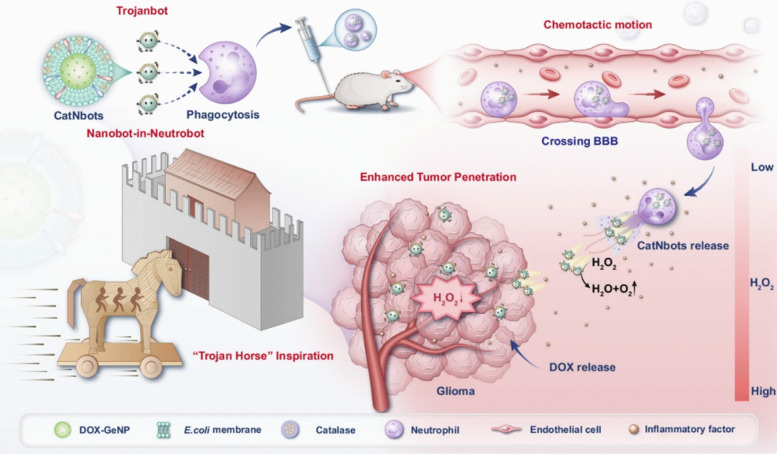
“For BBB traversal and deep brain delivery, neutrophil “Trojanbots” encapsulated catalase-powered gelatin nanobots (CatNbots). The assemblies measured about 329 nm (ζ ~ − 35.6 mV), crossed an in vitro BBB with roughly 50% efficiency, and once released self-propelled about 416 μm through GL261 spheroids.”
§ Overcoming tumor microenvironment barriers: transformable and bioinspired nanomedicine strategies for deep tumor penetration > Cell-based and bioinspired delivery systems > Barrier navigation systems
What the sources say
- Partly supportedcites [64] Gao Y, Mao M, Li Y, Xuan M, Wu Y, He Q. A self-directed trojanbot-enzymatic nanobot in neutrobot for active target therapy of glioblastoma. Nat Commun. 2025;16:5263. https://doi.org/10.1038/s41467-025-60422-z. sourceExperimental — accuracy not yet measured
Split into 2 atoms — 0 confirmed, 2 partially supported, 0 disputed, 0 misattributed, 0 unverifiable. Expand the claim to see per-atom verdicts.
plain- Asserted: passes — The authors put it forward as true.
- Checkable: passes — It can be checked against evidence.
- Load-bearing: passes — The paper’s conclusions depend on it.
- Based: passes — The paper gives a reason why it holds.
It may state two separate claims as one.
- Partly supported
None of the sources cited for this claim have been checked yet.
In the paper
“Earlier overviews have typically organized systems by material class or by a single trigger, but they seldom cross-compare how different design logics perform against specific tumor barriers or how deeply they penetrate in three-dimensional models and in vivo [16].”
§ Overcoming tumor microenvironment barriers: transformable and bioinspired nanomedicine strategies for deep tumor penetration > Background
What the sources say
- Not checked yetcites [16] Carton F, Malatesta M. In vitro models of biological barriers for nanomedical research. Int J Mol Sci. 2022;23:8910. https://doi.org/10.3390/ijms23168910. source
Checked before — its earlier verdict is held back until a new check runs.
plain- Asserted: passes — The authors put it forward as true.
- Checkable: passes — It can be checked against evidence.
- Load-bearing: passes — The paper’s conclusions depend on it.
- Based: passes — The paper gives a reason why it holds.
It may state two separate claims as one.
- Not checked yet
In the paper
“In addition to imposing physical transport barriers, stromal cells can actively drive malignant progression and therapy resistance.”
§ Overcoming tumor microenvironment barriers: transformable and bioinspired nanomedicine strategies for deep tumor penetration > Background
What the sources say
- Not checked — no full text of the sourcecites [8] Pang LB, Li J, Zhang ZW, Zhang CQ. Lung cancer-associated mesenchymal stem cells mediate chemoresistance and malignant progression of lung cancer through activating HIF-1α. Eur Cell Mater. 2025;50:87–108. https://doi.org/10.22203/eCM.v050a06. source
plaindirect- Asserted: passes — The authors put it forward as true.
- Checkable: passes — It can be checked against evidence.
- Load-bearing: passes — The paper’s conclusions depend on it.
- Based: passes — The paper gives a reason why it holds.
It may state two separate claims as one.
A claim is checked only against the cited paper’s full text, never its abstract, and none is available for its sources.
In the paper
“In comparative terms, acid/GSH shrinkers emphasize interstitial passage and retention with relatively simple chemistries [22, 23], whereas protease-directed ultra-shrinkers are especially potent in desmoplastic matrices that overexpress MMPs, achieving deeper spread at the cost of more elaborate trigger design.”
§ Overcoming tumor microenvironment barriers: transformable and bioinspired nanomedicine strategies for deep tumor penetration > Size and charge transformation > Size shrinkable systems
What the sources say
- Not checked — no full text of the sourcecites [22] He Y, Fan X, Wu X, Hu T, Zhou F, Tan S, et al. pH-responsive size-shrinkable mesoporous silica-based nanocarriers for improving tumor penetration and therapeutic efficacy. Nanoscale. 2022;14:1271–84. https://doi.org/10.1039/d1nr07513f. source
- Not checked — no full text of the sourcecites [23] Ma X, Chen X, Yi Z, Deng Z, Su W, Chen G, et al. Size changeable nanomedicines assembled by noncovalent interactions of responsive small molecules for enhancing tumor therapy. ACS Applied Materials & Interfaces. 2022;14:26431–42. https://doi.org/10.1021/acsami.2c04698. source
plaindirect- Asserted: passes — The authors put it forward as true.
- Checkable: passes — It can be checked against evidence.
- Load-bearing: unclear — It is unclear whether the paper’s conclusions depend on it.
- Based: passes — The paper gives a reason why it holds.
It may state two separate claims as one.
None of the sources cited for this claim have been checked yet.
In the paper
“Interestingly, what appear to be barriers can also be exploited as triggers: local acidity and enzymatic activity can induce size shrinkage and charge reversal; hypoxia and redox gradients can open transcytotic pathways and expose latent ligands.”
§ Overcoming tumor microenvironment barriers: transformable and bioinspired nanomedicine strategies for deep tumor penetration > Background
What the sources say
- Not checked yetcites [9] Nussbaum S, Shoukry M, Ashary MA, Kasbi AA, Baksh M, Gabriel E. Advanced tumor imaging approaches in human tumors. Cancers (Basel). 2022;14:1549. https://doi.org/10.3390/cancers14061549. source
Checked before — its earlier verdict is held back until a new check runs.
plaindirect- Asserted: passes — The authors put it forward as true.
- Checkable: passes — It can be checked against evidence.
- Load-bearing: passes — The paper’s conclusions depend on it.
- Based: passes — The paper gives a reason why it holds.
It may state two separate claims as one.
- Not checked yet
In the paper
“Several nanomedicines, such as liposomal doxorubicin (DOX) and albumin-bound paclitaxel, have been approved for clinical use, with benefits primarily in reducing systemic toxicity.”
§ Overcoming tumor microenvironment barriers: transformable and bioinspired nanomedicine strategies for deep tumor penetration > Background
What the sources say
- Not checked yetcites [5] Liu B, Zhou H, Tan L, Siu KTH, Guan XY. Exploring treatment options in cancer: tumor treatment strategies. Signal Transduct Target Ther. 2024;9:175. https://doi.org/10.1038/s41392-024-01856-7. source
plaindirect- Asserted: passes — The authors put it forward as true.
- Checkable: passes — It can be checked against evidence.
- Load-bearing: unclear — It is unclear whether the paper’s conclusions depend on it.
- Based: passes — The paper gives a reason why it holds.
It may state two separate claims as one.
In the paper
“As a result, transformation kinetics and activation windows calibrated in protein-free buffers may differ markedly from those in plasma or interstitial fluid, underscoring the need to validate size- and charge-switching behavior under physiologically relevant protein concentrations [18].”
§ Overcoming tumor microenvironment barriers: transformable and bioinspired nanomedicine strategies for deep tumor penetration > Size and charge transformation
What the sources say
- Not checked — no full text of the sourcecites [18] Yang H, Lu S, Wang S, Liu L, Zhu B, Yu S, et al. Evolution of the protein corona affects macrophage polarization. Int J Biol Macromol. 2021;191:192–200. https://doi.org/10.1016/j.ijbiomac.2021.09.081. source
hedgedconditional- Asserted: passes — The authors put it forward as true.
- Checkable: passes — It can be checked against evidence.
- Load-bearing: passes — The paper’s conclusions depend on it.
- Based: passes — The paper gives a reason why it holds.
It may state two separate claims as one.
In the paper
“For example, lung cancer-associated mesenchymal stem cells promote autophagy and epithelial-mesenchymal transition through HIF-1α-dependent signaling, thereby enhancing invasion and chemoresistance and underscoring that tumor-microenvironment remodeling is tightly coupled to drug response as well as penetration [8].”
§ Overcoming tumor microenvironment barriers: transformable and bioinspired nanomedicine strategies for deep tumor penetration > Background
What the sources say
- Not checked — no full text of the sourcecites [8] Pang LB, Li J, Zhang ZW, Zhang CQ. Lung cancer-associated mesenchymal stem cells mediate chemoresistance and malignant progression of lung cancer through activating HIF-1α. Eur Cell Mater. 2025;50:87–108. https://doi.org/10.22203/eCM.v050a06. source
plaindirect- Asserted: passes — The authors put it forward as true.
- Checkable: passes — It can be checked against evidence.
- Load-bearing: unclear — It is unclear whether the paper’s conclusions depend on it.
- Based: passes — The paper gives a reason why it holds.
It may state two separate claims as one.
None of the sources cited for this claim have been checked yet.
In the paper
“Nanotechnology-based drug delivery systems offer new opportunities to improve pharmacokinetics, enable site-specific targeting, and enhance drug stability in circulation [4].”
§ Overcoming tumor microenvironment barriers: transformable and bioinspired nanomedicine strategies for deep tumor penetration > Background
What the sources say
- Not checked yetcites [4] Tripathi D, Pandey P, Sharma S, Rai AK, Prabhu BHM. Advances in nanomaterials for precision drug delivery: insights into pharmacokinetics and toxicity. Bioimpacts. 2025;15:30573. https://doi.org/10.34172/bi.30573. source
Checked before — its earlier verdict is held back until a new check runs.
plainconditional- Asserted: passes — The authors put it forward as true.
- Checkable: passes — It can be checked against evidence.
- Load-bearing: passes — The paper’s conclusions depend on it.
- Based: passes — The paper gives a reason why it holds.
It may state two separate claims as one.
- Not checked yet
None of the sources cited for this claim have been checked yet.
In the paper
“Emerging patient-derived organoids (PDOs), co-culture spheroids and microfluidic tumor-on-a-chip platforms offer more faithful TME architectures and spatiotemporal gradients, and are thus particularly well suited for benchmarking “deep penetration” performance and validating model-informed design rules [11].”
§ Overcoming tumor microenvironment barriers: transformable and bioinspired nanomedicine strategies for deep tumor penetration > Background
What the sources say
- Not checked yetcites [11] Wang E, Xiang K, Zhang Y, Wang XF. Patient-derived organoids (PDOs) and PDO-derived xenografts (PDOXs): new opportunities in establishing faithful pre-clinical cancer models. J Natl Cancer Cent. 2022;2:263–76. https://doi.org/10.1016/j.jncc.2022.10.001. source
Checked before — its earlier verdict is held back until a new check runs.
boostedcorrelational- Asserted: passes — The authors put it forward as true.
- Checkable: passes — It can be checked against evidence.
- Load-bearing: unclear — It is unclear whether the paper’s conclusions depend on it.
- Based: passes — The paper gives a reason why it holds.
It may state two separate claims as one.
- Not checked yet
In the paper
“Compared with normal tissues, tumors exhibit a constellation of abnormal features collectively referred to as the TME, including disorganized and hyperpermeable vasculature, dense extracellular matrix (ECM), elevated interstitial fluid pressure (IFP), aberrant enzyme expression, acidic pH, and hypoxic regions.”
§ Overcoming tumor microenvironment barriers: transformable and bioinspired nanomedicine strategies for deep tumor penetration > Background
What the sources say
- Not checked — no full text of the sourcecites [7] Cabral H, Li J, Miyata K, Kataoka K. Controlling the biodistribution and clearance of nanomedicines. Nat Rev Bioeng. 2023;2:214–32. https://doi.org/10.1038/s44222-023-00138-1. source
plain- Asserted: passes — The authors put it forward as true.
- Checkable: passes — It can be checked against evidence.
- Load-bearing: passes — The paper’s conclusions depend on it.
- Based: passes — The paper gives a reason why it holds.
It may state two separate claims as one.
None of the sources cited for this claim have been checked yet.
In the paper
“In the same study, Cybulski et al. further demonstrated that positively charged AuNR(+) underwent complete charge inversion in serum-containing medium due to the adsorption of a predominantly anionic protein corona, which reduced close contact with cell membranes and limited penetration into inner spheroid layers [17].”
§ Overcoming tumor microenvironment barriers: transformable and bioinspired nanomedicine strategies for deep tumor penetration > Size and charge transformation
What the sources say
- Not checked yetcites [17] Cybulski P, Bravo M, Chen JJ, Van Zundert I, Krzyzowska S, Taemaitree F, et al. Nanoparticle accumulation and penetration in 3D tumor models: the effect of size, shape, and surface charge. Front Cell Dev Biol. 2024;12:1520078. https://doi.org/10.3389/fcell.2024.1520078. source
Checked before — its earlier verdict is held back until a new check runs.
boosteddirect- Asserted: passes — The authors put it forward as true.
- Checkable: passes — It can be checked against evidence.
- Load-bearing: passes — The paper’s conclusions depend on it.
- Based: passes — The paper gives a reason why it holds.
It may state two separate claims as one.
- Not checked yet
None of the sources cited for this claim have been checked yet.
In the paper
“They observed that larger nanospheres showed higher overall accumulation but shallower penetration, whereas smaller nanospheres and negatively charged particles could reach inner spheroid layers, and rod-shaped particles generally displayed more limited penetration than spherical ones [17].”
§ Overcoming tumor microenvironment barriers: transformable and bioinspired nanomedicine strategies for deep tumor penetration > Size and charge transformation
What the sources say
- Not checked yetcites [17] Cybulski P, Bravo M, Chen JJ, Van Zundert I, Krzyzowska S, Taemaitree F, et al. Nanoparticle accumulation and penetration in 3D tumor models: the effect of size, shape, and surface charge. Front Cell Dev Biol. 2024;12:1520078. https://doi.org/10.3389/fcell.2024.1520078. source
Checked before — its earlier verdict is held back until a new check runs.
plaincorrelational- Asserted: passes — The authors put it forward as true.
- Checkable: passes — It can be checked against evidence.
- Load-bearing: passes — The paper’s conclusions depend on it.
- Based: passes — The paper gives a reason why it holds.
It may state two separate claims as one.
- Not checked yet
In the paper
“Recent corona-focused analyses likewise emphasize that dynamic corona formation can substantially shift the zeta potential of nanoparticles and sterically shield pH- or redox-sensitive moieties [18].”
§ Overcoming tumor microenvironment barriers: transformable and bioinspired nanomedicine strategies for deep tumor penetration > Size and charge transformation
What the sources say
- Not checked — no full text of the sourcecites [18] Yang H, Lu S, Wang S, Liu L, Zhu B, Yu S, et al. Evolution of the protein corona affects macrophage polarization. Int J Biol Macromol. 2021;191:192–200. https://doi.org/10.1016/j.ijbiomac.2021.09.081. source
plaindirect- Asserted: passes — The authors put it forward as true.
- Checkable: passes — It can be checked against evidence.
- Load-bearing: passes — The paper’s conclusions depend on it.
- Based: passes — The paper gives a reason why it holds.
It may state two separate claims as one.
A claim is checked only against the cited paper’s full text, never its abstract, and none is available for its sources.
In the paper
“Because activated fragments are often neutral to mildly negative, diffusion gains can outpace cellular entry, which encourages coupling shrinkage with a second lever such as latent cation exposure or ligand unmasking so that transport is not achieved at the expense of uptake [22, 24].”
§ Overcoming tumor microenvironment barriers: transformable and bioinspired nanomedicine strategies for deep tumor penetration > Size and charge transformation > Size shrinkable systems
What the sources say
- Not checked — no full text of the sourcecites [22] He Y, Fan X, Wu X, Hu T, Zhou F, Tan S, et al. pH-responsive size-shrinkable mesoporous silica-based nanocarriers for improving tumor penetration and therapeutic efficacy. Nanoscale. 2022;14:1271–84. https://doi.org/10.1039/d1nr07513f. source
- Not checked — no full text of the sourcecites [24] Ma T, Li W, Ye J, Huang C, Li Y, Qiu H, et al. GSH/pH dual response drug delivery system for photothermal enhanced gene-immunotherapy. Nanoscale. 2023;15:16947–58. https://doi.org/10.1039/d3nr03881e. source
plaindirect- Asserted: passes — The authors put it forward as true.
- Checkable: passes — It can be checked against evidence.
- Load-bearing: passes — The paper’s conclusions depend on it.
- Based: passes — The paper gives a reason why it holds.
It may state two separate claims as one.
In the paper
“Since charge reversal does not inherently reduce hydrodynamic size, diffusion through dense stroma can remain the bottleneck when activated diameters exceed about 50 nm; pairing partial downsizing with charge programming or introducing short, well-tolerated priming that preserves perfusion can mitigate this constraint [25].”
§ Overcoming tumor microenvironment barriers: transformable and bioinspired nanomedicine strategies for deep tumor penetration > Size and charge transformation > Charge reversal systems
What the sources say
- Not checked — no full text of the sourcecites [25] Hu J, Zhou W, Zhou Y, Hu H, Ran S, Zhang Y. Ph-independent charge-reversal strategy for enhanced tumor penetration based on hyaluronidase-responsive tellurium-containing polycarbonate nanocarriers. J Mater Chem B. 2025;13:8483–95. https://doi.org/10.1039/d5tb00368g. source
plainconditional- Asserted: passes — The authors put it forward as true.
- Checkable: passes — It can be checked against evidence.
- Load-bearing: passes — The paper’s conclusions depend on it.
- Based: passes — The paper gives a reason why it holds.
It may state two separate claims as one.
In the paper
“In an MDA-MB-231 xenograft model, PRO achieved a TGI of 36.3% (vs PBS), whereas iPR reached 62.3% (5 μM) and 81.5% (8 μM) after 21 days (vs PBS), supporting a quantitatively stronger in vivo benefit than the parent PROTAC at matched/near-matched dosing.”
§ Overcoming tumor microenvironment barriers: transformable and bioinspired nanomedicine strategies for deep tumor penetration > Ligand and transcytosis mediated penetration > Tumor penetrating ligand systems
What the sources say
- Not checked — no full text of the sourcecites [81] He S, Fang Y, Wu M, Zhang P, Gao F, Hu H, et al. Enhanced tumor targeting and penetration of proteolysis-targeting chimeras through iRGD peptide conjugation: a strategy for precise protein degradation in breast cancer. J Med Chem. 2023;66:16828–42. https://doi.org/10.1021/acs.jmedchem.3c01539. source
plaindirect- Asserted: passes — The authors put it forward as true.
- Checkable: passes — It can be checked against evidence.
- Load-bearing: passes — The paper’s conclusions depend on it.
- Based: passes — The paper gives a reason why it holds.
It may state two separate claims as one.
In the paper
“In physiological urea they transitioned from Brownian diffusion (D ~ 0.03 μm2 s⁻1) to about 2.5 μm2 s⁻1, doubled cancer-cell uptake versus static PLT@Au, and in 4T1 tumors a single intratumoral dose plus 4 Gy γ-irradiation raised the sensitization enhancement rate to 1.89 (vs. 1.08 for passive PLT@Au), producing the largest 14-day tumor weight reduction without extra toxicity [63].”
§ Overcoming tumor microenvironment barriers: transformable and bioinspired nanomedicine strategies for deep tumor penetration > Cell-based and bioinspired delivery systems > Barrier navigation systems
What the sources say
- Not checked — no full text of the sourcecites [63] Liu W, Nie H, Li H, Liu Y, Tian M, Wang S, et al. Engineered platelet cell motors for boosted cancer radiosensitization. J Colloid Interface Sci. 2024;658:540–52. https://doi.org/10.1016/j.jcis.2023.12.091. source
plaindirect- Asserted: passes — The authors put it forward as true.
- Checkable: passes — It can be checked against evidence.
- Load-bearing: passes — The paper’s conclusions depend on it.
- Based: passes — The paper gives a reason why it holds.
It may state two separate claims as one.
In the paper
“This process enhances adsorption-mediated transcytosis, allowing uniform penetration through 3.6 mm thick 2,3-Dimethylmaleic Anhydride (DMMA) xenografts and achieving potent tumor inhibition via mitochondrial cisplatin release with negligible systemic toxicity compared with the control groups [25].”
§ Overcoming tumor microenvironment barriers: transformable and bioinspired nanomedicine strategies for deep tumor penetration > Size and charge transformation > Charge reversal systems
What the sources say
- Not checked — no full text of the sourcecites [25] Hu J, Zhou W, Zhou Y, Hu H, Ran S, Zhang Y. Ph-independent charge-reversal strategy for enhanced tumor penetration based on hyaluronidase-responsive tellurium-containing polycarbonate nanocarriers. J Mater Chem B. 2025;13:8483–95. https://doi.org/10.1039/d5tb00368g. source
plaindirect- Asserted: passes — The authors put it forward as true.
- Checkable: passes — It can be checked against evidence.
- Load-bearing: passes — The paper’s conclusions depend on it.
- Based: passes — The paper gives a reason why it holds.
It may state two separate claims as one.
None of the sources cited for this claim have been checked yet.
In the paper
“Geometry engineering via high-curvature fusiform CaP (ENP5) lowers hydrodynamic drag, enabling long-range matrix traversal (over ~ 1.5 mm across the perivascular matrix in Huh-7 xenografts) enabling long-range matrix traversal and potent antitumor activity”
§ Overcoming tumor microenvironment barriers: transformable and bioinspired nanomedicine strategies for deep tumor penetration > Barrier overcoming systems > ECM and IFP remodeling
What the sources say
- Not checked yetcites [51] Jiang X, Xu S, Miao Y, Huang K, Wang B, Ding B, et al. Curvature-mediated rapid extravasation and penetration of nanoparticles against interstitial fluid pressure for improved drug delivery. Proc Natl Acad Sci U S A. 2024;121:e2319880121. https://doi.org/10.1073/pnas.2319880121. source
Checked before — its earlier verdict is held back until a new check runs.
plaindirect- Asserted: passes — The authors put it forward as true.
- Checkable: passes — It can be checked against evidence.
- Load-bearing: passes — The paper’s conclusions depend on it.
- Based: passes — The paper gives a reason why it holds.
It may state two separate claims as one.
- Not checked yet
None of the sources cited for this claim have been checked yet.
In the paper
“Tat-A86 elastin-like polypeptide nanoparticles presented AP1 together with a CPP to form stable miRNA complexes, increasing 3D spheroid penetration and suppressing Lewis lung carcinoma (LLC) growth at equivalent doses [67].”
§ Overcoming tumor microenvironment barriers: transformable and bioinspired nanomedicine strategies for deep tumor penetration > Cell-based and bioinspired delivery systems > CPP assisted bioinspired systems
What the sources say
- Not checked yetcites [67] Hong J, Sim D, Lee BH, Sarangthem V, Park RW. Multifunctional elastin-like polypeptide nanocarriers for efficient miRNA delivery in cancer therapy. J Nanobiotechnol. 2024;22:293. https://doi.org/10.1186/s12951-024-02559-5. source
Checked before — its earlier verdict is held back until a new check runs.
plaindirect- Asserted: passes — The authors put it forward as true.
- Checkable: passes — It can be checked against evidence.
- Load-bearing: passes — The paper’s conclusions depend on it.
- Based: passes — The paper gives a reason why it holds.
It may state two separate claims as one.
- Not checked yet
In the paper
“iRGD conjugation to a BRD4 PROTAC via a GSH-responsive disulfide carbonate linker (iPR) improves solubility, enables αvβ3/NRP1-dependent uptake and CendR permeation, and strengthens BRD4 degradation and antitumor effects versus the parent small molecule [81].”
§ Overcoming tumor microenvironment barriers: transformable and bioinspired nanomedicine strategies for deep tumor penetration > Ligand and transcytosis mediated penetration > Tumor penetrating ligand systems
What the sources say
- Not checked — no full text of the sourcecites [81] He S, Fang Y, Wu M, Zhang P, Gao F, Hu H, et al. Enhanced tumor targeting and penetration of proteolysis-targeting chimeras through iRGD peptide conjugation: a strategy for precise protein degradation in breast cancer. J Med Chem. 2023;66:16828–42. https://doi.org/10.1021/acs.jmedchem.3c01539. source
plaindirect- Asserted: passes — The authors put it forward as true.
- Checkable: passes — It can be checked against evidence.
- Load-bearing: passes — The paper’s conclusions depend on it.
- Based: passes — The paper gives a reason why it holds.
It may state two separate claims as one.
A conclusion the paper draws from its own results — it cites no other source for it, so there is none to check. The quote shows it is in the paper.
In the paper
“Despite these hurdles, the strategic upside is compelling: cell-based and biomimetic systems can bypass endothelium and localize actively, and when augmented with CPP modules they achieve efficient cellular entry and endosomal escape to enable deep and uniform penetration.”
§ Overcoming tumor microenvironment barriers: transformable and bioinspired nanomedicine strategies for deep tumor penetration > Cell-based and bioinspired delivery systems > CPP assisted bioinspired systems
plaindirect- Asserted: passes — The authors put it forward as true.
- Checkable: passes — It can be checked against evidence.
- Load-bearing: passes — The paper’s conclusions depend on it.
- Based: passes — The paper gives a reason why it holds.
It may state two separate claims as one.
- Rests on an assumption: Cell-based and biomimetic vectors leverage innate homing, transendothelial migration, chemotaxis, and immune evasion to improve accumulation, penetration, and on-site release.
- Rests on an assumption: Cell-penetrating peptides act as bioinspired modules that strengthen membrane engagement, endocytic entry, and endosomal escape, and can also support adsorptive-mediated transcytosis at endothelium.
None of the sources cited for this claim have been checked yet.
In the paper
“In orthotopic glioma they increased drug deposition nearly fivefold and extended median survival (median survival 38 days; vs PBS 18 days, EMV@GeNP 25 days, CatNbots 26 days, and NE@EDGNs 34 days) to 45 days without organ toxicity [64] (Fig. 4).”
§ Overcoming tumor microenvironment barriers: transformable and bioinspired nanomedicine strategies for deep tumor penetration > Cell-based and bioinspired delivery systems > Barrier navigation systems
What the sources say
- Not checked yetcites [64] Gao Y, Mao M, Li Y, Xuan M, Wu Y, He Q. A self-directed trojanbot-enzymatic nanobot in neutrobot for active target therapy of glioblastoma. Nat Commun. 2025;16:5263. https://doi.org/10.1038/s41467-025-60422-z. source
Checked before — its earlier verdict is held back until a new check runs.
plaindirect- Asserted: passes — The authors put it forward as true.
- Checkable: passes — It can be checked against evidence.
- Load-bearing: passes — The paper’s conclusions depend on it.
- Based: passes — The paper gives a reason why it holds.
It may state two separate claims as one. The quote only partly states this claim.
- Not checked yet
A conclusion the paper draws from its own results — it cites no other source for it, so there is none to check. The quote shows it is in the paper.
In the paper
“Across integrin-, nucleolin-, and CXCR4-addressed designs, two shared effects dominate: (i) increased endothelial access and perivascular-to-interstitial spread (often via CendR/NRP1 pathways), and (ii) reinforced intracellular processing (e.g., PROTAC delivery or toxin activation) that converts deeper distribution into pharmacodynamic gain.”
§ Overcoming tumor microenvironment barriers: transformable and bioinspired nanomedicine strategies for deep tumor penetration > Ligand and transcytosis mediated penetration > Tumor penetrating ligand systems
plaindirect- Asserted: passes — The authors put it forward as true.
- Checkable: passes — It can be checked against evidence.
- Load-bearing: passes — The paper’s conclusions depend on it.
- Based: passes — The paper gives a reason why it holds.
It may state two separate claims as one.
In the paper
“Collagenase@CMSNs4.5 (DOX) | Collagen degradation on large-pore cationic mesoporous silica; enhanced doxorubicin delivery | Pancreatic tumor in vivo | Dense collagen-rich extracellular matrix | Tumor-slice depth profiling; detectable penetration depth: 1200 μm | Tumor inhibition rate 86% | [49]”
§ Overcoming tumor microenvironment barriers: transformable and bioinspired nanomedicine strategies for deep tumor penetration > Barrier overcoming systems
What the sources say
- Not checked — no full text of the sourcecites [49] Qiu N, Lv QY, Li CL, Song X, Wang YQ, Chen J, et al. Optimization and mechanisms of proteolytic enzyme immobilization onto large-pore mesoporous silica nanoparticles: enhanced tumor penetration. Int J Biol Macromol. 2024;271:132626. https://doi.org/10.1016/j.ijbiomac.2024.132626. source
plain- Asserted: passes — The authors put it forward as true.
- Checkable: passes — It can be checked against evidence.
- Load-bearing: passes — The paper’s conclusions depend on it.
- Based: passes — The paper gives a reason why it holds.
It may state two separate claims as one.
In the paper
“PEG-CPP33-decorated zeolitic imidazolate framework-90 (ZIF-90) MOFs co-deliver small molecules and siRNA with acid-triggered release and improved lysosomal escape to produce chemo-gene synergy [66].”
§ Overcoming tumor microenvironment barriers: transformable and bioinspired nanomedicine strategies for deep tumor penetration > Cell-based and bioinspired delivery systems > CPP assisted bioinspired systems
What the sources say
- Not checked — no full text of the sourcecites [66] Cai M, Yao Y, Yin D, Zhu R, Fu T, Kong J, et al. Enhanced lysosomal escape of cell penetrating peptide-functionalized metal-organic frameworks for co-delivery of survivin siRNA and oridonin. J Colloid Interface Sci. 2023;646:370–80. https://doi.org/10.1016/j.jcis.2023.04.126. source
plaindirect- Asserted: passes — The authors put it forward as true.
- Checkable: passes — It can be checked against evidence.
- Load-bearing: unclear — It is unclear whether the paper’s conclusions depend on it.
- Based: passes — The paper gives a reason why it holds.
It may state two separate claims as one.
A claim is checked only against the cited paper’s full text, never its abstract, and none is available for its sources.
In the paper
“In addition, when the activated entities approach the ultrasmall range, concentration gradients can drive partial back-diffusion toward vessels, and systemic elimination can accelerate once fragments re-enter circulation, collectively increasing the risk of intratumoral washout.”
§ Overcoming tumor microenvironment barriers: transformable and bioinspired nanomedicine strategies for deep tumor penetration > Size and charge transformation > Size shrinkable systems
What the sources say
- Not checked — no full text of the sourcecites [22] He Y, Fan X, Wu X, Hu T, Zhou F, Tan S, et al. pH-responsive size-shrinkable mesoporous silica-based nanocarriers for improving tumor penetration and therapeutic efficacy. Nanoscale. 2022;14:1271–84. https://doi.org/10.1039/d1nr07513f. source
- Not checked — no full text of the sourcecites [24] Ma T, Li W, Ye J, Huang C, Li Y, Qiu H, et al. GSH/pH dual response drug delivery system for photothermal enhanced gene-immunotherapy. Nanoscale. 2023;15:16947–58. https://doi.org/10.1039/d3nr03881e. source
plaindirect- Asserted: passes — The authors put it forward as true.
- Checkable: passes — It can be checked against evidence.
- Load-bearing: passes — The paper’s conclusions depend on it.
- Based: passes — The paper gives a reason why it holds.
It may state two separate claims as one.
A conclusion the paper draws from its own results — it cites no other source for it, so there is none to check. The quote shows it is in the paper.
In the paper
“These sources of heterogeneity lead to variable activation thresholds and increase the risk of premature, incomplete or misplaced transformation, particularly for single-stimulus systems; multi-stimulus designs can mitigate this at the cost of added synthetic and analytical complexity.”
§ Overcoming tumor microenvironment barriers: transformable and bioinspired nanomedicine strategies for deep tumor penetration > Size and charge transformation > Dual-transform systems
plaindirect- Asserted: passes — The authors put it forward as true.
- Checkable: passes — It can be checked against evidence.
- Load-bearing: passes — The paper’s conclusions depend on it.
- Based: passes — The paper gives a reason why it holds.
It may state two separate claims as one.
In the paper
“A silicasome that delivers the multi-target TKI nintedanib increases intratumoral drug exposure, prunes aberrant vessels, reduces collagen, elevates the CD8⁺/FoxP3⁺ ratio, and enables synergy with anti-PD-1 in a robust orthotopic pancreatic cancer model [45]”
§ Overcoming tumor microenvironment barriers: transformable and bioinspired nanomedicine strategies for deep tumor penetration > Barrier overcoming systems > Vascular normalization
What the sources say
- Not checked yetcites [45] Luo L, Wang X, Liao YP, Xu X, Chang CH, Nel AE. Reprogramming the pancreatic cancer stroma and immune landscape by a silicasome nanocarrier delivering nintedanib, a protein tyrosine kinase inhibitor. Nano Today. 2024;54:102058. https://doi.org/10.1016/j.nantod.2023.102058. source
plaindirect- Asserted: passes — The authors put it forward as true.
- Checkable: passes — It can be checked against evidence.
- Load-bearing: passes — The paper’s conclusions depend on it.
- Based: passes — The paper gives a reason why it holds.
It may state two separate claims as one.
A conclusion the paper draws from its own results — it cites no other source for it, so there is none to check. The quote shows it is in the paper.
In the paper
“Compared with shrink-only designs, these systems increase cell engagement and adsorption-mediated transcytosis, elevating uptake where membrane passage is rate-limiting.”
§ Overcoming tumor microenvironment barriers: transformable and bioinspired nanomedicine strategies for deep tumor penetration > Size and charge transformation > Charge reversal systems
plaindirect- Asserted: passes — The authors put it forward as true.
- Checkable: passes — It can be checked against evidence.
- Load-bearing: passes — The paper’s conclusions depend on it.
- Based: passes — The paper gives a reason why it holds.
It may state two separate claims as one.
A conclusion the paper draws from its own results — it cites no other source for it, so there is none to check. The quote shows it is in the paper.
In the paper
“Aligning the sequence of transformations with the expected perfusion window, for example ensuring that contraction precedes cation exposure while perfusion is still adequate, further improves spatial uniformity and pharmacodynamics.”
§ Overcoming tumor microenvironment barriers: transformable and bioinspired nanomedicine strategies for deep tumor penetration > Size and charge transformation > Dual-transform systems
plaindirect- Asserted: passes — The authors put it forward as true.
- Checkable: passes — It can be checked against evidence.
- Load-bearing: fails — The paper’s conclusions may not depend on it.
- Based: fails — The paper may give no reason why it holds.
Probably not a substantial claim. The paper’s conclusions may not depend on it. The paper may give no reason why it holds.
None of the sources cited for this claim have been checked yet.
In the paper
“To clarify comparator context, the source reports BBB penetration of ~ 50% (≈10 × vs GeNPs) and spheroid penetration distance of ~ 416 μm (≈2.8 × vs GeNPs).”
§ Overcoming tumor microenvironment barriers: transformable and bioinspired nanomedicine strategies for deep tumor penetration > Cell-based and bioinspired delivery systems > Barrier navigation systems
What the sources say
- Not checked yetcites [64] Gao Y, Mao M, Li Y, Xuan M, Wu Y, He Q. A self-directed trojanbot-enzymatic nanobot in neutrobot for active target therapy of glioblastoma. Nat Commun. 2025;16:5263. https://doi.org/10.1038/s41467-025-60422-z. source
Checked before — its earlier verdict is held back until a new check runs.
plain- Asserted: passes — The authors put it forward as true.
- Checkable: passes — It can be checked against evidence.
- Load-bearing: passes — The paper’s conclusions depend on it.
- Based: passes — The paper gives a reason why it holds.
It may state two separate claims as one.
- Not checked yet
None of the sources cited for this claim have been checked yet.
In the paper
“Exosome and membrane preparations often exhibit batch-to-batch variability in vesicle size, lipid and protein composition and functional marker expression, and their activity is highly sensitive to isolation methods, storage conditions and freeze thaw cycles.”
§ Overcoming tumor microenvironment barriers: transformable and bioinspired nanomedicine strategies for deep tumor penetration > Cell-based and bioinspired delivery systems > Microenvironment priming systems
What the sources say
- Not checked yetcites [71] Verma N, Arora S. Navigating the global regulatory landscape for exosome-based therapeutics: challenges, strategies, and future directions. Pharmaceutics. 2025;17:990. https://doi.org/10.3390/pharmaceutics17080990. source
Checked before — its earlier verdict is held back until a new check runs.
plaindirect- Asserted: passes — The authors put it forward as true.
- Checkable: passes — It can be checked against evidence.
- Load-bearing: passes — The paper’s conclusions depend on it.
- Based: passes — The paper gives a reason why it holds.
It may state two separate claims as one.
- Not checked yet
In the paper
“Scaling up production under GMP conditions is further complicated by the need for large, well-characterized cell banks or microbial strains and robust in-process controls, and by the multi-origin nature of many hybrid constructs, which blurs the boundary between biologics, devices and combination products in current regulatory frameworks [72].”
§ Overcoming tumor microenvironment barriers: transformable and bioinspired nanomedicine strategies for deep tumor penetration > Cell-based and bioinspired delivery systems > Microenvironment priming systems
What the sources say
- Not checked — no full text of the sourcecites [72] Ilgin K-G, Suphi SO. Exosomes: large-scale production, isolation, drug loading efficiency, and biodistribution and uptake. J Control Release. 2022;347:533–43. https://doi.org/10.1016/j.jconrel.2022.05.027. source
plaindirect- Asserted: passes — The authors put it forward as true.
- Checkable: passes — It can be checked against evidence.
- Load-bearing: unclear — It is unclear whether the paper’s conclusions depend on it.
- Based: passes — The paper gives a reason why it holds.
It may state two separate claims as one.
None of the sources cited for this claim have been checked yet.
In the paper
“Wan et al. reviewed β‑carboxylic amide-based DMMA shields, which remain stealthy in circulation but hydrolyze under acidic conditions to expose cationic surfaces, facilitating higher uptake while highlighting challenges in stability and manufacturability [26].”
§ Overcoming tumor microenvironment barriers: transformable and bioinspired nanomedicine strategies for deep tumor penetration > Size and charge transformation > Charge reversal systems
What the sources say
- Not checked yetcites [26] Wan D, Wu Y, Liu Y, Liu Y, Pan J. Advances in 2,3-dimethylmaleic anhydride (DMMA)-modified nanocarriers in drug delivery systems. Pharmaceutics. 2024;16:809. https://doi.org/10.3390/pharmaceutics16060809. source
Checked before — its earlier verdict is held back until a new check runs.
plaindirect- Asserted: passes — The authors put it forward as true.
- Checkable: passes — It can be checked against evidence.
- Load-bearing: unclear — It is unclear whether the paper’s conclusions depend on it.
- Based: passes — The paper gives a reason why it holds.
It may state two separate claims as one.
- Not checked yet
In the paper
“Fusing the nucleolin targeted F3 peptide to trimeric TRAIL creates a multivalent construct that improves tumor penetration and strengthens death receptor signaling, lowering IC50 values by about ten to 40- fold across several tumor lines and reducing tumor weight in vivo versus TRAIL alone [82].”
§ Overcoming tumor microenvironment barriers: transformable and bioinspired nanomedicine strategies for deep tumor penetration > Ligand and transcytosis mediated penetration > Tumor penetrating ligand systems
What the sources say
- Not checked — no full text of the sourcecites [82] Lopes R, Shi K, Fonseca NA, Gama A, Ramalho JS, Almeida L, et al. Modelling the impact of nucleolin expression level on the activity of F3 peptide-targeted pH-sensitive pegylated liposomes containing doxorubicin. Drug Deliv Transl Res. 2022;12:629–46. https://doi.org/10.1007/s13346-021-00972-z. source
plaindirect- Asserted: passes — The authors put it forward as true.
- Checkable: passes — It can be checked against evidence.
- Load-bearing: passes — The paper’s conclusions depend on it.
- Based: passes — The paper gives a reason why it holds.
It may state two separate claims as one.
A conclusion the paper draws from its own results — it cites no other source for it, so there is none to check. The quote shows it is in the paper.
In the paper
“Together, these examples illustrate that normalization can be achieved by vascular support, junctional stabilization or selective pathway interruption, but all require careful control of dose and timing to preserve perfusion while lowering transport resistance.”
§ Overcoming tumor microenvironment barriers: transformable and bioinspired nanomedicine strategies for deep tumor penetration > Barrier overcoming systems > Vascular normalization
plaindirect- Asserted: passes — The authors put it forward as true.
- Checkable: passes — It can be checked against evidence.
- Load-bearing: passes — The paper’s conclusions depend on it.
- Based: passes — The paper gives a reason why it holds.
It may state two separate claims as one.
None of the sources cited for this claim have been checked yet.
In the paper
“Bioluminescence decreased most at days 7 and 14, outperforming free TMZ, T7/TMZ micelles, or neutrophils alone, with no added toxicity [65].”
§ Overcoming tumor microenvironment barriers: transformable and bioinspired nanomedicine strategies for deep tumor penetration > Cell-based and bioinspired delivery systems > Barrier navigation systems
What the sources say
- Not checked yetcites [65] Piao C, Lee J, Kim GE, Choe YH, Lee H, Hyun YM. Targeted delivery of nanoparticle-conveyed neutrophils to the glioblastoma site for efficient therapy. ACS Appl Mater Interfaces. 2024;16:41819–27. https://doi.org/10.1021/acsami.4c05691. source
Checked before — its earlier verdict is held back until a new check runs.
plaindirect- Asserted: passes — The authors put it forward as true.
- Checkable: passes — It can be checked against evidence.
- Load-bearing: passes — The paper’s conclusions depend on it.
- Based: passes — The paper gives a reason why it holds.
It may state two separate claims as one.
- Not checked yet
In the paper
“Collagenase-armed CMSNs traverse millimeter-scale collagenous stroma in small pancreatic xenografts (penetration ≥ 1.2 mm across the stromal compartment) and increase doxorubicin delivery [49]”
§ Overcoming tumor microenvironment barriers: transformable and bioinspired nanomedicine strategies for deep tumor penetration > Barrier overcoming systems > ECM and IFP remodeling
What the sources say
- Not checked — no full text of the sourcecites [49] Qiu N, Lv QY, Li CL, Song X, Wang YQ, Chen J, et al. Optimization and mechanisms of proteolytic enzyme immobilization onto large-pore mesoporous silica nanoparticles: enhanced tumor penetration. Int J Biol Macromol. 2024;271:132626. https://doi.org/10.1016/j.ijbiomac.2024.132626. source
plaindirect- Asserted: passes — The authors put it forward as true.
- Checkable: passes — It can be checked against evidence.
- Load-bearing: passes — The paper’s conclusions depend on it.
- Based: passes — The paper gives a reason why it holds.
It may state two separate claims as one.
A conclusion the paper draws from its own results — it cites no other source for it, so there is none to check. The quote shows it is in the paper.
In the paper
“As summarized in Fig. 1, barrier-overcoming platforms primarily operate at the vascular and ECM/IFP levels and usually represent the earliest step in the temporal sequence (priming before carrier transformation and payload activation).”
§ Overcoming tumor microenvironment barriers: transformable and bioinspired nanomedicine strategies for deep tumor penetration > Barrier overcoming systems
plain- Asserted: passes — The authors put it forward as true.
- Checkable: passes — It can be checked against evidence.
- Load-bearing: unclear — It is unclear whether the paper’s conclusions depend on it.
- Based: passes — The paper gives a reason why it holds.
It may state two separate claims as one.
In the paper
“Collagenase-loaded hydrogenated TiO₂ nanoparticles softened collagen-rich tumor stroma, improved ultrasound imaging guidance, and augmented sonodynamic therapy by enabling deeper intratumoral penetration and drug action with therapeutic enhancement reported versus non-collagenase nanoparticle [58].”
§ Overcoming tumor microenvironment barriers: transformable and bioinspired nanomedicine strategies for deep tumor penetration > Barrier overcoming systems > ECM and IFP remodeling
What the sources say
- Not checked — no full text of the sourcecites [58] Luo J, Cao J, Ma G, Wang X, Sun Y, Zhang C, et al. Collagenase-loaded H-TiO2 nanoparticles enhance ultrasound imaging-guided sonodynamic therapy in a pancreatic carcinoma xenograft model via digesting stromal barriers. ACS Appl Mater Interfaces. 2022;14:40535–45. https://doi.org/10.1021/acsami.2c08951. source
plaindirect- Asserted: passes — The authors put it forward as true.
- Checkable: passes — It can be checked against evidence.
- Load-bearing: passes — The paper’s conclusions depend on it.
- Based: passes — The paper gives a reason why it holds.
It may state two separate claims as one.
In the paper
“Upon HAase digestion in the tumor bed, the shell is removed, shrinking the particles to approximately 130 nm and reversing the surface charge to positive.”
§ Overcoming tumor microenvironment barriers: transformable and bioinspired nanomedicine strategies for deep tumor penetration > Size and charge transformation > Charge reversal systems
What the sources say
- Not checked — no full text of the sourcecites [25] Hu J, Zhou W, Zhou Y, Hu H, Ran S, Zhang Y. Ph-independent charge-reversal strategy for enhanced tumor penetration based on hyaluronidase-responsive tellurium-containing polycarbonate nanocarriers. J Mater Chem B. 2025;13:8483–95. https://doi.org/10.1039/d5tb00368g. source
plaindirect- Asserted: passes — The authors put it forward as true.
- Checkable: passes — It can be checked against evidence.
- Load-bearing: passes — The paper’s conclusions depend on it.
- Based: passes — The paper gives a reason why it holds.
It may state two separate claims as one.
A conclusion the paper draws from its own results — it cites no other source for it, so there is none to check. The quote shows it is in the paper.
In the paper
“As discussed above, however, the formation and remodeling of a protein corona in vivo may delay or dampen these sequential switches, making it essential to benchmark dual-transform systems under realistic protein conditions rather than only in simple buffers.”
§ Overcoming tumor microenvironment barriers: transformable and bioinspired nanomedicine strategies for deep tumor penetration > Size and charge transformation > Dual-transform systems
hedgedconditional- Asserted: passes — The authors put it forward as true.
- Checkable: passes — It can be checked against evidence.
- Load-bearing: passes — The paper’s conclusions depend on it.
- Based: passes — The paper gives a reason why it holds.
It may state two separate claims as one.
A conclusion the paper draws from its own results — it cites no other source for it, so there is none to check. The quote shows it is in the paper.
In the paper
“These considerations suggest that the most useful design space is often not “as small as possible’ but rather ‘small enough to move, yet large/interactive enough to stay”, motivating staged architectures that diffuse first and capture later.”
§ Overcoming tumor microenvironment barriers: transformable and bioinspired nanomedicine strategies for deep tumor penetration > Size and charge transformation > Size shrinkable systems
hedgeddirect- Asserted: passes — The authors put it forward as true.
- Checkable: unclear — It is unclear whether it could be checked against evidence.
- Load-bearing: passes — The paper’s conclusions depend on it.
- Based: passes — The paper gives a reason why it holds.
It may state two separate claims as one.
A conclusion the paper draws from its own results — it cites no other source for it, so there is none to check. The quote shows it is in the paper.
In the paper
“Across materials classes (MOFs, elastin-like polypeptides, polymeric micelles, mesoporous silica), CPPs consistently shift the rate-limiting step from membrane access to intracellular trafficking, with brain-directed designs further exploiting adsorptive-mediated transcytosis (AMT) and efflux modulation.”
§ Overcoming tumor microenvironment barriers: transformable and bioinspired nanomedicine strategies for deep tumor penetration > Cell-based and bioinspired delivery systems > CPP assisted bioinspired systems
plaindirect- Asserted: passes — The authors put it forward as true.
- Checkable: passes — It can be checked against evidence.
- Load-bearing: passes — The paper’s conclusions depend on it.
- Based: passes — The paper gives a reason why it holds.
It may state two separate claims as one.
- Rests on an assumption: Cell-penetrating peptides act as bioinspired modules that strengthen membrane engagement, endocytic entry, and endosomal escape, and can also support adsorptive-mediated transcytosis at endothelium.
A conclusion the paper draws from its own results — it cites no other source for it, so there is none to check. The quote shows it is in the paper.
In the paper
“Conceptually, effective designs now couple a short perfusion window with matrix softening or pressure relief, then layer cellular uptake and immune activation so that distribution and action are temporally aligned.”
§ Overcoming tumor microenvironment barriers: transformable and bioinspired nanomedicine strategies for deep tumor penetration > Barrier overcoming systems
plaindirect- Asserted: passes — The authors put it forward as true.
- Checkable: passes — It can be checked against evidence.
- Load-bearing: passes — The paper’s conclusions depend on it.
- Based: passes — The paper gives a reason why it holds.
It may state two separate claims as one.
None of the sources cited for this claim have been checked yet.
In the paper
“From a safety perspective, CPP-containing and other strongly cationic nanoparticles increase the risk of dose-dependent cytotoxicity, hemolysis, complement activation and non-specific adsorption to plasma proteins and vascular endothelium, which can trigger undesired uptake in the blood circulation, rapid RES sequestration and increased exposure of healthy tissues [76].”
§ Overcoming tumor microenvironment barriers: transformable and bioinspired nanomedicine strategies for deep tumor penetration > Cell-based and bioinspired delivery systems > CPP assisted bioinspired systems
What the sources say
- Not checked yetcites [76] Khorsand Zak A, Hashim AM, Khorsand Zak H. Investigating the cytotoxicity of aluminum-doped zinc oxide nanoparticles in normal versus cancerous breast cells. Sci Rep. 2025;15:25227. https://doi.org/10.1038/s41598-025-11373-4. source
Checked before — its earlier verdict is held back until a new check runs.
plaindirect- Asserted: passes — The authors put it forward as true.
- Checkable: passes — It can be checked against evidence.
- Load-bearing: passes — The paper’s conclusions depend on it.
- Based: passes — The paper gives a reason why it holds.
It may state two separate claims as one.
- Not checked yet
In the paper
“Engineered bacteria that secrete hyaluronidase degrade hyaluronan in situ, reduce interstitial fluid pressure, and potentiate chemotherapy in breast and pancreatic tumor models with survival extension [69].”
§ Overcoming tumor microenvironment barriers: transformable and bioinspired nanomedicine strategies for deep tumor penetration > Cell-based and bioinspired delivery systems > Microenvironment priming systems
What the sources say
- Not checked — no full text of the sourcecites [69] Kim JS, Park JE, Choi SH, Kang SW, Lee JH, Lee JS, et al. ECM-targeting bacteria enhance chemotherapeutic drug efficacy by lowering IFP in tumor mouse models. J Control Release. 2023;355:199–210. https://doi.org/10.1016/j.jconrel.2023.02.001. source
plaindirect- Asserted: passes — The authors put it forward as true.
- Checkable: passes — It can be checked against evidence.
- Load-bearing: passes — The paper’s conclusions depend on it.
- Based: passes — The paper gives a reason why it holds.
It may state two separate claims as one.
A conclusion the paper draws from its own results — it cites no other source for it, so there is none to check. The quote shows it is in the paper.
In the paper
“Neutrophil “Trojanbots” and PMN/T7/TMZ carriers, by contrast, exploit active homing and BBB transmigration to distribute payloads widely within orthotopic glioma; they offer superior brain delivery and survival benefit, at the price of more demanding cell sourcing, processing and quality control.”
§ Overcoming tumor microenvironment barriers: transformable and bioinspired nanomedicine strategies for deep tumor penetration > Cell-based and bioinspired delivery systems > Barrier navigation systems
plaindirect- Asserted: passes — The authors put it forward as true.
- Checkable: passes — It can be checked against evidence.
- Load-bearing: passes — The paper’s conclusions depend on it.
- Based: passes — The paper gives a reason why it holds.
It may state two separate claims as one.
A conclusion the paper draws from its own results — it cites no other source for it, so there is none to check. The quote shows it is in the paper.
In the paper
“Biologically, performance and safety may be impacted by unintended immune activation and inflammatory toxicities, including premature neutrophil activation and NETosis, off-target tissue injury, altered trafficking/biodistribution, and inflammation-dependent variability across disease states and patients.”
§ Overcoming tumor microenvironment barriers: transformable and bioinspired nanomedicine strategies for deep tumor penetration > Cell-based and bioinspired delivery systems > Barrier navigation systems
hedgedconditional- Asserted: passes — The authors put it forward as true.
- Checkable: passes — It can be checked against evidence.
- Load-bearing: passes — The paper’s conclusions depend on it.
- Based: passes — The paper gives a reason why it holds.
It may state two separate claims as one.
In the paper
“A representative construct (PLGA-STM-TAT@CCM-YSA) illustrates this pattern, preferential deposition with transcriptional rewiring and anti-PD-1 synergy [61].”
§ Overcoming tumor microenvironment barriers: transformable and bioinspired nanomedicine strategies for deep tumor penetration > Cell-based and bioinspired delivery systems > Microenvironment priming systems
What the sources say
- Not checked — no full text of the sourcecites [61] Li Z, Zhang X, Liu C, Wu Y, Wen Y, Zheng R, et al. Engineering a nano-drug delivery system to regulate m6A modification and enhance immunotherapy in gastric cancer. Acta Biomater. 2025;191:412–27. https://doi.org/10.1016/j.actbio.2024.11.036. source
plaincorrelational- Asserted: passes — The authors put it forward as true.
- Checkable: passes — It can be checked against evidence.
- Load-bearing: passes — The paper’s conclusions depend on it.
- Based: passes — The paper gives a reason why it holds.
It may state two separate claims as one.
None of the sources cited for this claim have been checked yet.
In the paper
“As summarized in Table 1, most transformable nanocarriers are calibrated in well-controlled rodent models or 3D spheroids with relatively uniform stimuli, whereas human tumors display pronounced microregional heterogeneity in extracellular pH, enzyme activity and hypoxia.”
§ Overcoming tumor microenvironment barriers: transformable and bioinspired nanomedicine strategies for deep tumor penetration > Size and charge transformation > Dual-transform systems
What the sources say
- Not checked yetcites [31] Xiao P, Huang J, Han X, Cheu JWS, Liu Y, Law LH, et al. Monitor tumor pHe and response longitudinally during treatment using CEST MRI-detectable alginate microbeads. ACS Appl Mater Interfaces. 2022;14:54401–10. https://doi.org/10.1021/acsami.2c10493. source
Checked before — its earlier verdict is held back until a new check runs.
- Not checked yetcites [32] Tang Y, Xiao G, Shen Z, Zhuang C, Xie Y, Zhang X, et al. Noninvasive detection of extracellular pH in human benign and malignant liver tumors using CEST MRI. Front Oncol. 2020;10:578985. https://doi.org/10.3389/fonc.2020.578985. source
Checked before — its earlier verdict is held back until a new check runs.
plain- Asserted: passes — The authors put it forward as true.
- Checkable: passes — It can be checked against evidence.
- Load-bearing: passes — The paper’s conclusions depend on it.
- Based: passes — The paper gives a reason why it holds.
It may state two separate claims as one.
- Not checked yet
None of the sources cited for this claim have been checked yet.
In the paper
“Ligand-functionalized platforms add active binding, trans-barrier transport, and facilitated uptake to improve selectivity and distribution [79] (Fig. 5).”
§ Overcoming tumor microenvironment barriers: transformable and bioinspired nanomedicine strategies for deep tumor penetration > Ligand and transcytosis mediated penetration
What the sources say
- Not checked yetcites [79] Kim M, Shin M, Zhao Y, Ghosh M, Son YO. Transformative impact of nanocarrier-mediated drug delivery: overcoming biological barriers and expanding therapeutic horizons. Small Sci. 2024;4:2400280. https://doi.org/10.1002/smsc.202400280. source
Checked before — its earlier verdict is held back until a new check runs.
plaindirect- Asserted: passes — The authors put it forward as true.
- Checkable: passes — It can be checked against evidence.
- Load-bearing: passes — The paper’s conclusions depend on it.
- Based: passes — The paper gives a reason why it holds.
It may state two separate claims as one.
- Not checked yet
In the paper
“Wu et al. exploited a bispecific precursor peptide (pre‑GP1) that binds neuropilin‑1 and PD‑L1, self‑assembling in situ into β‑sheet “fibrous glue.””
§ Overcoming tumor microenvironment barriers: transformable and bioinspired nanomedicine strategies for deep tumor penetration > Barrier overcoming systems > Vascular normalization
What the sources say
- Not checked — no full text of the sourcecites [46] Wu XH, Wang JQ, Wang MD, Xiao T, Wang Y, Niu JY, et al. Bispecific fibrous glue synergistically boosts vascular normalization and antitumor immunity for advanced renal carcinoma therapy. Biomaterials. 2024;308:122550. https://doi.org/10.1016/j.biomaterials.2024.122550. source
plaindirect- Asserted: passes — The authors put it forward as true.
- Checkable: passes — It can be checked against evidence.
- Load-bearing: passes — The paper’s conclusions depend on it.
- Based: passes — The paper gives a reason why it holds.
It may state two separate claims as one.
In the paper
“Membrane-disrupting polymers (e.g., amphiphiles inserting into lipid bilayers) can weaken cell–cell junctions and induce NanoEL-like permeability, as quantified by TEER decline and Transwell leakage, thereby facilitating deeper transport and subsequent therapy [70].”
§ Overcoming tumor microenvironment barriers: transformable and bioinspired nanomedicine strategies for deep tumor penetration > Cell-based and bioinspired delivery systems > Microenvironment priming systems
What the sources say
- Not checked yetcites [70] Yalamandala BN, Chen YJ, Lin YH, Huynh TMH, Chiang WH, Chou TC, et al. A self-cascade penetrating brain tumor immunotherapy mediated by near-infrared II cell membrane-disrupting nanoflakes via detained dendritic cells. ACS Nano. 2024;18:18712–28. https://doi.org/10.1021/acsnano.4c06183. source
plaindirect- Asserted: passes — The authors put it forward as true.
- Checkable: passes — It can be checked against evidence.
- Load-bearing: passes — The paper’s conclusions depend on it.
- Based: passes — The paper gives a reason why it holds.
It may state two separate claims as one.
In the paper
“Dendritic-cell macrovesicles loaded with VEGF-A siRNA and doxorubicin conserved CD9/CD63/CD81, enhanced uptake and normalized the vascular bed, curbing vasculogenic mimicry and drawing perivascular T cells in orthotopic glioma [62].”
§ Overcoming tumor microenvironment barriers: transformable and bioinspired nanomedicine strategies for deep tumor penetration > Cell-based and bioinspired delivery systems > Microenvironment priming systems
What the sources say
- Not checked — no full text of the sourcecites [62] Shamshiripour P, Rahnama M, Nikoobakht M, Rad VF, Moradi AR, Ahmadvand D. Extracellular vesicles derived from dendritic cells loaded with VEGF-A siRNA and doxorubicin reduce glioma angiogenesis in vitro. J Control Release. 2024;369:128–45. https://doi.org/10.1016/j.jconrel.2024.03.042. source
plaindirect- Asserted: passes — The authors put it forward as true.
- Checkable: passes — It can be checked against evidence.
- Load-bearing: passes — The paper’s conclusions depend on it.
- Based: passes — The paper gives a reason why it holds.
It may state two separate claims as one.
The paper states this without a source or data behind it here, so there is nothing to check it against. The quote shows it is in the paper.
In the paper
“Ligand- and transcytosis-mediated systems occupy the “receptor-guided” branch in Fig. 1, where trigger-gated ligand exposure and CendR-mediated transcytosis govern vascular crossing and interstitial spread.”
§ Overcoming tumor microenvironment barriers: transformable and bioinspired nanomedicine strategies for deep tumor penetration > Ligand and transcytosis mediated penetration
plaindirect- Asserted: passes — The authors put it forward as true.
- Checkable: passes — It can be checked against evidence.
- Load-bearing: fails — The paper’s conclusions may not depend on it.
- Based: passes — The paper gives a reason why it holds.
Probably not a substantial claim. The paper’s conclusions may not depend on it. It may state two separate claims as one.
A conclusion the paper draws from its own results — it cites no other source for it, so there is none to check. The quote shows it is in the paper.
In the paper
“Enzyme-powered platelet micromotors mainly enhance local convection and cellular uptake after intratumoral administration, providing strong radiosensitization with limited systemic exposure but also constrained reach beyond the injection field.”
§ Overcoming tumor microenvironment barriers: transformable and bioinspired nanomedicine strategies for deep tumor penetration > Cell-based and bioinspired delivery systems > Barrier navigation systems
boosteddirect- Asserted: passes — The authors put it forward as true.
- Checkable: passes — It can be checked against evidence.
- Load-bearing: passes — The paper’s conclusions depend on it.
- Based: passes — The paper gives a reason why it holds.
It may state two separate claims as one.
In the paper
“Platelet micromotors (PLT@Au@Urease) carried about 29 pg of Au radiosensitizer per platelet and showed zeta potential near − 17.5 mV.”
§ Overcoming tumor microenvironment barriers: transformable and bioinspired nanomedicine strategies for deep tumor penetration > Cell-based and bioinspired delivery systems > Barrier navigation systems
What the sources say
- Not checked — no full text of the sourcecites [63] Liu W, Nie H, Li H, Liu Y, Tian M, Wang S, et al. Engineered platelet cell motors for boosted cancer radiosensitization. J Colloid Interface Sci. 2024;658:540–52. https://doi.org/10.1016/j.jcis.2023.12.091. source
plain- Asserted: passes — The authors put it forward as true.
- Checkable: passes — It can be checked against evidence.
- Load-bearing: unclear — It is unclear whether the paper’s conclusions depend on it.
- Based: passes — The paper gives a reason why it holds.
It may state two separate claims as one.
A conclusion the paper draws from its own results — it cites no other source for it, so there is none to check. The quote shows it is in the paper.
In the paper
“Dose and timing are critical, because excessive or prolonged anti-angiogenic exposure may reduce perfusion and counteract delivery, whereas short regimens can transiently enhance transport and thereby augment charge-reversal gains.”
§ Overcoming tumor microenvironment barriers: transformable and bioinspired nanomedicine strategies for deep tumor penetration > Size and charge transformation > Charge reversal systems
hedgedconditional- Asserted: passes — The authors put it forward as true.
- Checkable: passes — It can be checked against evidence.
- Load-bearing: passes — The paper’s conclusions depend on it.
- Based: passes — The paper gives a reason why it holds.
It may state two separate claims as one.
In the paper
“This process enhances adsorption-mediated transcytosis, allowing uniform penetration through 3.6 mm thick 2,3-Dimethylmaleic Anhydride (DMMA) xenografts and achieving potent tumor inhibition via mitochondrial cisplatin release with negligible systemic toxicity compared with the control groups [25].”
§ Overcoming tumor microenvironment barriers: transformable and bioinspired nanomedicine strategies for deep tumor penetration > Size and charge transformation > Charge reversal systems
What the sources say
- Not checked — no full text of the sourcecites [25] Hu J, Zhou W, Zhou Y, Hu H, Ran S, Zhang Y. Ph-independent charge-reversal strategy for enhanced tumor penetration based on hyaluronidase-responsive tellurium-containing polycarbonate nanocarriers. J Mater Chem B. 2025;13:8483–95. https://doi.org/10.1039/d5tb00368g. source
plaindirect- Asserted: passes — The authors put it forward as true.
- Checkable: passes — It can be checked against evidence.
- Load-bearing: passes — The paper’s conclusions depend on it.
- Based: passes — The paper gives a reason why it holds.
It may state two separate claims as one.
None of the sources cited for this claim have been checked yet.
In the paper
“Clinical imaging and microelectrode studies indicate that the bulk extracellular pH of many solid tumors often remains around 6.8–7.1, with only patchy acidic niches falling below 6.7, so pH-triggered shrinkers or charge-reversal systems tuned to sharp transitions at pH 6.5–6.8 may transform efficiently in small, severely hypoxic regions but remain inactive in large portions of the lesion [31, 32]”
§ Overcoming tumor microenvironment barriers: transformable and bioinspired nanomedicine strategies for deep tumor penetration > Size and charge transformation > Dual-transform systems
What the sources say
- Not checked yetcites [31] Xiao P, Huang J, Han X, Cheu JWS, Liu Y, Law LH, et al. Monitor tumor pHe and response longitudinally during treatment using CEST MRI-detectable alginate microbeads. ACS Appl Mater Interfaces. 2022;14:54401–10. https://doi.org/10.1021/acsami.2c10493. source
- Not checked yetcites [32] Tang Y, Xiao G, Shen Z, Zhuang C, Xie Y, Zhang X, et al. Noninvasive detection of extracellular pH in human benign and malignant liver tumors using CEST MRI. Front Oncol. 2020;10:578985. https://doi.org/10.3389/fonc.2020.578985. source
hedgedconditional- Asserted: passes — The authors put it forward as true.
- Checkable: passes — It can be checked against evidence.
- Load-bearing: passes — The paper’s conclusions depend on it.
- Based: passes — The paper gives a reason why it holds.
It may state two separate claims as one.
In the paper
“Second, depot followed by regeneration strategies, where amphiphiles form small, blood-stable particles that precipitate at pH about 6.5 to create a local depot and subsequently hydrolyze to regenerate tens-of-nanometers, folate-targeted cationic spheres for sustained deep delivery [30].”
§ Overcoming tumor microenvironment barriers: transformable and bioinspired nanomedicine strategies for deep tumor penetration > Size and charge transformation > Dual-transform systems
What the sources say
- Not checked — no full text of the sourcecites [30] Sun J, Wang Y, Zhang J, Wang J, Wang C. A drug reservoir strategy for long-acting cancer therapy using morphologically transformed amphiphilic polymeric nanoparticles. Acta Biomater. 2025;202:435–49. https://doi.org/10.1016/j.actbio.2025.07.006. source
plaindirect- Asserted: passes — The authors put it forward as true.
- Checkable: passes — It can be checked against evidence.
- Load-bearing: unclear — It is unclear whether the paper’s conclusions depend on it.
- Based: passes — The paper gives a reason why it holds.
It may state two separate claims as one.
A conclusion the paper draws from its own results — it cites no other source for it, so there is none to check. The quote shows it is in the paper.
In the paper
“Despite these advances, each modality carries intrinsic limitations. Enzyme-based ECM depletion may risk off-target proteolysis or compensatory fibrosis; vascular normalization is transient and dose-sensitive; and spatial heterogeneity in TME composition complicates universal trigger design.”
§ Overcoming tumor microenvironment barriers: transformable and bioinspired nanomedicine strategies for deep tumor penetration > Barrier overcoming systems > ECM and IFP remodeling
hedgedconditional- Asserted: passes — The authors put it forward as true.
- Checkable: passes — It can be checked against evidence.
- Load-bearing: passes — The paper’s conclusions depend on it.
- Based: passes — The paper gives a reason why it holds.
It may state two separate claims as one.
In the paper
“Dendritic polymer-based nanomedicines that phenotypically reprogram cancer-associated fibroblasts and decompress tumor vessels provide a complementary stromal-normalizing route, lowering solid stress, increasing perfusion and CD8⁺ T-cell infiltration, and thereby improving the efficacy of immune checkpoint blockade in desmoplastic lung tumors”
§ Overcoming tumor microenvironment barriers: transformable and bioinspired nanomedicine strategies for deep tumor penetration > Barrier overcoming systems > ECM and IFP remodeling
What the sources say
- Not checked — no full text of the sourcecites [57] Zhang Y, Fang Z, Pan D, Li Y, Zhou J, Chen H, et al. Dendritic polymer-based nanomedicines remodel the tumor stroma: improve drug penetration and enhance antitumor immune response. Adv Mater. 2024;36:e2401304. https://doi.org/10.1002/adma.202401304. source
plaindirect- Asserted: passes — The authors put it forward as true.
- Checkable: passes — It can be checked against evidence.
- Load-bearing: passes — The paper’s conclusions depend on it.
- Based: passes — The paper gives a reason why it holds.
It may state two separate claims as one.
In the paper
“pre-GP1 “fibrous glue” | Bispecific peptide binding to NRP1 and PD-L1; in situ beta-sheet nanofiber assembly; vascular support | Preclinical renal carcinoma models | Vascular instability and perivascular immune exclusion | 3D tumor spheroids: permeability factor increased by 6 times | Tumor inhibition rate 60.90% | [46]”
§ Overcoming tumor microenvironment barriers: transformable and bioinspired nanomedicine strategies for deep tumor penetration > Barrier overcoming systems
What the sources say
- Not checked — no full text of the sourcecites [46] Wu XH, Wang JQ, Wang MD, Xiao T, Wang Y, Niu JY, et al. Bispecific fibrous glue synergistically boosts vascular normalization and antitumor immunity for advanced renal carcinoma therapy. Biomaterials. 2024;308:122550. https://doi.org/10.1016/j.biomaterials.2024.122550. source
plaindirect- Asserted: passes — The authors put it forward as true.
- Checkable: passes — It can be checked against evidence.
- Load-bearing: passes — The paper’s conclusions depend on it.
- Based: passes — The paper gives a reason why it holds.
It may state two separate claims as one.
In the paper
“Hypoxia-reduced charge-switch micelles that concurrently trigger transcytosis and stromal remodeling stand out for depth of transport, reaching beyond 400 µm in dense pancreatic tumors and providing robust chemo-immunotherapy synergy, but they also exemplify the highest level of formulation complexity.”
§ Overcoming tumor microenvironment barriers: transformable and bioinspired nanomedicine strategies for deep tumor penetration > Multistage nanodelivery systems > Transform-switch systems
What the sources say
- Not checked — no full text of the sourcecites [105] Zhang S, You H, Fan H, Chen Y, Song H, Zhao Z, et al. Transcytosis-triggering nanoparticles for overcoming stromal barriers and reversing immunosuppression in pancreatic cancer combinatorial therapy. Nano Lett. 2025;25:2949–59. https://doi.org/10.1021/acs.nanolett.4c06372. source
plaindirect- Asserted: passes — The authors put it forward as true.
- Checkable: passes — It can be checked against evidence.
- Load-bearing: passes — The paper’s conclusions depend on it.
- Based: passes — The paper gives a reason why it holds.
It may state two separate claims as one.
A conclusion the paper draws from its own results — it cites no other source for it, so there is none to check. The quote shows it is in the paper.
In the paper
“Third, adapt particle size and multivalency to stromal state; small, lightly multivalent constructs should be favored in early, looser matrix, while larger and more multivalent formats can exploit receptor clustering in late, collagen-dense lesions.”
§ Overcoming tumor microenvironment barriers: transformable and bioinspired nanomedicine strategies for deep tumor penetration > Ligand and transcytosis mediated penetration > CendR-mediated tissue penetration systems
plaindirect- Asserted: passes — The authors put it forward as true.
- Checkable: passes — It can be checked against evidence.
- Load-bearing: passes — The paper’s conclusions depend on it.
- Based: fails — The paper may give no reason why it holds.
Probably not a substantial claim. The paper may give no reason why it holds. It may state two separate claims as one.
In the paper
“Hierarchical micelles for curcumin and doxorubicin | pH and enzyme | Biotin-channeled curcumin prodrug micelles with doxorubicin | Stage pH then enzyme response; P-gp inhibition first; doxorubicin release next”
§ Overcoming tumor microenvironment barriers: transformable and bioinspired nanomedicine strategies for deep tumor penetration > Multistage nanodelivery systems
What the sources say
- Not checked — no full text of the sourcecites [99] Das M, Joshi A, Devkar R, Seshadri S, Thakore S. Vitamin-H channeled self-therapeutic P-gp inhibitor curcumin-derived nanomicelles for targeting the tumor milieu by pH- and enzyme-triggered hierarchical disassembly. Bioconjug Chem. 2022;33:369–85. https://doi.org/10.1021/acs.bioconjchem.1c00614. source
plaindirect- Asserted: passes — The authors put it forward as true.
- Checkable: passes — It can be checked against evidence.
- Load-bearing: unclear — It is unclear whether the paper’s conclusions depend on it.
- Based: passes — The paper gives a reason why it holds.
It may state two separate claims as one.
In the paper
“Hierarchical micelles and “hairy” molecularly imprinted nanocapsules integrate recognition and multi-step disassembly, resulting in deeper spheroid penetration and sustained intratumoral retention, yet they require multiple orthogonal linkers and non-trivial synthetic routes [110].”
§ Overcoming tumor microenvironment barriers: transformable and bioinspired nanomedicine strategies for deep tumor penetration > Multistage nanodelivery systems > Transform-switch systems
What the sources say
- Not checked — no full text of the sourcecites [110] Zhou Y, Mu Y, Zhang H. Efficient synthesis of hydrophilic hairy semihollow molecularly imprinted polymer microcapsules with ultrahigh drug loading and pH-responsive sustained release properties. ACS Appl Mater Interfaces. 2025;17:65495–508. https://doi.org/10.1021/acsami.5c19502. source
plaindirect- Asserted: passes — The authors put it forward as true.
- Checkable: passes — It can be checked against evidence.
- Load-bearing: passes — The paper’s conclusions depend on it.
- Based: passes — The paper gives a reason why it holds.
It may state two separate claims as one.
The paper states this without a source or data behind it here, so there is nothing to check it against. The quote shows it is in the paper.
In the paper
“Method oriented analyses compare D and L peptide isoforms and outline modifications such as retro inverso and cyclization that influence stability and performance of tumor homing peptides, providing options to enhance CendR carriers.”
§ Overcoming tumor microenvironment barriers: transformable and bioinspired nanomedicine strategies for deep tumor penetration > Ligand and transcytosis mediated penetration > CendR-mediated tissue penetration systems
plaindirect- Asserted: passes — The authors put it forward as true.
- Checkable: passes — It can be checked against evidence.
- Load-bearing: fails — The paper’s conclusions may not depend on it.
- Based: passes — The paper gives a reason why it holds.
Probably not a substantial claim. The paper’s conclusions may not depend on it.
In the paper
“Core–shell MOF@poly(ortho ester) structures lose the acid-labile shell in the TME and switch surface potential from negative to positive, supporting nuclear-proximal delivery [97].”
§ Overcoming tumor microenvironment barriers: transformable and bioinspired nanomedicine strategies for deep tumor penetration > Multistage nanodelivery systems > Transform-switch systems
What the sources say
- Not checked — no full text of the sourcecites [97] Hu L, Xiong C, Wei G, Yu Y, Li S, Xiong X, et al. Stimuli-responsive charge-reversal MOF@polymer hybrid nanocomposites for enhanced co-delivery of chemotherapeutics towards combination therapy of multidrug-resistant cancer. J Colloid Interface Sci. 2022;608:1882–93. https://doi.org/10.1016/j.jcis.2021.10.070. source
plaindirect- Asserted: passes — The authors put it forward as true.
- Checkable: passes — It can be checked against evidence.
- Load-bearing: passes — The paper’s conclusions depend on it.
- Based: passes — The paper gives a reason why it holds.
It may state two separate claims as one.
None of the sources cited for this claim have been checked yet.
In the paper
“pH and MMP-9 responsive liposomes co-delivering the galectin-3 inhibitor GB1107, the PD-1 inhibitor BMS-1166, and enzalutamide to remodel the immune TME and reverse T-cell exhaustion [103, 104].”
§ Overcoming tumor microenvironment barriers: transformable and bioinspired nanomedicine strategies for deep tumor penetration > Multistage nanodelivery systems > Priming and remodeling systems
What the sources say
- Not checked yetcites [103] Du JR, Teng DK, Wang Y, Wang Q, Lin YQ, Luo Q, et al. Endogenous H2O2 self-replenishment and sustainable cascades enhance the efficacy of sonodynamic therapy. Int J Nanomed. 2023;18:6667–87. https://doi.org/10.2147/IJN.S431221. source
Checked before — its earlier verdict is held back until a new check runs.
- Not checked yetcites [104] Lu S, Zhang C, Wu H, Wang J, Wang J, Zhao L, et al. A pH/MMP-9 smart dual-responsive liposome GBE@LP co-delivers and controls the release of GB1107/BMS1166/Enzalutamide for liver cancer immunotherapy. Mater Today Bio. 2025;32:101801. https://doi.org/10.1016/j.mtbio.2025.101801. source
Checked before — its earlier verdict is held back until a new check runs.
plaindirect- Asserted: passes — The authors put it forward as true.
- Checkable: passes — It can be checked against evidence.
- Load-bearing: passes — The paper’s conclusions depend on it.
- Based: passes — The paper gives a reason why it holds.
It may state two separate claims as one.
- Not checked yet
A claim is checked only against the cited paper’s full text, never its abstract, and none is available for its sources.
In the paper
“Modeling indicates that sub-50 nm dimensions favor diffusion, whereas interstitial fluid retention elevates IFP and shapes uptake fields, underscoring the need to co-optimize particle physics with tumor hydraulics [105, 108, 115].”
§ Overcoming tumor microenvironment barriers: transformable and bioinspired nanomedicine strategies for deep tumor penetration > Multistage nanodelivery systems > Recognition-integrated cascades
What the sources say
- Not checked — no full text of the sourcecites [105] Zhang S, You H, Fan H, Chen Y, Song H, Zhao Z, et al. Transcytosis-triggering nanoparticles for overcoming stromal barriers and reversing immunosuppression in pancreatic cancer combinatorial therapy. Nano Lett. 2025;25:2949–59. https://doi.org/10.1021/acs.nanolett.4c06372. source
- Not checked — no full text of the sourcecites [108] Jafari-Matanagh S, Razavi SE, Ehghaghi Bonab MB, Omidian H, Omidi Y. Multi-dimensional modeling of nanoparticles transportation from capillary bed into the tumor microenvironment. Comput Biol Med. 2023;152:106477. https://doi.org/10.1016/j.compbiomed.2022.106477. source
- Not checked — no full text of the sourcecites [115] Yang Y, Chen K, He X, Han H, Li L, Li M, et al. Nanoscale gambogic acid liposomes for NIR-II photoacoustic imaging and photothermal-chemo tumor therapy. ACS Appl Nano Mater. 2024;7:17688–96. https://doi.org/10.1021/acsanm.4c02918. source
hedgeddirect- Asserted: passes — The authors put it forward as true.
- Checkable: passes — It can be checked against evidence.
- Load-bearing: passes — The paper’s conclusions depend on it.
- Based: passes — The paper gives a reason why it holds.
It may state two separate claims as one.
A conclusion the paper draws from its own results — it cites no other source for it, so there is none to check. The quote shows it is in the paper.
In the paper
“Membrane-disrupting amphiphiles can weaken cell–cell junctions and induce NanoEL-like permeability.”
§ Overcoming tumor microenvironment barriers: transformable and bioinspired nanomedicine strategies for deep tumor penetration > Multistage nanodelivery systems > Recognition-integrated cascades
plaindirect- Asserted: passes — The authors put it forward as true.
- Checkable: passes — It can be checked against evidence.
- Load-bearing: passes — The paper’s conclusions depend on it.
- Based: passes — The paper gives a reason why it holds.
It may state two separate claims as one.
A conclusion the paper draws from its own results — it cites no other source for it, so there is none to check. The quote shows it is in the paper.
In the paper
“This “prime-first, deliver-second” choreography widens the perfusion window and reduces matrix drag before intracellular action.”
§ Overcoming tumor microenvironment barriers: transformable and bioinspired nanomedicine strategies for deep tumor penetration > Multistage nanodelivery systems > Priming and remodeling systems
plaindirect- Asserted: passes — The authors put it forward as true.
- Checkable: passes — It can be checked against evidence.
- Load-bearing: passes — The paper’s conclusions depend on it.
- Based: passes — The paper gives a reason why it holds.
It may state two separate claims as one.
In the paper
“the tumor inhibition rate reached ~ 84.14% for the GA-targeted cascade system versus ~ 70.88% (non-GA nanoparticle control), ~ 64.87% (free drug), and ~ 22.67% (saline).”
§ Overcoming tumor microenvironment barriers: transformable and bioinspired nanomedicine strategies for deep tumor penetration > Multistage nanodelivery systems > Transform-switch systems
What the sources say
- Not checked — no full text of the sourcecites [98] Shi J, Wang Y, Wu Y, Li J, Fu C, Li Y, et al. Tumor microenvironment ROS/pH cascade-responsive supramolecular nanoplatform with ROS regeneration property for enhanced hepatocellular carcinoma therapy. ACS Appl Mater Interfaces. 2024;16:7576–92. https://doi.org/10.1021/acsami.3c16022. source
plaindirect- Asserted: passes — The authors put it forward as true.
- Checkable: passes — It can be checked against evidence.
- Load-bearing: passes — The paper’s conclusions depend on it.
- Based: passes — The paper gives a reason why it holds.
It may state two separate claims as one.
In the paper
“HA or MMP-2 cleavable coated size-shrinkable system | Enzyme and pH | HA or MMP-2 cleavable shell with CD44 recognition; doxorubicin payload | Long circulation; shell shedding contracts size from about 150 nm to about 50 nm at tumor; pH-guided drug release”
§ Overcoming tumor microenvironment barriers: transformable and bioinspired nanomedicine strategies for deep tumor penetration > Multistage nanodelivery systems
What the sources say
- Not checked — no full text of the sourcecites [96] Dai W, Zhou X, Zhao J, Lei L, Huang Y, Jia F, et al. Tumor microenvironment-modulated nanoparticles with cascade energy transfer as internal light sources for photodynamic therapy of deep-seated tumors. Biomaterials. 2025;312:122743. https://doi.org/10.1016/j.biomaterials.2024.122743. source
plaindirect- Asserted: passes — The authors put it forward as true.
- Checkable: passes — It can be checked against evidence.
- Load-bearing: passes — The paper’s conclusions depend on it.
- Based: passes — The paper gives a reason why it holds.
It may state two separate claims as one.
In the paper
“Recent studies indicate that corona composition is highly context-dependent and can re-mask targeting ligands or pH/redox-sensitive linkers, effectively broadening or shifting activation windows compared with corona-free buffer conditions.”
§ Overcoming tumor microenvironment barriers: transformable and bioinspired nanomedicine strategies for deep tumor penetration > Multistage nanodelivery systems > Recognition-integrated cascades
What the sources say
- Not checked — no full text of the sourcecites [119] Debnath M, Forster J, Ramesh A, Kulkarni A. Protein corona formation on lipid nanoparticles negatively affects the NLRP3 inflammasome activation. Bioconjug Chem. 2023;34:1766–79. https://doi.org/10.1021/acs.bioconjchem.3c00329. source
hedgeddirect- Asserted: passes — The authors put it forward as true.
- Checkable: passes — It can be checked against evidence.
- Load-bearing: passes — The paper’s conclusions depend on it.
- Based: passes — The paper gives a reason why it holds.
It may state two separate claims as one.
In the paper
“ROS and pH cascade-responsive supramolecular nanoparticles | H2O2 and low pH | GA-targeted host–guest assembly carrying triptolide | Size decrease from about 181 nm to about 125 nm; zeta potential switches from about − 2.8 mV to about + 15.4 mV; accelerated entry and burst release”
§ Overcoming tumor microenvironment barriers: transformable and bioinspired nanomedicine strategies for deep tumor penetration > Multistage nanodelivery systems
What the sources say
- Not checked — no full text of the sourcecites [98] Shi J, Wang Y, Wu Y, Li J, Fu C, Li Y, et al. Tumor microenvironment ROS/pH cascade-responsive supramolecular nanoplatform with ROS regeneration property for enhanced hepatocellular carcinoma therapy. ACS Appl Mater Interfaces. 2024;16:7576–92. https://doi.org/10.1021/acsami.3c16022. source
plaindirect- Asserted: passes — The authors put it forward as true.
- Checkable: passes — It can be checked against evidence.
- Load-bearing: passes — The paper’s conclusions depend on it.
- Based: passes — The paper gives a reason why it holds.
It may state two separate claims as one.
In the paper
“Paclitaxel-IR780 platform with GSH-responsive release | Photothermal priming and GSH | Paclitaxel conjugate or formulation with IR780; redox-cleavable linker | Photothermal heating increases permeability; intracellular GSH triggers paclitaxel release; chemo-photothermal synergy”
§ Overcoming tumor microenvironment barriers: transformable and bioinspired nanomedicine strategies for deep tumor penetration > Multistage nanodelivery systems
What the sources say
- Not checked — no full text of the sourcecites [102] Dai Q, Du Z, Jing L, Zhang R, Tang W. Enzyme-responsive modular peptides enhance tumor penetration of quantum dots via charge reversal strategy. ACS Appl Mater Interfaces. 2024;16:6208–20. https://doi.org/10.1021/acsami.3c11500. source
plaindirect- Asserted: passes — The authors put it forward as true.
- Checkable: passes — It can be checked against evidence.
- Load-bearing: passes — The paper’s conclusions depend on it.
- Based: passes — The paper gives a reason why it holds.
It may state two separate claims as one.
A result the paper reports from its own data — it cites no other source for it, so there is none to check. The quote shows it is in the paper.
In the paper
“In an endothelial monolayer model (bEnd.3), TEER decreased at 6 and 24 h after nanoparticle exposure, and Transwell assays and CLSM confirmed partial leakage across the cell sheet, supporting barrier loosening that can facilitate deeper transport.”
§ Overcoming tumor microenvironment barriers: transformable and bioinspired nanomedicine strategies for deep tumor penetration > Multistage nanodelivery systems > Recognition-integrated cascades
plaindirect- Asserted: passes — The authors put it forward as true.
- Checkable: passes — It can be checked against evidence.
- Load-bearing: passes — The paper’s conclusions depend on it.
- Based: passes — The paper gives a reason why it holds.
It may state two separate claims as one.
In the paper
“3D spheroid z-stack signal: ~ 120 µm;tumor inhibition rate: 31%”
§ Overcoming tumor microenvironment barriers: transformable and bioinspired nanomedicine strategies for deep tumor penetration > Multistage nanodelivery systems
What the sources say
- Not checked — no full text of the sourcecites [97] Hu L, Xiong C, Wei G, Yu Y, Li S, Xiong X, et al. Stimuli-responsive charge-reversal MOF@polymer hybrid nanocomposites for enhanced co-delivery of chemotherapeutics towards combination therapy of multidrug-resistant cancer. J Colloid Interface Sci. 2022;608:1882–93. https://doi.org/10.1016/j.jcis.2021.10.070. source
plain- Asserted: passes — The authors put it forward as true.
- Checkable: passes — It can be checked against evidence.
- Load-bearing: passes — The paper’s conclusions depend on it.
- Based: passes — The paper gives a reason why it holds.
It may state two separate claims as one.
None of the sources cited for this claim have been checked yet.
In the paper
“Pegylated liposomal doxorubicin (Doxil/Caelyx), for instance, showed similar efficacy endpoints with significantly reduced cardiotoxicity versus conventional doxorubicin in metastatic breast cancer, illustrating that the most consistent clinical value may be toxicity mitigation and exposure smoothing rather than reliably deeper parenchymal penetration[123].”
§ Overcoming tumor microenvironment barriers: transformable and bioinspired nanomedicine strategies for deep tumor penetration > Multistage nanodelivery systems and translational > Clinical translation snapshot of penetration- or TME-modulating nanomedicines
What the sources say
- Not checked yetcites [123] Upshaw JN, Parson SK, Buchsbaum RJ, Schlam I, Ruddy KJ, Durani U, et al. Dexrazoxane to prevent cardiotoxicity in adults treated with anthracyclines. JACC: CardioOncology. 2024;6:322–4. https://doi.org/10.1016/j.jaccao.2024.02.004. source
Checked before — its earlier verdict is held back until a new check runs.
plaindirect- Asserted: passes — The authors put it forward as true.
- Checkable: passes — It can be checked against evidence.
- Load-bearing: passes — The paper’s conclusions depend on it.
- Based: passes — The paper gives a reason why it holds.
It may state two separate claims as one.
- Not checked yet
A conclusion the paper draws from its own results — it cites no other source for it, so there is none to check. The quote shows it is in the paper.
In the paper
“Multilayer constructs and orthogonal linkers raise manufacturability and reproducibility demands; heterogeneous stimuli risk premature disassembly or under-activation; binding-site barriers and the protein corona can trap carriers near vessels.”
§ Overcoming tumor microenvironment barriers: transformable and bioinspired nanomedicine strategies for deep tumor penetration > Multistage nanodelivery systems > Recognition-integrated cascades
plaindirect- Asserted: passes — The authors put it forward as true.
- Checkable: passes — It can be checked against evidence.
- Load-bearing: fails — The paper’s conclusions may not depend on it.
- Based: passes — The paper gives a reason why it holds.
Probably not a substantial claim. The paper’s conclusions may not depend on it.
A conclusion the paper draws from its own results — it cites no other source for it, so there is none to check. The quote shows it is in the paper.
In the paper
“For lipid- and polymer-based nanoparticles, controlled and reproducible assembly (e.g., continuous or in-line mixing approaches) combined with in-process analytics can improve batch-to-batch consistency.”
§ Overcoming tumor microenvironment barriers: transformable and bioinspired nanomedicine strategies for deep tumor penetration > Multistage nanodelivery systems and translational > Stability and scalability
plaindirect- Asserted: passes — The authors put it forward as true.
- Checkable: passes — It can be checked against evidence.
- Load-bearing: fails — The paper’s conclusions may not depend on it.
- Based: passes — The paper gives a reason why it holds.
Probably not a substantial claim. The paper’s conclusions may not depend on it.
None of the sources cited for this claim have been checked yet.
In the paper
“The guiding logic mirrors “long circulation, local activation”: carriers remain stable in blood, then switch at the tumor to deepen diffusion and synchronize payload action [94].”
§ Overcoming tumor microenvironment barriers: transformable and bioinspired nanomedicine strategies for deep tumor penetration > Multistage nanodelivery systems
What the sources say
- Not checked yetcites [94] Fang F, Wang S, Song Y, Sun M, Chen WC, Zhao D, et al. Continuous spatiotemporal therapy of a full-API nanodrug via multi-step tandem endogenous biosynthesis. Nat Commun. 2023;14:1660. https://doi.org/10.1038/s41467-023-37315-0. source
Checked before — its earlier verdict is held back until a new check runs.
plaindirect- Asserted: passes — The authors put it forward as true.
- Checkable: passes — It can be checked against evidence.
- Load-bearing: passes — The paper’s conclusions depend on it.
- Based: passes — The paper gives a reason why it holds.
It may state two separate claims as one.
- Not checked yet
In the paper
“For example, mice receiving ONC201@WINA + HFMF plus anti-PD-1 showed the most pronounced survival benefit versus PBS and single-therapy controls, consistent with enhanced T-cell infiltration and improved checkpoint blockade responsiveness [117].”
§ Overcoming tumor microenvironment barriers: transformable and bioinspired nanomedicine strategies for deep tumor penetration > Multistage nanodelivery systems > Recognition-integrated cascades
What the sources say
- Not checked — no full text of the sourcecites [117] Thrinayan M, Chia-Ko C, Zhuo-Hao L, Bhanu Nirosha Y, Thi My Hue H, Hoi Man I, et al. Wireless chargeable gold yarnball-mediated mitochondrial depolarization for dendritic cell detainment in programmed brain tumor immunotherapy. Nano Today. 2025;65:102838. https://doi.org/10.1016/j.nantod.2025.102838. source
plaincorrelational- Asserted: passes — The authors put it forward as true.
- Checkable: passes — It can be checked against evidence.
- Load-bearing: passes — The paper’s conclusions depend on it.
- Based: passes — The paper gives a reason why it holds.
It may state two separate claims as one.
In the paper
“Ferritin nanocages use EPR and transferrin receptor 1 for accumulation and entry, then unmask an MMP-2/9 cleavable anti-PD-L1 peptide in the matrix and release oxaliplatin under lysosomal pH, improving chemoimmunotherapy with spatial control [107].”
§ Overcoming tumor microenvironment barriers: transformable and bioinspired nanomedicine strategies for deep tumor penetration > Multistage nanodelivery systems > Recognition-integrated cascades
What the sources say
- Not checked — no full text of the sourcecites [107] Liu Z, Hao X, Qian J, Zhang H, Bao H, Yang Q, et al. Enzyme/pH dual-responsive engineered nanoparticles for improved tumor immuno-chemotherapy. ACS Appl Mater Interfaces. 2024;16:12951–64. https://doi.org/10.1021/acsami.3c18348. source
plaindirect- Asserted: passes — The authors put it forward as true.
- Checkable: passes — It can be checked against evidence.
- Load-bearing: passes — The paper’s conclusions depend on it.
- Based: passes — The paper gives a reason why it holds.
It may state two separate claims as one.
A conclusion the paper draws from its own results — it cites no other source for it, so there is none to check. The quote shows it is in the paper.
In the paper
“From a scalability perspective, translation favors architectures with fewer unique components and modular chemistries that preserve CQAs during scale-up.”
§ Overcoming tumor microenvironment barriers: transformable and bioinspired nanomedicine strategies for deep tumor penetration > Multistage nanodelivery systems and translational > Stability and scalability
plaindirect- Asserted: passes — The authors put it forward as true.
- Checkable: fails — It may be too vague to check against evidence.
- Load-bearing: fails — The paper’s conclusions may not depend on it.
- Based: fails — The paper may give no reason why it holds.
Probably not a substantial claim. It may be too vague to check against evidence. The paper’s conclusions may not depend on it. The paper may give no reason why it holds.
None of the sources cited for this claim have been checked yet.
In the paper
“Strategies such as reducing intrinsic affinity, lowering ligand copy number, or optimizing spatial presentation allow carriers to bypass perivascular sequestration and achieve deeper interstitial penetration [93].”
§ Overcoming tumor microenvironment barriers: transformable and bioinspired nanomedicine strategies for deep tumor penetration > Ligand and transcytosis mediated penetration > CendR-mediated tissue penetration systems
What the sources say
- Not checked yetcites [93] Yang W, Hicks DR, Ghosh A, Schwartze TA, Conventry B, Goreshnik I, et al. Design of high-affinity binders to immune modulating receptors for cancer immunotherapy. Nat Commun. 2025;16:2001. https://doi.org/10.1038/s41467-025-57192-z. source
Checked before — its earlier verdict is held back until a new check runs.
plaindirect- Asserted: passes — The authors put it forward as true.
- Checkable: passes — It can be checked against evidence.
- Load-bearing: passes — The paper’s conclusions depend on it.
- Based: passes — The paper gives a reason why it holds.
It may state two separate claims as one.
- Not checked yet
None of the sources cited for this claim have been checked yet.
In the paper
“Notably, in 4T1 tumor-bearing mice, DTX/RGD NPs yielded 0/6 tumors exceeding 600 mm3 at day 20 (vs 6/6 saline, 6/6 blank NPs, 4/6 free DTX, 3/6 DTX/PLGA NPs), and no metastatic clots were observed in lung after DTX/RGD NP treatment (vs abundant nodules in saline/blank groups)”
§ Overcoming tumor microenvironment barriers: transformable and bioinspired nanomedicine strategies for deep tumor penetration > Ligand and transcytosis mediated penetration > Tumor penetrating ligand systems
What the sources say
- Not checked yetcites [83] Yao P, Wang X, Wang Q, Dai Q, Peng Y, Yuan Q, et al. Cyclic RGD-functionalized pH/ROS dual-responsive nanoparticle for targeted breast cancer therapy. Pharmaceutics. 2023;15:1827. https://doi.org/10.3390/pharmaceutics15071827. source
Checked before — its earlier verdict is held back until a new check runs.
plain- Asserted: passes — The authors put it forward as true.
- Checkable: passes — It can be checked against evidence.
- Load-bearing: passes — The paper’s conclusions depend on it.
- Based: passes — The paper gives a reason why it holds.
It may state two separate claims as one.
- Not checked yet
In the paper
“Mechanistically, limited survival translation is commonly associated with heterogeneous EPR/perfusion across patients and lesions, low and variable tumor deposition, perivascular sequestration and binding-site barriers, and carrier/PK designs that do not ensure adequate bioavailable drug release at depth, together with systemic clearance by the mononuclear phagocyte system [124].”
§ Overcoming tumor microenvironment barriers: transformable and bioinspired nanomedicine strategies for deep tumor penetration > Multistage nanodelivery systems and translational > Clinical translation snapshot of penetration- or TME-modulating nanomedicines
What the sources say
- Not checked — no full text of the sourcecites [124] Gomerdinger VF, Nabar N, Hammond PT. Advancing engineering design strategies for targeted cancer nanomedicine. Nat Rev Cancer. 2025;25:657–83. https://doi.org/10.1038/s41568-025-00847-2. source
plaincorrelational- Asserted: passes — The authors put it forward as true.
- Checkable: passes — It can be checked against evidence.
- Load-bearing: passes — The paper’s conclusions depend on it.
- Based: passes — The paper gives a reason why it holds.
It may state two separate claims as one.
None of the sources cited for this claim have been checked yet.
In the paper
“Acid-induced sphere-to-fiber assemblies | Acidic pH | Dual-drug supramolecular assembly | Long circulation; sphere-to-fiber transition at tumor; prolonged residence and synchronized exposure”
§ Overcoming tumor microenvironment barriers: transformable and bioinspired nanomedicine strategies for deep tumor penetration > Multistage nanodelivery systems
What the sources say
- Not checked yetcites [106] Liu Y, Liu Y, Sun X, Wang Y, Du C, Bai J. Morphologically transformable peptide nanocarriers coloaded with doxorubicin and curcumin inhibit the growth and metastasis of hepatocellular carcinoma. Mater Today Bio. 2024;24:100903. https://doi.org/10.1016/j.mtbio.2023.100903. source
Checked before — its earlier verdict is held back until a new check runs.
plaindirect- Asserted: passes — The authors put it forward as true.
- Checkable: passes — It can be checked against evidence.
- Load-bearing: passes — The paper’s conclusions depend on it.
- Based: passes — The paper gives a reason why it holds.
It may state two separate claims as one.
- Not checked yet
None of the sources cited for this claim have been checked yet.
In the paper
“In this system, MMP-1 and MMP-2 were upregulated by ~ 5.7 × and ~ 5.1 × (vs PBS), while collagen I was reduced to ~ 46% of the PBS group, quantitative remodeling that mechanistically supports the reported penetration gains rather than relying on qualitative imaging alone.”
§ Overcoming tumor microenvironment barriers: transformable and bioinspired nanomedicine strategies for deep tumor penetration > Multistage nanodelivery systems > Priming and remodeling systems
What the sources say
- Not checked yetcites [101] Li D, Chen X, Dai W, Jin Q, Wang D, Ji J, et al. Photo-triggered cascade therapy: a NIR-II AIE luminogen collaborating with nitric oxide facilitates efficient collagen depletion for boosting pancreatic cancer phototheranostics. Adv Mater. 2024;36:e2306476. https://doi.org/10.1002/adma.202306476. source
Checked before — its earlier verdict is held back until a new check runs.
plaindirect- Asserted: passes — The authors put it forward as true.
- Checkable: passes — It can be checked against evidence.
- Load-bearing: passes — The paper’s conclusions depend on it.
- Based: passes — The paper gives a reason why it holds.
It may state two separate claims as one.
- Not checked yet
None of the sources cited for this claim have been checked yet.
In the paper
““Hairy” molecularly imprinted nanocapsules for sialic acid | Mildly acidic pH and GSH | SA-imprinted capsules with benzoic imine brushes and disulfide crosslinks; 5-fluorouracil model | Brush shedding exposes SA sites and flips surface charge to positive; intracellular GSH degrades shell for rapid release”
§ Overcoming tumor microenvironment barriers: transformable and bioinspired nanomedicine strategies for deep tumor penetration > Multistage nanodelivery systems
What the sources say
- Not checked yetcites [100] Zhang H, Mu Y, Han C, Zhou Y. Multi-responsive molecularly imprinted polymer nanocapsules as biological environment-adaptable drug carriers for efficient cancer therapy. Small. 2025;21:e2412303. https://doi.org/10.1002/smll.202412303. source
Checked before — its earlier verdict is held back until a new check runs.
plaindirect- Asserted: passes — The authors put it forward as true.
- Checkable: passes — It can be checked against evidence.
- Load-bearing: passes — The paper’s conclusions depend on it.
- Based: passes — The paper gives a reason why it holds.
It may state two separate claims as one.
- Not checked yet
In the paper
“ROS/pH cascades detach β-cyclodextrin shells, shrink size (~ 181 to ~ 125 nm), and flip ζ potential (− 2.8 to + 15.4 mV), which accelerates triptolide entry and burst release at depth [98].”
§ Overcoming tumor microenvironment barriers: transformable and bioinspired nanomedicine strategies for deep tumor penetration > Multistage nanodelivery systems > Transform-switch systems
What the sources say
- Not checked — no full text of the sourcecites [98] Shi J, Wang Y, Wu Y, Li J, Fu C, Li Y, et al. Tumor microenvironment ROS/pH cascade-responsive supramolecular nanoplatform with ROS regeneration property for enhanced hepatocellular carcinoma therapy. ACS Appl Mater Interfaces. 2024;16:7576–92. https://doi.org/10.1021/acsami.3c16022. source
plaindirect- Asserted: passes — The authors put it forward as true.
- Checkable: passes — It can be checked against evidence.
- Load-bearing: passes — The paper’s conclusions depend on it.
- Based: passes — The paper gives a reason why it holds.
It may state two separate claims as one.
None of the sources cited for this claim have been checked yet.
In the paper
“And “hairy” molecularly imprinted polymer nanocapsules that shed benzoic imine brushes in acidic TME to expose sialic acid sites, switch charge, and then disulfide degrade for rapid payload release and deep spheroid penetration [100].”
§ Overcoming tumor microenvironment barriers: transformable and bioinspired nanomedicine strategies for deep tumor penetration > Multistage nanodelivery systems > Transform-switch systems
What the sources say
- Not checked yetcites [100] Zhang H, Mu Y, Han C, Zhou Y. Multi-responsive molecularly imprinted polymer nanocapsules as biological environment-adaptable drug carriers for efficient cancer therapy. Small. 2025;21:e2412303. https://doi.org/10.1002/smll.202412303. source
Checked before — its earlier verdict is held back until a new check runs.
plaindirect- Asserted: passes — The authors put it forward as true.
- Checkable: passes — It can be checked against evidence.
- Load-bearing: passes — The paper’s conclusions depend on it.
- Based: passes — The paper gives a reason why it holds.
It may state two separate claims as one.
- Not checked yet
None of the sources cited for this claim have been checked yet.
In the paper
“Overall, systems with more orthogonal triggers and integrated stromal modulation tend to deliver the best combination of penetration and therapeutic benefit, whereas simpler single-trigger designs offer easier translation but more modest gains, highlighting a continuum between performance and manufacturability [111].”
§ Overcoming tumor microenvironment barriers: transformable and bioinspired nanomedicine strategies for deep tumor penetration > Multistage nanodelivery systems > Transform-switch systems
What the sources say
- Not checked yetcites [111] Guo X, Han L, Chen W, He H, Zhang W, Huang C, et al. Hypoxia and singlet oxygen dual-responsive micelles for photodynamic and chemotherapy therapy featured with enhanced cellular uptake and triggered cargo delivery. Int J Nanomedicine. 2024;19:247–61. https://doi.org/10.2147/IJN.S432407. source
Checked before — its earlier verdict is held back until a new check runs.
plaincorrelational- Asserted: passes — The authors put it forward as true.
- Checkable: passes — It can be checked against evidence.
- Load-bearing: passes — The paper’s conclusions depend on it.
- Based: passes — The paper gives a reason why it holds.
It may state two separate claims as one.
- Not checked yet
In the paper
“In the eye, iRGD, RPARPAR, and PL3 traverse from choroid through the retinal pigment epithelium to the outer nuclear layer and cut leakage by about fifty percent in a laser induced choroidal neovascularization model [90].”
§ Overcoming tumor microenvironment barriers: transformable and bioinspired nanomedicine strategies for deep tumor penetration > Ligand and transcytosis mediated penetration > CendR-mediated tissue penetration systems
What the sources say
- Not checked — no full text of the sourcecites [90] Puranen J, Korhonen S, Haugas M, Lingasamy P, Teesalu T, Subrizi A, et al. Intravitreal CendR peptides target laser-induced choroidal neovascularization sites in mice. J Control Release. 2023;360:810–7. https://doi.org/10.1016/j.jconrel.2023.07.025. source
plaindirect- Asserted: passes — The authors put it forward as true.
- Checkable: passes — It can be checked against evidence.
- Load-bearing: unclear — It is unclear whether the paper’s conclusions depend on it.
- Based: passes — The paper gives a reason why it holds.
It may state two separate claims as one.
None of the sources cited for this claim have been checked yet.
In the paper
“pH and MMP-9 responsive liposomes co-delivering GB1107, BMS1166, enzalutamide (GBE@LP) | Acidic pH and MMP-9 | PEGylated liposomes with immuno-modulators | Long circulation; tumor-site release; immune TME remodeling; reversal of T-cell exhaustion”
§ Overcoming tumor microenvironment barriers: transformable and bioinspired nanomedicine strategies for deep tumor penetration > Multistage nanodelivery systems
What the sources say
- Not checked yetcites [104] Lu S, Zhang C, Wu H, Wang J, Wang J, Zhao L, et al. A pH/MMP-9 smart dual-responsive liposome GBE@LP co-delivers and controls the release of GB1107/BMS1166/Enzalutamide for liver cancer immunotherapy. Mater Today Bio. 2025;32:101801. https://doi.org/10.1016/j.mtbio.2025.101801. source
Checked before — its earlier verdict is held back until a new check runs.
plaindirect- Asserted: passes — The authors put it forward as true.
- Checkable: passes — It can be checked against evidence.
- Load-bearing: passes — The paper’s conclusions depend on it.
- Based: passes — The paper gives a reason why it holds.
It may state two separate claims as one.
- Not checked yet
In the paper
“Hierarchical micelles can stage pH then enzyme responses to liberate curcumin for P-gp inhibition and amplify doxorubicin against multidrug-resistant lesions [99].”
§ Overcoming tumor microenvironment barriers: transformable and bioinspired nanomedicine strategies for deep tumor penetration > Multistage nanodelivery systems > Transform-switch systems
What the sources say
- Not checked — no full text of the sourcecites [99] Das M, Joshi A, Devkar R, Seshadri S, Thakore S. Vitamin-H channeled self-therapeutic P-gp inhibitor curcumin-derived nanomicelles for targeting the tumor milieu by pH- and enzyme-triggered hierarchical disassembly. Bioconjug Chem. 2022;33:369–85. https://doi.org/10.1021/acs.bioconjchem.1c00614. source
plaindirect- Asserted: passes — The authors put it forward as true.
- Checkable: passes — It can be checked against evidence.
- Load-bearing: passes — The paper’s conclusions depend on it.
- Based: passes — The paper gives a reason why it holds.
It may state two separate claims as one.
In the paper
“Ferritin nanocages with MMP-2/9 cleavable anti-PD-L1 peptide and lysosomal pH release of oxaliplatin | MMP-2/9 and lysosomal acidity | HFn displaying anti-PD-L1 peptide via MMP-cleavable linker; oxaliplatin inside | EPR and TfR1-mediated entry; matrix cleavage exposes anti-PD-L1 function; lysosomal pH releases oxaliplatin”
§ Overcoming tumor microenvironment barriers: transformable and bioinspired nanomedicine strategies for deep tumor penetration > Multistage nanodelivery systems
What the sources say
- Not checked — no full text of the sourcecites [107] Liu Z, Hao X, Qian J, Zhang H, Bao H, Yang Q, et al. Enzyme/pH dual-responsive engineered nanoparticles for improved tumor immuno-chemotherapy. ACS Appl Mater Interfaces. 2024;16:12951–64. https://doi.org/10.1021/acsami.3c18348. source
plaindirect- Asserted: passes — The authors put it forward as true.
- Checkable: passes — It can be checked against evidence.
- Load-bearing: passes — The paper’s conclusions depend on it.
- Based: passes — The paper gives a reason why it holds.
It may state two separate claims as one.
A conclusion the paper draws from its own results — it cites no other source for it, so there is none to check. The quote shows it is in the paper.
In the paper
“A first pulse primes vasculature and stroma, creating a transient window of lower interstitial fluid pressure and higher permeability, after which the transformed carrier exploits the opened paths.”
§ Overcoming tumor microenvironment barriers: transformable and bioinspired nanomedicine strategies for deep tumor penetration > Multistage nanodelivery systems > Priming and remodeling systems
plaindirect- Asserted: passes — The authors put it forward as true.
- Checkable: passes — It can be checked against evidence.
- Load-bearing: passes — The paper’s conclusions depend on it.
- Based: passes — The paper gives a reason why it holds.
It may state two separate claims as one.
None of the sources cited for this claim have been checked yet.
In the paper
“NIR-II photosensitizer and NO-donor liposomes generate ONOO⁻ in situ, activate MMP-1/2, deplete collagen, increase deposition, and then perform PDT/PTT for tissue-scale penetration in stroma-rich tumors [101].”
§ Overcoming tumor microenvironment barriers: transformable and bioinspired nanomedicine strategies for deep tumor penetration > Multistage nanodelivery systems > Priming and remodeling systems
What the sources say
- Not checked yetcites [101] Li D, Chen X, Dai W, Jin Q, Wang D, Ji J, et al. Photo-triggered cascade therapy: a NIR-II AIE luminogen collaborating with nitric oxide facilitates efficient collagen depletion for boosting pancreatic cancer phototheranostics. Adv Mater. 2024;36:e2306476. https://doi.org/10.1002/adma.202306476. source
Checked before — its earlier verdict is held back until a new check runs.
plaindirect- Asserted: passes — The authors put it forward as true.
- Checkable: passes — It can be checked against evidence.
- Load-bearing: passes — The paper’s conclusions depend on it.
- Based: passes — The paper gives a reason why it holds.
It may state two separate claims as one.
- Not checked yet
None of the sources cited for this claim have been checked yet.
In the paper
“Enzymatic ECM degradation and broad MMP activation can loosen structural constraints on tumor and stromal cells, and over-depletion of collagen or hyaluronan has been linked to enhanced invasion, metastatic dissemination and, in some settings, vascular complications [112].”
§ Overcoming tumor microenvironment barriers: transformable and bioinspired nanomedicine strategies for deep tumor penetration > Multistage nanodelivery systems > Transform-switch systems
What the sources say
- Not checked yetcites [112] Mayorca-Guiliani AE, Leeming DJ, Henriksen K, Mortensen JH, Nielsen SH, Anstee QM, et al. Ecm formation and degradation during fibrosis, repair, and regeneration. npj Metabolic Health and Disease. 2025;3:25. https://doi.org/10.1038/s44324-025-00063-4. source
Checked before — its earlier verdict is held back until a new check runs.
plaincorrelational- Asserted: passes — The authors put it forward as true.
- Checkable: passes — It can be checked against evidence.
- Load-bearing: passes — The paper’s conclusions depend on it.
- Based: passes — The paper gives a reason why it holds.
It may state two separate claims as one.
- Not checked yet
None of the sources cited for this claim have been checked yet.
In the paper
“acid-induced sphere-to-fiber transitions prolong residence and synchronize dual-drug exposure [106].”
§ Overcoming tumor microenvironment barriers: transformable and bioinspired nanomedicine strategies for deep tumor penetration > Multistage nanodelivery systems > Priming and remodeling systems
What the sources say
- Not checked yetcites [106] Liu Y, Liu Y, Sun X, Wang Y, Du C, Bai J. Morphologically transformable peptide nanocarriers coloaded with doxorubicin and curcumin inhibit the growth and metastasis of hepatocellular carcinoma. Mater Today Bio. 2024;24:100903. https://doi.org/10.1016/j.mtbio.2023.100903. source
Checked before — its earlier verdict is held back until a new check runs.
plaindirect- Asserted: passes — The authors put it forward as true.
- Checkable: passes — It can be checked against evidence.
- Load-bearing: unclear — It is unclear whether the paper’s conclusions depend on it.
- Based: passes — The paper gives a reason why it holds.
It may state two separate claims as one.
- Not checked yet
None of the sources cited for this claim have been checked yet.
In the paper
“A CPP-induced chimera (cpPCC) recruits CRBN to degrade DHHC3 and indirectly destabilize PD-L1; the lead PCC16 achieved DC50 ~ 0.103 μM in C33A cells and reduced tumor weight to 10.1% of the PBS-treated control in ICB-resistant 4T1 xenografts, outperforming BMS-8 (90.8% of control) and a PD-L1 monoclonal antibody (77.9% of control), as well as small-molecule inhibitor [86].”
§ Overcoming tumor microenvironment barriers: transformable and bioinspired nanomedicine strategies for deep tumor penetration > Ligand and transcytosis mediated penetration > CendR-mediated tissue penetration systems
What the sources say
- Not checked yetcites [86] Shi YY, Fan G, Tan R, Li S, Sun HB, Li R, et al. Treating ICB-resistant cancer by inhibiting PD-L1 via DHHC3 degradation induced by cell penetrating peptide-induced chimera conjugates. Cell Death Dis. 2024;15:701. https://doi.org/10.1038/s41419-024-07073-y. source
Checked before — its earlier verdict is held back until a new check runs.
plaindirect- Asserted: passes — The authors put it forward as true.
- Checkable: passes — It can be checked against evidence.
- Load-bearing: passes — The paper’s conclusions depend on it.
- Based: passes — The paper gives a reason why it holds.
It may state two separate claims as one.
- Not checked yet
A conclusion the paper draws from its own results — it cites no other source for it, so there is none to check. The quote shows it is in the paper.
In the paper
“binding-site barriers and the protein corona can trap carriers near vessels.”
§ Overcoming tumor microenvironment barriers: transformable and bioinspired nanomedicine strategies for deep tumor penetration > Multistage nanodelivery systems > Recognition-integrated cascades
plaindirect- Asserted: passes — The authors put it forward as true.
- Checkable: passes — It can be checked against evidence.
- Load-bearing: passes — The paper’s conclusions depend on it.
- Based: passes — The paper gives a reason why it holds.
It may state two separate claims as one.
None of the sources cited for this claim have been checked yet.
In the paper
“Likewise, tumor-penetrating peptides (e.g., iRGD/CendR pathway) have been broadly used as penetration-promoting modules in peptide-drug conjugates and nanocarriers; when combined with cleavable linkers (e.g., reducible/disulfide or enzyme-responsive motifs), they can improve intratumoral dispersion while helping limit off-target exposure [89].”
§ Overcoming tumor microenvironment barriers: transformable and bioinspired nanomedicine strategies for deep tumor penetration > Ligand and transcytosis mediated penetration > Tumor penetrating ligand systems
What the sources say
- Not checked yetcites [89] Yang D, Liu B, Sha H. Advances and prospects of cell-penetrating peptides in tumor immunotherapy. Sci Rep. 2025;15:3392. https://doi.org/10.1038/s41598-025-86130-8. source
Checked before — its earlier verdict is held back until a new check runs.
plaindirect- Asserted: passes — The authors put it forward as true.
- Checkable: passes — It can be checked against evidence.
- Load-bearing: unclear — It is unclear whether the paper’s conclusions depend on it.
- Based: passes — The paper gives a reason why it holds.
It may state two separate claims as one.
- Not checked yet
None of the sources cited for this claim have been checked yet.
In the paper
“Nanozyme-assisted sonodynamic formulations repolarize tumor-associated macrophages to M1 and convert H₂O₂ to O₂ to relieve hypoxia, amplifying low-intensity ultrasound therapy and improving distribution.”
§ Overcoming tumor microenvironment barriers: transformable and bioinspired nanomedicine strategies for deep tumor penetration > Multistage nanodelivery systems > Priming and remodeling systems
What the sources say
- Not checked yetcites [103] Du JR, Teng DK, Wang Y, Wang Q, Lin YQ, Luo Q, et al. Endogenous H2O2 self-replenishment and sustainable cascades enhance the efficacy of sonodynamic therapy. Int J Nanomed. 2023;18:6667–87. https://doi.org/10.2147/IJN.S431221. source
Checked before — its earlier verdict is held back until a new check runs.
plaindirect- Asserted: passes — The authors put it forward as true.
- Checkable: passes — It can be checked against evidence.
- Load-bearing: unclear — It is unclear whether the paper’s conclusions depend on it.
- Based: passes — The paper gives a reason why it holds.
It may state two separate claims as one.
- Not checked yet
In the paper
“Premature switching can be induced by protein adsorption/corona remodeling, off-target enzymatic cleavage, or heterogeneous pH/redox microdomains, resulting in aggregation, ligand masking, or payload leakage [120]”
§ Overcoming tumor microenvironment barriers: transformable and bioinspired nanomedicine strategies for deep tumor penetration > Multistage nanodelivery systems and translational > Stability and scalability
What the sources say
- Not checked — no full text of the sourcecites [120] Jun T, Weiqing N, Wei L, Rui W, Hui Z, Hongru Z, et al. Smart self-transforming nano-systems for overcoming biological barrier and enhancing tumor treatment efficacy. J Control Release. 2025;380:85–107. https://doi.org/10.1016/j.jconrel.2025.01.058. source
plaindirect- Asserted: passes — The authors put it forward as true.
- Checkable: passes — It can be checked against evidence.
- Load-bearing: passes — The paper’s conclusions depend on it.
- Based: passes — The paper gives a reason why it holds.
It may state two separate claims as one.
A conclusion the paper draws from its own results — it cites no other source for it, so there is none to check. The quote shows it is in the paper.
In the paper
“A complementary solution is triggered unmasking: protease-activatable ligands (e.g., uPA-dependent PL3) keep the CendR motif latent during circulation and early vascular contact, then expose it only within the tumor microenvironment, mitigating off-target binding while overcoming the binding-site barrier after extravasation.”
§ Overcoming tumor microenvironment barriers: transformable and bioinspired nanomedicine strategies for deep tumor penetration > Ligand and transcytosis mediated penetration > CendR-mediated tissue penetration systems
plaindirect- Asserted: passes — The authors put it forward as true.
- Checkable: passes — It can be checked against evidence.
- Load-bearing: passes — The paper’s conclusions depend on it.
- Based: passes — The paper gives a reason why it holds.
It may state two separate claims as one.
In the paper
“Quantitatively, confocal depth profiling showed that at 100 µm depth the MIP nanocapsules retained ~ 6 × higher fluorescence than the non-imprinted control (CP), whereas CP signals dropped sharply beyond ~ 40–60 µm, indicating more durable deep-layer delivery rather than surface-only accumulation [98].”
§ Overcoming tumor microenvironment barriers: transformable and bioinspired nanomedicine strategies for deep tumor penetration > Multistage nanodelivery systems > Transform-switch systems
What the sources say
- Not checked — no full text of the sourcecites [98] Shi J, Wang Y, Wu Y, Li J, Fu C, Li Y, et al. Tumor microenvironment ROS/pH cascade-responsive supramolecular nanoplatform with ROS regeneration property for enhanced hepatocellular carcinoma therapy. ACS Appl Mater Interfaces. 2024;16:7576–92. https://doi.org/10.1021/acsami.3c16022. source
hedgeddirect- Asserted: passes — The authors put it forward as true.
- Checkable: passes — It can be checked against evidence.
- Load-bearing: passes — The paper’s conclusions depend on it.
- Based: passes — The paper gives a reason why it holds.
It may state two separate claims as one.
In the paper
“hypoxia-reduced charge-switch micelles achieve transport beyond 400 μm in desmoplastic pancreatic tumor tissue sections and reprogram TGF-β/SMAD stroma [105]”
§ Overcoming tumor microenvironment barriers: transformable and bioinspired nanomedicine strategies for deep tumor penetration > Multistage nanodelivery systems > Priming and remodeling systems
What the sources say
- Not checked — no full text of the sourcecites [105] Zhang S, You H, Fan H, Chen Y, Song H, Zhao Z, et al. Transcytosis-triggering nanoparticles for overcoming stromal barriers and reversing immunosuppression in pancreatic cancer combinatorial therapy. Nano Lett. 2025;25:2949–59. https://doi.org/10.1021/acs.nanolett.4c06372. source
plaindirect- Asserted: passes — The authors put it forward as true.
- Checkable: passes — It can be checked against evidence.
- Load-bearing: passes — The paper’s conclusions depend on it.
- Based: passes — The paper gives a reason why it holds.
It may state two separate claims as one.
In the paper
“pH- or ROS-only cascades, such as GA-targeted supramolecular nanoparticles, achieve modest size reduction and charge inversion that suffice for improved penetration and efficacy in hepatocellular carcinoma, but their activation strongly depends on the presence of intense oxidative stress and acidity [98].”
§ Overcoming tumor microenvironment barriers: transformable and bioinspired nanomedicine strategies for deep tumor penetration > Multistage nanodelivery systems > Transform-switch systems
What the sources say
- Not checked — no full text of the sourcecites [98] Shi J, Wang Y, Wu Y, Li J, Fu C, Li Y, et al. Tumor microenvironment ROS/pH cascade-responsive supramolecular nanoplatform with ROS regeneration property for enhanced hepatocellular carcinoma therapy. ACS Appl Mater Interfaces. 2024;16:7576–92. https://doi.org/10.1021/acsami.3c16022. source
plaindirect- Asserted: passes — The authors put it forward as true.
- Checkable: passes — It can be checked against evidence.
- Load-bearing: passes — The paper’s conclusions depend on it.
- Based: passes — The paper gives a reason why it holds.
It may state two separate claims as one.
In the paper
“Cross-scale modeling for multistage optimization | Computational parameters and TME hydraulics | Models of vascular, interstitial and cellular transport | Predicts size, charge, IFP and diffusion windows; supports stage-aware design and scheduling”
§ Overcoming tumor microenvironment barriers: transformable and bioinspired nanomedicine strategies for deep tumor penetration > Multistage nanodelivery systems
What the sources say
- Not checked — no full text of the sourcecites [108] Jafari-Matanagh S, Razavi SE, Ehghaghi Bonab MB, Omidian H, Omidi Y. Multi-dimensional modeling of nanoparticles transportation from capillary bed into the tumor microenvironment. Comput Biol Med. 2023;152:106477. https://doi.org/10.1016/j.compbiomed.2022.106477. source
plaindirect- Asserted: passes — The authors put it forward as true.
- Checkable: passes — It can be checked against evidence.
- Load-bearing: unclear — It is unclear whether the paper’s conclusions depend on it.
- Based: passes — The paper gives a reason why it holds.
It may state two separate claims as one.
None of the sources cited for this claim have been checked yet.
In the paper
“Stage-adaptive engineering with RGD gold nanoparticles shows early, looser ECM favors ~ 7 nm carriers via size dominated transport, whereas late, stroma-dense tumors favor larger particles via multivalent αvβ3 interactions, motivating tuning of size, multivalency, and ligand density across disease stages [88].”
§ Overcoming tumor microenvironment barriers: transformable and bioinspired nanomedicine strategies for deep tumor penetration > Ligand and transcytosis mediated penetration > CendR-mediated tissue penetration systems
What the sources say
- Not checked yetcites [88] Nie H, Huang R, Jiang G, Li W, Yang L, Zhang M, et al. Modulating active targeting nanoparticle design according to tumor progressions. Acta Pharm Sin B. 2025;15:1143–58. https://doi.org/10.1016/j.apsb.2024.12.016. source
Checked before — its earlier verdict is held back until a new check runs.
plaindirect- Asserted: passes — The authors put it forward as true.
- Checkable: passes — It can be checked against evidence.
- Load-bearing: passes — The paper’s conclusions depend on it.
- Based: passes — The paper gives a reason why it holds.
It may state two separate claims as one.
- Not checked yet
None of the sources cited for this claim have been checked yet.
In the paper
“A remotely boosted catalytic antigen-captured nanosponge further exemplifies ‘multiple interactions’ by coupling marginated accumulation with dual-oxide CDT, field-enhanced ROS generation and antigen transport to program dendritic cells, yielding robust suppression of lung metastases when combined with anti-PD-1 therapy [116].”
§ Overcoming tumor microenvironment barriers: transformable and bioinspired nanomedicine strategies for deep tumor penetration > Multistage nanodelivery systems > Recognition-integrated cascades
What the sources say
- Not checked yetcites [116] Chiang MR, Hsu CW, Pan WC, Tran NT, Lee YS, Chiang WH, et al. Reprogramming dysfunctional dendritic cells by a versatile catalytic dual oxide antigen-captured nanosponge for remotely enhancing lung metastasis immunotherapy. ACS Nano. 2025;19:2117–35. https://doi.org/10.1021/acsnano.4c09525. source
Checked before — its earlier verdict is held back until a new check runs.
plaindirect- Asserted: passes — The authors put it forward as true.
- Checkable: passes — It can be checked against evidence.
- Load-bearing: passes — The paper’s conclusions depend on it.
- Based: passes — The paper gives a reason why it holds.
It may state two separate claims as one.
- Not checked yet
None of the sources cited for this claim have been checked yet.
In the paper
“Nanozyme-assisted sonodynamic therapy | Low-intensity ultrasound and catalytic O2 | Hyaluronic acid anchored nanozyme for SDT | Long circulation and targeting; ultrasound triggers SDT; nanozyme converts H2O2 to O2 to relieve hypoxia; macrophage repolarization to M1”
§ Overcoming tumor microenvironment barriers: transformable and bioinspired nanomedicine strategies for deep tumor penetration > Multistage nanodelivery systems
What the sources say
- Not checked yetcites [103] Du JR, Teng DK, Wang Y, Wang Q, Lin YQ, Luo Q, et al. Endogenous H2O2 self-replenishment and sustainable cascades enhance the efficacy of sonodynamic therapy. Int J Nanomed. 2023;18:6667–87. https://doi.org/10.2147/IJN.S431221. source
Checked before — its earlier verdict is held back until a new check runs.
plaindirect- Asserted: passes — The authors put it forward as true.
- Checkable: passes — It can be checked against evidence.
- Load-bearing: passes — The paper’s conclusions depend on it.
- Based: passes — The paper gives a reason why it holds.
It may state two separate claims as one.
- Not checked yet
In the paper
“Consistent with this, ex vivo organ/tumor fluorescence quantification showed higher tumor-associated signal for the nanoparticle group (tumor ~ 21.0%) while free DOX distributed predominantly to off-target organs (e.g., liver, kidney, lung), providing a second quantitative proxy for more tumor-localized exposure.”
§ Overcoming tumor microenvironment barriers: transformable and bioinspired nanomedicine strategies for deep tumor penetration > Multistage nanodelivery systems > Transform-switch systems
What the sources say
- Not checked — no full text of the sourcecites [97] Hu L, Xiong C, Wei G, Yu Y, Li S, Xiong X, et al. Stimuli-responsive charge-reversal MOF@polymer hybrid nanocomposites for enhanced co-delivery of chemotherapeutics towards combination therapy of multidrug-resistant cancer. J Colloid Interface Sci. 2022;608:1882–93. https://doi.org/10.1016/j.jcis.2021.10.070. source
plaincorrelational- Asserted: passes — The authors put it forward as true.
- Checkable: passes — It can be checked against evidence.
- Load-bearing: passes — The paper’s conclusions depend on it.
- Based: passes — The paper gives a reason why it holds.
It may state two separate claims as one.
In the paper
“Hypoxia-reduced charge-switch micelles that trigger transcytosis | Hypoxia and low pH | N-oxide based micelles with CBP decoration; gemcitabine derivative and galunisertib | Stealth during circulation; reduction to tertiary amines switches charge; activation of transcytosis; TGF-β/SMAD stroma remodeling”
§ Overcoming tumor microenvironment barriers: transformable and bioinspired nanomedicine strategies for deep tumor penetration > Multistage nanodelivery systems
What the sources say
- Not checked — no full text of the sourcecites [105] Zhang S, You H, Fan H, Chen Y, Song H, Zhao Z, et al. Transcytosis-triggering nanoparticles for overcoming stromal barriers and reversing immunosuppression in pancreatic cancer combinatorial therapy. Nano Lett. 2025;25:2949–59. https://doi.org/10.1021/acs.nanolett.4c06372. source
plaindirect- Asserted: passes — The authors put it forward as true.
- Checkable: passes — It can be checked against evidence.
- Load-bearing: passes — The paper’s conclusions depend on it.
- Based: passes — The paper gives a reason why it holds.
It may state two separate claims as one.
In the paper
“Enzyme and pH orthogonality can first shed HA or MMP-2 cleavable coats to contract particles from roughly 150 nm to about 50 nm, then trigger pH-guided doxorubicin release under CD44 recognition [96].”
§ Overcoming tumor microenvironment barriers: transformable and bioinspired nanomedicine strategies for deep tumor penetration > Multistage nanodelivery systems > Transform-switch systems
What the sources say
- Not checked — no full text of the sourcecites [96] Dai W, Zhou X, Zhao J, Lei L, Huang Y, Jia F, et al. Tumor microenvironment-modulated nanoparticles with cascade energy transfer as internal light sources for photodynamic therapy of deep-seated tumors. Biomaterials. 2025;312:122743. https://doi.org/10.1016/j.biomaterials.2024.122743. source
plaindirect- Asserted: passes — The authors put it forward as true.
- Checkable: passes — It can be checked against evidence.
- Load-bearing: passes — The paper’s conclusions depend on it.
- Based: passes — The paper gives a reason why it holds.
It may state two separate claims as one.
In the paper
“MOF@poly(ortho ester) core–shell nanocomposite | Acidic pH | MOF core with acid-labile poly(ortho ester) shell; doxorubicin or cisplatin | Blood stability with negative surface; shell loss in TME exposes positive core; nuclear-proximal delivery”
§ Overcoming tumor microenvironment barriers: transformable and bioinspired nanomedicine strategies for deep tumor penetration > Multistage nanodelivery systems
What the sources say
- Not checked — no full text of the sourcecites [97] Hu L, Xiong C, Wei G, Yu Y, Li S, Xiong X, et al. Stimuli-responsive charge-reversal MOF@polymer hybrid nanocomposites for enhanced co-delivery of chemotherapeutics towards combination therapy of multidrug-resistant cancer. J Colloid Interface Sci. 2022;608:1882–93. https://doi.org/10.1016/j.jcis.2021.10.070. source
plaindirect- Asserted: passes — The authors put it forward as true.
- Checkable: passes — It can be checked against evidence.
- Load-bearing: passes — The paper’s conclusions depend on it.
- Based: passes — The paper gives a reason why it holds.
It may state two separate claims as one.
In the paper
“GSH-responsive paclitaxel-IR780 platforms use photothermal priming to raise permeability and then rely on redox conditions for intracellular release, yielding chemo-PTT synergy [102].”
§ Overcoming tumor microenvironment barriers: transformable and bioinspired nanomedicine strategies for deep tumor penetration > Multistage nanodelivery systems > Priming and remodeling systems
What the sources say
- Not checked — no full text of the sourcecites [102] Dai Q, Du Z, Jing L, Zhang R, Tang W. Enzyme-responsive modular peptides enhance tumor penetration of quantum dots via charge reversal strategy. ACS Appl Mater Interfaces. 2024;16:6208–20. https://doi.org/10.1021/acsami.3c11500. source
plaindirect- Asserted: passes — The authors put it forward as true.
- Checkable: passes — It can be checked against evidence.
- Load-bearing: unclear — It is unclear whether the paper’s conclusions depend on it.
- Based: passes — The paper gives a reason why it holds.
It may state two separate claims as one.
None of the sources cited for this claim have been checked yet.
In the paper
“Representative multi-interaction designs have demonstrated marked therapeutic impact in hypovascular metastases by integrating organ-selective targeting/charge conversion with catalytic stress, endo/lysosomal escape and antigen capture, thereby enhancing PD-L1 gene silencing and sustained DC/T-cell activation [109].”
§ Overcoming tumor microenvironment barriers: transformable and bioinspired nanomedicine strategies for deep tumor penetration > Multistage nanodelivery systems > Transform-switch systems
What the sources say
- Not checked yetcites [109] Huynh TMH, Huang PX, Wang KL, Tran NT, Iao HM, Pan WC, et al. Reprogramming immunodeficiency in lung metastases via PD-L1 siRNA delivery and antigen capture of nanosponge-mediated dendritic cell modulation. ACS Nano. 2025;19:25134–53. https://doi.org/10.1021/acsnano.5c05395. source
Checked before — its earlier verdict is held back until a new check runs.
boosteddirect- Asserted: passes — The authors put it forward as true.
- Checkable: passes — It can be checked against evidence.
- Load-bearing: passes — The paper’s conclusions depend on it.
- Based: passes — The paper gives a reason why it holds.
It may state two separate claims as one.
- Not checked yet
In the paper
“Platelet-mimicking coatings and platelet membrane cloaks improve homing and retention, but they also intersect with coagulation pathways and may, in principle, increase the risk of microthrombosis or coagulation abnormalities if not carefully dosed and monitored [113].”
§ Overcoming tumor microenvironment barriers: transformable and bioinspired nanomedicine strategies for deep tumor penetration > Multistage nanodelivery systems > Transform-switch systems
What the sources say
- Not checked — no full text of the sourcecites [113] Qinyi Z, Qiuhua L, Zimeng L, Mengchi S, Xiao D. Nano-ROS-generating approaches to cancer dynamic therapy: lessons from nanoparticles. Chem Eng J. 2023;457:141225. https://doi.org/10.1016/j.cej.2022.141225. source
hedgedconditional- Asserted: passes — The authors put it forward as true.
- Checkable: passes — It can be checked against evidence.
- Load-bearing: unclear — It is unclear whether the paper’s conclusions depend on it.
- Based: passes — The paper gives a reason why it holds.
It may state two separate claims as one.
None of the sources cited for this claim have been checked yet.
In the paper
“NIR-II AIE luminogen with NO-donor liposomes (Lip-DTI/NO) | NIR light and NO; peroxynitrite cascade | Liposomes with NIR-II AIEgen and SNAP NO donor | Photo-driven O2•- and heat; NO release; ONOO − activation of MMPs; collagen depletion creates a window for penetration; imaging and therapy combined”
§ Overcoming tumor microenvironment barriers: transformable and bioinspired nanomedicine strategies for deep tumor penetration > Multistage nanodelivery systems
What the sources say
- Not checked yetcites [101] Li D, Chen X, Dai W, Jin Q, Wang D, Ji J, et al. Photo-triggered cascade therapy: a NIR-II AIE luminogen collaborating with nitric oxide facilitates efficient collagen depletion for boosting pancreatic cancer phototheranostics. Adv Mater. 2024;36:e2306476. https://doi.org/10.1002/adma.202306476. source
Checked before — its earlier verdict is held back until a new check runs.
plaindirect- Asserted: passes — The authors put it forward as true.
- Checkable: passes — It can be checked against evidence.
- Load-bearing: passes — The paper’s conclusions depend on it.
- Based: passes — The paper gives a reason why it holds.
It may state two separate claims as one.
- Not checked yet
None of the sources cited for this claim have been checked yet.
In the paper
“In this “affinity penetration paradox,” maximizing binding strength does not necessarily maximize tumor coverage; instead, it can suppress the very trans-tissue transport that CendR programs are intended to enable [92].”
§ Overcoming tumor microenvironment barriers: transformable and bioinspired nanomedicine strategies for deep tumor penetration > Ligand and transcytosis mediated penetration > CendR-mediated tissue penetration systems
What the sources say
- Not checked yetcites [92] Xu Y, Yang S, Rao Q, Gao Y, Zhou G, Zhao D, et al. A mechanistic quantitative systems pharmacology model platform for translational efficacy evaluation and checkpoint combination design of bispecific immuno-modulatory antibodies. Front Pharmacol. 2025;16:1571844. https://doi.org/10.3389/fphar.2025.1571844. source
Checked before — its earlier verdict is held back until a new check runs.
plaindirect- Asserted: passes — The authors put it forward as true.
- Checkable: passes — It can be checked against evidence.
- Load-bearing: passes — The paper’s conclusions depend on it.
- Based: passes — The paper gives a reason why it holds.
It may state two separate claims as one.
- Not checked yet
In the paper
“Dual pH/GSH micelles combine charge reversal with disulfide cleavage to co-deliver siPD-L1 and indocyanine green, aligning photothermal guidance with checkpoint silencing [24].”
§ Overcoming tumor microenvironment barriers: transformable and bioinspired nanomedicine strategies for deep tumor penetration > Multistage nanodelivery systems > Transform-switch systems
What the sources say
- Not checked — no full text of the sourcecites [24] Ma T, Li W, Ye J, Huang C, Li Y, Qiu H, et al. GSH/pH dual response drug delivery system for photothermal enhanced gene-immunotherapy. Nanoscale. 2023;15:16947–58. https://doi.org/10.1039/d3nr03881e. source
plaindirect- Asserted: passes — The authors put it forward as true.
- Checkable: passes — It can be checked against evidence.
- Load-bearing: unclear — It is unclear whether the paper’s conclusions depend on it.
- Based: passes — The paper gives a reason why it holds.
It may state two separate claims as one.
A conclusion the paper draws from its own results — it cites no other source for it, so there is none to check. The quote shows it is in the paper.
In the paper
“Otherwise, additional stages tend to increase CMC burden faster than they improve patient relevant performance.”
§ Overcoming tumor microenvironment barriers: transformable and bioinspired nanomedicine strategies for deep tumor penetration > Conclusions and future perspectives
plaindirect- Asserted: passes — The authors put it forward as true.
- Checkable: passes — It can be checked against evidence.
- Load-bearing: passes — The paper’s conclusions depend on it.
- Based: passes — The paper gives a reason why it holds.
Probably not a substantial claim.
A conclusion the paper draws from its own results — it cites no other source for it, so there is none to check. The quote shows it is in the paper.
In the paper
“Ligand and CendR or transcytosis systems are likewise high priority when they are designed to overcome binding site barriers through moderated avidity or protease or redox gated exposure.”
§ Overcoming tumor microenvironment barriers: transformable and bioinspired nanomedicine strategies for deep tumor penetration > Conclusions and future perspectives
plainconditional- Asserted: passes — The authors put it forward as true.
- Checkable: fails — It may be too vague to check against evidence.
- Load-bearing: passes — The paper’s conclusions depend on it.
- Based: passes — The paper gives a reason why it holds.
Probably not a substantial claim. It may be too vague to check against evidence.
A conclusion the paper draws from its own results — it cites no other source for it, so there is none to check. The quote shows it is in the paper.
In the paper
“In summary, the field is moving from smarter materials to transport programmed systems.”
§ Overcoming tumor microenvironment barriers: transformable and bioinspired nanomedicine strategies for deep tumor penetration > Conclusions and future perspectives
plain- Asserted: passes — The authors put it forward as true.
- Checkable: fails — It may be too vague to check against evidence.
- Load-bearing: passes — The paper’s conclusions depend on it.
- Based: fails — The paper may give no reason why it holds.
Probably not a substantial claim. It may be too vague to check against evidence. The paper may give no reason why it holds.
A conclusion the paper draws from its own results — it cites no other source for it, so there is none to check. The quote shows it is in the paper.
In the paper
“Designs that target the dominant barrier for a given tumor phenotype, execute a short and verifiable activation sequence, and deliver distribution gains without disproportionate CMC burden are most likely to convert strong preclinical penetration into consistent and patient relevant benefit.”
§ Overcoming tumor microenvironment barriers: transformable and bioinspired nanomedicine strategies for deep tumor penetration > Conclusions and future perspectives
hedgedconditional- Asserted: passes — The authors put it forward as true.
- Checkable: fails — It may be too vague to check against evidence.
- Load-bearing: passes — The paper’s conclusions depend on it.
- Based: fails — The paper may give no reason why it holds.
Probably not a substantial claim. It may be too vague to check against evidence. The paper may give no reason why it holds.
A conclusion the paper draws from its own results — it cites no other source for it, so there is none to check. The quote shows it is in the paper.
In the paper
“Tumor penetration is fundamentally a transport problem embedded in a heterogeneous and dynamically evolving microenvironment.”
§ Overcoming tumor microenvironment barriers: transformable and bioinspired nanomedicine strategies for deep tumor penetration > Conclusions and future perspectives
plain- Asserted: passes — The authors put it forward as true.
- Checkable: fails — It may be too vague to check against evidence.
- Load-bearing: passes — The paper’s conclusions depend on it.
- Based: passes — The paper gives a reason why it holds.
Probably not a substantial claim. It may be too vague to check against evidence.
A conclusion the paper draws from its own results — it cites no other source for it, so there is none to check. The quote shows it is in the paper.
In the paper
“Barrier priming approaches that transiently normalize perfusion or decompress stroma are high leverage because they act upstream on dominant transport bottlenecks and can benefit multiple payload classes.”
§ Overcoming tumor microenvironment barriers: transformable and bioinspired nanomedicine strategies for deep tumor penetration > Conclusions and future perspectives
plaindirect- Asserted: passes — The authors put it forward as true.
- Checkable: passes — It can be checked against evidence.
- Load-bearing: passes — The paper’s conclusions depend on it.
- Based: passes — The paper gives a reason why it holds.
Probably not a substantial claim.
None of the sources cited for this claim have been checked yet.
In the paper
“Against this clinical backdrop, clinical translation remains comparatively sparse and heterogeneous, and many trials do not report standardized intratumoral transport metrics (e.g., penetration distance, coverage, or spatial AUC).”
§ Overcoming tumor microenvironment barriers: transformable and bioinspired nanomedicine strategies for deep tumor penetration > Multistage nanodelivery systems and translational > Clinical translation snapshot of penetration- or TME-modulating nanomedicines
plain- Asserted: passes — The authors put it forward as true.
- Checkable: passes — It can be checked against evidence.
- Load-bearing: passes — The paper’s conclusions depend on it.
- Based: passes — The paper gives a reason why it holds.
It may state two separate claims as one.
The paper relies on this without support.
Intratumoral penetration remains the most critical and limiting factor for effective delivery to solid tumors, particularly for nanoparticle-based systems.
“Among these, intratumoral penetration remains the most critical and limiting factor, particularly for nanoparticle-based systems.”
The paper relies on this without support.
Most penetration claims have been established in subcutaneous or orthotopic xenografts and relatively simple 3D spheroids, which only partially recapitulate patient-level heterogeneity in perfusion, stromal architecture and immune contexture.
“To date, most penetration claims have been established in subcutaneous or orthotopic xenografts and relatively simple 3D spheroids, which only partially recapitulate patient-level heterogeneity in perfusion, stromal architecture and immune contexture.”
The paper relies on this without support.
MMP-2/9 expression is highly context dependent across tumor types, between stromal and malignant compartments, and over the course of therapy.
“Likewise, MMP-2/9 expression is highly context dependent across tumor types (e.g. pancreatic versus brain or prostate cancer), between stromal and malignant compartments, and over the course of therapy;”
The paper relies on this without support.
The long-term biosafety of residual metallic or polymeric fragments remains insufficiently studied.
“Furthermore, the long-term biosafety of residual metallic or polymeric fragments remains insufficiently studied, and scaling production to GMP standards requires modular and reproducible chemistries.”
The paper relies on this without support.
Tumor vessels are structurally and functionally abnormal, with irregular branching, poor pericyte coverage and leaky junctions that jointly increase interstitial fluid pressure and impair convective transport.
“Tumor vessels are structurally and functionally abnormal, with irregular branching, poor pericyte coverage and leaky junctions that jointly increase interstitial fluid pressure and impair convective transport.”
The paper relies on this without support.
The tumor microenvironment combines poorly perfused and tortuous vessels, elevated IFP, a collagen-rich matrix, and immunosuppressive cells, which together distort drug gradients and create protected core regions that resist therapy.
“The tumor microenvironment combines poorly perfused and tortuous vessels, elevated IFP, a collagen-rich matrix, and immunosuppressive cells, which together distort drug gradients and create protected core regions that resist therapy.”
The paper relies on this without support.
Intratumoral transport is restricted by abnormal vasculature, elevated interstitial fluid pressure, and a dense extracellular matrix.
“Intratumoral transport is restricted by abnormal vasculature, elevated IFP, and a dense ECM.”
The paper relies on this without support.
Cell-based and biomimetic vectors leverage innate homing, transendothelial migration, chemotaxis, and immune evasion to improve accumulation, penetration, and on-site release.
“Cell-based and biomimetic vectors leverage innate homing, transendothelial migration, chemotaxis, and immune evasion to improve accumulation, penetration, and on-site release.”
The paper relies on this without support.
Agents such as hyaluronidase, PEGylated recombinant hyaluronidase (PEGPH20), losartan and TGF-β or LOX inhibitors deplete hyaluronan, relax collagen networks and decompress vessels, thereby improving nanomedicine accumulation in desmoplastic tumors.
“In the first category, agents such as hyaluronidase, PEGylated recombinant hyaluronidase (PEGPH20), losartan and TGF-β or LOX inhibitors have been shown to deplete hyaluronan, relax collagen networks and decompress vessels, thereby improving nanomedicine accumulation in desmoplastic tumors.”
The paper relies on this without support.
Photosynthetic Chlorella loaded with indocyanine green generates oxygen under 660 nm irradiation and splits interstitial water, which lowers interstitial fluid pressure, improves perfusion, and deepens doxorubicin penetration in vivo.
“Photosynthetic Chlorella loaded with indocyanine green generates oxygen under 660 nm irradiation and splits interstitial water, which lowers interstitial fluid pressure, improves perfusion, and deepens doxorubicin penetration in vivo.”
The paper relies on this without support.
Cell-penetrating peptides act as bioinspired modules that strengthen membrane engagement, endocytic entry, and endosomal escape, and can also support adsorptive-mediated transcytosis at endothelium.
“Cell-penetrating peptides (CPP) act as bioinspired modules that strengthen membrane engagement, endocytic entry, and endosomal escape, and can also support adsorptive-mediated transcytosis at endothelium.”
The paper relies on this without support.
Peptide synthesis and conjugation impose sequence-specific quality control requirements, while protease susceptibility, serum binding and binding-site barriers can restrict tissue spread and distort biodistribution profiles.
“In addition, peptide synthesis and conjugation impose sequence-specific quality control requirements, while protease susceptibility, serum binding and binding-site barriers can restrict tissue spread and distort biodistribution profiles.”
Self-check
Percentages, sums and reported differences re-computed from the paper’s own numbers.
Each contradiction between two passages listed here was confirmed by an independent check.
Rated minor: it would not touch a result — a value no result rests on, a p-value that stays on the same side of the significance level, or a conflict that is clerical, resolved elsewhere in the paper, or outside its own findings.
In the paper
§ Overcoming tumor microenvironment barriers: transformable and bioinspired nanomedicine strategies for deep tumor penetration > Multistage nanodelivery systems > Priming and remodeling systems
“GSH-responsive paclitaxel-IR780 platforms use photothermal priming to raise permeability and then rely on redox conditions for intracellular release, yielding chemo-PTT synergy [102].”
§ Overcoming tumor microenvironment barriers: transformable and bioinspired nanomedicine strategies for deep tumor penetration > References
“102. Dai Q, Du Z, Jing L, Zhang R, Tang W. Enzyme-responsive modular peptides enhance tumor penetration of quantum dots via charge reversal strategy.”
Rated minor: it would not touch a result — a value no result rests on, a p-value that stays on the same side of the significance level, or a conflict that is clerical, resolved elsewhere in the paper, or outside its own findings.
In the paper
§ Overcoming tumor microenvironment barriers: transformable and bioinspired nanomedicine strategies for deep tumor penetration > Ligand and transcytosis mediated penetration
“Protease-activatable PL3 (uPA-dependent CendR exposure) | uPA cleavage unmasks the CendR motif while retaining tenascin-C binding; discovered with T7 phage and high-throughput sequencing | Orthotopic models reported in the literature | Protease-gated NRP1 transport with reduced off-target accumulation | — | — | [87]”
§ Overcoming tumor microenvironment barriers: transformable and bioinspired nanomedicine strategies for deep tumor penetration > References
“87. Tao Z, Li Y, Huang Y, Hu L, Wang S, Wan L, et al. Multivalent assembly of nucleolin-targeted F3 peptide potentiates TRAIL’s tumor penetration and antitumor effects.”
Rated minor: it would not touch a result — a value no result rests on, a p-value that stays on the same side of the significance level, or a conflict that is clerical, resolved elsewhere in the paper, or outside its own findings.
In the paper
§ Overcoming tumor microenvironment barriers: transformable and bioinspired nanomedicine strategies for deep tumor penetration > Size and charge transformation > Charge reversal systems
“allowing uniform penetration through 3.6 mm thick 2,3-Dimethylmaleic Anhydride (DMMA) xenografts”
§ Overcoming tumor microenvironment barriers: transformable and bioinspired nanomedicine strategies for deep tumor penetration > Size and charge transformation > Dual-transform systems
“PANC-1 xenograft (3.6 mm thick)”
Rated minor: it would not touch a result — a value no result rests on, a p-value that stays on the same side of the significance level, or a conflict that is clerical, resolved elsewhere in the paper, or outside its own findings.
In the paper
§ Overcoming tumor microenvironment barriers: transformable and bioinspired nanomedicine strategies for deep tumor penetration > Cell-based and bioinspired delivery systems > Barrier navigation systems
“extended median survival (median survival 38 days; vs PBS 18 days, EMV@GeNP 25 days, CatNbots 26 days, and NE@EDGNs 34 days) to 45 days without organ toxicity [64]”
§ Overcoming tumor microenvironment barriers: transformable and bioinspired nanomedicine strategies for deep tumor penetration > Cell-based and bioinspired delivery systems > Barrier navigation systems
“median survival 38 days; vs PBS 18 days, EMV@GeNP 25 days, CatNbots 26 days, and NE@EDGNs 34 days”
Rated minor: it would not touch a result — a value no result rests on, a p-value that stays on the same side of the significance level, or a conflict that is clerical, resolved elsewhere in the paper, or outside its own findings.
In the paper
§ Overcoming tumor microenvironment barriers: transformable and bioinspired nanomedicine strategies for deep tumor penetration > Ligand and transcytosis mediated penetration > Tumor penetrating ligand systems
“Fusing the nucleolin targeted F3 peptide to trimeric TRAIL creates a multivalent construct that improves tumor penetration and strengthens death receptor signaling, lowering IC50 values by about ten to 40- fold across several tumor lines and reducing tumor weight in vivo versus TRAIL alone [82].”
§ Overcoming tumor microenvironment barriers: transformable and bioinspired nanomedicine strategies for deep tumor penetration > References
“82. Lopes R, Shi K, Fonseca NA, Gama A, Ramalho JS, Almeida L, et al. Modelling the impact of nucleolin expression level on the activity of F3 peptide-targeted pH-sensitive pegylated liposomes containing doxorubicin.”
Rated minor: it would not touch a result — a value no result rests on, a p-value that stays on the same side of the significance level, or a conflict that is clerical, resolved elsewhere in the paper, or outside its own findings.
In the paper
§ Overcoming tumor microenvironment barriers: transformable and bioinspired nanomedicine strategies for deep tumor penetration > Ligand and transcytosis mediated penetration > CendR-mediated tissue penetration systems
“Mechanistic work shows that CendR ligands initiate endocytosis at stable pockets on the vessel wall that function as portals for rapid transvascular and tissue transport of drugs and nanoparticles [91].”
§ Overcoming tumor microenvironment barriers: transformable and bioinspired nanomedicine strategies for deep tumor penetration > References
“91. Luo PK, Chang WA, Peng SY, Chu LA, Chuang YH, Nguyen LD, et al. Endogenous macrophages as “trojan horses” for targeted oral delivery of mRNA-encoded cytokines in tumor microenvironment immunotherapy.”
Rated minor: it would not touch a result — a value no result rests on, a p-value that stays on the same side of the significance level, or a conflict that is clerical, resolved elsewhere in the paper, or outside its own findings.
In the paper
§ Overcoming tumor microenvironment barriers: transformable and bioinspired nanomedicine strategies for deep tumor penetration > Ligand and transcytosis mediated penetration
“T22-PE24 (independent or extended report) | Same mechanism as above | As reported | As reported | Tumor section IHC/IF; NR | — | [85]”
§ Overcoming tumor microenvironment barriers: transformable and bioinspired nanomedicine strategies for deep tumor penetration > References
“85. Lee JH, Yang SB, Park SJ, Kweon S, Ma G, Seo M, et al. Cell-penetrating peptide like anti-programmed cell death-ligand 1 peptide conjugate-based self-assembled nanoparticles for immunogenic photodynamic therapy.”
Rated minor: it would not touch a result — a value no result rests on, a p-value that stays on the same side of the significance level, or a conflict that is clerical, resolved elsewhere in the paper, or outside its own findings.
In the paper
§ Overcoming tumor microenvironment barriers: transformable and bioinspired nanomedicine strategies for deep tumor penetration > Barrier overcoming systems > ECM and IFP remodeling
“the spheroid penetration depth comparison is reported in Table 2 with clear comparator groups (free DOX/HA-DOX vs HA-DOX@GNPs-Met@HFn, with/without MMP-2 pretreatment as described)”
§ Overcoming tumor microenvironment barriers: transformable and bioinspired nanomedicine strategies for deep tumor penetration > Barrier overcoming systems
“HA-DOX@GNPs-Met@HFn | MMP-2-triggered downsizing and release of Met@HFn; AMPK activation; TGF-β downregulation; CAF depletion | Tumor-bearing mice | Collagen/CAF stroma and solid stress | — | Tumor inhibition rate ~ 87% | [50]”
Citations
Cites
Engineering precision nanoparticles for drug delivery
Mitchell, M. J., Billingsley, M. M., Haley, R. M., Wechsler, M. E., Peppas, N. A., & Langer, R. (2021) · Nature Reviews Drug Discovery · doi:10.1038/s41573-020-0090-8 · Cited by 7,933
Therapeutic Targeting of the Tumor Microenvironment
Bejarano, L., Jordão, M. J. C., & Joyce, J. A. (2021) · Cancer Discovery · doi:10.1158/2159-8290.cd-20-1808 · Cited by 1,718
Exploring treatment options in cancer: tumor treatment strategies
Liu, B., Zhou, H., Tan, L., Siu, K. T. H., & Guan, X.-Y. (2024) · Signal Transduction and Targeted Therapy · doi:10.1038/s41392-024-01856-7 · Cited by 1,201
Extracellular matrix and its therapeutic potential for cancer treatment
Huang, J., Zhang, L., Wan, D., Zhou, L., Zheng, S., Lin, S., & Qiao, Y. (2021) · Signal Transduction and Targeted Therapy · doi:10.1038/s41392-021-00544-0 · Cited by 962
Exosomes: Large-scale production, isolation, drug loading efficiency, and biodistribution and uptake
Kimiz-Gebologlu, I., & Oncel, S. S. (2022) · Journal of Controlled Release · doi:10.1016/j.jconrel.2022.05.027 · Cited by 722
Dual roles and therapeutic targeting of tumor-associated macrophages in tumor microenvironments
Xu, J., Ding, L., Mei, J., Hu, Y., Kong, X., Dai, S., Bu, T., Xiao, Q., & Ding, K. (2025) · Signal Transduction and Targeted Therapy · doi:10.1038/s41392-025-02325-5 · Cited by 389
Human disease models in drug development
Loewa, A., Feng, J. J., & Hedtrich, S. (2023) · Nature Reviews Bioengineering · doi:10.1038/s44222-023-00063-3 · Cited by 331 · cited 1×
“…bioinspired carriers remain compelling for specific niches, for example blood–brain barrier delivery, immune cell trafficking and homologous adhesion, but their translational pathway depends as much on standardized sourcing, potency assays and regulatory alignment as on delivery performance [131].”
Controlling the biodistribution and clearance of nanomedicines
Cabral, H., Li, J., Miyata, K., & Kataoka, K. (2023) · Nature Reviews Bioengineering · doi:10.1038/s44222-023-00138-1 · Cited by 303
Wang, W., Li, T., Cheng, Y., Li, F., Qi, S., Mao, M., Wu, J., Liu, Q., Zhang, X., Li, X., et al. (2024) · Cancer Cell · doi:10.1016/j.ccell.2024.03.013 · Cited by 246
Sabit, H., Pawlik, T. M., Radwan, F., Abdel-Hakeem, M., Abdel-Ghany, S., Wadan, A.-H. S., Elzawahri, M., El-Hashash, A., & Arneth, B. (2025) · Molecular Cancer · doi:10.1186/s12943-025-02357-z · Cited by 239
Cited by
Sorted by citations
Bae, C.-S., & Ahn, T. (2026) · Han-guk hyeonmigyeong hakoeji/Applied microscopy · doi:10.1186/s42649-026-00130-0 · Cited by 4
Wang, R., Zhang, Z., Du, J., Chen, J., Teng, Y., Wang, Q., Wu, Z., Yang, T., & Jiang, H. (2026) · International Journal of Nanomedicine · doi:10.2147/ijn.s603425 · Cited by 4
Badikol, A. R., Mangu, K., Mundada, A. R., & Rizwanullah, M. (2026) · Nano Trends · doi:10.1016/j.nwnano.2026.100216 · Cited by 3
Qiu, J., Liao, Y., Kan, D., Liao, L., Yang, K., Hu, X., Wang, Z., Yu, H., Xie, F., & Liu, Z. (2026) · International Journal of Nanomedicine · doi:10.2147/ijn.s587972 · Cited by 2
Wang, C., Ma, W., Wang, X., Xu, Y., & Huang, S. (2026) · Cytokine & Growth Factor Reviews · doi:10.1016/j.cytogfr.2026.05.004 · Cited by 2
Metadata
- Authors
- Sheng, J., Yuan, W., Zhang, M., Chen, Z., Qi, Y., Zhao, Y., & Zhang, S.
- Affiliations
- Dalian Minzu University (CN)
- The University of Sydney (AU)
- Corresponding author
- Zhao, Yinan
- Zhang, Shubiao
- Venue
- Journal of Nanobiotechnology
- Published
- 2026-01-30
- Volume
- 24
- Issue
- 1
- ISSN
- 1477-3155 (ISSN-L)
- PMC
- PMC12931093
- OpenAlex
- W7126181746
- Cited by
- 35
- References
- 135
- Citations by year
- 2026: 35
- FWCI
- 12.55
- Type
- journal article
- Language
- en
- Open access
- gold
- doi.org
- Licence
- Locations
- Journal of Nanobiotechnology (publishedVersion, cc-by)
- PubMed (publishedVersion)
- PubMed Central (publishedVersion, cc-by)
- DOAJ (DOAJ: Directory of Open Access Journals) (submittedVersion)
- Funders
- Science and Technology Innovation Fund of Dalian (2023JJ11CG007, 2022JJ12SN046)
- the Key Research and Development Project of Liaoning Province (2023JH2/101800011)
- National Natural Science Foundation of China (U23A20488)
- Topics
- Physical Sciences › Materials Science › Biomaterials › Nanoparticle-Based Drug Delivery
- Physical Sciences › Engineering › Biomedical Engineering › Nanoplatforms for cancer theranostics
- Life Sciences › Biochemistry, Genetics and Molecular Biology › Molecular Biology › RNA Interference and Gene Delivery
- Keywords
- deep tumor penetration, intratumoral drug distribution, stimuli-responsive nanomedicine, microenvironment remodeling, interstitial fluid pressure, extracellular matrix, transcytosis, biomimetic nanocarriers, solid tumors
- MeSH terms
- Animals, Humans, Neoplasms, Drug Delivery Systems, Biomimetics, Nanomedicine, Tumor Microenvironment
About these checks
Registry, retraction, Cites and statistics results are computed, not judged, with one exception: a printed reference that no index lists is read once by a model before it counts as a citation error. Claims are extracted by a model and kept only when their quote appears verbatim in the text; each cited source is then checked, with a model’s help, for whether it says what the claim relies on. Those verdicts can be wrong — read the claim’s quote and the cited source before relying on one.
A language model drew the claims from the paper on 2026-11-10, under version 3 of the claim definition (model deepseek-v4.1-flash, prompt extract-v3).
A second model labelled each claim on 2026-11-10 (model jev-1.13-20260917, definition revision gold-guideline-v0.2).
Cited sources are checked with a language model’s help (gpt-6-sol).
Statistics and arithmetic are recomputed, not judged.
Confidence bands are shown only for fields calibrated on our annotated test set. None is calibrated yet, so no band is shown.
What counts as a claim ›How we measure confidence ›How we check this ›
Are you an author, or do you see a problem with this page? Request a review
