

The DOI matches its Crossref record; 68 of the 68 references it cites were found in a registry or an index; 1 of the 36 sources its claims cite were checked for support.
The Oxytocin Receptor (OXTR) Contributes to Prosocial Fund Allocations in the Dictator Game and the Social Value Orientations Task
Open accessAbstract
BACKGROUND: Economic games observe social decision making in the laboratory that involves real money payoffs. Previously we have shown that allocation of funds in the Dictator Game (DG), a paradigm that illustrates costly altruistic behavior, is partially determined by promoter-region repeat region variants in the arginine vasopressin 1a receptor gene (AVPR1a). In the current investigation, the gene encoding the related oxytocin receptor (OXTR) was tested for association with the DG and a related paradigm, the Social Values Orientation (SVO) task. METHODOLOGY/PRINCIPAL FINDINGS: Association (101 male and 102 female students) using a robust-family based test between 15 single tagging SNPs (htSNPs) across the OXTR was demonstrated with both the DG and SVO. Three htSNPs across the gene region showed significant association with both of the two games. The most significant association was observed with rs1042778 (p = 0.001). Haplotype analysis also showed significant associations for both DG and SVO. Following permutation test adjustment, significance was observed for 2-5 locus haplotypes (p<0.05). A second sample of 98 female subjects was subsequently and independently recruited to play the dictator game and was genotyped for the three significant SNPs found in the first sample. The rs1042778 SNP was shown to be significant for the second sample as well (p = 0.004, Fisher's exact test). CONCLUSIONS: The demonstration that genetic polymorphisms for the OXTR are associated with human prosocial decision making converges with a large body of animal research showing that oxytocin is an important social hormone across vertebrates including Homo sapiens. Individual differences in prosocial behavior have been shown by twin studies to have a substantial genetic basis and the current investigation demonstrates that common variants in the oxytocin receptor gene, an important element of mammalian social circuitry, underlie such individual differences.
Overview
AI snapshot
Written from the paper’s full text.
TL;DR
Common variants in the oxytocin receptor gene (OXTR) were associated with prosocial fund allocations in both the Dictator Game and the Social Value Orientations task, with rs1042778 showing the most robust signal. The rs1042778 association with Dictator Game giving was replicated in an independent sample of 98 female subjects.
Key findings
- In the first family-based sample (101 male and 102 female students), 8 of 15 analyzed OXTR htSNPs showed nominal association with one or both games; 6 of 8 were consistent across Dictator Game and SVO. The most significant SNP was rs1042778 for both Dictator Game (p = 0.001, corrected p = 0.016) and SVO (p = 0.002, corrected p = 0.031).
- Three SNPs—rs1042778, rs2268490, and rs237887—were significant for both games. Haplotype analysis found significant associations for 2–5 locus haplotypes after permutation testing (p < 0.05); the 4-locus block rs9840864-rs237888-rs2268490-rs237887 was significant for Dictator Game (FBAT-GEE = 0.005), SVO (FBAT-GEE = 0.028), and jointly (p = 0.038).
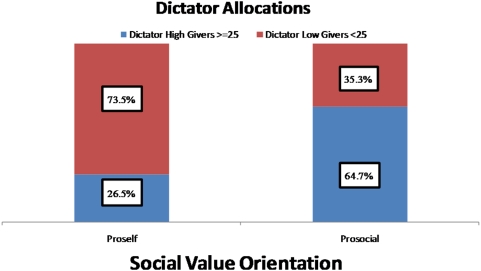
- Dictator Game and SVO allocations were correlated (Pearson Chi-Square = 28.18, DF = 1, p < 0.0001): 64.7% of SVO prosocial participants were high Dictator Game allocators versus 26.5% of proself participants.
- In the second sample of 98 female subjects, rs1042778 was significant for high/low Dictator Game giving (p = 0.004, Fisher’s exact test); mean giving trended higher for GG+GT genotypes (25 shekels) than TT genotypes (18.3 shekels; F1,96 p = 0.07, effect size approximately 0.5 SD).
Methods
- Candidate-gene family-based association study. First sample: 101 male and 102 female students, average age 26.00 (SD = 3.73), with parents genotyped for family-based analysis; second sample: 98 mothers, average age 34.47 (SD = 4.76), who played only the Dictator Game.
- Sixteen tagging SNPs across OXTR were selected; rs2139184 was excluded for very low heterozygosity, leaving 15 htSNPs analyzed. Dictator Game allocations were dichotomized as low (<25 NIS) versus high (≥25 NIS); SVO responses were categorized as prosocial, proself, or undefined.
- Main analyses used PBAT dominant model, UNPHASED haplotype analysis with 1000 permutations, and FBAT-GEE multivariate statistics; the second sample used Fisher’s exact test.
Limitations
- The paper states that complex traits such as human altruism are shaped by environment and multiple genes and pose challenges from gene-gene and gene-environment interactions, genetic heterogeneity, low penetrance, and limited statistical power. It also notes that the second sample played only the Dictator Game because time constraints precluded the SVO, and that the pharmacological oxytocin study by Zak et al. did not find a Dictator Game effect, suggesting a future pharmacogenetic approach.
- Evident from the text: the replication sample was all female mothers and tested only three SNPs, so replication is limited to Dictator Game giving and rs1042778 rather than the full OXTR region or SVO. The first sample also showed some sex-specific nominal associations, and many SNP results were nominal before correction.
Model-written summary. Check it against the paper before relying on it.
Integrity signals
Registry
Cites
Statistics
Figures
Verification
Claims the paper makes
26 Not checked yet · 17 Own result · 9 Own method · 6 Own interpretation · 3 No basis given · 1 Supported
A result the paper reports from its own data — it cites no other source for it, so there is none to check. The quote shows it is in the paper.
In the paper
“6 of the 8 htSNPs showed a consistent association for both Dictator Game and SVO allocations.”
§ The Oxytocin Receptor (OXTR) Contributes to Prosocial Fund Allocations in the Dictator Game and the Social Value Orientations Task > Results > Association between OXTR htSNPs and fund allocation
plaincorrelational- Asserted: passes — The authors put it forward as true.
- Checkable: passes — It can be checked against evidence.
- Load-bearing: passes — The paper’s conclusions depend on it.
- Based: passes — The paper gives a reason why it holds.
A result the paper reports from its own data — it cites no other source for it, so there is none to check. The quote shows it is in the paper.
In the paper
“Of the 15 htSNPs across the gene region, 8 htSNPs showed nominal significant association (before correction for multiple testing) with one or both of the game paradigms”
§ The Oxytocin Receptor (OXTR) Contributes to Prosocial Fund Allocations in the Dictator Game and the Social Value Orientations Task > Results > Association between OXTR htSNPs and fund allocation
plaincorrelational- Asserted: passes — The authors put it forward as true.
- Checkable: passes — It can be checked against evidence.
- Load-bearing: unclear — It is unclear whether the paper’s conclusions depend on it.
- Based: passes — The paper gives a reason why it holds.
A result the paper reports from its own data — it cites no other source for it, so there is none to check. The quote shows it is in the paper.
In the paper
“Altogether, 47% of the participants were designated as high allocators.”
§ The Oxytocin Receptor (OXTR) Contributes to Prosocial Fund Allocations in the Dictator Game and the Social Value Orientations Task > Results > Fund allocation in Dictator Game and Social Values Orientation Task
plain- Asserted: passes — The authors put it forward as true.
- Checkable: passes — It can be checked against evidence.
- Load-bearing: unclear — It is unclear whether the paper’s conclusions depend on it.
- Based: passes — The paper gives a reason why it holds.
A result the paper reports from its own data — it cites no other source for it, so there is none to check. The quote shows it is in the paper.
In the paper
“There were also SNPs whose effects appeared to be gender specific e.g. rs237897 (nominally significant in male subjects) and rs9840864 (nominally significant in female subjects).”
§ The Oxytocin Receptor (OXTR) Contributes to Prosocial Fund Allocations in the Dictator Game and the Social Value Orientations Task > Results > Association between OXTR htSNPs and fund allocation
hedgedcorrelational- Asserted: passes — The authors put it forward as true.
- Checkable: passes — It can be checked against evidence.
- Load-bearing: unclear — It is unclear whether the paper’s conclusions depend on it.
- Based: passes — The paper gives a reason why it holds.
A result the paper reports from its own data — it cites no other source for it, so there is none to check. The quote shows it is in the paper.
In the paper
“Similar to dictator giving, prosocial responses also fell into a bi-modal distribution with a plurality (38%) of participants selecting 9/9 prosocial responses and 24% selecting 0/9.”
§ The Oxytocin Receptor (OXTR) Contributes to Prosocial Fund Allocations in the Dictator Game and the Social Value Orientations Task > Results > Fund allocation in Dictator Game and Social Values Orientation Task
plain- Asserted: passes — The authors put it forward as true.
- Checkable: passes — It can be checked against evidence.
- Load-bearing: unclear — It is unclear whether the paper’s conclusions depend on it.
- Based: passes — The paper gives a reason why it holds.
A result the paper reports from its own data — it cites no other source for it, so there is none to check. The quote shows it is in the paper.
In the paper
“There is considerable similarity between individual allocation of funds in the Dictator Game and the Social Values Orientation (SVO) task (Figure 2, Pearson Chi-Square = 28.18, DF = 1 p<0.0001).”
§ The Oxytocin Receptor (OXTR) Contributes to Prosocial Fund Allocations in the Dictator Game and the Social Value Orientations Task > Results > Fund allocation in Dictator Game and Social Values Orientation Task
plaincorrelational- Asserted: passes — The authors put it forward as true.
- Checkable: passes — It can be checked against evidence.
- Load-bearing: unclear — It is unclear whether the paper’s conclusions depend on it.
- Based: passes — The paper gives a reason why it holds.
A result the paper reports from its own data — it cites no other source for it, so there is none to check. The quote shows it is in the paper.
In the paper
“There was also a trend for mean differences in overall dictator giving (F1,96 p = 0.07), with TT genotypes allocating on average 18.3 shekels to the ‘other’ and GG+GT genotypes allocating on average 25 shekels to the other, an effect size of approximately 0.5 SD.”
§ The Oxytocin Receptor (OXTR) Contributes to Prosocial Fund Allocations in the Dictator Game and the Social Value Orientations Task > Results > Second Sample
hedgedcorrelationaln = 98- Asserted: passes — The authors put it forward as true.
- Checkable: passes — It can be checked against evidence.
- Load-bearing: unclear — It is unclear whether the paper’s conclusions depend on it.
- Based: passes — The paper gives a reason why it holds.
A result the paper reports from its own data — it cites no other source for it, so there is none to check. The quote shows it is in the paper.
In the paper
“Using the same dominant model of inheritance as in the first sample, a significant association was observed with the G allele of the rs1042778 SNP and high/low giving in the (p = 0.004, Fisher's exact test).”
§ The Oxytocin Receptor (OXTR) Contributes to Prosocial Fund Allocations in the Dictator Game and the Social Value Orientations Task > Results > Second Sample
plaincorrelationaln = 98- Asserted: passes — The authors put it forward as true.
- Checkable: passes — It can be checked against evidence.
- Load-bearing: passes — The paper’s conclusions depend on it.
- Based: passes — The paper gives a reason why it holds.
- The authors state this as an assumption: The PBAT association analysis assumes a dominant mode of inheritance.
A result the paper reports from its own data — it cites no other source for it, so there is none to check. The quote shows it is in the paper.
In the paper
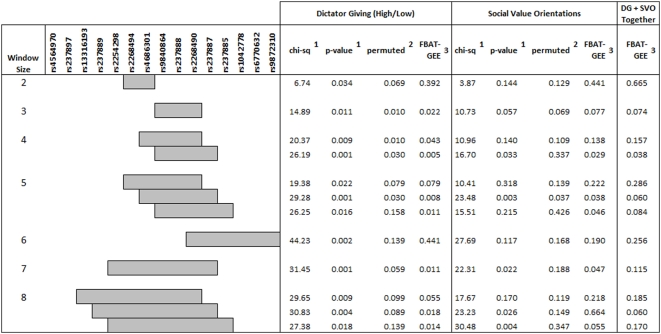
“Notably, all significant (global p<0.05) haplotype blocks that withstood permutation tests in UNPHASED for Dictator Giving and the SVO were also significantly associated using the PBAT multivariate statistic which considers the DG and SVO simultaneously (p<0.05) (see FIGURE 5, FBAT-GEE column) strongly confirming the results observed in UNPHASED.”
§ The Oxytocin Receptor (OXTR) Contributes to Prosocial Fund Allocations in the Dictator Game and the Social Value Orientations Task > Results > Haplotype analysis
boostedcorrelational- Asserted: passes — The authors put it forward as true.
- Checkable: passes — It can be checked against evidence.
- Load-bearing: unclear — It is unclear whether the paper’s conclusions depend on it.
- Based: passes — The paper gives a reason why it holds.
A conclusion the paper draws from its own results — it cites no other source for it, so there is none to check. The quote shows it is in the paper.
In the paper
“The demonstration that genetic polymorphisms for the OXTR are associated with human prosocial decision making converges with a large body of animal research showing that oxytocin is an important social hormone across vertebrates including Homo sapiens.”
§ The Oxytocin Receptor (OXTR) Contributes to Prosocial Fund Allocations in the Dictator Game and the Social Value Orientations Task > Abstract > Conclusions
boostedcorrelational- Asserted: passes — The authors put it forward as true.
- Checkable: passes — It can be checked against evidence.
- Load-bearing: passes — The paper’s conclusions depend on it.
- Based: passes — The paper gives a reason why it holds.
- Probably not a substantial claim. 38
- It may state two separate claims as one. 21
Every source the paper cites for this claim was checked and supports it.
In the paper
“A recent study by Zak et al.,[31] had subjects indicate transfer amounts for both the DG and the Ultimatum game (where the recipient has the opportunity to refuse the allocation, in which case both players receive zero) after undergoing intranasal administration of OT. Oxytocin significantly increased transfer amounts in the Ultimatum game as compared to placebo, whereas no effect in the DG was ob”
§ The Oxytocin Receptor (OXTR) Contributes to Prosocial Fund Allocations in the Dictator Game and the Social Value Orientations Task > Introduction
What the sources say
- Supportedcites [31] PJ Zak, 2007, Oxytocin increases generosity in humans., PLoS ONE source
The Introduction describes intranasal oxytocin and placebo administration and the rules of both games. The Results report significantly larger Ultimatum Game offers with oxytocin (p = 0.005), but no significant effect on Dictator Game transfers (p = 0.51). (LLM, conf=0.94)
plaindirect- Asserted: passes — The authors put it forward as true.
- Checkable: passes — It can be checked against evidence.
- Load-bearing: passes — The paper’s conclusions depend on it.
- Based: passes — The paper gives a reason why it holds.
Probably not a substantial claim. It may state two separate claims as one.
- Supported
A result the paper reports from its own data — it cites no other source for it, so there is none to check. The quote shows it is in the paper.
In the paper
“58% of participants were categorized as prosocial, 36% as proself (which includes 1% competitive and 35% individualistic) and 6% as undefined.”
§ The Oxytocin Receptor (OXTR) Contributes to Prosocial Fund Allocations in the Dictator Game and the Social Value Orientations Task > Results > Fund allocation in Dictator Game and Social Values Orientation Task
plain- Asserted: passes — The authors put it forward as true.
- Checkable: passes — It can be checked against evidence.
- Load-bearing: unclear — It is unclear whether the paper’s conclusions depend on it.
- Based: passes — The paper gives a reason why it holds.
It may state two separate claims as one.
A result the paper reports from its own data — it cites no other source for it, so there is none to check. The quote shows it is in the paper.
In the paper
“For Dictator Giving, significant associations were observed for 2–8 locus haplotypes (global p<0.05), many of which were also significant for the SVO.”
§ The Oxytocin Receptor (OXTR) Contributes to Prosocial Fund Allocations in the Dictator Game and the Social Value Orientations Task > Results > Haplotype analysis
plaincorrelational- Asserted: passes — The authors put it forward as true.
- Checkable: passes — It can be checked against evidence.
- Load-bearing: passes — The paper’s conclusions depend on it.
- Based: passes — The paper gives a reason why it holds.
It may state two separate claims as one.
A result the paper reports from its own data — it cites no other source for it, so there is none to check. The quote shows it is in the paper.
In the paper
“A family-based analysis for the three SNPs showed significant association with prosocial value orientations (PBAT dominant model: rs1042778 p = 0.001, rs2268490 p = 0.011, and rs237887 p = 0.005).”
§ The Oxytocin Receptor (OXTR) Contributes to Prosocial Fund Allocations in the Dictator Game and the Social Value Orientations Task > Results > Association between OXTR htSNPs and fund allocation
plaincorrelational- Asserted: passes — The authors put it forward as true.
- Checkable: passes — It can be checked against evidence.
- Load-bearing: passes — The paper’s conclusions depend on it.
- Based: passes — The paper gives a reason why it holds.
It may state two separate claims as one.
- The authors state this as an assumption: The PBAT association analysis assumes a dominant mode of inheritance.
A result the paper reports from its own data — it cites no other source for it, so there is none to check. The quote shows it is in the paper.
In the paper
“The most significant association, which is also robust to Bonferroni correction, was observed with rs1042778 for both the Dictator Game (p = 0.001, p corrected 0.016) and SVO (p = 0.002, p corrected = 0.031).”
§ The Oxytocin Receptor (OXTR) Contributes to Prosocial Fund Allocations in the Dictator Game and the Social Value Orientations Task > Results > Association between OXTR htSNPs and fund allocation
plaincorrelational- Asserted: passes — The authors put it forward as true.
- Checkable: passes — It can be checked against evidence.
- Load-bearing: passes — The paper’s conclusions depend on it.
- Based: passes — The paper gives a reason why it holds.
It may state two separate claims as one.
A result the paper reports from its own data — it cites no other source for it, so there is none to check. The quote shows it is in the paper.
In the paper
“In the SVO prosocial group, 64.7% of respondents are also high allocators (≥25 NIS) in the Dictator Game. Among proself SVO individuals, only 26.5% are high allocators in the Dictator Game.”
§ The Oxytocin Receptor (OXTR) Contributes to Prosocial Fund Allocations in the Dictator Game and the Social Value Orientations Task > Results > Fund allocation in Dictator Game and Social Values Orientation Task
plaincorrelational- Asserted: passes — The authors put it forward as true.
- Checkable: passes — It can be checked against evidence.
- Load-bearing: unclear — It is unclear whether the paper’s conclusions depend on it.
- Based: passes — The paper gives a reason why it holds.
It may state two separate claims as one.
A result the paper reports from its own data — it cites no other source for it, so there is none to check. The quote shows it is in the paper.
In the paper
“Following permutation testing, significance was observed for 2–5 locus haplotypes (p<0.05) and approached significance for the 7 and 8 locus haplotypes (permutation test p<0.1).”
§ The Oxytocin Receptor (OXTR) Contributes to Prosocial Fund Allocations in the Dictator Game and the Social Value Orientations Task > Results > Haplotype analysis
plaincorrelational- Asserted: passes — The authors put it forward as true.
- Checkable: passes — It can be checked against evidence.
- Load-bearing: passes — The paper’s conclusions depend on it.
- Based: passes — The paper gives a reason why it holds.
It may state two separate claims as one.
In the paper
“Of particular interest is rs1042778, which is significant both in our prior autism study[25], the 1st sample for both Dictator and SVO and in the second independently recruited DG sample.”
§ The Oxytocin Receptor (OXTR) Contributes to Prosocial Fund Allocations in the Dictator Game and the Social Value Orientations Task > Discussion
What the sources say
- Not checked yetcites [25] E Lerer, 2008, Association between the oxytocin receptor (OXTR) gene and autism: relationship to Vineland Adaptive Behavior Scales and cognition., Mol Psychiatry source
plaincorrelational- Asserted: passes — The authors put it forward as true.
- Checkable: passes — It can be checked against evidence.
- Load-bearing: passes — The paper’s conclusions depend on it.
- Based: passes — The paper gives a reason why it holds.
It may state two separate claims as one.
A result the paper reports from its own data — it cites no other source for it, so there is none to check. The quote shows it is in the paper.
In the paper
“Notably, the 4 locus haplotype block (rs9840864-rs237888-rs2268490-rs237887) is significant for Dictator Giving (FBAT-GEE = 0.005), SVO (FBAT-GEE = 0.028) and when both Dictator Giving and SVO are jointly considered (p = 0.038).”
§ The Oxytocin Receptor (OXTR) Contributes to Prosocial Fund Allocations in the Dictator Game and the Social Value Orientations Task > Results > Haplotype analysis
plaincorrelational- Asserted: passes — The authors put it forward as true.
- Checkable: passes — It can be checked against evidence.
- Load-bearing: passes — The paper’s conclusions depend on it.
- Based: passes — The paper gives a reason why it holds.
It may state two separate claims as one.
A result the paper reports from its own data — it cites no other source for it, so there is none to check. The quote shows it is in the paper.
In the paper
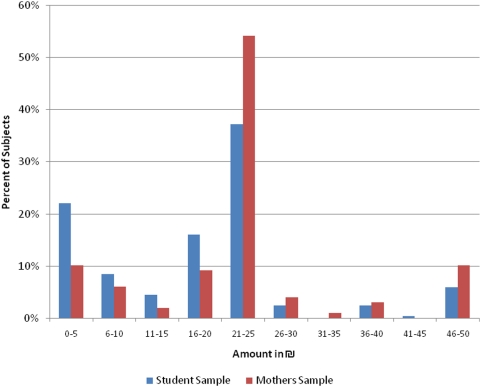
“Dictator giving was considerably higher in the second sample (One-way ANOVA F1,296 = 9.934 p = 0.002), with giving amounts on average 4.97 higher in the second sample (see Figure 1).”
§ The Oxytocin Receptor (OXTR) Contributes to Prosocial Fund Allocations in the Dictator Game and the Social Value Orientations Task > Results > Second Sample
plainn = 98- Asserted: passes — The authors put it forward as true.
- Checkable: passes — It can be checked against evidence.
- Load-bearing: unclear — It is unclear whether the paper’s conclusions depend on it.
- Based: passes — The paper gives a reason why it holds.
It may state two separate claims as one.
What the paper did — it cites no source for this, so there is none to check. The quote shows it is in the paper.
In the paper
“All of the SNPs tested were in Hardy-Weinberg Equilibrium (p>0.01).”
§ The Oxytocin Receptor (OXTR) Contributes to Prosocial Fund Allocations in the Dictator Game and the Social Value Orientations Task > Results > Association between OXTR htSNPs and fund allocation
plain- Asserted: passes — The authors put it forward as true.
- Checkable: passes — It can be checked against evidence.
- Load-bearing: fails — The paper’s conclusions may not depend on it.
- Based: passes — The paper gives a reason why it holds.
Probably not a substantial claim. The paper’s conclusions may not depend on it.
None of the sources cited for this claim have been checked yet.
In the paper
“In addition to their roles in enhancing social behaviors, the AVPR1a and oxytocin receptor (OXTR) genes have been shown by us [25], [26] and others [27]–[30] to contribute to autism spectrum disorders (ASD), a behavioral disorder characterized by deficits in social communication and bonding.”
§ The Oxytocin Receptor (OXTR) Contributes to Prosocial Fund Allocations in the Dictator Game and the Social Value Orientations Task > Introduction
What the sources say
- Not checked yetcites [25] E Lerer, 2008, Association between the oxytocin receptor (OXTR) gene and autism: relationship to Vineland Adaptive Behavior Scales and cognition., Mol Psychiatry source
- Not checked yetcites [26] N Yirmiya, 2006, Association between the arginine vasopressin 1a receptor (AVPR1a) gene and autism in a family-based study: mediation by socialization skills., Mol Psychiatry source
- Not checked yetcites [27]–[30]
boosteddirect- Asserted: passes — The authors put it forward as true.
- Checkable: passes — It can be checked against evidence.
- Load-bearing: fails — The paper’s conclusions may not depend on it.
- Based: passes — The paper gives a reason why it holds.
Probably not a substantial claim. The paper’s conclusions may not depend on it.
In the paper
“Since haplotypes are often more informative than individual SNPs [36], haplotype analysis was carried out.”
§ The Oxytocin Receptor (OXTR) Contributes to Prosocial Fund Allocations in the Dictator Game and the Social Value Orientations Task > Results > Haplotype analysis
What the sources say
- Not checked yetcites [36] DC Crawford, 2005, Definition And Clinical Importance Of Haplotypes., Annu Rev Med source
hedgedcorrelational- Asserted: passes — The authors put it forward as true.
- Checkable: passes — It can be checked against evidence.
- Load-bearing: passes — The paper’s conclusions depend on it.
- Based: passes — The paper gives a reason why it holds.
Probably not a substantial claim.
In the paper
“Our selection of all tagging SNPs listed for OXTR in HapMap represents an optimal strategy for detecting association across this gene region [35].”
§ The Oxytocin Receptor (OXTR) Contributes to Prosocial Fund Allocations in the Dictator Game and the Social Value Orientations Task > Introduction
What the sources say
- Not checked yetcites [35] BV Halldorsson, 2004, Optimal selection of SNP markers for disease association studies., Hum Hered source
plain- Asserted: passes — The authors put it forward as true.
- Checkable: passes — It can be checked against evidence.
- Load-bearing: fails — The paper’s conclusions may not depend on it.
- Based: passes — The paper gives a reason why it holds.
Probably not a substantial claim. The paper’s conclusions may not depend on it.
In the paper
“An important contribution of neuroeconomics is the demonstration that the classical economic assumption of self-interest cannot explain the richness of human social behavior [1].”
§ The Oxytocin Receptor (OXTR) Contributes to Prosocial Fund Allocations in the Dictator Game and the Social Value Orientations Task > Introduction
What the sources say
- Not checked yetcites [1] G Loewenstein, 2007, Neuroeconomics., Annu Rev Psychol
boosted- Asserted: passes — The authors put it forward as true.
- Checkable: passes — It can be checked against evidence.
- Load-bearing: fails — The paper’s conclusions may not depend on it.
- Based: passes — The paper gives a reason why it holds.
Probably not a substantial claim. The paper’s conclusions may not depend on it.
What the paper did — it cites no source for this, so there is none to check. The quote shows it is in the paper.
In the paper
“Of the 16 tagging SNPs, one of them, rs2139184, had a very low rate of heterozygosity, and was not included in the analysis.”
§ The Oxytocin Receptor (OXTR) Contributes to Prosocial Fund Allocations in the Dictator Game and the Social Value Orientations Task > Results > Association between OXTR htSNPs and fund allocation
plain- Asserted: passes — The authors put it forward as true.
- Checkable: passes — It can be checked against evidence.
- Load-bearing: fails — The paper’s conclusions may not depend on it.
- Based: passes — The paper gives a reason why it holds.
Probably not a substantial claim. The paper’s conclusions may not depend on it. It may state two separate claims as one.
None of the sources cited for this claim have been checked yet.
In the paper
“Intriguingly, intranasal application of OT has been shown to increase trusting behavior in humans [20], [21], identification of others' affective states [22] and amygdala responses to emotional faces [23].”
§ The Oxytocin Receptor (OXTR) Contributes to Prosocial Fund Allocations in the Dictator Game and the Social Value Orientations Task > Introduction
What the sources say
boosteddirect- Asserted: passes — The authors put it forward as true.
- Checkable: passes — It can be checked against evidence.
- Load-bearing: fails — The paper’s conclusions may not depend on it.
- Based: passes — The paper gives a reason why it holds.
Probably not a substantial claim. The paper’s conclusions may not depend on it.
None of the sources cited for this claim have been checked yet.
In the paper
“Our first studies of the role of the AVPR1a gene in social cognition exemplified by a simple laboratory paradigm converges with a wide range of both animal and human experimentation showing that arginine vasopressin (AVP) and the closely related oxytocin (OT) are key neuropeptides that facilitate social communication, affiliative behaviors and social cognition across mammals [6], [7] .”
§ The Oxytocin Receptor (OXTR) Contributes to Prosocial Fund Allocations in the Dictator Game and the Social Value Orientations Task > Introduction
What the sources say
boosteddirect- Asserted: passes — The authors put it forward as true.
- Checkable: passes — It can be checked against evidence.
- Load-bearing: fails — The paper’s conclusions may not depend on it.
- Based: passes — The paper gives a reason why it holds.
Probably not a substantial claim. The paper’s conclusions may not depend on it.
In the paper
“Fund allocation in the Dictator Game is considered a real-life test of altruism since it involves a ‘put your money where your mouth is’ decision where giving to another is both costly and not subject to strategic considerations of reciprocity; this is particularly the case when “Dictator” and “Recipient” identities are made anonymous [4].”
§ The Oxytocin Receptor (OXTR) Contributes to Prosocial Fund Allocations in the Dictator Game and the Social Value Orientations Task > Introduction
What the sources say
- Not checked yetcites [4] CC Eckel, 1996, Altruism in Anonymous Dictator Games., Games and Economic Behavior source
plain- Asserted: passes — The authors put it forward as true.
- Checkable: passes — It can be checked against evidence.
- Load-bearing: passes — The paper’s conclusions depend on it.
- Based: passes — The paper gives a reason why it holds.
Probably not a substantial claim. It may state two separate claims as one.
In the paper
“Genetic association studies for complex phenotypes such as social behavior can be highly sensitive to measurement construct. For example, a meta-analysis reviewing association for a serotonin transporter gene polymorphism (5-HTTLPR) and anxiety related traits demonstrated how choice of measurement scale may be a critical factor in moderating phenotypic contours[32].”
§ The Oxytocin Receptor (OXTR) Contributes to Prosocial Fund Allocations in the Dictator Game and the Social Value Orientations Task > Introduction
What the sources say
- Not checked yetcites [32] JA Schinka, 2004, A meta-analysis of the association between the serotonin transporter gene polymorphism (5-HTTLPR) and trait anxiety., Mol Psychiatry source
boostedconditional- Asserted: passes — The authors put it forward as true.
- Checkable: passes — It can be checked against evidence.
- Load-bearing: passes — The paper’s conclusions depend on it.
- Based: passes — The paper gives a reason why it holds.
Probably not a substantial claim.
In the paper
“Previously we have shown that allocation of funds in the Dictator Game (DG), a paradigm that illustrates costly altruistic behavior, is partially determined by promoter-region repeat region variants in the arginine vasopressin 1a receptor gene (AVPR1a).”
- Also stated in: § Introduction · boosted
“In a seminal study [3] we have shown that the powerful techniques of molecular genetics can also be employed to further clarify the mechanisms by which the social brain formulates economic decisions. We demonstrated that allocation of funds in the Dictator Game (DG) were in part determined by length of the arginine vasopressin 1a (AVPR1a) RS3 promoter region repeat region.”
§ The Oxytocin Receptor (OXTR) Contributes to Prosocial Fund Allocations in the Dictator Game and the Social Value Orientations Task > Abstract > Background
What the sources say
- Not checked yetcites [3] A Knafo, 2007, Individual differences in allocation of funds in the dictator game associated with length of the arginine vasopressin 1a receptor RS3 promoter region and correlation between RS3 length and hippocampal mRNA., Genes Brain Behav
boostedcorrelational- Asserted: passes — The authors put it forward as true.
- Checkable: passes — It can be checked against evidence.
- Load-bearing: fails — The paper’s conclusions may not depend on it.
- Based: passes — The paper gives a reason why it holds.
Probably not a substantial claim. The paper’s conclusions may not depend on it.
- Also stated in: § Introduction · boosted
What the paper did — it cites no source for this, so there is none to check. The quote shows it is in the paper.
In the paper
“93% of contacted individuals agreed to participate.”
§ The Oxytocin Receptor (OXTR) Contributes to Prosocial Fund Allocations in the Dictator Game and the Social Value Orientations Task > Materials and Methods > Subjects
plain- Asserted: passes — The authors put it forward as true.
- Checkable: passes — It can be checked against evidence.
- Load-bearing: fails — The paper’s conclusions may not depend on it.
- Based: passes — The paper gives a reason why it holds.
Probably not a substantial claim. The paper’s conclusions may not depend on it.
In the paper
“The FBAT statistic has an additional advantage in that it is robust against population admixture and stratification [67].”
§ The Oxytocin Receptor (OXTR) Contributes to Prosocial Fund Allocations in the Dictator Game and the Social Value Orientations Task > Materials and Methods > PBAT (Helix Tree)
What the sources say
- Not checked yetcites [67] D Rabinowitz, 2000, A unified approach to adjusting association tests for population admixture with arbitrary pedigree structure and arbitrary missing marker information., Hum Hered source
plain- Asserted: passes — The authors put it forward as true.
- Checkable: passes — It can be checked against evidence.
- Load-bearing: fails — The paper’s conclusions may not depend on it.
- Based: passes — The paper gives a reason why it holds.
Probably not a substantial claim. The paper’s conclusions may not depend on it.
None of the sources cited for this claim have been checked yet.
In the paper
“The data analysis can be adjusted for covariates and gene/environment interactions.”
§ The Oxytocin Receptor (OXTR) Contributes to Prosocial Fund Allocations in the Dictator Game and the Social Value Orientations Task > Materials and Methods > PBAT (Helix Tree)
What the sources say
plain- Asserted: passes — The authors put it forward as true.
- Checkable: passes — It can be checked against evidence.
- Load-bearing: fails — The paper’s conclusions may not depend on it.
- Based: passes — The paper gives a reason why it holds.
Probably not a substantial claim. The paper’s conclusions may not depend on it. It may state two separate claims as one.
What the paper did — it cites no source for this, so there is none to check. The quote shows it is in the paper.
In the paper
“Ordering of DG and SVO was randomized”
§ The Oxytocin Receptor (OXTR) Contributes to Prosocial Fund Allocations in the Dictator Game and the Social Value Orientations Task > Materials and Methods > Dictator Game
plain- Asserted: passes — The authors put it forward as true.
- Checkable: passes — It can be checked against evidence.
- Load-bearing: fails — The paper’s conclusions may not depend on it.
- Based: passes — The paper gives a reason why it holds.
Probably not a substantial claim. The paper’s conclusions may not depend on it.
None of the sources cited for this claim have been checked yet.
In the paper
“PBAT can handle nuclear families with missing parental genotypes, extended pedigrees with missing genotypic information, analysis of single nucleotide polymorphisms (SNPs), haplotype analysis, quantitative traits, multivariate/longitudinal data and time to onset phenotypes.”
§ The Oxytocin Receptor (OXTR) Contributes to Prosocial Fund Allocations in the Dictator Game and the Social Value Orientations Task > Materials and Methods > PBAT (Helix Tree)
What the sources say
plain- Asserted: passes — The authors put it forward as true.
- Checkable: passes — It can be checked against evidence.
- Load-bearing: fails — The paper’s conclusions may not depend on it.
- Based: passes — The paper gives a reason why it holds.
Probably not a substantial claim. The paper’s conclusions may not depend on it. It may state two separate claims as one.
In the paper
“This methodology extends readily to scenarios in which the parental genotypes are not known, using the approach of Rabinowitz and Laird [67].”
§ The Oxytocin Receptor (OXTR) Contributes to Prosocial Fund Allocations in the Dictator Game and the Social Value Orientations Task > Materials and Methods > PBAT (Helix Tree)
What the sources say
- Not checked yetcites [67] D Rabinowitz, 2000, A unified approach to adjusting association tests for population admixture with arbitrary pedigree structure and arbitrary missing marker information., Hum Hered source
plain- Asserted: passes — The authors put it forward as true.
- Checkable: passes — It can be checked against evidence.
- Load-bearing: fails — The paper’s conclusions may not depend on it.
- Based: passes — The paper gives a reason why it holds.
Probably not a substantial claim. The paper’s conclusions may not depend on it.
In the paper
“The various tests we used are implemented in the program UNPHASED (http://www.rfcgr.mrc.ac.uk/~fdudbrid/software/unphased/) [63], a suite of programs for association analysis of multilocus haplotypes from unphased genotype data.”
§ The Oxytocin Receptor (OXTR) Contributes to Prosocial Fund Allocations in the Dictator Game and the Social Value Orientations Task > Materials and Methods > UNPHASED [63], [64]
What the sources say
- Not checked yetcites [63] F Dudbridge, 2003, Pedigree disequilibrium tests for multilocus haplotypes., Genet Epidemiol source
plain- Asserted: passes — The authors put it forward as true.
- Checkable: passes — It can be checked against evidence.
- Load-bearing: fails — The paper’s conclusions may not depend on it.
- Based: passes — The paper gives a reason why it holds.
Probably not a substantial claim. The paper’s conclusions may not depend on it.
None of the sources cited for this claim have been checked yet.
In the paper
“The PBAT software package provides a unique set of tools for complex family-based association analysis at a genome-wide level [65], [66].”
§ The Oxytocin Receptor (OXTR) Contributes to Prosocial Fund Allocations in the Dictator Game and the Social Value Orientations Task > Materials and Methods > PBAT (Helix Tree)
What the sources say
plain- Asserted: passes — The authors put it forward as true.
- Checkable: passes — It can be checked against evidence.
- Load-bearing: fails — The paper’s conclusions may not depend on it.
- Based: passes — The paper gives a reason why it holds.
Probably not a substantial claim. The paper’s conclusions may not depend on it.
None of the sources cited for this claim have been checked yet.
In the paper
“Although twin studies underscore the importance of the genetic contribution to prosocial behavior [58], [59], untangling the contribution of specific polymorphisms to this and other complex traits is difficult.”
§ The Oxytocin Receptor (OXTR) Contributes to Prosocial Fund Allocations in the Dictator Game and the Social Value Orientations Task > Discussion
What the sources say
- Not checked yetcites [58] A Knafo, 2006, Parental discipline and affection and children's prosocial behavior: genetic and environmental links., J Pers Soc Psychol source
- Not checked yetcites [59] A Knafo, 2006, Prosocial behavior from early to middle childhood: genetic and environmental influences on stability and change., Dev Psychol source
plaincorrelational- Asserted: passes — The authors put it forward as true.
- Checkable: passes — It can be checked against evidence.
- Load-bearing: fails — The paper’s conclusions may not depend on it.
- Based: passes — The paper gives a reason why it holds.
Probably not a substantial claim. The paper’s conclusions may not depend on it.
The paper states this without a source or data behind it here, so there is nothing to check it against. The quote shows it is in the paper.
In the paper
“SNP marker selection is aimed to increase the chances that at least one typed SNP would be in linkage disequilibrium (LD) with the disease causative variant, while at the same time controlling the cost of the study in terms of the number of markers genotyped and sampled.”
§ The Oxytocin Receptor (OXTR) Contributes to Prosocial Fund Allocations in the Dictator Game and the Social Value Orientations Task > Materials and Methods > Genotyping
plaindirect- Asserted: passes — The authors put it forward as true.
- Checkable: passes — It can be checked against evidence.
- Load-bearing: fails — The paper’s conclusions may not depend on it.
- Based: passes — The paper gives a reason why it holds.
Probably not a substantial claim. The paper’s conclusions may not depend on it. It may state two separate claims as one.
What the paper did — it cites no source for this, so there is none to check. The quote shows it is in the paper.
In the paper
“the genetic study was approved by the local University and Hospital Internal Review Board and the Israeli Ministry of Health (Genetics Section).”
§ The Oxytocin Receptor (OXTR) Contributes to Prosocial Fund Allocations in the Dictator Game and the Social Value Orientations Task > Materials and Methods > Ethics Statement
plain- Asserted: passes — The authors put it forward as true.
- Checkable: passes — It can be checked against evidence.
- Load-bearing: fails — The paper’s conclusions may not depend on it.
- Based: passes — The paper gives a reason why it holds.
Probably not a substantial claim. The paper’s conclusions may not depend on it.
The paper states this without a source or data behind it here, so there is nothing to check it against. The quote shows it is in the paper.
In the paper
“This procedure corrects for multiple testing but accounts for correlation between markers, hence is less conservative than a Bonferroni correction, which is appropriate for independent tests such as unlinked markers.”
§ The Oxytocin Receptor (OXTR) Contributes to Prosocial Fund Allocations in the Dictator Game and the Social Value Orientations Task > Materials and Methods > UNPHASED [63], [64]
plain- Asserted: passes — The authors put it forward as true.
- Checkable: passes — It can be checked against evidence.
- Load-bearing: fails — The paper’s conclusions may not depend on it.
- Based: passes — The paper gives a reason why it holds.
Probably not a substantial claim. The paper’s conclusions may not depend on it. It may state two separate claims as one.
In the paper
“Suggestion of a functional character of SNPs located in the 3rd intron is based on the finding of a specific motif of about 10–15 nucleotides close to the middle of the 3rd intron that specifically binds nuclear proteins correlating with the down-regulated state of the gene [56].”
§ The Oxytocin Receptor (OXTR) Contributes to Prosocial Fund Allocations in the Dictator Game and the Social Value Orientations Task > Discussion
What the sources say
- Not checked yetcites [56] Y Mizumoto, 1997, A genomic element within the third intron of the human oxytocin receptor gene may be involved in transcriptional suppression., Mol Cell Endocrinol source
hedgedcorrelational- Asserted: passes — The authors put it forward as true.
- Checkable: passes — It can be checked against evidence.
- Load-bearing: fails — The paper’s conclusions may not depend on it.
- Based: passes — The paper gives a reason why it holds.
Probably not a substantial claim. The paper’s conclusions may not depend on it.
None of the sources cited for this claim have been checked yet.
In the paper
“Haplotype-based features include sliding windows and the reconstruction of the haplotypes of the probands.”
§ The Oxytocin Receptor (OXTR) Contributes to Prosocial Fund Allocations in the Dictator Game and the Social Value Orientations Task > Materials and Methods > PBAT (Helix Tree)
What the sources say
plain- Asserted: passes — The authors put it forward as true.
- Checkable: passes — It can be checked against evidence.
- Load-bearing: fails — The paper’s conclusions may not depend on it.
- Based: passes — The paper gives a reason why it holds.
Probably not a substantial claim. The paper’s conclusions may not depend on it. It may state two separate claims as one.
What the paper did — it cites no source for this, so there is none to check. The quote shows it is in the paper.
In the paper
“Permutation test correction was performed using 1000 iterations (random permutations) and applied to correction of global P-values”
§ The Oxytocin Receptor (OXTR) Contributes to Prosocial Fund Allocations in the Dictator Game and the Social Value Orientations Task > Materials and Methods > UNPHASED [63], [64]
plain- Asserted: passes — The authors put it forward as true.
- Checkable: passes — It can be checked against evidence.
- Load-bearing: fails — The paper’s conclusions may not depend on it.
- Based: passes — The paper gives a reason why it holds.
Probably not a substantial claim. The paper’s conclusions may not depend on it. It may state two separate claims as one.
What the paper did — it cites no source for this, so there is none to check. The quote shows it is in the paper.
In the paper
“All subjects gave informed written consent”
§ The Oxytocin Receptor (OXTR) Contributes to Prosocial Fund Allocations in the Dictator Game and the Social Value Orientations Task > Materials and Methods > Ethics Statement
plain- Asserted: passes — The authors put it forward as true.
- Checkable: passes — It can be checked against evidence.
- Load-bearing: fails — The paper’s conclusions may not depend on it.
- Based: passes — The paper gives a reason why it holds.
Probably not a substantial claim. The paper’s conclusions may not depend on it.
In the paper
“To limit the conundrum of multiple testing, we used a more stringent criteria for SNP selection in the second sample[39]. Subjects were genotyped solely for the three SNPs found to be significant in both the SVO and Dictator in the first sample (rs2268490, rs237887 and rs1042778).”
§ The Oxytocin Receptor (OXTR) Contributes to Prosocial Fund Allocations in the Dictator Game and the Social Value Orientations Task > Results > Second Sample
What the sources say
- Not checked yetcites [39] A Herbert, 2006, A common genetic variant is associated with adult and childhood obesity., Science source
plainn = 98- Asserted: passes — The authors put it forward as true.
- Checkable: passes — It can be checked against evidence.
- Load-bearing: passes — The paper’s conclusions depend on it.
- Based: passes — The paper gives a reason why it holds.
Probably not a substantial claim.
A conclusion the paper draws from its own results — it cites no other source for it, so there is none to check. The quote shows it is in the paper.
In the paper
“That variations in these two receptor genes, OXTR and AVPR1a, jointly contribute to a complex human behavioral phenotype is probably the rule and not the exception.”
§ The Oxytocin Receptor (OXTR) Contributes to Prosocial Fund Allocations in the Dictator Game and the Social Value Orientations Task > Discussion
hedgeddirect- Asserted: passes — The authors put it forward as true.
- Checkable: passes — It can be checked against evidence.
- Load-bearing: fails — The paper’s conclusions may not depend on it.
- Based: fails — The paper may give no reason why it holds.
Probably not a substantial claim. The paper’s conclusions may not depend on it. The paper may give no reason why it holds.
A conclusion the paper draws from its own results — it cites no other source for it, so there is none to check. The quote shows it is in the paper.
In the paper
“Additionally, our finding of a significant association for both the Dictator game and SVO, decision tasks that are significantly correlated with one another, provides supporting evidence for the robustness of the current findings.”
§ The Oxytocin Receptor (OXTR) Contributes to Prosocial Fund Allocations in the Dictator Game and the Social Value Orientations Task > Discussion
plaincorrelational- Asserted: passes — The authors put it forward as true.
- Checkable: passes — It can be checked against evidence.
- Load-bearing: passes — The paper’s conclusions depend on it.
- Based: passes — The paper gives a reason why it holds.
It may state two separate claims as one.
What the paper did — it cites no source for this, so there is none to check. The quote shows it is in the paper.
In the paper
“Game instructions were identical for both groups.”
§ The Oxytocin Receptor (OXTR) Contributes to Prosocial Fund Allocations in the Dictator Game and the Social Value Orientations Task > Materials and Methods > Dictator Game
plain- Asserted: passes — The authors put it forward as true.
- Checkable: passes — It can be checked against evidence.
- Load-bearing: passes — The paper’s conclusions depend on it.
- Based: passes — The paper gives a reason why it holds.
Probably not a substantial claim.
In the paper
“Complex traits including human altruism are molded by both environment and multiple genes and such phenotypes pose special challenges for genetic analysis due to gene-gene and gene-environment interactions, genetic heterogeneity, low penetrance, and limited statistical power [60].”
§ The Oxytocin Receptor (OXTR) Contributes to Prosocial Fund Allocations in the Dictator Game and the Social Value Orientations Task > Discussion
What the sources say
- Not checked yetcites [60] AM Glazier, 2002, Finding genes that underlie complex traits., Science source
plaindirect- Asserted: passes — The authors put it forward as true.
- Checkable: passes — It can be checked against evidence.
- Load-bearing: fails — The paper’s conclusions may not depend on it.
- Based: passes — The paper gives a reason why it holds.
Probably not a substantial claim. The paper’s conclusions may not depend on it. It may state two separate claims as one.
In the paper
“In addition, to this intronic regulation site, a number of 5′ upstream regulatory sites have been identified for the OXTR promoter region [57].”
§ The Oxytocin Receptor (OXTR) Contributes to Prosocial Fund Allocations in the Dictator Game and the Social Value Orientations Task > Discussion
What the sources say
- Not checked yetcites [57] AM Blanks, 2007, Regulation of oxytocin receptors and oxytocin receptor signaling., Semin Reprod Med source
plain- Asserted: passes — The authors put it forward as true.
- Checkable: passes — It can be checked against evidence.
- Load-bearing: fails — The paper’s conclusions may not depend on it.
- Based: passes — The paper gives a reason why it holds.
Probably not a substantial claim. The paper’s conclusions may not depend on it.
In the paper
“A measure developed by Van Lange and colleagues (23) to measure social value orientations by using a series of decomposed games, involving choices among combinations of outcomes for oneself and for another person, was adapted in this study.”
§ The Oxytocin Receptor (OXTR) Contributes to Prosocial Fund Allocations in the Dictator Game and the Social Value Orientations Task > Materials and Methods > Social Value Orientations Task
What the sources say
- Not checked yetcites [23] G Domes, 2007, Oxytocin attenuates amygdala responses to emotional faces regardless of valence., Biol Psychiatry source
plain- Asserted: passes — The authors put it forward as true.
- Checkable: passes — It can be checked against evidence.
- Load-bearing: fails — The paper’s conclusions may not depend on it.
- Based: passes — The paper gives a reason why it holds.
Probably not a substantial claim. The paper’s conclusions may not depend on it.
In the paper
“3′ untranslated regions (3′ UTRs) often contain several regulatory elements that govern the spatial and temporal expression of an mRNA. [55]”
§ The Oxytocin Receptor (OXTR) Contributes to Prosocial Fund Allocations in the Dictator Game and the Social Value Orientations Task > Discussion
What the sources say
- Not checked yetcites [55] S Kuersten, 2003, The power of the 3′ UTR: translational control and development., Nat Rev Genet source
plain- Asserted: passes — The authors put it forward as true.
- Checkable: passes — It can be checked against evidence.
- Load-bearing: fails — The paper’s conclusions may not depend on it.
- Based: passes — The paper gives a reason why it holds.
Probably not a substantial claim. The paper’s conclusions may not depend on it.
In the paper
“Most association studies rely on the use of surrogate markers, single-nucleotide polymorphisms (SNPs) being the most suitable due to their abundance and ease of scoring (see discussion in [35].”
§ The Oxytocin Receptor (OXTR) Contributes to Prosocial Fund Allocations in the Dictator Game and the Social Value Orientations Task > Materials and Methods > Genotyping
What the sources say
- Not checked yetcites [35] BV Halldorsson, 2004, Optimal selection of SNP markers for disease association studies., Hum Hered source
plain- Asserted: passes — The authors put it forward as true.
- Checkable: passes — It can be checked against evidence.
- Load-bearing: fails — The paper’s conclusions may not depend on it.
- Based: passes — The paper gives a reason why it holds.
Probably not a substantial claim. The paper’s conclusions may not depend on it. It may state two separate claims as one.
What the paper did — it cites no source for this, so there is none to check. The quote shows it is in the paper.
In the paper
“there was no effect of game order on average giving amount or value orientation.”
§ The Oxytocin Receptor (OXTR) Contributes to Prosocial Fund Allocations in the Dictator Game and the Social Value Orientations Task > Materials and Methods > Dictator Game
plain- Asserted: passes — The authors put it forward as true.
- Checkable: passes — It can be checked against evidence.
- Load-bearing: fails — The paper’s conclusions may not depend on it.
- Based: passes — The paper gives a reason why it holds.
Probably not a substantial claim. The paper’s conclusions may not depend on it.
The paper states this without a source or data behind it here, so there is nothing to check it against. The quote shows it is in the paper.
In the paper
“Empirical studies reporting block-like segments in the genome with high LD and low haplotype diversity have motivated a marker selection strategy whereby subsets of SNPs that ‘tag’ the common haplotypes of a region are picked for genotyping, avoiding typing redundant SNPs.”
§ The Oxytocin Receptor (OXTR) Contributes to Prosocial Fund Allocations in the Dictator Game and the Social Value Orientations Task > Materials and Methods > Genotyping
plaindirect- Asserted: passes — The authors put it forward as true.
- Checkable: passes — It can be checked against evidence.
- Load-bearing: fails — The paper’s conclusions may not depend on it.
- Based: passes — The paper gives a reason why it holds.
Probably not a substantial claim. The paper’s conclusions may not depend on it.
The authors state this as an assumption.
The PBAT association analysis assumes a dominant mode of inheritance.
“results are given using PBAT's dominant model, which assumes a dominant mode of inheritance.”
The authors state this as an assumption.
Under the null hypothesis, offspring genotypes follow Mendelian segregation.
“which are assumed to follow Mendelian segregation under the null hypothesis.”
Claims other papers make about this one
Each is checked against this paper’s own text: does it say what the citing paper says it does?
The source backs part of the claim, not all of it — or backs it for a different population, condition or comparison.
In the citing paper
“Furthermore, the exercise of power increases levels of testosterone while decreasing oxytocin which in turn leads to higher levels of aggression and lower levels of empathy and prosocial behaviour (Israel et al. 2009; Owen 2012; Hogeveen et al. 2014; Robertson 2012).”
From Having Burned the Straw Man of Christian Spiritual Leadership, what can We Learn from Jesus About Leading Ethically? (2017) · cites this paper as Israel et al. 2009
Experimental — accuracy not yet measuredThe source backs part of the claim, not all of it — or backs it for a different population, condition or comparison.
In the citing paper
“Indeed, intranasal administration of oxytocin in humans promotes trust and cooperation (11, 16–19), although such effects may be limited to in-group members and do not extend toward out-groups (16, 17).”
From Oxytocin promotes human ethnocentrism (2011) · cites this paper as [19]
Experimental — accuracy not yet measuredIn the citing paper
“The SVO construct itself has been characterized by a specific haplotype of the OXTR gene (Israel et al., 2009).”
From The effect of oxytocin on cooperation in a prisoner's dilemma depends on the social context and a person's social value orientation (2014) · cites this paper as Israel et al., 2009
Self-check
Percentages, sums and reported differences re-computed from the paper’s own numbers.
Each contradiction between two passages listed here was confirmed by an independent check.
Rated minor: it would not touch a result — a value no result rests on, a p-value that stays on the same side of the significance level, or a conflict that is clerical, resolved elsewhere in the paper, or outside its own findings.
In the paper
§ The Oxytocin Receptor (OXTR) Contributes to Prosocial Fund Allocations in the Dictator Game and the Social Value Orientations Task > Abstract > Methodology/Principal Findings
“Association (101 male and 102 female students) using a robust-family based test”
§ The Oxytocin Receptor (OXTR) Contributes to Prosocial Fund Allocations in the Dictator Game and the Social Value Orientations Task > Materials and Methods > Subjects
“The sample consisted of 102 men and 101 women whose average age was 26.00 (SD = 3.73).”
Rated minor: it would not touch a result — a value no result rests on, a p-value that stays on the same side of the significance level, or a conflict that is clerical, resolved elsewhere in the paper, or outside its own findings.
In the paper
§ The Oxytocin Receptor (OXTR) Contributes to Prosocial Fund Allocations in the Dictator Game and the Social Value Orientations Task > Results > Second Sample
“Subjects were genotyped solely for the three SNPs found to be significant in both the SVO and Dictator in the first sample (rs2268490, rs237887 and rs1042778).”
§ The Oxytocin Receptor (OXTR) Contributes to Prosocial Fund Allocations in the Dictator Game and the Social Value Orientations Task > Materials and Methods > Genotyping
“| | | rs2264890 | CAGAAAGACACTGTTTTG |”
Rated minor: it would not touch a result — a value no result rests on, a p-value that stays on the same side of the significance level, or a conflict that is clerical, resolved elsewhere in the paper, or outside its own findings.
In the paper
§ The Oxytocin Receptor (OXTR) Contributes to Prosocial Fund Allocations in the Dictator Game and the Social Value Orientations Task > Results > Association between OXTR htSNPs and fund allocation
“Of the 15 htSNPs across the gene region, 8 htSNPs showed nominal significant association (before correction for multiple testing) with one or both of the game paradigms”
§ The Oxytocin Receptor (OXTR) Contributes to Prosocial Fund Allocations in the Dictator Game and the Social Value Orientations Task > Results > Association between OXTR htSNPs and fund allocation
“| rs13316193 | C/T | C : 0.27 | 0.0508 | | | | | |”
Citations
Cites
Longitudinal Data Analysis for Discrete and Continuous Outcomes
Zeger, S. L., & Liang, K. (1986) · Biometrics · doi:10.2307/2531248 · Cited by 7,781 · cited 1×
“[37] has proposed a natural extension of the FBAT statistics which are based on the general likelihood-score test approach [38] to multivariate phenotypes based on GEE scores.”
MethodOxytocin increases trust in humans
Kosfeld, M., Heinrichs, M., Zak, P. J., Fischbacher, U., & Fehr, E. (2005) · Nature · doi:10.1038/nature03701 · Cited by 3,690 · cited 1×
“Intriguingly, intranasal application of OT has been shown to increase trusting behavior in humans [20,21], identification of others’ affective states [22] and amygdala responses to emotional faces [23].”
BackgroundDialysis Dose and Intradialytic Hypotension: Results from the HEMO Study
Causland, F. R. M., Brunelli, S. M., & Waikar, S. S. (2013) · American Journal of Nephrology · doi:10.1159/000355958 · Cited by 2,705
“Economic man” in cross-cultural perspective: behavioral experiments in 15 small-scale societies
Henrich, J., Boyd, R., Bowles, S., Camerer, C., Fehr, E., Gintis, H., McElreath, R., Alvard, M., Barr, A., Ensminger, J., et al. (2005) · Behavioral and Brain Sciences · doi:10.1017/s0140525x05000142 · Cited by 1,898 · cited 1×
“Moreover, allocations in the DG underscore the universal nature of human altruism since the canonical model - based on selfinterest – has been shown to fail in all societies studied [5].”
BackgroundOxytocin Modulates Neural Circuitry for Social Cognition and Fear in Humans
Kirsch, P., Esslinger, C., Chen, Q., Mier, D., Lis, S., Siddhanti, S., Gruppe, H., Mattay, V. S., Gallhofer, B., & Meyer-Lindenberg, A. (2005) · The Journal of Neuroscience · doi:10.1523/jneurosci.3984-05.2005 · Cited by 1,639
The neurobiology of pair bonding.
Young, L. J., & Wang, Z. (2004) · Nature Neuroscience · doi:10.1038/nn1327 · Cited by 1,523 · cited 1×
“Our first studies of the role of the AVPR1a gene in social cognition exemplified by a simple laboratory paradigm converges with a wide range of both animal and human experimentation showing that arginine vasopressin (AVP) and the closely related oxytocin (OT) are key neuropeptides that facilitate social communication,…”
ResultThe neural correlates of maternal and romantic love
Bartels, A., & Zeki, S. (2004) · NeuroImage · doi:10.1016/j.neuroimage.2003.11.003 · Cited by 1,497
Neuroendocrine perspectives on social attachment and love
Sue Carter, C. (1998) · Psychoneuroendocrinology · doi:10.1016/s0306-4530(98)00055-9 · Cited by 1,425 · cited 1×
“OT and AVP have overlapping functions in part mediated by mutual actions on their respective receptors [11–15], possibly based on receptor affinities [16].”
BackgroundOxytocin improves “mind-reading” in humans
Domes, G., Heinrichs, M., Michel, A., Berger, C., & Herpertz, S. C. (2007) · Biological Psychiatry · doi:10.1016/j.biopsych.2006.07.015 · Cited by 1,298 · cited 1×
“Intriguingly, intranasal application of OT has been shown to increase trusting behavior in humans [20,21], identification of others’ affective states [22] and amygdala responses to emotional faces [23].”
BackgroundOxytocin shapes the neural circuitry of trust and trust adaptation in humans
Baumgartner, T., Heinrichs, M., Vonlanthen, A., Fischbacher, U., & Fehr, E. (2008) · Neuron · doi:10.1016/j.neuron.2008.04.009 · Cited by 1,258 · cited 1×
“Intriguingly, intranasal application of OT has been shown to increase trusting behavior in humans [20,21], identification of others’ affective states [22] and amygdala responses to emotional faces [23].”
Background
Cited by
Sorted by citations
Oxytocin and vasopressin in the human brain: social neuropeptides for translational medicine
Meyer-Lindenberg, A., Domes, G., Kirsch, P., & Heinrichs, M. (2011) · Nature Reviews Neuroscience · doi:10.1038/nrn3044 · Cited by 1,688
“— and with altered performance on the social value orientation task, an economic exchange game in which a participant's behaviour differs depending on his or her concern for the well-being of others, or his or her concern for equalit”
BackgroundSocial effects of oxytocin in humans: context and person matter
Bartz, J. A., Zaki, J., Bolger, N., & Ochsner, K. N. (2011) · Trends in Cognitive Sciences · doi:10.1016/j.tics.2011.05.002 · Cited by 1,581
The Neuropeptide Oxytocin Regulates Parochial Altruism in Intergroup Conflict Among Humans
De Dreu, C. K. W., Greer, L. L., Handgraaf, M. J. J., Shalvi, S., Van Kleef, G. A., Baas, M., Ten Velden, F. S., Van Dijk, E., & Feith, S. W. W. (2010) · Science · doi:10.1126/science.1189047 · Cited by 1,148
The oxytocin receptor: from intracellular signaling to behavior
Jurek, B., & Neumann, I. D. (2018) · Physiological Reviews · doi:10.1152/physrev.00031.2017 · Cited by 999
Oxytocin promotes human ethnocentrism
De Dreu, C. K. W., Greer, L. L., Van Kleef, G. A., Shalvi, S., & Handgraaf, M. J. J. (2011) · Proceedings of the National Academy of Sciences · doi:10.1073/pnas.1015316108 · Cited by 870
The Neuroscience of Social Decision-Making
Rilling, J. K., & Sanfey, A. G. (2011) · Annual Review of Psychology · doi:10.1146/annurev.psych.121208.131647 · Cited by 775
“Nevertheless, individual variation in the genes that code for neuropeptide receptors such as oxytocin (OT) and vasopressin (AVP) has been linked with social decisionmaking (Israel et al. 2009, Knafo et al. 2008).”
BackgroundOxytocin and social affiliation in humans
Feldman, R. (2012) · Hormones and Behavior · doi:10.1016/j.yhbeh.2012.01.008 · Cited by 767
“Variations in OXTR have been associated with multiple social and emotional processes (Apicella et al., 2010; Israel et al., 2009; Kim et al., 2010; Rodrigues et al., 2009), and risk alleles on the OXTR rs2254298 and rs1042778 SNPs have been associated with increased risk for disorders characterized…”
BackgroundDecety, J., Bartal, I. B.-A., Uzefovsky, F., & Knafo-Noam, A. (2016) · Philosophical Transactions of the Royal Society B Biological Sciences · doi:10.1098/rstb.2015.0077 · Cited by 740
Tost, H., Kolachana, B., Hakimi, S., Lemaitre, H., Verchinski, B. A., Mattay, V. S., Weinberger, D. R., & Meyer–Lindenberg, A. (2010) · Proceedings of the National Academy of Sciences · doi:10.1073/pnas.1003296107 · Cited by 564
“(2010) Is desire for social relationships mediated by the serotonergic system in the prefrontal cortex? An [(18)F]setoperone PET study.”
BackgroundDe Dreu, C. K. W. (2012) · Hormones and Behavior · doi:10.1016/j.yhbeh.2011.12.009 · Cited by 455
Eisenberg, N., Spinrad, T. L., & Knafo‐Noam, A. (2015) · Wiley eBooks · doi:10.1002/9781118963418.childpsy315 · Cited by 444
Sensitive Parenting Is Associated with Plasma Oxytocin and Polymorphisms in the OXTR and CD38 Genes
Feldman, R., Zagoory-Sharon, O., Weisman, O., Schneiderman, I., Gordon, I., Maoz, R., Shalev, I., & Ebstein, R. P. (2012) · Biological Psychiatry · doi:10.1016/j.biopsych.2011.12.025 · Cited by 393
Self-citationThe oxytocin receptor gene (OXTR) is associated with autism spectrum disorder: a meta-analysis
LoParo, D., & Waldman, I. D. (2015) · Molecular Psychiatry · doi:10.1038/mp.2014.77 · Cited by 343
Genetics of Human Social Behavior
Ebstein, R. P., Israel, S., Chew, S. H., Zhong, S., & Knafo, A. (2010) · Neuron · doi:10.1016/j.neuron.2010.02.020 · Cited by 323
Self-citationMicrobial symbionts accelerate wound healing via the neuropeptide hormone oxytocin
Poutahidis, T., Kearney, S. M., Levkovich, T., Qi, P., Varian, B. J., Lakritz, J. R., Ibrahim, Y. M., Chatzigiagkos, A., Alm, E. J., & Erdman, S. E. (2013) · PLoS ONE · doi:10.1371/journal.pone.0078898 · Cited by 310
“In fact, in humans, specific SNPs in the 39 untranslated region of the oxytocin receptor gene correlate with prosocial behavior, suggesting that modulation of these hormones at the levels of transcription and translation can have profound influence on these phenotypes [81].”
BackgroundDoes Oxytocin Increase Trust in Humans? A Critical Review of Research
Nave, G., Camerer, C., & McCullough, M. (2015) · Perspectives on Psychological Science · doi:10.1177/1745691615600138 · Cited by 316
The Interpersonal Dimension of Borderline Personality Disorder: Toward a Neuropeptide Model
Stanley, B., & Siever, L. J. (2009) · American Journal of Psychiatry · doi:10.1176/appi.ajp.2009.09050744 · Cited by 301
Prosocial effects of oxytocin and clinical evidence for its therapeutic potential
Striepens, N., Kendrick, K. M., Maier, W., & Hurlemann, R. (2011) · Frontiers in Neuroendocrinology · doi:10.1016/j.yfrne.2011.07.001 · Cited by 283
“A recent study has also found a significant association between three single nucleotide polymorphism (SNP) alleles in the OXTR gene (rs1042778, rs2268490 and rs237887) and performance in the dictator game as well as in another related monetary paradigm, the social values orientation task [93].”
BackgroundThe contributions of oxytocin and vasopressin pathway genes to human behavior
Ebstein, R. P., Knafo, A., Mankuta, D., Chew, S. H., & Lai, P. S. (2012) · Hormones and Behavior · doi:10.1016/j.yhbeh.2011.12.014 · Cited by 283
Self-citationBakermans‐Kranenburg, M. J., & van IJzendoorn, M. H. (2014) · Annual Review of Psychology · doi:10.1146/annurev-psych-010814-015407 · Cited by 288
“…should not be confused with the use of laboratory test settings to assess behavioral or developmental outcomes and to contrast the outcomes between genotypes (as in, e.g., Bakermans-Kranenburg & Van IJzendoorn 2011, Gallardo-Pujol et al. 2013, Israel et al. 2009, Verschoor & Markus 2012).”
BackgroundOxytocin, stress and social behavior: neurogenetics of the human oxytocin system
Kumsta, R., & Heinrichs, M. (2012) · Current Opinion in Neurobiology · doi:10.1016/j.conb.2012.09.004 · Cited by 276
“(rs1042778) on prosocial behavior in an economic exchange game [8] could not be replicated in a subsequent study [9].”
Klahr, A. M., & Burt, S. A. (2013) · Psychological Bulletin · doi:10.1037/a0034205 · Cited by 278
REVIEW: Oxytocin: Crossing the Bridge between Basic Science and Pharmacotherapy
Viéro, C., Shibuya, I., Kitamura, N., Verkhratsky, A., Fujihara, H., Katoh, A., Ueta, Y., Zingg, H. H., Chvátal, A., Syková, E., et al. (2010) · CNS Neuroscience & Therapeutics · doi:10.1111/j.1755-5949.2010.00185.x · Cited by 259
“Recently, Israel and collaborators demonstrated a correlation between oxytocin receptor gene polymorphisms and individual differences in prosocial behavior [39].”
BackgroundKeltner, D., Kogan, A., Piff, P. K., & Saturn, S. R. (2014) · Annual Review of Psychology · doi:10.1146/annurev-psych-010213-115054 · Cited by 298
The association between oxytocin receptor gene polymorphism (OXTR) and trait empathy
Wu, N., Li, Z., & Su, Y. (2012) · Journal of Affective Disorders · doi:10.1016/j.jad.2012.01.009 · Cited by 221
“Our observation is in agreement with previous evidence that OXTR SNP rs237887 GG carriers were more prosocial than AA carriers (Israel et al., 2009).”
The Promises and Pitfalls of Genoeconomics
Benjamin, D. J., Cesarini, D. A., Chabris, C. F., Glaeser, E. L., Laibson, D., Age, G. S.-R. S., Gudnason, V. G., Harris, T. B., Launer, L. J., Purcell, S., et al. (2012) · Annual Review of Economics · doi:10.1146/annurev-economics-080511-110939 · Cited by 217
“Israel et al. (2009) report an association between a SNP in the gene OXTR and dictator-game giving.”
BackgroundVariation in the Oxytocin Receptor Gene Is Associated with Pair-Bonding and Social Behavior
Walum, H., Lichtenstein, P., Neiderhiser, J. M., Reiss, D., Ganiban, J. M., Spotts, E. L., Pedersen, N. L., Anckarsäter, H., Larsson, H., & Westberg, L. (2012) · Biological Psychiatry · doi:10.1016/j.biopsych.2011.09.002 · Cited by 211
Skuse, D. H., Lori, A., Cubells, J. F., Lee, I., Conneely, K. N., Puura, K., Lehtimäki, T., Binder, E. B., & Young, L. J. (2014) · Proceedings of the National Academy of Sciences · doi:10.1073/pnas.1302985111 · Cited by 207
Riedl, R., & Javor, A. (2011) · Journal of Neuroscience Psychology and Economics · doi:10.1037/a0026318 · Cited by 193
The Molecular Genetic Architecture of Self-Employment
van der Loos, M. J. H. M., Rietveld, C. A., Eklund, N., Koellinger, P., Rivadeneira, F., Abecasis, G. R., Ankra-Badu, G. A., Baumeister, S. E., Benjamin, D. J., Biffar, R., et al. (2013) · PLoS ONE · doi:10.1371/journal.pone.0060542 · Cited by 167
“Examples of non-replication of candidate genes studies on complex human traits include general intelligence [81], personality [89–94], and trust [95,96].”
BackgroundKnafo, A., Israel, S., & Ebstein, R. P. (2011) · Development and Psychopathology · doi:10.1017/s0954579410000647 · Cited by 156
“Single nucleotide polymorphisms in the oxytocin receptor gene are associated with donation of money to an unknown stranger in the dictator game (Israel et al., 2009) as is the length of the promoter region of the gene coding for the arginine vasopressin receptor (Knafo, Israel, et al.”
BackgroundSelf-citationYamasue, H., Yee, J. R., Hurlemann, R., Rilling, J. K., Chen, F. S., Meyer-Lindenberg, A., & Tost, H. (2012) · The Journal of Neuroscience · doi:10.1523/jneurosci.3327-12.2012 · Cited by 149
“Variation at rs2254298 has been associated with prosociality (Israel et al., 2009); trait empathy (Wu et al., 2012); attachment anxiety in females and autism-spectrum quotient in males (Chen, 2012); infant– caregiver attachment security in non-Caucasians (Chen et al., 2011a); and parental touch…”
BackgroundInfluentialIntranasal oxytocin modulates EEG mu/alpha and beta rhythms during perception of biological motion
Perry, A., Bentin, S., Shalev, I., Israel, S., Uzefovsky, F., Bar-On, D., & Ebstein, R. P. (2010) · Psychoneuroendocrinology · doi:10.1016/j.psyneuen.2010.04.011 · Cited by 143
“, 2008) and the genetic polymorphism of the OT receptor gene has been associated with prosocial behavior in social value orientations tasks (Israel et al., 2009).”
Self-citationMacDonald, K., MacDonald, T. M., Brüne, M., Lamb, K., Wilson, M. P., Golshan, S., & Feifel, D. (2013) · Psychoneuroendocrinology · doi:10.1016/j.psyneuen.2013.05.014 · Cited by 140
“, 2010), prosocial decision-making (Israel et al., 2009), thin-slices of prosocial behavior (Kogan et al.”
BackgroundUzefovsky, F., Shalev, I., Israel, S., Edelman, S., Raz, Y., Mankuta, D., Knafo-Noam, A., & Ebstein, R. P. (2015) · Hormones and Behavior · doi:10.1016/j.yhbeh.2014.11.007 · Cited by 131
Self-citationThe role of oxytocin and oxytocin receptor gene variants in childhood‐onset aggression
Malik, A. I., Zai, C. C., Abu, Z., Nowrouzi, B., & Beitchman, J. H. (2012) · Genes, Brain and Behavior · doi:10.1111/j.1601-183x.2012.00776.x · Cited by 128
“However, it should be noted that the C allele in rs1042778 (or the G allele on the reverse strand) has been associated with a higher number of prosocial responses in adult males and females (Israel et al. 2009).”
BackgroundCarruthers, P. (2015) · Consciousness and Cognition · doi:10.1016/j.concog.2015.04.009 · Cited by 133
Molecular Genetics and Economics
Beauchamp, J. P., Cesarini, D. A., Johannesson, M., van der Loos, M. J. H. M., Koellinger, P., Groenen, P. J. F., Fowler, J. H., Rosenquist, J. N., Thurik, R., & Christakis, N. A. (2011) · The Journal of Economic Perspectives · doi:10.1257/jep.25.4.57 · Cited by 132
Mileva‐Seitz, V. R., Steiner, M. S., Atkinson, L. R., Meaney, M. J., Levitan, R. D., Kennedy, J. L., Sokolowski, M. B., & Fleming, A. S. (2013) · PLoS ONE · doi:10.1371/journal.pone.0061443 · Cited by 134
“Furthermore, there is evidence that the OXTR SNP in this study (rs237885) is part of a haplotype block for OXTR, which is significantly associated with pro-social behaviors [67].”
BackgroundInvestigating the genetic basis of altruism: the role of the COMT Val158Met polymorphism
Reuter, M., Frenzel, C., Walter, N. T., Markett, S. A., & Montag, C. (2010) · Social Cognitive and Affective Neuroscience · doi:10.1093/scan/nsq083 · Cited by 131
Intranasal oxytocin in the treatment of autism spectrum disorders: A multilevel meta-analysis
Huang, Y., Huang, X., Ebstein, R. P., & Yu, R. (2021) · Neuroscience & Biobehavioral Reviews · doi:10.1016/j.neubiorev.2020.12.028 · Cited by 119
Self-citationNeuroeconomic Approaches to Mental Disorders
Kishida, K. T., King‐Casas, B., & Montague, P. R. (2010) · Neuron · doi:10.1016/j.neuron.2010.07.021 · Cited by 124
Integrating Genetics and Social Science: Genetic Risk Scores
Belsky, D. W., & Israel, S. (2014) · Biodemography and Social Biology · doi:10.1080/19485565.2014.946591 · Cited by 118
“If functional polymorphisms are not evident, variation within and around the gene can be surveyed and tested for associations to identify variants for use in subsequent research (Israel et al. 2009).”
BackgroundSelf-citationBehavioral and mechanistic insight into rodent empathy
Sivaselvachandran, S., Acland, E. L., Abdallah, S., & Martin, L. J. (2018) · Neuroscience & Biobehavioral Reviews · doi:10.1016/j.neubiorev.2016.06.007 · Cited by 114
Brüne, M. (2012) · BMC Medicine · doi:10.1186/1741-7015-10-38 · Cited by 116
“Consequently, based on observations that intranasal application of supra-physiological dosages of OXT improves ‘mindreading’ abilities [25], fear recognition [26] and trust in healthy subjects [27,28], as well as studies demonstrating the role of OXT in establishing secure attachment and bonding [29,30], research on t…”
BackgroundJonas, W., Mileva‐Seitz, V. R., Girard, A. W., Bisceglia, R., Kennedy, J. L., Sokolowski, M. B., Meaney, M. J., Fleming, A. S., & Steiner, M. S. (2013) · Genes Brain & Behavior · doi:10.1111/gbb.12069 · Cited by 111
“Furthermore, there is evidence that the OXTR SNP in this study (rs237885) is part of a haplotype block for OXTR, which is significantly associated with prosocial behaviors (Israel et al. 2009; Saphire-Bernstein et al. 2011).”
BackgroundZhao, K., Ferguson, E., & Smillie, L. D. (2015) · Journal of Personality · doi:10.1111/jopy.12237 · Cited by 110
Apicella, C. L., Cesarini, D. A., Johannesson, M., Dawes, C. T., Lichtenstein, P., Wallace, B., Beauchamp, J. P., & Westberg, L. (2010) · PLoS ONE · doi:10.1371/journal.pone.0011153 · Cited by 110
“Using the dictator game, a simple one-shot game in which a subject decides under conditions of anonymity how to divide an endowment between themselves and an unknown individual, researchers examined the association between 16 tagging SNPs across the entire OXTR gene and dictator game donations [28].”
BackgroundResultInfluentialPolymorphisms in the oxytocin receptor gene are associated with the development of psychopathy
Dadds, M. R., Moul, C., Cauchi, A., Dobson‐Stone, C., Hawes, D. J., Brennan, J., Urwin, R., & Ebstein, R. P. (2013) · Development and Psychopathology · doi:10.1017/s0954579413000485 · Cited by 112
“Our finding that the minor homozygote is associated with CU traits is consistent with Israel et al. (2009), where it was associated with lower levels of prosocial behavior.”
BackgroundResultInfluentialSelf-citationOxytocin infusion increases charitable donations regardless of monetary resources
Barraza, J. A., McCullough, M. E., Ahmadi, S., & Zak, P. J. (2011) · Hormones and Behavior · doi:10.1016/j.yhbeh.2011.04.008 · Cited by 106
Childhood aggression, callous-unemotional traits and oxytocin genes
Beitchman, J. H., Zai, C. C. H., Muir, K. E., Berall, L. E., Nowrouzi‐Kia, B., Choi, E., & Kennedy, J. L. (2012) · European Child & Adolescent Psychiatry · doi:10.1007/s00787-012-0240-6 · Cited by 103
Oxytocin and oxytocin receptor gene polymorphisms and risk for schizophrenia: A case–control study
Montag, C., Brockmann, E.-M., Bayerl, M., Rujescu, D., Müller, D. J., & Gallinat, J. (2012) · The World Journal of Biological Psychiatry · doi:10.3109/15622975.2012.677547 · Cited by 105
“2010a) and prosocial decision making (Israel et al. 2009), but was not implicated in childhood mood disorder (Strauss et al.”
BackgroundInfluentialCataldo, I., Azhari, A., & Esposito, G. (2018) · Frontiers in Molecular Neuroscience · doi:10.3389/fnmol.2018.00027 · Cited by 97
“Furthermore, there are suggestions of its implication in aggression (Israel et al., 2009; Johansson et al., 2012; Malik et al., 2012) and prosocial behavior (Israel et al.”
BackgroundMontag, C., Fiebach, C. J., Kirsch, P., & Reuter, M. (2010) · Biological Psychiatry · doi:10.1016/j.biopsych.2010.10.026 · Cited by 97
Declerck, C. H., Boone, C., & Kiyonari, T. (2014) · Social Cognitive and Affective Neuroscience · doi:10.1093/scan/nst040 · Cited by 96
“The SVO construct itself has been characterized by a specific haplotype of the OXTR gene (Israel et al., 2009).”
BackgroundSchneiderman, I., Kanat‐Maymon, Y., Ebstein, R. P., & Feldman, R. (2013) · Social Cognitive and Affective Neuroscience · doi:10.1093/scan/nst142 · Cited by 90
“The T allele of the OXTR rs2268490 and the G allele of the OXTR rs1042778 were each implicated in prosocial decision making (Israel et al., 2009), and carriers of the rs1042778 G allele exhibited more parenting behaviour and had higher plasma OT levels than T carriers (Feldman et al., 2012).”
BackgroundMethodResultInfluentialSelf-citationOxytocin enhances the perception of biological motion in humans
Kéri, S., & Benedek, G. (2009) · Cognitive Affective & Behavioral Neuroscience · doi:10.3758/cabn.9.3.237 · Cited by 84
“Hiris (2007) demonstrated that biological motion is easier to detect than unstructured nonbiological motion and that the advantage of biological motion disappears when it is compared with structured nonbiological motion that contains a form.”
BackgroundMethodInfluentialChrist, C. C., Carlo, G., & Stoltenberg, S. F. (2014) · Journal of Personality · doi:10.1111/jopy.12152 · Cited by 85
“An examination of 15 OXTR SNPs showed that three (rs2268490, rs237887, and rs1042778) were associated with prosocial behaviors using two separate paradigms (Israel et al., 2009).”
BackgroundMethodResultInfluentialSocial bonding: regulation by neuropeptides
Lieberwirth, C., & Wang, Z. (2014) · Frontiers in Neuroscience · doi:10.3389/fnins.2014.00171 · Cited by 86
“In particular, using genetic screening for the OTR gene and the “trust game” showed that the rs53576, rs1042778, rs2268490, and rs237887 SNPs of the OTR gene is associated with greater trusting behavior (Israel et al., 2009; Krueger et al., 2012).”
MethodOxytocin and socioemotional aging: current knowledge and future trends
Ebner, N. C., Maura, G. M., MacDonald, K., Westberg, L., & Fischer, H. (2013) · Frontiers in Human Neuroscience · doi:10.3389/fnhum.2013.00487 · Cited by 78
“The most consistent associations found in these analyses were in relation to OXTR rs237887 (cf. Lerer et al., 2008; Israel et al., 2009; Liu et al., 2010; Lori et al., 2012; but see Apicella et al., 2010).”
BackgroundOxytonergic circuitry sustains and enables creative cognition in humans
Dreu, C. K. W. D., Baas, M., Roskes, M., Sligte, D. J., Ebstein, R. P., Chew, S. H., Tong, T. Y. Y., Jiang, Y., Mayseless, N., & Shamay‐Tsoory, S. (2013) · Social Cognitive and Affective Neuroscience · doi:10.1093/scan/nst094 · Cited by 82
Self-citationMichalska, K. J., Decety, J., Liu, C., Chen, Q., Martz, M. E., Jacob, S., Hipwell, A. E., Lee, S. S., Chronis-Tuscano, A., Waldman, I. D., et al. (2014) · Frontiers in Behavioral Neuroscience · doi:10.3389/fnbeh.2014.00021 · Cited by 76
The other side of the coin: oxytocin decreases the adherence to fairness norms
Radke, S., & de Bruijn, E. R. A. (2012) · Frontiers in Human Neuroscience · doi:10.3389/fnhum.2012.00193 · Cited by 73
“Fairness is a very elementary and salient norm, for which a preference is already observable in young children (Takagishi et al., 2010; Blake and Mcauliffe, 2011).”
BackgroundResultSasaki, J. Y., Kim, H. S., & Xu, J. (2011) · Journal of Cross-Cultural Psychology · doi:10.1177/0022022111412526 · Cited by 71
“…found that OXTR-deficient mice (i.e., with an experimentally “knocked-out” OXTR gene) exhibit deficits in social functioning (e.g., Takayanagi et al., 2005), and OXTR is also linked to prosocial decisions in humans (Israel et al., 2009), suggesting that OXTR is implicated in social interactions.”
BackgroundOxytocin and Vasopressin Receptor Gene Polymorphisms: Role in Social and Psychiatric Traits
Aspé-Sánchez, M., Moreno, M., Rivera, M. I., Rossi, A., & Ewer, J. (2016) · Frontiers in Neuroscience · doi:10.3389/fnins.2015.00510 · Cited by 71
“Several association studies are also beginning to shed light on the molecular basis of variations in these so-called “prosocial” behaviors (Kosfeld et al., 2005; Zak et al., 2007; Israel et al., 2009; Ebstein et al., 2010; Krueger et al., 2012; Radke and De Bruijn, 2012).”
BackgroundDigit ratios, the menstrual cycle and social preferences
Buser, T. (2012) · Games and Economic Behavior · doi:10.1016/j.geb.2012.07.006 · Cited by 68
Buttner, A. P. (2016) · Neuroscience & Biobehavioral Reviews · doi:10.1016/j.neubiorev.2016.08.029 · Cited by 71
“Additionally, several single nucleotide polymorphisms located on the human oxytocin receptor (OTR) gene have been associated with altruism (Israel et al., 2009) and empathy (Rodrigues et al., 2009).”
When Two Become One: The Role of Oxytocin in Interpersonal Coordination and Cooperation
Arueti, M., Perach-Barzilay, N., Tsoory, M. M., Berger, B., Getter, N., & Shamay-Tsoory, S. G. (2013) · Journal of Cognitive Neuroscience · doi:10.1162/jocn_a_00400 · Cited by 67
“Interestingly, it has been reported that the OT receptor gene is associated with differential monetary allocations in the SVO (Israel et al., 2009).”
BackgroundDopamine D4 Receptor Gene Associated with Fairness Preference in Ultimatum Game
Zhong, S., Israel, S., Shalev, I., Xue, H., Ebstein, R. P., & Chew, S. H. (2010) · PLoS ONE · doi:10.1371/journal.pone.0013765 · Cited by 70
“[45] apply a neurogenetic strategy to study altruism in the dictator game and provide the first evidence for the contribution of specific genes to altruism [46].”
Self-citationGallardo‐Pujol, D., Pueyo, A. A., & Maydeu‐Olivares, A. (2012) · Genes Brain & Behavior · doi:10.1111/j.1601-183x.2012.00868.x · Cited by 75
“2006) or the OXR gene (Israel et al. 2009).”
Walter, N. T., Montag, C., Markett, S. A., Felten, A., Voigt, G., & Reuter, M. (2012) · Brain and Cognition · doi:10.1016/j.bandc.2012.01.003 · Cited by 65
Associations between oxytocin and empathy in humans: A systematic literature review
Barchi-Ferreira, A. M., & Osório, F. D. L. (2021) · Psychoneuroendocrinology · doi:10.1016/j.psyneuen.2021.105268 · Cited by 65
Toward a radically embodied neuroscience of attachment and relationships
Beckes, L., IJzerman, H., & Tops, M. (2015) · Frontiers in Human Neuroscience · doi:10.3389/fnhum.2015.00266 · Cited by 72
“Biology necessitates that all organisms must use less energy than they take in (cf. Proffitt, 2006), a simple principle referred to as economy of action (see also, Stearns, 1992; Kaplan and Frontiers in Human Neuroscience | www.frontiersin.org 4 May 2015 | Volume 9 | Article 266 Gangestad, 2005).”
BackgroundStaes, N., Stevens, J. M. G., Helsen, P., Hillyer, M. J., Korody, M. L., & Eens, M. (2014) · PLoS ONE · doi:10.1371/journal.pone.0113364 · Cited by 65
“behavior has primarily been studied in humans [30–32].”
BackgroundThe role of oxytocin and vasopressin in emotional and social behaviors
Bachner‐Melman, R., & Ebstein, R. P. (2014) · Handbook of clinical neurology · doi:10.1016/b978-0-444-59602-4.00004-6 · Cited by 65
Self-citationThe oxytocin system and early‐life experience‐dependent plastic changes
Onaka, T., & Takayanagi, Y. (2021) · Journal of Neuroendocrinology · doi:10.1111/jne.13049 · Cited by 60
Fujisawa, T. X., Tanaka, S., Saito, D. N., Kosaka, H., & Tomoda, A. (2014) · Frontiers in Neuroscience · doi:10.3389/fnins.2014.00295 · Cited by 59
Chabris, C. F., Lee, J. J., Benjamin, D. J., Beauchamp, J. P., Glaeser, E. L., Borst, G., Pinker, S. A., & Laibson, D. (2013) · American Journal of Public Health · doi:10.2105/ajph.2013.301327 · Cited by 67
“For example, a mechanistic role for the hormone oxytocin in trustrelated behavior has been suggested by findings that variants in the oxytocin receptor gene (OXTR) are associated with differences in performance in a behavioral--economic trust game (albeit with mixed results so far).(6,7) Also, just as in medicine, for…”
Lucht, M. J., Barnow, S., Sonnenfeld, C., Ulrich, I., Grabe, H. J., Schroeder, W., Völzke, H., Freyberger, H. J., John, U., Herrmann, F. H., et al. (2012) · Nordic Journal of Psychiatry · doi:10.3109/08039488.2012.700731 · Cited by 67
Dopamine and Risk Choices in Different Domains: Findings Among Serious Tournament Bridge PlayersPreprint
Zeckhauser, R., Dreber, A., Rand, D. G., Wernerfelt, N., Garcia, J. R., & Lum, J. K. (2010) · RePEc: Research Papers in Economics · Cited by 57
Staes, N., Koski, S. E., Helsen, P., Fransén, E., Eens, M., & Stevens, J. M. G. (2015) · Hormones and Behavior · doi:10.1016/j.yhbeh.2015.08.006 · Cited by 56
“In humans, genotype variation, for both Avpr1a and OXTR, is linked with prosociality (Israel et al., 2009; Knafo et al., 2008), social cognition (Ebstein et al., 2009) and partner bonding (Walum et al., 2008, 2012).”
BackgroundInfluentialPulcu, E., Zahn, R., & Elliott, R. (2013) · Frontiers in Psychology · doi:10.3389/fpsyg.2013.00310 · Cited by 61
“Another study showed that a genetic polymorphism associated with the oxytocin receptor may have a direct influence on the amount of money people offered in DG interactions (Israel et al., 2009), providing further support for the role of oxytocin in guiding such altruistic decisions.”
Johansson, A., Bergman, H., Corander, J., Waldman, I. D., Karrani, N., Salo, B., Jern, P., Ålgars, M., Sandnabba, K. N., Santtila, P. O., et al. (2011) · Genes Brain & Behavior · doi:10.1111/j.1601-183x.2011.00744.x · Cited by 59
“In a study by Israel et al. (2009), the G allele was associated with lower levels of prosocial behavior assessed 218 Genes, Brain and Behavior (2012) 11: 214–221 with the dictator game.”
A constructive replication of the association between the oxytocin receptor genotype and parenting.
Klahr, A. M., Klump, K. L., & Burt, S. A. (2014) · Journal of Family Psychology · doi:10.1037/fam0000034 · Cited by 58
“Previous research has highlighted the possible role of OXTR rs53576 for socially relevant phenotypes including prosocial behavior (Israel et al., 2009; Kogan et al., 2011), empathy (Rodrigues, Saslow, Garcia, John, & Keltner, 2009), and attachment (Costa et al., 2009).”
BackgroundAssociation between the oxytocin receptor (OXTR) gene and mesolimbic responses to rewards
Damiano, C. R., Aloi, J. M., Dunlap, K., Burrus, C. J., Mosner, M. G., Kozink, R. V., McLaurin, R. E., Mullette-Gillman, O. A., Carter, R., Huettel, S. A., et al. (2014) · Molecular Autism · doi:10.1186/2040-2392-5-7 · Cited by 56
“For rs237887, the A allele has been linked to increased risk for ASD in the Japanese population [64] as well as decreased prosociality [61], and thus we compared nine risk allele homozygotes (AA) to a combined group of 22 heterozygotes and non-risk allele homozygotes (AG/GG).”
BackgroundOxytocin Facilitates Social Learning by Promoting Conformity to Trusted Individuals
Xu, L., Becker, B., & Kendrick, K. M. (2019) · Frontiers in Neuroscience · doi:10.3389/fnins.2019.00056 · Cited by 55
Serotonin, pregnancy and increased autism prevalence: Is there a link?
Hadjikhani, N. K. (2009) · Medical Hypotheses · doi:10.1016/j.mehy.2009.11.015 · Cited by 51
Lucas-Thompson, R. G., & Holman, E. A. (2013) · Hormones and Behavior · doi:10.1016/j.yhbeh.2013.02.015 · Cited by 51
Perach-Barzilay, N., Tauber, A., Klein, E., Chistyakov, A. V., Ne'eman, R., & Shamay‐Tsoory, S. (2012) · Social Neuroscience · doi:10.1080/17470919.2012.720602 · Cited by 51
Thompson, G., Hurd, P. L., & Crespi, B. J. (2013) · Biology Letters · doi:10.1098/rsbl.2013.0395 · Cited by 51
“rs2254298 amounts of money allocated to others in dictator game [23,25] rsbl.”
BackgroundEvolving the neuroendocrine physiology of human and primate cooperation and collective action
Trumble, B. C., Jaeggi, A. V., & Gurven, M. (2015) · Philosophical Transactions of the Royal Society B Biological Sciences · doi:10.1098/rstb.2015.0014 · Cited by 50
Boone, C., Buyl, T., Declerck, C. H., & Sajko, M. (2020) · The Leadership Quarterly · doi:10.1016/j.leaqua.2020.101386 · Cited by 50
“7 shaped both by social learning and genetic predispositions (Bogaert et al., 2008; Israel et al., 2009)”
BackgroundThe oxytocin receptor gene predicts brain activity during an emotion recognition task in autism
Uzefovsky, F., Bethlehem, R. A. I., Shamay-Tsoory, S., Ruigrok, A., Holt, R., Spencer, M., Chura, L., Warrier, V., Chakrabarti, B., Bullmore, E., et al. (2019) · Molecular Autism · doi:10.1186/s13229-019-0258-4 · Cited by 49
“Similar findings of association between OXTR and social cognition have been reported for typical populations, including an association with performance on the Eyes Test [47, 48] and empathy [49, 50], as well as with prosocial behaviour [51, 52], partner bonding [53], parent-child relationship [54], and others.”
ResultSelf-citationHarony, H., & Wagner, S. (2010) · Neurosignals · doi:10.1159/000321035 · Cited by 62
“In both studies the GG allele was more prosocial than the AA and AG alleles.A significant association was also observed between 3 single-tagging SNPs across the OTR gene region and human social behavior [”
BackgroundEmonds, G., Declerck, C. H., Boone, C., Seurinck, R., & Achten, R. (2013) · Social Neuroscience · doi:10.1080/17470919.2013.858080 · Cited by 48
“First, Israel et al. (2009) demonstrate that common variants in an oxytocin receptor gene (OXTR), an important element in the neural network substantiating mammalian social behavior, underlie individual differences in SVO.”
BackgroundAssociation between the oxytocin receptor ( OXTR ) gene and children's social cognition at 18 months
Wade, M., Hoffmann, T. J., Wigg, K., & Jenkins, J. M. (2014) · Genes Brain & Behavior · doi:10.1111/gbb.12148 · Cited by 55
“…associations between OXTR single nucleotide polymorphisms (SNPs) and a variety of social-cognitive behaviors, including empathy (Rodrigues et al. 2009), altruism (Israel et al. 2009), social recognition (Skuse et al. 2013), prosocial temperament (Tost et al. 2010) and theory of mind (Wu & Su 2013).”
InfluentialStoltenberg, S. F., Christ, C. C., & Carlo, G. (2013) · Social Neuroscience · doi:10.1080/17470919.2013.807874 · Cited by 43
“Other studies have focused on the well-studied hormone oxytocin that functions as a neuromodulator in the brain, finding that genetic variation in the oxytocin receptor (OXTR) is associated with differences in prosocial decision-making and value orientation (Israel et al., 2009).”
BackgroundHovey, D., Lindstedt, M., Zettergren, A., Jönsson, L., Johansson, A., Melke, J., Kerekes, N., Anckarsäter, H. S., Lichtenstein, P., Lundström, S., et al. (2015) · Molecular Psychiatry · doi:10.1038/mp.2015.144 · Cited by 47
Chang, S.-C., Glymour, M. M., Rewak, M., Cornelis, M. C., Walter, S., Koenen, K. C., Kawachi, I. I., Liang, L., Tchetgen, E. J. T., & Kubzansky, L. D. (2013) · Psychoneuroendocrinology · doi:10.1016/j.psyneuen.2013.09.024 · Cited by 47
“Prosocial effects of oxytocin in humans have also been reported (Heinrichs et al., 2009; Israel et al., 2009; Macdonald and Macdonald, 2010).”
BackgroundMabey, C., Conroy, M., Blakeley, K., & de Marco, S. (2017) · Journal of Business Ethics · doi:10.1007/s10551-016-3054-5 · Cited by 42
“Furthermore, the exercise of power increases levels of testosterone while decreasing oxytocin which in turn leads to higher levels of aggression and lower levels of empathy and prosocial behaviour (Israel et al. 2009; Owen 2012; Hogeveen et al. 2014; Robertson 2012).”
Background
Metadata
- Authors
- Israel, S., Lerer, E., Shalev, I., Uzefovsky, F., Riebold, M., Laiba, E., Bachner-Melman, R., Maril, A., Bornstein, G., Knafo, A., & Ebstein, R. P.
- Affiliations
- Hebrew University of Jerusalem (IL)
- Corresponding author
- Ebstein, Richard P.
- Venue
- PLoS ONE
- Publisher
- Public Library of Science (PLoS)
- Published
- 2009-05-20
- Volume
- 4
- Issue
- 5
- Pages
- e5535
- ISSN
- 1932-6203 (ISSN-L)
- PMC
- PMC2680041
- OpenAlex
- W2039329578
- Semantic Scholar
- 275c7845659b70b3d7a9b0af2c118a646b9ec7a3
- Cited by
- 278
- References
- 68
- Citations by year
- 2026: 2 · 2025: 1 · 2024: 6 · 2023: 7 · 2022: 11 · 2021: 16 · 2020: 17 · 2019: 9 · 2018: 15 · 2017: 13 · 2016: 22 · 2015: 20 · 2014: 26 · 2013: 32 · 2012: 30
- FWCI
- 35.25
- Type
- journal article
- Language
- en
- Open access
- gold
- doi.org
- Locations
- PLoS ONE (publishedVersion, cc-by)
- PubMed Central (publishedVersion, cc-by)
- PubMed (publishedVersion)
- National University of Singapore (submittedVersion)
- RePEc: Research Papers in Economics (submittedVersion)
- DOAJ (DOAJ: Directory of Open Access Journals) (submittedVersion)
- Funders
- Hebrew University of Jerusalem
- Israel Academy of Sciences and Humanities
- Israel Science Foundation
- Ministry of Industry, Trade and Labor
- Topics
- Life Sciences › Neuroscience › Endocrine and Autonomic Systems › Neuroendocrine regulation and behavior
- Social Sciences › Economics, Econometrics and Finance › Economics and Econometrics › Experimental Behavioral Economics Studies
- Life Sciences › Neuroscience › Cellular and Molecular Neuroscience › Neurotransmitter Receptor Influence on Behavior
- Keywords
- oxytocin receptor, dictator game, prosocial behavior, altruism, genetic association, single nucleotide polymorphisms, haplotypes, individual differences, social decision-making, oxytocin
- MeSH terms
- Adult, Cost Allocation, Female, Games, Experimental, Haplotypes, Humans, Male, Social Behavior, Social Values, Software, Task Performance and Analysis, Receptors, Oxytocin, Polymorphism, Single Nucleotide
About these checks
Registry, retraction, Cites and statistics results are computed, not judged, with one exception: a printed reference that no index lists is read once by a model before it counts as a citation error. Claims are extracted by a model and kept only when their quote appears verbatim in the text; each cited source is then checked, with a model’s help, for whether it says what the claim relies on. Those verdicts can be wrong — read the claim’s quote and the cited source before relying on one.
A language model drew the claims from the paper on 2026-10-09, under version 3 of the claim definition (model deepseek-v4.1-flash, prompt extract-v3).
A second model labelled each claim on 2026-10-09 (model jev-1.13-20260917, definition revision gold-guideline-v0.2).
Cited sources are checked with a language model’s help (gpt-6-sol).
Statistics and arithmetic are recomputed, not judged.
Confidence bands are shown only for fields calibrated on our annotated test set. None is calibrated yet, so no band is shown.
What counts as a claim ›How we measure confidence ›How we check this ›
Are you an author, or do you see a problem with this page? Request a review
