

The DOI matches its Crossref record; 70 of the 70 references it cites were found in a registry or an index; none of the 93 sources its claims cite is checked for support yet.
Space Radiation: The Number One Risk to Astronaut Health beyond Low Earth Orbit
Open accessAbstract
Projecting a vision for space radiobiological research necessitates understanding the nature of the space radiation environment and how radiation risks influence mission planning, timelines and operational decisions. Exposure to space radiation increases the risks of astronauts developing cancer, experiencing central nervous system (CNS) decrements, exhibiting degenerative tissue effects or developing acute radiation syndrome. One or more of these deleterious health effects could develop during future multi-year space exploration missions beyond low Earth orbit (LEO). Shielding is an effective countermeasure against solar particle events (SPEs), but is ineffective in protecting crew members from the biological impacts of fast moving, highly-charged galactic cosmic radiation (GCR) nuclei. Astronauts traveling on a protracted voyage to Mars may be exposed to SPE radiation events, overlaid on a more predictable flux of GCR. Therefore, ground-based research studies employing model organisms seeking to accurately mimic the biological effects of the space radiation environment must concatenate exposures to both proton and heavy ion sources. New techniques in genomics, proteomics, metabolomics and other “omics” areas should also be intelligently employed and correlated with phenotypic observations. This approach will more precisely elucidate the effects of space radiation on human physiology and aid in developing personalized radiological countermeasures for astronauts.
Overview
AI snapshot
Written from the paper’s full text.
TL;DR
This review argues that space radiation is the number one health risk for astronauts beyond low Earth orbit, driven by galactic cosmic radiation (GCR) and solar particle events (SPEs). It summarizes NASA’s four radiation risk areas—carcinogenesis, degenerative tissue effects, CNS decrements, and acute radiation syndrome—and calls for combined proton/heavy-ion exposures and integrated omics in ground-based research.
Key findings
- Space radiation beyond LEO combines GCR and SPEs; GCR is approximately 87% protons, 12% alpha particles, and 1%–2% HZE nuclei with charges from Z = 3 to about Z = 28. SPEs can produce fluences in excess of 10^9 protons/cm², with dose rates from zero to 100 mGy/h inside a space vehicle and zero to 500 mGy/h during EVA.
- NASA identifies four primary biomedical risks: carcinogenesis, degenerative tissue effects, CNS decrements, and acute radiation syndrome. ISS mission doses were typically greater than 70 mSv; career effective dose limits vary by age and sex, e.g., 520 mSv for a 25-year-old male astronaut and 370 mSv for a 25-year-old female astronaut.
- CNS studies report that 20 cGy of 1 GeV/u 56Fe particles impairs learning and memory in rodents, proton radiation causes neurocognitive deficits at doses as low as 25 cGy, and ferret emesis/retching occurs at doses as low as 50 cGy. SPE-like radiation suppressed immune system function at doses as low as 1.0 Gy in a mini-pig model.
- Shielding is effective against SPEs but ineffective against the biological impacts of fast-moving GCR HZE nuclei; the paper recommends concatenating proton and heavy-ion exposures in low-dose regimens and using omics techniques correlated with phenotypic observations.
Methods
- Narrative review synthesizing the space radiation environment, NCRP and National Research Council reports, NASA evidence reports, astronaut cytogenetic data, and animal studies including rodent, ferret, and mini-pig models.
- No systematic search strategy, inclusion criteria, or meta-analysis is described; the text presents no primary data collection or formal statistical analysis methods.
Limitations
- Stated: morbidity risk and unique toxicity profiles remain poorly understood, and uncertainties in dose toxicity plus complex SPE/GCR spectra limit dose projections.
- Stated: animal models have limitations for translating results to humans, and mono-energetic acute heavy-ion or proton exposures do not accurately model low-dose-rate space radiation effects.
- Stated/evident: no studies conclusively demonstrate increased cancer mortality versus the U.S. population, due to low LEO doses, variable time intervals, small sample size, individual variability, and insufficient statistical power; as a narrative review, it also provides no new experimental data or systematic synthesis.
Model-written summary. Check it against the paper before relying on it.
Integrity signals
Registry
Cites
Statistics
Figures
Verification
Claims the paper makes
53 Not checked yet · 31 Own interpretation · 10 No basis given · 1 Own result
In the paper
“For example, five SPE events were recorded during the recent transit of the MSL spacecraft from Earth to Mars [11].”
§ Space Radiation: The Number One Risk to Astronaut Health beyond Low Earth Orbit > 2. The Pernicious Interplanetary Space Radiation Environment > 2.2. SPE Radiation
What the sources say
- Not checked yetcites [11] Zeitlin, 2013, Measurements of energetic particle radiation in transit to mars on the mars science laboratory, Science source
plain- Asserted: passes — The authors put it forward as true.
- Checkable: passes — It can be checked against evidence.
- Load-bearing: unclear — It is unclear whether the paper’s conclusions depend on it.
- Based: passes — The paper gives a reason why it holds.
The paper states this without a source or data behind it here, so there is nothing to check it against. The quote shows it is in the paper.
In the paper
“This included the intriguing observation that the yield of chromosomal aberrations decreases some years after a first flight, but without reaching the un-irradiated values.”
§ Space Radiation: The Number One Risk to Astronaut Health beyond Low Earth Orbit > 3. Biomedical Consequences of Exposure to Space Radiation > 3.1. Degenerative Tissue Effects from Radiation Exposure
plaindirect- Asserted: passes — The authors put it forward as true.
- Checkable: passes — It can be checked against evidence.
- Load-bearing: unclear — It is unclear whether the paper’s conclusions depend on it.
- Based: passes — The paper gives a reason why it holds.
None of the sources cited for this claim have been checked yet.
In the paper
“Hienz et al. demonstrated that proton radiation caused marked neurocognitive deficits at doses as low as 25 cGy.”
§ Space Radiation: The Number One Risk to Astronaut Health beyond Low Earth Orbit > 3. Biomedical Consequences of Exposure to Space Radiation > 3.3. Acute and Late CNS Effects from Radiation Exposure
boosteddirect- Asserted: passes — The authors put it forward as true.
- Checkable: passes — It can be checked against evidence.
- Load-bearing: passes — The paper’s conclusions depend on it.
- Based: unclear — It is unclear why the paper says it holds.
In the paper
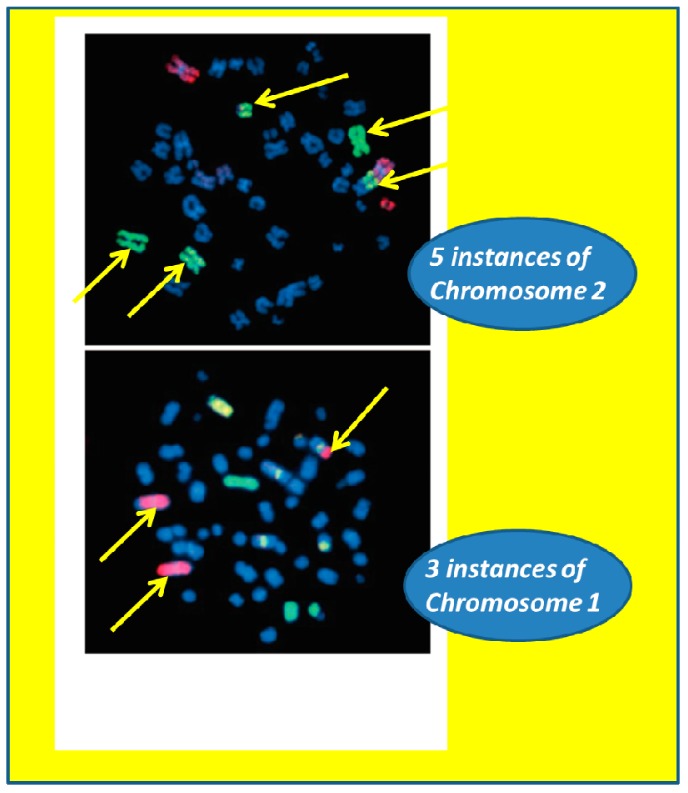
“In 2008, using multi-color fluorescence in situ hybridization, Cucinotta et al. vividly showed complex chromosomal aberrations in lymphocyte cells involving three or more chromosomes, observed post-mission in ISS astronauts [29], (Figure 5).”
§ Space Radiation: The Number One Risk to Astronaut Health beyond Low Earth Orbit > 3. Biomedical Consequences of Exposure to Space Radiation > 3.1. Degenerative Tissue Effects from Radiation Exposure
What the sources say
- Not checked yetcites [29] Cucinotta, 2008, Physical and biological organ dosimetry analysis for international space station astronauts, Radiat. Res. source
boosteddirect- Asserted: passes — The authors put it forward as true.
- Checkable: passes — It can be checked against evidence.
- Load-bearing: passes — The paper’s conclusions depend on it.
- Based: passes — The paper gives a reason why it holds.
None of the sources cited for this claim have been checked yet.
In the paper
“Britten et al. have shown that doses as low as 20 cGy of simulated GCR radiation (1 GeV/u 56Fe particles) can significantly impair learning and memory in a rodent model.”
§ Space Radiation: The Number One Risk to Astronaut Health beyond Low Earth Orbit > 3. Biomedical Consequences of Exposure to Space Radiation > 3.3. Acute and Late CNS Effects from Radiation Exposure
What the sources say
- Not checked yetcites [55] Britten, 2012, Low (20 cGy) doses of 1 GeV/u 56Fe-particle radiation lead to a persistent reduction in the spatial learning ability of rats, Radiat. Res. source
- Not checked yetcites [56] Lonart, 2012, Executive function in rats is impaired by low (20 cGy) doses of 1 GeV/u 56Fe particles, Radiat. Res. source
plaindirect- Asserted: passes — The authors put it forward as true.
- Checkable: passes — It can be checked against evidence.
- Load-bearing: passes — The paper’s conclusions depend on it.
- Based: passes — The paper gives a reason why it holds.
In the paper
“Shavers et al. determined that the doses received by astronauts during extended ISS missions were typically greater than 70 mSv [31].”
§ Space Radiation: The Number One Risk to Astronaut Health beyond Low Earth Orbit > 3. Biomedical Consequences of Exposure to Space Radiation > 3.2. Radiation Carcinogenesis
What the sources say
- Not checked yetcites [31] Shavers, 2004, Implementation of alara radiation protection on the iss through polyethylene shielding augmentation of the service module crew quarters, Adv. Space Res. source
plain- Asserted: passes — The authors put it forward as true.
- Checkable: passes — It can be checked against evidence.
- Load-bearing: unclear — It is unclear whether the paper’s conclusions depend on it.
- Based: passes — The paper gives a reason why it holds.
None of the sources cited for this claim have been checked yet.
In the paper
“In the mini-pig, it was demonstrated that high doses of SPE-like radiation resulted in adverse effects to the skin, as well as to deeper organs and tissues (e.g., decrease in circulating blood cells [63], lung damage [63] and impaired heart function [64]).”
§ Space Radiation: The Number One Risk to Astronaut Health beyond Low Earth Orbit > 3. Biomedical Consequences of Exposure to Space Radiation > 3.4. Radiation Syndromes Due to SPEs
What the sources say
- Not checked yetcites [63] Wilson, 2011, Acute biological effects of simulating the whole-body radiation dose distribution from a solar particle event using a porcine model, Radiat. Res. source
- Not checked yetcites [64] Sanzari, 2013, Acute hematological effects of solar particle event proton radiation in the porcine model, Radiat. Res. source
boosteddirect- Asserted: passes — The authors put it forward as true.
- Checkable: passes — It can be checked against evidence.
- Load-bearing: unclear — It is unclear whether the paper’s conclusions depend on it.
- Based: passes — The paper gives a reason why it holds.
None of the sources cited for this claim have been checked yet.
In the paper
“Immune system suppression occurred at doses as low as 1.0 Gy.”
§ Space Radiation: The Number One Risk to Astronaut Health beyond Low Earth Orbit > 3. Biomedical Consequences of Exposure to Space Radiation > 3.4. Radiation Syndromes Due to SPEs
plaindirect- Asserted: passes — The authors put it forward as true.
- Checkable: passes — It can be checked against evidence.
- Load-bearing: unclear — It is unclear whether the paper’s conclusions depend on it.
- Based: passes — The paper gives a reason why it holds.
A result the paper reports from its own data — it cites no other source for it, so there is none to check. The quote shows it is in the paper.
In the paper
“the blood cell counts (e.g., platelets, lymphocytes, neutrophils) did not return to normal, pre-irradiation levels in the mini-pig model following exposure to simulated SPE radiation”
§ Space Radiation: The Number One Risk to Astronaut Health beyond Low Earth Orbit > 3. Biomedical Consequences of Exposure to Space Radiation > 3.4. Radiation Syndromes Due to SPEs
plain- Asserted: passes — The authors put it forward as true.
- Checkable: passes — It can be checked against evidence.
- Load-bearing: passes — The paper’s conclusions depend on it.
- Based: passes — The paper gives a reason why it holds.
A conclusion the paper draws from its own results — it cites no other source for it, so there is none to check. The quote shows it is in the paper.
In the paper
“Furthermore, it is likely that crewmembers will be exposed to multiple SPEs during such missions.”
§ Space Radiation: The Number One Risk to Astronaut Health beyond Low Earth Orbit > 2. The Pernicious Interplanetary Space Radiation Environment > 2.2. SPE Radiation
hedged- Asserted: passes — The authors put it forward as true.
- Checkable: passes — It can be checked against evidence.
- Load-bearing: passes — The paper’s conclusions depend on it.
- Based: passes — The paper gives a reason why it holds.
In the paper
“Dangerous and unpredictable SPEs can produce large quantities of energetic protons with fluences in excess of 109 protons/cm2 [5].”
§ Space Radiation: The Number One Risk to Astronaut Health beyond Low Earth Orbit > 2. The Pernicious Interplanetary Space Radiation Environment > 2.2. SPE Radiation
What the sources say
- Not checked yetcites [5] Cucinotta, F.A., Wang, H., and Huff, J.L. (2013). Evidence Report: Risk of Acute or Late Central Nervous System Effects from Radiation Exposure, National Aeronautical and Space Agency.
plaindirect- Asserted: passes — The authors put it forward as true.
- Checkable: passes — It can be checked against evidence.
- Load-bearing: unclear — It is unclear whether the paper’s conclusions depend on it.
- Based: passes — The paper gives a reason why it holds.
In the paper
“While the International Space Station (ISS) has been continuously crewed for fifteen years, with each astronaut spending an average of six months in space, there are limited data to evaluate the degenerative tissue effects that may arise due to a high radiation dose delivered over several months [16].”
§ Space Radiation: The Number One Risk to Astronaut Health beyond Low Earth Orbit > 3. Biomedical Consequences of Exposure to Space Radiation > 3.1. Degenerative Tissue Effects from Radiation Exposure
What the sources say
- Not checked yetcites [16] Longnecker, D.E., Manning, F.J., and Worth, M.H. (2004). Review of Nasa’s Longitudinal Study of Astronaut Health, National Research Council.
plain- Asserted: passes — The authors put it forward as true.
- Checkable: passes — It can be checked against evidence.
- Load-bearing: passes — The paper’s conclusions depend on it.
- Based: passes — The paper gives a reason why it holds.
In the paper
“Recent evidence has therefore demonstrated that the absorbed dose and dose equivalent from incident particles can be well estimated in advance of future exploration class space missions.”
§ Space Radiation: The Number One Risk to Astronaut Health beyond Low Earth Orbit > 2. The Pernicious Interplanetary Space Radiation Environment > 2.1. Galactic Cosmic Radiation
What the sources say
- Not checked yetcites [11] Zeitlin, 2013, Measurements of energetic particle radiation in transit to mars on the mars science laboratory, Science source
boosted- Asserted: passes — The authors put it forward as true.
- Checkable: passes — It can be checked against evidence.
- Load-bearing: unclear — It is unclear whether the paper’s conclusions depend on it.
- Based: passes — The paper gives a reason why it holds.
In the paper
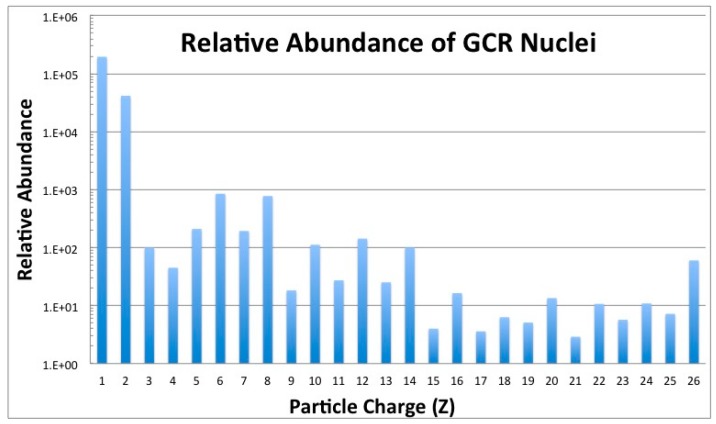
“The GCR spectrum consists of approximately 87% hydrogen ions (protons) and 12% helium ions (alpha particles), with the remaining 1%–2% of particles being HZE nuclei with charges ranging from Z = 3 (lithium) to approximately Z = 28 (nickel) [9].”
§ Space Radiation: The Number One Risk to Astronaut Health beyond Low Earth Orbit > 2. The Pernicious Interplanetary Space Radiation Environment > 2.1. Galactic Cosmic Radiation
What the sources say
- Not checked yetcites [9] Badwar, 1994, Long-term modulation of galactic cosmic radiation and its model for space exploration, Adv. Space Res. source
plain- Asserted: passes — The authors put it forward as true.
- Checkable: passes — It can be checked against evidence.
- Load-bearing: unclear — It is unclear whether the paper’s conclusions depend on it.
- Based: passes — The paper gives a reason why it holds.
In the paper
“SPEs have a unique dose distribution with respect to whole body irradiation. For instance, skin doses are 5–10-times higher than those experienced by internal organs, because of its superficial location and susceptibility to absorption in the low energy spectra of protons and nuclei [15].”
§ Space Radiation: The Number One Risk to Astronaut Health beyond Low Earth Orbit > 3. Biomedical Consequences of Exposure to Space Radiation
What the sources say
- Not checked yetcites [15] Kim, 2006, Evaluation of skin cancer risks from lunar and mars missions, Adv. Space Res. source
plaindirect- Asserted: passes — The authors put it forward as true.
- Checkable: passes — It can be checked against evidence.
- Load-bearing: unclear — It is unclear whether the paper’s conclusions depend on it.
- Based: passes — The paper gives a reason why it holds.
A conclusion the paper draws from its own results — it cites no other source for it, so there is none to check. The quote shows it is in the paper.
In the paper
“The risks of space radiation will, however, become more onerous, as future spaceflight missions to an NEO or Mars require extended transit beyond the protection of the Earth’s magnetosphere.”
§ Space Radiation: The Number One Risk to Astronaut Health beyond Low Earth Orbit > 1. Introduction
plaindirect- Asserted: passes — The authors put it forward as true.
- Checkable: passes — It can be checked against evidence.
- Load-bearing: passes — The paper’s conclusions depend on it.
- Based: passes — The paper gives a reason why it holds.
None of the sources cited for this claim have been checked yet.
In the paper
“Even so, there can be very high density fluxes of protons with energies greater than 30 MeV that can be of concern to astronauts in thinly-shielded vehicles and habitats [13,14].”
§ Space Radiation: The Number One Risk to Astronaut Health beyond Low Earth Orbit > 2. The Pernicious Interplanetary Space Radiation Environment > 2.2. SPE Radiation
What the sources say
- Not checked yetcites [13] National Council on Radiation Protection and Measurements (NCRP) (1989). Guidance on Radiation Received in Space Activities, NCRP.
- Not checked yetcites [14] Townsend, 1994, Estimates of hze particle contributions to spe radiation exposures on interplanetary missions, Adv. Space Res. source
plainconditional- Asserted: passes — The authors put it forward as true.
- Checkable: passes — It can be checked against evidence.
- Load-bearing: unclear — It is unclear whether the paper’s conclusions depend on it.
- Based: passes — The paper gives a reason why it holds.
In the paper
“These findings raise the possibility that astronauts on prolonged deep space exploratory missions could develop deficits in executive function [56].”
§ Space Radiation: The Number One Risk to Astronaut Health beyond Low Earth Orbit > 3. Biomedical Consequences of Exposure to Space Radiation > 3.3. Acute and Late CNS Effects from Radiation Exposure
What the sources say
- Not checked yetcites [56] Lonart, 2012, Executive function in rats is impaired by low (20 cGy) doses of 1 GeV/u 56Fe particles, Radiat. Res. source
hedgedconditional- Asserted: passes — The authors put it forward as true.
- Checkable: passes — It can be checked against evidence.
- Load-bearing: passes — The paper’s conclusions depend on it.
- Based: passes — The paper gives a reason why it holds.
In the paper
“Cytogenetic data unequivocally reveals that space radiation exposure produces significant damage to cells [28].”
§ Space Radiation: The Number One Risk to Astronaut Health beyond Low Earth Orbit > 3. Biomedical Consequences of Exposure to Space Radiation > 3.1. Degenerative Tissue Effects from Radiation Exposure
What the sources say
- Not checked yetcites [28] Maalouf, 2011, Biological effects of space radiation on human cells: History, advances and outcomes, J. Radiat. Res. source
boosteddirect- Asserted: passes — The authors put it forward as true.
- Checkable: passes — It can be checked against evidence.
- Load-bearing: unclear — It is unclear whether the paper’s conclusions depend on it.
- Based: passes — The paper gives a reason why it holds.
A conclusion the paper draws from its own results — it cites no other source for it, so there is none to check. The quote shows it is in the paper.
In the paper
“Space radiation-induced CNS effects are not limited to the effects of HZE particles.”
§ Space Radiation: The Number One Risk to Astronaut Health beyond Low Earth Orbit > 3. Biomedical Consequences of Exposure to Space Radiation > 3.3. Acute and Late CNS Effects from Radiation Exposure
plain- Asserted: passes — The authors put it forward as true.
- Checkable: passes — It can be checked against evidence.
- Load-bearing: passes — The paper’s conclusions depend on it.
- Based: passes — The paper gives a reason why it holds.
In the paper
“Understanding the mechanisms is complicated, as Rabin et al. have shown that studies modelling the impact of HZE particles on cognitive performance cannot be generalized from radiobiology studies of chromosomal aberrations and carcinogenesis [57].”
§ Space Radiation: The Number One Risk to Astronaut Health beyond Low Earth Orbit > 3. Biomedical Consequences of Exposure to Space Radiation > 3.3. Acute and Late CNS Effects from Radiation Exposure
What the sources say
- Not checked yetcites [57] Rabin, 2004, Heavy particle irradiation, neurochemistry and behavior: Thresholds, dose-response curves and recovery of function, Adv. Space Res. source
plain- Asserted: passes — The authors put it forward as true.
- Checkable: passes — It can be checked against evidence.
- Load-bearing: unclear — It is unclear whether the paper’s conclusions depend on it.
- Based: passes — The paper gives a reason why it holds.
None of the sources cited for this claim have been checked yet.
In the paper
“There have been no studies conclusively demonstrating that exposures to the unique doses and dose rates found in the space radiation environment will result in an increased risk of cancer mortality when compared to the U.S. population [32,33,34,35,36].”
§ Space Radiation: The Number One Risk to Astronaut Health beyond Low Earth Orbit > 3. Biomedical Consequences of Exposure to Space Radiation > 3.2. Radiation Carcinogenesis
What the sources say
- Not checked yetcites [32] Hamm, 1998, Risk of cancer mortality among the longitudinal study of astronaut health (lsah) participants, Aviat. Space Environ. Med.
- Not checked yetcites [33] Hamm, 2000, Design and current status of the longitudinal study of astronaut health, Aviat. Space Environ. Med.
- Not checked yetcites [34] Peterson, 1993, Longitudinal study of astronaut health: Mortality in the years 1959–1991, Radiat. Res. source
- Not checked yetcites [35] Behnken, R., Barratt, M., and Walker, S. (2013). Presentation to the Institute of Medicine-Ethics Principles and Guidelines for Health Standards for Long Duration and Exploration Spaceflights, National Aeronautics and Space Administration.
- Not checked yetcites [36] Van Baalen, M. Personal communication.
boosted- Asserted: passes — The authors put it forward as true.
- Checkable: passes — It can be checked against evidence.
- Load-bearing: passes — The paper’s conclusions depend on it.
- Based: passes — The paper gives a reason why it holds.
None of the sources cited for this claim have been checked yet.
In the paper
“However, it is still unclear how SPE, GCR and constituent HZE nuclei negatively impact the CNS at the dose and dose rates found in the space environment [2,52,53].”
§ Space Radiation: The Number One Risk to Astronaut Health beyond Low Earth Orbit > 3. Biomedical Consequences of Exposure to Space Radiation > 3.3. Acute and Late CNS Effects from Radiation Exposure
What the sources say
- Not checked yetcites [2] National Council on Radiation Protection and Measurements (NCRP) (2006). Information Needed to Make Radiation Protection Recommendations for Space Missions Beyond Low-Earth Orbit, NCRP.
- Not checked yetcites [52] National Research Council (1973). Hze-Particle Effects in Manned Spaceflight, The National Academies Press.
- Not checked yetcites [53] National Research Council (1996). Radiation Hazards to Crews of Interplanetary Missions:Biological Issues and Research Strategies, The National Academies Press.
plain- Asserted: passes — The authors put it forward as true.
- Checkable: passes — It can be checked against evidence.
- Load-bearing: passes — The paper’s conclusions depend on it.
- Based: passes — The paper gives a reason why it holds.
A conclusion the paper draws from its own results — it cites no other source for it, so there is none to check. The quote shows it is in the paper.
In the paper
“These research data demonstrate that important changes to the CNS can be expected to occur at mission-relevant dose and dose rate levels.”
§ Space Radiation: The Number One Risk to Astronaut Health beyond Low Earth Orbit > 3. Biomedical Consequences of Exposure to Space Radiation > 3.3. Acute and Late CNS Effects from Radiation Exposure
boosteddirect- Asserted: passes — The authors put it forward as true.
- Checkable: passes — It can be checked against evidence.
- Load-bearing: passes — The paper’s conclusions depend on it.
- Based: passes — The paper gives a reason why it holds.
- Rests on an assumption: The biological effects of space radiation observed in animal models can be extrapolated to human astronauts.
A conclusion the paper draws from its own results — it cites no other source for it, so there is none to check. The quote shows it is in the paper.
In the paper
“However, the risks for these same effects occurring after low dose rate or HZE nuclei exposures are more difficult to assess, due to the multifactorial nature of the diseases and their long latency periods.”
§ Space Radiation: The Number One Risk to Astronaut Health beyond Low Earth Orbit > 3. Biomedical Consequences of Exposure to Space Radiation > 3.1. Degenerative Tissue Effects from Radiation Exposure
plain- Asserted: passes — The authors put it forward as true.
- Checkable: passes — It can be checked against evidence.
- Load-bearing: passes — The paper’s conclusions depend on it.
- Based: passes — The paper gives a reason why it holds.
None of the sources cited for this claim have been checked yet.
In the paper
“Epidemiological studies on atomic bomb survivors in Japan, radiotherapy patients and occupationally-exposed workers have characterized the association between moderate to high doses of low-LET radiation and the long-term development of degenerative tissue effects, such as heart disease, cataracts, immunological changes and premature aging [17,18,19,20].”
§ Space Radiation: The Number One Risk to Astronaut Health beyond Low Earth Orbit > 3. Biomedical Consequences of Exposure to Space Radiation > 3.1. Degenerative Tissue Effects from Radiation Exposure
What the sources say
- Not checked yetcites [17] Darby, 2005, Long-term mortality from heart disease and lung cancer after radiotherapy for early breast cancer: Prospective cohort study of about 300,000 women in us seer cancer registries, Lancet Oncol. source
- Not checked yetcites [18] Hayashi, 2003, Radiation dose-dependent increases in inflammatory response markers in a-bomb survivors, Int. J. Radiat. Biol. source
- Not checked yetcites [19] Kodama, 1996, Profiles of non-cancer diseases in atomic bomb survivors, World Health Stat. Q.
- Not checked yetcites [20] Preston, 2003, Studies of mortality of atomic bomb survivors. Report 13: Solid cancer and noncancer disease mortality: 1950–1997, Radiat. Res. source
plaincorrelational- Asserted: passes — The authors put it forward as true.
- Checkable: passes — It can be checked against evidence.
- Load-bearing: unclear — It is unclear whether the paper’s conclusions depend on it.
- Based: passes — The paper gives a reason why it holds.
In the paper
“Highly ionizing HZE nuclei can easily penetrate space vehicle structures and still have sufficient energy capable of heavily damaging cells or creating micro-lesions along their tracks through tissues [54].”
§ Space Radiation: The Number One Risk to Astronaut Health beyond Low Earth Orbit > 3. Biomedical Consequences of Exposure to Space Radiation > 3.3. Acute and Late CNS Effects from Radiation Exposure
What the sources say
- Not checked yetcites [54] Todd, 1989, Stochastics of hze-induced microlesions, Adv. Space Res. source
plaindirect- Asserted: passes — The authors put it forward as true.
- Checkable: passes — It can be checked against evidence.
- Load-bearing: passes — The paper’s conclusions depend on it.
- Based: passes — The paper gives a reason why it holds.
A conclusion the paper draws from its own results — it cites no other source for it, so there is none to check. The quote shows it is in the paper.
In the paper
“Recent studies at NASA’s Space Radiation Laboratory using heavy-ion beams to simulate the GCR environment have provided evidence of the CNS health risk for missions outside of LEO.”
§ Space Radiation: The Number One Risk to Astronaut Health beyond Low Earth Orbit > 3. Biomedical Consequences of Exposure to Space Radiation > 3.3. Acute and Late CNS Effects from Radiation Exposure
plaincorrelational- Asserted: passes — The authors put it forward as true.
- Checkable: passes — It can be checked against evidence.
- Load-bearing: passes — The paper’s conclusions depend on it.
- Based: passes — The paper gives a reason why it holds.
A conclusion the paper draws from its own results — it cites no other source for it, so there is none to check. The quote shows it is in the paper.
In the paper
“This uncertainty is due to several confounding factors, including: (1) the relatively low doses and dose rates of radiation received during spaceflight in LEO; (2) a wide range of time intervals between spaceflight and the current ages of individual living astronauts; and (3) the small overall sample size of those who have flown in space.”
§ Space Radiation: The Number One Risk to Astronaut Health beyond Low Earth Orbit > 3. Biomedical Consequences of Exposure to Space Radiation > 3.2. Radiation Carcinogenesis
plaindirect- Asserted: passes — The authors put it forward as true.
- Checkable: passes — It can be checked against evidence.
- Load-bearing: passes — The paper’s conclusions depend on it.
- Based: passes — The paper gives a reason why it holds.
None of the sources cited for this claim have been checked yet.
In the paper
“These results may indicate that dopamine levels have an important role in neurobehavioral response to radiation [60,61].”
§ Space Radiation: The Number One Risk to Astronaut Health beyond Low Earth Orbit > 3. Biomedical Consequences of Exposure to Space Radiation > 3.3. Acute and Late CNS Effects from Radiation Exposure
What the sources say
- Not checked yetcites [60] Davis, C.M., Roma, P.G., Brady, J.V., and Hienz, R.D. (2011, January 11–15). Neurobehavioral effects of space radiation on choice impulsivity. Proceedings of the 18th Biannual Meeting of the International Academy of Astronautics’ Humans in Space Symposium, Houston, TX, USA.
- Not checked yetcites [61] Hienz, R.D., Davis, C.M., Weed, M.R., Guida, P.M., Gooden, V.L., Brady, J.V., and Roma, P.G. (2011, January 11–15). Neurobehavioral effects of space radiation on psychomotor vigilance and reaction time tests. Proceedings of the 18th Biannual Meeting of the International Academy of Astronautics’ Humans in Space Symposium, Houston, TX, USA.
hedgedconditional- Asserted: passes — The authors put it forward as true.
- Checkable: passes — It can be checked against evidence.
- Load-bearing: unclear — It is unclear whether the paper’s conclusions depend on it.
- Based: passes — The paper gives a reason why it holds.
None of the sources cited for this claim have been checked yet.
In the paper
“These results demonstrate that mission-relevant doses of HZE particles may result in deficits in hippocampus-dependent neurocognitive tasks, most likely due to the perturbation of multiple processes, in addition to killing neuronal cells [55,56].”
§ Space Radiation: The Number One Risk to Astronaut Health beyond Low Earth Orbit > 3. Biomedical Consequences of Exposure to Space Radiation > 3.3. Acute and Late CNS Effects from Radiation Exposure
What the sources say
- Not checked yetcites [55] Britten, 2012, Low (20 cGy) doses of 1 GeV/u 56Fe-particle radiation lead to a persistent reduction in the spatial learning ability of rats, Radiat. Res. source
- Not checked yetcites [56] Lonart, 2012, Executive function in rats is impaired by low (20 cGy) doses of 1 GeV/u 56Fe particles, Radiat. Res. source
hedgedconditional- Asserted: passes — The authors put it forward as true.
- Checkable: passes — It can be checked against evidence.
- Load-bearing: passes — The paper’s conclusions depend on it.
- Based: passes — The paper gives a reason why it holds.
In the paper
“This work was significant, as it demonstrated gross biomolecular damage at the fundamental DNA level within ISS crewmembers as a result of exposure to space radiation [29].”
§ Space Radiation: The Number One Risk to Astronaut Health beyond Low Earth Orbit > 3. Biomedical Consequences of Exposure to Space Radiation > 3.1. Degenerative Tissue Effects from Radiation Exposure
What the sources say
- Not checked yetcites [29] Cucinotta, 2008, Physical and biological organ dosimetry analysis for international space station astronauts, Radiat. Res. source
boosteddirect- Asserted: passes — The authors put it forward as true.
- Checkable: passes — It can be checked against evidence.
- Load-bearing: passes — The paper’s conclusions depend on it.
- Based: passes — The paper gives a reason why it holds.
In the paper
“The elevated risk for astronauts developing cancer during or following a mission is directly related to the dose of radiation received [30].”
§ Space Radiation: The Number One Risk to Astronaut Health beyond Low Earth Orbit > 3. Biomedical Consequences of Exposure to Space Radiation > 3.2. Radiation Carcinogenesis
What the sources say
- Not checked yetcites [30] National Research Council (1990). Health Effects of Exposure to Low Levels of Ionizing Radiation: Beir V, The National Academies Press.
plaindirect- Asserted: passes — The authors put it forward as true.
- Checkable: passes — It can be checked against evidence.
- Load-bearing: passes — The paper’s conclusions depend on it.
- Based: passes — The paper gives a reason why it holds.
None of the sources cited for this claim have been checked yet.
In the paper
“Results from animal studies examining the synergistic effects of radiation combined with spaceflight environment stressors (i.e., microgravity, environmental constraints, emotional stress) show increased susceptibility to infection, delayed wound healing and decreased survival [73,74,75].”
§ Space Radiation: The Number One Risk to Astronaut Health beyond Low Earth Orbit > 4. Synergistic Effects and Individual Susceptibility
What the sources say
- Not checked yetcites [73] Maks, 2011, Analysis of white blood cell counts in mice after gamma- or proton-radiation exposure, Radiat. Res. source
- Not checked yetcites [74] Sanzari, 2011, Antioxidant dietary supplementation in mice exposed to proton radiation attenuates expression of programmed cell death-associated genes, Radiat. Res. source
- Not checked yetcites [75] Wilson, 2012, Comparison of hindlimb unloading and partial weight suspension models for spaceflight-type condition induced effects on white blood cells, Adv. Space Res. source
plaindirect- Asserted: passes — The authors put it forward as true.
- Checkable: passes — It can be checked against evidence.
- Load-bearing: passes — The paper’s conclusions depend on it.
- Based: passes — The paper gives a reason why it holds.
A conclusion the paper draws from its own results — it cites no other source for it, so there is none to check. The quote shows it is in the paper.
In the paper
“These results indicate that the mini-pigs, and other larger species, may be relatively incapable of repairing DNA damage caused by the proton radiation exposure as efficiently as rodents”
§ Space Radiation: The Number One Risk to Astronaut Health beyond Low Earth Orbit > 3. Biomedical Consequences of Exposure to Space Radiation > 3.4. Radiation Syndromes Due to SPEs
hedgedconditional- Asserted: passes — The authors put it forward as true.
- Checkable: passes — It can be checked against evidence.
- Load-bearing: passes — The paper’s conclusions depend on it.
- Based: passes — The paper gives a reason why it holds.
A conclusion the paper draws from its own results — it cites no other source for it, so there is none to check. The quote shows it is in the paper.
In the paper
“Similarly, radiobiological models and experiments utilizing mono-energetic beams of protons for short periods of time may not fully characterize SPE effects and the associated acute and sub-acute biological responses.”
§ Space Radiation: The Number One Risk to Astronaut Health beyond Low Earth Orbit > 5. Research Considerations > 5.1. Simulating the Space Radiation Environment
hedged- Asserted: passes — The authors put it forward as true.
- Checkable: passes — It can be checked against evidence.
- Load-bearing: passes — The paper’s conclusions depend on it.
- Based: passes — The paper gives a reason why it holds.
In the paper
“While this compartmentalized approach to space radiation research has been productive, it also represents a shortcoming in experimental design that is only now being addressed through concatenated and integrated studies addressing both the SPE and GCR effects [77].”
§ Space Radiation: The Number One Risk to Astronaut Health beyond Low Earth Orbit > 5. Research Considerations > 5.1. Simulating the Space Radiation Environment
What the sources say
- Not checked yetcites [77] National Space Biomedical Research Institute (2013). National Space Biomedical Research Institute Request for Applications Nsbri-Rfa-13–02 to Establish A Center for Space Radiation Research (Csrr), National Space Biomedical Research Institute.
plain- Asserted: passes — The authors put it forward as true.
- Checkable: passes — It can be checked against evidence.
- Load-bearing: unclear — It is unclear whether the paper’s conclusions depend on it.
- Based: passes — The paper gives a reason why it holds.
None of the sources cited for this claim have been checked yet.
In the paper
“Results from animal studies examining the synergistic effects of radiation combined with spaceflight environment stressors (i.e., microgravity, environmental constraints, emotional stress) show increased susceptibility to infection, delayed wound healing and decreased survival [73,74,75].”
§ Space Radiation: The Number One Risk to Astronaut Health beyond Low Earth Orbit > 4. Synergistic Effects and Individual Susceptibility
What the sources say
- Not checked yetcites [73] Maks, 2011, Analysis of white blood cell counts in mice after gamma- or proton-radiation exposure, Radiat. Res. source
- Not checked yetcites [74] Sanzari, 2011, Antioxidant dietary supplementation in mice exposed to proton radiation attenuates expression of programmed cell death-associated genes, Radiat. Res. source
- Not checked yetcites [75] Wilson, 2012, Comparison of hindlimb unloading and partial weight suspension models for spaceflight-type condition induced effects on white blood cells, Adv. Space Res. source
plaindirect- Asserted: passes — The authors put it forward as true.
- Checkable: passes — It can be checked against evidence.
- Load-bearing: passes — The paper’s conclusions depend on it.
- Based: passes — The paper gives a reason why it holds.
In the paper
“It is only during large SPEs (e.g., similar to the August 1972, SPE event) that the dose rate will rise to levels known to have substantive biological effects [62].”
§ Space Radiation: The Number One Risk to Astronaut Health beyond Low Earth Orbit > 3. Biomedical Consequences of Exposure to Space Radiation > 3.4. Radiation Syndromes Due to SPEs
What the sources say
- Not checked yetcites [62] Parsons, 2000, Interplanetary crew dose rates for the august 1972 solar particle event, Radiat. Res. source
boosteddirect- Asserted: passes — The authors put it forward as true.
- Checkable: passes — It can be checked against evidence.
- Load-bearing: unclear — It is unclear whether the paper’s conclusions depend on it.
- Based: passes — The paper gives a reason why it holds.
The paper states this without a source or data behind it here, so there is nothing to check it against. The quote shows it is in the paper.
In the paper
“Two ionizing particles of different atomic numbers having the same LET can have very different track structures and fragmentation contributions.”
§ Space Radiation: The Number One Risk to Astronaut Health beyond Low Earth Orbit > 5. Research Considerations > 5.1. Simulating the Space Radiation Environment
plaincorrelational- Asserted: passes — The authors put it forward as true.
- Checkable: passes — It can be checked against evidence.
- Load-bearing: passes — The paper’s conclusions depend on it.
- Based: unclear — It is unclear why the paper says it holds.
None of the sources cited for this claim have been checked yet.
In the paper
“Using a mouse model, studies suggest that exposure to low-dose rate SPE-like proton radiation leads to an increase in fatigue [71,72].”
§ Space Radiation: The Number One Risk to Astronaut Health beyond Low Earth Orbit > 3. Biomedical Consequences of Exposure to Space Radiation > 3.4. Radiation Syndromes Due to SPEs
What the sources say
- Not checked yetcites [71] York, 2012, The biobehavioral and neuroimmune impact of low-dose ionizing radiation, Brain Behav. Immun. source
- Not checked yetcites [72] York, 2012, Individually ventilated cages cause chronic low-grade hypoxia impacting mice hematologically and behaviorally, Brain Behav. Immun. source
hedgeddirect- Asserted: passes — The authors put it forward as true.
- Checkable: passes — It can be checked against evidence.
- Load-bearing: unclear — It is unclear whether the paper’s conclusions depend on it.
- Based: passes — The paper gives a reason why it holds.
- Rests on an assumption: Fatigue has been observed in radiotherapy patients receiving therapeutic radiation doses as low as 2 Gy.
In the paper
“the threshold doses required to generate specific measurable physiological effects can be very different between species and even between strains within species [83].”
§ Space Radiation: The Number One Risk to Astronaut Health beyond Low Earth Orbit > 5. Research Considerations > 5.2. Selection of Appropriate Animal Models
What the sources say
- Not checked yetcites [83] Davis, 2014, Effects of x-ray radiation on complex visual discrimination learning and social recognition memory in rats, PLoS One source
plain- Asserted: passes — The authors put it forward as true.
- Checkable: passes — It can be checked against evidence.
- Load-bearing: passes — The paper’s conclusions depend on it.
- Based: passes — The paper gives a reason why it holds.
The paper states this without a source or data behind it here, so there is nothing to check it against. The quote shows it is in the paper.
In the paper
“However, LET does not adequately describe in a single term all of the features of radiation quality.”
§ Space Radiation: The Number One Risk to Astronaut Health beyond Low Earth Orbit > 5. Research Considerations > 5.1. Simulating the Space Radiation Environment
plain- Asserted: passes — The authors put it forward as true.
- Checkable: passes — It can be checked against evidence.
- Load-bearing: unclear — It is unclear whether the paper’s conclusions depend on it.
- Based: passes — The paper gives a reason why it holds.
In the paper
“no direct connections can yet be drawn between observed DNA sequence changes and a corresponding change in radio-sensitivity [27].”
§ Space Radiation: The Number One Risk to Astronaut Health beyond Low Earth Orbit > 4. Synergistic Effects and Individual Susceptibility
What the sources say
- Not checked yetcites [27] National Council on Radiation Protection and Measurements (NCRP) (2010). Potential Impact of Individual Genetic Susceptibility and Previous Radiation Exposure on Radiation Risk for Astronauts, NCRP.
plain- Asserted: passes — The authors put it forward as true.
- Checkable: passes — It can be checked against evidence.
- Load-bearing: unclear — It is unclear whether the paper’s conclusions depend on it.
- Based: passes — The paper gives a reason why it holds.
- Rests on an assumption: Individual differences in responses to radiation exist at all levels of biological organization (molecular, cellular and tissue).
A conclusion the paper draws from its own results — it cites no other source for it, so there is none to check. The quote shows it is in the paper.
In the paper
“This method of delivering the heavy ion radiation in a single acute dose, rather than titrating it in a series of smaller chronic doses delivered over time, does not accurately model low-dose-rate effects.”
§ Space Radiation: The Number One Risk to Astronaut Health beyond Low Earth Orbit > 5. Research Considerations > 5.1. Simulating the Space Radiation Environment
plaindirect- Asserted: passes — The authors put it forward as true.
- Checkable: passes — It can be checked against evidence.
- Load-bearing: passes — The paper’s conclusions depend on it.
- Based: passes — The paper gives a reason why it holds.
None of the sources cited for this claim have been checked yet.
In the paper
“Results from animal studies examining the synergistic effects of radiation combined with spaceflight environment stressors (i.e., microgravity, environmental constraints, emotional stress) show increased susceptibility to infection, delayed wound healing and decreased survival [73,74,75].”
§ Space Radiation: The Number One Risk to Astronaut Health beyond Low Earth Orbit > 4. Synergistic Effects and Individual Susceptibility
What the sources say
- Not checked yetcites [73] Maks, 2011, Analysis of white blood cell counts in mice after gamma- or proton-radiation exposure, Radiat. Res. source
- Not checked yetcites [74] Sanzari, 2011, Antioxidant dietary supplementation in mice exposed to proton radiation attenuates expression of programmed cell death-associated genes, Radiat. Res. source
- Not checked yetcites [75] Wilson, 2012, Comparison of hindlimb unloading and partial weight suspension models for spaceflight-type condition induced effects on white blood cells, Adv. Space Res. source
plaindirect- Asserted: passes — The authors put it forward as true.
- Checkable: passes — It can be checked against evidence.
- Load-bearing: passes — The paper’s conclusions depend on it.
- Based: passes — The paper gives a reason why it holds.
None of the sources cited for this claim have been checked yet.
In the paper
“Emesis and retching are known prodromal outcomes following exposures to high doses of radiation”
§ Space Radiation: The Number One Risk to Astronaut Health beyond Low Earth Orbit > 3. Biomedical Consequences of Exposure to Space Radiation > 3.4. Radiation Syndromes Due to SPEs
What the sources say
boosteddirect- Asserted: passes — The authors put it forward as true.
- Checkable: passes — It can be checked against evidence.
- Load-bearing: unclear — It is unclear whether the paper’s conclusions depend on it.
- Based: passes — The paper gives a reason why it holds.
- Rests on an assumption: Astronauts performing EVAs have compromised shielding that can leave them vulnerable to the effects of unpredictable SPEs.
None of the sources cited for this claim have been checked yet.
In the paper
“In general, animal experiments have contributed significantly to our understanding of the mechanisms of disease, but their value in predicting the effectiveness of treatment strategies has limitations [80,81,82].”
§ Space Radiation: The Number One Risk to Astronaut Health beyond Low Earth Orbit > 5. Research Considerations > 5.2. Selection of Appropriate Animal Models
What the sources say
- Not checked yetcites [80] Hackam, 2006, Translation of research evidence from animals to humans, JAMA source
- Not checked yetcites [81] Perel, P., Roberts, I., Sena, E., Wheble, P., Briscoe, C., Sandercock, P., Macleod, M., Mignini, L.E., Jayaram, P., and Khan, K.S. (2007). Comparison of treatment effects between animal experiments and clinical trials: Systematic review. BMJ, 334. source
- Not checked yetcites [82] Hackam, D.G. (2007). Translating animal research into clinical benefit. BMJ, 334. source
plain- Asserted: passes — The authors put it forward as true.
- Checkable: passes — It can be checked against evidence.
- Load-bearing: unclear — It is unclear whether the paper’s conclusions depend on it.
- Based: passes — The paper gives a reason why it holds.
- It may state two separate claims as one. 24
- Probably not a substantial claim. 26
The paper states this without a source or data behind it here, so there is nothing to check it against. The quote shows it is in the paper.
In the paper
“This work showed that chromosome breaks were two-fold more frequent in the Apollo astronauts compared to the Gemini astronauts, suggesting for the first time a link between dose and flight duration.”
§ Space Radiation: The Number One Risk to Astronaut Health beyond Low Earth Orbit > 3. Biomedical Consequences of Exposure to Space Radiation > 3.1. Degenerative Tissue Effects from Radiation Exposure
hedgedcorrelational- Asserted: passes — The authors put it forward as true.
- Checkable: passes — It can be checked against evidence.
- Load-bearing: unclear — It is unclear whether the paper’s conclusions depend on it.
- Based: passes — The paper gives a reason why it holds.
It may state two separate claims as one.
The paper states this without a source or data behind it here, so there is nothing to check it against. The quote shows it is in the paper.
In the paper
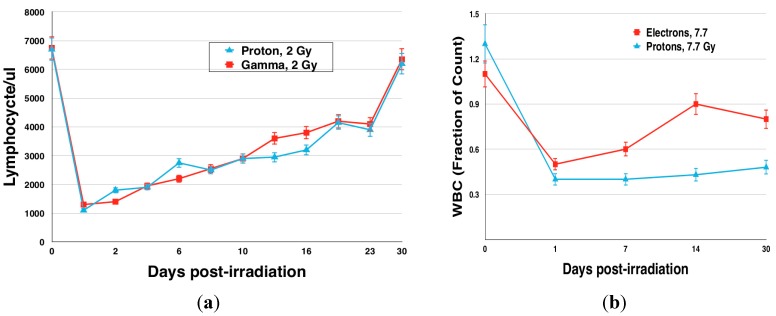
“in the mouse model, high dose rate proton exposures resulted in comparable effects on the number of circulating white blood cells that subsequently returned to pre-irradiation levels within 30 days following exposure”
§ Space Radiation: The Number One Risk to Astronaut Health beyond Low Earth Orbit > 3. Biomedical Consequences of Exposure to Space Radiation > 3.4. Radiation Syndromes Due to SPEs
plaindirect- Asserted: passes — The authors put it forward as true.
- Checkable: passes — It can be checked against evidence.
- Load-bearing: passes — The paper’s conclusions depend on it.
- Based: passes — The paper gives a reason why it holds.
It may state two separate claims as one.
None of the sources cited for this claim have been checked yet.
In the paper
“The WBC counts did not return to normal levels at the 30-day time point, with proton radiation exposure having the more detrimental effect.”
§ Space Radiation: The Number One Risk to Astronaut Health beyond Low Earth Orbit > 3. Biomedical Consequences of Exposure to Space Radiation > 3.4. Radiation Syndromes Due to SPEs
plaindirect- Asserted: passes — The authors put it forward as true.
- Checkable: passes — It can be checked against evidence.
- Load-bearing: unclear — It is unclear whether the paper’s conclusions depend on it.
- Based: passes — The paper gives a reason why it holds.
It may state two separate claims as one.
None of the sources cited for this claim have been checked yet.
In the paper
“In a mouse model, T-cells did not become activated following exposure to low doses of SPE-like proton radiation, and the animals were susceptible to a non-toxic bacterial challenge of organisms (Pseudomonas aeruginosa, Klebsiella pneumoniae) that are relatively innocuous and ubiquitous on Earth and have been detected aboard the ISS [65,66].”
§ Space Radiation: The Number One Risk to Astronaut Health beyond Low Earth Orbit > 3. Biomedical Consequences of Exposure to Space Radiation > 3.4. Radiation Syndromes Due to SPEs
What the sources say
- Not checked yetcites [65] Sanzari, 2013, Leukocyte activity is altered in a ground based murine model of microgravity and proton radiation exposure, PLoS One source
- Not checked yetcites [66] Li, 2014, Hindlimb suspension and spe-like radiation impairs clearance of bacterial infections, PLoS One source
plaindirect- Asserted: passes — The authors put it forward as true.
- Checkable: passes — It can be checked against evidence.
- Load-bearing: passes — The paper’s conclusions depend on it.
- Based: passes — The paper gives a reason why it holds.
It may state two separate claims as one.
The paper states this without a source or data behind it here, so there is nothing to check it against. The quote shows it is in the paper.
In the paper
“With respect to the different qualities of space radiation that may be encountered, the high LET radiation found in the GCR spectrum can directly or indirectly damage biomolecules (e.g., proteins, DNA, lipids), as well as organelles and cellular structures.”
§ Space Radiation: The Number One Risk to Astronaut Health beyond Low Earth Orbit > 3. Biomedical Consequences of Exposure to Space Radiation > 3.1. Degenerative Tissue Effects from Radiation Exposure
plaindirect- Asserted: passes — The authors put it forward as true.
- Checkable: passes — It can be checked against evidence.
- Load-bearing: passes — The paper’s conclusions depend on it.
- Based: fails — The paper may give no reason why it holds.
Probably not a substantial claim. The paper may give no reason why it holds.
A conclusion the paper draws from its own results — it cites no other source for it, so there is none to check. The quote shows it is in the paper.
In the paper
“The large ionization power of GCR ions makes them a major health threat to astronauts and constitutes one of the most important barriers impeding plans for interplanetary travel by crewed spacecraft.”
§ Space Radiation: The Number One Risk to Astronaut Health beyond Low Earth Orbit > 2. The Pernicious Interplanetary Space Radiation Environment > 2.1. Galactic Cosmic Radiation
plaindirect- Asserted: passes — The authors put it forward as true.
- Checkable: passes — It can be checked against evidence.
- Load-bearing: passes — The paper’s conclusions depend on it.
- Based: passes — The paper gives a reason why it holds.
It may state two separate claims as one.
In the paper
“During transit outside of LEO, every cell nucleus within an astronaut would be traversed, on average, by a hydrogen ion every few days and by heavier HZE nuclei (e.g., 16O, 28Si, 56Fe) every few months [12].”
§ Space Radiation: The Number One Risk to Astronaut Health beyond Low Earth Orbit > 2. The Pernicious Interplanetary Space Radiation Environment > 2.1. Galactic Cosmic Radiation
What the sources say
- Not checked yetcites [12] Cucinotta, 1998, The effects of delta rays on the number of particle-track traversals per cell in laboratory and space exposures, Radiat. Res. source
hedged- Asserted: passes — The authors put it forward as true.
- Checkable: passes — It can be checked against evidence.
- Load-bearing: passes — The paper’s conclusions depend on it.
- Based: passes — The paper gives a reason why it holds.
It may state two separate claims as one.
A conclusion the paper draws from its own results — it cites no other source for it, so there is none to check. The quote shows it is in the paper.
In the paper
“Astronauts traveling on a protracted voyage to Mars may be exposed to SPE radiation events, overlaid on a more predictable flux of GCR.”
§ Space Radiation: The Number One Risk to Astronaut Health beyond Low Earth Orbit > Abstract
hedgedconditional- Asserted: passes — The authors put it forward as true.
- Checkable: passes — It can be checked against evidence.
- Load-bearing: passes — The paper’s conclusions depend on it.
- Based: fails — The paper may give no reason why it holds.
Probably not a substantial claim. The paper may give no reason why it holds.
In the paper
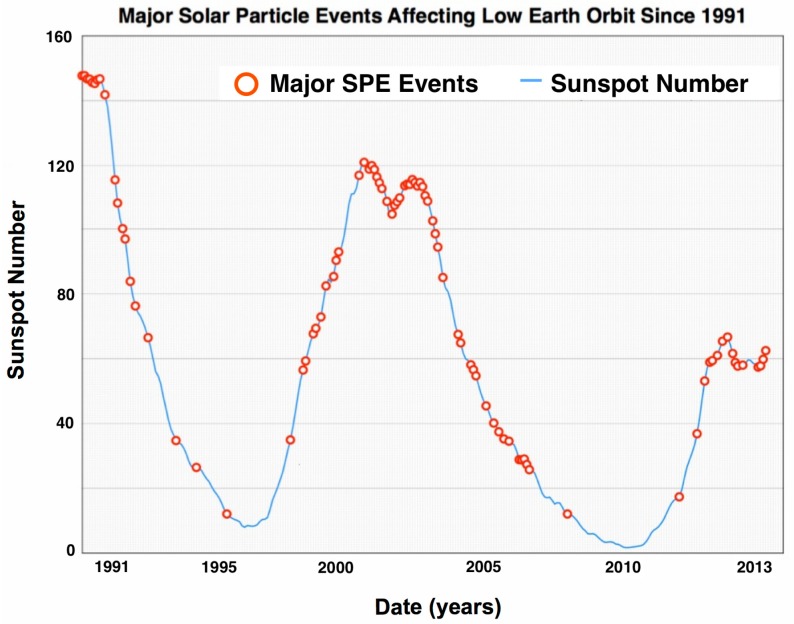
“The fluence of ionized nuclei that make up GCR is inversely proportional to the solar cycle and decreases by a factor of two during solar maximum [10].”
§ Space Radiation: The Number One Risk to Astronaut Health beyond Low Earth Orbit > 2. The Pernicious Interplanetary Space Radiation Environment > 2.1. Galactic Cosmic Radiation
What the sources say
- Not checked yetcites [10] National Council on Radiation Protection and Measurements (NCRP) (2000). Radiation Protection Guidance for Activities in Low-Earth Orbit, NCRP.
plaincorrelational- Asserted: passes — The authors put it forward as true.
- Checkable: passes — It can be checked against evidence.
- Load-bearing: unclear — It is unclear whether the paper’s conclusions depend on it.
- Based: passes — The paper gives a reason why it holds.
It may state two separate claims as one.
A conclusion the paper draws from its own results — it cites no other source for it, so there is none to check. The quote shows it is in the paper.
In the paper
“Exploration missions outside of LEO will include interplanetary transits, and shielding provided by the spacecraft may not be able to completely protect astronaut crews from the effects of an SPE.”
§ Space Radiation: The Number One Risk to Astronaut Health beyond Low Earth Orbit > 2. The Pernicious Interplanetary Space Radiation Environment > 2.2. SPE Radiation
hedgedconditional- Asserted: passes — The authors put it forward as true.
- Checkable: passes — It can be checked against evidence.
- Load-bearing: passes — The paper’s conclusions depend on it.
- Based: passes — The paper gives a reason why it holds.
It may state two separate claims as one.
The paper states this without a source or data behind it here, so there is nothing to check it against. The quote shows it is in the paper.
In the paper
“Ionized transition metals, such as iron (Z = 26), are biologically harmful, as no reasonable amount of spacecraft material can shield them (Figure 2).”
§ Space Radiation: The Number One Risk to Astronaut Health beyond Low Earth Orbit > 2. The Pernicious Interplanetary Space Radiation Environment > 2.1. Galactic Cosmic Radiation
plaindirect- Asserted: passes — The authors put it forward as true.
- Checkable: passes — It can be checked against evidence.
- Load-bearing: passes — The paper’s conclusions depend on it.
- Based: passes — The paper gives a reason why it holds.
It may state two separate claims as one.
In the paper
“The main radiation health risks to astronaut crews on exploration missions are degenerative vascular changes, genetic mutations and cancer [2].”
§ Space Radiation: The Number One Risk to Astronaut Health beyond Low Earth Orbit > 3. Biomedical Consequences of Exposure to Space Radiation > 3.1. Degenerative Tissue Effects from Radiation Exposure
What the sources say
- Not checked yetcites [2] National Council on Radiation Protection and Measurements (NCRP) (2006). Information Needed to Make Radiation Protection Recommendations for Space Missions Beyond Low-Earth Orbit, NCRP.
plaindirect- Asserted: passes — The authors put it forward as true.
- Checkable: passes — It can be checked against evidence.
- Load-bearing: passes — The paper’s conclusions depend on it.
- Based: passes — The paper gives a reason why it holds.
It may state two separate claims as one.
In the paper
“SPE dose rates are variable over the course of an event and range from zero to 100 mGy/h inside a space vehicle and from zero to 500 mGy/h for an astronaut exposed during an extravehicular activity (EVA) on missions outside of LEO [6].”
§ Space Radiation: The Number One Risk to Astronaut Health beyond Low Earth Orbit > 2. The Pernicious Interplanetary Space Radiation Environment > 2.2. SPE Radiation
What the sources say
- Not checked yetcites [6] Wu, H., Huff, J.L., Casey, R., Kim, M.H., and Cucinotta, F.A. (2013). Evidence Report: Risk of Acute Radiation Syndromes Due to Solar Particle Events, National Aeronautical and Space Agency.
plain- Asserted: passes — The authors put it forward as true.
- Checkable: passes — It can be checked against evidence.
- Load-bearing: unclear — It is unclear whether the paper’s conclusions depend on it.
- Based: passes — The paper gives a reason why it holds.
It may state two separate claims as one.
In the paper
“Shielding is an effective countermeasure against solar particle events (SPEs), but is ineffective in protecting crew members from the biological impacts of fast moving, highly-charged galactic cosmic radiation (GCR) nuclei.”
- Also stated in: § 2.1. Galactic Cosmic Radiation · plain
“Shielding only partially reduces the doses experienced inside a spacecraft, given the penetrating ability of HZE ions [8].”
§ Space Radiation: The Number One Risk to Astronaut Health beyond Low Earth Orbit > Abstract
What the sources say
- Not checked yetcites [8] Cucinotta, 2006, Evaluating shielding effectiveness for reducing space radiation cancer risks, Radiat. Meas. source
plaindirect- Asserted: passes — The authors put it forward as true.
- Checkable: passes — It can be checked against evidence.
- Load-bearing: passes — The paper’s conclusions depend on it.
- Based: passes — The paper gives a reason why it holds.
It may state two separate claims as one.
- Also stated in: § 2.1. Galactic Cosmic Radiation · plain
In the paper
“GCR nuclei originate from outside our solar system and are high-LET relativistic particles, possessing sufficient energies to penetrate any shielding technology used on current mission vehicles [8].”
§ Space Radiation: The Number One Risk to Astronaut Health beyond Low Earth Orbit > 2. The Pernicious Interplanetary Space Radiation Environment > 2.1. Galactic Cosmic Radiation
What the sources say
- Not checked yetcites [8] Cucinotta, 2006, Evaluating shielding effectiveness for reducing space radiation cancer risks, Radiat. Meas. source
plaindirect- Asserted: passes — The authors put it forward as true.
- Checkable: passes — It can be checked against evidence.
- Load-bearing: passes — The paper’s conclusions depend on it.
- Based: passes — The paper gives a reason why it holds.
It may state two separate claims as one.
A conclusion the paper draws from its own results — it cites no other source for it, so there is none to check. The quote shows it is in the paper.
In the paper
“However, the morbidity risk and unique toxicity profiles remain poorly understood.”
§ Space Radiation: The Number One Risk to Astronaut Health beyond Low Earth Orbit > 3. Biomedical Consequences of Exposure to Space Radiation
plain- Asserted: passes — The authors put it forward as true.
- Checkable: passes — It can be checked against evidence.
- Load-bearing: passes — The paper’s conclusions depend on it.
- Based: fails — The paper may give no reason why it holds.
Probably not a substantial claim. The paper may give no reason why it holds.
A conclusion the paper draws from its own results — it cites no other source for it, so there is none to check. The quote shows it is in the paper.
In the paper
“No studies to date have adequately assessed the possibility of synergism between high-LET radiation and the stresses of the space environment.”
§ Space Radiation: The Number One Risk to Astronaut Health beyond Low Earth Orbit > 3. Biomedical Consequences of Exposure to Space Radiation > 3.1. Degenerative Tissue Effects from Radiation Exposure
plain- Asserted: passes — The authors put it forward as true.
- Checkable: passes — It can be checked against evidence.
- Load-bearing: fails — The paper’s conclusions may not depend on it.
- Based: fails — The paper may give no reason why it holds.
Probably not a substantial claim. The paper’s conclusions may not depend on it. The paper may give no reason why it holds.
In the paper
“lack of knowledge about the biological effects of, and responses to, space radiation is the single most important factor limiting the prediction of radiation risk associated with human space exploration”
§ Space Radiation: The Number One Risk to Astronaut Health beyond Low Earth Orbit > 1. Introduction
What the sources say
- Not checked yetcites [3] Committee on the Evaluation of Radiation Shielding for Space Exploration, Aeronautics and Space Engineering Board, Division on Engineering and Physical Sciences, and National Research Council (2008). Managing Space Radiation Risk in the New Era of Space Exploration, National Academies Press.
plaindirect- Asserted: passes — The authors put it forward as true.
- Checkable: passes — It can be checked against evidence.
- Load-bearing: passes — The paper’s conclusions depend on it.
- Based: passes — The paper gives a reason why it holds.
Probably not a substantial claim.
A conclusion the paper draws from its own results — it cites no other source for it, so there is none to check. The quote shows it is in the paper.
In the paper
“It remains unclear how moderate to large magnitude SPEs, when combined with continuous GCR exposure, will affect the health and performance of astronaut crews during interplanetary transits.”
§ Space Radiation: The Number One Risk to Astronaut Health beyond Low Earth Orbit > 3. Biomedical Consequences of Exposure to Space Radiation
plain- Asserted: passes — The authors put it forward as true.
- Checkable: passes — It can be checked against evidence.
- Load-bearing: passes — The paper’s conclusions depend on it.
- Based: fails — The paper may give no reason why it holds.
Probably not a substantial claim. The paper may give no reason why it holds.
A conclusion the paper draws from its own results — it cites no other source for it, so there is none to check. The quote shows it is in the paper.
In the paper
“Calculation of radiation exposures to astronauts in a detailed and realistic way is challenging because of the complexity of the radiation environment, the shielding effects of the vehicle and/or space suit and human anatomy and physiology.”
§ Space Radiation: The Number One Risk to Astronaut Health beyond Low Earth Orbit > 3. Biomedical Consequences of Exposure to Space Radiation
plaindirect- Asserted: passes — The authors put it forward as true.
- Checkable: passes — It can be checked against evidence.
- Load-bearing: passes — The paper’s conclusions depend on it.
- Based: fails — The paper may give no reason why it holds.
Probably not a substantial claim. The paper may give no reason why it holds.
A conclusion the paper draws from its own results — it cites no other source for it, so there is none to check. The quote shows it is in the paper.
In the paper
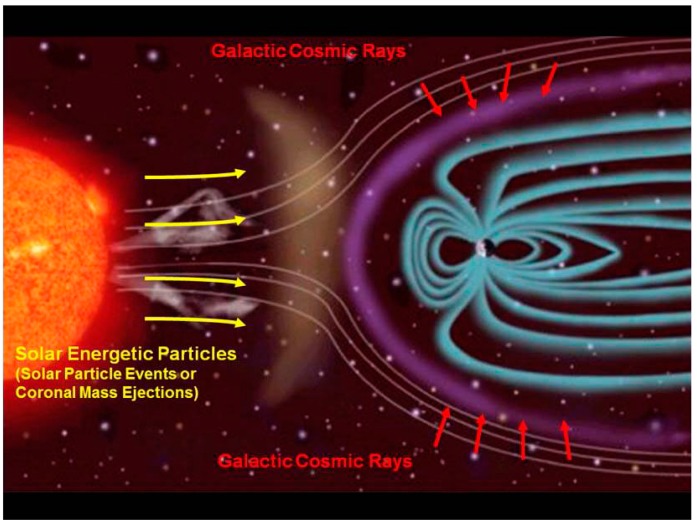
“Radiation outside of LEO is composed of a toxic milieu of GCR and particles (predominantly protons) expelled from the Sun during SPEs. This mixture of radiation modalities represents the most significant physical impediment to safe human space exploration.”
§ Space Radiation: The Number One Risk to Astronaut Health beyond Low Earth Orbit > 2. The Pernicious Interplanetary Space Radiation Environment
plaindirect- Asserted: passes — The authors put it forward as true.
- Checkable: passes — It can be checked against evidence.
- Load-bearing: passes — The paper’s conclusions depend on it.
- Based: fails — The paper may give no reason why it holds.
Probably not a substantial claim. The paper may give no reason why it holds. It may state two separate claims as one.
A conclusion the paper draws from its own results — it cites no other source for it, so there is none to check. The quote shows it is in the paper.
In the paper
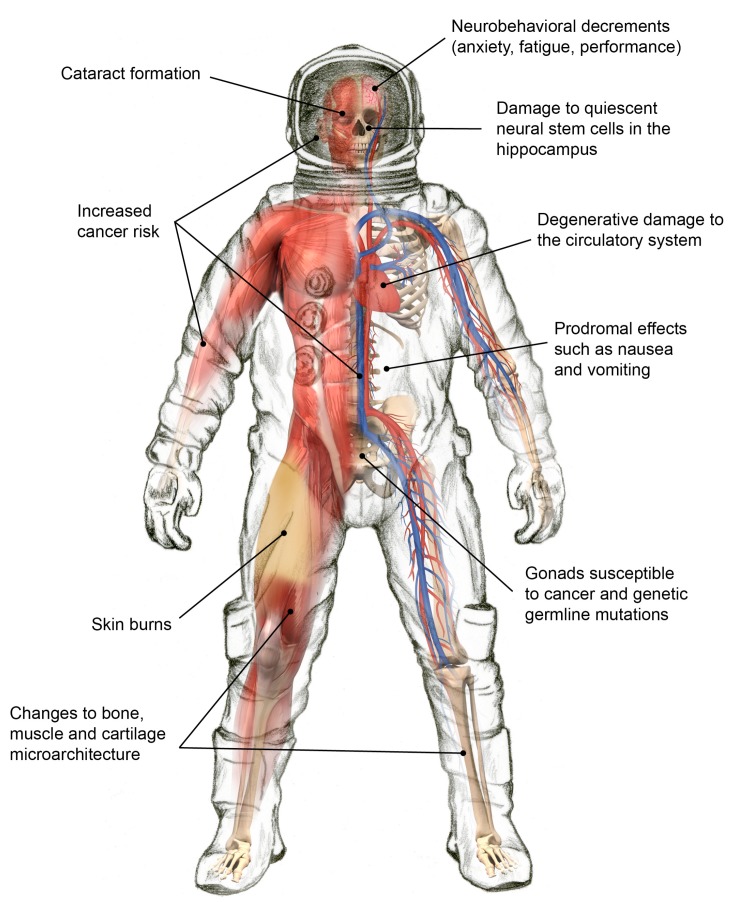
“Exposure to space radiation affects multiple organs and physiological systems in complex ways (Figure 4).”
§ Space Radiation: The Number One Risk to Astronaut Health beyond Low Earth Orbit > 3. Biomedical Consequences of Exposure to Space Radiation
plaindirect- Asserted: passes — The authors put it forward as true.
- Checkable: passes — It can be checked against evidence.
- Load-bearing: fails — The paper’s conclusions may not depend on it.
- Based: fails — The paper may give no reason why it holds.
Probably not a substantial claim. The paper’s conclusions may not depend on it. The paper may give no reason why it holds.
None of the sources cited for this claim have been checked yet.
In the paper
“Exposure to space radiation increases the risks of astronauts developing cancer, experiencing central nervous system (CNS) decrements, exhibiting degenerative tissue effects or developing acute radiation syndrome.”
§ Space Radiation: The Number One Risk to Astronaut Health beyond Low Earth Orbit > Abstract
What the sources say
- Not checked yetcites [4] Cucinotta, F.A., and Durante, M. (2013). Evidence Report: Risk of Radiation Carcinogenesis, National Aeronautical and Space Agency.
- Not checked yetcites [5] Cucinotta, F.A., Wang, H., and Huff, J.L. (2013). Evidence Report: Risk of Acute or Late Central Nervous System Effects from Radiation Exposure, National Aeronautical and Space Agency.
- Not checked yetcites [6] Wu, H., Huff, J.L., Casey, R., Kim, M.H., and Cucinotta, F.A. (2013). Evidence Report: Risk of Acute Radiation Syndromes Due to Solar Particle Events, National Aeronautical and Space Agency.
- Not checked yetcites [7] Huff, J.L., and Cucinotta, F.A. (2013). Evidence Report: Risk of Degenerative Tissue or other Health Effects from Radiation Exposure, National Aeronautical and Space Agency.
plaindirect- Asserted: passes — The authors put it forward as true.
- Checkable: passes — It can be checked against evidence.
- Load-bearing: passes — The paper’s conclusions depend on it.
- Based: passes — The paper gives a reason why it holds.
It may state two separate claims as one.
A conclusion the paper draws from its own results — it cites no other source for it, so there is none to check. The quote shows it is in the paper.
In the paper
“SPE radiation and the synergistic effects of spaceflight can place the crew at significant risk for prodromal effects (e.g., nausea and vomiting), skin injury, hematological changes and immune system dysfunction.”
§ Space Radiation: The Number One Risk to Astronaut Health beyond Low Earth Orbit > 3. Biomedical Consequences of Exposure to Space Radiation
plainconditional- Asserted: passes — The authors put it forward as true.
- Checkable: passes — It can be checked against evidence.
- Load-bearing: passes — The paper’s conclusions depend on it.
- Based: passes — The paper gives a reason why it holds.
It may state two separate claims as one.
In the paper
“Current space radiation guidelines pertain only to missions in LEO and are not considered relevant for missions beyond LEO. The acceptable levels of risk for space exploration beyond LEO have not been defined at this time and need to be dealt with before sending manned missions to colonize the moon or to deep space, such as a mission to Mars”
§ Space Radiation: The Number One Risk to Astronaut Health beyond Low Earth Orbit > 1. Introduction
What the sources say
- Not checked yetcites [2] National Council on Radiation Protection and Measurements (NCRP) (2006). Information Needed to Make Radiation Protection Recommendations for Space Missions Beyond Low-Earth Orbit, NCRP.
plain- Asserted: passes — The authors put it forward as true.
- Checkable: passes — It can be checked against evidence.
- Load-bearing: passes — The paper’s conclusions depend on it.
- Based: passes — The paper gives a reason why it holds.
It may state two separate claims as one.
A conclusion the paper draws from its own results — it cites no other source for it, so there is none to check. The quote shows it is in the paper.
In the paper
“Therefore, in spite of their low flux, HZE ions constitute a deleterious biological threat and contribute a significant amount to the cumulative GCR dose that astronauts will incur outside of LEO.”
§ Space Radiation: The Number One Risk to Astronaut Health beyond Low Earth Orbit > 2. The Pernicious Interplanetary Space Radiation Environment > 2.1. Galactic Cosmic Radiation
plaindirect- Asserted: passes — The authors put it forward as true.
- Checkable: passes — It can be checked against evidence.
- Load-bearing: passes — The paper’s conclusions depend on it.
- Based: passes — The paper gives a reason why it holds.
It may state two separate claims as one.
A conclusion the paper draws from its own results — it cites no other source for it, so there is none to check. The quote shows it is in the paper.
In the paper
“Uncertainties with respect to dose toxicity and the complex variation in SPE and GCR spectra likely to be encountered in future exploration missions underscore the need for models that are capable of identifying particle energy and species on an event-by-event basis.”
§ Space Radiation: The Number One Risk to Astronaut Health beyond Low Earth Orbit > 3. Biomedical Consequences of Exposure to Space Radiation
hedgeddirect- Asserted: passes — The authors put it forward as true.
- Checkable: fails — It may be too vague to check against evidence.
- Load-bearing: passes — The paper’s conclusions depend on it.
- Based: passes — The paper gives a reason why it holds.
Probably not a substantial claim. It may be too vague to check against evidence.
The paper states this without a source or data behind it here, so there is nothing to check it against. The quote shows it is in the paper.
In the paper
“The resultant radiation-induced increase in oxidative stress levels has been shown to exacerbate some degenerative tissue changes that are normally associated with aging (e.g., cardiovascular disease and cataract formation).”
§ Space Radiation: The Number One Risk to Astronaut Health beyond Low Earth Orbit > 3. Biomedical Consequences of Exposure to Space Radiation > 3.1. Degenerative Tissue Effects from Radiation Exposure
boosteddirect- Asserted: passes — The authors put it forward as true.
- Checkable: passes — It can be checked against evidence.
- Load-bearing: passes — The paper’s conclusions depend on it.
- Based: fails — The paper may give no reason why it holds.
Probably not a substantial claim. The paper may give no reason why it holds.
In the paper
“GCR ions originate from outside our solar system and contain mostly highly energetic protons and alpha particles, with a small component of high charge and energy (HZE) nuclei moving at relativistic speeds and energies [1].”
§ Space Radiation: The Number One Risk to Astronaut Health beyond Low Earth Orbit > 1. Introduction
What the sources say
- Not checked yetcites [1] Simpson, 1983, Elemental and isotopic composition of the galactic cosmic rays, Ann. Rev. Nucl. Part. Sci. source
plain- Asserted: passes — The authors put it forward as true.
- Checkable: passes — It can be checked against evidence.
- Load-bearing: unclear — It is unclear whether the paper’s conclusions depend on it.
- Based: passes — The paper gives a reason why it holds.
It may state two separate claims as one.
The paper states this without a source or data behind it here, so there is nothing to check it against. The quote shows it is in the paper.
In the paper
“In addition to GCR, unpredictable and intermittent solar particle events (SPEs) can produce large plasma clouds containing highly energetic protons and some heavy ions that may cause a rapid surge of radiation both outside and within a spacecraft (Figure 1).”
§ Space Radiation: The Number One Risk to Astronaut Health beyond Low Earth Orbit > 1. Introduction
hedgedconditional- Asserted: passes — The authors put it forward as true.
- Checkable: passes — It can be checked against evidence.
- Load-bearing: fails — The paper’s conclusions may not depend on it.
- Based: fails — The paper may give no reason why it holds.
Probably not a substantial claim. The paper’s conclusions may not depend on it. The paper may give no reason why it holds.
A conclusion the paper draws from its own results — it cites no other source for it, so there is none to check. The quote shows it is in the paper.
In the paper
“Created by passing through spacecraft shielding, these fission products can deliver a significant fraction of the total mission dose and have the ability to damage critical cellular components when passing through the tissues of the body.”
§ Space Radiation: The Number One Risk to Astronaut Health beyond Low Earth Orbit > 2. The Pernicious Interplanetary Space Radiation Environment > 2.3. Intravehicular Radiation
plaindirect- Asserted: passes — The authors put it forward as true.
- Checkable: passes — It can be checked against evidence.
- Load-bearing: fails — The paper’s conclusions may not depend on it.
- Based: fails — The paper may give no reason why it holds.
Probably not a substantial claim. The paper’s conclusions may not depend on it. The paper may give no reason why it holds. It may state two separate claims as one.
The paper states this without a source or data behind it here, so there is nothing to check it against. The quote shows it is in the paper.
In the paper
“The interaction of energetic SPE protons and heavy-charged GCR particles with the spacecraft structure can produce an additional, secondary intravehicular radiation hazard.”
§ Space Radiation: The Number One Risk to Astronaut Health beyond Low Earth Orbit > 2. The Pernicious Interplanetary Space Radiation Environment > 2.3. Intravehicular Radiation
plaindirect- Asserted: passes — The authors put it forward as true.
- Checkable: passes — It can be checked against evidence.
- Load-bearing: fails — The paper’s conclusions may not depend on it.
- Based: fails — The paper may give no reason why it holds.
Probably not a substantial claim. The paper’s conclusions may not depend on it. The paper may give no reason why it holds.
A conclusion the paper draws from its own results — it cites no other source for it, so there is none to check. The quote shows it is in the paper.
In the paper
“Furthermore, the interpretation of animal-based CNS studies that model the space radiation environment is limited and confounds the development of mitigation strategies and countermeasures.”
§ Space Radiation: The Number One Risk to Astronaut Health beyond Low Earth Orbit > 3. Biomedical Consequences of Exposure to Space Radiation > 3.3. Acute and Late CNS Effects from Radiation Exposure
plaindirect- Asserted: passes — The authors put it forward as true.
- Checkable: passes — It can be checked against evidence.
- Load-bearing: fails — The paper’s conclusions may not depend on it.
- Based: fails — The paper may give no reason why it holds.
Probably not a substantial claim. The paper’s conclusions may not depend on it. The paper may give no reason why it holds.
None of the sources cited for this claim have been checked yet.
In the paper
“However, interpretation of these studies is limited by significant individual variability and insufficient statistical power [37,38,39,40].”
§ Space Radiation: The Number One Risk to Astronaut Health beyond Low Earth Orbit > 3. Biomedical Consequences of Exposure to Space Radiation > 3.2. Radiation Carcinogenesis
What the sources say
- Not checked yetcites [37] Durante, 2003, Chromosome aberration dosimetry in cosmonauts after single or multiple space flights, Cytogenet. Genome Res. source
- Not checked yetcites [38] George, 2001, Chromosome aberrations in the blood lymphocytes of astronauts after space flight, Radiat. Res. source
- Not checked yetcites [39] George, 2004, Chromosome aberrations of clonal origin are present in astronauts’ blood lymphocytes, Cytogenet. Genome Res. source
- Not checked yetcites [40] Horstman, 2005, Space radiation does not induce a significant increase of intrachromosomal exchanges in astronauts’ lymphocytes, Radiat. Environ. Biophys. source
plain- Asserted: passes — The authors put it forward as true.
- Checkable: passes — It can be checked against evidence.
- Load-bearing: passes — The paper’s conclusions depend on it.
- Based: passes — The paper gives a reason why it holds.
It may state two separate claims as one.
In the paper
“It still remains to be determined whether the higher doses of radiation incurred during future exploration class missions beyond LEO will increase the threat of cancer for astronaut crews [4].”
§ Space Radiation: The Number One Risk to Astronaut Health beyond Low Earth Orbit > 3. Biomedical Consequences of Exposure to Space Radiation > 3.2. Radiation Carcinogenesis
What the sources say
- Not checked yetcites [4] Cucinotta, F.A., and Durante, M. (2013). Evidence Report: Risk of Radiation Carcinogenesis, National Aeronautical and Space Agency.
hedgedconditional- Asserted: passes — The authors put it forward as true.
- Checkable: passes — It can be checked against evidence.
- Load-bearing: passes — The paper’s conclusions depend on it.
- Based: passes — The paper gives a reason why it holds.
Probably not a substantial claim.
A conclusion the paper draws from its own results — it cites no other source for it, so there is none to check. The quote shows it is in the paper.
In the paper
“During long-duration exploration missions beyond LEO, it is anticipated that multiple SPEs will be encountered.”
§ Space Radiation: The Number One Risk to Astronaut Health beyond Low Earth Orbit > 3. Biomedical Consequences of Exposure to Space Radiation > 3.4. Radiation Syndromes Due to SPEs
hedged- Asserted: passes — The authors put it forward as true.
- Checkable: passes — It can be checked against evidence.
- Load-bearing: passes — The paper’s conclusions depend on it.
- Based: fails — The paper may give no reason why it holds.
Probably not a substantial claim. The paper may give no reason why it holds.
None of the sources cited for this claim have been checked yet.
In the paper
“Ionizing radiation can damage the CNS, causing changes to cognitive function, inducing fatigue, and generating performance decrements [2,30,42,43,44,45,46,47,48,49,50,51].”
§ Space Radiation: The Number One Risk to Astronaut Health beyond Low Earth Orbit > 3. Biomedical Consequences of Exposure to Space Radiation > 3.3. Acute and Late CNS Effects from Radiation Exposure
What the sources say
- Not checked yetcites [2] National Council on Radiation Protection and Measurements (NCRP) (2006). Information Needed to Make Radiation Protection Recommendations for Space Missions Beyond Low-Earth Orbit, NCRP.
- Not checked yetcites [30] National Research Council (1990). Health Effects of Exposure to Low Levels of Ionizing Radiation: Beir V, The National Academies Press.
- Not checked yetcites [42] Butler, 2006, Neurocognitive effects of treatment for childhood cancer, Ment. Retard. Dev. Disabil. Res. Rev. source
- Not checked yetcites [43] Castro, 1985, Current considerations in heavy charged-particle radiotherapy: A clinical research trial of the university of california lawrence berkeley laboratory, northern california oncology group, and radiation therapy oncology group, Radiat. Res. Suppl. source
- Not checked yetcites [44] Fabrikant, 1985, Heavy charged-particle bragg peak radiosurgery for intracranial vascular disorders, Radiat. Res. Suppl. source
- Not checked yetcites [45] Napolitano, 1998, Neurological complications of radiotherapy and chemotherapy, J. Neurol. source
- Not checked yetcites [46] Kjellberg, 1983, Bragg-peak proton-beam therapy for arteriovenous malformations of the brain, N. Engl. J. Med. source
- Not checked yetcites [47] Levy, 1989, Stereotactic heavy-charged-particle bragg peak radiosurgery for the treatment of intracranial arteriovenous malformations in childhood and adolescence, Neurosurgery source
- Not checked yetcites [48] Schultheiss, 1995, Radiation response of the central nervous system, Int. J. Radiat. Oncol. Biol. Phys. source
- Not checked yetcites [49] Steinberg, 1990, Stereotactic heavy-charged-particle bragg-peak radiation for intracranial arteriovenous malformations, N. Engl. J. Med. source
plaindirect- Asserted: passes — The authors put it forward as true.
- Checkable: passes — It can be checked against evidence.
- Load-bearing: passes — The paper’s conclusions depend on it.
- Based: passes — The paper gives a reason why it holds.
It may state two separate claims as one.
A conclusion the paper draws from its own results — it cites no other source for it, so there is none to check. The quote shows it is in the paper.
In the paper
“Moreover, a second spaceflight apparently does not proportionately increase the yield of aberrations, suggesting a non-additive or even an infra-additive effect, raising the possibility of a radio-adaptive response in crewmembers (i.e., “radiation hormesis”).”
§ Space Radiation: The Number One Risk to Astronaut Health beyond Low Earth Orbit > 3. Biomedical Consequences of Exposure to Space Radiation > 3.1. Degenerative Tissue Effects from Radiation Exposure
hedgedconditional- Asserted: passes — The authors put it forward as true.
- Checkable: passes — It can be checked against evidence.
- Load-bearing: fails — The paper’s conclusions may not depend on it.
- Based: passes — The paper gives a reason why it holds.
Probably not a substantial claim. The paper’s conclusions may not depend on it. It may state two separate claims as one.
A conclusion the paper draws from its own results — it cites no other source for it, so there is none to check. The quote shows it is in the paper.
In the paper
“Furthermore, there is only a small probability that low-LET radiation from SPEs will reach high enough doses to cause degenerative tissue effects.”
§ Space Radiation: The Number One Risk to Astronaut Health beyond Low Earth Orbit > 3. Biomedical Consequences of Exposure to Space Radiation > 3.1. Degenerative Tissue Effects from Radiation Exposure
hedged- Asserted: passes — The authors put it forward as true.
- Checkable: passes — It can be checked against evidence.
- Load-bearing: fails — The paper’s conclusions may not depend on it.
- Based: fails — The paper may give no reason why it holds.
Probably not a substantial claim. The paper’s conclusions may not depend on it. The paper may give no reason why it holds.
In the paper
“The linkage between DNA lesions (including point mutations, insertions and deletions, as well as intra- and inter-chromosomal rearrangements) and carcinogenesis is well-established [27].”
§ Space Radiation: The Number One Risk to Astronaut Health beyond Low Earth Orbit > 3. Biomedical Consequences of Exposure to Space Radiation > 3.1. Degenerative Tissue Effects from Radiation Exposure
What the sources say
- Not checked yetcites [27] National Council on Radiation Protection and Measurements (NCRP) (2010). Potential Impact of Individual Genetic Susceptibility and Previous Radiation Exposure on Radiation Risk for Astronauts, NCRP.
boostedcorrelational- Asserted: passes — The authors put it forward as true.
- Checkable: passes — It can be checked against evidence.
- Load-bearing: fails — The paper’s conclusions may not depend on it.
- Based: passes — The paper gives a reason why it holds.
Probably not a substantial claim. The paper’s conclusions may not depend on it.
A conclusion the paper draws from its own results — it cites no other source for it, so there is none to check. The quote shows it is in the paper.
In the paper
“The veracity of data obtained and the reliability of conclusions drawn from ground-based studies using model organisms will benefit substantially from accurately simulating combined exposures to both protons and heavy ions sources.”
§ Space Radiation: The Number One Risk to Astronaut Health beyond Low Earth Orbit > 6. Conclusions
plainconditional- Asserted: passes — The authors put it forward as true.
- Checkable: fails — It may be too vague to check against evidence.
- Load-bearing: passes — The paper’s conclusions depend on it.
- Based: fails — The paper may give no reason why it holds.
Probably not a substantial claim. It may be too vague to check against evidence. The paper may give no reason why it holds.
A conclusion the paper draws from its own results — it cites no other source for it, so there is none to check. The quote shows it is in the paper.
In the paper
“Space radiation is the number one risk to astronaut health on extended space exploration missions beyond the Earth’s magnetosphere.”
§ Space Radiation: The Number One Risk to Astronaut Health beyond Low Earth Orbit > 6. Conclusions
plain- Asserted: passes — The authors put it forward as true.
- Checkable: passes — It can be checked against evidence.
- Load-bearing: passes — The paper’s conclusions depend on it.
- Based: fails — The paper may give no reason why it holds.
Probably not a substantial claim. The paper may give no reason why it holds.
None of the sources cited for this claim have been checked yet.
In the paper
“In general, animal experiments have contributed significantly to our understanding of the mechanisms of disease, but their value in predicting the effectiveness of treatment strategies has limitations [80,81,82].”
§ Space Radiation: The Number One Risk to Astronaut Health beyond Low Earth Orbit > 5. Research Considerations > 5.2. Selection of Appropriate Animal Models
What the sources say
- Not checked yetcites [80] Hackam, 2006, Translation of research evidence from animals to humans, JAMA source
- Not checked yetcites [81] Perel, P., Roberts, I., Sena, E., Wheble, P., Briscoe, C., Sandercock, P., Macleod, M., Mignini, L.E., Jayaram, P., and Khan, K.S. (2007). Comparison of treatment effects between animal experiments and clinical trials: Systematic review. BMJ, 334. source
- Not checked yetcites [82] Hackam, D.G. (2007). Translating animal research into clinical benefit. BMJ, 334. source
plaindirect- Asserted: passes — The authors put it forward as true.
- Checkable: passes — It can be checked against evidence.
- Load-bearing: fails — The paper’s conclusions may not depend on it.
- Based: passes — The paper gives a reason why it holds.
Probably not a substantial claim. The paper’s conclusions may not depend on it.
A conclusion the paper draws from its own results — it cites no other source for it, so there is none to check. The quote shows it is in the paper.
In the paper
“The ability of humans to realize our potential by becoming a multi-planet species will hinge on, to a large extent, our ability to appropriately understand, manage, mitigate and overcome the significant dangers and health effects of space radiation.”
§ Space Radiation: The Number One Risk to Astronaut Health beyond Low Earth Orbit > 6. Conclusions
plainconditional- Asserted: passes — The authors put it forward as true.
- Checkable: fails — It may be too vague to check against evidence.
- Load-bearing: passes — The paper’s conclusions depend on it.
- Based: fails — The paper may give no reason why it holds.
Probably not a substantial claim. It may be too vague to check against evidence. The paper may give no reason why it holds.
A conclusion the paper draws from its own results — it cites no other source for it, so there is none to check. The quote shows it is in the paper.
In the paper
“the selection of a single animal model for specific organ system studies may prove inadequate due to physiological interactions between organ systems that modify specific radiation toxicities.”
§ Space Radiation: The Number One Risk to Astronaut Health beyond Low Earth Orbit > 5. Research Considerations > 5.2. Selection of Appropriate Animal Models
hedgedconditional- Asserted: passes — The authors put it forward as true.
- Checkable: passes — It can be checked against evidence.
- Load-bearing: fails — The paper’s conclusions may not depend on it.
- Based: fails — The paper may give no reason why it holds.
Probably not a substantial claim. The paper’s conclusions may not depend on it. The paper may give no reason why it holds.
None of the sources cited for this claim have been checked yet.
In the paper
“Animal studies performed using a ferret model indicate that retching and vomiting occur at doses as low as 50 cGy and can be expected from SPE radiation exposure at doses up to 2 Gy [67,68].”
§ Space Radiation: The Number One Risk to Astronaut Health beyond Low Earth Orbit > 3. Biomedical Consequences of Exposure to Space Radiation > 3.4. Radiation Syndromes Due to SPEs
What the sources say
plaindirect- Asserted: passes — The authors put it forward as true.
- Checkable: passes — It can be checked against evidence.
- Load-bearing: unclear — It is unclear whether the paper’s conclusions depend on it.
- Based: passes — The paper gives a reason why it holds.
It may state two separate claims as one.
- Rests on an assumption: Astronauts performing EVAs have compromised shielding that can leave them vulnerable to the effects of unpredictable SPEs.
In the paper
“The group concluded that animal models are applicable to the following two stages of radiation research: (1) mechanisms/discovery; and (2) validation.”
§ Space Radiation: The Number One Risk to Astronaut Health beyond Low Earth Orbit > 5. Research Considerations > 5.2. Selection of Appropriate Animal Models
What the sources say
- Not checked yetcites [79] Augustine, 2005, Animal models for radiation injury, protection and therapy, Radiat. Res. source
plain- Asserted: passes — The authors put it forward as true.
- Checkable: passes — It can be checked against evidence.
- Load-bearing: fails — The paper’s conclusions may not depend on it.
- Based: passes — The paper gives a reason why it holds.
Probably not a substantial claim. The paper’s conclusions may not depend on it.
The paper relies on this without support.
The biological effects of space radiation observed in animal models can be extrapolated to human astronauts.
“These research data demonstrate that important changes to the CNS can be expected to occur at mission-relevant dose and dose rate levels.”
The paper relies on this without support.
Ground-based research studies employing model organisms can accurately mimic the biological effects of the space radiation environment if they concatenate exposures to both proton and heavy ion sources.
“ground-based research studies employing model organisms seeking to accurately mimic the biological effects of the space radiation environment must concatenate exposures to both proton and heavy ion sources.”
The paper relies on this without support.
Astronauts performing EVAs have compromised shielding that can leave them vulnerable to the effects of unpredictable SPEs.
“Astronauts performing EVAs have compromised shielding that can leave them vulnerable to the effects of unpredictable SPEs.”
The paper relies on this without support.
Fatigue has been observed in radiotherapy patients receiving therapeutic radiation doses as low as 2 Gy.
“it has been observed in radiotherapy patients receiving therapeutic radiation doses as low as 2 Gy.”
The paper relies on this without support.
Individual differences in responses to radiation exist at all levels of biological organization (molecular, cellular and tissue).
“Previous radiobiology research has shown individual differences in responses to radiation at all levels (i.e., molecular, cellular and tissue) of biological organization.”
The paper relies on this without support.
Only limited testing has occurred to study the efficacy of medical countermeasures and pharmaceuticals when radiation exposure is a concomitant and aggravating factor.
“only limited testing has occurred to study the efficacy of these measures and pharmaceuticals when radiation exposure is a concomitant and aggravating factor.”
The paper relies on this without support.
Space radiation exposures at the dose rates expected for a mission to Mars may not induce significant acute or sub-acute biological responses.
“This is tempered by evidence that space radiation exposures at the dose rates expected for a mission to Mars may not induce significant acute or sub-acute biological responses.”
The paper relies on this without support.
Some commonly-used animal models do not accurately reflect the pathologies and pathologic response (outcomes and endpoints) seen in humans.
“Some commonly-used animal models do not accurately reflect the pathologies and pathologic response (i.e., outcomes and endpoints) seen in humans”
Claims other papers make about this one
Each is checked against this paper’s own text: does it say what the citing paper says it does?
The source backs part of the claim, not all of it — or backs it for a different population, condition or comparison.
In the citing paper
“Exposure to the ionizing radiation of cosmic rays during transit as well as while on the Martian surface is also of great concern as it can result in carcinogenesis, tissue degeneration, and potentially acute radiation syndrome (Chancellor et al., 2014; Pavleti ´ c et al., 2022).”
From Cyanobacteria and microalgae in supporting human habitation on Mars (2022) · cites this paper as Chancellor et al., 2014
Experimental — accuracy not yet measuredThe source backs part of the claim, not all of it — or backs it for a different population, condition or comparison.
In the citing paper
“Research related to the radio-susceptibility of cyanobacterium species is complicated by the fact that ionizing radiation (IR) in space is complex, temporal, and comes in many wavelengths and particle sizes [103].”
From Biologically-Based and Physiochemical Life Support and In Situ Resource Utilization for Exploration of the Solar System—Reviewing the Current State and Defining Future Development Needs (2021) · cites this paper as [103]
Experimental — accuracy not yet measuredThe source backs part of the claim, not all of it — or backs it for a different population, condition or comparison.
In the citing paper
“Although this program represents a major step forward in human space exploration, the fact remains that the shielding provided by Earth’s atmosphere and magnetic field is not available beyond low Earth orbit (LEO) and astronauts will have to contend with exposure to the compositionally complex, spatially and temporally variable space radiation environment, introducing critical risks to crew health”
From First evaluation of wearable radiation protection for human deep space exploration, as flown on Artemis I (2026) · cites this paper as [2]
Experimental — accuracy not yet measuredThe source backs part of the claim, not all of it — or backs it for a different population, condition or comparison.
In the citing paper
“The secondary spectrum reaching the Martian surface includes high LET low energy protons, neutrons and α-particles as well as penetrating high energy γ-rays (Chancellor et al., 2014).”
From Medical countermeasures for the hematopoietic-subsyndrome of acute radiation syndrome in space (2022) · cites this paper as Chancellor et al., 2014
Experimental — accuracy not yet measuredThe source backs part of the claim, not all of it — or backs it for a different population, condition or comparison.
In the citing paper
“On the other hand, the atmosphere layer is thick enough to generate secondary particles from nuclear interactions of energetic protons from solar events and heavy-charged GCR particles with atmospheric atoms and molecules.”
From Medical countermeasures for the hematopoietic-subsyndrome of acute radiation syndrome in space (2022) · cites this paper as Chancellor et al., 2014
Experimental — accuracy not yet measured
The source backs part of the claim, not all of it — or backs it for a different population, condition or comparison.
In the citing paper
“The Moon has neither a protective magnetic field nor an atmosphere; therefore, particles of solar or galactic origin reach the lunar surface unattenuated (Chancellor et al., 2014).”
From Medical countermeasures for the hematopoietic-subsyndrome of acute radiation syndrome in space (2022) · cites this paper as Chancellor et al., 2014
Experimental — accuracy not yet measured
Citations
Cites
Sleep Deprivation and Vigilant Attention
Lim, J., & Dinges, D. F. (2008) · Annals of the New York Academy of Sciences · doi:10.1196/annals.1417.002 · Cited by 1,213
Preston, D. L., Shimizu, Y., Pierce, D. A., Suyama, A., & Mabuchi, K. (2003) · Radiation Research · doi:10.1667/rr3049 · Cited by 1,172
Darby, S. C., McGale, P., Taylor, C. W., & Peto, R. (2005) · The Lancet Oncology · doi:10.1016/s1470-2045(05)70251-5 · Cited by 1,049
Comparison of Treatment Effects between Animal Experiments and Clinical Trials: Systematic Review
Perel, P., Roberts, I., Sena, E., Wheble, P., Briscoe, C., Sandercock, P., Macleod, M., Mignini, L. E., Jayaram, P., & Khan, K. S. (2007) · BMJ · doi:10.1136/bmj.39048.407928.be · Cited by 827
Translation of Research Evidence From Animals to Humans
Hackam, D. G., & Redelmeier, D. A. (2006) · JAMA · doi:10.1001/jama.296.14.1731 · Cited by 733
Elemental and isotopic composition of the galactic cosmic rays
Simpson, J. A. (1983) · Annual Review of Nuclear and Particle Science · doi:10.1146/annurev.ns.33.120183.001543 · Cited by 724
Radiation response of the central nervous system
Schultheiss, T. E., Kun, L. E., Ang, K. K., & Stephens, L. C. (1995) · International Journal of Radiation Oncology*Biology*Physics · doi:10.1016/0360-3016(94)00655-5 · Cited by 653
Measurements of energetic particle radiation in transit to Mars on the Mars Science Laboratory
Zeitlin, C., Hassler, D. M., Cucinotta, F. A., Ehresmann, B., Wimmer-Schweingruber, R. F., Brinza, D. E., Kang, S., Weigle, G., Böttcher, S., Böhm, E., et al. (2013) · Science · doi:10.1126/science.1235989 · Cited by 641 · cited 9×
“Future human spaceflight missions potentially include Moon bases, rendezvous with a near-Earth object (NEO), such as an asteroid, and, eventually, habitations on the surface of Mars.”
BackgroundInfluentialBragg-peak proton-beam therapy for arteriovenous malformations of the brain
Kjellberg, R. N., Hanamura, T., Davis, K. R., Lyons, S. L., & Adams, R. D. (1983) · New England Journal of Medicine · doi:10.1056/nejm198308043090503 · Cited by 540
The Radioresponse of the Central Nervous System: A Dynamic Process
Tofilon, P. J., & Fike, J. R. (2000) · Radiation Research · doi:10.1667/0033-7587(2000)153[0357:trotcn]2.0.co;2 · Cited by 527
Research works printed but not linked: 5
- Committee on the Evaluation of Radiation Shielding for Space Exploration, Aeronautics and Space Engineering Board, Division on Engineering and Physical Sciences, and National Research Council (2008). Managing Space Radiation Risk in the New Era of Space Exploration, National Academies Press.
- National Research Council (1973). Hze-Particle Effects in Manned Spaceflight, The National Academies Press.
- National Research Council (1996). Radiation Hazards to Crews of Interplanetary Missions:Biological Issues and Research Strategies, The National Academies Press.
- Davis, C.M., Roma, P.G., Brady, J.V., and Hienz, R.D. (2011, January 11–15). Neurobehavioral effects of space radiation on choice impulsivity. Proceedings of the 18th Biannual Meeting of the International Academy of Astronautics’ Humans in Space Symposium, Houston, TX, USA.
- Hienz, R.D., Davis, C.M., Weed, M.R., Guida, P.M., Gooden, V.L., Brady, J.V., and Roma, P.G. (2011, January 11–15). Neurobehavioral effects of space radiation on psychomotor vigilance and reaction time tests. Proceedings of the 18th Biannual Meeting of the International Academy of Astronautics’ Humans in Space Symposium, Houston, TX, USA.
Cited by
Sorted by citations
Fundamental Biological Features of Spaceflight: Advancing the Field to Enable Deep-Space Exploration
Afshinnekoo, E., Scott, R. T., MacKay, M. J., Pariset, E., Cekanaviciute, E., Barker, R. J., Gilroy, S., Hassane, D. C., Smith, S. M., Zwart, S. R., et al. (2020) · Cell · doi:10.1016/j.cell.2020.10.050 · Cited by 496
Tinganelli, W., & Durante, M. (2020) · Cancers · doi:10.3390/cancers12103022 · Cited by 279
Delp, M. D., Charvat, J. M., Limoli, C. L., Globus, R. K., & Ghosh, P. (2016) · Scientific Reports · doi:10.1038/srep29901 · Cited by 232
Limitations in predicting the space radiation health risk for exploration astronauts
Chancellor, J. C., Blue, R. S., Cengel, K. A., Auñón-Chancellor, S. M., Rubins, K. H., Katzgraber, H. G., & Kennedy, A. R. (2018) · npj Microgravity · doi:10.1038/s41526-018-0043-2 · Cited by 183
Self-citationHodkinson, P. D., Anderton, R. A., Posselt, B. N., & Fong, K. J. (2017) · British Journal of Anaesthesia · doi:10.1093/bja/aex336 · Cited by 173
Metadata
- Authors
- Chancellor, J., Scott, G., & Sutton, J.
- Affiliations
- National Space Biomedical Research Institute (US)
- Corresponding author
- Sutton, Jeffrey
- Venue
- Life
- Publisher
- MDPI AG
- Published
- 2014-09-11
- Volume
- 4
- Issue
- 3
- Pages
- 491-510
- ISSN
- 2075-1729 (ISSN-L)
- PMC
- PMC4206856
- OpenAlex
- W2017290871
- Semantic Scholar
- 0dae08815aba61fd12b71ab76d84c5815b55323d
- Cited by
- 455
- References
- 69
- Citations by year
- 2026: 42 · 2025: 64 · 2024: 65 · 2023: 37 · 2022: 49 · 2021: 64 · 2020: 36 · 2019: 25 · 2018: 34 · 2017: 20 · 2016: 14 · 2015: 5
- FWCI
- 1.53
- Type
- journal article
- Language
- en
- Open access
- gold
- doi.org
- Licence
- Locations
- Life (publishedVersion, cc-by)
- Europe PMC (PubMed Central) (publishedVersion, cc-by)
- PubMed Central (publishedVersion, cc-by)
- PubMed (publishedVersion)
- Civil War Book Review (submittedVersion, cc-by)
- Civil War Book Review (submittedVersion)
- DOAJ (DOAJ: Directory of Open Access Journals) (submittedVersion, cc-by-sa)
- Funders
- National Space Biomedical Research Institute (NCC 9-58)
- Baylor College of Medicine (Friedkin Chair for Research in Sensory System Integration and Space Medicine)
- Topics
- Health Sciences › Medicine › Physiology (medical) › Spaceflight effects on biology
- Health Sciences › Medicine › Radiology, Nuclear Medicine and Imaging › Effects of Radiation Exposure
- Physical Sciences › Physics and Astronomy › Radiation › Radiation Therapy and Dosimetry
- Keywords
- space radiation, astronaut health, galactic cosmic rays, solar energetic particle events, radiation-induced cancer, radiation sickness, radiation shielding, Mars missions, model organisms, omics, long-duration spaceflight
About these checks
Registry, retraction, Cites and statistics results are computed, not judged, with one exception: a printed reference that no index lists is read once by a model before it counts as a citation error. Claims are extracted by a model and kept only when their quote appears verbatim in the text; each cited source is then checked, with a model’s help, for whether it says what the claim relies on. Those verdicts can be wrong — read the claim’s quote and the cited source before relying on one.
A language model drew the claims from the paper on 2026-10-10, under version 3 of the claim definition (model deepseek-v4.1-flash, prompt extract-v3).
A second model labelled each claim on 2026-10-10 (model jev-1.13-20260917, definition revision gold-guideline-v0.2).
Statistics and arithmetic are recomputed, not judged.
Confidence bands are shown only for fields calibrated on our annotated test set. None is calibrated yet, so no band is shown.
What counts as a claim ›How we measure confidence ›How we check this ›
Are you an author, or do you see a problem with this page? Request a review
