

The DOI matches its Crossref record; 71 of the 71 references it cites were found in a registry or an index; none of the 71 sources its claims cite is checked for support yet.
Republished study: long-term toxicity of a Roundup herbicide and a Roundup-tolerantgenetically modified maize
Open accessAbstract
BACKGROUND: The health effects of a Roundup-tolerant NK603 genetically modified (GM) maize (from 11% in the diet), cultivated with or without Roundup application and Roundup alone (from 0.1 ppb of the full pesticide containing glyphosate and adjuvants) in drinking water, were evaluated for 2 years in rats. This study constitutes a follow-up investigation of a 90-day feeding study conducted by Monsanto in order to obtain commercial release of this GMO, employing the same rat strain and analyzing biochemical parameters on the same number of animals per group as our investigation. Our research represents the first chronic study on these substances, in which all observations including tumors are reported chronologically. Thus, it was not designed as a carcinogenicity study. We report the major findings with 34 organs observed and 56 parameters analyzed at 11 time points for most organs. RESULTS: Biochemical analyses confirmed very significant chronic kidney deficiencies, for all treatments and both sexes; 76% of the altered parameters were kidney-related. In treated males, liver congestions and necrosis were 2.5 to 5.5 times higher. Marked and severe nephropathies were also generally 1.3 to 2.3 times greater. In females, all treatment groups showed a two- to threefold increase in mortality, and deaths were earlier. This difference was also evident in three male groups fed with GM maize. All results were hormone- and sex-dependent, and the pathological profiles were comparable. Females developed large mammary tumors more frequently and before controls; the pituitary was the second most disabled organ; the sex hormonal balance was modified by consumption of GM maize and Roundup treatments. Males presented up to four times more large palpable tumors starting 600 days earlier than in the control group, in which only one tumor was noted. These results may be explained by not only the non-linear endocrine-disrupting effects of Roundup but also by the overexpression of the EPSPS transgene or other mutational effects in the GM maize and their metabolic consequences. CONCLUSION: Our findings imply that long-term (2 year) feeding trials need to be conducted to thoroughly evaluate the safety of GM foods and pesticides in their full commercial formulations.
Overview
AI snapshot
Written from the paper’s full text.
TL;DR
This 2-year rat feeding study reports that NK603 GM maize, with or without Roundup, and Roundup alone at low doses produced chronic kidney and liver pathology, hormone-dependent tumors, and increased mortality compared with controls. The authors conclude that long-term feeding trials are needed to evaluate GM foods and complete pesticide formulations.
Key findings
- Biochemical analyses found chronic kidney deficiencies across all treatments and both sexes; 76% of altered parameters were kidney-related, including 82% in treated females and 87% in GM maize-treated males.
- In treated males, liver congestions and necrosis were 2.5 to 5.5 times higher than controls; Gamma GT hepatic activity increased up to 5.4 times in GMO + R groups, and cytochrome P450 activity increased up to 5.7 times at the highest dose.
- Females in all treatment groups showed a two- to threefold increase in mortality, with earlier deaths; maximum differences included five times more male deaths by month 17 in the 11% GM maize group and six times greater female mortality by month 21 on 22% GM maize with or without R.
- Females developed large mammary tumors more frequently and earlier: by month 24, 50% to 80% of treated females had tumors versus 30% of controls, and R groups had 80% affected; mammary tumor incidence was significantly increased at the lowest R dose versus controls (p < 0.05, Kruskal-Wallis with Dunn’s test). Males had up to four times more large palpable tumors starting 600 days earlier than controls, in which only one tumor was noted.
Methods
- Two-year chronic toxicity study in Sprague-Dawley rats: 100 males and 100 females, 10 per group per sex, fed NK603 GM maize at 11%, 22%, or 33% with or without Roundup, or given Roundup in drinking water at 0.1 ppb, 0.09%, or 0.5%, alongside isogenic maize controls.
- Observations included 34 organs and 56 parameters analyzed at 11 time points for most organs, with blood and urine biochemistry, histology, electron microscopy, organ weights, and tumor monitoring.
- Biochemical data were analyzed by OPLS-DA using models with R2(Y) ≥ 80% and Q2(Y) ≥ 60%, with discriminant variables at 99% confidence; mammary tumor differences used Kruskal-Wallis followed by Dunn’s test.
Limitations
- The paper states it was not designed as a carcinogenicity study and did not use the OECD-required 50 rats per sex per group; it calls for larger cohorts to confirm or refute the tumor incidence and mortality trends.
- The authors state that further transcriptomic, proteomic, and metabolomic analyses are needed to confirm endocrine and oxidative stress pathways, and that the total chemical composition of the GM maize was not measured in detail.
- Evident from the text: group sizes were 10 per sex per group, limiting statistical power, and the study relied on multivariate modeling for many biochemical comparisons rather than pairwise survival analyses such as Kaplan-Meier.
Model-written summary. Check it against the paper before relying on it.
Integrity signals
Registry
Cites
Statistics
Figures
Verification
Claims the paper makes
75 Own result · 50 Not checked yet · 18 Own method · 16 Own interpretation · 6 No basis given
A result the paper reports from its own data — it cites no other source for it, so there is none to check. The quote shows it is in the paper.
In the paper
“Marked and severe nephropathies were also generally 1.3 to 2.3 times greater.”
§ Republished study: long-term toxicity of a Roundup herbicide and a Roundup-tolerant genetically modified maize > Abstract > Results
plaincorrelational- Asserted: passes — The authors put it forward as true.
- Checkable: passes — It can be checked against evidence.
- Load-bearing: passes — The paper’s conclusions depend on it.
- Based: passes — The paper gives a reason why it holds.
A result the paper reports from its own data — it cites no other source for it, so there is none to check. The quote shows it is in the paper.
In the paper
“Ferulic acid was decreased in both GM maize and GM maize + R diets by 16% to 30% in comparison to the control diet (889 ± 107, 735 ± 89, respectively, vs. control 1,057 ± 127 mg/kg)”
§ Republished study: long-term toxicity of a Roundup herbicide and a Roundup-tolerant genetically modified maize > Results > Biochemical analyses of the maize feed
plaindirect- Asserted: passes — The authors put it forward as true.
- Checkable: passes — It can be checked against evidence.
- Load-bearing: unclear — It is unclear whether the paper’s conclusions depend on it.
- Based: passes — The paper gives a reason why it holds.
A result the paper reports from its own data — it cites no other source for it, so there is none to check. The quote shows it is in the paper.
In the paper
“For example, there was no difference in total isoflavones.”
§ Republished study: long-term toxicity of a Roundup herbicide and a Roundup-tolerant genetically modified maize > Results > Biochemical analyses of the maize feed
plain- Asserted: passes — The authors put it forward as true.
- Checkable: passes — It can be checked against evidence.
- Load-bearing: unclear — It is unclear whether the paper’s conclusions depend on it.
- Based: passes — The paper gives a reason why it holds.
A result the paper reports from its own data — it cites no other source for it, so there is none to check. The quote shows it is in the paper.
In the paper
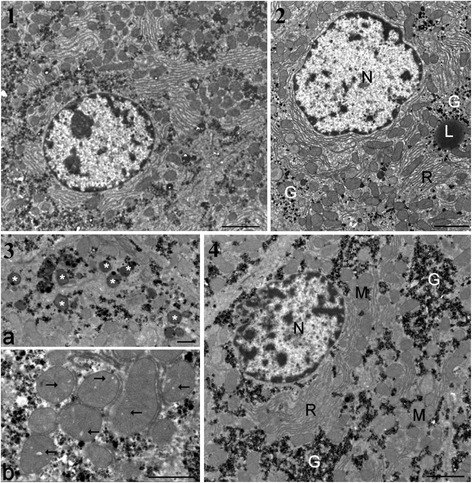
“In the R alone treatment groups, similar trends were observed, with a partial resumption of nucleolar activity at the highest dose.”
§ Republished study: long-term toxicity of a Roundup herbicide and a Roundup-tolerant genetically modified maize > Results > Anatomopathological observations and liver parameters
plaincorrelational- Asserted: passes — The authors put it forward as true.
- Checkable: passes — It can be checked against evidence.
- Load-bearing: unclear — It is unclear whether the paper’s conclusions depend on it.
- Based: passes — The paper gives a reason why it holds.
A result the paper reports from its own data — it cites no other source for it, so there is none to check. The quote shows it is in the paper.
In the paper
“In addition, by the end of the experiment, Gamma GT hepatic activity was increased, particularly in the GMO + R groups (up to 5.4 times higher), this probably being reflective of liver dysfunction.”
§ Republished study: long-term toxicity of a Roundup herbicide and a Roundup-tolerant genetically modified maize > Results > Anatomopathological observations and liver parameters
hedgeddirect- Asserted: passes — The authors put it forward as true.
- Checkable: passes — It can be checked against evidence.
- Load-bearing: passes — The paper’s conclusions depend on it.
- Based: passes — The paper gives a reason why it holds.
A result the paper reports from its own data — it cites no other source for it, so there is none to check. The quote shows it is in the paper.
In the paper
“In treated males, liver congestions and necrosis were 2.5 to 5.5 times higher.”
- Also stated in: § Anatomopathological observations and liver parameters · plain
“Liver abnormalities such as hepatic congestions and macroscopic and microscopic necrotic foci were 2.5 to 5.5 times more frequent in all treatments than in control groups, where only two rats out of ten were affected with one abnormality each.”
- Also stated in: § Anatomopathological observations and liver parameters · plain
“For instance, there were 5 abnormalities in total in the GMO 11% group (2.5 times higher than controls) and 11 in the GMO 22% group (5.5 times greater).”
§ Republished study: long-term toxicity of a Roundup herbicide and a Roundup-tolerant genetically modified maize > Abstract > Results
plaincorrelational- Asserted: passes — The authors put it forward as true.
- Checkable: passes — It can be checked against evidence.
- Load-bearing: passes — The paper’s conclusions depend on it.
- Based: passes — The paper gives a reason why it holds.
- Also stated in: § Anatomopathological observations and liver parameters · plain
A result the paper reports from its own data — it cites no other source for it, so there is none to check. The quote shows it is in the paper.
In the paper
“This difference was also evident in three male groups fed with GM maize.”
§ Republished study: long-term toxicity of a Roundup herbicide and a Roundup-tolerant genetically modified maize > Abstract > Results
plaincorrelational- Asserted: passes — The authors put it forward as true.
- Checkable: passes — It can be checked against evidence.
- Load-bearing: passes — The paper’s conclusions depend on it.
- Based: passes — The paper gives a reason why it holds.
A result the paper reports from its own data — it cites no other source for it, so there is none to check. The quote shows it is in the paper.
In the paper
“the pituitary was the second most disabled organ”
§ Republished study: long-term toxicity of a Roundup herbicide and a Roundup-tolerant genetically modified maize > Abstract > Results
plain- Asserted: passes — The authors put it forward as true.
- Checkable: passes — It can be checked against evidence.
- Load-bearing: unclear — It is unclear whether the paper’s conclusions depend on it.
- Based: passes — The paper gives a reason why it holds.
A result the paper reports from its own data — it cites no other source for it, so there is none to check. The quote shows it is in the paper.
In the paper
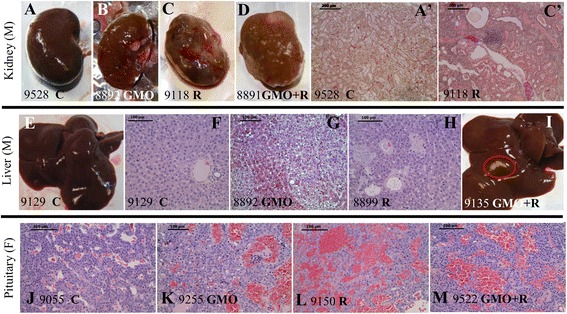
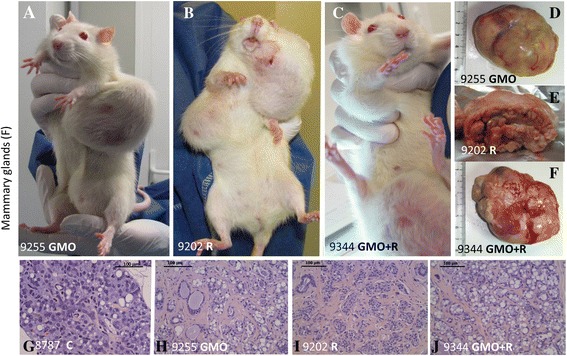
“The most affected organs in males were the liver, hepatodigestive tract, and kidneys (Table 2; Figure 1A,B,C,D,E,F,G,H,I).”
§ Republished study: long-term toxicity of a Roundup herbicide and a Roundup-tolerant genetically modified maize > Results > Anatomopathological observations and liver parameters
plain- Asserted: passes — The authors put it forward as true.
- Checkable: passes — It can be checked against evidence.
- Load-bearing: passes — The paper’s conclusions depend on it.
- Based: passes — The paper gives a reason why it holds.
A result the paper reports from its own data — it cites no other source for it, so there is none to check. The quote shows it is in the paper.
In the paper
“Degenerating kidneys with turgid inflammatory areas demonstrated the increased incidence of marked and severe chronic progressive nephropathies, which were up to two fold higher in the 33% GM maize or lowest dose R treatment groups (Table 2; Figure 1, first line).”
§ Republished study: long-term toxicity of a Roundup herbicide and a Roundup-tolerant genetically modified maize > Results > Anatomopathological observations and liver parameters
boostedcorrelational- Asserted: passes — The authors put it forward as true.
- Checkable: passes — It can be checked against evidence.
- Load-bearing: passes — The paper’s conclusions depend on it.
- Based: passes — The paper gives a reason why it holds.
A result the paper reports from its own data — it cites no other source for it, so there is none to check. The quote shows it is in the paper.
In the paper
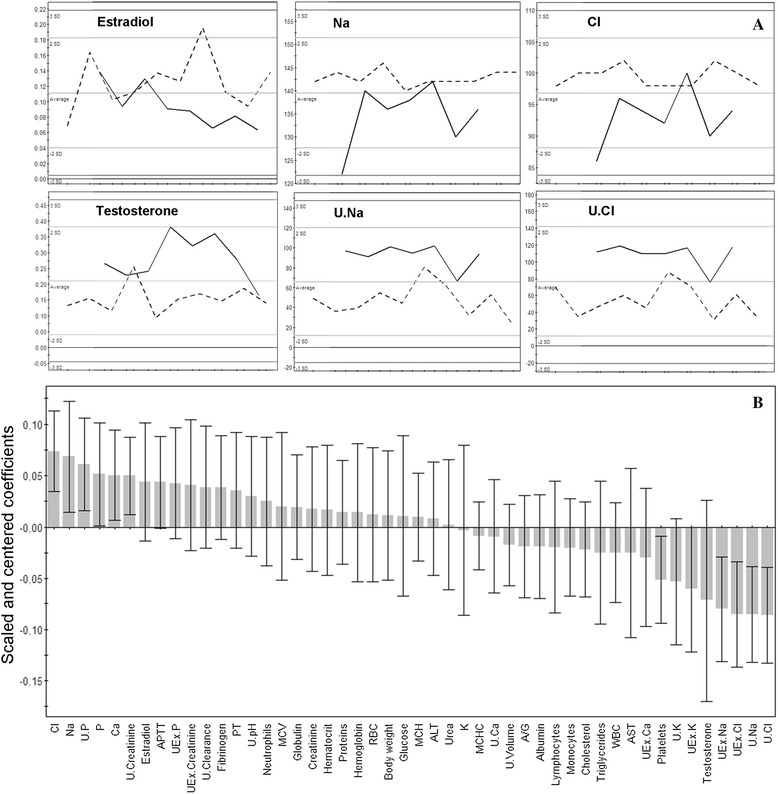
“the sex hormonal balance was modified by consumption of GM maize and Roundup treatments.”
- Also stated in: § Biochemical analyses of blood and urine samples · plain
“Profiles evidence kidney ion leakages and sex hormonal imbalance versus controls.”
§ Republished study: long-term toxicity of a Roundup herbicide and a Roundup-tolerant genetically modified maize > Abstract > Results
plaindirect- Asserted: passes — The authors put it forward as true.
- Checkable: passes — It can be checked against evidence.
- Load-bearing: passes — The paper’s conclusions depend on it.
- Based: passes — The paper gives a reason why it holds.
- Also stated in: § Biochemical analyses of blood and urine samples · plain
A result the paper reports from its own data — it cites no other source for it, so there is none to check. The quote shows it is in the paper.
In the paper
“Furthermore, cytochrome P450 activity generally increased in the presence of R (either in drinking water or in the GM maize-containing diet) according to the dose and up to 5.7 times greater at the highest dose.”
§ Republished study: long-term toxicity of a Roundup herbicide and a Roundup-tolerant genetically modified maize > Results > Anatomopathological observations and liver parameters
plaindirect- Asserted: passes — The authors put it forward as true.
- Checkable: passes — It can be checked against evidence.
- Load-bearing: passes — The paper’s conclusions depend on it.
- Based: passes — The paper gives a reason why it holds.
A result the paper reports from its own data — it cites no other source for it, so there is none to check. The quote shows it is in the paper.
In the paper
“caffeic acid in the same groups by 21% to 53% (17.5 ± 2.1, 10.3 ± 1.3 vs. control 22.1 ± 2.6 mg/kg).”
§ Republished study: long-term toxicity of a Roundup herbicide and a Roundup-tolerant genetically modified maize > Results > Biochemical analyses of the maize feed
plaindirect- Asserted: passes — The authors put it forward as true.
- Checkable: passes — It can be checked against evidence.
- Load-bearing: unclear — It is unclear whether the paper’s conclusions depend on it.
- Based: passes — The paper gives a reason why it holds.
A result the paper reports from its own data — it cites no other source for it, so there is none to check. The quote shows it is in the paper.
In the paper
“Furthermore, in females (Table 3), the androgen/estrogen balance in serum was modified by GM maize and R treatments (at least 95% confidence level, Figure 3).”
§ Republished study: long-term toxicity of a Roundup herbicide and a Roundup-tolerant genetically modified maize > Results > Biochemical analyses of blood and urine samples
plaindirect- Asserted: passes — The authors put it forward as true.
- Checkable: passes — It can be checked against evidence.
- Load-bearing: passes — The paper’s conclusions depend on it.
- Based: passes — The paper gives a reason why it holds.
A result the paper reports from its own data — it cites no other source for it, so there is none to check. The quote shows it is in the paper.
In the paper
“For male animals at the highest R treatment dose, levels of estrogens were more than doubled.”
§ Republished study: long-term toxicity of a Roundup herbicide and a Roundup-tolerant genetically modified maize > Results > Biochemical analyses of blood and urine samples
plaindirect- Asserted: passes — The authors put it forward as true.
- Checkable: passes — It can be checked against evidence.
- Load-bearing: unclear — It is unclear whether the paper’s conclusions depend on it.
- Based: passes — The paper gives a reason why it holds.
A result the paper reports from its own data — it cites no other source for it, so there is none to check. The quote shows it is in the paper.
In the paper
“These were found to be in 95% of cases non-regressive tumors (Figure 5D,E,F,G,H,I,J) and were not infectious nodules.”
§ Republished study: long-term toxicity of a Roundup herbicide and a Roundup-tolerant genetically modified maize > Results > Tumor incidence
plain- Asserted: passes — The authors put it forward as true.
- Checkable: passes — It can be checked against evidence.
- Load-bearing: passes — The paper’s conclusions depend on it.
- Based: passes — The paper gives a reason why it holds.
A result the paper reports from its own data — it cites no other source for it, so there is none to check. The quote shows it is in the paper.
In the paper
“and were not infectious nodules”
§ Republished study: long-term toxicity of a Roundup herbicide and a Roundup-tolerant genetically modified maize > Results > Tumor incidence
plain- Asserted: passes — The authors put it forward as true.
- Checkable: passes — It can be checked against evidence.
- Load-bearing: unclear — It is unclear whether the paper’s conclusions depend on it.
- Based: passes — The paper gives a reason why it holds.
A result the paper reports from its own data — it cites no other source for it, so there is none to check. The quote shows it is in the paper.
In the paper
“Surprisingly, there was also a clear trend in increased tumor incidence, especially mammary tumors in female animals, in a number of the treatment groups.”
§ Republished study: long-term toxicity of a Roundup herbicide and a Roundup-tolerant genetically modified maize > Background
boostedcorrelational- Asserted: passes — The authors put it forward as true.
- Checkable: passes — It can be checked against evidence.
- Load-bearing: passes — The paper’s conclusions depend on it.
- Based: passes — The paper gives a reason why it holds.
A result the paper reports from its own data — it cites no other source for it, so there is none to check. The quote shows it is in the paper.
In the paper
“In addition, one metastatic ovarian cystadenocarcinoma and two skin tumors were identified.”
§ Republished study: long-term toxicity of a Roundup herbicide and a Roundup-tolerant genetically modified maize > Results > Tumor incidence
plain- Asserted: passes — The authors put it forward as true.
- Checkable: passes — It can be checked against evidence.
- Load-bearing: unclear — It is unclear whether the paper’s conclusions depend on it.
- Based: passes — The paper gives a reason why it holds.
A result the paper reports from its own data — it cites no other source for it, so there is none to check. The quote shows it is in the paper.
In the paper
“Creatinine and creatinine clearance decreased in urine for all treatment groups in comparison to female controls (Table 3).”
§ Republished study: long-term toxicity of a Roundup herbicide and a Roundup-tolerant genetically modified maize > Results > Biochemical analyses of blood and urine samples
plaindirect- Asserted: passes — The authors put it forward as true.
- Checkable: passes — It can be checked against evidence.
- Load-bearing: passes — The paper’s conclusions depend on it.
- Based: passes — The paper gives a reason why it holds.
A result the paper reports from its own data — it cites no other source for it, so there is none to check. The quote shows it is in the paper.
In the paper
“Thus, in treated females, kidney failures appeared at the biochemical level (82% of the total disrupted parameters).”
§ Republished study: long-term toxicity of a Roundup herbicide and a Roundup-tolerant genetically modified maize > Results > Biochemical analyses of blood and urine samples
plaindirect- Asserted: passes — The authors put it forward as true.
- Checkable: passes — It can be checked against evidence.
- Load-bearing: passes — The paper’s conclusions depend on it.
- Based: passes — The paper gives a reason why it holds.
A result the paper reports from its own data — it cites no other source for it, so there is none to check. The quote shows it is in the paper.
In the paper
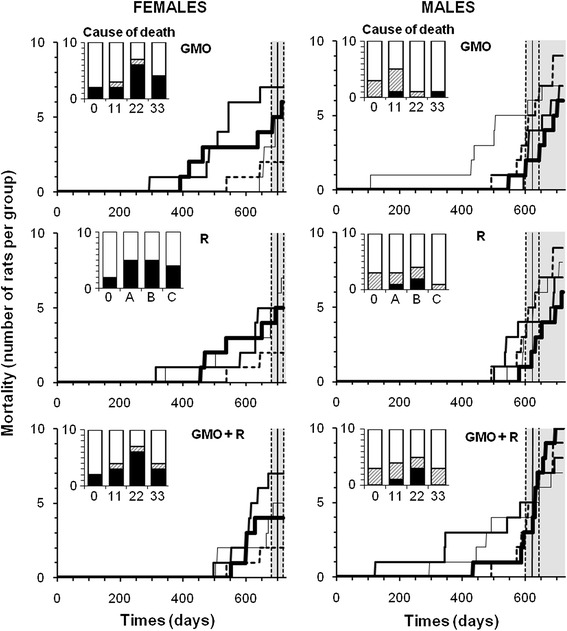
“It is noteworthy that the first two male rats that died in both GM maize-treated groups had to be euthanized due to Wilms' kidney tumors that had grown by this time to over 25% of body weight.”
§ Republished study: long-term toxicity of a Roundup herbicide and a Roundup-tolerant genetically modified maize > Results > Mortality
plainn = 2- Asserted: passes — The authors put it forward as true.
- Checkable: passes — It can be checked against evidence.
- Load-bearing: passes — The paper’s conclusions depend on it.
- Based: passes — The paper gives a reason why it holds.
A result the paper reports from its own data — it cites no other source for it, so there is none to check. The quote shows it is in the paper.
In the paper
“The second most affected organ in females was the pituitary gland, in general around two times more than in controls for most treatments (Table 2; Figure 1J,K,L,M).”
§ Republished study: long-term toxicity of a Roundup herbicide and a Roundup-tolerant genetically modified maize > Results > Tumor incidence
plaincorrelational- Asserted: passes — The authors put it forward as true.
- Checkable: passes — It can be checked against evidence.
- Load-bearing: unclear — It is unclear whether the paper’s conclusions depend on it.
- Based: passes — The paper gives a reason why it holds.
A result the paper reports from its own data — it cites no other source for it, so there is none to check. The quote shows it is in the paper.
In the paper
“Using a non-parametric multiple comparison analysis, mammary tumor incidence was significantly increased at the lowest dose of R compared to controls (p < 0.05, Kruskal-Wallis test with post hoc Dunn's test).”
§ Republished study: long-term toxicity of a Roundup herbicide and a Roundup-tolerant genetically modified maize > Results > Tumor incidence
plaindirect- Asserted: passes — The authors put it forward as true.
- Checkable: passes — It can be checked against evidence.
- Load-bearing: passes — The paper’s conclusions depend on it.
- Based: passes — The paper gives a reason why it holds.
None of the sources cited for this claim have been checked yet.
In the paper
“Our data show that the signs of liver and kidney toxicity seen at 90 days from the consumption of NK603 GM maize [3,7] do indeed escalate into severe disease over an extended period.”
§ Republished study: long-term toxicity of a Roundup herbicide and a Roundup-tolerant genetically modified maize > Discussion
What the sources say
- Not checked yetcites [3] Hammond B, Dudek R, Lemen J, Nemeth M: Results of a 13 week safety assurance study with rats fed grain fromglyphosate tolerant corn. Food Chem Toxicol 2004, 42: 1003–1014. 10.1016/j.fct.2004.02.013 source
- Not checked yetcites [7] Spiroux de Vendômois J, Roullier F, Cellier D, Seralini GE: A comparison of the effects of three GM corn varieties on mammalian health. Int J Biol Sci 2009, 5: 706–726. 10.7150/ijbs.5.706 source
boosteddirect- Asserted: passes — The authors put it forward as true.
- Checkable: passes — It can be checked against evidence.
- Load-bearing: passes — The paper’s conclusions depend on it.
- Based: passes — The paper gives a reason why it holds.
A result the paper reports from its own data — it cites no other source for it, so there is none to check. The quote shows it is in the paper.
In the paper
“However, the rate of mortality was not proportional to the treatment dose, reaching a threshold at the lowest (11%) or intermediate (22%) amounts of GM maize in the equilibrated diet, with or without the R application on the crop.”
§ Republished study: long-term toxicity of a Roundup herbicide and a Roundup-tolerant genetically modified maize > Results > Mortality
plain- Asserted: passes — The authors put it forward as true.
- Checkable: passes — It can be checked against evidence.
- Load-bearing: passes — The paper’s conclusions depend on it.
- Based: passes — The paper gives a reason why it holds.
A result the paper reports from its own data — it cites no other source for it, so there is none to check. The quote shows it is in the paper.
In the paper
“Furthermore, similar negative health effects were observed in all treatment groups (NK603 GM maize with or without R application and R alone).”
§ Republished study: long-term toxicity of a Roundup herbicide and a Roundup-tolerant genetically modified maize > Discussion
plain- Asserted: passes — The authors put it forward as true.
- Checkable: passes — It can be checked against evidence.
- Load-bearing: passes — The paper’s conclusions depend on it.
- Based: passes — The paper gives a reason why it holds.
A result the paper reports from its own data — it cites no other source for it, so there is none to check. The quote shows it is in the paper.
In the paper
“All females except one (with metastatic ovarian carcinoma) presented in addition mammary hypertrophies and in some cases hyperplasia with atypia (Table 2).”
§ Republished study: long-term toxicity of a Roundup herbicide and a Roundup-tolerant genetically modified maize > Results > Tumor incidence
plain- Asserted: passes — The authors put it forward as true.
- Checkable: passes — It can be checked against evidence.
- Load-bearing: passes — The paper’s conclusions depend on it.
- Based: passes — The paper gives a reason why it holds.
A result the paper reports from its own data — it cites no other source for it, so there is none to check. The quote shows it is in the paper.
In the paper
“What is also evident from our data is that ill effects were not proportional to the dose of either the NK603 GM maize ± R or R alone.”
§ Republished study: long-term toxicity of a Roundup herbicide and a Roundup-tolerant genetically modified maize > Discussion
plain- Asserted: passes — The authors put it forward as true.
- Checkable: passes — It can be checked against evidence.
- Load-bearing: passes — The paper’s conclusions depend on it.
- Based: passes — The paper gives a reason why it holds.
A result the paper reports from its own data — it cites no other source for it, so there is none to check. The quote shows it is in the paper.
In the paper
“In females, induced euthanasia due to suffering and deaths corresponded mostly to the development of large mammary tumors.”
§ Republished study: long-term toxicity of a Roundup herbicide and a Roundup-tolerant genetically modified maize > Discussion
plaincorrelational- Asserted: passes — The authors put it forward as true.
- Checkable: passes — It can be checked against evidence.
- Load-bearing: passes — The paper’s conclusions depend on it.
- Based: passes — The paper gives a reason why it holds.
A result the paper reports from its own data — it cites no other source for it, so there is none to check. The quote shows it is in the paper.
In the paper
“For all R treatment groups, 70% to 80% of animals presented 1.4 to 2.4 times more abnormalities in this organ than controls.”
§ Republished study: long-term toxicity of a Roundup herbicide and a Roundup-tolerant genetically modified maize > Results > Tumor incidence
plaincorrelational- Asserted: passes — The authors put it forward as true.
- Checkable: passes — It can be checked against evidence.
- Load-bearing: passes — The paper’s conclusions depend on it.
- Based: passes — The paper gives a reason why it holds.
A result the paper reports from its own data — it cites no other source for it, so there is none to check. The quote shows it is in the paper.
In the paper
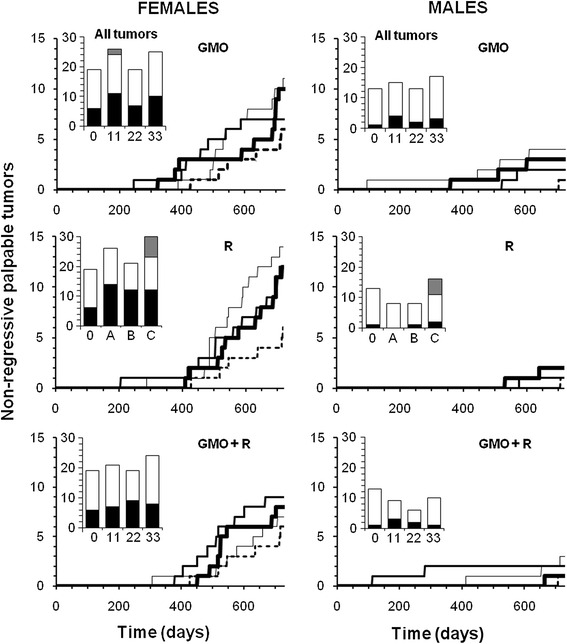
“The large palpable tumors in males (in kidney and mostly skin) were by the end of the experimental period on average twice as frequent as in controls, in which only one skin fibroma appeared during the 23rd month.”
§ Republished study: long-term toxicity of a Roundup herbicide and a Roundup-tolerant genetically modified maize > Results > Tumor incidence
plaincorrelational- Asserted: passes — The authors put it forward as true.
- Checkable: passes — It can be checked against evidence.
- Load-bearing: passes — The paper’s conclusions depend on it.
- Based: passes — The paper gives a reason why it holds.
A result the paper reports from its own data — it cites no other source for it, so there is none to check. The quote shows it is in the paper.
In the paper
“This was approximately a year before the first control animal died.”
§ Republished study: long-term toxicity of a Roundup herbicide and a Roundup-tolerant genetically modified maize > Results > Mortality
hedgedn = 2- Asserted: passes — The authors put it forward as true.
- Checkable: passes — It can be checked against evidence.
- Load-bearing: passes — The paper’s conclusions depend on it.
- Based: passes — The paper gives a reason why it holds.
A result the paper reports from its own data — it cites no other source for it, so there is none to check. The quote shows it is in the paper.
In the paper
“This was observed independently of the cancer grade but according to impact on morbidity.”
§ Republished study: long-term toxicity of a Roundup herbicide and a Roundup-tolerant genetically modified maize > Discussion
plain- Asserted: passes — The authors put it forward as true.
- Checkable: passes — It can be checked against evidence.
- Load-bearing: unclear — It is unclear whether the paper’s conclusions depend on it.
- Based: passes — The paper gives a reason why it holds.
In the paper
“The first large detectable tumors occurred at 4 and 7 months into the study in males and females, respectively, further underlining the inadequacy of the standard 90-day feeding trials for evaluating GM crop and food toxicity [1].”
§ Republished study: long-term toxicity of a Roundup herbicide and a Roundup-tolerant genetically modified maize > Discussion
What the sources say
- Not checked yetcites [1] Seralini G-E, Mesnage R, Clair E, Gress S, de Vendomois J, Cellier D: Genetically modified crops safety assessments: present limits and possibleimprovements. Environ Sci Eur 2011, 23: 10. 10.1186/2190-4715-23-10 source
plain- Asserted: passes — The authors put it forward as true.
- Checkable: passes — It can be checked against evidence.
- Load-bearing: passes — The paper’s conclusions depend on it.
- Based: passes — The paper gives a reason why it holds.
A result the paper reports from its own data — it cites no other source for it, so there is none to check. The quote shows it is in the paper.
In the paper
“The same trend was observed in the groups receiving R in their drinking water (Figure 4, R treatment panels).”
§ Republished study: long-term toxicity of a Roundup herbicide and a Roundup-tolerant genetically modified maize > Results > Tumor incidence
plaincorrelational- Asserted: passes — The authors put it forward as true.
- Checkable: passes — It can be checked against evidence.
- Load-bearing: passes — The paper’s conclusions depend on it.
- Based: passes — The paper gives a reason why it holds.
A result the paper reports from its own data — it cites no other source for it, so there is none to check. The quote shows it is in the paper.
In the paper
“In conclusion, the consumption of NK603 GM maize with or without R application or R alone gave similar pathologies in male and female rats fed over a 2-year period.”
§ Republished study: long-term toxicity of a Roundup herbicide and a Roundup-tolerant genetically modified maize > Conclusions
plain- Asserted: passes — The authors put it forward as true.
- Checkable: passes — It can be checked against evidence.
- Load-bearing: passes — The paper’s conclusions depend on it.
- Based: passes — The paper gives a reason why it holds.
A result the paper reports from its own data — it cites no other source for it, so there is none to check. The quote shows it is in the paper.
In the paper
“Sex steroid levels were also modified in treated rats in our study.”
§ Republished study: long-term toxicity of a Roundup herbicide and a Roundup-tolerant genetically modified maize > Discussion
plaindirect- Asserted: passes — The authors put it forward as true.
- Checkable: passes — It can be checked against evidence.
- Load-bearing: passes — The paper’s conclusions depend on it.
- Based: passes — The paper gives a reason why it holds.
A result the paper reports from its own data — it cites no other source for it, so there is none to check. The quote shows it is in the paper.
In the paper
“However, our analysis did reveal that the levels of caffeic and ferulic acids in the GM diet, which are also secondary metabolites of the plant shikimate pathway, but not always measured in regulatory tests, were significantly reduced.”
§ Republished study: long-term toxicity of a Roundup herbicide and a Roundup-tolerant genetically modified maize > Discussion
plaindirect- Asserted: passes — The authors put it forward as true.
- Checkable: passes — It can be checked against evidence.
- Load-bearing: passes — The paper’s conclusions depend on it.
- Based: passes — The paper gives a reason why it holds.
A result the paper reports from its own data — it cites no other source for it, so there is none to check. The quote shows it is in the paper.
In the paper
“All feed formulations consisted of balanced diets, chemically measured as substantially equivalent except for the transgene, with no contaminating pesticides over standard limits.”
§ Republished study: long-term toxicity of a Roundup herbicide and a Roundup-tolerant genetically modified maize > Methods > Plants, diets, and chemicals
plain- Asserted: passes — The authors put it forward as true.
- Checkable: passes — It can be checked against evidence.
- Load-bearing: passes — The paper’s conclusions depend on it.
- Based: passes — The paper gives a reason why it holds.
- Rests on an assumption: All secondary metabolites cannot be known and measured in the composition.
A result the paper reports from its own data — it cites no other source for it, so there is none to check. The quote shows it is in the paper.
In the paper
“We observed a strikingly marked induction of mammary tumors in groups administered R alone, even at the very lowest dose (50 ng/L G equivalent dilution in adjuvants).”
§ Republished study: long-term toxicity of a Roundup herbicide and a Roundup-tolerant genetically modified maize > Discussion
plaindirect- Asserted: passes — The authors put it forward as true.
- Checkable: passes — It can be checked against evidence.
- Load-bearing: passes — The paper’s conclusions depend on it.
- Based: passes — The paper gives a reason why it holds.
A result the paper reports from its own data — it cites no other source for it, so there is none to check. The quote shows it is in the paper.
In the paper
“Taken together, the significant biochemical disturbances and physiological failures documented in this work reveal the pathological effects of these GMO and R treatments in both sexes, with different amplitudes.”
§ Republished study: long-term toxicity of a Roundup herbicide and a Roundup-tolerant genetically modified maize > Conclusions
boosteddirect- Asserted: passes — The authors put it forward as true.
- Checkable: passes — It can be checked against evidence.
- Load-bearing: passes — The paper’s conclusions depend on it.
- Based: passes — The paper gives a reason why it holds.
A result the paper reports from its own data — it cites no other source for it, so there is none to check. The quote shows it is in the paper.
In the paper
“All feed formulations consisted of balanced diets, chemically measured as substantially equivalent except for the transgene, with no contaminating pesticides over standard limits.”
§ Republished study: long-term toxicity of a Roundup herbicide and a Roundup-tolerant genetically modified maize > Methods > Plants, diets, and chemicals
plain- Asserted: passes — The authors put it forward as true.
- Checkable: passes — It can be checked against evidence.
- Load-bearing: passes — The paper’s conclusions depend on it.
- Based: passes — The paper gives a reason why it holds.
A result the paper reports from its own data — it cites no other source for it, so there is none to check. The quote shows it is in the paper.
In the paper
“A limited compositional analysis showed that these biochemical pathways were not disturbed in the GM maize used in our study.”
§ Republished study: long-term toxicity of a Roundup herbicide and a Roundup-tolerant genetically modified maize > Discussion
plain- Asserted: passes — The authors put it forward as true.
- Checkable: passes — It can be checked against evidence.
- Load-bearing: passes — The paper’s conclusions depend on it.
- Based: passes — The paper gives a reason why it holds.
A result the paper reports from its own data — it cites no other source for it, so there is none to check. The quote shows it is in the paper.
In the paper
“All feed formulations consisted of balanced diets, chemically measured as substantially equivalent except for the transgene, with no contaminating pesticides over standard limits.”
§ Republished study: long-term toxicity of a Roundup herbicide and a Roundup-tolerant genetically modified maize > Methods > Plants, diets, and chemicals
plain- Asserted: passes — The authors put it forward as true.
- Checkable: passes — It can be checked against evidence.
- Load-bearing: passes — The paper’s conclusions depend on it.
- Based: passes — The paper gives a reason why it holds.
A result the paper reports from its own data — it cites no other source for it, so there is none to check. The quote shows it is in the paper.
In the paper
“Interestingly and perhaps surprisingly, in the groups of animals fed with the NK603 GM maize without R application, similar effects with respect to enhanced tumor incidence and mortality rates were observed.”
§ Republished study: long-term toxicity of a Roundup herbicide and a Roundup-tolerant genetically modified maize > Discussion
plaincorrelational- Asserted: passes — The authors put it forward as true.
- Checkable: passes — It can be checked against evidence.
- Load-bearing: passes — The paper’s conclusions depend on it.
- Based: passes — The paper gives a reason why it holds.
In the paper
“For instance, comparing the 11% GMO-treated female group to the controls, the assumption that the tumors are equally distributed is rejected with a level of significance of 0.54% with the Westlake exceedance test [67].”
§ Republished study: long-term toxicity of a Roundup herbicide and a Roundup-tolerant genetically modified maize > Discussion
What the sources say
- Not checked yetcites [67] Deheuvels P: On testing stochastic dominance by exceedance, precedence and otherdistribution-free tests, with applications. Chapter 10 in Statistical Models and Methods for Reliability and SurvivalAnalysis John Wiley & Sons 2013.
plain- Asserted: passes — The authors put it forward as true.
- Checkable: passes — It can be checked against evidence.
- Load-bearing: passes — The paper’s conclusions depend on it.
- Based: passes — The paper gives a reason why it holds.
A conclusion the paper draws from its own results — it cites no other source for it, so there is none to check. The quote shows it is in the paper.
In the paper
“implying a reduced level of mRNA and rRNA transcription.”
§ Republished study: long-term toxicity of a Roundup herbicide and a Roundup-tolerant genetically modified maize > Results > Anatomopathological observations and liver parameters
plaindirect- Asserted: passes — The authors put it forward as true.
- Checkable: passes — It can be checked against evidence.
- Load-bearing: unclear — It is unclear whether the paper’s conclusions depend on it.
- Based: passes — The paper gives a reason why it holds.
In the paper
“Adjuvants are found in groundwater [24].”
§ Republished study: long-term toxicity of a Roundup herbicide and a Roundup-tolerant genetically modified maize > Background
What the sources say
- Not checked yetcites [24] Krogh KA, Vejrup KV, Mogensen BB, Halling-Sørensen B: Liquid chromatography-mass spectrometry method to determine alcohol ethoxylatesand alkylamine ethoxylates in soil interstitial water, ground water and surfacewater samples. J Chromatogr A 2002, 957: 45–57. 10.1016/S0021-9673(02)00077-8 source
plain- Asserted: passes — The authors put it forward as true.
- Checkable: passes — It can be checked against evidence.
- Load-bearing: passes — The paper’s conclusions depend on it.
- Based: passes — The paper gives a reason why it holds.
In the paper
“Furthermore, this toxic effect was reproduced by the application of R herbicide directly to hepatocytes in culture [15].”
§ Republished study: long-term toxicity of a Roundup herbicide and a Roundup-tolerant genetically modified maize > Background
What the sources say
- Not checked yetcites [15] Malatesta M, Perdoni F, Santin G, Battistelli S, Muller S, Biggiogera M: Hepatoma tissue culture (HTC) cells as a model for investigating the effects oflow concentrations of herbicide on cell structure and function. Toxicol In Vitro 2008, 22: 1853–1860. 10.1016/j.tiv.2008.09.006 source
plaindirect- Asserted: passes — The authors put it forward as true.
- Checkable: passes — It can be checked against evidence.
- Load-bearing: unclear — It is unclear whether the paper’s conclusions depend on it.
- Based: passes — The paper gives a reason why it holds.
In the paper
“The half-life of POEA (21 to 42 days) is even longer than for G (7 to 14 days) in aquatic environments [25].”
§ Republished study: long-term toxicity of a Roundup herbicide and a Roundup-tolerant genetically modified maize > Background
What the sources say
- Not checked yetcites [25] Giesy J, Dobson S, Solomon K: Ecotoxicological risk assessment for Roundup® herbicide. In In Reviews of Environmental Contamination and Toxicology. Edited by: Ware G. Springer, New York; 2000:35–120. Reviews of Environmental Contamination and Toxicology Reviews of Environmental Contamination and Toxicology source
plain- Asserted: passes — The authors put it forward as true.
- Checkable: passes — It can be checked against evidence.
- Load-bearing: passes — The paper’s conclusions depend on it.
- Based: passes — The paper gives a reason why it holds.
None of the sources cited for this claim have been checked yet.
In the paper
“A detailed analysis of the data in the subchronic toxicity studies [2–5] has revealed statistically significant alterations in kidney and liver function that may constitute signs of the early onset of chronic toxicity.”
§ Republished study: long-term toxicity of a Roundup herbicide and a Roundup-tolerant genetically modified maize > Background
What the sources say
- Not checked yetcites [2] Domingo JL, Gine Bordonaba J: A literature review on the safety assessment of genetically modified plants. Environ Int 2011, 37: 734–742. 10.1016/j.envint.2011.01.003 source
- Not checked yetcites [3] Hammond B, Dudek R, Lemen J, Nemeth M: Results of a 13 week safety assurance study with rats fed grain fromglyphosate tolerant corn. Food Chem Toxicol 2004, 42: 1003–1014. 10.1016/j.fct.2004.02.013 source
- Not checked yetcites [4] Hammond B, Lemen J, Dudek R, Ward D, Jiang C, Nemeth M, Burns J: Results of a 90-day safety assurance study with rats fed grain from cornrootworm-protected corn. Food Chem Toxicol 2006, 44: 147–160. 10.1016/j.fct.2005.06.008 source
- Not checked yetcites [5] Hammond BG, Dudek R, Lemen JK, Nemeth MA: Results of a 90-day safety assurance study with rats fed grain from cornborer-protected corn. Food Chem Toxicol 2006, 44: 1092–1099. 10.1016/j.fct.2006.01.003 source
hedgedconditional- Asserted: passes — The authors put it forward as true.
- Checkable: passes — It can be checked against evidence.
- Load-bearing: passes — The paper’s conclusions depend on it.
- Based: passes — The paper gives a reason why it holds.
A conclusion the paper draws from its own results — it cites no other source for it, so there is none to check. The quote shows it is in the paper.
In the paper
“Thus, in the study of health effects, exposure to the diluted whole formulation may be more representative of environmental pollution than exposure to G alone.”
§ Republished study: long-term toxicity of a Roundup herbicide and a Roundup-tolerant genetically modified maize > Background
hedgedconditional- Asserted: passes — The authors put it forward as true.
- Checkable: passes — It can be checked against evidence.
- Load-bearing: passes — The paper’s conclusions depend on it.
- Based: passes — The paper gives a reason why it holds.
In the paper
“In this regard, it is noteworthy that the far greater toxicity of full agricultural formulations compared to declared supposed active principles alone has recently been demonstrated also for six other major pesticides tested in vitro [22].”
§ Republished study: long-term toxicity of a Roundup herbicide and a Roundup-tolerant genetically modified maize > Background
What the sources say
- Not checked yetcites [22] Mesnage R, Defarge N, Spiroux De Vendômois J, Séralini GE: Major pesticides are more toxic to human cells than their declared activeprinciples. Biomed Res Int 2014, Vol 2014: Article ID 179691. 10.1155/2014/179691 source
boosteddirect- Asserted: passes — The authors put it forward as true.
- Checkable: passes — It can be checked against evidence.
- Load-bearing: unclear — It is unclear whether the paper’s conclusions depend on it.
- Based: passes — The paper gives a reason why it holds.
A conclusion the paper draws from its own results — it cites no other source for it, so there is none to check. The quote shows it is in the paper.
In the paper
“As in the case of rates of mortality (Figure 6), this suggests that a threshold in effect was reached at the lower doses.”
§ Republished study: long-term toxicity of a Roundup herbicide and a Roundup-tolerant genetically modified maize > Results > Tumor incidence
hedgedconditional- Asserted: passes — The authors put it forward as true.
- Checkable: passes — It can be checked against evidence.
- Load-bearing: passes — The paper’s conclusions depend on it.
- Based: passes — The paper gives a reason why it holds.
None of the sources cited for this claim have been checked yet.
In the paper
“This included the lowest dose of R administered (0.1 ppb, 50 ng/L G equivalent) of R formulation administered, which is well below permitted MRLs in both the USA (0.7 mg/L) [33] and European Union (100 ng/L) [34].”
§ Republished study: long-term toxicity of a Roundup herbicide and a Roundup-tolerant genetically modified maize > Background
What the sources say
- Not checked yetcites [33] EPA: Basic information about glyphosate in drinking water. 2014, (lastaccess March)., [ http://www.waterepagov/drink/contaminants/basicinformation/glyphosatecfm ] EPA: Basic information about glyphosate in drinking water. 2014, (lastaccess March).
- Not checked yetcites [34] COUNCIL DIRECTIVE 98/83/EC of 3 November 1998 on the quality of water intended forhuman consumption Off J Eur Commun L 1998, 330(32):51298.
boosted- Asserted: passes — The authors put it forward as true.
- Checkable: passes — It can be checked against evidence.
- Load-bearing: passes — The paper’s conclusions depend on it.
- Based: passes — The paper gives a reason why it holds.
None of the sources cited for this claim have been checked yet.
In the paper
“After several months of consumption of an R-tolerant soy, the liver and pancreas of mice were affected, as highlighted by disturbances in sub-nuclear structure [12–14].”
§ Republished study: long-term toxicity of a Roundup herbicide and a Roundup-tolerant genetically modified maize > Background
What the sources say
- Not checked yetcites [12] Malatesta M, Boraldi F, Annovi G, Baldelli B, Battistelli S, Biggiogera M, Quaglino D: A long-term study on female mice fed on a genetically modified soybean: effects onliver ageing. Histochem Cell Biol 2008, 130: 967–977. 10.1007/s00418-008-0476-x source
- Not checked yetcites [13] Malatesta M, Caporaloni C, Gavaudan S, Rocchi MB, Serafini S, Tiberi C, Gazzanelli G: Ultrastructural morphometrical and immunocytochemical analyses of hepatocytenuclei from mice fed on genetically modified soybean. Cell Struct Funct 2002, 27: 173–180. 10.1247/csf.27.173 source
- Not checked yetcites [14] Malatesta M, Caporaloni C, Rossi L, Battistelli S, Rocchi MB, Tonucci F, Gazzanelli G: Ultrastructural analysis of pancreatic acinar cells from mice fed on geneticallymodified soybean. J Anat 2002, 201: 409–415. 10.1046/j.0021-8782.2002.00103.x source
plaindirect- Asserted: passes — The authors put it forward as true.
- Checkable: passes — It can be checked against evidence.
- Load-bearing: unclear — It is unclear whether the paper’s conclusions depend on it.
- Based: passes — The paper gives a reason why it holds.
None of the sources cited for this claim have been checked yet.
In the paper
“Our findings show that the differences in multiple organ functional parameters seen from the consumption of NK603 GM maize for 90 days [3,7] escalated over 2 years into severe organ damage in all types of test diets.”
§ Republished study: long-term toxicity of a Roundup herbicide and a Roundup-tolerant genetically modified maize > Background
What the sources say
- Not checked yetcites [3] Hammond B, Dudek R, Lemen J, Nemeth M: Results of a 13 week safety assurance study with rats fed grain fromglyphosate tolerant corn. Food Chem Toxicol 2004, 42: 1003–1014. 10.1016/j.fct.2004.02.013 source
- Not checked yetcites [7] Spiroux de Vendômois J, Roullier F, Cellier D, Seralini GE: A comparison of the effects of three GM corn varieties on mammalian health. Int J Biol Sci 2009, 5: 706–726. 10.7150/ijbs.5.706 source
plaindirect- Asserted: passes — The authors put it forward as true.
- Checkable: passes — It can be checked against evidence.
- Load-bearing: passes — The paper’s conclusions depend on it.
- Based: passes — The paper gives a reason why it holds.
In the paper
“Furthermore, evaluation of long-term toxicity of herbicides is generally performed on mammalian physiology employing only their active principle, rather than the complete formulations as used in agriculture.”
§ Republished study: long-term toxicity of a Roundup herbicide and a Roundup-tolerant genetically modified maize > Background
What the sources say
- Not checked yetcites [17] Williams GM, Kroes R, Munro IC: Safety evaluation and risk assessment of the herbicide Roundup and its activeingredient, glyphosate, for humans. Regul Toxicol Pharmacol 2000, 31: 117–165. 10.1006/rtph.1999.1371 source
plain- Asserted: passes — The authors put it forward as true.
- Checkable: passes — It can be checked against evidence.
- Load-bearing: passes — The paper’s conclusions depend on it.
- Based: passes — The paper gives a reason why it holds.
What the paper did — it cites no source for this, so there is none to check. The quote shows it is in the paper.
In the paper
“Biochemical measurements of blood and urine were focused on samples taken at the 15th month time point, as this was the last sampling time when most animals were still alive (in treated groups 90% males, 94% females, and 100% controls).”
§ Republished study: long-term toxicity of a Roundup herbicide and a Roundup-tolerant genetically modified maize > Results > Biochemical analyses of blood and urine samples
plain- Asserted: passes — The authors put it forward as true.
- Checkable: passes — It can be checked against evidence.
- Load-bearing: passes — The paper’s conclusions depend on it.
- Based: passes — The paper gives a reason why it holds.
The paper states this without a source or data behind it here, so there is nothing to check it against. The quote shows it is in the paper.
In the paper
“Our study is the first and to date the only attempt to follow up Monsanto's investigation and to determine whether the differences found in the NK603 GM maize-fed rats, especially with respect to liver and kidney function, were not biologically meaningful, as claimed, or whether they developed into serious diseases over an extended period of time.”
§ Republished study: long-term toxicity of a Roundup herbicide and a Roundup-tolerant genetically modified maize > Background
plain- Asserted: passes — The authors put it forward as true.
- Checkable: passes — It can be checked against evidence.
- Load-bearing: passes — The paper’s conclusions depend on it.
- Based: unclear — It is unclear why the paper says it holds.
A conclusion the paper draws from its own results — it cites no other source for it, so there is none to check. The quote shows it is in the paper.
In the paper
“Adenomas, fibroadenomas, and carcinomas were deleterious to health due to their very large size (Figure 5A,B,C) rather than the grade of the tumor itself.”
§ Republished study: long-term toxicity of a Roundup herbicide and a Roundup-tolerant genetically modified maize > Results > Tumor incidence
plaindirect- Asserted: passes — The authors put it forward as true.
- Checkable: passes — It can be checked against evidence.
- Load-bearing: unclear — It is unclear whether the paper’s conclusions depend on it.
- Based: passes — The paper gives a reason why it holds.
In the paper
“It is important to note that G is only able to efficiently penetrate target plant organisms with the help of adjuvants present in the various commercially used R formulations [18].”
§ Republished study: long-term toxicity of a Roundup herbicide and a Roundup-tolerant genetically modified maize > Background
What the sources say
- Not checked yetcites [18] Cox C: Herbicide factsheet - glyphosate. J Pesticide Reform 2004, 24: 10–15.
plaindirect- Asserted: passes — The authors put it forward as true.
- Checkable: passes — It can be checked against evidence.
- Load-bearing: passes — The paper’s conclusions depend on it.
- Based: passes — The paper gives a reason why it holds.
In the paper
“Early signs of toxicity at month 3 in kidney and liver were also observed for 19 edible GM crops containing pesticide residues [1].”
§ Republished study: long-term toxicity of a Roundup herbicide and a Roundup-tolerant genetically modified maize > Discussion
What the sources say
- Not checked yetcites [1] Seralini G-E, Mesnage R, Clair E, Gress S, de Vendomois J, Cellier D: Genetically modified crops safety assessments: present limits and possibleimprovements. Environ Sci Eur 2011, 23: 10. 10.1186/2190-4715-23-10 source
plaincorrelational- Asserted: passes — The authors put it forward as true.
- Checkable: passes — It can be checked against evidence.
- Load-bearing: unclear — It is unclear whether the paper’s conclusions depend on it.
- Based: passes — The paper gives a reason why it holds.
In the paper
“Furthermore, liver enzymes have been clearly demonstrated as sex-specific in their expression patterns, including in a 90-day rat feeding trial of NK603 GM maize [7].”
§ Republished study: long-term toxicity of a Roundup herbicide and a Roundup-tolerant genetically modified maize > Discussion
What the sources say
- Not checked yetcites [7] Spiroux de Vendômois J, Roullier F, Cellier D, Seralini GE: A comparison of the effects of three GM corn varieties on mammalian health. Int J Biol Sci 2009, 5: 706–726. 10.7150/ijbs.5.706 source
boostedcorrelational- Asserted: passes — The authors put it forward as true.
- Checkable: passes — It can be checked against evidence.
- Load-bearing: unclear — It is unclear whether the paper’s conclusions depend on it.
- Based: passes — The paper gives a reason why it holds.
In the paper
“It is known that only elderly male rats are sensitive to chronic progressive nephropathies [37].”
§ Republished study: long-term toxicity of a Roundup herbicide and a Roundup-tolerant genetically modified maize > Discussion
What the sources say
- Not checked yetcites [37] Hard GC, Khan KN: A contemporary overview of chronic progressive nephropathy in the laboratory rat,and its significance for human risk assessment. Toxicol Pathol 2004, 32: 171–180. 10.1080/01926230490422574 source
boosted- Asserted: passes — The authors put it forward as true.
- Checkable: passes — It can be checked against evidence.
- Load-bearing: passes — The paper’s conclusions depend on it.
- Based: passes — The paper gives a reason why it holds.
In the paper
“It is thus possible that NK603 GM maize consumption, with its reduced levels of these compounds, may have provoked the early aging of the kidney physiology, similarly to R exposure causing oxidative stress [41].”
§ Republished study: long-term toxicity of a Roundup herbicide and a Roundup-tolerant genetically modified maize > Discussion
What the sources say
- Not checked yetcites [41] El-Shenawy NS: Oxidative stress responses of rats exposed to Roundup and its active ingredientglyphosate. Environ Toxicol Pharmacol 2009, 28: 379–385. 10.1016/j.etap.2009.06.001 source
hedgedconditional- Asserted: passes — The authors put it forward as true.
- Checkable: passes — It can be checked against evidence.
- Load-bearing: passes — The paper’s conclusions depend on it.
- Based: passes — The paper gives a reason why it holds.
In the paper
“further underlining the inadequacy of the standard 90-day feeding trials for evaluating GM crop and food toxicity [1]”
§ Republished study: long-term toxicity of a Roundup herbicide and a Roundup-tolerant genetically modified maize > Discussion
What the sources say
- Not checked yetcites [1] Seralini G-E, Mesnage R, Clair E, Gress S, de Vendomois J, Cellier D: Genetically modified crops safety assessments: present limits and possibleimprovements. Environ Sci Eur 2011, 23: 10. 10.1186/2190-4715-23-10 source
boosteddirect- Asserted: passes — The authors put it forward as true.
- Checkable: passes — It can be checked against evidence.
- Load-bearing: passes — The paper’s conclusions depend on it.
- Based: passes — The paper gives a reason why it holds.
In the paper
“It is also important to note that our study is the first to conduct blood, urine, and organ analyses from animals treated with the complete agricultural formulation of R and not just G alone, as measured by the manufacturer [35].”
§ Republished study: long-term toxicity of a Roundup herbicide and a Roundup-tolerant genetically modified maize > Discussion
What the sources say
- Not checked yetcites [35] German Federal Agency CPFS: Monograph on glyphosate by the German federalagency for consumer protection and food safety. Annex B-5: Toxicol Metabol 1998. German Federal Agency CPFS: Monograph on glyphosate by the German federalagency for consumer protection and food safety.Annex B-5: Toxicol Metabol 1998.
plain- Asserted: passes — The authors put it forward as true.
- Checkable: passes — It can be checked against evidence.
- Load-bearing: unclear — It is unclear whether the paper’s conclusions depend on it.
- Based: passes — The paper gives a reason why it holds.
In the paper
“The previous toxicity study with NK603 maize employed only this GM crop that had been sprayed with R during cultivation [3].”
§ Republished study: long-term toxicity of a Roundup herbicide and a Roundup-tolerant genetically modified maize > Discussion
What the sources say
- Not checked yetcites [3] Hammond B, Dudek R, Lemen J, Nemeth M: Results of a 13 week safety assurance study with rats fed grain fromglyphosate tolerant corn. Food Chem Toxicol 2004, 42: 1003–1014. 10.1016/j.fct.2004.02.013 source
plain- Asserted: passes — The authors put it forward as true.
- Checkable: passes — It can be checked against evidence.
- Load-bearing: passes — The paper’s conclusions depend on it.
- Based: passes — The paper gives a reason why it holds.
In the paper
“Estrogen can induce expression of genes such as superoxide dismutase and glutathione peroxidase via the MAP kinase-NF-kB signaling pathway, thus providing an antioxidant effect [43].”
§ Republished study: long-term toxicity of a Roundup herbicide and a Roundup-tolerant genetically modified maize > Discussion
What the sources say
- Not checked yetcites [43] Vina J, Borras C, Gambini J, Sastre J, Pallardo FV: Why females live longer than males? Importance of the upregulation oflongevity-associated genes by oestrogenic compounds. FEBS Lett 2005, 579: 2541–2545. 10.1016/j.febslet.2005.03.090 source
plaindirect- Asserted: passes — The authors put it forward as true.
- Checkable: passes — It can be checked against evidence.
- Load-bearing: passes — The paper’s conclusions depend on it.
- Based: passes — The paper gives a reason why it holds.
In the paper
“However, in a long-term study, evidence of early liver aging was observed in female mice fed with R-tolerant GM soy [12].”
§ Republished study: long-term toxicity of a Roundup herbicide and a Roundup-tolerant genetically modified maize > Discussion
What the sources say
- Not checked yetcites [12] Malatesta M, Boraldi F, Annovi G, Baldelli B, Battistelli S, Biggiogera M, Quaglino D: A long-term study on female mice fed on a genetically modified soybean: effects onliver ageing. Histochem Cell Biol 2008, 130: 967–977. 10.1007/s00418-008-0476-x source
plaincorrelational- Asserted: passes — The authors put it forward as true.
- Checkable: passes — It can be checked against evidence.
- Load-bearing: unclear — It is unclear whether the paper’s conclusions depend on it.
- Based: passes — The paper gives a reason why it holds.
What the paper did — it cites no source for this, so there is none to check. The quote shows it is in the paper.
In the paper
“As already stated, our study was not designed as a carcinogenicity study that would have required according to OECD the use of 50 rats per sex per group.”
§ Republished study: long-term toxicity of a Roundup herbicide and a Roundup-tolerant genetically modified maize > Discussion
plain- Asserted: passes — The authors put it forward as true.
- Checkable: passes — It can be checked against evidence.
- Load-bearing: passes — The paper’s conclusions depend on it.
- Based: passes — The paper gives a reason why it holds.
In the paper
“Similar degrees of pathological symptoms occurred from the lowest to the highest doses, suggesting a threshold effect [36].”
§ Republished study: long-term toxicity of a Roundup herbicide and a Roundup-tolerant genetically modified maize > Discussion
What the sources say
- Not checked yetcites [36] Vandenberg LN, Colborn T, Hayes TB, Heindel JJ, Jacobs DR Jr, Lee DH, Shioda T, Soto AM, Vom Saal FS, Welshons WV, Zoeller RT, Myers JP: Hormones and endocrine-disrupting chemicals: low-dose effects and nonmonotonicdose responses. Endocr Rev 2012, 33: 378–455. 10.1210/er.2011-1050 source
hedged- Asserted: passes — The authors put it forward as true.
- Checkable: passes — It can be checked against evidence.
- Load-bearing: passes — The paper’s conclusions depend on it.
- Based: passes — The paper gives a reason why it holds.
A conclusion the paper draws from its own results — it cites no other source for it, so there is none to check. The quote shows it is in the paper.
In the paper
“The results of the study presented here clearly indicate that lower levels of complete agricultural G herbicide formulations, at concentrations well below officially set safety limits, can induce severe hormone-dependent mammary, hepatic, and kidney disturbances.”
§ Republished study: long-term toxicity of a Roundup herbicide and a Roundup-tolerant genetically modified maize > Conclusions
boosteddirect- Asserted: passes — The authors put it forward as true.
- Checkable: passes — It can be checked against evidence.
- Load-bearing: passes — The paper’s conclusions depend on it.
- Based: passes — The paper gives a reason why it holds.
None of the sources cited for this claim have been checked yet.
In the paper
“This is despite the fact that the variety of GM maize used in this study was judged by industry and regulators as being substantially equivalent to the corresponding non-GM closest isogenic line [3,30].”
§ Republished study: long-term toxicity of a Roundup herbicide and a Roundup-tolerant genetically modified maize > Discussion
What the sources say
- Not checked yetcites [3] Hammond B, Dudek R, Lemen J, Nemeth M: Results of a 13 week safety assurance study with rats fed grain fromglyphosate tolerant corn. Food Chem Toxicol 2004, 42: 1003–1014. 10.1016/j.fct.2004.02.013 source
- Not checked yetcites [30] Opinion of the scientific panel on genetically modified organisms on a requestfrom the commission related to the safety of foods and food ingredients derivedfrom herbicide-tolerant genetically modified maize NK603 for which a request forplacing on the market was submitted under Article 4 of the Novel Food Regulation(EC) No 258/97 by Monsanto (QUESTION NO EFSA-Q-2003–002) EFSA J 2003, 9: 1–14.
plain- Asserted: passes — The authors put it forward as true.
- Checkable: passes — It can be checked against evidence.
- Load-bearing: passes — The paper’s conclusions depend on it.
- Based: passes — The paper gives a reason why it holds.
In the paper
“In addition, estrogenic isoflavones and their glycosides are also products of this pathway [68].”
§ Republished study: long-term toxicity of a Roundup herbicide and a Roundup-tolerant genetically modified maize > Discussion
What the sources say
- Not checked yetcites [68] Duke SO, Rimando AM, Pace PF, Reddy KN, Smeda RJ: Isoflavone, glyphosate, and aminomethylphosphonic acid levels in seeds ofglyphosate-treated, glyphosate-resistant soybean. J Agric Food Chem 2003, 51: 340–344. 10.1021/jf025908i source
plaindirect- Asserted: passes — The authors put it forward as true.
- Checkable: passes — It can be checked against evidence.
- Load-bearing: passes — The paper’s conclusions depend on it.
- Based: passes — The paper gives a reason why it holds.
A conclusion the paper draws from its own results — it cites no other source for it, so there is none to check. The quote shows it is in the paper.
In the paper
“These hormone-dependent phenomena are confirmed by enhanced pituitary dysfunction in treated females.”
§ Republished study: long-term toxicity of a Roundup herbicide and a Roundup-tolerant genetically modified maize > Discussion
boosteddirect- Asserted: passes — The authors put it forward as true.
- Checkable: passes — It can be checked against evidence.
- Load-bearing: passes — The paper’s conclusions depend on it.
- Based: passes — The paper gives a reason why it holds.
None of the sources cited for this claim have been checked yet.
In the paper
“An estrogen-modified feedback mechanism may act at this level [65,66].”
§ Republished study: long-term toxicity of a Roundup herbicide and a Roundup-tolerant genetically modified maize > Discussion
What the sources say
- Not checked yetcites [65] Popovics P, Rekasi Z, Stewart AJ, Kovacs M: Regulation of pituitary inhibin/activin subunits and follistatin gene expressionby GnRH in female rats. J Endocrinol 2011, 210: 71–79. 10.1530/JOE-10-0485 source
- Not checked yetcites [66] Walf AA, Frye CA: Raloxifene and/or estradiol decrease anxiety-like and depressive-like behavior,whereas only estradiol increases carcinogen-induced tumorigenesis and uterineproliferation among ovariectomized rats. Behav Pharmacol 2010, 21: 231–240. 10.1097/FBP.0b013e32833a5cb0 source
hedgedconditional- Asserted: passes — The authors put it forward as true.
- Checkable: passes — It can be checked against evidence.
- Load-bearing: unclear — It is unclear whether the paper’s conclusions depend on it.
- Based: passes — The paper gives a reason why it holds.
What the paper did — it cites no source for this, so there is none to check. The quote shows it is in the paper.
In the paper
“The concentrations of the transgene were confirmed in the three doses of each diet by qPCR.”
§ Republished study: long-term toxicity of a Roundup herbicide and a Roundup-tolerant genetically modified maize > Methods > Plants, diets, and chemicals
plain- Asserted: passes — The authors put it forward as true.
- Checkable: passes — It can be checked against evidence.
- Load-bearing: passes — The paper’s conclusions depend on it.
- Based: passes — The paper gives a reason why it holds.
In the paper
“These tumors are generally known to be mostly estrogen-dependent [63].”
§ Republished study: long-term toxicity of a Roundup herbicide and a Roundup-tolerant genetically modified maize > Discussion
What the sources say
- Not checked yetcites [63] Harvell DM, Strecker TE, Tochacek M, Xie B, Pennington KL, McComb RD, Roy SK, Shull JD: Rat strain-specific actions of 17beta-estradiol in the mammary gland: correlationbetween estrogen-induced lobuloalveolar hyperplasia and susceptibility toestrogen-induced mammary cancers. Proc Natl Acad Sci USA 2000, 97: 2779–2784. 10.1073/pnas.050569097 source
boostedcorrelational- Asserted: passes — The authors put it forward as true.
- Checkable: passes — It can be checked against evidence.
- Load-bearing: passes — The paper’s conclusions depend on it.
- Based: passes — The paper gives a reason why it holds.
A conclusion the paper draws from its own results — it cites no other source for it, so there is none to check. The quote shows it is in the paper.
In the paper
“This implies that both the NK603 maize and R may cause hormonal disturbances in the same biochemical and physiological pathways.”
§ Republished study: long-term toxicity of a Roundup herbicide and a Roundup-tolerant genetically modified maize > Discussion
hedgedconditional- Asserted: passes — The authors put it forward as true.
- Checkable: passes — It can be checked against evidence.
- Load-bearing: passes — The paper’s conclusions depend on it.
- Based: passes — The paper gives a reason why it holds.
A conclusion the paper draws from its own results — it cites no other source for it, so there is none to check. The quote shows it is in the paper.
In the paper
“These appeared to be related to the various treatments when compared to the control groups.”
§ Republished study: long-term toxicity of a Roundup herbicide and a Roundup-tolerant genetically modified maize > Discussion
hedgedcorrelational- Asserted: passes — The authors put it forward as true.
- Checkable: passes — It can be checked against evidence.
- Load-bearing: passes — The paper’s conclusions depend on it.
- Based: passes — The paper gives a reason why it holds.
In the paper
“They also show that the conclusion of the Monsanto authors [3] that the initial indications of organ toxicity found in their 90-day experiment were not ‘biologically meaningful’ is not justifiable.”
§ Republished study: long-term toxicity of a Roundup herbicide and a Roundup-tolerant genetically modified maize > Conclusions
What the sources say
- Not checked yetcites [3] Hammond B, Dudek R, Lemen J, Nemeth M: Results of a 13 week safety assurance study with rats fed grain fromglyphosate tolerant corn. Food Chem Toxicol 2004, 42: 1003–1014. 10.1016/j.fct.2004.02.013 source
plain- Asserted: passes — The authors put it forward as true.
- Checkable: passes — It can be checked against evidence.
- Load-bearing: passes — The paper’s conclusions depend on it.
- Based: passes — The paper gives a reason why it holds.
In the paper
“Moreover, these phenolic acids, and in particular ferulic acid, may modulate estrogen receptors or the estrogenic pathway in mammalian cells [71].”
§ Republished study: long-term toxicity of a Roundup herbicide and a Roundup-tolerant genetically modified maize > Discussion
What the sources say
- Not checked yetcites [71] Chang CJ, Chiu JH, Tseng LM, Chang CH, Chien TM, Wu CW, Lui WY: Modulation of HER2 expression by ferulic acid on human breast cancer MCF7cells. Eur J Clin Invest 2006, 36: 588–596. 10.1111/j.1365-2362.2006.01676.x source
hedgedconditional- Asserted: passes — The authors put it forward as true.
- Checkable: passes — It can be checked against evidence.
- Load-bearing: passes — The paper’s conclusions depend on it.
- Based: passes — The paper gives a reason why it holds.
What the paper did — it cites no source for this, so there is none to check. The quote shows it is in the paper.
In the paper
“The genetic nature, as well as the purity of the GM seeds and harvested material, was confirmed by qPCR analysis of DNA samples.”
§ Republished study: long-term toxicity of a Roundup herbicide and a Roundup-tolerant genetically modified maize > Methods > Plants, diets, and chemicals
plain- Asserted: passes — The authors put it forward as true.
- Checkable: passes — It can be checked against evidence.
- Load-bearing: passes — The paper’s conclusions depend on it.
- Based: passes — The paper gives a reason why it holds.
A conclusion the paper draws from its own results — it cites no other source for it, so there is none to check. The quote shows it is in the paper.
In the paper
“The similar pathological profiles provoked by the GM maize + R diet may thus be explained at least in part by R residues present in this feed.”
§ Republished study: long-term toxicity of a Roundup herbicide and a Roundup-tolerant genetically modified maize > Discussion
hedgedconditional- Asserted: passes — The authors put it forward as true.
- Checkable: passes — It can be checked against evidence.
- Load-bearing: passes — The paper’s conclusions depend on it.
- Based: passes — The paper gives a reason why it holds.
A conclusion the paper draws from its own results — it cites no other source for it, so there is none to check. The quote shows it is in the paper.
In the paper
“Similarly, disruption of biosynthetic pathways that may result from overexpression of the EPSPS transgene in the GM NK603 maize can give rise to comparable pathologies that may be linked to abnormal or unbalanced phenolic acid metabolites or related compounds.”
§ Republished study: long-term toxicity of a Roundup herbicide and a Roundup-tolerant genetically modified maize > Conclusions
hedgedconditional- Asserted: passes — The authors put it forward as true.
- Checkable: passes — It can be checked against evidence.
- Load-bearing: passes — The paper’s conclusions depend on it.
- Based: passes — The paper gives a reason why it holds.
What the paper did — it cites no source for this, so there is none to check. The quote shows it is in the paper.
In the paper
“The genetic nature, as well as the purity of the GM seeds and harvested material, was confirmed by qPCR analysis of DNA samples.”
§ Republished study: long-term toxicity of a Roundup herbicide and a Roundup-tolerant genetically modified maize > Methods > Plants, diets, and chemicals
plain- Asserted: passes — The authors put it forward as true.
- Checkable: passes — It can be checked against evidence.
- Load-bearing: passes — The paper’s conclusions depend on it.
- Based: passes — The paper gives a reason why it holds.
In the paper
“A cause of the ill effects resulting from NK603 GM maize alone observed in this study could be the fact that it is engineered to overexpress a modified version of the Agrobacterium tumefaciens 5-enolpyruvylshikimate-3-phosphate synthase (EPSPS-CP4) [3], which confers R tolerance.”
§ Republished study: long-term toxicity of a Roundup herbicide and a Roundup-tolerant genetically modified maize > Discussion
What the sources say
- Not checked yetcites [3] Hammond B, Dudek R, Lemen J, Nemeth M: Results of a 13 week safety assurance study with rats fed grain fromglyphosate tolerant corn. Food Chem Toxicol 2004, 42: 1003–1014. 10.1016/j.fct.2004.02.013 source
hedgedconditional- Asserted: passes — The authors put it forward as true.
- Checkable: passes — It can be checked against evidence.
- Load-bearing: passes — The paper’s conclusions depend on it.
- Based: passes — The paper gives a reason why it holds.
The paper states this without a source or data behind it here, so there is nothing to check it against. The quote shows it is in the paper.
In the paper
“The modified EPSPS is not inhibited by G, in contrast to the wild-type enzyme in the crop.”
§ Republished study: long-term toxicity of a Roundup herbicide and a Roundup-tolerant genetically modified maize > Discussion
plain- Asserted: passes — The authors put it forward as true.
- Checkable: passes — It can be checked against evidence.
- Load-bearing: passes — The paper’s conclusions depend on it.
- Based: passes — The paper gives a reason why it holds.
None of the sources cited for this claim have been checked yet.
In the paper
“This may lower their protective effects against carcinogenesis and mammalian tumor formation [69,70].”
§ Republished study: long-term toxicity of a Roundup herbicide and a Roundup-tolerant genetically modified maize > Discussion
What the sources say
- Not checked yetcites [69] Kuenzig W, Chau J, Norkus E, Holowaschenko H, Newmark H, Mergens W, Conney AH: Caffeic and ferulic acid as blockers of nitrosamine formation. Carcinogenesis 1984, 5: 309–313. 10.1093/carcin/5.3.309 source
- Not checked yetcites [70] Baskaran N, Manoharan S, Balakrishnan S, Pugalendhi P: Chemopreventive potential of ferulic acid in7,12-dimethylbenz[a]anthracene-induced mammary carcinogenesis inSprague–Dawley rats. Eur J Pharmacol 2010, 637: 22–29. 10.1016/j.ejphar.2010.03.054 source
hedgedconditional- Asserted: passes — The authors put it forward as true.
- Checkable: passes — It can be checked against evidence.
- Load-bearing: passes — The paper’s conclusions depend on it.
- Based: passes — The paper gives a reason why it holds.
In the paper
“Furthermore, R appears to be a sex endocrine disruptor in vivo in males [10].”
§ Republished study: long-term toxicity of a Roundup herbicide and a Roundup-tolerant genetically modified maize > Discussion
What the sources say
- Not checked yetcites [10] Romano MA, Romano RM, Santos LD, Wisniewski P, Campos DA, de Souza PB, Viau P, Bernardi MM, Nunes MT, de Oliveira CA: Glyphosate impairs male offspring reproductive development by disruptinggonadotropin expression. Arch Toxicol 2012, 86: 663–673. 10.1007/s00204-011-0788-9 source
hedgedconditional- Asserted: passes — The authors put it forward as true.
- Checkable: passes — It can be checked against evidence.
- Load-bearing: passes — The paper’s conclusions depend on it.
- Based: passes — The paper gives a reason why it holds.
What the paper did — it cites no source for this, so there is none to check. The quote shows it is in the paper.
In the paper
“These two types of maize were grown under similar normal conditions, in the same location, spaced at sufficient distance to avoid cross-contamination.”
§ Republished study: long-term toxicity of a Roundup herbicide and a Roundup-tolerant genetically modified maize > Methods > Plants, diets, and chemicals
plain- Asserted: passes — The authors put it forward as true.
- Checkable: passes — It can be checked against evidence.
- Load-bearing: passes — The paper’s conclusions depend on it.
- Based: passes — The paper gives a reason why it holds.
In the paper
“At this concentration in vitro, G alone is known to induce human breast cancer cell growth via estrogen receptors [64].”
§ Republished study: long-term toxicity of a Roundup herbicide and a Roundup-tolerant genetically modified maize > Discussion
What the sources say
- Not checked yetcites [64] Thongprakaisang S, Thiantanawat A, Rangkadilok N, Suriyo T, Satayavivad J: Glyphosate induces human breast cancer cells growth via estrogen receptors. Food Chem Toxicol 2013, 59C: 129–136. 10.1016/j.fct.2013.05.057 source
boosteddirect- Asserted: passes — The authors put it forward as true.
- Checkable: passes — It can be checked against evidence.
- Load-bearing: passes — The paper’s conclusions depend on it.
- Based: passes — The paper gives a reason why it holds.
- It may state two separate claims as one. 56
- The quote only partly states this claim. 1
- Probably not a substantial claim. 21
A result the paper reports from its own data — it cites no other source for it, so there is none to check. The quote shows it is in the paper.
In the paper
“The GM maize-fed groups either with or without R application showed a higher heterochromatin content and decreased nucleolar dense fibrillar components, implying a reduced level of mRNA and rRNA transcription.”
§ Republished study: long-term toxicity of a Roundup herbicide and a Roundup-tolerant genetically modified maize > Results > Anatomopathological observations and liver parameters
plaindirect- Asserted: passes — The authors put it forward as true.
- Checkable: passes — It can be checked against evidence.
- Load-bearing: passes — The paper’s conclusions depend on it.
- Based: passes — The paper gives a reason why it holds.
It may state two separate claims as one.
A result the paper reports from its own data — it cites no other source for it, so there is none to check. The quote shows it is in the paper.
In the paper
“Standard biochemical compositional analysis revealed no particular differences between the different maize types and diets, the GM and non-GM maize being classified as substantially equivalent, except for transgene DNA quantification.”
§ Republished study: long-term toxicity of a Roundup herbicide and a Roundup-tolerant genetically modified maize > Results > Biochemical analyses of the maize feed
plain- Asserted: passes — The authors put it forward as true.
- Checkable: passes — It can be checked against evidence.
- Load-bearing: unclear — It is unclear whether the paper’s conclusions depend on it.
- Based: passes — The paper gives a reason why it holds.
It may state two separate claims as one.
A result the paper reports from its own data — it cites no other source for it, so there is none to check. The quote shows it is in the paper.
In the paper
“In the GMO + R group (at the highest dose), the smooth endoplasmic reticulum was drastically increased and nucleoli decreased in size, becoming more compact.”
§ Republished study: long-term toxicity of a Roundup herbicide and a Roundup-tolerant genetically modified maize > Results > Anatomopathological observations and liver parameters
plaindirect- Asserted: passes — The authors put it forward as true.
- Checkable: passes — It can be checked against evidence.
- Load-bearing: unclear — It is unclear whether the paper’s conclusions depend on it.
- Based: passes — The paper gives a reason why it holds.
It may state two separate claims as one.
A result the paper reports from its own data — it cites no other source for it, so there is none to check. The quote shows it is in the paper.
In the paper
“Males presented up to four times more large palpable tumors starting 600 days earlier than in the control group, in which only one tumor was noted.”
§ Republished study: long-term toxicity of a Roundup herbicide and a Roundup-tolerant genetically modified maize > Abstract > Results
plaincorrelational- Asserted: passes — The authors put it forward as true.
- Checkable: passes — It can be checked against evidence.
- Load-bearing: passes — The paper’s conclusions depend on it.
- Based: passes — The paper gives a reason why it holds.
It may state two separate claims as one.
The paper states this without a source or data behind it here, so there is nothing to check it against. The quote shows it is in the paper.
In the paper
“All results were hormone- and sex-dependent, and the pathological profiles were comparable.”
§ Republished study: long-term toxicity of a Roundup herbicide and a Roundup-tolerant genetically modified maize > Abstract > Results
plaincorrelational- Asserted: passes — The authors put it forward as true.
- Checkable: passes — It can be checked against evidence.
- Load-bearing: unclear — It is unclear whether the paper’s conclusions depend on it.
- Based: passes — The paper gives a reason why it holds.
It may state two separate claims as one.
A result the paper reports from its own data — it cites no other source for it, so there is none to check. The quote shows it is in the paper.
In the paper
“Transmission electron microscopic observations of liver samples confirmed changes for all treated groups in relation to glycogen dispersion or appearance in lakes, increase of residual bodies and enlargement of cristae in mitochondria (Figure 2, panels 2 to 4).”
§ Republished study: long-term toxicity of a Roundup herbicide and a Roundup-tolerant genetically modified maize > Results > Anatomopathological observations and liver parameters
plaindirect- Asserted: passes — The authors put it forward as true.
- Checkable: passes — It can be checked against evidence.
- Load-bearing: passes — The paper’s conclusions depend on it.
- Based: passes — The paper gives a reason why it holds.
It may state two separate claims as one.
A result the paper reports from its own data — it cites no other source for it, so there is none to check. The quote shows it is in the paper.
In the paper
“Biochemical analyses confirmed very significant chronic kidney deficiencies, for all treatments and both sexes; 76% of the altered parameters were kidney-related.”
- Also stated in: § Biochemical analyses of blood and urine samples · plain
“In summary, for all treatments and both sexes, 76% of the discriminant variables versus controls were kidney-related.”
§ Republished study: long-term toxicity of a Roundup herbicide and a Roundup-tolerant genetically modified maize > Abstract > Results
boosteddirect- Asserted: passes — The authors put it forward as true.
- Checkable: passes — It can be checked against evidence.
- Load-bearing: passes — The paper’s conclusions depend on it.
- Based: passes — The paper gives a reason why it holds.
It may state two separate claims as one.
- Also stated in: § Biochemical analyses of blood and urine samples · plain
A result the paper reports from its own data — it cites no other source for it, so there is none to check. The quote shows it is in the paper.
In the paper
“There was no rejection by the animals of the diet with or without GM maize, nor any major difference in body weight (data not shown).”
§ Republished study: long-term toxicity of a Roundup herbicide and a Roundup-tolerant genetically modified maize > Results > Anatomopathological observations and liver parameters
plain- Asserted: passes — The authors put it forward as true.
- Checkable: passes — It can be checked against evidence.
- Load-bearing: unclear — It is unclear whether the paper’s conclusions depend on it.
- Based: passes — The paper gives a reason why it holds.
It may state two separate claims as one.
A result the paper reports from its own data — it cites no other source for it, so there is none to check. The quote shows it is in the paper.
In the paper
“Females developed large mammary tumors more frequently and before controls”
§ Republished study: long-term toxicity of a Roundup herbicide and a Roundup-tolerant genetically modified maize > Abstract > Results
plaincorrelational- Asserted: passes — The authors put it forward as true.
- Checkable: passes — It can be checked against evidence.
- Load-bearing: passes — The paper’s conclusions depend on it.
- Based: passes — The paper gives a reason why it holds.
It may state two separate claims as one.
A result the paper reports from its own data — it cites no other source for it, so there is none to check. The quote shows it is in the paper.
In the paper
“In females, all treatment groups showed a two- to threefold increase in mortality, and deaths were earlier.”
§ Republished study: long-term toxicity of a Roundup herbicide and a Roundup-tolerant genetically modified maize > Abstract > Results
plaindirect- Asserted: passes — The authors put it forward as true.
- Checkable: passes — It can be checked against evidence.
- Load-bearing: passes — The paper’s conclusions depend on it.
- Based: passes — The paper gives a reason why it holds.
It may state two separate claims as one.
A result the paper reports from its own data — it cites no other source for it, so there is none to check. The quote shows it is in the paper.
In the paper
“In GM maize-treated males (with or without R), 87% of discriminant variables were kidney-related, but the disrupted profiles were less obvious because of advanced chronic nephropathies and deaths.”
§ Republished study: long-term toxicity of a Roundup herbicide and a Roundup-tolerant genetically modified maize > Results > Biochemical analyses of blood and urine samples
plaindirect- Asserted: passes — The authors put it forward as true.
- Checkable: passes — It can be checked against evidence.
- Load-bearing: passes — The paper’s conclusions depend on it.
- Based: passes — The paper gives a reason why it holds.
It may state two separate claims as one.
A result the paper reports from its own data — it cites no other source for it, so there is none to check. The quote shows it is in the paper.
In the paper
“Up to 14 months, no animals in the control groups showed any signs of palpable tumors, whilst 10% to 30% of treated females per group developed tumors, with the exception of one group (33% GMO + R).”
§ Republished study: long-term toxicity of a Roundup herbicide and a Roundup-tolerant genetically modified maize > Results > Tumor incidence
plain- Asserted: passes — The authors put it forward as true.
- Checkable: passes — It can be checked against evidence.
- Load-bearing: passes — The paper’s conclusions depend on it.
- Based: passes — The paper gives a reason why it holds.
It may state two separate claims as one.
A result the paper reports from its own data — it cites no other source for it, so there is none to check. The quote shows it is in the paper.
In the paper
“In female animals, the largest tumors were in total five times more frequent than in males after 2 years, with 93% of these being mammary tumors.”
§ Republished study: long-term toxicity of a Roundup herbicide and a Roundup-tolerant genetically modified maize > Results > Tumor incidence
plain- Asserted: passes — The authors put it forward as true.
- Checkable: passes — It can be checked against evidence.
- Load-bearing: passes — The paper’s conclusions depend on it.
- Based: passes — The paper gives a reason why it holds.
It may state two separate claims as one.
A result the paper reports from its own data — it cites no other source for it, so there is none to check. The quote shows it is in the paper.
In the paper
“By the beginning of the 24th month, 50% to 80% of female animals had developed tumors in all treatment groups, with up to three tumors per animal, whereas only 30% of controls were affected.”
§ Republished study: long-term toxicity of a Roundup herbicide and a Roundup-tolerant genetically modified maize > Results > Tumor incidence
plaincorrelational- Asserted: passes — The authors put it forward as true.
- Checkable: passes — It can be checked against evidence.
- Load-bearing: passes — The paper’s conclusions depend on it.
- Based: passes — The paper gives a reason why it holds.
It may state two separate claims as one.
A result the paper reports from its own data — it cites no other source for it, so there is none to check. The quote shows it is in the paper.
In the paper
“Large tumor size caused impediments to either breathing or digestion and nutrition because of their thoracic or abdominal location and also resulted in hemorrhaging (Figure 5A,B,C).”
§ Republished study: long-term toxicity of a Roundup herbicide and a Roundup-tolerant genetically modified maize > Results > Tumor incidence
plaindirect- Asserted: passes — The authors put it forward as true.
- Checkable: passes — It can be checked against evidence.
- Load-bearing: unclear — It is unclear whether the paper’s conclusions depend on it.
- Based: passes — The paper gives a reason why it holds.
It may state two separate claims as one.
A result the paper reports from its own data — it cites no other source for it, so there is none to check. The quote shows it is in the paper.
In the paper
“Levels of Na and Cl or urea increased in urine with a concomitant decrease of the same ions in serum, as did the levels of P, K, and Ca.”
§ Republished study: long-term toxicity of a Roundup herbicide and a Roundup-tolerant genetically modified maize > Results > Biochemical analyses of blood and urine samples
plaincorrelational- Asserted: passes — The authors put it forward as true.
- Checkable: passes — It can be checked against evidence.
- Load-bearing: passes — The paper’s conclusions depend on it.
- Based: passes — The paper gives a reason why it holds.
It may state two separate claims as one. The quote only partly states this claim.
A result the paper reports from its own data — it cites no other source for it, so there is none to check. The quote shows it is in the paper.
In the paper
“These tumors progressively increased in size and number, but not proportionally to the treatment dose, over the course of the experiment (Figure 4).”
§ Republished study: long-term toxicity of a Roundup herbicide and a Roundup-tolerant genetically modified maize > Results > Tumor incidence
plaincorrelational- Asserted: passes — The authors put it forward as true.
- Checkable: passes — It can be checked against evidence.
- Load-bearing: unclear — It is unclear whether the paper’s conclusions depend on it.
- Based: passes — The paper gives a reason why it holds.
It may state two separate claims as one.
A result the paper reports from its own data — it cites no other source for it, so there is none to check. The quote shows it is in the paper.
In the paper
“Tumor numbers were rarely equal but almost always more than in controls for all treated groups, often with a two- to threefold increase for both sexes.”
§ Republished study: long-term toxicity of a Roundup herbicide and a Roundup-tolerant genetically modified maize > Results > Tumor incidence
plaincorrelational- Asserted: passes — The authors put it forward as true.
- Checkable: passes — It can be checked against evidence.
- Load-bearing: passes — The paper’s conclusions depend on it.
- Based: passes — The paper gives a reason why it holds.
It may state two separate claims as one.
A result the paper reports from its own data — it cites no other source for it, so there is none to check. The quote shows it is in the paper.
In the paper
“Metastases were observed in only two cases; one in a group fed with 11% GM maize and another in the highest dose of R treatment group.”
§ Republished study: long-term toxicity of a Roundup herbicide and a Roundup-tolerant genetically modified maize > Results > Tumor incidence
plainn = 2- Asserted: passes — The authors put it forward as true.
- Checkable: passes — It can be checked against evidence.
- Load-bearing: unclear — It is unclear whether the paper’s conclusions depend on it.
- Based: passes — The paper gives a reason why it holds.
It may state two separate claims as one.
A result the paper reports from its own data — it cites no other source for it, so there is none to check. The quote shows it is in the paper.
In the paper
“Tumors began to reach a large size on average 94 days before controls in treated females and up to 600 days earlier in two male groups fed with GM maize (11 and 22% with or without R).”
§ Republished study: long-term toxicity of a Roundup herbicide and a Roundup-tolerant genetically modified maize > Results > Tumor incidence
plaindirect- Asserted: passes — The authors put it forward as true.
- Checkable: passes — It can be checked against evidence.
- Load-bearing: passes — The paper’s conclusions depend on it.
- Based: passes — The paper gives a reason why it holds.
It may state two separate claims as one.
A result the paper reports from its own data — it cites no other source for it, so there is none to check. The quote shows it is in the paper.
In the paper
“At the end of the experiment, internal non-palpable tumors were added, and their sums were lower in males than in females.”
§ Republished study: long-term toxicity of a Roundup herbicide and a Roundup-tolerant genetically modified maize > Results > Tumor incidence
plaincorrelational- Asserted: passes — The authors put it forward as true.
- Checkable: passes — It can be checked against evidence.
- Load-bearing: unclear — It is unclear whether the paper’s conclusions depend on it.
- Based: passes — The paper gives a reason why it holds.
It may state two separate claims as one.
In the paper
“Death in male rats was mostly due to the development of severe hepatorenal insufficiencies, confirming the first signs of toxicity observed in 90-day feeding trials with NK603 GM maize [7].”
§ Republished study: long-term toxicity of a Roundup herbicide and a Roundup-tolerant genetically modified maize > Discussion
What the sources say
- Not checked yetcites [7] Spiroux de Vendômois J, Roullier F, Cellier D, Seralini GE: A comparison of the effects of three GM corn varieties on mammalian health. Int J Biol Sci 2009, 5: 706–726. 10.7150/ijbs.5.706 source
plaindirect- Asserted: passes — The authors put it forward as true.
- Checkable: passes — It can be checked against evidence.
- Load-bearing: passes — The paper’s conclusions depend on it.
- Based: passes — The paper gives a reason why it holds.
It may state two separate claims as one.
None of the sources cited for this claim have been checked yet.
In the paper
“All treatments in both sexes enhanced large tumor incidence by two- to threefold in comparison to our controls and also the number of mammary tumors in comparison to the Harlan Sprague-Dawley strain [56] and overall around threefold in comparison to the largest study with 1,329 Sprague-Dawley female rats [57].”
§ Republished study: long-term toxicity of a Roundup herbicide and a Roundup-tolerant genetically modified maize > Discussion
What the sources say
- Not checked yetcites [56] Brix AE, Nyska A, Haseman JK, Sells DM, Jokinen MP, Walker NJ: Incidences of selected lesions in control female Harlan Sprague–Dawley ratsfrom two-year studies performed by the National Toxicology Program. Toxicol Pathol 2005, 33: 477–483. 10.1080/01926230590961836 source
- Not checked yetcites [57] Chandra M, Riley MG, Johnson DE: Spontaneous neoplasms in aged Sprague–Dawley rats. Arch Toxicol 1992, 66: 496–502. 10.1007/BF01970675 source
plaindirect- Asserted: passes — The authors put it forward as true.
- Checkable: passes — It can be checked against evidence.
- Load-bearing: passes — The paper’s conclusions depend on it.
- Based: passes — The paper gives a reason why it holds.
It may state two separate claims as one.
A result the paper reports from its own data — it cites no other source for it, so there is none to check. The quote shows it is in the paper.
In the paper
“The general causes of death represented in histogram format within each of the panels in Figure 6, are linked mostly to mammary tumors in females and to problems in other organ systems in males.”
§ Republished study: long-term toxicity of a Roundup herbicide and a Roundup-tolerant genetically modified maize > Results > Mortality
plaincorrelational- Asserted: passes — The authors put it forward as true.
- Checkable: passes — It can be checked against evidence.
- Load-bearing: unclear — It is unclear whether the paper’s conclusions depend on it.
- Based: passes — The paper gives a reason why it holds.
It may state two separate claims as one.
A result the paper reports from its own data — it cites no other source for it, so there is none to check. The quote shows it is in the paper.
In the paper
“In the female cohorts, there were two to three times more deaths in all treated groups compared with controls by the end of the experiment and deaths occurred earlier in general.”
§ Republished study: long-term toxicity of a Roundup herbicide and a Roundup-tolerant genetically modified maize > Results > Mortality
plaincorrelational- Asserted: passes — The authors put it forward as true.
- Checkable: passes — It can be checked against evidence.
- Load-bearing: passes — The paper’s conclusions depend on it.
- Based: passes — The paper gives a reason why it holds.
It may state two separate claims as one.
A result the paper reports from its own data — it cites no other source for it, so there is none to check. The quote shows it is in the paper.
In the paper
“In our study, the tumors also developed considerably faster than in controls, even though the majority of tumors were observed after 18 months.”
§ Republished study: long-term toxicity of a Roundup herbicide and a Roundup-tolerant genetically modified maize > Discussion
plaincorrelational- Asserted: passes — The authors put it forward as true.
- Checkable: passes — It can be checked against evidence.
- Load-bearing: passes — The paper’s conclusions depend on it.
- Based: passes — The paper gives a reason why it holds.
It may state two separate claims as one.
A result the paper reports from its own data — it cites no other source for it, so there is none to check. The quote shows it is in the paper.
In the paper
“In the present investigation, deeper analysis at an ultrastructural level revealed evidence of impediments in transcription and other defects in cell nuclear structure that were comparable in both sexes and dose-dependent in hepatocytes in all treatments.”
§ Republished study: long-term toxicity of a Roundup herbicide and a Roundup-tolerant genetically modified maize > Discussion
plaincorrelational- Asserted: passes — The authors put it forward as true.
- Checkable: passes — It can be checked against evidence.
- Load-bearing: passes — The paper’s conclusions depend on it.
- Based: passes — The paper gives a reason why it holds.
It may state two separate claims as one.
In the paper
“The lifespan of the control group of animals corresponded to the mean for the strain of rat used (Harlan Sprague-Dawley), but as is frequently the case with most mammals, including humans [55], males on average died before females, except for some female treatment groups.”
§ Republished study: long-term toxicity of a Roundup herbicide and a Roundup-tolerant genetically modified maize > Discussion
What the sources say
- Not checked yetcites [55] World health statistics. WHO press, Geneva, Switzerland; 2012.
plaincorrelational- Asserted: passes — The authors put it forward as true.
- Checkable: passes — It can be checked against evidence.
- Load-bearing: fails — The paper’s conclusions may not depend on it.
- Based: passes — The paper gives a reason why it holds.
Probably not a substantial claim. The paper’s conclusions may not depend on it. It may state two separate claims as one.
The paper states this without a source or data behind it here, so there is nothing to check it against. The quote shows it is in the paper.
In the paper
“In females, kidney ion leakage was evident at a biochemical level at month 15, when severe nephropathies were observed in dead male animals at postmortem, at the anatomopathological level.”
§ Republished study: long-term toxicity of a Roundup herbicide and a Roundup-tolerant genetically modified maize > Discussion
plaincorrelational- Asserted: passes — The authors put it forward as true.
- Checkable: passes — It can be checked against evidence.
- Load-bearing: passes — The paper’s conclusions depend on it.
- Based: passes — The paper gives a reason why it holds.
It may state two separate claims as one.
A result the paper reports from its own data — it cites no other source for it, so there is none to check. The quote shows it is in the paper.
In the paper
“The first female death occurred in the 22% GM maize feeding group and resulted from a mammary fibroadenoma 246 days before the first control female death.”
§ Republished study: long-term toxicity of a Roundup herbicide and a Roundup-tolerant genetically modified maize > Results > Mortality
plainSingle case- Asserted: passes — The authors put it forward as true.
- Checkable: passes — It can be checked against evidence.
- Load-bearing: unclear — It is unclear whether the paper’s conclusions depend on it.
- Based: passes — The paper gives a reason why it holds.
It may state two separate claims as one.
A result the paper reports from its own data — it cites no other source for it, so there is none to check. The quote shows it is in the paper.
In the paper
“Control male animals survived on average 624 ± 21 days, whilst females lived for 701 ± 20 days during the experiment, plus in each case, a 5-week starting age at reception of animals and a 3-week housing stabilization period.”
§ Republished study: long-term toxicity of a Roundup herbicide and a Roundup-tolerant genetically modified maize > Results > Mortality
plain- Asserted: passes — The authors put it forward as true.
- Checkable: passes — It can be checked against evidence.
- Load-bearing: passes — The paper’s conclusions depend on it.
- Based: passes — The paper gives a reason why it holds.
It may state two separate claims as one.
A result the paper reports from its own data — it cites no other source for it, so there is none to check. The quote shows it is in the paper.
In the paper
“The R treatment groups showed the greatest rates of tumor incidence, with 80% of animals affected (with up to three tumors for one female), in each group.”
§ Republished study: long-term toxicity of a Roundup herbicide and a Roundup-tolerant genetically modified maize > Results > Tumor incidence
plaincorrelational- Asserted: passes — The authors put it forward as true.
- Checkable: passes — It can be checked against evidence.
- Load-bearing: passes — The paper’s conclusions depend on it.
- Based: passes — The paper gives a reason why it holds.
It may state two separate claims as one.
A result the paper reports from its own data — it cites no other source for it, so there is none to check. The quote shows it is in the paper.
In the paper
“Before this period, 30% control males (three in total) and 20% females (only two) died spontaneously, while up to 50% males and 70% females died in some groups on diets containing the GM maize (Figure 6, panels GMO, GMO + R).”
§ Republished study: long-term toxicity of a Roundup herbicide and a Roundup-tolerant genetically modified maize > Results > Mortality
plaincorrelational- Asserted: passes — The authors put it forward as true.
- Checkable: passes — It can be checked against evidence.
- Load-bearing: passes — The paper’s conclusions depend on it.
- Based: passes — The paper gives a reason why it holds.
It may state two separate claims as one.
A result the paper reports from its own data — it cites no other source for it, so there is none to check. The quote shows it is in the paper.
In the paper
“They were not significantly different from controls, although slightly increased in females (Figure 4, histogram insets).”
§ Republished study: long-term toxicity of a Roundup herbicide and a Roundup-tolerant genetically modified maize > Results > Tumor incidence
plain- Asserted: passes — The authors put it forward as true.
- Checkable: passes — It can be checked against evidence.
- Load-bearing: unclear — It is unclear whether the paper’s conclusions depend on it.
- Based: passes — The paper gives a reason why it holds.
It may state two separate claims as one.
A result the paper reports from its own data — it cites no other source for it, so there is none to check. The quote shows it is in the paper.
In the paper
“Disturbances that we found to occur in the male liver are characteristic of chronic toxicity, confirmed by alterations in biochemical liver and kidney function parameters.”
§ Republished study: long-term toxicity of a Roundup herbicide and a Roundup-tolerant genetically modified maize > Discussion
plaindirect- Asserted: passes — The authors put it forward as true.
- Checkable: passes — It can be checked against evidence.
- Load-bearing: passes — The paper’s conclusions depend on it.
- Based: passes — The paper gives a reason why it holds.
It may state two separate claims as one.
The paper states this without a source or data behind it here, so there is nothing to check it against. The quote shows it is in the paper.
In the paper
“This explanation also corresponds to the fact that the observed effects of NK603 GM maize and R were not additive but reached a threshold.”
§ Republished study: long-term toxicity of a Roundup herbicide and a Roundup-tolerant genetically modified maize > Discussion
plain- Asserted: passes — The authors put it forward as true.
- Checkable: passes — It can be checked against evidence.
- Load-bearing: passes — The paper’s conclusions depend on it.
- Based: passes — The paper gives a reason why it holds.
It may state two separate claims as one.
A result the paper reports from its own data — it cites no other source for it, so there is none to check. The quote shows it is in the paper.
In the paper
“The classical tests of Kolmogorov-Smirnov (one-sided) and Wilcoxon-Mann-Whitney reach α values of significance, which are respectively of 1.40% and 2.62%.”
§ Republished study: long-term toxicity of a Roundup herbicide and a Roundup-tolerant genetically modified maize > Discussion
plain- Asserted: passes — The authors put it forward as true.
- Checkable: passes — It can be checked against evidence.
- Load-bearing: passes — The paper’s conclusions depend on it.
- Based: passes — The paper gives a reason why it holds.
It may state two separate claims as one.
A conclusion the paper draws from its own results — it cites no other source for it, so there is none to check. The quote shows it is in the paper.
In the paper
“These results may be explained by not only the non-linear endocrine-disrupting effects of Roundup but also by the overexpression of the EPSPS transgene or other mutational effects in the GM maize and their metabolic consequences.”
§ Republished study: long-term toxicity of a Roundup herbicide and a Roundup-tolerant genetically modified maize > Abstract > Results
hedgedconditional- Asserted: passes — The authors put it forward as true.
- Checkable: passes — It can be checked against evidence.
- Load-bearing: passes — The paper’s conclusions depend on it.
- Based: passes — The paper gives a reason why it holds.
It may state two separate claims as one.
What the paper did — it cites no source for this, so there is none to check. The quote shows it is in the paper.
In the paper
“Statistical analysis of results employed OPLS-DA 2-class models built between each treated group per sex and controls. Only models with an explained variance R2(Y) ≥ 80%, and a cross-validated predictive ability Q2(Y) ≥ 60%, were used for selection of the discriminant variables (Figure 3), when their regression coefficients were significant at a 99% confidence level.”
§ Republished study: long-term toxicity of a Roundup herbicide and a Roundup-tolerant genetically modified maize > Results > Biochemical analyses of blood and urine samples
plain- Asserted: passes — The authors put it forward as true.
- Checkable: passes — It can be checked against evidence.
- Load-bearing: passes — The paper’s conclusions depend on it.
- Based: passes — The paper gives a reason why it holds.
Probably not a substantial claim. It may state two separate claims as one.
None of the sources cited for this claim have been checked yet.
In the paper
“Indeed, it has been demonstrated that R concentrations in the range of 103 times below the MRL can induce endocrine disturbances in human cells [8] and toxic effects thereafter [9].”
§ Republished study: long-term toxicity of a Roundup herbicide and a Roundup-tolerant genetically modified maize > Background
What the sources say
- Not checked yetcites [8] Gasnier C, Dumont C, Benachour N, Clair E, Chagnon MC, Seralini GE: Glyphosate-based herbicides are toxic and endocrine disruptors in human celllines. Toxicology 2009, 262: 184–191. 10.1016/j.tox.2009.06.006 source
- Not checked yetcites [9] Benachour N, Seralini GE: Glyphosate formulations induce apoptosis and necrosis in human umbilical,embryonic, and placental cells. Chem Res Toxicol 2009, 22: 97–105. 10.1021/tx800218n source
boosteddirect- Asserted: passes — The authors put it forward as true.
- Checkable: passes — It can be checked against evidence.
- Load-bearing: passes — The paper’s conclusions depend on it.
- Based: passes — The paper gives a reason why it holds.
It may state two separate claims as one.
In the paper
“This choice is also consistent with the recommendation of the OECD that for a chronic toxicity test, rats of the same strain should be used as in studies on the same substance but of shorter duration [32].”
§ Republished study: long-term toxicity of a Roundup herbicide and a Roundup-tolerant genetically modified maize > Background
What the sources say
- Not checked yetcites [32] OECD guideline no. 452 for the testing of chemicals: Chronic toxicity studies:Adopted 7 September 2009. OECD Publishing, Paris, France; 2009.
plain- Asserted: passes — The authors put it forward as true.
- Checkable: passes — It can be checked against evidence.
- Load-bearing: fails — The paper’s conclusions may not depend on it.
- Based: passes — The paper gives a reason why it holds.
Probably not a substantial claim. The paper’s conclusions may not depend on it.
In the paper
“Our study design was based on that of the Monsanto investigation in order to make the two experiments comparable, but we extended the period of observation from Monsanto's 90 days to 2 years.”
§ Republished study: long-term toxicity of a Roundup herbicide and a Roundup-tolerant genetically modified maize > Background
What the sources say
- Not checked yetcites [3] Hammond B, Dudek R, Lemen J, Nemeth M: Results of a 13 week safety assurance study with rats fed grain fromglyphosate tolerant corn. Food Chem Toxicol 2004, 42: 1003–1014. 10.1016/j.fct.2004.02.013 source
plain- Asserted: passes — The authors put it forward as true.
- Checkable: passes — It can be checked against evidence.
- Load-bearing: passes — The paper’s conclusions depend on it.
- Based: passes — The paper gives a reason why it holds.
It may state two separate claims as one.
None of the sources cited for this claim have been checked yet.
In the paper
“Even if G has shown to interact directly with the active site of aromatase at high levels [19], at low contaminating levels, adjuvants may be better candidates than G to explain the toxicity or endocrine disruptive side effects of R on human cells [8,20] and also in vivo for acute toxicity [21].”
§ Republished study: long-term toxicity of a Roundup herbicide and a Roundup-tolerant genetically modified maize > Background
What the sources say
- Not checked yetcites [8] Gasnier C, Dumont C, Benachour N, Clair E, Chagnon MC, Seralini GE: Glyphosate-based herbicides are toxic and endocrine disruptors in human celllines. Toxicology 2009, 262: 184–191. 10.1016/j.tox.2009.06.006 source
- Not checked yetcites [20] Mesnage R, Bernay B, Seralini GE: Ethoxylated adjuvants of glyphosate-based herbicides are active principles ofhuman cell toxicity. Toxicology 2013, 313: 122–128. 10.1016/j.tox.2012.09.006 source
- Not checked yetcites [21] Adam A, Marzuki A, Abdul Rahman H, Abdul Aziz M: The oral and intratracheal toxicities of ROUNDUP and its components to rats. Vet Hum Toxicol 1997, 39: 147–151.
hedgedconditional- Asserted: passes — The authors put it forward as true.
- Checkable: passes — It can be checked against evidence.
- Load-bearing: passes — The paper’s conclusions depend on it.
- Based: passes — The paper gives a reason why it holds.
It may state two separate claims as one.
The paper states this without a source or data behind it here, so there is nothing to check it against. The quote shows it is in the paper.
In the paper
“Overall, our study is the first in-depth life-long toxicology study on the full commercial Roundup formulation and NK603 GM maize, with observations on 34 organs and measurement of 56 parameters analyzed at 11 time points for most organs, and utilizing 3 doses.”
§ Republished study: long-term toxicity of a Roundup herbicide and a Roundup-tolerant genetically modified maize > Background
plain- Asserted: passes — The authors put it forward as true.
- Checkable: passes — It can be checked against evidence.
- Load-bearing: passes — The paper’s conclusions depend on it.
- Based: passes — The paper gives a reason why it holds.
It may state two separate claims as one.
What the paper did — it cites no source for this, so there is none to check. The quote shows it is in the paper.
In the paper
“Both OECD 452 and 453 specify 20 rats per sex per group but require only 50% (ten per sex per group, the same number that we used in total) to be analyzed for biochemical and hematological parameters.”
§ Republished study: long-term toxicity of a Roundup herbicide and a Roundup-tolerant genetically modified maize > Background
plainn = 20- Asserted: passes — The authors put it forward as true.
- Checkable: passes — It can be checked against evidence.
- Load-bearing: passes — The paper’s conclusions depend on it.
- Based: passes — The paper gives a reason why it holds.
It may state two separate claims as one.
None of the sources cited for this claim have been checked yet.
In the paper
“We used the Sprague-Dawley strain of rat, as recommended for chronic toxicology tests by the National Toxicology Program in the USA [31], and as used by Monsanto in its 90-day study [3].”
§ Republished study: long-term toxicity of a Roundup herbicide and a Roundup-tolerant genetically modified maize > Background
What the sources say
- Not checked yetcites [31] King-Herbert A, Sills R, Bucher J: Commentary: update on animal models for NTP studies. Toxicol Pathol 2010, 38: 180–181. 10.1177/0192623309356450 source
- Not checked yetcites [3] Hammond B, Dudek R, Lemen J, Nemeth M: Results of a 13 week safety assurance study with rats fed grain fromglyphosate tolerant corn. Food Chem Toxicol 2004, 42: 1003–1014. 10.1016/j.fct.2004.02.013 source
plain- Asserted: passes — The authors put it forward as true.
- Checkable: passes — It can be checked against evidence.
- Load-bearing: passes — The paper’s conclusions depend on it.
- Based: passes — The paper gives a reason why it holds.
Probably not a substantial claim. It may state two separate claims as one.
A conclusion the paper draws from its own results — it cites no other source for it, so there is none to check. The quote shows it is in the paper.
In the paper
“Our data highlight the inadequacy of 90-day feeding studies and the need to conduct long-term (2 years) investigations to evaluate the life-long impact of GM food consumption and exposure to complete pesticide formulations.”
§ Republished study: long-term toxicity of a Roundup herbicide and a Roundup-tolerant genetically modified maize > Background
plain- Asserted: passes — The authors put it forward as true.
- Checkable: passes — It can be checked against evidence.
- Load-bearing: passes — The paper’s conclusions depend on it.
- Based: passes — The paper gives a reason why it holds.
Probably not a substantial claim. It may state two separate claims as one.
- Rests on an assumption: The rat model and the 2-year chronic toxicity design are adequate to predict life-long human health impacts of GM food and complete pesticide formulations.
In the paper
“However, in contrast with the study we report here, none of these previous investigations have included a detailed follow-up of the animals, including multiple (up to 11) blood and urine sampling over 2 years, and none has investigated either the GM NK603 R-tolerant maize or Roundup.”
§ Republished study: long-term toxicity of a Roundup herbicide and a Roundup-tolerant genetically modified maize > Background
What the sources say
- Not checked yetcites [16] Snell C, Bernheim A, Berge JB, Kuntz M, Pascal G, Paris A, Ricroch AE: Assessment of the health impact of GM plant diets in long-term andmultigenerational animal feeding trials: a literature review. Food Chem Toxicol 2012, 50: 1134–1148. 10.1016/j.fct.2011.11.048 source
plain- Asserted: passes — The authors put it forward as true.
- Checkable: passes — It can be checked against evidence.
- Load-bearing: passes — The paper’s conclusions depend on it.
- Based: passes — The paper gives a reason why it holds.
It may state two separate claims as one.
None of the sources cited for this claim have been checked yet.
In the paper
“This is consistent with the well-documented toxic effect of very low dilutions of R on apoptosis, mitochondrial function, and cell membrane degradation, inducing necrosis of hepatocytes, and in other cell lines [8,9,44,45].”
§ Republished study: long-term toxicity of a Roundup herbicide and a Roundup-tolerant genetically modified maize > Discussion
What the sources say
- Not checked yetcites [8] Gasnier C, Dumont C, Benachour N, Clair E, Chagnon MC, Seralini GE: Glyphosate-based herbicides are toxic and endocrine disruptors in human celllines. Toxicology 2009, 262: 184–191. 10.1016/j.tox.2009.06.006 source
- Not checked yetcites [9] Benachour N, Seralini GE: Glyphosate formulations induce apoptosis and necrosis in human umbilical,embryonic, and placental cells. Chem Res Toxicol 2009, 22: 97–105. 10.1021/tx800218n source
- Not checked yetcites [44] Benachour N, Sipahutar H, Moslemi S, Gasnier C, Travert C, Seralini GE: Time- and dose-dependent effects of roundup on human embryonic and placentalcells. Arch Environ Contam Toxicol 2007, 53: 126–133. 10.1007/s00244-006-0154-8 source
- Not checked yetcites [45] Peixoto F: Comparative effects of the Roundup and glyphosate on mitochondrial oxidativephosphorylation. Chemosphere 2005, 61: 1115–1122. 10.1016/j.chemosphere.2005.03.044 source
boosteddirect- Asserted: passes — The authors put it forward as true.
- Checkable: passes — It can be checked against evidence.
- Load-bearing: unclear — It is unclear whether the paper’s conclusions depend on it.
- Based: passes — The paper gives a reason why it holds.
It may state two separate claims as one.
In the paper
“This possibility is consistent with our previous observation that plant extracts containing ferulic and caffeic acids were able to promote detoxification of human embryonic kidney cells after culture in the presence of R [40].”
§ Republished study: long-term toxicity of a Roundup herbicide and a Roundup-tolerant genetically modified maize > Discussion
What the sources say
- Not checked yetcites [40] Gasnier C, Laurant C, Decroix-Laporte C, Mesnage R, Clair E, Travert C, Seralini GE: Defined plant extracts can protect human cells against combined xenobioticeffects. J Occup Med Toxicol 2011, 6: 3. 10.1186/1745-6673-6-3 source
plaindirect- Asserted: passes — The authors put it forward as true.
- Checkable: passes — It can be checked against evidence.
- Load-bearing: passes — The paper’s conclusions depend on it.
- Based: passes — The paper gives a reason why it holds.
Probably not a substantial claim.
A conclusion the paper draws from its own results — it cites no other source for it, so there is none to check. The quote shows it is in the paper.
In the paper
“Females were more sensitive to the presence of R in drinking water than males, as evidenced by a shorter lifespan (Figure 6, panels R).”
§ Republished study: long-term toxicity of a Roundup herbicide and a Roundup-tolerant genetically modified maize > Results > Mortality
plaindirect- Asserted: passes — The authors put it forward as true.
- Checkable: passes — It can be checked against evidence.
- Load-bearing: unclear — It is unclear whether the paper’s conclusions depend on it.
- Based: passes — The paper gives a reason why it holds.
It may state two separate claims as one.
A conclusion the paper draws from its own results — it cites no other source for it, so there is none to check. The quote shows it is in the paper.
In the paper
“This suggests that the observed disease may result from endocrine disruptive effects, which are known to be non-monotonic.”
§ Republished study: long-term toxicity of a Roundup herbicide and a Roundup-tolerant genetically modified maize > Discussion
hedgedconditional- Asserted: passes — The authors put it forward as true.
- Checkable: passes — It can be checked against evidence.
- Load-bearing: passes — The paper’s conclusions depend on it.
- Based: passes — The paper gives a reason why it holds.
It may state two separate claims as one.
- Rests on an assumption: Endocrine disruptive effects are known to be non-monotonic.
In the paper
“The observation that liver function in female animals was less negatively affected may be due to the known protection from oxidative stress conferred by estrogen [43].”
§ Republished study: long-term toxicity of a Roundup herbicide and a Roundup-tolerant genetically modified maize > Discussion
What the sources say
- Not checked yetcites [43] Vina J, Borras C, Gambini J, Sastre J, Pallardo FV: Why females live longer than males? Importance of the upregulation oflongevity-associated genes by oestrogenic compounds. FEBS Lett 2005, 579: 2541–2545. 10.1016/j.febslet.2005.03.090 source
hedgedconditional- Asserted: passes — The authors put it forward as true.
- Checkable: passes — It can be checked against evidence.
- Load-bearing: unclear — It is unclear whether the paper’s conclusions depend on it.
- Based: passes — The paper gives a reason why it holds.
It may state two separate claims as one.
None of the sources cited for this claim have been checked yet.
In the paper
“Therefore, the disturbed kidney functional parameters may have been induced by the reduced levels of phenolic acids in the GM maize feed used in our study, since caffeic and ferulic acids are beneficial to the kidney as they prevent oxidative stress [38,39].”
§ Republished study: long-term toxicity of a Roundup herbicide and a Roundup-tolerant genetically modified maize > Discussion
What the sources say
- Not checked yetcites [38] Srinivasan M, Rukkumani R, Ram Sudheer A, Menon VP: Ferulic acid, a natural protector against carbon tetrachloride-inducedtoxicity. Fundam Clin Pharmacol 2005, 19: 491–496. 10.1111/j.1472-8206.2005.00332.x source
- Not checked yetcites [39] Sultana S: Attenuation of oxidative stress, inflammation and early markers of tumor promotionby caffeic acid in Fe-NTA exposed kidneys of Wistar rats. Mol Cell Biochem 2011, 357: 115–124. 10.1007/s11010-011-0881-7 source
hedgedconditional- Asserted: passes — The authors put it forward as true.
- Checkable: passes — It can be checked against evidence.
- Load-bearing: unclear — It is unclear whether the paper’s conclusions depend on it.
- Based: passes — The paper gives a reason why it holds.
It may state two separate claims as one.
A conclusion the paper draws from its own results — it cites no other source for it, so there is none to check. The quote shows it is in the paper.
In the paper
“A possible explanation for this finding is the production of specific compound(s) in the GM feed that are either directly toxic and/or cause the inhibition of pathways, which in turn generates toxic effects.”
§ Republished study: long-term toxicity of a Roundup herbicide and a Roundup-tolerant genetically modified maize > Discussion
hedgedconditional- Asserted: passes — The authors put it forward as true.
- Checkable: fails — It may be too vague to check against evidence.
- Load-bearing: passes — The paper’s conclusions depend on it.
- Based: passes — The paper gives a reason why it holds.
Probably not a substantial claim. It may be too vague to check against evidence. It may state two separate claims as one.
What the paper did — it cites no source for this, so there is none to check. The quote shows it is in the paper.
In the paper
“These two types of maize were grown under similar normal conditions, in the same location, spaced at sufficient distance to avoid cross-contamination.”
§ Republished study: long-term toxicity of a Roundup herbicide and a Roundup-tolerant genetically modified maize > Methods > Plants, diets, and chemicals
plain- Asserted: passes — The authors put it forward as true.
- Checkable: passes — It can be checked against evidence.
- Load-bearing: passes — The paper’s conclusions depend on it.
- Based: passes — The paper gives a reason why it holds.
Probably not a substantial claim.
What the paper did — it cites no source for this, so there is none to check. The quote shows it is in the paper.
In the paper
“The location of each cage within the experimental room was regularly changed.”
§ Republished study: long-term toxicity of a Roundup herbicide and a Roundup-tolerant genetically modified maize > Methods > Animals and treatments
plain- Asserted: passes — The authors put it forward as true.
- Checkable: passes — It can be checked against evidence.
- Load-bearing: fails — The paper’s conclusions may not depend on it.
- Based: passes — The paper gives a reason why it holds.
Probably not a substantial claim. The paper’s conclusions may not depend on it.
What the paper did — it cites no source for this, so there is none to check. The quote shows it is in the paper.
In the paper
“Herbicide levels were assessed by G measurements in the different dilutions by mass spectrometry.”
§ Republished study: long-term toxicity of a Roundup herbicide and a Roundup-tolerant genetically modified maize > Methods > Plants, diets, and chemicals
plain- Asserted: passes — The authors put it forward as true.
- Checkable: passes — It can be checked against evidence.
- Load-bearing: fails — The paper’s conclusions may not depend on it.
- Based: passes — The paper gives a reason why it holds.
Probably not a substantial claim. The paper’s conclusions may not depend on it.
In the paper
“It was previously known that G consumption in water above authorized limits may provoke hepatic and kidney failure [33].”
§ Republished study: long-term toxicity of a Roundup herbicide and a Roundup-tolerant genetically modified maize > Conclusions
What the sources say
- Not checked yetcites [33] EPA: Basic information about glyphosate in drinking water. 2014, (lastaccess March)., [ http://www.waterepagov/drink/contaminants/basicinformation/glyphosatecfm ] EPA: Basic information about glyphosate in drinking water. 2014, (lastaccess March).
hedgedconditional- Asserted: passes — The authors put it forward as true.
- Checkable: passes — It can be checked against evidence.
- Load-bearing: fails — The paper’s conclusions may not depend on it.
- Based: passes — The paper gives a reason why it holds.
Probably not a substantial claim. The paper’s conclusions may not depend on it.
What the paper did — it cites no source for this, so there is none to check. The quote shows it is in the paper.
In the paper
“The experimental protocol was conducted in an animal care unit authorized by the French Ministries of Agriculture and Research (Agreement Number A35-288-1).”
§ Republished study: long-term toxicity of a Roundup herbicide and a Roundup-tolerant genetically modified maize > Methods > Ethics
plain- Asserted: passes — The authors put it forward as true.
- Checkable: passes — It can be checked against evidence.
- Load-bearing: fails — The paper’s conclusions may not depend on it.
- Based: passes — The paper gives a reason why it holds.
Probably not a substantial claim. The paper’s conclusions may not depend on it.
In the paper
“Animal experiments were performed according to ethical guidelines of animal experimentations (CEE 86/609 regulation), including the necessary observations of all tumors, in line with the requirements for a long-term toxicological study [32], up to a size where euthanasia on ethical grounds was necessary.”
§ Republished study: long-term toxicity of a Roundup herbicide and a Roundup-tolerant genetically modified maize > Methods > Ethics
What the sources say
- Not checked yetcites [32] OECD guideline no. 452 for the testing of chemicals: Chronic toxicity studies:Adopted 7 September 2009. OECD Publishing, Paris, France; 2009.
plain- Asserted: passes — The authors put it forward as true.
- Checkable: passes — It can be checked against evidence.
- Load-bearing: fails — The paper’s conclusions may not depend on it.
- Based: passes — The paper gives a reason why it holds.
Probably not a substantial claim. The paper’s conclusions may not depend on it. It may state two separate claims as one.
What the paper did — it cites no source for this, so there is none to check. The quote shows it is in the paper.
In the paper
“These two types of maize were grown under similar normal conditions, in the same location, spaced at sufficient distance to avoid cross-contamination.”
§ Republished study: long-term toxicity of a Roundup herbicide and a Roundup-tolerant genetically modified maize > Methods > Plants, diets, and chemicals
plain- Asserted: passes — The authors put it forward as true.
- Checkable: passes — It can be checked against evidence.
- Load-bearing: fails — The paper’s conclusions may not depend on it.
- Based: passes — The paper gives a reason why it holds.
Probably not a substantial claim. The paper’s conclusions may not depend on it.
What the paper did — it cites no source for this, so there is none to check. The quote shows it is in the paper.
In the paper
“After 20 days of acclimatization, 100 male and 100 female animals were randomly assigned on a weight basis into ten equivalent groups.”
§ Republished study: long-term toxicity of a Roundup herbicide and a Roundup-tolerant genetically modified maize > Methods > Animals and treatments
plainn = 100- Asserted: passes — The authors put it forward as true.
- Checkable: passes — It can be checked against evidence.
- Load-bearing: passes — The paper’s conclusions depend on it.
- Based: passes — The paper gives a reason why it holds.
Probably not a substantial claim.
What the paper did — it cites no source for this, so there is none to check. The quote shows it is in the paper.
In the paper
“This 2-year life-long experiment was conducted in a Good Laboratory Practice (GLP) accredited laboratory according to OECD guidelines.”
§ Republished study: long-term toxicity of a Roundup herbicide and a Roundup-tolerant genetically modified maize > Methods > Animals and treatments
plain- Asserted: passes — The authors put it forward as true.
- Checkable: passes — It can be checked against evidence.
- Load-bearing: fails — The paper’s conclusions may not depend on it.
- Based: passes — The paper gives a reason why it holds.
Probably not a substantial claim. The paper’s conclusions may not depend on it.
A conclusion the paper draws from its own results — it cites no other source for it, so there is none to check. The quote shows it is in the paper.
In the paper
“As the total chemical composition of the GM maize has not been measured in detail, the use of substantial equivalence as a concept in risk assessment is insufficient to highlight potential unknown toxins and therefore cannot replace long-term animal feeding trials for GMOs.”
§ Republished study: long-term toxicity of a Roundup herbicide and a Roundup-tolerant genetically modified maize > Discussion
plaindirect- Asserted: passes — The authors put it forward as true.
- Checkable: fails — It may be too vague to check against evidence.
- Load-bearing: passes — The paper’s conclusions depend on it.
- Based: passes — The paper gives a reason why it holds.
Probably not a substantial claim. It may be too vague to check against evidence. It may state two separate claims as one.
None of the sources cited for this claim have been checked yet.
In the paper
“In addition, R with adjuvants has been shown to disrupt aromatase, which synthesizes estrogen [19], and to interfere with estrogen and androgen receptors in cells [8].”
§ Republished study: long-term toxicity of a Roundup herbicide and a Roundup-tolerant genetically modified maize > Discussion
What the sources say
- Not checked yetcites [19] Richard S, Moslemi S, Sipahutar H, Benachour N, Seralini GE: Differential effects of glyphosate and roundup on human placental cells andaromatase. Environ Health Perspect 2005, 113: 716–720. 10.1289/ehp.7728 source
- Not checked yetcites [8] Gasnier C, Dumont C, Benachour N, Clair E, Chagnon MC, Seralini GE: Glyphosate-based herbicides are toxic and endocrine disruptors in human celllines. Toxicology 2009, 262: 184–191. 10.1016/j.tox.2009.06.006 source
plaindirect- Asserted: passes — The authors put it forward as true.
- Checkable: passes — It can be checked against evidence.
- Load-bearing: passes — The paper’s conclusions depend on it.
- Based: passes — The paper gives a reason why it holds.
It may state two separate claims as one.
What the paper did — it cites no source for this, so there is none to check. The quote shows it is in the paper.
In the paper
“After 20 days of acclimatization, 100 male and 100 female animals were randomly assigned on a weight basis into ten equivalent groups.”
§ Republished study: long-term toxicity of a Roundup herbicide and a Roundup-tolerant genetically modified maize > Methods > Animals and treatments
plainn = 100- Asserted: passes — The authors put it forward as true.
- Checkable: passes — It can be checked against evidence.
- Load-bearing: passes — The paper’s conclusions depend on it.
- Based: passes — The paper gives a reason why it holds.
Probably not a substantial claim.
In the paper
“This partitioning of the X data results in improved model transparency and interpretability [75].”
§ Republished study: long-term toxicity of a Roundup herbicide and a Roundup-tolerant genetically modified maize > Methods > Statistical analysis
What the sources say
- Not checked yetcites [75] Eriksson L, Johansson E, Kettaneh-Wold N, Trygg J, Wikström C, Wold S: Multi- and Megavariate Data Analysis Part II. Advanced Applications and MethodExtensions. Umetrics, Umea, Sweden; 2006.
plaindirect- Asserted: passes — The authors put it forward as true.
- Checkable: passes — It can be checked against evidence.
- Load-bearing: fails — The paper’s conclusions may not depend on it.
- Based: passes — The paper gives a reason why it holds.
Probably not a substantial claim. The paper’s conclusions may not depend on it.
What the paper did — it cites no source for this, so there is none to check. The quote shows it is in the paper.
In the paper
“It was first demonstrated that anesthesia did not impact animal health.”
§ Republished study: long-term toxicity of a Roundup herbicide and a Roundup-tolerant genetically modified maize > Methods > Biochemical analyses
boosted- Asserted: passes — The authors put it forward as true.
- Checkable: passes — It can be checked against evidence.
- Load-bearing: fails — The paper’s conclusions may not depend on it.
- Based: fails — The paper may give no reason why it holds.
Probably not a substantial claim. The paper’s conclusions may not depend on it. The paper may give no reason why it holds.
The paper relies on this without support.
No regulatory authority requires mandatory chronic animal feeding studies for edible GMOs, or even short-term studies with blood analyses for the full commercial formulations of pesticides as sold and used, but only for the declared active principle alone.
“Currently, no regulatory authority requires mandatory chronic animal feeding studies to be performed for edible genetically modified organisms (GMOs), or even short-term studies with blood analyses for the full commercial formulations of pesticides as sold and used, but only for the declared active principle alone.”
The paper relies on this without support.
There was no evidence in the literature on GM food safety evaluation to indicate anything to the contrary that would require a carcinogenicity study.
“As there was no evidence in the literature on GM food safety evaluation to indicate anything to the contrary, this initial investigation was designed as a full chronic toxicity and not a carcinogenicity study.”
The paper relies on this without support.
The rat model and the 2-year chronic toxicity design are adequate to predict life-long human health impacts of GM food and complete pesticide formulations.
“Our findings imply that long-term (2 year) feeding trials need to be conducted to thoroughly evaluate the safety of GM foods and pesticides in their full commercial formulations.”
The paper relies on this without support.
This report describes the first long-term (2-year) rodent feeding study investigating possible toxic effects from consumption of R-tolerant GM maize NK603 and a complete commercial formulation of R herbicide.
“This report describes the first long-term (2-year) rodent (rat) feeding study investigating possible toxic effects arising from consumption of an R-tolerant GM maize (NK603) and a complete commercial formulation of R herbicide.”
The paper relies on this without support.
The tested levels correspond to levels likely to arise from consumption or environmental exposure, such as 11% GM maize in food or 50 ng/L G equivalent of R-formulation in contaminated drinking tap water.
“This corresponds to levels likely to arise from consumption or environmental exposure, such as either 11% GM maize in food, or 50 ng/L G equivalent of R-formulation, a level which can be found in some contaminated drinking tap waters and which falls within authorized limits.”
The paper relies on this without support.
The medium dose of R treatment tested (400 mg/Kg G equivalent) corresponds to acceptable residue levels of this pesticide in some edible GMOs.
“In this regard, it is noteworthy that the medium dose of the R treatment tested (400 mg/Kg G equivalent) corresponds to acceptable residue levels of this pesticide in some edible GMOs.”
The paper relies on this without support.
The modified EPSPS enzyme drives the first step of aromatic amino acid biosynthesis in the plant shikimate pathway.
“This enzyme is known to drive the first step of aromatic amino acid biosynthesis in the plant shikimate pathway.”
The paper relies on this without support.
This study represents the first detailed documentation of long-term deleterious effects arising from consumption of a GMO, specifically a R-tolerant maize, and of R, the most widely used herbicide worldwide.
“This study represents the first detailed documentation of long-term deleterious effects arising from consumption of a GMO, specifically a R-tolerant maize, and of R, the most widely used herbicide worldwide.”
The paper relies on this without support.
Non-cancerous tumors can be more lethal than cancerous tumors due to internal hemorrhaging or compression and obstruction of function of vital organs, or toxins or hormone secretions.
“The real tumors were recorded independently of their grade, but dependent on their morbidity, since non-cancerous tumors can be more lethal than those of cancerous nature, due to internal hemorrhaging or compression and obstruction of function of vital organs, or toxins or hormone secretions.”
The paper relies on this without support.
Endocrine disruptive effects are known to be non-monotonic.
“This suggests that the observed disease may result from endocrine disruptive effects, which are known to be non-monotonic.”
The paper relies on this without support.
DKC 2675 is the nearest isogenic non-transgenic control to NK603.
“The varieties of maize used in this study were the DKC 2678 R-tolerant NK603 (Monsanto Corp., USA), and its nearest isogenic non-transgenic control DKC 2675.”
The paper relies on this without support.
All secondary metabolites cannot be known and measured in the composition.
“All secondary metabolites cannot be known and measured in the composition.”
Claims other papers make about this one
Each is checked against this paper’s own text: does it say what the citing paper says it does?
In the citing paper
“Some of these reports were published and then retracted (Séralini et al., 2012), although recently and controversially republished without further peer review (Séralini et al., 2014), and others were never subjected to peer review (Ermakova, 2005; Velmirov et al., 2008).”
From Prevalence and impacts of genetically engineered feedstuffs on livestock populations1 (2014) · cites this paper as Séralini et al., 2014
Citations
Cites
1 retracted
Williams, G. M., Kroes, R., & Munro, I. C. (2000) · Regulatory Toxicology and Pharmacology · doi:10.1006/rtph.1999.1371 · Cited by 864
RetractedHormones and endocrine-disrupting chemicals: low-dose effects and nonmonotonic dose responses
Vandenberg, L. N., Colborn, T., Hayes, T. B., Heindel, J. J., Jacobs, D. R., Lee, D.-H., Shioda, T., Soto, A. M., vom Saal, F. S., Welshons, W. V., et al. (2012) · Endocrine Reviews · doi:10.1210/er.2011-1050 · Cited by 3,209
Stowman, K. (1949) · The Milbank Memorial Fund Quarterly · doi:10.2307/3348165 · Cited by 2,962
Wiklund, S., Johansson, E., Sjöström, L., Mellerowicz, E. J., Edlund, U. G., Shockcor, J. P., Gottfries, J., Möritz, T., & Trygg, J. (2007) · Analytical Chemistry · doi:10.1021/ac0713510 · Cited by 1,234
Zhang, L., Hou, D., Chen, X., Li, D., Zhu, L., Zhang, Y., Li, J., Bian, Z., Liang, X., Cai, X., et al. (2012) · Cell Research · doi:10.1038/cr.2011.158 · Cited by 1,216
Ecotoxicological Risk Assessment for Roundup® Herbicide
Giesy, J. P., Dobson, S., & Solomon, K. R. (2000) · Reviews of Environmental Contamination and Toxicology · doi:10.1007/978-1-4612-1156-3_2 · Cited by 912
Multi- and megavariate data analysis
Eriksson, L. (2006) · Cited by 736
Glyphosate-based herbicides are toxic and endocrine disruptors in human cell lines
Gasnier, C., Dumont, C., Benachour, N., Clair, E., Chagnon, M.-C., & Séralini, G.-E. (2009) · Toxicology · doi:10.1016/j.tox.2009.06.006 · Cited by 658
Self-citationDifferential effects of glyphosate and roundup on human placental cells and aromatase
Richard, S., Moslemi, S., Sipahutar, H., Benachour, N., & Seralini, G.-E. (2005) · Environmental Health Perspectives · doi:10.1289/ehp.7728 · Cited by 619
Self-citationBenachour, N., & Séralini, G.-E. (2009) · Chemical Research in Toxicology · doi:10.1021/tx800218n · Cited by 428
Self-citation
Research works printed but not linked: 4
- Cox C: Herbicide factsheet - glyphosate. J Pesticide Reform 2004, 24: 10–15.
- Mesnage R, Clair E, Séralini GE: Roundup in genetically modified plants: regulation and toxicity in mammals. Theorie in der Ökologie 2010, 16: 31–33.
- Opinion of the scientific panel on genetically modified organisms on a requestfrom the commission related to the safety of foods and food ingredients derivedfrom herbicide-tolerant genetically modified maize NK603 for which a request forplacing on the market was submitted under Article 4 of the Novel Food Regulation(EC) No 258/97 by Monsanto (QUESTION NO EFSA-Q-2003–002) EFSA J 2003, 9: 1–14.
- COUNCIL DIRECTIVE 98/83/EC of 3 November 1998 on the quality of water intended forhuman consumption Off J Eur Commun L 1998, 330(32):51298.
Cited by
Sorted by citations
Trends in glyphosate herbicide use in the United States and globally
Benbrook, C. M. (2016) · Environmental Sciences Europe · doi:10.1186/s12302-016-0070-0 · Cited by 1,890
“Evidence from multiple studies suggests that the kidney, and secondarily the liver, is at risk of glyphosatetriggered, or glyphosate-enhanced chronic degeneration [55, 71, 72, 84, 85].”
BackgroundChemical Pesticides and Human Health: The Urgent Need for a New Concept in Agriculture
Nicolopoulou‐Stamati, P., Maipas, S., Kotampasi, C., Stamatis, P., & Hens, L. (2016) · Frontiers in Public Health · doi:10.3389/fpubh.2016.00148 · Cited by 1,936
Environmental and health effects of the herbicide glyphosate
van Bruggen, A. H. C., He, M., Shin, K., Mai, V., Jeong, K. C., Finckh, M. R., & Morris, J. G. (2017) · The Science of The Total Environment · doi:10.1016/j.scitotenv.2017.10.309 · Cited by 1,057
Myers, J. P., Antoniou, M. N., Blumberg, B., Carroll, L., Colborn, T., Everett, L. G., Hansen, M., Landrigan, P. J., Lanphear, B. P., Mesnage, R., et al. (2016) · Environmental Health · doi:10.1186/s12940-016-0117-0 · Cited by 907
Self-citationGenetically modified crops: current status and future prospects
Kumar, K., Gambhir, G., Dass, A., Tripathi, A. K., Singh, A., Jha, A., Yadava, P., Choudhary, M., & Rakshit, S. (2020) · Planta · doi:10.1007/s00425-020-03372-8 · Cited by 568
Metadata
- Authors
- Séralini, G.-E., Clair, E., Mesnage, R., Gress, S., Defarge, N., Malatesta, M., Hennequin, D., & de Vendômois, J. S.
- Affiliations
- Centre National de la Recherche Scientifique (FR)
- University of Verona (IT)
- Venue
- Environmental Sciences Europe
- Published
- 2014-06-24
- Volume
- 26
- Issue
- 1
- Pages
- 14-14
- ISSN
- 2190-4715 (ISSN-L)
- 2190-4707
- PMC
- PMC5044955
- OpenAlex
- W2143746117
- Semantic Scholar
- d1c31b767dbc03c77b99be14ddc0c7719ed29b57
- Cited by
- 299
- References
- 71
- Citations by year
- 2026: 6 · 2025: 13 · 2024: 8 · 2023: 23 · 2022: 26 · 2021: 30 · 2020: 37 · 2019: 27 · 2018: 36 · 2017: 30 · 2016: 26 · 2015: 28 · 2014: 9
- FWCI
- 36.24
- Type
- journal article
- Language
- en
- Open access
- gold
- doi.org
- Locations
- Environmental Sciences Europe (publishedVersion, cc-by)
- Europe PMC (PubMed Central) (publishedVersion, cc-by)
- PubMed Central (publishedVersion, cc-by)
- PubMed (publishedVersion)
- Topics
- Life Sciences › Agricultural and Biological Sciences › Plant Science › Genetically Modified Organisms Research
- Life Sciences › Pharmacology, Toxicology and Pharmaceutics › Toxicology › Pesticide Exposure and Toxicity
- Life Sciences › Biochemistry, Genetics and Molecular Biology › Cancer Research › Carcinogens and Genotoxicity Assessment
- Keywords
- Roundup, glyphosate, NK603, genetically modified crops, chronic toxicity, kidney injury, liver necrosis, mammary tumors, pituitary tumors, sex differences, endocrine disruption, GM food safety, pesticide safety, drinking water exposure
About these checks
Registry, retraction, Cites and statistics results are computed, not judged, with one exception: a printed reference that no index lists is read once by a model before it counts as a citation error. Claims are extracted by a model and kept only when their quote appears verbatim in the text; each cited source is then checked, with a model’s help, for whether it says what the claim relies on. Those verdicts can be wrong — read the claim’s quote and the cited source before relying on one.
A language model drew the claims from the paper on 2026-10-10, under version 3 of the claim definition (model deepseek-v4.1-flash, prompt extract-v3).
A second model labelled each claim on 2026-10-10 (model jev-1.13-20260917, definition revision gold-guideline-v0.2).
Statistics and arithmetic are recomputed, not judged.
Confidence bands are shown only for fields calibrated on our annotated test set. None is calibrated yet, so no band is shown.
What counts as a claim ›How we measure confidence ›How we check this ›
Are you an author, or do you see a problem with this page? Request a review
