

Application of Tuned Mass Dampers for Structural Vibration Control: A State-of-the-art Review
Open accessThe DOI matches its Crossref record; 164 of the 165 references it cites were found in a registry or an index; 6 of the 146 sources its claims cite were checked for support.
Abstract
This paper presents a critical review of active, passive, semi-active and hybrid control systems of TMD used for preserving structures against forces induced by earthquake or wind.
Overview
CoChat Summary
## TL;DR
This paper is a state-of-the-art review of tuned mass dampers (TMDs) and related passive, semi-active, active, and hybrid vibration control systems for structural vibration mitigation under wind and earthquake loading. It argues that active TMDs generally outperform passive TMDs in reducing structural response, while also identifying key research gaps such as uncertainty in tuning, nonlinear behavior, and soil-structure interaction.
## Key findings
- The review states that active TMDs have significantly better performance than passive TMDs, especially in reducing storey displacement; they also perform well when the excitation frequency is close to the structure’s fundamental frequency.
- The paper reports that single TMDs are the most commonly used and are often placed at the top floor; they work well for wind excitation in flexible structures but are less effective for earthquakes because they are tuned mainly to the dominant mode.
- It says multiple TMDs (MTMDs) can be more effective than a single TMD with equal mass and damping ratio and are less sensitive to parameter uncertainty; one cited study reports MTMD systems give an average 10% improvement in acceleration reduction over a single-TMD system, with similar displacement reduction.
- In bridge applications, the review notes that TMDs and MTMDs reduce responses such as buffeting and vibration; one cited study reports TMD use in a 101-storey building was materially effective in reducing wind-induced vibrations but not as effective for remote seismic vibrations.
## Methods
- This is a state-of-the-art literature review rather than an original experimental or numerical study.
- The paper synthesizes prior work on passive, semi-active, active, and hybrid TMD systems, including analytical formulations, numerical studies, experimental methods, optimization approaches, soil-structure interaction, and bridge applications.
- The analysis is a comparative narrative review of published studies, with some tabulated comparisons of system features and reported performance.
## Limitations
- The paper explicitly notes that previous review studies focused only on either passive or active TMDs, which this review seeks to address.
- The paper states that current practices in determining the principal natural frequency of TMDs need improvement and that more complex methods considering nonlinear behavior are needed to better predict structural response and optimize TMDs.
- Evident from the text: the review is qualitative and literature-based, so its conclusions depend on the scope and quality of the cited studies rather than on a new unified dataset or meta-analysis.
Model-written summary. Check it against the paper before relying on it.
Integrity signals
Registry
Cites
Statistics
Figures

Verification
Claims the paper makes
5 Valid · 6 Not valid · 132 Not checked · 59 Own results and interpretations
The cited sources that could be checked couldn’t confirm or dispute this claim.
In the paper
“Pinelli and Gutierrez [58] showed that MTMDs effectively control the structural response during earthquakes of various periods and energy contents.”
§ Application of Tuned Mass Dampers for Structural Vibration Control: A State-of-the-art Review > 3.1.2. Multi TMD
What the sources say
- Could not verifycites Pinelli and Gutierrez [58] 58. Pinelli, J.-P. and H. Gutierrez. Experimental Study of Tuned Mass Dampers. In Proceedings of the US National Conference on Earthquake Engineering. 2002. Earthquake Engineering Research Institute. doi:10.1088/1742-6596/744/1/012045. sourceExperimental — accuracy not yet measured
Our copy of Wu, Qiong, Zhao & Xilu (2016) is an experimental study of a SINGLE passive tuned-mass damper on a 1:200 four-column jack-up offshore platform, tested under exactly two records (El-Centro NS 1940, M6.9; Taft EW 1952, M7.7) — see Abstract and Section 4 'Prototype Experiment'. No passage in the paper discusses multiple tuned-mass dampers (MTMD) or control 'during earthquakes of various periods and energy contents'; searches for 'MTMD / multiple tuned mass damper', 'Pinelli', 'Gutierrez' and 'energy content' returned nothing (the introduction mentions only double TMDs of Li et al. [11] in passing). On the contrary, Section 5.2 states 'a single damper, tuned to the fundamental mode, is adequate for reducing the structural vibration under earthquake excitations', and the paper does not cite Pinelli and Gutierrez at all, so the attributed finding cannot be checked here. (LLM, conf=0.72)
plainstates a cause- Asserted: passes — The authors put it forward as true.
- Checkable: passes — It can be checked against evidence.
- Load-bearing: passes — The paper’s conclusions depend on it.
- Based: passes — The paper gives a reason why it holds.
- Could not verify
Every source the paper cites for this claim was checked and supports it.
In the paper
“Analytically shown that optimally designed TMDI outperforms the classical TMD in minimizing the displacement variance of un-damped singledegree-of-freedom (SDOF) white-noise excited primary structures.”
§ Application of Tuned Mass Dampers for Structural Vibration Control: A State-of-the-art Review > 3-TMD parameters reduce the displacement and acceleration responses significantly (50 percent).
What the sources say
- Supportedcites [77] 77. Marian, L. and A. Giaralis, Optimal Design of a Novel Tuned Mass-Damper-Inerter (Tmdi) Passive Vibration Control Configuration for Stochastically Support-Excited Structural Systems. Probabilistic Engineering Mechanics, 2014. 38: p. 156- 164. doi:10.1016/j.probengmech.2014.03.007. source
The Abstract (p. 3) states the claim directly. The concluding discussion (p. 29) also says that, for a fixed TMD mass, an optimally designed TMDI is more effective than a classical TMD at suppressing displacement variance in undamped SDOF structures under white-noise excitation. (LLM, conf=0.95)
plainstates a cause- Asserted: passes — The authors put it forward as true.
- Checkable: passes — It can be checked against evidence.
- Load-bearing: passes — The paper’s conclusions depend on it.
- Based: passes — The paper gives a reason why it holds.
- Supported
Every source the paper cites for this claim was checked and supports it.
In the paper
“[156] experimentally demonstrated that performance of the TMD is optimum when the natural frequency of the TMD is tuned to the predominant modal frequency of the soil-structure system.”
§ Application of Tuned Mass Dampers for Structural Vibration Control: A State-of-the-art Review > 8. Soil-structure Interaction and TMD Performance
What the sources say
- Supportedcites [156] 156. Jabary, R.N. and G.S. Madabhushi, Tuned Mass Damper Positioning Effects on the Seismic Response of a Soil-Mdof- Structure System. Journal of Earthquake Engineering, 2018. 22(2): p. 281-302. doi:10.1016/j.soildyn.2015.06.013. source
The Conclusions report that centrifuge tests found tuning the TMD to the soil-structure system’s fundamental frequency more beneficial than tuning it to the fixed-base frequency. The Introduction also states the claimed optimum-tuning relationship, citing earlier shaking-table tests; this paper’s own tests support the same point. (LLM, conf=0.92)
boostedstates a cause- Asserted: passes — The authors put it forward as true.
- Checkable: passes — It can be checked against evidence.
- Load-bearing: passes — The paper’s conclusions depend on it.
- Based: passes — The paper gives a reason why it holds.
- Supported
In the paper
“Hybrid control systems are effective to protect structures subjected to different types of excitation with dissimilar intensity and frequency range [13].”
§ Application of Tuned Mass Dampers for Structural Vibration Control: A State-of-the-art Review > 2.4. Hybrid Control Systems
What the sources say
- Not checked — no full text of the sourcecites [13] 13. Wu, S.-T., Y.-R. Chen, and S.-S. Wang, Two-Degree-of-Freedom Rotational-Pendulum Vibration Absorbers. Journal of Sound and Vibration, 2011. 330(6): p. 1052-1064. doi:10.1016/j.jsv.2010.09.028. source
plainstates a cause- Asserted: passes — The authors put it forward as true.
- Checkable: passes — It can be checked against evidence.
- Load-bearing: unclear — It is unclear whether the paper’s conclusions depend on it.
- Based: passes — The paper gives a reason why it holds.
In the paper
“Active control systems have been developed to enhance the capabilities of passive and semi-active systems in seismic structural response control [9].”
§ Application of Tuned Mass Dampers for Structural Vibration Control: A State-of-the-art Review > 2.3. Active Control Systems
What the sources say
- Not checked — no full text of the sourcecites [9] 9. Symans, M.D. and M.C. Constantinou, Semi-Active Control Systems for Seismic Protection of Structures: A State-of-the-Art Review. Engineering structures, 1999. 21(6): p. 469-487. doi:10.1016/S0141-0296(97)00225-3. source
plainstates a cause- Asserted: passes — The authors put it forward as true.
- Checkable: passes — It can be checked against evidence.
- Load-bearing: unclear — It is unclear whether the paper’s conclusions depend on it.
- Based: passes — The paper gives a reason why it holds.
94 more claims
Create a free account to see all 202 claims and to verify the 16 references still open.
- It may state two separate claims as one. 57
- Probably not a substantial claim. 66
- The quote only partly states this claim. 1
Citations
Cites
Chapter 12: What does the Anthropocene hold for citizenship?
(2019) · edoc (University of Basel) · doi:10.1007/978-3 · Cited by 11,533
Mechanical Vibrations: Applications to Equipment
Mori, Y. (2017) · Wiley eBooks · doi:10.1002/9781119384502 · Cited by 882
Marian, L., & Giaralis, A. (2014) · Probabilistic Engineering Mechanics · doi:10.1016/j.probengmech.2014.03.007 · Cited by 828 · cited 4×
“[32] Giaralis, A. and A. Taflanidis, Optimal Tuned Mass‐Damper‐Inerter (TMDI) Design for Seismically Excited Mdof Structures with Model Uncertainties Based on Reliability Criteria.”
BackgroundInfluentialSemi-active control systems for seismic protection of structures: a state-of-the-art review
Symans, M. D., & Constantinou, M. C. (1999) · Engineering Structures · doi:10.1016/s0141-0296(97)00225-3 · Cited by 706
Parametric study and simplified design of tuned mass dampers
Rana, R., & Soong, T. T. (1998) · Engineering Structures · doi:10.1016/s0141-0296(97)00078-3 · Cited by 651 · cited 3×
“Rana and Soong [64] Parametric study and simplified design of TMD 1- When damping and mass ratio is increasing, the effect of detuning in TMDs parameters becomes less detrimental 2- During time-history analysis, when damping is getting large, TMD performance is reducing.”
BackgroundInfluentialJournal of Wind Engineering and Industrial Aerodynamics
Solari, G. (1998) · CINECA IRIS Institutial Research Information System (University of Genoa) · Cited by 636
Research developments in vibration control of structures using passive tuned mass dampers
Elias, S., & Matsagar, V. (2017) · Annual Reviews in Control · doi:10.1016/j.arcontrol.2017.09.015 · Cited by 556
Soil-structure-interaction analysis in time domain
Wolf, J. P. (1989) · Nuclear Engineering and Design · doi:10.1016/0029-5493(89)90249-5 · Cited by 537 · cited 1×
“It is well known that the structural response is affected by soil flexibility owing to the effects of SSI [138].”
BackgroundArchives of Computational Methods in Engineering
(2013) · Archives of Computational Methods in Engineering · doi:10.1007/11831.1886-1784 · Cited by 529
Optimal tuned mass damper for seismic applications and practical design formulas
Hoang, N., Fujino, Y., & Warnitchai, P. (2008) · Engineering Structures · doi:10.1016/j.engstruct.2007.05.007 · Cited by 382
A Note on the Damped Vibration Absorber
Brock, J. E. (1946) · Journal of Applied Mechanics · doi:10.1115/1.4009588 · Cited by 356
Gutierrez Soto, M., & Adeli, H. (2013) · Archives of Computational Methods in Engineering · doi:10.1007/s11831-013-9091-7 · Cited by 346 · cited 4×
“Soto and Adeli [122] provided a computational model for active control of large structures utilizing distributed actuators against to various types of dynamic loading, such as impact, wind and earthquake loadings.”
BackgroundInfluentialYamaguchi, H., & Harnpornchai, N. (1993) · Earthquake Engineering & Structural Dynamics · doi:10.1002/eqe.4290220105 · Cited by 341
Dynamic characterization of multiple tuned mass dampers and some design formulas
Abé, M., & Fujino, Y. (1994) · Earthquake Engineering & Structural Dynamics · doi:10.1002/eqe.4290230802 · Cited by 329 · cited 7×
“Abé and Fujino [41] utilizing the perturbation solutions, formulas relevant to designing the TMD for different types of loading are gotten; they are claimed as a function of mass ratio, tuning ratio, damping ratio of the TMD and damping ratio of the structure.”
MethodInfluentialGiaralis, A., & Taflanidis, A. A. (2018) · Structural Control and Health Monitoring · doi:10.1002/stc.2082 · Cited by 328 · cited 1×
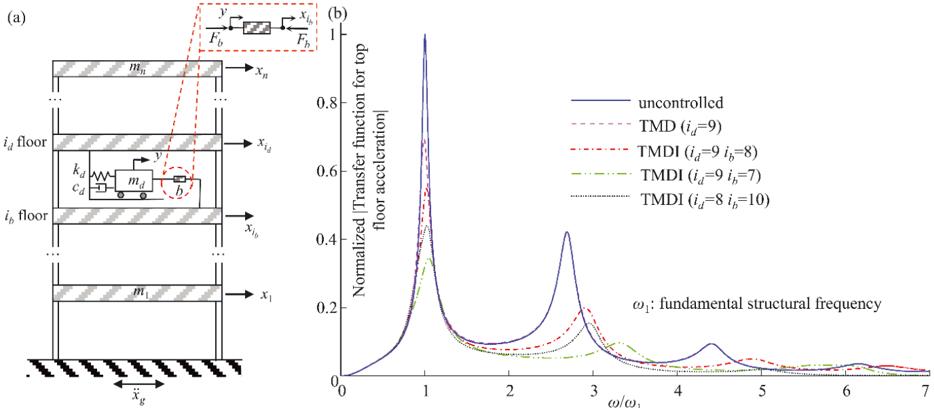
“(a) Tuned mass-damper-inerter (TMDI) equipped multi-storey frame structure and ideal inerter device with inertance b under equilibrium with an external force F (inlet); (b) Normalized absolute frequency response functions for the top floor acceleration of the 10-storey structure [32].”
BackgroundDynamic characteristics of multiple substructures with closely spaced frequencies
Xu, K., & Igusa, T. (1992) · Earthquake Engineering & Structural Dynamics · doi:10.1002/eqe.4290211203 · Cited by 326 · cited 8×
“The MTMD systems with a uniform propagation of natural frequencies were first proposed by Xu and Igusa [19] and then further investigated by Li and Liu [81]; Pansare and Jangid [147].”
BackgroundMethodInfluentialDynamics of building-soil interaction
Jennings, P. C., & Bielak, J. (1973) · Bulletin of the Seismological Society of America · doi:10.1785/bssa0630010009 · Cited by 313 · cited 2×
“SSI effects on the elastic response of SDOF and multi-degree of freedom (MDOF) systems were presented in the 1970s by scholars containing Jennings and Bielak [144].”
BackgroundPerformance of Multiple Mass Dampers under Random Loading
Kareem, A., & Kline, S. (1995) · Journal of Structural Engineering · doi:10.1061/(asce)0733-9445(1995)121:2(348) · Cited by 306 · cited 2×
“The dynamic characteristics and performance of the MTMD system under random loading were further analyzed by Kareem and Kline [44].”
MethodOptimal design theories and applications of tuned mass dampers
Lee, C.-L., Chen, Y.-T., Chung, L.-L., & Wang, Y.-P. (2006) · Engineering Structures · doi:10.1016/j.engstruct.2005.06.023 · Cited by 296 · cited 1×
“[25] proposed an optimal design theory for buildings associated with TMDs at different story level and power spectral density (PSD) function of environmental disturbances.”
BackgroundVibration Control Using Multiple Tuned Mass Dampers
Igusa, T., & Xu, K. (1994) · Journal of Sound and Vibration · doi:10.1006/jsvi.1994.1341 · Cited by 295 · cited 2×
“Igusa and Xu [42] analytically designed multiple TMDs for a SDOF structure subjected to a wide-band force.”
BackgroundSemi‐Active versus Passive or Active Tuned Mass Dampers for Structural Control
Hrovat, D., Barak, P., & Rabins, M. (1983) · Journal of Engineering Mechanics · doi:10.1061/(asce)0733-9399(1983)109:3(691 · Cited by 291 · cited 1×
“[89] studied the interests of using an STMD for the suppression of wind-induced vibration.”
BackgroundSmart structures: Part I—Active and semi-active control
Fisco, N. R., & Adeli, H. (2011) · Scientia Iranica · doi:10.1016/j.scient.2011.05.034 · Cited by 270 · cited 2×
“An Active Mass Damper (AMD) consisting of an AC servo motor, a movable mass connected to the AC servo motor by a ball-screw a mechanism, and an accelerometer as a sensor for measurement was considered [4].”
BackgroundEstimating optimum parameters of tuned mass dampers using harmony search
Bekdaş, G., & Nigdeli, S. M. (2011) · Engineering Structures · doi:10.1016/j.engstruct.2011.05.024 · Cited by 259
Optimum Design of Absorber for MDOF Structures
Hadi, M. N. S., & Arfiadi, Y. (1998) · Journal of Structural Engineering · doi:10.1061/(asce)0733-9445(1998)124:11(1272 · Cited by 257
Nagarajaiah, S. (2009) · Structural Control and Health Monitoring · doi:10.1002/stc.349 · Cited by 256 · cited 1×
“Nagarajaiah [112] introduced the concept of adaptive passive tuned mass dampers (APTMD).”
BackgroundDynamic response and optimal design of structures with large mass ratio TMD
De Angelis, M., Perno, S., & Reggio, A. (2012) · Earthquake Engineering & Structural Dynamics · doi:10.1002/eqe.1117 · Cited by 239 · cited 1×
“[74] Dynamic response and optimal design of structures with large mass-ratio TMD 1- Investigated the dynamic behavior and the seismic effectiveness of a nonconventional TMD with a large mass ratio.”
BackgroundActive and semi-active control of structures – theory and applications: A review of recent advances
Casciati, F., Rodellar, J., & Yildirim, U. (2012) · Journal of Intelligent Material Systems and Structures · doi:10.1177/1045389x12445029 · Cited by 232 · cited 15×
“SAMD does not inject any mechanical energy into the controlled structure, but instead, its properties can be controlled (i.e. adjustable stiffness or variable damping devices or both) to optimally mitigate the response of the system [5].”
BackgroundInfluentialImprovement of tuned mass damper by using rotational inertia through tuned viscous mass damper
Garrido, H., Curadelli, O., & Ambrosini, D. (2013) · Engineering Structures · doi:10.1016/j.engstruct.2013.08.044 · Cited by 227 · cited 2×
“(2013) [103] showed that rotational inertia double tuned mass damper (RIDTMD) was more practical than a TMD with the same mass ratio, especially at excitation frequencies near resonance.”
BackgroundBackstepping control of a vehicle with active suspensions
Yagiz, N., & Hacioglu, Y. (2008) · Control Engineering Practice · doi:10.1016/j.conengprac.2008.04.003 · Cited by 227 · cited 2×
“[85] Yagiz, N. and Y. Hacioglu, Backstepping Control of a Vehicle with Active Suspensions.”
BackgroundFrequency analysis of the tuned mass damper
Krenk, S. (2005) · Journal of Applied Mechanics · doi:10.1115/1.2062867 · Cited by 217 · cited 1×
“A frequency analysis of the TMD system was studied by [36, 37], wherein it displayed that the ancient frequency tuning causes to equal damping ratio of the two vibration modes of the Hybrid system.”
BackgroundLi, C. (2002) · Earthquake Engineering & Structural Dynamics · doi:10.1002/eqe.128 · Cited by 189
Optimal Placement of Multiple Tune Mass Dampers for Seismic Structures
Chen, G., & Wu, J. (2001) · Journal of Structural Engineering · doi:10.1061/(asce)0733-9445(2001)127:9(1054 · Cited by 188 · cited 2×
“Therefore, STMDs are prone to some problems such as mistuning, off-optimum damping, and weak performance for reduction of response when structures had multimode [50].”
BackgroundEnhanced vibration energy harvesting using dual-mass systems
Tang, X., & Zuo, L. (2011) · Journal of Sound and Vibration · doi:10.1016/j.jsv.2011.05.019 · Cited by 181 · cited 1×
“Tang and Zuo (2011 and 2012) [115, 116] modelled two energy harvesters with the tuned mass damper systems, single-mass and dual-mass systems, and concluded that the dual-mass systems provide greater power generation with an increase of electrical damping if the energy harvester is under forced excitation, or base disp…”
BackgroundMass dampers and their optimal designs for building vibration control
Chang, C. C. (1999) · Engineering Structures · doi:10.1016/s0141-0296(97)00213-7 · Cited by 177 · cited 2×
“Chang [27] Mass dampers and their optimal designs for building vibration control 1- The control performance of three types of mass dampers (tuned mass damper (TMD), the tuned liquid column damper (TLCD) and the liquid column vibration absorber (LCVA)) on suppressing excessive building vibration is studied.”
BackgroundVibration suppression for high-speed railway bridges using tuned mass dampers
Wang, J. F., Lin, C. C., & Chen, B. L. (2003) · International Journal of Solids and Structures · doi:10.1016/s0020-7683(02)00589-9 · Cited by 173 · cited 1×
“[165] showed that the TMD was an applicable vibration control device in reducing vertical displacements in the bridge, its absolute accelerations, end rotations, and train accelerations during resonant speeds.”
BackgroundVaradarajan, N., & Nagarajaiah, S. (2004) · Journal of Engineering Mechanics · doi:10.1061/(asce)0733-9399(2004)130:4(451 · Cited by 172
Effectiveness of semi-active tuned mass dampers under harmonic excitation
Pinkaew, T., & Fujino, Y. (2001) · Engineering Structures · doi:10.1016/s0141-0296(00)00091-2 · Cited by 166 · cited 1×
“While single TMDs are simple, more economical and more authentic tactics for structural vibration control [49], their performance depend on the optimization of tuning frequency and damping parameters.”
BackgroundParticle swarm optimization of TMD by non‐stationary base excitation during earthquake
Leung, A. Y. T., Zhang, H., Cheng, C. C., & Lee, Y. Y. (2008) · Earthquake Engineering & Structural Dynamics · doi:10.1002/eqe.811 · Cited by 166 · cited 2×
“Vibration control techniques can broadly arrange into four major groups based on their operational mechanism [8-10].”
BackgroundTuned mass dampers for response control of torsional buildings
Singh, M. P., Singh, S., & Moreschi, L. M. (2002) · Earthquake Engineering & Structural Dynamics · doi:10.1002/eqe.119 · Cited by 160
Frequency and damping adaptation of a TMD with controlled MR damper
Weber, F., & Maślanka, M. (2012) · Smart Materials and Structures · doi:10.1088/0964-1726/21/5/055011 · Cited by 158
Design of multiple tuned mass dampers by using a numerical optimizer
Hoang, N., & Warnitchai, P. (2005) · Earthquake Engineering & Structural Dynamics · doi:10.1002/eqe.413 · Cited by 152
Liu, M., Chiang, W.-L., Hwang, J., & Chu, C. (2007) · Journal of Wind Engineering and Industrial Aerodynamics · doi:10.1016/j.jweia.2007.06.034 · Cited by 152 · cited 1×
“[149] developed a mathematical model for time domain analysis of wind induced oscillations of a tall building with TMD considering soil effects.”
BackgroundTechnology of Semiactive Devices and Applications in Vibration Mitigation
Casciati, F., Magonette, G., & Marazzi, F. (2006) · doi:10.1002/0470022914 · Cited by 149
The structural design of tall and special buildings
Hart, G. C. (2005) · The Structural Design of Tall and Special Buildings · doi:10.1002/tal.324 · Cited by 133
Effectiveness of distributed tuned mass dampers for multi-mode control of chimney under earthquakes
Elias, S., Matsagar, V. A., & DATTA, T. K. (2016) · Engineering Structures · doi:10.1016/j.engstruct.2016.06.006 · Cited by 131
Optimum design of linear tuned mass dampers for structures with nonlinear behaviour
Sgobba, S., & Marano, G. C. (2010) · Mechanical Systems and Signal Processing · doi:10.1016/j.ymssp.2010.01.009 · Cited by 128 · cited 3×
“Unlike previous studies related to TMD optimization where TMD mass ratio was a predefined parameter, Sgobba and Marano [31] optimized TMD mass ratio before with other parameters.”
BackgroundBekdaş, G., & Nigdeli, S. M. (2017) · Soil Dynamics and Earthquake Engineering · doi:10.1016/j.soildyn.2016.10.019 · Cited by 124
Frontiers of Structural and Civil Engineering
(2013) · Frontiers of Structural and Civil Engineering · doi:10.1007/11709.2095-2449 · Cited by 118
Smart Structures: Innovative Systems for Seismic Response Control
Cheng, F. Y., Jiang, H., & Lou, K. (2008) · Thammasat University Digital Collections · Cited by 110
Yang, D.-H., Shin, J.-H., Lee, H., Kim, S.-K., & Kwak, M. K. (2017) · Journal of Sound and Vibration · doi:10.1016/j.jsv.2016.12.036 · Cited by 107 · cited 2×
“AMDs apply a controlled force calculated using a control algorithm and based on a sensor signal, hence resulting in active control of the vibration [61].”
BackgroundMethodSeismic performance of multiple tuned mass dampers for soil–irregular building interaction systems
Wang, J.-F., & Lin, C.-C. (2005) · International Journal of Solids and Structures · doi:10.1016/j.ijsolstr.2005.02.042 · Cited by 106 · cited 22×
“Lin et al. [151] proposed a novel semi-active friction-type multiple tuned mass damper (SAF-MTMD) for vibration control of seismic structures.”
BackgroundInfluentialZuo, L., & Cui, W. (2013) · Journal of Vibration and Acoustics · doi:10.1115/1.4024095 · Cited by 104
Tuned mass damper with fractional derivative damping
Rüdinger, F. (2006) · Engineering Structures · doi:10.1016/j.engstruct.2006.01.006 · Cited by 103 · cited 1×
“Rüdinger (2007) and Rüdinger (2006) [30, 99] investigated the effectiveness of a TMD characterized by a nonlinear viscous power law for reducing vibrations of a single- degree-offreedom system under white noise excitation.”
BackgroundMoon, K. S. (2010) · The Structural Design of Tall and Special Buildings · doi:10.1002/tal.499 · Cited by 99 · cited 1×
“Moon [69] Vertically distributed multiple tuned mass dampers in tall buildings 1- TMDs can be distributed vertically along with the building height without substantial loss of their effectiveness for tall-building motion control.”
BackgroundWeber, F., Boston, C., & Maślanka, M. (2011) · Smart Materials and Structures · doi:10.1088/0964-1726/20/1/015012 · Cited by 97
Hybrid Time‐Frequency Blind Source Separation Towards Ambient System Identification of Structures
Hazra, B., Sadhu, A., Roffel, A. J., & Narasimhan, S. (2012) · Computer-Aided Civil and Infrastructure Engineering · doi:10.1111/j.1467-8667.2011.00732.x · Cited by 95 · cited 1×
“Recently, the MTMD system has extended to control structures with closely spaced natural frequencies [45] using the perturbation technique.”
MethodOptimum design of pendulum-type tuned mass dampers
Gerges, R. R., & Vickery, B. J. (2005) · The Structural Design of Tall and Special Buildings · doi:10.1002/tal.273 · Cited by 94
Yau, J. D., & Yang, Y. B. (2004) · Engineering Structures · doi:10.1016/j.engstruct.2004.06.015 · Cited by 93 · cited 10×
“[78] Kwon, I.Y., H.T. Yang, P.K. Hansma, and C.J. Randall, Bioinspired Tuned Mass Damper for Mitigation of Wind-Induced Building Excitation.”
BackgroundInfluentialImplementation considerations for active vibration control in the design of floor structures
Hudson, E., & Reynolds, P. (2012) · Engineering Structures · doi:10.1016/j.engstruct.2012.05.034 · Cited by 93 · cited 2×
“Hudson and Reynolds [124] introduced a compensated acceleration feedback control algorithm performed on an office floor in which a phase-lag compensator is practiced to the acceleration productions such that the properties of high damping at the basic vibration mode and high consistency margins are got, the value of t…”
Parametric study on multiple tuned mass dampers for buffeting control of Yangpu Bridge
Gu, M., Chen, S. R., & Chang, C. C. (2001) · Journal of Wind Engineering and Industrial Aerodynamics · doi:10.1016/s0167-6105(01)00094-0 · Cited by 92
VIBRATION CONTROL IDENTIFICATION OF SEISMICALLY EXCITED m.d.o.f. STRUCTURE-PTMD SYSTEMS
Lin, C.-C., Wang, J.-F., & Ueng, J. (2001) · Journal of Sound and Vibration · doi:10.1006/jsvi.2000.3188 · Cited by 92 · cited 1×
“[28] applied an extended accidental diminution method to reduce dynamic responses of a PTMD system against to seismic load.”
MethodElias, S., Matsagar, V., & Datta, T. K. (2019) · Journal of Earthquake Engineering · doi:10.1080/13632469.2017.1351407 · Cited by 91 · cited 1×
“For instance, recent study [51-54] evaluated and showed the superior performance of MTMDs with homogenous and non- homogeneous mass distribution where the mass ratio, damping ratio, peak ground acceleration and structural periods were improved.”
BackgroundVibration control of seismic structures using semi-active friction multiple tuned mass dampers
Lin, C.-C., Lu, L., Lin, G., & Yang, T.-W. (2010) · Engineering Structures · doi:10.1016/j.engstruct.2010.07.014 · Cited by 85 · cited 1×
“[151] proposed a novel semi-active friction-type multiple tuned mass damper (SAF-MTMD) for vibration control of seismic structures.”
BackgroundCoupled tuned mass dampers for control of coupled vibrations in asymmetric buildings
Desu, N. B., Deb, S. K., & Dutta, A. (2006) · Structural Control and Health Monitoring · doi:10.1002/stc.64 · Cited by 84 · cited 1×
“Examples of such systems include a structure equipped with distributed viscoelastic dampers and an active tuned mass damper on or near the top floor; or a base-isolated structure with actuators that are actively controlled to enhance performance [14].”
BackgroundOPTIMUM MULTIPLE TUNED MASS DAMPERS FOR BASE-EXCITED DAMPED MAIN SYSTEM
BAKRE, S. V., & JANGID, R. S. (2004) · International Journal of Structural Stability and Dynamics · doi:10.1142/s0219455404001367 · Cited by 84 · cited 6×
“A numerical algorithm was also developed to search optimal design parameters of MTMDs. Bakre and Jangid [29] developed explicit mathematical statements for optimum TMD parameters using numerical searching technique.”
BackgroundInfluentialVellar, L. S., Ontiveros-Pérez, S. P., Miguel, L. F. F., & Miguel, L. F. F. (2019) · Shock and Vibration · doi:10.1155/2019/9273714 · Cited by 84 · cited 1×
“MTMDs created the uniform distribution of masses for economical reason [47].”
BackgroundMitigation of wind‐induced response of Shanghai Center Tower by tuned mass damper
Lu, X., & Chen, J. (2011) · The Structural Design of Tall and Special Buildings · doi:10.1002/tal.659 · Cited by 83
Tuned mass damper with nonlinear viscous damping
Rüdinger, F. (2006) · Journal of Sound and Vibration · doi:10.1016/j.jsv.2006.09.009 · Cited by 81 · cited 2×
“[30] included nonlinear viscous damping elements to TMD and analyzed the effect.”
BackgroundLin, Y.-Y., Cheng, C.-M., & Lee, C.-H. (2000) · Engineering Structures · doi:10.1016/s0141-0296(99)00049-8 · Cited by 78
Multi-modal vibration control of truss bridges with tuned mass dampers under general loading
Debnath, N., Deb, S., & Dutta, A. (2016) · Journal of Vibration and Control · doi:10.1177/1077546315571172 · Cited by 77 · cited 1×
“[87] to control truss bridge vibrations.”
Dynamic characteristics of structures with multiple tuned mass dampers
Jangid, R. S. (1995) · Structural Engineering and Mechanics · doi:10.12989/sem.1995.3.5.497 · Cited by 76 · cited 1×
“[126, 127] studied the effectiveness of multiple tuned mass dampers (MTMD) and optimized the parameters for an un-damped system subjected to harmonic base stimulation.”
BackgroundAly, A. M. (2014) · The Structural Design of Tall and Special Buildings · doi:10.1002/tal.1068 · Cited by 74 · cited 1×
“Aly [71] Design of buildings for wind and earthquake 1- Wind and earthquake effects on high-rise buildings in order to apply for designing of structures.”
BackgroundA novel approach to the optimum design of MTMDs under seismic excitations
Fadel Miguel, L. F., Lopez, R. H., Miguel, L. F. F., & Torii, A. J. (2016) · Structural Control and Health Monitoring · doi:10.1002/stc.1845 · Cited by 73
Vibration energy harvesting from random force and motion excitations
Tang, X., & Zuo, L. (2012) · Smart Materials and Structures · doi:10.1088/0964-1726/21/7/075025 · Cited by 72 · cited 1×
“Tang and Zuo (2011 and 2012) [115, 116] modelled two energy harvesters with the tuned mass damper systems, single-mass and dual-mass systems, and concluded that the dual-mass systems provide greater power generation with an increase of electrical damping if the energy harvester is under forced excitation, or base disp…”
BackgroundBonello, P., Brennan, M. J., & Elliott, S. J. (2005) · Smart Materials and Structures · doi:10.1088/0964-1726/14/5/044 · Cited by 72 · cited 2×
“(2005) [108] used physics principles to offer an adaptive TMD; Gsell et al.”
MethodFeasibility study of nonlinear tuned mass damper for machining chatter suppression
Wang, M. (2011) · Journal of Sound and Vibration · doi:10.1016/j.jsv.2010.10.043 · Cited by 71 · cited 1×
“Wang [102] proposed a nonlinear TMD with the aim of suppressing machining chatter.”
BackgroundReal-time control of a shape memory alloy adaptive tuned vibration absorber
Rustighi, E., Brennan, M. J., & Mace, B. R. (2005) · Smart Materials and Structures · doi:10.1088/0964-1726/14/6/011 · Cited by 70 · cited 2×
“[98] addressed the design and realization of a tunable beam-like TMD, consisting of two shape-memory alloy (SMA) wires heated by a flowing current.”
BackgroundLi, C., & Liu, Y. (2003) · Earthquake Engineering & Structural Dynamics · doi:10.1002/eqe.239 · Cited by 69
Inelastic buildings with tuned mass dampers under moderate ground motions from distant earthquakes
Lukkunaprasit, P., & Wanitkorkul, A. (2001) · Earthquake Engineering & Structural Dynamics · doi:10.1002/eqe.22 · Cited by 64
Moutinho, C. (2012) · Earthquake Engineering & Structural Dynamics · doi:10.1002/eqe.2174 · Cited by 64 · cited 1×
“Moutinho [73] An alternative methodology for designing tuned mass dampers to reduce seismic vibrations in building structures 1- Using tuning TMDs in the context of reducing seismic vibrations of building structures based on mass ratio on two modes of vibration.”
MethodH 2 Optimization of the Three-Element Type Dynamic Vibration Absorbers
Asami, T., & Nishihara, O. (2002) · Journal of Vibration and Acoustics · doi:10.1115/1.1501286 · Cited by 60
Closed-form formulas for the optimal pole-based design of tuned mass dampers
Bisegna, P., & Caruso, G. (2012) · Journal of Sound and Vibration · doi:10.1016/j.jsv.2012.01.005 · Cited by 60 · cited 7×
“[121] Bisegna, P. and G. Caruso, Closed-Form Formulas for the Optimal Pole-Based Design of Tuned Mass Dampers.”
BackgroundMethodInfluentialVibration control of high-rise buildings for wind: a robust passive and active tuned mass damper
Aly, A. M. (2014) · Smart Structures and Systems · doi:10.12989/sss.2014.13.3.473 · Cited by 58 · cited 1×
“Since then, they have been installed in a number of high-rise buildings [18].”
BackgroundJin, X., Xie, S., He, J., Lin, Y., Wang, Y., & Wang, N. (2018) · Ocean Engineering · doi:10.1016/j.oceaneng.2018.08.031 · Cited by 58
Chen, S., & Wu, J. (2008) · Engineering Structures · doi:10.1016/j.engstruct.2008.04.035 · Cited by 57 · cited 1×
“Chen and Wu [170] studied the effectiveness of the MTMDs in suppression of the wind-induced vibration in bridge structures.”
BackgroundOptimal Direct Output Feedback of Structural Control
Chung, L. L., Lin, C. C., & Chu, S. Y. (1993) · Journal of Engineering Mechanics · doi:10.1061/(asce)0733-9399(1993)119:11(2157 · Cited by 56 · cited 1×
“The authors use an optimal direct output feedback strategy where ‘‘output measurement is directly multiplied by time-invariant feedback gain and fed back to the structural system’’ [83] and 1940, El Centro, California earthquake as input.”
MethodZhang, Z., & Balendra, T. (2013) · Engineering Structures · doi:10.1016/j.engstruct.2013.03.044 · Cited by 56 · cited 4×
“Zhang and Balendra [104] demonstrate that the initial structures achieve much better damage reduction by adopting the optimal TMD parameters.”
BackgroundInfluentialUnified dynamic absorber design formulas for wind-induced vibration control of tall buildings
Chang, C. C., & Qu, W. L. (1998) · The Structural Design of Tall Buildings · doi:10.1002/(sici)1099-1794(199806)7:2<147::aid-tal107>3.0.co;2-3 · Cited by 55 · cited 1×
“Chang and Qu [63] Unified dynamic absorber design formulas for wind-induced vibration control of tall buildings 1- Unified design formulas for various passive dynamic absorbers for wind vibration control of tall buildings.”
BackgroundGeneralized framework for robust design of tuned mass damper systems
Mohtat, A., & Dehghan-Niri, E. (2010) · Journal of Sound and Vibration · doi:10.1016/j.jsv.2010.09.007 · Cited by 55
(2013) · Scientia Iranica · doi:10.1016/j.scient.2012.11.015 · Cited by 53
Distributed Mass Damper System for Integrating Structural and Environmental Controls in Buildings
Fu, T. S., & Johnson, E. A. (2011) · Journal of Engineering Mechanics · doi:10.1061/(asce)em.1943-7889.0000211 · Cited by 53 · cited 4×
“Since the DMD system distributes the weight throughout the building rather than concentrating it, a larger total damper weight can be implemented with the DMD system (Figure 8).”
BackgroundInfluentialPractical applications of active mass dampers with hydraulic actuator
Yamamoto, M., Aizawa, S., Higashino, M., & Toyama, K. (2001) · Earthquake Engineering & Structural Dynamics · doi:10.1002/eqe.88 · Cited by 53 · cited 1×
“[80] present the performance results of ATMD systems mounted in four actual steel-frame high-rise buildings in Japan, ranging in height from 58.”
BackgroundFurther Characteristics for Multiple Tuned Mass Dampers
Li, C., & Liu, Y. (2002) · Journal of Structural Engineering · doi:10.1061/(asce)0733-9445(2002)128:10(1362 · Cited by 52 · cited 10×
“Li and Liu [65] Optimum properties of multiple TMDs for reduction of the response of structures subject to ground acceleration 1-”
BackgroundInfluentialTakeya, K., Sasaki, E., & Kobayashi, Y. (2016) · Journal of Sound and Vibration · doi:10.1016/j.jsv.2015.10.002 · Cited by 50 · cited 1×
“[117] showed that for effective energy harvesting, it is vital that the TMD has robustness against uncertainties in bridge vibrations and the tuning errors.”
BackgroundAnh, N. D., & Nguyen, N. X. (2013) · International Journal of Mechanical Sciences · doi:10.1016/j.ijmecsci.2013.09.014 · Cited by 50 · cited 3×
“Anh and Nguyen [75] Design of TMD for damped linear structures using the dual criterion of the equivalent linearization method 1- Designing of TMD for a linear system is a classical problem and numerical methods or approximate analytical solutions for optimal parameters of TMD are proposed.”
MethodHybrid active tuned mass dampers for structures under the ground acceleration
Li, C., & Cao, B. (2015) · Structural Control and Health Monitoring · doi:10.1002/stc.1716 · Cited by 49 · cited 6×
“Using an STFT relying on control algorithm, real time tuning of the damping ratio and the frequency of the STMD is performed through exploring the displacements of the STMD and the primary structure [38].”
BackgroundMethodInfluentialOn a nonlinear single-mass two-frequency pendulum tuned mass damper to reduce horizontal vibration
Viet, L. D., & Nghi, N. B. (2014) · Engineering Structures · doi:10.1016/j.engstruct.2014.09.038 · Cited by 49 · cited 2×
“[105] Viet, L. and N. Nghi, On a Nonlinear Single-Mass Two-Frequency Pendulum Tuned Mass Damper to Reduce Horizontal Vibration.”
BackgroundBENDING VIBRATIONS OF BEAMS COUPLED BY A DOUBLE SPRING–MASS SYSTEM
Gürgöze, M., Ǧ, G. E., & Ǧ, S. I. (2001) · Journal of Sound and Vibration · doi:10.1006/jsvi.2000.3442 · Cited by 49 · cited 2×
“[33] Inceo, G., S and M. Gürgöze, Bending Vibrations of Beams Coupled by Several Double Spring-Mass Systems.”
BackgroundEffect of Multiple Tuned Mass Dampers for Vibration Control in High-Rise Buildings
Suresh, L., & Mini, K. M. (2019) · Practice Periodical on Structural Design and Construction · doi:10.1061/(asce)sc.1943-5576.0000453 · Cited by 49 · cited 2×
“The experimental study of these TMDs’ type has done to investigate their performance in mitigating the displacement, peak of acceleration and base shear of structures along of earthquake and by optimization algorithm the best position of MTMDs identified [48].”
BackgroundNi, T., Zuo, L., & Kareem, A. (2011) · Volume 1: 23rd Biennial Conference on Mechanical Vibration and Noise, Parts A and B · doi:10.1115/detc2011-48728 · Cited by 48
Optimal Damper Characteristics of ATMD for Buildings under Wind Loads
Yan, N., Wang, C. M., & Balendra, T. (1999) · Journal of Structural Engineering · doi:10.1061/(asce)0733-9445(1999)125:12(1376 · Cited by 47 · cited 1×
“[79] present expressions for the required control force to be applied by an ATMD system for a high-rise building with a rectangular plan subjected to vibrations because of wind loadings.”
BackgroundMatta, E. (2018) · Earthquake Engineering & Structural Dynamics · doi:10.1002/eqe.2987 · Cited by 47
Timoshenko beam with tuned mass dampers and its design curves
Chen, Y.-H., & Huang, Y.-H. (2004) · Journal of Sound and Vibration · doi:10.1016/j.jsv.2003.10.013 · Cited by 47 · cited 3×
“[169] Chen, Y.-H. and Y.-H. Huang, Timoshenko Beam with Tuned Mass Dampers and Its Design Curves.”
BackgroundMethodInfluentialControl of flutter of suspension bridge deck using TMD
Pourzeynali, S., & Datta, T. K. (2002) · Wind and Structures · doi:10.12989/was.2002.5.5.407 · Cited by 45 · cited 4×
“[164] Pourzeynali, S. and T. Datta, Control of Flutter of Suspension Bridge Deck Using TMD. Wind and Structures, 2002.”
BackgroundInfluentialOPTIMUM DYNAMIC CHARACTERISTICS OF STOCKBRIDGE DAMPERS FOR DEAD-END SPANS
Markiewicz, M. (1995) · Journal of Sound and Vibration · doi:10.1006/jsvi.1995.0589 · Cited by 45 · cited 1×
“Markiewicz [159] showed an analysis of the optimum damper impedance needs for spans, which are called dead-end spans.”
BackgroundJabary, R. N., & Madabhushi, S. P. G. (2015) · Soil Dynamics and Earthquake Engineering · doi:10.1016/j.soildyn.2015.06.013 · Cited by 44 · cited 3×
“Subsequently, Jabary and Madabhushi [157] reported that tuning a TMD to the soil-structure system properties rather than fixed-base structural properties was found to double the recovery in damping and reduce the original peak response by nearly half.”
BackgroundInfluentialEissa, M., & Sayed, M. (2006) · Mathematical and Computational Applications · doi:10.3390/mca11020151 · Cited by 43 · cited 1×
“Passive, Semi-active and full active control of structures [11]”
BackgroundCoupled vibration control with tuned mass damper for long-span bridges
Chen, S. R., & Cai, C. S. (2004) · Journal of Sound and Vibration · doi:10.1016/j.jsv.2003.11.056 · Cited by 40 · cited 2×
“Chen and Cai [166] proposed a new control approach that was to weak the modal double effects, in addition to suppressing the resonant vibration with the TMDs.”
BackgroundHwang, J., Kim, H., & Kim, J. (2005) · Engineering Structures · doi:10.1016/j.engstruct.2005.06.022 · Cited by 40 · cited 2×
“[37] and Li and Cao [38] proposed a method for estimating the modal mass of a real structure with a TMD based on the H-∞ optimal model diminution technique.”
BackgroundMethodPerformance-based Seismic Design of a Pendulum Tuned Mass Damper System
Shu, Z., Li, S., Sun, X., & He, M. (2017) · Journal of Earthquake Engineering · doi:10.1080/13632469.2017.1323042 · Cited by 40
Wind-induced response of soil-structure-damper systems
Xu, Y. L., & Kwok, K. C. S. (1992) · Journal of Wind Engineering and Industrial Aerodynamics · doi:10.1016/0167-6105(92)90632-k · Cited by 40 · cited 8×
“Xu and Kwok [143] checked the wind-induced motion of two super tall structures (a 76-story RC building and a 370 m tower) installed with TMD, taking into account the effect of soil compliancy under the footing.”
BackgroundMethodInfluentialMiah, M. S., Chatzi, E. N., Dertimanis, V. K., & Weber, F. (2017) · Structural Control and Health Monitoring · doi:10.1002/stc.1878 · Cited by 39 · cited 1×
“It should note that the semi-active system does not have full control capacity since they are limited within the range of the capacity of installed passive devices [12].”
BackgroundNew control strategies for active tuned mass damper systems
Cao, H., & Li, Q. S. (2004) · Computers & Structures · doi:10.1016/j.compstruc.2004.05.010 · Cited by 38
Cost Optimum Design of Posttensioned I-Girder Bridge Using Global Optimization Algorithm
Ahsan, R., Rana, S., & Ghani, S. N. (2012) · Journal of Structural Engineering · doi:10.1061/(asce)st.1943-541x.0000458 · Cited by 38 · cited 2×
“[23] to optimize the design of simply supported, post-tensioned, pre stressed concrete I-girder bridge.”
MethodEnergy dissipation of tuned mass dampers during earthquake excitations
Wong, K. K. F., & Chee, Y. L. (2004) · The Structural Design of Tall and Special Buildings · doi:10.1002/tal.244 · Cited by 37 · cited 2×
“Wong and Chee [35] found that the TMD was very impressive in mitigating both the greatest kinetic energy and strain energy of the structure, while it was also effective in reducing the amount of damping energy that must dissipate through the structure.”
BackgroundOptimization of TMD for suppressing buffeting response of long-span bridges
Gu, M., & Xiang, H. (1992) · Journal of Wind Engineering and Industrial Aerodynamics · doi:10.1016/0167-6105(92)90146-2 · Cited by 37 · cited 2×
“Optimization of the TMD parameters for suppressing buffeting response of the long-span bridges was investigated by Gu and Xiang [160].”
BackgroundSystematic assessment of irregular building–soil interaction using efficient modal analysis
Wu, W., Wang, J., & Lin, C. (2001) · Earthquake Engineering & Structural Dynamics · doi:10.1002/eqe.25 · Cited by 37 · cited 2×
“[148] is occupied to compute the dynamic response for a building supported on soft soil underground-excitations.”
BackgroundDynamic performance analysis of non-linear tuned vibration absorbers
Koo, J.-H., Shukla, A., & Ahmadian, M. (2008) · Communications in Nonlinear Science and Numerical Simulation · doi:10.1016/j.cnsns.2007.03.020 · Cited by 36 · cited 2×
“[3] accessed a remarkable improvement in the performance of a mass damper by changing the passive damping element with tunable one.”
BackgroundUeng, J., Lin, C., & Wang, J. (2008) · The Structural Design of Tall and Special Buildings · doi:10.1002/tal.336 · Cited by 36
Tuned Mass Damper Positioning Effects on the Seismic Response of a Soil-MDOF-Structure System
Jabary, R. N., & Madabhushi, S. (2017) · Journal of Earthquake Engineering · doi:10.1080/13632469.2016.1224743 · Cited by 36
GROUND MOTION DOMINANT FREQUENCY EFFECT ON THE DESIGN OF MULTIPLE TUNED MASS DAMPERS
LI∗, C., & LIU†, Y. (2004) · Journal of Earthquake Engineering · doi:10.1080/13632460409350482 · Cited by 35 · cited 10×
“Li and Liu [65] Optimum properties of multiple TMDs for reduction of the response of structures subject to ground acceleration 1-”
BackgroundInfluentialLi, C. (2012) · The Structural Design of Tall and Special Buildings · doi:10.1002/tal.624 · Cited by 35 · cited 2×
“Li [152] also considered the influences of various parameters in the soil–asymmetric structure interaction system on both the effectiveness and robustness of the active TMD and MTMD.”
BackgroundDevelopment of a chaotic nonlinear tuned mass damper for optimal vibration response
Farshi, B., & Assadi, A. (2011) · Communications in Nonlinear Science and Numerical Simulation · doi:10.1016/j.cnsns.2011.02.011 · Cited by 35 · cited 3×
“Farshi and Assadi [101] reported that optimal nonlinear TMD is more effective in response control as contrast to the linear TMD and MTMDs.”
BackgroundDevelopment of optimal design formula for bi-tuned mass dampers using multi-objective optimization
Ok, S.-Y., Song, J., & Park, K.-S. (2009) · Journal of Sound and Vibration · doi:10.1016/j.jsv.2008.11.023 · Cited by 35 · cited 1×
“[68] Development of optimal design formula for bituned mass dampers using multi-objective optimization 1- Closed-form, easy-to-use design formula for optimal performance of bituned mass dampers system using a non-dominated sorting genetic algorithm 2- The performance of the damped structural system is described by two…”
MethodSeismic Response Mitigation of Base-Isolated Buildings
Stanikzai, M. H., Elias, S., & Rupakhety, R. (2020) · Applied Sciences · doi:10.3390/app10041230 · Cited by 35
Optimum Design of TMD System for Tall Buildings
Farghaly, A. A., & Salem Ahmed, M. (2012) · ISRN Civil Engineering · doi:10.5402/2012/716469 · Cited by 33 · cited 3×
“1631 Farghaly and Salem Ahmed [72] Optimum Design of TMD System for Tall Buildings 1- Time response and shear force of structure can be dramatically reduced by using TMDs.”
BackgroundInfluentialVibration control of buildings by using partial floor loads as multiple tuned mass dampers
Sakr, T. A. (2017) · HBRC Journal · doi:10.1016/j.hbrcj.2015.04.004 · Cited by 32
Effects of tuned mass dampers on random response of bridges
Das, A., & Dey, S. S. (1992) · Computers & Structures · doi:10.1016/0045-7949(92)90518-5 · Cited by 32 · cited 2×
“[158] Das, A. and S. Dey, Effects of Tuned Mass Dampers on Random Response of Bridges.”
MethodOptimum Tuned Mass Damper for Wind and Earthquake Response Control of High-Rise Building
Elias, S., & Matsagar, V. (2015) · Advances in Structural Engineering · doi:10.1007/978-81-322-2193-7_113 · Cited by 30
Two-degree-of-freedom rotational-pendulum vibration absorbers
Wu, S.-T., Chen, Y.-R., & Wang, S.-S. (2011) · Journal of Sound and Vibration · doi:10.1016/j.jsv.2010.09.028 · Cited by 27 · cited 2×
“Hybrid control systems are effective to protect structures subjected to different types of excitation with dissimilar intensity and frequency range [13].”
BackgroundMethodA Comparison between a New Semi-Active Tuned Mass Damper and an Active Tuned Mass Damper
Owji, H. R., Shirazi, A. H. N., & Sarvestani, H. H. (2011) · Procedia Engineering · doi:10.1016/j.proeng.2011.07.350 · Cited by 26
Control of response of structures with passive and active tuned mass dampers
Rasouli, S. K., & Yahyai, M. (2002) · The Structural Design of Tall Buildings · doi:10.1002/tal.181 · Cited by 26
Quaranta, G., Mollaioli, F., & Monti, G. (2016) · Earthquakes and Structures · doi:10.12989/eas.2016.10.1.239 · Cited by 26
Adaptive Tuned Mass Damper based on Pre-stressable Leaf-springs
Gsell, D., Feltrin, G., & Motavalli, M. (2007) · Journal of Intelligent Material Systems and Structures · doi:10.1177/1045389x06073641 · Cited by 24
Seismic structural control using an electric servomotor active mass driver system
Lee, C., & Wang, Y. (2004) · Earthquake Engineering & Structural Dynamics · doi:10.1002/eqe.373 · Cited by 22 · cited 15×
“[13] Wu, S.-T., Y.-R. Chen, and S.-S. Wang, Two-Degree-of-Freedom Rotational-Pendulum Vibration Absorbers.”
MethodInfluentialDynamic characteristics of non‐classically damped structures
Xu, K., & Igusa, T. (1991) · Earthquake Engineering & Structural Dynamics · doi:10.1002/eqe.4290201204 · Cited by 21 · cited 7×
“The MTMD systems with a uniform propagation of natural frequencies were first proposed by Xu and Igusa [19] and then further investigated by Li and Liu [81]; Pansare and Jangid [147].”
BackgroundInfluentialRizos, D. D., Feltrin, G., & Motavalli, M. (2010) · Mechanical Systems and Signal Processing · doi:10.1016/j.ymssp.2010.07.001 · Cited by 19
Tuned mass dampers for torsionally coupled systems
Pansare, A. P., & Jangid, R. S. (2003) · Wind and Structures · doi:10.12989/was.2003.6.1.023 · Cited by 18 · cited 9×
“The MTMD systems with a uniform propagation of natural frequencies were first proposed by Xu and Igusa [19] and then further investigated by Li and Liu [81]; Pansare and Jangid [147].”
MethodInfluentialLi, C., & Qu, W. L. (2004) · Engineering Structures · doi:10.1016/j.engstruct.2004.07.019 · Cited by 18
Chey, M.-H., & Kim, J.-U. (2012) · Frontiers of Structural and Civil Engineering · doi:10.1007/s11709-012-0170-x · Cited by 17 · cited 1×
“Found that using an optimal passive tuned mass damper is practical in control of the structural responses under stationary Gaussian white noise shaking [135].”
MethodControl performance evaluation of semi-active tmd subjected to various types of loads
Kim, H.-S., Chang, C., & Kang, J.-W. (2015) · International Journal of Steel Structures · doi:10.1007/s13296-015-9006-6 · Cited by 16 · cited 4×
“(2015) [5] conducted an experimental study of an STMD coupled with a three-story building model under support ground motion.”
BackgroundMethodInfluentialActive Control for a Distributed Mass Damper System
Fu, T. S., & Johnson, E. A. (2014) · Journal of Engineering Mechanics · doi:10.1061/(asce)em.1943-7889.0000650 · Cited by 16
Series multiple tuned mass dampers for vibration control of high-speed railway bridges
Kahya, V, & Araz, O. (2016) · Insights and Innovations in Structural Engineering, Mechanics and Computation · doi:10.1201/9781315641645-25 · Cited by 16
Design of tuned mass dampers incorporating wire rope springs: Part II: Simple design method
Gerges, R. R., & Vickery, B. J. (2005) · Engineering Structures · doi:10.1016/j.engstruct.2004.12.014 · Cited by 13
Palacios, F., Massegú, J. R., Rossell, J. M., et al. (2014) · Modeling Identification and Control A Norwegian Research Bulletin · doi:10.4173/mic.2014.3.4 · Cited by 13 · cited 1×
“Therefore, to enhance the safety and functionality of the structure, vibration control of the structural systems has long been considered by structural designers which serve as major technological competitiveness [2].”
BackgroundExperimental Study on a Tuned-Mass Damper of Offshore for Vibration Reduction
Wu, Q., Zhao, X., & Zheng, R. (2016) · Journal of Physics: Conference Series · doi:10.1088/1742-6596/744/1/012045 · Cited by 12
Bioinspired Tuned Mass Damper for Mitigation of Wind-Induced Building Excitation
Kwon, I. Y., Yang, H. T., Hansma, P. K., & Randall, C. J. (2017) · Journal of Structural Engineering · doi:10.1061/(asce)st.1943-541x.0001881 · Cited by 12 · cited 2×
“(2017) [78] discuss the use of an ATMD system consisting of three actuators to control the windinduced motion of the 310-m Nanjing TV transmission Tower in China.”
BackgroundMethodControl strategies for a distributed mass damper system
Fu, T. S., & Johnson, E. A. (2009) · Proceedings of the ... American Control Conference/Proceedings of the American Control Conference · doi:10.1109/acc.2009.5160718 · Cited by 10 · cited 1×
“A shear structure with a VSDD brace control system [119]”
MethodA novel semi-active tuned mass damper with tunable stiffness
Zhang, L., Hong, L., Dhupia, J. S., Johnson, S., Qaiser, Z., & Zhou, Z. (2018) · 2018 IEEE/ASME International Conference on Advanced Intelligent Mechatronics (AIM) · doi:10.1109/aim.2018.8452301 · Cited by 9 · cited 1×
“[90] worked on a novel semi-active tuned mass damper with tunable stiffness.”
BackgroundEFFICIENCY AND DESIGN FORMULAS OF MULTIPLE TUNED MASS DAMPERS (MTMD)
ABÉ, M., & FUJINO, Y. (1993) · Doboku Gakkai Ronbunshu · doi:10.2208/jscej.1993.465_97 · Cited by 8 · cited 7×
“Abé and Fujino [41] utilizing the perturbation solutions, formulas relevant to designing the TMD for different types of loading are gotten; they are claimed as a function of mass ratio, tuning ratio, damping ratio of the TMD and damping ratio of the structure.”
MethodInfluentialSun, C. (2013) · Rice Research Repository (Rice University) · Cited by 5
Structural Control Strategies for Earthquake Response Reduction of Buildings
(2014) · Illinois Digital Environment for Access to Learning and Scholarship (University of Illinois at Urbana-Champaign) · Cited by 5
Recent development in structural control including soil-structure interaction effect
Chen, G., Wu, J., Chen, C., et al. (2000) · Proceedings of SPIE, the International Society for Optical Engineering/Proceedings of SPIE · doi:10.1117/12.383144 · Cited by 3 · cited 1×
“[145] investigated the effects of SSI in the seismic analyses of structures with energy dissipation devices standing on flexible soil.”
BackgroundShankar, K., Balendra, T., Modi, V. J., Akinturk, A., Tse, W., Gu, M., Peng, F. J., Wu, J.-C., Pan, P.-C., Joo, S. J., et al. (2001) · Wind Engineers, JAWE · doi:10.5359/jawe.2001.89_429 · Cited by 2
Wind-induced response of soil-structure-damper systems
Xu, Y. (1992) · Journal of Wind Engineering and Industrial Aerodynamics · doi:10.1016/0167-6105(92)90327-7 · Cited by 2
Vibration Control in High-Rise Buildings for Multi-Hazard
Abburu, S. A. S. (2022) · doi:10.31390/gradschool_theses.1991 · Cited by 1
Jia, J. (2016) · Springer eBooks · doi:10.1007/978-3-642-31854-2_24 · Cited by 1
Zhou, Z. (2014) · Rutgers University Community Repository (Rutgers University) · doi:10.7282/t3bk19p4 · Cited by 1
Structural Control: Past, Present, and Future
(1997) · doi:10.1061/(asce)0733-9399(1997)123:9(897
State of the Art of Structural Control
(2003) · doi:10.1061/(asce)0733-9445(2003)129:7(845
Optimum Multiple Tuned Mass Dampers for base-excited undamped system
(1999) · doi:10.1002/(sici)1096-9845(199909)28:9<1041::aid-eqe853>3.0.co;2-e · cited 1×
“[126, 127] studied the effectiveness of multiple tuned mass dampers (MTMD) and optimized the parameters for an un-damped system subjected to harmonic base stimulation.”
BackgroundEfficacy of Tuned Mass Dampers for Bridge Flutter Control
(2003) · doi:10.1061/(asce)0733-9445(2003)129:10(1291 · cited 5×
“The dynamic characteristics and performance of the MTMD system under random loading were further analyzed by Kareem and Kline [44].”
BackgroundInfluentialSeismic Energy Dissipation of Inelastic Structures with Tuned Mass Dampers
(2008) · doi:10.1061/(asce)0733-9399(2008)134:2(163 · cited 1×
“Wong [100] had proved that the hysteretic energy demand of the symmetrical buildings could be significantly mitigated by using elastic TMDs.”
Background(1999) · doi:10.1002/(sici)1096-9845(199911)28:11<1219::aid-eqe861>3.0.co;2-g
Sadek (1997) · doi:10.1002/(sici)1096-9845(199706)26:6<617::aid-eqe664>3.0.co;2-z
Research works printed but not linked: 9
- [57]57. Kamrani-Moghaddam, B., M. Rahimian, and A.K. Ghorbani-Tanha, Performance of Tuned Mass Dampers for Response Reduction of Structures under near-Field and Far-Field Seismic Excitations, in 4th International Conference on Earthquake Engineering. 2006: Taipei, Taiwan.
- [59]59. Lee, J., The Role of the Aerodynamic Modifications of the Shapes of Tall Buildings, 2011.Master's Thesis, Civil and Environmental Engineering, Massachusetts Institute of Technology, Massachusetts Available online: http://hdl.handle.net/1721.1/66869 (Accessed on: 9 Apr 2020).
- [131]131. Desu, N.B., S. Deb, and A. Dutta, Coupled Tuned Mass Dampers for Control of Coupled Vibrations in Asymmetric Buildings. Structural Control and Health Monitoring: The Official Journal of the International Association for Structural Control and Monitoring and of the European Association for the Control of Structures, 2006. 13(5): p. 897-916.
- [133]133. Islam, B. and R. Ahsan. Optimization of Tuned Mass Damper Parameters Using Evolutionary Operation Algorithm. in 15th World Conference in Earthquake Engineering (WCEE). 2012. Lisbon, Portugal.
- [134]134. Brock, J.E., A Note on the Damped Vibration Absorber. Trans. ASME, Journal of Applied Mechanics, A, 1946. 284.
- [139]139. Samali, B., K. Kwok, G. Young, and Y. Xu. Effectiveness of Optimised Tuned Liquid Column Dampers in Controlling Vibration of Tall Buildings Subject to Strong Ground Motions. In Proc. 2nd International Conf. on Highrise Buildings. 1992.
- [141]141. Chouw, N. Behaviour of Soil-Structure System with Tuned-Mass Dampers During near-Source Earthquakes. in 13th World Conference on Earthquake Engineering, Vancouver, BC, Canada. 2004.
- [146]146. Gao, H., B. Samali, and K. Kwok. Structural Vibration Control by Passive Dampers Considering Soil-Structure Interaction. in Proc. 2nd Int. Workshop on Structural Control, HJUST, Hong Kong. 1996.
- [155]155. Zoka, H. and S. Soheili, Tmd Effects on Drift for Earthquake Oscillations of Tall Building Including Soil Effects, in 2nd National Conference on New Material and Structures. 2018: Isfahan, Iran.
Cited by
Optimum Parameters of Tuned Inerter Damper for Damped Structures
Islam, N. U., & Jangid, R. S. (2022) · Journal of Sound and Vibration · doi:10.1016/j.jsv.2022.117218 · Cited by 82
Tuned mass damper inerter for seismic control of multi-story buildings: Ten years since inception
Konar, T., & Ghosh, A. (. (2024) · Structures · doi:10.1016/j.istruc.2024.106459 · Cited by 69
Train-induced vibration mitigation based on foundation improvement
Li, X., Chen, Y., Zou, C., et al. (2023) · Journal of Building Engineering · doi:10.1016/j.jobe.2023.107106 · Cited by 39
Experimental study on seismic retrofit of a RC frame using viscoelastic dampers
Nasab, M. S. E., Javidan, M. M., Chun, S., et al. (2021) · Structures · doi:10.1016/j.istruc.2021.08.044 · Cited by 36
Xu, S., Fang, G., Zhang, M., Øiseth, O. A., Zhao, L., & Ge, Y. (2023) · Mechanical Systems and Signal Processing · doi:10.1016/j.ymssp.2023.110857 · Cited by 43
Metadata
- Authors
- Rahimi, F., Aghayari, R., & Samali, B.
- Affiliations
- Western Sydney University (AU)
- Razi University (IR)
- Venue
- Civil Engineering Journal
- Publisher
- Ital Publication
- Published
- 2020-08-01
- Volume
- 6
- Issue
- 8
- Pages
- 1622-1651
- ISSN
- 2476-3055 (ISSN-L)
- 2676-6957
- OpenAlex
- W3049331051
- Cited by
- 138
- References
- 163
- Citations by year
- 2026: 28 · 2025: 30 · 2024: 32 · 2023: 21 · 2022: 14 · 2021: 13
- FWCI
- 7.01
- Type
- journal article
- Language
- en
- Open access
- diamond
- doi.org
- Locations
- Civil Engineering Journal (publishedVersion, cc-by)
- Topics
- Physical Sciences › Engineering › Civil and Structural Engineering › Vibration Control and Rheological Fluids
- Physical Sciences › Engineering › Civil and Structural Engineering › Structural Engineering and Vibration Analysis
- Physical Sciences › Engineering › Civil and Structural Engineering › Seismic and Structural Analysis of Tall Buildings
- Keywords
- tuned mass damper, structural vibration control, passive vibration control, active vibration control, semi-active vibration control, hybrid control systems, earthquake response, wind-induced vibration, high-rise buildings, vibration isolation, vibration absorber, natural frequency tuning, nonlinear structural response
About these checks
Registry, retraction, Cites and statistics results are computed, not judged, with one exception: a printed reference that no index lists is read once by a model before it counts as a citation error. Claims are extracted by a model and kept only when their quote appears verbatim in the text; each cited source is then checked, with a model’s help, for whether it says what the claim relies on. Those verdicts can be wrong — read the claim’s quote and the cited source before relying on one.
The claim verdicts this report counts are experimental: their accuracy is not yet measured.
A language model drew the claims from the paper on 2026-10-10, under version 3 of the claim definition (model deepseek-v4.1-flash, prompt extract-v3).
A second model labelled each claim on 2026-10-10 (model jev-1.13-20260917, definition revision gold-guideline-v0.2).
Cited sources are checked with a language model’s help (qwen3.8-omni-flash and gpt-6-sol).
Statistics and arithmetic are recomputed, not judged.
Confidence bands are shown only for fields calibrated on our annotated test set. None is calibrated yet, so no band is shown.
What counts as a claim ›How we measure confidence ›How we check this ›
Are you an author, or do you see a problem with this page? Request a review
Data sources
Bibliographic data: Semantic Scholar, OpenAlex, Crossref.
Contains information from the Semantic Scholar Academic Graph Datasets, made available under the ODC Attribution License (ODC-BY 1.0).
Semantic Scholar’s data is described in: Kinney, R., et al. (2023). The Semantic Scholar Open Data Platform. arXiv:2301.10140.
