

The DOI matches its Crossref record; 163 of the 163 references it cites were found in a registry or an index; 23 of the 164 sources its claims cite were checked for support.
Block Copolymers: Synthesis, Self-Assembly, and Applications
Open accessAbstract
This review briefly discusses recent progress in block copolymer synthesis, followed by fundamentals of self-assembly and applications.
Overview
CoChat Summary
TL;DR
This review summarizes progress in block copolymer (BCP) synthesis, self-assembly, and applications, emphasizing controlled/living polymerization, coupling chemistry, and morphology control. It highlights BCP uses as thermoplastic elastomers, drug-delivery vehicles, soft-lithography templates, and mesoporous materials.
Key findings
- BCP synthesis is dominated by sequential controlled/living polymerization—especially ATRP, RAFT, NMP, and living anionic polymerization—and by coupling/click or supramolecular routes; living anionic polymerization can give very low PDI, e.g. 1.04 in one multiblock example.
- Self-assembly in bulk is governed by χ, N, and volume fraction f, producing spheres, cylinders, gyroids, and lamellae; solution self-assembly is controlled largely by the packing parameter p = v/a0lc, yielding micelles, vesicles, tubules, and related structures.
- Applications include thermoplastic elastomers, where a tetrafunctional multigraft copolymer with 10 branching points showed elongation at break ~2100% versus ~1050% for commercial Kraton®, and mesoporous materials, where PEO-b-PS templating achieved silica pore diameters up to 30.8 nm.
- In soft lithography, PS-b-PMMA is limited to ~13 nm feature size due to low χ (~0.039 at 150 °C), while high-χ systems such as PS-b-PEO, PLA-PDMS-PLA, and silicon-containing BCPs have demonstrated 3-nm, 7-nm, and 5-nm features, respectively.
Methods
- Design: narrative review of BCP synthesis, self-assembly, and applications, with sections on controlled polymerization, living anionic polymerization, coupling strategies, bulk/solution self-assembly, and application areas.
- Data/sample: no primary experimental dataset; the paper synthesizes and discusses selected literature examples, figures, schemes, and prior reports.
- Analysis: qualitative synthesis of published results, including reported morphologies, mechanical properties, feature sizes, pore dimensions, and synthetic strategies.
Limitations
- The paper states that challenges remain in establishing structure-property relationships and that more interdisciplinary collaborations are needed across synthesis, characterization, theory, and simulation.
- Evident from the text: as a review, it presents no new experimental data and does not use a systematic or quantitative literature-search methodology.
- Evident from the text: coverage is explicitly selective, e.g. the authors state it is beyond the scope to cover all aspects of self-assembly and external-field effects.
Model-written summary. Check it against the paper before relying on it.
Integrity signals
Registry
Cites
Statistics
Figures






Verification
Claims the paper makes
16 Valid · 9 Not valid · 113 Not checked · 51 Own results and interpretations
The sources with a verdict support this claim; the rest weren’t checked yet, have no full text we could read, or their verdicts aren’t rated yet.
In the paper
“Thanks to the advancement of polymer synthetic strategies and techniques, e.g., controlled polymerization techniques along with facile post-polymerization functionalization, BCPs with precisely controlled molecular weights and defined macromolecular architectures can be prepared [2,3,4,5,6,7,8].”
§ Block Copolymers: Synthesis, Self-Assembly, and Applications > 1. Introduction
What the sources say
- Supportedcites [2] Hadjichristidis, 2006, Macromolecular architectures by living and controlled/living polymerizations, Prog. Polym. Sci. sourceExperimental — accuracy not yet measured
The exact sentence appears in “Block Copolymers: Synthesis, Self-Assembly, and Applications” (Semantic Scholar score 0.80), but that is the citing paper: it attributes the statement to references [2–8], including Hadjichristidis (2006), rather than presenting itself as an alternative source. The cited review’s title directly concerns living and controlled polymerizations and macromolecular architectures, consistent with the core claim. No paper-scoped snippet was available to verify whether it also discusses post-polymerization functionalization, so that part remains uncertain; the matching sentence alone is not evidence of misattribution. (LLM, conf=0.72)
- Supportedcites [3] Uhrig, 2005, Experimental techniques in high-vacuum anionic polymerization, J. Polym. Sci. Part A Polym. Chem. sourceExperimental — accuracy not yet measured
The prior search result places the claim in “Block Copolymers: Synthesis, Self-Assembly, and Applications,” where the sentence cites references [2–8], a group that includes Uhrig (2005) according to the citing document. Uhrig’s title, “Experimental techniques in high-vacuum anionic polymerization,” is relevant to the controlled-polymerization part of this broad claim; the sentence’s appearance in a later review is not, by itself, evidence of misattribution. The cited paper has no available full-text snippets, so its support for the post-polymerization-functionalization part cannot be checked directly. (LLM, conf=0.72)
- Could not verifycites [4] Zhang, 2002, Synthesis of block copolymers of styrene and methyl methacrylate by conventional free radical polymerization in room temperature ionic liquids, Macromolecules sourceExperimental — accuracy not yet measured
The cited Zhang paper concerns synthesizing styrene–methyl methacrylate block copolymers in ionic liquids, but both paper-scoped searches returned no text to verify precise molecular-weight control, defined architectures, or post-polymerization functionalization. The verbatim match is in “Block Copolymers: Synthesis, Self-Assembly, and Applications”—the citing work itself, which attributes the sentence collectively to references [2]–[8], not an independent source of the claim. A separate snippet says ionic liquids can be used to synthesize these block copolymers, but does not establish the claim’s more specific assertions. The evidence is insufficient to confirm the full attribution or to call it misattributed. (LLM, conf=0.72)
- Could not verifycites [5] Uhrig, 2002, Synthesis of combs, centipedes, and barbwires: Poly (isoprene-graft-styrene) regular multigraft copolymers with trifunctional, tetrafunctional, and hexafunctional branch points, Macromolecules sourceExperimental — accuracy not yet measured
The cited Uhrig paper’s title concerns the synthesis of regular multigraft copolymers with defined branch-point architectures, so it is relevant to the claim. The paper-scoped search returned no snippets, and its full text and abstract were unavailable here; the specific combination of controlled polymerization and post-polymerization functionalization therefore could not be checked. The close wording identified in *Block Copolymers: Synthesis, Self-Assembly, and Applications* is the citing sentence itself, which cites several papers, not evidence that Uhrig was wrongly credited. The evidence does not meet the requirements for a misattribution verdict. (LLM, conf=0.62)
- Not checked — no full text of the sourcecites [6] Hong, 1999, Living anionic polymerization, Curr. Opin. Solid State Mater. Sci. source
- Not checked — no full text of the sourcecites [7] Pochan, 1996, Morphologies of microphase-separated A2B simple graft copolymers, Macromolecules source
- Not checked — no full text of the sourcecites [8] Bates, 1999, Block copolymers—Designer soft materials, Phys. Today source
plainstates a cause- Asserted: passes — The authors put it forward as true.
- Checkable: passes — It can be checked against evidence.
- Load-bearing: unclear — It is unclear whether the paper’s conclusions depend on it.
- Based: passes — The paper gives a reason why it holds.
- Supported
The cited sources support only part of this claim — read each source’s verdict below.
In the paper
“The preparation of BCPs using sequential CRP relies on the fact that the reactive polymer chain end is preserved by a reversible reaction between the active species and the dormant species [17,18,19].”
§ Block Copolymers: Synthesis, Self-Assembly, and Applications > 2. Synthesis of BCPs > 2.1. Sequential Addtion Polymerization
What the sources say
- Not checked — no full text of the sourcecites [17] Braunecker, 2007, Controlled/living radical polymerization: Features, developments, and perspectives, Prog. Polym. Sci. source
- Partly supportedcites [18] Gody, 2016, The limits of precision monomer placement in chain growth polymerization, Nat. Commun. sourceExperimental — accuracy not yet measured
The introductory section (page unavailable) identifies controlled radical polymerization as reversible-deactivation radical polymerization, and ‘Absolute position of monomers’ discusses sequentially prepared blocks and activation–deactivation cycles. Our copy does not state that a reaction between active and dormant species preserves the reactive chain end, so it supports the general context but not the claimed mechanism. (LLM, conf=0.79)
- Could not verifycites [19] Cao, 2017, A star-shaped single lithium-ion conducting copolymer by grafting a poss nanoparticle, Polymer sourceExperimental — accuracy not yet measured
The Conclusion (p. 23) describes attaching PEO and a RAFT chain-transfer agent to POSS, followed by RAFT polymerization; the thermal-analysis section (p. 16) also describes a diblock copolymer made from PEO-terminated RAFT-CTA. Neither passage addresses sequential controlled radical polymerization or explains preservation of a reactive chain end through a reversible reaction between active and dormant species. Searches for that mechanism found no passage stating it. (LLM, conf=0.76)
plainstates a cause- Asserted: passes — The authors put it forward as true.
- Checkable: passes — It can be checked against evidence.
- Load-bearing: unclear — It is unclear whether the paper’s conclusions depend on it.
- Based: passes — The paper gives a reason why it holds.
The cited sources support only part of this claim — read each source’s verdict below.
In the paper
“Controlled radical polymerization (CRP) techniques represent the most versatile and facile approach for BCP synthesis, mainly due to their compatibility with a wide spectrum of monomers, high tolerance of functional groups and impurities, and ease of experimental setup [14,15,16].”
§ Block Copolymers: Synthesis, Self-Assembly, and Applications > 2. Synthesis of BCPs > 2.1. Sequential Addtion Polymerization
What the sources say
- Could not verifycites [14] Fan, 2016, Effect of molecular weight on the ion transport mechanism in polymerized ionic liquids, Macromolecules sourceExperimental — accuracy not yet measured
Split into 2 atoms — 0 confirmed, 0 partially supported, 0 disputed, 0 misattributed, 2 unverifiable. Expand the claim to see per-atom verdicts.
- Partly supportedcites [15] Matyjaszewski, 2005, Controlled/living radical polymerization, Mater. Today sourceExperimental — accuracy not yet measured
The Scope of CRP section (page unavailable) says CRP can make block copolymers, adapts to different polymerization systems, and tolerates functional groups on monomers. The Abstract (page unavailable) describes nonstringent conditions and a wide monomer range for conventional free radical polymerization, but the paper does not establish that CRP is the most versatile or facile approach to block-copolymer synthesis, or that CRP has high impurity tolerance and an easy experimental setup. (LLM, conf=0.86)
- Not checked — no full text of the sourcecites [16] Matyjaszewski, K., Sumerlin, B.S., and Tsarevsky, N.V. (2012). Progress in Controlled Radical Polymerization: Mechanisms and Techniques, American Chemical Society. source
plainstates a cause- Asserted: passes — The authors put it forward as true.
- Checkable: passes — It can be checked against evidence.
- Load-bearing: unclear — It is unclear whether the paper’s conclusions depend on it.
- Based: passes — The paper gives a reason why it holds.
- Could not verify
The cited sources support only part of this claim — read each source’s verdict below.
In the paper
“However, ATRP still does not work for some monomers, though it has many advantages compared to other polymerization methods for block copolymerization. For example, some monomers contain functionality that can form complexes with transition metal catalyst and have a detrimental effect on polymerization, such as side reactions resulting in a broad polydispersity index (PDI) [15].”
§ Block Copolymers: Synthesis, Self-Assembly, and Applications > 2. Synthesis of BCPs > 2.1. Sequential Addtion Polymerization
What the sources say
- Partly supportedcites [15] Matyjaszewski, 2005, Controlled/living radical polymerization, Mater. Today sourceExperimental — accuracy not yet measured
The Abstract identifies ATRP as transition-metal-catalyzed, and Corporate CRP research describes its advantages for making block copolymers. Scope of CRP notes unavoidable side reactions in an ATRP-made star polymer, but reports a narrow polydispersity index of 1.04. No passage found says that monomer functionality complexes with the catalyst, prevents ATRP for some monomers, or causes a broad PDI. (LLM, conf=0.80)
plainstates a cause- Asserted: passes — The authors put it forward as true.
- Checkable: passes — It can be checked against evidence.
- Load-bearing: unclear — It is unclear whether the paper’s conclusions depend on it.
- Based: passes — The paper gives a reason why it holds.
- Partly supported
The cited sources that could be checked couldn’t confirm or dispute this claim.
In the paper
“Because of its superior control over the molecular weight, architecture, composition, and functionality as compared to controlled radical polymerization, almost all well-defined BCPs with complex architectures such as star, comb, graft, dendritic, etc. are achievable via the combination of anionic polymerization and linking chemistry [6,42,43,44,45,46,47].”
§ Block Copolymers: Synthesis, Self-Assembly, and Applications > 2. Synthesis of BCPs > 2.1. Sequential Addtion Polymerization
What the sources say
- Not checked — no full text of the sourcecites [6] Hong, 1999, Living anionic polymerization, Curr. Opin. Solid State Mater. Sci. source
- Not checked — no full text of the sourcecites [42] Matsuo, 2004, Synthesis of well-defined dendrimer-like branched polymers and block copolymer by the iterative approach involving coupling reaction of living anionic polymer and functionalization, Macromolecules source
- Not checked — no full text of the sourcecites [43] Advincula, 2002, Polymer brushes by living anionic surface initiated polymerization on flat silicon (sio x) and gold surfaces: Homopolymers and block copolymers, Langmuir source
- Not checked — no full text of the sourcecites [44] Hirao, 2000, Synthesis of well-defined functionalized polymers and star branched polymers by means of living anionic polymerization using specially designed 1,1-diphenylethylene derivatives, Macromol. Rapid Commun. doi:10.1002/1521-3927(20001101)21:17
- Not checked — no full text of the sourcecites [45] Zhou, 2001, Living anionic surface initiated polymerization (sip) of styrene from clay surfaces, Chem. Mater. source
- Could not verifycites [46] Wojnarowska, 2017, Effect of chain rigidity on the decoupling of ion motion from segmental relaxation in polymerized ionic liquids: Ambient and elevated pressure studies, Macromolecules sourceExperimental — accuracy not yet measured
Split into 2 atoms — 0 confirmed, 0 partially supported, 0 disputed, 0 misattributed, 2 unverifiable. Expand the claim to see per-atom verdicts.
- Not checked — no full text of the sourcecites [47] Wojnarowska, Z., Feng, H., Diaz, M., Ortiz, A., Ortiz, I., Knapik-Kowalczuk, J., Vilas, M., Verdía, P., Tojo, E., and Saito, T. (2017). Revealing the charge transport mechanism in polymerized ionic liquids: Insight from high pressure conductivity studies. Chem. Mater. source
plainstates a cause- Asserted: passes — The authors put it forward as true.
- Checkable: passes — It can be checked against evidence.
- Load-bearing: unclear — It is unclear whether the paper’s conclusions depend on it.
- Based: passes — The paper gives a reason why it holds.
113 more claims · 8 with their cited sources checked
Create a free account to see all 189 claims and every source verdict.
- Probably not a substantial claim. 44
- It may state two separate claims as one. 35
- The quote only partly states this claim. 1
Self-check
Percentages, sums and reported differences re-computed from the paper’s own numbers.
Each contradiction between two passages listed here was confirmed by an independent check.
Rated minor: it would not touch a result — a value no result rests on, a p-value that stays on the same side of the significance level, or a conflict that is clerical, resolved elsewhere in the paper, or outside its own findings.
In the paper
§ Block Copolymers: Synthesis, Self-Assembly, and Applications > 3. Self-Assembly of BCPs > 3.1. Self-Assembly in Bulk
“the self-assembly of triblock copolymers of poly(styrene-b-isoprene-b-styrene) (PS-b-PI-b-PS) has also been extensively investigated using small-angle X-ray scattering (SAXS) and transmission electron microscopy (TEM) by Storey et al. and Elabd et al. [70,71].”
§ Block Copolymers: Synthesis, Self-Assembly, and Applications > References
“70. Storey R.F. Baugh D. Poly (styrene-b-isobutylene-b-styrene) block copolymers and ionomers therefrom: Morphology as determined by small-angle x-ray scattering and transmission electron microscopy”
Rated minor: it would not touch a result — a value no result rests on, a p-value that stays on the same side of the significance level, or a conflict that is clerical, resolved elsewhere in the paper, or outside its own findings.
In the paper
§ Block Copolymers: Synthesis, Self-Assembly, and Applications > 4. Applications > 4.4. Applications in Mesoporous Materials
“Recently, Wei and coworkers reported the synthesis of nitrogen-doped mesoporous carbon in the form of powder through EISA, using Pluoric copolymer as the template, with resol and dicyandiamide as sources for C and N, respectively [147].”
§ Block Copolymers: Synthesis, Self-Assembly, and Applications > References
“147. Yang P. Zhao D. Margolese D.I. Chmelka B.F. Stucky G.D. Generalized syntheses of large-pore mesoporous metal oxides with semicrystalline frameworks”
Rated minor: it would not touch a result — a value no result rests on, a p-value that stays on the same side of the significance level, or a conflict that is clerical, resolved elsewhere in the paper, or outside its own findings.
In the paper
§ Block Copolymers: Synthesis, Self-Assembly, and Applications > 4. Applications > 4.1. Applications as Thermoplastic Elastomers
“conventional all acrylic-based TPEs consisting of PMMA and PBA made by controlled radical processes [94]”
§ Block Copolymers: Synthesis, Self-Assembly, and Applications > References
“94. Martín-Gomis L. Fernández-García M. de la Fuente J.L. Madruga E.L. Cerrada M.L. Physical properties of PBMA-b-PBA-b-PBMA triblock copolymers synthesized by atom transfer radical polymerization”
Rated minor: it would not touch a result — a value no result rests on, a p-value that stays on the same side of the significance level, or a conflict that is clerical, resolved elsewhere in the paper, or outside its own findings.
In the paper
§ Block Copolymers: Synthesis, Self-Assembly, and Applications > 4. Applications > 4.4. Applications in Mesoporous Materials
“A large variety of mesoporous metal oxides in the form of powder were synthesized through EISA using commercial Pluronics as a template [149].”
§ Block Copolymers: Synthesis, Self-Assembly, and Applications > References
“149. Wei J. Zhou D. Sun Z. Deng Y. Xia Y. Zhao D. A controllable synthesis of rich nitrogen-doped ordered mesoporous carbon for CO2 capture and supercapacitors”
Citations
Cites
Self-assembly of block copolymers
Mai, Y., & Eisenberg, A. (2012) · Chemical Society Reviews · doi:10.1039/c2cs35115c · Cited by 3,610
Block Copolymers—Designer Soft Materials
Bates, F. S., & Fredrickson, G. H. (1999) · Physics Today · doi:10.1063/1.882522 · Cited by 3,219 · cited 1×
“Thanks to the advancement of polymer synthetic strategies and techniques, e.g., controlled polymerization techniques along with facile post-polymerization functionalization, BCPs with precisely controlled molecular weights and defined macromolecular architectures can be prepared [2–8].”
MethodControlled/living radical polymerization: Features, developments, and perspectives
Braunecker, W. A., & Matyjaszewski, K. (2007) · Progress in Polymer Science · doi:10.1016/j.progpolymsci.2006.11.002 · Cited by 3,202 · cited 1×
“The preparation of BCPs using sequential CRP relies on the fact that the reactive polymer chain end is preserved by a reversible reaction between the active species and the dormant species [17–19].”
BackgroundCarbon materials for chemical capacitive energy storage
Zhai, Y., Dou, Y., Zhao, D., Fulvio, P. F., Mayes, R. T., & Dai, S. (2011) · Advanced Materials · doi:10.1002/adma.201100984 · Cited by 2,964 · cited 1×
“With these unique features, porous materials present great value for applications in energy conversion and storage [132–135], catalysis [136], drug delivery [137], gas capture [138,139], and water purification [140,141].”
BackgroundGeneralized syntheses of large-pore mesoporous metal oxides with semicrystalline frameworks
Yang, P., Zhao, D., Margolese, D. I., Chmelka, B. F., & Stucky, G. D. (1998) · Nature · doi:10.1038/24132 · Cited by 2,493 · cited 2×
“Recently, Wei and coworkers reported the synthesis of nitrogen-doped mesoporous carbon in the form of powder through EISA, using Pluoric copolymer as the template, with resol and dicyandiamide as sources for C and N, respectively [147].”
BackgroundMethodOn the controllable soft-templating approach to mesoporous silicates
Wan, Y., & Zhao (2007) · Chemical Reviews · doi:10.1021/cr068020s · Cited by 2,371 · cited 1×
“This group of materials exhibits periodically aligned structures and uniform cavities with sizes ranging from micro- (<2 nm), to meso- (2–50 nm), to macropores (>50 nm) [130], which lead to very high surface areas (up to 1500 m2/g) [131].”
BackgroundMesoporous carbon materials: Synthesis and modification
Liang, C., Li, Z., & Dai, S. (2008) · Angewandte Chemie International Edition · doi:10.1002/anie.200702046 · Cited by 1,935 · cited 2×
“Different from a general solvent-annealing process, precursor molecules are crosslinked in EISA as the solvent evaporates, leaving no chance for structure refinement after it is formed [146,147].”
BackgroundThe Physics of Block Copolymers
Hamley, I. W. (1998) · doi:10.1093/oso/9780198502180.001.0001 · Cited by 1,913
Mesoporous silica nanoparticles for drug delivery and biosensing applications
Slowing, I. I., Trewyn, B. G., Giri, S., & Lin, V. S. ‐. (2007) · Advanced Functional Materials · doi:10.1002/adfm.200601191 · Cited by 1,699 · cited 1×
“With these unique features, porous materials present great value for applications in energy conversion and storage [132–135], catalysis [136], drug delivery [137], gas capture [138,139], and water purification [140,141].”
BackgroundBlanazs, A., Armes, S. P., & Ryan, A. J. (2009) · Macromolecular Rapid Communications · doi:10.1002/marc.200800713 · Cited by 1,500
Polymer-polymer phase behavior
Bates, F. S. (1991) · Science · doi:10.1126/science.251.4996.898 · Cited by 1,463 · cited 2×
“Composition (f), the number of repeating units (N), and the Flory-Huggins interaction parameter (χ) are the important parameters that determine the morphologies, which include spheres (S), cylinders (C), gyroids (G), and lamellae (L) [65,66].”
BackgroundStable and unstable phases of a diblock copolymer melt
Matsen, M. W., & Schick, M. (1994) · Physical Review Letters · doi:10.1103/physrevlett.72.2660 · Cited by 1,417 · cited 2×
“Composition (f), the number of repeating units (N), and the Flory-Huggins interaction parameter (χ) are the important parameters that determine the morphologies, which include spheres (S), cylinders (C), gyroids (G), and lamellae (L) [65,66].”
BackgroundCharacterization of the porous structure of sba-15
Kruk, M., Jaroniec, M., Ko, C. H., & Ryoo, R. (2000) · Chemistry of Materials · doi:10.1021/cm000164e · Cited by 1,409 · cited 2×
“the pore size of silica can be expanded to 30 nm [158].”
BackgroundMethodNitroxide-mediated polymerization
Nicolas, J., Guillaneuf, Y., Lefay, C., Bertin, D., Gigmes, D., & Charleux, B. (2013) · Progress in Polymer Science · doi:10.1016/j.progpolymsci.2012.06.002 · Cited by 1,380
SZWARC, M. (1956) · Nature · doi:10.1038/1781168a0 · Cited by 1,360
Polymers with Complex Architecture by Living Anionic Polymerization
Hadjichristidis, N., Pitsikalis, M., Pispas, S., & Iatrou, H. (2001) · Chemical Reviews · doi:10.1021/cr9901337 · Cited by 1,330 · cited 7×
“The pioneering work on BCP synthesis using living anionic polymerization (LAP) was reported by Szwarc et al. in 1956 [38,39].”
BackgroundInfluentialNew directions in thermoresponsive polymers
Roy, D., Brooks, W. L. A., & Sumerlin, B. S. (2013) · Chemical Society Reviews · doi:10.1039/c3cs35499g · Cited by 1,311 · cited 1×
“These micelles undergo reversible structural changes that facilitate drug release once the temperature is elevated above the LCST of the polymers [104].”
BackgroundThe convergence of synthetic organic and polymer chemistries
Hawker, C. J., & Wooley, K. L. (2005) · Science · doi:10.1126/science.1109778 · Cited by 1,298 · cited 2×
“The synthetic strategies mainly include: (1) the sequential addition of monomers via “living”/controlled polymerization techniques; and (2) coupling reactions exploiting the active chainends of different chain segments [13].”
BackgroundMethodControlling polymer-surface interactions with random copolymer brushes
Mansky, P., Liu, Y., Huang, E., Russell, T. P., & Hawker, C. (1997) · Science · doi:10.1126/science.275.5305.1458 · Cited by 1,291 · cited 2×
“This phenomenon is attributed to the si ilarity of the interfacial energies between each block and the air interface [120].”
BackgroundZhang, L., & Eisenberg, A. (1996) · Journal of the American Chemical Society · doi:10.1021/ja953709s · Cited by 1,262 · cited 1×
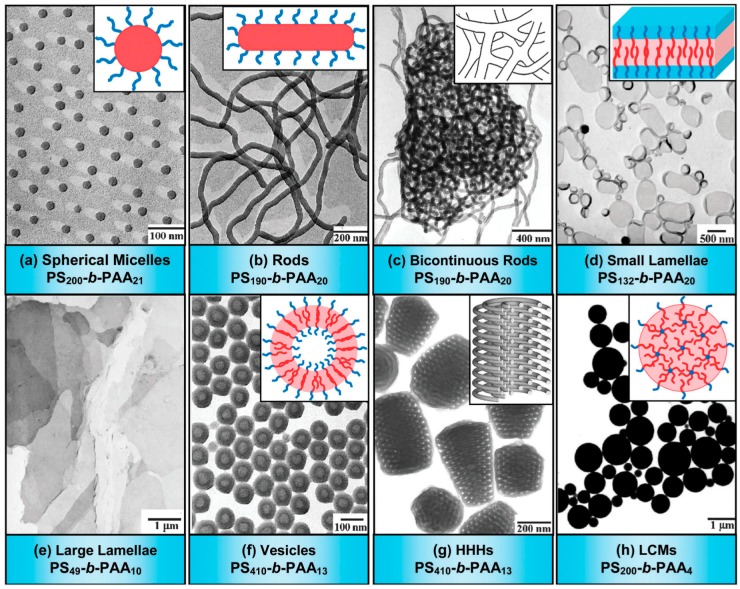
“…factors that are able to change the packing parameter such as BCP composition and concentration, water content, common solvent, and additives, a wide range of morphologies have been reported including spherical micelles, cylindrical, bi-continuous, lamella, vesicles, tubules, etc. [81] (Figure 11).”
BackgroundOn the origins of morphological complexity in block copolymer surfactants
Jain, S., & Bates, F. S. (2003) · Science · doi:10.1126/science.1082193 · Cited by 1,217 · cited 1×
“This observation is in contrast to that of the low molecular weight counterpart, where only spherical micelles, wormlike micelles, and vesicles were obtained when mixed with water [84].”
ResultCylindrical block copolymer micelles and co-micelles of controlled length and architecture
Wang, X., Guerin, G., Wang, H., Wang, Y., Manners, I., & Winnik, M. A. (2007) · Science · doi:10.1126/science.1141382 · Cited by 1,174 · cited 1×
“These micelles are able to grow epitaxially by the addition of more polymer, leading to extended micelles with a very narrow size distribution (Figure 12) [82].”
BackgroundAdvanced drug delivery devices via self-assembly of amphiphilic block copolymers
Rösler, A., Vandermeulen, G. W. M., & Klok, H.-A. (2001) · Advanced Drug Delivery Reviews · doi:10.1016/s0169-409x(01)00222-8 · Cited by 1,168 · cited 2×
“In addition, the PEO corona prevents recognition by the reticuloendothelial system and therefore increases the blood circulation times [100].”
BackgroundCatalytic nanoarchitectures—The importance of nothing and the unimportance of periodicity
Rolison, D. R. (2003) · Science · doi:10.1126/science.1082332 · Cited by 1,037 · cited 3×
“Larger pore size facilitates a more efficient diffusion of guest molecules within the pores [136], and also allows the loading of metal catalyst particles [154,155].”
BackgroundBlock copolymer based nanostructures: Materials, processes, and applications to electronics
Kim, H.-C., Park, S.-M., & Hinsberg, W. D. (2010) · Chemical Reviews · doi:10.1021/cr900159v · Cited by 1,017 · cited 2×
“, thermoplastic elastomers), drug delivery, patterning, porous materials, and many others over the last two decades [12].”
BackgroundSzwarc, M., Levy, M., & Milkovich, R. (1956) · Journal of the American Chemical Society · doi:10.1021/ja01592a101 · Cited by 988 · cited 1×
“The pioneering work on BCP synthesis using living anionic polymerization (LAP) was reported by Szwarc et al. in 1956 [38,39].”
MethodMolecular-based design and emerging applications of nanoporous carbon spheres
Liu, J., Wickramaratne, N. P., Qiao, S. Z., & Jaroniec, M. (2015) · Nature Materials · doi:10.1038/nmat4317 · Cited by 954 · cited 1×
“This group of materials exhibits periodically aligned structures and uniform cavities with sizes ranging from micro- (<2 nm), to meso- (2–50 nm), to macropores (>50 nm) [130], which lead to very high surface areas (up to 1500 m2/g) [131].”
BackgroundCross-linked block copolymer micelles: functional nanostructures of great potential and versatility
O'Reilly, R. K., Hawker, C. J., & Wooley, K. L. (2006) · Chemical Society Reviews · doi:10.1039/b514858h · Cited by 939 · cited 1×
“Advanced nanoscale systems created by self-assembly of BCPs have seen tremendous progress for drug delivery applications over the last decade [100,101].”
BackgroundWei, J., Zhou, D., Sun, Z., Deng, Y., Xia, Y., & Zhao, D. (2013) · Advanced Functional Materials · doi:10.1002/adfm.201202764 · Cited by 931 · cited 1×
“A large variety of mesoporous metal oxides in the form of powder were synthesized through EISA using commercial Pluronics as a template [149].”
MethodChong, ). Y. K., Le, T. P. T., Moad, G., Rizzardo, E., & Thang, S. H. (1999) · Macromolecules · doi:10.1021/ma981472p · Cited by 850 · cited 1×
“The creative combination of RAFT polymerization with other polymerization techniques, such as ATRP or ring-opening polymerization, has extended the array of available architectures such as graft, star, hyperbranched, etc. [31,32].”
MethodSynthesis of a large-scale highly ordered porous carbon film by self-assembly of block copolymers
Liang, C., Hong, K., Guiochon, G. A., Mays, J. W., & Dai, S. (2004) · Angewandte Chemie International Edition · doi:10.1002/anie.200461051 · Cited by 834 · cited 1×
“These synthesized BCPs usually contain poly(2-vinylpyridine) (P2VP), poly(4-vinylpyridine) (P4VP), or poly(ethylene oxide) (PEO) as the hydrophilic block, and PS, PMMA, PI, polyisobutylene (PIB), and polyacrylonitrile (PAN) as the hydrophobic block [143,144].”
BackgroundSelf-citationNanostructure fabrication using block copolymers
Hamley, I. W. (2003) · Nanotechnology · doi:10.1088/0957-4484/14/10/201 · Cited by 773
Controlled/living radical polymerization
Matyjaszewski, K., & Spanswick, J. (2005) · Materials Today · doi:10.1016/s1369-7021(05)00745-5 · Cited by 746
Templated nanocarbons for energy storage
Nishihara, H., & Kyotani, T. (2012) · Advanced Materials · doi:10.1002/adma.201201715 · Cited by 745
Macroscopic 10-terabit–per–square-inch arrays from block copolymers with lateral order
Park, S., Lee, D. H., Xu, J., Kim, B., Hong, S. W., Jeong, U., Xu, T., & Russell, T. P. (2009) · Science · doi:10.1126/science.1168108 · Cited by 740 · cited 1×
“were able to achieve a 3-nm cylindrical domain size using PS-b-PEO on a surface of a sapphire single-crystal (Figure 18) [123].”
MethodPorous electrode materials for lithium-ion batteries–how to prepare them and what makes them special
Vu, A., Qian, Y., & Stein, A. (2012) · Advanced Energy Materials · doi:10.1002/aenm.201200320 · Cited by 719
Thermo-sensitive polymeric micelles based on poly (N-isopropylacrylamide) as drug carriers
Wei, H., Cheng, S.-X., Zhang, X.-Z., & Zhuo, R.-X. (2009) · Progress in Polymer Science · doi:10.1016/j.progpolymsci.2009.05.002 · Cited by 718 · cited 1×
“Thermo-responsive micelles are the most widely investigated, such as poly(N-isopropyl acrylamide-b-D,L-lactide), poly(N-isopropyl acrylamide-bbutyl methacrylate), and poly(N-isopropyl acrylamide-co-N,N-dimethylacrylamide)-b-poly(D,Llactide-co-glycolide) [102,103].”
BackgroundAdvanced drug delivery devices via self-assembly of amphiphilic block copolymers
Rösler, A., Vandermeulen, G. W. M., & Klok, H.-A. (2012) · Advanced Drug Delivery Reviews · doi:10.1016/j.addr.2012.09.026 · Cited by 688
Organically modified aluminosilicate mesostructures from block copolymer phases
Templin, M., Franck, A., Du Chesne, A., Leist, H., Zhang, Y., Ulrich, R., Schädler, V., & Wiesner, U. (1997) · Science · doi:10.1126/science.278.5344.1795 · Cited by 668 · cited 2×
“synthesized mesostructured silicate/copolymer composite film through EISA with PSb-PEO as a structure-directing agent in a mixture of THF and water [148].”
BackgroundMethodSelf-porating polymersomes of peg–pla and peg–pcl: Hydrolysis-triggered controlled release vesicles
Ahmed, F., & Discher, D. E. (2004) · Journal of Controlled Release · doi:10.1016/j.jconrel.2003.12.021 · Cited by 667 · cited 2×
“employed vesicles made from a mixture of biocompatible PB-b-PEO and PLA-b-PEO to simultaneously deliver two anti-cancer drugs, in which hydrophilic doxorubicin was encapsulated in the cavity and hydrophobic paclitaxel was embedded in the vesicle wall [106,110].”
MethodMacromolecular architectures by living and controlled/living polymerizations
Hadjichristidis, N., Iatrou, H., Pitsikalis, M., & Mays, J. (2006) · Progress in Polymer Science · doi:10.1016/j.progpolymsci.2006.07.002 · Cited by 642 · cited 1×
“Although there might be an argument that the demanding experimental conditions is one of its limitations, LAP has proved itself to be the best polymerization technique for the preparation of well-defined BCPs based on vinyl monomers such as styrene, dienes, (meth)acrylates, vinyl pyridines, acrylonitriles, as well as…”
BackgroundSelf-citationKeddie, D. J. (2014) · Chem. Soc. Rev. · doi:10.1039/c3cs60290g · Cited by 634
Bates, C. M., Maher, M. J., Janes, D. W., Ellison, C. J., & Willson, C. G. (2014) · Macromolecules · doi:10.1021/ma401762n · Cited by 634
Tang, J., Liu, J., Li, C., Li, Y., Tade, M. O., Dai, S., & Yamauchi, Y. (2015) · Angewandte Chemie International Edition · doi:10.1002/anie.201407629 · Cited by 630 · cited 2×
“4 nm, 16 nm and 16 nm, respectively [152].”
BackgroundAtrp in the design of functional materials for biomedical applications
Siegwart, D. J., Oh, J. K., & Matyjaszewski, K. (2012) · Progress in Polymer Science · doi:10.1016/j.progpolymsci.2011.08.001 · Cited by 613 · cited 1×
“Tremendous efforts have been devoted to developing novel ligands to minimize such side reactions [28].”
BackgroundFrom Self-Organizing Polymers to Nanohybrid and Biomaterials
Förster, S., & Plantenberg, T. (2002) · Angewandte Chemie International Edition · doi:10.1002/1521-3773(20020301)41:5<688::aid-anie688>3.0.co;2-3 · Cited by 613 · cited 1×
“Several reviews are available on this topic [22,63,64].”
BackgroundDirect synthesis of ordered mesoporous carbons
Ma, T.-Y., Liu, L., & Yuan, Z.-Y. (2013) · Chem. Soc. Rev. · doi:10.1039/c2cs35301f · Cited by 598 · cited 1×
“Research interest in ordered porous materials originated from the successful synthesis of porous silicates in the 1990s and soon spread to a variety of framework compositions including metal oxides, non-oxide inorganics, and carbon [129].”
BackgroundOrigins of complex self-assembly in block copolymers
Matsen, M. W., & Bates, F. S. (1996) · Macromolecules · doi:10.1021/ma960744q · Cited by 578 · cited 2×
“By manipulating the molecular parameters such as the Flory-Huggins interaction parameter (χ), the degree of polymerization (N), and the volume fraction (f ), various morphologies including spherical, cylindrical, lamellar, and others have been revealed both experimentally and theoretically [9,10].”
BackgroundOrilall, M. C., & Wiesner, U. (2011) · Chem. Soc. Rev. · doi:10.1039/c0cs00034e · Cited by 520 · cited 1×
“Several reviews are available on this topic [22,63,64].”
BackgroundOpsteen, J. A., & van Hest, J. C. M. (2005) · Chemical Communications · doi:10.1039/b412930j · Cited by 516 · cited 1×
“Terminal alkyne and azide moieties were conveniently introduced via protected functionalized initiators [57].”
BackgroundFunctional nanomaterials based on block copolymer self-assembly
Kim, J. K., Yang, S. Y., Lee, Y., & Kim, Y. (2010) · Progress in Polymer Science · doi:10.1016/j.progpolymsci.2010.06.002 · Cited by 510 · cited 1×
“Several reviews are available on this topic [22,63,64].”
BackgroundWang, J.-S., & Matyjaszewski, K. (1995) · Macromolecules · doi:10.1021/ma00126a041 · Cited by 486 · cited 1×
“…numerous literature has described the synthesis of BCPs via controlled polymerization techniques including: atom transfer racial polymerization (ATRP), reversible addition-fragmentation chain transfer (RAFT) radical polymerization, nitroxide-mediated polymerization (NMP), and many others [20–22].”
MethodMin, K., Gao, H., & Matyjaszewski, K. (2005) · Journal of the American Chemical Society · doi:10.1021/ja0429364 · Cited by 471 · cited 2×
“This new ARGET system was also successfully applied to the efficient synthesis of styrene and nbutyl acrylate block copolymers [25].”
MethodLarge-pore ordered mesoporous materials templated from non-pluronic amphiphilic block copolymers
Deng, Y., Wei, J., Sun, Z., & Zhao, D. (2013) · Chem. Soc. Rev. · doi:10.1039/c2cs35426h · Cited by 447 · cited 6×
“Many intere ting crystal symmetries could b ac ieved through fine tuning the template compositions, and example are substantially reviewed [151].”
BackgroundMethodInfluentialDeng, Y., Yu, T., Wan, Y., Shi, Y., Meng, Y., Gu, D., Zhang, L., Huang, Y., Liu, C., Wu, X., et al. (2007) · Journal of the American Chemical Society · doi:10.1021/ja067379v · Cited by 402 · cited 1×
“Using PEO-b -PS ( M w = 29,700 g/mol) as the copolymer template, adding a special hydrothermal treatment step, Deng et al. achieved mesoporous silica with pore diameters as large as 30.8 nm [156].”
MethodInfluentialPolarity-switching top coats enable orientation of sub-10-nm block copolymer domains
Bates, C. M., Seshimo, T., Maher, M. J., Durand, W. J., Cushen, J. D., Dean, L. M., Blachut, G., Ellison, C. J., & Willson, C. G. (2012) · Science · doi:10.1126/science.1226046 · Cited by 385 · cited 1×
“A polarity-switchable top layer was also applied to the surface of silicon-containing BCPs films to obtain perpendicular orientation of poly(styrene-b-trimethyl silyl styrene-b-styrene) (PS-b-PTMSS-b-PS) and poly(trimethyl silyl styrene-b-lactide) (PTMSS-b-PLA) after thermal annealing [128].”
MethodUse of ascorbic acid as reducing agent for synthesis of well-defined polymers by arget atrp
Min, K., Gao, H., & Matyjaszewski, K. (2007) · Macromolecules · doi:10.1021/ma0702041 · Cited by 380 · cited 1×
“Later on, miniemulsion ARGET ATRP was developed by the same group and used for the preparation of homopolymers and block copolymers [26,27].”
MethodSchulze, M. W., McIntosh, L. D., Hillmyer, M. A., & Lodge, T. P. (2014) · Nano Letters · doi:10.1021/nl4034818 · Cited by 356
New insight into the synthesis of large-pore ordered mesoporous materials
Wei, J., Sun, Z., Luo, W., Li, Y., Elzatahry, A. A., Al-Enizi, A. M., Deng, Y., & Zhao, D. (2017) · Journal of the American Chemical Society · doi:10.1021/jacs.6b11411 · Cited by 336 · cited 2×
“In the c se of copolymers containi g PS and PAN, the hydrophobic s gments can be conve ted to carbon residue in high yield in the carbonization step, which provides additional mechanical support to the mesoporous framework [145].”
BackgroundThermal processing of diblock copolymer melts mimics metallurgy
Kim, K., Schulze, M. W., Arora, A., Lewis, R. M., Hillmyer, M. A., Dorfman, K. D., & Bates, F. S. (2017) · Science · doi:10.1126/science.aam7212 · Cited by 295 · cited 2×
“rapidly quenched poly(isoprene-b lactide) diblock cop lymers from the disordered state and revealed an extraordinary thermal history dependence [76].”
BackgroundExperimental techniques in high-vacuum anionic polymerization
Uhrig, D., & Mays, J. W. (2005) · Journal of Polymer Science Part A: Polymer Chemistry · doi:10.1002/pola.21016 · Cited by 293
Self-citation(2000) · doi:10.1201/9781482270365 · Cited by 282 · cited 1×
“These two types of BCPs were firstly developed by Holden and Milkovich through living anionic polymerization in the early 1960s [86].”
BackgroundTopological polymer chemistry: a cyclic approach toward novel polymer properties and functions
Yamamoto, T., & Tezuka, Y. (2011) · Polymer Chemistry · doi:10.1039/c1py00088h · Cited by 272 · cited 2×
“reviewed interesting work ab ut topological studies of BCPs [58].”
BackgroundGhoroghchian, P. P., Li, G., Levine, D. H., Davis, K. P., Bates, F. S., Hammer, D. A., & Therien, M. J. (2006) · Macromolecules · doi:10.1021/ma0519009 · Cited by 266 · cited 1×
“Both PEO-b-PLA and PEO-b-PCL vesicles exhibit the controlled release of active dyes and anti-cancer drugs over periods of up to two weeks [108,109].”
BackgroundTailored design of functional nanoporous carbon materials toward fuel cell applications
Tang, J., Liu, J., Torad, N. L., Kimura, T., & Yamauchi, Y. (2014) · Nano Today · doi:10.1016/j.nantod.2014.05.003 · Cited by 266 · cited 2×
“Many studies demonstrated the advantage of mesopores over micropores in the mass transport process in a variety of applications [135,153].”
BackgroundPreparation and brain delivery property of biodegradable polymersomes conjugated with ox26
Pang, Z., Lu, W., Gao, H., Hu, K., Chen, J., Zhang, C., Gao, X., Jiang, X., & Zhu, C. (2008) · Journal of Controlled Release · doi:10.1016/j.jconrel.2008.03.007 · Cited by 264 · cited 1×
“Attaching the vesicle with antibodies allows the delivery of vesicles to targeted cells [111].”
BackgroundCross-linked polymersome membranes: Vesicles with broadly adjustable properties
Discher, B. M., Bermudez, H., Hammer, D. A., Discher, D. E., Won, Y.-Y., & Bates, F. S. (2002) · The Journal of Physical Chemistry B · doi:10.1021/jp011958z · Cited by 262 · cited 1×
“employed vesicles made from a mixture of biocompatible PB-b-PEO and PLA-b-PEO to simultaneously deliver two anti-cancer drugs, in which hydrophilic doxorubicin was encapsulated in the cavity and hydrophobic paclitaxel was embedded in the vesicle wall [106,110].”
MethodInterfacial segregation in disordered block copolymers: Effect of tunable surface potentials
Mansky, P., Russell, T. P., Hawker, C. J., Mays, J., Cook, D. C., & Satija, S. K. (1997) · Physical Review Letters · doi:10.1103/physrevlett.79.237 · Cited by 255 · cited 2×
“reported that the neutral surface (γPS-Air ≈ γPMMA-Air) could be achieved with thermally annealed PS-b-PMMA at 225 ◦C in air [121].”
BackgroundSelf-citationHoneker, C. C., & Thomas, E. L. (1996) · Chemistry of Materials · doi:10.1021/cm960146q · Cited by 253 · cited 1×
“The self-assembly behavior may also be influenced by other external parameters such as mechanical or electric fields [67,68].”
BackgroundNonlinear Block Copolymer Architectures
Pitsikalis, M., Pispas, S., Mays, J. W., & Hadjichristidis, N. (2007) · Advances in Polymer Science · doi:10.1007/3-540-69191-x_1 · Cited by 244 · cited 1×
“Although there might be an argument that the demanding experimental conditions is one of its limitations, LAP has proved itself to be the best polymerization technique for the preparation of well-defined BCPs based on vinyl monomers such as styrene, dienes, (meth)acrylates, vinyl pyridines, acrylonitriles, as well as…”
BackgroundSelf-citationMicrodomain Orientation of PS-b-PMMA by Controlled Interfacial Interactions
Ham, S., Shin, C., Kim, E., Ryu, D. Y., Jeong, U., Russell, T. P., & Hawker, C. J. (2008) · Macromolecules · doi:10.1021/ma8007338 · Cited by 238 · cited 1×
“Poly(styrene-b-methyl methacrylate) (PSb-PMMA) is the most studied BCP system because it can produce lamellar or cylinder morphologies, which are perpendicularly oriented to the substrate simply via thermal treatment (Figure 17) [119].”
BackgroundBiodegradable polymersomes as a basis for artificial cells: Encapsulation, release and targeting
Meng, F., Engbers, G. H. M., & Feijen, J. (2005) · Journal of Controlled Release · doi:10.1016/j.jconrel.2004.09.026 · Cited by 227 · cited 1×
“Both PEO-b -PLA and PEO-b -PCL vesicles exhibit the controlled release of active dyes and anti-cancer drugs over periods of up to two weeks [108,109].”
BackgroundHonda, S., Yamamoto, T., & Tezuka, Y. (2010) · Journal of the American Chemical Society · doi:10.1021/ja104691j · Cited by 225 · cited 1×
“Moreover, the Tc can be tuned by the changing the ratio of 1 and 2 [83].”
BackgroundBlock Copolymers: Synthetic Strategies, Physical Properties, and Applications
Hadjichristidis, N., Pispas, S., & Floudas, G. (2002) · doi:10.1002/0471269808 · Cited by 223 · cited 1×
“Star-block copolymers of butadiene and styrene have found applications in adhesives and sealants [87].”
BackgroundRecent advance in living anionic polymerization of functionalized styrene derivatives
Hirao, A., Loykulnant, S., & Ishizone, T. (2002) · Progress in Polymer Science · doi:10.1016/s0079-6700(02)00016-3 · Cited by 218 · cited 1×
“Although there might be an argument that the demanding experimental conditions is one of its limitations, LAP has proved itself to be the best polymerization technique for the preparation of well-defined BCPs based on vinyl monomers such as styrene, dienes, (meth)acrylates, vinyl pyridines, acrylonitriles, as well as…”
BackgroundBenoit, D., Harth, E., Fox, P., Waymouth, R. M., & Hawker, C. J. (2000) · Macromolecules · doi:10.1021/ma991187l · Cited by 216 · cited 1×
“In comparison with conventional TEMPO systems, these new systems exhibit a significant improvement in the ability to control the polymerization and further demonstrate the versatility of nitroxide-mediated living free radical procedures [37].”
BackgroundOligosaccharide/silicon-containing block copolymers with 5 nm features for lithographic applications
Cushen, J. D., Otsuka, I., Bates, C. M., Halila, S., Fort, S., Rochas, C., Easley, J. A., Rausch, E. L., Thio, A., Borsali, R., et al. (2012) · ACS Nano · doi:10.1021/nn300459r · Cited by 211 · cited 1×
“The BCPs exhibit hexagonally packed cylinders with a 5-nm feature size in thin film [127].”
BackgroundCyclic block copolymers for controlling feature sizes in block copolymer lithography
Poelma, J. E., Ono, K., Miyajima, D., Aida, T., Satoh, K., & Hawker, C. J. (2012) · ACS Nano · doi:10.1021/nn304217y · Cited by 189 · cited 4×
“synthesized a series of cyclic PS-b-PEO BCPs using the ATRP and CuAAC of α,ωazide-functionalized PS and α,ω-alkyne PEO homopolymers (Figure 5) [11].”
BackgroundMethodInfluentialSustainable thermoplastic elastomers from terpene-derived monomers
Bolton, J. M., Hillmyer, M. A., & Hoye, T. R. (2014) · ACS Macro Letters · doi:10.1021/mz500339h · Cited by 186 · cited 2×
“Considerable research has focused on developing high Tg glassy domains such a poly(α-methyl styrene) (Tg ~ 173 °C) [89], poly(α-methyl p-methyl styrene) (Tg ~ 183 °C) [90], and poly(tert-butyl styrene) (PtBS, Tg ~ 130 °C) [91].”
BackgroundElabd, Y. A., Napadensky, E., Walker, C. W., & Winey, K. I. (2006) · Macromolecules · doi:10.1021/ma051958n · Cited by 183
Wei, J., Wang, H., Deng, Y., Sun, Z., Shi, L., Tu, B., Luqman, M., & Zhao, D. (2011) · Journal of the American Chemical Society · doi:10.1021/ja207525e · Cited by 175 · cited 2×
“Following the traditional EISA method, an evaporation-induced aggregation assembly (EIAA) mechanism, was proposed [150].”
MethodInglis, A. J., Sinnwell, S., Davis, T. P., Barner-Kowollik, C., & Stenzel, M. H. (2008) · Macromolecules · doi:10.1021/ma8002328 · Cited by 172 · cited 3×
“fi ized a series of star polymers by a combination of RAFT chemistry het ro Diels- l er re cti [60], in which the reaction occurs between thiocarbonyl group and a diene in a [4 + 2] cycloaddition process (Scheme 6).”
MethodThe limits of precision monomer placement in chain growth polymerization
Gody, G., Zetterlund, P. B., Perrier, S., & Harrisson, S. (2016) · Nature Communications · doi:10.1038/ncomms10514 · Cited by 170
Effect of molecular weight on the ion transport mechanism in polymerized ionic liquids
Fan, F., Wang, W., Holt, A. P., Feng, H., Uhrig, D., Lu, X., Hong, T., Wang, Y., Kang, N.-G., Mays, J., et al. (2016) · Macromolecules · doi:10.1021/acs.macromol.6b00714 · Cited by 169 · cited 1×
“Controlled radical polymerization (CRP) techniques represent the most versatile and facile approach for BCP synthesis, mainly due to their compatibility with a wide spectrum of monomers, high tolerance of functional groups and impurities, and ease of experimental setup [14–16].”
BackgroundSelf-citationLi, C., Tang, Y., Armes, S. P., Morris, C. J., Rose, S. F., Lloyd, A. W., & Lewis, A. L. (2005) · Biomacromolecules · doi:10.1021/bm049331k · Cited by 166 · cited 2×
“For example, a series of biocompatible, thermo-responsive ABA triblock copolymers comprising poly(N-isopropyl acrylamide) (PNIPAM) as the A block and poly(2methacryloyloxyethyl phosphorylcholine) (PMPC) as the central B block was synthesized using ATRP initiated by a if ctional initiator, as illustrated in Scheme 1 [2…”
MethodFetters, L. J., & Morton, M. (1969) · Macromolecules · doi:10.1021/ma60011a002 · Cited by 161 · cited 1×
“Considerable research has focused on developing high T g glassy domains such as poly( α -methyl styrene) (T g ~173 ◦ C) [89], poly( α -methyl p -methyl styrene) (T g ~183 ◦ C) [90], and poly( tert -butyl styrene) (P t BS, T g ~130 ◦ C) [91].”
BackgroundDefects in the Self-Assembly of Block Copolymers and Their Relevance for Directed Self-Assembly
Li, W., & Müller, M. (2015) · Annual Review of Chemical and Biomolecular Engineering · doi:10.1146/annurev-chembioeng-061114-123209 · Cited by 161
Zhang, H., Hong, K., & Mays, J. W. (2002) · Macromolecules · doi:10.1021/ma025518x · Cited by 160
Self-citationArget atrp of methyl methacrylate in the presence of nitrogen-based ligands as reducing agents
Kwak, Y., & Matyjaszewski, K. (2009) · Polymer International · doi:10.1002/pi.2530 · Cited by 159 · cited 1×
“Later on, miniemulsion ARGET ATRP was developed by the same group and used for the preparation of homopolymers and block copolymers [26,27].”
MethodYou, Y., Hong, C., Wang, W., Lu, W., & Pan, C. (2004) · Macromolecules · doi:10.1021/ma048444t · Cited by 151 · cited 1×
“The creative combination of RAFT polymerization with other polymerization techniques, such as ATRP or ring-opening polymerization, has extended the array of available architectures such as graft, star, hyperbranched, etc. [31,32].”
MethodSelf-citationDiscovering ordered phases of block copolymers: New results from a generic fourier-space approach
Guo, Z., Zhang, G., Qiu, F., Zhang, H., Yang, Y., & Shi, A.-C. (2008) · Physical Review Letters · doi:10.1103/physrevlett.101.028301 · Cited by 150
Zhao, Y., Sivaniah, E., & Hashimoto, T. (2008) · Macromolecules · doi:10.1021/ma8013004 · Cited by 143
Quirk, R. P., Yoo, T., Lee, Y., Kim, J., & Lee, B. (2007) · Advances in Polymer Science · doi:10.1007/3-540-46414-x_3 · Cited by 141 · cited 1×
“Another advantage of this linking chemistry is that it opens endless possibilities of various molecular architectures [5,42,52,53], as demonstrated by the work of Mays, Hadjichristidis, Hirao, Quirk, and many others through chlorosilane and 1,1-diphenylethylene (DPE)-based linking chemistry (Figure…”
BackgroundRodwogin, M. D., Spanjers, C. S., Leighton, C., & Hillmyer, M. A. (2010) · ACS Nano · doi:10.1021/nn901190a · Cited by 140 · cited 2×
“synthesized poly(lactide-b-dimethylsiloxane-lactide) (PLA-PDMS-PLA) to achieve a 7-nm pitch size [124].”
BackgroundControlled synthesis and functionalization of ordered large-pore mesoporous carbons
Deng, Y., Cai, Y., Sun, Z., Gu, D., Wei, J., Li, W., Guo, X., Yang, J., & Zhao, D. (2010) · Advanced Functional Materials · doi:10.1002/adfm.201001202 · Cited by 139 · cited 3×
“Larger pore size facilitates a more efficient diffusion of guest molecules within the pores [136], and also allows the loading of metal catalyst particles [154,155].”
BackgroundLuo, Y., Wang, X., Zhu, Y., Li, B.-G., & Zhu, S. (2010) · Macromolecules · doi:10.1021/ma101348k · Cited by 138 · cited 1×
“Furthermore, the same group demonstrated that this method could be used as a promising approach to synthesize thermoplastic elastomer materials [36].”
MethodAmphiphilic block copolymers from a direct and one-pot raft synthesis in water
Chaduc, I., Zhang, W., Rieger, J., Lansalot, M., D'Agosto, F., & Charleux, B. (2011) · Macromolecular Rapid Communications · doi:10.1002/marc.201100240 · Cited by 138 · cited 1×
“In contrast to this two-step process, Chaduc et al. reported a simple one-pot RAFT process for amphiphilic block copolymers in water [ 33].”
Uhrig, D., & Mays, J. W. (2002) · Macromolecules · doi:10.1021/ma020427l · Cited by 134 · cited 2×
“Another advantage of this linking chemistry is that it opens endless possibilities of various molecular architectures [5,42,52,53], as demonstrated by the work of Mays, Hadjichristidis, Hirao, Quirk, and many others through chlorosilane and 1,1-diphenylethylene (DPE)-based linking chemistry (Figure 3).”
BackgroundSelf-citationIatrou, H., Mays, J. W., & Hadjichristidis, N. (1998) · Macromolecules · doi:10.1021/ma980738p · Cited by 132 · cited 1×
“Another advantage of this linking chemistry is that it opens endless possibilities of various molecular architectures [5,42,52,53], as demonstrated by the work of Mays, Hadjichristidis, Hirao, Quirk, and many others through chlorosilane and 1,1-diphenylethylene (DPE)-based linking chemistry (Figure 3).”
BackgroundSelf-citationMorphologies of Microphase-Separated A2B Simple Graft Copolymers
Pochan, D. J., Gido, S. P., Pispas, S., Mays, J. W., Ryan, A. J., Fairclough, J. P. A., Hamley, I. W., & Terrill, N. J. (1996) · Macromolecules · doi:10.1021/ma951696x · Cited by 129
Self-citationYu, K., Hurd, A. J., Eisenberg, A., & Brinker, C. J. (2001) · Langmuir · doi:10.1021/la0113724 · Cited by 129 · cited 1×
“However, care must be taken when using the pore expanding agent to the composite in order to avoid the risk of unstable mesostructures [160].”
BackgroundWang, X., Luo, Y., Li, B., & Zhu, S. (2009) · Macromolecules · doi:10.1021/ma9010999 · Cited by 127
Block copolymer self-assembly-directed synthesis of mesoporous gyroidal superconductors
Robbins, S. W., Beaucage, P. A., Sai, H., Tan, K. W., Werner, J. G., Sethna, J. P., DiSalvo, F. J., Gruner, S. M., Van Dover, R. B., & Wiesner, U. (2016) · Science Advances · doi:10.1126/sciadv.1501119 · Cited by 127 · cited 4×
“Reprinted with permission from Reference [75].”
BackgroundInfluentialDeng, Y., Liu, J., Liu, C., Gu, D., Sun, Z., Wei, J., Zhang, J., Zhang, L., Tu, B., & Zhao, D. (2008) · Chemistry of Materials · doi:10.1021/cm802413q · Cited by 126 · cited 1×
“reported the use of PS homopolymer as the pore expanding agent in the synthesis of mesoporous carbon, when PS-b-PEO is selected as the template [159].”
MethodAdvincula, R., Zhou, Q., Park, M., Wang, S., Mays, J., Sakellariou, G., Pispas, S., & Hadjichristidis, N. (2002) · Langmuir · doi:10.1021/la025962t · Cited by 123
Self-citationMa, G., Yan, X., Li, Y., Xiao, L., Huang, Z., Lu, Y., & Fan, J. (2010) · Journal of the American Chemical Society · doi:10.1021/ja1027524 · Cited by 119 · cited 2×
“Larger pore size facilitates a more efficient diffusion of guest molecules within the pores [136], and also allows the loading of metal catalyst particles [154,155].”
BackgroundWojnarowska, Z., Feng, H., Fu, Y., Cheng, S., Carroll, B., Kumar, R., Novikov, V. N., Kisliuk, A. M., Saito, T., Kang, N.-G., et al. (2017) · Macromolecules · doi:10.1021/acs.macromol.7b01217 · Cited by 116
Self-citationLiving anionic surface initiated polymerization (sip) of styrene from clay surfaces
Zhou, Q., Fan, X., Xia, C., Mays, J., & Advincula, R. (2001) · Chemistry of Materials · doi:10.1021/cm0101780 · Cited by 113
Self-citationZhang, J., Deng, Y., Wei, J., Sun, Z., Gu, D., Bongard, H., Liu, C., Wu, H., Tu, B., Schüth, F., et al. (2009) · Chemistry of Materials · doi:10.1021/cm901371r · Cited by 107 · cited 1×
“Alternatively, amphiphilic BCPs with wider choices for composition and molecular weight of the polymer segments are readily designed and synthesized in the laboratory through controlled/“living” polymerization techniques [142].”
MethodFree energy evaluation in field-theoretic polymer simulations
Lennon, E. M., Katsov, K., & Fredrickson, G. H. (2008) · Physical Review Letters · doi:10.1103/physrevlett.101.138302 · Cited by 103 · cited 1×
“…manipulating the molecular parameters such as the Flory-Huggins interaction parameter ( χ ), the degree of polymerization (N), and the volume fraction ( f ), various morphologies including spherical, cylindrical, lamellar, and others have been revealed both experimentally and theoretically [9,10].”
BackgroundTang, J., Liu, J., Li, C., Li, Y., Tadé, M. O., Dai, S., & Yamauchi, Y. (2014) · Angewandte Chemie · doi:10.1002/ange.201407629 · Cited by 101
Deng, Y., Liu, C., Gu, D., Yu, T., Tu, B., & Zhao, D. (2008) · J. Mater. Chem. · doi:10.1039/b713310c · Cited by 100 · cited 2×
“) using a variety of BCP templates such as PS-b-P4VP, PEO-b-PS, PEO-b-PMMA, and PEO-b-PMMA-b-PS [143].”
BackgroundMethodThambi, T., Son, S., Lee, D. S., & Park, J. H. (2016) · Acta Biomaterialia · doi:10.1016/j.actbio.2015.10.011 · Cited by 95 · cited 1×
“The formed micelles encapsulated doxorubicin (DOX) in an aqueous condition and exhibited rapid intracellular release of DOX under the hypoxic condition [105].”
BackgroundHong, K., Uhrig, D., & Mays, J. W. (1999) · Current Opinion in Solid State and Materials Science · doi:10.1016/s1359-0286(00)00011-5 · Cited by 94 · cited 1×
“…weight, architecture, composition, and functionality as compared to controlled radical polymerization, almost all well-defined BCPs with complex architectures such as star, comb, graft, dendritic, etc. are achievable via the combination of anionic polymerization and linking chemistry [6,42–47].”
BackgroundSelf-citationAqueous Dispersions of Poly(ethylene oxide)-b-poly(γ-methyl-ε-caprolactone) Block Copolymers
Zupancich, J. A., Bates, F. S., & Hillmyer, M. A. (2006) · Macromolecules · doi:10.1021/ma060642s · Cited by 94 · cited 1×
“BCP vesicles containing biocompatible PEO, PLA, and PCL have been evaluated [106,107].”
MethodMatsuo, A., Watanabe, T., & Hirao, A. (2004) · Macromolecules · doi:10.1021/ma0496549 · Cited by 91 · cited 2×
“…weight, architecture, composition, and functionality as compared to controlled radical polymerization, almost all well-defined BCPs with complex architectures such as star, comb, graft, dendritic, etc. are achievable via the combination of anionic polymerization and linking chemistry [6,42–47].”
BackgroundLee, H.-N., Bai, Z., Newell, N., & Lodge, T. P. (2010) · Macromolecules · doi:10.1021/ma1019279 · Cited by 89 · cited 1×
“Thermo-responsive micelles are the most widely investigated, such as poly(N-isopropyl acrylamide-b-D,L-lactide), poly(N-isopropyl acrylamide-b-butyl methacrylate), and poly(N-isopropyl acrylamide-co-N,N-dimethylacrylamide)-b-poly(D,L-lactide-co-glycolide) [102,103].”
BackgroundProgress in Controlled Radical Polymerization: Mechanisms and Techniques
(2012) · ACS Symposium Series · doi:10.1021/bk-2012-1100 · Cited by 87
Synthesis, Thermodynamics, and Dynamics of Poly(4-tert-butylstyrene-b-methyl methacrylate)
Kennemur, J. G., Hillmyer, M. A., & Bates, F. S. (2012) · Macromolecules · doi:10.1021/ma301047y · Cited by 86
Directed Self-Assembly of Silicon-Containing Block Copolymer Thin Films
Maher, M. J., Rettner, C. T., Bates, C. M., Blachut, G., Carlson, M. C., Durand, W. J., Ellison, C. J., Sanders, D. P., Cheng, J. Y., & Willson, C. G. (2015) · ACS Applied Materials & Interfaces · doi:10.1021/am508197k · Cited by 79
Zhu, Y., Burgaz, E., Gido, S. P., Staudinger, U., Weidisch, R., Uhrig, D. W., & Mays, J. W. (2006) · Macromolecules · doi:10.1021/ma060067s · Cited by 79 · cited 1×
“synthesized a series of tetrafunctional multigraft copolymer (“centipede”) with varied branching points (Figure 16) [96].”
BackgroundSelf-citationBlock copolymer synthesis in one shot: Concurrent metal-free atrp and rop processes under sunlight
Aydogan, C., Kutahya, C., Allushi, A., Yilmaz, G., & Yagci, Y. (2017) · Polymer Chemistry · doi:10.1039/c7py00069c · Cited by 78 · cited 2×
“reported a one-pot synthetic approach to BCPs using the combination of ATRP nd ring opening polymerization (ROP) methods simultaneously [56].”
MethodCao, Y., Huang, J., Peng, X., Cao, D., Galaska, A. M., Qiu, S., Liu, J., Khan, M. A., Young, D. P., Ryu, J. E., et al. (2017) · Carbon · doi:10.1016/j.carbon.2017.01.033 · Cited by 75 · cited 1×
“With these unique features, porous materials present great value for applications in energy conversion and storage [132–135], catalysis [136], drug delivery [137], gas capture [138,139], and water purification [140,141].”
BackgroundSelf-citationMorphology diagram of a diblock copolymer–aluminosilicate nanoparticle system
Garcia, B. C., Kamperman, M., Ulrich, R., Jain, A., Gruner, S. M., & Wiesner, U. (2009) · Chemistry of Materials · doi:10.1021/cm901885c · Cited by 74 · cited 2×
“As illustrated in Figure 22, eight morphologies of the composite system were obtained by adding different amounts of the inorganic precursor into BCP templates [161].”
MethodSugihara, S., Sugihara (nee Nishikawa), K., Armes, S. P., Ahmad, H., & Lewis, A. L. (2010) · Macromolecules · doi:10.1021/ma101136v · Cited by 72 · cited 1×
“Armes and coworkers synthesized zwitterionic PMPC-based block copolymers by a dispersion ATRP process [29].”
MethodPatino, J. M. R., Gutiérrez, M. C., Carriazo, D., Ania, C. O., Fierro, J. L. G., Ferrer, M. L., & del Monte, F. (2014) · Journal of Materials Chemistry A · doi:10.1039/c4ta00562g · Cited by 71 · cited 1×
“With these unique features, porous materials present great value for applications in energy conversion and storage [132–135], catalysis [136], drug delivery [137], gas capture [138,139], and water purification [140,141].”
BackgroundXenidou, M., & Hadjichristidis, N. (1998) · Macromolecules · doi:10.1021/ma980362f · Cited by 71 · cited 1×
“Because the precise control over composition and architecture is possible through LAP, the resulting BCPs can be tailored to a wide variety of applications [88].”
BackgroundLuo, Y., Wang, X., Li, B.-G., & Zhu, S. (2011) · Macromolecules · doi:10.1021/ma102378w · Cited by 70 · cited 2×
“This macro-RAFT agent was capa le of nh ncing the colloid l stability and, as a result, the polymerization was successful [34,35].”
BackgroundInfluences of mesopore size on oxygen reduction reaction catalysis of pt/carbon aerogels
Du, H., Gan, L., Li, B., Wu, P., Qiu, Y., Kang, F., Fu, R., & Zeng, Y. (2007) · The Journal of Physical Chemistry C · doi:10.1021/jp066374h · Cited by 69 · cited 1×
“Many studies demonstrated the advantage of mesopores over micropores in the mass transport process in a variety of applications [135,153].”
BackgroundKamegawa, T., Ishiguro, Y., Seto, H., et al. (2014) · Journal of Materials Chemistry A · doi:10.1039/c4ta06020b · Cited by 68 · cited 1×
“With these unique features, porous materials present great value for applications in energy conversion and storage [132–135], catalysis [136], drug delivery [137], gas capture [138,139], and water purification [140,141].”
BackgroundPatel, S. N., Javier, A. E., Beers, K. M., Pople, J. A., Ho, V., Segalman, R. A., & Balsara, N. P. (2012) · Nano Letters · doi:10.1021/nl302454c · Cited by 67 · cited 1×
“studied the effect of salt on the morphology of electron conducting poly(3-(2′-ethylhexyl)thiophene)-b-ethylene oxide) (P3EHTb-PEO) [74].”
BackgroundAlmdal, K., Hillmyer, M. A., & Bates, F. S. (2002) · Macromolecules · doi:10.1021/ma020148y · Cited by 62 · cited 1×
“Some other BCPs that are capable of self-assembling into sub-10 nm domain sizes include PS-b-PDMS [125], PS-b-P2VP [126], and PS-b-PLA [118].”
BackgroundMatsuo, Y., Konno, R., Ishizone, T., Goseki, R., & Hirao, A. (2013) · Polymers · doi:10.3390/polym5031012 · Cited by 62 · cited 7×
“The pioneering work on BCP synthesis using living anionic polymerization (LAP) was reported by Szwarc et al. in 1956 [38,39].”
BackgroundInfluentialTopcoat approaches for directed self-assembly of strongly segregating block copolymer thin films
Yoshida, H., Suh, H. S., Ramirez-Herunandez, A., Lee, J. I., Aida, K., Wan, L., Ishida, Y., Tada, Y., Ruiz, R., de Pablo, J., et al. (2013) · Journal of Photopolymer Science and Technology · doi:10.2494/photopolymer.26.55 · Cited by 60 · cited 1×
“…(Figure 18) [123]. χ Some other BCPs that are capable of self-assembling into sub-10 nm domain sizes include PS-b -PDMS [125], PS-b -P2VP [126], and PS-b -PLA [118]. χ χ Since organic polymers that contain inorganic constituents, such as silicon, are inherently etch resistant, the…”
BackgroundLu, W., Wang, Y., Wang, W., Cheng, S., Zhu, J., Xu, Y., Hong, K., Kang, N., & Mays, J. W. (2017) · Polymer Chemistry · doi:10.1039/c7py01225j · Cited by 57 · cited 1×
“The same group synthesized a series of TP all acrylic-based high temperature thermoplastic elastomers containing poly(1-adamatyl acrylate) as a hard domain and poly(tetrahydrofurfuryl acrylate) as a soft domain by RAFT polymerization [93].”
BackgroundSelf-citationKeen, I., Yu, A., Cheng, H.-H., Jack, K. S., Nicholson, T. M., Whittaker, A. K., & Blakey, I. (2012) · Langmuir · doi:10.1021/la304141m · Cited by 56 · cited 1×
“Some other BCPs that are capable of self-assembling into sub-10 nm domain sizes include PS-b-PDMS [125], PS-b-P2VP [126], and PS-b-PLA [118].”
BackgroundA star-shaped single lithium-ion conducting copolymer by grafting a poss nanoparticle
Cao, P.-F., Wojnarowska, Z., Hong, T., Carroll, B., Li, B., Feng, H., Parsons, L., Wang, W., Lokitz, B. S., Cheng, S., et al. (2017) · Polymer · doi:10.1016/j.polymer.2017.07.052 · Cited by 56 · cited 1×
“The preparation of BCPs using sequential CRP relies on the fact that the reactive polymer chain end is preserved by a reversible reaction between the active species and the dormant species [17–19].”
BackgroundSelf-citationSeshimo, T., Maeda, R., Odashima, R., Takenaka, Y., Kawana, D., Ohmori, K., & Hayakawa, T. (2016) · Scientific Reports · doi:10.1038/srep19481 · Cited by 56
DeRouchey, J., Thurn-Albrecht, T., Russell, T. P., & Kolb, R. (2004) · Macromolecules · doi:10.1021/ma034739f · Cited by 54
Storey, R. F., & Baugh, D. W. (2000) · Polymer · doi:10.1016/s0032-3861(99)00512-1 · Cited by 54
Facile arm-first synthesis of star block copolymers via arget atrp with ppm amounts of catalyst
Ding, H., Park, S., Zhong, M., Pan, X., Pietrasik, J., Bettinger, C. J., & Matyjaszewski, K. (2016) · Macromolecules · doi:10.1021/acs.macromol.6b01597 · Cited by 54 · cited 1×
“[24].”
Tong, J. D., Leclère, P., Doneux, C., Brédas, J. L., Lazzaroni, R., & Jérôme, R. (2001) · Polymer · doi:10.1016/s0032-3861(00)00759-x · Cited by 49 · cited 1×
“These TPEs exhibited superior stress-strain behavior compared to that of conventional all acrylic-based TPEs consisting of PMMA and PBA made by controlled radical processes [94], while the tensile strength was lower compared to that of similar products prepared via living anionic polymerization [95].”
BackgroundSanoja, G. E., Popere, B. C., Beckingham, B. S., Evans, C. M., Lynd, N. A., & Segalman, R. A. (2016) · Macromolecules · doi:10.1021/acs.macromol.5b02614 · Cited by 49 · cited 2×
“prepared a series of ionic conducting BCPs to investigate the relationship between ionic conductivity and domain spacing [73].”
BackgroundMethodWang, W., Schlegel, R., White, B. T., Williams, K., Voyloy, D., Steren, C. A., Goodwin, A., Coughlin, E. B., Gido, S., Beiner, M., et al. (2016) · Macromolecules · doi:10.1021/acs.macromol.5b02642 · Cited by 49 · cited 2×
“3 MPa and strain at break of 1390 ± 66% from tensile tests [92].”
BackgroundSelf-citationSynthesis of model linear tetrablock quaterpolymers and pentablock quintopolymers of ethylene oxide
Ekizoglou, N., & Hadjichristidis, N. (2002) · Journal of Polymer Science Part A: Polymer Chemistry · doi:10.1002/pola.10288 · Cited by 47
Tunable morphologies from charged block copolymers
Goswami, M., Sumpter, B. G., Huang, T., Messman, J. M., Gido, S. P., Isaacs-Sodeye, A., & Mays, J. W. (2010) · Soft Matter · doi:10.1039/c0sm00733a · Cited by 46 · cited 2×
“Interestingly, Inversed morphologies were observed when the diblock BCP, 25sPS-b-75f PI (50% of PS block was sulfonated to sulfonic form), was casted from tetrahydrofuran compared with its neutral counterpart, as shown in Figure 8 [72].”
MethodSelf-citationWojnarowska, Z., Feng, H., Diaz, M., Ortiz, A., Ortiz, I., Knapik-Kowalczuk, J., Vilas, M., Verdía, P., Tojo, E., Saito, T., et al. (2017) · Chemistry of Materials · doi:10.1021/acs.chemmater.7b01658 · Cited by 43 · cited 1×
“…weight, architecture, composition, and functionality as compared to controlled radical polymerization, almost all well-defined BCPs with complex architectures such as star, comb, graft, dendritic, etc. are achievable via the combination of anionic polymerization and linking chemistry [6,42–47].”
BackgroundSelf-citationFetters, L. J., Firer, E. M., & Dafauti, M. (1977) · Macromolecules · doi:10.1021/ma60060a008 · Cited by 38 · cited 1×
“Considerable research has focused on developing high Tg glassy domains such as poly(α-methyl styrene) (Tg ~ 173 °C) [89], poly(α-methyl p-methyl styrene) (Tg ~ 183 °C) [90], and poly(tert-butyl styrene) (PtBS, Tg ~ 130 °C) [91].”
Mechanical properties and hysteresis behaviour of multigraft copolymers
Staudinger, U., Weidisch, R., Zhu, Y., Gido, S. P., Uhrig, D., Mays, J. W., Iatrou, H., & Hadjichristidis, N. (2006) · Macromolecular Symposia · doi:10.1002/masy.200690027 · Cited by 35 · cited 1×
“The tetrafunctional copolymer with 10 branching points showed an exceptional elongation at break ~2100%, almost double that of commercial Kraton® (1050% at similar composition), and only 40% residual strain on hysteresis experiments (elongated at 1400%) [97].”
BackgroundSelf-citationDesign and Synthesis of Multigraft Copolymer Thermoplastic Elastomers: Superelastomers
Wang, H., Lu, W., Wang, W., Shah, P. N., Misichronis, K., Kang, N., & Mays, J. W. (2017) · Macromolecular Chemistry and Physics · doi:10.1002/macp.201700254 · Cited by 35
Self-citationGas separation mechanism of CO 2 selective amidoxime-poly(1-trimethylsilyl-1-propyne) membranes
Feng, H., Hong, T., Mahurin, S. M., et al. (2017) · Polymer Chemistry · doi:10.1039/c7py00056a · Cited by 33 · cited 1×
“With these unique features, porous materials present great value for applications in energy conversion and storage [132–135], catalysis [136], drug delivery [137], gas capture [138,139], and water purification [140,141].”
BackgroundSelf-citationBellas, V., Iatrou, H., Pitsinos, E. N., & Hadjichristidis, N. (2001) · Macromolecules · doi:10.1021/ma010440q · Cited by 31 · cited 1×
“P t BA, a linking reagent bearing with chlorosilane moiety was used due to its high reactivity (Scheme 4B) [51].”
MethodWang, W., Wang, W., Lu, X., Bobade, S., Chen, J., Kang, N., Zhang, Q., & Mays, J. W. (2014) · Macromolecules · doi:10.1021/ma501866t · Cited by 31 · cited 1×
“Furthermore, the same group developed a low-cost emulsion polymerization to prepare comb multigraft copolymers such as PI-g-PS and PBA-g-PS as well as centipede PBA-g-PS for TPE applications [98,99].”
BackgroundSelf-citationFeng, H., Changez, M., Hong, K., Mays, J. W., & Kang, N.-G. (2017) · Macromolecules · doi:10.1021/acs.macromol.6b02084 · Cited by 30
Self-citationWang, W., Wang, W., Li, H., Lu, X., Chen, J., Kang, N., Zhang, Q., & Mays, J. W. (2015) · Industrial & Engineering Chemistry Research · doi:10.1021/ie504457e · Cited by 26 · cited 1×
“Furthermore, the same group developed a low-cost emulsion polymerization to prepare comb multigraft copolymers such as PI-g-PS and PBA-g-PS as well as centipede PBA-g-PS for TPE applications [98,99].”
BackgroundSelf-citationKimura, T. (2011) · Chemistry – An Asian Journal · doi:10.1002/asia.201100173 · Cited by 17 · cited 1×
“In another case, aluminum-organophosphonate films with tunable macropores (30–200 nm) were synthesized via ultra-high molecular weight PEO-b -PS (250,000 g/mol) templates, though the resulting material exhibited a relatively disordered mesostructure [157].”
MethodMartín‐Gomis, L., Fernández‐García, M., de la Fuente, J. L., Madruga, E. L., & Cerrada, M. L. (2003) · Macromolecular Chemistry and Physics · doi:10.1002/macp.200300001 · Cited by 12 · cited 1×
“…TPEs exhibited superior stress-strain behavior compared to that of conventional all acrylic-based TPEs consisting of PMMA and PBA made by controlled radical processes [94], while the tensile strength was lower compared to that of similar products prepared via living anionic polymerization [95].”
BackgroundHandlin, D. L., Hansen, D. R., Wright, K. J., & Trenor, S. R. (2009) · Controlled and Living Polymerizations · doi:10.1002/9783527629091.ch10 · Cited by 9
Double-bond-containing polyallene-based triblock copolymers via phenoxyallene and (meth)acrylate
Ding, A., Lu, G., Guo, H., & Huang, X. (2017) · Scientific Reports · doi:10.1038/srep43706 · Cited by 8
ChemInform Abstract: From Self‐Organizing Polymers to Nanohybrid and Biomaterials
Foerster, S., & Plantenberg, T. (2002) · ChemInform · doi:10.1002/chin.200229258 · Cited by 4
(2015) · Cited by 2
Self-citationSupramolecular engineering with macromolecules: An alternative concept for block copolymers
Lohmeijer, B. G. G., & Schubert, U. S. (2002) · Angewandte Chemie International Edition · doi:10.1002/1521-3773(20021018)41:20<3825::aid-anie3825>3.0.co;2-6
Hirao, A., Hayashi, M., & Haraguchi, N. (2000) · Macromolecular Rapid Communications · doi:10.1002/1521-3927(20001101)21:17<1171::aid-marc1171>3.0.co;2-c
Research works printed but not linked: 1
- Alexandridis, P., and Lindman, B. (2000). Amphiphilic Block Copolymers: Self-Assembly and Applications, Elsevier.
Cited by
Block copolymer solution self‐assembly: Recent advances, emerging trends, and applications
Karayianni, M., & Pispas, S. (2021) · Journal of Polymer Science · doi:10.1002/pol.20210430 · Cited by 257
Lombardo, D., Calandra, P., Pasqua, L., & Magazù, S. (2020) · Materials · doi:10.3390/ma13051048 · Cited by 229
Linear Block Copolymer Synthesis
Dau, H., Jones, G. R., Tsogtgerel, E., Nguyen, D., Keyes, A., Liu, Y.-S., Rauf, H., Ordonez, E., Puchelle, V., Basbug Alhan, H., et al. (2022) · Chemical Reviews · doi:10.1021/acs.chemrev.2c00189 · Cited by 210
Architectural Design and Additive Manufacturing of Mechanical Metamaterials: A Review
Lu, C., Hsieh, M., Huang, Z., Zhang, C., Lin, Y., Shen, Q., Chen, F., & Zhang, L. (2022) · Engineering · doi:10.1016/j.eng.2021.12.023 · Cited by 212
Hydrophobic Interaction: A Promising Driving Force for the Biomedical Applications of Nucleic Acids
Xiao, F., Chen, Z., Wei, Z., & Tian, L. (2020) · Advanced Science · doi:10.1002/advs.202001048 · Cited by 191
Metadata
- Authors
- Feng, H., Lu, X., Wang, W., Kang, N.-G., & Mays, J.
- Affiliations
- University of Tennessee at Knoxville (US)
- Oak Ridge National Laboratory (US)
- Corresponding author
- Mays, Jimmy
- Venue
- Polymers
- Publisher
- MDPI AG
- Published
- 2017-10-09
- Volume
- 9
- Issue
- 10
- Pages
- 494
- ISSN
- 2073-4360 (ISSN-L)
- PMC
- PMC6418972
- OpenAlex
- W2762501848
- Semantic Scholar
- 88db26794feb9e7209b6797101c1c4158f6abd41
- Cited by
- 467
- References
- 163
- Citations by year
- 2026: 40 · 2025: 57 · 2024: 58 · 2023: 60 · 2022: 77 · 2021: 56 · 2020: 58 · 2019: 33 · 2018: 28
- FWCI
- 1.73
- Type
- journal article
- Language
- en
- Open access
- gold
- doi.org
- Licence
- Locations
- Polymers (publishedVersion, cc-by)
- Europe PMC (PubMed Central) (publishedVersion, other-oa)
- PubMed Central (publishedVersion, cc-by)
- PubMed (publishedVersion)
- DOAJ (DOAJ: Directory of Open Access Journals) (submittedVersion)
- OSTI OAI (U.S. Department of Energy Office of Scientific and Technical Information) (submittedVersion)
- Funders
- U.S. Department of Energy
- Office of Science
- Basic Energy Sciences
- Materials Sciences and Engineering Division
- Topics
- Physical Sciences › Materials Science › Materials Chemistry › Block Copolymer Self-Assembly
- Physical Sciences › Chemistry › Organic Chemistry › Advanced Polymer Synthesis and Characterization
- Physical Sciences › Materials Science › Polymers and Plastics › Polymer crystallization and properties
- Keywords
- block copolymers, block copolymer synthesis, self-assembly, polymer architecture, polymer characterization
About these checks
Registry, retraction, Cites and statistics results are computed, not judged, with one exception: a printed reference that no index lists is read once by a model before it counts as a citation error. Claims are extracted by a model and kept only when their quote appears verbatim in the text; each cited source is then checked, with a model’s help, for whether it says what the claim relies on. Those verdicts can be wrong — read the claim’s quote and the cited source before relying on one.
The claim verdicts this report counts are experimental: their accuracy is not yet measured.
A language model drew the claims from the paper on 2026-10-10, under version 3 of the claim definition (model deepseek-v4.1-flash, prompt extract-v3).
A second model labelled each claim on 2026-10-10 (model jev-1.13-20260917, definition revision gold-guideline-v0.2).
Cited sources are checked with a language model’s help (gpt-6-sol).
Statistics and arithmetic are recomputed, not judged.
Confidence bands are shown only for fields calibrated on our annotated test set. None is calibrated yet, so no band is shown.
What counts as a claim ›How we measure confidence ›How we check this ›
Are you an author, or do you see a problem with this page? Request a review
Data sources
Bibliographic data: Semantic Scholar, OpenAlex, Crossref.
Contains information from the Semantic Scholar Academic Graph Datasets, made available under the ODC Attribution License (ODC-BY 1.0).
Semantic Scholar’s data is described in: Kinney, R., et al. (2023). The Semantic Scholar Open Data Platform. arXiv:2301.10140.
