

Ultrafast terahertz emission from emerging symmetry-broken materials
Open accessThe DOI matches its Crossref record; 268 of the 279 references it cites were found in a registry or an index, and 1 are not checked yet; 95 of the 170 sources its claims cite were checked for support.
Abstract
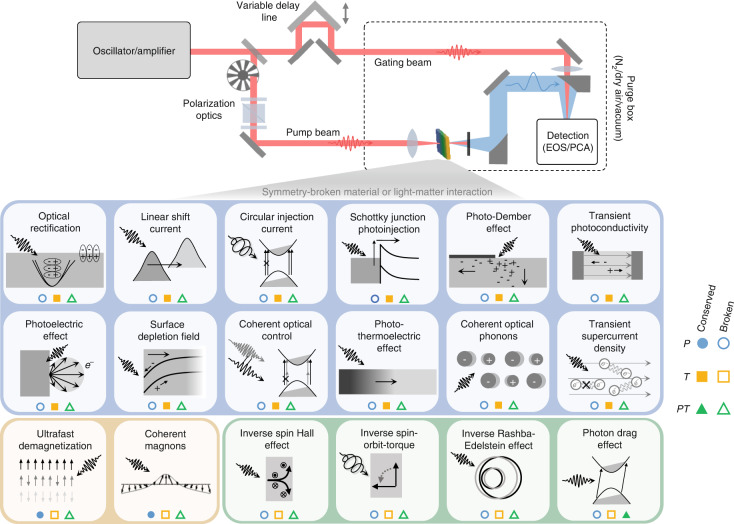
Nonlinear optical spectroscopies are powerful tools for investigating both static material properties and light-induced dynamics. Terahertz (THz) emission spectroscopy has emerged in the past several decades as a versatile method for directly tracking the ultrafast evolution of physical properties, quasiparticle distributions, and order parameters within bulk materials and nanoscale interfaces. Ultrafast optically-induced THz radiation is often analyzed mechanistically in terms of relative contributions from nonlinear polarization, magnetization, and various transient free charge currents. While this offers material-specific insights, more fundamental symmetry considerations enable the generalization of measured nonlinear tensors to much broader classes of systems. We thus frame the present discussion in terms of underlying broken symmetries, which enable THz emission by defining a system directionality in space and/or time, as well as more detailed point group symmetries that determine the nonlinear response tensors. Within this framework, we survey a selection of recent studies that utilize THz emission spectroscopy to uncover basic properties and complex behaviors of emerging materials, including strongly correlated, magnetic, multiferroic, and topological systems. We then turn to low-dimensional systems to explore the role of designer nanoscale structuring and corresponding symmetries that enable or enhance THz emission. This serves as a promising route for probing nanoscale physics and ultrafast light-matter interactions, as well as facilitating advances in integrated THz systems. Furthermore, the interplay between intrinsic and extrinsic material symmetries, in addition to hybrid structuring, may stimulate the discovery of exotic properties and phenomena beyond existing material paradigms.
Verified 2026-11-25 · 1 reference not checked yet
Overview
CoChat Summary
## TL;DR
This review argues that THz emission spectroscopy is a symmetry-sensitive, contact-free probe of ultrafast currents, quasiparticles, and order parameters in quantum materials. It surveys how broken symmetries in magnetic, correlated, topological, and nanostructured systems enable or enhance THz emission, and highlights designer low-dimensional structures as a route to new THz functionality.
## Key findings
- THz emission is especially sensitive to broken inversion, time-reversal, and combined symmetries, and the paper notes that even the presence of THz emission itself reveals a broken discrete symmetry.
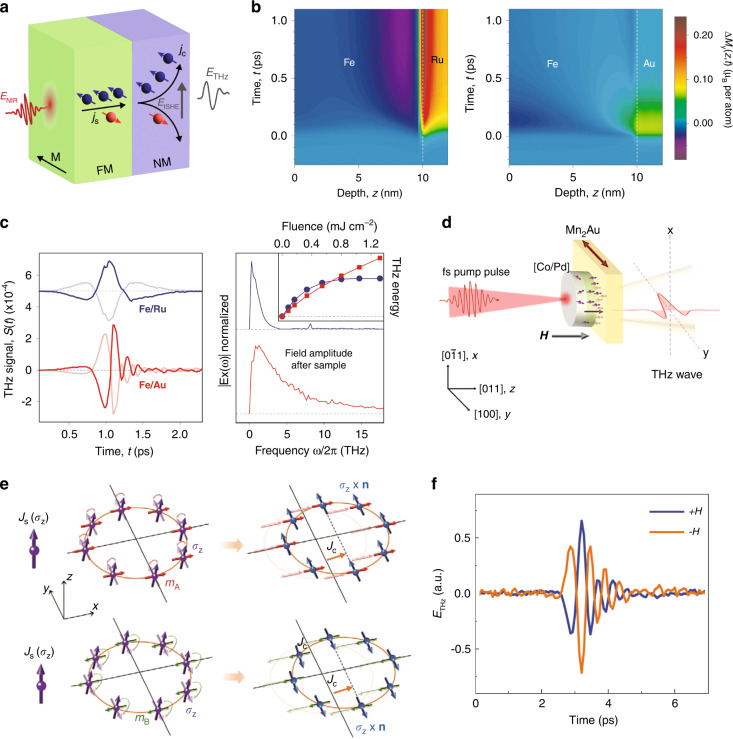
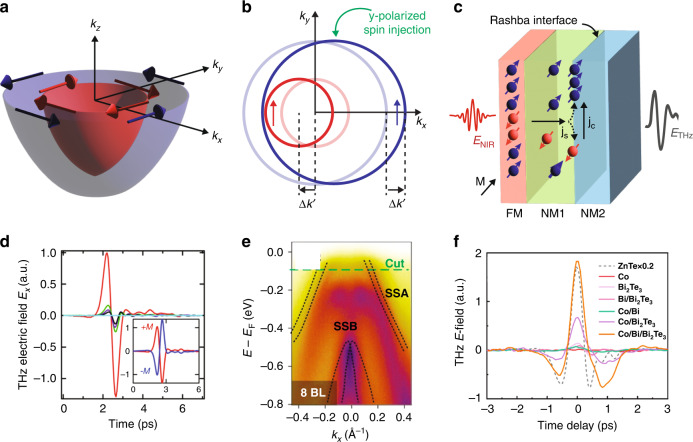
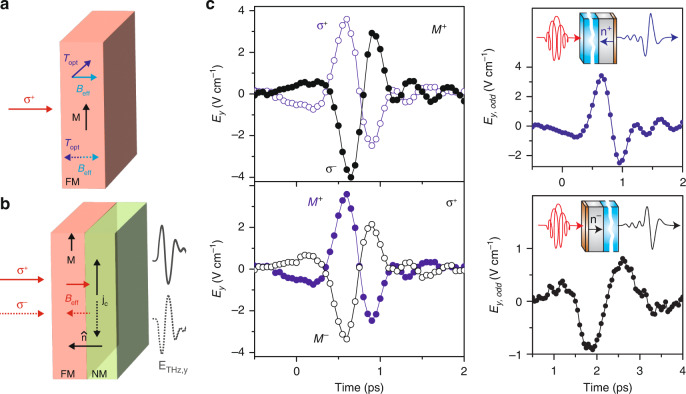
- In spintronic heterostructures, THz emission can be strongly enhanced: FM/NM systems are attributed to the inverse spin Hall effect, and tri-layer spintronic devices are reported to generate THz pulses with nearly 30 THz bandwidth and amplitudes rivaling optical rectification in ZnTe and GaP.
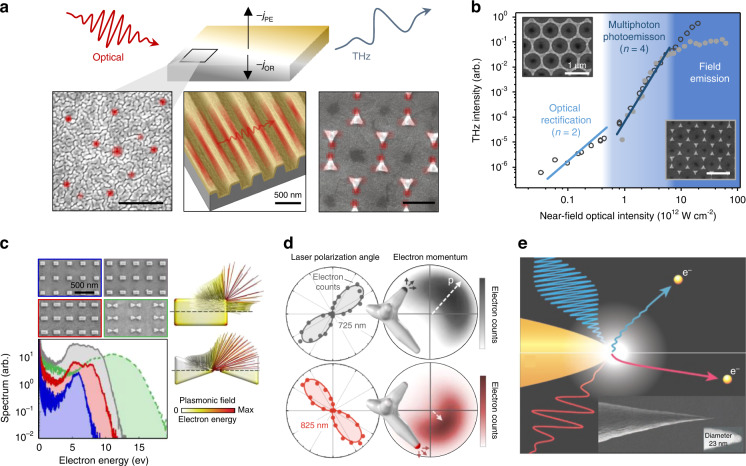
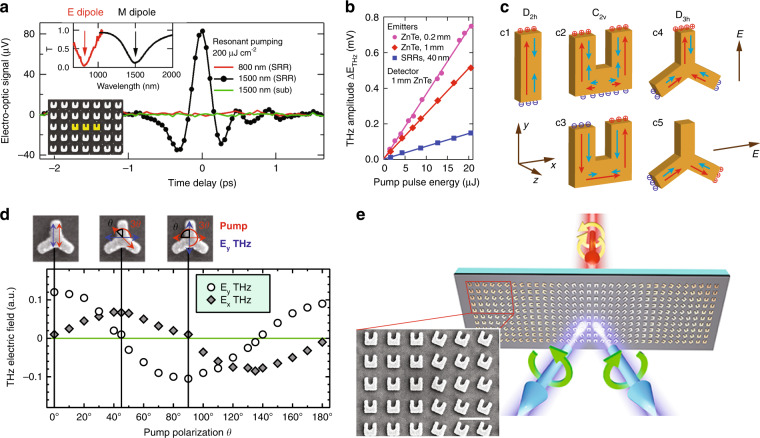
- In plasmonic metasurfaces, a 40 nm gold split-ring resonator layer on ITO/glass produced single-cycle broadband THz pulses up to 4 THz, with a field intensity approaching that from 5000-fold thicker 200 μm ZnTe crystals.
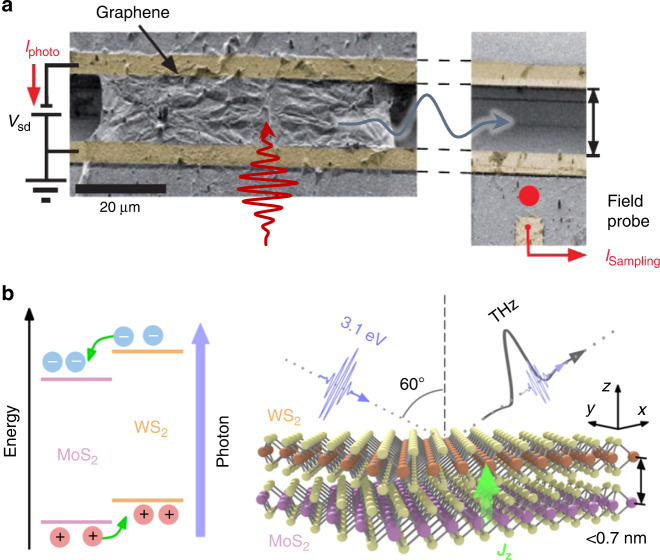
- In 2D heterostructures, THz emission detected sub-nanometer-scale interfacial currents in MoS2/WS2 monolayers with transfer efficiencies approaching 100%, underscoring angstrom-scale sensitivity.
## Methods
- Narrative review / perspective article: it synthesizes prior THz emission studies across symmetry-broken materials rather than presenting a new experimental dataset.
- Sources and examples span magnetic systems, superconductors, multiferroics, topological materials, nanostructured metals, plasmonic metasurfaces, 1D nanowires and nanotubes, and 2D materials/heterostructures.
- Main analysis is a symmetry-based framework: the authors organize mechanisms by broken parity/inversion, time-reversal, and point-group symmetries, then relate those symmetries to nonlinear response tensors, currents, and emitted THz waveforms.
## Limitations
- The paper itself states that it is “not exhaustive” and apologizes for potentially overlooking relevant work.
- It also says many areas are only briefly surveyed, especially in low-dimensional and emerging hybrid systems, so coverage is necessarily selective.
- Evident from the text: because this is a review, it does not provide a single unified dataset or new experimental test of its claims; instead, conclusions are drawn from previously published studies.
Model-written summary. Check it against the paper before relying on it.
Integrity signals
Registry
Cites
Statistics
Figures
Verification
Claims the paper makes
71 Valid · 1 Not valid · 40 Not checked · 77 Own results and interpretations
The cited sources support only part of this claim — read each source’s verdict below.
In the paper
“high- cuprates can likewise emit THz radiation under bias due to tunneling of Cooper pairs through the intrinsic Josephson junctions that develop between superconducting CuO2 layers and insulating BiO/SrO barrier layers, as occurs naturally within Bi2Sr2CaCu2O8+x (Bi-2212)67,68.”
§ Ultrafast terahertz emission from emerging symmetry-broken materials > Transient currents in strongly correlated and topological materials The strength of THz emission spectroscopy stems from its sensitivity to symmetry breaking in the electronic state. Nowhere is this more apparent than in strongly correlated and topological material systems, as the presence of frustrated couplings provides an opportunity to explore unconventional symmetries and symmetry breaking that would otherwise be forbidden based on crystal structure alone. Here we will focus on the breaking of symmetry brought on intrinsically within some broken symmetry states or extrinsically by application of an external bias field. Within strongly correlated materials, such as high- superconductors or multiferroic oxides, we will focus on the use of THz emission to gain insights into the ordered ground state, while the nonlinear response in topological materials can go one step further by shedding light on the quantum geometrical properties that are characteristic of the topological state. Notably, light-induced photocurrents will feature prominently in the discussion, where we emphasize that THz emission in general provides an all-optical, contact-free means of tracking photocurrents that largely mitigates extraneous effects due to Schottky barriers, field screening, and generation of interfacial defects common to direct photocurrent readout. However, as compared to the continuous excitation used in static photocurrent measurements, pulsed excitations employed in THz emission can have unintended consequences, including laser heating. Often the degree to which heating influences the emitted THz spectra is material specific and can frequently be identified by a lack of polarization dependence in the spectra. Nonetheless, heating can be responsible for driving either reversible or irreversible phase transitions within a material and should be carefully monitored during the experiment. > Superconductors
What the sources say
- Partly supportedcites [67] Hu X Lin SZ Phase dynamics in a stack of inductively coupled intrinsic Josephson junctions and terahertz electromagnetic radiation Supercond. Sci. Technol. 2010 23 053001 sourceExperimental — accuracy not yet measured
The Introduction (p. 2) describes Cooper-pair tunneling across Josephson junctions and reports THz emission from voltage-biased BSCCO. Section III.1 (p. 17) places superconductivity mainly in CuO layers and describes the layered crystal as a stack of Josephson junctions. Our copy does not identify the insulating barriers specifically as BiO/SrO layers, so that structural detail is not supported. (LLM, conf=0.87)
- Not checked — no full text of the sourcecites [68] Kashiwagi T High temperature superconductor terahertz emitters: Fundamental physics and its applications Jpn J. Appl. Phys. 2012 51 010113 source
plainstates a cause- Asserted: passes — The authors put it forward as true.
- Checkable: passes — It can be checked against evidence.
- Load-bearing: unclear — It is unclear whether the paper’s conclusions depend on it.
- Based: passes — The paper gives a reason why it holds.
- Partly supported
The cited sources support only part of this claim — read each source’s verdict below.
In the paper
“Radiative ultrafast currents can also occur when symmetry is conserved but both and are broken, as in some centrosymmetric antiferromagnets44.”
§ Ultrafast terahertz emission from emerging symmetry-broken materials > Symmetries underlying pulsed terahertz emission > Symmetry breaking
What the sources say
- Partly supportedcites [44] Ahn J Guo GY Nagaosa N Low-frequency divergence and quantum geometry of the bulk photovoltaic effect in topological semimetals Phys. Rev. X 2020 10 041041 sourceExperimental — accuracy not yet measured
The symmetry analysis (p. 4) says PT-symmetric systems with broken inversion symmetry can generate linear injection and circular shift currents. But the Introduction (p. 2) says inversion symmetry forbids the bulk photovoltaic response, so the cited paper does not support the example of centrosymmetric antiferromagnets. The cited passages also do not characterize these currents as radiative or ultrafast. (LLM, conf=0.87)
plainstates a cause- Asserted: passes — The authors put it forward as true.
- Checkable: passes — It can be checked against evidence.
- Load-bearing: unclear — It is unclear whether the paper’s conclusions depend on it.
- Based: passes — The paper gives a reason why it holds.
- Partly supported
Every source the paper cites for this claim was checked and supports it.
In the paper
“the partial suppression of supercurrent density following optical excitation can transiently introduce magnetic flux in a manner akin to field cooling.”
§ Ultrafast terahertz emission from emerging symmetry-broken materials > Transient currents in strongly correlated and topological materials The strength of THz emission spectroscopy stems from its sensitivity to symmetry breaking in the electronic state. Nowhere is this more apparent than in strongly correlated and topological material systems, as the presence of frustrated couplings provides an opportunity to explore unconventional symmetries and symmetry breaking that would otherwise be forbidden based on crystal structure alone. Here we will focus on the breaking of symmetry brought on intrinsically within some broken symmetry states or extrinsically by application of an external bias field. Within strongly correlated materials, such as high- superconductors or multiferroic oxides, we will focus on the use of THz emission to gain insights into the ordered ground state, while the nonlinear response in topological materials can go one step further by shedding light on the quantum geometrical properties that are characteristic of the topological state. Notably, light-induced photocurrents will feature prominently in the discussion, where we emphasize that THz emission in general provides an all-optical, contact-free means of tracking photocurrents that largely mitigates extraneous effects due to Schottky barriers, field screening, and generation of interfacial defects common to direct photocurrent readout. However, as compared to the continuous excitation used in static photocurrent measurements, pulsed excitations employed in THz emission can have unintended consequences, including laser heating. Often the degree to which heating influences the emitted THz spectra is material specific and can frequently be identified by a lack of polarization dependence in the spectra. Nonetheless, heating can be responsible for driving either reversible or irreversible phase transitions within a material and should be carefully monitored during the experiment. > Superconductors
What the sources say
- Supportedcites [66] Tonouchi M Recent topics in high-Tc superconductive electronics Jpn J. Appl. Phys. 2005 44 7735 7749 source
Section 4.2, “Optical vortex manipulation” (page unavailable), says femtosecond laser illumination locally reduces supercurrent, allowing magnetic flux to form, and that vortices can become trapped as superconductivity relaxes. This supports the field-cooling analogy as a comparison about flux trapping, not a claim that the film undergoes a temperature-driven transition. (LLM, conf=0.86)
plainstates a cause- Asserted: passes — The authors put it forward as true.
- Checkable: passes — It can be checked against evidence.
- Load-bearing: unclear — It is unclear whether the paper’s conclusions depend on it.
- Based: passes — The paper gives a reason why it holds.
- Supported
Every source the paper cites for this claim was checked and supports it.
In the paper
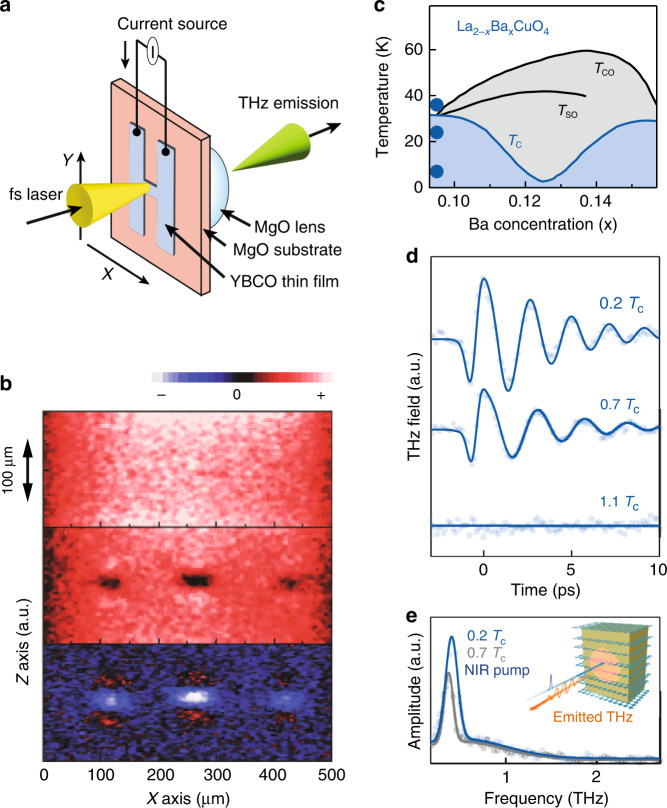
“the emission of narrow-band THz radiation following optical excitation occurs when fluctuating or incommensurate charge stripes coexist with superconductivity (Fig. 2c–e), leading to a breaking of inversion symmetry between CuO2 planes.”
§ Ultrafast terahertz emission from emerging symmetry-broken materials > Transient currents in strongly correlated and topological materials The strength of THz emission spectroscopy stems from its sensitivity to symmetry breaking in the electronic state. Nowhere is this more apparent than in strongly correlated and topological material systems, as the presence of frustrated couplings provides an opportunity to explore unconventional symmetries and symmetry breaking that would otherwise be forbidden based on crystal structure alone. Here we will focus on the breaking of symmetry brought on intrinsically within some broken symmetry states or extrinsically by application of an external bias field. Within strongly correlated materials, such as high- superconductors or multiferroic oxides, we will focus on the use of THz emission to gain insights into the ordered ground state, while the nonlinear response in topological materials can go one step further by shedding light on the quantum geometrical properties that are characteristic of the topological state. Notably, light-induced photocurrents will feature prominently in the discussion, where we emphasize that THz emission in general provides an all-optical, contact-free means of tracking photocurrents that largely mitigates extraneous effects due to Schottky barriers, field screening, and generation of interfacial defects common to direct photocurrent readout. However, as compared to the continuous excitation used in static photocurrent measurements, pulsed excitations employed in THz emission can have unintended consequences, including laser heating. Often the degree to which heating influences the emitted THz spectra is material specific and can frequently be identified by a lack of polarization dependence in the spectra. Nonetheless, heating can be responsible for driving either reversible or irreversible phase transitions within a material and should be carefully monitored during the experiment. > Superconductors
What the sources say
- Supportedcites [71] Nicoletti D Coherent emission from surface Josephson plasmons in striped cuprates Proc. Natl Acad. Sci. USA 2022 119 e2211670119 36126100 PMC9522412 source
Split into 2 atoms — 2 confirmed, 0 partially supported, 0 disputed, 0 misattributed, 0 unverifiable. Expand the claim to see per-atom verdicts.
plainstates a cause- Asserted: passes — The authors put it forward as true.
- Checkable: passes — It can be checked against evidence.
- Load-bearing: passes — The paper’s conclusions depend on it.
- Based: passes — The paper gives a reason why it holds.
- Supported
The cited sources support only part of this claim — read each source’s verdict below.
In the paper
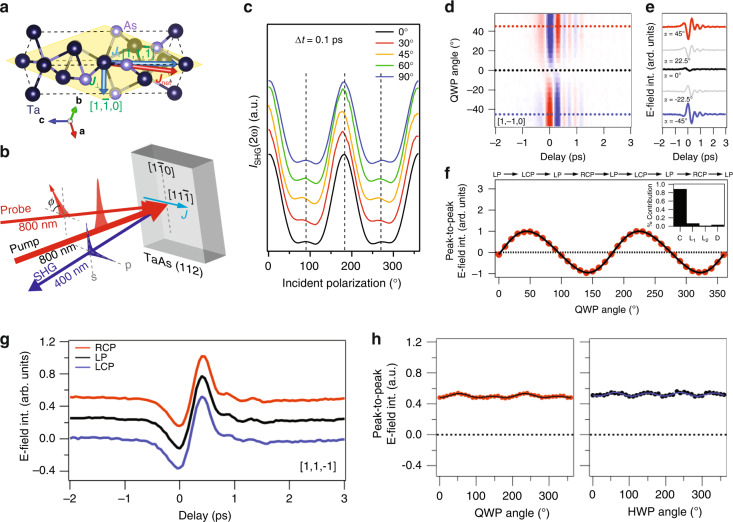
“Shift currents, resulting from the real space coherent shift of electron density following photoexcitation42, can be traced to a local geometric property defined by the difference in Berry connection between bands participating in the optical transition86,87.”
§ Ultrafast terahertz emission from emerging symmetry-broken materials > Transient currents in strongly correlated and topological materials The strength of THz emission spectroscopy stems from its sensitivity to symmetry breaking in the electronic state. Nowhere is this more apparent than in strongly correlated and topological material systems, as the presence of frustrated couplings provides an opportunity to explore unconventional symmetries and symmetry breaking that would otherwise be forbidden based on crystal structure alone. Here we will focus on the breaking of symmetry brought on intrinsically within some broken symmetry states or extrinsically by application of an external bias field. Within strongly correlated materials, such as high- superconductors or multiferroic oxides, we will focus on the use of THz emission to gain insights into the ordered ground state, while the nonlinear response in topological materials can go one step further by shedding light on the quantum geometrical properties that are characteristic of the topological state. Notably, light-induced photocurrents will feature prominently in the discussion, where we emphasize that THz emission in general provides an all-optical, contact-free means of tracking photocurrents that largely mitigates extraneous effects due to Schottky barriers, field screening, and generation of interfacial defects common to direct photocurrent readout. However, as compared to the continuous excitation used in static photocurrent measurements, pulsed excitations employed in THz emission can have unintended consequences, including laser heating. Often the degree to which heating influences the emitted THz spectra is material specific and can frequently be identified by a lack of polarization dependence in the spectra. Nonetheless, heating can be responsible for driving either reversible or irreversible phase transitions within a material and should be carefully monitored during the experiment. > Topological insulators and semimetals
What the sources say
- Partly supportedcites [86] Morimoto T Nagaosa N Topological nature of nonlinear optical effects in solids Sci. Adv. 2016 2 e1501524 27386523 PMC4928882 sourceExperimental — accuracy not yet measured
The Results (Floquet two-band model; page not provided) identify the local geometric quantity as the shift vector for the two bands involved in the optical transition. But the shift vector includes both the difference in their Berry connections and the momentum derivative of the transition-matrix-element phase; the Berry-connection difference alone does not define it. (LLM, conf=0.87)
- Supportedcites [87] Sotome M Spectral dynamics of shift current in ferroelectric semiconductor SbSI Proc. Natl Acad. Sci. USA 2019 116 1929 1933 30670652 PMC6369763 source
The passage labeled Abstract states that shift current emerges through a difference in Berry connection between the valence and conduction bands involved in an optical transition. It defines the shift vector using that difference alongside the transition-matrix-element phase, consistent with the claim's geometric description. (LLM, conf=0.91)
plainstates a cause- Asserted: passes — The authors put it forward as true.
- Checkable: passes — It can be checked against evidence.
- Load-bearing: unclear — It is unclear whether the paper’s conclusions depend on it.
- Based: passes — The paper gives a reason why it holds.
- Partly supported
112 more claims · 41 with their cited sources checked
Create a free account to see all 189 claims and to verify the 13 references still open.
- It may state two separate claims as one. 55
- Probably not a substantial claim. 22
- The quote only partly states this claim. 1
Citations
Cites
Electric Field Effect in Atomically Thin Carbon Films
Novoselov, K. S., Geim, A. K., Morozov, S. V., Jiang, D., Zhang, Y., Dubonos, S. V., Grigorieva, I. V., & Firsov, A. A. (2004) · Science · doi:10.1126/science.1102896 · Cited by 66,834
Colloquium : Topological insulators
Hasan, M. Z., & Kane, C. L. (2010) · Reviews of Modern Physics · doi:10.1103/revmodphys.82.3045 · Cited by 19,930
Light Propagation with Phase Discontinuities: Generalized Laws of Reflection and Refraction
Yu, N., Genevet, P., Kats, M. A., Aieta, F., Tetienne, J.-P., Capasso, F., & Gaburro, Z. (2011) · Science · doi:10.1126/science.1210713 · Cited by 10,361
Composite Medium with Simultaneously Negative Permeability and Permittivity
Smith, D. R., Padilla, W. J., Vier, D. C., Nemat-Nasser, S. C., & Schultz, S. (2000) · Physical Review Letters · doi:10.1103/physrevlett.84.4184 · Cited by 8,831
Magnetism from conductors and enhanced nonlinear phenomena
Pendry, J. B., Holden, A. J., Robbins, D. J., & Stewart, W. J. (1999) · IEEE Transactions on Microwave Theory and Techniques · doi:10.1109/22.798002 · Cited by 8,786
Experimental Verification of a Negative Index of Refraction
Shelby, R. A., Smith, D. R., & Schultz, S. (2001) · Science · doi:10.1126/science.1058847 · Cited by 8,347
Unconventional superconductivity in magic-angle graphene superlattices
Cao, Y., Fatemi, V., Fang, S., Watanabe, K., Taniguchi, T., Kaxiras, E., & Jarillo-Herrero, P. (2018) · Nature · doi:10.1038/nature26160 · Cited by 8,300
2D materials and van der Waals heterostructures
Novoselov, K. S., Mishchenko, A., Carvalho, A., & Castro Neto, A. H. (2016) · Science · doi:10.1126/science.aac9439 · Cited by 7,434
2D transition metal dichalcogenides
Manzeli, S., Ovchinnikov, D., Pasquier, D., Yazyev, O. V., & Kis, A. (2017) · Nature Reviews Materials · doi:10.1038/natrevmats.2017.33 · Cited by 6,075
Weyl and Dirac semimetals in three-dimensional solids
Armitage, N. P., Mele, E. J., & Vishwanath, A. (2018) · Reviews of Modern Physics · doi:10.1103/revmodphys.90.015001 · Cited by 4,528
Photodetectors based on graphene, other two-dimensional materials and hybrid systems
Koppens, F. H. L., Mueller, T., Avouris, P., Ferrari, A. C., Vitiello, M. S., & Polini, M. (2014) · Nature Nanotechnology · doi:10.1038/nnano.2014.215 · Cited by 3,828
Photonics and optoelectronics of 2D semiconductor transition metal dichalcogenides
Mak, K. F., & Shan, J. (2016) · Nature Photonics · doi:10.1038/nphoton.2015.282 · Cited by 3,819
Electronic transport in two-dimensional graphene
Das Sarma, S., Adam, S., Hwang, E. H., & Rossi, E. (2011) · Reviews of Modern Physics · doi:10.1103/revmodphys.83.407 · Cited by 3,447
Classical Electrodynamics, 3rd ed .
Jackson, J. D., & Fox, R. F. (1999) · American Journal of Physics · doi:10.1119/1.19136 · Cited by 3,073
Oscillatory effects and the magnetic susceptibility of carriers in inversion layers
Bychkov, Y. A., & Rashba, E. I. (1984) · Journal of Physics C: Solid State Physics · doi:10.1088/0022-3719/17/33/015 · Cited by 2,972
Spin and pseudospins in layered transition metal dichalcogenides
Xu, X., Yao, W., Xiao, D., & Heinz, T. F. (2014) · Nature Physics · doi:10.1038/nphys2942 · Cited by 2,855
A review of metasurfaces: physics and applications
Chen, H.-T., Taylor, A. J., & Yu, N. (2016) · Reports on Progress in Physics · doi:10.1088/0034-4885/79/7/076401 · Cited by 2,551
Self-citationUltrafast Spin Dynamics in Ferromagnetic Nickel
Beaurepaire, E., Merle, J.-C., Daunois, A., & Bigot, J.-Y. (1996) · Physical Review Letters · doi:10.1103/physrevlett.76.4250 · Cited by 2,457
Active terahertz metamaterial devices
Chen, H.-T., Padilla, W. J., Zide, J. M. O., Gossard, A. C., Taylor, A. J., & Averitt, R. D. (2006) · Nature · doi:10.1038/nature05343 · Cited by 2,383
Self-citationObservation of the spin Seebeck effect
Uchida, K., Takahashi, S., Harii, K., Ieda, J., Koshibae, W., Ando, K., Maekawa, S., & Saitoh, E. (2008) · Nature · doi:10.1038/nature07321 · Cited by 2,243
Conversion of spin current into charge current at room temperature: Inverse spin-Hall effect
Saitoh, E., Ueda, M., Miyajima, H., & Tatara, G. (2006) · Applied Physics Letters · doi:10.1063/1.2199473 · Cited by 2,157
Terahertz Metamaterials for Linear Polarization Conversion and Anomalous Refraction
Grady, N. K., Heyes, J. E., Chowdhury, D. R., Zeng, Y., Reiten, M. T., Azad, A. K., Taylor, A. J., Dalvit, D. A. R., & Chen, H.-T. (2013) · Science · doi:10.1126/science.1235399 · Cited by 2,023
Self-citationMetamaterial Electromagnetic Wave Absorbers
Watts, C. M., Liu, X., & Padilla, W. J. (2012) · Advanced Materials · doi:10.1002/adma.201200674 · Cited by 1,735
Classifying multiferroics: Mechanisms and effects
Khomskii, D. (2009) · Physics · doi:10.1103/physics.2.20 · Cited by 1,593
Photovoltaic Hall effect in graphene
Oka, T., & Aoki, H. (2009) · Physical Review B · doi:10.1103/physrevb.79.081406 · Cited by 1,423
Electrical control of antiferromagnetic domains in multiferroic BiFeO3 films at room temperature
Zhao, T., Scholl, A., Zavaliche, F., Lee, K., Barry, M., Doran, A., Cruz, M. P., Chu, Y. H., Ederer, C., Spaldin, N. A., et al. (2006) · Nature Materials · doi:10.1038/nmat1731 · Cited by 1,297
Bradley, C. J., & Cracknell, A. P. (2009) · doi:10.1093/oso/9780199582587.001.0001 · Cited by 1,232
How to deal with the loss in plasmonics and metamaterials
Khurgin, J. B. (2015) · Nature Nanotechnology · doi:10.1038/nnano.2014.310 · Cited by 1,125
Eichenfield, M., Chan, J., Camacho, R. M., Vahala, K. J., & Painter, O. (2009) · Nature · doi:10.1038/nature08524 · Cited by 1,082
Topological orders and edge excitations in fractional quantum Hall states
Wen, X.-G. (1995) · Advances in Physics · doi:10.1080/00018739500101566 · Cited by 1,060
Explaining the paradoxical diversity of ultrafast laser-induced demagnetization
Koopmans, B., Malinowski, G., Dalla Longa, F., Steiauf, D., Fähnle, M., Roth, T., Cinchetti, M., & Aeschlimann, M. (2010) · Nature Materials · doi:10.1038/nmat2593 · Cited by 957
Interference theory of metamaterial perfect absorbers
Chen, H.-T. (2012) · Optics Express · doi:10.1364/oe.20.007165 · Cited by 954
Self-citationEfficient metallic spintronic emitters of ultrabroadband terahertz radiation
Seifert, T., Jaiswal, S., Martens, U., Hannegan, J., Braun, L., Maldonado, P., Freimuth, F., Kronenberg, A., Henrizi, J., Radu, I., et al. (2016) · Nature Photonics · doi:10.1038/nphoton.2016.91 · Cited by 944
Second-order optical response in semiconductors
Sipe, J. E., & Shkrebtii, A. I. (2000) · Physical Review B · doi:10.1103/physrevb.61.5337 · Cited by 910
Light-induced anomalous Hall effect in graphene
McIver, J. W., Schulte, B., Stein, F.-U., Matsuyama, T., Jotzu, G., Meier, G., & Cavalleri, A. (2020) · Nature Physics · doi:10.1038/s41567-019-0698-y · Cited by 888
Dynamical Electric and Magnetic Metamaterial Response at Terahertz Frequencies
Padilla, W. J., Taylor, A. J., Highstrete, C., Lee, M., & Averitt, R. D. (2006) · Physical Review Letters · doi:10.1103/physrevlett.96.107401 · Cited by 868
Self-citationExperimental demonstration of frequency-agile terahertz metamaterials
Chen, H.-T., O'Hara, J. F., Azad, A. K., Taylor, A. J., Averitt, R. D., Shrekenhamer, D. B., & Padilla, W. J. (2008) · Nature Photonics · doi:10.1038/nphoton.2008.52 · Cited by 848
Self-citationCoherent control of terahertz supercontinuum generation in ultrafast laser–gas interactions
Kim, K. Y., Taylor, A. J., Glownia, J. H., & Rodriguez, G. (2008) · Nature Photonics · doi:10.1038/nphoton.2008.153 · Cited by 835
Self-citationEnhancement of nonlinear effects using photonic crystals
SoljaČiĆ, M., & Joannopoulos, J. D. (2004) · Nature Materials · doi:10.1038/nmat1097 · Cited by 805
Nahata, A., Weling, A. S., & Heinz, T. F. (1996) · Applied Physics Letters · doi:10.1063/1.117511 · Cited by 783
Optical Second Harmonic Generation at Interfaces
Shen, Y. R. (1989) · Annual Review of Physical Chemistry · doi:10.1146/annurev.pc.40.100189.001551 · Cited by 776
Second-Harmonic Generation from Magnetic Metamaterials
Klein, M. W., Enkrich, C., Wegener, M., & Linden, S. (2006) · Science · doi:10.1126/science.1129198 · Cited by 762
Emission of Coherent THz Radiation from Superconductors
Ozyuzer, L., Koshelev, A. E., Kurter, C., Gopalsami, N., Li, Q., Tachiki, M., Kadowaki, K., Yamamoto, T., Minami, H., Yamaguchi, H., et al. (2007) · Science · doi:10.1126/science.1149802 · Cited by 761
Coherent submillimeter-wave emission from Bloch oscillations in a semiconductor superlattice
Waschke, C., Roskos, H. G., Schwedler, R., Leo, K., Kurz, H., & Köhler, K. (1993) · Physical Review Letters · doi:10.1103/physrevlett.70.3319 · Cited by 758
Optical Second-Harmonic Generation in Reflection from Media with Inversion Symmetry
Bloembergen, N., Chang, R. K., Jha, S. S., & Lee, C. H. (1968) · Physical Review · doi:10.1103/physrev.174.813 · Cited by 736
Topological Crystalline Insulators and Topological Superconductors: From Concepts to Materials
Ando, Y., & Fu, L. (2015) · Annual Review of Condensed Matter Physics · doi:10.1146/annurev-conmatphys-031214-014501 · Cited by 723
Terahertz spin current pulses controlled by magnetic heterostructures
Kampfrath, T., Battiato, M., Maldonado, P., Eilers, G., Nötzold, J., Mährlein, S., Zbarsky, V., Freimuth, F., Mokrousov, Y., Blügel, S., et al. (2013) · Nature Nanotechnology · doi:10.1038/nnano.2013.43 · Cited by 714
Plasmon induced thermoelectric effect in graphene
Shautsova, V., Sidiropoulos, T., Xiao, X., Güsken, N. A., Black, N. C. G., Gilbertson, A. M., Giannini, V., Maier, S. A., Cohen, L. F., & Oulton, R. F. (2018) · Nature Communications · doi:10.1038/s41467-018-07508-z · Cited by 710
Quantized circular photogalvanic effect in Weyl semimetals
de Juan, F., Grushin, A. G., Morimoto, T., & Moore, J. E. (2017) · Nature Communications · doi:10.1038/ncomms15995 · Cited by 708
Tutorial: An introduction to terahertz time domain spectroscopy (THz-TDS)
Neu, J., & Schmuttenmaer, C. A. (2018) · Journal of Applied Physics · doi:10.1063/1.5047659 · Cited by 675
Exploring Dynamics in the Far-Infrared with Terahertz Spectroscopy
Schmuttenmaer, C. A. (2004) · Chemical Reviews · doi:10.1021/cr020685g · Cited by 659
Control over topological insulator photocurrents with light polarization
McIver, J. W., Hsieh, D., Steinberg, H., Jarillo-Herrero, P., & Gedik, N. (2012) · Nature Nanotechnology · doi:10.1038/nnano.2011.214 · Cited by 647
Measurement of Recombination Lifetimes in Superconductors
Rothwarf, A., & Taylor, B. N. (1967) · Physical Review Letters · doi:10.1103/physrevlett.19.27 · Cited by 628
Hebling, J., Yeh, K.-L., Hoffmann, M. C., Bartal, B., & Nelson, K. A. (2008) · Journal of the Optical Society of America B · doi:10.1364/josab.25.0000b6 · Cited by 594
Rao, R., Pint, C. L., Islam, A. E., Weatherup, R. S., Hofmann, S., Meshot, E. R., Wu, F., Zhou, C., Dee, N., Amama, P. B., et al. (2018) · ACS Nano · doi:10.1021/acsnano.8b06511 · Cited by 588
Topological nature of nonlinear optical effects in solids
Morimoto, T., & Nagaosa, N. (2016) · Science Advances · doi:10.1126/sciadv.1501524 · Cited by 569
Scaling of Spin Hall Angle in 3d, 4d, and 5d Metals from Y 3 Fe 5 O 12 /Metal Spin Pumping
Wang, H. L., Du, C. H., Pu, Y., Adur, R., Hammel, P. C., & Yang, F. Y. (2014) · Physical Review Letters · doi:10.1103/physrevlett.112.197201 · Cited by 557
Berry, C. W., Wang, N., Hashemi, M. R., Unlu, M., & Jarrahi, M. (2013) · Nature Communications · doi:10.1038/ncomms2638 · Cited by 539
Generation of femtosecond electromagnetic pulses from semiconductor surfaces
Zhang, X.-C., Hu, B. B., Darrow, J. T., & Auston, D. H. (1990) · Applied Physics Letters · doi:10.1063/1.102601 · Cited by 538
Field-driven photoemission from nanostructures quenches the quiver motion
Herink, G., Solli, D. R., Gulde, M., & Ropers, C. (2012) · Nature · doi:10.1038/nature10878 · Cited by 481
Review of terahertz photoconductive antenna technology
Burford, N. M., & El-Shenawee, M. O. (2017) · Optical Engineering · doi:10.1117/1.oe.56.1.010901 · Cited by 453
Coherent submillimeter-wave emission from charge oscillations in a double-well potential
Roskos, H. G., Nuss, M. C., Shah, J., Leo, K., Miller, D. A. B., Fox, A. M., Schmitt-Rink, S., & Köhler, K. (1992) · Physical Review Letters · doi:10.1103/physrevlett.68.2216 · Cited by 433
Direct optical detection of Weyl fermion chirality in a topological semimetal
Ma, Q., Xu, S.-Y., Chan, C.-K., Zhang, C.-L., Chang, G., Lin, Y., Xie, W., Palacios, T., Lin, H., Jia, S., et al. (2017) · Nature Physics · doi:10.1038/nphys4146 · Cited by 418
Observation of ferrotoroidic domains
Van Aken, B. B., Rivera, J.-P., Schmid, H., & Fiebig, M. (2007) · Nature · doi:10.1038/nature06139 · Cited by 413
Colossal mid-infrared bulk photovoltaic effect in a type-I Weyl semimetal
Osterhoudt, G. B., Diebel, L. K., Gray, M. J., Yang, X., Stanco, J., Huang, X., Shen, B., Ni, N., Moll, P. J. W., Ran, Y., et al. (2019) · Nature Materials · doi:10.1038/s41563-019-0297-4 · Cited by 399
Unconventional Chiral Fermions and Large Topological Fermi Arcs in RhSi
Chang, G., Xu, S.-Y., Wieder, B. J., Sanchez, D. S., Huang, S.-M., Belopolski, I., Chang, T.-R., Zhang, S., Bansil, A., Lin, H., et al. (2017) · Physical Review Letters · doi:10.1103/physrevlett.119.206401 · Cited by 399
Shift current bulk photovoltaic effect in polar materials—hybrid and oxide perovskites and beyond
Tan, L. Z., Zheng, F., Young, S. M., Wang, F., Liu, S., & Rappe, A. M. (2016) · npj Computational Materials · doi:10.1038/npjcompumats.2016.26 · Cited by 393
Optical Harmonic Generation in Calcite
Terhune, R. W., Maker, P. D., & Savage, C. M. (1962) · Physical Review Letters · doi:10.1103/physrevlett.8.404 · Cited by 391
Weyl semimetals, Fermi arcs and chiral anomalies
Jia, S., Xu, S.-Y., & Hasan, M. Z. (2016) · Nature Materials · doi:10.1038/nmat4787 · Cited by 379
Wafer-scale monodomain films of spontaneously aligned single-walled carbon nanotubes
He, X., Gao, W., Xie, L., Li, B., Zhang, Q., Lei, S., Robinson, J. M., Hároz, E. H., Doorn, S. K., Wang, W., et al. (2016) · Nature Nanotechnology · doi:10.1038/nnano.2016.44 · Cited by 376
Simulation of terahertz generation at semiconductor surfaces
Johnston, M. B., Whittaker, D. M., Corchia, A., Davies, A. G., & Linfield, E. H. (2002) · Physical Review B · doi:10.1103/physrevb.65.165301 · Cited by 364
Laser‐Driven Strong‐Field Terahertz Sources
Fülöp, J. A., Tzortzakis, S., & Kampfrath, T. (2020) · Advanced Optical Materials · doi:10.1002/adom.201900681 · Cited by 345
Photocurrents in Weyl semimetals
Chan, C.-K., Lindner, N. H., Refael, G., & Lee, P. A. (2017) · Physical Review B · doi:10.1103/physrevb.95.041104 · Cited by 327
Nonlinear photoresponse of type-II Weyl semimetals
Ma, J., Gu, Q., Liu, Y., Lai, J., Yu, P., Zhuo, X., Liu, Z., Chen, J.-H., Feng, J., & Sun, D. (2019) · Nature Materials · doi:10.1038/s41563-019-0296-5 · Cited by 327
Study of terahertz radiation from InAs and InSb
Gu, P., Tani, M., Kono, S., Sakai, K., & Zhang, X.-C. (2002) · Journal of Applied Physics · doi:10.1063/1.1465507 · Cited by 326
Semimetals for high-performance photodetection
Liu, J., Xia, F., Xiao, D., García de Abajo, F. J., & Sun, D. (2020) · Nature Materials · doi:10.1038/s41563-020-0715-7 · Cited by 326
Coherent terahertz emission from ferromagnetic films excited by femtosecond laser pulses
Beaurepaire, E., Turner, G. M., Harrel, S. M., Beard, M. C., Bigot, J.-Y., & Schmuttenmaer, C. A. (2004) · Applied Physics Letters · doi:10.1063/1.1737467 · Cited by 305
Calculation of second-order optical response in semiconductors
Hughes, J. L. P., & Sipe, J. E. (1996) · Physical Review B · doi:10.1103/physrevb.53.10751 · Cited by 295
Ultrafast Strong-Field Photoemission from Plasmonic Nanoparticles
Dombi, P., Hörl, A., Rácz, P., Márton, I., Trügler, A., Krenn, J. R., & Hohenester, U. (2013) · Nano Letters · doi:10.1021/nl304365e · Cited by 280
Ahn, J., Guo, G.-Y., & Nagaosa, N. (2020) · Physical Review X · doi:10.1103/physrevx.10.041041 · Cited by 272
Femtosecond control of electric currents in metallic ferromagnetic heterostructures
Huisman, T. J., Mikhaylovskiy, R. V., Costa, J. D., Freimuth, F., Paz, E., Ventura, J., Freitas, P. P., Blügel, S., Mokrousov, Y., Rasing, T., et al. (2016) · Nature Nanotechnology · doi:10.1038/nnano.2015.331 · Cited by 267
Sarukura, N., Ohtake, H., Izumida, S., & Liu, Z. (1998) · Journal of Applied Physics · doi:10.1063/1.368068 · Cited by 264
Topological Semimetals from First Principles
Gao, H., Venderbos, J. W. F., Kim, Y., & Rappe, A. M. (2019) · Annual Review of Materials Research · doi:10.1146/annurev-matsci-070218-010049 · Cited by 263
Experiments on second- and third-harmonic generation from magnetic metamaterials
Klein, M. W., Wegener, M., Feth, N., & Linden, S. (2007) · Optics Express · doi:10.1364/oe.15.005238 · Cited by 262
Circular photogalvanic effect on topological insulator surfaces: Berry-curvature-dependent response
Hosur, P. (2011) · Physical Review B · doi:10.1103/physrevb.83.035309 · Cited by 258
Riemannian geometry of resonant optical responses
Ahn, J., Guo, G.-Y., Nagaosa, N., & Vishwanath, A. (2022) · Nature Physics · doi:10.1038/s41567-021-01465-z · Cited by 252
Nanoscale terahertz scanning probe microscopy
Cocker, T. L., Jelic, V., Hillenbrand, R., & Hegmann, F. A. (2021) · Nature Photonics · doi:10.1038/s41566-021-00835-6 · Cited by 247
Takahashi, K., Kida, N., & Tonouchi, M. (2006) · Physical Review Letters · doi:10.1103/physrevlett.96.117402 · Cited by 245
Ultrafast photocurrents at the surface of the three-dimensional topological insulator Bi2Se3
Braun, L., Mussler, G., Hruban, A., Konczykowski, M., Schumann, T., Wolf, M., Münzenberg, M., Perfetti, L., & Kampfrath, T. (2016) · Nature Communications · doi:10.1038/ncomms13259 · Cited by 236
Helicity-dependent photocurrents in the chiral Weyl semimetal RhSi
Rees, D., Manna, K., Lu, B., Morimoto, T., Borrmann, H., Felser, C., Moore, J. E., Torchinsky, D. H., & Orenstein, J. (2020) · Science Advances · doi:10.1126/sciadv.aba0509 · Cited by 234
Wei, J., Li, Y., Wang, L., Liao, W., Dong, B., Xu, C., Zhu, C., Ang, K.-W., Qiu, C.-W., & Lee, C. (2020) · Nature Communications · doi:10.1038/s41467-020-20115-1 · Cited by 233
Topological order, emergent gauge fields, and Fermi surface reconstruction
Sachdev, S. (2019) · Reports on Progress in Physics · doi:10.1088/1361-6633/aae110 · Cited by 227
Broadband terahertz generation from metamaterials
Luo, L., Chatzakis, I., Wang, J., Niesler, F. B. P., Wegener, M., Koschny, T., & Soukoulis, C. M. (2014) · Nature Communications · doi:10.1038/ncomms4055 · Cited by 217
Mid-infrared semimetal polarization detectors with configurable polarity transition
Wei, J., Xu, C., Dong, B., Qiu, C.-W., & Lee, C. (2021) · Nature Photonics · doi:10.1038/s41566-021-00819-6 · Cited by 213
Photocurrent as a multiphysics diagnostic of quantum materials
Ma, Q., Kumar, R. K., Xu, S., Koppens, F. H. L., & Song, J. C. W. (2023) · Nature Reviews Physics · doi:10.1038/s42254-022-00551-2 · Cited by 203
Optical Harmonic Generation in Single Crystal BaTiO3
Miller, R. C. (1964) · Physical Review · doi:10.1103/physrev.134.a1313 · Cited by 199
Broadband Terahertz Generation via the Interface Inverse Rashba-Edelstein Effect
Zhou, C., Liu, Y. P., Wang, Z., Ma, S. J., Jia, M. W., Wu, R. Q., Zhou, L., Zhang, W., Liu, M. K., Wu, Y. Z., et al. (2018) · Physical Review Letters · doi:10.1103/physrevlett.121.086801 · Cited by 199
Topology and geometry under the nonlinear electromagnetic spotlight
Ma, Q., Grushin, A. G., & Burch, K. S. (2021) · Nature Materials · doi:10.1038/s41563-021-00992-7 · Cited by 191
Control of Terahertz Emission by Ultrafast Spin-Charge Current Conversion at Rashba Interfaces
Jungfleisch, M. B., Zhang, Q., Zhang, W., Pearson, J. E., Schaller, R. D., Wen, H., & Hoffmann, A. (2018) · Physical Review Letters · doi:10.1103/physrevlett.120.207207 · Cited by 189
Evidence of an odd-parity hidden order in a spin–orbit coupled correlated iridate
Zhao, L., Torchinsky, D. H., Chu, H., Ivanov, V., Lifshitz, R., Flint, R., Qi, T., Cao, G., & Hsieh, D. (2016) · Nature Physics · doi:10.1038/nphys3517 · Cited by 188
Echtermeyer, T. J., Nene, P. S., Trushin, M., Gorbachev, R. V., Eiden, A. L., Milana, S., Sun, Z., Schliemann, J., Lidorikis, E., Novoselov, K. S., et al. (2014) · Nano Letters · doi:10.1021/nl5004762 · Cited by 188
Origin of second-harmonic generation enhancement in optical split-ring resonators
Ciracì, C., Poutrina, E., Scalora, M., & Smith, D. R. (2012) · Physical Review B · doi:10.1103/physrevb.85.201403 · Cited by 188
Terahertz radiation from InAs induced by carrier diffusion and drift
Liu, K., Xu, J., Yuan, T., & Zhang, X.-C. (2006) · Physical Review B · doi:10.1103/physrevb.73.155330 · Cited by 181
Coherent Two-Dimensional Terahertz Magnetic Resonance Spectroscopy of Collective Spin Waves
Lu, J., Li, X., Hwang, H. Y., Ofori-Okai, B. K., Kurihara, T., Suemoto, T., & Nelson, K. A. (2017) · Physical Review Letters · doi:10.1103/physrevlett.118.207204 · Cited by 177
Time-resolved ultrafast photocurrents and terahertz generation in freely suspended graphene
Prechtel, L., Song, L., Schuh, D., Ajayan, P., Wegscheider, W., & Holleitner, A. W. (2012) · Nature Communications · doi:10.1038/ncomms1656 · Cited by 176
Efficient manipulations of circularly polarized terahertz waves with transmissive metasurfaces
Jia, M., Wang, Z., Li, H., Wang, X., Luo, W., Sun, S., Zhang, Y., He, Q., & Zhou, L. (2019) · Light: Science & Applications · doi:10.1038/s41377-019-0127-0 · Cited by 175
Metasurfaces for manipulating terahertz waves
Zang, X., Yao, B., Chen, L., Xie, J., Guo, X., Balakin, A. V., Shkurinov, A. P., & Zhuang, S. (2021) · Light: Advanced Manufacturing · doi:10.37188/lam.2021.010 · Cited by 171
Giant topological longitudinal circular photo-galvanic effect in the chiral multifold semimetal CoSi
Ni, Z., Wang, K., Zhang, Y., Pozo, O., Xu, B., Han, X., Manna, K., Paglione, J., Felser, C., Grushin, A. G., et al. (2021) · Nature Communications · doi:10.1038/s41467-020-20408-5 · Cited by 170
Rana, D. S., Kawayama, I., Mavani, K., Takahashi, K., Murakami, H., & Tonouchi, M. (2009) · Advanced Materials · doi:10.1002/adma.200802094 · Cited by 168
Ultrafast two-dimensional terahertz spectroscopy of elementary excitations in solids
Woerner, M., Kuehn, W., Bowlan, P. R., Reimann, K., & Elsaesser, T. (2013) · New Journal of Physics · doi:10.1088/1367-2630/15/2/025039 · Cited by 168
General Features of Photoinduced Spin Dynamics in Ferromagnetic and Ferrimagnetic Compounds
Ogasawara, T., Ohgushi, K., Tomioka, Y., TAKAHASHI, K. G., Okamoto, H., Kawasaki, M., & Tokura, Y. (2005) · Physical Review Letters · doi:10.1103/physrevlett.94.087202 · Cited by 164
Recent progress in the theory of bulk photovoltaic effect
Dai, Z., & Rappe, A. M. (2023) · Chemical Physics Reviews · doi:10.1063/5.0101513 · Cited by 162
Ultrafast spin current generated from an antiferromagnet
Qiu, H., Zhou, L., Zhang, C., Wu, J., Tian, Y. Z., Cheng, S., Mi, S., Zhao, H., Zhang, Q., Wu, D., et al. (2020) · Nature Physics · doi:10.1038/s41567-020-01061-7 · Cited by 162
Room-temperature valleytronic transistor
Li, L., Shao, L., Liu, X., Gao, A., Wang, H., Zheng, B., Hou, G., Shehzad, K., Yu, L., Miao, F., et al. (2020) · Nature Nanotechnology · doi:10.1038/s41565-020-0727-0 · Cited by 161
Kalashnikova, A. M., Kimel, A. V., Pisarev, R. V., Gridnev, V. N., Kirilyuk, A., & Rasing, T. (2007) · Physical Review Letters · doi:10.1103/physrevlett.99.167205 · Cited by 160
Nanostructure-enhanced atomic line emission
Sivis, M., Duwe, M., Abel, B., & Ropers, C. (2012) · Nature · doi:10.1038/nature10978 · Cited by 160
A review of non-linear terahertz spectroscopy with ultrashort tabletop-laser pulses
Hwang, H. Y., Fleischer, S., Brandt, N. C., Perkins, B. G., Liu, M., Fan, K., Sternbach, A., Zhang, X., Averitt, R. D., & Nelson, K. A. (2015) · Journal of Modern Optics · doi:10.1080/09500340.2014.918200 · Cited by 157
Nonlinear Hall Effect with Time‐Reversal Symmetry: Theory and Material Realizations
Ortix, C. (2021) · Advanced Quantum Technologies · doi:10.1002/qute.202100056 · Cited by 155
Li, G., Wu, L., Li, K. F., Chen, S., Schlickriede, C., Xu, Z., Huang, S., Li, W., Liu, Y., Pun, E. Y. B., et al. (2017) · Nano Letters · doi:10.1021/acs.nanolett.7b04451 · Cited by 154
Terahertz emission from lateral photo-Dember currents
Klatt, G., Hilser, F., Qiao, W., Beck, M., Gebs, R., Bartels, A., Huska, K., Lemmer, U., Bastian, G., Johnston, M. B., et al. (2010) · Optics Express · doi:10.1364/oe.18.004939 · Cited by 147
Topology and Symmetry of Quantum Materials via Nonlinear Optical Responses
Orenstein, J., Moore, J. E., Morimoto, T., Torchinsky, D. H., Harter, J. W., & Hsieh, D. (2021) · Annual Review of Condensed Matter Physics · doi:10.1146/annurev-conmatphys-031218-013712 · Cited by 145
Scaling of terahertz radiation from large-aperture biased photoconductors
Benicewicz, P. K., Roberts, J. P., & Taylor, A. J. (1994) · Journal of the Optical Society of America B · doi:10.1364/josab.11.002533 · Cited by 142
Self-citationFunctional THz emitters based on Pancharatnam-Berry phase nonlinear metasurfaces
McDonnell, C., Deng, J., Sideris, S., Ellenbogen, T., & Li, G. (2021) · Nature Communications · doi:10.1038/s41467-020-20283-0 · Cited by 141
A parity-breaking electronic nematic phase transition in the spin-orbit coupled metal Cd 2 Re 2 O 7
Harter, J. W., Zhao, Z. Y., Yan, J.-Q., Mandrus, D. G., & Hsieh, D. (2017) · Science · doi:10.1126/science.aad1188 · Cited by 140
Lithographic band structure engineering of graphene
Jessen, B. S., Gammelgaard, L., Thomsen, M., Mackenzie, D. M. A., Thomsen, J. D., Caridad, J. M., Duegaard, E., Watanabe, K., Taniguchi, T., Booth, T. J., et al. (2019) · Nature Nanotechnology · doi:10.1038/s41565-019-0376-3 · Cited by 140
Spectral dynamics of shift current in ferroelectric semiconductor SbSI
Sotome, M., Nakamura, M., Fujioka, J., Ogino, M., Kaneko, Y., Morimoto, T., Zhang, Y., Kawasaki, M., Nagaosa, N., Tokura, Y., et al. (2019) · Proceedings of the National Academy of Sciences · doi:10.1073/pnas.1802427116 · Cited by 138
Optical rectification at metal surfaces
Kadlec, F., Kužel, P., & Coutaz, J.-L. (2004) · Optics Letters · doi:10.1364/ol.29.002674 · Cited by 138
THz Generation from Plasmonic Nanoparticle Arrays
Polyushkin, D. K., Hendry, E., Stone, E. K., & Barnes, W. L. (2011) · Nano Letters · doi:10.1021/nl202428g · Cited by 137
Chang, C.-C., Zhao, Z., Li, D., Taylor, A. J., Fan, S., & Chen, H.-T. (2019) · Physical Review Letters · doi:10.1103/physrevlett.123.237401 · Cited by 131
Self-citationUltrafast Spin Dynamics and Critical Behavior in Half-Metallic Ferromagnet: Sr2FeMoO6
Kise, T., Ogasawara, T., Ashida, M., Tomioka, Y., Tokura, Y., & Kuwata‐Gonokami, M. (2000) · Physical Review Letters · doi:10.1103/physrevlett.85.1986 · Cited by 128
Observation of a ferro-rotational order coupled with second-order nonlinear optical fields
Jin, W., Drueke, E., Li, S., Admasu, A., Owen, R., Day, M., Sun, K., Cheong, S.-W., & Zhao, L. (2020) · Nature Physics · doi:10.1038/s41567-019-0695-1 · Cited by 125
Terahertz emission via ultrashort-pulse excitation of magnetic metal films
Hilton, D. J., Averitt, R. D., Meserole, C. A., Fisher, G. L., Funk, D. J., Thompson, J. D., & Taylor, A. J. (2004) · Optics Letters · doi:10.1364/ol.29.001805 · Cited by 124
Self-citationRectification and shift currents in GaAs
Côté, D., Laman, N., & van Driel, H. M. (2002) · Applied Physics Letters · doi:10.1063/1.1436530 · Cited by 123
Terahertz applications of carbon nanotubes
Portnoi, M. E., Kibis, O. V., & da Costa, M. R. (2007) · Superlattices and Microstructures · doi:10.1016/j.spmi.2007.07.026 · Cited by 123
Mechanisms and applications of carbon nanotubes in terahertz devices: A review
Wang, R., Xie, L., Hameed, S. F., Wang, C., & Ying, Y. B. (2018) · Carbon · doi:10.1016/j.carbon.2018.02.005 · Cited by 123
Terahertz-Pulse Emission Through Laser Excitation of Surface Plasmons in a Metal Grating
Welsh, G. H., Hunt, N. T., & Wynne, K. (2007) · Physical Review Letters · doi:10.1103/physrevlett.98.026803 · Cited by 122
Maysonnave, J., Huppert, S., Wang, F., Maero, S., Berger, C., de Heer, W., Norris, T. B., De Vaulchier, L. A., Dhillon, S., Tignon, J., et al. (2014) · Nano Letters · doi:10.1021/nl502684j · Cited by 121
Ultrafast Quenching of Ferromagnetism in InMnAs Induced by Intense Laser Irradiation
Wang, J., Sun, C., Kono, J., Oiwa, A., Munekata, H., Cywiński, Ł., & Sham, L. J. (2005) · Physical Review Letters · doi:10.1103/physrevlett.95.167401 · Cited by 117
Detection of freely propagating terahertz radiation by use of optical second-harmonic generation
Nahata, A., & Heinz, T. F. (1998) · Optics Letters · doi:10.1364/ol.23.000067 · Cited by 117
Resonance-enhanced optical nonlinearity in the Weyl semimetal TaAs
Patankar, S., Wu, L., Lu, B., Rai, M., Tran, J. D., Morimoto, T., Parker, D. E., Grushin, A. G., Nair, N. L., Analytis, J. G., et al. (2018) · Physical Review B · doi:10.1103/physrevb.98.165113 · Cited by 116
Spin pumping and inverse Rashba-Edelstein effect in NiFe/Ag/Bi and NiFe/Ag/Sb
Zhang, W., Jungfleisch, M. B., Jiang, W., Pearson, J. E., & Hoffmann, A. (2015) · Journal of Applied Physics · doi:10.1063/1.4915479 · Cited by 115
Tracking Ultrafast Photocurrents in the Weyl Semimetal TaAs Using THz Emission Spectroscopy
Sirica, N., Tobey, R. I., Zhao, L. X., Chen, G. F., Xu, B., Yang, R., Shen, B., Yarotski, D. A., Bowlan, P., Trugman, S. A., et al. (2019) · Physical Review Letters · doi:10.1103/physrevlett.122.197401 · Cited by 115
Self-citationEnhancement of the Bulk Photovoltaic Effect in Topological Insulators
Tan, L. Z., & Rappe, A. M. (2016) · Physical Review Letters · doi:10.1103/physrevlett.116.237402 · Cited by 113
Towards femtosecond on-chip electronics based on plasmonic hot electron nano-emitters
Karnetzky, C., Zimmermann, P., Trummer, C., Duque Sierra, C., Wörle, M., Kienberger, R., & Holleitner, A. (2018) · Nature Communications · doi:10.1038/s41467-018-04666-y · Cited by 113
Generation of spatiotemporally tailored terahertz wavepackets by nonlinear metasurfaces
Keren-Zur, S., Tal, M., Fleischer, S., Mittleman, D. M., & Ellenbogen, T. (2019) · Nature Communications · doi:10.1038/s41467-019-09811-9 · Cited by 112
Study of terahertz radiation generated by optical rectification on thin gold films
Kadlec, F., Kužel, P., & Coutaz, J.-L. (2005) · Optics Letters · doi:10.1364/ol.30.001402 · Cited by 111
Hu, X., & Lin, S.-Z. (2010) · Superconductor Science and Technology · doi:10.1088/0953-2048/23/5/053001 · Cited by 111
Kimel, A. V., Писарев, Р. В., Hohlfeld, J., & Rasing, T. (2002) · Physical Review Letters · doi:10.1103/physrevlett.89.287401 · Cited by 111
Ultrafast terahertz magnetometry
Zhang, W., Maldonado, P., Jin, Z., Seifert, T. S., Arabski, J., Schmerber, G., Beaurepaire, E., Bonn, M., Kampfrath, T., Oppeneer, P. M., et al. (2020) · Nature Communications · doi:10.1038/s41467-020-17935-6 · Cited by 110
Nanoscale Laser Terahertz Emission Microscopy
Klarskov, P., Oh, J., Colvin, V. L., & Mittleman, D. M. (2017) · ACS Photonics · doi:10.1021/acsphotonics.7b00870 · Cited by 109
Terahertz radiation from coherent antiferromagnetic magnons excited by femtosecond laser pulses
Nishitani, J., Kozuki, K., Nagashima, T., & Hangyo, M. (2010) · Applied Physics Letters · doi:10.1063/1.3436635 · Cited by 108
Optical-helicity-driven magnetization dynamics in metallic ferromagnets
Choi, G.-M., Schleife, A., & Cahill, D. G. (2017) · Nature Communications · doi:10.1038/ncomms15085 · Cited by 107
THz emitters based on the photo-Dember effect
Apostolopoulos, V, & Barnes, M. E. (2014) · Journal of Physics D: Applied Physics · doi:10.1088/0022-3727/47/37/374002 · Cited by 107
Plasmon Enhanced Terahertz Emission from Single Layer Graphene
Bahk, Y.-M., Ramakrishnan, G., Choi, J., Song, H., Choi, G., Kim, Y. H., Ahn, K. J., Kim, D.-S., & Planken, P. C. M. (2014) · ACS Nano · doi:10.1021/nn5025237 · Cited by 103
Generation of Terahertz Radiation by Optical Excitation of Aligned Carbon Nanotubes
Titova, L. V., Pint, C. L., Zhang, Q., Hauge, R. H., Kono, J., & Hegmann, F. A. (2015) · Nano Letters · doi:10.1021/acs.nanolett.5b00494 · Cited by 102
Josephson-Vortex-Flow Terahertz Emission in Layered High-TcSuperconducting Single Crystals
Bae, M.-H., Lee, H.-J., & Choi, J.-H. (2007) · Physical Review Letters · doi:10.1103/physrevlett.98.027002 · Cited by 99
Higuchi, T., Kanda, N., Tamaru, H., & Kuwata‐Gonokami, M. (2011) · Physical Review Letters · doi:10.1103/physrevlett.106.047401 · Cited by 93
Terahertz surface and interface emission spectroscopy for advanced materials
Huang, Y., Yao, Z., He, C., Zhu, L., Zhang, L., Bai, J., & Xu, X. (2019) · Journal of Physics: Condensed Matter · doi:10.1088/1361-648x/ab00c0 · Cited by 91
Seifert, T., Martens, U., Günther, S., Schoen, M. A. W., Radu, F., Chen, X. Z., Lucas, I., Ramos, R., Aguirre, M. H., Algarabel, P. A., et al. (2017) · SPIN · doi:10.1142/s2010324717400100 · Cited by 90
Terahertz emission spectroscopy of laser-induced spin dynamics inTmFeO3andErFeO3orthoferrites
Mikhaylovskiy, R. V., Hendry, E., Kruglyak, V. V., Pisarev, R. V., Rasing, T., & Kimel, A. V. (2014) · Physical Review B · doi:10.1103/physrevb.90.184405 · Cited by 90
Generation of ultrafast terahertz radiation pulses on metallic nanostructured surfaces
Welsh, G. H., & Wynne, K. (2009) · Optics Express · doi:10.1364/oe.17.002470 · Cited by 88
Terahertz Magnon-Polaritons in TmFeO3
Grishunin, K., Huisman, T., Li, G., Mishina, E., Rasing, T., Kimel, A. V., Zhang, K., Jin, Z., Cao, S., Ren, W., et al. (2018) · ACS Photonics · doi:10.1021/acsphotonics.7b01402 · Cited by 88
Mittendorff, M., Winnerl, S. F., & Murphy, T. E. (2020) · Advanced Optical Materials · doi:10.1002/adom.202001500 · Cited by 87
Control of the spin to charge conversion using the inverse Rashba-Edelstein effect
Sangiao, S., De Teresa, J. M., Morellon, L., Lucas, I., Martinez-Velarte, M. C., & Viret, M. (2015) · Applied Physics Letters · doi:10.1063/1.4919129 · Cited by 86
Symmetry regimes for circular photocurrents in monolayer MoSe2
Quereda, J., Ghiasi, T. S., You, J.-S., van den Brink, J., van Wees, B. J., & van der Wal, C. H. (2018) · Nature Communications · doi:10.1038/s41467-018-05734-z · Cited by 86
Principles of spintronic THz emitters
Wu, W., Yaw Ameyaw, C., Doty, M. F., & Jungfleisch, M. B. (2021) · Journal of Applied Physics · doi:10.1063/5.0057536 · Cited by 84
High Temperature Superconductor Terahertz Emitters: Fundamental Physics and Its Applications
Kashiwagi, T., Tsujimoto, M., Yamamoto, T., Minami, H., Yamaki, K., Delfanazari, K., Deguchi, K., Orita, N., Koike, T., Nakayama, R., et al. (2012) · Japanese Journal of Applied Physics · doi:10.1143/jjap.51.010113 · Cited by 83
Photon-drag-induced terahertz emission from graphene
Obraztsov, P. A., Kanda, N., Konishi, K., Kuwata-Gonokami, M., Garnov, S. V., Obraztsov, A. N., & Svirko, Y. P. (2014) · Physical Review B · doi:10.1103/physrevb.90.241416 · Cited by 81
Efficient terahertz emission from InAs nanowires
Seletskiy, D. V., Hasselbeck, M. P., Cederberg, J. G., Katzenmeyer, A., Toimil-Molares, M. E., Léonard, F., Talin, A. A., & Sheik-Bahae, M. (2011) · Physical Review B · doi:10.1103/physrevb.84.115421 · Cited by 81
Ma, E. Y., Guzelturk, B., Li, G., Cao, L., Shen, Z.-X., Lindenberg, A. M., & Heinz, T. F. (2019) · Science Advances · doi:10.1126/sciadv.aau0073 · Cited by 80
THz applications of 2D materials: Graphene and beyond
Wang, M., & Yang, E. (2017) · Nano-Structures & Nano-Objects · doi:10.1016/j.nanoso.2017.08.011 · Cited by 80
Shift charge and spin photocurrents in Dirac surface states of topological insulator
Kim, K. W., Morimoto, T., & Nagaosa, N. (2017) · Physical Review B · doi:10.1103/physrevb.95.035134 · Cited by 79
Interactions Remove the Quantization of the Chiral Photocurrent at Weyl Points
Avdoshkin, A., Kozii, V., & Moore, J. E. (2020) · Physical Review Letters · doi:10.1103/physrevlett.124.196603 · Cited by 78
Terahertz Emission from Compensated Magnetic Heterostructures
Chen, M., Mishra, R., Wu, Y., Lee, K., & Yang, H. (2018) · Advanced Optical Materials · doi:10.1002/adom.201800430 · Cited by 77
Hirota, Y., Hattori, R., Tani, M., & Hangyo, M. (2006) · Optics Express · doi:10.1364/oe.14.004486 · Cited by 76
Integrated Terahertz Generator-Manipulators Using Epsilon-near-Zero-Hybrid Nonlinear Metasurfaces
Lu, Y., Feng, X., Wang, Q., Zhang, X., Fang, M., Sha, W. E. I., Huang, Z., Xu, Q., Niu, L., Chen, X., et al. (2021) · Nano Letters · doi:10.1021/acs.nanolett.1c02372 · Cited by 76
Metamaterial Electromagnetic Wave Absorbers (Adv. Mater. 23/2012)
Watts, C. M., Liu, X., & Padilla, W. J. (2012) · Advanced Materials · doi:10.1002/adma.201290138 · Cited by 76
Percolation-enhanced generation of terahertz pulses by optical rectification on ultrathin gold films
Ramakrishnan, G., & Planken, P. C. M. (2011) · Optics Letters · doi:10.1364/ol.36.002572 · Cited by 73
Geometric Photon-Drag Effect and Nonlinear Shift Current in Centrosymmetric Crystals
Shi, L.-K., Zhang, D., Chang, K., & Song, J. C. W. (2021) · Physical Review Letters · doi:10.1103/physrevlett.126.197402 · Cited by 73
Unconventional Photocurrents from Surface Fermi Arcs in Topological Chiral Semimetals
Chang, G., Yin, J.-X., Neupert, T., Sanchez, D. S., Belopolski, I., Zhang, S. S., Cochran, T. A., Chéng, Z., Hsu, M.-C., Huang, S.-M., et al. (2020) · Physical Review Letters · doi:10.1103/physrevlett.124.166404 · Cited by 72
Symmetry regimes for circular photocurrents in monolayer MoSe2
Quereda, J., Ghiasi, T. S., You, J.-S., van den Brink, J., van Wees, B. J., & van der Wal, C. H. (2018) · RePEc: Research Papers in Economics · Cited by 72
Huisman, T. J., Mikhaylovskiy, R. V., Tsukamoto, A., Rasing, T., & Kimel, A. V. (2015) · Physical Review B · doi:10.1103/physrevb.92.104419 · Cited by 67
Theory of resonant photon drag in monolayer graphene
Entin, M. V., Magarill, L. I., & Shepelyansky, D. L. (2010) · Physical Review B · doi:10.1103/physrevb.81.165441 · Cited by 66
Chang, C.-C., Huang, L., Nogan, J., & Chen, H.-T. (2018) · APL Photonics · doi:10.1063/1.5003984 · Cited by 66
Self-citationKojima, E., Shimano, R., Hashimoto, Y., Katsumoto, S., Iye, Y., & Kuwata‐Gonokami, M. (2003) · Physical review. B, Condensed matter · doi:10.1103/physrevb.68.193203 · Cited by 66
THz emission from Co/Pt bilayers with varied roughness, crystal structure, and interface intermixing
Li, G., Medapalli, R., Mikhaylovskiy, R. V., Spada, F. E., Rasing, T., Fullerton, E. E., & Kimel, A. V. (2019) · Physical Review Materials · doi:10.1103/physrevmaterials.3.084415 · Cited by 65
Helicity-dependent photocurrents in the chiral Weyl semimetal RhSi
Rees, D., Manna, K., Lu, B., Morimoto, T., Borrmann, H., Felser, C., Moore, J. E., Torchinsky, D., Orenstein, J., & Torchinsky, D. H. (2020) · eScholarship (California Digital Library) · Cited by 65
Scaling of terahertz radiation from large-aperture biased InP photoconductors
Benicewicz, P. K., & Taylor, A. J. (1993) · Optics Letters · doi:10.1364/ol.18.001332 · Cited by 64
Self-citationHübner, W., Bennemann, K. H., & Böhmer, K. (1994) · Physical review. B, Condensed matter · doi:10.1103/physrevb.50.17597 · Cited by 63
Quantum interference control of currents in CdSe with a single optical beam
Laman, N., Shkrebtii, A. I., Sipe, J. E., & van Driel, H. M. (1999) · Applied Physics Letters · doi:10.1063/1.125084 · Cited by 62
Coherent control of terahertz emission and carrier populations in semiconductor heterostructures
Brener, I., Planken, P. C. M., Nuss, M. C., Luo, M. S. C., Chuang, S. L., Pfeiffer, L. N., Leaird, D. E., & Weiner, A. M. (1994) · Journal of the Optical Society of America B · doi:10.1364/josab.11.002457 · Cited by 61
Laser-induced torques in metallic ferromagnets
Freimuth, F., Blügel, S., & Mokrousov, Y. (2016) · Physical Review B · doi:10.1103/physrevb.94.144432 · Cited by 60
Coherent helicity-dependent spin-phonon oscillations in the ferromagnetic van der Waals crystal CrI3
Padmanabhan, P., Buessen, F. L., Tutchton, R., Kwock, K. W. C., Gilinsky, S. D., Lee, M. C., McGuire, M. A., Singamaneni, S. R., Yarotski, D., Paramekanti, A., et al. (2022) · Nature Communications · doi:10.1038/s41467-022-31786-3 · Cited by 59
Self-citationTong, M., Hu, Y., Wang, Z., Zhou, T., Xie, X., Cheng, X., & Jiang, T. (2021) · Nano Letters · doi:10.1021/acs.nanolett.0c03079 · Cited by 58
Terahertz emission from vertically aligned InN nanorod arrays
Ahn, H., Ku, Y.-P., Wang, Y.-C., Chuang, C.-H., Gwo, S., & Pan, C.-L. (2007) · Applied Physics Letters · doi:10.1063/1.2789183 · Cited by 57
Ultrafast Lateral Photo-Dember Effect in Graphene Induced by Nonequilibrium Hot Carrier Dynamics
Liu, C., Chang, Y.-C., Lee, S., Zhang, Y., Zhang, Y., Norris, T. B., & Zhong, Z. (2015) · Nano Letters · doi:10.1021/acs.nanolett.5b01912 · Cited by 57
Polyushkin, D. K., Márton, I., Rácz, P., Dombi, P., Hendry, E., & Barnes, W. L. (2014) · Physical Review B · doi:10.1103/physrevb.89.125426 · Cited by 56
Non-equilibrium Phenomena in Superconductors Probed by Femtosecond Time-Domain Spectroscopy
Demsar, J. (2020) · Journal of Low Temperature Physics · doi:10.1007/s10909-020-02461-y · Cited by 55
Ultrafast investigation and control of Dirac and Weyl semimetals
Weber, C. P. (2021) · Journal of Applied Physics · doi:10.1063/5.0035878 · Cited by 55
All-optical control of ultrafast photocurrents in unbiased graphene
Obraztsov, P. A., Kaplas, T., Garnov, S. V., Kuwata-Gonokami, M., Obraztsov, A. N., & Svirko, Y. P. (2014) · Scientific Reports · doi:10.1038/srep04007 · Cited by 54
Research works printed but not linked: 3
- Boyd, R. W. Nonlinear Optics. 3rd edn (Academic Press, 2008).
- Sipe JE Stegeman GI Nonlinear optical response of metal surfaces Mod. Probl. Condens. Matter Sci. 1982 1 661 701
- Keldysh LV Ionization in the field of a strong electromagnetic wave J. Exp. Theor. Phys. 1965 20 1307 1314
Cited by
Advances in Nanoengineered Terahertz Technology: Generation, Modulation, and Bio-Applications
Jin, Z., Lou, J., Shu, F., Hong, Z., & Qiu, C. (2025) · Research · doi:10.34133/research.0562 · Cited by 69
Light-driven nanoscale vectorial currents
Pettine, J., Padmanabhan, P., Shi, T., Gingras, L., McClintock, L., Chang, C., Kwock, K. W. C., Yuan, L., Huang, Y., Nogan, J. N., et al. (2024) · Nature · doi:10.1038/s41586-024-07037-4 · Cited by 75
“However, the broken spatial or temporal symmetries responsible for photocurrent generation in these materials 3 are typically either intrinsic to the lattice and thus constrained to specific light–matter interaction geometries or otherwise dependent on applied static fields, both of which are…”
BackgroundInfluentialSelf-citationHe, Y., Yang, L., Hu, Z., Zhang, L., Pan, X., Wei, Y., Guo, S., Lv, X., Jiang, M., Han, L., et al. (2023) · Advanced Functional Materials · doi:10.1002/adfm.202311008 · Cited by 45
Defect-induced helicity dependent terahertz emission in Dirac semimetal PtTe2 thin films
Chen, Z., Qiu, H., Cheng, X., Cui, J., Jin, Z., Tian, D., Zhang, X., Xu, K., Liu, R., Niu, W., et al. (2024) · Nature Communications · doi:10.1038/s41467-024-46821-8 · Cited by 52
“Ultrafast-laser-inducedTHzemissionbasedonsecond-ordernonlinear effects has been recognized as a versatile probe of the symmetry breaking 44 .”
Terahertz Emission in Quantum Materials
Yang, S., Cheng, L., & Qi, J. (2023) · Ultrafast Science · doi:10.34133/ultrafastscience.0047 · Cited by 31
Metadata
- Authors
- Pettine, J., Padmanabhan, P., Sirica, N., Prasankumar, R. P., Taylor, A. J., & Chen, H.-T.
- Affiliations
- Los Alamos National Laboratory (US)
- Corresponding author
- Chen, Hou-Tong
- ORCID
- Venue
- Light: Science & Applications
- Published
- 2023-06-01
- Volume
- 12
- Issue
- 1
- Pages
- 133-133
- ISSN
- 2047-7538 (ISSN-L)
- PMC
- PMC10232484
- OpenAlex
- W4378952027
- Cited by
- 81
- References
- 279
- Citations by year
- 2026: 20 · 2025: 27 · 2024: 25 · 2023: 8
- FWCI
- 1.34
- Type
- journal article
- Language
- en
- Open access
- gold
- doi.org
- Licence
- cc-by
- creativecommons.org/licenses/by/4.0 (tdm)
- creativecommons.org/licenses/by/4.0 (vor)
- Locations
- Light Science & Applications (publishedVersion, cc-by)
- PubMed Central (publishedVersion, cc-by)
- PubMed (publishedVersion)
- DOAJ (DOAJ: Directory of Open Access Journals) (submittedVersion, cc-by-sa)
- OSTI OAI (U.S. Department of Energy Office of Scientific and Technical Information) (submittedVersion)
- Funders
- DOE | LDRD | Los Alamos National Laboratory (20230124ER, 20210845PRD1, 20200419ER)
- DOE | Center for Integrated Nanotechnologies
- Topics
- Physical Sciences › Engineering › Electrical and Electronic Engineering › Terahertz technology and applications
- Physical Sciences › Physics and Astronomy › Atomic and Molecular Physics, and Optics › Laser-Matter Interactions and Applications
- Physical Sciences › Physics and Astronomy › Condensed Matter Physics › Topological Materials and Phenomena
- Keywords
- terahertz emission, symmetry breaking, point group symmetry, ultrafast dynamics, strongly correlated systems, magnetic materials, multiferroics, topological materials, low-dimensional materials, hybrid materials, light-matter interaction, nonlinear magnetization
About these checks
Registry, retraction, Cites and statistics results are computed, not judged, with one exception: a printed reference that no index lists is read once by a model before it counts as a citation error. Claims are extracted by a model and kept only when their quote appears verbatim in the text; each cited source is then checked, with a model’s help, for whether it says what the claim relies on. Those verdicts can be wrong — read the claim’s quote and the cited source before relying on one.
The claim verdicts this report counts are experimental: their accuracy is not yet measured.
A language model drew the claims from the paper on 2026-10-11, under version 3 of the claim definition (model deepseek-v4.1-flash, prompt extract-v3).
A second model labelled each claim on 2026-10-11 (model jev-1.13-20260917, definition revision gold-guideline-v0.2).
Cited sources are checked with a language model’s help (gpt-6-sol).
Statistics and arithmetic are recomputed, not judged.
Confidence bands are shown only for fields calibrated on our annotated test set. None is calibrated yet, so no band is shown.
What counts as a claim ›How we measure confidence ›How we check this ›
Are you an author, or do you see a problem with this page? Request a review
Data sources
Bibliographic data: Semantic Scholar, OpenAlex, Crossref.
Contains information from the Semantic Scholar Academic Graph Datasets, made available under the ODC Attribution License (ODC-BY 1.0).
Semantic Scholar’s data is described in: Kinney, R., et al. (2023). The Semantic Scholar Open Data Platform. arXiv:2301.10140.
