

How social media usage affects psychological and subjective well-being: testing a moderated mediation model
Open accessThe DOI matches its Crossref record; 126 of the 127 references it cites were found in a registry or an index; 10 of the 38 sources its claims cite were checked for support.
Abstract
Abstract Background A growing body of literature demonstrates that social media usage has witnessed a rapid increase in higher education and is almost ubiquitous among young people. The underlying mechanisms as to how social media usage by university students affects their well-being are unclear. Moreover, current research has produced conflicting evidence concerning the potential effects of social media on individuals' overall well-being with some reporting negative outcomes while others revealing beneficial results. Methods To address the research gap, the present research made an attempt to investigate the crucial role of social media in affecting students’ psychological (PWB) and subjective well-being (SWB) by testing the mediating role of self-esteem and online social support and the moderation effect of cyberbullying. The data in the study were obtained from a sample of 1,004 college students (483 females and 521 males, M age = 23.78, SD = 4.06) enrolled at 135 Chinese universities. AMOS 26.0 and SPSS 26.0 as well as the Process macro were utilized for analyzing data and testing the moderated mediation model. Results Findings revealed that social media usage by university students was positively associated with their PWB and SWB through self-esteem and online social support, and cyberbullying played a moderating role in the first phase of the mediation process such that the indirect associations were weak with cyberbullying reaching high levels. Conclusion These findings highlight the importance of discerning the mechanisms moderating the mediated paths linking social media usage by young adults to their PWB and SWB. The results also underline the importance of implementing measures and interventions to alleviate the detrimental impacts of cyberbullying on young adults’ PWB and SWB.
Overview
CoChat Summary
TL;DR
This study found that among 1,004 Chinese university students, social media usage was positively associated with both psychological well-being (PWB) and subjective well-being (SWB). The link operated through self-esteem and online social support, and cyberbullying weakened these indirect paths but did not moderate the direct links to PWB or SWB.
Key findings
- In the sample of 1,004 students from 135 Chinese universities, social media usage was positively related to self-esteem (B = 0.20, t = 15.75, p < 0.001), online social support (B = 0.09, t = 7.00, p < 0.001), PWB (B = 0.11, t = 4.78, p < 0.001), and SWB (B = 0.19, t = 8.36, p < 0.001).
- Social media usage had significant indirect effects on PWB via self-esteem (0.100, 95% CI [0.075, 0.126]), via online social support (0.046, 95% CI [0.030, 0.063]), and via both mediators (0.058, 95% CI [0.043, 0.074]).
- Social media usage also had significant indirect effects on SWB via self-esteem (0.072, 95% CI [0.049, 0.097]), via online social support (0.043, 95% CI [0.027, 0.061]), and via both mediators (0.054, 95% CI [0.039, 0.070]).
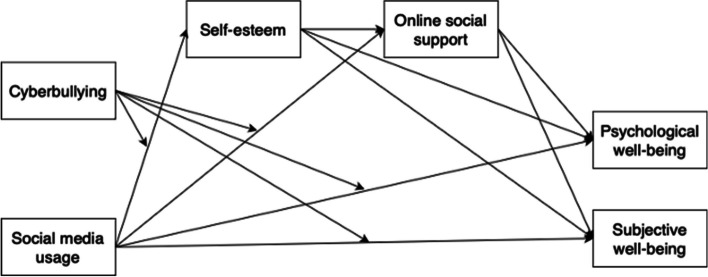
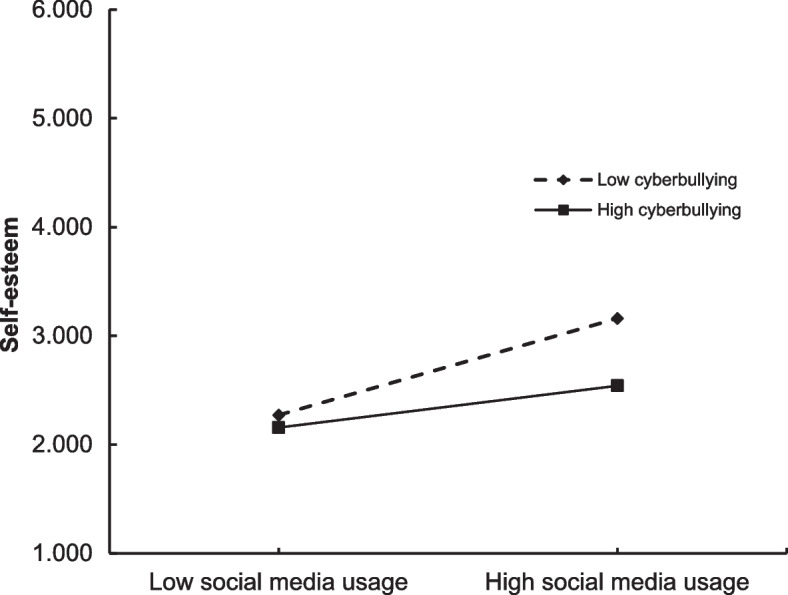
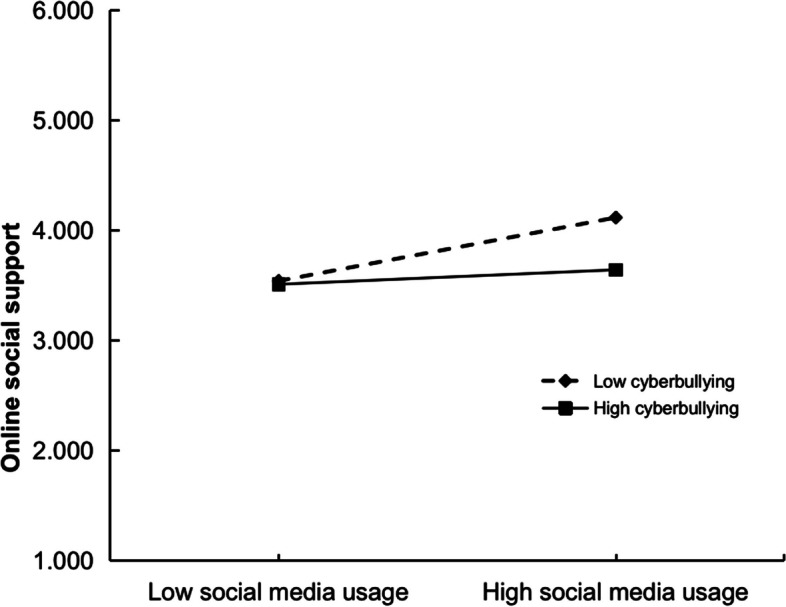
- Cyberbullying moderated the first stage of the mediation: the effect of social media usage on self-esteem was weaker at higher cyberbullying (interaction B = -0.11, t = -7.30, p < 0.001), and the effect on online social support was also weaker (interaction B = -0.10, t = -6.66, p < 0.001). The direct effects of social media usage on PWB and SWB were not significantly moderated by cyberbullying (both B = 0.00, p > 0.05).
Methods
- Cross-sectional online survey conducted from April to May 2023 using Wenjuanxing; questionnaires were distributed via WeChat and QQ.
- Final sample: 1,004 Chinese college students (483 females, 521 males; Mage = 23.78, SD = 4.06) from 135 universities; 1,301 active responses were received from 1,500 questionnaires, and 9 non-social-media users were excluded.
- Analyses used CFA in AMOS 26.0, then SPSS 26.0 with PROCESS Model 6 for mediation and Model 85 for moderated mediation, with bootstrap 95% confidence intervals and demographic controls (gender, age, family origin).
Limitations
- The paper states that it used a cross-sectional design, which limits causal inference and is vulnerable to common method variance; the authors suggest longitudinal or experimental studies instead.
- The authors note limited generalizability because the sample came from Chinese universities, so results may not apply to other populations, ages, or countries.
- The authors say their failure to confirm moderation of the direct effects by cyberbullying may reflect “possible deficiencies in our research design” and that future studies should include more factors; this is explicitly stated by the paper.
Model-written summary. Check it against the paper before relying on it.
Integrity signals
Registry
Cites
Statistics
Figures
Verification
Claims the paper makes
8 Valid · 0 Not valid · 22 Not checked · 65 Own results and interpretations
The cited sources support only part of this claim — read each source’s verdict below.
In the paper
“Online social support represents the extension of social support that is traditionally available in the physical world to the virtual realm of cyberspace and can enhance the well-being and overall health of individuals, both physically and mentally.”
§ How social media usage affects psychological and subjective well-being: testing a moderated mediation model > Literature review and hypotheses development > Self-esteem and online social support as mediators
What the sources say
- Supportedcites [77] Nick EA Cole DA Cho SJ Smith DK Carter TG Zelkowitz RL The online social support scale: measure development and validation Psychol Assess 2018 30 9 1127 1143 10.1037/pas0000558 29781664 PMC6107390 source
The passage labeled Abstract reports online-support findings concerning weight loss and smoking abstinence, as well as depression, anxiety, stress, and well-being. The Discussion also reports beneficial associations with depression-related outcomes in the current study. These passages support the claim that online social support can benefit physical and mental well-being; page numbers were not provided. (LLM, conf=0.88)
- Partly supportedcites [78] Zhao C Ding N Yang X Xu H Lai X Tu X Lv Y Xu D Zhang G Longitudinal effects of stressful life events on problematic smartphone use and the mediating roles of mental health problems in chinese undergraduate students Front Pub Health 2021 9 752210 10.3389/fpubh.2021.752210 34926377 PMC8678111 sourceExperimental — accuracy not yet measured
The Discussion (page not provided) says the Internet can help people seek social support to alleviate or eliminate suicidal ideation, supporting a narrower mental-health benefit. It does not say online social support improves physical health or overall well-being generally. (LLM, conf=0.85)
plainstates a cause- Asserted: passes — The authors put it forward as true.
- Checkable: passes — It can be checked against evidence.
- Load-bearing: passes — The paper’s conclusions depend on it.
- Based: passes — The paper gives a reason why it holds.
- Supported
The cited sources support only part of this claim — read each source’s verdict below.
In the paper
“Research consistently reveals that individuals who are bullied typically have lower levels of self-esteem compared to those who are not victimized [34, 96].”
§ How social media usage affects psychological and subjective well-being: testing a moderated mediation model > Literature review and hypotheses development > Cyberbullying as a moderator
What the sources say
- Partly supportedcites [34] Wachs S Vazsonyi AT Wright MF KsinanJiskrova G Cross-national associations among cyberbullying victimization, self-esteem, and internet addiction: direct and indirect effects of alexithymia Front Psychol 2020 11 1368 10.3389/fpsyg.2020.01368 32595579 PMC7300314 sourceExperimental — accuracy not yet measured
The Introduction links cyberbullying victimization among adolescents to lower self-esteem, supporting the claim in that narrower context. The Discussion reports a direct association only in the Dutch sample, not the American or German samples; the paper therefore does not establish a consistent direct difference for bullied individuals generally. No page numbers are available in our copy. (LLM, conf=0.84)
- Partly supportedcites [96] Maurya C Muhammad T Dhillon P Maurya P The effects of cyberbullying victimization on depression and suicidal ideation among adolescents and young adults: a three year cohort study from India BMC Psychiatry 2022 22 1 599 10.1186/s12888-022-04238-x 36085004 PMC9461154 sourceExperimental — accuracy not yet measured
The Introduction (page not specified in our copy) reports that adolescents who are cyberbullied are at greater risk of lower self-esteem, and its conceptual framework links cyberbullying to low self-esteem. This supports the association, but the cited paper addresses adolescent cyberbullying rather than bullying among individuals generally; its reported cohort results do not directly compare victims’ and nonvictims’ self-esteem. (LLM, conf=0.84)
boostedstates an association- Asserted: passes — The authors put it forward as true.
- Checkable: passes — It can be checked against evidence.
- Load-bearing: passes — The paper’s conclusions depend on it.
- Based: passes — The paper gives a reason why it holds.
- Partly supported
A result the paper reports from its own data — it cites no other source for it, so there is none to check. The quote shows it is in the paper.
In the paper
“Findings revealed that social media usage by university students was positively associated with their PWB and SWB through self-esteem and online social support”
§ How social media usage affects psychological and subjective well-being: testing a moderated mediation model > Abstract > Results
plainstates an association- Asserted: passes — The authors put it forward as true.
- Checkable: passes — It can be checked against evidence.
- Load-bearing: passes — The paper’s conclusions depend on it.
- Based: passes — The paper gives a reason why it holds.
A result the paper reports from its own data — it cites no other source for it, so there is none to check. The quote shows it is in the paper.
In the paper
“Self-esteem and online social support were found to be positively associated with social media usage (r = 0.45, p < 0.01; r = 0.43, p < 0.01), PWB (r = 0.54, p < 0.01; r = 0.55, p < 0.01), and SWB (r = 0.50, p < 0.01; r = 0.53, p < 0.01), respectively.”
§ How social media usage affects psychological and subjective well-being: testing a moderated mediation model > Results > Preliminary analyses
plainstates an association- Asserted: passes — The authors put it forward as true.
- Checkable: passes — It can be checked against evidence.
- Load-bearing: unclear — It is unclear whether the paper’s conclusions depend on it.
- Based: passes — The paper gives a reason why it holds.
61 more claims
Create a free account to see all 95 claims and to verify the 1 reference still open.
- Probably not a substantial claim. 22
- It may state two separate claims as one. 11
Citations
Cites
Evaluating Structural Equation Models with Unobservable Variables and Measurement Error
Fornell, C., & Larcker, D. F. (1981) · Journal of Marketing Research · doi:10.2307/3151312 · Cited by 109,314
Evaluating structural equation models with unobservable variables and measurement error
Fornell, C., & Larcker, D. F. (1981) · Journal of Marketing Research · doi:10.1177/002224378101800104 · Cited by 109,190
Self-efficacy: Toward a unifying theory of behavioral change
Bandura, A. (1977) · Psychological Review · doi:10.1037/0033-295x.84.2.191 · Cited by 43,925
Society and the Adolescent Self-Image
Rosenberg, M. (1965) · doi:10.1515/9781400876136 · Cited by 30,126
Social network sites: definition, history, and scholarship
boyd, D. M., & Ellison, N. B. (2007) · Journal of Computer-Mediated Communication · doi:10.1111/j.1083-6101.2007.00393.x · Cited by 16,251
Sources of method bias in social science research and recommendations on how to control it
Podsakoff, P. M., MacKenzie, S. B., & Podsakoff, N. P. (2012) · Annual Review of Psychology · doi:10.1146/annurev-psych-120710-100452 · Cited by 15,744
On Happiness and Human Potentials: A Review of Research on Hedonic and Eudaimonic Well-Being
Ryan, R. M., & Deci, E. L. (2001) · Annual Review of Psychology · doi:10.1146/annurev.psych.52.1.141 · Cited by 11,567 · cited 2×
“…different philosophical approaches: the hedonic perspective, which defines well-being as the pursuit of pleasure and avoidance of pain, and the eudaimonic perspective, which conceptualizes well-being as the extent to which an individual achieves their potential and experiences personal growth [5].”
BackgroundThe structure of psychological well-being revisited.
Ryff, C. D., & Keyes, C. L. M. (1995) · Journal of Personality and Social Psychology · doi:10.1037//0022-3514.69.4.719 · Cited by 10,285
Flow: The Psychology of Optimal Experience
Buchanan, R., & Csikszentmihalyi, M. (1991) · Design Issues · doi:10.2307/1511458 · Cited by 9,394
The meaning in life questionnaire: assessing the presence of and search for meaning in life
Steger, M. F., Frazier, P., Oishi, S., & Kaler, M. (2006) · Journal of Counseling Psychology · doi:10.1037/0022-0167.53.1.80 · Cited by 4,843
An updated and expanded assessment of PLS-SEM in information systems research
Hair, J., Hollingsworth, C. L., Randolph, A. B., & Chong, A. Y. L. (2017) · Industrial Management & Data Systems · doi:10.1108/imds-04-2016-0130 · Cited by 4,043 · cited 1×
“As shown in the table, the item loadings of all factors in the study exceed the threshold value of 0.60 as recommended by Hair et al. [113].”
InfluentialThe Impact of Social Media on Children, Adolescents, and Families
O'Keeffe, G. S., Clarke-Pearson, K., & Council on Communications and Media (2011) · Pediatrics · doi:10.1542/peds.2011-0054 · Cited by 2,943 · cited 2×
“In addition, researchers have also revealed that students’ frequent social media usage to exchange thoughts and strengthen bonds with family and friends can have a positive impact on their PWB by reducing loneliness [11] and social isolation [48], and strengthening life satisfaction [49].”
BackgroundBeyond money: toward an economy of well-being
Diener, E., & Seligman, M. E. P. (2004) · Psychological Science in the Public Interest · doi:10.1111/j.0963-7214.2004.00501001.x · Cited by 2,555
The nature and function of self-esteem: Sociometer theory
Leary, M. R., & Baumeister, R. F. (2000) · Advances in Experimental Social Psychology · doi:10.1016/s0065-2601(00)80003-9 · Cited by 2,521
Self-esteem as an interpersonal monitor: The sociometer hypothesis
Leary, M. R., Tambor, E. S., Terdal, S. K., & Downs, D. L. (1995) · Journal of Personality and Social Psychology · doi:10.1037/0022-3514.68.3.518 · Cited by 2,519 · cited 5×
“These findings align with the principles of Sociometer Theory [84], which suggests that there is a strong relationship between self-esteem and how individuals perceive acceptance from society and others.”
BackgroundResultInfluentialLiving with Television: The Violence Profile
Gerbner, G., & Gross, L. (1976) · Journal of Communication · doi:10.1111/j.1460-2466.1976.tb01397.x · Cited by 2,357
Does low self-esteem predict depression and anxiety? A meta-analysis of longitudinal studies.
Sowislo, J. F., & Orth, U. (2013) · Psychological Bulletin · doi:10.1037/a0028931 · Cited by 2,123 · cited 1×
“Research has demonstrated that individuals who possess high self-esteem often experience lower levels of aggressive negative emotions and depression compared to those with low self-esteem [62, 63].”
BackgroundCross-Cultural Correlates of Life Satisfaction and Self-Esteem
Diener, E., & Diener, M. (1995) · Journal of Personality and Social Psychology · doi:10.1037/0022-3514.68.4.653 · Cited by 1,722
Twenge, J. M., Joiner, T. E., Rogers, M. L., & Martin, G. N. (2018) · Clinical Psychological Science · doi:10.1177/2167702617723376 · Cited by 1,705
The Differential Susceptibility to Media Effects Model
Valkenburg, P. M., & Peter, J. (2013) · Journal of Communication · doi:10.1111/jcom.12024 · Cited by 1,340
Woods, H. C., & Scott, H. (2016) · Journal of Adolescence · doi:10.1016/j.adolescence.2016.05.008 · Cited by 1,302 · cited 1×
“…theories has identified a close relationship between the use of various social media sites such as Facebook, Twitter, and Instagram and users’ self-esteem [125, 126], revealing that peer interaction and feedback on the self represents critical predictors of young adults’ self-esteem [127].”
BackgroundThe future of mental health care: peer-to-peer support and social media
Naslund, J. A., Aschbrenner, K. A., Marsch, L. A., & Bartels, S. J. (2016) · Epidemiology and Psychiatric Sciences · doi:10.1017/s2045796015001067 · Cited by 1,180
The Role of Telehealth in Reducing the Mental Health Burden from COVID-19
Zhou, X., Snoswell, C. L., Harding, L. E., Bambling, M., Edirippulige, S., Bai, X., & Smith, A. C. (2020) · Telemedicine and e-Health · doi:10.1089/tmj.2020.0068 · Cited by 1,159
Dhir, A., Yossatorn, Y., Kaur, P., & Chen, S. (2018) · International Journal of Information Management · doi:10.1016/j.ijinfomgt.2018.01.012 · Cited by 1,033 · cited 1×
“The utilization of social media has unfortunately been linked to a range of distressing consequences including heightened feelings of anxiety [21], profound loneliness [22], and debilitating depression [23].”
BackgroundThe Development of Self-Esteem
Orth, U., & Robins, R. W. (2014) · Current Directions in Psychological Science · doi:10.1177/0963721414547414 · Cited by 1,004
How “phubbing” becomes the norm: The antecedents and consequences of snubbing via smartphone
Chotpitayasunondh, V., & Douglas, K. M. (2016) · Computers in Human Behavior · doi:10.1016/j.chb.2016.05.018 · Cited by 954
Lakey, B., & Orehek, E. (2011) · Psychological Review · doi:10.1037/a0023477 · Cited by 931 · cited 1×
“…exists a mediating role of self-esteem in the relationship between social media usage by university students and their PWB and SWB. Social support, being one of the most prominent factors that provide protection, plays a crucial and indispensable role in the prevention of mental illnesses [73, 74].”
BackgroundComputer Networks As Social Networks
Wellman, B. (2001) · Science · doi:10.1126/science.1065547 · Cited by 918 · cited 1×
“…a negative relationship while others have acknowledged that a positive association exists as social media can facilitate online social connections [117] and reduce the levels of negative emotions and feelings, such as stress, loneliness, depression, and the sense of social isolation [48], thus…”
BackgroundBeyond Ponce de Leon and Life Satisfaction: New Directions in Quest of Successful Ageing
Ryff, C. D. (1989) · International Journal of Behavioral Development · doi:10.1177/016502548901200102 · Cited by 913
(2009) · Social Indicators Research Series · doi:10.1007/978-90-481-2350-6 · Cited by 841
Comparative research methodology: Cross‐cultural studies
Brislin, R. W. (1976) · International Journal of Psychology · doi:10.1080/00207597608247359 · Cited by 832 · cited 1×
“To guarantee that the language was consistent in its meaning, a technique known as back-translation designed by Brislin [102] was employed.”
MethodThe Media and Technology Usage and Attitudes Scale: An empirical investigation
Rosen, L. D., Whaling, K., Carrier, L. M., Cheever, N. A., & Rokkum, J. (2013) · Computers in Human Behavior · doi:10.1016/j.chb.2013.06.006 · Cited by 788
Change in Level of Positive Mental Health as a Predictor of Future Risk of Mental Illness
Keyes, C. L. M., Dhingra, S. S., & Simoes, E. J. (2010) · American Journal of Public Health · doi:10.2105/ajph.2010.192245 · Cited by 778 · cited 1×
“A decline in SWB is frequently observed prior to the onset of more severe mental health problems and behavioral issues, including but not limited to depression, suicidal tendencies, and dropping out of college [52, 53].”
BackgroundZhu, C., Huang, S., Evans, R., & Zhang, W. (2021) · Frontiers in Public Health · doi:10.3389/fpubh.2021.634909 · Cited by 632
Social media use and anxiety in emerging adults
Vannucci, A., Flannery, K. M., & Ohannessian, C. M. (2017) · Journal of Affective Disorders · doi:10.1016/j.jad.2016.08.040 · Cited by 623 · cited 1×
“The utilization of social media has unfortunately been linked to a range of distressing consequences including heightened feelings of anxiety [21], profound loneliness [22], and debilitating depression [23].”
BackgroundThe Effect of Perceived Challenges and Skills on the Quality of Subjective Experience
Moneta, G. B., & Csikszentmihalyi, M. (1996) · Journal of Personality · doi:10.1111/j.1467-6494.1996.tb00512.x · Cited by 613
Nabi, R. L., Prestin, A., & So, J. (2013) · Cyberpsychology, Behavior, and Social Networking · doi:10.1089/cyber.2012.0521 · Cited by 510 · cited 1×
“…be attributed to the fact that students who have a vast network of connections on social media and dedicate a considerable amount of time to actively engaging in various interactions on these platforms are more likely to garner a substantial amount of support from their online acquaintances [123].”
BackgroundRoberts, J. A., & David, M. E. (2020) · International Journal of Human–Computer Interaction · doi:10.1080/10447318.2019.1646517 · Cited by 440
Media Use Is Linked to Lower Psychological Well-Being: Evidence from Three Datasets
Twenge, J. M., & Campbell, W. K. (2019) · Psychiatric Quarterly · doi:10.1007/s11126-019-09630-7 · Cited by 429
Social Media Elements, Ecologies, and Effects
Bayer, J. B., Triệu, P., & Ellison, N. B. (2020) · Annual Review of Psychology · doi:10.1146/annurev-psych-010419-050944 · Cited by 410 · cited 1×
“People of all ages, adults and adolescents, utilize a diverse array of social media platforms to engage in meaningful connections, both in intimate settings with loved ones and in expansive networks encompassing friends, acquaintances, and professional peers [3].”
BackgroundBurrow, A. L., & Rainone, N. (2017) · Journal of Experimental Social Psychology · doi:10.1016/j.jesp.2016.09.005 · Cited by 385 · cited 2×
“Studies have shown that the number of likes on social networking sites like Face-book is linked to higher self-esteem [70].”
BackgroundResultSocial media use and well-being: What we know and what we need to know
Valkenburg, P. M. (2022) · Current Opinion in Psychology · doi:10.1016/j.copsyc.2021.12.006 · Cited by 373
Self-Affirmation Underlies Facebook Use
Toma, C. L., & Hancock, J. T. (2013) · Personality and Social Psychology Bulletin · doi:10.1177/0146167212474694 · Cited by 362 · cited 1×
“By allowing users to carefully select and present information about themselves, social media enables individuals to highlight their positive attributes and experiences, which can boost their self-esteem when they review their profile or past interactions with others [40, 72].”
BackgroundYbarra, M. L., Espelage, D. L., & Mitchell, K. J. (2007) · Journal of Adolescent Health · doi:10.1016/j.jadohealth.2007.09.010 · Cited by 309
A scoping review on studies of cyberbullying prevalence among adolescents
Brochado, S., Soares, S., & Fraga, S. (2017) · Trauma, Violence, & Abuse · doi:10.1177/1524838016641668 · Cited by 307 · cited 1×
“9% of Chinese adolescents reported experiences of cyberbullying victimization, the second-highest median rate among nine nations surveyed in the study [31].”
BackgroundCyberbullying and children and young people’s mental health: A systematic map of systematic reviews
Kwan, I., Dickson, K., Richardson, M., MacDowall, W., Burchett, H., Stansfield, C., Brunton, G., Sutcliffe, K., & Thomas, J. (2020) · Cyberpsychology, Behavior, and Social Networking · doi:10.1089/cyber.2019.0370 · Cited by 291
Ladd, G. W., Ettekal, I., & Kochenderfer-Ladd, B. (2017) · Journal of Educational Psychology · doi:10.1037/edu0000177 · Cited by 278
Hellfeldt, K., López-Romero, L., & Andershed, H. (2019) · International Journal of Environmental Research and Public Health · doi:10.3390/ijerph17010045 · Cited by 278 · cited 1×
“…emotional and physiological harm upon vulnerable individuals who find themselves unable to defend against such attacks [92], decreasing their SWB [93] and causing psychological challenges, such as behavioral issues, alcohol consumption, smoking, and diminished dedication to their academic…”
BackgroundA hybrid SEM-neural network analysis of social media addiction
Leong, L.-Y., Hew, T.-S., Ooi, K.-B., Lee, V.-H., & Hew, J.-J. (2019) · Expert Systems with Applications · doi:10.1016/j.eswa.2019.05.024 · Cited by 262 · cited 1×
“Introduction In this digital world, the utilization of social media has become a massive and meaningful part of our everyday life and has grown substantially in recent years [1, 2].”
BackgroundEffects of Social Media Use on Psychological Well-Being: A Mediated Model
Ostic, D., Qalati, S. A., Barbosa, B., Shah, S. M. M., Galvan Vela, E., Herzallah, A. M., & Liu, F. (2021) · Frontiers in Psychology · doi:10.3389/fpsyg.2021.678766 · Cited by 253
Cultivating youth resilience to prevent bullying and cyberbullying victimization
Hinduja, S., & Patchin, J. W. (2017) · Child Abuse & Neglect · doi:10.1016/j.chiabu.2017.09.010 · Cited by 250
Blomfield neira, C. J., & Barber, B. L. (2014) · Australian Journal of Psychology · doi:10.1111/ajpy.12034 · Cited by 247
Yang, C., Holden, S. M., & Ariati, J. (2021) · Clinical Child and Family Psychology Review · doi:10.1007/s10567-021-00359-z · Cited by 210
Online social support for young people: Does it recapitulate in-person social support; can it help?
Cole, D. A., Nick, E. A., Zelkowitz, R. L., Roeder, K. M., & Spinelli, T. (2017) · Computers in Human Behavior · doi:10.1016/j.chb.2016.11.058 · Cited by 206
Völlink, T., Bolman, C. A. W., Dehue, F., & Jacobs, N. C. L. (2013) · Journal of Community & Applied Social Psychology · doi:10.1002/casp.2142 · Cited by 193
The Online Social Support Scale: Measure development and validation.
Nick, E. A., Cole, D. A., Cho, S.-J., Smith, D. K., Carter, T. G., & Zelkowitz, R. L. (2018) · Psychological Assessment · doi:10.1037/pas0000558 · Cited by 191 · cited 1×
“It encompasses various forms of assistance, ranging from empathetic conversations and advice to tangible resources and assistance [77, 78].”
BackgroundDienlin, T., Masur, P. K., & Trepte, S. (2017) · Journal of Computer-Mediated Communication · doi:10.1111/jcc4.12183 · Cited by 186
Valkenburg, P. M., Koutamanis, M., & Vossen, H. G. M. (2017) · Computers in Human Behavior · doi:10.1016/j.chb.2017.07.008 · Cited by 182
Relationship between mental health of nursing students and coping, self-esteem and social support.
Karaca, A., Yildirim, N., Cangur, S., Acikgoz, F., & Akkus, D. (2019) · Nurse Education Today · doi:10.1016/j.nedt.2019.01.029 · Cited by 177 · cited 1×
“In comparison, individuals with lower self-esteem typically have negative opinions about themselves, display more negative behavior online, and may not receive as much social support on the Internet [86].”
BackgroundMarengo, D., Montag, C., Sindermann, C., Elhai, J. D., & Settanni, M. (2021) · Telematics and Informatics · doi:10.1016/j.tele.2020.101523 · Cited by 174 · cited 1×
“In more recent research using objective data, it was revealed that Face-book ’likes’ have a positive association with happiness, as they boost self-esteem [71].”
Human Well-being: Issues, Concepts and Measures
McGillivray, M. (2007) · Palgrave Macmillan UK eBooks · doi:10.1057/9780230625600_1 · Cited by 171
Indian, M., & Grieve, R. (2014) · Personality and Individual Differences · doi:10.1016/j.paid.2013.11.016 · Cited by 170 · cited 1×
“As a result, it can lead to the development of a positive psychological and emotional state, ultimately contributing to an elevated level of SWB [124].”
BackgroundCalhoun, C. D., Stone, K. J., Cobb, A. R., Patterson, M. W., Danielson, C. K., & Bendezú, J. J. (2022) · Psychiatric Quarterly · doi:10.1007/s11126-022-10003-w · Cited by 165
Social media addiction: Applying the DEMATEL approach
Dalvi-Esfahani, M., Niknafs, A., Kuss, D. J., Nilashi, M., & Afrough, S. (2019) · Telematics and Informatics · doi:10.1016/j.tele.2019.101250 · Cited by 162
Tian, Q. (2016) · Journal of Health Psychology · doi:10.1177/1359105314547245 · Cited by 156
Maurya, C., Muhammad, T., Dhillon, P., & Maurya, P. (2022) · BMC Psychiatry · doi:10.1186/s12888-022-04238-x · Cited by 153 · cited 1×
“Research consistently reveals that individuals who are bullied typically have lower levels of self-esteem compared to those who are not victimized [34, 96].”
BackgroundWirtz, D., Tucker, A., Briggs, C., & Schoemann, A. M. (2020) · Journal of Happiness Studies · doi:10.1007/s10902-020-00291-z · Cited by 149
Facebook-based social support and health: A systematic review.
Gilmour, J., Machin, T., Brownlow, C., & Jeffries, C. (2020) · Psychology of Popular Media · doi:10.1037/ppm0000246 · Cited by 147 · cited 1×
“A recent review by Gilmour et al. [81] discovered that using social networking sites like Facebook for seeking social support can enhance users’ overall well-being, as well as improve both physical and mental health.”
BackgroundThe Use of Social Media as a Mechanism of Social Support in Parents
Haslam, D. M., Tee, A., & Baker, S. (2017) · Journal of Child and Family Studies · doi:10.1007/s10826-017-0716-6 · Cited by 144 · cited 1×
“Moreover, social media usage like for informational uses was found to increase people’s self-esteem [28] and can provide an important avenue for obtaining online social support from friends, peers and important others [29], which, in turn, reinforce peoples’ PWB and SWB.”
BackgroundCyberbullying and victimisation among Turkish university students
Akbulut, Y., & Eristi, B. (2011) · Australasian Journal of Educational Technology · doi:10.14742/ajet.910 · Cited by 142
Gulzar, M. A., Ahmad, M., Hassan, M., & Rasheed, M. I. (2021) · Behaviour and Information Technology · doi:10.1080/0144929x.2021.1917660 · Cited by 134
Peled, Y. (2019) · Heliyon · doi:10.1016/j.heliyon.2019.e01393 · Cited by 132
Sampasa-Kanyinga, H., & Hamilton, H. A. (2015) · European Psychiatry · doi:10.1016/j.eurpsy.2015.09.011 · Cited by 131
The Stimulators of Social Media Fatigue Among Students: Role of Moral Disengagement
Cao, X., Khan, A. N., Zaigham, G. H. K., & Khan, N. A. (2019) · Journal of Educational Computing Research · doi:10.1177/0735633118781907 · Cited by 121 · cited 1×
“…self-esteem, and online social support can have significant beneficial effects on their PWB and SWB. Increased cyberbullying, however, leads to more psychological distress, reduced life satisfaction, increased depressive symptoms and anxiety [131], or even suicidal thoughts and attempts [132].”
BackgroundSocial media, social integration and subjective well-being among new urban migrants in China
Wei, L., & Gao, F. (2016) · Telematics and Informatics · doi:10.1016/j.tele.2016.05.017 · Cited by 118
Zhan, L., Sun, Y., Wang, N., & Zhang, X. (2016) · Aslib Journal of Information Management · doi:10.1108/ajim-12-2015-0195 · Cited by 110
Correlates of bullying in Quebec high school students: The vulnerability of sexual-minority youth
Cénat, J. M., Blais, M., Hébert, M., Lavoie, F., & Guerrier, M. (2015) · Journal of Affective Disorders · doi:10.1016/j.jad.2015.05.011 · Cited by 109
Cingel, D. P., Carter, M. C., & Krause, H.-V. (2022) · Current Opinion in Psychology · doi:10.1016/j.copsyc.2022.101304 · Cited by 109
Cyberbullying and Bullying: Impact on Psychological Symptoms and Well-Being
Carvalho, M., Branquinho, C., & de Matos, M. G. (2020) · Child Indicators Research · doi:10.1007/s12187-020-09756-2 · Cited by 108
Apaolaza, V., Hartmann, P., Medina, E., Barrutia, J. M., & Echebarria, C. (2013) · Computers in Human Behavior · doi:10.1016/j.chb.2013.01.002 · Cited by 104
Cyberbullying, positive mental health and suicide ideation/behavior
Brailovskaia, J., Teismann, T., & Margraf, J. (2018) · Psychiatry Research · doi:10.1016/j.psychres.2018.05.074 · Cited by 104 · cited 1×
“…exists a mediating role of self-esteem in the relationship between social media usage by university students and their PWB and SWB. Social support, being one of the most prominent factors that provide protection, plays a crucial and indispensable role in the prevention of mental illnesses [73, 74].”
BackgroundPros & cons: impacts of social media on mental health
Zsila, Á., & Reyes, M. E. S. (2023) · BMC Psychology · doi:10.1186/s40359-023-01243-x · Cited by 102
Jiang, H., Chen, G., & Wang, T. (2016) · Personality and Individual Differences · doi:10.1016/j.paid.2016.09.005 · Cited by 98
Psychometrics of the Revised College Student Subjective Wellbeing Questionnaire
Renshaw, T. L. (2016) · Canadian Journal of School Psychology · doi:10.1177/0829573516678704 · Cited by 98
The effects of social media usage on attention, motivation, and academic performance
Barton, B. A., Adams, K. S., Browne, B. L., & Arrastia-Chisholm, M. C. (2021) · Active Learning in Higher Education · doi:10.1177/1469787418782817 · Cited by 97 · cited 1×
“According to Rosen et al. [103] and Barton et al. [104], the general social media usage scale demonstrated good reliability and validity with the alpha coefficient calculated at 0.97 and 0.90, respectively.”
InfluentialSocial exchanges and subjective well-being among older Chinese: Does age make a difference?
Li, L. W., & Liang, J. (2007) · Psychology and Aging · doi:10.1037/0882-7974.22.2.386 · Cited by 93
Reliability and validity of a shorter Chinese version for Ryff’s psychological well-being scale
Li, R.-H. (2014) · Health Education Journal · doi:10.1177/0017896913485743 · Cited by 92
Wu, H.-Y., & Chiou, A.-F. (2020) · Geriatric Nursing · doi:10.1016/j.gerinurse.2020.03.016 · Cited by 91
Rafferty, R., & Vander Ven, T. (2014) · Deviant Behavior · doi:10.1080/01639625.2013.849171 · Cited by 90
Wenninger, H., Krasnova, H., & Buxmann, P. (2019) · European Journal of Information Systems · doi:10.1080/0960085x.2018.1496883 · Cited by 83
Shaheen, M. A. (2008) · The International Information & Library Review · doi:10.1016/j.iilr.2008.07.006 · Cited by 75
Tan, Y., Huang, C., Geng, Y., Cheung, S. P., & Zhang, S. (2021) · Frontiers in Psychology · doi:10.3389/fpsyg.2021.671553 · Cited by 73 · cited 1×
“The shortened version scale has been adopted in a series of previous studies on Chinese samples with good internal consistency [109].”
MethodChen, Y., & Gao, Q. (2023) · International Journal of Human–Computer Interaction · doi:10.1080/10447318.2022.2062855 · Cited by 70
Chi, L.-C., Tang, T.-C., & Tang, E. (2022) · Current Psychology · doi:10.1007/s12144-021-02468-y · Cited by 68
Swar, B., & Hameed, T. (2017) · Proceedings of the 10th International Joint Conference on Biomedical Engineering Systems and Technologies · doi:10.5220/0006166501390146 · Cited by 68
ÇİÇEK, İ. (2022) · International Journal of Contemporary Educational Research · doi:10.33200/ijcer.817660 · Cited by 65
Chen, Y. A., Fan, T., Toma, C. L., & Scherr, S. (2022) · Computers in Human Behavior · doi:10.1016/j.chb.2022.107409 · Cited by 59
Gong, J., Zanuddin, H. B., Hou, W., & Xu, J. (2021) · Global Media and China · doi:10.1177/20594364211021331 · Cited by 57
Wachs, S., Vazsonyi, A. T., Wright, M. F., & Ksinan Jiskrova, G. (2020) · Frontiers in Psychology · doi:10.3389/fpsyg.2020.01368 · Cited by 56 · cited 2×
“Cyberbullying victimization has also been found to reduce individuals’ self-esteem [34] and make them feel less inclined to engage with social media platforms and online communities [35], thus decreasing online social support from peers, friends, and family members.”
BackgroundKim, J. Y., Chung, N., & Ahn, K. M. (2014) · Information Development · doi:10.1177/0266666913489894 · Cited by 54
Social value and content value in social media: Two paths to psychological well-being
Jiao, Y., Jo, M., & Sarigöllü, E. (2016) · Journal of Organizational Computing and Electronic Commerce · doi:10.1080/10919392.2016.1264762 · Cited by 54
Wang, Y., Nie, R., Li, Z., & Zhou, N. (2018) · Personality and Individual Differences · doi:10.1016/j.paid.2018.04.012 · Cited by 51
Porter, A. C., Zelkowitz, R. L., Gist, D., & Cole, D. A. (2019) · Journal of Psychopathology and Behavioral Assessment · doi:10.1007/s10862-019-09734-1 · Cited by 46
Self-Esteem Modulates the Time Course of Self-Positivity Bias in Explicit Self-Evaluation
Zhang, H., Guan, L., Qi, M., & Yang, J. (2013) · PLoS ONE · doi:10.1371/journal.pone.0081169 · Cited by 39
Zheng, X., Wang, Z., Chen, H., & Xie, F. (2020) · Personality and Individual Differences · doi:10.1016/j.paid.2020.110588 · Cited by 36
Improving customer well-being through two-way online social support
Zheng, Q., Yao, T., & Fan, X. (2016) · Journal of Service Theory and Practice · doi:10.1108/jstp-09-2014-0188 · Cited by 36
Hsieh, Y.-P. (2020) · Asia Pacific Journal of Social Work and Development · doi:10.1080/02185385.2020.1776153 · Cited by 33
Heiman, T., Olenik-Shemesh, D., & Frank, G. (2019) · Violence and Victims · doi:10.1891/0886-6708.34.1.28 · Cited by 32
Social Media Usage, Psychosocial Wellbeing and Academic Performance
Yimer, B. L. (2021) · Community Health Equity Research & Policy · doi:10.1177/0272684x211033482 · Cited by 31
Pathways Linking Media Use to Wellbeing during the COVID-19 Pandemic: A Mediated Moderation Study
Gong, J., Firdaus, A., Said, F., Ali Aksar, I., Danaee, M., & Xu, J. (2022) · Social Media + Society · doi:10.1177/20563051221087390 · Cited by 29 · cited 2×
“And empirical studies have revealed that media attention and dependency were proven to improve individuals’ self-efficacy [25], thus increasing their self-esteem.”
BackgroundHalston, A., Iwamoto, D., Junker, M., & Chun, H. (2019) · International Journal of Psychological Studies · doi:10.5539/ijps.v11n3p27 · Cited by 29
Zhao, C., Ding, N., Yang, X., Xu, H., Lai, X., Tu, X., Lv, Y., Xu, D., & Zhang, G. (2021) · Frontiers in Public Health · doi:10.3389/fpubh.2021.752210 · Cited by 28 · cited 1×
“It encompasses various forms of assistance, ranging from empathetic conversations and advice to tangible resources and assistance [77, 78].”
BackgroundYe, S., Ho, K. K. W., Wakabayashi, K., & Kato, Y. (2023) · BMC Public Health · doi:10.1186/s12889-023-15485-2 · Cited by 25
Zhang, Y., & Carciofo, R. (2021) · BMC Psychology · doi:10.1186/s40359-021-00569-8 · Cited by 24
The Complex Relationship Between Cyberbullying and Trust
Pieschl, S., & Porsch, T. (2017) · International Journal of Developmental Science · doi:10.3233/dev-160208 · Cited by 21
van Geel, M., & Vedder, P. H. (2019) · Scandinavian Journal of Psychology · doi:10.1111/sjop.12601 · Cited by 21
Kim, Y., & Lee, M. (2023) · Social Media + Society · doi:10.1177/20563051231177959 · Cited by 21
Denche-Zamorano, Á. M., Barrios-Fernández, S., Galán-Arroyo, C., Sánchez-González, S., Montalva-Valenzuela, F., Castillo-Paredes, A., Rojo-Ramos, J., & Olivares, P. R. (2022) · International Journal of Environmental Research and Public Health · doi:10.3390/ijerph20010209 · Cited by 18
Measuring Online Social Support: Development and Validation of a Short Form for Chinese Adolescents
Zhou, Z., & Cheng, Q. (2022) · International Journal of Environmental Research and Public Health · doi:10.3390/ijerph192114058 · Cited by 17
College Students in Distress: Can Social Media Be a Source of Social Support?
Drouin, M. A., Reining, L. E., Flanagan, M., Carpenter, M., & Toscos, T. (2018) · Cited by 15
Subjective Well-Being, Psychological Well-Being, and Islamic Religiosity
(2015) · International Journal of Science and Research (IJSR) · doi:10.21275/v4i12.nov152116 · Cited by 15
Social media use and self-esteem in undergraduate students
Pineiro, C. R. (2016) · Rowan Digitals Works (Rowan University) · Cited by 11
Social Media Use and Impact on Interpersonal Communication
Jimenez, Y., & Morreale, P. A. (2015) · Communications in computer and information science · doi:10.1007/978-3-319-21383-5_15 · Cited by 11
Examining the Associations Between Online Interactions and Momentary Affect in Depressed Adolescents
Moukalled, S., Bickham, D. S., & Rich, M. (2021) · Frontiers in Human Dynamics · doi:10.3389/fhumd.2021.624727 · Cited by 7
Shah, S., Hussain, K., Aftab, A., & Rizve, R. (2021) · The New Educational Review · doi:10.15804/tner.21.64.2.05 · Cited by 6
Research works printed but not linked: 12
- Kahneman, D., Diener, E., & Schwarz, N. (Eds.). Well-being: The foundations of hedonic psychology. Russell Sage Foundation. 1999
- Brown, J. D., & Marshall, M. A. The Three Faces of Self-Esteem. In M. H. Kernis (Ed.), Self-esteem issues and answers: A sourcebook of current perspectives, 2006; (pp. 4–9). Psychology Press.
- Fatima M Niazi S Ghayas S Relationship between self-esteem and social anxiety: role of social connectedness as a mediator Pakistan J Soc Clin Psychol 2017 15 12 7
- Tracy JL Robins RW "Death of a (Narcissistic) salesman:" an integrative model of fragile self-esteem: comment Psychol Inq 2003 14 1 57 62
- Jin, G. Lu, L. Zhang, X. Li. The mediating role of college students’ online social support in the relationship between self-esteem and online deviant behavior. Psychological Techniques and Application, 2017;5 (6), 327–333
- Burns, M. L. Cyberbullying: reciprocal links with social anxiety, self-esteem and resilience in U.K. school children (Master's thesis, University of Chester, Chester, United Kingdom). 2017. Retrieved from https://chesterrep.openrepository.com/handle/10034/620963. Accessed 22 Aug 2023.
- Ding Z Wang X Liu Q The relationship between college students’ self-esteem and cyber aggressive behavior: the role of social anxiety and dual self-consciousness Psychol Dev Educ 2018 34 2 171 180
- Hayes AF. Introduction to Mediation, Moderation, and Conditional Process Analysis. A Regression-Based Approach (2nd ed.). New York: The Guilford Press; 2018.
- Aiken, L. S., & West, S. G. Multiple regression: Testing and interpreting interactions. Sage Publications, Inc. 1991
- Hair, J. F, Hult, G. Tomas M, Ringle, C. M, & Sarstedt, M. A primer on partial least squares structural equation modeling (PLS-SEM). 2016;2nd ed. Los Angeles: SAGE.
- Steele CM The psychology of self-affirmation: Sustaining the integrity of the self. In L. Berkowitz (Ed.) Soc Psychol Stud Self 1988 21 261 302
- Harter, S. The construction of the self: Developmental and sociocultural foundations (2nd ed.). The Guilford Press. 2012
Cited by
The Use of Instagram and TikTok in Relation to Problematic Use and Well-Being
Hendrikse, C., & Limniou, M. (2024) · Journal of Technology in Behavioral Science · doi:10.1007/s41347-024-00399-6 · Cited by 59
Social media use and well-being: a systematic review and meta-analysis
Ansari, S., Iqbal, N., Asif, R., Hashim, M., Farooqi, S. R., & Alimoradi, Z. (2024) · Cyberpsychology, Behavior, and Social Networking · doi:10.1089/cyber.2024.0001 · Cited by 32
Wang, J., & Wang, S. (2025) · Behavioral Sciences · doi:10.3390/bs15050665 · Cited by 26
Martínez-Líbano, J., & Yeomans‐Cabrera, M. (2024) · Frontiers in Education · doi:10.3389/feduc.2024.1407021 · Cited by 36
Shao, Y., Wu, J., Xu, W., & Zhang, C. (2024) · Medicine · doi:10.1097/md.0000000000040123 · Cited by 23
Self-citation
Metadata
- Authors
- Zhang, C., Tang, L., & Liu, Z.
- Affiliations
- Xi'an Jiaotong University (CN)
- Universiti Sains Malaysia (MY)
- Corresponding author
- Tang, Lingjie
- ORCID
- Tang, Lingjie
- Venue
- BMC Psychology
- Published
- 2023-09-22
- Volume
- 11
- Issue
- 1
- Pages
- 286-286
- ISSN
- 2050-7283 (ISSN-L)
- PMC
- PMC10515432
- OpenAlex
- W4386945538
- Semantic Scholar
- 3b9a11cb55f57e954a81849757fba15c343402ef
- Cited by
- 78
- References
- 127
- Citations by year
- 2026: 25 · 2025: 27 · 2024: 24 · 2023: 2
- FWCI
- 33.45
- Type
- journal article
- Language
- en
- Open access
- gold
- doi.org
- Licence
- cc-by
- creativecommons.org/licenses/by/4.0 (tdm)
- creativecommons.org/licenses/by/4.0 (vor)
- Locations
- BMC Psychology (publishedVersion, cc-by)
- PubMed Central (publishedVersion, cc-by)
- PubMed (publishedVersion)
- DOAJ (DOAJ: Directory of Open Access Journals) (submittedVersion, cc-by-sa)
- Greater South Information System
- Topics
- Social Sciences › Sociology and Political Science › Impact of Technology on Adolescents
- Social Sciences › Psychology › Social Psychology › Psychological Well-being and Life Satisfaction
- Social Sciences › Psychology › Social Psychology › Bullying, Victimization, and Aggression
- Keywords
- social media use, psychological well-being, subjective well-being, university students, self-esteem, online social support, cyberbullying, moderated mediation, young adults
- MeSH terms
- Cyberbullying, Internet Use, Evidence Gaps, East Asian People, Adult, China, Female, Humans, Male, Mental Health, Self Concept, Social Support, Students, Universities, Young Adult, Social Media
About these checks
Registry, retraction, Cites and statistics results are computed, not judged, with one exception: a printed reference that no index lists is read once by a model before it counts as a citation error. Claims are extracted by a model and kept only when their quote appears verbatim in the text; each cited source is then checked, with a model’s help, for whether it says what the claim relies on. Those verdicts can be wrong — read the claim’s quote and the cited source before relying on one.
The claim verdicts this report counts are experimental: their accuracy is not yet measured.
A language model drew the claims from the paper on 2026-10-11, under version 3 of the claim definition (model deepseek-v4.1-flash, prompt extract-v3).
A second model labelled each claim on 2026-10-11 (model jev-1.13-20260917, definition revision gold-guideline-v0.2).
Cited sources are checked with a language model’s help (gpt-6-sol).
Statistics and arithmetic are recomputed, not judged.
Confidence bands are shown only for fields calibrated on our annotated test set. None is calibrated yet, so no band is shown.
What counts as a claim ›How we measure confidence ›How we check this ›
Are you an author, or do you see a problem with this page? Request a review
Data sources
Bibliographic data: Semantic Scholar, OpenAlex, Crossref.
Contains information from the Semantic Scholar Academic Graph Datasets, made available under the ODC Attribution License (ODC-BY 1.0).
Semantic Scholar’s data is described in: Kinney, R., et al. (2023). The Semantic Scholar Open Data Platform. arXiv:2301.10140.
