

The DOI matches its Crossref record; 225 of the 225 references it cites were found in a registry or an index; none of the 203 sources its claims cite is checked for support yet.
Behavioral trainings and manipulations to reduce delay discounting: A systematic review
Open accessAbstract
In everyday decision-making, individuals make trade-offs between short-term and long-term benefits or costs. Depending on many factors, individuals may choose to wait for larger delayed reward, yet in other situations they may prefer the smaller, immediate reward. In addition to within-subject variation in the short-term versus long-term reward trade-off, there are also interindividual differences in delay discounting (DD), which have been shown to be quite stable. The extent to which individuals discount the value of delayed rewards turns out to be associated with important health and disorder-related outcomes: the more discounting, the more unhealthy or problematic choices. This has led to the hypothesis that DD can be conceptualized as trans-disease process. The current systematic review presents an overview of behavioral trainings and manipulations that have been developed to reduce DD in human participants aged 12 years or older. Manipulation studies mostly contain one session and measure DD directly after the manipulation. Training studies add a multiple session training component that is not per se related to DD, in between two DD task measurements. Ninety-eight studies (151 experiments) were identified that tested behavioral trainings and manipulations to decrease DD. Overall, results indicated that DD can be decreased, showing that DD is profoundly context dependent and changeable. Most promising avenues to pursue in future research seem to be acceptance-based/mindfulness-based trainings, and even more so manipulations involving a future orientation. Limitations and recommendations are discussed to identify the mechanistic processes that allow for changes in discount rate and behavior accordingly.
Overview
AI snapshot
Written from the paper’s full text.
TL;DR
This systematic review of 98 studies (151 experiments) found that delay discounting (DD) can be reduced by behavioral trainings and manipulations, with manipulations showing much stronger success rates than trainings. The most promising avenues were acceptance-based/mindfulness-based trainings and, especially, future-oriented manipulations such as episodic future thinking and connectivity to future self.
Key findings
- Across the review, 119 of 98? Wait, text says “majority of published studies (n = 119; 79%) were able to reduce DD,” but only 98 studies were included; this appears to refer to experiments or is inconsistent in the paper. More clearly: 114 of 132 manipulation experiments (86%) reduced DD, whereas only 5 of 19 training experiments (26%) did so.
- The most effective manipulation categories were future-oriented: episodic future thinking reduced DD in 20 of 24 experiments (83%), and connectivity to future self reduced DD in 10 of 11 experiments (91%).
- Acceptance-based/mindfulness-based trainings were the most promising training category: four studies, two found significant DD decreases and two found mixed results (food DD decreased, money DD did not).
- Among experiments with secondary behavioral outcomes, all 7 training experiments with such outcomes found expected positive behavioral effects; EFT studies also reported reductions in smoking, caloric intake, and hypothetical alcohol purchase.
Methods
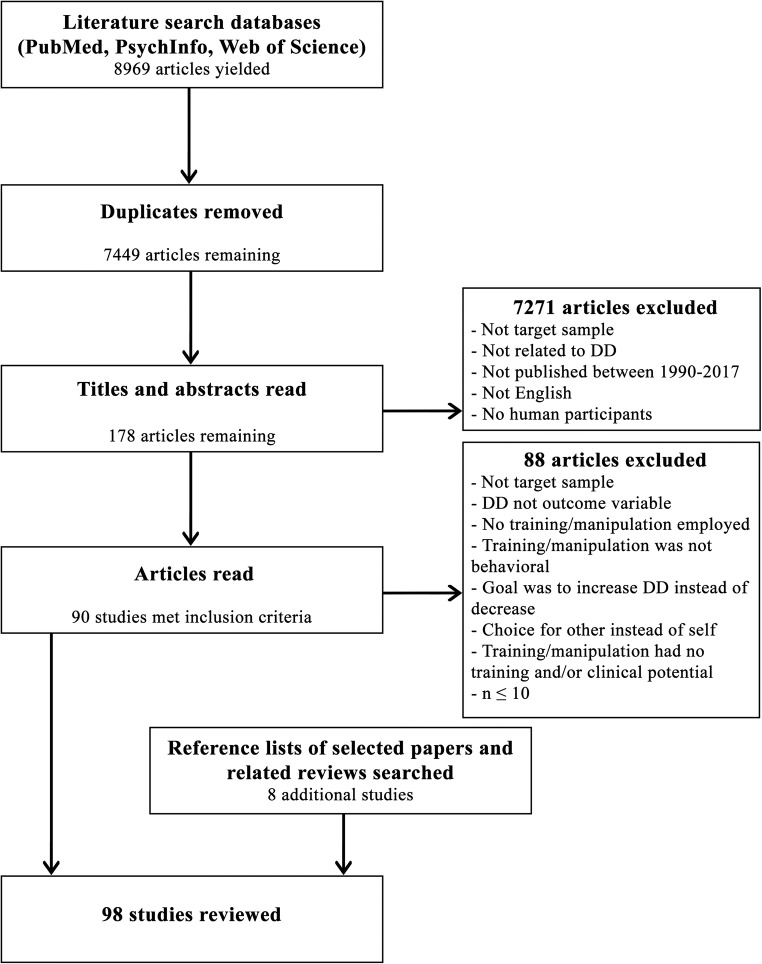
- Systematic review following PRISMA; searches in PubMed, PsychInfo, and Web of Science yielded 8,969 hits, 1,520 duplicates removed, 7,449 unique references, plus 8 from reference lists; 178 full texts screened, yielding 98 included studies.
- Inclusion criteria: human participants aged 12+; monetary DD outcome; behavioral training or manipulation aimed at decreasing DD; self-directed choices; sample size >10; published 1990–April 2017 in English peer-reviewed journals.
- Studies were categorized as trainings (19 studies, 19 experiments) or manipulations (79 studies, 132 experiments); manipulations were grouped into future, social factors, emotion, and framing categories. No meta-analysis or effect-size computation was performed.
Limitations
- Stated: wide variability in trainings/manipulations complicates comparison; publication bias could not be formally checked; most included studies did not report effect sizes or statistics allowing effect-size calculation.
- Stated: many studies lacked proper control conditions, did not directly compare experimental and control conditions, were poorly powered, or used different DD assessment methods; only two experiments included participants younger than 18, and many relied on healthy college student samples.
- Evident from the text: the categorization of manipulations into future, social, emotion, and framing is described by the authors as “purely subjective”; demand characteristics may inflate effects, especially for EFT and future-self manipulations; publication bias is likely more prevalent in manipulation studies than training studies.
Model-written summary. Check it against the paper before relying on it.
Integrity signals
Registry
Cites
Statistics
Figures
Verification
Claims the paper makes
153 Not checked yet · 56 Own interpretation · 51 Own result · 18 No basis given · 4 Own method
A result the paper reports from its own data — it cites no other source for it, so there is none to check. The quote shows it is in the paper.
In the paper
“Seven out of the 19 studies (37%) also reported effects of their training on actual behavior such as smoking or cocaine abstinence, in addition to results on DD.”
§ Behavioral trainings and manipulations to reduce delay discounting: A systematic review > Results > Characteristics of included studies
plaindirect- Asserted: passes — The authors put it forward as true.
- Checkable: passes — It can be checked against evidence.
- Load-bearing: unclear — It is unclear whether the paper’s conclusions depend on it.
- Based: passes — The paper gives a reason why it holds.
A result the paper reports from its own data — it cites no other source for it, so there is none to check. The quote shows it is in the paper.
In the paper
“Regarding the studies evaluating the effects of manipulations on DD, 86% (n = 114) found the expected reductions in DD”
§ Behavioral trainings and manipulations to reduce delay discounting: A systematic review > Results > General results
plaindirectn = 114- Asserted: passes — The authors put it forward as true.
- Checkable: passes — It can be checked against evidence.
- Load-bearing: passes — The paper’s conclusions depend on it.
- Based: passes — The paper gives a reason why it holds.
A result the paper reports from its own data — it cites no other source for it, so there is none to check. The quote shows it is in the paper.
In the paper
“Ninety-eight studies (151 experiments) were identified that tested behavioral trainings and manipulations to decrease DD.”
- Also stated in: § Search results · plain
“Next, all 178 full-text studies were screened using the same inclusion criteria, and this resulted in a final number of 98 studies relevant for the review.”
§ Behavioral trainings and manipulations to reduce delay discounting: A systematic review > Abstract
plain- Asserted: passes — The authors put it forward as true.
- Checkable: passes — It can be checked against evidence.
- Load-bearing: passes — The paper’s conclusions depend on it.
- Based: passes — The paper gives a reason why it holds.
- Also stated in: § Search results · plain
A result the paper reports from its own data — it cites no other source for it, so there is none to check. The quote shows it is in the paper.
In the paper
“The majority (n = 14; 74%) of these studies included a clinical population”
§ Behavioral trainings and manipulations to reduce delay discounting: A systematic review > Results > Characteristics of included studies
plainn = 14- Asserted: passes — The authors put it forward as true.
- Checkable: passes — It can be checked against evidence.
- Load-bearing: unclear — It is unclear whether the paper’s conclusions depend on it.
- Based: passes — The paper gives a reason why it holds.
A result the paper reports from its own data — it cites no other source for it, so there is none to check. The quote shows it is in the paper.
In the paper
“There are far more manipulation experiments available in the literature (n = 132; 87%), compared to trainings (n = 19; 13%).”
§ Behavioral trainings and manipulations to reduce delay discounting: A systematic review > Results > Characteristics of included studies
plainn = 132- Asserted: passes — The authors put it forward as true.
- Checkable: passes — It can be checked against evidence.
- Load-bearing: unclear — It is unclear whether the paper’s conclusions depend on it.
- Based: passes — The paper gives a reason why it holds.
A result the paper reports from its own data — it cites no other source for it, so there is none to check. The quote shows it is in the paper.
In the paper
“13% (n = 17) found null results or unexpected increases in DD”
§ Behavioral trainings and manipulations to reduce delay discounting: A systematic review > Results > General results
plainn = 17- Asserted: passes — The authors put it forward as true.
- Checkable: passes — It can be checked against evidence.
- Load-bearing: unclear — It is unclear whether the paper’s conclusions depend on it.
- Based: passes — The paper gives a reason why it holds.
A result the paper reports from its own data — it cites no other source for it, so there is none to check. The quote shows it is in the paper.
In the paper
“whereas 58% (n = 11) found null results or unexpected increases in DD.”
§ Behavioral trainings and manipulations to reduce delay discounting: A systematic review > Results > General results
plainn = 11- Asserted: passes — The authors put it forward as true.
- Checkable: passes — It can be checked against evidence.
- Load-bearing: passes — The paper’s conclusions depend on it.
- Based: passes — The paper gives a reason why it holds.
A result the paper reports from its own data — it cites no other source for it, so there is none to check. The quote shows it is in the paper.
In the paper
“Of the experiments, 5% (n = 6) reported effects of the manipulations on actual behavior, such as caloric intake, in addition to the effect on DD.”
§ Behavioral trainings and manipulations to reduce delay discounting: A systematic review > Results > Characteristics of included studies
plaindirectn = 6- Asserted: passes — The authors put it forward as true.
- Checkable: passes — It can be checked against evidence.
- Load-bearing: unclear — It is unclear whether the paper’s conclusions depend on it.
- Based: passes — The paper gives a reason why it holds.
A result the paper reports from its own data — it cites no other source for it, so there is none to check. The quote shows it is in the paper.
In the paper
“Overall, results indicated that DD can be decreased, showing that DD is profoundly context dependent and changeable.”
§ Behavioral trainings and manipulations to reduce delay discounting: A systematic review > Abstract
hedgeddirect- Asserted: passes — The authors put it forward as true.
- Checkable: passes — It can be checked against evidence.
- Load-bearing: passes — The paper’s conclusions depend on it.
- Based: passes — The paper gives a reason why it holds.
A result the paper reports from its own data — it cites no other source for it, so there is none to check. The quote shows it is in the paper.
In the paper
“and 1% (n = 1) found mixed results (i.e., only effects in healthy control group, not in amnestic patients).”
§ Behavioral trainings and manipulations to reduce delay discounting: A systematic review > Results > General results
plainSingle case- Asserted: passes — The authors put it forward as true.
- Checkable: passes — It can be checked against evidence.
- Load-bearing: unclear — It is unclear whether the paper’s conclusions depend on it.
- Based: passes — The paper gives a reason why it holds.
A result the paper reports from its own data — it cites no other source for it, so there is none to check. The quote shows it is in the paper.
In the paper
“Of the experiments that included a secondary behavioral outcome (n = 7) all found the expected positive effects on behavior.”
§ Behavioral trainings and manipulations to reduce delay discounting: A systematic review > Results > General results
plaindirectn = 7- Asserted: passes — The authors put it forward as true.
- Checkable: passes — It can be checked against evidence.
- Load-bearing: unclear — It is unclear whether the paper’s conclusions depend on it.
- Based: passes — The paper gives a reason why it holds.
A result the paper reports from its own data — it cites no other source for it, so there is none to check. The quote shows it is in the paper.
In the paper
“Results of the current review show that 26% (n = 5) of the experiments evaluating the effects of trainings find the expected reductions in DD”
§ Behavioral trainings and manipulations to reduce delay discounting: A systematic review > Results > General results
plaindirectn = 5- Asserted: passes — The authors put it forward as true.
- Checkable: passes — It can be checked against evidence.
- Load-bearing: passes — The paper’s conclusions depend on it.
- Based: passes — The paper gives a reason why it holds.
A result the paper reports from its own data — it cites no other source for it, so there is none to check. The quote shows it is in the paper.
In the paper
“The remainder three studies (16%) found mixed results”
§ Behavioral trainings and manipulations to reduce delay discounting: A systematic review > Results > General results
plainn = 3- Asserted: passes — The authors put it forward as true.
- Checkable: passes — It can be checked against evidence.
- Load-bearing: unclear — It is unclear whether the paper’s conclusions depend on it.
- Based: passes — The paper gives a reason why it holds.
In the paper
“Furthermore, a decrease in carbon monoxide (CO) levels, measuring how much carbon monoxide is present in the exhaled air of the smoker as a proxy of smoking behavior (Deveci, Deveci, Açik, & Ozan, 2004) over time was found in the CM condition.”
§ Behavioral trainings and manipulations to reduce delay discounting: A systematic review > Results > Trainings
What the sources say
- Not checked yetcites Yi et al. (2008)
plaindirect- Asserted: passes — The authors put it forward as true.
- Checkable: passes — It can be checked against evidence.
- Load-bearing: unclear — It is unclear whether the paper’s conclusions depend on it.
- Based: passes — The paper gives a reason why it holds.
None of the sources cited for this claim have been checked yet.
In the paper
“Both studies did not find effects of CBT on DD at posttest.”
§ Behavioral trainings and manipulations to reduce delay discounting: A systematic review > Results > Trainings
plain- Asserted: passes — The authors put it forward as true.
- Checkable: passes — It can be checked against evidence.
- Load-bearing: passes — The paper’s conclusions depend on it.
- Based: passes — The paper gives a reason why it holds.
The paper states this without a source or data behind it here, so there is nothing to check it against. The quote shows it is in the paper.
In the paper
“The two studies with expected or mixed effects included a substance-specific DD task.”
§ Behavioral trainings and manipulations to reduce delay discounting: A systematic review > Results > Trainings
plaincorrelational- Asserted: passes — The authors put it forward as true.
- Checkable: passes — It can be checked against evidence.
- Load-bearing: passes — The paper’s conclusions depend on it.
- Based: passes — The paper gives a reason why it holds.
In the paper
“Landes et al. (2012) found that DD decreased after a CM training in opioid-dependent patients”
§ Behavioral trainings and manipulations to reduce delay discounting: A systematic review > Results > Trainings
What the sources say
- Not checked yetcites Landes et al. (2012)
plaindirect- Asserted: passes — The authors put it forward as true.
- Checkable: passes — It can be checked against evidence.
- Load-bearing: passes — The paper’s conclusions depend on it.
- Based: passes — The paper gives a reason why it holds.
In the paper
“Moreover, participants in the CM condition had lower CO levels posttraining than participants in the control condition did.”
§ Behavioral trainings and manipulations to reduce delay discounting: A systematic review > Results > Trainings
What the sources say
- Not checked yetcites Yoon et al. (2009)
plaindirect- Asserted: passes — The authors put it forward as true.
- Checkable: passes — It can be checked against evidence.
- Load-bearing: unclear — It is unclear whether the paper’s conclusions depend on it.
- Based: passes — The paper gives a reason why it holds.
None of the sources cited for this claim have been checked yet.
In the paper
“Both studies did not find any effects on DD.”
§ Behavioral trainings and manipulations to reduce delay discounting: A systematic review > Results > Trainings
plain- Asserted: passes — The authors put it forward as true.
- Checkable: passes — It can be checked against evidence.
- Load-bearing: passes — The paper’s conclusions depend on it.
- Based: passes — The paper gives a reason why it holds.
In the paper
“Weidberg et al. (2015) did not find direct effects of CM on DD”
§ Behavioral trainings and manipulations to reduce delay discounting: A systematic review > Results > Trainings
What the sources say
- Not checked yetcites Weidberg et al. (2015)
plain- Asserted: passes — The authors put it forward as true.
- Checkable: passes — It can be checked against evidence.
- Load-bearing: unclear — It is unclear whether the paper’s conclusions depend on it.
- Based: passes — The paper gives a reason why it holds.
A result the paper reports from its own data — it cites no other source for it, so there is none to check. The quote shows it is in the paper.
In the paper
“Two studies exposed their participants to some sort of money-management-based training”
§ Behavioral trainings and manipulations to reduce delay discounting: A systematic review > Results > Trainings
plainn = 2- Asserted: passes — The authors put it forward as true.
- Checkable: passes — It can be checked against evidence.
- Load-bearing: unclear — It is unclear whether the paper’s conclusions depend on it.
- Based: passes — The paper gives a reason why it holds.
- The authors state this as an assumption: More knowledge of money management increases the salience of future rewards and makes those more concrete.
In the paper
“In a study by Morrison and colleagues (Morrison, Madden, Odum, Friedel, and Twohig, 2014), a brief acceptance-based training, designed to increase willingness to experience discomfort, successfully decreased DD.”
§ Behavioral trainings and manipulations to reduce delay discounting: A systematic review > Results > Trainings
What the sources say
- Not checked yetcites Morrison, Madden, Odum, Friedel, and Twohig, 2014
plaindirect- Asserted: passes — The authors put it forward as true.
- Checkable: passes — It can be checked against evidence.
- Load-bearing: unclear — It is unclear whether the paper’s conclusions depend on it.
- Based: passes — The paper gives a reason why it holds.
In the paper
“In the study by Bickel et al. (2011b) in stimulant-dependent individuals during substance-abuse treatment, decreased discounting rates were found for participants in the WM training condition compared with the control condition.”
§ Behavioral trainings and manipulations to reduce delay discounting: A systematic review > Results > Trainings
What the sources say
- Not checked yetcites Bickel et al. (2011b)
plaindirect- Asserted: passes — The authors put it forward as true.
- Checkable: passes — It can be checked against evidence.
- Load-bearing: passes — The paper’s conclusions depend on it.
- Based: passes — The paper gives a reason why it holds.
A result the paper reports from its own data — it cites no other source for it, so there is none to check. The quote shows it is in the paper.
In the paper
“Regarding behavioral outcomes, four studies (67%) found significant reductions in smoking behavior.”
§ Behavioral trainings and manipulations to reduce delay discounting: A systematic review > Results > Trainings
plaindirect- Asserted: passes — The authors put it forward as true.
- Checkable: passes — It can be checked against evidence.
- Load-bearing: unclear — It is unclear whether the paper’s conclusions depend on it.
- Based: passes — The paper gives a reason why it holds.
The paper states this without a source or data behind it here, so there is nothing to check it against. The quote shows it is in the paper.
In the paper
“In summary, the two studies provide mixed evidence for decreases in DD as a function of money-management-based trainings.”
§ Behavioral trainings and manipulations to reduce delay discounting: A systematic review > Results > Trainings
plainconditional- Asserted: passes — The authors put it forward as true.
- Checkable: passes — It can be checked against evidence.
- Load-bearing: passes — The paper’s conclusions depend on it.
- Based: passes — The paper gives a reason why it holds.
None of the sources cited for this claim have been checked yet.
In the paper
“However, Murphy and colleagues found decreased self-reports of alcohol problems in the condition that received the brief motivational training in combination with SFAS.”
§ Behavioral trainings and manipulations to reduce delay discounting: A systematic review > Results > Trainings
plaindirect- Asserted: passes — The authors put it forward as true.
- Checkable: passes — It can be checked against evidence.
- Load-bearing: passes — The paper’s conclusions depend on it.
- Based: passes — The paper gives a reason why it holds.
In the paper
“however, the control condition that only received buprenorphine also showed attenuated levels of DD.”
§ Behavioral trainings and manipulations to reduce delay discounting: A systematic review > Results > Trainings
What the sources say
- Not checked yetcites Landes et al. (2012)
plaindirect- Asserted: passes — The authors put it forward as true.
- Checkable: passes — It can be checked against evidence.
- Load-bearing: passes — The paper’s conclusions depend on it.
- Based: passes — The paper gives a reason why it holds.
A result the paper reports from its own data — it cites no other source for it, so there is none to check. The quote shows it is in the paper.
In the paper
“None of the studies tested whether decreases in substance use were mediated by decreases in DD rates.”
§ Behavioral trainings and manipulations to reduce delay discounting: A systematic review > Results > Trainings
plain- Asserted: passes — The authors put it forward as true.
- Checkable: passes — It can be checked against evidence.
- Load-bearing: unclear — It is unclear whether the paper’s conclusions depend on it.
- Based: passes — The paper gives a reason why it holds.
In the paper
“The participants in the mindfulness training condition showed attenuated discounting rates for food, but not for money, compared with the control condition.”
§ Behavioral trainings and manipulations to reduce delay discounting: A systematic review > Results > Trainings
What the sources say
- Not checked yetcites Hendrickson and Rasmussen (2013, 2017)
plaindirect- Asserted: passes — The authors put it forward as true.
- Checkable: passes — It can be checked against evidence.
- Load-bearing: unclear — It is unclear whether the paper’s conclusions depend on it.
- Based: passes — The paper gives a reason why it holds.
In the paper
“Secades-Villa et al. (2014) found a difference between smokers and abstainers on DD on 12-month follow-up”
§ Behavioral trainings and manipulations to reduce delay discounting: A systematic review > Results > Trainings
What the sources say
- Not checked yetcites Secades-Villa et al. (2014)
plaincorrelational- Asserted: passes — The authors put it forward as true.
- Checkable: passes — It can be checked against evidence.
- Load-bearing: unclear — It is unclear whether the paper’s conclusions depend on it.
- Based: passes — The paper gives a reason why it holds.
In the paper
“Yet, at baseline, the IGD group already showed higher DD rates than the healthy control group”
§ Behavioral trainings and manipulations to reduce delay discounting: A systematic review > Results > Trainings
What the sources say
- Not checked yetcites Yao et al. (2017)
plaincorrelational- Asserted: passes — The authors put it forward as true.
- Checkable: passes — It can be checked against evidence.
- Load-bearing: unclear — It is unclear whether the paper’s conclusions depend on it.
- Based: passes — The paper gives a reason why it holds.
A result the paper reports from its own data — it cites no other source for it, so there is none to check. The quote shows it is in the paper.
In the paper
“In conclusion, EFT manipulations are one of the more thoroughly researched categories, and the results on DD and behavior are mostly positive and promising.”
§ Behavioral trainings and manipulations to reduce delay discounting: A systematic review > Results > Manipulations
plaincorrelational- Asserted: passes — The authors put it forward as true.
- Checkable: passes — It can be checked against evidence.
- Load-bearing: passes — The paper’s conclusions depend on it.
- Based: passes — The paper gives a reason why it holds.
In the paper
“The older people prime resulted in attenuated DD, whereas the vacation prime resulted in heightened DD.”
§ Behavioral trainings and manipulations to reduce delay discounting: A systematic review > Results > Manipulations
What the sources say
- Not checked yetcites Israel, Rosenboim, and Shavit (2014)
plaindirect- Asserted: passes — The authors put it forward as true.
- Checkable: passes — It can be checked against evidence.
- Load-bearing: unclear — It is unclear whether the paper’s conclusions depend on it.
- Based: passes — The paper gives a reason why it holds.
In the paper
“In all three experiments, participants were willing to wait longer as they were offered a trip to Paris with the value of the monetary reward, instead of a monetary reward itself.”
§ Behavioral trainings and manipulations to reduce delay discounting: A systematic review > Results > Manipulations
What the sources say
- Not checked yetcites H. Kim, Schnall, and White (2013)
plaindirect- Asserted: passes — The authors put it forward as true.
- Checkable: passes — It can be checked against evidence.
- Load-bearing: passes — The paper’s conclusions depend on it.
- Based: passes — The paper gives a reason why it holds.
In the paper
“Pronin and colleagues (Pronin, Olivola, & Kennedy, 2008) found that choosing for your future self attenuated DD in comparison with choosing for the self.”
§ Behavioral trainings and manipulations to reduce delay discounting: A systematic review > Results > Manipulations
What the sources say
- Not checked yetcites Pronin, Olivola, & Kennedy, 2008
plaindirect- Asserted: passes — The authors put it forward as true.
- Checkable: passes — It can be checked against evidence.
- Load-bearing: passes — The paper’s conclusions depend on it.
- Based: passes — The paper gives a reason why it holds.
In the paper
“Furthermore, participants in the weight-reduced condition also ate less ice cream in a taste test and were more likely to choose a sugar-free drink as a reward, and this effect was mediated by discounting rate.”
§ Behavioral trainings and manipulations to reduce delay discounting: A systematic review > Results > Manipulations
What the sources say
- Not checked yetcites Kuo, Lee, and Chiou (2016)
plaindirect- Asserted: passes — The authors put it forward as true.
- Checkable: passes — It can be checked against evidence.
- Load-bearing: unclear — It is unclear whether the paper’s conclusions depend on it.
- Based: passes — The paper gives a reason why it holds.
In the paper
“Compared with the control group, participants who viewed their weight-reduced avatars showed attenuated DD.”
§ Behavioral trainings and manipulations to reduce delay discounting: A systematic review > Results > Manipulations
What the sources say
- Not checked yetcites Kuo, Lee, and Chiou (2016)
plaindirect- Asserted: passes — The authors put it forward as true.
- Checkable: passes — It can be checked against evidence.
- Load-bearing: unclear — It is unclear whether the paper’s conclusions depend on it.
- Based: passes — The paper gives a reason why it holds.
In the paper
“Bartels and Urminsky (2011) employed multiple experiments and discovered that directly informing people that identity is constant over time and implicitly inducing the opinion that personality stays the same over time reduced DD.”
§ Behavioral trainings and manipulations to reduce delay discounting: A systematic review > Results > Manipulations
What the sources say
- Not checked yetcites Bartels and Urminsky (2011)
plaindirect- Asserted: passes — The authors put it forward as true.
- Checkable: passes — It can be checked against evidence.
- Load-bearing: unclear — It is unclear whether the paper’s conclusions depend on it.
- Based: passes — The paper gives a reason why it holds.
In the paper
“The older people prime resulted in attenuated DD, whereas the vacation prime resulted in heightened DD.”
§ Behavioral trainings and manipulations to reduce delay discounting: A systematic review > Results > Manipulations
What the sources say
- Not checked yetcites Israel, Rosenboim, and Shavit (2014)
plaindirect- Asserted: passes — The authors put it forward as true.
- Checkable: passes — It can be checked against evidence.
- Load-bearing: unclear — It is unclear whether the paper’s conclusions depend on it.
- Based: passes — The paper gives a reason why it holds.
In the paper
“In Experiment 3, a neutral future thinking manipulation (i.e., EFT manipulation with neutral events to be imagined) was tested against a control condition, and no differences were found between both conditions.”
§ Behavioral trainings and manipulations to reduce delay discounting: A systematic review > Results > Manipulations
What the sources say
- Not checked yetcites L. Liu, Feng, Chen, and Li (2013)
plain- Asserted: passes — The authors put it forward as true.
- Checkable: passes — It can be checked against evidence.
- Load-bearing: passes — The paper’s conclusions depend on it.
- Based: passes — The paper gives a reason why it holds.
In the paper
“As more details were given about the trip, such as sightseeing possibilities and accommodations, the effect was even stronger, suggesting that a more specified event increases patience.”
§ Behavioral trainings and manipulations to reduce delay discounting: A systematic review > Results > Manipulations
What the sources say
- Not checked yetcites H. Kim, Schnall, and White (2013)
hedgeddirect- Asserted: passes — The authors put it forward as true.
- Checkable: passes — It can be checked against evidence.
- Load-bearing: passes — The paper’s conclusions depend on it.
- Based: passes — The paper gives a reason why it holds.
In the paper
“In Experiment 2 of the study by L. Liu, Feng, Chen, and Li (2013), a negative future thinking manipulation (i.e., EFT manipulation with negative events to be imagined) was tested against a control condition. DD rates increased in the negative EFT condition.”
§ Behavioral trainings and manipulations to reduce delay discounting: A systematic review > Results > Manipulations
What the sources say
- Not checked yetcites L. Liu, Feng, Chen, and Li (2013)
plaindirect- Asserted: passes — The authors put it forward as true.
- Checkable: passes — It can be checked against evidence.
- Load-bearing: passes — The paper’s conclusions depend on it.
- Based: passes — The paper gives a reason why it holds.
In the paper
“Both experiments confirmed this hypothesis by significant differences between the high and low power conditions, with participants in the high power condition showing lower DD rates.”
§ Behavioral trainings and manipulations to reduce delay discounting: A systematic review > Results > Manipulations
What the sources say
- Not checked yetcites Joshi and Fast (2013)
plaindirect- Asserted: passes — The authors put it forward as true.
- Checkable: passes — It can be checked against evidence.
- Load-bearing: passes — The paper’s conclusions depend on it.
- Based: passes — The paper gives a reason why it holds.
None of the sources cited for this claim have been checked yet.
In the paper
“and the studies also differed in training dosage (Bickel et al., b: 4–15 training sessions vs. Rass et al., 2015: 25 training sessions)”
§ Behavioral trainings and manipulations to reduce delay discounting: A systematic review > Results > Trainings
What the sources say
- Not checked yetcites Bickel et al. (2011b)
- Not checked yetcites Rass et al. (2015)
plain- Asserted: passes — The authors put it forward as true.
- Checkable: passes — It can be checked against evidence.
- Load-bearing: passes — The paper’s conclusions depend on it.
- Based: passes — The paper gives a reason why it holds.
In the paper
“Furthermore, participants in the weight-reduced condition also ate less ice cream in a taste test and were more likely to choose a sugar-free drink as a reward, and this effect was mediated by discounting rate.”
§ Behavioral trainings and manipulations to reduce delay discounting: A systematic review > Results > Manipulations
What the sources say
- Not checked yetcites Kuo, Lee, and Chiou (2016)
plaindirect- Asserted: passes — The authors put it forward as true.
- Checkable: passes — It can be checked against evidence.
- Load-bearing: unclear — It is unclear whether the paper’s conclusions depend on it.
- Based: passes — The paper gives a reason why it holds.
In the paper
“Bartels and Urminsky (2011) employed multiple experiments and discovered that directly informing people that identity is constant over time and implicitly inducing the opinion that personality stays the same over time reduced DD.”
§ Behavioral trainings and manipulations to reduce delay discounting: A systematic review > Results > Manipulations
What the sources say
- Not checked yetcites Bartels and Urminsky (2011)
plaindirect- Asserted: passes — The authors put it forward as true.
- Checkable: passes — It can be checked against evidence.
- Load-bearing: unclear — It is unclear whether the paper’s conclusions depend on it.
- Based: passes — The paper gives a reason why it holds.
None of the sources cited for this claim have been checked yet.
In the paper
“All seven experiments found the expected effects, meaning that more abstract mindsets attenuated DD.”
§ Behavioral trainings and manipulations to reduce delay discounting: A systematic review > Results > Manipulations
What the sources say
- Not checked yetcites Kelley and Schmeichel (2015)
- Not checked yetcites Li et al. (2016)
- Not checked yetcites Malkoc, Zauberman, and Bettman (2010)
plaindirect- Asserted: passes — The authors put it forward as true.
- Checkable: passes — It can be checked against evidence.
- Load-bearing: passes — The paper’s conclusions depend on it.
- Based: passes — The paper gives a reason why it holds.
The paper states this without a source or data behind it here, so there is nothing to check it against. The quote shows it is in the paper.
In the paper
“In conclusion, EFT manipulations are one of the more thoroughly researched categories, and the results on DD and behavior are mostly positive and promising.”
§ Behavioral trainings and manipulations to reduce delay discounting: A systematic review > Results > Manipulations
plain- Asserted: passes — The authors put it forward as true.
- Checkable: passes — It can be checked against evidence.
- Load-bearing: unclear — It is unclear whether the paper’s conclusions depend on it.
- Based: passes — The paper gives a reason why it holds.
In the paper
“Furthermore, participants in the weight-reduced condition also ate less ice cream in a taste test and were more likely to choose a sugar-free drink as a reward, and this effect was mediated by discounting rate.”
§ Behavioral trainings and manipulations to reduce delay discounting: A systematic review > Results > Manipulations
What the sources say
- Not checked yetcites Kuo, Lee, and Chiou (2016)
plaindirect- Asserted: passes — The authors put it forward as true.
- Checkable: passes — It can be checked against evidence.
- Load-bearing: unclear — It is unclear whether the paper’s conclusions depend on it.
- Based: passes — The paper gives a reason why it holds.
In the paper
“Short spatial distance manipulation reduced DD, thus a smaller spatial distance between two locations leads to less delay discounting in intertemporal choices (B. K. Kim et al., 2012).”
§ Behavioral trainings and manipulations to reduce delay discounting: A systematic review > Results > Manipulations
What the sources say
- Not checked yetcites B. K. Kim et al., 2012
plaindirect- Asserted: passes — The authors put it forward as true.
- Checkable: passes — It can be checked against evidence.
- Load-bearing: passes — The paper’s conclusions depend on it.
- Based: passes — The paper gives a reason why it holds.
The paper states this without a source or data behind it here, so there is nothing to check it against. The quote shows it is in the paper.
In the paper
“Twenty out of the 24 experiments (83%) employing an EFT manipulation found the expected reductions in DD in the EFT manipulation compared with the control condition.”
§ Behavioral trainings and manipulations to reduce delay discounting: A systematic review > Results > Manipulations
plaindirect- Asserted: passes — The authors put it forward as true.
- Checkable: passes — It can be checked against evidence.
- Load-bearing: passes — The paper’s conclusions depend on it.
- Based: passes — The paper gives a reason why it holds.
In the paper
“Participants in the FF condition exhibited significantly lower discounting rates than those in the PF or NTF conditions.”
§ Behavioral trainings and manipulations to reduce delay discounting: A systematic review > Results > Manipulations
What the sources say
- Not checked yetcites Sheffer et al. (2016)
plaindirect- Asserted: passes — The authors put it forward as true.
- Checkable: passes — It can be checked against evidence.
- Load-bearing: passes — The paper’s conclusions depend on it.
- Based: passes — The paper gives a reason why it holds.
In the paper
“Situations where people had to make choices for themselves were related to less patient choices than situations where people made decisions for the whole group.”
§ Behavioral trainings and manipulations to reduce delay discounting: A systematic review > Results > Manipulations
What the sources say
- Not checked yetcites Charlton et al. (2013)
plaincorrelationalSingle case- Asserted: passes — The authors put it forward as true.
- Checkable: passes — It can be checked against evidence.
- Load-bearing: passes — The paper’s conclusions depend on it.
- Based: passes — The paper gives a reason why it holds.
A result the paper reports from its own data — it cites no other source for it, so there is none to check. The quote shows it is in the paper.
In the paper
“To summarize, most experiments (85%) in the emotion priming category found positive results on DD.”
§ Behavioral trainings and manipulations to reduce delay discounting: A systematic review > Results > Manipulations
plaindirect- Asserted: passes — The authors put it forward as true.
- Checkable: passes — It can be checked against evidence.
- Load-bearing: passes — The paper’s conclusions depend on it.
- Based: passes — The paper gives a reason why it holds.
In the paper
“When information about normative strategy for economic decision-making was made available to participants, DD rates decreased, although no direct comparison between conditions was made in Experiment 1 and no control condition was used in Study 2.”
§ Behavioral trainings and manipulations to reduce delay discounting: A systematic review > Results > Manipulations
What the sources say
- Not checked yetcites Senecal, Wang, Thompson, & Kable, 2012
plaindirect- Asserted: passes — The authors put it forward as true.
- Checkable: passes — It can be checked against evidence.
- Load-bearing: passes — The paper’s conclusions depend on it.
- Based: passes — The paper gives a reason why it holds.
None of the sources cited for this claim have been checked yet.
In the paper
“Ifcher and Zarghamee (2011) used short movie clips, and Pyone and Isen (2011) used words to induce positive or neutral affect, and both found that positive affect reduced DD.”
§ Behavioral trainings and manipulations to reduce delay discounting: A systematic review > Results > Manipulations
What the sources say
- Not checked yetcites Ifcher and Zarghamee (2011)
- Not checked yetcites Pyone and Isen (2011)
plaindirect- Asserted: passes — The authors put it forward as true.
- Checkable: passes — It can be checked against evidence.
- Load-bearing: passes — The paper’s conclusions depend on it.
- Based: passes — The paper gives a reason why it holds.
In the paper
“In comparison, Yi et al. (2008) employed the same manipulation, but did not find a positive effect of choosing for the group over choosing for the self.”
§ Behavioral trainings and manipulations to reduce delay discounting: A systematic review > Results > Manipulations
What the sources say
- Not checked yetcites Yi et al. (2008)
plainSingle case- Asserted: passes — The authors put it forward as true.
- Checkable: passes — It can be checked against evidence.
- Load-bearing: unclear — It is unclear whether the paper’s conclusions depend on it.
- Based: passes — The paper gives a reason why it holds.
A result the paper reports from its own data — it cites no other source for it, so there is none to check. The quote shows it is in the paper.
In the paper
“yet there were also some studies, with both positive and negative affect/emotion inductions, that did not find effects in the expected direction (15%).”
§ Behavioral trainings and manipulations to reduce delay discounting: A systematic review > Results > Manipulations
plain- Asserted: passes — The authors put it forward as true.
- Checkable: passes — It can be checked against evidence.
- Load-bearing: unclear — It is unclear whether the paper’s conclusions depend on it.
- Based: passes — The paper gives a reason why it holds.
A result the paper reports from its own data — it cites no other source for it, so there is none to check. The quote shows it is in the paper.
In the paper
“Sixteen experiments induced positive affect or primed positive emotions and thereby found decreased DD rates”
§ Behavioral trainings and manipulations to reduce delay discounting: A systematic review > Results > Manipulations
plaindirect- Asserted: passes — The authors put it forward as true.
- Checkable: passes — It can be checked against evidence.
- Load-bearing: passes — The paper’s conclusions depend on it.
- Based: passes — The paper gives a reason why it holds.
In the paper
“They found that choosing for multiple people (“we condition”) was most important in bringing down DD rates.”
§ Behavioral trainings and manipulations to reduce delay discounting: A systematic review > Results > Manipulations
What the sources say
- Not checked yetcites Bickel, Jarmolowicz, Mueller, Franck, and colleagues (2012a)
plaindirect- Asserted: passes — The authors put it forward as true.
- Checkable: passes — It can be checked against evidence.
- Load-bearing: unclear — It is unclear whether the paper’s conclusions depend on it.
- Based: passes — The paper gives a reason why it holds.
In the paper
“Furthermore, peer-generated advice about strategies for economic decisions only decreased DD when this advice was written down in a patient versus impatient way (yet see our discussion of experimenter-demand effects in the discussion).”
§ Behavioral trainings and manipulations to reduce delay discounting: A systematic review > Results > Manipulations
What the sources say
- Not checked yetcites Senecal, Wang, Thompson, & Kable, 2012
plaindirect- Asserted: passes — The authors put it forward as true.
- Checkable: passes — It can be checked against evidence.
- Load-bearing: passes — The paper’s conclusions depend on it.
- Based: passes — The paper gives a reason why it holds.
None of the sources cited for this claim have been checked yet.
In the paper
“Participants in the natural environment manipulation showed attenuated DD rates compared with participants in the urban environment manipulation.”
§ Behavioral trainings and manipulations to reduce delay discounting: A systematic review > Results > Manipulations
What the sources say
- Not checked yetcites Berry et al., 2014
- Not checked yetcites Berry et al., 2015
- Not checked yetcites van der Wal et al., 2013
plaindirect- Asserted: passes — The authors put it forward as true.
- Checkable: passes — It can be checked against evidence.
- Load-bearing: passes — The paper’s conclusions depend on it.
- Based: passes — The paper gives a reason why it holds.
A result the paper reports from its own data — it cites no other source for it, so there is none to check. The quote shows it is in the paper.
In the paper
“whereas six other experiments induced negative affect or primed negative emotions and found decreased DD rates.”
§ Behavioral trainings and manipulations to reduce delay discounting: A systematic review > Results > Manipulations
plaindirect- Asserted: passes — The authors put it forward as true.
- Checkable: passes — It can be checked against evidence.
- Load-bearing: passes — The paper’s conclusions depend on it.
- Based: passes — The paper gives a reason why it holds.
A result the paper reports from its own data — it cites no other source for it, so there is none to check. The quote shows it is in the paper.
In the paper
“Of the 132 manipulation experiments, 114 (86%) were able to decrease DD”
- Also stated in: § Implications: Most promising strategies to reduce DD · hedged
“The majority of the manipulations (86%) seem to significantly reduce DD rates.”
§ Behavioral trainings and manipulations to reduce delay discounting: A systematic review > Discussion > Overall effectiveness of trainings and manipulations
plaindirect- Asserted: passes — The authors put it forward as true.
- Checkable: passes — It can be checked against evidence.
- Load-bearing: passes — The paper’s conclusions depend on it.
- Based: passes — The paper gives a reason why it holds.
- Also stated in: § Implications: Most promising strategies to reduce DD · hedged
A result the paper reports from its own data — it cites no other source for it, so there is none to check. The quote shows it is in the paper.
In the paper
“In the current systematic review, the publication rate of null results of training studies (74%) was higher than the publication rate of null results of manipulation studies (14%).”
§ Behavioral trainings and manipulations to reduce delay discounting: A systematic review > Discussion > Overall effectiveness of trainings and manipulations
plain- Asserted: passes — The authors put it forward as true.
- Checkable: passes — It can be checked against evidence.
- Load-bearing: passes — The paper’s conclusions depend on it.
- Based: passes — The paper gives a reason why it holds.
A result the paper reports from its own data — it cites no other source for it, so there is none to check. The quote shows it is in the paper.
In the paper
“First, the manipulation studies more often employed a within-subject design (n = 38, 29%) compared with training studies (n = 4, 21%).”
§ Behavioral trainings and manipulations to reduce delay discounting: A systematic review > Discussion > Overall effectiveness of trainings and manipulations
plaincorrelationaln = 38- Asserted: passes — The authors put it forward as true.
- Checkable: passes — It can be checked against evidence.
- Load-bearing: unclear — It is unclear whether the paper’s conclusions depend on it.
- Based: passes — The paper gives a reason why it holds.
A result the paper reports from its own data — it cites no other source for it, so there is none to check. The quote shows it is in the paper.
In the paper
“from the 19 trainings, only five (26%) were able to decrease DD”
§ Behavioral trainings and manipulations to reduce delay discounting: A systematic review > Discussion > Overall effectiveness of trainings and manipulations
plain- Asserted: passes — The authors put it forward as true.
- Checkable: passes — It can be checked against evidence.
- Load-bearing: passes — The paper’s conclusions depend on it.
- Based: passes — The paper gives a reason why it holds.
A result the paper reports from its own data — it cites no other source for it, so there is none to check. The quote shows it is in the paper.
In the paper
“most of these studies (66.6%) found positive effects on health outcomes.”
§ Behavioral trainings and manipulations to reduce delay discounting: A systematic review > Discussion > Implications: Most promising strategies to reduce DD
plaindirect- Asserted: passes — The authors put it forward as true.
- Checkable: passes — It can be checked against evidence.
- Load-bearing: passes — The paper’s conclusions depend on it.
- Based: passes — The paper gives a reason why it holds.
A result the paper reports from its own data — it cites no other source for it, so there is none to check. The quote shows it is in the paper.
In the paper
“Generally, the majority of published studies (n = 119; 79%) were able to reduce DD”
§ Behavioral trainings and manipulations to reduce delay discounting: A systematic review > Discussion > Overall effectiveness of trainings and manipulations
plaindirectn = 119- Asserted: passes — The authors put it forward as true.
- Checkable: passes — It can be checked against evidence.
- Load-bearing: passes — The paper’s conclusions depend on it.
- Based: passes — The paper gives a reason why it holds.
A result the paper reports from its own data — it cites no other source for it, so there is none to check. The quote shows it is in the paper.
In the paper
“the vast majority of the included studies did not report effect sizes or give statistics that would allow us to calculate effect sizes.”
§ Behavioral trainings and manipulations to reduce delay discounting: A systematic review > Discussion > Limitations and recommendations
plain- Asserted: passes — The authors put it forward as true.
- Checkable: passes — It can be checked against evidence.
- Load-bearing: passes — The paper’s conclusions depend on it.
- Based: passes — The paper gives a reason why it holds.
In the paper
“Individuals have the tendency to prefer immediate, smaller rewards over larger, but delayed rewards (Logue, 1988).”
§ Behavioral trainings and manipulations to reduce delay discounting: A systematic review > Glossary of acronyms in text and tables
What the sources say
- Not checked yetcites Logue, 1988 source
plain- Asserted: passes — The authors put it forward as true.
- Checkable: passes — It can be checked against evidence.
- Load-bearing: passes — The paper’s conclusions depend on it.
- Based: passes — The paper gives a reason why it holds.
In the paper
“In addition to within-subject variation in the short-term versus long-term reward trade-off, there are also interindividual differences in delay discounting (DD), which have been shown to be quite stable.”
- Also stated in: § Glossary of acronyms in text and tables · boosted
“Interindividual differences in discounting rates are highly stable.”
- Also stated in: § Glossary of acronyms in text and tables · hedged
“This had led some to argue that the discounting rate should be viewed as a personality trait (Odum, 2011)—namely, someone’s relative DD rate is highly stable.”
§ Behavioral trainings and manipulations to reduce delay discounting: A systematic review > Abstract
What the sources say
- Not checked yetcites Odum, 2011 source
boosted- Asserted: passes — The authors put it forward as true.
- Checkable: passes — It can be checked against evidence.
- Load-bearing: unclear — It is unclear whether the paper’s conclusions depend on it.
- Based: passes — The paper gives a reason why it holds.
- Also stated in: § Glossary of acronyms in text and tables · boosted
None of the sources cited for this claim have been checked yet.
In the paper
“Thus, DD is consistently linked with a variety of problematic and unhealthy behaviors”
§ Behavioral trainings and manipulations to reduce delay discounting: A systematic review > Glossary of acronyms in text and tables
What the sources say
boostedcorrelational- Asserted: passes — The authors put it forward as true.
- Checkable: passes — It can be checked against evidence.
- Load-bearing: passes — The paper’s conclusions depend on it.
- Based: passes — The paper gives a reason why it holds.
None of the sources cited for this claim have been checked yet.
In the paper
“For example, as a group, individuals who smoke consistently show higher DD rates than controls do (Amlung & MacKillop, 2014; MacKillop et al., 2011).”
§ Behavioral trainings and manipulations to reduce delay discounting: A systematic review > Glossary of acronyms in text and tables
What the sources say
plaincorrelational- Asserted: passes — The authors put it forward as true.
- Checkable: passes — It can be checked against evidence.
- Load-bearing: unclear — It is unclear whether the paper’s conclusions depend on it.
- Based: passes — The paper gives a reason why it holds.
In the paper
“Audrain-McGovern et al. (2009), for example, showed with a prospective longitudinal cohort study spanning midadolescence to young adulthood (ages 15–21 years old) that heightened baseline DD rates were a significant predictor of smoking initiation over time (11% increase in the odds of smoking uptake).”
§ Behavioral trainings and manipulations to reduce delay discounting: A systematic review > Glossary of acronyms in text and tables
What the sources say
- Not checked yetcites Audrain-McGovern et al., 2009 source
boostedcorrelational- Asserted: passes — The authors put it forward as true.
- Checkable: passes — It can be checked against evidence.
- Load-bearing: unclear — It is unclear whether the paper’s conclusions depend on it.
- Based: passes — The paper gives a reason why it holds.
None of the sources cited for this claim have been checked yet.
In the paper
“there is initial evidence from developmental studies that increased discounting rates contribute to the development and maintenance of these behaviors”
§ Behavioral trainings and manipulations to reduce delay discounting: A systematic review > Glossary of acronyms in text and tables
What the sources say
hedgedconditional- Asserted: passes — The authors put it forward as true.
- Checkable: passes — It can be checked against evidence.
- Load-bearing: passes — The paper’s conclusions depend on it.
- Based: passes — The paper gives a reason why it holds.
In the paper
“However, recently, a systematic review and meta-analysis was published on the same topic (Rung and Madden, b).”
§ Behavioral trainings and manipulations to reduce delay discounting: A systematic review > Glossary of acronyms in text and tables
What the sources say
- Not checked yetcites Rung and Madden, b
plain- Asserted: passes — The authors put it forward as true.
- Checkable: passes — It can be checked against evidence.
- Load-bearing: passes — The paper’s conclusions depend on it.
- Based: passes — The paper gives a reason why it holds.
None of the sources cited for this claim have been checked yet.
In the paper
“Supporting this belief, discount rate is highly correlated with a variety of health behaviors and disorders, with medium effect sizes across studies (Amlung, Petker, Jackson, Balodis, & MacKillop, 2016; Jackson & MacKillop, 2016; MacKillop et al., 2011).”
§ Behavioral trainings and manipulations to reduce delay discounting: A systematic review > Glossary of acronyms in text and tables
What the sources say
boostedcorrelational- Asserted: passes — The authors put it forward as true.
- Checkable: passes — It can be checked against evidence.
- Load-bearing: unclear — It is unclear whether the paper’s conclusions depend on it.
- Based: passes — The paper gives a reason why it holds.
What the paper did — it cites no source for this, so there is none to check. The quote shows it is in the paper.
In the paper
“Both studies did not include measurements of smoking behavior to test for changes in smoking behavior over time.”
§ Behavioral trainings and manipulations to reduce delay discounting: A systematic review > Results > Trainings
plain- Asserted: passes — The authors put it forward as true.
- Checkable: passes — It can be checked against evidence.
- Load-bearing: unclear — It is unclear whether the paper’s conclusions depend on it.
- Based: passes — The paper gives a reason why it holds.
None of the sources cited for this claim have been checked yet.
In the paper
“since decreases in DD rates can also be caused by other factors than the training itself, such as learning effects, regression to the mean, or expectations (Boot, Simons, Stothart, & Stutts, 2013; Cohen, Cohen, West, & Aiken, 2013).”
§ Behavioral trainings and manipulations to reduce delay discounting: A systematic review > Results > Trainings
What the sources say
plaindirect- Asserted: passes — The authors put it forward as true.
- Checkable: passes — It can be checked against evidence.
- Load-bearing: passes — The paper’s conclusions depend on it.
- Based: passes — The paper gives a reason why it holds.
In the paper
“although they did not include a control condition.”
§ Behavioral trainings and manipulations to reduce delay discounting: A systematic review > Results > Trainings
What the sources say
- Not checked yetcites Secades-Villa et al. (2014)
plain- Asserted: passes — The authors put it forward as true.
- Checkable: passes — It can be checked against evidence.
- Load-bearing: unclear — It is unclear whether the paper’s conclusions depend on it.
- Based: passes — The paper gives a reason why it holds.
In the paper
“CM attempts to directly influence decision-making processes by shifting preferences for immediate rewards to delayed rewards (Stanger et al., 2013).”
§ Behavioral trainings and manipulations to reduce delay discounting: A systematic review > Results > Trainings
What the sources say
- Not checked yetcites Stanger et al., 2013 source
plaindirect- Asserted: passes — The authors put it forward as true.
- Checkable: passes — It can be checked against evidence.
- Load-bearing: unclear — It is unclear whether the paper’s conclusions depend on it.
- Based: passes — The paper gives a reason why it holds.
A conclusion the paper draws from its own results — it cites no other source for it, so there is none to check. The quote shows it is in the paper.
In the paper
“In summary, brief motivational training in combination with SFAS do not seem to be effective in reducing DD rates.”
§ Behavioral trainings and manipulations to reduce delay discounting: A systematic review > Results > Trainings
hedged- Asserted: passes — The authors put it forward as true.
- Checkable: passes — It can be checked against evidence.
- Load-bearing: passes — The paper’s conclusions depend on it.
- Based: passes — The paper gives a reason why it holds.
A conclusion the paper draws from its own results — it cites no other source for it, so there is none to check. The quote shows it is in the paper.
In the paper
“Studies that included a substance-specific DD task (Yi et al., 2008; Yoon et al., 2009) yielded more positive effects than studies that used monetary DD tasks.”
§ Behavioral trainings and manipulations to reduce delay discounting: A systematic review > Results > Trainings
plaincorrelational- Asserted: passes — The authors put it forward as true.
- Checkable: passes — It can be checked against evidence.
- Load-bearing: passes — The paper’s conclusions depend on it.
- Based: passes — The paper gives a reason why it holds.
In the paper
“and no active control condition was included.”
§ Behavioral trainings and manipulations to reduce delay discounting: A systematic review > Results > Trainings
What the sources say
- Not checked yetcites Yao et al. (2017)
plain- Asserted: passes — The authors put it forward as true.
- Checkable: passes — It can be checked against evidence.
- Load-bearing: passes — The paper’s conclusions depend on it.
- Based: passes — The paper gives a reason why it holds.
A conclusion the paper draws from its own results — it cites no other source for it, so there is none to check. The quote shows it is in the paper.
In the paper
“Improving WM could therefore possibly also decrease discounting rates.”
§ Behavioral trainings and manipulations to reduce delay discounting: A systematic review > Results > Trainings
hedgedconditional- Asserted: passes — The authors put it forward as true.
- Checkable: passes — It can be checked against evidence.
- Load-bearing: passes — The paper’s conclusions depend on it.
- Based: passes — The paper gives a reason why it holds.
In the paper
“These correlations are substantiated by brain areas of functional overlap during tasks of WM and DD (Wesley & Bickel, 2014).”
§ Behavioral trainings and manipulations to reduce delay discounting: A systematic review > Results > Trainings
What the sources say
- Not checked yetcites Wesley & Bickel, 2014 source
plaincorrelational- Asserted: passes — The authors put it forward as true.
- Checkable: passes — It can be checked against evidence.
- Load-bearing: passes — The paper’s conclusions depend on it.
- Based: passes — The paper gives a reason why it holds.
A conclusion the paper draws from its own results — it cites no other source for it, so there is none to check. The quote shows it is in the paper.
In the paper
“In summary, findings regarding CM and its ability to decrease DD are mixed.”
§ Behavioral trainings and manipulations to reduce delay discounting: A systematic review > Results > Trainings
plain- Asserted: passes — The authors put it forward as true.
- Checkable: passes — It can be checked against evidence.
- Load-bearing: passes — The paper’s conclusions depend on it.
- Based: passes — The paper gives a reason why it holds.
None of the sources cited for this claim have been checked yet.
In the paper
“Research has demonstrated significant correlations between measures of WM and DD (Bobova et al., 2009; Shamosh et al., 2008).”
§ Behavioral trainings and manipulations to reduce delay discounting: A systematic review > Results > Trainings
What the sources say
boostedcorrelational- Asserted: passes — The authors put it forward as true.
- Checkable: passes — It can be checked against evidence.
- Load-bearing: passes — The paper’s conclusions depend on it.
- Based: passes — The paper gives a reason why it holds.
In the paper
“It promotes abstinence by delivering material incentives contingent on biochemically verified abstinence (Higgins, Silverman, & Heil, 2008).”
§ Behavioral trainings and manipulations to reduce delay discounting: A systematic review > Results > Trainings
What the sources say
- Not checked yetcites Higgins, Silverman, & Heil, 2008
plaindirect- Asserted: passes — The authors put it forward as true.
- Checkable: passes — It can be checked against evidence.
- Load-bearing: unclear — It is unclear whether the paper’s conclusions depend on it.
- Based: passes — The paper gives a reason why it holds.
In the paper
“However, the CM condition was not directly compared with the control condition in the statistical analyses.”
§ Behavioral trainings and manipulations to reduce delay discounting: A systematic review > Results > Trainings
What the sources say
- Not checked yetcites Yi et al. (2008)
plain- Asserted: passes — The authors put it forward as true.
- Checkable: passes — It can be checked against evidence.
- Load-bearing: unclear — It is unclear whether the paper’s conclusions depend on it.
- Based: passes — The paper gives a reason why it holds.
A conclusion the paper draws from its own results — it cites no other source for it, so there is none to check. The quote shows it is in the paper.
In the paper
“Yet there is tentative evidence suggesting that they could reduce alcohol problems.”
§ Behavioral trainings and manipulations to reduce delay discounting: A systematic review > Results > Trainings
hedgedconditional- Asserted: passes — The authors put it forward as true.
- Checkable: passes — It can be checked against evidence.
- Load-bearing: passes — The paper’s conclusions depend on it.
- Based: passes — The paper gives a reason why it holds.
In the paper
“suggesting that DD rates were decreased for abstainers compared with smokers”
§ Behavioral trainings and manipulations to reduce delay discounting: A systematic review > Results > Trainings
What the sources say
- Not checked yetcites Secades-Villa et al. (2014)
hedgedcorrelational- Asserted: passes — The authors put it forward as true.
- Checkable: passes — It can be checked against evidence.
- Load-bearing: unclear — It is unclear whether the paper’s conclusions depend on it.
- Based: passes — The paper gives a reason why it holds.
A conclusion the paper draws from its own results — it cites no other source for it, so there is none to check. The quote shows it is in the paper.
In the paper
“In summary, there is currently no evidence supporting that CBT reduces DD.”
§ Behavioral trainings and manipulations to reduce delay discounting: A systematic review > Results > Trainings
plain- Asserted: passes — The authors put it forward as true.
- Checkable: passes — It can be checked against evidence.
- Load-bearing: passes — The paper’s conclusions depend on it.
- Based: passes — The paper gives a reason why it holds.
A conclusion the paper draws from its own results — it cites no other source for it, so there is none to check. The quote shows it is in the paper.
In the paper
“These results indicate that DD can be decreased”
§ Behavioral trainings and manipulations to reduce delay discounting: A systematic review > Results > General results
hedgeddirectn = 114- Asserted: passes — The authors put it forward as true.
- Checkable: passes — It can be checked against evidence.
- Load-bearing: passes — The paper’s conclusions depend on it.
- Based: passes — The paper gives a reason why it holds.
A conclusion the paper draws from its own results — it cites no other source for it, so there is none to check. The quote shows it is in the paper.
In the paper
“Short spatial distance manipulation reduced DD, thus a smaller spatial distance between two locations leads to less delay discounting in intertemporal choices (B. K. Kim et al., 2012).”
§ Behavioral trainings and manipulations to reduce delay discounting: A systematic review > Results > Manipulations
plaindirect- Asserted: passes — The authors put it forward as true.
- Checkable: passes — It can be checked against evidence.
- Load-bearing: passes — The paper’s conclusions depend on it.
- Based: passes — The paper gives a reason why it holds.
A conclusion the paper draws from its own results — it cites no other source for it, so there is none to check. The quote shows it is in the paper.
In the paper
“Nevertheless, the few studies that reported null findings suggest that EFT needs to be positive in valence, and individuals’ episodic memory needs to be intact for the manipulation to be effective.”
§ Behavioral trainings and manipulations to reduce delay discounting: A systematic review > Results > Manipulations
hedgeddirect- Asserted: passes — The authors put it forward as true.
- Checkable: passes — It can be checked against evidence.
- Load-bearing: passes — The paper’s conclusions depend on it.
- Based: passes — The paper gives a reason why it holds.
A conclusion the paper draws from its own results — it cites no other source for it, so there is none to check. The quote shows it is in the paper.
In the paper
“The findings regarding the concrete mindset fit the findings of EFT and connectivity to future (self) manipulations.”
§ Behavioral trainings and manipulations to reduce delay discounting: A systematic review > Results > Manipulations
plaincorrelational- Asserted: passes — The authors put it forward as true.
- Checkable: passes — It can be checked against evidence.
- Load-bearing: unclear — It is unclear whether the paper’s conclusions depend on it.
- Based: passes — The paper gives a reason why it holds.
In the paper
“When temporal distances are larger, events are more likely to be represented in abstract terms that capture their central features (high-level construals) than in more concrete and incidental terms (low-level construals).”
§ Behavioral trainings and manipulations to reduce delay discounting: A systematic review > Results > Manipulations
What the sources say
- Not checked yetcites Trope & Liberman, 2003 source
hedgedcorrelational- Asserted: passes — The authors put it forward as true.
- Checkable: passes — It can be checked against evidence.
- Load-bearing: passes — The paper’s conclusions depend on it.
- Based: passes — The paper gives a reason why it holds.
A conclusion the paper draws from its own results — it cites no other source for it, so there is none to check. The quote shows it is in the paper.
In the paper
“In summary, connectivity to future (self) manipulations can be promising in reducing DD rates.”
§ Behavioral trainings and manipulations to reduce delay discounting: A systematic review > Results > Manipulations
plainconditional- Asserted: passes — The authors put it forward as true.
- Checkable: passes — It can be checked against evidence.
- Load-bearing: passes — The paper’s conclusions depend on it.
- Based: passes — The paper gives a reason why it holds.
A conclusion the paper draws from its own results — it cites no other source for it, so there is none to check. The quote shows it is in the paper.
In the paper
“As more details were given about the trip, such as sightseeing possibilities and accommodations, the effect was even stronger, suggesting that a more specified event increases patience.”
§ Behavioral trainings and manipulations to reduce delay discounting: A systematic review > Results > Manipulations
hedgeddirect- Asserted: passes — The authors put it forward as true.
- Checkable: passes — It can be checked against evidence.
- Load-bearing: passes — The paper’s conclusions depend on it.
- Based: passes — The paper gives a reason why it holds.
- Rests on an assumption: The more detailed information is available, the more a future event can be construed in a concrete way, corresponding to a low-level construal.
The paper states this without a source or data behind it here, so there is nothing to check it against. The quote shows it is in the paper.
In the paper
“Manipulating one’s connectedness to the future (self) could lead to more patient behavior, based on the notion that a higher connectedness to the future (self) implies a greater willingness to defer benefits to the future self.”
§ Behavioral trainings and manipulations to reduce delay discounting: A systematic review > Results > Manipulations
hedgedconditional- Asserted: passes — The authors put it forward as true.
- Checkable: passes — It can be checked against evidence.
- Load-bearing: passes — The paper’s conclusions depend on it.
- Based: passes — The paper gives a reason why it holds.
- Rests on an assumption: A higher connectedness to the future self implies a greater willingness to defer benefits to the future self.
In the paper
“According to this theory, spatial distance will influence how long or short individuals judge a future time to be, when spatial distance information is available in a temporal judgment context and is associated with the judgment of future time.”
§ Behavioral trainings and manipulations to reduce delay discounting: A systematic review > Results > Manipulations
What the sources say
- Not checked yetcites B. K. Kim, Zauberman, & Bettman, 2012
plaincorrelational- Asserted: passes — The authors put it forward as true.
- Checkable: passes — It can be checked against evidence.
- Load-bearing: passes — The paper’s conclusions depend on it.
- Based: passes — The paper gives a reason why it holds.
A conclusion the paper draws from its own results — it cites no other source for it, so there is none to check. The quote shows it is in the paper.
In the paper
“Though the content of the WM training in both studies was almost the same, several other differences between studies could have caused the contradicting results.”
§ Behavioral trainings and manipulations to reduce delay discounting: A systematic review > Results > Trainings
hedgedconditional- Asserted: passes — The authors put it forward as true.
- Checkable: passes — It can be checked against evidence.
- Load-bearing: passes — The paper’s conclusions depend on it.
- Based: passes — The paper gives a reason why it holds.
A conclusion the paper draws from its own results — it cites no other source for it, so there is none to check. The quote shows it is in the paper.
In the paper
“Nevertheless, the few studies that reported null findings suggest that EFT needs to be positive in valence, and individuals’ episodic memory needs to be intact for the manipulation to be effective.”
§ Behavioral trainings and manipulations to reduce delay discounting: A systematic review > Results > Manipulations
hedgedconditional- Asserted: passes — The authors put it forward as true.
- Checkable: passes — It can be checked against evidence.
- Load-bearing: passes — The paper’s conclusions depend on it.
- Based: passes — The paper gives a reason why it holds.
A conclusion the paper draws from its own results — it cites no other source for it, so there is none to check. The quote shows it is in the paper.
In the paper
“The effects found in the experiments of H. Kim et al. (2013) come close to those found in the EFT and connectivity to future (self) experiments.”
§ Behavioral trainings and manipulations to reduce delay discounting: A systematic review > Results > Manipulations
plaincorrelational- Asserted: passes — The authors put it forward as true.
- Checkable: passes — It can be checked against evidence.
- Load-bearing: unclear — It is unclear whether the paper’s conclusions depend on it.
- Based: passes — The paper gives a reason why it holds.
In the paper
“In addition to temporal distance, spatial distance can also influence subjective judgment of future time, an instance of metaphoric transfer (B. K. Kim, Zauberman, & Bettman, 2012).”
§ Behavioral trainings and manipulations to reduce delay discounting: A systematic review > Results > Manipulations
What the sources say
- Not checked yetcites B. K. Kim, Zauberman, & Bettman, 2012
plaincorrelational- Asserted: passes — The authors put it forward as true.
- Checkable: passes — It can be checked against evidence.
- Load-bearing: passes — The paper’s conclusions depend on it.
- Based: passes — The paper gives a reason why it holds.
In the paper
“Since discount rates are susceptible to order presentation (Robles & Vargas, 2008)”
§ Behavioral trainings and manipulations to reduce delay discounting: A systematic review > Results > Manipulations
What the sources say
- Not checked yetcites Robles & Vargas, 2008 source
plaindirect- Asserted: passes — The authors put it forward as true.
- Checkable: passes — It can be checked against evidence.
- Load-bearing: passes — The paper’s conclusions depend on it.
- Based: passes — The paper gives a reason why it holds.
None of the sources cited for this claim have been checked yet.
In the paper
“All experiments found attenuated DD when delays were presented as specific dates instead of temporal distances.”
§ Behavioral trainings and manipulations to reduce delay discounting: A systematic review > Results > Manipulations
What the sources say
- Not checked yetcites DeHart and Odum (2015)
- Not checked yetcites Dshemuchadse, Scherbaum, and Goschke (2013)
- Not checked yetcites LeBoeuf (2006)
plaindirect- Asserted: passes — The authors put it forward as true.
- Checkable: passes — It can be checked against evidence.
- Load-bearing: passes — The paper’s conclusions depend on it.
- Based: passes — The paper gives a reason why it holds.
A conclusion the paper draws from its own results — it cites no other source for it, so there is none to check. The quote shows it is in the paper.
In the paper
“Choosing for a set of rewards in the future instead of making those choices one by one thus seems to decrease DD rates.”
§ Behavioral trainings and manipulations to reduce delay discounting: A systematic review > Results > Manipulations
hedgedconditional- Asserted: passes — The authors put it forward as true.
- Checkable: passes — It can be checked against evidence.
- Load-bearing: passes — The paper’s conclusions depend on it.
- Based: passes — The paper gives a reason why it holds.
In the paper
“in fact, the effect was reversed for large rewards; DD rates decreased when participants choose for a single large reward instead of a sequence of large rewards.”
§ Behavioral trainings and manipulations to reduce delay discounting: A systematic review > Results > Manipulations
What the sources say
- Not checked yetcites Białaszek and Ostaszewski (2012)
plaindirect- Asserted: passes — The authors put it forward as true.
- Checkable: passes — It can be checked against evidence.
- Load-bearing: passes — The paper’s conclusions depend on it.
- Based: passes — The paper gives a reason why it holds.
In the paper
“The presence of a social context could influence decision-making, based on the rationale that when an individual makes a choice on behalf of their group (i.e., including themselves), they prefer alternatives geared towards the group’s long-term benefit (Bickel, Jarmolowicz, Mueller, Franck, et al., 2012a).”
§ Behavioral trainings and manipulations to reduce delay discounting: A systematic review > Results > Manipulations
What the sources say
- Not checked yetcites Bickel, Jarmolowicz, Mueller, Franck, et al., 2012a
hedgedconditionaln = 4- Asserted: passes — The authors put it forward as true.
- Checkable: passes — It can be checked against evidence.
- Load-bearing: passes — The paper’s conclusions depend on it.
- Based: passes — The paper gives a reason why it holds.
In the paper
“Callan, Harvey, and Sutton (2014) demonstrated in two experiments that a manipulation regarding the derogation of victims of misfortune, although damaging to others, yielded a psychological benefit for the self by choosing more often for the larger–later rewards than for the smaller–sooner rewards.”
§ Behavioral trainings and manipulations to reduce delay discounting: A systematic review > Results > Manipulations
What the sources say
- Not checked yetcites Callan, Harvey, and Sutton (2014)
boosteddirect- Asserted: passes — The authors put it forward as true.
- Checkable: passes — It can be checked against evidence.
- Load-bearing: unclear — It is unclear whether the paper’s conclusions depend on it.
- Based: passes — The paper gives a reason why it holds.
In the paper
“In contrast, in the study by Białaszek and Ostaszewski (2012) this effect was not found”
§ Behavioral trainings and manipulations to reduce delay discounting: A systematic review > Results > Manipulations
What the sources say
- Not checked yetcites Białaszek and Ostaszewski (2012)
plain- Asserted: passes — The authors put it forward as true.
- Checkable: passes — It can be checked against evidence.
- Load-bearing: passes — The paper’s conclusions depend on it.
- Based: passes — The paper gives a reason why it holds.
In the paper
“although the experiment by Dickens and Desteno (2016) did not include a proper control condition”
§ Behavioral trainings and manipulations to reduce delay discounting: A systematic review > Results > Manipulations
What the sources say
- Not checked yetcites Dickens and Desteno (2016)
plain- Asserted: passes — The authors put it forward as true.
- Checkable: passes — It can be checked against evidence.
- Load-bearing: unclear — It is unclear whether the paper’s conclusions depend on it.
- Based: passes — The paper gives a reason why it holds.
In the paper
“Results suggested that when regret was experienced, participants preferred the immediate rewards”
§ Behavioral trainings and manipulations to reduce delay discounting: A systematic review > Results > Manipulations
What the sources say
- Not checked yetcites Raeva, Mittone, & Schwarzbach, 2010
hedgeddirect- Asserted: passes — The authors put it forward as true.
- Checkable: passes — It can be checked against evidence.
- Load-bearing: unclear — It is unclear whether the paper’s conclusions depend on it.
- Based: passes — The paper gives a reason why it holds.
None of the sources cited for this claim have been checked yet.
In the paper
“and even more in the forced condition.”
§ Behavioral trainings and manipulations to reduce delay discounting: A systematic review > Results > Manipulations
What the sources say
- Not checked yetcites Hofmeyr, Ainsli, Charlton, and Ross (2011)
- Not checked yetcites Kirby and Guastello (2001)
plaindirect- Asserted: passes — The authors put it forward as true.
- Checkable: passes — It can be checked against evidence.
- Load-bearing: passes — The paper’s conclusions depend on it.
- Based: passes — The paper gives a reason why it holds.
None of the sources cited for this claim have been checked yet.
In the paper
“In the experiments by DeSteno, Dickens, and Lerner (2014) and Dickens and Desteno (2016), a gratitude manipulation was used, and both experiments found that this manipulation led to lower discounting rates”
§ Behavioral trainings and manipulations to reduce delay discounting: A systematic review > Results > Manipulations
What the sources say
- Not checked yetcites DeSteno, Dickens, and Lerner (2014)
- Not checked yetcites Dickens and Desteno (2016)
plaindirect- Asserted: passes — The authors put it forward as true.
- Checkable: passes — It can be checked against evidence.
- Load-bearing: unclear — It is unclear whether the paper’s conclusions depend on it.
- Based: passes — The paper gives a reason why it holds.
In the paper
“No effects were found on DD.”
§ Behavioral trainings and manipulations to reduce delay discounting: A systematic review > Results > Manipulations
What the sources say
- Not checked yetcites Quisenberry, Eddy, Patterson, Franck, & Bickel, 2015
plain- Asserted: passes — The authors put it forward as true.
- Checkable: passes — It can be checked against evidence.
- Load-bearing: unclear — It is unclear whether the paper’s conclusions depend on it.
- Based: passes — The paper gives a reason why it holds.
A conclusion the paper draws from its own results — it cites no other source for it, so there is none to check. The quote shows it is in the paper.
In the paper
“Based on this one study, social influence manipulations seem to reduce DD, but more research is needed.”
§ Behavioral trainings and manipulations to reduce delay discounting: A systematic review > Results > Manipulations
hedgedconditionalSingle case- Asserted: passes — The authors put it forward as true.
- Checkable: passes — It can be checked against evidence.
- Load-bearing: passes — The paper’s conclusions depend on it.
- Based: passes — The paper gives a reason why it holds.
In the paper
“Luo, Ainslie, and Monterosso (2014) induced fear, happiness, and neutrality by using facial expressions whereby fear decreased DD rates compared with the happiness and neutrality conditions.”
§ Behavioral trainings and manipulations to reduce delay discounting: A systematic review > Results > Manipulations
What the sources say
- Not checked yetcites Luo, Ainslie, and Monterosso (2014)
plaindirect- Asserted: passes — The authors put it forward as true.
- Checkable: passes — It can be checked against evidence.
- Load-bearing: unclear — It is unclear whether the paper’s conclusions depend on it.
- Based: passes — The paper gives a reason why it holds.
In the paper
“whereas when rejoicing was experienced, participants chose the delayed reward more often.”
§ Behavioral trainings and manipulations to reduce delay discounting: A systematic review > Results > Manipulations
What the sources say
- Not checked yetcites Raeva, Mittone, & Schwarzbach, 2010
plaindirect- Asserted: passes — The authors put it forward as true.
- Checkable: passes — It can be checked against evidence.
- Load-bearing: unclear — It is unclear whether the paper’s conclusions depend on it.
- Based: passes — The paper gives a reason why it holds.
In the paper
“In one of their experiments, they showed that besides the actual experience of a cancer death, mental simulation of experiencing cancer death leads to decreases in DD rates as well.”
§ Behavioral trainings and manipulations to reduce delay discounting: A systematic review > Results > Manipulations
What the sources say
- Not checked yetcites W. Liu and Aaker (2007)
plaindirect- Asserted: passes — The authors put it forward as true.
- Checkable: passes — It can be checked against evidence.
- Load-bearing: unclear — It is unclear whether the paper’s conclusions depend on it.
- Based: passes — The paper gives a reason why it holds.
A conclusion the paper draws from its own results — it cites no other source for it, so there is none to check. The quote shows it is in the paper.
In the paper
“In conclusion, social context manipulations seem to reduce DD.”
§ Behavioral trainings and manipulations to reduce delay discounting: A systematic review > Results > Manipulations
hedgedconditionaln = 4- Asserted: passes — The authors put it forward as true.
- Checkable: passes — It can be checked against evidence.
- Load-bearing: passes — The paper’s conclusions depend on it.
- Based: passes — The paper gives a reason why it holds.
In the paper
“In two experiments by Huang, Huang, and Wyer (2016), a nostalgia manipulation (i.e., reminiscing about positive events in the past) was used and participants in the nostalgia conditions showed decreased DD rates compared with the control condition.”
§ Behavioral trainings and manipulations to reduce delay discounting: A systematic review > Results > Manipulations
What the sources say
- Not checked yetcites Huang, Huang, and Wyer (2016)
plaindirect- Asserted: passes — The authors put it forward as true.
- Checkable: passes — It can be checked against evidence.
- Load-bearing: unclear — It is unclear whether the paper’s conclusions depend on it.
- Based: passes — The paper gives a reason why it holds.
In the paper
“Berndsen and van der Pligt (2001) used an optimism manipulation and found that participants in the low-optimism condition showed decreased discounting rates compared with the high-optimism condition.”
§ Behavioral trainings and manipulations to reduce delay discounting: A systematic review > Results > Manipulations
What the sources say
- Not checked yetcites Berndsen and van der Pligt (2001)
plaindirect- Asserted: passes — The authors put it forward as true.
- Checkable: passes — It can be checked against evidence.
- Load-bearing: unclear — It is unclear whether the paper’s conclusions depend on it.
- Based: passes — The paper gives a reason why it holds.
A conclusion the paper draws from its own results — it cites no other source for it, so there is none to check. The quote shows it is in the paper.
In the paper
“It is likely that publication bias is more prevalent in the manipulation studies, given that these studies are less complex to perform compared with training studies.”
§ Behavioral trainings and manipulations to reduce delay discounting: A systematic review > Discussion > Overall effectiveness of trainings and manipulations
hedgedconditional- Asserted: passes — The authors put it forward as true.
- Checkable: passes — It can be checked against evidence.
- Load-bearing: unclear — It is unclear whether the paper’s conclusions depend on it.
- Based: passes — The paper gives a reason why it holds.
In the paper
“Being aware of the hypothesized effects in a study may bias participants’ answers and behaviors, potentially driving the effect of EFT on DD and behavior”
§ Behavioral trainings and manipulations to reduce delay discounting: A systematic review > Discussion > Implications: Most promising strategies to reduce DD
What the sources say
- Not checked yetcites Rung & Madden, 2018a
hedgedconditional- Asserted: passes — The authors put it forward as true.
- Checkable: passes — It can be checked against evidence.
- Load-bearing: passes — The paper’s conclusions depend on it.
- Based: passes — The paper gives a reason why it holds.
A conclusion the paper draws from its own results — it cites no other source for it, so there is none to check. The quote shows it is in the paper.
In the paper
“Based on the results of the training studies, the acceptance-based/mindfulness-based trainings seem to be most promising in reducing DD.”
§ Behavioral trainings and manipulations to reduce delay discounting: A systematic review > Discussion > Implications: Most promising strategies to reduce DD
hedgedconditional- Asserted: passes — The authors put it forward as true.
- Checkable: passes — It can be checked against evidence.
- Load-bearing: passes — The paper’s conclusions depend on it.
- Based: passes — The paper gives a reason why it holds.
None of the sources cited for this claim have been checked yet.
In the paper
“video games can promote long-term training by incorporating repetitive actions and encouraging repetitive gameplay without evoking boredom”
§ Behavioral trainings and manipulations to reduce delay discounting: A systematic review > Discussion > Implications: Most promising strategies to reduce DD
What the sources say
- Not checked yetcites Granic et al., 2014 source
- Not checked yetcites C. S. Green & Bavalier, 2012
plaindirect- Asserted: passes — The authors put it forward as true.
- Checkable: passes — It can be checked against evidence.
- Load-bearing: passes — The paper’s conclusions depend on it.
- Based: passes — The paper gives a reason why it holds.
In the paper
“Discount rates decreased when intertemporal choices were constructed of monetary outcomes with nonzero decimal values.”
§ Behavioral trainings and manipulations to reduce delay discounting: A systematic review > Results > Manipulations
What the sources say
- Not checked yetcites Fassbender et al. (2014)
plaindirect- Asserted: passes — The authors put it forward as true.
- Checkable: passes — It can be checked against evidence.
- Load-bearing: unclear — It is unclear whether the paper’s conclusions depend on it.
- Based: passes — The paper gives a reason why it holds.
A conclusion the paper draws from its own results — it cites no other source for it, so there is none to check. The quote shows it is in the paper.
In the paper
“Training them to mindfully attend to the present can help them to get through these moments and choose for the future reward.”
§ Behavioral trainings and manipulations to reduce delay discounting: A systematic review > Discussion > Implications: Most promising strategies to reduce DD
plaindirect- Asserted: passes — The authors put it forward as true.
- Checkable: passes — It can be checked against evidence.
- Load-bearing: passes — The paper’s conclusions depend on it.
- Based: passes — The paper gives a reason why it holds.
In the paper
“decades of intervention research have shown that health behaviors or substance abuse are not easily changeable”
§ Behavioral trainings and manipulations to reduce delay discounting: A systematic review > Discussion > Implications: Most promising strategies to reduce DD
What the sources say
- Not checked yetcites Jeffery, 2004 source
boosted- Asserted: passes — The authors put it forward as true.
- Checkable: passes — It can be checked against evidence.
- Load-bearing: unclear — It is unclear whether the paper’s conclusions depend on it.
- Based: passes — The paper gives a reason why it holds.
None of the sources cited for this claim have been checked yet.
In the paper
“Participants in an acceleration frame (i.e., receiving $75 in 3 months or receiving a smaller amount now) more often chose the delayed reward than the immediate reward, than did participants in a delay frame (i.e., receiving $50 now or receiving a larger amount in 3 months).”
§ Behavioral trainings and manipulations to reduce delay discounting: A systematic review > Results > Manipulations
What the sources say
- Not checked yetcites Appelt, Hardisty, and Weber (2011)
- Not checked yetcites Grace & McLean (2005)
- Not checked yetcites Weber et al. (2007)
plaindirect- Asserted: passes — The authors put it forward as true.
- Checkable: passes — It can be checked against evidence.
- Load-bearing: passes — The paper’s conclusions depend on it.
- Based: passes — The paper gives a reason why it holds.
None of the sources cited for this claim have been checked yet.
In the paper
“Explicitly referring to the hidden zero in each choice alternative decreased DD rates.”
§ Behavioral trainings and manipulations to reduce delay discounting: A systematic review > Results > Manipulations
What the sources say
- Not checked yetcites Magen, Dweck, and Gross (2008)
- Not checked yetcites Magen, Kim, Dweck, Gross, and McClure (2014)
- Not checked yetcites Radu et al. (2011)
plaindirect- Asserted: passes — The authors put it forward as true.
- Checkable: passes — It can be checked against evidence.
- Load-bearing: passes — The paper’s conclusions depend on it.
- Based: passes — The paper gives a reason why it holds.
In the paper
“Within-subject designs have more power to detect effects than between-subject designs do”
§ Behavioral trainings and manipulations to reduce delay discounting: A systematic review > Discussion > Overall effectiveness of trainings and manipulations
What the sources say
- Not checked yetcites Charness, Gneezy, & Kuhn, 2012 source
plaincorrelational- Asserted: passes — The authors put it forward as true.
- Checkable: passes — It can be checked against evidence.
- Load-bearing: passes — The paper’s conclusions depend on it.
- Based: passes — The paper gives a reason why it holds.
In the paper
“whereas Experiment 3 did not replicate this effect.”
§ Behavioral trainings and manipulations to reduce delay discounting: A systematic review > Results > Manipulations
What the sources say
- Not checked yetcites Read, Frederick, & Scholten, 2013
plain- Asserted: passes — The authors put it forward as true.
- Checkable: passes — It can be checked against evidence.
- Load-bearing: unclear — It is unclear whether the paper’s conclusions depend on it.
- Based: passes — The paper gives a reason why it holds.
In the paper
“Rung and Madden (2018a) state that demand characteristics will probably be inherent to EFT procedures, as participants are asked to create future thinking cues that in turn are embedded in the DD tasks they have to perform later on.”
§ Behavioral trainings and manipulations to reduce delay discounting: A systematic review > Discussion > Implications: Most promising strategies to reduce DD
What the sources say
- Not checked yetcites Rung & Madden, 2018a
hedgedconditional- Asserted: passes — The authors put it forward as true.
- Checkable: passes — It can be checked against evidence.
- Load-bearing: passes — The paper’s conclusions depend on it.
- Based: passes — The paper gives a reason why it holds.
A conclusion the paper draws from its own results — it cites no other source for it, so there is none to check. The quote shows it is in the paper.
In the paper
“indicating that won money was less valued than their own money.”
§ Behavioral trainings and manipulations to reduce delay discounting: A systematic review > Results > Manipulations
hedged- Asserted: passes — The authors put it forward as true.
- Checkable: passes — It can be checked against evidence.
- Load-bearing: passes — The paper’s conclusions depend on it.
- Based: passes — The paper gives a reason why it holds.
In the paper
“It was found that participants in the waiting condition showed decreased DD compared with participants in both the near-future and distant-future conditions.”
§ Behavioral trainings and manipulations to reduce delay discounting: A systematic review > Results > Manipulations
What the sources say
- Not checked yetcites Dai and Fishbach (2013)
plaindirect- Asserted: passes — The authors put it forward as true.
- Checkable: passes — It can be checked against evidence.
- Load-bearing: passes — The paper’s conclusions depend on it.
- Based: passes — The paper gives a reason why it holds.
A conclusion the paper draws from its own results — it cites no other source for it, so there is none to check. The quote shows it is in the paper.
In the paper
“In sum, manipulations that reframe rewards, such as explicitly referring to the hidden zero in choices and including nonzero decimal values, seem to be highly effective in decreasing DD rates.”
§ Behavioral trainings and manipulations to reduce delay discounting: A systematic review > Results > Manipulations
hedgeddirect- Asserted: passes — The authors put it forward as true.
- Checkable: passes — It can be checked against evidence.
- Load-bearing: passes — The paper’s conclusions depend on it.
- Based: passes — The paper gives a reason why it holds.
In the paper
“In two experiments by Read and colleagues (Read, Frederick, & Scholten, 2013, Experiments 1 and 2), conditions including investment language in the choice alternatives (i.e., “Would you rather receive $70,000 now or invest it for 1 year at an 8% interest rate?”) decreased DD rates”
§ Behavioral trainings and manipulations to reduce delay discounting: A systematic review > Results > Manipulations
What the sources say
- Not checked yetcites Read, Frederick, & Scholten, 2013
plaindirect- Asserted: passes — The authors put it forward as true.
- Checkable: passes — It can be checked against evidence.
- Load-bearing: unclear — It is unclear whether the paper’s conclusions depend on it.
- Based: passes — The paper gives a reason why it holds.
In the paper
“The addition of both up-front losses and gains in the choice pairs reduced DD.”
§ Behavioral trainings and manipulations to reduce delay discounting: A systematic review > Results > Manipulations
What the sources say
- Not checked yetcites Jiang, Hu, and Zhu (2014)
plaindirect- Asserted: passes — The authors put it forward as true.
- Checkable: passes — It can be checked against evidence.
- Load-bearing: passes — The paper’s conclusions depend on it.
- Based: passes — The paper gives a reason why it holds.
None of the sources cited for this claim have been checked yet.
In the paper
“Multiple systematic reviews and meta-analyses show that CM has beneficial effects on abstinence rates in a range of substance-abuse samples”
§ Behavioral trainings and manipulations to reduce delay discounting: A systematic review > Discussion > Implications: Most promising strategies to reduce DD
What the sources say
plaindirect- Asserted: passes — The authors put it forward as true.
- Checkable: passes — It can be checked against evidence.
- Load-bearing: passes — The paper’s conclusions depend on it.
- Based: passes — The paper gives a reason why it holds.
A conclusion the paper draws from its own results — it cites no other source for it, so there is none to check. The quote shows it is in the paper.
In the paper
“Hence, comparing manipulations in healthy control samples with a higher chance of success with trainings in clinical samples can lead to biased interpretations.”
§ Behavioral trainings and manipulations to reduce delay discounting: A systematic review > Discussion > Overall effectiveness of trainings and manipulations
plaindirect- Asserted: passes — The authors put it forward as true.
- Checkable: passes — It can be checked against evidence.
- Load-bearing: passes — The paper’s conclusions depend on it.
- Based: passes — The paper gives a reason why it holds.
None of the sources cited for this claim have been checked yet.
In the paper
“Finally, publication bias could have introduced an overestimation of the actual effect of trainings and manipulations on DD”
§ Behavioral trainings and manipulations to reduce delay discounting: A systematic review > Discussion > Overall effectiveness of trainings and manipulations
What the sources say
hedgedconditional- Asserted: passes — The authors put it forward as true.
- Checkable: passes — It can be checked against evidence.
- Load-bearing: passes — The paper’s conclusions depend on it.
- Based: passes — The paper gives a reason why it holds.
In the paper
“are able to evoke intrinsic motivation to engage people in the treatment process”
§ Behavioral trainings and manipulations to reduce delay discounting: A systematic review > Discussion > Implications: Most promising strategies to reduce DD
What the sources say
- Not checked yetcites Ryan, Rigby, & Przybylski, 2006 source
plaindirect- Asserted: passes — The authors put it forward as true.
- Checkable: passes — It can be checked against evidence.
- Load-bearing: passes — The paper’s conclusions depend on it.
- Based: passes — The paper gives a reason why it holds.
A conclusion the paper draws from its own results — it cites no other source for it, so there is none to check. The quote shows it is in the paper.
In the paper
“the most encouraging line of research regarding manipulations seems to be the “future” category, especially “future episodic thinking” and “connectivity to future (self)” manipulations”
§ Behavioral trainings and manipulations to reduce delay discounting: A systematic review > Discussion > Implications: Most promising strategies to reduce DD
hedged- Asserted: passes — The authors put it forward as true.
- Checkable: passes — It can be checked against evidence.
- Load-bearing: passes — The paper’s conclusions depend on it.
- Based: passes — The paper gives a reason why it holds.
A conclusion the paper draws from its own results — it cites no other source for it, so there is none to check. The quote shows it is in the paper.
In the paper
“In conclusion, the majority of time framing manipulations found decreases in DD rates.”
§ Behavioral trainings and manipulations to reduce delay discounting: A systematic review > Results > Manipulations
plaindirect- Asserted: passes — The authors put it forward as true.
- Checkable: passes — It can be checked against evidence.
- Load-bearing: passes — The paper’s conclusions depend on it.
- Based: passes — The paper gives a reason why it holds.
In the paper
“the perception of time within individuals is an important factor influencing DD rates”
§ Behavioral trainings and manipulations to reduce delay discounting: A systematic review > Discussion > Overarching mechanisms of change
What the sources say
- Not checked yetcites Baumann & Odum, 2012 source
plaincorrelational- Asserted: passes — The authors put it forward as true.
- Checkable: passes — It can be checked against evidence.
- Load-bearing: passes — The paper’s conclusions depend on it.
- Based: passes — The paper gives a reason why it holds.
What the paper did — it cites no source for this, so there is none to check. The quote shows it is in the paper.
In the paper
“The widespread variability in trainings and manipulations (e.g., working memory training, future-based manipulations, framing manipulations) complicates comparison between studies.”
§ Behavioral trainings and manipulations to reduce delay discounting: A systematic review > Discussion > Limitations and recommendations
plaindirect- Asserted: passes — The authors put it forward as true.
- Checkable: passes — It can be checked against evidence.
- Load-bearing: passes — The paper’s conclusions depend on it.
- Based: passes — The paper gives a reason why it holds.
In the paper
“Sweeney et al. (2018) failed to replicate the effects of a working memory training on DD in adolescents with cannabis use disorders”
§ Behavioral trainings and manipulations to reduce delay discounting: A systematic review > Discussion > Limitations and recommendations
What the sources say
- Not checked yetcites Sweeney et al. (2018) source
plain- Asserted: passes — The authors put it forward as true.
- Checkable: passes — It can be checked against evidence.
- Load-bearing: passes — The paper’s conclusions depend on it.
- Based: passes — The paper gives a reason why it holds.
A conclusion the paper draws from its own results — it cites no other source for it, so there is none to check. The quote shows it is in the paper.
In the paper
“Acceptance-based/mindfulness-based trainings that train individuals to mindfully attend to the present can help them to get through these moments and choose for the future reward.”
§ Behavioral trainings and manipulations to reduce delay discounting: A systematic review > Discussion > Overarching mechanisms of change
plaindirect- Asserted: passes — The authors put it forward as true.
- Checkable: passes — It can be checked against evidence.
- Load-bearing: passes — The paper’s conclusions depend on it.
- Based: passes — The paper gives a reason why it holds.
A conclusion the paper draws from its own results — it cites no other source for it, so there is none to check. The quote shows it is in the paper.
In the paper
“some of the “effective” trainings and manipulations in this systematic review have failed to replicate in more recent studies.”
§ Behavioral trainings and manipulations to reduce delay discounting: A systematic review > Discussion > Limitations and recommendations
plain- Asserted: passes — The authors put it forward as true.
- Checkable: passes — It can be checked against evidence.
- Load-bearing: passes — The paper’s conclusions depend on it.
- Based: passes — The paper gives a reason why it holds.
A conclusion the paper draws from its own results — it cites no other source for it, so there is none to check. The quote shows it is in the paper.
In the paper
“Taking all this together could imply that different strategies may reduce DD by working on different components of the DD process.”
§ Behavioral trainings and manipulations to reduce delay discounting: A systematic review > Discussion > Overarching mechanisms of change
hedgedconditional- Asserted: passes — The authors put it forward as true.
- Checkable: passes — It can be checked against evidence.
- Load-bearing: passes — The paper’s conclusions depend on it.
- Based: passes — The paper gives a reason why it holds.
In the paper
“and substance use”
§ Behavioral trainings and manipulations to reduce delay discounting: A systematic review > Discussion > Overarching mechanisms of change
What the sources say
- Not checked yetcites Wills, Sandy, & Yaeger, 2001 source
plaincorrelational- Asserted: passes — The authors put it forward as true.
- Checkable: passes — It can be checked against evidence.
- Load-bearing: unclear — It is unclear whether the paper’s conclusions depend on it.
- Based: passes — The paper gives a reason why it holds.
In the paper
“present time perspective is significantly correlated with risky driving”
§ Behavioral trainings and manipulations to reduce delay discounting: A systematic review > Discussion > Overarching mechanisms of change
What the sources say
- Not checked yetcites Zimbardo, Keough, & Boyd, 1997 source
plaincorrelational- Asserted: passes — The authors put it forward as true.
- Checkable: passes — It can be checked against evidence.
- Load-bearing: unclear — It is unclear whether the paper’s conclusions depend on it.
- Based: passes — The paper gives a reason why it holds.
What the paper did — it cites no source for this, so there is none to check. The quote shows it is in the paper.
In the paper
“given the large heterogeneity between studies and the nature of this systematic review, we could not formally check for publication bias.”
§ Behavioral trainings and manipulations to reduce delay discounting: A systematic review > Discussion > Limitations and recommendations
plain- Asserted: passes — The authors put it forward as true.
- Checkable: passes — It can be checked against evidence.
- Load-bearing: unclear — It is unclear whether the paper’s conclusions depend on it.
- Based: passes — The paper gives a reason why it holds.
In the paper
“Zhang and Smith (2018) did not find an effect of power on DD in two preregistered, close-replication studies of Joshi and Fast’s study in 2013”
§ Behavioral trainings and manipulations to reduce delay discounting: A systematic review > Discussion > Limitations and recommendations
What the sources say
- Not checked yetcites Zhang and Smith (2018) source
plain- Asserted: passes — The authors put it forward as true.
- Checkable: passes — It can be checked against evidence.
- Load-bearing: passes — The paper’s conclusions depend on it.
- Based: passes — The paper gives a reason why it holds.
A conclusion the paper draws from its own results — it cites no other source for it, so there is none to check. The quote shows it is in the paper.
In the paper
“Finally, another overarching mechanism driving many effects is attention.”
§ Behavioral trainings and manipulations to reduce delay discounting: A systematic review > Discussion > Overarching mechanisms of change
plaindirect- Asserted: passes — The authors put it forward as true.
- Checkable: passes — It can be checked against evidence.
- Load-bearing: passes — The paper’s conclusions depend on it.
- Based: passes — The paper gives a reason why it holds.
In the paper
“Kable et al. (2017) showed that cognitive training (including working memory training) was unable to decrease DD in healthy controls.”
§ Behavioral trainings and manipulations to reduce delay discounting: A systematic review > Discussion > Limitations and recommendations
What the sources say
- Not checked yetcites Kable et al. (2017) source
plain- Asserted: passes — The authors put it forward as true.
- Checkable: passes — It can be checked against evidence.
- Load-bearing: unclear — It is unclear whether the paper’s conclusions depend on it.
- Based: passes — The paper gives a reason why it holds.
In the paper
“without intervention, very few adolescent smokers quit smoking”
§ Behavioral trainings and manipulations to reduce delay discounting: A systematic review > Discussion > Limitations and recommendations
What the sources say
- Not checked yetcites Mermelstein, 2003 source
plaindirect- Asserted: passes — The authors put it forward as true.
- Checkable: passes — It can be checked against evidence.
- Load-bearing: passes — The paper’s conclusions depend on it.
- Based: passes — The paper gives a reason why it holds.
A conclusion the paper draws from its own results — it cites no other source for it, so there is none to check. The quote shows it is in the paper.
In the paper
“Thus, shifting individuals’ time perception by making future rewards appear closer, more concrete, or easier to imagine might decrease DD rates.”
§ Behavioral trainings and manipulations to reduce delay discounting: A systematic review > Discussion > Overarching mechanisms of change
hedgedconditional- Asserted: passes — The authors put it forward as true.
- Checkable: passes — It can be checked against evidence.
- Load-bearing: passes — The paper’s conclusions depend on it.
- Based: passes — The paper gives a reason why it holds.
In the paper
“Drawing attention toward magnitude and away from delay should lead to decreased DD rates”
§ Behavioral trainings and manipulations to reduce delay discounting: A systematic review > Discussion > Overarching mechanisms of change
What the sources say
- Not checked yetcites Lempert & Phelps, 2016 source
hedgeddirect- Asserted: passes — The authors put it forward as true.
- Checkable: passes — It can be checked against evidence.
- Load-bearing: passes — The paper’s conclusions depend on it.
- Based: passes — The paper gives a reason why it holds.
In the paper
“some of these manipulations have already been included in trainings with relevant clinical populations: Solanto (2011) developed a CBT program for adults with ADHD focusing on executive functions and integrated the visualization of long-term rewards and positive outcomes (episodic future thinking) as an important part of this effective intervention.”
§ Behavioral trainings and manipulations to reduce delay discounting: A systematic review > Discussion > Implications: Most promising strategies to reduce DD
What the sources say
- Not checked yetcites Solanto, 2011
plain- Asserted: passes — The authors put it forward as true.
- Checkable: passes — It can be checked against evidence.
- Load-bearing: unclear — It is unclear whether the paper’s conclusions depend on it.
- Based: passes — The paper gives a reason why it holds.
A conclusion the paper draws from its own results — it cites no other source for it, so there is none to check. The quote shows it is in the paper.
In the paper
“manipulation effects on DD are easier demonstrated than effects of trainings.”
§ Behavioral trainings and manipulations to reduce delay discounting: A systematic review > Discussion > Conclusion
plain- Asserted: passes — The authors put it forward as true.
- Checkable: passes — It can be checked against evidence.
- Load-bearing: passes — The paper’s conclusions depend on it.
- Based: passes — The paper gives a reason why it holds.
A conclusion the paper draws from its own results — it cites no other source for it, so there is none to check. The quote shows it is in the paper.
In the paper
“Making the delayed reward more rewarding or emotionally salient could be the driving force behind these effects (EFT, emotion, reframing of rewards, and time framing manipulations).”
§ Behavioral trainings and manipulations to reduce delay discounting: A systematic review > Discussion > Overarching mechanisms of change
hedgedconditional- Asserted: passes — The authors put it forward as true.
- Checkable: passes — It can be checked against evidence.
- Load-bearing: passes — The paper’s conclusions depend on it.
- Based: unclear — It is unclear why the paper says it holds.
- It may state two separate claims as one. 94
- Probably not a substantial claim. 38
- The quote only partly states this claim. 3
A result the paper reports from its own data — it cites no other source for it, so there is none to check. The quote shows it is in the paper.
In the paper
“these studies found the expected reductions in DD on a substance-related DD task, but not on a monetary DD task.”
§ Behavioral trainings and manipulations to reduce delay discounting: A systematic review > Results > General results
plaindirect- Asserted: passes — The authors put it forward as true.
- Checkable: passes — It can be checked against evidence.
- Load-bearing: unclear — It is unclear whether the paper’s conclusions depend on it.
- Based: passes — The paper gives a reason why it holds.
It may state two separate claims as one.
A result the paper reports from its own data — it cites no other source for it, so there is none to check. The quote shows it is in the paper.
In the paper
“14 experiments (11) included clinical populations”
§ Behavioral trainings and manipulations to reduce delay discounting: A systematic review > Results > Characteristics of included studies
plain- Asserted: passes — The authors put it forward as true.
- Checkable: passes — It can be checked against evidence.
- Load-bearing: fails — The paper’s conclusions may not depend on it.
- Based: passes — The paper gives a reason why it holds.
Probably not a substantial claim. The paper’s conclusions may not depend on it.
A result the paper reports from its own data — it cites no other source for it, so there is none to check. The quote shows it is in the paper.
In the paper
“These clinical populations included smokers, individuals with Internet gaming disorder, obese individuals, alcohol-dependent or substance-dependent individuals, and ADHD or amnestic patients.”
§ Behavioral trainings and manipulations to reduce delay discounting: A systematic review > Results > Characteristics of included studies
plain- Asserted: passes — The authors put it forward as true.
- Checkable: passes — It can be checked against evidence.
- Load-bearing: unclear — It is unclear whether the paper’s conclusions depend on it.
- Based: passes — The paper gives a reason why it holds.
It may state two separate claims as one.
The paper states this without a source or data behind it here, so there is nothing to check it against. The quote shows it is in the paper.
In the paper
“The selected studies cover a wide variety of behavioral trainings and manipulations that change DD in adolescents and adults.”
§ Behavioral trainings and manipulations to reduce delay discounting: A systematic review > Method > Search results
plaindirect- Asserted: passes — The authors put it forward as true.
- Checkable: passes — It can be checked against evidence.
- Load-bearing: fails — The paper’s conclusions may not depend on it.
- Based: passes — The paper gives a reason why it holds.
Probably not a substantial claim. The paper’s conclusions may not depend on it.
A result the paper reports from its own data — it cites no other source for it, so there is none to check. The quote shows it is in the paper.
In the paper
“A small number of experiments used a real DD task (n = 2; 1%), a potentially real FITB task (n = 1; 1%) or combined two methods within one experiment (n = 3; 2%).”
§ Behavioral trainings and manipulations to reduce delay discounting: A systematic review > Results > Characteristics of included studies
plainn = 2- Asserted: passes — The authors put it forward as true.
- Checkable: passes — It can be checked against evidence.
- Load-bearing: unclear — It is unclear whether the paper’s conclusions depend on it.
- Based: passes — The paper gives a reason why it holds.
It may state two separate claims as one.
A result the paper reports from its own data — it cites no other source for it, so there is none to check. The quote shows it is in the paper.
In the paper
“The remaining 26% (n = 5) of studies tested their training in healthy controls.”
§ Behavioral trainings and manipulations to reduce delay discounting: A systematic review > Results > Characteristics of included studies
plainn = 5- Asserted: passes — The authors put it forward as true.
- Checkable: passes — It can be checked against evidence.
- Load-bearing: fails — The paper’s conclusions may not depend on it.
- Based: passes — The paper gives a reason why it holds.
Probably not a substantial claim. The paper’s conclusions may not depend on it.
A result the paper reports from its own data — it cites no other source for it, so there is none to check. The quote shows it is in the paper.
In the paper
“Table 1 covers all studies applying a training, with a total of 19 studies (each covering one experiment; thus 19 experiments) published between 2008 and 2017.”
§ Behavioral trainings and manipulations to reduce delay discounting: A systematic review > Results > Characteristics of included studies
plain- Asserted: passes — The authors put it forward as true.
- Checkable: passes — It can be checked against evidence.
- Load-bearing: fails — The paper’s conclusions may not depend on it.
- Based: passes — The paper gives a reason why it holds.
Probably not a substantial claim. The paper’s conclusions may not depend on it. It may state two separate claims as one.
A result the paper reports from its own data — it cites no other source for it, so there is none to check. The quote shows it is in the paper.
In the paper
“Almost all experiments included adults; only two experiments (Fassbender et al., 2014, Study 5; Radu, Yi, Bickel, Gross, & McClure, 2011, Study 2) also included participants younger than 18.”
§ Behavioral trainings and manipulations to reduce delay discounting: A systematic review > Results > Characteristics of included studies
plainn = 2- Asserted: passes — The authors put it forward as true.
- Checkable: passes — It can be checked against evidence.
- Load-bearing: fails — The paper’s conclusions may not depend on it.
- Based: passes — The paper gives a reason why it holds.
Probably not a substantial claim. The paper’s conclusions may not depend on it. It may state two separate claims as one.
A result the paper reports from its own data — it cites no other source for it, so there is none to check. The quote shows it is in the paper.
In the paper
“One experiment combined a real DD and a hypothetical DD task, one experiment combined a potentially real DD task with a hypothetical DD task, and another experiment combined a hypothetical DD task with a hypothetical FITB task.”
§ Behavioral trainings and manipulations to reduce delay discounting: A systematic review > Results > Characteristics of included studies
plain- Asserted: passes — The authors put it forward as true.
- Checkable: passes — It can be checked against evidence.
- Load-bearing: fails — The paper’s conclusions may not depend on it.
- Based: passes — The paper gives a reason why it holds.
Probably not a substantial claim. The paper’s conclusions may not depend on it. It may state two separate claims as one.
A result the paper reports from its own data — it cites no other source for it, so there is none to check. The quote shows it is in the paper.
In the paper
“more than a third of all manipulation experiments (n = 52; 39%) has tested its manipulation in healthy control college student samples with a higher percentage of female than male participants (>60%).”
§ Behavioral trainings and manipulations to reduce delay discounting: A systematic review > Results > Characteristics of included studies
plainn = 52- Asserted: passes — The authors put it forward as true.
- Checkable: passes — It can be checked against evidence.
- Load-bearing: fails — The paper’s conclusions may not depend on it.
- Based: passes — The paper gives a reason why it holds.
Probably not a substantial claim. The paper’s conclusions may not depend on it. It may state two separate claims as one.
A result the paper reports from its own data — it cites no other source for it, so there is none to check. The quote shows it is in the paper.
In the paper
“most experiments employed either a hypothetical DD task (n = 77; 51%), a potentially real DD task (n = 46; 30%) or a hypothetical FITB task (n = 22; 15%).”
§ Behavioral trainings and manipulations to reduce delay discounting: A systematic review > Results > Characteristics of included studies
plainn = 77- Asserted: passes — The authors put it forward as true.
- Checkable: passes — It can be checked against evidence.
- Load-bearing: unclear — It is unclear whether the paper’s conclusions depend on it.
- Based: passes — The paper gives a reason why it holds.
It may state two separate claims as one.
A result the paper reports from its own data — it cites no other source for it, so there is none to check. The quote shows it is in the paper.
In the paper
“Most experiments (n = 118; 89%) included healthy controls as their target population”
§ Behavioral trainings and manipulations to reduce delay discounting: A systematic review > Results > Characteristics of included studies
plainn = 118- Asserted: passes — The authors put it forward as true.
- Checkable: passes — It can be checked against evidence.
- Load-bearing: fails — The paper’s conclusions may not depend on it.
- Based: passes — The paper gives a reason why it holds.
Probably not a substantial claim. The paper’s conclusions may not depend on it.
A result the paper reports from its own data — it cites no other source for it, so there is none to check. The quote shows it is in the paper.
In the paper
“A total of 132 experiments were conducted within these 79 studies.”
§ Behavioral trainings and manipulations to reduce delay discounting: A systematic review > Results > Characteristics of included studies
plain- Asserted: passes — The authors put it forward as true.
- Checkable: passes — It can be checked against evidence.
- Load-bearing: fails — The paper’s conclusions may not depend on it.
- Based: passes — The paper gives a reason why it holds.
Probably not a substantial claim. The paper’s conclusions may not depend on it. The quote only partly states this claim.
A result the paper reports from its own data — it cites no other source for it, so there is none to check. The quote shows it is in the paper.
In the paper
“In the training experiments, the percentage of healthy control college student samples with more female than male participants was much lower (n = 4; 21%).”
§ Behavioral trainings and manipulations to reduce delay discounting: A systematic review > Results > Characteristics of included studies
plainn = 4- Asserted: passes — The authors put it forward as true.
- Checkable: passes — It can be checked against evidence.
- Load-bearing: fails — The paper’s conclusions may not depend on it.
- Based: passes — The paper gives a reason why it holds.
Probably not a substantial claim. The paper’s conclusions may not depend on it.
In the paper
“The authors found that discounting rates increased and cocaine abstinence rates decreased in the control condition and both discounting rates and cocaine abstinence remained stable in the ATM condition.”
§ Behavioral trainings and manipulations to reduce delay discounting: A systematic review > Results > Trainings
What the sources say
- Not checked yetcites Black and Rosen (2011)
plaindirect- Asserted: passes — The authors put it forward as true.
- Checkable: passes — It can be checked against evidence.
- Load-bearing: passes — The paper’s conclusions depend on it.
- Based: passes — The paper gives a reason why it holds.
It may state two separate claims as one.
- The authors state this as an assumption: More knowledge of money management increases the salience of future rewards and makes those more concrete.
A result the paper reports from its own data — it cites no other source for it, so there is none to check. The quote shows it is in the paper.
In the paper
“One study (16.5%) found expected reductions in DD, one found mixed results on two different DD tasks (16.5%), and four found null results or unexpected increases in DD (67%).”
§ Behavioral trainings and manipulations to reduce delay discounting: A systematic review > Results > Trainings
plain- Asserted: passes — The authors put it forward as true.
- Checkable: passes — It can be checked against evidence.
- Load-bearing: passes — The paper’s conclusions depend on it.
- Based: passes — The paper gives a reason why it holds.
It may state two separate claims as one.
In the paper
“Neither exercise nor CM decreased DD rates.”
§ Behavioral trainings and manipulations to reduce delay discounting: A systematic review > Results > Trainings
What the sources say
- Not checked yetcites Kurti and Dallery (2014)
plain- Asserted: passes — The authors put it forward as true.
- Checkable: passes — It can be checked against evidence.
- Load-bearing: unclear — It is unclear whether the paper’s conclusions depend on it.
- Based: passes — The paper gives a reason why it holds.
It may state two separate claims as one.
None of the sources cited for this claim have been checked yet.
In the paper
“Both studies did not find effects on marijuana (Peters et al., 2013) and opioid use (Landes et al., 2012).”
§ Behavioral trainings and manipulations to reduce delay discounting: A systematic review > Results > Trainings
What the sources say
- Not checked yetcites Landes et al. (2012)
- Not checked yetcites Peters et al. (2013)
plain- Asserted: passes — The authors put it forward as true.
- Checkable: passes — It can be checked against evidence.
- Load-bearing: unclear — It is unclear whether the paper’s conclusions depend on it.
- Based: passes — The paper gives a reason why it holds.
It may state two separate claims as one.
In the paper
“They found that monetary as well as cigarette DD was decreased in the CM condition, whereas no changes were found in the control condition.”
§ Behavioral trainings and manipulations to reduce delay discounting: A systematic review > Results > Trainings
What the sources say
- Not checked yetcites Yi et al. (2008)
plaindirect- Asserted: passes — The authors put it forward as true.
- Checkable: passes — It can be checked against evidence.
- Load-bearing: unclear — It is unclear whether the paper’s conclusions depend on it.
- Based: passes — The paper gives a reason why it holds.
It may state two separate claims as one.
The paper states this without a source or data behind it here, so there is nothing to check it against. The quote shows it is in the paper.
In the paper
“Four studies included an acceptance-based or mindfulness-based approach, two of which found significant decreases in DD and two of which found mixed results.”
§ Behavioral trainings and manipulations to reduce delay discounting: A systematic review > Results > Trainings
plaindirect- Asserted: passes — The authors put it forward as true.
- Checkable: passes — It can be checked against evidence.
- Load-bearing: passes — The paper’s conclusions depend on it.
- Based: passes — The paper gives a reason why it holds.
It may state two separate claims as one.
In the paper
“Yao et al. (2017) compared a healthy control sample with a sample of individuals with Internet gaming disorder (IGD) and found that discounting rates and IGD symptoms decreased in the IGD group after an acceptance-based training.”
§ Behavioral trainings and manipulations to reduce delay discounting: A systematic review > Results > Trainings
What the sources say
- Not checked yetcites Yao et al. (2017)
plaindirect- Asserted: passes — The authors put it forward as true.
- Checkable: passes — It can be checked against evidence.
- Load-bearing: passes — The paper’s conclusions depend on it.
- Based: passes — The paper gives a reason why it holds.
It may state two separate claims as one.
In the paper
“They found attenuated DD in the CM condition on the task comparing monetary and cigarette rewards, but no effects on the monetary DD task.”
§ Behavioral trainings and manipulations to reduce delay discounting: A systematic review > Results > Trainings
What the sources say
- Not checked yetcites Yoon et al. (2009)
plaindirect- Asserted: passes — The authors put it forward as true.
- Checkable: passes — It can be checked against evidence.
- Load-bearing: passes — The paper’s conclusions depend on it.
- Based: passes — The paper gives a reason why it holds.
It may state two separate claims as one.
In the paper
“Peters et al. (2013) compared a CBT-only condition with three conditions including CM in marijuana-dependent individuals and found increases in DD in the CBT-only group, whereas DD rates remained stable in the CM conditions.”
§ Behavioral trainings and manipulations to reduce delay discounting: A systematic review > Results > Trainings
What the sources say
- Not checked yetcites Peters et al. (2013)
plaindirect- Asserted: passes — The authors put it forward as true.
- Checkable: passes — It can be checked against evidence.
- Load-bearing: passes — The paper’s conclusions depend on it.
- Based: passes — The paper gives a reason why it holds.
It may state two separate claims as one.
In the paper
“DD decreased in the financial education condition at the end of the semester, whereas there was no change found in DD rates in the abnormal psychology condition.”
§ Behavioral trainings and manipulations to reduce delay discounting: A systematic review > Results > Trainings
What the sources say
- Not checked yetcites DeHart et al. (2016)
plaindirect- Asserted: passes — The authors put it forward as true.
- Checkable: passes — It can be checked against evidence.
- Load-bearing: passes — The paper’s conclusions depend on it.
- Based: passes — The paper gives a reason why it holds.
It may state two separate claims as one.
- The authors state this as an assumption: More knowledge of money management increases the salience of future rewards and makes those more concrete.
The paper states this without a source or data behind it here, so there is nothing to check it against. The quote shows it is in the paper.
In the paper
“Two studies employed a WM training to reduce DD, one with results in the expected direction on DD whereas the other study did not find any effects.”
§ Behavioral trainings and manipulations to reduce delay discounting: A systematic review > Results > Trainings
plaindirect- Asserted: passes — The authors put it forward as true.
- Checkable: passes — It can be checked against evidence.
- Load-bearing: unclear — It is unclear whether the paper’s conclusions depend on it.
- Based: passes — The paper gives a reason why it holds.
It may state two separate claims as one.
None of the sources cited for this claim have been checked yet.
In the paper
“One study found null results for DD, but the expected results for cocaine abstinence; the other study found the expected reductions in DD.”
§ Behavioral trainings and manipulations to reduce delay discounting: A systematic review > Results > Trainings
plaindirectn = 2- Asserted: passes — The authors put it forward as true.
- Checkable: passes — It can be checked against evidence.
- Load-bearing: unclear — It is unclear whether the paper’s conclusions depend on it.
- Based: passes — The paper gives a reason why it holds.
It may state two separate claims as one.
- The authors state this as an assumption: More knowledge of money management increases the salience of future rewards and makes those more concrete.
In the paper
“but they demonstrated an increase in smoking abstinence in the CM condition at posttest though not at follow-up.”
§ Behavioral trainings and manipulations to reduce delay discounting: A systematic review > Results > Trainings
What the sources say
- Not checked yetcites Weidberg et al. (2015)
boosteddirect- Asserted: passes — The authors put it forward as true.
- Checkable: passes — It can be checked against evidence.
- Load-bearing: unclear — It is unclear whether the paper’s conclusions depend on it.
- Based: passes — The paper gives a reason why it holds.
It may state two separate claims as one.
In the paper
“However, the conditions including CM found increased latencies to smoke and decreased total puffs in smokers compared with conditions without CM.”
§ Behavioral trainings and manipulations to reduce delay discounting: A systematic review > Results > Trainings
What the sources say
- Not checked yetcites Kurti and Dallery (2014)
plaindirect- Asserted: passes — The authors put it forward as true.
- Checkable: passes — It can be checked against evidence.
- Load-bearing: unclear — It is unclear whether the paper’s conclusions depend on it.
- Based: passes — The paper gives a reason why it holds.
It may state two separate claims as one.
In the paper
“One experiment (9%) showed a trend toward a decrease in DD (p = .056), but did not convincingly show effects of the connection to future (self) manipulation on DD.”
§ Behavioral trainings and manipulations to reduce delay discounting: A systematic review > Results > Manipulations
What the sources say
- Not checked yetcites Hershfield et al. (2011)
hedgedSingle case ·- Asserted: passes — The authors put it forward as true.
- Checkable: passes — It can be checked against evidence.
- Load-bearing: passes — The paper’s conclusions depend on it.
- Based: passes — The paper gives a reason why it holds.
It may state two separate claims as one.
In the paper
“Yet, the study by Parthasarathi and colleagues (Parthasarathi, McConnell, Luery, & Kable, 2017) employed a visualization training and did not find the expected effects on DD.”
§ Behavioral trainings and manipulations to reduce delay discounting: A systematic review > Results > Trainings
What the sources say
- Not checked yetcites Parthasarathi, McConnell, Luery, & Kable, 2017
plain- Asserted: passes — The authors put it forward as true.
- Checkable: passes — It can be checked against evidence.
- Load-bearing: passes — The paper’s conclusions depend on it.
- Based: passes — The paper gives a reason why it holds.
It may state two separate claims as one.
In the paper
“in the study by Daniel et al. (2013b) they found that the participants in the EFT condition showed lower DD rates and lower caloric intake, compared with the control condition.”
§ Behavioral trainings and manipulations to reduce delay discounting: A systematic review > Results > Manipulations
What the sources say
- Not checked yetcites Daniel et al. (2013b)
plaindirect- Asserted: passes — The authors put it forward as true.
- Checkable: passes — It can be checked against evidence.
- Load-bearing: unclear — It is unclear whether the paper’s conclusions depend on it.
- Based: passes — The paper gives a reason why it holds.
It may state two separate claims as one.
None of the sources cited for this claim have been checked yet.
In the paper
“Three experiments (13%) did not find that EFT reduced DD and one experiment (4%) found mixed results (i.e., DD decreased in healthy control sample after EFT, but not in the amnestic patients’ sample).”
§ Behavioral trainings and manipulations to reduce delay discounting: A systematic review > Results > Manipulations
plain- Asserted: passes — The authors put it forward as true.
- Checkable: passes — It can be checked against evidence.
- Load-bearing: unclear — It is unclear whether the paper’s conclusions depend on it.
- Based: passes — The paper gives a reason why it holds.
It may state two separate claims as one.
In the paper
“In Experiment 1 of the study by Palombo and colleagues (Palombo, Keane, & Verfaellie, 2016), amnestic and healthy control subjects performed either a standard DD task (control condition) or a DD task with EFT manipulation. EFT reduced DD in healthy control subjects, but not in amnestic subjects.”
§ Behavioral trainings and manipulations to reduce delay discounting: A systematic review > Results > Manipulations
What the sources say
- Not checked yetcites Palombo, Keane, & Verfaellie, 2016
plaindirect- Asserted: passes — The authors put it forward as true.
- Checkable: passes — It can be checked against evidence.
- Load-bearing: unclear — It is unclear whether the paper’s conclusions depend on it.
- Based: passes — The paper gives a reason why it holds.
It may state two separate claims as one.
In the paper
“In contrast, Rass et al. (2015) applied almost the same WM training and did not find a difference in DD rates between the WM and control condition.”
§ Behavioral trainings and manipulations to reduce delay discounting: A systematic review > Results > Trainings
What the sources say
- Not checked yetcites Rass et al. (2015)
plain- Asserted: passes — The authors put it forward as true.
- Checkable: passes — It can be checked against evidence.
- Load-bearing: passes — The paper’s conclusions depend on it.
- Based: passes — The paper gives a reason why it holds.
It may state two separate claims as one.
None of the sources cited for this claim have been checked yet.
In the paper
“Each study included different substance-addicted population in different addiction stages (stimulant-dependent vs. methadone-maintenance patients)”
§ Behavioral trainings and manipulations to reduce delay discounting: A systematic review > Results > Trainings
What the sources say
- Not checked yetcites Bickel et al. (2011b)
- Not checked yetcites Rass et al. (2015)
plain- Asserted: passes — The authors put it forward as true.
- Checkable: passes — It can be checked against evidence.
- Load-bearing: passes — The paper’s conclusions depend on it.
- Based: passes — The paper gives a reason why it holds.
It may state two separate claims as one.
None of the sources cited for this claim have been checked yet.
In the paper
“Five studies (Chiou & Wu, 2016; Daniel et al., 2013b; Dassen et al., 2016; Snider, LaConte, & Bickel, 2015; Stein et al., 2016) also tested for effects on behavior and found reductions in smoking, caloric intake, and hypothetical alcohol purchase.”
§ Behavioral trainings and manipulations to reduce delay discounting: A systematic review > Results > Manipulations
What the sources say
- Not checked yetcites Chiou & Wu, 2016
- Not checked yetcites Daniel et al., 2013b
- Not checked yetcites Dassen et al., 2016
plaindirect- Asserted: passes — The authors put it forward as true.
- Checkable: passes — It can be checked against evidence.
- Load-bearing: passes — The paper’s conclusions depend on it.
- Based: passes — The paper gives a reason why it holds.
It may state two separate claims as one.
None of the sources cited for this claim have been checked yet.
In the paper
“Furthermore, the study by Bickel et al. (2011b) included 74% males, whereas the study by Rass et al. (2015) included 46% males.”
§ Behavioral trainings and manipulations to reduce delay discounting: A systematic review > Results > Trainings
What the sources say
- Not checked yetcites Bickel et al. (2011b)
- Not checked yetcites Rass et al. (2015)
plain- Asserted: passes — The authors put it forward as true.
- Checkable: passes — It can be checked against evidence.
- Load-bearing: unclear — It is unclear whether the paper’s conclusions depend on it.
- Based: passes — The paper gives a reason why it holds.
It may state two separate claims as one.
A result the paper reports from its own data — it cites no other source for it, so there is none to check. The quote shows it is in the paper.
In the paper
“Eleven experiments tested manipulations to heighten connectivity to the future (self) and 10 (91%) were effective in reducing DD rates.”
§ Behavioral trainings and manipulations to reduce delay discounting: A systematic review > Results > Manipulations
plaindirect- Asserted: passes — The authors put it forward as true.
- Checkable: passes — It can be checked against evidence.
- Load-bearing: passes — The paper’s conclusions depend on it.
- Based: passes — The paper gives a reason why it holds.
It may state two separate claims as one.
A result the paper reports from its own data — it cites no other source for it, so there is none to check. The quote shows it is in the paper.
In the paper
“Five experiments tested effects of the presence of a social context on DD; 80% (n = 4) found positive effects on DD, whereas 20% (n = 1) did not find main effects of condition on DD.”
§ Behavioral trainings and manipulations to reduce delay discounting: A systematic review > Results > Manipulations
plaindirectn = 4- Asserted: passes — The authors put it forward as true.
- Checkable: passes — It can be checked against evidence.
- Load-bearing: passes — The paper’s conclusions depend on it.
- Based: passes — The paper gives a reason why it holds.
It may state two separate claims as one.
None of the sources cited for this claim have been checked yet.
In the paper
“In contrast, Augustine and Larsen (2011) and Hirsh, Guindon, Morisano, and Peterson (2010) did not find a reduction in DD rates while using the same sort of affect induction.”
§ Behavioral trainings and manipulations to reduce delay discounting: A systematic review > Results > Manipulations
What the sources say
- Not checked yetcites Augustine and Larsen (2011)
- Not checked yetcites Hirsh, Guindon, Morisano, and Peterson (2010)
plain- Asserted: passes — The authors put it forward as true.
- Checkable: passes — It can be checked against evidence.
- Load-bearing: unclear — It is unclear whether the paper’s conclusions depend on it.
- Based: passes — The paper gives a reason why it holds.
It may state two separate claims as one.
In the paper
“They found that DD was attenuated in the neutral condition and even more decreased in the positive condition, compared with the negative condition.”
§ Behavioral trainings and manipulations to reduce delay discounting: A systematic review > Results > Manipulations
What the sources say
- Not checked yetcites Guan, Cheng, Fan, and Li (2015)
plaindirect- Asserted: passes — The authors put it forward as true.
- Checkable: passes — It can be checked against evidence.
- Load-bearing: unclear — It is unclear whether the paper’s conclusions depend on it.
- Based: passes — The paper gives a reason why it holds.
It may state two separate claims as one.
A result the paper reports from its own data — it cites no other source for it, so there is none to check. The quote shows it is in the paper.
In the paper
“Twenty-six experiments all used very different forms of inducing affect or emotional priming with the aim to decrease DD, and 22 (85%) found a decrease in DD rates.”
§ Behavioral trainings and manipulations to reduce delay discounting: A systematic review > Results > Manipulations
plaindirect- Asserted: passes — The authors put it forward as true.
- Checkable: passes — It can be checked against evidence.
- Load-bearing: passes — The paper’s conclusions depend on it.
- Based: passes — The paper gives a reason why it holds.
It may state two separate claims as one.
A result the paper reports from its own data — it cites no other source for it, so there is none to check. The quote shows it is in the paper.
In the paper
“Four experiments have employed a bundling manipulation, of which three (75%) found positive results on DD and one (25%) did not.”
§ Behavioral trainings and manipulations to reduce delay discounting: A systematic review > Results > Manipulations
plain- Asserted: passes — The authors put it forward as true.
- Checkable: passes — It can be checked against evidence.
- Load-bearing: unclear — It is unclear whether the paper’s conclusions depend on it.
- Based: passes — The paper gives a reason why it holds.
It may state two separate claims as one.
A result the paper reports from its own data — it cites no other source for it, so there is none to check. The quote shows it is in the paper.
In the paper
“Twenty-one experiments attempted to decrease DD by time framing manipulations, 16 (76%) found the expected effects on DD, and five (24%) did not find effects on DD.”
§ Behavioral trainings and manipulations to reduce delay discounting: A systematic review > Results > Manipulations
plaindirect- Asserted: passes — The authors put it forward as true.
- Checkable: passes — It can be checked against evidence.
- Load-bearing: passes — The paper’s conclusions depend on it.
- Based: passes — The paper gives a reason why it holds.
It may state two separate claims as one.
A result the paper reports from its own data — it cites no other source for it, so there is none to check. The quote shows it is in the paper.
In the paper
“Second, the majority of trainings tried to find effects over longer time periods, while the effects of most manipulations were tested just after the manipulation.”
§ Behavioral trainings and manipulations to reduce delay discounting: A systematic review > Discussion > Overall effectiveness of trainings and manipulations
plain- Asserted: passes — The authors put it forward as true.
- Checkable: passes — It can be checked against evidence.
- Load-bearing: unclear — It is unclear whether the paper’s conclusions depend on it.
- Based: passes — The paper gives a reason why it holds.
It may state two separate claims as one.
The paper states this without a source or data behind it here, so there is nothing to check it against. The quote shows it is in the paper.
In the paper
“Attrition in the training studies reported in this systematic review was on average 15% (range: 0%–50%), with higher dropout rates in more severely affected populations.”
§ Behavioral trainings and manipulations to reduce delay discounting: A systematic review > Discussion > Overall effectiveness of trainings and manipulations
plaincorrelational- Asserted: passes — The authors put it forward as true.
- Checkable: passes — It can be checked against evidence.
- Load-bearing: passes — The paper’s conclusions depend on it.
- Based: passes — The paper gives a reason why it holds.
It may state two separate claims as one.
The paper states this without a source or data behind it here, so there is nothing to check it against. The quote shows it is in the paper.
In the paper
“Third, trainings were mostly conducted in clinical populations and the manipulations (with a few exceptions) in healthy populations.”
§ Behavioral trainings and manipulations to reduce delay discounting: A systematic review > Discussion > Overall effectiveness of trainings and manipulations
plain- Asserted: passes — The authors put it forward as true.
- Checkable: passes — It can be checked against evidence.
- Load-bearing: passes — The paper’s conclusions depend on it.
- Based: passes — The paper gives a reason why it holds.
It may state two separate claims as one.
The paper states this without a source or data behind it here, so there is nothing to check it against. The quote shows it is in the paper.
In the paper
“the EFT studies include healthy (62%) as well as different clinical samples (38%)”
§ Behavioral trainings and manipulations to reduce delay discounting: A systematic review > Discussion > Implications: Most promising strategies to reduce DD
plain- Asserted: passes — The authors put it forward as true.
- Checkable: passes — It can be checked against evidence.
- Load-bearing: unclear — It is unclear whether the paper’s conclusions depend on it.
- Based: passes — The paper gives a reason why it holds.
It may state two separate claims as one.
A result the paper reports from its own data — it cites no other source for it, so there is none to check. The quote shows it is in the paper.
In the paper
“Although the effects regarding CM on DD rates in this systematic review are mixed (only 33.3% found the expected decreases in DD)”
§ Behavioral trainings and manipulations to reduce delay discounting: A systematic review > Discussion > Implications: Most promising strategies to reduce DD
plain- Asserted: passes — The authors put it forward as true.
- Checkable: passes — It can be checked against evidence.
- Load-bearing: passes — The paper’s conclusions depend on it.
- Based: passes — The paper gives a reason why it holds.
It may state two separate claims as one.
The paper states this without a source or data behind it here, so there is nothing to check it against. The quote shows it is in the paper.
In the paper
“especially “future episodic thinking” and “connectivity to future (self)” manipulations with 83% and 91% effectiveness rates, respectively.”
§ Behavioral trainings and manipulations to reduce delay discounting: A systematic review > Discussion > Implications: Most promising strategies to reduce DD
plaindirect- Asserted: passes — The authors put it forward as true.
- Checkable: passes — It can be checked against evidence.
- Load-bearing: passes — The paper’s conclusions depend on it.
- Based: passes — The paper gives a reason why it holds.
It may state two separate claims as one.
The paper states this without a source or data behind it here, so there is nothing to check it against. The quote shows it is in the paper.
In the paper
“find promising effects on smoking behavior (40%), caloric intake (40%) and hypothetical alcohol purchase (20%).”
§ Behavioral trainings and manipulations to reduce delay discounting: A systematic review > Discussion > Implications: Most promising strategies to reduce DD
plainconditional- Asserted: passes — The authors put it forward as true.
- Checkable: passes — It can be checked against evidence.
- Load-bearing: passes — The paper’s conclusions depend on it.
- Based: passes — The paper gives a reason why it holds.
It may state two separate claims as one.
A result the paper reports from its own data — it cites no other source for it, so there is none to check. The quote shows it is in the paper.
In the paper
“However, the way these two amounts are described seem to matter according to 26 experiments. Of these 26 experiments, 25 (96%) found positive results of the reframing of reward manipulation on DD.”
§ Behavioral trainings and manipulations to reduce delay discounting: A systematic review > Results > Manipulations
plaindirect- Asserted: passes — The authors put it forward as true.
- Checkable: passes — It can be checked against evidence.
- Load-bearing: passes — The paper’s conclusions depend on it.
- Based: passes — The paper gives a reason why it holds.
It may state two separate claims as one.
The paper states this without a source or data behind it here, so there is nothing to check it against. The quote shows it is in the paper.
In the paper
“Differences between studies are high: Some studies did not include a proper control condition, some did not directly compare the experimental and control condition, and others included poorly powered designs or did not report effect sizes or statistics to calculate effect sizes.”
§ Behavioral trainings and manipulations to reduce delay discounting: A systematic review > Discussion > Limitations and recommendations
plain- Asserted: passes — The authors put it forward as true.
- Checkable: passes — It can be checked against evidence.
- Load-bearing: passes — The paper’s conclusions depend on it.
- Based: passes — The paper gives a reason why it holds.
It may state two separate claims as one.
A result the paper reports from its own data — it cites no other source for it, so there is none to check. The quote shows it is in the paper.
In the paper
“in the current systematic review, only two experiments included a sample younger than 18 years of age, with all other studies heavily relying on healthy control college student samples.”
§ Behavioral trainings and manipulations to reduce delay discounting: A systematic review > Discussion > Limitations and recommendations
plainn = 2- Asserted: passes — The authors put it forward as true.
- Checkable: passes — It can be checked against evidence.
- Load-bearing: passes — The paper’s conclusions depend on it.
- Based: passes — The paper gives a reason why it holds.
It may state two separate claims as one.
In the paper
“Furthermore, Rung and Madden (2018b) included a review and analysis of animal studies, studies with child populations, and studies before 1990, but did not report on possible effects of DD trainings or manipulations on behavior.”
§ Behavioral trainings and manipulations to reduce delay discounting: A systematic review > Glossary of acronyms in text and tables
What the sources say
- Not checked yetcites Rung and Madden, 2018b
plain- Asserted: passes — The authors put it forward as true.
- Checkable: passes — It can be checked against evidence.
- Load-bearing: passes — The paper’s conclusions depend on it.
- Based: passes — The paper gives a reason why it holds.
Probably not a substantial claim. It may state two separate claims as one.
A conclusion the paper draws from its own results — it cites no other source for it, so there is none to check. The quote shows it is in the paper.
In the paper
“Overall, results indicated that DD can be decreased, showing that DD is profoundly context dependent and changeable.”
§ Behavioral trainings and manipulations to reduce delay discounting: A systematic review > Abstract
boosteddirect- Asserted: passes — The authors put it forward as true.
- Checkable: passes — It can be checked against evidence.
- Load-bearing: passes — The paper’s conclusions depend on it.
- Based: passes — The paper gives a reason why it holds.
It may state two separate claims as one.
The paper states this without a source or data behind it here, so there is nothing to check it against. The quote shows it is in the paper.
In the paper
“Frequently, unhealthy or problematic behaviors have a delayed effect on health—for example, smoking a cigarette right now has detrimental effects on one’s health in the long run.”
§ Behavioral trainings and manipulations to reduce delay discounting: A systematic review > Glossary of acronyms in text and tables
plaindirect- Asserted: passes — The authors put it forward as true.
- Checkable: passes — It can be checked against evidence.
- Load-bearing: passes — The paper’s conclusions depend on it.
- Based: passes — The paper gives a reason why it holds.
Probably not a substantial claim.
The paper states this without a source or data behind it here, so there is nothing to check it against. The quote shows it is in the paper.
In the paper
“The extent to which individuals discount the value of delayed rewards turns out to be associated with important health and disorder-related outcomes: the more discounting, the more unhealthy or problematic choices.”
- Also stated in: § Glossary of acronyms in text and tables · plain
“The extent to which individuals discount the value of delayed rewards turns out to be associated with important health and disorder-related outcomes, and there is growing interest in trainings and manipulations that decrease heightened DD.”
§ Behavioral trainings and manipulations to reduce delay discounting: A systematic review > Abstract
plaincorrelational- Asserted: passes — The authors put it forward as true.
- Checkable: passes — It can be checked against evidence.
- Load-bearing: passes — The paper’s conclusions depend on it.
- Based: passes — The paper gives a reason why it holds.
It may state two separate claims as one.
- Also stated in: § Glossary of acronyms in text and tables · plain
None of the sources cited for this claim have been checked yet.
In the paper
“At the same time, there is a growing number of studies that suggest that intraindividual differences in DD rate are substantial as well: Within individuals, DD rate changes as a function of contextual/situational factors (Bickel, 2015; Gray & MacKillop, 2015; Odum, 2011).”
§ Behavioral trainings and manipulations to reduce delay discounting: A systematic review > Glossary of acronyms in text and tables
What the sources say
- Not checked yetcites Bickel, 2015
- Not checked yetcites Gray & MacKillop, 2015
- Not checked yetcites Odum, 2011 source
hedgeddirect- Asserted: passes — The authors put it forward as true.
- Checkable: passes — It can be checked against evidence.
- Load-bearing: passes — The paper’s conclusions depend on it.
- Based: passes — The paper gives a reason why it holds.
It may state two separate claims as one.
The paper states this without a source or data behind it here, so there is nothing to check it against. The quote shows it is in the paper.
In the paper
“While attention to the topic of reducing DD is growing, little is understood about effective ways to alter heightened discount rates.”
§ Behavioral trainings and manipulations to reduce delay discounting: A systematic review > Glossary of acronyms in text and tables
plain- Asserted: passes — The authors put it forward as true.
- Checkable: passes — It can be checked against evidence.
- Load-bearing: passes — The paper’s conclusions depend on it.
- Based: fails — The paper may give no reason why it holds.
Probably not a substantial claim. The paper may give no reason why it holds.
The paper states this without a source or data behind it here, so there is nothing to check it against. The quote shows it is in the paper.
In the paper
“Although the literature provides a small number of important narrative reviews discussing the promise of DD trainings and manipulations (e.g., Bickel et al., 2015; Gray & MacKillop, 2015; Koffarnus et al., 2013; Lempert & Phelps, 2016), a systematic review was not performed at the time of our search.”
§ Behavioral trainings and manipulations to reduce delay discounting: A systematic review > Glossary of acronyms in text and tables
plain- Asserted: passes — The authors put it forward as true.
- Checkable: passes — It can be checked against evidence.
- Load-bearing: passes — The paper’s conclusions depend on it.
- Based: passes — The paper gives a reason why it holds.
Probably not a substantial claim.
None of the sources cited for this claim have been checked yet.
In the paper
“Specifically, increased DD rates are characteristic of maladaptive and unhealthy behaviors including alcohol dependence”
§ Behavioral trainings and manipulations to reduce delay discounting: A systematic review > Glossary of acronyms in text and tables
What the sources say
plaincorrelational- Asserted: passes — The authors put it forward as true.
- Checkable: passes — It can be checked against evidence.
- Load-bearing: passes — The paper’s conclusions depend on it.
- Based: passes — The paper gives a reason why it holds.
It may state two separate claims as one.
What the paper did — it cites no source for this, so there is none to check. The quote shows it is in the paper.
In the paper
“Authors H.S. and U..G independently determined whether the inclusion criteria were met by reading the titles and abstracts.”
§ Behavioral trainings and manipulations to reduce delay discounting: A systematic review > Method > Search results
plain- Asserted: passes — The authors put it forward as true.
- Checkable: passes — It can be checked against evidence.
- Load-bearing: fails — The paper’s conclusions may not depend on it.
- Based: passes — The paper gives a reason why it holds.
Probably not a substantial claim. The paper’s conclusions may not depend on it.
A conclusion the paper draws from its own results — it cites no other source for it, so there is none to check. The quote shows it is in the paper.
In the paper
“Most promising avenues to pursue in future research seem to be acceptance-based/mindfulness-based trainings, and even more so manipulations involving a future orientation.”
§ Behavioral trainings and manipulations to reduce delay discounting: A systematic review > Abstract
hedged- Asserted: passes — The authors put it forward as true.
- Checkable: fails — It may be too vague to check against evidence.
- Load-bearing: passes — The paper’s conclusions depend on it.
- Based: passes — The paper gives a reason why it holds.
Probably not a substantial claim. It may be too vague to check against evidence. It may state two separate claims as one.
In the paper
“Contingency management (CM) is a well-researched and effective behavioral training to increase drug abstinence across substance-dependent disorders (Stanger et al., 2013).”
§ Behavioral trainings and manipulations to reduce delay discounting: A systematic review > Results > Trainings
What the sources say
- Not checked yetcites Stanger et al., 2013 source
boosteddirect- Asserted: passes — The authors put it forward as true.
- Checkable: passes — It can be checked against evidence.
- Load-bearing: unclear — It is unclear whether the paper’s conclusions depend on it.
- Based: passes — The paper gives a reason why it holds.
It may state two separate claims as one.
A conclusion the paper draws from its own results — it cites no other source for it, so there is none to check. The quote shows it is in the paper.
In the paper
“could be an indication that the effects of CM are substance specific and do not transfer to monetary DD tasks.”
§ Behavioral trainings and manipulations to reduce delay discounting: A systematic review > Results > Trainings
hedged- Asserted: passes — The authors put it forward as true.
- Checkable: passes — It can be checked against evidence.
- Load-bearing: passes — The paper’s conclusions depend on it.
- Based: passes — The paper gives a reason why it holds.
Probably not a substantial claim. It may state two separate claims as one.
In the paper
“Yet no results on CO levels were provided for the control condition, which did not allow a direct comparison between both conditions.”
§ Behavioral trainings and manipulations to reduce delay discounting: A systematic review > Results > Trainings
What the sources say
- Not checked yetcites Yi et al. (2008)
plain- Asserted: passes — The authors put it forward as true.
- Checkable: passes — It can be checked against evidence.
- Load-bearing: unclear — It is unclear whether the paper’s conclusions depend on it.
- Based: passes — The paper gives a reason why it holds.
It may state two separate claims as one.
A conclusion the paper draws from its own results — it cites no other source for it, so there is none to check. The quote shows it is in the paper.
In the paper
“showing that DD is profoundly context dependent and changeable.”
§ Behavioral trainings and manipulations to reduce delay discounting: A systematic review > Results > General results
boostedn = 114- Asserted: passes — The authors put it forward as true.
- Checkable: passes — It can be checked against evidence.
- Load-bearing: passes — The paper’s conclusions depend on it.
- Based: passes — The paper gives a reason why it holds.
It may state two separate claims as one.
In the paper
“These two factors make it difficult to fully interpret the findings”
§ Behavioral trainings and manipulations to reduce delay discounting: A systematic review > Results > Trainings
What the sources say
- Not checked yetcites Yao et al. (2017)
plain- Asserted: passes — The authors put it forward as true.
- Checkable: passes — It can be checked against evidence.
- Load-bearing: passes — The paper’s conclusions depend on it.
- Based: passes — The paper gives a reason why it holds.
It may state two separate claims as one.
A conclusion the paper draws from its own results — it cites no other source for it, so there is none to check. The quote shows it is in the paper.
In the paper
“Increasing the ability to vividly imagine future events by visualization training could then theoretically lead to a decrease in discounting rates.”
§ Behavioral trainings and manipulations to reduce delay discounting: A systematic review > Results > Trainings
hedgedconditional- Asserted: passes — The authors put it forward as true.
- Checkable: passes — It can be checked against evidence.
- Load-bearing: passes — The paper’s conclusions depend on it.
- Based: passes — The paper gives a reason why it holds.
Probably not a substantial claim.
A conclusion the paper draws from its own results — it cites no other source for it, so there is none to check. The quote shows it is in the paper.
In the paper
“In conclusion, both abstract and concrete mindsets, including mentally imagining a smaller spatial distance, seem to be effective in decreasing DD rates.”
§ Behavioral trainings and manipulations to reduce delay discounting: A systematic review > Results > Manipulations
hedgedconditional- Asserted: passes — The authors put it forward as true.
- Checkable: passes — It can be checked against evidence.
- Load-bearing: passes — The paper’s conclusions depend on it.
- Based: passes — The paper gives a reason why it holds.
It may state two separate claims as one.
None of the sources cited for this claim have been checked yet.
In the paper
“Some theoretical models of discounting hypothesize that delayed outcomes are less concrete or less vivid than immediate outcomes, and therefore individuals tend to prefer immediate outcomes over delayed ones (Rick & Loewenstein, 2008; Trope & Liberman, 2003).”
§ Behavioral trainings and manipulations to reduce delay discounting: A systematic review > Results > Trainings
What the sources say
plaindirect- Asserted: passes — The authors put it forward as true.
- Checkable: passes — It can be checked against evidence.
- Load-bearing: passes — The paper’s conclusions depend on it.
- Based: passes — The paper gives a reason why it holds.
Probably not a substantial claim. It may state two separate claims as one.
A conclusion the paper draws from its own results — it cites no other source for it, so there is none to check. The quote shows it is in the paper.
In the paper
“Different theoretical frameworks and methods are used, but in the end the future event is made available and more concrete to the participant.”
§ Behavioral trainings and manipulations to reduce delay discounting: A systematic review > Results > Manipulations
plain- Asserted: passes — The authors put it forward as true.
- Checkable: passes — It can be checked against evidence.
- Load-bearing: passes — The paper’s conclusions depend on it.
- Based: passes — The paper gives a reason why it holds.
It may state two separate claims as one.
In the paper
“Construal level theory (CLT) proposes that temporal distance alters people’s responses to future events by systematically changing the way people mentally represent those events (Trope & Liberman, 2003).”
§ Behavioral trainings and manipulations to reduce delay discounting: A systematic review > Results > Manipulations
What the sources say
- Not checked yetcites Trope & Liberman, 2003 source
plaindirect- Asserted: passes — The authors put it forward as true.
- Checkable: passes — It can be checked against evidence.
- Load-bearing: passes — The paper’s conclusions depend on it.
- Based: passes — The paper gives a reason why it holds.
Probably not a substantial claim.
In the paper
“This hypothesis is grounded in the argument that if a bias to the present is driven by contextual and concrete representations, then endorsing an abstract mindset should decrease the extent of these representations and thus attenuate delay discounting (Malkoc et al., 2010).”
§ Behavioral trainings and manipulations to reduce delay discounting: A systematic review > Results > Manipulations
What the sources say
- Not checked yetcites Malkoc et al., 2010
plaindirect- Asserted: passes — The authors put it forward as true.
- Checkable: passes — It can be checked against evidence.
- Load-bearing: passes — The paper’s conclusions depend on it.
- Based: passes — The paper gives a reason why it holds.
Probably not a substantial claim. It may state two separate claims as one.
In the paper
“Another, evolutionary, explanation states that natural environments indicate resource abundance, and therefore individuals choose more often for larger but future outcomes (van der Wal et al., 2013).”
§ Behavioral trainings and manipulations to reduce delay discounting: A systematic review > Results > Manipulations
What the sources say
- Not checked yetcites van der Wal et al., 2013
hedgeddirect- Asserted: passes — The authors put it forward as true.
- Checkable: passes — It can be checked against evidence.
- Load-bearing: fails — The paper’s conclusions may not depend on it.
- Based: passes — The paper gives a reason why it holds.
Probably not a substantial claim. The paper’s conclusions may not depend on it. It may state two separate claims as one.
None of the sources cited for this claim have been checked yet.
In the paper
“Natural environments are serene, thereby increasing attentional capacity and/or reducing general arousal, and by viewing them perception of time is lengthened (Berry et al., 2014; Berry et al., 2015).”
§ Behavioral trainings and manipulations to reduce delay discounting: A systematic review > Results > Manipulations
What the sources say
- Not checked yetcites Berry et al., 2014
- Not checked yetcites Berry et al., 2015
plaindirect- Asserted: passes — The authors put it forward as true.
- Checkable: passes — It can be checked against evidence.
- Load-bearing: fails — The paper’s conclusions may not depend on it.
- Based: passes — The paper gives a reason why it holds.
Probably not a substantial claim. The paper’s conclusions may not depend on it. It may state two separate claims as one.
In the paper
“The experiment by Lempert, Johnson, and Phelps (2016) employed the same manipulation but did not replicate the findings of the previous studies.”
§ Behavioral trainings and manipulations to reduce delay discounting: A systematic review > Results > Manipulations
What the sources say
- Not checked yetcites Lempert, Johnson, and Phelps (2016)
plain- Asserted: passes — The authors put it forward as true.
- Checkable: passes — It can be checked against evidence.
- Load-bearing: passes — The paper’s conclusions depend on it.
- Based: passes — The paper gives a reason why it holds.
It may state two separate claims as one.
None of the sources cited for this claim have been checked yet.
In the paper
“In both studies, discounting rates decreased when participants were allocated to the suggested condition”
§ Behavioral trainings and manipulations to reduce delay discounting: A systematic review > Results > Manipulations
What the sources say
- Not checked yetcites Hofmeyr, Ainsli, Charlton, and Ross (2011)
- Not checked yetcites Kirby and Guastello (2001)
plaindirect- Asserted: passes — The authors put it forward as true.
- Checkable: passes — It can be checked against evidence.
- Load-bearing: passes — The paper’s conclusions depend on it.
- Based: passes — The paper gives a reason why it holds.
It may state two separate claims as one.
A conclusion the paper draws from its own results — it cites no other source for it, so there is none to check. The quote shows it is in the paper.
In the paper
“Based on the four studies, bundling seems to decrease DD rates, but may partly depend on reward magnitude.”
§ Behavioral trainings and manipulations to reduce delay discounting: A systematic review > Results > Manipulations
hedgedconditional- Asserted: passes — The authors put it forward as true.
- Checkable: passes — It can be checked against evidence.
- Load-bearing: passes — The paper’s conclusions depend on it.
- Based: passes — The paper gives a reason why it holds.
It may state two separate claims as one.
In the paper
“The presence of a social context could influence decision-making, based on the rationale that when an individual makes a choice on behalf of their group (i.e., including themselves), they prefer alternatives geared towards the group’s long-term benefit (Bickel, Jarmolowicz, Mueller, Franck, et al., 2012a).”
§ Behavioral trainings and manipulations to reduce delay discounting: A systematic review > Results > Manipulations
What the sources say
- Not checked yetcites Bickel, Jarmolowicz, Mueller, Franck, et al., 2012a
hedgeddirect- Asserted: passes — The authors put it forward as true.
- Checkable: passes — It can be checked against evidence.
- Load-bearing: passes — The paper’s conclusions depend on it.
- Based: passes — The paper gives a reason why it holds.
Probably not a substantial claim.
A conclusion the paper draws from its own results — it cites no other source for it, so there is none to check. The quote shows it is in the paper.
In the paper
“These inconsistent findings leave the exact interaction between emotion and DD to be uncovered.”
§ Behavioral trainings and manipulations to reduce delay discounting: A systematic review > Results > Manipulations
plain- Asserted: passes — The authors put it forward as true.
- Checkable: passes — It can be checked against evidence.
- Load-bearing: passes — The paper’s conclusions depend on it.
- Based: passes — The paper gives a reason why it holds.
Probably not a substantial claim.
A conclusion the paper draws from its own results — it cites no other source for it, so there is none to check. The quote shows it is in the paper.
In the paper
“Thus, both positive and negative affect/emotional priming can result in decreases in DD”
§ Behavioral trainings and manipulations to reduce delay discounting: A systematic review > Results > Manipulations
plainconditional- Asserted: passes — The authors put it forward as true.
- Checkable: passes — It can be checked against evidence.
- Load-bearing: passes — The paper’s conclusions depend on it.
- Based: passes — The paper gives a reason why it holds.
It may state two separate claims as one.
None of the sources cited for this claim have been checked yet.
In the paper
“For example, exposure to natural environments decreases stress, increases happiness, improves mood, and restores attention (Berto, 2005; Bowler, Buyung-Ali, Knight, & Pullin, 2010; White, Alcock, Wheeler, & Depledge, 2013).”
§ Behavioral trainings and manipulations to reduce delay discounting: A systematic review > Results > Manipulations
What the sources say
plaindirect- Asserted: passes — The authors put it forward as true.
- Checkable: passes — It can be checked against evidence.
- Load-bearing: passes — The paper’s conclusions depend on it.
- Based: passes — The paper gives a reason why it holds.
It may state two separate claims as one.
None of the sources cited for this claim have been checked yet.
In the paper
“Of the other four experiments that did not find effects”
§ Behavioral trainings and manipulations to reduce delay discounting: A systematic review > Results > Manipulations
What the sources say
- Not checked yetcites Zauberman, Kim, Malkoc, & Bettman, 2009
- Not checked yetcites Ebert and Prelec (2007)
- Not checked yetcites Rabinovich, Morton, & Postmes, 2010
plain- Asserted: passes — The authors put it forward as true.
- Checkable: passes — It can be checked against evidence.
- Load-bearing: unclear — It is unclear whether the paper’s conclusions depend on it.
- Based: passes — The paper gives a reason why it holds.
It may state two separate claims as one.
In the paper
“Since discount rates are susceptible to order presentation (Robles & Vargas, 2008), this may explain the failure to replicate the date/delay effect.”
§ Behavioral trainings and manipulations to reduce delay discounting: A systematic review > Results > Manipulations
What the sources say
- Not checked yetcites Robles & Vargas, 2008 source
hedgedconditional- Asserted: passes — The authors put it forward as true.
- Checkable: passes — It can be checked against evidence.
- Load-bearing: passes — The paper’s conclusions depend on it.
- Based: passes — The paper gives a reason why it holds.
The quote only partly states this claim.
In the paper
“through acceptance-based/mindfulness-based trainings, individuals with addictive problems learn to accept negative feelings associated with moments of cravings and therefore get through these moments and stay abstinent”
§ Behavioral trainings and manipulations to reduce delay discounting: A systematic review > Discussion > Implications: Most promising strategies to reduce DD
What the sources say
- Not checked yetcites Ashe et al., 2015 source
plaindirect- Asserted: passes — The authors put it forward as true.
- Checkable: passes — It can be checked against evidence.
- Load-bearing: passes — The paper’s conclusions depend on it.
- Based: passes — The paper gives a reason why it holds.
Probably not a substantial claim. It may state two separate claims as one.
A conclusion the paper draws from its own results — it cites no other source for it, so there is none to check. The quote shows it is in the paper.
In the paper
“the effects of the manipulations could very well be short-lived and context-specific effects that quickly disappear over time.”
§ Behavioral trainings and manipulations to reduce delay discounting: A systematic review > Discussion > Implications: Most promising strategies to reduce DD
hedgedconditional- Asserted: passes — The authors put it forward as true.
- Checkable: passes — It can be checked against evidence.
- Load-bearing: passes — The paper’s conclusions depend on it.
- Based: fails — The paper may give no reason why it holds.
Probably not a substantial claim. The paper may give no reason why it holds.
In the paper
“more impulsive people might find waiting in the moment particularly aversive, and their prime motivation is to escape those negative feelings by choosing immediate rewards”
§ Behavioral trainings and manipulations to reduce delay discounting: A systematic review > Discussion > Implications: Most promising strategies to reduce DD
What the sources say
- Not checked yetcites Sonuga-Barke, 2005 source
hedgedconditional- Asserted: passes — The authors put it forward as true.
- Checkable: passes — It can be checked against evidence.
- Load-bearing: passes — The paper’s conclusions depend on it.
- Based: passes — The paper gives a reason why it holds.
It may state two separate claims as one.
None of the sources cited for this claim have been checked yet.
In the paper
“We know that training effects tend to decay over time, with effect sizes generally being the largest at posttest and decreasing at follow-up”
§ Behavioral trainings and manipulations to reduce delay discounting: A systematic review > Discussion > Overall effectiveness of trainings and manipulations
What the sources say
boosteddirect- Asserted: passes — The authors put it forward as true.
- Checkable: passes — It can be checked against evidence.
- Load-bearing: passes — The paper’s conclusions depend on it.
- Based: passes — The paper gives a reason why it holds.
It may state two separate claims as one.
In the paper
“Most intervention theories related to elevated DD rates attempt to change individuals’ heightened emphasis on immediate rewards toward a more future-oriented focus, whereas acceptance-based/mindfulness-based trainings concentrate on experiencing and accepting the aversiveness of the present moment”
§ Behavioral trainings and manipulations to reduce delay discounting: A systematic review > Discussion > Implications: Most promising strategies to reduce DD
What the sources say
- Not checked yetcites Ashe, Newman, & Wilson, 2015 source
plain- Asserted: passes — The authors put it forward as true.
- Checkable: passes — It can be checked against evidence.
- Load-bearing: passes — The paper’s conclusions depend on it.
- Based: passes — The paper gives a reason why it holds.
It may state two separate claims as one.
None of the sources cited for this claim have been checked yet.
In the paper
“Following intention-to-treat principles, all participants should be included in analyses, regardless of whether they actually received treatment, and thus dropouts are included in the analyses as nonabstainers”
§ Behavioral trainings and manipulations to reduce delay discounting: A systematic review > Discussion > Overall effectiveness of trainings and manipulations
What the sources say
- Not checked yetcites Brorson et al., 2013 source
- Not checked yetcites Montori and Guyatt, 2001
plain- Asserted: passes — The authors put it forward as true.
- Checkable: passes — It can be checked against evidence.
- Load-bearing: passes — The paper’s conclusions depend on it.
- Based: passes — The paper gives a reason why it holds.
Probably not a substantial claim. It may state two separate claims as one.
None of the sources cited for this claim have been checked yet.
In the paper
“this alternative focus on improving DD by decreasing the aversiveness of the present moment is strengthened with significant effects on behavior, such as food behaviors”
§ Behavioral trainings and manipulations to reduce delay discounting: A systematic review > Discussion > Implications: Most promising strategies to reduce DD
What the sources say
boosteddirect- Asserted: passes — The authors put it forward as true.
- Checkable: passes — It can be checked against evidence.
- Load-bearing: passes — The paper’s conclusions depend on it.
- Based: passes — The paper gives a reason why it holds.
The quote only partly states this claim.
In the paper
“Attrition in clinical studies is common and is frequently seen in studies with substance-abuse samples”
§ Behavioral trainings and manipulations to reduce delay discounting: A systematic review > Discussion > Overall effectiveness of trainings and manipulations
What the sources say
- Not checked yetcites Brorson, Arnevik, Rand-Hendriksen, & Duckert, 2013 source
plaincorrelational- Asserted: passes — The authors put it forward as true.
- Checkable: passes — It can be checked against evidence.
- Load-bearing: passes — The paper’s conclusions depend on it.
- Based: passes — The paper gives a reason why it holds.
It may state two separate claims as one.
A conclusion the paper draws from its own results — it cites no other source for it, so there is none to check. The quote shows it is in the paper.
In the paper
“although there may be between-subject stability to DD, it is also profoundly context dependent within individuals”
§ Behavioral trainings and manipulations to reduce delay discounting: A systematic review > Discussion > Overall effectiveness of trainings and manipulations
hedgedcorrelationaln = 119- Asserted: passes — The authors put it forward as true.
- Checkable: passes — It can be checked against evidence.
- Load-bearing: passes — The paper’s conclusions depend on it.
- Based: passes — The paper gives a reason why it holds.
It may state two separate claims as one.
A conclusion the paper draws from its own results — it cites no other source for it, so there is none to check. The quote shows it is in the paper.
In the paper
“However, it remains unclear whether changes in behavior are mediated by changes in DD and, if so, whether these effects are substance specific”
§ Behavioral trainings and manipulations to reduce delay discounting: A systematic review > Discussion > Implications: Most promising strategies to reduce DD
plain- Asserted: passes — The authors put it forward as true.
- Checkable: passes — It can be checked against evidence.
- Load-bearing: passes — The paper’s conclusions depend on it.
- Based: passes — The paper gives a reason why it holds.
Probably not a substantial claim. It may state two separate claims as one.
In the paper
“video games are a ubiquitous part of our current society”
§ Behavioral trainings and manipulations to reduce delay discounting: A systematic review > Discussion > Implications: Most promising strategies to reduce DD
What the sources say
- Not checked yetcites Granic, Lobel, & Engels, 2014 source
plain- Asserted: passes — The authors put it forward as true.
- Checkable: passes — It can be checked against evidence.
- Load-bearing: fails — The paper’s conclusions may not depend on it.
- Based: passes — The paper gives a reason why it holds.
Probably not a substantial claim. The paper’s conclusions may not depend on it.
A conclusion the paper draws from its own results — it cites no other source for it, so there is none to check. The quote shows it is in the paper.
In the paper
“Besides effects on EFT, demand characteristics could likely play a role in “connectivity to future (self)” manipulations and “construal level thinking manipulations (concretization).””
§ Behavioral trainings and manipulations to reduce delay discounting: A systematic review > Discussion > Implications: Most promising strategies to reduce DD
hedgedconditional- Asserted: passes — The authors put it forward as true.
- Checkable: passes — It can be checked against evidence.
- Load-bearing: unclear — It is unclear whether the paper’s conclusions depend on it.
- Based: passes — The paper gives a reason why it holds.
It may state two separate claims as one.
In the paper
“not only has heightened DD been correlated with health and disorder-related outcomes, but lower-than-average discount rates have also been associated with pathology (e.g., anorexia; Decker, Figner, & Steinglass, 2015).”
§ Behavioral trainings and manipulations to reduce delay discounting: A systematic review > Discussion > Limitations and recommendations
What the sources say
- Not checked yetcites Decker, Figner, & Steinglass, 2015 source
plaincorrelational- Asserted: passes — The authors put it forward as true.
- Checkable: passes — It can be checked against evidence.
- Load-bearing: unclear — It is unclear whether the paper’s conclusions depend on it.
- Based: passes — The paper gives a reason why it holds.
It may state two separate claims as one.
A conclusion the paper draws from its own results — it cites no other source for it, so there is none to check. The quote shows it is in the paper.
In the paper
“there are some overarching mechanisms of change that could explain results over different trainings and manipulations, content wise.”
§ Behavioral trainings and manipulations to reduce delay discounting: A systematic review > Discussion > Overarching mechanisms of change
hedgedconditional- Asserted: passes — The authors put it forward as true.
- Checkable: fails — It may be too vague to check against evidence.
- Load-bearing: fails — The paper’s conclusions may not depend on it.
- Based: fails — The paper may give no reason why it holds.
Probably not a substantial claim. It may be too vague to check against evidence. The paper’s conclusions may not depend on it. The paper may give no reason why it holds.
A conclusion the paper draws from its own results — it cites no other source for it, so there is none to check. The quote shows it is in the paper.
In the paper
“For some individuals, for whom delay aversion is the main reason for steep DD, acceptance-based/mindfulness-based trainings may be more appropriate, whereas for others, who are driven by reward immediacy in steep DD, the future manipulations may be more effective.”
§ Behavioral trainings and manipulations to reduce delay discounting: A systematic review > Discussion > Overarching mechanisms of change
hedgedconditional- Asserted: passes — The authors put it forward as true.
- Checkable: fails — It may be too vague to check against evidence.
- Load-bearing: passes — The paper’s conclusions depend on it.
- Based: passes — The paper gives a reason why it holds.
Probably not a substantial claim. It may be too vague to check against evidence. It may state two separate claims as one.
None of the sources cited for this claim have been checked yet.
In the paper
“From both a human impact and economic perspective, there is a strong rationale to focus more on youth”
§ Behavioral trainings and manipulations to reduce delay discounting: A systematic review > Discussion > Limitations and recommendations
What the sources say
boosted- Asserted: passes — The authors put it forward as true.
- Checkable: fails — It may be too vague to check against evidence.
- Load-bearing: fails — The paper’s conclusions may not depend on it.
- Based: passes — The paper gives a reason why it holds.
Probably not a substantial claim. It may be too vague to check against evidence. The paper’s conclusions may not depend on it.
None of the sources cited for this claim have been checked yet.
In the paper
“Sonuga-Barke and colleagues (Sonuga-Barke, 2005; Sonuga-Barke, Taylor, Sembi, & Smith, 1992) have hypothesized that choosing for immediate rewards, and thus steep discounting, is the result of a high aversion to delay.”
§ Behavioral trainings and manipulations to reduce delay discounting: A systematic review > Discussion > Overarching mechanisms of change
What the sources say
plaindirect- Asserted: fails — The authors may not put it forward as true.
- Checkable: passes — It can be checked against evidence.
- Load-bearing: passes — The paper’s conclusions depend on it.
- Based: passes — The paper gives a reason why it holds.
Probably not a substantial claim. The authors may not put it forward as true.
A conclusion the paper draws from its own results — it cites no other source for it, so there is none to check. The quote shows it is in the paper.
In the paper
“Changing the way reward magnitudes are presented (reframing of reward manipulations; decimal effects) or drawing the attention to the “costs” of the immediate reward (reframing of reward manipulations; explicit-zero effects; CM trainings; money-management-based trainings) are ways to change discount rates.”
§ Behavioral trainings and manipulations to reduce delay discounting: A systematic review > Discussion > Overarching mechanisms of change
plaindirect- Asserted: passes — The authors put it forward as true.
- Checkable: passes — It can be checked against evidence.
- Load-bearing: passes — The paper’s conclusions depend on it.
- Based: passes — The paper gives a reason why it holds.
It may state two separate claims as one.
None of the sources cited for this claim have been checked yet.
In the paper
“it has been shown that individuals with ADHD experience relatively strong negative emotions during waiting times, resulting in a preference to escape delay”
§ Behavioral trainings and manipulations to reduce delay discounting: A systematic review > Discussion > Overarching mechanisms of change
What the sources say
boosteddirect- Asserted: passes — The authors put it forward as true.
- Checkable: passes — It can be checked against evidence.
- Load-bearing: passes — The paper’s conclusions depend on it.
- Based: passes — The paper gives a reason why it holds.
It may state two separate claims as one.
In the paper
“smoking during adolescence has a direct negative effect on youth’s health and is a significant predictor of nicotine dependence in adulthood”
§ Behavioral trainings and manipulations to reduce delay discounting: A systematic review > Discussion > Limitations and recommendations
What the sources say
- Not checked yetcites Mermelstein, 2003 source
plaindirect- Asserted: passes — The authors put it forward as true.
- Checkable: passes — It can be checked against evidence.
- Load-bearing: passes — The paper’s conclusions depend on it.
- Based: passes — The paper gives a reason why it holds.
It may state two separate claims as one.
In the paper
“individuals showing steeper discounting also show a more present orientation and a shorter future time perspective, which is associated with a range of problematic behaviors”
§ Behavioral trainings and manipulations to reduce delay discounting: A systematic review > Discussion > Overarching mechanisms of change
What the sources say
- Not checked yetcites Teuscher & Mitchell, 2011 source
plaincorrelational- Asserted: passes — The authors put it forward as true.
- Checkable: passes — It can be checked against evidence.
- Load-bearing: passes — The paper’s conclusions depend on it.
- Based: passes — The paper gives a reason why it holds.
It may state two separate claims as one.
A conclusion the paper draws from its own results — it cites no other source for it, so there is none to check. The quote shows it is in the paper.
In the paper
“Most promising avenues to pursue in future research seem to be acceptance-based/mindfulness-based trainings, and even more so future-oriented manipulations.”
§ Behavioral trainings and manipulations to reduce delay discounting: A systematic review > Discussion > Conclusion
hedgedconditional- Asserted: passes — The authors put it forward as true.
- Checkable: fails — It may be too vague to check against evidence.
- Load-bearing: passes — The paper’s conclusions depend on it.
- Based: passes — The paper gives a reason why it holds.
Probably not a substantial claim. It may be too vague to check against evidence. It may state two separate claims as one.
A conclusion the paper draws from its own results — it cites no other source for it, so there is none to check. The quote shows it is in the paper.
In the paper
“Overall, results showed that DD can be decreased and thus that DD is a changeable construct”
§ Behavioral trainings and manipulations to reduce delay discounting: A systematic review > Discussion > Conclusion
plaindirect- Asserted: passes — The authors put it forward as true.
- Checkable: passes — It can be checked against evidence.
- Load-bearing: passes — The paper’s conclusions depend on it.
- Based: passes — The paper gives a reason why it holds.
It may state two separate claims as one.
A conclusion the paper draws from its own results — it cites no other source for it, so there is none to check. The quote shows it is in the paper.
In the paper
“at this point we do not know whether this relation between DD rates and health behaviors is correlational or causal in nature; the mere fact that discounting is correlated with psychopathology does not necessarily mean that reducing discounting would reduce psychopathology.”
§ Behavioral trainings and manipulations to reduce delay discounting: A systematic review > Discussion > Limitations and recommendations
hedgedcorrelational- Asserted: passes — The authors put it forward as true.
- Checkable: passes — It can be checked against evidence.
- Load-bearing: passes — The paper’s conclusions depend on it.
- Based: passes — The paper gives a reason why it holds.
Probably not a substantial claim. It may state two separate claims as one.
- Rests on an assumption: High delay discounting rates are associated with unhealthy behaviors.
A conclusion the paper draws from its own results — it cites no other source for it, so there is none to check. The quote shows it is in the paper.
In the paper
“affective and emotional states can change DD rates, but likely depend on the specific properties of the affective state”
§ Behavioral trainings and manipulations to reduce delay discounting: A systematic review > Discussion > Overarching mechanisms of change
hedgedconditional- Asserted: passes — The authors put it forward as true.
- Checkable: passes — It can be checked against evidence.
- Load-bearing: passes — The paper’s conclusions depend on it.
- Based: passes — The paper gives a reason why it holds.
It may state two separate claims as one.
In the paper
“individuals with ADHD symptoms show a larger present orientation and a more negative view of the future than the controls”
§ Behavioral trainings and manipulations to reduce delay discounting: A systematic review > Discussion > Overarching mechanisms of change
What the sources say
- Not checked yetcites Carelli & Wiberg, 2012 source
plaincorrelational- Asserted: passes — The authors put it forward as true.
- Checkable: passes — It can be checked against evidence.
- Load-bearing: unclear — It is unclear whether the paper’s conclusions depend on it.
- Based: passes — The paper gives a reason why it holds.
It may state two separate claims as one.
None of the sources cited for this claim have been checked yet.
In the paper
“different methods were used to assess DD, and these methods vary systematically in their outcomes”
§ Behavioral trainings and manipulations to reduce delay discounting: A systematic review > Discussion > Limitations and recommendations
What the sources say
- Not checked yetcites Scheres, de Water, et al., 2013a
- Not checked yetcites Weatherly, 2014 source
plaincorrelational- Asserted: passes — The authors put it forward as true.
- Checkable: passes — It can be checked against evidence.
- Load-bearing: passes — The paper’s conclusions depend on it.
- Based: passes — The paper gives a reason why it holds.
It may state two separate claims as one.
A conclusion the paper draws from its own results — it cites no other source for it, so there is none to check. The quote shows it is in the paper.
In the paper
“Both thorough, longer lasting, and active trainings as well as more short lived on–off manipulations could be successful in changing DD rates and behavior, depending on the purpose of a certain intervention.”
§ Behavioral trainings and manipulations to reduce delay discounting: A systematic review > Discussion > Overarching mechanisms of change
hedgedconditional- Asserted: passes — The authors put it forward as true.
- Checkable: passes — It can be checked against evidence.
- Load-bearing: passes — The paper’s conclusions depend on it.
- Based: fails — The paper may give no reason why it holds.
Probably not a substantial claim. The paper may give no reason why it holds. It may state two separate claims as one.
A conclusion the paper draws from its own results — it cites no other source for it, so there is none to check. The quote shows it is in the paper.
In the paper
“Therefore, delaying interventions until adulthood is undesirable, and a focus on youth is imperative.”
§ Behavioral trainings and manipulations to reduce delay discounting: A systematic review > Discussion > Limitations and recommendations
plain- Asserted: passes — The authors put it forward as true.
- Checkable: fails — It may be too vague to check against evidence.
- Load-bearing: passes — The paper’s conclusions depend on it.
- Based: passes — The paper gives a reason why it holds.
Probably not a substantial claim. It may be too vague to check against evidence. It may state two separate claims as one.
The authors state this as an assumption.
The division of manipulations into four main categories is subjective.
“Please note that this division is purely subjective, and some studies combine multiple manipulation categories.”
The authors state this as an assumption.
More knowledge of money management increases the salience of future rewards and makes those more concrete.
“based on the idea that more knowledge of money management increases the salience of future rewards and makes those more concrete.”
The paper relies on this without support.
A higher connectedness to the future self implies a greater willingness to defer benefits to the future self.
“based on the notion that a higher connectedness to the future (self) implies a greater willingness to defer benefits to the future self.”
The paper relies on this without support.
The more detailed information is available, the more a future event can be construed in a concrete way, corresponding to a low-level construal.
“The rationale behind this hypothesis is that the more detailed information is available, the more a future event can be construed in a concrete way, corresponding to a low-level construal.”
The paper relies on this without support.
High delay discounting rates are associated with unhealthy behaviors.
“Though high DD rates are associated with unhealthy behaviors”
Claims other papers make about this one
Each is checked against this paper’s own text: does it say what the citing paper says it does?
The cited source says what the claim attributes to it.
In the citing paper
“The most promising ways to lower discount rates are episodic future thinking and mindfulness-based training/acceptance-based training48,49.”
From Temporal discounting predicts procrastination in the real world (2024) · cites this paper as [49]
Self-check
Percentages, sums and reported differences re-computed from the paper’s own numbers.
Each contradiction between two passages listed here was confirmed by an independent check.
Rated minor: it would not touch a result — a value no result rests on, a p-value that stays on the same side of the significance level, or a conflict that is clerical, resolved elsewhere in the paper, or outside its own findings.
In the paper
§ Behavioral trainings and manipulations to reduce delay discounting: A systematic review > Results > Manipulations
“In both studies, discounting rates decreased when participants were allocated to the suggested condition and even more in the forced condition.”
§ Behavioral trainings and manipulations to reduce delay discounting: A systematic review > Results > Characteristics of included studies
“Smokers:Main effect conditionC: Free condition ➔ DD –E1: Suggested condition ➔ DD –E2: Forced condition ➔ DD ↓”
Rated minor: it would not touch a result — a value no result rests on, a p-value that stays on the same side of the significance level, or a conflict that is clerical, resolved elsewhere in the paper, or outside its own findings.
In the paper
§ Behavioral trainings and manipulations to reduce delay discounting: A systematic review > Results > Manipulations
“In comparison, Yi et al. (2008) employed the same manipulation, but did not find a positive effect of choosing for the group over choosing for the self.”
§ Behavioral trainings and manipulations to reduce delay discounting: A systematic review > Results > Characteristics of included studies
“| Yi et al. (2010) | | HC | 57 (26) | 33.09 | HYP DD | VIR, FDR | 1d−25y /1w−5y | WSNo main effect conditionC: Choosing for self ➔ DD –E: Choosing for group ➔ DD –”
Rated minor: it would not touch a result — a value no result rests on, a p-value that stays on the same side of the significance level, or a conflict that is clerical, resolved elsewhere in the paper, or outside its own findings.
In the paper
§ Behavioral trainings and manipulations to reduce delay discounting: A systematic review > Results > Trainings
“However, the CM condition was not directly compared with the control condition in the statistical analyses.”
§ Behavioral trainings and manipulations to reduce delay discounting: A systematic review > Results > Characteristics of included studies
“BSInteraction effect condition and timeMoney:C: Smoke as normal ➔ DD −E: CM ➔ DD ↓Cigarettes:C: Smoke as normal ➔ DD −E: CM ➔ DD ↓”
Citations
Cites
Statistical Power Analysis for the Behavioral Sciences
Muller, K. E., & Cohen, J. (1989) · Technometrics · doi:10.2307/1270020 · Cited by 99,603
Preferred Reporting Items for Systematic Reviews and Meta-Analyses: the PRISMA statement
Moher, D., Liberati, A., Tetzlaff, J., Altman, D. G., & for the PRISMA Group (2009) · BMJ · doi:10.1136/bmj.b2535 · Cited by 83,823
Statistical power analysis for the behavioral sciences
Cohen, J. (1990) · Computers Environment and Urban Systems · doi:10.1016/0198-9715(90)90050-4 · Cited by 65,417
Preferred reporting items for systematic reviews and meta-analyses: the PRISMA Statement.
(2009) · PubMed Central · Cited by 44,859
Preferred reporting items for systematic reviews and meta-analyses: The PRISMA statement
Moher, D., Liberati, A., Tetzlaff, J., Altman, D. G., & the PRISMA Group* (2009) · Annals of Internal Medicine · doi:10.7326/0003-4819-151-4-200908180-00135 · Cited by 37,554
Applied Multiple Regression/Correlation Analysis for the Behavioral Sciences
Cohen, P., Cohen, P., West, S. G., & Aiken, L. S. (2014) · Psychology Press eBooks · doi:10.4324/9781410606266 · Cited by 20,870
Simmons, J. P., Nelson, L. D., & Simonsohn, U. (2011) · Psychological Science · doi:10.1177/0956797611417632 · Cited by 6,567
(1991) · Medical Entomology and Zoology · Cited by 4,438
The motivational pull of video games: a self-determination theory approach
Ryan, R. M., Rigby, C. S., & Przybylski, A. (2006) · Motivation and Emotion · doi:10.1007/s11031-006-9051-8 · Cited by 3,332
Applied Multiple Regression/Correlation Analysis for the Behavioral Sciences
Cohen (2013) · doi:10.4324/9780203774441 · Cited by 3,228
Research works printed but not linked: 2
- Ainslie, G. (1992). Picoeconomics. Cambridge: Cambridge University Press.
- Rachlin, H. (1989). Judgment, decision and choice. New York: W. H. Freeman.
Cited by
Sorted by citations
Socioeconomic status, time preferences and pro-environmentalism
Grandin, A., Guillou, L., Sater, R. A., Foucault, M., & Chevallier, C. (2021) · Journal of Environmental Psychology · doi:10.1016/j.jenvp.2021.101720 · Cited by 76
Dekkers, T. J., de Water, E., & Scheres, A. (2021) · Current Opinion in Psychology · doi:10.1016/j.copsyc.2021.11.002 · Cited by 78
Self-citationA meta-analysis of the effects of episodic future thinking on delay discounting
Ye, J., Ding, Q., Cui, J., Liu, Z., Jia, L., Qin, X., Xu, H., & Wang, Y. (2021) · Quarterly Journal of Experimental Psychology · doi:10.1177/17470218211066282 · Cited by 73
Individual Differences in Intertemporal Choice
Keidel, K., Rramani, Q., Weber, B., Murawski, C., & Ettinger, U. (2021) · Frontiers in Psychology · doi:10.3389/fpsyg.2021.643670 · Cited by 66
Underlying Principles of a Covid-19 Behavioral Vaccine for a Sustainable Cultural Change
Couto, K., Lorenzo, F. M., Tagliabue, M., Henriques, M. B., & Freitas-Lemos, R. (2020) · International Journal of Environmental Research and Public Health · doi:10.3390/ijerph17239066 · Cited by 13
Metadata
- Authors
- Scholten, H., Scheres, A., de Water, E., Graf, U., Granic, I., & Luijten, M.
- Affiliations
- Radboud University Nijmegen (NL)
- Corresponding author
- Scholten, Hanneke
- Venue
- Psychonomic Bulletin & Review
- Published
- 2019-07-03
- Volume
- 26
- Issue
- 6
- Pages
- 1803-1849
- ISSN
- 1069-9384 (ISSN-L)
- 1531-5320
- PMC
- PMC6863952
- OpenAlex
- W2954189525
- Semantic Scholar
- cd06ac92ad358d63a8dae4ccd0fff22241787e19
- Cited by
- 135
- References
- 225
- Citations by year
- 2026: 13 · 2025: 26 · 2024: 23 · 2023: 18 · 2022: 12 · 2021: 27 · 2020: 15 · 2019: 1
- FWCI
- 1.61
- Type
- journal article
- Language
- en
- Open access
- hybrid
- doi.org
- Locations
- Psychonomic Bulletin & Review (publishedVersion, cc-by)
- PubMed Central (publishedVersion, cc-by)
- PubMed (publishedVersion)
- Radboud Repository (Radboud University) (submittedVersion)
- Radboud Repository (Radboud University) (submittedVersion, other-oa)
- Funders
- Radboud University
- Topics
- Social Sciences › Decision Sciences › General Decision Sciences › Decision-Making and Behavioral Economics
- Life Sciences › Neuroscience › Cognitive Neuroscience › Neural and Behavioral Psychology Studies
- Social Sciences › Psychology › Experimental and Cognitive Psychology › Psychological and Temporal Perspectives Research
- Keywords
- delay discounting, behavioral training, controlling behavior, delayed rewards, intertemporal choice, mindfulness training, future orientation, individual differences, context sensitivity
- MeSH terms
- Cognitive Remediation, Humans, Reward, Cognitive Behavioral Therapy, Mindfulness, Delay Discounting
About these checks
Registry, retraction, Cites and statistics results are computed, not judged, with one exception: a printed reference that no index lists is read once by a model before it counts as a citation error. Claims are extracted by a model and kept only when their quote appears verbatim in the text; each cited source is then checked, with a model’s help, for whether it says what the claim relies on. Those verdicts can be wrong — read the claim’s quote and the cited source before relying on one.
A language model drew the claims from the paper on 2026-10-09, under version 3 of the claim definition (model deepseek-v4.1-flash, prompt extract-v3).
A second model labelled each claim on 2026-10-09 (model jev-1.13-20260917, definition revision gold-guideline-v0.2).
Statistics and arithmetic are recomputed, not judged.
Confidence bands are shown only for fields calibrated on our annotated test set. None is calibrated yet, so no band is shown.
What counts as a claim ›How we measure confidence ›How we check this ›
Are you an author, or do you see a problem with this page? Request a review
